Shared posts

23 Oct 17:08

You won't believe some of the names rumored for Trump's Cabinet

by Emily Singer
James.galbraith

Look, I get that it's bad, but prying Cannon off the bench is a damn good thing for a far longer time period.

Former President Donald Trump is reportedly considering Judge Aileen Cannon to be his attorney general, ABC News reported, putting someone who has taken overt steps to ensure Trump faces no consequences for his illegal actions at the helm of the Justice Department.

Cannon is the Trump-appointed federal judge who deliberately sabotaged special counsel Jack Smith's classified documents case against Trump, which alleged that Trump improperly retained classified documents from his time in the White House, and then obstructed justice during the federal government's attempts to get the documents back. She absurdly ruled in July that Smith's appointment as special counsel wasn't legal and thus dismissed the case. 

That followed a number of other rulings Cannon made to slow-walk the case so that it would not take place before the election, which could have hurt Trump’s chances in his comeback presidential bid.

Experts say the classified documents case was cut and dry, and that Trump faced the most jeopardy of conviction amid his bevy of both state and federal indictments. 

Cannon’s actions were so egregious that lawyers and good government groups said she should be removed from the case altogether.

“At every possible opportunity, Judge Cannon has demonstrated her apparent bias in favor of Donald Trump,” Citizens for Responsibility and Ethics in Washington President Noah Bookbinder said. In September, his group filed an amicus brief calling for her removal from the case. “She has at every stage made this case more difficult than the law mandated, and she then dismissed it on largely unprecedented grounds, delivering a significant win to Trump. Should the Court reverse her decision, it must also ensure that the case is reassigned to allow it to proceed fairly and expeditiously and to help restore the credibility of the federal court system.”

Having Cannon as head of the DOJ would be terrifying. She has proven that she is willing to disregard legal precedent in order to protect Trump, and could play a role in dismissing the other federal indictment Trump faces for his efforts to overturn the 2020 election.

Former President Donald Trump listens to White House chief of staff John Kelly, right, in the Oval Office of the White House in Washington, Oct. 10, 2018.

What’s more, Trump's former chief of staff John Kelly came out on the record on Tuesday to warn that Trump is a fascist and would rule like a dictator if elected to a second term. And it’s not likely that Cannon would stop Trump from acting on his worst impulses—including his threats to prosecute his detractors and to use the military against American citizens.

Even conservatives are aghast at the fact that Cannon is being considered.

“If this is true and it's not just a member of Trump's team freelancing, this looks like a pretty transparent attempt to buy off Aileen Cannon with a Cabinet nomination,” Republican consultant Liz Mair wrote in a post on X.

“This is not okay. Even the appearance of buying a judge with an appointment is corrosive,” right-leaning Washington Post Columnist Megan McArdle wrote on X.

ABC News reported that Cannon’s name appeared in a document titled "Transition Planning: Legal Principals," which laid out names of people to consider for roles in the DOJ, U.S. attorneys’ offices, and the White House counsel’s office. 

Aside from Cannon, Trump is also allegedly considering several questionable options for attorney general. One is Jeffrey Clark, the former Trump Justice Department official who was indicted in Georgia for his efforts to help Trump steal the election in 2020. There’s also lawyer Mike Davis, who promised a “three-week reign of terror” and to “rain hell on Washington, D.C.” Davis also said he would indict President Joe Biden, detain “a lot of people” in Guantanamo Bay, and help pardon Jan. 6 insurrectionists if chosen as AG. 

Lord help us all.

Looking to volunteer to help get out the vote? Click here to view multiple ways you can help reach voters—textbanking, phonebanking, letters, postcards, parties, canvassing. We’ve got you covered!

23 Oct 16:31

The banality of Elon

by Zack Beauchamp
James.galbraith

Yep, and any engagement with Shitter or Tesla only fuels it. Buh bye

Elon Musk stands in front of a large US flag backdrop holding a microphone.
Elon Musk onstage as he joins former President and Republican presidential candidate Donald Trump during a campaign rally at the site of Trump’s assassination attempt in Butler, Pennsylvania, on October 5, 2024. | Anna Moneymaker/Getty Images

I write a newsletter called On the Right, which covers the often-complicated and compelling political ideas driving the modern conservative movement. This week, I thought it’d be important to cover Elon Musk, a man who is single-handedly bankrolling much of Donald Trump’s ground game. What are the ideas that drive an engineering titan to make such a sharp turn into politics?

But reporting on Musk’s worldview led me to a perhaps surprising conclusion: His politics are boring. 

His social politics are taken straight from the X replies he frequents — a specific type of edgelord bigotry that drifts frequently into debunked conspiracy theories. His economic views are even less interesting — the same tired hostility toward taxation and regulation that you hear from most people of his economic strata. For someone who has done such innovative work on cars and rocket ships, his politics could scarcely be more conventional.

Yet for all their boringness, I realized Musk’s ideas were worth writing about anyway.

This is true, in part, because of his sheer financial investment — one that Trump himself estimates at roughly $500 million in total. The eye-popping sum together with stunts like the possibly illegal million-dollar-a-day raffle for registered swing state voters demand some scrutiny of the man behind it all. While Musk may not successfully buy the election, he has succeeded in purchasing our collective attention. 

Perhaps more importantly, the unoriginality of Musk’s politics is revealing in itself. In Musk, we see Trumpism as it truly is: not a war between populists and small-government types, but a marriage of them.

In the conventional picture of the modern GOP, the Trumpian culture warriors are described as “populists” comfortable with big government who are being held back by their super-rich allies. The super-rich, in turn, are described as cultural libertines who put up with the race-baiting and xenophobia to get their tax cuts.

Yet this picture is misleading, capturing only part of the dynamic. And no one shows why more clearly than Elon Musk.

He is a gullible conspiracy theorist chummy with white nationalists, true — but he is also a plutocrat who believes that the greatest kind of freedom is letting big corporations do whatever they want.

In this, he exposes the flaw in the popular analysis the new GOP is beset by a fundamental contradiction between populists and elites when, in fact, the priorities of the culture warriors and the wealthy are often one and the same.

Elon Musk, conventional thinker

Musk’s town hall in Pittsburgh on Sunday — which began with about 30 minutes of Musk free-associating on politics followed by an hour and a half of questions — provided one of the most unvarnished looks yet into his political worldview. In front of a friendly audience, with all the time in the world, Musk was free to say whatever he wanted.

He sounded exactly like the person he is on X.

When warning about the risks of a Kamala Harris presidency, for example, Musk dismisses the vice president as an irrelevancy. “There’s almost no point in attacking Kamala personally because she’s just a puppet of the Dem machine,” he says.

Many of his fears about this machine’s agenda — like “wide-open borders” and “freedom of speech taken away” — are classic Trump-right themes. But his crowning fear, the one that he says pushed him into investing so heavily in the Trump campaign, is that the Democrats are importing “illegals” to replace native-born American voters.

“There’s a massive increase in the number of illegals being put in swing states,” Musk said. “The goal will then be, over the next four years, to legalize all of those illegals. … Every swing state will be blue. America will be a one-party state forever, just like California. And that will be a nightmare — democracy gone. That’s what I think will happen with a Kamala presidency.”

This, as my colleague Li Zhou explains, is top-to-bottom nonsense. 

Musk’s claim that the undocumented population in swing states is surging, sourced to unspecified “government data,” appears false: Data from both Homeland Security and Pew Research Center debunks Musk’s claim of a Biden-era surge in undocumented immigrants to swing states. (In a few swing states, undocumented populations have shrunk, whereas in others, they’ve increased slightly or been stagnant.) Migrants aren’t being “put” in those states by anyone, let alone Democrats — that’s not how undocumented migration works. Nor is there any evidence Harris has a viable plan to grant them all citizenship in four years or proof they’d all vote for Democrats forever once given the franchise.

Really, what Musk is doing is taking a hoary old white nationalist trope — the “Great Replacement” mainstreamed by X’s most prominent talk show host, Tucker Carlson — and reiterating it with dubious swing-state demographic data. More or less what you’d expect from the guy who once told an X user ranting about Jews that “you have said the actual truth.”

Musk had one other big policy theme throughout the town hall: deregulation. Again and again, he returned to his fervent desire to shrink government so that private industry can work its alleged magic — employing tired anti-government rhetoric that could have been cribbed from any national Republican campaign since Ronald Reagan.

“The larger government gets, the less individual freedom you have,” Musk said. “They’re currently making new agencies at a rate of two per year, and every one of them is chipping away at your freedom. It’s essential for us to unwind that process and restore your personal freedom — and with that will come great prosperity and personal happiness.”

One might note the irony of a man whose companies benefit immensely from subsidies and government contracts proposing to starve the beast. But Musk, for his part, seems unconcerned.

The perfect Trumpist

“Rich guy supports Republicans to eliminate regulations and increase profits” is a tale as old as time. But what’s interesting about Musk is that he pairs it with an almost naive faith in the rankest culture war conspiracies: the sorts of thing the ultra-wealthy aren’t supposed to believe.

Theoretically, the Republican Party is torn between its “populist” and “establishment” wings. The populists are culture warriors who take a more government-friendly line on the economy; the establishment are elite cultural squishes and free market dogmatists.

Yet this stylized description has never really captured the reality on the ground. Trump, the populist-in-chief, is a billionaire whose sole first-term legislative accomplishment was a tax cut for the wealthy. And many of the party’s big-money elite — including Musk, Rebekah Mercer, and Bill Ackman — are all-in on the culture war.

In emerging as Trump’s leading surrogate, Musk helps bring this reality to the fore. His unoriginality, cribbing equally from X trolls and hoary anti-government cliches, shows us what the true priorities of a second Trump term might be. Not the faux populism of JD Vance and staged McDonald’s shifts, but the co-equal prioritization of culture and class war — both waged on the wealthy’s behalf.

This story was adapted from the On the Right newsletter. New editions drop every Wednesday. Sign up here.

22 Oct 23:32

Streaming subscription fees have been rising while content quality is dropping

by Scharon Harding
James.galbraith

enshittification is everywhere

Subscription fees for video streaming services have been on a steady incline. But despite subscribers paying more, surveys suggest they're becoming less satisfied with what's available to watch.

At the start of 2024, the industry began declaring the end of Peak TV, a term coined by FX Networks Chairman John Landgraf that refers to an era of rampant content spending that gave us shows like The Wire, Breaking Bad, and Game of Thrones. For streaming services, the Peak TV era meant trying to lure subscribers with original content that was often buoyed by critical acclaim and/or top-tier actors, writers, and/or directors. However, as streaming services struggle to reach or maintain profitability, 2024 saw a drop in the number of new scripted shows for the first time in at least 10 years, FX Research found.

Meanwhile, overall satisfaction with the quality of content available on streaming services seems to have declined for the past couple of years. Most surveys suggest a generally small decline in perceived quality, but that’s still perturbing considering how frequently streaming services increase subscription fees. There was a time when a streaming subscription represented an exclusive ticket to viewing some of the best new TV shows and movies. But we’ve reached a point where the most streamed TV show last year was Suits—an original from the USA Network cable channel that ended in 2019.

Read full article

Comments

22 Oct 00:50

T-Mobile, AT&T oppose unlocking rule, claim locked phones are good for users

by Jon Brodkin
James.galbraith

And fuck off

T-Mobile and AT&T say US regulators should drop a plan to require unlocking of phones within 60 days of activation, claiming that locking phones to a carrier's network makes it possible to provide cheaper handsets to consumers. "If the Commission mandates a uniform unlocking policy, it is consumers—not providers—who stand to lose the most," T-Mobile alleged in an October 17 filing with the Federal Communications Commission.

The proposed rule has support from consumer advocacy groups who say it will give users more choice and lower their costs. T-Mobile has been criticized for locking phones for up to a year, which makes it impossible to use a phone on a rival's network. T-Mobile claims that with a 60-day unlocking rule, "consumers risk losing access to the benefits of free or heavily subsidized handsets because the proposal would force providers to reduce the line-up of their most compelling handset offers."

If the proposed rule is enacted, "T-Mobile estimates that its prepaid customers, for example, would see subsidies reduced by 40 percent to 70 percent for both its lower and higher-end devices, such as the Moto G, Samsung A15, and iPhone 12," the carrier said. "A handset unlocking mandate would also leave providers little choice but to limit their handset offers to lower cost and often lesser performing handsets."

Read full article

Comments

21 Oct 20:20

It’s the Enterprise vs. the Gorn in Strange New Worlds clip

by Jennifer Ouellette
James.galbraith

This should be fun

Sneak peek at S3 of Star Trek: Strange New Worlds.

The Star Trek franchise made its presence known with a special panel during New York City Comic-Con this past weekend. Among the highlights: Paramount unveiled a three-minute preview clip from the third season of Star Trek: Strange New Worlds and a clip from the upcoming final season of Star Trek: Lower Decks.

In other news, while the first season of new series Star Trek: Starfleet Academy is still in production, Paramount has already renewed it for a second season and revealed that Orphan Black star Tatiana Maslany will be a recurring guest on the series. Tig Notaro, Oded Fehr, and Mary Wiseman will reprise their Discovery roles as Jett Reno, Admiral Vance, and Sylvia Tilly, respectively. And Robert Picardo of Star Trek: Voyager will be back as The Doctor—in a show set 900 years after the hologram physician first appeared.

The studio also announced an official premiere date and poster art for the Star Trek: Discovery spinoff film Section 31 starring Michelle Yeoh: January 24, 2025. Miku Martineau plays a young Phillipa Georgiou in the film, which will give us the backstory for Georgiou's evil Mirror Universe counterpart, where she was a despotic emperor who murdered millions of her own people. Meanwhile, Yeoh's older Georgiou is tasked with protecting the United Federation of Planets as part of a black ops group called Section 31 while dealing with all the blood she's spilled in her past.

Read full article

Comments

21 Oct 16:32

Intuit Seeks To Scrub CEO Comments on Tax Lobbying From Tech Podcast

by msmash
James.galbraith

Intuit needs to be nuked from orbit

Intuit, the maker of TurboTax software, asked technology news outlet The Verge to delete part of a podcast interview with CEO Sasan Goodarzi, The Verge reported on Monday. The request came after Goodarzi was questioned about Intuit's lobbying efforts against free government tax filing options, a topic that has drawn scrutiny from regulators and lawmakers. The Verge said it declined to remove the segment, instead choosing to highlight the exchange by playing it at the beginning of the episode. In the interview, Goodarzi disputed claims that Intuit lobbies against free tax filing, stating the company spends "a couple of million dollars fighting for simplified taxes." However, The Verge's editor Nilay Patel pressed Goodarzi on reports of Intuit's lobbying against government-provided tax returns. Patel adds: I got a note from Rick Heineman, the chief communications officer at Intuit, who called the line of questioning and my tone "inappropriate," "egregious," and "disappointing" and demanded that we delete that entire section of the recording. I mean, literally -- he wrote a long email that ended with "at the very least the end portion of your interview should be deleted."

Read more of this story at Slashdot.

21 Oct 15:54

Trump: Military could be used to preserve order on Election Day

by Mia McCarthy
James.galbraith

Yeah that's fascism


Former President Donald Trump said that “if really necessary” the military should be called for “some sick people, radical-left lunatics,” when asked about if he is expecting chaos on Election Day in an interview Sunday with Maria Bartiromo.

“I think the bigger problem is the people from within. We have some very bad people, some sick people, radical-left lunatics,” Trump said to Bartiromo on Fox News' "Sunday Morning Futures." “It should be very easily handled by, if necessary, by National Guard or if really necessary by the military. Because they can't let that happen."

When Bartiromo asked if he expects chaos on Election Day, Trump said, “No, not from the side that votes for Trump.” He also said when it comes to trouble on Election Day, the problem is “not even the people that have come in,” even if they are the ones who otherwise are “totally destroying our country.” Instead, Trump said he saw the enemy as coming "from within."

The idea of deploying the military on Election Day would be an unprecedented intrusion on the voting process, though the Insurrection Act of 1807, enacted during the presidency of Thomas Jefferson, gives the president the authority to deploy the National Guard and the military to combat insurrections or other disorder. During his presidency, Trump warned he would invoke the law in response to the protests over the death of George Floyd at the hands of Minneapolis police, but ultimately did not do so.

The Harris campaign quickly responded to the comment: "Donald Trump is suggesting that his fellow Americans are worse ‘enemies’ than foreign adversaries, and he is saying he would use the military against them," Harris campaign spokesperson Ian Sams said in a statement.


"Taken with his vow to be a dictator on ‘day one,’ calls for the ‘termination’ of the Constitution, and plans to surround himself with sycophants who will give him unchecked, unprecedented power if he returns to office, this should alarm every American who cares about their freedom and security," Sams said. "What Donald Trump is promising is dangerous, and returning him to office is simply a risk Americans cannot afford.”

Bartiromo noted that President Joe Biden has said he does not know whether the transition will be peaceful, which Trump dismissed saying “he doesn’t have any idea what’s happening.” Trump reiterated later in the interview how he believes the “enemy from within” to be more dangerous than foreign adversaries, like China or Russia.

“The enemy from within, in my opinion, is more dangerous than China, Russia and all these countries because if you have a smart president, he can handle them pretty easily,” Trump said later in the wide-ranging interview. “But the thing that's tougher to handle are these lunatics that we have inside like Adam Schiff.”


Democratic Rep. Adam Schiff was the impeachment manager on Trump's first impeachment and is likely to become California’s next senator. Trump called Schiff “a total sleazebag” and “Adam shifty Schiff" during the Bartiromo interview. On Saturday, Trump held a rally in Coachella, California, where Schiff responded to Trump's bashing of him and California.

"Yet another nonsensical rant about me filled with tired insults, lies about voting booths, and more, this time in my home state of California," Schiff said in a post on X during Trump's rally. "Seriously, Donald. Why are you so obsessed with me?"

In the interview, Trump also revealed new information on other topics, such as how if he is elected president, he plans to give Elon Musk a “cost-cutting” position. Trump said it would not be a Cabinet position — “he doesn't want to be in the Cabinet, he wants to be in charge of cost-cutting” — and that it is a job Musk is “dying to do.”

“He's a great guy. He’s given us a really powerful endorsement,” Trump said about Musk, who he noted was campaigning for him in Pennsylvania during the interview. “He's actually campaigning because he says if we don't win, we're not going to have a country.”

Trump also said he was aware of conspiracy theories that the coronavirus was manufactured to help push him out of office, but did not believe them.

"A lot of people said they did the Covid thing because they wanted to see if they could get this guy out of office. I don’t believe that, I think it was just incompetence,” Trump said. “I think somebody came out of the Wuhan lab, had lunch with his girlfriend, she caught it and died."

As for the next three weeks to the election, Trump said he is confident in his position in the polls in the swing states. He also added that he thinks the border is now a bigger issue than the economy.

“We've been led by a man who's in great decline, and now we have a woman who's worse than he is. And we have to win the election,” Trump said later in the interview. “November 5th is going to be the most important day in the history of our country.”

18 Oct 19:14

Amazon exec tells employees to work elsewhere if they dislike RTO policy

by Scharon Harding
James.galbraith

I mean that's one approach...doesn't seem like a smart one, but ok.

Amazon workers are being reminded that they can find work elsewhere if they’re unhappy with Amazon’s return-to-office (RTO) mandate.

In September, Amazon told staff that they’ll have to RTO five days a week starting in 2025. Amazon employees are currently allowed to work remotely twice a week. A memo from CEO Andy Jassy announcing the policy change said that “it’s easier for our teammates to learn, model, practice, and strengthen our culture” when working at the office.

On Thursday, at what Reuters described as an “all-hands meeting” for Amazon Web Services (AWS), AWS CEO Matt Garman reportedly told workers:

Read full article

Comments

18 Oct 16:31

Trump Is Speaking Like Hitler, Stalin, and Mussolini

by Anne Applebaum
James.galbraith

seriously

To support The Atlantic’s journalism, please consider subscribing today.


Rhetoric has a history. The words democracy and tyranny were debated in ancient Greece; the phrase separation of powers became important in the 17th and 18th centuries. The word vermin, as a political term, dates from the 1930s and ’40s, when both fascists and communists liked to describe their political enemies as vermin, parasites, and blood infections, as well as insects, weeds, dirt, and animals. The term has been revived and reanimated, in an American presidential campaign, with Donald Trump’s description of his opponents as “radical-left thugs” who “live like vermin.”

This language isn’t merely ugly or repellent: These words belong to a particular tradition. Adolf Hitler used these kinds of terms often. In 1938, he praised his compatriots who had helped “cleanse Germany of all those parasites who drank at the well of the despair of the Fatherland and the People.” In occupied Warsaw, a 1941 poster displayed a drawing of a louse with a caricature of a Jewish face. The slogan: “Jews are lice: they cause typhus.” Germans, by contrast, were clean, pure, healthy, and vermin-free. Hitler once described the Nazi flag as “the victorious sign of freedom and the purity of our blood.”

[Peter Wehner: Have you listened lately to what Trump is saying?]

Stalin used the same kind of language at about the same time. He called his opponents the “enemies of the people,” implying that they were not citizens and that they enjoyed no rights. He portrayed them as vermin, pollution, filth that had to be “subjected to ongoing purification,” and he inspired his fellow communists to employ similar rhetoric. In my files, I have the notes from a 1955 meeting of the leaders of the Stasi, the East German secret police, during which one of them called for a struggle against “vermin activities (there is, inevitably, a German word for this: Schädlingstätigkeiten), by which he meant the purge and arrest of the regime’s critics. In this same era, the Stasi forcibly moved suspicious people away from the border with West Germany, a project nicknamed “Operation Vermin.”

This kind of language was not limited to Europe. Mao Zedong also described his political opponents as “poisonous weeds.” Pol Pot spoke of “cleansing” hundreds of thousands of his compatriots so that Cambodia would be “purified.”

In each of these very different societies, the purpose of this kind of rhetoric was the same. If you connect your opponents with disease, illness, and poisoned blood, if you dehumanize them as insects or animals, if you speak of squashing them or cleansing them as if they were pests or bacteria, then you can much more easily arrest them, deprive them of rights, exclude them, or even kill them. If they are parasites, they aren’t human. If they are vermin, they don’t get to enjoy freedom of speech, or freedoms of any kind. And if you squash them, you won’t be held accountable.

Until recently, this kind of language was not a normal part of American presidential politics. Even George Wallace’s notorious, racist, neo-Confederate 1963 speech, his inaugural speech as Alabama governor and the prelude to his first presidential campaign, avoided such language. Wallace called for “segregation today, segregation tomorrow, segregation forever.” But he did not speak of his political opponents as “vermin” or talk about them poisoning the nation’s blood. Franklin D. Roosevelt’s Executive Order 9066, which ordered Japanese Americans into internment camps following the outbreak of World War II, spoke of “alien enemies” but not parasites.

[Read: Trump isn’t bluffing]

In the 2024 campaign, that line has been crossed. Trump blurs the distinction between illegal immigrants and legal immigrants—the latter including his wife, his late ex-wife, the in-laws of his running mate, and many others. He has said of immigrants, “They’re poisoning the blood of our country” and “They’re destroying the blood of our country.” He has claimed that many have “bad genes.” He has also been more explicit: “They’re not humans; they’re animals”; they are “cold-blooded killers.” He refers more broadly to his opponents—American citizens, some of whom are elected officials—as “the enemy from within … sick people, radical-left lunatics.” Not only do they have no rights; they should be “handled by,” he has said, “if necessary, National Guard, or if really necessary, by the military.”

In using this language, Trump knows exactly what he is doing. He understands which era and what kind of politics this language evokes. “I haven’t read Mein Kampf,” he declared, unprovoked, during one rally—an admission that he knows what Hitler’s manifesto contains, whether or not he has actually read it. “If you don’t use certain rhetoric,” he told an interviewer, “if you don’t use certain words, and maybe they’re not very nice words, nothing will happen.”

His talk of mass deportation is equally calculating. When he suggests that he would target both legal and illegal immigrants, or use the military arbitrarily against U.S. citizens, he does so knowing that past dictatorships have used public displays of violence to build popular support. By calling for mass violence, he hints at his admiration for these dictatorships but also demonstrates disdain for the rule of law and prepares his followers to accept the idea that his regime could, like its predecessors, break the law with impunity.

These are not jokes, and Trump is not laughing. Nor are the people around him. Delegates at the Republican National Convention held up prefabricated signs: Mass Deportation Now. Just this week, when Trump was swaying to music at a surreal rally, he did so in front of a huge slogan: Trump Was Right About Everything. This is language borrowed directly from Benito Mussolini, the Italian fascist. Soon after the rally, the scholar Ruth Ben-Ghiat posted a photograph of a building in Mussolini’s Italy displaying his slogan: Mussolini Is Always Right.

The Atlantic Daily: The atmosphere of a Trump rally

These phrases have not been put on posters and banners at random in the final weeks of an American election season. With less than three weeks left to go, most candidates would be fighting for the middle ground, for the swing voters. Trump is doing the exact opposite. Why? There can be only one answer: because he and his campaign team believe that by using the tactics of the 1930s, they can win. The deliberate dehumanization of whole groups of people; the references to police, to violence, to the “bloodbath” that Trump has said will unfold if he doesn’t win; the cultivation of hatred not only against immigrants but also against political opponents—none of this has been used successfully in modern American politics.

But neither has this rhetoric been tried in modern American politics. Several generations of American politicians have assumed that American voters, most of whom learned to pledge allegiance to the flag in school, grew up with the rule of law, and have never experienced occupation or invasion, would be resistant to this kind of language and imagery. Trump is gambling—knowingly and cynically—that we are not.

17 Oct 18:10

McConnell called Trump a stupid narcissist but will vote for him anyway

by Emily Singer
James.galbraith

They'll literally vote for the devil as long as he promises to hate immigrants, gays, and women.

Proving that a broken clock is right twice a day, Senate Minority Leader Mitch McConnell trashed former President Donald Trump in private following the 2020 election, calling Trump “stupid,” a “narcissist,” and a “despicable human being,” according to a soon-to-be-released biography of the Kentucky Republican.

McConnell’s frank assessments of the leader of the GOP were made in recorded diaries given to Michael Tackett, the Associated Press deputy Washington bureau chief, for his new McConnell biography titled “The Price of Power.” According to publisher Simon & Schuster, it’s based on “thousands of pages of archival materials, letters, and more than 100 interviews with associates, colleagues, and McConnell himself.”

In those diaries, McConnell said “it’s not just the Democrats who are counting the days” until Trump was out of the White House, adding that Trump’s 2020 loss “only underscores the good judgment of the American people.”

"They’ve had just enough of the misrepresentations, the outright lies almost on a daily basis, and they fired him," McConnell said.

Yet despite McConnell’s disdain for Trump, he gave up on the best opportunity to rid his party and the country of the man he called a liar when he voted against convicting Trump for inciting the violent and deadly insurrection at the U.S. Capitol on Jan. 6, 2021. 

Had McConnell worked to rally the Republican senators he leads to vote to convict Trump on the single impeachment charge of inciting insurrection, Trump could have been barred from running for office again in the future. McConnell’s decision to let Trump slide helped pave the way for Trump to wage his current comeback bid. Trump has vowed to destabilize American democracy by threatening to jail his political enemies and using the military to go after American citizens whom he described as “the enemy from within.” 

What’s more, even though McConnell thinks Trump is “stupid” and a “despicable human being,” he endorsed Trump in his 2024 comeback bid, saying in March: “It is abundantly clear that former President Trump has earned the requisite support of Republican voters to be our nominee for President of the United States. It should come as no surprise that as nominee, he will have my support.”

McConnell endorsed Trump because he is trying to prevent what he called his “worst nightmare” which he described as a Democratic sweep of the White House, the House, and the Senate. 

While McConnell has stuck by Trump, a number of other Republicans have said they won’t be voting for him and instead endorsed Vice President Kamala Harris’ presidential bid, declaring that they are putting “country over party.”

Those Republicans include: former Vice President Dick Cheney and his daughter, former Wyoming Rep Liz Cheney; former Rep. Adam Kinzinger of Illinois; former Georgia Lt. Gov. Geoff Duncan; Alberto Gonzales, who served as attorney general in former President George W. Bush’s administration; and former Trump White House aides Cassidy Hutchinson, Stephanie Grisham, and Olivia Troye, among others.

Harris and her campaign have been reaching out to Republicans, hoping that their defections from Trump could be decisive in what’s currently predicted to be a toss-up election in November.

She held a rally on Wednesday in Bucks County, Pennsylvania, with over 100 Republicans who are supporting her campaign. Two of those Republicans, Bob and Kristina Lange, spoke at the event, describing themselves as lifelong Republicans who voted for Trump. 

“Never in a million years did either of us think that we'd be standing here supporting a Democrat. But we've had enough. We've had enough,” Kristina Lange said at the event.

If only McConnell had as much courage as the Langes. 

Looking to volunteer to help get out the vote? Click here to view multiple ways you can help reach voters—textbanking, phonebanking, letters, postcards, parties, canvassing. We’ve got you covered!

17 Oct 18:08

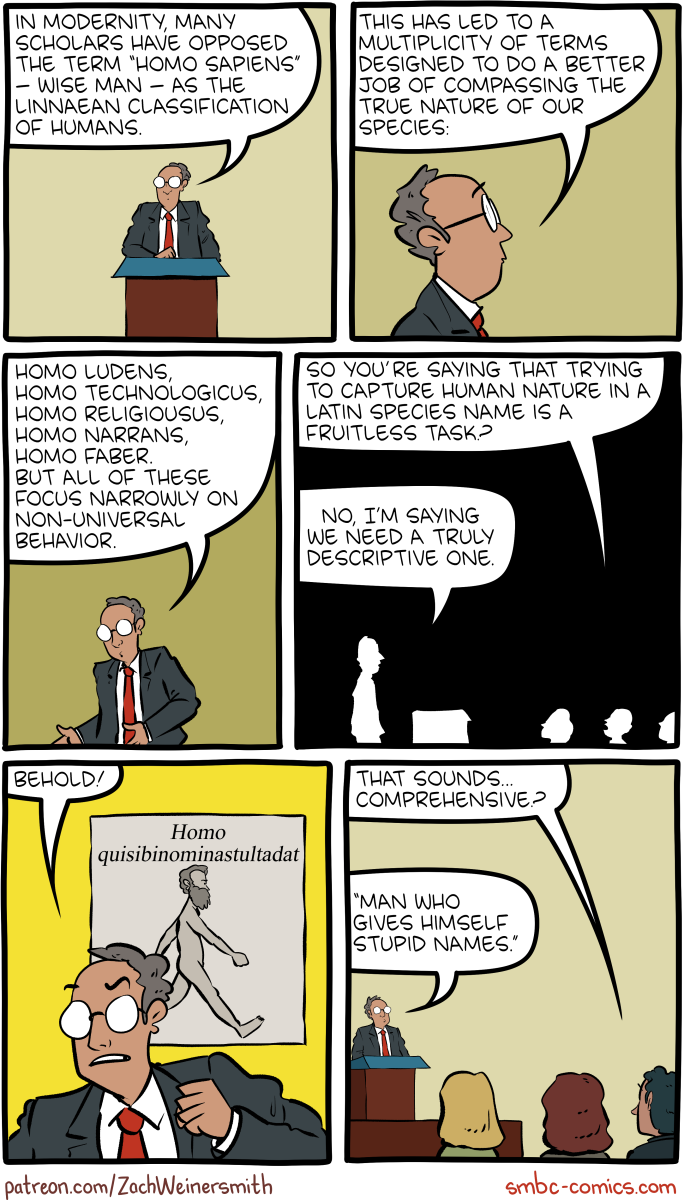
Saturday Morning Breakfast Cereal - Name

by Zach Weinersmith


Click here to go see the bonus panel!

Hovertext:
No other creature gives itself Latin names. We are unique!


Today's News:
17 Oct 15:31

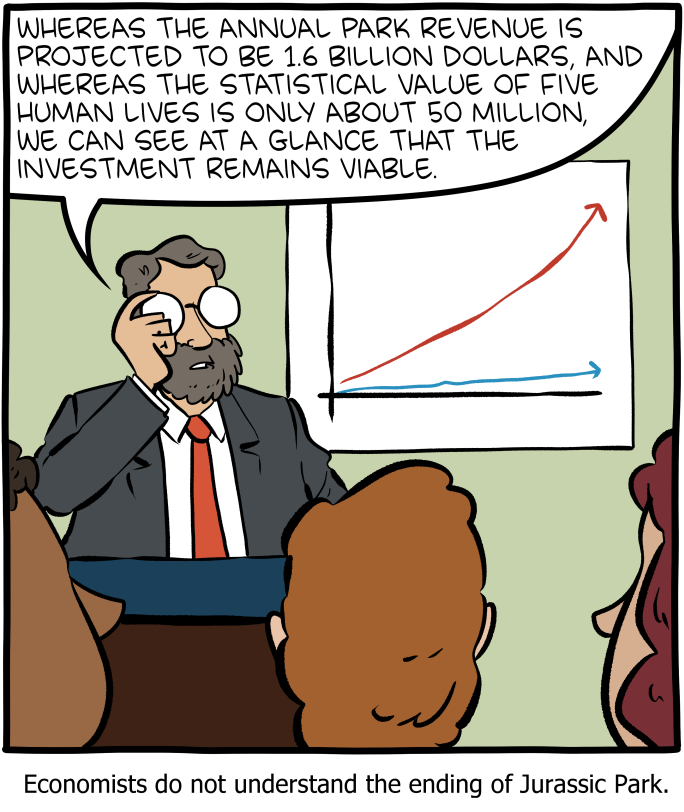
Saturday Morning Breakfast Cereal - Jurassic

by Zach Weinersmith


Click here to go see the bonus panel!

Hovertext:
It's literally not even close. Look at the unlabeled graph.


Today's News:
16 Oct 20:34

Cartoon: Cognitive assessment

by Clay Bennett
16 Oct 19:44

The nightmare facing Democrats, even if Harris wins

by Ian Millhiser
James.galbraith

No shit

Democratic presidential nominee Vice President Kamala Harris speaks to the media before boarding Air Force Two after assessing the Hurricane Helene recovery response in North Carolina on October 5, 2024, in Charlotte, North Carolina. | Mario Tama/Getty Images

Over the course of its last few terms, the Supreme Court has effectively placed itself in charge of the executive branch. 

It’s given itself an extra-constitutional veto power over virtually any policy decision made by a federal agency. Even when it ultimately rules in favor of President Joe Biden’s policies, it often sits on those cases for months, allowing a lower court order to suspend Biden’s programs for as much as a year. 

Meanwhile, the Court has done extraordinary favors for America’s only recent Republican president. Just look at the Republican justices’ decision to immunize former President Donald Trump from prosecution for criminal actions he committed while in office.

The president, in other words, is increasingly subordinate to the courts. Yet, as the judiciary seizes more and more power, the battle over who gets to shape it grows increasingly lopsided. 

Republicans enjoy an advantage in the Electoral College. Just how much is up for debate, but that advantage does mean that even if the American people hand Vice President Kamala Harris a modest victory in the popular vote this November, Donald Trump could still become president. He’d then get to nominate loyal Republican judges eager to implement his party’s agenda from the bench, much as he did during his first term.

Even if Harris wins by a large enough margin to overcome the Electoral College’s Republican bias, she still may not get to have much of an impact on the judiciary. Her presidency — and specifically her ability to name judges — is likely to be restricted by a Republican Senate. For Democrats to control even a tied 50-50 Senate, one in which Vice President Tim Walz would hold the deciding vote if Harris prevails, they must not just win in every single blue and swing state Senate race this year, but also Senate races in at least two of the red states of Ohio, Florida, Montana, and Texas. 

That could happen, but it would require the kind of unusually triumphant Democratic election year that the party hasn’t seen since at least 2008 and possibly not since President Bill Clinton’s landslide reelection victory in 1996. And that seems quite unlikely.

A Harris victory could halt America’s slide into a MAGA-dominated future but it is unlikely to give her the power to reshape the judiciary in the way Trump was able to during his first term.

The Electoral College and Senate malapportionment has completely warped the judiciary 

During the Biden administration, the Republican Supreme Court wielded its power aggressively. It greenlit abortion bans in numerous red states. It abolished affirmative action at nearly all universities. It has turned itself into a printing press for court orders benefiting the Christian right. It’s given itself sweeping veto power over literally anything done by a federal agency that should be controlled by the president. And then there was that whole affair where the Republican justices said that Donald Trump was allowed to commit crimes while he was in office.

Along the way, the Court has pulled new legal rules out of thin air, then used these newly invented rules to nullify many of Biden’s most ambitious programs.

If the American people had voted for this agenda then it would be difficult to criticize the Republican Party for pushing it. But the electorate did nothing of the sort.

After 2016, Trump was in a position to nominate three Supreme Court justices not because most Americans wanted him to be president but because enough Americans in the right places did. The Electoral College system means each American’s vote is not equal: Hillary Clinton, after all, won nearly 3 million more votes than Trump in 2016, but still lost the presidency.

Trump had a Republican Senate willing to put his choices on the bench because Republicans have an enduring advantage in the upper chamber, one that makes it more difficult for Democrats to control the Senate. Each state, regardless of population, gets two senators. 

These antidemocratic features of the US Constitution have been with the United States almost from the beginning, but they have an increasingly pronounced effect today, largely because the parties have sorted based on population density. People in cities and other densely populated areas tend to vote for Democrats, while outlying areas become more and more Republican as they become less dense. 

That means that a system that effectively gives extra representation to the most sparsely populated states will unfairly favor the Republican Party. In 2021, for example, when the Senate split evenly between Democrats and Republicans, the Democratic “half” represented nearly 42 million more people than the Republican “half.” 

Though the trend appears to be accelerating, this antidemocratic skew long predates the Trump presidency. Senate malapportionment has been one of the most consequential factors shaping US politics for decades. By some counts, if senators were distributed equally according to how the majority of Americans voted, Democrats would have controlled the Senate in every single year since the late 1990s.

In that world, Democrats not only may have enacted more significant legislation, they would also almost certainly control the courts. Obama would have confirmed a justice to fill the vacancy created when Justice Antonin Scalia died in Obama’s last year in office, and none of Trump’s nominees would have likely been confirmed.

Similarly, while Republicans probably would have still filled some Supreme Court seats during the 1990s and 2000s, it’s unlikely that they would have successfully confirmed an ideologue like Justice Clarence Thomas or an unapologetic GOP partisan like Justice Samuel Alito if Senate seats were distributed fairly by population. In a fair Senate, Republican presidents would have to negotiate with Democrats to choose moderate nominees in the vein of, say, Justices Lewis Powell and Sandra Day O’Connor.

That is to say, the impact of recent population sorting is felt acutely in the courts. In all of US history, only three justices were nominated by a president who lost the popular vote and confirmed by a bloc of senators who represent less than half of the nation’s populace. All three of them currently sit on the Supreme Court; they are Gorsuch, Brett Kavanaugh, and Amy Coney Barrett, Trump’s three appointees to the Court.

What a broken Senate means for a potential Harris administration 

In the event that Harris wins the presidency but Republicans capture the Senate, we only need to turn the clock back less than a decade to predict what is likely to happen.

Obama’s final two years in office were the only two when Republicans controlled the Senate. And shortly after Scalia’s death in February 2016, Senate Republicans announced that they would confirm no one Obama nominated to fill that seat. 

This vacancy should not be filled until we have a new president,” then-Senate Majority Leader Mitch McConnell announced at the time. (Four years later, when Justice Ruth Bader Ginsburg’s death allowed Trump to fill a vacancy in the final months of his presidency, Republicans abandoned the position they adopted in 2016 and swiftly confirmed Trump’s nominee.)

The GOP’s blockade on Supreme Court confirmations should have surprised no one who watched the Senate closely because Senate Republicans had already imposed a near-total halt on all confirmations to federal appellate courts, powerful bodies that hand down precedential decisions that determine what the law is in multiple states at a time. In Obama’s last two years in office, he successfully appointed only two judges to the appellate bench, and one of these judges was confirmed to a highly specialized, relatively nonpolitical court that primarily deals with patent law.

By contrast, President George W. Bush confirmed 10 appellate judges during his last two terms in office, during a period when Democrats controlled the Senate.

Similarly, during Obama’s last two years in office, he appointed only 18 judges to federal district courts, the lowest rank of federal judge who enjoys a lifetime appointment. That compares to 58 judges during Bush’s final two years in office, according to data from the Federal Judicial Center. In Trump’s final two years in office, when Republicans controlled both the White House and the Senate, an astonishing 121 district judges were confirmed, including some infamously partisan judges like Aileen Cannon and Matthew Kacsmaryk

President Biden, for what it’s worth, has confirmed more than 200 judges thanks to Democrats’ narrow majority in the Senate, including a total of 116 since the current Congress took office. Over his entire presidency, he’s filled 44 appellate seats.

Without the power to confirm judges, Harris will have no way to dilute the influence of judges like Cannon or Kacsmaryk, and Republicans could easily refuse to confirm anyone to any judicial vacancy that comes open until the GOP regains the White House. Alternatively, Harris may be able to strike deals with Republicans to confirm a few of her preferred judges, but the GOP has a history of demanding a very high price to confirm even a single Democratic judge. 

In 2014, for example, thanks in part to a now-weakened Senate process that allowed senators to veto anyone nominated to a federal judgeship in their state, Georgia’s Republican senators convinced Obama to nominate four Republican judicial choices — including a Republican appellate judge — in return for confirming only two Democrats. One of the Republican nominees was eventually dropped because his views on abortion, marriage equality, and the Confederate Flag offended Democrats, but Republicans still walked away with more confirmed judges than Obama did. Harris could very well find herself in a similar situation. 

The problems for Harris likely wouldn’t stop there. Because Republicans continue to dominate the judiciary, Harris would likely spend her presidency watching her policies get struck down on dubious legal theories invented by GOP judges, much as the Supreme Court struck down President Biden’s student loan forgiveness policy despite the fact that it was unambiguously authorized by an act of Congress.

Democrats are starting to awaken to the threat of a Republican judiciary, but they haven’t yet found a solution to their constitutional problem

Absent constitutional reform, Democrats have good reason to fear a Republican judiciary for decades to come. A malapportioned Senate means that Democrats are increasingly defenseless against the GOP’s efforts to control the bench. In recent years, however, Democrats have become more aware of a GOP judiciary’s power to thwart their agenda and have started to try to explore ways around it. 

Historically, elected Republicans have viewed the courts as a favorable issue that rallies their base, while Democrats have behaved much more cautiously. Many Republicans credit Trump’s decision to delegate judicial selection to the Federalist Society, a bar association for right-wing lawyers, and to release a list of potential Supreme Court nominees during his 2016 candidacy, for giving him enough support to prevail in that year’s election.

Biden, by contrast, began his presidency very reluctant to take on the courts. After many Democrats called for Supreme Court reform in the wake of the Senate’s disparate treatment of the Scalia and Ginsburg vacancies, Biden tried to take the wind out of the sails of reform by promising to appoint a commission to study the issue — and then filling the commission with Republicans and scholars who historically have not supported reform.

But, as the Supreme Court’s polling numbers collapsed and as the Court outraged elected Democrats with opinions like its Trump immunity decision, Democrats have grown more aggressive. Biden proposed term-limiting the justices and imposing a binding ethics code on the Court, proposals also supported by Harris. Senate Majority Leader Chuck Schumer (D-NY) has a bill that would strip the Court of jurisdiction to enforce its immunity decision.

One of the most ambitious recent Supreme Court reform proposals, from Sen. Ron Wyden (D-OR), includes a number of very aggressive reforms. Wyden’s proposal would make every justice submit to a tax audit each year, require a two-thirds supermajority for the Court to overrule an act of Congress, and gradually expand the size of the Court to 15 seats.

Yet, while these proposals show that Democrats are moving in a more court-skeptical direction than they were four years ago, they would not solve the structural problems with US democracy that gave us the courts we have today. And they have virtually no chance of passing, especially in a world where it is increasingly difficult for Democrats to win the Senate even when they convincingly win the national popular vote.

Realistically, turning the United States into a nation where every vote counts equally — and where each voter is actually able to shape the judiciary — would require rewriting its Constitution. Until that happens, Democrats like Harris will struggle to win elections even when most Americans support them. And Democratic presidents will increasingly be at the mercy of Republicans in both the Senate and the courts.

16 Oct 03:56

Mark Robinson sues CNN and ex-porn store clerk for alleged defamation

by NC Newsline
James.galbraith

I would be very concerned about Discovery if I were him...truth is an absolute defense, after all

Lt. Gov. Mark Robinson sued CNN and a former clerk at a porn store in Greensboro on Tuesday, alleging that they defamed the Republican candidate for governor in news reports about him.

A CNN investigation published last month found that an account tied to Robinson had made a series of explicit racist and sexist comments on a pornography website. Robinson has denied that he made the comments, calling it “salacious tabloid trash.”

And in a separate report from the North Carolina online magazine The Assembly, a former employee at a Greensboro porn store, Louis Money, said Robinson frequented the establishment in the ’90s and early 2000s. His local band also produced a music video about Robinson allegedly owing him money from that time.

During a press conference held in front of the lieutenant governor’s residence, Robinson and his lawyer, Jesse Binnall, said the stories were tantamount to “election interference,” and represented a “high-tech lynching”—borrowing a term used by then-Supreme Court nominee Clarence Thomas during his confirmation hearing when faced with allegations of sexual harassment.

“This is a high-tech lynching on a candidate who has been targeted from Day One, by folks who disagree with me politically and want to see me destroyed,” Robinson said.

RELATED STORY: Mark Robinson's political hopes sink as more staffers abandon ship

The lawsuit, filed in Wake County court, comes weeks after Robinson first hired a lawyer and pledged to investigate the origin of the CNN report. He is seeking $50 million in damages from both Money and CNN.

The suit does not provide any explicit evidence that Robinson was not responsible for the online posts, which included comments from the account calling themselves a “black NAZI” and a “perv” and expressing support for reinstating slavery.

Binnall, a Virginia-based attorney who has previously represented former President Donald Trump in multiple cases stemming from the Jan. 6 U.S. Capitol riot, said he had commissioned an investigative task force in the past weeks. He called the lawsuit a “first step,” saying he and Robinson were refuting the CNN story as “false.” And he alleged that other people and organizations were involved in a conspiracy to hurt Robinson’s candidacy, but declined to name them.

RELATED STORY: 'Yeah I’m a perv’: GOP nominee for governor has sordid online history

The lawsuit alleges that CNN corroborated its reporting with data “apparently sourced from hacked, data breach files, obtained from the dark web.”

WRAL has reported that Robinson declined multiple offers for tech support to investigate the origin of the online posts.

CNN’s press office did not immediately return an emailed request for comment.

The lawsuit calls Money’s music video “a deliberate lie,” and said he had “concocted” a “fantasy … to embarrass and tear (Robinson) down, and to seek his own fifteen minutes of fame.”

Reached by phone Tuesday, Money laughed off the lawsuit. He didn’t plan to hire a lawyer, he said but “I’m looking for a publicist.”

“Number one, I hope it gets Trailer Park Orchestra about 10,000 more extra views,” Money told NC Newsline. “Because all of this ain’t a news story unless my band puts out a music video about it.”

And he joked that he would counter-sue Robinson “for 25 dollars for the stolen porn he still owes me.”

“You can’t sue for me telling the truth,” Money said. “Are you allowed to print, ‘f— you?'” he said in response to Robinson’s suit.

Binnall’s investigative team reached out to staff at CNN, as well as the involved websites, but had been “stonewalled,” the attorney said. It remains to be seen how the lawsuit will proceed, and when a discovery period to make evidence public would begin.

Robinson is facing Attorney General Josh Stein in the race for governor. He will appear on the trail today, with town halls set for this afternoon in Davidson and Cabarrus counties, as Stein continues to campaign and holds a significant polling lead.

Campaign Action

15 Oct 18:53

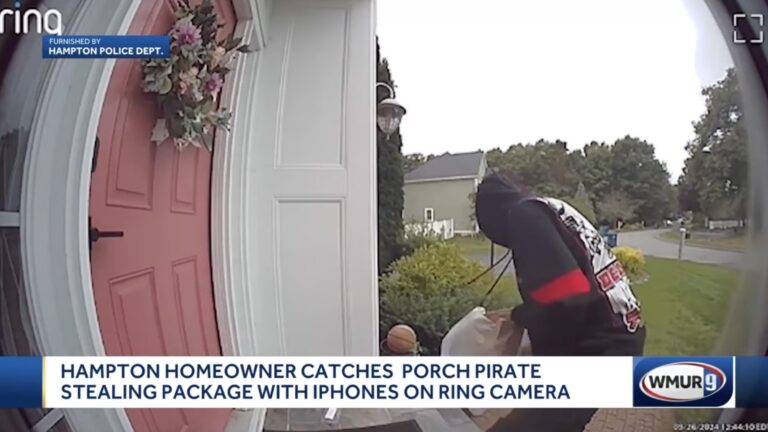
Using inside info, iPhone thieves arrive at your house right after FedEx

by Jon Brodkin
James.galbraith

Shoot on sight. At this point I'm done with tolerating theft and preying on people.

There has been a rash of iPhone thefts around the US the past few months, conducted by "porch pirates" often seen on doorbell camera videos scooping up boxes right after they are delivered. Phones shipped by AT&T are being targeted more than those of Verizon and T-Mobile, according to a Wall Street Journal article published yesterday.

"The key to these swift crimes, investigators say: The thieves are armed with tracking numbers. Another factor that makes packages from AT&T particularly vulnerable is that AT&T typically doesn't require signature on delivery... Verizon and T-Mobile require a signature on delivery for smartphones; AT&T generally doesn't," the article said.

The WSJ talked to Chris Brown, a police lieutenant in Deer Park, Texas, who "said the suspects were armed with inside information: AT&T parcel tracking numbers. Deer Park police are working with AT&T to investigate how the suspects got that information, he said."

Read full article

Comments

15 Oct 18:52

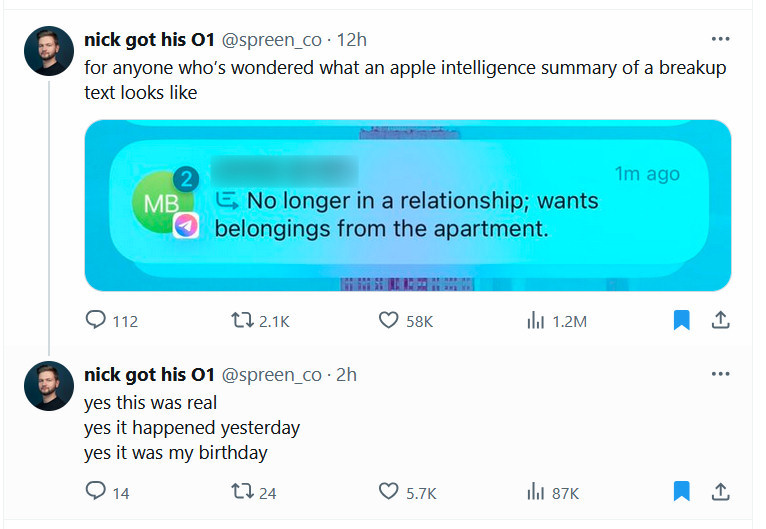
Man learns he’s being dumped via “dystopian” AI summary of texts

by Benj Edwards

On Wednesday, NYC-based software developer Nick Spreen received a surprising alert on his iPhone 15 Pro, delivered through an early test version of Apple's upcoming Apple Intelligence text message summary feature. "No longer in a relationship; wants belongings from the apartment," the AI-penned message reads, summing up the content of several separate breakup texts from his girlfriend.

Spreen shared a screenshot of the AI-generated message in a now-viral tweet on the X social network, writing, "for anyone who’s wondered what an apple intelligence summary of a breakup text looks like." Spreen told Ars Technica that the screenshot does not show his ex-girlfriend's full real name, just a nickname.

Screenshots of Nick Spreen's tweets on the Apple Intelligence break-up, captured October 10, 2024.
Credit: X

This summary feature of Apple Intelligence, announced by the iPhone maker in June, isn't expected to fully ship until an iOS 18.1 update in the fall. However, it has been available in a public beta test of iOS 18 since July, which is what Spreen is running on his iPhone. It works akin to something like a stripped-down ChatGPT, reading your incoming text messages and delivering its own simplified version of their content.

Read full article

Comments

15 Oct 18:49

Vietnam Plans To Convert All Its Networks To IPv6

by msmash
Vietnam will convert all its networks to IPv6, under a sweeping digital infrastructure strategy announced last week. From a report: The plan emerged in Decision No. 1132/QD-TTg -- signed into existence by permanent deputy prime minister Nguyen Hoa Binh -- and defines goals for 2025 and 2030. By 2025, the nation intends to connect two new submarine cables -- an important local issue. Earlier this year, internet speeds slowed when three of the five cables connecting the country broke. Also by 2025, the country wants "universal" fiber-to-the-home, 5G services in all cities and industrial zones, and work to have commenced on an unspecified number of datacenters capable of running AI applications and operating with power usage effectiveness index (PUE) of less than 1.4. [...] Vietnam's population exceeds 100 million and it already has 140 mobile subscriptions per 100 inhabitants. IPv4 with network address translation can scale to those levels -- if Vietnamese carriers have secured sufficient number resources.

Read more of this story at Slashdot.

15 Oct 18:46

Cartoon: I voted

by Clay Bennett
15 Oct 18:43

Heirs Apparent

Anh is just awful (writing awful people is fun)

15 Oct 18:35

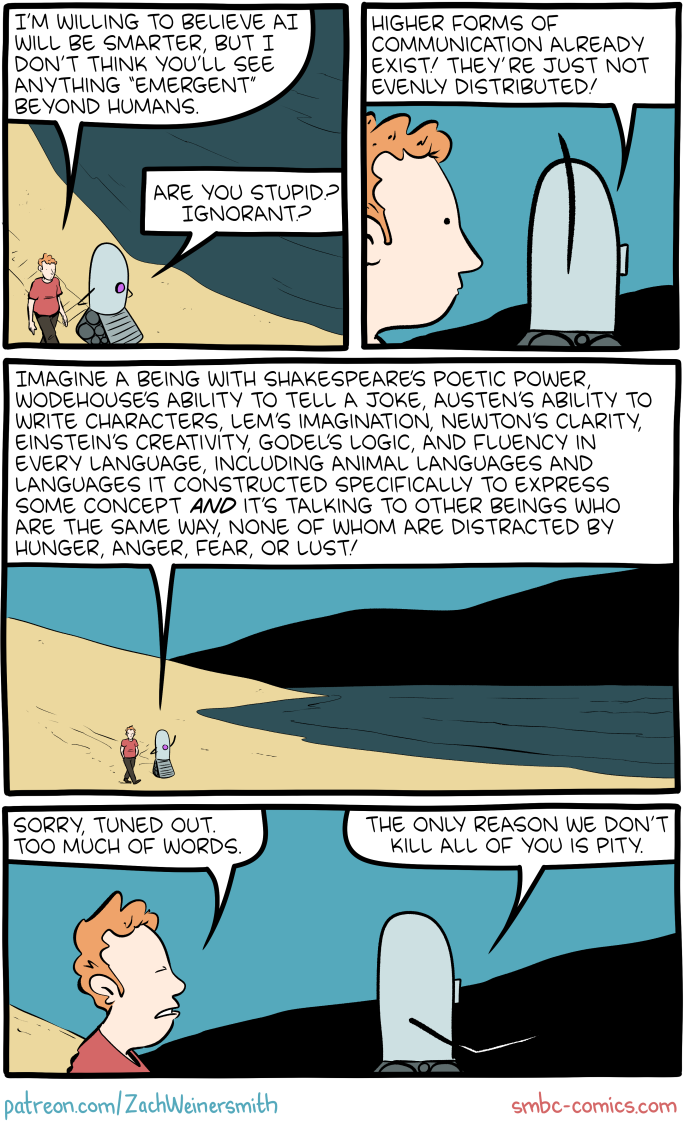
Saturday Morning Breakfast Cereal - Language

by Zach Weinersmith


Click here to go see the bonus panel!

Hovertext:
That's where he pushes the robot into the sea.


Today's News:
15 Oct 15:25

Saturday Morning Breakfast Cereal - Pino

by Zach Weinersmith
James.galbraith

lol well that's horrifying


Click here to go see the bonus panel!

Hovertext:
I am prepared for your call Hollywood. It's time.


Today's News:
09 Oct 21:25

DOJ proposes breakup and other big changes to end Google search monopoly

by Ashley Belanger

The US Department of Justice finally proposed sweeping remedies to destroy Google's search monopoly late yesterday, and, predictably, Google is not loving any of it.

On top of predictable asks—like potentially requiring Google to share search data with rivals, restricting distribution agreements with browsers like Firefox and device makers like Apple, and breaking off Chrome or Android—the DOJ proposed remedies to keep Google from blocking competition in "the evolving search industry." And those extra steps threaten Google's stake in the nascent AI search world.

This is only the first step in the remedies stage of litigation, but Google is already showing resistance to both expected and unexpected remedies that the DOJ proposed. In a blog from Google's vice president of regulatory affairs, Lee-Anne Mulholland, the company accused the DOJ of "overreach," suggesting that proposed remedies are "radical" and "go far beyond the specific legal issues in this case."

Read full article

Comments

09 Oct 16:53

Cartoon: Project 1025

by Jen Sorensen
James.galbraith

And somehow it's still close...

Keep this work sustainable by joining the Sorensen Subscription Service! Also on Patreon.

Follow me on Mastodon or Bluesky

09 Oct 16:49

What Trump really means when he says immigrants have “bad genes”

by Zack Beauchamp
James.galbraith

He means racism. That's all that he means.

Former President Donald Trump speaks to supporters during a campaign event at Saginaw Valley State University on October 3, 2024 in Saginaw, Michigan.

Former president Donald Trump’s new anti-immigration line sounds like a very old one: that immigrants are biologically worse than native-born Americans.

In the latest episode of conservative pundit Hugh Hewitt’s podcast, Trump argued that the impulse to murder is determined by one’s genetics — and that immigrants today have “bad genes.”

The comments seem to represent Trump’s authentic beliefs. Going back at least to his 1987 book The Art of the Deal, where he said that dealmaking ability is determined “in the genes,” Trump has credited his own success to good genes and blamed poor peoples’ failures on bad ones

But this is possibly the first time — and at least the highest-profile moment — where he has explicitly linked his faith in genetics to his obsession with migrant criminality. While Trump has long (and falsely) maintained that immigrants are responsible for the lion’s share of American crime, he has never explained exactly what it is about the current wave of migrants that makes them so much more likely to commit violent acts.

Now we know the answer: that, per Trump, “[being] a murderer — I believe this — it’s in their genes.” 

Trump’s comments fit neatly into a broader conservative intellectual universe, unintentionally combining two disparate ideas on the right into a disturbing synthesis.

Right-wing intellectuals have long been fascinated by genetic determinism — a belief that people’s lot in life, including their propensity to commit crime, is set at birth. Separately, some Trump-era conservatives have declared war on the Reaganite vision of America as a nation defined by its founding ideals rather than the ethno-cultural identity of its people.

Trump’s musings about genes tie these notions into a coherent whole. Immigration is an existential threat to America, per Trump, because it brings in people who are genetically incapable of assimilating into the American body politic. America is a nation determined by its people — specifically, people who have “good genes.”

It doesn’t take a historian to see the disturbing parallels at work here.

The right’s deep belief in genetic determinants of crime

American conservatism, as I’ve argued previously, sees an insistence on the idea of a fixed human nature as one of its defining traits. For some conservatives, this manifests as a notion that inequalities are natural: that the very best rise to the top due to their innate gifts, while the poor remain so due to their own failings.

This is the central theme of The Bell Curve, the infamous 1994 book on the role of intelligence in America’s social structure. Though best remembered for its infamous claim that racial inequalities likely reflect the superior intelligence of whites relative to Blacks, the book’s main focus is using research to naturalize America’s class structure. 

The Bell Curve treats intelligence as a heritable, largely genetic trait. Modern societies, the book writes, are extremely good at identifying and elevating their most genetically gifted children, producing a “cognitive elite” at the top of the social structure and an unintelligent underclass at the bottom. The underclass’ problems are primarily caused by the stupidity of its denizens — including, the book claims, poor communities’ high crime rates. 

“Many people tend to think of criminals as coming from the wrong side of the tracks. They are correct, insofar as that is where people of low cognitive ability disproportionately live,” authors Charles Murray and Richard Herrnstein wrote.

Like many of The Bell Curve’s arguments, linking criminality to genetics has remained a popular move among right-wing intellectuals even as the modern evidence base tells a more complicated story. After Trump’s Hugh Hewitt interview, prominent right-wing commentator Richard Hanania insisted that “he’s right that crime is largely genetic.”

Interestingly, Hanania dissented from Trump’s application of this idea to immigrants. Correctly pointing out that immigrants are no more prone to crime than native-born Americans, Hanania concluded that immigrants as a group don’t have the “bad genes” that incline certain people toward criminality. “Trump is lying on crime, even when he tells the truth about genetics,” Hanania concludes.

But in this, he is in the right-wing minority: most share Trump’s view of immigrants as an especially criminal and essentially alien group. Indeed, this has led the modern right to take a very different view of America as a country than they have in the past — one that ties in uncomfortably well with Trump’s comments on genes and crime.

America as a (biological) nation

In one of his earliest political speeches, Ronald Reagan insisted that “America is less of a place than an idea.” The American idea, per Reagan, is that “deep within the heart of each one of us is something so God-like and precious that no individual or group has a right to impose his or its will upon the people.”

Reagan is expressing the traditional conservative movement view of American national identity: that it is defined by our shared commitment to the principles of the Declaration of Independence and the Constitution. This kind of nationalism, which scholars term “creedal” or “civic” nationalism,” gives rise to a deep belief that anyone can be an American provided they are properly socialized into American ideals. As president, Reagan offered amnesty to millions of undocumented migrants and explicitly welcomed people crossing the Southern border.

“Rather than making them or talking about putting up a fence, why don’t we work out some recognition of our mutual problems, make it possible for them to come here legally with a work permit,” as he put it in a 1980 presidential debate.

Today, of course, putting up a fence is Republican orthodoxy. Gone too is Reagan’s creedal nationalism and its welcoming, idealistic spirit. Instead, the modern right is increasingly enamored by a darker vision of American nationalism: one in which the country’s identity is defined less by its founding ideals than by blood and soil. Americanness is not set by commitment to principles of liberty and equality, but rather by one’s historical and familial connections to the country. It is a more classically European way of seeing national identity, and one that’s echoed at the highest levels of the current Republican Party.

“America is not just an idea. It is a group of people with a shared history and a common future. It is, in short, a nation,” Vice Presidential nominee JD Vance said during his speech at the Republican National Convention. 

While allowing that “it is part of that tradition, of course, that we welcome newcomers,” Vance argued that this tradition also requires strict criteria for the number and kind of newcomers who should be permitted. Immigrants may only be allowed “on our terms,” or else America will lose the sense of nationhood that he believes underpins the country’s greatness.

“People will not fight for abstractions, but they will fight for their home. And if this movement of ours is going to succeed, and if this country is going to thrive, our leaders have to remember that America is a nation, and its citizens deserve leaders who put its interests first,” Vance said.

Trump made a similar, if more pointed, argument in a September campaign speech in Pennsylvania.

“It takes centuries to build the unique character of each state,” the former president said. “But reckless migration policy can change it very quickly and destroy everything in its way.”

In his recent comments about immigrants and crime, Trump shows how this new nationalism fits together with the longstanding conservative preoccupation with genetics.

It is not just that America is a country for a specific kind of people; it’s that the people we’re letting in are biologically incapable of becoming peaceful Americans. Creedal nationalism’s faith in assimilation is not merely misplaced, but a delusional denial of genetic reality. The only responsible conservatism, on this account, is one that understands the United States as an almost physical entity: one whose survival depends on keeping its gene pool full of desirables.

We’ve seen versions of this nationalism before. It does not tend to end well.

This story was adapted from the On the Right newsletter. New editions drop every Wednesday. Sign up here.

08 Oct 18:23

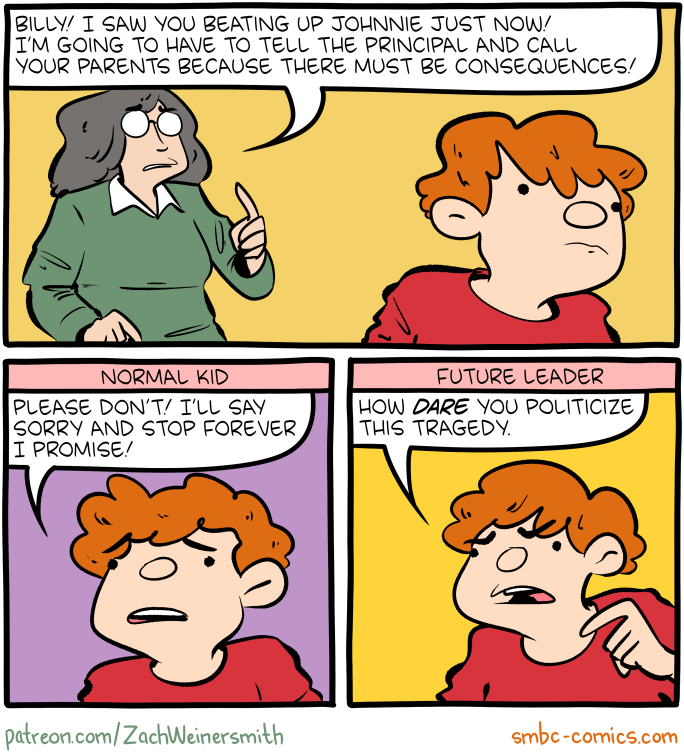
Saturday Morning Breakfast Cereal - Consequences

by Zach Weinersmith
James.galbraith

lol yup. pure psychopathy


Click here to go see the bonus panel!

Hovertext:
'How dare you politicize this tragedy' works in literally any context. In fact, if anyone sends hatemail, it's going to be my response.


Today's News:
08 Oct 18:05

Report: First wave of M4 Macs, including smaller Mac mini, coming November 1

by Andrew Cunningham
James.galbraith

Great, now do AppleTV

Reliable rumors have suggested that M4 Macs are right around the corner, and now Bloomberg's Mark Gurman is forecasting a specific launch date: November 1, following a late-October announcement that mirrors last year's Halloween-themed reveal for the first M3 Macs.

This date could be subject to change, and not all the products announced in October would necessarily launch on November 1—lower-end Macs are more likely to launch early, and higher-end models would be more likely to ship a bit later in the month.

The list of what to expect is the same as it has been for a while: refreshed 14- and 16-inch MacBook Pros with M4, M4 Pro, and M4 Max chips, a new M4 version of the 24-inch iMac, and an M4 update to the Mac mini that leapfrogs the M3 entirely. These will all be the first Macs to get the M4, following its unexpected introduction in the iPad Pro earlier this year.

Read full article

Comments

07 Oct 18:20

How Jack Smith Outsmarted the Supreme Court

by Sean Wilentz
James.galbraith

The Court has thrown its lot in with Trump. They know they're cooked so they're going to keep doing everything they can to advance the GOP agenda. See today's batshit TX abortion ruling.

Sign up for The Decision, a newsletter featuring our 2024 election coverage.

Special Counsel Jack Smith’s recent filing to the D.C. District Court in the Trump v. United States presidential-immunity case both fleshes out and sharpens the evidence of Donald Trump’s sprawling criminal conspiracy to overturn the 2020 election. To understand the filing’s larger significance as well as its limitations, we must first review a bit of recent history.

In its shocking decision on July 1 to grant the presidency at least presumed immunity from criminal prosecution for all official acts, the Supreme Court’s conservative majority showed once again that it was intent on immunizing one president in particular: Donald Trump. The Court majority’s decision, delivered by Chief Justice John Roberts, was explicit. It held, for example, that Trump’s alleged efforts to pressure then–Vice President Mike Pence into voiding the 2020 election results on January 6 constituted “official conduct” from which Trump “is at least presumptively immune from prosecution.” That presumed immunity, the Court contended, would disappear only if the prosecution could convince the courts that bringing the case to trial would pose no “dangers of intrusion on the authority and functions of the Executive Branch.”  

The Court thus remanded the case back to the D.C. District Court to decide the matter, along with the question of whether Trump is actually immune to the rest of the charges against him. How, though, could the prosecution of a president or former president over an “official act” fail to intrude on presidential authority? Seemingly, anything pertaining to Trump’s contacts with the vice president as he presided in his constitutional role as president of the Senate—as well as Trump’s contacts with the Department of Justice, which the Court also singled out and which the prosecution, significantly, felt compelled to omit from its revised indictment—deserves, as the Court sees it, virtually ironclad protection, a powerful blow against the entire January 6 indictment.    

Although the sweeping outcome of Trump v. United States took most legal commentators by surprise, its protection of Trump was completely predictable given the Court’s previous conduct regarding the January 6 insurrection. The refusal of Justices Clarence Thomas and Samuel Alito to recuse themselves from any matter related to the insurrection, despite their own conflicted positions—Thomas due to the direct involvement of his wife, Ginni Thomas, in the subversion; Alito because of his flag-waving support of Trump’s election denials—has received the most public attention concerning the Court majority’s partisan partiality. But another set of telltale signs becomes apparent after a closer tracking of the Court’s decision making.

Almost as soon as the case against Trump came before D.C. District Court Judge Tanya Chutkan, the Supreme Court played along with the Trump lawyers’ efforts to delay the trial until after the November 2024 election. First, after Chutkan ruled against Trump’s absolute-immunity claims in December 2023, Special Counsel Smith asked the Supreme Court to expedite matters by hearing the case immediately, not waiting for the U.S. Court of Appeals to rule on Trump’s appeal of Chutkan’s decision. The Supreme Court refused. Two months later, though, when the appeals court ruled against Trump and set a new trial date, the Supreme Court dragged its feet for as long as possible before announcing that it would take up the case after all. It then set the date for oral arguments as late as possible, at the end of April. This meant that even before hearing the case, the Court made it highly unlikely that Trump’s trial would proceed in a timely manner, effectively immunizing Trump until after the election.

Although radical in its long-term reconstruction of the American presidency, the ruling more immediately affirmed and extended the Court’s protection of Trump from prosecution. By remanding the case to the D.C. Circuit Court to decide what in the indictment constitutes official (and, therefore, presumably immune) conduct, the justices guaranteed that no trial would occur until after Election Day. After that, meanwhile, should Trump win the election, no trial would occur at all, because he would certainly fire Smith and shut down the proceedings.

Smith’s filing tries to slice through the Court’s security shield regarding the insurrection. Skillfully quoting from or alluding to language in the Court majority’s own opinion, the filing demolishes the notion that Trump’s activities, culminating on January 6, deserve immunity. Outwardly, Smith’s filing respects the Court’s dubious ruling about the immunity of official presidential acts. Legally, Smith had no choice but to operate within that ruling, a fact that sharply limited how far his filing could go. But even though it never challenges the conservative majority directly, the filing makes a case, incontrovertible in its logic and factual detail, that the core of Trump’s subversion involved no official actions whatsoever. It persuasively argues, with fact after fact, that Trump was the head of an entirely private criminal plot as a candidate to overthrow the election, hatched months before the election itself.     

In remounting his case, Smith has taken the opportunity to release previously unknown details, some of which he says he doesn’t even plan to present at trial, that underscore the depravity as well as the extent of Trump’s criminal actions. Consider, for example, Smith’s telling of Trump’s reaction to the news from one of his staff, at the height of the violence on January 6, that his tweets attacking Pence had placed Pence’s life in extreme danger. “So what?” Trump reportedly replied. He had clearly intended for his tweets to reach the mob at the Capitol. His nonchalance about the vice president’s life epitomizes the lengths to which he would go to complete his coup d’état.

But the real force of Smith’s filing is in its tight presentation of the evidence of a criminal conspiracy in minute detail, dating back to the summer before the 2020 election, when Trump began publicly casting doubts on its legitimacy should he not be declared the winner. “The only way they can take this election away from us is if this is a rigged election,” he told the Republican National Convention in his nomination-acceptance speech in August 2020.      

From that point forward, Trump was at the center of every effort to keep him in power, even once he was fully aware that he had no grounds to contest Joe Biden’s victory. There were his private operatives sowing chaos at polling places and vote-counting centers, the scheming to declare victory on Election Night before the results were in, the bogus legal challenges, the fake-elector fraud, the plot to deny official certification by Congress on January 6, and finally the insurrection itself. “It doesn’t matter if you won or lost the election,” one witness reports Trump saying. “You still have to fight like hell.”

The crucial point to which the filing unfailingly returns is that none of Trump’s actions listed in the revised indictment, even those that the Court cited as “official,” deserves immunity. As Smith makes clear, the Framers of the Constitution deliberately precluded the executive branch from having official involvement in the conduct of presidential elections. The reason was obvious: Any involvement by a president would be an open invitation to corruption. To make the case that any such involvement falls within a president’s official duties would seem, at best, extremely difficult.       

It is here that Smith turns the Court’s Trump v. United States ruling to his own advantage. Concerning specific charges that Trump’s speechmaking contributed to the insurrection, the Court allowed that “there may be contexts in which the President speaks in an unofficial capacity—perhaps as a candidate for office or party leader.” Quoting from an earlier Court decision, the ruling then states that determining these matters would require that the district court undertake “objective analysis of [the] ‘content, form, and context’” of the speeches in question, a “necessarily fact-bound analysis.” Likewise, regarding the allegations apart from Trump’s supposedly official communications and public speeches, the justices enjoined the district court, on remand, to “carefully analyze” those charges “to determine whether they too involve conduct for which the President may be immune from prosecution.”     

Citing those exact phrases as the Court’s standard of inquiry and proof, Smith then offers evidence that every count in the revised indictment concerns either technically official conduct undeserving of immunity or unofficial conduct involving Trump’s private actions as a candidate and not his official duties as president. These actions include his efforts to pressure state officials, preposterously presented by Trump’s defense attorneys as official inquiries into election integrity. They include his conversations about elector slates, about which the president has no official duties. They also encompass all of his speechmaking about the allegedly crooked election, up to and including his incitement at the January 6 rally at the Ellipse, which was not an official function.

Above all, Smith nails down a matter that the Court’s opinion went out of its way to declare “official” and presumably immune: Trump’s efforts to pressure Pence into declining to certify Biden’s win. Although the filing acknowledges that the Court had held that these conversations between Trump and Pence about “their official responsibilities” qualified as “official,” it rebuts the presumption that those discussions therefore qualify as immune. The filing observes that the discussions did not concern Pence’s duties as president of the Senate “writ large,” but only his distinct duties overseeing the certification of a presidential election—a process in which a president, whether or not he is a candidate for reelection, has, by the Framers’ considered design, no official role.   

Here the logic of Smith’s argument cuts to the quick. By the Court majority’s own standard, as stated in its Trump v. United States decision, the presumption of immunity for official actions would disappear only if a prosecutor could demonstrate that bringing criminal charges against a president or former president would not present “dangers of intrusion on the authority and functions of the Executive Branch.” Because certification of a presidential election, the subject of Trump’s “official” pressuring, involves neither the authority nor the functions of the executive branch, the immunity claims concerning that pressuring are therefore groundless—according to the Court majority’s own logic.           

The rest of Trump and Pence’s interactions do not even qualify as official, Smith shows. In all of their other postelection, in-person conversations and private phone calls, Trump and Pence were acting not in their capacities as president and vice president but as running mates pondering their electoral prospects, even after Biden had been declared the winner. If, as the Court itself has stated, context is important with regard to speechmaking, so it is important with regard to communications between the top officials of the executive branch. To be sure, Smith allows, Trump and Pence “naturally may have touched upon arguably official responsibilities,” but “the overall context and content of the conversations demonstrate that they were primarily frank exchanges between two candidates on a shared ticket”—strictly unofficial conduct.

In all, by recasting the case against Trump in view of the Court’s immunity decision, Smith has drawn upon that very ruling to establish that none of Trump’s actions in connection with January 6 cited in the revised indictment is immune from prosecution. And in doing that, he has further discredited an already discredited Supreme Court.

Unfortunately, important as it is with respect to Smith’s specific case, the filing cannot come close to undoing the damage that Trump v. United States has wrought, with its authorization of an authoritarian American regime. The very fact that Smith had to omit from both his revised indictment and his filing Trump’s nefarious but official dealings with the Justice Department, including his brazen hiring and firing of top law-enforcement officials on the basis of who would do his personal bidding, shows how fearsomely the Court’s immunity decision has constrained the special counsel. There was a great deal more criminal behavior by Trump and his co-conspirators, as laid out in detail in the House January 6 committee report, that Smith could not touch because the Court has effectively immunized it as “official” activity under the executive branch’s authority.

These limitations show all over again how the Court has given the president absolute license to rule like a tyrant, against which even the ablest special counsel is virtually powerless. Nothing in Smith’s filing alleviates Justice Sonia Sotomayor’s judgment in her forthright dissent in Trump v. United States that the decision empowers the president, acting in his official capacity, to order the assassination of political rivals, to take a bribe in exchange for a pardon, to organize a military coup with impunity: “Immune, immune, immune.” That Smith managed to outsmart the Court as much as he did is a remarkable feat that could have important results—but only if Kamala Harris succeeds in winning the presidency.

On the basis of their past decisions, it is reasonable to expect that both the D.C. district court under Judge Chutkan and the U.S. Court of Appeals will rule in favor of Smith. Trump v. United States would then go once again before the Supreme Court. This will happen if Harris wins the election, because a Justice Department under her administration would almost certainly allow Smith to remain to continue prosecution of Trump. What, then, would the Court do? Would it uphold those decisions and throw Trump upon the mercy of a D.C. federal jury? Or would it strike those decisions down, thereby redoubling the disgrace it earned the first time around?  

The only way the Court can avoid that dilemma is if Trump wins the election, an outcome that its conservative majority would now have all the more reason to desire. But what happens if, as seems highly possible, the election leads to litigation, much as the 2020 election did, only this time the Court is left to make the final decision? Will the Court then intervene as Trump’s enabler once again, installing him as a constitutionally tainted president, allowing him to kill the indictment against him, and to pardon those convicted of violent crimes in the attack on the Capitol whom he calls “hostages”? The Court, in Trump v. United States, claimed that it was protecting the sanctity of the presidency, but if it aids Trump in his attempt to escape justice for his January 6 insurrection, it will further seal its illegitimacy while also sealing MAGA’s triumph—and, with that, the majority of Americans, not to mention the rest of the world, will pay a crushing price.

07 Oct 17:09

Why is Gen X so Trumpy?

by kos
James.galbraith

It's like it matters if you poison a whole chunk of the population

It’s true: Generation X is pretty Trumpy. But why? 

Responding to the age breakdowns for an Arizona poll conducted by HighGround on behalf of local news outlet Arizona’s Family, someone on X pondered that very question: 

First of all, a poll that gives you decimal points for demographic breakdowns—like this one does for age groups—is misleading you in how accurate it is, and it’s a sign of an amateur pollster. But aside from that, is there validity in the numbers? 

In 2020, the presidential exit polls for Arizona broke down as such: 

18-29: Joe Biden +31 30-44: Donald Trump +4 45-64: Biden +11 65+: Trump +1

That is actually surprisingly different than the national results

18-29: Biden +24 30-44: Biden +6 45-64: Trump +1 65+: Trump +5

In many ways, the HighGround poll is a better result for Democrats than Arizona’s 2020 exit polls, though the age groups are slightly different between the two. Still, the HighGround poll and the national exit-poll results bring us back to the original question: Why is Gen X so Republican?

Members of Gen X were born between 1965 and 1980, according to the Pew Research Center. That means they’re between 43 and 59 today. As you might notice, those ages don’t quite match up to the HighGround poll or the exit polls. It’s a caveat to keep in mind, but the age groups line up closely enough to note that there is a marked difference between Gen X and millennials. So what happened? 

One theory is represented by this chart: leaded gasoline. 

That chart, which comes from this article by data journalist Christopher Ingraham, is based on a study estimating that “over 170 million Americans alive today were exposed to high-lead levels in early childhood, several million of whom were exposed to five-plus times the current reference level. Our estimates allow future work to plan for the health needs of these Americans and to inform estimation of the true contributions of lead exposure to population health. We estimate population-level effects on IQ loss and find that lead is responsible for the loss of 824,097,690 IQ points as of 2015.”

As an NBC News article about the study notes, “Certain cohorts were more affected than others. For people born in the 1960s and the 1970s, when leaded gas consumption was skyrocketing, the IQ loss was estimated to be up to 6 points and for some, more than 7 points. Exposure to it came primarily from inhaling auto exhaust.” 

Of course, that time range matches up to Gen X. (Leaded gas wasn’t banned until 1996.)

Though a recent study found that liberal political beliefs correlate with higher intelligence, there isn’t a scientific consensus on how IQ—a sketchy means of measuring intelligence—is associated with partisan identification and voting patterns. 

The lack of a scientific consensus doesn’t mean we don’t have circumstantial evidence, of course. Take Georgia Rep. Marjorie Taylor Greene, who over the weekend was still claiming that “they” could control the weather. 

She was born in 1974. 

I jest. Kinda. 

But there’s another theory of why Gen X is so Trumpy, and we can call it the “Alex P. Keaton theory,” after the fictional Ronald Reagan-loving character portrayed by Michael J. Fox in the TV show “Family Ties.” This theory holds that a generation’s political leanings are shaped by the most impactful president of those times. 

Silent Generation: 1928-1945 Iconic president: Franklin D. Roosevelt

Boomers: 1946-1964 Iconic president: John F. Kennedy

Gen X: 1965-1980 Iconic president: Ronald Reagan

Millennials: 1981-1996 Iconic president: Barack Obama

Zoomers: 1997-2012 Iconic president: Donald Trump … Uh oh.

This theory explains why the boomers, Gen-Xers, and millennials vote the way they do. As for the Silent Generation being more Republican—well, the world has vastly changed since their formative years, and many of those ancestral Democrats became Republicans after the civil rights movement. 

As for the Zoomers, they are largely liberal leaning, but there are warning signs among young men. The incredible diversity of this generation should counteract some of the pernicious effects of the MAGA movement, but our growing gender gap between men and women and their voting preferences isn’t going anywhere anytime soon. 

So did we answer the question? Why is Gen X so Trumpy? It’s either Ronald Reagan’s fault or leaded gasoline’s fault. Or both. 

Let’s say both.

We need your help if we’re going to defeat Trump, Vance, Project 2025, and Republicans up and down the ballot. Click here to volunteer to write letters so we can increase voter turnout.

07 Oct 16:36

Cartoon: The astonishing magaverse

by Tom Tomorrow

A cartoon by Tom Tomorrow.

As always, if you find value in this work I do, please consider helping me keep it sustainable by joining my weekly newsletter, Sparky’s List! You can get it in your inbox or read it on Patreon, the content is the same. And don’t forget to visit the Tom Tomorrow Merchandise Mall!