Shared posts

02 Nov 20:29

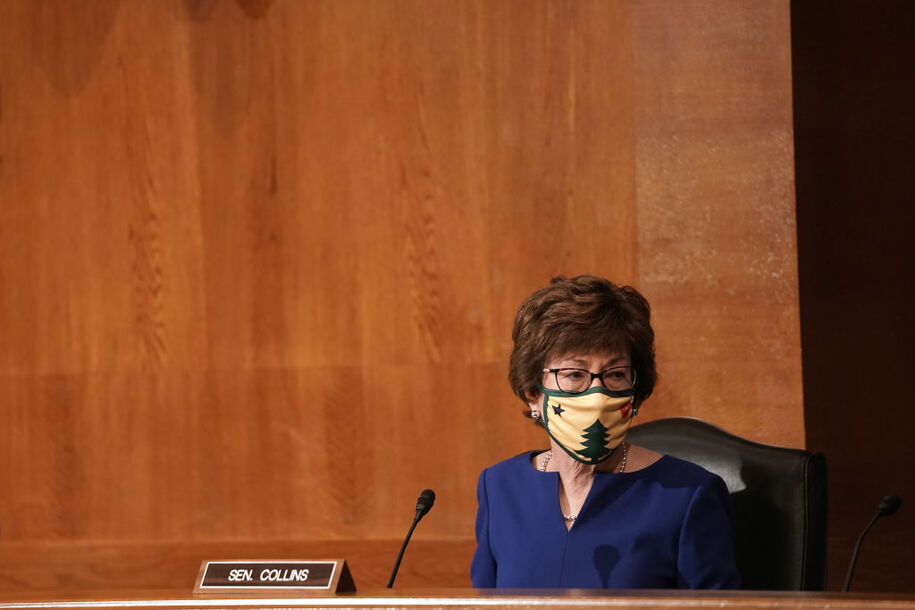
Collins closes out campaign badly, with a blown debate and shadows over her campaign funding

by Joan McCarter
James.galbraith

Hopefully Maine boots her out.

Sen. Susan Collins, the embattled Maine Republican, is not closing out the final week of her campaign with glory. Pretty much the opposite, in fact. In the final debate with Democrat Sara Gideon Wednesday night, Collins totally blew off the existence of systemic racism in Maine. Granted, Maine is pretty darned white, but it's not that white. There's a sizable population of refugees and immigrants in the state. So when Susan Collins, their senator, says "I do not believe systemic racism is a problem in the state of Maine," and "it's clear that in some parts of our country there is systemic racism or problems in police departments" but "we are very fortunate in the state of Maine because we have terrific members of law enforcement," she might seem just a little bit out of touch to those residents.

Especially compared to Gideon. "It doesn't matter how white our state is—it still exists. When we look at the incidences, for example, of the number of people of color who here in the state of Maine had a positive COVID infection rate and how outsized that was compared to the rest of the population. We see it in terms of access to education for people of color, access to health care, rates of poverty, rates of incarceration, and we do have to do something about it," Gideon said. That's the answer of someone living in the 21st century and not in a Republican bubble. And not someone who is being bankrolled by private equity firms. That's the other bad bit of press Collins has gained for herself this week.

Defeating Republicans will require all of us to get plugged in to GOTV efforts. On Mobilize, hundreds of Democratic campaigns are recruiting volunteers for all sorts of get-out-the-vote activities. Just click here, and search via zip code to find an event nearest you, and sign up to volunteer

ProPublica reports that she is the "No. 1 Senate recipient of private equity donations." Which isn't a good look. It's even worse when her work on the 2017 GOP Tax Scam is reviewed. Collins, trying to justify what was going to be her total capitulation in voting for the bill, offered an amendment the day before the vote to expand a child care tax credit, paid for by ending a tax break for the private equity industry. Within hours, though, she backed down and withdrew the amendment. "Her retreat was a significant victory for Senate Majority Leader Mitch McConnell," ProPublica reports. "Collins put aside her opposition and voted for the bill, which passed 51-49." Her decision to yank the amendment, and how the private equity industry prevailed, has remained a mystery.

But now we have a clue: the more than half a million dollars she's received from the private equity industry in this cycle for her reelection. There's also the $2 million Steve Schwarzman, the billionaire chairman and chief executive of the private equity giant Blackstone, has given to one of the Collins Super PACs as well as the $20 million he's giving to another Super PAC supporting Collins and other Republican Senate candidates. Tax experts told ProPublica that Collins amendment probably would have cost Schwarzman tens of millions in taxes. So lucky him that Collins changed her mind about that. Another donor to the Collins 1820 PAC is Ken Griffin, who's given $1.5 million. Griffin heads up the hedge fund giant Citadel. So his potential tax liability would have been significantly rosier without Collins' amendment to close the carried interest loophole.

Remember way back in 2017 when Collins was insisting that she was holding out her vote on the tax scam and getting ironclad promises from Mitch McConnell that he'd allow votes on protecting people's health care? And then he broke that promise when he got her vote? And how she insisted that it was still going to happen, that the Senate would have those healthcare votes in 2018? Somehow in retrospect, the millions she got from these hedge fund guys seem to be the promise that really secured her vote.

It's awfully rich for the person who said this in 2018 about a grassroots funding effort against her: "I consider this quid pro quo fundraising to be the equivalent of an attempt to bribe me to vote against Judge Kavanaugh." Please, Senator Collins, tell us all about bribes and quid pro quo. We'd really like to hear it.

30 Oct 23:28

As Trump moves to openly embrace homicidal herd immunity theories, health officials are running away

by Mark Sumner
James.galbraith

Because Trump assumes everyone constantly lies for money.

There’s a difference between the huge surge in COVID-19 cases that’s hitting the United States in the run up to Election Day, and those that are in the past. It’s not just a matter of the height of this peak in terms of the number of cases being racked up each day. It’s the breadth. The base. The way this is so broadly distributed across the nation.

With Donald Trump and his new coronavirus chief Scott Atlas pushing for herd immunity and Republicans across the nation joining in on a policy that is almost certain to kill not hundreds of thousands, but millions of Americans, some members of the Trump White House are becoming more vocal about speaking out in favor of what should be the non-controversial position of please stop murdering us. With days to go before voting ends, health officials are making it clear that Trump is on the wrong path.

And Trump is striking back … by spreading a conspiracy theory about doctors.

As the Associated Press reports, what’s happening now is very much not normal. In past crises, the White House has promoted statements from experts, elevated the voices of specialists, and looked to doctors and scientists for guidance in crafting policy. But Donald Trump set his policy before COVID-19 even reached the United States: downplay the threat, don’t provide testing, and attack governors who try to do anything effective.

Trump has chuckled over a plan to kidnap the governor Michigan, encouraged protests against governors who instituted social distancing guidelines, and gone after health officials like Dr. Anthony Fauci for trying to provide accurate information to the public.

Back in Michigan for another stop on his Superspreader Tour, Trump turned his attack directly on doctors and nurses, insisting that they are falsely reporting COVID-19 cases because they “get more money if someone dies from COVID.” It’s not true on any level, but it’s amazing to see Trump spreading even more distrust. Maybe he plans to open Trump Medical School when this is over. He already has experience running a university.

Trump starts out by making fun of the idea that “cases have gone up,” saying that it doesn’t matter because those cases could be a 14-year-old kid. Or a 20-year-old student. Because it’s not like any of them are going to have a bad outcome. “We’re making that beautiful turn,” says Trump … though he never says where we’re going. 

Then Trump moves on to accusing doctors of lying about cause of death. “You know, our doctors get more money if somebody dies from COVID. You know that, right? I mean, our doctors are very smart people, our hospitals … so what they do, is they say, ‘I’m sorry, but, you know, everybody dies of COVID.’” Trump then goes on to say that the reason that other nations are reporting fewer COVID-19 deaths is because their doctors don’t cheat like ours.

Since White House chief of staff Mark Meadows made it clear that White House policy was not to try and control the pandemic, it’s become more clear that the push for herd immunity has always been Trump’s policy. He’s just advocating it more openly. That includes the war on masks, which are being downplayed expressly because they are effective in reducing the spread of disease.

As Trump and Atlas go all in on allowing 2 million more Americans to die in order to prop up the stock market, health officials at the White House are shying away from the negligent homicide plan. Trump’s former favorite on the coronavirus task force, Dr. Deborah Birx, has been touring states to encourage the use of masks. Health and Human Services Assistant Secretary Brett Giroir has been doing a series of interviews to emphasize wearing masks and washing hands. And as Trump keeps insisting that the nation is rounding that curve—or that the pandemic is “over”—Dr. Anthony Fauci is warning that even if vaccines ship at the end of 2020, it’s going to be another year before life gets back to normal.

One thing is certain: It can’t get back to normal as long as Donald Trump is in the White House.

"Our doctors get more money if someone dies from Covid. You know that, right? I mean, our doctors are very smart people." -- Trump pushes a baseless conspiracy that greedy American health care workers are overcounting coronavirus deaths pic.twitter.com/fsajGTvvN3

— Aaron Rupar (@atrupar) October 30, 2020

30 Oct 22:13

North Dakota has the highest COVID-19 death rate and lowest mask-wearing. Go figure

by Laura Clawson
James.galbraith

Gee, it's like there's some causation here and not just correlation

Masks work. But thanks to Donald Trump politicizing them, many people reject masks and boost the spread of the coronavirus around the United States. We’re in a third surge that is about to swamp the previous two, disastrous ones, and many of the people in affected areas are not willing to change their behavior for their own safety or for public safety.

For instance, “North Dakota has the highest covid death rate per capita in the world right now,” the Institute for Health Metrics and Evaluation at the University of Washington’s Christopher Murray told The Washington Post, yet data suggests that less than 50% of people there wear masks. When Dr. Deborah Birx was in the state on Monday, she told reporters, “Over the last 24 hours, as we were here and we were in your grocery stores and in your restaurants and frankly, even in your hotels, this is the least use of masks that we have seen in retail establishments of any place we have been.”

An average of more than 800 people a day are dying of COVID-19 in the United States, but you’ve got people stomping around Florida protesting against masks, even burning them to grab some media attention, saying, “I don’t see this as a political thing. It’s about freedom.” The freedom to infect other people with a deadly virus, apparently. 

Masks work.

.@Maddow on Kansas counties: "Through mid-October, the new case rate in the no-mandate counties, the red counties, was double the rate of new cases in the counties with the mask mandate...In other words, this is as simple as science gets, masks work."https://t.co/Mpel0qkoFY

— MSNBC (@MSNBC) October 28, 2020

When we wear them.

This figure says it all. https://t.co/B6Yd9NKxpe pic.twitter.com/X1rsobTNAr

— Atul Gawande (@Atul_Gawande) October 23, 2020

It’s going to be a hard winter filled with death. But hey, according to the White House, Donald Trump has ended the pandemic.

30 Oct 21:42

These Drones Will Plant 40,000 Trees in a Month. By 2028, They'll Have Planted 1 Billion

by msmash
James.galbraith

That's fantastic

Earlier this month, on land north of Toronto that previously burned in a wildfire, drones hovered over fields and fired seed pods into the ground, planting native pine and spruce trees to help restore habitat for birds. From a report: Flash Forest, the Canadian startup behind the project, plans to use its technology to plant 40,000 trees in the area this month. By the end of the year, as it expands to other regions, it will plant hundreds of thousands of trees. By 2028, the startup aims to have planted a full 1 billion trees. The company, like a handful of other startups that are also using tree-planting drones, believes that technology can help the world reach ambitious goals to restore forests to stem biodiversity loss and fight climate change. The Intergovernmental Panel on Climate Change says that it's necessary to plant 1 billion hectares of trees -- a forest roughly the size of the entire United States -- to limit global warming to 1.5 degrees Celsius. Existing forests need to be protected while new trees are planted; right now, that isn't working well. "There are a lot of different attempts to tackle reforestation," says Flash Forest cofounder and chief strategy officer Angelique Ahlstrom. "But despite all of them, they're still failing, with a net loss of 7 billion trees every year." Drones don't address deforestation, which is arguably an even more critical issue than planting trees, since older trees can store much more carbon. But to restore forests that have already been lost, the drones can work more quickly and cheaply than humans planting with shovels. Flash Forest's tech can currently plant 10,000 to 20,000 seed pods a day; as the technology advances, a pair of pilots will be able to plant 100,000 trees in a day (by hand, someone might typically be able to plant around 1,500 trees in a day, Ahlstrom says.) The company aims to bring the cost down to 50 cents per tree, or around a fourth of the cost of some other tree restoration efforts. When it begins work at a site, the startup first sends mapping drones to survey the area, using software to identify the best places to plant based on the soil and existing plants. Next, a swarm of drones begins precisely dropping seed pods, packed in a proprietary mix that the company says encourages the seeds to germinate weeks before they otherwise would have. The seed pods are also designed to store moisture, so the seedlings can survive even with months of drought. In some areas, such as hilly terrain or in mangrove forests, the drones use a pneumatic firing device that shoots seed pods deeper into the soil.

Read more of this story at Slashdot.

30 Oct 21:42

Politics Podcast: There Just Isn’t Good Evidence That ‘Shy’ Trump Voters Exist

by Galen Druke and Nate Silver

This is the final(!) preelection installment of Model Talk on the FiveThirtyEight Politics podcast. Galen Druke talks to editor-in-chief Nate Silver about the latest polling shifts in key battleground states and whether there is any reason to believe that “shy Trump voters” will deliver an upset win for the president on Election Day. (The evidence suggests there isn’t.)

You can listen to the episode by clicking the “play” button in the audio player above or by downloading it in iTunes, the ESPN App or your favorite podcast platform. If you are new to podcasts, learn how to listen.

The FiveThirtyEight Politics podcast is recorded Mondays and Thursdays. Help new listeners discover the show by leaving us a rating and review on iTunes. Have a comment, question or suggestion for “good polling vs. bad polling”? Get in touch by email, on Twitter or in the comments.

30 Oct 21:19

DHS watchdog report again confirms former DHS Sec. Kirstjen Nielsen lied to Congress

by Gabe Ortiz
James.galbraith

Yep, perjury still needs to have consequences.

A report from the Department of Homeland Security (DHS) watchdog continues to confirm that Customs and Border Protection (CBP) lied when it turned away asylum-seekers by claiming officials couldn’t process these families because U.S. ports of entry were full, BuzzFeed News reports.

“We found two ports had stopped using available detention space,” even as families were waiting in Mexico, the DHS inspector general said in a report (which was public for a short time before it became no longer available). “Management at those ports said staffing was insufficient to monitor the rooms. However, other staff we interviewed disagreed with that assessment.” The report also continues to confirm former DHS Sec. Kirstjen Nielsen is a liar, but we already knew that. 

We have no more time to lose. Millions of Americans have voted, but many millions more still need to vote for Biden-Harris and the Democratic ticket. It's too late to write letters, so the most effective thing you can do right now is phonebank to battleground states. Click to sign up for a shift.

American Immigration Council counsel Aaron Reichlin-Melnick tweeted that Nielsen claimed under oath to Congress in late 2018 that she’d taken no actions to reduce CBP’s ability to process asylum-seekers at ports of entry. But Nielsen perjured herself (it wouldn’t be the first time), because the report says she’d earlier that year ordered policy intentionally designed to limit how many asylum-seekers can be processed per day.

“In May 2018, DHS and CBP leaders anticipated an increase in undocumented aliens seeking entry at the southern border,” the inspector general’s report said. “[A] few weeks later, then-Secretary Kirstjen Nielsen asked CBP for the estimated ‘number of [undocumented aliens] that would likely be turned away’ if all ports conducted ‘Queue Management.’ After learning that CBP could turn away 650 undocumented aliens every day, the Secretary instructed ports to implement Queue Management.”

Nielsen further claimed in a tweet the summer that if “you are seeking asylum for your family, there is no reason to break the law and illegally cross between ports of entry.” But it was Nielsen herself who was forcing families to do just that: “After waiting in Queue Management lines or being redirected to other ports, some asylum seekers and other undocumented aliens crossed the border illegally between ports of entry,” the inspector general’s report continued.

At @AlOtroLado_Org we've been yelling for years about @CBP's lies regarding capacity to process refugees @ the border. Their lies sentenced many migrants to die. Some survived but only after being beaten, raped, or kidnapped. Some of them were our clients. https://t.co/Trzo6XjiX1

— Nicole Elizabeth Ramos #BurnItAllDown (views mine) (@luzenlafrontera) October 30, 2020

Or the 2 unaccompanied teen boys lured from the youth shelter, kidnapped, tortured, & murdered in Zona Norte by members of organized crime. They're dead because they were waiting for their turn on a stupid fucking waitlist that DHS invented & the Mexican government accepted.

— Nicole Elizabeth Ramos #BurnItAllDown (views mine) (@luzenlafrontera) October 30, 2020

The news cycle is short but our memories are long. We will never forget that @DHSgov's lies have destroyed lives, that they must be brought to justice just as swiftly as those who killed, kidnapped, & trafficked our clients-- Because they knew it would happen & they did it anyway

— Nicole Elizabeth Ramos #BurnItAllDown (views mine) (@luzenlafrontera) October 30, 2020

The report also found that CBP unlawfully turned away asylum-seekers after they’d entered the country.

“Moreover, although asylum seekers legally must be processed once physically within the United States, we found CBP staff turned away asylum seekers at four ports after they had already entered the United States,” the report said. “For instance, our fieldwork indicated, CBP officers at San Ysidro and Tecate ports returned to Mexico asylum seekers who had not only crossed over the international boundary into the United States, but also had entered the ports’ buildings.”

As Ramos noted in her tweets, CBP has long been lying about its ability to process asylum-seekers. In just one example last year, an officer had told a pregnant woman, her husband, and their 3-year-old son, “We’re full” when they presented themselves at the Paso del Norte port of entry. But unbeknownst to the officials, Oregon U.S. Sen. Ron Wyden and his staffers were behind them, having visited at a Mexican shelter. Miraculously, the family was then allowed to pass through after Wyden intervened.

“I feel very confident that if the family had tried to present alone, they would not have been allowed in,” immigration attorney Taylor Levy told The Washington Post at the time. 

30 Oct 20:56

Seagate Says 20 TB HAMR Drives Will Arrive in December, 50 TB Capacities in 2026

by msmash
James.galbraith

goddamn

Seagate revealed several interesting points about its upcoming releases of next-generation hard drives during its quarterly earnings call this week. From a report: The company has disclosed a shift to a new generation of HDDs based on so-called heat-assisted magnetic recording (HAMR) technology. This technology is set to bring many improvements compared to the one currently used by Seagate's rivals like Western Digital. The rivaling company uses energy-assisted perpendicular magnetic recording (ePMR) and microwave-assisted (MAMR) technologies and it already has a 20 TB drive in the offering. Seagate announced that they will unveil a 20 TB HDD in December this year, with the use of HAMR technology, which will bring many improvements like better speed and more efficient disk read/write. It added, "Seagate will be the first to ship this crucial technology with a path to deliver 50-TB HAMR drives forecast in 2026."

Read more of this story at Slashdot.

30 Oct 19:56

Google’s Project Zero discloses Windows 0day that’s been under active exploit

by Dan Goodin
James.galbraith

oh for fucks sake

A stylized skull and crossbones made out of ones and zeroes.

Enlarge (credit: Getty Images)

Google’s project zero says that hackers have been actively exploiting a Windows zeroday that isn’t likely to be patched until almost two weeks from now.

In keeping with long-standing policy, Google’s vulnerability research group gave Microsoft a seven-day deadline to fix the security flaw because it’s under active exploit. Normally, Project Zero discloses vulnerabilities after 90 days or when a patch becomes available, whichever comes first.

CVE-2020-117087, as the vulnerability is tracked, allows attackers to escalate system privileges. Attackers were combining an exploit for it with a separate one targeting a recently fixed flaw in Chrome. The former allowed the latter to escape a security sandbox so the latter could execute code on vulnerable machines.

Read 9 remaining paragraphs | Comments

30 Oct 19:55

Texas lieutenant governor previews GOP lies of voter fraud ahead of possible electoral rout

by Kerry Eleveld
James.galbraith

This guy is such a shithead

Clearly anticipating a terrible night for Republicans, GOP Texas Lt. Gov. Dan Patrick told a radio show Thursday that if Democrats win the White House next Tuesday, they will have cheated.

“The Democrats have just decided this election, Mark, we don't have to pay attention to any laws. We're gonna use COVID as an excuse to steal the election, and that's what they're trying to do everywhere,” Patrick told radio host Mark Davis. “If the president loses Pennsylvania or North Carolina, Mark, or Florida, they'll lose it because they stole it.”

The Texas Tribune reported on Patrick's lie-fest, and it's surely just the beginning of a deluge of GOP disinformation that everyone from Trump on down through state-level officials will be spewing, particularly if Joe Biden flips a Sunbelt state like North Carolina, Georgia, or Florida. But singling out Pennsylvania—where Biden's been polling ahead of Trump by anywhere from five to nine points for the last few months—just shows the depths of Republicans’ depravity. For instance, The Economist forecast model presently gives Biden a 93% chance of winning Pennsylvania. I hasten to add that a Biden victory in the Keystone State isn't assured, but the suggestion that him winning there somehow suggests foul play is legit laughable.

Just to be clear: No credible reports of voter fraud have emerged in a single state so far. There is, however, a lot of evidence that Republicans are shaking in their boots, particularly in Texas where the total number of early votes has already surpassed all the votes counted in 2016.

In fact, here's how worried Republicans are—forget about Pennsylvania, North Carolina, and Florida; Trump's making GOTV calls in Texas!

Trump is making get out the vote robocalls in Texas:https://t.co/PrlJX2oYj4

— andrew kaczynski🤔 (@KFILE) October 30, 2020

"Texas, I need you to get out and vote," Trump says. Give it a listen—Trump is sounding a touch raspy and desperate.

Texas is the bedrock of the GOP electoral map. For decades, every Republican presidential candidate has taken its giant 38 electoral vote haul as a given without so much as a second thought. Until now.

30 Oct 18:19

Video shows cops dragging Black mother out of SUV, cops post picture saying her son was found ‘lost’

by Walter Einenkel
James.galbraith

Time to nuke FOP

On Monday, Oct. 26, Philadelphia police clashed with protesters. This was the direct result of shooting death of Walter Wallace by two police officers earlier in the day. Police had been called, along with medical professionals, to help 27-year-old Wallace, whose family says he suffered from mental health problems. Wallace was in possession of a knife and was killed in a hail of bullets while his mother tried to deescalate the situation. 

Since Monday, protesters have been in the streets and clashes with law enforcement have been violent. On Thursday, The Washington Post reports, the largest police union in the country posted a photo on their social media pages—a photo they’ve since taken down—showing a Black toddler clinging to the neck of a police woman. The social media post was accompanied by this truly condescending, but also shocking relating of context: “This child was lost during the violent riots in Philadelphia, wandering around barefoot in an area that was experiencing complete lawlessness, The only thing this Philadelphia police officer cared about in that moment was protecting this child.” It turns out that the actual context of this photo is almost the exact opposite of the police’s claims.

1/ This post by @GLFOP is a lie. My firm @MinceyFitzRoss represents this boy and his mother. This photo was taken moments after police attacked their vehicle, busted out the windows, ripped the mother from her car and assaulted her. pic.twitter.com/6dmDfoBe2B

— Riley H. Ross III (@AttorneyRoss) October 30, 2020

Riley H. Ross III, an attorney for the mother of that child, told the Post that this was “propaganda,” and that the child was literally only in that position, terrified, because of the police brutality and terrorizing that his mother and cousin had just received from the Philadelphia police department. According to Ross, just after midnight on Tuesday, 28-year-old Rickia Young, a home health aide, was borrowing her sister’s car to go and pick up her teenage nephew across town in Philadelphia. She put her 2-year-old in the back seat, hoping the drive would get her son to fall asleep. She later turned onto a street where police and protesters were clashing. 

Realizing her mistake, she attempted a three-point turn, at which point police swarmed the vehicle. Before we go further, here is a video of the ensuing madness on the part of the police.

Looks like Philly PD smashed the windows of a passing vehicle that was trying to turn around, then dragged the parents out and beat them on the ground in front of their terrified children. [@MrCheckpoint] pic.twitter.com/dNBf0aLGAf

— Chad Loder (@chadloder) October 28, 2020

The video, shot by 30-year-old Aapril Rice, was filmed from the rooftop of Rice’s home. In the video, dozens of riot-geared officers swarm the diagonally stopped car, smashing the windows all around with their batons. They rip the front door open and, while at least two officers continue swinging their batons, drag the driver out of the car and onto the concrete about 15 feet away from the vehicle.

The Philadelphia Inquirer first reported on the bogus social media posts by the Fraternal Order of Police, including one showing Young’s son and reading: “We are not your enemy. We are the Thin Blue Line. And WE ARE the only thing standing between Order and Anarchy.” The Fraternal Order of Police, like cowards, has not responded to inquiries from either the Post or the Inquirer about the video and their bullshit propaganda use of a 2-year-old child whose innocent mother they abused.

The photo the Fraternal Order of Police used was taken literally moments after police smashed and attacked this kid’s mother, yanked her out of the car, and separated the child from his mother for hours.

Ross and another attorney are now representing Young in a civil lawsuit. Ross told the Post that his client was temporarily detained after she was taken for medical treatment at the hospital “because her head was bleeding and most of her left side had been badly bruised when police threw her to the ground.” Young and her son were separated for hours. According to Ross’ partner, Kevin Mincey, the nephew she originally came to pick up was also injured by police, and the toddler was left with a large bump on his head.

Young was released with zero charges and took her son to the Children’s Hospital of Philadelphia, where he was treated for the head injury.

30 Oct 18:17

Elliot Blows It

Elliot...no?

30 Oct 18:17

Trump plans a final firehose blast of rallies just as new evidence shows he's spreading COVID-19

by Laura Clawson
James.galbraith

No shit

Donald Trump hasn’t just failed to slow the spread of the coronavirus in the United States. He has actively sped it along.

Trump’s ego demands campaign rallies, and his ego demands pretending COVID-19 is not a problem, and that has led to increasing virus rates in many of the places he’s held his crowded, mask-deficient events. A CNN investigation finds that 82% of the counties that hosted Trump rallies included in the analysis saw increased coronavirus rates. This follows a USA Today analysis that similarly found increasing COVID-19 rates following Trump rallies.

Pennsylvania is the tipping-point state, and Republicans know it. Joe Biden should win, but only if we can get out the Democratic vote. Click here to get involved in phonebanking, textbanking, and other crucial volunteer activities we need for the final days to deliver the Keystone State for Democrats.

Seventeen rallies. Fourteen counties with increases. 

CNN looked at the virus levels in the counties for four weeks before and four weeks after the rally, and compared them with state levels also.

In eight of the counties, infection rates had been declining until Trump came to town. In six, infection rates had been increasing, but sped up even more after Trump’s rally. Ten of the counties showed faster growth of infection rates in the county than in the state as a whole.

For instance, in the month before Trump’s Sept. 12 rally in Minden, Nevada, rates were falling, “But four weeks after the event, the rate of new cases in the county skyrocketed by 225%, outpacing the 74% increase the rest of the state experienced in the same time period.”

But Trump doesn’t care, because his ego is all that matters. For the final days of the campaign, he’s planning a marathon series of rallies: five in Pennsylvania, three in Michigan, two in North Carolina, one in Florida, one in Georgia, one in Iowa, and one in Wisconsin. 

30 Oct 18:14

Madame Tussauds Museum Puts Wax Figure of Trump in Dumpster: ‘Making Room for the Next President’

by Andy Towle

The world famous wax museum Madame Tussauds made a statement about the U.S. election, throwing the Donald Trump wax figure from its Berlin museum into a trash dumpster.

The museum posted a photo to its Instagram account, with the caption: “The US elections are imminent and we are making room for the next president.”

The post Madame Tussauds Museum Puts Wax Figure of Trump in Dumpster: ‘Making Room for the Next President’ appeared first on Towleroad Gay News.

30 Oct 18:14

If the Supreme Court decides the election, it will likely all come down to Brett Kavanaugh

by Ian Millhiser
James.galbraith

If it gets to the Court, we're fucked. Nearly half the court worked on Bush v Gore (for Bush). They'll take the election and run straight to Trump.

President Donald Trump puts his hand on Justice Brett Kavanaugh’s shoulder during his ceremonial swearing in in the East Room of the White House October 08, 2018 in Washington, DC.  | Chip Somodevilla/Getty Images

Welcome to the Bad Place.

Here’s how grim the future of voting rights looks for both large-D Democrats and small-d democrats: the pivotal vote on the Supreme Court — the justice who is likely to decide all closely divided voting rights disputes in the near future — is Brett Kavanaugh.

Brett Kavanaugh, who worked on the Republican legal team that convinced the Supreme Court to hand a presidential election to the GOP in Bush v. Gore (2000).

Brett Kavanaugh, who, after being credibly accused of attempting to sexually assault Christine Blasey Ford when they were in high school, denied the allegation then lashed out at Democrats who believed it disqualified him from serving on the nation’s highest court. “What goes around comes around,” an angry Kavanaugh told Senate Democrats, after he nearly lost his chance to serve on the Supreme Court.

And yet, since becoming a justice, Kavanaugh has staked out a position on voting rights that is less extreme than the views of many of his colleagues. That doesn’t mean that Kavanaugh is any kind of moderate — his most recent voting rights opinion leaves little doubt that he intends to banish to the sunken place longstanding doctrines protecting the right to vote. But Kavanaugh, at the very least, rejects some parts of the nihilistic approach shared by Justices Clarence Thomas, Samuel Alito, and Neil Gorsuch.

The Court’s newest member, Justice Amy Coney Barrett, does not have much of a record on voting rights. But her scholarly writings suggest that her approach to constitutional questions resembles that of Thomas and Gorsuch. Chief Justice John Roberts, who is himself frequently hostile to voting rights law, has written that he thinks his conservative colleagues are going too far in an important dispute over whether his Court can override state judges and state officials.

That leaves Kavanaugh in the middle. The difference between Kavanaugh and his three most radical colleagues was most visible in Andino v. Middleton, a recent decision that reinstated a South Carolina law requiring absentee voters to have another person sign their ballot as a witness. Though Kavanaugh joined the Court’s decision, he did not embrace the extreme position of Justices Thomas, Alito, and Gorsuch, who would have tossed out unwitnessed ballots that were cast while the state of South Carolina was bound by a court order requiring it to count these ballots.

More recently, Kavanaugh wrote, in a decision establishing that late-arriving ballots in Wisconsin should not be counted, that the Supreme Court should take unprecedented steps to overrule state judges and other state officials who try to make it easier to vote. But he also did not join a recent opinion by Alito that suggested that the Court may step in after the election to toss out ballots that, according to the Pennsylvania Supreme Court, should be counted.

Kavanaugh, in other words, appears to be torn between a belief that well-established rules governing election disputes should be abandoned, and a competing understanding that it is unfair to disenfranchise voters who followed the rules that were in place at the time when those voters cast their ballots.

The results of the 2020 election — if the race is close and winds up in the courts — could very well hinge on how Kavanaugh resolves this tension.

Kavanaugh is very hostile to voting rights — but doesn’t go as far as his most conservative colleagues

Early in October, Kavanaugh wrote a brief concurring opinion in Andino, the ballot witness case, which reads like a manifesto of indifference to whether voters are disenfranchised.

In that case, a lower court blocked South Carolina’s witness requirement on the theory that it imposed too high a burden on voters who may be reluctant to interact with potential witnesses during a pandemic. Kavanaugh’s opinion gave two reasons why he thought this requirement should be reinstated.

The first relied on Purcell v. Gonzales (2006), a case which — at least according to Kavanaugh — established that “federal courts ordinarily should not alter state election rules in the period close to an election.”

The second reason, meanwhile, called for judicial deference to state officials’ decisions regarding how to conduct an election during a pandemic. “The Constitution ‘principally entrusts the safety and the health of the people to the politically accountable officials of the States,’” Kavanaugh wrote. Therefore, “it follows that a State legislature’s decision either to keep or to make changes to election rules to address COVID–19 ordinarily ‘should not be subject to second-guessing by an ‘unelected federal judiciary,’ which lacks the background, competence, and expertise to assess public health and is not accountable to the people.’”

Thus, Kavanaugh’s primary message to federal judges is that they should stay out of the 2020 election. Let state legislatures decide how elections will be conducted in each state, for better or for worse. And don’t intervene even if those decisions are likely to disenfranchise voters.

Notably, however, Kavanaugh did not sign onto a more radical position pushed by Thomas, Alito, and Gorsuch. (Barrett was not on the Court when Andino was decided.)

The lower court in Andino blocked the witness requirement in mid-September, but the Supreme Court did not reinstate that requirement until early October. That means that there was a brief period when South Carolina was subject to a court order requiring it to count unwitnessed ballots. At least 20,000 votes were cast in this period, and it’s likely that some of these voters did not have a witness sign their ballot, because these voters believed that they could rely on a federal court order.

Thomas, Alito, and Gorsuch took the extraordinary position that voters who failed to anticipate that the Supreme Court would change the rules after their unwitnessed ballot was already cast should have their ballots tossed out.

Kavanaugh, however, did not agree with Thomas, Alito, and Gorsuch on this point — or, at least, he did not publicly state that he agrees with them.

The radical implications of Kavanaugh’s opinion on a Wisconsin voting case

Earlier this week, however, Kavanaugh handed down another opinion suggesting that, while he is not as hostile to voting rights as his most conservative colleagues, he still wants to make radical changes that would profoundly impact American democracy.

Concurring in Democratic National Committee v. Wisconsin State Legislature, a case that determined that ballots that arrive after Election Day in Wisconsin shall not be counted, Kavanaugh pointed to a provision of the Constitution that provides that “the rules for Presidential elections are established by the States ‘in such Manner as the Legislature thereof may direct.’”

For more than a century, the Supreme Court’s understood the word “legislature,” when read in this and similar contexts, to refer to whatever the valid lawmaking process is within that state. As the Court held most recently in Arizona State Legislature v. Arizona Independent Redistricting Commission (2015), the word “legislature” should be read “in accordance with the State’s prescriptions for lawmaking, which may include the referendum and the Governor’s veto.”

But Kavanaugh rejects this longstanding view. As a general rule, the Supreme Court of the United States has the final word on questions of federal law, but state supreme courts have the final say on questions of their own state’s law. Kavanaugh would abandon this foundational rule of American constitutional law, and hold that his Court may overrule a state supreme court if five or more justices believe that a state court departed “from the state election code enacted by the legislature.”

Kavanaugh’s position also has other implications for democracy. It doesn’t just mean that a state court may not be able to protect the right to vote (because a court is not a “legislature”). It could mean that a state governor cannot veto a state election law (because the governor is not the “legislature”). Or that a state constitution may not empower an independent commission to draw un-gerrymandered legislative maps (because the commission is not the “legislature”).

At the very least, Kavanaugh’s views suggest that he’s eager to make a lot of sweeping changes to the rules governing American elections — and that these changes are likely to make our elections much less democratic.

We don’t yet know how much chaos Kavanaugh is willing to insert into the 2020 election

As explained above, Kavanaugh appears to be largely indifferent to voting rights, and is willing to give state legislatures a great deal of leeway to disenfranchise voters. Yet he did seem to balk when his most conservative colleagues suggested that the Supreme Court should be allowed to change the rules in the middle of an election, and then toss out ballots that do not comply with these new rules.

Which brings us to two other ongoing cases that could potentially decide the outcome of the 2020 election.

On Wednesday night, the Supreme Court handed down orders in Republican Party of Pennsylvania v. Boockvar and Moore v. Circosta, which concern whether late-arriving ballots should be counted in Pennsylvania and North Carolina. In both cases, state officials — but not the state legislature — decided that ballots that are mailed before Election Day and that arrive during a brief window after the election should be counted. Republicans wanted the Supreme Court to overrule these state officials and toss out these ballots.

The justices did not tell the Republican Party that it would toss out these ballots — but they didn’t exactly tell the GOP “no,” either. The Court denied the GOP’s request to order, in advance of the election, that late-arriving ballots will not be counted. But an ominous opinion by Alito suggests that the Court might revisit this question after the election.

“I reluctantly conclude that there is simply not enough time at this late date to decide the question before the election,” Alito wrote in a concurring opinion in Republican Party, which was joined by Thomas and Gorsuch. Nevertheless, he added that the case “remains before us” and could be decided “under a shortened schedule” after the election takes place. (Barrett did not participate in these cases, but she could participate if they come up again after the election.)

Litigants who seek relief from the Supreme Court can sometimes make multiple requests from the justices. They might seek a temporary order blocking a lower court’s decision, for example, and then come back to the justices later and ask them to reverse a lower court decision outright. Neither Republican Party nor Moore are fully resolved. The GOP could very well ask the justices to toss out late-arriving ballots after the election has already taken place.

Voters, in other words, might mail their ballots close to Election Day, believing that they can rely on state officials and lower courts that have said that these ballots will be counted, only to have the Supreme Court change the rules after the election is over — and order these ballots tossed out.

We know that three justices — Thomas, Alito, and Gorsuch — are willing to disenfranchise voters who failed to predict that the Supreme Court would change the rules in the future. And we know that a fourth justice, Barrett, is philosophically similar to Thomas and Gorsuch.

What we don’t know is how Kavanaugh will approach the Pennsylvania and North Carolina cases if they come before the Court again. Kavanaugh shares many of Thomas, Alito, and Gorsuch’s views on election law. And we know that he shares many of their views about whether state officials outside of the legislature can take steps to make it easier for ballots to be counted — an issue that could arise again in the Pennsylvania and North Carolina cases.

But Kavanaugh hasn’t yet shown the same willingness to disenfranchise people who followed the rules — or, at least, who followed the rules that were in place when those voters cast their ballots.

The election might not land in the courts. It may be a Biden blowout, or a fair-and-square Trump win. But if it’s close, and if Pennsylvania or North Carolina is pivotal, these are the competing considerations that Kavanaugh, likely the swing vote, will be wrestling with.


Will you help keep Vox free for all?

The United States is in the middle of one of the most consequential presidential elections of our lifetimes. It’s essential that all Americans are able to access clear, concise information on what the outcome of the election could mean for their lives, and the lives of their families and communities. That is our mission at Vox. But our distinctive brand of explanatory journalism takes resources. Even when the economy and the news advertising market recovers, your support will be a critical part of sustaining our resource-intensive work. If you have already contributed, thank you. If you haven’t, please consider helping everyone understand this presidential election: Contribute today from as little as $3.
30 Oct 18:13

Donald Trump Jr.’s ugly rant on Fox makes a strong case against his father

by Greg Sargent
James.galbraith

No shit

The president's son says coronavirus deaths have dwindled to "almost nothing." Vote accordingly.
30 Oct 17:58

Pence absent from Covid-19 planning calls for more than a month

by Adam Cancryn and Dan Goldberg
James.galbraith

Why govern when you can campaign?


When Vice President Mike Pence first took charge of the White House’s coronavirus task force, among his earliest moves was establishing a standing call with all 50 governors aimed at closely coordinating the nation’s pandemic fight.

Yet as the U.S. confronts its biggest Covid-19 surge to date, Pence hasn’t attended one of those meetings in over a month.

Pence – who has been touting the Trump administration’s response effort on the campaign trail for weeks – is not expected to be on the line again Friday, when the group holds its first governors call since Oct. 13, said a person with knowledge of the plan. It’s a prolonged absence that represents just the latest sign of the task force’s diminished role in the face of the worsening public health crisis it was originally created to combat.

Once a driving force behind the White House’s coronavirus messaging, the group hasn’t held a collective press briefing in months. Inside the West Wing, task force members’ growing alarm over the virus’ resurgence has gone largely ignored. And among health officials on the front lines, there is mounting consensus that the federal government has little new aid to offer – leaving states to face the pandemic’s third and potentially worst wave increasingly on their own.

“There’s not any acknowledgment or appreciation of the severity of the surge,” said an official in one governor's office long frustrated with the federal response. “The stark reality that we’re facing is the White House – from top to bottom – has stopped governing and is only campaigning.”

The task force’s shrinking stature comes amid warnings that the nation is headed toward its darkest days since the beginning of the pandemic, as cases hit record highs and hospitals across several states struggle to deal with a fresh crush of Covid-19 patients.


The U.S. on Thursday recorded a record 88,452 cases, bringing its average over the past week to around 76,000 — the highest point so far this year. Hospitalizations are on the rise too, reaching numbers not seen since mid-August.

It’s a more expansive outbreak than during previous waves, when the coronavirus swamped the Northeast in April and tore through the South and West in July. On Thursday, cases were increasing across three dozen states.

Hospitals in states like Idaho, Utah, Texas and Wisconsin, which had been left relatively untouched by the pandemic in its early days, are now at risk of being overrun – with governors preparing to have the National Guard repurpose convention centers as field hospitals. In Montana, the nearly 300-bed Kalispell Regional Medical Center found itself so short-staffed earlier this month that it stopped quarantining employees exposed to Covid-19.

Indiana, meanwhile, has nearly 1,700 people in its hospitals and 470 patients in the ICU, the latter figure up 70 percent in the five weeks since Republican Gov. Eric Holcomb removed most coronavirus-related restrictions.

“This is the most worrisome of the three surges so far,” said Bruce Siegel, the CEO of America’s Essential Hospitals, which represents safety net providers. “This is the first time we’ve had such widespread outbreaks across America.”

A White House spokesperson defended the administration's pandemic response, adding that Pence regularly chairs task force meetings and updates Trump frequently on coronavirus-related issues.

"The task force proactively reaches out to, meets with, and has calls with jurisdictions across America to ensure they are receiving data, supplies, medication, and personnel," the spokesperson said.

The administration has also continued shipping supplemental testing supplies to states monthly, and authorized the National Guard's continued deployment to aid relief efforts -- albeit at a higher cost to some states than earlier this year.

But as the crisis mushrooms, state and local health officials say there’s no indication that the Trump administration’s response is growing with it. In media appearances and meetings, task force coordinator Deborah Birx and other officials have mostly offered the same advice – emphasizing the need for personal responsibility, mask wearing and continued avoidance of large gatherings.


Though the administration in September celebrated shipping millions of rapid tests around the country to slow the virus' transmission, cases have continued to spread uncontrolled. Roughly a dozen states have seen their positive test rates soar well above the 10 percent benchmark the task force initially targeted.

Perhaps most distressingly for cash-strapped states headed into their eighth month of the pandemic response, there is little promise of new funding to alleviate the cutbacks and furloughs that have hit health departments across the country. Congress has deadlocked for months over how much aid to send states – with the Trump administration balking at Democrats' push for hundreds of billions of dollars in funding. In the meantime, health officials say, they've seen no new efforts to find existing federal funds that could go toward reinforcing the state and local response.

“We still are having huge issues with money getting down to the local health departments, and that has continued to be the theme since the first Covid supplemental dollars were released,” Lori Tremmel Freeman, who heads the National Association of County and City Health Officials, said, adding that there is little federal communication about what dollars are still available and how to access them.

For many state leaders, the White House’s relative detachment from the crisis on the ground is unsurprising. Trump made clear early on that despite creating the task force, his administration would not coordinate a national response. Most states have long since set up their own supply lines and procedures instead. In recent months, the White House has only pivoted further away from leading a comprehensive effort – embracing a narrower approach that prioritizes protecting the elderly and vulnerable populations while otherwise pushing for the country’s broader reopening and pouring efforts into developing a vaccine.

Still, health officials say the contrast between the White House’s view and the pandemic reality is increasingly jarring – especially as task force members themselves voice dire worries about the surge.

In stops in Wyoming, Montana and North Dakota this past week, Birx has implored people to wear masks – scolding those in North Dakota this week for their “deeply unfortunate” lack of adherence to masking recommendations in a state where the governor has refused to mandate them. She’s traveled to dozens of universities to promote social distancing and urged more frequent testing to control on-campus outbreaks.

And over the last month, Birx began holding private calls with the heads of a handful of organizations representing state and territorial health officials to discuss their needs and offer guidance – meetings that one participant said reflect the depth of the current crisis, but also represent the kind of basic outreach that should have taken place in the pandemic’s first months.

Asked whether those meetings brought the promise of new resources or support, the participant was blunt: “No.”

Other task force members like HHS testing czar Brett Giroir and infectious disease expert Anthony Fauci have issued similarly grim outlooks of late, with Giroir saying Wednesday the U.S. has reached a “critical point.”

A status update on the pandemic sent nightly by Trump’s health department to state and local health officials, meanwhile, raised eyebrows after its reliably upbeat tone turned dour earlier this month.


“Mask skeptics remain, but the data is strong: wearing a mask decreases your exposure to the virus,” said its Oct. 13 email, which was later obtained by POLITICO, adding that the department was seeing a “very concerning” uptick in cases.

The next week, health officials characterized the nation as at a “very sobering” stage, stressing in an Oct. 19 email the need for Americans to “double down” on mitigation measures.

Yet for governors and public health officials on the front lines, those warnings have more often been frustrating than helpful – a reminder that the pandemic’s bleak outlook appears to be hitting home everywhere except at the top levels of the White House.

As Trump stumps through the final days of his re-election campaign, his consistent dismissals of the virus as a nuisance that will soon go away are drowning out any competing message that Birx and the rest of the task force try to send during small group meetings and local radio hits.

And as for Pence, just his presence on the campaign trail alone has dismayed public health officials, coming soon after five members of his inner circle contracted Covid-19.

“The communications coming out of the federal government continue to be confusing and, in some cases, a detriment to what locals are saying,” said Chrissie Juliano, executive director of the Big Cities Health Coalition, which represents metropolitan health departments. “It’s problematic when you see the vice president on the campaign trail. … Do as I say, not as I do: that’s a really complicated message.”

It’s a conflict not lost on members of the task force who have grown exasperated with the White House’s dismissive attitude of the virus down the campaign’s home stretch – and their own increasing irrelevance amid a pandemic surge.

“There is no task force. It’s not serving any role at all,” one Republican close to the task force said. “You’ve got a bunch of very thoughtful, intelligent people who want to contribute twiddling their thumbs.”

30 Oct 17:48

Nearly 90,000 cases in a day: Pandemic skyrockets in third, highest peak yet

by Beth Mole
James.galbraith

Doesn't seem to be turning a corner.

Some 250 Covid-19 isolation bays stand at the ready at the Austin Convention Center on August 07, 2020 in Austin, Texas. The cavernous facility was prepared for use as a field hospital for Covid-19 patients.

Enlarge / Some 250 Covid-19 isolation bays stand at the ready at the Austin Convention Center on August 07, 2020 in Austin, Texas. The cavernous facility was prepared for use as a field hospital for Covid-19 patients. (credit: Getty | John Moore)

The United States recorded nearly 90,000 new coronavirus cases Thursday, the largest single-day total yet in the pandemic.

The record-breaking day comes amid a steady and sharp climb in US cases. The country is experiencing the third and highest peak in cases, and it’s unclear how high the numbers will go. Today may well be another record-breaking day. The country’s seven-day rolling average of daily new cases is now over 76,000, another record in the pandemic.

With more than 88,400 cases Thursday, the US is expected to easily surpass 9 million cases total Friday. Deaths are likely to near 30,000.

Read 5 remaining paragraphs | Comments

30 Oct 17:47

Swiss security analyst behind a bombshell Hunter Biden folio turns out to be an AI-generated fake

by Mark Sumner
James.galbraith

And the GOP will continue to spread blatant lies

The story of the big Republican October surprise goes like this: Sometime in April last year, someone walked into a Delaware computer repair store and dropped off not one, but three waterlogged laptops. The store owner is legally blind, so he couldn’t identify the person. And his security camera was on the fritz, so no pictures. The store owner also failed to collect a name, phone number, address, or a payment for any of these laptops. However, he’s pretty sure that the computers belong to Hunter Biden, who lives in California, because one of them has a sticker for a local charity that has trained at least 2,000 people in the Wilmington area alone.

The store owner then looked at the contents of one of these laptops—a step that was not only unnecessary to fixing it, but is likely a violation of Delaware’s privacy laws. Then he copied everything on the hard drive. Then he called the FBI and Rudy Giuliani … though he won’t say in what order. Giuliani then began publishing documents through the New York Post after everyone else, including Fox News, turned down this fabulous offer of documents from someone who took a definitely unethical, and possibly illegal, deep dive into private information.

So how could this story get better? Well … how about if another version of it emerged a month earlier than the one that appeared in the Post, making many of the same claims about connections between Hunter Biden and China and offering up many of the same salacious stories? Only this version didn’t come from a mystery laptop dropped off by a mystery man. It comes from a Swiss security analyst who put together a folio of data that appears to be genuinely damning. Except … drop the “genuinely.” Because the Swiss analyst doesn’t exist. Which didn’t stop him from becoming a right-wing media star.

As NBC News reports, the 64-page “intelligence file” on Hunter Biden from a supposed Swiss security analyst named Marten Aspen has circulated widely around the right for weeks. Only Aspen doesn’t exist. Not only has no one at the company where Aspen was supposed to have worked ever heard of him, no one by that name lives in all of Switzerland. 

Then there’s the problem of Aspen’s photo. Because it’s not a photo. It’s an image created using an AI program that generates fake faces based on algorithms. And speaking of fake, no one seems to have noticed that this Swiss superspy’s name is actually just a version of the name of the British automaker Aston Martin. 

The fake folio from the fake analyst has not only been the basis of a far-right AM radio and social media blast, it’s been distributed by people associated with the Trump campaign. The document, known as the “Typhoon Investigations” report, first appeared on a website from economic adviser Albert Marko. The real author appears to be a blogger and economics professor named Christopher Balding. And it turns out there is an actual Chinese connection in all this … because Balding actually lives in Beijing. 

On the left, actual Christopher Balding. On the right, fake Marten Aspen.

But wait: Though Balding has admitted that he created Aspen and he gave the report to Marko, he still says that he’s not the actual author. Because there’s another secret author behind all this, one who has to remain anonymous because it would be too risky to reveal his identity. And certainly, Balding should be taken at his word. After all, it’s not like he’s been lying to everyone about everything for months.

The absolute fakeness of this information hasn’t stopped it from going wide in right-wing media circles. That includes being included on a podcast from Steve Bannon, where Balding appeared to promote this startling paper by the renowned expert, Guy I Made Up.

But honestly, is a fake folio from a fake analyst any less believable than what Giuliani has been pushing through the New York Post, or anything Donald Trump tried to insert into a presidential debate? Every word of the whole Hunter Biden smear seems to be as silly, and unlikely, as anything created by the second-most-interesting-man-in-the-world that Balding created.

It’s interesting that as the nature of the fake folio was becoming obvious, Tucker Carlson was busy declaring that his secret trove of devastating Hunter Biden documents had gone missing. A day later, when UPS made it clear the documents were not missing, Tucker Carlson suddenly did a 180-degree turn and decided it was time to stop picking on Hunter Biden.

Odds that Carlson had already booked Marten Aspen as a guest? 287%.

Want to create your own Swiss analyst/White House insider/person who is actually Q? If you’d like to see how uncanny these fake photos can be, visit This Person Does Not Exist for your very own fake person.

30 Oct 17:45

Saturday Morning Breakfast Cereal - Precision

by tech@thehiveworks.com
James.galbraith

god if only


Click here to go see the bonus panel!

Hovertext:
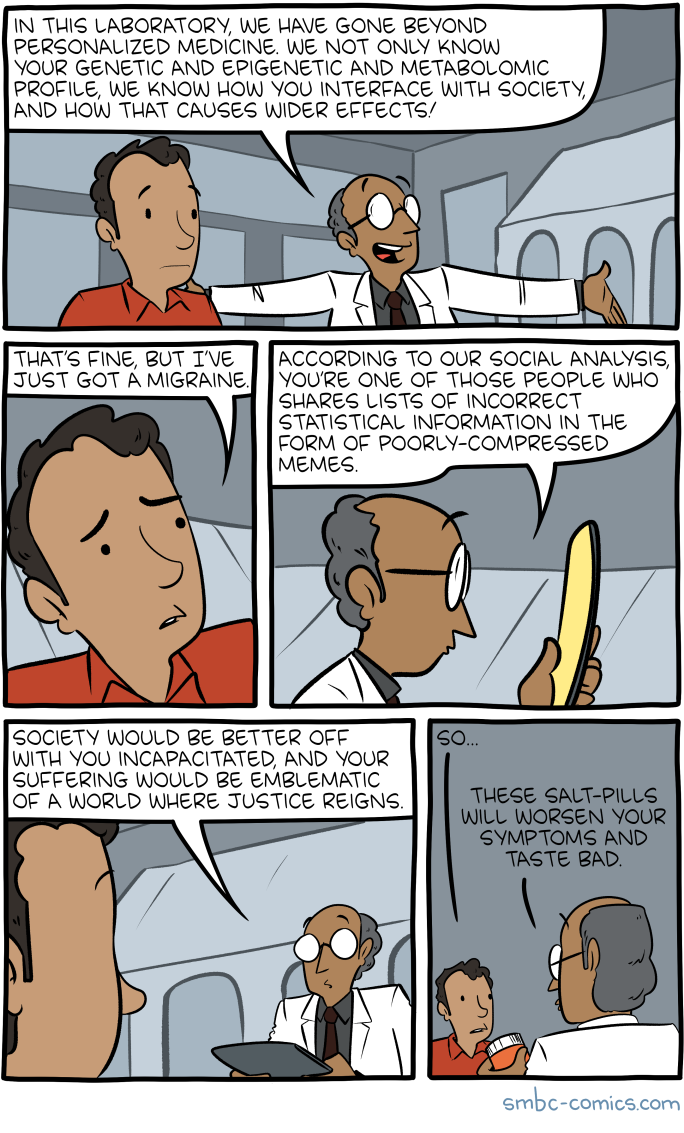
I could live with all the bigotry and ignorance, but must they have jpeg artifacts?


Today's News:
30 Oct 17:44

GOP Senator David Perdue Ditches Final Debate After Withering Attack by Jon Ossoff

by Andy Towle
James.galbraith

GOP cowardice

Jon Ossoff David Perdue

Democratic challenger Jon Ossoff has managed to bruise incumbent Senator David Perdue (R) so badly that he has withdrawn from the final debate before Tuesday’s election.

If you missed Ossoff’s viral attack on Perdue, catch up on it HERE.

The NYT reports: “A spokesman for Mr. Perdue confirmed that he would not be at the debate and said in a statement that the senator had better uses of his time. ‘As lovely as another debate listening to Jon Ossoff lie to the people of Georgia sounds, Senator Perdue will not be participating in the WSB-TV debate but will instead join the 45th president, Donald J. Trump, for a huge get-out-the-vote rally in Northwest Georgia,’ the spokesman, John Burke, said.”

The post GOP Senator David Perdue Ditches Final Debate After Withering Attack by Jon Ossoff appeared first on Towleroad Gay News.

30 Oct 17:33

Exclusive: Rashida Tlaib and AOC have a proposal for a fairer financial system — public banking

by Emily Stewart
Reps. Rashida Tlaib (left) and Alexandria Ocasio-Cortez speak during a town hall in Washington, DC, on September 11, 2019. | Zach Gibson/Getty Images

Rashida Tlaib and AOC are rolling out a plan to help create public banks across the country.

A public option, but for banking. That’s what Reps. Rashida Tlaib and Alexandria Ocasio-Cortez are proposing in a new bill unveiled on Friday.

The Public Banking Act, first shared with Vox, wouldn’t create those options by itself, but would foster the creation of public banks across the country by providing them a pathway to getting started, establishing an infrastructure for liquidity and credit facilities for them via the Federal Reserve, and setting up federal guidelines for them to be regulated. Essentially, it would make it easier for public banks to exist, and it would give some of them grant money to get started.

While it sounds a little wonky, the basic idea is to make it possible for state and local governments, local businesses, and people to do business with public banks, which theoretically would be more motivated to do public good and invest in their communities than private institutions, which are out for profit. One public bank exists in North Dakota, and there is a growing movement to create more of them across the country. California recently passed a law allowing cities and counties to create and sponsor public banks.

“Economic stability is really, truly tied in with access to this type of banking,” Tlaib said in an interview with Vox. “It’s to try to create stable neighborhoods and communities.”

The proposal lands in the midst of the Covid-19 pandemic, which has shed light on many inefficiencies in the American system, including banking. Take the Paycheck Protection Program, for example: It used the regular banking system as an intermediary, which ultimately meant that bigger businesses and those with preexisting relationships with those banks were prioritized over others. Some smaller businesses missed out, with many owners saying they were denied loans for even a few thousand dollars. The discrepancy hit Black-owned businesses particularly hard.

“Economic stability is really, truly tied in with access to this type of banking”

The intent of the proposal is to try to guarantee a more equitable recovery by providing an alternative to Wall Street banks for state and local governments, businesses, and ordinary people, and by ensuring such banks provide services to historically excluded and marginalized groups. The public banking bill also does double duty as a climate bill: It would prohibit public banks from investing in or doing business with the fossil fuel industry.

“Public banks are uniquely able to address the economic inequality and structural racism exacerbated by the banking industry’s discriminatory policies and predatory practices,” Ocasio-Cortez said in a statement. She said that she also believes public banks could facilitate the use of public resources to construct “a myriad of public goods,” including affordable housing and local renewable energy projects. “Public banks empower states and municipalities to establish new channels of public investment to help solve systemic crises.”

Other countries have various forms of public banking in operation and have different regulatory schemes set up for them than commercial banks do, said Rohan Grey, a law professor at Willamette University. But, he said, this proposal is particularly comprehensive and supportive.

Getting the bill passed, the regulatory scheme and grant program set up, and public banks chartered and operational in time to actually shape America’s recovery from the pandemic may not be possible on a broad scale, timing-wise. But the bill is a signal of what’s possibly to come.

If Democrats keep control of the House come 2021 and manage to flip the Senate and win the White House, they’ll be able to take some big legislative swings, including and perhaps especially on issues related to the economy. It is worth noting that both Tlaib and Ocasio-Cortez sit on the powerful House Financial Services Committee, which is chaired by Rep. Maxine Waters (D-CA).

“I look at economic justice and the issues around economy right now, that many of our working families, from farmers to the middle class to front-line essential workers, all of them know that, with the corporate bailouts, at some point it’s just hitting a wall where it doesn’t carry them along and they’re looking for options,” said Tlaib, who represents Michigan’s 13th Congressional District, the third-poorest congressional district in the country. “So I’m putting this on the table as an option.”

The Public Banking Act, briefly explained

To be clear, the Public Banking Act isn’t creating a federal public bank.

Instead, what it does is encourage and enable the creation of public banks across the US. It provides legitimacy to those who are pushing for more public banking, and it also includes regulators as key stakeholders who can support and provide guidance for how those banks should operate.

“It’s not that tomorrow you’re going to see 1,000 of these across the country; it’s still going to be a hill-by-hill, city-by-city battle,” Grey said.

There is a spectrum of services public banks would offer; many would be a lot like what commercial banks do, though different public banks would likely have different areas of emphasis. At least at the outset, some banks could serve as depository institutions for state and local governments, meaning those governments would put their money in the local public bank, not JPMorgan. Or they might partner with community banks or other institutions to help boost lending capacity and offer lower debt costs to the businesses and cities they lend to. They could also facilitate easier access to funds for state and local governments from the federal government or Federal Reserve.

“It’s basically a way to finance state and local investment that doesn’t go through Wall Street and doesn’t leave the community and turn into a windfall for shareholders,” said Porter McConnell, the campaign director of advocacy group Take On Wall Street. “This is more about community development.”

They could engage in retail banking as well. The legislation creates a framework for public banks to interact with postal banking, where the Postal Service serves as a bank, or FedAccounts, where everyone gets an account with the Federal Reserve through which they could receive direct payments from the government, for example, during an economic crisis.

“This bill is saying whatever you come up with, there’s a place for that to be recognized and be plugged in at the federal level,” Grey said.

Tlaib recalled hearing from her constituents when the $1,200 coronavirus stimulus checks went out this spring — people waiting days and weeks for direct deposits, or getting a check in the mail only to lose a substantial portion of it cashing it at the store down the street. “I’d rather them have access to a bank that’s for them, that’s not focused on for-profit schemes,” she said.

The Public Banking Act allows the Federal Reserve to charter and grant membership to public banks and creates a grant program for the Treasury secretary to provide seed money for public banks to be formed, capitalized, and developed. It also instructs the Fed to establish an incubator program for those who want to create a public bank, and it instructs the Securities and Exchange Commission (SEC) and Federal Deposit Insurance Corporation (FDIC) to establish regulatory schemes around them.

One other important element, McConnell explained, is how the legislation would change the FDIC’s reticent approach to public banks. Public banks need the FDIC to provide assurances that it will recognize them in accordance with the bond rating of the city or state they represent. For example, Los Angeles is a large municipality and has typically maintained a strong bond rating. McConnell said the FDIC issuing guidance that it recognizes the city’s — and the state’s — public banks as an AAA rating would send a clear direction to the state financial regulators that the public bank is considered low risk.

“The FDIC needs to be convinced not to discriminate against public banks, and they need to be convinced legislatively that they should be given the same facilities, the same rights, as private banks,” she said.

The bill would also provide a road map for the FDIC, which insures bank deposits of up to $250,000, to insure deposits for public banks, so people feel assured they won’t lose all their money by choosing to open an account with their state bank instead of, say, Wells Fargo.

The legislation has multiple co-sponsors in the House, including Reps. Chuy Garcia (D-IL), Pramila Jayapal (D-WA), Ayanna Pressley (D-MA), Bennie Thompson (D-MS), and Ilhan Omar (D-MN).

This isn’t a panacea for fixing banking in America, and whether this is the right approach can be debated. The government isn’t always perfect at providing services (see: the unemployment system, or Flint, Michigan). Columbia University law professor Katharina Pistor noted for Worth in 2019 that “the global and historical experience with public banking suggests that, just as in the private sector some public banks will achieve most of their goals most of the time, while others will underperform or even fail.” She also points out that there is a question of whether in the long run, public banks will be able to stay on mission.

Aaron Klein, an economic fellow at the Brookings Institution and former Treasury Department aide in the Obama administration, noted in an email to Vox that the Office of the Comptroller of the Currency (OCC) has historically been charged with chartering national banks in the US, not the Fed, meaning this is a fairly novel idea. He also noted what he saw as a potentially thorny part of the bill: It prohibits the Fed and Treasury from considering the financial health of an entity that controls or owns a bank in grant-making decisions.

“The lack of matching funds for federal grants and the specific prohibition against considering the financial health of the bank owner are also major changes. It has been a bad idea to give money or regulatory forbearance to failing banks,” he said.

Still, he commended the message at the heart of the proposal: “The problem that the bill responds to is sound — banking is too expensive for working people.”

Tlaib’s office clarified that the goal of the bill is to prevent the Fed and Treasury from discriminating against or rejecting public bank applications because the controlling entity — say a city or a state — has budget problems, not to force them to prop up banks that are failing. It is also worth noting that part of the point of proposal is to reach communities, specifically, that might not have the resources for matching funds, which would act as a barrier to entry.

When the public sector competes with the private sector, it’s a good thing

So here is the thing about private companies, including, yes, banks: The point of them is to make money, and that drives their decisions. It’s not necessarily evil (though sometimes it kind of is), but it’s just how they work. For example, many people in America don’t have access to affordable internet because it’s not lucrative for telecom companies to get it to them.

The idea behind public banking isn’t that Goldman Sachs, Wells Fargo, and Morgan Stanley go away; it’s that they have to compete with a government-owned entity — and one that’s a little fairer and more ethical in how it does business.

“The potential around taking private ownership out of banking, even just a little bit, is huge considering that we are depositors and we deposit $15 trillion in the commercial banking industry, and we get what? Redlined? Ethical violations in Malaysia? Fraud? Coal? Fossil fuels? All of these things that are driving us toward catastrophe,” said Emma Guttman-Slater, director of policy advocacy and field building at the Beneficial State Foundation, a nonprofit focused on making the banking system more equitable.

“The potential around taking private ownership out of banking, even just a little bit, is huge considering that we are depositors and we deposit $15 trillion in the commercial banking industry, and we get what?”

Public banks, as imagined in the Tlaib/Ocasio-Cortez proposal, would provide loans to small businesses and governments with lower interest rates and lower fees. They would potentially be better at avoiding the short-term thinking private institutions tend toward and be more willing to lend to projects with a slightly longer time horizon.

“There’s a disinclination to believe you can make money without making money hand over fist,” McConnell said. “A lot of this gets at market failures.”

In the US, North Dakota is the only state to have a public bank, which it established more than a century ago. And it works pretty well, as Will Peischel explained for Vox in 2019. The bank — which isn’t FDIC-insured — initially was supposed to protect the state’s farmers, but now it’s good for a lot of people:

Student loans are facilitated directly with BND, but other loans, called participation loans, go through a local financial institution — often with BND support. For example, if someone wants to take out a business loan for $20,000 with a local bank, BND would lend half of the money, $10,000, and minimize the risk for that bank. The result: The individual and local bank or credit union are supported by BND through a single transaction.

According to a study on public banks, BND had some $2 billion in active participation loans in 2014. BND can grant larger loans at a lower risk, which fosters a healthy financial ecosystem populated by a cluster of small North Dakota banks. The benefits of these loans are kept local, and the banks are protected from risk with BND support.

If this bill were to become law, it would open up a lot of doorways in public banking. It would make life a lot easier for those working on forming public banks in California after the state gave the rubber stamp allowing it in late 2019. In New York City, advocates have long been pushing for a public bank that would make equitable investments, foster growth and prosperity in the local community, and be more transparent about where money is going.

If Democrats take power, there could be a lot more where this came from

Beyond the ins and outs of this specific piece of legislation, there is a broader message: Democrats have a lot of ideas, and if they take power come January 2021, there’s a lot they can do.

Democrats have a lot of ideas, and if they take power come January 2021, there’s a lot they can do

Tlaib, for example, is a proponent of universal basic income and has proposed multiple pieces of related legislation. In response to the pandemic, she and Rep. Pramila Jayapal (D-WA) proposed the Automatic BOOST to Communities (ABC Act), which would provide a $2,000 payment to every American during the Covid-19 crisis, plus $1,000 monthly payments for a year after the outbreak ends.

“I hope we have a serious conversation about the [ABC Act] … that’s important,” Tlaib said. “Right now, people need us to put them first and to have a people’s bailout, and so I hope that we’re looking at reoccurring payments at the beginning of next year. I think there’s going to be a door to having a conversation about it, because right now, there’s a wall around the White House.”

The Public Banking Act is meant to complement ideas such as the ABC Act and postal banking. And, of course, it’s linked to the Green New Deal, not only because it would bar public banks from financing things that hurt the environment, but also because the idea is that public banks would play a major role in financing Green New Deal and climate-friendly projects.

There’s no guarantee moderates will get on board, but there’s a plethora of ideas for making the American economy and people’s financial lives better. Klein pointed to proposed legislation from Sens. Chris Van Hollen (D-MD) and Elizabeth Warren (D-MA) and Reps. Pressley and Garcia proposed in 2019 that would authorize the Fed to build a real-time payments system to get people money safely and fast.

How likely some of these proposals are to make it into law is an open question — and much of it hinges on Tuesday’s election. If former Vice President Joe Biden wins the White House and Democrats control both the House and the Senate come 2021, the talk around these ideas becomes a lot more serious.

Clarification, October 30: This article has been updated to clarify that under the Public Banking Act proposal, the Fed and Treasury are barred from considering the financial health of the entity that owns or controls a public bank, not the financial health of the bank itself.


Will you help keep Vox free for all?

The United States is in the middle of one of the most consequential presidential elections of our lifetimes. It’s essential that all Americans are able to access clear, concise information on what the outcome of the election could mean for their lives, and the lives of their families and communities. That is our mission at Vox. But our distinctive brand of explanatory journalism takes resources. Even when the economy and the news advertising market recovers, your support will be a critical part of sustaining our resource-intensive work. If you have already contributed, thank you. If you haven’t, please consider helping everyone understand this presidential election: Contribute today from as little as $3.

30 Oct 17:32

Chainsaws Were Originally Invented To Assist With Childbirth

James.galbraith

umm what?

By Amanda Mannen  Published: October 29th, 2020 
30 Oct 16:54

“Oh Jeeeesus”: Drivers react to Tesla’s full self-driving beta release

by Timothy B. Lee
Two cars nearly collide in a parking lot.

Enlarge / YouTuber Brandon M captured this drone footage of his Tesla steering toward a parked car. "Oh Jeeeesus," he said as he grabbed the steering wheel. (credit: Brandon M)

Last week, Tesla released an early version of its long-awaited "full self-driving" software to a limited number of customers. It was arguably Tesla's biggest Autopilot update ever. The software enables Tesla vehicles to autonomously navigate the vast majority of common roadway situations and complete many trips from start to finish.

Tesla considers it to be beta software and says it's not intended for fully autonomous operation. Drivers are expected to keep their eyes on the road and hands on the wheel at all times.

To understand the new software, I watched more than three hours of driving footage from three Tesla owners who got the FSD update. These YouTube videos underscored how important it is for drivers to actively supervise Tesla's new software. Over the course of three hours, the drivers took control more than a dozen times, including at least two cases when the car seemed to be on the verge of crashing into another vehicle.

Read 23 remaining paragraphs | Comments

30 Oct 16:54

One of Barrett’s first cases asks if religion is a license to discriminate against LGBTQ people

by Ian Millhiser
James.galbraith

Yeah this will go very badly because there's now a solid majority of religious bigots on the Court.

President Donald Trump stands with newly sworn in US Supreme Court Associate Justice Amy Coney Barrett during a ceremonial swearing-in event on the South Lawn of the White House on October 26, 2020, in Washington, DC. | Tasos Katopodis/Getty Images

The Supreme Court’s new culture warrior will leap straight into the culture war.

Just one day after the election, the Supreme Court will hear oral arguments in a case that could hand religious conservatives total victory in a longstanding battle over whether the Constitution protects the right to discriminate against LGBTQ people on religious grounds.

On Wednesday, the justices will hear a case brought by a government contractor that claims a constitutional right to discriminate — and to still receive a government contract while it refuses to provide government services to same-sex couples.

Fulton v. City of Philadelphia was likely to end in victory for the religious right even before Justice Amy Coney Barrett’s confirmation gave conservatives a 6-3 majority on the Supreme Court. With Barrett now on the Court, Fulton is overwhelmingly likely to end in a major defeat for LGBTQ equality.

And the case also has implications that stretch far beyond anti-discrimination law. The Fulton plaintiffs attack two well-established constitutional doctrines. The first provides that laws that apply equally to religious and secular parties, without singling out people of faith for inferior treatment, are generally constitutional. The second provides that the government has wide-ranging authority to regulate its own contractors, and may place demands on such contractors that it might not be able to place on private businesses.

Both of these doctrines could fall now that a 6-3 conservative Court has taken up Fulton.

The government could lose much of its ability to control how its own services are provided

One of the plaintiffs in Fulton is Catholic Social Services (CSS). Until recently, CSS was one of 30 different organizations that contracted with the city of Philadelphia to identify potential foster parents and to help the city place foster children in suitable homes. In 2018, however, a reporter from the Philadelphia Inquirer discovered that CSS discriminates against same-sex couples, in violation of its contract with the city forbidding discrimination on the basis of sexual orientation.

After an investigation, the city determined that CSS was, indeed, engaged in discrimination, and it did not renew its foster placement contract with CSS. (The city says in its brief that it wishes to renew its contract with CSS, which has otherwise “performed its contractual duties with distinction,” but will only do so if CSS agrees to be bound by the non-discrimination requirement.)

CSS’s primary argument is that the Constitution’s safeguards protecting “free exercise” of religion entitles it to continue to contract with the city, even if it refuses to comply with one of the terms of that contract because it objects to that term on religious grounds.

For this reason, Fulton is a significant escalation in the legal war over whether and when people of faith may violate laws that they object to for religious reasons.

Other recent cases seeking religious exemptions from the law, such as Masterpiece Cakeshop v. Colorado Civil Rights Commission (2018), involved private businesses that claimed a right to defy certain laws regulating their business. Fulton, by contrast, involves an organization that contracts with the government to provide governmental services to the public.

Cases like Masterpiece Cakeshop, in other words, ask whether the government can regulate how private business owners conduct their own affairs. Fulton asks whether a private religious organization can dictate how the government conducts its business.

In the past, the Supreme Court treated this distinction as significant. “There is a crucial difference, with respect to constitutional analysis,” the Court explained in Engquist v. Oregon Dept. of Agriculture (2008), “between the government exercising ‘the power to regulate or license, as lawmaker,’ and the government acting ‘as proprietor, to manage [its] internal operation.’”

But it’s far from clear that the current Court will consider the distinction between purely private actors and government contractors to be dispositive — or even relevant.

The Court is likely to support an unprecedented expansion of religious objectors’ rights to defy the law

The rights of religious objectors have ebbed and flowed at various points since Sherbert v. Verner (1963), a seminal decision holding that the Constitution limits the government’s ability to enforce laws that impose a “substantial infringement” on someone’s religious beliefs. Understanding how the Court’s approach to religious liberty has changed over time is important to understanding the Fulton case — and to understanding why the Fulton plaintiffs’ position is a radical break with nearly all of the Court’s previous precedents interpreting the Constitution’s free exercise protections.

A big reason why the Supreme Court’s religious liberty cases can be confusing is that the Court made an unfortunate choice of words in Sherbert. Sherbert held that the government typically cannot enforce a particular law against someone who objects to that law on religious grounds unless the government’s reasons for doing so are supported by a compelling state interest.

These three words, compelling state interest, will leap out to any law student who has completed their first semester of constitutional law. When the Court uses the words “compelling interest,” it typically signals that the Constitution applies the highest possible safeguards against a particular kind of government action. Laws that discriminate on the basis of race, for example, must overcome a “compelling interest” test.

Most laws that are subjected to such a test — lawyers refer to this rigorous level of constitutional analysis as “strict scrutiny” — are struck down.

Yet, while the Court used three loaded words in Sherbert, the judiciary applied something much less rigorous than strict scrutiny in cases involving religious objectors. A 1992 study by James E. Ryan, now the president of the University of Virginia, found that federal courts of appeals heard 97 free exercise cases applying the “compelling interest” test between 1980 and 1990, and those courts rejected 85 of these cases.

A similar study by UCLA law professor Adam Winkler, which looked at cases between 1990 and 2003, found that federal courts upheld 59 percent of “religious liberty burdens” during that period. By contrast, Winkler found that federal courts applying the compelling interest test upheld only 22 percent of free speech restrictions and 27 percent of laws that engaged in discrimination on disfavored grounds such as race.

So, while the courts often used the rhetoric of strict scrutiny when confronted with religious objectors, they weren’t actually engaged in strict scrutiny. Claims by religious objectors typically failed during the periods studied by Ryan and Winkler.

Indeed, while Sherbert technically remained good law for much of this time, the Supreme Court’s decisions often emphasized that courts should be reluctant to grant exemptions to business regulations or other laws that applied evenly to secular business and to people of faith. As the Court held in United States v. Lee (1982), “when followers of a particular sect enter into commercial activity as a matter of choice, the limits they accept on their own conduct as a matter of conscience and faith are not to be superimposed on the statutory schemes which are binding on others in that activity.”

Eight years after Lee, the Court seemed to abandon Sherbert altogether — and it did so in a majority opinion written by one of the conservative movement’s heroes. “To make an individual’s obligation to obey such a law contingent upon the law’s coincidence with his religious beliefs, except where the State’s interest is ‘compelling,’” Justice Antonin Scalia wrote for the Court in Employment Division v. Smith (1990), is “permitting him, by virtue of his beliefs, ‘to become a law unto himself.’” Such an outcome, according to Scalia, “contradicts both constitutional tradition and common sense.”

Religious objectors must follow “neutral law[s] of general applicability,” Scalia wrote in Smith. So long as a law applied equally to religious and secular actors, religious objectors had to follow it. Smith announced a new rule — a rule that the Fulton plaintiffs explicitly ask the Supreme Court to abandon now.

Smith triggered an immediate backlash from people across the political spectrum who believed that it did too much to limit religious liberties. Congress enacted the Religious Freedom Restoration Act of 1993 (RFRA) by an overwhelming margin, which sought to “restore the compelling interest test as set forth in Sherbert” and one other related case.

Significantly, RFRA only applies to the federal government. States may still enforce their own laws against religious objectors so long as the state obeys the neutrality rules laid out in Smith.

One more legal development is worth noting here. As Ryan’s and Winkler’s research demonstrates, “the compelling interest test as set forth in Sherbert” is far less strict than the rigid strict scrutiny test that the Court applies to laws that discriminate on the basis of race. Nevertheless, in Burwell v. Hobby Lobby (2014), the Supreme Court reinterpreted RFRA to apply full-bore strict scrutiny when a religious objector claims an exemption to a federal law.

To summarize this somewhat convoluted history: Current law provides that religious objectors to federal laws will frequently prevail. But religious objectors to state law will typically lose their case unless the objector can show that the state imposes restrictions on religious actors that it does not impose on secular actors.

And that brings us back to Fulton. The Fulton plaintiffs offer several reasons why they think that Smith should not apply to their particular case, but they also make a big ask: The Court should “revisit Smith and apply strict scrutiny to government actions infringing on religious exercise.”

The plaintiffs in Fulton, in other words, seek broad, unprecedented legal immunity from federal and state law. And they claim that this immunity is written into the Constitution itself.

Not that long ago, the Supreme Court indicated that cases like Fulton were frivolous

The idea that religious objectors should be free to violate anti-discrimination laws is not new. But the Supreme Court used to treat this idea very dismissively.

Maurice Bessinger owned a South Carolina chain of restaurants known as Piggie Park that sold barbecue served with the mustard-based sauce peculiar to that state. He was also a virulent racist, who distributed literature to his customers claiming that African slaves “blessed the Lord for allowing them to be enslaved and sent to America.” When Congress banned whites-only restaurants in 1964, Bessinger claimed that this ban “contravenes the will of God,” and that the Piggie Park restaurants should be allowed to ignore this new law.

But the Supreme Court rejected Bessinger’s religious liberty argument in the most dismissive way possible. In its unanimous decision in Newman v. Piggie Park Enterprises (1968), the Court concluded that “this is not even a borderline case,” and that Bessinger’s claim that his religion empowers him to discriminate is “patently frivolous.”

At least some members of the Court’s right flank appear to concede that religious objectors cannot engage in at least some forms of race discrimination. As Justice Samuel Alito wrote in Hobby Lobby, “the Government has a compelling interest in providing an equal opportunity to participate in the workforce without regard to race, and prohibitions on racial discrimination are precisely tailored to achieve that critical goal.”

But Fulton is likely to establish that religious objectors do have a constitutional right to discriminate against LGBTQ people. And future cases could potentially permit other forms of discrimination — such as if someone who claims that their religion requires them to discriminate against women seeks an exemption from anti-discrimination law.

Unless Congress adds new seats to the Supreme Court, the Court’s new majority is likely to give religious conservatives unprecedented new rights — and to do so at the expense of many victims of discrimination.


Help keep Vox free for all

Millions turn to Vox each month to understand what’s happening in the news, from the coronavirus crisis to a racial reckoning to what is, quite possibly, the most consequential presidential election of our lifetimes. Our mission has never been more vital than it is in this moment: to empower you through understanding. But our distinctive brand of explanatory journalism takes resources. Even when the economy and the news advertising market recovers, your support will be a critical part of sustaining our resource-intensive work. If you have already contributed, thank you. If you haven’t, please consider helping everyone make sense of an increasingly chaotic world: Contribute today from as little as $3.

30 Oct 16:35

Montana Democrat tricks Chris Christie into doing Cameo message trolling Republican Greg Gianforte

by Walter Einenkel

Cameo is an online service that allows you to get celebrities and other public people to record messages to send to friends and family. It’s used to send well wishes and birthday wishes, silly messages, and the like. Celebrities usually address their phone camera, for a price, and use the person’s first name.

Democratic candidate for governor of Montana Mike Cooney decided to take advantage of this service—in the service of his own campaign. In fact, either Cooney or someone on his campaign noticed that former New Jersey Gov. Chris Christie recently joined the Cameo roster of “celebrities.” This revelation has led to one truly terrific trolling move by the Cooney campaign.

In a Cameo video tweeted out by Mike Cooney entitled “a special message for @gregformontana,” Christie implores “Greg” to come back to New Jersey. Gianforte went to school and lived in New Jersey until 1995, when he moved to Montana. Christie has told NJ Advance Media that he had no idea that the “Greg” he was speaking to was Republican Greg Gianforte. “This is the kind of dirty underhanded stuff done by the DGA to exploit a charity that is caring for drug and alcohol addicted women and it should be repudiated immediately by all the leadership of the DGA.” 

Then Christie tweeted out: “Shame on @CooneyforMT. Same to @DemGovs. I am doing Cameo to benefit a NJ charity that shelters & treats drug & alcohol addicted pregnant women & they send this misleading request and then push it out as a shot of @GregForMontana. I SUPPORT Greg Gianforte for Governor-absolutely!”

Hmmmm. Maybe Christie should have worried more about that when he was cutting billions as governor in spending on those very same programs and resources. That’s because Christie is a craven bullshit artist. The race in Montana is close, but Gianforte is ahead. It would be wonderful if someone good could come from Christie after all of these decades of corruption.

CHRISTIE: I have this special message today for you, Greg. Now, I understand you left New Jersey some time ago for work, and that happens sometimes. But Jersey never quite leaves you, does it? Now think of everything we got back here: We’ve got Taylor Ham. We’ve got Bruce Springsteen. We’ve got Jon Bon Jovi. We’ve got the Jersey Shore. We’ve got the boardwalks. We’ve got all that stuff back here that is waiting for you, but more than anything else, Mike and your whole family—they want you back here. So listen, we can do this the easy way or the hard way. You can come back voluntarily, or maybe, they’ll send me out to get you. I don’t think that’s what you want, Greg. So get yourself back to Jersey quick and let’s have some Jersey fun, and be Jersey strong. Get back here, Greg. We need you.

a special message for @gregformontana pic.twitter.com/YEWM0dEi2S

— Mike Cooney (@CooneyforMT) October 29, 2020

About two years after lying to police officers about assaulting Guardian reporter Ben Jacobs, Republican bully Greg Gianforte launched his campaign to become governor of Montana. The wealthy businessman has been adding money to his campaign against Democratic candidate Mike Cooney as we come down to the wire in a tight race. Considering that Gianforte voted to get a big tax break that added a reported $3 million in welfare to his personal coffers this past year, the fact that he’s throwing money at himself while jeopardizing Americans’ Social Security and Medicaid is sort of par-for-the-Republican-course.

30 Oct 15:59

Warren will make case to be Biden's Treasury secretary

by Alex Thompson and Megan Cassella
James.galbraith

fuck yes


Elizabeth Warren wants to be Joe Biden's Treasury secretary and will make her case for it if he wins next week, according to three Democratic officials who have spoken with her inner circle.

“She wants it,” two of them said matter-of-factly.

Warren’s moves could set up the marquee fight between the party's left and its center over what will be one of the most consequential Cabinet roles in the next administration. The Treasury Department will be tasked with steering the U.S. economy out of a deep recession, even as the country continues to struggle with the coronavirus pandemic.

Other leading contenders for the Treasury slot include Federal Reserve Governor Lael Brainard; Sarah Bloom Raskin, a former Treasury Department official; and Roger Ferguson, former Federal Reserve vice chairman and current CEO of financial services giant TIAA.

Tapping Warren would rally progressives who have been pushing — some quietly, others loudly — for her to get the role. But it would also likely draw strong opposition from Wall Street and some moderate Democrats.

“It's 5 days out, we're focused on the election and encourage everyone else to be as well,” said Warren spokesperson Kristen Orthman. The Massachusetts senator is set to campaign for Biden in New Hampshire this weekend.


While Warren has frequently been mentioned as a candidate for Treasury and she has developed a relationship with Biden as an economic adviser since ending her own presidential bid this past spring, there has been uncertainty about her ambitions. She could stay in her safe Senate seat and still be a prominent national political voice.

But Warren allies say that the job is appealing because it is a once-in-a lifetime opportunity to enact some of the “big structural change” she talked about during the presidential primary, rather than just pressuring Cabinet officials from her Senate perch. Much of her life’s work has revolved around the intricate rules and levers of power in the executive branch.

Warren also sees an opportunity amid the economic crisis wrought by Covid-19 to rectify what she thinks were mistakes in the Obama administration's response to the Great Recession — namely, not doing enough to change the underlying systemic problems or focus on the most vulnerable.

That history could hurt her with Obama administration veterans who saw her as a populist grandstander. But it could also appeal to Biden, who is eager to put his own imprint on his administration and not just be Obama 2.0.

“She’d be the person to meet the moment,” said Sara Nelson, president of the Association of Flight Attendants labor union, who added that she doesn’t know anything about Warren’s plans and is focused on electing Democrats next week. “She understands all the failed strategies in the past in terms of how to rebuild the economy and how to shore up average Americans.”

A fourth Democratic source who spoke with former Warren staffers said if Warren does not get the Treasury spot, she would likely want to stay in the Senate and push for a seat on the chamber’s influential Finance Committee, which oversees the agency.


If Warren gets the nod, the pushback from Wall Street would likely be swift, given some banking executives' fears that Warren would spearhead harsher regulations on the financial sector. It’s a reputation Warren herself embraced during the Democratic primary, touting reports that financial industry leaders were concerned about the possibility she could win the Democratic nomination.

The Massachusetts Democrat’s opponents in the business world are also whispering that her nomination to lead the Treasury Department could spook the markets, particularly the bond market, at a perilous moment — just as Biden is going to ask Congress for a multi-trillion dollar stimulus package.

Such warnings have effectively cowed past Democratic presidents. “I used to think that if there was reincarnation, I wanted to come back as the president or the pope or as a .400 baseball hitter. But now I would like to come back as the bond market. You can intimidate everybody,” James Carville said during Bill Clinton’s presidency.

Other critics in the financial sector have questioned whether Warren would be ready for the job: Despite her economic expertise, she has little direct experience with financial markets. Her allies counter that few people know more about both the markets and the executive branch than Warren, herself. They also point out that despite the apocalyptic rhetoric directed at her, she impressed centrists and progressives alike when she set up the Consumer Financial Protection Bureau.

Another potential obstacle for Warren: Massachusetts Gov. Charlie Baker, a Republican, would appoint her successor under current state law. Democrats, however, hold a supermajority in the state legislature and could decide to amend the current rules — for example by requiring the governor to choose a replacement from the same party as the previous senator, as seven states already do.


30 Oct 02:34

Poll: Biden leads by 5 in Florida

by Caitlin Oprysko
James.galbraith

That's one set of polls that deserves deep skepticism. It'd be great to win FL, but seems very unlikely it'll be that lopsided


Former Vice President Joe Biden is holding onto a 4- to 6-point lead over President Donald Trump in Florida — a must-win state for the president — with less than a week to go until Election Day, a new poll shows.

The Monmouth University survey found the president trailing Biden by 5 points, 45-50, among registered voters, a gap that grew by 1 point under a likely voter model of high turnout and shrank by one point under a likely voter model of low turnout.

The results among registered voters are unchanged from a month ago, showing a stable race in the key battleground state despite heavy campaigning by Trump and efforts to regain momentum in the race.

Despite the stagnant polling, the Monmouth poll found that the gender gap between both candidates has widened.

Biden now leads Trump among women by 60 percent to 37 percent, compared to 53 percent to 41 percent last month. Trump gained among men, however, expanding his lead from 49 percent to 46 in September to 54 percent to 39 percent this week.

Despite fears that Trump could eat into Biden’s lead with Latinos, the poll found the president’s standing with the key voting bloc is virtually the same as it was last month, and it still stands within 1 percentage point of how exit polls show he performed in 2016.

But the former vice president has diminished a sizable chunk of Trump’s advantage with white voters. While the president walloped 2016 Democratic nominee Hillary Clinton by 32 points among the demographic, Biden is running much closer, but still trails Trump 41 percent to 55 percent, the poll found.


The poll also found that the race remains tight among older voters in Florida, though Trump has made slight gains. Among those 65 and older, Trump edges out Biden 51 percent to 47 percent, compared to a lead of 49 percent to 47 percent last month. In the next oldest age bracket, voters aged 50 to 64, Biden trails 45 percent to Trump’s 52 percent — the poll found both men tied at 48 percent with the age group in September.

Still, Biden holds a substantial lead with voters under 50, growing his lead by 7 points since September.

Florida — and its 29 Electoral College votes — are still up for grabs this year, with the RealClearPolitics average of polls showing Biden with a lead of just half a point there. And both Trump and Biden have hit the state hard, with Biden even deploying former President Barack Obama to campaign there twice this week.

With the coronavirus upending the way Americans are casting their ballots this year, nearly 6-in-10 voters Monmouth surveyed reported already casting their votes.

Biden leads Trump among this group by 20 points, but the president leads 53-38 among voters who have yet to vote, the poll found. Trump’s advantage grew under both likely voter turnout models: He leads Biden 56 percent to 37 percent under a high turnout model, and 61 percent to 32 percent under a low turnout model.

The Monmouth University Poll was conducted by phone from Oct. 24-28, among 509 Florida registered voters. Results from the survey have a margin of error of plus or minus 4.4 percentage points.

30 Oct 00:49

White sheriffs find political home with far-right organizations

by Prism Staff
James.galbraith

Yep time for a purge

by Tamar Sarai Davis and Tina Vasquez

In the midst of a pandemic, thousands of Americans nationwide have taken to the streets with a demand: abolish the police. Two years prior, the case against sheriffs gained steam—inspired by a speech former Attorney General Jeff Sessions gave to the National Sheriffs Association in which he called the office of the sheriff “a critical part of the Anglo-American heritage of law enforcement.”

While sheriffs’ offices are structured differently than police departments, Brenda Choresi Carter, the director of the Reflective Democracy Campaign, said that public sheriffs offices should “absolutely” be a part of the ongoing public discussion around abolishing the police—especially in light of the election. This November there are 1,241 sheriffs’ elections, which includes nine races that have the power to curb Immigration and Custom Enforcement’s power. In some jurisdictions, these races may be decided by a few dozen votes.

In June, the Reflective Democracy Campaign released a report about America’s sheriffs called “Confronting the Demographics of Power,” highlighting the “apartheid-level demographics” of the nation’s 3,000 elected county sheriffs spanning 46 states, most of whom run unopposed. Ninety percent of sheriffs are white men and they have tremendous power and oversight in their jurisdictions, as we’ve seen during the COVID-19 crisis. As Democratic governors nationwide ordered residents to wear masks in public, dozens of sheriffs staged “a rebellion against state governments,” calling mask requirements “unconstitutional,” The Washington Post reported

The demographics of sheriffs and the increasing evidence of their ties to patriot and militia movements should be cause for concern. According to the Southern Poverty Law Center (SPLC), militias are “paramilitary-style organizations” animated by “anti-government ideology and conspiracy theories that portray the federal government as a nefarious entity.” Militias are an armed subset of the antigovernment “patriot” movement, which comprises groups that “generally believe a secret cabal of global elites is plotting to ban guns, take away individual freedoms, and install a global, totalitarian regime known as the ‘New World Order,’’’ the SPLC reported.

“Nine out of 10 sheriffs are white men. You don’t stumble into numbers like that by accident,” Choresi Carter said. “You have to work hard to create that kind of demographic profile.”

A few facts about sheriffs

Last year The Appeal published a helpful explainer on sheriffs, the oldest institution of law enforcement in the United States. Of note: In the South, sheriffs historically played a crucial role serving as chief law enforcement officers. As America expanded westward, other states adopted the “Southern sheriff model” and included an elected sheriff position within their state constitutions, The Appeal reported.

Today the role of elected sheriffs varies depending on the state, but sheriffs nationwide share some common duties: overseeing local jails, transporting prisoners and pretrial detainees, and investigating crimes.

“In many places, sheriffs are the police where there is no municipal police force, but even when there is a municipal police force, sheriffs have tremendous power … when it comes to interacting with community members during very perilous times,” said Choresi Carter, noting that sheriffs oversee residential evictions, domestic violence calls, traffic stops, polling place monitoring, and criminal investigations. “From our perspective, when a group has tremendous discretion to act unilaterally, combined with apartheid-level demographics, that should be a huge red flag for everyone.”

The role of sheriff has incredible potential for abuse because sheriffs operate with very little oversight and restriction. There is also no real mechanism for holding sheriffs accountable, especially when they run for years unopposed. A shining example of this is Alamance County Sheriff Terry Johnson, one of North Carolina’s longest-serving sheriffs.  

In December 2012, the Department of Justice filed a civil rights suit against Johnson after a multi-year investigation into allegations of racial profiling and misconduct. Johnson’s office targeted Latinx residents in an effort to spur deportations, a process made seamless by the sheriff’s participation in the 287(g) program that deputizes local law enforcement to help carry out immigration enforcement for ICE. Prior to the lawsuit, federal officials stripped Johnson's office of 287(g), which turned out to be of little consequence.

Johnson continues to maintain a special service agreement with ICE in which his jail temporarily detains immigrants on behalf of the agency. In effect, the Alamance jail has become “the ICE processing center of North Carolina.” Despite Johnson’s history of racism—he has called Mexican immigrants “taco eaters” and recently claimed “criminal immigrants” are “raping” citizens—last year Alamance County Commissioners unanimously approved a series of measures allowing Johnson to renew a multimillion dollar contract with ICE.

Like Johnson, sheriffs often run unopposed and can experience very long tenures. This is true even when the person elected has no law enforcement training. “Elected sheriffs may have backgrounds in business or real estate instead. Patronage can run strong in sheriffs’ departments, with some deputies hired as political favors,” The Appeal reported. Once in the role, sheriffs may enjoy financial perks. In one striking example outlined by The Appeal, Alabama sheriffs used state money to feed incarcerated people cheaply and then pocketed the remaining funds.

As Prism previously reported, the origin story of sheriffs is deeply racist and tied Reconstruction’s “slave patrols.” This history continues—and the overwhelming whiteness of sheriffs and dangerous lack of oversight enables sheriffs to “openly engage in vicious abuse with no repercussions and ample rewards,” according to the Reflective Democracy Campaign. Increasingly, white men in this role are openly flouting the federal government, partnering with hate groups, and aligning themselves with white nationalists.

Dangerous ties and racist rhetoric

A number of longtime sheriffs have recently made headlines for their dangerous ties and racist rhetoric.

Michigan’s Barry County Sheriff Dar Leaf is being pressured to resign after he defended the militia group that plotted to kidnap Gov. Gretchen Whitmer. Back in May during an anti-lockdown rally, Leaf shared a stage with one of the anti-government militia members who would later be charged with terrorism. In Wisconsin, after police killed 29-year-old Jacob Blake in front of his children, Kenosha Sheriff David Beth came under fire in August for his department’s “friendly rapport” with white nationalists. Members of his department were recorded “thanking armed, white vigilantes for their presence in the streets,” Rolling Stone reported. Beth, who was first elected in 2002 and is in his fifth term, was also recorded in a 2018 press conference calling a group of Black alleged shoplifters “garbage people” that needed to be “warehoused” in inhumane conditions, until “they’ve perished in these buildings.”

Leaf, Beth, and Johnson are all part of a wave of sheriffs who are helping to support and expand “systems of racialized social control and expulsion,” Political Research Associates’ Cloee Cooper wrote as part of a recent project that maps county sheriffs who align with far right and anti-immigrant movements. In practice, these sheriffs engage in openly racist policing and go to great lengths to help ICE expand its reach and funnel immigrants into deportation proceedings.

According to Cooper’s report, these efforts are largely led by the Constitutional Sheriffs and Peace Officers Association (CSPOA) and the organization Federation for American Immigration Reform (FAIR), both of which encourage sheriffs to “leverage their local influence and become increasingly vocal supporters of right-wing policies.”

Within the last several years, sheriffs affiliated with CSPOA and the broader Patriot movement have embraced “Second Amendment sanctuaries,” creating jurisdictions that do not adhere to gun control policies. This June, the Kenosha County Legislative Committee voted to advance a resolution that would allow Kenosha County to operate as a Second Amendment Sanctuary. While the resolution did not pass, it would have allowed Beth to use his personal discretion in deciding which community members would be subject to firearms laws.

In 2019, Leaf was a speaker at CSPOA’s “Lawmen for Liberty” Conference where he discussed the opposition to their movement, framing Democrats, democratic socialists, and progressives as “just people who can’t spell Communism.” Leaf also cited a 1997 Supreme Court case that described sheriffs as “the sovereignty of the State [who] has no superiors in his county.”

Johnson also shares ties to FAIR, an anti-immigrant group that has been instrumental in urging local sheriffs to enter into 287(g) agreements with ICE and which has been identified by the Southern Poverty Law Center as a hate group. In 2015, Johnson was among a group of sheriffs that attended a “border tour” in Texas hosted by FAIR. The tour included courses on themes such as “recognizing the border crisis in your jurisdiction” and “drug wars and the recruitment of American teens by cartels.”

While alliances with explicitly far-right groups like FAIR and CSPOA are particularly troubling, membership in supposedly politically neutral groups such as the National Sheriffs Association (NSA) is also cause for alarm. The NSA boasts a membership of over 20,000 law enforcement officials and it is an increasingly right-wing organization. According to a 2019 analysis by Political Research Associates, nearly a quarter of the leadership of the NSA have ties to CSPOA. Those alliances fly in the face of statements made by NSA leadership that seek to dismiss groups like CSPOA as “fringe.”

Further, a series of ongoing trainings about racism hosted by the NSA for law enforcement professionals provides a glimpse into how they approach race and concerns around bias and police violence.

Two NSA webinars held this summer and facilitated by Dr. Kimberly A. Miller sought to explain concepts such as privilege and systemic racism. During the hours-long conversations, Miller characterized the term “privilege” as a “weapon” that is currently being wielded to “attack white people.” It’s been used “as a weapon to say we are bad people because we walk in the world with privilege,” explained Miller, “you should not feel guilty about the privilege you have.”

Miller further told attendees that accusations of systemic racism have “been thrown at law enforcement agencies … very unfairly and I don’t think people who throw around this idea of systemic racism really even understand what it means.”

To help remedy that confusion, Miller described systemic racism as an issue that arises in only some law enforcement departments. The examples of systemic racism that she went on to outline—such as darker skinned people not being able to find flesh-toned bras, Band-Aids, and crayons—were almost entirely personal and anecdotal as opposed to examples that were illustrative of larger issues. Meanwhile, an historical overview of race relations in the country that spanned from slavery to redlining was outlined by Miller within a minute.

A webinar held later this year, also facilitated by Miller, focused on how to identify roadblocks and barriers that have been keeping law enforcement departments from moving “beyond racism.” Miller spent much of the presentation avoiding any explicit mentions of racial discrimination within the criminal legal system. She described problems around racial bias and police violence as a result of “poor hiring decisions” as opposed to a flawed system.

As part of a series of discussions designed to “enhance the profession and break down misperceptions about the justice system,” Miller's misinformation and deflection of accountability for racial justice are not just troublesome but potentially dangerous considering the immense power wielded by the sheriffs within NSA’s membership.

A bigger question

While the nation's attention continues to be captivated by the presidential election, there are more than 1,000 sheriffs races this year—and a number of the incumbents in these races are right-wing sheriffs and sheriffs who work directly with ICE.

Among these incumbents are Eddy, New Mexico Sheriff Mark Cage who is featured on Political Research Associates’ map of sheriffs with far right and anti-immigrant ties. Cage participated in FAIR’s 2019 Immigration and Border Crisis Conference and will be facing Democratic challenger Donald Cantrell this November.

Douglas County, Oregon, Sheriff John Hanlin is a longtime member of CSPOA and vehemently opposed to gun control laws. In 2013, Hanlin and other Oregon sheriffs sent CSPOA-initiated letters to then-vice president Joe Biden, “saying they would not enforce new gun laws that were being discussed after the Sandy Hook school massacre,” the Rural Organizing Project reported. Afterward, Hanlin was one of hundreds of sheriffs cited by CSPOA as a law enforcement official who “vowed to uphold and defend the Constitution against Obama’s unconstitutional gun control measures,” Talking Points Memo reported. Hanlin is running unopposed in this November's election.

As Prism previously reported, immigration is also essentially on the ballot in Arizona, Texas, Michigan, Ohio, Georgia, Massachusetts, South Carolina, and Florida, all jurisdictions where sheriffs have a history of working closely with ICE.

As people nationwide grapple with the role they want law enforcement to play in their communities, there are roadmaps for different approaches jurisdictions can take. “So far we’re seeing three main approaches: They replace existing sheriffs with more progressive ones; they try to reform the office in some way; [or they] abolish the department altogether,” Choresi Carter said.

In 2000, Connecticut voters abolished the sheriff system. In 2016, the Los Angeles County Civilian Oversight Commission formed in an attempt to reform the deeply corrupt Los Angeles Sheriff's Department, which is the largest sheriff’s department in the world. In 2018, North Carolineans elected a wave of Black Democratic sheriffs who cut ties with ICE.

The director told Prism there is a bigger question that communities need to ask themselves. “The big question is whether sheriffs are legitimate positions,” Choresi Carter said. “Should they continue to exist?”

Tina Vasquez is a senior reporter for Prism. She covers gender justice, workers’ rights, and immigration. Follow her on Twitter @TheTinaVasquez.

Tamar Sarai Davis is Prism’s criminal justice staff reporter. Follow her on Twitter @TheRealTamar.

Prism is a BIPOC-led nonprofit news outlet that centers the people, places and issues currently underreported by our national media. Through our original reporting, analysis, and commentary, we challenge dominant, toxic narratives perpetuated by the mainstream press and work to build a full and accurate record of what’s happening in our democracy. Follow us on Twitter, Facebook, and Instagram.

30 Oct 00:40

DNI Ratcliffe got the FBI to sign off on a statement about Iran then changed it on the fly

by Mark Sumner
James.galbraith

Of course he did. Because he's a GOP hack, which at this point is redundant.

A week ago, Director of National Intelligence John Ratcliffe—a title and name combo that’s right up there at the “jumbo shrimp” level of oxymoron—warned the nation that he had something very special to say. Then he stepped out for a special appearance in which he warned that Iran was interfering in the U.S. election by sending threatening letters to Florida Democrats telling them to switch parties and vote for Trump, or else. Oh, and he also said that Iran was doing this to hurt Donald Trump. And also Russia … something. Okay, bye.

How Iran’s actions in telling people they had to vote for Trump were designed to hurt Trump wasn’t explained. Presumably, Ratcliffe had some explanation for that claim. Or maybe not, since he left the stage and hurried away without taking questions.

Apparently Ratcliffe’s Trump-centric embellishment wasn’t just a puzzle for the reporters in the room: It also sent a shock through FBI Director Chris Wray and senior DHS official Chris Krebs, who flanked Ratcliffe during the announcement. Wray and Krebs had blessed the remarks before they were given to the public, stating that they matched the information they had obtained. The problem was … when Ratcliffe showed his statement to Wray and Krebs, it said nothing about an attempt to harm Donald Trump. 

That part, it seems, Ratcliffe simply made up on the spot.

According to Politico, when Ratcliffe said that the series of threatening emails were “designed to intimidate voters, incite social unrest, and damage President Trump” he was on track right up until that final comma. It also seems that the press event was entirely Ratcliffe’s idea. FBI and DHS officials agreed to join him on stage as a symbol to show that the intelligence community as a whole took the threats from both iran and Russia seriously. They also hoped that their presence on stage would show that this was a strictly apolitical event. It was also viewed as a nice “victory lap” for the intelligence community, since cybersecurity experts had been able to identify the source of the threatening emails within hours after the first one was turned over to the FBI.

Then Ratcliffe went off script, made it overtly political, and turned the event into one that supported Trump rather than the nation’s cyberdefense. Which didn’t exactly warm the hearts of the men who joined him on stage.

This wasn’t a one-off for Ratcliffe, a former Republican congressman who grabbed the DNI job entirely through his vocal support of Trump in House hearings. In September, Ratcliffe unilaterally declassified a document that had been identified by bipartisan committees in both the House and Senate Russian that made false claims about Hillary Clinton. And to cement his commitment to partisanship above all, Ratcliffe didn’t send the declassified document to the full Senate, or even the Intelligence Committee. He just sent it to Lindsey Graham.

Ratcliffe has also done his best to indicate that there is some sort of investigation going on into Hunter Biden and bolster the idea that the soggy laptop is legitimate. In fact, Ratcliffe couched his statement in a sort of double negative, saying that there was no evidence that the laptop was created by foreign intelligence … without saying that there was any evidence that it was real. 

Now that he has his media call button warmed up, don’t be surprised to see Ratcliffe announcing a special special press conference on … Saturday, or maybe Monday. Donald Trump has expressed his anger at how hard it’s been to get Christopher Wray to stand up on stage to provide the sort of last-minute distraction that then-FBI Director James Comey handed him in 2016.

There’s absolutely no doubt: John Ratcliffe will do it.

30 Oct 00:39

Democrats' Senate map is expanding in some very unexpected places

by Kerry Eleveld
James.galbraith

Here's to hoping

If you're seeking evidence that the Senate map is expanding, not contracting, for Democrats, look no further than Cook Political Report's ratings change in the Mississippi Senate race from "solid" to "likely" Republican. Republicans will most likely hold that seat on election night, but the idea that things are loosening even a tad in a state like Mississippi is somewhat astonishing.

The movement in such an unlikely state also suggests Democrats are very much in the running to bring home some of the lower-tier Senate races. One of Democrats' best chances for a pickup in a state that initially fell below the radar appears to be Montana, where Democratic Gov. Steve Bullock is in striking distance of unseating GOP Sen. Steve Daines.

Joe Biden and Kamala Harris need your help EVERY DAY between now and the election. We are calling voters in swing states to help the whole Democratic ticket. Sign up with 2020 Victory, and make target phone calls to voters from the comfort of your home. All you need is a computer, a quiet place to make these calls and a determination to absolutely humiliate Donald Trump.

A new poll released Wednesday by Montana State University put Bullock up 1 point, 48%-47%, with 5% undecided. And although Donald Trump is still running 7 points ahead of Joe Biden, 52%-45%, the other statewide races for governor the state's at-large congressional seat are neck and neck. In the gubernatorial race, Democratic Lt. Gov. Mike Cooney and GOP Rep. Greg Gianforte are tied at 45%, while Republican at-large candidate Matt Rosendale holds a one-point lead over Democrat Kathleen Williams, 47%-46%. In other words, Montana looks to be very competitive and Democrats could pick up some important seats there.

In Kansas, Democrat Barbara Bollier won the endorsement of the Kansas City Star, which compared Bollier's GOP opponent Rep. Roger Marshall to the highly unpopular Republican, Kris Kobach. "Don’t be fooled," wrote the Star, "Marshall is every bit as conservative as Kobach. Bollier is far better prepared to meet this moment." Kansas.com also endorsed her as "an independent thinker," writing, "It’s no surprise that more than 80 current and former Republican leaders have endorsed her campaign." An internal poll conducted by GBAO found Bollier leading by 1 point, 46%-45%, with Libertarian Jason Buckley drawing 4% and 4% undecided. Yet apparently, Marshall feels so good about the state of play that he decided to skip the final debate altogether. In a pretty stunning move, Marshall suggested he got "set up" after the Topeka TV Station KSNT tried to contact him repeatedly and even sent a certified letter inviting him to participate in the debate.

Watch this video from @KSNTnews tonight.@RogerMarshallMD got caught shamelessly lying after he blew off a 3rd debate. While I was in the studio speaking directly to Kansans. The difference is clear: I'll always show up for you, while he'll mislead and deceive. #KSSen pic.twitter.com/12rV52bUwU

— Dr. Barbara Bollier (@BarbaraBollier) October 29, 2020

In South Carolina, Cook Political has the race between Democrat Jaime Harrison and GOP Sen. Lindsey Graham in tossup territory. Since Harrison's eye-popping $57 million fundraising haul in the third quarter, he has also picked up the endorsement of the South Carolina's oldest newspaper, The State. The Economist's forecast model is also "unclear which candidate will win," putting the race in the same category as other tight races that have been viewed as slightly more ripe for Democratic pickups, such as the two Georgia Senate races along with the one in Iowa.

Some Democratic Senate candidates are obviously much better poised to deliver wins on election night, but if there's one thing that unites nearly all these races—from the "very likely" flips to the "unclear"—it's that they are trending in Democrats' direction, according to forecasts and recent polling. 

That's a good sign and suggests Democrats might walk away with an unexpected victory or two in some of the scrappier races that weren’t originally viewed as being in the offing for Democrats.