Shared posts

19 Nov 19:38

Judge slams Trump admin's DACA games as DHS scrambles to try to fix Chad Wolf's unlawful status

by Gabe Ortiz
James.galbraith

DHS needs to pay dearly for this defiance.

The federal judge who over the weekend ruled that the changes further decimating the popular Deferred Action for Childhood Arrivals (DACA) program are invalid because acting Department of Homeland Security (DHS) Secretary Chad Wolf is unlawfully in his job gave the Trump administration a deserved earful during ongoing proceedings in the case this week. It wasn’t the contempt charges deserved for ignoring court rulings regarding the program, but maybe we’re getting there.

CNN reports Judge Nicholas Garaufis read out loud a government statement that had named him an “activist judge” for ruling against the administration—“You're entitled to your own opinions, you're not entitled to your own facts,” he commented—and slammed intentional efforts to kill the program before the administration ends in January. “[W]hat we're doing is impacting the lives of many, many people, who are buoyed by the Supreme Court decision in June and have been undermined by the conduct of the Department of Homeland Security since then,” CNN reports he said.

That conduct from the Trump administration has included some ... legal maneuver (???) that I guess was supposed to correct the status of Unlawful Chad and his equally invalid policies. “On Saturday, DHS had Pete Gaynor, who is the Senate-confirmed FEMA administrator, temporarily exercise the authority of Homeland Security secretary to try to alleviate concerns over Wolf's legitimacy as acting chief of the department,” CNN reported earlier this week.

Talking Points Memo explains this “feat of quantum bureaucracy” in further detail here, and I’ll be honest, maybe I’m just tired from worry and anxiety about looks around at everything, but I read it and then reread it and I still didn’t quite get what they were trying to do. Perhaps you’ll get it because you’re all a smart bunch. Perhaps it doesn’t make sense because it doesn’t make sense.

What does make me feel better about not really understanding it is that Judge Garaufis could not have rolled his eyes harder at the bullshit: “Garaufis was not impressed,” the latest CNN report continued, “calling it a ‘sad and inappropriate use of executive authority to keep DACA recipients & DACA-eligible individuals (from accessing protections).’” That definitely sounds about right.

What happens next? Worker and Immigrant Rights Advocacy Clinic tweeted that plaintiffs in the litigation against the administration will next file a request for relief by next week, with the administration given until the week after that to respond. 

”The Trump administration has refused to implement a Supreme Court opinion from June that ordered them to restore DACA,” the Worker and Immigrant Rights Advocacy Clinic continued. “It was made clear this morning that federal courts will not allow the government to continue delaying its obligation to follow the law.”

Of course, many who are angry that officials are outright defying orders from the Supreme Court on down are no doubt also frustrated that nothing seems to be happening, both when it comes to forcing the administration to reopen the program to thousands of new applicants and holding officials defying the courts accountable. Undocumented young immigrants deserve better. They’ve won this, over and over again. But yet again, they continue to be denied their justice.

19 Nov 19:37

State restrictions and hospitalizations

by Nathan Yau
James.galbraith

If only 47% of the country could figure out data

The University of Oxford’s Blavatnik School of Government defined an index to track containment measures for the coronavirus. For The New York Times, Lauren Leatherby and Rich Harris plotted the index against cases and hospitalizations:

When cases first peaked in the United States in the spring, there was no clear correlation between containment strategies and case counts, because most states enacted similar lockdown policies at the same time. And in New York and some other states, “those lockdowns came too late to prevent a big outbreak, because that’s where the virus hit first,” said Thomas Hale, associate professor of global public policy at the Blavatnik School of Government, who leads the Oxford tracking effort.

A relationship between policies and the outbreak’s severity has become more clear as the pandemic has progressed.

States with more restrictions tend to have lower rates.

From these plots, it seems clear what we need to do. But I think most people have made up their minds already, and the interpretation of the data leads people to different conclusions.

With the holidays coming up, I just hope you lean towards clarity.

Tags: coronavirus, mask, New York Times, shutdown, University of Oxford

19 Nov 19:36

Rudy Giuliani’s Hair Dye Melts Down His Face After Reenacting ‘My Cousin Vinny’ in Unhinged ‘Election Fraud’ Press Conference: WATCH

by Towleroad
James.galbraith

No shame at all

Rudy Giuliani hair dye

Rudy Giuliani lobbed allegations about voter fraud at an unhinged press conference where he reenacted a scene from the film My Cousin Vinny and something that appeared to be hair dye dripped down the side of his face.

Presenting no evidence, Giuliani claimed there were enough votes in Georgia, Pennsylvania, Michigan, Wisconsin, Nevada and Arizona to overturn the election. Giuliani’s claims are not backed up by election officials in any of those states.

He also cited hundreds of affidavits from Michigan “poll watchers” that have already been debunked.

Giuliani also stated that Trump’s goal was to “overturn” the election.

Some additional clips of the press conference from Vox’s Aaron Rupar, which also included Sidney Powell and Trump adviser Jenna Ellis (who once called Trump an “unethical, corrupt, lying, criminal, dirtbag”):

Presser stream:

The post Rudy Giuliani’s Hair Dye Melts Down His Face After Reenacting ‘My Cousin Vinny’ in Unhinged ‘Election Fraud’ Press Conference: WATCH appeared first on Towleroad Gay News.

19 Nov 19:30

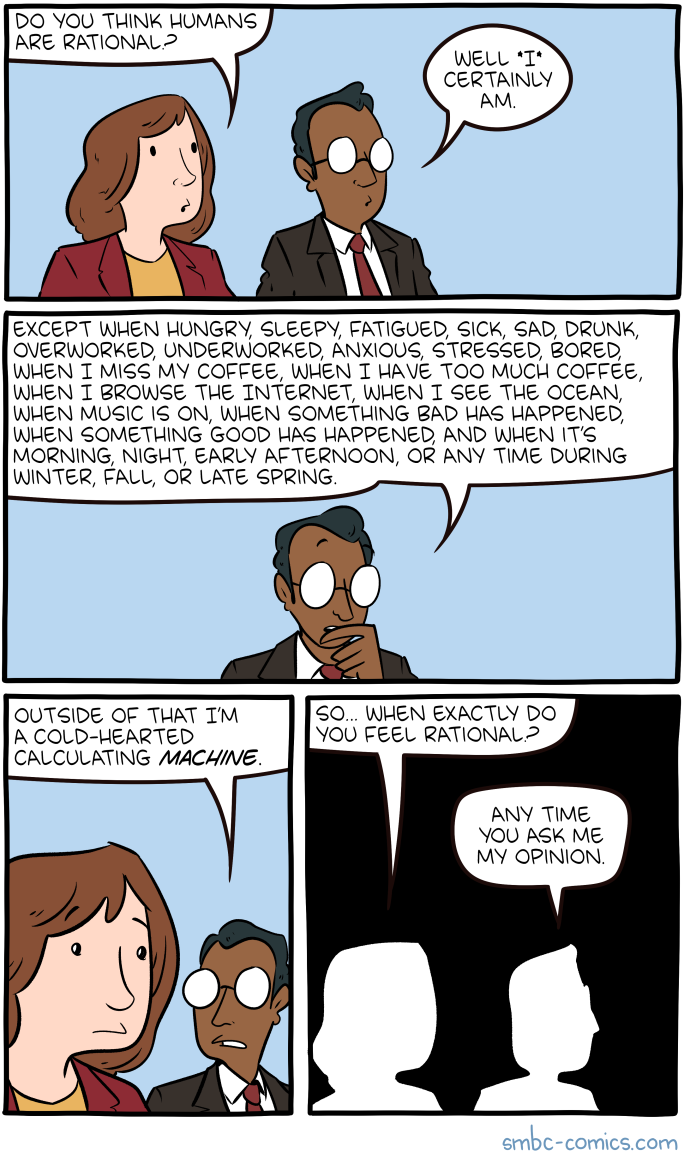
Saturday Morning Breakfast Cereal - Rational

by tech@thehiveworks.com


Click here to go see the bonus panel!

Hovertext:
I was feeling especially rational when I made this observation.


Today's News:
19 Nov 19:24

Azar digs in his heels: There will be no smooth transfer of power in the fight against COVID-19

by Laura Clawson
James.galbraith

If there were any justice in the world, the entire GOP would be burned to the ground for this.

In the middle of a deadly pandemic, the Health and Human Services (HHS) Department will actively refuse to work with the incoming Biden administration for as long as Donald Trump can hold off the formal transfer of power, HHS Secretary Alex Azar confirmed Wednesday.

“We've made it very clear that when GSA makes a determination, we will ensure complete, cooperative professional transitions and planning," Azar told reporters. “We follow the guidance. We're about getting vaccines and therapeutics invented and get the clinical trial data and saving lives here. That's where our focus is as we go forward with our efforts.”

Azar is waiting for General Services Administration (GSA) head Emily Murphy to issue a formal ascertainment that President-elect Joe Biden has won, while Murphy is apparently waiting for Trump to run out the clock on his legal challenges, even as Trump has lost dozens of such legal challenges with no sign of an imminent turnaround.

In the mean time, HHS staff are directed not to talk to the Biden transition team, even though this could cause interruptions in vaccine distribution and other efforts to fight the coronavirus pandemic when Biden takes office on Jan. 20, 2021.

Biden warned of exactly that on Wednesday, saying: “Soon, we're going to be behind by weeks and months being able to put together the whole initiative relating to the biggest promise we have with two drug companies coming along and finding 95% effectiveness, efficiency in the vaccines, which is enormous promise.”

Brett Giroir, assistant secretary for health at HHS, claimed Wednesday that hey, they’re just following the rules and it’s not going to cause any delays. But on the first point, this delay is unprecedented in recent elections with the sole exception of 2000, which was much closer and involved serious litigation, not the series of frivolous lies Team Trump has brought to various courts. And on the second point, Dr. Anthony Fauci disagrees, saying repeatedly that it’s important to get the transition going so that efforts aren’t interrupted in January.

Donald Trump’s temper tantrum over losing an election is going to lead to people losing their lives, and Alex Azar, Brett Giroir, and Emily Murphy are all complicit.

19 Nov 19:02

Mac mini and Apple Silicon M1 review: Not so crazy after all

by Samuel Axon
James.galbraith

Sure looks encouraging

  • The 2020, M1-equipped Mac mini. [credit: Samuel Axon ]

Apple is crazy, right? The Mac just had its best year of sales ever, and Cupertino is hitting the platform with a shock like it hasn’t had in nearly 15 years—back in a time when the Mac was not having such a good year. Apple is beginning the process of replacing industry-standard Intel chips with its own, custom-designed silicon.

In a way, we're not just reviewing the new Mac mini—a Mac mini is always a Mac mini, right? We're reviewing an ARM-based Mac for the first time. And this is not exactly the same story as all the other ARM machines we've looked at before, like Windows 10 on ARM—a respectable option with some serious tradeoffs.

Sure, longer battery life and quick waking from sleep are already out there on other ARM computers. But as you may have seen in our hands-on earlier this week, what we're encountering here is also a performance leap—and as you'll also see in this review, a remarkable success at making this new architecture compatible with a large library of what could now, suddenly, be called legacy Mac software.

Read 86 remaining paragraphs | Comments

19 Nov 18:54

Trump is purposely piling on additional disasters in hopes of ruining Biden's presidency

by Mark Sumner
James.galbraith

Trying to burn it all down, and the GOP is fine with it.

Once again, America is getting a vivid demonstration of why George W. Bush—despite starting two seemingly endless wars, driving the nation into recession, and generally handing over his government to the worst people imaginable—will not come down in history as America’s worst president. When Bush left office at the end of 2008, he spent his last few months not just cooperating with Barack Obama’s transition team, but moving to address some of the issues created by the deregulatory disaster—including bailing out much of the auto industry.

It wouldn’t matter much, since Mitch McConnell was already meeting with congressional Republicans to set making Obama a one-term president as their primary goal. Within two years, those same Republicans would not just be blaming Obama for the recession, but running ads about how he gave billions to “Government Motors.” Still … it at least seems that Bush was willing to throw a Band-Aid at the gushing wound his policies had created.

In 2020, Donald Trump is not just continuing to place the nation at risk of absolute dissolution by attacking its most fundamental institution, he has a backup plan that’s almost as terrible. If Trump fails to convert the nation into another of the single-party dictatorships he has so admired around the world, he intends to leave behind a system so broken that no one can fix it. And for once, he’s doing a really good job.

In this case, the pandemic is giving Trump exactly the “magic” that he wants. Through the simple expediency of not getting off his ass for months, Trump has continued to scale the coronavirus from disaster to catastrophe to just short of existential threat, none of which was preordained. Just a few short weeks ago, the news was full of stories about how countries like France, which suffered so greatly in the pandemic’s initial surge, were once again seeing a flood of new cases. Then those stories disappeared. That’s because prompt action on the part of the French government cut their rate of daily cases by more than two-thirds in just a couple of weeks. But in the United States, cases have continued to explode exactly because Trump has done less than nothing. He has not only refused to issue any new guidelines, but has undermined vaccine news with talk of conspiracies while the head of his coronavirus task force has urged people to defy social distancing mandates set by states.

As CNN notes, creating hundreds of thousands of unnecessary deaths may seem like a pretty big fire, but it’s not the only one that Trump intends to set. Trump is making moves in Afghanistan, and Iraq, and potentially in Iran, not out of an intention to deliver increased national security, but to intentionally create instability. Trump has ordered the latest acting defense secretary to engage in cyber warfare with China. He’s looking to make new terrorist designations that would hogtie future diplomatic actions. And, of course, he’s rushing through massive arms sales to the UAE and Saudi Arabia that could completely upset the balance in a region that’s been notoriously fragile.

All of this reflects something that Trump did immediately after the 2016 election—he began running for 2020. That’s exactly what Trump is doing again. Except this time he is using his ability to wreck the government to position himself for a run in 2024. Trump’s plan breaks down to: try to destroy democracy now, but if that doesn’t work, make sure the nation is so broken that you can destroy democracy next time. How Republicans will handle this is best summed up by what the Senate did in its last hours before going on a break—completely shatter past traditions by continuing to hand lifetime appointments to unqualified judicial nominees put forward by the loser of the national election. 

Trump is doing everything he can to leave Joe Biden a nation that is sick and divided at home, weak and besieged abroad. And he’s doing it for the same reason he decided to not engage in a serious attempt to stop COVID-19. He believes that a little death and disaster will be good political strategy.

19 Nov 17:52

U.S. border officials tried to cover up unlawful detention of Iranian Americans, documents reveal

by Gabe Ortiz
James.galbraith

Of course. CBP has no problem lying to courts.

Internal documents released in litigation against Customs and Border Protection (CBP) following the detention of U.S. citizens and permanent residents of Iranian descent at the U.S.-Canadian border earlier this year reveal that officials not only detained far more people than previously known, they actively misled the public in an effort to cover up their unlawful and discriminatory actions.

Civil and immigrant rights groups that sought the documents said in a statement that “emails demonstrate that after reporters began to inquire about the detention of Iranians at the Blaine Port of Entry, then-Acting CBP Commissioner Mark Morgan and other high-level officials signed off on a public statement claiming that ‘[r]eports that CBP officers are detaining Iranian-Americans and refusing their entry in the U.S. solely because of their country of origin are false.’” That, of course, was a lie.

The documents, sought by the Council on American Islamic Relations­, the Washington office of CAIR, and the Northwest Immigrant Rights Project, show that despite their claims otherwise, there was in fact an order instructing U.S. officials to single out people of Iranian descent following the killing of a top Iranian military official by the United States in early January.

“The court ... required CBP to provide to the court unredacted copies of additional documents that CBP refused to release, in order to determine whether they must also be released to the public,” the groups said. “Those documents include the previously-leaked directive ordering the detention of all Iranians entering at the border, regardless of their lawful status … Notably, as the court observed in its decision, CBP has not contested that its actions in ordering the detention of Iranians at the border was unlawful.”

The documents also revealed that more people were unlawfully detained than previously known. While the number of people detained was reported anywhere from an initial 60 people to as high as 200 according to Rep. Pramila Jayapal, emails show over 250 people were sent to secondary inspection, including over 80 U.S. citizens. “Another email shows that CBP detained many of these individuals for several hours, including over 9 hours in some cases,” the groups said. “Indeed, in the vast majority of cases, CBP detained individuals for 3-4 hours or more—solely based on these individuals’ national origin.”

Morgan, who is still serving as the agency’s acting commissioner, later responded to outrage over the unlawful detentions by claiming officials just got a little carried away. “In that one instance,” he said during a press conference in February, “leadership just got a little overzealous, and we corrected that right away.” The true correction is making sure Morgan is nowhere near the federal government come January 20.

“The Constitution makes clear that discrimination based on national origin like this is unlawful,” NWIRP legal director Matt Adams said. “Yet, the records plainly demonstrate that CBP officials detained hundreds of people, including scores of U.S. citizens and lawful permanent residents solely because of where they were born. Moreover, the records make clear that authorities then lied about it. We urge Congress and the incoming Biden administration to hold CBP officials accountable for violating the civil rights of Iranian-Americans, among others.”

19 Nov 17:51

[Eugene Volokh] Criminal Libel for High School Student to Falsely Write That He'd Had Sex with Teacher

by Eugene Volokh
James.galbraith

Yes indeed

[Louisiana is one of about a dozen states that has a criminal libel statute; my sense is that, throughout the country, there are likely about 20-30 criminal libel prosecutions per year.]

This is from earlier this year, but I just came across it; it's State in the Interest of G.J.G. (La. Ct. App.), written by Judge Ulysses Gene Thibodeaux, and joined by Judges Van Kyzar and Jonathan Perry:

G.J.G. is a student at Grand Lake High School. In December 2018, G.J.G. sent a message to the SouthernSchemers' Snapchat account stating, "I f***** my ag teacher best p**** I've had." The message was then posted by SouthernSchemers onto their story, which consisted of messages from students describing sexual conduct with teachers…. [When interviewed by the police,] G.J.G. admitted that he sent the message and that it was false….

Louisiana Revised Statutes 14:47 states:

Defamation is the malicious publication or expression in any manner, to anyone other than the party defamed, of anything which tends:
(1) To expose any person to hatred, contempt, or ridicule, or to deprive him of the benefit of public confidence or social intercourse ….

"Malice (or fault), for purposes of the tort of defamation, is a lack of reasonable belief in the truth of the statement giving rise to the defamation." "Malice in this sense is more akin to negligence with respect to the truth than to spite or improper motive." In the context of criminal defamation, "malice involves intent, and such intent may be inferred by circumstances connected with or surrounding the transaction." …

There is no doubt that G.J.G. lacked a reasonable belief in the truth of the statement. He admittedly knew that it was false. Moreover, the act was done intentionally. G

.J.G. argues that he did not intend to refer to Mrs. Montie, and the text did not mention Mrs. Montie by name. However, the message asserted that he had been intimate with his "ag teacher." Mrs. Montie had taught him "ag" the year before and was currently teaching him carpentry, a class in the "ag" department. Mrs. Montie is the only female "ag teacher" at Grand Lake High School. It is evident that his "ag teacher" is Mrs. Montie.

G.J.G. knew that the content of the message was false, and he intentionally sent it to SouthernSchemers for the purpose of having it added to their story about students' sexual conduct with teachers. Thus, in viewing the evidence in the light most favorable to the prosecution, a reasonable trier of fact could find that the element of malice was proven….

Additionally, La.R.S. 14:48 provides, "Where a non-privileged defamatory publication or expression is false it is presumed to be malicious unless a justifiable motive for making it is shown." Louisiana Revised Statutes 14:49 provides:

A qualified privilege exists and actual malice must be proved, regardless of whether the publication is true or false, in the following situations:
(1) Where the publication or expression is a fair and true report of any judicial, legislative, or other public or official proceeding, or of any statement, speech, argument, or debate in the course of the same.
(2) Where the publication or expression is a comment made in the reasonable belief of its truth, upon,
(a) The conduct of a person in respect to public affairs; or
(b) A thing which the proprietor thereof offers or explains to the public.
(3) Where the publication or expression is made to a person interested in the communication, by one who is also interested or who stands in such a relation to the former as to afford a reasonable ground for supposing his motive innocent.
(4) Where the publication or expression is made by an attorney or party in a judicial proceeding.

None of the sections of La.R.S. 14:49 apply to the message in question. Therefore, it was an unprivileged expression. There is no question that the message was false. The only motive which G.J.G. gave for sending the message was that it was a joke. As the expression was false and no justifiable motive for making it was shown, the message was presumptively malicious.

19 Nov 17:35

COVID-19 doesn't care about 'individual freedom,' so Republicans turn to mask mandates

by Laura Clawson
James.galbraith

Why the fuck would anyone trust Iowans? jesus christ.

As COVID-19 surges across the country, some governors are experiencing a hard collision between reality and their Republican ideas about governance. Governor after governor who spent months rejecting mask mandates, often railing against them, is now admitting they’re necessary. Partly, these governors are coming up against the distance between the ideas they claimed to embrace and the ideas Donald Trump was pushing hard this whole time. Republicans like North Dakota Gov. Doug Burgum, Utah Gov. Gary Herbert, and Iowa Gov. Kim Reynolds previously said they were backing personal responsibility and individual freedom around masks, but are now having to mandate masks because, at least in the age of Trump, the Republican base uses its individual freedom to violently reject personal responsibility.

North Dakota currently sports the highest COVID-19 mortality rate in the world, which apparently made Burgum think that maybe he wasn’t doing everything exactly right. He’s gone from emotionally urging people to wear masks without requiring it in May, to “It’s not a job for government; this is a job for everybody,” in October, to a mask mandate backed up by $1,000 in fines for violations. Apparently it is a job for government after all.

In June, Herbert encouraged mask-wearing but wouldn’t require it, because “requiring masks could create divisive enforcement issues at a time when we need to come together of our own accord around a shared concern for one another’s health.” In November, with Utah’s dwindling hospital capacity showing that people had failed to come together of their own accord around a shared concern for one another’s health, Herbert decided “We cannot afford to debate this issue any longer” and issued a mask mandate.

Reynolds, too, had earlier gone the route of saying that a mask mandate was unnecessary or even counterproductive because people would do the right thing on their own—even as Trump encouraged them not to do the right thing. 

“No, I’m not going to mandate masks. I trust Iowans. I believe in Iowans,” Reynolds said in a local radio interview in July. “There’s no way to enforce it. Most of the states or entities that have done that, they’ve actually gone as far as to say we’re not going to enforce it, so it’s just kind of a feel-good.” Well, sure, if by “feel-good” you mean “people feel good because they don’t have COVID-19.”

That whole “I trust Iowans” thing turned into exponential growth of coronavirus rates turned into a mask mandate, because “It’s up to all of us so that the worst-case scenarios I just described don’t become reality.”

Who knows, maybe personal responsibility and individual freedom could, under ideal circumstances, have worked. Probably not, but we’ll never know, in part because these Republicans were urging personal responsibility at the same time as the leader of their party was telling his followers to let it all hang out. Burgum and Herbert and Reynolds don’t look like people who wanted to believe the best of their constituents, but like leaders who refused to lead out of fear. And now their states are overrun, their hospitals are overwhelmed, their constituents are dying—and the nationwide coronavirus surge is threatening states that have been trying to do the right thing all along.

The coronavirus does not care about your individual freedom.

19 Nov 17:32

Arizona secretary of state releases must-read statement in response to right-wing threats

by Walter Einenkel
James.galbraith

And the GOP is fine with this

Since Election Day, mobs of right-wing anti-Democracy groups have alternately been trying to “stop the count” and “count the votes” in a confusing cacophony of dumb. Led by some of the same faces that have brought you other bogus right-wing protests around the country, the Arizona mobs have been fueled by the entirely baseless claims of election fraud promoted by the Republican Party and Donald Trump.

As a result, Arizona Secretary of State Katie Hobbs has been forced to repeatedly appear on television to refute the completely fabricated claims of election malfeasance. This has led to Hobbs, her family, and her staff to be targeted online by real cowardly faketriots who are threatening the lives of Hobbs and those around her. On Wednesday, Sec. Hobbs dropped a powerful statement about these threats and our Democracy and justice. In it, Hobbs says that while she is not surprised that people are angry and are striking out it does not excuse the perpetrators of violent threats meant to intimidate people trying to protect our Democracy. “Their continued intimidation tactics will not prevent me from performing the duties I swore an oath to do. Our democracy is tested constantly, it continues to prevail, and it will not falter under my watch.”

She also calls out Trump and “members of Congress and other elected officials,” who spread false information about the integrity of these elections, reminding them that their “words and actions have consequences.” 

Hobbs’ statement is the kind of document that should be copied, and printed, and re-printed, and taught in classes across the country. It is about the integrity of our delicate democracy and a testament to the courage that our officials are meant to show when our Constitution truly is threatened by a minority of mobsters and well-funded bullies.

Here is the full statement from Arizona Secretary of State Katie Hobbs:

The truth is, I was prepared for these threats of violence and vitriol I have been a social worker for many years and can anticipate this reaction when certain people feel powerless and angry. These actions are utterly abhorrent, especially when directed at my family and my staff. They are a symptom of a deeper problem in our state and country—the consistent and systematic undermining of trust in each other and our democratic process Arizonans deserve to know that elections are safe and secure.

This does not excuse the perpetrators. Their continued intimidation tactics will not prevent me from performing the duties I swore an oath to do. Our democracy is tested constantly, it continues to prevail, and it will not falter under my watch.

But there are those, including the president, members of Congress and other elected officials, who are perpetuating misinformation and are encouraging others to distrust the election results in a manner that violates the oath of office they took. It is well past time that they stop. Their words and actions have consequences.

Now, I am calling on other leaders in this state, including the governor whose deafening silence has contributed to the growing unrest, to stand up for the truth. When facing unimaginable challenges this election year, Arizonans stepped up. More people are registered to vote in our state than ever before, election participation has been at historic highs, thousands answered the call to work at voting locations during a pandemic, and people made their voices heard.

This should be a time for thanking voters and election workers for their incredible commitment during unprecedented challenges. In that spirit, I offer my gratitude and express my admiration for the Arizonans who inspire trust in our democracy.

18 Nov 20:33

Biden wants to expand Obamacare to all citizens. He can only do that with two Democrats from Georgia

by Joan McCarter

President-elect Joe Biden has plans to make the Affordable Care Act stronger and better for more people. Since the U.S. Supreme Court seems unlikely at this point to do Donald Trump's bidding and toss the law, there remains one obstacle: A Republican Senate. That is, unless Democrats Jon Ossoff and Rev. Raphael Warnock win the runoff election on Jan. 5, and Sen. Mitch McConnell loses his majority.

Bidencare, as he’s calling it, would make some of the fixes that Republican congresses have refused to allow in the past decade to extend access to coverage to every person residing legally in the U.S.—about 24 million people who are currently uninsured, the Urban Institute estimates. The big way he would achieve that is finally adding the public option to the marketplace for the 12 million people who buy insurance on the individual market. It's a Medicare-like program that would also extend coverage to people who would qualify for Medicaid under Obamacare, but don't because their states have refused to implement expansion. That would be about 4 million people gaining access to coverage. Access to care for undocumented people is still an issue, but we've got a much greater chance of achieving that if we have a Democratic Senate.

Control of the U.S. Senate is at stake. We need you to phonebank, textbank, and do other crucial work necessary to win for Jon Ossoff and Rev. Raphael Warnock. Click to find the activity best for you.

We've got one last shot at taking McConnell's Senate Republican majority away in January. Please give $3 right now to send the GOP packing.

A Democratic Senate might also finally give us a respite from the attacks on our health care. Never forget McConnell's promise last time he ran for reelection: to repeal Obamacare "root and branch." He tried that in 2017 and he failed, but since then it's been all about loading the judiciary with judges who will keep allowing cases from Republican states, no matter how bad they are.

He's not going to let Bidencare pass. He's going to continue to put judges on the bench who would take up specious Republican state challenges against whatever measures Biden puts in place to expand health care. Because it is what he does. Allowing anything that actually helps people and makes Democrats more popular is not going to happen on his watch. As always, the nation's health and prosperity depends on dethroning McConnell.

18 Nov 19:01

Racist ‘Karen’ Threatens Neighbor with Taser: ‘You’re a Black Person in a White Neighborhood’ — WATCH

by Andy Towle
James.galbraith

Fucking white people

taser karen

A racist white “Karen” in Discovery Bay, California threatened her black neighbors with a taser and accused their dog of attacking hers, although the neighbors captured her on video petting their pit bull and calling it a “good dog.”

The neighbor, identified as Adana Dean, was captured on surveillance and cell phone video confronting Gerritt Jones and his sister Jariell. Their family has lived in the neighborhood for 12 years, ABC7 reports.

“You are a black person in a white neighborhood and you are acting like one,” says Dean in the video. “Why don’t you act like a white person in a white neighborhood?”

Dean later repeats the accusation: “You guys are acting like black people and you shouldn’t. You should act like white people.

“I was raised in Oklahoma City, where there were tons of black people,” Dean adds. “You’re acting like people that aren’t normal.”

Dean later claims she has “a top secret clearance” and tells the family “you’re going to go to hell because I’m going to sue the hell out of you, both of you.”

The Contra Costa County Office of the Sheriff released a statement: “The Contra Costa County Office of the Sheriff takes these types of acts seriously. Deputy Sheriffs responded to the home yesterday and contacted both parties involved. Although Deputies determined that no crime had been committed, a report was taken to document the interaction between the two neighbors, as the original complaint was in reference to a neighbor dispute due to an off-leash dog. The Office of the Sheriff will refer the case to Contra Costa Animal Services.” 

ABC7 spoke with (or tried to speak with) the two parties:

The post Racist ‘Karen’ Threatens Neighbor with Taser: ‘You’re a Black Person in a White Neighborhood’ — WATCH appeared first on Towleroad Gay News.

18 Nov 19:00

Pfizer’s Covid-19 vaccine just came a little closer to emergency approval

by Umair Irfan
James.galbraith

Actual data, yay

Pfizer Inc.
A Pfizer office in Cambridge, Massachusetts. | Matt Stone/MediaNews Group/Boston Herald

Pfizer and BioNTech now say their vaccine is 95 percent effective and has cleared its trial benchmarks.

Just last week, Pfizer and BioNTech revealed that their experimental Covid-19 vaccine, called BNT162b2, was at least 90 percent effective in an early analysis. On Wednesday, the pharmaceutical and biotech companies reported that their vaccine was even better after it cleared more clinical trial benchmarks for safety and efficacy.

A press release out Wednesday from the two companies reports the results of 170 Covid-19 cases confirmed in their clinical trial pool: Eight in the group that received the vaccine got Covid-19 versus 162 in the placebo group, demonstrating an efficacy of 95 percent.

It follows news this week from a competitor, the vaccine developer Moderna, which reported that its vaccine was 94.5 percent effective in an early analysis.

It’s worth pausing to reflect on where we are: At the one-year anniversary of the first detection in China of the SARS-CoV-2 virus, the pathogen that causes Covid-19, there are now two highly effective vaccine candidates developed at a record pace, both using mRNA, a new vaccine technology that has never been approved before in humans.

The announcements are a breathtaking feat of international science, development, collaboration, and public investment. “The study results mark an important step in this historic eight-month journey to bring forward a vaccine capable of helping to end this devastating pandemic,” said Albert Bourla, Pfizer chair and CEO, in a statement.

With 170 detected infections among their 43,661 participants in their phase 3 clinical, Pfizer and BioNTech say they have enough data to apply for an Emergency Use Authorization (EUA) from the Food and Drug Administration, an application they say they will make “within days.”

That means their vaccine could soon start rolling out to people in high-exposure jobs like health workers, possibly before the end of the year.

But there are concerns as well. Pfizer and BioNTech’s latest announcement came, for the second time, in a press release instead of a peer-reviewed paper, although the companies revealed far more about the demographics of their clinical trial than in their first report. BNT162b2 also has some of the most stringent cold storage requirements, demanding temperatures of -70 degrees Celsius (-94 degrees Fahrenheit) or lower, which may make widespread distribution challenging. The vaccine is also administered in two doses spaced several weeks apart. That adds a huge logistical burden to rolling out the vaccine.

That the clinical trial racked up so many Covid-19 cases among its volunteers so quickly is also a grim reminder of just how fast the disease is spreading right now.

And it will likely take months before any Covid-19 vaccine gets full FDA approval, which would allow the general public to have access to it. Even then, immunizing millions of people in the US against Covid-19 would be an endeavor unprecedented in its speed and scale. So getting through clinical trials is just one step toward ending the pandemic.

Pfizer and BioNTech say their Covid-19 vaccine was safe and effective across a diverse pool of volunteers

Pfizer and BioNTech’s Covid-19 vaccine data so far is still preliminary, but it likely received validation from its Data Safety Monitoring Board (DSMB). This is an independent group of scientists that serves as an intermediary between the pharmaceutical companies and the clinical trial participants to ensure that there is no meddling in the trial. The DSMB meets with the companies at regular intervals to go over their observations of the trial. The fact that Pfizer and BioNTech were able to make this announcement likely means that the committee reported this information to them during an analysis.

“To date, the Data Monitoring Committee for the study has not reported any serious safety concerns related to the vaccine,” the companies reported in their press release. In a separate trial of 8,000 participants, Pfizer and BioNTech reported that the only severe side effects they found that occurred in more than 2 percent of volunteers were fatigue, observed in 3.8 percent of participants, and headache, observed in 2 percent. Surprisingly, the companies found that older adults reported fewer and milder side effects.

Chart showing participant diversity in Pfizer and BioNTech’s Covid-19 vaccine trial. Pfizer
Pfizer and BioNTech reported that they recruited a diverse pool of volunteers for their Covid-19 vaccine clinical trial.

The trial also recruited a diverse pool of volunteers to see how well the vaccine would work among different populations. About 30 percent of US trial participants came from diverse racial and ethnic backgrounds, and 45 percent were between the ages of 56 and 85. “Efficacy was consistent across age, gender, race and ethnicity demographics,” the companies reported.

The next step for a Covid-19 vaccine: Emergency Use Authorization

During a public health crisis, the FDA can grant an EUA to allow unapproved medical products to treat or prevent serious diseases when there are no adequate alternatives on the market.

The benchmark for an EUA is lower than it is for full approval of licensure. In general, the treatment in question has to have a likely benefit, whereas approval demands evidence of a proven benefit.

However, it’s not just about efficacy. A vaccine has the additional hurdle of a much higher bar for safety than conventional drugs. Since a vaccine has to be distributed to millions of people, including those who are healthy and those who have preexisting conditions, the rate of complications has to be extremely low for both full approval and an EUA.

“The thing people need to keep in mind is the safety data. Do we have enough data on safety at this point that we can go forward with the EUA?” said Jose Romero, chair of the Advisory Committee on Immunization Practices (ACIP), an independent group of health experts that advises the Centers for Disease Control and Prevention on vaccines. “I think the FDA, ACIP, and all of the pharmaceutical companies have said over and over again that safety is paramount as they move forward with full licensure or an EUA for vaccines.”

The burden of approving a Covid-19 vaccine isn’t just on the companies. The FDA also has to be transparent about how it is making decisions. This is especially urgent given that public mistrust of a vaccine stands to be a major hurdle in the effort to contain the Covid-19 pandemic.

Some experts are worried that the FDA damaged its credibility this year with its decisions to grant EUAs to treatments like hydroxychloroquine and convalescent plasma based on weak data, which may have been driven by political pressure from the White House. Some researchers have also criticized the FDA’s full approval of the antiviral drug remdesivir. These decisions have sown doubt about the FDA’s decision-making, and the agency will have to go out of its way to rebuild fragile trust with the public to roll out a vaccine.

How do we decide who gets a Covid-19 vaccine first?

Once an EUA is granted, the Covid-19 vaccine can start to be administered to people outside of the clinical trial. Health workers — doctors, nurses, first responders, medical cleaning staff — are the top priority. “They’re certainly high on the list,” Romero said.

Then the vaccine would be targeted at people who are likely to suffer severe complications from Covid-19, such as people over the age of 65 with other underlying health conditions.

However, there are 18 million health workers in the US alone. There are almost 50 million Americans over the age of 65. More than 10 million Americans are immunocompromised, and more than 100 million US adults have diabetes or prediabetes.

Pfizer and BioNTech said they only expect to have 50 million vaccine doses around the world by the end of the year. And remember this is a two-dose vaccine, so 50 million doses will only protect 25 million people. That means there won’t be enough to go around, even for people at high risk. The companies do expect to have 1.3 billion doses ready in 2021.

ACIP is now putting together its recommendations for how to prioritize people for Covid-19 vaccination. But Romero explained they will also have to consider that there will likely be multiple vaccines on the market shortly. A dozen Covid-19 vaccine candidates are already in phase 3 trials, each with their own unique traits and caveats.

“It’s a little silly to think that all vaccines are going to be ranked the same, because they’ll have different characteristics,” Romero said. “Some vaccines may be better in younger populations; some may be better in older populations.”

The advisory committee will also have to weigh practicality, including the -70 degree Celsius storage requirements of the Pfizer-BioNTech vaccine. “Those are going to be very important and impact significantly the logistics of getting these vaccines out and into the arms of recipients,” Romero said. “It’s hard to imagine how you’re going to set up a system to deliver a vaccine that requires storage at -70 [Celsius] into the widespread community.”

It’s likely, then, that the BNT162b2 vaccine will be reserved at the outset for health workers who are already working in and around facilities that have the ultra-cold storage systems for this vaccine, or those who are near facilities that are equipped to distribute it. For those in far-flung regions or people who don’t have sophisticated $10,000 freezers nearby, a vaccine with easier storage requirements may be recommended. Moderna’s vaccine, for example, only needs long-term storage at -20 degrees Celsius (-4 degrees Fahrenheit) and is stable for 30 days between 2 and 8 degrees Celsius (36 degrees to 46 degrees Fahrenheit).

Pfizer and BioNTech say they do have a solution for getting their vaccine to places without ultra-cold freezers. “The companies have developed specially designed, temperature-controlled thermal shippers utilizing dry ice to maintain temperature conditions of -70°C±10°C,” according to their press release. “They can be used be as temporary storage units for 15 days by refilling with dry ice. Each shipper contains a GPS-enabled thermal sensor to track the location and temperature of each vaccine shipment across their pre-set routes leveraging Pfizer’s broad distribution network.”

However, even with a green light from the FDA and assembly lines cranking out millions of vaccine vials, developers like Pfizer and BioNTech will still have to keep an eye on the people who received the vaccine to ensure there aren’t any super-rare complications that could arise. “I think it’s important for the public to understand that the process doesn’t end with approval,” Romero said.

For their part, Pfizer and BioNTech said they will continue monitoring their clinical trial participants for two years.

And as these vaccines gradually roll out, people will still have to keep up measures to limit the spread of the virus: wearing masks, maintaining social distance, keeping up good hygiene. Until there is widespread vaccination, Covid-19 will remain dangerous and deadly, and the steps taken to mitigate it now will ensure a smoother and more effective campaign to halt the pandemic.

18 Nov 18:34

The next Covid-19 superspreading event: Thanksgiving

by German Lopez
James.galbraith

yep, hard pass

A man in a gray hoodie and green mask holds up a large, white-feathered turkey.
John Tlumacki/The Boston Globe via Getty Images

America’s coronavirus epidemic is already bad. The holidays could make it worse.

America’s Covid-19 epidemic is at the worst point it’s been since the spring. And experts say it looks poised to get much worse this Thanksgiving and the rest of the holiday season, with a vaccine likely still months away.

The US hit an all-time record for coronavirus cases in a single day on Friday, November 13: more than 181,000. That came just nine days after the country hit more than 100,000 cases in a single day on November 4. The weekly average of daily new cases stood above 155,000 as of November 16 — nearly triple what it was a month ago.

While testing can help explain why the US is recording more cases now than it did during the spring surge, it can’t explain the recent increase in Covid-19 cases. Between October 16 and November 16, the total number of tests in the US, based on the Covid Tracking Project, increased by 35 percent. In that time, the number of Covid-19 cases nationwide increased by 176 percent — a fivefold difference.

The number of people hospitalized with Covid-19 has also hit record highs: More than 73,000 people were hospitalized with the disease as of November 16, up nearly double from October 16. Covid-19 deaths are increasing too: With more than 1,100 coronavirus deaths a day on average as of November 16, deaths are up nearly 66 percent compared to the same day last month.

Unlike the spring, this surge is a truly national phenomenon. Every state now has more than four daily new coronavirus cases per 100,000 people, a standard for controlling Covid-19. The vast majority of states completely surpass that. Nine states now report more than 100 daily new cases per 100,000 — which was unthinkable in even one state just months ago.

Kumi Smith, an epidemiologist at the University of Minnesota, gave me a frank assessment: “Things are looking pretty bad.”

Even these numbers may not represent how dire it really is. With the coronavirus, it takes some time — days, maybe weeks — for someone to go from getting infected to actually getting tested. Then it can take days or weeks for that person to end up at a hospital with serious symptoms. Deaths can take even longer, if treatment fails. All this data is like light from another galaxy that takes time to travel to our eyes: It’s reflective of infections that happened weeks ago, not today or yesterday.

Some experts now say that the US will inevitably record at least 2,000 deaths in a day in the coming weeks, a threshold the country hasn’t seen since the spring. That daily death toll is, at this point, “essentially baked in,” Brown University School of Public Health dean Ashish Jha told me.

It likely gets worse from here. The holiday season, starting with Thanksgiving and continuing into Christmas and New Year’s, will bring friends and family together — sometimes from across the country — in large gatherings. With winter coming, the colder weather in much of the country will push people indoors, where the virus has an easier time spreading due to poor ventilation.

The flip side is a vaccine is closer than ever, with recent reports suggesting at least two Covid-19 vaccines undergoing trials may be more than 90 percent effective. The problem is widespread vaccination is still likely months away; the remaining steps of research and development, manufacturing, and distribution mean the medicine likely won’t be in reach for most Americans until spring 2021 or later. Before then, the country has to remain vigilant — arguably more so, given the current rate of spread — to make sure as many people as possible make it across the finish line.

“I have become far more pessimistic about the next two months, and far more optimistic about what happens after that,” Jha said. “I’m starting to feel better about where we’ll be in February. The rest of November, December, and a good chunk of January are just going to be the hardest months of the pandemic.”

To put it another way: A vaccine may save us in a few months. But before then, things are likely to get much worse.

The holidays will likely cause Covid-19 to spread more

America may be only in the beginning of its third Covid-19 surge.

The recent increase appears to be largely reflective of a mix of pandemic fatigue and broader reopenings. Since the spring and summer, the country has eased the initial stay-at-home orders to open up all sorts of public spaces and businesses, from parks and beaches to schools to bars and restaurants. At the same time, people have become exhausted with combating the virus — leading them to not only venture back out into risky indoor spaces like bars and restaurants but also to host house parties and gatherings with friends and family. That’s led to more interactions between more people who don’t live together and, subsequently, more infections.

Consider New York. The state managed to suppress the virus after its massive outbreak in the spring. But as it’s reopened more and more — with indoor dining starting again in New York City in September — cases have spiked from a weekly average of 800 a day to more than 4,500.

And that’s with the state’s mask mandate and social distancing guidelines still in place. Less careful and more lax states, like South Dakota, are seeing much larger spikes and outbreaks.

The holiday season will likely lead friends and family to come together even more. These kinds of gatherings are tremendously risky: People will gather close together for potentially hours or days; take off masks, if they had them on at all; and then talk, shout, laugh, and sing while maskless, spewing potentially coronavirus-carrying particles all over each other.

So while many people may expect a good time with friends and family this Thanksgiving, experts have a much grimmer outlook: “We’re going to see much more transmission as a result of that,” Saskia Popescu, an infectious disease epidemiologist, told me. That means likely more Covid-19 cases, hospitalizations, and deaths in the weeks to follow.

Winter could hasten spread further. The colder weather in particular could push activities back inside, where close spaces, prolonged interactions, and poor ventilation make it easier for the coronavirus to travel from one host to another.

Then, as hospitalizations due to Covid-19 rise, another virus — the flu — could join the fray, further straining health care facilities and workers. The gains doctors and nurses have made to treat the coronavirus could disappear if many patients are left in waiting rooms, without treatment, as there simply aren’t enough medical staff and hospital beds to care for them.

And if the outbreak is truly national, as is the case so far, there will be less ability for other states to send in reinforcements of health care workers to help save the day, as happened in New York this spring. Doctors, nurses, and technicians will be dealing with their own crises at home.

Unlike countries in Asia, Europe, and Oceania, America never managed to truly suppress the virus, and it has circulated in different parts of the country in some form since the spring. That’s left a lot of coronavirus out in the US, able to spread the moment that people go out and interact with each other again.

The power of exponential spread makes the high levels of virus already in the community particularly calamitous. Like many pathogens, the coronavirus can spread quicker and quicker as an outbreak goes on — to the point that cases can double every few days or weeks. But it’s obviously worse for 100,000 daily new cases to double than 10.

We’ve already seen the effects of this in the past month. The country went from a weekly average of 100,000 cases a day to 150,000 more than three times as fast as it went from 50,000 to 100,000 daily new cases. And that’s before holiday travel and winter.

So the milestones of 200,000, 300,000, or worse may be even closer than they appear. As bad as it looks, the country’s Covid-19 outbreak stands to get worse — quickly.

A vaccine is still months away. We need action in the meantime.

The past few weeks have brought surprisingly good news on vaccine development. Based on press releases from Pfizer and Moderna about early data from their respective trials, their vaccines may be at least 90 percent effective. That number dramatically exceeds expectations — a week before Pfizer’s announcement, experts said they expected 50 or 60 percent efficacy, 70 percent if we were really lucky.

The bad news is widespread vaccine distribution is still months away. The clinical trials still have to finish, or the companies need to get the necessary approvals from the Food and Drug Administration to distribute the vaccines early. Even after approvals, it will take time, money, and a whole lot of planning to produce and ship the vaccine, and administer it to hundreds of millions of Americans. Realistically, experts said, the earliest most of us could expect to see a vaccine is next spring.

That makes it all the worse that America may now face the worst of the coronavirus, since illnesses or deaths now could be avoided by suppressing cases for just a few months more. It makes efforts to stop the spread of the virus all the more important.

That may require America to close down again. The research suggests that lockdowns did reduce cases in the spring. Other countries that have faced resurgences of Covid-19, from Israel to European nations, have also seen success with widespread closures (often after milder, more targeted measures failed).

A chart of Israel’s Covid-19 cases, which plummeted following a lockdown. Our World in Data

While physical distancing, testing, tracing, and masking all have solid evidence behind them, they may only be able to keep cases down when they’re already low (not true for the US), at least for a time, and only if they’re universal (also not true) and sustained (nope).

Take contact tracing. The idea is “disease detectives” can contact people who are positive for the coronavirus to get them to isolate, find out their close contacts, and get those close contacts to quarantine. But that is simply much harder when there are more than 100,000 new cases a day — it requires much more staff, time, and resources. Even the best teams may not be able to keep up with exponential spread.

Crystal Watson, a senior scholar at the Johns Hopkins Center for Health Security, estimated that contact tracing becomes difficult at 10 daily new cases per 100,000 people. The US is now at more than four times that, and several states are now past 10 or even 15 times that threshold.

So some experts believe widespread closures are now likely needed: People should stay home as much as possible — only going out for basic needs like food and medicines — and not socialize with others from different households. Large gatherings, including in private, should be banned and avoided. In-person, indoor services at nonessential businesses, like bars and restaurants, should shut down.

That begins with Thanksgiving and other holidays. As great as it would be to spend time with family and friends after such a rough year, experts argue that now is still not the time.

Different levels of government could mandate all of this, while offering economic relief to those affected. A few places, including some states, are already moving in this direction. But short of that, individuals could try to act on their own, voluntarily choosing to stay at home or close businesses until Covid-19 subsides.

Still, with the outbreak so widespread, the actions of a few individuals or states just won’t do. It will require a truly national effort. President Donald Trump and his administration so far have shown no signs of changing their approach, and President-elect Joe Biden won’t take office until January 20, 2021. That may leave it to the states and general public to deal with the worst of Covid-19 yet — and both seem, as of now, highly resistant to more drastic measures.

“I don’t think people realize this is the worst it’s gotten,” Popescu said.

So the US could see mounting Covid-19 deaths, on top of the more than 248,000 that it’s already seen, right as the country needed to hold off just a few more months to ensure that more people made it across the finish line.

18 Nov 18:24

Republicans insist Amy Coney Barrett’s religion is off-limits but Raphael Warnock’s isn't

by Lauren Floyd
James.galbraith

Of course

Frequently mistaken Sen. Marco Rubio is adding another misinterpretation to his resume. The Florida Republican chose to float a clip on Twitter Wednesday of Georgia Democrat Rev. Raphael Warnock and rebrand it as anti-military rhetoric. In the clip, Warnock can be heard giving various examples to bring home the message that there can be no substitute for God. “America, nobody can serve God and the military. You can't serve God and money,” Warnock said. “You can not serve God and Mammon at the same time. America, choose ye this day who you will serve.”

Rubio’s interpretation, however, was quite different. “Not shocked,” he said in his tweet. “#Georgia Democrat Senate candidate Raphael Warnock said ‘You cannot serve God and the military’ at the same time. These & even crazier things is what the radicals who control the Democratic party’s activist & small dollar donor base believe.” Only, Warnock’s communications director Terrence Clark explained quite clearly what Warnock believes in an email to Daily Kos Wednesday. 

The Georgia run-off is January 5. Request an absentee ballot by Nov. 18. Early in-person voting starts Dec. 14. And REGISTER TO VOTE here by Dec. 7.

And give $3 right now to rip the Senate majority from Mitch McConnell’s cold dead hands.

Not shocked #Georgia Democrat Senate candidate Raphael Warnock said “You cannot serve God and the military” at the same time. These & even crazier things is what the radicals who control the Democratic party’s activist & small dollar donor base believepic.twitter.com/bQyBuKLwjb

— Marco Rubio (@marcorubio) November 18, 2020

“This sermon is based on a biblical verse that reads ‘No man can serve two masters … Ye cannot serve God and mammon,’ a biblical term for wealth,” Clark said. “Reverend Warnock was speaking about the need to commit to moral life before pursuing other priorities. As the video of the congregation’s response makes clear, this is another blatant effort by Kelly Loeffler to take Reverend Warnock’s words completely out of context. Given her own decision to spend her first days in the U.S. Senate profiting off the pandemic, perhaps she should watch the sermon more closely.”

Its meaning wasn’t particularly difficult to decipher. Several Twitter users were able to do so with little trouble. Journalist Wesley Lowery tweeted: "this is extremely standard Christian rhetoric about "serving two masters" [Matthew 6:24, since I know you like verses]"

He’s literally quoting Jesus from the Sermon on the Mount. No man can serve two masters: for either he will hate the one, and love the other; or else he will hold to the one, and despise the other, Ye cannot serve God and mammon. - Matthew 6:24 https://t.co/kgdiAqiOha

— Hari Sevugan (@HariSevugan) November 18, 2020

Journalist Sam Stein asked: "Why are Raphael Warnock’s faith and sermons fair game for attack but Amy Coney Barrett’s religious views not?" The newly appointed Supreme Court justice has been associated with the religious group People of Praise, which isn’t in and of itself some crime of consciousness. But being a complete stranger to a judge’s responsibility to remain unbiased, Barrett apparently likes to spew her religious teachings to law students to teach them “how God can use them as judges, law professors and practicing attorneys to help keep the door open for the spread of the Gospel in America.”

But in following GOP logic, we should all overlook that and focus instead on what Warnock—who's been quite upfront about being the pastor of Dr. Martin Luther King, Jr.'s church home Ebenezer Baptist Church—says on the pulpit. Feel free to roll your eyes now. 

RELATED: Religious group scrubs references to Amy Coney Barrett from its website

18 Nov 18:23

Did Trump Delay the Arrival of At-Home Coronavirus Testing?

by Olga Khazan
James.galbraith

No surprise there

Updated on November 20, 2020.

Coronavirus infections in the United States are growing exponentially, and lawmakers may soon face an awful choice between another round of shutdowns and the deaths of tens of thousands more Americans.

A small band of scientists insist there is another way. They say that if every American took multiple coronavirus tests a week at home, we’d be able to figure out who is contagious. People who tested positive would stay home for two weeks while the rest of us more or less went about our lives. With masks and social distancing, yes—but also with safer schools and larger funerals.

These rapid tests, these scientists argue, would help Americans survive until a vaccine becomes widely available next summer. A similar testing scheme conducted in Slovakia recently helped cut infections in half, Reuters reported. Other studies have suggested that testing people for symptoms, such as fevers, alone won’t stop the spread of the coronavirus, and that everyone—symptomatic or not—should be tested frequently.

But the easy, cheap, at-home coronavirus tests that would make all of this possible still aren’t available to most Americans.

My colleagues Robinson Meyer and Alexis C. Madrigal wrote about the promise of such testing in August. At the time, the concept had circulated for months. A handful of at-home tests are now for sale in some stores, but they cost more than $100 and take more than a day to return the results. Yesterday, the FDA approved another at-home test, Lucira, that will cost less than $50 and return results within 30 minutes. But it will be available only by prescription, NPR reported, and won’t be widely available until this spring. The types of tests scientists such as the Harvard epidemiologist Michael Mina, an advocate for the idea, are envisioning are extremely cheap—a few bucks a pop—and wouldn’t require a prescription.

Mina and others suspect that at-home COVID-19 testing isn’t widely available yet because President Donald Trump and his administration haven’t tried particularly hard to make it so. “The only reason that we don’t have these out in massive numbers is that the federal government hasn’t prioritized it in any way,” Mina told me recently.

Though the Lucira news is encouraging, Mina sees it as a “baby step.” He said the feds should be pumping money into the companies developing and manufacturing cheap, over-the-counter tests, and accelerating the regulatory-approval process. Simply sitting back and letting the market do its work, Mina and his allies argue, is wasting time and costing lives. The Trump administration insists that further government intervention in the testing market is neither necessary nor appropriate. But President-elect Joe Biden has a plan that includes pushing harder for rapid testing. Whether he’s able to carry it out could determine the course of the pandemic.

T

he most common at-home rapid tests that Mina and others envision are what are called antigen tests—strips of paper that have monoclonal antibodies printed on them that attach to the virus if it’s present, turning the paper a darker color. These aren’t the polymerase-chain-reaction, or PCR, tests clinicians use to diagnose people with COVID-19. Although PCR tests look for any recent sign of the virus, antigen tests hunt for live, infectious virus. “In other words, PCR testing is like a detective at a crime scene, looking for any evidence that a crime is or was in the past few weeks committed,” Mina said. “An antigen test is more like a security guard, looking only for an actionable crime, currently being committed.” (The company Abbott has designed a rapid test called the BinaxNOW, but it is approved only for use by health-care providers. Other companies, such as Lucira, are working on at-home rapid tests that don’t rely on antigens. More on those tests later.)

[Read: The pandemic safety rule that really matters]

Although these rapid tests are not very sensitive to the presence of any virus, their proponents say that they catch the people who are most likely to be contagious. Think of these tests like a pregnancy test, but for COVID-19. Just like you would get a pregnancy confirmed by a doctor if you test positive, you would confirm your COVID-19 at-home antigen test either by taking a different type of antigen test or by getting tested at the doctor. “Think about the number of situations where you would love to have something like that,” says Jeff Huber, the president of OpenCovidScreen, which is running a contest for companies to invent a better COVID-19 test. “There was a death in the family and you want to have a funeral and you want people to come together, but you want to do that as safely as possible.” School, work, and even weddings could be back on—even if not everyone had been vaccinated yet.

But some experts say the FDA has been slow to approve these tests. Typically, the agency approves new coronavirus tests based on how well they detect the presence of the virus—and how well they don’t erroneously flag negative cases. Rather than hold antigen tests to that standard, the FDA should approve these tests based on how well they catch people with high levels of virus in their system, Mina argues. The current standard has “turned a lot of the companies off for many, many months, from even submitting anything,” Mina said.

A company called E25Bio, in Cambridge, Massachusetts, has already developed such a test. It costs less than $10, and it provides results in three to 10 minutes. To use it, you swab your nose, place the swab into a liquid, and drop the liquid on a paper strip housed inside a plastic cassette.* On November 10, the company told me it had an application in for approval with the FDA, and had been waiting for several weeks to hear back.

Eric Topol, a cardiologist and the director of the Scripps Research Translational Institute, has gotten the sense that the FDA thinks antigen at-home tests will be too confusing for everyday people to use, and thus will lead to chaos and the erratic reporting of positive cases.

In an interview with Topol for Medscape, FDA commissioner Stephen Hahn said, “it’s a whole different level with at-home tests because there won’t be a provider that’s providing information and guidance to someone who’s doing this at home. We need to make sure that they’re easy to use, easy to understand, and highly reliable.”

In response to a request for comment, a spokesperson for the agency said, “The role of the FDA is to ensure the safety and efficacy of diagnostic tests when used by the intended user. In the case of at-home tests, we assure they are easy for consumers to administer and the results are clear for consumers to interpret … The FDA wants data to show that consumers can also get accurate results and interpret them.”

The agency added that “a developer could opt to validate their test by demonstrating its ability to detect people who are likely infectious. However, that may be more difficult to demonstrate than the validation approach we’ve recommended because there isn’t an accepted way to measure it.”

Another problem that Mina and others point to is that the Trump administration has failed to infuse money into at-home testing companies.

The companies producing these antigen tests, with the exception of Abbott, are small start-ups. The government is essentially waiting for these underdogs to independently raise cash and develop tests, then weighing whether it’s willing to approve them. “If somebody was bombing us, killing even a fraction of the number of people who have died at the hands of this virus, we would not be sitting idly by and saying, I wonder who’s going to make the next crop of missiles for us to use to defend ourselves?” Mina said.

The federal government, he and others argue, should be throwing money at companies to produce the tests, or possibly even building factories to produce them itself. With $20 billion, Mina argues, the government could build four factories that produce enough antigen tests to stop most outbreaks in the country. That may sound like a lot of money, but it’s just 1 percent of the COVID-19 stimulus package, the CARES Act. And after the pandemic ends, the factories could be repurposed for flu tests and other efforts. “But they haven’t done it, and I don’t know why,” Mina said.

One way for the federal government to get affordable, at-home tests to Americans faster would be to use the Defense Production Act, which allows the government to prioritize the manufacturing of goods and infrastructure deemed essential to national security. Though Trump used the act occasionally throughout the pandemic, some, like Mina, say he should have been using it to ramp up at-home testing.

Multiple experts shared Mina’s concern that the government has not already churned out rapid tests. “They kept saying to me, ‘We don’t want to use the [Defense Production Act]; the market will work,’” one person who is working on testing strategies and has had conversations with the Trump administration told me. But once a vaccine for the coronavirus becomes widely available, the market for the tests will diminish, if not disappear entirely. Small companies aren’t eager to put up their own capital for a type of manufacturing that won’t be useful in eight months.

This person got the impression that Trump administration officials were under pressure from the White House not to use the DPA for the production of tests, only to buy up tests that are already available. In August, for instance, the Trump administration bought 150 million rapid tests from Abbott and distributed them to states, colleges, and nursing homes. Mina and his ilk argue that’s not enough—the government should become a manufacturer, and make the test printer go brrr.

[Read: All the president’s lies about the coronavirus]

Before the election, I asked Peter Navarro, the assistant to Trump for trade and manufacturing, whether the president planned to use the DPA for the production of at-home tests if he was reelected. “Companies along the supply chain working with Abbott understand the power of the DPA—which we have used more than 100 times—so it need not be explicitly invoked to get the desired effect,” he told me.

A spokesperson for Biden’s campaign told me the president-elect plans to use the DPA to scale the production of at-home tests. Vivek Murthy, the former surgeon general under President Barack Obama, will co-chair Biden’s COVID-19 task force. In a recent interview with NPR, Murthy said, “[Biden] wants to expand our testing capacity … not just diagnostic testing, but also screening testing so that we can better open up schools and workplaces.”

There are some pleas for caution on at-home tests, even among their boosters. Topol, from the Scripps Research Translational Institute, argues that we first need a large clinical trial to show that the tests are effective at stopping outbreaks. The test that does so, then, could set the standard for others like it.

Other experts say that imprecise, at-home tests are a terrible idea. Michael Osterholm, the director of the Center for Infectious Disease Research and Policy at the University of Minnesota, worries that if the country is awash in tests that return too many incorrect results, people will lose confidence in testing. They might refuse to get tested, refuse to self-isolate if they test positive, or get PCR and antigen tests mixed up. After the federal government gave nursing homes some antigen rapid tests, the state of Nevada ordered the homes to stop using them once they were found to have an error rate of nearly 60 percent. Another rapid test made by the company Quidel was found to detect only 32 percent of the positive cases identified by a PCR test. (Part of the explanation for the delayed development of cheap, at-home testing might be the mixed messages experts are sending on the effectiveness of at-home tests.)

Osterholm and others are concerned that if people start testing at home, positive cases might not be reported back to public-health departments. Advocates of at-home tests say they should come with apps that people can use to report their results anonymously to their local health department.

The point of rapid testing is not to stop all cases, proponents argue, but to reduce how many there are. People would still have to take precautions, but they would have an extra measure of security knowing they are (likely) not contagious.

What’s more, different types of tests could be used in tandem. A positive antigen test could be confirmed with a PCR test, or one antigen test could confirm a different kind of antigen test. (This type of confirmation is similar to what happens with positive HIV antibody tests.) “We don’t have enough money to do PCR in everybody, every day,” says Mara Aspinall, a biomedical-diagnostics professor at Arizona State University. In the case of a positive antigen test at a nursing home, for example, “if you have to send a nurse home for a day, before you get a central-lab PCR test, it’s a small price to pay. It’s not ideal; it’s logistically a hassle. But it’s a lot cheaper than an outbreak.”

Besides, right now, we’re keeping everyone home because we don’t even know who might have the coronavirus. There is no “perfect,” these experts argue, and the alternative is bad. “Knowing more is better than knowing less,” says Paul Romer, a Nobel Prize–winning economist and an advocate for this kind of testing.

To help people understand the risks of false positives and negatives, Mina said, the U.S. needs a major public-education initiative paired with the tests. People should be told what their results mean, and how to incorporate them into their already-careful lifestyles. “The NIH and the CDC should be hiring, for whatever cost it takes, Coca-Cola’s branding team,” to show people how to use the tests, Mina said.

If the government remains reluctant to fund antigen tests, it could funnel money into other types of tests instead. Sherlock Biosciences, another Cambridge-based company, is working on a molecular test that’s similar to a PCR test but can be performed at home. It will be slightly more expensive—about $20 to $30 a test—but the results would still take only half an hour.

But because of the challenge of getting investors to throw money at a temporary public-health risk, Sherlock will not have the tests out in wide circulation until the middle of next year. The company could get it out sooner, but that would require getting money from the federal government, CEO Rahul Dhanda told me. And so far, that money hasn’t come.

Dhanda told Trump’s coronavirus task force about his company’s plans a few months ago. But “it didn’t lead to a response,” he recalled. “It just sort of fizzled. We never really heard back.”


* This article previously mischaracterized E35Bio's at-home testing process.

18 Nov 18:20

FDA authorizes first at-home coronavirus test

by David Lim
James.galbraith

It's progress


The Food and Drug Administration has authorized the first prescription at-home coronavirus test, in a long-awaited milestone.

The test, developed by Lucira Health, can be used by people who are at least 14 years old when their health provider suspects they have Covid-19, the FDA said late Tuesday. The test can be used on younger people, but in that case a health care provider must collect the sample.

The test involves swabbing the inside of the nose, placing the swab in a vial and swirling it before putting the vial in a "test unit." The process gives results in 30 minutes or less.

FDA medical device director Jeff Shuren said the test, which can be fully run outside a lab or health care settings, represents a significant step forward.

“Now, more Americans who may have COVID-19 will be able to take immediate action, based on their results, to protect themselves and those around them,” Shuren said.

The agency said that the health care providers of patients who use the test must report the results to public health authorities.

Crunching the numbers: The at-home test was able to correctly identify 94 percent of positive samples and 98 percent of negative samples diagnosed using a more sensitive lab-based test in a study, according to Lucira's instructions for use.

"Excluding samples with very low levels of virus that possibly no longer reflected active infection, Lucira achieved 100% positive percent agreement," the instructions state.

Background: FDA has previously granted emergency authorization for kits that allow people to take a sample in their home and send it to a lab for testing. But a test people can conduct themselves has been elusive.

Lucira is one of several companies that have been working to develop fully at-home tests to relieve pressure on overburdened testing laboratories and quickly identify new infections.

“While COVID-19 diagnostic tests have been authorized for at-home collection, this is the first that can be fully self-administered and provide results at home,” FDA Commissioner Stephen Hahn said.

Some public health experts, including Harvard University epidemiologist Michael Mina, argue widespread at-home testing could help bring the Covid-19 pandemic in the U.S. under control.

“I believe very firmly that if we asked 100 percent of Americans — maybe we wouldn’t get there — to get tested weekly we could do it,” Mina told POLITICO. To cut down on false positives, a second at-home test that uses a different technological approach should be provided to confirm results, he added.

What’s next: It is unclear how fast Lucira will be able to ramp up manufacturing of the newly authorized at-home test. But FDA says it is eager for more at-home tests to be on the market. Lucira’s website states the test is “intended to cost less than $50” and is manufactured in the U.S.

HHS testing czar Brett Giroir said the health department and Pentagon — which have made investments to boost manufacturing of other Covid-19 tests — are prepared to help Lucira "expand their scope and scale."

“We look forward to proactively working with test developers to support the availability of more at-home test options,” Shuren said.

18 Nov 17:48

4 more years: Trump freezes 2024 presidential field

by Alex Isenstadt
James.galbraith

They deserve each other


Kevin Cramer called Donald Trump last week to convey his support for the president’s efforts to contest the election results when Trump dropped a casual aside that snapped the North Dakota senator to attention.

“If this doesn’t work out, I’ll just run again in four years,” Trump said.

Cramer could only chuckle at the president musing about the next presidential race while he’s still in office. But to the lineup of Republican hopefuls with their eyes on becoming the GOP’s post-Trump standard bearer, the president’s remark was no laughing matter.

While Trump’s loss was supposed to trigger a Republican Party reset, his flirtation with a 2024 bid ensures he’ll remain the dominant force in the party and cast a shadow over anyone looking to succeed him. Even the possibility of Trump running again will impede other Republicans from laying groundwork for their own bids — lest they upset Trump and his tens of millions of supporters, many of whom are convinced the election was stolen.


“Of course it makes it more difficult for people who might want to run,” Cramer said, before adding: “It’s not up to him to make it easy for other people to run.”

Those who’ve worked for Trump — Vice President Mike Pence, Secretary of State Mike Pompeo and former United Nations Ambassador Nikki Haley — are in perhaps the toughest spot of all. Each would have to maneuver around the soon-to-be-former president after spending the last four years aligning themselves with him.

But some argue the three would benefit from the president freezing the 2024 field. Pence, Pompeo and Haley have used their roles in the administration to establish national profiles, build donor networks and deepen their ties to conservative activists. In the event Trump eventually decides not to run, they would start out a primary with advantages over others who are further behind organizationally.


While Pence has been relatively low-profile since the election, he has begun telegraphing how he might distinguish himself: as a Trump loyalist who shies away from the president’s more divisive rhetoric. During a closed-door appearance Friday evening before the conservative Council for National Policy, the vice president spoke out about “defending the integrity of the vote” in post-election court cases without addressing the debunked conspiracy theories being espoused by Trump’s legal team.

But for many would-be Republican candidates, building a national political apparatus could prove tricky — or worse — with Trump in the 2024 mix. Strategists might be fearful of being blacklisted during a second Trump term if they work for another potential candidate. Then there’s the task of courting donors, who could be reluctant to get crosswise with Trump.

“The prospect of a run by President Trump in 2024 will put a pall over other prospective candidates cultivating donors,” said Northern Virginia-based GOP contributor Bobbie Kilberg, who voiced eagerness for the party to move on from Trump.

It “perplexes me since we could have numerous excellent candidates who should not be put on hold for years,” she added.

More public actions, like taking trips to early voting states like Iowa or New Hampshire, could be perceived as an open affront to Trump and potentially alienate his voters.

“Who wants to be the first candidate to look like they’re challenging Trump for the nomination?” said Alex Conant, who was spokesperson on Marco Rubio’s 2016 presidential campaign.

The prospect of a future Trump bid is already forcing would-be 2024 hopefuls to respond. Rubio told reporters last week that Trump would “certainly be the frontrunner and will probably be the nominee” if he ran.

Sen. Tom Cotton (R-Ark.) was more evasive during a Fox News appearance, saying, “I know everyone likes to speculate on the next election, but I think we should put this election on the books before we move on to that speculation.”


Those who’ve previously clashed with the president, like Sen. Ben Sasse (R-Neb.) or Maryland Gov. Larry Hogan, are less likely to be deterred by a Trump candidacy and are staking out an anti-Trump lane. During a Monday speech at the Ronald Reagan Presidential Foundation and Institute, Hogan offered a direct rebuke of Trump’s Republican Party, warning that “divisive rhetoric and toxic politics is alienating large parts of the country.”

Hogan added: “Some Republicans simply want to return to the way things were before 2016 while others want to continue in the same direction as if this election never happened.”

Trump has told White House officials he could announce his 2024 candidacy as soon as he bows out of 2020. Some advisers are skeptical he’s serious, saying it could simply be a ruse to raise money for his legal fund or maintain his relevance.

But Trump has already begun inserting himself into future party business and elections, a sign that he wants to stay involved.

The president has endorsed Ronna McDaniel to serve another term as Republican National Committee chair, virtually ensuring that a top ally will be atop the organization for the next two years. And in a Monday tweet, Trump took aim at Republican Gov. Mike DeWine, who has called Joe Biden the president-elect and is up for reelection in 2022.

“Who will be running for Governor of the Great State of Ohio? Will be hotly contested!” Trump wrote.

Former Wisconsin Gov. Scott Walker said the extent to which Trump stays involved in down-ballot elections would indicate his real level of interest in seeking another term.

“Whether or not the President plays a big role in Georgia and then 2022 elections will determine what happens in 2024,” said Walker, who ran against Trump in the 2016 GOP primary, referring to the upcoming Georgia Senate runoffs.

Many senior Republicans express frustration over Trump’s dalliance with a 2024 comeback, arguing that it will be impossible for the party to turn the page and for other candidates to emerge. Even if Trump isn’t serious, they note he’s paralyzing others by not taking steps to shoot the speculation down.

“I suspect he will play this Kabuki dance right up until the last day of filing for the 2024 election,” said Terry Sullivan, who was Rubio’s 2016 campaign manager. “He has no interest in the future of the party. He never has.”


As they tiptoe around the president, potential candidates are heading to Georgia to raise their national profiles. Rubio visited the state last week, and Pence is expected to take a bus tour outside Atlanta on Friday. Cotton and Florida Sen. Rick Scott, meanwhile, are running TV ads in the state bashing the Democratic Senate candidates — while simultaneously introducing themselves to voters.

Some Republicans are taking on specific, profile-raising projects. Scott is taking over the National Republican Senatorial Committee, and Arizona Gov. Doug Ducey is poised to take the reins of the Republican Governors Association — perches that provide an entrée to the party’s biggest donors. If the 2022 midterms go the GOP’s way, they will also be able to make the case they played a big role in the party’s success.

“Trump will definitely be the dominant force in the party if he either runs or hints at running. But politics never stands still,” said Ari Fleischer, who was press secretary in the George W. Bush White House. “Other candidates will test the waters, especially in the 2022 cycle as they boost congressional candidates without declaring their presidential intentions.”

Some Republicans say the best hope for 2024 aspirants is for Trump to gradually fade away — either when the realization sets in with voters that he is a defeated former president or because of damage suffered in potential post-White House legal battles.

But others say that’s unlikely. As he leaves the White House, Trump has an iron grip on his party, with legions of loyalists who aren’t ready to move on to someone else.

“If Donald Trump wants the Republican nomination in 2024 that’s his,” said Rep. Matt Gaetz (R-Fla.), a staunch Trump ally. “That may leave a lot of thirsty presidential aspirants still thirsty. I say, ‘Stay thirsty my friends.’”


18 Nov 17:48

Trump's tantrum threatens the Biden transition, and Republicans are just fine with that

by Hunter
James.galbraith

Of course they are

President-elect Joe Biden will become the next president of the United States in January whether Donald Trump concedes or not. Trump has no control over that, short of calling out the Army to stop it—and there is nothing to hint the military would go along.

What Trump can do in the two months from now to then is, primarily, throw a tantrum. This happens to be among his only skills, he is very good at it, and he has been obsessive in clearing from government ranks anyone not willing to treat his screaming tweet-fits as new, loud executive orders.

Trump refuses to believe he lost the election, or rather is pretending to for the sake of narcissism and possible tax consequences: This means his political hires throughout government and whatever career officials do not particularly feel like getting new jobs right now are stonewalling on cooperation with the Biden-Harris transition team, under threat of immediate termination.

It is currently mid-November, and it is not yet a dire problem. Even if Trump tantrums and sabotages until the last day, the Biden team is filled with ex-government officials and experts who already know which buildings are which and where the bathrooms are—they will get back up to speed quickly enough.

If things drag on like this, however, the implications get dicier and dicier. Politico points out that the required background checks and security clearances for Biden hires aren't yet getting underway. They quote historian Michael Beschloss, who says that "never remotely in the founders' wildest dreams" did they imagine a future president might refuse to leave office, but that sounds like a stretch. The founders knew a great many terrible people, and some of them were fairly terrible people themselves.

Thomas Jefferson assuredly contemplated many times what might happen if a future president declared himself above elections. He had a solution, too—though not one we can reprint here without getting the Secret Service pissy at us.

Getting back on track: The longer this goes on, the more fragile the transition in January is going to be, even aside from Trump's own uncontrollable emotions that might be part of a more general Republican and administration plan to sabotage Biden's team in whatever petty ways they can manage even before Biden's team gets in the door. Word comes today that U.S. Citizenship and Immigration Services received an administration email ordering them to have no contact with Biden's transition team, keeping the new administration in the dark as to what new immigration horrors the old administration might hurriedly be inflicting while white nationalists retain control of the agency.

And that's only one agency. In publicly pretending to be confused about the presidential election's winner despite the outcome not being particularly close, the current administration's insistence on not recognizing Biden as president-elect is forcing each government agency to abide by a similar edict. It's very obviously performative, and fairly obviously crooked.

As Biden himself pointed out, the nation is currently not only in a pandemic but in a new out-of-control pandemic surge far in excess of previous records, and at some point soon the Trump administration's stonewalling is going to come with a steep new death count.

While Trump might be doing this because he literally cannot help himself—he is the very personification of malignant narcissism, and we will no doubt be told in multiple books in the coming decade that he was truly incapacitated by the condition, unable to function as president or indeed manage anything but himself in his "administration” while a staff of enabling power-cravers hid the depths of that dysfunction for their own gain—one cannot help but note that Republican lawmakers are very much not taking any steps to rein the administration in here.

Republican Sen. James Lankford was one of several conservative lawmakers who assured the public that he would step in if the administration continued to block Biden from receiving national security briefings as Biden prepared to take office. As his self-declared deadline came and went, though, Lankford insisted to reporters that he did not actually mean what he said, and they had just misconstrued it.

So there may be two separate things going on here. First, Donald Trump personally cannot yet come to terms with his obvious election loss, and is using the official powers of his presidency to pout mightily while denying his opponent any of the trappings of victory it is within his power to deny.

And second, the Republican Party and Trump's arch-conservative administration hires are very much on board with this plan as means of sabotaging an incoming United States presidential team.

It would be asinine to pipe up with oh they would never. Doing real damage to both government and to Americans themselves for the sake of hurting nonconservative opponents has been a staple of new cult Republicanism throughout recent administrations. Republicans deliberately undermined economic recovery after the last recession because they did not want newly installed President Barack Obama to get credit. Republican lawmakers wrote open letters to Iranian leaders warning them that whatever diplomatic breakthroughs Obama attempted would be speedily reversed when Republicans regained power. Republicans invented new theories barring Democrats from appointing Supreme Court justices during their terms. The Trump administration is reported to have intentionally moved sluggishly on the pandemic under the theory that, in the beginning months, it was mostly affecting only Democratic-led states and cities.

Republican lawmakers are not just willing but eager to sabotage national interests in service to party power. Republicans do not recognize the right of nonparty members to govern regardless of election results, and do not recognize the right of nonparty voters to determine the winners of election when they happen. So yes—the current Republican administration attempting whatever petty sabotage can be mustered to allow corporate looting and white nationalist anti-immigration policies to last even a few weeks longer than they otherwise would is very much in line with Senate and House Republican interests. It will likely be a barely audible hiccup compared to the sabotage they will attempt after Biden's inauguration.

In the meantime, this will continue until Trump gets bored. He will get bored, mind you. He will get sullen, and he will feel that the nation betrayed him, and he will fly off to Mar-a-Lago and never come back. He will invent some justification for transferring power that supposes he didn't actually lose and Biden didn't actually win, but nevertheless he just will happen to remember that he has important redecorating work to do in a dining room somewhere, and does not have time for the presidency. His time on stage will be ending, and Republicans will no longer have him to hide their own extremism behind. What happens next will be on them, not him.

17 Nov 19:00

USCIS staffers reportedly ordered to make 'no contact' with Biden team until Trump appointee clears

by Gabe Ortiz
James.galbraith

DHS is a rogue agency at this point

BuzzFeed News has learned that policy staffers at U.S. Citizenship and Immigration Services (USCIS), the immigration agency that handles paperwork like naturalization forms, received an email ordering them to not speak with the transition team of President-elect Joe Biden. In an example of just how far-reaching her decision to kneecap the incoming administration has been, the letter cites General Services Administration (GSA) administrator Emily Murphy’s ongoing refusal to recognize Biden’s victory.

Hamed Aleaziz reports staffers got the email from the USCIS official days after the election had already been called for Biden. “It’s disturbing and disheartening that the agency is not permitting staff to aid the Biden transition team to ensure a smooth transfer,” one USCIS staffer told BuzzFeed News. “These delays could hamper the new administration’s ability to hit the ground running on important issues facing the agency and our country.” But that’s the exact goal.

As Daily Kos’ Kerry Eleveld noted earlier this month, the sign-off is critical in that it releases millions of dollars to transition teams working to set up new governments, along with critical access to federal agencies. But Murphy, a Trump appointee, has refused to sign the letter even as it’s been clear she privately recognizes that he lost. That refusal isn’t only, in just one example, endangering the novel coronavirus pandemic response either.

“For USCIS—and DHS as a whole—the delay could hamper efforts to undo the myriad changes to immigration policy instituted by the Trump administration,” Aleaziz reported. The outgoing administration has implemented hundreds of immigration policies, some of which President-elect Biden has vowed to act on immediately after being sworn in, while others will be a lengthier process. While Biden’s team has likely already been reviewing these policies, Murphy is single-handedly blockading critical access that would likely benefit this process, for no reason than other than placating the sore loser who installed her.

The wall of silence at the administration could also be far-reaching in other ways at the agency. Named in Biden’s transition team is Ur Jaddou, a former USCIS chief counsel who has shined a light on the agency’s abuses and radicalization under impeached president Donald Trump. She’s now rumored to be a top pick to head USCIS, a decision that if pans out could be well-received by immigrant rights advocates. But Murphy’s refusal also blocks Jaddou from critical access and a head start in trying to restore and improve USCIS.

As Daily Kos has noted before, USCIS has become radicalized under the outgoing administration. I mean, just look at who leads it in an acting capacity: Ken Cuccinelli, a racist who once compared immigrants to rodents. I repeat this next thing a lot because it needs to be repeated: A federal judge actually found this anti-immigrant loudmouth was unlawfully installed to his job, yet he’s still refused to leave. He instead spends a lot of time retweeting notorious right-wing trolls from his official government account while shamelessly campaigning for his soon-to-be-former boss on the taxpayer dime.

In one of its final middle fingers to immigrants, USCIS has also rolled out a revised U.S. citizenship test intentionally making it harder for applicants to pass. Of course I wonder: Could Trump pass it? How about Senator-elect Tommy Tuberville of Alabama, who is apparently ignorant of basic shit we learn in elementary school? “On the campaign trail, Tuberville ducked interviews and declined debates, and now we all get to see why,” one recent op-ed in the state said.

The blockading won’t work forever. Murphy and Trump can’t prevent the inevitable. Biden will be president on Jan. 20. It’s also true that every day preventing a smooth transfer of power is another day lost—and it’s happening on purpose. BuzzFeed News reports that the email to USCIS staffers orders that “’until ascertainment, there is to be no contact with the Biden team,’ before adding that ‘if and when’ the GSA recognition of Biden’s victory is formalized, contact will be made.” Just some truly fucking shameful stuff here, folks. January can’t come any faster.

17 Nov 18:13

Trump must be held to account for his crimes. And Biden needs to accept that

by Kerry Eleveld
James.galbraith

There needs to be accountability

President-elect Joe Biden is privately telling his advisers that he doesn't want investigations of Donald Trump to dominate his presidency, according to NBC News. Biden fears wide-ranging inquires would both serve as a distraction from his agenda and alienate Trump's base at a time when Biden hopes to unify the country.

The discussions come amid growing pressure from some Democrats intent on launching investigations into Trump's time in office, his many violations of law, and those who committed illegal acts at his direction. To be clear, the potential violations are too numerous to even list and more infractions will almost certainly surface once Biden appointees take over the various agencies and get a look under the hood. Other illegal activity also includes Trump's conduct outside of government related to his family business, tax returns, and more.

Biden could potentially affect how rigorously Trump is investigated on several levels, including by seeking to set the tone for the Democratic House majority and his own Justice Department. House Speaker Nancy Pelosi will also take part in shaping how much energy is devoted to reviewing Trump's tenure with a scaled down Democratic majority and competing factions within her caucus. 

Whether Democrats manage to regain a majority in the Senate could also play a role in shaping House Democrats' overall agenda. Having a functional Democratically controlled Senate that might actually pass much of Biden's agenda rather than simply leaving bills to die in the upper chamber would surely motivate the House caucus to focus more heavily on passing critical legislation that can actually help the country dig out of Trump’s COVID-19 recession hole.

But Biden has also signaled that he intends to reestablish the wall that existed between the White House and the Justice Department before Trump came in and decided the department was there to serve his every whim—be it defending him and his friends, threatening his political enemies, or fabricating investigations of his political rivals. 

In some ways, it makes perfect sense that Biden doesn't want his entire presidency consumed by probes into Trump, his minions, and an inevitable cycle of recriminations. But Donald Trump so misused and abused the federal government that his entire tenure represents an assault on American democracy itself, not to mention a series of crimes against humanity, ranging from literally ripping children away from their parents and caging them to intentionally slaughtering hundreds of thousands of Americans through coronavirus denialism and weaponization of disinformation.

For those reasons, Trump and those who did his bidding must be held to account through both criminal inquiries and uncovering information that could mar the reputations of certain individuals for life. This is absolutely critical to preserving the integrity of our republic moving forward. Using the U.S. government to commit crimes against humanity cannot be tolerated at any level. 

Biden can preach unity all he wants, but it is incumbent upon the incoming administration to make it glaringly clear that efforts to subvert our democracy and use the federal government for malign political purposes carry with them a steep cost for everyone involved. This is a fundamental part of safeguarding our democracy. Otherwise, the next autocrat—who will surely be far more competent than Trump—won't think twice before trodding the same paths Trump did, but with greater efficacy and fervor. 

Biden clearly wants to make his presidency about healing our nation. Part of that healing includes inoculating it against the fascist impulses that are pulsing through the conservative movement right now. If House Democrats want to limit their number of inquiries by focusing on several key areas or specific transgressions, that's a reasonable approach. But don't pull any punches in those investigations—they must be thorough, relentless, and unsparing.

As for the Justice Department, Biden should simply pick good people and get out of their way—as most American presidents have done for centuries. Both the criminal and civil divisions of the department must be allowed to follow the trail of Trump-era transgressions unfettered by Biden's political agenda. Just like Trump was wrong to so explicitly give his Justice Department marching orders, the same will be true for Biden even if his guidance is in the service of restraint. 

But no matter what happens, the ongoing investigations of Trump and his family business at the state level by the Manhattan DA and New York attorney general will continue. Biden's wishes should and must have zero impact there. 

17 Nov 18:11

The fight in Georgia is a nearly perfect microcosm of American politics in 2020

by Paul Waldman
A state becoming more Democratic while Republicans try to suppress votes and mount a dishonest and cynical campaign.
17 Nov 18:04

New Democratic sheriffs in Georgia and South Carolina have vowed to cut ties with ICE

by Nicole Narea
James.galbraith

Good. Time to bring some real reforms

US Immigration and Customs Enforcement conducts an immigration sweep in February 2017 in Atlanta, Georgia. | Bryan Cox/US Immigration and Customs Enforcement via Getty Images

The new sheriffs have promised to end cooperative agreements with ICE at the local level.

Three Democratic sheriffs who have promised to cut ties with US Immigration and Customs Enforcement will soon assume office in some of Georgia’s and South Carolina’s most populous counties after defeating hardline Republicans.

All of them have promised to end longstanding agreements with the federal government under which sheriffs can question people about their immigration status and detain them on immigration charges.

These agreements, known as 287(g) agreements after the section of the Immigration and Nationality Act that created them, predate President Donald Trump. But Trump has vastly expanded the 287(g) program, issuing an executive order during the first weeks of his presidency that allowed him to rapidly sign more such agreements with local law enforcement to arrest and detain unauthorized immigrants living in the US. During fiscal year 2019 alone, the agreements allowed local law enforcement to take almost 25,000 immigrants into custody.

Opponents say they foster distrust of law enforcement in immigrant communities, result in racial profiling, yield few arrests of violent criminals who should be prioritized for deportation, and prove costly for local authorities, who foot the bill of carrying them out.

In Georgia’s Gwinnett County, Democrat Keybo Taylor, a police major, prevailed over Republican Chief Deputy Sheriff Lou Solis. The county’s 287(g) agreement had been used to refer more than 21,000 people in the county to ICE over the past decade, making it one of ICE’s biggest local law enforcement partners outside of counties on the US-Mexico border.

“Along the campaign trail, I spent hours listening to your needs. You voiced concerns for community inclusion, neighborhood safety, the 287(g) program and nonviolent interactions with law enforcement personnel,” Taylor told his supporters in a letter last week. “In the upcoming months, my team and I will implement robust plans which will address these concerns. My goal as your sheriff is to lead an office that truly serves the needs of every constituent in our county.”

In nearby Cobb County, Democrat Craig Owens, also a police major, ousted incumbent Republican Sheriff Neil Warren, who has held office for 17 years and was the first sheriff in the state to enter into a 287(g) agreement. Taylor and Owens are also their counties’ first black sheriffs.

And in Charleston County, South Carolina, Kristin Graziano, a former master deputy at the sheriff’s office who was put on leave once she announced her candidacy, defeated incumbent Sheriff Al Cannon, who had never seen a serious challenger and had run unopposed in the general election for eight terms.

Democrats also fended off pro-ICE sheriff candidates in Ohio’s Hamilton County and Arizona’s Maricopa County, where the infamous former Sheriff Joe Arpaio once targeted immigrants and sought to implement one of the most restrictive “show me your papers” laws in the country.

The election of these sheriffs, who made cutting ties with ICE a central message of their campaigns, is a triumph for immigrant rights activists. They view it as a signal that the public doesn’t think local law enforcement should be involved in efforts to deport members of their communities and spread fear among immigrants.

“I think voters tend to think of immigration as a federal matter, and it is, and so they often don’t want their local police, who should be focused upon the public safety of everyone in the community, distracted by efforts to be immigration agents,” said Ronald Newman, the political director of the American Civil Liberties Union, which worked with grassroots organizations in Georgia and South Carolina to galvanize support for the anti-ICE sheriff candidates.

“At the end of the day, local police should do their job, not the federal government’s job, and that sentiment is what we try to tap into when we do this work,” he added.

Immigrant advocates argue that 287(g) hurts public safety

Immigrant rights advocates argue that the 287(g) program isn’t improving public safety, but rather undermining it.

There are two kinds of 287(g) agreements that local law enforcement can sign: the jail enforcement model and the warrant service officer model. The jail enforcement model allows local law enforcement to interrogate people who have been arrested on state or local charges about their immigration status as well as process them for deportation by ICE. The more limited warrant service officer model, which the Trump administration created in May 2019, trains local law enforcement to carry out civil immigration warrants issued by ICE for the arrests of unauthorized immigrants, even in places that have adopted sanctuary policies. But it doesn’t allow local law enforcement to interrogate people about their immigration status.

Both types of agreements formalize cooperation between the federal government and local law enforcement. But even in the absence of these agreements, local law enforcement could still, for example, opt to share information with ICE or allow the agency into local jails without a judicial warrant, unless state and local governments have otherwise prohibited those practices.

While the Trump administration has invoked the program as a means to keep criminals off the streets, the Migration Policy Institute found that half of all the requests to detain unauthorized immigrants issued through the program were directed at people who had committed misdemeanors and traffic offenses.

In places like North Carolina’s Alamance County and Arizona’s Maricopa County (which has since ended its agreement), the program led to widespread racial profiling of Latinos, damaging the relationship between law enforcement and the community. Both the International Association of Chiefs of Police and the Major Cities Chiefs Association — which represent law enforcement in the US and Canada — have stated that unauthorized immigrants are more fearful to contact police or assist in investigations without assurance that they will not be targeted for deportation.

Trump has also made changes to the 287(g) program. While the agreements were previously designed to expire after three years, prompting regular conversations at the local level over whether they should be renewed, ICE is no longer placing end dates on the agreements. The agency has also allowed local law enforcement to arrest unauthorized immigrants and refer them for deportation proceedings without filing charges in criminal court, leading to baseless arrests.

Ending these agreements would foster more trust between local law enforcement and immigrant communities.

“There is an embrace that is signaled when a sheriff exits from one of these agreements that I think has a really significant effect within these communities,” Newman said. “The message being conveyed is that you are fully a member of this community and my role is to protect and serve you.”

Biden could unilaterally end the 287(g) program

The 287(g) program was created under a law signed by President Bill Clinton and supported by then-Sen. Joe Biden and other Democrats. But Biden vowed this August that he would end all of the Trump’s administration’s new 287(g) agreements and “aggressively limit the use of 287(g) and similar programs that force local law enforcement to take on the role of immigration enforcement.”

Currently, 148 total jurisdictions have signed 287(g) agreements, including 126 that did so under the Trump administration.

“We would encourage him to take another step further and actually exit from all 287(g) agreements entirely, and he can do that completely on his own — no conversation with Congress required,” Newman said of Biden.

Aside from 287(g) agreements, there are other programs under which federal immigration authorities can deputize local law enforcement.

And under intergovernmental service agreements, the federal government pays local authorities to provide space in jails and prisons to detain unauthorized immigrants beyond a 48-hour limit on detaining people in non-ICE facilities for immigration violations.

Biden also would have the power to stop these programs unilaterally, but he has not yet elaborated on his plans. On the campaign trail, he promised that he would focus on deporting only immigrants who pose a threat to national security and public safety and that he would improve accountability for immigration agencies like ICE, without delving into specifics.

But even if Biden keeps some or all of these programs intact, Newman said the ACLU intends to scope out opportunities to lift up sheriff candidates who oppose this kind of cooperation with federal immigration authorities in the 2022 election cycle.

Frederick County, Maryland, where the sheriff’s office recently prohibited profiling or targeting people based on their immigration status and arresting people based on ICE warrants, seems to already be moving in the direction of cutting ties with ICE. But other targets could include Alamance County, North Carolina; Bristol, Plymouth, and Barnstable counties in Massachusetts; and Kenosha County, Wisconsin.

“It’s a second failsafe that leaves us comfortable that local involvement in federal immigration enforcement won’t occur, irrespective of what president is in office and what request they make,” Newman said.

17 Nov 17:58

Saturday Morning Breakfast Cereal - Prayer

by tech@thehiveworks.com


Click here to go see the bonus panel!

Hovertext:
Oddly enough this was drawn just about a week before the Pfizer vaccine.


Today's News:
17 Nov 17:58

The Supreme Court will hear a new attack on unions. The implications are profound.

by Ian Millhiser
James.galbraith

It'll be hideous

Cesar Chavez is seen leading a strike in a black-and-white photo. Getty Images

A case targeting union organizers could endanger basic government functions such as fire inspection and workplace safety.

The Supreme Court announced on Friday that it would hear Cedar Point Nursery v. Hassid, a case targeting a 45-year-old California regulation that allows union organizers to briefly enter agricultural workplaces to speak to farmworkers. But the case has implications that stretch well beyond labor organizing. Among other things, Cedar Point could potentially allow businesses to deny entry to health inspectors and other government officials who ensure that those businesses are being operated safely.

The Fifth Amendment provides that private property shall not “be taken for public use, without just compensation.” The Cedar Point plaintiffs argue that this “takings clause” gives them a broad right to “exclude unwanted persons from [their] property,” including union organizers — and that property owners are entitled to compensation if this right is violated by a state regulation.

If the Supreme Court were to hold that the government may not require a business to allow unwanted people on its premises, the implications could be staggering. It could mean, for example, that the government runs afoul of the takings clause if it requires restaurants to submit to periodic health inspections, or if it requires power plants to be inspected to monitor their emissions, or if factories are required to allow workplace safety inspectors to observe working conditions.

A victory for the Cedar Point plaintiffs could potentially endanger a wide range of land use regulations — such as requirements that certain buildings install sprinkler systems to prevent a fire from spreading, or requirements that buildings in earthquake-prone areas be built to protect occupants from such quakes.

The Court could also potentially hand down a narrower ruling that singles out unions for inferior treatment. In Janus v. AFSCME (2018), for example, the Supreme Court voted along party lines to forbid public sector unions from charging certain fees to non-union members who benefit from the union’s services. But the Court has, at least so far, not applied Janus to non-unions that charge similar fees.

A broad decision in Cedar Point, meanwhile, could fundamentally reshape the balance of power between the government and private property owners. And it could do so in ways that don’t simply endanger workers’ rights but that could also potentially make all of our lives less safe.

California’s farmworker access rule, briefly explained

The specific regulation at issue in Cedar Point, as Harvard Law professor Niko Bowie noted on Twitter, “was the product of a years-long campaign by César Chávez” and the United Farm Workers. Promulgated in 1975, this regulation gives union organizers limited access to agricultural worksites, provided that those organizers disclose to the employer that they intend to enter a particular worksite.

Briefly, the regulation allows organizers to enter a worksite and speak to farmworkers for up to three hours a day — the hour before the start of work, the hour after the end of work, and the period when the workers break for lunch. Before a union may take advantage of this regulation, however, it must notify the government and the employer that it intends to do so. After filing the appropriate paperwork, the union then gains limited access to a worksite for up to 30 days. A union may invoke this right to enter a particular worksite up to four times a year.

Thus, union organizers are allowed on an agricultural employer’s property for a maximum of 120 days a year, and only for a maximum of three hours on any given day.

Two kinds of “takings” under the Constitution

The Supreme Court’s cases distinguish between “per se” takings, which are cases involving particularly significant intrusions on a person’s property that are entitled to special constitutional protection, and “regulatory” takings, where landowners’ rights are more limited.

Property owners who are subject to a per se taking typically win their suit, while property owners who allege a mere regulatory taking are far less likely to prevail — even if the plaintiffs in a regulatory takings case challenge a land use regulation that imposes significant limits on how they can use their property. In one classic regulatory takings case, for example, the Supreme Court upheld a New York City law that prevented the owners of the Grand Central train station from constructing a high-rise office building on top of the terminal.

Fairly few cases, moreover, qualify as per se takings. Under the Court’s existing precedents, unless a particular law either deprives a property owner of “all economically beneficial or productive use” of their property, or subjects the property owner to a “permanent physical occupation” of their land, the law is not a per se taking.

Given this existing framework, California’s farmworker access rule should not qualify as a per se taking. Though the goal of a unionization drive is typically to pressure an employer into paying higher wages to their workers, the mere presence of union organizers at a workplace does not deprive an employer of all economic use of their property. Similarly, the California regulation does not give union organizers the right to permanently occupy an employer’s land — it only lets them enter that land for a few hours a day, and for only four months of the year.

The Cedar Point plaintiffs, however, ask the Court to expand its definition of what constitutes a per se taking to include many regulations that merely allow an unwanted person to enter a landowner’s property temporarily.

Although the California regulation does not permit union organizers to permanently occupy an employer’s land, the Cedar Point plaintiffs argue that the regulation grants unions a permanent right that they can invoke against certain landowners (known as an “easement” in the parlance of property law). Thus, the plaintiffs argue that this case should be deemed a per se taking because the California regulation is itself permanent.

If the Supreme Court embraces this theory, however, the implications could stretch far beyond union organizing.

Imagine, for example, a city ordinance that provides that “all restaurants shall permit a government health inspector to enter their business once every three months, to inspect the property for health code violations.” This hypothetical ordinance resembles the California regulation in that it only permits an unwanted person to enter a business’s property occasionally, but it also grants health inspectors a permanent power to enter into that property once every quarter.

If the California regulation violates the takings clause, then it’s hard to see how this health inspection ordinance — or any other law that requires businesses to periodically allow a government worker to inspect their property — doesn’t also run afoul of the Fifth Amendment.

Moreover, if the Court does expand its definition of what constitutes a per se taking — that is, what constitutes a “permanent physical occupation” of land — then such a decision could have profound implications for virtually any land development project. Fairly basic laws requiring developers to install illuminated exit signs in their buildings — or to construct those buildings using sturdy, architecturally sound materials — could potentially run afoul of the takings clause.

After all, if it is a “permanent physical occupation” of land to permit a union organizer to temporarily enter an employer’s property for a few hours a day, then why isn’t it a “permanent physical occupation” of land to actually require a developer to install a permanent physical structure inside one of their buildings?

Thus, if the Supreme Court. with its 6-3 conservative majority, decides to limit the rights of unions in Cedar Point, it could open up a can of worms that could jeopardize a long list of land use laws. At the very least, it’s hard to distinguish the California regulation from any law permitting government inspectors to investigate whether a business is complying with health, safety, or labor laws.

17 Nov 17:42

Right-wing fraudsters attorney says they want Alan Dershowitz to testify at robocall trial

by Walter Einenkel
James.galbraith

Of course

American scumbags Jacob Wohl and Jack Burkman have been charged with at least four felony counts connected to voter-suppressing, misinforming robocalls in Michigan that targeted “urban” areas in the weeks preceding this election. No, this isn’t connected to the time Wohl and Burkman attempted to trump up fake sexual assault charges against Dr. Anthony Fauci. No, this isn’t the time Wohl and Burkman attempted to create fake sexual intrigue allegations against Sen. Elizabeth Warren. 

On Monday, Burkman and Wohl were back in virtual court where Burkman’s lawyers Scott Grabel and William Amadeo of Grabel & Associates made this amazing revelation: he has been “consulting with someone.” In fact, he has been consulting with some who “is working with the president right now on this election fraud situation.” It turns out that this person he is consulting with and who he hopes will be an expert witness on constitutional law, “teaches at Harvard Law School...”

In this clip below, Burkman’s attorney Scott Grabel claims he has “spoken” to Alan Dershowitz by “email” and is not sure whether or not he will be able to be “retained,” but is hoping to have a place for him to speak on, once again, “constitutional law.” This is the same Alan Dershowitz whose shining catastrophic moment, the one that will likely be remembered in law history for centuries to come, was the singularly most convoluted, intellectually dishonest, and vapid attempt at arguing that Donald Trump couldn’t be impeached due to an abuse of power, while then arguing he didn’t say he said that, but that if he had said it it would be true, but it isn’t, so don’t say he said that. 

Daily Dot’s Zachary Petrizzo reported that Michigan Attorney General lawyer Richard Cunningham strongly opposed the motion to have a constitutional witness, before the bizarre Dershowitz revelation, because “An attorney’s role is to argue the law, it is not to testify as to what the law is.”

Burkman’s lawyer is consulting with famously unscrupulous, self-aggrandizing, there is no law unless I say it’s a law, Alan Dershowitz. This is about a series of robocalls, received in various states, targeting predominantly Black and brown communities across the country, that attempted to scare potential voters away from early voting, by lying about how early voter rolls would be used to imprison people based on outstanding debts or warrants.

Law & Crime reports that Dershowitz has told them that he is “not involved in that case,” referring to Burkman’s robocall fraud. Dershowitz also says that he is not involved at all with Trump election lawsuits. Burkman’s attorney, Grabel told Law & Order that “If Mr. Dershowitz isn’t working on ‘election issues’ I stand corrected.”

Real scumbag shit. Makes sense that Dershowitz is involved—even tangentially. George Bernard Shaw once wrote that one should “Never wrestle with pigs. You both get dirty and the pig likes it.” In this case, everyone involved might like it. No bad press and all of that. Only the best people.

16 Nov 23:34

Cartoon: Let it go

by Nick Anderson

Consider supporting my work on Patreon or on Ko-Fi so I can continue creating it.

Also, please sign up for my free editorial cartooning newsletter.

Also, check out a time-lapse video of me drawing this cartoon from last week:

16 Nov 23:11

Google Will Make It Slightly Easier To Turn Off Smart Features

by BeauHD
James.galbraith

Yep I've just gutted the same setting on MS Outlook Web Access. They're bad at prediction. It's like Clippy had a lobotomy.

"[I]n the coming weeks," Google will show a new blanket setting to "turn off smart features" which will disable features like Smart Compose, Smart Reply, in apps like Gmail; the second half of the same prompt will disable whether additional Google products -- like Maps or Assistant, for example -- are allowed to be personalized based on data from Gmail, Meet, and Chat. Gizmodo reports: Google writes in its blog post about the new-ish settings that humans are not looking at your emails to enable smart features, and Google ads are "not based on your personal data in Gmail," something CEO Sundar Pichai has likewise said time and again. Google claims to have stopped that practice in 2017, although the following year the Wall Street Journal reported that third-party app developers had freely perused inboxes with little oversight. (When asked whether this is still a problem, the spokesperson pointed us to Google's 2018 effort to tighten security.) A Google spokesperson emphasized that the company only uses email contents for security purposes like filtering spam and phishing attempts. These personalization changes aren't so much about tightening security as they are another informed consent defense which Google can use to repel the current regulatory siege being waged against it by lawmakers. [...] Inquiries in the U.S. and EU have found that Google's privacy settings have historically presented the appearance of privacy, rather than privacy itself. [...] So this is nice, and also Google's announcement reads as a letter to regulators. "This new setting is designed to reduce the work of understanding and managing [a choice over how data is processed], in view of what we've learned from user experience research and regulators' emphasis on comprehensible, actionable user choices over data."

Read more of this story at Slashdot.

16 Nov 22:48

The World Is Watching More Anime -- and Streaming Services Are Buying

by msmash
An anonymous reader shares a report: The pandemic is helping Japan's demon slayers, monsters and robots make the leap to the global market. Animated video in the Japanese style -- aka anime -- has long been a niche taste for fans in the U.S. and elsewhere, and some anime films such as those by Hayao Miyazaki have become mainstream hits. Now, with the pandemic putting a premium on escapist video content, the business is getting hotter. Streaming services such as Netflix and Amazon Prime are scouring the globe for fresh content, from documentaries to calming videos, and anime has an advantage over live-action content because it doesn't require actors and crew to expose themselves to virus contagion. With the latest anime hit bringing in hundreds of millions of dollars in Japan, industry players say the next year is likely to bring more deals and more content for the U.S. "I used to have the sense that the anime category was spreading widely around the world, but what we're seeing these days is a big leap beyond that," said Taiki Sakurai, Netflix's chief anime producer. "The global anime fan base is expanding rapidly." Last month, Netflix said it had 16 projects in the works at its Tokyo-based anime production hub, including "Godzilla" and "Transformers" titles, with plans for global distribution that it said were pushed forward by the evidence of higher demand. Netflix, which hired a creative team dedicated to anime production in Tokyo four years ago, said more than 100 million households around the world watched at least one anime title on the streaming site in the year to September 2020, growing by 50% from a year earlier. Anime titles have appeared in the top-10 list in nearly 100 countries this year, it said. Amazon Prime also features a wealth of anime titles. The financial reports of Tokyo-based Toei Animation, the studio responsible for anime such as the "Dragon Ball" and "Sailor Moon" franchises, give a glimpse into how the industry is changing. Four years ago, revenue received from outside Japan accounted for one-third of Toei Animation's overall revenue. The overseas portion rose to half of the total in the year ended this past March, and overseas revenue more than doubled to the equivalent of $243 million, with "Dragon Ball" programs available on streaming services such as Hulu in the U.S. In the most recent six months, overseas sales rose to nearly three-fifths of the total.

Read more of this story at Slashdot.