Shared posts

19 Mar 19:50

Alkaline “Real Water” linked to liver failure in kids—and reports are rising

by Beth Mole
Images of Real Water's "alkalized" products, which the FDA now says you should not drink or use.

Enlarge / Images of Real Water's "alkalized" products, which the FDA now says you should not drink or use. (credit: FDA)

At least five infants and children in Nevada have suffered acute non-viral hepatitis, resulting in liver failure, after drinking “alkalized” water by the brand “Real Water,” local and federal regulators reported this week. At least six others fell ill with less severe conditions after drinking the water—and additional reports continue to surface.

The initial five infants and children with liver failure fell ill in November 2020 and required hospitalization, but they have since recovered. They lived in four different households in southern Nevada. The other six ill people—three adults and three children—came from at least two of those same households and reported vomiting, nausea, loss of appetite, and fatigue, according to the Southern Nevada Health District.

The health district is working to investigate the cases with the Food and Drug Administration. It’s not yet clear what caused the illnesses but “to date, the consumption of ‘Real Water’ brand alkaline water was found to be the only common link identified between all the cases,” the health district said.

Read 7 remaining paragraphs | Comments

19 Mar 19:00

Biden has a golden opportunity to change how we approach marijuana

by Paul Waldman
James.galbraith

Fucking seriously. Stop it.

Stop punishing people because they ever smoked pot. Then for good measure, stop drug testing them.
19 Mar 18:54

Victoria University of Wellington accidentally nukes files on all desktop PCs

by Jim Salter
James.galbraith

ROFL oh my

Victoria University of Wellington is in New Zealand. We offer no further defense of this image.

Enlarge / Victoria University of Wellington is in New Zealand. We offer no further defense of this image. (credit: Aurich Lawson | Getty Images)

Last Friday, IT staff at the Victoria University of Wellington started a maintenance procedure aimed at reclaiming space on the university network—in theory, by removing the profiles of students who no longer attend the university. The real impact, unfortunately, was much larger—affecting students, faculty, and staff across the university.

The Critic—student magazine of the Otago University Students' Association—reported the issue pretty thoroughly this Wednesday, although from a non-IT perspective. It sounds like an over-zealous Active Directory policy went out of bounds—the university's Digital Solutions department (what most places would refer to as Information Technology, or IT) declared that files stored on the university network drives, or on Microsoft's OneDrive cloud storage, were "fully protected."

A grad student reported that not "only files on the desktop were gone" but "my whole computer had been reset, too," which would be consistent with an AD operation removing her user profile from the machine entirely—in such a case, a user would be able to log in to the PC, but into a completely "clean" profile that looked factory new.

Read 3 remaining paragraphs | Comments

19 Mar 18:53

Cricut fully abandons plans to make device owners pay subscription fee

by Kate Cox
James.galbraith

Turns out "haha you don't own devices that you've paid for" isn't very popular. Go figure.

A Cricut maker in its natural habitat: a carefully staged table full of miscellaneous crafting bits.

Enlarge / A Cricut maker in its natural habitat: a carefully staged table full of miscellaneous crafting bits. (credit: Cricut)

Crafting device-maker Cricut has completely abandoned a plan to start requiring all device owners to pay a monthly subscription fee following a week of sustained public blowback.

Cricut makes cutting machines for precise detail work used by millions of home crafters. The machines work much like printers, but in the inverse: you put a pattern into the software, send it to the device, and the machine slices your design into paper, vinyl, fabric, or a hundred other materials. Users who owned the machines have always been able to import as many of their own designs into the software, Design Maker, as they wish.

Last week, however, Cricut announced it was imposing a $7.99 monthly subscription fee for anyone who wished to upload more than a handful of patterns into Design Maker in a given calendar month. The subscription would apply not only to new users, but also to the millions of consumers who already laid out hundreds of dollars for a Cricut device and all its attendant accessories.

Read 3 remaining paragraphs | Comments

19 Mar 16:52

Saturday Morning Breakfast Cereal - Evolution

by tech@thehiveworks.com


Click here to go see the bonus panel!

Hovertext:
Give those speech bubbles a few more years and they'll evolve self awareness.


Today's News:
19 Mar 02:27

'A proctological exam of the highest order': Trump investigations really may be different this time

by Aldous J Pennyfarthing
James.galbraith

Here's to hoping

If you’re like me, you were continually frustrated by Donald Trump’s baffling ability to avoid real consequences for his serial perfidy over the past four (erm, 74) years, and you responded to this outrage by curling up into the fetal position, crawling into a giant bag of Kirkland Signature Rice Crackers, and treating it like some sort of artificial space placenta. If you’re not like me, you still probably hated all that unpunished lawbreaking. 

But now that the former guy is, well, former, it’s time for him to pay the piper. But you’ll forgive me if my cynicism over the rich and powerful continually facing less severe scrutiny than a poor Black kid caught with half a joint has gotten the better of me. After all, Trump conditioned us for years to believe justice was out to lunch.

But now, with the help of the indefatigable David Fahrenthold, et al., I’m sensing at least a glimmer of hope.

In a wide-ranging Washington Post story on Donald Trump’s post-POTUS legal peril, the authors, led by veteran Trump gadfly Fahrenthold, included a few passages that really jumped out at me.

Now, it goes without saying that Trump’s legal exposure has broadened considerably. Manhattan District Attorney Cyrus Vance and New York Attorney General Letitia James are looking into his finances and business dealings. Meanwhile, Georgia is investigating his attempts to overturn the state’s election results, and Washington, D.C. Attorney General Karl Racine is probing Trump’s seemingly seditious behavior on the day of the Capitol riot. 

And the Post story offers at least one indication that things may actually be different this time around.

Until recently, “at his level, there was no such thing as being in ‘legal trouble,’ in the way that ordinary people think about it,” said Michael D’Antonio, who wrote a 2015 biography of Trump. He said Trump usually had something he could hold over the head of his opponents: withholding donations, bad press or a messy countersuit.

Today, D’Antonio said, in the urban and liberal jurisdictions where Trump is facing the most peril, “nobody needs him now.”

“What does he have to offer anybody? And in fact there’s every incentive to crush him,” D’Antonio said.

Ooh, I like the sound of that. Especially the word “crush.” And the way it’s juxtaposed so tantalizingly with the pronoun “him.”

But that’s not all! What say you, Michael Cohen, former Trump fixer and confidant?

Cohen has spoken with Vance’s investigators seven times — with an eighth planned on Friday, according to a person familiar with the investigation. Searching for a more urgent metaphor, he called Vance’s inquiry “a proctological exam of the highest order.” Cohen has his own pending lawsuit against Trump, alleging that Trump owes him $3 million for legal bills.

Cohen also told the Post that “the level of review is unprecedented in Trump’s corporate history.”

Well, he should know, shouldn’t he?

Trump is entering uncharted territory, sort of like Fabio just before getting hit in the face by a goose on a roller coaster. And if you think that metaphor is outlandish and paints an unrealistic picture of Trump’s true legal peril, well, fuck you, because that actually happened!

And you know the old saying: “If Fabio can murder a goose with his face on a theme park ride, anything can happen.” Does that mean Trump really will get his comeuppance? That remains to be seen, but for the first time in a long time, I feel like justice might actually be served.

”This guy is a natural. Sometimes I laugh so hard I cry." — Bette Midler on author Aldous J. Pennyfarthing via TwitterSay “ba-bye” to the former guy. The long-anticipated EPILOGUE to Aldous J. Pennyfarthing’s Goodbye, Asshat: 101 Farewell Letters to Donald Trump is now available for FREE. Download your copy here! And don’t forget to check out the rest of AJP’s oeuvre here.

19 Mar 02:23

Sen. Grassley seems to think households making $400,000 a year are 'middle income'

by Aldous J Pennyfarthing
James.galbraith

Seriously. Ridiculous

Is it sinking in for Republicans yet just how much they’ve fucked up? In the eyes of millions of Americans, they’re now the party of COVID-19, election theft, voter suppression, sedition, and smaller checks for fewer people. 

Meanwhile, Joe Biden is outsmarting them at every turn, having recently brushed back the GOP’s insincere overtures before passing massive COVID-19 relief, which includes direct cash assistance to a vast majority of Americans. 

So while Kevin McCarthy was reading Green Eggs and Ham to prove he has the cognitive dexterity to recite children’s books and ignore pressing the needs of his constituents, Democrats were coming through for the American people, just as Joe promised.

So what can Republicans do? Oh, here’s an idea! Pretend that people making more than $400,000 a year are solidly middle class.

Wednesday, GOP Sen. Chuck Grassley sat down with Fox News’ Charles Payne and, well, it was like watching a dude in a headless Grimace costume interview a bucket of lint. In other words, it was as scintillating a conversation as you could reasonably expect from a pair of rudderless conservatives these days. 

won't someone think of the households making more than $400,000? pic.twitter.com/aaB5KSinJN

— Aaron Rupar (@atrupar) March 17, 2021

Transcript:

PAYNE: “We know taxes were promised and elections have consequences, but I don’t think anyone thought that … President Biden was talking about a household making $400,000. I always tell people, Senator, ‘be careful when you pick up your torch and your pitchforks, sooner or later you might end up in front of your own house.’”

GRASSLEY: “The middle-income people of this country are smart enough to know that when they hear a politician or even the president of the United States say that only high-income people, the very wealthiest, are going to pay the tax, they know better. If you go there, you’re going to eventually end up paying, uh, taxing middle-income people.”

The dynamic duodenum appeared to be responding to White House Press Secretary Jen Psaki’s clarification of Biden’s campaign promise that no one making less than $400,000 a year would face a tax increase.

NBC News:

“The President remains committed to his pledge from the campaign that nobody making under $400,000 a year will have their taxes increased,” White House press secretary Jen Psaki said this week.

She clarified on Wednesday that the $400,000 threshold applies to families, not individuals. Consequently, individuals who make $200,000 could be affected if they are married to someone who earns that same amount, for example.

That’s still a lot of money, dudes. And, hey, it’s not like their tax rate would go through the roof.

Biden wants to increase the top marginal rate from 37% to 39.6% on households making more than $400,000. You know, like it was under Bill Clinton, after Republicans screamed to the rafters that raising taxes even a little on the highest earners would lead to a crushing recession. And since these are marginal tax rates, people earning more than $400,000 will pay the top rate only on the dollars they earn above that threshold.

I think they’ll manage to pull through.

Meanwhile, lots of people who aren’t managing so well these days are getting their Biden Bucks as we speak.

I hope this is the Republicans’ new talking point, because it’s remarkably out of touch, even for them. Even if most people don’t understand the history of marginal tax rates (i.e., they were far higher during the prosperous ‘50s and ‘60s), they sure as shit know they don’t make anywhere close to $400,000 a year. After all, that’s still a pretty rarefied group. 

Have Republicans lost their mojo when it comes to fooling ordinary Americans about upper-class tax cuts and the benefits of government spending? Probably not, but this is a great start, and if this is what a “senile” president can do, I say let him take as many naps in his basement as he wants.

”This guy is a natural. Sometimes I laugh so hard I cry." — Bette Midler on author Aldous J. Pennyfarthing via TwitterSay “ba-bye” to the former guy. The long-anticipated EPILOGUE to Aldous J. Pennyfarthing’s Goodbye, Asshat: 101 Farewell Letters to Donald Trump is now available for FREE. Download your copy here! And don’t forget to check out the rest of AJP’s oeuvre here.

19 Mar 02:19

House votes to reauthorize Violence Against Women Act with a whopping 29 Republicans in support

by Laura Clawson
James.galbraith

Fuck the GOP

The House voted to reauthorize the Violence Against Women Act on Wednesday with what passes for a seriously bipartisan majority these days: The bill garnered 29 Republican votes. The last time the law was reauthorized, in 2013—not a year that was a pinnacle of bipartisanship, either—it got 87 Republican votes in the House and 23 in the Senate.

But go ahead and tell us about how Democrats should make massive compromises to get Republican votes.

This time around, the Republican sticking points were a provision to take guns away from abusive boyfriends and stalkers and provisions to protect Native American, immigrant, and transgender women.

“Certainly we ran into hiccups with some of the gun issues, and that’s a big one for a number of us, stripping away people’s constitutional rights is not something that we should be doing,” said Sen. Joni Ernst of the House bill’s closure of the boyfriend loophole, a plan to change the fact that right now, a legal spouse convicted of domestic violence loses the right to own a firearm, but a dating partner or stalker with a similar conviction can keep his guns.

High levels of gun ownership are bad news for women, with officials warning last year as gun sales rose at the beginning of the coronavirus pandemic: “A recent surge in gun sales has increased already rising concerns among those of us working to protect people from domestic violence and sexual assault due to the already tense situations that may become more dangerous with a (new) firearm in the house.”

That’s bad news because abusers frequently use guns both to kill and to terrorize their partners. According to data from Everytown, “Every month, an average of 53 women are shot and killed by an intimate partner. Nearly 1 million women alive today have reported being shot or shot at by intimate partners, and 4.5 million women have reported being threatened with a gun by an intimate partner.”

And while Republicans object separately to the closure of the boyfriend gun loophole and the added protections for Native, LGBTQ, and immigrant women, “Black, American Indian/Alaska Native, and Hispanic women are victims of homicide at the highest rates, and over 55 percent of these killings are committed by an intimate partner,” according to Everytown, and LGBTQ women are also particularly likely to face intimate partner violence.

With Republicans predictably saying that they support passing some Violence Against Women Act, just not this one, House Speaker Nancy Pelosi said that Republicans want to protect women unless they “happen to be Native American or an LGBTQ woman or an immigrant women.” That’s probably being generous to Republicans on the subject of protecting women—for one thing, they also don’t want to protect women from gun-owning men they didn’t marry—but it certainly spells out some of the groups Republicans want to leave open to violence.

President Joe Biden was the author of the original Violence Against Women Act in 1994, and considers it one of his major lifetime achievements.

19 Mar 02:19

An intriguing reason that Republicans want to keep the filibuster

by Greg Sargent
James.galbraith

Interesting, and an excellent point: the GOP sucks at coming up with popular policy. If they got control they'd allegedly do all sorts of insanely unpopular things.

Take their massive votes against the Violence Against Women Act. That'll age well.

Republicans might have a lot more to lose.
19 Mar 02:14

Republicans wanted to use federal pandemic dollars to reduce taxes, not fight the pandemic. Oops

by Hunter
James.galbraith

Glad someone on the Dem side saw this and cut it off. We'll see if the courts let it stand.

In crafting the $1.9 trillion pandemic rescue package providing relief checks for Americans and funding boosts for state governments reeling from closure requirements and collapsing revenues, Democrats wrote in a specific provision aimed at preventing (Republican) state governments from using the federal funds being provided to once again bleed their own governments dry, rather than restoring government services or expanding their own pandemic health and safety efforts. The law stipulates that none of the federal money provided can be used as means of funding new tax cuts, either directly or indirectly.

This was deemed necessary because the Republican commitment to cutting taxes on the rich remains one of the few planks of party policy still standing, after erasing most of the rest of it to instead follow Donald Trump's personal whims and grievances. That Republican-led state governments already contemptuous of pandemic safety measures would take the billions offered in release and promptly hand it out to their richest constituents in the form of yet another "tax cut," rather than to increase student safety in schools or supercharge vaccination efforts or take-your-pick, was seen as an obvious risk. Of course Republican government would resist using the money to fund government services; defunding government services has been the whole point of modern conservatism.

The reaction of Republican-led state governments to this provision suggests that the suspicions of their detractors hit the bullseye. On Tuesday, 21 Republican attorney generals (yes, I know it's "attorneys general," I'm spelling it this way out of raw spite) threatened to sue the Biden administration over the rule stipulating they can't use the funds to cut taxes, and on Wednesday Ohio's Republican attorney general followed through on those threats.

The charge is that telling states how to use the $350 billion worth of federal funding is "unconstitutional." It's plainly not: The federal government imposes rules on how federal funds are to be spent Literally All The Time. But the Republican argument is that because the mandate bars using the $350 billion to cut taxes even indirectly, as in by offsetting the fiscal effects of a tax cut the state would otherwise have not undertaken, it is unconstitutionally broad. What if we had planned to cut taxes soon but hadn't done it yet? Does that mean we can't cut taxes at all?

And so on. This means states cannot change tax policies at all, during the period they accept this funding, and therefore it violates the Tenth Amendment 'n federalism 'n stuff.

Again, this isn't strictly true. All a state has to do to both cut taxes and take the federal relief cash is identify, when cutting taxes, where the money will be coming from. If it comes from some other identifiable offset, fine. It just can't use this as its offset. The only place where the stipulation would foul state government plans is if state Republicans cut taxes while giving no plausible explanation as to how the resulting state budget hole would be filled.

What's that? They do that all the time? Ah. Well now, there's our problem.

After campaigning vigorously against providing any money to pandemic-ravaged states at all, calling it a "bailout" of poorly run "Democrat" states, Republican states are now bristling that they can't use the funds as bailout of their own. Any Republican policy that is not specifically racist (or, these days, fascist), is devoted to cancelling as many government services as possible, using tax cuts to create the budget crises justifying the cuts. It is The Gimmick.

The provision in the pandemic-focused American Rescue Plan threatens to put special focus on the Republican practice of cutting taxes to induce deficits, if only because it temporarily may require those tax cuts to stipulate just how the drafters intend to make up the lost revenue. Since Republican state lawmakers don't particularly want to explain to their constituents the specifics of just what will next be getting damaged by each tax cut for corporations and the rich, those tradeoffs typically being profoundly unpopular, they are Extremely Peeved here.

Why these Republican states do not instead simply decline the federal funds—after a year of their lawmakers insisting that no such funds are needed and that the pandemic's severity is merely a hoax—is unclear.

It is possible that Biden administration officials may be able to come to some compromise here, with rules detailed enough to satisfy state leaders that their ability to cut taxes remains intact if that is what they insist on doing and can indeed prove federal pandemic funding wasn't the means of financing it. The Washington Post notes some examples of reasonable confusion as to what might or might not run afoul of the law, all of which would seem straightforward to sort out.

It's equally possible, though, that many Republican lawmakers truly did expect to use the pandemic funds as giveaway to important constituents, and are ticked that federal lawmakers foresaw the move and headed it off.

A reasonably likely outcome, then, is that this one gets decided by the newly archconservative Supreme Court. Since that court is essentially nonfunctional, in that the majority decides each case near-solely based on whether allied Republicans will be hurt or helped by any single decision, it is plausible that the majority will decide Republicans are allowed to use federal funds in ways the federal government specifically forbade because screw you, that's why.

But it should go without saying that Republican "tax cuts" as means of fighting the COVID-19 pandemic is not intended as plausible antiviral policy, any more than it was plausible growth policy or plausible deficit policy. Democratic tax policies keep running circles around Republican ones, when it comes to either providing the most relief or the most economic growth, and it is because the Republican versions remain devoted to an alleged "trickle-down" from rich to poor that has now been tested, ad nauseam, and proven fraudulent.

Indeed, the same Republicans who spat vitriol about the American Rescue Plan during its passage have been lining up to claim credit now that it's passed and providing actual state rescue. That's another reason Republican-state lawmakers have no intention of solving their little problem by refusing the provided federal dollars and calling it done: Republicans have already been bragging to constituents that the relief they so angrily opposed is now on the way.

19 Mar 02:13

One company wants to sell the feds location data from every car on Earth

by Kate Cox
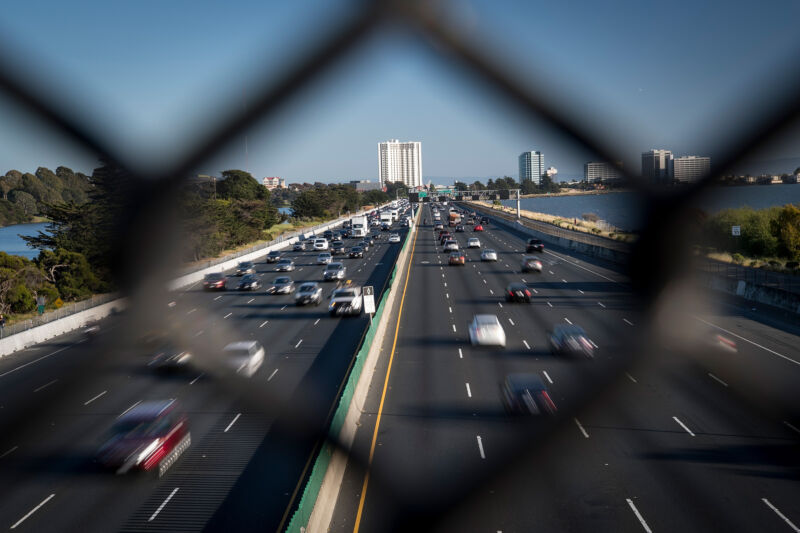
Cars driving down I-80 in Berkeley, California, in May, 2018 when there were still places to go.

Enlarge / Cars driving down I-80 in Berkeley, California, in May, 2018 when there were still places to go. (credit: David Paul Morris | Bloomberg | Getty Images)

There is a strange sort of symmetry in the world of personal data this week: one new report has identified a company that wants to sell the US government granular car location data from basically every vehicle in the world, while a group of privacy advocates is suing another company for providing customer data to the feds.

A surveillance contractor called Ulysses can "remotely geolocate vehicles in nearly every country except for North Korea and Cuba on a near real-time basis," Vice Motherboard reports.

Ulysses obtains vehicle telematics data from embedded sensors and communications sensors that can transmit information such as seatbelt status, engine temperature, and current vehicle location back to automakers or other parties.

Read 9 remaining paragraphs | Comments

19 Mar 02:12

Republicans block effort to protect COVID-19 relief checks from debt collectors

by Laura Clawson
James.galbraith

Of course they do

Republicans have blocked a bill to protect $1,400 COVID-19 relief payments from debt collectors, despite having passed such a protection on the previous $600 payments. It’s all part of how Republicans supported COVID-19 funding—some of it, at least—while they were in control, but have tried to torpedo anything good Democrats were promoting since President Joe Biden took office.

Sens. Sherrod Brown and Ron Wyden had asked the Senate for unanimous consent to pass the bill protecting payments from seizure, but Sen. Pat Toomey blocked it, because wah wah, Democrats didn’t give in to Republican demands on passing the American Rescue Plan, and also debt collectors are pursuing “valid legal claims” against people who “owe money to someone else and that someone else has gone to court, and it’s been adjudicated.”

The economy is rigged and Pat Toomey is definitely not going to be the person to unrig it.

The IRS will not seize the stimulus checks, but states or private debt collectors could do so, as already happened to some people’s $1,200 checks from 2020’s CARES Act. Maryland Gov. Larry Hogan signed an order prohibiting banks from allowing such garnishment in his state.

Allowing debt collectors to grab the payments will, as with so many other things during the coronavirus pandemic, exacerbate existing inequities. Black and Latino people were more likely than white people to tell a pollster they needed the $1,400 just to “get by”: 50% of Black people, 40% of Latino people, and 22% of white people reported that need. In each group, women were more likely to say they needed the payments to get by, and Black and Latino people were more than twice as likely as white people to say they had used past COVID-19 relief payments for housing.

Women also face high levels of need during the pandemic, having been more likely to lose or have to leave their jobs, hits that come on top of already unequal pay that leaves many women economically vulnerable to begin with.

Through the pandemic, 23% of Black women say they’ve had to borrow money from family or friends. Just 9% of white men say the same. When it comes to using a food bank, 21% of Black women say yes compared with 8% of white men. Need is a matter of race and gender and the intersection between them in this country, so when Republicans take action to make all economically vulnerable people more vulnerable, they take action against some groups more than others. And they know they’re doing it.

19 Mar 02:12

It’s time for Justice Breyer and Senator Feinstein to retire

by Paul Waldman
If they wait any longer, the result could be disaster.
19 Mar 02:10

Declassified report shows that Republican claims about election interference by China were lies

by Mark Sumner
James.galbraith

Of course they were

Well before any votes were cast in November 2020, it was clear that Russia was once again acting to protect its favored politicians within the United States. In response to this threat, Donald Trump and Republicans in Congress moved immediately … to protect the interference. In part this was done through directly purging the intelligence community of those reporting this threat. 

But an even more public effort was made in the form of “it’s not Russia, it’s these other guys,” where the other guys were sometimes Iran, but much more frequently, China. The claims that China was “the real threat” flew fast and furious in the run-up to the election. However, despite Trump’s claims that China was responsible for Democratic victories in midterm elections, and his follow-up attempt to recruit China to his cause, there was never any real evidence that China was involved in the kind of active interference coming from Russia.

As Reuters reported in September 2020, then-National Security Advisor China Robert O’Brien claimed that China “has taken the most active role” in attempting to interfere with the U.S. election. William Barr was also making the same claims, saying that “China posed a bigger threat to November’s U.S. election than Russia.”

At the time, Rep. Adam Schiff accused Barr of lying. And, as new intelligence reports have demonstrated, Schiff was right.

The National Intelligence Council (NIC) report that was declassified on Wednesday may be most notable because it shows how Trump and his associates were directly accepting disinformation from Russian agents to bolster their attacks on Joe Biden. That included all the claims that Trump, Rudy Giuliani, and others were making about Hunter Biden’s actions in Ukraine. The report shows once again that colluding with Russia is not just something that Trump and other Republicans have done, but something they’ve done eagerly, often seeking out the Russian sources in their efforts to generate propaganda.

As The New York Times reports, what’s obvious after a review of the NIC report is that the intelligence showing Russian interference in the election was clear. It always had been clear. Claims from Barr, O’Brien, and other Trump officials that the intelligence was not clear was itself a form of disinformation. 

What was also crystal clear is that the emphasis on the threat from China was intended to distract from the real interference from Russia, tie into lies that Trump repeatedly stated about Hunter Biden making “billions” in China, and reinforce a Republican wall of false claims blaming China for everything from the failure of the U.S. steel industry to America’s COVID-19 response. 

In no sense is the authoritarian, one-party government of China “good.” Their actions in controlling Hong Kong, the genocide of the Uighurs, and the ongoing occupation of Tibet are just a small fraction of the reasons why China’s government should be rightfully scorned. The expansion of China’s military capability and rapid growth of cyber capabilities do constitute a genuine threat, especially to other nations in the region. But none of that makes the lies that were told concerning China and the election—or China and the Bidens—any more true.

The efforts that Trump and other Republicans made to misdirect attention to China were extremely helpful to Vladimir Putin. The Russian leader was able to run his anti-democratic campaign not only unimpeded, but actively assisted by everyone from Rudy Giuliani to Sen. Ron Johnson, who seemed all too eager to act as Putin’s bag men.

It was clear, even at the time the statements were being made last fall, that the attempts to direct claims of election interference toward China were worse than a smokescreen. As CNN reported at the time, Trump claimed that China was not only trying to interfere in the election, but was secretly funding BLM protests that came in the wake of George Floyd’s murder by Minneapolis police. Trump’s efforts to treat China as a catch-all for every issue in the nation—including his own greatest failures—is directly connected to the violence against Asian Americans that has been spiking for over a year.

As with everything else, Trump, along with right-wing media, worked to politicize the idea that China was interfering in the election and Russia was not. This included claims that Biden was helping China in these actions, and frequent claims on on Fox, OANN, and talk radio that a vote for Biden was “a vote for China, not the U.S.” All of that was, of course, a lie. 

And they knew it. The report that was declassified this week may be new, but none of the information it contains was put together at the last minute. This is a compilation of information that was understood for months. Information that says this:

Key Judgment 4: We assess that China did not deploy interference efforts and considered but did not deploy influence efforts intended to change the outcome of the US Presidential election. We have high confidence in this judgment. 

Don’t expect that result, or the clear evidence that Russians did interfere with Republican help, to change the way the story is reported on Fox or spewed by Ron Johnson. After all, they knew they were lying when they said it the first time. They’ll have no problem doing more of the same.

18 Mar 03:54

Democrats would pay no political price for reforming the filibuster

by Dartagnan
James.galbraith

Seriously. So fucking stop defending this shit.

For an issue that has so dominated the media during the past two weeks, the views of ordinary Americans toward the legislative filibuster have received remarkably little attention in the way of polling. What emerges most noticeably from those polls that have been conducted is a remarkable degree of indifference, one that most likely stems from Americans’ overall lack of knowledge on the topic.

I always find it curious when a Democratic senator frets about changing a procedural mechanism that the vast majority of their actual constituents couldn’t explain if you asked them to. Are there people in West Virginia, for example, who, as they entered the voting booth in 2016, said to themselves, “I’ll vote for that Manchin guy again, but if he ever decides to change that cloture rule, he’s history?” Or to put it another way, are there any Joe Manchin voters in West Virginia who, when offered the prospect of a huge waterworks or road repair project to bring jobs and improvement to their hometown or county, are likely to say, “Well, those things would be wonderful, but I just can’t reconcile that with changing the filibuster rule?”

Of course not. People may have different rationales to support their voting decisions, but the retention or modification of arcane Senate rules is likely not one of them—and that‘s historically true for either party. Perhaps more basic (but just as obvious): People elect their senators to get work done. That’s also generally true for partisans of either political persuasion (although it may be more so for Democrats).

Washington University political science professor Steven S. Smith wanted to find out how concerned the American electorate actually is about reforming the filibuster, and whether there was an actual, partisan breakdown, either for or against it. In a paper released this month, titled “Partisan Differences on Filibuster Reform in the American Public,” Smith, a senior fellow at the Brookings Institution and a distinguished professor of political science at several other institutions, examined the past polling on the issue, and found—not surprisingly—that pollsters tended to ignore the issue except when a particular piece of legislation was publicly and noticeably subject to the filibuster. The fact that the issue of filibuster reform was even raised during the 2020 campaign, almost wholly in the context of the Democratic primary, was an anomaly.

Smith writes:

A fair generalization is that only a few Americans show real familiarity with the filibuster and cloture and that, in the aggregate, the balance of opinion shifts with attitudes about the legislation or nomination at stake. Moreover, the public favors both majority rule and minority rights, with preferences about the right balance affected by which party benefits from majority rule at the moment. But attitudes about the filibuster are transient.

The number of Americans who know enough about the filibuster to say how many votes are required to end one varies by the survey. A Pew survey from 2018 reported as many as 40% could “identify” that it took 60 senators to break through. But when asked in a 2020 survey, only 15% responded that 60 votes were required. Overall, in terms of their actual views about the filibuster—whether it is a “good” or “bad” thing—Americans views are, as Smith describes, “weak.”

That’s mainly because polling on the issue invariably requires asking lengthy, confusing questions that many people simply don’t comprehend: Smith cites a 2013 CBS survey that asked respondents to say whether the means to end a filibuster was a “good thing,” but was so vaguely worded that respondents could have felt they were being asked whether the specific 60-vote threshold required was a “good thing.” Overall, there was a small majority in favor of retaining the rule as is. But then came 2020, when discussions about the filibuster began to percolate through the media, and now perception of the filibuster has changed: “A reasonable working hypothesis, based on elite commentary over the past year, is that Democrats and liberals favor reform while Republicans and conservatives do not.”

But that, of course, is dependent on which party is in power at the time. It makes perfect sense that Republicans would disfavor a change that reduces their party’s ability to obstruct while Republicans are in the minority. And vice versa for Democrats. But the more interesting observation is the degree of utter indifference by Americans overall: When asked whether they would support a reform of the filibuster so that legislation could simply get a vote with 51 (majority) votes, 45% of respondents “chose “neither support nor oppose” reform or did not answer the question.” In other words, as Smith points out, “Indifference seems to run deep.”

Smith essentially concludes from his review of the polling that neither party is likely to face any discernible blowback for reforming the filibuster.

While Democrats clearly favor reform more than Republicans do, the lack of knowledge about the current rule surely must make the issue difficult to understand for the average citizen. Strong procedural preferences, independent of partisan or policy considerations, are likely to exist for only a few Americans. The result is that party and opinion leaders have a quite malleable audience for their procedural moves and are not likely to suffer a political price for those moves on whatever grounds motivate their strategies.

It is probably too obvious that for those few who would strongly object to such reform, nearly all would be from the minority party; so in our Manchin example, those in opposition would be Republicans who would never have voted for Joe Manchin in the first place.

In other words, neither he nor anyone else in the Democratic Party would pay a political price for reforming the filibuster.

18 Mar 03:51

The Atlanta shootings can’t be divorced from racism and misogyny

by Li Zhou
James.galbraith

And GA cops go out of their way to excuse the white guy. Is anyone surprised?

Mourners leave flowers at the site of one of three businesses that were targeted in Tuesday night’s shootings in Atlanta, Georgia. | Megan Varner/Getty Images

The suspect has claimed that these attacks weren’t racially motivated even though they predominantly targeted women of Asian descent.

After eight people — including six women of Asian descent — were killed at three Atlanta-area spas on Tuesday, police echoed a surprising claim: According to the suspect, the attacks weren’t “racially motivated.”

Instead, the Cherokee County police noted that the alleged shooter, 21-year-old Robert Long, had “some issues, potentially sexual addiction,” seemingly writing off the role of race altogether. (Later in the day, it came to light that one of the officers who made these statements, Capt. Jay Baker of the county sheriff’s office, had posted to Facebook about a T-shirt that espoused a conspiracy theory that the coronavirus had been “imported” from China.)

In the best case scenario, police were attempting to provide clarity: Since anti-Asian incidents have surged in the last year as people have scapegoated Asian Americans for the coronavirus pandemic, officials likely wanted to make it explicit that this attack may have been prompted by something different. Their statements, however, wound up obscuring just how much racism and misogyny were tied to the shootings, which Long framed as a way to reduce the “temptation” he faced at the spas.

That perception alone relies on longstanding tropes about businesses like these and about Asian American women who have been exoticized and fetishized as sexual partners as far back as the 1800s. In other words, the suspect’s choice of victims and the rationale he gave are telling in themselves: He may explicitly state that race was not a factor, but his actions and his reasoning clearly suggest a very different interpretation.

Officials have yet to reveal more information about the victims: Those who have been identified are Delaina Ashley Yaun, Paul Andre Michels, Xiaojie Tan, and Daoyou Feng, while four other women of Korean descent have not been named. Elcias R. Hernandez-Ortiz was also injured but experienced wounds that were not life-threatening. It’s still not yet known whether all the victims worked at these spas and what relationship, if any, they had to the shooter.

But it does seem unlikely that his choice of business and who it employs was random given the makeup of the state. In Georgia, Asian Americans are about 4 percent of the population, according to a 2019 census report. Although their presence in the state and in the Atlanta area have grown significantly in the past two decades, Asian Americans are still a relatively small proportion of area residents. As the New York Times reported, Asian Americans are about 2 percent of the population in Cherokee County, where one of the shootings took place.

The Atlanta attacks also echo a chilling dynamic that has been observed in the data about anti-Asian incidents overall, which have found that women are twice as likely to report experiencing such attacks and harassment as men, and that elderly people and children comprised nearly 20 percent of the reports. This data seems to indicate that attackers across the board have sought out those who they perceive to be more vulnerable, a perception that’s inextricably linked with gender and race.

Attacks against Asian Americans can’t be divorced from race and gender

In the Atlanta shootings, the suspect claims to have carried out attacks on businesses he saw as cause for “temptation.” According to police statements, Long aimed to remove this temptation from his life by using violence.

That impression, both of these establishments as venues for “temptation” and of the people who were on site, stems from entrenched tropes about spas and Asian American women, who have been depicted as hypersexualized beings.

Such stereotypes about Asian American women emerged in the 1800s, and have since been reinforced again and again during the Korean and Vietnam Wars, in American soldiers’ treatment of Asian women, and in depictions in popular culture, like that of the geisha in Madame Butterfly. Over time, Asian American women were painted as subservient, docile, and the focus of objectification and colonization, rather than people deserving of genuine understanding and engagement. As Patricia Park writes for Bitch Media:

The perception of sexualized Asian women was informed by a long tradition of the Western male writing and controlling that perception, leaving the women with no agency and no control over their own representation. Asian women in the media have been few and far between; what few there were often had no choice but to take on the archetypal roles of Asian females.

The central problem with this stereotype is that it dehumanizes Asian American women and reduces them solely to sexual objects. That dehumanization, in turn, perpetuates violence toward these groups, and condones it.

This dynamic, coupled with the pervasiveness of the “model minority myth,” which seeks to drive a wedge between minority groups and treats the Asian American experience as an exceptional and homogenous one, renders the pain and violence that Asian American women endure invisible.

“Dehumanization creates a climate that makes violence excusable,” says Morgan Dewey, the development coordinator for the National Network to End Domestic Violence. “Forty-one to 61 percent of Asian women report experiencing physical and/or sexual violence by an intimate partner during their lifetime. This is significantly higher than any other ethnic group.”

The conversation surrounding Tuesday’s shootings has some similarities to the one surrounding violence toward Asian American elders as well. Although recent attacks on senior citizens who have been pushed to the ground or robbed might not be tied to the coronavirus, the decision to attack them specifically could still be a racialized one.

“When an Asian person, elderly or otherwise, is attacked because they are seen ‘as easy or lucrative targets,’ that in itself does not discount ‘racial animus,’” the Asian American Justice and Innovation Lab previously wrote on Instagram. “Without a doubt, one can be seen as an ‘easy or lucrative target’ precisely because of how they are racialized as an Asian person.”

Asian Americans are often viewed as easy marks for crimes like mugging, for instance, because they may be less likely to report such incidents, and because some members of the community don’t speak English fluently. Several of the recent attacks have also been concentrated in Chinatowns across the country, which include many immigrant residents who are likely to be lower-income and less visible. In other words, they’re profiled and attacked specifically because of their ethnicity and vulnerability.

When it comes to the Atlanta shootings, the suspect’s claims about his actions ultimately highlight just how connected they are to race and gender, issues that can’t be divorced from these crimes and the efforts to understand the motivations behind them.

18 Mar 03:33

The House has renewed the Violence Against Women Act. It now faces major hurdles in the Senate. 

by Li Zhou
James.galbraith

Because of the GOP. They're fine with that.

House Democrats Hold News Conference On Reauthorization Of Violence Against Women Act
House Speaker Nancy Pelosi during a news conference about the renewal of the Violence Against Women Act, on March 17, 2021.  | Chip Somodevilla/Getty Images

The House once again passes the Violence Against Women Act in the face of NRA opposition.

A reauthorization of the Violence Against Women Act (VAWA) has officially passed in the House of Representatives, and now heads to the Senate, where it’s poised to face staunch Republican opposition over the gun control measures it contains.

This legislation makes critical changes to VAWA, which was the first federal law to ever comprehensively confront violence against women including domestic abuse, sexual assault, and stalking by allocating grant money to combat and investigate these offenses.

First authored by then-Sen. Joe Biden and the late Rep. Louise Slaughter in 1994, VAWA has been updated multiple times since then in order to best address current needs that people face. In 2013, for instance, lawmakers pushed through changes that would extend the provisions of the law to cover same-sex couples.

In the latest reauthorization, lawmakers aim to strengthen protections for women facing sexual violence by ensuring that non-tribal offenders on tribal lands can be held accountable, and by closing the so-called “boyfriend loophole,” which would bar anyone convicted of stalking from obtaining a firearm. Additionally, the bill includes funds for housing vouchers, so survivors in federally-assisted housing are able to relocate quickly if they need to. It guarantees, too, that people will be able to obtain unemployment insurance if they have to leave a job because of concerns for their safety.

“As a survivor and a member of Congress, I want to use my power to protect other people from what I have experienced,” Rep. Gwen Moore (D-WI), one of the cosponsors of the bill, said in a statement. “With domestic violence cases on the rise during the pandemic, we need the Violence Against Women Act signed into law now.”

There has been a sharp uptick in incidents of domestic violence in the last year as people have been forced to stay home, prompting organizations to offer more flexible support including texting services as well as housing aid. A recent report from the National Commission on COVID-19 and Criminal Justice found an 8 percent uptick in reports of domestic violence since stay-at-home orders were issued, and research from Brigham and Women’s Hospital in Massachusetts also found an increase in the number of emergency room patients with injuries from such incidents.

“Domestic violence is being called a pandemic within the Covid-19 pandemic, with growing evidence showing that the conditions of the pandemic have resulted in escalated rates of intimate partner violence, and in some cases more severe injuries,” Biden has said.

Although the last VAWA reauthorization expired after lawmakers passed a short extension in 2019, Congress has continued to appropriate funding for the programs it covers in the interim, meaning those who use them haven’t seen gaps in coverage because of the delay. But by dragging their feet on this reauthorization — which the Senate stymied last term — lawmakers have prevented important new changes and protections from being implemented.

“This reauthorization would significantly increase funding for rape prevention programs,” says Allison Randall, the vice president for policy for the National Network to End Domestic Violence. “The longer it takes means more survivors won’t benefit.”

What’s in the bill

The VAWA reauthorization would continue to fund a number of existing programs it covers — including legal aid for victims, programs aimed at preventing and reducing dating violence, and support for medical care — while also expanding the protections the law offers.

Here are some of the areas that the reauthorization would change:

  • Closes the “boyfriend loophole” for firearms purchases: The bill would bar anyone convicted of stalking or domestic abuse from being able to purchase a firearm. At the moment, this restriction only applies to partners who are married, cohabitating, or have children with the victim.
  • Increases accountability for incidents on tribal lands: Currently, Native American tribes don’t have jurisdiction to prosecute certain violent acts against women by non-tribal members including sexual assault, limiting the legal accountability of some offenders. This bill would change that.
  • Additional funding for culturally specific services: The legislation includes $40 million for the Department of Health and Human Services to specifically tailor programs to the needs of communities of color, including improving language access.
  • More funding for the Rape Prevention & Education Program: There’s a boost in funding to efforts aimed at preventing sexual assault, including grants that go to states and community-based initiatives. The reauthorization would designate $110 million per fiscal year for these programs.

Senate Republicans intend to offer their own version of the legislation, and have already cited the House bill’s gun control provisions as a potential stumbling block for bipartisan support in the upper chamber.

“Certainly we ran into hiccups with some of the gun issues and that’s a big one for a number of us — stripping away people’s constitutional rights is not something that we should be doing,” Sen. Joni Ernst (R-IA), a lead author of the GOP bill, recently told the Wall Street Journal’s Lindsay Wise.

Ultimately, since the 50-member Democratic caucus in the Senate will need 10 Republican votes to hit the 60-vote threshold required to pass the reauthorization in the upper chamber, the two parties may need to work out a compromise, or VAWA could get blocked yet again this year.

18 Mar 03:31

Democrats just got one step closer to making gender equality a constitutional right

by Anna North
James.galbraith

And the GOP will scream because they like their bigotry, thank you very much.

Rep. Jackie Speier speaks at a podium, flanked by women members of Congress.
Rep. Jackie Speier (D-CA) speaks at a press conference on the House’s vote to remove the ratification deadline for the Equal Rights Amendment in February 2020. | Tasos Katopodis/Getty Images

A House vote brings the Equal Rights Amendment closer to passage, but it still has a long road ahead.

The House of Representatives voted on Wednesday to remove a key stumbling block for the Equal Rights Amendment, which would enshrine the principle of gender equality in the US Constitution.

First introduced in 1923, the amendment would ban discrimination on the basis of sex, paving the way for people of all genders to challenge anything from unequal pay to restrictions on abortion. But the amendment has had a long road in American politics, and that road is far from ended.

The ERA passed Congress with bipartisan support in 1972 but still had to be ratified by three-quarters of the states, a process that ended up taking nearly 40 years. Last January, Virginia became the 38th state to ratify the amendment, pushing it over the finish line. But there was a problem: Congress had set a ratification deadline of 1982. The resolution passed today, introduced by Reps. Jackie Speier (D-CA) and Tom Reed (R-NY), removes the deadline so that the process can move forward.

There are still many obstacles ahead; the resolution needs to pass the Senate, where it will likely face Republican opposition. It’s also likely to face a legal challenge, as the Department of Justice under President Donald Trump issued a memo stating that Congress could not revive a proposed amendment after the ratification deadline had expired. Still, the vote Wednesday is a major step toward an amendment that, with a Democratic-controlled Congress and a new president in the White House, now stands a better chance of becoming law.

Wednesday’s vote removes one obstacle to the ERA. There are many more ahead.

The Equal Rights Amendment is simple. Here’s the text:

Section 1: Equality of rights under the law shall not be denied or abridged by the United States or by any state on account of sex.

Section 2: The Congress shall have the power to enforce, by appropriate legislation, the provisions of this article.

Section 3: This amendment shall take effect two years after the date of ratification.

But these few words have been wending their way through American politics for nearly 100 years, as Vox’s Emily Stewart writes. First introduced in 1923, it passed Congress with bipartisan support in 1972. But because it’s a constitutional amendment, it still had to be ratified by three-quarters of the states, or 38 out of 50.

Thirty-five states ratified the amendment quickly, but then momentum slowed, in part due to the work of anti-feminist advocates like Phyllis Schlafly in the mid- to late 1970s who argued that the amendment would undermine women’s role as wives and mothers, expand abortion, and even make women eligible for the draft (supporters of the amendment argue that, actually, Congress already has the power to draft women). However, things have picked up again in recent years, with Nevada ratifying the amendment in 2017, Illinois in 2018, and Virginia in 2020.

“In passing this resolution, we’re finally on record as supporting women’s rights as human beings, equal to men,” Virginia Del. Jennifer Carroll Foy, sponsor of the state’s ratification resolution, said in a statement at the time.

But the deadline was a problem. The House of Representatives passed a resolution to remove it last year, but it didn’t receive a vote in the Senate, then under Republican control. Meanwhile, some states actively fought the amendment. In 2019, Louisiana, Alabama, and South Dakota filed a lawsuit in an effort to force the federal government to let the 1982 deadline stand. And President Trump’s Justice Department issued guidance last January stating that Congress does not have the power to change the deadline.

Now, however, Democrats control the Senate, and the resolution is likely to come to a vote, at a minimum. It’s still unlikely to gain a filibuster-proof majority, with Sens. Susan Collins of Maine and Lisa Murkowski of Alaska the only Republicans supporting it so far.

And even if it did pass the Senate, the resolution could face legal trouble, especially since several states, including South Dakota and Tennessee, have actually rescinded their ratification since 1972. Even Supreme Court Justice Ruth Bader Ginsburg, a champion of women’s rights, saw this as a problem. “If you count a latecomer on the plus side,” she said in a 2020 appearance, “how can you disregard states that said, ‘We’ve changed our minds?’”

Still, the amendment has something now that it didn’t have last year: the support of the president. Biden said during his campaign last year that he would “proudly advocate for Congress to recognize that three-fourths of states have ratified the amendment and take action so our Constitution makes clear that any government-related discrimination against women is unconstitutional.”

Advocates say passing the ERA would send a crucial message on gender equality

If it eventually does pass, advocates say the ERA would send an important message of gender equality to the entire country. Right now, the Constitution doesn’t explicitly address sex discrimination at all. The ERA would change that, Emily Martin, vice president for education and workplace justice at the National Women’s Law Center, told Vox last year. “It would, at the most fundamental level, recognize that gender equality is a foundational principle for the United States.”

There are laws on the books that ban sex discrimination in some arenas. The Equal Pay Act, for example, requires that men and women get equal pay for equal work. But, Foy told Vox last year, “laws can be changed just as easily as legislators change their minds” — a constitutional amendment is more permanent.

A constitutional amendment would also provide more tools to challenge discriminatory laws or practices in court. Federal courts have interpreted the Equal Protection Clause of the 14th Amendment as conferring some protection against sex discrimination, Martin said. But adding an explicit ban on such discrimination in the Constitution would likely force courts to take the issue much more seriously.

And it wouldn’t just affect women’s rights. By banning discrimination on the basis of sex, it could implicitly prohibit discrimination on the basis of sexual orientation and gender identity as well, offering protections to gay and trans people regardless of their gender. The Supreme Court ruling last year in Bostock v. Clayton County, Georgia, which found that discrimination on the basis of sexual orientation was a form of sex discrimination, could bolster these protections if the ERA were to pass.

The effort to pass the ERA will strengthen activism for gender equality around the country, Martin said. In recent years, “we’ve seen this need and hunger and energy around women’s organizing, around women demanding equality,” she explained. “The push for the Equal Rights Amendment is part of that and builds on that.”

18 Mar 03:30

Georgia sheriff's office is filled with excuses for alleged Atlanta massage parlor shooter

by Laura Clawson
James.galbraith

Fucking appalling. How the fuck are they dedicating themselves to going out and making excuses for an admitted mass murderer?

Police say Robert Aaron Long, the suspect in a shooting spree at three Atlanta-area massage parlors that killed eight people, may not have been racially motivated despite the fact that six of his eight victims were Asian or Asian American.

“He made indicators that he has some issues, potentially sexual addiction, and may have frequented some of these places in the past,” an official with the Cherokee County Sheriff’s Office said. That being the case, Capt. Jay Baker said, the massage parlors were a “temptation for him that he wanted to eliminate.”

Sounds like we don’t just need to talk about Long’s motivations to kill—we also need to talk about the Cherokee County Sheriff’s Office’s motivation to make excuses for him.

Baker said Long “was pretty much fed up, kind of at the end of his rope, and yesterday was a really bad day for him and this is what he did.” Investigators who interviewed Long “got the impression that he understood the gravity” of his actions, according to Baker, who further said “I don’t know if he was remorseful or not.”

Okay, then. We have a white guy who apparently murdered eight people at three locations, injured one other person, and was arrested unharmed despite police having to force his car off the road to apprehend him. And the first thing police have to tell us is what a bad day he had and about his sexual addiction problems that led him to want to eliminate temptation … by murdering people.

First off, let’s be clear that “murdered women because he saw them as a source of sexual temptation” is also very, very bad. Second, a spike in anti-Asian racist incidents over the past pandemic year have disproportionately targeted women, with the founder of Stop AAPI Hate noting, before the Atlanta shootings, “There is an intersectional dynamic going on that others may perceive both Asians and women and Asian women as easier targets.” Third, and this is closely related, gross racist fetishization of Asian women has a long history.

Fourth, sex addiction is not a real condition. It’s mostly an excuse for men who do lousy things: “high libido coupled with low impulse control.” Attributing mass murder to sex addiction suggests an illness is responsible where there is no illness.

The message from the police seems to be this: Gosh, it’s not good what he did, but … he had his reasons—a really bad day, people!—and despite the racial makeup of his victims, we're going to put a whole laundry list of reasons above racism

In addition to why Long (allegedly) killed all those people, there’s a question of how. He reportedly bought a gun just hours before the shootings, despite plenty of evidence that he was a guy with access to guns already. “It's worth asking if waiting periods could've prevented this tragedy in Georgia[.] Waiting periods for possession of firearms prevent impulsive, volatile acts of gun violence,” Igor Volsky tweeted. “10 states + DC have waiting periods for at least some types of firearm purchases. Georgia does not.”

Going to buy a gun and then going to three separate establishments, with 30 miles between the first and second, and then planning, as Long told police, to go to Florida to kill some more people would seem to suggest a higher degree of planning than “yesterday was a really bad day for him and this is what he did.”

Police have named the victims at Young’s Asian Massage in Acworth as Delaina Ashley Yaun, Paul Andre Michels, Xiaojie Tan, and Daoyou Feng. Elcias R. Hernandez-Ortiz was injured. The people killed at the two other locations have not yet been identified by officials. 

Long’s victims won’t get to have any more days—not good ones or “really bad” ones.

18 Mar 03:28

Joe Manchin just took an important filibuster reform off the table

by Ian Millhiser
James.galbraith

Fuck West Virginia and the troll they've cursed us with.

Sen. Joe Manchin (D-WV) speaks at the confirmation hearing for Rep. Deb Haaland (D-NM), nominee for secretary of the interior, before the Senate Energy and Natural Resources Committee on February 24, 2021, on Capitol Hill in Washington, DC. | Sarah Silbiger/Getty Images

Manchin just closed the door on a promising idea that could have made the Senate much more functional.

Sen. Joe Manchin, the most conservative member of the Senate Democratic caucus, has spent the past couple of weeks doling out cryptic hints that he might be open to changing filibuster rules that currently allow the Republican minority to block most legislation unless a bill is supported by at least 60 senators.

On Wednesday, however, he appeared to shut the door on several ideas floated by proponents of filibuster reform within the Senate. Manchin’s latest move does not mean that filibuster reform is dead, but it does suggest that Democrats who wish to make it easier to enact legislation may struggle to come up with a strong package of reforms that will win Manchin’s support.

Earlier this month, Manchin told Meet the Press’s Chuck Todd that he’s open to making the filibuster “a little bit more painful” for the minority, and that he might be willing to make senators “stand there and talk” if they wish to maintain a filibuster. The West Virginia senator, in other words, appeared open to a so-called “talking filibuster,” where senators who wish to block legislation must speak continuously on the Senate floor in order to maintain a filibuster.

President Joe Biden endorsed changing the Senate’s rules to require talking filibusters on Tuesday evening.

In addition to offering tepid support for a talking filibuster, Manchin had also hinted that he’d be open to a completely different reform. Under the Senate’s current rules, the majority must produce 60 affirmative votes in order to break a filibuster. That could be changed to require the minority to produce 41 negative votes in order to maintain a filibuster, thus shifting the burden onto the minority.

Manchin appeared open to shifting this burden in a recent interview with Politico’s Burgess Everett. But his support for this idea, such as it was, appears to have ebbed:

In a 50-50 Senate, every vote matters. Though Democrats can effectively change Senate rules with only a simple majority vote, they almost certainly need every single member of their caucus to back any significant change to the filibuster rule. So if Manchin — or other reform skeptics like Sen. Kyrsten Sinema (D-AZ) — take potential reforms off the table, that’s a serious blow to the broader project of trying to weaken the filibuster.

And Manchin’s newly stated opposition to burden shifting — that is, moving to requiring 41 senators to sustain a filibuster instead of requiring 60 senators to break one — is a particularly significant blow to reform efforts. Burden shifting, combined with other reforms such as a talking filibuster, could have imposed very potent limits on the minority’s power to obstruct legislation.

Why Manchin’s latest statement is such a significant blow to filibuster reform

The broad idea behind a talking filibuster, which Manchin still may support, is that a filibuster ends unless at least one senator continues to speak on the Senate floor in support of that filibuster. On its own, however, a talking filibuster requirement is unlikely to do much to limit the minority’s power to block legislation.

If only one senator can maintain a filibuster, and if senators are allowed to tag-team — swapping in a new senator to maintain a filibuster when the previous senator is unable to keep talking — then the 50 members of the Republican caucus can probably take turns maintaining a filibuster for as long as they want.

Recently, however, Sen. Jeff Merkley (D-OR) proposed imposing a much more significant burden on filibustering senators. Under this proposal, senators in the minority would need to keep 41 senators who support a filibuster on the floor at all times in order to maintain that filibuster.

If Merkley’s proposal were written into the Senate’s rules, it would be a significant limit on the minority’s power to block legislation. Such a rule would potentially allow the majority leader to hold the Senate in session 24 hours a day, 365 days a year. If Republicans wanted to maintain a filibuster under this proposed rule, they might have had to keep over 80 percent of their caucus on the floor into the wee hours of every morning.

But Merkley’s proposal now appears dead, because Manchin won’t support it.

That doesn’t mean that the entire project of filibuster reform is dead. But it does mean that reformers hoping to make serious inroads on the minority’s power to obstruct legislation may need to go back to the drawing board.

18 Mar 03:24

State Republicans have found their first fight to pick with Biden

by Paul Waldman
James.galbraith

Of course they do, but federal money comes with strings. There's nothing new about that.

The covid relief bill says they can't use state aid to cut taxes. They want to do it anyway.
17 Mar 19:39

Aurelia Gets It

James.galbraith

lol and it finally lands

ohhhh

17 Mar 17:31

AT&T whines about Calif. net neutrality law as ISPs’ case appears doomed

by Jon Brodkin
Closeup shot of a judge holding a gavel.

Enlarge (credit: Getty Images | naruecha jenthaisong)

The broadband industry's attempt to kill California's net neutrality law appears to have very little chance of succeeding in the US district court where the case is being heard.

On February 23, the industry's motion for a preliminary injunction was denied by Judge John Mendez of US District Court for the Eastern District of California, as we reported at the time. We didn't have much detail on Mendez's reasoning last month, but we've since obtained a not-yet-publicly released transcript of the hearing in which he issued his verbal ruling against the injunction. (He did not issue a written ruling, citing time constraints caused by a shortage of judges in his district.)

Mendez's denial of the injunction means that California can enforce its net neutrality law while the case continues, leaving open the possibility that Mendez could ultimately side with the broadband industry. But Mendez explained during the hearing why he thinks the industry is unlikely to succeed at trial.

Read 25 remaining paragraphs | Comments

17 Mar 16:34

Saturday Morning Breakfast Cereal - Pray

by tech@thehiveworks.com


Click here to go see the bonus panel!

Hovertext:
I believe that's the correct sign language for that particular request, but please correct me if I'm wrong.


Today's News:
17 Mar 16:16

The Biden Agenda Doesn’t Run Through Washington

by Ronald Brownstein
James.galbraith

Good for dems to finally realize that we need serious urban policy, because that's where the people and the economy lives.

President Joe Biden can’t expect a lot of cooperation from Texas. That much has been made clear by state Republicans’ behavior in just the past three months. Texas Attorney General Ken Paxton led a far-fetched federal lawsuit to overturn Biden’s victory. After that failed, he brought a suit against the new administration’s plan to pause immigration deportations only two days into Biden’s presidency. Just days after that, Texas Governor Greg Abbott issued an executive order pledging to fight Biden’s climate-change agenda—and when a bitter winter storm knocked out the state’s power, Abbott erroneously blamed Democrats and renewable energy for the crisis. For the Republicans who dominate Texas politics, Biden’s honeymoon ended before he had unpacked all his boxes in the White House.

But the leadership in Harris County, Texas, the third-largest county in the country and home to Houston, responded to Biden’s ascendance with a very different attitude. The county’s chief elected official, Lina Hidalgo—a Democrat, Colombian immigrant, and 30-year-old Stanford graduate—views the Biden administration as something like the arrival of the cavalry.

After taking office in 2019, Hidalgo dealt with a Trump administration whose attitude toward the nation’s biggest cities and inner suburbs ranged from indifference to open hostility. The Republican-ruled state government has been equally combative. In recent years, Abbott and the legislature have grown more and more assertive in overriding policies from the state’s Democratic-leaning metropolitan centers. (On Monday, Abbott endorsed legislation that would ban the innovative measures—such as keeping polls open later in the day during the early-voting period—that Harris County used to expand voter turnout last fall to a 30-year high.) After years of these headwinds, Hidalgo is eager to work with the Biden administration on a range of issues, including pandemic recovery; expanding access to health care, transportation, and affordable housing; and combatting local flooding linked to climate change. Republican leaders in Texas have been “targeting local governments as their political tool, and it almost seems they keep a to-do list of what counties and cities are doing so they can cancel it out at the next session,” Hidalgo, one of Biden’s hosts when he recently toured damage from the storm in Houston, told me. “Being able to work with someone—anyone—helps.”

[Derek Thompson: Superstar cities are in trouble]

Hidalgo’s enthusiasm about working with Biden illustrates the president’s opportunity to fundamentally rethink the way the federal government pursues its domestic goals. Biden could advance both his agenda and his political interests by channeling his policies through major metropolitan areas, without relying on states as his principal partners, as previous White Houses have traditionally done.

Cities and their inner suburbs need an immediate lifeline from Washington to stabilize their finances after the devastation of the pandemic. But once those communities regain their balance, they could become crucial allies for Biden. By working with big metros, the president would be aligning federal policy with powerful economic, social, and electoral trends—and empowering local officials overwhelmingly sympathetic to his core objectives. If Biden can forge such partnerships, he could both ignite a new wave of local innovation and solidify the Democratic Party’s advantage in the fast-growing, diverse, and well-educated metro areas that have become the bedrock of its electoral coalition. “If Joe Biden could be the president who reclaimed federalism and rewrote federalism for this next generation,” Los Angeles Mayor Eric Garcetti told me, “I think that’s going to be one of his most lasting legacies.”

Donald Trump, though himself a native New Yorker, had little use for cities except to condemn them, using them as a foil to energize his predominantly nonurban base. He not only targeted urban areas with inflammatory rhetoric, but also assaulted them with policy—including his attempt to cut off federal funding to those that would not fully cooperate with immigration authorities and his deployment of federal law enforcement into Democratic-run cities last year over the objection of local officials. Congressional Republicans, few of whom now represent urban voters, were no warmer: In negotiations on a COVID-19 relief plan last year, for example, then–Senate Majority Leader Mitch McConnell blocked additional aid to state and local governments whose budgets had been ravaged by the pandemic, thus pressuring them to cut key services. The Trump administration didn’t communicate much with local governments, Garcetti said. “And worse than that, obviously, what they’ve communicated—whether it’s McConnell or others—is: Drop dead.”

Biden has a very different history. His political career began five decades ago in local government, when he won a seat on the New Castle County Council in northern Delaware. As vice president, he worked closely with mayors while implementing the economic-recovery plan that Barack Obama signed into law in 2009. He has selected three current or former mayors for his Cabinet: Pete Buttigieg at the Department of Transportation, Marcia Fudge at the Department of Housing and Urban Development, and Marty Walsh at the Department of Labor. Biden made one of his first postelection appearances before the advocacy group the National League of Cities, where he insisted that cooperation with urban areas would be crucial to his success on the biggest challenges he faces, including the pandemic and racial and economic inequality. “American cities are on the front lines of all of these crises,” Biden said.

Democratic presidents almost always express some version of that sentiment. But Biden has good reason to translate it into a genuine reassessment of how the federal government implements its domestic policies. Any president who wants to accelerate economic recovery, widen the circle of opportunity, close the racial wealth gap, reduce carbon emissions, and rethink the country’s education system must recognize that cities and their inner suburbs are the principal arena in which those efforts will succeed or fail.

On most issues—whether it’s health care, infrastructure, or education—the federal government’s default position for decades has been to work with states, not cities or counties. This approach has typically seemed logical: America has only 50 states, compared with more than 19,000 cities and towns and more than 3,100 counties. But in many ways, that strategy now seems anachronistic, especially for a Democratic president.

The most obvious reason is that in this highly polarized era, the states controlled by Republican governors or legislators—currently slightly more than half of all the states—are hostile to almost everything a Democratic president wants to do. In the most consequential recent example, red states were conspicuously slower than blue states to expand Medicaid to more of the working poor following the passage of the Affordable Care Act. Eleven years after the ACA became law, 12 states with Republican-controlled legislatures (most of them also with Republican governors) still haven’t done so. During Obama’s presidency, coalitions of red states, many of them organized by Texas, filed a series of lawsuits to block the administration’s agenda on immigration, health care, climate, and other concerns. Texas’s success at winning a nationwide injunction against Biden’s immigration-enforcement policies less than a week after his inauguration shows that the new president can expect more of the same. Far from partnering with Biden, red states are much more likely to fight him using every tool at their disposal.

Relying on states as partners also ignores the increasing economic importance of the big metro areas, particularly in the growing knowledge-based economy. Since the late 20th century, when many cities seemed to be facing terminal decline, “we’ve had a radical economic restructuring,” says Bruce Katz, a former HUD chief of staff and now a distinguished fellow at Drexel University’s Lindy Institute for Urban Innovation. “What the market is rewarding all over the world is metropolitan concentration and agglomeration.” The 100 largest U.S. counties now account for more than half of the nation’s total economic output, nearly half of its jobs, and more than two-fifths of the total population—measurable increases from 2010, according to tabulations provided to me by the Brookings Institution’s Metropolitan Policy Program. Additionally, about three-fifths of nonwhite Americans and more than two-thirds of the country’s immigrants live in just those 100 largest counties.

Targeting metro areas as the principal partner for federal action would also acknowledge the rapidly evolving electoral landscape. From the 1960s through the ’90s, urban politics was defined by endemic conflict between inner cities, which were largely minority communities and tilted Democratic, and their suburbs, which were filled with Republican-leaning white-flight families. But over roughly the past 20 years, and especially during the Trump era, a different dividing line has emerged. Economic opportunities, especially in the digital economy, have attracted more white people back to central cities, and suburbs have diversified with the migration of more Black, Latino, and Asian American families. Economic ties between central cities and their surrounding suburbs have solidified.

The result: More and more, cities and their inner suburbs find their interests converging—while those interests simultaneously diverge from the conservative priorities of the mostly white people living in small-town and rural places away from urban centers. As November’s presidential results demonstrated, if you draw an imaginary beltway around almost any major metropolitan area, Democrats are growing stronger inside that circle, while Republicans are consolidating their position outside of it. Tabulations by The Daily Yonder, a website focusing on rural issues, found that Biden not only won the counties anchored by the nation’s biggest urban centers by a crushing 13 million votes, but also carried their inner suburbs by more than 4 million, and even won midsize urban centers by 1.5 million or so. (Those three categories of communities provided almost four-fifths of all Biden’s votes.) Trump dominated the smaller places beyond those centers, but that wasn’t nearly enough for him to overcome Biden’s advantage in the metro areas.

[Read: Trump’s parting gift to Joe Biden]

The political convergence between cities and inner suburbs would multiply the impact of any Biden partnership with local leaders: He has the chance to build alliances—and thus extend policies—across entire metropolitan regions, achieving greater scale than he could by working with central cities alone. “Regionalism becomes much more realistic today than it ever was before,” Julián Castro, the HUD secretary under Obama and a former mayor of San Antonio, told me. This convergence also underscores another reason for Biden to channel his agenda through metropolitan areas: Most of them are already moving in the direction he wants to go. Because Trump and the previous Republican Congress treated cities and their inner suburbs with such hostility, many were forced to develop their own capacities to respond to a broad range of domestic challenges that in the past they might have left to state or federal officials. Cities still have plenty of problems, but in the cold wind of the Trump years, the best of them grew more creative about nurturing new approaches and building new coalitions that engage business, labor, and philanthropy for region-wide solutions. “It’s not just that these urban counties … are home to the bulk of the nation’s economy and represent the future,” says Amy Liu, the vice president and director of Brookings’s Metropolitan Policy Program (MPP). “It’s that these places are more likely to come up with the innovative solutions that are going to put the U.S. back into global leadership.”

This means that on almost any domestic issue Biden cares about, he doesn’t have to start from scratch. Hundreds of mayors and county executives, such as Garcetti and Hidalgo, are already attempting to accomplish many of the same goals—and they are eager for federal help that could scale their efforts. Although Biden’s agenda may provoke opposition from the majority of Republican governors and state legislators, this army of largely Democratic local officials provides him with “a coalition of the willing,” as Mark Muro, the MPP’s policy director, put it. Garcetti, who has worked to organize mayors on climate, transportation, and other issues, agrees. “I think that we have definitely increased our capacity,” he said. “But we haven’t given up on the idea that Washington will be a partner.”

Biden may have the greatest opportunity to partner with cities on the problem that he’s described as the “No. 1 issue facing humanity” and an “existential threat”: global climate change.

Despite his strong words, Biden faces structural political constraints that could prevent him from responding sufficiently to the problem. In Congress, the prospect of meaningful legislative action is virtually precluded by what I’ve called “the brown blockade”: the tendency of the states most reliant on the fossil-fuel economy to elect Republicans opposed to any efforts to reduce carbon emissions. Biden may respond to that legislative stalemate by imposing tough climate regulations through the Environmental Protection Agency, but the conservative majority on the Supreme Court could block him there too—just as it sided with mostly red states to bar some of Obama’s emissions regulations on power plants.

Partnership with cities offers Biden his best way out of this box. With Trump undoing almost all of Obama’s federal efforts to fight climate change, hundreds of mayors committed to meeting the goals of the Paris Agreement and reducing greenhouse-gas emissions through organizations such as America’s Pledge and Climate Mayors. Brookings recently reported that 45 of the nation’s 100 largest cities have established specific commitments for reducing their greenhouse-gas emissions, and another 22 have set more general reduction goals. The municipal organizing during the Trump years established “some really important groundwork,” Antha Williams, the global head of climate and environment at Bloomberg Philanthropies, told me. “We have a bunch of leaders who have now run their political races on climate change and won, and now we are pivoting to what has to be the time for action.”

Biden has many options for boosting cities’ climate efforts in ways that advance his own goals. He could start by helping them transition their transportation fleets to electric vehicles. Biden laid down a bold marker in his first week as president when he said that he wanted to replace the federal government’s entire 650,000-vehicle fleet with fully electric options—a way of using Washington’s purchasing power to turbocharge the market for electric vehicles. But Biden can virtually double his reach by nudging municipal governments to electrify too: According to Bloomberg’s calculations, they have a combined fleet that’s nearly as large, about 600,000 vehicles.

Some local governments are moving on their own to integrate more electric vehicles, but progress has been slow. And supply simply isn’t available right now for some of the vehicles that cities want to electrify, such as school and transit buses. Federal grants to cities to buy electric vehicles could speed up the transition. “There’s a bottleneck with manufacturers who are saying, ‘There’s not the market, so we’re not making them,’” Williams said. “Cities are saying, ‘We can’t buy them, because they don’t exist.’”

“Having the signal that the market’s going to be there because the weight of the federal government is behind it makes a really big difference,” she added.

Rethinking energy usage in buildings, also a Biden priority, could be another shared goal. Lauren Faber O’Connor, Los Angeles’s chief sustainability officer, says the federal government has a huge opportunity to cut emissions and add jobs by giving cities money to undertake energy-efficiency retrofits in public and private structures. “Every building in the country is basically a shovel-ready project,” she told me. Electricity generation offers yet another chance for partnership, as Castro pointed out to me. Biden wants to require all utilities, public and private, to generate 100 percent of their electricity from zero-carbon sources by 2035. While such a mandate faces difficult odds of surviving Congress or the courts, many municipally owned utilities would voluntarily enlist in such a crusade, Castro predicts. They have been “much more willing than investor-owned utilities to invest in renewable energy and take on green-economy initiatives,” he said.

Biden also has huge opportunities to partner with cities to more broadly rethink policy around transportation, now the single largest source of U.S. carbon emissions. Almost all federal transportation money is now distributed through states, producing frustration in urban areas that too much funding goes to building roads and highways—especially in rural areas—rather than to mass-transit projects. In recent years, “roads were being paved that had more cows walking on them than people driving on them,” former Philadelphia Mayor Michael Nutter, now a professor of practice at Columbia University’s School of International and Public Affairs, told me. “The money gets used for political chits that governors need.”

In Houston, Hidalgo’s fight with the state over a crucial transportation project is an example of counties’ and cities’ funding struggles. She’s engaged in a lengthy, but fruitless, effort to redirect transportation money from a planned expansion of Interstate 45, through the center of the city, toward greater investment in mass-transit options, which are few in Houston. “We’ve tried so hard, as the city and the county, to get them to modify this I-45 expansion,” Hidalgo said, noting that the county hired a Rice University expert to develop an alternative plan. “But they are just unwilling.” The state planning board that controls the decision is “set up to increase the power of the nonurban areas.”

To Hidalgo, this is precisely the sort of anti-metro impulse in red states that the Biden administration could combat, since the highway project is being funded largely with federal money. “I’m hoping that a Biden administration that is committed to modern and effective transportation might … step in and say, ‘Look, why do we need to keep building this kind of highway that really nobody wants and hurts on so many other issues—including, by the way, encouraging the [housing] sprawl that causes us to flood?’” she said.

Beyond Houston, cities across the country are trying to reduce residents’ long-term dependence on cars. Even in the ultimate car city, Los Angeles, voters approved a visionary ballot measure in 2016 that will raise $120 billion over the succeeding 40 years to fund mass-transit improvements through a permanent increase in the sales tax. The next year, Garcetti founded an organization, Accelerator for America, that has worked with other cities to pass their own, similar ballot measures.

Yusef Robb, a senior adviser at Accelerator for America, told me that Los Angeles’s experience offers one model for Biden to reimagine federal transportation programs: providing matching grants to cities and metro areas that raise their own money for transit initiatives. Such an approach could also benefit rural communities, he said: If metro areas raise their own taxes to partially fund transit improvements, that would free up more federal dollars for nonurban places with a smaller tax base.

[Read: Biden’s stimulus is a big deal for public transit]

Mass-transit investment is only one example of how Washington could rethink transportation in partnership with big metros. Shouldn’t a 21st-century transportation plan also fund denser development, especially around transit hubs, to reduce the need to commute at all? Robb asked. Shouldn’t it examine how to better connect those hubs through greener options such as scooters, bicycles, ride-shares, and electric vehicles? Or why not explore what Garcetti calls an even more radical idea: free mass transit? “It would help get people out of cars. It would help get ridership back” after the pandemic, Garcetti said, adding that L.A. is studying the idea. If the federal government gave the city money for a pilot program, it could “double the number of people taking transit, because it was free or very, very low-cost for most people,” he said. That would have significant environmental and economic-justice impacts, and could encourage industry to produce greener transportation options, Garcetti said: “There’s a whole virtuous cycle in this.”

The biggest change available to Biden cuts across the full range of domestic policies. Nothing would contribute more to a new federalism than preventing red-state governors and legislatures from standing in between Biden and the metro areas sympathetic to his goals.

The past decade’s experience with the Affordable Care Act crystallizes the problem. In the red states that have refused to expand Medicaid, many local officials in the largest cities and counties might welcome the opportunity to cover more of the uninsured. Under current law, though, counties and cities can only partner with Washington to expand Medicaid if their governor agrees to forward their application, says Cindy Mann, who ran the Centers for Medicare and Medicaid Services under Obama.

In most, if not all, red states, Republican governors would likely block such federal-local partnerships, but a Democratic-controlled Congress could change the ACA to allow local governments to bypass those governors—and even to make such partnerships more financially feasible for the locales by providing them with enhanced federal funding. Authorizing local governments to expand coverage directly would make a big dent in access to health care, since most of the uninsured in those red states live in urban areas—the five biggest Texas counties, for instance, account for nearly half of the state’s uninsured. And a law empowering local governments to expand Medicaid might be easier to pass through Congress than an alternative Biden has already floated: automatically enrolling eligible Americans in the non-expansion states into a new “public option.”

The principle of allowing cities and counties to circumvent hostile governors could provide the cornerstone for this new federalism. The sweeping immigration-reform bill Biden proposed in late February gestures in this direction: It includes a small pilot program to allow cities or counties facing a population squeeze to directly petition the federal government to obtain new green cards for immigrants willing to settle there. Biden could apply that instinct more powerfully by allowing cities and counties to participate, even if their state refuses to, in any new funding stream he establishes, such as money for universal pre-K and expanded child-care programs, or even his call for tuition-free community college.

During his two terms as president, Obama took some initial steps toward allying the federal government more directly with local governments. The former president created an especially valuable model through a set of programs that required local governments to compete for federal grants by assembling coalitions of local businesses, educational institutions, and philanthropies. He applied that approach most prominently to the “race to the top” educational grants that provided new dollars to districts that committed to sweeping reforms. He also made cities compete to host new advanced-manufacturing research centers. Although only a handful of applicants ever won funding in either of those competitions, many communities found that just convening all the local players behind a shared vision spurred fresh thinking and new initiatives, the MPP’s Liu and other experts in urban policy note.

Biden could build on that precedent, many of those experts told me, by incorporating into his plans funding incentives for cities to work with their surrounding counties. “Inducements for cooperation could be a really transformative thing,” says Brooks Rainwater, the director of the National League of Cities’ Center for City Solutions. “In the same way the politics is converging within broader metro areas, the economies really have converged in the last couple of decades. You could really see the federal government encourage that.”

Promoting such regionalism would reflect the realities of how problems are actually solved—or not—in today’s economy. It would also advance the Democrats’ political goal of encouraging inner suburbs, already trending toward them in the Trump era, to see their interests as aligned with those of central cities. That process of strengthening a sense of shared purpose could reach far beyond the government toward a much broader range of local constituencies. “What I see is a coalition of business, civic, and philanthropic leaders around the country committing to a set of national goals through local action,” Liu told me. “I could imagine CEO circles with mayors in different parts of the country committing to drive those goals in those regions, and the federal government could easily align their resources to help regions meet their goals.”

Washington’s role in this new federalism doesn’t need to be limited to writing checks. Biden could also advance his agenda by pushing local governments to adopt policies consistent with his priorities. The president, for instance, has endorsed a $15 minimum wage and mandatory paid leave for illness or family needs, such as the birth of a child. Save for what he’s able to shoehorn into the special budget “reconciliation” process that can clear the Senate with just a majority vote, he is unlikely to pass those measures through Congress. But some local governments have already adopted those policies, and Biden could extend them to millions of more workers by campaigning to win them approval in more cities, either through personal appearances or by dispatching his Cabinet secretaries. “There is a groundswell of urban-policy experimentation on the wage and labor sector that could be supported on the national level,” Rainwater told me.

With Biden’s emphasis on fostering national unity, his instinct likely will be to search for ways to disperse economic growth more widely into small-town and rural areas where Republicans dominate. (His chief of staff, Ronald Klain, spent the past few years working for the AOL founder Steve Case’s investment fund to encourage more venture-capital financing in midsize and smaller cities.) Spreading the wealth around would fulfill a real need: The growing concentration of economic activity into a few superstar cities has left everyone frustrated. People living outside those golden circles feel deprived of opportunity, and those within them feel crushed by traffic, soaring housing prices, and neighborhood displacement. By showing the possibilities of remote work and the potential risks of density, the pandemic might encourage more people to move farther away from crowded metropolitan areas.

[Read: A cold war between red and blue America]

Yet, on both economic and political grounds, it would be a mistake for Biden to divert his attention too much from the largest metropolitan areas. Even if some remote workers flee big-city rents, the underlying trends in the information-age economy that reward the concentration of talent, investment, and ideas in dense metro areas show no signs of slackening. Cities and their inner suburbs are likely to remain America’s driving engine of economic innovation, racial and religious diversity, and population growth. America’s biggest challenges, from social inequality to racial equity to climate change, will either get solved in those large metro areas or they won’t get solved at all.

The political case for Biden to focus primarily on big metros is equally compelling. He can try to attract more voters in Trump country by steering resources toward their tangible needs: better infrastructure, more widely available broadband, more access to health care, and stronger economic development. But so long as the GOP continues to stoke those voters’ racial and cultural resentments—and as Democrats more unreservedly embrace racial and cultural liberalism—Biden is likely to have only limited success, at most. For the foreseeable future, Democrats’ ability to hold on to power in Washington will depend mostly on their capacity to maximize support in and around the nation’s largest cities.

That reality leaves Biden facing what, in the end, may be a straightforward equation. In an era of intense political polarization and widening social division, Biden’s best chance at enlarging his political support—and recording gains on the issues he cares most about—may come from finding new ways to work with the places that most want to work with him. If Biden ever doubts that proposition, he need only remember the immense gulf between the hostility he’s facing from all of Texas’s statewide Republican officials and the excitement that’s greeted his victory from the leaders of the state’s biggest cities. “He says he will govern for everyone, and I’m sure he is going to continue to try to reach out to those rural, red areas,” Hidalgo said. “But ultimately it is these urban areas where his bread is buttered.”


17 Mar 00:03

The Snyder Cut rights a lot of Justice League’s wrongs

by Alex Abad-Santos
James.galbraith

tldr: "better" != "good"

Zack Snyder’s Justice League. | HBO Max

But the movie is also four hours long.

Let me save you some time: The Snyder Cut is better.

Zack Snyder’s Justice League is an upgrade over the 2017 original. The story of DC Comics’ trinity — Superman (Henry Cavill), Batman (Ben Affleck), and Wonder Woman (Gal Gadot) — banding together is more coherent. Flash (Ezra Miller) and Cyborg (Ray Fisher) get more interiority and function less like action figures. The hammerhead villain, Steppenwolf, has more to do and a slightly meatier backstory. Snyder also includes a glorious cameo of a future Leaguer. And there’s certainly more myth-building and thrill — think Snyder slow-motion set pieces flanked by his love for zippy CGI.

Given that this director’s cut cost a reported $70 million to finish up after years of fan clamor and rumors that it would brightly outshine the 2017 theatrical release, perhaps its “betterness” should be the default assumption. But it’s also worth taking into account that the 2017 movie, which Snyder stepped away from and Joss Whedon took over to finish, bruised its knees on the rock bottom of superhero storytelling.

Lumbering, confusing, and filled to the brim with the quippy, quasi-sardonic dialogue known as “Buffy Speak,” the film smashed the most legendary superhero trio in history into what felt like a designer impostor Avengers story. Heroes who struggle to get along have to figure out how to unite and save the world. Thankfully, by the end, they do. But the heart of the movie’s problem is its failure to acknowledge what makes heroes like Wonder Woman, Superman, and Batman so captivating. A hint: It is not cheerful sarcasm.

The pertinent question, then, is whether the improvements of Zack Snyder’s Justice League, some slighter than others, are worth the four hours of runtime and the tens of millions of dollars Warner Bros. spent reviving it.

Pre-established Justice League and Snyder fans, especially those who have waited four years for this version, will love it. I also think the circumstances we’re in — one year into a pandemic, waiting for vaccines, wanting things to look forward to — will work in the movie’s favor. It’s easy to forgive some of its sins when many of us would be just as likely to spend the same four hours mindlessly scrolling on our phones or watching something worse.

And again, what Snyder built is a much better movie, so much that I wanted to go back to my review of the original cut and dock it a few more points.

But improving on something as horrendous as the original Justice League isn’t difficult. The truly challenging, perhaps impossible, task would be making Justice League something remarkable. That would’ve been awesome to see. But that isn’t the Snyder Cut.

The Snyder Cut’s biggest improvement is its storytelling

A muscled superhero sits on a throne with flames around him. HBO Max
Darkseid in Zack Snyder’s Justice League.

I do not like to think about what an awful time I had watching the first Justice League. The movie was riding the momentum of Patty Jenkins’s Wonder Woman when it hit theaters, and it flopped right out of the gate. The spirit of the heroes was missing, as was the buoyancy and spirit that we all saw in Jenkins’s work. Whatever it lacked in joy and charisma, it replaced with endless, nonsensical exposition about the end of the world at the hands of some guy named Steppenwolf and his army of fear-sniffing parademons.

Snyder’s second chance dedicates the majority of its extra time to clarifying this story.

He treats Superman’s death in Batman v. Superman: Dawn of Justice as a world-changing event. There’s a good three or four minutes devoted to watching the visualized soundwaves of Superman’s dying screams reverberate around the world and across the universe. Snyder could never be accused of being abstract. Superman’s death means that Earth’s most powerful defender is no longer in commission.

This wakes up three Mother Boxes, a set of world-ending devices that, when united, are capable of immense power. The boxes apparently function as a reverse alarm system, becoming active when Earth is at its most vulnerable.

The Snyder Cut adds another layer of mythos to the original story by introducing Darkseid, an intergalactic threat who’s calling all the shots. He and his army controlled the Mother Boxes once before but were defeated when the world’s forces — Amazon, Atlantean, Old Gods, Humans, and a Green Lantern — worked together. Not unlike the rings in Lord of the Rings, upon Darkseid’s loss, the boxes were divided between three factions: the Themysciran Amazons, the undersea Atlanteans, and human men.

So Darkseid, menacing with jagged skin that looks like the side of a mountain, has called in Steppenwolf — who sports a metallic makeover this time around — to conquer worlds for him. Steppenwolf is on a mission to find the boxes.

Snyder’s biggest improvement is showing the film’s heroes, in particular Flash and Cyborg, get on board for this inevitable war. Several of the new scenes are devoted to these two characters, establishing them with better backstories than they were previously afforded. Both of their stories involve unsettled relationships with their fathers, and those relationships end up being pivotal to their recruitment. Ray Fisher, even decked out in a distracting pile of CGI, breaks through and gives Cyborg a mix of rage and vulnerability in depicting his strained relationship with his dad, who turned him into the man-machine to save his life.

The Snyder Cut also indirectly benefits from Wonder Woman and Aquaman’s (Jason Momoa) standalone movies that have come out since Whedon’s original Justice League debuted. Those movies did a lot of work laying the foundation of their respective lead characters, and they no longer feel as stagnant as they did in Whedon’s original (which preceded Aquaman and this year’s Wonder Woman 1984). There are enough notes and beats hit — including a slim backstory detailing an Amazon and Atlantean rivalry — that the chemistry between Momoa and Gadot is something a future movie should take advantage of.

That said, the Snyder Cut is far from perfect. The more coherent storyline comes with the four-hour running time. Fisher’s performance is often stymied by a script that sputters more often than it crackles, as are the performances of his fellow heroes. Ben Affleck’s Batman didn’t really make me feel any different than the original version did, and Henry Cavill, who looks like Superman in every single way, still feels like squandered potential.

But will any of this matter to fans who’ve waited for so long to see the Snyder Cut? Or to any superhero fan who’s stuck at home with time to kill? Or to anyone that already has an HBO Max subscription? Probably not.

Zack Snyder is fascinated by the amount of violence superheroes are capable of

 HBO Max
Henry Cavill in Zack Snyder’s Justice League.

The most compelling aspect about the Snyder Cut, whether you’re an intense fan or not, is the way it invites you to catch the differences between the two movies. Snyder’s distinct visual style — shots as slow as molasses, speedy CGI characters hurtling across the screen, rotating zooms and pans — make this game fun. So does the director’s love for a moody shot set to an ominous chorus of women’s voices moan-chanting indistinct syllables (see: the Oracle scene in 300).

One thing the Snyder Cut makes very clear is that Snyder is infatuated with the violence superheroes are capable of. Sometimes that works, like when he highlights the Amazons’ willingness to sacrifice their bodies to protect Themyscira and their queen from Steppenwolf, or when he demonstrates just how barbaric Superman can be by having the Man of Steel smash various Justice Leaguers’ faces in.

But it also makes for odd, sometimes poor storytelling choices.

Batman as master detective and strategist is an afterthought, with Snyder favoring the hero’s ability to shoot alien guns (Batman spends a lot of the Snyder Cut pathetically pew-pewing bad guys while everyone else is super-speeding, flying, soaring through the sky, and taking down parademons left and right). Snyder’s version of Wonder Woman’s bank rescue from the 2017 movie makes it absolutely clear she kills a man in front of children with her gauntlet boom, and later, we see her joyously decapitating a bad guy.

Flash, who isn’t much of a fighter in this flick, is left running around in a circle during the final battle — possibly a sign of Snyder’s lack of imagination when it comes to a character who isn’t built around shooting stuff and breaking people’s bones.

Snyder’s love for super-strength brutality may also explain why I’ve always found his interpretations of Batman and Superman to be lacking. Both heroes have wildly different worldviews and ideas about isolation, humanity, and family. They both lost their parents too young. Both also have secret identities, but use them in different ways and need them for different reasons. They also have very different motivations for being heroes.

I wanted to see just a scrap of these ideas in the Snyder Cut, but was left starving.

Snyder doesn’t really explore their dueling mindsets or their relationship with one another. And while he can get away with a brooding Batman, his take on Superman, whose story is all about lost family and aching loneliness, feels especially hollow — especially in scenes Superman shares with the alleged love of his life and only tether to humanity, Lois Lane (Amy Adams).

The overall effect often makes the Snyder Cut feel like an action video game where the goal is to tally up the number of knockouts each character can land. The film isn’t without its pleasures; it’s fun to see Aquaman and Wonder Woman beat people up and smirk afterward. I didn’t realize that watching Superman blow on stuff and freeze it with this super breath was something that would bring me immense happiness. And I’ve sunk an afternoon or more into video games in the past.

But it would’ve been nice to see Snyder knock this out of the park and supplement his eye for visuals and his unique style with a story that had a bit more soul, especially with his very rare $70 million second chance.

Zack Snyder’s Justice League premieres on HBO Max on March 18, 2021

16 Mar 23:39

Utah Campaign Against Porn Marches On With Phone Filter Ban

by BeauHD
James.galbraith

because they literally have nothing better to do.

Conservative lawmakers in Utah have a passed a proposal this month requiring all cellphones and tablets sold in the state to automatically block pornography. It's unknown whether Gov. Spencer Cox, a Republican, will sign or veto the proposal. He has until March 25 to decide. The Associated Press reports: Supporters argue the restriction is a critical step to help parents keep explicit content away from kids -- especially as more children have their own electronic devices and have been forced to spend more time online during the pandemic. Combating porn is a perennial issue for Utah lawmakers who have previously mandated warning labels on print and online pornography and declared porn a "public health crisis." Utah's generally conservative culture means racy mainstream magazines and lingerie catalogs can be considered risque. Leaders of the predominant Church of Jesus Christ of Latter-day Saints faith have also drawn attention to what they consider the harms of pornography. Even if Cox signs the measure, it wouldn't go into effect unless five other states also enacted similar laws, a provision added after manufacturers and retailers voiced concerns that it would be difficult to implement the filters for a single state. If Cox signs the bill, Utah appears poised to become the first state to mandate filters on devices, according to two prominent technology experts and the bill's sponsor, though federal internet restrictions aimed at preventing kids from accessing porn were passed in the late 1990s and later stuck down in the courts.

Read more of this story at Slashdot.

16 Mar 23:38

The selling of Biden’s relief bill will test a hopeful theory among Democrats

by Greg Sargent
James.galbraith

Here's to hoping

How the rescue package might begin to solve some of Democrats' political problems.
16 Mar 23:14

Poll: 79 percent of parents want a return to in-person schooling

by Jerusalem Demsas
James.galbraith

People support subsidized childcare for their crotch goblins? What a shocker.

A school bus arrives at Ashlawn Elementary School in Arlington, Virginia, on March 4, 2021. Ashlawn reopens on Thursday. | Chen Mengtong/China News Service via Getty Images

Vaccination rates are on the rise, and parents are eager to send their kids back to the classroom.

In-person schooling has become one of the biggest flashpoints in the debate around how to contain Covid-19 and live amid a pandemic. A new poll from Gallup indicates that the vast majority of parents are eager to get their kids back into in-person education.

Conducted February 14 to 21, the poll surveyed 860 adults with kids ranging from kindergarten age to 12th grade. Seventy-nine percent said they support “providing in-person schooling” in their communities, with Republicans at 94 percent, independents at 80 percent, and Democrats at 62 percent.

Those partisan differences reflect one aspect of the heated debate over school reopening, which Vox’s Anna North noted has “parents mad at teachers and unions, teachers mad at public officials, and students in some places staring down the possibility of remote education continuing into the fall”:

Yet despite all this chaos, public health experts and many teachers actually agree on the core precautions necessary to open schools: universal masking, keeping students in stable cohorts, proper ventilation, and regular testing of students, teachers, and staff.

“Today in most of the United States, if you could have those other things available, it would be for the most part safe to open schools even without teachers being vaccinated,” Megan Ranney, an emergency physician and the director for the Center for Digital Health at Brown University, told Vox.

Unsurprisingly, working parents — who have borne the brunt of this crisis as they juggle providing schooling for their children and staying employed — are more likely than their non-working counterparts to support in-person schooling, per Gallup.

There are also interesting differences by region. Parents in the Northeast are the most supportive (90 percent) of in-person schooling, and those in the West are the least supportive, though they still express a substantial level of support for the policy (72 percent).

Previous polling has shown the American public more mixed on the question of reopening schools. FiveThirtyEight reviewed recent surveys on the question and found that when asked a binary question on whether schools should reopen, two different polls found majority support. One, among registered voters, found 53 percent support, and another, also among registered voters, found 57 percent supported reopening.

Other polls have offered greater granularity, asking respondents whether hybrid models should be considered. For instance, a YouGov/HuffPost poll found only 27 percent in favor of completely reopening schools and 29 percent in favor of a hybrid model.

One thing the Gallup poll might be capturing is that parents of school-age children are more eager to get their kids back in school than the general public (seeing as the benefits will mostly accrue to the former and the latter might fear community spread even as research suggests that concern is unfounded).

However, the YouGov/HuffPost poll also measured support from parents regarding reopening. While they were slightly more supportive than the sample of just US adults, only 29 percent fully supported “completely” reopening schools, and another 28 percent were in favor of partial reopening.

Gallup’s poll comes after a third vaccine manufactured by Johnson & Johnson has been authorized for emergency use in the United States and the vaccination effort has taken off. While this poll was being administered, vaccinations reached over 2 million a day. The poll results could be a reflection of Americans’ belief that the crisis may soon be behind them — or it could be missing the possibility that many parents’ first choice is a hybrid model.

Regardless, school closures have been devastating to children, with those in the poorest fifth of US neighborhoods expected to experience a 25 percent decline in their earning potential, not to mention the mental health and personal impacts of a year of isolation.

16 Mar 20:23

The pressure to reform the filibuster is already working

by Paul Waldman
James.galbraith

Yup. McConnell's latest stunt reeks of desperation. He was no paragon of restraint before. He's done what he can already.

Moderate Republicans are eager for bipartisanship, and Mitch McConnell is livid.