Amazon folded in record time. They're just an organ of state propaganda now
The Trump administration is now at war with Amazon, after reports that the mega company will show consumers just how much more President Donald Trump's nonsensical tariffs will cost them.
Punchbowl News first reported on Tuesday that Amazon will display tariff costs next to the cost of each item, so consumers will see how much more they have to pay thanks to Trump’s trade policy. Amazon has since disputed the report, telling the Washington Post that it was just their Amazon Haul store that considered listing the tariff prices and that it was “never a consideration for the main Amazon site.”
Still, after Punchbowl’s report, White House press secretary Karoline Leavitt said the move is "a hostile and political act by Amazon."
“Why didn’t Amazon do this when the Biden administration hiked inflation to the highest level in 40 years?” Leavitt said from the briefing room, a ridiculous spin attempt as former President Joe Biden didn’t put asinine tariffs on every imported item. “And I would also add that it’s not a surprise because as Reuters recently wrote, Amazon has recently partnered with a Chinese propaganda arm, so this is another reason why Americans should buy American.”
Of course, the White House was only mad that if Amazon actually implemented this policy, they could no longer lie and say that Trump's tariffs will be paid for by China.
Every expert with half a brain said Trump’s claim was false, but now consumers will see directly that they are paying the import fees, and not the Chinese or other countries that export goods.
Even if Amazon doesn’t list tariff prices, companies that sell items on Amazon were already raising prices thanks to Trump’s tariffs.
While Amazon claims it won’t list import charges, other companies already are.
The online retailer Temu, a China-based company, has already been putting a line item at checkout for import fees. It's led consumers to post angrily on Reddit about how much more the tariffs are costing them. One poster wrote in a Temu group on the social networking site:
“Hey all my fellow temu friends. It's a sad day for us. I am so pissed at that idiot trump, the only people that benifit from high tarrifs are him and his rich friends. The rest of us got screwed. I hope that when his time is up, someone puts everything back to normal and we get temu back but honestly I don't see that happening 😕. I'm so mad at him right now for doing this to us!!! He sucks so bad! I don't mean to make this political but I loved being able to get whatever I needed on temu and now we have to pay double or more to get it from there or somewhere else. He just keeps screwing over the working class and making his rich friends more rich. I'm so disgusted and angry!!!”
The CEOs of big-box stores Target, Walmart, and Home Depot also met with the White House last week to warn that the tariffs Trump imposed are set to spike prices and even lead to shortages at stores as the tariffs are leading companies to halt orders of products.
And that will have further negative downstream effects for port workers and truck drivers, who won’t have any goods to unload from cargo ships or to transport across the country.
In fact, on Tuesday, UPS announced that it is cutting 20,000 jobs, saying they anticipate the tariffs will “lower volumes” from Amazon, which is their biggest customer, CBS News reported.
Ultimately, Trump's tariffs are already unpopular. A Civiqs poll conducted for Daily Kos found 53% of voters are opposed to tariffs, with 49% of those voters strongly opposed. The same survey found that voters want the Republican-controlled Congress to limit Trump’s tariffs.
That poll was conducted before a number of Trump’s tariffs went into effect, so voters only hated the policy in the abstract. But now that consumers are going to see the tariffs’ direct impacts, public sentiment could drop even further.
After Leavitt slammed Amazon for its decision to show consumers the tariffs they’ll be paying on their orders, Democrats on the House Ways and Means Committee mocked her and the Trump administration for not taking accountability for their own actions.
“To fuck around is human, to find out is divine,” the committee wrote in a post on X.
Bitcoin mining has crossed a critical economic threshold, with costs now exceeding market value for most operators. According to data cited by CoinShares, large public mining companies spend over $82,000 to produce a single Bitcoin -- nearly double last quarter's figure -- while smaller operations face even steeper costs of approximately $137,000 per coin.
With Bitcoin currently trading around $94,703, the math no longer works for most miners. The economics become particularly challenging in high-electricity-cost regions like Germany, where mining a single coin requires approximately $200,000. Industry analysts suggest larger mining operations are adapting by optimizing energy consumption and positioning their computational infrastructure for alternative uses. These companies can potentially lease their mining setups for other computational tasks during unprofitable mining periods, then resume mining when market conditions improve.
For individual miners, however, the era of profitable home operations appears effectively over, as industrial-scale facilities with strategic positioning and optimized technology have fundamentally altered the mining landscape.
so all of the time and effort and sabotage to sideline AOC for this shit? Fucking idiots.
Rep. Gerry Connolly of Virginia announced on Monday he is stepping down as the top Democrat on the powerful House Oversight Committee and will not be seeking reelection next year due to his cancer returning, ending his long career in public life.
“The sun is setting on my time in public service,” Connolly said in a statement. “With no rancor and a full heart, I move into this final chapter full of pride in what we’ve accomplished together over 30 years.”
Connolly, 75, has served in Congress since 2009 and represents northern Virginia, including Fairfax County. House Minority Leader Hakeem Jeffries, D-N.Y., said in a statement that Connolly has been a “relentless advocate for the incredible civil servants” in his district during the Trump administration’s “unprecedented attacks on federal employees.”
Sen. Mark Warner, a fellow Virginia Democrat, lauded Connolly for his toughness.
“Whether it’s standing up for federal workers, advocating for good governance, or now confronting cancer with the same resilience and grit that have defined his life of public service, Gerry is one of the toughest fighters I know,” Warner said in a statement.
Connolly announced late last year that he had been diagnosed with esophageal cancer and would undergo chemotherapy and immunotherapy. He said that after “grueling treatments,” he learned that the cancer has returned.
Concerns about Connolly's health were a factor late last year as he ran for the top ranking position on Oversight, one of the most prominent committees in Congress.
Rep. Alexandria Ocasio-Cortez, D-N.Y., ran against Connolly for the job but was defeated as the majority of Democrats opted to stick with the seniority system. Connolly has served on the Oversight Committee for more than 16 years.
You mean shitting on and actively antagonizing your customers for years has consequences? Stop the fucking presses.
An anonymous reader quotes a report from Ars Technica: Comcast executives apparently realized something that customers have known and complained about for years: The Internet provider's prices aren't transparent enough and rise too frequently. This might not have mattered much to cable executives as long as the total number of subscribers met their targets. But after reporting a net loss of 183,000 residential broadband customers in Q1 2025, Comcast President Mike Cavanagh said the company isn't "winning in the marketplace" during an earnings call today. The Q1 2025 customer loss was over three times larger than the net loss in Q1 2024.
While customers often have few viable options for broadband and the availability of alternatives varies widely by location, Comcast faces competition from fiber and fixed wireless ISPs. "In this intensely competitive environment, we are not winning in the marketplace in a way that is commensurate with the strength of the network and connectivity products that I just described," Cavanagh said. "[Cable division CEO] Dave [Watson] and his team have worked hard to understand the reasons for this disconnect and have identified two primary causes. One is price transparency and predictability and the other is the level of ease of doing business with us. The good news is that both are fixable and we are already underway with execution plans to address these challenges." [...]
Cavanagh said that Comcast plans to make changes in marketing and operations "with the highest urgency." This means that "we are simplifying our pricing construct to make our price-to-value proposition clearer to consumers across all broadband segments," he said. Comcast last week announced a five-year price guarantee for broadband customers who sign up for a new package. Comcast said customers will get a "simple monthly price starting as low as $55 per month," without having to enter a contract, giving them "freedom and flexibility to cancel at any time without penalty." The five-year guarantee also comes with one year of Xfinity Mobile at no charge, Comcast said. [...] Additional offers are in the works, Cavanagh said. "We are not done. Providing more value to our customers with less complexity and friction is a top priority and you will see our go-to-market approach continue to evolve over the coming months," he said. Comcast investors shouldn't expect an immediate turnaround, though. "We anticipate that it will take several quarters for our new approach to gain traction and impact the business in a meaningful way," Cavanagh said.
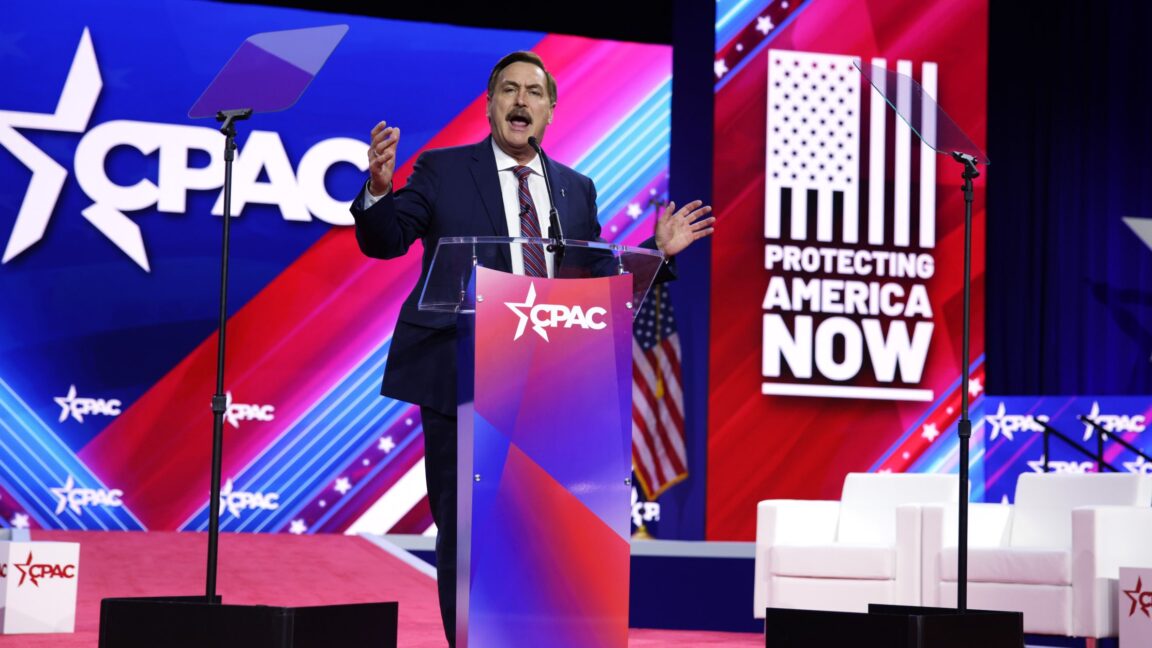
A lawyer representing MyPillow and its CEO Mike Lindell in a defamation case admitted using artificial intelligence in a brief that has nearly 30 defective citations, including misquotes and citations to fictional cases, a federal judge said.
"[T]he Court identified nearly thirty defective citations in the Opposition. These defects include but are not limited to misquotes of cited cases; misrepresentations of principles of law associated with cited cases, including discussions of legal principles that simply do not appear within such decisions; misstatements regarding whether case law originated from a binding authority such as the United States Court of Appeals for the Tenth Circuit; misattributions of case law to this District; and most egregiously, citation of cases that do not exist," US District Judge Nina Wang wrote in an order to show cause Wednesday.
Wang ordered attorneys Christopher Kachouroff and Jennifer DeMaster to show cause as to why the court should not sanction the defendants, law firm, and individual attorneys. Kachouroff and DeMaster also have to explain why they should not be referred to disciplinary proceedings for violations of the rules of professional conduct.
Another appalling GOP grifter. Dead servicemembers to pay for plastic surgery? Sure, that deserves a pardon.
President Donald Trump has pardoned a Nevada Republican politician who was awaiting sentencing on federal charges that she used money meant for a statue honoring a slain police officer for personal costs, including plastic surgery.
Michele Fiore, a former Las Vegas city councilwoman and state lawmaker who ran unsuccessfully in 2022 for state treasurer, was found guilty in October of six counts of federal wire fraud and one count of conspiracy to commit wire fraud. She was out of custody ahead of her sentencing, which had been scheduled for next month.
In a lengthy statement Thursday on Facebook, the loyal Trump supporter expressed gratitude to the president while also accusing the U.S. government and “select media outlets” of a broad, decade-long conspiracy to “target and dismantle" her life.
The White House confirmed Fiore had been pardoned but did not comment on the president’s decision.
The pardon, issued Wednesday, comes less than a week after Fiore lost a bid for a new trial. She had been facing the possibility of decades in prison.
Federal prosecutors said at trial that Fiore, 54, had raised more than $70,000 for the statue of a Las Vegas police officer who was fatally shot in 2014 in the line of duty, but had instead spent some of it on cosmetic surgery, rent and her daughter’s wedding.
“Michele Fiore used a tragedy to line her pockets,” federal prosecutor Dahoud Askar said.
FBI agents in 2021 subpoenaed records and searched Fiore’s home in Las Vegas in connection with her campaign spending.
In a statement, Nevada Democratic Party Executive Director Hilary Barrett called the pardon “reckless” and a “slap in the face” to law enforcement officers.
Fiore, who does not have a law degree, was appointed as a judge in deep-red Nye County in 2022 shortly after she lost her campaign for state treasurer.
She was elected last June to complete the unexpired term of a judge who died but had been suspended without pay amid her legal troubles. Pahrump is an hour’s drive west of Las Vegas.
In her statement Thursday, Fiore also said she plans to return to the bench next week.
Nye County said it is awaiting an update on Fiore's current suspension from the state Commission on Judicial Discipline, which told The Associated Press in an email that it was aware that Fiore had been pardoned but that it didn't have further comment on her situation.
AP also sent an email seeking comment from Fiore's lawyer.
Fiore served in the state Legislature from 2012 to 2016. She was a Las Vegas councilwoman from 2017 to 2022.
While serving as a state lawmaker, Fiore gained national attention for her support of rancher Cliven Bundy and his family during armed standoffs between militiamen and federal law enforcement officers in Bunkerville, Nevada, in 2014 and Malheur, Oregon, in 2016.
Former GOP Rep. George Santos of New York—whose exaggerations about his professional and academic background ultimately led to his indictment on 23 counts of fraud, money laundering, theft of public funds, and more—was sentenced to more than 7 years in prison Friday.
“Mr. Santos, words have consequences. You got elected with your words, most of which were lies,” Judge Joanna Seybert said as she handed down his sentence.
Santos, who was expelled from Congress in December 2023, lied about everything from being the child of a Holocaust survivor to playing volleyball in college. The uncovering of his lies led to an investigation into other behaviors, revealing that he spent campaign funds on Botox, designer clothing, and OnlyFans subscriptions.
“Representative Santos sought to fraudulently exploit every aspect of his House candidacy for his own personal financial profit. He blatantly stole from his campaign. He deceived donors into providing what they thought were contributions to his campaign but were in fact payments for his personal benefit,” the House Ethics Committee wrote in a report at the time of his expulsion.
Federal prosecutors requested that Santos be sentenced to 87 months in prison, citing that his “conduct has made a mockery of our election system" and that a harsh sentence was necessary because of the “breadth, scope, and predatory nature” of his crimes.
Santos claims that he won't seek a pardon from President Donald Trump, but even those who once were close to Santos don't believe that.
“I wouldn’t trust a word out of his mouth,” Peter Hamilton, a former friend of Santos, told The New York Times.
Trump is reportedly not expected to pardon Santos, but he has pardoned unrepentant criminals who’ve praised him, including as recently as Thursday when he pardoned a former Republican lawmaker of Nevada who stole charity funds meant for a slain police officer to pay for her own plastic surgery and rent.
So all it might take is some ass-kissing for Santos to walk free.
The iconic "You Wouldn't Steal a Car" anti-piracy campaign, which dramatically equated digital piracy with physical theft, appears to have used a pirated font in its own materials. New evidence indicates the campaign utilized "XBAND Rough," a free clone of the commercial "FF Confidential" font, which requires a license.
TorrentFreak independently confirmed campaign materials from 2005 embedded the XBAND Rough font rather than the original created by Just Van Rossum in 1992. Researchers discovered the font in PDF files hosted on the campaign's official website. Van Rossum, FF Confidential's creator, called the revelation "hilarious" when informed by TorrentFreak. "I knew my font was used for the campaign and that a pirated clone named XBand-Rough existed. I did not know that the campaign used XBand-Rough," he said.
An anonymous reader quotes a report from TechCrunch: Perplexity CEO Aravind Srinivas said this week on the TBPN podcast that one reason Perplexity is building its own browser is to collect data on everything users do outside of its own app. This so it can sell premium ads. "That's kind of one of the other reasons we wanted to build a browser, is we want to get data even outside the app to better understand you," Srinivas said. "Because some of the prompts that people do in these AIs is purely work-related. It's not like that's personal."
And work-related queries won't help the AI company build an accurate-enough dossier. "On the other hand, what are the things you're buying; which hotels are you going [to]; which restaurants are you going to; what are you spending time browsing, tells us so much more about you," he explained. Srinivas believes that Perplexity's browser users will be fine with such tracking because the ads should be more relevant to them. "We plan to use all the context to build a better user profile and, maybe you know, through our discover feed we could show some ads there," he said. The browser, named Comet, suffered setbacks but is on track to be launched in May, Srinivas said.
and it'd be even better with more competition including municipal broadband
Comcast executives apparently realized something that customers have known and complained about for years: The Internet provider's prices aren't transparent enough and rise too frequently.
This might not have mattered much to cable executives as long as the total number of subscribers met their targets. But after reporting a net loss of 183,000 residential broadband customers in Q1 2025, Comcast President Mike Cavanagh said the company isn't "winning in the marketplace" during an earnings call today. The Q1 2025 customer loss was over three times larger than the net loss in Q1 2024.
While customers often have few viable options for broadband and the availability of alternatives varies widely by location, Comcast faces competition from fiber and fixed wireless ISPs.
Has nothing to do with deference to the military and everything to do with the Justices' massive homophobia
The Supreme Court’s current majority has not been particularly sympathetic to constitutional claims brought by transgender litigants. | Jeremy Hogan/SOPA Images/LightRocket via Getty Images
According to the American Psychiatric Association, gender dysphoria refers to the “psychological distress that results from an incongruence between one’s sex assigned at birth and one’s gender identity” that is commonly experienced by transgender people. The government may no more recharacterize a ban on trans service as a ban on gender dysphoria than it could defend Jim Crow by recharacterizing it as a series of laws targeting people with high levels of melanin.
Nevertheless, so long as the Court follows its long history of showing extreme deference to the military, it seems exceedingly likely that the Trump administration will prevail in this case.
It is well-established that the government cannot evade a ban on discrimination by claiming that it is merely discriminating based on a trait that closely correlates with a particular identity. As the Supreme Court said in Bray v. Alexandria Women’s Health Clinic (1993), “a tax on wearing yarmulkes is a tax on Jews.”
Yet, while the Trump administration’s brief in the Shilling case is poorly argued, the Court is almost certain to reinstate the trans military ban, in part because the case is little more than a sequel to a fight that already played out in the first Trump administration.
During his first term, Trump’s government issued a similar ban on transgender military service — although the first-term ban did contain some exceptions that are not part of the second-term ban. Lower courts halted the first-term ban, but the Supreme Court voted 5-4, along party lines, to reinstate that ban in 2019. The Court has only moved further to the right since 2019, and Republicans now have a 6-3 supermajority among the justices.
The Supreme Court has long held that judges should defer to the military
It’s not clear that the first-term decisions reinstating the ban were wrongly decided under the Supreme Court’s precedents. The Court has long permitted the military to engage in activity that would clearly violate the Constitution in a civilian context.
As Judge Benjamin Settle, the district judge who blocked Trump’s second-term ban, explained in his opinion, this ban is likely to do considerable harm to the United States.
In Goldman v. Weinberger (1986), for example, the Court held that the military could ban Jewish service members from wearing yarmulkes while in uniform. As the Court explained, its “review of military regulations challenged on First Amendment grounds is far more deferential than constitutional review of similar laws or regulations designed for civilian society.” The military, Goldman reasoned, “must foster instinctive obedience, unity, commitment, and esprit de corps,” and that justifies imposing restrictions on service members that would normally violate the Constitution.
The Court has even held that the military may engage in explicit sex discrimination — a fact that is highly relevant to the Shilling case because the Court held in Bostock v. Clayton County (2020) that discrimination against transgender workers is a form of illegal sex discrimination.
In Rostker v. Goldberg (1981), the Court upheld the federal law that requires men, but not women, to register for the draft. While this kind of explicit sex discrimination would be unconstitutional in virtually any other context, Rostker explained that the courts owe extraordinary deference to Congress in matters of “national defense and military affairs.”
Given these precedents, the plaintiffs challenging Trump’s transgender service ban always faced an uphill climb. And that’s doubly true because the Court’s current majority has not been particularly sympathetic to constitutional claims brought by trans litigants.
As Judge Benjamin Settle, the district judge who blocked Trump’s second-term ban, explained in his opinion, this ban is likely to do considerable harm to the United States. The named plaintiff in the Shilling case is Commander Emily Shilling, a pilot with 19 years of military service who has flown 60 combat missions. Shilling alleges, without any contradiction from the government, that the Navy spent $20 million to train her. All of that expertise will now be lost to the US military.
But the Constitution does not forbid the government from self-harm. And the Supreme Court’s precedents permit the military to discriminate in ways that other institutions cannot, which is bad news for people targeted by Trump’s transgender service ban.
In a chilling move that echoes Nazi Germany, the Trump administration is making a list of Jews—supposedly for their own good.
The Intercept reported on Wednesday that professors at Barnard College in New York City received a text message to their personal cellphones with a survey from the Equal Employment Opportunity Commission that asked recipients if they identify as one of the following options: “I am Jewish,” “I am Israeli,” “I have shared Jewish/Israeli ancestry,” “I practice Judaism,” and “Other.”
Professor Debbie Becher, who is Jewish, told the outlet, “The federal government reaching out to our personal cellphones to identify who is Jewish is incredibly sinister.”
The questions on the Barnard text were written under the guise of the Trump administration purportedly trying to root out antisemitism on college campuses. But this excuse is a Trojan horse for attacking dissent on college campuses—to the point of disappearing people—and pushing an anti-immigrant agenda.
Students, faculty and members of the Harvard University community rally, on April 17, 2025, in Cambridge, Massachusetts.
The Anti-Defamation League recently noted that Trump’s attempts to withhold funding from Harvard University under the guise of combating antisemitism was a ruse. Even though the school had taken steps to combat antisemitism, Trump is trying to deny billions in aid that would help Boston-area hospitals affiliated with the school.
None of that protects Jews from antisemitism. But the government making a list of Jews certainly raises questions.
In the 1940s, Jewish people were forced to register with the German government in areas of Europe controlled by the Nazis. This registration was a precursor to one of the worst episodes of ethnic cleansing in all of human history: Six million Jews were killed by the Nazis during the Holocaust.
The ultimate purpose of the government’s list is unclear. The EEOC is currently led by Acting Chair Andrea R. Lucas, who was appointed to the position by Trump in 2020. While the traditional mission of the EEOC is the enforcement of civil rights law, Lucas is an open critic of diversity efforts.
When she was appointed she said her priorities were “rooting out unlawful DEI-motivated race and sex discrimination,” which is how the right inaccurately characterizes pro-diversity programs. She also said she would be “defending the biological and binary reality of sex,” which is how conservatives refer to policies that strip the civil and equal rights of transgender Americans.
As for Trump, his posturing as someone hoping to combat antisemitism is not a believable premise.
Trump loves to use antisemitic language and tropes. He has argued that Jews in America have a dual loyalty to Israel, referring to the leader of Israel as “your prime minister” while speaking to Jews living in the United States. He has repeatedly referred to “globalist” forces controlling world events, a frequent citation used by Nazis and white supremacists. In a 2019 speech to the Israeli American Council, Trump told the audience “you’re brutal killers” and “not nice people at all.”
Trump infamously referred to neo-Nazis marching in Charlottesville as “very fine people” and hosted antisemitic figures like rapper Kanye West and conservative activist Nick Fuentes at Mar-a-Lago. And of course, there’s his co-president Elon Musk’s Nazi salute … twice.
Conservatism has embraced Trump’s antisemitic behavior for over a decade now, and this list-making is the next phase in his escalation.
President Donald Trump on Thursday pleaded with Russian dictator Vladimir Putin to stop mercilessly bombing Ukraine, after Putin launched a deadly wave of attacks on civilians in Kyiv that killed at least eight and injured over 60.
"I am not happy with the Russian strikes on KYIV. Not necessary, and very bad timing. Vladimir, STOP! 5000 soldiers a week are dying. Lets get the Peace Deal DONE!" Trump wrote in a post on his Truth Social platform.
Putin’s appalling strikes on Ukraine’s capital are an embarrassment for Trump, who had just taken Putin’s side in peace talks. Trump told Ukraine President Volodymyr Zelenskyy he needed to cede Crimea to Russia and not join the North Atlantic Treaty Organization in order for the United States to keep helping Ukraine fend off Russian attacks. Those demands are exactly what Putin was seeking.
Trump had also slammed Zelenskyy in a Truth Social post, criticizing the Ukrainian leader for standing up for his country and refusing to give away Crimea:
It’s inflammatory statements like Zelenskyy’s that makes it so difficult to settle this War. He has nothing to boast about! The situation for Ukraine is dire — He can have Peace or, he can fight for another three years before losing the whole Country. I have nothing to do with Russia, but have much to do with wanting to save, on average, five thousand Russian and Ukrainian soldiers a week, who are dying for no reason whatsoever. The statement made by Zelenskyy today will do nothing but prolong the “killing field,” and nobody wants that! We are very close to a Deal, but the man with “no cards to play” should now, finally, GET IT DONE. I look forward to being able to help Ukraine, and Russia, get out of this Complete and Total MESS, that would have never started if I were President!
Vice President JD Vance made similarly inflammatory comments toward Ukraine on Wednesday.
“We’ve issued a very explicit proposal to both the Russians and the Ukrainians, and it’s time for them to either say yes or for the United States to walk away from this process,” Vance told reporters. “The only way to really stop the killing is for the armies to both put down their weapons, to freeze this thing and to get on with the business of actually building a better Russia and a better Ukraine.”
Ukrainian President Volodymyr Zelenskyy arrives in Pretoria, South Africa, for a state visit on April 24.
"The president is not asking Ukraine to recognize Crimea. Nobody has asked them to do that,” Leavitt said, even though the peace deal would have the United States recognize Crimea as part of Russia. “What he is asking is for people to come to the negotiating table recognizing that this has been a brutal war for far too long, and in order to make a good deal, both sides have to walk away a little bit unhappy. And unfortunately, President Zelenskyy has been trying to litigate this peace negotiation in the press, and that’s unacceptable to [Trump].”
This is just the latest failure to add to the pile of Trump’s first 100 days in office, which Americans grade very poorly in opinion polling. For instance, Trump's approval rating now stands at just 44%, down from 52% a week after Inauguration Day, according to The New York Times’ newly released polling averages.
Polling also shows that Americans are unhappy with Trump’s efforts to end Russia’s war on Ukraine, with a plurality (46%) saying the U.S. is not doing enough to aid Ukraine, according to a Gallup survey from March.
“Until now, the highest percentage of Americans who believed the U.S. was not doing enough to help Ukraine was 38%, recorded in Gallup’s initial measurement of this question in August 2022,” Gallup wrote.
Meanwhile, a Fox News poll released Wednesday found that 61% of registered voters are concerned about Russia's invasion of Ukraine
And Democrats are slamming Trump for consistently taking Putin’s side.
“This isn’t a deal, this is a surrender,” Democratic Rep. Jason Crow of Colorado wrote in a post on X, regarding Trump’s peace proposal. “Trump and Vance are doing Putin's bidding. Forcing an invaded country to accept a dictator's terms and threatening to walk out is hardly a negotiation. When the going gets tough, this administration folds—every single time.”
As North Carolina and Arkansas just learned, voting for Donald Trump has created a catastrophe for states hit by natural disasters. And now, it’s West Virginia's turn.
Trump won the state by a 42-point victory in 2024—one of the biggest margins nationally. Despite ranking third in the nation on dependence on federal money—which accounts for half of its budget—and paying far less in federal taxes than it receives, it’s funny that West Virginia would vote so overwhelmingly for a candidate who promised to slash that funding.
West Virginia has already suffered from Trump’s spending freeze, attacks on Chinese commercial shipping, cuts in the federal workforce, tariffs—the list goes on and on. Now it’s time to add national disasters to that list.
In February, the state was hit with deadly flooding, killing several and causing severe damage. While the Federal Emergency Management Agency did approve public assistance for the hard-hit counties, it has now rejected individual assistance in seven of those counties.
The difference is important; public assistance is money disbursed directly to the state or local government to clean and repair damage. Individual assistance, according to FEMA, “benefits survivors directly to assist those who have uninsured or under-insured necessary expenses and serious needs. The assistance is meant to return a home to a safe, sanitary and functional residence.”
West Virginia’s Republican Gov. Patrick Morrisey
Remember how Republicans blasted President Joe Biden for only giving $750 to North Carolinians impacted by Hurricane Helene—a bald-faced lie? That amount was an immediate disbursement meant to cover immediate needs in the days after the hurricane hit. It wasn’t the full sum of aid available with more time to process damage and claims, which could reach $42,500 when FEMA wasn’t run by psychopaths.
These impacted West Virginia residents aren’t even getting $750. They’re getting nothing.
But, of course, Republican Gov. Patrick Morrisey of West Virginia couldn’t respond to the rejection without kissing Trump’s ass.
“Despite today’s notification, I am grateful to the Trump Administration for their strong support for southern West Virginia’s recovery following the February floods. FEMA has offered the ability to appeal this decision, and I will look at all options to do so,” Morrisey said in a statement.
So very Republican of him to beg Trump to help out people in need, while thanking him for doing less than what Democrats would have done.
Heck, Kamala Harris could’ve given them $100 million, and they still would’ve spit in her face. It’s pathetic.
A Democratic member of the Federal Communications Commission plans what she calls a First Amendment tour to fight the Trump administration's "ongoing campaign of censorship and control."
"Since the founding of our country, the First Amendment has protected our fundamental right to speak freely and hold power to account. Today, the greatest threat to that freedom is coming from our own government," Commissioner Anna Gomez said yesterday.
Gomez plans to focus on FCC Chairman Brendan Carr's actions against news broadcasters and tech firms. Under Carr, "the FCC is being weaponized to attack freedom of speech in the media and telecommunications sector instead of focusing on its core mission—connecting the public, protecting consumers, and supporting competition," Gomez's announcement said.
When Chris Van Hollen traveled to El Salvador to check on the status of Kilmar Abrego Garcia, who had been deported to a notorious prison, the Trump administration erupted in delight. Here was a golden opportunity to accuse the Democratic senator and his party of sympathizing with violent criminals. “His heart is reserved for an illegal alien who’s a member of a foreign terrorist organization,” the Trump adviser Stephen Miller told reporters.
Many Democrats and other critics of Trump’s lawless deportation policy cheered Van Hollen’s move, but others cringed. Several House Democrats complained to Axios that the party was walking into a trap. California Governor Gavin Newsom told reporters, “It’s exactly the debate they want,” urging his party to focus instead on the economy.
Hardheaded advice like this has its place. Dramatic speeches that satisfy Trump-hating liberals tend not to peel voters away from him. In this case, however, the pragmatic concerns raised by Democrats are mistaken. This is a political fight they can still win, and the stakes are too important to give up without trying.
The case for doing nothing is as follows. Immigration is Trump’s strongest issue, according to polls. The more Democrats holler about Trump’s immigration policy, the more the public judges Trump based on how he handles it, as opposed to other issues on which he’s much less popular. “The White House would much rather this story dominate the political conversation than the economy,” argues the polling expert Nate Silver. Staying quiet on deportation, by contrast, means people will hear more about Trump’s trade war, the various unsecured chats on which his advisers have discussed secret military operations, and other stories that make Trump look bad. As Trump’s approval rating sinks, Republicans will feel the need to distance themselves from him, and independent institutions such as courts and the media will have more courage to challenge him. Ultimately, that will do more to stymie his immigration abuses than confronting him directly on the issue would.
This isn’t a crazy argument. It correctly describes the strategic choices Democrats face on many issues where Trump has a strong hand. But it fails to work in this particular case, for several reasons.
First, although Americans generally approve of Trump’s handling of immigration, the margin is small, and may be shrinking. Several recent polls find Trump’s approval on the issue slipping below the level of disapproval. More pertinent, that support collapses when it meets almost any specific application of his agenda, as the data journalist G. Elliott Morris points out. For example, one Reuters/Ipsos poll in March found that 56 percent of respondents, and 22 percent of Republicans, disagreed with the statement “Trump should keep deporting people despite a court order to stop.” Deporting immigrants who have not broken any laws other than immigration laws, deporting illegal immigrants who have lived in the United States for more than a decade, and deporting people without due process are all deeply unpopular.
Relying on the public’s ability to develop a detailed grasp of policy specifics is often a mistake. You can’t control the shape of a political debate, and the other side gets a say, which means that the details you think are important might not be the details the voters hear, if they hear any details at all. But this brings up the second flaw in the do-nothing argument. The midterm elections are a year and a half away, and the next presidential election is three and a half years away. Democrats have plenty of time to shape the information environment.
Right now, the public supports Trump’s immigration stance because it’s reacting to the extraordinary surge in migration, led by huge numbers of unprocessed asylum seekers, under the Biden administration. But when Joe Biden took office, after four years of draconian Trump policies and rhetoric—above all the cruel spectacle of family separation—the public was in a far more forgiving mood toward immigrants. This reflects a dynamic called “thermostatic public opinion,” in which people tend to move in the opposite direction of where the president is pushing policy.
If immigration is still the best issue for the Republican candidate in, say, summer 2028, then Democrats would be wise to let the issue drop. At the moment, however, time remains for thermostatic opinion to swing against Trump, and Democrats can help push it in that direction by highlighting the unpopular aspects of his agenda.
Trump’s actions have also opened up cracks within his coalition at the elite level. Conservative organs such as TheWall Street Journal editorial page and National Review have editorialized against his disregard for due process. The Free Press, another conservative outlet, surveyed seven legal experts, all of whom criticized Trump’s actions.
None of those publications commands the kind of mass audience that could turn Republican voters against Trump the way Walter Cronkite could make middle America question the Vietnam War. Yet their opposition indicates that Trump will struggle to maintain a unified front on this issue the way he has on other norm-violating actions where the conservative elite has mostly stood behind him. The overall tone of a debate tends to be much more skeptical when your own party’s expert class is divided.
Some Democrats nonetheless think it wiser to devote their attention to issues where they already have an advantage, rather than trying to create an advantage that doesn’t currently exist. That’s a sensible approach under normal circumstances. But these are abnormal times. Trump is attempting to open a loophole in the Constitution that would let him jail any person, criminal or not, citizen or not, in an overseas prison without recourse to American law. This poses a threat to the republic on a totally different scale than almost any other Trump crime.
Drawing attention to the issue can not only alert the American public to its dangers; it can also alert Nayib Bukele, El Salvador’s president, to the depth of anger he is creating among Democrats. Trump’s foreign-prison loophole relies on the cooperation of overseas strongmen. If those strongmen are thinking about the possibility that Democrats might regain the presidency one day, and subject him to anything ranging from frosty diplomatic relations to a trial at the Hague, they might recalibrate their level of cooperation.
The fight over deportations is not just about immigration policy or approval ratings. Trump is attempting to use his advantage on immigration to secure terrifying powers. Before ceding him those powers, the opposition should try to deny him the advantage.
On Monday, the State Bar of California revealed that it used AI to develop a portion of multiple-choice questions on its February 2025 bar exam, causing outrage among law school faculty and test takers. The admission comes after weeks of complaints about technical problems and irregularities during the exam administration, reports the Los Angeles Times.
The State Bar disclosed that its psychometrician (a person or organization skilled in administrating psychological tests), ACS Ventures, created 23 of the 171 scored multiple-choice questions with AI assistance. Another 48 questions came from a first-year law student exam, while Kaplan Exam Services developed the remaining 100 questions.
The State Bar defended its practices, telling the LA Times that all questions underwent review by content validation panels and subject matter experts before the exam. "The ACS questions were developed with the assistance of AI and subsequently reviewed by content validation panels and a subject matter expert in advance of the exam," wrote State Bar Executive Director Leah Wilson in a press release.
The Trump administration’s proposed budget would cut all funding to specialized services for LGBTQ+ youth who call the 988 Suicide and Crisis Lifeline.
LGBTQ+ youth are at an elevated risk for suicide. In 2021, 45% of LGTBQ+ high school students said they seriously considered suicide in the past year. Since 2022, 988’s LGBTQ+ service has received nearly 1.3 million contacts, including almost 59,000 just this past February, the most recent month of published data.
“I worry deeply that we will see more LGBTQ young people reach a crisis state and not have anyone there to help them through that,” Janson Wu, the director of advocacy and government affairs at the Trevor Project, told Mother Jones. “I worry that LGBTQ young people will reach out to 988 and not receive a compassionate and welcoming voice on the other end—and that will only deepen their crisis.”
If President Donald Trump’s budget is passed, the specialized service for LGBTQ+ youth would end this October.
Protesters fill the Iowa state Capitol to denounce a bill that would strip the state civil rights code of protections based on gender identity, Feb. 27, in Des Moines.
It is just the latest Republican attack on vulnerable LGBTQ+ youth. After stoking panic around transgender children during last year’s election, Trump spent his first days in office signing executive orders that curtail access to gender-affirming care and protections for LGBTQ+ children in schools.
Trump’s proposed budget would also harm America’s health more broadly. For instance, it would slash the Department of Health and Human Services’ discretionary spending by roughly a third, according to documents first reported on by The Washington Post.
As of late March, HHS Secretary Robert F. Kennedy Jr. also planned to either close or consolidate the Substance Abuse and Mental Health Services Administration, which funds 988, the distribution of anti-overdose drugs, and addiction treatments across the nation. SAMHSA was created by Congress in 1992. To fully close it would require another act of Congress.
The Trump administration has been a disaster, and while much of it seems borne of plain old incompetence, its desire to leave at-risk youth out in the cold is pure, bigoted malice.
To support this work and receive my weekly newsletter with background on each cartoon, please consider joining the Sorensen Subscription Service! Also on Patreon.
You’d think White House deputy chief of staff Stephen Miller’s plate would be full, what with cosplaying Slenderman and trying to cover up his ever-receding hairline. You’d also think he’d be happy, as his lifetime commitment to xenophobia and racism is finally paying off as the Trump administration gears up to deport millions.
White House deputy chief of staff Stephen Miller
But Miller is not happy because you people won’t stop whining about how Kilmar Abrego Garcia, who was wrongfully deported to a Salvadorean prison, is entitled to due process. You know who didn’t get due process, according to Miller? The Jan. 6 insurrectionists.
Here’s Miller over at X, Elon Musk’s Nazi bar: “If you were an American falsely accused of wrongdoing on January 6th it wasn't merely difficult to get ‘due process,’ it was impossible. The entire system was rigged against you. All of it. Those persecuted Americans could only dream of the ‘due process’ afforded illegal aliens.”
Hoo boy. Where to even start? Let’s count the myriad ways that the abduction of Abrego Garcia is not remotely similar to anything that happened to the Jan. 6 rioters.
1. The Jan. 6 rioters were actually charged with crimes.
Abrego Garcia was deported despite there being no charges against him. The Trump administration has already admitted he was deported in error, a thing they’re now trying to walk back. In contrast, the Jan. 6 insurrectionists were criminally charged as part of the largest investigation in FBI history. That investigation led to the arrest of at least 1,583 people.
That’s not evidence of some nefarious plot to deprive the insurrectionists of due process. In fact, it’s the opposite. There were roughly 10,000 people on the Capitol grounds that day, meaning nearly 85% of the rioters never even faced arrest, much less a trial or a conviction or a deportation.
2. The insurrectionists got trials and plea deals.
Out of those 1,583 arrests, 1,270 were convicted, with 1,009, or 79%, pleading guilty. Two hundred twenty-one of the Jan. 6 defendants were convicted after a trial, with an additional 40 convicted after stipulated trials, where a defendant admits to facts without agreeing they constitute a crime. That number of plea deals might seem high, but it’s lower than the typical rate in federal courts, where 89.5% of defendants pleaded guilty in fiscal year 2022.
Abrego Garcia has not been arrested. He has not been convicted. He did not get to have a trial. He did not get to make a plea deal. He was deported illegally, and the administration refuses to bring him back. Miller knows full well these things aren’t remotely comparable.
3. Nobody manufactured evidence against the Jan. 6 criminals.
It’s not just that Trump posted a doctored photograph, photoshopping “MS-13” onto Abrego Garcia’s knuckles. There’s also White House press secretary Karoline Leavitt’s now-routine habit of straight-up lying to justify the administration’s actions. Earlier this month, Leavitt called Abrego Garcia a “leader” of MS-13, but when asked to provide details, couldn’t be bothered, saying, “There’s a lot of evidence, and the Department of Homeland Security and ICE have that evidence, and I saw it this morning.”
Last week, Leavitt accused Abrego Garcia of being detained on suspicion of human trafficking, when the reality was that he was stopped for speeding and veering out of his lane.
In contrast, there was no need to manufacture evidence against the Jan. 6 insurrectionists. Hundreds of them filmed themselves rioting at the Capitol. Plenty bragged about it on social media. And, of course, the nation watched everything unfold in real time.
4. Many Jan. 6 rioters already had criminal records.
Maryland Sen. Chris Van Hollen, right, speaks with Kilmar Abrego Garcia.
At least 159 convicted insurrectionists had previous criminal records. We’re not talking something like jaywalking here. NPR found that dozens had charges or convictions for serious crimes like manslaughter, rape, drug trafficking, domestic violence, sexual assault of a minor, and production of child sexual abuse material.
Abrego Garcia has no criminal record in the United States or El Salvador. He was arrested once in 2019 by a now-disgraced cop who later pleaded guilty to misconduct. That cop’s evidence for Abrego Garcia’s membership in MS-13? He had a Chicago Bulls cap, which the officer said was “indicative of the Hispanic gang culture.” Of course, it’s also indicative of liking the Chicago Bulls, which is not actually a crime.
5. The Supreme Court gave hundreds of the Jan. 6 rioters a little treat.
Roughly 350 of the Jan. 6 insurrectionists were charged under a federal criminal law that makes it a felony to obstruct official proceedings. You’d think that a riot that tried to block the certification of electoral votes and sent members of Congress into hiding would count as an obstruction of an official proceeding, but you’d be wrong. In 2024, the Supreme Court ruled that the provision applied only to evidence tampering, not rioting.
Fun fact: This was also one of the charges against Trump, not that it matters anymore.
6. Republicans were very concerned about jail conditions for the insurrectionists.
Led by Georgia Rep. Marjorie Taylor Greene, Republican members of Congress made a 2023 pilgrimage to see 20 insurrectionists housed at the D.C. jail. Greene howled about a “two-tier justice system” and declared the 20 were “political prisoners,” which is the same nonsense pushed by Trump. These were not people who were being persecuted for their beliefs. And 17 of those 20 were charged with assaulting law enforcement officers.
Greene also ostentatiously worried about the conditions at the jail, saying that inmates had been threatened and denied medical care. She’s correct that conditions at the jail have been bad for a long time, but her passion for fair treatment of the incarcerated extends only to Jan. 6 protesters.
When it comes to Abrego Garcia’s wrongful imprisonment in a notoriously violent foreign prison, Greene’s stance is that it is “dangerously close to treason” for people to advocate for Abrego Garcia’s return. So, it’s treason to demand that the government follow the laws and give Abrego Garcia the due process to which he is entitled, but it’s not treason to try to overturn an election with violence. Got it.
7. The Jan. 6 rioters had Trump in their corner.
On the campaign trail in 2024, Trump made no secret of the fact that if he were elected, he’d pardon the rioters, who he said were “hostages.” He showed up at fundraisers on their behalf. He described the violence perpetrated by his supporters as a display of “spirit and faith and love,” and said he’d never seen anything like “the love in the air” that day.
Trump was so smitten that he joined the Washington, D.C. jail inmates in song, sort of. Trump recited the “Pledge of Allegiance,” which was then layered over the “J6 Prison Choir” singing “The Star-Spangled Banner.” FBI Director Kash Patel produced this monstrosity, but when he was asked about it during his confirmation hearings, he suddenly couldn’t recall a thing about his involvement.
8. The Jan. 6 insurrectionists were pardoned.
One of Trump’s first official acts of 2025 was to pardon his merry band of treasonists, including people who had violently assaulted police officers. So, not only did they receive all the due process owed to them as criminal defendants, but they also received the gift of a clean slate.
For some defendants, that clean slate was extra-generous. Several had been charged with additional, unrelated crimes, such as weapons charges, that turned up during investigations into their actions on Jan. 6. In at least seven cases, the DOJ then argued that Trump’s pardon covered the unrelated crimes, as the crime wouldn’t have been discovered but for the Jan. 6 investigation. Quite the deal!
9. The rioters were not shipped off to a maximum security prison in El Salvador.
Besides the part where they are no longer burdened with any criminal charges, the Jan. 6 rioters are, well, here. They were not transported to El Salvador in the dead of night. They’re not being kept in El Salvador in defiance of a Supreme Court order. And unlike what the White House is saying about Abrego Garcia, senior officials in the Biden administration didn’t mock Jan. 6 prisoners and brag that they were never coming home.
It’s honestly unclear what additional due process Miller thinks the Jan. 6 defendants should have received. His real complaint is that he doesn’t believe they should have ever been charged, regardless of the evidence. When it comes to Abrego Garcia, however, Miller doesn’t believe in due process at all.
And this chucklefuck wants to be FL governor? That'll go well.
Republican Rep. Byron Donalds of Florida held a town hall on Monday where his staff prescreened attendees to make sure they lived in his deeply conservative southwestern Florida district, an attempt to prevent being heckled like his fellow Republican lawmakers have been.
“Elon Musk and DOGE have been authorized by the president of the United States—" Donalds said, and then was drowned out by boos.
“Do you want to yell, or do you want to hear?” he said to the audience.
Donalds is not the first Republican lawmaker to have facedtestytown halls as constituents rage over DOGE cuts and other destructive Trump administration policies.
A number of House Republicans have brushed off the anger, falsely claiming that those who show up were paid protesters who aren’t from their districts.
“The videos you saw of the town halls were for paid protesters in many of those places,” House Speaker Mike Johnson told CNN in late February. “These are Democrats who went to the events early and filled up the seats.”
Yet Donalds cannot make this claim for his event because, according to information from his own office, attendees had to show proof that they lived in his district before they were let in.
“Only voting constituents of Florida’s 19th Congressional District are eligible,” reads the event page on Donalds’ House website, which added that attendees had to show identification that had an address within the district.
“Non-voting constituents will not be allowed to enter the event,” the event page added.
Florida Democratic Party Chair Nikki Fried made this point to explain why Donalds' town hall was an abject disaster.
"This is actually worse than it looks,” Fried wrote in a post on X, above a video from the town hall. “There was room for 700 people, you had to be a resident of the district and could only sign up a certain amount of people per family. Byron pre-screened the audience in deep red Lee County and this is still what he got. Angry constituents.”
Town hall events have been so ugly for Republicans that GOP leadership has advised their members not to hold in-person events at all—a way to avoid video images of Republicans being challenged by their voters.
And it’s no wonder Republicans are worried. The last time Republicans faced such rowdy town halls was in 2017 and 2018, before Democrats romped their way back to the House majority in the midterms during Trump's first term.
Florida Gov. Ron DeSantis has made public education ground zero in the culture wars. | Joe Raedle/Getty Images
Over the last few months, the Trump administration has intensified its attacks on elite, Ivy League institutions like Columbia and Harvard, enacting sweeping funding cuts and even threatening to revoke their tax-exempt status.
But what’s happening on the campuses of state schools is much less covered. Take for example the public university system in Florida. For years, Gov. Ron DeSantis has used public schools at all levels as the battleground for what he calls a war on “woke” — and punched his ticket to national prominence.
Though elite universities in the Northeast have largely fought deportation efforts spearheaded by Secretary of State Marco Rubio, DeSantis has openly cooperated with US Immigration and Customs Enforcement, even appointing university presidents who are friendly to this mission.
Today, Explained host Sean Rameswaram spoke with Moody about his findings, which uncovered formal cooperation agreements between many of Florida’s public universities and ICE that has led to revoked visas, alarmed faculties, and student protests.
Below is an excerpt of their conversation, edited for length and clarity. There’s much more in the full podcast, so listen to Today, Explained wherever you get your podcasts, including Apple Podcasts, Pandora, and Spotify.
What’s going on here with the Florida state schools? Is this a rebrand to ICE-U? What are they doing here?
You’ve probably not heard of some of these schools because it’s the Florida State University system, which has 12 members, ranging from large schools with tens of thousands of students to New College of Florida, which has about 800 students. At least 10 of those institutions have signed agreements with ICE, which essentially would give their campus police departments immigration enforcement powers, allowing them to question, arrest, and prepare charges for those they suspect of immigration violations.
These agreements, as one expert explained to me, are “force multipliers for ICE.”
Andbasically these agreements, as one expert explained to me, are “force multipliers for ICE.” So if you wanted to have more immigration enforcement, you would sign an agreement with ICE to delegate that power locally. This is just a way for Florida to expand its immigration enforcement capabilities. The governor, as I mentioned before, has taken a hard line on immigration.
He ran for president previously. I wouldn’t be surprised if he does so again, and that could be part of his long-term strategy. In this way, he’s sort of outflanking Trump on immigration.
And this is just a fun question I love to ask while we’re talking about this stuff. Where did Ron DeSantis go to school again?
Yale, right? Or was it Harvard?
It was both! Anyway, have any students been detained or deported yet at these Florida state schools like we’ve seen at Columbia?
They would have to leave the country. It doesn’t necessarily mean that ICE is going to come scoop them up in a van and facilitate that process, but they would essentially have to begin the process of leaving the country.
And do we know what specifically these students have had their visas revoked for?
We do not, but that is not uncommon. That has been the case across the US. Some students have been targeted for their speech. You look at the situation at Tufts and Columbia where students were active in pro-Palestinian protests and the Trump administration has claimed they’re antisemitic and pro-Hamas, but has not provided any evidence that they have done anything illegal. In other cases, they’ve had visas revoked for crimes committed years ago.
And these institutions themselves have often been given no explanation when student statuses were changed — and sometimes they’ve discovered it by looking in their own systems and seeing that those statuses had been revoked.
We don’t know how many international students have been caught up in this, but one of my fellow reporters at Inside Higher Ed is keeping a nationwide database and we have counted at least 1,680 students at 250 colleges who have lost visas. [Editor’s note: These figures reflect the latest numbers and have been updated since this Today, Explained episode first aired.]
Does that mean there are other university systems around the country that are signing these kinds of agreements with ICE, that are cooperating with ICE at this level?
Florida institutions are the only ones to have signed agreements with ICE. The professors that I spoke with, the legal experts for this piece, believe this is unprecedented. Neither were aware of another university ever signing into what is known as a 287(g) agreement with ICE. It’s sort of a new frontier in immigration enforcement on college campuses.
Are students on the campuses of these universities upset to hear that they’re signing into agreements with ICE?
Yes. There were protests at Florida International University today, which had a board meeting. The students that I hear from are often upset about what is happening in the state, not just around immigration, but what has been a broader effort by Florida Republicans to control all aspects of the university, whether that is hiring politicians and lawmakers into the presidencies or overhauling general education requirements to minimize certain disciplines — like sociology — that Florida state officials have deemed liberal.
How do you feel what’s going on at ICE-U down in Florida fits into this other fight that we’re seeing in the Northeast, with Trump going to war with the elite universities?
In Florida, this is being done by the state dictating to these universities: “You need to do this to basically carry out state goals around immigration enforcement.” Whereas the other examples at places like Harvard and Columbia is the Trump administration more or less trying to bring higher education to heel, by making an example of some of the most visible universities, where there have been the most visible pro-Palestinian campus protests over the last year.
If they crumble, it seems only likely that your local institution is going to crumble when faced with the same threats.
People are really freaked out. Professors are worried about academic freedom. But also nationally, people are worried too. They see Harvard and Columbia being at the forefront of this fight, and even though they’re not at all representative of higher education broadly, these are very visible universities that everyone pays attention to. If they crumble, it seems only likely that your local institution is going to crumble when faced with the same threats.
On the show today, we’ve been talking about these two extremes in this culture war right now. On one end, you’ve got the oldest and most prestigious universities in the country. Then, over here, we’ve got this pocket of Florida state schools that are just throwing up their hands and complying with ICE. Where does that leave in your estimation, everyone in between those two extremes?
A lot of that comes down to public or private control. If you are a public university in a dark red state, you should expect that this is coming. If you are at a public university in Texas, you might not be that far behind Florida in terms of an action like this and that’s what I’m hearing from experts too. If you’re in a blue state, you are a little bit more isolated if you’re a public institution there. Private institutions in both will have a lot more latitude.
I don’t like to speculate, but I think it is entirely possible that the Trump administration looks at something like this and says, “Why don’t we do this nationwide?”
Well let's hope my current array lasts for a while.
Popular NAS-maker Synology has confirmed and slightly clarified a policy that appeared on its German website earlier this week: Its "Plus" tier of devices, starting with the 2025 series, will require Synology-branded hard drives for full compatibility, at least at first.
"Synology-branded drives will be needed for use in the newly announced Plus series, with plans to update the Product Compatibility List as additional drives can be thoroughly vetted in Synology systems," a Synology representative told Ars by email. "Extensive internal testing has shown that drives that follow a rigorous validation process when paired with Synology systems are at less risk of drive failure and ongoing compatibility issues."
Without a Synology-branded or approved drive in a device that requires it, NAS devices could fail to create storage pools and lose volume-wide deduplication and lifespan analysis, Synology's German press release stated. Similar drive restrictions are already in place for XS Plus and rack-mounted Synology models, though work-arounds exist.
Of course, because government can't function without trust in the basic rules, so they'll destroy that too
Immigration and Customs Enforcement can request data from the IRS on immigrants who are under investigation. | Aaron M. Sprecher/Getty Images
Mohsen Mahdawi, a Palestinian student at Columbia University, went into a US Citizenship and Immigration Services office in Vermont on Monday for his scheduled naturalization interview. But instead of being granted citizenship, he was arrested and detained by Immigration and Customs Enforcement (ICE), which started the process to deport him. In a memo reviewed by the New York Times, Secretary of State Marco Rubio claimed that Mahdawi’s activities — like the protests he helped lead at Columbia — undermined US foreign policy and threatened the Middle East peace process.
What happened to Mahdawi is alarming on many levels. Mahdawi has legal status as a permanent resident and has lived in the United States for the past decade. He wasn’t charged with a crime, but, like Mahmoud Khalil, another Palestinian Columbia student and green card holder, was detained and ordered to be deported simply for having and expressing views that the secretary of state does not like.
And what’s especially notable about Mahdawi’s case is that he wasn’t arrested at his home or kidnapped off the street; ICE surprised him during a scheduled appointment with immigration services. In other words, he was arrested during a voluntary interaction with the federal government.
This is not the only case where the government has punished immigrants for following the rules. For years, the IRS has encouraged undocumented immigrants to file their taxes, promising to keep their data private so that they won’t be targeted by immigration agencies. But under the Trump administration, the IRS recently reached an agreement to share sensitive data on undocumented taxpayers with the US Department of Homeland Security (DHS). This is just one of many promises that the federal government has walked back since Donald Trump returned to the White House.
The message that sends to immigrants is clear: You have no reason to trust us. Interacting with us might put you in danger. And the result will be more and more immigrants being pushed to live in the shadows.
“Part of the Trump administration’s strategy is to sow as much chaos, fear, and panic as they can in this moment to really make our communities feel as unsafe as possible,” said Murad Awawdeh, president and CEO of the New York Immigration Coalition. “While they continue to say that they’re doing all that they can around safety and security, we know that that is not their point. Cruelty is.”
Why the IRS sharing data on immigrants is such a big deal
The IRS promise to undocumented immigrants that their data would remain confidential had been working: Undocumented immigrants paid nearly $100 billion in taxes in 2022, according to the Institute on Taxation and Economic Policy. Now, that’s all jeopardized, and the acting commissioner of the IRS is resigning, at least in part because of the deal between her agency and DHS, CNN reported.
Details of the data-sharing agreement are sparse because much of what has been made public has been redacted, so it’s unclear what kind of data the IRS will be passing on to immigration authorities or when. What’s available so far makes clear that ICE can request data from the IRS on immigrants who are under investigation, including those who have overstayed in the country for more than 90 days.
But while attorneys in the Justice Department have argued that the new agreement is lawful and “includes clear guardrails to ensure compliance,” that does very little to assure immigrants that the act of filing their taxes — or putting any trust in the federal government more broadly — won’t come back to haunt them later.
Seeing the IRS break with precedent will only discourage people from filing taxes and puts them at serious risk. “It’s like a broken promise. It’s like a betrayal,” one immigrant told NBC News.
“Instead of being thanked for their contributions and for them actually following tax compliance, now — because they followed the law, because they filed [their taxes] — their data is now being shared to be used against them for immigration enforcement,” Awawdeh said.
It’s not just undocumented immigrants who are worried
The IRS breaking its promise to undocumented immigrants goes a long way in undermining trust in the federal government. But the government is also betraying immigrants with legal status, as Mahdawi’s case shows.
Hundreds of thousands of migrants scheduled immigration-related appointments on a government-issued app during the Biden administration, just as they were encouraged to do. But under the Trump administration, the federal government has targeted those same people who had been legally living and working in the United States. Now, tens of thousands of them have been notified that their legal status is being terminated and that they will have to leave the country within a week.
Since President Donald Trump’s assault on universities and his crackdown on pro-Palestinian student activists, foreign students and legal immigrants have been living in fear of their visas or even green cards being revoked because they support Palestinian rights. Some stories are especially unnerving, like the case of Rümeysa Öztürk, a Tufts University student who was essentially kidnapped by plainclothes officers while walking down the street and is now being held in a Louisiana detention facility. The Trump administration has also warned Harvard that it will block the university from enrolling international students if it does not share information about its student body with the federal government, including details on foreign students who have taken part in “dangerous” activities.
Even if immigrants become naturalized citizens, the Trump administration is still giving them cause for concern in what should otherwise be routine interactions with the government. Over the weekend, for example, Bachir Atallah, a real estate attorney who has been a US citizen for 10 years, was detained at the US-Canada border while going through customs, where he says US Customs and Border Protection handcuffed him and looked through his emails on his phone. Atallah says that the officers didn’t give him an explanation for why he was being detained. “Even if you ask questions, they say, ‘We don’t know, it’s the government,’” he told NBC’s Boston affiliate.
“It’s pushing people further into the shadows.”
Murad Awawdeh, New York Immigration Coalition’s president and CEO
The Trump administration is, in other words, targeting people with every kind of immigration status, from undocumented immigrants to lawful permanent residents to naturalized citizens. Refugees are also under threat: A Venezuelan man who had refugee status was deported to El Salvador, where he’s now detained in a notorious maximum security prison, all for having a tattoo that authorities thought signaled gang affiliation. (Trump has even suggested sending native-born American citizens to that prison, saying, “The homegrowns are next.”)
All of these actions put immigrants — undocumented or otherwise — in an impossible position: If they don’t listen to the government, they risk running afoul of the law. But taking the government at its word might be what actually leads to their arrest and potential deportation. That means any contact with the government will feel especially risky, be it visiting the DMV, going through airport security, or reporting a crime to local law enforcement.
“It’s pushing people further into the shadows,” Awawdeh said. “One of our bigger fears, in addition to the way in which we have been seeing the administration targeting our communities, is that when [members of] our communities are actually victims of crimes, that they are not going to step forward, they’re not going to seek help.”
The steps that the Trump administration is taking are part of a bigger push to not only reduce immigration but to further establish tiered citizenship, where immigrants are a permanent underclass who can’t ever trust that the government will respect their rights, even after they become citizens. “This is the country that we’re living in right now,” Awawdeh said, “where the number one focus is to create a second-class citizenry.”
AI masquerading as a human should be an instant lawsuit under consumer protection laws
On Monday, a developer using the popular AI-powered code editor Cursor noticed something strange: Switching between machines instantly logged them out, breaking a common workflow for programmers who use multiple devices. When the user contacted Cursor support, an agent named "Sam" told them it was expected behavior under a new policy. But no such policy existed, and Sam was a bot. The AI model made the policy up, sparking a wave of complaints and cancellation threats documented on Hacker News and Reddit.
This marks the latest instance of AI confabulations (also called "hallucinations") causing potential business damage. Confabulations are a type of "creative gap-filling" response where AI models invent plausible-sounding but false information. Instead of admitting uncertainty, AI models often prioritize creating plausible, confident responses, even when that means manufacturing information from scratch.
For companies deploying these systems in customer-facing roles without human oversight, the consequences can be immediate and costly: frustrated customers, damaged trust, and, in Cursor's case, potentially canceled subscriptions.
Kevin Hall, a prominent nutrition expert who led influential studies on ultra-processed foods, has resigned from his long-held position at the National Institutes of Health, alleging censorship of his research by top aides of health secretary Robert F. Kennedy Jr.
In a post on LinkedIn, Hall claimed that he "experienced censorship in the reporting of our research because of agency concerns that it did not appear to fully support preconceived narratives of my agency’s leadership about ultra-processed food addiction."
In comments to CBS News, Hall said the censorship was over a study he and his colleagues recently published in the journal Cell Metabolism, which showed that ultra-processed foods did not produce the same large dopamine responses in the brain that are seen with use of addictive drugs. The finding suggests that the mechanism leading people to overconsume ultra-processed foods may be more complex than the studied mechanisms in addiction. This appears to slightly conflict with the beliefs of Kennedy Jr., who has claimed that food companies use additives to make ultra-processed foods addictive.
This guy needs to go. Carr is massively and knowingly abusing his authority.
Federal Communications Commission Chairman Brendan Carr accused Comcast of "news distortion" because its subsidiary NBC isn't parroting the Trump administration narrative on the deportation of Kilmar Abrego Garcia.
"Comcast knows that federal law requires its licensed operations to serve the public interest. News distortion doesn't cut it," Carr wrote in a post on X yesterday.
Carr's use of the phrase "news distortion" is significant because he has been invoking the FCC's rarely enforced news distortion policy to pressure licensed broadcasters that he perceives as being biased against President Trump. For a detailed look at Carr's fight against media, read our feature: "The speech police: Chairman Brendan Carr and the FCC's news distortion policy."
But what she hasn’t done is use her power to investigate actual threats, like the arson attack at the home of Democratic Gov. Josh Shapiro of Pennsylvania.
After days of silence, Bondi finally addressed the attack on Wednesday, calling it “horrific” and saying she “firmly” believes the arsonist wanted to kill Shapiro. But she stopped short of calling it “domestic terrorism,” a label that Bondi and Republicans she’s aligned herself with have thrown at peaceful Tesla protesters without hesitation.
The message is clear: If President Donald Trump doesn’t see a political advantage, Bondi doesn’t see a crime.
On Thursday, Senate Minority Leader Chuck Schumer publicly called on the Department of Justice to treat the attack with the seriousness it deserves, including investigating it as a possible hate crime.
Pennsylvania Gov. Josh Shapiro
Cody Balmer, who was arrested for allegedly starting the fire at Shapiro’s house, reportedly targeted the Jewish governor for his pro-Israel stance—an attack that occurred during Passover. Balmer is currently being held in jail without bail.
“In conjunction with the timing of the attack during Passover, Governor Shapiro’s visible embrace of his Jewish faith, and the context of rising antisemitism globally and across the country raise serious concerns about antisemitic motivation,” Schumer, who is the highest-ranking Jewish public official in U.S. history, wrote in a letter to Bondi.
“Our federal authorities must bring the full weight of our civil-rights laws to bear in examining this matter. No person or public official should be targeted because of their faith, and no community should wonder whether such acts will be met with silence,” he added.
The DOJ and the White House have not publicly commented on Schumer’s request, but Bondi isn’t the only one who’s been quiet.
Shapiro told NBC News that Trump has yet to call him or issue any meaningful condemnation. When asked about it earlier this week, Trump dismissed the suspect as “just a whack job,” while also noting, pointedly, that the man “was not a fan of Trump.”
Jewish Democratic Council of America CEO Halie Soifer criticized Trump’s silence, noting his previous attacks on Shapiro.
“Last year, Trump didn’t hesitate to call Josh Shapiro a ‘highly overrated Jewish governor.’ Now, nearly four days after Gov. Shapiro was targeted in an act of political violence—reportedly due to his position on Israel—Trump hasn’t clearly condemned it,” she said.
Meanwhile, some Republicans have fully victim-blamed Shapiro for the attack. Rep. Dan Meuser of Pennsylvania, a potential 2026 challenger to Shapiro, said during a radio interview that the governor’s rhetoric may have fueled the attacker’s rage.
“The left’s got to look in the mirror here. Our hearts go out to the Shapiro family on this, but you know, they gotta tone it down too. I mean, every action Josh Shapiro has taken so far against the president has either been a lawsuit or a falsehood,” Meuser said.
Though Vice President JD Vance—hardly known for his moral clarity—called the attack “really disgusting violence” on Sunday, that kind of vague half-condemnation isn’t nearly enough.