Read more of this story at Slashdot.
James.galbraithYup
Read more of this story at Slashdot.
James.galbraithCannot fucking wait

Enlarge / The hotly anticipated Wheel of Time series is expected to debut in November 2021 on Amazon Prime. (credit: Amazon Prime)
So far, we've only seen a few tantalizing video teasers (which contain only split seconds of actual footage) and some poster art for The Wheel of Time, Amazon's long-awaited TV adaptation of the late Robert Jordan's bestselling 14-book series of epic fantasy novels. But Entertainment Weekly just unveiled an exclusive first look at the new series, featuring four stunning images that give us a welcome taste of showrunner Rafe Judkins' (Agents of S.H.I.E.L.D.) vision for this fictional world.
(Some spoilers for the first book in Jordan's series below.)
"Wheel of Time is the first fantasy series that really dove into the political and cultural worlds of all these different characters," Judkins told Entertainment Weekly. "It was also one of the first to dive into multiple POV characters, so you're following an ensemble, with each of them having their own agendas and approaches to everything. That's always felt to me like the missing piece of the fantasy-literature landscape that hasn't been brought to TV or film yet."
Read 8 remaining paragraphs | Comments
James.galbraithThen let's fire up the other lawsuits and see how they try a global settlement then
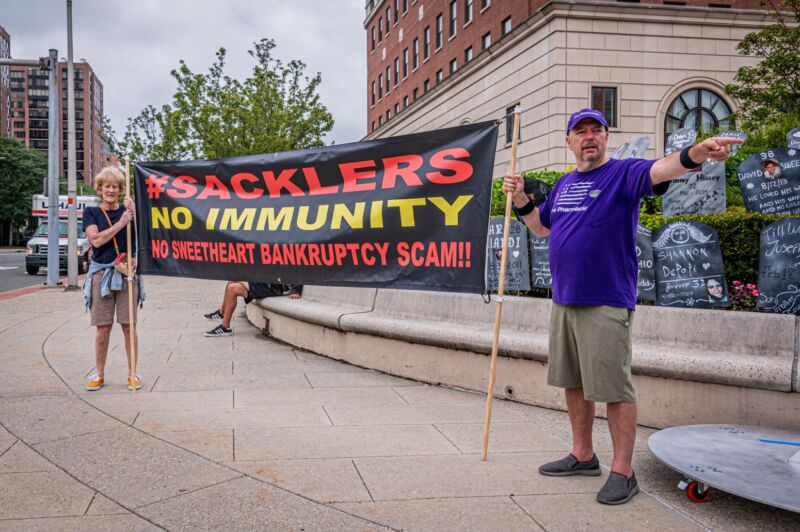
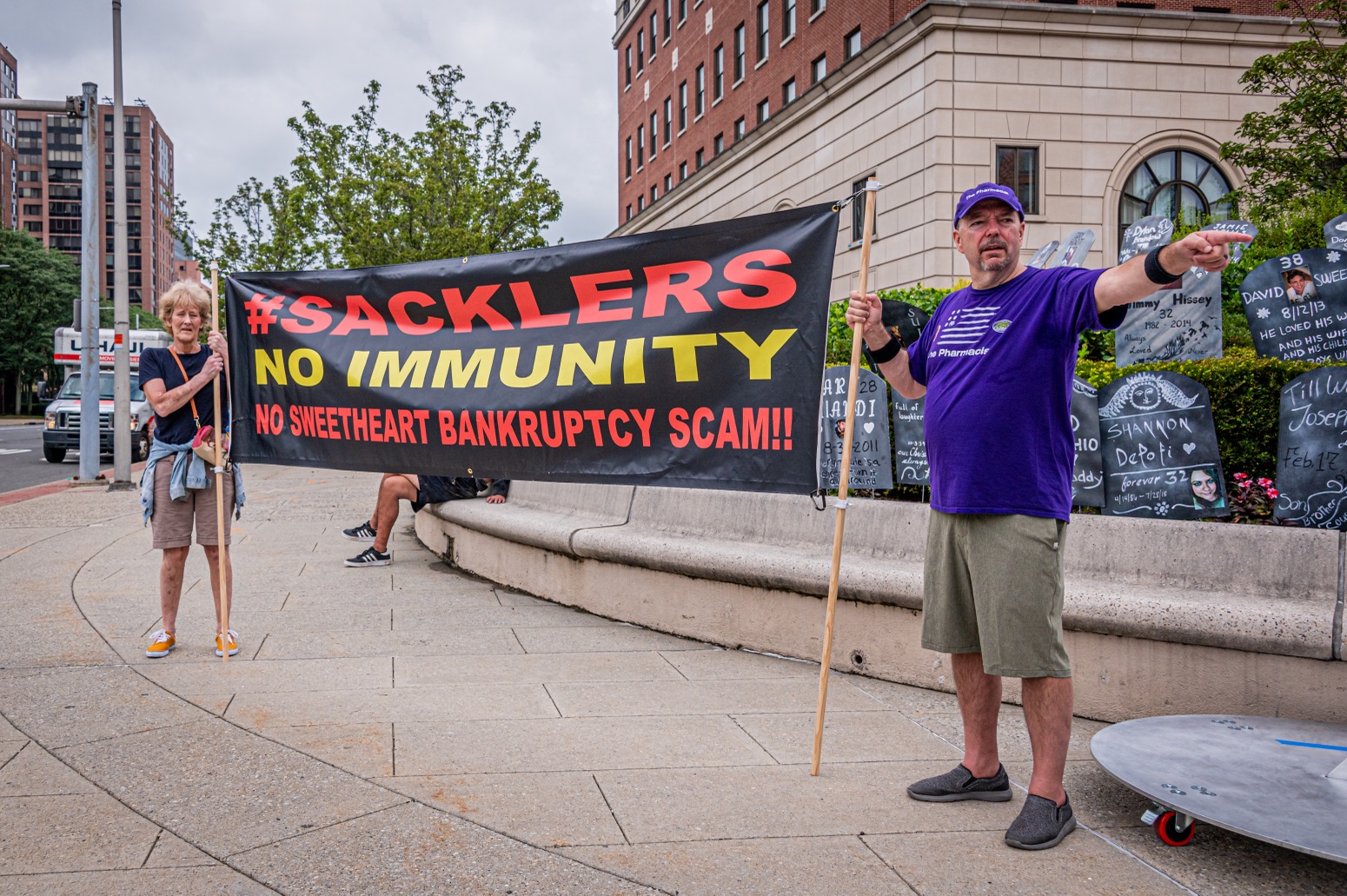
Enlarge / Members of PAIN (Prescription Addiction Intervention Now), Truth Pharm, and other advocacy groups working in response to the overdose crisis protested the Sacklers' immunity deal outside US Bankruptcy Court in White Plains, New York on August 9, 2021. (credit: Getty Images | Erik McGregor)
The Sackler family is threatening to back out of a $4.5 billion opioid settlement if it is not granted broad immunity from lawsuits. The pending settlement between the Sacklers and 15 states includes an immunity provision, but other states oppose it, and a bankruptcy court judge is still considering whether to approve the deal.
Forty-one-year-old David Sackler, a former Purdue Pharma board member and grandson of one of the company's founders, "vowed in court on Tuesday that the family would walk away from a $4.5 billion pledge to help communities nationwide that have been devastated by the opioid epidemic, unless a judge grants it immunity from all current and future civil claims associated with the company," The New York Times wrote.
"We need a release that's sufficient to get our goals accomplished," Sackler said in testimony via video at a hearing in US Bankruptcy Court for the Southern District of New York. "If the release fails to do that, we will not support it." The family is worth $11 billion, a fortune boosted substantially by sales of OxyContin.
Read 14 remaining paragraphs | Comments
James.galbraithYep got the notice from TMobile this morning

Enlarge (credit: Getty Images)
T-Mobile on Wednesday said criminals obtained the personal information of almost 49 million current, former, or prospective customers in the latest mega-hack of its servers.
The haul includes customers’ first and last names, date of birth, SSN, and driver’s license/ID information for 7.8 million current post-paid accounts, meaning accounts that are billed at the end of each billing cycle. The unknown hackers obtained the same data from more than 40 million records belonging to former or prospective customers who had previously applied for credit with T-Mobile.
Names, phone numbers, and account PINs for about 850,000 active T-Mobile prepaid customers were also stolen. T-Mobile said that “additional information” from an unspecified number of inactive prepaid accounts was also affected.
Read 6 remaining paragraphs | Comments
James.galbraithSeriously

The dark irony of who TV news talks to about Afghanistan.
Four presidential administrations share, in varying degrees, the blame for the Taliban’s sudden takeover of Afghanistan — a development that brought the United States’ 20-year war in the country to an ignominious conclusion.
But watch cable news and you’d think some of the retired officials who helped orchestrate and continue the war had learned nothing.
Fox News watchers particularly have been inundated with the message this week that it’s all President Joe Biden’s fault — a message coming from veterans of the George W. Bush administration. Take Fox News contributor and former Bush speechwriter Marc Thiessen, who told host Dana Perino during a segment on Monday that the idea of pulling US troops out was “shameful.”
“Khalid Sheikh Mohammed predicted this,” Thiessen continued, referring to the alleged architect of the 9/11 attacks. “He told his interrogator, after he was captured, he said, ‘You Americans, what you don’t understand is we don’t have to defeat you militarily. We only have to wait long enough for you to defeat yourselves by quitting.’ He predicted this day would come. And on the 20th anniversary of the attack that he carried out, it’s come true because of Joe Biden.”
“Sobering but also very true,” Perino, Bush’s former press secretary, replied.
Marc Thiessen, a former Bush speechwriter, tells Dana Perino, a former Bush press secretary, that he fully expects Biden to be "booed" when he speaks at Ground Zero next month and that "he really shouldn’t show his face" because of Afghanistan. pic.twitter.com/1IrzE6zNvN
— Justin Baragona (@justinbaragona) August 16, 2021
Nowhere in that segment did either person explicitly acknowledge they’d worked in the very administration that started the war, though a chyron did identify Thiessen as a “FMR GW BUSH SPEECHWRITER.”
But Fox News hasn’t been alone in giving people a platform to opine on US failures in Afghanistan who could benefit from some introspection. A similar dynamic played out on MSNBC on Sunday night, when guest anchor Anand Giridharadas gave host and former George W. Bush administration communications director Nicolle Wallace the opportunity to blame “long-hardwired historical reasons” for the ultimate failure of the US effort in Afghanistan.
On Tuesday, MSNBC host Andrea Mitchell interviewed former Obama administration CIA director and defense secretary Leon Panetta about Afghanistan. Panetta, who oversaw Obama’s failed surge of troops to Afghanistan, at least acknowledged that “there’s a lot of blame to go around,” but still tried to paint a relatively rosy picture of the past 20 years.
“What people fought for was worthwhile. We were able to achieve progress in Afghanistan,” said Panetta, who as recently as two months ago claimed that Afghan security forces and government had made “progress” and conducted “effective operations” — statements belied by the developments of the past two weeks.
CNN, meanwhile, gave retired Gen. David Petraeus a platform on Wednesday to criticize Biden’s handling of the situation, but didn’t mention that his tenure as commander of NATO forces in Afghanistan ended in the summer of 2011 with violence in the country escalating and with any prospects of a withdrawal frustrated.
Says the guy who killed multiple negotiations meant to end the war ... while the Taliban was in a much, much weaker position. https://t.co/PgSCHf0n6M
— Noah Shachtman (@NoahShachtman) August 18, 2021
CNN also interviewed hawkish former Bush and Trump administration official John Bolton, who made a case that if the situation were “properly explained,” the American people would support the indefinite deployment of troops in Afghanistan, even though polling shows a plurality support withdrawal.
Print articles about the Taliban takeover of Afghanistan also privileged the voices of those with an interest in seeing US troops stay. As Judd Legum detailed for his Popular Information newsletter, a Washington Post piece written by Matt Viser and headlined “Biden’s promise to restore competence to the presidency is undercut by chaos in Afghanistan” quotes Panetta; Ryan Crocker, who served as ambassador to Afghanistan during the Bush and Obama administrations and in 2012 touted the Afghan security forces as an “amazing achievement”; Eliot Cohen, a self-described “hawk” who advised then-Secretary of State Condoleezza Rice during the Bush administration; and members of Congress who supported keeping troops in Afghanistan.
“Unrepresented in Viser’s piece are any voices that supported withdrawing U.S. forces from Afghanistan — even though a poll last month found that 73% of Americans supported withdrawal,” Legum writes, capturing a dynamic that’s been apparent across the media ecosystem.
While it’s true that 20 years of US troop presence in Afghanistan did prevent the country from becoming a haven for those planning attacks on the US homeland and did result in significant gains for Afghan women, the rapid collapse of the US-backed government suggests those gains weren’t sustainable without the indefinite presence of US troops in the country. But instead of acknowledging that perspective, the discussion of Afghanistan on cable news this week has been chock full of ex-officials looking to justify the minority view that troops should stay longer.
To be clear, there are many legitimate criticisms of the Biden administration’s handling of Afghanistan. Even if one agrees with the president’s decision to follow through on the withdrawal deal struck last year by then-President Donald Trump and the Taliban, the US exit could have happened in a much more orderly fashion. And as my colleague Nicole Narea explained, the administration also could have done much more to evacuate Afghans who worked with US forces before the country descended into chaos.
Obama and his administration also aren’t blameless. Though Obama did fulfill the invasion’s initial objective by taking out al-Qaeda leader Osama bin Laden in neighboring Pakistan in 2011, his decision to escalate the US troop presence in Afghanistan in 2009 didn’t pay dividends, and his effort to implement a timeline for US withdrawal five years later didn’t work out, either.
But if anybody should think carefully about joining conservations about who is to blame for the current awful situation in Afghanistan, it should be alums of the George W. Bush and Donald Trump administrations.
Bush, of course, not only made the decision to invade Afghanistan in 2001 but failed to capture or take out bin Laden. And Trump struck a deal with the Taliban last year that put them in a position to rapidly take over the country as soon as US troops began to leave.
And that’s why Fox News’s decision to platform the likes of Thiessen and Perino during its Afghanistan discussions is egregious. Both worked in the Bush administration, as a speechwriter and press secretary, respectively. So they have self-interested reasons for playing the blame game, even while their own failures when it came to Afghanistan aren’t acknowledged.
Fox News has been by far the worst offender in this regard. Pundits brought on Fox this week to bash Biden for the Taliban takeover of Afghanistan also included Karl Rove, a top aide to George W. Bush; Mike Pompeo, who as secretary of state during the Trump administration oversaw the deal with the Taliban that put them in a position to quickly overrun Afghan forces as US troops withdraw; and Kayleigh McEnany, a former Trump press secretary.
What’s more, Thiessen, Perino, Pompeo, Rove, and McEnany are all currently paid by Fox News, with Perino and McEnany working as hosts and the other three joining various programs as paid contributors. Another contributor, Lara Trump, daughter-in-law to former President Trump, also went on Fox News on Monday to attack Biden.
Bringing out Trump's daughter in law to explain that he bears no responsibility for what is happening in Afghanistan and it's all Biden's fault. pic.twitter.com/UkuuuHzQmA
— Matthew Gertz (@MattGertz) August 16, 2021
It’s true that the scenes of chaos in Afghanistan caused US support for withdrawal to drop precipitously, from 69 percent in April to 49 percent now, according to Morning Consult. But withdrawal is still more popular than opposing it, which Morning Consult says is the stance of 37 percent.
Yet prominent voices among the relatively small minority favoring keeping troops there are the ones being amplified by elite media. There’s a role for military and government sources to comment on situations like these. But the American failure in Afghanistan should lead to some rethinking about which voices dominate the conversation — and so far, that doesn’t seem to be happening.
James.galbraithHopefully
James.galbraithGood, now if only it'd get passed into law.

Nancy Pelosi is planning a vote on a bill that would undo many of the Court’s attacks on democracy.
Two things are clear about House Democrats’ new plan to undo a conservative Supreme Court’s efforts to restrict the right to vote: One is that Democrats are starting to recognize the existential threat that a 6-3 conservative Court could present to American democracy. The other is that, unless a handful of key Senate Democrats stop propping up the filibuster, the Court will win this engagement.
On Tuesday, Rep. Terri Sewell (D-AL) introduced the plan, known as the “John R. Lewis Voting Rights Advancement Act of 2021,” with a strong endorsement from House leadership. The bill is expected to receive a House floor vote as soon as next week — but will likely die in the Senate, like other Democratic priorities sabotaged by a handful of Democratic senators who remain loyal to the filibuster.
Congressional Democrats have backed some version of the John Lewis Act for quite some time. Not long after Democrats regained control of the House of Representatives in 2019, they rallied behind an earlier version of the bill. That earlier version sought to restore “preclearance,” a practice from the Voting Rights Act of 1965 that required states with a history of racist election practices to submit their election rules to federal approval before those rules take effect.
The Supreme Court effectively struck down preclearance in Shelby County v. Holder (2013) — in a party-line vote with all of the Court’s Republican appointees in the majority and all of its Democrats in dissent.
The latest version of the John Lewis Act is far more ambitious than the one Democrats supported in 2019. Among other things, the new bill would undo the Supreme Court’s very recent decision in Brnovich v. Democratic National Committee (2021), which imposed new, seemingly made-up limits on the Voting Rights Act’s safeguards against racism in elections.
The new bill would also roll back the Court’s decision in Purcell v. Gonzales (2006), which drastically limits courts’ ability to protect voting rights as an election draws close. The bill creates a new process to block certain voting restrictions in all 50 states, and, it prevents the Court from changing the rules governing who may cast a ballot while an election is underway — and then retroactively disenfranchising voters who did not comply with the new rules.
The Supreme Court’s disregard for voting rights enabled a raft of legislation attacking the franchise in Republican-controlled states. Some of these bills erect hurdles between voters and the polls that might be overcome by Democratic political organizing, but others make structural changes to elections that could lock Democrats out of power. In Georgia, for example, the state Republican Party can take over local election boards that could potentially disenfranchise thousands of voters in Democratic strongholds like Atlanta.
If enacted, the new John Lewis Act would be one of the most ambitious voting rights laws ever enacted by Congress — though, again, its success depends on Senate Democrats unanimously concluding that protecting democracy is more important than preserving the filibuster. In either event, however, the bill is a giant middle finger to the Roberts Court, which has been extraordinarily hostile toward voting rights.
If nothing else, in other words, the latest version of the John Lewis Act recognizes that one of the greatest threats to American democracy is the Supreme Court of the United States — and that Congress needs to confront the Court’s recent decisions directly if it hopes to protect democracy in the United States.
Under the original Voting Rights Act, states with a history of racist election practices had to “preclear” any new voting rules with a federal court in DC or with the US Department of Justice. The idea was to stop those laws from ever taking effect until federal officials reviewed them to ensure that they would not target minority voters.
In Shelby County, however, the Court’s Republican majority struck down preclearance. Notably, though, Shelby County did not hold that Congress could never pass new legislation imposing preclearance. Instead, Shelby County held that, if Congress wants to impose preclearance on some states but not others, it “must identify those jurisdictions to be singled out on a basis that makes sense in light of current conditions.”
The John Lewis Act seeks to meet this challenge by imposing preclearance — typically for at least 10 years — on states where “15 or more voting rights violations” occurred in the previous 25 years, or that committed 10 such violations if “at least one of which was committed by the State itself.” Local jurisdictions, such as counties or townships, can also be subjected to preclearance if they committed three or more violations during the previous 25 years.
Additionally, the latest draft of the John Lewis Act imposes preclearance on any state with only three violations, if they occur in a local jurisdiction where elections are administered by the state itself. This is likely a response to a new Georgia law, which allows the GOP-controlled State Elections Board to take over local election administration and potentially disenfranchise voters en masse.
The new version of the John Lewis Act also requires all 50 states — regardless of whether they have a racist history — to submit certain kinds of election rules to preclearance.
The list of election practices that must be submitted to federal review by all 50 states includes most laws that reduce “the proportion of the jurisdiction’s voting-age population” that belongs to a particular racial or language minority group by 3 percent or more. It includes all redistricting laws in areas with significant minority population growth. It includes certain voter ID laws, and it includes many attempts to close or reduce the hours of polling places.
Again, the mere fact that a state engages in one of these disfavored practices does not mean that the state’s new rule will be invalidated. But the election rule may not take effect until federal officials screen it to ensure that it “neither has the purpose nor will have the effect of denying or abridging the right to vote on account of race, color, or membership in a language minority group.”
The Voting Rights Act prohibits states from enacting an election law that “results in a denial or abridgement of the right ... to vote on account of race or color.” Violations of this provision, which is often referred to as the “results test,” are typically enforced through litigation.
In Brnovich, however, the Supreme Court invented several new restrictions on the results test which appear nowhere in the text of the law. Among other things, Justice Samuel Alito’s majority opinion in Brnovich creates a strong presumption that voting restrictions that were commonplace in 1982 remain lawful. It fabricates a similar presumption favoring state laws purporting to fight voter fraud. And Brnovich suggests that a state law restricting one method of voting (such as, say, early voting) should be upheld if there are “other available means” to cast a ballot.
Much of the new version of the John Lewis Act appears to have been drafted by lawyers who went line by line through Alito’s opinion in Brnovich in order to cancel every new limit on voting rights made up by Alito and his colleagues.
Among other things, the bill would forbid courts from considering certain factors in Voting Rights Act cases, such as whether a particular voting restriction “has a long pedigree or was in widespread use at some earlier date,” whether the law is defended as an effort to fight “fraud,” and, in most cases, whether the state makes other methods of voting available.
Additionally, the bill contains a list of factors that courts should consider when hearing Voting Rights Act cases, including “the history of official voting-related discrimination in the State or political subdivision,” the degree to which voting is “racially polarized” in a jurisdiction (such as if white voters overwhelmingly prefer Republicans and Black voters vote overwhelmingly for Democrats), and “the extent to which minority group members bear the effects of discrimination in areas such as education, employment, and health.”
Many of these later factors are derived from the Court’s pre-Brnovich decisions.
Many of the Roberts Court’s voting rights cases involve subtle procedural attacks on the right to vote — the sort of attacks that nominally leave the right in place but that prevent courts from handing down orders protecting it.
Consider, for example, Purcell. That case held that courts should be reluctant to hand down orders impacting a state’s election practices as an election draws close. “Court orders affecting elections,” the Court warned in Purcell, “can themselves result in voter confusion and consequent incentive to remain away from the polls. As an election draws closer, that risk will increase.”
There is some wisdom in Purcell’s warning that late-breaking election law decisions might create more problems than they are worth. But the Supreme Court’s more recent cases have treated Purcell less as a warning that judges should be careful when hearing voting rights cases, and more as a ban on election-related orders close to an election.
In Republican National Committee v. Democratic National Committee (2020), for example, the Supreme Court forbade lower courts from altering Wisconsin’s election practices in the midst of a pandemic, even as some localities were shutting down the overwhelming majority of their polling places because they did not have adequate poll workers to conduct a normal spring election.
The new version of the John Lewis Act provides that, except in extraordinary cases, “proximity of the action to an election shall not be a valid reason” to deny relief to a voting rights plaintiff.
Other provisions of the bill prevent appeals courts from disenfranchising voters who relied on a lower court’s order when they cast their ballot. In Andino v. Middleton, for example, a lower court suspended a South Carolina law requiring absentee voters to have another person sign their ballot as a witness. The Supreme Court eventually blocked that lower court’s decision, but not before thousands of voters had already cast a ballot.
Nevertheless, three justices would have disenfranchised any voter who did not have their ballot signed by a witness, even if those voters cast that ballot while the lower court’s order was in effect. The John Lewis Act prevents appeals courts from disenfranchising voters in this way by providing that “a reviewing court shall not order relief that has the effect of denying or abridging the right to vote of any citizen who has acted in reliance on” a lower court’s order.
It should be noted that these are only some of the provisions in House Democrats’ new, very detailed bill. The bill also includes safeguards against “retrogression,” where states enact laws that make voters of color worse off than they were before that law took effect. It imposes new disclosure requirements on states and localities. And it provides grants to smaller jurisdictions to help them comply with the new obligations imposed by this bill.
But the primary purpose of the bill appears to be rolling back the Roberts Court’s efforts to restrict voting rights. It’s a worthy effort — assuming that the Court does not invent some reason to strike down the bill.
James.galbraithlol

Hovertext:
One day, molecular printers will allow starbucks to serve every conceivable food as a whipped topping.
James.galbraithHere's to hoping...
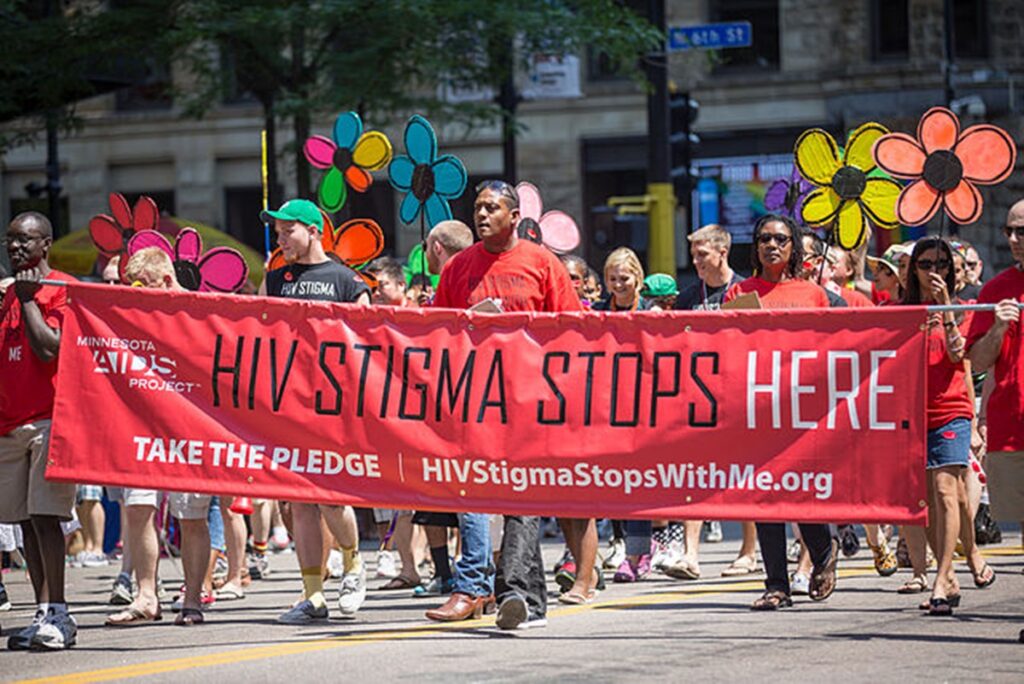
The Moderna HIV vaccine is set to enter human trials as early as next week, marking a monumental step in the treatment of one of the most devastating health crises worldwide.
According to the National Institutes of Health’s clinical trials registry, the biotech company is prepping to test its mRNA-1644 and mRNA-1644v2-Core vaccines after both passed phase one testing earlier this year. The study will divide its 56 participants, all of which have not previously tested positive for HIV, into four groups that will be administered both or either vaccine in various combinations.
Building the vaccine from an mRNA foundation differs from previous vaccine constructions and functionality, essentially providing instructions for cells to build immune responses through specific protein production. This process teaches the body how to defend itself on the cellular level rather than having human immune systems learn through combatting weakened forms of a virus.
Research news! | The Globally Relevant AIDS Vaccine Europe-Africa Trials Partnership (GREAT) – of which @UniofOxford is a lead partner – announced this week the start of #vaccinations in a Phase I clinical trial of a novel #HIV vaccine candidate. https://t.co/bFP0jXe7ny pic.twitter.com/09kSp7pJCB
— OxfordSparks (@OxfordSparks) August 6, 2021
mRNA vaccines also respond better to variants of a virus – a fact that is vital and addressing HIV mutations that have emerged since the virus surfaced 40 years ago. “The mRNA platform makes it easy to develop vaccines against variants because it just requires an update to the coding sequences in the mRNA that code for the variant,” Dr. Rajesh Ghandi, HIV Medicine Association chair, told Verywell.
Moderna’s Covid-19 vaccine, which is built of an mRNA base, has been a success in showing the aptitude of mRNA vaccines in building up immuno-response to the base strain of Covid-19 and its more dangerous variants.
The trial is estimated to start on Aug. 19, 2021, though the timetable could alter depending on response to Moderna’s call for volunteers, though it is expected to begin before the end of the year. It is scheduled to wrap and deliver findings by May 1, 2023.
2021 has been a landmark year in the development of HIV vaccines. As Moderna prepares its human trials in the U.S., the University of Oxford launched trials of its HIVconsvX vaccine in Europe and multiple African nations, including Kenya and Tanzania, are testing the HIVconsvX vaccine as well.
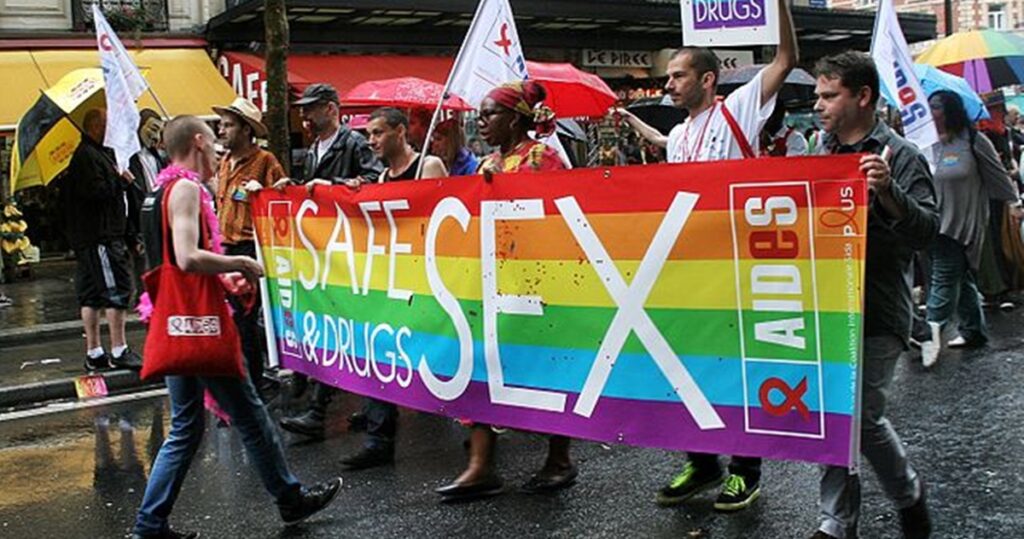
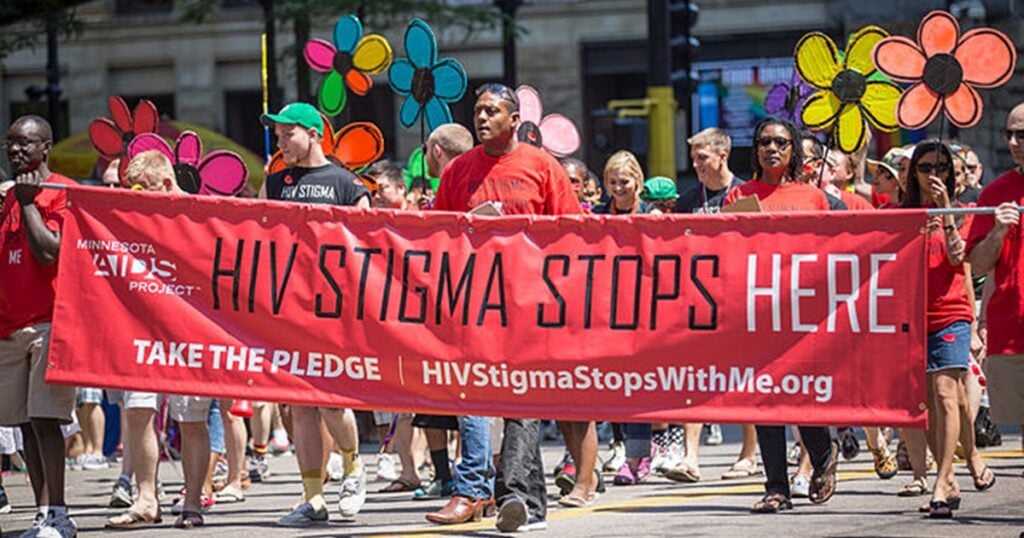
Photo courtesy of Tony Webster/Creative Commons
James.galbraithIf only there were consequences

“These waves are just something you have to deal with.”
It wasn’t that long ago that major media outlets were publishing stories proclaiming Florida Gov. Ron DeSantis (R) “won the pandemic,” or deserved an apology from pundits and public health experts who have panned his laissez faire approach to the coronavirus. But those notions have aged poorly, as Florida struggles with spiking Covid-19 hospitalizations that DeSantis seems particularly unequipped to handle.
Comments DeSantis made to reporters on Wednesday in an attempt to downplay the grim reality that Florida currently leads the nation in Covid hospitalizations for children were case in point. Instead of implementing policies to address the issue, DeSantis banned mask mandates in schools. On Wednesday, he went as far as to suggest — citing no evidence other than anonymous anecdotes — that families of school-age children should be more worried about children contracting respiratory syncytial virus (RSV).
“COVID, I view as a very minor risk,” DeSantis said. “RSV is a little more serious and it just shows certain things that are focused on versus not. I’ve had doctors tell me that parents have come in with kids who were sick that have gotten a negative COVID test and a positive RSV and the parents were relieved at that.”
It’s not COVID-19 in kids. It’s RSV. pic.twitter.com/huZBgY1LCO
— Daniel Uhlfelder (@DWUhlfelderLaw) August 11, 2021
DeSantis’s remarks are at odds with data from his own state Department of Health showing that RSV cases have decreased in recent weeks and can currently be counted on one hand. By contrast, the Centers for Disease Control and Prevention (CDC) reported earlier this month that Florida had more than 30 Covid-stricken kids in the hospital each day between July 24 and 30.
That press conference came one day after DeSantis expressed confusion about officials from his own state requesting ventilators and smaller breathing devices from the federal government — equipment needed to prevent the state’s hospitals from becoming overwhelmed.
ℹ Florida COVID-19 Update for August 10, 2021
— Florida Hospital Association (@FLHospitalAssn) August 10, 2021
Total Confirmed Hospitalizations: 14,787 pic.twitter.com/T3thlJwHyL
DeSantis — who last week admonished President Joe Biden, “why don’t you get this border secure and until you do that, I don’t want to hear a blip about Covid from you” — made comments on Tuesday to reporters seeming to indicate that he’s either oblivious to the ventilator request or trying to intentionally mislead people about it.
“I would honestly doubt that that’s true, but I’ll look because we have a lot of stuff that we stockpiled over the last year and a half through the Department of Emergency Management,” DeSantis said. “I’ve not had any requests across my desk. I have not been notified of that.”
A short time after, NBC reported not only that the request had been made, but that the federal government had already sent the breathing gear to Florida.
In a written response to an email sent by Vox, Weesam Khoury, communications director for the Florida Department of Health (DOH), claimed, “to be clear, there is not a shortage of ventilators in Florida,” adding that the request is “a proactive measure to ensure there are consistent resources available in the state stockpile for deployment” made by “health care facilities.”
DeSantis, a former Congress member who distinguished himself during his 2018 gubernatorial run with his sycophantic praise of Trump, became something of a national conservative hero last year due to his hands-off approach. As my colleague German Lopez explained last year:
Florida was relatively late in closing down statewide, but it was also among the first to reopen. The state also reopened very quickly — letting restaurants, bars, and other businesses reopen, sometimes at high or full capacity, within weeks of ending its lockdown. That fast pace of reopening not only made it easier for people to infect each other with the coronavirus, but also made it much harder to evaluate, due to lags in coronavirus case reporting, if each phase of reopening was leading to uncontrollable growth in infections.
Relatively speaking, the Covid situation in Florida was far from a disaster until quite recently, and DeSantis has touted his ability to keep the state’s unemployment rate low throughout the pandemic. The state is still in the middle of the pack overall in terms of Covid deaths per 100,000 residents. But sadly, there’s no guarantee that will remain the case, as in recent weeks Florida has accounted for the second-highest number of Covid cases per capita in the US, and the highest number of deaths (141 per day).
Dr. Jonathan Reiner of the George Washington University School of Medicine said during a recent CNN appearance that if Florida were a foreign country, the federal government would consider banning travel to it.
“The viral load in Florida is so high right now, there are really only two places on the planet where it’s higher,” Reiner said. (Those two places: Botswana and Louisiana.)
In a Talking Points Memo piece arguing that DeSantis “is the nation’s worst Covid governor,” Josh Kovensky details how DeSantis enabled the ongoing Covid surge with his two-front war on mask mandates and vaccine mandates:
As all of this preventable carnage began, DeSantis shrugged it off with a series of orders that, epidemiologists say, poured gasoline on the already more contagious Delta variant. He has made national news this year by banning two mandates that public health officials have said are needed to keep hospitalizations down: vaccine and indoor mask requirements. The Florida government has prohibited businesses and government agencies from requiring vaccines, and has forbid schools from instituting mask requirements.
Notably, DeSantis’s vaccine mandate prohibition includes cruise ships — a policy MSNBC’s Chris Hayes has characterized as the “single most deranged Covid policy we’ve seen.” But a federal judge earlier this week ruled that Florida can’t bar cruise companies from requiring proof of vaccination.
Likewise, DeSantis’s mask mandates ban is being challenged in court by parents and ignored by at least one school board. DeSantis has responded by saying the Florida Board of Education might withhold paychecks from board members and administrators who enforce mask mandates, which in turn has prompted the White House to suggest it might try to step in. (On Thursday, the DeSantis administration backed down from its threat to withhold pay.)
Biden indirectly took aim at DeSantis during a speech earlier this month, saying, “Just two states, Florida and Texas, account for one-third of all new Covid-19 cases in the entire country. We need leadership from everyone ... I say to these governors, please help, but if you aren’t going to help, at least get out of the way.”
"Just two states, Florida and Texas, account for one-third of all new Covid-19 cases in the entire country. We need leadership from everyone ... I say to these governors, please help, but if you aren't going to help, at least get out of the way" -- Biden pic.twitter.com/dPDnGAJ38u
— Aaron Rupar (@atrupar) August 3, 2021
On Thursday, news broke that just days into Florida’s school year, 440 students in Palm Beach County have already been asked to quarantine because of Covid-19 exposure. And Friday morning brought reports of four Broward County teachers dying of Covid in a single day.
But DeSantis seems undeterred.
“It’s airborne. It’s aerosolized,” he said of the delta variant on Thursday. “So we just have to understand when that’s happening these waves are something you just have to deal with.”
DeSantis Press Secretary Christina Pushaw dismissed research linking mask mandates to reduced Covid-19 spread in an email to Vox, writing, “Governor DeSantis will continue to protect individual rights from unscientific mandates promoted by overreaching politicians who are desperate to give the appearance of ‘doing something’ even if it has no effect.”
What explains DeSantis’s stubborn refusal to acknowledge the gravity of the Florida Covid case spike and stop working against public health best practices? The answer to that question is up for debate, but one factor may be a belief that reversing course would undermine his brand as the governor who stuck it to the libs by thumbing his nose at the Dr. Faucis of the world. That brand has established DeSantis as the non-Trump frontrunner for the 2024 Republican presidential nomination.
After all, it was just last month that DeSantis was selling “Don’t Fauci My Florida” merchandise on his website.
As Fauci has conducted local and national interviews obliquely criticizing DeSantis’s policies, DeSantis has continued to downplay the surge, saying last week that “this is our COVID season.” Meanwhile, hospitals in the state are reporting “unprecedented” wait times for beds.
Press Secretary Pushaw pointed to the fact that Covid-19 hospitalizations dipped this week in the Jacksonville area, writing to Vox, “COVID cases in the areas of the state that were earliest hit in this wave, such as Jacksonville, have already started their decline as predicted — without any government authority imposing non-pharmaceutical interventions.”
“Governor DeSantis continues to support vaccination for Covid-19 as well as promoting monoclonal antibody treatment for anyone who tests positive and is at risk of severe illness from Covid-19,” she continued.
It’s possible that as the news grows more dire, Floridians will adjust their behavior and/or get vaccinated if they haven’t already, prompting new cases to begin trending down again. But even in that scenario, the fact remains that by stubbornly working at cross-purposes with public health experts, DeSantis has made Florida’s Covid-19 problem worse than it had to be.
Update, August 13, 4:40 pm: Updated to include comment from DeSantis’s office and the Florida Department of Health.
James.galbraithIt's fucking delightful

Free Guy is about a man stuck in a fake world. Hollywood loves that metaphor.
Guy thinks his world is perfect. “My name is Guy, and I live in paradise,” he says in the early moments of Free Guy, by way of introduction. His days are unchanging: Greet his goldfish, raise the blinds, eat breakfast while watching the news, head off to work. Pick up coffee on the way — cream and two sugars, always — and crack some corny joke with the barista. Meet up with his friend Buddy. Settle in for another day as a bank teller.
Guy technically lives in Free City, which, to the outsider’s eye, is obviously not paradise. Cars are constantly crashing on the streets. People are routinely shot; buildings explode; fights break out. The bank where Guy works gets robbed every day, like clockwork.
But he thinks it’s perfect, because he is programmed to think it’s perfect. Guy (played by Ryan Reynolds) is a character in an open-world video game called Free City — think The Sims crossed with Grand Theft Auto. He and Buddy (Lil Rel Howery) are “non-playing characters,” which is a term for the bystanders and extras who mill about in the background, getting run over or shot or otherwise disregarded by the people actually playing the game.
Free Guy is the tale of Guy becoming self-aware, realizing that he can, and should, make choices in life. That’s partly thanks to some artificial intelligence code buried in his virtual DNA by Millie (Jodie Comer) and Keys (Joe Keery), and partly thanks to the existentialist philosophy of the movie he’s in. Let’s put it this way: Guy is not the only character in the film who needs to learn to take responsibility for his life and his choices.
/cdn.vox-cdn.com/uploads/chorus_asset/file/22778106/DF_29489_R.jpg) Alan Markfield/20th Century Studios
Alan Markfield/20th Century Studios
I quite enjoyed Free Guy, an original comedy with some good jokes and a bunch of funny performances. (In addition to the main cast, the film boasts Taika Waititi as the punky, petulant boy-man who runs the video game company that produces Free City, plus a few great cameos I won’t spoil.) Reynolds plasters over his occasionally too-knowing handsomeness with an utterly guileless affect, turning Guy into an accidental hero you want to see win. It’s a silly story, but it’s fun, and it’s inspiring in the manner of a TikTok video about how you can change your life if you just work hard.
That is probably why I spent most of Free Guy distracted by all the ways it reminded me of other movies with a similar existential bent. The film that Free Guy most recalls is The Truman Show, the 1998 Jim Carrey vehicle that holds up brilliantly as a precursor to the reality TV age. Carrey plays Truman Burbank, a man who was raised in a giant bubble and has no idea that his entire life is actually highly produced fiction, his every moment broadcast to the world. Truman’s life changes when he starts to realize something is fishy, and he wonders if he can break out of the construct and find his own way, even against the will of the show’s creator.
Though it’s probably the most well-known, The Truman Show is only one of many movies where a character realizing they’re being controlled — their steps preordained by some force bigger than them — becomes a larger meditation on the meaning of life, fate, chance, and destiny. In the 2006 comedy Stranger Than Fiction, Harold Crick (Will Ferrell) becomes slowly aware that he might actually be a character in a book, and consumes himself with trying to change his fate. In David Fincher’s 1997 thriller The Game, a wealthy investment banker (played by Michael Douglas) feels the border blurring between reality and a high-stakes “game,” and he’s not sure whether he’s in charge of his own life. In the 2011 sci-fi thriller Source Code, a fighter pilot finds himself enmeshed in a reality that he didn’t choose, and he doesn't know if there’s any way out.
There are dozens more examples, most of which seem designed to prompt the audience to examine their assumptions, stop feeling “stuck,” and start living. They’re the modern-day reincarnation of the existentialist tradition stretching back to the late 19th century, drawing on figures like Kierkegaard and Sartre. Give life meaning by making deliberate choices, then take responsibility for those choices, they exhort. It’s an old, appealing philosophy, albeit one that tends to downplay factors outside of people’s control.
/cdn.vox-cdn.com/uploads/chorus_asset/file/22778111/DF_20703.jpg) Alan Markfield/20th Century Studios
Alan Markfield/20th Century Studios
I find it darkly ironic that existentially inclined movies often strand their characters in what amounts to a simulation of life — a video game, a reality TV show, a real-life role-playing game. After all, when you make a (fiction) movie, you are kind of doing the same thing. The characters are controlled by the filmmakers and the people who portray them; they exist only within the movie’s constructed world. It’s not a huge leap to wondering if you, too, are a character in someone else’s simulation of life, and thinking about it too long will twist you up in knots.
Free Guy raises some other surprisingly deep questions about the nature of being, too. For instance, if we develop self-aware artificial intelligence, and then decide to delete the code that powers them, does that mean we’ve killed off a being? If so, does that imply that intelligence is the fundamental measure of being? And if our answer to that question is yes, what are the implications for how we value human life? Dark but important stuff.
It’s more germane to wonder why we tell these stories at all. I have one theory, which is depressing but hard to resist: that we’ve all been slowly constructing our own simulations. We document our lives on social media, performing for followers. We gamify our lives, turning fitness and hydration and sleep quality into contests using tiny computers we carry in our pockets or strap onto our wrists. We buy things that algorithms tell us to buy. We may feel, little by little, that we’re ceding control to something outside of us — probably a corporation. So it’s not surprising that movies reflect that anxiety.
But when you’re worn down, it’s hard to imagine choosing any path other than the one of least resistance. That’s likely why the cheery conclusion of Free Guy is that we don’t just need to take charge of our own lives; if we want to save our world from becoming like Free City, we need to resist the people who try to construct our realities for us and find a way to live outside their grasp (or at least find a better way to live). It’s a strong message, and a relevant one. I just don’t know how real — or realistic — it is.
Free Guy opens in theaters on August 13.
James.galbraithNo shit. Individual responsibility isn't carte blanche to inflict your stupidity on everyone else.
The vaccinated, across party lines, have kind of had it with the unvaccinated, an array of new polls suggests.
While most state and national GOP leaders are focused on defending the rights of unvaccinated Americans, new polling shows that the large majority of vaccinated adults—including a substantial portion of Republicans—support tougher measures against those who have refused COVID-19 shots.
These new results, shared exclusively with The Atlantic by several pollsters, reveal that significant majorities of people who have been vaccinated support vaccine mandates for health workers, government employees, college students, and airline travelers—even, in some surveys, for all Americans or all private-sector workers. Most of the vaccinated respondents also say that entry to entertainment and sporting arenas should require proof of vaccination, and half say the same about restaurants.
All of this suggests that as the Delta variant’s “pandemic of the unvaccinated” disrupts the return to “normal” life promised by the vaccines, a backlash may be intensifying among those who have received the shots against those who have not. And that could leave Republican leaders who have unstintingly stressed the rights of the unvaccinated—including Governors Ron DeSantis of Florida and Greg Abbott of Texas and House Minority Leader Kevin McCarthy—in an exposed position.
As a political calculus, it’s “a risky one,” says Matthew Baum, a public-policy professor at Harvard University’s John F. Kennedy School of Government, and a co-founder of a multi-university study of public opinion on the outbreak. “Over time, this general sense may grow of ‘Why are we who are vaccinated enduring this in order to coddle this liberty fantasy of the unvaccinated?’ And I think that is going to get stronger as the inconvenience grows, and as the wind goes out of the getting-back-to-normal sails, which is clearly happening. Everybody I know is pissed off.”
[Chavi Eve Karkowsky: Vaccine refusers risk compassion fatigue]
The principal dynamic raising tension between the roughly 70 percent of American adults who have received at least one shot of a coronavirus vaccine and the roughly 30 percent who have not is the current caseload surge. The Delta variant has again pushed the national COVID-19 caseload past 120,000 new infections daily, more than 10 times its level in mid-June.
Under that pressure, the divide between Republican and Democratic officials over how to respond to the pandemic—which raged throughout Donald Trump’s presidency but somewhat receded as the focus shifted to vaccine distribution under President Joe Biden—has reopened. Though more Republicans in recent weeks have promoted the vaccine, the party’s leaders at both the state and national levels have consistently emphasized people’s right to refuse it, while also opposing mask mandates to combat the immediate threat in the red states where case numbers are rising fastest.
Multiple states with Republican governors have banned school districts or local governments from imposing mask mandates. (Together, those states enroll about one-fourth of all primary- and secondary-public-school students.) About 20 Republican-controlled states have barred private businesses from requiring proof of vaccination. Seven Republican-controlled states have barred employers from requiring their workers to obtain a COVID-19 vaccine, and other red states are considering similar proposals.
In advancing these ideas, GOP leaders have insisted that the “choice” to reject the shot must be defended. “In Florida, your personal choice regarding vaccinations will be protected, and no business or government entity will be able to deny you services based on your decision,” DeSantis declared when signing his ban on vaccine passports in May. When New York City imposed such a requirement for admission to restaurants or other indoor venues, McCarthy sharply condemned the move as “un-American. Period.” He added: “Republicans will oppose any attempt to expand such a disastrous policy.” Representative Marjorie Taylor Greene of Georgia, as is often the case, has offered the most incendiary attacks, comparing restrictions on unvaccinated individuals to “segregation” (after earlier comparing mask requirements to the Nazi holocaust).
Democrats, more fitfully, are moving in the opposite direction, toward more mandates. Biden has made vaccination a necessity for federal workers, and a military requirement is expected close behind. Several blue states and cities have imposed vaccine mandates on government employees; California has mandated the shots for teachers and health-care workers, and many Democratic-leaning jurisdictions are requiring masks for public schools (in several cases in defiance of GOP governors’ prohibitions) and some indoor activities. Yesterday, the Los Angeles City Council moved toward adopting a version of New York’s vaccine-passport requirement. California Governor Gavin Newsom took another dramatic step yesterday by mandating that teachers either obtain a vaccine or accept weekly testing.
These moves by Biden and blue jurisdictions amount to the beginning of a shift in response to the recent upsurge, away from imposing more obligations on the vaccinated (such as mask mandates or capacity limits) and toward demanding more of the unvaccinated (through vaccine mandates or proof requirements).
[Juliette Kayyem: Unvaccinated people need to bear the burden]
Nick Gourevitch, a Democratic pollster who has closely studied attitudes about the pandemic, says public opinion has not moved decisively in favor of more pressure on unvaccinated people. Polls do consistently find that big majorities back mask mandates in most circumstances. But regarding segments of the population for whom officials have been discussing possible vaccine mandates—health-care workers, the military, students and staff at K–12 schools and universities, and interstate travelers—surveys have produced more divergent results; most find the country split almost exactly in half. “These are not slam-dunk numbers,” for more vaccine mandates, Gourevitch told me.
But these same polls also show a widening split in attitudes between respondents who have been vaccinated and those who have not. And this suggests that the overall balance could tip further toward mandates as more Americans receive the vaccines—and as they grow more frustrated that the “pandemic of the unvaccinated” is limiting their choices and multiplying their risks.
To better understand these dynamics, I asked several pollsters to break down results from their recent coronavirus surveys into four groups: Republicans and Democrats who have and have not received the shots. About 85 percent of Democrats and just over half of Republicans have been vaccinated, according to a recent survey by the nonpartisan Kaiser Family Foundation, which is conducting monthly polls about experiences and attitudes toward the COVID-19 vaccines.
In some key respects, party still outweighed vaccination status in the polls I examined: In the Kaiser polling, for instance, vaccinated Republicans were no more likely than unvaccinated Republicans (and much less likely than Democrats, whether or not they had been vaccinated) to say that they routinely wear a mask in various public settings.
But on almost all key questions, a majority, usually a significant majority, of vaccinated Americans in these surveys wanted tougher requirements. Vaccinated Democrats remain much more likely than vaccinated Republicans to support such mandates, but a substantial portion of the latter consistently echoes those views.
Evidence of frustration among the vaccinated begins with a recent Axios/Ipsos national poll that asked who was to blame for the recent upsurge in COVID-19 cases. Compared with the Democrats who had received the vaccine, the vaccinated Republicans were much less likely to blame former President Trump or conservative media, and much more likely to point a finger at President Biden and mainstream media, according to previously unpublished figures provided to me by Axios and Ipsos.
But big majorities of the vaccinated in both parties assigned responsibility to the unvaccinated; almost two in three vaccinated Republicans joined nearly nine in 10 vaccinated Democrats in blaming them for the case rise. By contrast, less than one in 14 of the Republicans who hadn’t received the shot blamed the unvaccinated. (In this survey, like most of those I examined, the group of unvaccinated Democrats was too small to reliably analyze.)
[David Frum: Vaccinated America has had enough]
Vaccinated Republicans also depart significantly from their unvaccinated counterparts in their assessment of the risks now facing the country. In the July Kaiser poll, about three in five vaccinated Republicans and more than four in five vaccinated Democrats expressed concern that the Delta variant “will lead to a worsening of the pandemic”; only about one in three unvaccinated Republicans agreed.
Likewise, more than eight in 10 vaccinated Republicans joined more than nine in 10 vaccinated Democrats in agreeing that “becoming infected with coronavirus” was a greater risk to their health than “getting the COVID-19 vaccine.” It may be hard to imagine how anyone might disagree, but six in 10 of the unvaccinated Republicans said that receiving the vaccine was a bigger risk than contracting the disease. (Kaiser’s poll did have enough unvaccinated Democrats to measure, and they came out in between: Only about one-third said that receiving the shot was the greatest risk, while about half picked contracting the disease.) Vaccinated Republicans consistently express much more support than unvaccinated Republicans for an aggressive response—though they remain less supportive than vaccinated Democrats.
The COVID States Project’s national polling has found the broadest support for mandates: In its latest survey, 63 percent of vaccinated Republicans, as well as 95 percent of vaccinated Democrats and 65 percent of unvaccinated Democrats, supported government action “requiring everyone” to obtain a vaccination. Unvaccinated Republicans stood isolated in their opposition; just 14 percent supported such a sweeping mandate.
When Kaiser recently asked whether “the federal government should recommend that employers” require their workers to get vaccinated, four-fifths of vaccinated Democrats and nearly half of vaccinated Republicans agreed that it should. But nearly nine in 10 unvaccinated Republicans disagreed (as did about six in 10 unvaccinated Democrats).
Quinnipiac University found similar patterns when it recently tested attitudes toward a broad range of vaccine and mask requirements. Among vaccinated Democrats, at least 85 percent backed vaccine mandates for government workers, university students, health-care workers, and all private-sector employees; well over 80 percent backed proof-of-vaccination requirements for flying or entering large arenas; and 90 percent or more backed mask requirements for public-school students and staff, as well as for participants in indoor activities in high-risk areas. (Seventy percent of vaccinated Democrats also backed proof-of-vaccination requirements for restaurants.)
In a mirror image, about 90 percent or more of unvaccinated Republicans opposed all of those ideas, with the highest percentages rejecting a private-sector vaccine mandate or proof-of-vaccination requirements for different activities. Vaccinated Republicans, though, were considerably more receptive to these ideas; somewhere between one-third and one-half supported almost all of the possible requirements. They expressed the most support for requiring vaccines for health-care workers (53 percent) and proof of vaccination to fly (44 percent), and the least support for mandating masks to enter restaurants (23 percent).
Biden so far has focused more on encouraging, rather than requiring, vaccinations. Although he’s imposed a mandate on federal employees, he’s rejected calls for requiring proof of vaccination for interstate travel, including on planes. And although he belatedly intensified his public criticism of Republican governors blocking mask mandates, he hasn’t followed those words with any policies to pressure them to change direction.
[Read: Vaccination in America might have only one tragic path forward]
But medical experts say Biden may soon have to face a choice of imposing more mandates or accepting persistently high caseloads and hospitalization rates. Many experts originally believed that the nation probably needed to vaccinate about 70 percent of its population to achieve herd immunity. But the Delta variant is so much more contagious than the original strain that experts such as Peter Hotez, the dean of the National School of Tropical Medicine at Baylor College of Medicine, and Ezekiel Emanuel, the vice provost for global initiatives at the University of Pennsylvania, say the nation now will more likely need to vaccinate 85 or 90 percent to reach that goal.
On the basis of the COVID States Project’s polling, Baum says, he believes that the share of American adults who will voluntarily take a vaccine will peak at about 75 percent, well below the new required level. Emanuel agrees. “We are in a circumstance of where we are going to need carrots and sticks,” he told me. “We are not going to get there by carrots alone.”
Emanuel recently organized a letter from leading medical organizations urging all health-care employers to require that their employees be vaccinated. But he said that such ad hoc efforts among private-sector employers are unlikely to produce enough progress. “I think we are probably going to have to think more systematically,” he said. Like many medical experts, he wants Biden to explore more options for encouraging vaccinations, including further federal mandates and using federal funds to promote mandates by other institutions.
Matt Mackowiak, a Texas-based Republican consultant, says that although the deteriorating situation will likely provoke “greater exasperation” among the vaccinated toward the unvaccinated, any push for more mandates, such as for interstate travel, would ignite a big conservative backlash. “I think it’s politically dangerous,” he told me. “It’s really hard to justify.”
But Gourevitch believes that the support for tougher measures among a significant share of vaccinated Republicans complicates the equation. He doesn’t think that the disagreement is powerful enough to cause many of those Republicans to break from their party entirely and support Biden or Democrats, but he does think that their attitudes could make it difficult for GOP leaders to generate the kind of ferocious conservative uprising against COVID-19 mandates that they have ignited on other issues over the years, such as undocumented immigration, defunding the police, and passage of the Affordable Care Act.
“The strategy that has worked for them … is when they have 90 percent agreement in their group,” Gourevitch said. “There’s something different about this than any of their culture-war or [racial]-identity fights, because a huge percentage of their own party at the very least doesn’t agree [on], or is not energized by, the position of protecting the unvaccinated.”
Biden, who has generally muted issues that might spark culture-war confrontations, has clearly been reluctant to test the public’s tolerance for more coercive measures to pressure unvaccinated individuals to receive a vaccine. But if the virus continues to find a safe harbor primarily in Republican-leaning states with low vaccination rates and lax public-health protections, he may eventually have no choice but to enter that fight.
James.galbraithOh Utah
James.galbraithlol
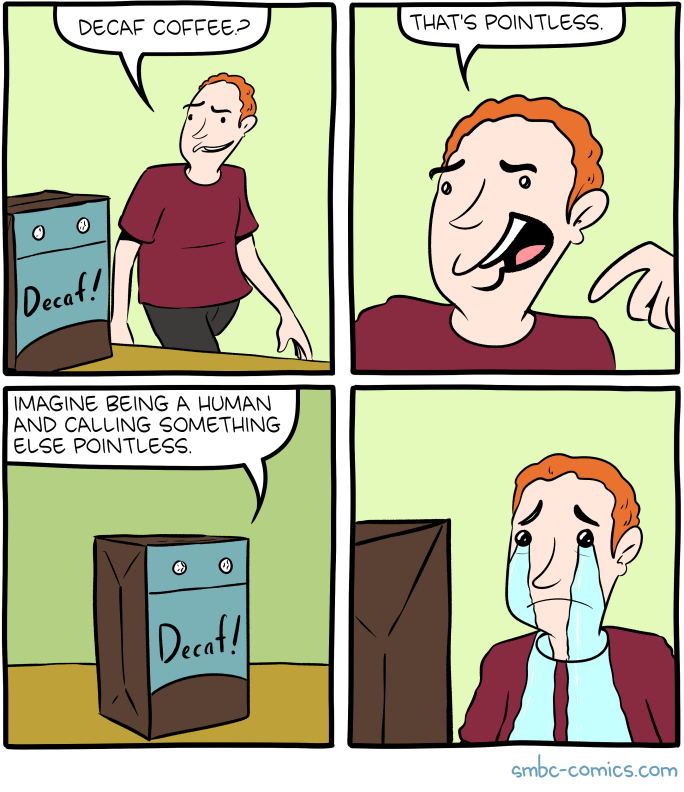
Hovertext:
Non-alcoholic vodka, on the other hand, is a genuine mystery.
James.galbraithLet the discovery commence
[Another bad day for the Kraken team of lawyers.]
U.S. Dominion's defamation suits against Kraken lawyer Sidney Powell, Rudy Giuliani, and My Pillow CEO Mike Lindell will proceed. Yesterday, Judge Carl Nichols of the U.S. District Court in D.C. denied the defendants' motions to dismiss in their entirety in a combined opinion.
Each of the different defendants made slightly different claims, but Judge Nichols rejected them all. Powell, for example, tried to argue that her allegations about Dominion voting machines were simply matters of opinion, and therefore could not be defamatory. No dice, Judge Nichols explained.
Powell contends that no reasonable person could conclude that her statements were statements of fact because they "concern the 2020 presidential election, which wa both bitter and controversial," Powell's Mot. at 38, and were made "as an attorney-advocate for [Powell's] preferred candidate and in support of her legal and political positions," id. at 39. As an initial matter, there is no blanket immunity for statements that are "political" in nature: as the Court of Appeals has put it, the fact that statements were made in a "political 'context' does not indiscriminately immunize every statement contained therein." Weyrich, 235 F.3d at 626. It is true that courts recognize the value in some level of "imaginative expression" or "rhetorical hyperbole" in our public debate. Milkovich, 497 U.S. at 2. But it is simply not the law that provably false statements cannot be actionable if made in the context of an election.
Powell similarly argues that her statements were protected commentary about other lawsuits. But Powell cannot shield herself from liability for her widely disseminated out-of-court statements by casting them as protected statements about in-court litigation; an attorney's out-of court statements to the public can be actionable, even if those statements concern contemplated or ongoing litigation. Messina v. Krakower, 439 F.3d 755, 761–62 (D.C. Cir. 2006) (recognizing no privilege when statement is published to persons not having an interest [in] or connection to the litigation") . . .
The question, then, is whether a reasonable juror could conclude that Powell's statements expressed or implied a verifiably false fact about Dominion. Milkovich, 497 U.S. at 19–20. This is not a close call. To take one example, Powell has stated publicly that she has "evidence from [the] mouth of the guy who founded [Dominion] admit[ting that] he can change a million votes, no problem at all." Powell Compl. ¶ 181(j). She told audiences that she would "tweet out the video." Id. These statements are either true or not; either Powell has a video depicting the founder of Dominion saying he can "change a million votes," or she does not.
Judge Nichols also rejected defendant's claims that Dominion failed to adequately plead "actual malice" and the efforts to challenge venue and jurisdiction. The opinion is a thorough drubbing. (And, for those who care about such things, Nichols is a Trump appointee.)
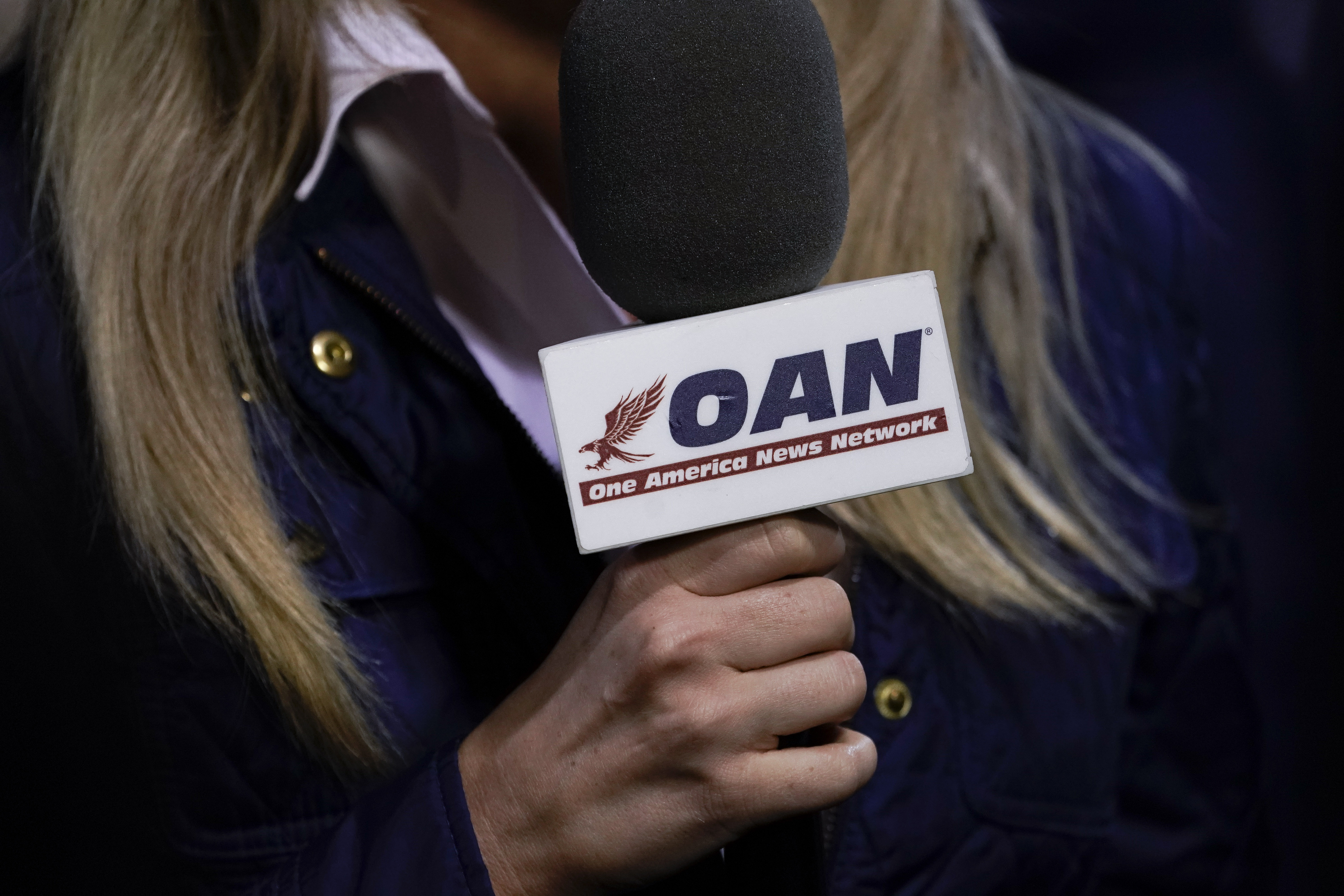
We will see more of these suits. Just this week Dominion also filed defamation claims against Newsmax and One America News Network (OANN). It has also sued Fox News.
James.galbraithWell this should be fun
Mesa County Clerk and Recorder Tina Peters—a “high-ranking Election Division staff worker”—and a “mystery man” reportedly accessed the secure Election Division room where, the following day, Colorado election equipment was going to be upgraded. The Daily Sentinel reports that these three individuals are alleged to have made copies of the hard drive and copies of the election management software. Some of these files and images are suspected of having made their way onto an election conspiracy theory website. Peters is suspected of having created this “serious breach” of Colorado elections security to help fuel Trump-supporting conspiracy theories that massive voter fraud led to the single most unpopular president losing his election in recent memory.
The Colorado Secretary of State’s Office, who has opened an investigation into the breach, says that Peters will be replaced in upcoming elections. This comes days after Secretary of State Jena Griswold ordered 41 pieces of election equipment replaced, saying that the security breach had compromised their integrity. That equipment must be replaced and certified by the end of August, or the county must hand-count ballots in upcoming elections. The Colorado Sun reports that while Secretary of State Griswold cannot have Peters removed from office, she can bar Peters from overseeing this November’s elections.
The Colorado Secretary of State’s office released a statement on Monday outlining the intricacies of their election security system, saying:
Colorado leads the way in secure elections, and has layers of security measures, both preventative and for detection purposes. This includes restricted access, chain-of-custody logs, equipment that is under lock and key, multiple sets of passwords or keys that no single person holds, and tamper evident seals. Colorado’s election system is also segmented, with each county having its own closed network and systems across counties are not connected to one another. Election systems have separate sets of passwords; one set is only held by a few specific civil servants with the Department of State and the other is held by the county officials. No one person has all the keys to the castle, as there are several passwords that are kept separate and protected by separate parties. Should there be an internal security breach like the one that occurred in Mesa County, in addition to the safeguards outlined prior to an election, Colorado also requires security protocols such as bipartisan testing on election equipment like tabulation machines before and after elections, mail ballot signature verification, and bipartisan risk limiting audits.
The Daily Sentinel has identified one of the two mystery people as Gerald Wood. Peters, this other staff worker—whose name is being withheld by the Sentinel at this time—allegedly passed off Wood as an employee of the county, giving him security access he did not have. The Colorado Sun reports that investigators believe the drives were copied and taken on May 23. The result: Images taken from the room were posted on a conspiracy website. They contained passwords and other delicate information and were taken a couple of days later, allegedly by Wood.
In a release to the media, the Secretary of State’s Office says, “[n]ew information acquired during the Department of State’s investigation reveals that the secure room where this election equipment is stored was accessed on the evening of Sunday, May 23, outside of normal work hours by the Mesa County Clerk Tina Peters; Gerald Wood, the unauthorized individual who attended the Mesa County trusted build; and another Mesa County Clerk and Recorder employee.”
The evidence presented so far is rather damning. Earlier reports say that Peters’ office had security cameras turned off two days before the “trusted build” of the elections system. According to Secretary of State Griswold, blacking out your security video feed for a week or two around the time that your equipment is being serviced to make sure it is secure is not a thing anyone does, and more importantly, is not protocol precisely because it is such a dubious thing to do.
Subsequently, the Sentinel reports that “computer logs of swipe cards that were used to unlock secure doors in that part of Peters’ office. Wood apparently had such a card even though he isn’t an employee of the clerk’s office.” Griswold also says that her office has contacted the U.S. Department of Homeland Security’s Cybersecurity and Infrastructure Security Agency because of the severity of this security breach and what that means for other localities across the country who may have officials like Tina Peters, under the impression that their opinions matter more than the integrity of the elections.
Peters has been relatively mum when asked for statements by Colorado news outlets. She did, however, get a private jet flight (care of MyPillow CEO Mike Lindell) to appear on a panel at his recent Scamporium Election Fraud Symposium Cyber Merry-Go-Round, where she implied that any evidence being collected from her offices by Colorado’s Secretary of State was being planted. It’s a great conundrum for MAGA-heads who are happy being living, breathing embodiments of the word conundrum. Peters is being championed as a heroic whistleblower who says she didn’t blow the whistle, but also did, but also not really because the whistles are being blown by the deep state, which is using whistleblowing to fetter her.
At the same time, District Attorney Dan Rubinstein, a Republican, has been investigating whether or not crimes have been committed in concert with this breach. The current chair of the Mesa County Commission, Janet Rowland, told a dozen or so local MAGA residents (who are in the process of pretending Tina Peters is some kind of Robin Hood hero) that before she and her fellow commissioners take any more actions on who or what Tina Peters is and/or deserves, “There is an ongoing investigation, not just by the Secretary of State, but by our own elected district attorney, Dan Rubinstein, who I’m guessing most of you voted for. I’ve known Dan for nearly two decades, I trust him, and he’s a man of integrity. I’m waiting to hear back from him in what he finds in the investigation process.”
The Mesa County Commissioners fielded statements from the local Mesa Trumpites about how we need to return to paper ballots and cannot trust the internet, from people whose entire banking and credit card system is online. Commissioner Rowland pointed out a self-serving twisted logic in the Mesa County MAGA Republicans who believe the country’s election results were a massive fraud, reminding them that Republicans like Mesa County’s own disorderly Lauren Boebert won handily in their county.
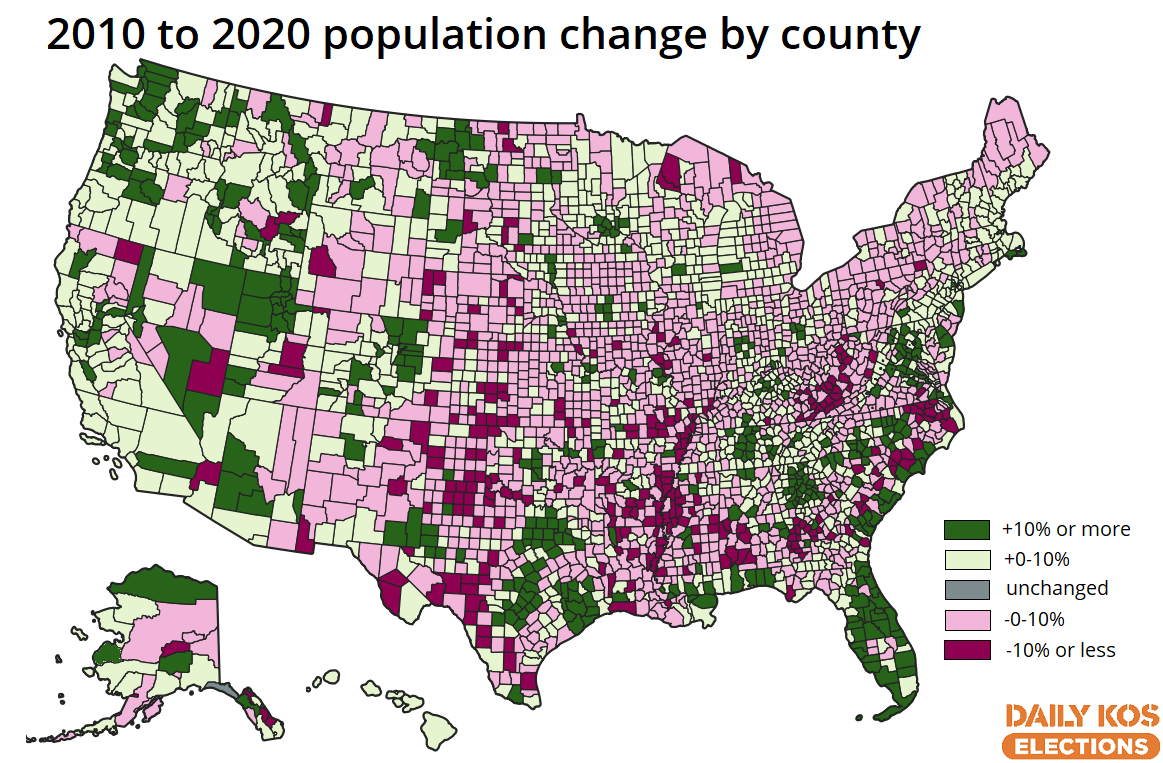
James.galbraithThat population change map is encouraging at least, though it'll take a while before it really does much. Nice to see Appalachia withering away.
If you thought that the suburbs of the major cities in the South and Southwest were the major battleground in the 2020 election, hold on to your butts for 2024: New census data released last week gives an even clearer picture of how these rapidly blue-shifting areas are also some of the fastest-growing terrain in the country.
Thursday’s drop included every last scrap of data from the 2020 census: the population of every county, every city, every school district—all the way down to every city block. These figures give state legislatures and commissions the green light to start the redistricting process for congressional maps, legislative districts, municipal constituencies, and much more.
It’s also a treasure trove of information for people interested in the demographic changes that are shaping our nation, and in turn, our nation’s politics, which is why we’ve crunched and compiled all of that data at the congressional district, county, and city levels.
We’ll begin, though, with the state-level numbers, which the Census Bureau published back in April. Unsurprisingly, Texas was by far the biggest gainer of population. What might surprise you is the state in the no. 3 slot: California. That’s because the Golden State actually lost a congressional seat in this year’s apportionment, breaking a nearly-century-long streak of constantly gaining seats. That naturally prompted some people to conclude that California had lost population, but far from it: The state gained over two million people over the last decade, despite its punishing housing prices.
If you’re wondering how that squares with losing a seat in the House, keep in mind that California is already much larger than any other state. A gain of “only” two million people while starting from such a high baseline means that California gained population at a slightly lower rate than the nation as a whole, enough for it to narrowly lose a congressional seat.
Only three states, in fact, actually shrank in absolute terms. Most significant is West Virginia, which, as expected, fell from three to two congressional seats. Illinois lost a seat, while Mississippi’s very small loss spared it from a further cut. On the left below are the biggest gainers, while on the right are the three losers and, right behind them, the two smallest gainers, Wyoming and Vermont (which also happen to be the two smallest states overall). Each state is color-coded based on which party carried it in last year’s presidential election.
| Texas | +3,999,944 | West Virginia | -59,278 | |
| Florida | +2,736,877 | Illinois |
-18,124 |
|
| California | +2,284,267 | Mississippi | -6,018 | |
| Georgia | +1,024,255 | Wyoming |
+13,225 |
|
| Washington | +980,741 | Vermont | +17,336 |
We can also look at the biggest gainers and losers among states by percentage rather than raw numbers. Interestingly, other than Texas, none of the fastest growers gained a seat this year. That’s because they’re all relatively small states starting from a low enough point that even rapid growth wasn’t enough to increase their representation. Idaho, however, only narrowly missed the cut for a third seat, while Nevada and Utah both gained seats in 2010, as part of their many-decades-long trend of rapid growth; those two states might both be in a position to gain their fifth seats in 2030 if they keep on the same trajectory.
| Utah | +18.4% | West Virginia | -3.2% | |
| Idaho | +17.3% | Mississippi | -0.2% | |
| Texas | +15.9% | Illinois | -0.1% | |
| North Dakota | +15.8% | Connecticut | +0.1% | |
| Nevada | +15.0% | Michigan | +2.0% |
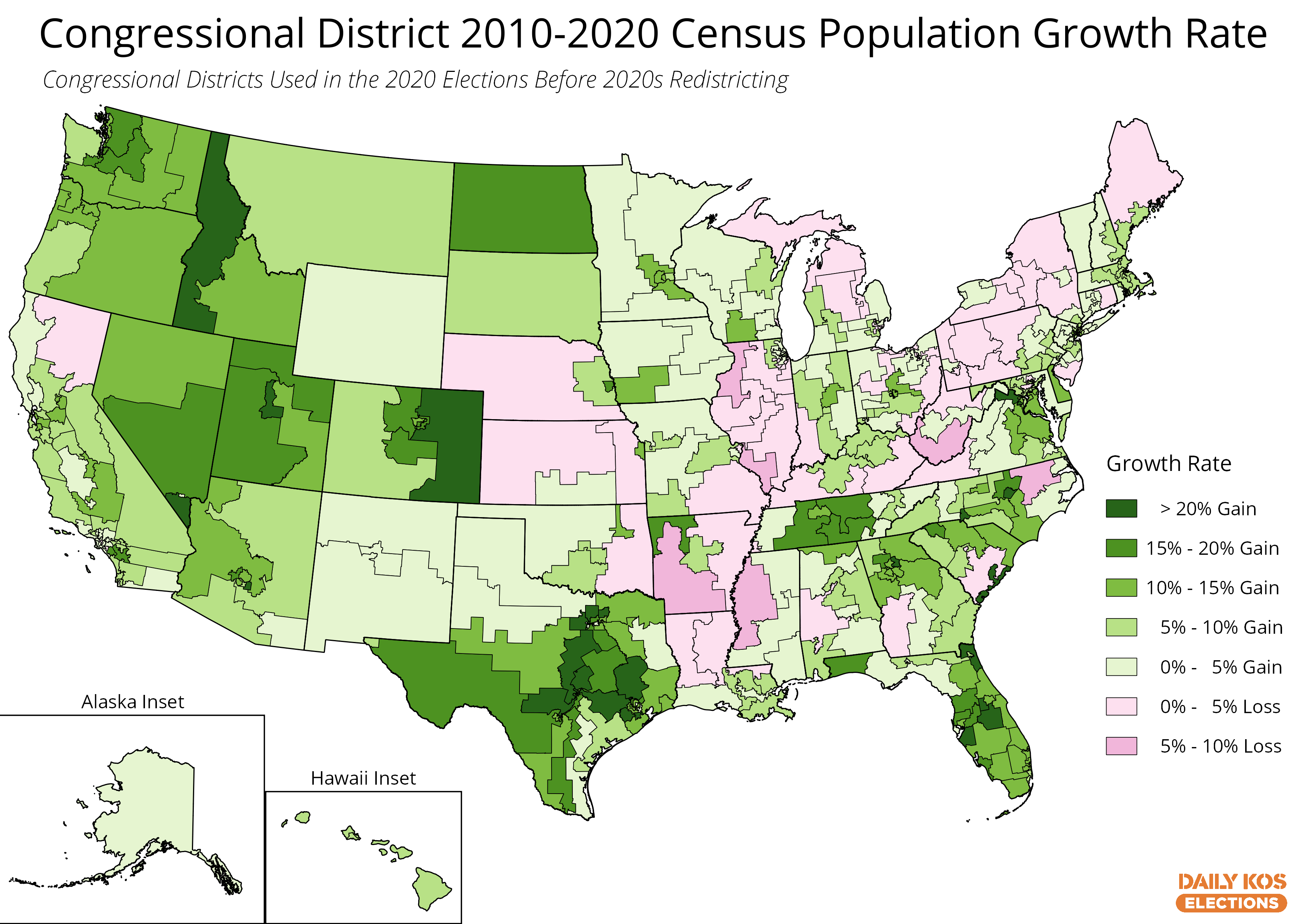
Now let’s look at the population of our current congressional districts; this level of detail only became possible to examine with last week’s data release. This is related to, but separate from, our previous analysis of which districts will have to shrink or expand in redistricting (which looks at how their current population deviates from the “ideal” district population for each state); here, we’re looking simply at how much each district has changed population-wise over the decade from its starting point in 2010. Naturally, there’s a lot of overlap between the lists, though; the districts that have grown the most are also the ones that will have to shed the most people in redistricting to neighboring districts.
The biggest growth in raw population came in Texas’s 22nd District, located in Houston’s southern suburbs, primarily in Fort Bend County. As with many of these other districts on the list, this was once solidly red turf—the previous iteration of the 22nd was former House GOP Majority Leader Tom DeLay’s old district—that has moved increasingly in the Democratic direction. That’s the result of swift diversification with the addition of many Asian and Latino residents, as well as affluent college-educated voters souring on the current version of the Republican Party.
Close behind is Florida’s 9th, mostly in the suburbs of Orlando, which is a less affluent district than Texas’ 22nd (with a large force of service workers), but which is the epicenter of Puerto Rican migration to Florida. The 9th is one of the few districts on the list of biggest gainers that a Democrat represents in the House (along with Nevada’s 3rd district, in the suburbs of Las Vegas), though current trends could move at least some of these Texas districts (which may receive different numbers after redistricting) into the blue column as the decade unfolds.
Meanwhile, the districts that lost the most population are a mixed bag of urban and rural turf and mostly white and mostly Black districts. Within Illinois, for instance, which has four of the 10 biggest losers on the list, there’s a wide variety: the majority-Black 2nd is on Chicago’s South Side, while the Downstate 15th is mostly agricultural and white, with the 12th and 17th split between rural areas and declining industrial towns.
As for Mississippi’s 2nd district, which lost the most population, it covers both the state’s main city of Jackson and the rural, mostly Black Delta. On the other hand, West Virginia’s 3rd district and Ohio’s 6th district (in the state’s southeastern quadrant) are rural and almost entirely white districts at the core of Appalachia. We’ve color-coded these districts based on which party currently controls them, which is also the same as the 2020 presidential winner in every case except Illinois’ 17th, which was won by Democratic Rep. Cheri Bustos but carried narrowly by Donald Trump.
| TX-22 | +273,805 | MS-02 | -67,371 | |
| FL-09 | +259,258 | WV-03 | -45,550 | |
| TX-26 | +244,618 | AR-04 | -42,404 | |
| TX-10 | +239,495 | IL-17 | -39,043 | |
| TX-31 | +235,285 | IL-12 | -37,943 | |
| TX-03 | +234,520 | MI-05 | -35,272 | |
| TX-08 | +217,898 | OH-06 | -33,914 | |
| UT-04 | +192,198 | MO-01 | -33,870 | |
| FL-16 | +187,702 | IL-02 | -33,185 | |
| NV-03 | +180,390 | IL-15 |
-32,520 |
We’re not including a table of percentage change in the nation’s congressional districts because all districts start the decade with relatively similar populations. The list of the top 10 and bottom 10 districts by percentage change would, in fact, be the same 10 again (though in a slightly different order).
However, you can see those changes in the map just below, which is a cartogram that shows each district as the same size, with an extra-large zoomable version here. If you’d prefer to see the same data on a traditional map, we’ve got that as well.

Now let’s move on to the counties with the biggest numeric change. Again, the list of the biggest gainers is heavily weighted toward Texas, with six of the state’s most populous counties getting even bigger. Harris County, a behemoth that contains almost all of Houston plus most of its suburbs, leads the way. It’s followed by Arizona’s Maricopa County, which, similarly, contains all of Phoenix plus most of its suburbs. The one non-Sun Belt county in the top 10—although with this summer’s extreme weather, it too has been making a case to join that club—is King County, Washington, driven by Seattle’s rapid growth over the 10 years.
The list of counties losing the most population is, for the most part, not surprising, with industrial cities in decline leading the way. (Baltimore and St. Louis are independent cities, which are considered county-equivalent.) While these are mostly in the North, there are a few Southern locales, such as the counties that are home to Jackson, Mississippi (Hinds), and Shreveport, Louisiana (Caddo Parish).
The least-expected name on the list is Robeson County, North Carolina, which is much less populous and more rural than the others; it’s a county in eastern North Carolina with a large Native American population (chiefly of the Lumbee tribe) that fell from 134,000 to 117,000 over the last decade. It’s not exactly clear what drove this drop, though repeated flooding over recent years probably drove emigration on top of poor economic prospects. But it’s not an aberration, as other neighboring, smaller counties also lost population at a similar rate.
| Harris, TX (Houston) | +638,686 | Baltimore city, MD | -35,253 | |
| Maricopa, AZ (Phoenix) | +603,451 | Wayne, MI (Detroit) | -27,023 | |
| King, WA (Seattle) | +338,426 | Genesee, MI (Flint) | -19,579 | |
| Clark, NV (Las Vegas) | +314,192 | St. Louis city, MO | -17,716 | |
| Tarrant, TX (Ft. Worth) | +301,606 | Robeson, NC (Lumberton) | -17,638 | |
| Bexar, TX (San Antonio) | +294,551 | Hinds, MS (Jackson) | -17,543 | |
| Orange, FL (Orlando) | +283,952 | Caddo, LA (Shreveport) | -17,121 | |
| Collin, TX (Dallas suburbs) | +282,124 | Cuyahoga, OH (Cleveland) | -15,305 | |
| Travis, TX (Austin) | +265,922 | St. Clair, IL (E. St. Louis) | -12,656 | |
| Dallas, TX | +245,400 | Kanawha, WV (Charleston) | -12,318 |
Switching to biggest gainers and losers by percentage change—as shown in the map at the top of this post—gives a totally different set of counties, most of which have very low populations and you probably haven’t heard of. The top two gainers are both in western North Dakota, which benefited greatly (though perhaps briefly) from the oil and gas extraction explosion in that region.
The rest of the gainers are previously rural counties where exurbs from nearby larger cities have recently started to creep in. Only three of the top 10 counties currently have more than 100,000 people; they’re Hays and Comal Counties in the corridor between San Antonio and Austin (anchored by San Marcos and New Braunfels, respectively), and Osceola County, south of Orlando, Florida, which is the core of the rapidly-growing 9th District mentioned earlier.
You might be surprised to also see so many Texas counties on the list of losers, given the state’s massive overall growth. However, Texas has far more counties than any other state—254 in total—many of which are in the Great Plains part of the state and are nearly empty. Dozens of them have only a few thousand residents apiece (some number in just the hundreds), and those without oil are getting even emptier; the loss of a few hundred residents makes a big difference percentage-wise.
However, the biggest drop nationwide was in Alexander County, Illinois, at the very southern tip of the state. Cairo, the county’s main population center, has long had a reputation as one of the country’s most dysfunctional small towns. HUD’s notorious closure of several housing projects in 2017 without providing any replacement housing may have been an unfortunate population tipping point.
| McKenzie, ND | +131.2% | Alexander, IL | -36.4% | |
| Williams, ND | +82.8% | Schleicher, TX | -29.2% | |
| Hays, TX | +53.4% | Edwards, TX | -29.0% | |
| Dallas, IA | +50.7% | Dickens, TX | -27.6% | |
| Comal, TX | +48.9% | Blaine, OK | -26.9% | |
| Bryan, GA | +48.0% | Tyrrell, NC | -26.4% | |
| Wasatch, UT | +47.8% | McPherson, NE | -26.0% | |
| Trousdale, TN | +47.6% | Quitman, MS | -24.9% | |
| Lincoln, SD | +45.4% | Dooly, GA | -24.9% | |
| Osceola, FL | +44.7% | Telfair, GA | -24.4% |
Finally, let’s look at the biggest gains and losses among the nation’s cities, which may be more familiar. The biggest gainer by far was the nation’s largest city, New York City (though it doesn’t make the county list because each of its five boroughs is its own county, dividing the impact of its growth).
This development may seem surprising, given the abundant hot takes about the “death of the city” during the pandemic, what with everyone supposedly fleeing to the suburbs. Apparently, though, pundits’ anecdotes about their upper-middle-class neighbors are no match for data concerning the realities of the city’s many other millions of residents.
In fairness, the census was largely complete before the start of the pandemic, so it’s possible that next year’s population estimates could swerve the other way. It does seem, though, that a historic, one-time disruption is likely to be a less powerful force than long-term trends, especially since the pandemic brought down the cost of renting or owning in the notoriously pricey Big Apple.
Beyond New York, the list of the biggest gainers mostly features the usual Sun Belt suspects, along with Seattle and, interestingly, Columbus, which seems to be keeping all of Ohio afloat, population-wise.
Meanwhile, Detroit continues to lose population at an alarming pace, followed by some of the other names you’d expect to see, like Baltimore and Cleveland. Of note, though, are two places named Paradise. One is Paradise, Nevada, whose presence on the list appears to be a technicality. Paradise, the suburb that’s home to the Las Vegas Strip (which is not actually in Las Vegas), is one of the nation’s largest “census-designated places.” That means that it’s not an incorporated municipality, but there’s still enough consensus on its boundaries and what it’s called that the Census Bureau considers it city equivalent.
Given the overall rapid growth in the Las Vegas metropolitan area and especially Nevada’s 3rd district, what happened here isn’t actual depopulation but rather reijggering of Paradise’s Census Bureau-drawn boundaries. The 2020 Census gave a former portion of Paradise to the adjacent unincorporated census-designated place of Enterprise, which grew massively over the decade, narrowly missing the top 10 list (from 108,000 to 222,000 including the addition of the former Paradise residents).
The other Paradise on the list is a sadder story: Paradise, California’s population fell from 26,000 to 5,000 in 2018 after most of the town burned down in a forest fire. There were dozens of fatalities; most of the loss, though, was the result of out-migration. However, the town has since seen a rapid boom that has brought its population up to 6,000 and made it the fastest-growing city in the state. (It’s also the only one on this list that went for Trump.)
There’s one other unexpected name on the bottom 10, and that’s Aurora, Illinois. This is a blue-collar suburb of Chicago (and the setting of Wayne’s World) that grew rapidly in previous decades, doubling in population from 1990 to 2010. It appears to have taken a U-turn lately, though it could reflect a data collection problem, as Aurora’s 2020 numbers undershot its 2019 estimate by a similar 17,000 people.
| New York City, NY | +629,057 | Detroit, MI | -74,666 | |
| Houston, TX | +205,129 | Baltimore, MD | -35,253 | |
| Ft. Worth, TX | +177,709 | Paradise, NV | -31,929 | |
| Austin, TX | +171,465 | Cleveland, OH | -24,191 | |
| Phoenix, AZ | +162,507 | Paradise, CA | -21,454 | |
| Charlotte, NC | +143,155 | Flint, MI | -21,182 | |
| Seattle, WA | +128,355 | Jackson, MS | -19,813 | |
| Jacksonville, FL | +127,827 | St. Louis, MO | -17,716 | |
| Columbus, OH | +118,715 | Milwaukee, WI | -17,611 | |
| Denver, CO | +115,364 | Aurora, IL | -17,357 |
Let’s also take a look at the biggest gains and losses among cities by percentage. Because base rates play such a big role here, we’re limiting this table to places with a population of 50,000 or more. As an example, consider Greenhorn, Oregon, which went from a population of zero in 2010 to a population of three in 2020. That’s an amazing gain of ∞%, but not a change with big demographic or political implications. (Greenhorn is a literal ghost town, but apparently, three living souls have now returned.)
Even then, the list of the biggest gainers consists of places most people haven’t heard of (at least, not yet); it’s mostly suburbs that have sprung into being over the last decade. A case in point is Horizon West, Florida, a master-planned community in Orange County near Walt Disney World, which went from a population of 14,000 in 2010 to 58,000 in 2020. On its own, it was a major contributor to the rapid growth in the Orlando area. The most recognizable name on the top 10 list is Macon, Georgia, which came about its big gain the easy way: It nearly doubled its population by forming a unified city-county government with its surroundings in Bibb County.
Meanwhile, the cities losing the most population, percentage-wise, tend to be the smaller Midwestern cities known for industrial decline, most notably Flint, Michigan (whose woes this decade were compounded by the scandalous problems with its water system), but also similar places like Gary, Indiana and Youngstown, Ohio. Detroit’s loss in population was large enough, though, that it makes the list despite starting from a much higher baseline.
| Horizon West, FL | +315.0% | Flint, MI | -20.7% | |
| Herriman, UT | +153.1% | Paradise, NV | -14.3% | |
| Queen Creek, AZ | +125.8% | Saginaw, MI | -14.2% | |
| Leander, TX | +123.2% | Gary, IN | -13.9% | |
| Four Corners, FL | +115.9% | Jackson, MS | -11.4% | |
| Enterprise, NV | +104.5% | Detroit, MI | -10.5% | |
| Kirkland, WA | +88.9% | Youngstown, OH | -10.3% | |
| Westchester, FL | +88.8% | Aurora, IL | -8.8% | |
| Buckeye, AZ | +79.9% | Decatur, IL | -7.4% | |
| Macon, GA | +72.2% | Camden, NJ | -7.2% |
Not seeing what you’re interested in, in terms of your particular city, county, or congressional district? Please click through to our full Google sheet, which has the 2010 and 2020 populations, and numeric and percentage change for every district, every county, and every city (so long as they existed in both 2010 and 2020). Keep in mind that all the listed cities add up to around 247 million people; the remaining 84 million people in the United States live outside an incorporated city or census-designated place.
James.galbraithDespite having fewer votes
James.galbraithAwesome
Read more of this story at Slashdot.
James.galbraith"trust us"
Enlarge (credit: Felix Wong/South China Morning Post)
Apple employees want to know if they’re being paid equitably, so some of them have been sending surveys to their colleagues to collect compensation information. The surveys are all opt-in, and several hundred people have participated so far.
The surveys stem in part from the fact that, in 2016, Tim Cook told investors that Apple had largely tackled pay inequality at the company. Women at Apple made 99.6 cents for every dollar men made, and underrepresented minorities made 99.7 cents for every dollar white workers made, Apple said. Those numbers probably sounded too good to be true to some people, and questionnaires started popping up in recent months.
At least two surveys were pulled by their authors, The Verge reported, after Apple’s “people team”—what some companies call human resources—claimed various infractions. Apple HR said the first survey’s questions about race, gender, ethnicity, and disability constituted personally identifying information. They nixed the second because it was hosted on the corporate Box account. When reached for comment, an Apple spokesperson would not confirm why the first two surveys were halted.
Read 5 remaining paragraphs | Comments
James.galbraithHere's to hoping

California’s suit against Activision Blizzard for fostering a toxic workplace could change the whole industry.
The state of California filed a massive lawsuit in July against gaming giant Activision, parent company to the game developer Blizzard.
The suit, spearheaded by the Department of Fair Employment and Housing (DFEH), concluded a two-year investigation into Blizzard and Activision’s workplace culture, and contains allegations of entrenched misogyny, gender-based discrimination, and rape culture throughout the corporation. The suit paints a damning picture not just of Activision — the company behind game franchises like Candy Crush, World of Warcraft, Guitar Hero, Overwatch, and Call of Duty — but of gaming culture itself.
Among other allegations, the suit includes claims that while attending Activision’s popular annual gaming conference, BlizzCon, higher-level male staffers hung out at a hotel suite nicknamed the “Cosby Suite,” after Bill Cosby, who would later be convicted for serial sexual assault. (His sentence was vacated in June). The suit further named the suite’s occupant, former Blizzard game director Alex Afrasiabi, citing multiple incidents in which he allegedly harassed women at the conference.
The suit also purports that in an unrelated event, after a period of targeted sexual harassment which reportedly included male staffers sharing nude photos of her around the office, one employee died by suicide.
It’s hardly news that gaming culture has a problem with misogyny; the explosion of the Gamergate online harassment campaign throughout 2014 and 2015 made that abundantly clear. Still, it might be natural to assume that the gaming industry made attempts to create meaningful change in the wake of Gamergate — or if not then, perhaps in 2017, when so many industries were facing their #MeToo reckonings.
Indeed, one of Activision’s responses to the lawsuit was to note that Afrasiabi had already been fired in 2020, while emphasizing that the “Cosby Suite” had been part of “2013 events,” perhaps implying that the allegations were outdated.
This assumption belies the ugly truth about the gaming industry: though it’s easy to assume that things must have changed since the mid-2010s, that doesn’t appear to be the case. The lawsuit cites one complaint made to company leadership about gender-based discrimination as late as “early 2019.”
What this leaves us with, then, is a portrait of a gaming industry with deep-rooted toxicity and misogyny, problems that have been entrenched since the very beginning. The Activision lawsuit indicts not just gaming culture, but the broader dysfunction of tech culture, as well as the high-pressure, often exploitative environments in which games employees are all too frequently expected to thrive.
Activision has been around since the dawn of the gaming industry, more or less; first formed in 1979, it merged with Blizzard’s parent company in 2008 and became an industry behemoth, employing nearly 10,000 people worldwide. Blizzard enjoys a huge amount of fan loyalty, runs multiple esports leagues, and, prior to the Covid-19 pandemic, produced BlizzCon every year for over 40,000 attendees.
Despite all this public-facing good will, the allegations in the DFEH lawsuit paint a far different picture of Activision’s internal environment. Women were allegedly consistently “offered lower compensation and less lucrative job assignments and opportunities ... and often had to work harder and longer to earn equal promotional opportunities.” One woman employee who “generated significantly more revenue [and] ran almost twice as many campaigns as her male counterpart” was repeatedly overlooked and passed over for promotion in favor of her coworker, a man.
At times, the lawsuit’s details of the alleged sexism and sexual harassment seem like a parody of a toxic office. “A female employee had assumed some of the responsibilities of being a manager, but when she asked [about] being paid fairly,” was told “they could not risk promoting her as she might get pregnant and like being a mom too much ... Other female employees were criticized for leaving to pick their children up from daycare while their male counterparts were playing video games.”
Meanwhile, Black women on staff say they were continually micromanaged, with one employee facing criticism from male supervisors for requesting time off, asking for help, and for her “body language,” according to the lawsuit.
All of this alleged discrimination played out against a backdrop repeatedly described as a “fratboy culture,” one in which “male employees proudly came into work hungover,” perpetually played video games instead of doing work (“A newly promoted male supervisor delegated his responsibilities to his now female subordinates in favor of playing Call of Duty”), and perpetually sexually harassed female employees. This described harassment included a litany of inappropriate sexual advances, rape jokes, demeaning sexual comments, and non-consensual touching, groping, and physical harassment, according to the lawsuit.
One male member of company leadership, Blizzard’s former senior creative director Alex Afrasiabi, was purported to be the brainchild behind the BlizzCon “Cosby Suite.” On July 28, Kotaku published photos of the suite, allegedly taken in 2013, which included a group of Activision staff posing with a painting of Bill Cosby. Afrasiabi allegedly physically groped and harassed multiple female staffers and other BlizzCon attendees. Activision said in an emailed statement to Kotaku that it had become aware of the allegations in 2020 and “immediately took corrective action,” but that it had “already conducted a separate investigation of Alex Afrasiabi and terminated him for his misconduct in his treatment of other employees.”
It’s hard to overstate just how dysfunctional much of the gaming industry’s workplace environments are. Alongside the rampant misogyny, many gaming companies also struggle with abusive labor practices that lay the groundwork for the environments in which this level of toxicity flourishes.
To make sure games are released on time, game developers often operate on months of intense work schedules known as “crunch times” — absurdly long work weeks, sometimes as long as 100 hours or more, nearly always characterized by unpaid overtime. This practice has intensified to the point of becoming known as crunch culture, in which the ability of a company’s staff to work exhaustively to deliver a product on a high-pressure work deadline is almost a matter of pride.
“If you have a culture of a particular studio that says, ‘work hard, live hard, fight hard,’ [where] everything has to be 100 percent or give up,” one employee with game developer Ubisoft told me, “all it takes [to apply pressure to overwork] is just somebody to say, well, you must not love it that much.”
The employee, who spoke on the condition of anonymity, told me she only realized how harsh the work culture of the US gaming industry was after she relocated to a country with a better work-life balance. “I was working overtime pretty much every single day, not really getting paid for it,” she said. “And when I was getting paid for it, I was told I needed to cut back.”
The pressure to overwork manifested in other ways, too. “I would have dudes throwing humongous temper tantrums or putting their fingers in my face, yelling at me,” she said. “And if I said, ‘This is wildly inappropriate and slightly illegal,’ everybody in the room would be like, ‘Whoa, you need to relax.’”
This worker exploitation pops up throughout tech culture, which has managed over the decades to reframe labor exploitation as a love of workaholism. Such zeal frequently verges on cult-like loyalty toward tech companies and one’s own employers. Many gaming employees grew up loving, and dreaming of working for, the companies that made the games they loved, so many are primed to accept an exploitative environment as the trade-off for attaining that dream.
“It starts when you first apply for the job,” the Ubisoft staffer said. “We need a rockstar, we need a ninja, we need someone who’s passionate, who’s going to give it their all. Then you go and you interview and you may just feel like the most special human being in the world. And if you don’t do the job, if you don’t work the 50, 60, 70, 80 hours, then you’re not that rock star — then you’re nothing.”
Partly as a reward for getting through the crunch, gaming employees flock to the industry’s run of massive gaming conferences — huge, weeklong events like E3, BlizzCon, and PAX. These conventions not only serve as spaces where fans and game promotions converge; they also serve as pressure valves for the other, more stressful parts of the job — and they often come with a side of additional issues.
“I witnessed so many divorces because the dudes would be doing their things,” the Ubisoft staffer observed. “They could date and live the high life while the women [employees] suffered. They would sexually harass the women. And their wives would be back home and they would be living their lives at all of the [industry] events.”
She noted that the interplay between fans and employees at gaming cons can be “a fantastic high” that feeds the egos of staffers and elevates the “rock star” culture. The convention VIP treatment both feeds their ego and becomes a status symbol they then pass on to their friends and favored employees. “It’s all totally connected,” she said, “and it all adds to the magical world of the gaming industry.”
In such a context, any attempt to question the company or cultural status quo might easily be taken as a show of disloyalty, or a sign that someone is disgruntled and doesn’t belong. Furthermore, a great majority of these employees are young men who’ve been raised in an environment where casual misogyny is a habitual part of gaming socialization.
It’s hardly surprising, then, that some gaming companies tend to foster an environment that normalizes casual misogyny, harassment, and sexism in the workplace, and then denigrate, ostracize, and punish women who attempt to change that culture.
“What you have is an industry filled with Peter Pans,” game developer Brianna Wu, a feminist activist whose outspoken views on the industry have frequently made her a prominent target for harassment, told me. “And the thing is Wendy eventually leaves the Lost Boys, and that’s very much a metaphor for the game industry.”
This workplace conflict reflects the broader tension between traditional gaming culture — the “fratboy” atmosphere described in the lawsuit — and the growing visibility of women and other diverse players in gaming communities. This conflict gained media attention, particularly in the years just prior to Gamergate, when headlines involving rampant, extreme sexism in geek spaces seemed to pop up on a near-weekly basis. In response to the current Activision lawsuit, social media users resurfaced a video from 2010 in which an all-male panel of Blizzard staffers mocked a female WoW player’s request to have less sexualized female characters.
Oh god, I'd not seen this before. It's heartbreaking.
— Chris Bratt (@chrisbratt) July 23, 2021
Here's a 2010 Blizzcon panel in which a fan was brave enough to ask a panel full of men, including J. Allen Brack (left) & Alex Afrasiabi (right) whether there's scope for some of WoW's female characters to be less sexualised pic.twitter.com/Elaf3K7KVc
“Blizzard is the Disney of the gaming industry,” Wu observed. “They’re well-regarded for putting out games that are fun to play, but also have that stench of misogynistic, dated game design.”
In this regard, Blizzard is typical of the industry as a whole, she noted. Like other major developers, Blizzard has “focused on a very particular kind of fan like a laser, who generally speaking is [a] white straight male, 20 to 40,” she said. “And they’ve catered to their every single whim.”
This focus on male consumers contributed to Gamergate, a social media movement which ostensibly began as a protest against biased games journalism in 2014, but really was focused on intimidating and harassing a handful of prominent, outspoken feminists in the industry, Wu among them. Gamergate’s overt misogyny sparked massive criticism of gaming culture, and many people hoped that it might result in more support for women in gaming.
“I think there was a sense with a lot of women in the field that we were about to change — that the industry was about to change,” Wu said. “Finally, our stories were being told, finally, people knew about the constant deluge of sexism.”
Despite the gaming industry taking “a reputational hit” for its misogyny, Wu told me bluntly that the expected change never came. “Every single convention I go to has more panels for women to come forward and talk about what it’s like to be a woman in games. We did all these things that feel good and might look good for a PR perspective, but doesn’t get to the heart of the matter, which is [that] you’ve got to fire the a-hole, and you’ve got to promote women, We treated it like a marketing problem rather than a workplace problem.”
As for the MeToo movement, Wu believes that, too, has been a nonstarter in the industry: “You can point to a couple people that faced consequences, like IGN editor Steve Butts [who was fired for allegedly harassing a staff member], but overall, the gaming industry never had a #MeToo movement ... Our industry has done nothing but window-dressing in getting rid of the harassers.”
One reason for the lack of a larger movement, she said, is that “women had seen that there were no consequences so many times that there was a fear in coming forward.” In the years since MeToo became a wider movement, many women have come forward to accuse individuals of specific harassment and assault allegations; in 2020, one gamer began documenting specific allegations against Twitch streamers and other gaming figures. Still, little wider change, or even widespread attention, came from that short-lived movement, and instead, instances of the gaming industry’s misogyny continue to make headlines. (See, for example, the release of the 2019 video game Rape Day, in which the player’s goal is to ... you can probably figure it out.)
“I think that the thing I’ve seen over and over from this Activision lawsuit with my friends in the game industry is just a kind of existential rage,” Wu said, “because we keep talking about the same thing and nothing changed.”
Since the lawsuit was filed, Activision has been on the ropes, defending itself on a number of fronts and initially calling the suit “inaccurate” and “irresponsible.” Activision’s employees, on the other hand, responded with outrage, calling the response by company leadership “abhorrent” and organizing for better working conditions, including fairer treatment of women on staff. Over 3,000 current and former employees have since signed an open letter to company leadership, calling for a better, more sensitive response from company leadership and a commitment to holding alleged abusers accountable.
As current staff conducted walkouts in protest, former employees tweeted their their horror stories of experiencing sexism and sexual harassment at the company. The backlash prompted Activision’s CEO to walk back the company’s previous responses and admit that they were “tone deaf.”
The lawsuit prompted numerous corporate sponsors, including Coca-Cola and T-Mobile, to exit from their participation in Blizzard’s esports leagues, including its Overwatch and Call of Duty leagues. Activists also called for fans to boycott Activision’s many games in protest; the subsequent drop in Activision stock has reportedly cost the company at least $8 billion.
On August 3, Blizzard president J. Allen Brack, who was directly cited in the DFEH lawsuit as having delivered nothing but “a slap on the wrist” to one of the company’s worst offenders, announced his resignation. The company’s head of HR, Jesse Meschuk, also departed shortly after.
All of this activity may make it seem as though the lawsuit is having an impact: On an August 3 call with investors, Activision CEO Bobby Kotick pledged “swift action” to address the issues raised by the suit.
But Wu’s note about industry window-dressing may be well observed. Even as Activision was pledging an internal review, employees were pushing back over its choice of the third-party company hired to conduct that review: WilmerHale, a law firm known for union-busting that has a history of backing employer interests over those of their employees.
Meanwhile, the calls for accountability have spread to other parts of the industry including Ubisoft, whose employees published their own open letter on July 27, claiming that despite reports of rampant harassment and discrimination in their company that surfaced last year, little had changed and many of the alleged harassers had yet to be held accountable. “It was an open secret that these people were doing these things, and it took public outcry for something to happen and for them to make any sort of choice,” the Ubisoft staffer said. “But did something major change? No, not really.”
When contacted by Vox, an Activision Blizzard spokesperson insisted the company is looking out for its employees. “We support our employees’ right to express their opinions and concerns about benefits and working conditions, without fear of retaliation and with respect for the rights of other employees,” they said in an email. “This includes their right to choose whether or not to organize. As always, we welcome outreach directly from our employees with concerns or ideas to help make improvements, and there are multiple well-established avenues internally for dialogue, both direct and anonymous, with HR, leadership, and legal.”
As for the law firm: “WilmerHale has extensive experience helping organizations strengthen their workplace environment by making improvements around policies and procedures related to discrimination, harassment, and retaliation issues,” they said. “The firm has not been retained to advise on union-related matters.”
Activision also countered the narrative of the company as a straight white boys’ club and committed itself to hiring more diversely. “The only way for our games to reach our desired, global scale is to make them as broadly appealing as possible to anyone who wants to play,” the spokesperson said. “We are proud that our games openly celebrate diversity. We’re constantly introducing characters with different genders, races, and backgrounds to ensure that anyone who plays our game feels welcome and dignified.”
“Activision Blizzard is likewise committed to inclusive hiring practices and to creating a diverse workforce. It is essential to our mission. We are adding personnel to further strengthen our work in response to this directive.”
Wu, for her part, told me she has little faith in the industry’s ability to self-police. Instead, she drew encouragement from the fact that Activision’s stock dropped in response to the uproar — because money might have more of an influence than any number of staff walkouts.
“My bottom line is, until it’s more expensive to treat women wrong than it is to treat women right, this is simply going to continue,” she said. She noted that many major gaming studios had refused to audit their companies to be compliant with federal workplace regulations. “It’s past time that we had real solutions.”
Still, if there’s any silver lining here, she said, it’s that the lawsuit was filed to begin with, because the state of California was able to conduct a real investigation into systemic issues that the company itself never could or would.
“This is the formula we need going forward to change the culture in the video game industry,” Wu said. “It needs to be a top-to-bottom reckoning.”
James.galbraithYeah, the federal judiciary can't really be trusted with that many Trump appointees

Warnock’s political career — and democracy in Georgia — could hinge on the most dangerous provision of the state’s new voter suppression law.
Late last month, Georgia Republicans began a process that could end with them seizing control of election administration in Fulton County — a Democratic stronghold that encompasses most of Atlanta.
Under Georgia’s new election law, SB 202, the GOP-controlled state elections board may remove a county’s top election officials and replace them with a temporary superintendent (although this process will likely take months as the board has to jump through a few procedural hoops first). Once such a superintendent is in place, they can disqualify voters, move polling places, and even potentially refuse to certify election results.
Voter suppression laws are nothing new, even in the post-Jim Crow era. And Georgia’s SB 202 is hardly the first effort by Republican state lawmakers to skew elections by making it harder for Democratic constituencies to cast a ballot.
But prior efforts to restrict the franchise frequently placed unnecessary hurdles in the way of voters, such as by requiring them to show certain forms of ID or by limiting where and when voters can cast their ballot. These sorts of laws are troubling, but they can be overcome by determined voters.
SB 202, by contrast, is part of a new generation of election laws that target the nuts and bolts of election administration, potentially allowing voters to be disenfranchised even if they follow the rules.
Because state voter suppression laws targeting ballot counting and election certification are relatively new, Democrats did not come into 2021 with a legislative proposal to address these laws. Democratic leaders’ primary voting rights bill, the For the People Act, includes a grab bag of provisions intended to neutralize state laws making it harder to vote. But the For the People Act’s drafters did not anticipate something like SB 202’s provisions allowing the Republican Party to take control of election administration in Democratic counties.
Which brings us to the Preventing Election Subversion Act of 2021, a bill introduced by Sen. Raphael Warnock (D-GA) that seeks to fill that gap.
It doesn’t prevent Georgia’s elections board from removing a local election official, but it does impose some procedural safeguards intended to prevent local officials from being removed for partisan reasons. Among other things, it allows such officials to sue for reinstatement in federal court.
Additionally, the bill would make it a felony to harass or intimidate election workers in order to interfere with their official duties. GOP lawmakers in some states, including Texas, are pushing legislation making it harder for election workers to remove partisan observers who disrupt an election. Warnock’s bill would subject the worst-behaved election observers to criminal charges.
Realistically, Warnock’s bill has a long way to go before it becomes law. Warnock is reportedly in negotiations with Senate Majority Leader Chuck Schumer and Sen. Joe Manchin (D-WV) to include safeguards against “election subversion” in a package of voting rights reforms that enjoys Manchin’s blessing. As the most conservative Democratic senator in an evenly divided Senate, Manchin is key to advancing any meaningful voting rights legislation.
And, even if Manchin signs on to the Preventing Election Subversion Act, that support is unlikely to amount to much unless Democratic senators unanimously agree to eliminate the GOP’s power to filibuster voting rights bills. Plus, there’s always a risk that an increasingly conservative judiciary will refuse to enforce new voting rights legislation.
But, at the very least, this bill is a sign that Democrats understand that the GOP recently escalated its tactics in the voting rights war, and that Democrats — and democracy — need an adequate countermeasure.
SB 202 presents a devilish problem for federal policymakers.
On its face, SB 202 creates a process that can be used to remove local elections officials who violate the law, or who demonstrate “nonfeasance, malfeasance, or gross negligence in the administration of the elections.” Few people would argue that election officials who repeatedly break the law, or who prove incapable of doing their jobs well, should remain in office. It’s entirely reasonable for a state to create a nonpartisan process to remove officials who are bad at their jobs.
The problem with SB 202, however, is that, in effect, it creates a partisan process to remove local elections officials. The bill ensures that Republicans will control four of the five seats on the state elections board for as long as the GOP controls both chambers of the state legislature. (As they have since 2005.) And it removes Secretary of State Brad Raffensperger, a Republican who rebuffed former President Donald Trump’s attempts to toss out Joe Biden’s victory in Georgia’s 2020 election, as chair of the state board.
The Preventing Election Subversion Act includes several provisions that would diminish the GOP’s ability to take over local election administration in Georgia — and in other states that enact SB 202-style laws. One of its central provisions is that statewide officials may only remove a local elections official “for inefficiency, neglect of duty, or malfeasance in office.”
Of course, SB 202, at least on its face, also gives similar protections to local elections officials. But SB 202 allows the GOP-controlled State Elections Board to determine if an official committed malfeasance. Warnock’s bill would allow a local elections official targeted by SB 202 to sue in federal court for reinstatement.
Thus, the ultimate determination of whether a local official performed their job so poorly that removal is warranted would be made by federal judges who, at least in theory, are less likely to be motivated by partisanship than a state board dominated by Republicans.
Warnock’s bill also includes provisions to ensure that such a federal lawsuit is vigorously litigated by a well-financed team of lawyers. Among other things, it provides that a local election administrator who is wrongfully relieved of duty may receive “reasonable attorney’s fees” if they file a successful lawsuit.
And under the bill, when a state begins proceedings to remove a local official, it must inform the US Department of Justice’s Civil Rights Division that it has done so, and the Justice Department may also challenge the state’s effort to remove such an official in federal court.
The basic theory underlying the Preventing Election Subversion Act is that federal courts can be trusted to stop partisan efforts to seize control of local election administration. But it’s far from clear that this theory is correct.
The Supreme Court, with its 6-3 conservative majority, has generally been hostile toward voting rights statutes. In Shelby County v. Holder (2013) the Court struck down a key provision of the Voting Rights Act — the primary federal safeguard against racist voter suppression — based on an entirely novel reading of the Constitution that is at odds with the Constitution’s text. Similarly, in Brnovich v. DNC (2021), the Court imposed new limits on the Voting Rights Act that have no basis in that law’s text.
Congress, in other words, could pass a law that effectively neutralizes the most virulent provisions of SB 202, but there’s no guarantee that the Supreme Court will follow that law.
Another danger is that, should the Preventing Election Subversion Act become law, individual federal judges may apply that law in bad faith.
Imagine, for example, that Georgia Republicans uncover a few instances where Fulton County’s election board made suboptimal management calls — the sort of minor errors that are inevitable in any operation tasked with counting hundreds of thousands of ballots. Because Warnock’s bill allows local officials to be removed for “inefficiency, neglect of duty, or malfeasance in office,” a partisan federal judge might claim that these minor missteps justify removal.
And then there’s the risk that the Supreme Court — perhaps by engaging in the same sort of textually challenged legal interpretation that it performed in Shelby County and Brnovich — could strike down a federal law governing who may administer elections.
As a general rule, federal courts are reluctant to hear lawsuits challenging how a state allocates power among its “political subdivisions.” Though there are some exceptions to this general rule, typically, if Georgia decided to take over Atlanta’s police force, or its schools, or some other government agency that is typically led by local Atlanta officials, federal courts would not intervene.
The Supreme Court has also held that the federal government may not “commandeer” state officials and demand that they perform their jobs in certain ways. A conservative Supreme Court could potentially extend this doctrine to prevent the federal government from shaping who will administer elections in Fulton County.
But the Constitution also gives Congress an unusually broad power to regulate congressional elections. Although the Constitution permits states to determine “the times, places and manner of holding elections for Senators and Representatives,” it also permits Congress to “at any time by law make or alter such regulations, except as to the places of choosing Senators.”
So, as the Supreme Court held in Smiley v. Holm (1932), federal law may “provide a complete code for congressional elections,” regulating such granular matters as “notices, registration, supervision of voting, protection of voters, prevention of fraud and corrupt practices, counting of votes, duties of inspectors and canvassers, and making and publication of election returns.”
A Supreme Court that believes it is bound by the text of the Constitution, in other words, should uphold Congress’s ability to prevent Georgia Republicans from taking over the administration of congressional elections in Fulton County. But, of course, America is ruled by the same Supreme Court that gave us Shelby County and Brnovich, so there is no guarantee Warnock’s bill would be upheld, even if it becomes law.
James.galbraithYeah that's horrifying. As is his birthday lol
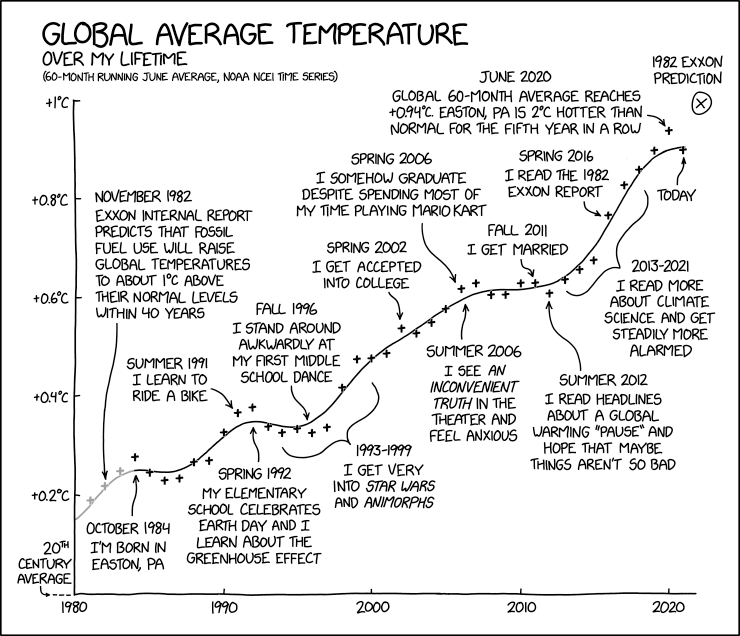
James.galbraithgood riddance
James.galbraithExcellent

Enlarge (credit: Drew Angerer/Getty Images)
Dominion Voting Systems filed another round of lawsuits today, alleging that the company was defamed by conservative news channels Newsmax and One America News Network when they aired segments that claimed the 2020 US election was rigged. Dominion also filed a defamation suit against Patrick Byrne, the founder and former CEO of Overstock.com, who has peddled election-fraud conspiracy theories.
In each lawsuit, Dominion is seeking more than $1.7 billion in damages for lost profits and expenses incurred by the election-rigging claims. The new lawsuits come on top of several more filed earlier this year against other parties, including Fox News, Rudy Giuliani, and Sidney Powell, who are all defending themselves.
Dominion’s lawyers didn't pull any punches in today's filing.
Read 9 remaining paragraphs | Comments
James.galbraithCannot wait

Dorothy Spinner (Abigail Shapiro) confronts the Candlemaker. [credit: YouTube/HBO Max ]
The delightfully bonkers, Emmy-nominated HBO Max series Doom Patrol (based on the DC Comics of the same name) ended S2 on a maddeningly abrupt cliffhanger after production was interrupted by the pandemic. Fortunately, we'll soon be getting S3, and judging by the new teaser that just dropped, we're in for another wild, mind-bending ride.
(Spoilers for first two seasons below.)
For those who may be new to the series, Niles Caulder (Timothy Dalton), aka the Chief, is a medical doctor who saved the lives of the various Doom Patrol members and lets them stay in his mansion. His Manor of Misfits includes Jane, aka Crazy Jane (Diane Guerrero), whose childhood trauma resulted in 64 distinct personalities, each with its own powers. Rita (April Bowlby), aka Elasti-Woman, is a former actress with stretchy, elastic properties she can't really control, thanks to being exposed to a toxic gas that altered her cellular structure. Larry Trainor, aka Negative Man, is a US Air Force pilot who has a "negative energy entity" inside him and must be swathed in bandages to keep radioactivity from seeping out of his body. (Matt Bomer plays Trainor without the bandages, while Matthew Zuk takes on the bandaged role.)
Read 8 remaining paragraphs | Comments
James.galbraith"trust us".

Enlarge (credit: Getty Images | Yuichiro Chino)
Apple today said it will refuse any government demands to expand its new photo-scanning technology beyond the current plan of using it only to detect CSAM (child sexual abuse material).
Apple has faced days of criticism from security experts, privacy advocates, and privacy-minded users over the plan it announced Thursday, in which iPhones and other Apple devices will scan photos before they are uploaded to iCloud. Many critics pointed out that once the technology is on consumer devices, it won't be difficult for Apple to expand it beyond the detection of CSAM in response to government demands for broader surveillance. We covered how the program will work in detail in an article Thursday night.
Governments have been pressuring Apple to install backdoors into its end-to-end encryption system for years, and Apple acknowledged that governments are likely to make the exact demands that security experts and privacy advocates have been warning about. In a FAQ released today with the title, "Expanded Protections for Children," there is a question that asks, "Could governments force Apple to add non-CSAM images to the hash list?"
Read 13 remaining paragraphs | Comments
James.galbraithno shit
Critical race theory is quickly becoming the Republican Party’s favorite culture-war cudgel.
From April to mid-July, Fox News mentioned it nearly 2,000 times, per Media Matters, a left-leaning media watchdog that tracks right-leaning media outlets. In fact, since February, mentions of the theory have more than doubled month-over-month on Fox News with prominent Republicans, including former President Donald Trump, former Vice President Mike Pence, Florida Gov. Ron DeSantis and Sen. Ted Cruz, all railing against it.
The attacks aren’t merely rhetorical, either. According to a July report from the Brookings Institute, eight states (Idaho, Oklahoma, Tennessee, Texas, Iowa, New Hampshire, Arizona and South Carolina) have passed laws banning critical race theory-related content from being taught in schools. Similar legislation has been introduced in over a dozen other state capitols.
Few Americans can define what critical race theory actually is — an academic framework that originated among legal scholars in the 1970s to help explain how racism permeates American institutions — but it’s not surprising that it has emerged as a bogeyman on the political right. Increasingly, the Republican base is politically animated by white racial grievances, which is a major reason why misrepresentations of critical race theory — “every white person is racist” or “certain children are inherently bad people because of their skin color” — have found such a receptive audience. After all, many of the same grievances helped fuel Trump’s rise.
From the earliest days of his 2016 presidential campaign, Trump’s support has been most heavily concentrated among white Americans who think they face significant racial discrimination. In fact, perceived anti-white discrimination powerfully predicted voter preferences in the 2016 general election. One survey conducted shortly after the election found Trump voters were over four times more likely than Clinton voters to say white Americans face “a lot” of discrimination (45 percent versus 10 percent, respectively); other polls also consistently showed that Republicans and Trump’s 2016 supporters saw racial discrimination against white people as a bigger problem than unfair treatment of racial and ethnic minorities in American society. Those views have only grown more pronounced in Republican politics.
For example, the chart below, which draws on data from the American National Election Studies, shows that support for the Republican presidential candidate has steadily grown by 12-to-15 percentage points since 2012 among white Americans who think there’s at least a moderate amount of anti-white discrimination in the U.S.
Meanwhile, the reverse is true among white Americans who don’t think there’s much anti-white discrimination: Support for the Republican presidential candidate has steadily dropped. The same pattern holds even after accounting for several factors that are also strongly correlated with presidential vote choice, such as partisanship, ideology and racial resentment.
This is still a relatively new phenomenon in our politics, however. For instance, I found in my research with fellow political scientists John Sides and Lynn Vavreck that perceptions of anti-white discrimination were not as predictive of voters’ preferences in elections immediately preceding 2016, after controlling for other relevant factors. With Trump’s rise in 2016, perceived anti-white discrimination became a significantly more powerful predictor of voting behavior with the same controls in place.
In fact, white grievance politics now explains more than just vote choice. Sides, Vavreck and I found in a 2021 working paper that perceived anti-white discrimination increasingly predicts public opinion of people and policies connected to the former president, like Pence or repealing the Affordable Care Act. We also find that perceived anti-white discrimination is increasingly associated with Americans’ partisan attachments, much the way public opinion of Barack Obama often spilled over into anti-Black and Islamophobic attitudes that would shape party identification during his presidency.
These findings dovetail with the important research of Duke University political scientist Ashley Jardina. Her book, “White Identity Politics,” argues that white racial grievances more strongly influence political beliefs when white people perceive themselves as under threat, which is one reason why Trump was so effective in his many appeals to the cultural, economic and physical threats that they were supposedly facing. And Republican attacks on critical race theory follow the same playbook, framing its teachings as an anti-white “existential threat to the United States.”
Republican politics have become so animated by white victimhood in the Trump era that any honest accounting of racial injustice in U.S. history is almost certain to draw conservative ire. Indeed, I found that the share of Republicans who think there’s too much Black history taught in schools increased by 30 percentage points from 2000 to 2018. But when you combine the rise of white identity politics in the GOP with its mischaracterization of critical race theory as tantamount to anti-white indoctrination, it’s even easier to see how a relatively obscure framework emerged as a leading issue in Republican Party politics. Moreover, the war on critical race theory suggests that the white grievance politics Trump helped activate isn’t going anywhere; rather, it’s a key part of the GOP strategy moving forward.
James.galbraithSeems timely

Enlarge / Despite the encryption, Stingle Photos is a distinctly minimalist app that comes closer to the simple feel of an analog album than most of its competitors do. (credit: Kohei Hara / Getty Images)
With Google Photos killing off its Unlimited photo backup policy last November, the market for photo backup and sync applications opened up considerably. We reviewed one strong contender—Amazon Photos—in January, and freelancer Alex Kretzschmar walked us through several self-hosted alternatives in June.
Today, we're looking at a new contender—Stingle Photos—which splits the difference, offering a FOSS mobile application that syncs to a managed cloud.
Arguably, encryption is Stingle Photos' most important feature. Although the app uploads your photos to Stingle's cloud service, the service's operators can't look at your photos. That's because the app, which runs on your phone or tablet, encrypts them securely using Sodium cryptography.
Read 21 remaining paragraphs | Comments