A cartoon by Pedro Molina.
Related | Ghislaine Maxwell gets big upgrade after cooperating with Trump team
James.galbraithBrought to you by the GOP
A cartoon by Pedro Molina.
Related | Ghislaine Maxwell gets big upgrade after cooperating with Trump team
James.galbraithWhen the law doesn't matter anymore, it's time for more drastic actions.

This story appeared in The Logoff, a daily newsletter that helps you stay informed about the Trump administration without letting political news take over your life. Subscribe here.
Welcome to The Logoff: The Trump administration plans to claw back some $7 billion in grant funding for solar energy, its latest attack on renewable energy in the US.
What are the grants for? The money the administration is targeting is intended to help with solar panel installation for low- and middle-income households and has been awarded to 60 entities, including 49 state agencies, as part of the Solar for All program. The program is a legacy of the Inflation Reduction Act, the 2022 law that dedicated nearly $370 billion to clean energy, electric vehicle tax breaks, and more.
Can the administration do this? We’re going to find out. While Congress successfully clawed back money from unobligated Solar for All grants in last month’s recissions package, this funding has already been awarded. That makes terminating the grants less straightforward, and the move is likely to be challenged in lawsuits.
The New York Times reported that grant cancellation notices could be sent out as soon as this week.
How else is the administration going after clean energy? It’s a long list. To name a few, the Environmental Protection Agency attempted to cancel an additional $20 billion in already-awarded climate grants earlier this year, only to be blocked by a federal judge, and Trump’s reconciliation package cut clean energy subsidies and electric vehicle tax credits while adding new subsidies for coal power.
What’s the big picture? This latest attack on solar power, and the administration’s broader assault on renewables, is bad news for efforts to move away from fossil fuels and advance a more sustainable future. But the bigger picture is still optimistic. Renewable energy buildout around the world is still strong, and even in the US, there’s a lot of inertia behind the ongoing transition. Clean energy expansion will continue — despite all of the antagonistic policies coming out of the Trump administration.
Here’s some good news from my colleague Kenny Torrella: The fur industry is collapsing worldwide, and the number of animals farmed and killed for their fur has plummeted in the last decade, from around 140 million annually in 2014 to 20.5 million last year. As Kenny points out, more than 20 million animals dying per year means there’s still a long way to go — but such a steep decline is serious progress against an incredibly cruel industry, and it’s likely to continue from here.
James.galbraithSummer of Nazi platforming...no thanks.

In book world, the summer of 2025 is officially the summer of Substack.
Over the past few years, Substack has been slowly building a literary scene, one in which amateurs, relative unknowns, and Pulitzer Prize-winning writers rub shoulders with one another. This spring, a series of writers — perhaps best known for their Substacks — released new fiction, leading to a burst of publicity that the critic, novelist, and Substacker Naomi Kanakia has declared “Substack summer.”
“Is the Next Great American Novel Being Published on Substack?” asked the New Yorker in May. Substack “has become the premier destination for literary types’ unpublished musings,” announced Vulture.
Can Substack move sales like BookTok can? No. But it’s doing something that, for a certain set, is almost more valuable. It’s giving a shot of vitality to a faltering book media ecosystem. It’s building a world where everyone reads the London Review of Books, and they all have blogs.
“I myself think of BookTok as an engine for discovery, and I think Substack is an engine for discourse,” said the journalist Adrienne Westenfeld. “BookTok is a listicle in a way. It’s people recommending books that you might not have heard of. It’s not as much a place for substantive dialogue about books, which is simply a limitation of short-form video.”
Three years ago, Westenfeld wrote about Substack’s rising literary scene for Esquire. Now, Esquire has slashed its book coverage, and Westenfeld is writing the Substack companion to a traditionally published nonfiction book: Adam Cohen’s The Captain’s Dinner. That progression is, in a way, par for the course for the current moment.
All the sad, young literary men that are said to have disappeared are there on Substack, thriving.
With both social media and Google diverting potential readers away from publications, many outlets are no longer investing in arts coverage. The literary crowd who used to hang out on what was known as “Book Twitter” no longer gathers on what is now X. All the same, there are still people who like reading, and writing, and thinking about books. Right now, a lot of them seem to be on Substack.
What strikes me most about the Substack literary scene is just how much it looks like the literary scene of 20 years ago, the one the millennials who populate Substack just missed. The novels these writers put out tend to be sprawling social fiction about the generational foibles of American families à la Jonathan Franzen. They post essays to their Substacks like they’re putting blog posts on WordPress, only this time, you can add a paywall. All the sad, young literary men that are said to have disappeared are there on Substack, thriving. On Substack, it’s 2005 again.
Substack has a lot of big-name writers, some of whom the platform courted aggressively with advances when it began scaling up around 2021 and 2022. (Substack was first founded in 2017.) Acclaimed literary icons like George Saunders and Salman Rushdie are on Substack — so are newer voices like Elif Batuman and Carmen Maria Machado.
Writers can offer Substack literary credibility, while Substack can offer writers a direct and monetizable connection to their readers. In a literary landscape that feels perennially on the edge, that’s a valuable attribute.
“As long as I’ve wanted to be a writer, as long as I’ve taken it seriously, it’s been mostly bad news,” said the novelist and prolific Substacker Lincoln Michel. “It’s been mostly advances getting lower, articles about people reading less, book review sections closing up, less and less book coverage. Substack feels like a bit of a lifeboat, or maybe an oar tossed to you in your canoe as you’re being pushed down to the waterfall. You can build up a following of people who are really interested in books and literature or whatever it is you might be writing about.”
Substack summer, however, is not about the established big-name novelists. Substack summer is about writers who are not particularly famous, who found themselves amassing some tens of thousands of followers on Substack and who have recently released longform fiction. They are the ones whose works are getting discussed as central to a new literary scene.
In her original “Substack summer” post, Kanakia identified three novels of the moment as Ross Barkan’s Glass Century, John Pistelli’s Major Arcana, and Matthew Gasda’s The Sleepers. To that list, Kanakia could easily add her own novella, Money Matters, which she published in full on Substack last November. “No other piece of new fiction I read last year gave me a bigger jolt of readerly delight,” the New Yorker said in May of Money Matters.
It wasn’t quite Oprah putting Franzen’s Corrections in her book club, but it was still more attention than you would reasonably expect.
When Barkan and Pistelli’s novels came out in April and May, they garnered a surprising amount of attention, Kanakia said. The books were both ambitious enough to be of potential interest to critics — Glass Century follows an adulterous couple from the 1970s into the present, and Major Arcana deals with a death by suicide at a university. Still, both books were from relatively small presses: Belt Publishing for Major Arcana and Tough Poets Press for Glass Century. That kind of book traditionally has a limited publicity budget, which makes it hard to get reviewed in major outlets. (Not that coverage is all that easy for anyone to get, as Michel noted.)
Nonetheless, both Major Arcana and Glass Century got reviewed in the Wall Street Journal. A few weeks later, Kanakia’s Money Matters, which she published directly to Substack, was written up in the New Yorker.
It wasn’t quite Oprah putting Franzen’s Corrections in her book club, but it was still more attention than you would reasonably expect. “I was like, ‘Something’s happening,’” Kanakia says. “‘This is going to be big. This is going to be a moment.’”
“Had this novel been released two or three years ago, it would have been completely ignored,” says Barkan of Glass Century. “Now it’s been widely reviewed, and I credit Substack with that fully.”
Pistelli’s Major Arcana is even more a product of Substack than the others. Pistelli originally serialized it on Substack, and then self-published before Belt Publishing picked it up. The book didn’t garner all that much attention when he was serializing it — Pistelli’s feeling is that people don’t go to Substack to read fiction — but after it came out in print, Substack became the peg for coverage of the book.
“A lot of the reviews, both positive and negative, treated my novel as kind of a test of whether Substack can produce a serious novel, a novel of interest,” Pistelli said. “The verdict was mixed.”
The theory that Substackers have about Substack is this: As social media and search traffic have both collapsed, the kinds of publications that usually give people their book news — newspapers, literary magazines, book-specific websites — have struggled and become harder to find. Substack, which delivers directly to readers’ inboxes, has emerged to fill the gap in the ecosystem.
“It’s very easy to talk to people and it’s very easy to get your writing out there,” said Henry Begler, who writes literary criticism on Substack. “It feels like a real literary scene, which is something I have never been part of.”
While there are lots of newsletter social platforms out there, Substack is fairly unique in that it’s both a place for newsletters, which tend towards the essayistic, and, with its Twitter clone Notes app, a place for hot takes and conversations. The two formats can feed off each other.
“It creates an ongoing discussion in a longer and more considered form than it would be on Twitter, where you’re just trying to get your zingers out,” Begler says.
The buzzy authors of the Substack scene are also all associated with the Substack-based literary magazine the Metropolitan Review. Barkan is co-founder and editor-in-chief, and Kanakia, Pistelli, and Gasda have all written for it, as has Begler. “Basically, we’re just a group of friends online who read each other’s newsletters and write for some of the same publications,” Kanakia said.
For Barkan, the Metropolitan Review is at the center of a new literary movement, which he’s dubbed New Romanticism, that is “properly exploiting the original freedom promised by Internet 1.0 to yank the English language in daring, strange, and thrilling directions.”
Barkan’s idea is that the kind of publications that used to host such daring, strange, and thrilling speech no longer do, and the Metropolitan Review is stepping into the breach. He argues somewhat optimistically that the Metropolitan Review, which has around 22,000 subscribers, is “one of the more widely read literary magazines in America.”
The combined mythologies of the Metropolitan Review and Substack summer have given these writers the beginnings of a cohesive self-identity. The world they’ve built with that identity is, interestingly, a bit of a throwback.
Here are some characteristics of the literary world of 2005: an enchantment with a group of talented young male writers who wrote primarily big social novels and a lot of excitement about the literary possibilities of a nascent blogosphere.
Here are some characteristics of the Substack literary scene: a lot of young male writers, a lot of social novels, and a lot of excitement about the literary possibilities of newsletter essays.
Glass Century and Major Arcana are both big, sprawling novels that take place over decades, and Glass Century, in particular, reads as though it was written under the influence of Jonathan Franzen. That’s a departure from what’s been more recently in vogue, like Karl Ove Knausgaard’s titanic autofictional saga.
“I think there’s a lot of nostalgia for a time when the novel was maybe a more discussed form or a more vital form or trying to capture a lot more of contemporary society.”
“The big trend in the world of literary fiction for the last decade or so was really autofiction, the idea of you would write a slice of life first person narrated often in a kind of transparent, not very adorned prose,” Pistelli said. “I think there’s been some desire to get back to that bigger canvas social novel that has been lost in the autofictional moment.”
Literary Substack in general also seems to espouse a desire to return to a time when literature was more culturally ascendant. “I think there’s a lot of nostalgia for a time when the novel was maybe a more discussed form or a more vital form or trying to capture a lot more of contemporary society,” Begler said. “It’s partially just a shift from one mode of thinking to another, and it’s partially a nostalgia for your Franzen and your David Foster Wallace and whatever.”
This desire is, in its way, very Franzenian. Franzen famously wrote an essay for Harper’s in 1996 in which he describes his “despair about the American novel” after the jingoism of the lead up to the first Gulf War. Franzen thought that television was bad for the novel; he hadn’t yet seen what TikTok could do to a person.
While the Franzen mode pops up a lot with this crowd, there are outliers to this loose trend. Gasda’s Sleeper is very much a product of millennial fiction (detached voice describing the foibles of Brooklyn literati), and Kanakia’s work on Substack, which she calls her “tales,” tends to be sparse, with little attention paid to description or setting.
There’s also the question of gender. The amount of men in this literary Substack scene is particularly notable in a moment so rich with essays about the disappearance of men who care about and write books. Some observers have drawn a lesson of sorts from this phenomenon: The mainstream literary world alienated men. They had to flee to Substack to build their own safe haven.
“The literary establishment treats male American writers with contempt,” wrote the writer Alex Perez on his Substack last August. His commenters agreed. The answer, they concluded, was building a platform and self publishing.
“I’m a middle-aged, straight, white, conservative, rich male who writes literary fiction. It’s like a demographic poo Yahtzee. I don’t stand a chance,” wrote one commenter. “But I have 85K Twitter followers and an email list with thousands of people, so I can self-publish and sell 5,000 copies of anything I write.”
“These aren’t manosphere men who are constantly raging against the influence of women on fiction. These are men just writing.”
For the Metropolitan Review crowd, the amount of men in Substack’s literary scene is mostly value-neutral. “I do think there’s something to the fact that when I got on Substack, I was like, ‘These are people that are producing work that I’m actually interested in and I actually find compelling,’ and that they were probably majority men,” Begler said.
“Overall, it’s a rather welcoming environment for all,” Barkan adds. “These aren’t manosphere men who are constantly raging against the influence of women on fiction. These are men just writing.”
Kanakia thinks the narrative about literary white men is more complicated than literary white men let on, but ultimately harmless. “In 2025 the varieties of men advocating for themselves — most of them are very horrific. This variety is not so bad,” she says. “If they want a book deal at Scribners, like, fine, if that’ll make you happy. That’ll be great. I have no problem with that.”
In the meantime, literary Substack keeps expanding. Pulitzer Prize-winning novelist Michael Chabon just signed up. “It’s smart of him,” Barkan says. “If I were Michael Chabon and was working on a novel, I would be on Substack. I think more literary writers who have platforms already should be there.”
The closest antecedent to this moment did not last. The literary moment of 2005 was blown apart the way everything of that era was: under the pressure of the 2008 recession and the so-called Great Awokening, under the slow collapse of the blogosphere as social media took off — and everything that came along with them.
Will the same thing happen to this crowd? It’s hard to know for sure this early. At least for right now, Substack is having its summer.
James.galbraithSounds like Perplexity doesn't deserve to remain connected to the internet.


Read more of this story at Slashdot.
James.galbraithyup
A cartoon by Mike Luckovich.
Related | Federal employees can now be harassed about religion by their bosses
James.galbraithYeah nitrogen chemistry gets wild...eek
Read more of this story at Slashdot.
James.galbraithWell that could be interesting
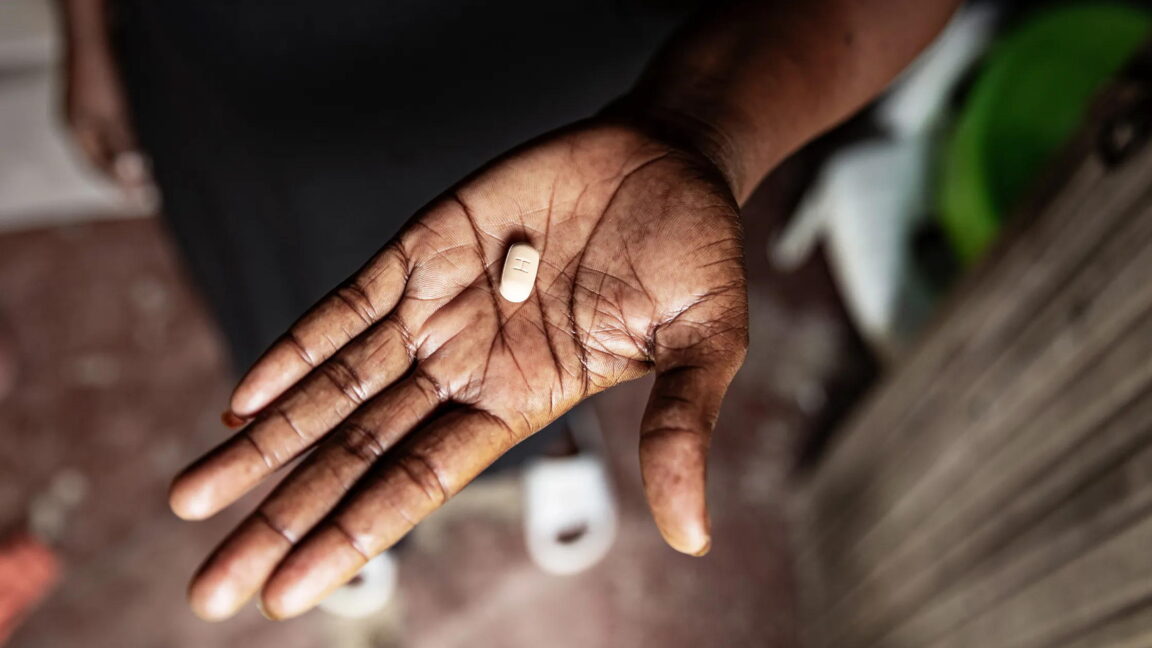
For years, Philip Goulder has been obsessed with a particularly captivating idea: In the hunt for an HIV cure, could children hold the answers?
Starting in the mid-2010s, the University of Oxford pediatrician and immunologist began working with scientists in the South African province of KwaZulu-Natal, with the aim of tracking several hundred children who had acquired HIV from their mothers, either during pregnancy, childbirth, or breastfeeding.
After putting the children on antiretroviral drugs early in their lives to control the virus, Goulder and his colleagues were keen to monitor their progress and adherence to standard antiretroviral treatment, which stops HIV from replicating. But over the following decade, something unusual happened. Five of the children stopped coming to the clinic to collect their drugs, and when the team eventually tracked them down many months later, they appeared to be in perfect health.
James.galbraithSprinting down the enshittification path
Since 2023, Amazon has been framing Alexa+ as a monumental evolution of Amazon’s voice assistant that will make it more conversational, capable, and, for Amazon, lucrative. Amazon said in a press release on Thursday that it has given early access of the generative AI voice assistant to “millions” of people. The product isn’t publicly available yet, and some advertised features are still unavailable, but Amazon’s CEO is already considering loading the chatbot up with ads.
During an investors call yesterday, as reported by TechCrunch, Andy Jassy noted that Alexa+ started rolling out as early access to some customers in the US and that a broader rollout, including internationally, should happen later this year. An analyst on the call asked Amazon executives about Alexa+'s potential for “increasing engagement” long term.
Per a transcript of the call, Jassy responded by saying, in part, "I think over time, there will be opportunities, you know, as people are engaging in more multi-turn conversations to have advertising play a role to help people find discovery and also as a lever to drive revenue."
James.galbraithYep the deal has been broken. Time for red states to learn some self sufficiency.
For once, a conservative is being honest about his hatred for the government and support for its destruction—so long as it doesn’t impact him.
“There are government programs that I’d like to see discontinued or cut back, especially those that don’t affect me,” but don’t touch the programs he personally depends on: “But the ones like the Postal Service, yes, we count on them,” Rick Wallace, a retired firefighter in rural Nebraska, told the Nebraska Examiner.
Of course they do. He lives in the kind of place where, if efficiency or cost savings become the standard, he’s completely screwed.
Wallace’s local mail carrier, Roger McDonald, drives nearly 150 miles every day to hit 334 delivery points. That kind of route bleeds money, and the long distance and sparse population density are part of why the U.S. Postal Service experiences annual losses. It’s also exactly the kind of thing that would vanish under President Donald Trump’s proposed privatization scheme, where unprofitable routes would inevitably be slashed, regardless of who’s left behind.

But the government isn’t supposed to be profitable. It’s supposed to serve the common good, even when that good is a tiny outpost in the middle of nowhere.
Liberals have long understood that. We’ve been fine subsidizing rural America—its roads, its phone lines, its mail service, and its hospitals—because that’s what a shared society does.
But in return, rural conservatives have demonized the very government that sustains their communities. Worse, they’ve vilified the people—us—who’ve supported those subsidies. And now they admit that they only want to fund what affects them.
Well, rural broadband doesn’t affect me. I have fast internet—screw everyone else. The expensive rural postal network? Doesn’t affect me, why should I pay for it? All that costly telephone infrastructure? Let it rot. The Department of Agriculture? I’m not a farmer, cut it all. Medicaid funding for rural hospitals? I’ve got 5 hospitals within 15 minutes. Rural road maintenance? Let them crumble. Black lung benefits for coal miners? Sucks to be them. Meth epidemic in rural towns? Let them bootstrap their way out. None of it affects me, right?
It’s fucking gross, isn’t it?
That’s the difference between the right and left. Conservatives get off on the suffering of people who aren’t like them—that’s why they voted for Trump. But liberals? We’d be horrified if someone earnestly made the argument I just laid out. We believe in a basic social obligation to each other—even when it costs us something. Especially when it costs us something.
Wallace doesn’t give a damn about programs that don’t directly benefit him. But we’re supposed to spend whatever it takes to keep his mail coming 6 days a week? That’s not how this works.
The social contract isn’t a vending machine for personal convenience; it’s a mutual agreement that binds a nation of people together, one that says we all pitch in so that no one—no matter where they live—falls through the cracks. It’s a recognition that the government is the tool we use to express collective values, not individual preferences.
When conservatives start picking and choosing what parts of society are worth funding based solely on their own needs, they’re not just being selfish. They’re breaking the very foundation that holds this country together.
James.galbraithOf course. Actively making life worse is the GOP's only mission
Read more of this story at Slashdot.
James.galbraithDespite the GOP's efforts
The United States added 22,332 megawatts of power plant capacity in the first half of this year, and the vast majority of it was utility-scale solar, batteries, and onshore wind.
Natural gas was next, and there was zero new coal or nuclear, according to the Energy Information Administration.
Through 2030, the US energy landscape looks a lot like these last six months in terms of the mix of new power plants, with solar and batteries leading the way, according to the EIA’s list of planned power plants.
James.galbraithno shit. They're deeply insecure by design
AI tools are widely used by software developers, but those devs and their managers are still grappling with figuring out how exactly to best put the tools to use, with growing pains emerging along the way.
That's the takeaway from the latest survey of 49,000 professional developers by community and information hub Stack Overflow, which itself has been heavily impacted by the addition of large language models (LLMs) to developer workflows.
The survey found that four in five developers use AI tools in their workflow in 2025—a portion that has been rapidly growing in recent years. That said, "trust in the accuracy of AI has fallen from 40 percent in previous years to just 29 percent this year."
James.galbraithwell that's odd
A 20-year-old man in China may be anxiously reassessing his chances of eternal damnation after the cross he had tattooed on his neck inexplicably vanished after five months and was replaced by an aggressive necrotic ulcer and grave inflammation. The case is so strange that doctors say it "expands the spectrum of tattoo-associated pathology."
In an uncanny case report published Thursday in JAMA Otolaryngology–Head & Neck Surgery, the man's doctors noted the multiple ways in which his lesion was striking. First, they could find no trace of an infection. The pigment used for the tattoo, which was red, had disappeared from his skin, leaving just scarring behind in places not yet covered by the ulcer. This isn't entirely unusual; in normal cases of people having a bad reaction to a tattoo, pigment has been known to migrate into lesions or lymph nodes. But in this case, there was no sign of the red ink, even with deeper digging.
When people's bodies reject tattoos, the abnormal immune reactions usually stay in the upper layers of tissue, and they almost never cause tissue death. But the man's lesion went deep and was clearly an invasive, crusty, bleeding necrotic ulcer. Moreover, doctors could also see that his neck was swollen on either side of the lesion. Magnetic resonance imaging (MRI) showed that large masses had formed on both sides of the ulcer and below it. The masses were all in the ballpark of 4 cm by 3 cm, and they were eclipsing his jugular veins. Subsequent scans with enhanced computed tomography showed the internal jugular veins on both sides of his neck had formed clots.
James.galbraithIt means buckle up because we'd better see BYU, Hillcrest, and Liberty U targeted with a change in administrations

One by one, elite universities are signing away some of their autonomy to the Trump administration after it has accused them of civil rights violations and withheld federal funding.
The University of Pennsylvania banned transgender women from participating in women’s college sports as part of an agreement with the Trump administration earlier this month.
Columbia University agreed last week to pay $200 million in penalties and fulfill a laundry list of other demands, from slashing diversity, equity, and inclusion programs to reviewing the curricula and personnel of its Middle Eastern studies department.
Brown University agreed to pay $50 million Wednesday to support Rhode Island state workforce initiatives, to abide by the Trump administration’s policies on trans athletes, and to apply what it refers to as “merit-based” university admissions.
Harvard University, despite seeking to fight the administration’s allegations of antisemitism and demands in court, is also reportedly in talks to pay the federal government $500 million as part of an agreement similar to the one signed by Columbia.
These Ivy League schools have large endowments, billions of dollars in reserve funds that should put them in the best financial position among institutions of higher education to resist the administration’s allegations and attempts to hold their federal funding ransom. But so far, they have chosen to settle with Trump instead — and in so doing, campus free speech advocates say they are compromising academic freedom and dialogue throughout higher education.
Other schools, especially those less resourced, are likely to follow. The Trump administration has announced investigations into more than 100 universities related to their policies on DEI, transgender students, students with disabilities, disclosure of foreign gifts and contracts, and alleged antisemitism following student protests against Israel’s war in Gaza.
“This does set up a bit of a road map, unfortunately, that I think is probably going to ripple across higher education,” said Kristen Shahverdian, program director for campus free speech at PEN America, an organization that advocates for freedom of expression. “This most likely has emboldened the Trump administration.”
Columbia has reached the most comprehensive deal signed by any university so far, and Education Secretary Linda McMahon has said that it will “change the course of campus culture for years to come.”
Trump had accused Columbia of failing to shield its students from antisemitic harassment and withheld $400 million in federal grants as a result.
The deal restores that funding. In exchange, Columbia did not admit any wrongdoing but agreed to comply with Trump’s demands on key policy priorities, and to pay $200 million to the US Treasury, as well as a separate $21 million to resolve civil rights complaints by Jewish students and staff.
In the deal, the school agreed to crack down on student protests after the major protests over the war in Gaza on campus last year. As a private institution, Columbia is not required to protect freedom of expression on its property to the degree required by the First Amendment. But along with its peers, Columbia has historically sought to hold itself to that standard. Its agreement with the Trump administration marks a paradigm shift in that respect.
The university vowed to discipline or expel students involved in demonstrations at Butler Library, enforce a ban on wearing masks during student protests, hire new security officers, and prevent student occupation of university buildings. Responsibilities for student discipline will also now be shifted from the faculty senate to the provost’s office to ensure additional oversight.
Those provisions have the potential to chill free speech. The Foundation for Individual Rights and Expression (FIRE), a free speech advocacy group, has argued that masking, for example, may give individuals who are not involved in illicit activities the opportunity to articulate controversial opinions without fear of retribution or to draw focus to their message over their identities. The Supreme Court has repeatedly overturned identification requirements for expression under the First Amendment, acknowledging that there are legitimate reasons to protest anonymously.
Columbia will also adopt the International Holocaust Remembrance Alliance’s definition of antisemitism, which explicitly includes criticism of the state of Israel. That definition, that antisemitism is a “certain perception of Jews, which may be expressed as hatred toward Jews,” seeks to restrict speech that would not be punishable under federal antidiscrimination law. Free speech advocates say it is overly broad and will chill freedom of expression.
“The IHRA definition doesn’t leave open what’s necessary on a college campus, which is dialogue, digging into issues being presented with different people’s different opinions, different research. It instead allows the university to restrict discussion and potentially to censor,” Shahverdian said.
The university will also conduct a review of its curricular offerings and leadership in the departments focused on Middle Eastern, South Asian, and African studies to ensure “balanced” content. It will create new joint faculty appointments to both the school’s Institute for Israel and Jewish Studies and to the departments of economics, political science, and the School of International and Public Affairs in order to promote an “intellectually diverse academic environment.”
Columbia will reevaluate the number of international students it admits and ask them about their reasons for studying in the US. About 40 percent of the student body, both undergraduate and graduate-level, is foreign.
It has agreed to share information about disciplinary action that results in expulsions or suspensions of international students, as well as their arrest records or other criminal history that the university is aware of, with federal immigration authorities. That means the university could now report students to US Immigration and Customs Enforcement if they’re found to be in violation of the now more stringent campus policies on student protests, and the administration could take away their visa and deport them on that basis.
And the university will end “unlawful” DEI programs — including those that “provide benefits or advantages to individuals on the basis of protected characteristics.” In the agreement, it pledges not to consider race, color, sex, or national origin of a candidate in hiring or admissions decisions.
Some higher education experts, including Columbia’s acting president, have pointed to one provision in the deal as a win for academic freedom: that no part of the settlement “shall be construed as giving the United States authority to dictate faculty hiring, university hiring, admissions decisions or the content of academic speech.” (That same language shows up in the agreement that Brown signed this week.)
However, it’s important to note that an independent monitor, jointly selected by Columbia and the federal government, will oversee and report on compliance with the Columbia deal. That monitor, Bart M. Schwartz from the compliance consulting company Guidepost Solutions, has already been chosen. That kind of arrangement is “incredibly unusual, really almost unprecedented,” Shahverdian said.
Despite the provision some call “a win,” then, the agreement could still significantly curtail Columbia’s institutional independence and threaten constitutional protections for academic freedom. Indeed, courts have repeatedly recognized that the First Amendment protects academic freedom — that is, that the freedom of speech clause protects schools’ and individual professors’ ability to disseminate expert knowledge.
“To make high-level decisions about academic work in these departments is core academic governance that we wouldn’t want to see [from the government],” said Connor Murnane, campus advocacy chief of staff at FIRE. “We think that the federal government doesn’t have a say in how a private institution reforms itself, if even possible.”
Notably, the Trump administration’s demand that Harvard similarly appoint an independent monitor has reportedly been a sticking point in ongoing negotiations. It’s still unclear whether, as part of an eventual agreement like Columbia’s and Brown’s, Harvard will continue to pursue its lawsuit seeking to prevent the federal government from withholding federal funds. The school argues that those funds have been used “as leverage to gain control of academic decisionmaking at Harvard.”
The Trump administration has managed to extract these agreements without doing much to even back up its claims of civil rights violations at elite universities.
Harvard argues in its lawsuit that the administration did not follow the required procedures to temporarily withhold federal funds. There is a process associated with adjudicating claims of discrimination under Title VI of the Civil Rights Act, but the White House followed no such process before retracting the funds.
In order to withhold funding permanently, the Trump administration would have had to prove, in a Title VI hearing before an administrative judge, that the alleged discrimination was committed. The universities would have had the opportunity to formally submit evidence and respond to the allegations against them.
Murnane said he’s not sure if Columbia would have successfully defended itself against allegations of antisemitism or if it would have been able to sufficiently reform its policies to come into compliance with federal civil rights law and avoid penalties. What actually constitutes antisemitism in the context of student protests over the war in Gaza was hotly debated even at the time.
And it’s worth noting that Columbia’s reaction to the protests last year was significantly harsher than its peers. It was the first elite school to call the police on its own students, escalating campus unrest, and it swiftly expelled some of the students involved in the protests, while its peers pursued lesser disciplinary actions. Columbia also suspended its campus chapter of Students for Justice in Palestine, one of the organizations that helped organize the protests, whereas its peers did not.
And before the agreement was reached, the university had already increased funding for Jewish student programs, enhanced security for Jewish centers on campus, and appointed a new vice provost for campus climate tasked with combating antisemitism.
Murnane noted that Harvard has also taken steps to improve the campus climate while respecting free speech, including adopting a pledge that classroom discussions cannot be attributed to particular individuals under Chatham House rules, launching a program for students to debate issues with people who don’t share their opinions, and adding a question to their application asking about how students interact with people they disagree with.
Brown, too, reached an agreement with Gaza protesters in 2024 that was widely praised as a better means of encouraging campus dialogue compared to the approaches pursued by its peers.
But instead of evaluating the allegations against these universities and the steps they took as part of a formal process, the administration temporarily cut off funding unilaterally, as a tactic to bring the schools to the negotiating table and reach an alternative resolution to the legal cases against them. Given the amounts of federal funding on the line, in the hundreds of millions of dollars, universities have to some extent been backed into a corner.
But those with the endowments to weather the storm, including Columbia, whose endowment is $14.8 billion (Harvard’s, for its part, is more than $53 billion) did have a choice — and now all of higher education may pay the price.
“In the end, Columbia’s capitulation and Harvard’s behind-the-scenes negotiation send a troubling message to colleges and universities nationwide: yield to political pressure, and the pressure may momentarily subside. But behavior that gets rewarded gets repeated,” Murnane said. “This is not civil rights enforcement, it is political coercion under the color of law.”
James.galbraithFunny how many politicians are only Israel first. Dems shouldn't support this shit.

Since former Vice President Kamala Harris lost the 2024 presidential election, the Democratic Party has been in a panic over how it can win back more voters. Ideas have so far included Democratic officials going on podcasts, finding their own Joe Rogan, and growing facial hair.
But when it comes to actual issues Democratic voters care about, the party doesn’t seem so eager to experiment. And there’s one topic in particular that is showing just how big the divide is between the Democratic establishment and Democratic-leaning voters: the United States’ support for Israel.
Israel’s destruction of Gaza — which many scholars and experts consider to be an ongoing genocide — has prompted a dramatic shift in how Americans view Israel and its relationship with the US. That change is especially pronounced among Democratic voters. A recent Quinnipiac poll found that only 12 percent of Democratic voters say they sympathize more with Israelis, while 60 percent say they are more sympathetic toward Palestinians.
Compare that to just eight years ago, when Quinnipiac asked voters the same question. In 2017, 42 percent of Democratic respondents said they sympathized more with Israelis, while only 23 percent sided more with the Palestinians.
“All of a sudden, it’s the pro-Palestinian position that actually reigns supreme in Democratic politics, not the Israeli position,” Harry Enten, CNN’s chief data analyst, said in a recent broadcast breaking down why Zohran Mamdani, an outspoken critic of Israel, performed so well in the New York City mayoral primaries. “I rarely ever see shifts like this.”
Over the last week, news and images of more and more Palestinian children dying of hunger have finally compelled American politicians to push back on Israel’s war crimes in Gaza. A growing number of Democrats have called out Israel’s use of starvation as a weapon of war in recent days because of just how dire the situation has become, though Israel has been weaponizing humanitarian aid since the start of its war. It seems that nearly two years into Israel’s assault on Gaza, more and more Democrats are starting to shift their tone.
But by and large, the Democratic establishment has remained out of step with its voters on Israel — because Democrats’ actions and policies tell a far different story than their recent rhetoric does. Democratic leaders in Congress, for example, recently met with Israeli Prime Minister Benjamin Netanyahu, who has a warrant out for his arrest — issued by the International Criminal Court — for alleged crimes against humanity and war crimes, including the crime of starvation as a method of warfare. High-ranking Democratic officials from New York, including House Minority Leader Hakeem Jeffries and Sens. Chuck Schumer and Kirsten Gillibrand, have also held out on endorsing Mamdani, despite him being their party’s nominee for New York City mayor. One issue that they keep citing is how Mamdani talks about Israel, presumably out of fear of alienating some of their own voters.
If Democrats really wanted to act on their criticisms of Netanyahu’s government, they could have, over the past two years, tried to suspend military aid to Israel — including defensive weapons — until it complies with international law. But when members of Congress made those kinds of proposals — like Vermont Sen. Bernie Sanders’s resolution to withhold billions in military aid to Israel — they consistently failed to gain any real traction within the Democratic Party, let alone on the Republican side of the aisle.
Instead, under the Biden administration, congressional Democrats helped approve over $17 billion in military aid to Israel, even after Israel stood accused of committing genocide in front of the International Court of Justice. And earlier this month, only four House Democrats voted in favor of an amendment in the defense budget bill that would have stripped Israel of $500 million in military aid. Even some of the party’s progressive leaders, like Rep. Alexandria Ocasio-Cortez (D-NY), voted against the amendment, arguing that the aid was for defensive, not offensive, weapons.
Given how far Democratic voters have moved on support for Israel — a more than 60-point swing in the last decade — why has their party’s establishment been so slow to respond?
Even before the war in Gaza, public opinion in the US, especially among Democrats, was already shifting on Israel. Gallup polls have shown the same trend as the Quinnipiac polls. In 2013, only 19 percent of Democratic voters sympathized more with Palestinians than with Israelis. By 2022 — a year before Hamas’s October 7 attacks — that number had doubled to 38 percent. Israel’s destruction of Gaza has only accelerated the shift, and by 2025, 59 percent of Democratic voters sympathized more with Palestinians, while only 21 percent sympathized more with Israelis.

That sea-change is not just limited to Democrats. In 2013, 63 percent of independents sympathized more with Israelis, while only 11 percent said they were more sympathetic toward Palestinians, according to Gallup. By 2025, those numbers were 42 percent and 34 percent, respectively — marking a 44-point swing. Republican voters, on the other hand, have remained relatively steady and staunchly pro-Israel.
So what accounts for the Democratic reticence to shift on Israel? One major factor is the Israel lobby. Political scientists John Mearsheimer and Stephen Walt have argued that the strength of this lobby — and the American Israel Public Affairs Committee (AIPAC) in particular — is largely responsible for the strong US-Israel relationship.
In a 2006 article for the London Review of Books, which they later spun into a book, they wrote, “The thrust of US policy in the region derives almost entirely from domestic politics, and especially the activities of the ‘Israel Lobby.’ Other special-interest groups have managed to skew foreign policy, but no lobby has managed to divert it as far from what the national interest would suggest, while simultaneously convincing Americans that US interests and those of the other country — in this case, Israel — are essentially identical.”
While others have pushed back on that claim, it’s hard to argue that AIPAC — a hard-line pro-Israel group that has lobbied both political parties for decades, helping organize donors’ campaign contributions to pro-Israel candidates — does not have a major role in US politics and foreign policy.
Though it’s impossible to put a precise figure on AIPAC’s economic impact — in part because its operations also help its donor network and other pro-Israel PACs know where to direct their resources — it’s one of the best-funded and most powerful organizations in American politics. Even among lobbying groups, its influence is astounding, especially given how relatively niche their cause is. In the 2024 cycle, AIPAC, which reportedly boasted a $100 million war chest to target progressive candidates, was among the biggest election spenders. (AIPAC has often been insulated from the kind of criticism other major lobbying groups get because people who point out AIPAC’s outsize role in elections tend to get accused of engaging in antisemitic tropes.)
“Members of both parties worried about crossing the American Israel Public Affairs Committee, a powerful bipartisan lobbying organization dedicated to ensuring unwavering U.S. support for Israel,” former President Barack Obama wrote in his memoir, A Promised Land. “Those who criticized Israeli policy too loudly risked being tagged as ‘anti-Israel’ (and possibly anti-Semitic) and confronted with a well-funded opponent in the next election.”
AIPAC is just one part of a whole lobbying ecosystem that includes other pro-Israel groups, think tanks, and wealthy individuals who try to influence US policy to support Israel. This is a reflection of the way money in politics works in general: that deep-pocketed donors have way more sway over party leaders than average voters. That’s why wealthy individuals and corporations, for example, keep avoiding significant tax hikes despite the fact that higher taxes on millionaires are extremely popular among Americans.
AIPAC seems keenly aware that Democratic voters’ views on Israel are shifting fast, so much so that it has become even more aggressive in recent election cycles. In 2024, the group targeted Democratic members of Congress critical of Israel, spending millions to help unseat them. Jamaal Bowman of New York and Cori Bush of Missouri both lost their primaries to challengers backed by AIPAC. And as a result of AIPAC’s spending, those two races became the most expensive House primaries in US history. (Notably, AIPAC funneled its money on those races through its new super PAC, the vaguely named “United Democracy Project,” which is perhaps a sign that even AIPAC is aware of how toxic its brand has become in Democratic politics.) The millions of dollars AIPAC poured into these primaries were a desperate attempt — amid the quickly changing politics around Israel — to send Democrats a warning: Criticize Israel and you’ll still face a well-funded opponent.

Of course, AIPAC’s influence has its limits. Despite spending record amounts of money to unseat Bowman and Bush, other representatives who have drawn AIPAC’s ire — including Rashida Tlaib, Ilhan Omar, and Summer Lee — won reelection comfortably. In some cases, AIPAC didn’t even bother trying, knowing the incumbents were too strong.
That doesn’t mean that AIPAC is going away. The group remains a top donor to some major Democratic figures, including Gillibrand and Jeffries. And even Democrats who reject money from pro-Israel groups can still feel boxed in by the Israel lobby. Ocasio-Cortez, for example, specifically turned AIPAC down when they approached her after she won her first primary in 2018. But it’s clear why even she is wary of being too outspoken against Israel. Take, for example, her vote for an amendment that would have stripped Israel of military aid. If she has any ambitions for statewide office, it’s not difficult to imagine the attack ads against her, calling her out — potentially calling her antisemitic — for voting to strip Israel of money for defensive weapons. And it’s easy to see why that prospect would spook her, especially given that her state is home to the largest Jewish population in the US.
Another obstacle to Democrats shifting on Israel is that groups like the Anti-Defamation League have conflated anti-Zionism with antisemitism, making it all the more toxic for politicians to talk more openly about Israel’s abysmal human rights record, let alone in support of Palestinian liberation.
There’s also a longstanding bias against Palestinians in American politics and culture. Politicians can get away with repeating Israeli talking points that dehumanize Palestinians, including by (as mentioned above) conflating anti-Zionism with antisemitism or decrying symbols like the keffiyeh as hateful, without getting as much pushback as they would if they were talking about other ethnic groups. As a result, anti-Palestinian racism is seldom called out as its own form of discrimination and often flies under the radar. That makes it easier to defend Israel because Palestinians are too often treated as an afterthought in US politics, not people who face life or death consequences as a direct result of US policy.
Finally, there’s the problem of political inertia. Many establishment politicians who have been around for some time are accustomed to a different political era when support for Israel was unshakeable. They are also part of an older generation whose views on Israel are vastly different from younger Americans. The stark generational divide is even evident among Jewish voters: A recent poll in the New York City mayor’s race showed that 67 percent of Jewish voters under the age of 45 support Mamdani, while only 25 percent of Jewish voters over 45 do.
That all helps explain why so many establishment Democrats — used to a kind of politics where Israel enjoyed broad support from voters in both parties — might be reluctant to embrace the new political reality.
But at some point, if Democrats truly want to improve their standing among the public — especially now that their approval ratings have record lows — it might be wise to start actually listening to their voters.
The Democratic Party has many hardline pro-Israel officials, some of whom have gone to great lengths to defend Israel’s indefensible actions in Gaza. In 2023, some Democrats even joined their Republican colleagues in censuring Tlaib, the only Palestinian-American in the House, over her criticisms of Israel. And while Democrats have had an easier time condemning obvious targets, like Netanyahu’s right-wing government or settler violence, they still have trouble criticizing Israel’s routine international law violations more broadly.
However, there are signs that Democrats could start changing their posture. In recent years, more and more Democratic members of Congress have become loud critics of Israel and its occupation of Palestine. Maryland Sen. Chris Van Hollen, who is not exactly a firebrand leftist, has been consistently critical of Israel’s war and has even called out the Biden administration’s involvement.
These voices are a minority, but they show there is a potential opening for change. The fracture within the party could mean that the Biden administration’s record on Gaza will be a topic of fierce debate in the 2028 Democratic primaries, given how Biden enabled one of the bloodiest military assaults this century — one that many Democratic voters, especially young people, view as a genocide. And that could further embolden progressive-leaning Democrats to be more outspoken about their opposition to Israel.
As Mamdani’s race in New York City showed last month, that might catch some of the more old-school, establishment Democrats by surprise, since being pro-Palestinian is no longer the third rail in American politics that it was long thought to be.
After all, if Mamdani, an outspoken critic of Israel, was able to win the Democratic nomination for mayor of the city with the largest Jewish voting bloc in the country, then that kind of politics could have success elsewhere, no matter how hard lobbying groups try to stop it.
James.galbraithWell that's appalling

This story was originally published in The Highlight, Vox’s member-exclusive magazine. To get early access to member-exclusive stories every month, join the Vox Membership program today.
You don’t need me to tell you that the US is in the midst of an obsession with protein. By now, you’ve probably seen extra protein in foods and beverages it once didn’t belong: ice cream, popcorn, iced tea — even water. Google searches for “protein” have surged in recent years, and the macronutrient seems to be on the tip of every fitness influencers’ tongue.
But the impact of the protein craze goes beyond snacks and social media. It helped the meat industry achieve record sales in 2024, and it likely contributed to a surprising change in American eating habits: Last year, for the first time in 15 years, consumers increased their cow’s milk consumption.
Perhaps no company has both benefited from and accelerated these converging trends more than Fairlife, the Coca-Cola-owned milk brand that contains zero lactose and boasts 50 percent more protein and 50 percent less sugar than regular milk. That unique nutritional profile, achieved through a patented “ultra-filtration” process, has helped turn Fairlife into a billion-dollar business in under a decade, ranking second in name-brand refrigerated milk sales last year.

“There’s this obsession with protein [among] young men right now that’s just been blockbuster to” Fairlife, agriculture researcher Austin Frerick, author of Barons: Money, Power, and the Corruption of America’s Food Industry, told me. The company’s success has been a godsend for Coca-Cola, which became Fairlife’s sole owner in 2020; it’s now the beverage giant’s fastest-growing US brand.
Fairlife has distinguished itself not just with its high protein content, but also by claiming that its milk is higher quality than its competitors, its cows are treated humanely, and its farms are environmentally sustainable. “Believe in better,” reads one of the company’s taglines.
That feel-good story has earned Fairlife’s husband-and-wife co-founders Mike and Sue McCloskey glowing profiles in Food & Wine, NPR, and Fortune, along with invitations to speak at conferences held by South by Southwest, Yale, Fast Company, and TEDx.

But it’s a story that has, in recent years, increasingly collided with reality. In 2019, an undercover investigation by the nonprofit Animal Recovery Mission (ARM) at the McCloskeys’ flagship farm in Indiana, a supplier to Fairlife at the time, revealed horrific animal abuse: employees kicking calves in the head, hitting them with steel rods, and slamming them to the ground, among many other cruelties.
Soon after, the McCloskeys apologized. But since then, ARM has released several additional stomach-wrenching investigations into dairy farms that belong to Select Milk Producers — a cooperative, also co-founded by the McCloskeys, of some 100 dairy farms that helped launch Fairlife and supply milk to it.
The latest investigation, released in late June, recorded workers at a New Mexico dairy hitting cows in the head with a metal pipe, kicking them in the face and body, dragging newborn calves and adult cows in the dirt with a tractor, and numerous other instances of abuse.
Fairlife told Vox it hasn’t sourced milk from that farm since 2023, but ARM’s investigator shared evidence to the contrary. Additionally, in a class action lawsuit filed earlier this year against Fairlife, Coca-Cola, the McCloskeys, and Select Milk Producers, a group of consumers accuse Fairlife of deceiving customers with claims of humane animal treatment, and allege that the New Mexico dairy farm did supply Fairlife at the time of the investigation.
Fairlife is far from alone. Farmed animals are largely exempt from federal and state animal cruelty laws, so industry welfare standards are incredibly low, and dairy producers are effectively left to police themselves. Past investigations alleging horrific abuse are legion across the dairy industry, including at dairy farms that have supplied to Burger King, Domino’s, Land O’Lakes, Nestlé, Cabot Creamery, and other leading food brands.
Between the early 2000s and the mid 2010s, many of these investigations became high-profile news stories. The livestock industry reacted by advocating for laws not to criminalize animal abuse, but to criminalize the investigators who videotaped the abuse. The McCloskeys had a different strategy: They capitalized on this era of heightened concern around animal cruelty by promising transparency and humane treatment of their animals.
ARM’s slate of investigations have consistently undermined that narrative. But Fairlife has thrived in spite of it all, revealing the consequences of consumers’ willingness to believe a good story — or ignore a bad one — in the pursuit of ever-more protein.
Last Christmas Eve, a man who had worked on dairy farms for 17 years started his first shift at a large industrial dairy operation, called Woodcrest Dairy, in the New Mexico desert. But there was something that set him apart from his coworkers: He was wearing a hidden camera.
Years prior, he had been a worker at a Fairlife supplier farm that ARM investigated for alleged animal abuse. Disturbed by their findings, the worker reached out to the organization and eventually became an ARM investigator himself.
While employed at Woodcrest Dairy for 10 weeks, through early March of this year, he caught dozens of acts of animal abuse on camera, including workers:
In an interview with Vox conducted via a translator, the investigator, who requested anonymity due to the covert nature of undercover investigations, described the treatment of cows at Woodcrest Dairy as “terrifying” and said that the owner and managers witnessed it. “They only care about the money,” he said. “There’s no care about the animals.”
“The actions observed in the video are cruel and reprehensible,” Jim Reynolds, a veterinarian and professor emeritus of large animal medicine and welfare at Western University of Health Sciences, told me in an email. “The abusive and cruel actions seen in the video represent serious problems in management of the dairy.”


Beyond the most blatant cruelty, the investigator documented other animal welfare problems, like “downer” cows — cows unable to stand or walk on their own, often due to disease, metabolic issues, or post-birth pain. Some were lifted with a hip clamp that was placed on their bodies and attached to a tractor; one cow was dragged through the dirt while attached to the tractor. Another cow had a band wrapped around her hind legs to keep them from splaying.
Because cows, like all mammals, need to give birth to produce milk, dairy farms revolve around continual pregnancies and births, which is immensely taxing on their bodies. The investigator documented numerous instances of workers doing something during the birthing process he had never seen: tying a chain to the legs of baby calves while they were still in their mothers’ birth canals, and then jumping on it to pop the calf out. In one scene, the cow bellows in pain and the calf is partly covered in blood.
“The cow and calf both definitely suffered from this mistreatment,” Reynolds wrote to me about this part of the investigation. “The actions seen tell us the employees are not trained appropriately for delivering calves, they have not been provided appropriate equipment, and they are not managed appropriately.”
Fairlife declined an interview request for this story. In an email to Vox, the company said it stopped sourcing milk from Woodcrest Dairy in 2023. However, ARM’s investigator, in a videotaped conversation shared with Vox, asked a truck driver transporting milk from the farm in January if he was taking the milk to a nearby Fairlife plant. The driver answered yes, specifying that they bring milk to the Fairlife plant three times a day.
The livestock industry — not just Fairlife — has long portrayed dairy as an essential, wholesome product from cows who just happen to be producing milk on quaint, green pastures. But cows on dairy farms, even when they’re not overtly abused like those seen in undercover investigations into Fairlife, still face severe welfare issues because of the very nature of dairy production.
Today’s cows have been bred to produce far more milk than they naturally would, which greatly taxes their bodies. They’re (artificially) impregnated each year — another physical stressor — to induce milk production. After they give birth, their calves are quickly taken away so that humans can take their mothers’ milk.
Newborn calves are then confined alone in tiny hutches. Females go on to become dairy cows once they’re sexually mature, while the male calves are dehorned and castrated — often without pain relief — and sold off to become veal or beef.
Most dairy cows have little to no access to pasture and spend their lives confined indoors or on dirt feedlots. Naturally, they might live to 15 to 20 years of age, but by 5 or 6 years old, when bodies give out and their milk yield wanes, they’re sent off to slaughter.
Many of these practices have become standard on dairy farms of all sizes — not just on mega dairies. It’s a reality far different from what consumers often see in advertisements and on milk bottles.
Woodcrest Dairy has since closed down and couldn’t be reached for comment. Select Milk Producers, the cooperative that Woodcrest belonged to, told Vox in an email that “animal care is a core value” at the cooperative, and that it investigates “any report of inappropriate animal care.” (Select Milk confirmed to me that Woodcrest has shut down.)
As recently as this March, Select Milk Producers’ website stated that the “highly nutritious milk products of fairlife come from the 99 family owned dairies of Select Milk Producers.” That web page has since been taken down.
The Woodcrest Dairy findings were the latest in a string of similar recent investigations. Earlier this year, after ARM released disturbing videos showing animal cruelty at two Arizona dairy farms that supplied Fairlife, the company said it had immediately suspended ties with the farms. But weeks later, investigators from the group Consumer Protection Foundation, separate from ARM, followed milk being trucked from the Arizona farms to a processing plant run by United Dairymen of Arizona (a cooperative that Fairlife sources some of its Arizona milk from), and then to a Fairlife plant. Fairlife told Vox in an email that it did not resume sourcing milk from these farms.
And in 2023, ARM released a shocking investigation into an Indiana dairy operation that ARM says belongs to the Select Milk Producers cooperative (SMP didn’t reply to a question about whether the farm is currently a cooperative member, and the farm couldn’t be reached for comment).
Videos from the investigation show workers hitting cows with screwdrivers, knives, and sawed-off golf clubs, and in one scene, a worker takes a rod with a huge flame at the end and brushes it against cows’ legs as they’re being milked. At one point in the video, the ARM investigator asks a manager about a dairy cow he had just shot: “Do you feel remorse for killing her?” The manager replies, “No! It’s why I live in this country, so I can kill these asshole cows.”
Fairlife denied sourcing milk from the operation. Soon after, ARM followed milk trucks from the facility to a Fairlife processing plant in Michigan. ARM also recorded a conversation with a milk truck driver who said he took milk from the farm to the Fairlife processing plant. Fairlife stated that it had been considering bringing on the farm as a supplier and that the milk shipment ARM observed was simply a test run that was subsequently dumped and never entered Fairlife’s supply chain.
The class action lawsuit filed earlier this year accuses Fairlife of lying about its relationship with the Arizona, Indiana, and New Mexico farms. “This conduct constitutes bad faith, collusion, deception, and fraud,” the lawsuit states.
ARM has asked the US Department of Agriculture and state agriculture departments to take a deeper look into Fairlife’s supply chain and the pattern of animal cruelty, but no such inquiry has ever been taken up, according to Richard Couto, ARM’s founder and CEO.
Federal and state agriculture agencies are “out to protect industry and dollars,” Couto told me. “They’re not out to protect the animal.”
Animal Recovery Mission’s first investigation into a Fairlife supplier, released in 2019, has since been viewed over 19 million times — more than perhaps any other farm animal cruelty video in history. It garnered widespread news coverage, and several Midwest grocery chains temporarily pulled Fairlife bottles from their shelves. Fans posted videos of themselves pouring Fairlife down the drain, vowing to never buy the product again.
By 2022, Coca-Cola, the McCloskeys, their farm business, and Select Milk Producers settled a $21 million class action lawsuit (separate from the one filed earlier this year) alleging the companies had falsely advertised their milk as coming from humanely treated cows.
That wasn’t how it was all supposed to turn out.
In the early 1990s, the McCloskeys — who at the time owned a large dairy farm in New Mexico — launched the cooperative Select Milk Producers, differentiated by a promise of increased transparency and higher standards that led to healthier cows and cleaner milk.
A few years later, they moved to Indiana and opened Fair Oaks Farms, which is now one of the country’s largest dairy operations, with an eye-popping 36,000 cows — what’s considered a mega dairy. At the time, industrial animal agriculture was under increasing scrutiny as investigations into factory farms by animal rights groups gained media attention. Rather than hunker down and ignore Big Ag’s negative publicity, the McCloskeys saw a business opportunity in transparency — or at least their version of it.
In 2004, the McCloskeys expanded Fair Oaks Farms to become what’s been called an agricultural Disneyland — a farm-meets-theme park tourist attraction that draws more than 100,000 visitors annually.
“The farm was founded out of necessity to counter the very loud, very well-funded, and often, very misleading voices against modern farming and animal agriculture,” Sue McCloskey told Food & Wine in 2018.
Today, visitors can take a sanitized tour of Fair Oaks’s dairy and pig operations. The programming “attempts to make the public comfortable with the factory farm,” Jan Dutkiewicz, a Vox contributor and assistant professor of political science at the Pratt Institute who went on the tour, wrote in 2018. Fair Oaks, he added, deploys a “selective transparency that seems to perform radical revelation — even as it hides overt and structural forms of violence against animals.”
There are also interactive dairy, pork, and crop museums, a 25-foot tall rock climbing wall in the shape of a milk bottle called “Udder Heights,” and a “Legen-Dairy Drop MegaSlide,” two on-site restaurants, and a Marriott hotel.


Throughout their time at Fair Oaks Farms, visitors are inundated with messages that modern animal agriculture is sustainable and humane. “At Fair Oaks, Mike is essentially able to create a new reality,” Frerick, the ag researcher and author, said in The Price of Milk, a new documentary series on the dairy industry. “They built one of the most popular tourist attractions in the state of Indiana, full of propaganda, to refute claims that industrial animal operations (CAFOs) were cruel,” he told me in an email.
Yet the McCloskeys’ claims about what separates their farms and businesses from typical dairy factory farms have always been scant on specifics.
For example, Mike McCloskey has told NPR that the fact that he’s fluent in Spanish has enabled him to better communicate with his largely Spanish-speaking workforce, which has resulted in better care for animals. Select Milk Producers’s website mentions its adherence to voluntary animal welfare guidelines that were developed by dairy industry groups, which largely mirror standard industry practices.
Fair Oaks Farms did not respond to multiple requests for comment for this story.
“This is just the one classic textbook example of why self-policing just fails. How can you even take the company at their word now to do better?”
Austin Frerick, agriculture researcher and author
After Fair Oaks Farms came Fairlife. In 2012, the McCloskeys, through Select Milk Producers, developed a partnership with Coca-Cola to distribute Core Power, a milk-based protein shake made using their ultra-filtration process to enhance the drink’s protein content. Two years later, Select Milk Producers and Coca-Cola launched the Fairlife brand.
Their timing was perfect. The protein craze was gaining steam, while cruelty investigations into factory farms had become a frequent news story. Fairlife promised consumers everything: a low-sugar, lactose-free, high-protein milk beverage with a humane and sustainable sheen. Coca-Cola’s market dominance helped get Fairlife drinks into 76,000 US retail outlets by 2017.
The company took off, and the McCloskeys became a positive story in an otherwise struggling industry: Over the last 80 years per capita fluid milk consumption in the US has declined dramatically, and hundreds of thousands of small- and mid-sized dairies went under. Large dairy producers like the McCloskeys were well-positioned to benefit from the industry’s structural problems.
In the years that followed, Mike McCloskey landed on President Donald Trump’s short list for agriculture secretary. Sue, meanwhile, was busy on the conference and media circuit, where she frequently, and lovingly, referred to the couple’s cows as “our girls.”
“There’s a degree of business brilliance to them that you have to admire,” Frerick said. Neither of the McCloskeys came from a big farm family, yet their business savvy, political connections, and marketing prowess, he said, has made them “unquestionably the most powerful dairy farmers in America in a lifetime.”
It wasn’t long before Animal Recovery Mission’s first investigation revealed how the “girls” were treated in the McCloskeys’ dairy empire.
Following ARM’s first investigation in 2019, Mike McCloskey released an apology video, saying that Fairlife doesn’t tolerate animal abuse and would clean up its supply chain. Yet ever since, Animal Recovery Mission continued to release new investigations into Fairlife suppliers and Select Milk Producers members at a regular clip, each with similarly disturbing findings.
Along the way, Fairlife removed humane care claims from its bottles, and earlier this year, it took down a lengthy yet vague web page about its animal welfare commitments.
Of course, no one at the top of these companies actively wants animals to be abused, but the continued investigations reflect a structural reality of animal agriculture: Mass producing cheap animal products is all but impossible to do humanely. Dozens of investigations into the US meat, milk, and egg industries have revealed that the constantly growing demand for cheap animal products — combined with virtually zero legal protections for farmed animals and captured regulatory agencies — means that efficiency and profit are almost always prioritized over animal welfare.
“This is just the one classic textbook example of why self-policing just fails,” Frerick said. “How can you even take the company at their word now to do better?” The story here, he added, “is the failure of regulators.”
Through it all, Select Milk Producers and the McCloskeys have continued to prosper. All told, Coca-Cola spent $7.4 billion to acquire Fairlife, Bloomberg reported earlier this year.
And the public shock and disgust that followed the first investigation into Fairlife six years ago has since largely faded into the background, while the brand just gets more and more popular.
“The scariest thing from all these animal abuse scandals is it feels like that, with each additional scandal, the tension goes down,” Frerick said. “This abuse is becoming seemingly a fact of life. I think that’s kind of an unsaid strategy of Fairlife — it’s just to ride it out so [people] become numb to it.”
Fairlife, after all, has always managed to effectively foresee and meet the cultural moment. It’s now reaping the financial rewards of a protein fad that it anticipated long before its competitors. And although the McCloskeys once promised that a bottle of Fairlife came from humanely raised cows at a time when animal welfare concerns were particularly salient, the company has appeared just as happy to quietly shed its commitments to animal welfare when they were no longer convenient.
But Couto said Animal Recovery Mission isn’t going away. “ARM is such a thorn in Coca-Cola’s side,” he told me, “because we’re never going to stop investigating.”
James.galbraithfascinating

Birds have a strong ability to learn and mimic sounds. So, Benn Jordan converted a PNG image into a spectrogram and then played the resulting sound to a starling, a bird known for its mimicking. The starling was able to copy the sound, thus demonstrating an ability to store data in its song.
James.galbraithThat checks out lol
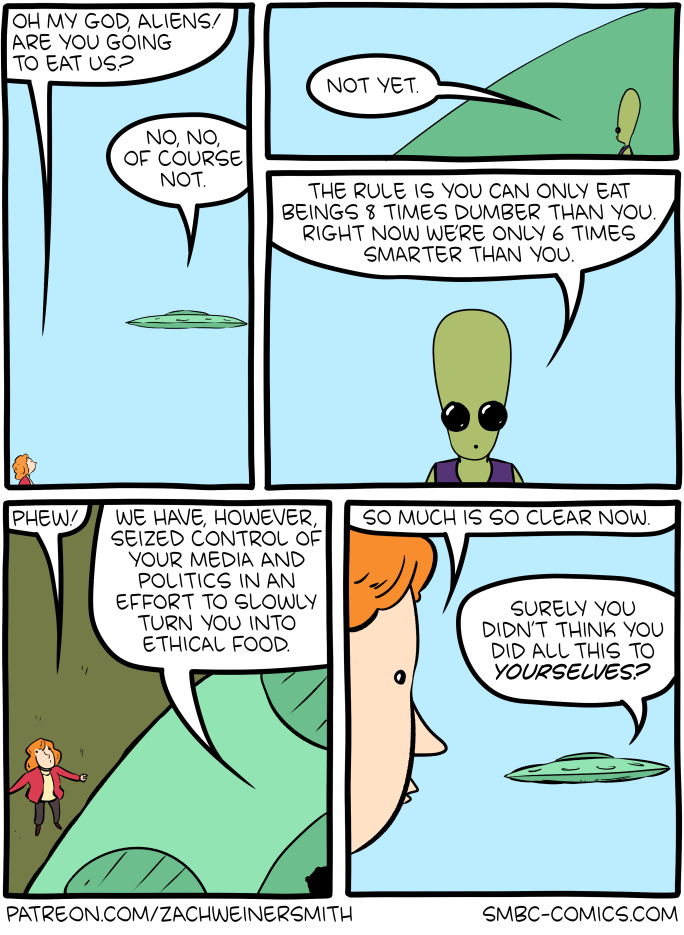
Hovertext:
If the comic was too long, please run an AI summary.
Can we settle space, should we settle space, and have we really thought this through?
The Weinersmiths investigate perhaps the biggest questions humanity has: whether and how to become multiplanetary.
A City on Mars - Now available in Paperback!

James.galbraithinsanity
When the Office of Personnel Management isn’t busy overseeing mass firings, it’s busy figuring out ways to force a very narrow, very conservative version of Christianity on those federal employees it hasn’t yet sacked. OPM’s latest guidance to all agency heads, titled “Protecting Religious Expression in the Workplace,” is a permission slip for evangelicals to foist their religious views on everyone else.
That’s not an exaggeration. The memo explicitly says it: “An employee may engage another in polite discussion of why his faith is correct and why the non-adherent should re-think his religious beliefs. However, if the nonadherent requests such attempts to stop, the employee should honor the request.”

Who doesn’t love the idea of going to work at a shattered, decimated government agency only to be buttonholed by an evangelical weirdo telling them their religious beliefs, or lack thereof, are wrong? Totally what everyone wants from their job, and not at all entangling church and state.
Bosses can get in on the action too. A supervisor can post a message inviting “each of his employees to attend an Easter service at his church.” Supervisors are also welcome to do the whole bit about telling employees their views are wrong and why they should “re-think” their religious beliefs. Surely no non-Christian employee will feel at all coerced by having their boss tell them they should convert.
What other cool things can happen in Donald Trump’s brave new world? A park ranger can pray with a tour group. Veterans’ Affairs doctors can pray over patients. Security guards and other front-facing employees can cover their desks with crucifixes, a Bible, or rosary beads. It’s unclear how this doesn’t look, to a member of the public, like official government endorsement of Christianity.
And it really is just Christianity. There’s no mention of, say, having the Quran or a Tibetan prayer bowl on that imaginary security guard’s desk.
Somehow, all of this is actually about “restoring constitutional freedoms,” per OPM director Scott Kupor, who is making it his mission to smash the remaining barriers between church (Christian only, thanks!) and state. This isn’t even the first religious liberty memo Kupor has issued since taking the reins at the OPM two weeks ago. On his first day on the job, he issued a memo all about how federal employers have to allow religious people—but only religious people—to telework, get comp time, have flexible schedules, and time off for travel in order to adhere to their religious beliefs. Anyone else who wants to telework is a lazy sod who should be fired, however.
Related | Telework is fine in Trump's America, but only for this group
It’s not just Kupor or OPM. The Trump administration is committed to reframing religious freedom as the freedom to impose religion on others, not the right to be free of religious coercion by the government. So we have Defense Secretary Pete Hegseth leading prayer services at the Pentagon and Trump’s “Task Force to Eradicate Anti-Christian Bias,” which the Baptist News even characterized as “an exercise in airing conservative evangelical grievances.”
At the same time, the administration is actively hostile to people whose faith compels them to show care to others. Trump greenlit efforts to let Immigration and Customs Enforcement agents arrest people in churches and continues to relentlessly fight religious groups who sued on the basis that it burdens their free expression of religion to have ICE goons stomp into their places of worship. Per the administration, that’s fine because it’s not at all coercive and totally wouldn’t cause people who fear arrest not to attend church or require faith leaders to compromise their faith by not sheltering immigrants.

Except that’s exactly what is happening. Two Catholic bishops have already issued dispensations, telling people they do not have to attend Mass if they fear harm over the possibility of immigration raids. Bishop Alberto Rojas of the San Bernardino diocese, about an hour away from Los Angeles, has pleaded with the administration to stop terrorizing people, saying.
“Please reconsider and cease these tactics immediately, in favor of an approach that respects human rights and human dignity,” Rojas pleaded. Somehow, there’s no religious freedom to oppose violent immigration raids, but the hypothetical boss who wants to corner you in the break room to tell you the good news about Jesus Christ is the pinnacle of that freedom.
Don’t expect federal workers to be able to sue to stop this, given that anything that hits the Supreme Court docket will likely lead to a Trump-friendly conservative majority enthusiastically endorsing the government’s right to force religion on you at work. The court has steadily, relentlessly eroded the boundary between church and state, and doesn’t appear to have any intention of stopping.
Let’s hope federal employees enjoy having their offices draped in crucifixes and a boss who won’t stop talking about how you need to come to their megachurch and get saved.
James.galbraithAbout fucking time...the only time I use 1 monitor is when I'm traveling on my laptop
Microsoft devotes most of its time and energy these days to promoting new AI- and Copilot-related features for Windows 11, but the company's Windows Insider builds are still full of small tweaks and changes aimed at improving longstanding Windows features for people who just want to use their PC the way they always have.
New updates that began rolling out to testers in the Windows Insider program yesterday include a couple of small but meaningful changes for Windows power users. First, Microsoft is changing the way the Taskbar works on secondary monitors, allowing users to click it to see the calendar and Notification Center on all monitors, not just the primary display.
Microsoft is also making a change to how the various tabs in the Task Manager measure CPU usage to make it more consistent (and less nonsensical).
James.galbraithpublic costs, private profit. Welcome to the capitalist death spiral
Read more of this story at Slashdot.
James.galbraithThese are consequences for being the puritanical police and immediately caving to transparently bad-faith actors.
Read more of this story at Slashdot.
James.galbraithlove it lol
Hovertext:
I need to do a book just of people ruining some nice idea by dissecting it.
James.galbraithSeriously
Read more of this story at Slashdot.
James.galbraithSeriously
My current obsession is pretty simple: Democrats need to focus relentlessly on making people’s lives better—immediately and demonstrably, and they need to brand the hell out of it when they do.
Take the COVID-era stimulus checks. Donald Trump—who is evil, but not dumb about marketing—literally signed his name on them. Joe Biden didn’t do the same when he became president, which he now acknowledges was a big mistake.
“Within the first two months of office I signed the American Rescue Plan,” Biden recently said. “And also learned something from Donald Trump—he signed checks for people, $7,400 for people because we passed the plan. I didn’t—stupid.”
Exactly. Democrats constantly bury their accomplishments in the fine print of the tax code. Working parents get help via confusing credits. Many don’t even benefit because they don’t itemize their taxes. And no one walks away from tax season thinking, “Thanks, Democrats, for that obscure $200 break!” Even those of us who believe in fully funding a functioning society mostly think, “Fuck this shit!” while doing our taxes.
If you want to help parents of young children? Send them a damn check. Every month. Signed by the Democratic president. And then say it clearly: “If Republicans win the next election, you don’t get that check anymore.”
Related | Stop overthinking it: Cost of living is the most important issue
Do that, and the political landscape looks very different. Republicans make the same mistake too, which is why I wrote this piece urging Democrats to capitalize on Trump’s broken “no taxes on tips” promise. Their branding sucks too—so let’s use that to our advantage.
Obviously we can’t do direct stimulus right now, as Democrats are out of power. But we can absolutely make clear how Trump’s policies are screwing over the very people who voted for him.
Trump is directly gutting services for his new lower-income, less-educated base. Many of them are MAGA dead-enders, and no one is trying to convert them. They are lost to the cult.
But this is a 49-48 Democratic country, and our base turns out less reliably than the GOP’s. We need everything to go right in order to win. Shift the electorate just 5 points, and suddenly we’re a 54-43 country. That kind of margin gives us breathing room. It lets us win even in a rough year. It opens up Senate and House seats that seemed out of reach.
That’s why I love what the Democratic National Committee just did.
They’re launching a billboard campaign targeting Trump in rural communities where hospitals and clinics are shutting down. As NOTUS reports, the billboards are going up in Silex, Missouri; Columbus, Indiana; Stilwell, Oklahoma; and Missoula, Montana—each declaring “Under Trump’s Watch…” followed by what’s been lost.
In Montana, for example, the message reads: “Under Trump’s Watch, Providence St. Patrick Hospital Is Closing Its Maternity Center.”
I would make the language even more direct. Saying it happened “under Trump’s watch” makes it sound like an accident, like a storm or a fire, something that just happened while he was around. But these aren’t natural disasters: They’re the result of deliberate policy. So let’s say it plainly: “Trump killed the maternity ward at Providence St. Patrick Hospital.”
Still, I’m thrilled the DNC is doing this and I hope it’s just the beginning. I’ve written about a Nebraska clinic that closed, and another in rural North Carolina that was set to reopen—until Trump’s policies killed the possibility. There will be dozens, maybe hundreds more of these stories. And every single one should have a billboard calling him out.
Related | Trump hasn't delivered ‘no taxes on tips’ promise—but Democrats should
And when Democrats take power again? Brand everything they create and fund with the name of the elected officials who voted to make it happen—and add their party affiliation.
Suddenly, you’ll see a lot fewer Republicans pretending to support federal projects they voted against. And voters? They’ll finally be able to see—clearly and directly—which party actually shows up for them, and what they stand to lose if they stick with the GOP.
James.galbraithsuch a great game
I maintain a to-do list of story ideas to write at Ars, and for about a year "monthly column on DOS games I love" has been near the top of the list. When we spoke with the team at GOG, it felt less like an obligation and more like a way to add another cool angle to what I was already planning to do.
I'm going to start with the PC game I played most in high school and the one that introduced me to the very idea of online play. That game is Descent.
As far as I can recall, Descent was the first shooter to be fully 3D with six degrees of freedom. It's not often in today's gaming world that you get something completely and totally new, but that's exactly what Descent was 30 years ago in 1995.
James.galbraithFucking ridiculous
The Federal Communications Commission has approved Skydance's $8 billion acquisition of Paramount, which owns CBS.
But the agency's approval drew fiery dissent from the only Democratic commissioner, Anna Gomez, after requiring written commitments from Skydance that allow the government to influence editorial decisions at CBS. Gomez accused the FCC of "imposing never-before-seen controls over newsroom decisions and editorial judgment, in direct violation of the First Amendment and the law."
Under the agreement, FCC Chairman Brendan Carr explained that Skydance has given assurances that all of the new company’s programming will embody "a diversity of viewpoints from across the political and ideological spectrum." Carr claimed that the requirements were necessary to restore Americans' trust in mainstream media, backing conservatives' claims that media is biased against Trump and appointing an ombudsman for two years to ensure that CBS's reporting "will be fair, unbiased, and fact-based." Any complaints of bias that the ombudsman receives will be reviewed by the president of New Paramount, the FCC confirmed.
James.galbraithBowing to bigots. Not a smart look.
Indie game clearinghouse itch.io is the latest online gaming storefront to take action to remove or limit the availability of some adult content, bowing to pressure from payment processors spurred by an Australian grassroots group's campaign against certain sexualized content.
Wednesday night, itch.io creators and users began noticing that many adult-oriented games and content were no longer appearing in search results on the platform. Other creators reported that their adult-focused titles had been removed from the platform entirely, without any advance warning.
By early Thursday morning, itch.io had confirmed in a blog post that it had "'deindexed' all adult NSFW content from our browser and search pages." Itch said the move—which it admitted was "sudden and disruptive"—came in response to a pressure campaign from Collective Shout, an Australian nonprofit that describes itself as "a grassroots movement challenging the objectification of women and sexualization of girls in media, advertising, and popular culture."
James.galbraithneat!
Read more of this story at Slashdot.
James.galbraithwell this is fun
The popular animated show “South Park” came gunning for President Donald Trump in the premiere of its 27th season on Wednesday night.
The episode depicted Trump in bed with Satan and tackled the president’s ties to convicted sex offender Jeffrey Epstein. “It’s weird that whenever it comes up, you just tell everyone to relax,” Satan tells Trump at one point in the episode.
Along with the episode, the creators launched a website called “He Trumped Us,” styled to resemble the “He Gets Us” ads, which promote Christianity and regularly air during sporting events. However, the “South Park” guys’ site strikes a far, far different note.
It features a scathing PSA attacking both Trump and the show’s own corporate backer, Paramount. The two-minute video begins with the animated characters agreeing to settle a lawsuit with Trump, a jab at the recent embarrassing deal CBS—which Paramount owns—made with Trump. The rest of the video is a satirical, computer-manipulated takedown of Trump that you’ll have to see to believe.
The video, it must be said, is not safe for work.
This bold bit of satire comes on the heels of Trump critic Stephen Colbert’s popular late-night show on CBS being abruptly canceled, with its final episodes airing next May. And the PSA’s use of “synthetic media,” as the video’s YouTube page describes it, is particularly fitting because of Trump’s penchant for reposting inflammatory, AI-generated material.