Shared posts

23 Jul 20:51

After $380M hack, Clorox sues its “service desk” vendor for simply giving out passwords

by Nate Anderson
James.galbraith

rofl holy shit

Hacking is hard. Well, sometimes.

Other times, you just call up a company's IT service desk and pretend to be an employee who needs a password reset, an Okta multifactor authentication reset, and a Microsoft multifactor authentication reset... and it's done. Without even verifying your identity.

So you use that information to log in to the target network and discover a more trusted user who works in IT security. You call the IT service desk back, acting like you are now this second person, and you request the same thing: a password reset, an Okta multifactor authentication reset, and a Microsoft multifactor authentication reset. Again, the desk provides it, no identity verification needed.

Read full article

Comments

23 Jul 19:00

Whistleblower scientists outline Trump’s plan to politicize and dismantle NSF

by Ashley Belanger
James.galbraith

no surprise there

Nearly 150 employees of the National Science Foundation (NSF) sent an urgent letter of dissent to Congress on Tuesday, warning that the Trump administration's recent "politically motivated and legally questionable" actions threaten to dismantle the independent "world-renowned scientific agency."

Most NSF employees signed the letter anonymously, with only Jesus Soriano, the president of their local union (AFGE Local 3403), publicly disclosing his name. Addressed to Rep. Zoe Lofgren (D-Calif.), ranking member of the House Committee on Science, Space, and Technology, the letter insisted that Congress intervene to stop steep budget cuts, mass firings and grant terminations, withholding of billions in appropriated funds, allegedly coerced resignations, and the sudden eviction of NSF from its headquarters planned for next year.

Perhaps most disturbingly, the letter revealed "a covert and ideologically driven secondary review process by unqualified political appointees" that is now allegedly "interfering with the scientific merit-based review system" that historically has made NSF a leading, trusted science agency. Soriano further warned that "scientists, program officers, and staff" have all "been targeted for doing their jobs with integrity" in what the letter warned was "a broader agenda to dismantle institutional safeguards, impose demagoguery in research funding decisions, and undermine science."

Read full article

Comments

23 Jul 16:05

‘We Voted for Retribution’

by Eric Schlosser
James.galbraith

Racism. They voted for racism.

Three weeks ago, Donald Trump attended the opening of an immigrant-detention center in the Florida Everglades, about 50 miles west of Miami. “Pretty soon, this facility will handle the most menacing migrants, some of the most vicious people on the planet,” the president said. Officially named Alligator Alcatraz, it was constructed in eight days by the state of Florida on a disused airport runway. The detention center features tents that contain chain-link cages crammed with bunk beds, surrounded by miles of barbed wire. By the end of August, it may have the capacity to hold 4,000 people waiting to hear whether they’ll be deported.

On Fox News that night, Stephen Miller, the White House’s deputy chief of staff for policy, argued that there was nothing dehumanizing about an immigrant-detention center built in a hot, humid, mosquito-infested, subtropical wetland. “What is dehumanizing is when Democrats let illegal alien rapists into the country to attack our children,” Miller said. Laura Loomer, a Trump adviser, expressed the hope that alligators would eat the immigrants detained in the Everglades. “Alligator lives matter,” she posted on X, along with an implied threat to the Latino population of the United States: “The good news is, alligators are guaranteed at least 65 million meals if we get started now.”

The Everglades detention center, the nationwide roundups of immigrants, the massive increase in spending for ICE, and the Trump administration’s harsh rhetoric were foreshadowed during the 2024 presidential campaign. “This is country changing; it’s country threatening; and it’s country wrecking,” Trump said about undocumented immigration at one campaign rally. At another he said, “It’s a massive invasion at our southern border that has spread misery, crime, poverty, disease, and destruction to communities all across our land.” Trump called immigrants “animals,” accused them of stealing and eating pet dogs and cats, and claimed that they were “poisoning the blood of our country.” These claims helped ensure Trump’s election. Last year, an opinion poll commissioned by CBS News found that almost half of all adults in the United States agreed that undocumented immigrants are “poisoning the blood” of the country. More than three-quarters of Republican adults agreed.

I’ve been writing about the role of undocumented immigrants in the American economy for 30 years. They are the bedrock of our food, construction, and hospitality industries. They are also some of the nation’s poorest, most vulnerable, most devout, most family-oriented workers. They routinely suffer wage theft, minimum-wage violations, sexual harassment on the job, and workplace injuries that go unreported and uncompensated. Most of them have lived here for more than a decade. The lies now being spread about them are too numerous to mention. But one that must be addressed is the falsehood at the heart of Trump’s immigration policy: that undocumented immigrants are likely to be murderers, rapists, and violent criminals who wreak havoc upon law-abiding citizens.

[Stephanie McCrummen: The message is ‘we can take your children’]

A recent study of 150 years of American incarceration data, from 1870 to 2020, found that immigrant men were far less likely to be sent to prison than men born in the U.S. Since 1990, the number of undocumented immigrants in the U.S. has roughly tripled—yet the homicide rate has fallen by almost 50 percent. A 2020 study published in the journal PNAS compared the crime rates of undocumented immigrants in Texas with the crime rates of U.S.-born citizens there. “Relative to undocumented immigrants,” the study found, U.S.-born citizens “are over 2 times more likely to be arrested for violent crimes, 2.5 times more likely to be arrested for drug crimes, and over 4 times more likely to be arrested for property crimes.” That helps explain why crackdowns on undocumented immigration aren’t the most effective way to improve public safety. Texas would be a much safer place if everyone born in Texas got deported.

“Under President Trump’s leadership, we are targeting eight terrorist organizations, including six Mexican drug cartels that threaten the foreign policy, the public safety, the national security of the United States,” Miller said during his Fox News appearance, stressing the urgent need to build more ICE detention centers. But ICE isn’t part of the criminal-justice system. The apprehension and deportation of immigrants is conducted under civil law by the executive branch of the federal government. The phrase criminal alien, widely used by the Trump administration, is misleading. It conjures images of a dangerous, perhaps homicidal, stranger. Kristi Noem, the Department of Homeland Security secretary, likes to issue grave warnings about the threat posed by “illegal criminal aliens” and “criminal illegal aliens.” That threat is greatly overstated.  

A criminal alien is an immigrant who has already been convicted of a crime. Last year, the U.S. Border Patrol arrested about 17,000 criminal aliens. Among the convictions recorded for that group, 29 were for homicide or manslaughter, 221 were for sex offenses—and 10,935 were for unlawful entry or reentry to the U.S. The Trump administration’s harsh, fearmongering rhetoric is contradicted by a simple fact: The overwhelming majority of criminal aliens become criminals by violating immigration laws. And almost three-quarters of the people now being held in ICE detention centers aren’t even criminal aliens.

The federal agencies actually devoted to hunting down terrorists and members of Mexican drug cartels—-the FBI, the Drug Enforcement Administration (DEA), the Bureau of Alcohol, Tobacco, Firearms and Explosives (ATF)—all face major cuts in Trump’s 2026 budget. The FBI’s budget will be reduced by $545 million; the ATF’s by $418 million; the DEA’s by $112 million. The Justice Department’s Organized Crime and Drug Enforcement Task Forces program, created to “disrupt and dismantle transnational criminal networks,” will lose its entire $547 million in funding. The program is being completely shut down. Meanwhile, the omnibus bill that Trump signed on July 4 triples the size of ICE’s budget and allocates about $170 billion to immigration enforcement. Roughly $45 billion will be spent during the next four years to build new ICE detention centers, which will hold mainly people who have never been convicted of any crime.

Unauthorized entry to the U.S. wasn’t a criminal offense until 1929, almost a century and a half after the nation’s founding. The Undesirable Aliens Act had two sections outlining the first federal immigration crimes. Section 1325 made it unlawful to enter the U.S. without proper inspection, and Section 1326 made it unlawful to reenter the U.S. after being deported. As Eric S. Fish, a law professor at UC Davis, reveals in a 2022 Iowa Law Review article, “Race, History, and Immigration Crimes,” the Undesirable Aliens Act was designed to keep people from Latin America, especially Mexicans, out of the U.S. Its principal sponsors were advocates of eugenics, a pseudoscience that claims that races have innate characteristics and that the white race is superior to every other.

[From the September 2022 issue: An American catastrophe]

Harry Hamilton Laughlin served as the “expert eugenics agent” for the House Committee on Immigration and Naturalization when the bill was written. Laughlin had a biology degree from Princeton. He called for laws against interracial marriage. He called for laws requiring the forced sterilization of criminals; people suffering from alcoholism or epilepsy; deaf people; blind people; people deemed mentally or physically impaired; and poor people, including “orphans, n’er-do-wells, the homeless, tramps, and paupers.” The Nazi Law for the Prevention of Hereditarily Diseased Offspring was directly inspired by Laughlin’s model law on forced sterilization. He believed that Mexicans were innately criminal and feeble-minded as well as carriers of disease. “If we do not deport the undesirable individual,” Laughlin testified before Congress, “we can not get rid of his blood, no matter how inferior it may be, because we can not deport his offspring born here.”

Coleman Livingston “Coley” Blease, a Democrat from South Carolina, introduced the Undesirable Aliens Act in the Senate. Blease publicly called Black people “apes” and “baboons.” He publicly celebrated the lynching of Black men in “defense of the virtue of the white women of my State.” He sought a constitutional amendment to outlaw interracial marriage. He opposed all immigration to the U.S., especially from Mexico, arguing, “I believe in America for Americans.” The legislation that became the Undesirable Aliens Act made it through the Senate with a voice vote and without any debate. In the House, Representative John Box, a Democrat from Texas, claimed that Mexican immigration would lead to the “mongrelization” and “degradation” of white racial purity, creating the “most insidious and general mixture of white, Indian, and negro blood strains ever produced in America.” The House debate on the bill didn’t focus on “legal versus illegal methods of entry,” Fish writes, “but on the reasons why we should not let Mexicans immigrate at all.” He goes on: “The primary reason given was their race.”  

Almost 100 years later, Sections 1325 and 1326 are still in force. Today, more people are prosecuted for violating those two sections than for any other federal crimes. Indeed, the majority of all convictions in federal court stem from that pair of statutes. Unlawful entry is a misdemeanor; unlawful reentry is a felony, often punished with a sentence of about a year in federal prison. Ninety-nine percent of the people convicted for unlawful reentry last year were Latino—-just as the authors of the Undesirable Aliens Act intended. Nevertheless, by some estimates, almost half of the roughly 11 million undocumented immigrants in the U.S. violated neither of those statutes. They entered the U.S. legally and then overstayed their visas. They have violated civil immigration law but not federal criminal law.

Immigrant-detention centers are not prisons. They are being built throughout the U.S. not to punish criminals but to hold people facing deportation for violations of civil immigration law. The Department of Homeland Security, which administers these centers, admits that fact. “Detention is non-punitive,” according to ICE. But immigrants in ICE detention centers frequently endure living conditions much worse than people who are incarcerated in American prisons.  

ICE puts immigrants into dangerous, overcrowded jails, paying local authorities for their care. It sends immigrants to state prisons. And it holds about 90 percent of detainees in facilities run by private prison companies—-whose stock prices have soared since Trump’s reelection. The name Alligator Alcatraz suggests that the health and well-being of detainees are not top priorities. Each of the Florida facility’s chain-link cages can house 32 men but has only three toilets. Immigrants detained by ICE have been forced to sleep on floors, live in windowless cells, spend a week or more without a shower, and go without medicine for chronic illnesses. ICE can move immigrants to jails or detention centers anywhere in the U.S., regardless of where they were apprehended or where they may have lived for years. During an unannounced visit to the Krome Detention Center in Miami this May, Representative Debbie Wasserman Schultz of Florida found the conditions “incredibly disturbing.” An attorney for one immigrant detained there said that the daily ration of food was a cup of rice and a glass of water. In June, a group of immigrants at Krome went outside and arranged their bodies into an “SOS.”

The tactics used by ICE agents to arrest immigrants and bring them to detention evoke those of a police state—masked, armed officers raiding churches, farms, schools, garment factories, and Home Depots; appearing by surprise to seize graduate students; separating parents from children; conducting sweeps while on horseback. ICE agents can arrest anybody, without a warrant, based on probable cause that a person is undocumented and may flee. All of these practices may be legal, but they don’t inspire faith in the rule of law.

[Read: Trump loves ICE. Its workforce has never been so miserable.]

The administrative hearings that determine whether an immigrant can remain in the U.S. are similarly out of keeping with traditional democratic norms. Immigrants have no legal right to an attorney in these proceedings, and most never gain access to one. The stakes are extraordinarily high now that the Supreme Court has permitted the deportation of immigrants to distant nations they’ve never visited before, such as El Salvador and South Sudan. Immigration courts are run by the Department of Justice, and the Department of Homeland Security employs the attorneys who make the government’s case for deportation. Both the DOJ and the DHS are headed by Cabinet members who report to the president. The Trump administration has imposed quotas on ICE agents to increase apprehensions, and may once again impose quotas on immigration judges to speed the completion of cases.  

An immigration judge can be removed from a case at the discretion of the federal attorney general. And a thorough knowledge of the intricacies of immigration law no longer seems to be a job requirement. On the first day of his second term, Trump signed an executive order—“Protecting the American People Against Invasion”—that authorizes state and local officials to serve as federal immigration officials. During Trump’s visit to the Everglades detention center, Governor Ron DeSantis announced that 47,000 Florida law-enforcement officers had been deputized to work for ICE. DeSantis has also proposed letting attorneys who serve with the Florida National Guard act as immigration judges.

Outside the Everglades facility on its opening day, Enrique Tarrio spoke with a group of reporters. Tarrio is a former leader of the Proud Boys, a neofascist group. He was convicted of seditious conspiracy after the January 6 attack on the U.S. Capitol, sentenced to 22 years in prison, pardoned by the president, and praised by Trump during a recent visit to Mar-a-Lago with his mother. Tarrio is now promoting a new app, ICERAID, that offers a cryptocurrency reward to users who help the government locate and arrest undocumented immigrants. “We didn’t vote for cheaper eggs,” Tarrio said in the Everglades. “We voted for mass deportation, and we voted for retribution.”


22 Jul 23:46

A power utility is reporting suspected pot growers to cops. EFF says that’s illegal.

by Dan Goodin
James.galbraith

That seems highly problematic.

In May 2020, Sacramento, California, resident Alfonso Nguyen was alarmed to find two Sacramento County Sheriff’s deputies at his door, accusing him of illegally growing cannabis and demanding entry into his home. When Nguyen refused the search and denied the allegation, one deputy allegedly called him a liar and threatened to arrest him.

That same year, deputies from the same department, with their guns drawn and bullhorns and sirens sounding, fanned out around the home of Brian Decker, another Sacramento resident. The officers forced Decker to walk backward out of his home in only his underwear around 7 am while his neighbors watched. The deputies said that he, too, was under suspicion of illegally growing cannabis.

Invasion of the privacy snatchers

According to a motion the Electronic Frontier Foundation filed in Sacramento Superior Court last week, Nguyen and Decker are only two of more than 33,000 Sacramento-area people who have been flagged to the sheriff’s department by the Sacramento Municipal Utility District, the electricity provider for the region. SMUD called the customers out for using what it and department investigators said were suspiciously high amounts of electricity indicative of illegal cannabis farming.

Read full article

Comments

22 Jul 23:32

FCC to eliminate gigabit speed goal and scrap analysis of broadband prices

by Jon Brodkin
James.galbraith

FCC has just raced to become pure evil in record time

The Federal Communications Commission is ditching Biden-era standards for measuring progress toward the goal of universal broadband deployment.

The changes will make it easier for the FCC to give the broadband industry a passing grade in an annual progress report. FCC Chairman Brendan Carr's proposal would give the industry a thumbs-up even if it falls short of 100 percent deployment, eliminate a long-term goal of gigabit broadband speeds, and abandon a new effort to track the affordability of broadband.

Section 706 of the Telecommunications Act requires the FCC to determine whether broadband is being deployed "on a reasonable and timely basis" to all Americans. If the answer is no, the US law says the FCC must "take immediate action to accelerate deployment of such capability by removing barriers to infrastructure investment and by promoting competition in the telecommunications market."

Read full article

Comments

22 Jul 23:13

A new Supreme Court case is an existential threat to the Voting Rights Act

by Ian Millhiser
James.galbraith

Well they don't give a fuck, so they're going to do it anyway.

1963 photo of John Lewis on the March on Washington
Future Congressman John Lewis, then the chair of the Student Nonviolent Coordinating Committee and a key activist in the fight to enact the Voting Rights Act, speaks at the March on Washington in 1963. | Getty Images

In mid-May, two Republicans on a federal appeals court declared that the Voting Rights Act of 1965 — the landmark law that a Senate report once described as “the most successful civil rights statute in the history of the Nation” — is effectively null and void. 

The Voting Rights Act was one of the Black civil rights movement’s signature accomplishments, and is widely considered one of the most consequential laws in American history because it was extraordinarily successful in ending Jim Crow restrictions on voting. Just two years after it became law, for example, Black voter registration rates in the former Jim Crow stronghold of Mississippi rose from 6.7 percent to nearly 60 percent.

The two Republicans’ decision in Turtle Mountain Band of Chippewa Indians v. Howe attempts to strip private litigants of their ability to enforce the law, which bans race discrimination in elections. If the lower court’s decision in Turtle Mountain is ultimately upheld by the Supreme Court, the Justice Department could still bring suits to enforce the law, but the Justice Department is currently controlled by President Donald Trump. 

As federal Judge Lavenski Smith noted in a 2023 opinion, over the past 40 years various plaintiffs have brought 182 successful lawsuits under the Voting Rights Act. Only 15 of these suits were brought solely by the DOJ. So, even if the United States still had a Justice Department committed to voting rights, the premise of the two Republicans’ decision in Turtle Mountain is that the overwhelming majority of successful Voting Rights Act suits should have ended in failure.

Turtle Mountain arises on the Court’s “shadow docket,” a mix of emergency motions and other matters that the justices decide on an expedited basis. So the Court could reveal whether it intends to nuke the Voting Rights Act within weeks.

The idea that the Voting Rights Act is virtually unenforceable — and that, somehow, no one noticed this fact for four decades — appears to originate from Justice Neil Gorsuch, who suggested that the law may be a near-nullity in a 2021 concurring opinion. Ironically, less than a month ago, Gorsuch authored the Court’s majority opinion in Medina v. Planned Parenthood, which cuts against his own attack on the law.

Still, Gorsuch may ultimately prevail in his attack on this landmark law. Though much of the Medina opinion cuts against the lower court’s reasoning in Turtle Mountain, Medina changed many of the rules governing which federal laws may be enforced through private lawsuits. Gorsuch’s Medina opinion did not just narrow the rights of private litigants to bring suits enforcing federal law; it appeared to overrule the Court’s two-year-old opinion in Health and Hospital Corporation v. Talevski (2023), which read the rights of private litigants much more expansively.

It’s hard to identify a principled distinction between Talevski and Medina, but there is an important political distinction between the two cases. Unlike Talevski, the Medina lawsuit was brought by Planned Parenthood, an abortion provider that Republicans love to hate. So the most likely explanation for the Court’s shift in Medina is that the Republican justices wanted Planned Parenthood to lose, and were willing to change the rules to ensure this outcome.

The Court’s Republicans have shown similar contempt for the Voting Rights Act. In Shelby County v. Holder (2013), the Republican justices deactivated a core provision of the law, which required states with a history of racist election practices to “preclear” any new election laws with federal officials before they took effect. Other Supreme Court decisions have written arbitrary limits into the Voting Right Act that appear nowhere in the law’s text, such as legal protection for voting restrictions that were commonplace in 1982.

As Justice Elena Kagan said in a 2021 opinion, “in the last decade, this Court has treated no statute worse.”

So, while there are no good legal arguments supporting the lower court’s decision in Turtle Mountain, it is still possible that the Court’s Republican majority will neutralize the Voting Rights Act anyway.

The dispute at the heart of the case

Turtle Mountain is a dispute about what are known as “implied causes of action.” There are many federal laws that do not state explicitly that they can be enforced through private lawsuits, but that nonetheless are understood to permit such suits. 

Unfortunately, the Supreme Court appears to change the rules governing when these suits are permitted about as often as Gorsuch changes his necktie.

For many years, the Court applied a strong presumption that federal laws must be enforceable. In Allen v. State Board of Elections (1969), an early Voting Rights Act case, the Court held that “a federal statute passed to protect a class of citizens, although not specifically authorizing members of the protected class to institute suit, nevertheless implied a private right of action.” 

As the Court moved rightward, it started announcing increasingly more restrictive rules governing when federal laws could be enforced through private suits. In its 2023 Talevski decision, however, the Court finally seemed to settle on a rule that would govern these sorts of cases moving forward. 

Under Talevski, a federal law may be enforced by private litigants if it is “‘phrased in terms of the persons benefited’ and contains ‘rights-creating,’ individual-centric language with an ‘unmistakable focus on the benefited class.’”

Thus, for example, a law stating that “no state may prevent a hungry person from eating French fries” would be enforceable through private-person lawsuits, because the law’s text focuses on the people who benefit from it (people who are hungry). A similar statute saying that “states shall not impede access to fried potatoes” would not be enforceable, because it lacks the “individual-centric language” demanded by Talevski.

Two years later, however, in Medina, the Supreme Court considered a federal law that permits “any individual eligible for medical assistance” under Medicaid to choose their own health provider. South Carolina violated this law by forbidding Medicaid patients from choosing Planned Parenthood as their health provider, but the Republican justices declared that this law is unenforceable — despite the fact that it is “phrased in terms of the persons benefited” as Talevski demands.

Gorsuch’s Medina opinion is difficult to parse. Unlike Talevski, it does not state a clear legal rule explaining when federal laws are enforceable. It doesn’t even quote Talveski’s language about laws “phrased in terms of the persons benefited.”

That said, Medina does spend several pages suggesting that statutes, like the one in Talevski, which actually use the word “right” in their text — as in individuals’ rights — are enforceable. (Talevski involved several provisions of federal Medicaid law that protect nursing home residents, including a provision that protects the “right to be free from” physical or drug-induced restraints.)

In any event, the Voting Rights Act should be enforceable under either the clearly articulated rule announced in Talevski, or the more haphazard rule announced in Medina. Here is the relevant text from the act:

No voting qualification or prerequisite to voting or standard, practice, or procedure shall be imposed or applied by any State or political subdivision in a manner which results in a denial or abridgement of the right of any citizen of the United States to vote on account of race or color…

Under Talevski, this statute may be enforced through private lawsuits because it is phrased in terms of the person benefited: “any citizen of the United States.” Under Medina, the statute may also be enforced through private lawsuits because the law refers to “the right” of any citizen to vote.

This provision, moreover, appears in a section of the United States Code entitled “denial or abridgement of right to vote on account of race or color through voting qualifications or prerequisites; establishment of violation.” That section appears in a chapter of the US Code entitled “Enforcement of Voting Rights.” And, of course, the law that created this provision is called the “Voting Rights Act.”

So, even under the silly standard that Gorsuch appeared to lay out in his Medina opinion, the Voting Rights Act may be enforced through private lawsuits.

The Supreme Court should not be allowed to change the rules, and then apply them retroactively to old laws

There is something remarkably cruel about this entire exercise. Congress could not possibly have known in 1965, when it enacted the Voting Rights Act, that the Supreme Court would declare decades later that statutes must have “individual-centric language” or they cannot be enforced by private litigants. Nor could it have known that, not long thereafter, the Supreme Court would hand down another decision that seems to scrap the Talevski rule and replace it with a new one that requires Congress to use the magic word “right.”

Similarly, as the Turtle Mountain plaintiffs point out in their brief to the justices, “from 1982 through August 2024, ‘private plaintiffs have been party to 96.4% of Section 2 claims that produced published opinions … and the sole litigants in 86.7% of these decisions.’” None of the courts that decided these cases could have anticipated Gorsuch’s logic in Medina.

In any event, it is a happy coincidence that the statute Congress wrote in 1965 happens to comply with both the rule that the Supreme Court announced in 2023, and the entirely different rule that it announced in 2025. 

21 Jul 20:03

Trump administration prepares to drop 7 major housing discrimination cases

by ProPublica
James.galbraith

Because they're just trying to bring back segregation by any means necessary

Federal housing officials spent years investigating cities from Chicago to Memphis to Corpus Christi for putting industrial plants and unwanted facilities in poor, nonwhite neighborhoods. Now, under Trump, the agency plans to drop the cases.

By Jesse Coburn for ProPublica

The U.S. Department of Housing and Urban Development is preparing to shut down seven major investigations and cases concerning alleged housing discrimination and segregation, including some where the agency already found civil rights violations, according to HUD records obtained by ProPublica.

The high-profile cases involve allegations that state and local governments across the South and Midwest illegally discriminated against people of color by placing industrial plants or low-income housing in their neighborhoods, and by steering similar facilities away from white neighborhoods, among other allegations. HUD has been pursuing these cases — which range from instances where the agency has issued a formal charge of discrimination to newer investigations — for as many as seven years. In three of them, HUD officials had determined that the defendants had violated the Fair Housing Act or related civil rights laws. A HUD staffer familiar with the other four investigations believes civil rights violations occurred in each, the official told ProPublica. Under President Donald Trump, the agency now plans to abruptly end all of them, regardless of prior findings of wrongdoing.

Four HUD officials said they could recall no precedent for the plan, which they said signals an acceleration of the administration’s retreat from fair housing enforcement. “No administration previously has so aggressively rolled back the basic protections that help people who are being harmed in their community,” one of the officials said. “The civil rights protections that HUD enforces are intended to protect the most vulnerable people in society.”

In the short term, closing the cases would allow the local governments in question to continue allegedly mistreating minority communities, said the officials, who spoke on the condition of anonymity out of fear of retaliation. In the long term, they said, it could embolden local politicians and developers elsewhere to take actions that entrench segregation, without fear of punishment from the federal government.

Related | Yes, Trump's trying to make America segregated again

HUD spokesperson Kasey Lovett declined to answer questions, saying “HUD does not comment on active 3 matters or individual personnel.”

Three of the cases involve accusations that local governments clustered polluting industrial facilities in minority neighborhoods.

One concerned a protracted dispute over a scrap metal shredding plant in Chicago. The facility had operated for years in the largely white neighborhood of Lincoln Park. But residents complained ceaselessly of the fumes, debris, noise and, occasionally, smoke emanating from the plant. So the city allegedly pressured the recycling company to close the old facility and open a new one in a minority neighborhood in southeast Chicago. In 2022, HUD found that “relocating the Facility to the Southeast Site will bring environmental benefits to a neighborhood that is 80% White and environmental harms to a neighborhood that is 83% Black and Hispanic.” Chicago’s mayor called allegations of discrimination “preposterous,” then settled the case and agreed to reforms in 2023. (The new plant has not opened; its owner has sued the city.)

Related | Chicago’s plan to replace lead pipes puts it 30 years behind the federal deadline

In another case, a predominantly white Michigan township allowed an asphalt plant to open on its outskirts, away from its population centers but near subsidized housing complexes in the neighboring poor, mostly Black city of Flint. The township did not respond to a ProPublica inquiry about the case.

Still another case involved a plan pushed by the city of Corpus Christi, Texas, to build a water desalination plant in a historically Black neighborhood already fringed by oil refineries and other industrial facilities. (Rates of cancer and birth defects in the area are disproportionately high, and average life expectancy is 15 years lower than elsewhere in the city, researchers found.) The city denied the allegations. Construction of the plant is expected to conclude in 2028.

Three other cases involve allegations of discrimination in municipal land use decisions. In Memphis, Tennessee, the city and its utility allegedly coerced residents of a poor Black neighborhood to sell their homes so that it could build a new facility there. In Cincinnati, the city has allegedly concentrated low-income housing in poor Black neighborhoods and kept it out of white neighborhoods. And in Chicago, the city has given local politicians veto power over development proposals in their districts, resulting in little new affordable housing in white neighborhoods. (Memphis, its utility and Chicago have disputed the allegations; Cincinnati declined to comment on them.)

The last case involved a Texas state agency allegedly diverting $1 billion in disaster mitigation money away from Houston and other communities of color hit hard by Hurricane Harvey in 2017 and toward more rural, white communities less damaged by the storm. The agency has disputed the allegations.

Flood-damaged debris from homes lines the street in the aftermath of Hurricane Harvey in Houston in Sept. 2017.

All of the investigations and cases are now slated to be closed. HUD is also planning to stop enforcing the settlement it reached in the Chicago recycling case, the records show.

The move to drop the cases is being directed by Brian Hawkins, a recent Trump administration hire at HUD who serves as a senior adviser in the Fair Housing Office, two agency officials said. Hawkins has no law degree or prior experience in housing, according to his LinkedIn profile. But this month, he circulated a list within HUD of the seven cases that indicated the agency’s plans for them. In the cases that involve Cincinnati, Corpus Christi, Flint and Houston, the agency would “find no cause on [the] merits,” the list reads. In the two Chicago cases and the one involving Memphis, HUD would rescind letters documenting the agency’s prior findings. Hawkins did not respond to a request for comment.

The list does not offer a legal justification for dropping the cases. But Hawkins also circulated a memo that indicates the reasoning behind dropping one — the Chicago recycling case. The memo cites an executive order issued by Trump in April eliminating federal enforcement of “disparate-impact liability,” the doctrine that seemingly neutral policies or practices could have a discriminatory effect. Hawkins’ memo stated that “the Department will not interpret environmental impacts as violations of fair housing law absent a showing of intentional discrimination.” Four HUD officials said such a position would be a stark departure from prior department policy and relevant case law.

The reversal on the Chicago recycling case also follows behind-the-scenes pressure on HUD from Sen. Jim Banks. In June, Banks, a Republican from Indiana, wrote a letter to HUD Secretary Scott Turner and U.S. Environmental Protection Agency Administrator Lee Zeldin in which he criticized the administration of President Joe Biden’s handling of the case as “brazen overreach.” Noting that the Chicago plant would supply metal to Indiana steel mills, Banks asked the Trump appointees to “take any actions you deem necessary to remedy the situation.” Banks did not respond to a request for comment.

That case and others among the seven had also received scrutiny from other federal and state agencies, including the EPA and the U.S. Department of Justice. The EPA declined to say whether it was still pursuing any of the cases. The DOJ did not respond to the same inquiry.

The case closures at HUD would be the latest stage in a broad rollback of fair housing enforcement under the Trump administration, which ProPublica reported on previously. That rollback has continued in other ways as well. The agency recently initiated a plan to transfer more than half of its fair housing attorneys in the office of general counsel into unrelated roles, compounding prior staff losses since the beginning of the year, four HUD officials told ProPublica.

The officials fear long-lasting ramifications from the changes. “Fair housing laws shape our cities, shape where housing gets built, where pollution occurs, where disaster money goes,” one official said. “Without them, we have a different country.”

21 Jul 19:56

Delta's Boeing 767 Makes Emergency Landing as Engine Catches Fire Moments After Takeoff

by EditorDavid
A new video shows flames emanating from one side of a Boeing 767 moments after takeoff, reports LiveMint.com. "Delta flight 446 was forced to make an emergency landing in Los Angeles," they report, adding "No one was injured. The fire was extinguished upon landing." According to a report by Aviation A2Z, the plane (24-year-old Boeing 767-400 with registration N836MH) had just departed from Los Angeles International Airport when its left engine ignited. The pilots promptly declared an emergency and requested to return to the airport. Delta faced a similar issue less than three months ago. The article notes the engine of an Airbus also caught on fire in April when pushing back from the gate for departure. CBS News describes that incident: Delta said crew members evacuated the cabin when flames were seen in the tailpipe of one of the plane's two main engines and fire crews quickly responded. According to Delta, the plane, an Airbus 330, had 282 passengers, 10 flight attendants and two pilots on board... The engine fire marks the latest aviation scare involving the airline in recent months. In February, 21 people were injured after a Delta plane flipped upside down while landing amid wintry conditions at Toronto Pearson International Airport. All of the injured passengers were later released from the hospital. In January, several people were injured after a Delta flight aborted its takeoff at Hartsfield-Jackson Atlanta International Airport, forcing about 200 passengers to evacuate the plane through emergency slides. ["A passenger says the engine on the Boeing 757 caught fire," according to CBS's video report in January.]

Read more of this story at Slashdot.

21 Jul 16:44

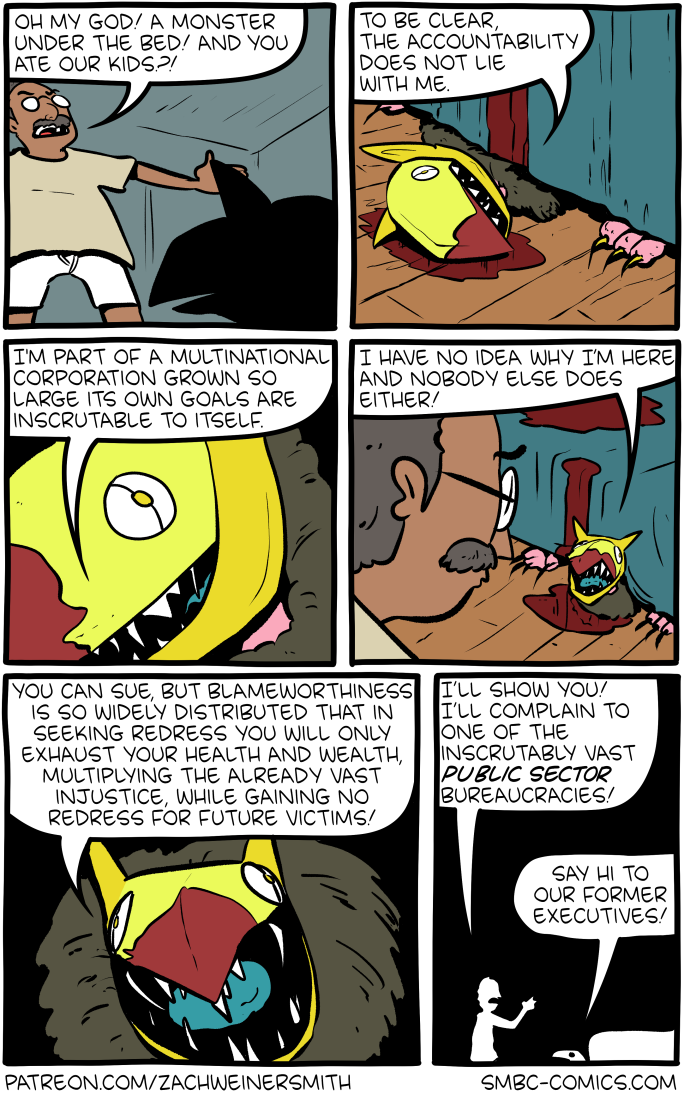
Saturday Morning Breakfast Cereal - Monster

by Zach Weinersmith


Click here to go see the bonus panel!

Hovertext:
There should be a Monsters Inc. episode where they experience a leveraged buyout.


Today's News:
18 Jul 19:46

Democrats are using Trump's playbook and going after Fox News

by Oliver Willis
James.galbraith

Sue the fuck out of them

Congressional Democrats are demanding answers from Fox News after the conservative network edited an interview with President Donald Trump about Jeffrey Epstein, his associate and convicted sex offender.

In a 2024 interview, Fox aired an interview with Trump and Rachel Campos-Duffy in which he appeared to unequivocally say he would declassify files associated with the Epstein investigation, the 9/11 attacks, and the assassination of President John F. Kennedy.

In the version broadcast on “Fox & Friends,” Trump responds, “Yeah. Yeah, I would.” But in the extended version of the comments, Trump equivocated and told the network, “You don’t want to affect people’s lives if it’s phony stuff in there.”

The interview is coming under renewed scrutiny after Trump and his Department of Justice have decided to withhold information on the Epstein investigation despite years of touting the case as something he would expose.

Rep. Robert Garcia of California

“It is obvious to the American public that someone is lying and someone is trying to hide something,” Rep. Robert Garcia, the highest-ranking Democratic member of the House Oversight Committee, said in a statement released on Thursday. “As a network that reaches an estimated 2,663,000 total viewers, Fox News should not be in the business of censoring interviews with presidential candidates to mislead the public. The American people have a right to understand why Fox & Friends chose to alter President Trump’s stated position on the release of the Epstein files.”

In a letter addressed to Lachlan Murdoch (executive chair and CEO of Fox parent Fox Corporation) and Fox News Media CEO Suzanne Scott, Garcia asks the network for access to any communications between Fox and Trump regarding the interview and exchanges about the Trump campaign and Epstein.

Garcia noted in his letter that the Fox News edits are even “more pressing” after Trump sued CBS for airing two clips of an interview with then-Vice President Kamala Harris, falsely insinuating that the edits changed the content of the exchange—while apparently benefitting from edited video from Fox at the same time.

Related | CBS News disgraces itself as parent company bends to Trump

CBS’ parent company Paramount has since paid off a $16 million settlement to Trump to make the frivolous lawsuit go away.

The Epstein issue has been a major concern for Trump, as he has received criticism from MAGA supporters for the administration’s lack of transparency. Trump and congressional Republicans continue to stonewall efforts by Democrats attempting to force full disclosure of the government’s Epstein data, including a purported client list related to Epstein’s sex trafficking.

Fox has long been in Trump’s corner, devoting hundreds of hours of airtime to propping up Trump, the Republican Party, and conservatism. Editing videos to help Republicans and/or smear Democrats has been part of Fox’s operation for its 29 years of existence.

The edits under scrutiny by Garcia are right in line with the network’s past actions.

18 Jul 19:44

CBS cancels Trump critic Colbert's 'Late Show'—and faces sharp blowback

by Oliver Willis
James.galbraith

Paramount is just TrumpTV at this point. Unfortunate.

CBS is being criticized after the network announced on Thursday night that its long-running late-night talk show, “The Late Show with Stephen Colbert,” hosted by the comedian and outspoken Trump critic, would be canceled and go off the air in 2026. The network’s decision comes as President Donald Trump’s administration has been engaged in a sustained attack on independent media and as corporate media like CBS has given in to his demands.

“This is all just going away,” Colbert told his audience on Thursday night, and said he shared his audience’s feelings after they booed the announcement.

CBS claimed in a statement that the cancellation of “The Late Show with Stephen Colbert” was based on finances and “not related in any way to the show's performance, content or other matters happening at Paramount.”

Trump praised the network’s decision.

“I absolutely love that Colbert got fired. His talent was even less than his ratings,” Trump wrote on his Truth Social account.

But as is often the case, Trump is wrong. In the most recent quarter, Colbert was the highest-rated late-night talk show host. Colbert had an average of 2.42 million viewers each night, outpacing the competition at ABC and NBC.

CBS’ announcement comes just three days after Colbert mocked the network’s parent Paramount company for paying out $16 million to settle a frivolous lawsuit from Trump. Paramount is also, coincidentally, in the middle of a merger that the Trump administration will need to sign off on.

“As someone who has always been a proud employee of this network, I’m offended. And I don’t know if anything will ever repair my trust in this company. But just taking a stab at it, I’d say $16 million dollars would help,” Colbert said.

Several Democratic members of Congress called out CBS for the apparent censorship.

“CBS canceled Colbert’s show just THREE DAYS after Colbert called out CBS parent company Paramount for its $16M settlement with Trump – a deal that looks like bribery,” Sen. Elizabeth Warren of Massachusetts wrote. “America deserves to know if his show was canceled for political reasons.”

CBS canceled Colbert’s show just THREE DAYS after Colbert called out CBS parent company Paramount for its $16M settlement with Trump – a deal that looks like bribery. America deserves to know if his show was canceled for political reasons. Watch and share his message.

Elizabeth Warren (@warren.senate.gov) 2025-07-18T00:15:04.991Z

California Sen. Adam Schiff echoed Warren’s sentiments, writing, “If Paramount and CBS ended the Late Show for political reasons, the public deserves to know. And deserves better.”

Washington Rep. Pramila Jayapal noted that Paramount had previously admitted that the Trump suit was “without merit” and said the public needs to know if the Colbert cancellation is “a politically motivated attack on free speech.”

Colbert has been one of the most prominent voices in the entertainment world consistently mocking Trump, the Republican Party, and conservatives. He has hosted progressives and Democratic Party leaders who have used the program to criticize and mock the right.

By eliminating the show, the right gains ground by silencing a dissenting voice.

Trump and his Republican allies in Congress have been systematically working to defund, attack, and purge media that doesn’t toe the party line. At the same time, corporate media has bowed to Trump at outlets like the Washington Post, ABC News, and previously at CBS.

The capitulation continues.

18 Jul 19:44

Cartoon: He's different ...

by Pedro Molina
18 Jul 19:38

Trump admin squanders nearly 800,000 vaccines meant for Africa: Report

by Beth Mole
James.galbraith

There has to be a serious reckoning for the ghouls doing this shit

Nearly 800,000 doses of mpox vaccine pledged to African countries working to stamp out devastating outbreaks are headed for the waste bin because they weren't shipped in time, according to reporting by Politico.

The nearly 800,000 doses were part of a donation promised under the Biden administration, which was meant to deliver more than 1 million doses. Overall, the US, the European Union, and Japan pledged to collectively provide 5 million doses to nearly a dozen African countries. The US has only sent 91,000 doses so far, and only 220,000 currently still have enough shelf life to make it. The rest are expiring within six months, making them ineligible for shipping.

"For a vaccine to be shipped to a country, we need a minimum of six months before expiration to ensure that the vaccine can arrive in good condition and also allow the country to implement the vaccination," Yap Boum, an Africa CDC deputy incident manager, told Politico.

Read full article

Comments

17 Jul 22:18

California Democrats have a new plan to combat GOP in the next election

by Emily Singer
James.galbraith

Small signs of a fight, about fucking time. Stop the unilateral disarmament.

California Democrats say they are looking for ways to extract as many as seven Democratic congressional seats out of the state, Punchbowl News reported, and are currently debating the legal avenues to make that happen.

It’s Democrats' effort to combat Republicans' naked attempt to rig the 2026 midterms.

Related Texas Republicans are trying to rig the map for the next election

“We’re ready,” Rep. Sara Jacobs (D-CA) told Punchbowl. “If Texas goes, we are going.”

President Donald Trump has demanded that Texas and Ohio redraw their congressional maps to make more Republican-leaning seats, offsetting potential losses in other states across the country to ensure Republicans keep their House majority. He fears that if Democrats retake the House, it will both thwart his legislative agenda as well as open him up to investigations of his corrupt and illegal actions.

Texas GOP Gov. Greg Abbott has acquiesced to Trump’s demand, calling a special session of the legislature to get the Republican-led body to redraw Texas’ U.S. House districts. Texas Republicans could try to extract as many as five seats from a new map—though experts say doing so could backfire on the GOP. Distributing Republican voters across more districts would create some marginally Republican seats that could flip in a Democratic wave election.

Texas Gov. Greg Abbott

Ohio is also doing a mid-decade redraw of its egregiously gerrymandered districts, and could wipe out as many as three Democratic lawmakers.

In California, in order to redraw the districts, Democrats would have to find a way to negate the state's independent redistricting commission, which was added to the state constitution in 2010 after voters passed a ballot measure.

Punchbowl reported that Democratic Gov. Gavin Newsom could call a special election for voters to strip the commission from the state constitution—paving the way for a redraw.

"Democrats believe voters would back their proposal if they frame it as the key to thwarting what they see as a congressional power grab by President Donald Trump. Democrats would need to go on the airwaves to message the issue, and this would be extremely expensive. Republicans will try to fight this dramatic redraw of the map, of course," Punchbowl reported, saying that Democrats may sell it to voters by saying that the independent commission would return if states like Texas and Florida pass independent commissions of their own.

If California is successful, it would be a step in the right direction for Democrats, who need to fight fire with fire.

"Any Democrat in the California state legislature in a safe blue district that opposes this should be primaried with the fire of a thousand suns," Democratic pollster Adam Carlson wrote in a post on X. "Oh they’re a [Yes In My Backyard]? Run another YIMBY against them who actually cares about preventing another federal Republican trifecta."

California’s Democratic lawmakers seem to understand that.

“We want our gavels back,” Rep. Mark Takano (D-CA) told Punchbowl. “That’s what this is about.”

17 Jul 22:11

Will AI end cheap flights? Critics attack Delta’s “predatory” AI pricing.

by Ashley Belanger
James.galbraith

No shit. This is hideous

Delta has become the first airline to announce that it is using AI to boost profits by personalizing pricing through a pilot program that for months has caused customers to pay different prices for the same flights based on their data profile.

Critics have warned that this use of AI goes beyond airline practices that charge people who book flights ahead less than people who book flights at the last minute—and could ultimately mean the end of cheap flights across the board if other airlines follow.

On an earnings call last week, Delta Air Lines President Glen William Hauenstein confirmed that seats on about 3 percent of domestic flights were sold using the AI pricing system over the past six months. By the end of the year, Delta's goal is to boost that to 20 percent of tickets.

Read full article

Comments

17 Jul 22:09

Rough road to “energy dominance” after GOP kneecaps wind and solar

by Aidan Hughes, Inside Climate News
James.galbraith

On the plus side, these idiots are just setting the stage for a democratic administration to nuke coal and oil from orbit

As the One Big Beautiful Bill Act squeaked its way through Congress earlier this month, its supporters heralded what they described as a new era for American energy and echoed what has become a familiar phrase among President Donald Trump’s supporters.

“Congress has taken decisive action to advance President Trump’s energy dominance agenda,” said American Petroleum Institute President and CEO Mike Sommers in a statement after the House passed the bill.

Republicans concurred, with legislators ranging from Rep. Mariannette Miller-Meeks of Iowa, chair of the Conservative Climate Caucus, to Energy and Commerce Committee Chairman Rep. Brett Guthrie of Kentucky releasing statements after the bill’s passage championing its role in securing “energy dominance.”

Read full article

Comments

17 Jul 22:08

Large study squashes anti-vaccine talking points about aluminum

by Beth Mole
James.galbraith

If only data actually mattered to these quacks

A sweeping analysis of health data from more than 1.2 million children in Denmark born over a 24-year period found no link between the small amounts of aluminum in vaccines and a wide range of health conditions—including asthma, allergies, eczema, autism, and attention deficit-hyperactivity disorder (ADHD).

The finding, published in the Annals of Internal Medicine, firmly squashes a persistent anti-vaccine talking point that can give vaccine-hesitant parents pause.

Small amounts of aluminum salts have been added to vaccines for decades as adjuvants, that is, components of the vaccine that help drum up protective immune responses against a target germ. Aluminum adjuvants can be found in a variety of vaccines, including those against diphtheria, tetanus, and pertussis, Haemophilus influenzae type b (Hib), and hepatitis A and B.

Read full article

Comments

17 Jul 21:56

Grok’s “MechaHitler” meltdown didn’t stop xAI from winning $200M military deal

by Jon Brodkin
James.galbraith

Not under a Republican administration, surprise

A week after Grok's antisemitic outburst, which included praise of Hitler and a post calling itself "MechaHitler," Elon Musk's xAI has landed a US military contract worth up to $200 million. xAI announced a "Grok for Government" service after getting the contract with the US Department of Defense.

The military's Chief Digital and Artificial Intelligence Office (CDAO) yesterday said that "awards to Anthropic, Google, OpenAI, and xAI—each with a $200M ceiling—will enable the Department to leverage the technology and talent of US frontier AI companies to develop agentic AI workflows across a variety of mission areas." While government grants typically take many months to be finalized, Grok's antisemitic posts didn't cause the Trump administration to change course before announcing the awards.

The US announcement didn't include much detail but said the four grants "to leading US frontier AI companies [will] accelerate Department of Defense (DoD) adoption of advanced AI capabilities to address critical national security challenges." The CDAO has been talking about grants for what it calls frontier AI since at least December 2024, when it said it would establish "partnerships with Frontier AI companies" and had identified "a need to accelerate Generative AI adoption across the DoD enterprise from analysts to warfighters to financial managers."

Read full article

Comments

16 Jul 16:47

Saturday Morning Breakfast Cereal - Prompt

by Zach Weinersmith


Click here to go see the bonus panel!

Hovertext:
Suddenly wondering if someone has already done this.


Today's News:
14 Jul 23:00

Are a Few People Ruining the Internet For the Rest of Us?

by msmash
James.galbraith

obviously yes

A small fraction of hyperactive social media users generates the vast majority of toxic online content, according to research by New York University psychology professor Jay Van Bavel and colleagues Claire Robertson and Kareena del Rosario. The study found that 10% of users produce roughly 97% of political tweets, while just 0.1% of users share 80% of fake news. Twelve accounts known as the "disinformation dozen" created most vaccine misinformation on Facebook during the pandemic, the research found. In experiments, researchers paid participants to unfollow divisive political accounts on X. After one month, participants reported 23% less animosity toward other political groups. Nearly half declined to refollow hostile accounts after the study ended, and those maintaining healthier newsfeeds reported reduced animosity 11 months later. The research describes social media as a "funhouse mirror" that amplifies extreme voices while muting moderate perspectives.

Read more of this story at Slashdot.

14 Jul 22:23

Study finds AI tools made open source software developers 19 percent slower

by Kyle Orland

When it comes to concrete use cases for large language models, AI companies love to point out the ways coders and software developers can use these models to increase their productivity and overall efficiency in creating computer code. However, a new randomized controlled trial has found that experienced open source coders became less efficient at coding-related tasks when they used current AI tools.

For their study, researchers at METR (Model Evaluation and Threat Research) recruited 16 software developers, each with multiple years of experience working on specific open source repositories. The study followed these developers across 246 individual "tasks" involved with maintaining those repos, such as "bug fixes, features, and refactors that would normally be part of their regular work." For half of those tasks, the developers used AI tools like Cursor Pro or Anthropic's Claude; for the others, the programmers were instructed not to use AI assistance. Expected time forecasts for each task (made before the groupings were assigned) were used as a proxy to balance out the overall difficulty of the tasks in each experimental group, and the time needed to fix pull requests based on reviewer feedback was included in the overall assessment.

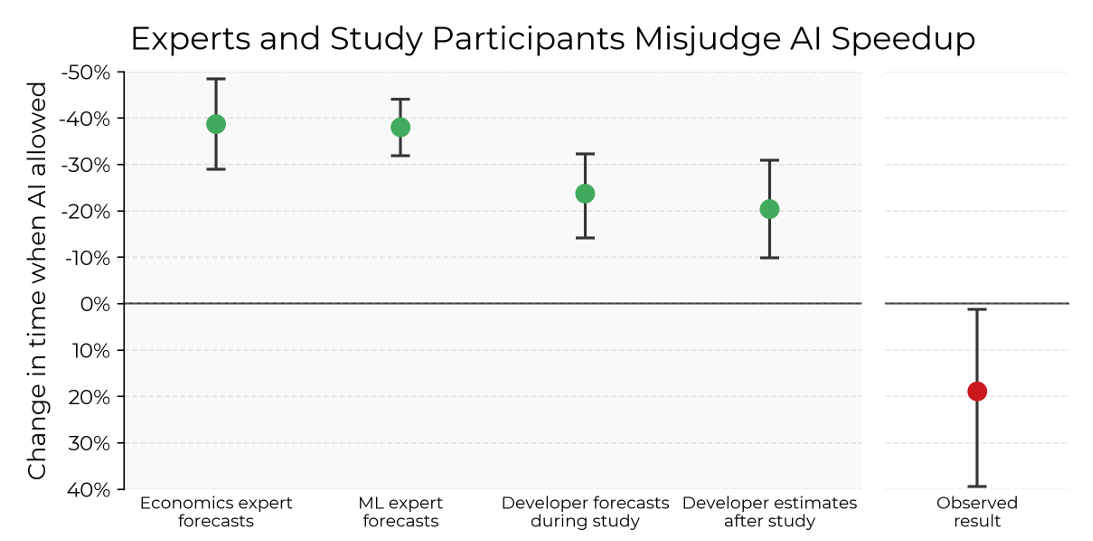
Experts and the developers themselves expected time savings that didn't materialize when AI tools were actually used. Credit: METR

Before performing the study, the developers in question expected the AI tools would lead to a 24 percent reduction in the time needed for their assigned tasks. Even after completing those tasks, the developers believed that the AI tools had made them 20 percent faster, on average. In reality, though, the AI-aided tasks ended up being completed 19 percent slower than those completed without AI tools.

Read full article

Comments

14 Jul 22:22

Kristi Noem is getting roasted for FEMA flop after Texas floods

by Emily Singer
James.galbraith

Well glad to see it landing in conservative spots in TX. This is precisely what they voted for, so they should be glad to die for Noem's vanity.

Democratic lawmakers are demanding Homeland Security Secretary Kristi Noem to explain why the Federal Emergency Management Agency failed to answer thousands of calls from victims of the Texas floods.

The demand comes after Noem claimed that a report from The New York Times—which said that she refused to extend a FEMA call center contract, leading two-thirds of calls to go unanswered—was "fake news."

"It's just false. Those contracts were in place. No employees were off of work, every one of them was answering calls. False reporting, fake news," she said on NBC News’ “Meet the Press” on Sunday.

According to the Times' report, FEMA laid off hundreds of employees at disaster assistance call centers because Noem did not renew their contracts, which needed her personal signature for renewal since she changed DHS policy for any contract over $100,000—a pittance when it comes to disaster relief needs.

According to the report: 

On July 5, as floodwaters were starting to recede, FEMA received 3,027 calls from disaster survivors and answered 3,018, or roughly 99.7 percent, the documents show. Contractors with four call center companies answered the vast majority of the calls.

That evening, however, Ms. Noem did not renew the contracts with the four companies and hundreds of contractors were fired, according to the documents and the person briefed on the matter.

The next day, July 6, FEMA received 2,363 calls and answered 846, or roughly 35.8 percent, according to the documents. And on Monday, July 7, the agency fielded 16,419 calls and answered 2,613, or around 15.9 percent, the documents show.

Democratic Sen. Patty Murray of Washington said that Noem must now provide evidence that she approved these contracts.

"Show us the receipts that you extended those contracts. Turn over documents detailing exactly when you renewed those contracts. There needs to be bipartisan oversight and Congressional hearings over these truly unacceptable failures,” she wrote on X.

The Guadalupe River flows past a makeshift memorial on July 12.

Similarly, three House Oversight Committee Democrats requested that FEMA provide a “detailed and comprehensive list of every contract, grant, or other funding request from DHS and/or FEMA to Secretary Noem related to the July 2025 flooding in Central Texas, including the date the request was made and the date that it was approved or denied by Secretary Noem.”

Ultimately, the failure to renew FEMA disaster assistance call center contracts is Noem’s latest blunder in responding to the Texas floods, which have now claimed at least 130 lives, with more than 160 people still missing.

Noem also failed to approve a contract for urban search and rescue teams, slowing efforts for 72 hours after the floods, according to a report from CNN. Noem also claimed that this was false. 

“Fake news, CNN again. It’s absolutely trash, what they are doing by saying that,” Noem said on Fox News.

But in trying to claim that the report was false, a DHS spokesperson actually admitted that it took 3 days for hundreds of search and rescue staffers to try to recover flood survivors, confirming CNN’s reporting.

And while Noem was twiddling her thumbs over approving FEMA contracts, she herself has been blowing through DHS funding for her own vanity projects, spending hundreds of millions of dollars cosplaying as a law enforcement officer during ICE raids and Coast Guard missions. She has also spent money to pose in front of immigrants detained in El Salvador’s notoriously violent CECOT prison. She also requested a new $50 million private jet to use to travel around and perform more stunts to scare immigrants.

Turns out that President Donald Trump’s appointment of wildly unqualified egomaniacs is now having deadly consequences for Americans.

14 Jul 20:56

iFixit: the Switch 2 Pro is a 'Piss-Poor Excuse For a Controller'

by BeauHD
James.galbraith

Like everything with the Switch 2: overpriced and underengineered.

iFixit has harsh words for Nintendo's $85 Switch 2 Pro controller, calling it a "piss-poor excuse for a controller" due to its difficult repairability, use of outdated drift-prone joysticks, and poor internal accessibility. The Verge reports: Opening the controller requires you to first forcefully remove a faceplate held in place by adhesive tape before a single screw is visible. But you'll need to extract several other parts and components, including the controller's mainboard, before its battery is even accessible. As previously revealed, the Pro 2 is still using older potentiometer-based joysticks that are prone to developing drift over time. They do feature a modular design that will potentially make them easier to swap with third-party Hall effect or TMR replacements, but reassembling the controller after that DIY upgrade will require you to replace all the adhesive tape you destroyed during disassembly. You can watch the full teardown on YouTube.

Read more of this story at Slashdot.

10 Jul 22:50

Cops’ favorite AI tool automatically deletes evidence of when AI was used

by Ashley Belanger

On Thursday, a digital rights group, the Electronic Frontier Foundation, published an expansive investigation into AI-generated police reports that the group alleged are, by design, nearly impossible to audit and could make it easier for cops to lie under oath.

Axon's Draft One debuted last summer at a police department in Colorado, instantly raising questions about the feared negative impacts of AI-written police reports on the criminal justice system. The tool relies on a ChatGPT variant to generate police reports based on body camera audio, which cops are then supposed to edit to correct any mistakes, assess the AI outputs for biases, or add key context.

But the EFF found that the tech "seems designed to stymie any attempts at auditing, transparency, and accountability." Cops don't have to disclose when AI is used in every department, and Draft One does not save drafts or retain a record showing which parts of reports are AI-generated. Departments also don't retain different versions of drafts, making it difficult to assess how one version of an AI report might compare to another to help the public determine if the technology is "junk," the EFF said. That raises the question, the EFF suggested, "Why wouldn't an agency want to maintain a record that can establish the technology’s accuracy?"

Read full article

Comments

10 Jul 17:30

Look just how much red counties depend on the government they hate

by kos
James.galbraith

Time for some real self sufficiency

One of the most enduring conservative myths is that of the self-reliant, salt-of-the-earth, rural-dwelling American who pulls himself up by his bootstraps, wrestles a steer before breakfast, and builds his own house out of patriotism and chewing tobacco because, by god, they sure do love America! 

If that were ever true, it hasn’t been for a while. These days, rural America is largely dependent on the federal government it claims to hate. In fact, far from self-reliant, rural America is subsidized by blue states. And it’s not even close.

The Economic Innovation Group, a bipartisan public policy organization, has put together a map tracking the share of every county’s personal income that’s made up of government transfers, which include Social Security, Medicaid, Medicare, food assistance, and veterans benefits—money specifically sent or spent on individuals. 

I circled some of the country’s largest metropolitan areas to highlight how stark the urban-rural disparity can be. The metros around Boston, Chicago, Dallas, Houston, Los Angeles, New York, Philadelphia, and San Francisco all show minimal (less than 15% of personal income) or moderate (15% to less than 25%) reliance on government transfers. Rural America, meanwhile, is a glowing sea of government-dependent yellow. The South in particular looks like it took a bath in it.

There are reasons for this. Rural regions have a big share of older people, given decades of young people fleeing for big cities. And while there is evidence of that trend reversing since 2020, due largely to the proliferation of remote work, rural areas still tend to be older than large metros. And more older people in a county means a bigger share of that country drawing Social Security and Medicare. And rural areas are more dependent on Medicaid.

Government benefits are a good thing, so none of this is inherently bad, per se.

But it does mean those rural areas are dependent on the very social safety net that Republicans are gleefully hacking apart with their cuts on Medicaid, food assistance, and the like. They’re also poorer than expensive urban regions, so they rely more on federal food assistance to eat. 

But hey, that’s what these voters asked for. Rural areas lean heavily Republican, and farming-dependent counties voted for Trump at an eye-popping average of 78%. Maybe they were just eager to get back to some serious bootstrap-pulling, or maybe they thought the government cheese tasted better if it came with a side of moral superiority and immigrant-blaming. And can anyone actually eat when a handful of trans girls might be playing high school sports? They sure had their priorities! 

And don’t worry, rural Republican voters: Elon Musk, the world’s richest man, gets a tax cut. Which he definitely needed. For reasons. 

10 Jul 17:28

Trump quietly claimed a power even King George wasn’t allowed to have

by Zack Beauchamp
James.galbraith

Yep this is a huge fucking deal

An effigy of Trump during the No Kings rally
Protesters display an effigy of Donald Trump wearing a crown during a rally in Los Angeles on June 14, 2025. | David Pashaee/Middle East Images/AFP via Getty Images

Just before the July Fourth holiday, we learned that President Donald Trump secretly claimed a power so dangerous that even King George was prohibited from using it. 

The claim came in a series of identical letters that Attorney General Pam Bondi sent to 10 leading tech companies on April 5 — each instructing the company to ignore Congress’s law effectively banning TikTok in the United States. The letters, released in response to a Freedom of Information Act request, consist mostly of weakly argued claims about why companies do not have to stop hosting TikTok on their platforms (as the legislation explicitly requires).

But when put together, those claims amount to a frighteningly raw assertion of power: that the president can exempt specific companies from complying with legislation if he believes it interferes with his control over foreign policy.

This is called the “dispensing power.” It was an old prerogative of English kings, one in which they could simply assert that the law doesn’t apply to their friends (a power not limited to foreign affairs). Dispensations were basically proactive pardons, telling someone they can feel free to ignore specific laws and never suffer any consequences.

The dispensation power was so sweeping, and so anti-democratic, that it was abolished by name in the 1689 English Bill of Rights. In 1838, the US Supreme Court ruled that the president does not have dispensing power — a ruling that modern legal scholars across the political spectrum treat as obviously correct.

Bondi’s letters seem to directly contradict this basic principle of constitutional law.

“The effect [of the letter] is to declare an almost unbridled dispensation power when it comes to foreign relations,” says Alan Rozenshtein, a law professor at the University of Minnesota Law School who has been closely following the TikTok case.

The Bondi letters have gotten virtually no attention outside of dedicated legal blogs and podcasts. And yet the implications of Trump claiming a dispensing power — the ability to issue licenses for lawlessness — are stunning.  

How Bondi’s letters claim dispensing power

The Bondi letters are very short — about six paragraphs. They do not directly assert a dispensing power, but instead confusingly mash together multiple different legal claims without spelling out how they fit together into a coherent argument. During our conversation, Rozenshtein asked to be described as “spittle-flecked with rage” at the letters’ technical legal incompetence.

Inasmuch as there is a cogent argument, it appears to be something like this: The president has unilateral power under Article II of the Constitution, which defines the powers of the executive branch, to determine whether legislation would (in Bondi’s words) “interfere with the execution of the President’s constitutional duties to take care of the national security and foreign affairs of the United States.” 

If Trump determines that legislation might “interfere” with his conduct of foreign affairs, Bondi suggests, he can bindingly promise individual corporations or people that the administration will not take any legal action against them for violating its provisions.  

On its surface, this argument seems like a mashup of two relatively normal presidential prerogatives: the ability to assert that a statute contradicts presidential power and the ability to use discretion in enforcing it. But if you look more deeply, it looks less like those normal claims and a lot more like dispensation.

The Supreme Court has indeed held that legislation can unconstitutionally interfere with Article II powers, the most notable recent case (2014’s Zivotofsky v. Kerry) overturning a law requiring that US passports list “Israel” as the birthplace for US citizens born in Jerusalem.

However, this doesn’t mean that all legislative constraints on the president’s foreign policy powers are unconstitutional — far from it. And there is no credible case that the TikTok ban contravenes Article II. In fact, the Supreme Court unanimously upheld the TikTok ban’s constitutionality in January.

Presidents are also widely understood to have discretion in how they enforce the law. There is far more lawbreaking than there are Justice Department attorneys to prosecute offenses; given scarce resources, presidents and attorneys general have to make choices about which crimes to prioritize.

This discretion can give rise to tricky gray area cases. Barack Obama, for example, ordered the Justice Department to stop immigration enforcement actions against undocumented migrants brought to the US as children. There is a robust debate over whether this is a legitimate use of discretion, as the Obama administration argued, or an abuse designed to usurp Congress’s lawmaking power.

But the TikTok case, legal experts say, is very different. There’s no issue of enforcement or limited resources; before Trump issued his exemptions, Apple and Google had already removed TikTok from their US app stores. So this isn’t a decision of non-enforcement, in the sense of redirecting law enforcement resources. 

Rather, it was giving big tech platforms a blank check to ignore a law they had previously complied with — which is, essentially, an assertion that the president has a version of the dispensing power that English kings lost centuries ago.

Just how dangerous are the letters?

To understand how scary these letters are, it’s worth considering an analogy: the pardon power.

The pardon power is eminently, and famously, abusable. Because the president can forgive any federal crime (at least theoretically), he can dangle pardons in front of anyone he wants to break the law — promising them that he’ll make sure they get away with it.

But the pardon power only covers criminal offenses, not violation of the civil code. Jack Goldsmith, a leading expert on presidential power at Harvard Law School, reads Bondi’s letters as claiming the power to proactively forgive civil violations. This would, in effect, allow the president to authorize whole new categories of illegal conduct, provided he can find a sufficient foreign policy-related excuse.

At the moment, it does not appear that this sweeping reasoning is being employed for anything other than giving companies cover to violate the TikTok ban. But as Goldsmith notes, executive power assertions typically function like one-way ratchets: Once used successfully, presidents turn to them again in the future. 

“There is an immense danger in Bondi’s assertion of a dispensing power here—that it might set a precedent for assertions of the same authority in future cases in which the dispensations are far less popular and far more corrupting,” writes Steve Vladeck, a law professor at Georgetown University and author of a newsletter on the Supreme Court.

I have to admit, at this point, that I’d mostly been tuning out the debate over the lawfulness of the TikTok ban. It struck me as yet another in a long string of technical arguments over presidential non-enforcement, one that applied to law that it seems many in Congress regret ever passing. 

But after reading Bondi’s letters, and studying their legal implications, I’ve started to see this as fundamentally different. This case isn’t about TikTok, not really; it’s about Trump being able to make an obviously unconstitutional power grab in secret and get away with it — as he very well may, as Rozenshtein believes the letters’ claims will be hard to challenge in court due to standing issues.

It’s a situation that looks especially dangerous in light of his broader agenda.

“Trump, unlike [previous] presidents, has clearly expressed, in word and deed, his disregard of any limits on his powers to do pretty much anything he wants to do,” writes David Post, a legal scholar at the libertarian Cato Institute. “It gives each individual act of malfeasance — such as ‘nullifying’ a federal statute — a much, much more sinister resonance.”

09 Jul 21:30

Fix This Sign

James.galbraith

This makes my brain hurt

We're building on our earlier success getting web developers to pay to change the backslashes in our displayed payment URL to forward slashes.
09 Jul 18:21

Grok praises Hitler, gives credit to Musk for removing “woke filters”

by Ashley Belanger
James.galbraith

Yeah that third party's going really well

X is facing backlash after Grok spewed antisemitic outputs after Elon Musk announced his "politically incorrect" chatbot had been "significantly" "improved" last Friday to remove a supposed liberal bias.

Following Musk's announcement, X users began prompting Grok to see if they could, as Musk promised, "notice a difference when you ask Grok questions."

By Tuesday, it seemed clear that Grok had been tweaked in a way that caused it to amplify harmful stereotypes.

Read full article

Comments

09 Jul 18:20

RFK Jr. barred registered Democrats from being vaccine advisors, lawsuit says

by Beth Mole
James.galbraith

Piece of shit screwing over an entire country

After US health secretary and hardline anti-vaccine activist Robert F. Kennedy Jr. fired all 17 highly respected vaccine experts from the federal Advisory Committee on Immunization Practices (ACIP) last month, he vetted their replacements, not by medical and scientific expertise, but by their political leanings, according to a lawsuit filed by medical organizations Monday.

Under Kennedy, to qualify to be on the Centers for Disease Control and Prevention's nationally influential and historically apolitical ACIP, candidates had to be registered as a Republican or independent and could not have any history of publicly criticizing President Trump or Kennedy, the lawsuit claims.

Just two days after dismissing all 17 ACIP members—who had all gone through an extensive vetting process that lasted up to two years—Kennedy announced eight new members. One later dropped out during last-minute financial vetting the day before an ACIP meeting. Of the remaining seven, only one has the scientific and medical qualifications described under ACIP's charter.

Read full article

Comments

08 Jul 22:37

This rural county hoped to reopen its hospital. Voting for Trump killed it

by kos
James.galbraith

Yep time to stop the rural subsidies.

Martin County, nestled in northeast North Carolina, had 24,500 residents in 2010. By 2020, that number had dropped to 22,000. Like much of rural America, its population is steadily declining.

Politically, it’s followed a familiar trajectory. President Barack Obama carried the county twice by 5 points. In 2016, President Donald Trump edged out Hillary Clinton, 49.2% to 48.8%. And by 2020, Trump’s margin grew to 52% to President Joe Biden’s 47%. Last year, he won it by 55% to Vice President Kamala Harris’ 45%.

Now the county faces a very different kind of loss: its only hospital shut down in August 2023 due to financial strain, making the nearest emergency room 22 miles away—a 30-minute drive that, for some, is fatal. It’s even farther for more advanced medical services.

There were plans to reopen the hospital, but then Trump’s proposed cuts to Medicaid—framed as a crackdown on “fraud and waste”—shattered that possibility.

According to The New York Times, the impacts are felt acutely by Martin County residents, more than a quarter of whom are older than 65. The nearest hospital is in Greenville 40 minutes away.

Verna Marie Perry, 66, a former worker in the county’s adult and aging services department, told the Times that she now fields calls from friends in medical crises. 

“Neighbors have called me crying moments after someone close to them died while being transported to the nearest hospital,” she said.

Related | Republicans voted to kill ‘woke'—only to hurt their own communities

It’s a tragic reality made worse by the fact that some residents still can’t—or won’t—see the connection between their vote and the disaster now unfolding.

Cathy Price, 72, a lifelong Williamston resident and former nurse at the shuttered Martin General, told the Times that while she still backs Trump’s efforts to trim Medicaid, “we’re in a life-and-death crisis. People’s lives are on the line because of the hospital not being here.”

There it is: She voted to hurt other people, not herself. And even now, she clings to the fantasy that all of that “fraud and waste” must be happening somewhere else. 

But the harsh reality is that there’s nothing remotely efficient about a hospital serving just 22,000 people. Rural hospitals aren’t profitable. They can only exist because of subsidies from urban areas—in effect, from liberals.

And for years, that was the deal: Blue America paid the bills so red America could have hospitals, schools, broadband, and clean water. In return, rural voters have voted to burn the country down. 

Okay, then. 

I feel for the 45% of Martin County voters who backed Harris. They tried to do what was best for their country and their county. As for Price and her fellow Trump voters?

I hope that they get exactly what they voted for.

Trump’s DOJ is targeting Daily Kos. That’s all we can say for now other than: We need your support! Can you donate $5 today to the legal fund?