Japanese researchers have tested whether or not cats recognize their owners' voices. The good news: they can. The bad news: they're probably going to ignore it.

    
|
Japanese researchers have tested whether or not cats recognize their owners' voices. The good news: they can. The bad news: they're probably going to ignore it.
|
|
(No, not unicorns.)
H. P. Lovecraft was born in August 1890 and died in March 1937. (And I have just experienced a queasy moment of realization: that I am now older than he was when he died.) He's remembered to this day mostly as an author of disturbing and fantastic fiction, and as the spark that ignited an entire sub-genre of horror, in which many other authors work (myself included).
But what exactly was it that fuelled his deep sense of paranoia and dread at the scale of the cosmos, and made his work so memorable?
I have a hypothesis.
We know that Lovecraft was fascinated by astronomy as a boy; and the formative years for this interest would have been approximately 1895-1910.
A trip to the McCormick Museum at the University of Virginia's online history of photographic astronomy may shed some light on Lovecraft's view of the cosmos. Prior to the development of photographic processes, astronomy was limited to what the human eye could see, with or without magnification. But from the 1840s onwards astronomers began to experiment with Daguerreotypes and later with improved photographic processes. By use of long exposure times, and telescopes on mobile platforms that kept the instruments aimed at the same point in the heavens despite the Earth's rotation, it was possible to gather far more photons than a merely human eye could sense, over a longer period of time, from fainter objects. During the 1880s the use of silver bromide emulsions revolutionized the field of photographic astronomy, and permitted the first photographic sky surveys.
(Incidentally, there's a lot more on the history of photographic astronomy and astronometry here—it's well worth a browse.)
Prior to the 1890s, our conception of the universe was very different from the cosmology we are familiar with today.
We measure the Apparent magnitude of an object to classify stars by how bright they appear to the naked eye, using a system dating to antiquity but formalized in the 1850s. (The higher the number, the fainter the object: anything with an apparent magnitude higher than roughly 6.5 is not visible to the naked eye.) There are roughly 5000 stars in the skies that are visible with the naked eye, and a scant double-handful of visible galaxies. Individual stars in other galaxies are not visible to the naked eye, and so these objects were commonly known as "spiral nebulae", to distinguish them from other non-stellar objects (which today are known to be gas and dust clouds). When we add telescopic assistance, many more stars are visible: there are about a third of a million above apparent magnitude 10.0.
So the universe into which H. P. Lovecraft was born consisted of the Milky Way, containing perhaps a million stars, and some irritating unidentifiable nebulous things.
But there's more! Remember that in 1890 we didn't know how the sun generated heat and light, or how old it was. Perhaps the best-remembered theory of the time was Lord Kelvin's paper from 1862: "the sun is now an incandescent liquid mass, radiating away heat, either primitively created in his substance, or, what seems far more probable, generated by the falling in of meteors in past times, with no sensible compensation by a continuance of meteoric action." Working backwards from this assumption, Lord Kelvin derived an estimate of the maximum age of the sun:
We may, therefore, accept, as a lowest estimate for the sun's initial heat, 10,000,000 times a year's supply at the present rate, but 50,000,000 or 100,000,000 as possible, in consequence of the sun's greater density in his central parts.Remember, if you will, that the discovery of radioactivity did not take place until 1896. Lord Kelvin's speculation was based on the rigorously understood physics of the Newtonian era; working with the best information available, he placed the age of the sun at most likely less than 100 million years (and definitely less than 500 million).The considerations adduced above, in this paper, regarding the sun's possible specific heat, rate of cooling, and superficial temperature, render it probable that he must have been very sensibly warmer one million years ago than now; and, consequently, if he has existed as a luminary for ten or twenty million years, he must have radiated away considerably more than the corresponding number of times the present yearly amount of loss.
It seems, therefore, on the whole most probable that the sun has not illuminated the earth for 100,000,000 years, and almost certain that he has not done so for 500,000,000 years. As for the future, we may say, with equal certainty, that inhabitants of the earth can not continue to enjoy the light and heat essential to their life for many million years longer unless sources now unknown to us are prepared in the great storehouse of creation.
So: the universe H. P. Lovecraft was born into consisted of a single galaxy containing about a million stars, and our own star was less than 100 million years old.
The universe Lovecraft died in was very different.
The first attempts at using parallax to determine the distance of stars and other astronomical objects from photographs took place in the 1890s. Instruments for comparing photographic plates taken at different times during the Earth's orbit around the sun were developed over the next couple of decades, and studies soon expanded from measurements of distance to proper motion and spectral analysis. At the same time, larger and larger mirrors were becoming available for reflector telescopes, aiding the observation of increasingly distant (and faint) objects. During the second decade of the 20th century, Edwin Hubble pushed back the distance scale of the observable universe to a dizzying extent. By studying Cepheid variables, a type of star characterised by its highly predictable variable luminosity (making them a useful standard candle), and comparing the brightness of Cepheid variables visible in "spiral nebulae" to nearer Cepheids whose distance could be calculated by parallax observation, Hubble was able to prove that the spiral nebulae were located far outside the milky way. Next, during the 1920s, Hubble used spectroscopic observation and distance estimates based on Cepheid variables to establish that more distant galaxies were receding faster, determining the Hubble constant—the rate at which the observable universe is expanding.
Finally, during the early decades of the 20th century it became obvious that the sun's radiation was powered not by gravitational collapse but by some other nuclear-related energy source. The precise mechanism was not determined until the 1940s, but in 1920 Arthur Eddington proposed that the fusion of hydrogen nuclei into helium was a likely candidate; subsequently the detailed theory of stellar nucleosynthesis emerged to support this hypothesis.
Today, in 2013, we live in the Milky Way galaxy; it is believed to contain between 100 billion and 500 billion stars. The Milky Way is part of a local group of over fifty galaxies, but the observable universe is believed to contain 100-200 billion galaxies (and possibly a lot more). Finally, detailed observations have determined that our universe is 13.8 billion years old.
At the time of Lovecraft's death in 1937, the universe was considerably smaller—but it was still vastly larger than it had been at the time of his birth; with over a hundred million stars in our own galaxy, and many tens or hundreds of millions of other galaxies estimated, and the upper limit on the sun's age raised to five billion years, the universe had expanded by two orders of magnitude in age and nine orders of magnitude in size (as measured by the number of stars) during Lovecraft's life. That's eleven orders of magnitude in just over four decades.
Let's look for a modern metaphor:
The cosmos expanded during Lovecraft's life at a rate comparable to the rate of expansion of available data storage during my life. I was born in late 1964. In 1973, the total manufactured fixed disk storage capacity in the United States was on the order of 100Gb. 40 years later, it's really hard to buy hard disks that small; hard disk storage currently costs on the order of 4 cents per gigabyte, giving our 1973 USA's installed hard disk capacity a value of around $5.
I am going to take it as so glaringly obvious that our computers' power has grown exponentially since 1973 that I'm not going to bother with figures, other than to note that my mobile phone in 2013 has over a thousand times the processing power, storage/memory bandwidth, and storage capacity of a Cray-1 supercomputer from 1976 (price: $8.86 million, in 1976 dollars—$36.46M in today's money.
Forty years of Moore's law and its cousins have given us an inflating, exponentiating bubble in computing power that compares eerily to the forty year marathon of cosmological discoveries that informed Lovecraft's later weltanshauung, as expressed through fictions such as "At the Mountains of Madness" (1931), "The Color out of Space" (1927) and "The Whisperer in Darkness" (1931).
I believe that Lovecraft's sense of cosmological dread emerged from the exponential expansion and recomplication of the universe he lived in—it eerily prefigures the appeal of today's singularitarian fiction, which depends for its dizzying affect on a similar exponential growth curve. Lovecraft interpreted the expansion of his universe as a thing of horror, a changing cosmic scale factor that ground humanity down into insignificance. Not all writers from his period took this approach; to many, the expanded universe was a playground of joyous imagination. Today, singularitarian fiction is frequently aspirational, a literature of transcendence (with theological taproots linking it to the early Russian cosmists). But the inversion of a sense of wonder is a sense of dread. Which leaves me asking, where is the singularitarian Lovecraft?

My proposal to legalize marijuana in Maryland comes from these values. Maryland had the third most marijuana possession arrests proportionally of all states-- over 23,000. It’s easy to see that this system is not working. By legalizing marijuana we will save tens of thousands of people from unnecessary run-ins with law enforcement, imprisonment, or worse.
Marijuana's time as an illegal substance has run its course. Marijuana laws ruin lives, are enforced with racial bias, and distract law enforcement from serious and violent crimes. Our criminal justice system should keep people safe, treat them fairly, and use limited fiscal resources wisely. Legalizing marijuana is the first step to ensuring that happens.
Marijuana criminalization costs our state $281.7 million every year without making us any safer. A Maryland with legalized, regulated, and taxed marijuana will mean safer communities and fewer citizens unnecessarily exposed to our criminal justice system.
It will also provide Maryland with a dedicated revenue stream to make overdue and critical investments in early childhood education. The new annual revenue will provide 23,625 children with a full day of prekindergarten. Our plan will help ensure that prekindergarten is available to all children in our state.
This campaign is not just about me-- it’s about what we can do when we all come together. The election won’t be won by special interests, lobbyists, or backroom deals in Annapolis. It comes down to which candidate’s vision creates a large enough movement of people to win on Election Day and then lift our communities up when we govern.You'll find comprehensive plans for all of her proposals on her website.

Each year around mid-August, publicists start burying everyone in the food journalizing racket with ideas for Thanksgiving coverage. Most of their emails concern ways in which a client, usually a lesser television chef or an agricultural marketing board, can enhance your stuffing with this or that upscale mushroom or obscure nutmeat. Over in our soggy corner of the booze-writing ghetto, the pitches tend to feature recipes for gibletinis and butternut squasharitas or threats of cinnamon-sage vodkas and gravy liqueurs.

|
|
Beatles collector and artist Rutherford Chang collects first pressings of The White Album. For a show at NYC's Recess Gallery called We Buy White Albums, Rutherford produced a special vinyl pressing that overlays 100 different copies of the White Album playing simultaneously.

The disc is available at this weekend's WFMU record fair -- it's a rather beautiful piece, decorated with scans of the doodles and wear-marks Chang found on the White Albums in his collection (he owns 902 copies of the album). You can listen to Side 1 x 100 online. It's a rather disturbing and noisy experience, but there's no denying that it's also rather wonderful.
There's no word on whether EMI licensed the music to Chang for his project -- it feels like a fair use to me, but this is the company that went after the Grey Album and the Beastles, so we know what they think of fair use.
(via Kottke) 
|
|

For Baby Boomers, today marks the 50th anniversary of the assassination of John F. Kennedy. But for those of us who don't belong to the generation that ruined America, Nov. 22 holds an even dearer place in our memories. Today is Buttfumble Day.

|
|

We've already shown you some minimalist approaches to NHL logos, stadiums, and professional baseball teams, but Andrew Janik of LessonsInSport.tumblr.com has taken this little design challenge a step further, trying to distill the essence of individual athletes (and coaches/owners) in as few strokes as possible. We've included five of his designs, can you figure out who each one represents?

|
|
Refe Tuma and his wife have a very special set of pranks that they pull on their daughters every November - DINOSAUR PRANKS. In a move they call "Dinovember," their daughters' plastic toys "come to life" every night and wreak havoc on the Tume household. As Refe puts it, " In a time when the answers to all the world's questions are a web-search away, we want our kids to experience a little mystery. All it takes is some time and energy, creativity, and a few plastic dinosaurs."
Makes you feel good, doesn't it?
Check out more pictures from the ongoing project here!
Submitted by: Unknown (via Medium)
Louis C.K. recites the Gettysburg Address with (not so much) grace, and he talks with Jerry Seinfeld about its history and meaning in true Louie style.
Submitted by: Unknown (via Ken Burns)
 Laurel sends us "Holdfast Magazine, a new free online speculative fiction magazine that I co-edit.Each issue revolves around a central theme, examining genre fiction through focussed articles, fiction and reviews. Linked to this is each issue's interview with a featured author, whose writing connects to the issue's topic. Regular features include The Unbelievers, in which our two heroic editors attempt to convert self-confessed fantasy haters, a themed playlist that gives readers a suitable atmosphere in which to browse, and A Letter To... tells an author how influential and inspiring they are. Issue#1 is out now, Speculating about Speculative Women."
Read speculative fiction, poetry, interviews, articles, reviews and other oddments all whilst listening to our fantasy playlist. Take part in co-authoring a story with featured author Emma Newman in our Story Chain. Discover what's making Emma Newman angry, read Eva Kerslake-Blue's short story Mirror, Mirror (and then read her bio!), peruse new books written and inhabited by speculative women on our Bookshelf, and find out about the underrepresentation of Black women in science fiction.
One of the reasons we would appreciate the exposure is so that we can seriously pursue sponsorship and advertising. At the moment, we are operating on an annual, future based earning cooperative in which all contributors get an equal share of what we have managed to raise per year.
HOME issue1 - holdfast magazine 
|
|
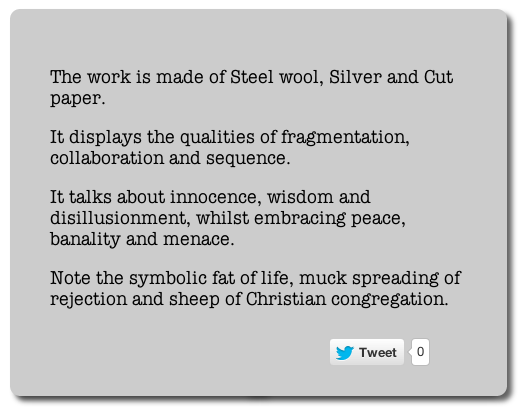
Shardcore writes, "The Tate recently released a 'big data' set of the 70k artworks in their collection. I've been playing with it and finding all sorts of fun to be had. The latest experiment uses the Tate data as a springboard to algorithmically imagine new artworks - 88,577,208,667,721,179,117,706,090,119,168 to be precise."
(that's eighty-eight nonillion, five hundred seventy-seven octillion, two hundred eight septillion, six hundred sixty-seven sextillion, seven hundred twenty-one quintillion, one hundred seventy-nine quadrillion, one hundred seventeen trillion, seven hundred six billion, ninety million, one hundred nineteen thousand, one hundred sixty-eight possible artworks...)We can imagine machines which spot the items within a representational work (look at Google Goggles, for example) but algorithms which spot the ‘emotions and human qualities’ of an artwork are more difficult to comprehend. These categories capture complex, uniquely human judgements which occupy a space which we hold outside of simple visual perception. In fact I think I’d find a machine which could accurately classify an artwork in this way a little sinister…
The relationships between these categories and the works are metaphorical in nature, allusions to whole classes of human experience that cannot be derived from simply ‘looking at’ the artwork. The exciting part of the Tate data is really the ‘humanity’ it contains, something absolutely essential when we’re talking about art – after all, culture cannot exist without culturally informed entities experiencing it.
It struck me that these are not only representations of existing artworks, but actually the vocabulary and structure required to describe new, as yet un-made, artworks.
Machine Imagined Artworks (2013) (Thanks, Shardcore!) 
|
|
Zackc43He's had the same haircut for 44 years.

This wonderful artifact surfaced on Imgur earlier today, and it will be enjoyed by people all over the world for years to come. If Duke haters have any sense at all, they will start referring to Coach K as "Mick Krizilonski" from here on out.

|
|
Zackc43Memorial Stadium was on 33rd Street, near City College. Camden Yards is just a few blocks from the intersection of Baltimore and Charles, the center of the city's grid (such as it is).

Earlier today, the Braves announced that they'll be leaving Turner Field in favor of a new stadium in Cobb County, north of Atlanta. The move caught people off guard in part because of Turner Field's age—just 16 years old!—but also because it represents an enormous shift toward suburban baseball on a scale not seen in decades.

|
|
Zackc43The second worse poetry written by an ACC alumnus.
We received this from reader Jake, as part of our call for responses you've received from writing to athletes. (Keep sending those in, by the way.) It doesn't quite fit, so I still wanted to share it with you.

|
|

"Looking for some of those mini doughnuts."
 Twitter's IPO prospectus provided a handy basis for measuring the value that each Twitter user has contributed to the company's valuation. Now Time has produced a handy calculator that tells you how much Twitter "owes" you based on the value you created for it (importantly, this calculator does not tell you how much you owe Twitter for the value it created for you). It's crack-like fun. (via Sean Bonner)
|
|

We’ve previously featured the amazing work of Sanna Dullaway, but along with her there has been an increasingly popular trend over the past few years to create and share colourized photos from history with artists such as Jordan Lloyd, and Dana Keller all transforming old black-and-white photos into vividly colourful images that look as if they had been taken today.
Above: Little Rock, Arizona, protest against the integration of 9 black students into a white school, 1959. (WTF Race Mixing is Communism???) Click image to enlarge.
More images below.

Unemployed Lumber Worker and His Wife, 1939.

London, 1945.

Hindenburg Disaster, 1937.

Japanese Archers, 1860.

Audrey Hepburn.

Albert Einstein in Long Island, 1939.

Nazi Minister of Propaganda Joseph Goebbels scowls at a Jewish photographer, 1933.

Baltimore Slums, 1938.

British Troops Board Their Train for the Front, 1939.

Walt Whitman, 1887.

Mark Twain, circa 1900.

Charlie Chaplin, 1916.

Elizabeth Taylor, 1956.

Old Gold Country store, 1939.

Washington D. C., 1921.

Louisville, Kentucky, 1937.

Big Jay McNeely, Olympic Auditorium, 1953.

Nicola Tesla.

Thich Quang Duc’s self-immolation, 1963.

Broadway in Saratoga Springs, New York, 1915. Click image to enlarge.
pic and info: 22 Words
Paul Graham Raven's "Introduction to infrastructure fiction" is a great, 20 minute explanation of why infrastructure should matter to artists and why art should matter to civil engineers. The invisible ubiquity and vital importance of infrastructure means that it's something we should be talking about, and that we're not talking about.
An introduction to infrastructure fiction — Improving Reality 2013The Someone Else’s Problem Field around infrastructure is, ironically enough, a measure of its ubiquity and success. You don’t think about it because you don’t need to; it just works, and when it doesn’t, there’s a phone number you can not bother calling, because they’ll only put you on hold anyway, and by the time you get through it’ll probably have fixed itself, so why bother? You pay for these things to work, and – most of the time – they do. You pay for them to be Someone Else’s Problem.
Being reminded of infrastructure is rarely pleasant. It’s no fun to turn your tap and have nothing come out. It’s a different sort of not-fun when you discover that a wind-farm, town bypass or high-speed train line is scheduled to materialise near your house, or when protestors camp out on your driveway to fight a fracking company. Infrastructure is meant to make life easier, not harder. The better it gets at the former, the more painful are the moments when it does the latter.
The golden age of British infrastructure was surely the Victorian era, thanks to a combination of ambition, new technological developments, and an exploitable underclass workforce. In those days, infrastructure primarily benefitted the middle and upper classes; if you were working class, you were likely one of infrastructure’s many unsung human components, and new infrastructure was far more likely to spoil your immediate environment than improve it. To the middle classes, though, infrastructure – especially the railways – was progress incarnate, a living force in the world. Victorian painting and literature is full of infrastructure, sometimes as hero, sometimes as villain, depending on the target audience: majestic bridges in oil on canvas for the gallery-goer, train-wreck penny dreadfuls for the proles. It was all new, and people wondered what it meant.

|
|
Remember SEK’s NEIGHBOR? The one who thought SEK belonged to a gang because of his backward hat? Well, this morning SEK decided it was about time to start watching The Sopranos, and so when he was driving home from the grocery store and saw his NEIGHBOR, SEK thought it’d be a great idea to slow his car to a crawl and give NEIGHBOR a good eye-fucking. The fake neighborhood “police” started driving around until, finally, MR. POLICEMAN — with NEIGHBOR in tow — knocked on SEK’s door.
MR. POLICEMAN: Have you been threatening this man?
SEK: What? No.
MR. POLICEMAN: Is that your car?
SEK: Yes.
MR. POLICEMAN: He says a man in a hat was threatening him this morning.
SEK: (points to hair) I’m not wearing a hat.
NEIGHBOR: It’s you! You have a hat!
SEK: I’m sure I do somewhere. What’s this about, officer?
MR. POLICEMAN: Have you been speeding recently?
SEK: I’ve been in Houston, my sister just had a baby. Wanna see a picture?
NEIGHBOR: He has a hat!
MR. POLICEMAN: So you haven’t been speeding?
SEK: I haven’t even been here.
NEIGHBOR: Ask him about his hat?
SEK: Do you need a hat, sir?
NEIGHBOR: I want to see your hat!
SEK: Officer, should I get him a hat?
MR. POLICEMAN: I don’t think that’ll be necessary. Sorry to have bothered you, sir.
NEIGHBOR looks at SEK. SEK waits until the officer turns around, then eye-fucks NEIGHBOR again.
NEIGHBOR: ASK HIM ABOUT HIS HAT!
MR. POLICEMAN: (to NEIGHBOR) We’re done here.
NOT REALLY AN UPDATE: For the record, what I thought was going to happen turned out to be funnier. What’s the point of living life as if it were performance art if it refuses to perform? Sigh:
The fake neighborhood “police” just drove by, and I can’t help but wonder what they’re looking for: “Suspect is an off-white late-model academic, so use extreme caution, he may have an ethnicity. Repeat: he may have an ethnicity.”
(And after they bust in and shoot me, they’ll be all like, “It’s terrible, sir, it’s terrible. The books! THEY”RE EVERYWHERE. On the floor, there’re little ones on the table, looks like he broke their spines. OH THE HUMANITIES!”)
ACTUAL UPDATE:

That is, however, only the second-best hat picture I’ve seen recently:


|
|
Jesse Jackson on Sesame Street, 1971.
I especially like the line affirming those on welfare. Which I wish was still a relatively robust program, hey thanks Bill Clinton for making political points on the backs of the poor.

|
|
Scientists have recently uncovered an unknown species of platypus that lived 5 to 15 million years ago and is roughly three feet in length, making it nearly three times the size of the one known living species of platypus currently living in Australia. What struck scientists as odd was a single, particularly large tooth which suggested a rather different predatory diet than that of the platypus we know today.
This discovery suggests to experts that the evolution of the egg-laying mammal is quite a bit more complicated than previously thought.
Submitted by: Unknown (via National Geographic)
Zackc43If his tie was a person, it'd be graduating from high school this year.

Toronto mayor Rob Ford, who admitted earlier today that he smokes crack cocaine, just wrapped up a press conference at which he said some stuff about his political future. But we couldn't help but notice the garish novelty tie he was wearing, which has NFL team logos all over it. Now look more closely. Those are not current NFL logos, or anything close to current NFL logos.

|
|






!['Will [ ] allow us to better understand each other and thus make war undesirable?' is one that pops up whenever we invent a new communication medium.](http://imgs.xkcd.com/comics/simple_answers.png "'Will [ ] allow us to better understand each other and thus make war undesirable?' is one that pops up whenever we invent a new communication medium.")