Sabes que ha sido una buena siesta si el que te despierta es HAL 9000 para echar una partidita de ajedrez.
– El Largo
Sabes que ha sido una buena siesta si el que te despierta es HAL 9000 para echar una partidita de ajedrez.
– El Largo
On Aug. 17, the U.S. Navy successfully tested its X-47B UCAS (Unmmaned Combat Air System) alongside an F/A-18F Hornet in a flight deck working environment.
The unmanned aircraft (destined to become USN’s first “killer drone”) completed a series of tests, which included a catapult launch and arrested landing, which demonstrated its ability to operate safely and seamlessly with manned aircraft.
After hitting some important milestones operating as a singleton, the next step was to occupy the carrier pattern with the manned aircraft in order to test whether the UCAS is able to land and vacate the landing area within the time lines that are required for blue water ops aboard a U.S. flattop.
According to the U.S. Navy:
“The first series of manned/unmanned operations began this morning [Aug. 17] when the ship launched an F/A-18 and an X-47B. After an eight-minute flight, the X-47B executed an arrested landing, folded its wings and taxied out of the landing area. The deck-based operator used newly developed deck handling control to manually move the aircraft out of the way of other aircraft, allowing the F/A-18 to touch down close behind the X-47B’s recovery.
This cooperative launch and recovery sequence will be repeated multiple times over the course of the planned test periods. The X-47B performed multiple arrested landings, catapults, flight deck taxiing and deck refueling operations.”
Future plans include nighttime taxiing and flying.
Image and Video credit: U.S. Navy
 [Video] U.S. Navy launches its killer drone off the deck of an aircraft carrier. A new era has begun.
 X-47B UCAS (Navy’s killer drone) lands aboard aircraft carrier: machine does what first pilot did 102 years ago
 Video of Unmanned Combat Air System X-47B Taxi at Sea shows the future of naval aviation
 U.S. Navy catapults X-47B combat drone for the first time
 Video: U.S. Navy initial flight (and heavy landing) of the X-47B Unmanned Combat Air System Demonstrator.
 Hand Signals: the next step to controlling UAVs on aircraft carriers
 Awesome GoPro video gives flight deck inspector’s view of F/A-18 final check and cat launch
Muchos de nosotros conocemos los escuadrones SAR del Ejército del Aire y sus tareas de búsqueda y salvamento de aeronaves caídas en todo el territorio español. Pero hay otro organismo civil que depende únicamente del Ministerio de Fomento y que lo forman grandísimas personas cuyo trabajo es, tal y como ellos dicen, sacar de un apuro a la gente. Y es que Salvamento Marítimo, o SASEMAR, tiene como misión el rescate y auxilio de las personas en peligro a lo largo de toda la costa española, así como sus aguas. Tanto es así que ayer mismo salvaron a centenares de personas de un final incierto en el estrecho de Gibraltar.

El S61N que irá dejando el servicio en LECO – © Jose Luis Maquieira
Para ello, cuentan con una gran flota de embarcaciones de distinto tamaño para desempeñar todo tipo de tareas en alta mar con grandes buques hasta el rescate de pequeñas balsas. También cuentan con 3 aviones CN235 (Sasemar 101, 102 y 103) y una flota de helicópteros con 8 AW139, tres S-61 en fase de baja y un nuevo EC225 para suplir la primera baja del S61 de la base de Alvedro.
El S61N que está basado en Alvedro, A Coruña, es propiedad de Inaer y tiene más de 40 años de servicio a sus espaldas. Es por ello que se consideró el cambio a una nueva plataforma mucho más moderna, potente y capaz de asumir la gran cantidad de tráfico marítimo e inclemencias meteorológicas de la Costa Da Morte. El primero de los EC225 del SASEMAR llegó a Alvedro el pasado jueves 7 de agosto en su vuelo ferry desde Albacete, donde EADS lo entregó a Fomento. Su puesta en servicio está planeada para que sea gradual, junto a un entrenamiento intensivo de las tripulaciones. Mientras, el EC-FTB no será retirado del servicio y se posicionará donde más haga falta como medida de soporte eventual a Alvedro u otras bases.

El nuevo EC225 con matrícula provisiona EC-004 – © Jose Luis Maquieira
Y es que a veces no se les da el suficiente reconocimiento por el hecho de ser un cuerpo civil, y por ello quería mostraros este precioso vídeo documental de apenas 9 minutos de los cuales no hay ninguno que no merezca la pena. Cada frase de la tripulación tiene detrás mucho sentimiento y muchas vivencias, y la verdad es que emociona ver a esta gente tan comprometida con su deber.
Leave A Commentposted in aviación general by ÁngelNo hay entradas relacionadas
The Royal Air Force deployed six Typhoon FGR4s and a team consisting 13 pilots from 11 Squadron and 3(F) Squadron from RAF Coningsby, to Konya airbase, in Central Turkey, to take part in Anatolian Eagle 2014-2.
The 1,000 miles trip to Turkey gave the British Typhoons the opportunity to train jointly with the Turkish Air Force and international partners inside a large, segregated airspace measuring 200 x 150 Nautical Miles, most of which is available from ground to 50,000 feet – the ideal stage for simulated contingency operations.
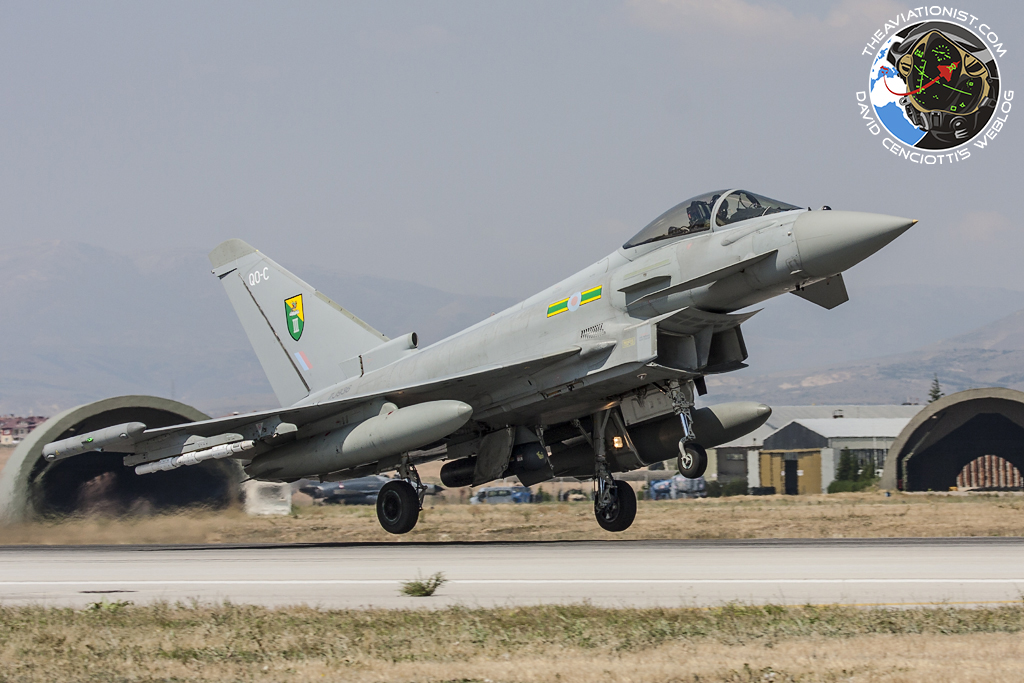
RAF Typhoons flew swing-role missions, leveraging on the multi-role capabilities of the aircraft: carrying underwing RAIDS (Rangeless Airborne Instrumentation Debriefing System) pods to gather and transmit to ground station relevant flight data, the “Tiffies” flew high and fast to provide cover to the rest of the strike package during the ingress into the enemy airspace, dropped their simulated Precision Guided Munitions (PGMs) on targets designated with the centerline Litening III targeting pod, and escorted the package again during the egress and subsequent return to Konya.
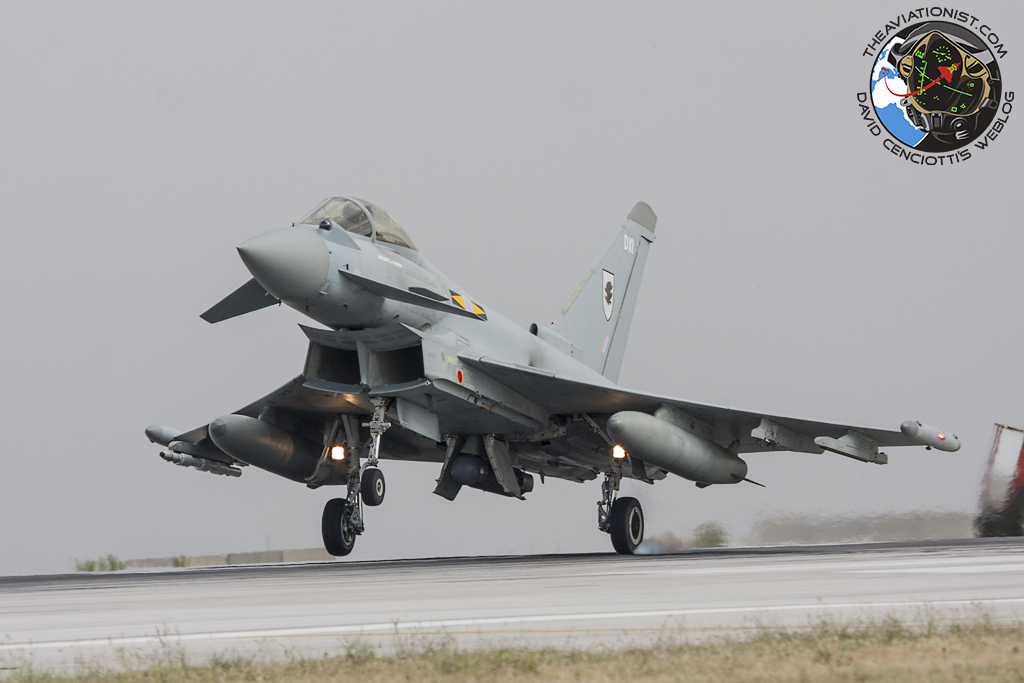
Talking to the Royal Air Force website, newly appointed Typhoon Force Commander, Air Commodore Philip Beach, said: “The Typhoon Force is very much in demand, providing Quick Reaction Alert in the UK, the Falklands and in the Baltic region; it is on call 24/7 every day of the year. Typhoon is also a fundamental component of UK contingent operations and it is vital that we train with our NATO and international partners, in complex scenarios, to retain our competitive edge. This exercise provides the opportunity for us to further enhance interoperability with our allies and ensures that we maintain the highest levels of readiness for operations.”

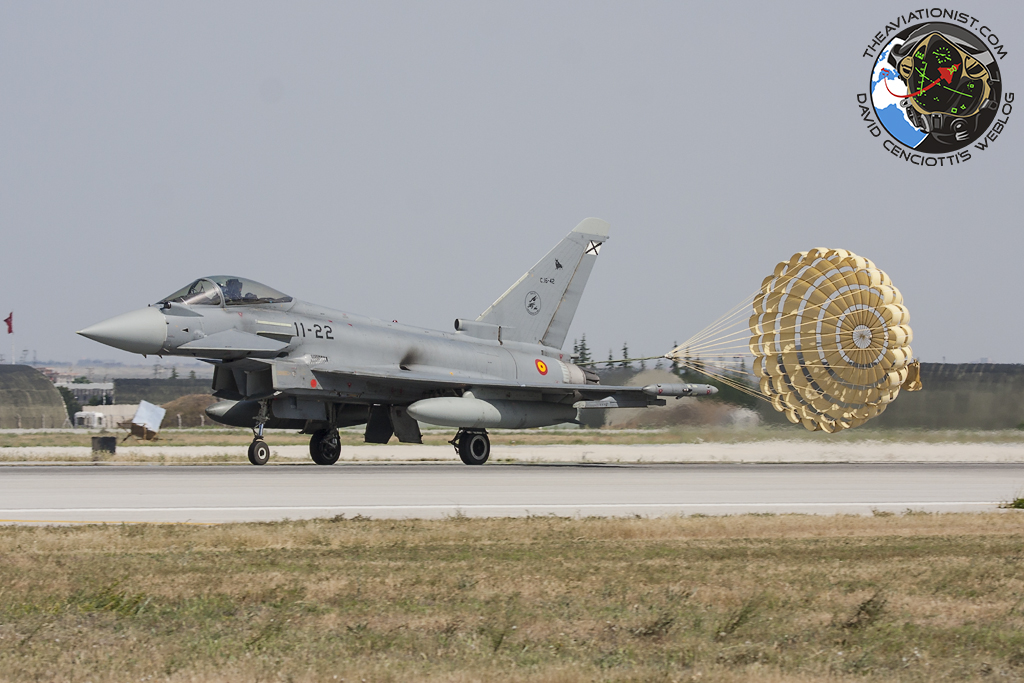
The Spanish Air Force brought a tactical air expeditionary group to Turkey made up of six Eurofighter Typhoon C.16 jets from Ala 14 based at Albacete for what was their first participation in an overseas multinational exercise, and six EF-18s from Ala 12, based at Torrejón. Along with the Hornets, two Typhoons deployed to Konya non-stop, taking fuel mid-air from an Italian Air Force Boeing KC-767A tanker; the remaining four C.16s made a stopover at the Italian Eurofighter base at Gioia del Colle.
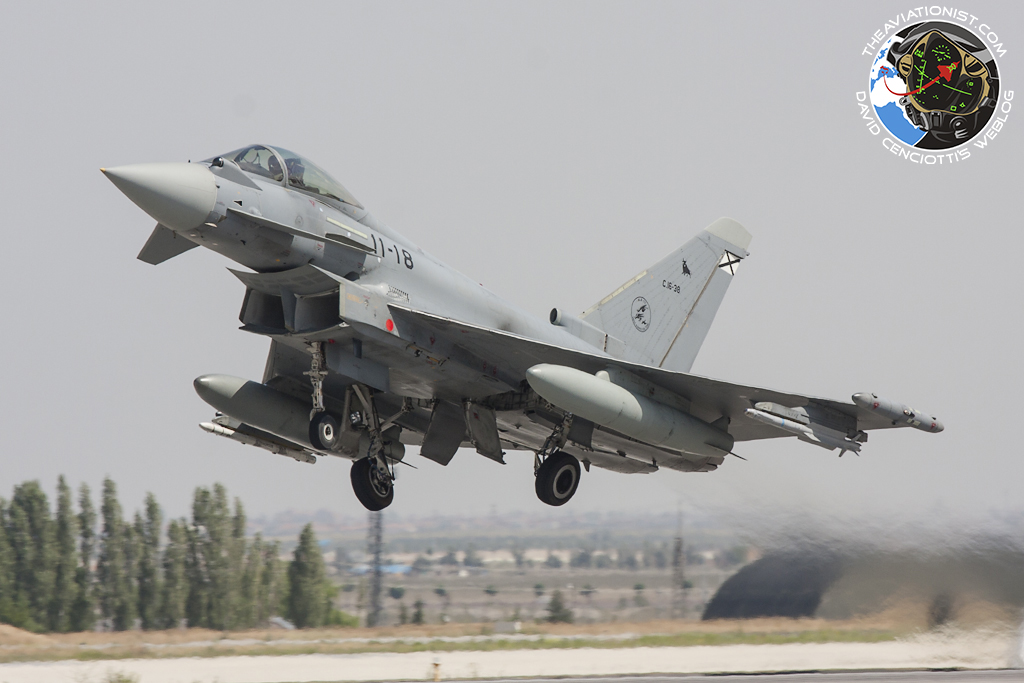
The Spanish Typhoons were tasked with pure Fighter Sweep missions: their role was to conduct offensive counter air missions, destroying all the enemy aircraft within the area of responsibility and to clear the way for incoming attack planes.

Depending on the length of the sortie, the aircraft flew with two or three drop tanks, an AIS (Airborne Instrumentation Sub-system) pod for the flight data downlink to the ground ACMI sensors, and a dummy IRIS-T air-to-air missile.
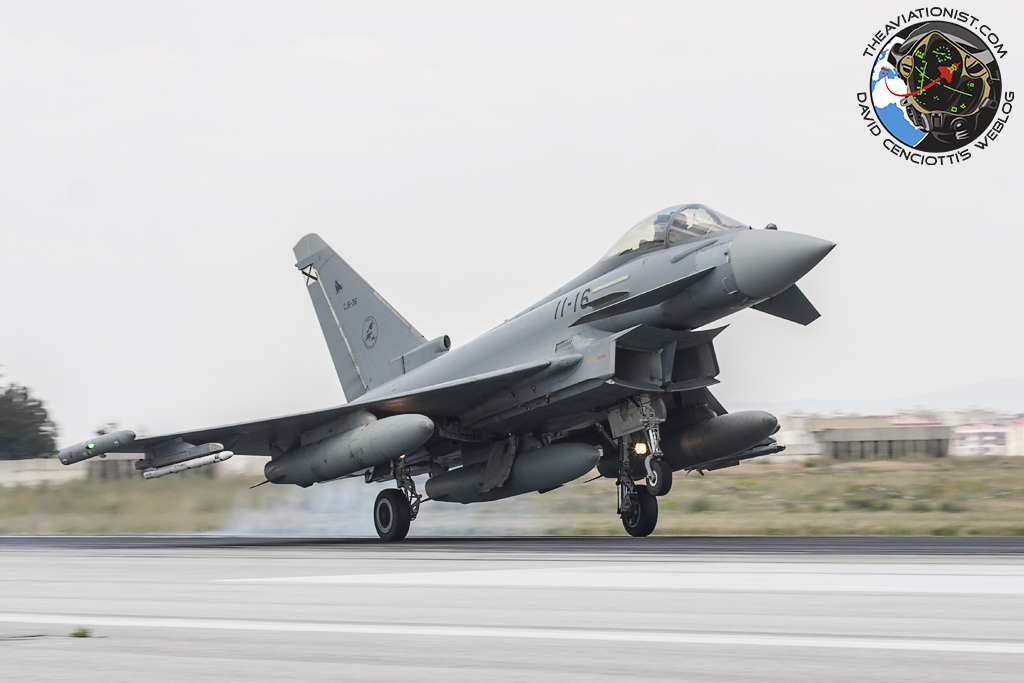
For the Ala 14 pilots, who were taking part in their first expeditionary experience with the Typhoon, their participation in Anatolian Eagle was an important opportunity to validate and enhance their reference tactics, share knowledge and improve cooperation with personnel from different nations, and fly the Eurofighter in a challenging scenario, with up to 60 aircraft flying at the same time, in a large, almost unrestricted airspace.
 Exercise Anatolian Eagle 2014-2: Turkey, Jordan, Qatar, Spain and the UK train for real combat ops
 [Photo] Anatolian Eagle 2014-2 exercise underway in Turkey
 Boeing KC-767 next generation tanker as you have never seen it before: Buddy Refueling
 Smoking Tires! F-16D Fighting Falcon (hard) touchdown at Konya
 Polish Air Force Mig-29 and Royal Air Force Typhoon jets on Baltic Alert
 Eurofighters invade Sardinia: 40 Austrian, German and Italian Typhoons at Decimomannu
 Awesome photo of British Typhoon intercepting fully armed Russian Su-27 over the Baltics
Offtopic cinéfilo. Tears of Steel es la cuarta Open Movie realizada por la Blender Foundation. Realizada gracias a la financiación vía crowd-funding y la ayuda de usuarios del software Blender. Se encuentra licenciada bajo la licencia “Creative Commons Attribution” y puede ser descargada desde su sitio web en resolución 4k.
El corto ya tiene algún tiempo (2012) pero cuenta con un impresionante nivel técnico y ha logrado bastante repercusión en la escena. Incluso cuenta con un remake en chino. Vale la pena darle al play, es un excelente ejemplo de lo que Blender puede llegar a hacer.
+Info: http://www.tearsofsteel.org/
La entrada Tears of Steel (offtopic cinéfilo) aparece primero en Ubuntizando.com.
A great circle is the shortest path interconnecting two points on a sphere.
Since Earth is almost spherical, routes followed by aircraft follow great circles between departure and destination because they are shorter, thus make flights shorter and cheaper for airlines.
Obviously, it’s impossible to fly along the Great Circle until destination: aircraft departing from an airfield have to follow SIDs (Standard Instrumental Departure) routes, have to comply with airspace restrictions, avoid dangerous airspaces (or fly above them, as in the case of the MH17 shot down over Ukraine) or bad weather etc.
Nevertheless, routes are planned in such a way they are as close as possible to a Great Circle and the ideal GC route from Amsterdam to Kuala Lumpur crosses Ukraine.
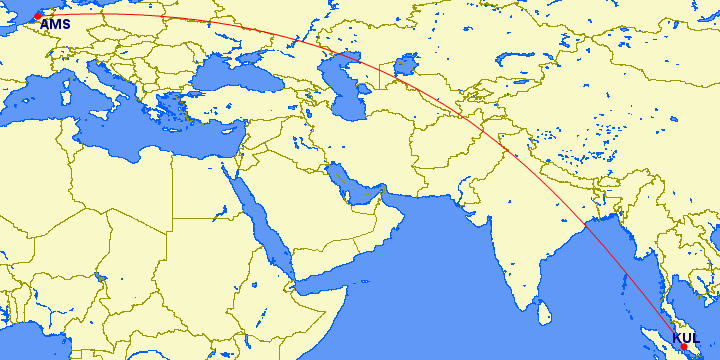
Image credit: Great Circle Mapper
All European airlines followed (more or less) the same route and crossed the same airspace during long haul flights to Asia. Indeed, Singapore Airlines SQ351 (B777) and Air India AI113 (B787) were in the vicinity of Malaysia Airlines MH17 when it was hit by a missile (or more than one) most probably fired by an SA-11 Gadfly system.
Ukrainian authorities had banned aircraft from flying below FL320 (32,000 ft) but MH17, at FL330 was still within the reach of some of the most deadly weaponry in the hands of pro-Russia separatists that have been using SAM (Surface to Air Missile) systems quite effectively against Ukrainian Air Force aircraft.
The airspace over eastern Ukraine was closed to civilian flights after the incident.
Since no other restriction was in place, Malaysia Airlines flight dispatcher could plan the usual route to from AMS to KUL. Unfortunately that route brought the Boeing 777 in the wrong place at the wrong time.
Top image credit: Wiki
 It was just a matter of time before a civil plane was shot down in Ukraine’s SAM-infested airspace
 Malaysian Boeing 777 with 295 people on board shot down over Eastern Ukraine
 What we know and what we don’t about the mysterious Malaysia Airlines MH370 disappearance
 Stolen passports aboard Malaysia Airlines B777 disappeared enroute to Beijing
 What SATCOM, ACARS and Pings tell us about the missing Malaysia Airlines MH370
 Can you believe neither Malaysian nor Thai radars saw the Malaysia Airlines MH370 crashing?
 Hijacked Malaysian Airlines Boeing 777 shadowed other airliners to escape detection?
If you want to take nice, close up, footage or images of military aircraft on final approach, then RAF Waddington, in the UK (home of the British drone force) is the right airport for you.
Each time the local airshow attracts aircraft from all around the world, there is a good chance to take some interesting photographs or footage of warplanes coming low, very low, on final approach for landing.
The following video was filmed there, on Jul. 5, at the end of the display of the Turkish Air Force Solo Türk aerobatic display team’s F-16C Block 40.
By the way, it’s not only a matter of how low the pilot flew the final approach: there are airports in Europe where runway threshold is so close to the airfield perimeter that you can have your head buzzed by a plane’s landing gear.
 Watch this: Typhoon fighter jet buzzes photographer’s heads on landing
 Incredible F-16 jet pilot’s selfie
 Awesome Footage Brings You Aboard a Sukhoi Su-27 Flanker During Air Show over Crimea
 [Video] F/A-18B Hornet jets take off in 30 – 40 knot crosswind
 Disbandment of Swiss Air Force display team could make its “Flat Eric” yellow puppet mascot unemployed
 [Photo] F-16 pilot pulls high Gs during demo display: canopy fogs up obscuring his vision
 Ukrainian Mig-29 Fulcrum (in display team livery) performs low pass over pro-Russia separatists
 Kerbal Space Program is already a runaway indie video game hit, and if you ask some people, they’ll tell you it is the way to learn all about orbital dynamics, how spaceships actually fly, the challenges of getting to the mün. The controls in KSP are primarily keyboard and mouse, something that really breaks the immersion for a space flight simulator. We’ve seen a few before, but now custom controllers well suited for a Kerbal command pod can be made at home, with all the blinkey LEDs, gauges, and buttons you could want.
[Freshmeat] over on the KSP forums began his space adventures with a keyboard but found the fine control lacking. An old Logitech Dual Shock controller offered better control, but this gamepad doesn’t come with a throttle, and USB throttles for flight sims are expensive. He found a neat plugin for KSP made for interfacing an Arduino, and with a few modifications, turned his controller into a control panel, complete with sliders, pots, gauges, and all the other goodies a proper command pod should have.
[Freshmeat]‘s work is not the only custom Kerbal controller. There’s a whole thread of them, with implementations that would look great in everything from a modern spaceplane to kerbalkind’s first steps into the milky abyss of space. There’s even one over on the Hackaday projects site, ready to fly Bill, Bob, and Jeb to the mün or a fiery explosion. Either one works.
Thanks [drago] for the tip.


ArnoldC es un lenguaje de programación basado en frases de Arnold Schwarzenegger. Si señores parece un chiste y lo es, pero un chiste que se puede utilizar para hacer programas. Entre las instrucciones más graciosas tenemos:
Entre otras características ArnoldC corre sobre la plataforma Java, veamos un "hola mundo" con este lenguaje:
IT'S SHOWTIME TALK TO THE HAND "hello world" YOU HAVE BEEN TERMINATED
Veamos un ejemplo de un condicional:
BECAUSE I'M GOING TO SAY PLEASE a TALK TO THE HAND "a is true" BULLSHIT TALK TO THE HAND "a is not true" YOU HAVE NO RESPECT FOR LOGIC
La verdad muy gracioso y se puede probar muy fácilmente:
wget http://lhartikk.github.io/ArnoldC.jar echo -e "IT'S SHOWTIME\nTALK TO THE HAND \"hello world\"\nYOU HAVE BEEN TERMINATED" > hello.arnoldc java -jar ArnoldC.jar hello.arnoldc java hello
Más información | ArnoldC
-
La noticia ArnoldC el lenguaje basado en frases de Arnold Schwarzenegger fue publicada originalmente en Genbetadev por Pablo Emanuel Goette.


Normalmente todos los videojuegos tienen varios niveles de dificutad a la hora de jugar, con los cuales podemos elegir cuán difícil serán los niveles a lo largo del mismo. Pero se imaginan cómo sería si los juegos tuvieran niveles “super fáciles”?
A continuación les dejo un video muy divertido en el cual su creador ya se lo imaginó y lo quiere compartir con nosotros:
Visto en Abadía Digital
Este artículo Si los videojuegos tuvieran un nivel super fácil… sería así fue publicado originalmente en Punto Geek.


 Halfbrick Studios has made all its iOS games free to download today, including Fruit Ninja, Age of Zombies, and others.

Catching a liar in person usually just means looking for a variety of nonverbal cues , but that's not as easy when it's written in a text message or email. For that, The Wall Street Journal suggests looking for subtle changes in how someone words things.