Shared posts

23 Sep 19:17

Mubarak Speaks–Unfortunately

by Elliott Abrams
Yuval Pinter

במיוחד השני

Through a leaked recording of conversations with his doctor over the past year, we now have new insights into the mind of Hosni Mubarak. Of course, we can’t be sure everything is authentic–not yet, anyway–nor can we be sure that Mubarak was giving this doctor his bottom line. But the Mubarak who emerges in this New York Times account will sound familiar to anyone who spent time with him on behalf of the United States Government.

Two themes stood out to me. The first was his claim that the United States began to work against him in 2005.

He said in the recordings that American efforts to remove him began in 2005 when Washington pressed him to allow at least token rivals to run for president against him instead of holding a one-candidate plebiscite for another term in the office. He said that he had promised to “hand it over” in the next election, scheduled for 2011, but that the Americans had not trusted him. He said “the Americans” were “liars.” He accused them of spreading false rumors that Mr. Mubarak might try to hand the presidency to his son Gamal, who had taken up a senior position in the ruling party and begun shaping Egyptian policy. “And people believed them!” Mr. Mubarak complained. “I told them, ‘People, we are a democratic regime!’ but to no avail.”

It is true that in 2004 and 2005 the Bush administration ramped up pressure on Mubarak–but not to remove him. We genuinely thought his system was increasingly difficult for the United States to support, for human rights reasons, and increasingly unsustainable in Egypt. We thought Egyptians would not accept the absence of a presidential election for much longer. We thought Egyptians would not tolerate having his son Gamal foisted upon them as the next president. To allow Mubarak, already in his 80s, to finish his term as president was one thing; to have Mubaraks for thirty more years would be another. Mubarak may now say that was not his intention, and he appeared at the time to be uncertain about it. But his wife kept pushing for Gamal, and Gamal kept being promoted into more and more influential positions. Mubarak’s argument now, that this was impossible because he ran a democratic regime, is of course laughable.

But it is striking that he cannot distinguish between American efforts to push him toward reform and American efforts to remove him. That unwillingness to countenance reform, to permit liberal or secular or democratic parties to grow, left the Muslim Brotherhood as the only alternative to military rule when Mubarak left power after 30 years. That is his legacy to his people.

The second theme is his anti-Semitism.

At another point, Mr. Mubarak dismissed Mr. Morsi as overly reliant on Qatar, an oil-rich monarchy allied with the United States and supportive of the Brotherhood. “Qatar will bring American Jews” to Egypt, Mr. Mubarak said. “All will have American and Jewish passports, they will start projects and I don’t know what, and it will be worse.” He speculated that Jews might have played a role in a proposal to dam the Nile upstream from Egypt in Ethiopia, a major worry in Cairo. “The Jews work there,” Mr. Mubarak said. “Africa is full of Jews.” He said of a former chief of the International Monetary Fund, “He was a Jew, but skillful.”

By Middle Eastern standards these remarks are not surprising, but they do attest to Mubarak’s view that Jews are secretly behind all sorts of nefarious plots. They also show his inability to distinguish Jews from Israelis, for even in these quotes it is unclear when he means all Jews and when he actually is referring to Israelis only–for example when he uses the term “Jewish passports.”

Perhaps there are more tapes and more revelations to come. In truth it would be interesting to have a historian interview Mubarak about the 1967 and 1973 wars, the peace treaty with Israel, the assassination of Sadat, and many other pieces of Egyptian and Middle Eastern history that he witnessed or in which he was a key player. A serious Mubarak oral history project would be worth having. But it would show, as these quotes do, that he was a man of limited insight. Fouad Ajami once described Mubarak as “a civil servant with the rank of president,” and nothing he says in these tapes suggests otherwise.

21 Sep 16:12

The sum total of all human knowledge.

by Lydia Marks
Via
15 Sep 18:29

September 15, 2013


40% of BAHFest tickets have now sold! At this rate, we will probably sell out the show. So, please buy soon if you want to be certain of a seat!
08 Sep 08:36

לוג עוף

by חריף

כמות מידה של עוף.

מבוסס על מידה מתקופת הגמרא (לוג = 6 ביצים).

- "כן בחור, מה תרצה לאכול בבקשה?"
- "שים לי בבקשה לוג עוף, וקצת אורז בצד. תודה."

נתרם ע"י: חריף.

08 Sep 07:26

Proportion of adjectives and adverbs: Some facts

by Mark Liberman
Yuval Pinter

science.

Adam Okulicz-Kozaryn, "Cluttered writing: adjectives and adverbs in academia", Scientometrics 2013:

[H]ow do we produce readable and clean scientific writing? One of the good elements of style is to avoid adverbs and adjectives (Zinsser 2006). Adjectives and adverbs sprinkle paper with unnecessary clutter. This clutter does not convey information but distracts and has no point especially in academic writing, say, as opposed to literary prose or poetry.

If you've seen my earlier discussion of this paper ("'Clutter' in (writing about) science writing", 8/30/2013), you'll recall that Dr. O-K goes on to count adjectives and adverbs in some word lists from samples of scientific writing. He asserts that "social science" writing uses about 15% more adjectives and adverbs than "natural science" writing — although he doesn't tell us enough about his methods to dispel concerns about several likely sources of artifact — and he concludes by asking "Is there a reason that a social scientist cannot write as clearly as a natural scientist?"

In the interests of science of all kinds, I decided to devote this morning's Breakfast Experiment™ to the relations between text quality and the proportion of adjectives and adverbs. I wrote a python script using NLTK to calculate the proportions of various parts of speech in a document; and then I tried this script out on samples of various sorts of writing. Here's some of what I found.

To start with, I decided to try some really cluttered prose, prose that is not at all "readable and clean": Edward Bulwer-Lytton's Paul Clifford. Wikipedia tells us that this novel is considered to represent 'the archetypal example of a florid, melodramatic style of fiction writing'". Its first sentence:

It was a dark and stormy night; the rain fell in torrents, except at occasional intervals, when it was checked by a violent gust of wind which swept up the streets (for it is in London that our scene lies), rattling along the house-tops, and fiercely agitating the scanty flame of the lamps that struggled against the darkness.

I put essentially all of the first chapter of this work into a file (minus the paragraphs that are mostly dialogue, much of which is in dialect). According to NLTK's pos_tag() function, which should be about 95% correct, the score was:

1775 words, 184 punctuation tokens = 1591 real words
108 adjectives = 6.8 percent
78 adverbs = 4.9 percent
186 adjectives+adverbs = 11.7 percent

So Bulwer-Lytton's chapter is about 12% adjectives and adverbs. What should we compare this to? Well, Dr. O-K cites William Zinsser's On Writing Well as his authority for the cluttering nature of adjectives and adverbs, so let's try the first three sections of that work (minus quotations from others, of course):

3939 words, 439 punctuation tokens = 3500 real words
241 adjectives = 6.9 percent
208 adverbs = 5.9 percent
449 adjectives+adverbs = 12.8 percent

Hmm. Well, maybe this is experimental error. And Bulwer-Lytton's writing is clear enough, it's just kind of overwrought. So let's take a look a something by Jacques Derrida, whose prose is about as unreadable as anything I've ever encountered. Here's the score for chapter 2 of "Of Grammatology" (in English translation, of course):

19239 words, 2105 punctuation tokens = 17134 real words
1434 adjectives = 8.4 percent
946 adverbs = 5.5 percent
2380 adjectives+adverbs = 13.9 percent

OK, that's better —  Derrida has 19% more adjectives and adverbs than Bulwer-Lytton. But he's only got 8% more than Zinsser, and Zinsser has more than Bulwer-Lytton, so this still doesn't all seem to be working out the way we were told it would.

Let's go for another paragon. Dr. O-K opens his paper with a quote from Mark Twain: "When you catch an adjective, kill it." So let's try the whole letter that the quote came from:

1474 words, 170 punctuation tokens = 1304 real words
89 adjectives = 6.8 percent
95 adverbs = 7.3 percent
184 adjectives+adverbs = 14.1 percent

Oops. We're really going in the wrong direction here — Saint Mark uses the highest proportion of adjectives and adverbs that we've seen so far.

And what about Dr. O-K's own writing? Here's the score for the text of "Cluttered writing: adjectives and adverbs in academia" itself (of course minus the quotations from others):

883 words, 80 punctuation tokens = 803 real words
85 adjectives = 10.6 percent
42 adverbs = 5.2 percent
127 adjectives+adverbs = 15.8 percent

We have a winner! Dr. Okulicz-Kozaryn's text, about the importance of eliminating adjectives and adverbs from prose, has fully 35% more adjectives and adverbs than the infamous "It was a dark and stormy night" passage, which has given its author's name to an annual bad writing contest!

(127/803)/(186/1591) = 1.3528

And the first two pages of another of his papers ("Man and God and Circle of Trust", 2012) score even a bit higher:

1121 words, 104 punctuation tokens = 1017 real words
113 adjectives = 11.1 percent
60 adverbs = 5.9 percent
173 adjectives+adverbs = 17 percent

Seriously, the problem is not in Dr. O-K's writing (despite the sprinkling of slavicisms), but in his ideas. Calculating the relative percentages of adjectives and adverbs in texts tells us nothing useful about their readability, clarity, or efficiency.

I'll spare you the reports for the other 45 texts that's I've tested. But just to let Dr. O-K off the hook for the "most modifiers" prize, let me note that the text of Ben Yagoda's piece from the Chronicle of Higher Education on adjectival anxiety ("The Adjective — So Ludic, So Minatory, So Twee", 2/20/2004), beats him out:

1908 words, 301 punctuation tokens = 1607 real words
208 adjectives = 12.9 percent
86 adverbs = 5.4 percent
294 adjectives+adverbs = 18.3 percent

Finally, I need to point out that there's a technical flaw in the whole "avoid adjectives and adverbs" idea — nouns are often modified by other nouns, or by prepositional phrases, or in other ways that don't involve adjectives; and verbs are often modified by prepositional phrases, subordinate clauses used as verbal adjuncts, and so on.

If it were true, counterfactually, that modification in general was a Bad Thing, then we'd need to count these other sorts of modifiers as well, not just adjectives and adverbs.

Some of the previous LL posts on modificational anxiety:

"Those who take the adjectives from the table", 2/18/2004
"Avoiding rape and adverbs", 2/25/2004
"Modification as social anxiety", 5/16/2004
"The evolution of disornamentation", 2/21/2005
"Adjectives banned in Baltimore", 3/5/2007
"Automated adverb hunting and why you don't need it", 3/5/2007
"Worthless grammar edicts from Harvard", 4/29/2010
"Getting rid of adverbs and other adjuncts", 2/21/2013
"'Clutter' in (writing about) science writing", 8/30/2013

N.B. Someone who took this whole business seriously enough to want to look at differences in part-of-speech distributions among scientific disciplines should know that Okulicz-Kozaryn is wrong when he writes that

as of 2012 I cannot bulk download enough full texts to have a representative sample of a discipline.

Between arXiv,  the PLoS collections, SSOAR, the resources available from the ACL, and so on, it would not be hard to create large enough samples in enough different disciplines and subdisciplines to engage the question more seriously than Okulicz-Kozaryn did. But you ought to have another hypothesis to test as well, in my opinion, because the modifier-percentage idea looks like a loser.

Update — I realize that it's only fair for me to report the score for this blog post. Leaving out the quotations and so on, and without this update, I get:

1143 words, 146 punctuation tokens = 997 real words
82 adjectives = 8.2 percent
59 adverbs = 5.9 percent
141 adjectives+adverbs = 14.1 percent

The same overall percentage as Mark Twain…

Update #2 — William Zinsser complains that

Clutter is the disease of American writing. We are a society strangling in unnecessary words, circular constructions, pompous frills and meaningless jargon. Who can understand the clotted language of everyday American commerce: the memo, the corporation report, the business letter, the notice from the bank explaining its latest “simplified” statement?

So I decided to score Microsoft's 2012 Annual Report:

1499 words, 92 punctuation tokens = 1407 real words
117 adjectives = 8.3 percent
38 adverbs = 2.7 percent
155 adjectives+adverbs = 11 percent

There are certainly some unnecessary words and pompous frills in that report ("we delivered strong results, launched fantastic new products and services, and positioned Microsoft for an incredible future"), but the percentage of adjectives and adverbs is not a good measure of those characteristics.

Update #3 — I should also tell you that I did check the adjective and adverb proportions in various natural-science articles. For example, the first page of the first article in the current issue of Physical Review A (A. Rançon et al., "Quench dynamics in Bose-Einstein condensates in the presence of a bath: Theory and experiment") weighs in at

908 words, 62 punctuation tokens = 846 real words
103 adjectives = 12.2 percent
35 adverbs = 4.1 percent
138 adjectives+adverbs = 16.3 percent

And a combination of the first seven abstracts from the current issue of Science scores

1041 words, 81 punctuation tokens = 960 real words
106 adjectives = 11 percent
36 adverbs = 3.8 percent
142 adjectives+adverbs = 14.8 percent

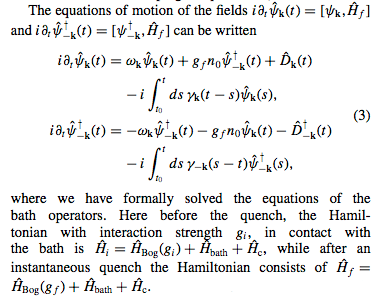
This tends to confirm my suspicion that Okulicz-Kozaryn's result (15% lower proportion of adjectives and adverbs in natural science compared to social science text) probably results from one of the obvious sources of artifact, for example an inappropriate attempt to calculate part-of-speech percentages in text derived from passages like this one (from the second page of the Rançon et al. paper):
Since Okulicz-Kozaryn's counts came from word lists supplied by JSTOR, and he doesn't tell us which lists he used or how he processed them, and JSTOR doesn't tell us how they created the lists, we'll probably never know.

08 Sep 05:23

September 06, 2013


Hey Gaymers! My pals at GaymerX are having a sale until Monday (9/9). Items are already discounted, but if you have an order over $20 and you enter the code "smbc15" and you stand on one leg, you get 15% off.
07 Sep 08:23

English is a Dialect of Germanic; or, The Traitors to Our Common Heritage

by Victor Mair

[This is a guest post by Stephan Stiller.]

This post complements Robert Bauer and Victor Mair's previous LL post titled "Spoken Hong Kong Cantonese and written Cantonese" and addresses, among other things, J. Marshall Unger's comment in the corresponding thread. Please have a look.

The most important parts (of J. Marshall Unger) I quote here:

May I suggest that "dialect" and "language" be defined operationally with respect to the comparative method, i.e. diachronically rather than synchronically? If most linguists who know speech varieties A and B well accept that they are diachronically related without an explicit demonstration (regular sound laws and explanations for semantic divergences, etc.), then A and B ought to be called dialects of their common language. Otherwise, A and B should be called languages, which are assumed to be unrelated until proven "to have sprung from a common source."

[...] No honest linguist thinks that describing the relationship of Cantonese to Mandarin is a trivial task. There are still "gray area" cases (e.g. Okinawan, which I tend to think of as a highly aberrant dialect of Japanese, but others consider a distinct languages), but at least we know what we're arguing about in terms of data.

I would say it's evident to most people that German is related to English; it doesn't take a linguist to make that realization. Not only that – we are 100% certain that they have "sprung from a common source".

To describe the precise relationship between Cantonese and Mandarin is of course not a trivial task, but I have – on more than one occasion – heard Chinese linguists state that it is merely for political reasons that many call 粵 Yue a dialect. Cantonese linguist Anne Oi-Kan Yue(-Hashimoto) 余靄芹 writes:

We shall follow the tradition of designating the major Sinitic languages as "Chinese dialects", although linguistically speaking the latter is a misnomer.

(Materials for the Diachronic Study of the Yue Dialects, footnote 1 (p. 270); on pp. 246-271 of: 乐在其中:王士元教授七十华诞庆祝文集 / The Joy of Research: A Festschrift in Honor of Professor William S-Y. Wang on His Seventieth Birthday; 石锋 Shí Fēng、沈钟伟 Shěn Zhōngwěi (eds.); 天津 (Tiānjīn): 南开大学出版社 (Nankai University Press))

I don't think the linguistic facts are controversial, despite some people still saying so.

In order to get a better understanding of the language situation for Cantonese, imagine this:

Scenario A: You require that everyone in Germany writes English. A German might thus write something like this (the grammatical error with the first word is intentional and illustrates the realities of L2 usage):

Mine parents have acquired a pet.

He'd still say

Meine Eltern haben ein Haustier erworben.

in German because this is correct German. But he is taught to pronounce every English sentence (when reading aloud) in a cognate-by-cognate fashion, like this:

Meine Färser¹ haben z-heischt ein *Biech.

Of course, some words here don't really exist in German, but this mirrors the situation of a speaker of Cantonese in Hong Kong. To match up German with Cantonese and English with Mandarin works on so many levels (I won't explain now), but to better illustrate the situation to a native speaker of English, let's flip things around and proceed to …

Scenario B: Imagine a situation where all speakers of English are required to employ German for written communication. The sentence "my parents have acquired a pet" is, in correct German, the following:

Meine Eltern haben ein Haustier erworben.

Now when native speakers of English talk amongst each other, they still say:

My parents (have)² acquired a pet.

but they're not allowed to write such a vulgar thing! Instead they only ever encounter German in prestigious newspapers. They are also taught, in school, to read aloud the German sentence as

My elders have a house deer ur-wharven.

linearly matching the German text with English cognates. (Okay. "ur-" is more like a recent borrowing, with a distinct foreign sound to it. And I haven't heard anyone use the verb "to wharve" lately. But these seemingly irrelevant details, too, mirror the situation for Cantonese.) The two sentences even sound similar if you say them out loud.

German is a language, and English is only a dialect. You must not write English, because it is a bastardized, corrupt, "highly aberrant" form of German, extant only among crazy islanders!

Still not convinced that German and English are but phonetic variants of one and the same common language? Let's write the sentences down in a writing system that abstracts away from inessential details such as pronunciation. What about we pick something universal – Chinese characters! After all, if you can use them for Japanese, you might as well use them for written Pan-Germanic (aka Modern Standard Germanic), to which Sinographs seem almost equally suited.

Glosses, from the German version of the sentence, which the writing is appropriately based on:

I+⟨possessive suffix⟩ old+⟨comparative suffix⟩+⟨plural suffix⟩ have one house+beast ⟨prefix indicating successful achievement⟩+revolve+⟨participial suffix⟩

The homophonous plural and participial suffixes were spelled out with Runes to emphasize the common millenia-old Teutonic heritage. (Don't the Japanese have a mixed script employing kana in similar fashion?)

Now for the finale. As constructed, the sentence is written like this in German:


("Meine Eltern haben ein Haustier erworben.")

And now in High English³:


("My elders have a house deer ur-wharven.")

We can see that the two are exactly the same! In passing we've even proven Germanic to be part of the Sino-Tibetan language family.⁴

That Cantonese barely lost to Mandarin as China's national language might be a myth⁵ akin to the Muehlenberg legend (it's the one according to which German allegedly lost to English as the official language of the United States by just one vote). But since they're dialects of the same language, why would it even matter?

I am in fundamental agreement with much of J. Marshall Unger's academic work on Japanese and its script, to the extent that I am familiar with it. But I am not sure in what way his proposal for a comparative method of dialect determination is workable. Also, in what way is it, as he states, "diachronic" as opposed to "synchronic"? For linguists to determine diachronic relatedness – the existence of a common ancestor – "without an explicit demonstration" is for sure something that would rely on present-day similarities, which would make it a synchronic procedure.

Notes:

¹ "Färse" means "heifer", so I'm forming an ambigendered plural "Färser" from a constructed male singular form, which would also be "Färser". I encourage the reader to explore the Indo-European Lexicon at UT Austin.

http://www.utexas.edu/cola/centers/lrc/ielex/index.html

² The German present perfect corresponds to the English simple past as well. The way I have constructed my examples, details about grammatical aspect shouldn't matter.

³ What you hear on the streets is Low English, not worthy of ink. For example, "pet" sounds slangy. (HKers frequently use the word "slangy" to describe their perception of Cantonese lexis as being less refined than that of Mandarin.) There's regional variation anyways. Better to have a standard, no?

⁴ I know someone who insists that Japanese is Sino-Tibetan. Guess where his confusion is coming from.

⁵ Discussions of the Conference on Unification of Pronunciation (讀音統一會) are in The Languages of China by S. Robert Ramsey and Nationalism and Language Reform in China by John DeFrancis. It seems like Mandarin clearly won in the end. Who knows whether the oft-encountered "by one vote" can be accurately applied to an intermediate negotiation that took place there in 1913.

04 Sep 11:19

כשהמיית הלב נפגשת בעובדות

03 Sep 19:16

חג שמח וחופשה מהנה

חג שמח וחופשה מהנה

02 Sep 15:06

Comics 1256-1258: September Solitudes

by Jon Levi
Well, summer is ending, and I feel so alone oh God. This blog is all I have for company. Please make me feel less alone by writing a comment.

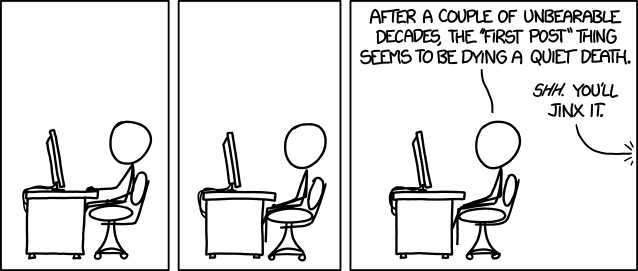
1258: First


This is awful, Randall. *Takes off belt*

F for observational humour - you are literally just commenting on an established trend, and not even telling a joke about it. G for accuracy - the 'first post' phenomenon is far from dead. H for quantum egotism - it's like you decided that if you don't observe it happening on the forums you frequent, then it doesn't exist. I for actually acknowledging the phenomenon, and encouraging more trolls to do it. And don't you fucking dare say that jinxing it on purpose was the point of the joke, because there was no joke. J for lack of a joke. And it looks like you were still trying to do a dramatic buildup for this nonexistent joke. But instead of a joke we get smugness. K for smugness - wipe that grin off your face, because even if there had been a joke then it would still be L for comic timing. The beat panels literally add nothing. M for artwork - the guy barely moves in three panels, and the other character (presumably a woman) is off-panel. And if I wanted to see a stick figure sitting at a computer, I'd look in the fucking mirror. N for appealing to your core demographic - even the forum thread couldn't find anything good to say about it. It just degraded into a 'last post' forum game, then burned out after two pages. You've created something that even the fora can't nerd out on. Think about that. O for being so bad that even Gizmodo wouldn't touch it. P for wasting precious pixels on my screen. Q for the 23 kilobytes I wasted to download this. R for the 35 minutes I have already spent writing about this. I am so fucking angry at this comic. How fitting it is that the harshest grade so far is the first letter of your name. But I'm going to stop there, because there are some things that can't be said with alphabetical grades.

48 BELT LASHINGS for the worst comic I have ever reviewed, one for each of the comics I have reviewed before this one. *Deep menacing breaths, whimpering, and obscure Yiddish expletives are heard from the corner. Thwack, thwack, thwack, thwack...* AYIN KAFIN FAKATA YAN RANDALL. Say first post again. I fucking dare you.

C- for the alt text, which was actually quite good.

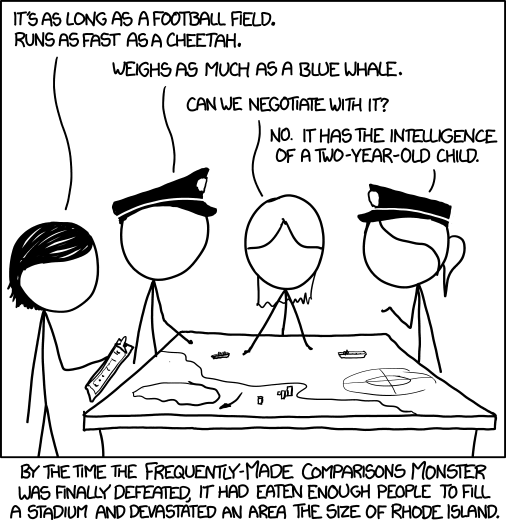
1257: Monster


After the 'First' comic, anything looks good in comparison. In hindsight, I probably should have left that one till last.

D+ for dialog. It's terribly stilted, but at least it conveys the joke. B+ for artwork. While it violates show-don't-tell by not actually showing us the monster, I don't actually think that is important. The war room is surprisingly detailed for an xkcd, and showing the monster would ruin the joke. Oh and C+ for the joke. It was not bad, I guess. And B+ for the timing of it. The caption completes the joke, and doesn't whack the reader in the face with an unnecessary explanation. He could have added a few more comparisons in the first two lines of speech to make it more ridiculous, but that's my only real complaint.

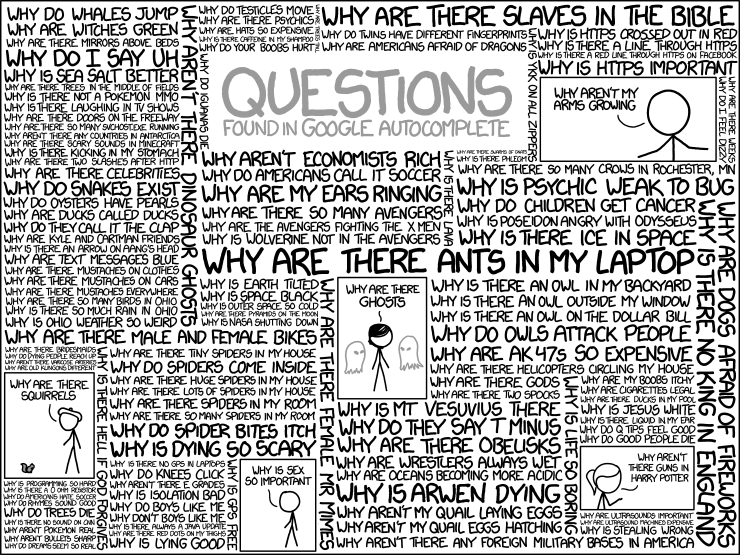
1256: Questions


I wanted to hate this one, but when I read it up close, I almost laughed in spite of myself. Funny lines questions like "Why do snakes exist?" make up for at least five not-so-funny ones. This is Randall playing to his strong point, and it works. So I'm actually going to give it a for humour.

It's funny because the questions are dumb, really dumb. And he's not mocking them in a smug way. B for lack of smugness. They remind me of the sort of questions that a child would ask. With the advent of the Internet, we have become like silly little kids, treating Google as our collective daddy-who-knows-everything. I would have liked to see the comic make a joke about this, or explore it in more detail. D because of what this comic could have been

A for effort. No really, it can't be easy to look at several hundred Google search suggestions, and pick only the stupid ones.


By the way, if you get the reference in this post's title, you don't get a million nerd points or anything. You just get get my unending unconditional love.
02 Sep 04:28

Photobomb level: Expert! תודה ל-Noam Yan Shuf

31 Aug 07:14

DER HOBIT.

by languagehat
Yuval Pinter

לחובבי הז'אנער

Natalie Schachar at Tablet has one of those oddball translation stories I love, Yiddish-Speaking Wizards and Dragons Invade the Shire in ‘Der Hobit’":

For one of his first translation projects after his retirement, Barry Goldstein, a former computer programmer, found an empty table at his local Starbucks in Boston and settled in to work on the “Treebeard” chapter from J.R.R. Tolkien’s Lord of the Rings trilogy. But Goldstein soon realized that he needed something more sizable to occupy his time: 95,022 words later, he had translated the entire text of The Hobbit, the prequel to the Ring series, into Yiddish. [...]

While Goldstein grew up in a Yiddish-speaking home—his father’s roots were in Lithuania, and his mother was born in Kaminets-Podolsk—he never took to the language as a child. In fact, he vividly remembers the time that he escaped through a window in order to cut class at the Jewish school where he learned Yiddish. Years later though, he started taking Yiddish classes and soon found himself as J.R.R. Tolkien’s foremost and only Yiddish-language translator.

Sales are in the low three figures, but you don't translate into Yiddish to make the big bucks. Also, Schachar links to Yale UP's New Yiddish Library Series, a worthy project I hadn't been familiar with (or had forgotten). Thanks, Paul!
28 Aug 04:57

August 27, 2013


Jorge Cham has a new video on Quantum Computers!
27 Aug 07:55

STRICKEN.

by languagehat

Via Anatoly, this hilarious bit from the memoirs of the mathematician Ralph Boas:

MR [i.e., Mathematical Reviews] sent me a paper by a Japanese author who kept referring to “stricken mass distributions”. I couldn’t figure out what those were, and finally wrote to the editor of the journal in which the paper had appeared. He sent me a copy of the referee’s report, which had been sent to the author; this said, in part, “The term ‘generalized mass distribution’ is no longer used. The word ‘generalized’ should be stricken.”
Which reminded a commenter of an anecdote from Littlewood's A Mathematician's Miscellany:
A minute I wrote (about 1917) for the Ballistic Office ended with the sentence 'Thus σ should be made as small as possible'. This did not appear in the printed minute. But P. J. Grigg said, 'what is that?' A speck in a blank space at the end proved to be the tiniest σ I have ever seen (the printers must have scoured London for it).
(There are some other good misprint stories on the same page, if Google Books will let you see it.)
25 Aug 13:43

סִירעַכּוּז

by nadav bershif

סיר הקקי של ילד שנגמל מחיתולים.

המילה 'סיר' אשר בשימוש היום משותפת לסירי בישול ועל כן אינה מספקת. המונח נשען על הדמיון המצלולי ל-"Syracuse", עיר במדינת ניו יורק.

"כמה פעמים אמרתי לך לא בשירותים של הגדולים? את רק בסירעכוז!"

נתרם ע"י: nadav bershif.

23 Aug 06:30

‫רני רהב מגן על אסד: בסך הכל מדובר בקמפיין ויראלי‬

by ‫admin‬
‫ Tweet This! Email this via Gmail Share this on Facebook Get Shareaholic‬

בקרו באתר להנפצה במלואה
22 Aug 04:57

פול גז בניוטרל

by שלמה מן
בעוד נבחרת ג'מייקה ובולט טסים למדליית זהב, תוכנית ספורט נידחת בלבנט פיטפטה את עצמה לדעת
21 Aug 18:48

‫הסכמה נדירה בקרב רבני הימין: הפרידה של יודה ונינט – עונש על ההתנתקות‬

by ‫admin‬
‫ Tweet This! Email this via Gmail Share this on Facebook Get Shareaholic‬

בקרו באתר להנפצה במלואה
21 Aug 08:01

היה לקרוא?

by יובל פינטר

היוש קוראים יקרים,

בין היתר כדי שלא תחשבו שהתפגרנו, להלן תובנה לשונית שתובננה לי זה עתה: ל-"יש" במובנו המודאלי אין צורת עבר/עתיד בהיעדר משלים!

כן כן. שלחתי מייל חד-שורה לעמית בעבודה, עם אינטונציה מסוימת שהתנגנה בראשי. העמית דנן הבין אותה אחרת. לו היה המייל מולנו, הייתי אומר "<המשפט באינטונציה שהתכוונתי אליה>. כך יש לקרוא את זה". אממה, היה זה מייל בן שעה, לכן התפלקה לי צורת עבר מומצאת, "כך היה לקרוא את זה". אוי אברוך. גם "כך יהיה לקרוא את זה" נשמע לי רע למדי.

לא זו אף זו, ששפה חיה איננה זברה, שכולה שחור לבן. הו לא. אנחנו בפוסט מתגלגל, שתוך כדי כתיבתו הבנתי את הקסמיות שבשפה (קסם הוא הֶחתול שלנו, שבחלקו לבן ובחלקו מספר גווני אפור). אם הייתי אומר "כך היה עליך לקרוא את זה" הכל היה טוב ויפה. אך האם מדובר פה באמת בצורת העבר של "יש"? אני חושב שזה סתם אוגד, כי בהווה נאמר "כך עליך לקרוא את זה" בלי יש.

לסיכום, נדמה לי שעליתי על משהו (עד שיהיה לי זמן לעיין בספרות, לפחות. אבל זו תמיד השעה היפה ביותר). יום טוב לכולכם.


תויק תחת:לקסיקוגרפיה, מורפולוגיה, סמנטיקה, עברית, תחביר
21 Aug 04:39

"Let’s change the font of the Terms and Conditions to Comic Sans."

“Let’s change the font of the Terms and Conditions to Comic Sans.”
20 Aug 05:01

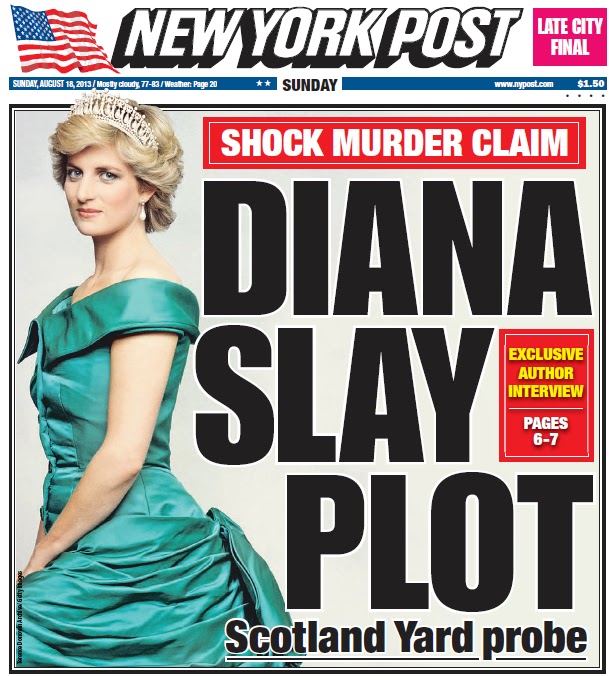
The New York Post goes verbless

by Ben Zimmer

On Headsup: The Blog, FEV (Fred Vultee) notes a remarkable confluence of nouns (and one adjective) on the front page of Sunday's New York Post:

Comments by Vultee:

Nothing on here really qualifies as a noun pile, strictly speaking, but it's still impressive by US tabloid standards: four chunks of display type, and not a verb in the bunch:

Shock Murder Claim
Diana Slay Plot
Scotland Yard Probe
Exclusive Author Interview

"Exclusive" is a well-established newspaper noun, but I'd score it as an adjective here, which is something like a single in the top of the 10th after nine perfect innings. Otherwise, we're all nouns, all the time.

It's true that nothing here rivals some of the sublime noun piles from the UK press that we have documented here in the past, like "Fish foot spa virus bombshell" or "China Ferrari sex orgy death crash." But noun-piling is still relatively unusual in US tabloids, so a verbless front page from the Post is enough to make us sit up and take notice. Could it be another facet of what Ben Yagoda has called "the Britishism invasion"? Or is the Post just taking orders from the Murdoch mothership?

13 Aug 21:09

ההחלטה לבטל את המיצ"ב אכן משוגעת

by (רביב דרוקר)

כבר נימקתי בהרחבה (מוגזמת) כמה נכונה הייתה פסיקת העליון לפרסם את ציוני המיצ"ב לפי בתי ספר. (שבאה בעקבות עתירה של התנועה לחופש המידע, שאני פעיל בה). שיערתי שמשרד החינוך יתקשה לעכל את ההחלטה לחשוף את רמת החינוך, שהוא מספק לכולנו. דבר אחד לא העליתי על הדעת, שבמסווה של חווית למידה, הם פשוט יבטלו את המציאות, כלומר את המיצ"ב. באותה רוח נפלאה של פירון ולפיד, אני מציע גם לבטל את ההשתתפות של ישראל בבחינות הבינלאומיות. זה פוגע בחווית הלמידה ומעמיס על התלמידים המסכנים.


כמה שאלות לשרים פירון ולפיד והמנכ"לית שטאובר:


1. כבוד השר פירון, באמת אמרת ש"יש לנו בעיה עם חופש המידע"? זה לא נשמע לך כמו משפט של קומיסר בברה"מ של שנות החמישים?


2. האם כבוד השר מודע לכך שלראשונה הורי ישראל יכלו לדעת עד כמה בתי הספר של ילדיהם אלימים? האם הוא מודע לעובדה שסוף סוף ידענו כמה המורים הרגישו שחוקים בבית הספר? האם הוא באמת מבין שככה יכולתי לדעת אם בבית הספר אליו רשמתי את בני, יש תלמידים שבעי רצון או לא וכמה. משרד החינוך הודיע שהשאלות הללו ימשיכו להישאל. ולהתפרסם?

שאלתי בזמנו את אותן שאלות את יו"ר הכנסת, ניחשתי שהוא לא מודע לכך, כשהוא יצא בביקורת על פרסום הציונים. מאוחר יותר גיליתי שאכן לא היה לו מושג שגם הנתונים הללו מתפרסמים.


3. כבוד המנכ"לית שטאובר, כמה זמן את מנכ"ל המשרד? בתקופת סער אני לא זוכר שהייתה לך בעיה עם עריכת בחינות מיצ"ב. האם ההתפתחות של הפילוסופיה החינוכית שלך קשורה לשר החדש שלך? האם את בטוחה שאין לזה קשר לכך שהשר העיף את רוב הצמרת החינוכית של המשרד? שמעתי אותך אומרת ברדיו שהמבחנים פגעו בחוויה הלימודית, בעומק, הם לא פגעו בזה לפני שפירון בא?


4. תהרגו אותי, אבל לא הבנתי את הטענה על הלחץ על התלמידים. איפה הלחץ האמיתי, במבחן שתוצאותיו לא משפיעות עליו, כי הן משפיעות על כלל ביה"ס, או במבחנים רגילים של ביה"ס, שהוא יכול להיכשל באמת? אם המטרה היא להוריד את הלחץ מהתלמידים, למה לא מבטלים את המבחנים הרגילים? אלא אם כן, כמובן, המטרה היא להוריד לחץ מצמרת משרד החינוך המבוהל.


5. פירון מבטל את הפסיכומטרי ואת הבגרויות ואת המיצ"ב ואולי גם את המבחנים הרגילים וכנראה שהוא יודע הרבה דברים על חינוך, שאנחנו לא יודעים. בואו נקווה שלא יתברר שכול היצירתיות הזאת לא תסתיים בעדרים של תלמידים בורים. פעם שמעתי את בנימין נתניהו מספר שהמפתח לחינוך טוב הוא שלהורים יהיו ציפיות מילדיהם. נתניהו סיפר על הציפיות של אמו ממנו וכמה הם תרמו להתפתחותו. יש לא מעט מחקרים שמחזקים את העמדה הזאת של נתניהו. עולם ללא מבחנים הוא בטח עולם נעים יותר לתלמידים ועולם בלי מבחני מיצ"ב הוא בטח עולם נורא נעים לשר החינוך.


13 Aug 13:06

הניחו לנו לרצוח בשקט

09 Aug 20:55

חולל ביום צום

by ilan arad

האלטרנטיבה החילונית ל-"צולם ביום חול".

"ראיתי את התמונה שהעלית איך אתה נותן רייסים על האופנוע בנתיביאיילון ביום כיפור. שכחת לכתוב חולל ביום צום."

נתרם ע"י: ilan arad.

09 Aug 16:40

תגובתם של מנהיגי הציונות הדתית על פסק הדין תודה לרועי דיה


תגובתם של מנהיגי הציונות הדתית על פסק הדין

תודה לרועי דיה

09 Aug 16:35

Spoilers

by Doug

Spoilers

More movies.

09 Aug 16:18

08.07.2013

New Cyanide and Happiness Comic.
02 Aug 12:31

Degrading Bashar’s Air Power is Possible

by Elliott Abrams

Is there anything the United States can do to slow or stop the recent advances being made by Bashar al-Assad’s forces in Syria, who are getting valuable help from Iranian and Hezbollah troops?

Unfortunately, the message from the Obama administration and from the Pentagon is “no.” From those sources we hear that the only military options are hopelessly expensive and dangerous. CJCS chairman Gen. Martin Dempsey once said 700 sorties would be needed before we even start, to suppress Syrian air defenses, and billions of dollars would be spent. Sen. John McCain has rightly excoriated Gen. Dempsey and the others who are taking this misleading line.

Now we have an expert, and balanced, study of  the military option that makes the most sense: not a no-fly zone but a one-time strike at Bashar’s quite limited air power. The study was by the the Institute for the Study of War, and is found here.

A brief summary: three Naval surface ships, and 100 aircraft, launching air to ground to ship to ground missiles and never entering Syrian airspace, could very seriously degrade the regime’s air power.

Here is McCain’s summary:

“Specifically, the ISW study reports that Assad’s forces are only flying a maximum of 100 operational strike aircraft at present, an estimate that ISW concedes is likely very generous to the Assad regime. The real figure, they maintain, is more likely around 50. What’s more, these aircraft are only being flown out of 6 primary airfields, with an additional 12 secondary airfields playing a supporting role. What this means is that the real-world military problem of how to significantly degrade Assad’s air power is very manageable – again, as I and others have maintained.

“ISW calculates that U.S. and allied forces could significantly degrade Assad’s air power using stand-off weapons that would not require one of our pilots to enter Syrian airspace or confront one Syrian air defense system. With a limited number of these precision strikes against each of the Assad’s eight primary airfields, we could crater their runways, destroy their fuel and maintenance capabilities, knock out key command and control, and destroy a significant portion of their aircraft on the ground. The ISW study estimates that this limited intervention could be achieved in one day and would involve a total of 3 Navy surface ships and 24 strike aircraft, each deploying a limited number of precision guided munitions – all fired from outside of Syria, without ever confronting Syrian air defenses.”

It would be useful for both the House and Senate Armed Services Committees to review the ISW study and to ask the Pentagon to respond to it. For if the United States does not act, Iran’s gamble in sending an expeditionary force to Syria will have paid off–with extremely dangerous effects in the entire region.

02 Aug 10:01

איך איתן כבל ובוז'י הרצוג, פוליטיקאים מנוסים, נקלעו לפינה הזאת? (ומילה על אראל מרגלית)

by (רביב דרוקר)
בכול הסיפור המשעמם של מפלגת העבודה, זה מה שאני לא מצליח להבין. אני מבין שהשניים מאוד מתקשים לקבל את המרות של העיתונאית לשעבר. באמת מבין. זה קשה, אבל כול העניין של נסיון ובגרות זה שאתה לומד להתגבר על יצריך, לא?


כבל והרצוג בוודאי מכירים יותר טוב מכל אחד את הנרטיב הציבורי לגבי המפלגה שלהם, שהמפלגה שלהם תעשה את המוות לכל מנהיג, שהבעיה היא לא המנהיג אלא המפלגה. הם בוודאי מבינים שהנרטיב הזה מייצר חומת חסינות למנהיגה הנוכחית. כדי לאתגר אותה בסה״כ שנה וקצת אחרי שנבחרה, הם צריכים סיבה טובה במיוחד, הם לא ממש הצביעו על סיבה כזאת. כמוה, הם לא רצו להיכנס לממשלה לכאורה (מאחורי הקלעים בוז׳י היה בעד). מעל לכול, סיכוייהם לנצח כרגע מאוד נמוכים. אז למה בשם אלוהים הם מובילים את הביזיון הזה? מילא שזה מאלץ אותם לתככים במפלגה ולקואליציה עם אראל מרגלית (כבר נגיע), אבל מתי שמעתם על מועמדים שרוצים להדיח את היו״ר ומנסים לאלץ אותה לדחות את הבחירות?...יש עמדה יותר משפילה וחלשה מזו לפוליטיקאי? בכלל, מה בוער להם המאבק הזה? הכול בשביל לדחות בחודשיים את הפריימריז? הם יגידו לכם, בטח שזה משנה. נוכל בחודשיים האלה לפקוד עוד אנשים. בחייאת, כאילו בחודשיים האלו יבואו עשרות אלפי אנשים, שישנו את התמונה במפלגה. הדבר היחיד שיכול לקרות זה ששוב יגיעו המזוודות עם המזומן לכול מיני יישובים בפזורה הבדואית. שוב הקבוצה הקטנה והאקסלוסיבית של קבלני קולות ערביים יעשו קצת כסף. בשביל זה להתאמץ?


העמדה הפוליטית הטבעית הייתה צריכה להיות להמתין בסבלנות ולצבור כוח עד למועד שבו זה יהיה רלוונטי. במקום זאת, הרצוג וכבל יבזבזו אשראי ציבורי, כסף, מאמץ, אנרגיה בקיץ החם הזה והכול כדי, כנראה, להפסיד הפסד צורב. על הדרך הם גם ייתנו לה צידוק לדחוק אותם למטה ברשימת שרי העבודה, אם בשלב מאוחר יותר יחימוביץ׳ תיכנס לממשלה.


ומילה וחצי על אראל מרגלית. הוא, כנראה, יזם היי טק מחונן. מה זה כנראה. בטוח. פוליטיקאי? אללה יוסטור. האיש מתנהל כאילו המשיח הגיע לרחובותינו ורק אנחנו בעיוורוננו, לא מצליחים לראות את הסוס הלבן. הוא כבר התמודד על ראשות העבודה. שפך ים כסף וקיבל תוצאה משפילה. זה לא גרם לו להפסיק לשפוך כספים. אתם בטח אומרים, כסף שלו, שיעשה מה שהוא רוצה. אז קודם כול, הוא רוצה הרבה. הוא רוצה מיליון דוברים, יועצים (שמוחלפים די מהר כי הוא לא איש שקל לרצות), מטה, ראשי מטות, אוטובוסים.

שנית, מבקר המדינה לא בדיוק מתיר שפיכת כספים כזאת על ידי חבר כנסת בתקופה שאינה תקופת בחירות (שמוגדרת בחוק). הרעיון הוא שלא יינתן יתרון דרמטי רק לאנשים עשירים. אני מוכן לתת לח״כ מרגלית עצת חינם אחת. אל תתמודד בבחירות הקרובות. לאף אחד מאלו שמקבלים ממך כסף אין אינטרס להגיד את זה, אולי אתה לא שואל, אבל סתם תושפל ותבזבז כסף ואנרגיה. במקום זאת, תתמקד בנסיון לייצר הישג ראשון כמחוקק, זה יכול להקנות לך איזושהי עמדת זינוק להתמודדות עתידית.

29 Jul 02:48

רקעים פוגעניים לשולחן העבודה, חלק 2 כל הרקעים באיכות גבוהה


רקעים פוגעניים לשולחן העבודה, חלק 2

כל הרקעים באיכות גבוהה