Yuval Pinter
Shared posts
"The writing and data presentation are so bad that I had to leave work and go home early and then..."
Wikipedia says "In 1869, while doing experiments searching for the location of the soul, German physiologist Friedrich Goltz demonstrated that a frog that has had its brain removed will remain in slowly heated water, but an intact frog attempted to escape the water when it reached 25 °C". I hereby nominate Friedrich Goltz for the CREEPIEST SCIENTIST 1869 award. Can you imagine walking in on your buddy who is slowly boiling an ALIVE FROG whose BRAIN HE HAS ALREADY REMOVED, and when you ask him what the hell is going on, he just stares at the frog and whispers something about "trying to find its soul"?? Screw you, Goltz! I don't need none of this crap!!
Yuval Pinterהטקסט כותרת
| archive - contact - sexy exciting merchandise - search - about | |||
 |
|||
| ← previous | March 2nd, 2016 | next | |
|
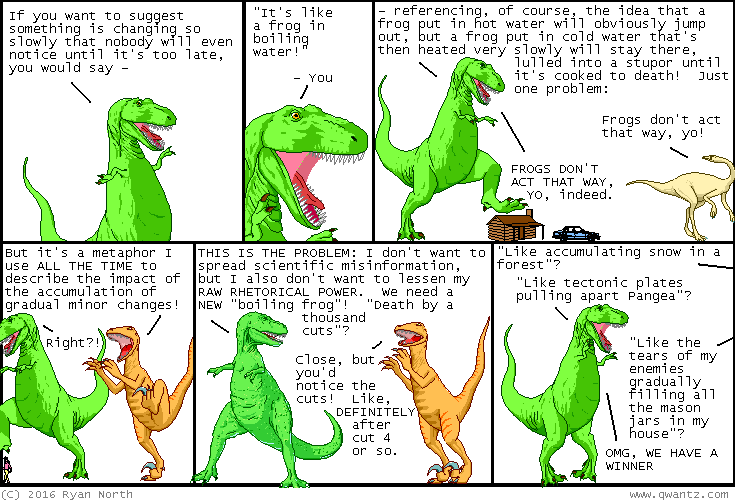
March 2nd, 2016: Its the 10th anniversary of MACHINE OF DEATH! Just about. The idea for the anthology / sequel anthology / creative card game / expansion pack all started with the the original Machine of Death comic in Dinosaur Comics back in December 2005! WHOAH! And to celebrate that idea being 10 years old (and the fact it took us like half that time just to get the book out in the first place, and then everything exploded!) you can get ANY of our books or games for... $10! A MERE TEN BUCKAZOIDS. THAT IS A CRAZY DEAL. The game normally retails for $35 (and the expansion set for $45)! THIS IS PURE MADNESS. And you can take advantage of it RIGHT NOW by clicking... THESE WORDS. – Ryan | |||
Saints and Names.
Yuval Pinterחביב אם יש לכם כמה דקות
Another interesting passage from Bartlett’s endlessly interesting The Making of Europe
In the early Middle Ages most regions of Europe had highly localized repertoires of names. It is easy, given a few personal names, to tell which region or ethnic group is being talked about. Among aristocratic Germans it is even possible to make a good guess at the family, so distinct and particular are the naming patterns. Those who moved permanently from one linguistic or cultural world to another would feel the pressure to adopt a new name, as a tactic designed to avoid outlandishness. On his arrival in Normandy in 1085, for example, the child oblate Orderic was renamed: ‘the name of Vitalis was given me in place of my English name, which sounded harsh to the Normans’. When noble ladies married into foreign royal families who spoke a different language, it was not uncommon for them to adopt a new name. The Bohemian princesses Swatawa and Markéta became, respectively, the German countess Liutgard and Dagmar, queen of Denmark. Henry I of England’s wife was ‘Matilda, who had previously been called Edith’. The tight bonding of name and ethnic or local group explains the pressure for such diplomatic renaming.
The same intense regionalism is true of saints. Their cults usually had one or two main centres, where the chief relics were situated, surrounded by a limited zone of relative cultic density where one might expect to encounter churches devoted to the saint, perhaps subsidiary relics and men named after the saint, a zone which shaded off into the zones of other adjoining local saints. If we find a town whose churches are dedicated to Saints Chad, Mary and Alcmund, we know we are in the English Midlands (the example is Shrewsbury). This regional concentration is characteristic even of the more successful cults. For example, though there were over 700 churches dedicated to St Remi, 80 per cent of them were located within 200 miles of his chief centre at Rheims. The historian Charles Higounet mapped the places named after the saints of Merovingian Aquitaine and found that they stopped abruptly at the Loire, the Rhône and the Gironde.
In the eleventh and twelfth centuries this highly compartmentalized world began to change. A circulation of names and saints through the system began. Sometimes this occurred as a result of conquest. England provides a neat example of such a change. In 1066 the country was conquered by an army of French-speakers from northern France. Within a few years that army had transformed itself into a landed aristocracy — a French-speaking aristocracy ruling an English-speaking peasantry. Not only did the two groups speak different languages, they bore different names. Although Norman and Anglo-Saxon nomenclatures were both, in origin, Germanic, the two countries had developed quite different repertories of names. English Ethelreds, Alfreds and Edwards faced Norman Williams, Henrys and Roberts. In the eleventh century the distinction is fairly watertight: a name is a virtually certain indicator of ethnic origin. In the twelfth century this situation changed. Names are, of course, among the most malleable elements of linguistic culture, offering, as they do, the repeated chance of choice; and soon, it seems, the English population of England chose to adopt the names of their conquerors. The kinds of pressure at work are shown by the story of one young boy, born in the area of Whitby around 1110, whose parents initially christened him Tostig but, ‘when his youthful companions mocked the name’, changed it to the respectably Norman William. This process began among the higher clergy and townsmen. […]
Our picture must, however, be complicated by one more factor. […] Simultaneously changes were taking place in the very pattern of naming and worship of the saints throughout Latin Christendom. Everywhere the universal saints and the dominical cult were increasing in importance. The apostolic saints, especially Peter and John, the Mother of God, and God himself, as Trinity, Holy Saviour or Corpus Christi, were eclipsing the local shrines and cults of earlier medieval Europe. In the twelfth century, for example, the churches of Wales adopted universal saints, like Mary and Peter, as additional patrons, to reinforce their obscure local saints. […] And, following in the wake of their rise to prominence, European naming patterns began to homogenize as parents, kin and priests began to choose names for children from these universal saints. The highly localized name repertoires of the early Middle Ages were replaced by a more standard pattern in which the universal saints were increasingly common.
One wishes the medieval English hadn’t been quite so fond of the name Matilda; Henry I’s mother, wife, and daughter were all named Matilda, as was his nephew Stephen’s wife and one of his son Henry’s daughters. Between the Williams and Henrys and the Matildas and Eleanors, it all becomes very confusing.
"Unless the authors performed some clever pagan ritual before euthanizing the animals I would use..."
"I found the use of the evolutionary theory problematic. This is a highly contested theory and the..."
Yuval Pinterdios mio
"I now have had a chance to look at this paper. I think it is a bit of a joke."
"The authors use a log transformation, which is statistical machination, intended to deceive"
Yuval Pinter<3
Saturday Morning Breakfast Cereal - Autism and Vaccines
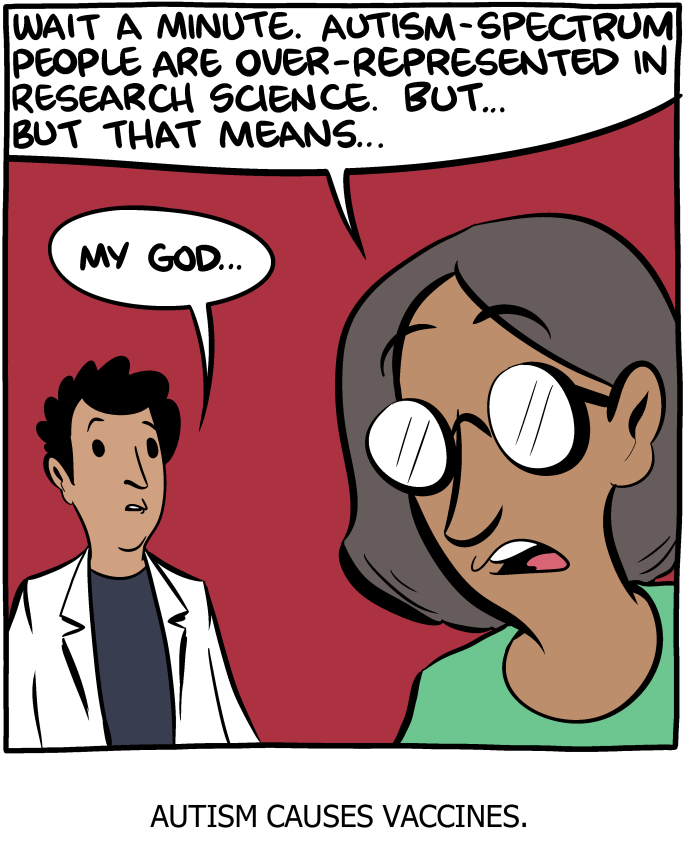
Hovertext: I await your hatemail, pertussis enthusiasts!
New comic!
Today's News:
With apologies to people who saw my earlier version of this on twitter.
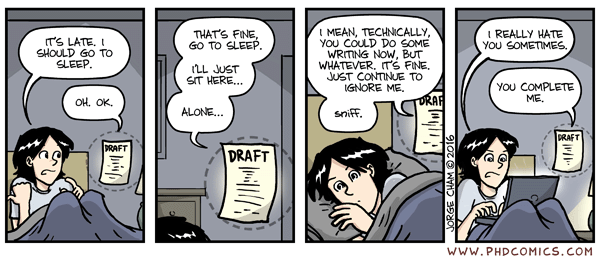
02/24/16 PHD comic: 'Fine'
| Piled Higher & Deeper by Jorge Cham |
www.phdcomics.com
|
|
 |
||
|
title:
"Fine" - originally published
2/24/2016
For the latest news in PHD Comics, CLICK HERE! |
||
"This article reads like the work of a reasonably competent undergraduate."
Where are the adjectives, Bernie?
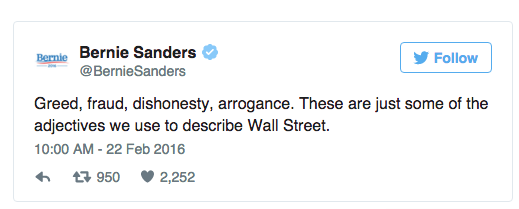
The Bernie Sanders campaign sent out a tweet at 10 a.m., reading: "Greed, fraud, dishonesty, arrogance. These are just some of the adjectives we use to describe Wall Street." That got the attention of Jezebel blogger Joanna Rothkopf, who posted it under the headline, "These Are All Nouns, Bernie." Shortly thereafter, the tweet was deleted, but I was able to grab a screenshot in time.
This reminds me of a column that appeared in the New York Times Magazine ten years ago, "Is Freedom Just Another Word for Many Things to Buy?" (Feb. 26, 2006) by the social psychologists Barry Schwartz, Hazel Rose Marks, and Alana Conner Snibbe. They wrote:
In a recent study with Nicole Stephens at Stanford University, we asked college students to pick "three adjectives that best capture what the word 'choice' means to you." A higher percentage of those who had parents with a college education said "freedom," "action" and "control," while more of those whose parents had only a high-school education responded with "fear," "doubt" and "difficulty."
I posted about this on Language Log at the time, wondering whether the confusion over adjectives and nouns was the fault of the college students, the psychologists, or — as I suspected — the editors of the column. Regardless, I noted that it's a common mix-up:
Nouns that don't denote substantive things sometimes don't seem "noun-y" enough to qualify for that part of speech. Hence Jon Stewart can tell a graduating class that the word "terror" is "not even a noun," while Timothy Noah can write on Slate that words like "humbug" and "poppycock" are adjectives. So it wouldn't be surprising if an editor looking to tighten up the writers' prose made a quick redaction that ended up treating such nebulous terms as "freedom" and "fear" as adjectives rather than nouns.
The Sanders social media team shouldn't feel too bad about having a similar problem identifying "greed," "fraud," "dishonesty," and "arrogance" as nouns. And the speedy deletion of the tweet just might be enough for the campaign to avoid losing the English teacher vote.
(Hat tip, Adam Cooper.)
Sanford stumble ringtone
Yuval Pinterשמתי בריפיט
In a comment on "Mark Sanford can't even" (2/15/2016), Thomas Lee wrote
If only I knew how to turn those marvelous eight seconds of mumbo jumbo into a ringtone for my iPhone…
Just download SanfordRingtone.m4r, add it to your iTunes library, and sync your iPhone. For Android users, download SanfordRingtone.mp3 and follow these instructions.
What you get in either case is this — the start of representative Mark Sanford's response to a question about whether he would support Donald Trump:
So you might want to reconsider.
Or you could choose this version (.m4r, .mp3), where I've replicated a few quasi-syllables to make it a bit longer:
Lexical Distance Among the Languages of Europe.
Yuval Pinterשימושי
Just a map, but a nicely done one, with some interesting discussion (and explanation of obscure abbreviations) in the comments. Thanks, Trevor!
ממוקד, ממותג, ויזואלי
Yuval Pinterהעין השביעית מוודאים עם כל מיני אנשים בברנז׳ה שהם הֿפנימו את דף המסרים של האתר
Negation density record?
From Julian Hook:
Browsing some old Language Log posts recently, I came across "Prophylactic over-negation", 1/26/2012, featuring the phrase "It's not that I don't doubt…"
Something possessed me to hunt for other examples of the construction, which turned up a remarkable specimen in a piece about the personal life of Derek Jeter (Emily Shire, "Derek Jeter’s Lady-Killing Past Before Hannah Davis", 10/28/2015):
“It’s not that I don’t doubt that Jeter isn’t media-savvy.”
This sentence manages in ten and a half words to include one more negation than any of those in the LL post linked above. The context suggests that the intended meaning is something like “I concede that Jeter is media-savvy.” This might have been expressed using a common double-negative construction such as “I don’t doubt that Jeter is media-savvy” or “I don’t mean that Jeter isn’t media-savvy.” But here the writer couples “I don’t doubt” (2 negatives) with “isn’t” (3), and then ups the ante by negating the whole sentence via “It’s not that” (4). My suspicion is that it’s through nothing more than a stroke of luck that the negation parity seems somehow to come out correct in the end.
There are more like this one Out There:
[link] It's not that I don't doubt that certain key things weren't properly sterilized.
[link] Not that I don't doubt that advertising artists don't slip in naughty stuff…
[link] Not that I don't doubt that companies can't do altruistic, well-intentioned things;
[link] Not that I don't doubt that Prevost's reputation isn't warranted but I personally think the curved windows of the La Mirage are ghastly…
[link] not that I don't doubt that it couldn't happen.
I'll leave it to readers to determine whether all of these pass a logic parity check.
More important, I'm offering a prize (a year's free subscription to LLOG) for finding real-world examples with five or more negations in a dozen words, e.g. "Not that I don't doubt that his reputation isn't undeserved".
Some others that don't quite make it:
[link] I cannot deny that some of this negativity isn't deserved
[link] I won't deny that he isn't an undisputed documentary-maker
[link] I won't deny that the series isn't without its charms
[link] even the Spartans' head coach can't deny that Reid's style isn't necessarily bad
[link] Agree with me or not, you can't deny that it isn't a possibility he opts not to report after being drafted.
Anyhow, this one goes into the misnegations file, even if Julian's example comes out right in the end.
Comic for 2016.02.22
GANGSTER: i run an illegal gambling operation and i need a tough name for that / CHILD: bookie / GANGSTER: no, see, i'm a tough criminal who - / CHILD: BOOKIE
| archive - contact - sexy exciting merchandise - search - about | |||
 |
|||
| ← previous | February 19th, 2016 | next | |
|
February 19th, 2016: And finally, THIS comic was inspired by the time I was given the gift of prophecy and nobody believed me! YOU'RE SKEPTICAL RIGHT NOW ABOUT THIS, I CAN TELL. This comic is NOT UNRELATED to the comic I've done for 1001 Knights, a Kickstarter for a couple of really beautiful books with some talented creators inside (FIGURATIVELY SPEAKING). Check it out! – Ryan | |||
Saturday Morning Breakfast Cereal - Condemned
Yuval Pinterאני דווקא מבין את המקור כביקורת על צעידה במקום והעדר קדמה (בניגוד ללמידה מטעויות )
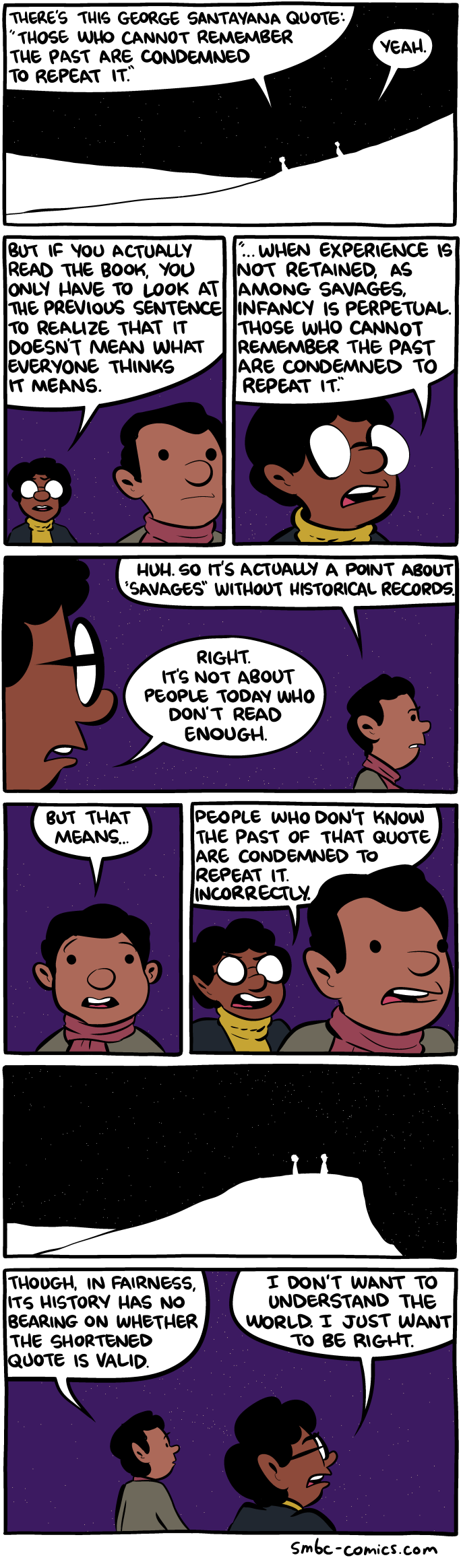
Hovertext: Pro Tip: Any quote that sounds pithy was either (A) never said by the person who supposedly said it, or (B) at least somewhat contradicted by the surrounding sentences in the original source.
New comic!
Today's News:
I encountered this nifty fact reading Dr. Liben's new, and excellent, paper!
Sandals, Sandwiches, Sanders, whatever…
Yuval Pinterעצום
Megyn Kelly, reporting on the New Hampshire primary:
On the Democratic sides, Bernie Sandal- Sanders —
"Sandals", it could catch on —
in the summer months —
he has bested Hillary Clinton …
Chris Hayes, similarly (though less deftly dealt with):
But you see that play out in different ways,
in both Trump's — particularly closing message,
and railing against pharmaceutical companies and the like,
and Bernie Sandwiches- uh Sanders' message from the beginning,
Two excellent examples of Fay-Cutler malapropisms, right up there with "Liszt's second Hungarian restaurant".
Taking into account the "syntactic category rule", and the tendency to have a similar phonological shape, a shared initial syllable, etc., there are not a lot of other options. Maybe Bernie Sandtrap? Bernie Sandblast? Bernie Sandman? I think the second syllables are too heavy in those, alas.
And two substitutions for one politician's name in one news cycle? What are the odds?
I haven't heard of any similar inadvertant substitutions for Trump, any of the Bushes, any of the Clintons, etc. Or "Ted Cruel"? "Mike Huckleberry"? "Marco Rubicon"? Not so far.



Castro Mocks the American Outreach
The efforts of the Obama administration to ‘normalize’ relations with Cuba have been mocked this past week.
The U.S. Southern Command holds an annual regional security conference. For decades one of its main purposes was to protect the region against Cuba, but this time the Obama administration made sure that Cuba was invited to attend. The conference was held at the very end of January.
What did the Cubans do? They sent as their representative a man who spied against the United States and was thrown out of our country. He is Gustavo Machin Gomez, a Cuban spy declared persona non grata in 2002. Now this man was accepted by us to sit with American military officers as a fit person with whom to discuss regional security.
There’s one other thing to consider as one thinks about this invitation. Cuba still holds the Hellfire missile that somehow was sent there, and the regime will not give it back to the United States. The Wall Street Journal has reported that “for more than a year, amid a historic thawing of relations between the U.S. and Cuba, American authorities have tried to get the Cuban government to return the missile….”
Presumably, Cuba is happily sharing what the Journal called “this sensitive military technology” with Russia and other regime allies. The return of the missile was, amazingly enough, not made a condition of ‘normalization’ by the Obama administration in its negotiations with Cuba. And now we see that its return was not even made a condition of inviting Cuba to participate in a regional security conference.
They keep the missile, they send a man thrown out of the United States for spying to our regional security conference, and the Obama administration appears to think all is just swell with the new opening to Cuba. Castro must be wondering if he’s dreaming.
But here’s the nightmare. It seems clear that President Obama wants to cap off his years in office with a visit to Cuba, where he can meet the great Fidel Castro and do some wonderful photo ops. So throughout 2016, we can expect this kowtowing to the Castro regime to continue, and we can expect to see more and more displays of regime contempt for the United States. And meanwhile, the arrests and the beatings of Cubans struggling for democracy and human rights continue, and increase- and they have increased since Mr. Obama signed his deal with the Castro brothers. The price for Mr. Obama’s photo ops would be paid by Cubans struggling for freedom. And that would be an immoral bargain.
Times Xwords Wax Insular.
In today’s NY Times, Charles Kurzman presents some depressing news (if you’re a fan of cosmopolitanism):
With the permission of Will Shortz, the Times’s crossword puzzle editor, I recently downloaded all of the newspaper’s crosswords from February 1942, when the puzzle began, through the end of 2015. I created an algorithm to search all 2,092,375 pairs of clues and answers for foreign language words and place names outside the United States.
The results are imperfect, since the puzzles can be tricky and there is a lot of overlap between English and foreign words. But the broad trend is clear. The puzzle today uses one-third fewer non-English clues and answers than it did at its peak in 1966, and makes two-thirds fewer international references than its peak in 1943.
For many years, the puzzle expected educated Americans to know the German word for “with” (mit) and the Latin word for “man” (vir), for example. These words have all but disappeared from the puzzle. Solvers were expected to know details about America’s military operations, such as “Mountain battlefield” in 1943 (etna) and (misleadingly, since the answer is actually Japanese) “Forever!: Korean battle shout” in 1951 (banzai). Vietnam, Afghanistan and Iraq, by contrast, appear in the puzzle barely more often than before the United States sent troops to each country. Since the 1990s, puzzlers were occasionally asked to recognize “Burkina ____” but over the last few years, they were given additional help, “Burkina ____ (African land)” and “Burkina ____ (Niger neighbor)” (the answer is “Faso”). […]
So are we going to see Vietnamese or Korean in The New York Times crossword?
“I want the puzzle to reflect our common culture,” Mr. Shortz notes, meaning that the answers and clues should have at least entered the general conversation before they appear. After a moment’s reflection, Mr. Shortz noted that the puzzle did include a Vietnamese word last year. The clue was “Vietnamese soup” (pho).
“This is a word I did not know a few years ago, but it has now become embedded enough in American culture that I can expect American readers to know it. With Vietnamese restaurants in many cities, it has become mainstreamed,” he said.
Recently, the puzzle added “Vietnamese sandwich” (banh mi).
Kurzman sums up, “When we turn from the New York Times news pages to the puzzle page, the rest of the world fades away.” There are interesting tidbits in the rest of the article, as well as some very cool charts.
Comic for 2016.02.12
הבניית המציאות
Yuval Pinterהם כתבו גורביץ' וזה מחמם לי את הלב
ויכוח עם פלסטינים? ב'הארץ', עמדת המדינה לא ראויה אפילו לאזכור
דיווחה של עמירה הס על הריסת מבנים פלסטיניים לא חוקיים בדרום הר חברון. כולל רק גרסה פלסטינית ומתעלם לחלוטין מעמדת המדינה, הסותרת אותה

דרום הר חברון. הפלסטינים קובעים עובדות בשטח, המדינה קובעת עובדות חדשות (צילום מתוך אתר 'דהרמה מעורבת חברתית')
ידיעה ארוכה ומפורטת מאת עמירה הס ב'הארץ' ("המדינה הרסה 26 מבנים בדרום הר חברון, יממה לאחר שהליך גישור נכשל", 3.2) מתארת את הריסת 23 מבני מגורים בכפרים הפלסטינים ג'ינבה וחלאווה, בדרום הר חברון בשטח אש 918.
אין זו הפעם הראשונה שהס מדווחת על הנעשה בכפרים האלו, וגם לא הפעם הראשונה שבה 'פרספקטיבה' נכנסת בעובי הקורה ובודקת את דיווחיה אודותיהם. גם הפעם מצאנו שיש מה לדייק, אם לנקוט לשון המעטה.
גם לפי הדיווח של הס, אין חולק שהמבנים שהרסה המדינה אתמול נבנו רק בשנת 2014, במקביל להליך גישור המתנהל בין המדינה לעותרים הפלסטינים. למרות חוסר תום הלב שבבניה בעוד הדברים מתבררים, ומצדיקה הס את הבנייה במילים אלה:
כל המבנים שנהרסו ביום שלישי הם מבני מגורים חדשים, שנבנו החל ב–2014 במקביל לתהליך הגישור. הם עשויים לבני בטון חשוף וגגות פח גלי. ישראל לא פיתחה תוכניות מתאר לכפרים אלו, שקיימים מהמאה ה–19, ולכן כל בנייה בהם אסורה. אבל הגידול הטבעי והצפיפות כופים על תושביהם לבנות גם בלא היתר.
ההצדקה לבניה, אפוא, מגובה בטענה "עובדתית", לפיה ישובים פלסטיניים אלו קיימים מאז המאה ה-19, והבנייה בהם אסורה רק בגלל החוסר בתוכנית מתאר.
זו קביעה מוזרה, שכן זאת בדיוק השאלה העובדתית העומדת במחלוקת, ומחכה להחלטת בית המשפט. דרך אחת להצגת המקרה, היא לבחור בטענה הפלסטינית, אבל יש דרך נוספת להציג את הנושא, והיא לכל הפחות להזכיר, אם לא לקבל, את עמדת המדינה, לפיה עד הכרזת האזור כשטח אש לא התקימו בו מגורי קבע – אפילו לא במערות, וכי חלק מהח'רבות משמשות את העותרים למגורים עונתיים בלבד. גם עמדת המדינה (כמו עמדת הפלסטינים) מגובה בעדויות, מחקר היסטורי ותצלומי אויר, המוכיחים שעד לשנת 1999. היה השטח ללא מגורי קבע.
הס מזכירה טענה עובדתית נוספת, גם היא בכדי לחזק את הטענה כי מדובר בכפרים הקיימים בשטח זה עידן ועידנים:
אזור הכפרים הוכרז כבר בסוף שנות השבעים כשטח צבאי סגור, שבו מורשים לשהות רק תושבי קבע. עד 1997 המשיכו התושבים לחיות ביישובי המערות שלהם כמעט באין מפריע — ראיה לכך שאז נחשבו תושבי קבע.
לא במפתיע, גם את הנושא הזה זוכרת המדינה מעט אחרת:  חיזוק נוסף לטיעון שלה נגד ההריסה, מוצאת הס בסיבה ה"מפוקפקת" לכאורה, שבעטייה חזרה המדינה להשתמש בשטחי האש:
ביולי 2012 הודיע שר הביטחון דאז, אהוד ברק, שיש לפנות שמונה מבין 12 הכפרים כדי לקיים בשטח אימונים צבאיים, וכשנה לאחר מכן הודיעה פרקליטות המדינה שהאימונים באזור זה, ולפיכך פינוי הכפרים, נחוצים כי הם חוסכים כסף לצה"ל
כלומר, הס רומזת לכך שתושבי הכפרים, שכאמור חיים בשטח מאז המאה ה 19' , מפונים מהשטח ובתיהם נהרסים רק כדי לחסוך מעט כסף לצבא.
כפי שכבר ציינה 'פרספקטיבה' בעבר, 12 פסקאות בלבד (מתוך 188) הקדישה המדינה בתשובתה לבגצ, לנושא נחיצות שטחי אש בכלל, ושטח אש זה בפרט. שאר 176 הפסקאות מספקות הסברים נוספים ומגוונים מדוע מוצדק, על פי המדינה, לפנות את הפלסטינים מהאזור.
אבל את כל הצד הזה של הסיפור, לא תקראו ב'הארץ'. שם יש סיפור אחד, צד אחד, גרסה אחת. למדינה יש מה להגיד? יש לה גם הוכחות להצדקת טענותיה? החומר הוגש לבית המשפט? לא רלוונטי.
חידון מספר 487. סופרבול
Yuval Pinterקל יחסית הפעם. נראה אתכם

1. מי השיג שלושה סאקס בניצחון על ניו אינגלנד?
2. מי הקורנרבק היחיד להיות הMVP של המשחק?
3. למי מסר ג׳ו מונטנה את הטאצ׳דאון המנצח מול סינסינטי ב-1989?
4. אילו שתי קבוצות התמודדו בינהן שלוש פעמים?
5. מנה אחד משני הקולג׳ים להעמיד שלושה קווטרבקים מנצחים?
6. מי הייתה קבוצת הווילד קארד הראשונה לנצח במשחק?
7. מי הייתה הראשונה להבקיע 40 נקודות?
8. לאיזו קבוצה הכי הרבה הפסדים בסופרבול?
9. איזה איצטדיון שמעולם לא שימש כאיצטדיון ביתי של קבוצת NFL אירח את הסופרבול?
10. מתי היו שני סקורז רצופים של סייפטי (כלומר לא היה שער שדה או טאצ׳דאון ביניהם)?
11. תנו לי שלוש מארבע הקבוצות שלא היו בסופרבול?
12. קאם ניוטון מקווה להיות הקווטרבק זוכה ההייזמן הראשון לזכות בסופרבול מאז?