

Read more of this story at Slashdot.
Read more of this story at Slashdot.

Crispin Glover's "Clownly Clown Clown" is a far out song and music video from 1988. Glover is an actor, artist, filmmaker, author, and collector/archivist of esoterica. This video features a sexy dancing clown, creepy pig mask, strange footage of a masked woman laying in a medical chair, and Glover Himself. — Read the rest

Flooding can do some major damage to a car, even if it’s not immediately visible (once it has been cleaned). Unfortunately, this means that some vehicles that are irreparably harmed may be shipped off and sold in other parts of the country—specifically, places less prone to flooding where buyers may not be aware of…
 |
submitted by /u/hoverboardholligan [link] [comments] |
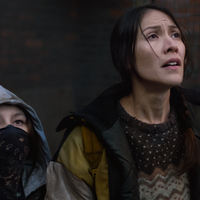 It can often feel in recent events that we are seeing the end of civilization as we know it (if not the end of human life all together). But too often people, especially white westerners, forget that the end of civilization effectively has happened already for countless indigneous peoples in the past few centuries, across the Americas, in Australia, New Zealand, and other parts of Oceania. Genocide has been committed, land confiscated, children stolen, and these entire ways of existing almost erased from existence. For her first feature, filmmaker Danis Goulet dives into the deep end a hard-hitting and (rightfully) thinly-veiled analogy; Night Raiders reads as both deeply personal and encompassing of a community still fighting for recognition. Taking a somewhat familiar dystopian sci-premise, Goulet...
The post Prey [2021] – Netflix Review (3/5) appeared first on Heaven of Horror.

We here at Boing Boing have long been fans of the Codex Seraphinianus, a mysterious surrealist cypher manuscript that first appeared in print in the early 1980s. We first covered it in The Happy Mutant Handbook and have been marveling at it ever since. — Read the rest
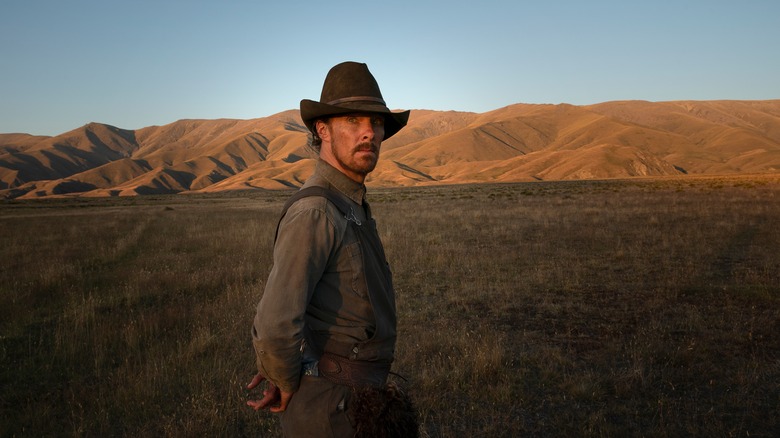
"What kind of man would I be if I didn't help my mother?" So says Peter (Kodi Smit-McPhee) at the start of "The Power of the Dog," Jane Campion's quiet-yet-menacing neo-Western. We hear Peter say these words before we've even met him, and it will take almost the entire film before we find out what they truly mean. With this moment, Campion, adapting the novel by Thomas Savage, is setting a trap. The entire film feels like that; like something hypnotizing us, lulling us in, ready to strike us down at the very last second. The devil is in the details here, and Campion focuses on those details with a fetish-like eye – rough hands pulling taught ropes; fabric stretched shroud-like across a face; nude bodies caked with mud; and land – all that wide-open land, which somehow looks both gorgeous and ominous.
"The Power of the Dog" is set in 1920s Montana, but Campion shot it in New Zealand, and the geographic distance doesn't matter – she has perfectly transported the story, and us, to this land, to this time. Or at least a hazy, haunting dream of this time. Mountains roll on as far as the eye can see. Thick, fleece-like clouds soldier on across the sky. And everything seems vaguely threatening. A foreboding tone blankets "The Power of the Dog," putting us on edge nearly from the jump. Even when mundane, harmless things are happening, the tension mounts. The harmless seems harmful. Silence speaks volumes. This is a subtle movie that manages to knock us flat.
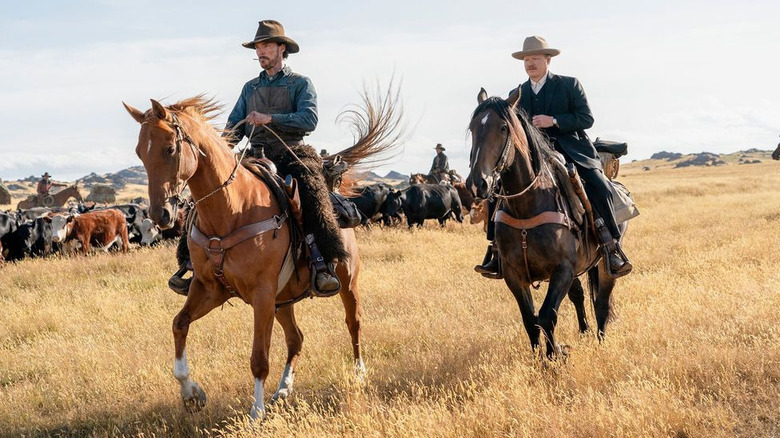
Phil Burbank (Benedict Cumberbatch) and his brother George (Jesse Plemons) are wealthy cattle ranchers. We get the sense that they don't need to be doing this anymore; that they don't have to play cowboy and ride out into the dust. But they do, and it's probably because of Phil, a Yale-educated scholar who has fully embraced the cowboy lifestyle. Indeed, Phil is so engaged in the idiosyncrasies of cowboy life that he seems completely out of time – as if he were straight out of the 1800s instead of the 1920s. When he's not cutting the testicles off bulls or rolling cigarettes, Phil uses his massive intellect to put everyone around him in their place, and in his eyes, their place is beneath him. He is cruel, cutting, and downright scary. He bellows in rage at a group of cheerful folk gathered in celebration, and they scurry away in silent terror like chastised children being sent to their rooms.
Where Phil is cold, George is kind, albeit in an awkward, clumsy way. He doesn't have Phil's smarts or his gift for gab. There are times where he's downright monosyllabic, unable to string more than two or three words together. But he comes off as far more sympathetic, primarily because he always looks pained by Phil's cruelty. One evening, Phil, George, and the rough-and-tumble cowboys who work for them dine at an establishment owned by widow Rose (Kirsten Dunst). Her son Peter, owner of the voice we hear at the start of the film, works at the restaurant, too. He's a shy, awkward young man; rail-thin, ghostly pale, eyes wide. Occasionally, he talks with a lisp. He is slight where other boys his age are sturdy. Phil immediately picks up on these traits and sees them as weaknesses. And when Phil spots weakness, he pounces. He humiliates the boy so harshly that it leaves Rose in tears. George, the good brother, comforts her – and before you know it, the two have fallen into a clumsy love affair and are quickly married.
While George does seem to love Rose, he's not the best at showing it. He remains willfully oblivious to her needs, and her discomforts. When he insists that she play the piano for a dinner party, Rose pleads again and again that she'd rather not. He ignores her and brings in a brand new piano for her to play. He takes Rose back to live with him in the huge ranch house he shares with Phil and two servants (Genevieve Lemon, and an oddly underused Thomasin McKenzie). Rose is an immediate outsider, and while the servants eventually come around to her, Phil remains nasty. When Rose tries to make nice he scoffs and calls her a "cheap schemer." He's convinced that she just married George for the family's money. Or is he? Does Phil really dislike Rose for that reason, or is he just resistant to any outsider coming into his life? Whatever the reason, he makes Rose's life a living hell. And George seems completely oblivious to this, too, leaving Rose in the house with Phil for days on end while he goes off on business. Rose grows so disheartened that she descends into alcoholism, stashing bottles of booze all over the house and spending days on end passed out in her room.
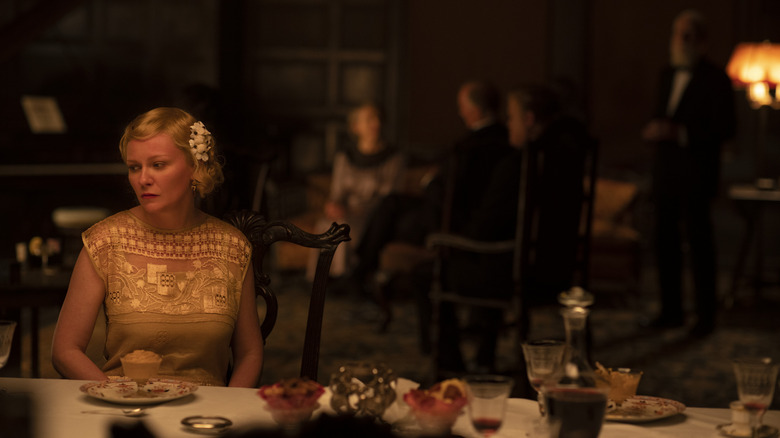
Peter comes to live in the house, too. Phil is once again cold and cruel to the boy, eyeing him with contempt. Peter, meanwhile, appears off in his own inner world, unable and unwilling to even pretend he's not the strange young man that he is. He's an enigma; a curious boy who tucks stray flowers into his pockets and who has a keen interest in anatomy. The bad energy continues to build, and we think we know where this is leading. But it's impossible to pin down what Campion creating here at first; the cards are played extremely close to the vest. We will only know things when Campion damn well wants us to know them, and not a minute sooner.
A curious thing happens. Phil abruptly changes his tune and begins taking an interest in Peter. We are given hints and clues as to Phil's motivations – stories from his past involving a now-dead mentor-figure known as Bronco Henry. "When did Bronco Henry teach you to ride?" Peter asks. "When I was around your age," Phil says, his reply loaded with an unspoken weight. Deep in the woods, tucked away, Phil keeps a secret box that contains a bit of fabric embossed with the initials BH. He handles that bit of fabric in suggestive ways. But he never articulates things. He doesn't have to. We follow along, even if we don't know all the details.
The cast here fit all their characters like a glove. Dunst is perfectly sympathetic, and even a little pathetic, as the put-upon Rose. Plemons is suitably clumsy yet likable, clueless yet sweet; one of the most remarkable scenes in the movie comes after Rose teaches Geroge a few awkward dance steps, leading George to softly weep and say, "It's so nice not to be alone." Smit-McPhee plays Peter as a walking mystery, an internal character we wouldn't think twice about if we saw him in public. But "The Power of the Dog" truly belongs to Cumberbatch, who has never been better than he is here. His considerable cheekbones peppered with sandpaper stubble, his clothes and skin filthy with the land, his overall aura domineering, Cumberbatch is so commanding here that it starts to get downright scary. We both look forward to and dread when he'll appear on screen next. I've enjoyed a lot of Cumberbatch's work, but none of it comes close to what he's doing here.
As "The Power of the Dog" rolls into its jaw-dropper of a conclusion, we are left drained, pulverized, as if we've been put through the wringer. Campion hasn't helmed a feature film in nearly 12 years, and here she comes back with a vengeance, with supreme command of her imagery. I'm not anti-Netflix by any means, and I'm thrilled the streaming giant continues to throw money at great filmmakers. But it seems almost a pity to picture such a subtle, emotionally pulverizing movie playing on Netflix while the viewer spends most of the time checking their phone. But perhaps I'm generalizing. Perhaps "The Power of the Dog" will find exactly the audience it needs and deserves. An audience ready to be transported into a completely different world; a fully realized scary-beautiful world brimming with meticulously drawn characters who intrigue, confuse, frighten, and ultimately thrill us.
/Film Rating: 9 out of 10
Read this next: Power Of The Dog Trailer: Benedict Cumberbatch Leads A Star-Studded Netflix Western
The post The Power of the Dog Review: Jane Campion's Stunning Neo-Western Has a Career-Best Performance From Benedict Cumberbatch [TIFF 2021] appeared first on /Film.
Read more of this story at Slashdot.
Read more of this story at Slashdot.
Read more of this story at Slashdot.

Exposure to high-power motorcycles which generate tremendous levels of vibrations can have an adverse impact on the iPhone cameras, according to Apple. Here are additional details the company wants to be aware of.
Apple says your iPhone camera lenses equipped with OIS and closed-loop autofocus (AF) features are more prone to damage as they use gyroscopes, or magnetic sensors to help minimize shake when capturing images and video. Apple has also explained what to avoid doing in order to protect the iPhone camera from harm.
“High-power or high-volume motorcycle engines generate intense high-amplitude vibrations, which are transmitted through the chassis and handlebars. It is not recommended to attach your iPhone to motorcycles with high-power or high-volume engines due to the amplitude of the vibration in certain frequency ranges that they generate. Attaching your iPhone to vehicles with small-volume or electric engines, such as mopeds and scooters, may lead to comparatively lower-amplitude vibrations, but if you do so a vibration dampening mount is recommended to lessen the risk of damage to your iPhone and its OIS and AF systems. It is also recommended to avoid regular use for prolonged periods to further lessen the risk of damage.”
Apple has also included a list of iPhones that support OIS and closed-loop AF.
1. OIS is available on iPhone 6 Plus, iPhone 6s Plus, and iPhone 7 and later including iPhone SE (2nd generation). Note that the Ultra Wide camera on iPhone 11 and later doesn't have OIS, nor does the Telephoto camera on iPhone 7 Plus and iPhone 8 Plus.
2. Closed-loop AF is available on iPhone XS and later, including iPhone SE (2nd generation).
There have been a number of reports pointed out by MacRumors where iPhone owners complained about the damage caused to their iPhone cameras in situations where they were riding mountain bikes.
We are not sure if this particular scenario affects Android smartphones with OIS, but for now, we recommend being a little careful when carrying your iPhone in the aforementioned situation.
The post Apple Warns iPhone Users That Vibrations From Motorcycle Engines Can Permanently Damage Cameras by Omar Sohail appeared first on Wccftech.
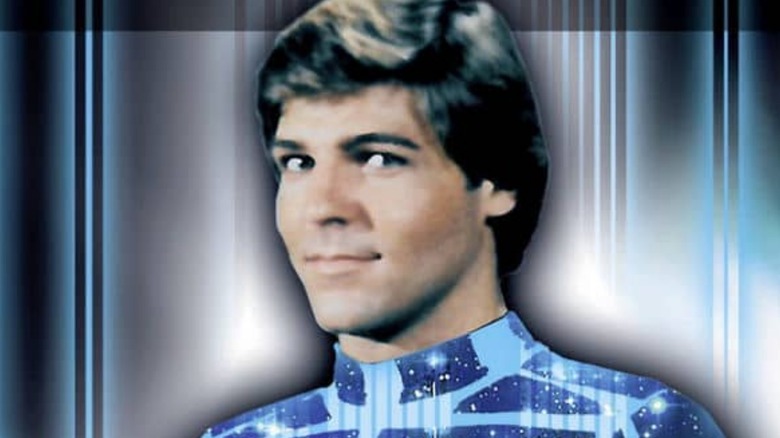
The '80s were the decade when KITT prowled the streets and Airwolf patrolled the skies, when a school teacher stepped up to serve as the greatest American hero, and when a government scientist took his first quantum leap back in time to put right what once went wrong.
But '80s television also boasted legions of less-watched stealth superheroes: phoenixes and probing prodigies and extraterrestrial ex-cons, wizards and warriors, manimals and automen, and voyagers to other worlds. Maybe their shows were stuck in no-win timeslots. Maybe the writing didn't live up to their series' promising concepts. Maybe TV audiences four decades ago simply weren't ready for them yet.
Whatever the reason, these 15 sci-fi and fantasy shows from the '80s deserved more than a single season, and are just waiting to be renovated and relaunched for modern audiences. Here's what they're about, why they failed, and -- most importantly -- how they could be given a second chance.
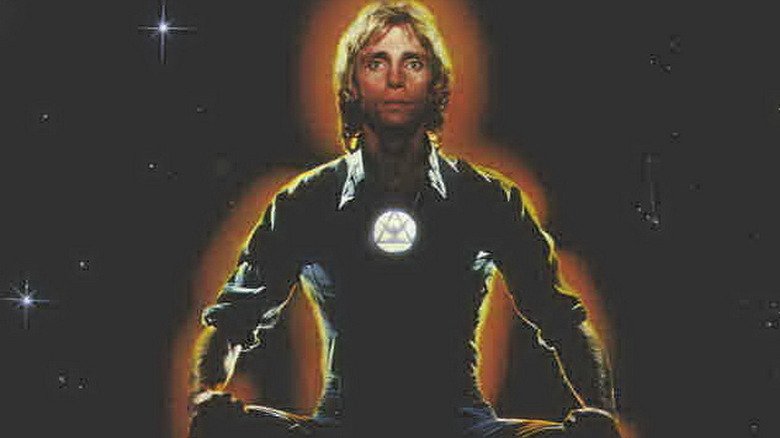
What was it about? The alien Bennu of the Golden Light (Judson Scott) was left on Earth to find Mira (Sheila Frazier), another being from his home world, who was placed on Earth as his companion thousands of years before to inform him of his ultimate mission. Bennu boasted an array of paranormal powers, enhanced by his Phoenix amulet, which drew strength from the Sun. While he was doggedly pursued by government agent Justin Preminger (Richard Lynch), Bennu's greater foe was Yago, an evil being from his home world who was connected to the Moon in the same way that Bennu was to the Sun.
Why didn't it work? Poor ratings, thanks to airing in the "Friday night death slot."
How could it be made to work? Reboot. Tales of ancient aliens visiting Egyptians and Mesoamericans can be fun, but not if they fail to respect the cultures they're portraying. Cast Egyptian-American actor Rami Malek as Bennu (the Egyptian word for Phoenix), and have his quest for Mira double as an Indiana Jones-style hopscotch around ancient archaeological sites, highlighting the actual histories and heritage of those cultures along the way.
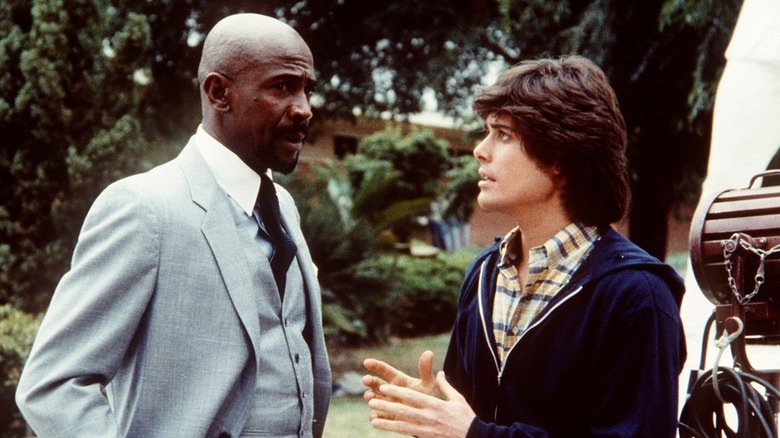
What was it about? High school student Matthew Star (Peter Barton) posed as a "typical American teenager," fooling even his girlfriend, Pam Elliot (Amy Steel), but was secretly the exiled crown prince of an alien planet, forced into hiding on Earth after an intergalactic armada conquered his home world. Matthew struggled to balance schoolwork and dating with dodging alien assassins, but was aided by an ally of the royal family, Walt Shepherd (Louis Gossett Jr.), who worked as a science teacher at his school.
Why didn't it work? Poor ratings, radical midseason retooling, and harsh reviews from critics. Matthew and Walt went from occasionally aiding the military's extraterrestrial investigations to serving as full-time government agents, but TV Guide still ranked it 22 on the "50 Worst TV Shows of All Time" in 2002.
How could it be made to work? Reboot. Imagine "Smallville" if Clark Kent arrived on Earth as an adolescent rather than as an infant. As an immigrant, how much of your new home's culture do you choose to adopt, and how much of your heritage do you hold onto?
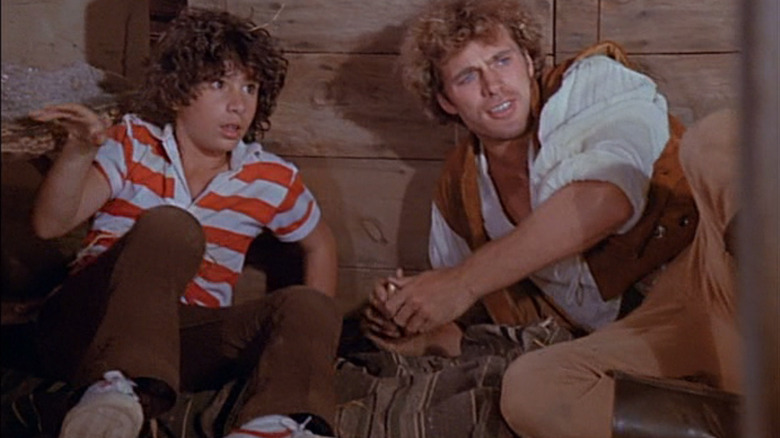
What was it about? Orphaned history buff Jeffrey Jones (Meeno Peluce) was accidentally swept up into the time-traveling adventures of Phineas Bogg (Jon-Erik Hexum), a member of a society of "Voyagers" sworn to ensure the events of history unfold properly. Because the handsome Bogg had more of an eye for the ladies than he did a head for history, Jeffrey drew from the lessons of his departed father, a history professor, to help guide them in setting events right.
Why didn't it work? Not poor ratings, for once. "Voyagers!" averaged a 17 share opposite the top-rated "60 Minutes" and seemed set for a second season, until executives believed they could beat "60 Minutes" with a competing news program, and canceled "Voyagers!" (for the record, NBC's execs were wrong).
How could it be made to work? Reboot. It already worked. Boy genius Jeffrey is the brains of the outfit, while Bogg provides the muscle and the ability to charm historic heroines such as Cleopatra. As Tom Shales said in The Washington Post, "Voyagers!" was "a joy ride from start to finish."
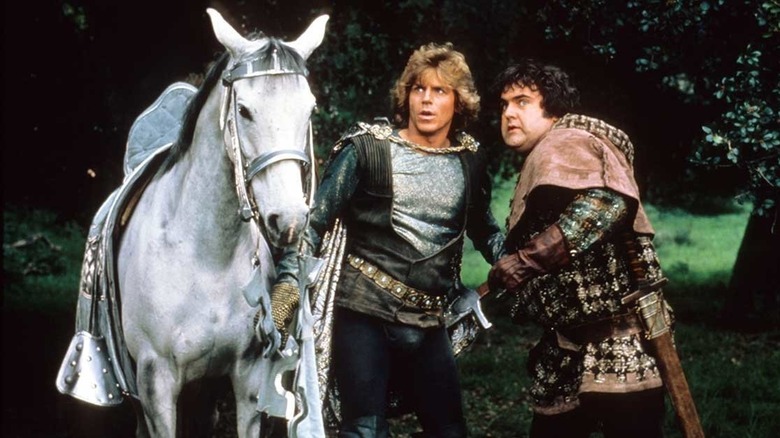
What was it about? From neighboring kingdoms, the good prince Erik Greystone (Jeff Conaway) and his husky loyal sidekick Marko (Walter Olkewicz) constantly came to blows with the evil Prince Dirk Blackpool (Duncan Regehr), often over the spoiled Princess Ariel (Julia Duffy), while the evil wizard Vector (Clive Revill) hatched his own schemes.
Why didn't it work? Poor ratings, in spite of some notably positive reviews and expensive special effects.
How could it be made to work? Reboot. Moviegoing audiences in 1984 weren't ready for the sci-fi satire of "The Ice Pirates," but by 2014, they were ready for "Guardians of the Galaxy." Similarly, "Wizards and Warriors" was praised by the Dallas Morning News as a "vastly underappreciated satire," and after "The Princess Bride" in 1987 and "Galavant," which aired from 2015 to 2016, the swords-and-sorcery subgenre is arguably ripe for self-aware comedic commentary.
Conclude the reboot's pilot episode by revealing that Erik and Marko are tabletop role-players from modern-day Earth -- show them sharing a "Wizards & Warriors Player's Handbook" -- who inexplicably find themselves inhabiting the reality of their game, à la "Jumanji," and are on a quest to solve this mystery.
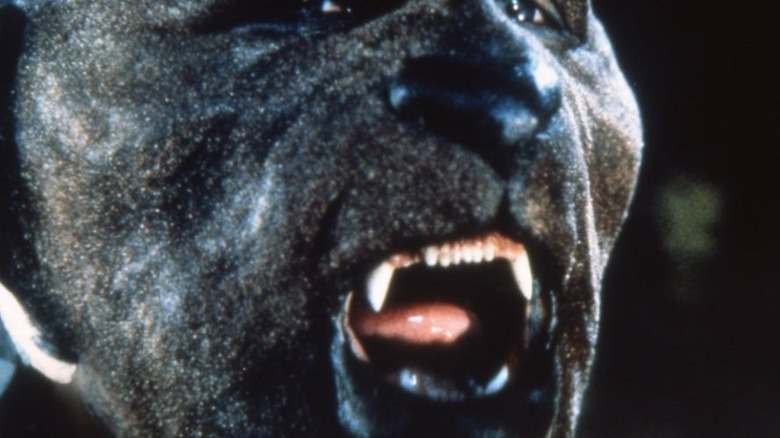
What was it about? Wealthy, well-traveled professor of criminology Dr. Jonathan Chase (Simon MacCorkindale) inherited the quasi-mystical ability to shapeshift into a veritable menagerie of animals, which he used to secretly assist the police, for whom he already served as an official consultant.
Why didn't it work? Poor ratings (the Friday night death slot strikes again), expensive special effects, and harsh reviews from critics, including fellow NBC show "Late Night with David Letterman."
How could it be made to work? Reboot. William Conrad's opening narration mentioned that Chase traveled to Africa and Tibet, but most episodes rarely strayed from the territory of generic cop show plots. Take the series out of the big city by recasting Chase as a professor of cryptozoology. Send Chase around the world to investigate reports of cryptids in other lands (and seas), in hopes of learning more about his own origins, and generate dramatic tension by revealing that he not only identifies with mythical creatures, but also struggles to control his more feral animal nature. Also, take advantage of the advances in affordable special effects since 1983 by not repeatedly reusing the same transformation footage.
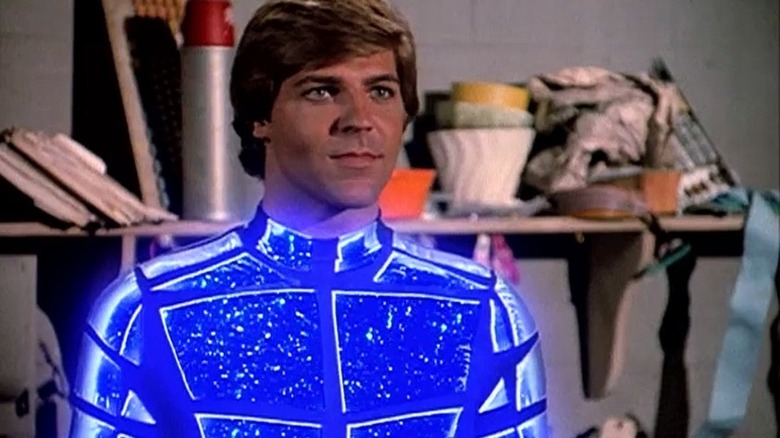
What was it about? Police officer and computer programmer Walter Nebicher (Desi Arnaz Jr.) created an artificially intelligent crime-fighting program that became an "Automatic Man" (Chuck Wagner), or "Automan" for short. Automan generated hard-light holograms through his floating polyhedron sidekick Cursor, usually of various "Tron"-influenced vehicles, and posed as government agent "Otto J. Mann" so that he and Walter could work on police cases together.
Why didn't it work? Poor ratings and expensive special effects.
How could it be made to work? Parody remake. In 2017, Red Giant Software teamed up with "Stargate" actor David Hewlett to produce the comic short film "Hewlogram." Wagner appeared in an after-credits cameo, which affectionately poked fun at how no part of computer technology has ever worked the way it did in "Automan."
With three DVD releases collecting the complete "Automan" series released between 2012 and 2015, it's clear that there's an abiding affinity for this otherwise overlooked, admittedly silly show. Deliver some dazzling visuals with a "Tron"-inspired sheen, cast a pair of co-leads with authentically chummy chemistry, and encourage the audience to laugh along with the outlandishly scientifically inaccurate hijinks, rather than at them.
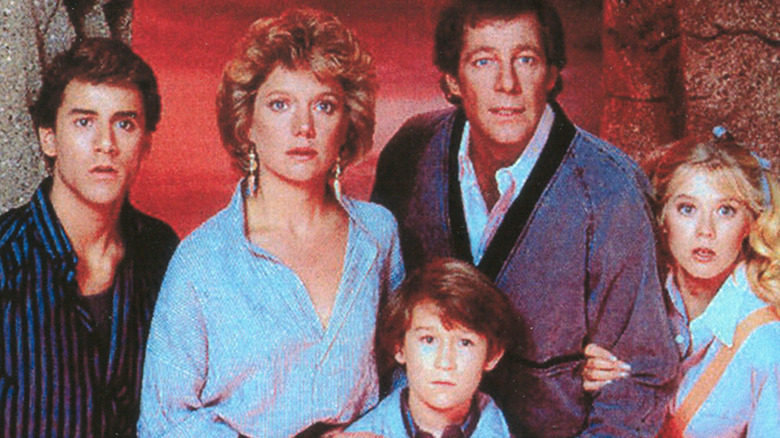
What was it about? The vacationing Sterling family toured inside the Great Pyramid of Giza during a 10,000-year conjunction of the planets, which transported them to another world in what was apparently an alternate universe. This "otherworld" of Thel was divided into 77 "zones," each containing an entirely different society, with travel tightly regulated by "Zone Troopers." The Sterlings ran afoul of Kommander Nuveen Kroll (Jonathan Banks), the Zone Trooper who pursued them for the rest of the series, as they searched for the capital province of Imar, which legends implied might offer them a way back to Earth.
Why didn't it work? Poor ratings, as Saturdays went from must-watch TV nights to shedding viewers, and mixed reviews from critics.
How could it be made to work? Sequel. You don't pass up casting Jonathan Banks -- Mike Ehrmantraut from "Breaking Bad" and "Better Call Saul" -- as your recurring villain. Another American family visits Egypt, gets transported to Thel, and is pursued by Kroll, who cryptically alludes to the Sterlings' quest to return home as we're treated to the fantastically diverse societies (and pointed social commentaries) of each zone.
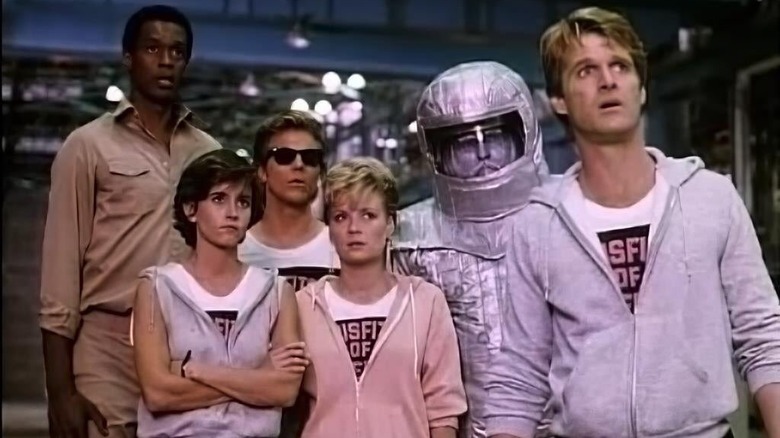
What was it about? Renegade research scientist Dr. Billy Hayes (Dean Paul Martin) and his colleague and best friend, the size-changing Dr. Elvin "El" Lincoln (Kevin Peter Hall) studied "human anomalies" at the Humanidyne Institute. In the process, they recruited electrically powered rock-and-roll musician Johnny "Johnny B" Bukowski (Mark Thomas Miller) and telekinetic teenager Gloria "Glo" Dinallo (Courteney Cox) as their fellow "Misfits of Science."
Why didn't it work? Poor ratings and expensive special effects.
How could it be made to work? Sequel. One name among that cast stands apart from the rest.
Martin and Hall both passed away, and Miller mostly stopped acting after 1991, but Courteney Cox, once the team's ingénue, is now overqualified to play Dr. Gloria Dinallo, senior research scientist at Humanidyne, as she recruits the next generation of "Misfits" to save the world from science gone weird. It's Marvel's X-Men with the serial numbers scrubbed, and without being beholden to "mutant genes" as the singular, boring origin for all the characters' superpowers. It's about benevolently mad scientists furnishing a laboratory home for all of us freaks of nature.
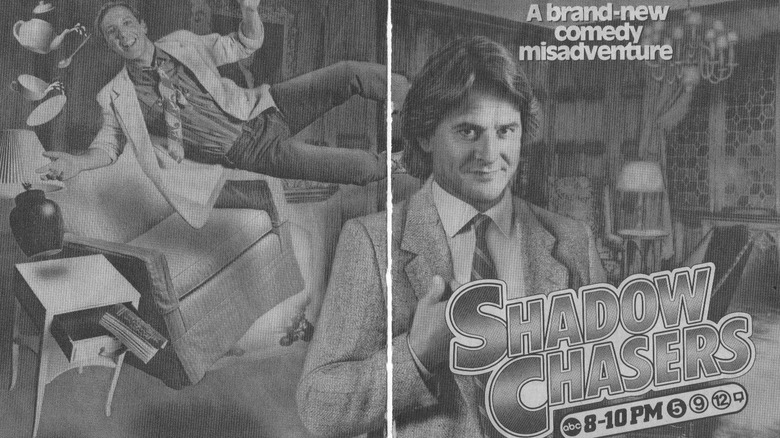
What was it about? Genteel British anthropologist Dr. Jonathan MacKensie (Trevor Eve) worked for Dr. Julianna Moorhouse (Nina Foch), his department head at the fictional Georgetown Institute Paranormal Research Unit, and struck up a partnership of mutual convenience with garish tabloid reporter Edgar "Benny" Benedek (Dennis Dugan), after being forced to investigate an alleged haunting. The odd couple grudgingly agreed they worked well together and teamed up regularly.
Why didn't it work? Not just poor ratings, but the worst ratings of all 106 shows in the 1985-1986 TV season, thanks to its Bataan Death March of a timeslot -- it aired opposite NBC's "The Cosby Show" and "Family Ties" on Thursdays from 8-9 p.m. -- in spite of celebrities such as Ricardo Montalbán and Ron Howard promoting the show in amusing commercials.
How could it be made to work? Reboot. This was 100% intended to be TV's "Ghostbusters" with two fewer team members (both Filmation's "Ghostbusters" and "The Real Ghostbusters" animated series premiered in 1986), but it could be "The X-Files," minus the "mytharc" that came to dominate every episode. Imagine "Jose Chung's From Outer Space," each week.
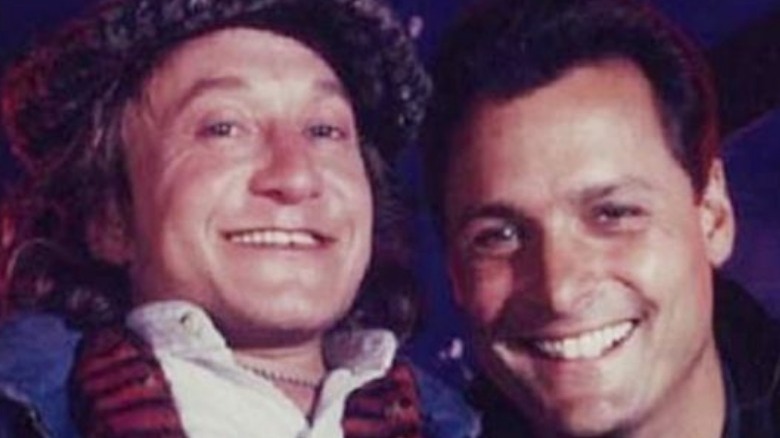
What was it about? Simon McKay (David Rappaport), an inventor with dwarfism, devoted himself to toymaking and philanthropy, but in spite of his pacifism and altruism wielded enough genius that government agent Alex Jagger (Douglas Barr) was assigned to protect him from those who would exploit his creativity for more destructive purposes. Those foes included Simon's mad-scientist archenemy Troyan (Roy Dotrice), a fellow former employee of the Pentagon.
Why didn't it work? Poor ratings, rescheduling to the Thursday night death slot, and expensive special effects.
How could it be made to work? Reboot. Online fans of the original series are still calling for a DVD release, but Rappaport passed away in 1990, so a sequel wouldn't be possible. Simon McKay's character arc remains resonant nonetheless. He turned his efforts toward world peace after suffering a bad brush with weaponry he helped design for the U.S. military. Sound familiar? Everyone loved Peter Dinklage as Tyrion Lannister in "Game of Thrones," so this is TV's chance to cast him as Tony Stark, exploring the cutting-edge technology and the applications of the toys and video games of today (and tomorrow).
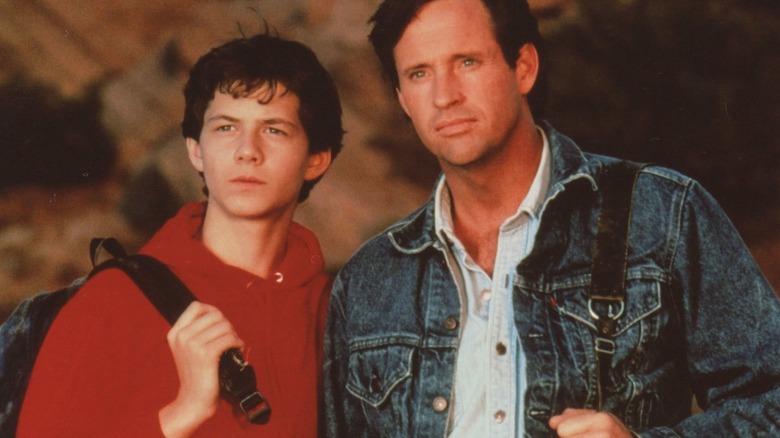
What was it about? A sequel to John Carpenter's 1984 film "Starman," this TV adaptation revised the timeline by setting the film 15 years prior to 1986, even though that predated the 1977 launch of the Voyager 2 space probe, to which the "Starman" originally responded.
In the show, the Starman returned to Earth, cloned another human body (Robert Hays), and connected with his teenage son, Scott Hayden Jr. (Christopher Daniel Barnes) as they evaded government agents and searched for Scott's mother, Jenny Hayden (recast as Erin Gray for TV).
Why didn't it work? Poor ratings (Friday and Saturday night death slots) and mixed reviews from critics.
How could it be made to work? Direct sequel to the film, replacing the previous show. Bring back Jeff Bridges as "Scott Hayden" -- without the uncanny valley-triggering digital de-aging used in "Tron: Legacy" -- and Karen Allen as Jenny Hayden, if at all possible. Given the similarity in looks between Bridges and Kurt Russell, cast Wyatt Russell as Scott Jr. No need to fudge the timeline anymore. Generationally, Scott Jr. is a Millennial, so meeting his long-absent alien father merely compounds his preexisting existential angst.
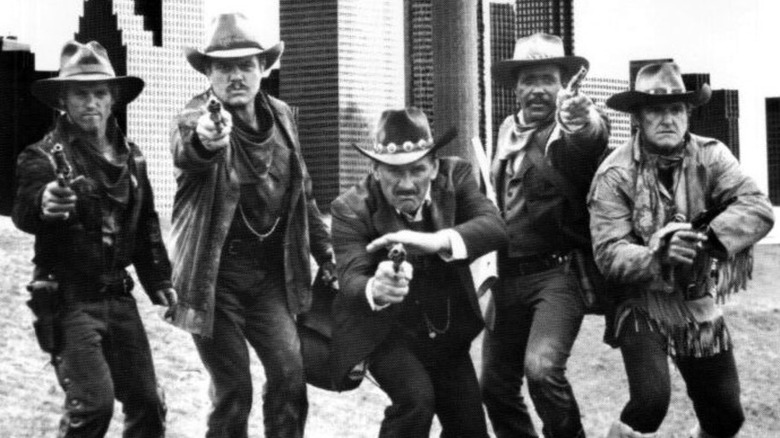
What was it about? In Texas in 1899, Sheriff Jonathan Grail (Rod Taylor) was squaring off for a final showdown against his former allies in the criminal Pike Gang when a lightning bolt struck all five men, transporting them forward in time to 1986.
With no way back to the past, Grail and the gang declared a truce and started the Double Eagle Ranch Detective Agency so they could afford to live in the present day. Grail also struck up a romance with Deputy Maggie Randall (Christina Belford), a Houston detective who assisted the gang on several cases.
Why didn't it work? Poor ratings, in spite of its pilot episode being one of the most-watched shows that week.
How could it be made to work? Reboot. In addition to the "fish out of water" comedy that flows naturally from nudging a posse of Old West outlaws more than a century outside of their comfort zone, there's an opportunity here to comment on the growing cultural divide between rural and urban America under the guise of an action-oriented sci-fi allegory.
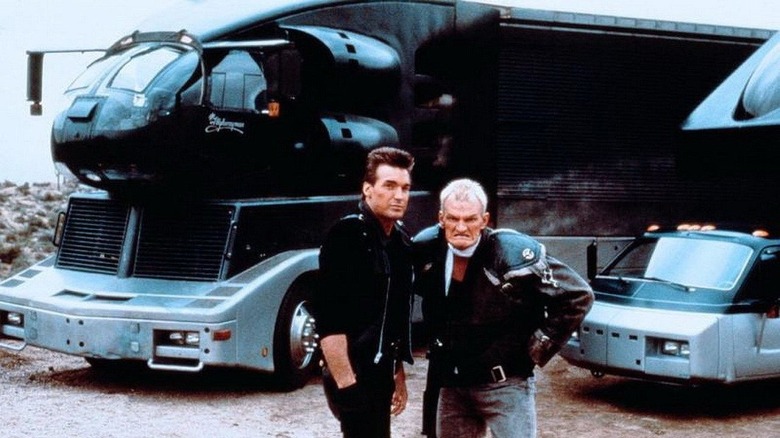
What was it about? In "the near future" (ultimately revealed as 1992), an unnamed law enforcement agency, whose own legal status remained nebulous throughout the show, dispatched its "Highwaymen," each of whom drove a technologically advanced truck that served as a crime lab and weapons arsenal and concealed a helicopter inside, to deal with "the fringes of society's frontiers."
Why didn't it work? Poor ratings, radical midseason retooling, and expensive special effects. The vehicles and high-tech toys were fun, as one expects from "Knight Rider" creator Glen A. Larson, but the series did a sloppy job of defining the parameters of its reality. The titular Highwayman (Sam J. Jones) never revealed his name, as close friends and even fellow Highwaymen called him "Highway" (you're not the Mandalorian, Flash Gordon).
How could it be made to work? Reboot. George Miller's "Mad Max" films work because there's a fully developed mythos behind the vehicles-go-vroom stuff we see onscreen. Maybe, in "the near future," Highwaymen are needed to keep peace in what remains of the United States, which splintered into Balkanized factions without a civil war even being declared.
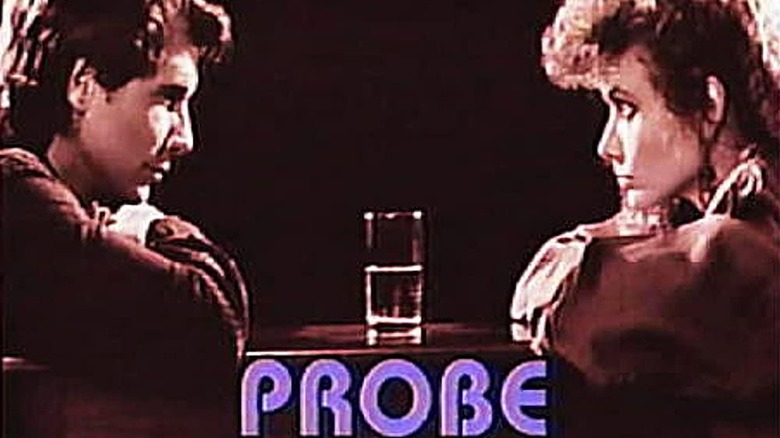
What was it about? Asocial prodigy Austin James (Parker Stevenson) founded the think tank Serendip but was uninterested in running it, so Serendip sent secretary Michelle "Mickey" Castle (Ashley Crow) to pester him over paperwork. Mickey was no scientist, but her instinctive insights made her a natural match for Austin, as he consulted for the police and investigated strange scientific mysteries, occasionally stemming from the creations and discoveries of Serendip. Isaac Asimov and "Columbo" co-creator William Link co-created "Probe," so it was well-written.
Why didn't it work? The 1988 Writers Guild of America strike kicked off March 7, the same day this midseason replacement series premiered.
How could it be made to work? Sequel. Austin and Mickey were Mulder and Scully five years early, with the twist that Austin tended to debunk supposedly supernatural occurrences. Stevenson and Crow also possessed an effortlessly endearing "ship-tease" chemistry, on a par with Bruce Willis and Cybill Shepherd in "Moonlighting." Stevenson has told interviewers that "Probe" remains his "favorite" show he's worked on, and if it were resurrected, "I would beg to be part of it."
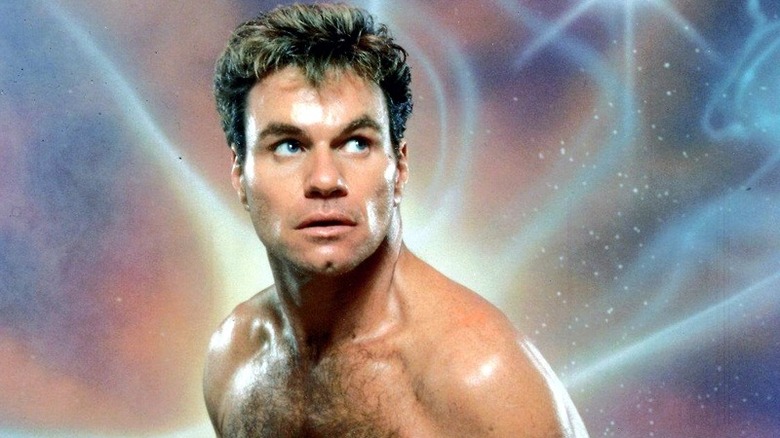
What was it about? An alien soldier (Martin Kove) who served in an interplanetary war was subsequently prosecuted for a rebellion against his own planet's rulers. Although found guilty, he was granted an opportunity to reform, in recognition of his wartime service, by being sentenced to live for an indefinite period on planet Earth in a human body, with a floating "Control" robot (voiced by Danny Mann) as his probation officer. Control kept the soldier's violent tendencies in check, and assigned him to help humans he encountered to demonstrate his reformation, reduce the length of his sentence, and eventually end his exile.
Why didn't it work? Poor ratings and harsh reviews from critics. Its premiere ranked 65th out of 81 shows.
How could it be made to work? Reboot, but like the American "Broadchurch" remake with David Tennant, cast Martin Kove (fresh off "Cobra Kai") in the same role he played before. Focus less on the fish out of water antics than on Kove's weathered, weary veteran learning to value the lives of others, while gradually revealing that his rebellion against his rulers was actually justified.
Read this next: 'Cobra Kai' Season 4: Release Date, Cast And More
The post Single-season '80s sci-fi and fantasy shows that deserve a second shot appeared first on /Film.
The devil is terrifying. Whether viewers are persons of faith or not, there's something about the devil that cultivates a distinct, almost existential kind of fear. The name alone, uttered in shadows and whispers, is enough to inspire a perennial, frosty chill. For certain audiences, the devil is very much real. For others, the movies he stars in are so chilling and so raw in their depiction of Old Scratch that until the lights go on, whoever is watching just might find themselves believing, too, even if only for a little bit.
If you're looking for some satanic scares, the following 13 movies are the best there are. A combination of old school horror films and contemporary showcases, the devil is central in all of the following films. Some might be about specific demons -- "The Exorcist," for instance, is actually about Pazuzu -- but so long as the creatures are in league with Satan himself, they count. So, grab your Bible, stock up on holy water, say a prayer, and read on ... if you dare.
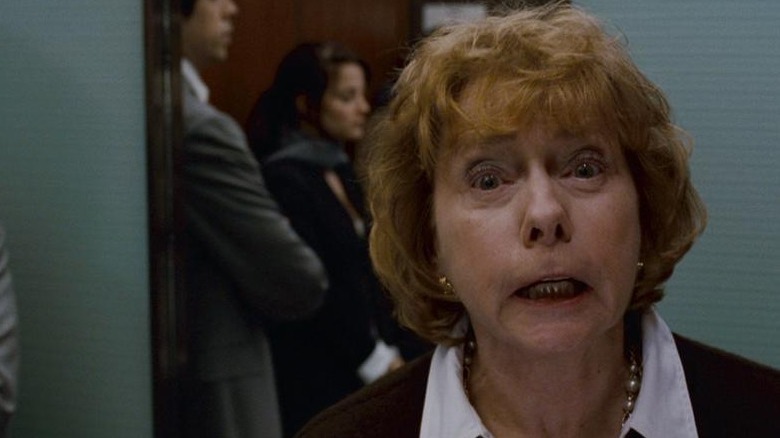
"Devil" is a lot like "The Nightmare Before Christmas" in that it is routinely misattributed to the wrong director. No, M. Night Shyamalan did not direct "Devil." John Erick Dowdle did. Though adapted from a story of Shyamalan's, the writing and directorial duties were placed in other hands. Still, it's an easy misattribution to make, on account of both the marketing and how Shyamalan's inimitable narrative and filmmaking techniques are evident all over "Devil." An ensemble thriller, in "Devil" five strangers are trapped together in an elevator and soon realize that one of them is the literal Devil himself.
With quick shocks, lots of paranoia, and the kind of twist ending one comes to expect from a Shyamalan production, "Devil" is both familiar and unpredictable. It earns its scares earnestly, the acting is worthwhile, and it's a prime example of a high concept exploited to maximum effect on a modest budget. The world could certainly use more of this kind of devilry.
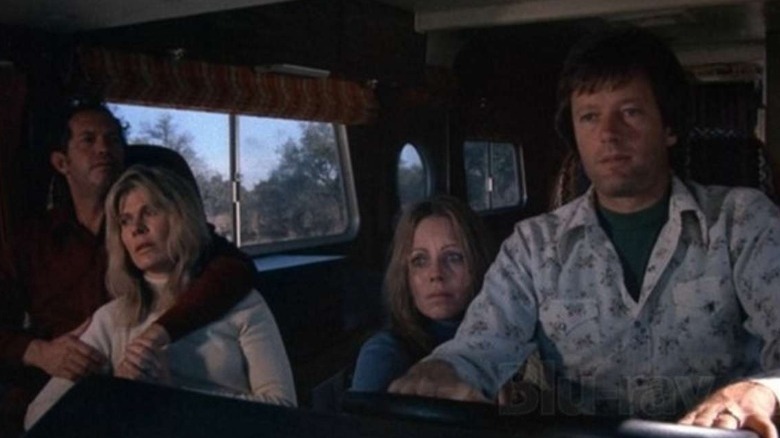
"Race with the Devil" is an early "Mad Max" prototype with a horror vibe and a whole lot of angry, violent Satanists. Peter Fonda, Warren Oates, Loretta Swift, and Lara Parker star as a pair of married couples on an RV trip to Aspen when they run afoul of a satanic sacrifice. The first act is a tense, slow burn, as the couples, having barely escaped the cult, continue their trip, unaware that the cult is watching their every move. The third act is when everything hits the colloquial fan. Chased down across the freeway, the vehicular stunts are practical, well-choreographed, and genuinely thrilling. Fonda gets to jump between moving vehicles, guns are fired, and the protracted action sequence is an expert example of how to do car chases right.
Not everything about "Race the Devil" is perfect. As deliciously dour as the ending is, the third act is a swift shift into action territory that belies the tension that preceded it. Similarly, the gender politics are dated, even for 1975. As the two wives, Swift and Parker are worse than useless -- they're practically liabilities. It's especially strange to see Swift behave so helplessly given her other screen credits, and it's frustrating to see these two talented actors scream and cry without any agency. Still, it's a one-of-a-kind film. For fans of paranoid thrillers with satanic undertones, there's little better.
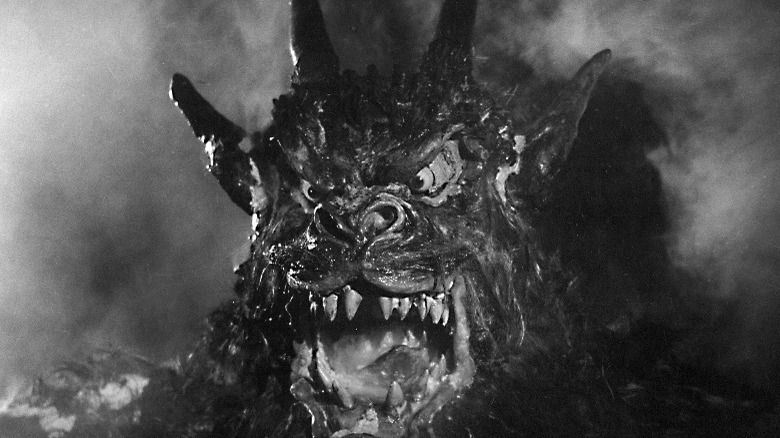
"Curse of the Demon" (also known as "Night of the Demon") is genuinely scary in a way that few classic horror films are. That isn't to say that other older films aren't frightening, but "Curse of the Demon" is almost prescient in the way it moves to the rhythms of more contemporary horror outings. Directed by Jacques Tourneur, its production was notoriously rife with conflict, with tension rising over both its length and the decision by producer Hal E. Chester to insert the demon itself into the climax; Tourneur wanted to leave it to the viewers' imaginations.
"Curse of the Demon" stars Dana Andrews as Dr. John Holden, a professor intrigued by the death of Professor Harrington (Maurice Denham) and his work on the occult, namely his interest in exposing a satanic cult. Holden is soon in over his head and stuck in a cycle of death, curses, and, yes, giant demons. The decision to show the demon itself is still a point of contention -- some think it looks silly, while others appreciate the brazenness of the choice -- but regardless, there's little that matches the potent thrills of "Curse of the Demon." Grounded with peripheral supernatural chills, it reminds audiences that if the devil is real, he exists in shadows and whispers, in the minds and hearts of evil men. It's true in a way more bombastic entries can't quite manage.
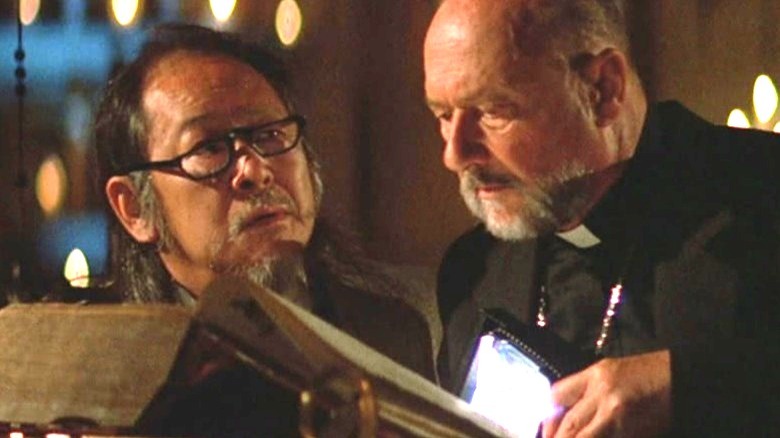
"Prince of Darkness" is prime late '80s John Carpenter. It's a little goofy, stunningly melodramatic, and full of so much religious dogma and quantum jargon that it's liable to make one's head spin all the way around. Still, the second entry in what director John Carpenter calls his "Apocalypse Trilogy" (coming after "The Thing" and preceding "In the Mouth of Madness") is a glorious time. It's gory, silly, and brazenly entertaining. The devil is in the details.
Donald Pleasance stars as a Catholic priest who, along with Professor Howard Birack (Victor Wong) and several of his students, investigates a mysterious green liquid in the basement of a Los Angeles monastery. The monastery belonged to the Brotherhood of Sleep, an old order of men who allegedly communicated through dreams. Shortly after arriving, they deduce that this liquid is the Anti-God, bound to the realm of anti-matter, and likely the father of Satan himself. If that doesn't make much sense, don't worry -- "Prince of Darkness" doesn't seem to quite understand it either. With ongoing rumors of a new show in development and Carpenter's trademark gonzo gore and kinetic energy, "Prince of Darkness" is a curious, devilish beast not to be missed.
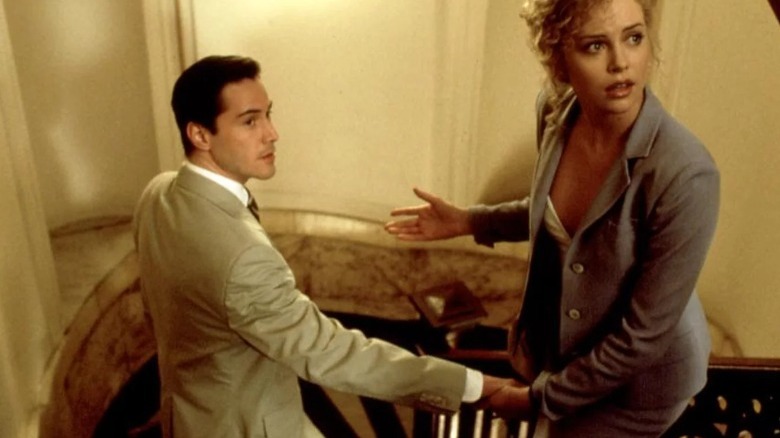
It's not a spoiler, per say, to acknowledge that Al Pacino plays the devil himself in "The Devil's Advocate." Look, it's right there in the title. Still, when the film starts, we're introduced to Pacino as John Milton (get it?), the head of a New York law firm who offers to hire Keanu Reeves' Kevin Lomax, an unscrupulous defense attorney who has never lost a case, even if it means letting guilty men walk free. Kevin subsequently accepts the offer following a high-profile win, and he and his wife Mary (a sensational Charlize Theron) move to New York.
Haunting occurrences start almost immediately. As Kevin begins his allegorical rise, Mary unravels. She is plagued by visions and nightmares, including a graphic scene in which she sees a child playing with her removed ovaries, and an increasing sense of isolation, compounded by Kevin's change in demeanor. Kevin's career becomes harder to manage as he chooses winning over the wellbeing of himself and those he loves. A critical and box office triumph, "The Devil's Advocate" has been somewhat lost to the annals of time. Seek it out.

"The House of the Devil" director Ti West has had a prolific career. Beyond classics like this and "The Innkeepers," West has been quite active in genre television, directing episodes of "Scream: The TV Series" and "The Exorcist," among others. "The House of the Devil" is his third directorial feature, although given the lackluster quality of his first two (sorry, fans of "The Roost"), it might as well be his first.
Jocelin Donahue is authentic as a college student strapped for cash. Eager to secure a new rental on campus, she takes a cryptic babysitting gig from a job board, only to discover that there are no children -- she simply needs to watch the house. She's desperate enough to accept the job anyway, and it's not a spoiler to reveal that the homeowners have other, devilish plans. Tense, violent, and replete with exceptional practical gore effects (including one genuinely shocking and unexpected kill) and an early turn by Greta Gerwig, "The House of the Devil" is throwback horror at its best.
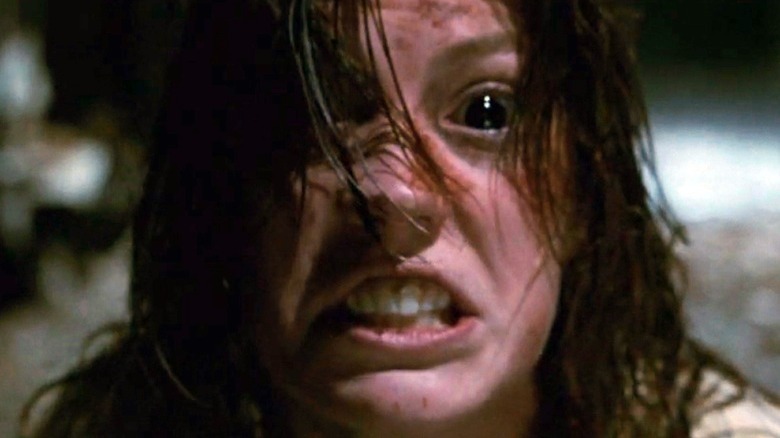
Several months ago, "The Exorcism of Emily Rose" director Scott Derrickson revealed on Twitter that the movie was originally hit with an R rating on account of star Jennifer Carpenter's disturbing facial distortions. Done practically in camera, the MPAA found Carpenter's performance so chilling and visceral that they refused to issue the PG-13 the studio wanted until Derrickson cut some of Carpenter's more disturbing moments.
Loosely based on the true story of Anneliese Michel, a German woman infamously killed during an exorcism in 1976, "The Exorcism of Emily Rose" is a courtroom procedural with a supernatural shading. Laura Linney stars as the defense attorney representing Tom Wilkinson's parish priest, who is charged with negligent homicide after Emily Rose dies during his ceremony. The movie jumps back and forth between the courtroom and Emily's possession, showing both her early symptoms and the eventual demonic takeover. Though somewhat dated -- the digital faces and exhausting jump scares are pure '00s -- the performances, especially Jennifer Carpenter's, are so incredible that the movie will terrify even the most agnostic horror fan.
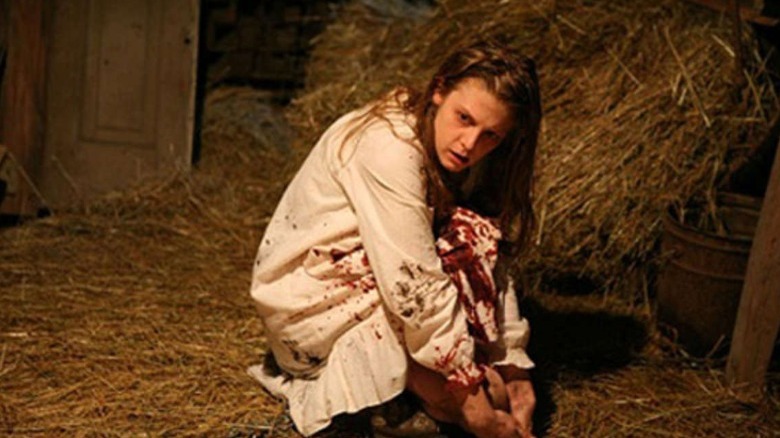
Just as "The Exorcism of Emily Rose" was anchored by an awards-worthy performance from Jennifer Carpenter, the found-footage shocker "The Last Exorcism" largely works on account of Ashley Bell's sympathetic yet chilling performance as a young girl, Nell, whose father believes she is possessed by Satan.
Patrick Fabian plays Cotton Marcus, a reverend who, along with a camera crew, seeks to delegitimize exorcisms. He is attracted to Nell's case, and in the early goings, director Daniel Stamm keeps the uncertainty terrifyingly high. Audiences aren't quite sure whether Nell is possessed or just deeply ill. I won't spoil the answer, but Bell's performance holds the entire thing together, exhibiting the same disturbing physicality and penchant for unnatural contortions as Jennifer Carpenter. It's a rapturous performance, and worth the price of admission alone.
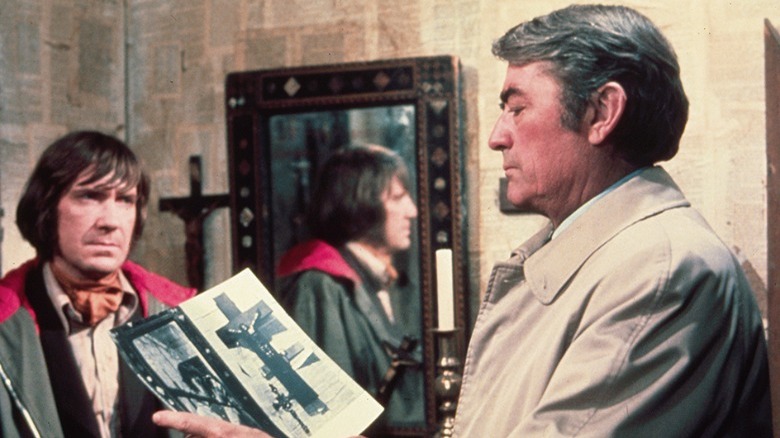
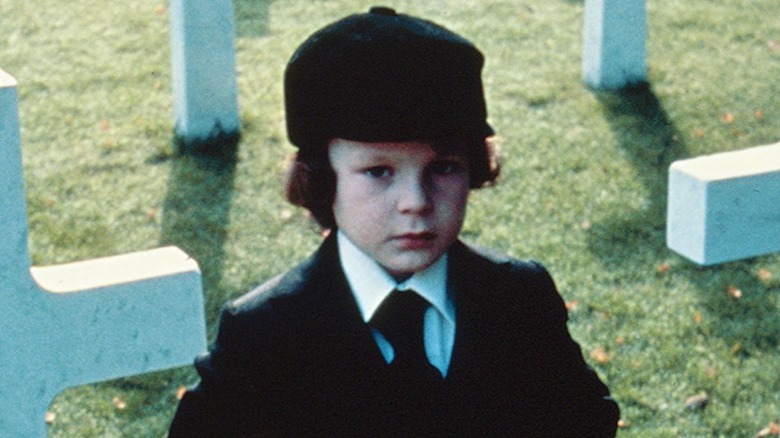
Children are terrifying. Even the nice ones are so unpredictable that they can inspire terror. "The Omen," directed by Richard Donner and written by David Seltzer, takes that idea and runs with it. Gregory Peck and Lee Remick star as Robert and Katherine Thorn, a couple living in Rome, where Peck's Robert works as a diplomat. When their son dies during childbirth, Robert is convinced by Father Spiletto (Martin Benson) to adopt a child whose mother died, which he keeps secret from Katherine. They name this child Damien. Damien is the Antichrist.
With incredible death scenes, including the best beheading ever committed to celluloid, and an intoxicating take on the satanic panic, "The Omen" is smart, high-toned horror. Cerebral while also conforming to parameters of the genre, "The Omen" is one of the best devil movies ever made. It's anchored by stellar performances -- as Damien, Harvey Spencer Stephens is so exceptional that he earned a Golden Globe nomination, while Jerry Goldsmith won an Oscar for his score. "The Omen" is enduring, too, having earned three sequels, a remake, and even a (quickly canceled) television series. The Antichrist is here to stay.
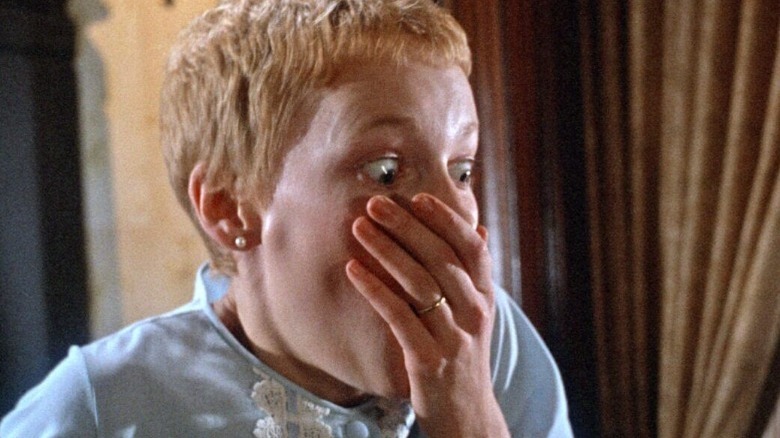
"Rosemary's Baby" is a classic. Director Roman Polanski subverted the entire horror genre with his star-studded and deliciously restrained tale of a woman, Rosemary (Mia Farrow), who is pregnant with the Antichrist. There are supernatural horrors throughout, including the movie's infamous ending, although for most of its run "Rosemary's Baby" is unconventionally grounded. The scares emanate from creepy neighbors, including an Oscar-winning Ruth Gordon, pregnancy drinks, and trips to the doctor.
Mia Farrow holds the entire enterprise together, embodying both the vulnerability of a new mother and the conviction of second-wave feminism, especially as her husband, Guy (John Cassavetes), gaslights Rosemary into thinking nothing is wrong. A cautionary tale replete with demonic iconography, "Rosemary's Baby" is well-regarded 50 years after its release for a reason. Terrifying, unconventional, and simply gorgeous to look at, no other movie has managed to capture its power (and that includes its made-for-TV remake).
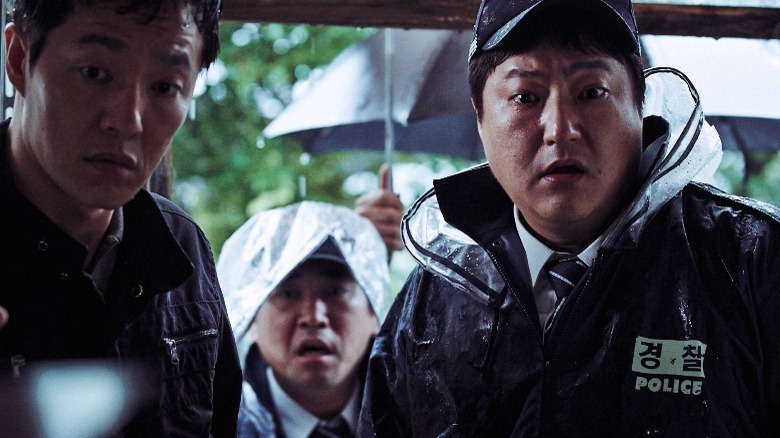
"The Wailing" is one of the scariest movies ever made. Na Hong-jin's operatic, dense, and thoroughly frightening sixth feature is almost impossible to describe. Ostensibly the story of a small village in South Korea rattled by the arrival of an enigmatic Japanese stranger (Jun Kunimura), "The Wailing" is a frenzied sprint through different horror subgenres. A psychological thriller, an exorcism movie, and a blockbuster grounded in Korean mythos, "The Wailing" is a lot of things. At no point during its nearly two-and-a-half-hour runtime, though, is it anything less than captivating and terrifying.
I won't spoil the ending, but the final half hour (which feature the devil, though I won't say how) is unreservedly the scariest 30 minutes of film I've seen in the past decade. With genre-defying performances from Kwak Do-won and Chun Woo-hee and so much mythology to unpack and explore, "The Wailing" is classic cinema. It transcends time and genre with an indefinable capacity to scare. Don't miss this one.
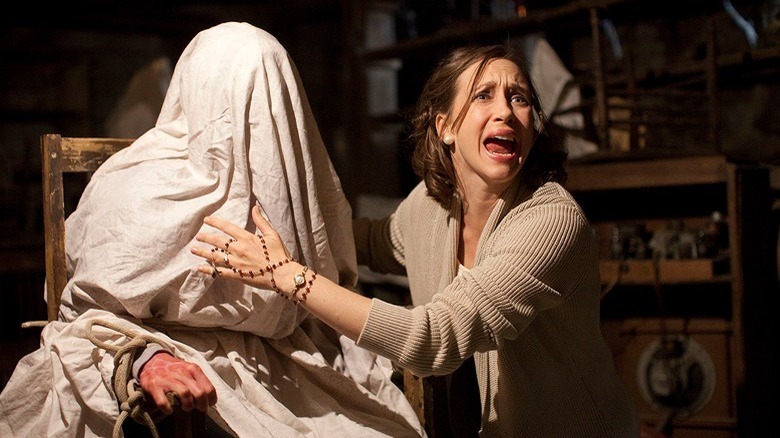
James Wan is a master. Working on a larger scale in the genre he finds most comforting, the shock maestro reinvented both himself and the horror genre with "The Conjuring." Gone was Wan's "Saw"-style gore and macabre Gothicism (see "Dead Silence"). Instead, with stars Vera Farmiga and Patrick Wilson playing real-life demonologists Ed and Lorraine Warren, "The Conjuring" has enough heart to match its terrifying scares.
Wan is at peak form here, turning every nook and cranny of the film's farmhouse setting into a springboard for gut-wrenching frights. Children's games, toys, and even wardrobes are used to maximum effect. The cast, which also includes Lily Taylor and Ron Livingston, are more than up to selling the terror. Additionally, Wan wisely keeps many of the horrors unseen, and never lets certain haunts overstay their welcome. "The Conjuring" is the rare horror film that works both in the moment, satisfying that immediate need to jump and feel fear, and long after the credits roll.
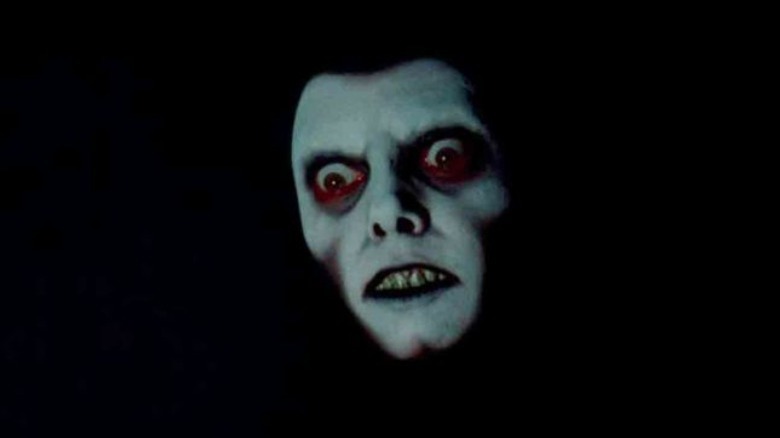
"The Exorcist" is a classic, and were it not included here, I wouldn't fault readers for suspecting that I myself had been possessed by the devil. William Friedkin's Oscar-winning horror opus, based on the novel of the same name by William Peter Blatty, is a subversive, thoroughly terrifying exploration of one girl's demonic possession. Graphic, vile, and almost antagonistic, it didn't earn its reputation as the scariest movie ever made for nothing.
Hardened genre veterans might dissemble the truth 50 years after release and allege that "The Exorcist" isn't all that scary, but the fact remains that without "The Exorcist," the horror genre -- and the entirety of the filmmaking landscape -- would look very different today.
Ellen Burstyn stars in the film Chris MacNeil, an actress filming in Georgetown who suspects that her daughter, Regan (Linda Blair), has been possessed by some demonic force. Friedkin wisely stacked "The Exorcist" to the rafters with stellar performances, breakthrough effects work, and lots of nuance, all of which make its most terrifying elements -- like, say, that crucifix scene -- more palatable to general audiences. It was groundbreaking in all the right ways, and for 50 years, has possessed an entire genre.
Read this next: Counting Down The 10 Scariest And Most Evil Children In Horror Movies
The post The 13 best Movies About the Devil Ranked appeared first on /Film.

(Superhero Bits is a collection of stories, updates, and videos about anything and everything inspired by the comics of Marvel, DC, and more. For comic book movies, TV shows, merchandise, events, and whatever catches our eye, this is the place to find anything that falls through the cracks.)
In this edition of Superhero Bits:
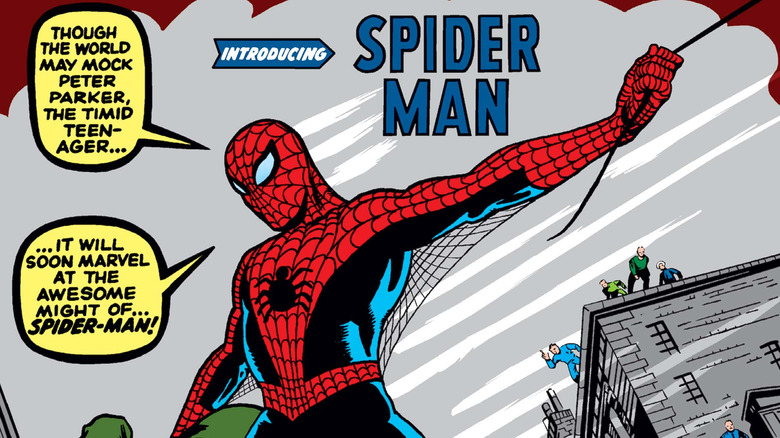
Even though Action Comics #1 and the debut of Superman has long held the record for the most expensive comic ever sold at auction, the Man of Steel just got stopped by a sticky web. Amazing Fantasy #15 is now the most expensive comic ever sold at auction, with a recent copy fetching $3.6 million. That's much higher than the previous record of $3.25 million set by The Big Blue Boy Scout. The cost of these comics is only going to continue to increase, so be prepared for more records to be broken in the coming years.
"Robot Chicken" has given us the crossover that we never knew we needed. What if comedian Larry David joined The Avengers? This stop-motion animated sketch imagines what "Avengers: Endgame" might have been like if the "Curb Your Enthusiasm" star worked alongside the superhero team after Thanos snapped half the universe out of existence. It goes about as well as you'd expect, with Larry David being just as eccentric and frequently annoyed with just about everything.
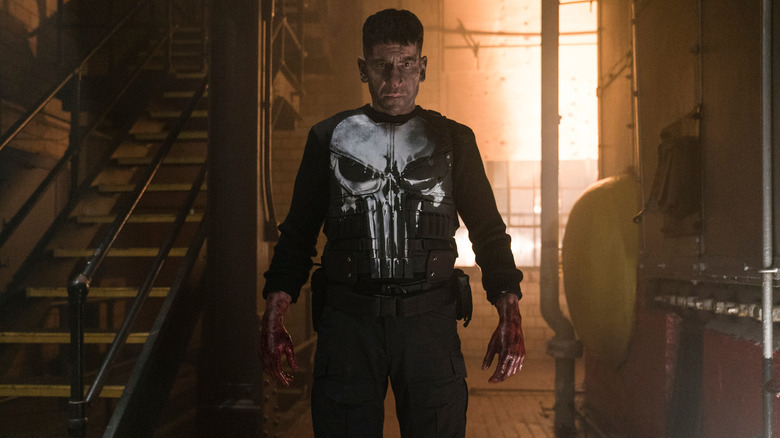
With rumors swirling about Charlie Cox returning as Matt Murdock in "Spider-Man: No Way Home," fans are wondering if any of the other Marvel characters from Netflix shows will be appearing on the big screen in the Marvel Cinematic Universe. Jon Bernthal was recently asked about this while making the publicity rounds for the new movie "Small Engine Repair." Though it doesn't seem like he's actually aware of any cameo, he played coy about the possibility, saying, "I don't know, man. I don't know. Ya know, yeah. I don't know about all that."
Obscure Games got their hands on some footage from a "Spider-Man 4" video game, which would have been tied to the movie that director Sam Raimi was supposed to direct before the project fell apart and the franchise came to an end. Video game fans will noticed that the in-progress game footage shares some surprising similarities to Radical Entertainment "Prototype 2" video game, and that's because they utilized the unused elements of this game to create that sequel.
Fandango released a new image from "Venom: Let There Be Carnage," where Eddie Brock (Tom Hardy) can be seen holding a live chicken while conferring with his symbiote sidekick. More than likely, Venom is trying to convince Eddie to let him eat, but he's probably not keen on eating the animal while it's still alive. Clearly Venom is still making problems for the journalist, and it's likely only going to get worse when Carnage comes around.
The cast of "Shang-Chi and the Legend of the Ten Rings" really ran the gamut of promotional videos for the Marvel Studios movie. In this latest marketing move, Simu Liu, Awkwafina, and Meng'er Zhang try to describe the film without using certain words. It's like a Marvel version of Taboo, and the cast is actually pretty good at avoiding all the right words.
Fresh off working on "Shang-Chi and the Legend of the Ten Rings," cinematographer Bill Pope is working behind the camera in the same role for Marvel's upcoming sequel "Ant-Man and the Wasp: Quantumania." Though "Shang-Chi" was the first Marvel Studios movie that Pope worked on, he previously lensed "Spider-Man 2" and "Spider-Man 3" for Sam Raimi. Pope is also known for his work on the "Matrix" trilogy. Coincidentally enough, the cinematographer has also previously worked with Edgar Wright, who was once attached to direct the first "Ant-Man" movie until creative differences forced the filmmaker to leave the project.
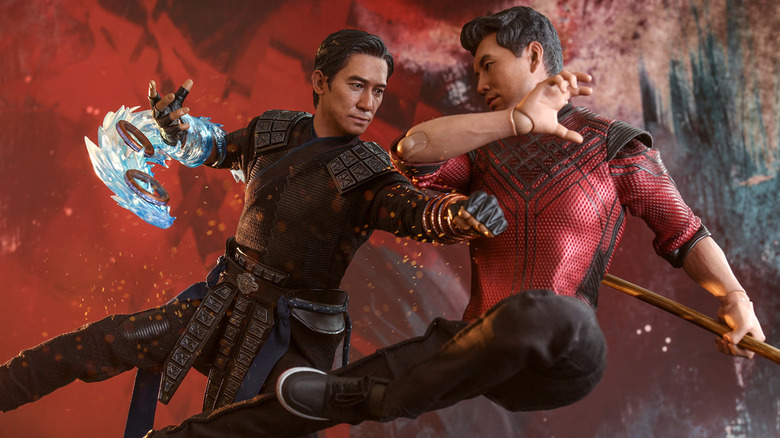
Hot Toys has put two figures from "Shang-Chi and the Legend of the Ten Rings" up for pre-order. Shang-Chi and Wenwu are both $250, and they each come loaded with accessories. Even though only Wenwu is pictured with accessories allowing him to wield the power of the Ten Rings, we're betting the hidden accessories for Shang-Chi will feature the Ten Rings with the translucent orange glow instead of the blue versions held by his father. If not, the Shang-Chi figure is going to be pretty disappointing.
Read this next: Superhero Bits: Elizabeth Olsen Done Shooting Doctor Strange 2, Lucifer Season 5 Recap & More
The post Superhero Bits: Abandoned Spider-Man 4 Video Game Footage, Shang-Chi Hot Toys Figures & More appeared first on /Film.
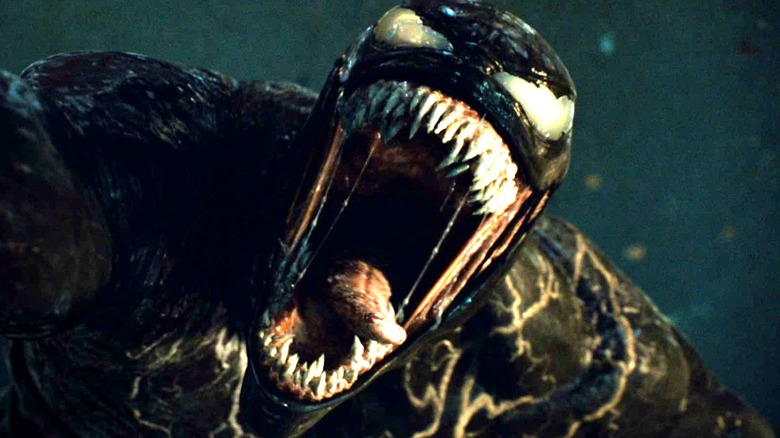
Film trailers are an act of escalation. At minimum, they exist to make the public aware of a project. At best, a trailer can turn a movie with buzz into something you must see, right now, no excuses. In the forever war for pop-culture dominance, trailers lead the movie studios' charge -- which means they're often battling each other for supremacy. Getting the internet's attention, however, is a perilous task; it's hard to do, and when it backfires, it backfires big.
Which is why, on May 10th, 2021, "Venom: Let There Be Carnage" accomplished something amazing. Look, if a Gershwin-crooning parasite cooking breakfast badly doesn't escalate your interest in "Venom: Let There Be Carnage," then I don't know what to tell you. Andy Serkis' forthcoming film looks like a funnier and more menacing affair than the blockbuster that preceded it, functioning as rom-com horror alternative to the other comic book movies dropping this fall. Almost as importantly, its storyline draws from 30-plus years of comics canon, the filmographies of both Serkis and star Tom Hardy, and the heyday of '90's superhero films. That's makes it "must see" for me.
If you want to enrich your "Venom: Let There Be Carnage" experience (or aren't sure how to prepare for it), here are 10 films and television episodes to watch before you hit the theater.
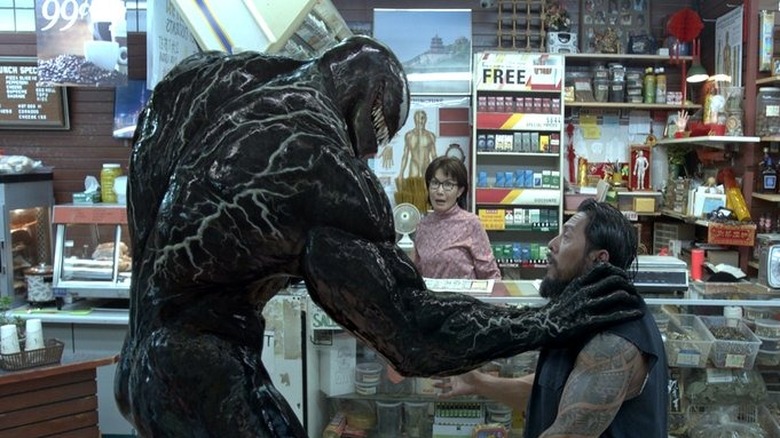
When noted video essayist Patrick H Willems called "Venom" "the third best superhero film of 2003," his point was more than Letterboxd fodder: Ruben Flesicher's film was CGI-saturated, dully hued, and slow to achieve narrative lift-off. It was far more "Daredevil" than "The Dark Knight. Why, then, it's lasting appeal?
Two words: Tom Hardy. Tom Hardy put his heart and soul into playing both Eddie Brock and the film's titular symbiote, melding his mainstream charm with gonzo choices -- choices like diving into a lobster tank to feed on frightened crustaceans (a moment that Hardy improvised), or giving Venom the line, "Like a turd ... in the wind" (again, an improv). "Venom" is to Tom Hardy what "Scent of a Woman" was to Pacino: the moment when a great actor gives a performance so ridiculous, yet so inspired that it becomes both perfect art and parody. Tom Hardy is why "Venom" holds up. He makes the film worth watching.
But if Hardy's performance isn't enough, "Venom" is chock full of plot details and characters that "Venom: Let There Be Carnage" builds on, including a post-credits scene that introduces Woody Harrelson's Cleatus Kassidy, the villain of "Let There Be Carnage." You must watch "Venom" first.
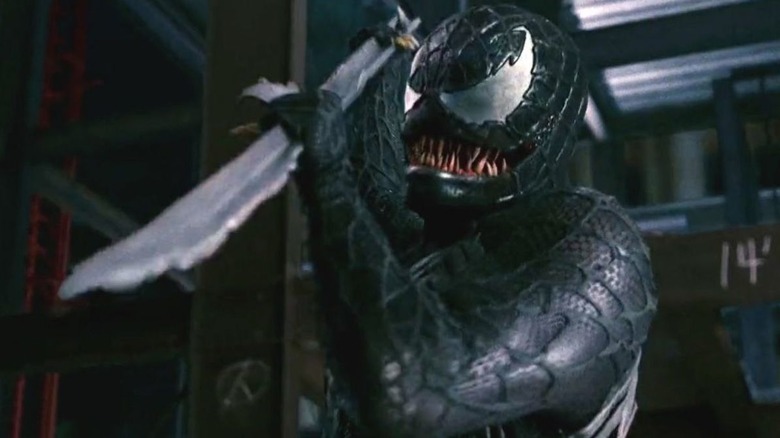
Many casual filmgoers don't remember "Spider-Man 3." That's understandable. It's mostly been purged from collective memory by six subsequent Spider-Man movies, and reduced to a pretty great gag in "Spider-Man: Into the Spider-Verse." Does it deserve re-appreciation? Depends on who you ask. But what's barely up for debate is that Tom Hardy's gonzo take on Venom doesn't make it to multiplexes if Topher Grace doesn't gun for mad-eyed and tragic menace as the character first. Like, really gun for it.
This isn't Grace's fault, just like it isn't Tom Brady's fault if he cannot dunk a basketball or hit a home run on cue. Grace was cast against type in a movie overcrowded with villains (the actor himself has practically said as much), but his inability to make Venom scary or sad was Sony's main argument for pivoting towards a funny, cool Venom 11 years later. To fully appreciate what "Venom" and "Venom: Let There Be Carnage" are doing with the character is to know "Spider-Man 3" backwards and forwards. Study up.
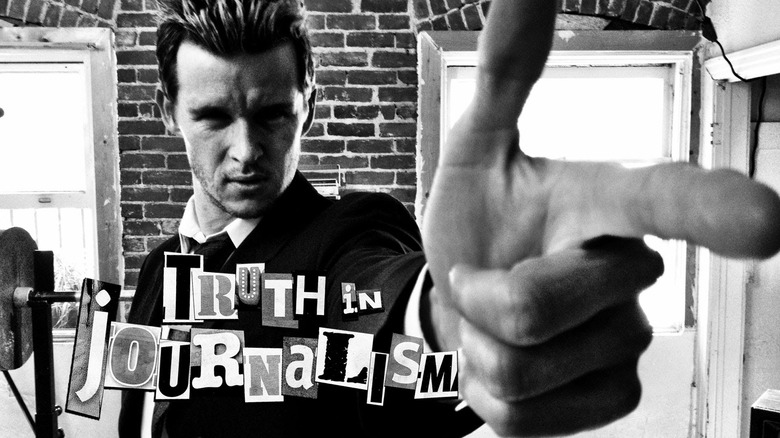
If "Spider-Man 3" showed Sony that the cinematic Venom needed a tune-up, "Venom: Truth in Journalism" offered a chop-shop oil change. Joe Lynch's found-footage Eddie Brock fan film, released as part of Adi Shankar's "Bootleg Universe," features sprawling monologues, '80s rock, and French documentary crews; there's nothing it won't throw under the hood. The project was described by Shankar as mash up of the Belgian mockumentary "Man Bites Dog" and comic book movies, but it's ostensibly Marvel Comics' "Nightcrawler" (the 2014 thriller, not the X-Man).
To be fair: that's sort of why it works! Lynch isn't known for subtlety as a director (See "Mayhem", "Wrong Turn II", and so on), but a story-thirsty journalist who's also a human-eating symbiote hardly lends itself to understatement. And the film has more on its mind thematically than 2018's "Venom" and possibly "Let There Be Carnage," too, wrestling with the ethics of cinematic storytelling even as Eddie spews black bile and fights crime. Much like the leaked test footage of "Deadpool" proved the Merc with a Mouth could carry a movie, "Venom: Truth in Journalism" showed that audiences were ready for a stranger take on Eddie Brock. But if we're talking strange...
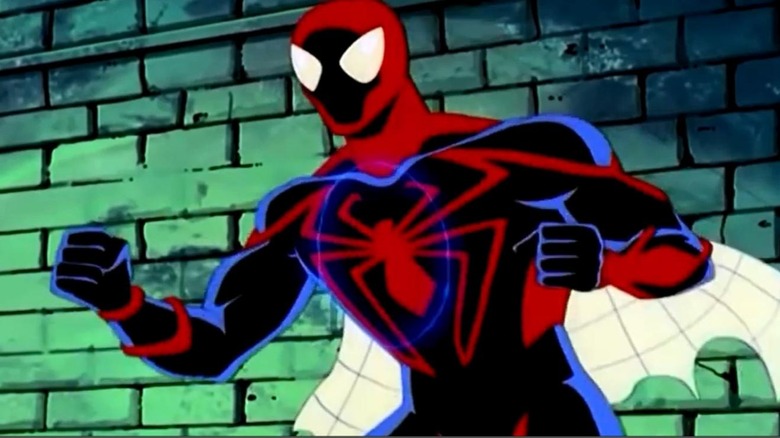
"Spider-Man Unlimited" is a strange show. Its animation is firmly from the '90s, but it might take place far in the future; it's never really clear. It also poaches Spidey's cape from the 2099 comics and give Peter Parker an accent (Queens, maybe -- again, it's hard to tell). But even if "One Is the Loneliest Number" contains questionable aesthetics and dicey dialogue (at one point, Venom says to Spider Man, "We always thought of you as a swinger"), the episode perfectly captures the co-dependent bond between Venom and Edward Brock. The pair are more than attached. They're each other's enablers.
Venom exacerbates Brock's hatred and self-loathing. Brock, in turn, brings Venom human meals. It's a non-stop cycle of toxicity. And as anyone who's been in a bad relationship knows, leaving is easier said than done. In this instance, "One Is the Loneliest Number" posits that Brock has been bonded to a symbiote for so long that he'll die without it in his system. It's an all-too-human fear rendered using comic book tropes, and it's the exact fear that "Venom: Let There Be Carnage" looks to exploit to both hilarious and moving ends. What's more, "One Is The Loneliest Number" also features a surreal depiction of Carnage himself, which brings us straight to...

Carnage and Cletus Kassidy are itches that Eddie Brock must scratch. Whether they're causing violent mayhem on the streets or locked up tight in Ravencroft, they gnaw at his psyche. Eddie is never responsible for Carnage's actions, but he's fully innocent, either. This delicate and frightening dynamic was first captured on screen by 1994's "Spider-Man: The Animated Series," which spent much of its third season on symbiotes doing battle (War Machine, Iron Man, and cult favorite the Spot all make appearances as well). Venom and Carnage's terrifying tête-à-tête, however, is the focus of episode 11, "Carnage."
It's really impossible to understate how compelling and bone-chilling Carnage is here. As voiced by Scott Cleverdon, Carnage is charming even whilst hoisting a bloody axe over Spider-Man's head. His beguiling lack of humanity is enough to help Eddie find his own by episode's end, hinting at the chaotic face turn that would inspire both "Venom" and "Venom: Let There Be Carnage." The show -- and all Spider-Man animated properties -- are available on Disney+.
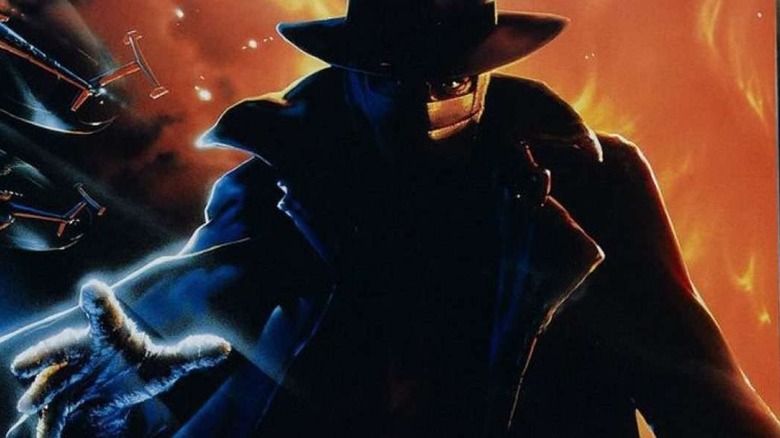
"Darkman" was a reaction to Tim Burton's "Batman" -- literally. When the powers-that-be wouldn't let "Evil Dead" director Sam Raimi make a movie based on Batman or the Shadow, the director decided to adapt one of his '30's-set short stories for the screen instead. Universal was hoping it would be a cash cow; those hopes were dashed, fast. Their loss was cinema's gain, however, because "Darkman" is Raimi cutting the breaks on his own aesthetic in the hopes of going full dollar-store crime novel. He succeeds. If you've never seen the trailer, now's the time.
And, in retrospect, "Darkman" is more than ahead of its time -- it's the blueprint for the blueprint, the film that paved the way for Joel Schumacher and his kaleidoscopic Batman films, and later for Raimi's own "Spider-Man." But the influence of its gothic pulp tendencies can also be seen in grungy cult efforts like "The Crow," "Spawn," and even "Blade." "Venom: Let There Be Carnage" is a close cousin of those movies, all of which are pulpy pictures full of dark asylums and radical monsters. "Darkman" is the real deal. Check it out imminently.
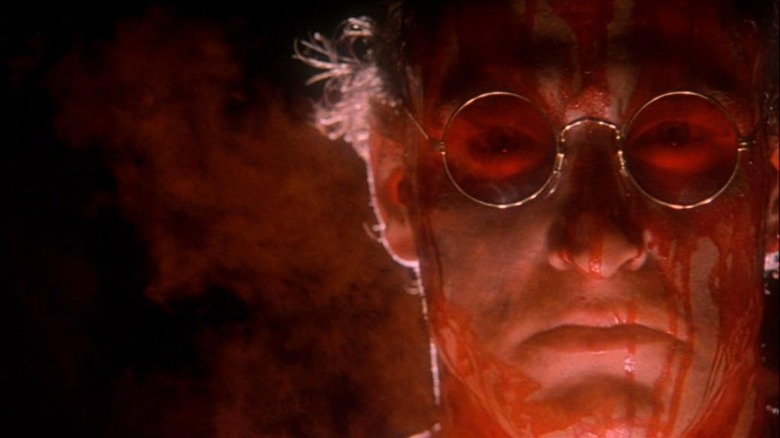
Few films are as simultaneously iconic and problematic as "Natural Born Killers." It is lurid and yet visionary, satirical while still glorifying violence. To watch it means debating the content of every frame, even if only with yourself. Unpacking everything in "Natural Born Killers" would take its own article. For our purposes, what you need to know is this: Woody Harrelson rules in it.
Prior to playing serial killer Mickey Knox, Harrelson had cornered the market on goofy, loveable schlubs. He was Woody Boyd in "Cheers." He was Billy Hoyle in "White Men Can't Jump." "Natural Born Killers" exploded that image. Harrelson is occasionally hysterical and consistently terrifying as a walking, evil-talking embodiment of the human id unleashed. Harrelson anchors "Natural Born Killers" with recognizable, if ugly, humanity, and based on the trailers, he does the same for the "Venom" sequel as Carnage. Harrelson should be drawing from the same quietly funny and menace-drenched playbook that made Knox so memorable. If you want to better appreciate his work, "Natural Born Killers" is the starting point.

Though Marvel and Sony have both turned to indie directors as of late, "Venom: Let There Be Carnage" director Andy Serkis, who made his name playing mo-cap characters like Gollum and Planet of the Apes' Caesar, already has a known IP effort under his belt: the ambitious, motion-capture heavy "Mowgli: Legend of The Jungle." It's a sprawling picture, one that never clicks so much as revs through fits and starts.
But besides revealing Serkis' taste for films with four-word subtitles, "Mowgli" suggests that Stephen Summers is Serkis' primary directorial influence. Like "The Jungle Book" director (we're talking about the 1994 live-action film, not the 2016 remake of the animated feature), Serkis stages deeply physical set-pieces (a battle in Sher Khan's cave is rife with live and CGI action, all of it visceral). He also pulls physically rich performances from on-set and mo-cap actors alike. Serkis is a sucker for physical comedy, too, finding time to put Mowgli through the slapstick ringer during a vine-swinging session.
Given all that, it's no wonder that Serkis was drawn to "Let There Be Carnage." The trailer alone suggests that motion capture, sudden violence, and a broad comic streak will be hallmarks of its story. A viewing of "Mowgli: Legend Of The Jungle" will help one better appreciate Serkis' efforts behind the camera.
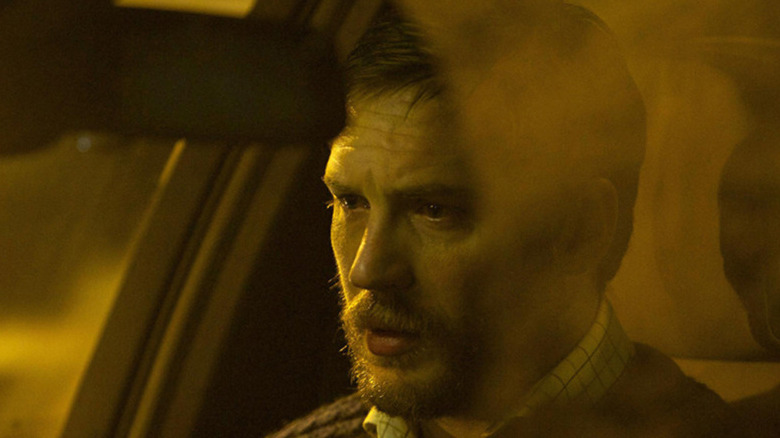
We've discussed how Tom Hardy's dual performance as Eddie Brock and the symbiote is one of the core pleasures of "Venom," and the original film frequently pits them in heated conversation with each other, not unlike Edward Norton's character in "Fight Club." Eight years ago, however, Hardy perfected this skill in "Locke," which milks feature film-length tension out of a construction foreman who debates the choices that have brought him to a crossroads over the course of a long, solitary car ride. When Locke isn't talking with others over his speakerphone (leading to vocal cameos from Olivia Coleman, Andrew Scott, and the MCU's own Spider-Man, Tom Holland, among others), he's talking to himself, wrestling with the voice inside his head.
This tug-of-moral-war is rendered with crystalline clarity by Hardy, who has arguably never been better than he is as Ivan Locke. And director Steven Knight, whose cinematic experiments have ranged from effective to totally bugnuts, recognizes the universe-shifting gravity of watching Tom Hardy think. If you want to understand why Hardy excels even in the most bonkers moments of "Venom," "Locke" offers an excellent explanation.
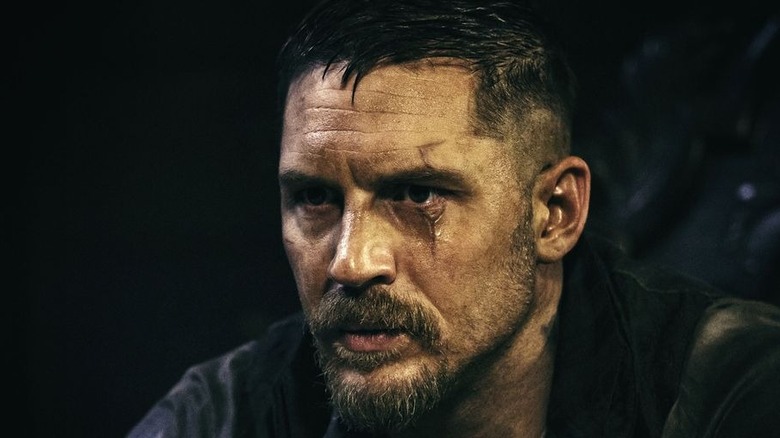
One of the more surprising tidbits from the "Venom: Let There Be Carnage" press release is that star Tom Hardy is credited as a co-writer on the film. And while very few had "moviesStar co-writes gnarly comic book movie" on their vision board for 2021, "Let There Be Carnage" isn't the first project Hardy has helped pen. That title belongs to FX and BBC's "Taboo," which ran for one season and barely made any impact anywhere.
That doesn't, however, mean that "Taboo" isn't worth watching. In fact, quite the opposite -- "Taboo" takes a straightforward revenge narrative and makes it labyrinthian, eschewing traditional storytelling for grim, ecstatic visuals and atmospheric world building. It also confirms Hardy's attraction characters whose heads wage war against their hearts. And given that the "Taboo" scripts also marry genre conventions to unexpected grace notes for flawed protagonists, it strongly hints at where "Venom: Let There Be Carnage" might be headed. Don't overlook this show.
Read this next: Who Is The Main Venom: Let There Be Carnage Villain? Carnage Explained
The post What to watch before Venom: Let There Be Carnage appeared first on /Film.
Read more of this story at Slashdot.
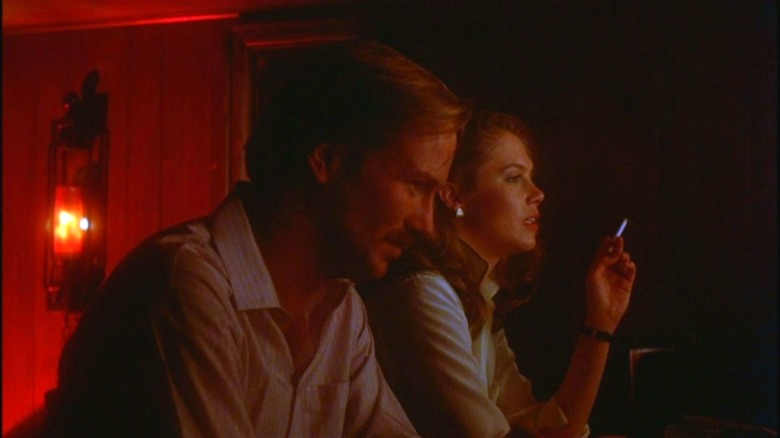
(Welcome to The Daily Stream, an ongoing series in which the /Film team shares what they've been watching, why it's worth checking out, and where you can stream it.)
The Movie: "Body Heat"
Where You Can Stream It: HBO Max
The Pitch: Only the relentless Florida heat could drive anyone this mad, basically. Well, that and pure, unbridled lust. Released almost exactly 40 years ago, this 1981 erotic thriller by Lawrence Kasdan -- yes, the one and the same Lawrence Kasdan from "Star Wars: The Empire Strikes Back," "Indiana Jones and the Raiders of the Lost Ark," and "Star Wars: Episode VI - Return of the Jedi" -- marked his impressive directing debut and instantly launched actor Kathleen Turner into stardom. The story takes place amid an unbearable Florida heatwave, following William Hurt's ineffectual lawyer Ned Racine and the increasingly tension-ridden course of events that transpire as a result of meeting Turner's Matty Walker, who can only be described as a living and breathing bombshell. Turner's impossibly confident bearing and utterly seductive air (both subtle and otherwise) make it entirely believable that someone like Hurt's Racine would fall for her immediately upon seeing her walk by him at a crowded outdoor concert. A brief glance leads to his dogged pursuit of her and finally to their torrid affair, though all hell threatens to shake loose when the pair hatch a scheme to take Walker's pesky rich husband out of the picture for good.
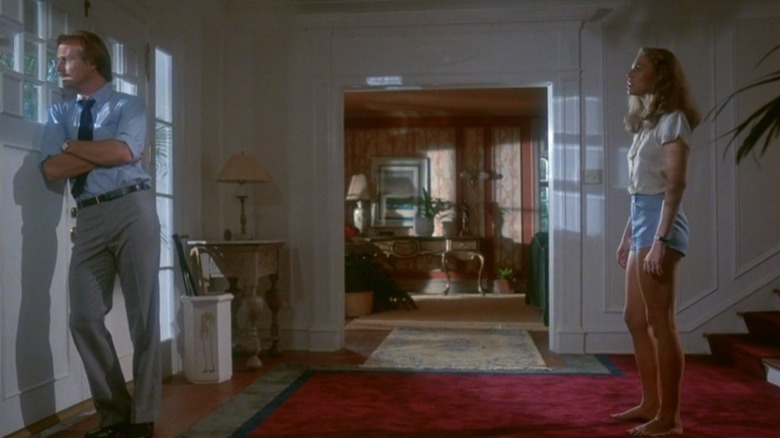
"You're not too smart. I like that in a man."
Following the conventions of many a neo-noir before it, this 1980s-set film wears its influences on its sleeve for all to see -- particularly the trope of a wily femme fatale who runs circles around the man ostensibly at the center of the story. The married Matty Walker wastes no time at all in sizing up a shamelessly horny Ned Racine and, on the other side of the equation, Ned is equally as ambivalent about how he might appear. (It should also be noted that Hurt is hardly a slouch in his own right, spending frequent portions of the film entirely shirtless like the mustached heartthrob he is!) He quickly accepts her invitation to join her at the summer house she shares with her constantly out-of-town husband Edmund (Richard Crenna), both under the pretense that it's only to, ah, admire her windchimes. His visit ultimately ends in passionate and shockingly sweaty sex, a barely-contained act that Kasdan's camera refuses to tone down or shy away from. Although her unhappiness with her husband is initially met with Ned's staunch refusal to do anything criminal about it, it's absolutely no surprise when it takes less than 15 minutes of screen time (really, I checked the timestamps!) for the two to pull a complete 180 and agree to act.
As Ned falls further and further into the depths of obsession with Matty, not even the stern warnings from his cop and lawyer friends (played by J.A. Preston and a young Ted Danson, respectively) have any effect whatsoever. The two lovers seem physically unable to resist each other, despite the universe indicating that it might not be the greatest idea. Of course, the underhandedness of their illicit affair only makes the chemistry between the two all the more combustible and their eventual turn towards murder nothing short of inevitable.
That inescapable feeling of fate, destiny, human nature, or whatever you want to call it remains pervasive throughout "Body Heat." The recklessly amateurish murder sequence itself is carefully staged by Kasdan, throwing last-second complications and unforeseen obstacles in Ned and Matty's paths with an almost childlike glee. Their plan is riddled with holes and leaps of logic, but one gets the distinct impression that both characters get off on the increasingly likely risk that they might get caught. That frantic adrenaline rush doesn't last long, of course, quickly becoming replaced by paranoia and suspicion. It's clear to viewers that not everything is quite as it seems. Ned's nagging feelings of being set up only worsen when Matty takes it upon herself to take even bigger risks without first informing Ned, making it glaringly obvious to the world that the widow of a very rich husband would have every reason to be involved in his untimely death.
"Body Heat" turns the screws on its viewers every bit as much as it does on poor Ned Racine, repeatedly relying on suffocating close-ups and claustrophobic shadows to communicate the perilousness of both Ned and Matty's actions. Ultimately, there might be one too many twists by the end of the film. I wouldn't be even close to the first person to point out how much it owes to a film like "Double Indemnity." But watching "Body Heat" today, you'll find yourself enraptured by a throwback noir that, like Matty Walker herself, isn't afraid to get its hands dirty and get you too caught up in the fun to notice when things start to spin out of control.
Read this next: The Daily Stream: The Buried Life Is MTV's Overlooked Reminder To Live Life To The Fullest
The post The Daily Stream: Body Heat Redefines The Term 'Guilty Pleasure' appeared first on /Film.

There’s no need to overthink hydration for a short jog, but if you’re running long distances, you’ll need to hydrate before the workout is over. (The American Council on Exercise recommends 7-10 ounces of water every 15 to 20 minutes, although that may be overkill if you’re not sweating a lot.) So where do you get all…
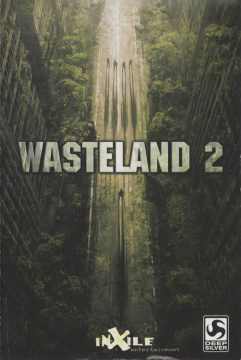
The real sequel to Wasteland took a long time to realize. Legal problems were part of the puzzle. While Electronic Arts used to own the trademark, it let the rights lapse and Brian Fargo ultimately had to purchase them from Konami in 2003, which trademarked the name in connection with its own Yu-Gi-Oh! titles. While he expressed interest in developing a sequel as early as 2007, it wasn’t until 2012 that inXile, his development studio, announced it publicly. It followed the example set by Double Fine’s highly successful Kickstarter that eventually gave us Broken Age, with a funding threshold budget of $900,000. Fargo committed to covering $100,000 out of his own pocket to bring the minimum budget to a tidy one million.
The goal was met in under 43 hours and became one of the most successful projects of the early years of crowdfunding, culminating in a grand total of over $3 million dollars (Kickstarter and PayPal together). As one of the first crowdfunded projects of this scale, Wasteland 2 broke new ground. Key among this was the involvement of the community, providing feedback on the game’s direction, design, and even assets for the game’s production. While tentatively scheduled for a release in late 2013, Wasteland 2 was delayed by a full year to allow for additional polish and beta testing.
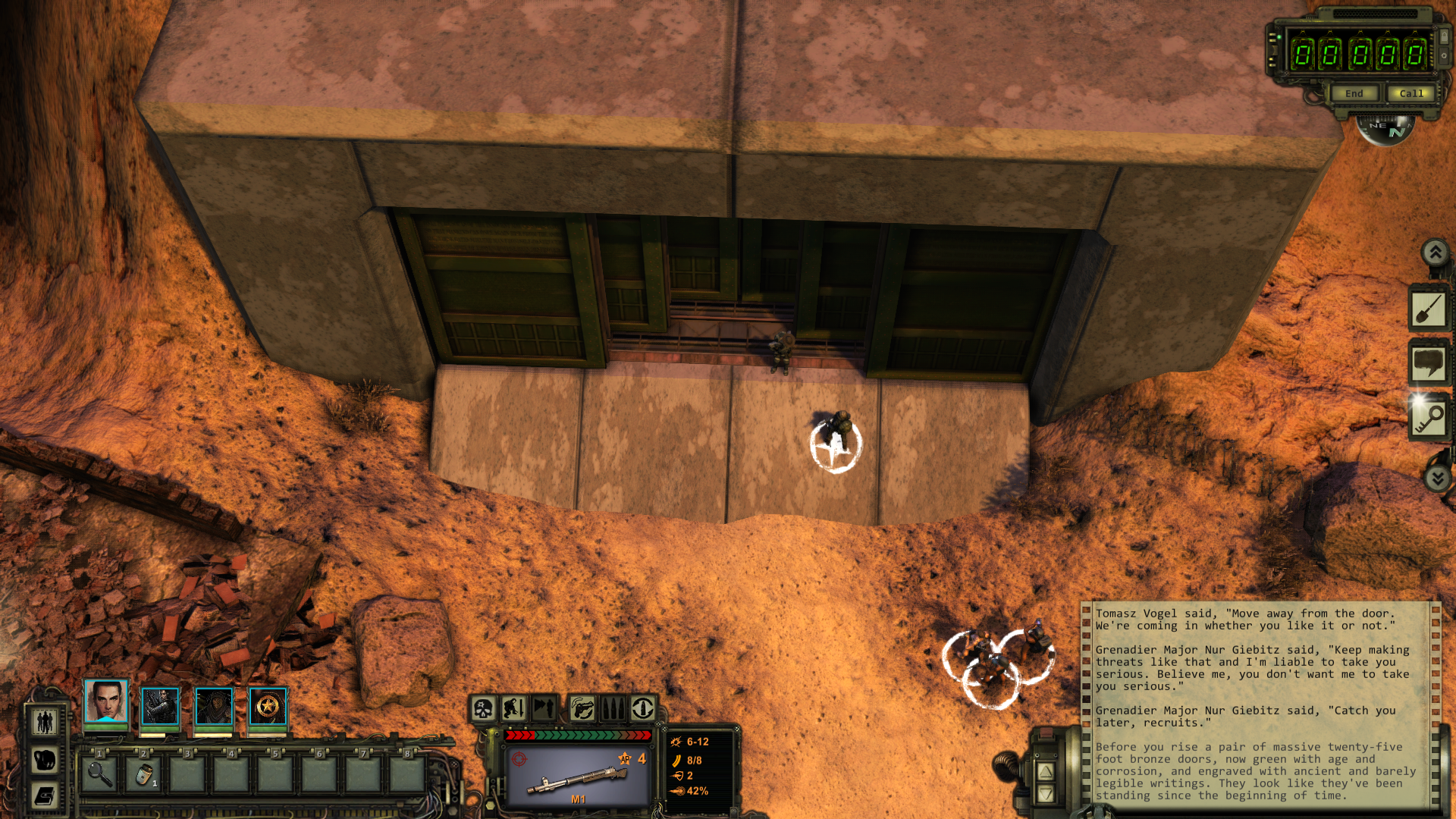
It finally released in September 2014, as a digital download and a physical edition for Kickstarter backers. A Director’s Cut followed a year later, bringing with it enhanced graphics, modified UI, voice acting for most characters and revamped level design and combat system, on top of dozens of other changes.
Familiar places
Set 15 years after Wasteland, in 2012, the sequel starts in Arizona, as the Rangers bury one of their own in the hot sands of the Ranger Citadel. General Vargas makes his funeral speech, as a distraught Angela Deth looks upon the coffin with the earthly remains of Ace, her lover and fellow Ranger. Moments after the coffin is buried, the general turns to you, already issued your weapons and equipment, and sends you out of the Ranger Citadel’s gates to investigate Ace’s death and continue where he left off…
Wasteland 2 is a soft reboot of the series, bringing it into the 21st century. The first part of the game is spent revisiting old stomping grounds of the Rangers, updated to match. You’ll run into numerous familiar faces – most notably Vargas, Deth, and Thrasher, the default team from the original game -, and explore familiar locations remade for a new generation of gamers. The degree of fidelity varies: The agricultural center’s central complex is a 1:1 recreation of the old location, while Highpool is a complete reimagining. In many cases you will deal with fallout from decisions you could make in the first game, such as at Highpool, where you have to reckon with the still fresh memories of Bobby, a child shot by Vargas’ team after he shot at them with his BB gun for killing his rabid dog, Rex.
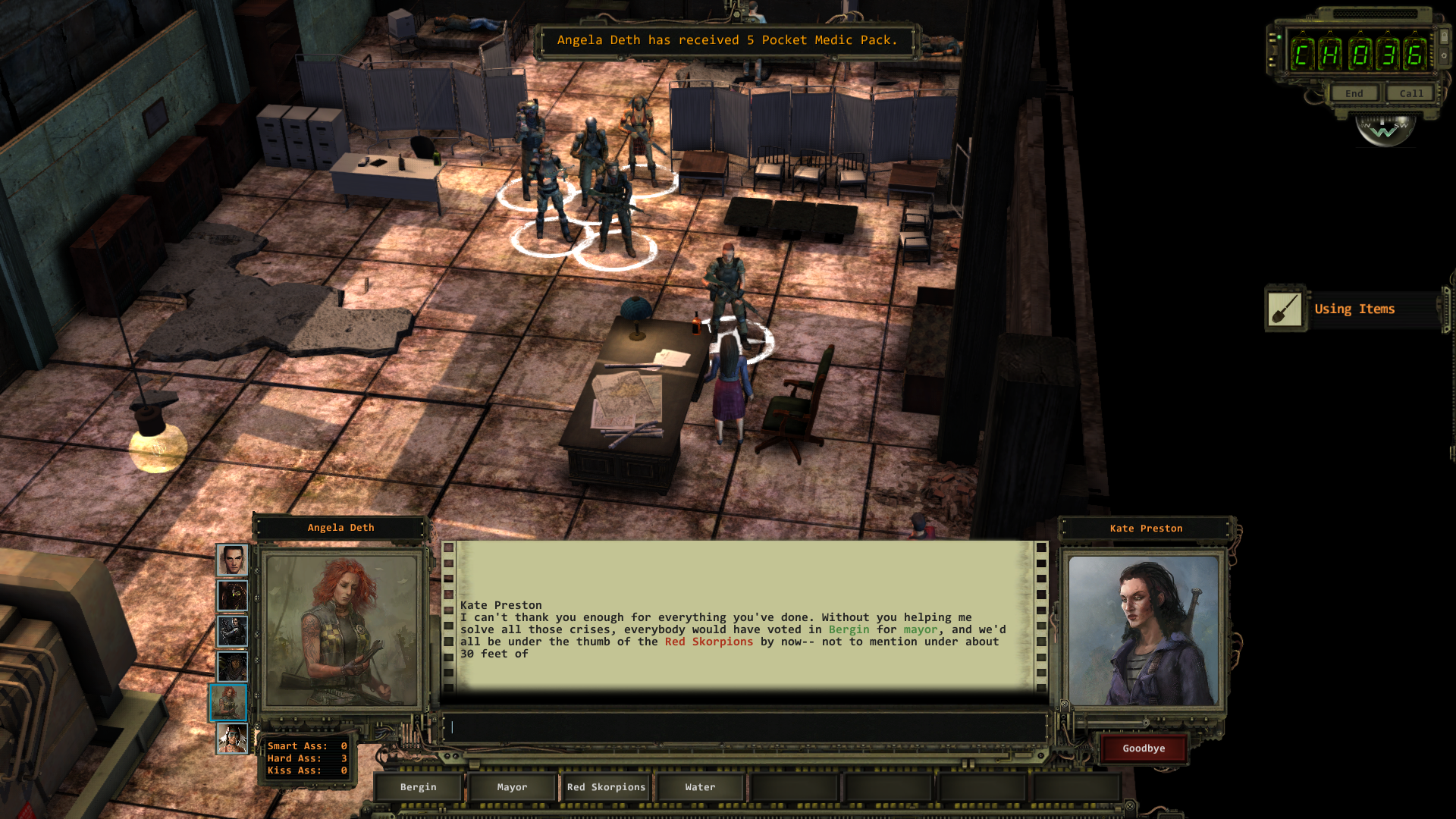
The challenges awaiting your fresh team of recruits vary, and the game wastes no time in forcing you to make hard choices. The very first of those is deciding which of the communities to save: The aforementioned agricultural center, which feeds Arizona and whose research could solve hunger in the wastes? Or Highpool, the loss of which will deprive Rangers’ territory of much-needed water and prove the Red Skorpion Militia right, that Vargas lost his touch and his men are incapable of protecting Arizona? Save one, lose the other. Retreat, and you can lose the one you tried to save, but the general will still expect you to finish Ace’s mission: Triangulating mysterious signals coming from beyond the deadly radiation walls surrounding Arizona.
You’ll make more choices as you locate the radio antennas, settling a tribal feud that might turn into a genocide, confront local militias, deal with deranged cultists worshipping a nuclear missile, save a town from a metallic menace, and eventually travel to the overgrown ruins of Los Angeles. Trading the dry deserts of Arizona for the mutated jungles of the City of Angels, you’ll be forced to deal with the local flavor, ranging from displaced Arizona gangs, through the impeccable Mannerites, fans of good manners and very humane sources of protein, to the Salvation Church, a violent Christian cult bent of purifying the wasteland for the glory of God.
After dealing with these factions, you’ll confront an old foe of the Rangers for the second and final time, settling accounts.
Revamped and reimagined
Your Ranger team, call-sign Echo, is given authority to approach the situation as it sees fit. You can jump through hoops and deal with the factions using diplomacy, showing the best side of the Rangers. Or, if you get tired of running errands, you can flip the safety off and start leaving a trail of corpses in your wake. Wasteland 2 doesn’t judge, but you might have to reckon with unforeseen consequences on the way.
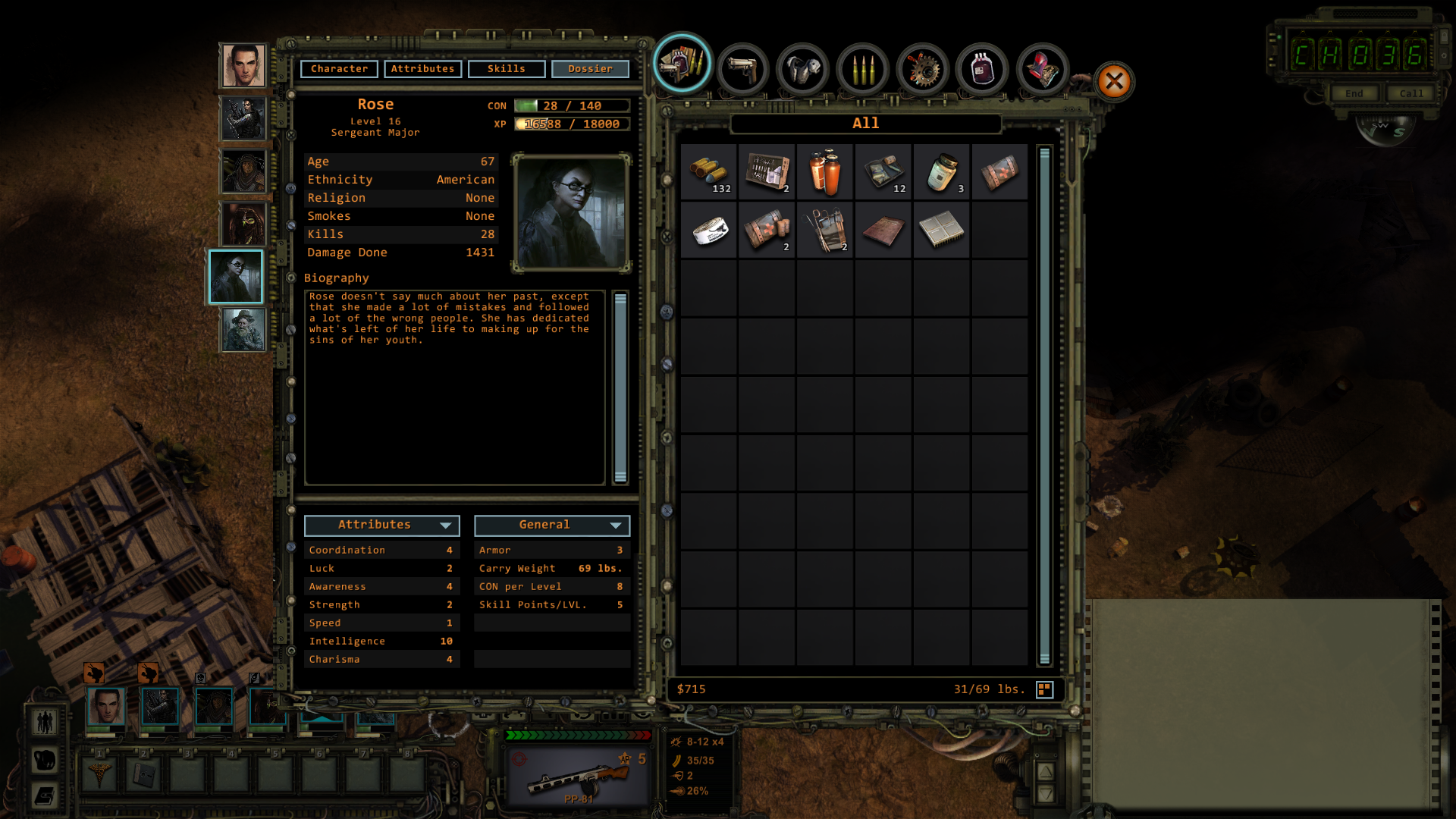
Aiding you is a reimagined character system, inspired by the originals. As before, you control four Rangers of your own making and up to three followers. Each is defined by seven statistics (Coordination, Luck, Awareness, Strength, Speed, Intelligence, and Charisma), tied to a grand total of 31 skills. These can be further modified by perks, armor, trinkets, and a broad variety of consumables. This robust character system is designed to support building unique parties with a varied skill set to face the wasteland’s challenges.
The game does an admirable job of trying to keep skills relevant and giving a variety of options, including opening doors with the poor man’s lockpick, a TNT stick. The one drawback is the reliance on randomized skill checks. Even at the highest, tenth level of aptitude, you can still fail miserably at the task, resulting in a critical failure and usually an injury of some sort. This can be frustratingly common – the lack of alternative outcomes for failure winds up encouraging save scumming. The diplomatic options, affectionately, but vaguely named Hard Ass, Kiss Ass, and Smart Ass, are the exception: All dialogue choices are flat, hard requirements.
Unfortunately, dialogue is a limited affair. Although characters have a lot to say, the game adheres to the original formula and relies on keywords representing entire dialogue options, which sometimes prompt speech checks. You can’t go through the game without violence, unlike in Fallout, and eventually you’ll have to draw weapons.
Combat resolution is turn-based. Characters take turns sequentially, rather than as a group. The order in which they act is as important as the terrain. Taking a page out of 2012’s XCOM, cover is essential for survival, as is exploiting natural features and height differences. Enemies will try to play to their strengths, moving to better positions to improve their chances of scoring a hit or closing distance to deal damage and make it impossible for your snipers to bring their high-powered rifles to bear.
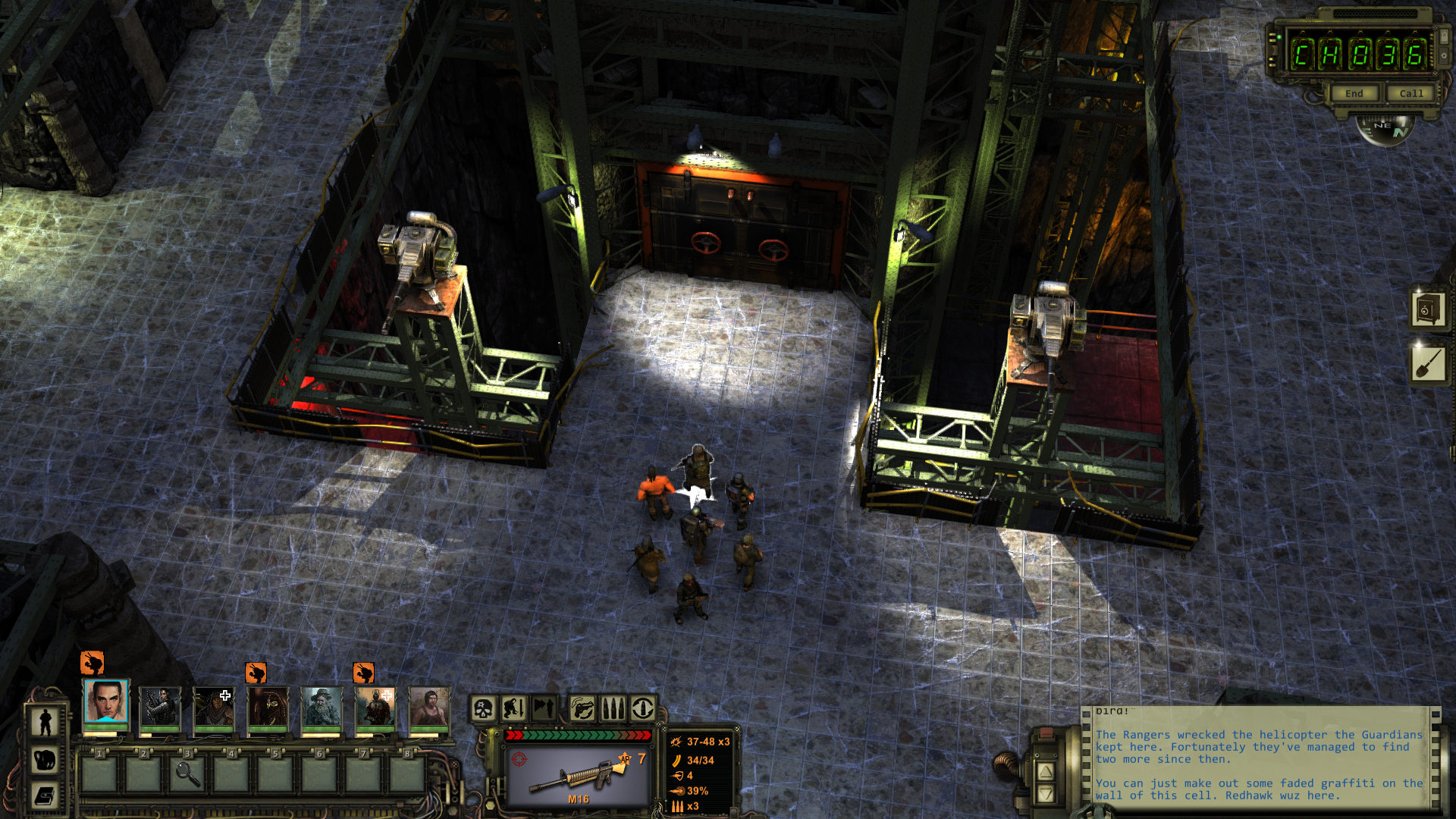
Wasteland 2 tries to give each weapon type has a distinct tactical niche. Assault rifles are versatile, but mundane workhorses effective at medium and long ranges. Pistols and SMGs have limited range and penetration, but with the right perks can be a tremendous asset thanks to their low Action Point cost. Heavy machine guns can deal tremendous damage, but cannot be modified and require plenty of ammo. Shotguns can hit many targets at once, but have minimal armor penetration. Energy weapons work well against armored foes, but deal minimal damage to those who aren’t. Sniper rifles deal tremendous damage, but as mentioned above, are useless in close quarters. Conversely, melee weapons can be very powerful, but are a gamble at the best of times. Finally, if all else fails, you can always just blow the enemy up.
Though the system isn’t perfectly balanced, with assault and sniper rifles having an edge due to their versatility and damage output, it works surprisingly well in practice. The game is filled with combat encounters, and especially in the early stages, can be quite unforgiving. You’ll find yourself desperately fighting to save wounded Rangers more than once, much like the original Wasteland.
Summary
In fact, the game is too much like the original. It is an impressive pedigree and makes for a good, top-down RPG. However, the adherence to replicating the feel of the original game, down to radioing for level-ups, prevents it from showing its true potential. As such, it frequently ends up erring on the side of caution, rather than boldly exploring a new area.
The seeming lack of confidence in itself did not affect its success. Wasteland 2 did well. While it did not become another Skyrim, for obvious reasons, it laid the groundwork for the next game in the series, that could refine the new formula and push it in a new direction.
This time, it wouldn’t take a quarter of a century to arrive.
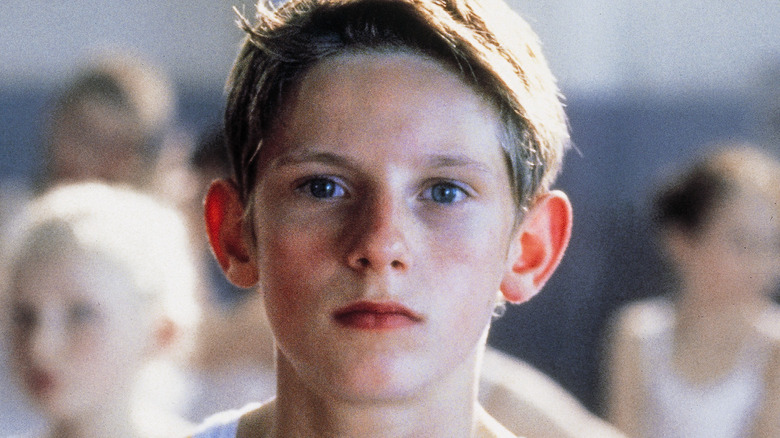
As with most creative pursuits, there's a lot to be said for good, old-fashioned experience. It takes time to get comfortable in front of the camera on a film set, even if you worked on stage or television before. So it makes sense that, most of the time, actors tend to start in small, unobtrusive roles and work their way up to leading man or leading lady status. That said, there is something very special about fresh-faced actors walking right onto set -- maybe with some theater experience or a few television credits under their belt -- and knocking it right out of the park.
We romanticize the concept of the ingenue, the inexperienced but innately talented actor who has so much star power that it's evident from their first moments on screen that they have a bright future ahead of them. You never forget it when you see it: the magic of feeling as though you yourself discovered the next big thing, even if you're only sitting in the audience watching them about to burst onto the scene in a huge way. Here are 14 greatest acting debuts of all time.

Is this one cheating? Maybe a little bit. After all, Dev Patel did have a recurring role on "Skins," a British teen show that also gave us the likes of Nicholas Hoult and Daniel Kaluuya, before he made his official feature film debut. But we're talking about the movies, and "Slumdog Millionaire" is both his first film and the role that catapulted him onto a global stage. He plays Jamal, a hapless boy from Mumbai whose life experiences are shown over the course of a fateful episode of "Who Wants to Be a Millionaire?" in which he answers every single question correctly.
Jamal is perhaps not a typical romantic lead: he's incredibly earnest and is less of a person than he is a metaphor for hope and optimism amidst a cruel and unfair world. But the fact that Jamal isn't a character who naturally leaps off the screen, and yet we are still drawn to him, speaks to Dev Patel's inherent magnetism, which became more fully exploited as he matured into a proper leading man.
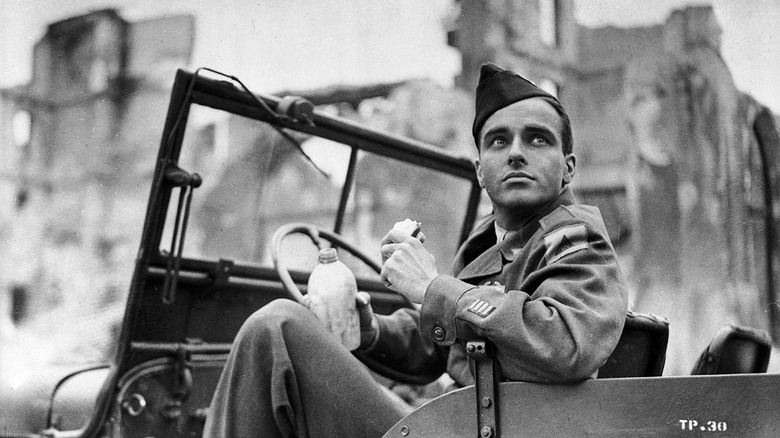
Montgomery Clift is that actor between Marlon Brando and James Dean who always seems to fall through the cracks. He never gets the credit he deserves! But there was a time, friends, when Montgomery Clift was your go-to devastatingly handsome, emotionally vulnerable young movie star. And that all begins in "The Search," a film made in the immediate aftermath of World War II where Clift plays a young soldier who takes on the responsibility of helping a displaced boy who survived Auschwitz to find his mother.
Clift's incredible screen presence and deep well of emotional resonance is present from day one, as he forges a strong connection with this boy and even plans to try to take him back to the United States with him when he is shipped out. Clift would later go on to act in some mediocre films that didn't quite use his formidable talents to their best advantage, but here we can see a general baseline of what he was capable of as an actor: a bright-eyed starlet with endless charm and a wide open future full of possibilities.
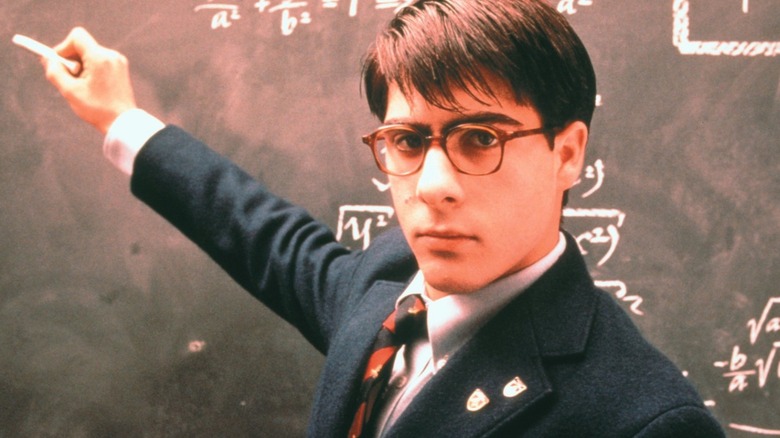
Jason Schwartzman is a member of a veritable Hollywood dynasty, coming from the same clan that brought us Francis Ford Coppola, Sofia Coppola, and Nicolas Cage. So the fact that he would make his acting debut at some point or another was essentially a foregone conclusion. But with his lead performance as the memorable Max Fischer in Wes Anderson's "Rushmore," he launches himself onto the scene with such style that you have to admire him for it.
Max is an overachiever at his prestigious prep school, the founder of dozens of different clubs and associations. But there's just one problem. Actually, two. His poor grades have him on academic probation, one false step away from expulsion, and he finds himself hopelessly in love with a teacher at his school. With Max, Schwartzman builds out a preternaturally mature teenager who is a mass of eccentricity and charm. And when you have a performance this good, who even cares if it's nepotism?
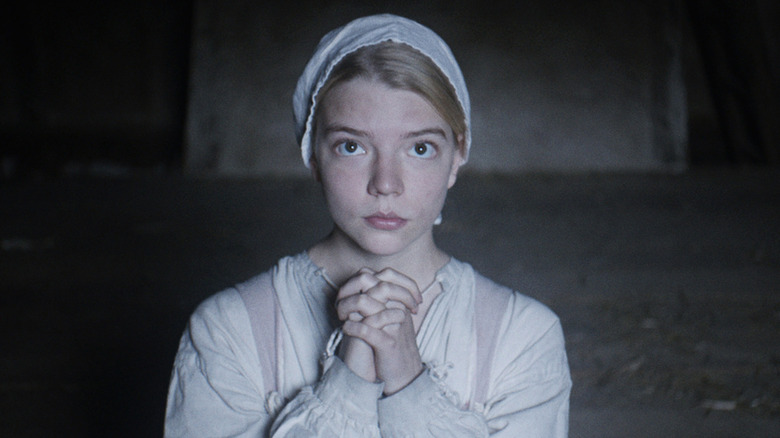
Anya Taylor-Joy has an otherworldly quality which was evident from her very first film performance. After a handful of minor television roles and a brief career as a teen model, she was cast in "The Witch," a period supernatural horror film directed by Robert Eggers, who was then also embarking on his directorial debut. (The two would both quickly be considered rising stars in their respective field, collaborating for a second time on 2022's "The Northman.")
"The Witch" is the story of a group of English settlers in early America, who have left the security of their settlement in favor of a quiet, untarnished life on the edge of a mysterious forest. Taylor-Joy plays the eldest daughter of the family, who is blamed for the disappearance of her infant brother and suspected of witchcraft -- her father lashing out in misdirected rage at his barely concealed lust for her, her mother in denial about her father's wandering eye. She is incandescent as a girl on the verge of womanhood, punished for being insufficiently subdued by the strictures placed on her gender.
Malcolm McDowell has been acting for so long that it's easy to forget that he was ever actually a novice. Still, at some point he had to have had his debut performance, just like anybody else. And while he's perhaps best known for Stanley Kubrick's adaptation of "A Clockwork Orange," his first role captured much of the same youthful, rebellious energy -- albeit in a considerably less controversial way.
After acting in small roles on television throughout the '60s, McDowell got his big break when he was 25 years old with the role of Mick in "If....," the story of a group of schoolboys at a prestigious private school and the abuses they face at the hands of their headmaster, their teachers, and the older students who have been put in charge of discipline. It is a reckoning with the traditional power structures in English society, forcing them to acknowledge their reduced relevance in a changing world. And McDowell is captivating: funny, intelligent, always with a simmering defiance just underneath the surface.

A pretty safe standard of excellence for a debut performance is getting an Oscar for your very first feature film role; it requires pretty much everyone to acknowledge that you knocked one out of the park immediately. That's what Lupita Nyong'o did in "12 Years a Slave" as Patsey, a young enslaved girl who is brutally treated by her master and his wife. Her performance is unflinching and devastating, sparing the audience none of her anguish.
This accomplished work came after her only other on-screen credit, a role on a Nigerian television show called "Shuga." (Although, it is worth mentioning that before any of this, she got her master's degree in acting from Yale School of Drama, so she wasn't exactly a novice going into "12 Years a Slave.") Still, it's rare that an actor new to screen work is able to elicit such a strong emotional reaction so early on in their career, and Nyong'o would be rewarded for it not just with an Academy Award, but with a slew of roles that would highlight her skill and charisma.
Acting is a hard enough job, especially when you're a kid with limited emotional experience to draw on for the performance. So it boggles the mind that Jamie Bell was not only able to bring to life the vulnerable Billy Elliot, but dance his little legs off in the role as well. His very first performance was in the lead role as Billy, a working-class boy from a mining town in northern England in the early '80s who secretly harbors a passion and genuine talent for dance.
Billy is forced to confront traditional concepts of masculinity, as the idea of men dancing is sneered at by many members of his community. But at the same time there's such an overwhelming sense of joy to his performance, showing that he dances not just because he's good at it, but because he loves it, and it allows him to process the emotions that he would otherwise repress. The energetic sequences as he runs through his neighborhood are the highlight of "Billy Elliot," using the medium of dance to express his anger, pain, grief, and defiance.
Robert Duvall is barely in "To Kill a Mockingbird." Just a couple of short scenes, and he doesn't ever actually speak. But as Boo Radley, the invisible son of Maycomb, Alabama who represents both the unpleasant history that the town would prefer to keep hidden, as well as Scout's growing maturity in her understanding of the people around her, he makes an incredible impact.
Boo is the town recluse, coming out only at night and scarcely being seen by anyone. Young Scout, alongside her brother Jem, has mentally transformed him into some sort of bogeyman -- a monster lurking in their neighborhood -- and the reason behind him being locked away in his home for so long has taken on an equally salacious nature in their minds. But with Duvall's limited screen time, he is able to impart the genuine kindness and humanity of Boo Radley in his determination to protect the children, and serve as a reminder to Scout that people are so much more complex and multi-faceted than she'd ever realized.
"Withnail and I" is a triumph of independent filmmaking, a movie that would grow into a cult classic encapsulating a moment in 1960s British culture. It was known primarily for two things: being one of the most intensely quotable films of the entire decade, and launching the careers of a handful of beloved British stars. Among them, it turns out, would be the ebullient Withnail himself, played by Richard E. Grant. It's altogether shocking that a performance this self-assured and iconic could be Grant's feature film debut, but it's the truth.
Before getting the lead role that would put him on the map (Withnail, the flamboyant unemployed actor), Grant was himself a flamboyant unemployed actor, having only appeared in one short film and a single episode of the short-lived television show "Sweet Sixteen." Fun fact: Although his character here is a lover of alcohol (there's even a drinking game where viewers can attempt to keep up with Withnail by drinking whenever he drinks), Richard E. Grant is, ironically, allergic to alcohol. So the fact that he's able to convincingly play one of the greatest drunks in cinematic history is a testament to his acting ability!

There are once-in-a-decade child actor performances: one or two kids out of every generation who just completely steal the films that they're in. Hailee Steinfeld in "True Grit" is one of them. She's acting opposite Jeff Bridges, Matt Damon, and Josh Brolin, three men who have pretty decent reputations (not to mention eleven Academy Award nominations and one win between them), and hers is easily the most compelling performance in the film.
Steinfeld plays a stern, stubborn, hard-hearted teenage girl on a quest to avenge her father's death, whose single-minded determination is such that it actually begins to constitute a character flaw. Steinfeld is able to adopt the cadence of 19th century speech unusually well, and her words have a certain lyricism to them even as they are sharp and occasionally cruel. It's a performance from a child that is well outside the realm of what we can fairly expect from such a young actor, and she was rewarded for it with an Academy Award nomination for Best Supporting Actress, making her one of the youngest performers ever nominated in the category.
A lot of modern viewers would most likely associate Brad Dourif with some of his shadier roles, such as Chucky in the "Child's Play" franchise, or Grima Wormtongue in "Lord of the Rings." So it might come as a shock that his very first film role was as the delicate, intensely vulnerable Billy Bibbit in "One Flew Over the Cuckoo's Nest." Dourif is quietly devastating as the youngest patient in the film's psychiatric ward, a shy, stuttering man whom R.P. McMurphy (Jack Nicholson) takes under his wing, seeing as we do that he's far more stable and, well, normal than any of the others.
The tragedy of Billy is how thoroughly he is controlled by both his mother and, by extension, Nurse Ratched, who is able to take him from beaming and full of life to utterly suicidal with just a few simple words: "You know, Billy, what worries me is how your mother is going to take this." You watch Brad Dourif's face, how he completely crumbles at this, and it's shocking to learn that this was his first ever on-screen performance.
There's good child acting, and then there's Tatum O'Neal, out there in a class of her own in "Paper Moon." She stars alongside her father, Ryan O'Neal, as a Depression-era orphan who teams up with a con man to swindle the bereaved with a truly heinous Bible scam, only for bonds of affection to develop between the two of them.
Part of what was so appealing about Tatum's performance is that she never felt like the sort of overly rehearsed cutesy child actress that we see in so many films. She has a really natural line delivery and great chemistry with her father (obviously aided by their already existing relationship), and her entire vibe is just not what you'd expect. She's an adorable little girl, but she's also kind of rough around the edges. She can be frosty and abrasive and domineering, with hints of vulnerability that drive the audience's emotional connection with her.
For her performance in "Paper Moon," O'Neal won an Academy Award for best supporting actress at the age of 10 -- the youngest competitive Oscar win in history, and an achievement which unfortunately clouded the already complicated relationship with her father, who wasn't similarly honored for his work in "Paper Moon."
Frances McDormand and the Coen Brothers: they go together like peanut butter and jelly. Although only one of her three acting Academy Awards came from a collaboration with the famed directors and screenwriters Ethan and Joel Coen, they have worked together often over the years and always with great success. But their first film together, "Blood Simple," is arguably one of their best.
McDormand stars as Abby, a woman in an unhappy marriage who unwittingly gets caught up in a murder plot when her husband hires an investigator to follow her to one of her romantic trysts. It's a neo-noir which, like many of the Coen Brothers' later works, would seamlessly blend violence and dark humor in equal measure. McDormand's screen presence is undeniable, and it's easy to see why this performance would herald her introduction to Hollywood, leading to a career as one of the industry's most reliably eccentric actresses.
It feels like there was never a time when Alan Rickman wasn't acting in movies, but he actually only transitioned from theater and television in the late 1980s. To be more specific, in "Die Hard" as Hans Gruber. You're probably thinking: "How is it possible that Hans Gruber, one of the most famous villains of all time, was Alan Rickman's first ever film role?" Well, it was. And it was the first in what would become a long tradition of Rickman taking on darkly sardonic roles.
Like many of Rickman's villain characters, one of the most compelling aspects of Hans is how charismatic he is. Morally bankrupt and devoid of sentiment, perhaps, but incredibly captivating in a role that could, in the hands of a lesser actor, be paper thin. We've all seen bog standard action thrillers from the Reagan years, where cardboard cutouts of villains are propped up for macho American heroes to fight against in a jingoistic frenzy. This isn't that: Alan Rickman makes sure of it.
Read this next: The 14 Best Directorial Debuts From Actors Ranked
The post The 14 Best Film Acting Debuts of All Time appeared first on /Film.


![[link]](https://i.redd.it/womnm6ikyym71.png)