An ideal fried egg is crispy on the edges and bottom, with a barely set or runny yolk, depending on your personal preference. I like frying mine in what some would consider to be “too much butter.” Often, I will let the butter brown first, then add the egg. Once the edges are crispy and the white is set, I will slide…
I’m addicted to documentaries about cults. I’m generally fascinated by extreme beliefs, and the fact that the genre provides us with filmed evidence of the way even the most obscure swami’s followers feel driven to immortalize their Chosen One’s enlightened teaching provides rich insight into our inherent desire to…
Many attacks that impacted organizations with operational technology (OT) networks in 2021 involved ransomware, and operators of the Ryuk ransomware in particular appear to gravitate towards this type of target, according to research conducted by IBM’s X-Force cybersecurity unit.
When FireEye (now Mandiant) disclosed the SolarWinds breach in December 2020, the security world was forced to accept the reality that given the motivation, time and resources, an advanced attacker can breach any organization. And if the breached organization is part of an important supply chain, the potential damage could be devastating.
One of the side effects of today’s cyber security landscape is the overwhelming volume of data security teams must aggregate and parse. Lean security teams don’t have it any easier, and the problem is compounded if they must do it manually. Data and log management are essential for organizations to gain real-time transparency and visibility into security events.
XDR provider Cynet has offered
Apple's new MacBook Pro loses features users disliked and restores some they loved—the SD card slot and physical F-keys!— and adds the company's powerful and efficient in-house processors. One new feature, though, was not so well-received: the display now has a notch at the top, like Apple's smartphones. — Read the rest
A woman in Bankok was so annoyed when she saw painter support rope hanging outside the window of her condo's 21st floor, she cut it. The 34-year-old Karen was furious that she hadn't been informed painters would be doing repair work that day. — Read the rest
(The Morning Watch is a recurring feature that highlights a handful of noteworthy videos from around the web. They could be video essays, fan-made productions, featurettes, short films, hilarious sketches, or just anything that has to do with our favorite movies and TV shows.)
In this edition, see how the gang from Corridor Crew reacts to the best sequence from "Fantasia," and a few other pieces of animation. Plus, see how the Honest Trailer for "Halloween Kills" tears apart the latest sequel in the franchise. And finally, listen as "Dune" star Rebecca Ferguson breaks down some of the more recent roles in her career, including the "Mission: Impossible" franchise and "The Greatest Showman."
Animators React To The Simpsons And More
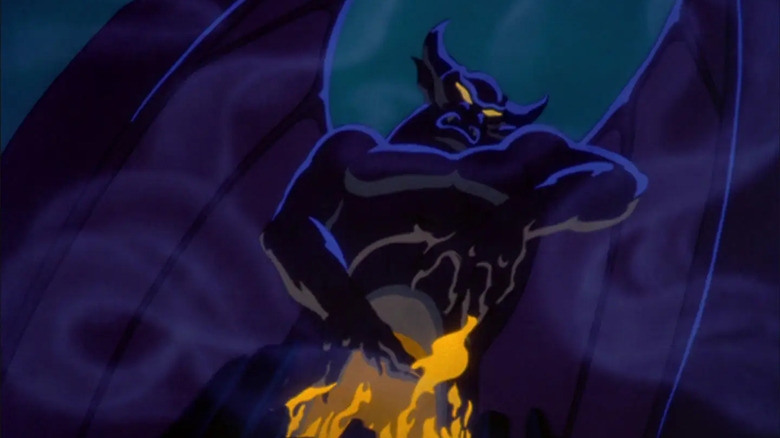
First up, Corridor Crew is joined by veteran animator and director Eric Koenig, who has worked on "The Simpsons" for over 14 years, to take a look at animated segments from over the years. They start with Disney's "The Skeleton Dance" from all the way back in 1929, check out the "Night on Bald Mountain/Ave Maria" segment from "Fantasia," and spend some time with "The Adventures of Ichabod and Mr. Toad." Other pieces include "The Tell-Tale Heart," "Watership Down," Tim Burton's stop-motion short "Vincent," and a little bit of "The Simpsons."
Halloween Kills Honest Trailer
Next, since "Halloween Kills" is available on Peacock, Screen Junkies didn't waste any time tackling the franchise sequel with a new Honest Trailer. Though it doesn't hit quite as hard on some of the more silly elements of the sequel, it does hone in on the endless reminders of the events of the original "Halloween" and the surprising amount of shoving and slamming that Michael Myers does when he's not stabbing with whatever he has handy.
Rebecca Ferguson Career Breakdown
Finally, "Dune" star Rebecca Ferguson sat down with Vanity Fair to take a look back at her career, which has grown rather quickly since her appearance in "Mission: Impossible - Rogue Nation." Listen as she reflects on "The Girl on the Train," "Florence Foster Jenkins," "The Greatest Showman," "Doctor Sleep," and both of the "Mission: Impossible" sequels she's appeared in so far. Plus, there's some talk about "Dune" at the very end.
"Red flags" doesn't even begin to cover it. Neal W. Zoromski, a veteran prop master who has worked on films like "The Day After Tomorrow" and "Thank You For Smoking," spoke with The Los Angeles Times about why he turned down a job on the film "Rust," and the interview is full of chilling quotes and background information as Zoromski describes a crew that was rushing to get things done at the cost of safety. While hindsight certainly comes into play here, it's troubling to hear these details from a longtime industry professional.
The film, which halted production after actor Alec Baldwin shot and killed cinematographer Halyna Hutchins and injured director Joel Souza with a prop gun, has been dominating headlines since the shocking incident took place. While the on-set tragedy is still being actively investigated by the Santa Fe County Sheriff's deputies and the New Mexico Occupational Health and Safety Bureau, cast and crew members have been talking to a number of outlets and have painted a bleak picture of the set conditions and the events that took place.
According to Zoromski, his experience with the "Rust" production managers started out on the wrong foot and only went downhill from there. Producers avoided questions about the budget for his "kit," or the props he would need to stock the set. He was also taken aback by the short notice. With the start of filming only two weeks out, "Rust" still hadn't officially hired a prop master.
"In the movies, the prep is everything ... You also need time to clean, inspect and repair guns ... You need time to fix old clocks. In period films, you are sometimes using antiques. But here, there was absolutely no time to prepare, and that gave me a bad feeling."
Zoromski's concerns didn't end there. When he told producers that he would need five crew members on his team, they pushed back. Zoromski attempted to compromise and offered instead to bring on two crew members: an assistant prop master and an armorer, who is in charge of looking after weaponry. Producers denied that request as well, saying that one person could juggle both jobs. As Zoromski explained, "You never have a prop assistant double as the armorer ... Those are two really big jobs."
Beyond that, Zoromski was surprised by the film's small budget in comparison to the kind of film the producers were trying to make. All of those red flags quickly added up and Zoromski decided to pass on the job offer. Shortly after he declined the job, Hannah Gutierrez-Reed announced her new position as a "property key assistant/armorer" on the set of "Rust" online.
This was Gutierrez-Reed's second time working as an armorer. On top of that, it's been reported that Gutierrez-Reed left a cart with three weapons on it alone on the day of the tragedy, leaving director Joel Souza to comment that he wasn't sure if any of the guns were checked for safety after the crew returned from lunch. This information, coupled with the news that guns had been taken off the "Rust" set and used for target practice and that multiple crew members had walked off set, makes this horrible situation sound all too avoidable.
Comedian and actor Bill Hader really knows his vintage horror. During our interview for his latest film, the animated "The Addams Family 2," which is in theaters now, he mentioned the wealth of good pre-Code horror movies that end up streaming or on TV this time of year. Speaking about some of his favorites, he recommended two Michael Curtiz horror films from the 1930s. If you want to celebrate Halloween like Hader, we found where you can stream them both and widen your spooky cinematic horizons!
Time For Pre-Code Movies And Chill
When I asked if Hader had any Halloween plans, he explained that he does pretty much the same thing every year:
No, I like this time of year because TCM and Criterion Channel, all places like that start playing horror movies and old grade horror movies. I also love Halloween specials, like Charlie Brown and stuff like that.
His favorites? Two Michael Curtiz flicks that recently got restorations, "Doctor X" and "Mystery of the Wax Museum." Both star Lionel Atwill and Fay Wray, and both feature the kinds of salacious content that make pre-Hays Code movies so fun. (The Hays Code was a self-imposed series of guidelines for all Hollywood films released between 1934 and 1968, often removing sexual or violent content.) Hader explains that there's just something special about them:
Those are great, just weird. It's really gruesome, it's pre-Code so there's a lot of cannibalism and stuff, but then there's also this really weird comic relief characters in it. I mean, they're one, gorgeous, those early color, but they're also just incredibly strange.
Where To Watch These Curtiz Classics
"Doctor X" is a 1932 American horror movie based on the play titled "The Terror," by Howard W. Comstock and Allen C. Miller. It was jointly produced by First National and Warner Bros., who also produced "Mystery of the Wax Museum" in 1933. Both films were some of the last made with the early two-color Technicolor process. Separate black-and-white prints were created as well, mostly for foreign and smaller markets.
Here's the official synopsis for "Doctor X," which is streaming now on Criterion:
Cannibals, strange research experiments, a serial killer who only strikes when the moon is full . . . Something strange is afoot at the cliffside laboratory of the mysterious Dr. Xavier (Lionel Atwill), suspected by police of harboring the murderer—or of committing the grisly crimes himself. When an intrepid reporter (Lee Tracy) sneaks onto the grounds of the laboratory in search of a scoop, he stumbles into Xavier's plan to catch the seemingly supernatural killer—using his own daughter (Fay Wray) as bait. Expressionistic art direction and hallucinatory two-strip Technicolor cinematography enhance the dreamlike mood of this pre-Code chiller from classic Hollywood's consummate craftsman Michael Curtiz.
In "The Mystery of the Wax Museum," a deranged sculptor starts turning human victims into wax statues. Atwill stars as Ivan Igor, the disfigured sculptor whose creations are just a little too real. While the beautifully restored color version of "Doctor X" is on Criterion, only the black and white version of "Mystery of the Wax Museum" is available for streaming. You can find it on both HBO Max and the Turner Classic Movies website.
Ana Taylor-Joy has a new movie opening in theaters this weekend, "Last Night in Soho," directed and co-written by Edgar Wright. "Mad Max: Fury Road" director George Miller had a chance to view an early cut of the film before the general public, and apparently he was so impressed by Taylor-Joy's performance (the first of hers he had ever seen) that he decided to approach her for the role of Furiosa in his "Fury Road" prequel.
She still had to audition for the part remotely, and that's where things get interesting. In an interview with Empire (by way of Indiewire), Miller revealed that he tasked Taylor-Joy with performing the famous "I'm mad as hell" speech from Sidney Lumet's "Network" for her audition. He explained:
"I said to her, 'I'd like you to do a very simple test, which is read something to camera.' And it was the speech from 'Network.' The 'I'm mad as hell' speech. Apart from the brilliance of the writing, it's a piece that can be done to camera. It doesn't need an acting partner. Anya did one version, which was really good. Then I gave her just a couple of simple notes about intention and she just absolutely nailed [it]. I think it was done on an iPhone.
"I sent it to the studio. I explained why I thought she was right for the role. I said I was really happy to talk about it but it was so persuasive that we didn't need to talk. The studio said, 'Tick.' "
Mad As Max
"Network" is currently available on FilmStruck, the Turner Classic Movies streaming service, and in the clip above you can see the scene that Miller asked Taylor-Joy to perform. It features Peter Finch in character as anchorman Howard Beale, giving an extended monologue on camera in front of a live studio audience. Finch died shortly after the release of "Network," but his performance was so strong that it earned him a posthumous Oscar for best actor.
Bryan Cranston also played the role of Howard Beale in a London stage adaptation of "Network," so other actors have taken a stab at the same material before, but it speaks to Taylor's talent that she was able to adjust her performance to Miller's direction and nail such an iconic scene — on an iPhone, no less — thereby winning the role of Furiosa.
Charlize Theron obviously leaves some big shoes to fill, too. As the older version of Furiosa, she was arguably the real star of "Fury Road" -- a one-armed Imperator who was as mad as Max and not going to take it anymore, so to speak. It will be interesting to see how Taylor-Joy approaches the character and whether she will align her performance with Theron's in any way to keep up Furiosa's established movie personality.
"Furiosa" recently has its release date postponed and is scheduled to go into production next year.
Intel has finally unleashed a sub-10nm (officially the Intel 7 process, which is comparable to TSMC 7nm) desktop CPU with its Alder Lake processors and the company’s multi-year slippage at 14nm is officially over. The Alder Lake architecture also features a plethora of innovative changes including a hybrid architecture with big.SMALL design feature p and e-cores as well as a new hardware scheduling technology that will go live in Windows 11.
Intel has also managed to deliver 19% IPC increase at ISO frequency over the previous 10th generation Rocket Lake parts and we are noting an improvement of almost 50% when you take into account multi-threaded performance in benchmarks. Alder Lake also features Intel Smart Cache architecture which will share the L3 cache with the p and e cores. Apart from this, the company is the first to market with DDR5 memory and PCIe 5.0.
PCIe 5.0 will be supported through the processor (and up to 16 lanes) while PCIe 4.0 will be supported via the chipset (and up to 12 lanes). The company has taken back the performance crown from AMD as the undisputed gaming leader thanks to its IPC and general performance improvements.
Single-threaded fixed frequency performance is up by 28% (if you look at the p-cores) and up by 50%, if you look at multi-threaded runs. All of this happens with Alder Lake consuming 9 watts less than the Core i9 11900k. One minor change, however, is that the PL1 and PL2 are now the same, meaning the TDP of the Core i9 12900k is effectively 241 watts by default.
Intel Alder Lake can match 11th generation MT performance for 1/4th the power consumption
Performance creation is also seeing a giant leap in performance across the board. Interestingly, however, if you want the same performance as an Intel Core i9 11900k, then you can drop the power consumption by 1/4 to 65W and get the same performance! This is an incredible leap in performance efficiency thanks to the e-cores.
Pricing and specification
Intel has decided to go with extremely aggressive pricing for its Alder Lake lineup. The flagship Intel Core i9 12900k will be sold for $589 which is very competitive with the AMD Ryzen 5900X (which retails for $550). The Core i7 12700K will retail for $409 and the Intel Core i5 12600k will retail for just $289. Considering the Core i5 part is an extremely capable SKU with 10 cores, this is competitive pricing by Intel and if they can deliver on supply, should sell like hot cakes.
Intel’s Alder Lake will be built using the company’s new E and P cores, you can read the architectural deep dive over here, and represent a significant evolution in the company’s power efficiency targets. It will be built on the Intel 7 process and scale from 9 watts to 125 watts. DDR5 and PCIe gen5 will be supported (first to market) and feature new technologies like the Intel Thread Director.
Alder Lake will be fully scalable from Desktop (LGA1700) to ultra mobile. Interestingly however, while the platform has 8 P-cores and 8 E-cores, only the P-cores will support hyper threading making for a total of 24 threads available. The integrated GPU will have 96 EUs of Xe architecture (good but nothing to write home about) but the thing that impressed us the most was the fact that Intel is claiming a 19% IPC uplift over Rocketlake – which should handily beat AMD parts if true.
Alder Lake will feature up to 30 MB of non inclusive LL Cache and support DDR5-4800, LP5-5200 along with DDR4-3200 and LP4x-4266. It will also support two times the PCIe bandwidth thanks to its support of PCIe 5 and will be able to provide up to 16 lanes of PCIe Gen5 with up to 64 GB/s. The new design is fully modular and built like lego and should be completely scalable and flexible. The compute fabric interconnect has a bandwidth of 1000 GB/s while the IO fabric has a BW of 64 GB/s. The memory subsystem supports up to 204 GB/s but more importantly can scale memory frequency (and power) according to the need of the SoC
"The Addams Family 2" star Bill Hader knows a thing or two about comedy and horror. He's a beloved film and sketch comic, with credits ranging from "Saturday Night Live" to some of the biggest mainstream comedies in movie history. More recently he has branched out into the horror genre as well, with "It Chapter Two" now under his belt.
In /Film's interview with Hader, writer Danielle Ryan made the connection between the "Barry" star's comedic and horror work, asking if he felt there was a "sinew between those two genres." His response was pretty luminary:
"Yeah, there is. I think you're both trying to get a big reaction out of the audience. So much of horror and comedy is also about pacing and timing and how you play it, how you lay the story out, surprise. So much of it is about surprise. The really good ones, too, they're very structured and loose at the same time. It's a weird combination where you have to be kind of intuitive, but then also have deep precision. Whereas like with a drama or something like that, you're just playing the emotions of those scenes, and it doesn't have to end. It has a rhythm, but it's just different.
"But I mean, the biggest thing I think about in comedy and horror is at least for me, you're thinking of the audience. You're trying to elicit something out of the audience, a scream or a laugh or both."
"The Addams Family 2" is in theatres now, and it's definitely great to see Hader step back into a spookier role than his usual straight comedy fare.
Jack Of Two Trades, Master Of Both
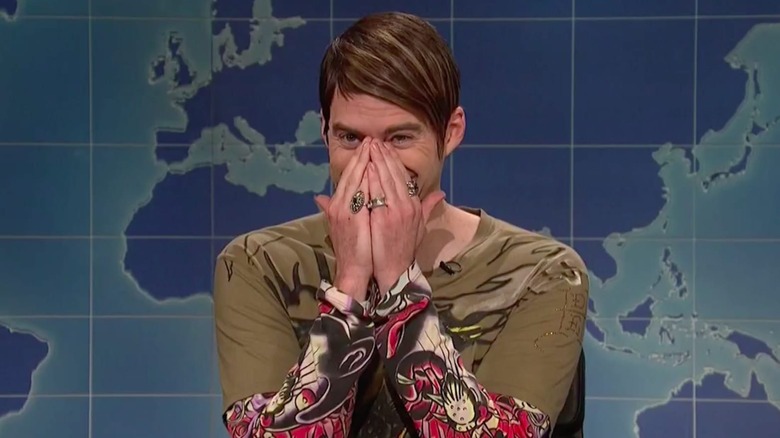
Bill Hader is known for his extremes, and he's done more than his fair share of going the extra mile in both comedic and horror performances over the years. From a comedy perspective, his character Stefon from his "Saturday Night Live" days is certainly an example of how exaggerated and big his comedy can be. In fact, a lot of the time, that is when Hader is at his funniest.
As for his horror capabilities, the actor really proved himself in "It Chapter Two." He was incredibly effective as the adult Richie Tozer, originally played by Finn Wolfhard in the first installment. Wolfhard's characterization was very sarcastic and witty with a secret soft edge, and Hader followed suit with a similar performance in the second part, letting his comedic edge show. His performance, especially during the film's scariest moments, was incredibly raw and real.
It's no surprise that the "Documentary Now!" star is able to move through both comedy and horror so seamlessly in his work. His influences include some really fun pre-Hayes code horror films, which undoubtedly pile on the camp as well as the scares. He told /Film:
"A movie I recently watched that they came out with a new restoration of was 'Doctor X.' 'Doctor X' and the 'Mystery of the Wax Museum,' these Michael Curtiz horror films from the '30s and they're beautiful. They look amazing. Those are great, just weird. It's really gruesome, it's pre-Code so there's a lot of cannibalism and stuff, but then there's also these really weird comic relief characters in it. I mean, they're one, gorgeous, those early color, but they're also just incredibly strange."
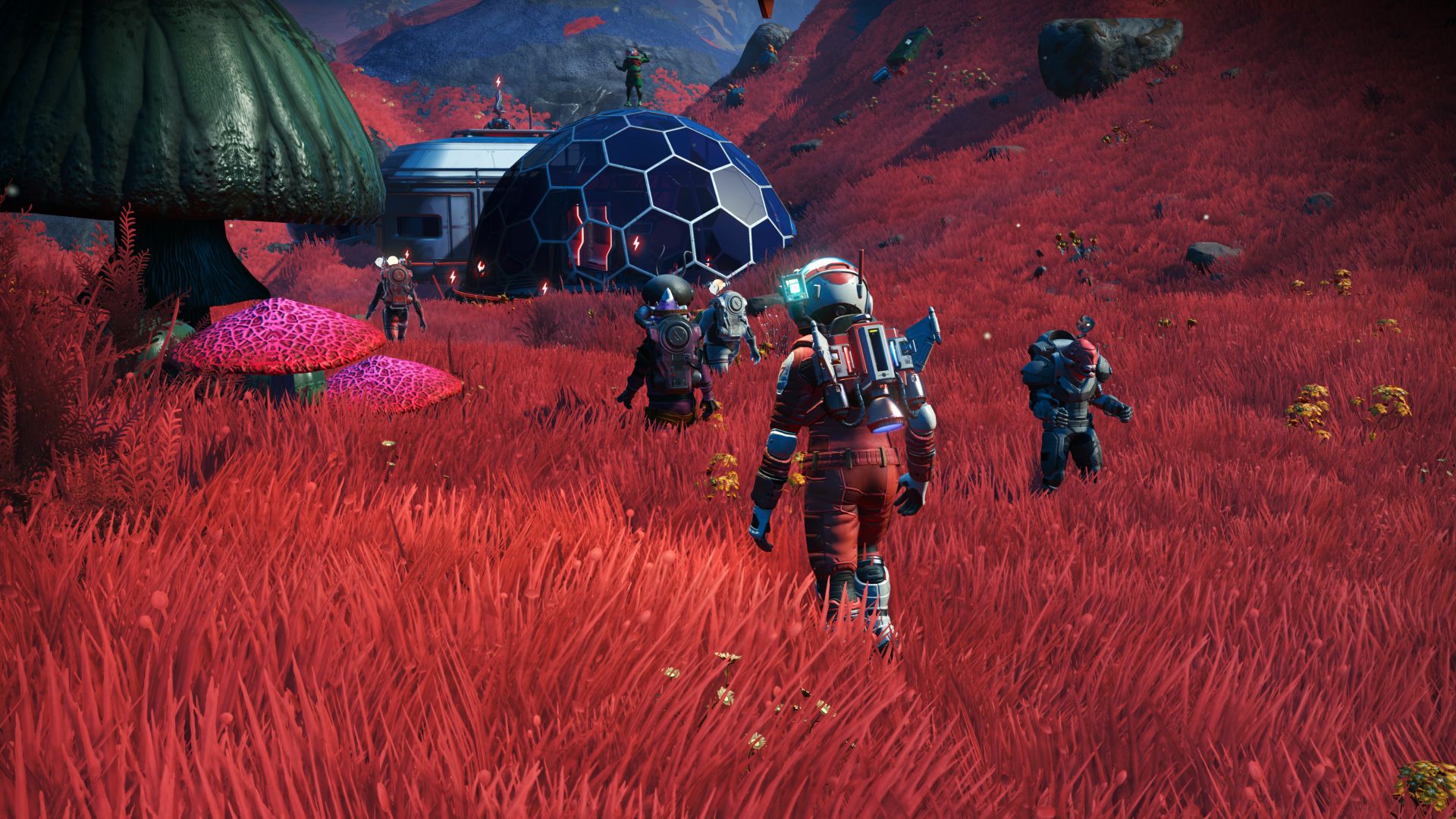
In a talk at this year's Develop: Brighton conference Iain Brown, senior programmer at No Man's Sky developer Hello Games, has given some insight into how Microsoft's Azure cloud computing tech has helped players share the game's procedurally generated universe. And, it turns out it's come in handy in helping to bring one of this year's biggest new features to life - and then keep them a surprise.
In a case study talk with Harvey Eagle, director of Azure gaming at Microsoft at the conference, Brown explains how the service's cloud-based tech has helped keep players interested. It seems No Man's Sky's Expeditions, the shared, seasonal exploratory mode rolled into the space game earlier this year, are a great example. For context, these are time-limited events that arrive in-game on a regular basis, though each is "unique" in terms of its exact duration and the milestones (open-ended challenges) players will have to hit to complete it. So, naturally, these Expeditions are something Hello Games would want to keep a surprise until they're rolled out and ready for players to discover.
"We don't want people hacking the game client to unlock this mode early or seeing what's coming, or whatever, so all that data lives in the cloud," Brown explains, referring to the Expeditions. "It lives in table storage within Azure and then, at a given time, it will be downloaded to all the clients as they need it."
You’re probably familiar with containers if you’re even remotely involved in software development or systems administration. In their 2020 survey, the Cloud Native Computing Foundation found that the use of containers in production has increased to 92%, up 300% since their first survey in 2016.
But, even if containers are a regular part of your day-to-day life, or if you, like me, are a worthy student just trying to understand what an operating system kernel is, it helps to have an understanding of some container basics.
Today, we’re explaining what containers are, how they’re used, and how cloud storage fits into the container picture—all in one neat and tidy containerized blog post package. (And, yes, the kernel is important, so we’ll get to that, too).
What Are Containers?
Containers are packaged units of software that contain all of the dependencies (e.g. binaries, libraries, programming language versions, etc.) they need to run no matter where they live—on a laptop, in the cloud, or in an on-premises data center. That’s a fairly technical definition, so you might be wondering, “OK, but what are they really?”
Well, typically, when it comes to naming things, the tech world is second only to the world of pharmaceuticals in terms of absurdity (I see your Comirnaty, and I’ll raise you a Kubernetes, good sir… More on that later.). But sometimes, we get it right, and containers are one example.
The generally accepted definition of the term applies almost exactly to what the technology does.
A container, generally = a receptacle for holding goods; a portable compartment in which freight is placed (as on a train or ship) for convenience of movement.
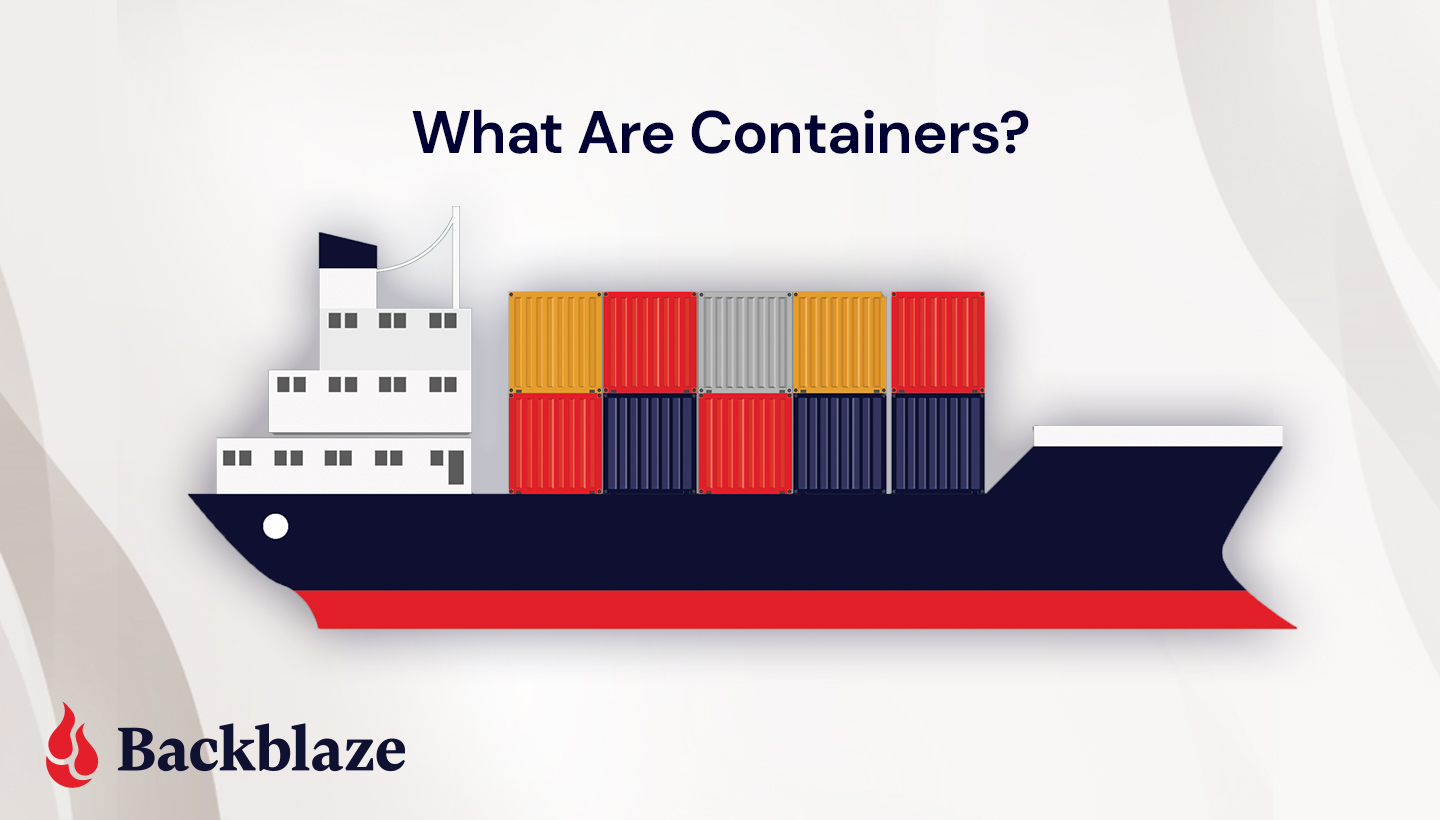
A container in software development = a figurative “receptacle” for holding software. The second part of the definition applies even better—shipping containers are often used as a metaphor to describe what containers do. In shipping, instead of stacking goods all higgledy piggledy, goods are packed into standard-sized containers that fit on whatever is hauling them—a ship, a train, or a trailer.
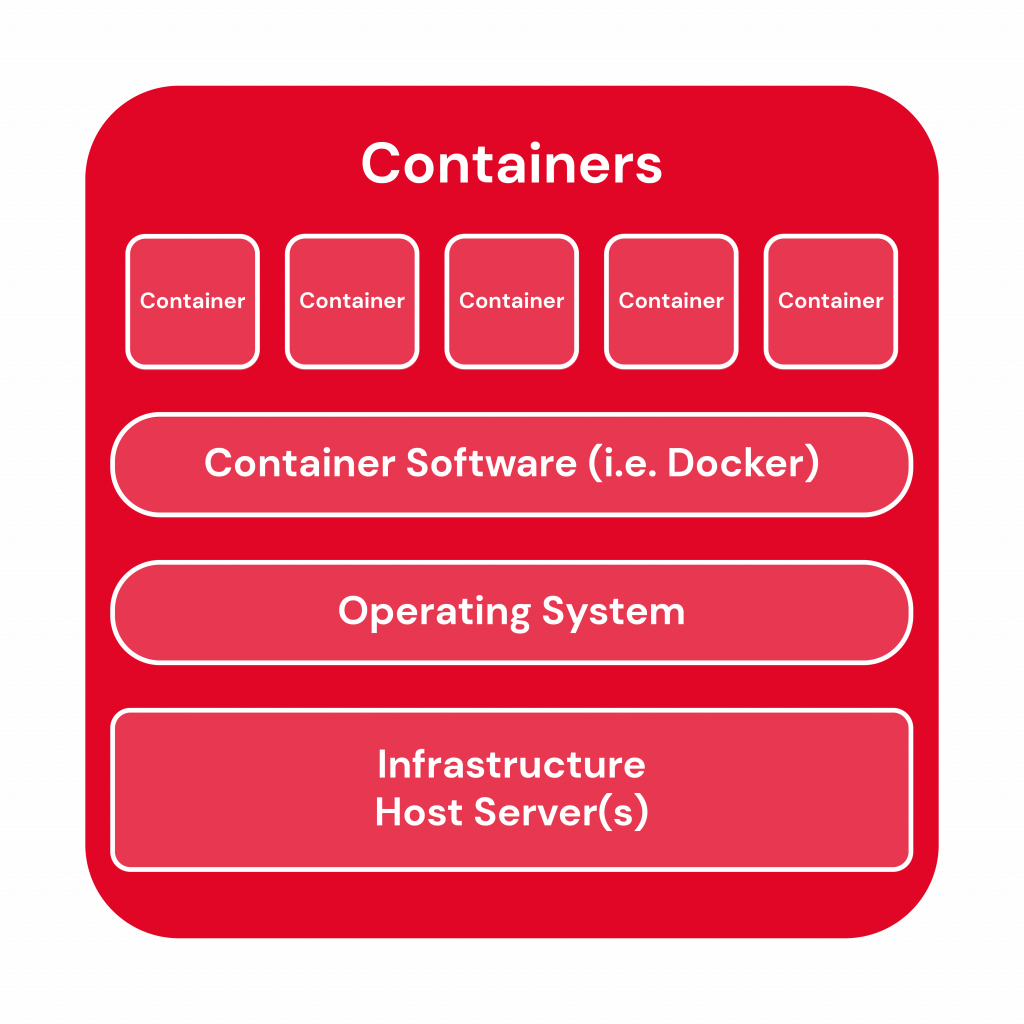
Likewise, instead of “shipping” an unwieldy mess of code, including the required operating system, containers package software into lightweight units that share the same operating system (OS) kernel and can run anywhere—on a laptop, on a server, in the cloud, etc.
What’s an OS Kernel?
As promised, here’s where the OS kernel becomes important. The kernel is the core programming at the center of the OS that controls all other parts of the OS. In yet another example of naming things in tech, the term makes sense if you consider the definition of “kernel” as “the central or essential part” as in “a kernel of truth,” but also begs the question, “Why didn’t they just call it a colonel? Because now all I can envision is a popcorn seed inside a computer.” …But that’s neither here nor there, and now you know what an OS kernel does.
Compared to older virtualization technology, namely virtual machines which are measured in gigabytes, containers are only megabytes in size. That means you can run quite a few of them on a given computer or server much like you can stack many containers onto a ship.
Indeed, the founders of Docker, the software that sparked widespread container adoption, looked to the port of Oakland for inspiration. Former Docker CEO, Ben Golub, explained in an interview with InfoWorld, “We could see all the container ships coming into the port of Oakland, and we were talking about the value of the container in the world of shipping. The fact it was easier to ship a car from one side of the world than to take an app from one server to another, that seemed like a problem ripe for solving.” In fact, it’s right there in their logo.
And that is exactly what containers, mainly via Docker’s popularity, did—they solved the problem of environment inconsistency for developers. Before containers became widely used, moving software between environments meant things broke, a lot. If a developer wrote an app on their laptop, then moved it into a testing environment on a server, for example, everything had to be the same—same versions of the programming language, same permissions, same database access, etc. If not, you would have had a very sad app.
Virtualization 101
Containers work their magic by way of virtualization. Virtualization is the process of creating a simulated computing environment that’s abstracted from the physical computing hardware—essentially a computer-generated computer, also referred to as a software-defined computer.
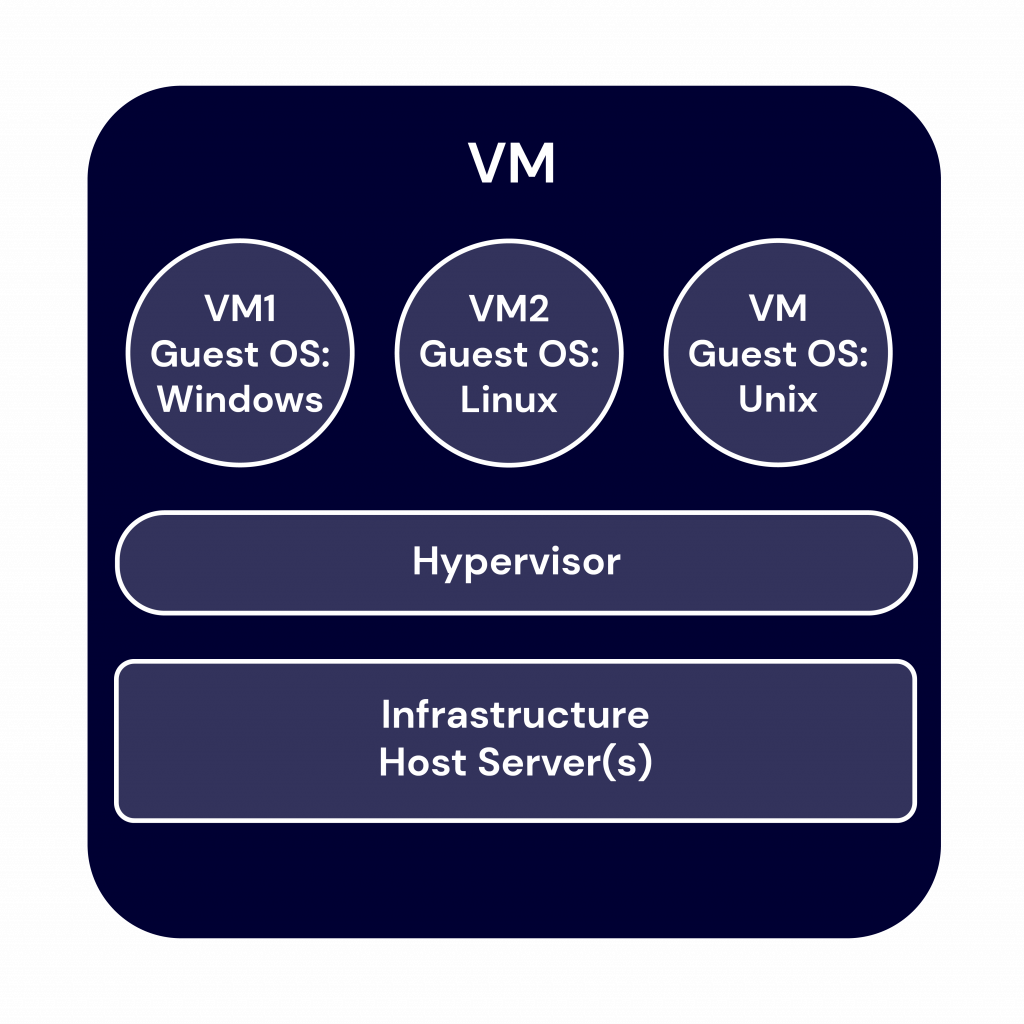
The first virtualization technology to really take off was the virtual machine (VM). A VM sits atop a hypervisor—a lightweight software layer that allows multiple operating systems to run in tandem on the same hardware. VMs allow developers and system administrators to make the most of computing hardware. Before VMs, each application had to run on its own server, and it probably didn’t use the server’s full capacity. After VMs, you could use the same server to run multiple applications, increasing efficiency and lowering costs.
Containers vs. Virtual Machines
While VMs increase hardware efficiency, each VM requires its own OS and a virtualized copy of the underlying hardware. Because of this, VMs can take up a lot of system resources, and they’re slow to start up.
Containers, on the other hand, virtualize the underlying hardware and the OS. Because they don’t include their own OS, containers are much smaller and faster to spin up than VMs. Want to know more? Check out our deep dive into the differences between VMs and containers.
The Benefits of Containers
Containers allow developers and system administrators to develop, test, and deploy software and applications faster and more efficiently than older virtualization technologies like VMs. The benefits of containers include:
Portability: Containers include all of the dependencies they need to run in any environment, provided that environment includes the appropriate OS. This reduces the errors and bugs that arise when moving applications between different environments, increasing portability.
Size: Containers share OS resources and don’t include their own OS image, making them lightweight—megabytes compared to VMs’ gigabytes. As such, one machine or server can support many containers.
Speed: Again, because they share OS resources and don’t include their own OS image, containers can be spun up in seconds compared to VMs which can take minutes to spin up.
Resource efficiency: Similar to VMs, containers allow developers to make the best use of hardware and software resources.
Isolation: Also similar to VMs, with containers, different applications or even component parts of a singular application can be isolated such that issues like excessive load or bugs on one don’t impact others.
Container Use Cases
Containers are nothing if not versatile, so they can be used for a wide variety of use cases. However, there are a few instances where containers are especially useful:
Enabling microservices architectures: Before containers, applications were typically built as all-in-one units or “monoliths.” With their portability and small size, containers changed that, ushering in the era of microservices architecture. Applications could be broken down into their component “services,” and each of those services could be built in its own container and run independently of the other parts of the application. For example, the code for your application’s search bar can be built separately from the code for your application’s shopping cart, then loosely coupled to work as one application.
Supporting modern development practices: Containers and the microservices architectures they enable paved the way for modern software development practices. With the ability to split applications into their component parts, each part could be developed, tested, and deployed independently. Thus, developers can build and deploy applications using modern development approaches like DevOps, continuous integration/continuous deployment (CI/CD), and agile development.
Facilitating hybrid cloud and multi-cloud approaches: Because of their portability, containers enable developers to utilize hybrid cloud and/or multi-cloud approaches. Containers allow applications to move easily between environments—from on-premises to the cloud or between different clouds.
Accelerating cloud migration or cloud-native development: Existing applications can be refactored using containers to make them easier to migrate to modern cloud environments. Containers also enable cloud-native development and deployment.
Container Tools
The two most widely recognized container tools are Docker and Kubernetes. They’re not the only options out there, but in their 2021 survey, Stack Overflow found that nearly 50% out of 76,000+ respondents use Docker and 17% use Kubernetes. But what do they do?
1. What Is Docker?
Container technology has been around for a while in the form of Linux containers or LXC, but the widespread adoption of containers happened only in the past five to seven years with the introduction of Docker.
Docker was launched in 2013 as a project to build single-application LXC containers, introducing several changes to LXC that make containers more portable and flexible to use. It later morphed into its own container runtime environment. At a high level, Docker is a Linux utility that can efficiently create, ship, and run containers.
Docker introduced more standardization to containers than previous technologies and focused on developers, specifically, making it the de facto standard in the developer world for application development.
2. What Is Kubernetes?
As containerization took off, many early adopters found themselves facing a new problem: how to manage a whole bunch of containers. Enter: Kubernetes. Kubernetes is an open-source container orchestrator. It was developed at Google (deploying billions of containers per week is no small task) as a “minimum viable product” version of their original cluster orchestrator, ominously named Borg. Today, it is managed by the Cloud Native Computing Foundation, and it helps automate management of containers including provisioning, load balancing, basic health checks, and scheduling.
Kubernetes allows developers to describe the desired state of a container deployment using YAML files (YAML stands for Yet Another Markup Language, which is yet another winning example of naming things in tech.). The YAML file uses declarative language to tell Kubernetes “this is what this container deployment should look like” and Kubernetes does all the grunt work of creating and maintaining that state.
Containers + Storage: What You Need to Know
Containers are inherently ephemeral or stateless. They get spun up, and they do their thing. When they get spun down, any data that was created while they were running is destroyed with them. But most applications are stateful, and need data to live on even after a given container goes away.
Object storage is inherently scalable. It enables the storage of massive amounts of unstructured data while still maintaining easy data accessibility. For containerized applications that depend on data scalability and accessibility, it’s an ideal solution for keeping stateful data stateful.
There are three essential use cases where object storage works hand in hand with containerized applications:
Backup and Disaster Recovery: Tools like Docker and Kubernetes enable easy replication of containers, but replication doesn’t replace traditional backup and disaster recovery just as sync services aren’t a good replacement for backing up the data on your laptop, for example. With object storage, you can replicate your entire environment and back it up to the cloud. There’s just one catch: some object storage providers have retention minimums, sometimes up to 90 days. If you’re experimenting and iterating on your container architecture, or if you use CI/CD methods, your environment is constantly changing. With retention minimums, that means you might be paying for previous iterations much longer than you want to. (Shameless plug: Backblaze B2 Cloud Storage is calculated hourly, with no minimum retention requirement.)
Primary Storage: You can use a cloud object storage repository to store your container images, then when you want to deploy them, you can pull them into the compute service of your choice.
Origin Storage: If you’re serving out high volumes of media, or even if you’re just hosting a simple website, object storage can serve as your origin store coupled with a CDN for serving out content globally. For example, CloudSpot, a SaaS platform that serves professional photographers, moved to a Kubernetes cluster environment and connected it to their origin store in Backblaze B2, where they now keep 120+ million files readily accessible for their customers.
Need Object Storage for Your Containerized Application?
Now that you have a handle on what containers are and what they can do, you can make decisions about how to build your applications or structure your internal systems. Whether you’re contemplating moving your application to the cloud, adopting a hybrid or multi-cloud approach, or going completely cloud native, containers can help you get there. And with object storage, you have a data repository that can keep up with your containerized workloads.
Ready to connect your application to scalable, S3-compatible object storage? You can get started today, and the first 10GB are free.
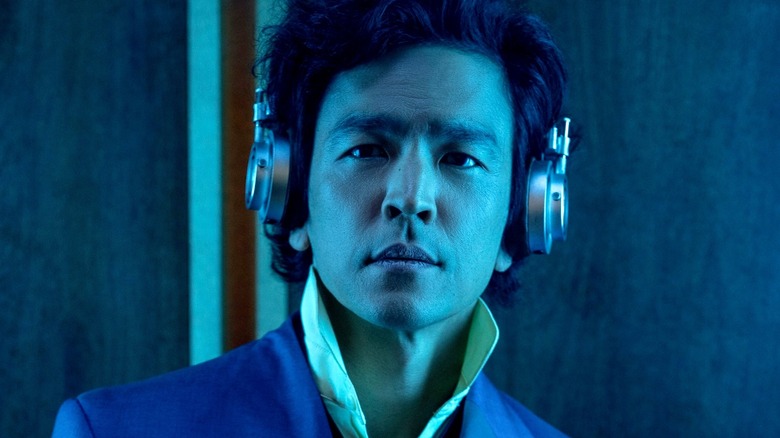
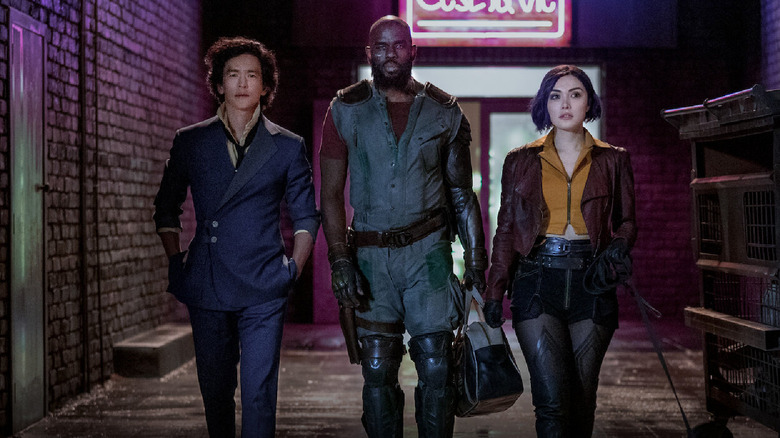
Fans of Shinichiro Watanabe's 1998 sci-fi action anime "Cowboy Bebop" have been anxiously awaiting the Netflix live-action adaptation, and the trailer is finally here. Anyone who was worried about the live-action version losing its jazzy, kinetic cool can put those fears to rest: the goods are all here. Bounty hunters Spike Spiegel (John Cho), Jet Black (Mustafa Shakir), and Faye Valentine (Daniella Pineda) -- along with their trusty genius Welsh Corgi named Ein -- will try to catch the bounty-heads, make a little cash, and survive in a cold, dark universe.
"Cowboy Bebop" will follow the crew of the spaceship known as the Bebop over 10 episodes. Showrunner André Nemec has promised to hold true to the canon, but fans can't help but notice that the Bebop's resident hacker, Ed, is missing from the crew. In the original anime, Ed doesn't show up for a bit and she's only in certain episodes, so hold tight! The original anime series had 26 episodes, so there's plenty of time for the Netflix crew to get to Edward Wong Hau Pepelu Tivrusky IV, the genius teenage hacker who bonds deeply with Ein.
While we didn't get any glimpses of Ed in the trailer, we did get hints for just about everything else that's coming our way in "Cowboy Bebop." So strap in, jetsetters, and let's break this boogie down.
The Universe At His Feet
The opening shot is on Cho's Spike in silhouette, looking out over a space dock into a beautiful cityscape. While the crew of the Bebop may always be short on money, at least they get a chance to sightsee. We can see the tip of Spike's fighter ship, the Swordfish II, parked just behind him. That's our space cowboy alright -- all long limbs, wonky grace, and perfect hair.
See The Spacey Sights
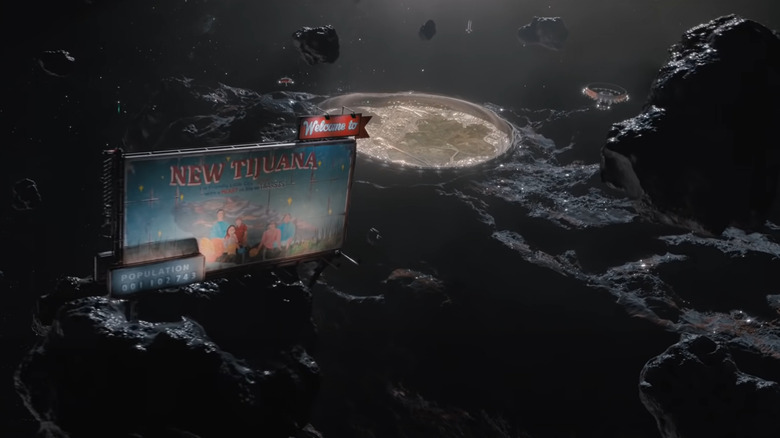
Okay, maaaybe all of the sights aren't so great to see. It looks like the Bebop is headed to the asteroid colony of New Tijuana, which is the setting of the first episode of the anime series, "Asteroid Blues." In the anime they take a bounty on "TJ," but only after Jet convinces Spike by playing to his stomach, telling him that the carnitas on Tijuana are "out of this world".
A Quick Chat With An Old Friend
We get a quick peek of Tamara Tunie as Ana, an old friend of Spike's from before he ever joined up with the Bebop. In the anime Ana runs a convenience store on Mars, and she was friends with Spike when he was a member of the Red Dragon Crime Syndicate. Spike tells her that he has a partner now (Jet), and we get brief flashes to Spike's tragic past before he informs her that he's going by the name "Spike Spiegel." It's a great introduction to the character's mysterious backstory, and Cho is just owning it with every fiber of his being.
A Haunting Memory
Before Spike leaves Ana, he takes a long look at a framed black-and-white photo of a blonde-haired woman. Fans of the anime will recognize Julia, Spike's former lover, instantly. Falling in love with Julia is what made Spike leave the Red Dragon Crime Syndicate, and what eventually puts him into a deadly feud with Syndicate member Vicious.
It's The Bebop, Baby!
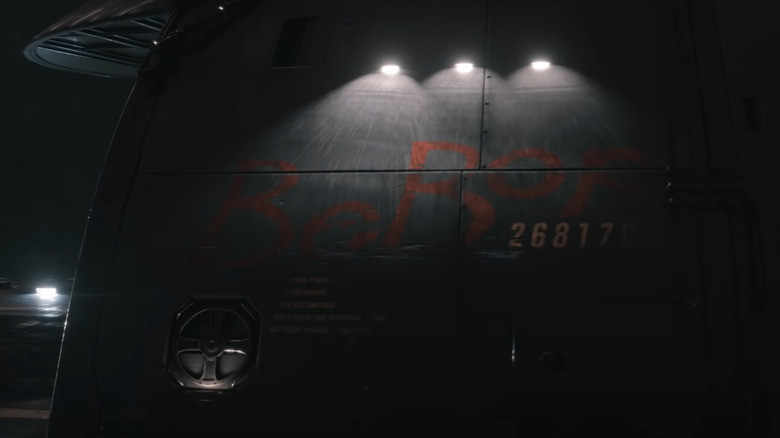
There are several ships in the series that are important, but the Bebop is the one that matters most because it serves as home for Faye, Spike, and Jet. They might fly around or have space battles in their other ships, but the Bebop is where they eat, sleep, and accidentally trip out on hallucinogenic mushrooms in one famous anime episode. We also get a peek inside the cockpit of the Bebop, where Jet's neon yellow "Beware of the Dog" sign is on full display.
At Least She's Spaceworthy?
Jet seems to be having a fine time piloting the Bebop, but then he tries to close the shades and one of them gets stuck. He has to go smack his fist against the panel until it works, which is relatable for anyone who's ever worked with old technology and also shows us that the Bebop ain't exactly a top-of-the-line luxury vessel. The crew of the Bebop are roughing it, and they're just trying to get by.
Coming In For A Water Landing
There's a neat shot of the Bebop landing on the water, probably on the same planet we saw Spike on at the very beginning. You can see the landing strips on the top of the Bebop for smaller ships, like Spike's Swordfish II or Faye's Red Tail.
'If The Cops Or The Bounty Hunters Don't Get Ya, The Syndicate Will'
Spike explains via voiceover that in this world, there's really nowhere that's safe. There's a whole slew of bounty hunters always on the lookout for fresh meat, the cops are dirty at best, and the Red Dragon Crime Syndicate, often called just the Syndicate, run everything. Spike's got some bad blood with the Syndicate, so he has to be especially careful.
Oh Look, It's Vicious
Speaking of the Syndicate, we get a tiny flash of a peek at Vicious, one of Spike's greatest enemies. Vicious and Spike were close friends within the Syndicate, and both of them had feelings for Julia. When Spike left and tried to take Julia with him, it spawned their blood feud. Without Spike there to stop him, Vicious rose through the ranks of the Syndicate, amassing incredible criminal power.
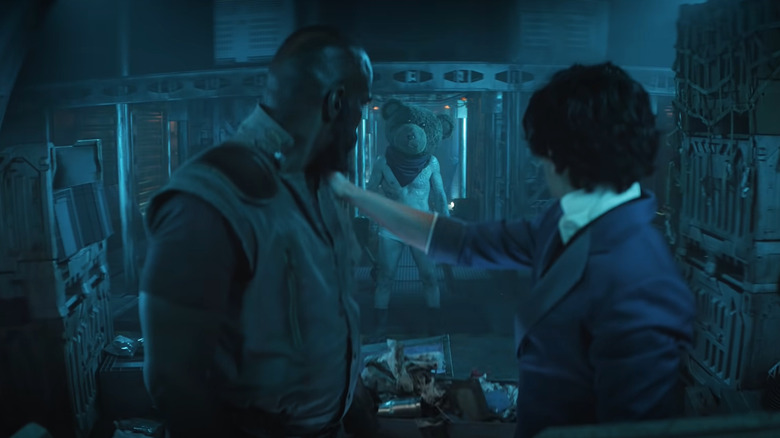
The Teddy Bomber
One of the most wild baddies the crew of the Bebop face off against is the Teddy Bomber, real name Ted Bower, an activist and terrorist who uses exploding teddy bears to take down symbols of capitalism. "Cowboy Bebop" the anime was never afraid to get really weird, and it's nice to see that the live-action series is going to dig into some of those more bizarre storylines too.
A Steamy Flashback
There's another quick flashback to Spike when he was a member of the Syndicate. (You can tell because his hair's pulled back, see?) We see him with Julia, and they share some tender and intimate moments in quick bursts of imagery before we're back to the Bebop's regular timeline.
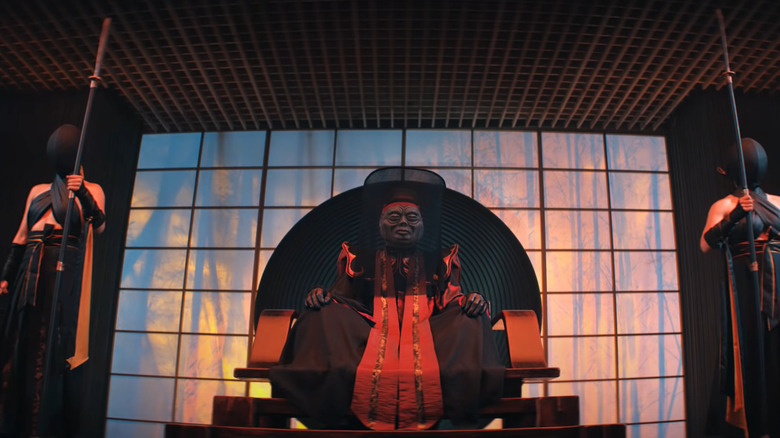
A Freaky Bountyhead
This guy looks a lot like the Van, the council of elders that ran the Red Dragon Syndicate in the anime. Maybe they consolidated all of those old dudes into one creepy masked guy, but the effect is definitely impressive.
Collecting A Bounty
There's a brief and colorful clip of a fight between Spike and one of his bounties, the pet thief Abdul Hakim. Cho gets to show off some martial arts moves and there's a silly porn sign in the background that looks like it's a ransom note. (Hakim is the main villain in the second episode of the anime, "Stray Dog Strut.")
There's Miss Valentine!
We finally get a glimpse of Faye Valentine as she bursts onto the screen in a blast of gunfire, but then we're quickly taken to a diner where the crew of the Bebop are rehashing their last mission. Faye's looking pretty beat up, but she's a tough broad and doesn't seem to mind. We can start to get a feel for the dynamic between Spike and Faye, which is contentious and somewhat like the love between siblings.
Flight Of The Red Tail
Cut between the diner sequence is Faye pulling off of the deck of the Bebop in her ship, the Red Tail. She's taken Ein with her, and she gives the boys in the cockpit of the Bebop a wink before she takes off.
Don't Touch Ein
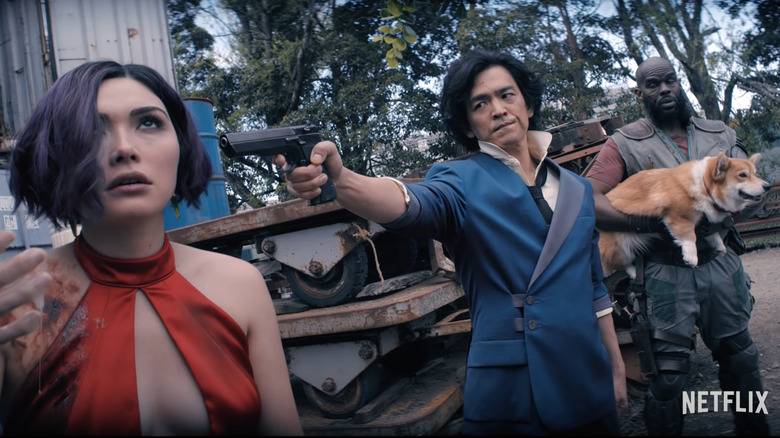
This still sums up the relationships between the Bebop crew members pretty well. Spike doesn't want to deal with Faye's antics anymore, Faye is exasperated that she didn't get away with something, and Jet looks completely annoyed with the both of them. Poor Jet often has to play father to both Faye and Spike, but at least here he just has to hold Ein (who is always along for the ride.)
A Girl And Her Gun
Faye loves her guns, and she gets a pretty stinking cool one in "Cowboy Bebop." The trailer gives us a shot of Faye opening up her new, freaky high-tech looking gun, and she's excited.
Oh My God It's Mad Pierrot
Remember when I said that sometimes "Cowboy Bebop" gets weird? In a truly creepy episode of the original anime, a man who was a lab experiment named Mad Pierrot escapes and creates a carnival of terrors that kills several people before Spike takes on the bounty.
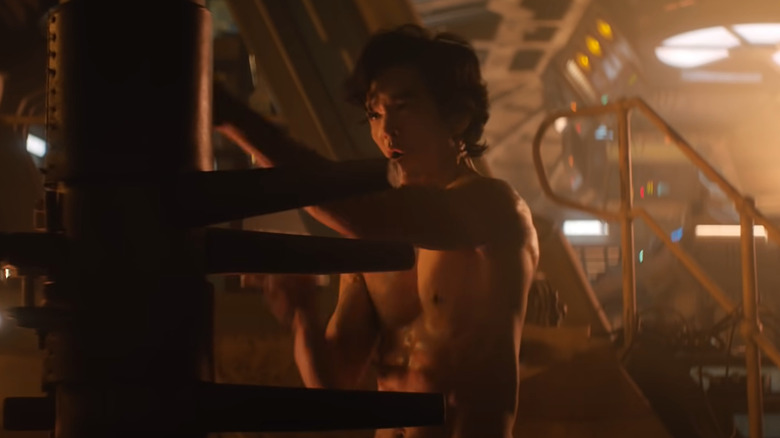
Spike Shirtless
This doesn't need a description, but if you had it, you'd post it, too.
Teamwork Makes The Dream Work
Aww. Spike, Faye, and Jet have a great fist-bump over the diner table. Teamwork is great, ain't it gang? The very next shot is Spike aiming his gun at Faye's head again, though, so the camaraderie on the Bebop is strained at best. They'll always be there for one another, but they're going to bicker like school children about it the entire way.
The Battle With Vicious
Spike and Vicious have a stunning fight in the anime, shooting and sword-fighting in front of a giant stained glass window. The Netflix series decided to keep that amazing imagery, and the live-action version is breathtaking. The whole trailer feels like "Cowboy Bebop" come to life, but seeing such an iconic image in three dimensions is really, really cool.
Here We Go Again
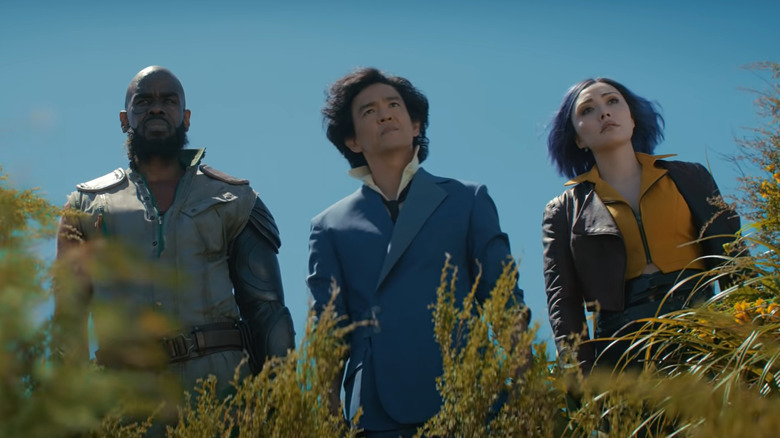
The final shot of the trailer shows Jet, Spike, and Faye in a field, all looking a little apprehensive about something. In the anime series, they often argue about what bounties to take and how to take them on, and it's likely this is just before they get into some serious trouble in the name of making a buck. The sarcastic humor of "Cowboy Bebop" shines through in these little moments, and the actors are doing killer work expressing what was previously animated.
"Cowboy Bebop" can't get here soon enough. The live-action series debuts on Netflix worldwide on November 19, 2021.
Microsoft's admission that the Universal Windows Platform has no future is a bit overdue. It is not jut because of the minimal adoption of the platform by programmers but also because it…
As we approach the last week of Cybersecurity Awareness Month, I think about what is top of mind for myself and my peers in security. The past year has continued the 2020s major shift in the way organizations operate. Recent data shows that 81 percent of enterprise organizations have begun the move toward a hybrid workplace, with 31 percent of those surveyed already fully adopted. As the public and private sectors continue to enable hybrid work, the attack surface for cyber threats has expanded, and threat actors have been quick to exploit any vulnerabilities. In response, organizations have enforced various security controls to revamp their security postures. For example, the number of Microsoft Azure Active Directory (Azure AD) Conditional Access policies deployed has more than doubled over the last year.
Figure 1: Rate of onsite versus remote work at Microsoft (Jan 2020 to Aug 2021).
Organizations that don’t maintain basic security hygiene practices in the new workplace—applying updates, turning on multifactor authentication (MFA)—are placing their data, reputation, and employees’ privacy at much greater risk. On October 7, 2021, we published the 2021 Microsoft Digital Defense Report (MDDR) with input from thousands of security experts spanning 77 countries. In the report, we examine the current state of hybrid work and recent trends in cybercrime. You’ll also get actionable insights for strengthening defenses across your entire organization.
Hybrid work requires a Zero Trust strategy
Along with basic security hygiene, adopting a Zero Trust security strategy protects your digital estate by applying a “never trust, always verify” approach. The prevalence of cloud-based services, IoT, and the use of personal devices (also known as bring your own device or BYOD) in hybrid work environments has changed the landscape for today’s enterprise. Unfortunately, security architectures that rely on network firewalls and virtual private networks (VPNs) to isolate and restrict access to resources won’t cut it for a workforce that operates beyond traditional network boundaries.
There is no one-size-fits-all approach to Zero Trust implementation, and that’s a good thing. It means you’re free to start anywhere. Organizations of all sizes begin in different areas, based on their immediate needs and available resources. Most organizations approach Zero Trust as an end-to-end strategy that can be completed over time.
Zero Trust controls and technologies are deployed across six technology pillars. Each pillar in a control plane is interconnected by automated enforcement of security policy, correlation of signal and security automation, and orchestration:
1. Identities
Identities can represent people, services, or IoT devices. As companies adapt for a hybrid workforce, we’ve seen more than a 220 percent increase in strong authentication usage (like MFA) in the last 18 months. Still, in Azure AD for the calendar year to date, we’re observing 61 million password attacks daily. Strong authentication can protect against 99.9 percent of identity attacks, but even better is passwordless authentication, which can provide the most usable and secure authentication experience. Legacy protocols, such as IMAP, SMTP, POP, and MAPI, are another major source of compromise. These older protocols do not support MFA; for that reason, 99 percent of password spray and 97 percent of credential-stuffing attacks exploit legacy authentication.
2. Endpoints
Once an identity has been granted access, data can flow to different endpoints—from IoT devices to smartphones, BYOD to partner-managed devices, on-premises workloads to cloud-hosted servers—creating a massive attack surface. With the Zero Trust model, enterprises can reduce provisioning costs and avoid additional hardware purchases for work-from-home use. For example, an administrator can grant access only to verified and compliant devices while blocking access from a personal device that’s been rooted or jailbroken (modified to remove manufacturer or operator restrictions) to ensure that enterprise applications aren’t exposed to known vulnerabilities.
3. Applications
Modernized applications and services require users to be authenticated prior to having access. However, thousands of applications and services still remain heavily reliant on network firewalls and VPNs to restrict access. These traditional architectures built for legacy applications were designed for lateral connectivity (CorpNet) rather than micro-segmentation. They violate the fundamental Zero Trust principle of “least-privilege access” and are more vulnerable to lateral movement across the network by an adversary. To modernize your applications, deploy one of these three solutions:
Utilize application tiers that only expose minimal least-privileged-access endpoints.
Add an internet hybrid endpoint, such as a reverse proxy or other secure-access service edge system (SASE).
4. Network
Microsoft Azure Firewall blocks millions of attempted exploits daily. Our signals show that attackers most commonly used malware, phishing, web applications, and mobile malware in their attempts at network attacks during July 2021. Also in July, there was a significant uptick in the use of coin miners, a type of malware that uses the network to mine cryptocurrency. Protocols leveraged most often in attacks were HTTP, TCP, and DNS, since these are open to the internet. A Zero Trust approach assumes your network is always under attack; therefore, you need to be prepared with a segmented layout that minimizes the blast radius.
Figure 3: Top 10 network threats (July 2021).
Distributed denial of service (DDoS) attacks on internet-facing endpoints ramped up significantly this year. Compared to the latter part of 2020, the average daily number of attack mitigations in the first half of 2021 increased by 25 percent while the average attack bandwidth per public IP increased by 30 percent. Microsoft Azure DDoS Protection mitigated 1,200 to 1,400 unique DDoS attacks every day in the first half of 2021. Europe, Asia, and the United States remain the most attacked regions because of the concentration of financial services and gaming industries in those regions. Over 96 percent of the attacks were of short duration—less than four hours. To get our latest research on DDoS attacks, download the 2021 MDDR.
Figure 4: DDoS attack destination regions.
5. Infrastructure
Infrastructure—whether on-premises, cloud-based, virtual machines (VMs), containers, or micro-services—represents a critical threat vector. As the move to the cloud enables a more secure hybrid workforce, organizations are also increasing their dependency on cloud storage, requiring effective threat protection, mitigation strategies, and tools to manage access. Azure Defender treats data-centric services, such as cloud storage accounts and big data analytics platforms, as part of the security perimeter and provides prioritization and mitigation of threats. We’ve produced a threat matrix for storage to help organizations identify gaps in their defenses, with the expectation that the matrix will evolve as more threats are discovered and cloud infrastructures constantly progress toward securing their services.
6. Data
With the rise of hybrid work, it’s especially important that data remain protected even if it leaves the devices, apps, infrastructure, and networks your organization controls. While classification, labeling, encryption, and data loss prevention remain core data security components, organizations that effectively manage the lifecycle and flow of their sensitive data as part of their business operations make it much easier for data security and compliance teams to reduce exposure and manage risk. Reducing that risk means reevaluating how your organization conducts business with sensitive data to ensure its proper storage, access, flow, and lifecycle.
Figure 5. The cumulative impact of unified data governance and security on sensitive data risk.
Actionable insights
As we adapt to a hybrid work world, Microsoft is aware of cybersecurity paradigm shifts that will support the evolution of work in a way that centers on the inclusivity of people and data.
Practice digital empathy
By applying empathy to digital solutions, we can make them more inclusive toward people with diverse perspectives and varied abilities. Factoring in digital empathy leads to the inclusion of security professionals with a broader range of abilities, skill sets, and perspectives—increasing the effectiveness of cybersecurity solutions. It also means developing technology that can forgive mistakes. Whether as an organization or an individual, our ability to be empathetic will help us to adapt during this time of constant change.
Don’t wait to start your Zero Trust journey
As we look past the pandemic to a time when workforces and budgets finally rebound, Zero Trust will become the biggest area of investment for cybersecurity. This means that right now, every one of us is on a Zero Trust journey—whether we know it or not. As shown in Figure 2, it doesn’t matter whether you start in endpoints, applications, or infrastructure, all that matters is that you get started now. Something as simple as enabling MFA (free with Microsoft Security solutions) can prevent 99 percent of credential theft. To see where you are at in your Zero Trust journey, take the Zero Trust Assessment.
Diversity of data sources matters
Microsoft processes over 24 trillion daily security signals across a diverse set of endpoints, products, services, and feeds from around the globe. We were able to identify and block new COVID-19-themed threats—sometimes in a fraction of a second—before they reached customers. Our rich diversity of data allowed Microsoft cyber defenders to understand COVID-19-themed attacks in a broader context—determining that attackers were primarily adding new pandemic-themed lures to familiar malware. This is just one example of how the diversity of data and the power of the cloud deliver a clear advantage in combating threats.
Cyber resilience equals business resilience
The latest cyberattacks are deliberately targeting core business systems to maximize destructive impact and increase the likelihood of a ransomware payout. Knowing this, it’s imperative that a comprehensive approach to operational resilience includes cyber-resilience. At Microsoft, our strategy focuses on four basic threat scenarios: events we can plan for, such as extreme weather; unforeseen natural events, such as earthquakes; legal events, such as cyberattacks; and deadly pandemics, such as COVID-19. Cloud technology, due to its scalability and agility, helps organizations develop a comprehensive cyber-resilience strategy and makes preparing for contingencies less complicated.
Focus on integrated security
Recent attacks by nation-state actors against Microsoft Exchange, Colonial Pipeline, and JBS USA brought into stark reality the agility and callousness of our adversaries. To uncover shifting attack techniques and stop them before they do serious damage, organizations need to have complete visibility across their own applications, endpoints, network, and users. To do this, while simplifying and reducing costs, businesses can adopt the security capabilities built into the cloud and productivity platforms they’re already using. Security tools that are fully integrated help improve efficacy and provide the end-to-end visibility today’s organization needs.
While digital acceleration will continue to drive these paradigm shifts, one thing remains the same: security technology is about improving productivity and collaboration through secure and inclusive user experiences. By practicing security for all, Microsoft is committed to making cybersecurity empowering for your organization every day.
Learn more
Hybrid work is the new normal, and organizations need the latest data on how to defend themselves in a constantly evolving threat landscape. To get 100 plus pages of insights gathered across more than 23 billion daily security signals across the Microsoft cloud, endpoints, and intelligent edge, download the 2021 Microsoft Digital Defense Report. Also, see our past blog posts providing information for each themed week of Cybersecurity Awareness Month 2021. Read our latest posts:
Be sure to visit our Cybersecurity Awareness Month page for more resources and information on protecting your organization year-round. Do your part. #BeCyberSmart
To learn more about Microsoft Security solutions, visit our website. Bookmark the Security blog to keep up with our expert coverage on security matters. Also, follow us at @MSFTSecurity for the latest news and updates on cybersecurity.
X.Org Server 21.1 is now officially available as this first xorg-server update in three years and what began development as X.Org Server 1.21 prior to the versioning change...
Phoronix: Now that Windows 11 has been out as stable and the initial round of updates coming out, I've been running fresh Windows 11 vs. Linux benchmarks for seeing how Microsoft's latest operating system release compares to the fresh batch of Linux distributions. First up is the fresh look at the Windows 11 vs. Linux performance on an Intel Core i9 11900K Rocket Lake system. Microsoft Windows 11 Pro with all stable updates as of 18 October was used for this round of benchmarking on Intel Rocket Lake. The Windows 11 performance was being compared to all of the latest prominent Linux distributions, including: Ubuntu 20.04.3 LTS, Ubuntu 21.10, Arch Linux (latest rolling), Fedora Workstation 35, Clear Linux 35150. All the testing was done on the same Intel Core i9 11900K test system at stock speeds (any frequency differences reported in the system table come down to how the information is exposed by the OS, i.e. base or turbo reporting) with 2 x 16GB DDR4-3200 memory, 2TB Corsair Force MP600 NVMe solid-state drive, and an AMD Radeon VII graphics card.
Each operating system was cleanly installed and then run at its OS default settings for seeing how the out-of-the-box OS performance compares for these five Linux distributions to Microsoft Windows 11 Pro. But for the TLDR version... Out of 44 tests run across all six operating systems, Windows 11 had just three wins on this Core i9 11900K system. Meanwhile Intel's own Clear Linux platform easily dominated with coming in first place 75% of the time followed by Fedora Workstation 35 in second place with first place finishes 9% of the time. The geometric mean for all 44 tests showed Linux clearly in front of Windows 11 for this current-generation Intel platform. Ubuntu / Arch / Fedora were about 11% faster overall than Windows 11 Pro on this system. Meanwhile, Clear Linux was about 18% faster than Windows 11 and enjoyed about 5% better performance overall than the other Linux distributions.
Lazarus Group, the advanced persistent threat (APT) group attributed to the North Korean government, has been observed waging two separate supply chain attack campaigns as a means to gain a foothold into corporate networks and target a wide range of downstream entities.
The latest intelligence-gathering operation involved the use of MATA malware framework as well as backdoors dubbed BLINDINGCAN
The past few days have brought a flood of non-stop news stories related to the death of cinematographer Halyna Hutchins, and there appears to be no end in sight. New details keep coming out about the circumstances leading up to the shooting accident that occurred on the set of the Alec Baldwin Western, "Rust," which resulted in Hutchins' death. The latest piece of information pertains to armorer Hannah Gutierrez-Reed, who was part of the chain of crew members involved in handling the prop gun that caused the fatal misfire.
The Wrap reports that Reed was "the subject of numerous complaints" on her previous film, "The Old Way" — also a Western, starring Nicolas Cage. According to Stu Brumbaugh, a key grip on the film, these included at least one complaint from Cage himself, who became enraged after Gutierrez-Reed discharged a gun near the cast and crew without warning. Brumbaugh told The Wrap that it was the second time in three days this had happened. He said Cage left the set in anger after shouting, "Make an announcement, you just blew my f***ing eardrums out!"
Brumbaugh added, "I told the [assistant director], 'She needs to be let go.' After the second round I was pissed off. We were moving too fast. She's a rookie."
From Gutierrez-Reed To Halls
Gutierrez-Reed isn't the only crew member whose history prior to "Rust" has come into question in the days since Hutchins' death. Yesterday, we reported that assistant director Dave Halls had been fired from the production of another film, "Freedom's Path," after a separate incident where a rifle "unexpectedly discharged," injuring a boom operator. A sheriff's affidavit revealed that it was Halls who unknowingly handed Baldwin the gun that killed Hutchins (pictured above), after grabbing it from a cart that Gutierrez-Reed had prepped.
Right now, there's a lot of finger-pointing going on in the Halyna Hutchins case. Emotions are understandably high and everyone is looking for someone to blame. It's only exacerbated by the current media feeding frenzy, which in some ways, has already reduced Hutchins' death to "content," to be consumed online by readers in an infinite scroll.
Through all of this, it's important not to lose sight of the fact that this is a tragedy where a woman is dead and people's careers and lives have been destroyed. That two crew members, each with a questionable record, could wind up being involved in the same fatal accident onset is disturbing, to say the least. But there were clearly systematic failures at play here, as well, in regards to safety measures. It only hammers home the point all the more that some real change is needed in Hollywood to ensure that this kind of tragedy never happens again.
Apple's privacy rules are "negatively affecting" Facebook, and its business, Facebook CEO Mark Zuckerberg claimed during its most recent earnings call. MacRumors reports: As a quick refresher, starting with iOS 14.5 and all newer versions of iOS and iPadOS, Apple requires that apps ask for users' permission to track them across other apps and websites. Under the App Tracking Transparency (ATT) framework, the latest change gives users a choice on whether they wish to be tracked for ads or other purposes. [...] Continuing on its anti-Apple's privacy rules campaign, Facebook CEO Mark Zuckerberg was quick to blame Apple for his company's lower than expected growth in the third quarter of the year. Kicking off the earnings call, Zuckerberg said Apple is "negatively affecting" Facebook but that he believes the company will be able to "navigate" the challenges Apple is presenting thanks to its long-term investments.
"As expected, we did experience revenue headwinds this quarter, including from Apple's changes that are not only negatively affecting our business, but millions of small businesses in what is already a difficult time for them in the economy. Sheryl and Dave will talk about this more later, but the bottom line is we expect we'll be able to navigate these headwinds over time with investments that we're already making today." While Zuckerberg and the Facebook executive team hold Apple's changes accountable for this quarter's performance, it may also be an asset. Zuckerberg has in the past stated that ATT could ultimately help Facebook, and it's a sentiment he again repeated during the earning's call. Apple's changes, according to Zuckerberg, are making "e-commerce and customer acquisition less effective on the web." Still, Facebook could benefit from the lessened effectiveness as "solutions that allow businesses to set up shop right inside our apps will become increasingly attractive," Zuckerberg added.
Facebook's chief operating officer, Sheryl Sandberg, also criticized Apple and its privacy rules, going as far as to claim that the new rules are negatively impacting Facebook while benefiting Apple's own advertising business: "We've been open about the fact that there were headwinds coming -- and we've experienced that in Q3. The biggest is the impact of Apple's iOS14 changes, which have created headwinds for others in the industry as well, major challenges for small businesses, and advantaged Apple's own advertising business." Despite Facebook facing an avalanche of pressure amid leaked internal documents and scrutiny, Sandberg pointed the finger at Apple for Facebook's lackluster performance this quarter. "Overall, if it wasn't for Apple's iOS 14 changes, we would have seen positive quarter-over-quarter revenue growth," Sandberg said.
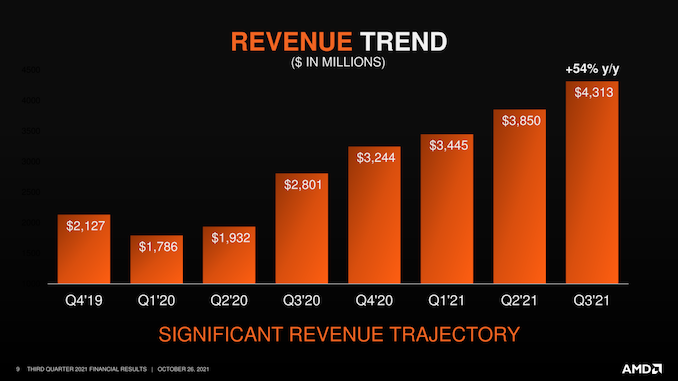
Continuing our earnings season coverage for Q3’21, today we have the yin to Intel’s yang, AMD. The number-two x86 chip and discrete GPU maker has been enjoying explosive growth ever since AMD kicked off its renaissance of sorts a couple of years ago, and that trend has been continuing unabated – AMD is now pulling in more revenue in a single quarter than they did in all of 2016. Consequently, AMD has been setting various records for several quarters now, and their latest quarter is no exception, with AMD setting new high water marks for revenue and profitability.
For the third quarter of 2021, AMD reported $4.3B in revenue, making a massive 54% jump over a year-ago quarter for AMD, when the company made just $2.8B in a then-record quarter. That makes Q3’21 both the best Q3 and the best quarter ever for the company, continuing a trend that has seen the company’s revenue grow for the last 6 quarters straight – and this despite a pandemic and seasonal fluctuations.
As always, AMD’s growing revenues have paid off handsomely for the company’s profitability. For the quarter, the company booked $923M in net income – coming within striking distance of their first $1B-in-profit quarter. This is a 137% increase over the year-ago quarter, underscoring how AMD’s profitability has been growing even faster than their rapidly rising revenues. Helping AMD out has been a strong gross margin for the company, which has been holding at 48% over the last two quarters.
AMD Q3 2021 Financial Results (GAAP)
Q3'2021
Q3'2020
Q2'2021
Y/Y
Revenue
$4.3B
$2.8B
$3.45B
+54%
Gross Margin
48%
44%
48%
+4pp
Operating Income
$948M
$449M
$831M
+111%
Net Income
$923M
$390M
$710M
+137%
Earnings Per Share
$0.75
$0.32
$0.58
+134%
Breaking down AMD’s results by segment, we start with Computing and Graphics, which encompasses their desktop and notebook CPU sales, as well as their GPU sales. That division booked $2.4B in revenue for the quarter, $731M (44%) more than Q2 2021. Accordingly, the segment’s operating income is up quite a bit as well, going from $384M a year ago to $513M this year. Though, in a mild surprise, it is down on a quarterly basis, which AMD is ascribing to higher operating expenses.
As always, AMD doesn’t provide a detailed breakout of information from this segment, but they have provided some selective information on revenue and average selling prices (ASPs). Overall, client CPU sales have remained strong; client CPU ASPs are up on both a quarterly and yearly basis, indicating that AMD has been selling a larger share of high-end (high-margin) parts – or as AMD likes to call it, a “richer mix of Ryzen processor sales”. For their earnings release AMD isn’t offering much commentary on laptop versus desktop sales, but it’s noteworthy that the bulk of the company’s new consumer product releases in the quarter were desktop-focused, with the Radeon RX 6600 XT and Ryzen 5000G-series APUs.
Speaking of GPUs, AMD’s graphics and compute processor business is booming as well. As with CPUs, ASPs for AMD’s GPU business as up on both a yearly and quarterly basis, with graphics revenue more than doubling over the year-ago quarter. According to the company this is being driven by both high-end Radeon sales as well as AMD Instinct sales, with data center graphics revenue more than doubling on both a yearly and quarterly basis. AMD began shipping their first CDNA2-based accelerators in Q2, so for Q3 AMD has been enjoying that ramp-up as they ship out the high-margin chips for the Frontier supercomputer.
AMD Q3 2021 Reporting Segments
Q3'2021
Q3'2020
Q2'2021
Computing and Graphics
Revenue
$2398M
$1667M
$2250M
Operating Income
$513M
$384M
$526M
Enterprise, Embedded and Semi-Custom
Revenue
$1915M
$1134M
$1600M
Operating Income
$542M
$141M
$398M
Moving on, AMD’s Enterprise, Embedded, and Semi-Custom segment has yet again experienced a quarter of rapid growth, thanks to the success of AMD’s EPYC processors and demand for the 9th generation consoles. This segment of the company booked $1.9B in revenue, $781M (69%) more than what they pulled in for Q3’20, and 20% ahead of an already impressive Q2’21. The gap between the CG and EESC groups has also further closed – the latter is now only behind AMD’s leading group by $483M in revenue.
And while AMD intentionally doesn’t separate server sales from console sales in their reporting here, the company has confirmed that both are up. AMD’s Milan server CPUs, which were launched earlier this quarter, have become the majority of AMD’s server revenue, pushing them to their 6th straight quarter of record server processor revenue. And semi-custom revenue – which is primarily the game consoles – is up not only on a yearly basis, but on a quarterly basis as well, with AMD confirming that they have been able to further expand their console APU production.
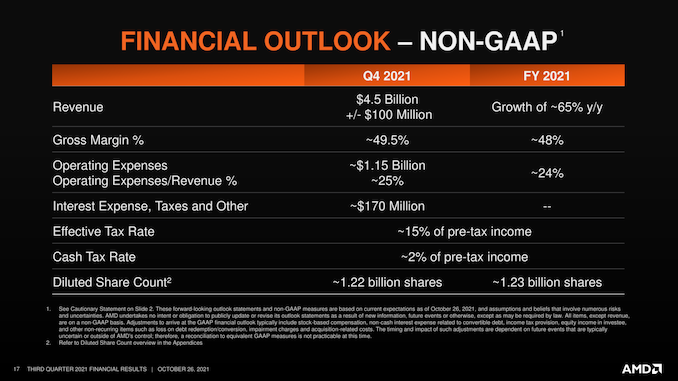
Looking forward, AMD’s expectations for the fourth quarter and for the rest of the year have been bumped up yet again. For Q4 the company expects to book a record $4.5B (+/- $100M) in revenue, which if it comes to pass will be 41% growth over Q4’20. AMD is also projecting a 49.5% gross margin for Q4, which if they exceed it even slightly, would be enough to push them to their first 50% gross margin quarter in company history. Meanwhile AMD’s full year 2021 projection now stands at a 65% year-over-year increase in revenue versus their $9.8B FY2020, which is 5 percentage points higher than their forecast from the end of Q2.
As for AMD’s ongoing Xilinx acquisition, while the company doesn’t have any major updates on the subject, they are confirming that they’re making “good progress” towards securing the necessary regulatory approvals. To that they, they are reiterating that it remains on-track to close by the end of this year.
Finally, taking a break from growing the company by 50% every year, AMD is scheduled to hold their AMD Accelerated Data Center Premiere event on Monday, November 8th. While AMD isn’t giving up too much information in advance, the company is confirming that we’ll hear more about their CDNA2 accelerator architecture, which along with the current Frontier supercomputer, will be going into their next generation Radeon Instinct products. As well, the company will also be delivering news on their EPYC server processors, which were just recently updated back in March with the launch of the 3rd generation Milan parts. As always, AnandTech will be virtually there, covering AMD’s announcements in detail, so be sure to drop by for that.
Rejoice! Shinichiro Watanabe's acclaimed anime series "Cowboy Bebop" is getting a live-action adaptation, and Netflix has just dropped the trailer. The noir space western series stars John Cho as Spike Spiegel. Along with Mustafa Shakir as Jet Black and Daniella Pineda as Faye Valentine, the trio of bounty hunters are what Netflix describes as "long on style and perpetually short on cash."
The show explores the crew's interstellar exploits over 10 episodes and is expected to air its first episode on the streaming service November 19. It's developed by showrunner André Nemec and written by Christopher Yost. Nemec and Jeff Pinkner are series creators, having previously collaborated on the series "Alias," and the show will be directed by Alex Garcia Lopez ("Daredevil," "The Witcher") and Michael Katleman ("The Last Ship"). As a bonus, original anime series director Shinichirō Watanabe is onboard as a consultant, and original composer Yoko Kanno (who also composed for "Wolf's Rain") returns to bring some space jazz to the adaptation, as well.
Fans can join in the countdown through a trailer livestream event, available to viewers here.
Cowboy Bebop Trailer
Despite the delayed production due to a knee injury for John Cho and then the COVID-19 pandemic, it appears that the series will retain the bonkers energy and slick style of its predecessor, and the showrunner promises to keep things as canon-friendly as possible. Cho is pitch-perfect in the lead role, at once a ruthless hunter and a tailored trendsetter -- and that luxurious hair is all him, baby.
The o.g. "Cowboy Bebop" had a 26-episode run in its day, airing in Japan from 1998 through the following year. As the first anime to be broadcast on Cartoon Network's Adult Swim, the show is credited with bringing the animation genre to a new influx of Western audiences through its lauded English dubbing, completed by Animaze and ZRO Limit Productions. The show is now considered atop the list of best anime series of all time, and a solid gateway series for onboarding anime enthusiasts.
The upcoming "Cowboy Bebop" series is executive produced by André Nemec, Jeff Pinkner, Josh Appelbaum and Scott Rosenberg of Midnight Radio, Marty Adelstein and Becky Clements of Tomorrow Studios, Makoto Asanuma, Shin Sasaki and Masayuki Ozaki of Sunrise Inc.,Tim Coddington, Tetsu Fujimura, Michael Katleman, Matthew Weinberg, and Christopher Yost.
Here's the synopsis for "Cowboy Bebop":
"Cowboy Bebop" is an action-packed space Western about three bounty hunters, aka "cowboys," all trying to outrun the past. As different as they are deadly, Spike Spiegel (John Cho), Jet Black (Mustafa Shakir), and Faye Valentine (Daniella Pineda) form a scrappy, snarky crew ready to hunt down the solar system's most dangerous criminals — for the right price. But they can only kick and quip their way out of so many scuffles before their pasts finally catch up with them.
The first episode of "Cowboy Bebop" drops on Netflix on November 19, 2021.







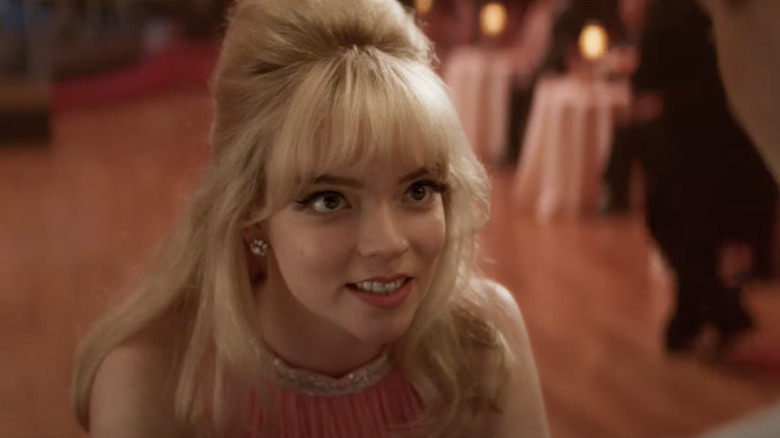
 Anya Taylor-Joy, Thomasin McKenzie and Matt Smith star in a new film by director Edgar Wright.