Shared posts

09 Jan 17:38

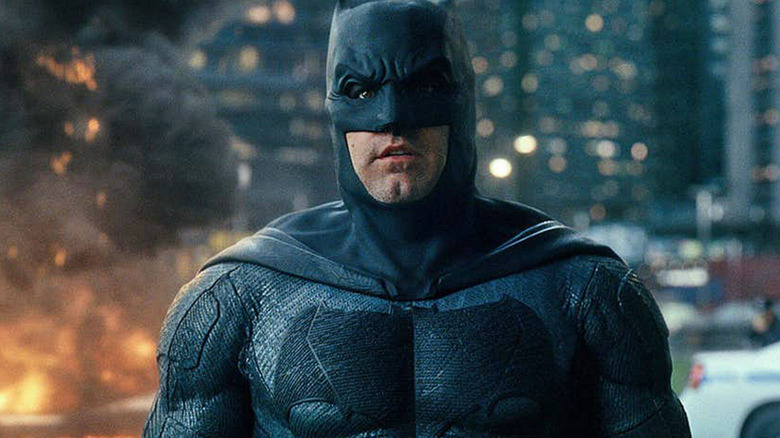
Ben Affleck Opens Up About His Batman Casting Backlash

by Ben F. Silverio

While "Batman V Superman: Dawn of Justice" and "Zack Snyder's Justice League" are quite divisive films (and by "divisive" I personally mean "terrible"), Ben Affleck's portrayal of Batman was probably one of the better things to come out of them. He may have been a little older and more grizzled than his predecessors, but he was able to crack a joke here and there to remind people how fun the Caped Crusader could be. He also wasn't afraid to get in on the hand to hand combat and didn't rely too heavily on a weapon- and gadget-based offense. That's why fans were looking forward to finally see him break out from the Snyder shackles, star in his own film, and potentially let his version of his character shine on his own more.

Things didn't play out that way as Affleck decided to entirely part ways with "The Batman" due to personal issues. The actor and his fans are still excited for his final appearance in the iconic cape and cowl in Andy Muschietti's "The Flash," which stars Ezra Miller as the Barry Allen version of the Scarlet Speedster. However, that excitement wasn't always there.

When the casting announcement was first made, many vocal fans expressed their distaste for Batfleck without knowing much about his take or seeing any footage. Now, the actor is opening up about how the initial reaction to his casting made him feel.

Dark, Sad, Lonely Knight

During an appearance on The Howard Stern Show, Affleck shared that he was disappointed by the negative outcry following the announcement that he would be the new Batman. He was especially baffled by the petitions that called for him to be removed from the role.

"I was hurt. I was less hurt than I would've been 10 years earlier. But I was hurt because I felt like 'Wait a minute, come on. What do I got to do to' you know what I mean? Like, I'm just you know, like, 'Jesus Christ' ... I thought it was an interesting idea but you know what? I also realized at that point ... it's gonna be, 'Now this turns into a petition.' Now they got this thing, everybody's going to do a petition. You're really -– a hundred thousand [signatures], you signed a f***ing petition like, you have anything better to do with your day than sign petitions? But, ironically, the reason I did this is I wanted to do a movie for my kids, particularly my son, that they would see and be proud of."

Interestingly enough, petitions also popped up to keep him in the role when it was announced that Robert Pattinson would be taking over. Stern also backs up Affleck by reminding him of the negative reaction to Michael Keaton when he was first announced as Batman. Now, Keaton is one of the most beloved performers to ever don the batsuit and fans are excited to see him alongside Affleck and Miller in the Fastest Man Alive's upcoming multiversal feature film, followed by HBO Max's "Batgirl," starring Leslie Grace.

Basically, all of this is a nice reminder that you shouldn't react until there's actually something to react to. You know, like a teaser or a trailer or the actual movie that you've seen with your own eyes so you can make an informed opinion. Once that stuff is out there, sure, critique away. Or maybe react to news like this with cautious optimism? Either way, maybe let's stop responding to casting announcements with such venomous vitriol when it's not necessary.

Read this next: Batman Movies Ranked From Worst To Best

The post Ben Affleck Opens Up About His Batman Casting Backlash appeared first on /Film.

09 Jan 15:29

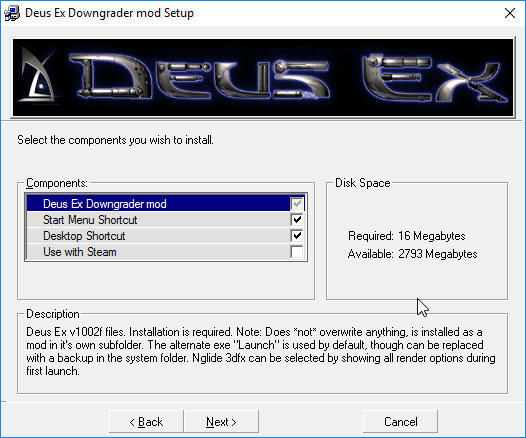
Deus Ex Downgrader mod Version 1002f (Original Release) Installer 2022-1-9 549

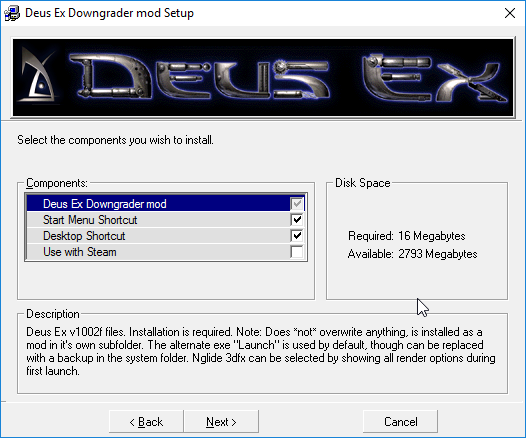
Deus Ex Downgrader mod Version 1002f (Original Release) Installer 2022-1-9 549
Mod and delta installer for version 1002f (Original Release)
09 Jan 13:47

Rebel FM Episode 524 - 01/07/2022

It's been a horrifyingly long 13 years of Rebel FM and we're here to celebrate it by ... well, basically doing a normal, two person show! We talk Powerwash Simulator, Worldbox - God Simulator, Anvil: Vault Breaker, Unpacking, and more! This week's music:  Future Palace - Heads Up
08 Jan 23:50

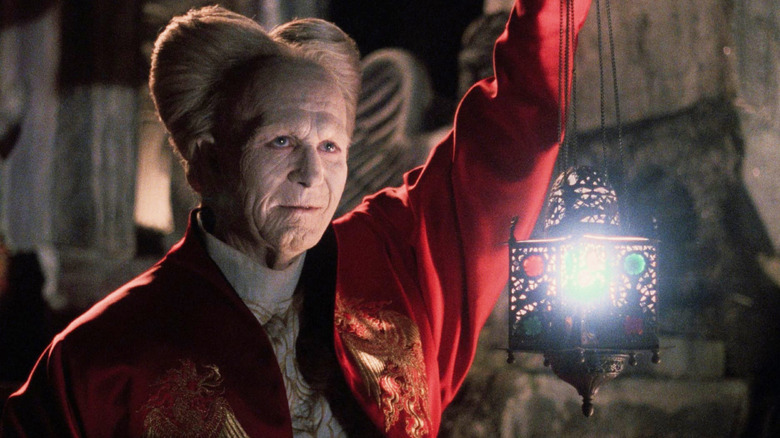
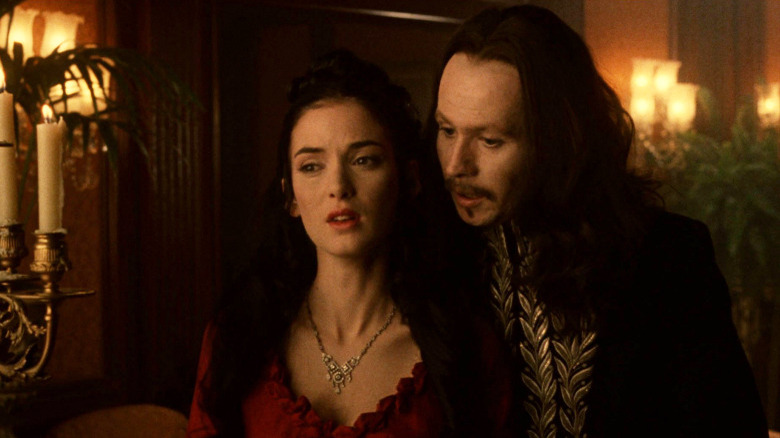
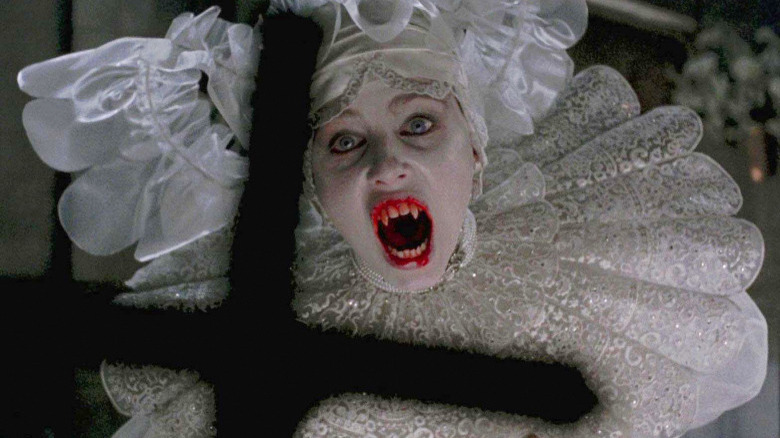
Year Of The Vampire: Bram Stoker's Dracula Puts The 'Opera' In Gothic Horror Opera

by Sandy Schaefer

(Welcome to Year of the Vampire, a series examining the greatest, strangest, and sometimes overlooked vampire movies of all time in honor of "Nosferatu," which turns 100 this year.)

"Dracula" movies are commonly associated with Universal Pictures and Hammer Film Productions, and with valid reason: they're responsible for many of the most famous big screen adaptations of Bram Stoker's landmark 1897 novel that've come out over the last 100 years. Yet one of the best and certainly the most operatic cinematic interpretations of Stoker's vampire horror classic, "Bram Stoker's Dracula," was released in 1992 by Sony. Yes, as in the House of Spider-Man.

Looking back with the benefit of hindsight, "Bram Stoker's Dracula" landing at Sony was a blessing. It freed up director Francis Ford Coppola — who joined the film after star Winona Ryder gave him the script by James V. Hart ("Hook"), which she used as an olive branch after dropping out of "The Godfather Part III" — to go wild with his vision for the movie, as opposed to feeling like he had to adhere to the stylistic tropes of "Dracula" films past. And boy did he do just that, delivering a visually extravagant work of gothic horror-romance where every cent of the movie's $40 million budget (not adjusted for inflation) is visible onscreen.

Take, for example, the film's prologue. In its first five minutes, "Bram Stoker's Dracula" depicts Vlad Dracula's (Gary Oldman) vicious campaign against the Ottoman Empire as though it were a violent shadow puppet show unfolding against a blood-soaked sky. Where Draculas past mostly wore black cloaks and capes, Oldman's Vlad dons vibrantly red armor that recalls the muscles of the human body. When the movie jumps ahead 400 years to the late 19th century, we see the older Dracula hasn't lost his taste for the flamboyant. He now spends his days trotting around in a satin coat and robe, his snow-white hair bound tightly into two massive buns atop his head.

What It Brought To The Genre

One could argue "Bram Stoker's Dracula" brought style to the vampire genre and not much else — but what style it brought! It's a film that's full to the brim with sumptuous imagery, from the Oscar-winning costumes by Eiko Ishioka (many of which are museum-worthy works of art) to the striking in-camera and on-set visual effects overseen by Coppola's son, Roman Coppola. The movie also tips its hat to "Dracula" adaptations past, using iris transitions and shot compositions that call back to the German Expressionism of "Nosferatu: A Symphony of Horror." Even the famous moment where Dracula's shadow takes on a life of its own and threatens to strangle Jonathan Harker (Keanu Reeves) makes for a nice homage to Count Orlok's profile slinking up a set of stairs in F.W. Murnau's unauthorized silent film version of Stoker's novel.

Much like Wes Anderson's films, however, you can't divorce the style of "Bram Stoker's Dracula" from the substance. This is a gothic tale of damned souls and a Romance (with a capital "R") that spans centuries. It required a theatrical sensibility across the board, from the cinematography and music (you could pair Michael Ballhaus' menacing central theme with most anything, and it would feel dramatic and ominous) down to the script and acting. What's more, Coppola and his big-name cast know better than to wink at the audience. None of the movie's outlandishness would land if Ryder, Oldman, and their co-stars didn't play it all with a straight face. Even Reeves, for all the flak he's gotten for his turn as Mr. Harker, takes everything here seriously. (The real problem is that Reeves was miscast in a role that simply didn't fit his strengths as an actor.)

The Legacy Of Bram Stoker's Dracula

"Bram Stoker's Dracula" both is and isn't an easy target for parody. How can you make fun of something that goes over the top with such skillful precision? It's why the better lampoons of Coppola's film are those that merely remix its iconography for comedic effect (see: the "Bart Simpson's Dracula" segment from "The Simpsons: Treehouse of Horror IV"), instead of trying to top its inherent silliness (see: the notorious critical and box office flop that was Mel Brooks' 1995 spoof "Dracula: Dead and Loving It"). 

Far from being limited to the realm of mockery, "Bram Stoker's Dracula" has changed the way vampire tales are told since it came out. The genre has only become more colorful and imaginative with its storytelling — not to mention, Dracula's attire — than it was in the 70 years between the film's release and "Nosferatu." One could even draw a line between its sweeping love story and the swooning teen romance at the heart of "Twilight." (A discussion unto itself, no doubt.) You can also thank Coppola's "Dracula" movie for inspiring Guillermo del Toro, who not only featured some of its props in his At Home With Monsters exhibition, but also clearly took more than a few cues from its production design and tone for his own gothic horror-romance, "Crimson Peak."

Beyond that, "Bram Stoker's Dracula" led to a short-lived trend of costly prestige drama adaptations of classic horror novels in the '90s, all of which saw lesser returns both creatively and commercially. (Case in point: "Mary Shelley's Frankenstein," a 1994 film directed by and starring Kenneth Branagh that, for all its flaws, is worth a look.) It just goes to show what a rare, strange beast Coppola's take on Stoker's source material remains to this day.

Read this next: The 12 Best Vampire Movies Of All Time

The post Year Of The Vampire: Bram Stoker's Dracula Puts the 'Opera' in Gothic Horror Opera appeared first on /Film.

08 Jan 22:35

Paleontologists Excavate 'Incredibly Detailed' Fossils With Preserved Subcellular Structures

by EditorDavid
Slashdot reader BoogieChile writes: Details of an important new fossil site has just been published in the first Science Advances journal for the new year. McGraths Flat, in New South Wales, Australia, was once the location of this oxbow lake in a mesic rainforest. Today, superb examples of fossilised animals and plants from the Miocene epoch have been recovered, showing incredible detail, including melanosomes preserved in feathers of birds and the eyes of fossilised fish "The discovery of melanosomes — subcellular organelles that store the melanin pigment — allows us to reconstruct the colour pattern of birds and fishes that once lived at McGraths Flat," said Dr Michael Frese of the University of Canberra, one of the team's leaders. "Interestingly, the colour itself is not preserved, but by comparing the size, shape and stacking pattern of the melanosomes in our fossils with melanosomes in extant specimens, we can often reconstruct colour and/or colour patterns. "Over the last three years a team of researchers has been secretly excavating the site, discovering thousands of specimens including rainforest plants, insects, spiders, fish and a bird feather," announced the University of New South Wales: "The fossils we have found prove that the area was once a temperate, mesic rainforest and that life was rich and abundant here in the Central Tablelands," said UNSW Sydney palaeontologist Dr Matthew McCurry [one of the team's leaders]. "Many of the fossils that we are finding are new to science and include trapdoor spiders, giant cicadas, wasps and a variety of fish. "Until now it has been difficult to tell what these ancient ecosystems were like, but the level of preservation at this new fossil site means that even small fragile organisms like insects turned into well-preserved fossils." Associate Professor Michael Frese, who imaged the fossils using stacking microphotography and a scanning electron microscope, said that the fossils from McGraths Flat show an incredibly detailed preservation. "Using electron microscopy, I can image individual cells of plants and animals and sometimes even very small subcellular structures," Dr Frese said. "The fossils also preserve evidence of interactions between species. For instance, we have fish stomach contents preserved in the fish, meaning that we can figure out what they were eating. We have also found examples of pollen preserved on the bodies of insects so we can tell which species were pollinating which plants."

Read more of this story at Slashdot.

08 Jan 02:03

Movies Like The Silence Of The Lambs You Really Need To See

by Layla Halfhill

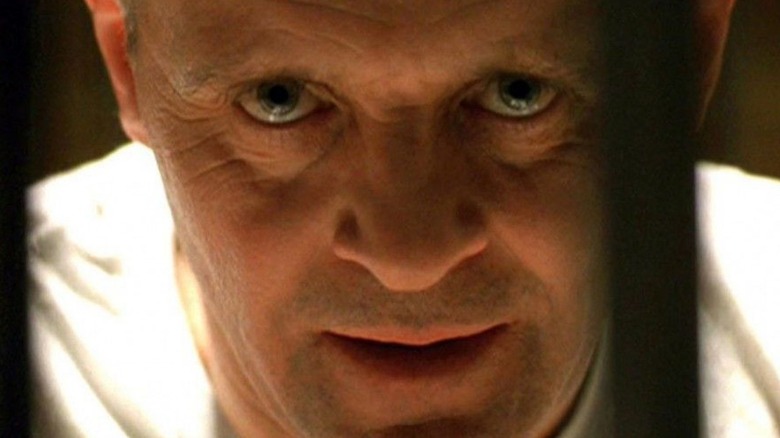
Jonathan Demme's "The Silence of the Lambs" may not have started America's long-standing obsession with serial killers, but it certainly helped fuel it. Part psychological drama, part horror-thriller, and part police procedural, the chilling masterpiece is generally considered to be a stone cold classic and remains a cultural touchstone, having influenced countless films that have come after it.

Based on the best-selling novel by Thomas Harris, "The Silence of the Lambs" stars Jodie Foster as FBI trainee Clarice Starling, who is sent to elicit clues from the incarcerated cannibal Hannibal Lecter (Anthony Hopkins) in an effort to help get inside the mind of another serial killer, Jame Gumb, aka "Buffalo Bill" (Ted Levine). But Lecter has a way of getting inside his opponents' minds, and if Clarice isn't careful, catching one killer may end up leading to the escape of another. "Quid pro quo," as Lecter likes to say.

Not only is "The Silence of the Lambs" the only horror film to have thus far won an Academy Award for best picture, it's also only the third film in history to win all "big five" Academy Awards. It also earned the Oscars for best director (Demme), best actor (Hopkins), best actress (Foster), and best adapted screenplay (Ted Tally), although there's a still fair amount of controversy about how it depicts the transgender experience.

As much as it has going for it, "The Silence of the Lambs" is not without peers. While not all of the following films are quite on its level, they all share similarities with "The Silence of the Lambs" that should keep fans entertained, disturbed, and perhaps a little frightened.

Manhunter

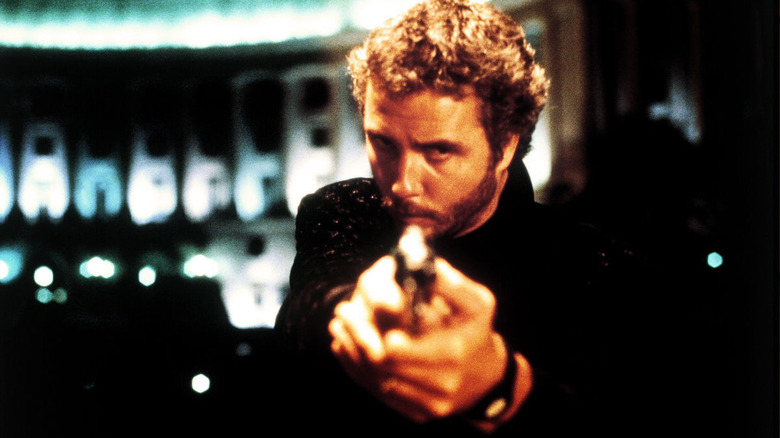
"The Silence of the Lambs" wasn't the first movie made about Hannibal Lecter. That honor goes to Michael Mann's 1986 film, "Manhunter."

Based on "Red Dragon," an earlier novel by Thomas Harris, "Manhunter" stars William Peterson as former FBI profiler Will Graham, who went into retirement after being attacked by Dr. Hannibal Lecktor (Brian Cox), whom he captured. Graham's former boss, Jack Crawford (Dennis Farina), pays him a visit, asking for help tracking down Francis Dollarhyde (Tom Noonan), a serial killer dubbed "The Tooth Fairy." In an effort to get inside the mind of the killer, Graham decides to turn to the imprisoned Hannibal for help.

The hyper-stylized, moody, and very '80s "Manhunter" is full of Michael Mann's signature flair, including vivid dark blues, a sexy soundtrack, and even a tiger. Though it was considered a box office flop, it has been reappraised in recent years and is now considered a cult film that helped set the stage for the crime thrillers that followed.

Seven

"What's in the box?" You'll have to watch David Fincher's "Seven" to find out, but it will be time well spent. Like "The Silence of the Lambs," "Seven" is generally considered to be one of the more compelling psychological thrillers not only of the '90s but of all time.

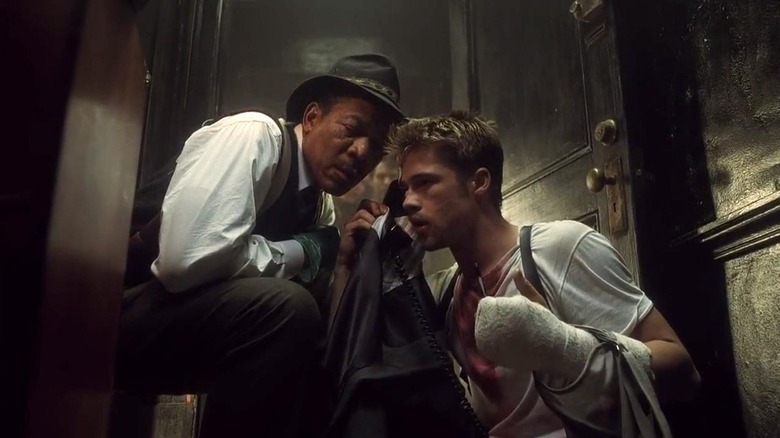
The gritty, noirish crime thriller follows two detectives, the soon-to-retire ​​William Somerset (Morgan Freeman) and the younger David Mills (Brad Pitt), as they become drawn into the case of a serial killer known as John Doe (Kevin Spacey), whose murders are inspired by the seven deadly sins, like sloth, greed and gluttony. As the men get closer to solving the crimes, they don't realize that they're becoming ensnared in the killer's sinister game.

The events of "Seven" culminate in a shocking and unforgettable ending, though an alternate ending was at one point considered. Although it was largely ignored by the Academy, as horror-skewing films often are, Richard Francis-Bruce did receive a nomination for best editing on the film, and Andrew Kevin Walker was nominated for a BAFTA for his excellent screenplay.

Zodiac

David Fincher delivered another compelling film about an elusive serial killer in "Zodiac," a stylish and meticulously researched period drama about the self-named Zodiac Killer, who committed a series of crimes in Northern California in the '60s and '70s while leaving cryptic clues and cyphers behind.

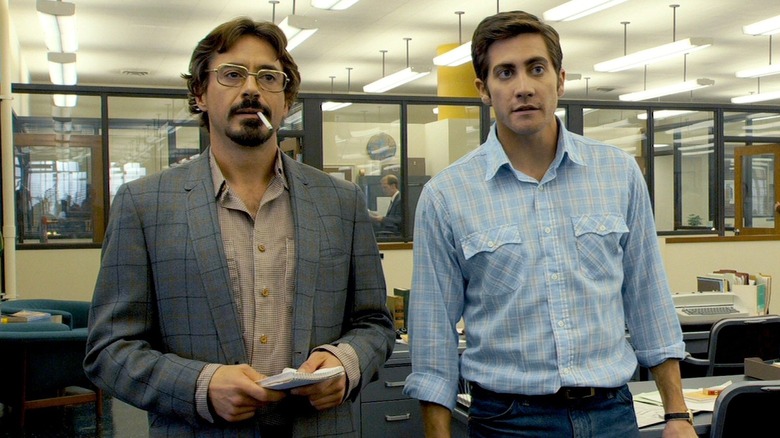
"Zodiac" is based on a non-fiction book of the same name by political cartoonist Robert Graysmith, formerly of the San Francisco Chronicle. Played in the movie by Jake Gyllenhaal, Graysmith helped the team at the Chronicle decipher clues in the letters that the Zodiac Killer, played here by John Carroll Lynch, sent to them to be published. Robert Downey Jr. also stars as Chronicle crime reporter Paul Avery, while Mark Ruffalo plays San Francisco police inspector Dave Toschi.

Fincher, along with the film's screenwriter and producer, conducted his own extensive research into the Zodiac case prior to filming, adding to the authenticity and historical accuracy of the film, for which it has been widely praised. Graysmith's book and the film both point to a former teacher and registered sex offender named Arthur Leigh Allen as the main suspect, although in October 2021 an independent group claimed to have identified Air Force veteran Gary Allen Poste as the actual Zodiac Killer. As of this writing however, the case remains officially unsolved.

Memories Of Murder

Before South Korean director Bong Joon-Ho was collecting Oscars for his widely acclaimed "Parasite," he was directing other masterpieces of cinema, including 2003's "Memories of Murder."

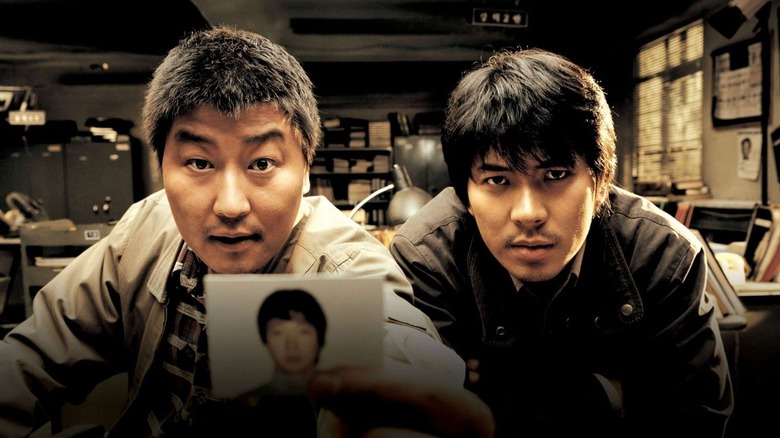
The expertly-crafted crime thriller follows Park (Song Kang-Ho), a simple-minded small-town detective in rural South Korea who finds himself trying to track down whomever is responsible for a string of local rapes and murders. After teaming up with a younger, slicker detective from Seoul named Cho (Kim Roi-ha), the two men work together but find that their styles clash. Park believes he can identify the perpetrator by looking him in the eyes, while Cho has a more modern, higher-tech approach to fighting crime. As they sift through suspects, they begin to realize that this killer may be harder to find than they initially believed, culminating in a profoundly haunting ending.

"Memories of Murder" is loosely based on South Korea's first documented serial killer case, the Hwaseong Serial Murders, which took place in the late '80s and early '90s. At the time of filming, the murders had yet to be solved. However, in 2019, police identified a suspect who ultimately confessed to the killings.

Cure

Another incredibly haunting crime thriller is Japanese director Kiyoshi Kurosawa's "Cure," which shares similarities with "Memories of Murder" in the way its protagonist is faced with tracking down a mysterious serial killer who remains frustratingly elusive.

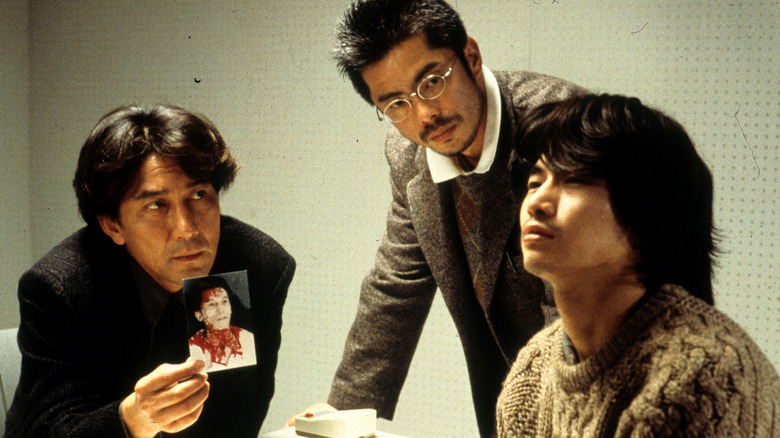
Kōji Yakusho stars as detective Kenichi Takabe, who is baffled by a string of gruesome murders all committed by different people who don't remember perpetrating the crime, and in which each of the victims have an "X" carved into their necks. With the help of a psychologist, Takabe is led to Mamiya (Masato Hagiwara), a mysterious man with short-term memory loss who seems to be a master at evading questions, and who just may hold the key to the horrific happenings.

Hypnotic and unsettling, Cure is an underseen gem in the J-horror canon, a masterwork that has influenced filmmakers including Bong Joon-Ho and that has recently received a 4K restoration.

I Saw The Devil

Another Asian crime thriller that fans of "The Silence of the Lambs" should appreciate is South Korean director Kim Jee-woon's "I Saw the Devil."

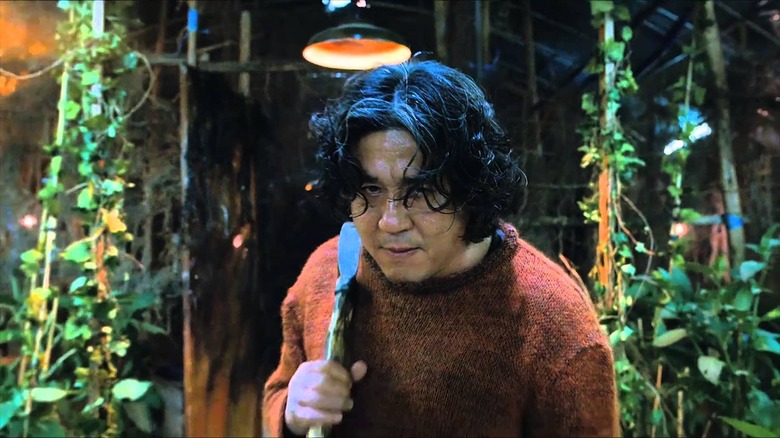
A bit more action-heavy than some of the other entries on this list, "I Saw the Devil" follows inspector Kim Soo-hyun (Lee Byung-hun), whose fiancée has been brutally murdered by a serial killer, Jang Kyung-chul (Choi Min-sik). Soo-hyun hunts Kyun-chul down, hellbent not only on catching him, but on exacting revenge. Soon, Soo-hyun is carrying out his own grisly acts of violence in his quest for vengeance, the price for which may just be his soul.

"I Saw the Devil" is a grim, harrowing film that highlights the dark side of revenge. Squeamish viewers might struggle with its extreme violence, but "Silence of the Lambs" aficionados will appreciate this tense, grisly game of cat-and-mouse.

Angel Heart

The 1950s. New Orleans. Voodoo. The devil. Director Alan Parker's "Angel Heart" is a stylishly atmospheric neo-noir thriller that brings these elements together in eerie, dread-soaked fashion as it follows one New York City private investigator's personal descent into hell.

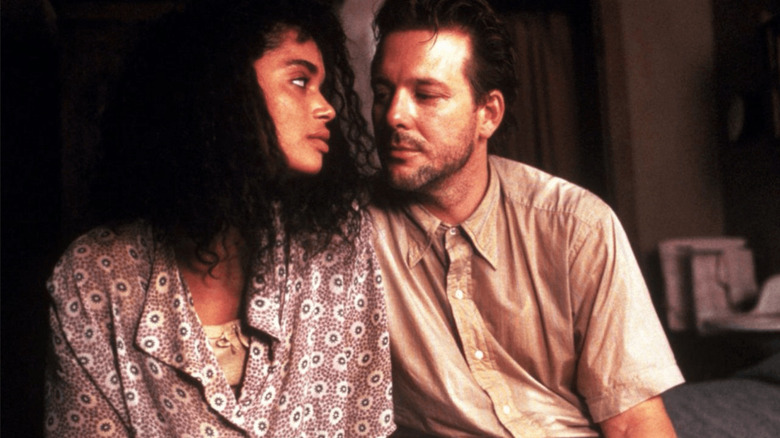
Mickey Rourke stars as the aforementioned P.I., Harry Angel, who is hired by a man named Louis Cypher (Robert De Niro) to track down a singer named Johnny Favorite. His mission leads him to New Orleans, where he meets Favorite's fiancée (Charlotte Rampling) and begins a steamy affair with Epiphany Proudfoot (Lisa Bonet), the daughter of one of Favorite's former lovers. But the mystery of Favorite's disappearance only deepens as dead bodies start turning up everywhere Harry goes.

The chillingly dark and twisty "Angel Heart" received mixed reviews upon its release. Critic Roger Ebert defended it, calling it "sensuous and depraved" but giving it three and half out of four stars. In more recent years, Christopher Nolan told Metropolis that it was an influence on his film "Memento," and Wired included it on its list of "The 25 best horror films of all time."

Shutter Island

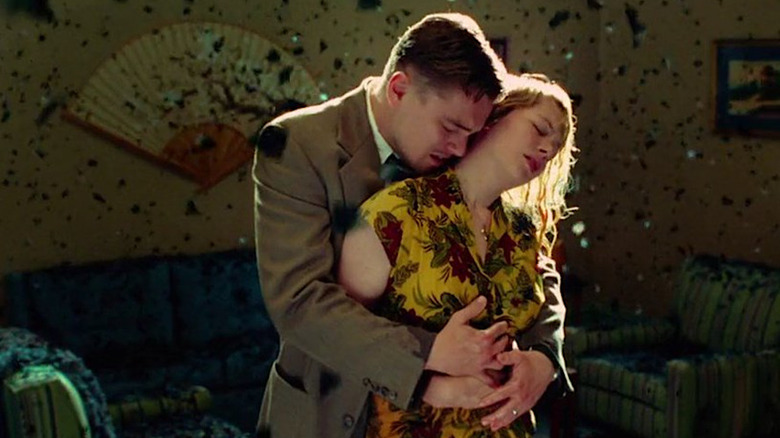
Another atmospheric neo-noir mystery that will keep you guessing until the end is Martin Scorsese's "Shutter Island." In it, Leonardo DiCaprio stars as U.S. Marshall Edward "Teddy" Daniels, who, along with his new partner Chuck Aule (Mark Ruffalo), arrives on the titular island to investigate the escape of Rachel Solando (Patricia Clarkson) from her locked cell at the Ashecliffe Hospital for the criminally insane. While facing an uncooperative staff and sorting through cryptic clues, Teddy begins to have migraines and nightmares about his time in the army during WWII, as well as the death of his wife Dolores Chanal (Michelle Williams), who was killed in a fire set by an arsonist. As it turns out, confronting his own past may be the key to cracking the case.

Based on a novel by Thomas Lehane and influenced by the works of Alfred Hitchcock, "Shutter Island" is a delightfully pulpy big budget genre film, the likes of which don't get made very often. It may not be Scorsese's best movie, but it's worth the time for those inclined to appreciate such works.

Frailty

The late, great Bill Paxton is known for his prolific career, but lesser known is the fact that he not only starred in but directed one heck of a horror film, 2001's "Frailty".

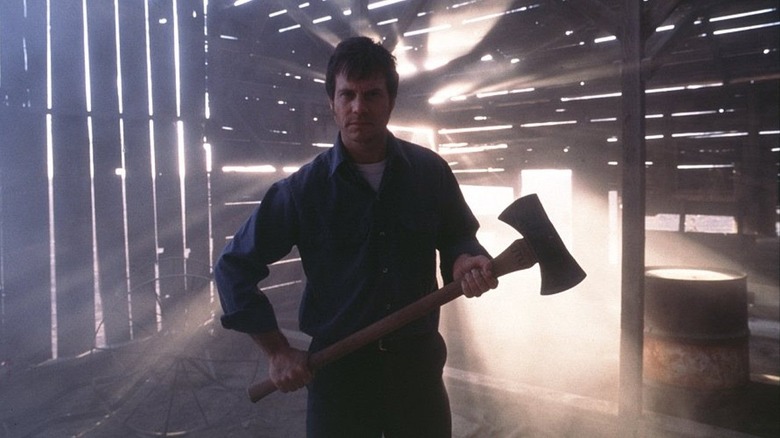
The psychological horror-thriller stars Matthew McConaughy as Fenton Meiks, who shows up at an FBI office in Texas and tells an agent (Powers Booth) that his now-deceased younger brother, Adam, is the serial killer known as the "Hand of God." He then relates the story of their childhood, and through flashbacks we learn that the boys' father (Paxton) told them that he was visited by an angel who tasked him with killing demons who are disguised in human forms. The kids' axe-wielding dad then commits a series of murders in the name of God while making the boys promise not to tell anyone. Fenton is horrified by his father's apparent madness, but Adam idolizes his father and dutifully falls in line.

An underseen genre gem, the twisty "Frailty" is a smart, unsettling work that highlights the dangers of fanaticism and of toxic parents in general.

Tenebrae

When it comes to police procedurals and psychological horror films, Italian giallo cinema is a good place to turn, and Dario Argento's "Tenebrae" is one that fans of "The Silence of the Lambs" should appreciate.

Anthony Franciosa stars as Peter Neal, an American mystery novelist who travels to Rome with his agent (John Saxon) and assistant (Daria Nicolodi) to promote his latest book, only to become caught up in the hunt for a serial killer who has been inspired by his work to commit a string of gruesome murders. As the body count continues to grow, Neal slowly begins to unravel the killer's identity, but there are some big twists along the way, as well as quite a bit of blood.

In typical giallo fashion, "Tenebrae" is a stylish, visually stimulating work of horror, with a driving, pulse pounding soundtrack that adds to the overall relentless feel. Not for the squeamish, the bloody thriller was relegated in the U.K. upon its release to the bin of "video nasties," although it is now often cited as one of Argento's best works.

Insomnia

Christopher Nolan has proven himself to be a director with a keen interest in psychological thrillers. His third feature, "Insomnia," also doubles as a crime drama, putting it in the same space as "The Silence of the Lambs."

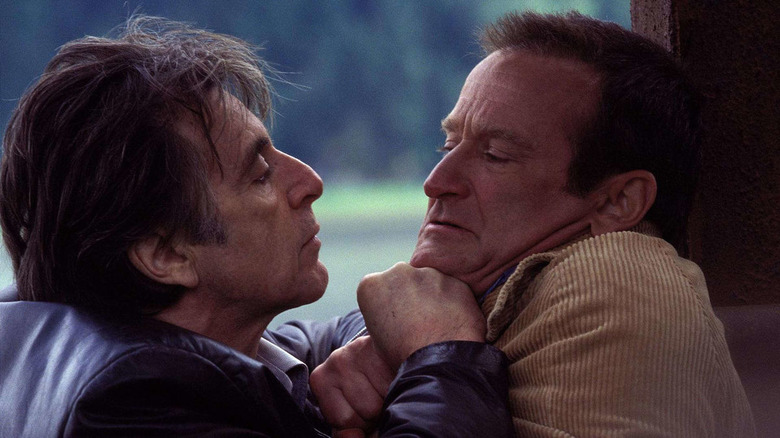
Al Pacino plays Los Angeles police detective Will Dormer, who is sent with his partner Hap (Martin Donovan) to the remote town of Nightmute, Alaska to investigate the murder of a teenage girl. While there, Hap tells Dormer that he's planning to testify against him in regards to one of his old cases. While chasing after the murder suspect, Walter Finch (Robin Williams), Dormer accidentally kills Hap, and, knowing how suspicious that looks, decides to cover up his actions by blaming Finch. Finch offers to help Dormer in exchange for help with his own case, but as Dormer's guilt grows, local detective Ellie (Hillary Swank) may end up foiling both of the men's plans.

A remake of the 1997 Norwegian film of the same name, Roger Ebert praised Nolan's work for being "not a pale retread, but a re-examination of the material, like a new production of a good play." Set against a backdrop of fog and the never-ending daylight of the land of the midnight sun, "Insomnia" is a grippingly tense thriller with great performances by its leads.

Prisoners

Before he became famous for directing epic sci-fi films like "Dune," "Arrival," and "Blade Runner 2049," Dennis Villeneuve was known for directing thrillers like 2013's "Prisoners."

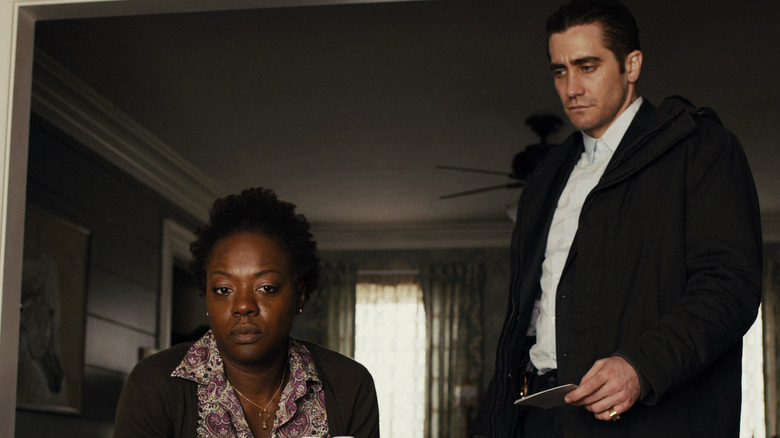
Jake Gyllenhaal stars in "Prisoners" as Detective Loki, who is called in to investigate the kidnapping of two girls, one the daughter of Keller and Grace Dover (Hugh Jackman and Maria Bello), and one the daughter of Franklin and Nancy Birch (Terrence Howard and Viola Davis). When a suspect named Alex Jones (Paul Dano) is arrested and then released due to lack of evidence, the frustrated Keller decides to take matters into his own hands. Though Loki continues investigating new leads, Keller kidnaps Alex, and then, along with Franklin, begins torturing him.

"Prisoners" is a compelling, dark, and haunting edge-of-your-seat thriller, bolstered by its strong ensemble cast. Variety called it "spellbinding," noting its "complex moral center" and praising Gyllenhaal and Jackman's performances as career bests.

The Girl With The Dragon Tattoo

"The Girl with the Dragon Tattoo" is the third David Fincher film to make this list, and can you blame us? The man has a way with dark psychological crime thrillers.

Based on the bestselling novel by Swedish writer Stieg Larsson, "The Girl with the Dragon Tattoo" stars Daniel Craig as Mikael Blomkvist, a disgraced financial reporter who is recruited by a wealthy financier, Henrik Vanger (Christopher Plummer), to investigate the decades-old murder of his grandniece, which he suspects was committed by a family member, and which may also have some ties to the Nazis.

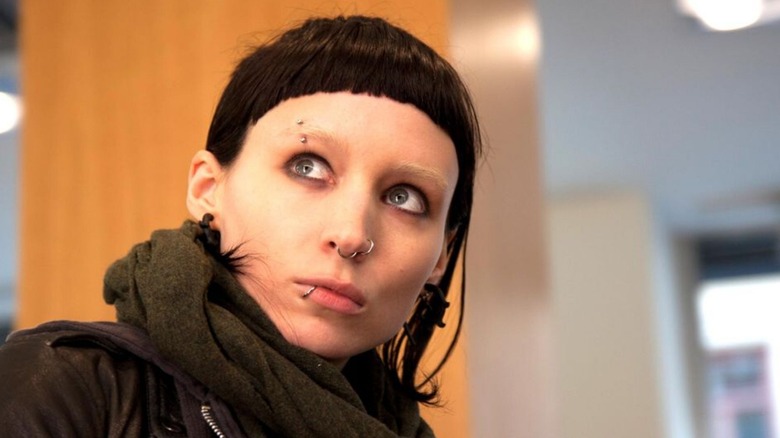
Blomkvist is aided in his investigation by the intelligent but emotionally guarded computer hacker Lisbeth Salander (Rooney Mara). She's the titular girl with the dragon tattoo, and she has some secrets of her own. It's her avenging spirit in the face of injustice, as well as Mara's mesmeric performance, that helps carry the slickly made thriller.

"The Girl with the Dragon Tattoo" received five Academy Award nominations, including one for Mara for best actress. Critical consensus on Rotten Tomatoes calls it "brutal yet captivating."

Read this next: The 15 Best Final Girls In Horror Movies Ranked

The post Movies Like The Silence of the Lambs You Really Need to See appeared first on /Film.

08 Jan 01:29

Women's Periods May Be Late After Coronavirus Vaccination, Study Suggests

by BeauHD
An anonymous reader quotes a report from The New York Times: Shortly after coronavirus vaccines were rolled out about a year ago, women started reporting erratic menstrual cycles after receiving the shots. Some said their periods were late. Others reported heavier bleeding than usual or painful bleeding. Some postmenopausal women who hadn't had a period in years even said they had menstruated again. A study published on Thursday found that women's menstrual cycles did indeed change following vaccination against the coronavirus (Warning: source may be paywalled; alternative source). The authors reported that women who were inoculated had slightly longer menstrual cycles after receiving the vaccine than those who were not vaccinated. Their periods themselves, which came almost a day later on average, were not prolonged, however, and the effect was transient, with cycle lengths bouncing back to normal within one or two months. For example, someone with a 28-day menstrual cycle that starts with seven days of bleeding would still begin with a seven-day period, but the cycle would last 29 days. The cycle ends when the next period starts and would revert to 28 days within a month or two. The delay was more pronounced in women who received both vaccine doses during the same menstrual cycle. These women had their periods two days later than usual, the researchers found. [...] One serious drawback of the study, which focused on U.S. residents, is that the sample is not nationally representative and cannot be generalized to the population at large. The data were provided by a company called Natural Cycles that makes an app to track fertility. Its users are more likely to be white and college educated than the U.S. population overall; they are also thinner than the average American woman -- weight can affect menstruation -- and do not use hormonal contraception. "I want to make sure we dissuade people from those untrue myths out there about fertility effects," said Dr. Hugh Taylor, the chair of the department of obstetrics, gynecology and reproductive sciences at Yale School of Medicine. "A cycle or two where periods are thrown off may be annoying, but it's not going to be harmful in a medical way." With that said, postmenopausal women who experience vaginal bleeding or spotting, whether after vaccination or not, should be evaluated by a physician, says Dr. Taylor. It may be a sign they have a serious medical condition.

Read more of this story at Slashdot.

07 Jan 18:45

3 Ways to Encourage People to Pursue a Career in Cybersecurity

by Shannon Flynn

People whose jobs revolve around removing computer viruses from systems, safeguarding corporate and private networks, and teaching best practices for staying well-protected online are ideal candidates to serve as cybersecurity career advocates, to urge individuals to follow a workforce path similar to theirs.

07 Jan 17:59

You might need to wait a little longer for Intel’s Arc Alchemist GPUs

by Phil Hayton
You might need to wait a little longer for Intel’s Arc Alchemist GPUs

Intel ended 2021 on a high note with the release of its Alder Like CPUs, but its CES 2022 offerings were a damp squib. While the blue team promised more chipsets would be coming soon, it kept hush its upcoming Arc Alchemist GPUs, and a subtle website update suggests that the graphics cards are no longer arriving in Q1 2022.

Spotted by Videocardz, the update removes the Q1 part from all Arc Alchemist GPU blurbs, meaning the site now lists a vague 2022 release. While Intel referred to its original release date plans during CES, its presentation alluded to laptop specific releases, rather than a full range of desktop and mobile graphics cards. Nevertheless, the website tweak could mean we won't see any new graphics tech from the company until later this year.

It's also worth noting that Arc GPUs are coming to prebuilt systems, which means Intel's change of course could affect third party release plans. Since it’s already confirmed Intel is working with board partners like Asus, Gigabyte, and MSI, and will be bringing its Arc GPUs to prebuilt systems, this potential delay could throw off third-party release schedules, too.

RELATED LINKS: Intel Core i9 9900K review, Intel Core i7 9700K review, Best CPU for gaming
07 Jan 17:58

Why You Should Prep Your Garnishes Before You Start Cooking

by Claire Lower

Let me paint you a picture: You’re cooking breakfast. Today, you’ve decided to make soft scrambled eggs in brown butter. You plan to finish this scramble with a healthy handful of finely sliced chives, or maybe green onion if you’re out of chives. You will eat the eggs with toast.

Read more...

07 Jan 17:57

The Most Popular Places on Zillow to Fantasize About a Home You Can't Afford

by Emily Long

Many of us have spent a portion of our free time over the last two years looking at home listings online—first with aspirations of getting outside of our current four walls, and then out of desperation over the out-of-control real estate market.

Read more...

07 Jan 17:56

Behold Half-Life Ray Traced, featuring a real-time full path tracing renderer

by John Papadopoulos

Software engineer ‘sultim-t’, the man behind the amazing Serious Sam TFE: Ray Traced, is currently working on a Ray Tracing mod for Half-Life. This mod aims to add a full path tracing renderer to the game. This full path tracing renderer will calculate global illumination, reflections, refractions, soft shadows and other visual effects. This is … Continue reading Behold Half-Life Ray Traced, featuring a real-time full path tracing renderer →

The post Behold Half-Life Ray Traced, featuring a real-time full path tracing renderer appeared first on DSOGaming.

07 Jan 17:54

In the hopes that it might offer their children extra protection against COVID, some moms are deciding to nurse their children much, much later than they normally would. Now if you'll excuse subby, he's supposed to meet his mom for breakfast in a bit [Strange]

07 Jan 17:54

The Scariest Foreign Horror Film Of All Time According To Science

by Fatemeh Mirjalili

If you consider yourself a horror movie enthusiast, it is likely you've gone through multiple lists that feature the most frightening movies of all time. Fear is after all, a universal language — and when administered accurately, it can creep under your skin and make for an unsettling experience. Throw in a popped eyeball, a few jump scares, and you're good. 

Maybe "The Conjuring" and "Hereditary" kept you up at night. You've probably also dabbled your way through lesser-known gems such as "The Blackcoat's Daughter" (2015) and "The Wailing" (2016), but have you watched the J-horror film "Audition"? 

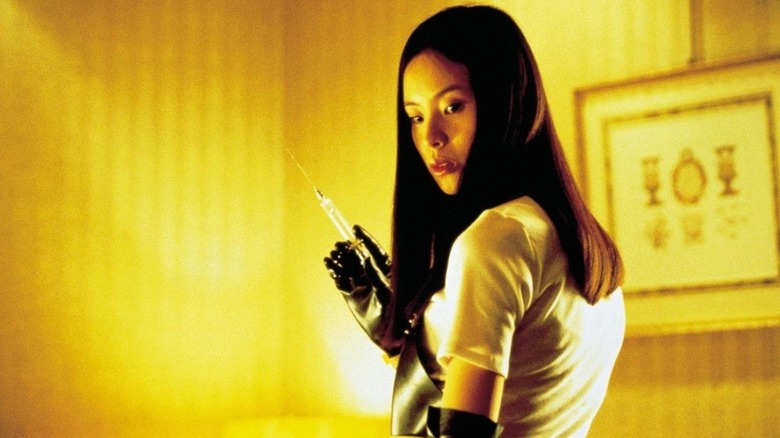
Helmed by Japanese filmmaker Takashi Miike, "Audition" features an abundance of violence and depravity that isn't for the faint of heart. It's also how the movie earned the title of the "the scariest foreign horror film of all time." And there's science to back it up!

What Science Has To Say About Takashi Miike's Audition

Takashi Miike is a prolific auteur who has helmed over 100 movies since 1991. He is well-known for the treatment of violence in his films and his exploration of myriad genres. 

But his work can be pretty brutal. Miike has dived into every possible genre — his samurai film "13 Assassins" features intricate historical details, and his horror project "Audition" is gory and perhaps one of the most unnerving films you'll ever watch. It's also the scariest foreign horror film of all time, per a scientific experiment conducted in 2020. 

Last year, Forbes reported that broadbandchoices, a comparison tool for broadband deals, performed an experiment known as the "Science of Scare Project," during which they tracked the heart rates of 50 people from different age groups. The participants watched over 100 hours of horror movies, which helped the platform narrow down a list of the scariest 35 movies ever made. "Audition" was revealed to be the scariest foreign horror film of all time.

Though you wouldn't know it based on the extremely vague synopsis for the film. Here's the synopsis for "Audition."

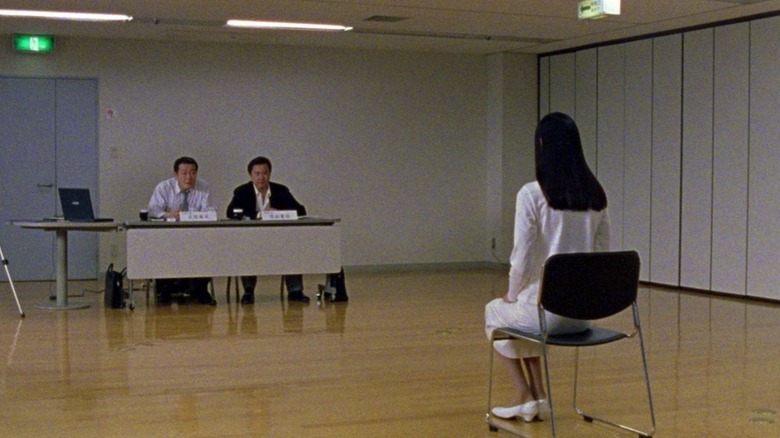
 "A widower accepts his friend's offer to audition girls in order to search for his new wife. However, the girl he likes does not appear to be the one she claims to be."

Not For The Faint Of Heart

"Audition" is an adaptation of Japanese author Ryu Murakami's 1997 novel of the same name. If you've read Murakami's work — "Coin Locker Babies" and "In The Miso Soup" — you have a fair idea of the atrocities that unravel within the pages of his novels.

Though "Audition" was released in 1999, the book did not receive an English translation until a decade later, in 2009.

Described as a classic of modern J-horror, "Audition" starts off slowly before transforming into an intense expression of the power play between men and women. There's brutality, extreme violence, and the protagonist is unforgiving, so basically — it's a scare-fest. And hey, science agrees!

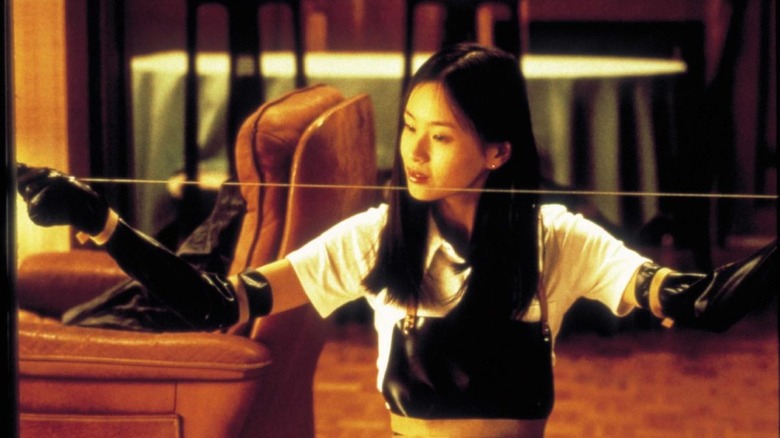
The torture sequences aren't for the faint of heart, and in the movie, piano wires become deadly weapons. Those who've watched "Audition" will always ask you not to watch its trailer or read about it before going in — so that's what I am going to do, too!

You can buy "Audition" on Amazon Prime Video.

Read this next: The 15 Best Japanese Horror Movies Of All Time

The post The Scariest Foreign Horror Film of All Time According to Science appeared first on /Film.

07 Jan 17:54

Nicolas Cage Opens Up About The Time He Pleaded To Be Cast In Godfather III

by Kaylee Dugan

Some family get-togethers end with everyone getting way too drunk and honest. Some end with a wholesome board game or a movie marathon. But if you're Nicolas Cage, they end with you begging your uncle for a role in the "Godfather" franchise, only to be cruelly set aside. I honestly don't know which one is worse. I mean, hangovers suck and some board games are annoying, but the shame that comes along with pleading to be cast in a movie your uncle refuses to cast you in has to be worse than any hangover or round of Monopoly. Especially when that movie's themes are all about the power of family.

Despite the unadulterated humiliation, Cage told the whole story in an interview with The Hollywood Reporter, and while it might be embarrassing for him, it's pretty damn funny. As Cage tells it:

So Uncle [Francis Ford Coppola] was doing Godfather III, and I said, "I really think I ought to be in your movie, Uncle. I really think it's a good idea if you would cast me. I think I could play this part."

I'm Gonna Make Him An Offer He Can Refuse

For those of you just finding out that Nicolas Cage (whose non-professional name is Nicolas Kim Coppola) is related to "The Godfather" director Francis Ford Coppola -- welcome to the party! If Cage would have dropped it there and let it go, it might have been fine. Hell, maybe Coppola would have let those words slosh around and his brain and we'd be living in a world where Cage was in "The Godfather: Part III," but he didn't and we aren't. Cage added to his pitch, saying:

He was going to cast Andy Garcia, and I said, "But I just see myself more as James Caan's son, and he's playing Sonny's son. He's not playing Michael's son. He's Sonny's son. I just feel a little more James Caan."

Of course, Cage is talking about the role of Vincent Corleone, Sonny Corleone's son and cousin of Al Pacino's Michael Corleone (just in case you need a primer on the Corleone family tree). Despite his pleading, Andy Garcia was cast in the role and his performance even netted him an Academy Award nomination, which must have stung for Cage. Although we think of "The Godfather: Part III" as a family affair since Sofia Coppola was cast in the role of Mary Corleone, it wasn't meant to be and Cage definitely knew it:

It just wasn't going to happen. Nope, not going to happen. So that was a movie I didn't get let in that I really wanted to be in. There.

Considering "The Godfather Part: III" is considered the worst in "The Godfather" franchise, you have to wonder who felt the most embarrassed the next time Cage and Uncle Coppola spent some time together. Like with most family disagreements, you're always left wondering ... who actually won here?

Read this next: Jack Nicholson's 15 Most Iconic Roles Ranked

The post Nicolas Cage Opens Up About the Time He Pleaded to be Cast in Godfather III appeared first on /Film.

07 Jan 17:54

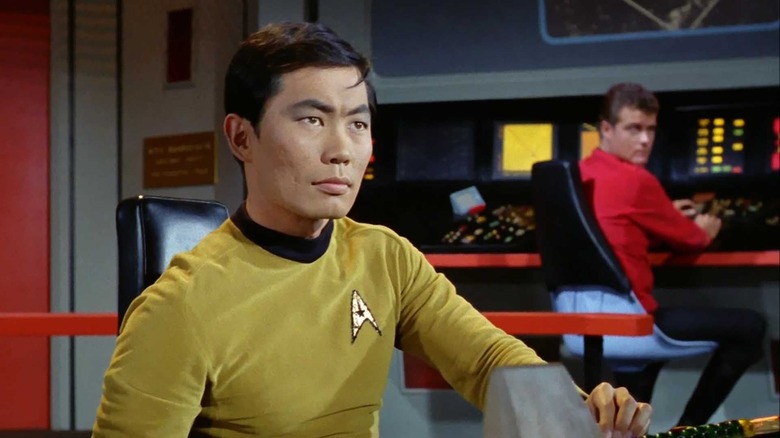
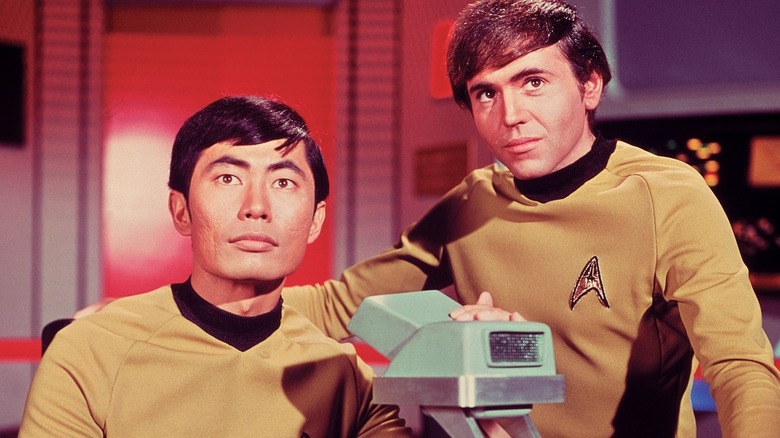
The Lie That Led To George Takei's Favorite Star Trek Scene

by Witney Seibold

"The Naked Time" was either the fourth or the seventh episode of "Star Trek," depending on whether you adhere to broadcast order or production order. For the record, true Trekkies go by production order, while total losers go by broadcast order. In the episode, Kirk, Spock, and Lt. Disposable beam down to the planet of Psi 2000, only to find the planet's small research team mysteriously frozen to death. While there, they also contract a mysterious virus, which they take back up to the Enterprise. The virus, which spreads through touch, causes the infected to behave like they're drunk, lowering inhibitions, and inspiring unruly behavior among the crew.

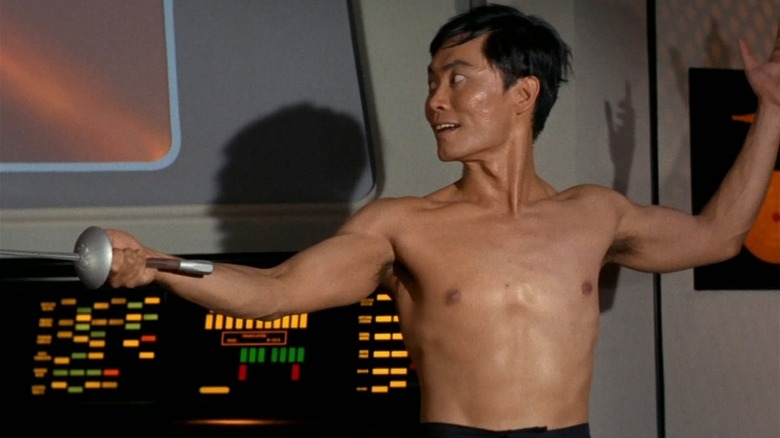
In one of the episode's most famous scenes, Lt. Hikaru Sulu (George Takei), with his inhibitions lowered and his jersey joyously jettisoned, has given into his hidden D'Artagnan fantasies, taking up a rapier and charging about the hallways of the Enterprise, challenging crewmates to duels. The scene became so notorious and iconic that it inspired a swordfighting sequence in J.J. Abrams' 2009 "Star Trek" film, wherein Sulu (now John Cho) grapples with a baddie on a laser platform. 

"The Naked Time" is also actor George Takei's favorite episode.

The Sword Scene

Takei tells this story in a video interview with the Television Academy: The writer of "The Naked Time," John D.F. Black, originally intended for Sulu to take up a Samurai sword. When visiting the "Star Trek" set, Black told Takei about his plans. Takei was diplomatic about it, pointing out that a samurai sword was "ethnically consistent," seeing as Takei was of Japanese ancestry. But he also had a suggestion. Takei, a 20th century man, didn't play samurai as a kid, recalling, rather, that he and friends would play Robin Hood in his backyard, inspired by the 1938 film "The Adventures of Robin Hood." His mom even made him a Robin Hood costume. Takei says he got to play Robin Hood because it was his backyard and he had the costume. The other kids had to be the other Merry Men.

Sulu, Takei figured, was raised in the 23rd century, and wouldn't necessarily be inspired by samurai either, so he suggested to Black that Sulu have a rapier instead. Takei, game and energized, would duel his way into one of the series' more notable scenes.

Actors Are Masters At Everything

Could George Takei fence? Well, in his words, yes. But, as we learned from the recent film "Licorice Pizza," if you ask an actor if they can do something, they will automatically say yes just to get the role. To quote Takei: "You never ask an actor if we can do anything, because if it's related to the part, we are masters at it. I said [to the screenwriter, about fencing] 'Oh, it's my favorite sport! I used to fence when I was young!" 

Takei then arranged to take his first formal fencing lesson at Falcon Studios on Sunset Blvd., and Takei's instructor, by magical coincidence, was Ralph Faulkner, the fight choreographer for "The Adventures of Robin Hood" and Basil Rathbone's fight double in that film. "The Naked Time" not only permitted George Takei to display his fencing skills and relive an actual childhood play scenario of his, but put him in contact with the very swordfighter he grew up watching. 

It's no wonder "The Naked Time" is Takei's favorite episode.

Read this next: Star Trek: The Next Generation's 10 Best Episodes

The post The Lie That Led to George Takei's Favorite Star Trek Scene appeared first on /Film.

07 Jan 17:49

Starlink U.S. Download Speeds Drop But Service Blasts Broadband Out Of The Park Globally 

by Ramish Zafar

Space Exploration Technologies Corporation's (SpaceX) Starlink satellite internet constellation's internet speed tests for the third quarter of last year reflect the service's expansion as it adds more customers and gradually builds out a constellation of thousands of small internet satellites. Data combined by Ookla, who is behind the popular internet speed test application Speedtest shows that as Starlink increased its active users in the third quarter of last year, the service's median speeds across the United States dropped, reversing the trend Q2 2021 had exhibited over the first quarter. However, users in other countries, such as Canada fared off better, in the wake of the service being available there as SpaceX continues to launch more spacecraft, with the latest launch having taken place yesterday evening.

Starlink Median U.S. Internet Speeds Drop By 10% In Q3 2021 Shows Speedtest Data

The details of Speedtest's latest report show that median Starlink download speeds across the U.S. stood at 87.25 Mbps during Q3 2021. When compared to the results from the same organization for the previous quarter, this marks for a 10% drop, as the median speeds stood at 97.23 Mbps in Q2 2021. Speedtest rightly speculates that the drop in download speeds can be a result of Starlink adding new customers as part of an aggressive campaign to build out its base to satiate both its competitors and investors, and prove to the Federal Communications Commission (FCC) that a strong demand is present for the satellite internet service.

In the upload segment, Speedtest reports that data gathered across 304 American counties reveals that upload speeds stood at 13.54 Mbps, remaining relatively flat over Q2's data. However, despite the median download speed reducing, Starlink continued to vastly outstrip its satellite internet competitors Viasat and HughesNet. For them, the median download speeds stood at 18.75 Mbps and 19.30, respectively. In other words, they were slightly higher than the download speeds exhibited by SpaceX's young internet service.

  • Starlnk median internet download speeds Q3 2021
  • Starlnk median internet download speeds Q2 2021

Starlink Vs Broadband Internet Speeds - SpaceX's Young Satellite Service Shames Broadband Services Globally

In addition to being vastly ahead in the download segment, Starlink also outshone its competitors in latency, as it managed posted results that stood closer to broadband internet service providers. Latency, which is the time taken for a packet of information to travel from and back to a user's device, is higher for the land-based broadband companies due to the propagation characteristics of their equipment and close proximity to the internet servers. According to Speedtest, average Starlink latency stood at 44 milliseconds (ms), which is orders of magnitudes lower than HughesNet and Viasat's 744 ms and 629 ms, respectively.

Moving elsewhere, Canadian Starlink users saw their median download speeds decrease slightly in Q3, standing in at 84.55 Mbps over the 86.92 Mbps in Q2. However, and crucially, it was in the same range as broadband download speeds, which stood at 90.21 Mbps for the latest quarter. The Q3 drop is expected according to Speedtest, who goes on to note that, "[t]his is in line with what we expect to see on new technologies as additional users are added to a system." Additionally, out of the nine Canadian provinces analyzed by Speedtest, Starlink was faster than broadband, with the sharpest difference being in Edward Islands, where the internet service had 118.02 Mbps in median download speeds, more than double the 46.86 Mbps for broadband.

It also outpaced broadband in both New Zealand and the United Kingdom. British Starlink users were able to achieve a median speed of 111.66 Mbps, which was not only higher than the Q2 speeds but also faster than broadband's 53.16 Mbps. Similarly, median speeds in New Zealand stood at 120.10 Mbps, while broadband clocked in at 84.98 Mbps.

Finally, Australian users also experienced more than two times the speeds delivered by broadband in the Southern Hemisphere. The broadband speeds stood at 51.17 Mbps, which were no where near Starlink's 138.12 Mbps median speeds. However, broadband latency stood at 10ms while Starlink was able to deliver 42 ms.

The data solidifies the case for global internet coverage made by SpaceX executives, and should serve Starlink well as it launches more satellites. SpaceX's president Ms. Gwynne Shotwell believes that the internet service is playing in a $1 trillion market, and Starlink just might be off to a strong start if these numbers hold over the years as more user flock to the service.

Here's more on Starlink download speeds and tests:

The post Starlink U.S. Download Speeds Drop But Service Blasts Broadband Out Of The Park Globally  by Ramish Zafar appeared first on Wccftech.

07 Jan 17:48

Watch Dogs Legion cracked & retail/digital versions perform EXACTLY the same

by John Papadopoulos

As we informed you a couple of days ago, EMPRESS was able to crack Watch Dogs Legion which was using Denuvo V10. Alongside Denuvo, Ubisoft used four additional DRM protections. As such, we were curious whether the pirated version performed better than the retail/digital version. Therefore, we went ahead and benchmarked both of them. For … Continue reading Watch Dogs Legion cracked & retail/digital versions perform EXACTLY the same →

The post Watch Dogs Legion cracked & retail/digital versions perform EXACTLY the same appeared first on DSOGaming.

07 Jan 17:47

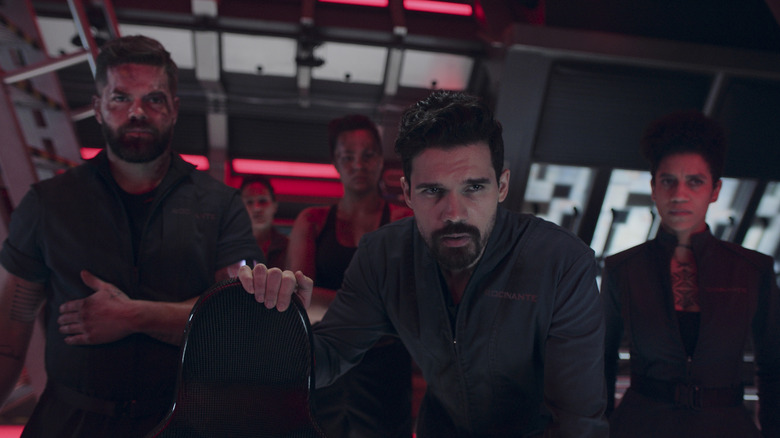
The Expanse Forces Everyone To Confront What Side They're On In 'Why We Fight'

by Vanessa Armstrong

In "Why We Fight," the penultimate episode of "The Expanse," more than a couple characters from all sides of the war confront the question about what they're fighting for, and whether they can accept the costs. There are also unexpected alliances, both personal and geopolitical, and revelations that shake some characters to the core.

Read on for a breakdown of what we saw, including some insights from the cast about particular scenes in the episode.

Warning! Spoilers for "Why We Fight," episode 605 of "The Expanse," lie below.

Meanwhile, On Laconia

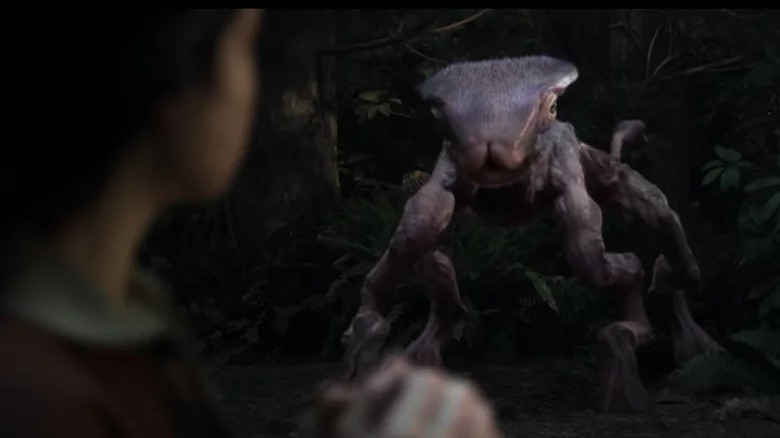
Xan (Ian Ho) is back from the dead...kind of. The strange protomolecule dogs have brought him back to sentience, and he's still Cara's brother (played by Ho's real-life sister, Emma). But he's also different.

"I feel weird," Xan says. "What happened?" When Cara tells him the truth — that he died and the dogs fixed him, he seems to take it all in stride. Cara is able to look past the protomolecule weirdness, however, and just sees her brother. They hug and we pan out and back to the solar system.

Things Are Real Bad For The Inners

We start at the ring gate, where Mars is attacking the Free Navy forces in hopes of taking over Medina Station. What they didn't account for, however, were the six rail guns Marco — with the help of Duarte's team on Laconia — had grafted on the ring sphere, which destroyed the entire fleet in mere seconds.

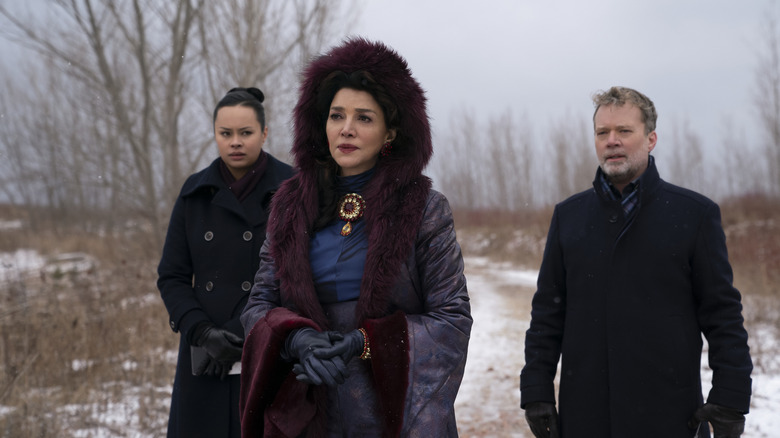
This interaction propels the geopolitical maneuverings of the episode — the MCRN is effectively down for the count, leaving only the struggling UNN fleet against the Free Navy. Avasarala (Shohreh Aghdashloo) knows she needs allies in the Belt more than ever.

She also shows vulnerability here, something she hasn't let come through much before. "Have I gone soft?" she asks Bobbie (Frankie Adams). "Did I try too hard to be good when I should have been ruthless?"

Bobbie seems to think so, and the two have a heated exchange, one that Aghdashloo said was one of her most memorable moments from season 6. "She's not trying to hide her emotions anymore," Aghdashloo told me during my interview with her. "On the contrary, she would like for other people to know what is going on inside her ... that monologue is like out of this world — it's a woman who is now admitting that I'm changing."

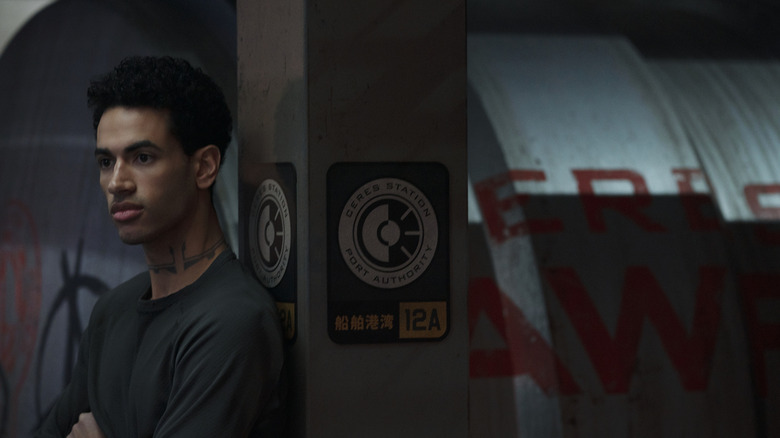
This changed Avarsarala is one who wants to become allies with Drummer (Cara Gee). And when Drummer drops off the supplies at Ceres, the UNN leader makes a strong push for them to work together, something that Drummer strongly resists.

Drummer Makes A Hard Choice

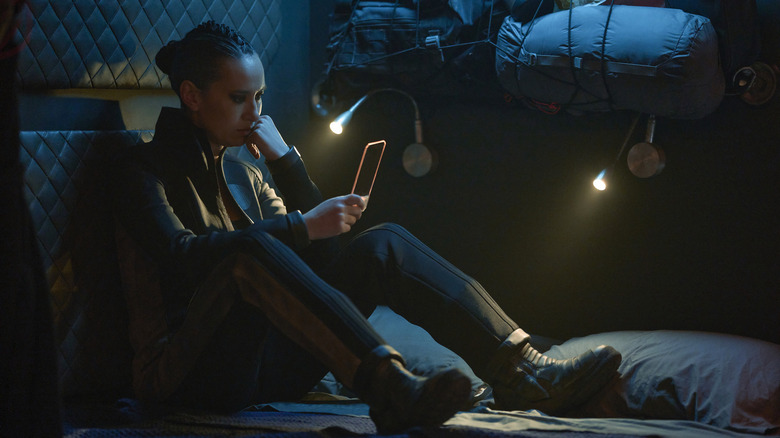
In the context of the war, Drummer is the strongest she's ever been. She's gone from hiding out from Marco to openly resisting him and having a fleet of her own. Personally, however, her world is crumbling apart. The last two remaining members of her family are going to stay on Ceres — Josep (Samer Salem) is recovering from his lost arm and Michio (Vanessa Smythe) is going to stay with him while he recuperates. "I loved you because you were builders," Drummer says to them. "I wanted us to build something together."

It's hard to build things when there's a war, however. And when Naomi (Dominique Tipper) visits her and also tries to convince her to partner with Avasarala, Drummer loses it. "This universe has no place for me," she says with anguish in her voice. And having Naomi — someone that a previous X-Ray short makes clear that she loves — force her to realize that the only way to survive this war is to ally with her oppressor is almost too much for her to bear.

But she does bear it, and the episode ends with Avasarala and Drummer coming to an agreement to fight together against Inaros. It's unexpected on all sides, but they're fighting together because it will meant less dead Belters and dead Inners. And that's what fundamentally matters for both of them, in the end.

Amos And Bobbie Have A Heart To Heart (And Maybe A Bit More?)

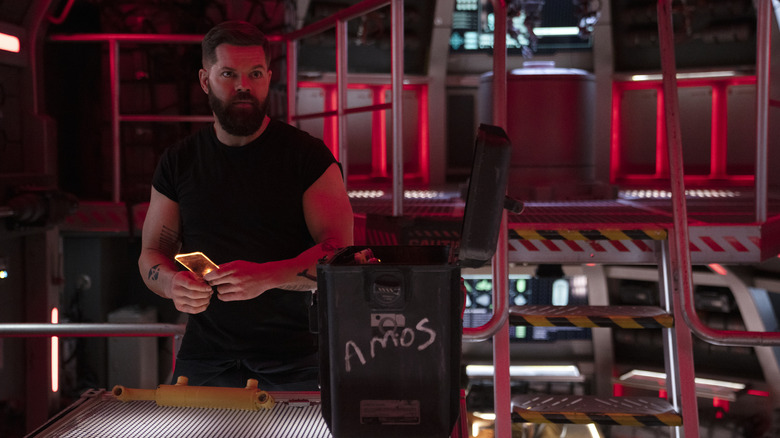
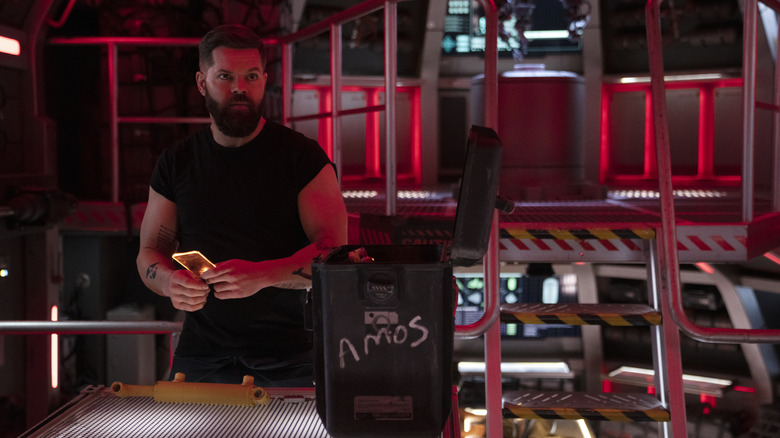
Amos (Wes Chatham) is also in a funk this episode about how things are in the Rocinante. He runs into Bobbie on Ceres where he's in the middle of drinking and visiting brothels and admits he's not sure if he's going back to the ship. He doesn't know why he's fighting — he doesn't think Holden disarming the nuke is right and doesn't know why he's fighting for. When Bobbie says that what matters is protecting your people — this resonates with Amos and gets him to head back to the Roci, but not before heading to the brothel one more time and inviting Bobbie to join him. (And did Bobbie join him? It's intentionally vague, but check out my post here that shares what Chatham and showrunner Naren Shankar had to say about it.)

Filip Continues To Have Doubts

On the Pella, Filip is also forced to reckon with what side he's on. Everyone is celebrating because of the victory over the Martian fleet at Medina, but Filip ends up helping his repair tech friend who ended up in the brig because he used comms to try to find out about his brother.

Filip uses his level of access to confirm that his brother is dead, and when he breaks the news, he gets confirmation that it was Marco who planted those bombs. As we pan in on his face, as he tries to console his friend, we see how much this news has devastated him. It's harder and harder for him to push the atrocities the Free Navy has done aside. How that plays out in the series finale remains to be seen.

Other Thoughts And Tidbits

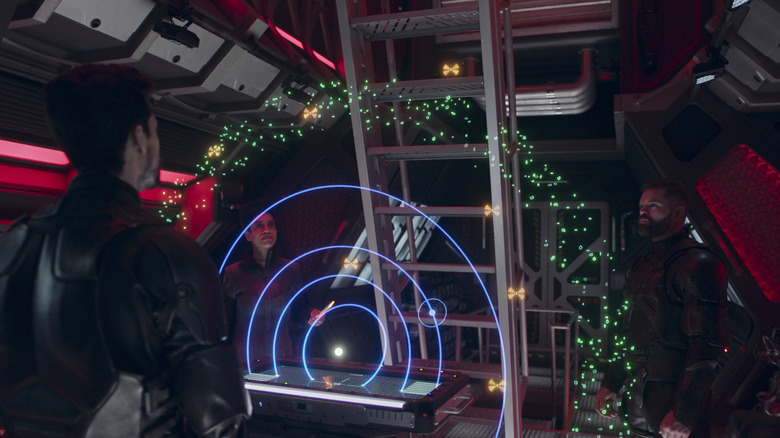
  • The ships disappearing through the ring issue gets some screen time this epsidoe as well. Holden tells Avasarala about it, and we also got a cameo from season 4 — Dr. Elvie Okoye (Lyndie Greenwood) confirming that everyone who travels through the ring is taking a major risk.
  • We also get the good news that the technology Prax (Terry Chen) shared last episode may save many Earthers from starving. It takes more than one person to help people recover from a war, and Prax has certainly helped that.

The series finale of "The Expanse" drops on Prime Video on January 14, 2022.

Read this next: The 14 Greatest War Movies Of The 21st Century

The post The Expanse Forces Everyone to Confront What Side They're On in 'Why We Fight' appeared first on /Film.

07 Jan 17:46

The Expanse: Did Amos And Bobbie Do It? [Exclusive]

by Vanessa Armstrong

A lot happened in latest episode of "The Expanse," not least of which was a meaningful conversation between Amos (Wes Chatham) and Bobbie (Frankie Adams) about what really matters when you're fighting in wartime.

Right after that touching exchange, Amos goes off to hit the brothel one more time before heading back to the Rocinante. As he leaves, however, he coyly asks Frankie if she wants to join him. "Join you? Or join you?" Frankie asks. Amos says that either option works for him and we get a close up of Bobbie's considering face before cutting away.

The scene is ambiguous — it could go either way! During my interviews with Wes Chatham and showrunner Naren Shankar, however, I asked them what they thought happened. Read on for their responses.

Schrodinger's Sex Scene

"We left the question open for a reason, because you could make the argument that it goes any way you want it to go," Shankar told /Film, adding that those interested in the answer to this question will get a kick out of the X-Ray short after the season's third episode, where Amos and Bobbie get in a bit of a wrestling match that's rife with sexual tension.

"Something we found in the course of the season was — here's another character relationship we haven't really been able to play with, Amos and Bobbie. They were in season 3 [together], but it wasn't a ton of interaction ... here's another opportunity to play two characters off of each other that we've never seen."

Bobbie and Amos certainly do play off each other, and while Shankar remained coy about whether they the two characters did or didn't do it, Chatham was more straightforward. "Frankie and I both know what the answer to the question is," he said, though he hesitated at first to reveal what he thought.

Eventually, however, he gave an answer: "In my opinion," he said, "she went with him."

Chatham didn't clarify, however, whether Bobbie went with Amos, or with Amos. It's up to the viewers to fill in the blanks as they see fit. I know what my answer is, and I think the X-Ray short with the both of them supports my answer. But each fan can decide which path the two took, depending on who or what they may fancy.

The series finale of "The Expanse" drops on Prime Video on January 14, 2022.

Read this next: 14 Greatest Romance Films Of All Time

The post The Expanse: Did Amos and Bobbie Do It? [Exclusive] appeared first on /Film.

07 Jan 11:55

Quake 4 Hi Def v2.0 Mod is available for download, featuring improved textures & 3D models

by John Papadopoulos

Modder ‘y2keeth’ has released Version 2.0 of his Hi Def Mod for Quake 4. According to its description, Quake 4 Hi Def v2.0 updates Quake 4’s graphics by improving the quality of textures and models, as well as shadows. Going into slightly more details, Quake 4 Hi Def v2.0 adds a bunch of more textures. … Continue reading Quake 4 Hi Def v2.0 Mod is available for download, featuring improved textures & 3D models →

The post Quake 4 Hi Def v2.0 Mod is available for download, featuring improved textures & 3D models appeared first on DSOGaming.

06 Jan 23:02

GWJ 2021 GOTY Interviews

by Antichulius

Summary of 2021 Game of the Year Interviews

06 Jan 22:53

The nomadplug is a travel adapter that'll ensure you have juice in 195 different countries

by Boing Boing's Shop

We thank our sponsor for making this content possible; it is not written by the editorial staff nor does it necessarily reflect its views. 

Yeah, let's just call it now: We're not really going anywhere fast at this point. But someday, we'll be able to roam freely about the world, and it will be just such a wonderful day. — Read the rest

06 Jan 22:50

Star Wars TV Is Finally Giving Tusken Raiders The Spotlight, And It's About Time

by Lyvie Scott

As a near-lifelong "Star Wars" fan, I've found that enjoying the galaxy far, far away gets exponentially harder as years pass. My identity as a woman of color, as well as the constraints that come with it, staunchly influences my opinion on everything. So I've found that my appreciation for "Star Wars" — a decidedly-white franchise that has only recently begun seeking out minority voices — now hinges exclusively on how said voices are elevated (or -- let's be real -- ignored).

Lucasfilm has a pretty shoddy history of inclusion, at least in its live-action "Star Wars" properties. Until very recently, the films had little to no representation to speak of, and most of it was appropriative. Most of the alien species of "Star Wars," particularly those of the prequel era, are also closely linked to racist caricatures. From the Gungans of Naboo to the Neimoidians of the Trade Federation, very few have broken free from their harmful depictions. But with Lucasfilm's pivot to Disney+ and the rise of "good 'Star Wars' TV," one group is finally getting the justice they deserve: the Tusken Raiders of Tatooine.

The Tuskens' Complicated History

A kind of primordial groan resounds across the fandom whenever "Star Wars" returns to Tatooine for any reason. It feels like we've been "returning to Tatooine" for everything lately, and the storyline is often as barren as the planet's sand-swept topography. It's coarse. It's rough. It's irritating. What more could they feasibly have to show us there?

The answer, according to "The Mandalorian," is a brand new side to the Tusken Raiders.

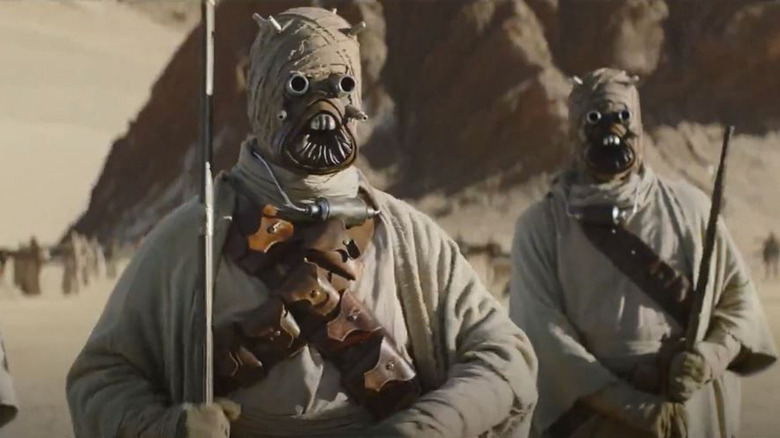
The Tuskens (née "Sand People") have always had a kind of enmity with the Skywalkers — they nearly killed Luke in "A New Hope," and indirectly murdered Luke's grandmother, Shmi, in "Attack of the Clones" — as well as the other (mostly white) settlers on Tatooine. Until "The Mandalorian," the Raiders were always painted as one of the many hostile, uncivilized fixtures of the planet, and it didn't help that they were very clearly inspired by real-life indigenous nomads.

"The Mandalorian" didn't exactly retcon the Tuskens' trademark ruthlessness, but it did confirm that they weren't nearly as mindlessly violent as they'd always been portrayed. In Season 1's "The Gunslinger," Mando's first adventure on Tatooine, the bounty hunter is actually able to communicate with the Tuskens. The series created Tusken Sign Language with the help of deaf actor Troy Kotsur (who recently starred in the AppleTV+ movie "CODA"). They even expanded on the Tuskens' spoken dialect, which until that point mimicked the bray of a donkey ... something I have never enjoyed.

With A Little Help From A Mandalorian...

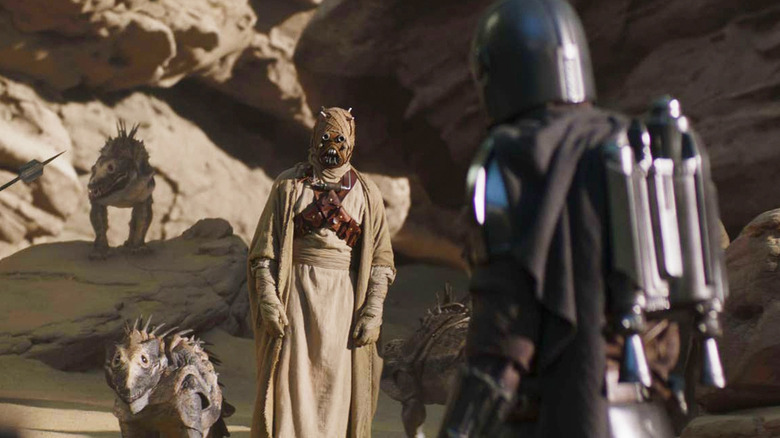
Din returned to Tatooine (are you primordially groaning yet?) in season 2. That first encounter gave way to an alliance between a Tusken tribe and the settlers of Mos Pelgo, one orchestrated by Din. For the first time, they had a common enemy in the legendary Krayt Dragon — a creature vaguely introduced, along with the Tuskens, in "A New Hope" — and they defeated it together. (Well, it was mostly Din. But their victory was very much symbolic of all they could accomplish with a bit of mutual understanding.)

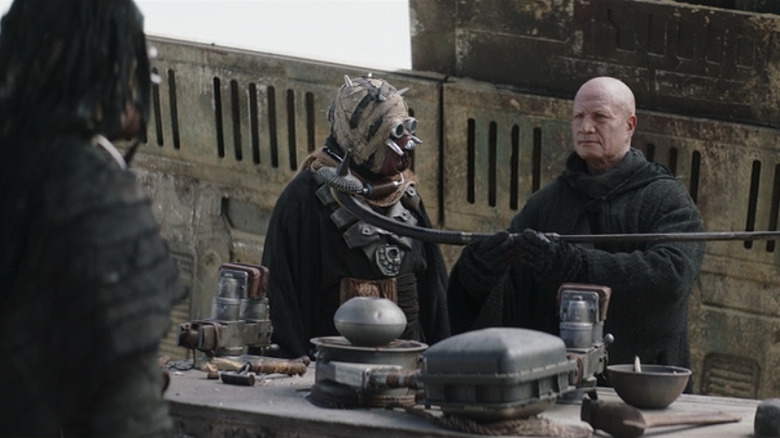
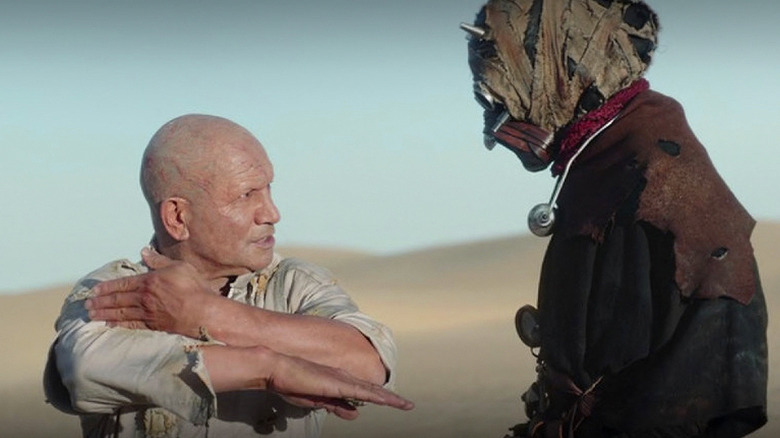
"The Mandalorian" wasn't entirely able to shake the ol' "Cowboys and Indians" motif (it is, after all, merely a Western in space), but it seems "The Book of Boba Fett" is doing what it can to subvert that dynamic. Many assumed Boba Fett had spent time with the Tuskens after his infamous Sarlacc escape: He sported a baller Tusken-inspired fit before reclaiming his trademark armor in "The Mandalorian," and even wielded a gaffi stick against a group of stormtroopers. "The Book of Boba Fett" confirms that theory right out of the gate, and in doing so, gives us an even closer look into the Tuskens' inner world.

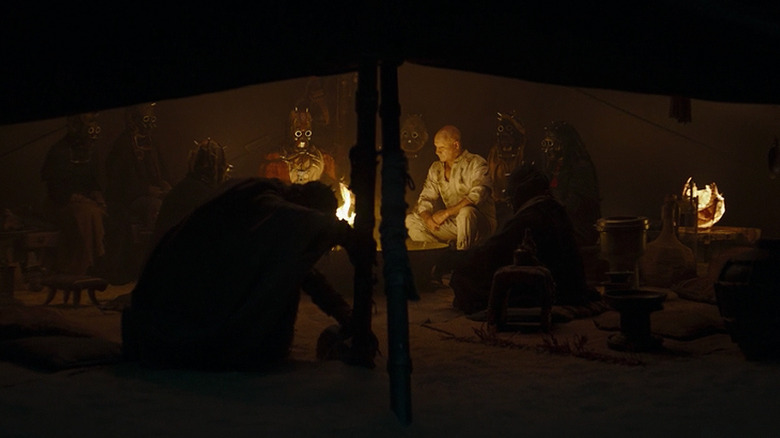
Granted, Boba didn't merely stroll into a Tusken camp and ask for a place to lay low. He essentially becomes their slave before eventually earning their respect and working his way into the tribe. And it's a bit jarring, not only to see such an "untouchable" figure like Boba made so vulnerable, but also to see him humbled by the same people who later join forces with another Mandalorian. In some ways it feels like a backslide, but it makes sense because it "humanizes" the Tuskens without completely abandoning their pricklier attributes.

...Make That Two Mandalorians

The Tusken Raiders are just like any other indigenous alien in "Star Wars." Like the Gungans or even the Ewoks of the original trilogy, they're slow to trust the outsiders trespassing on their land, but are fiercely loyal to those who earn their respect. Boba, as seen in "The Tribes of Tatooine," earns that and more. Not only does he coax them from their misgivings with technology, he also defends them — and their ancestral land! — from the invasive Pyke syndicate.

This sort of "Dances With Wolves" narrative can get old fast when it's a white man adopting the "simple" cultures of the Other. But Temuera Morrison, who first gave a face to Jango Fett and later Boba, is deeply in touch with his own indigenous roots. As a result, he was able to influence the Tusken culture in turn.

"I come from the Maori nation of New Zealand," Morrison told The New York Times in 2020, "and I wanted to bring that kind of spirit and energy, which we call wairua."

Morrison imparts his cultural dance, the haka, to the Tuskens. Even the manipulation of the gaffi stick was inspired by the Polynesian fighting style. By the end of "The Tribes of Tatooine," Boba has been trained to fight as the Tuskens do, and performs a ceremonial dance with the entire tribe. It's a moment that put a surprising smile on my face. It warmed my heart to see the Tuskens — a group coded not only as people of color, but as a monolithic threat in general — treated with such reverence.

A Surprising Shift

It's a shame that it's taken so long to see a side of the Tuskens that other "Star Wars" natives have always intrinsically possessed. But in a way, "The Book of Boba Fett" was the perfect opportunity to reveal it. The series was touted as a descent into the criminal underworld of "Star Wars" and a closer look at the hard-hearted Boba Fett fans expected to see. However, its parallel storyline, while lifted from the godfather (wink!) of all gangster flicks, pulls most of the focus to Boba's time with the Tuskens. This has disappointed fans who were really gunning for a darker, more grounded "Star Wars" title, myself included. It was only "The Tribes of Tatooine" that changed my mind for good.

While this subplot may seem tedious to some, it does address the bantha in the room, one that couldn't be ignored in yet another Tatooine-based story. The Tuskens aren't savages, they're people. And this might be a reach, but they're also a kind of family to Boba, a character who spent a great deal of time searching for belonging. If you don't believe me, watch "The Clone Wars" — it does a wonderful job depicting Boba's rocky coming of age, and the string of ill-fated alliances he endured before finally going solo.

It may not be what anyone expected or wanted, but it is a natural progression from the events of "The Mandalorian." It even makes Boba a sort of foundling in his own right. The success of the Tusken arc is twofold, in that it endows the maligned raiders and Boba with some much-needed substance. That Morrison was able to bring his own culture to "Star Wars" makes Boba Fett a perfect fit among the Tuskens. He's not the cynical guy who treats bounties as cargo. Not anymore, anyway. Maybe the Tuskens had a hand in reversing that. And again, that's a surprising shift for a character that has lived rent-free in the minds of generations. But it's made me care about "Star Wars" again, so I'm definitely along for the ride.

Read this next: Star Wars Movie Villains Ranked Least To Most Powerful

The post Star Wars TV is Finally Giving Tusken Raiders the Spotlight, and It's About Time appeared first on /Film.

06 Jan 22:45

Denuvo V10.0, used in Watch Dogs Legion, has been cracked

by John Papadopoulos

It appears that one of the latest versions of the Denuvo anti-tamper tech, Denuvo V10.0, has been cracked. This version of Denuvo was used in Watch Dogs Legion, alongside four other (yes you read that right) additional protection systems. Going into more details, Ubisoft used Denuvo V10 alongside VMProtect v3.5.1 and uPlay R2. In addition, … Continue reading Denuvo V10.0, used in Watch Dogs Legion, has been cracked →

The post Denuvo V10.0, used in Watch Dogs Legion, has been cracked appeared first on DSOGaming.

06 Jan 22:45

Cobra Kai Will Use AC/DC's 'Thunderstruck' Or Die Trying

by Jenna Busch

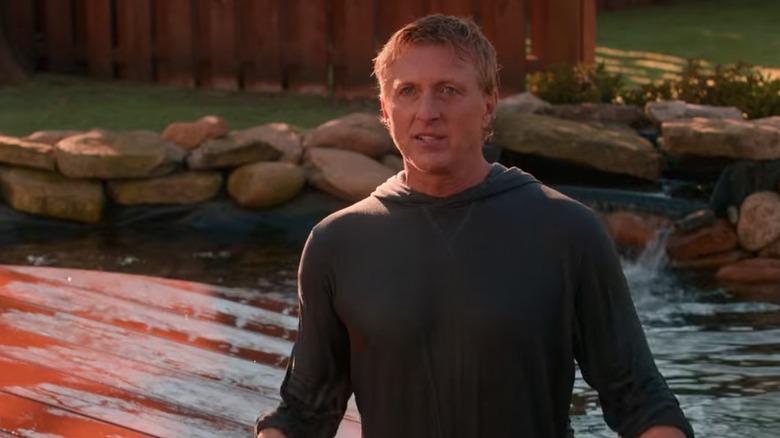
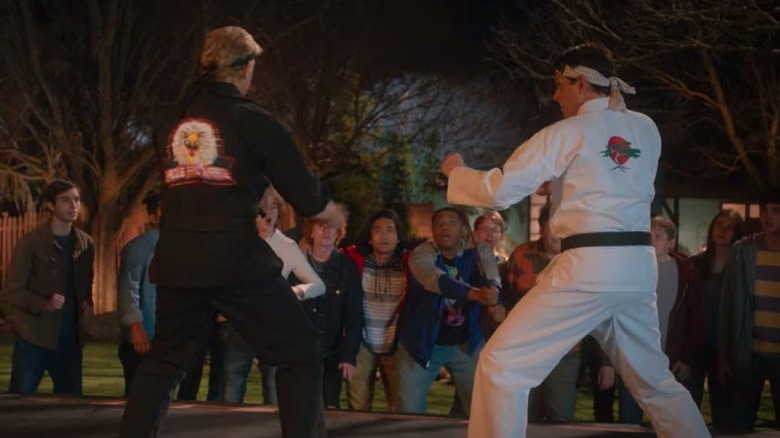
The music in "Cobra Kai" is not only fantastic, but it's often a plot point. For instance, that reference to (and there are mild spoilers for season 4 ahead) Peter Cetera and his song "Glory of Love" from the second film in the franchise as bonding point between Miguel (Xolo Maridueña) and Daniel (Ralph Macchio). Johnny (William Zabka), as we know, loves '80s hair metal. It's a huge part of who he is, and it was part of how he helped bond with Miguel as well.

The series creators have a song in mind that they'd really like to get into the show, and it needs to happen. In an interview with Entertainment Weekly, Jon Hurwitz (who created the show along with Josh Heald and Hayden Schlossberg) talked about the music in the series, saying, "I mean, our fantasy is having the kind of music budget that would allow for us to have nonstop AC/DC and Bon Jovi and Guns N' Roses."

Yes please to that! They've managed some really good ones like songs from Poison and Journey. However, there is a white whale of a song, and that song is AC/DC's "Thunderstruck."

Burning Heart

Hurwitz explained, "We had 'Thunderstruck' written into the script ... We've written 'Thunderstruck' into the script several times over the years, and we've never been able to afford it in that moment or to make that choice [to spend the money on it] right now." They ended up using  "Breakin' Outta Hell" from the Australian rock band Airbourne over the training montage they wanted "Thunderstruck" for. 

You know, I do love that song, and I'd really like to hear it. To that end, maybe we can all tweet about "Thunderstruck" and the important people who can just volunteer to let them use it for free will see it? I mean, they got Carrie Underwood for the finale of the season because she tweeted her love for the series. It's not just background noise, "Cobra Kai." Music supervisor Michelle Johnson uses these songs in a way that highlights them, like when they used "Girls Girls Girls" from Mötley Crüe, as the interview points out, for Johnny's attempt to recruit female students.

Whether or not they get the rights, may I just point out Johnny's training montage to Survivor's "Burning Heart?" He was running to that song. I have also run to that song. Cheesy or not, it's from "Rocky IV," and it's the perfect amount of silly and inspiring. AC/DC, just give them the rights, okay? 

Read this next: The 20 Best Sports Films Of All Time Ranked

The post Cobra Kai Will Use AC/DC's 'Thunderstruck' or Die Trying appeared first on /Film.

06 Jan 22:44

How The Shining Changed Shelley Duvall Forever

by BJ Colangelo

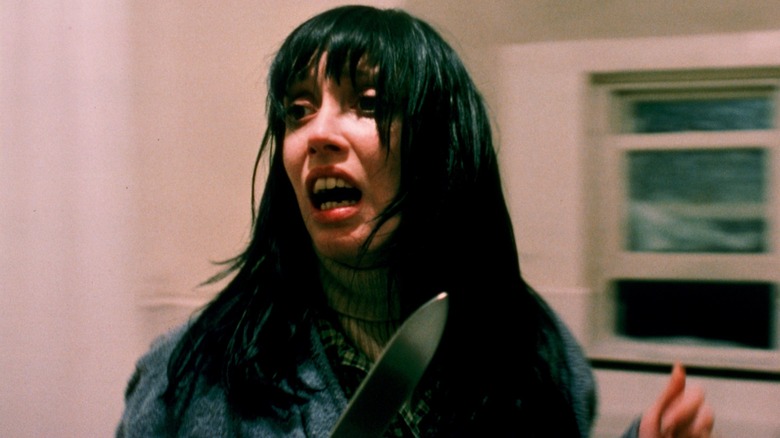
In a now-infamous video shot by a 19-year-old Vivian Kubrick, her father Stanley calls action for Shelley Duvall before a scene in "The Shining." Perhaps it was because Kubrick was outside and Duvall was behind a large door to the set of The Overlook Hotel, or perhaps the sound of Kubrick calling for action was muffled by the snow machine blasting at the set, but Duvall misses her cue. Kubrick calls "cut," and then meets Duvall at the door not to figure out why the cue was missed, but instead to ream her out, telling her "you're wasting everyone's time." Following this clip, Vivian Kubrick's making-of documentary shows Duvall saying that she doesn't think her performance would have been as good if Kubrick hadn't gotten a rise out of her, but notes that Kubrick knowingly treated her this way in order to get the performance. She looks calm. She smiles. 

She seems positive, but that was over 40 years ago. In the years since the release of "The Shining," much has been revealed about the horrendous working conditions for all of the cast and crew of the film, but none as extensive or as exhausting as Shelley Duvall. At the time, Duvall was a star on the rise, but Kubrick's treatment of her on set almost made her walk away from acting for good.

Kubrick Completely Mistreated Duvall On Set

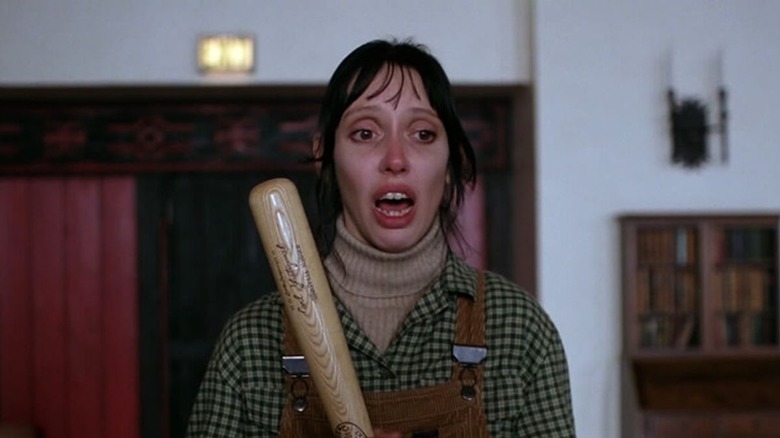
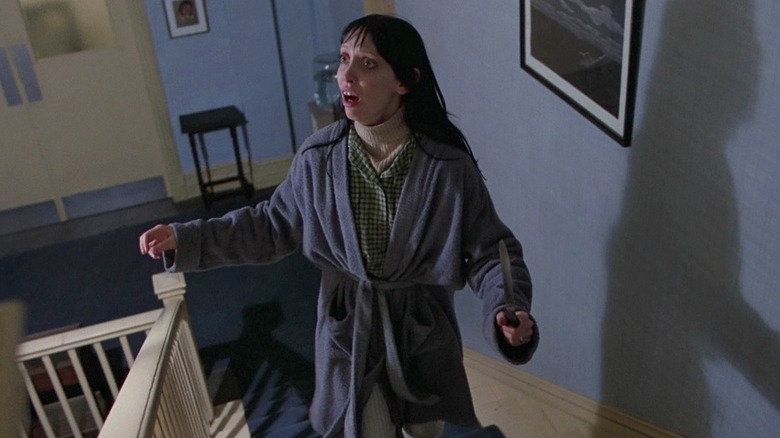
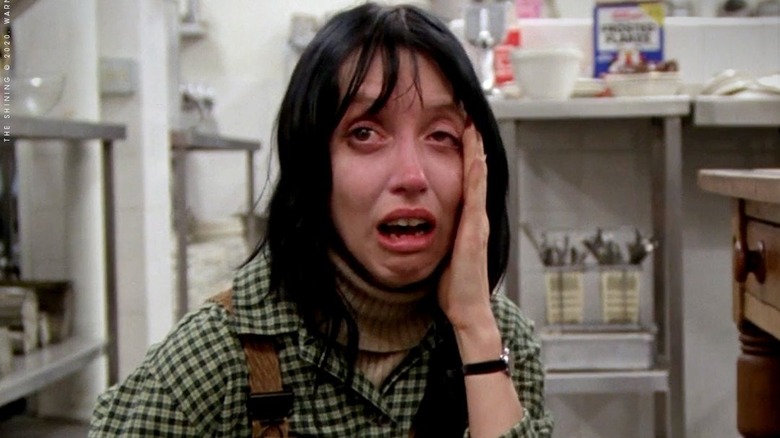
The magnum opus of his cruelty toward Duvall came in the form of one of "The Shining's" most iconic scenes -- the baseball bat confrontation on the stairs. Kubrick made Duvall and Nicholson shoot the scene in a record-setting 127 takes, something that horror fans love to spout off as a fun bit of trivia. The result of the constant takes were Duvall's hands were shredded raw from gripping the bat for such a prolonged period of time, her voice was hoarse from crying, her eyes became swollen, and she left the set completely dehydrated. The moments we see on screen of Duvall crying in pain, fear, and exhaustion were not acting, but an actor delivering lines while enduring a trauma response.

Kubrick's psychological brutalization of Duvall was so severe, her hair began falling out. "To wake up on a Monday morning, so early, and realize that you had to cry all day because it was scheduled — I would just start crying," Duvall said in an interview with The Hollywood Reporter. In the equally iconic "door scene," Jack Nicholson destroyed nearly 60 doors to get the shot to Kubrick's liking, filming this one moment over the course of three days. The scene was mostly improvised, and Kubrick reportedly kept information regarding Nicholson's choices to tear down the door with an axe from Duvall, meaning her reactions are authentic. This isn't acting, this is responding to trauma.

The Difference Between Acting And Reacting

There's a quote from actress Dee Wallace in an interview she did for "Eli Roth's History of Horror" where she recounts the exhaustion from shooting "Cujo." In it, she states, "What most people don't understand is that your body does not differentiate between a perceived threat and an actual threat. So I blew all my adrenals out because for eight weeks, literally, I was in fight or flight."

This helps explain what was going on with Duvall. No matter how much she tells herself "I'm acting" and no matter how much she knows the actions she's performing are scripted, the body is going to respond to the circumstances as if they're truly happening. Vivian Kubrick's documentary, "Stanley Kubrick: A Life in Pictures" doesn't shy away from her father's ridiculous methods, with co-star Jack Nicholson admitting that Kubrick acted like "a different director" when dealing with her. 

Many of Duvall's lines were unexpectedly cut, she was frequently kept isolated, and she was forced to wait for extensive periods of time before performing her scenes to throw her off. Vivian's documentary even shows moments of Kubrick not acting alone, but instead requiring the rest of the crew to follow his lead. "Don't sympathize with Shelley," he says to the crew. He also made the decision to never compliment her work, and instead criticized every choice or impulse she had for the character. At one point, he encourages the rest of the crew to ignore her and tells them to disregard any needs she expresses. Kubrick is notorious for being a perfectionist, but at what cost?

'I Don't Know How I Did It'

Kubrick chose to shoot "The Shining" chronologically, which pushed the filming to a whopping 500 days. This means Duvall spent over a year of her life being tormented by a man in an untouchable position of power. Kubrick was already considered an auteur at this point in his career, with his unconventional (see: abusive) techniques hailed as genius rather than correctly identified as harmful. He was awarded and given the space to direct anything he wanted. Many have tried to defend Kubrick by referencing the clips from Vivian's documentary where Duvall speaks positively about the director's choice to treat her subhumanly, but never do they put it in context. If the daughter of the man with enough power to make or break the rest of Duvall's career puts a camera in her face and asks how she feels about his process ... what else do people expect her to say? 

In The Hollywood Reporter interview, Duvall said, "I don't know how I did it. Jack [Nicholson] said that to me, too. He said, 'I don't know how you do it.'" Author Stephen King has not shied away from his hatred of Kubrick's film, and the treatment of Duvall as Wendy is part of it. "She's basically just there to scream and be stupid and that's not the woman that I wrote about."

We Need To Call It What It Is

Duvall appeared on the "Dr. Phil Show" in 2016, clearly in need of legitimate help and speaking incoherently. Dr. Phil treated it like sensationalist exploitation, but when he asked about "The Shining," her response was the most honest she'd been in years. "I guess this is what most people know me for, right? And look, I won't get into too much detail now, but that film was hell to be a part of," she said. She followed by saying:

I mean, there was a great cast — Jack, Scatman [Crothers], Danny [Lloyd]. They were all wonderfully hilarious people, but then there was Stanley Kubrick, the director of this iconic masterpiece. All I'll really say for now is that if he hadn't directed the way he did, if he hadn't done everything with force and cruelty, then I guess it wouldn't have turned out to be as it was.

There's a tragic acceptance to Duvall's perspective, as if she has bought into the lie that she wouldn't have been as good in the role without having endured harm, or as if she has convinced herself that the torture she underwent was necessary for the film to be as beloved as it became. Duvall didn't have the opportunity to act, because she was too busy trying to maintain sanity while being psychologically exploited. That's not the sign of a bad actor, that's the sign of a bad director. To put a person in the position of feeling threatened and fearing for their life for 127 takes on a staircase is not legendary or the work of a perfectionist -- it's abuse, and we need to start calling it what it is.

Read this next: All 59 Stephen King Movies Ranked From Worst To Best

The post How The Shining Changed Shelley Duvall Forever appeared first on /Film.

06 Jan 22:01

New Battlestar Galactica Movie Will Share A Universe With The Upcoming Series

by Jenna Busch

Shared universes are a common thing these days. Heck, even Marvel and Sony have characters that link in the superhero world, meaning world peace might actually be attainable. Though it's been a good decade since we last saw "Battlestar Galactica" on our television screens, we're going to get a lot more of it soon. Perhaps you've heard about the "Battlestar Galactica" movie and new TV series? Well, it appears that they're going to share a universe. That's good news for fans, but not that surprising in a world where Marvel and "Star Wars" have interlinking stories going across TV and film.

'There Is A Synergy Between The Two Enterprises'

In an interview with Collider about "The 355," director/writer/producer Simon Kinberg spoke about how these things might come together. Kinberg has been attached to write and produce the "Battlestar Galactica" film since 2020 with Dylan Clark ("Rise of the Planet of the Apes"). The TV series was announced for NBC's streaming service Peacock in 2019 from executive producer Sam Esmail ("Mr. Robot"). In the interview, Kinberg says of the "Battlestar Galactica" film:

"We are in the process of going out to directors and the hope is to attach a director and start prepping the movie this year. It's a megillah, humongous film and the prep will be a very long prep period so I would imagine even if we attached a director today it would take six, nine months to prep this movie properly. So at the earliest, we'd be shooting at the end of this year. We'd probably be shooting at the beginning of next year. Time will tell who the director is and then you or someone else will tell who the director is."

On the show and the film being connected, he says:

"In terms of the situation with Sam and the show, I can't say too much about it other than there is synergy between the two enterprises and constant communication between us. We've become close and been having a really good time together and there will be, for lack of a better phrase and it's an overused phrase, a shared universe."

'There Are Connections'

That sounds promising. The question remaining is whether or not this will be connected to the series that blew us away a decade ago. Kinberg says, "There are connections, but it is certainly not simply a continuation or a remake of Ron Moore's masterpiece." Well, that's something. What I would really like to know, however, is if we'll see anyone from the prequel series "Caprica." That show got a raw deal as far as I'm concerned. Go re-watch it if you have a chance. It deserved so much more recognition, and I really miss it. 

If there are "connections," I'd also love to hear of any of our favorite actors will show up. Just ... find a way to put Katee Sackhoff in there, okay? Considering how the original (well, the modern original) series ended (no spoilers), I'm sure you can come up with something. 

Read this next: The 14 Greatest Science Fiction Movies Of The 21st Century

The post New Battlestar Galactica Movie Will Share a Universe with the Upcoming Series appeared first on /Film.

06 Jan 21:56

How Ian McKellen Inspired One Of The MCU's Most Beloved Characters

by Ben F. Silverio

The Marvel Cinematic Universe has produced some unforgettable heroes in their shows and movies. However, they haven't always had the same success with their villains. For every Erik Killmonger, you had a Whiplash. When there's a Baron Zemo, there's also a Malekith the Accursed. And even though we got the Kingpin in "Daredevil," we also got the Kingpin in "Hawkeye." The House of Ideas is certainly aware of this problem and they have been doing their best to remedy it with varying degrees of success. But when it came to crafting the trickster god Loki for his jump from the pages of Marvel Comics to become the primary antagonist in "Thor" and "The Avengers," Marvel Studios told screenwriter Zack Stentz to look to one of the greatest actors of all time for some inspiration.

Glorious Purpose

During his appearance on The Fanboy Podcast, Stentz revealed that the studio brass were adamant that they needed Loki to be the biggest Big Bad that they could make him. And that's not to say that he just needed to be incredibly evil, but he had to be a complex and interesting character. That's why the team looked to the "X-Men" movies for probably the best example.

"It's a complicated issue because we had a very clear mandate when we were writing Thor. They already knew that they were building towards The Avengers and they already had the notion that Loki was going to be the villain. They knew that their villains thus far in the MCU had been a bit underwhelming, and they said -- one of the executives literally said, 'Look, if you fail at everything else, give us a villain as good as Magneto in Loki.' We need someone at that level because that's going to be our villain for The Avengers.

We always put a lot of effort into our villains, but in this case we really worked hard giving Loki an interesting story and making him sympathetic at the same time as he's doing these terrible things."

I'd say that writers Ashley Edward Miller, Zack Stentz, and Don Payne, along with director Kenneth Branagh and the god himself Tom Hiddleston, succeeded in creating a memorable villain for "Thor" and beyond. They certainly understood the assignment.

Magneto Set The Bar

And obviously no disrespect to Alfred Molina or Willem Dafoe (who both not only shined in their original stints as Doctor Octopus and the Green Goblin in the Sam Raimi Spider-Man movies, but in "Spider-Man: No Way Home" as well), but Ian McKellan's performance as Magneto set the bar for villains in comic book movie adaptations. Hell, Magneto is one of the best villains in all of storytelling, so it's not surprising that Marvel Studios would want someone like that in the Marvel Cinematic Universe. And in being inspired by Magneto, they elevated Loki to a level of fandom that not many could have predicted back in 2011.

Of course, now that Disney own Fox, the actual Magneto can make his MCU debut somewhere down the line. And thanks to the multiverse, maybe even Sir Ian himself will don the red cape and helmet once again. Then if that happens, what if we get to see him come face to face with Hiddleston's mischievous self-loving, time-traveling scamp? I'm not trying to get anyone's hopes up or anything like that, but could you just imagine that? Heart eyes emoji. Either way, we can thank Ian McKellan for making yet another amazing contribution to the world of entertainment (albeit a passive one this time around).

Read this next: Every Pre-MCU Marvel Movie Ranked

The post How Ian McKellen Inspired One Of The MCU's Most Beloved Characters appeared first on /Film.

06 Jan 21:56

20 Things You Didn't Know About Ghostbusters

by Kirk Boxleitner

With "Ghostbusters: Afterlife" earning more than $110 million domestically before the stateside premiere of fellow Sony feature "Spider-Man: No Way Home," fans have reason to hope for another sustained multimedia franchise inspired by the first "Ghostbusters" film, which opened on June 8, 1984, and went on to make close to $300 million on a roughly $30 million budget.

It notched top-grossing film status for eight weeks, and the second-highest-grossing rank for six weeks, before returning to the box office top 10 for its two-week re-release in August of 1985.

Not only did "Ghostbusters" beat both "Indiana Jones and the Temple of Doom" and "Gremlins" for the highest-grossing films that debuted in 1984, but it jockeyed for first place with "Beverly Hills Cop" before surpassing it in 1985, and also surpassed 1978's "National Lampoon's Animal House" as the highest-grossing comedy film in history, until 1990's "Home Alone."

"Ghostbusters" was nominated for two Academy Awards in 1985 — best original song for "Ghostbusters" by Ray Parker Jr., which lost to Stevie Wonder's "I Just Called to Say I Love You" from "The Woman in Red," and best visual effects, which it lost to "Indiana Jones and the Temple of Doom" — and in 2001, the American Film Institute ranked "Ghostbusters" 28th on its "100 Years...100 Laughs" list of best comedy films.

What follows are more facts you might not know about 1984's "Ghostbusters," plus related information touching on its three follow-up films, two-and-a-half animated spin-off series, and multiple tie-in comic books and video games.

Who You Gonna Call?
To promote the 1984 film, the Ghostbusters' TV commercial was re-edited for a trailer that replaced its phony 555-2368 phone number with the then-operational 1-800-654-1984, which received an estimated 1,000 calls per hour, around the clock, for six weeks.

Callers heard a pre-recorded dialogue by Dan Aykroyd and Bill Murray, using their real names, but still basically in-character from the film, claiming they were out investigating "a possible infestation backstage at the show 'La Femme Des Paris' at the Waverly Theater in Times Square," for which they were "bringing all of our equipment into the girls' dressing room" for "a complete sweep" that "could take a couple of weeks."

Aykroyd and Murray elaborated on the need to follow up with "Brigitte" and "Fifi" personally, before encouraging callers to "go see the Ghostbusters movie."

In September of 2014, Sony created another temporary phone number (212-897-1964, with a New York City area code) for the 1984 film's 30th anniversary and Blu-ray release.

This time, callers heard a pre-recorded message from Annie Potts as Janine Melnitz, complaining, "I've been working here for 30 years and I still get no respect. I've quit better jobs than this," before adding, "I stay because I love it. We couldn't have gotten where we are today without all of you, so thanks for your support along the way."

"Janine" then encouraged fans to visit the Ghostbusters website and "remember to always be humanitarian like Egon, even if they're not human."

Who You're NOT Gonna Call
As documented by Getty Images photographer Trevor James Robert Dallen on Dec. 19, 1984, the first Ghostbusters film's hotline haunted an Australian woman — Mary Walton of Hurlstone Park, a suburb of Sydney — whose phone number was similar enough for her to receive calls from children "wanting ghosts busted."

Fellow Australian Chris Hemsworth, as Kevin Beckman from 2016's "Ghostbusters: Answer the Call," was more receptive to such calls, via that year's UK promotional phone number of 0800 2229 911, whose pre-recorded message apologized for not answering calls "due to the considerable rise in paranormal activity."

"Kevin" directed fans to the 2016 film's Facebook page, after advising them, "If you've experienced strange noises or feelings of dread, just ignore them and hope they go away. If you're troubled by a floating apparition, open a window and turn on a fan. Anything worse, run! And leave the Ghostbusting to us."

Ghost...Breakers?
Well into shooting the 1984 original, the folks making the film didn't know who they were gonna call, because Filmation (home of "He-Man and the Masters of the Universe") had made a live-action children's sitcom called "The Ghost Busters" for CBS in 1975.

Alternate titles under consideration included "Ghostsmashers," "Ghoststoppers," "Ghostblasters" and "Ghostbreakers" (itself the title of a 1940 Bob Hope comedy film), but the folks making what would become "Ghostbusters" held out hope of securing the rights to that title from Universal Pictures, enough that they filmed certain scenes more than once, including exterior shots of the firehouse with banners bearing those alternate titles.

Joe Medjuck, one of the film's associate producers, put a stop to this practice by calling Columbia Pictures from a payphone at the filming of the Ghostbusters' arrival at Central Park West to save the day. He told the studio to listen to the hundreds of extras who were chanting "Ghostbusters" over and over, and pointed out how unfeasible it would be to try and shoot such scenes repeatedly.

Fortunately, Columbia Pictures President Frank Price — who'd greenlit the film based on the premise Aykroyd summed up as "Ghost Janitors in New York" — became chairman of the MCA Motion Picture Group in November of 1983, which granted him control over Universal Pictures.

Price sold Columbia the "Ghostbusters" title for $500,000 plus 1% of the film's profits, and thanks to "Hollywood accounting," the film technically never made a profit from which Universal could be owed.

The "No-Ghost" Is Named "Mooglie"
Before the Ghostbusters could claim their name, they already had a brand, in the form of a white ghost trapped by the bar of a red "no" circle.

Dan Aykroyd's script described the concept, but the "no-ghost" logo was designed by Michael C. Gross, another associate producer and art director for the film, who worked with creature design consultant Brent Boates to render the image.

Gross also served as art director for National Lampoon magazine from 1970-74, creating the "If You Don't Buy This Magazine, We'll Kill This Dog" cover for its January 1973 "Death" issue, before becoming the personal art designer for John Lennon and an art consultant to the Muppets. "Ghostbusters" and "Ghostbusters II" were among the 15 TV and movie projects on which Gross was listed as a producer from 1978-94, before he died of cancer at the age of 70 in 2015.

Gross' iconic ghost gained a life of its own, as Ivan Reitman revealed to HitFix that he and Aykroyd nicknamed it "Mooglie" — a nickname repeated by Ray Stantz in the Ghostbusters comics by IDW Publishing — and the intros and bumpers for "The Real Ghostbusters" cartoon depicted Mooglie as its own character.

The cartoon's 1987 episode "The Copycat" showed the titular metamorph mimicking the "no-ghost" symbol, while 2016's "Ghostbusters: Answer the Call" elevated the iconic ghost to the team's archenemy, a mad scientist and occultist named Rowan North (played by Neil Casey), who commits suicide to become a powerful spirit.

Reitman Called Aykroyd's Script A "Phone Book"
Before the 1984 film even had a logo or a settled title, "Ghostbusters" director Ivan Reitman had to recruit Harold Ramis to help him channel Dan Aykroyd's vision into a filmable script.

According to Reitman's "domino theory of reality," a film that starts with a solid grounding in the ordinary can ultimately persuade audiences to accept absurdities even as large as a 100-plus-foot-tall Stay-Puft Marshmallow Man. This made Reitman an ideal director to winnow down a script whose size he compared to a "phone book," since he recalled its first draft as about 70-80 pages long, before it ballooned to 180 pages by the time it was handed to Richard Edlund, who headed up the film's visual effects.

In 1981, Aykroyd began writing "Ghost Smashers" (the script's original title) to star himself as Stantz, his fellow Blues Brother John Belushi as Venkman, and his eventual 1983 "Trading Places" costar Eddie Murphy as "Ramsey."

And that's the simple part, since instead of being set in New York City during the contemporary present of the 1980s, the "Ghost Smashers" script opened in the then-future year of 2012, by which time Ghostbusters had become as commonplace and necessary as a combination of pest control, sanitation workers and first responders.

Aykroyd imagined Ghostbusting becoming such an established business model that multiple competitive franchises of spirit-trappers would operate around the world, because he believed such aspects of the supernatural would be scientifically proven true in the future.

"Ghost Smashers" Wielded Wands, Not Proton Blasters
No, not wizards' wands, but in place of the hand-held Proton Blasters that appeared in the film, each Ghost Smasher's Proton Pack fed power to twin adjustable-length antennae identified in storyboards as "Nutrona" (not "Neutrona") Wands, one for each arm, mounted to their wrists and extendable from their palms.

The Ghost Smashers' uniforms were scripted practically, as both janitorial and tactical, with law enforcement riot control gear including helmets with transparent face-shields, even as Aykroyd's fantastical script sent the team traveling through time and space, with a dematerializing Ectomobile, and a culmination that whisked our haunt-stopping trio into alternate dimensions.

This all followed a prologue stating that a hole had already been torn in our reality, that allowed entities from the other side to enter our world.

Just as other Ghostbusters had government, corporate or private sponsors, the Ghost Smashers were employed by the wealthy, eccentric Ivo Shandor, while Mr. Stay-Puft first appeared well before the story's climax, as one of many forms adopted by Gozer.

The Ghost Smashers' Containment Unit was kept at a deserted Sunoco gas station in northern New Jersey, with a viewer that allowed them to look inside, which was nixed for the film, but made it into both 1984's "Ghostbusters: The Novel" by Larry Milne and "The Real Ghostbusters" cartoon.

The ghosts' release yielded an explosion of paranormal energy that triggered a 25-acre sinkhole around the gas station, disrupting a long-dormant fault line that destroyed northern New Jersey.

Aykroyd Comes From A Family Of Real-Life Spirit-Seekers
Ivan Reitman told Esquire "Ghost Smashers" would have cost around $200 million to produce, after he'd pledged Columbia Pictures President Frank Price a ballpark budget of $30 million.

Fortunately, Aykroyd understood the need to scale down his ambitions, since he told Vanity Fair he's "a kitchen-sink writer" who throws "everything in" and relies on collaborators to "bring it into reality," and also because he had literal generations of knowledge on the script's subject.

Dan's great-grandfather, Dr. Samuel Augustus Aykroyd, conducted seances in the same family farmhouse where Dan grew up and still lives, during the spiritualist craze of the 19th century.

Dan's grandfather, Maurice James Gladstone Aykroyd, was an engineer for the Bell Telephone Company of Canada, who not only constructed a crystal radio to communicate with spirits, but also invited ghosts into the family's home while Dan was growing up.

Dan's father, Samuel Cuthbert Peter Hugh Aykroyd, maintained an extensive library on spirits, the supernatural and paranormal phenomena until his death at the age of 98 in 2020, and in 2009, he co-authored "A History of Ghosts: The True Story of Séances, Mediums, Ghosts, and Ghostbusters."

Even Dan's mother, Lorraine Gougeon Aykroyd, claimed she'd seen apparitions of his great-great-grandparents while nursing him.

And in 1981, Dan read an article on quantum physics and parapsychology, in The Journal of the American Society for Psychical Research, that sparked his desire to update decades-old ghost comedy films like Bob Hope's "The Ghost Breakers."

Aykroyd's Eerie Experiences Extend Beyond His Haunted Homes
Although Aykroyd hasn't noticed any stray spirits at his family homestead since he reached adulthood, he claims to have encountered the ghost of "Mama Cass" Elliot, of The Mamas & the Papas, during her alleged hauntings of his former bungalow in Los Angeles.

And when the 1984 film shot the scene of the Ghostbusters in jail, in an actual New York prison facility that had been decommissioned and essentially abandoned, Aykroyd echoed those who suggested the location was haunted, a suspicion which was fed by the unexplained appearance of scratches all over the dailies that were shot there. Film editor Sheldon Kahn was able to work around the scratches on the footage, enough that a reshoot of the jail scene wasn't necessary, much to the relief of Ivan Reitman, who hoped never to return to that location.

In the film's DVD commentary track, Harold Ramis placed the prison's location as somewhere in the middle of 14th Street, not Lower Manhattan, while Reitman confirmed it was a police station. Without confirming the exact location, the inlay booklet of the 2014 Ghostbusters 1&2 Gift Set, on page 3 of "The Story of Ghostbusters," mentions one of the shooting locations as "the old New York Police Department lock-up."

Aykroyd has professed otherworldly close encounters of the alien kind, as well. In 2005, he released the documentary "Dan Aykroyd Unplugged on UFOs," which includes interviews, footage of supposed extraterrestrial sightings, and his own personal accounts.

Much Of The Film's 'Science' Is Real(ish)
The 1984 film's most infamous experiment is a combination of two actual experiments, both of which have been heavily criticized by real-world scientists.

The cards whose symbols Venkman asks the two students to identify, without seeing them, were designed by perceptual psychologist Karl Zener during the 1930s, for experiments conducted at Duke University with his colleague, Joseph Banks Rhine, to test for extrasensory perception.

The term "parapsychology" was coined in 1889 by philosopher Max Dessoir as the German "parapsychologie," but it was popularized by J.B. Rhine, in his 1937 book "New Frontiers of the Mind," as a replacement for the term "psychical research." Rhine founded both parapsychology as a branch of psychology and the autonomous parapsychology laboratory within Duke University.

Karl Zener requested they no longer be called "Zener cards" after Rhine's experiments with them were discredited by their peers, due to a combination of "sensory leakage" and cheating.

The electric shocks Venkman administers to the male student, purportedly to study the effect of "negative reinforcement" (actually positive punishment) on ESP ability, were inspired by Yale University psychologist Stanley Milgram's experiments, which began in 1961, and whose findings were presented in his 1974 book "Obedience to Authority: An Experimental View."

Milgram measured the willingness of study participants to obey authority figures ordering them to perform acts that conflicted with their consciences, specifically administering fake electric shocks (which they believed were real) to people who pretended to feel pain.

The Film's Experiment Tested Its Audiences' Sympathies
While Milgram's experiment obviously raised a number of ethical concerns, Harold Ramis jokingly suggested this scene had Venkman unrepentantly employ Milgram's methodology to test audiences' willingness to accept an ostensible "hero" who would unfairly administer painful but non-lethal electric shocks to others.

The experiment was one of Bill Murray's favorite scenes during the filming of "Ghostbusters," and his visible enthusiasm makes sense of the graffiti on his office door — "Venkman Burn in Hell" — paraphrasing the similar graffiti of "Carrie White Burns in Hell!" from 1976's "Carrie."

The door's graffiti originally rhymed with "Venkman Darns Socks in Hell," itself paraphrasing one of Linda Blair's least G-rated quotes from 1973's "The Exorcist," but Reitman wanted to keep the film relatively family-friendly.

Columbia University agreed to lend the film an academic verisimilitude, by having its real-life Havemeyer Hall provide the shooting interiors for the fictional "Weaver Hall," home of the equally nonexistent Paranormal Studies Laboratory (in Room 205 A) occupied by Drs. Spengler, Stantz and Venkman.

However, given the film's ethically dubious characterization of a field of research already regarded as suspect by most reputable real-world scientists, the university stipulated that Columbia itself should not be identified by name onscreen.

Adding a touch of technological verisimilitude was an Apple II knockoff, the Franklin Ace 1000, in the Ghostbusters' firehouse, used to simulate Kirlian photography by capturing the image of Vinz Clortho, Keymaster of Gozer, in his Terror Dog form, inside the possessed Louis Tully's body.

Gozer Was A Gestalt

In both real-life casting and storytelling inspirations, the Ghostbusters' supernatural adversary Gozer was assembled from multiple sources.

On the 2009 "Ghostbusters: Slimer Mode" Blu-ray, film historian Paul M. Sammon recounted how Gozer almost manifested as Ivo Shandor, planned to be played by Paul "Pee-wee Herman" Reubens, and according to page 170 of Don Shay's 1985 "Making Ghostbusters," Aykroyd and Ramis' script drafts envisioned Gozer as resembling first Bert Parks, then Robert Young, before director Ivan Reitman suggested an androgynous figure.

Shay quoted associate producer Joe Medjuck in naming musicians David Bowie and Grace Jones as two inspirations, before Yugoslavian model Slavitza Jovan was cast to embody Gozer.

British-American actress Paddi Edwards — who performed voiceover roles for Disney's "The Little Mermaid" and "Hercules," and appeared onscreen in "Star Trek: The Next Generation" — supplied Gozer's voice, after Bill Murray mocked Jovan's thick Slavic accent, according to page 183 of Shay's "Making Ghostbusters."

On the 2005 "Ghostbusters" DVD commentary track, Ramis recalled "punk rock singer" Anne Carlisle, star of 1982's "Liquid Sky," declining the role of Gozer, although she would appear in 1986's "Crocodile Dundee" as the trans woman character Gwendoline.

On page 97 of "Making Ghostbusters," Shay quoted Aykroyd as attributing Gozer's inspiration to both a Gozer Chevrolet dealership in upstate New York and documented reports of a council house in Enfield, London, being haunted between 1977-79, during which one medium claimed to have contacted a spirit called Gozer, whom she described as "a nasty piece of work."

John Belushi's Spirit Haunted Ghostbusters, Onscreen And Off
Belushi's death on March 5, 1982, meant recasting the role of Peter Venkman, which Aykroyd had written for him, but Aykroyd and Ramis still managed to work him into "Ghostbusters."

Like Ivo Shandor and Gozer, what started as the "Onionhead" ghost — so dubbed due to the stench it was originally written as emitting, according to page 64 of Don Shay's "Making Ghostbusters" — persisted in various forms from the earliest drafts of the film's script.

But it wasn't until Ivan Reitman remarked upon the resemblance of "Onionhead" to Belushi as Bluto in "National Lampoon's Animal House" (Shay, page 78) that Steve Johnson, the visual effects crewmember who sculpted both the librarian ghost and the "Onionhead" ghost that became known as "Slimer," received Aykroyd and Ramis' request to redesign Slimer in Belushi's likeness, less than 24 hours before Johnson's deadline.

Johnson told Bloody Disgusting, "I pulled out a stack of headshots of John Belushi, poured a gram of cocaine on it and started chopping lines up," when the literal ghost of Belushi himself allegedly manifested to model for him, so Johnson could get his likeness just right for Slimer, before Belushi departed with the warning, "Watch that (stuff) Steve, it'll kill you."

Slimer compounded visual effects crewmembers' headaches when his miniature figure, made to fly around the Sedgewick Hotel's chandelier, proved too big, so as creature design consultant Terry Windell said on the 1999 "Ghostbusters" DVD, "We basically spray-painted a peanut green."

Slimer Connected The Film To The Cartoon
On the 2005 "Ghostbusters" DVD commentary track, Ivan Reitman admitted to voicing both Slimer and Zuul in the 1984 film, while Frank Welker voiced Slimer in "The Real Ghostbusters" cartoon from 1986-91.

The cartoon first named the former "Onionhead" ghost "Slimer," and explicitly referenced specifics from the film in episodes 10 and 11 of its first season, written by future "Babylon 5" creator J. Michael Straczynski.

In "Take Two," the Ghostbusters oversee production of a movie about them, and cartoon Peter Venkman metafictionally complains that live-action Bill Murray "doesn't look a thing like me."

And "Citizen Ghost" depicted the aftermath of the team's battle with Gozer, as they rebuilt their firehouse and Containment Unit, and their original uniforms manifested "spectral" duplicates of their former wearers, due to how much psychokinetic energy they'd absorbed.

The team adopted Slimer after he helped defeat their doppelgangers.

Winston "Ramsey" Zeddemore Nearly Stole The Show
As Ernie Hudson told The A.V. Club, he was the only actor from the 1984 film who auditioned to voice his character in the cartoon, but he lost the role to Arsenio Hall.

And as Eddie Murphy told Jimmy Fallon, he was unavailable to play "Ramsey" in what would become "Ghostbusters" because he needed to work on "Beverly Hills Cop."

As "Ramsey" became Winston Zeddemore, future "Die Hard" and "Family Matters" star Reginald VelJohnson nearly nabbed the part. Hudson won their competing final auditions, but Ivan Reitman cast VelJohnson as the prison guard in the jail scene to thank him for his trouble.

On page 29 of Aykroyd and Ramis' August 5, 1983, draft of the script, Winston introduced himself to Ray Stantz as a five-year veteran of the Air Force's Air Police (now Security Forces), who made captain and administered perimeter security at Reese Strategic Air Command Base, before he designed electronic barrier systems for Sentry Alarms as a civilian, and wound up as vice-president of tactics and training at the company's Pacific headquarters.

Winston added he was "a 15th-degree black belt in Wing Chun boxing" and "a qualified, award-winning weapons handler."

Ernie Hudson Got Robbed
The August 5, 1983, script draft also had Winston getting slimed (on page 51) and choosing Gozer's form as the Stay-Puft Marshmallow Man, because "he was on all the packages we used to buy when I was a kid in North Carolina," and "we used to roast Stay-Puft marshmallows on my grandpa's smokehouse fire" (on page 129).

On page 54 of "Making Ghostbusters," Don Shay quoted Harold Ramis saying, "As writers, we'd never done a Black character," so "we bent over backwards to make Winston's character good — and in doing so, we made him the best character in the movie."

When Ramis realized, in his words, "Jesus! He's got all the good lines," the decision was made to give Peter Venkman, whose character Ramis deemed "a little weak" previously, more of Winston's lines, and to delay Winston's introduction within the film.

Tie-in media have treated Winston better, with the 2009 "Ghostbusters: The Video Game" establishing him as a Marine Corps veteran who apparently obtained a Ph.D. after the events of "Ghostbusters II." During an in-game investigation at the Museum of Natural History, Winston says he "practically lived" in the Egypt exhibit while working on his doctorate.

Ray Stantz's "Dream Ghost" Had Her Own Subplot
In the final cut of the 1984 film's montage of the Ghostbusters on the job, Ray Stantz is shown dreaming about a beautiful floating phantasm performing an adult-rated act on him, but this scene started as part of a call Ray and Winston responded to at the fictional Fort Detmerring, a historic military installation where Ray stakes out the period-furnished Single Officers' Quarters.

While Winston checks the armory, Ray conducts a sweep of the quarters, before donning an officer's uniform, skimming through one of the bedroom's books ("I don't even understand French"), and falling asleep on its bed.

From there, the needle on one of Ray's meters spikes, as light and mist emanate from the wardrobe, and Ray awakens to see his "dream ghost" hovering over him.

When Winston returns to knock on the door of the Single Officers' Quarters and ask Ray if he's alright, Ray responds with a firm "Later, man!"

When this scene appears as a dream during the montage, the "Ghostbusters" theme plays in the background, but the song's vocals cut out as the "dream ghost" unzips Ray's pants, omitting the lyric "Bustin' makes me feel good."

That's One Big Marshmallow
The Stay-Puft Marshmallow Man appears twice in "Ghostbusters," before Gozer manifests as Mr. Stay-Puft; first on a package next to the carton of eggs that pop out and start frying on Dana Barrett's kitchen counter, then on a mural ad painted on a building across from the firehouse.

According to Esquire, Dan Aykroyd told "my old friend, the Viking," to sketch Mr. Stay-Puft as "a cross between the Michelin Tire Man and the Pillsbury Doughboy," topped with "a little sailor hat," but William Atherton, who played EPA inspector Walter Peck, balked at being dumped on so heavily to make the towering marshmallow man's roast seem real.

Atherton refused to have 150 pounds of shaving cream poured on him, to simulate Mr. Stay-Puft's explosion, without testing it on a stuntman first. When "it knocked (the) poor guy down," Atherton estimated it was reduced to 75 pounds.

The Librarian Ghost's Afterlife Extended Beyond The Film
"Swamp Thing" co-creator Bernie Wrightson drew drafts of what became the Terror Dogs, the Temple of Gozer and the librarian ghost, adding a cartoon balloon reading "Quiet!" to the latter, per page 33 of Don Shay's "Making Ghostbusters."

The 2009 video game established the librarian ghost as Eleanor Twitty, former head of the New York Public Library's special collections, who was murdered in the 1920s by her lover, after denying him further access to the rare books in her care, especially the "Gozerian Codex."

And the 2019 "Cleanin' Up the Town: Remembering Ghostbusters" Blu-ray revealed a nearly-completed puppet for a second stage to the librarian ghost's transformation was nixed by visual effects entrepreneur Richard Edlund due to budgetary concerns, only to be repurposed for 1985's "Fright Night," another Columbia Pictures film with Edlund's team handling its visual effects (Shay, page 29).

The P.K.E. Meter Was Too Well-Made Not To Share
The P.K.E. (Psychokinetic Energy) Meter reappears throughout the "Ghostbusters" franchise, plus two subsequent sci-fi films pitting professional wrestlers against alien invaders.

In 1988's "They Live," starring Roddy Piper and Keith David, the prop served as a walkie-talkie for paramilitary security forces working for ghoulishly undead-looking alien overlords. And in 1991's "Suburban Commando," starring Hulk Hogan and Christopher Lloyd, an interstellar warrior uses it as a "homing device" to locate extraterrestrial technology on Earth.

Not bad for a prop whose main shell was a hand-held Iona Electric Shoe Polisher from the 1960s.

Egon Spengler first used the P.K.E. Meter onscreen to detect the librarian ghost in the New York Public Library, after living librarian Alice (played by actress Alice Drummond) admitted under questioning from Peter Venkman, "My uncle thought he was St. Jerome."

Jerome is the patron saint of librarians.

A Heartfelt Moment Rescued From The Deleted Scene Pile
No shortage of scenes from the 1984 film wound up on the cutting-room floor, from Slimer haunting a honeymooning couple at the Sedgewick Hotel, to Bill Murray and Dan Aykroyd playing two homeless characters completely unrelated to Peter Venkman and Ray Stantz, while encountering Louis Tully as he fled from a Terror Dog.

But the scene that "Ghostbusters: Afterlife" finally restored from the first "Ghostbusters" film showed Janine wishing Egon good luck, just before the team's climactic battle with Gozer, although "Afterlife" still trimmed Peter breaking up their embrace by telling Janine, "Didn't your mama ever tell you not to get involved with no Ghostbusters? Now go on home; be gone."

Neither "Ghostbusters II" nor "Afterlife" followed up on this rare display of mutual emotion between them, but in "The Real Ghostbusters" cartoon ... well, that's a tale for another article.

Read this next: 14 Awesome Comedies That Never Got Sequels

The post 20 Things You Didn't Know About Ghostbusters appeared first on /Film.