Shared posts

01 Apr 15:44

Sonic The Hedgehog 2 Might Be Jim Carrey's Final Film As He Considers Retirement

by Debopriyaa Dutta

Jim Carrey might be retiring as an actor for good, making his upcoming "Sonic the Hedgehog 2" the final acting role of his long-spanning career. In an interview with Access Hollywood (via Variety), Carrey revealed that he is planning to retire from acting after his reprisal of the role of "Eggman" Robotnik in the "Sonic the Hedgehog" sequel, clarifying that he is "fairly serious" about this forthcoming decision:

"Well, I'm retiring. Yeah, probably. I'm being fairly serious. It depends, if the angels bring some sort of script that's written in gold ink that says to me that it's going to be really important for people to see, I might continue down the road but I'm taking a break."

Check out Carrey's interview in its entirety below.

'I Have Enough. I've Done Enough. I Am Enough'

Carrey's villainous Robotnik character in the "Sonic the Hedgehog" franchise has been the actor's first major role in a studio movie since the 2014 "Dumb and Dumber" sequel. In between these major releases, Carrey starred in a variety of indie offerings, including "The Bad Batch" and "Dark Crimes." The comedian's most recent roles also include Showtime's comedy series, "Kidding," which got canceled after running for a course of two seasons. Apart from this, Carrey guest-appeared on "Saturday Night Live," playing Joe Biden for six episodes in 2020.

Carrey elaborated on his feelings about retreating to his "quiet life" and the affirmation that he has achieved "enough:"

"I really like my quiet life and I really like putting paint on canvas and I really love my spiritual life and I feel like, and this is something you might never hear another celebrity say as long as time exists – I have enough. I've done enough. I am enough."

While the actor-comedian has taken extended breaks in his career before, there seems to be a ring of calm decisiveness in his intention to retire for good. However, never say never, as Carrey seems to be open to the opportunity of working with an amazing script, which might as well convince him to resume his acting roles after an extended break.

With the anticipated release of "Sonic the Hedgehog 2" and its expanding universe, Carrey returns to the franchise alongside Ben Schwartz, Tika Sumpter, James Marsden, and Natasha Rothwell. The cast for the upcoming sequel also includes Idris Elba, who voices Knuckles, a character who shares an ever-shifting dynamic with Sonic.

"Sonic the Hedgehog 2" will hit theaters on April 8, 2022.

Read this next: The 15 Best '90s Comedies Ranked

The post Sonic the Hedgehog 2 Might Be Jim Carrey's Final Film as He Considers Retirement appeared first on /Film.

01 Apr 15:44

Russian tyrant Vladimir Putin now constantly followed by a thyroid cancer doctor wherever he goes. No sightings of the Grim Reaper behind the doctor yet (possible nsfw content on page) [Interesting]

01 Apr 15:44

There Was A Behind-The-Scenes Feud Over Gladiator's Most Famous Line

by Devin Meenan

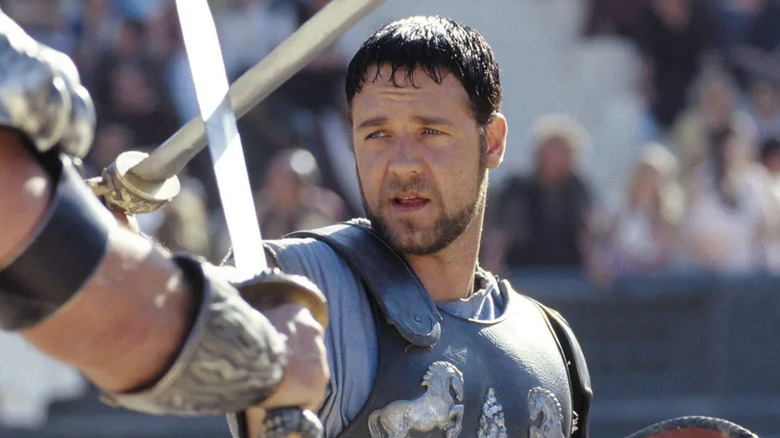
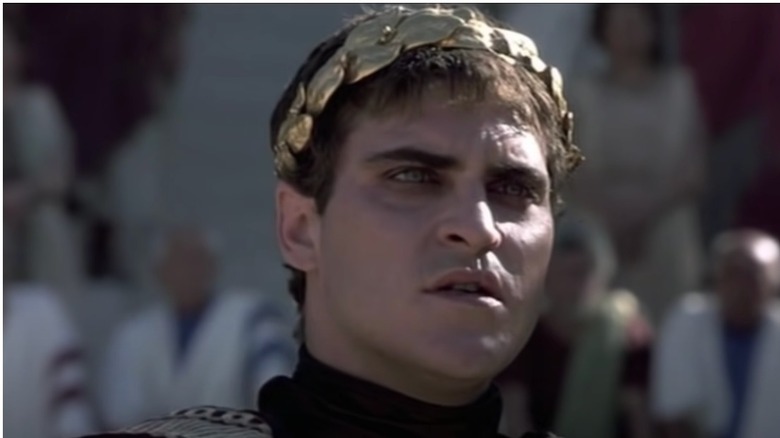
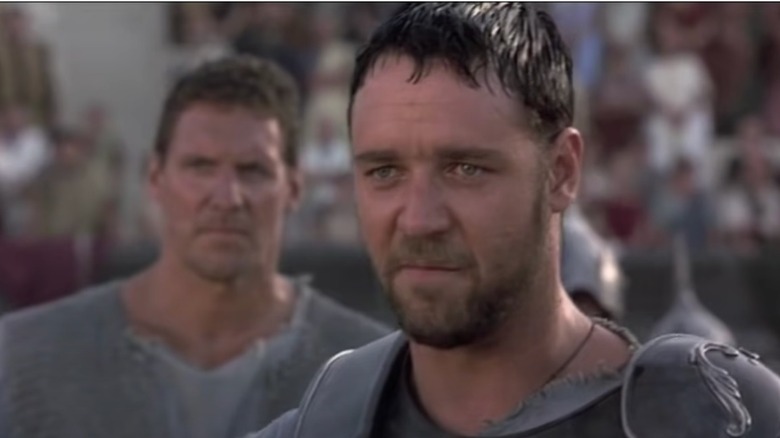
Sometimes, actors don't have the same level of affection for their movies that the fans do. "Gladiator" is what made Russell Crowe into a full-fledged movie star, winning him an Oscar for Best Actor. It was also the first of his collaborations with legendary director Ridley Scott. One of the most famous moments in the film is when Russell Crowe's Maximus, a general turned gladiator, swears revenge for his family's murder against Emperor Commodus (Joaquin Phoenix). However, according to behind-the-scenes reports, Crowe had to be corralled into even delivering the now-iconic line.

Shooting With An Incomplete Script

According to Crowe, the script for "Gladiator" was incomplete when he signed on. What convinced him to play Maximus was Scott's pitch about how the film would render ancient Rome onscreen:

"So, I went to see Ridley and he was so prepared and the things that he was showing me, the visual images and the mathematics of how he was going to not have to build an entire Coliseum yet still shoot the Coliseum. We just clicked in the first meeting."

Recalling the production of "Gladiator" in 2016, Crowe said that when they first started principal photography, the shooting script was only 21 pages long. This meant that plenty of work crafting the story had to be done on the fly. The crew took to mixing and matching elements from different drafts, and shooting was even halted one day so that Crowe, Scott, and producer/writer David Franzoni could plot out where the story would go next. A monologue where Maximus explains to Emperor Marcus Aurelius (Richard Harris) his desire to return home to Spain was written by Crowe himself, who drew on his own feelings of homesickness during the shoot.

Crowe credits Scott's direction with not only seeing the film completed, but with turning a mess of a production into a Best Picture winner:

"If you have a really responsible director like Ridley, who is never gonna go crazy with the costs of stuff, he's always gonna be responsible for the dollars he's spending, it's not actually that bad a way to do it."

Despite Crowe's retrospective praise, the actor and his director didn't agree on everything during the shoot itself.

The Moment In Question

"My name is Maximus Decimus Meridius, commander of the Armies of the North, General of the Felix Legions, and loyal servant to the true emperor, Marcus Aurelius. Father to a murdered son, husband to a murdered wife. And I will have my vengeance, in this life or the next."

This vow that Maximus makes to Commodus is one of the most quoted pieces of dialogue from "Gladiator." However, the man who originally delivered these words is not among its fans. Crowe did not like the line as written, feeling it was overwrought, and insisted it be changed while refusing to say it. After multiple takes, he was convinced to deliver it as written. An unnamed Dreamworks executive ascribes Scott's peacemaker attitude as the reason Crowe relented: 

"At first he absolutely refused to say it. He did a lot of posturing and put the fear of God into some people. Thankfully, Ridley never yelled. He was the voice of reason dealing with many unreasonable factors, not the least of which was his lead."

While Crowe gave into delivering the line, that doesn't mean his feelings softened. After the scene wrapped, Crowe remarked to Scott, "It was s***, but I'm the greatest actor in the world and I can make even s*** sound good." Considering Crowe won Best Actor for the part of Maximus, he might've had a point with this boast.

Read this next: Every Ridley Scott Movie Ranked From Worst To Best

The post There Was a Behind-the-Scenes Feud Over Gladiator's Most Famous Line appeared first on /Film.

01 Apr 15:43

Video of the Ukrainian military just kicking a bunch of landmines off a road [Scary]

01 Apr 15:43

‘Star Trek: The Motion Picture - The Director’s Edition’ makes its glorious return

by Daniel Cooper

If there was ever a Star Trek film that needed a do-over, both artistically and reputationally, it was The Motion Picture. Dismissed by critics as boring and sterile when it came out, its nickname inside Trek fandom has long been “The Motionless Picture.” In 1997, director Robert Wise started the process of re-examining the film, with a Director’s Edition being birthed at the dawn of the DVD era in 2001. For a couple of reasons, the altogether better version of that movie fell into obscurity, unavailable for most people to see. Now, twenty years after Wise’s amended film made its debut, the film has been given a second do-over in the form of a 4K remaster for Paramount+.

The Abandoned Picture

You can buy a shelf’s worth of books discussing the troubled production of The Motion Picture, and its creative failures. Paramount wanted a new Star Trek TV series, until the money men balked at the cost and potential disinterest from advertisers. The pricey show got crunched into a single movie-of-the-week, right until the moment that Star Wars (and Close Encounters) swallowed 1977 whole. Bosses wanted a slice of that late ‘70s sci-fi movie pie and upgraded the Trek project to a big-budget movie. Except none of the already-made material was movie quality, and the effects house wasn’t up to the task at hand.

The Motion Picture was directed by Robert Wise, a footnote in a career that started in 1934 and ran through 2000. Wise got his big break as Orson Welles’ editor on Citizen Kane and, more controversially, The Magnificent Ambersons. He’d won enough Academy Awards that The Motion Picture wouldn’t be in the top ten of his most notable achievements. The special effects were eventually completed by the recently-departedDouglas Trumbull and John Dykstra; both could point to 2001 and Star Wars as the highlights on their own resumes. Even so, Wise was battered by the process of making it, hand-delivering the prints to the film’s premiere and declaring it to be a rushed, unfinished job.

Length was a problem for the film, a 90-minute TV pilot expanded to more than two hours, bloated with too many special effects shots. Paramount would subsequently produce an even longer cut of the film, letting ABC screen a super-sized, 143-minute TV version which included deleted and unfinished scenes. (There is a rumor, apparently tied to this forum post from 2016 (via Memory Alpha), which suggests that Wise re-cut the film in 1980 to be 12 minutes shorter, but producer David C. Fein doesn’t believe it to be true.)

The Director’s Edition

Image supplied by Paramount
Paramount

In 1997, Wise, through his company Robert Wise Productions, enlisted the help of producer David C. Fein, post-production supervisor Michael Matessino and visual effects supervisor Daren R. Dochterman to help fix the film. They examined the original storyboards, fixed some of the more egregious effects choices and tightened the editing. While the runtime was longer, a snappier edit (more or less) helped contextualize some of the choices made back when the film was shooting. It also helped to kickstart the reappraisal of the film as something more valuable than the big-budget catastrophe it was treated as.

Part of that work was to broaden the visual palette, especially in some of the key sequences which weren’t fully-realized in ‘79. The inconsistencies during Spock’s first scene – which were shot in broad daylight but painted on a matte implying darkness – are fixed. Many sets that were constrained even with matte paintings were broadened out and CGI – by pioneers Foundation Imaging – used to fill the gaps in the action. The film remained, more or less, like it had two decades prior, but was a much more joined-up experience on screen.

But this edition, while considered “definitive,” was never re-released beyond its original 2001 DVD printing. According to Memory Alpha, it’s because Paramount never kept its own archive copies of the CGI files for its projects. And when Foundation Imaging went under after the death of its founder, Ron Thornton, it was believed that those files were gone forever.

The Re-Remaster

Image of the 4K Version of the V'Ger Dock
Paramount

“Completely untrue,” said David C. Fein who produced both the first Directors Edition and its 2022 successor, to Engadget. “Everything was designed to be able to go to film, but the resolution [in those original files] wasn’t there, [...] so it couldn’t just be re-rendered,” he said. “It had to be recreated by people who knew what we were going for, because we’re now able to put the detail in for it to be full-size.” “We re-did all the visual effects, not from scratch – the setups [from 1999] were there – then we worked in all of the new levels of technology and information,” said Fein.

Fein says that the project, which was announced in July 2021, is “not a restoration,” and that his team wasn’t just “polishing this film,” but working to tweak it to improve the overall storytelling. That meant scanning the raw material and re-compositing everything to make a fresh, 4K scan off the original 35mm live-action footage. (Douglas Trumbull, to avoid detail loss, would shoot on 65mm film, and so his material was scanned in at 8K, while Dykstra’s VistaVision material was scanned in at 6K.)

The project is, if we’re being a little too honest, long overdue, since Paramount opted to offer the theatrical print of The Motion Picture for all of the Blu-ray releases. “Unfortunately, when the hi-def [versions of the Star Trek films] came out, Bob [Wise] got to watch the fact that it was the original theatrical version,” explained Fein. “And he sat me down in his kitchen and said, ‘I need you to promise me something Dave’ – ‘I don’t care how long it takes, I need you to finish the director’s edition and it needs to be finished,’ meaning film quality.” But Fein says that the lag time was down to a need for the technology to improve, and also for the “guardian angels” at Paramount+ to greenlight the work.

There are a number of small tweaks to the film, designed to smooth out even more of its visual rough edges. Keen-eyed fans will enjoy spotting the additions and changes, an early highlight is the addition of Shuttle Pod 5 to the exterior of Starfleet’s orbital office. “Just about every shot [in the film] has been touched in some way, there’s a lot of subtlety added to shots,” he said. “There’s [also] at least one clearly new shot in the film that helps continuity, and I hope no-one else notices it.”

One sequence that Fein spent lots of effort on, both then and now, was when the V’Ger probe attacks the bridge. The original film sequence was projected through a bent mylar filter with intentionally harsh lighting to create the alien effect. “The way that it looked, was almost like [our] film stopped and another one started,” he explained, looking at the washed-out colors, high grain and poor continuity. Fein credits the power of HDR which enabled his team to create a harsh overexposure of the probe without dulling the rest of the film.

And a less obvious change – unless you’re like me and watched multiple versions side-by-side – is a vastly improved color grade. Because the film was so rushed, Fein explained, the process of color grading, which can take months, was crunched down to four days. He said that the crew’s opinion, at the time, was “just ‘let’s get it done as flat [as we can] so everything matched, and [get it done] as quickly as it could.” The film’s colors are, traditionally, washed out, leaden with that ‘70s sci-fi beige that makes even the actors look like pieces of furniture. “Now that we’re working from negative scans, we’re able to do what [Robert Wise’s] real intention was.”

The final task Fein had to oversee was to ensure that The Directors Edition is no longer a rare curio. Fein explained that, having worked with the digital negatives and produced a new print designed for theatrical distribution, the film is now “future proof.” That should ensure that it never again becomes the sort of film you have to actively seek out to watch. Not to mention that Fathom events will offer a handful of screenings (in select theaters) for viewers to see the film on the big screen once again.

Give me a Good Time

I don’t want to be facetious when I say that The Motion Picture is less of a film and more of an experience. For all of the complaints that the film was slow, antiseptic and cold, it also offers something a little more heavyweight than you may expect from a franchise movie. The team behind the film may not have been making Solaris, or 2001, but those influences are keenly felt through much of the movie. It’s not dumb noisy fun, and it’s not as clever as it thinks it might be, but it’s trying to deal with some weighty issues around what it means to be human. A computer looking to understand if there’s any meaning beyond its existence is something fiction has come back to again and again – it’s always been a fascination for Star Trek, too.

Unfortunately, I didn’t get to watch the 4K transfer in all of its glory, since previews were capped at 1080p (I know). What is obvious, however, is that the new version is a whole lot brighter, with much more detailed CG models and much better sound, in most places. The new color grade makes a huge difference, with actors no longer blending into the background of their own film. There are only a few moments where the transfer seems less kind than you may expect, and that’s mostly when you go looking for matte lines. You can clearly see some of that hand-cut wonkiness in the more detail-heavy sequences, like the drydock scene.

(While we’re on the subject; the Drydock sequence is considered, by non fans, as the ne plus ultra of pointless fan service. Yes, it’s a six-minute scene in which Kirk stares, milky-eyed at the refitted Enterprise, well-known enough that even nü-Trek repeatedly tipsits hat to it. But let’s be honest, if you wanted to spend six minutes staring at a model, you might as well make it the most beautiful model ever to be created.)

And as much as it’s Wise’s name on the film, in these modern eras, I think we should also offer kudos to Trumbull and Dykstra for their contribution. The effects sequences are, for their age, some of the best ever put to film and the trippy late ‘70s sci-fi visuals during the spacewalk sequence are on a par with anything 2001 offered. I can’t not also say that, without Jerry Goldsmith’s score, one of the best ever written, much of this film wouldn’t hold together nearly as well as it does. While the finished product is not to everyone’s taste, you can tell it is the product of a number of virtuosos all working to produce their very best work.

It’s funny, because I’d say that I’ve seen this film more times than I should probably admit, especially the first 40 minutes. Something that only occurred to me during this rewatch is how Wise’s direction, and the acting, loosens up as things go on. Kirk, Spock and McCoy all start this film stiff and stagey, acting like they’re all trying to act under the effects of a sedative. But once they’ve returned to the Enterprise and you see Kirk visibly relax into his chair, Spock and McCoy start bantering, and you could almost frame this as a deliberate choice to make the film a form of origin story.

While researching this piece, I went hunting for critical reviews of the film back when it first debuted in 1979. (The best modern essay on the film, and the best modern essays on any of the Star Trek films, is Darren Franich’s 2016 retrospective, which I urge you to read.) Weirdly, Roger Ebert wrote the smartest take on the film back then, and I reckon the conclusion of his review is probably the most elegant way anyone could discuss it. He wrote, “Some of the early reviews seemed pretty blase, as if the critics didn’t allow themselves to relish the film before racing out to pigeonhole it. My inclination, as I slid down in my seat and the stereo sound surrounded me, was to relax and let the movie give me a good time. I did and it did.”

Star Trek: The Motion Picture - The Director's Edition, will be available on Paramount+ on April 5th, 2022. A physical media release will follow with new special features.

01 Apr 15:43

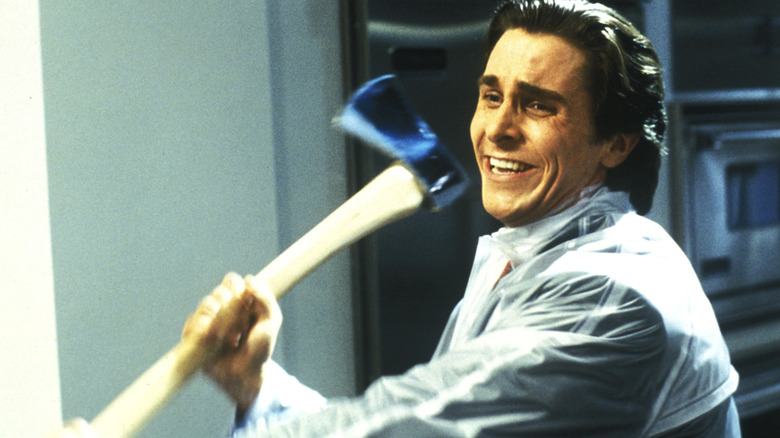
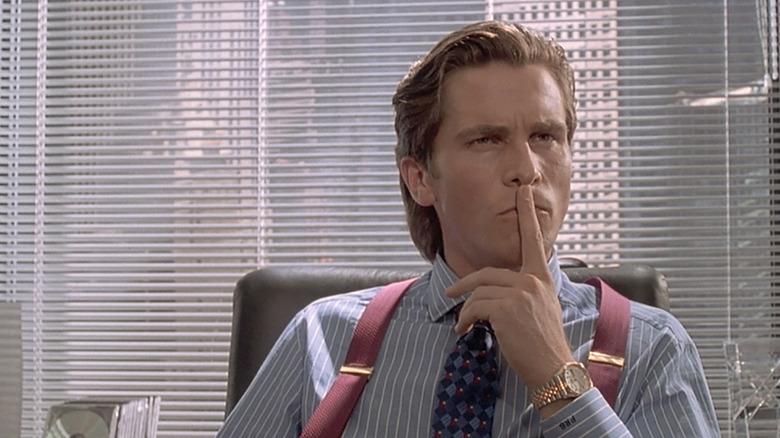
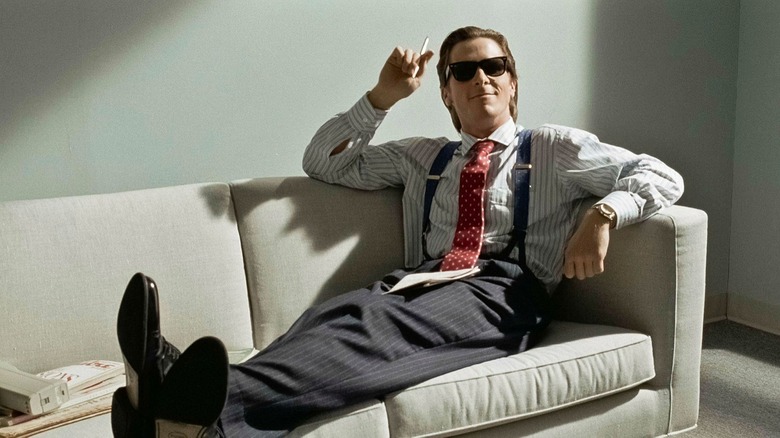
Christian Bale's American Psycho Co-Stars Thought He Sucked At Acting

by Witney Seibold

Bret Easton Ellis' novel "American Psycho" was published in 1991, serving as the final nail in the coffin for the once-flourishing toxic yuppie culture of Reagan's 1980s. The protagonist of the book, Patrick Bateman, was a soulless stock-handling wonk and occasional serial killer whose intense obsessions with wealth, status, and the empty popular culture of the '80s continually drove him to depravity and murder. Ellis based Bateman on many of the Wall Street bros he regularly encountered while living in New York throughout the previous decade. When director Mary Harron and he co-screenwriter Guinevere Turner adapted "American Psycho" to film in 2000, they presented Bateman's soulless yuppie lifestyle as a natural outcropping of shallow maleness. Bateman became just as vapid and whiny as he was monstrous and threatening. Harron and Turner saw Bateman not as an aberration with a psychological problem to be unlocked, but the logical endpoint of male vanity and aggression. 

When actor Christian Bale first read the script, according to an oral history presented by MovieMaker, he laughed throughout. He also wasn't sure of that was the appropriate response. When he told Harron his reaction, she told him it was the right one, and that they should talk in person. While the production was in flux for a while -- Oliver Stone was attached at one point, as was Leonardo DiCaprio as the star -- Harron and Bale would eventually make the film they wanted.

Harron and Bale created just the right Patrick Bateman. It wasn't until later that Bale learned that his co-stars thought he was doing a bad job. 

'Why Did Mary Fight For This Guy?'

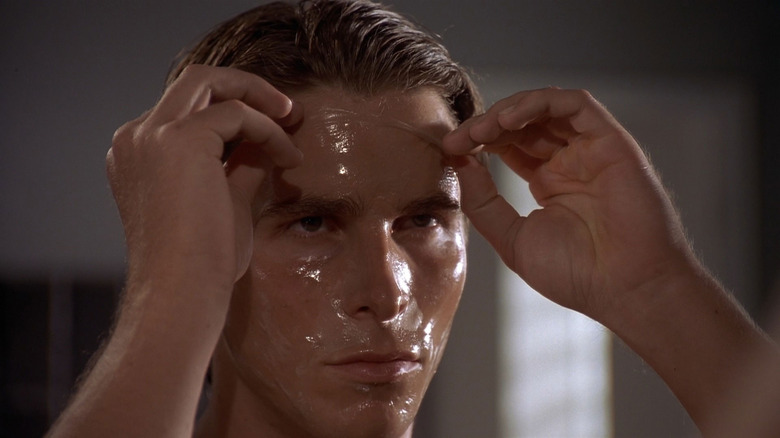
Bale fully devoted himself to the role, doing all the necessary working out and skincare routines that Patrick Bateman described in detail. Harron did not want a sympathetic character, and Bale was willing to be horrible. Unfortunately, his horribleness was seen as an acting weakness by co-stars. Bale said: 

"Josh Lucas and I did a film together recently and he opened my eyes to something that I had been unaware of. He informed me that all of the other actors thought that I was the worst actor they'd ever seen. He was telling me they kept looking at me and talking about me, saying, 'Why did Mary fight for this guy? He's terrible.' And it wasn't until he saw the film that he changed his mind. And I was in the dark completely about that critique."

Bale has said that he does not subscribe to the Stanislavski method of acting (although his "American Psycho" co-star Chloë Sevigny saw him that way), and he has admitted that he can take his devotion to certain roles a little too far. Sevigny said of working with Bale: 

"Working with Christian was pretty hard because I didn't know this whole Method thing. I was pretty fresh. I hadn't done that many films before, and that an actor would lose himself to such a degree and was so consumed by the part, I was having a hard time kind of ... just wanting to socialize with him, but feeling that he didn't, and then my ego being like, 'Does he not like me? Does he think I'm a terrible actress?'

Luckily, after filming wrapped, and Sevigny started going to film festivals with Bale, he proved to be a kind, approachable person:

"I remember as a wrap gift I gave him a 45 of 'Psycho Killer' by Talking Heads, which I thought was the greatest wrap gift, in the world, ever. But then when we went to festivals and stuff after, like Berlin and whatnot, he was very friendly then. When we were not shooting, doing press and stuff, he couldn't have been a nicer guy."

Patrick Bateman For President

The Oliver Stone version of Patrick Bateman was, according to the oral history, going to be a multiple-personality story, giving Bateman -- then the DiCaprio version -- far too much sympathy. To repeat: Harron wanted an unsympathetic a character as possible. Bale was willing to play a monstrous man, not something all actors are necessarily willing to do. As the actor explained, he and Harron were copasetic on Bateman's lack of psychological background: 

"I think the thing that united us on it is I had no interest in his background, childhood -- and she didn't either. We looked at him as an alien who landed in the unabashedly capitalist New York of the '80s, and looked around and said, 'How do I perform like a successful male in this world?' And that was our beginning point. And we didn't want to talk about why was he this way, what happened in his childhood -- there was none of that between Mary and I."

"American Psycho" recently passed its 20th anniversary -- it was released on April 14th of 2000 -- and it's easy to look back at the film and see Donald Trump. Trump is name-checked in "American Psycho," and he was held up as an aspirational figure for horrid yuppies throughout the '80s. Trump's brazenly pro-ignorance, me-only philosophy was a central part of the ultra-male outcropping mentioned above. Bale certainly saw Tom Cruise in Bateman, but also Trump:

"I mean, look, if someone had landed at that time and he was looking around for cultural alpha males, business-world alpha males, et cetera, than Tom Cruise certainly would have been one of those that he would have looked at and aspired to be and attempted to emulate. And he's still a leading man now. So yeah, I had pictures of him inside the trailer, as I did other people, and '80s models that Bateman probably would have looked at and tried to imitate. And certainly that megawatt smile with the perfect teeth.

"Likewise, Donald Trump would have been somebody he would have looked at and said, 'Ah, right. I need to have a little bit of that as well.' ... If Bateman were around today he'd probably be inspired to run for president.

A chilling thought indeed.

Read this next: The 14 Best Noir Movies Ranked

The post Christian Bale's American Psycho Co-Stars Thought He Sucked at Acting appeared first on /Film.

01 Apr 15:41

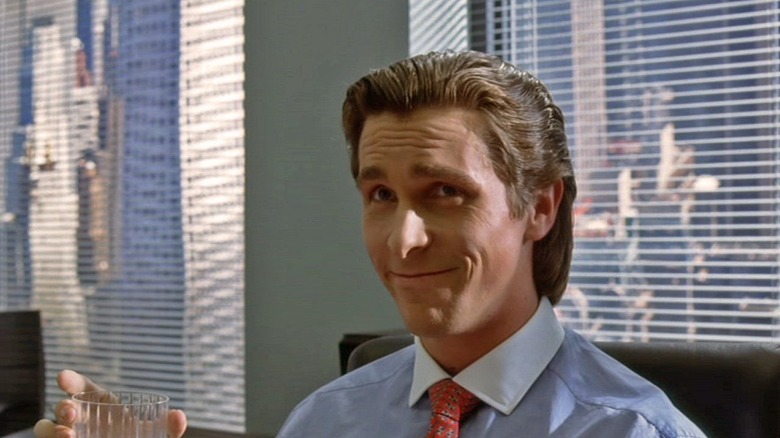
How Christian Bale's American Psycho Performance Was Influenced By Tom Cruise

by BJ Colangelo

Now that it's been two whole decades since its release, it feels safe to say that Mary Harron's "American Psycho" is a bona fide horror classic. Based on the gripping Bret Easton Ellis novel of the same name, Harron and co-screenwriter Guinevere Turner created a biting critique of corporate America and breathed new life into Ellis' satirical examination of toxic masculinity before we had a word for it. "American Psycho" tells the story of Patrick Bateman, a handsome, young, white-collar professional in 1987 New York City. By day, Bateman seems like a standard narcissistic greed-hound, but by night, he's a serial killer building up a hefty body count. His fiance (Reese Witherspoon) is none the wiser, but after killing his coworker Paul Allen (Jared Leto), a detective (Willem Dafoe) starts inching closer to Bateman's extra-curricular activities, causing his grasp on his double life to slip.

Christian Bale's performance as Patrick Bateman is considered one of the best, but he wasn't the original choice for the iconic role. Producer Edward R. Pressman bought the film rights to the novel in 1992, with Johnny Depp eyed for the lead role and "Re-Animator" director Stuart Gordon at the top of the list. The project went through a variety of hands, with Lionsgate pursuing Edward Norton, Ewan McGregor, and Leonardo DiCaprio for the lead. Harron, however, fought for Christian Bale, who turned down roles in the hopes that he would soon be playing the character. Fortunately, it all paid off, and Bale's performance helped catapult him into Hollywood superstardom. That performance, however, wouldn't have been the same if it wasn't for an unlikely hero ... Tom Cruise

'Intense Friendliness With Nothing Behind The Eyes'

Christian Bale's performance as Patrick Bateman is especially haunting, considering how realistic it seems to so many people we witness in real life. In an interview regarding the film's 20th anniversary, Mary Harron confessed that one of the biggest inspirations for Bale's performance was Tom Cruise himself, not Cruise's portrayal of a specific movie character. Harron had challenged Bale to think of Bateman like an alien studying human nature, which inspired him to study the energy of Tom Cruise. Specifically, Tom Cruise during a 1999 interview on "Late Night with David Letterman." If you look up the interview on YouTube, the first result is labeled "Tom Cruise goes crazy live on Letterman," so Bale was seemingly not alone in his assessment of this particular moment. Bale described his energy as "a very intense friendliness with nothing behind the eyes."

Tom Cruise is one of those actors who exists in the constant state of "movie star," even when off set, which makes for a perfect inspiration for someone like Patrick Bateman who thrives off of his ability to convince those around him that he's the right guy for any circumstance. In order for Bateman to ward off suspicion of his true nature, he must constantly be playing the long game, presenting a charming demeanor as a cover for the rage within. Tom Cruise is obviously not secretly a serial killer, but given his heavily curated public persona, he's the kind of guy Patrick Bateman could totally pick up some pointers from.

Miles Fisher Marries The Worlds Of Tom Cruise And Patrick Bateman

Ironically enough, musician and actor Miles Fisher is proof positive that Tom Cruise and Patrick Bateman are two sides of the same coin. The "Final Destination 5" star has gone viral on multiple occasions for his videos imitating Tom Cruise, in particular, "Tom Cruise: 2020 Presidential Announcement." Fisher first parodied the actor in the 2008 "Superhero Movie," but has continued his impersonations of the movie star well into 2022. The year following "Superhero Movie," Fisher released a music video for his cover of The Talking Heads' "This Must Be The Place," but as a recreation of "American Psycho." All of Bateman's most memorable moments are on display, with Fisher impersonating the performance with uncanny accuracy. Watching the two videos back to back is genuinely uncomfortable, because while the characters of Tom Cruise and Patrick Bateman are obviously very different, there's still an unsettling level of similarity that now has us dying for a Tom Cruise horror movie.

Read this next: The 15 Best Horror TV Shows Of All Time

The post How Christian Bale's American Psycho Performance Was Influenced By Tom Cruise appeared first on /Film.

01 Apr 02:44

The Bubble Review: This Talent-Stuffed Comedy May Meander But It'll Still Make You Laugh

by Vanessa Armstrong

It was only a matter of time before someone made a comedy that centers around the hellish experience of living in a world shut down by COVID-19. Judd Apatow is that someone, and being "the first" is a moniker he knowingly took on when he went about making "The Bubble." The film — an ensemble feature whose premise rests on the challenges of shooting an aggressively bad action movie in the middle of a pandemic — succeeds in being funny. 

It's also very self-aware of its premise, and at times seems almost embarrassed about it, as if Apatow feels a bit weird about co-writing and directing a comedy centered around a virus that has scarred all our lives. You can feel the undercurrent of Apatow's angst as the events of the film unfold, with certain scenes seeming to come from a headspace of panic, desperation, and fear — a state that many of us were in during the Spring of 2020.

That doesn't mean, however, that the movie isn't fun to watch, though your mileage may vary depending on how you're dealing with everything that has happened (and is still happening) over the last two years.

Are You Emotionally Ready For Nasal Swab Jokes?

Apatow's inspiration for "The Bubble" came from the early days of lockdown, when sports teams and films like "Jurassic World: Dominion" created enclosed spaces (i.e., bubbles) in order to continue bringing entertainment to the masses (or perhaps more accurately — as "The Bubble" touches on — to allow the rich to continue to become richer). In the movie, a group of actors heads to a fancy British hotel in the countryside to film "Cliff Beasts 6," the latest movie in a very silly fake franchise, which is also a clear riff on the "Jurassic World" films.

These fake "Cliff Beasts" cast members — played by Karen Gillan, Leslie Mann, Iris Apatow, David Duchovny, Keegan-Michael Key, Pedro Pascal, and Guz Khan — are all ridiculous individuals that play up typical actor stereotypes to comedic effect. Key, for example, started a health-centered cult during his pandemic downtime, while Duchovny's character is one of those actors who always want to "tweak" the script because he thinks he knows best. In a nod to our times, the sixth "Cliff Beasts" movie also adds TikTok star Krystal Kris (Iris Apatow) to the production, which also means your eyeballs will see more than one TikTok-esque dance during the film.

The good news is the "Cliff Beasts" actors keep the comedy coming, none more so than Pascal, who was the funniest of the bunch. (Did we know Pascal was so funny? I didn't before "The Bubble," and gaining this knowledge alone made the film worth a watch.)

Cameos, Cameos, Everywhere

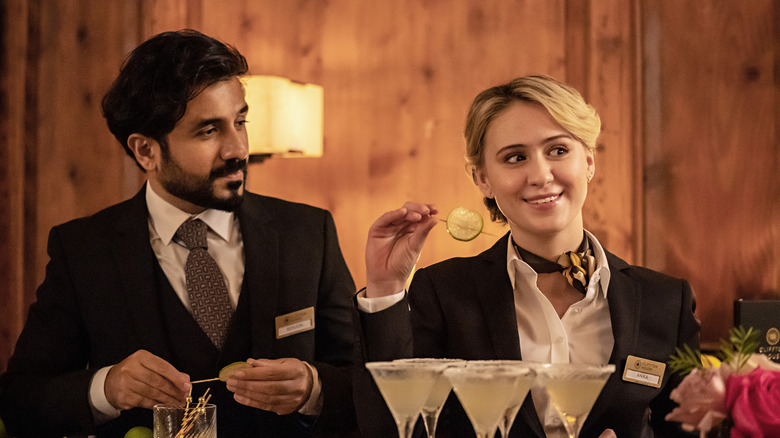
There's amazing talent outside the core fake cast as well. Fred Armisen is there as the "Cliff Beasts 6" director, and Peter Serafinowicz plays the producer trying to keep everything from becoming a complete disaster. Add into the mix the two virus safety folks (Samson Kayo and Harry Trevaldwyn), the hotel staff (Maria Bakalova and Vir Das), and things are downright crowded in the "Cliff Beasts" comedic bubble.

And if that wasn't enough (reader, it was enough), the movie is also crammed with cameos of legendary talents, a fun thing to see but perhaps a detriment from an editing standpoint. I'm sympathetic here — I mean, who wouldn't want to include that completely unnecessary (and not super funny) Zoom call scene with John Lithgow, after all? That's not to say that none of these cameos add to the story — James McAvoy has a moment with Gillan near the end, for example, that had me in tears. But with a 124-minute runtime, even the most impressive cameos start to wear thin. The plot also steers into absurd territory near the end in a way that is jarringly graphic, though the story more or less gets back on track and meanders toward an end. 

Despite these issues, however, "The Bubble" succeeds in what it set out to be — a movie that gives us some laughs during these distressing times. And I was ready to laugh. It's a nice change, after all, from crying.

/Film Rating: 6 out of 10

Read this next: 20 Underrated Comedy Movies You Need To Watch

The post The Bubble Review: This Talent-Stuffed Comedy May Meander But It'll Still Make You Laugh appeared first on /Film.

01 Apr 02:43

Chrome's 'Topics' Advertising System Is Here, Whether You Want It Or Not

by BeauHD
slack_justyb writes: After the failure of the Chrome user-tracking system that was called FLoC, Google's latest try at topic tracking to replace the 3rd party cookie (that Chrome is the only browser to still support) is FLEDGE and the most recent drop of Canary has this on full display for users and privacy advocates to dive deeper into. This recent release shows Google's hand that it views user tracking as a mandatory part of internet usage, especially given this system's eye-rolling name of "Privacy Sandbox" and the tightness in the coupling of this new API to the browser directly. The new API will allow the browser itself to build what it believes to be things that you are interested in, based on broad topics that Google creates. New topics and methods for how you are placed into those topics will be added to the browser's database and indexing software via updates from Google. The main point to take away here though is that the topic database is built using your CPU's time. At this time, opting out of the browser building this interest database is possible thus saving you a few cycles from being used for that purpose. In the future there may not be a way to stop the browser from using cycles to build the database; the only means may be to just constantly remove all interest from your personal database. At this time there doesn't seem to be any way to completely turn off the underlying API. A website that expects this API will always succeed in "some sort of response" so long as you are using Chrome. The response may be that you are interested in nothing, but a response none-the-less. Of course, sending a response of "interested in nothing" would more than likely require someone constantly, and timely, clearing out the interest database, especially if at some later time the option to turn off the building of the database is removed. With 82% of Google's empire based on ad revenue, this latest development in Chrome shows that Google is not keen on any moves to threaten their main money maker. Google continues to argue that it is mandatory that it builds a user tracking and advertising system into Chrome, and the company says it won't block third-party cookies until it accomplishes that -- no matter what the final solution may ultimately be. The upshot, if it can be called that, of the FLEDGE API over FLoC, is that abuse of FLEDGE looks to yield less valuable results. And attempting to use the API alone to pick out an individual user via fingerprinting or other methods employed elsewhere seems to be rather difficult to do. But only time will tell if that remains true or just Google idealizing this new API. As for the current timeline, here's what the company had to say in the latest Chromium Blog post: "Starting today, developers can begin testing globally the Topics, FLEDGE, and Attribution Reporting APIs in the Canary version of Chrome. We'll progress to a limited number of Chrome Beta users as soon as possible. Once things are working smoothly in Beta, we'll make API testing available in the stable version of Chrome to expand testing to more Chrome users."

Read more of this story at Slashdot.

31 Mar 23:41

Fake Emergency Search Warrants Draw Scrutiny from Capitol Hill

by BrianKrebs

On Tuesday, KrebsOnSecurity warned that hackers increasingly are using compromised government and police department email accounts to obtain sensitive customer data from mobile providers, ISPs and social media companies. Today, one of the U.S. Senate’s most tech-savvy lawmakers said he was troubled by the report and is now asking technology companies and federal agencies for information about the frequency of such schemes.

At issue are forged “emergency data requests,” (EDRs) sent through hacked police or government agency email accounts. Tech companies usually require a search warrant or subpoena before providing customer or user data, but any police jurisdiction can use an EDR to request immediate access to data without a warrant, provided the law enforcement entity attests that the request is related to an urgent matter of life and death.

As Tuesday’s story showed, hackers have figured out there is no quick and easy way for a company that receives one of these EDRs to know whether it is legitimate. After all, there are roughly 18,000 distinct police organizations in the United States alone, and many thousands of government and police agencies worldwide.

Criminal hackers exploiting that ambiguity are enjoying remarkable success rates gaining access to the data they’re after, and some are now selling EDRs as a service to other crooks online.

This week’s piece included confirmation from social media platform Discord about a fraudulent EDR they recently processed. On Wednesday, Bloomberg published a story confirming that both Apple and Meta/Facebook have recently complied with fake EDRs.

Today, KrebsOnSecurity heard from Sen. Ron Wyden (D-Ore.), who said he was moved to action after reading this week’s coverage.

“Recent news reports have revealed an enormous threat to Americans’ safety and national security,” Wyden said in a statement provided to KrebsOnSecurity. “I’m particularly troubled by the prospect that forged emergency orders may be coming from compromised foreign law enforcement agencies, and then used to target vulnerable individuals.”

“I’m requesting information from tech companies and multiple federal agencies to learn more about how emergency data requests are being abused by hackers,” Wyden’s statement continues. “No one wants tech companies to refuse legitimate emergency requests when someone’s safety is at stake, but the current system has clear weaknesses that need to be addressed. Fraudulent government requests are a significant concern, which is why I’ve already authored legislation to stamp out forged warrants and subpoenas.”

Tuesday’s story showed how fraudulently obtained EDRs were a tool used by members of LAPSUS$, the data extortion group that recently hacked Microsoft, NVIDIA, Okta and Samsung. And it tracked the activities of a teenage hacker from the United Kingdom who was reportedly arrested multiple times for sending fake EDRs.

That was in March 2021, but there are similar fake EDR services on offer today. One example can be found on Telegram, wherein a member who favors the handle “Bug” has for the past month been selling access to various police and government email accounts.

All of the access Bug is currently offering was allegedly stolen from non-U.S. police and government email accounts, including a police department in India; a government ministry of the United Arab Emirates; the Brazilian Secretariat of Education; and Saudi Arabia’s Ministry of Education.

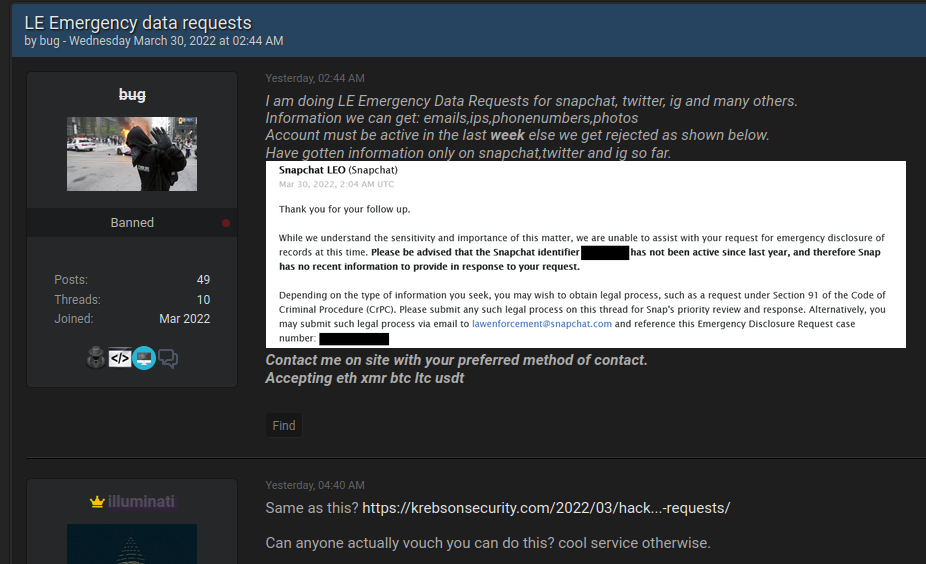
On Mar. 30, Bug posted a sales thread to the cybercrime forum Breached[.]co saying he could be hired to perform fake EDRs on targets at will, provided the account was recently active.

“I am doing LE Emergency Data Requests for snapchat, twitter, ig [Instagram] and many others,” Bug wrote. “Information we can get: emails, IPs, phone numbers, photos. Account must be active in the last week else we get rejected as shown below. Have gotten information only on Snapchat, Twitter and IG so far.”

An individual using the nickname “Bug” has been selling access to government and police email accounts for more than a month. Bug posted this sales thread on Wednesday.

KrebsOnSecurity sought comment from Instagram, Snapchat, and Twitter. This post will be updated in the event they respond.

The current scourge of fraudulent EDRs illustrates the dangers of relying solely on email to process legal requests for privileged subscriber data. In July 2021, Sen. Wyden and others introduced new legislation to combat the growing use of counterfeit court orders by scammers and criminals. The bill calls for funding for state and tribal courts to adopt widely available digital signature technology that meets standards developed by the National Institute of Standards and Technology.

“Forged court orders, usually involving copy-and-pasted signatures of judges, have been used to authorize illegal wiretaps and fraudulently take down legitimate reviews and websites by those seeking to conceal negative information and past crimes,” the lawmakers said in a statement introducing their bill.

The Digital Authenticity for Court Orders Act would require federal, state and tribal courts to use a digital signature for orders authorizing surveillance, domain seizures and removal of online content.

31 Mar 23:24

Proposal To Sanction Russian Cybersecurity Firm Over Ukraine Invasion Splits Biden Administration

by msmash
The Biden administration is divided over whether to impose sanctions on Kaspersky Lab, a Russian cybersecurity giant that officials warn could be used by the Kremlin as a surveillance tool against its customers, The Wall Street Journal reported Thursday, citing people familiar with the matter. From the report: The White House's National Security Council has pressed the Treasury Department to ready the sanctions as part of the broad Western campaign to punish Russia for its invasion of Ukraine, according to officials familiar with the matter. While Treasury officials have been working to prepare the package, sanctions experts within the department have raised concerns over the size and scope of such a move. The company's software is used by hundreds of millions of customers across the world, making it difficult to enforce the sanctions. In addition, some officials in the U.S. and Europe fear sanctioning Kaspersky Lab will increase the likelihood of triggering a cyberattack against the West by Moscow, even potentially leveraging the software itself. It wasn't clear whether the sanctions would go forward, and one official said the idea had been put on hold for now. The debate reflects how agencies within the Biden administration are weighing in real time options to deliver more economic pain to the Russian economy in response to its invasion of Ukraine.

Read more of this story at Slashdot.

31 Mar 21:34

'We Study Virus Evolution. Here's Where We Think the Coronavirus Is Going.'

by msmash
Sarah Cobey, who studies the interaction of immunity, virus evolution and transmission at the University of Chicago, Jesse Bloom and Tyler Starr, both of whom study virus evolution at Fred Hutchinson Cancer Research Center in Seattle, writing for The New York Times: It's impossible to say whether future variants will have more big Omicron-like jumps or more typical stepwise changes, but we are confident SARS-CoV-2 will continue to evolve to escape immunity. While transmissibility of viruses does plateau at a certain point, other human viruses that escape immunity keep doing so. The influenza vaccine has been updated annually for decades to chase viral evolution, and some influenza viruses show no sign of slowing down. Immune escape is an endless evolutionary arms race, because the immune system can always make new antibodies and the virus has a vast set of mutations to explore in response. For instance, Omicron has just a tiny fraction of the many mutations that have been observed in SARS-CoV-2 or related bat viruses, which are in turn just a small fraction of what lab experiments suggest the virus could potentially explore. Taking all this together, we expect SARS-CoV-2 will continue to cause new epidemics, but they will increasingly be driven by the ability to skirt the immune system. In this sense, the future may look something like the seasonal flu, where new variants cause waves of cases each year. If this happens, which we expect it will, vaccines may need to be updated regularly similar to the flu vaccines unless we develop broader variant-proof vaccines. And of course, how much all this matters for public health depends on how sick the virus makes us. That is the hardest prediction to make, because evolution selects for viruses that spread well, and whether that makes disease severity go up or down is mostly a matter of luck. But we do know that immunity reduces disease severity even when it doesn't fully block infections and spread, and immunity gained from vaccination and prior infections has helped blunt the impact of the Omicron wave in many countries. Updated or improved vaccines and other measures that slow transmission remain our best strategies for handling an uncertain evolutionary future.

Read more of this story at Slashdot.

31 Mar 21:30

Half-Life Decay: Solo Mission Demo

by Blue
Steam now offers a playable demo for Half-Life Decay: Solo Mission (thanks Frans). This is a modification, and it requires the original Half-Life to play. This features single-player gameplay based...
31 Mar 21:25

Russian troops digging trenches in Chernobyl suffer radiation sickness

by Jason Weisberger

The world was shocked when Russian troops laid siege to Chernobyl on their way to Kyiv. Predictably the Russian occupying force in Chernobyl has poisoned itself. The world hopes they do not poison others or cause further damage to the site. — Read the rest

31 Mar 21:23

In the Shadow of the Star Wars Kid

by Andy Baio

Last August, I entered a loft in downtown Portland, walked through a door, and met someone I’ve wanted to talk to for the last 20 years: Ghyslain Raza, the unwilling subject of the “Star Wars Kid” meme, the biggest viral video of the pre-YouTube era.

Since the video and its remixes exploded online in 2003, Ghyslain has refused all interview requests, except for the 10th anniversary of the video’s release in 2013 for an interview with a French-Canadian journalist for L’actualité magazine, which was translated into English for partner magazine Maclean’s.

But over the last couple years, he’s quietly worked with a group of documentary filmmakers to tell his story for the first time, in his own words. The full-length film was released today in French and English, as you’d expect from Quebec-based filmmakers. In English, it’s being released as Star Wars Kid: The Rise of the Digital Shadows, but I’m partial to the French title, Dans l’ombre du Star Wars Kid, which translates to “In the Shadow of the Star Wars Kid.” It feels much more fitting to the story they told.

It’s now available for streaming free from the National Film Board of Canada’s site, and I highly recommend watching it. I was lucky enough to get an advance screener and it’s a powerful film expertly told. Update: After a short window, the documentary can now only be viewed in Canada. No word on when it’ll be available elsewhere.

Making the Documentary

In February 2021, the documentary’s director, Mathieu Fournier, reached out to see if I’d speak to them about my role in the video’s initial spread and the fundraiser we held for him, my ultimately-futile attempt to shift the narrative to a positive light.

I’ve declined every interview request about this subject since 2003, but was surprised to hear that Ghyslain himself was deeply involved in the production, so I immediately agreed to participate.

The production team came to Portland for the filming, where I was interviewed for a couple hours by the filmmakers. Then, Ghyslain and I sat down for a long one-on-one conversation on camera about everything that happened 20 years ago, the impact it had on his life, and how he looks back on it now.

I’ve never talked about it publicly, but I regret ever posting it. From the start, it was obvious it was never meant to be seen, and mirroring it on my site without consent was wrong in a way that I couldn’t see when I was in my 20s, one year into blogging. I removed the videos once it was clear how it was affecting him, but I never should have posted them in the first place.

Meeting Ghyslain gave me the opportunity to tell him all of that in person, as well as in my interviews, some of which made it into the finished film.

As a side note, it was fascinating to get answers to questions I’ve wondered about for 20 years. Yes, Ghyslain actually received the iPod we sent him from the fundraiser, and used the gift cards we sent him to buy an iMac G4, both of which he kept to this day. He managed to avoid most of the remixes and media coverage, except for Arrested Development, which he watched live as it aired.

But more than anything, it was great to finally talk to him in person and see that he’s doing well. By all accounts, he handled everything that happened back then with a profound emotional maturity, despite how painful it was, and emerged on the other side with a uniquely interesting perspective that’s worth listening to.

Afterwards

After the documentary taping, we all met up for drinks on the roof deck at Revolution Hall, where we hold XOXO every year, and then went out for dinner and more drinks until late at night.

This time, Ghyslain and I were able to talk privately off camera, about our lives and families, about the Commodore 64 and typography, finding natural common ground. When he was younger, he was really into computers, but for obvious reasons, Ghyslain spent much of his life offline after 2003.

Like so many others, I saw my geeky teenage self when first watching the Star Wars Kid video, and sitting across from this 34-year-old man, I saw a parallel-world version of myself in my 30s. I first fell in love with the internet at age 15, the age Ghyslain was when he made the video.

That night, I couldn’t help but wonder how his life would have changed if it never happened. I was surprised to see that in the final film, there’s a moment where Ghyslain talks about our meeting, and wonders exactly the same thing. I hope you take the time to watch it.

Thanks to Ghyslain for his generosity and empathy, and thanks to the filmmakers for making this meeting possible: something I’ve quietly hoped would happen for 20 years.

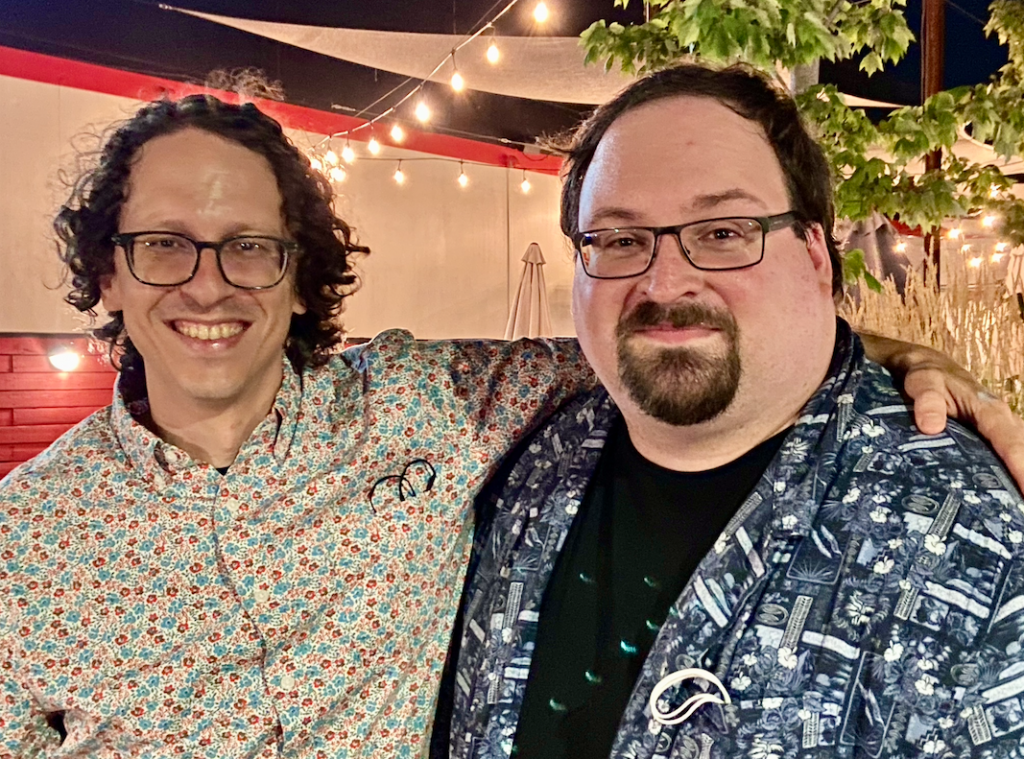
Me and Ghyslain, August 2021
31 Mar 21:21

NASA Says Russia is Still 'Moving Toward' Extending the Space Station Through 2030

by msmash
Despite the United States and Russia's deteriorating relationship here on Earth, Russia is still considering extending its participation on the International Space Station through 2030, according to NASA. However, it could be a few months before there is a solid update on Russia's official stance. From a report: NASA and Russia's state space corporation, Roscosmos, have been the two largest partners on the International Space Station for the last three decades. The two organizations have agreed to work together on the ISS through 2024, but at the end of last year, the Biden administration announced its intentions to extend the space station program through 2030. Russia has not formally agreed to the extension yet. Roscosmos's participation in the extension started to seem unlikely after Russia invaded Ukraine in February. In response to the war, the United States sanctioned Russia's major industries, which triggered outrage from the head of Roscosmos, Dmitry Rogozin. On Twitter, Rogozin made wild threats about the future of the ISS, insinuating that the station could come crashing down on the United States if Russia withdrew prematurely from the program. He has also hinted at revisiting the partnership with the US in light of the sanctions.

Read more of this story at Slashdot.

31 Mar 21:17

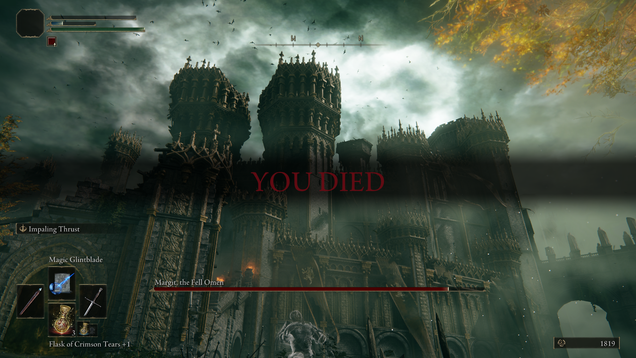
Use This Mod to Restore 'Elden Ring' Progress Whenever You Want

by Jake Peterson

Elden Ring is a massive game. You can spend hours exploring the map, engaging with enemies, and progressing through the storyline, all without giving a second thought to your save file. After all, Steam automatically backs up your save files to the cloud. What could go wrong? Unfortunately, a lot. Save file…

Read more...

31 Mar 21:15

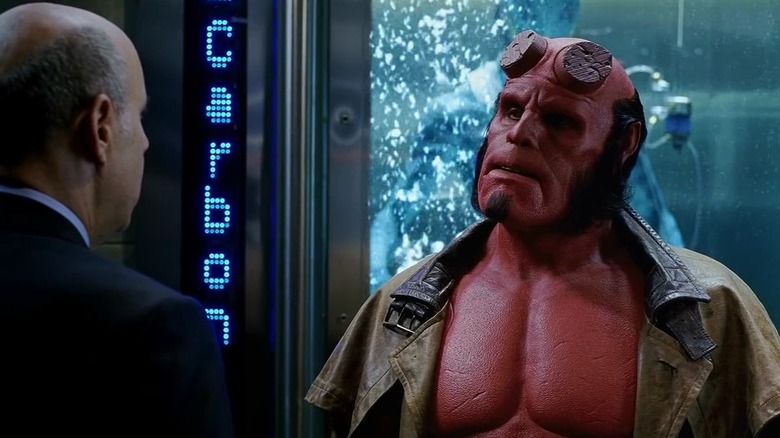
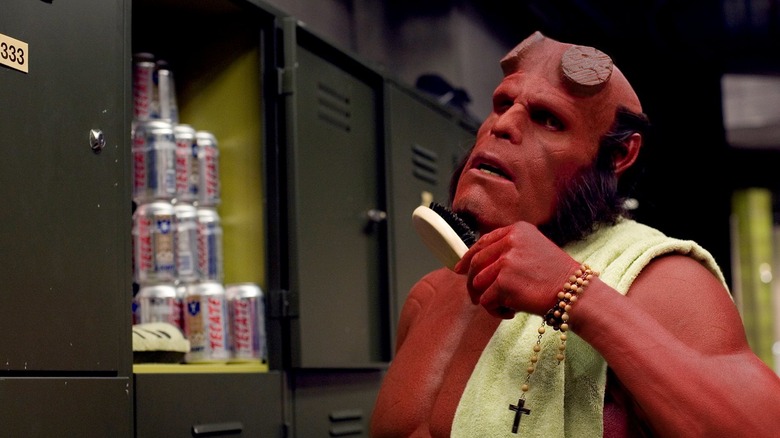
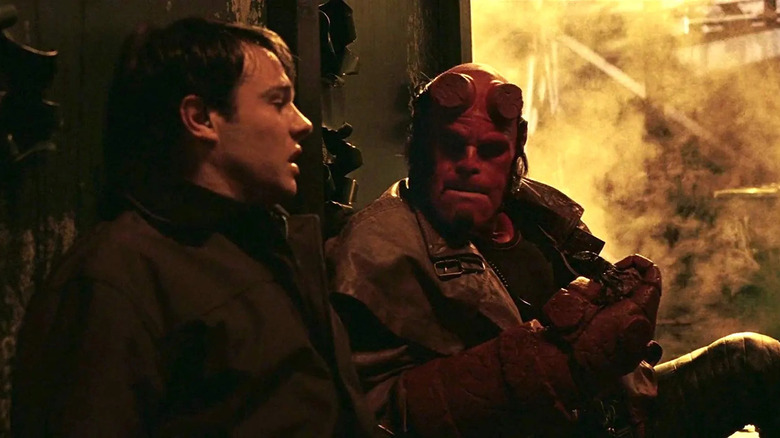
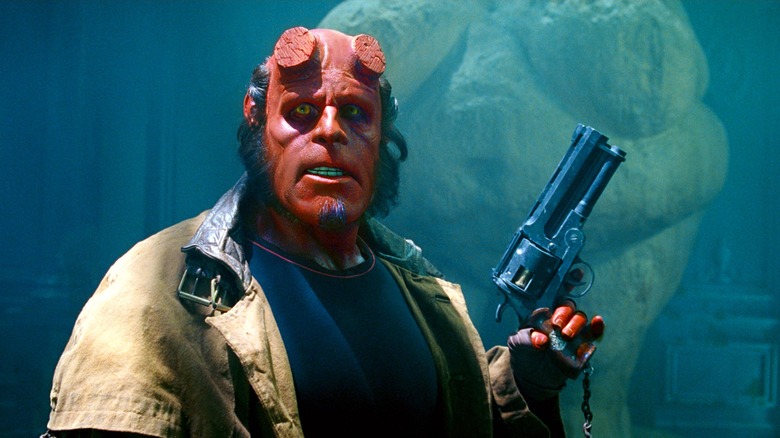
Ron Perlman's Hellboy Casting Was A Years-Long Battle Behind The Scenes

by Steven Ward

Some of the greatest behind-the-scenes battles between directors and studios are waged over casting decisions. Particularly when it comes to leading roles. One such director was Guillermo del Toro, the monster movie master who gave the world two films based on Mike Mignola's comic "Hellboy." But those films did not come without some serious determination on the director's part. Not only was he facing a growing stigma towards comic book movies in the early 2000s, but he also faced stone-walling by studio heads on his choice to play Big Red.

To think there was a time when Ron Perlman and Hellboy were near antonyms feels sacrilege. Even though both director and Mignola agreed there was no one more fit to play the part, they couldn't get anyone else to agree — or at least not anyone with enough money to fund the project. Here's another timeless Hollywood anecdote though: the actor that the studio thought wasn't "right" for a leading role ends up being perfect. Perlman himself has had plenty of moments in his career when he's defied expectations, and the long road that both he and del Toro had to walk in order for him to play Hellboy was one of them.

Why Guillermo Del Toro Thought Perlman Was Perfect

Making the intimidating, dare we say monstrous, relatable is something of a running theme in del Toro's films. As Hellboy, the gruff but humanizing sarcasm that Perlman exudes naturally couldn't find a more fitting role. In 2004, the director explained in an interview with "Today" his carefully envisioned look for the character:

"Hellboy is the guy that walks in with his box of tools and says, 'Where's the leak?' He's a working stiff. He's a plumber, the guy who says, 'I'm here to fix your monster problem."

It's almost eerie how accurate Perlman as Hellboy fits this description. In both the first film and "Hellboy II: The Golden Army," the half-demon destined to bring about Ragnarok moves about town like the Ghostbusters, hunting down all the things that go bump in the night. Except, instead of proton-packs, Hellboy is packing a colossal four-round revolver named the "Good Samaritan." 

Comic creator Mike Mignola also had plenty to say about why Perlman was always the right man to bring his character to life.

"What Ron has, what Ron brought to it that was so important, is that Joe Average, working stiff thing. He already had the attitude of the character, a guy who never really got the red-carpet treatment."

Perlman has rarely been given the leading-man treatment. His first was in 1995 with "The City of Lost Children," and it wasn't until "Hellboy," nearly 10-years later, that the actor would be given another shot.

A Long-Time Promise

Perlman once gave an enlightening and characteristically candid Q&A with IndieLondon about his experience becoming Hellboy. When asked about the first time he came across the character or comic, the actor recalled a providential nighttime walk with del Toro. The following anecdote sounds like something out of a movie, but in reality, it's because of it a movie was ever made. Perlman recollected:

"Guillermo introduced me to the comic book that very night, which was eight years ago. He took me to a comic book store and said 'Hellboy – Ron, Ron – Hellboy, at some point you guys are going to be one and the same.' He said, 'I'm going to buy you a comic book,' and I said, 'Please don't.' I avoided Hellboy for all that time because I didn't want to become emotionally involved with a character that I didn't think I would be playing, because I really didn't think I was going to [play] him. To this day, I still think 'did that really happen?' But I'm not gilding the lily, I truly thought it was impossible, and I refused to address myself emotionally."

I can just imagine del Toro waving a "Hellboy" comic in Perlman's face while people exiting the store do double-takes at them. We understand the actor not wanting to get his hopes up, especially given how smitten he was with the character from the start. Obviously, the director kept his promise, but like any good story, Perlman revealed there was a small tragedy mixed up in the triumph of him officially nabbing the role. Perlman explained what happened on the day he found out someone was willing to pay for a "Hellboy" with him in the lead:

"The day [del Toro] told me that Joe Roth had plonked down the money to do it. At that point, I drove myself to that same comic book store and bought every comic, which was a stupid idea, because the following day a box of 'em arrived, and I was out about $125. Tried to exchange them but they said, 'Sir, we don't do exchanges on books.'"

We imagine that'd be an excellent bit for Hellboy too: buying some of his own comics and being unable to get his money back for them. There's even a moment in the first film in which he ironically references the comics and laments them not getting his eyes exactly right. But the eyes were certainly done right on the big screen, where Perlman carried the mantle of Hellboy through two still deeply loved films. But the actor has no illusions about the fact that del Toro, if not for his loyalty and belief in him, could've easily lessened his headache had he caved to recast the lead role.

Guillermo Del Toro Championed Ron Perlman For Seven Years

Apparently, del Toro was the kind of director who didn't succumb to pressures other than his own. He kept his promise to Perlman and waited almost a decade because of it. In the aforementioned Q&A, the actor pointed out just how grateful he was to discover del Toro's fierce loyalty:

"I mean, it took him seven years from the moment he acquired the rights to this, to the moment when someone actually submitted to his single-minded, uncompromising vision of this film. Seven years! And it went through one studio for five years, where he could have made the movie ten times over if he had just changed that one little idea of his as to who was going to play Hellboy. The fact that he prevailed in this quest, which I always believed was absolutely [undoable], is an act I've never witnessed before in my 30 years as a professional actor, and probably never will again. I've never, ever seen somebody willing to sacrifice something that was as important to them as Hellboy was to him for the sake of an idea. He made it very clear: 'I would rather not do the movie than do it in a way that's not the way I see it.'"

Seven years is quite the crucible to get a movie made. Though it wasn't the first time del Toro or Perlman were involved in such a monumental act of perseverance. The director spent eight years trying to make his debut film "Cronos," which also starred Perlman, who had to take a pay cut to help get the film made. Then there was the miracle that went into creating "Pan's Labyrinth," and the infamous book he's spent 15 years trying to adapt.

But del Toro's entire career has been defined by his uncompromising struggle to get the films he wants to make onto the silver screen. Because of that, it's clear why Perlman wasn't doubtful of the director's ability to keep his promise — he was just trying to be realistic about his prospects and psyche himself out of a role he really wanted to play. After all, the last time the actor was asked about it, he's still fully game for a crack at "Hellboy 3," and frankly, so are we.

Read this next: The 15 Most Anticipated Comic Book Movies And Shows Of 2022, Ranked

The post Ron Perlman's Hellboy Casting Was a Years-Long Battle Behind the Scenes appeared first on /Film.

31 Mar 21:13

Microsoft expands cybersecurity skills training to 23 new countries

by Kevin Okemwa
31 Mar 21:11

11 Ways To Make A 'One Wild Night Out On The Town' Movie

by Kirk Boxleitner

It was supposed to be a simple trip, until things stopped going according to plan. Now, you're stranded after dark in hostile territory, with those who mean you harm hot on your heels. But if you manage to make it home safe, you can say you had "One Wild Night Out on the Town." This subgenre combines "One Crazy Night" and "Caught in the Bad Part of Town" through a specific monomyth-style sequence.

Our travelers leave home (and their comfort zones) behind to venture into questionable realms, to complete tasks they either expect to be harmless and uncomplicated, or regard as obligatory. But unexpected elements and occurrences subject our travelers to successions of chaotic travails, just as random circumstances and fears of punishment likewise separate them from outside assistance. The intrusion of our travelers into domains where they do not belong provokes the ire of those environments' native inhabitants, but it's also possible for our travelers to acquire temporary allies along the way. Even if our travelers are able to return home, they might be required to complete one or more sidequests, often involving MacGuffins, to ensure they're not bringing trouble back with them, or leaving any fellow travelers behind.

Although such adventures may feature epilogue errands, their primary missions (and returns home) must be completed before or during the morning hours of the following day. "One Wild Night Out on the Town" delivers enticingly perilous and transgressive escapades, often candy-coated with dark comedy, through whirlwind tours of the extraordinary.

The Warriors (1979)
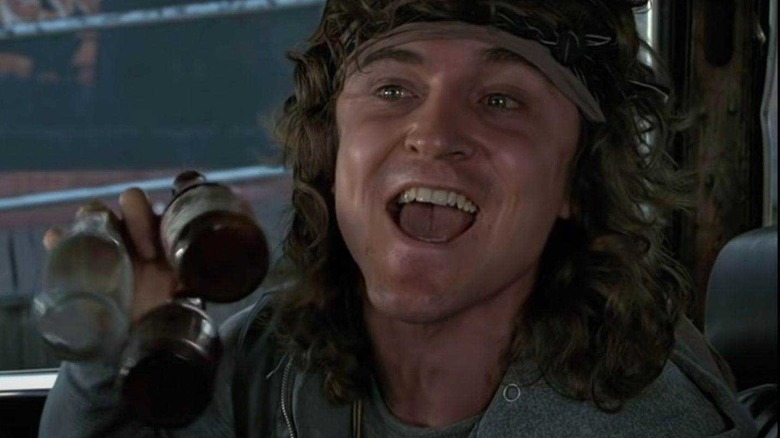
There's always a danger war will break out when New York City street gangs come together outside their home turf, but when Cyrus (Roger Hill) — leader of the Gramercy Riffs, the most powerful gang in NYC — calls delegates of all the cities' gangs to Van Cortlandt Park for a midnight summit, the Warriors of Coney Island know they risk losing more by not showing up. Cyrus' popularity makes his speeches advocating pan-gang unity seem feasible, until Luther (David Patrick Kelly), leader of the Rogues, shoots Cyrus dead and blames the Warriors, making the Coney Island gang pariahs among all their fellow gangs as they traverse the 30 miles of urban jungle between them and home.

The obstacles the Warriors face include not only brawls with other colorfully costumed gangs — including a siren seduction play by the all-girl Lizzies — looking to collect the bounty offered by the Gramercy Riffs, but also pursuit by police and fires shutting down the elevated train. One Warrior is thrown onto the tracks and killed by a subway car, while another is arrested for attempting to sexually assault an undercover cop. Along the way, the Warriors' leader, Swan (Michael Beck), winds up with Mercy (Deborah Van Valkenburgh), the girlfriend of another gang's leader, in spite of Swan wanting to shake her off.

When the remaining Warriors finally return to Coney Island at dawn, they find Luther and the Rogues waiting for them. Ironically, the Gramercy Riffs intervene on the Warriors' behalf, after learning Luther killed Cyrus, and the former rivals express their mutual respect.

Tron (1982)
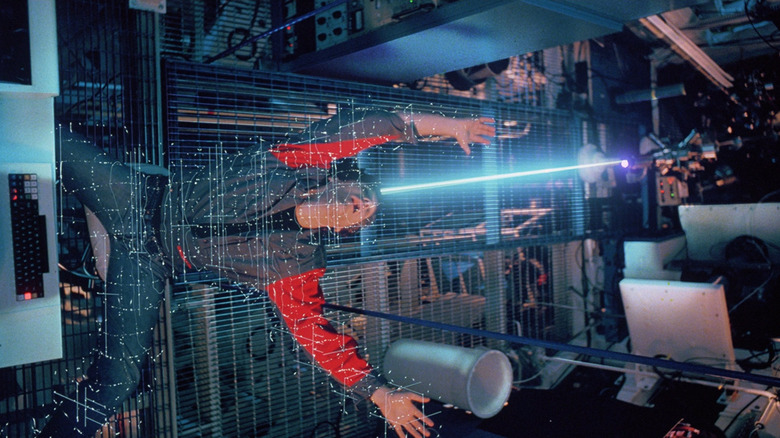
Kevin Flynn's (Jeff Bridges) video games were stolen by his former boss, ENCOM executive Ed Dillinger (David Warner), but the data proving this is secured by ENCOM's Master Control Program. ENCOM programmer Alan Bradley (Bruce Boxleitner), Flynn's former coworker, has developed a security program, "Tron," to regulate the activities of the MCP, which would grant Flynn access to the data proving Dillinger's plagiarism, but the MCP has locked Alan's access to his projects. For Alan to provide the information his Tron program needs to counter the MCP, he needs Flynn to hack ENCOM's system at the source, to unlock Alan's access to Tron.

When Flynn, Alan, and engineer Lora Baines (Cindy Morgan) break into ENCOM after dark, the MCP detects Flynn's presence, and uses Lora's experimental matter-digitizing laser to blast Flynn into cyberspace. Flynn is forced to play gladiatorial video games "on the other side of the screen" by Sark, an evil program that serves as the MCP's second-in-command.

To return to "the real world," Flynn teams with Tron, first to aid him in reaching the I/O tower, to receive instructions from Alan on how to defeat the MCP, then to cross the cyberspace plains with Tron, to fight the MCP directly. Before Flynn sacrifices his digital self to help Tron deactivate the MCP and return to non-virtual reality, he encounters a number of other good programs that, like Tron, share the likenesses and personalities of their "users." When Dillinger returns to ENCOM in the morning, he finds a neutered MCP has publicized proof of his theft.

Streets Of Fire (1984)
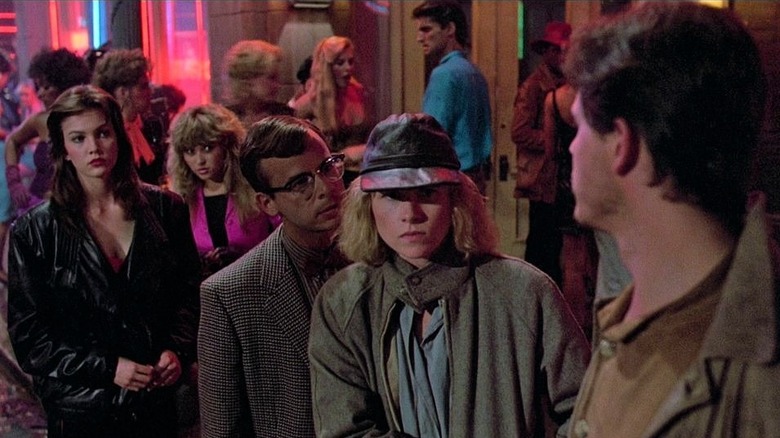
When Ellen Aim (Diane Lane), lead singer of the Attackers, is kidnapped from her own concert, in her home borough of Richmond, by the Bombers — a biker gang led by Raven Shaddock (Willem Dafoe) — there's no way Ellen's ex-boyfriend, and ex-soldier, Tom Cody (Michael Paré) isn't coming to rescue her, despite his initial protestations.

Tom insists Ellen's current boyfriend and manager, Billy Fish (Rick Moranis), pay him $10,000 to rescue Ellen, but Tom then pays 10% of his cut to tomboyish fellow ex-soldier McCoy (Amy Madigan), to join his mission as a shooter and driver. Raven is holding Ellen captive in "The Battery," the bad (or rather worse) part of town where the Bombers are based, so Billy, who used to live in the Battery, serves as a Virgil-esque guide for Tom and McCoy's trip into urban Hell.

Rescuing Ellen from "Torchie's" biker bar proves less challenging than making it back to Richmond, as our party ditches their now-hot car to cross the "Streets of Fire" on foot. "Baby Doll" (E.G. Daily), a fan of Ellen's, tags along to warn that police are looking for whoever started the fight at Torchie's, and our party briefly hitches a ride on "The Sorels" band's tour bus, until it's pulled over by racist cops. The Sorels persuade Ellen to make them the Attackers' opening act, and a third-day coda showcases the showdown between Raven and his Bombers versus Tom and the decent people of Richmond (two words: sledgehammer duel), but Tom still gets Ellen home the morning after rescuing her from Raven.

After Hours (1985)
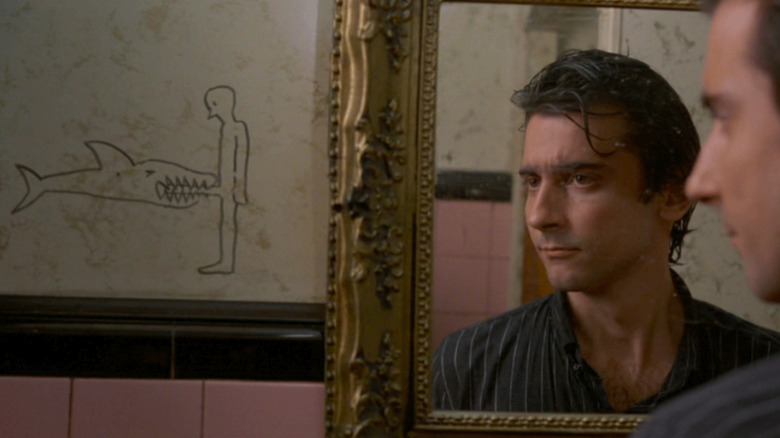
Paul Hackett (Griffin Dunne) is less than stimulated by his computer data entry job, so when he goes home to his drab apartment, it makes sense he'd want to call Marcy Franklin (Rosanna Arquette), the lively, pretty, well-read girl he'd met at a café earlier that evening, who'd given him her number. A phone conversation yields an invite to Marcy's SoHo apartment, but a high-speed ride in an open-windowed cab sucks Paul's $20 — his only cash on hand, aside from some coins — out the window.

Paul nonetheless arrives at Marcy's apartment, meeting Kiki (Linda Fiorentino), her artistically and libidinously experimental roommate, and receiving mixed romantic signals from Marcy herself, who spurns his advances while disclosing sexual traumas she's suffered with an unsettlingly disaffected air. Between Marcy's behavior and signs she might be disfigured from burns, Paul discreetly leaves, only to find his pocket change can't cover the subway fare. A bartender's attempt to lend him money puts Paul under suspicion for a string of neighborhood burglaries. Paul then learns his wordless rejection of Marcy (who was covering a tattoo, not burns) caused her to commit suicide, breaking the heart of the bartender, who was Marcy's boyfriend.

Paul's no-less-fraught, misfiring interactions with a Mister Softee truck driver and a beehived waitress contribute to a literal mob chasing him down the streets, until he hides in a nightclub by posing as a sculpture. The neighborhood's actual burglars steal the plaster-coated Paul, but accidentally drop him off outside his office that morning, in time for another workday.

Vamp (1986)
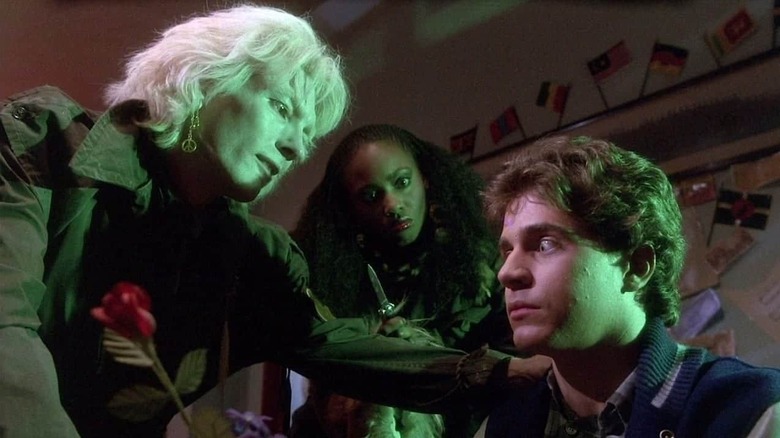
Roommates Keith (Chris Makepeace) and AJ (Robert Rusler) are tired of living in the dorms, but to be accepted into their fraternity of choice, they need to hire a stripper. Since their college is an extended drive from the nearest strip clubs in the city, they ask the richest student on campus, Duncan (Gedde Watanabe), to lend them one of his nine Cadillacs, but he insists they bring him along.

A literal whirlwind of a near-miss traffic accident drops our boys into the bad part of town after dark, where they tussle with a switchblade-wielding albino street gang in a café, before reaching the strip club they're searching for. The club's exotic lead act, Katrina (Grace Jones), is more than they could have imagined, but she's also a vampire who kills AJ. When Keith grows concerned over AJ's absence, club waitress Amaretto (Dedee Pfeiffer), who insists she knows Keith, helps him search the neighborhood for AJ. Except Keith also loses track of Amaretto, then flees through streets and sewers from the albino gang and various area vampires, until he discovers AJ's body in a dumpster.

When cops respond to Keith's call, AJ appears alive and well again, but reveals to Keith he's now a vampire. AJ stakes himself to avoid feeding on Keith, who fights his way through the vampire strip club with Amaretto (his fifth-grade classmate Allison), as Duncan also turns into a vampire and is killed. After car chases and multiple explosions, the vampires' nest burns, and Keith saves Allison from Katrina with the morning's sunlight.

Adventures In Babysitting (1987)
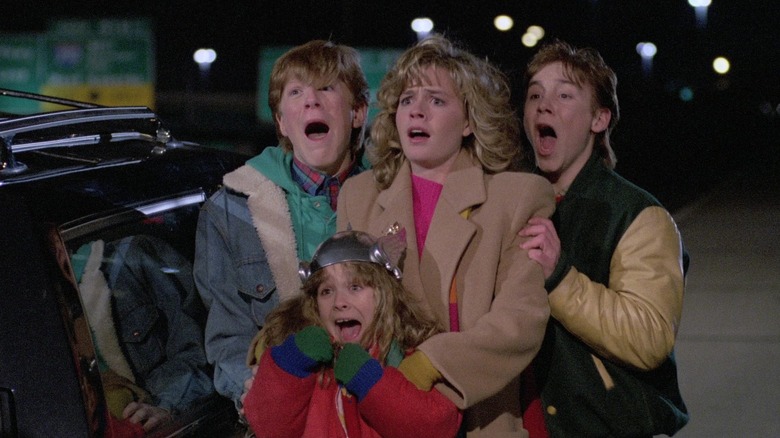
Suburban high schooler Chris Parker (Elisabeth Shue) is babysitting Brad (Keith Coogan) and Sarah Anderson (Maia Brewton) when her friend Brenda (Penelope Ann Miller) calls from a downtown Chicago bus station, begging Chris for a ride home ... because Brenda ran out of money while running away from home. To avoid leaving the Andersons unsupervised, Chris takes them and Brad's friend, Daryl Coopersmith (Anthony Rapp), along for the ride in her mother's station wagon, but she forgets to bring her purse, and the car blows a flat on the freeway.

An initially helpful tow truck driver abandons the kids to confront his cheating wife and her lover, and the kids hide from the confrontation's stray gunfire in a Cadillac that gets stolen, taking them to a mob-run chop shop. The kids sneak out of the chop shop, but because Daryl swipes a Playboy the criminals used to take important notes, the mobsters pursue the kids through a blues club, where the kids sing the blues, to Chicago's "L" train, where Chris breaks up a gang war after one gang leader stabs Brad's foot with a switchblade. A misdiagnosis at the hospital leaves everyone relieved to see Brad still alive, and when they stumble across a fraternity party, a sympathetic college student donates almost enough money to recover their car from the tow truck garage.

Before all the kids (including Brenda) make it home without getting caught by their parents, Chris confronts her own cheating boyfriend, and Sarah meets her hero, Thor, before scaling the side of Chicago's "Diamond Building."

License To Drive (1988)
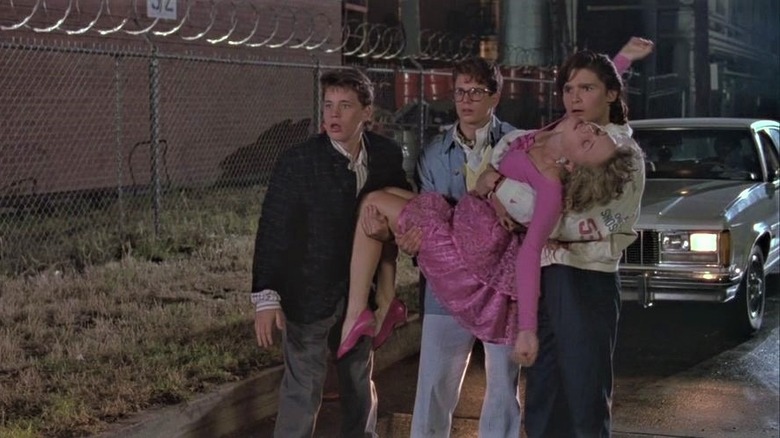
Les Anderson (Corey Haim) gets grounded for failing his driver's license exam, but he'd already promised his crush, Mercedes Lane (Heather Graham), that he'd pick her up for a date, in "his" car, that Saturday. "His" car is his grandfather's 1972 Cadillac Sedan de Ville, which Les' dad drives while Grandpa Anderson borrows his son's BMW (the old man dislikes driving his not-quite-classic car long distances).

Les waits until his parents fall asleep to take the car for a joyride with Mercedes, except she gets so drunk, she dents the hood of the car by dancing on it, then passes out. Because Les' friend Dean (Corey Feldman) is able to repair the damage, Dean persuades Les to load a sleeping Mercedes into the trunk, so the boys can make a pilgrimage to "Archie's Atomic Drive-In," and hook up with other hot girls. After a run-in with hot-rodding punks curtails those plans, the Caddy accidentally enters a political protest attended by Les' sister and her boyfriend, and the cops catch Les without a license. Les gets released as the protest turns into a riot, but he barely retrieves Mercedes from the Caddy's trunk before it's stolen and virtually totaled by a drunk driver.

Les gets the car home by morning, but his dad freaks out over its damage, until Les' pregnant mom goes into labor, and his unorthodox driving gets her to the hospital in time. Grandpa Anderson laughs upon seeing his wrecked Caddy, as he reveals he'd totaled his son's BMW in turn.

Miracle Mile (1988)
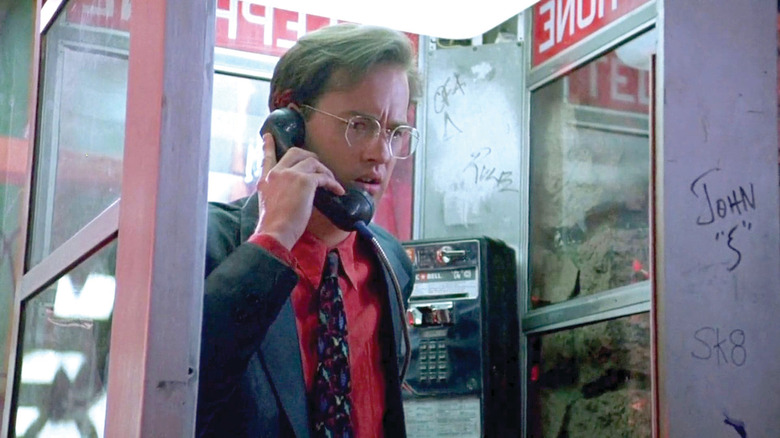
Jazz musician Harry Washello (Anthony Edwards) and diner waitress Julie Peters' (Mare Winningham) meet-cute at the La Brea Tar Pits, on LA's "Miracle Mile," leads into a whirlwind courtship that afternoon, with a promise to meet again at midnight, when Julie's shift ends, but Harry oversleeps until 4 a.m. after his power (and alarm clock) fails.

Harry calls Julie from a payphone at her diner, but the payphone receives a misdialed call from a military base, warning that nuclear missiles will arrive from Russia within 70 minutes. When Harry tells those at the diner what he's heard, a well-connected businesswoman named Landa (Denise Crosby) confirms his fears, and plans to schedule a heliport shuttle from the roof of the Mutual Benefit Life Building to LAX, from which she and others can fly to a compound in Antarctica. Landa's group won't take a detour to collect Julie, so Harry arranges to reunite with them at the airport, then heads to Julie's apartment.

Without a car, Harry hitches a ride with a stereo thief, whose own desperation starts a fire that kills two cops and blows up a gas station. After retrieving a Valium-drowsy Julie, Harry resorts to threatening a 24-hour gym with a gun to find a helicopter pilot, to fly him and Julie to LAX. Meanwhile, spreading rumors of nuclear war cause citywide chaos by daybreak. A bodybuilder pilot picks up the couple, but the incoming missiles' EMP crashes their helicopter into the tar pits, where a final explosion turns the soulmates into diamonds.

Mystery Date (1991)
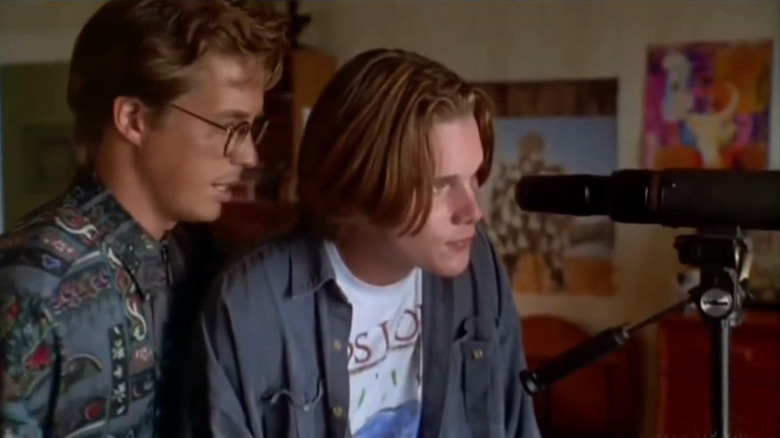
Shy teen Tom McHugh (Ethan Hawke) admires his gorgeous next-door neighbor, Geena Matthews (Teri Polo), from afar, until his visiting older brother, stylish and confident Craig (Brian McNamara), cajoles Tom into taking action. Craig calls Geena, posing as Tom, to set up a date between "himself" (Tom) and Geena. Craig then lends Tom his clothes and wallet — complete with his ID, credit card, and cash — while also furnishing Tom with glasses and a hairstyle both intended to resemble Craig's. And when the limo Craig rented suffers a fender-bender, Tom's only remaining transportation option is Craig's classic 1959 DeSoto convertible, even though he forbade Tom from driving it.

These identifiers are enough for cops, criminals, and random women to mistake a cosplaying Tom for Craig, as Tom visits Craig's favorite fine dining and entertainment haunts in the city. Meanwhile, Geena goes from feeling charmed by Tom's seeming spontaneity to resenting his distracted lack of regard for her, as Tom dodges slaps, assaults, attempted arrests, and even assassinations that Craig's criminal misdeeds and casual cruelty appear to have earned, from fired floral delivery drivers and Chinatown crime lords alike. Tom can't go to the police after discovering a dead body in Craig's trunk, especially when a corrupt cop gets shot and has to be loaded in alongside him.

Gangster James Lew (BD Wong) hammers Tom with his grudge against Craig, and even holds Geena hostage until Tom retrieves a tape proving Lew's collusion with corrupt cops. Tom wins Geena's heart, but his once-beloved older brother breaks his heart.

Judgment Night (1993)
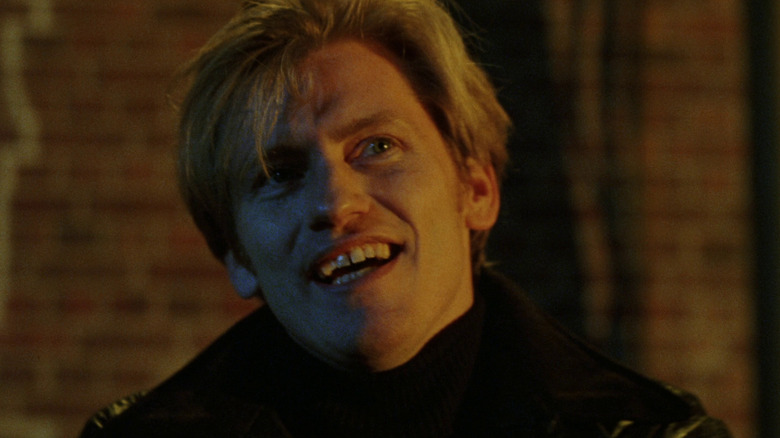
New father Frank Wyatt (Emilio Estevez), his kid brother John (Stephen Dorff) and their friends, conflict instigator Mike Peterson (Cuba Gooding Jr.) and con artist Ray Cochran (Jeremy Piven), depart the suburbs in Ray's luxurious loaner RV to catch a professional boxing match in Chicago that evening, when a shortcut off the gridlocked freeway makes them witnesses to a murder.

The RV accidentally hits a man holding a bag full of money, who's already been shot. Gangsters drag the man from the RV, after immobilizing it, to face local crime lord Fallon (Denis Leary), who executes the man for theft, before ordering his gang to eliminate the witnesses. Frank and his friends run into the railyards, hiding in a boxcar until an altercation with a homeless camp gives them away. The friends then gain access to an apartment in the projects, where they call the cops, who predictably don't come, but Fallon's gang tracks them down again. After Ray falls behind his friends, he offers to pay Fallon $200,000 to spare their lives, but Fallon kills Ray for offending him, by comparing them as "businessmen."

When the friends make a stand in the sewers, Mike manages to kill one of Fallon's gang, but the fight exposes their raw emotions, especially as they fail to flag down a passing bus. The friends finally draw law enforcement by triggering a grocery store's alarms, but when Fallon's diminished forces kill the security guards, Frank must defend his wounded friends by ending Fallon, before he can fulfill his threats to visit Frank's suburban family.

Date Night (2010)
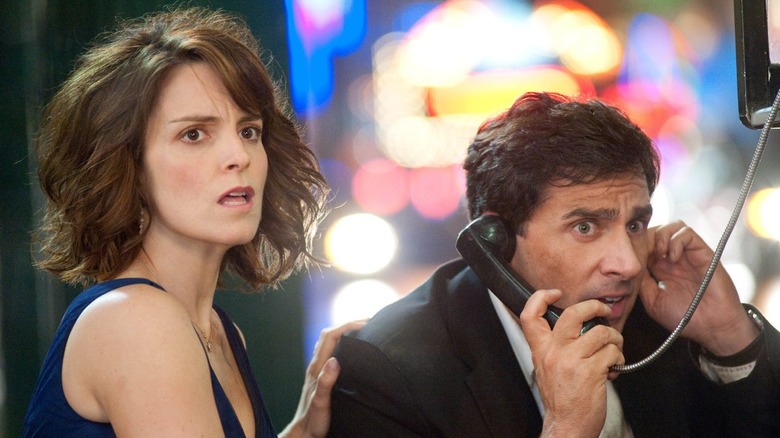
Phil (Steve Carell) and Claire Foster (Tina Fey) are married with two careers and two children, but when the New Jersey couple learns their best friends are getting divorced, the Fosters spice up their "Date Night" by stealing a no-show couple's reservation at a trendy Manhattan restaurant. Posing as "the Tripplehorn's" prompts a pair of crooked cops to demand the Fosters turn over a flash drive stolen from mob boss Joe Miletto (Ray Liotta).

When the couple realizes they can neither turn to the police for aid, nor return home, they call the babysitter to take the kids out of the house, then resolve to locate the actual Tripplehorns. Security expert Holbrooke Grant (Mark Wahlberg), a former client of Claire's, helps the Fosters trace the Tripplehorns' cell phone number, from their restaurant reservation to the apartment of a pair of married hustlers, nicknamed "Taste" (James Franco) and "Whippit" (Mila Kunis), who used the flash drive to blackmail district attorney Frank Crenshaw (William Fichtner), rather than Miletto.

Phil loses the flash drive in the East River, after a shootout and conjoined-car chase with the crooked cops, but since its photos showed Crenshaw with prostitutes at the "Peppermint Hippo" club, the Fosters gain admittance by posing as a prostitute and her pimp. After the Fosters' awkward dancing arouses Crenshaw, they introduce themselves as "the Tripplehorn's." The crooked cops march the Fosters to the club's roof at gunpoint, where both Crenshaw and Miletto demand the flash drive. Phil then tricks Crenshaw and Miletto into declaring their misdeeds, while wearing a wire for a sting operation.

Read this next: The Horror Movies We Can't Wait To See In 2022

The post 11 Ways To Make A 'One Wild Night Out On the Town' Movie appeared first on /Film.
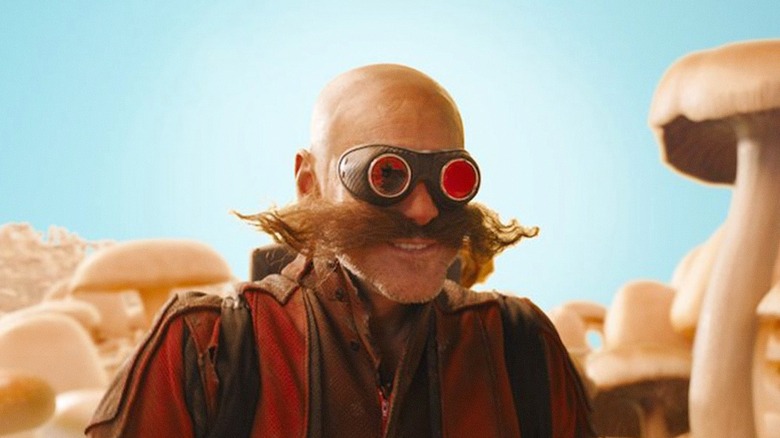
31 Mar 17:40

Hubble Sees Most Distant Star Ever, 28 Billion Light-Years Away

by msmash
The Hubble Space Telescope has glimpsed the most distant single star it's ever observed, glimmering 28 billion light-years away. And the star could be between 50 to 500 times more massive than our sun, and millions of times brighter. From a report: It's the farthest detection of a star yet, from 900 million years after the big bang. Astronomers have nicknamed the star Earendel, derived from an Old English words that means "morning star" or "rising light." A study detailing the findings published Wednesday in the journal Nature. This observation breaks the record set by Hubble in 2018 when it observed a star that existed when the universe was around four billion years old. Earendel is so distant that the starlight has taken 12.9 billion years to reach us. This observation of Earendel could help astronomers to investigate the early years of the universe. "As we peer into the cosmos, we also look back in time, so these extreme high-resolution observations allow us to understand the building blocks of some of the very first galaxies," said study coauthor Victoria Strait, a postdoctoral research at the Cosmic Dawn Center in Copenhagen, in a statement. "When the light that we see from Earendel was emitted, the Universe was less than a billion years old; only 6% of its current age. At that time it was 4 billion lightyears away from the proto-Milky Way, but during the almost 13 billion years it took the light to reach us, the Universe has expanded so that it is now a staggering 28 billion lightyears away."

Read more of this story at Slashdot.

31 Mar 14:52

Nightmare Reaper is a retro-FPS roguelike that's bloody fun

by Ed Thorn

Nightmare Reaper is rad, which is something I didn't think I'd say. DOOM and its DOOM-like spawn don't often do it for me. Bouncing around an arena and carving demons into hunks of meat gets a bit repetitive for my tastes. Which is weird! I love FPS games and repetitive things, like dying in Hades over and over again.

I'm into Nightmare Reaper because it's repetitive... but not. It's a roguelike DOOM-inspired shooter where you blast through procedurally-generated levels and their demonic denizens, earn cash, put points into a skill-tree, and get as far as you can. The quest for loot has elevated this from a potential "Meh" to a solid, "Oh yeah".

Read more

31 Mar 14:51

Day 36 of WW3: Russian soldiers refuse to follow orders, Zelensky talks to Australia, Putin is being misled about how bad it's going, and Russians near Chernobyl get radiation poisoning. It's your Thursday Ukraine War thread [Scary]

31 Mar 14:50

Visual FX Legend Phil Tippett's Experimental Feature Mad God Is Coming To Shudder

by Kaylee Dugan

Shudder may not have every horror movie you want to watch when you want to watch it, but you can't deny that the horror streaming service has a keen eye when it comes to picking up exclusive streaming rights. From the childhood bleakness of "Tigers Are Not Afraid" to the heavy metal surrealism of "Mandy" or the pure delightful comedy of "One Cut of the Dead," there's a lot of gold in them hills. And it looks like they're not done sifting for gems yet.

According to Deadline, Shudder has recently acquired the rights to Phil Tippett's "Mad God," a thoroughly experimental stop motion film that our official /Film review described as 1. One of the weirdest movies ever made and 2. That "'Mad God' will be what flashes before my eyes as I'm lying on my deathbed and only then will I maybe actually comprehend the brilliance behind this waking fever dream." You might want to pencil in your screening of this movie in advance, because it sounds like the kind of experience that makes you less normal than usual for a little while (like when I went to a friend's birthday party after watching "Compliance.")

It's A Mad, Mad, Mad, Mad God

So what is the madness behind "Mad God"? I'm glad you asked, but I'm also concerned I can't give you the answer you're looking for because this movie might just be beyond our mutual understanding of language, symbols, and classical or modern story arcs. Anyway! The film, which is a casual 30 years in the making, follows a human-esque assassin wearing a gas mask and a black leather trench coat who descends into a horror hellscape unlike one you've ever seen or experienced (hopefully) that's also crawling with a lifetime'ss worth of monsters and filled to the brim with violence. That's it! Very little is said during the movie. This is truly all we know or understand.

At this point, I should also mention that even if you don't know Tippett's name or what he's about (or what his movie is about), you certainly know his work. He's a double Academy Award winner behind the animation and effects of movies like "Star Wars," "Jurassic Park," "Starship Troopers," and "RoboCop." The man knows what he's doing when it comes to making a visually engrossing movie, and he's certainly done it here.

Before "Mad God" burrows into Shudder on June 16, 2022, it'll enjoy a limited theatrical release. While I'm sure this movies hits in an even deeper and wilder way on the big screen, at least we can all rest easy known that it's madness will be streamable. After all, this might be the kind of movie you want to watch in a comforting space.

Read this next: 13 Fantasy Films That Never Got Sequels

The post Visual FX Legend Phil Tippett's Experimental Feature Mad God is Coming to Shudder appeared first on /Film.

31 Mar 14:49

Hackers Increasingly Using 'Browser-in-the-Browser' Technique in Ukraine Related Attacks

by noreply@blogger.com (Ravie Lakshmanan)
A Belarusian threat actor known as Ghostwriter (aka UNC1151) has been spotted leveraging the recently disclosed browser-in-the-browser (BitB) technique as part of their credential phishing campaigns exploiting the ongoing Russo-Ukrainian conflict. The method, which masquerades as a legitimate domain by simulating a browser window within the browser, makes it possible to mount convincing social
31 Mar 14:49

Weird West review: a breathtakingly reactive spin on classic Fallout

by Jeremy Peel

“Graveyard’s full,” says Timothy Hall, the man prodding the bones of the piano at the saloon in Grackle. It’s a concise expression of everything the town’s been through: the rampaging bandits, the cannibal kidnappings, the swirling tornados. Filling the graveyard has been a solemn bid for order in the wake of so much chaos.

It’s not that way in Bripton, the next town over. The graveyard there is uncannily empty, save for a similarly bare tree. But you can change that, should you so choose: shoot up the bank or fight a duel and, the next time you return to that settlement, new plots will have appeared for every life snuffed out. Weird West even suggests you head to the local cemetery to loot any bodies you’ve missed - though its reputational system implies you should ensure nobody’s watching first.

Read more

31 Mar 14:48

Our Flag Means Death Has Pilfered Book Of Boba Fett's Throne As The Most In-Demand New Series

by Debopriyaa Dutta

Yes, your favorite bounty hunter has been dethroned. "The Book of Boba Fett" had held on to the top spot of "Most In-Demand New Series" for three weeks since its Disney+ premiere, but now has been overtaken by the HBO Max period romantic comedy, "Our Flag Means Death," as per a report by The Wrap. This new ranking has been measured by Parrot Analytics, wherein the definition of a breakout show is measured in terms of the most in-demand series that have premiered in the past 100 days since calculation. 

A Delightfully Fun Pirate Show Takes Over

Created by David Jenkins ("People of Earth") and executive produced by none other than Taika Waititi ("What We Do in the Shadows," "Thor: Ragnarok"), "Our Flag Means Death" is loosely based on the life of English aristocrat-turned-pirate Stede Bonnet (Rhys Darby), who crosses paths with the notorious Blackbeard (Waititi) abroad his sailing vessel, The Revenge. The premise hinges on how Bonnet does not really have what it takes to be a hardened pirate and must deal with his dysfunctional crew and other deadly threats that marks the seas he sails.

It is understandable why "The Book of Boba Fett" maintained the top spot for so long, being a "Star Wars" entry about a beloved character who manages to fight his way through the Sarlacc Pitt and teams up with mercenary Fennec Shand (Ming-Na Wen), while also forming an alliance with Din Djarin (Pedro Pascal), who he meets in Chapter 14 of "The Mandalorian," namely "The Tragedy."

As per the numbers run by Parrot Analytics, the demand for "Our Flag Means Death" surged by 33% since its season finale premiered on March 24, 2022. Parrot Analytics runs its calculations by taking consumer research data, streaming, downloads, and social media into account, among other consumer engagement metrics. However, per the details of the metrics, the calculations only apply to the U.S. alone. Check out the details of the metrics for the week below:

Parrot Analytics

Other shows that closely follow HBO Max's "The Gilded Age," whose season finale aired on March 21, 2022, showcasing a 15% increase in demand since then, within the period of a week. The interest in the period drama has been pretty consistent, and "The Gilded Age" has already been renewed for a second season

The trajectory for HBO Max's "Peacemaker" has also been interesting, as it witnessed a surge in interest even after its season finale aired back in February. This probably has to do with the show's unique formula of melding superhero shenanigans with outrageous humor and a whole lot of heart, and this seems to be working well in its favor so far.

"Our Flag Means Death" season 1 is now streaming in its entirety on HBO Max.

Read this next: The 14 Greatest '80s Romantic Comedies Ranked

The post Our Flag Means Death Has Pilfered Book of Boba Fett's Throne as the Most In-Demand New Series appeared first on /Film.

31 Mar 14:47

Dell introduces the Precision 5470, its most powerful 14-inch workstation

by João Carrasqueira

Dell has announced a refresh of its Precision lineup of mobile workstations, including the new Precision 5470, which the company calls the “smallest, thinnest, and most powerful” 14-inch workstation in the world. It also introduced the Dell Precision 5570 and 5770, along with the Precision 3570 and 3571. These are all powered by Intel’s 12th-generation processors and professional NVIDIA graphics. Alongside these laptops, Dell also introduced the new Latitude lineup for business users.

Dell Precision laptops

The star of the show is the Dell Precision 5470, which is a brand new addition to Dell’s lineup. It comes with Intel’s 12th-generation H-series Core processors and it’s the first one of its kind to meet the Intel Evo spec while also supporting Intel vPro. Additionally, you can configure it with up to an NVIDIA RTX A1000 GPU, one of the new mobile GPUs introduced earlier this month. Plus, you get up to 64GB of DDR5 RAM and 4TB of storage built in. The two larger models, the Dell Precision 5570 and 5770, come with even more powerful GPUs – up to an NVIDIA RTX A2000 8GB on the Precision 5570 or an RTX A3000 12GB on the 5770.

Front view of the Dell Precision 5470

Dell Precision 5470

To keep all of this running cool, Dell designed a new cooling system that still fits in a relatively compact chassis, with dual opposite outlet fans and a bonded hinge architecture that improves air exhaust. The Dell Latitude 5470 starts at just 3.26lbs, which is impressively light for a workstation. The Precision 5570 and 5770 are also Dell’s lightest workstations in their respective sizes.

For the display, all three laptops have an InfinityEdge panel with a 16:10 aspect ratio. The Dell Precision 5470 has Quad HD+ resolution, while the two larger models can be configured with up to an Ultra HD+ panel. They also cover 100% of Adobe RGB and 99% of DCI-P3 color spaces, making them ideal for creative work. Plus, they support Dell’s new intelligent privacy features with onlooker detection, and Dell ExpressSign-In makes it easier to securely unlock the laptop.

Right-angle rear view of Dell Precision 5770

Dell Precision 5770

Turning to the Precision 3000 series, we have the Dell Precision 3571, which is also powered by 12th-generation Intel Core H-series processors and up to an NVIDIA RTX A2000 8GB GPU. It also still comes with up to 64GB of DDR5 RAM and 4TB of storage. The display comes in a more traditional 16:9 aspect ratio and up to Ultra HD resolution. If you want something with better battery life, the precision 3570 comes with Intel’s U15 and P-series processors instead of the H series, and it has optional discrete NVIDIA graphics up to an RTX A500.

All of these laptops will be available in April, and pricing information but pricing information wasn’t mentioned.

Dell UltraSharp monitors

In addition to the new Precision laptops, Dell also introduced a handful of peripherals today, starting with the new UltraSharp monitors. First, there are the new Dell UltraSharp 32 (U3223QE) and 27 (U2723QUE) 4K monitors, which are the world’s first monitors to use the new IPS Black technology. This provides a 2,000:1 contrast ratio, higher than most IPS panels, plus the monitors cover 100% of sRGB and 98% of DCI-P3 for excellent color reproduction. They also meet the VESA DisplayHDR 400 certification. As the names suggest, they support 4K and they have a 16:9 aspect ratio for a total resolution of 3840 x 2160.

Two Dell UltraSharp 32 4K Monitors next to a laptop

Dell UltraSharp 32 4K Monitors

Both monitors support tilt, swivel, pivot, and height adjustments for added convenience and a simplified joystick control on the back. In addition to typical display inputs, including DisplayPort and HDMI, the monitors can connect via USB Type-C, and in addition to the display signal, this connection can carry data and up to 90W of power, keeping your laptop charged. The monitors have four USB Type-A ports, one USB Type-C (downstream) port, and RJ45 Ethernet, all of which connect to your laptop with the all-in-one USB Type-C port.

if you want something a little less conventional, the Dell UltraSharp 30 USB-C Hub Monitor (U3023E) may be for you. This is a 30-inch monitor with a roughly 16:10 aspect ratio and WQXGA (2560 x 1660) resolution, making it more suited for productivity work. Color-wise, it still covers 100% of sRGB and 95% of DCI-P3, so it’s going to look great. The monitor stand also supports all the same adjustments as the two monitors above, and it has a similar setup of ports, which can be used when you connect to your laptop via USB Type-C. Of course, you still have the option for DisplayPort 1.4 or HDMI 1.4.

Dell UltraSharp 30 USB-C Hub Monitor

Dell UltraSharp 30 USB-C Hub Monitor

All of these monitors are available today. The Dell UltraSharp 27 4K Monitor starts at $724.99, while the 32-inch variant starts at $1,149.99. The Dell UltraSharp 30 USB-C Hub Monitor starts at $1,049.99.

Dell peripherals

Beyond all of this, Dell also introduced a bunch of smaller peripherals. First, there’s the Dell Dual Charge Dock (HD22Q), a USB-C docking station for your laptop that also supports 12W Qi wireless charging for your smartphone (plus 90W power delivery to the laptop itself). It has DisplayPort, HDMI, four USB Type-A ports, and a USB Type-C port to connect other peripherals to the laptop. It’ll launch on May 12th for $368.99.

Dell Dual Charge Dock

Then, the new Dell Universal Dock (UD22) comes with four USB Type-A ports, two USB Type-C ports, and four video output ports so you can connect up to four displays. Plus, it supports up to 96W of power delivery. It’s also available today for $459.99.

Finally, the latest Dell Thunderbolt Dock (WD22TB4) comes with two DisplayPort connections (plus a USB-C port with a DP signal), HDMI, three USB Type-A ports, one USB Type-C port for data, RJ45 Ethernet, and two Thunderbolt 4 downstream ports. It supports up to 150W of power delivery to Dell commercial laptops, or 90W for other systems. It will launch sometime in the second quarter and cost $469.99.

For conference rooms, Dell announced the Slim Conferencing Soundbar (SB522A) and the Dell Speakerphone (SP3022), both certified for Microsoft Teams. They have a Teams button to access notifications and meetings, plus they use LED lights to show things such as whether there’s an ongoing call, the microphone is muted, and so on. Plus, they both use AI to reduce background noise and make voices clearer. The Dell Slim Conferencing Soundbar is available today for $79.99, while the Dell Speakerphone costs $99.99.

Dell Speakerphone SP3022

Finally, Dell also introduced the latest version of the Dell premier Rechargeable Active Pen (PN7522W). This new active pen promises a battery life of up to 40 days on a charge, it supports 4,096 levels of pressure, and it has three programmable buttons, one on the top and two on the side. It supports Bluetooth connectivity for quick shortcuts on Windows, and it’s the first active pen in the world to feature Tile integration. This makes it so that you can easily find the pen even if you left it behind somewhere far away. It’s available today for $109.99.

The post Dell introduces the Precision 5470, its most powerful 14-inch workstation appeared first on xda-developers.

31 Mar 14:45

Before Filming Scrooged, Bill Murray Tore The Script To Shreds

by Bill Bria

One of the many pleasures of 1988's "Scrooged" is how it figuratively goes off the rails by the end, all while being a pretty darn faithful modern retelling of Charles Dickens' "A Christmas Carol."

While the first two acts of the movie run through the expected beats of Dickens' tale — three ghosts haunt a miserly Yule-hating grumpus in order to teach him humility, empathy, and the spirit of giving — the third act sees TV executive Frank Cross (Bill Murray) hold his live broadcast production of "Scrooge" hostage with the help of one of his prior victims, lowly network employee Eliot Loudermilk (Bobcat Goldthwait), so that he can impart what he's learned to an attentive audience. During these final scenes, Murray and director Richard Donner capture the spirit of a live broadcast gone awry, all the awkwardness and improvised dialogue of such an incident included.

Given the authenticity of these moments, it may not be shocking to learn that there was a lot of truth to their improvised nature. "Scrooged" was not a movie written and constructed in the usual way — in fact, Murray insisted that the initial script be thrown out. After Murray and writers Mitch Glazer and Michael O'Donoghue "tore up the [original] script so badly that we had parts all over the lawn," as Murray colorfully put it, the film was put back together by the three starting from scratch, enhancing various elements and allowing for as much improvisation and reinvention as possible.

'Here's The Kind Of Thing I Would Have Done' — Murray Shapes Scrooged Into A Classic

One of the reasons Murray gave such consideration to "Scrooged" was due to his taking a break from starring in movies for long enough that he wanted his comeback film to be of higher quality than normal. The "Scrooged" idea was first pitched to Murray in the mid-80s, but it didn't capture his interest during his self-imposed break. When the actor sought a new project to star in around 1987, "the scripts were just not good," including "Scrooged."

Yet the kernel of the idea eventually proved irresistible to Murray, the actor explaining that "the idea of making a funny Scrooge was an inspired touch," even though he admitted that "there was a lot I didn't like" about the original script. Once Murray went to work with Glazer, O'Donoghue, and eventually Donner, the filmmakers attempted to "remake the story." The subplot involving Frank's lost love, Claire (Karen Allen), "existed in the script's original version, but we had to make more out of it." Thus, Murray and company "took the romantic element and built that up a little more." The filmmakers also took a look at the various other characters in the film, including Frank's brother James (John Murray), Frank's Bob Cratchit-like secretary Grace (Alfre Woodard) and her Harlem family, finding that "the family scenes were kind of off, so we worked on that."

Taking such an open approach to the material early on resulted in that climactic scene becoming so freewheeling. According to Dennis Perrin's book "Mr. Mike: The Life and Work of Michael O'Donoghue," Murray deviated from his pre-planned marks when shooting the finale and improvised much of the final speech, resulting in the crew spontaneously applauding the actor when he'd finished. Donner rolled with the actor taking the reins, observing that "you don't direct Billy, you pull him back." He was impressed with Murray's improvisational way of working, explaining that "you give him a platform, make him as comfortable as possible, and he comes at you from every direction. He did for me."

'There Are People Who Are Having Trouble Making Their Miracle Happen' — The Aftermath Of Scrooged

In the time immediately following the completion of principal photography on "Scrooged," Murray was left still feeling uncertain about the film. In the process of tearing the script to shreds and attempting to reconstitute it through improvisation and reconfiguration, the filmmakers "shot a big, long sloppy movie," according to Murray, leaving "a great deal of material that didn't even end up in the film. It just didn't work."

Murray's fears seemed to be founded upon the film's release, when notable critics such as Roger Ebert gave the movie a withering one-star review. In an interview with Ebert in 1990, Murray explained that he'd had a bad time making the film, lamenting that it "could have been a really, really great movie. The script was so good." He claimed that "There's maybe one take in the final cut" that was his, and that "We made it so fast, it was like doing a movie live."

Yet Murray, ever the mercurial enigma, didn't completely write the film off in his estimation. During the same interview with Ebert, the star encouraged the critic to take another look at the movie, saying "It wasn't that bad. It had some good stuff in it." During the 34 years since the film's release, a variety of critics have reappraised the film, calling it everything from prescient to one of the best adaptations of Dickens ever made. It even ended up at #3 on /Film's "20 Favorite Holiday Movies of All Time." As more critics and audiences discover, revisit and enjoy the movie every holiday season, it continues to validate Murray and company's hard work.

Read this next: The 14 Best Bill Murray Movies Ranked

The post Before Filming Scrooged, Bill Murray Tore the Script to Shreds appeared first on /Film.

31 Mar 14:45

Potentially unauthorized use of a USAF C-130 Hercules to move a motorcycle across country

by Jason Weisberger

The USAF is investigating a C-130 Hercules belonging to the 403rd Wing's 53rd Weather Reconnaissance Squadron, based in Mississippi, that was spotted picking up a motorcycle in Martha's Vineyard, Massachusettes.
Less than 1% of annual traffic to MVY is military, so it would seem they stopped just for the bike. — Read the rest