Shared posts

21 Oct 16:28

What are the "Essential Functions" of the Supreme Court?

by Michael C. Dorf

Yesterday the Supreme Court heard oral argument in Bowe v. United States. In my Verdict column previewing the case, I highlighted the case's potential to resolve a longstanding constitutional question: What are the limits on Congress's power to remove cases from the Supreme Court's appellate jurisdiction under the Exceptions Clause of Article III? As I explained in my column, an amicus brief by some Federal Courts scholars propounds the view of the late great Henry M. Hart that Congress may not deploy its power under the Exceptions Clause in such a manner as to "destroy the essential role of the Supreme Court in the constitutional plan."

I am dubious of the argument put forward in the Federal Courts scholars' amicus brief for the proposition that maintaining the uniformity of federal law is an essential function of the Supreme Court--at least if it's taken to mean that the Supreme Court must have the authority to resolve every possible conflict over the meaning of federal law. As I noted in the column, the amicus brief relies on Justice Story's opinion for the Court in Martin v. Hunter's Lessee, but Hart's views about Article III differ in some important details from Story's views. The latter (especially as revived and tweaked by Akhil Amar) would allow that Congress could ensure the uniformity of federal law by vesting jurisdiction in some other federal courts instead of the Supreme Court.

That is not to say that I think Hart was entirely or even mostly wrong. I like Hart's essential functions theory. Among other things, it has the virtue of complementing my own view (which I expounded in a 2018 Texas Law Review article) regarding the limits on Congress's affirmative power to strip state courts of jurisdiction in federal constitutional questions. Although I do not think that invocation of Story's Martin opinion suffices to show that maintaining the uniformity of federal law is an essential function of the Supreme Court's appellate jurisdiction, I agree with Hart and the Federal Courts scholars' amicus brief that in the usual course, maintaining the uniformity of federal law is at least a very important function of the Supreme Court. Thus, I agree with the bottom line of that brief and the petitioner's brief: the Court should employ the constitutional avoidance canon to read the jurisdiction-stripping statutory provision at issue in Bowe as inapplicable to certiorari jurisdiction in cases involving habeas petitions by federal prisoners.

It's worth noting that Hart himself never said that the Supreme Court must have the ability to resolve all federal issues in order to maintain the uniformity of federal law. That formulation is generally credited to Leonard G. Ratner, who propounded it in a 1960 article in the University of Pennsylvania Law Review. He cited Story's Martin opinion but also offered arguments rooted in text, original understanding, precedent, and ultimately functional considerations for his view. I am not entirely persuaded by the Ratner version of the Hart thesis as it applies to questions of statutory interpretation, but at least with respect to constitutional questions, it strikes me as plausible.

For what it's worth,  the version of Hart's approach that I find most persuasive is the one articulated by Larry Sager in his 1981 Harvard Law Review Foreword, which regards the Supreme Court's role in maintaining the supremacy of federal law as even more vital than its role in maintaining its uniformity. Under Sager's view, the "Court must be available to superintend state compliance with federal law unless Congress provides effective review elsewhere within the federal judiciary." Sager offered historical and doctrinal arguments, but the core of his view--like the core of Hart's view--was functional.

In recent memory, perhaps the clearest clash between a functional account of the Supreme Court's essential functions and a more formalist view can be found in the back-and-forth between Justices Kennedy (for the majority) and Scalia (in dissent) in 2013 in United States v. Windsor. On the merits, the Court invalidated Section 3 of the Defense of Marriage Act (DOMA), but to reach the merits, the Court had to find that there was a concrete case or controversy despite the fact that the Obama administration was enforcing but not defending DOMA.

For the majority, Justice Kennedy explained that disallowing jurisdiction when the executive branch chose not to defend a law's constitutionality would frustrate the Supreme Court's ultimate authority, pursuant to Marbury v. Madison, "to say what the law is." In dissent, Justice Scalia accused the majority of confusing the role of the U.S. Supreme Court with the role that constitutional courts in Europe play. He wrote that "declaring the compatibility of state or federal laws with the Constitution is not only not the 'primary role' of this Court, it is not a separate, free-standing role at all. We perform that role incidentally--by accident, as it were--when that is necessary to resolve the dispute before us."

One can argue that Justice Scalia's view (which overlaps with what is sometimes called "departmentalism") is more faithful to the original understanding of the Constitution than Justice Kennedy's, but the Kennedy view more closely tracks the understanding of the Court that has emerged over the course of the last century or so and especially since 1988, when Congress eliminated nearly all of the Supreme Court's mandatory appellate jurisdiction. With nearly complete discretion over what cases to hear, the Court has understood its job as deciding just those cases that present the most important legal questions. It takes its cases for the purpose of deciding such questions and not, as Justice Scalia would have it, to resolve particular disputes and propound its view of the law "by accident."

Now I suppose one might say that just as Congress had the power to eliminate the Court's mandatory appellate jurisdiction, it also has the power to modify what remains of that appellate jurisdiction. And to a point, I would agree. That's why I prefer the Sager version of Hart's view to the more expansive version promoted by Ratner and others. But it would be a mistake to view the 1988 elimination of nearly all of the Supreme Court's mandatory appellate jurisdiction as simply the exercise of Congress's policy discretion. Rather, the statutory change reflected and ratified a decades-long transformation of the Supreme Court into a de facto constitutional court of the European sort. Whatever the essential functions of the Supreme Court may have been in the distant past, they now include interpreting and applying the Constitution.

To be sure, that does not mean that the Court must or does have jurisdiction in every circumstance in which constitutional meaning is contested. The political question doctrine, standing limits, various forms of immunity, and other doctrines mean that there are some issues that federal courts--including the Supreme Court--do not resolve. But absent circumstances that implicate any one of those doctrines, the Court does have a responsibility to apply the Constitution and laws of the United States.

Whether those principles play any role at all in the Bowe case remains to be seen. As I noted in my Verdict column yesterday, I would not be surprised if the Court decides the case on purely statutory grounds, leaving unresolved the scope of congressional power under the Exceptions Clause.

During yesterday's oral argument, four Justices expressed interest in the Exceptions Clause issue. Chief Justice Roberts was the most aggressive in promoting a maximalist version of congressional power under the Exceptions Clause. He asked Bowe's attorney, Andrew Adler, this rhetorical question: "But we've never held that the Exceptions Clause does not mean what it says, have we?" Mr. Adler said no but then fell back on his avoidance argument without offering a substantive defense of the essential functions theory; he simply relied on the Federal Courts Scholars' amicus brief.

Mr. Adler was more responsive to a question from Justice Sotomayor. She wanted to know why his view, if accepted, wouldn't mean that the limit on certiorari is unconstitutional in cases involving state prisoners? His answer--which resonates with the final paragraph of Ex Parte McCardle--was that state prisoners have other means of seeking review in the Supreme Court that are unavailable to federal prisoners. (It's worth noting that the government argues that such alternative means are also available to federal prisoners, but I'll put that disagreement aside.)

Mr. Adler had the toughest time with a question from Justice Barrett. She suggested that his view of the Court's essential functions would "completely eviscerate the Exceptions Clause" because whenever Congress withdrew any set of cases from the Court's jurisdiction, the Court would be unable to resolve circuit splits on questions that arise in those cases. Mr. Adler tried to pivot back to the statute at hand but eventually appeared to concede that there would indeed be a constitutional question in such cases and thus didn't answer Justice Barrett's objection that under his view Congress has no power under the Exceptions Clause.

That was a mistake. Even if one takes the view (which, to be clear, I don't take), that SCOTUS must have the power to resolve all circuit splits (and all splits with or among state courts) on questions of federal law, that would not mean Congress is powerless under the Exceptions Clause. Indeed, my discussion of the reduction in the Court's mandatory jurisdiction above indicates why.

The Judiciary Act of 1789 and most subsequent legislation is phrased as conferring jurisdiction on the Supreme Court, but that's misleading. As the Court explained in Murdock v. Memphis, when Congress purports to confer less jurisdiction on the Supreme Court than what is set out in Article III, it is in essence exercising power under the Exceptions Clause to change the default. The default would be that the Supreme Court has, in the words of Article III, jurisdiction over "all" federal question cases. So, for example, the fact that Congress changed some of the Supreme Court's appellate jurisdiction from mandatory to discretionary via certiorari was an exercise of the Exceptions Clause power. And with the certiorari jurisdiction, the Court can resolve all circuit splits even though it has less jurisdiction than it would have if Congress had not exercised some of its power under the Exceptions Clause.

That's the answer that Mr. Adler should have given to Justice Barrett's question: there are many things Congress can do under the Exceptions Clause that would limit the scope of SCOTUS jurisdiction but still leave it with the ability to resolve circuit splits. His theory doesn't eviscerate the Exceptions Clause. (And again, to be clear, I don't agree with the Federal Courts scholars' amicus brief that the Court must have the power to resolve all circuit splits. For example, if Congress were to withdraw jurisdiction over circuit splits involving only statutory questions, Congress itself would still be able to resolve them, thus maintaining the uniformity of federal law.)

The fourth Justice to ask about the Exceptions Clause was Justice Alito. Questioning Anthony Yang, who argued for the government, Justice Alito worried that the issue should be briefed more thoroughly if the Court were to say anything about it. Justice Alito also suggested that an issue of the Court's essential functions under the Exceptions Clause might arise if the Court were prevented from addressing the merits of some important issue but that the contested issue in Bowe was too technical or procedural to implicate that concern.

Thus, there was some discussion of the Exceptions Clause issue in Bowe, but not enough for me to adjust my assessment before the oral argument: I continue to think it unlikely that the Court will say anything definitive about the essential functions theory or the scope of congressional power under the Exceptions Clause.

In any event, Bowe is small potatoes. The question of the moment is not what the Court will allow Congress to do to restrict its jurisdiction. Congress is not doing much of anything right now. The fundamental question is whether the Supreme Court recognizes that its most essential function is to defend the Constitution and the rule of law against an assault by an authoritarian president. The preliminary evidence is not encouraging.

Michael C. Dorf
19 Oct 01:17

Game Chat: Dodgers vs Mets, 5:08 p.m.

by Elliot Teichman

Friday, October 18, 2024 • 5:08 PM
Citi Field • Flushing, NY
RHP Jack Flaherty (13-7, 3.17) vs. LHP David Peterson (10-3, 2.90)
FS1

The Mets play an elimination game against the Los Angeles Dodgers in the NLCS this afternoon for the first time since Game 3 of the Wild Card Series. It has been a wild couple of weeks for New York, but this team fought through adversity all regular season as well as up to this stage in the playoffs, meaning they are battle-tested.

When they have been pushed all the way to the brink, they have pushed back. Do they have a little more magic left in the tank?

Wendell Cruz-Imagn Images

Mets Lineup

  1. Francisco Lindor – SS
  2. Brandon Nimmo – LF
  3. Mark Vientos – 3B
  4. Pete Alonso – 1B
  5. Jesse Winker – DH
  6. Starling Marte – RF
  7. Tyrone Taylor – CF
  8. Jeff McNeil – 2B
  9. Francisco Alvarez – C

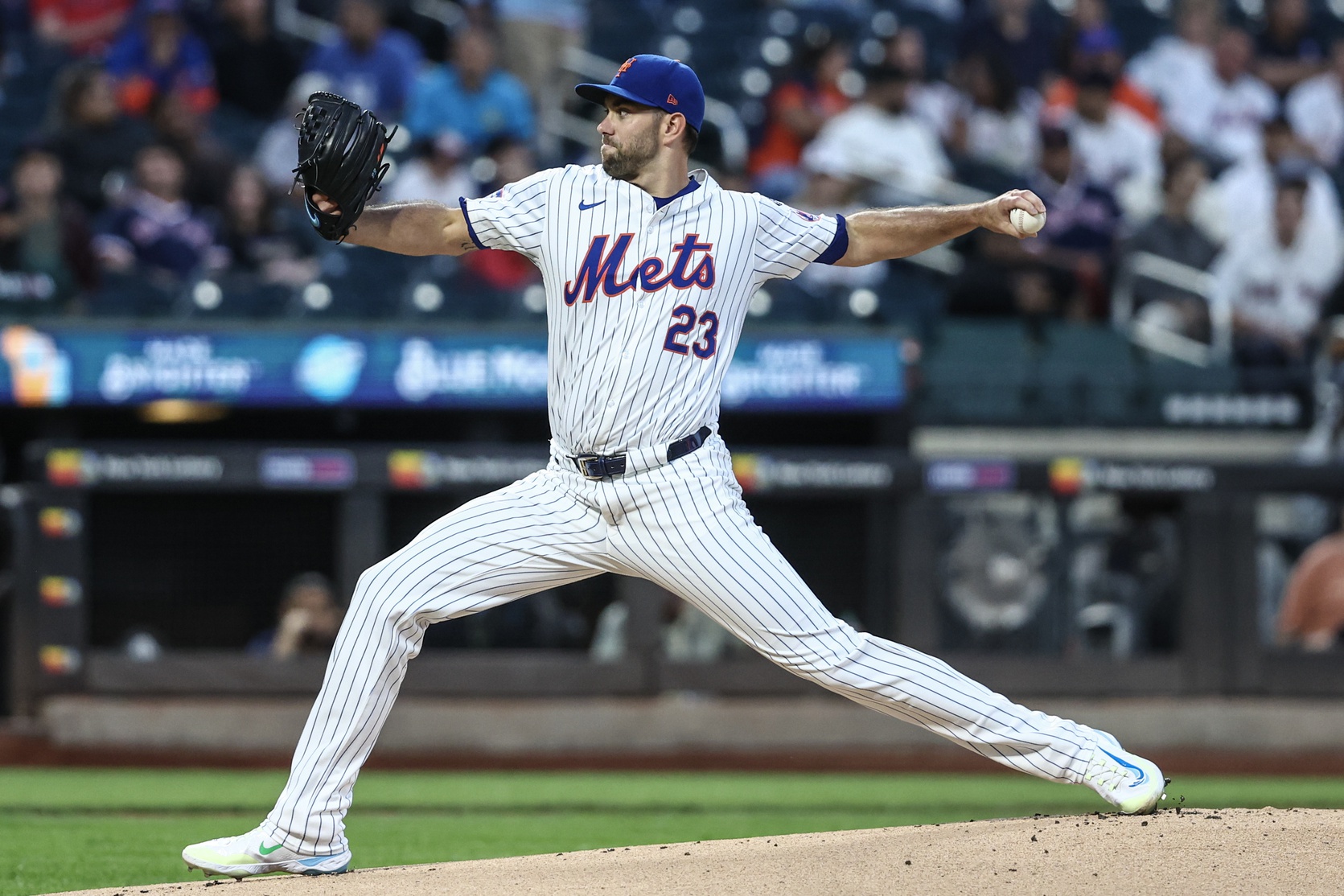
David Peterson gets the start this afternoon! Over 21 games in the regular season, he tossed 121 innings with a 2.90 ERA, 3.67 FIP, 1.289 WHIP and a 136 ERA+. He ended the year with an amazing seven inning outing against the Milwaukee Brewers, holding them to only one run. The left-hander allowed no runs and four hits in his first three relief appearances this postseason over 6 1/3 innings. Peterson’s first start of the season was against the Dodgers, where he allowed two earned runs and scattered seven hits over five innings.

In his one relief outing against Los Angeles this series, he allowed two earned runs over 2 1/3 innings. The Dodgers have the following career numbers against Peterson:

Opposing Lineup

  1. Shohei Ohtani – DH
  2. Mookie Betts – RF
  3. Teoscar Hernández – LF
  4. Freddie Freeman – 1B
  5. Tommy Edman – SS
  6. Enrique Hernández – 2B
  7. Max Muncy – 3B
  8. Will Smith – C
  9. Andy Pages – CF

The Mets’ bats will look to exorcise their demons this afternoon against Jack Flaherty. He had a fantastic start against the Mets in Game 1, holding them to two hits and two walks on no runs over seven innings. Against the San Diego Padres in the NLDS, he allowed four runs over 5 1/3 innings. In Flaherty’s four starts between Sept. 14 and Oct. 6, he allowed 14 runs across 19 1/3 frames.

The Mets have the following career numbers against him:

  • Pete Alonso 2-5, 2B, BB, 2 K
  • Francisco Alvarez 0-2, K
  • Jose Iglesias 1-7, K
  • Francisco Lindor 0-6, 2 BB, 2 K
  • Starling Marte 4-25, HR, BB, 8 K
  • J.D. Martinez 1-2, K
  • Jeff McNeil 1-3, K
  • Brandon Nimmo 0-3
  • Tyrone Taylor 0-6, 2 K
  • Mark Vientos 0-3, 2 K
  • Jesse Winker 9-24, 3 2B, 2 HR, 3 BB, 3 K

Game Notes

Per Newsday’s Tim Healey, manager Carlos Mendoza stated that Peterson is slated to throw up to 80 pitches.

The Mets’ “Plan A” does not include using Kodai Senga out of the bullpen, though he is available if needed. Sean Manaea, on the other hand, is not a relief candidate as he would start Game 6 if the team were to extend the series.

Mendoza added that Ryne Stanek and Edwin Díaz could combine to log 12 outs if necessary.

Three Things To Watch For

  1. How do the Mets come out of the gate? During the last series in September against the Brewers, the Mets came out tight and took some of the worst at-bats we saw this season. It appeared as though they were trying to do too much, and the Brewers just ran all over the Mets. At the end of the series, New York looked like their loose, fun selves and smashed the Brewers. Then, they did the same thing against the Atlanta Braves to clinch a playoff spot. They have every reason to come out tight this afternoon against a pitcher that shut them down earlier in the week, but how they perform in the first inning will tell us a lot about how the day goes.
  2. No free passes! The Mets allowed 22 walks over the first three games of the series. The key for Thursday’s game was to limit the free passes, and instead they gifted the Dodgers nine free passes. It’s difficult to win when you walk opposing hitters so often, especially against a lineup as potent as Los Angeles’, so the Mets need to keep the base paths as clear as possible to give themselves a chance.
  3. Mets’ big hitters need to come through. The Mets scored only two runs on Thursday on 10 hits. Several times throughout the game, they would get a rally going only to do nothing with it. At the end of the night, they were 0-for-10 with RISP while stranding 12 runners. Vientos provided a huge solo shot at the start of the game, and the Mets need someone to step up in a big moment today as well to score some runs.

Let’s go Mets!

The post Game Chat: Dodgers vs Mets, 5:08 p.m. appeared first on Metsmerized Online.

29 Nov 16:34

Pfizer CEO Blasted By UK Pharma Watchdog For "Disgracefully Misleading" Statements On COVID Vaccine

by Tyler Durden
Pfizer CEO Blasted By UK Pharma Watchdog For "Disgracefully Misleading" Statements On COVID Vaccine

Authored by Thomas Lifson via AmericanThinker.com,

You might think that an official rebuke of Pfizer’s CEO for misleading the public on the benefits of its COVID vaccine would be big news, especially given the fill court press by vaccine absolutists to compel people to receive the shots.

6 months ago, Dr. Bourla appeared with Klaus Schwab at the Wiorld Economic Forum (YouTube screengrab)

But even with a Google search, I have not yet seen any US media coverage of a starling rebuke delivered to Pfizer CEO Dr. Albert Bourla by a panel convened by the UK Prescription Medicines Code of Practice Authority (PMCPA). The criticism followed remarks he made in a December 2021 interview with the BBC. The following account is derived from an article in the Melbourne, Australia Herald-Sun by Frank Chung.

In early December 2021, Dr Bourla used an interview with BBC Breakfast to claim that the virus was “thriving” in schools and “there is no doubt in my mind that the benefits, completely, are in favour of” giving five-year-olds the vaccine.

“This is disturbing, significantly, the educational system, and there are kids that will have severe symptoms,” he said. (snip)

By March 2022, some data were showing the effectiveness of the children’s vaccine plummeted to just 12 per cent within weeks of inoculation.

Dr Bourla said in the BBC interview that the main benefit of immunising children was “the indirect protection of adults”.

“The extent to which we can do that and protect adults by avoiding them being infected by children with the current vaccines is still quite uncertain,” he said.

“So, that’s the balance — we clearly want to protect children as much as possible and we’ve got good evidence now that this vaccine, even at a low dose, produces a really good protective immune response in children and produces many fewer side effects because of the lower dose.

The CEO’s touting of “good evidence” and his promotion of a jab that turned out to have but 12% effectiveness, drew an almost immediate complaint:

Shortly after the interview was published, parent lobby group UsForThem lodged a formal complaint with the Prescription Medicines Code of Practice Authority (PMCPA).

The complaint alleged Dr Bourla’s remarks were “disgracefully misleading” and “extremely promotional in nature”, breaching several clauses of the Association of the British Pharmaceutical Industry’s (ABPI) code of practice, The Telegraph reported. (snip)

There is simply no evidence that healthy schoolchildren in the UK are at significant risk from the SARS COV-2 virus and to imply that they are is disgracefully misleading,” the complaint said.

A code of practice panel convened by the PMCPA found Pfizer had breached the code in a number of different ways, including by misleading the public, making unsubstantiated claims, and by failing to present information in a factual and balanced way, according to The Telegraph.

Pfizer appealed the findings, arguing Dr Bourla’s remarks were based on “up-to-date scientific evidence” and could be substantiated by the “publicly available independent benefit-risk assessments”. 

An appeal board panel met in November, where the breaches relating to misleading the public, making unsubstantiated claims and the lack of balance were upheld.

The more serious findings, including that Pfizer had brought discredit to the industry, had encouraged irrational use of a medicine and had failed to maintain high standards, were overturned.

The full case report will be published in coming weeks.

Pfizer is one of the largest television advertisers in the United States. That’s why I don’t expect this strong rebuke of its CEO to get much publicity here.

Tyler Durden Mon, 11/28/2022 - 14:24
23 Oct 23:55

Dr. John Campbell Sees It

by Concerned American
26 Apr 15:49

[Lael Weinberger] What Is Church Autonomy?

by Lael Weinberger

[A primer on a religious liberty issue that went from a backwater to a hot topic in the last decade.]

Thanks to Eugene and coconspirators for having me here this week writing about my recent work on church autonomy law. I have a new paper (forthcoming in the Notre Dame Law Review) about the limits of the church autonomy doctrine—responding, in part, to areas of confusion that have arisen in lower courts applying church autonomy doctrine. I'll use some future blog posts this week to get into those issues. Before getting into that, I want to step back to reflect on what's going on in the field of "church autonomy doctrine" and how this issue has risen in significance in the last decade.

The "church autonomy doctrine" is a legal principle of protection for the internal self-governance of religious organizations. (You can find a longer version of this explanation, with more citations, in the law review article.) Church autonomy doctrine protects religious institutions from state control, ensuring that religious organizations can control their own beliefs and internal affairs, or ensuring that the state does not establish a religion. The basics are fairly intuitive: Americans don't want the state telling religious bodies whom it can or can't retain as a minister, rabbi, or imam, or endorsing the theological distinctives of one side of a church split when the competing factions disagree about what counts as the "true" form of a given faith.

The church autonomy doctrine applies to all religious institutions, not just churches. While it could be termed "religious autonomy" (or more precisely, autonomy for religious institutions), "church autonomy" remains the most used term in the courts for the body of law that has developed about the internal affairs of religious organizations.

The church autonomy doctrine is based on both of the religion clauses of the First Amendment. The courts have based church autonomy on both religion clauses of the First Amendment. Interfering with the internal governance of a religious institution would violate religious liberty (free exercise) and establish a religion by allowing the state to dictate the conduct of the religious body. Scholars disagree about whether the Establishment Clause or the Free Exercise Clause provides the better foundation, or whether it is best to view church autonomy as the combined effect of the religion clauses, as the Supreme Court has said. But in any case, church autonomy ensures the institutional separation of church and state.

Broadly speaking, this doctrine has two main applications. First, courts should not decide matters that require a particular position on religious doctrine or belief. So if the court is asked to decide whether a member was wrongfully expelled on the basis of the church's doctrinal standards, the court should decline. Second, courts should not decide matters that interfere with the religious institution's internal governance. As the Supreme Court said in its 2019 decision of Our Lady of Guadalupe School, this "protect[s] their autonomy with respect to internal management decisions that are essential to the institution's central mission." This includes selecting ministers, which is known as the "ministerial exception" from employment nondiscrimination law. It also has been long understood to protect churches from defamation lawsuits challenging church discipline proceedings.

Some courts and commentators speak as though there are several different but related doctrines here (church autonomy different from ministerial exception different from ecclesiastical abstention). But I think the better way to think of this is as a single overarching principle—church autonomy—applied in different contexts. That's certainly how the Supreme Court has described the issue.

Church autonomy is not new. One can find a common-law church autonomy principle being articulated by the Supreme Court as early as 1872, even before the First Amendment was applied against the states. (The early history of American church autonomy is fascinating, but I'll hold back on that for the present—that's the subject of another project I have underway!) Church autonomy principles were thoroughly constitutionalized (that is, articulated as a matter of constitutional law) in a 1952 decision.

But for a long time, church autonomy remained a backwater. The paradigmatic Free Exercise religious liberty case involved an individual seeking to follow the dictates of individual conscience. The paradigm cases for Establishment Clause principles were government religious practices—school prayer, Ten Commandments in government buildings, and the like.

I first became interested in church autonomy cases when I was in college. My friend Bob Renaud and I noticed that the church autonomy cases engaged with church-state issues that had been historically very important in the history of Christian theology, about the formal institutional authority of church and state. We wrote an article about this. (It was my first law review publication—still in college and not quite knowing how law reviews worked, I was grateful to the law review editors who took a chance on us!) As I finished college, worked, came back to graduate school, and pursued other projects, I kept an eye on church autonomy. And over time, it took on more and more importance.

Over the last decade, most of the Supreme Court's high-profile cases about religious liberty involved religious institutions, from church employment decisions in Hosanna Tabor, to corporate conscience in Hobby Lobby, to religious social services in Fulton. The idea that the solitary individual conscience was the paradigm case for First Amendment religion cases has shifted considerably over the last decade.

The Supreme Court addressed church autonomy issues for the first time in years in Hosanna Tabor, making the church autonomy principle as strong as it has ever been. While controversies swirled over the best way to interpret and apply the Free Exercise clause to conscience claims, religious institutions had robust legal protections for their domain of internal autonomy. Zoë Robinson has perceptively called this decade an era of "religious institutionalism."

Church autonomy is no longer a backwater. It has taken its place as one of the central Religion Clause doctrines, regularly litigated in the courts. But with that as the case, it's particularly important to reflect on the scope and limits of church autonomy. Is church autonomy a praiseworthy principle of religious liberty that appropriately recognizes the communal nature of so much religious faith and practice? Or does it threaten (as its critics charge) to place religious institutions above the law in troubling ways? That's a question I'll take up in the next post.

The post What Is Church Autonomy? appeared first on Reason.com.

24 Jan 18:09

"Take Only What You Need:" DC Asks People To Limit Supermarket Purchases As Empty Shelves Persist

by Tyler Durden
"Take Only What You Need:" DC Asks People To Limit Supermarket Purchases As Empty Shelves Persist

"If you're hitting the grocery store to prepare for winter weather, please just buy what you need and leave some for others! You may have noticed empty shelves in some stores due to national supply chain issues, but there is no need to buy more than you normally would." 

Above is a recent tweet from the DC Homeland Security and Emergency Management Agency (DC HSEMA) completely contradicting what President Biden told the nation last Wednesday that images of empty store shelves in supermarkets are fake news. 

Biden, talking about his Build Back Better legislation, said, "First fix the supply chain... We heard dire warnings about how these supply chain problems could create a real crisis around the holidays. So we acted."

The president preceded to tell the nation, "eighty-nine percent" of supermarkets "are full, which is only a few points below what it was before the pandemic." 

He said the images Americans see on television of empty shelves are misleading. 

Suppose supermarket shelves aren't empty, as Biden explains. Why would DC HSEMA issue a notice to area residents about empty store shelves and ask people not to panic hoard ahead and during adverse weather conditions this winter? 

Something is amiss here, and it seems the delusional 79yo president might be a little out of touch with reality. 

For a dose of reality, the internet has been washed with social media users pointing out bare shelves at supermarkets around the country. 

Last week, Phil Lempert, an editor of the website SupermarketGuru.com, told NPR that supermarket shelves are bare again. He called it a "perfect storm." 

Industry experts, such as Conagra Brands' CEO Sean Connolly warned its US plants could be constrained for at least the next month due to Omicron-related absences

Another expert, the CEO of Albertsons, is anticipating continued supply chain woes "over the next four to six weeks." 

So if the nation's food supply is under stress and store shelves are going bare as DC HSEMA tells residents not to panic hoard, then why in the heck is the president misleading the public about how everything is okay? 

Ah, yes, the midterms are coming up. 

Tyler Durden Sun, 01/23/2022 - 16:35
16 Nov 13:57

Watch "Historic" Event: SpaceX Rocket To Launch Astronauts To Space Station

by Tyler Durden
Watch "Historic" Event: SpaceX Rocket To Launch Astronauts To Space Station Tyler Durden Sun, 11/15/2020 - 19:15

If schedules and the weather hold up, the launch of NASA's SpaceX Crew-1 Mission on the "Resilience" Crew Dragon spacecraft, powered by a Falcon 9 rocket, will begin at 7:27 p.m. ET on Sunday from pad 39A at NASA's Kennedy Space Center in Florida. 

Sunday's launch will make history as the first crewed commercial space mission to the space station. This will also be the second time in a decade that NASA has launched astronauts from the US. 

In May, astronauts Doug Hurley and Bob Behnken rode the Crew Dragon spacecraft, powered by Falcon 9 rocket, to the space station, stayed for two months and returned to Earth in August.   

On Friday, at a press conference, NASA Administrator Jim Bridenstine said, "this is another historic moment -- it seems like every time I come to Kennedy [Space Center] we're making history, and this is no different." 

Bridenstine continued: "The history being made this time is we're launching what we call an operational flight to the International Space Station."

"The whole goal here is to commercialize our activities in low-Earth orbit," he added. "NASA wants to be one customer of many customers in a very robust commercial marketplace for human spaceflight in low-Earth orbit."

NASA's website outlines today's scheduled events: 

  • 3:15 p.m. – Coverage of the Launch of NASA's SpaceX Crew-1 Mission on the "Resilience" Crew Dragon to the International Space Station (Mike Hopkins, Victor Glover, Shannon Walker, Soichi Noguchi; 
  • Launch scheduled at 7:27 p.m. EST; coverage will be continuous through docking and hatch opening on Sunday, Nov. 15) – Kennedy Space Center/ Hawthorne, Calif./Johnson Space Center
  • 9:30 p.m. – NASA/ SpaceX Crew-1 Postlaunch News Conference (time is subject to change)- Kennedy Space Center

NASA Live: Launch Event 

It remains to be seen if SpaceX CEO Elon Musk attends the launch event as he revealed Saturday evening he "likely" has a "moderate case of COIVID-19. 

22 Oct 18:06

China Engineers Mammoth Monday Stock Rally

by therealheisenberg
Let's hope this lasts, because if 2015 is any guide...
09 Oct 16:42

Fix The Senate The Right Way – Repeal The 17th Amendment

by Duane Norman

Originally Posted at Free Market Shooter

Following the ultra-partisan confirmation of Justice Kavanaugh to the Supreme Court, mainstream media suggested that the US Senate falsely represented America’s interests, and alluded to possible changes:

Sadly, WaPo is pushing for a plan that involves a large number of people congregating in a few urban areas, dictating their will to the rest of the country.  This mob rule wouldn’t solve anything, except perhaps pushing America towards a second civil war…

…but a different reform could improve the hyper-partisan nature of today’s elections – repeal of the 17th amendment.

Most people don’t even know what the 17th amendment is, much less what it did to our elections.  Prior to the 17th, US Senators were elected by state legislatures, with the 17th changing it to the popular vote system we have today.  The two primary reasons cited for the change were – legislative corruption, and electoral “deadlock” – both of which were far more infrequent than claimed, according to The Federalist.

Of course, it was none other than the progressive movement that was able to spearhead this change to the Constitution:

The progressives dealt with this roadblock to their agenda by spreading “fake news.” Media mogul William Randolph Hearst and his “yellow journalists” spread the idea of widespread senatorial corruption using flamboyant headlines like “The Treason of the Senate.”

Over time, people began to believe the lie. In a grassroots rebellion, they elected state representatives who supported direct election of senators. When 31 states passed resolutions calling for an amendment, Congress finally capitulated.

Thus, out of manufactured hysteria over nonexistent corruption, the Seventeenth Amendment was born, robbing states of their most notable constitutional check on federal lawmaking in the name of “democracy.” Ever since, states have been reduced to hiring lobbyists to influence federal policy. In 2009, state and local governments spent more than $83.5 million on such efforts.

Somehow progressives were able to con the public into believing it was easier to corrupt thousands of state legislators (currently 7,330) instead of just corrupting the Senate elections themselves, as noted by The Nationalist Review:

In addition, direct election of Senators caused citizens to care less about their own state’s politics, ceding an increasing amount of authority to federal officials that have been increasingly corrupted by national parties, which spend millions campaigning for Senators every two years:

Direct elections require Senators to build a statewide electioneering machine to win office. This is an expensive proposition. In fact, the average cost to win a Senate seat is $10.4 million—10 times the average expense of a successful House of Representatives race.  The large amount of money necessary to win and hold a seat requires Senators to curry favor with interest groups, corporations, and big-dollar donors. Many argue that campaign contributors receive much greater access and influence than the average citizen in exchange for their donations.

Repeal of the 17th amendment would ultimately have Senators represent their state’s interests far more than the national political party, with local elections taking on added importance.  The decentralization of power would also make it far more difficult for special interests to control Senators’ votes, as doing so would involve controlling thousands of local races, as opposed to just a small number of Senate elections.

States in grey are those FMShooter believes are highly contested in the 2018 elections – and both parties are pouring millions into these races

The Daily Bell did the math on just how much more representation each voter would be getting if the 17th amendment was repealed:

Remember, your vote for state Rep and state Senate actually matter… in these small districts you have 105x and 39x more power than in a state-wide race.

So compared to the US Senate race, your vote has a MUCH higher probability of influencing 2 seats out of the 144 member legislature (39 Senators + 105 Reps).

If both your choices get elected, you have chosen 1.4% of the state legislators who will choose your US Senator.

But your vote for US Senate in the state-wide race gives you just .00002% say in who gets elected US Senator.

If both your choices for state Rep and state Senate get elected, you have 70,000 times more control over who gets elected US Senator.

The numbers don’t lie – repeal of the 17th amendment would not only give voters a bigger voice in deciding who gets elected to the Senate, it would give voters more interest in (and control over) their own state governments, which might finally hamstring an already omnipotent federal government.

As The Nationalist Review again articulates, the progressive push for direct democracy has further cemented the “rule of mob” into American politics:

The 17th amendment has thus been one of the worst modifications to the US Constitution in our 242-year history.  It has removed much of the impetus for voters to change politics at the local level, instead federalizing even more power in Washington DC.  Designed to give voters more say in their representation, the 17th instead changed the Senate to become far more similar to the House, only with special interests and political parties exerting far more control over Senators than the voters.

Sadly, repeal of the 17th amendment is as unlikely to happen as it would be good for the country.  Who really believes progressives and big business would allow that much power to be ceded without a monstrous fight?

26 Jan 14:21

As the Left’s social revolution wins victories, a revolt begins

by Larry Kummer, Editor
Summary: As the Left’s social revolution gains momentum, a counter-revolution brews unseen in America’s back alleys where the wise and great do not go. We can only guess at the results. “It’s called being female, this strange creature, covered in hair, pinioned between morality and hormones, governed by two brains, one above and one below. … Continue reading As the Left’s social revolution wins victories, a revolt begins →
09 Aug 13:08

Judging things by their side effects

by Simon Penner

“He wrote this post, and then people were hurt. There appears to be no rational evaluation of how or why this happened. No consideration of other factors in play, and no meaningful allowance for any alternative explanations.”

Normally I’d feel like writing this on the blog would be gauche. Believe it or not, I am trying to avoid fueling the culture war when possible, but something very specific caught my eye, and I’ve been feeling the need to address it for a long time.

This Medium post has been written about the Google Manifesto. Please read it. And then please read the following paragraph five times:

I am not staking out a position on the Google Manifesto. I am not staking out a position on this blog post. I am not making any comment whatsoever on anything object level or anything meta level concerning the political event or the blog post. What I am doing is taking an excerpt from this blog post that concerns me, and that I believe to be broadly representative of a social trend, and using this blog post as a convenient springboard to provide a context in which I can introduce my discussion. This is not a response to the Medium author. If at any point you wish to respond to anything I’ve said with “the Medium post didn’t say that”, then please don’t. I am not responding to the Medium post. I am responding to a broad trend that I perceive across certain elements of society.

Have you read the Medium article in full? Have you read the preceding paragraph five times? Then let’s begin.


For a while I have been considering a vague, half-formed thought that keeps floating around the edges of my ideas. To be blunt: when interacting with people who fall in the general direction of “Social Justice Politics,” their comments and actions are sufficiently baffling to me that I have a very hard time assuming good faith. Of course, assuming bad faith is a rather grim disposition, and if you find yourself assuming bad faith, you should consider this a warning light that you are missing some key detail. I’ve spent a lot, a lot of time trying to identify a key detail that fits into my mystery. I’ve considered some candidates, but they all inevitably strike me as “how can someone possibly believe that?”

A passage in this Medium post has put words to one of my more promising candidate key details. I still find myself somewhat at a loss for how anyone could believe this, but at least it feels right. Consequently, it should be noted explicitly that this blog post is epistemic status: exploratory. Every single statement that I make in this post should be interpreted as something like “is this true?” or “suppose this is true, what happens?”

The passage I’m interested in is the bolded part. The rest is quoted for a little bit of context within the article.

So it seems that someone has seen fit to publish an internal manifesto about gender and our “ideological echo chamber.” I think it’s important that we make a couple of points clear.

(1) Despite speaking very authoritatively, the author does not appear to understand gender.

(2) Perhaps more interestingly, the author does not appear to understand engineering.

(3) And most seriously, the author does not appear to understand the consequences of what he wrote, either for others or himself.

The author does not think it important to address upfront whether or not the manifesto’s statements are true. However, the author does think it is important to address upfront that the manifesto’s statements are dangerous. Further, he elevates the danger to be his biggest and most important concern.

He appears to believe that the side effects of saying words are strictly more important than the actual information content of these words.

It is my position that normatively this is a bad idea. I have two main reasons. First of all, it plays into something I’ve been calling “active denial of causality.” In a nutshell, it supposes that if an action (in this case, a statement) correlates with any negative effects whatsoever, then this is automatically bad and must be stopped, by a point intervention that forcibly shifts society in the direction away from the bad thing. In this case: Manifesto Author wrote the manifesto (action), and then people were hurt (correlation), so we must do whatever it takes to punish him and stop him or others from writing things like this again (forcible shift).

The critical detail missing from that line of reasoning is the mechanisms by which any of those things are related to each other. There is a post-hoc-ergo-propter-hoc fallacy: He wrote this post, and then people were hurt. There appears to be no rational evaluation of how or why this happened. No consideration of other factors in play, and no meaningful allowance for any alternative explanations. So, for example, it is assumed as an inviolable axiom that the manifesto author is the only person with agency. It is assumed that his action always necessarily causes the harms posited and that the only way to stop them is to prevent his action. The idea that someone could possibly disagree with him and address him head on without exploding into threats and insults is written off without so much as a thought.

This dogmatic, unthinking insistence on a direct cause-effect relationship, with no attempt made at understanding contexts or motivations, creates a bigger problem. If the causes are arbitrary and direct, then changes can be as well. There appears to be a sincere, genuine belief that all it takes to stop this from ever happening again is a well-timed banhammer. This completely denies any discussion of the underlying causes of why someone might write this. It completely denies any other underlying causes for why people reading it may be hurt by it. It completely denies that there will be any side-effect reaction to the implementation of this banhammer. It is an authoritarian high modernist fallacy, assuming that anything not legible doesn’t exist.

This is bad and dangerous, in general, because it will cause people to make mistakes. This kind of thinking leads to an attitude that underlying structures do not matter, and can be blown away without a second thought if they are inconveniently in the way. It is the philosophical equivalent of an architect who smashes down load-bearing walls without hesitation, purely because the room was the wrong size. This makes buildings collapse. Or, to use an analogy the left might like: “If we blow up terrorists, there will be no terrorists to blow us up” is an insane and ridiculous statement because, among other things, it assumes that blowing up terrorists will not radicalize any new terrorists.


The second reason is somewhat more mundane and practical, but even more important.

If, when somebody makes a statement of fact, our primary concern is with whether or not those facts are true, this is a tractable problem. We can establish, for a certain subset of claims anyway, an objective and unchanging standard of truth. This allows all of us to coordinate against that standard, which facilitates communication and understanding.

In practice, one of our main standards of truth is a cluster of ideas that are broadly referred to as “the scientific method.” Essentially: An idea is proposed, data is collected, statistical methods are applied to the data in order to validate it, and then a conclusion is written, tying the observed data to the proposed idea.

Observed data is not up for argument. It is not up for debate. You cannot deny it, unless your argument is “the person providing this data is lying.” Statistically concluded data is not quite as ironclad, but it still cannot be denied unless one has concerns about the underlying data or statistical confounders.

Contrasting to this, if one’s primary concern is not with whether or not a statement is true, but whether or not it is dangerous, this is a much more subjective thing. If I measure something at 100kg, it is 100kg. It is 100kg regardless of who you are, where you are, what you are. However, if your assertion is “telling me that this thing is 100kg is dangerous,” that is more subjective. You can’t make the claim “this is universally dangerous,” only “this is dangerous to me.” Because different people will have different thresholds for danger, this makes it much harder to coordinate, communicate, and understand each other. It creates impossible-to-understand situations. It creates fundamental disagreements that ultimately cannot be resolved without resorting to violence, whether symbolic or physical.

This is important when one is creating systems that are supposed to stand as absolute, objective standards that we coordinate around. For example, if your rule is “anyone under 100kg can attend”, this is a rule everyone can easily understand. If your rule is “anyone who is not dangerous can attend”, what then? How do I know if I am dangerous? Do we use my standard of danger? Your standard? What if our standards are different? How am I supposed to know ahead of time whether or not I am allowed to attend?

In extreme cases, major ambiguities in social norms like this can be exploited by sociopathic bad actors. I don’t think I need to get into details on this; if you read our blog regularly, you can think of some examples.

If we adopt a social norm that the side effects of speech are more important than its truth value, another problem arises: we can no longer trust the truth value of anything by default, ever. If we know that, when one’s priorities come in conflict with the truth, society prioritizes one’s priorities, then a necessary precondition to trusting someone is “knowing that their priorities are in line with the truth.” However, as priorities are subjective things, we can never know this for sure. Especially in a world in which people’s communication about their priorities is itself subject to the same truth/pragmatism tradeoff.

Once we can no longer trust the truth values of anything by default, we can no longer be confident in the correctness of our own reasoning or actions. At the extreme, this creates a miserable society, where nobody can trust one another, where everyone is disconnected from the fundamental constraints of reality, and consequently where everyone is constantly accidentally hurting themselves and each other with foolish mistakes and petty manipulations.

From speaking to many left-leaning people, I understand that many of them would at this point like to make an argument of the form “yes, yes, I understand that, but you’re seriously defending $REALLY_BAD_THING. Can’t you tell that $REALLY_BAD_THING is really bad, and that in this case the trade-off is not only worth it, but imperative?”. The problem with this is that your perception of its badness is not objective. The problem is that you think that this is the really bad thing that needs an exception. And that guy over there thinks a different thing is the really bad thing that needs an exception. He thinks that your thing is actually a really dangerous exception, and you think the same about his. And, because you have both thrown out the window any hope of an objective, absolute standard to measure your claims by, ultimately the only way to decide which of you two is correct is “might makes right” aka “whoever actually pulls off the deceit wins.”

So, consider the following. Perhaps you sincerely and in good faith believe that, despite everything that the Google Manifesto says being true (because if it wasn’t, you could just say “this document is false” and be done with it), it will cause harm and danger to many people and so it should be nonetheless denied. Well, so, here’s a problem.

In 2003, the Bush administration knew damn well that there were no WMDs in Iraq. However, they really truly sincerely believed, according to whatever weird messed up metric they were using, that not bringing war to Iraq would cause massive harm and danger to many people, so that nevertheless we should lie about there being WMDs in Iraq. In a world where truth is prioritized, they have to come to us and say, “Ok, so, we don’t have a slam dunk argument for why we need to do this, but we still need to do this because of XYZ”. And then we can say “yeah but if we do this, ABC,” and then we can do a proper discussion of the tradeoffs of XYZ vs ABC and, hopefully, come to a good path forward. But in a world where “But I FEEL that that would be bad” is considered the trump card, then this discussion of whether or not we should glass the desert doesn’t happen, and mans with guns go murder a fuckload of people unless you are smart enough to realize that they are lying to you before they start deploying a carrier group. I generally think that not-murdering people is preferable to murdering people, especially when they didn’t threaten us with weapons of mass destruction.

I believe that SJWs, activists, etc., in general, act-as-if they don’t think truth matters. I believe that this concisely explains a lot of things that otherwise appear to be irrational or nonsensical. I also believe that this is a very dangerous attitude to hold, and I am genuinely afraid of our society becoming one in which this attitude is the normalized, default attitude.

Ultimately, a focus on truth is equivalent to saying “I trust you, fully informed with all the facts, to do the right thing”. And a focus on harm (or any subjective metric) is equivalent to saying “so-and-so has the right to impose their decision on you”. Of course this probably sounds great when you’re doing the imposing. It’s just somewhat laughable that the people doing the imposing are also the ones claiming to be oppressed.

26 Aug 20:14

Stavisky Allies Knock Primary Opponent’s Abortion Stance

by Nick Reisman

Supporters of Queens Democratic Sen. Toby Ann Stavisky, ranging from state lawmakers to prominent advocates, on Friday criticized her primary opponent SJ Jung for his stance on abortion.

Jung at a candidates forum this week declared he is opposed to abortion unless bringing the pregnancy term threatens the life of the mother.

At a news conference, Stavisky and her allies — including Democratic Minority Leader Andrea Stewart-Cousins — blasted the remarks.

“The last thing that New York needs is another State Senator working to restrict a woman’s right to choose,” Stewart-Cousins said. “We need more pro-choice Senators fighting for the women of New York, not fewer.”

Advocates for abortion rights, too, criticized Jung’s stance on the issue, which in recent years come to the forefront of both Democratic electoral politics and policy in Albany after Gov. Andrew Cuomo pushed for a codification of the Roe v. Wade decision in state law.

“SJ Jung fails to understand that abortion is a fundamental right for women, just like equal pay, or the right to vote. His extreme anti-choice views make him unfit to represent Queens in the New York State Senate,” said Andrea Miller, the president of the Campaign for a Pro-Choice New York PAC. “The people of District 16 have been fortunate to be represented by Senator Toby Ann Stavisky, who has long been an advocate for access to all reproductive health care and a true champion for women’s rights.”

Not lost on the event, too, was the recognition of Women’s Equality Day. One lawmaker, Assemblywoman Nily Rozic, said Jung’s comments were disqualifying.

“We need strong pro-choice women defending our rights in Albany,” she said, “not those who will betray the women of Queens.”

26 Oct 19:15

The Montauk Catamaran Company Chronicles 10/23/15: Well begun is half done…?

by David Ryan

johndaquan

Their second day on the job and John and Daquan are working from blueprints to loft Mon Tiki Largo’s bulkheads. At the Montauk Catamaran  Company we don’t’ just build boats, we build boat-builders.

I am sitting at a table in a deli at the corner of Church and Lincoln in Holbrook NY. A late model silver Mercedes coupe just pulled up. Now the driver’s crossed the threshold of the deli. I’d make him as one of the owners of the various businesses that make this neighborhood. On our block there’s scrap-metal recycler, a mini-storage, a run-down trailer park, a couple of auto body places, a cabinet shop or two, a place that builds aluminum boats, and sundry other “light industrial” business. When I drove here a half-hour ago (6:30am) the streets were mostly empty, but now they’re busy. Work starts at 7am at a lot of these places, 8am at most of the rest. The fellow driving the Mercedes just left with his coffee, got in his car and is on his way.

Over last weekend I hired four people — Krystle, John, Daquan, and Tom — and after four days together it seems like it’s always been this way. Mistakes get made every day, every hour, but they are the right kind of mistakes. The crew is learning fast and learning well.

Today we are talking delivery on 200 sheets of BS 1088 meranti marine plywood. Last time out (Mon Tiki) the Coast Guard asked for lab tests when we already had the hulls half built. This time, lesson learned, the testing is already done. Early next week 250 gallons of epoxy & hardener and associated materials will arrive at the shop; and shortly there after the dimensional lumber will start coming into the shop.

In addition to the materials we’ve also secured a portfolio of insurance policies for the build: workers comp, workers disability, builders risk, and a general liability policy for whatever the first three don’t cover. Add all of it up — the materials, rent, insurance, first week’s payroll — and it would just about pay for that silver Mercedes that pulled in earlier. But the idea of driving a Mercedes coupe doesn’t excite me the way the idea of building a big silly boat excites me. And a fancy car won’t protect all that my wife and I have built over the last few years, a bigger boat might…

If you think offshore sailing is a thrill, try running a small business. My head is filled with doubts, but it’s too late. We are building this boat, Mon Tiki Largo, a Pahi 63 MkII. I’m excited!

In the next 7-10 days I hope to be hiring another 2-4 people. If you’re interested in being a part of something amazing, get in touch.


TwitterFacebookRedditEmailPrintFriendlyMore options

22 Oct 18:13

Ruben Tejada Provides Each Teammate With Some Spirit!

by Joe D

ruben tejada waves

And by spirit, I mean the distilled kind…

Shortstop Ruben Tejada, although sidelined with a fractured leg, stood out behind-the-scenes with a truly rare gift for his teammates in honor of their incredible victory.

JW Engraving_Ruben Tejada NLCS 2015_2

Each member of the team received a custom engraved bottle of Johnnie Walker Blue Label Scotch whisky that read:

“NLCS CHAMPS 2015, KEEP WALKING”

It’s clear that chants for #WinForRuben didn’t go unnoticed by Tejada. This ultimate gift of gratitude shows his continued joy in the success of his team and love of the game.

Tejada said after the game:

“It’s been a long time since the Mets have gotten this far. It’s been a joy to watch my teammates sweep and I wanted to congratulate them with engraved bottles of Johnnie Walker Blue Label.”

“We do have some work cut out for us, but today we’re going to enjoy this moment as a team since we worked so hard to get here.”

No word if Chase Utley offered to pay the tab for Ruben…

2015-world-series-logo

24 Feb 17:37

Nobody’s perfect. Not even Strunk & White

by Ray

Here is a sentence from Strunk & White’s The Elements of Style, 76–77 (4th ed. 2000):

Do not be tempted by a twenty-dollar word when there is a ten-center handy, ready and able.

The problem: in the same book, page 2, the authors advise writers, “In a series of three or more terms with a single conjunction, use a comma after each term except the last.” Following their own advice, the authors should have put a comma after “ready.”

If the authors were alive today, they might quote Ralph Waldo Emerson: “A foolish consistency is the hobgoblin of little minds, adored by little statesmen and philosophers and divines.” Or they might shrug their shoulders and say, “Typos happen.”

Hat tip to my colleague Louis LaCour for spotting this.

17 Dec 14:49

Judge rules new immigration policy invalid

by Lyle Denniston
Judge rules new immigration policy invalid

A federal judge in Pittsburgh, in the first court ruling on President Obama’s new policy on undocumented immigrants, ruled on Tuesday that, because the president had no authority to act alone, the policy is unconstitutional.   If that part of the ruling by U.S. District Judge Arthur J. Schwab survives further review in lower courts, the issue could go to the Supreme Court much earlier than expected.

Although the judge flatly declared the November orders by the president and other U.S. officials to be unconstitutional, he did not bar the policy’s continued enforcement and, in fact, set up additional steps he plans to take in a pending case on the alternative view that the policy may actually be valid.

The judge’s highly complex ruling came in a totally unanticipated test case on the policy, involving a Honduran national who has pleaded guilty to the crime of returning to the United States after once being deported as an undocumented immigrant.

The president’s policy, which has been in effect for less than four weeks, gives some immigrants who have been in the United States illegally for years a chance to remain in the country by having their potential deportation put on hold.  The policy may give a reprieve to more than four million foreign nationals living in the United States.  The president has defended his action as necessary because, he said, immigration policy is broken but Congress has not acted to fix it.

The policy is hotly controversial in Congress, and the Republican leaders on both sides of Capitol Hill have vowed to take action to thwart it when the GOP takes control of the House and Senate in January.  The policy also is under legal challenge in federal courts in Washington, D.C., and in Brownsville, Texas.  Neither of those cases, however, is likely to unfold quickly.

Judge Schwab’s ruling, however, may develop rapidly, depending upon how the Obama administration reacts to it.  The issue arose unexpectedly in that federal court on November 24, four days after the President announced the change in a nationwide address from the White House.   On the same day, Judge Schwab ordered lawyers in a pending criminal case to file briefs on the potential impact of the new policy on that case.  Those filings then led to Tuesday’s ruling against the policy.

Before Judge Schwab is the case of Elionardo Juarez-Escobar, now forty-two years old, who came to the U.S. illegally from his native Honduras in October 2005.  He was arrested in New Mexico by the U.S. Border Patrol and was deported on December 5 of that year.

He later reentered the country later without permission and wound up in Pittsburgh, where his brother lives.  His brother is a U.S. citizen and has employed him in a landscaping business for at least two years.  In April of this year, Juarez-Escobar was stopped by a police officer in Pennsylvania after driving around a traffic stop, according to court records.   He was charged with drunk driving and driving without a license.

In June, he was turned over to federal immigration officials, who concluded that he had reentered the United States illegally.   He has been detained since July, and was charged with one count of illegally reentering the country after being removed earlier.   He initially pleaded not guilty to that criminal charge, but then asked to change to a guilty plea.

While that request was pending before Judge Schwab, with a sentence to be imposed later, President Obama announced the new deferred deportation policy, and the judge then moved to consider whether it had any impact on the Juarez-Escobar case.  The Justice Department told the judge that the new policy had no effect on criminal cases such as this one, but the Honduran’s lawyers argued that it might affect the case.

In his decision on Tuesday, the judge gave a stern lecture to the president on the need to execute the laws that Congress passes, rather than seeking to change the effect of those laws on his own.   The opinion cited many comments that the president himself had made, before announcing the policy change, about his lack of authority to take such action.

Writing that the court was “bound to ensure that the Constitution’s structural safeguards are preserved,” the judge concluded that the policy was unconstitutional.   “The President may only ‘take care that the laws be faithfully executed'; he may not take any Executive action that creates laws.”

The new policy, the judge went on, is not an exercise of presidential discretion on when to prosecute individuals for a violation of the nation’s laws, but was in fact a legislative action beyond the president’s constitutional authority.

Instead of being a form of case-by-case judgment about which individuals are to be deported, Judge Schwab found, the policy “provides a systematic and rigid process by which a broad group of individuals will be treated differently than others based upon arbitrary classifications.”  Rejecting the government’s claim that the policy only delays deportation and does not create any new legal rights for those who benefit from it, the judge declared that the policy provides those who qualify with “substantive rights.”

He ultimately concluded: “President Obama’s unilateral legislative action violates the separation of powers provided for in the United States Constitution as well as the Take Care Clause, and, therefore, is unconstitutional.”

From that point, the judge moved on to analyze whether the policy — if valid — would apply to Juarez-Escobar.  The judge commented that it might apply, as Juarez-Escobar’s lawyer had argued, because he might not be subject to early deportation and might even qualify for extended delay of any potential deportation, or perhaps qualify for asylum because of hostile conditions in his home country.

Therefore, Judge Schwab found, he should give Juarez-Escobar a chance to change his guilty plea back to not guilty, because of the possibility of deportation that could follow a criminal conviction.

Despite his declaration that the Obama policy was invalid, the judge said that, if it were understood to be lawful, it was the court’s duty to decide definitively whether Juarez-Escobar could benefit from it and, if so, the impact on his criminal case.

As a result, the judge announced this schedule:  by January 6, Juarez-Escobar should choose whether to withdraw his guilty plea in light of the new government policy; leave his guilty plea intact and go forward to sentencing on January 22; or go ahead with sentencing and be turned over then to immigration officials, potentially to be deported.

If he were to choose the second option, Judge Schwab said, Juarez-Escobar would be sentenced only to the time he already has been detained, followed by a year of supervised release while living in the U.S., so that he could attempt to take advantage of the new policy.

Once Juarez-Escobar makes his choice, the judge ruled, the federal government must file a formal response by January 12.

The government presumably has the option of either going to a higher court to try to block that schedule or attempting to persuade Judge Schwab not to apply the new policy in this case — despite the judge’s determination already to do so, at least so far as it may have an impact on the sentencing issue.


22 Oct 16:08

Looking for Writers

by Captain Capitalism
Howdy All,

Alex is looking to hire more writers as the fall semester gets into mid-terms and ultimately finals season.  If you're interested in picking up a little extra cash and would like a job without a commute, contact him below:

Aleksey Bashtavenko
Academic Composition
Owner & Principal Writer
(540) 300-1253
academiccomposition@gmail.com
www.academiccomposition.com
www.linkedin.com/pub/aleksey-bashtavenko/25/7b8/323/
 
Thank you,
 
Cappy 
HHR4HM7ZPMV3
02 May 13:38

Veterans of the Burn Pits

by Kelley Vlahos
Wickemt

It’s estimated that at its peak, the pit at Balad burned 250 tons of unregulated hazardous materials, batteries, tires, food, medical waste, and whatever else—a day. And they used jet fuel to burn it, Meyer told TAC.

Sgt. Daniel Meyer doesn’t need anyone to tell him that the poison he sucked into his lungs at the Joint Base Balad burn pit in Iraq is to blame for the fact that he’s now a 29-year-old trapped in an old man’s body. But it is helpful that doctors have made it official in his medical records. Meyer has Bronchiolitis Obliterans (as bad as it sounds), for which he is on four liters of oxygen a day, as well as fatty tumors of the legs, which keep him wheelchair-bound. His service connection affords him generous VA home health care, since he can no longer leave the house.

Even Meyer, featured recently in the Washington Post, admits his case was so severe that the VA could not deny him. But what about all the men and women who came home with respiratory problems, perhaps not quite as severe but debilitating nonetheless, who don’t know where they got it or where to turn for a proper diagnosis? The VA and Department of Defense have yet to fully recognize that toxic exposures—primarily from the burn pits on all major U.S bases in Iraq and Afghanistan, but also from heavy metals in the sand and dust —are to blame.

Thanks to persistent lobbying and more than one sympathetic representative, Congress passed legislation in 2009 to put tough new regulations on burn pit use in the field including a general prohibition, with giant incinerators replacing the dozens of giant pits operating in Iraq and Afghanistan immediately. But it didn’t quite go as planned.

The Special Inspector General for Afghanistan (SIGAR) has found that millions of taxpayer dollars have gone into putting incinerators into the field that are either not working or not being used. It found that incinerators brought into Afghanistan’s Forward Operating Bases Salerno and Sharana cost taxpayers $11 million, but were not being used because contractors did not install them properly. To add insult to injury, reports indicate that once Sharana was shut down, the inoperable incinerators were likely broken down into scrap.

At Camp Leatherneck, despite the military spending $11.5 million to put four incinerators on the base, “we observed several truckloads of solid waste being delivered to open-air burn pits,” wrote SIGAR John Sopko in July 2013 (page 35). It turns out the incinerators were not being used. This unduly exposed the estimated 13,500 Marines and soldiers who lived there, he wrote, “to toxic smoke from burning solid waste each day,” which “increases the long-term health risks for camp personnel, including reduced lung function and exacerbated chronic illnesses, ranging from asthma to chronic obstructive pulmonary disease.”

Veterans advocates who have been working on the burn pit issue for several years now are hoping that another law, passed by Congress in January 2013, will force the VA and DoD’s hands by establishing the VA Open Air Burn Pit Registry. The registry would reach out to the untold number of ill men and women suffering from possible toxic exposures overseas. It was mandated to launch a year after the bill was signed, but so far, and with very little explanation, the registry has yet to materialize.

“They don’t want to admit there is a burn pit problem and putting out the registry is admitting there is a burn pit problem so this is just another way of putting it off,” charges Meyer, who has been unable to walk for two and a half years. He spent his first tour in Balad in 2007. One of his jobs on the first tour was shooting birds with a BB gun around the burn pit, wholly unprotected from the fumes. His barracks were adjacent to the pit. On his second tour, at Camp Bastion, Afghanistan, his barracks were across the street from the pit.

It’s estimated that at its peak, the pit at Balad burned 250 tons of unregulated hazardous materials, batteries, tires, food, medical waste, and whatever else—a day. And they used jet fuel to burn it, Meyer told TAC.

Vets began wondering publicly about their unexplained symptoms—particularly respiratory problems—as far back as 2009. Burn Pits 360 is a nonprofit run by Rosie Lopez-Torres for her husband Sgt. LeRoy Torres, 40, who was diagnosed with constrictive bronchiolitis after returning from Iraq (great profiles of Meyer and Torres here). Like Meyer, he is severely restricted and stays inside on oxygen most of the time. Lopez-Torres told TAC this week that the informal registry at BurnPits360.org has gathered information from 3,000 veterans who say they are sick.

“I think there is going to be a pretty shocking and a sizable number” if the VA’s registry does what it’s supposed to do, says Nick McCormick, legislative associate for the Iraq and Afghanistan Veterans of America (IAVA), which has been lobbying for the registry to start. “The registry will quantify the numbers.”

But where is it?

“The delay is deeply concerning, particularly when similar registries exist in the United States government. The lack of urgency and communication from the VA is even more troubling,” wrote Sens. Tom Udall, D-N.M., and Bob Corker, R-Tenn., who sponsored the registry legislation and shepherded it into passage after two years of effort. They sent their letter to VA Secretary Eric Shinseki in March in hopes of getting a firm launch date.

Their letter, which emphasized Corker’s “deep concern with the VA’s failure to diligently and expeditiously implement” the registry, according to his spokesperson, never got a response. Nor did the VA return multiple phone calls and e-mails from TAC for comment. The department web page designated for “VA’s Action Plan: Burn Pits and Airborne Hazards,” simply states:

The registry has been delayed. VA needs extra time to design and test the system to ensure functionality, data security and accessibility. Once a firm launch date is established, we will announce how to sign up for it.

It is no secret the department had initially resisted the registry. In a story TAC published in October 2012, VA Deputy Under Secretary for Economic Opportunity Curtis Coy was not only quoted casting doubt on the burn pit connection to post-deployment illnesses, but said a registry would be unhelpful. “Health registries can only produce very limited and possibly skewed results,” he told Congress.

Despite the hesitation, however, publicly available information indicates that the VA is indeed moving forward. It put out a working draft of the questionnaire dated March 18. At 27 pages long, the draft questionnaire canvasses in detail veterans’ deployment, home, and health backgrounds, assessing different exposures and current health needs. It is not restricted to veterans of the wars in Iraq and Afghanistan, but is also open to veterans who were stationed in Djibouti, Africa after September 11, 2001, and Southwest Asia after 1990, as well as veterans of Operations Desert Shield and Desert Storm in 1991.

Advocates who spoke with TAC said they were brought in early in the development phase for feedback, and were initially hopeful of the direction it was taking.

Daniel Sullivan brother, Sgt. Thomas Joseph Sullivan, died at 30 following a long bout with chronic illness upon returning from Iraq, leading Daniel to found the Sergeant Sullivan Center with his parents. Thomas had been suffering from “health complications that included chronic widespread pain, swelling, severe inflammatory bowel issues, and side effects of pharmaceutical treatments,” when he passed away in February 2009. A postmortem found that Thomas had widespread organ and cardiovascular degeneration that had not been previously diagnosed. The Sergeant Sullivan Center advocates for the recognition of toxic exposures and unexplained illnesses, and has been one of the groups in contact with the VA over the registry.

“They asked for feedback and we gave it to them,” Sullivan told TAC. He said that he and Torres participated in an online demo of the aforementioned questionnaire. “It looked like good first steps,” though the subsequent delay and recent silence about the rollout have been “disconcerting.” Sullivan asked a VA official at a recent veterans’ liaison meeting this week about the timeline. “Apparently they’re testing the IT and that might go on for another month,” he said. “It’s impossible to know anything more right now.”

Torres isn’t as sanguine. “I have a lot of mixed emotions about it,” she said. “I know [the registry] is not something they would have done willingly… our organization manages a registry for less than $300 a year, why can’t they do this? What’s the hold up?” “People are dying in the meantime,” she said. She hears from widows fairly regularly: “They are in their 20s—widows in their 20s.”

As though to prove her point, an April 23 headline on The Marine Corps Times announced that Marine Sean Terry’s family is blaming his death on esophageal cancer he got from the burn pits during his service. In fact, a doctor’s letter to his family said “there is more than a 50 percent likelihood” the exposures overseas were to blame, according to the family. He was a 33-year-old father of three.

Sgt. Daniel Meyer

Sgt. Daniel Meyer

Advocates like Meyer worry that the VA is putting off its responsibility because—like Agent Orange among Vietnam veterans—the exposure and resulting injuries represent a tremendous liability for the government. “They told us (the burn pits) weren’t so bad, but obviously that wasn’t the case,” he said. McCormick said veterans have learned the lessons of Vietnam, and groups like IAVA won’t quit until the registry is up and running, reaching everyone it needs to. If done right, the registry will help veterans get proper care and inform the VA where the greatest needs are.

“There is a sense of urgency to make sure the VA is up to speed on this,” he said. Especially as “the war in Afghanistan winds down, we want to make sure that no one gets left behind, no one is forgotten.”

Kelley Beaucar Vlahos is a Washington, D.C.-based freelance reporter and TAC contributing editor. Follow her on Twitter.

08 Apr 16:04

April 08, 2014

28 Mar 12:43

NATO’s Wrong Turn

by Scott McConnell
Wickemt

As Sergei Karanakov, a leading Russian foreign affairs analyst who subsequently became an advisor to Putin put it:

In 1990 we were told quite clearly by the West that dissolution of the Warsaw Pact and German unification would not lead to NATO expansion. We did not demand written guarantees because in the euphoric atmosphere of that time it would have seemed almost indecent, like two girlfriends giving written promises not to seduce each other’s husbands.

A rapidly congealing Beltway consensus seems to be forming around the idea of a new Cold War. The anti-Russia sentiment is partially rooted in the particulars of the Ukraine crisis, which flowed from the West-backed insurrection in Maidan that overthrew a democratically elected—if terminally corrupt—Ukrainian leader and replaced him with an unelected nationalist anti-Russian regime. These events sparked a predictable Russian countermove, Russia’s taking back of (mostly ethnically Russian) Crimea with troops. In cascading fashion, this has descended upon an American political establishment that has responded as if it had been subconsciously yearning for a “bipartisan” and “unifying” mission of the sort the Cold War once provided. If initial poll numbers showed that few Americans had much of an interest in making a big fuss over Ukraine, or Crimea, the media and the politicians have been rapidly coalescing to change that. For the first time since 2004 or so, neoconservative commentators have the initiative in the opinion columns: they propose tough measures (NATO membership for Ukraine is now being bandied about, along with various military moves) as liberals emit me-too bleeps, in a political pattern all too evocative of the fateful months preceding the Iraq war. Within several weeks the new elite consensus will undoubtedly be able to point to poll numbers in favor of getting tough with Russia over an issue that few people had opinions about six months ago.

The Ukraine crisis is of course interesting and complicated in its own right (for instance, who commanded the snipers who fired on both police and demonstrators at Maidan, escalating the confrontation and upending the diplomatic arrangement reached days earlier?) but it is a subset of the larger question about Russia and NATO expansion at the end of the Cold War. This was debated in the mid 1990s in forums largely limited to foreign policy specialists. (I worked at the middlebrow New York Post‘s editorial page during most of those years, and don’t recall drafting a single editorial on NATO expansion from 1992 to 1996.) Yet the debate, which once was barely noticed beyond the specialist journals, now looms as critically important. And, if the current confrontation does lead to World War III, as one Ukrainian general has predicted, it will be clear that decisions taken quietly in the 1990s lit the fuse.

The collapse of the Soviet empire in 1989 to 1991 came so quickly that no one was prepared for it. The Soviet Union first lost its Eastern European empire, then collapsed into itself. Considering that the Cold War was the central fault line of world politics, and one with stakes such that a civilization destroying nuclear war was at some level contemplated and planned for every day, this was was a kind of political miracle. As Owen Harries put it in one of the most important essays of the 1990s,

The Soviet regime, steeped in blood and obsessed with total control as it had been throughout most of its history, voluntarily gave up its Warsaw Pact empire, collapsed the Soviet system upon itself, and then acquiesced in its own demise—all with virtually no violence. This extraordinary sequence of events was by no means inevitable. Had it so chosen, the regime could have resisted the forces of change as it had on previous occasions, thus either extending its life, perhaps for decades more, or going down in a welter of blood and destruction. That, indeed, would have been more normal behavior, for as the English scholar Martin Wight once observed, “Great power status is lost, as it is won, by violence. A Great Power does not die in its bed.” What occurred in the case of the Soviet Union was very much the exception.

Why did the Soviet Union choose to die peacefully? A large part of the answer was the understanding, explicit according to some but never formally codified, that the West would not take strategic advantage of Moscow’s retreat. Had Moscow envisioned that the West would expand NATO to its doorstep, the Warsaw Pact and Soviet Union would probably not have expired peacefully. As Harries puts it, the bargain, whether implicit or explicit, made a great deal of sense for the United States:

For, after all, its avowed objective was not the eastward extension of its own power and influence in Europe, but the restoration of the independence of the countries of the region. In effect, the bargain gave the United States everything it wanted (more, in fact, for the breakup of the Soviet Union had never been a Cold War objective), and in return required it only to refrain from doing what it had never expressed any intention of doing.

The critical complicating factor, at the time, was the fate of Germany, Europe’s largest power and the source of most of its 20th-century conflict: could Germany be reunited, as part of NATO? Evidently, yes. As Adam Garfinkle noted, in a valuable 1996 analysis of the NATO expansion debate:

If it had been proposed to you in 1989 that the Warsaw Pact and the Soviet Union both would come peaceably to an end, that Germany would be reunited in NATO, and that all Russian military forces would withdraw behind their own frontier—and that all that was asked in return was that NATO not take advantage of this retreat by moving eastward—would you have accepted? Extraordinary as it would have sounded then, had it been put so succinctly and all in one breath, this is more or less what was in fact proposed in the “two-plus-four” agreement for the reunification of Germany, and later accepted as the Warsaw Pact collapsed.

As the process proceeded, guided by the United States, Russia was told quite explicitly that the Western idea was not to move NATO up to its borders. Why did Russia not insist on a formal treaty to that effect? Obviously it was not in a position to do so—during the dynamics of the time, Russia was imploding and no more able to insist upon terms than the Bolsheviks were at Brest-Litvosk. But importantly, there also seemed to be no need as everyone, Russians and American and key NATO nations alike, were on the same page. As Sergei Karagnakov, a leading Russian foreign affairs analyst who subsequently became an advisor to Putin put it:

In 1990 we were told quite clearly by the West that dissolution of the Warsaw Pact and German unification would not lead to NATO expansion. We did not demand written guarantees because in the euphoric atmosphere of that time it would have seemed almost indecent, like two girlfriends giving written promises not to seduce each other’s husbands.

Of course the euphoria didn’t last. Rapid liberalization proved deadly to the Russian economy and standard of living in the 1990s, and Putin came to power determined to put a stop to what was widely perceived as an anarchic period of Russian weakness. And the more versatile and powerful girlfriend did indeed seduce, first Poland, Hungary, and the Czech Republic, and has since pushed further into nations and regions that are perceived, by Russians, to be literally part of historic Russia. In his essay of 1997, Owen Harries described the NATO expansion decision as “ominous”—for the United States had decided to project American power into a highly sensitive region.

The expansionist victory came partly through the forces of bureaucratic inertia—NATO has many layers of vested constituencies, which needed new rationales to justify their salaries and continued existence. It was partially due to domestic American politics—Clinton in 1996 made his initial NATO-expansion speeches at campaign events crafted to appeal to Polish and East European voters. And it was partially due to a desire by traditional hawks, neoconservative and others, to continue a version of the Cold War, perhaps by sparking a “democratic crusade” in Eastern Europe. There was also a moral case—we would finally “do right” by those East Europeans twice abandoned—so the conventional narrative ran—first at Munich and then again at Yalta.

Another who perceived this choice to be woefully misguided was the 94-year-old George F. Kennan, the American strategist who had designed the doctrine of “containment” in the early Cold War. In a 1997 New York Times op-ed, Kennan suggested that expanding NATO would be “the most fateful error” of American foreign policy in the post-Cold War era, which could be expected to “inflame the nationalistic, anti-Western and militaristic tendencies in Russian opinion; to have an adverse effect on the development of Russian democracy … and to impel Russian foreign policy in directions decidedly not to our liking.” Kennan was perhaps overly prescient, for Russia’s negative reaction did not emerge immediately. Moscow, faced with a more immediate and deadly Chechen insurgency, seemed too distracted to focus on NATO; it would take half a generation before NATO expansion became an obviously sensitive issue. In 1998, the Senate would go on to vote for NATO enlargement by a margin of 80-19. One of the 19, Daniel P. Moynihan, inserted Kennan’s op-ed into the Congressional record, along with a laudatory letter Kennan had sent to Owen Harries and Harries’ own piece.

Another participant in the 1990s debate was Rodric Braithwaite, Britain’s former ambassador to Moscow. His Prospect essay from 1997 asked which path is better for victors after a war: the models of 1815, when a defeated France was brought into the “concert of Europe,” and 1945, when Germany, or much of it, was integrated into the Western system; or Versailles, where after World War I a defeated Germany was humiliated and made to pay. It is clear that the first George Bush, in the early 1990s, was thinking along 1815 and 1945 lines. But incrementally his policy was reversed by his successors, first by the Clinton-Albright duo, and then by his son, and now by Obama, the latter prodded by his belligerent assistant secretary of state Victoria Nuland.

Of course it is not really possible that Russia will respond to its Versailles the way Germany did, remilitarizing and for a time dominating its adversaries. It is almost certainly too weak for that. But it can begin to act irresponsibly in global affairs, perhaps most menacingly on nuclear proliferation. It is a state with many weapons and many nuclear scientists. Russia can also reforge its strategic links to China. Of course unlike during the 1950s, an anti-Western Moscow would be the junior partner in a Beijing-Moscow alliance. But it’s still a combination the United States should not be working to bring about.

Scott McConnell is a founding editor of The American Conservative.

12 Mar 18:12

February 27, 2014


Oh man. The day of Baby draws nigh. Wish us luck.
12 Mar 18:04

March 08, 2014


A great big BAHFest update is coming very soon.
11 Mar 14:44

March 11, 2014

06 Mar 14:27

The persecution of justice (updated)

by Gideon

i-dont-want-to-live-farnsworth

One of the more important things I write about here at ‘a public defender’ is the notion that “Justice” is a complicated concept. It is not limited to what you are fed through your televisions and it is certainly not a government-centric idea.

Justice takes many obvious forms, such as the apprehension and conviction of a criminal. But limiting the definition of justice to something as simplistic as “good guys vs. bad guys” leaves you with a very narrow worldview and an over-inflated sense of morality.

Justice can mean that the right person was punished and that the punishment was just. Justice can mean standing up for unpopular causes, maybe sometimes precisely because they are unpopular.

The persecution of this nuanced meaning of justice, however, has never been more fervent than in this day of “speak by shouting at others” discourse and base politics that pander to ever-extreme hysterical idiots who have found a sure-fire method of whipping up political points and ire by removing any semblance of complexity from American politics and intellectual discussion.

I speak, of course, of the shameful defeat of the president’s nomination of Debo Adegbile to head the civil rights division at the Department of Justice. Joined by 7 democrats, Republicans torpedoed this highly qualified, lifelong public servant from running the civil rights division because a long time ago, he spent some part of his career working for the NAACP Legal Defense Fund, during which time he worked on a brief seeking to overturn the conviction of “noted cop-killer” Mumia Abu-Jamal.

Abu-Jamal, who killed a cop, is a hated man by many. He was sentenced to death, but because of the work of others, including Adegbile, a conservative Third Circuit Court of Appeals found that there was instructional error and reversed his sentence of death. Abu-Jamal was sentenced to life in prison without the possibility of release.

But it is precisely the fact of his involvement with a case like that that has caused some of the Democrats to vote against him (and indeed, one hypocritical Republican/Libertarian).

What, exactly, does this boil down to? What the’re saying, in effect, is that there is one kind of justice that’s acceptable and there’s another that’s not. That our founding principles are great, but only in name. And that hatred of cop killers will always trump everything else:

Sen. Chris Coons (D-Del.), who is facing reelection this year and whose state sits within the Philadelphia media market, said he thought Adegbile was well-qualified for the position, but was concerned that he would face “visceral opposition from law enforcement on his first day on the job,” citing the opposition to his nomination by several law enforcement organizations.

Adegbile was presumably only doing his job. I am only doing my job. But I also believe in what I do. That doesn’t make me a lesser person or any less deserving of a job that I am qualified for. The fact that I despise the death penalty is not a fault or a bug. The fact that I am highly skeptical of the Government’s power and their irresponsible exercise of that power doesn’t make me an amoral person. The fact that I have represented robbers and rapists and killers doesn’t make me one.

To hold that view is akin to, as Dahlia Lithwick at Slate writes:

a referendum on the most basic premise of any functioning legal system: that even the guilty deserve representation and that the justice system cannot operate if we don’t work to correct systemic injustice. As the president of the American Bar Association, James R. Silkenat, was forced to explain to the Senate Judiciary Committee, “a fundamental tenet of our justice system and our Constitution is that anyone who faces loss of liberty has a right to legal counsel. Lawyers have an ethical obligation to uphold that principle and provide zealous representation to people who otherwise would stand alone against the power and resources of the government—even to those accused or convicted of terrible crimes.”

But as of today, you are as guilty as your guiltiest client, and your representation of that client—especially if it is both zealous and successful—is now disqualifying as well. Cop-killers deserve no lawyers and their lawyers deserve no role in government service. It’s not hard to imagine the scorching Fox News headlines, under the new standards set forth by the Judiciary Committee today: “John Adams Frees Vicious Patriot-Killer in Boston Massacre.” “John Roberts Unsuccessfully Defends Serial Killer in Florida!” “Anarchist-Loving Felix Frankfurter Advocates for Sacco and Vanzetti!” Clarence Darrow! Lover of Killers, Monkeys, and Commies; Disgrace to Legal Profession!.” “Murderer-Coddler John Paul Stevens disqualified from Supreme Court at 80!

We became who we claim to be because we valued the rights of individuals above all else. Because we had people willing to fight for those who were minorities and whose positions were unpopular.

Imagine if Republicans had voted against Adegbile because he represented Edith Windsor or Mildred Loving? Would you be as outraged as you are now? What’s stopping you today?

This is what happens when we willingly accept a Fox News/Law and Order society: where everything is so black and white and you’re always good and they’re always bad.

A good, honest, hard-working man doesn’t get a job he deserves because our world has become so isolated and selfish and so mind-numbingly ignorant.

Update: As Scott points out, this “defense” of Adegbile by Sen. Harkin (2:00 mark) is well-meaning but also exposes the greater point that I’m talking about. Harkin says “not that he defended this person”, distinguishing the act of actually representing and fighting for the Constitutional rights of an individual at the trial level and “signing on an appeal”, which places the lawyer at a distance.

The implication, again, is that anyone who does represent cop-killers and child molesters is unworthy of political office or even recognition or any sort of reward.

Due process has always been an obstacle on the way to conviction, but we were always willing to pay it lip service:

In Oct. 1990, Sen. Orrin Hatch (R-Utah) passionately defended then-Supreme Court nominee David Souter, who faced criticism during his confirmation process for defending literacy tests in his home state of New Hampshire. Hatch noted that those tests were existing law at the time, and that Souter, as the state’s assistant attorney general, was required to defend them.

“It is not right to go back in hindsight and say he should not have done that; that that shows something wrong with him. Come on, that is what advocates do,” Hatch said at the time.

“If we are going to start using a nominee’s briefs against him in the confirmation process, we are going to be setting a shocking precedent,” he continued. “It would be a very, very dangerous message to send to lawyers: If you have any ambition to be a judge, you lawyers, do not represent controversial clients and be careful what you say on behalf of a client because you might be held responsible for the fact that the law was as it was at the time you made the statement.”

Now we won’t even do that. Long live the Justice System.

04 Mar 21:21

One tweet sums up the Oscars, Hollywood, and the Left

by Bookworm

Median household income for family of 4 = $51,000. Value of #Oscar swag bag = $85000. Hollywood speeches on inequality = Priceless.

— Pundit Review (@PunditReview) March 1, 2014


04 Mar 16:11

Brought to you by the letter "K"

by noreply@blogger.com (Patrice Lewis)
My brother has a friend named Tom who is a retired engineer. Tom and my brother share an odd and nerdy interest in inks and old-style fountain pens.


Recently Tom emailed the following incident to my brother, as follows:
________________________________________

Some time ago, I went in to a "Big-Box" electronics store looking to get info on the latest and greatest PC model available. A young lad approached me and offered assistance. I explained that I hadn't kept up with the latest models and needed some guidance. He was well-groomed and well-spoken and presented a professional customer service attitude.

Explaining the latest and greatest powerful models available, I asked for a brochure or a one-page flyer on the model he was describing. His response was that the model he suggested was not in the store yet and that he had no information to give me. I asked him for a model number so I could research it myself on-line. He started to write the model number on a piece of paper and abruptly stopped.

I thought he was thinking of the model number, but to my surprise he turned to me and asked me, "How do I write the letter K?"


I thought he was joking, but he wasn't. I asked for his pen and I wrote the letter K. As I was writing, he explained that he rarely writes anything, and if anything needs to be written, he does his writing on the keyboard.

This is what we have digressed to.

- Tom
________________________________________

Make of this what you will.
25 Feb 21:26

This Man's $600,000 Facebook Disaster Is A Warning For All Small Businesses

by Tyler Durden

Submitted by Mike Krieger of Liberty Blitzkrieg blog,

It continues to amaze me how people are completely ignoring what appears to be an incredible amount of shadiness inherent in Facebook’s business model. Whether or not this is intentional click fraud, it is clear that advertisers are not getting what they think they are getting. They won’t be fooled forever, and once they wake up to the money being wasted on fake “likes” and “clicks,” I’m curious to see what happens to their revenue.

The following article from SF Gate is a perfect followup to my post from a couple weeks ago: How Much of Facebook’s Ad Revenue is From Click Fraud?

Perhaps the most shocking passage from the entire article is the following:

Naturally, Brar began disputing his bill with Facebook. He wanted his clicks audited by a third party, to see how many were genuine. Then he discovered that Facebook’s terms of service forbid third-party verification of its clicks. That’s something all advertisers should be aware of before they spend a penny on Facebook.


Facebook is different from the rest of the online ad industry, which follows a standard of allowing click audits by third parties like the IAB, the Media Ratings Council or Ernst & Young.

Um, ok then…

Now more from the SF Gate:

Raaj Kapur Brar runs a small but successful empire of online fashion magazines from his base just outside Toronto. Some of his titles are huge online brands, such as Fashion & Style Magazine, which has 1.6 million Facebook fans.


That’s more fans than Elle magazine has.


Recently, however, Brar has fallen out of love with Facebook. He discovered  that his Facebook fanbase was becoming polluted with thousands of fake likes from bogus accounts. He can no longer tell the difference between his real fans and the fake ones. Many appear fake because the users have so few friends, are based in developing countries, or have generic profile pictures.

At one point, he had a budget of more than $600,000 for Facebook ad campaigns, he tells us. Now he believes those ads were a waste of time.

Facebook declined multiple requests for comment on this story.


Brar’s take is a cautionary one because Facebook has 25 million small businesses using its platform for one marketing purpose or another. Many of them are not sophisticated advertisers — they are simply plugging a credit card number into the system and hoping for the best. This is what can happen if you don’t pay careful attention to contract language, or the live, real-time results your campaigns on Facebook are having.


Here’s how Brar believes it went down: He became interested in advertising on Facebook in 2012, and he took it seriously. He went to Facebook’s local Toronto office where he was trained to use the advertising interface. They set up the campaign, and ran a small “beta” test. Then, in late October Brar pulled the trigger on a massive push through Facebook’s Ads Manager. He used Bitly and Google Analytics to measure the number of clicks his campaign was generating.


The results were disastrous, Brar says.


Facebook’s analytics said the campaign sent him five times the number of clicks he was seeing arrive on his sites, which Brar was monitoring with Bitly, Google Analytics, and his own web site’s WordPress dashboard. There was a reasonable discrepancy between the Bitly and Google numbers, Brar says, but not the five-fold margin between Google’s and Facebook’s click counts.


At one point, data from Facebook indicated his ads had delivered 606,000 clicks, but the site itself registered only 160,000 incoming clicks from Facebook, according to data supplied by Brar. (160,000 clicks is a not insignificant return. After all, these are not clicks on a mere Facebook page, these are users who clicked through to an off-Facebook site.)


“I don’t know what to say, right? This is a huge loss. This ran for four days, then we just stopped the campaign,” Brar says.


Then, things got worse. Even though Fetopolis wasn’t advertising, the likes and new followers kept on piling up. Normally, an advertiser would be pleased at such a result, but every time Brar checked a sample of the new fans he found people with dubious names; a picture of a flower as a profile shot; and fewer than 10 friends — classic signs of a fake profile.


Naturally, Brar began disputing his bill with Facebook. He wanted his clicks audited by a third party, to see how many were genuine. Then he discovered that Facebook’s terms of service forbid third-party verification of its clicks. That’s something all advertisers should be aware of before they spend a penny on Facebook: Facebook has operated this way for a long time, and has a page for advertisers explaining in more depth why third-party click reporting may not match Facebook’s click counts. Essentially, Facebook suggests, if clicks are not measured in exactly the same way over the same time intervals then there will always be discrepancies.


Facebook is different from the rest of the online ad industry, which follows a standard of allowing click audits by third parties like the IAB, the Media Ratings Council or Ernst & Young.

This will all be exposed by the market sooner or later. I’m just shocked it is taking so long for people to put two and two together.

Full article here.


25 Feb 15:26

February 23, 2014


19 Feb 15:44

Ukraine Military Reveals Protesters Stole Weapons Cache; Guilty Of "Terrorist Acts"

by Tyler Durden
Wickemt

Kat, are you still on TOR?

With Putin hoping that they can just keep it from going full civil war for a few more days, Ukraine continues to slide towards a dismal result. This morning sees the next level of escalation in the break-away Western region:

  • *UKRAINE'S SECURITY SERVICE SAYS WEAPONS CACHE STOLEN: INTERFAX
  • *UKRAINE SECURITY SERVICE SAYS PROTESTERS SEIZED 1,500 GUNS
  • *UKRAINE SERVICE SAYS PROTESTERS SEIZED 100,000 ROUNDS OF AMMO
  • *UKRAINE SERVICE SAYS PROTESTERS GUILTY OF `TERRORIST ACTS'

And with that, the 'excuse' the military needed to get involved as Interfax reports the Ukraine's SBU starts "Anti-terrorist" operation in the Western region of Ivano-Frankvisk. With 25 dead and 241 injured, according to the AP, we suspect these numbers are sadly just the start.


Via Interfax,

Volodymyr Porodko, deputy head of the Ukrainian Security Service, said weapons and ammunition have been stolen from the Ukrainian Security Service department in Ivano-Frankivsk.


"A total of 268 service pistols, two rifles, three assault rifles, 92 grenades, and some 15,000 cartridges were seized in the Ukrainian Security Service department in Ivano-Frankivsk," he said while meeting with foreign ambassadors in the Ukrainian Foreign Ministry on Wednesday.

Russia is starting to comment:

Extremists are to blame for the events happening in Ukraine, however opposition forces, which refused the compromise, and Western countries, which interfered in the domestic affairs of Ukraine, bare some responsibility as well, Russian Foreign Minister Sergei Lavrov said.


"Of course, the blame is on extremists, who tried all these weeks and all these months to bring the situation to such forceful scenario but considerable share of responsibility is also on opposition activists, who refused compromise, gave the authorities demands outside the legal frame and in the end turned out to be incapable to fulfill what has been agreed," Lavrov said at a news conference following a meeting with his Kuwaiti counterpart.

Ukraine CDS spiked to 4 year highs...


19 Feb 04:26

Epic geekery

by noreply@blogger.com (Borepatch)
This is fixin' to collapse into a black hole of geekery.