Following on from Heidi’s post about gender issues in the comics industry, the best response seemed clear: I should probably write a post about some gender issues. Which leads me to a question which has started to circulate through t’blogosphere recently: whilst we’re all very quick to leap onto DC and Marvel’s track record with female creators, why aren’t people looking beyond them?
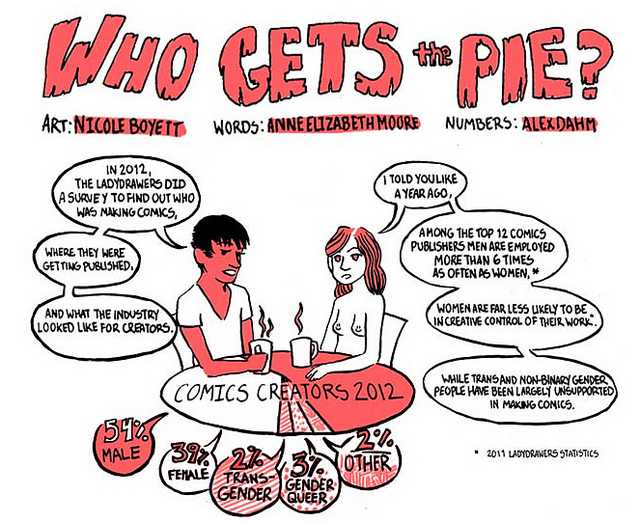
If I’m to generalise – and I’m prone to – then big companies like Marvel and DC don’t hire new talent: they hire people who’re well well-known and have seen success with their own work. If a Justin Jordan or Jim Zub finds success at Image, they tend to get a chance to pitch to DC. If Warren Ellis champions somebody, they tend to get a chance to pitch at Marvel. Nobody just walks into a creative industry – you have to break the door down. You have to be noticed.
Writer Mairghread Scott addresses this in a post circulating round Tumblr right now. In her post, she mentions that when she took over on IDW’s Transformers franchise, she sent round messages to prominent sites and bloggers, asking if they’d be interested in interviewing her about the series. She even mentioned that she was the first female writer to ever handle the franchise as she pitched herself for interviews. Barely anybody responded to her.
(I’m not sure if she sent an email to The Beat or not).
The more I talked to women (and marketing departments) in comics, the more I found that the media is only interested in promoting women who write/draw the right kind of comics. Women at IDW, Boom, and other working professionals are being ignored in favor of the ultra-established and the ultra-indie.
And I have to say, I haven’t interviewed any of the women who currently work for Boom or IDW. I’d certainly like to, but it just hasn’t seemed to cross my radar. Looking at it from a distance, I’m personally focused on perhaps seven companies, rather than the hundreds that are out there. When I think about comics, I’ve found that I’m thinking about companies like Image, 2000AD, Dark Horse. And of course, I’m thinking about Marvel and DC.
It’s interesting how our attention span barely registers anything beyond DC or Marvel as ‘official’ comics. The complaint that there are no women in comics doesn’t account for any of the women writing or drawing for Boom, for example – a company with an almost 50/50 split of male to female creators. There are plenty of women out there, but they aren’t being given any of the prominence they deserve. Oni Press and Monkeybrain and Dynamite are all picking up on top female talent we’ve never even heard of before.
In any creative industry, visibility is the marker for success. You can’t be hired unless somebody has heard of you. On one level, perhaps Marvel and DC should be scouting for writers (they already scout for artists, as seen by the success of people like Will Sliney, hired off the back of a portfolio submission). On the other hand, perhaps DC and Marvel already have twenty or so writers on their books, writers whose work sells and makes the company money. Why does a new writer need to be hired when Jonathan Hickman and Scott Snyder are still pitching ideas to you?
Unless the case is made that these creators are too good to be ignored.
Pretty Deadly, launching at some point from Image Comics, is a fascinating case in point. Artist Emma Rios made her first steps into the American market through Boom, illustrating the mini-series Hexed. Off the back of the critical acclaim for her work there, she was invited to work for Marvel – and since then hasn’t looked back. Kelly Sue DeConnick is a long-working writer who was noticed by Marvel writers like Brian Michael Bendis, and ultimately invited to pitch for the company as a result.
Once their names were known, they then found themselves championed by an array of websites, bloggers, retailers and fans. To get into Marvel, you have to make your case – and others have to also make your case for you. This is true of anyone – whether it be Five Fists of Science pushing Matt Fraction and Steven Sanders towards Marvel’s direction, or Gail Simone moving from CBR articles to Bongo, and then to DC. Without that direct early support from fans and comic sites, it’s incredibly difficult to make your case at the big two.
Surely people are buying Bongo and Boom and IDW, because otherwise, y’know, they’d go bust. So why aren’t we then paying our dues to the women who write and draw these comics? If we’re enjoying these comics and think they’re good, shouldn’t we be tracking down the creators to see what else they’ve done?
As noted frequently over the past few days, these are companies who not only put out fairly strong comics from talented creators, but also tend to act as ‘feeder’ companies monitored by Marvel and DC. Tom Spurgeon and Jennifer de Guzman have both recently spoken (separately and at cross-purposes to one another) about this idea. It’s not for lack of female creators that we HAVE a lack of female creators. For whatever reason, we all seem to be ignoring companies outside this bright spotlight which we ourselves are shining on DC and Marvel.
Which is the point where I now have to drag in myself and my contemporaries, and talk about comics websites. There are a number of terrific people writing directly about gender issues in comics. Laura Hudson’s article about DC comes to mind, as well as the various pieces Kelly Thompson has written about Marvel. Brett White and Andrew Wheeler have written extensive commentary pieces about female characters and creators. But for all that, I can’t think of a single well-circulated article about female creators at Dynamite…
We’ve got some ways to go, clearly. Even here at The Beat, where we do have writers like Laura Sneddon discussing 2000AD with Emma Beeby or Zainab Akhtar interviewing L. Nichols, there’s more we could do to focus on the companies who sometimes get forgotten. When will Valiant get a female writer? How will Gail Simone impact on Red Sonja? Didn’t Meredith Gran just write a miniseries for Kaboom? It’s not just about writing specific articles (like this one) where we complain about the industry. It’s about acting on things ourselves and reviewing comics we don’t usually stretch to. It’s about me putting down my battered, loved copy of Pixie Strikes Back and buying issues of Transformers, because maybe I’ll like something new.
If we want Marvel and DC to pick up the pace, then we have to do the same. The goal isn’t to shout at DC until they hire a female writer on Justice League: it’s to find a female writer who could have a great run as writer for the Justice League. I don’t know if it’ll work in practise, but in principle it’s pretty sound! As a male human person, I don’t have any experience of the inner working of the comics industry, and the hurdles faced by a women who enters the Marvel offices. All I can do is watch and commentate, and hope that what I say is helping.
Get women into power at the Big Two, and progression will trickle through the industry, is the argument made by many. Start at the top and work your way down. But surely we can view things from the other way round, as well? If female creators are getting hired more frequently to work for hire projects at IDW or 2000AD or Boom (and they ARE), then the battle is already being won. It’s only a matter of time before the best will get noticed by the big two, and asked to pitch for them. If we, as the audience, help them get there.
When Monkeybrain launched, people paid attention. It was a digital comics initiative and we could have ignored it – it could’ve been given no coverage by sites, and flown right past fans without anyone offering them a second glance. But instead people swooped onto several of the comics and found stories they liked, like Bandette. And now Bandette is Eisner nominated, and co-creator Colleen Coover nominated twice herself. That’s the sort of power we’re wielding here!
Whilst visibility is the marker of success in the comics industry, that visibility is decided not by comic companies – it’s decided by the fans. Who decides where the top of the comics mountain is, anyway? Isn’t it, uh, us? In our haste to proclaim Pretty Deadly as the next great advancement for female creators worldwide, aren’t we forgetting that there are plenty of other comics both written and drawn by women? My Little Pony: Friendship is Magic currently has an all-female creative team, and sales are gangbusters on that one. I can’t name a single article I’ve read about either Heather Nuhfer or Amy Mebberson.
Are we hiding behind a select few women, praising them so we don’t have to go find others?
Now, Mairghread Scott’s run on Transformers may or may not be the best run on Transformers ever. I have no way of knowing, because I didn’t even know she was writing for the series. Nobody’s mentioned it to me, and I haven’t taken the effort to go try it out myself. I’m as to blame as anyone, probably moreso. As she says in her piece:
Look at Boom! Valiant, Dark Horse, Archaia, Oni, Dynamite, IDW. If you like their female creators, say so. If you don’t, say so. If they don’t have any, say so. But please please please don’t call yourself an advocate for women in comic books while rendering invisible most of the women who are already here.
So, if you’ll forgive me for a moment, I’ve now got an issue of Transformers to try out. You’ve got my attention, Ms Scott – I’m sorry it’s taken so long.



 One of the nation’s largest mortgage servicers intentionally, knowingly, and routinely falsifies paperwork and lies to homeowners in order to boot them from their homes,