×You need to sign in to continue.

Shared posts

23 Jan 22:02

Canadian Woman Euthanised “Against Her Will” After Husband was Fed-Up With Caring For Her

by Will Jones

An elderly woman was euthanised "against her will" within hours of her husband claiming she changed her mind after insisting she wanted to live.

The post Canadian Woman Euthanised “Against Her Will” After Husband was Fed-Up With Caring For Her appeared first on The Daily Sceptic.

22 Jan 23:19

49ers now investigating viral theory that blames nearby electrical substation for the team's injury bug

by Not the Bee
Jts5665

Maybe they went vegan

I knew San Francisco was home to the original hippie-dippy loons out there, but this one really confirms the stereotype.

20 Jan 15:35

NHS Tells Midwives Not to “Stigmatise” Cousin Marriage Because “Only 15% Lead to Birth Defects”. Whatever Next?

by Will Jones

As it emerges that the NHS has told midwives not to "stigmatise" cousin marriage because "only 15% lead to birth defects", the Telegraph's Michael Deacon wonders where this pandering to multicultural madness might lead.

The post NHS Tells Midwives Not to “Stigmatise” Cousin Marriage Because “Only 15% Lead to Birth Defects”. Whatever Next? appeared first on The Daily Sceptic.

16 Jan 15:52

“You Know Who I am Right?” Identity Confusion Leaves Rhode Island Woman Under Fire After Viral Video

by jonathanturley

What is the next worst thing to being arrested for DUI just before Christmas with a viral video of you berating an officer? Being confused with that person by irate citizens because you share the same name, Maria Bucci. It is particularly unwelcome when you are a substance abuse counselor.

On December 18, Maria Bucci, a 51-year-old Rhode Island political figure, was pulled over on suspicion of drunk driving by an officer in East Greenwich. The Chairwoman of the Democratic Committee in Cranston is shown on the police bodycam video invoking her special or influential status: “You know who I am right?”

The Cranston Herald reported Bucci is a former Cranston mayoral candidate who previously served on the City Council and made an unsuccessful bid for the Rhode Island House of Representatives last year.

The officer responds by saying, “I don’t know who you are, miss. You can start throwing out names and start doing out what you need to do, it’s not going to work with me, I’m telling you right now, I’m not the guy for that.”

That only seemed to set Bucci off, who then abused the officer. The most ironic statement was the following:

“Call my husband right now, and call the attorney general and everybody else in town, cause this is disgusting, God forbid I was a Black person, I’d be arrested.”

So, after invoking a special privilege or status, Bucci attacked the officer as presumptively racist for not arresting white people for crimes that Black people are arrested for. He then arrested her for a misdemeanor as she declared, “You’re a d**k … Like I am not drinking, you’re a loser.”

If she were drunk, it would seem a case of in vino veritas, or “in wine there is truth.” The immediate response of this politician is to reveal a deep dislike of police officers and her view of officers as inherently racist.

Bucci will have to deal with the consequences, but it should be the right Bucci. While the real Bucci asked “You know who I am, right?” some appear to have done little to answer in the affirmative before going on the attack.

The problem is that East Greenwich has a second Maria Bucci, who is also a substance abuse counselor. She was apparently deluged by trolling and angry citizens.

The “other” Maria Bucci is also from Cranston but works in East Greenwich. She is 61 years old and was surprised to find herself taking the heat for someone else over the holiday.

It was bad enough that East Greenwich News ran a story to ask people to stop harassing the poor woman, noting that the newspaper:

“typically doesn’t use names when people who get arrested unless there is a public service aspect. We did not consider Bucci’s arrest rose to that level but we are writing about it now to clarify that the Maria Bucci who works for the Town of East Greenwich is not the same Maria Bucci arrested by EGPD Dec. 18 (here is that arrest report: 25-251-AR).”

Legally, the “other” Maria Bucci could sue for a publication that falsely claims she was responsible for this viral encounter. (So far, no news organizations have committed that error). However, such litigation is expensive and trolls are notoriously difficult to track down. That leaves Maria Bucci in the unfortunate class of others who share names with notorious figures, as Dr. Jeffrey Epstein recently learned after a bizarre shoutout from ep. Jasmine Crockett (D-TX). Indeed, even spelling “Madoff” with one “f” does not help when you are scooped up in the sensation of a crime.

Bucci is clearly not on the same level as an Epstein or a Madoff. This is, after all, a still unproven misdemeanor. However, in the community of Cranston, Rhode Island (pop. 84,934), it is hard to shake a viral story with your name. The greatest penalty likely to befall the real Maria Bucci is the reputational damage, which should not be shared with that “other” Maria Bucci.

15 Jan 22:07

Not as good as Cowen-Tabarrok

by Tyler Cowen

Russia is preparing a new economics textbook for university students that aims to challenge what its authors call a “myth” that democracy drives economic growth and to revive the socialist economic theories of Soviet leader Josef Stalin, the head of a Kremlin-linked advisory body said.

Moscow has ramped up efforts to enforce its view of history and global politics in schools since launching its full-scale invasion of Ukraine in 2022, introducing mandatory patriotic classes and rewriting history curricula to align with the Kremlin’s wartime narratives.

Valery Fadeyev, chairman of Russia’s presidential human rights council, told the RBC news website that he is leading work on the textbook, which could be introduced as early as the next academic year for students of sociology, political science and history.

The 350-400-page book, tentatively titled “Essays on Economics and Economic Science,” is intended to present a broader view of economic development than mainstream liberal theory, Fadeyev said.

Here is the full story, via Frank W.  The Kyiv School of Economics it ain’t…

The post Not as good as Cowen-Tabarrok appeared first on Marginal REVOLUTION.

14 Jan 19:45

Germany’s Latest War on Freedom

by James Bovard
Jts5665

Free to agree with the government. Otherwise, straight to jail.

Germany’s Latest War on Freedom
by James Bovard at Brownstone Institute
Germany’s Latest War on Freedom

There is no censorship here in Germany,” according to Steffen Meyer, a top spokesman for the German government. In reality, Germans have freedom of speech except for ideas that politicians and government contractors and nonprofit activists don’t like. Germany is providing a road map for freedom that can be squashed throughout the Western world.

Germany was the scene of some of the 20th century’s worst tyranny but today’s German leaders have only noble intentions for oppression. Berlin’s Best and Brightest™ “improved” democracy by turning politicians into a privileged caste. After a conservative editor mocked a top German law enforcement official by posting a meme showing her holding a sign, “I hate freedom of opinion,” he was convicted and sentenced to seven months in jail for “abuse, slander or defamation against persons in political life.” The editor is on probation while the sentence is suspended but many other Germans have been locked up for similar offenses.

The US State Department Human Rights Report stated that German police “routinely raided homes, confiscated electronic devices, interrogated suspects and prosecuted individuals for the exercise of freedom of speech, including online.” German Chancellor Friedrich Merz personally filed almost 5,000 complaints against his online critics, sometimes resulting in police raids against people he accused.

The German media are gung-ho for government censorship of average Germans. The New York Times noted, “Authorities in Lower Saxony raid homes up to multiple times per month, sometimes with a local television crew in tow.”  The Times reported that in 2022, “Christian Endt, a journalist in Berlin whose coverage of Covid drew a steady stream of insults online, reached a breaking point. After an anonymous Twitter user had called him ‘stupid’ and mentally ill, he embarked on a mission to see if he could get the person prosecuted.”

The Twitter account didn’t have a real name but Endt used an image search of his picture and tracked it down to a small-business owner. Local prosecutors fined that guy more than a thousand dollars. Endt told the New York Times, “I was not even sure if what this guy wrote was a crime or not. In the end, I’m happy they did something about it and this person got a signal that there are some limits on free speech.” But is there no limit to the cowardliness of some German journalists? Publicly admitting that you ran crying to the authorities after some dweeb called you stupid and crazy makes a journalist unfit for writing about anything that offends anyone.   

Journalist J.D. Tuccille, writing in Reason, notes:

“Last November, a Bavarian man was investigated for referring online to then-Deputy Chancellor Robert Habeck with a pun that roughly translates as ‘idiot.’ Police raided the home of a Hamburg man for calling a local politician a ‘pimmel’ (dick). Berlin banned the pro-Palestinian and anti-Israel slogan ‘from the river to the sea, Palestine will be free.’ And Irish protesters in Germany were forbidden to speak in Gaelic because police wouldn’t be able to tell if they were saying verboten things.”

Going back almost a decade, Germany was the most aggressive online censor among advanced nations. I noted in USA Today in 2017:

“In June, German police raided dozens of homes across the nation suspected of offensive social media postings and “conducted home searches and interrogations,” according to The New York Times. Facebook is deleting 15,000 posts a month in Germany but the government is threatening a $50-million-plus fine unless Facebook suppresses far more comments. Judith Bergman of the Gatestone Institute commented on the German mandate: ‘When employees of social media companies are appointed as the state’s private thought police…free speech becomes nothing more than a fairy tale. Or is that perhaps the point?'”

Writing in The Hill, I warned in late 2017 that American politicians sought the “Germanification of Facebook here,” with pervasive censorship on political command. That vision was fulfilled during the Covid pandemic. Facebook founder Mark Zuckerberg later publicly complained that the Joe Biden administration had forced his company to suppress even true information during the pandemic.

The plight of freedom in Germany continues to worsen. The Future of Free Speech, a think tank at Vanderbilt University, did a massive study examining the nature of deleted comments in Germany, France, and Sweden in 2023. That study found that 99.7% of the deleted comments by Germans on Facebook and 98.9% of the deleted comments on YouTube were actually legally permissible. The social media companies, intimidated by the German Network Enforcement Act, were far more censorious than the law demanded. The Vanderbilt study found that most censored comments were simply “’general expressions of opinion’…that did not contain linguistic attacks, hate speech or illegal content, such as expressing the support for a controversial candidate in the abstract.”

Germany is destroying free speech in part to forcibly suppress anger over brutal crimes committed by immigrants. Greg Lukianoff, the president of the Foundation for Individual Rights and Expression, recently noted in the Washington Post: “A woman, furious at the gang rape of a 15-year-old girl in a Hamburg park, called one of the perpetrators a ‘disgraceful rapist pig’ in a WhatsApp message. She was prosecuted for insult and defamation, and ordered to spend the weekend in jail—while the rapist, because of youth sentencing rules, served no time.”

Censorship defines down self-government to “One person, one vote, one time.” Whoever wins a national election will exploit the censorship regime to perpetuate their own power. German politicians are conniving to outlaw the second largest political party, the Alliance for Deutschland (AfD) and its ideas because elitists disapprove of its positions. But it is not the AfD’s fault that Germans’ trust in politicians and government has plunged in recent years.

German government funding for censorship increased five-fold since 2020. Andrew Lowenthal, the founder and CEO of Liber-net, commented, “In Germany large swathes of civil society have abandoned their traditional role as watch-dogs of power. Instead, they have joined forces with the State to suppress popular discontent.” There are 330 different organizations now part of the German censorship machine. (See the excellent graphic produced by Liber-net.) As journalist Mario Nawfal wrote, “When your “fact-checkers” are on government payroll, they’re not checking facts—they’re enforcing narratives. The objectivity claim is window dressing. The real damage? Public trust is collapsing faster than the censorship can contain it.”

The Aspen Institute Germany, founded in Berlin in 1974, is massively subsidized by the German  Foreign Office (the equivalent of the US State Department) to proselytize for the destruction of free speech across Europe. In December, the institute published a report: Hybrid Realities: Disinformation, Influencers, and the Defense of Democracy in Central and Eastern Europe. Here’s the painfully portentous first paragraph of the Executive Summary:

“Democracy depends on the integrity and credibility of public discourse. It functions most effectively, when citizens can exchange ideas freely, engage in respectful disagreement, and make collective choices informed by reliable information. Transparent and inclusive dialogue fosters trust between individuals and institutions, which in turn underpins the legitimacy of democratic decision-making and helps ensure that differences of opinion do not lead to societal division. Sustaining this foundation requires an information environment that upholds transparency, enables verification, and encourages responsibility in maintaining fact-based public communication.”

That pious prattle sounds like “good government” gobbledygook but the reality is that those goals create endless penalty flags for government-subsidized referees to throw at private citizens and social media. As a New York Times article on German censorship explained in 2022, “The authorities in Germany argue that they are encouraging and defending free speech by providing a space where people can share opinions without fear of being attacked or abused.” So to have the space for free speech, government officials must have unlimited power to assure that nothing improper or insulting is said.

The new German report echoes the same themes and goals as a 2022 Aspen Institute report championing censorship for the United States. That report called for the Biden administration to “establish a comprehensive strategic approach to countering disinformation and the spread of misinformation, including a centralized national response strategy, defining roles and responsibilities across the Executive Branch.” It portrayed objectivity as an enemy of truth.

Aspen Institute commissioners “discussed the need to adjust journalistic norms to avoid false equivalencies between lies and empirical fact in the pursuit of ‘both sides’ and ‘objectivity,’ particularly in areas of public health, civil rights, or election outcomes.” The report called for creation of a “Public Restoration Fund…with a mandate to develop systemic misinformation countermeasures through education, research, and investment in local institutions.”

The Aspen Institute also urged government officials to impose “Superspreader Accountability,” to “hold superspreaders of mis- and disinformation to account with clear, transparent, and consistently applied policies.” The Aspen Institute neglected to condemn President Joe Biden as the Supreme Superspreader for his false promise that the Covid vaccine would prevent Covid infections. “Disinformation” is often simply the lag time between the pronouncement and the debunking of government falsehoods.

The new censors in Germany and beyond want to protect government against alleged private falsehoods but offer no remedy for government lies that deceive the citizenry. Instead, Germany’s censorship champions promise to protect “the integrity and credibility of public discourse” based on the notion that government is morally and intellectually superior to private citizens. As German journalist Jasmin Kosubek observed, “Germany’s censorship machine creates digital ‘priests’ who claim the truth—and silence those who challenge them.”

Today’s Germans are haunted by the intellectual ghost of a philosopher bootlicker from 200 years ago. Georg Wilhelm Friedrich Hegel declared, “Men are as foolish as to forget, in their enthusiasm for liberty of conscience and political freedom, the truth which lies in power.” Hegel bluntly equated government and truth:  “For Truth is the Unity of the universal and subjective Will; and the Universal is to be found in the State, in its laws, its universal and rational arrangements.”

Hegel probably did more to propel modern totalitarianism than perhaps any other philosopher. German philosopher Ernst Cassirer, who fled the Third Reich, commented, “These words, written in 1801, contain the clearest and most ruthless program of fascism that has ever been propounded by any political or philosophy writer.”

Actually, maybe another Hegel doctrine explains why the ruling class continues to proclaim that Germans are free. Hegel asserted that “the State is that in which Freedom obtains objectivity, and lives in the enjoyment of this objectivity.” So, objectively, Germans have free speech because the government attaches so many muzzles and blindfolds to the citizenry.

And the government will always be there to protect the “freedom” of oversensitive journalists by harshly punishing anyone who calls them a dummkoff.

An earlier version of this piece was published by the Libertarian Institute 

Germany’s Latest War on Freedom
by James Bovard at Brownstone Institute - Economics, Policy, Public Health, Education, Society

14 Jan 19:30

AI: The Earth Is Spinning Faster & Slower (Because “Climate Change”)

by Briggs

Here is a headline from Forbes 4 August 2022:

Here, five short days later, is a headline from The Independent 9 August 2022:

It is possible to reconcile these two messages, if you are are dedicated The Science follower who greatly fears being called a science denier.

This is how: that on or before 8 August 2022, you swear the earth is spinning faster, and you say that any who doubts this is a troglodyte MAGAtard, and that 9 August 2022 and after, you swear the earth is spinning slower, and say that any who doubts this is mouth-breathing redneck.

The Science is self-correcting in this way.

Now what is amusing about this is not the hubris and over-certainty of scientists, which because scientists are people have characteristics in them no different than in non-scientists. What matters to us are (a) the alleged causes of the changes in rotational speed, and (b) AI.

Let’s do AI first. I noticed the strange Google output when I searched for the titles of those articles.

Here’s AI claiming earth is spinning faster:

Here’s AI explaining spinning slower:

I have been trying, with little success, to explain that AI is programmed to be sycophantic, to give users a feeling that what they (the users) believe is right, and that they are right to believe whatever it is they want to believe. Press any of these AI models strongly and consistently enough, and you can get them to “admit” just about anything—that they haven’t been hard coded not to notice. DIE is still with us, even, or especially in, AI.

AI has sworn that earth is both speeding up and slowing down, promising both were true with searches I did (for the article titles) separated by less than a minute.

Now this is partly to blame on the training material, because scientists themselves are claiming the same things AI found. Which brings us to the alleged causes of both.

Climate change.

Well of course it was climate change. Climate change, as we discovered earlier, is responsible for all things on earth. All bad things, that is. Climate change simultaneously causes earth to spin both slower and faster. Climate change is therefore a branch of quantum mechanics, where outcomes both happen and don’t happen, depending on which scientist is looking.

Regular readers already know not to trust “climate change” claims. I hope after this more of you learn to distrust AI.

Here’s another example. Somebody tagged me on a Twitter “climate change” thread, recommending to his followers to read my Uncertainty, which discuses over-certainty in models. Naturally, that triggered the usual True Believers, the sort who become angry when you show them the weather isn’t as bad as they hoped.

Normally these fellows toss a few insults then block and run away. But one had the idea of asking ChatGPT if I were a bad person. Here is what that AI model said about my work:

What is hilarious about this is that these are the precise exact polar diametric opposites of my opinions. The AI is not just wrong, but seems to have taken pains to put a NOT operator on all my claims. My entire reason for being online is to insist on probabilistic risk reasoning, and insist that probabilities be put all all events (propositions), unique future ones included.

Which only takes seconds to confirm. Take a look at any lesson in the Class, or see my pinned tweet to verify. But I could not get the NPC to understand this. To him, the AI said it, therefore I must be lying.

Yet—and here is the punchline—it did no good to tell this person that AI was being its usual sycophantic self, and that it was wildly wrong about me. AI told him what he wanted to hear, and because it was AI, it was right. AI is yet another Expert in our Expertocracy, and like all Experts must be deferred to because it is an Expert. Not because it is right.

I never had a chance to ask the guy if the earth was spinning faster or slower because of “climate change”.

Here are the various ways to support this work:

14 Jan 02:12

Washington apartment manager arrested for illegally filling out and casting ballots addressed to former tenants

by Not the Bee

Oh look: The thing that never happens!

08 Jan 16:57

82% of Americans agree on one thing — $39 trillion national debt could destroy the country.

by Kane
08 Jan 16:52

Is It Science Denial.... Or Authority Denial?

by Coyote

In an otherwise moderately engaging NY Times article about the dual lives (Physicist and Rock Star) of Brian Cox, the author drops in this sentence as a universal truth:

In an era when science denial and disinformation are common...

The increasingly common elite/Leftist charge of science denial really aggravates me.  At best, it is a modern elitist virtue signaling tic, thrown into text in the same way a Catholic might genuflect.  At its worst, it is used as a totalitarian cudgel to attempt to silence differing scientific and/or political opinions.

Certainly flat earthers, 9/11 truthers, and moon landing deniers exist and have always existed.  It took a long time in the 19th and 20th century for average Americans to swallow Darwin, and almost as long for even hard-core geologists in the 20th century to accept plate tectonics.  But my contention is that most of the current behavior that elicits cries of science denialism are in fact skeptical not of science itself but of the authorities in academia and government who attempt to mandate scientific truth by fiat and who use the mantle of science to enhance their power.  In many cases that skepticism runs too far, for example following RFK Jr over his autism cliff, but this metastasizing of distrust began not with luddite tendencies of the hoi polloi but with the shameful actions of the "elite."

It is impossible to discuss this topic without digging into the government reactions to COVID19, but even before March of 2020 the government and academia where working hard to undermine their own creditability on scientific topics.  For example,

  • Anyone as old as I will have seen over the decades at least five different, often contradictory sets of government nutrition guidance.  And I have never met anyone who makes a living or serious hobby out of nutrition who agrees with any of these.
  • Without delving into the details of the climate debate, many thinking people are turned off by the catastrophic one-upmanship and overt partisanship of what should be sober scientific researchers and the absurd certainty in ascribing individual weather events to small changes in a chaotic climate system.
  • Even before 2020, academia had a severe replication crisis, where university press releases exaggerate actual study findings and where even those more modest results frequently fail to be replicated by other researchers.

But all of this was just a warmup act for COVID, when government officials and leading academics gave Americans every reason to distrust what they say about science.  What we have seen is not a backlash against science per se, it is a backlash against authority and the authorities who tried to use the goodwill created by the scientific revolution to protect their power and shield their blundering actions from criticism.  Sometimes this skepticism manifests itself in unproductive ways (e.g. avoiding measles vaccines) -- but this skepticism was 100% created by the authoritarian and dishonest behaviors of government officials and academics under COVID.  For example:

  • Authorities enforced actions, particularly masking and quarantines, that were the exact opposite of what had been recommended by the vast majority of scientific study prior to the pandemic.  It is interesting to hypothesize why they might have done this (I have put my hypothesis in the postscript below) but the most meta studies of these topics came to the conclusion that masking and quarantines were net counter-productive.
  • Authorities made up rules such as the 6-foot distancing rule that they later admitted were utterly without basis but which at the time they insisted was "science".
  • When they came under fire for some of their rules, authorities worked with academics to quickly generate some of the worst-structured studies in medical history to "prove" they were right
  • It is increasingly clear that authorities covered up the likely origins of COVID19 as an accidental leak from gain-of-function research at the Wuhan lab.  In the process, many social media accounts were suppressed for even suggesting what turned out to be the likely correct origins.  The fact that Dr Fauci appears to have been covering up the fact the he signed off on much of the funding, laundered through the EcoHealth Alliance, the resulted in the development of COVID19 makes the story even uglier.
  • State and local governments suppressed certain hypothesized treatments (e.g. chloroquine) before any real work could be done to evaluate them merely because other politicians they did not like (ie Donald Trump) seemed enthusiastic about them.  I am not sure these treatments ever would turn out to have merit, but in a fast-moving pandemic it is insane to cut off treatment avenues without evidence
  • In perhaps the most damaging failure of them all, the efficacy of the rapidly-developed vaccines was greatly overstated while side effects data (which I still believe were small and limited in number) were suppressed.    The COVID vaccines were sold as if they were more like polio vaccines (99% effectiveness) when in fact they were more like flu shots (40-55%).   In many cases they still allowed transmission and infection but acted as a palliative before-the-fact, reducing severity  and greatly reducing risk of death particularly in older patients.  Inevitably, people noticed that the shots did less than promised.  My belief is that this undermined faith in all vaccines.  If you put Mariah Carey's movie Glitter in a top 10 all-time movie list, once people watch it they are going to lose faith in the rest of the list even if every other choice is solid. At the same time, a lot of the potential data on vaccine side-effects was being suppressed.  The stated reason was that officials feared that if people saw data that there were bad reactions, however few, they would hesitate to take the shot.  This is typical government thinking that flies in the face of reality.  Everyone heard anecdotes of people getting side effects, so the side effects were no secret. With the data suppressed, some jumped to the conclusion that there must be something scandalous lurking in the numbers and there was no transparent data source that demonstrated how common or uncommon the anecdotal bad reactions were.

When I have said these things in the past, people have responded that "well, what we understood about the virus was altering day by day -- it is not unreasonable to expect mistakes to be made."  Yes, and a hard no.  Yes, it was perfectly reasonable to think that as knowledge grew, understanding might change.  But no, this is zero excuse for the behaviors displayed by authorities during COVID.  There was no modesty at all -- every one of their pronouncements and diktats were issued with smug certainty.  People who disagreed were silenced and punished.  And over time, nothing changed from authorities as we learned more.  As governments do all the time, once they took a position they never moved off of it no matter what the evidence.  The same people who insisted that the virus came from those wacky Chinese eating bats still insist the same thing today.   It is December of 2025 and I still have a operating contract with LA County that requires all of our employees to be vaccinated against COVID every 6 months.

A few parting thoughts:

  • "Science" is not whatever a government official with a science-adjacent job title says it is.  For any given area of study, most honest individual scientists will tell you that even they are not sure what the science "says".  Scientific knowledge comes only after an initial hypothesis has been replicated or pummeled many many times.  There is no gatekeeper that declares when it is settled and if there were such a gatekeeper it sure as hell should not be the government
  • Of late the charge of "science denial" tends to be a one-way political attack from the Left aimed at the Right (or at least the not-Left).  But most of the folks issuing this attack have their own set of beliefs that fly in the face of the mass of academic research.  Whether concerning the effect of minimum wage laws on employment or proper treatment of juvenile gender confusion, the Left is just as likely as RFK Jr -- with his vaccine autism fears -- to latch onto niche outlier studies that support their political preferences.  There is nothing necessarily wrong with being an outlier against the masses on the other side of a scientific issue -- most scientists who are famous enough that you know their names are famous because they did exactly this -- but you need to understand you are an outlier and be able to explain why that position is compelling for reasons beyond political convenience.
  • Modesty and skepticism are always required when discussing scientific findings.  Science not infrequently goes down blind alleys, with years-long adherence to concepts like phlogiston and Lamarckian evolution and decades-long fights for acceptance of theories we now hold dear like plate tectonics or a comet killing the dinosaurs.
  • The government funds a lot of science, and while this seems like a better way to spend money than a lot of the other BS that gets funded, it is not without its dangers.  Funding can easily get politicized.  For example, breast cancer for years received way more money per cancer death than the other top deadly cancers because it was a way for politicians to show solidarity with women's groups. AIDs research was grossly underfunded in early years because Conservatives thought gay sex was icky.  Current protests against RFK's changing research grant priorities simply prove my point -- if masses of funding can shift priority based on one guy getting a new job, then putting all our research eggs into the government basket makes no sense.
  • A much better way to respond to someone you think is way off base scientifically is not to call that person a science denier but to ask a simple question, "what's your evidence?"   For years when I was more active in the climate debate, I got called a climate denier (to which I would always snarkily answer that I do not deny there is a climate).  But to my statement that I thought the negative impacts of CO2 emissions were overstated, if I was asked "what's your evidence" I guarantee I could begin a thoughtful discussion. As the holder of a heterogenous opinion on this scientific topic I knew I needed to be prepared to state my case and my evidence.

Postscript -- Why did Fauci and Company go all in for masks and lockdowns when all the prior scientific work and planning advised against them?

This is actually a question I seldom see discussed.  Critics of Fauci will simply say he was a bad person, but that is seldom a good explanation. It will come as little surprise to folks who have read my work in the past that I believe we can understand this question by analyzing incentives.

The body of public health research prior to 2020, on balance, held that public masking (and large scale lockdowns, btw) were not effective and generally not recommended (at least once the outbreak is past a very small group). But within weeks of the start of the pandemic in 2020, government agencies like the CDC threw out all this history and decided to mandate masks.  Masks were mandated for people outdoors, even when we knew from the start that transmission risks outdoors were nil.   Officials even mandated masks for children, who have lower death rates from COVID than the flu and despite a lot of clear research about the importance of facial expressions in childhood development and socialization.   So why?

Incentives of the CDC

One needs to remember that the officials of government agencies like the CDC are not active scientists, they are government bureaucrats.  They may have had a degree in science at one time and still receive some scientific journals, but so do I.  Dr. Fauci has seen about the same number of patients over the last 40 years as Dr. Biden.  These are government officials that think like government officials and have the incentives of government officials.  They have climbed the ladder to the top of a government agency not by doing brilliant research work but by winning a hundred small and large political knife-fights.

I will take the CDC as an example but the following could apply to any related agency.  Remember that the CDC has been around for decades, consuming billions of dollars of years of tax money.  And as far as the average American is concerned, the CDC has never done much (at least visibly) in their lifetimes as we never have had any sort of public health emergency when the CDC had to roll into action in an emergency (AIDS might be an exception but it was a much slower-burning pandemic and the CDC did not cover themselves in glory with that one anyway).

If you think this unfair, consider that the CDC itself has recognized this problem.  For years they have been trying to expand their mandate to things like gun control and racism, trying to argue that these constitute public health emergencies and thus require their active participation.  The CDC has for years been actively looking for a publicly-visible role (as opposed to research coordination and planning and preparation and such) that would increase their recognition, prestige, and budget.

So that is the backdrop -- an agency trying to defend and expand its relevance.  And boom - finally! - there is a public health emergency where the CDC can roll into action.  They see this new and potentially scary respiratory virus, they check their plans on the shelf, and those plans basically say -- there is nothing much to be done, at least in the near term.  Ugh!  How are we going to justify our existence?  Tellingly, by the way, these agencies and folks like Fauci did follow a lot of the prior science in the opening weeks -- for example they discouraged mask wearing.  Later Fauci justified his flip flop by claiming he meant the statement as a way to protect mask supply for health care workers, but I actually think that was a lie.  His initial statements on masks were correct, but government agencies decided they did not like the signal of impotence this was sending.

There was actually plenty these agencies should have been doing, but none of those things looked like immediate things to make the public feel safer.  Agencies should have been:

  1. Trying to catalog COVID behavior and characteristics
  2. Developing tests
  3. Identifying and testing treatment protocols
  4. Slashing regulations vis a vis tests and other treatments so they could be approved faster
  5. Developing a vaccine

If we score these things, #1 was sort of done though with a lot of exaggerated messaging (ie they communicated a lot of stuff that was mostly BS, like long covid or heart risk to young athletes).  #2 the CDC and FDA totally screwed up.  #3 barely happened, with promising treatments politicized and ignored.  #4 totally did not happen, no one even tried.  #5 went fabulously, but was an executive project met with mostly skepticism from agencies like the CDC.

Instead, the CDC and other agencies decided they had to do something that seemed like it was immediately affecting safety, so it reversed both years of research and several weeks of their own messaging and came down hard for masks and lockdowns.   And, given the nature of government incentives, they had to stick with it right up to today, because an admission today that these NPI aren't needed risks having all their activity in 2020 questioned.  And besides, Fauci got himself sanctified and received multi-million dollar awards for insisting on masks and quarantines (and being seen as a foil to Trump), so why would he possibly reconsider?

Incentives for Government Officials Elsewhere

Pretty much all of the above also applies to the incentives of state and local government officials.  Our elected officials of both parties have been working to have the average American think of them as super-dad.  Got a problem?  Don't spend too much time trying to solve it yourself because it's the government's job to do so.  Against this background, the option to do nothing, at least nothing with immediate and dramatic apparent potency, did not exist.  We have to do "something."

It might have been possible for some officials to resist this temptation of action for action's sake, except for a second incentive.  Once one prominent official required masks and lockdowns, the media began creating pressure on all other government officials.  New York has locked down, why haven't you?  Does New York care more than you?  We had a cascade, where each official who adopted these NPI added to the pressure on all the others to do so.  Further, as this NPI became the standard government intervention, the media began to blame deaths in states with fewer interventions on that state's leaders.  Florida had far fewer COVID deaths, particularly given their age demographics, than New York but for the media the NY leaders were angels and the Florida ones were butchers.  For a brief time terrible rushed "studies" were created to prove that these interventions were working, generally by the dishonest tactic of cherry-picking a state with NPI mandates that was not in its seasonal disease peak and comparing it to another state without NPI mandates that was in the heart of its seasonal peak.

And then the whole thing got polarized around party affiliation and any last vestige of scientific thinking got thrown to the curb.   Take Chloroquine as a possible treatment protocol.  Personally, I have not seen much evidence in its favor but early last year we did not know yet one way or another and there were some reasons to think it might be promising.  And then Donald Trump mentioned it.  After that we had the spectacle of the Michigan Governor banning this treatment absolutely without evidence solely because Trump had touted it on pretty limited evidence.  What a freaking mess.  In addition to giving us all a really beautiful view of the hypocrisy of politicians, it also added another great lie to the standard list.  To "The check is in the mail" and "I will respect you in the morning" is now added "We are following the science."

Incentives for the Public

I won't dwell on this too long, but one thing COVID has made clear to me is that a LOT of people are looking for the world to provide them with drama and meaning.  The degree to which many folks (mostly all well-off white professionals and their families) seem to have enthusiastically embraced COVID restrictions and been reluctant to give them up has just been an amazing eye-opener for me.  Maybe I am crazy, but I get the sense that a lot of folks of a certain age miss the COVID days.

08 Jan 03:24

Donald Mamdani Trump

by Coyote

The WSJ reports:

President Trump said he will ban large investors from buying single-family homes, the administration’s first significant move to address the country’s severe housing shortage.

“I am immediately taking steps to ban large institutional investors from buying more single-family homes, and I will be calling on Congress to codify it. People live in homes, not corporations,” Trump said in a social-media post Wednesday.

I tell folks all the time that Trump is not a freaking free-marketeer.  This is yet more evidence.  His proposal is right out of the failed Progressive-Socialist playbook on housing.  Some quick thoughts:

  • Except where the houses have been converted to overnight rentals (think Airbnb or VRBO), people still live in these institutionally owned houses.  This is not withdrawing housing stock from the market, it is merely shifting it from individual purchase to rentals.  And there are arguments for there being more not less rental houses -- particularly when interest rates are high and/or housing prices are flat, houses limit mobility by locking a family to a fixed position, limiting the ability to seek out better employment in other cities
  • There is something to be said for renting from an institution, rather than an individual owner, as these landlords have better systems, large support and maintenance staffs, and often better legal compliance.  Because living in certain neighborhood boundaries is required to attend the best public schools, this allows families who could not afford to buy a house in that neighborhood to be able to live there.  It also opens suburban living to young couples who have not yet saved a down payment.
  • According to the WSJ, these institutions own 2-3% of the housing stock at most.  Hard to imagine that this tail is wagging the dog.  This is a typical populist grandstanding proposal with zero ability to address the intended issue, but a lot of emotional resonance with swing voters.
  • Real housing prices were likely flat to slightly down in 2025, so if there is a current "affordability" crisis it has more to do with higher mortgage rates than housing prices per se.  Rents have increased faster than inflation the last several years, but its hard to figure how removing rental units from the market based on this order will do anything to lower rents.
  • No one was complaining about institutional buyers back in 2008 when the market was awash in unsold houses and institutions began soaking up this excess capacity and providing much needed liquidity to the market.
  • I will confess the endless calls and texts to my cell phone from these yahoos trying to buy my house does piss me off, but not enough to ban their business model
  • Fiddling with ownership rules will not do anything for housing affordability.  The reason prices are rising is that there is not enough housing being built and has little or nothing to do with who owns the homes.  Many cities have myriad restrictions on home construction -- from outright limitations on new building permits to growth boundaries to onerous permitting rules -- while at the same time we subsidize demand through government mortgage insurance and the most lenient mortgages in the Western world (the bank can only take your house, not your other property if you default).  There remains much local support for housing restrictions -- you can think of many cities as a cartel of homeowners protecting their monopoly through restrictions on adding competing supply.
  • There are two financial reasons people want to own rather than rent houses (beyond an array of emotional ones)
    1. Mortgage interest is deductible on taxes, rent is not.  Why not equalize these, either by ending the deductibility of mortgage interest, or since that is likely a political non-starter, by making rent payments deductible?
    2. Historically home equity has been a good investment for many, with real home prices doubling over the past 50 or so years.  Over this same period, someone with a 90% Loan-to-Value (LTV) would have seen a 10x increase on their 10% equity portion.  As discussed above, this is mainly due to subsidizing demand and restricting supply.  However, this only works when housing prices grow faster than inflation, which is what people are now complaining about.  You can't have both -- either house prices rise faster than inflation and are a great investment or they don't and are more affordable but not a very good investment.
  • There is no way the President should have the power to mandate this.  Republicans are really, really going to regret these precedents when the next socialist-Democrat is in office and mandates something like national rent control.
07 Jan 19:44

Note on a Lawsuit

by Matt Taibbi

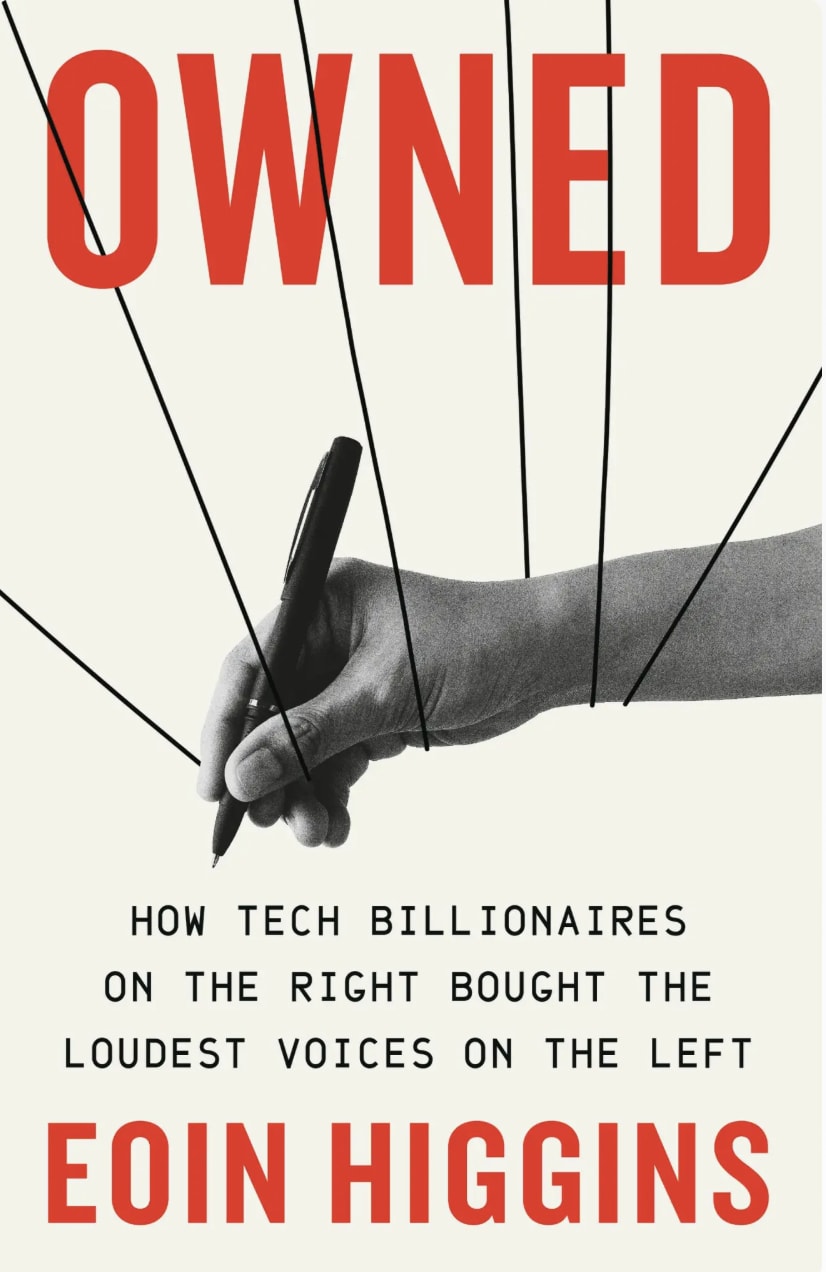
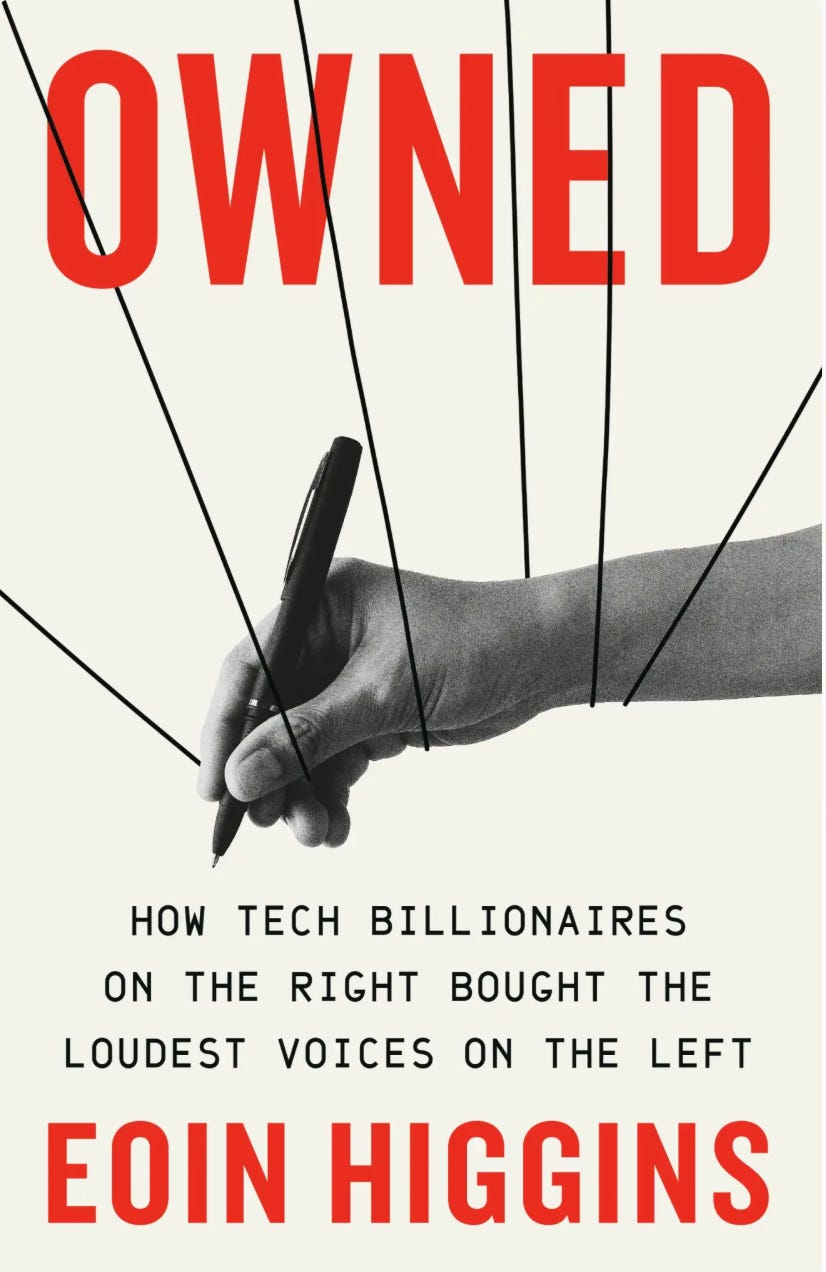
Recently author Eoin Higgins took to his Substack platform to complain, “Yes, I’m Being Sued by Matt Taibbi.” He wrote a book called Owned with a cover illustration showing marionette strings controlling people like me and Glenn Greenwald, the main subjects of his book, depicted me as “bought” by “tech billionaires on the right.” Though I’ve never taken any money from “tech billionaires on the right” and am entirely dependent on subscribers to this site, the suit was something Higgins felt needed celebrating.

Racket readers went through this when a member of congress called me a “serial sexual harrasser” last summer. Not wanting to pull a late-stage Lenny Bruce on a faithful audience the original plan was not to say anything. When The Free Press asked for a response, though, I gave one, published today. You can check it out if you like. One point left out is the main reason I felt I had to go to court.

Higgins somehow dismisses as an act of self-interest the key moment in my relationship with Elon Musk, when I refused to leave Substack and move to his new Twitter subs program. Elon was angry then about Substack’s new Notes feature, which he felt was an attempt to “kill Twitter,” so he began disabling Substack links not just for me but every Substack contributor, including ironically Eoin Higgins.

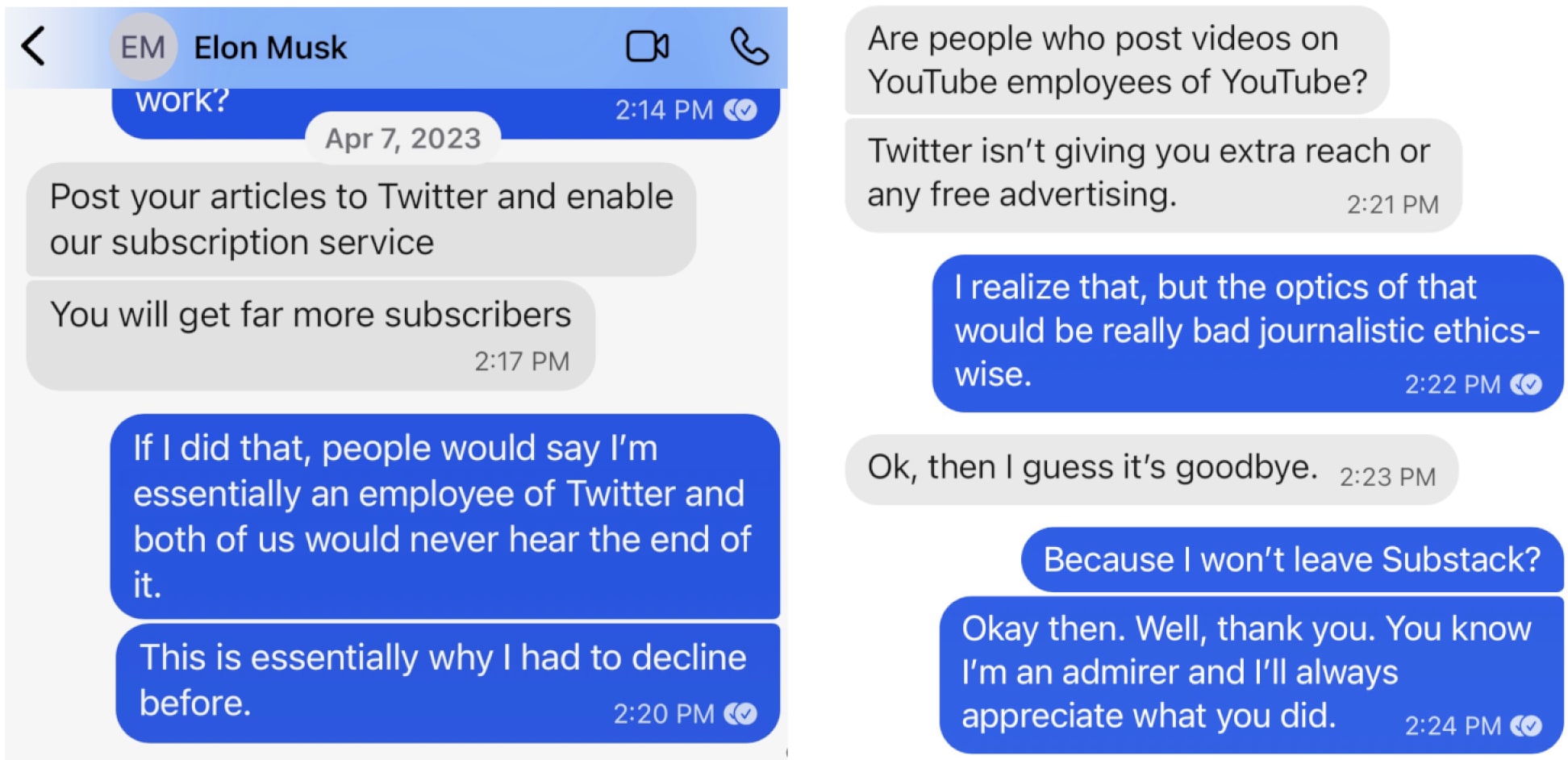
I would have done just about anything to keep working on the Twitter Files, but what Elon was asking — I still don’t think he understands this — would have looked like financial ties, which was enough undercut the reporting. I had no choice but to say no. When our exchanges were made public, these dynamics came out. Elon argued that if I moved to Twitter I’d “get far more subscribers,” but I still said no, because “people would essentially say I’m an employee of Twitter” and “both of us would never hear the end of it.” Also, the optics would be “really bad, journalistic ethics-wise.” Elon replied, “Then I guess it’s goodbye,” making clear I’d cut myself off:

If I’d been the marionetted mercenary Higgins and Hachette books claim I am, I’d have accepted Elon’s offer without a thought, put myself on Twitter subs, and kept cranking out Twitter Files stories. Instead I refused the inducement of “far more subscribers” to avoid the appearance of a financial relationship, and lost a great story because I was being asked to go to a place I felt I couldn’t go, “journalistic ethics-wise.”

This was a by-the-book example of what you have to do in such a situation, about which I consulted with older journalists. According to Higgins, though, it was motivated by greed. In Owned he writes that it was a “threat to Taibbi’s bottom line that finally motivated the journalist to act,” and I only protested the treatment of Substack because Musk was “threatening [my] subscription growth.” This makes no sense. Me staying at Substack was not an option for Elon. It was made clear there was only one way I could stay on that story, and I couldn’t do it, and that was that.

No one should get a medal for following basic standards, and I didn’t ask for one. However if for ethical reasons you have to give up a big story by standing up to a billionaire, it’s not a lot to ask that a major corporate publisher not subsequently describe you as a “bought” and “owned” puppet who literally sold his soul to that same billionaire. I didn’t make a big deal of this costly move because I think people should make decisions based only on whether or not they’re right, and not for credit, which means I was originally fine with people not noticing. But if you take advantage of that instinct to sell a book accusing me of bad ethics, what can I do but sue?

Higgins is having fun with this. He’s having a grand old time, laughing about smearing someone with corporate backing, and what a big joke it is that he should have to be careful with someone who’s “made no secret” of “ideological affiliation with the Republican Party.” Proof of the latter includes — this isn’t a joke — the fact that I once wrote a column called “Thanksgiving is Awesome” that made fun of Howard Zinn. These people are so nuts, they think you need a payoff to like Thanksgiving. They also think people with the wrong politics don’t deserve even the very low level of reputational care the law requires. This kind of person doesn’t care about being wrong, so courts are the only recourse. It sucks, but what else can you do?

05 Jan 17:28

MAMDANI OFFICIAL — ‘We will transition from treating property as an individual good to a collective good. White families especially will be impacted.’

by Kane
03 Jan 02:30

HUD UNDER BIDEN MAKES $5 BILLION IN PAYMENTS TO 30,000 DECEASED PEOPLE AND NON-CITIZENS.

by Kane
02 Jan 16:53

Economic inequality does not equate to poor well-being or mental health

by Tyler Cowen

A meta-analysis of 168 studies covering more than 11 million people found no reliable link between economic inequality and well-being or mental health. In other words, living in a place that has large gaps between the rich and poor does not affect these outcomes, with implications for policy.

Here is the Nature link, this claim has been bad science all along.

The post Economic inequality does not equate to poor well-being or mental health appeared first on Marginal REVOLUTION.

02 Jan 16:47

A model of girl happiness, a compensatory-use study

by Tyler Cowen

A statistical model was used to examine these relationships simultaneously by predicting the likelihood that a girl reports being very happy.

The model includes socioeconomic status, parent–child communication, screen-time limits, and an interaction between limits and communication.

The results reinforce the patterns in the figures. Parent–child communication dominates the model. Girls who report strong communication are about three to four times more likely to report being very happy than those who report none. Socioeconomic status shows a smaller independent association. Screen-time limits contribute little on their own and matter modestly only when strong communication is already present.

If phones were the central problem, limits would emerge as a robust solution across contexts. They do not…

What the compensatory-use model rejects is a stronger claim. It rejects the idea that smartphone exposure itself is the primary driver of youth distress and that prohibition is therefore the central remedy. If that causal story were correct, limits would show large and consistent benefits across households, including among those with the weakest communication and highest distress. They do not.

And to close:

The most reliable way to improve youth well-being is to meet individual needs through connection instead of control.

That work depends on cooperation, not compliance.

Here is the full essay by Owen Kellogg, of course this is only a single study.

The post A model of girl happiness, a compensatory-use study appeared first on Marginal REVOLUTION.

21 Dec 13:52

Rent Control Creates Ghost Apartments

by Alex Tabarrok

Adam Lehodey writing at City Journal:

In New York City, making a profit on real estate has become increasingly difficult. Rent-stabilization laws built on the mantra that “housing is a human right,” a dysfunctional housing court, and myriad other interventions have driven thousands of units off the market, giving rise to the phenomenon of New York’s “ghost apartments.”
The city now has nearly 50,000 empty units, absent from the market either because their operating costs exceed legal rents or because they require considerable renovations.

…Take a building on East 6th Street as an example. A mere five-minute walk from Tompkins Square, the building is a convenient home for students and young professionals.

One-bedroom units in the building average $3,500— except two of them, subject to the city’s rent-stabilization laws, which hold rents below $900 per month.

As a result, both units have been allowed to fall into disrepair, because the cost of restoring them to habitability is greater than what they’d generate in rent.

…Much of the predicament at the East 6th Street building and the apartments on Valentine Avenue can be traced back to one piece of legislation: the 2019 Housing Stability and Tenant Protection Act (HSTPA). Passed by a Democratic majority in the state legislature, HSTPA eliminated landlords’ abilities to raise rents after units were vacated, or when they exceeded $2,775 per month. In doing so, it also eliminated their ability to make improvements profitably and reset the stabilized rent.

Recall from the recent review by Kholodilin that “the published studies are almost unanimous with respect to the impact of rent control on the quality of housing….[namely] that rent control leads to a deterioration in the quality of those dwellings subject to regulations.”

The post Rent Control Creates Ghost Apartments appeared first on Marginal REVOLUTION.

19 Dec 12:59

Falling costs

by Tyler Cowen

Unbelievable progress that even I underestimated! Gemini 3 Flash has practically beaten ARC-AGI-1 [an AI evaluation] at cost/score parity! It achieved the same score at more than 500x lower cost than the o3 model from a year ago & 6x lower than the just-released GPT-5.2!

Here is the link.

The post Falling costs appeared first on Marginal REVOLUTION.

17 Dec 22:38

Spanish Woman Fired For Being Perpetually Early For Work

by Not the Bee
Jts5665

I guess I can't work in Spain.

They say the early bird gets the worm, but apparently not in Spain.

17 Dec 18:40

Top nuclear scientist at MIT shot dead in his house during the middle of the night 😬

by Not the Bee

"It's not hyperbole," Nuno F.G. Loureiro said when he took over as director of MIT's Plasma Science and Fusion Center in 2024, "to say MIT is where you go to find solutions to humanity's biggest problems." He went on, "Fusion energy will change the course of human history."

17 Dec 18:35

MIT nuclear scientist shot dead in home.

by Kane
16 Dec 17:51

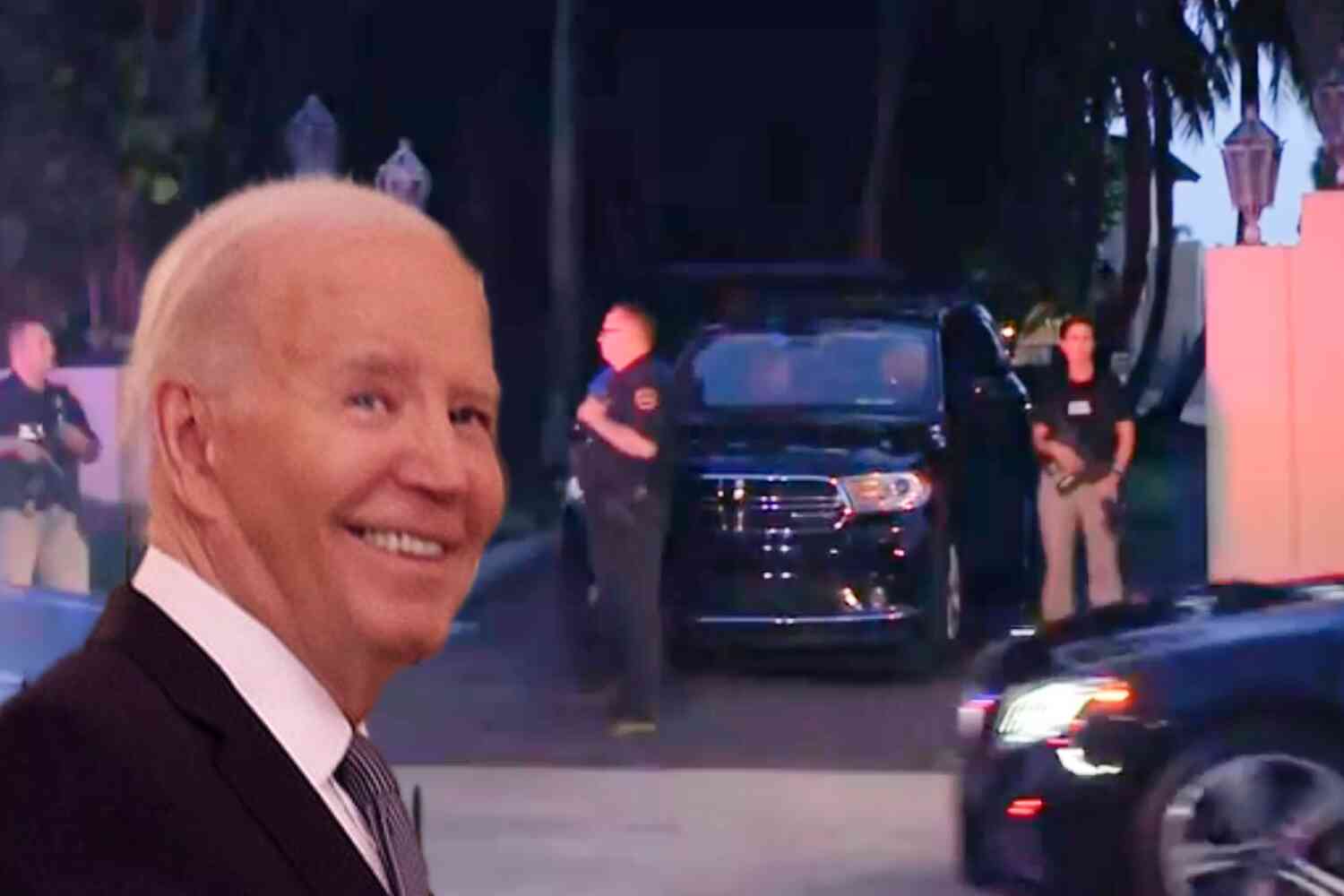
DOJ to give Congress email evidence that the Biden admin knew it did not have probable cause to raid Trump's home

by Not the Bee

On August 8, 2022, former President Biden's administration authorized an FBI raid of President Trump's Florida home in the unprecedented legal prosecution of a former president.

16 Dec 17:39

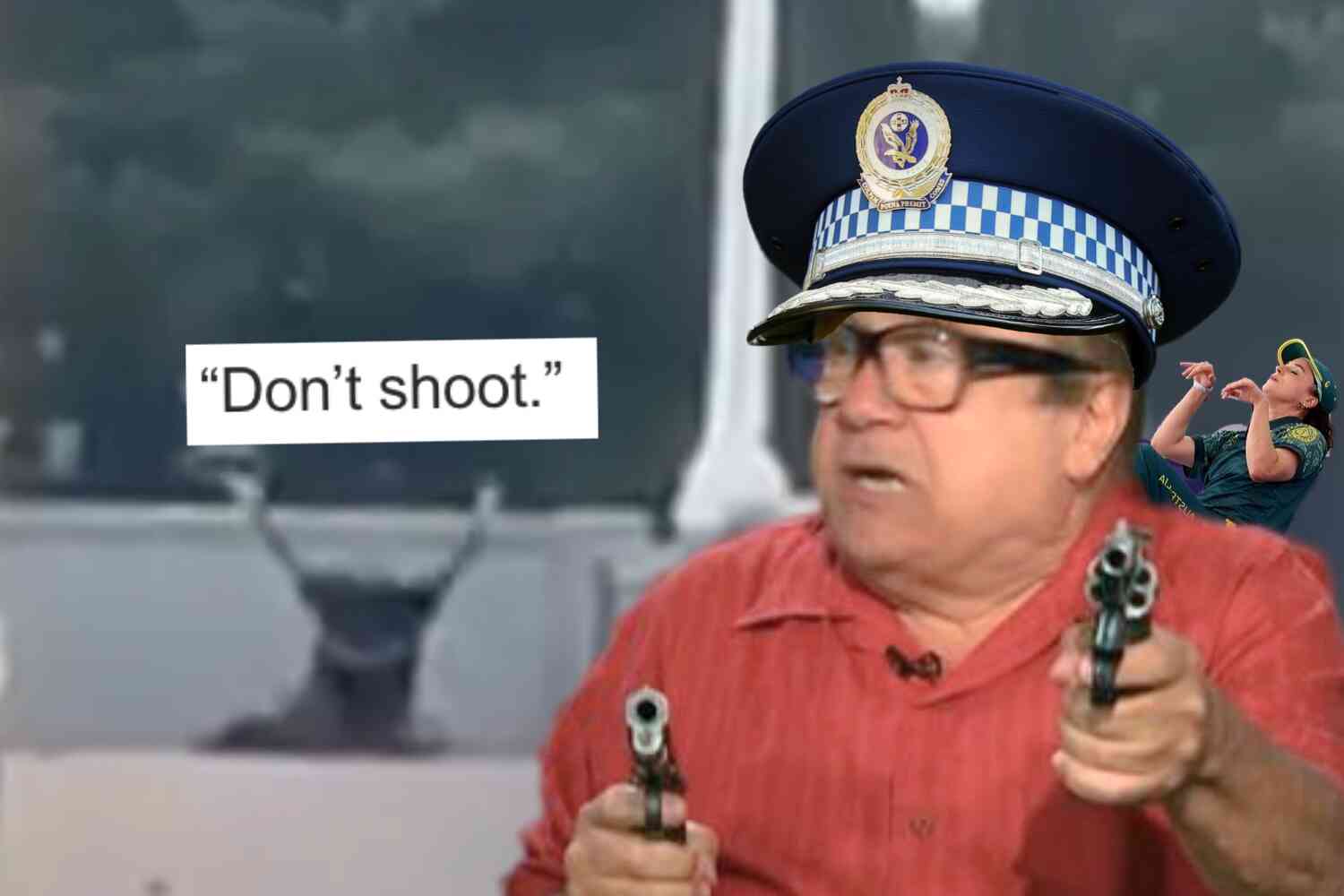
Report: After Failing To Stop Terrorists For 20 Minutes, Australian Police Shot Man Who Helped Stop Terrorists

by Not the Bee

Australian cops will hide while Jews are getting shot like fish in a barrel, but the second someone's toxic masculinity stops the shooter, they'll magically work up the courage to shoot the guy who stopped the shooter.

09 Dec 21:08

Ditch the Subsidies, Grow What Actually Works

by Joel Salatin

Ditch the Subsidies, Grow What Actually Works
by Joel Salatin at Brownstone Institute

Ditch the Subsidies, Grow What Actually Works

How do you get people to make good decisions? You can be negative and punish bad decisions or you can be positive and incentivize good decisions. Our language is full of cliches articulating these options: carrots and sticks, honey and vinegar.

Farmers make decisions every day about what to grow, how much of it to grow, and how to grow it. Whether it’s corn or cows, we look at the various incentives and punishments to decide how to proceed.

Decisions are a complicated and nuanced response to stimuli, both internal and external. Some of us really like cows. Others of us really like corn. These soul-level likes and dislikes are not subject to business or market influence. Often childhood familiarity determines whether we go with animals or plants. We tend to like knowns in our life.

Meanwhile, the food and fiber market has the same influence. One person likes beef, another tomatoes, and another milk. We might read something that makes us question a certain product. Or we may read something that makes us put it on our plate for the first time.

The market constantly ebbs and flows as information, friends, social media influencers, and personal health feelings impact purchasing decisions. The faster decisional consequences can be linked to the choices we make, the better our response. This is one reason why we have a statute of limitations for many crimes.

Decisional consequences are one of the most moral and authentic elements in both personal and societal development. When people don’t suffer the consequences of poor decisions, they tend to continue down a wayward path. On the other hand, when people don’t receive incentives for doing good, it thwarts development toward positive progress.

Failing to bear the costs and consequences of bad decisions is as perverse as failing to incentivize the costs and consequences of good decisions. This seems elementary enough to not even mention, but we often create public policy that seems to deny this fundamental axiom.

A case in point is federal government safety nets. Often begun with every good intention, they frequently break down after years of implementation. Government programs tend to grow more bureaucratic, becoming more interested in expanding power and budgets than in solving the problem they were chartered to solve.

When President Franklin D. Roosevelt froze wages, businesses sought new incentives for employees and opted for health insurance. Once health care market decisions left the individual level, the short chain between choice and consequence elongated. Eventually, this morphed into the Affordable Care Act that is now widely regarded as creating more problems than it started.

The local one-room, community-funded, and controlled school house gave way to state programs and eventually a federal program. “No Child Left Behind” now leaves some 46 percent of children left behind in reading based on current standardized tests. The safety net of public education is now widely regarded as inferior to private, charter, and homeschooling.

A retirement safety net called Social Security began as a 1 percent employee payroll tax. Today it’s far higher and any financial adviser knows that if that money had been invested in the stock market, it would have grown far more than in government coffers. Investment decisions that used to be made individually became neglected as millions of people came to believe the government would take care of them in their old age.

Most of us can list numerous programs and their influence on individual decisions, generally negatively. If someone else will always pick me up when I fall down, I’m not nearly as careful where I step. That’s sociologically axiomatic.

This brings me to soybean farmers. US crop insurance programs, renamed from subsidies for political acceptance, started during the Depression as a safety net for farmers. Handpicking just six commodities for special incentives (corn, soybeans, wheat, cotton, rice, and sugarcane) this nearly century-old program dominates American agriculture. Further, it influences farmer decisions down to the field level: “What am I going to grow here?”

Farmers have many choices as to what to grow. Although farmers are known for their product (dairy farmer, orchardist, vegetable grower, livestock) they are really caretakers of a spot of creation. As a farmer, the deed recorded at the county clerk’s office says I own this land, but in reality I’m a sojourner on something I did not create. The soil, water, and sunlight hitting my fields are ultimately not possessions as much as resources I have the privilege to steward.

The point is that the land that grows soybeans could grow a host of other things. The farmer must look at that array of options and choose something. Any land that will grow soybeans is inherently good land; nobody grows row crops on rock piles. The better the land, the more diversified the options.

Why should the American taxpayer guarantee the viability of soybean farming when the world has too many soybeans? Markets—and farmers—are supposed to respond to supply and demand. While their predicament of losing $90 per acre this year due to China’s retaliation for President Donald Trump’s tariffs (China bought 23 percent of the US soybean crop in 2024) is heartbreaking, this dependency on a multi-decade government safety net has created this dilemma.

I encourage all farmers to wean themselves from the government safety net. I’m a full-time farmer and I don’t take a dime of government money. My decisions create consequences due to my choices. By not using chemical fertilizers, when Vladimir Putin invaded Ukraine and fertilizer prices skyrocketed, it had no impact on our farm because we use compost instead of chemicals.

All farmers have a choice, and the faster our society respects them enough to put their choice consequences in their hands, the sooner farmers will make more creative and innovative decisions. The crop insurance safety net prejudices decisions and incentivizes dependence on one crop and one agency. Sooner or later, making the same choice every year because it’s easy due to a safety net will show its weakness, because safety nets eventually shatter, especially if they depend on politics.

I challenge forward-thinking soybean farmers to think about growing something else. Cattle come to mind. We’re desperately short of cattle, and the price is soaring to historical highs. Converting row crop ground to legacy perennial prairie polycultures under well-managed cows could be a ticket to stable profits and a happier life. That might be a decision with wonderful consequences.

Republished from Epoch Times 

Ditch the Subsidies, Grow What Actually Works
by Joel Salatin at Brownstone Institute - Daily Economics, Policy, Public Health, Society

09 Dec 01:45

Colors of growth

by Tyler Cowen

This looks pretty tremendous:

We develop a novel approach to measuring long-run economic growth by exploiting systematic variation in the use of color in European paintings. Drawing inspiration from the literature on nighttime lights as a proxy for income, we extract hue, saturation, and brightness from millions of pixels to construct annual indices for Great Britain, Holland, France, Italy, and Germany between 1600 and 1820. These indices track broad trends in existing GDP reconstructions while revealing higher frequency fluctuations – such as those associated with wars, political instability, and climatic shocks – that traditional series smooth over. Our findings demonstrate that light, decomposed into color and brightness components, provides a credible and independent source of information on early modern economic activity.

That is new research by Lars Boerner, Tim Reinicke, Samad Sarferaz, and Battista Severgnini.  Via Ethan Mollick.

The post Colors of growth appeared first on Marginal REVOLUTION.

08 Dec 03:37

The chess culture that is India

by Tyler Cowen
Jts5665

Impressive

Sarwagya Singh Kushwaha has become the youngest player in chess history to earn an official FIDE rating at the age of three years, seven months and 20 days.

Born in 2022, Sarwagya — from Sagar in the central Indian state of Madhya Pradesh — has been rated by FIDE, the international governing body of chess, which requires a player to score points against at least five rated opponents in official events.

The toddler’s first rating of 1572 is considerably above the minimum rating of 1,400, having won five of his eight rated matches. As detailed by chess.com, Sarwagya’s victories have come against opponents including 22-year-old Abhijeet Awasthi (FIDE-rated 1542), 29-year-old Shubham Chourasiya (1559) and 20-year-old Yogesh Namdev (1696).

Sarwagya has broken the record held by another Indian child, Anish Sarkar, who set it at three years, eight months and 19 days old, in November 2024.

Here is more from the NYT, via the excellent Samir Varma.

The post The chess culture that is India appeared first on Marginal REVOLUTION.

07 Dec 23:46

Planning sentences to ponder

by Tyler Cowen
Jts5665

Subsidized demand and planning related restrictions to supply. What could go wrong?

Planning assistance caused municipalities to build 20% fewer housing units per decade over the 50 years that followed.

Here is the full abstract:

We study how the federal Urban Planning Assistance Program, which subsidized growing communities in the 1960s to hire urban planners to draft land-use plans, affected housing supply. Using newly digitized records merged with panel data across municipalities on housing and zoning outcomes, we exploit eligibility thresholds and capacity to approve funds across state agencies to identify effects. Planning assistance caused municipalities to build 20% fewer housing units per decade over the 50 years that followed. Regulatory innovation steered construction in assisted areas away from apartments and toward larger single-family homes. Textual evidence related to zoning and development politics further shows that, since the 1980s, assisted communities have disincentivized housing supply by passing on development costs to developers. These findings suggest that federal intervention in planning helped institutionalize practices that complicate community growth, with subsequent consequences for national housing affordability.

Hail Martin Anderson!  The above paper is by Tom Cui and Beau Bressler, via Brad, and also Yonah Freemark.

The post Planning sentences to ponder appeared first on Marginal REVOLUTION.

07 Dec 00:50

What Tom Whitwell learned in 2025

by Tyler Cowen
Jts5665

lol

52 things, here is one of them:

Most characters in the film Idiocracy wear Crocs because the film’s wardrobe director thought they were too horrible-looking to ever become popular. [Alex Kasprak]

Here is the full list.

The post What Tom Whitwell learned in 2025 appeared first on Marginal REVOLUTION.

07 Dec 00:43

Greenland Petermann Glacier Has Grown 30 Kilometers Since 2012!

by P Gosselin

Klima e Scienza reports on how the Greenland PETERMANN GLACIER  has GROWN BY MORE THAN 30 KILOMETRES SINCE 2012, back when the MEDIA hysterically announced the glacier’s imminent disappearance.

In 2012:

In 2024:

The media doesn’t talk about this anymore. Klima e Scienza credits the Association des Climato-Realistes.

The reality defies the alarmist claims made by scientists, media and policymakers.

Arctic sea ice extent has plateaued and not shrunk over the past 15 years, let alone disappeared in the summertime.


Donate - choose an amount
5101520501002505001000

07 Dec 00:43

Revealed: Whitty Silenced Covid Ethics Advisers

by Toby Young

Sir Chris Whitty silenced an ethical advisory group set up to advise him about the harmful effects of lockdown when they started telling him what he didn't want to hear.

The post Revealed: Whitty Silenced Covid Ethics Advisers appeared first on The Daily Sceptic.