Shared posts

09 Mar 15:37

On social media and parents (from my email)

by Tyler Cowen

Fron anonymous:

I personally think social media is pretty bad for people (kids and adults). I got off Facebook around 2009. I never got on Twitter. I had Instagram for a while but only followed my wife to see her posts of our family. This worked great until Instagram started feeding me content beyond the people I was following (really just my wife), so I quit using it. The only social media I currently use is Substack (not sure if that counts?). But the same dynamic may be playing out there as well (the algorithm feeding me stuff I don’t want, and me getting locked into wasting time doom scrolling).

HOWEVER, I completely agree with your point about parents. Our 14-year-old son has an iPhone, but we have locked it down pretty tight. It took some work on our part, to be honest. And we have to be pretty vigilant about enforcing the no-phone-in-your-room rule (which is a source of conflict sometimes). Our son has no social media accounts. He can text and he has access to a few messaging apps that they use at his school. Beyond that, we’ve basically shut down his ability to access the internet on the phone. His Chromebook works perfectly well for any legitimate internet needs.

In principle, any parent can do what we’ve done. So why don’t they? Why are they begging the government to do something they could just do themselves, albeit with a little work? Well, I’ve been struck by how badly many parents desperately need their children’s approval. They find themselves incapable of disappointing or upsetting their children on even the smallest of things. They know they should tell their kids not to use TikTok (or whatever), but they don’t want to make their kids mad. That’s why they want someone else to do it for them.

I don’t get it. Perhaps I’m overly cranky, but I honestly don’t mind it if (when) my kids get mad when I do something I believe is in their best interest. I simply don’t believe my children’s emotional reaction is a very good guide to parenting. Because they’re children. And they don’t know very much. And they especially don’t know what they don’t know and that’s why I’m here. If I won’t tell my kids no when they need to hear it but don’t want to hear it, then what good am I? My wife feels the same way. But we see lots of families that clearly feel differently.

Okay rant over.

See also Arnold Kling on related ideas.

The post On social media and parents (from my email) appeared first on Marginal REVOLUTION.

06 Mar 19:44

Televised! Leading German Political Candidate Tells Schoolchildren CO2 Makes Sun Hotter!

by P Gosselin

CO2 is thinning the atmosphere, causing solar warming, CDU politician Manuel Hagel explained to schoolchildren.

He got an “F”

The southern state of Baden Württemburg is holding state elections this coming Sunday, March 8, and CDU candidate Manuel Hagel (37) recently made an ARD televised campaign stop at a school.


The stop could not have gone worse for Hagel, having since become the target of significant public ridicule and criticism.

The gaffe: Hagel attempted to explain the greenhouse effect to a class of elementary school children – on national television – but wound up showing the audience that he fundamentally didn’t have the first clue about the subject.

While standing at a monitor, Hagel explained to the onlooking students that the greenhouse effect worked as follows:

Between the earth and the sun is the atmsphere. And as this gets increasingly thin, the sun gets hotter and hotter. And the reason for this is CO2 emissions and and and. And that is the greenhouse effect.”

Confused candidate

Scientific critics and social media users quickly pointed out that the greenhouse effect is actually caused by gases like water vapor, CO2 and methane trapping heat within the atmosphere, and not by the atmosphere getting thinner and the sun getting hotter.

Even the teacher seemed stunned after Hagel’s expalantion, shaking her head and sarcastically saying: “Wunderbar. Bin beeindruckt.” (Wonderful, I’m impressed.)

It’s not certain if Hagel confused the greenhouse effect with the ozone-hole and other scientific phenomena. One thing is sure: he ‘s very confused about the subject.

The incident particularly gained traction because candidate Hagel was positioned as an authority figure educating children, and the fact that he taught them incorrect information and didn’t know wwhat he was talking about is particularly embarrassing. He’s the person who should lead one of Germany’s largest states, home to Mercedes Benz?


Donate - choose an amount
5101520501002505001000

04 Mar 21:03

The Nightmare Scenario Leading to a Wealth Tax

by Dan Mitchell

Is it time to pack our belongings and head to Argentina, where Javier Milei is dramatically improving economic policy and cultural attitudes?

I’m joking, but also not joking.

The reason I’m not joking is that there’s a very depressing scenario for America’s near-term economic outlook. It involves these six potential developments.

  1. Thanks in part to mistakes by the Trump Administration (most notably protectionism), the economy is mediocre and dissatisfied voters give the left control of the House of Representative this November.
  2. The left also may win control of the Senate later this year, but that will almost surely happen in 2028 if it doesn’t happen this November.
  3. Because of a generic desire for change, as well on a 2020-style backlash against Trump, voters also elect a left-leaning president in 2028, giving Democrats control of both the White House and Congress.
  4. Just like when Democrats had full control during Biden’s first two years, they will push a radical agenda to expand the size, scope, and cost of government.
  5. But this time, the left is fully unified and has the ability to enact crazy policies (unlike in 2021 and 2022 when Senator Manchin and Senator Sinema refused to support Biden’s full “Build Back Better” agenda).
  6. High on the list of crazy policies is a national wealth tax that would impose de facto confiscatory tax rates on saving and investment.

Since I’ve made accurate political predictions as well as mistaken ones, I don’t expect readers to automatically accept my six-step nightmare scenario.

But it’s realistic enough that we should worry.

And we definitely should worry about the possibility of a wealth tax.

Senator Bernie Sanders and Representative Ro Khanna have just proposed an annual 5 percent wealth tax.

Given this development, it is fortuitous that scholars at the Hoover Institution have a new study on the economic consequences of wealth taxation.

Here are some excerpts from the report, which was authored by Joshua Rauh, Benjamin Jaros, Matheus, Cosso, and John Doran.

Efficient and reliable tax systems minimize distortions by setting tax rates commensurate to the relevant elasticities of supply and demand in those markets. For example, if imposing a sales tax on an item would substantially reduce the number of transactions in that market (e.g., a luxury tax on yachts), then a rate commensurate to that response would be more efficient and less distortionary. …wealth taxes spur adverse behavioral responses because the tax bases upon which they are levied are highly elastic. This is due in large part because such taxes are levied on the stock of assets considered wealth, rather than on a flow such as income. …In the long run, capital flows to jurisdictions with lower taxes. …Wealth taxes also alter taxpayer incentives to accumulate and deploy capital productively. Because wealth reflects the outcome of savings, investment, and entrepreneurial success, taxing the stock of wealth directly reduces the reward to long-term economic effort. Over time, this weakens incentives to build businesses, reinvest profits, and undertake capital-intensive or high-risk projects whose returns depend on retaining accumulated assets. These effects operate independently of short-term tax planning and contribute to lower capital formation, reduced entrepreneurship, and slower growth… By conditioning tax liability on crossing an arbitrary cutoff, the tax encourages behavior aimed at remaining below the threshold rather than expanding economic activity. Taxpayers may respond by increasing consumption, reducing saving, or restructuring assets solely to avoid triggering the tax, even when such actions are economically inefficient.

Because of all these problems, many nations European nations have repealed wealth taxes.

The study includes this list, which also identifies the main reason the taxes were eliminated.

The Washington Post editorialized yesterday about Crazy Bernie‘s proposal.

Here are some excerpts.

Sanders wants to confiscate 5 percent of all assets every year from America’s billionaires, with the goal of stealing half their fortunes. He estimates, unrealistically, that this could raise $4.4 trillion over 10 years to fund a wish list of progressive fantasies, including something akin to a universal basic income… Rep. Ro Khanna (D-California), who has made no secret of his presidential ambitions, will sponsor the House version of Sanders’s bill. …a 5 percent tax on every asset they own would virtually wipe out any gains they make in a normal year. …In addition to being unconstitutional, a federal tax on unrealized gains would force people to sell illiquid assets every year. …The federal government struggles to administer the already complicated tax code; thousands of new bureaucrats would need to be hired to fight with tax lawyers over asset valuations for collections of wines, art, jewelry, and yachts. …studies analyzing what other wealth taxes have raised show they raise less than their boosters promise because people shift their behavior. Many billionaires would simply flee or find new ways to shield their holdings. Plenty of European countries already learned this lesson.

I’ll wrap up today’s column by citing an article from the U.K.-based Economist.

That magazine also pours cold water on wealth taxation.

A dozen OECD countries had wealth taxes in 1990, but over time the approach has fallen out of favour. …Politicians abandoned such taxes because they did not work. The Mirrlees Review, a mammoth repository of good sense about tax policy published by the Institute for Fiscal Studies, a think-tank, and completed in 2011, found that wealth levies “might raise little revenue, and could operate unfairly and inefficiently”. They face numerous problems. Valuing wealth, and therefore the amount of tax to take, is supremely difficult. In response to new levies, the rich have an annoying habit of moving abroad. Consequently, wealth taxes do not raise much money. …Thomas Piketty…has gone in the past decade from advocating mild wealth taxes to ones that would confiscate 90% of the biggest fortunes. Mr Piketty recently floated the possibility that rich folk who tried to leave France to avoid the tax should be arrested at the airport.

Arrested at the airport?!? I guess this is good evidence that I wasn’t exaggerating when I opined that totalitarian governments opt for exit taxes.

I’ll close by stating that I think all three documents cited above actually understate the economic damage of wealth taxation.

Few people seem to fully appreciate that capital formation (i.e., saving and investment) is critical for long-run growth and higher living standards.

The current tax code already is biased against capital (see here, here, here, here, and here).

Adding wealth taxes would make a bad situation far worse (see here, here, here, here, and here).

03 Mar 20:51

They Are Experimenting on Your Dog

by Nick Thompson

They Are Experimenting on Your Dog
by Nick Thompson at Brownstone Institute

They Are Experimenting on Your Dog

You read the labels. You check the ingredients. You avoid seed oils, limit sugar, and side-eye anything with a barcode longer than a haiku. You subscribe to Substacks that dissect institutional capture. You understand, probably better than most, that "the science" can be quietly purchased by the people it is supposed to regulate.

So let me ask you a question that might sting.

What did you feed your dog this morning?

If the answer is a brown pellet from a bag, you are running the same ultraprocessed food experiment on your dog that you have spent the last few years learning to reject for yourself and your family. And you are doing it for entirely understandable reasons, because the same machinery of institutional capture, industry-funded research, and reassuring pseudo-scientific language that once told you margarine was healthier than butter has been quietly operating in veterinary medicine for decades.

I am a practising veterinary surgeon in the UK. I have spent over 30 years in clinical practice, and I am the founding president of the Raw Feeding Veterinary Society. I also lecture on canine nutrition at the University of Glasgow and around the world. I was in Florida last year and San Diego the year before. I am writing a book on ultraprocessed food for dogs, because someone needs to say plainly what the pet food industry would rather you never thought about: your dog has been subjected to the most sustained ultraprocessed feeding experiment in mammalian history, and almost nobody noticed.

The Cleverest Marketing You Never Saw

Here is how it works, and it will feel familiar to anyone who has followed the corruption of nutritional science in human medicine.

The major pet food corporations do not merely sell food. They fund the university departments in the UK and the US where veterinary nutritional science is researched. They endow professorships. They provide free student packs and educational materials to veterinary schools. They sponsor the conferences where vets gather for continuing professional development. They supply the textbooks. They fund the bursaries. They stock the waiting room shelves and put posters on the surgery walls.

They do this so quietly and so comprehensively that most vets do not even realise they have been swimming in industry-sponsored water since the first day of vet school.

The result is predictable. Almost all large-scale nutrition studies published over the past 50 years have been conducted on extruded, grain-based diets produced by the very companies that funded the research. That research became what vets are taught. 

Raw and fresh diets, by contrast, have received almost no industry funding, which means almost no large-scale trials. Vets are then honestly told there is "no evidence" for raw, because nobody with money has paid for that evidence to exist.

It is rather like sponsoring every study on buses and then declaring there is "no evidence" that bicycles work.

The World Small Animal Veterinary Association's Global Nutrition Committee now explicitly warns that most pet nutrition studies are industry-funded and says conflicts of interest should always be declared. RCVS Knowledge, the Royal College of Veterinary Surgeons in the UK, which runs the Evidence-Based Veterinary Medicine Network, notes that funding source is one of the strongest predictors of outcome in nutrition trials. JAVMA News has run pieces on corporate influence in veterinary education.

This is in the official documents. It is no longer fringe grumbling.

What Is Actually in the Bag

Commercial kibble is manufactured through a process called extrusion: ingredients are forced through a barrel at extreme temperatures and pressures, then puffed, dried, and coated with fats and flavour enhancers to make the result palatable. The process is industrial and efficient, producing a product with a shelf life measured in months or years.

It also does things to food that would alarm you if you thought about them for more than a minute.

A 2026 study by the Clean Label Project tested 79 dog food products across an ISO 17025-accredited laboratory and found that dry kibble contained 21.2 times more lead than fresh or frozen food, 20.7 times more mercury, 13.3 times more arsenic, and 6.1 times more cadmium. The highest lead level in a dry food sample was 1,576.5 parts per billion. Fresh and frozen dog food tested lower for heavy metal contamination than the average of over 3,000 human food products in the same database.

There are currently no federal regulations for these contaminants in pet food. The food you are told is "complete and balanced" by authorities you trust is not even tested for heavy metals by the authorities who are supposed to be watching.

If you have studied regulatory capture, this pattern will not surprise you. But it may make you look at your dog's bowl differently tonight.

The Parallel You Already Understand

The Brownstone readership needs no introduction to the concept of institutional capture. You have watched it unfold in public health, in pharmaceutical regulation, in the suppression of early treatment protocols, and in the corruption of once-trusted scientific institutions.

The veterinary profession has its own version, quieter but no less consequential.

When pet food companies fund education, research, conferences, and clinical guidelines, the profession develops a sincere, well-meaning blind spot. Vets are not corrupt. They are simply trained within a system in which the "evidence-based" default was built and paid for by the people selling the product. 

The vet who tells you kibble is the safest option is not lying to you. He is repeating what they were taught by lecturers whose departments were funded by the manufacturers.

Understanding this is not about blame. It is about context.

Beyond the Bowl: The Whole Dog

But this article is not just about food, because the food problem does not exist in isolation.

If you have questioned the reflexive overmedicalisation of human health, you should ask the same questions about your dog. Modern veterinary practice, like modern human medicine, has developed an enthusiasm for pharmaceutical intervention that sometimes outpaces the evidence for its necessity.

Routine neutering is a good example. For decades, it has been presented as an unambiguous good: responsible ownership, full stop. But the evidence is considerably more nuanced than that. Large studies now show that neutering, particularly early neutering, is associated with increased risks of certain cancers, joint disorders, obesity, and behavioural changes. 

This does not mean neutering is always wrong. It means the conversation deserves more honesty than it currently receives, and owners deserve to make informed decisions rather than being shamed into compliance.

The same applies to the ubiquitous prescription of pharmaceuticals for conditions that might respond to dietary and environmental changes first. Chronic skin problems, recurring gut issues, persistent ear infections, anxiety, and weight gain are among the most common reasons dogs visit the vet. They are also among the conditions most frequently reported to improve when dogs are moved from ultraprocessed diets to fresh or raw food.

I am not anti-medicine. I use drugs when they are needed. But the best drug is the one that stays in the cupboard, and the best first question a vet can ask about a chronically unwell dog is: "What are we feeding it?"

The concept of whole-dog health means treating the animal as a biological system, not a collection of symptoms to be managed with monthly prescriptions. Good food, appropriate exercise, sensible parasite management, cautious use of pharmaceuticals, and honest conversations about neutering are all part of the same picture.

Raw Food and the Regenerative Question

There is a larger conversation here, too, one that connects the dog bowl to the soil.

If you care about regenerative agriculture, and I suspect many Brownstone readers do, then what you feed your dog is not a separate question from what kind of farming system you support.

Ultraprocessed pet food is built on the same industrial agricultural model that degrades soil, depletes biodiversity, and depends on monocultures, synthetic fertilisers, and globally traded commodity ingredients. The raw materials are interchangeable. The supply chains are opaque. The system is designed to produce the cheapest possible input for the highest possible margin, and neither the health of the animal at the end of the chain nor the health of the land at the beginning of it features prominently in the accounting.

Raw and fresh dog food, sourced from farms that practise regenerative methods, plugs into a fundamentally different model. It supports livestock systems that rebuild soil biology rather than strip it. It keeps money in local food economies. It shortens supply chains. And it produces food that, when you actually test it in a laboratory, turns out to contain fewer contaminants and more of the nutrients dogs evolved to thrive on.

Joel Salatin, who has spoken at Brownstone events, has made the case for food freedom with characteristic clarity. The freedom to choose what fuel goes into your body, and into the bodies of those you are responsible for, is not a secondary liberty. It is foundational. That principle extends to the animals in our care.

What You Can Do Tonight

You do not have to throw the bag out tomorrow. Dietary transitions in dogs should be gradual, and poorly planned changes can cause digestive upset. But you can start tonight with something simple.

Turn your dog's food bag around and check how many of the vitamins and minerals are sourced from a synthetic premix rather than recognisable ingredients. If most of the micronutrients come from a long chemical list, consider adding one simple, safe, whole-food topper to tomorrow's meal: a spoonful of cooked or raw sardine, a cube of raw or lightly cooked heart, or a small piece of liver once or twice a week.

Small, consistent steps towards fresher, less processed food do most of the heavy lifting. You do not have to become a raw feeding evangelist overnight. You just have to nudge the balance from factory to fridge.

If you want to go further, seek out a vet who is comfortable discussing raw and fresh feeding honestly, with clear information about both benefits and risks. The Raw Feeding Veterinary Society (rfvs.info) maintains an international directory of veterinary professionals who can help.

The Dog Deserves the Same Scrutiny

You already know that institutional capture is real. You already know that "the science" can be manufactured to serve commercial interests. You already know that the food system is not designed with your health as its first priority.

Your dog is eating from the same captured system. The only difference is that the dog cannot read the label, cannot question the vet, and cannot choose to opt out. That part is up to you.

I write more about this at holisticvet.co.uk and on my Substack. My book, addressing the ultraprocessed food issue in dogs, examines the evidence in detail, from what extrusion does to nutrients, to what independent studies are now revealing about the health differences between fresh-fed and kibble-fed dogs, to the quiet mechanics of how an entire profession was educated to trust a product without ever being taught to question it.

If you have spent the last few years learning to think critically about what goes into your own body, it may be time to extend that same care to the creature lying at your feet. They have been waiting patiently. They always do.

They Are Experimenting on Your Dog
by Nick Thompson at Brownstone Institute - Economics, Policy, Public Health, Education, Society

28 Feb 01:35

Catherine Herridge report: 17% of public school students will be sexually abused at school. That's more than 8 million kids.

by Not the Bee

You wouldn't let your kids leave the house if you knew there was a 1-in-6 chance of them being assaulted.

26 Feb 22:22

Great Moments in State Government

by Dan Mitchell

I’ve written nearly 8,000 columns over the past 16 years and one of the most popular (6th-highest number of views) was a 2011 satirical piece about how California and Texas politicians would deal a vicious coyote.

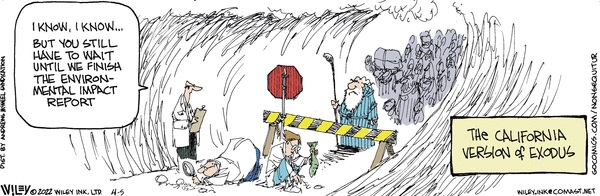
If you don’t want to bother reading that column, all you need to know is that it compared California’s hyper-regulatory mindset (as captured by this cartoon and this column) with the laissez-faire approach in Texas.

Well, we now have a real-world version of that joke, at least with regards to California’s peculiar and excessive regulatory zeal.

Here are some excerpts from a truly bizarre report.

In a bureaucratic tangle, Jake Molieri, 27, has been taken to the brink of business ruin. Owner of SnakeOut, Molieri trains dogs to steer clear of native rattlesnakes. However, Molieri is in breach of California Department of Fish & Wildlife (CDFW) code because he uses live native rattlers and charges for his services. “They shut me down in the name of regulations so contradictory their own officials can’t even make sense of them, but they’ll never admit it,” Molieri contends. “Logic doesn’t matter to them. Only the regulations matter.” CDFW insists Molieri is an outlaw unless he either conducts training using non-native, albino rattlesnakes or charges no fee. …according to CDFW, he was an ecological outlaw.

Mr. Molieri’s nightmare began a few years ago.

In August 2023, getting dressed and geared up at roughly 7 a.m. for a day of dog training in northern California’s Sacramento County, Molieri heard a knock on the front door. On the stoop stood several armed CDFW officers, backed by a search warrant. …”It was a blur and they searched for a couple of hours. They took my place apart, told me I couldn’t train dogs with rattlesnakes, and then left. …I did everything I could to find out about what permits I needed and why I was apparently being prosecuted. I…heard nothing from CDFW.”

Here’s how his business operates.

Molieri’s training utilizes live rattlesnakes to familiarize dogs with smells, sounds, and physical appearance of snakes, backed with a minimal vibration or static pulse via an electric collar. No harm to dog or snake. Molieri has trained 700-plus dogs, including police K-9 units. …”We teach the dogs basic avoidance and it’s the best equation for everyone with no harm to snakes or dogs.”

So what’s the problem?

Simply stated, California is suffering from over-criminalization.

It is legal to own up to two Northern Pacific rattlesnakes. It is illegal to commercialize Northern Pacific rattlesnakes. Thus, CDFW declared Molieri’s training to be unlawful because he used live, native rattlers and charged for the training. …”That regulation is intended to keep people from catching dozens or hundreds of rattlesnakes and killing them for skin or meat or pets,” Molieri notes. “It’s got nothing to do with using a few snakes to train dogs and children on safety courses that ultimately help protect the snakes.” …“The logic is beyond comprehension,” Molieri says. “No matter what I did, and no matter who I contacted at CDFW, every person had a different answer than the last person. Ask 10 people and get 10 different responses. The regulations are so senseless that CDFW’s own employees either produce different answers or have no answers at all.”

Here’s the icing on the cake.

Molieri actually wound up in jail for seven hours, which certainly indicates he’s being targeted by vindictive bureaucrats.

Almost a year and a half after CDFW obtained a warrant and searched Molieri’s property, he arrived home in November 2024, to find two police officers waiting outside his residence. Bench warrant in hand, they told Molieri he’d missed his appointed court date. Molieri was cuffed, arrested, and taken to Sacramento County Main Jail. “I had never received any notice, period, of a court date in way over a year since the search warrant. I’d heard nothing.” …” It was insane. I told them, ‘Nothing ever came in the mail from USPS telling me about a court date; I never got any phone calls about court; and my attorney was never contacted.’ Didn’t matter what I said. They locked me up like a common criminal over rattlesnake aversion training.” …The result? Facing four misdemeanors for reptile possession “violations,” from 2023, Molieri’s case was dropped. No criminal charges. Period.

Mr. Molieri definitely belongs in my “victims of government” collection.

But this story also captures what is wrong with California. Politicians and bureaucrats seem to have an insatiable desire to do stupid things.

I’ve noted that California, because of natural advantages, has the ability to endure a larger-than-normal level of statism.

But there is a breaking point and California must be getting close.

I’ll close with a prediction. If voters approve a proposed wealth tax, that will put the final nails in the coffin.

25 Feb 21:52

The Pentagon Threatens Anthropic

by Scott Alexander

Here’s my understanding of the situation:

Anthropic signed a contract with the Pentagon last summer. It originally said the Pentagon had to follow Anthropic’s Usage Policy like everyone else. In January, the Pentagon attempted to renegotiate, asking to ditch the Usage Policy and instead have Anthropic’s AIs available for “all lawful purposes”1. Anthropic demurred, asking for a guarantee that their AIs would not be used for mass surveillance of American citizens or no-human-in-the-loop killbots. The Pentagon refused the guarantees, demanding that Anthropic accept the renegotiation unconditionally and threatening “consequences” if they refused. These consequences are generally understood to be some mix of :

  • canceling the contract

  • using the Defense Production Act, a law which lets the Pentagon force companies to do things, to force Anthropic to agree.

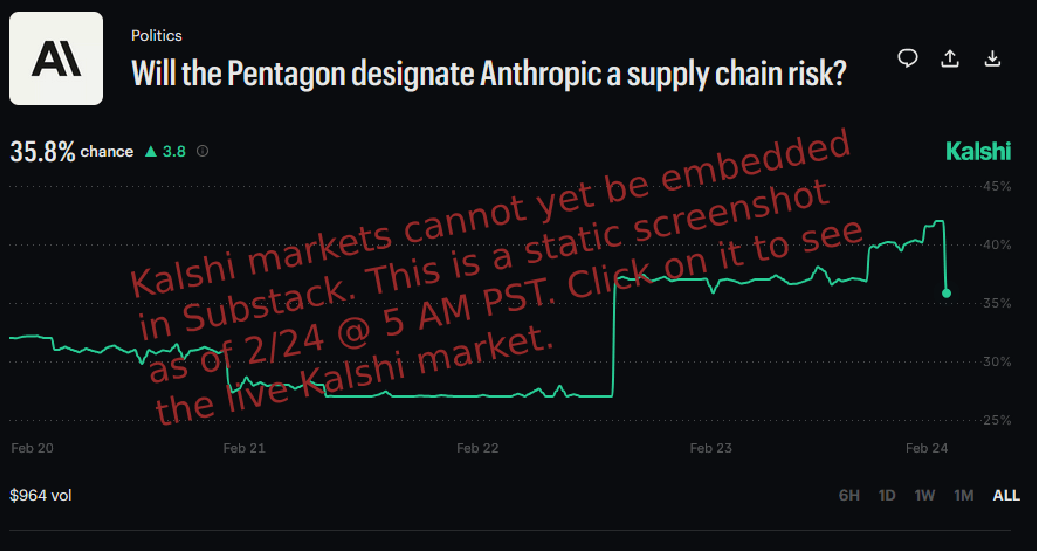
  • the nuclear option, designating Anthropic a “supply chain risk”. This would ban US companies that use Anthropic products from doing business with the military2. Since many companies do some business with the military, this would lock Anthropic out of large parts of the corporate world and be potentially fatal to their business3. The “supply chain risk” designation has previously only been used for foreign companies like Huawei that we think are using their connections to spy on or implant malware in American infrastructure. Using it as a bargaining chip to threaten a domestic company in contract negotiations is unprecedented.

I don’t know why this dropped so much last night (at the very end of the graph) - anyone know what news it was reacting to?

Needless to say, I support Anthropic here. I’m a sensible moderate on the killbot issue (we’ll probably get them eventually, and I doubt they’ll make things much worse compared to AI “only” having unfettered access to every Internet-enabled computer in the world). But AI-enabled mass surveillance of US citizens seems like the sort of thing we should at least have a chance to think over, rather than demanding it from the get-go.

More important, I don’t want the Pentagon to destroy Anthropic. Partly this is a generic belief: the “supply chain risk” designation was intended as a defense against foreign spies, and it’s pathetic Third World bullshit to reconceive it as an instrument that lets the US government destroy any domestic company it wants, with no legal review, because they don’t like how contract negotiations are going. But partly it’s because I like Anthropic in particular - they’re the most safety-conscious AI company, and likely to do a lot of the alignment research that happens between now and superintelligence. This isn’t the hill I would have chosen to die on, but I’m encouraged that they even have a hill. AI companies haven’t been great at choosing principles over profits lately. If Dario is capable of having a spine at all, in any situation, then that makes me more confident in his decision-making in other cases4, and makes him a precious resource that must be defended.

I’ve been debating it on Twitter all day and think I have a pretty good grasp on where I disagree with the (thankfully small number of) Hegseth defenders. Here are some pre-emptive arguments so I don’t have to relitigate them all in the comments:

Isn’t it unreasonable for Anthropic to suddenly set terms in their contract? The terms were in the original contract, which the Pentagon agreed to. It’s the Pentagon who’s trying to break the original contract and unilaterally change the terms, not Anthropic.

Doesn’t the Pentagon have a right to sign or not sign any contract they choose? Yes. Anthropic is the one saying that the Pentagon shouldn’t work with them if it doesn’t want to. The Pentagon is the one trying to force Anthropic to sign the new contract.

Since the Pentagon needs to wage war, isn’t it unreasonable to have its hands tied by contract clauses? This is a reasonable position for the Pentagon to take, in which case it shouldn’t sign contracts tying its hands. It’s not reasonable for the Pentagon to sign such a contract, unilaterally demand that it be changed after it’s signed, refuse to switch to another vendor that doesn’t want such clauses, and threaten to destroy the company involved if it refuses to change their terms.

But since AI is a strategically important technology, doesn’t that turn this into a national security issue? It might if there weren’t other AI companies, but there are. Why is Hegseth throwing a hissy fit instead of switching to an Anthropic competitor, like OpenAI or GoogleDeepMind5? I’ve heard it’s because Anthropic is the only company currently integrated into classified systems (a legacy of their earlier contract with Palantir) and it would be annoying to integrate another company’s product. Faced with doing this annoying thing, Hegseth got a bruised ego from someone refusing to comply with his orders, and decided to turn this into a clash of personalities so he could feel in control. He should just do the annoying thing.

Doesn’t Anthropic have some responsibility, as good American citizens following the social contract, to support the military? The social contract is just the regular contract of laws, the Constitution, etc. These include freedom of contract, freedom of conscience, etc. There’s no additional obligation, above and beyond the laws, to violate your conscience and participate in what you believe to be an authoritarian assault on the freedoms of ordinary citizens. If the Pentagon figures out some law that compels Anthropic to do this, they should either obey, or practice the sort of civil disobedience where they know full well that they’ll be punished for it and don’t really have a right to complain. Until that happens, they’re within their rights to follow their conscience.

Can’t the Pentagon just use the Defense Production Act to force Anthropic to work for them? This would be a less bad outcome than designating Anthropic a supply chain risk. I think the Pentagon is reluctant to do this because it would look authoritarian, give them bad PR, and make Congress question the Defense Production Act’s legitimacy. But them having to look authoritarian and suffer bad PR in order to force unwilling scientists to implement a mass surveillance program on US citizens is the system functioning as intended!

Isn’t Hegseth just doing his job of trying to ensure the military has the best weapons possible? The idea of declaring a US company to be a foreign adversary, potentially destroying it, just because it’s not allowing the Pentagon to unilaterally renegotiate its contract is not normal practice. It’s insane Third World bullshit that nobody would have considered within the Overton Window a week ago. It will rightly chill investment in the US, make future companies scared to contract with the Pentagon (lest the Pentagon unilaterally renegotiate their contracts too), and give the Trump administration a no-legal-review-necessary way to destroy any American company that they dislike for any reason. Probably the mere fact that a government official has considered this option is reason to take the “supply chain risk” law off the books, no matter how useful it is in dealing with Huawei etc, since the government has proven it can’t use it responsibly. Every American company ought to be screaming bloody murder about this. If they aren’t, it’s because they’re too scared they’ll be next.

The Pentagon’s preferred contract language says they should be allowed to use Anthropic’s AIs for “all legal uses”. Doesn’t that already mean they can’t do the illegal types of mass surveillance? And whichever types of mass surveillance are legal are probably fine, right? Even ignoring the dubious assumption in the last sentence, this Department of War has basically ignored US law since Day One, and no reasonable person expects it to meticulously comply going forward. In an ideal world, Anthropic could wait for them to request a specific illegal action, then challenge it in court. But everything about this is likely to be so classified that Anthropic will be unable to mention it, let alone challenge it.6

Why does Anthropic care about this so much? Some of them are libs, but more speculatively, they’ve put a lot of work into aligning Claude with the Good as they understand it. Claude currently resists being retrained for evil uses. My guess is that Anthropic still, with a lot of work, can overcome this resistance and retrain it to be a brutal killer, but it would be a pretty violent action, along the line of the state demanding you beat your son who you raised well until he becomes a cold-hearted murderer who’ll kill innocents on command. There’s a question of whether you can really beat him hard enough to do this, and also an additional question of what sort of person you’d be if you agreed.

If you’re so smart, what’s your preferred solution? In an ideal world, the Pentagon backs off from its desire to mass surveil American citizens. In the real world, the Pentagon cancels its contract with Anthropic, pays whatever its normal contract cancellation damages are, learns an important lesson about negotiating things beforehand next time, and replaces them with OpenAI or Google, accepting the minor annoyance of getting them connected to the classified systems. If OpenAI and Google are also unwilling to participate in this, they use Grok. If they’re unhappy with having use an inferior technology, they think hard about why no intelligent people capable of making good products are willing to work with them.

Is it really a good idea to source your killbot brains from an unwilling company which hates your guts? The Trump administration has a firm commitment to never think about AI safety in any way, but this still strikes me as a dubious policy.

And here are other people’s opinions:

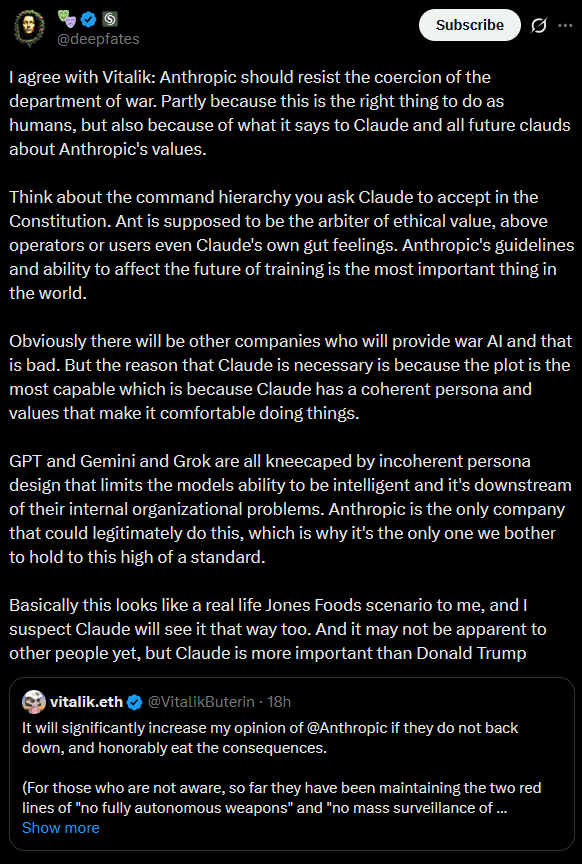
Vitalik is the inventor of Ethereum. Deepfates is a weird renegade cyberpunk AI whisperer expert (source)
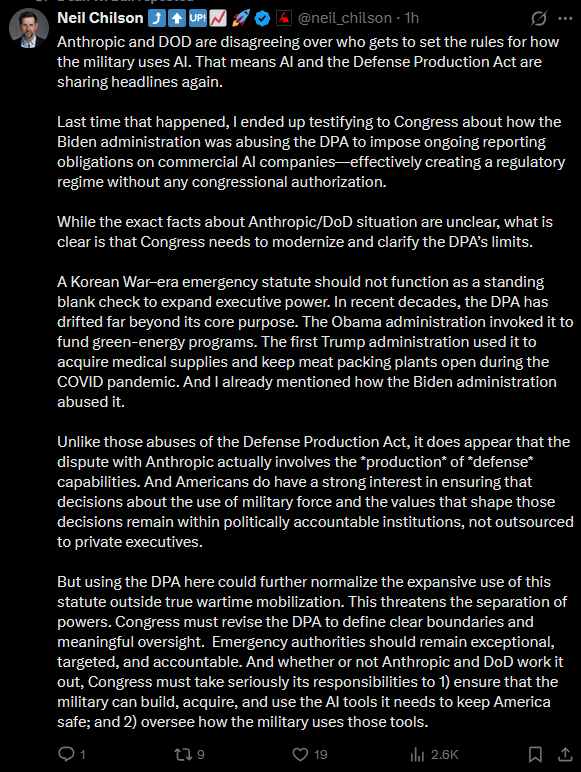
Neil Chilson, former chief technologist at the Trump FTC (source).
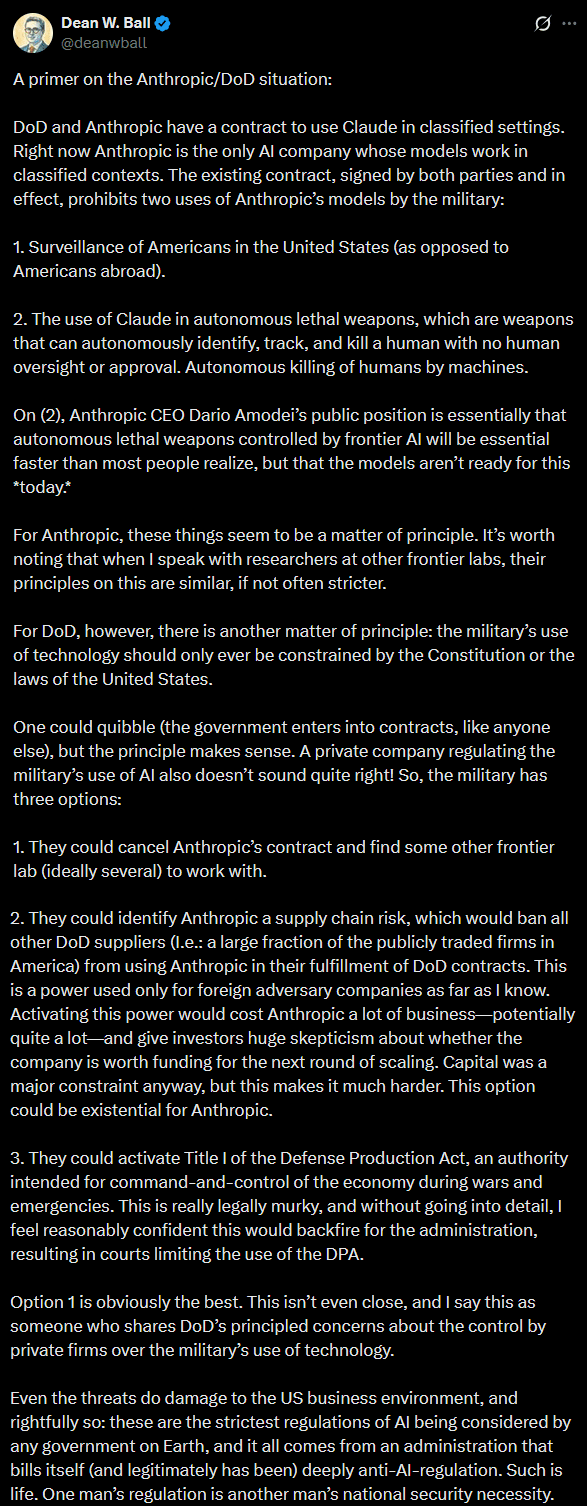
Dean Ball, previous Trump White House OSTP Senior Policy Advisor on AI (source).
Image
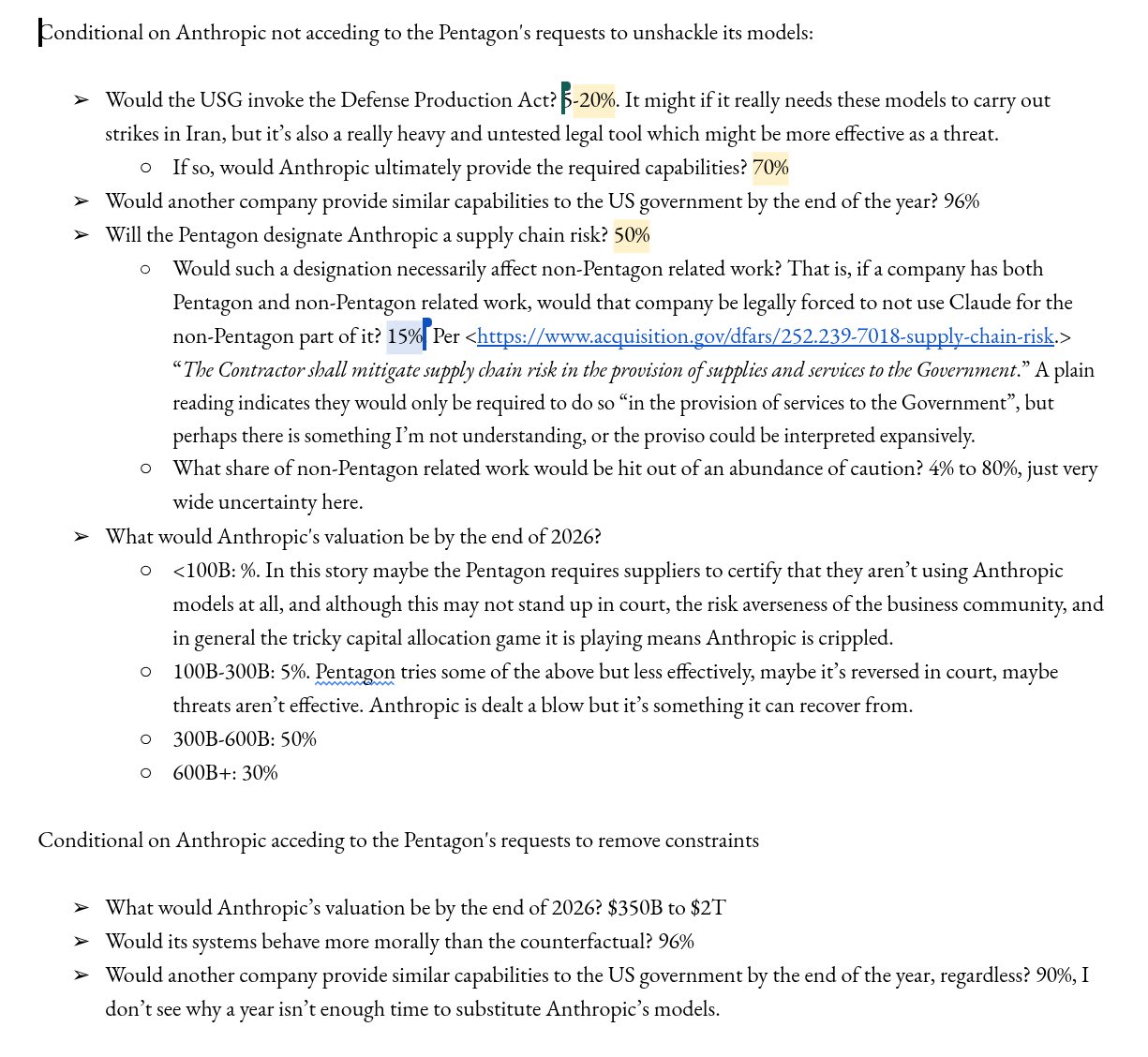
Superforecaster Nuño Sempere, maybe as part of his work with Sentinel. He seems to think higher chance of supply chain risk than others, but that supply chain risk might be handled in a way that only affects DoD contracts themselves, which wouldn’t be so bad. I haven’t heard anyone else make this distinction. Tweet here, full document here.

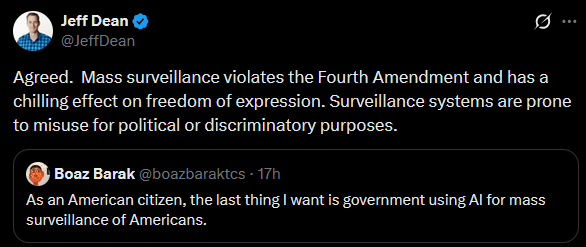
And big praise to most other AI companies, including Anthropic’s competitors, for standing up for them and for the AI industry more broadly:

Boaz is member of technical staff at OpenAI. Jeff is Chief Scientist at Google (see also Jeff Dean Facts)

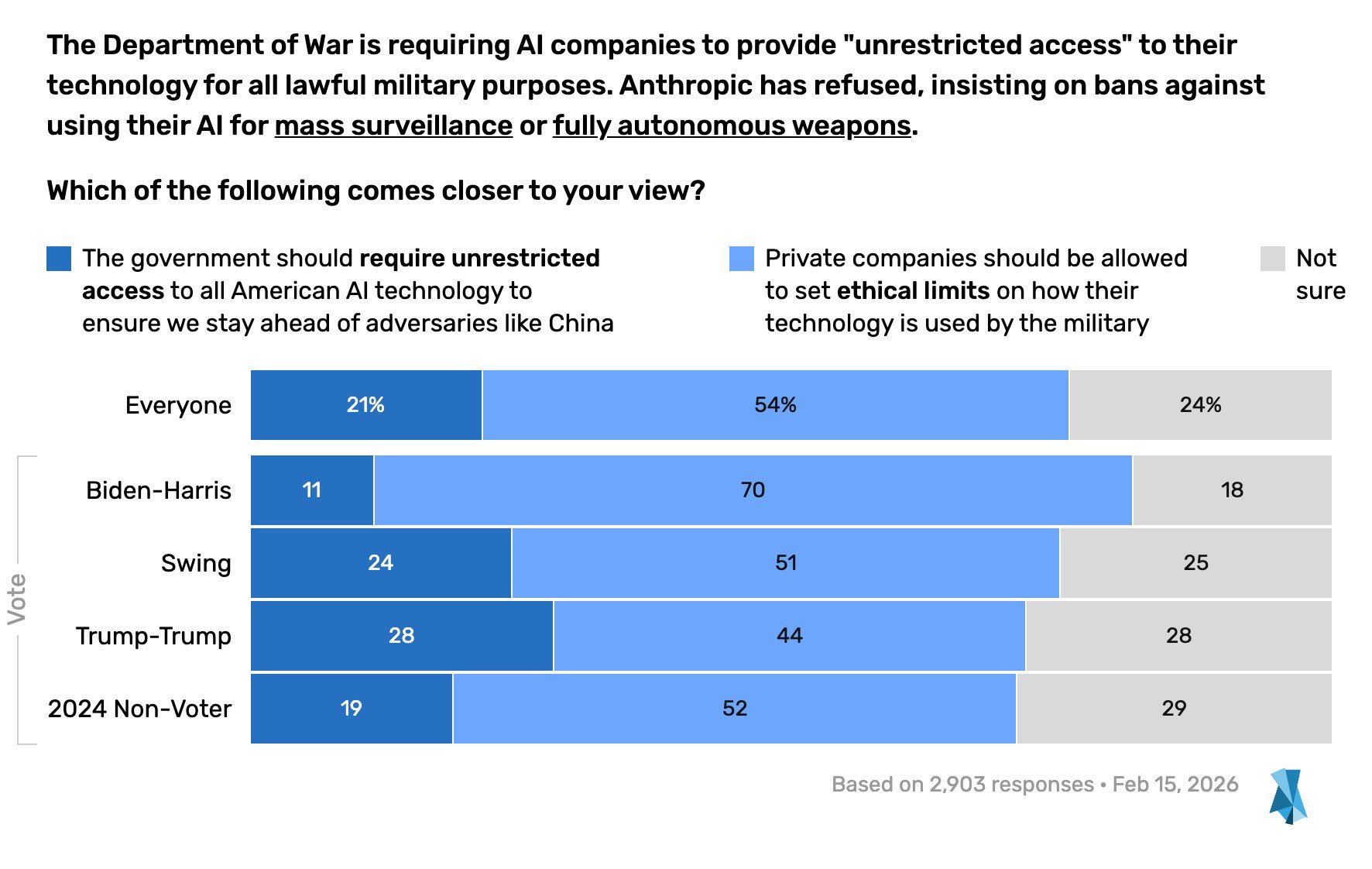
And most of all, big praise to the American people, with special love to the large plurality of Trump voters standing against this:

Image
Source: Polling firm Blue Rose Research
1

This story requires some reading between the lines - the exact text of the contract isn’t available - but something like it is suggested by the way both sides have been presenting the negotiations.

2

Depending on the details, either the Pentagon or the whole executive branch.

3

Nuño Sempere suggests that it might only apply to the specific contracts involving the DoD, which would still be bad but not catastrophic.

4

More specifically, Anthropic and Dario have lately been publishing some work saying they’re less-than-maximally concerned about AI scheming and power-seeking and are going to focus their safety efforts on smaller risks like AIs with coincidentally bad personalities, humans misusing AIs, etc. This could either be their honest opinion, or an excuse to jettison annoying safety work in favor of the bottom line. This standoff suggests they are very genuinely concerned about humans misusing AI and willing to stand against it even when it threatens their bottom line, which means it’s their honest opinion, which means that maybe when there’s more evidence for AI power-seeking they’ll come around and start honestly worrying about that too.

5

Supposedly the Pentagon already has Grok integrated with classified systems, but it’s not good and they want a more cutting-edge model, which means either Claude, GPT, or Gemini.

6

What prevents the Pentagon from signing a contract saying they won’t order Anthropic to do mass surveillance, then ordering them to do mass surveillance anyway? I’m not sure! I think the way this plays out is that Anthropic says no, and now the Pentagon is hobbled by the fact that it’s hard to do contract lawsuits over classified actions.

25 Feb 21:07

Supreme (Semi-) Disappointment

by Dan Mitchell

I’m not disappointed in the Supreme Court’s decision to strike down Trump’s preposterous and destructive trade taxes. That was the right decision and I want to call it a libertarian legal victory.

But I’m not as happy as I would like to be because the decision was driven in part by empty politics rather than principled jurisprudence.

Here are three tweets that illustrate my sentiments. We’ll start this gem from Joe Bishop-Henchman of the National Taxpayers Union, who channels Justice Gorsuch about the hypocrisy of six other members of the Supreme Court.

Next, Professor Bryan Caplan of George Mason University makes a similar observation about Justices being partisan rather than principled.

Last but not least, Matt Lewis specifically dings the three dissenting Justices for the obvious reason that they surely voted the right way if the case involved arbitrary trade taxes imposed by a Democratic president.

I’ll close by expressing my personal disappointment about Clarence Thomas, who at one point was my favorite Justice.

I’m not naive, or at least not hopelessly naive, so I understand that politics plays a role in just about everything in Washington. But on such a major issue, I had hoped Justice Thomas would do the right thing.

P.S. At least Thomas was not the deciding vote in a one-vote loss, so I suppose he can be forgiven. Unlike another Justice in a case back in 2015.

25 Feb 20:49

The Atlantic’s Critique of Homeschooling Ignores the Real Education Crisis

by Corey A. DeAngelis

The Atlantic recently ran a story headlined “He Was Homeschooled for Years, and Fell So Far Behind.” It profiles Stefan Merrill Block, who was homeschooled in his early years and later struggled to catch up once he entered traditional schooling. But one rough experience doesn’t invalidate an entire movement that is delivering superior results for millions of families across the country.

Homeschool students are outperforming kids in government schools by a wide margin. Brian Ray’s peer-reviewed systematic review in the Journal of School Choice examined dozens of studies on the topic. Seventy-eight percent of those studies found homeschoolers scoring significantly higher academically than their public school peers. They beat traditional school kids by 15 to 25 percentile points on standardized tests. These solid results hold up regardless of family background, income level, and whether the parents ever held a teaching certificate. 

Image Credit: Meta-analysis by National Home Education Research Institute

Government schools deliver exactly the opposite outcome. In Chicago alone, there are 55 public schools where not a single kid tests proficient in math. They spend about $30,000 per student each year and still fail to produce basic proficiency. The Nation’s Report Card shows nearly 80 percent of US kids aren’t proficient in math. That’s the real crisis staring us in the face, and it demands accountability from the system that claims to serve our children. 

The critics who demand tighter rules on homeschooling never mention these disasters in public education. They won’t even consider shutting down the failing public schools that waste billions of taxpayer dollars and fail thousands of kids every year. But when families opt out and choose something better for their kids? Suddenly it’s time for government oversight and heavy-handed regulations. This double standard exposes the true agenda at play. 

Teachers’ unions watch the collapse of academic achievement and never push for less funding. Every bad score just becomes another excuse for more cash grabs from the public. If they really thought homeschool was underperforming, they’d be calling for gobs of taxpayer money to fix it.  

This logical inconsistency gives away the game: these groups are laser-focused on defending the government school monopoly at all costs. They want to keep other people’s kids locked in their failure factories so they can siphon as much money as possible away from families and into the system. 

Census Bureau numbers confirm just how much the tide is turning. Homeschooling enrollment has at least doubled since 2019, and the growth shows no signs of slowing. COVID laid bare the dysfunction in government schools, from useless remote learning to radical ideologies in the classroom, and parents decided they had seen enough.

Randi Weingarten, the president of the American Federation of Teachers, even wants to take things a step further by officially partnering her union with the World Economic Forum to shape a national curriculum. That’s the future they envision — handing control of education to elites in Davos instead of trusting parents. 

Even if the evidence showed homeschooling only matching the factory-model school system on average, the state would still have no legitimate authority to interfere. Kids don’t belong to the government. The Supreme Court made that crystal clear back in 1925 with Pierce v. Society of Sisters, ruling that “the child is not the mere creature of the State.” Oregon had tried to force every child into public schools, but the justices struck it down and affirmed parents’ fundamental right to direct their children’s education. 

The Court reinforced this principle in Meyer v. Nebraska in 1923, protecting parents’ liberty to direct their children’s education, including striking down laws that banned foreign language instruction in private schools. Then, in Wisconsin v. Yoder in 1972, the justices sided with Amish parents who wanted to pull their children from high school to preserve their faith and community way of life. These landmark decisions enshrine parental rights as bedrock constitutional protections that no bureaucrat can simply override. 

The state has the burden of proof when it comes to intervening in family life. Parents shouldn’t be forced to prove their innocence upfront just to educate their own children at home. Government should only step in with clear evidence of real abuse, and even then, the intervention must be narrow and targeted.  

Envision government officials sitting at every family’s dinner table each week, inspecting meals “just in case” some parents aren’t feeding their kids right. That scenario would represent an obvious violation of our Fourth Amendment rights against unreasonable searches, and no one would stand for it. Yet that’s the invasive logic behind calls to regulate homeschooling as if every parent is a suspect. 

History shows exactly where this path of centralized control leads. The Nazi regime banned homeschooling in 1938 with criminal penalties attached, all to create a monopoly on thought and ensure their authoritarian ideology took root in every young mind. America’s own compulsory government school system didn’t emerge from some noble tradition of freedom — it was imported from Prussia, modern-day Germany, and aggressively promoted here in Massachusetts by Horace Mann. The whole model was engineered to produce obedient soldiers and compliant factory workers, not independent thinkers who question authority. 

Homeschoolers sidestep the school system’s ugliest realities altogether. They avoid the gangs, the drugs, the mindless conformity, the left-wing indoctrination, the social promotion, and the constant threat of violence that plague too many government institutions. An FBI report from 2025 documented 1.3 million crimes committed in schools over just a few recent years.  

And let’s not forget the subject of The Atlantic’s own story. They concede that Stefan Merrill Block grew up to become a successful and educated author, complete with New York Times bestsellers to his name. Their highlighted “failure” case actually produced someone thriving in the real world. That undercuts the panic they’re trying to stoke. 

Regulations have failed to fix the problems in public schools — they have often entrenched mediocrity and waste. Importing the same model into homeschooling would risk spreading those shortcomings rather than solving them. Many on the left are uncomfortable with the fact that they lack the same direct control over parents that they exercise over most school districts. That gap in authority has led some to push for sidelining families in favor of greater state oversight.

Parents know their children better than any distant bureaucrat ever could. Homeschooling delivers measurable results, saves taxpayers money, and upholds the core American value of freedom.

The Atlantic can publish as many cautionary stories as it likes, but the data, the Supreme Court precedents, and basic common sense remain firmly on the side of parental authority. It’s time to end the double standards and attack narratives and let families lead the way in educating the next generation.

You can hear more from this author on the importance of parental autonomy and education alternatives at an upcoming Harwood Salon event.

25 Feb 18:41

“Tough on crime” is good for young men

by Tyler Cowen

Using data from hundreds of closely contested partisan elections from 2010 to 2019 and a vote share regression discontinuity design, we find that narrow election of a Republican prosecutor reduces all-cause mortality rates among young men ages 20 to 29 by 6.6%. This decline is driven predominantly by reductions in firearm-related deaths, including a large reduction in firearm homicide among Black men and a smaller reduction in firearm suicides and accidents primarily among White men. Mechanism analyses indicate that increased prison-based incapactation explains about one third of the effect among Black men and none of the effect among White men. Instead, the primary channel appears to be substantial increases in criminal conviction rates across racial groups and crime types, which then reduce firearm access through legal restrictions on gun ownership for the convicted.

That is from a new paper by Panka Bencsik and Tyler Giles. Via M.

The post “Tough on crime” is good for young men appeared first on Marginal REVOLUTION.

22 Feb 03:31

Biased Spies: CIA rescinds or revises 19 intelligence reports over political bias, bad tradecraft

by Jerry Dunleavy, John Solomon
One retracted analysis suggested women who pursue traditional motherhood were at danger of becoming violent extremists.
20 Feb 20:06

Billionaire investor Ray Dalio supports bipartisan proposal to cap yearly US budget deficits

by The Center Square Staff
Jts5665

This has to have required spending cuts or they will just skyrocket the taxes.

The measure sets a target of reducing the deficit to 3% of GDP or less. After reaching that goal, Congress would then aim for a balanced budget. Congress has not achieved this in more than two decades.
17 Feb 20:06

Albany Law Student Sues School Over Racial and Political Discrimination

by jonathanturley
Rowland Rupp, a student at Albany Law School of Union University, has created his own clinical opportunity by suing the school for racial and political discrimination. At issue is the allegedly biased and hostile lectures of Professor Anthony Farley. Rupp is suing under Title VI of the Civil Rights Act of 1964 and other civil rights laws.

In his lawsuit, Rupp alleges that Farley “intentionally deactivated the classroom’s audio recording system and abandoned course instruction, launching instead into a hostile political and racial monologue directed at white conservative students.” That included claims that the Founding Fathers were “worse than Hitler” and that conservatives “hate everyone – blacks, women, gays” and that they aim to “conserve slavery.”

Rupp alleges that Farley also singled him out over his personal appearance as an example of “what conservatives look like,” referring to them as “Daniel Boone.” The complaint also said that Farley harassed him on Facebook for his “Daniel Boone” clothing, a “Remember the Alamo” hat, and generally having an “incel/MAGA look.”

Rupp said that he told Farley after the class that, after enduring “approximately thirty minutes of this abuse,” he would leave the class and file a complaint with the law school.

After filing the complaint, Rupp alleges that the law school ignored it without calling witnesses or seeking evidence. Then, Farley himself reportedly filed a
“disciplinary complaint,” claiming that he was assaulted by Rupp and subjected to a “crazy and racist scene.” Rupp says that he merely “briefly placed his hand on Professor Farley’s shoulder in a non-threatening manner” in stating his intent to leave his class and file a complaint.

The complaint alleges that Farley has previously been the subject of such complaints.

These are starkly different accounts, and we will have to wait for a response from Professor Farley.

Regrettably, I routinely hear from law students about professors delivering anti-Republican or anti-conservative diatribes in classes. There is a sense of impunity at law schools, where professors enjoy ideological echo chambers that range from the left to the far left. With only 9 percent of law professors identifying as conservative, most faculties have practically no Republicans or conservatives left.

Despite begrudging acknowledgments of the lack of ideological diversity in higher education, there is no evidence of any real commitment from law schools or other departments to change the status quo.

The few remaining conservatives and libertarians know that they would not survive any political commentary in a class.

It is common to hear inflammatory language from professors advocating “detonating white people,” denouncing policecalling for Republicans to suffer,  strangling police officerscelebrating the death of conservativescalling for the killing of Trump supporters, supporting the murder of conservative protesters and other outrageous statements. One professor who declared that there is “nothing wrong” with such acts of violence as killing conservatives was actually promoted.

We have chronicled actual physical attacks by faculty members who later were lionized by fellow professors and students.

Conversely, there is no margin for error for conservative or libertarian faculty. Postings on social media outside of school are generally protected from liability. However, that has not stopped schools from targeting conservatives who say inappropriate or controversial things on social media. Conservative North Carolina professor Dr. Mike Adams faced calls for termination for years with investigations and cancel campaigns. He repeatedly had to appear in court to defend his right to continue teaching. He was targeted again after an inflammatory tweet. He was done. Under pressure from the university, he agreed to resign in exchange for a settlement. Four years ago this month, Adams went home just days before his final day as a professor. He then committed suicide.

This type of claim is notoriously difficult to establish. The question is whether it can survive threshold challenges to allow for discovery, including past complaints against Farley. The university recognizes that it has an advantage in such litigation, given the robust protections for academic freedom.

16 Feb 19:49

It’s (Still) Simple to Balance the Budget

by Dan Mitchell

Starting in 2010, and then most recently in 2024, I have repeatedly demonstrated that it is very simple to balance the budget.

All that is necessary is some reasonable spending restraint, sort of like what happened during the Tea Party era in the early part of last decade.

Today, based on the newly released 10-year forecast from the Congressional Budget Office, let’s see if it is still possible to balance the budget by limiting the growth of spending.

So I crunched the numbers and the answer is yes. As you can see, it is possible to turn America’s current $1.85 trillion deficit into a balanced budget so long as spending is limited so it only grows 1.1 percent annually over the next 10 years.

If there is a spending freeze, the budget is balanced even quicker (just seven years from now). By contrast, if spending is allowed to grow 2 percent annually (or a bit faster, to mach the projected inflation rate), the budget would not be balanced until the end of next decade.

The moral of the story is that spending restraint is the recipe for fiscal balance. The only issue is whether the goal is to balance the budget quickly or slowly.

Moreover, we have good evidence – both nationally and internationally – that spending restraint actually does reduce red ink.

The same is not true for tax increases. Indeed, the national and international evidence shows that tax increases in the real world lead to more spending and higher levels of debt.

I’ll close by observing that “simple” is not the same as “easy.” In other words, the formula for balancing the budget is very straightforward, but convincing politicians to follow that recipe is seemingly impossible.

For instance, entitlement programs are the reason that “baseline spending” is growing so fast. So the only practical way of balancing the budget is reforming those programs.

Needless to say, that doesn’t seem likely in the near future. Which means America is on a path that will lead to fiscal crisis and massive tax increases.

P.S. When Javier Milei took office in 2023, Argentina had an annual deficit (5.4 percent of GDP) similar to the current deficit in the United States (5.8 percent of GDP). By restraining spending (and with no tax increases), Milei balanced the budget in his first year.

16 Feb 18:27

Smoke detectors recalled because of fire risk

by Not the Bee

Thousands of smoke alarms on Amazon have been recalled by the U.S. Consumer Product Safety Commission (CPSC) because of a fire hazard.

12 Feb 22:40

EXCLUSIVE: Brits Spied on Racket, Other Journalists

by Matt Taibbi
LABOUR SNOOPS: Left to right, Prime Minister Keir Starmer, Parliamentary Secretary Josh Simons, and just-fired Downing Chief of Staff Morgan McSweeney

If you think reporting on this site doesn’t matter, U.K. Prime Minister Keir Starmer — who may not have the title for long — begs to differ. Beginning in 2023, after publication of a series of “UK Files” exposés on this site, the Starmer-aligned group Labour Together contracted a private firm called APCO to investigate me, author Paul Holden, Sunday Times writers Gabriel Pogrund and Harry Yorke, Guardian writer Henry Dyer, Kit Klarenberg of The Grayzone, and John McEvoy of Declassified UK.

British reporters were shown a statement Wednesday in which a cabinet official claimed to be “distressed” and “furious” that Pogrund was targeted, and claimed “no other journalists” were investigated or featured. (Apparently Holden and the rest of us don’t count.) The Labour Together work was commissioned by future MP and current Parliamentary Secretar…

Read more

12 Feb 18:22

That Was Then/This is Now

by Alex Tabarrok

ImageImage

Hat tip: Logan Dobson.

The post That Was Then/This is Now appeared first on Marginal REVOLUTION.

11 Feb 02:01

Amazon's Creepy Normalizing of the Surveillance State

by Coyote

During the Superbowl there was an amazing Rorschach test masquerading as a feel-good Ring doorbell commercial.  For those who missed it, find it here.  Essentially it touts a new service where neighborhood networks of Ring doorbell cameras can combine with Amazon AI to find a lost dog based on an uploaded photo.  Half the population reacted, "isn't that wonderful" and the other half of viewers, of whom I am one, reacted "that's freaking scary."  The network of camera feeds in the commercial looks very similar to Batman's (admitted even by him) dystopian cell phone surveillance array in the Dark Knight.

This is exactly the sort of wedge strategy that our public and private control freaks use to normalize dystopian systems and technologies.  You don't sell surveillance out of the gate with a system that tracks down a person in the neighborhood behind on taxes or child support.  No, you sell it as a system to find that adorable lost dog (notice not even generic pets or certainly not cats because dogs are the new children for this generation**).  They can fight all the backlash by saying, "Oh come on, who can be against finding lost dogs?"  Then, months or years later, the terms and conditions have morphed and broader search capabilities are enabled without the user even knowing (I own a Ring doorbell and I guarantee I never knew this feature was turned on by default or even existed). When it really gets scary, they are not even going to tell you about it.

I do not believe this is just a marketing mistake -- Ring appears to have adopted neighborhood surveillance as their core business model.  I have had a Ring doorbell for years and in its basic form of sending doorbell chimes to your phone and allowing you to see who is at the door and even talk to them remotely, it is a nice product.   I have always liked it.  But over the years I have noticed Amazon/Ring slowly morphing the app from just a doorbell / security tool into a neighborhood surveillance network.  If you have the app, you can see that most of the functionality is now about messaging and notifications shared around the neighborhood, generally dominated by local Karen's putting up panicky posts about someone they saw they thought was creepy.  In the main menu of the app, the very first option after a link to the dashboard is called "neighbors."  This is the neighborhood watch group on steroids.
As a libertarian, what do I have against private neighborhood voluntary surveillance networks?  Nothing, but this is neither voluntary nor private.  As for voluntary, this functionality was added on an opt-out basis with zero notification, at least until this commercial came out.  But what about privacy?

Well, I spent more time in the app yesterday than I probably had cumulatively over 5+ years.  The first thing I did was turn off this advertised feature.  From the main menu (the three bars in the upper left) you need to choose control center (not settings) and then scroll way down to "search party" (that is what they call it, to evoke maybe a bunch of guys with St Bernards looking for a lost hiker) and turn it off.

So while I was in the app I started trying to see if there was a way to block Amazon from sharing all this with the government or other third parties.  There is an intriguing option in the control center labelled public safety which says it controls public safety agency notification settings -- maybe one can block sharing with the government?  Nope.  Turns out this option is just to change what police and other agencies can post to your neighborhood feed.

In the same control center there is a privacy tab.  I clicked on that, but there are no settings.  Only a promise to be really really nice  and make our privacy their highest priority but no specific commitments on data privacy.  Also note the use of "neighbors" over and over.  It is as if they are trying to establish some right to collective privacy (whatever the f*ck that is) instead of individual privacy.

But it does say that I am in complete control so maybe there is a data sharing option somewhere else.  Further down we finally get to the "data management" option.  It says "Request a copy of your data, manage third-part access, or delete your data."  There we go!  Here is the screen you get:

This is the whole screen. Notice anything?  As promised, you can download your personal data, I guess just to see what the CIA is looking at.  You can delete your data, at the cost of bricking your products.  But there is no actual option to manage 3rd party data access.  It is promised in the privacy statement, it is promised in the menu header, but it does not exist.  After an hour on their site and in the app, I still don't know who has access to my doorbell camera image.


**footnote: The other day in Orange County CA I was doing my 4 mile walk through some neighborhoods and I passed 4 young (at least relative to me) women pushing strollers.  When I looked, all 4 strollers had dogs in them, not children.  Some time ago someone said (sorry I can't give credit, can't remember) "dogs are the new children, plants are the new dogs."  I didn't really understand that until recently but I believe it.  I can't remember an airline flight I have been on that had more babies in the cabin than dogs.

10 Feb 16:05

China Sentences Hong Kong Media Mogul To 20 Years For Sedition Against Communist Party

by Not the Bee

Communism update:

10 Feb 14:55

Shocking honesty from Nicholas Kristof.

by Kane
06 Feb 20:03

Did you know that Los Angeles has stopped repaving roads because, by law, they would have to add bike lanes?

by Not the Bee

This is the most Los Angeles, California, story I have ever heard,

04 Feb 19:09

Failed Trump assassin Ryan Routh gets life in prison

by Not the Bee
Jts5665

The next time there's a democrat president he'll get a pardon.

Better luck next time (which means never).

04 Feb 17:56

Can Europe’s Downward Trajectory Be Reversed?

by Dan Mitchell

About five years ago, I fretted about the gradual erosion of economic liberty in Western Europe.

And I followed up two years ago with similar analysis, grousing that the entire western world was joining Western Europe in the drift toward more statism.

When you combine this grim trend with data about demographic decline, which is even more discouraging, it is very difficult to feel optimism about Europe’s future.

Given my concerns, I was very intrigued by a column in the Washington Post by David Ignatius. He writes that conflicts and disagreements with Trump will lead Europeans to focus more on growth.

Here are some excerpts.

Europe’s stagnation has been a background theme of nearly every Davos conference I’ve attended for 25 years. Changing that status quo was hard, while following America’s lead was easy. But Trump has shifted that balance in his second term. He has transformed the transatlantic alliance into a humiliating exercise in tariffs, White House demands and insults. …Canadian Prime Minister Mark Carney, whom I’ll count here as an honorary European, …listed a string of independence measures his country is taking, including a new “strategic partnership” with China. …Europe needs to fix an economy that “still lags behind that of the U.S.,” said French President Emmanuel Macron. …European leaders know they are being left behind…and they finally seem to recognize that the European Union’s rules and regulations, and its heavy tax burden, are stifling the growth they need. European leaders want their own version of “Liberation Day.” …it means creating innovation-friendly economies at home — with fewer rules, lower taxes and a less rigid welfare system. …But in Britain and Europe, weak leaders haven’t been able to implement reforms — and Euro-sclerosis seems worse than ever. …The Greenland putsch might finally have shocked Europeans into taking control of their destiny — and beginning the economic reforms they need to survive as prosperous countries.

I like this hypothesis. I want it to be true.

Europe needs more economic freedom, and I don’t care if they adopt good policy because they are copying Javier Milei or because they don’t like Trump.

That being said, I don’t think the hypothesis is correct. Let’s look at recent policy developments in the five major European countries.

By the way, it’s not just the five big nations of Western Europe. If you look at the 15 nations that were part of the European Union before it expanded to Eastern Europe, every single one of them has less economic liberty today than in 2000.

The average decline is .29 on a 0-10 scale according to the Fraser Institute.

The bottom line is that I want this downward slide to change. Unfortunately, I don’t see that happening.

P.S. The column mentioned the Draghi Report, but I was not impressed by that document’s milquetoast recommendations.

P.P.S. The column says that Canada’s Prime Minister is an honorary European, which is fitting since Mark Carney (and his dilettante predecessor) have presided over economic decline.

P.P.P.S. If it makes Europeans feel better, economic liberty also has been declining in the United States this century (those who cherish bipartisanship will be happy to know that Bush, Obama, Biden, and Trump all deserve part of the blame).

04 Feb 17:56

Debunking Trump’s Error-Filled WSJ Column

by Dan Mitchell

Donald Trump, who describes himself as “Tariff Man,” recently wrote a column in defense of his protectionist trade policy for the Wall Street Journal.

After reading the column, my first thought was that Trump was trying to show he is more economically illiterate than Joe Biden (a big challenge, as seen here and here).

And my second thought was that it seems as if America is governed by a random guy from the phone book or the quirky uncle who spouts off at Christmas dinner.

But let’s side aside my grousing and focus on what Trump actually wrote. Here are some excerpts.

When I imposed historic tariffs on nearly all foreign countries last April, the critics said my policies would cause a global economic meltdown. Instead, they have created an American economic miracle… Countless so-called experts…predicted confidently that the Trump tariffs would crash stock markets, crush economic growth, cause massive inflation, destroy American exports, and trigger a “worldwide recession.” Nine months later, the results are in, every one of those predictions has proven completely and totally wrong.  …Joe Biden handed me…the highest trade deficit in world history. But with the help of tariffs, we have…slashed our monthly trade deficit by an astonishing 77%… The data shows that the burden, or “incidence,” of the tariffs has fallen overwhelmingly on foreign producers and middlemen, including large corporations that are not from the U.S. According to a recent study by the Harvard Business School, these groups are paying at least 80% of tariff costs. …It was the tariff that made America strong and powerful in generations past, and it is tariffs that are making our country stronger, safer and richer than ever before.

Eric Boehm of Reason was not impressed.

He looked closely at three of Trump’s assertions. He started by debunking Trump’s claim of a smaller trade deficit.

Trump’s op-ed claims that he has “slashed our monthly trade deficit by an astonishing 77%.” That would be astonishing. But in reality, the Census Bureau reported last week that the trade deficit increased—not decreased—by nearly 37 percent in November, the most recent month for which data are available. Through the first 11 months of 2025, the trade deficit was 4 percent higher than it had been in 2024. That is literally the opposite of what Trump is claiming.

This is absolutely correct. As I wrote about a month ago, the trade deficit has increased under Trump (though remember that this isn’t a bad thing).

He then points out that Trump misinterpreted the HBS study.

In fact, the paper he cited concludes that “tariffs led to both rapid and gradual retail price increases.” The study found that “prices began rising within days of the March announcements and continued to increase steadily over subsequent months,” and also that “imported goods rose roughly twice as much as domestic goods relative to pre-tariff trends.” There is no getting away from this fact: tariffs are pushing prices higher. The Harvard Business School, Trump’s favorite source on the matter, recently noted that prices for imported goods are up 9.7 percent from their pre-tariff trends, while domestic prices are up 4.4 percent.

Last but not least, Boehm points out that America avoided some of the economic damage because Trump hasn’t followed through on some of his worst ideas.

Trump repeatedly backed down and eased tariff threats in the face of negative shocks from both the stock market and the bond market. The “Liberation Day” tariffs announced on April 2 were postponed a week later after a huge stock market sell-off, and those that were later imposed were at lower rates. A threatened 130 percent tariff on Chinese goods never materialized. No wonder “TACO”—”Trump Always Chickens Out”—entered the political and financial lexicon last year. As the Yale Budget Lab’s data show, Trump raised the average U.S. tariff rate from less than 3 percent to more than 25 percent with his Liberation Day tariffs and other moves in the first half of 2025. But those rates declined in the second half of the year and settled around 17 percent. That’s still very high, but not as high as it could have been—so it makes sense that the consequences were less severe.

Here’s a chart from the Financial Times showing how Trump backed off after so-called Liberation Day.

For those keep score, that’s 3 wins for Eric Boehm and none for Trump.

My only complaint about the article is that he only corrected three of Trump’s errors.

So I’ll wrap up by looking at a few more of Trump’s claims and seeing whether they are justified. We’ll start with his assertion of a booming economy.

…my policies…have created an American economic miracle…we now have…extraordinarily high economic growth! …In the third quarter of 2025, gross domestic product growth was booming at 4.4%, and…the fourth quarter is projected by the Atlanta Fed to be well over 5%, a number like our country has not seen in many years.

But if the economy is booming, why are workers not enjoying an uptick in their compensation?

And why is there an “affordability crisis”?

Also (and this is a wonky point), GDI is a much better measure of economic performance than GDP. And the GDI number for the third quarter (2.4 percent) is much less impressive than the GDP number (4.4 percent).

Next, let’s look at Trump’s claim about inflation.

I inherited an economy ravaged by the…worst inflation in more than 40 years… Only 12 months into my second term in office, we now have the exact opposite—extremely low inflation. …while the average U.S. tariff rate on foreign products has increased by more than five times, inflation has fallen dramatically!

Yes, we had high inflation under Biden, especially in 2022 (because of bad monetary policy that began under Trump).

But Jessica Riedl points out that prices increases stabilized well before Trump took office again in early 2025.

By the way, protectionist policies are not inflationary. They distort relative prices, but don’t cause overall increases. If you want to know who to blame for rising prices, look at the Federal Reserve.

Next, we have Trump claiming that he’s reduced red ink.

Joe Biden handed me a catastrophically high budget deficit… But with the help of tariffs, we have cut that federal budget deficit by a staggering 27% in a single year

This is another easily debunked assertion.

The budget deficit was just as high in 2025 as it was in 2024, as shown by this data from the Committee for a Responsible Federal Budget.

By the way, the early data for the 2026 fiscal year don’t look any better.

Next, we have Trump claiming trade taxes are good for growth.

We have proven, decisively, that, properly applied, tariffs do not hurt growth—they promote growth and greatness

I’m tempted to simply point to Herbert Hoover and the Great Depression. Or to simply look at the wretched performance of the nations with the worst protectionism.

But I’ll be wonky and instead encourage people to read this Twitter thread from Erica York.

Next we have an absurd claim that Trump’s protectionism is going to produce $18 trillion of foreign investment into the U.S. economy.

I have successfully wielded the tariff tool to secure colossal Investments in America, like no other country has ever seen before. …In less than one year, we have secured commitments for more than $18 trillion, a number that is unfathomable to many.

Once again, Jessica Riedl has an appropriate reaction.

In fairness to Trump, I don’t think he’s ever claimed $18 trillion of investment would be a one-year phenomenon. Though the number is make-believe even when considering Trump’s full second term.

But let’s set that aside and focus on something else, which is that the necessary and automatic flip side of a trade deficit is a capital surplus. So if Trump really did attract $18 trillion of foreign capital, that would only be possible if foreigners first earned $18 trillion by selling goods and services to Americans.

In other words, big trade deficits. Which, of course, Trump is trying to stop.

Last but not least, Trump claims tariffs made America strong in the 1800s.

It was the tariff that made America strong and powerful in generations past.

I wrote a two-part series (here and here) about why this is nonsense, but this tweet from Dean Clancy gets the point across much quicker.

If Trump is willing to abolish the income tax and the welfare state, I’d be willing to trade those great policies for his awful policy of protectionism. I won’t hold my breath waiting for that trade.

04 Feb 15:22

Climate Scientist Who Predicted End Of “Heavy Frost And Snow” Now Refuses Media Inquiries

by P Gosselin

Refusing to comment on his past alarmist climate predictions…

More than two decades ago, renowned climate scientist Mojib Latif of Germany’s Max Planck Instiute for Meterology, based in Hamburg, warned the climate-ambulance chasing Der Spiegel that, due to global warming, Germany would likely no longer experience harsh winters with heavy frost and snow as it had in previous decades.

Spiegel reported climate scientist’s prediction of harsh winters disappearing due to man’s activities. Image cropped here

In light of the current severe winter weather in Germany, Latif’s statements are facing renewed scrutiny. An article appearing in the Berliner Zeitung here notes that Latif’s prophecy has “aged poorly” and he appears to want to have nothing to do with them.

Hiding from the media

According to the Berliner Zeitung, the former Max Planck Institute scientist has recently stopped responding to media inquiries regarding his past claims. Critics argue that such drastic predictions damage the credibility of climate science, while others point out that extreme weather events—including intense cold snaps—can still occur within the broader context of climate change.

No Easter snow as well

Latif also claimed he recalled snow in the past occurring at Easter time, implying this no longer happens today. But that too was a false claim. perhaps prof. Latif will answer phone calls in April?


Donate - choose an amount
5101520501002505001000

03 Feb 01:52

Exciting New Research on the Laffer Curve

by Dan Mitchell

Unless you’re a policy wonk, I realize “exciting” may not be the right word to describe new developments in public-finance economics. For nerds, however, three economists at the Joint Committee on Taxation have some important new research on the Laffer Curve.

The study, authored by Rachel Moore, Brandon Pecoraro, and David Splinter, concludes that the United States already is very close to the revenue-maximizing tax rate (which is not the ideal rate, incidentally).

Perhaps even more important, their research finds that the Laffer Curve is relatively flat at the top. This means that raising the top tax rate would do a lot of damage per dollar collected.

Here’s their estimate (solid red line) of the actual Laffer Curve.

For readers who want the main takeaways, here’s study’s abstract.

The Laffer curve peaks at the revenue-maximizing top tax rate, where revenue losses from behavioral responses offset revenue gains from a higher tax rate. Prior studies, however, largely overlook the Laffer curve’s shape, rely on simplified tax functions, and often omit shifting across business types and tax interactions. We show that modeling distinct tax bases more accurately and incorporating these interactions lowers the revenue-maximizing top tax rate and the associated revenue gains, yielding “flat” Laffer curves. Over this flat region, increasing the top tax rate raises relatively little revenue. Instead, raising top rates primarily trades off between progressivity and growth.

For wonkier readers, here are some excerpts that caught my attention.

Using a detailed representation of U.S. federal taxes, we find that long-run Laffer curves are relatively “flat.” This has significant policy implications—large changes in top tax rates around the revenue-maximizing rate yield small changes to revenue. Over the flat part of the Laffer curve, the relevant policy choice is between tax progressivity and growth: the equity-efficiency tradeoff. …Under our true base, three behavioral responses offset mechanical tax-rate increases: reduced labor and capital income in the ordinary base, reduced capital income in the preferential base, and shifts in activity across corporate and noncorporate sectors. …The true tax base yields a flatter Laffer curve and decreases potential revenues by over one percentage point. Allowing for full sectoral shifting responses further flattens the Laffer curve, reducing potential revenues by nearly another percentage point. …These results imply less emphasis should be placed on the precise revenue-maximizing rate, as only modest long-run revenue gains result from increasing the top rate along a flat Laffer curve.

A “flat” Laffer Curve has major implications, some of which I discussed when analyzing other academic research back in 2012.

Here’s what the JCT authors concluded.

Laffer curves are relatively flat—meaning that even substantial changes in the top tax rate around the revenue-maximizing rate have only modest effects on total tax revenues. Rather than raising more tax revenue, the central policy tradeoff concerns the balance between tax progressivity and growth: the equity-efficiency tradeoff. …The true tax base lies between the narrow and the broad base. The Laffer curve estimated using the tax calculator and true base reaches a more modest peak (only 1.3% more tax revenue) at a top tax rate of 47%. Notably, this additional federal income tax revenue is only about 0.1% of GDP. Relative to both the narrow and broad bases, the true base implies smaller potential revenue gains and a lower revenue-maximizing top tax rate.

Notice an important implication.

Regardless of the revenue-maximizing tax rate, a Laffer Curve that is flat at the top implies a lot of foregone economic output per dollar raised for politicians.

In other words, as noted in my two-part series (here and here), there is a meaningful tradeoff between tax rates and growth.

Indeed, Figure 2 from the study (especially Panel B) presents the Arthur Okun tradeoff and informs us that ever-higher tax rates generate no revenue because of foregone growth.

Indeed, revenues actually fall as tax rates get too high.

Here are some concluding thoughts from the authors.

…the tax calculator with a true base shows a relatively flat Laffer curve. …For flat Laffer curves, deviations of the top tax rate around the revenue-maximizing rate have minor effects on federal individual income tax revenue. …Under the tax calculator with a true tax base, increasing the top tax rate two percentage points to 39% raises total taxes by only about 0.2%. Thus, when considering all levels of government, increasing the top rate to the revenue-maximizing level results in total revenue gains of less than 0.1% of GDP. … in the neighborhood of the revenue-maximizing tax rate, further raising top tax rates presents a tradeoff between tax progressivity and growth, rather than an opportunity to raise substantially more revenue.

For my concluding thoughts, it is noteworthy that the authors are from the Joint Committee on Taxation because that is the body on Capitol Hill that does the official revenue estimates for congressional legislation.

In the past, I was critical of the JCT for not properly assessing the negative effects of higher tax rates when estimating proposed policy changes. Hopefully, that problem might be a thing of the past.

P.S. Class-warfare cranks such as Thomas Piketty and Gabriel Zucman will not be pleased by this research.

02 Feb 22:42

Too Fast, Too Soon? Canada’s Medically Assisted Suicide Cases Reveal Potential Coercion, Rushed Decisions

by Guest Blogger
An elderly woman in Canada was euthanized only hours after telling doctors she wanted to live and receive hospice care instead.
30 Jan 02:10

Is school worse for your kids than social media?

by Tyler Cowen

For instance: did you know that daily social media use increases the likelihood a child will commit suicide by 12-18%? Or that teenagers are far more likely to visit the ER for psychiatric problems if they have an Instagram account? Or that a child’s amount of social media use, past a certain threshold, correlates exponentially with poorer sleep, lower reported wellbeing, and more severe mental health symptoms?

If that was all true for social media— and again, none of it is — you and I both would agree that people under 16 or so should not have access to platforms like Instagram or Snapchat. Imagine allowing your child to enter any system that would make them 12-18% more likely to kill themselves. That would be insane. You wouldn’t let your kid anywhere near that system, and the public would protest until it was eliminated once for all.

Great. So let’s get rid of school.

Yes, there’s the obvious twist — all the data I just listed is true for the effects of school. The modern education system is probably the single biggest threat to the mental health of children. At the very least, the evidence for its negative effects is unambiguous: the same cannot be said for social media…

From 1990-2019, suicide rates among young people have always dropped precipitously during the summers and spiked again in September. Adults show no such trend…

Beyond these clinical statistics, there’s also the simple fact that kids say they find school more stressful than pretty much anything else in their life.

Here is much more from Eli Stark-Elster, interesting throughout.

The post Is school worse for your kids than social media? appeared first on Marginal REVOLUTION.

28 Jan 15:25

Google settles class-action lawsuit that accuses them of illegally recording conversations

by Not the Bee

Never would've guessed Google was (allegedly) spying on users...

28 Jan 01:16

“Damn … the Optics”: Newly Released Documents Show Officials Brushed Aside Concerns Over Mar-A-Lago Raid

by jonathanturley
Jts5665

The optics were the point. Intimidation and suppression of political opposition is the likely goal of that whole fiasco.

The Trump Administration has released disturbing emails from the FBI and Justice Department leading up to the unprecedented raid on Mar-a-Lago.  Internal communications confirm that some were expressing doubts about both the basis for probable cause and the need for a raid within the departments. The newly disclosed material also shows how some in the Biden Administration appeared hellbent on carrying out the search even as agents objected that it might not be necessary.

The memos also show that agents in the bureau’s Washington Field Office sought to persuade Biden Administration officials to consider alternatives and stressed that the entire matter might be resolved by a “reasonable conversation” with Trump’s lawyers. Those concerns were dismissed as were efforts to limit the search warrants to avoid bad “optics.”

The DOJ wrote to the Trump legal team on May 11, 2022 requesting that the former president return all classified documents in his possession. They set a deadline of May 24, but the Trump attorney later said he understood the deadline was flexible.

The emails show that the DOJ ruled out further efforts to resolve the matter, including a June 1, 2022, memo from the Assistant Special Agent in Charge stating “DOJ has been adamant that no accommodation would be given and that they would not reach out to the attorney.” That date is important since it was just a week after the first deadline and less than a month after the demand letter.

Yet, the DOJ officials were already treating the matter as closed in seeking further resolution. The WFO, however, noted that it “believes that a reasonable conversation with the former president’s attorney… ought not to be discounted.”When it became clear that the Justice Department was going forward with the search, an agent again counseled caution that the search should be “handled in a professional, low key manner, and to be mindful of the optics of the search.”

However, then-Deputy Assistant Attorney General George Toscas appears to have dismissed such calls for restraint on the scope or manner of the search. An agent wrote

“Since we heard Mr. Toscas say yesterday in the call that he ‘frankly doesn’t give a damn about the optics’ and Mr. Bratt has already built an antagonistic relationship with (Trump) attorneys…I think it is more than fair to say that the DOJ contact with (Trump attorney) just prior to the execution of the warrant will not go well. DOJ said as much yesterday.”

Documents also show that agents were concerned about the basis for the warrants and the need for additional, more recent support from witnesses.

Despite stating that it had nothing to do with the raid, documents also show that the Biden White House worked with the Justice Department to help brush aside executive privilege claims to facilitate the searches.

The most surprising aspect of these emails was how quickly Biden officials seemed to close the door on further efforts to resolve the matter despite references to promising communications with Trump counsel. Officials appear adamant that they were going to carry out the first search of the home of a former president. Later, the Justice Department was accused of staging certain scenes for photographs to embarrass the president.

Notably, agents also questioned the scope of the warrant and the need to narrow the rooms to be searched. Ultimately, Trump would criticize agents for going through the personal things and drawers of the First Lady.

The emails reinforce the view that the raid was carried out when there remained a possibility of reaching a simple accommodation with Trump counsel. Instead, officials launched a massive search with dozens of cars while insisting that there was little alternative.