Shared posts

23 Jul 18:57

So How Can Anyone Be Opposed to Non-Discrimination Laws

by admin

First, let me establish a few background facts.  Several years ago I headed an attempt to put a Constitutional amendment legalizing gay marriage on the ballot here in Arizona.  As far back as 2004 I had a gay couple running a campground, and faced a customer petition demanding we remove them because they promoted moral degeneracy by being gay (it's for the children!).  I told those customers to camp somewhere else, as we were not changing our staffing.  Since then I have probably hired more gay couples to run campgrounds than anyone else in the business.

So how could I possibly be opposed to this:

After a period of foreshadowing and rumor, the Equal Employment Opportunity Commission has now gone ahead and ruled that employment discrimination on the basis of sexual orientation is forbidden under existing federal civil rights law, specifically the current ban on sex discrimination. Congress may have declined to pass the long-pending Employment Non-Discrimination Act (ENDA), but no matter; the commission can reach the same result on its own just by reinterpreting current law.

There are multiple problems with non-discrimination law as currently implemented and enforced in the US.  Larger companies, for example, struggle with disparate impact lawsuits from the EEOC, where statistical metrics that may have nothing to do with past discrimination are never-the-less used to justify discrimination penalties.

Smaller companies like mine tend to have a different problem.  It is an unfortunate fact of life that the employees who do the worst job and/or break the rules the most frequently tend to be the same ones with the least self-awareness.  As a result, no one wants to believe their termination is "fair", no matter how well documented or justified (I wrote yesterday that I have personally struggled with the same thing in my past employment).

Most folks grumble and walk away.  But what if one is in a "protected group" under discrimination law?  Now, not only is this person personally convinced that their firing was unfair, but there is a whole body of law geared to the assumption that their group may be treated unfairly.  There are also many lawyers and activists who will tell them that they were almost certainly treated unfairly.

So a fair percentage of people in protected groups whom we fire for cause will file complaints with the government or outright sue us for discrimination.  I will begin by saying that we have never lost a single one of these cases.   In one or two we paid someone a nominal amount just to save legal costs of pursuing the case to the bitter end, but none of these cases were even close.

This easy ability to sue, enabled by our current implementation of discrimination law, imposes a couple of costs on us.  First, each of these suits cost us about $20,000 to win (insurance companies are smart, they know exactly how this game works, and will not sell one an employment practices defense policy without at least a $25,000 deductible, particularly in California).  It takes a lot of effort for the government, even if neutral and not biased against employers as they are in California, to determine if the employee who was fired happened to be Eskimo or if the employee was fired because he was an Eskimo.  Unfortunately, the costs of this discovery are not symmetric.  It costs employees and their attorneys virtually nothing to take a shot at us with such discrimination cases, but costs us$20,000 each to defend and win (talk about Pyrrhic victories).  Which is why we sometimes will hand someone a few bucks even if their claim is absurd, just to avoid what turns out to be essentially legal blackmail.

Second, the threat of such suits and legal costs sometimes changes our behavior in ways that might be detrimental to our customers.  A natural response to this kind of threat is to be double careful in documenting issues with employees in protected groups, meaning their termination for cause is often delayed.  In a service business, almost anyone fired for cause has demonstrated characteristics that seriously hinder customer service, so drawing out the termination process also extends the negative impact on customers.

To make all this worse, many employees have discovered a legal dodge to enhance their post-employment lawsuits (I know that several advocacy groups in California recommend this tactic).  If the employee suspects he or she is about to be fired, they will, before getting fired, claim all sorts of past discrimination.  Now, when terminated, they can claim they where a whistle blower that that their termination was not for cause but really was retaliation against them for being a whistle-blower.

I remember one employee in California taking just this tactic, claiming discrimination just ahead of his termination, though he never presented any evidence beyond the vague claim.  We wasted weeks with an outside investigator checking into his claims, all while customer complaints about the employee continued to come in.  Eventually, we found nothing and fired him.  And got sued.  The case was so weak it was eventually dropped but it cost us -- you guessed it -- about $20,000 to defend.  Given that this was more than the entire amount this operation had made over five years, it was the straw that broke the camel's back and led to us walking about from that particular operation and over half of our other California business.

23 Jul 15:25

"Fannie & Freddie Are Back; Bigger & Badder Than Ever" - NYTimes Warns

by Tyler Durden

Submitted by Mike Krieger via Liberty Blitzkrieg blog,

Just in case you still harbored any doubt that absolutely zero lessons were learned from the cataclysmic financial collapse of 2008/09. We learn from the New York Times that:

AFTER the financial crisis of 2008, there was one thing that almost everyone agreed on. The government-sponsored mortgage giants, Fannie Mae and Freddie Mac, had to go. While shareholders and executives reaped the profits from Fannie and Freddie in good times, taxpayers were stuck with the bill in a crisis. President Obama described their dysfunctional business model as “Heads we win, tails you lose.” But here we are, seven years after the crisis, and nothing has changed.


In the 2008 crisis, when it looked as if Fannie and Freddie might go bankrupt, Henry M. Paulson Jr., then the Treasury secretary, argued that their fall would cause economic catastrophe. Foreign investors, stuck with their securities, would panic, and the mortgage market would shut down. So Fannie and Freddie were put into something called conservatorship, and are now government controlled, supported by a line of credit from the Treasury.


Conservatorship was supposed to be temporary — a “time out,” according to Mr. Paulson. We were going to stabilize the companies’ finances, reduce their importance to the mortgage market, and figure out a better system. But nothing happened. In fact, the situation has gotten even more precarious. In the years since the crisis, private lenders, for the most part, have been willing to make mortgages if they can immediately sell them to government agencies, mainly Fannie and Freddie. In other words, without Fannie and Freddie, there wouldn’t be much of a mortgage market.


To make things worse, the government decided to “sweep” almost all the duo’s profits into its own coffers, to be used as a slush fund for general government expenses. As Treasury Secretary Jacob J. Lew said in congressional testimony this spring, “As a practical matter it’s what has helped us reduce our overall deficit.” If there is another downturn in the real estate market and Fannie and Freddie suffer losses on their some $5 trillion in outstanding securities, taxpayers will again have to foot the bill. 

What do you expect to happen when the people responsible for running the economy into the ground are rewarded with bailouts and deemed “Too Big to Jail?”

22 Jul 20:33

Must Make for Interesting Family Dinners: If Anything, Ellen Pao's Husband is In The Middle of An Even Bigger Mess

by admin

Ellen Pao has had some career problems of late, but as I wrote yesterday, if she takes some responsibility for her own mis-steps and stops blaming it all on misogyny, she might learn something useful and build positive things on the experience.

A very loyal reader gives me a heads up that her husband, who is never mentioned in recent stories, actually faces a LOT more serious trouble (it is probably journalistically appropriate to leave her husband out of the recent stories, but one wonders if the New York Times would show the same scruples on a story about the CEO of Exxon if, say, his wife were independently in the midst of some sort of scandal).

Ellen Pao's husband is Buddy Fletcher, former Wall Street Wunderkind and now subject of a LOT of regulator scrutiny and pension fund lawsuits.  Here is one:

The firefighters’ system eventually said yes, and along with two other pension funds — the Municipal Employees’ Retirement System and the New Orleans Firefighters’ Pension and Relief Fund — invested a combined $100 million in one of Mr. Fletcher’s funds, FIA Leveraged. As they understood it, the fund would invest in liquid securities that could be sold in a matter of weeks.

The details sounded, as one board member put it, “too good to be true.”

In fact, they were.

Mr. Fletcher’s hedge fund has since been described by a court-appointed bankruptcy trustee as having elements of a Ponzi scheme, and four retirement systems are fighting to recover their money. A federal judge is scheduled to rule in March on a plan to liquidate the fund’s assets, which the trustee deemed “virtually worthless” in a report last November.

And another:

New York investment manager Alphonse “Buddy” Fletcher Jr. is being sued by the MBTA Retirement Fund and some of his own hedge funds on accusations that he defrauded them of more than $50 million.

The lawsuit, filed Monday in New York, accuses Fletcher and his firm, Fletcher Asset Management , and other parties of conducting a “long-running fraud” in which they misused money for their own benefit, inappropriately took inflated management fees, and overstated the value of assets.

As previously reported, the MBTA pension fund invested $25 million with Fletcher in 2007 on the advice of the fund’s former executive director, Karl White.

White pitched the investment to the pension fund just nine months after he had resigned to work for Fletcher.

The pension fund’s holding is now worthless, and the bankruptcy trustee investigating the case has alleged that Fletcher never invested the money as promised.

And here is an older, in-depth look at Fletcher.

It is starting to look like most of the money went to his family (e.g. $8 to his brother to fund a film), to buffing his image (e.g. $4+ million donation to Harvard), and to an incredibly opulent lifestyle (e.g. 4!! apartments in the Dakota).

Despite the fact that he seems to have grossly overstated income and assets of his funds, no one -- regulators, clients, auditors -- figured it out.  The most interesting part to me was the first group to detect the potential fraud was, of all groups, the governing board of the Dakota.  This group, full of successful Wall Streeters, looked at his financial statements and turned down his application to buy yet another apartment, coming to the conclusion he not only did not have the funds to buy this apartment but they were unsure how he was paying the vig on the $20 million loan securitized by his existing apartments.

One thing Fletcher apparently has in common with his wife is that he seems to respond to every negative business decision with a discrimination lawsuit.  This one backfired, however, and only served to point public attention to the fact that a group of savvy financiers thought Fletcher's wealth was potentially imaginary.  Government investigations and lawsuits have followed.

He still has a chance to escape, though.  Despite Jon Corzine's outright theft of funds from MF Global commodity investor accounts, he got off scott-free due to his close ties to the Democratic Party.  Time for Fletcher to start giving any free assets he still holds (if there are any) to Hillary's campaign.

22 Jul 20:30

Name The Human Decision-Making Process Which Claims a Low 0.25% Error Rate

by admin

Give up?  It's Chicago Police shooting people.  Despite the fact that the decisions must be made by folks who likely have no past experience or practice in making such decisions, Chicago claims its police officers have one of the lowest error rates of any known human decision-making process

Chicago's Independent Police Review Authority (IPRA) has conducted investigations of close to 400 police shootings of citizens and has found just one to have been unjustified.

Of course, it could be that the process is far more error-prone, but that the people tasked with declaring any shooting in error are the exact same people who have an interest in never admitting an error.  Also, it could be because anyone who does label a shooting as an error gets fired:

That little factoid comes from Chicago public radio station WBEZ as some background context for the news that Lorenzo Davis, a supervising investigator for IPRA, had been fired earlier in July.

Davis isn't going out quietly. WBEZ interviewedthe man, a former Chicago police officer himself who retired in 2004. Davis is saying that the reason why he was fired is because he insisted that several recent police shootings were unjustified and would not comply with orders to change his findings. Performance evaluations indicated everybody thought Davis' work was just great until recently.

22 Jul 16:51

How Capitalism Is Undermining the Indian Caste System

by Swaminathan S. Anklesaria Aiyar

Karl Marx was wrong about many things but right about one thing: the revolutionary way capitalism attacks and destroys feudalism. As I explain in a new study,  in India, the rise of capitalism since the economic reforms of 1991 has also attacked and eroded casteism, a social hierarchy that placed four castes on top with a fifth caste—dalits—like dirt beneath the feet of others. Dalits, once called untouchables, were traditionally denied any livelihood save virtual serfdom to landowners and the filthiest, most disease-ridden tasks, such as cleaning toilets and handling dead humans and animals. Remarkably, the opening up of the Indian economy has enabled dalits to break out of their traditional low occupations and start businesses. The Dalit Indian Chamber of Commerce and Industry (DICCI) now boasts over 3,000 millionaire members. This revolution is still in its early stages, but is now unstoppable.

Milind Kamble, head of DICCI, says capitalism has been the key to breaking down the old caste system. During the socialist days of India’s command economy, the lucky few with industrial licenses ran virtual monopolies and placed orders for supplies and logistics entirely with members of their own caste. But after the 1991 reforms opened the floodgates of competition, businesses soon discovered that to survive, they had to find the most competitive inputs. What mattered was the price of your supplier, not his caste.

Many tasks earlier done in-house were contracted out for efficiency, and this opened new spaces that could be filled by new entrepreneurs, including dalits. DIOCCI members had a turnover of half a billion dollars in 2014 and aim to double it within five years. Kamble says dalits have ceased to be objects of pity and are becoming objects of envy. They are no longer just job-seekers, they are now job creators.

Even in rural areas, dalits have increasingly moved up the income and social ladders in the last two decades.  One survey in the state of Uttar Pradesh shows the proportion of dalits owning brick houses is up from 38 percent to 94 percent, the proportion running their own businesses is up from 6 percent to 36.7 percent, and the proportion owning cell phones is up from zero to one-third. Some former serfs have now become bosses. A rising proportion have become land-owners, and sometimes hire upper-caste workers. Even more revolutionary, say dalits, is the change in their social status. Once they were virtually bonded laborers, and could not eat or drink with the upper castes. Today the bonded labor system is almost gone, and dalits operate restaurants at which upper castes eat and drink. They remain relatively poor and discriminated against, but economic reform since 1991 has revolutionized their social and economic status.

22 Jul 14:37

On the Bright Side: Three Full Decades of CO2-Induced Vegetative Greening in China

by Craig D. Idso

Here we introduce a new feature from the Center for the Study of Science, “On the Bright Side.” OBS will highlight the beneficial impacts of human activities on the state of our world, including improvements to human health and welfare, as well as the natural environment. Our emphasis will typically focus on the oft-neglected positive externalities of carbon dioxide emissions and associated climate change. Far too often, the media, environmental organizations, governmental panels and policymakers concentrate their efforts on the putative negative impacts of potential CO2-induced global warming. We hope to counter that pessimism with a heavy dose of positive reporting on the considerable good humans are doing for themselves and for the planet.

According to Piao et al. (2015), the reliable detection and attribution of changes in vegetation growth are essential prerequisites for “the development of successful strategies for the sustainable management of ecosystems.” And indeed they are, especially in today’s world in which so many scientists and policy makers are concerned with what to do (or not do) about the potential impacts of CO2-induced climate change. However, detecting vegetative change, let alone determining its cause, can be an extraordinarily difficult task to accomplish. Nevertheless, that is exactly what Piao et al. set out to do in their recent study.

More specifically, the team of sixteen Chinese, Australian and American researchers set out to investigate trends in vegetational change across China over the past three decades (1982-2009), quantifying the contributions from different factors including (1) climate change, (2) rising atmospheric CO2 concentrations, (3) nitrogen deposition and (4) afforestation. To do so, they used three different satellite-derived Leaf Area Index (LAI) datasets (GLOBMAP, GLASS, and GIMMIS) to detect spatial and temporal changes in vegetation during the growing season (GS, defined as April to October), and five process-based ecosystem models (CABLE, CLM4, ORCHIDEE, LPJ and VEGAS) to determine the attribution.

With respect to detection, this work revealed that most regions of China experienced a greening trend indicative of enhanced growth across the time period studied (see Figure 1). Overall, 56 percent of the area studied experienced a significant increase in greening (95% level) when using the GLOBMAP dataset, compared with 54 and 31 percent using the GLASS and GIMMIS datasets. Those regions with the largest greening trends include southwest China and part of the North China Plain. 

Figure 1. Spatial distribution of the trend in LAIGS over the period 1982–2009 as calculated by the GIMMS dataset (a), GLOBMAP dataset (b) and the GLASS dataset (c). The frequency distribution of the significance level (P value) of the trends calculated for the three LAIGS datasets is shown in panel d.

Figure 1. Spatial distribution of the trend in LAIGS over the period 1982–2009 as calculated by the GIMMS dataset (a), GLOBMAP dataset (b) and the GLASS dataset (c). The frequency distribution of the significance level (P value) of the trends calculated for the three LAIGS datasets is shown in panel d.

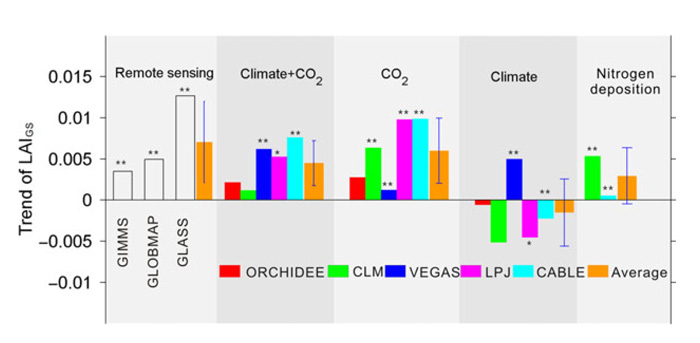
With respect to attribution, Piao et al. report that “the combined effect of CO2 fertilization and climate change with the effect of nitrogen deposition, leads to the conclusion that these three factors are responsible for almost all of the average increasing trend of LAIGS observed from the satellites” (see Figure 2). They also report that “at the country scale, the average trend of LAIGS attributed to rising CO2 concentration is estimated to be … about 85% of the average LAIGS trend estimated by satellite datasets,” while noting secondarily that the enhanced nitrogen deposition driven by fossil fuel combustion and agricultural fertilization is likely the source of the remaining portion of China’s enhanced vegetation growth, citing the findings of Reay et al. (2008), Thomas et al. (2009), Fleischer et al. (2013) and Yu et al. (2014).

Figure 2. Trend in China’s LAIGS over the period 1982–2009 at the country scale for the three satellite remote sensing datasets and five process models described in the text above. Significance levels of 95 and 99 percent are denoted with one and two asterisks, respectively. See the authors' original text (Piao et al., 2015) for additional explanation of this figure.

Figure 2. Trend in China’s LAIGS over the period 1982–2009 at the country scale for the three satellite remote sensing datasets and five process models described in the text above. Significance levels of 95 and 99 percent are denoted with one and two asterisks, respectively. See the authors’ original text (Piao et al., 2015) for additional explanation of this figure.

In considering the researchers’ several findings, it is clear that the fossil fuel combustion that has resulted in the rise in atmospheric CO2 and enhanced nitrogen deposition over the past three decades has provided a great benefit to Chinese vegetation. As illustrated in Figure 2, led primarily by the increase in CO2, that benefit has been more than sufficient to compensate for the negative effects of climate change that also occurred over that time period. Thus, it would seem far more prudent to celebrate CO2 instead of demonizing it, like so many people incorrectly do these days; for atmospheric CO2 is truly the elixir of life!


References

Fleischer, K., Rebel, K.T., Molen, M.K., Erisman, J.W., Wassen, M.J., van Loon, E.E., Montagnani, L., Gough, C.M., Herbst, M., Janssens, I.A., Gianelle, D. and Dolman, A.J. 2013. The contribution of nitrogen deposition to the photosynthetic capacity of forests. Global Biogeochemical Cycles 27: 187-199.

Piao, S, Yin, G., Tan, J., Cheng, L., Huang, M., Li, Y., Liu, R., Mao, J., Myneni, R.B., Peng, S., Poulter, B., Shi, X., Xiao, Z., Zeng, N., Zeng, Z. and Wang, Y. 2015. Detection and attribution of vegetation greening trend in China over the last 30 years. Global Change Biology 21: 1601-1609.

Reay, D.S., Dentener, F., Smith, P., Grace, J. and Feely, R.A. 2008. Global nitrogen deposition and carbon sinks. Nature Geoscience 1: 430-437.

Thomas, R.Q., Canham, C.D., Weathers, K.C. and Goodale, C.L. 2009. Increased tree carbon storage in response to nitrogen deposition in the U.S. Nature Geoscience 3: 13-17.

Yu, G., Chen, Z., Piao, S., Peng, C., Ciais, P., Wang, Q., Li, X., and Zhu, X. 2014. High carbon dioxide uptake by subtropical forest ecosystems in the East Asian monsoon region. Proceedings of the National Academy of Sciences USA 111: 4910-4915.

22 Jul 14:28

NYPD Officials Apparently Deleting Incriminating Communications Related To Alleged Illegal Summons Quotas

by Tim Cushing

The NYPD doesn't care for transparency. Its relationship with open records requesters ranges from "frosty" to "antagonistic." It even employs its own in-house, completely arbitrary classification system in order to prevent even more of its documents from making their way into the hands of the public.

And, despite policies specifically mandating the preservation of records, NYPD officials are apparently preemptively deleting certain communications to ensure they'll never be made public.

Attorneys for the city have failed to turn over even one email from the files of former Police Commissioner Raymond Kelly or former Chief of Department Joseph Esposito regarding summons activity over the last eight years, attorney Elinor Sutton writes in new filings in Manhattan Federal Court seeking sanctions against the city.

“It is simply not tenable that Commissioner Kelly and Chief Esposito did not — in the entire period of 2007 through the present — write or receive emails using terms” related to the word “summons,” Sutton writes.
Seven years of discussing police business and not once did Kelly or Esposito use the word "summons," one of the most common terms used when discussing police business. How can this possibly be? Well, when you're looking for evidence that NYPD bosses and supervisors instituted illegal quotas, the word "summons" would figure prominently in responsive documents... if said documents hadn't been memory-holed for the preservation of the greater good their positions.

And it's not just the top two men in the NYPD that have a "summons" hole in their communications. Searches for responsive emails/texts from three other high-ranking NYPD officials came up empty as well.

What Sutton has obtained that points to an unofficial quota system has come from whistleblowers and "other means." Sutton has copies of emails and texts -- sent using NYPD phones/email accounts -- that discuss quota-like "expectations" for officers and reprisals for failing to hit these numbers. But the NYPD's own search for these same documents has found nothing. This either means the NYPD isn't performing thorough searches or it has been destroying incriminating documents. Either way, the NYPD's lack of responsive documents looks very suspicious.

And the city itself is complicit in the "vanishing" of possibly culpatory evidence.
[C]ity lawyers didn’t advise the NYPD to preserve communications related to summonses until 2013 — three years after the suit was filed, Sutton says.
The city won't say much about the lawsuit or its police department's actions, but this contradictory set of sentences says a lot more than the city rep probably intended it to.
In a response filed last week, city attorney Qiana Smith-Williams said the alleged evidence destruction was “short on meritorious claims” and that the sides had not yet “exhausted the possibility of a settlement.”
If you believe the opposition's case is lacking in merit -- and you have an inexhaustible amount of (public) funds to fight it -- why would you be entertaining a settlement? The obvious answer is this: a settlement would allow the city to end the discovery process, maintain its secrecy, allow those involved in the quota scheme to avoid further examination/punishment. Handing out (public) money to the plaintiffs in settlement form also allows the city/NYPD to move on without having to admit wrongdoing. A payout means nothing changes. Quotas will still remain, but steps will be taken to ensure it's better hidden.

Permalink | Comments | Email This Story


22 Jul 13:21

Speech Crimes in Wisconsin

by Jacob Sullum

Last week the Wisconsin Supreme Court shut down a secret criminal investigation that featured early-morning raids on the homes of innocent people and indiscriminate seizures of email, documents, and personal property. You may be surprised to hear that the Brennan Center for Justice, which usually defends Fourth Amendment rights, denounced the court's decision.

Since this unconstitutional inquisition was prompted by the targets' exercise of their First Amendment rights, the Brennan Center's position is especially puzzling. It shows how the attempt to control corruption by controlling speech has corrupted the principles of civil libertarians.

The Wisconsin investigation, which was initiated by Milwaukee District Attorney John Chisholm in 2010, eventually encompassed "all or nearly all right-of-center groups and individuals in Wisconsin who engaged in issue advocacy from 2010 to the present," as U.S. District Judge Rudolph Randa explained in a 2014 ruling. The targets, which included about 30 conservative organizations, were suspected of coordinating their activities with Gov. Scott Walker, who at the time was engaged in a bitter struggle with Democrats over public employees' bargaining rights that culminated in an unsuccessful recall campaign against him.

There was little evidence of such coordination, which in any event was not a crime. That's right: As Randa concluded in response to a lawsuit brought by conservative activist Eric O'Keefe and the Wisconsin Club for Growth, the entire investigation was based on an offense that does not exist.  

"The defendants are pursuing criminal charges through a secret John Doe investigation against the plaintiffs for exercising issue advocacy speech rights that on their face are not subject to the regulations or statutes the defendants seek to enforce," Randa said, calling the prosecutors' interpretation of campaign finance law "simply wrong." Finding that "the plaintiffs are likely to succeed on their claim that the defendants' investigation violates their rights under the First Amendment," he issued a preliminary injunction.

Randa's injunction was overturned by an appeals court based on a law that limits federal judges' authority to intervene in state proceedings. But a state judge who took over supervision of the investigation after the original judge recused herself already had reached the same conclusion, and last week the Wisconsin Supreme Court agreed: In light of the relevant First Amendment decisions by the U.S. Supreme Court, Wisconsin's rule against coordination must be read as applying only to "express advocacy"—i.e., speech explicitly calling for a candidate's election or defeat.

Since prosecutors never even alleged that the Club for Growth or any of the other groups had engaged in express advocacy, there was no crime to be investigated. The targets were nevertheless treated like criminals.

"The search warrants were executed at approximately 6:00 a.m. on October 3, 2013, in pre-dawn, armed, paramilitary-style raids in which bright floodlights were used to illuminate the targets' homes," the Wisconsin Supreme Court noted. It added that "the breadth of the documents gathered pursuant to subpoenas and seized pursuant to search warrants is amazing." They included "wholly irrelevant information, such as retirement income statements, personal financial account information, personal letters, and family photos."

In an eye-opening National Review report last April, David French described the lasting psychological impact of this heavy-handed scrutiny. One woman, awakened by armed men demanding entry, rushed to the door half-naked and had no time to put her dogs out. She was terrified, with good reason, that the cops would shoot them. "I no longer feel safe," she told French, "and I don't think I ever will."

Afterward, although the investigation was hardly a secret anymore, the targets were legally forbidden to discuss it or defend themselves. The cloud of suspicion and the fear of criminal liability by association crippled their political activities and sent a chilling message to other supporters of Walker's policies.

These are the sort of abuses that the Brennan Center would condemn in the context of the War on Drugs or the War on Terror. Evidently the War on Conservative Activism requires sterner measures.

© Copyright 2015 by Creators Syndicate Inc.

21 Jul 16:43

Driverless Cars: Disrupting Government Reliance On Petty Traffic Enforcement

by Tim Cushing

Self-driving cars are on the way, and in their wake, they'll leave a variety of entities slightly less better off. Insurance companies may be the first to feel the pinch, as less-than-risk-averse drivers are replaced with Electric Grandmothers more than willing to maintain safe speed limits and the proper distance between vehicles. And as goes the car accident, so go other areas of the private sector: personal injury/DUI lawyers, hospitals, body shops, red light camera manufacturers, towing companies, etc.

But the public sector will take the hit as well. "Flow my tears," said the policeman.

Consider the following. This past year, the City of Los Angeles generated $161 million from parking violations. Red light violations have a fee of $490. Californians caught driving under the influence are fined up to $15,649 for a first-offense misdemeanor DUI conviction and up to $22,492 for an under-21 equivalent. Cities in California collect, on average, $40 million annually in towing fees that they divide with towing firms. Simply put, the hundreds of millions of dollars generated from poor driving-related behaviors provide significant funding for transportation infrastructure and maintenance, public schools, judicial salaries, domestic violence advocacy, conservation, and many other public services.

Since California legalized driverless vehicles, Google has logged more than 1.7 million miles during the testing phase and been involved in 11 accidents, none of which were the fault of the driverless vehicle. Tesla, Mercedes, and others are not far behind. It turns out that automated vehicle technology—unlike humans—abides by the law. And that’s bad news for local government revenues. In other words, once driverless cars become mainstream, deep revenue sources acquired from driving-related violations such as speeding tickets and DUIs will decrease greatly.
Someone has to pay for the roads and other government activities, but it won't be drivers. So, as the Brookings Institution report points out, new revenue streams will have to be sought. The obvious suggestion is tax-per-mile billing, but that puts the government right in your vehicle -- an idea that's not going to gain in popularity any time soon.

While the loss of revenue will have an impact, the picture painted here is skewed. For many years, communities have treated police departments as revenue generators, rather than crime fighters. This has skewed incentives so badly that some small towns have become nothing more than profitable speed traps. That's one end of the issue: the pressure (or the willingness) to overpolice minor traffic violations to keep city governments (and the police departments themselves) funded.

But that's only part of it. The situation looks rather dire, especially if one doesn't examine what's not being said in these paragraphs. As Scott Shackford at Reason points out, the Brookings Institution report does some mighty fine cherry-picking for its list of potentially-affected government services. Without a doubt, a downturn in revenue will affect good government programs like public schools and domestic violence programs. But it will also cut back funding for far more dubious government spending.
What an interesting list of government-financed uses they've chosen. Notice they left off "Poorly made third-party database software that will stop working properly in less than three years and that was purchased from somebody belonging to the same frat as the assistant city manager," "police abuse settlements," and "blatant pension spiking."
These "losses" will also be somewhat offset by less tax revenue being spent on traffic enforcement, accident response units and other related law enforcement activities. This will also mean fewer law enforcement officers will need to be employed, which should further reduce government expeditures.

The problem is that most governments aren't capable of heading off this sort of "threat" to their livelihoods, even with years of advance notice. Trimming back unneeded public sector employees won't happen until years after it's obvious they're no longer needed and will often come accompanied with expensive severance packages. New tax revenue streams won't be explored until they can be put off no longer, and often will just be added on top of existing taxes, rather than replacing those that have slowed to a trickle.

Worse, those most affected by this sort of shift will be the same people most affected by most government tax increases: the poor. The lowest income brackets will be the last to adopt driverless vehicles, leaving them the most exposed to fines for traffic violations (fines that will likely increase as revenue dwindles), as well as new costs like per-mile taxation. They're also most likely to see support programs they rely on suffer cuts as traffic enforcement money dries up.

The report somewhat addresses this outcome with a discussion of income inequality and the "disappearance of the middle class." While some of it is accurate and some of it is mostly buzzwords in search of a point, there's no doubt that traffic enforcement revenue will mostly be collected from those who can least afford it. After all, governments have done this for years -- something that helped fuel the outrage and backlash in Ferguson after the shooting of Michael Brown.
Is Brookings actually trying to blame the gap between billionaires and the poor for the racial tension in Ferguson? Which venture capitalist was it who told the Ferguson police to step up fine collection to rake in more money for the city's coffers? Which hedge fund manager invented the bureaucratic court system in Ferguson and other St. Louis County cities designed to wring every last cent from any indigent minority who couldn't afford an attorney? Which Wall Street "fat cat" is adding additional fees to every little fine so that getting pulled over for something as simple as not signaling a turn could end up costing hundreds of dollars for somebody who could end up losing his license and his ability to even work?
While driverless cars hold a great deal of disruption potential, when it's all said and done, governments will remain largely undisrupted. Whatever changes are made in response will arrive well after they're needed and be badly implemented. The same people who suffered in the previous system will find no improvement in the next one. While one would hope the drastic reduction in traffic enforcement would result in better, smarter policing more focused on serious criminal activity, old habits die hard. Cops will just go where the driverless car ain't, rather than trim that area of law enforcement to the minimum required. And cities will cut programs deemed expendable, rather than subject their own spending habits to greater scrutiny.

Permalink | Comments | Email This Story


21 Jul 14:35

If The UK Wants People To 'Respect' Copyright, Outlawing Ripping CDs Is Probably Not Helping

by Mike Masnick
We had two separate stories late last week about copyright issues in the UK, and it occurred to me that a followup relating one to the other might be in order. The first one, from Thursday, was about the UK's plan to try, once again, to push a new "education campaign" to teach people that "copyright is good." We've seen these campaigns pop up over and over again for decades now, and they tend to lead to complete ridicule and outright mockery. And yet, if you talk to film studio and record label execs, they continually claim that one of the most important things they need to do is to teach people to "respect" copyright through education campaigns.

My guess is they say this because an education campaign is something they can actually do, so they can make it look like they're "doing something" no matter how ineffective it will be. And, you can go back centuries and find that no education campaign has ever worked in magically making people respect anti-copying laws.

That brings us to story number two: on Friday, the UK's High Court confirmed that ripping your legally purchased CDs and DVDs to make a digital copy for personal use is no longer legal (something that the government had only "made" officially legal a few months ago). The court even left open the possibility that anyone who relied on the official change in regulations to rip their own CDs might now face punishment for doing so.

This court ruling came about after an organization run by the record labels, UK Music, challenged the legal change.

Combine these two stories, and you have to wonder what the recording industry is thinking. As Matt Schruers noted on Twitter, this latest court ruling can only serve to destroy any credibility that copyright might have held for people:

If one set out to burn up the credibility of #copyright in a single act, saying there could be liability for CD ripping just might be it.

— Matt Schruers (@MSchruers) July 18, 2015
And this is the part that legacy copyright industry extremists still don't get. You don't get respect for copyright through propaganda education campaigns. You get respect through earning it. And that means responding reasonably to things that people do. People want to rip music to make it more convenient to listen to. You should support that. You shouldn't try to make it illegal. You shouldn't sue your biggest fans. You shouldn't go after people for obviously non-commercial use of works. You shouldn't put ridiculous statutory damages on works. You shouldn't tax blank media. You shouldn't pull works down from the internet because a few seconds in the background contain some copyright-covered music. You shouldn't try to pass laws that limit free expression.

And yet, the recording industry does all of that, and then they think that a lousy (and misleading) education campaign will make people "respect" copyright? What are they thinking?

Permalink | Comments | Email This Story


20 Jul 18:01

Former senator says Snowden should be hanged in public square...

Jts5665

Wrong. He should get a medal of freedom.


Former senator says Snowden should be hanged in public square...


(Third column, 8th story, link)

20 Jul 16:08

Wesley Clark on 'Radicalized' Americans: Let's 'Segregate Them from the Normal Community'

by Jesse Walker

The conventional wisdom in Washington right now says the government should fight terrorism by targeting "radicalization." That is the theory behind the Justice Department's pilot programs to combat "violent extremism." It is the theory behind Rep. Michael McCaul's proposed Countering Violent Extremism Act. And it is the theory behind the following revolting remarks by retired general Wesley Clark:

Here's the heart of Clark's comments:

...on a national policy level, we need to look at what self-radicalization means. Because we are at war with this group of terrorists. They do have an ideology. In World War II, if someone supported Nazi Germany at the expense of the United States, we didn't say that was freedom of speech. We put him in a camp. They were prisoners of war. So if these people are radicalized and they don't support the United States and they're disloyal to the United States, as a matter of principle, fine, that's their right. It's our right and obligation to segregate them from the normal community for the duration of the conflict.

Needless to say, "the conflict"—be it with radical Muslims, the radical right, radical animal-rights activists, or anyone else feared by a substantial slice of Washington—has no clear end. So the general is basically calling for indefinite internment. And not just of violent people, but of anyone who has been "radicalized."

There are many good reasons to reject the "radicalization" framework for stopping terrorism, including the fact that it probably doesn't even work. (For more on that, go here and here.) But the worst thing about it is that it feeds the contempt for civil liberties that fuels batty proposals like Clark's.

[Via John Amato.]

20 Jul 14:21

Caught On Tape: Pro Surfer Attacked By Shark On Live TV

by Tyler Durden

If you thought your day was bad, remember: it can always get worse as pro surfer Mick Fanning found out earlier today when during the final of the World Surfing League's J-Bay Open in South Africa, he was attacked by a shark.

Perhaps for the first time ever, the stunning encounter was captured on live TV. But most amazing, after Fanning felt the shark attack, he "punched" the shark in the back, which then promptly lost interest and Fanning got away completely unscathed.

From CBS:

"I felt something grab, got stuck in my leg rope, and I instantly just jumped," a still-shocked Fanning said immediately after the incident. "It just kept coming at my board."


The Australian three-time world champion was lifted out of the water by a rescue jet ski mere seconds after the attack, which happened when he was paddling out to catch his first wave.


"I just saw fins, I didn't see teeth," he said. "I was waiting for the teeth to come at me. I punched it in the back."


The WSL issued an official statement following the incident: "We are incredibly grateful that no one was seriously injured today. Mick's composure and quick acting in the face of a terrifying situation was nothing short of heroic and the rapid response of our Water Safety personnel was commendable -- they are truly world class at what they do."


The competition was canceled following the attack.

The full dramatic encounter shown here.

20 Jul 14:17

Creator Of Internet Privacy Device Silenced: "Effective Immediately We Are Halting Further Development"

by Tyler Durden

Submitted by Mac Slavo via SHTFPlan.com,

ProxyHam

(Pictured: Proxyham by Benjamin Caudill / Rhino Security Labs)

Data collection and invasive monitoring of American citizens has been at the forefront of government activities for decades. After revelations by Edward Snowden in recent years, the fringe conspiracy theorists who warned of Big Brother surveillance and had been laughed at by the general population were finally proven right.

But despite the literal hundreds of thousands of pages of information about government snooping and the Congressional “investigations” that followed, nothing has been done to curb the unabated violations of Americans’ Constitutional rights to be secure in their homes and personal effects.

Thus, as always, the free market began developing its own solutions. Earlier this year an inventor by the name of Benjamin Caudill announced a device he dubbed the ProxyHam which was going to literally change everything about how those concerned with privacy could connect to the internet:

“I PRESENT PROXYHAM, A HARDWARE DEVICE WHICH UTILIZES BOTH WIFI AND THE 900MHZ BAND TO ACT AS A HARDWARE PROXY, ROUTING LOCAL TRAFFIC THROUGH A FAR-OFF WIRELESS NETWORK – AND SIGNIFICANTLY INCREASING THE DIFFICULTY IN IDENTIFYING THE TRUE SOURCE OF THE TRAFFIC. IN ADDITION TO A DEMONSTRATION OF THE DEVICE ITSELF, FULL HARDWARE SCHEMATICS AND CODE WILL BE MADE FREELY AVAILABLE.”

Rhino Security Labs via HackRead

What Caudill had built is a device that would mix up your personal WIFI signal in such a way that no one, not even the National Security Agency, could track down where it originated.

That, of course, is not something the government wants in the hands of ordinary citizens, and the events of the last week show exactly how dangerous of a device this is to the Big Brother Surveillance State.

Just hours before Caudill was to reveal a fully-functioning ProxyHam at the DefCon hacking conference his presentation was abruptly cancelled. No reason was given and Caudill posted several cryptic Tweets that left many baffled.

The device had been disappeared, the company was cancelling production on retail units, and the source code and blueprints would no longer be released to the public.

rhinosecurity

Some have suggested that a private business approached Caudill before the conference and made him an offer for retail distribution.

But the more likely scenario, given what we’re privy to about the device and the government’s incessant need to know everything about everyone, is that someone made Caudill an offer he couldn’t refuse. Hackread explains:

There’s another possibility of this sudden cancellation i.e. intrusion by the government. Maybe that is the reason why Caudill is not discussing the reason behind this halt. Even though the security firm was “excited” to unveil ProxyHam at Def Con.


Steve Ragan of CSO Online said:

“IT WOULD LOOK AS IF A HIGHER POWER – NAMELY THE U.S. GOVERNMENT – HAS PUT THEIR FOOT DOWN AND KILLED THIS TALK […] IT ISN’T PERFECT, BUT A TOOL LIKE PROXYHAM – WHEN COMBINED WITH TOR OR OTHER VPN SERVICES, WOULD BE POWERFUL.”

Incidents like this give us clear insight into what the goals of government surveillance are. As we noted in 2011, well before the Snowden revelations, everything we do is monitored.

They want to know everything. They want to monitor everyone. And they will stop at nothing to accomplish their goals.

But despite these obvious attempts to maintain tight, centralized control over the populace, the hacking community has never been one to just sit back and take it from the tyrants in charge. John McAfee, known for creating one of the first virus security programs for computers, has also been working on a new gadget that would create a “dark web” of interconnected devices designed to shield individuals from government monitoring. The device, according to McAfee would cost less than $100.

The cat is out of the bag with the ProxyHam and its abilities. It shouldn’t be long before source codes and blueprints for similar gadgets begin appearing on the open market.

The government can push all it wants. Freedom loving people will always push back.

17 Jul 18:08

The Jones Act Strikes Again

by Daniel R. Pearson

People who have heard of the Jones Act (Merchant Marine Act of 1920) generally are aware that its stated purpose is to maintain a strong U.S. merchant marine industry.  Drafters of the legislation hoped that the merchant fleet would remain healthy and robust if all shipments from one U.S. port to another were required to be carried on U.S.-built and U.S.-flagged vessels.  Unfortunately, things haven’t worked out very well. 

The protectionism of the Jones Act has given the United States the type of merchant marine that would be expected from a sector that has been cut off from market forces for close to a century.  Instead of being a global powerhouse, the U.S. merchant fleet has become a minor player.  In 1955 the 1,072 ships in the fleet accounted for 25 percent of global tonnage.  Today the 191 vessels account for 2 percent of the world total.  Those vessels primarily carry cargoes from one U.S. port to another, along with government-generated exports, such as military equipment and food aid. 

Not surprisingly, shipping goods on a U.S.-flagged vessel is a high-cost proposition, which explains why the U.S. fleet simply can’t compete in normal global commerce.  A 2011 study by the U.S. Maritime Administration (Marad) showed that the average daily operating costs for American vessels were roughly three times higher than comparable vessels registered in other countries.

Currently there are only three U.S.-flagged dry-bulk vessels of the type used to haul grains, fertilizers, and coal.  Lack of availability of U.S.-flagged vessels to ship grains between U.S. ports helps to explain a news item from last week:  50,000 metric tons of Brazilian corn have been contracted for shipment to Wilmington, NC. 

The decision to bring more grain into North Carolina isn’t hard to understand.  The state ranks second in production of pigs and turkeys, fourth in production of broiler chickens, and ninth in production of eggs.  The state’s livestock industry is large, so its animals require a lot of feed. North Carolina and surrounding southeastern states don’t raise enough corn and soybeans to meet local demand.  The United States as a whole produces plenty of livestock feedstuffs – particularly corn and soybeans – more than any other country.  From a North Carolina perspective, too much of those crops grow in the wrong place.  Des Moines, IA, for example, is in the heart of the Midwest.  It also is well over 1000 miles away from livestock producers in North Carolina. 

A substantial quantity of corn and soybeans (or soybean meal) moves by train from the Midwest to feed mills in the Southeast.  However, rail transport of bulk commodities not only is relatively costly, the timing of shipments also can be unpredictable.  Trains moving from the western Corn Belt need to go through Chicago, the busiest rail junction in the country.  Trains have been known to be delayed for days just trying to transit that city.  It’s not fun to be raising pigs or chickens when the feed you need to keep them from getting hungry is stuck on a train far away.

Several years ago a group of North Carolina livestock producers took steps to deal with the challenge of procuring a steady supply of competitively priced feedstuffs.  They banded together to build a facility for unloading cargoes of grains or soybean meal from ocean-going vessels at the port of Wilmington.  Wilmington Bulk LLC provides a cost-effective entry point for water-borne cargoes, which helps to assure abundant feed supplies for North Carolina farmers.  Instead of being limited to sourcing grains and soybean meal in the Southeast or Midwest of the United States, those products now can be procured from anywhere in the world.

But why not simply ship corn from the Midwest to Wilmington by water?  Waterborne transport of bulk commodities generally is less expensive than moving them via rail or truck.  The United States already has a highly sophisticated system for transporting agricultural commodities from the Midwest to the Gulf of Mexico that uses the Mississippi River and its tributaries.  This country long has been the world’s largest exporter of grains and soybeans.  The majority of those exports move down the river system before being loaded onto ocean vessels near New Orleans.  Why not just contract with an ocean-going dry-bulk vessel to make the relatively short trip (approx. 1600 miles) from Louisiana to North Carolina instead of the much longer trip (approx. 4500 miles) from the port of Santos in Brazil?

Yes, the Jones Act makes the perfectly rational plan of moving Midwestern grain by water to North Carolina economically infeasible.  Recall that there are only three dry-bulk vessels in the U.S.-flag fleet, and that the daily cost of chartering those vessels would be roughly three times higher than international rates.  Under those circumstances, it’s not hard to understand why the operators of Wilmington Bulk find it most cost-effective to obtain their supplies from overseas and have them shipped on foreign-flagged vessels.

The solution to this problem, of course, would be to allow foreign-flagged vessels to carry shipments from one U.S. port to another.  The best way to achieve this would be to repeal the Jones Act.  (Sen. John McCain (R-AZ) has drafted legislation to do so.)  If special maritime policies are needed to meet national security requirements, they should be targeted thoughtfully so that they don’t interfere with commercial shipping.  Until maritime statutes are reformed, though, it can be expected that North Carolina’s pigs and turkeys will continue to enjoy feedstuffs from around the world.

(For more detail on the Jones Act, see this recent article by my Cato colleague, Scott Lincicome.)

17 Jul 17:54

Robots Read News about Mexican Tunnels

If your company firewall is blocking the image, see it here on Twitter.

image

This comic is an example of what I call an “engineered solution” joke. You construct this type of joke by combining two unrelated things (El Chapo and commuter train service) and then show how one “solves” for the other.

The thing that makes this joke work is the timing lag. When you read the last panel, your brain has to quickly form some images and piece together the logic for why you only need to wait for a tunnel to appear. When it all comes together in your mind, it triggers a laugh reflex as you realize the idea has an absurd logic to it. 

Absurd logic always triggers a laugh. For example, yesterday I tweeted “If you are making love to a dophin, and it says, “Stop screwing with my head,” you are holding it upside down.”

Notice how the absurd logic of the upside-down dolphin creates its own timing delay as you figure out what I meant. You have to create a visual image in your mind to solve for the double meaning. And as soon as you mind thinks “blow hole,” you probably laughed. 

It also helps that a dolphin doesn’t look that different upside-down.

Back to today…

Today’s Robot joke also takes advantage of the “insider” effect. People who get the joke will be well-aware that 80% of the public are not following the news and would not understand it. This gives readers an instant “insider” feeling plus a feeling of knowledge superiority, and that can turbo-charge humor and generate more sharing.

This joke also takes advantage of the natural set-up. As soon as you tell me a drug lord escaped via tunnel… on a motorcycle… I know I have something I can work with. And when he has a cute nickname, such as El Chapo, half the work has been done for me.

And if you know about San Francisco, Alcatraz is a fun reference. That will make the joke more fun for the locals and anyone who ever visited.

In Top Tech News:

I keep telling you that healthcare costs are going to start dropping sharply because of technological advances, especially in lab testing. Here’s a good example of what is coming.

Scott


This gentleman has excellent taste in books

17 Jul 17:49

Senior Obamacare Official Becomes Top Health Insurance Lobbyist

by Peter Suderman
Jts5665

Gotta pay off those cronies...

In January, Marilyn Tavenner stepped down from her position as the head of the Centers for Medicare and Medicaid Services (CMS).Tavenner was one of the administration officials most involved with the flopped launch of Obamacare’s federal health insurance exchange—the administration sent her to Congress to apologize—and her agency crafted thousands of pages of regulations ordered up under the law.

Essentially, Tavenner played the role of Obamacare’s caretaker within the administration, helping to craft its many tedious rules and procedures while serving as a public face when implementation failed.

Earlier this week, news broke that Tavenner would be joining America’s Health Insurance Plans (AHIP), the health insurance lobbying group, as chief executive. Tavenner, in other words, will continue to be Obamacare’s caretaker—only now she’ll be operating from the private sector.

At this point, though, “private sector” is practically a misnomer.

Obamacare does not nationalize health insurance, but it turns the industry—already subject to extensive, (though mostly state-based) mandates and regulations—into a kind of quasi-public utility: a heavily subsidized, federally regulated product, with profit margins capped and rates subject to regulatory review, sold through government designed and run marketplaces to people who are required by law to buy the product.

Tavenner’s move not only highlights the link between government and industry, but strengthens it. As Philip Klein writes at The Washington Examiner, Tavenner “has a web of connections within the Obama administration and an intimate knowledge of how it works. But her being at AHIP is also valuable for the administration, because it means that the insurance industry's main lobbying group will now be headed by a cheerleader for Obamacare.”

Under Obamacare, health insurance is nearly as much a product of government as it is of the private sector—a joint operation conducted in tandem by a revolving cast of public officials and private sector interests.

17 Jul 17:49

Peter Pan's Revenge: Chinatown Bus Operator Fung Wah May Be Closed For Good Because the Government Won't Give it a Parking Spot

by Jim Epstein

Fung Wah Bus Company |||When a Chinese immigrant named Pei Lin Liang started running buses to New York City from a street corner in Boston's Chinatown for only $10 each way, naturally the established carrier Peter Pan turned to the government for help. The state decreed in 2004, thanks to Peter Pan's lobbying efforts, that intercity bus companies like Liang's Fung Wah could only pick up and drop off passengers from Boston's South Station.

“People need to play on an even playing field,” Robert Schwarz, Peter Pan's executive vice president of communications told China Daily. “What’s the fairness if one operates on the street and one operates out of a terminal?” (In 2013, Schwartz left the company to become a lobbyist for the bus industry.)

"The big dog out there, Peter Pan, is dead set against [Fung Wah]," a top Massachusetts bus regulator told the Boston Globe at the time. "They don't want that kind of competition."

Eleven years later, Peter Pan's move against Fung Wah is paying big dividends. Fung Wah has long been one of the best-operated and safest bus operators on the road, and yet two years ago it was forced to halt its operations because of an incompetent safety inspection carried out by two Massachusetts state employees. That ensnared the company in federal regulatory maze of Kafka-esque proportions. Twenty-one months later, after the company had burned through $3 million buying a new fleet of buses, paying lawyer's fees, and keeping its doors open, Fung Wah finally got the OK to reopen.

Not so fast. As the Boston Globe first reported in May, the two state agencies that run Boston's South Station are refusing to give Fung Wah a spot in the facility to resume its operations. And this week, DNA Info reported that New York City Councilwoman Margaret Chin (D-Dist. 1) was told by Fung Wah's Liang that he was throwing in the towel. If the company were permitted to operate from a street curb, like in practically every other city, this wouldn't be an issue.

For background on how Massachusetts inspectors botched the inspection of Fung Wah's fleet that led to the closure, read my Juy 2013 article, "Why the Government Was Wrong to Shutdown Fung Wah's Bus Company."

For the story of how federal regulators ensnared the company in a bureaucratic clusterfuck as it slowly bled to death, watch this Reason TV video from September 2014:

17 Jul 17:35

The World Explained (In 1 Cartoon)

by Tyler Durden

Presented with no comment...


Source: @RoykoLePoyko

15 Jul 20:07

SJW-weaponized law

by noreply@blogger.com (VD)
Speaking of SJWs, here is how they are weaponizing the combination of law and social media:
What’s believed to be the first case in Canada of alleged criminal harassment-via-Twitter is just a judge’s decision away from being over.

After hearing closing submissions Tuesday from Chris Murphy, who represents 54-year-old Greg Elliott, Ontario Court Judge Brent Knazan is expected to rule on Oct. 6.

In the balance rides enormous potential fallout for free speech online.

Elliott is charged with criminally harassing two Toronto female political activists, Steph Guthrie and Heather Reilly, in 2012.

Allegations involving a third woman were dropped.

The graphic artist and father of four lost his job shortly after his arrest, which was well-publicized online, and if convicted, could go to jail for six months.

These are astonishing repercussions given that it’s not alleged he ever threatened either woman (or any other, according to the testimony of the Toronto Police officer, Detective Jeff Bangild, who was in charge) or that he ever sexually harassed them.

Indeed, Elliott’s chief sin appears to have been that he dared to disagree with the two young feminists and political activists.

He and Guthrie, for instance, initially fell out over his refusal to endorse her plan to “sic the Internet” upon a young man in Northern Ontario who had invented a violent video game, where users could punch an image of a feminist video blogger named Anita Sarkeesian until the screen turned red.

Guthrie Tweeted at the time that she wanted the inventor’s “hatred on the Internet to impact his real-life experience” and Tweeted to prospective employers to warn them off the young man and even sent the local newspaper in his town a link to the story about the game.
Now, if a Canadian graphic artist who is sympathetic to SJWs can be successfully targeted by them for being insufficiently enthusiastic about their plans to swarm a target, do you seriously think you're beyond attack?

Posted by Vox Day.
14 Jul 16:15

Me Then, Hillary Now: Progressives Are Too Conservative to Accept Capitalism

by admin

Coyote, in Forbes, December 2010 (excerpts):

My contention is that what drives most progressives, at a very fundamental level, is a deep conservatism.  Of course, most “progressives” would freak if they were called conservative, but what I mean by conservative in this context is not donate-to-Jesse-Helms capital-C Conservative but fearful of change and uncomfortable with uncertainty conservative.

Because capitalism is based so completely on individual decision-making, because its operation is inherently chaotic, and because its rewards can’t possibly be divided equally and still be “rewards”, progressives are hugely uncomfortable with it.  Ironically, though progressives want to posture at being “dynamic”, it turns out that capitalism is in fact too dynamic for them.  Industries rise and fall, jobs are won and lost, recessions give way to booms.  Progressives want comfort and certainty.  They want to lock things down the way they are. They want to know that such and such job will be there tomorrow and next decade, and will always pay at least X amount.  Which is why, in the end, progressives are all statists, because only a government with totalitarian powers can bring the order and certainty and control of individual decision-making that they crave..

Progressive elements in this country have always tried to freeze commerce, to lock this country’s economy down in its then-current patterns.  Progressives in the late 19th century were terrified the American economy was shifting from agriculture to industry.  They wanted to stop this, to cement in place patterns where 80-90% of Americans worked on farms.  I, for one, am glad they failed, since for all of the soft glow we have in this country around our notion of the family farmer, farming was and can still be a brutal, dawn to dusk endeavor that never really rewards the work people put into it....

I am sure, if asked, most  progressives would profess to desire iPod’s and cures for cancer.  But they want these without the incentives that drive men to invent them, and the disruption to current markets and competitors and employees that their introduction entails.  They want to end poverty without wealth creation, they want jobs without employers, they want cars without unemployment for buggy whip makers.

Hillary Clinton in July, 2015:  via Instapundit

In her first major economic policy address of the 2016 campaign, Democratic presidential frontrunner Hillary Clinton raised questions about the effect that companies like Uber and Airbnb are having on American workers. . . .

Later in the speech, Clinton vowed to “crack down on bosses who exploit employees by misclassifying them as contractors” — a possible reference to something like the recent California Labor Commission decision that threatens to undermine Uber’s business model.

To be sure, Clinton does not want to destroy the sharing economy. She acknowledged that “these trends are real” and “none is going away.” But she may believe that, with the right application of political muscle, the new economy can be forced to conform with the antiquated blue social model — that is, the midcentury vision of steady, regulated, unionized employment with generous benefits.

As we have argued again and again, this notion is unrealistic. Like it or not, this 1950s model of economic organization is breaking down, and has been for several decades, thanks to globalization, demographic changes, technological innovation, and other trends that simply cannot be reversed. Measures like the California decision are futile and counterproductive. We should treat the emergence of a more entrepreneurial, dynamic landscape as an opportunity to be engaged with productively, not a danger to be henpecked by regulations better suited to the last century.

13 Jul 19:15

Why Greek History Reminds Me of California and Illinois

by admin

From the WSJ, an article on how politicians who tried to point out the unsustainability of Greek finances years ago where not only ignored, but villified and marginalized.  Sort of like in places like California and Illinois.

In the past quarter century, Greece has had a handful of reformist politicians who foresaw the problems that are now threatening the nation with bankruptcy.

Their reform proposals were fought by their colleagues in parliament and savaged by the media and labor unions. They invariably found themselves sidelined....

Tassos Giannitsis is no stranger to this kind of war: His tenure as labor minister was more short lived, and the battles against him even more visceral. Mr. Giannitsis in 2001, again in the Pasok government led by Mr. Simitis, put forward a comprehensive proposal to reform the pension system.

Trade unions, opposition parties and Pasok itself unleashed menace on Mr. Giannitsis.

“Giannitsis was annihilated after his pension-reform proposals. There are few precedents for this kind of universal attack on a politician,” said Loukas Tsoukalis, a prominent economics professor here.

Mr. Giannitsis’s proposals, which would have reduced the pension levels Greeks receive and made the system overall more sustainable given the country’s demographic and labor-force trends, were never taken to parliament.

“From the fridge to the bin!” said the front page of newspaper To Vima on April 28, 2001, as the frozen pension-reform plan was scrapped for good.

“When I told my colleagues in the cabinet about the reforms I was proposing—which mind you were not the toughest available—the attitude I got was that I was spoiling the party,” Mr. Giannitsis said in an interview.

“They were, like, ‘everything is going great right now, why are you bothering us with a problem that may implode in a decade?’”

There are many other examples.


13 Jul 19:11

The Greek Problem is Not a New Thing

by admin

I found this quote from an older Finem Respice article about Greek financial problems in the mid-20th-century to be pretty funny:

So hopeless was the state of Greek finances that, even as [the Nazis] routinely hung with piano wire prominent citizens and officials on the thinnest of provocations, and even given three years to do it, the Nazi's were somehow unable to compel what amounted to a totally subservient collaborator government to put its fiscal house in order.

The Axis administration soon realised it would be a waste of effort to get the Greek government to balance its accounts.

Later, in 1945, it was a British problem.  These problems from the late 1940's should sound really familiar:

Fortunately for Germany, by the time the matter came to a head the Germans had RSVP'd to Scobie and Greece was Britain's problem. It wasn't just partisans the British would end up having to fight....

What followed could only be described as a comic progression of populist pandering, the spread to the national economy of a series of parasitic labor unions and cabals, and a confidence on the part of the Allies in their own fiscal administration abilities that was as enduring as it was inflated.

At first [British Treasury Secretary] Waley sold gold to support the drachma, conditioning the sale on a series of fiscal and monetary reforms the Greeks adopted in principle and promised to implement– at some later date when it was somewhat more convenient. It was around this time Waley quipped:

...the Greek government are in effect paying doles to a large part of the population who spend all day parading in the streets in idleness with political demonstrations as their chief occupation.9

Liberation governments, fearing popular backlash were terrified of taxing the Greeks. Instead they continued to look for sources of wealth to redistribute, and were happy to resort to even the most gamey monetary policies to buy time. After raiding "punitively" the only entities with wealth of any kind (businesses) in 1945 in order to buy popular support with cheap food and wage increases, the Greeks were, again, running out of options.

The whole thing is interesting, and depressing.

13 Jul 16:33

Where the Private Buffalo Roam and the Private Antelope Play

by Ronald Bailey

APRlogo“I asscended to the top of the cutt bluff this morning, from whence I had a most delightfull view of the country,” wrote famed explorer Meriwether Lewis on April 22, 1805, as the Corps of Discovery journeyed westward through the newly acquired Louisiana Purchase. “The whole of which except the vally formed by the Missouri is void of timber or underbrush, exposing to the first glance of the spectator immence herds of Buffaloe, Elk, deer, & Antelopes feeding in one common and boundless pasture.”

The objective of the American Prairie Reserve (APR) is to recreate an untamed landscape in Montana so that 21st century Americans can similarly be exhilarated by the sight of thousands of wild bison, elk, deer, and antelope roaming free over vast areas of unfenced, native prairie. The APR is working to create the largest wildlife park of any kind in the lower 48 states—and it’s doing it all with private money.

A quick potted history of the APR: In the late 1990s, the World Wildlife Fund (WWF) sought examples of various biomes that remained largely intact and could become a focus for conservation. Identifying the unplowed prairie grasslands of Eastern Montana as one such area, the WWF initiated the Prairie Reserve project in 2001. The organization’s priorities later shifted and the APR became a standalone private organization in 2004. It reintroduced bison to region in 2005 and the herd now numbers around 600 animals.

The ultimate goal is to create a 3.5 million–acre reserve, an area about the size of the state of Connecticut and one and half times the size of Yellowstone National Park. Once completed, the reserve will consist of contiguous parcels of purchased private land (500,000 acres), permanently leased Bureau of Land Management grazing land (1.5 million acres), and the adjacent Charles M. Russell National Wildlife Refuge that already stretches along the Missouri River. So far, the APR has acquired 65,000 acres of private land and leases 270,000 acres from the government.

As the reserve grows in size over the next couple of decades, so too will its wildlife herds. As noted earlier, the region is currently home to 600 bison and perhaps 3,500 elk. Managing director Pete Geddes says that the APR plans to nurture those herds to as many as 10,000 bison and 15,000 elk. In addition, the APR aims to be a “catalyst to bring many wildlife populations, such as mule deer, white-tailed deer, big horn sheep, elk, cougars, and grassland birds, back to significantly larger populations than currently exist in the region.” In February 1805, Lewis’ partner William Clark recorded that he set out early and “Saw great numbers of Grouse feeding on the young Willows, on the Sand bars.” The APR lands now provide significant habitat for the Greater Sage Grouse, which is listed by the Montana Fish, Wildlife and Parks agency as a “species of concern.”

APRBison

Already some reserve lands are located along the migration route of tens of thousands of pronghorn antelope, which travel from their wintering grounds in central Montana to their fawning grounds in southern Canada each year. Assuming the reserve can get buy-in from the local residents and the approval of Montana wildlife officials, it may eventually be able to reintroduce predators like gray wolves and grizzly bears. “We scarcely see a gang of buffaloe without observing a parsel of those faithfull shepherds on their skirts in readiness to take care of the mamed & wounded,” Lewis wrote of the wolves in May 1805.

Geddes notes that growing the reserve is “as much a sociological problem as it is a biological one.” Specifically, the reserve should have “soft boundaries” unlike the hard boundaries like physical fences and waiting hunters that confine wildlife to national parks. Animals should largely be free to range across reserve boundaries without being harassed or killed by adjacent landowners. In other words, local ranchers and other residents have to be persuaded to permit wildlife on their property.

How to do this? Incentives. One big one is the APR’s new Wild Sky Beef program. The project “promotes the production of wildlife-friendly beef by returning a portion of its profits to participating ranchers raising cattle to a set of specific conservation-oriented practices.”

What sort of practices? Among other things, ranchers who sign onto the Wild Sky program must install wildlife friendly fences, where the bottom wire is at least 18 inches off the ground so that pronghorn can squeeze under it. They may not till the soil and must maintain natural hydrology (no irrigation and a high percentage of stream banks that are excluded from cattle grazing). In addition, evaluators track the number of deer, elk, pronghorn, and prairie dogs on the land.

Let’s look more closely at prairie dogs. When Lewis and Clark set out, some 3 to 5 billion black-tailed prairie dogs lived in colonies stretching over tens of millions of acres from Texas to Canada. On September 7, 1804, the Corps of Discovery succeeded in extracting a single member of this new-to-them species from its den. How? “Caught one a live by poreing a great quantity of Water in his hole,” wrote Lewis.

The rodents are important shapers of prairie ecosystems. They trim grasses near their colonies in order to see predators coming, but their mowing additionally enhances the production of fresh forage for larger herbivores. They are also at the bottom of the food chain, serving as prey for coyotes, bobcats, foxes, badgers, black-footed ferrets, golden eagles, and prairie falcons. While they are not endangered, this species occupies only about 2 percent of its former range, in part because ranchers have long considered them vermin to be exterminated.

The Wild Sky project also scores ranches on their carnivore compatibility, and ranchers get credit for accommodating their management practices to the needs of species of concern; APR priority species are pronghorn, sage grouse, bobcat, prairie dog, ferret, deer, cougar, and elk.

Depending on how high each ranch scores, the Wild Sky program pays a premium of three to eight cents per pound of beef over the standard market price. Let’s say a grass-fed steer after butchering dresses out at 700 pounds. The current price of grass-fed beef is around $300 per hundredweight, so the rancher would get $2,100 for the steer. A Wild Sky premium of eight cents would put an additional $56 per steer in the rancher’s pocket. Wild Sky is selling about $70,000 worth of beef per week, and it is so far available at 65 outlets including restaurants, distributors, and stores nationwide.

The APR has raised $75 million so far, mostly from individual donors. The total to complete the reserve will be $500 million, of which $125 million will be set aside as an endowment to finance its management. Five hundred million dollars is no small sum, but Geddes points out that universities and other charities raise that amount all the time.

Geddes paints a vivid picture of the sort of wildlife and landscape experience visitors can expect within couple of decades: After a several-days-long float trip down through the Missouri Breaks, visitors could debark to hike between rustic cabins dotted through the reserve. (Take your bear spray.) Or they could take a Land Rover tour to a luxurious Serengeti-style safari camp—bison steak dinners under the stars included—to experience circle-of-life moments such as watching a pack of wolves take down a bison calf. (The reserve already hosts the premium Kestrel Camp.)

Ambitious private conservation aims to achieve what political landscape management has failed to do: conjure back into existence for the 21st century the “immence herds of Buffaloe, Elk, deer, & Antelopes feeding in one common and boundless pasture” that Lewis and Clark witnessed 200 years ago.

13 Jul 14:57

Privi-Lege

by Don Boudreaux
(Don Boudreaux)

Tweet

One challenge that I encounter often when writing is that of finding an accurate adjective for describing the typical upper-middle-class American (and typical rich American).  A common convention is to use the adjective “privileged” – as in, for example, “A disproportionate number of minimum-wage jobs will be filled by privileged teenagers raised in affluent suburbs.”  As used in this now-conventional way, the word “privileged” describes the state of being more prosperous economically and better connected socially than is the typical working-class or poor American.  In other words, “privileged” is used here as an adjective to describe an economic and social outcome.

I resist using “privileged” in this way.  The reason is that the word “privilege” still conveys also a sense of undeserved special treatment.  And so while someone might be made economically more prosperous and socially more well-connected because he or she receives undeserved special treatment, becoming economically more prosperous and socially more well-connected does not require undeserved special treatment.  Many prosperous people (indeed, in America, still the vast majority of prosperous people) achieve their success through hard work, economic risk-taking (using their own money), prudent behavior, and honest dealings with others – in short, by practicing bourgeois virtues.  To call such successful people “privileged” is to mislabel them.  It wrongly, if subtly, suggests that they’ve been granted some unusual special treatment that accounts for their success.

Many people are tempted to assert that it is a “privilege” in modern America to be born white, or to be born into a loving two-parent family that instills bourgeois virtues, or to be born without any significant physical or mental disabilities.  It’s true that people so born are dealt a better starting hand in life than are many other people.  But such a use of “privilege” is too expansive and, hence, runs the risk of verbally papering over important distinctions that should be kept visible.  Such an expansive use of the word “privilege” has no obvious boundaries.  If we accede to this use of the word “privilege,” then we can say also that it is a privilege to have been born in the U.S. to start with – even, perhaps, regardless of one’s skin color (post-1865) or ethnic background.  Even the poorest American today is, by this expansive use of the word “privilege,” privileged in comparison to at least a couple of billion people living today throughout Africa and south and central Asia.  So, too, then is anyone born in the modern world “privileged” compared to the vast majority of people born just a few centuries ago and earlier.  Such an expansive use of the word “privilege” is misleading.

The etymology of the word “privilege” is obvious if you think about it: “privi” – private; “lege” – legislation.  Private legislation.  (“Special privileges” is, therefore, a pleonasm.)  A person who is truly privileged, therefore, is a person who benefits from a special use of government force wielded in his or her favor.  This use of force is not generalizable beyond the individual (or small, closed group) for whom the privilege is created.  A genuine privilege is a benefit that government bestows on only an individual or on a small select group with the intention of benefiting that individual or members of that small group even if such benefits come at the greater expense of the general public.

According to this correct understanding of the word “privilege,” the vast majority of upper-middle-class and rich Americans are not privileged.  While some of these people attained their wealth through favors conferred illegitimately upon them by the state (and, hence, are indeed privileged), the vast majority earned their prosperity without any such favors.

It’s important not to use words that sneak in to the conversation historical claims and policy conclusions that should be explicitly stated and proven rather than surreptitiously taken as premises.  By calling all upper-middle-class and rich Americans (and, in some conversations, even simply middle-class Americans) “privileged” wrong implies that their current economic well-being is due to special favors conferred by the state (or by the collective).  Such a use also strongly suggests (if it does not literally imply) that the best, or only, way for “underprivileged” people to become more prosperous is for them to manage to get for themselves some privileges.  That suggestion is widely mistaken, as well as one that, if accepted, creates social strife rather than encourages social cooperation.

13 Jul 03:30

A Bill Seeks to Halt Charter School Expansion in New Jersey

by Jim Epstein

A bill introduced in the New Jersey State Senate last month seeks to put a three-year moratorium on the growth of charter schools in the state.

In a blistering op-ed this week in NJ Spotlight, Dale Caldwell, the head of school at the Village Charter School in Trenton, argues that the New Jersey Education Association (NJEA), the state's largest teachers union, is behind the legislation. The union's goal: to preserve its monopoly over public education in the state.

As Caldwell writes,

Charter public schools are producing graduation rates far outpacing their traditional public-school counterparts. The NJEA and their champions in the Legislature cannot allow the one sector of the public education system that is showing achievement, promise, and hope for students and families to flourish if it cannot be controlled by them, so they exert political pressure to stifle the success of charter public schools.

Last year, I produced a three-part series for Reason TV on how New Jersey's charter school movement is providing hope in America's poorest city. Here's part one:

09 Jul 13:22

Continuous delivery, the manual way

by sharhalakis

by @uaiHebert

07 Jul 16:41

Mathematical Thinking: Lines And Curves

by Tom Naughton

Pop quiz: what’s the difference between the two x-y graphs below?

The answer is that they’re same graph  — but the first picture above, we’ve zoomed in on one side of the bell curve.

In the book How Not To Be Wrong: A Guide To Mathematical Thinking, author Jordan Ellenberg points out that if you focus on a small part of a curve, it looks rather a lot like a line. Human like lines because they’re easy to understand. Plot some data and draw a line, and you have visual evidence that more of this produces more of that, or that more of this results in less of that. If the x-axis represents a span of time, you can even predict what the data will look like years from now by extending the line into the future.

The trouble is, real life tends to be more curved and less tidy than our beloved trendlines would have us believe. Two variables that were happily holding hands and running uphill together on our chart can suddenly break up and go their separate ways. So the trendline flattens out or reverses direction completely. That’s often how real life is, and if we don’t want to be wrong (as the title of the book says), we shouldn’t assume that a trendline heading in a particular direction will continue in that direction forever.

For example, you’ve probably seen headlines announcing that by the year 2040, everyone in America will be obese. Yup, every single person. Those predictions are based on charts that look something like this:


Researchers take a 25-year trendline that runs from 1990 to 2015 and simply extend it another 25 years. That is, of course, a wee bit ridiculous. Some decent-sized fraction of the population is highly resistant to becoming fat. Even if the Standard American Diet doesn’t undergo a positive shift (which I think it already is), the likely scenario is that when the actual data is plotted in 2040, it will look something like this:


Trendlines can flatten out. It happens all the time. It’s what we see when the law of diminishing returns kicks in. If I’ve been lifting weights once per month and switch to twice per month, I’ll likely become stronger. Kick it up to once per week and I’ll probably become stronger again. But at some point, more frequent workouts won’t make me stronger. There’s a limit to how quickly a body can produce new, stronger muscle cells.

Trendlines can also rise and then fall, producing a bell curve. More of this means more of that up to a point, but then even more of this leads to less of that. Interestingly (at least for those of us who enjoy reading about economics), Ellenberg introduces the concept by writing about taxes and the revenues they produce.

I’ve had debates with big-government-lovin’ acquaintances who are convinced there’s no national problem we couldn’t solve if we just had the political courage to seriously jack up taxes – especially on those darned rich people. In their minds, the relationship between tax rates and tax revenues looks like this:


Higher tax rates always produce higher revenues and therefore more government goodies for all – no matter how high the rates go.

But that’s not how it works in real life. Ellenberg doesn’t argue in favor of any particular tax rate, but he points out what any sane economist knows: at some point, higher tax rates produce less revenue, not more, because (among other reasons):

  • People have less disposable income to buy goods and services, which means fewer people will be employed to provide them.
  • More people decide to participate in the underground economy to avoid high taxes.
  • Fewer people can save the capital to start a new business.
  • People who already have the capital to start a new business decide they won’t bother if they’re taking all the risks but Uncle Sam is going to take most of the reward.
  • People in the highest income brackets often quit working for the year once any additional income they earn is taxed at a rate they find unacceptable.

So the relationship between tax rates and tax revenues is a bell curve:

Again, Ellenberg doesn’t advocate for a particular tax rate. He simply points out that in any given set of economic circumstances, there’s going to be a rate far greater than 0% and far less than 100% that produces the most revenue. If we only focus on the left side of the curve, we’ll end up believing that higher rates always produce more revenue. If we only focus on the right side of the curve, we’ll end up believing that lower rates always produce more revenue. Both beliefs are wrong – and of course, the title of the book is How Not To Be Wrong.

One way to avoid being wrong is to understand that in real life, the relationship between this-and-that often takes the form of a bell curve. Starting from a low level, more of something may be good … but that doesn’t necessarily mean a LOT more is better. Starting at a high level, less of something might also be good … but that doesn’t mean zero is better.

We see the bell-curve relationship all the time in the health sciences. How much vitamin D should you get? The answer would surely look something like this:

Starting from a low level, more is better. But that doesn’t necessarily mean a LOT more is better. At some point, a LOT more is toxic.

How much protein should you eat? We know too little is bad for your health. You’ll lose muscle mass and your immune system will weaken. But too much can cause diarrhea and dehydration. So the relationship between protein and health is a bell curve.

But my bell curve probably doesn’t peak at the same point yours does. And a muscular athlete who engages in heavy workouts would need protein than I do. So the relationship between protein and health may look something like this:

Not every relationship in health is a bell curve, of course. If we’re talking about rat poison and health, the relationship probably looks like this:

Less is better, period. Sometimes that’s the reality. Chareva’s mother is highly allergic to walnuts. So for her at least, the walnut-to-health relationship would look very much like the rat poison-to-health relationship above.

But getting back to the How Not To Be Wrong theme, here’s a graphic representation of a belief I once held, but now consider wrong:

Metabolic health is the highest at close to zero carbs, then goes down from there. I believed that because I went from a high-carb diet to a low-carb diet, and my health dramatically improved. So for awhile, I figured if low is good, close to zero must be even better. It may be true for some people, but it’s clearly not true for everyone.

On the low-carb cruise, I was pleased to hear Dr. Justin Marchiagiani respond to a question about ketogenic diets by saying he doesn’t recommend them for everyone. He works with each patient to find his or her ideal carbohydrate intake, which will depend on a number of factors. For some, it’s 50 grams per day or less; others feel better and lose weight more easily at 100 grams per day or more. He said he feels at his best at between 75 and 100 grams per day. That’s about where I am now as well.

There is no level of carb intake that’s ideal for everyone. So the relationship between carbs and metabolic health looks something like this:

If we only focus on the right side of the curve, we’ll end up believing that more carbs always means worse metabolic health, so the ideal level of carb intake is close to zero.

But that ignores the left side of the curve. And that’s an easy way to be wrong.

Share

07 Jul 16:21

Hacking Team Is Hacked

by schneier

Someone hacked the cyberweapons arms manufacturer Hacking Team and posted 400 GB of internal company data.

Hacking Team is a pretty sleazy company, selling surveillance software to all sorts of authoritarian governments around the world. Reporters Without Borders calls it one of the enemies of the Internet. Citizen Lab has published many reports about their activities.

It's a huge trove of data, including a spreadsheet listing every government client, when they first bought the surveillance software, and how much money they have paid the company to date. Not surprising, the company has been lying about who its customers are. Chris Soghoian has been going through the data and tweeting about it. More Twitter comments on the data here. Here are articles from Wired and The Guardian.

Here's the torrent, if you want to look at the data yourself. (Here's another mirror.) The source code is up on Github.

I expect we'll be sifting through all the data for a while.

Slashdot thread. Hacker News thread.

EDITED TO ADD: The Hacking Team CEO, David Vincenzetti, doesn't like me:

In another [e-mail], the Hacking Team CEO on 15 May claimed renowned cryptographer Bruce Schneier was "exploiting the Big Brother is Watching You FUD (Fear, Uncertainty and Doubt) phenomenon in order to sell his books, write quite self-promoting essays, give interviews, do consulting etc. and earn his hefty money."

Meanwhile, Hacking Team has told all of its customers to shut down all uses of its software. They are in "full on emergency mode," which is perfectly understandable.

EDITED TO ADD: Hacking Team had no exploits for an un-jail-broken iPhone. Seems like the platform of choice if you want to stay secure.

EDITED TO ADD (7/14): WikiLeaks has published a huge trove of e-mails.

Hacking Team had a signed iOS certificate, which has been revoked.

02 Jul 13:32

Free Ride: A Crow Catches a Lift on the Back of a Bald Eagle

by Christopher Jobson

bird-5

Photographer Phoo Chan has seen more than his fair share of spectacular moments while photographing birds and other wildlife around his home in California, but perhaps nothing will ever top what he witnessed last spring while shooting near Kitsap, Washington: a crow riding atop a bald eagle. It only lasted for a few seconds, but Chan managed to capture the entire encounter on film. He shares about the image:

Crows are known for aggressively harassing other raptors that are much bigger in size when spotted in their territories and usually these ‘intruders’ simply retreat without much fuss. However, in this frame the crow did not seem to harass the bald eagle at such close proximity and neither did the bald eagle seem to mind the crow’s presence invading its personal space. What made it even more bizarre was that the crow even made a brief stop on the back of the eagle as if it was taking a free scenic ride and the eagle simply obliged.

You can see more of Chan’s bird photography on 500px and Flickr. (via Bored Panda, @pourmecoffee, Stellar)

bird-1

bird-2

bird-3

bird-4