Shared posts

05 Aug 15:47

Bearing Witness to China’s ‘Orwellian Dystopia’

by Suzy Weiss

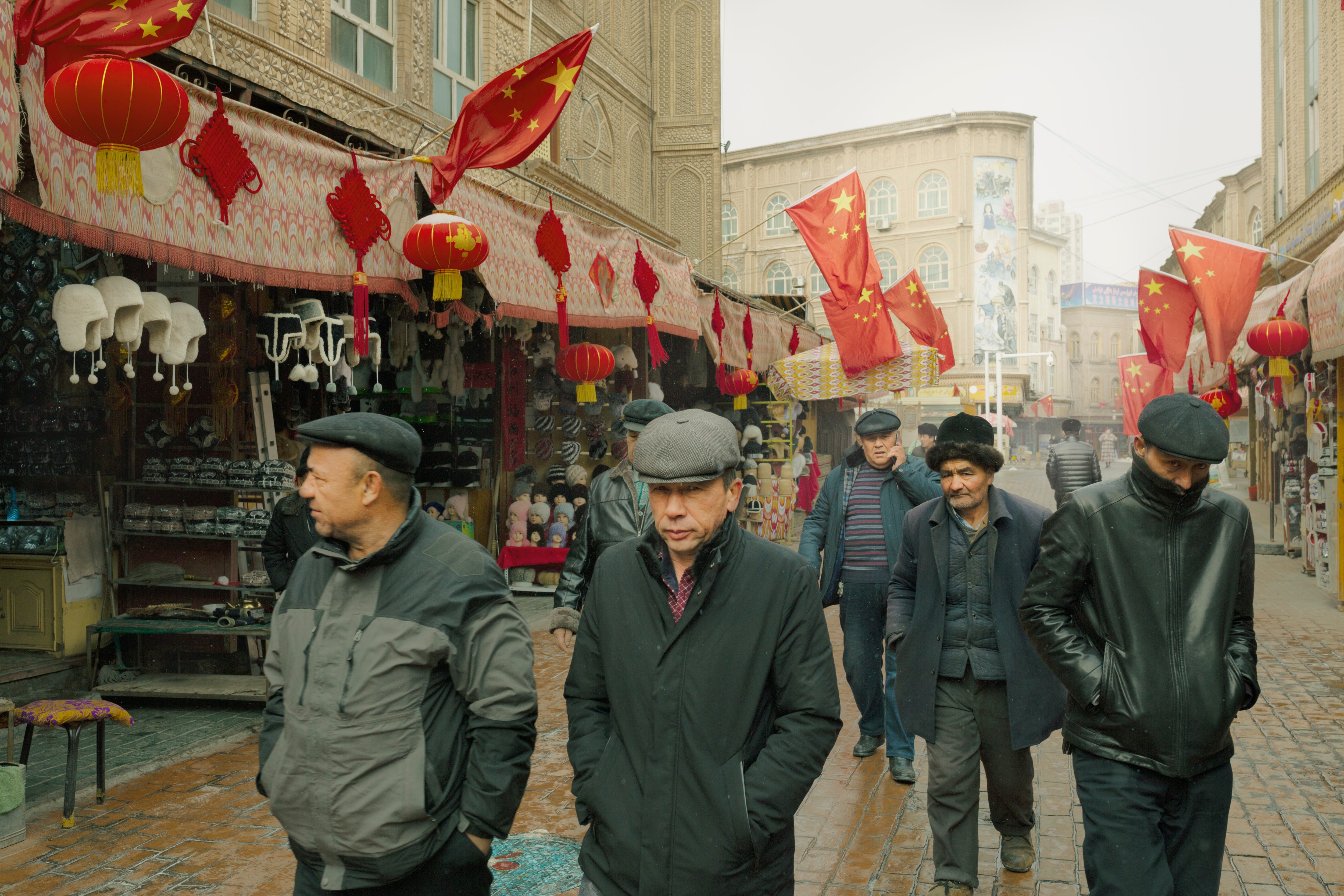
January 2019. Uyghur men walk in the old part of town near the Idkah mosque in Kashgar, Xinjiang province.

Earlier this month, Patrick Wack got a boost any photographer would dream of when Kodak’s Instagram account — 841,000 followers and counting — decided to feature ten photographs from his forthcoming book. It’s called “Dust,” and it chronicles the transformation, over the past half-decade, of the Xinjiang region, the cradle of Uyghur civilization, at the hands of the Chinese Communist Party.

Then, a few days after Kodak shared the photos, the company deleted them

It didn’t just delete them. It replaced Wack’s haunting pictures with its corporate logo and a statement that reads, in part: “Kodak’s Instagram page is intended to enable creativity by providing a platform for promoting the medium of film. It is not intended to be a platform for political commentary.” It went on to “apologize for any misunderstanding or offense the post may have caused.”

Instagram is banned in China, so Kodak put out an additional statement on WeChat, a Chinese social-media platform. This one was more abject:

For a long time, Kodak has maintained a good relationship with the Chinese government and has been in close cooperation with various government departments. We will continue to respect the Chinese government and the Chinese law.

We will keep ourselves in check and correct ourselves, taking this as an example of the need for caution. 

To appease Chinese Communist Party officials, other Western  brands — Apple, Airbnb, the NBA, Marriott, Dior and Valentino, to name just a few — have issued similar apologies. 

Kodak’s Instagram faux pas most closely resembles that of Mercedes-Benz, which, in 2018, posted a #MondayMotivation ad on its Instagram account that included a quote from the Dalai Lama: “Look at situations from all angles, and you will become more open.” The line sparked an uproar in Beijing, and the German carmaker quickly apologized.

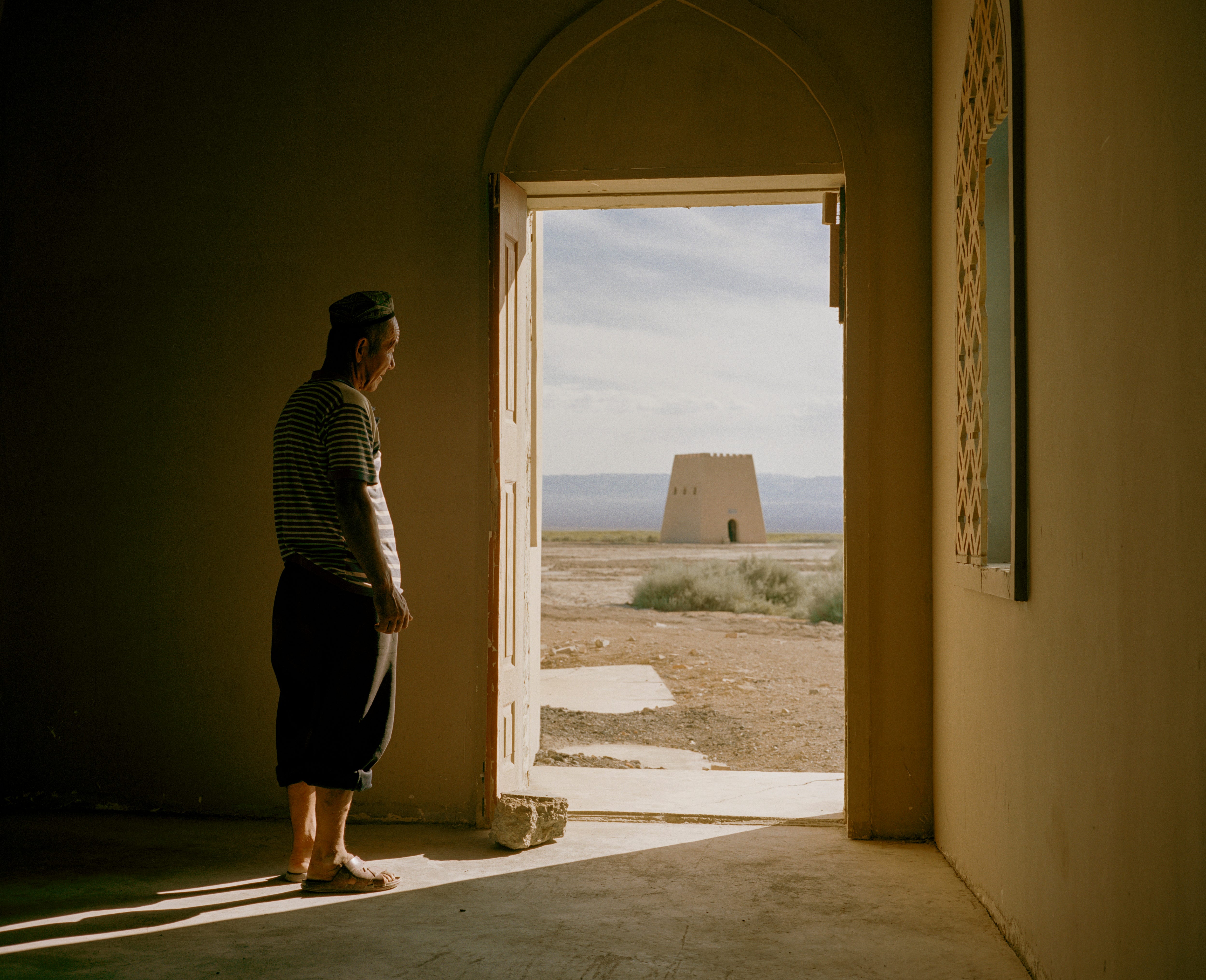
Wack’s images are far more threatening to the CCP. The photographer calls the situation in Xinjiang, in the northwest region of the country, an “Orwellian dystopia.” He would know. He traveled there six times from 2016 to 2019, documenting the province as it became, in his words, “an open-air prison.”

In today’s newsletter, we are proud to reprint Patrick Wack’s stirring images. They are accompanied by a conversation, edited for length and clarity, with him. You can preorder his book here


Suzy Weiss: You were born in France. What drew you to photographing China?

Patrick Wack: I first went to China in 2006. I had been working in Berlin, but Shanghai was booming and I had a friend who likewise went from being a hobby photographer to a professional there. Plus, I had this romantic idea of going to a faraway place and documenting it. There was a mix of opportunity and trying to be smart about where to go.
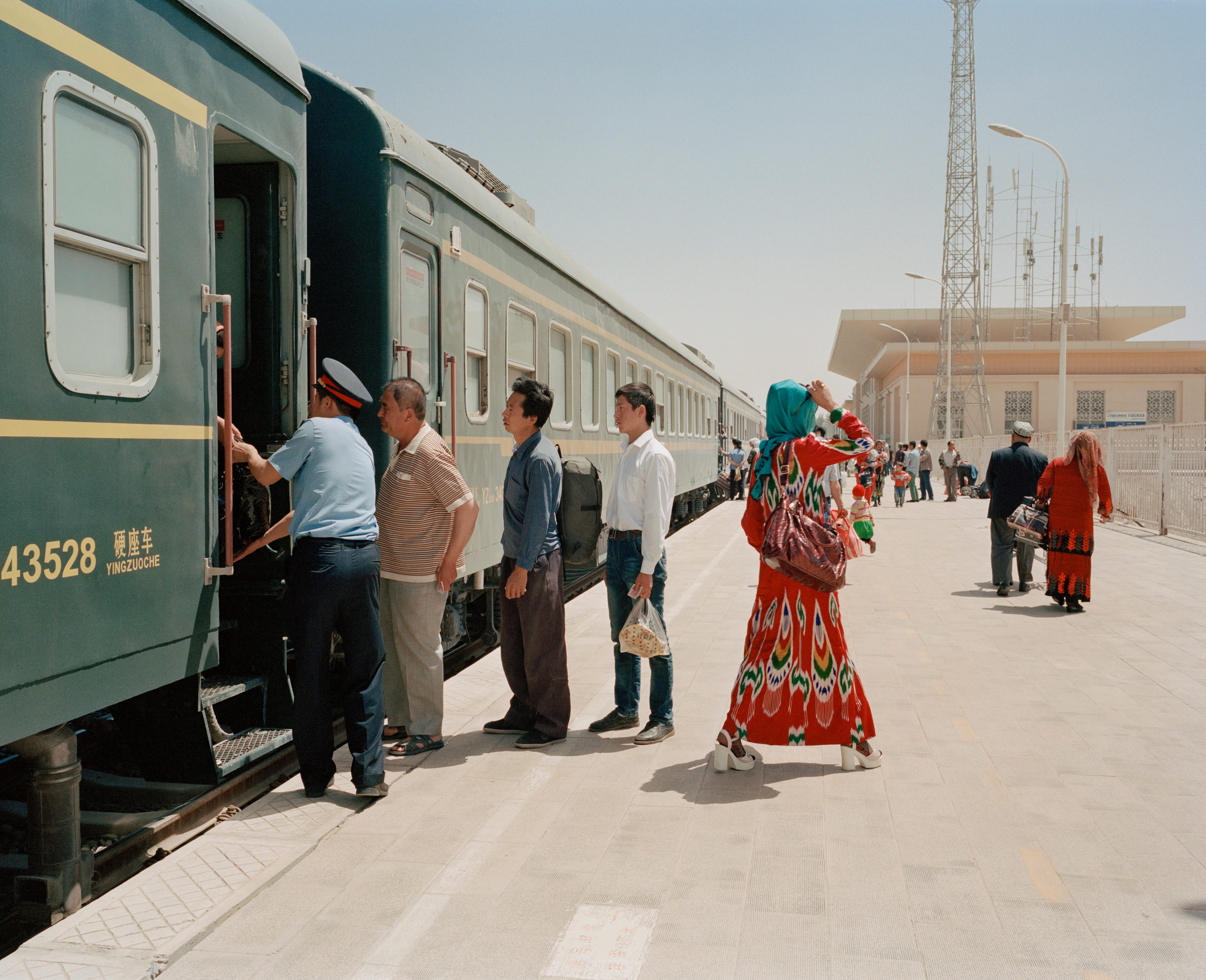
May 2016. Travelers at the Kashgar railway station.

You’ve said your project “Out West” started as more of an artistic, visual exercise to show how the development of China’s Western region compared with the conquest of the American West. But that goal shifted when you saw what was happening in Xinjiang to the Uyghurs. What did you see or hear or experience that made you rethink the project? 

When Out West wrapped in 2017, I thought I was done. But then, in 2018, the news about concentration camps came out. I felt like I had to update the original project, and I knew I was well-situated to go back and document it. I felt it was my responsibility, too, because I had a permanent work visa in China, not a journalist one. Plus, I can speak Mandarin, and I had lived in the country for ten years. 

I wanted to see how much of the repression of the minorities, and the economic segregation, I could capture. For example, the biggest industry in Xinjiang is hydro-carbons, like gas and construction. I didn’t see a single Uyghur person working there. It was all Han Chinese people. The only people you see working in the cotton fields were Uyghur. They are second-class citizens. And they are in a region that is generating so much wealth — but not for them. 

November 2016. A young Uyghur seasonal worker in the last days of the cotton harvest in Luntai county, located between Korla and Kuqa, north of the Taklamakan desert.

So, for my second project, “The Night is Thick,” I had to be more discreet. I couldn't use film because there were so many checkpoints all the time. They would scan my bags and the x-rays would ruin the film. And I knew I was being surveilled. I only had a digital camera and one lens.

You describe your work as a “visual narrative of the region and as a testimony to its abrupt descent into an Orwellian dystopia.” I’d like to know more about that descent. What were some of the most important changes you saw between your first trips to Xinjiang in 2016, and your most recent trip in 2019?

There were two major differences. The first was the increase of the police on the ground. In 2016, it was a highly-surveilled region. By 2019, it had become an open air prison filled with police. The officers are all Uyghur people, and they are checking you all the time. You have to go through a body scan and security, just like when you go through an airport, but whenever you enter any public place at all, like a bazaar or a supermarket. 
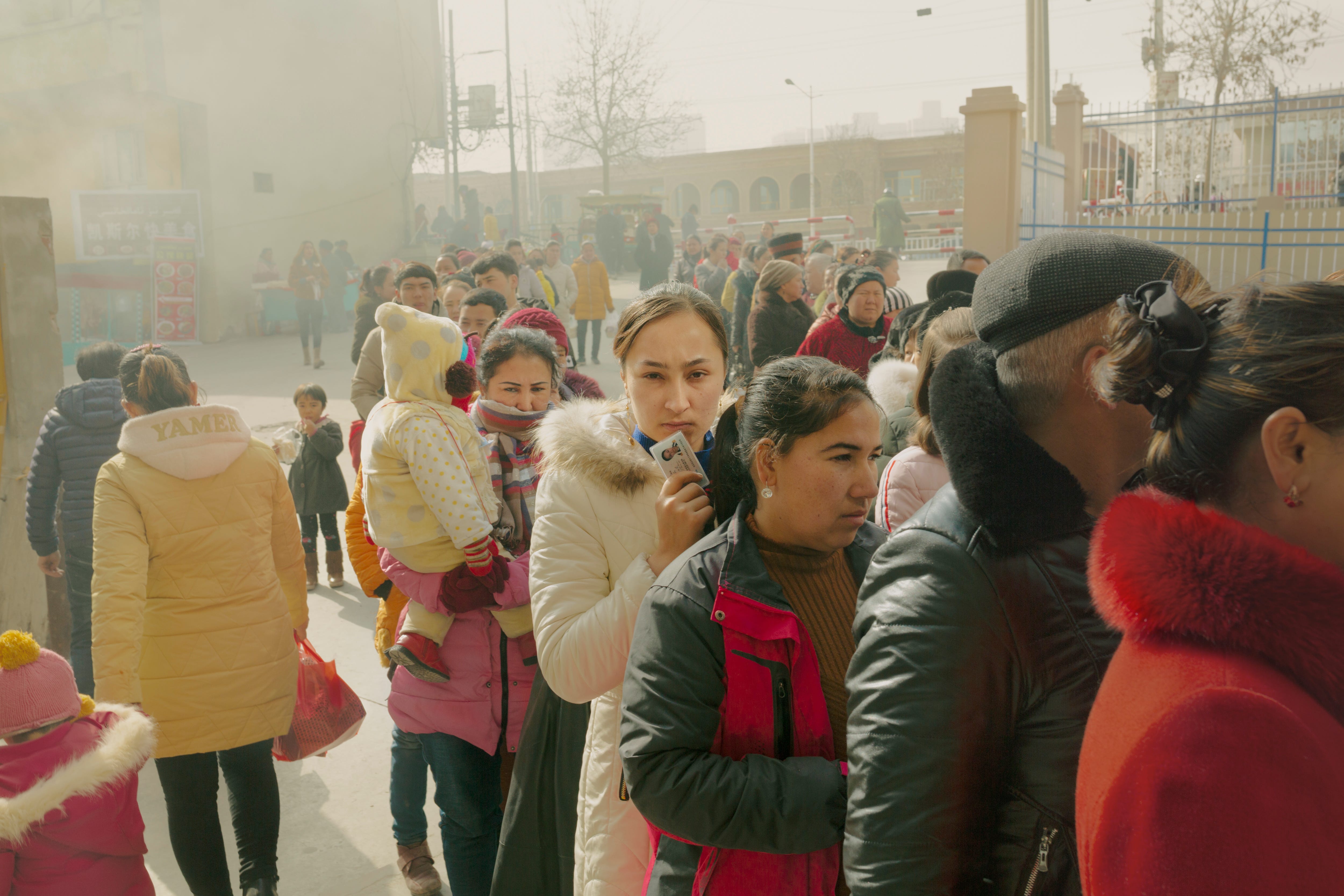
February 2019. Hotan, Xinjiang province. Locals wait in line for ID check and body searches before entering the local bazaar.

There’s also the surveillance you can’t see. There are devices that check the content of phones and apps that record everything. And the cameras are absolutely everywhere.

The second major change was in the landscape. The women were not wearing their veils anymore. Any symbol that was Middle Eastern or Muslim had been removed. The mosques were closed or destroyed. You couldn’t hear the call to prayer anymore in the streets.

In 2016, the mosques were filled, especially in the towns in the south of the region, which is the cradle of the Uyghur people.
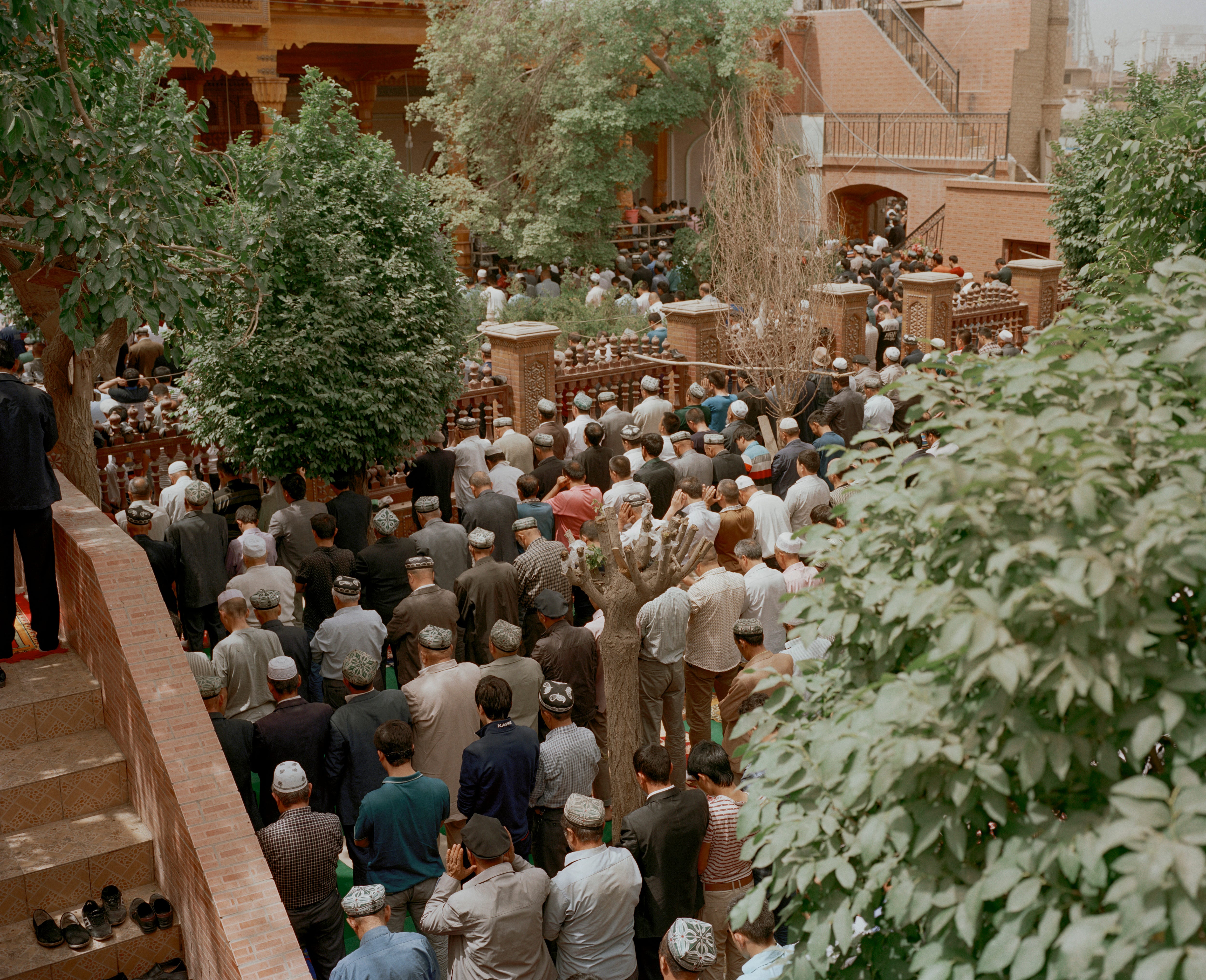
May 2016. Uyghur men praying in a mosque in the old city of Kashgar.

In 2019, I didn’t see a single person going to the mosque to pray. Some mosques were open, but only as tourist sites. I also saw a gap in the demographics in the region. There were fewer men in their twenties, thirties and forties out in the streets. My impression was that they were in the camps, but it’s hard to know for sure. That’s what I felt. There was tension and weight all around. Something grim. 
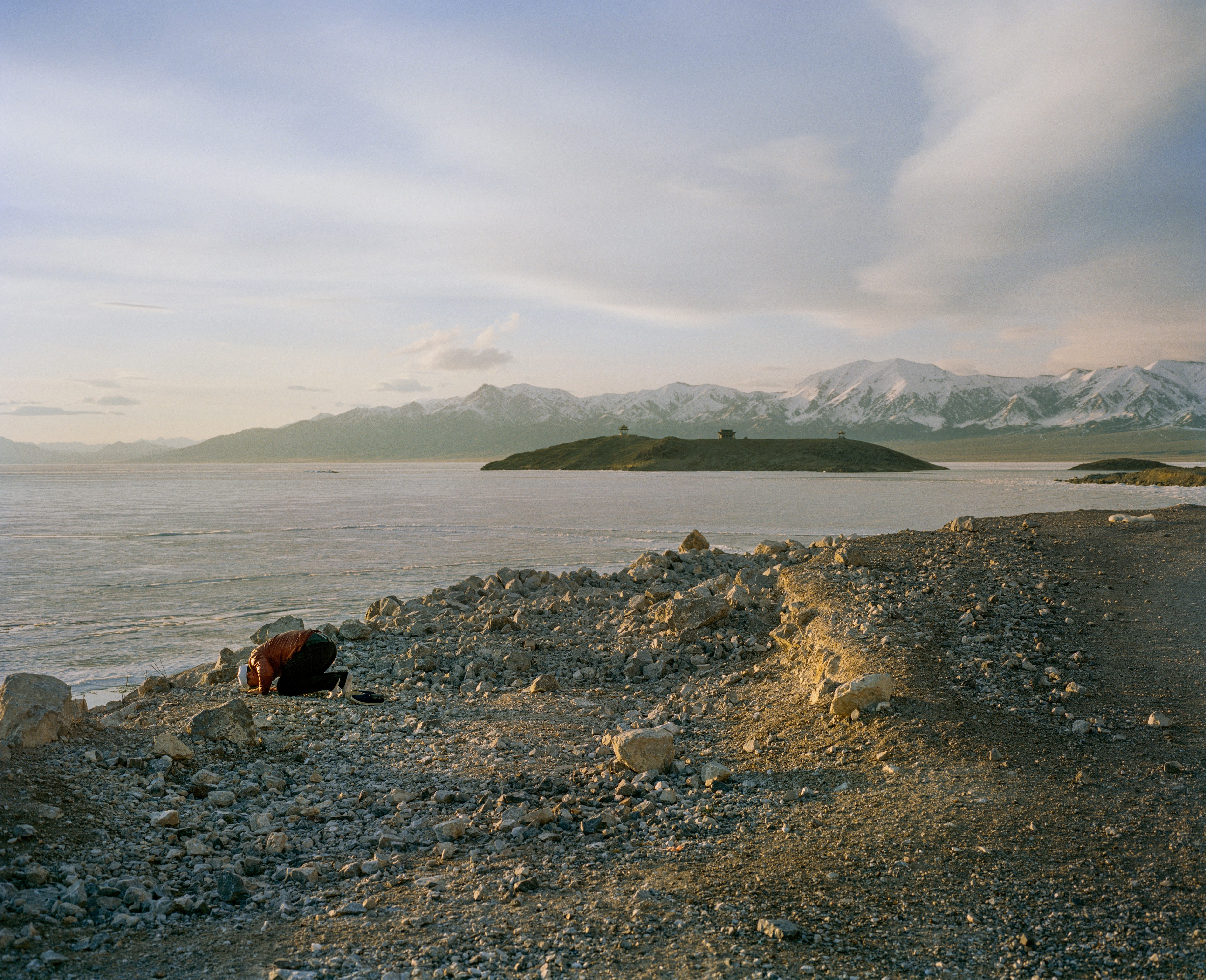
May 2017. Muslim man of the Hui minority praying at sunset on the shores of Saytam lake in the far-western Xinjiang province at the border with Kazakhstan.

What is the point of all this watching? What are the Chinese authorities so afraid of?

The government says it’s to make the area safer and to secularize it. It’s true there were a lot of incidents in the past twenty years, and the area needs to be safer, but the whole point is to accelerate something that was already underway: to turn these religious minorities into Chinese people. That policy of forced assimilation is broadening beyond Muslims to Christians, too. 

You write about “the weakening pulse” of the Uyghur community. You’ve described pretty brutal treatment over the past five years. 

The CCP can’t stand hearing the voice of dissonance. That’s why they’re tightening their grip on Hong Kong. They can’t bear the idea that Hong Kong has a successful democracy in a Chinese society. They can’t stand the idea that Taiwan is a successful country, or that it did a better job of fighting COVID while still remaining democratic. 

Xi Jinping can’t handle anything that casts a shadow on the only official religion, which is Communism, or on the reign of the CCP. The goal is to turn everyone into foot soldiers for the new China. To have them bow to the CCP and to Xi Jinping. They don’t want anything to stand in the way of the society they’re trying to create. 

A recent Atlantic article by a Uyghur poet who immigrated to the United States notes that religious items like Qurans and prayer mats have turned over to the authorities. The writer described how some Uyghurs kept their books, knowing that the government would destroy them, but when a rumor circulated that the government had a new technology that would be able to detect the contraband, they snuck out in the night to throw their sacred objects down manholes or into the street. Did you witness anything like that while you were there? Describe this air-brushing of Islam. Is the goal to erase any memory of the Muslim experience in China?

I didn’t see people throwing out their books, but I know Chinese officials are sent into peoples’ homes to spy on them and report anything that could show that they are leading a religious or traditional life. Whether they have a Quran or they’re fasting or they aren’t willing to drink alcohol. Any of these things can get you sent to a camp. Receiving a call from abroad or having WhatsApp on your phone can also get you sent to the camps. 

The only mosques that are open now are the ancient ones. The regular ones that people would actually use are closed, or they’re being destroyed and turned into parking lots. 

I saw burial grounds being destroyed to be turned into new residential developments. They’re trying to erase what it means to be Uyghur.
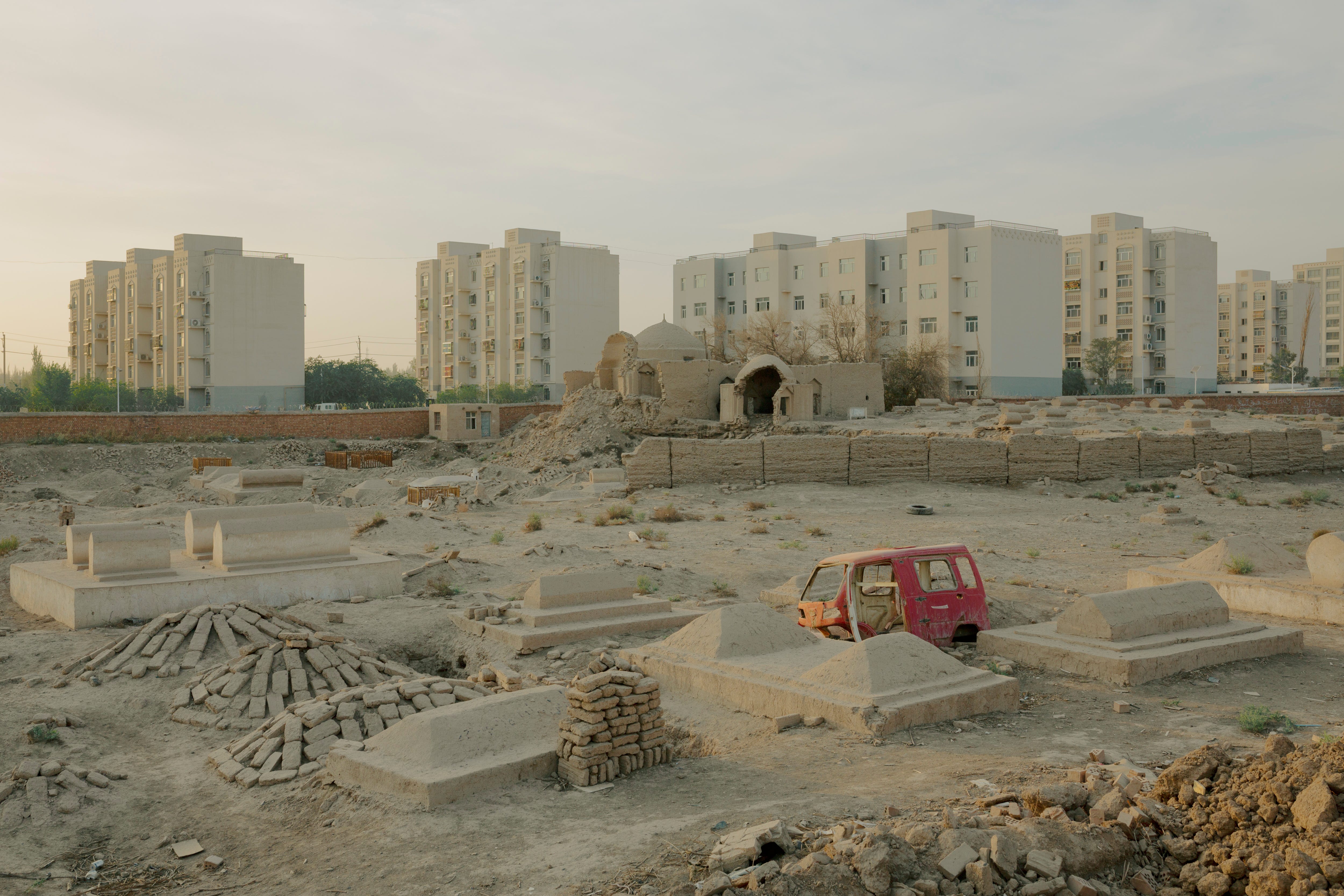
September 2019. Uyghur burial ground in Turpan, encircled by new housing developments.

You told The New York Times that you were limited to landscape photography, in part, because the authorities wouldn’t let you photograph much of anything else. So there’s almost this game that takes place — with you, working inside the narrow parameters established by the Chinese authorities. Can you walk me through that process? 

If you have a journalist visa, there are people waiting for you at the airport. You’re followed everywhere, and people will block your lens. Now I hear that photographers are getting a bit more space, but, of course, there’s surveillance everywhere. When I went in 2016, I didn't think I was being followed, but, in 2019, half of the time I had guys waiting for me in the lobby of the hotel, and they would follow me everywhere, whether by car or foot. They were nice, local guys. Sometimes I would have a smoke with them, and they would tell me that the police chief was nervous about me being there. 

During that trip, I tried to get more portraits of the people there and the atmosphere. It’s hard, because I can’t talk to anyone, because I don’t want to put them in danger. All of the portraits I took of people happened within one or two minutes. The rest were candid images that I just snapped. 

There are an estimated one million Uyghurs being held in detention camps. The stories of those who have made it out are bone chilling. Can you tell us how big of a role the detention centers, and what goes on in them, plays in the local imagination? 

I only know what is going on indirectly. I didn’t see it. One of the texts in my book, by Brice Pedroletti, says that people within the community use code language. They’ll say, “My uncle has been sent to school,” which means he is in a re-education camp. There’s a fear not only of putting yourself in danger, but anyone else, too. It’s a complete nightmare

June 2016. Uyghur man looking through the door of his house in Xinjiang.

What is the general impression that Han Chinese people have about Uyghurs, and where do they get that impression? Does the Chinese state use propaganda to shape popular thinking about the Uyghurs? 

When I would tell Chinese people, like my neighbors or someone at a restaurant, that I was doing a project in Xinjiang, they would say that I should be careful, that it wasn’t safe, or that my things would be stolen. In the Chinese psyche, it’s like Xinjiang is this faraway place with very different people.

You could hear the same discourse if you were to tell someone in France that you were going to Algeria. There’s some prejudice, but no one would ever say, “Oh, they’re terrorists.” Still, they want to see the landscapes and the mountains, like in Tibet. There’s this love-hate idea, and a romance for it. 

I think a lot of Chinese people have no idea what’s going on in Xinjiang. Regular people who don’t speak English and only read Chinese media think the camps are training centers, and that the government is bringing modernity to backwards people so they can integrate into the Chinese dream of this great, modern society where everyone has a car and a flat. 

There’s also a push from the government to send people there to eat the food, and watch girls do traditional dance or take a camel ride into the desert. They want people to think it’s stable and safe. 

There are busloads of Han Chinese tourists coming in to see this idyllic version of Xinjiang which is just about the folklore. They’re going to theme parks, or ethno-parks, and ten kilometers away you have camps where they are trying to brainwash and annihilate the culture of the Uyghurs. I found it perverse, the two realities of this Potemkin Village version of Xinjiang with what was really happening. 

September 2019. Motorized miniature tanks at a desert-tourism park catering to Han-Chinese tourists.

Walk me through Kodak taking down your images. One day, they’re there. The next, they’re not. Did anyone from Kodak notify you in advance? Did they apologize? 

When I was trying to promote my book I was emailing some people and posting in some photography Facebook groups. Kodak’s social media manager saw one of my posts, and we started emailing. He made the post on their Instagram, and we messaged a bit, and I thanked him. One or two days later, I reached out again because there was some heat in the comments. We laughed about it, and he said he loved my work and that it was no problem. 

The next day, the post was deleted, and the day after that they put out that statement. Apparently, upper management made the decision, because they got scared. I haven't talked to the social media guy since. 

When I think about photographing China, I think of one of the most iconic images of the 20th century: the Tank Man photo. I’m curious if you see yourself as an heir to the political photography of modern China that began with the Tiananmen protests.

I don’t think so. I’ve never asked myself that question. My project became more and more political along the way. I had no idea, when I started the project, that it would turn political. It became a political issue, and, because of the position I was in, I felt that I needed to go back, so within that context the work became political. 

In my book, I have essays by a few journalists and academics, but none from activists. To make a political book about this, you don’t need to be an activist. Explaining the facts is enough. Telling the truth is enough. It’s a political object because everything with China is political. For example, by saying that the CCP has to honor the One Country Two Systems policy in Hong Kong, you’re saying something political. But it’s just the truth. 

In terms of what happened with Kodak, I do think this touched on something emotional for people because Kodak products were used to document all of the changes in the 20th century. When people hear about this issue with Nike or H&M, it’s already part of the global psyche that these are major capitalist multinationals that will use sweatshop labor if it’s cheaper. With Kodak, it’s a bit of a hipster business. There’s a hype about film, but it’s a niche market. I don’t think people were expecting something like this from them.  

There is a line of thinking around China that says, ‘You know, it’s bad, but we — America, the West — have our own problems, and we really aren’t in a position to throw stones.’ What do you say to that? 

We all realize that European imperialism is horrible. The genocide of Native Americans or in Austrialia is horrible. But you can’t justify a current genocide by saying, ‘Those people have done it before us.’ That’s basically what’s being thrown at me in the comments on my Instagram: that I’m a white supremacist or a colonizer, or a CIA agent. They’re re-using those tropes, and holding up a mirror of past mistakes to say, ‘You should leave us alone.’ But what kind of logic is that?    
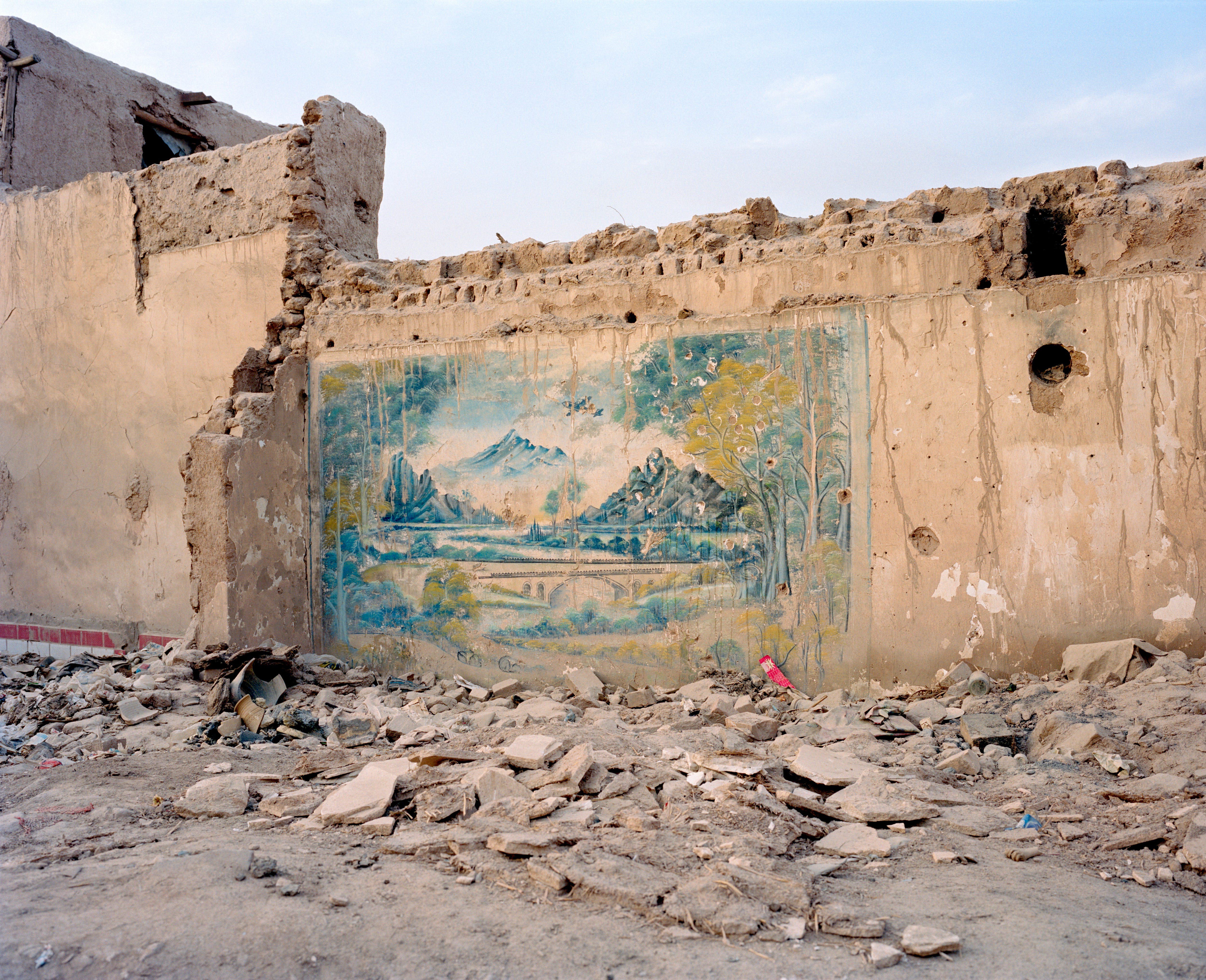
May 2016. Ruins of the old city of Kashgar destroyed by Chinese authorities.

What’s next for you? Will you try to go back to the region?

My guess is probably that, with what’s happening, I can say goodbye to China. I’ve had images of mine of Xinjiang coming out for the past four or so years, and every time one of them is in a big publication, I think ‘That’s it.’ I’m still hopeful they might renew [my visa]. Now, I’m applying for a journalist visa in Russia, so I hope that doesn't get screwed up. My girlfriend is a Russian photographer in Moscow — plus, Russia is a paradise for a documentary photographer. 

I want to do a project on the border between Russia and China. We’re talking a lot these days about a new Cold War, the polarization of the world and the Russia-China dynamic. I think the border is probably where a lot of that will crystallize. 

What do you hope readers will get out of your book, ‘Dust’? 

I mean, nobody buys photo books. We were planning on doing 1,000 first edition copies, and we might do 1,200. So I don’t think I’ll be informing the masses about Xinjiang. But my ambition was to bring to light Xinjiang. To show how, in five years, everything changed. 

China is a country where so many products are manufactured. It’s a country that the whole world has business and diplomatic relations with. And they are trying to re-engineer and disappear a people and their culture. I hope to bring light to this and what kind of a regime this is. We’re seeing history repeat itself in Xinjiang. And the architect is Xi Jinping himself. The main evil is coming directly from him. His life’s goal is to reunite China with Taiwan, but how will that ever happen after what’s been going on in Hong Kong and the broken promise there? 

The Uyghurs were promised autonomy, too. It’s supposed to be an autonomous region. But it is an unkept promise, like so many others. These people are just demanding to have their rights respected within their homeland, to not disappear, to have a good job and to keep their language. 

Any other thoughts? 

I would feel terrible if the Olympics next year were held in Beijing. I am hesitant to draw parallels to the Holocaust, but, with the Olympics, we could draw a parallel with the 1936 Berlin Olympics. I think, if a stance is going to be taken, it should be now. 

June 2016. Blindfolded statue of a Kazakh warrior in an ethno-park catering to Chinese tourists on the road between Turpan and Urumqi.

You may have noticed that this piece was written by another woman named Weiss. Suzy Weiss joins Common Sense from the trenches of the features department of The New York Post. She is also my younger sister and better than me in just about every way. Expect more from her here.

And, if you haven’t yet, please subscribe:

Subscribe now

05 Aug 14:41

Cuba Continues Raiding Homes, Arresting Individuals Three Weeks After National Marches

by Matt Palumbo
04 Aug 22:13

FIGHT THE POWER: Jefferson County parks & rec district drops concealed carry ban effort after ‘num…

by Stephen Green

FIGHT THE POWER: Jefferson County parks & rec district drops concealed carry ban effort after ‘numerous’ public comments.

Foothills Parks and Recreation District (FPRD) Executive Director Ronald Hopp told Complete Colorado on Monday that the board of directors had decided to indefinitely table discussion of banning concealed carry of firearms by lawfully permitted citizens in Foothills facilities and outdoor spaces.

Complete Colorado initially broke, and exclusively covered the developing story.

Hopp said there will not be an agenda item on the August meeting or “any other board meeting in the foreseeable future,” citing numerous comments from the public.

“The Foothills Park & Recreation District’s Board had discussed various options, including the possibility of new policies, in response to recent gun-related incidents in both our facilities and parks, at least one of which involved the mishandling of a properly permitted concealed firearm,” Hopp said in a statement.

The ink from Gov. Jared Polis’ pen on Senate Bill 21-256, allowing FPRD to ban all firearms, including concealed carry, from its facilities had only been dry for three days when FRPD staff brought up the idea at its board of directors meeting on June 22.

Civil rights enthusiasts made themselves heard, and it worked.

04 Aug 22:09

NO, EVANGELICALS NOT MOST LIKELY TO BE UNVACCINATED: Religion Unplugged’s Ryan Burge crunched the da…

by Mark Tapscott

NO, EVANGELICALS NOT MOST LIKELY TO BE UNVACCINATED: Religion Unplugged’s Ryan Burge crunched the data and found the group that actually is the least likely to be vaccinated. It’s not evangelicals, it’s not minorities, it’s ….

04 Aug 21:52

Twitter Suspends Journalist Who Repeated CDC Fact on Vaccines

by jonathanturley

Twitter LogoGreg Piper writers for the news site Just The News and recently decided to share a story from The College Fix, where he was previously an editor. The story included the line “Vaccines are not safe for everyone.” That line appears to have prompted Twitter to suspend his account despite the fact that some people have medical exemptions from the vaccine due to the high risk posed by preexisting medical conditions. Indeed, the Center for Disease Control and Prevention (CDC) states that some people cannot take the vaccine for medical reasons. The latest censorship controversy is reminiscent of the suspension of writer Alex Berenson after he posted the public results of a Pfizer vaccine trial.

The CDC repeatedly has stressed that “All states provide medical exemptions.” CDC website also states that “all states and the District of Columbia allow a medical exemption. A medical exemption is allowed when a child has a medical condition that prevents them from receiving a vaccine.”

This is a standard question for all vaccines. The CDC has a site titled “Who Should Not Get Vaccinated with these Vaccines” that stresses “because of age, health conditions, or other factors, some people should not get certain vaccines or should wait before getting them.”

Specifically on Covid-19, the CDC warns “adults of any age with certain underlying medical conditions are at increased risk for severe illness from the virus that causes COVID-19.” The CDC offers a list of people who have a high risk of severe illness from the vaccine.

However, when Piper noted that “vaccines are not safe for everyone,” he was hit with a suspension for spreading misinformation by Twitter:

Even if Piper’s posting is controversial, the suspension is another example of Twitter enforcing its own corporate view of “the truth.”  It will not allow anyone to debate or discuss opposing views on such subjects.  If Piper’s positing is misleading, then allow others to rebut or refute the posting. Instead, Twitter is enforcing one of the largest censorship programs in history.
It is the license of the censor.  Twitter is unwilling to let people read or discuss viewpoints that it disagrees with as a corporation. Many on the left, however, have embraced the concept of corporate speech and censorship. It turns out that the problem with censorship for many was the failure to censor views that they opposed. With the “right” censors at work, the free speech concerns have been set aside.
04 Aug 13:09

Crazy Government Responses to COVID Part 1: Understanding Incentives

by admin

When I argue with folks about the irrationality of certain COVID NPI mandates, eg masks and lockdowns, their ultimate argument when their backs are up against the wall is this:  the government and/or the "experts" would not have mandated these interventions if they did not make sense.  The purpose of this and several following posts is to explain exactly why  they might, or more particularly, why certain government mandates might make sense for government officials even when they make sense for no one else.

Briefly, the case against masks

There are people I talk to that assume that the entire history of science consists of a march towards more and more certainly that public masking is essential to stopping respiratory disease spread and that the only people who oppose this NPI are doing so because Donald Trump or the Baptist Church told us to oppose them.  But there are actually really good reasons to be skeptical of masks as a mandated NPI for this respiratory disease:

  • The body of public health research prior to 2020, on balance, held that public masking (and large scale lockdowns, btw) were not effective and generally not recommended (at least once the outbreak is past a very small group).  A good roundup of the studies is here.
  • People usually respond to this by saying, well, you wouldn't want your surgeon to operate on you without a mask.  Of course, this use case comparison is absurd, since standing next to someone in line at Walmart for 60 seconds is not really anything like hovering over someone's open incision for 3 hours.   But it turns out that the scientific support for masks even in surgery to reduce post-op infection is surprisingly equivocal.
  • The weave of your mask looks to a COVID virus approximately what a chain link fence looks like to a mosquito.  It is not stopping the virus itself.  And this is even before discussing the total lack of sealing against the face I see on pretty much every mask.  And the fact that many people are reusing the same mask for days.
  • The argument is thus made that the mask is stopping saliva droplets.  But we have known pretty much since last March that droplets don't spread the disease.  Droplets end up on the floor, not floating around for hours.  The disease is spread best by aerosols, and masks are only marginally effective at blocking these aerosols
  • Everything I have said above is EXACTLY what the CDC has said for years.  Here is their info-graphic, still up on their web site.  (Here is a copy I have archived in case they ever take it down: understanddifferenceinfographic-508 )
  • A case can be made that masks can make spread worse.  Imagine being on a plane for 4 hours and you have COVID.  Before you ever even get on the plane, you mask is saturated with COVID virus and moisture.  You then spend the entire flight blowing COVID-laden aerosols out through the mask like bubbles from a bubble wand.

Incentives of Government Agencies

But within weeks of the start of the pandemic in 2020, government agencies like the CDC threw out all this history and decided to mandate masks.  Masks were mandated for people outdoors, even when we knew from the start that transmission risks outdoors were nil.   Officials are still mandating masks for children, who have lower death rates from COVID than the flu and despite a lot of clear research about the importance of facial expressions in childhood development and socialization.  Officials are even starting to mandate masks for the vaccinated who, if they are not effectively immune from the disease, are nearly perfectly immune to hospitalization and death from the disease.  So why?

One needs to remember that the officials of government agencies like the CDC are not active scientists, they are government bureaucrats.  They may have had a degree in science at one time and still receive some scientific journals, but so do I.  Dr. Fauci has seen about the same number of patients over the last 40 years as Dr. Biden.  These are government officials that think like government officials and have the incentives of government officials.

I will take the CDC as an example but the following could apply to any related agency.  Remember that the CDC has been around for decades, consuming billions of dollars of years of tax money.  And as far as the average American is concerned, the CDC has never done much (at least visibly) as we never have had any sort of public health emergency when the CDC had to roll into action.

If you think this unfair, consider that the CDC itself has recognized this problem.  For years they have been trying to expand their mandate to things like gun control and racism, trying to argue that these constitute public health emergencies and thus require their active participation.  The CDC has for years been actively looking for a publicly-visible role (as opposed to research coordination and planning and preparation and such) that would increase their recognition, prestige, and budget.

So that is the backdrop.  And boom - finally! - there is a public health emergency where they can roll into action.  They see this new and potentially scary respiratory virus, they check their plans on the shelf, and those plans basically say -- there is nothing much to be done, at least in the near term.  Ugh!  How are we going to justify our existence?  Tellingly, by the way, these agencies and folks like Fauci did follow a lot of the prior science in the opening weeks -- for example they discouraged mask wearing.  Later Fauci justified his flip flop by claiming he meant the statement as a way to protect mask supply for health care workers, but I actually think that was a lie.  His initial statements on masks were correct, but government agencies decided they did not like the signal of impotence this was sending.

There was actually plenty these agencies should have been doing, but none of those things looked like immediate things to make the public feel safer.  Agencies should have been:

  1. Trying to catalog COVID behavior and characteristics
  2. Developing tests
  3. Identifying and testing treatment protocols
  4. Slashing regulations vis a vis tests and other treatments so they could be approved faster
  5. Developing a vaccine

If we score these things, #1 was sort of done though with a lot of exaggerated messaging (ie they communicated a lot of stuff that was mostly BS, like long covid or heart risk to young athletes).  #2 the CDC and FDA totally screwed up.  #3 barely happened, with promising treatments politicized and ignored.  #4 totally did not happen, no one even tried.  #5 went fabulously, but was an executive project met with mostly skepticism from agencies like the CDC.

Instead, the CDC and other agencies decided they had to do something that seemed like it was immediately affecting safety, so it reversed both years of research and several weeks of their own messaging and came down hard for masks and lockdowns.   And, given the nature of government incentives, they had to stick with it right up to today, because an admission today that these NPI aren't needed risks having all their activity in 2020 questioned.

Incentives for Government Officials

Pretty much all of the above also applies to the incentives of government officials.  Our elected officials of both parties, but particularly the Democrats, have been working to have the average American think of them as super-dad.  Got a problem?  Don't spend too much time trying to solve it yourself because its the government's job to do so.  Against this background, the option to do nothing, at least nothing with immediate and dramatic apparent potency, did not exist.  We have to do "something."

It might have been possible for some officials to resist this temptation of action for action's sake, except for a second incentive.  Once one prominent official requires masks and lockdowns, the media began creating pressure on all other government officials.  New York has locked down, why haven't you?  Does New York care more than you?  We had a cascade, where each official who adopted these NPI added to the pressure on all the others to do so.  Further, as this NPI became the standard government intervention, the media began to blame deaths in states with fewer interventions on that state's leaders.  Florida had far fewer COVID deaths, particularly given their age demographics, than New York but for the media the NY leaders were angels and the Florida ones were butchers.  For a brief time terrible rushed "studies" were created to prove that these interventions were working, generally by the dishonest tactic of cherry-picking a state with NPI mandates that was not in its seasonal disease peak and comparing it to another state without NPI mandates that was in the heart of its seasonal peak.  (We are, by the way, starting to see a similar cascade around the most recent delta-driven mandates -- just today a random Arizona county with no uptick in COVID hospitalizations just required indoor masking for the vaccinated).

And then the whole thing got polarized around party affiliation and any last vestige of scientific thinking got thrown to the curb.   Take Chloroquine as a possible treatment protocol.  Personally, I have not seen much evidence in its favor but early last year we did not know yet one way or another and there were some reasons to think it might be promising.  And then Donald Trump mentioned it.  After that we had the spectacle of the Michigan Governor banning this treatment absolutely without evidence solely because Trump had touted it on pretty limited evidence.  What a freaking mess.  In addition to giving us all a really beautiful view of the hypocrisy of politicians, it also added another great lie to the standard list.  To "The check is in the mail" and "I will respect you in the morning" is now added "We are following the science."

Incentives for the Public

I won't dwell on this too long, but one thing COVID has made clear to me is that a LOT of people are looking for the world to provide them with drama and meaning.  The degree to which many folks (mostly all well-off white professionals and their families) seem to have enthusiastically embraced COVID restrictions and been reluctant to give them up has just been an amazing eye-opener for me.

Incentives for Businesses

Many businesses have been caught up in the politicized virtue-signaling, making a big deal of their support for or opposition to various NPI.  But even without this political element, businesses were always going to be conservative and mandate a lot of this stuff if for no reason than to avoid liability.  If politicians are worried about blame from the media for deaths if they did not mandate every intervention their neighbors required, just think what a corporation worries about.  Any tort lawyer worth their salt can get a jury to blame a customer or employee death, without evidence, on a company that somehow did not follow the CDC advice of the microsecond.

Next Episode

In our next episode, I will discuss the role of poor selection of metrics for crazy government interventions.  Spoiler alert -- focusing on cases via positive readings on an overly sensitive test has led to a LOT of the most recent wave of stupidity.

03 Aug 17:28

This megathread does an A+ job explaining why some people are "vaccine hesitant"

by Not the Bee

Hey you! Yes, you, random American and/or citizen of the world.

02 Aug 22:09

Haj Amin al-Husseini’s poisonous legacy

by Nitay Arbel (a.k.a. New Class Traitor)

Sean Durns in Mosaic Magazine looks back 100 years after the appointment of one Haj Amin al-Husseini [y”sh] as the senior Islamic cleric in the British mandate.

The very long article is behind a paywall, so let me share a few excerpts. I never quite understood why the British, even if they wanted to appease the Arabs, would have appointed somebody so obviously unqualified. Mr. Durns answers that question:

To underscore its commitment to the Balfour Declaration, the cabinet selected Herbert Samuel, a prominent British Jewish politician and a Zionist, to serve as the first high commissioner for Palestine. But opposition to Zionism, among both the Arabs and British in the Mandate alike, remained; it would resurface when anti-Jewish violence erupted in both February and May of 1921. Complicating an already tense situation, on March 21 of the same year Kamil al-Husseini, the grand mufti of Jerusalem, died.

Kamil had held the position of mufti, or chief cleric, of Jerusalem under Ottoman rule, but the British authorities created the new position of grand mufti out of a desire to have someone to turn to as the religious representative of Muslims in Palestine, who could also preside over the various Muslim holy sites in the city.  Around the same time and for similar reasons, they created the position of chief rabbi of [the British Mandate], likewise elevating the Ashkenazi and Sephardi chief rabbis of Jerusalem to greater prominence. As a result, Israel today has two chief rabbis, and Jerusalem still has a grand mufti.

During his short tenure in office, Kamil al-Husseini had sought to work with the British and accommodate them in every way possible. Perhaps he was grateful to the new rulers for expanding his authority, or perhaps he simply saw good relations with them as the most prudent path. His death not only cost the Mandate a supportive local leader, but also put it in the midst of tensions between two clans.

The Husseinis and their rivals, the Nashashibis, were Jerusalem’s two principal Arab families. Claiming descent from Mohammad, the Husseinis had held various positions of authority as far back as the early 17th century. While both clans were hostile to Zionism, the Nashashibis tended to favor compromise, while the Husseinis, with the exception of Kamil, did not. In April of 1920, the British appointed Ragheb Bey Nashashibi as mayor of Jerusalem, replacing Musa Kasem al-Husseini.

With Kamil’s death a year later, the Husseinis suddenly feared that they would lose a second key position in Jerusalem. The British decided to follow the Ottoman system of selecting a replacement: elections would be held, and the government would then choose its preferred candidate among the three who obtained the most votes. The Husseinis hoped that Kamil’s twenty-six-year-old half-brother Amin would succeed him, but he came in fourth. The results seemed to shock the British as much as the Husseinis, who subsequently contested the election.

And here is where the British—specifically Herbert Samuel—made one of the most fateful decisions in Middle Eastern history: they pressured Sheikh Husam al-Din Jarallah, the Nashashibi-backed frontrunner, to remove himself from consideration. As a result, Amin al-Husseini, who had previously come in fourth, became an eligible candidate. The Nashashibi clan was outraged. To reduce tensions, the high commissioner did not send Husseini an official letter offering him the position, nor make any formal announcement.

Samuel’s support for Husseini has long perplexed historians. Husseini was young and, while he had briefly studied at Cairo’s prestigious al-Azhar University, he lacked the scholarly bona fides expected for such an office. As the British colonial official Edward Keith-Roach admitted, his “sole qualifications for the post were the pretensions of his family plus shrewd opportunism.” Indeed, there were aspects of his background that were far more worrisome.

[…]

Husseini had demonstrated his skill as a political operator even before the arrival of the British. In a four-year period alone, Husseini served three different, and rival, empires—shifting allegiances to whichever power he felt could best serve his twin aims: permanently ousting Europeans from the Middle East and opposing Zionism. [NA: the article goes on to explain how al-Husseini was an officer in the Ottoman Turkish army, then became a double agent for the British, and ultimately a triple agent, throwing in the French for good measure.]

[…]

[Richard] Meinertzhagen, upon hearing of the appointment, wrote in his diary that Husseini was now “in a position where he can do untold harm to Zionism and to the British; he hates both Jews and British. His appointment is sheer madness; . . . sooner or later” it “will be bitterly regretted by us.”

Husseini’s appointment came to (poisonous) fruition quite quickly:

In 1929, Husseini spread false rumors that Jews intended to desecrate the al-Aqsa Mosque—leading to pogroms that lasted for days and left more than 60 Jews dead. He also established clandestine contacts with Britain’s enemies, Mussolini’s Italy and Nazi Germany, eventually taking funds and support from both.

Armed and equipped by fascist powers, Husseini launched the 1936 Arab Revolt, which could properly be characterized as the first intifada. Armed bands under the mufti’s sway murdered Jewish civilians and British officials alike, and assassinated rivals like the Nashashibis, who had established rival parties and institutions. These had advocated cooperation with Mandate authorities and were rumored to have made secret contact with Zionists.

Rather than reach out to the accommodationists or try to bolster them in the 1920s, when they were most popular and had the greatest chance for success, the Mandatory authorities continued to court Husseini. Even after he fled to Syria amid the Arab Revolt in 1937, they sought to appease him by curtailing Jewish immigration and proposing solutions that would eventually have ended the possibility of a Jewish state.

These efforts were in vain. From Syria, Husseini went to Fascist Italy and Nazi Germany where he rewarded nearly two decades of British support by serving as a propagandist for the Axis and helping to recruit soldiers for an all-Muslim SS division. [That would have been the 13th Waffen SS “Handschar” —NA.] After the war ended, unchastened and still at large, Husseini orchestrated both the 1951 assassination of King Abdullah of Jordan, Britain’s closest ally in the region, as well as the murder of the former Lebanese Prime Minister Riad as-Sulh. Their crime? Openness to negotiations with Zionists.

In short, the British thought they could use Husseini to their own ends, but instead he used them. By giving him the position of grand mufti, they invested him with both power and authority, allowing him to position himself as de-facto leader of the Palestinian people. He used the position to undermine their interests and fight Zionism. And he betrayed Britain twice: once to France and once to Germany. No one can know what might have happened if Samuel had cultivated a pro-British Palestinian leader who might have sought accommodation with the Jews. But there is no doubt that Husseini proved to be a poor investment.

And that, dear reader, is what one calls a British understatement.

Haj Amin al-Husseini meeting with Adolf Hitler [y”sh], November 28, 1941. CC-BY-SA 3.0 Bundesarchiv/German Federal Archives, 146-1987-004-09A
al-Husseini inspects the 13th Waffen SS “Handschar” Division, January 13, 1944. CC-BY-SA 3.0 from the German Federal Archives

al-Husseini survived the war, and later would become a mentor of sorts to a distant cousin named Mohammed al-Rauf al-Husseini, better known to the world by his nom de guerre Yasser Arafat [y”sh]…

02 Aug 20:15

OH, THAT LIBERAL FASCISM: ‘Mao was just a bit of a hipster’: how liberals fell in love with a ge…

by Ed Driscoll
02 Aug 18:41

CAM EDWARDS: Boston Globe Readers Discover The Racist History Of Gun Control. “I was shocked to see …

by Stephen Green
Jts5665

The democrat party's 190 year war on minority gun ownership.

CAM EDWARDS: Boston Globe Readers Discover The Racist History Of Gun Control. “I was shocked to see a column headlined ‘The Very Racist History of Gun Control’ on the paper’s website this weekend. I’m sure the piece by longtime columnist Jeff Jacoby has caused some heartburn in the newsroom, not only because the op-ed is chock full of inconvenient truths for fans of gun control, but because it directly takes aim at the claims of historian Carol Anderson, whose new book ‘The Second’ is based on the premise that the right to keep and bear arms itself is rooted in racism.”

02 Aug 16:17

The Biden Administration Goes To War With The “Non-Vacs”: Is Coercion the Answer?

by jonathanturley

Below is my column in the Hill on the shift from reasoned consent to coerced consent in the campaign for vaccinations. The push by the Biden Administration for private companies to enforce mandates and restrictions has increased in the last week. There is a high likelihood of a new round of litigation as pressure builds for new mandates and even lockdowns.

Just before this column ran, CDC Director Rochelle Walensky was asked by Fox host Bret Baier “Are you for mandating a vaccine on a federal level?” She responded “That’s something that I think the administration is looking into.” Later she reversed herself by saying “I was referring to mandates by private institutions and portions of the federal government. There will be no federal mandate.” It was a telling response because she was asked about a federal mandate directly. She now says she meant to say a privately enforced mandates is what they are thinking about. The reversal may be a problematic as the original. It would confirm that the Biden Administration is using private companies as a type of direct surrogate for a public mandate.

Here is the column:

They didn’t get vaccinated.” Those words from President Biden summed up why his administration made a critical shift in its COVID policies, from mask recommendations to mandatory shots for federal workers. And that represents a third stage of government policy, toward a more confrontational approach to “them” — the increasingly demonized unvaccinated class that is roughly half of America.

But this stage could face legal challenges in coming weeks, as citizens and some states push back on mandates.

This month was a clear break from persuasion and a step toward coercion in dealing with those who refuse to be vaccinated. Even the normally staid Centers for Disease Control and Prevention (CDC) is ramping up its rhetoric, declaring that the “war has changed” due to the Delta variant. For some, however, there is concern that Biden’s “they” is a declaration of war on them.

Clearly, there is a rapidly diminishing level of communication between the “vacs” and “non-vacs.”

Stage One: Reasoned consent

Until recently, the Biden administration relied largely on what could be called the “reasoned consent” model. Not unreasonably, it assumed that Americans would want the vaccine, given the dire consequences of being unvaccinated. For many of us, it took little persuasion. My family and I took the earliest possible date for vaccinations. But this first stage was in some regards a failure: While more than 85 percent of the high-risk population of older Americans have been vaccinated, roughly half of the wider population has not been fully vaccinated.

A myriad of reasons exist: distrust of government programs among some minorities and conservatives; people who previously had COVID-19 considering themselves immune; those concerned with religious or medical issues. Billions spent on state and federal outreach programs failed to penetrate that wall of resistance.

Stage Two: Induced consent

As long lines disappeared at vaccine centers, it became clear that many citizens have come to distrust the media and the government on this, as on so many issues. Anyone raising questions about the virus — even its origins — was censored by Big Tech, and politicians weaponized the wedge issue for their own purposes. Such censorship continued this week even for those merely suggesting a “pause” to examine the data. For people already distrustful of the government, the censorship and overheated rhetoric only confirm their suspicions.

Government officials then shifted from reasoned to induced or compensated consent. In Ohio, $1 million lottery prizes were offered to those willing to take the shots; other states offered free metro or free museum passes. It didn’t work — but that didn’t stop President Biden this week from telling states to use federal funds to offer $100 for every person who consents to take a shot. It is the monetization of vaccination under the logic that those not motivated by self-preservation will be persuaded by a C-note.

The government and the media, however, remain unwilling to engage vaccine resisters beyond stereotyping them as “Trumpers” or pandemic-spreading morons. That includes censoring questions and opposing discussion of whether the level of statistical risk should leave this to be a matter of individual choice, as with other viruses and illnesses.

Stage Three: Coerced consent

We are now entering the “coerced consent” stage. Unable to persuade or purchase consent, many are arguing to make it difficult to be gainfully employed or functionally active without proof of vaccination. It is a type of de facto pandemic passport. After indicating the administration was considering a federal vaccine mandate, CDC Director Dr. Rochelle Walensky said this week, “I was referring to mandates by private institutions and portions of the federal government. There will be no federal mandate.”

Unwilling to face the legal or political challenges of mandating a vaccination program, the Biden administration has actively encouraged companies to bar unvaccinated people from planes, restaurants and other venues. The danger is that using companies to censor opposing views and restrict people can amount to a type of government-by-surrogate, a shadow state.

There clearly are good reasons why many companies and schools demand vaccinations to rejoin workplaces or classrooms. As expected, those rules have been upheld, including a recent favorable ruling for Indiana University.

More concerning are those calls to use mandates to make life miserable for anyone who still has doubts. German Chancellor Angela Merkel told her citizens that they will have fewer “freedoms” until they consent. Some in the media have echoed these calls, and some private organizations are following the same strategy. The NFL, for example, has been openly making life “a living hell” for NFL players who prefer to be tested but not vaccinated.

For the most part, the motivation behind government and private mandates are hard to litigate. Courts tend to defer to measures ostensibly protecting others from risk of illness; even in criminal cases, the government has been allowed to conduct “pretextual traffic stops” if it can cite an objective basis.

There may be new legal challenges ahead, however. First, those with religious or medical concerns can challenge mandated vaccination programs. CNN’s Don Lemon this week called for barring unvaccinated people from offices and businesses, insisting “It has nothing to do with liberty. You don’t have the freedom and the liberty to put other people in jeopardy.” In truth, there are constitutional questions when you force people to take medications or vaccinations that violate their religious beliefs or that fail to satisfy a rational basis.

States also are moving to counter private mandates or to bar mandatory masking rules; Florida Gov. Ron DeSantis (R) just signed an executive order allowing parents to ignore masking orders for their children in the state’s public schools. That could force the hand of the Biden administration on implementing federal mandates or executive orders — a conflict that would raise core federalism issues.

The federal government is on shaky ground in mandating hood behavior or inactivity. In 2012 in NFIB v. Sebelius, Chief Justice John Roberts declared that “Construing the Commerce Clause to permit Congress to regulate individuals precisely because they are doing nothing would open a new and potentially vast domain to congressional authority.”

The greatest danger with the coercion model is that it will further deepen our divisions and turn vaccine resistance into a type of patriotic resistance for some people. Recently, a shocking poll found that almost 50 percent of Republicans believe “patriotic Americans [might] have to take the law into their own hands.” The poll shows how many Americans are increasingly alienated from the government, the media and the established order. Conversely, some commentators on the left have declared that the unvaccinated are terrorists using “biological warfare” against the nation.

Threatening to make the lives of the unvaccinated a “living hell,” or isolating them from society, likely will do little to increase the level of vaccination — but it will do much to increase the level of alienation in our society.

Jonathan Turley is the Shapiro Professor of Public Interest Law at George Washington University. You can find his updates on Twitter @JonathanTurley.

02 Aug 16:11

FLASHBACK: Reynolds’ Law: The government decides to try to increase the middle class by subsidiz…

by Glenn Reynolds

FLASHBACK: Reynolds’ Law:

The government decides to try to increase the middle class by subsidizing things that middle class people have: If middle-class people go to college and own homes, then surely if more people go to college and own homes, we’ll have more middle-class people. But homeownership and college aren’t causes of middle-class status, they’re markers for possessing the kinds of traits — self-discipline, the ability to defer gratification, etc. — that let you enter, and stay, in the middle class. Subsidizing the markers doesn’t produce the traits; if anything, it undermines them.

Somebody was referencing this to me yesterday. I think it’s worth mentioning again.

02 Aug 15:56

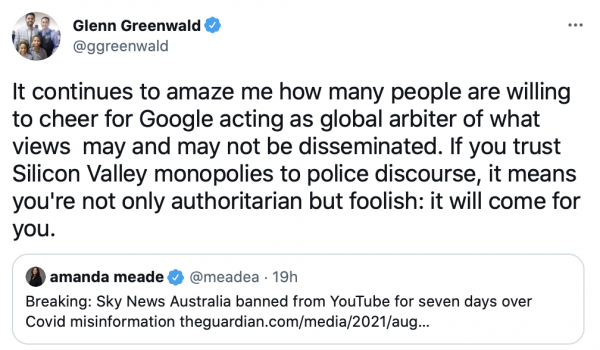
THE BANNINGS WILL CONTINUE UNTIL MORALE IMPROVES: Sky News Australia Suspended from YouTube. More…

by Ed Driscoll

THE BANNINGS WILL CONTINUE UNTIL MORALE IMPROVES: Sky News Australia Suspended from YouTube.

More here: “YouTube said Sunday it had barred Sky News Australia from uploading new content for one week, citing concerns about Covid-19 misinformation. The move comes after a review of posts uploaded by the Rupert Murdoch-owned TV channel, which has a substantial online presence.”

UPDATE:

Sky News needs to put together a special unit investigating Google, YouTube and — especially — their top executives.

01 Aug 02:46

RULE OF LAW: FBI Seized $900,000 From Safe Deposit Box on ‘Pure Conjecture,’ Federal Judge Says….

by Glenn Reynolds
30 Jul 21:44

Vaccine truth censored on Sydney radio…

by Kane
(Watch both videos)Pauline Hanson was on the Kyle & Jackie O this morning. They censored out most of what Pauline was saying because it’s not “government approved”. This is very North Korea like. pic.twitter.com/BOJ5Mu9Wf0 — PRIMOD (@theprimod) July 28, 2021   Pauline Hanson was bleeped out on Kyle & Jackie O this morning.      […]
30 Jul 21:22

STEALTH GUN CONTROL: “EAR” Restrictions Imposed On 3D Printed Firearms. “Earlier this year, th…

by Glenn Reynolds

STEALTH GUN CONTROL: “EAR” Restrictions Imposed On 3D Printed Firearms. “Earlier this year, the U.S. Ninth Circuit Court of Appeals issued a preliminary injunction that removed such technologies from the U.S. Munitions List (USML) and made them exempt from International Traffic in Arms Regulations (ITAR). In response, the BIS has now declared that anyone engaged in manufacturing, exporting or ‘furnishing’ 3D printed firearms, are subject to Export Administration Regulations (EAR) instead.”

30 Jul 17:07

Twitter forced podcaster Rubin to delete tweet: COVID vaccines 'clearly not working as promised'

by Greg Piper
Proposals for a federal mandate and booster shots should "take a pause" in light of reporting, he said.
30 Jul 17:06

Dave Rubin censored…

by Kane
          Twitter was probably also miffed by this earlier tweet… “Sociologists, psychologists and anthropologists should study how a billionaire orange man from New York was more authentic than any of the people who hated him.” Today’s show: https://t.co/l9L9H3nt9u pic.twitter.com/GlB5lWJxWS — Dave Rubin (@RubinReport) July 29, 2021           […]
30 Jul 17:03

U.S. Coast Guard Sends 27 Cubans Found at Sea Back to Cuba

by Matt Palumbo
Jts5665

A stark difference in treatment from the Mexican border.

29 Jul 17:28

UNEXPECTEDLY: 1 in 5 electric vehicle owners in California switched back to gas because charging the…

by Ed Driscoll
29 Jul 14:01

WHO COULD HAVE SEEN THIS COMING? South Africa Is Falling Apart. At the heart of the discord is t…

by Glenn Reynolds

WHO COULD HAVE SEEN THIS COMING? South Africa Is Falling Apart.

At the heart of the discord is the ruling African National Congress. In the 27 years since it steered South Africa to democracy, it has carried the hopes of millions of South Africans. Drawing on its reputation as the party of liberation, it has strong support and remains electorally unassailable. But it has now become squarely a source of division. A devastating battle for its soul is underway, with the country as the battlefield.

Though the A.N.C. always promoted the rise of a Black elite, Mr. Zuma’s presidency, beginning in 2009, changed the focus: The state, rather than the market, became the main site for opportunity and enrichment. A spurious ideology of “Radical Economic Transformation,” spun as a radical challenge to South Africa’s white-dominated private sector, provided rhetorical cover for corruption and patronage.

Let’s hope that South Africans don’t wind up like Zimbabweans under Mugabe: Black Zimbabweans nostalgic for era of white rule:

An elderly peasant in another village, Makupila Muzamba, said that hunger today is worse than ever before in his seven decades or so, and said: “I want the white man’s government to come back. Even if whites were oppressing us, we could get jobs and things were cheap compared to today.”

His wife, Mugombo Mudenda, remembered that as a younger woman she used to eat meat, drink tea, use sugar and buy soap. But now she cannot even afford corn gruel. “I miss the days of white rule,” she said.

Nearly every peasant I’ve spoken to in Zimbabwe echoed those thoughts.

But Mugabe was never demonized by the Western media the way say, Augusto Pinochet — who brought freedom and prosperity to his own country — was.

29 Jul 00:11

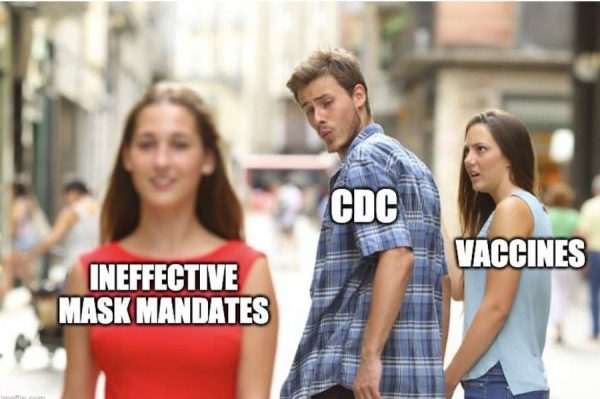
FLIPFLOPS: ‘The CDC hasn’t changed’: Biden’s top health officials try to sell new masking g…

by Glenn Reynolds
Jts5665

#Arbitrary&Capricious...

28 Jul 12:51

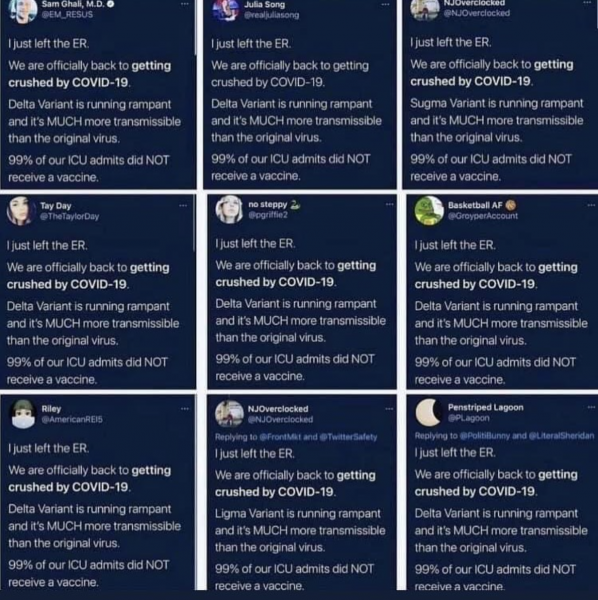
SOMETHING’S SPREADING, AND IT’S NOT A VIRUS: The ‘I just left the ER’ variant is multiplying on…

by Glenn Reynolds
28 Jul 12:42

World’s first ‘small nuclear reactor’ is under construction…

by Kane
28 Jul 12:36

A CLUE TO WHY FLU VANISHED LAST SEASON…  CDC Alerts Labs to Use Tests That Can Differentiate Betw…

by Sarah Hoyt
28 Jul 12:31

IT’S COME TO THIS: Dell can’t ship gaming rigs to blue states because of energy rules. “Dell has sto…

by Ed Driscoll

IT’S COME TO THIS: Dell can’t ship gaming rigs to blue states because of energy rules. “Dell has stopped shipping certain highly energy-intensive gaming computers to customers in six states with new electricity consumption regulations. The PC giant won’t ship certain computer models to California, Colorado, Hawaii, Oregon, Vermont, and Washington because of the states adopting the California Energy Commission’s new Tier II mandatory energy efficiency standards on computers and mobile gaming systems that were put into effect on July 1.”

(H/T: Small Dead Animals.)

27 Jul 22:53

Gun Control Scheme Harms Black and Hispanic New Yorkers, Public Defenders Tell Supreme Court

by Damon Root
Jts5665

Intended consequences.

zumaglobaleight140446

The U.S. Supreme Court will hear oral arguments this fall in New York State Rifle & Pistol Association v. Corlett, a case about the constitutionality of New York's requirement that anyone seeking a license to carry a concealed handgun in public first satisfy a local official that he has "proper cause" to do so.

Big cases about hot button issues like gun control always attract a lot of friend of the court briefs, and this one is no exception. Many of those briefs will have zero impact on the ruling. But a brief filed this month just might make a difference.

The brief is from a coalition of public defense lawyer organizations, including the Black Attorneys of Legal Aid, the Bronx Defenders, and Brooklyn Defender Services. They are urging the Supreme Court to overrule New York's gun licensing scheme for both violating the Second Amendment and disparately harming black and Hispanic people.

"Each year," the groups state in their brief, "we represent hundreds of indigent people whom New York criminally charges for exercising their right to keep and bear arms. For our clients, New York's licensing requirement renders the Second Amendment a legal fiction. Worse, virtually all our clients whom New York prosecutes for exercising their Second Amendment rights are Black and Hispanic." And that, the brief argues, "is no accident. New York enacted its firearm licensing requirements to criminalize gun ownership by racial and ethnic minorities. That remains the effect of its enforcement by police and prosecutors today."

According to the public defender groups, New York's scheme has "brutal" consequences for their clients. They write:

New York police have stopped, questioned, and frisked our clients on the streets. They have invaded our clients' homes with guns drawn, terrifying them, their families, and their children. They have forcibly removed our clients from their homes and communities and abandoned them in dirty and violent jails and prisons for days, weeks, months, and years. They have deprived our clients of their jobs, children, livelihoods, and ability to live in this country. And they have branded our clients as 'criminals' and 'violent felons' for life. They have done all of this only because our clients exercised a constitutional right.

It's possible that such arguments will resonate with Justice Sonia Sotomayor, who is perhaps the Court's leading critic of overpolicing and related law enforcement abuses. This brief seems to be right up her alley. As the public defense lawyers make clear, a ruling against New York's gun control scheme would be a victory not only for the Second Amendment but for criminal justice reform.

27 Jul 19:40

HMM: Distinctive gut microbiome unrelated to diet may characterize children with autism….

by Glenn Reynolds
27 Jul 15:11

OUR POLITICAL CLASS IS LOOKING TO CHINA AS A MODEL: Hong Kong protester convicted in 1st trial unde…

by Glenn Reynolds

OUR POLITICAL CLASS IS LOOKING TO CHINA AS A MODEL: Hong Kong protester convicted in 1st trial under Chinese security law. “Leon Tong Ying-kit, a former restaurant cook, volunteered as a medic during the 2019 pro-democracy protests that rocked the city. He was convicted of terrorism and secession and faces a possible sentence of life in prison.”

All around the world, the global ruling classes are trying to bring the proles under firm control.

27 Jul 13:25

PRIORITIES: DOJ Drops Charges Against 5 Possible Chinese Spies as FBI Focuses on January 6….

by Stephen Green