
Recorded live by Jesse at Venture Compound on November 16th, 2014.
Specials thanks to Jesse of Venture Compound, David and Nick and all of Prom Date, Mute Speak, Kat, Dylan, Shawn, Luke, Laura, Desi, Ryan, and LeEtta.
Recorded live by Jesse at Venture Compound on November 16th, 2014.
Specials thanks to Jesse of Venture Compound, David and Nick and all of Prom Date, Mute Speak, Kat, Dylan, Shawn, Luke, Laura, Desi, Ryan, and LeEtta.
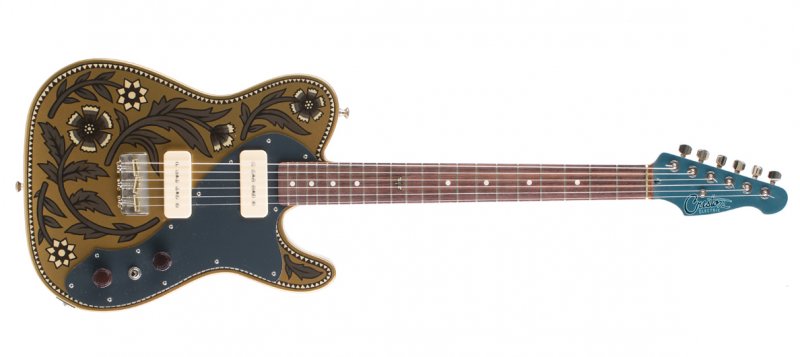
Burlington, Vermont luthier, Creston Lea, builds hand-made electric guitars and basses in a classic American style. This film explores Lea's particular design aesthetic and place in the boutique electric instrument world, as well as his long-time collaboration with artist, Sarah Ryan.




The Economist's feature on time-poverty is an absolute must-read, explaining the multi-factorial nature of the modern time crunch, which combines the equivalence of time and money (leading to leisure hours that are as crammed as possible in order to maximize their value), the precarity of the American workplace (meaning that affluent workers work longer hours), and the pace of electronically mediated communications (which makes any kind of refractory pause feel like a wasteful and dull eternity).
Read the rest

Christmas is a time for nostalgia, a time where even the most hardened cynics among us might reflect on our Christmases past with a certain warmth. And there’s no better way to set aside the slings and arrows of daily life than by shutting the curtains and snuggling up to watch a film.
This is not simply escapism or occupying the kids while the presents are wrapped. You shouldn’t need an excuse to encourage children to watch films but, in the spirit of the season, I offer you 12.
Those of us of a certain age will remember the delights of settling down to watch the afternoon Christmas film. We all watched Dorothy in her red shoes vanquish the wicked witch of the west and uncover the humbug Oz. We have all been invited to sing along to The Sound of Music or been delighted by The Snowman. These shared experiences act as a social glue – we may not all feel the same about each film, but we share a common experience of their place in our seasonal celebrations.
As a child my grandma used to tell me stories based on Hollywood melodramas as if they were fairy stories. This was my induction into the black and white world of the “weepy”. Soon I was an avid watcher of Bette Davies, Olivia de Havilland and Vivian Leigh films. Watching the films of our parents and grandparents connects us to their experiences and to their life histories. In doing so, children’s experiences of narrative are extended.
If we only ever watch films of the same genre we may end up in a cultural cul de sac. Watching unfamiliar films helps children to see what is distinct about the films they usually choose and importantly that there’s a world out there for them to discover. Hollywood musicals such as White Christmas or Westerns such as High Noon might take them out of their cultural comfort zones.
Children who watch lots of films are not goggle eyed, just as children who read books are not risking their sight. My own research suggests that when children have watched many diverse films they start to see the underlying film language or grammar and this helps them to develop their understanding of narrative more widely. If we said our children spent all day reading books no one would bat an eye.
Nostalgia needn’t have an exclusive hold over Christmas. In the films of Tim Burton such as A Nightmare Before Christmas, children can encounter a visceral, visual feast. Adaptations of Neil Gaiman’s Stardust and Mirrormask also challenge ideas about just how scary children’s stories can be, while Terry Gilliam’s Baron Munchhausen is full of grotesque, playful and Pythonesque quirks which offer children a break from the generic conventions of the Disney fairy tales.
As a child in the 1980s it was regularly possible to watch black and white films, musicals and even the odd short film just by turning on Channel 4 and BBC2 at the right times. This is trickier now, which is why film festivals are so important for promoting international films. At this year’s Leeds Young Film Festival, the film We Are The Best was screened. A truly joyous and uniquely Swedish film, this is the hilarious story of a teenage 1980s girl punk band.
Film festival websites are a great source of new ideas for films for children. Japanese Studio Ghibli films such as The Cat Returns, Arietty and My Neighbour Totoro offer children a distinct visual style, humour and narrative – and are great stocking fillers.
The Victorian era was a rich time for children’s literature. Now, the many adaptations of the work of Dickens make great festive treats, especially when combined with Jim Henson’s muppets. There are some other very powerful adaptations of children’s classics which deserve a particular mention. In Agnieszka Holland’s adaptation of The Secret Garden we see new life breathed into Mary Lennox, a character sidelined by previous screen versions. Similarly, Five Children and It, E Nesbit’s classic tale exploring the second war and loss in the midst of magic and myth is brought to life by Eddie Izzard’s sand fairy.
Film often physically presents the viewpoint of particular characters, asking the audience to imagine how it feels to see the world differently. ET explores the world from a child’s height as ET and Elliott see it, inviting us to laugh and weep with them. In the wealth of films about childhood from around the world, children can experience the world through the eyes of other children. Lad: A Yorkshire Story, which won the audience and jury prize at the Leeds festival, is that all too rare a thing –- a British film for children.
Being able to put doubts and disbelief to one side and imagine the unknown or unlikely is a skill some find harder than others. The late Anna Craft described this crucial aspect of creativity as “possibility thinking”. Films, especially those created for children, complete with wizards, talking animals and magic portals to other lands may be fantasy but they helps us make the imaginative leaps that might just help us change the world. FairyTale: A True Story delightfully examines this dilemma.
Boredom is under-rated. Boredom is a precursor to creativity and induces resourcefulness. Being bored helps us focus on alternatives. So if your children find your film suggestion boring, it might be time to put digital technology to good use and help your child make their own film. See learnaboutfilm.com to help get you started. This is, after all, how Nick Park started on his journey to creating Wallace and Gromit and other Aardman classics, now staples of the British Christmas diet.
I once overheard a passenger on the train I was travelling to work in say “it’s not Christmas without the Die Hard films.” Much as I personally find this surprising, strong action and emotional impact are still key ingredients for the festive season. Perhaps this is the time to introduce older children to films such as Zulu or The Great Escape, which provide these qualities in a very different way. For older children films such as Tsotsi and Rabbit Proof Fence explore the extreme circumstances children are so often exposed to. We should not be afraid to let our children encounter sorrow on film – they need to see their own lives represented on the screen and to know that, yes, sometimes bad things happen.
The sheer joy of a funny film – what better gift is there at Christmas? The antics of Laurel and Hardy, Monsieur Hulot, Chaplain or the Marx brothers feature the sort of physical humour which is almost universally funny. But we have our own proud tradition of comedy in Britain, no better represented than by the Ealing Comedies. Kind Hearts and Coronets and The Ladykillers are great favourites in our house, but for me Hue and Cry uniquely combines the Ealing humour with a story in which the children are at the heart of the narrative – solving crimes and putting adults in their place.
And if the adults are behaving badly over the Christmas period, children, make them sit and watch Pollyanna or Scrooge while you treat yourself to Son of Rambow, The Girl with Brains in her Feet or, a personal favourite, Into the West .

Becky Parry receives funding from Cape UK.

The federal spending measure passed this weekend, and one of the provisions in it "effectively ends the federal government's prohibition on medical marijuana and signals a major shift in drug policy," reports the LA Times.
Read the restThe novelist and memoirist Anne Lamott’s advice for writing fictional characters based on people in your life—specifically men you don’t like—is to give them small penises. She doesn’t offer equivalent advice for writing about women. This tactic is clearly an imperfect guide to dealing with a perpetually thorny and emotionally charged issue, but the idea is that no one will come forward and say, This is me!
I’ve been thinking about this a lot lately—the act of writing fiction about real people. It’s a complicated issue, and a fraught one, which is why the higher-ups here at Rookie set me to the task, thinking, maybe, that I had some answers.
I do, and I don’t.
You might be asking yourself: Why is this a thing that I need to worry about? Because if you are at all interested in writing, and in writing about yourself or your own experiences, sooner or later, you’re going to be writing about other people. Maybe if you live on a deserted island, this doesn’t apply to you, but most of us spend our days bumping into and interacting with other people, and those relationships color how we see ourselves and the rest of the world. This is obviously true if you’re writing non-fiction, but it’s true if you’re writing fiction, too. If you’re writing a story with a character that has some things in common with your mother, for example, and you know that she’s going to see it, then you might want to read on.
I wrote this piece for Rookie, and it’s very REVEAL-Y THE TRUTH-Y.

Good question. Orwell is anything you want it to be, whether it’s a sofa, a daybed, a bed, or a cabin, or all of the above. Whatever you label it, I don’t care because I want one. I love it when people know how to make a nap easier to take and Álvaro Goula and Pablo Figuera are clearly geniuses at it.

The Barcelona-based duo designed the cabin-like piece of furniture to help you create a bit of intimacy within a larger environment, like your home. The idea is for you to climb in, rest, and revisit childhood memories of “cabins”, or you know, forts. With heavy quilted curtains, sounds and light are kept out so you can get some sleep if you want. If not, sit up and use it as a sofa.


The political system’s indifference to the needs of the American people could not have been made clearer in recent days.
At a time when economic inequality is increasing and the US racial divide is ever more evident, Congress negotiated a massive spending bill behind closed doors and further empowered the country’s economic elite. It voted last week to increase the amount of money an individual – but not a business – can give to party committees from US$97,200 to US$776,600. In part, this was push-back by the parties against the independent expenditures unleashed by recent Court decisions, so that more campaign dollars flow directly into their coffers. But more than that, it increases the already overwhelming clout of wealthy political donors.
The vote further reduces the likelihood of reversing the trend toward a society increasingly divided by wealth and race. Not many who will be making an annual six-figure contribution to either party are likely to press to achieve racial justice or to increase taxation at the top of the income distribution. Yet doing both is necessary to reverse the overlapping racial and economic polarization currently engulfing the country.
The only possible source of corrective action lies in the political realm. But studies indicate the public is already thoroughly alienated from the political process. The voter turnout rate in 2014 was the lowest since 1942. The reality is that the only possible offset to money is a large turnout of voters in opposition to current trends.
At the moment, many believe that the Congress is a tool of the rich and that it is a waste of time to try to correct the problem. This alienation is particularly widespread among young people.
IF the American people want to reverse oligarchic domination, they must be persuaded that political engagement is an empowering mechanism, not just for the rich, but potentially for themselves as well. They will have to be convinced that it is possible to construct an electoral system in which – unlike the current system – opportunity exists for people outside of the elite to shape policy outcomes.
Treating the political system as a public good – a service provided by the government such as education, defense or roads – would be a start. If candidates had the option of financing their electoral races with public funds, two very important changes would occur. Both would help rein in the power of the economic elite.
In the first place, because access to private wealth would no longer be a barrier to candidacies, more people representing the middle class and the poor could run for office. Second, and as a result, voters would be able to elect office seekers other than those who represent the interests primarily of political donors. There is no certainty that an anti-elitist outcome would prevail with a public campaign funding option. But until that option appears, it’s unlikely the current trend toward inequality will be reversed. Other options alone, such as shortening campaigns or putting forth a Constitutional amendment overturning the Supreme Court’s Citizens United ruling are inadequate to turn the tide and re-empower average Americans.
Treating the electoral system as a public good has barely made it onto the country’s political agenda. Polling data indicate that people are receptive to the idea. But advocating the public financing of elections has yet to become a winning platform for candidates.
The upshot is that any effort to achieve an America of greater fairness has to be thought of as a long-term project. The people will have to come to believe what they do not now believe – that it is possible to construct a new politics in which they exercise decisive power.
This will not be easy. Wealth not only exercises power in the political realm, but in the media as well. Even so, it can be done. Advocacy organizations such as Democracy Matters, Every Voice, Reprensent.Us and Rootstrikers have made an effort to persuade Americans of the efficacy of public political financing. But the projects currently underway to curb the role of private money in politics do not nearly approach the scale required.
Ironically, it might well take rich benefactors to fund this effort. Changing the views of the American people will require a systematic plan and the resources to support such organizing. Political alienation in this country is deep, and can only be overcome with an intensive education effort that is sustained over many years.

Jay MandleI is the Treasurer and Co-Founder of Democracy Matters.


A federal judge in New York has ruled that telling people where to get DRM-removal software isn't against the law -- it's a huge shift in the case-law around DRM, and it's an important step in the right direction.
Read the rest

There are at least 268,000 tonnes of plastic floating around in the oceans, according to new research by a global team of scientists.
The world generates 288m tonnes of plastic worldwide each year, just a little more than the annual vegetable crop, yet using current methods only 0.1% of it is found at sea. The new research illustrates as much as anything, how little we know about the fate of plastic waste in the ocean once we have thrown it “away”.
Most obviously, this discarded plastic exists as the unsightly debris we see washed ashore on our beaches.
These large chunks of plastic are bad news for sea creatures which aren’t used to them. Turtles, for instance, consume plastic bags, mistaking them for jellyfish. In Hawaii’s outer islands the Laysan albatross feeds material skimmed from the sea surface to its chicks. Although adults can regurgitate ingested plastic, their chicks cannot. Young albatrosses are often found dead with stomachs full of bottle tops, lighters and other plastic debris, having starved to death.

But these big, visible impacts may just be the tip of the iceberg. Smaller plastic chunks less than 2.5mm across – broken down bits of larger debris – are ubiquitous in zooplankton samples from the eastern Pacific. In some regions of the central Pacific there is now six times as much plankton-sized plastic are there is plankton. Plankton-eating birds, fish and whales have a tough time telling the two apart, often mistaking this plastic – especially tan coloured particles – for krill.
However, even this doesn’t quite tell the whole story. For technical reasons Eriksen and his team weren’t able to consider the very smallest particles – but these may be the most harmful of all.
We’re talking here about tiny lumps of 0.5mm across or considerably less, usually invisible to the naked eye, which often originate in cosmetics or drugs containing nanoparticles or microbeads. Such nanoparticles matter as they are similar size to the smallest forms of plankton (pico and nano plankton) which are the most abundant plankton group and biggest contributors in terms of biomass and contribution to primary production. There’s a lot going on when you zoom right in.

We don’t yet know precisely how plastic nanoparticles interact with marine fauna but we do know that they can be absorbed at the level of individual cells. And what’s worse is they’re very efficient carriers of organic molecules such as estradiol, the drug used for birth control and IVF that finds it way through our sewage system into the sea. Indeed, this efficiency is one of the reasons nanoparticles are being explored for drug delivery – they’re a great way to get the right medicine absorbed into the right cells.
Therefore it isn’t just the plastic itself that should concern us. We need to look at what it’s carrying, as substances clinging to nanoparticles of plastic could badly damage marine ecosystems.
Nasty endocrine disrupting chemicals can be concentrated a million times more than background levels on the surfaces of plastic particles. These can then be ingested by organisms and the chemicals absorbed leading to disruption of the reproductive process – some species such as bivalve mussels have even seen males turned into females.
Floating chunks of plastic can also be colonised by organisms including potential bacterial pathogens such as cholera, and marine insect sea skaters which need a hard surface to lay their eggs on – plastic in the sea increases their numbers and range. The fact that floating plastic debris is novel and persists for longer than most natural flotsam could make them ideal vehicles for the introduction of invasive species with potentially devastating consequences.
Plastic pollution of the marine environment is the Cinderella of global issues, garnering less attention than its ugly sisters climate change, acidification, fisheries, invasive species or food waste but it has links to them all and merits greater attention by the scientific community.

Magnus Johnson is affiliated with Yorkshire First.
Melanie Coull does not work for, consult to, own shares in or receive funding from any company or organisation that would benefit from this article, and has no relevant affiliations.

The 12 oz, dishwasher/microwave safe Retro Raygun Rocket Mug is $9.72 and ships worldwide. (via Geeks Are Sexy)
I hope The Basic Report sticks around. It's like a condensed version of The Week, which is already a condensed version of other news magazines.
Read the rest It’s been Wreath Mania 2014 at my house again this season. In the quiet after my wreath-making party, I made three wreaths of my own. Because I know that lots of readers have been busy with their own hot glue gun festivals, I powered up an Uploader. 87 wreaths in our Uploader so far (including from last year’s holiday uploader) — let’s see yours!
 Above: My red-green-silver wreath, with lots of weebits — a knee-hugger elf, a vintage mica ornament, a porcelain Santa, antique reflectors, a holly berry pick, teensy pinecones, two bottle brush trees — and hanging bells. I pushed my design skills making this wreath harder than ever, working to incorporate lots of weebits. I gifted this wreath to my friend Michelle at Finders Keepers vintage shop in Lee, Mass., as thanks for helping to enable my ornie hunting. I love her shop!
Viewing tip: Click on any photo in this story (and other stories on the blog), and it should double in size on screen, so that you can see greater detail. Once the photo is enlarged, click on the right hand side of it, and you will be able to see all the photos in the story like a slide show.
 Above: This blue and silver wreath was for a friend, by request. Note the owl, which I glued into the open cavity of the ornament… I love the big spray of silver balls… and I also loved using the decopauge ornament.
 Above: This gold and green wreath is possibly my favorite of all time. It is so glowy — I got out the professional photo light to try and get a photo to do it justice, this still doesn’t quite. This wreath is for my Aunt Mary Anne. I am going to make another one, in the same color palette, for me next year.
 Above: I made this pink wreath after Christmas last year, so I don’t think I ever showed it on the blog. It’s pretty over-the-moon glowy fabulous, too. This and the blue wreath are the most “perfect” wreaths I’ve made, although, on the other two I made this year, I took more chances, pushed my boundaries in terms of incorporate more elements.
Have you made a wreath using vintage and/or new ornaments? Upload your photo(s) here:
Tips to view slide show: Click on first image… it will enlarge and you can also read my captions… move forward or back via arrows below the photo… you can start or stop at any image:
The post 87 photos of DIY Christmas ornament wreaths — Upload yours, too appeared first on Retro Renovation.

On Friday we witnessed images reminiscent of the London Riots from a few years ago. People with a crazed look in their eyes descended on shopping malls to plunder their contents. They fought with others over flat screen TVs and emerged, arms full of consumer goods they did not even know they needed. This time, at least, it was legal.
As sure as Boxing Day follows Christmas, so Cyber Monday now follows Black Friday. It presents an altogether different scene. Instead of people brawling over electrical equipment, hundreds of thousands of people around the country sit quietly in their office. Instead of spending their day working, they will spend a good chunk of it chasing bargains on various internet sites.
This is a bonanza for retailers, but in many ways it amounts to a mass withdrawal of productive labour. In the past, this might have been called a general strike. Now it seems we are all willing to collectively row back on working for a day in order to start shopping online.
It is a relatively recent phenomenon. The term was first coined in the US about 2005 and popularised in the UK around 2009. Alongside its “real world” twin, Cyber Monday marks the beginning of the Christmas sales period; according to one marketing services company, UK consumers will spend £649.5m on Dec 1 this year, a 26% increase on Cyber Monday the previous year. In the US, the spend was US$1,735m which was an 18% increase on the previous year.
While Cyber Monday is a big day on for internet retailers, it seems to be a big day off for many of the work force. Instead of officially taking a holiday, many employees show up to work, informally clock off, and then spend a few hours hunting for bargains online. What this means is that a significant amount of the shopping done on this big shopping day is done on company time. Following Sunday evenings, 4pm during weekdays is typically the busiest times for internet shopping.
One US survey found that 49% of employees planned to spend some of their work time during the Christmas holiday period shopping online. Another UK survey found that 53% of employees will do some of their Christmas shopping online while at work.
It might seem productive, at least to those with lengthy Christmas lists to tick off, but internet shopping is a quintessential form of what has become known as “cyber loafing”. This involves the use of working time to engage in unproductive surfing of the internet – usually for personal purposes. Cyber loafing can come in many forms, from briefly checking in to a social network which might take up a few minutes to extended online shopping sprees or hardcore internet surfing sessions which can wile away whole workdays.
The prevalence of cyber loafing naturally leads us to ask why employees do it. The existing research suggests that employees who are not particularly interested in their job (lower intrinsic motivation and less involved) were more likely to cyber loaf. The cultural norms of the workplace seemed to also make a difference. In workplaces where cyber loafing was informally accepted, people were more likely engage in minor acts of cyber loafing such as checking emails, but they tended to avoid major bouts. When people perceive their workplace to be unjust, they were also more likely to engage in cyber loafing.pdf). One study found that the most keen cyber loafers are young, male, from ethnic minorities and more frequent internet users.

A recent, fascinating study by Roland Paulsen suggests that some people engage in cyber loafing because they simply don’t have enough tasks to do at work. This might seem like a good deal, but not having enough to do can actually be very boring. As a result, many of the people interviewed applied their languishing work ethic to online activities such as reading the newspaper, playing video games and high involvement shopping. By filling up their days with high involvement cyber-loafing, Paulsen found that these bored workers could give some meaning to the endless stretch of time which lay before them.
Cyber loafing is often seen as a waste of time and energy. However, a recent study suggests that moderate levels don’t have much impact on performance in work tasks. Actually, it appears that a little cyber loafing can actually have an upside. One study reports that some forms can actually trigger more positive moods in people. The lesson, though, is to keep it impersonal: checking emails often made people less happy.
What all this suggests is that the many millions of hours which will be “wasted” at work by employees shopping this Christmas season may not be an entirely bad thing. It certainly fuels the consumer economy. But perhaps more importantly, it means that if you’re not particularly motivated by your job, then you can fairly easily lift your mood; and wave some research about negligible productivity losses under the boss’s nose if you get caught.

Andre Spicer does not work for, consult to, own shares in or receive funding from any company or organisation that would benefit from this article, and has no relevant affiliations.

Police violence has dominated American headlines over the past year. The seemingly unaccounted-for police shooting of unarmed teenager Michael Brown in Ferguson brought renewed attention and public protests to this issue; now, the decision not to charge officer Daniel Pantaleo for the death of Eric Garner, even after he was caught on video illegally restraining him with a chokehold, has only added to these rising concerns over apparently unaccountable use of force by police officers across the country, particularly against African-Americans.
In the months since Garner’s death, authorities had feared unrest on the same scale as in Ferguson, or even worse. These worries were especially acute in light of video footage showing the officer putting the victim in an illicit chokehold while he repeatedly gasped: “I can’t breathe.”
This evidence was even more damning given the coroner’s report that the death was a homicide caused “by the compression of his chest and prone positioning during physical restraint by police”.
Not surprisingly, this violence has been largely linked to the persistence of racism in the US. The American news cycle has been tightly focused on the country’s racial divisions, the threat of race riots and the stark disparity in the way the white majority and the African-American minority are treated.
But tragic and racially charged though these incidents have been, they are also a golden opportunity to unite Americans behind the cause of fundamental social change – a cause that encompasses racism, but goes further too. And while no such movement is yet in the offing, the seeds of one are already starting to sprout.
The mayor of New York City, Bill de Blasio, quickly responded to Pantaleo’s non-indictment with appeals for non-violent protests, declaring: “New York City owns a proud and powerful tradition of expressing ourselves through non-violent protest. We trust that those unhappy with today’s grand jury decision will make their views known in the same peaceful, constructive way.”
While the moderating impulse is understandable, sentiments such as these do little more than focus attention on the “threat” of “violent” blacks rather than the actual aggression and violence of the white police officers responsible for Garner’s death.
But de Blasio also managed to advance things a little, bluntly and honestly acknowledging that “centuries of racism that have brought us to this day”. That spoke to the deeper anger driving these protests, reflected in the protesters' rallying cry: “Black lives matter”.
At the heart of these words and the protests they addressed was a desire to unite the country in condemning the status quo. The emphasis was on “healing” a divided nation, while also recognising the serious need for reform at all levels of the state. As the US president, Barack Obama, said in response: “We are not going to let up until we see a strengthening of the trust and a strengthening of the accountability that exists between our communities and our law enforcement.”
But crucial to the success of those efforts will be realising that this is not just a racial problem – it is a problem with authority in the US in general.
Undeniably, African Americans are disproportionately affected by police violence – but it also affects people of all races. Within months of Michael Brown’s death at the hands of the Ferguson police, there were two less publicised cases of excessive police violence against white suspects in the surrounding area: Joseph Jennings, who was shot 16 times outside a Kansas hardware store, and 17-year-old Bryce Masters, who ended up in a coma after a police officer tasered him when he refused to roll down his window after being stopped.
Obama echoed this need to both recognise the racial dynamic driving much of this violence while also the importance of treating it as a national not just “black” or “minority” crisis. He maintained: “The problem is not just a Ferguson problem. It’s an American problem.”
In order to address the problem, we have to confront its deeper causes, ones that certainly involve but are by no means limited to the country’s ongoing structural racism. Rising inequality and poverty, especially in the wake of the financial crisis, have done much to contribute to police brutality. These economic factors have been exacerbated by the growing domination of US politics by elites.
Framing police violence as principally a “black problem” reinforces the underlying notion that African-Americans are somehow separate from other Americans and that authoritarian crackdowns on them are reactive, not active. This plays into an established tactic of strategically highlighting racial divisions within the country to distract attention from other issues such as class polarisation and oligarchy.
Ultimately, this is a way to freeze out solidarity across race, geography and even class, leaving Americans with an identity politics of distrust and conflict.
This strategy is part of the culture of fear that has driven much of the US government’s policy for decades. From the War on Drugs to the War on Terror, chronic and growing issues of unemployment, economic insecurity and declining social welfare are channelled into anger and action against existential “enemies” – most of whom are non-white, or in some way portrayed as less than “American”.
These policy “wars” have been mounted in the service of a growing authoritarianism in contemporary America. The militarisation of the police force, for instance, reflects the government’s need to neutralise urban areas marked by often extreme poverty and violence. Instead of an attack on the economic and social causes of ghettoisation and urban blight, we’ve seen a move away from “community policing” toward what has been called: “The United Police States of America”.
To overcome this strategy, then, it must be tackled as more than just a programme of racism. What must be emphasised is the authoritarianism and deeper shared disenfranchisement that motivates the state violence we see today – a tendency that certainly includes structural racism, but which is by no means limited to it.
In the words Obama used when responding to the Eric Garner case, it must be framed as an “American problem”.
The foundations for such a movement are well established and span the political spectrum. On the right, anti-authoritarian feelings have spurred the Tea Party movement to unprecedented, if chaotic, success. While Tea Partiers are primarily up in arms about public intervention in the private sector, their politics speak to an underlying fear of unaccountable state power and mass political marginalisation.
Meanwhile, on the left, the Occupy movement has been railing against the growing influence of corporations and their political handmaidens since 2011; an anti-elite politics that appeals to many of the same Americans outraged at the surveillance policies of the NSA. The authoritarianism of the police response to the Occupy protests drew unforgiving attention to just how defensive US police forces can become when power is confronted.
Unpunished incidents of police violence should be a catalyst for uniting Americans in a common cause against authoritarianism. In the US, the odds are stacked against most of the general public in favour of a privileged minority – and police forces are seen to ultimately serve to protect this unfair system more than they safeguard citizens.
What is needed is a vision of constructive change, one focused not simply on individual justice but on collective national progress. That means going beyond simply blaming law enforcement officials and instead indicting the system as a whole.
The fight against police violence should unite Americans, not divide them. Before the country can heal, it first needs to come together to cure itself.

Peter Bloom does not work for, consult to, own shares in or receive funding from any company or organisation that would benefit from this article, and has no relevant affiliations.

In the movie The Life of Brian (1979), Reg, played by John Cleese, asks fellow members of the People’s Front of Judea:
… apart from the sanitation, the medicine, education, wine, public order, irrigation, roads, the fresh water system and public health; what have the Romans ever done for us?
“Brought peace” is the answer he receives.
In hindsight, Christmas could be added to the list.
When we think of the Romans, gift-giving, carol-singing and celebrating the birth of Christ don’t immediately present themselves. Waging wars, general oppression and a never-ending desire to rule the world are more likely to spring to mind.
But various Christmas traditions come from ancient pagan festivities, including the Roman celebration of the Saturnalia.
Historian and cultural investigator, Polydore Vergil (c. 1470-1555), was the first to record the similarities between certain pagan and Christian practices. He noted the connection between the predominantly English tradition, “The Lord of Misrule”, which occurred on Christmas Day and an equivalent custom of the Saturnalia. Both involved masters and servants or slaves swapping roles for a day.
Why the Romans permitted such silliness is based on the nature of the Saturnalia. Held in mid-December, the Saturnalia, a celebration in honour of the god Saturn, was characterised by the relaxation of social order and a carnival-like atmosphere.

Saturn, once the principal deity of the Italians, was the god of time, agriculture and things bountiful. He reigned over the Golden Age, an era of peace, happiness and plenty. Indeed, the pleasures associated with the Golden Age were perhaps re-enacted in the Saturnalia itself.
The Saturnalia celebrated the god in his role as overseer of a season of anxiety. Winters were harsh and food sometimes scarce. And as the days became shorter and the earth symbolically died, the seasonal time needed to be commemorated and the god kept happy.
The Saturnalia was a lead-up to the winter solstice, the shortest day of the year, recorded as December 25 in the Julian calendar.
With revelries and hijinks, feasting and the cessation of formal business, the Romans looked forward to the coming of the light of the sun. With the return of spring, there would be renewed fertility. Crops would grow and farm animals would give birth, providing another year of bounty and full bellies.
As part of the revelries, the Romans exchanged gifts: candles, signet rings, toothpicks, combs, tooth paste, baby rattles, hairpins, woolly slippers, warm caps, tablecloths and, yes, even socks and the Christmas puppy! These were exchanged during or after a feast, served by the head of the household and perhaps his children while the slaves enjoyed their time off.
Saturn’s association with gift-giving has led scholars like Samuel L. Macey to link him with Santa Claus. But, as Macey knows, Saturn had a shadowy side and, like many Roman deities, there were skeletons in his closet! Someone who decides to eat his children as a means of maintaining power, for example, isn’t an ideal Santa prototype. Then again, some kids find Santa pretty scary.

As television was not yet invented, and the internet light years away, the poor old Romans had to occupy their Saturnalian leisure time with human interaction. They enjoyed games, gambled, played dress-ups and recited poetry (some of a risqué nature). Drinking, the modern scourge of the holiday season, was also a feature of the Saturnalia. While some of us take offence at the barbed comments at Christmas get-togethers, the Romans simply regarded them as a ritualised part of the upside-down world of the silly season.
Besides the Saturnalia, there was another important Roman festival with influential ties to Christmas: the celebration of the Unconquered Sun on December 25. According to the fourth century almanac, the Calendar of Philocalus, there is mention of a celebration of the “Unconquered” on December 25, which is most likely a reference to the “Unconquered Sun.”
In the same manuscript, December 25 is also listed as the birth of Jesus.
The Calendar of Philocalus is therefore cited by some scholars as potential evidence for the coalescence of the festival of the Unconquered Sun with the celebration of the birth of Christ. David M. Gwynn suggests: “The commemoration of Christ’s birth on 25 December … appears to have originated in the west, in part to provide a Christian counterpart to the birthday of the Sun.”
By the end of the late Roman period, Christmas was part of the Christian calendar. The pagan festivals may have officially disappeared but traces of the old ways remained.
And so began the long history of Christmas.
This article is part of The Conversation’s End of Year series.

Marguerite Johnson does not work for, consult to, own shares in or receive funding from any company or organisation that would benefit from this article, and has no relevant affiliations.
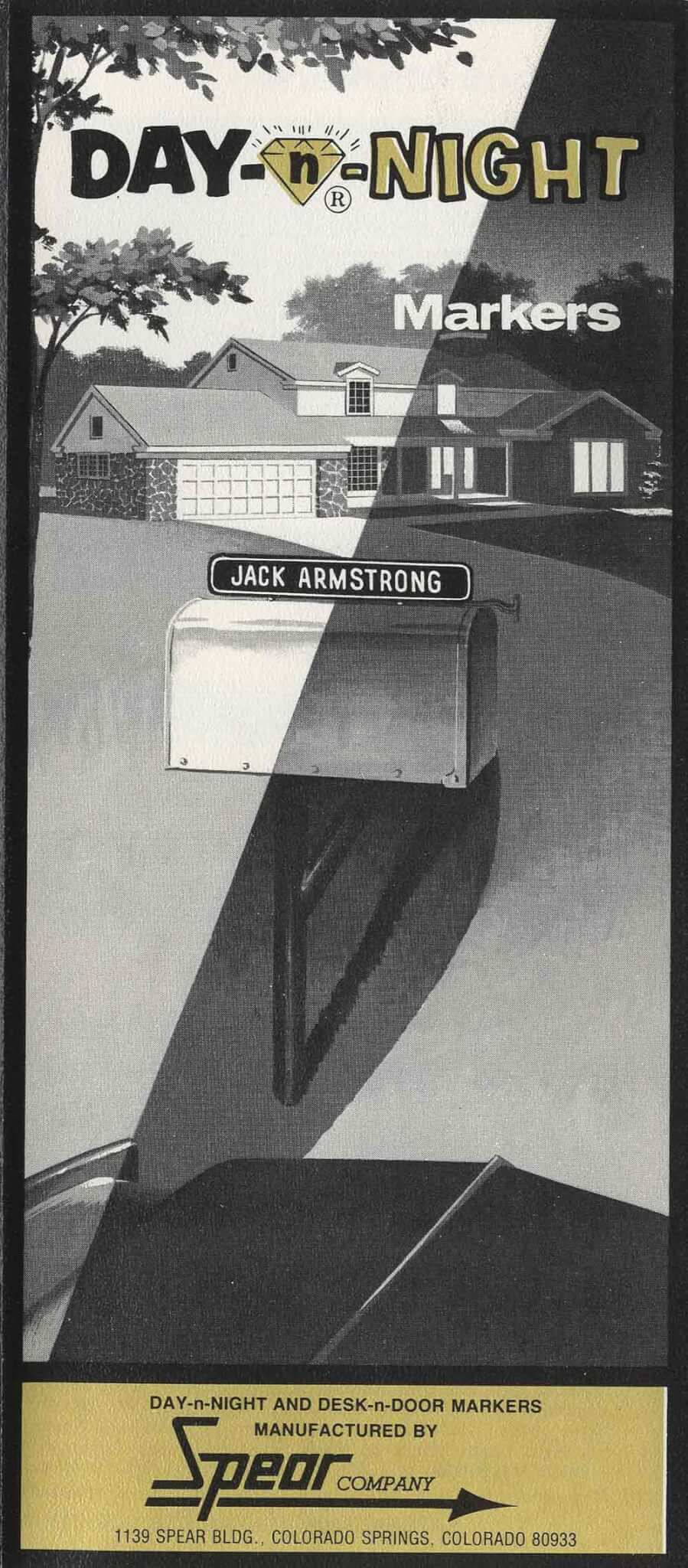 Epic discovery: Brilliant readers Caryn and Nina have discovered where we can still buy aluminum “Day-n-Night” house name and address plates — just like we’ve seen in the back of golly every 1950s magazine ever. And these retro house plaques are not “reproductions” — they are made on the same machinery — in the same factory — by the same company that has been making them continuously since 1949 — an epic 65 years! Hey, and I think they are quite affordable, too.
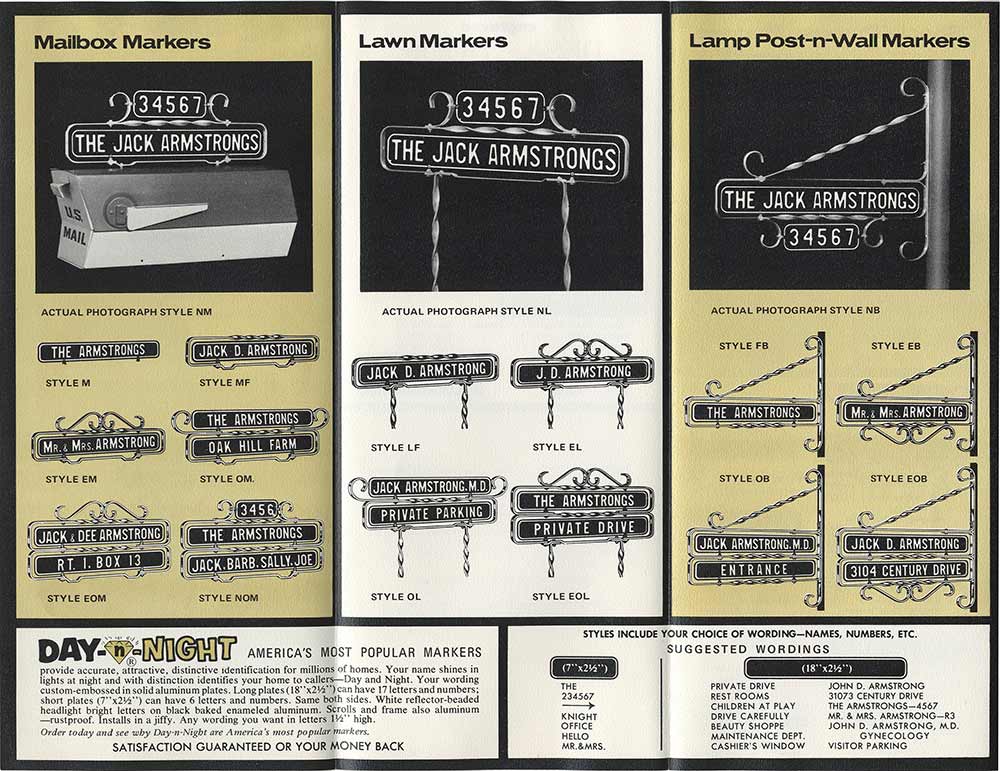
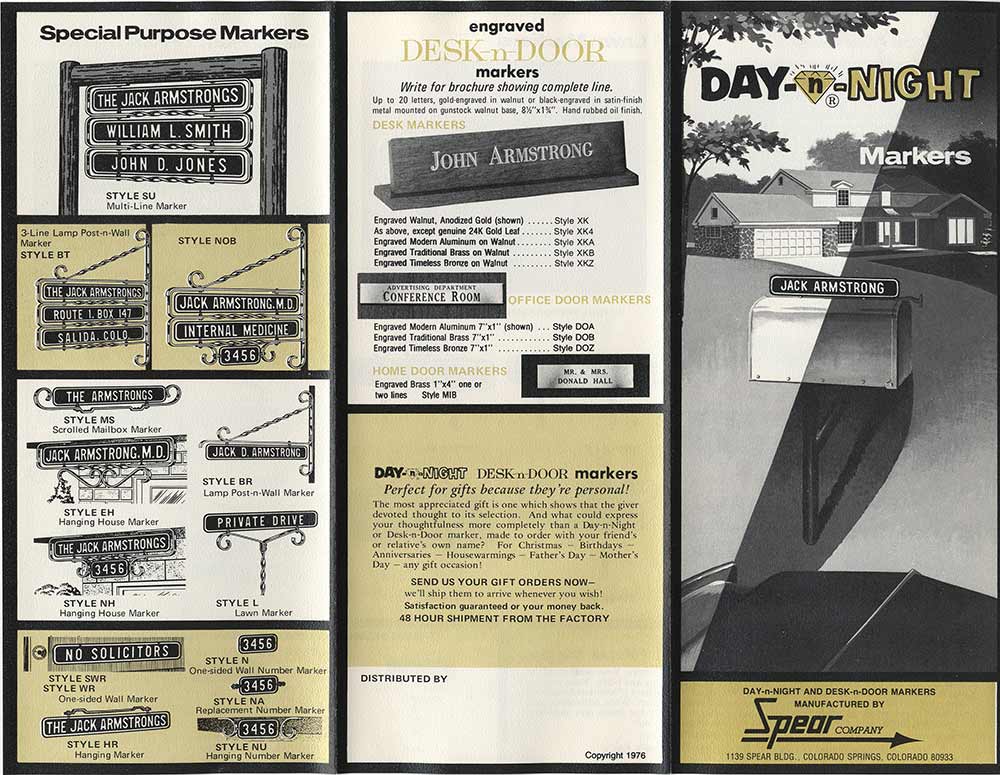 Yes, Spear Engineering Company of Colorado Springs, Colo., is still powering up their decades-old machines to stamp out metal mailbox, lamp post and lawn address plates to send all across America.
But take note, dear readers, because this company is so old-school that they don’t have a website and don’t advertise an email address. Yes, they do have voice mail.
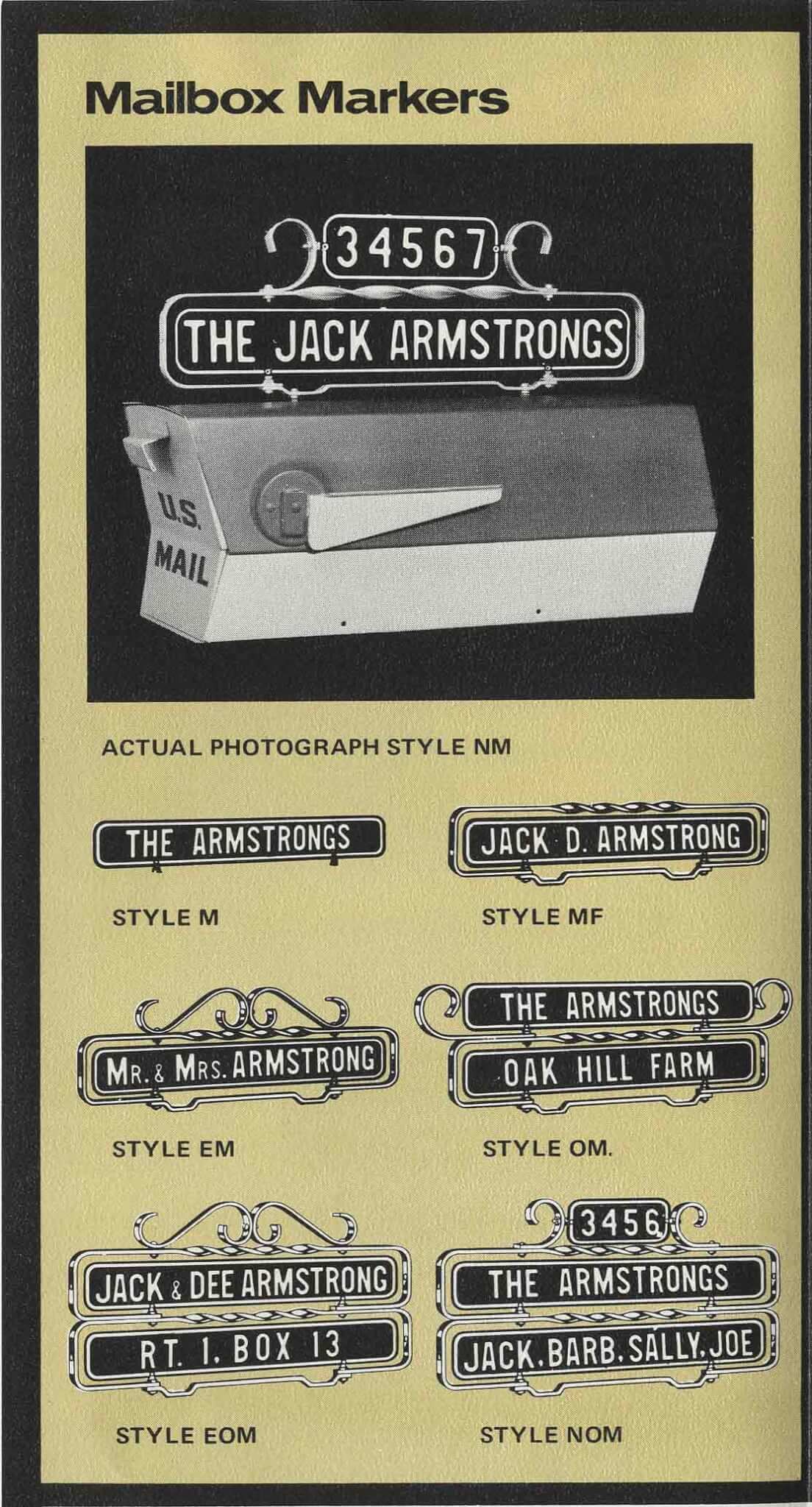
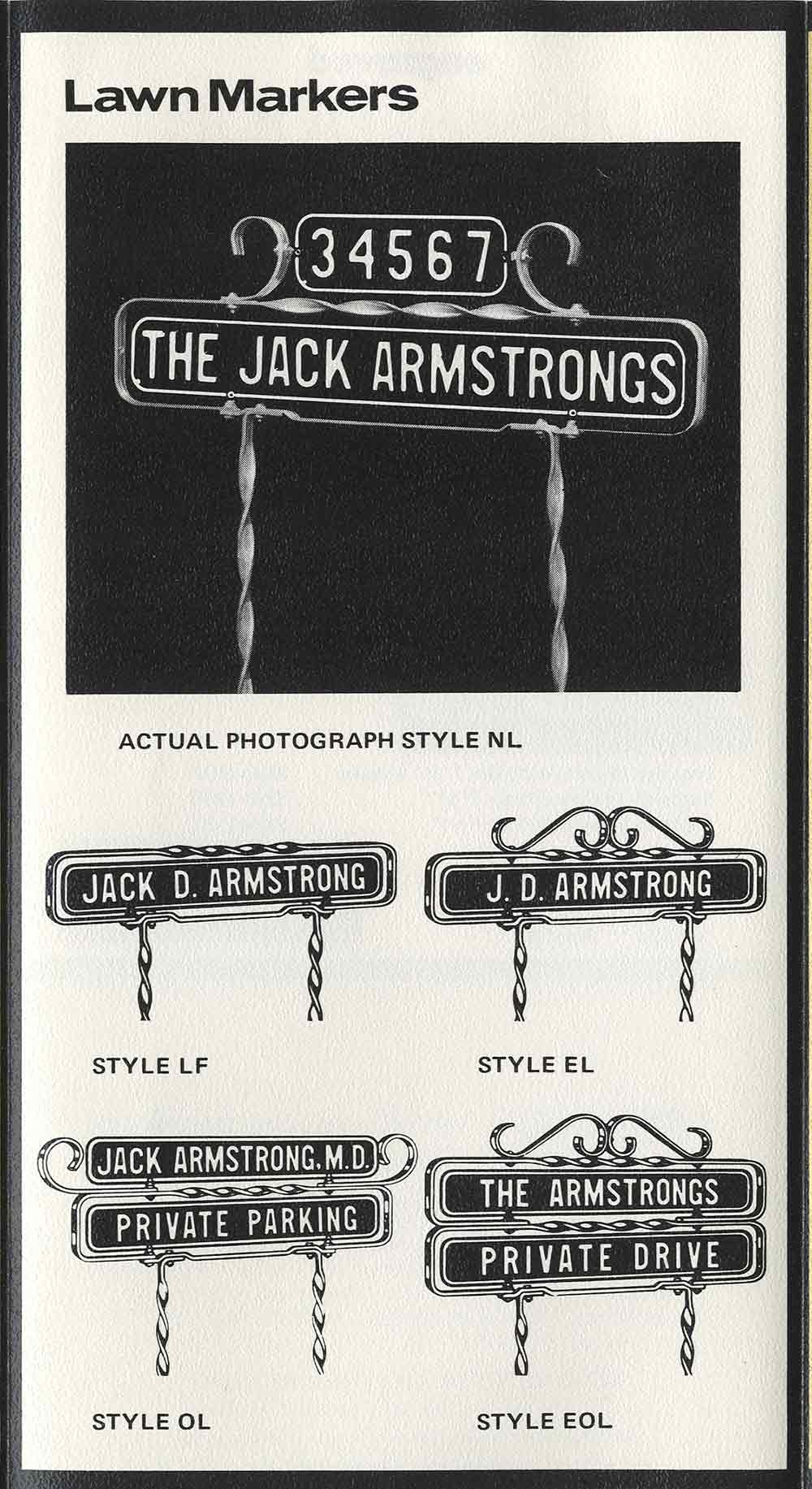
Want to see the designs? The prices? Want to submit and order? The complete brochure and order form are right here in this story, making it relatively easy to get a Day-n-Night address marker of your very own.

Super mega thanks to readers Caryn, then Nina462, for uncovering and sharing this amazing find. The journey-of-discovery started when Nina462 posted a wishful comment in our story about Mod Box midcentury modern mailbox reproductions. Caryn responded, then… well, here you go with the discovery trail:
Commenting on the new ModBox story, Nina462 said:
Just what I was looking for! I’ll be sure to order one…. Now, I’d like the fancy lettering that one used to be able to buy. It was black, and was on top of the mail box, sometimes it was the name or the address….According to my old catalogues/magazines they were made in Colorado. Of course, that was in the 1950’s.

Advertisement from 1951, spotted in the back of a home magazine – from Nina462’s archive
Caryn replied to Nina462:
Nina, you’re in luck! I drooled over those ads in my 50s & 60s Better Homes & Gardens mags for a while, then after much google time, I found the exact same company who still makes the SAME designs!! The company is Spear Engineering in Colorado Springs, Colorado, and you can reach them at (719) 471-9850. I talked to a sweet lady named Judy and ordered an address/name topper for our mailbox. From what I understood, it’s only a few people who work there, so be patient if you do place an order. It took a while to get it, but it’s soooo worth the wait!!
I just tried looking them up and cannot find the website anymore with the designs pictured, so I hope they are still in business. It was March 2013 when I ordered mine. Good luck!
Pam & Kate, this might make a great follow-up story to go along with these mod mailboxes
Next Nina462 got all tenacious and tracked ‘em down and followed up to let us know:
Pam/Kate……I contacted Spears Mfg., by sending them a copy of an old advert & asked them if they still make the nameplates…..they DO!! They responded by sending me an order form for their Day N Night glow in the dark markers.
I will be sending you a scanned copy of this!!
And so she did. And here we are.

 History: Spear Engineering — maker of Day-n-Night Markers since 1949
For this story, I also contacted Spear Engineering. I left a voice mail and within a few days, owner Spencer Katalin called me back. We had a delightful chat. I warned him he might get 100 orders in one day once this story runs. He didn’t seem phased — bring ‘em on!
Katalin bought the company in 1991 from Wendell Spear, the son of the original owner. According to one of the old brochures that Katalin sent me, the company was started in 1949. Katalin told me that the presses used to make the house plates came from the Denver Press (which printed money) and Canyon City Prison, which printed license plates. Yes: Come to think of it, these Day-n-Night house plaques are much like license plates!
Today, decades later, the business endures and is going strong. Katalin told me that the company still manufactures the Day-n-Night Markers on the same machinery… the same way… they have for decades. The letters and/or numbers are embossed-to-order onto aluminum plaques (one for each side)… then each placard is painted black… then the raised embossed lettering is painted white, with paint that includes beads that make it reflective. Finally, the placard is mounted onto the mill finish aluminum holder ordered. This is the same kind of aluminum that we see on vintage and new mill finish metal screen doors.

Spear Engineering owner Spencer Katalin says that this design of Day-n-Night Marker — the NM, which sits ona mailbox — is a best-seller, along with the EOM, the double-placard mailbox marker.
Today, Spear Engineering’s business also includes metal caskets. At first I thought, ‘That must be the lion’s share of their business now.’ But, no. Katalin said that about half of the company’s business is selling the Day-n-Night Markers. The big market is among mobile home parks. The mobile home parks know about Spear Engineering from word of mouth — tradition about where to get these placards is passed from one manager to the next and the orders just keep coming in.
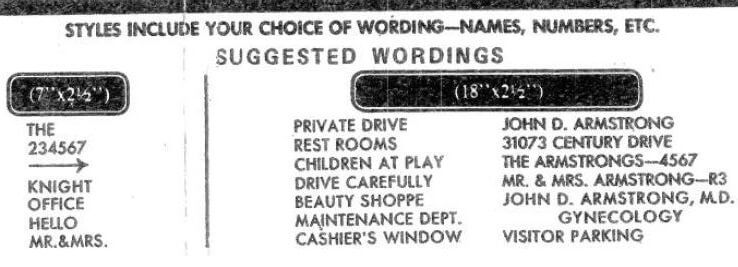
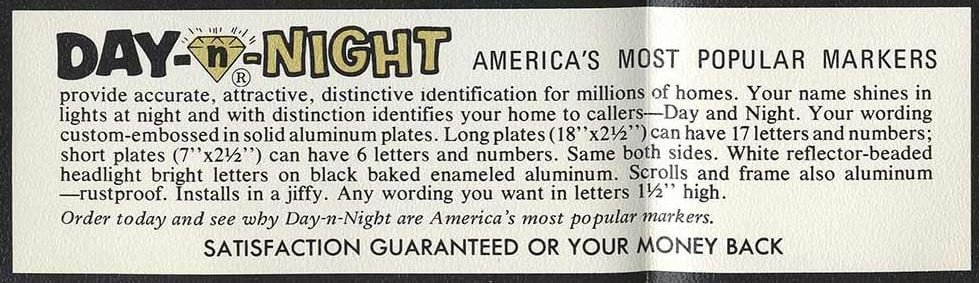
DAY-n-NIGHT — America’s most popular markers provide accurate, attractive, distinctive identification for millions of homes. Your name shines in lights at night and with distinction identifies your home to callers — Day and Night. Your wording custom-embossed in solid aluminum plates. Long plates (18″ x 2.5″) can have 17 letters and numbers; short plates (7″ x 2.5″) can have 6 letters and numbers. Same both sides. White reflector-beaded headlight bright letters on black baked enameled aluminum. Scrolls and frame also aluminum– rustproof. Installs in a jiffy. Any wording you want in letters 1.5″ high. Order today and see why Day-n-Night are America’s most popular markers.

I purchased this used / salvaged Day-n-Night marker on ebay a few years ago. I have always admired these!
Day-n-Night house plates: These things must have been wicked popular: They are embossed into my visual DNA — just as they have been embossed into aluminum for decades. To be sure, ordering then installing one of these name and address house plaques must have been the icing on the cake to the many millions of first-time homeowners in post-World War II America! The icing on the cake of the American Dream.
Now, we can help revive the market for these Day-n-Night markers among owners of mid-century modern — and more likely, mid-century modest — house. As it should be. I think I will order two: “NB” — Retro Renovation / Pam and Retro Renovation / Kate. For our home offices. “Retro Renovation” is 16 characters — just one under the max — it was meant to be.
This discovery just absolutely positively rocks my world.
All info and images in this story are copyright Retro Renovation 2014. Please contact me regarding any re-use.
The post Midcentury house name and address plaques in production since 1949 — still available today appeared first on Retro Renovation.
|

In Australia, around a billion cups of coffee a year are consumed in cafés, restaurants and other outlets. Even Britain, a nation famous for its fondness for tea, has in recent years seen a dramatic rise in its coffee consumption, with an estimated 70 million cups drunk each day.
Given the economic incentive to keep consumers drinking coffee, café owners, restaurateurs, crockery designers and manufacturers will, presumably, be interested in anything that can help to enhance the multisensory coffee-drinking experience for their clientele.
And, in research published last week in the journal Flavour by my colleagues and I, it appears that cup colour plays a big part in the way coffee drinkers perceive the taste of their morning cuppa.
The idea behind this study came about serendipitously. A barista once told me that when coffee is consumed from a white, ceramic mug, it tastes more bitter than when drunk from a clear, glass mug. Note that these two mug types are among the most commonly used vessels to serve coffee in Australian cafés and restaurants.
My colleagues and I, then, sought to establish the validity of this claim which, to our knowledge, had not been tested before.
Although many studies have been published on colour-flavour interactions over the years, there is a lack of research on the psychological impact of the cups from which we drink. This paucity is surprising given, as we saw above, how many cups of coffee are drunk every day.
The notion that the colour of the receptacle could impact taste/flavour perception might relate to work by consumer studies researcher Betina Piqueras-Fiszman and colleagues, which showed that a red, strawberry-flavoured mousse presented on a white plate was rated as 10% sweeter and 15% more flavourful than when exactly the same food was presented on a black plate.
Taking the principal one stage further, and given the conversation with the barista, we proposed that brown may be associated with bitterness (or, perhaps, negatively associated with sweetness) and that coffee from a white mug should be rated as somewhat more bitter than exactly the same coffee when consumed from a transparent mug.
It is possible that another mechanism might affect the perception of taste. Here, if light, opaque, milky brown coffee were to be associated with bitterness, then a light blue mug should intensify the brown of the coffee as it is brown’s complementary colour; as such the brown of the coffee will “pop out”.

This, in turn, would be expected to elevate ratings of bitterness relative to the same coffee when served in a transparent mug.
Some famous examples of the use of this “simultaneous contrast” mechanism are Heinz’s use of a greenish-blue can to set off the red-orange colour of its beans and sauce, and Cadbury’s use of purple packaging to enhance the colour of its chocolate.
In one experiment, the white mug enhanced the rated “intensity” of the coffee flavour relative to the transparent mug – but given slight physical differences in the mugs used, a second experiment was conducted using identical glass mugs with coloured sleeves.
Once again, the colour of the mug was shown to influence participants’ rating of the coffee. In particular, the coffee was rated as less sweet in the white mug as compared to the transparent and blue mugs.
Our study clearly shows that the colour of a mug does influence the perceived taste/ flavour of coffee.
Interestingly, Dutch psychologist Ap Dijksterhuis suggested that because of the use of the word “strong” in advertising, consumers often confuse a coffee’s strength or intensity with its “bitterness”. In our research we found a trend in bitterness ratings that mirrored intensity ratings.
We also found that any reduction in the “sweetness” of the coffee when presented from a white mug might also be expected to increase perceived bitterness (or strength). This supports research (mentioned above) which shows brown, among other colours, is negatively associated with sweetness.
The crossmodal effect of the colour of the mug on the flavour of the coffee reported here suggests that café owners, baristas, as well as crockery manufacturers should carefully consider the colour of their mugs.
The potential effects may spell the difference between a one-time purchase and a return customer.

George Van Doorn does not work for, consult to, own shares in or receive funding from any company or organisation that would benefit from this article, and has no relevant affiliations.

The decision not to charge police officer Darren Wilson with the unlawful shooting of unarmed teen Michael Brown has reignited protests across the US. The judgment was met by violent outrage on the streets of Ferguson.
After months of deliberation, a grand jury ruled that there was “insufficient evidence” to convict Wilson of acting illegally. At the heart of the controversy is whether this incident was motivated by racism or the officer’s “reasonable fear” for his life. American law enforcement officials are permitted to use deadly force when their safety is perceived to be in mortal danger. Opponents charge, however, that this shooting had little to do with fear and everything to do with the unjust racial profiling by police.
These are not mutually exclusive. The public stereotyping of black American males still justifies the use of lethal force against them by authorities at increasingly alarming levels. And as long as racial fear can be used to justify that force, killings like that of Brown will continue.
Racial fearmongering has long been used to legitimise violence against African-Americans. Before the civil war, black slaves were commonly depicted as savages who needed to be tamed by the white race. In the late 19th and early 20th centuries in particular, an image of blacks as sex-crazed threats to white moral decency was used to justify their lynching and the rise of white supremacist terrorist groups like the Ku Klux Klan.
In today’s America, racial fear is most obviously manifest in the widely held stereotype of African-American males as dangerous criminals. The image of the “violent thug” terrorising the inner city and increasingly the suburbs remains a strong.
It is this fearful representation that has helped to legitimise the government’s war on drugs that has disproportionately targeted black communities and led to the incarceration of African-Americans at a staggeringly disproportionate rate.
It is not surprising, then, that police officers would “instinctually” have a heightened fear for their safety when confronted by a black suspect. This is not just their individual racism coming into play. Instead it is the result of years of social conditioning to see blacks as “dangerous”. In the words of one expert: “The fact of the matter is that whiteness presumes innocence and blackness presumes guilt, and you have to prove yourself otherwise.”
This purportedly “reasonable” fear of African-Americans makes them especially vulnerable to aggressive and often lethal policing tactics. These tactics are needed, police argue, to effectively deal with “thugs” whose lifestyle is supposedly defined by the use and celebration of violence. Otherwise innocuous fashion choices – hoodies and low-slung jeans – become coded as warnings that people should fear for their safety.
The infamous 2012 shooting of 17-year-old Trayvon Martin by George Zimmerman is a case in point.
Not surprisingly, the parents of Trayvon Martin have supported the Ferguson movement, saying publicly that the officer “should be held accountable” and even visiting the Brown family and protestors in Missouri.
In the case of Ferguson, much has been made of the fact that the vast majority of the town’s police force is white, while the vast majority of its citizens are black. It’s also been reported that more than 90% of all arrests in Ferguson are of black people – despite evidence that they are less likely to be carrying contraband, for instance, than white citizens.
Tellingly, in the immediate aftermath of the shooting, the Ferguson police made an ill-planned attempt to depict Brown, who had just graduated from high school and was headed to college, as a “typically” dangerous black youth. They released a video showing him appearing to steal an item from a local shop where he briefly fought with the store owner.
The police were widely criticised for taking the time-honoured approach of demonising their black male victim as “dangerous” to imply he somehow “deserved” his violent end. And yet, the strategy has not only persisted; it’s been extended to the protesters now taking to the streets of Ferguson.
What started out as peaceful demonstrations in August 2014 soon turned violent when riot police armed with military-grade weapons began attacking the protesters.
According to an Amnesty report, police met protesters “using armored vehicles which are more commonly seen in a conflict zone rather than the streets of a suburban town in the United States”.
This echoed video footage of police taunting the crowd. One CNN video showed an officer saying to the protesters: “Bring it you fucking animals! Bring it!”
Some sections of mainstream US media, however, have largely blamed the protesters for the violence, depicting them as an angry black mob creating “chaos” who the authorities were acting appropriately in aggressively putting them down.
Equally, the Ferguson protesters made much of another example of the racial double-standard: a violent riot among mostly white individuals intoxicated after a “pumpkin fest” in New Hampshire, which was widely depicted as merely being “rowdy” and chaotic despite the fact that police used tear gas to shut it down.
Now, instead of talking to the media, the Ferguson protesters are increasingly relying on social media outlets to get their message out and present themselves as constructively fighting for justice. As one woman who went to the protests to observe what it was like for herself first hand, put it:
They (the media) totally took advantage of stereotypes about race and making any black person that shared emotion seem violent. They painted all these protests to be violent mobs of people terrorising, and that’s absolutely not the experience I had.
In response to the police’s racial stereotyping, a national twitter campaign has begun, with the hashtag #IfTheyGunnedMeDown.
Black men in particular have used the feed as a forum to post everyday pictures of themselves next to ones that could be misused to portray them as “thugs” (for instance holding a fake gun at a costume party).
#IfTheyGunnedMeDown what picture would they use pic.twitter.com/rrBoOusvkC
— RALPH LAUREN (@RLSELFMADEBOSS) November 25, 2014
After the jury’s decision on November 24, the first concern of the authorities was to make sure the protesters didn’t engage in widespread violence. This masks the broader message being promoted by those in the movement, one they expressed in an open letter in the aftermath of the ruling:
This fight for the dignity of our people, for the importance of our lives, for the protection of our children is one that did not begin Michael’s murder and will not end with this announcement. The “system” you have told us to rely on has kept us on the margins of society … housed us in her worst homes, educated our children in her worst schools, locked up our men at disproportionate rates and shamed our women for receiving the support they need to be our mothers
To end this cycle of violence and preserve the dignity of black lives, we have to end the stereotype of the “dangerous” and “violent” black threat. Until then, as Ferguson has so tragically shown, American racism will continue to make the fear and killing of blacks seem “reasonable”.

Peter Bloom does not work for, consult to, own shares in or receive funding from any company or organisation that would benefit from this article, and has no relevant affiliations.

Last week on ABC’s This Week, President Obama said, “My own experience tells me race relations continue to improve,” and “There’s no way to say race relations are worse than 20, 50 years ago.”
It’s impossible to ignore this assessment spoken by the leader of the free world, who just happens to identify as African American. It’s an attention grabber, especially because his assessment came just days in advance of a grand jury decision to not indict a white police officer who shot and killed Michael Brown, an unarmed black teenager, in Ferguson, Missouri.
Anxiety has been sky high there since the shooting three months ago and civil unrest shows the depth of pain and misunderstanding, and police action shows the depth of fear.
The nation’s attention is now focused on the St. Louis suburb and its handling of the situation. It should come as no surprise that some may not see as much improvement in race relations as does President Obama. There were violent protests in Ferguson after the grand jury’s verdict: a dozen buildings were badly damaged; cars were set on fire; 29 people were arrested. In fact, many blacks disagree completely with Obama’s assessment. As do some whites. How could this be true?
A serious read of history demonstrates that black lives have been treated as less valuable than white lives, and that well-meaning whites have, on the whole, failed to appreciate the origins of racial-ethnic disparities in health, wealth, education, and incarceration – or to see them as a problem. Many believe in justice, but feel perfectly comfortable when and where racial-ethnic inequality is the norm.
Unfortunately, belief in justice does not necessarily engender frustration with the status quo or empathy for the marginalized. Regardless, the present moment presents an opportunity to address three social facts that guarantee it won’t be long before the nation’s attention focuses on another divided community or telling videotape/audiotape or insensitive Tweet or heart-wrenching statistic or incredible news story that yet again reveals the permanence of racism.
The first social fact, to paraphrase the ESPN show, is that numbers never lie. The black-white disparity in infant mortality has grown since 1950. Whereas 72.9% of whites are homeowners, only 43.5% of blacks are. Blacks constitute nearly 1 million of the total 2.3 million people incarcerated. According to Pew, white median household wealth is $91,405; black median household wealth is $6,446 – the gap has tripled over the past 25 years.
Since 2007, the black median income has declined 15.8%. In contrast, Hispanics’ median income declined 11.8%, Asians’ 7.7% and whites’ 6.3%.
Rather than focusing on race relations – or the degree to which individuals of different races appear to be civil and friendly toward each other, and to a lesser extent, the degree to which black and white lives remain segregated – it seems more sensible to talk about parity. On that score, there is evidence of an unfinished civil rights agenda.
The second social fact is that improvement in race relations is not about asking apologetically: “can’t we all just get along?” There are powerful structural forces that organize our nation and its institutions such that white lives are considered more valuable than black lives. There is institutional inequality that happens without the ill-will of any one individual. The question becomes a matter of apportioning the race problem to past inequality (that we prefer to forget) versus the contemporary actions of schools, real estate agents, hospitals, banks, elected officials, corporations, the prison industrial complex, etc. whose rules of operation seem to further entrench existing disparities. Consider, for example, the police. The shooting of unarmed men (mostly black) by allegedly well-trained policemen (mostly white) has become a depressingly frequent occurrence. Indeed, in an October 2014 study, the investigative journalism organization, Pro Publica, discovered that “young black males in recent years were at a far greater risk of being shot dead by police than their white counterparts – 21 times greater.”
The third social fact is that tear gas should not be the preferred response to tears of frustration, angst, and disappointment shed by blacks and other marginalized groups.
In situations like Ferguson, people on both sides of the issue need to reflect carefully on and express openly their divergent views of why Brown was shot. Repression of either side of the story is counter-productive. But truly hearing both sides of the story requires empathy. Racism thrives in part because whites suffer from what I would call social alexithymia – they literally cannot imagine the lives of blacks and the burdens of social dislocations and criticism heaped upon the black community. The mere mention of racism or racial inequality, it seems, causes many whites to go deaf – whereas civil unrest seems to restore their hearing.
Ferguson is not a special case. It’s just evidence that race cleaves our nation, tensions simmer just below the surface, and far too many people who believe in justice are comfortable watching its miscarriage.
That does not mean that the white officer who shot Brown dead should have been indicted – apparently the evidence did not support such. But it does mean that everyone should be outraged because blacks are not yet full citizens of this nation. We need indignation. We need to take a stand.
Otherwise we are, in effect, accepting the permanence of racism: no longer the white-sheet-wearing KKK member, Archie Bunker type, but instead the type that allows polite neglect of racial and socioeconomic inequality, and permits sanguine assessments of progress discordant with the experiences of everyday people who feel abandoned and invisible and worthless.

Tony N. Brown does not work for, consult to, own shares in or receive funding from any company or organisation that would benefit from this article, and has no relevant affiliations.
From 2011, Skeptical Science's excellent Debunking Handbook, a short guide for having discussions about climate change denial that tries to signpost the common errors that advocates of the reality of anthropogenic global warming make when talking to people who disbelieve.
Read the rest

Just a few years ago, crocodilians – crocodiles, alligators and their less-known relatives – were mostly thought of as slow, lazy, and outright stupid animals. You may have thought something like that yourself the last time you were in a zoo and saw them lying still for hours, making people wonder if they were alive or made of plastic.
But people who worked with crocodilians – zoologists, breeders, animal trainers, tribal hunters – knew that these animals were capable of amazing things. And recently this knowledge has finally found support in the form of scientific publications.

Now we know that crocodilians have a weird communication system composed of chemical signals, various calls, infrasound vibrations too low for us to hear, and body language. They can take care of their babies for more than a year, feeding them, protecting them, even putting them together in crèches – like daycare centers protected in turn by many parents. They can disperse seeds of rainforest trees. They can bond with certain people and play with them. They can use little sticks to lure egrets looking for nesting material. And they can hunt in teams, each animal playing the role best suited for its size and agility; for example, large adult alligators can drive fish into shallows where small, agile youngsters lie in ambush.

Why are these amazing facts only coming to light now? There are many reasons.
First, scientists don’t study natural history as much as they used to. To get your research financed nowadays, it seems you need to be testing a fancy theory, or using a new technology, or contributing to some major cause such as finding cure for cancer, stopping global warming, or slowing down the ongoing mass extinction. You don’t get paid for just watching animals, no matter how cool the stuff is that you’re discovering.
Of course, this is a fundamentally wrong approach; it is impeding not just the science, but also our ability to fix major problems such as the mass extinction, because we no longer have the basic data on which our fancy theories should be based.

Second, crocodilian behavior is extremely difficult to see, especially in the wild. These are nocturnal animals living in swamps and muddy rivers, mostly in the tropics. Few people dare work there at night, and even fewer know how to observe nocturnal animals without disturbing them. These things aren’t taught in most universities. You can do your research in a zoo, but it’s not the same because many forms of behavior can only be seen in wild animals.
Third, time doesn’t flow for crocodilians like it does for us mammals. We are warm-blooded, so we need a lot of energy to keep our body temperature constant, and that makes us constantly hungry and active. Compared to us, crocodilians are the Taoist sages of the animal world. They lie back, conserve energy and silently absorb information about their surroundings. Eventually the moment comes when they decide it’s time for action, and when they do, they can make Jurassic Park’s velociraptors look like plucked chickens.
But to see this action, you have to spend weeks, months, sometimes years feeding mosquitoes in the swamps. Some Nile crocodiles, for example, hunt only once a year, during the wildebeest migration. Few scientists can afford to commit to a project where you get data once a year, if at all. Even if you somehow manage to get a grant for this, you’ll run out of money long before having something to show for it.

The only way you can do it is by thinking out of the box. I write books and sell my photos to finance my research. I use Facebook to survey people who don’t usually publish their observations in scientific journals: hunters, tour guides, zoo directors, amateur naturalists. I’ve learned to be as comfortable in a tropical swamp at night as I am in my apartment on a winter evening with the fireplace on and the coffee brewing.
Studying crocodilians is no longer a challenge for me – it’s pure fun. And the best part of it is that there’s still a lot to be discovered and understood. We’ve just scratched the surface.

Vladimir Dinets does not work for, consult to, own shares in or receive funding from any company or organisation that would benefit from this article, and has no relevant affiliations.

An ever-increasing number of our consumer electronics is internet-connected. We’re living at the dawn of the age of the Internet of Things. Appliances ranging from light switches and door locks, to cars and medical devices boast connectivity in addition to basic functionality.
The convenience can’t be beat. But what are the security and privacy implications? Is a patient implanted with a remotely-controllable pacemaker at risk for security compromise? Vice President Dick Cheney’s doctors worried enough about an assassination attempt via implant that they disabled his defibrillator’s wireless capability. Should we expect capital crimes via hacked internet-enabled devices? Could hackers mount large-scale terrorist attacks? Our research suggests these scenarios are within reason.
Modern cars are one of the most connected products consumers interact with today. Many of a vehicle’s fundamental building blocks – including the engine and brake control modules – are now electronically controlled. Newer cars also support long-range wireless connections via cellular network and Wi-Fi. But hi-tech definitely doesn’t mean highly secure.

Our group of security researchers at the University of Washington was able to remotely compromise and control a highly-computerized vehicle. They invaded the privacy of vehicle occupants by listening in on their conversations. Even more worrisome, they remotely disabled brake and lighting systems and brought the car to a complete stop on a simulated major highway. By exploiting vulnerabilities in critical modules, including the brake systems and engine control, along with in radio and telematics components, our group completely overrode the driver’s control of the vehicle. The safety implications are obvious.
This attack raises important questions about how much manufacturers and consumers are willing to sacrifice security and privacy for increased functionality and convenience. Car companies are starting to take these threats seriously, appointing cybersecurity executives. But for the most part, automakers appear to be playing catchup, dealing with security as an afterthought of the design process.

An increasing number of devices around the home are automated and connected to the internet. Many rely on a proprietary wireless communications protocol called Z-Wave.
Two UK researchers exploited security loopholes in Z-Wave’s cryptographic libraries - that’s the software toolkit that authenticates any device being connected to the home network, among other functions, while providing communication security over the internet. The researchers were able to compromise home automation controllers and remotely-controlled appliances including door locks and alarm systems. Z-Wave’s security relied solely on keeping the algorithm a secret from the public, but the researchers were able to reverse engineer the protocol to find weak spots.

Our group was able to compromise Z-Wave controllers via another vulnerability: their web interfaces. Via the web, we could control all home appliances connected to the Z-Wave controller, showing that a hacker could, for instance, turn off the heat in wintertime or watch inhabitants via webcam feeds. We also demonstrated an inherent danger in connecting compact fluorescent lamps (CFL) to a Z-Wave dimmer. These bulbs were not designed with remote manipulations over the internet in mind. We found an attacker could send unique signals to CFLs that would burn them out, emitting sparks that could potentially result in house fires.
Our group also pondered the possibility of a large-scale terrorist attack. The threat model assumes that home automation becomes so ubiquitous that it’s a standard feature installed in homes by developers. An attacker could exploit a vulnerability in the automation controllers to turn on power-hungry devices - like HVAC systems - in an entire neighborhood at the same time. With the A/C roaring in every single house, shared power transformers would be overloaded and whole neighborhoods could be knocked off the power grid.

One of the best practices of designing elegant security solutions is to enlist the help of the security community to find and report weak spots otherwise undetected by the manufacturer. If the internal cryptographic libraries these devices use to obfuscate and recover data, amongst other tasks, are open-source, they can be vetted by the security community. Once issues are found, updates can be pushed to resolve them. Crypto libraries implemented from scratch may be riddled with bugs that the security community would likely find and fix – hopefully before the bad guys find and exploit. Unfortunately, this sound principle has not been strictly adhered to in the world of the Internet of Things.
Third party vendors designed the web interfaces and home appliances with Z-Wave support that our group exploited. We found that, even if a manufacturer has done a very good job and released a secure product, retailers who repackage it with added functionality - like third party software - could introduce vulnerabilities. The end-user can also compromise security by failing to operate the product properly. That’s why robust multi-layered security solutions are vital – so a breach can be limited to just a single component, rather than a successful hack into one component compromising the whole system.
There is one Internet of Things security loophole that law enforcement has taken notice of: thieves' use of scanner boxes that mimic the signals sent out by remote key fobs to break into cars. The other attacks I’ve described are feasible, but haven’t made any headlines yet. Risks today remain low for a variety of reasons. Home automation system attacks at this point appear to be very targeted in nature. Perpetrating them on a neighborhood-wide scale could be a very expensive task for the hacker, thereby decreasing the likelihood of it occurring.
There needs to be a concerted effort to improve security of future devices. Researchers, manufacturers and end users need to be aware that privacy, health and safety can be compromised by increased connectivity. Benefits in convenience must be balanced with security and privacy costs as the Internet of Things continues to infiltrate our personal spaces.

Temitope Oluwafemi is a 5th year PhD student at the University of Washington. He receives funding from Intel's ISTC initiative.

Poverty is associated with a great number of health problems. One relatively recent health crisis largely attributed to poverty is obesity. According to the World Health Organisation, obesity rates have more than doubled since 1980, exceeding 500m worldwide by 2012 with 1.4bn overweight. In other words, approaching one tenth of the world population is currently obese. And while initially obesity was considered a first-world problem, now it occurs just as commonly in many developing countries, often alongside malnutrition.
Given the scale of the crisis and the enormous economic and welfare cost, many scholars have attempted to establish its causes and in particular, why poor people are most at risk. Among the factors frequently proposed to link poverty and obesity are the increased availability of cheap high-calorie food and a lack of knowledge about what constitutes a healthy diet.
In other words, it is commonly assumed that if people know what type of food is good for them and have easy access to it, they could avoid becoming obese, even if they continue living in poverty. Many public health campaigns have therefore attempted to educate people about their nutritional needs, inform them about food content and nutritional value, and provide them with vouchers to make healthy food more easily accessible.
Trends in UK adult obesity

But there might be a psychological mechanism at play here linking poverty to obesity. If so, it would mean that health campaigns are ineffective – and would certainly explain why the obesity numbers keep rising.
Many creatures exhibit an instinct when faced with scarcity, namely to pile up calorie reserves to help them outlive potential hunger. Could it be that in the same way as a bear prepares for the winter by consuming amounts of food far exceeding its daily needs, people who are exposed to poverty and recession consume excessive amounts of food to survive what they may perceive as an impending economic winter?
There is certainly evidence that when food is scarce or insecure, both humans and animals pre-emptively increase their consumption. Experimental research on animals’ eating behaviour has shown that such patterns of anticipatory eating quickly emerge in response to cues signalling periods of food scarcity. Similarly, research with people in natural settings has identified a link between food insecurity and compensatory binge-like eating.
What remains unclear is whether cues of poverty and economic recession could trigger the same instinctive eating behaviour even when food is unlikely to become scarce or unavailable. We tested this possibility in two experimental studies conducted with fairly affluent samples of students in Australia and the UK. There were 53 students in the first study and 54 in the second, and the results will be published in the coming months.
In the Australian study we had participants come to the laboratory to complete two ostensibly unrelated tasks – examining perceptions of the economy and enjoying food while watching movies. As a first task we had them view a slide show about the future of the Australian economy. Half of the audiences watched a show about impending economic recession and half watched one about moderate economic prosperity. Following the slide show, both groups indicated the extent to which they believed the economic future of Australia will be marked by recession or prosperity.

We then had everyone watch two short videos, each of about four minutes in duration, which were about art and history. With each video the participants were served two plates of snacks and invited to eat as much as they liked. With the first video they were served two types of savoury snacks – one low-fat, low-calorie option (rice crackers), and one high-fat, high-calorie option (cheese crackers).
With the second video, the participants were served two types of sweet snacks – one low-calorie option (grapes), and one high-calorie option (chocolates). Unbeknown to the participants, we weighed the plates before and afterwards.
The findings revealed that those participants who had previously seen a slide show about upcoming economic recession and agreed that Australia’s future would be gloomy consumed more calories overall. They also showed a preference for the high-calorie foods, eating greater amounts of cheese crackers and chocolates than rice crackers or grapes. And when asked how tasty the food was, participants who had watched the slide show about scarcity found the high-calorie snacks tastier.

Importantly, these findings cannot be explained by people feeling more anxious after viewing the pessimistic forecast – the effect of anxiety was statistically ruled out. Similarly, the findings remained after accounting for participants’ socio-economic status, gender, level of hunger and body-mass index. In short, after hearing about an impeding economic recession, people choose high-calorie food, eat more of it, and enjoy it more.
In our study in the UK, we induced different participants to feel either poor or well off. We did this by asking them to compare themselves to people either living well or living in poverty, then asked them to think about how they were similar to the respective group. We then had them complete the video-snack task. The results were striking: participants who were induced to feel poor ate about 50% more calories than people induced to feel well off. As in the first study, we made sure that anxiety, socio-economic status, gender, level of hunger, and body-mass index were not responsible.

Importantly, neither the slide show nor the social-comparison manipulations mentioned food in any way. Instead, we referred to employment opportunities, house affordability, and strategies people use to make ends meet as a means to present cues of poverty and economic crisis. Yet even keeping food well away from the subject matter was sufficient to elicit the instinctive response to pile up calorie reserves by eating more and selecting high-calorie options.
Our findings therefore point to a previously undetected pathway – an instinctive increase in calorie intake through poverty and economic gloom, which can lead to obesity. This should be food for thought, if you will forgive the pun, for public health campaigners.

The authors do not work for, consult to, own shares in or receive funding from any company or organisation that would benefit from this article. They also have no relevant affiliations.

The Y chromosome, that little chain of genes that determines the sex of humans, is not as tough as you might think. In fact, if we look at the Y chromosome over the course of our evolution we’ve seen it shrink at an alarming rate.
So will it one day completely disappear? And what happens to the human race if it does? It’s a topic that’s long been debated and we’ve covered before – but a paper published in Nature this year suggests the degradation of the chromosome has stabilised.
Humans, like other mammals, have what’s called “chromosomal sex”. Women have two copies of a medium-sized chromosome called X (which stands for “unknown” because it was originally a mystery). Males have a single X and a tiny Y.

The X bears about 1,600 genes with varied functions. But the Y has hardly any genes; maybe 50, and only 27 of these are in the male-specific part of the Y. Many are present in multiple copies, most of them inactive, lying in giant loops of DNA. Most of the Y is made of repetitive “junk DNA”. Thus the human Y shows all the signs of a degraded chromosome near the end of its life.
But the Y must contain a gene that determines maleness, because XXY people are male, and XO people with a single X but no Y are female.
We know that at 12 weeks an XY human embryo develops testes, which make male hormones and cause a baby to develop as a male. The identity of this male-determining gene on the Y – the SRY gene – was discovered in 1990 by a young Australian postdoc Andrew Sinclair (a PhD graduate from my lab). Babies with mutations in the SRY gene don’t develop testes, and develop as females.
Leave humans for a moment, and you see a huge variety of sex systems.
Some reptiles, fish and frogs are XX female: XY male like humans, but have different sex genes. Other vertebrates, such as birds and snakes, are just the opposite, with ZZ males and ZW females, and the sex gene is different again.
Many reptiles and some fish use environmental cues (usually temperature) rather than genetic triggers to determine sex.
So we are wrong if we think sex determination in human babies is typical of vertebrates.
But back in the world of humans: what befell the Y to make it so much smaller than the X and lose most of its genes?
Our sex chromosomes were once just a pair of ordinary chromosomes, which they still are in birds and reptiles. We found they are still ordinary chromosomes even in monotreme mammals (platypuses and echidnas) which last shared a common ancestor with humans 166 million years ago.
This means that within the past 166 million years the human Y lost most of its 1,600-odd genes, a rate of nearly 10 per million years.
At this rate, the Y chromosome will disappear in about 4.5 million years. This back-of-the-envelope calculation, inserted as a throwaway line in a little paper in 2002, produced a hysterical reaction and loads of responses. When I talk about the disappearing Y, men in the audience shrink into their seats to protect their manhood.

But why the surprise? Degradation is typical of all sex chromosome systems. Acquisition of a gene that determines sex is the kiss of death for a chromosome, because other genes nearby on the Y evolve a male-specific function, and these genes are kept together by suppressing exchange with the X.
This means that the Y can’t get rid of mutations or deletions or invading junk DNA by swapping good bits with the X.
The poor Y chromosome is also at a disadvantage because it is in the testis every generation. This is a dangerous place to be because cells must divide many times to make sperm, so mutations are much more frequent.
Of course, the loss of genes from the Y is unlikely to be linear. It could get faster as the Y becomes more unstable, or it could stabilize as the Y is stripped to essential genes.
Biologist David Page’s group from Boston keenly defend the honour of the human Y, noting that although chimpanzees have lost a few genes since we shared a common ancestor 5 million years ago, humans haven’t. In fact, humans have lost very few genes in the 25 million years since we diverged from monkeys.
So has the human Y finally stabilised? Maybe loss of any of the remaining 27 Y genes would compromise the viability, or fertility of the bearer. A 2014 paper from Page’s group claiming that the Y is here to stay has unleashed another round of debate, recently aired on US National Public Radio (NPR).
But looking more widely reveals that even genes on the human Y with important functions (such as making sperm) are missing from the mouse Y, and vice versa.
Most spectacularly, species in two rodent groups have lost their entire Y chromosome. Y genes have been either shunted to other chromosomes, or replaced – we don’t know by what. So it must be possible to dispense with the Y and start over again.

If the human Y disappears, will men disappear? If they do, that’ll be the end of the human race. We can’t become a female-only species (as have some lizards, such as the New Mexico whiptail) because there are at least 30 “imprinted” genes that are active only if they come through the sperm. So we can’t reproduce without men.
So does that mean humans will become extinct in 4.5 million years? Not necessarily. The Y-less rodents have evolved a new sex determining gene, so why not humans?
Perhaps this has already happened in some small isolated population, where genetic accidents are much more likely to take hold. We wouldn’t know without screening chromosomes from every human population on the planet.
But a group of humans with new sex determining genes won’t easily breed with humans who retain the present XY system. Children of, say, an XX woman and a man with a novel sex gene, are likely to be intersex or at least infertile. Such a reproductive barrier can drive incipient species apart, as happened with Y-less rodents. So if we return to Earth in 4.5 million years, we might find either no humans – or several different hominid species.
In any case, 4.5 million years is a long time. We have been human for less than 100,000 years. And I can think of several ways in which we are likely to become extinct long before we run out of Y chromosome.

Jenny Graves has received funding from the ARC and NHMRC and is a Fellow of the Australian Academy of Science.