

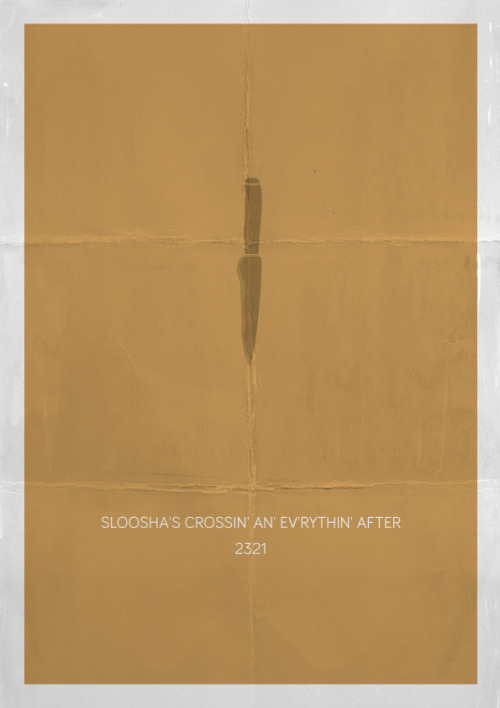
Cloud Atlas by Dat Tran

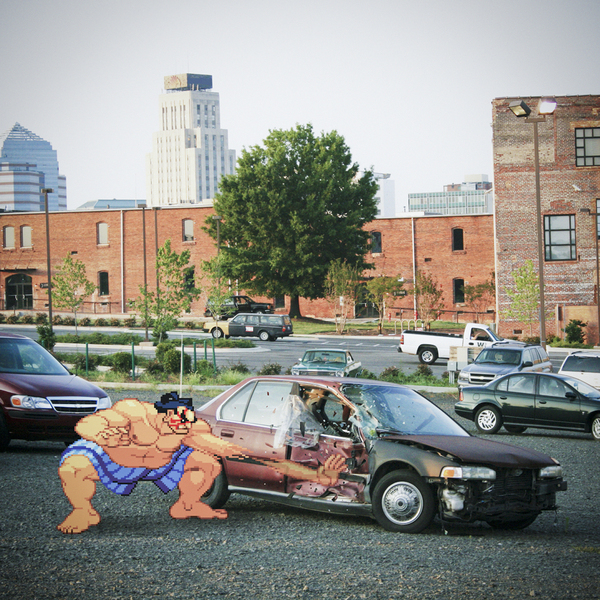
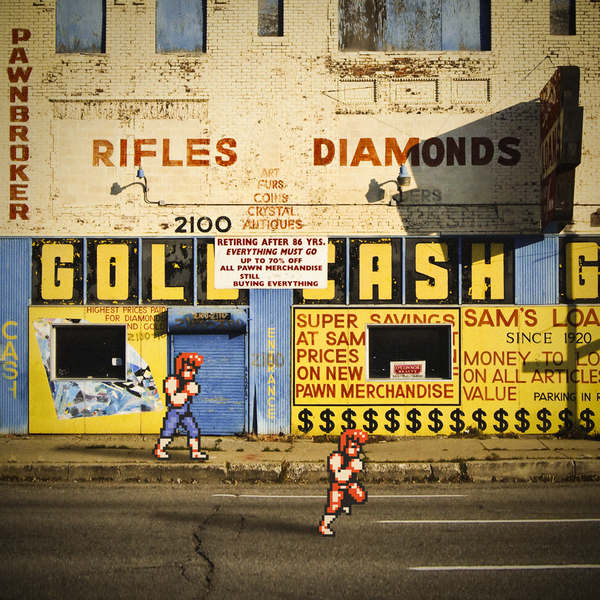
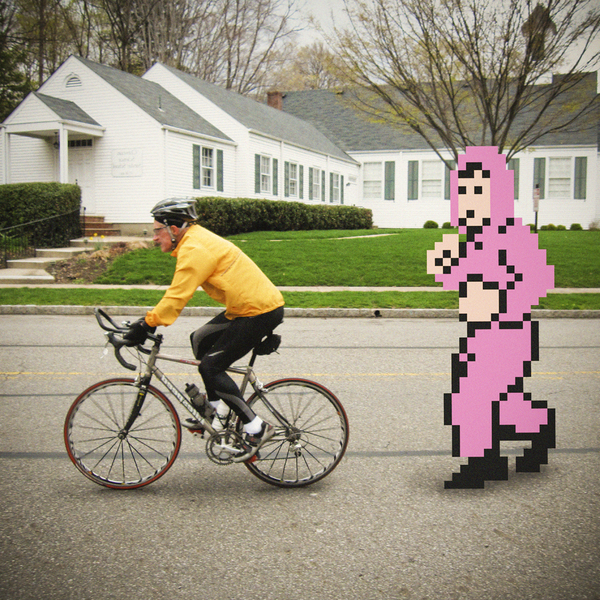
As kids in the eighties and nineties we dreamed of being zapped into the worlds our favourite 8-bit creations. Now, thanks to Aled Lewis, we get a glimpse of what our world would look like if the pixelated heroes and villains of classic video games were able to roam in reality.
The pixel-art images were featured on Lewis’ Behance page with the following statement:
“A mash-up of video game characters and photographic scenes. As a kid I would become completely immersed in there crude pixel environments and they would seem very real! I thought it would be fun to try to express how gamers see these worlds. I spent many hours gaming with my siblings and friends when I was growing up and this aesthetic has really come to represent that time.”
What video game character do you want to see come to life?



(via Visual News)
The post An 8-Bit Fantasy Come True appeared first on Snapsort.

At least she understood me this time.
-Submitted by Amanda
I have discovered what I humbly consider to be the most perfect use of the gif wall medium possible: The reaction shots of Oscar losers. As they are broadcast, you simply cannot take them all in since they're spread out on the screen in tiny boxes, and last but seconds. They're just flickers of emotion. I think that placing them side by side on infinite loops works best to fully read the reactions of disappointment, bitchiness, feigned cheer and actual cheer. As much as losing an Oscar (or winning even) is kind of an emotional Rorschach for the nominated actors, reading their expressions is a Rorschach for the viewers. Except for the really bitchy ones. Those we can all agree on.
Below are so so many examples of fallen dreams. Each row is all of the (present) members of one year's given category (I'm only using actors and actresses here). On far right, I've included the reaction of the winners just for good measure. Have fun laughing at their pain!

This Classic Wondermark was originally published April 28, 2009!
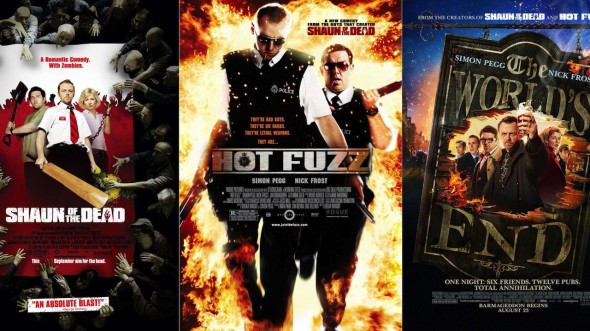
Shaun of the Dead. Hot Fuzz. The World’s End. These movies make up the Three Flavors Cornetto Trilogy, and they share more in common than the creative team of Simon Pegg, Nick Frost, and Edgar Wright.
They all tell the story of the Monomyth, otherwise known as the Hero’s Journey:
A hero ventures forth from the world of common day into a region of supernatural wonder: fabulous forces are there encountered and a decisive victory is won: the hero comes back from this mysterious adventure with the power to bestow boons on his fellow man.
-Joseph Campbell, The Hero with a Thousand Faces
Not familiar with this concept? Long story short, it’s a narrative structure that’s shared by many of our most memorable stories, from Gilgamesh to Star Wars. Some follow this structure on purpose; others by accident. Take a few moments to review the Wikipedia article and orient yourself to the seventeen stages. If you’re still a little fuzzy about what these stages look like in modern movies, check out this mapping of the Star Wars and Matrix trilogies to these stages as well.
Now, are you ready to Cross the Threshold and see how this maps to the Cornetto Trilogy? Probably not, because this is pretty insane. But here it is anyway (click for even larger version):
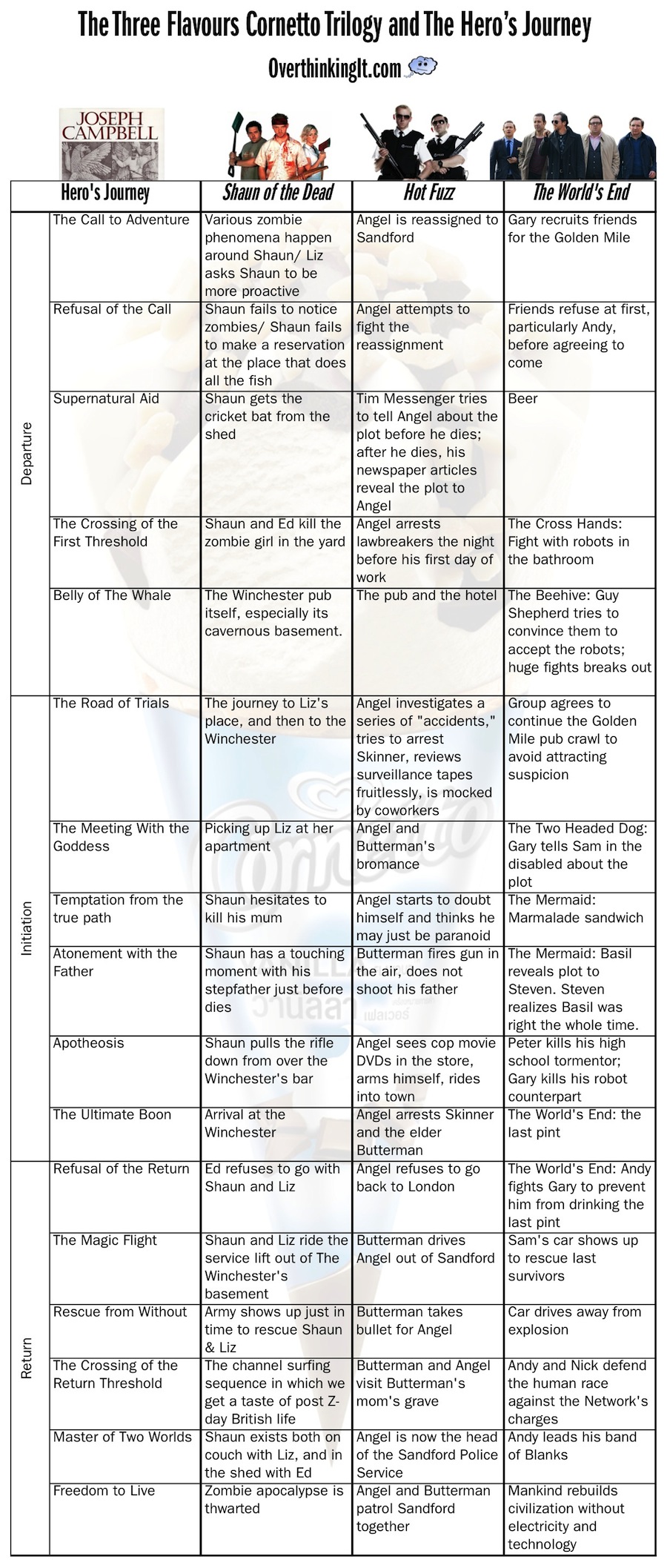
Click for even larger version.
A few important things to keep in mind while reading this:
So what this all mean? In a nutshell, the Hero’s Journey effectively functions as a satirical element of these movies. Part of the satire may be in calling out the frequent usage of the Hero’s Journey in genre movies, but to me, most of the satire lies in the movies’ implicit reminders that achieving self-actualization and escaping from the mundanity of daily life is actually harder than what we see in these genre movies. Lacking a call to adventure, a crossing of a threshold, or an ultimate boon, we have no structure to defeat the real forces of conformity and mundanity in our lives. They may not be zombies, psychotic villagers, or robots, but they’re real, and that makes them more fearsome enemies than anything a storyteller can throw against a hero.
Readers: what do you think? Do you have any suggestions for better ways to map the movies’ plot points to the Hero’s Journey? Do you think the Hero’s Journey acts as a satire in the Cornetto Trilogy, or is it just a convenient way to tell a good story? Let me know in the comments!
Special thanks to Fenzel and Stokes, who came up with this idea on the Overthinking It Podcast, and Stokes, who filled out most of the steps for Shaun of the Dead.
Shaun of the Fuzz’s End: The Three Flavours Cornetto Trilogy and the Hero’s Journey originally appeared on Overthinking It, the site subjecting the popular culture to a level of scrutiny it probably doesn't deserve. [Latest Posts | Podcast (iTunes Link)]
 |
| A classic, I think you'd agree |
It is ridiculous that when unemployment stands at almost 2.5 million more than half of all new jobs still go to foreigners.Wait a minute? Doesn't he know it's the dawn of a new age and most new jobs go to British born people now? Maybe not. In June, in 'Male migrants enjoy higher levels of employment than men born in Britain', the Express told us:
An estimated 225,000 people among the 423,000 who found work in the last year were not born in the UK, showed data released by the Office for National Statistics.Are migrants taking most new jobs or a third of them? Which paper is right? The answer is both. And neither.

why did the chicken cross the road
to get its baby monkeys ahhhhhhhhhhhhhhhhahaha



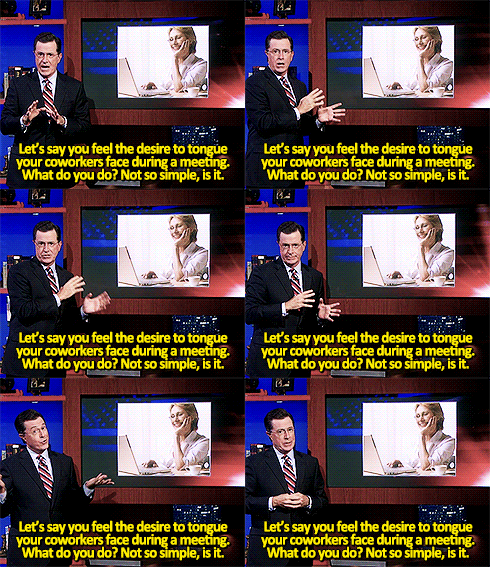


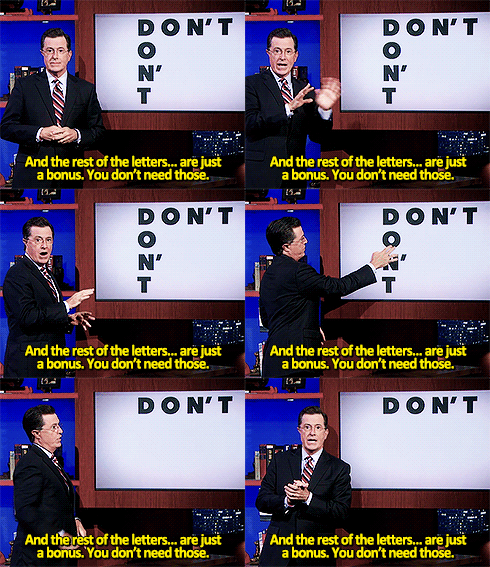



TCR | 2013.08.01 Grab-Ask 5800: Stephen devises a system to help navigate the sexual rules of a modern workplace.
Sam.rj.coleyTHIS IS THE CUTEST EFFING THING.

I just made the most inhuman noise
WHEN IT REALIZES THE PERSON IS STILL THERE AND GOES BACK TO BEING ‘DEAD’
Submitted by: Unknown (via Doghouse Diaries)

.
If only Messrs. Douglas and Malden had known about this back in the day…
.

.
Many thanks to all who sent in these maps (found here on Mr McCune’s blog): Andrew M. Galleni, Geoffrey Engelstein, Brian Kavanaugh, John O’Brien, Jeff Crocombe, Kate Loux, Taed Wynnell, Kelley Ketchmark, Sarah Schoenfeldt, Elise K and Brian Ogilvie.


The film industry’s move to Hollywood, early on in the 20th century, was not entirely an accident. Out west, good weather was more constant, the light better and the scenery more varied than on the East Coast. Hollywood, then still a sleepy hamlet 10 miles north of Los Angeles, was conveniently central between the bustling city and the natural splendour further afield.
Depending on how far afield you’d want to carry your tripod, that splendour could be a stand-in for a surprisingly wide swathe of the world.
This map, apparently produced by Paramount Studios in 1927, does not mention the corresponding films. Can anybody suggest any of the movies these locations refer to? The map does mention, without further context, the 19th-century Californian poet Bret Harte.
Many thanks to Brian Kavanaugh, Lee Breisacher, Noah Feehan, Jim Eikner, Ben Jefferies and Dan Beaver-Seitz for sending in this map, found here on Flowing Data.






 facebook
  reddit