This is lovely!
The moaning of miserable medieval monks who transcribed books.
Lol
My people.
Now I’ve written the whole thing: for Christ’s sake give me a drink.
BUGGRE ALL THIS FOR A LARK.
:)
This is lovely!
The moaning of miserable medieval monks who transcribed books.
Lol
My people.
Now I’ve written the whole thing: for Christ’s sake give me a drink.
BUGGRE ALL THIS FOR A LARK.
:)

Dry-cured ham is one of the lesser known pillars of Spanish identity. Every year the average Spaniard eats 11 pounds of the stuff, and there are 47 million Spaniards. That comes out to more than half a billion pounds each year.
Food historians suggest that Spain’s love affair with jamón dates back to Roman times and was cemented under the Caliphate of Córdoba, when eating pork was a way of declaring one’s Christian-ness. The cured hams also traveled well, which came in handy in the days when Spain ruled the seas; whole pig legs were stacked like firewood on Spanish ships bound for the edge of the world. More recently, traditional Spanish ham has taken on new associations. Sometime around 2010 or so, cafes around Barcelona started cutting prices on their most popular breakfast order—a small ham sandwich and a coffee. At a price of just two euros, they called it the precio crisi: the “crisis special.”
At first, force of habit and the appeal of a bargain kept the cafes full in the mornings. In my neighborhood, a cafe called the Mesón del Toro kept serving the finest acorn-fed pork, its flesh a satisfying deep red, even at precio crisi prices. But unemployment was skyrocketing, and before long the crisis ushered in yet another transformation in Spain’s—or at least my neighborhood’s—relationship with jamón.
About a year ago the cafes that served the crisis sandwich started closing. First one, then three, then six of the old family-owned breakfast spots in my neighborhood shut down and passed on to new owners.
The ham sandwiches stayed on the menu (no cafe in Barcelona could hope to do business without them). But none of the new proprietors was Spanish. Financing a small business has become nearly impossible for anyone who depends on Spain’s crippled banking system, which is making fewer loans now than at any point in the country’s democratic history. Instead, the cafes all went to Chinese immigrants.
What’s remarkable about this is that, until fairly recently, Spain hardly had any Chinese immigrants. Over the past 15 years or so, their numbers have ballooned from a handful to more than 170,000. Most arrived during the boom years of the aughts, only to then fend for themselves alongside everyone else in the grim crisis-era labor market. But as the downturn continued, the immigrants have turned out to hold one crucial advantage over their hosts: access to informal credit.
The Chinese underground banking system is complex and hard to pin down, but suffice it to say there is a great deal of money sloshing around off the books in the world’s second-largest economy. “Forty-four percent of elites want to move their money out of China,” says E. J. Fagan, a spokesman for Global Financial Integrity, a research and advocacy shop in Washington, D.C., that tracks illicit capital flows. International Chinese lending networks—often operating in places like the British Virgin Islands—accept deposits from people on the mainland who want to evade taxes, hide proceeds from corruption, or just realize higher returns than the paltry interest rates offered by Chinese banks. The networks then lend the money out to Chinese entrepreneurs. According to a Global Financial Integrity estimate, $2.83 trillion leaked out of China illicitly from 2005 to 2011.
When “P,” a Chinese woman living in Barcelona, decided she wanted to buy one of the cafes in my neighborhood, her brother-in-law and a Chinese accountant arranged her loan through an entity located “somewhere in South America.” I spoke to P in her new cafe, where she stood behind the bar. She asked me not to use her name, because she didn’t want the Chinese to look bad—which she thinks they do. “Even I think there are too many Chinese bars now,” she said. And the reservoirs of goodwill toward the immigrants were hardly deep to begin with. “I’ve been here 15 years, and sometimes I feel like I just got here,” P said. “My son, at school they call him Chinito.” The more the crisis pinches, the more the rising visibility of the Chinese triggers resentment.
The envy is ill founded, however, because business is worse than ever. At this point, one in four Spaniards is unemployed; they aren’t stopping in for a ham sandwich on their way to work. None of the half-dozen Chinese-owned cafes in my neighborhood is turning a profit. Eight months into her proprietorship, P is struggling to keep up with her loans. And the economic challenge is tied to a gastronomic one. With bills to pay, the cafes have to cut corners.
The sandwiches are suffering, and everybody knows it. One recent morning, I was the only customer on the terrace of the Mesón del Toro. In the cold March air, I stared down at my crisis sandwich. The bread was no longer the fresh, crispy stuff the previous owners had used. It was a dry, store-bought roll. The jamón was more pink than red, the wan color of a pencil eraser. And the meat was cut in suspiciously perfect rectangles, betraying that it had come off the shelf, not the bone. A week and a half later, the cafe was closed; workmen said it had been sold to a new Chinese family.
When I asked P about the declining quality of the sandwiches, she scoffed at the suggestion that the Chinese owners lacked a feel for traditional Spanish fare. “The food’s easy!” she said. Chinese workers have been staffing Spanish kitchens for years. Rather, it was the crisis itself that was still eating away at their breakfast.

Residents call life at Pismo Dunes Senior Park “Pismodise.” Park manager Louise Payne calls it “a holding tank for the great beyond.” Louise has short hair and blunt bleached bangs that give her the air of a preteen skateboarder, but at 72 she’s often found rolling by the park’s 333 trailers in her electric golf cart, alternating between her roles as mother hen and whip-cracker. California is a notoriously youthful culture, but eventually the perpetually young get very old. If they’re lucky enough to live in Pismodise, which is on the Central Coast, they can exit its palm-lined entrance, cross the road, amble across the capacious sand of Pismo State Beach, and dip their toes in the Pacific Ocean while contemplating eternity (or a cocktail).
To move into Pismodise you must meet four conditions: Be 55 or older, keep your dog under 20 pounds, be present when guests stay at your home, and be comfortable with what most Americans consider a very small house. “If you need more than 800 square feet I can’t help you,” says Louise with a shrug. There seems to be some leeway on the dog’s weight. The unofficial rules are no less definite: If you are attending the late-afternoon cocktail session on the porch of Space 329, bring your own can, bottle, or box to drink. If you are fighting with other residents, you still have to greet them when you run into them. Make your peace with the word “trailer trash.”
No one in California aspires to be old or to live in a trailer, but we need to be more open to the possibilities inherent in both. Every day since January 1, 2011, some 10,000 American baby boomers have retired, and that will continue until 2030, when people over 65 will make up 19 percent of the population (up from 13 percent today). Old is the new boom and it is changing the culture and the conversation. (Have you seen all the sexy talk in Betty White’s reality show?) In Washington, D.C., anxiety about the decreasing proportion of workers to retirees underlies the frenzied discussion of “entitlement reform.”
Baby boomers aren’t going to retire the way their parents did. They are poorer and more likely to live alone. They can’t depend on pensions, and the real-estate bubble destroyed almost 50 percent of their wealth. Today one in six seniors lives in poverty, and that proportion is rising; the generation of Americans now facing retirement is so financially ill prepared that half of them have less than $10,000 in the bank. The coming swell of retirees will strain our current system to its limits—in terms of not only health care, but also incidental things like road signs, which are hard for drivers over 65 to read in a majority of American cities and towns.
Emily Greenfield, an assistant professor at the Rutgers School of Social Work, who researchers elder-care networks, says a change is occurring under our feet, whether we see it or not: “Baby boomers have critical mass—they’re covertly revolutionizing society again” as they retire.
One of the biggest questions facing the nation with regard to aging boomers is: Where are they going to live? The options amount to a tangle of euphemisms and politically correct titles: independent living, nursing homes, aging-in-place, naturally occurring retirement communities (NORCs), retirement village, memory-care units, age-restricted communities. All this complexity disguises a simple fact about money, happiness, and aging: Seniors who can live on their own cost the country relatively little—they even contribute to the economy. But those who move into nursing homes start to run up a significant tab—starting at $52,000 a year. People who are isolated and lonely end up in nursing homes sooner. Hence, finding ways to keep people living on their own, socially engaged, healthy, happy, and out of care isn’t just a personal or family goal—it’s a national priority. Among seniors’ living options, there is one we overlook: mobile homes. Time-tested, inhabited by no fewer than three million seniors already, but notoriously underloved, manufactured-homes can provide organic communities and a lifestyle that is healthy, affordable, and green, and not incidentally, fun. But in order to really see their charms, we need to change a mix of bad policies and prejudice.

How Well Do You Understand the Affordable Care Act?

Just Breathe: Confirming Meditation’s Benefits

Prescription for an Ailing Care System: Combat Health Illiteracy
LOUISE AND I GET in her golf cart and zip down the street in front of a row of homes, each one six feet from the next, most decorated differently and elaborately: There are rocks, nautical themes, many angels, some pelicans, some sunflowers. There are lots of signs: every day is a gift, old farts at play. One house, near the little grassy dog run at one end of the park, is surrounded by potted plants. Nearby is a fence, followed by a railroad track and a view of the Los Padres mountains. All is orderly, quiet, and attractive. The streets are a smooth ribbon of black asphalt—perfect for pushing a walker.
Louise has lived in the park for 12 years and managed it with brusque efficiency for the last seven. After raising a family and owning houses in the Central Valley, she found a “cute” unit in the park, bought it, and fixed it up with the sort of attention people give to tricking out their cars. She sees Pismo Dunes as a community, and as we move along, she points out the units where retired firefighters live, and then takes me to visit Ferne, a bright 92-year-old who recently rode on a zip line during a visit to a winery.
As we wind through the park’s little streets, I realize Louise is not just managing relationships with the living. She points out a unit where the owner is ailing, and another where the owner’s husband had recently died; park employees had sat with the woman until the coroner arrived. As for retirement, it’s not in Louise’s future, and neither is leaving Pismo Dunes: “They’ll carry me out of here in a box.”
TRAILER PARKS HAVE REPUTATIONS: they’re considered havens of crime, perches for transients; they’re flimsy rusting structures, dangerous during disasters—”blight” that brings down neighborhood property values. Legally and financially, manufactured homes have a second-class existence. They are not treated as real estate, but as chattel or personal property. Owners don’t get the same rights or financial benefits as do other homeowners. For this reason, sociologists have described trailer parks as “quasi-homelessness” and “a kind of serfdom.” Among the few recent pieces of research about parks is a paper describing the strategies residents use to “manage” the “stigma” of living in a trailer park. Included: dressing well, not telling people where they live, and disparaging other trailer parks as worse than theirs. We all have an ugly prejudice when it comes to the trailer park. “Trailer trash jokes are still acceptable in polite circles where other prejudicial humor wouldn’t be considered funny,” says Paul Bradley, the president of New Hampshire’s ROC USA, a non-profit that helps residents buy their parks and turn them into co-ops.
This prejudice prevents us from seeing a modest but otherwise pleasant house. Travel-trailers evolved into mobile homes, which eventually lost their wheels and became manufactured housing. By any name, they are the largest source of unsubsidized affordable housing in the country. There are seven million manufactured homes housing 18 million people. In some counties they make up 60 percent of dwellings. Approximately one out of every 12 Floridians lives in a manufactured home. Units built since 1976, when the Department of Housing and Urban Development started regulating their construction, can last as long as site-built homes when they’re well built and maintained. Yet they cost far less: $41 per square foot versus $85 per square foot and up. At least one study, from the University of Illinois-Chicago, on trailer parks in Omaha, Nebraska, found that crime rates in mobile-home parks are the same as the rest of the community; the parks do not cause crime nearby; and that the parks appear to depress crime levels because residents own their homes. In one survey, nine out of 10 owners of manufactured homes said they were satisfied with their dwellings. They’ve found a housing option that suited their budget and needs.
Like a number of trailer parks, Pismo Dunes started as a camper park in the 1970s. Some of those campers stayed in place, and concrete blocks surrounded their wheels as they became layered with porches, awnings, sunrooms, and carports. Some have been replaced with new factory-built homes that resemble townhouses—but still have wheels hidden underneath, because Pismo Dunes is still technically an RV park. Though the home have changed dramatically from the trailers they once were, the business model has not: Residents own their homes but not the land under them. If you want to buy here you can go through Louise (who has a license to sell RVs) or buy directly from the owner, but you can’t buy or sell using a realtor. Louise is advertising units that start at $6,500 (for an old camper) to $185,000 (for a nearly new, splashy vinyl-sided Chariot Eagle one-bedroom manufactured house with a loft). Everyone also pays rent to Louise’s employer, the park owner, of between $400 and $700 a month, depending on the space and how long they’ve occupied it. The homes are taxed as automobiles, and fees are paid to the DMV. The park still has community showers and bathrooms, a remnant of earlier days, but most folks use the ones in their homes. Residents can hobnob at a clubhouse that hosts games every night and serves lunch twice a week.

Louise and Ernie laugh about the time she thought she had found him dead in his trailer. Turns out he just wasn’t wearing his hearing aid. (PHOTO: LISA MARGONELLI)
ERNIE LINK, 93, IS sitting in front of his trailer wearing shades and trying to flirt with whoever will play along. “I get slapped a lot, but what the hell,” he tells me. Ernie’s yard is a happy jumble of plants, a flag, and a sun catcher. His house was originally a small travel trailer but he’s added a sunroom and a carport, now occupied by an electric golf cart. In 1990, after 40 years as a railroad conductor based in Pocatello, Idaho, and several years of nursing his wife through a brutal and losing battle with breast cancer, he moved to Pismodise. His daughter lives nearby, but he still wants to live alone. His biggest worry is falling, which is how his best friend and drinking buddy ended up in a nursing home. “He didn’t lift his feet,” Ernie explains. But his neighbors check on him a few times a day. And every day he sets out for an excursion down the park’s streets to the mail room, slowly lifting his feet behind his walker, greeted by everyone he passes. “I don’t think I could have it any better,” he says. “I got a little trailer, but if I fall it’s not far.”
Ernie’s trailer gives him physical and financial independence. Pismo Beach’s residents are 36 percent seniors, a third of whom live in mobile-home parks. In 2010, a city survey found seniors in mobile homes spent a smaller percentage of their income on housing than renters or homeowners, even though their incomes were lower. The Department of Housing and Urban Development found that mobile-home dwellers “do substantially better,” nationally, than owners and renters at keeping housing costs below 30 percent of their income.
What surprises me is the wide range of incomes in the park—more than in subsidized housing, for example, or a retirement community. Little trailers like Ernie’s nestle next to much more impressive house-like units with bay windows, fancy porches, and nice cars in the drive. Louise tells me that some residents of Pismo Dunes survive on less than $900 a month, while others have monthly incomes of $15,000. For half of the residents, this is their second home. This is not a fluke: Farmers Insurance surveyed seniors in mobile homes in 2012 and found that while 30 percent have assets under $25,000, nine percent had more than $250,000 and some had more than $500,000. “When you consider we’re called trailer trash, it’s a joke,” says Louise. “I have very wealthy people here. They think it’s the coolest thing there is.” Lunches at the clubhouse are priced at $5 so that those who would never ask for help can bring home leftovers, those who are better off can put a little extra in the jar. One resident likens the diverse incomes and classes in the park to the old canard about nudist camps—everybody’s naked so you can’t see the differences. “In here we’re all equal. Some can hardly afford food. It’s all over the playing field. There’s no tension because some of the trailers are run-down. Who cares? It’s their home.”

Deenah: “Carolyn saves the crossword puzzles and brings them to me at seven every morning.” (PHOTO: LUCAS AZNAR MILES)
JUST BEFORE SUNSET, LOUISE and I make our way to the evening’s “therapy session” at Space 329, at the junction of the two biggest streets in the park. Deenah and Ronnie Stockton have an elevated porch that allows them to see everyone coming and going. They also own another house in Bakersfield, California. The evening was peppered with their own brand of banter, well-worn and most often directed at their 50-year marriage. (“I tried but the gun jammed!”) Today’s conversation meanders from topic to topic: a neighbor’s overweight King Charles spaniel, the ambulance that came to the park earlier in the day, a neighbor’s renovation that includes a Jimmy Buffett-inspired sign that says “it’s five o’clock somewhere.” Someone tells a story about noticing the park’s flag was at half-mast and asking Louise if it was in memory of someone who died in the park. “Are you kidding? That would be down all the time,” she replied, to much laughter. Deenah tells a story about the time Carolyn Kolthoff, a 90-year-old neighbor, called to ask for a cup of coffee. Deenah made the coffee and dutifully took it across the street, only to discover that Carolyn had fallen. Turns out she felt better asking for a cup of coffee than a hand to get up. Around 7 p.m. or so, the group drifts off after making plans for their morning walk.
“Therapy” in these circles is meant as a joke, except it happens to be true. One of the longest-running studies of aging, conducted over a period of 34 years in Alameda County, California, found that among the predictors of healthy aging are: not smoking, moderate drinking, having five or more friends, avoiding depression, and walking for exercise. Older people who do two out of the three last activities (friends, avoiding depression, and walking) are more likely to spend their next six years in a sort of golden old age, without becoming dependent upon others—or, god forbid, nursing homes—for the basics of daily living. In other words, sitting on the porch, drinking and yakking, is exactly what the doctor suggests. (It’s also good for all that residents can drink without driving.)
When I come back to the park just before 7 a.m. the next day, seven women are waiting for me. We set off at a brisk pace, walking all the roads of the park and waving to anyone who’s looking out the window or is on the porch. Walking—on the smooth and safe streets, to the beach, and to the market in town—is a big part of the culture of Pismo Dunes. This makes park residents exceptional: less than 25 percent of older adults say they walk regularly.
Most places in America make it hard to grow old. Older people in neighborhoods with high crime, lots of traffic, and poor lighting have been found to “lose functioning” (in other words, need nursing homes) earlier than those who live where they can walk. Those who live in the suburbs lose their social networks when they stop driving and become isolated. Loneliness is a killer: Over a six-year period, lonely seniors are 45 percent more likely to die and 59 percent more likely to decline than those who aren’t lonely, according to a University of California-San Francisco study. Pismo provides no formal services to elders, no health care, no exercise room. To the extent there’s a safety net here, it’s made by residents themselves.

Carolyn: “Louise is tops as a person and a manager; you know where you stand and she doesn’t pull any punches.” (PHOTO: LUCAS AZNAR MILES)
ONE AFTERNOON, I GO to meet Deenah’s neighbor Carolyn, who moved into the park 23 years ago because her mother lived here. Carolyn has vivid eyes and an impish sense of humor. She laughs about her reason for choosing her unit: “My husband was a talker, and this corner is a good location—you can see everything. Louise says I’m nosy.” Her old trailer was cold and expensive to heat, so last year Carolyn bought a “park model.” Her home is small and spotless. A loft contains a few dolls, nothing much else. Clutter, she says, is not possible here. Most days, Carolyn gives Deenah crossword puzzles she’s cut from her paper in the morning and babysits Louise’s dachshund, Sadie. Sadie happens to be lying on the carpet, dressed in a small lavender coat, and her eyes follow Carolyn’s slow movements around the home. For four years, Carolyn walked the dachshund to town every day. Recently, though, she’s felt unsteady so she’s started getting around in a golf cart that Louise brought her.
Rutgers researcher Emily Greenfield is working with a team to examine community-based initiatives such as “villages” that are designed to make it possible for older people to live longer on their own. The work is in its early stages, but Greenfield says it’s hard to quantify the clinical impact of Carolyn’s relationship with Louise, or Deenah’s willingness to run over with a cup of coffee and give her a hand up, or Sadie. “Dog sitting! How could an agency track that kind of interaction?” asks Greenfield.
We don’t do a great job of stitching people together through families or institutions in the United States, and that shows up in how we treat elders. U.C. Berkeley social welfare professor Andrew Scharlach, who is studying how to create communities as people age at home, says that in the U.S. aging is seen as an “individual problem,” rather than a societal one. He tells me that in this country, a third of elderly people who are disabled don’t have adequate help dressing, but in Sweden, where policies and communities are more integrated, less than five percent lack such basic care. Scharlach says American negligence is an embarrassment: “Swedes look at me like, What’s wrong with you people?” Pismodise—a for-profit, down-market entity without a professional staff—pretty much organically fills some of the smaller holes in the American system.
I don’t have any hard numbers on aging in the Pismo Dunes, or even more than a dozen interviews over a couple of two-day-long visits, but I can say that sitting on Deenah and Ronnie’s porch, drinking rosé, I felt better about getting old. I wanted to find out more about what made the place tick. What made this miniature trailer park more than just a cheap and funky place to live, more than a nice environment to push a walker? Everyone asked if I’d talked to Charlie and Margaret.

Charlie and Margaret: “We look at each other and say ‘Can you believe this happened?’ When I lost my husband I thought it would be like that forever.” (PHOTO: LUCAS AZNAR MILES)
CHARLIE HENSON STARTED COMING to the park for vacations with his wife in the 1970s. He moved in full time after he retired in 1985 from maintenance work at a refinery in Taft, California. In his sunroom, a stuffed panda sits under a painting of an oil derrick. He’s been fixing something with a cold chisel, which he’s left on the kitchen table. Charlie is active on the residents’ committee, cajoling management to improve the park. He makes the rounds, checking on people. (He’s found several people who had passed away in their homes.) And residents check on him. When his wife was ill with cancer, neighbors dropped by all the time. In the mornings Charlie likes to dance to Nat King Cole, with a broom. One morning his neighbors knocked, making sure he was okay. “Since we’ve been here all these years we help each other.” Even with inevitable tensions in the park, he says, hardly anyone locks their doors.
Margaret Julkowski walks in, tallish and luminous in Charlie’s dark house. Margaret and Charlie fell in love a year ago, and they still glow. Margaret was a social worker in California’s Central Valley. She moved to the park five years ago with her husband, who died six months later. “People were good to me even though they didn’t know me,” she says. One woman convinced her to come to clubhouse, where she played cards with Charlie and his wife. When Charlie’s wife passed away, he and Margaret started taking sandwiches out to where they could look at the ocean. They told me they were amazed to find out they were in love. And then word traveled fast. Residents gossiped that they’d seen Charlie kiss Margaret good night. “It’s a small Peyton Place,” Margaret says. In her golf cart, she whispers to me that now she kisses Charlie anytime she wants to.
Gossip is the currency of the kind of community that doesn’t form on Facebook. Here people watch each other, and they know they’re being watched: bad behavior is noted, people who “do the right thing” are admired. Pismo Dunes, with its little streets, is a virtuous circle where you can bank social capital. Margaret has a serious respiratory condition, and she’d ended up in the hospital for weeks at a time. Her daughter had qualms about letting Margaret move back to the park, but when she saw the parade of visitors, some carrying food, she realized Margaret was likely in the best hands here.
And another thing that unites Pismodise is death. Outside, dying is essentially a taboo topic. Here, people bring it up, in one way or another, every 15 minutes. Margaret and Charlie shared the deaths of their spouses, as well as their current lives. I’ve never been in such a vibrant, deathly place. “We’re living to the fullest because we know mortality is close,” Margaret tells me.

“Therapy session:” The term is used in jest for the daily late-afternoon porch party at Pismo Dunes, but studies show that having friends, moderate drinking, avoiding depression, and walking are predictors of a happy, independent old age. (PHOTO: ARNALDO ABBA)
WHEN PORTLAND STATE UNIVERSITY professor Andrée Tremoulet held focus groups with seniors in mobile-home parks, she was surprised that so many said they’d do it all over again. In a paper published in the Journal of Housing for the Elderly, Tremoulet speculates that mobile-home parks can, for some seniors, do a better job of meeting needs than more-traditional arrangements in apartment buildings or in the suburbs. The design of the community allows seniors to own and modify their homes, have dogs, and putter around with hobbies like gardening in a way they couldn’t in an apartment building. Meanwhile, because parks have boundaries and streets, they function a bit like a gated community, where residents feel safe and have an easier time making friends than in either an apartment or a suburb. Mobile-home parks give residents a lot of control over their desire to be alone or to be social, Tremoulet found.
But buyer beware, all is not right in the mobile-home park: Residents have to contend with a parallel world of second-class legal rights and financing that needs to be changed before manufactured homes are a really good investment. The legal problems start with the parks themselves. Because most residents own their homes but not the land under them, they have the rights of neither renters nor homeowners. Rent control is rare in mobile-home parks. (Pismo Dunes’ owner managed to fight rent control in 2002 because of the park’s designation as an RV park.) But residents don’t really have the ability to move if landlords raise rents because moving a full-size manufactured home can cost as much as $25,000. Sometimes park owners can raise rates indiscriminately and even take over homes or sell the land under the park for another purpose. “A park in the hands of the wrong owner can be milked for income. The power is primarily in the hands of the landowner,” Tremoulet says.
The financial system, meanwhile, treats manufactured homes more like cars than houses—which means they depreciate like cars rather than gaining value the way houses do. New manufactured homes are sold by dealers on lots, similar to cars, with similar high-pressure sales tactics. In most states, buyers can’t get a real-estate mortgage for a mobile home. Rather, they have to get a personal loan for “chattel,” with higher interest rates than a mortgage’s. Even though manufactured homes last as long as conventional site-built houses, they start losing value as soon as the buyer moves in. Likewise, in some areas, manufactured homes have been excluded from projects that weatherize low-income homes. (Some homes at Pismo Dunes, however, have received government assistant for weatherizing and disability access.) Insurance can also be a struggle; in hurricane-prone areas like Florida it is impossible to insure some mobile homes.
Bradley, who runs the non-profit ROC USA, calls manufactured housing finance and regulation “sick.” Conventional real-estate markets—with their systematized regulation and finance—build wealth, he says, but excluding this permanent form of housing from that conventional system depletes capital from people who live in manufactured homes. Bradley sees the current market structure as a holdover from the days when trailers were really trailers. The homes have changed; regulations have not kept up.
ROC USA has leveraged money from banks and foundations to help more than 100 groups of mobile-home owners organize to buy the trailer parks under their houses. The non-profit essentially provides the guarantee on the capital, while residents make payments on the loan just as they would pay rent on their spaces. Also, in some parts of the country there are parks that work more like condominiums, where buyers own their houses and a share of the land. (One version of this is the Blue Skies Village that Bing Crosby started in Palm Springs, California.) Seattle non-profit developer HomeSight literally stacked sections of manufactured homes together to build a complex of affordable two-story duplexes named Noji Gardens, and made it possible for 75 families to buy their own homes. Still, Bradley doesn’t see baby boomers flocking to manufactured housing until the business model and the regulations are updated to reduce the risks.
And that’s too bad, because in many cases, new manufactured houses can solve another problem: they offer greener housing than other options. An elaborate 2012 report published by ROC USA and underwritten by HUD found that mobile homes use, on average, far less energy and water than conventional homes or condos (the mobile homes in the study were 940 square feet, larger than those at Pismo Dunes). While models built before 1976, when federal regulations kicked in, sometimes have exorbitant utility bills, newer models made to Energy-Star efficiency standards can reduce the combined costs of electricity, gas, and water to well below $1,000 a year, even in the hottest and coldest parts of the country. And manufacturing the homes in factories cuts construction waste by 30 percent. The efficient layout of a mobile-home park helps conserve water and reduces storm runoff. And in some locations, residents are able to share vehicles, or get around without them, which saves money.
Jennifer Siegal, a Los Angeles-based architect who is working to create communities of cheap and green manufactured homes, reminds me that in a generation we’ve gone from storing our memories in boxes in the attic to keeping them on hard drives. Our houses can catch up with our lifestyle, but until the marketing, financing, and regulations are changed, home manufacturers can’t reach new customers. ROC’s Bradley says manufacturers are caught between innovating faster to provide a better product, and innovating to provide an even cheaper house that fits with the current market structure. It turns out a prejudicial market—a stigma—dooms manufactured homes to stay as trailer parks.

At Pismo Dunes, the gang walks at 7 a.m. every day; only 25 percent of American retirees walk regularly. (PHOTO: ARNALDO ABBA)
THE U.S. HAS AN impressive crowd of people working to provide affordable housing through infrastructure bonds, HUD loans, and IRS tax credits. Ironically, a lot of effort and money are put into federally-funded programs that have created a few hundred thousand units, while manufactured homes provide housing to almost three million seniors. “The problem is there’s a huge stigma,” says Rodney Harrell, a senior strategic policy advisor for AARP. “As a housing person myself, I had to learn a lot to appreciate that manufactured homes could be a good choice.” The image of the trailer as a rusting hulk, a blight on the landscape, and a scam-laden investment aimed at poor people make activists and policy makers shy away from changing the very policies that could make it a better investment. Tremoulet thinks some of the prejudice is the result of HUD incentives themselves, which offer carrots to builders of low-income housing but not of manufactured housing. And then there are the residents, often stereotyped as blue-collar whites, who may be “less interesting” to foundations and non-profits looking to help marginalized communities like the homeless, Tremoulet says. “The whole culture has a spiraling effect,” says Harrell, which perpetuates a cycle of bad policies.
Harrell believes that if policies were dramatically changed, manufactured-home parks could offer low-cost housing while serving as hubs that provide health care, recreation, and other services. “But getting over that stigma is step one—before the policies and the financing can change, you have to convince policy makers that there’s something good there.”
As I got off the phone with Harrell, it crossed my mind that, as Mayberry RFD was to small towns in the ’60s, Pismo Dunes Senior Park it to mobile-home parks. Call it Mayberry NORC if you like—Louise and her staff may be closer to the mythically benevolent Sheriff Andy Taylor than the usual park managers and staff. And the diminutive size of its RV-derived manufactured homes, and its sunny California beach location just add to its charmed air. The owners of Pismo Dunes, who have kept the park in their family for more than a generation, seem to be in no hurry to cash out, which is the opposite of the national trend. Pismo Dunes is the mobile-home park as it could be.
I returned to Pismo Dunes for another visit last November. Experts had warned me against using the term “trailer park.” One sociologist published a paper saying that in 45 ethnographic interviews, she never heard anyone reclaim the word trailer trash the way the words queer and redneck have almost become badges of pride.
They hadn’t met Louise, who threw a “trailer trash” party a few years ago. “We had bras hanging from clotheslines in the clubhouse. Fried potatoes! Fried Spam! Pickled eggs and okra! We even got an outhouse for the decorations.” Guests ate out of pie tines and drank out of pint jars. By addressing the prejudice head on, the park has embraced the word, even enjoys it. When I met up with Louise in November, she was at a storage area examining the park’s 350 electric Christmas trees, dozens of inflatable Santa installations (including one of Santa in a trailer), and many, many electric reindeer. “That’s my 11-foot reindeer,” she said, pointing at one of the multitude of decorations hanging from the ceiling. Louise spent the month installing most of what was in storage. Already the clubhouse lawn was studded with pink pigs carrying presents on their backs, white bears, angels, a mechanical “crane” bearing presents, a troop of leaping dolphins in Santa hats, and a constellation of pink and purple Christmas trees, some upside down. They shimmered against the green grass. It was a boisterous show of community, pride, and one-upmanship: The park has won the Pismo Beach Clam award for decorations so many times that Louise says the town had to create another award so someone else could win something too.
When I went back to visit with Charlie and Margaret, she was thin and weak, preparing to go back to the hospital. Margaret told me that they were blessed to have found each other and, “We always say how blessed we are to have reasonable rent of $400 to $450 a month this close to the ocean,” she added. “I don’t know where we could live for that much unless it was subsidized senior housing. And as someone who worked for the welfare department, I never wanted to live in one of those places.”
At Ronnie and Deenah’s, the therapy session is well under way and the rosé is flowing. The park’s security officer, a gregarious woman in her 40s, gets teased for “stopping crime by being too sexy.” The friends sit around discussing their grandkids, holiday plans, soup night at the clubhouse, depression, cancer, and Christmas lights, as the gloaming settles in and the plastic icicles on the edge of the roof wink on.

So far this spring has been a momentous season for the American city. Stockton, California, became the country’s largest municipal bankruptcy, collapsing under $1 billion in debt incurred before the housing crisis knocked the city on its back. And in Michigan, the governor appointed an emergency manager to take control of Detroit and save it from insolvency of its own, caused by a shrinking population and unwieldy pensions obligations.
And then there was the release, in early March, of a rebooted SimCity, the first new installment of the metropolitan video game in a decade.
In it, anyone can run a city with the power of a Detroit-style emergency manager, unfettered by democracy or public unions, a Robert Moses on steroids. After its release, city geeks—adherents of an urbanist intellectual style that is strikingly common these days—debated the merits of the new SimCity: What use is a city simulation that doesn’t include democracy? Are the assumptions in the model too favorable to suburban sprawl over walkable urbanism? Are its cities green or environmentally exploitative? What does the end of agriculture as a zoning option in the game mean for the urban chicken farmer?
In most media outlets, coverage of SimCity’s release was dominated by headlines about the game’s epic software problems, which likely drowned out—for the average reader—much of this discussion among urbanist wonks. But what both conversations obscured was a more basic fact: that urbanist wonkery as a contemporary phenomenon practically grew up with SimCity.
First introduced in 1989—a few short years before the “the new urbanism” became an organized movement—the game introduced the public to the ideas behind urban planning and public finances, viewing cities as zoning grids and interlocking systems that affected how it changed and grew.
“I remember being a grad student and leaving SimCity on for days at a time with certain policies in place to see what would happen,” Drew Williams-Clark, a Chicago city planner, told Fast Company, which polled urban planners about the game and even challenged a group of them to build the “best” cities in a contest promoting it.
In 1994, the Princeton sociologist Paul Starr wrote with some suspicion about SimCity and other “computer simulations that turn public policy and ideas into popular entertainment,” wondering about the implicit political assumptions smuggled in through the games’ models. Starr opened his piece with an anecdote about his then nine- and 11-year-old daughters obsessively playing an early version of SimCity. Those daughters are now pushing 30. Along with them, a whole generation has gained a weirdly intimate, market-driven, heavily stylized appreciation of city government and planning through the game.
They have also acquired something else: a characteristic optimism about cities. As Starr wrote 20 years ago, the first SimCity arrived on the heels of “a broader collapse of confidence in planning in the 1970s and 1980s,” a period marked by loss of faith in predictive models. It was also a period marked by a loss of faith in cities themselves. SimCity’s long run reflects, if anything, the opposite: the hope that Americans have placed in their cities in recent years, spurred by an enthusiastic, wonkish understanding of how and why they work.

SimCity. (COURTESY OF ELECTRONIC ARTS)
WHEN ROGER EBERT DIED earlier this month, I came across his review of another work of art about cities that came out the same year as the first SimCity, Spike Lee’s racially-charged Do the Right Thing. Ebert considered the movie, and the mixed messages it contained, a reflection of the “weary, urban cynicism that has settled down around us in recent years.”
In 1989, the crime rate was peaking and crack was tearing apart the inner city, manufacturing was beginning its downward slide but the information economy hadn’t begun to even partially replace it, and racial tensions were far higher—think New York city pre-Rudolph Giuliani, much less Mike Bloomberg. Suburbs were in, urbs were out. In the first edition of SimCity, an initial scenario was called “Detroit, 1972″ and had gamers trying to solve the decaying city’s crime problem and put it on a sustainable path to growth.
While Detroit’s problems have yet to be solved, today we think differently about cities in general. The big problem of the city today isn’t the hollowing out of the urban core that America saw in the ’70s and ’80s, but the filling-in (more people live in cities here than ever before) and the pushing out to suburbs—which have become the new locus of poverty. To put it simply: We talk about more about gentrification than white flight.
The American city is an icon. Books like Edward Glaeser’s The Triumph of the City detail the economic advantages of cities—for health, for jobs, for quality of life. Richard Florida’s Who’s Your City? promotes his idea of cities as a gathering place for the creative, post-industrial economy.
For younger writers like Ryan Avent and Matt Yglesias (both former SimCity obsessives) the quest to grant more people access to these urban engines of prosperity has the quality of a moral crusade. In their view, zoning rules, NIMBY politicking, and other structural impediments to density all conspire to limit the supply of urban housing and commercial space, creating an artificial scarcity of real estate in vibrant cities like San Francisco, Los Angeles, Austin, and New York. Density is also increasingly seen as an environmental good, bringing with it efficiencies in energy expenditures as the costs of climate control and transportation are reduced. So many problems, from joblessness to gentrification, could be forestalled if cities simply let themselves hold many more people, homes, and businesses.

SimCity. (COURTESY OF ELECTRONIC ARTS)
In SimCity—whose Mac edition is due out in June—this dynamic becomes tangible. The new game doesn’t reflect all of the ways cities could be optimized: Your simulated metropolis must be built around roads for cars and without bike lanes, although your public transit options include light rail and buses; there is no multi-use zoning. Some of these restrictions are due to the limits of the simulation itself, some due to gamification. The new edition it is at once far more sophisticated than previous siblings, and yet less daring than it could be. Heavy traffic is a far more realistic problem than in previous editions, but I still can’t impose a congestion tax to help clear my downtown and raise revenue.
But as has always been the case, the game is strongest as an economic model. It tasks you to turn empty land into prosperity within the structure of what the game’s original designer, Will Wright, called “a capitalistic land value ecology”—a concept that bears more than a passing resemblance to the assumptions behind some market-focused urban debates of today. The player has to turn a plot of land into a city by creating the right market parameters: Real estate must be zoned and provided with the right infrastructure (roads, water, power) for sim-citizens to build homes and shops; urban services (police, fire, and education) to protect the participants in the market. Players specialize their city’s economy with industrial policies designed to support everything from oil wells to trade. Nearly everything else—construction, design, daily life—happens independently.
While playing, it’s easy to solve your early economic problems by zoning more land and collecting more taxes. But soon you run out of land, your budget is in the red, pollution is becoming a problem, and your industries are running out of workers. As the city grows and more services are demanded, density becomes your watchword. This is a true nod to the realities of urbanism, where building up is the only way to efficiently capture the economic benefits of new residents.
The most important lesson of SimCity, and of the real Detroit, is that growth is the only successful urban policy. But the brilliant decisions of the past become traps as you realize how they limit new development. It makes for an engaging, obsession-creating game, and a troubling reality.
One common rap against young market urbanists today is that they are too impatient with the human realities of politics. It’s true that SimCity takes politics out of the picture, but there are moments in the game when this very absence is instructive, eerie, and conspicuous: When a poorly planned city of my design ran out of residential space—and workers—it became clear that only massive restructuring would save the city from failure. An entire neighborhood would need to be wiped out and re-zoned for the greater whole to thrive. My digital bulldozers wasted no time. Obviously, the real world doesn’t work that way.
That’s partially the point. In his 1994 critique of the SimCity’s simulated approach to politics, Starr concluded that the best simulations work to expose their assumptions. What cities need to do to survive can be a political mess. To survive, mine needed massive redevelopment that anywhere else would have been choked by local interests. Making those kinds of changes to a city’s plan aren’t easy, whether the need is for a new economic base or simply lower rent.

SimCity. (COURTESY OF ELECTRONIC ARTS)
But the easy decisions to protect existing residents from change—decisions that create sprawl and raise rents—mean that if the bottom falls out and growth halts in the city, the necessary adjustments are that much harder. A lack of density has become a liability in Detroit, as city services are spread too thin over a sparsely populated city. And after the economic problems comes the social disruption that surrounds the previous generation’s take on cities, knotty thickets that politicians rarely navigate with grace. Which is why, when it comes down to it, the people who deal with the problems of failing cities are judges, as in the case of Stockton; unelected boards, as in the financial rescue of insolvent New York in 1975; or an emergency manager.
The juxtaposition couldn’t be clearer in Detroit, where the manager with SimCity powers, a black bankruptcy attorney named Kevyn Orr, was greeted by protesters delivering him Oreo cookies symbolizing betrayal of his race. Orr recently restructured Chrysler; now he will have to do the same for Detroit. The optimistic euphemism for the task is “right-sizing”—how else do you fix the problems of a city that was built to serve a population of 1.5 million (and service the pensions of all the workers in a city of that size) that now has a population of just 700,000 people? While the meat of his work will be credit negotiations, there is no shortage of bold city plans with experimental zoning techniques designed to attract new industry—and new people—to a more consolidated city.
SimCity doesn’t nearly begin to capture the costs, human and financial, of Detroit’s management problem, or any metropolitan dislocations. But if you can picture how a player would fix a broken city—one blogger actually has suggested just that as a way to crowdsource solutions—you can find the most important assumption built into the models of SimCity, today’s and the original: That building a sustainable metropolis is possible at all.
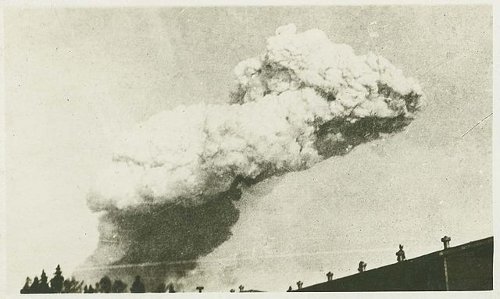
On Dec. 6, 1917, an overnight express train bearing 300 passengers was approaching Halifax, Nova Scotia, when an unexpected message arrived by telegraph:
“Hold up the train. Ammunition ship afire in harbor making for Pier 6 and will explode. Guess this will be my last message. Good-bye boys.”
The train stopped safely before the burning French cargo ship Mont-Blanc erupted with the force of 2.9 kilotons of TNT, the largest manmade explosion before the advent of nuclear weapons.
The blast killed 2,000 residents, including train dispatcher Vince Coleman. He had remained at work in the telegraph office, sending warnings, until the end.

Architects Moon Hoon designed a house in Chungcheongbuk-do, South Korea, that uses a staircase as a slide, a library and a room-divider. My goodness, it is lovely.
The basic request of upper and lower spatial organization and the shape of the site promted a long and tin house with fluctuating facade which would allow for more differentiated view. The key was coming up with a multi-functional space which is a large staircase, bookshelves, casual reading space, home cinema, slide and many more…The client was very pleased with the design, and the initial design was accepted and finalized almost instantly, only with minor adjustments. The kitchen and dining space is another important space where family gathers to bond. The TV was pushed away to a smaller living room. The attic is where the best view is possible, it is used as a play room for younger kids. The multi-use stair and slice space brings much active energy to the house, not only children, but also grown ups love the slide staircase…An action filled playful house for all ages…
Panorama House by Moon Hoon (via Neatorama) 
    
|


Living on the shore of Lake Ontario, just east of Toronto, photographer Matt Molloy has daily encounters with brilliant sunsets and cloudscapes that he’s been photographing for over three years. One day he began experimenting with time-lapse sequences by taking hundreds of images as the sun set and the clouds moved through the sky. Molloy then digitally stacked the numerous photos to reveal shifts in color and shape reminiscent of painterly brush strokes that smeared the sky. You can learn more about his “timestack” technique over at Digital Photo Magazine and prints are available here. (via bored panda)
John.boddieI am wondering how many of these reactions are taught and practiced in a University level chemistry course. This sort of data could be really helpful in reinforcing the "trade" aspect (as opposed to the academic aspect) of chemistry.
Over at NextMove software, they have an analysis of what kinds of reactions are being run most often inside a large drug company. Using the company's electronic notebook database and their own software, they can get a real-world picture of what people spend their time on at the bench.
The number one reaction is Buchwald-Hartwig amination. And that seems reasonable to me; I sure see a lot of those being run myself. The number two reaction is reduction of nitro groups to amines, which surprises me a bit. There certainly are quite a few of those - the fellow just down the bench from me was cursing at one just the other day - but I wouldn't have pegged it as number two overall. Number three was the good old Williamson ether synthesis, and only then do we get to the reaction that I would have thought would beat out either of these, N-acylation. After that comes sulfonamide formation, and that one is also a bit of a surprise. Not that there aren't a lot of sulfonamides around, far from it, but I was under the impression that a lot of organizations gave the the semi-official fish-eye, due to higher-than-average rates of trouble (PK and so on) down the line.
My first thought was that there might have been some big and/or recent projects that skewed the numbers around a bit. These sorts of data sets are always going to be lumpy, in the same way that compound collections tend to be (and for the same reasons). The majority of compounds (and reactions) pile up when a great big series of active compounds comes along with Structure X made via Reaction Scheme Y. But that, in a way, is the point: different organizations might have a slightly different rank-ordering, but it seems a safe bet that the same eight or ten reactions would always make up most of the list. (My candidate for number 6, the next one down on the above list: Suzuki coupling).
There's also a pie chart of the general reaction types that are run most often. The biggest category is heteroatom alkylation and arylation, followed by acylation in general. By the time you've covered those two, you've got half the reactions in the database. Next up is C-C bond formations (there are those Suzukis, I'll bet) and reductions. (Interestingly. oxidations are much further down the list). That same trend was noted in an earlier analysis of this sort, and nitro-to-amine reactions were thought to be the main reason for it, as seems to be the case here. There's at least one more study of this sort that I'm aware of, and it came to similar conclusions.
One of the things that might occur to an academic chemist looking over these data is that none of these are exactly the most exciting reactions in the world. That's true, and that's the point. We don't want exciting chemistry, because "exciting" means that it has a significant chance of not working. Our reactions are dull as the proverbial ditchwater (and often about the same color), because the excitement of not knowing whether something is going to pan out or not is deferred a bit down the line. Just getting the primary assay data back on the compounds you just made is often an exercise in finger-crossing. Then waiting to see if your lead compound made it through two-week tox, now that's exciting. Or the first bit of Phase I PK data, when the drug candidate goes into a person's mouth for the first time. Or, even more, the initial Phase II numbers, when you find out if it might actually do something for somebody's who's sick. Now those have all the excitement that you could want, and often quite a bit more. With that sort of unavoidable background, the chemistry needs to be as steady and reliable as it can get.






“Kairos” animated trailer by La Cachette studio (for the promotion of Ulysse Malassagne’s comic book)
This is pretty cool.
From Nature comes this news of an effort to go back to oncology clinical trials and look at the outliers: the people who actually showed great responses to otherwise failed drugs.
By all rights, Gerald Batist’s patient should have died nine years ago. Her pancreatic cancer failed to flinch in the face of the standard arsenal — surgery, radiation, chemotherapy — and Batist, an oncologist at McGill University in Montreal, Canada, estimated that she had one year to live. With treatment options dwindling, he enrolled her in a clinical trial of a hot new class of drugs called farnesyltransferase inhibitors. Animal tests had suggested that the drugs had the potential to defeat some of the deadliest cancers, and pharmaceutical firms were racing to be the first to bring such compounds to market.
But the drugs flopped in clinical trials. Companies abandoned the inhibitors — one of the biggest heartbreaks in cancer research over the past decade. For Batist’s patient, however, the drugs were anything but disappointing. Her tumours were resolved; now, a decade later, she remains cancer free. And Batist hopes that he may soon find out why.
That's a perfect example, because pancreatic cancer has a well-deserved reputation as one of the most intractable tumor types, and the farnesylation inhibitors were indeed a titanic bust after much anticipation.. So that combination - a terrible prognosis and an ineffective class of compounds - shouldn't have led to anything, but it certainly seems to have in that case. If there was something odd about the combination of mutations in this patient that made her respond, could there be others that would as well? It looks as if that sort of thing could work:
Early n-of-1 successes have bolstered expectations. When David Solit, a cancer researcher also at Memorial Sloan-Kettering, encountered an exceptional responder in a failed clinical trial of the drug everolimus against bladder cancer, he decided to sequence her tumour. Among the 17,136 mutations his team found, two stood out — mutations in each of these genes had been shown to make cancer growth more dependent on the cellular pathway that everolimus shut down1. A further search revealed one of these genes — called TSC1 — was mutated in about 8% of 109 patients in their sample, a finding that could resurrect the notion of using everolimus to treat bladder cancer, this time in a trial of patients with TSC1 mutations.
So we are indeed heading to that dissection of cancer into its component diseases, which are uncounted thousands of cellular phenotypes, all leading to unconstrained growth. It's going to be quite a slog through the sequencing jungle along the way, though, which is why I don't share the optimism of people like Andy von Eschenbach and others who talk about vast changes in cancer therapy being just about to happen. These n-of-1 studies, for example, will be of direct benefit to very few people, the ones who happen to have rare and odd tumor types (that looked like more common ones at first). But tracking these things down is still worthwhile, because eventually we'll want to have all these things tracked down. Every one of them. And that's going to take quite a while, which means we'd better get starting on the ones that we know how to do.
And even then, there's going to be an even tougher challenge: the apparently common situation of multiple tumor cells types in what looks (without sequencing) like a single cancer. How to deal with these, in what order, and in what combinations - now that'll be hard. But not impossible and "not impossible" is enough to go on. Like Francis Bacon's "New Atlantis", what we have before us is the task of understanding ". . .the knowledge of causes, and secret motions of things; and the enlarging of the bounds of human empire, to the effecting of all things possible". Just don't put a deadline on it!

Talking back to our broadcast media seems to be an integral part of the early 21st century experience. Hulu is constantly asking me if a particular ad is relevant to my interests. Major news networks like CNN want me to give my opinion on breaking news stories to them via Twitter. Even here at Pacific Standard we encourage you to leave comments on stories.
In the parlance of advertisers, this two-way street of media communication is called “engagement.” It might seem like something that’s just started popping into conversations recently, but the idea is as old as broadcasting itself.
In 1934, a New York research engineer named Dr. Nevil Monroe Hopkins thought that adding in a bit of interaction was the future of radio. Hopkins proposed a three-button box that would be installed with each home radio set. Press one button for “no,” another for “yes,” and a third for “present.”
Back then, the Detroit Free Press seemed to be in favor of this proposed device:
Millions of people have been longing for years for a chance to let certain perpetrators of jazz and alleged humor, and likewise a crooner or two know how ‘rotten’ their stuff is. And multitudes of fingers long have been itching to get at certain raucous-voiced ballyhooists, if not in one way then in another.
The paper explained that this new tool opened up new ways for the listening public to express their discontent with everything from advertisers to politicians:
Handy buttons as a part of the standard equipment of receiving sets should put many a counterfeit statesmen and professional hot air artist in his place; and, of course, they should be equally valuable as registers of sober, thoughtful public opinion.
Will the public care for that sort of thing? Will they bother to use Dr. Hopkins’ device if they get a chance, do you ask? Don’t you like to tell ‘em where to head in and get off?
Hopkins was granted two patents in 1937 (one filed in 1933, the other in 1936) for his radio voting devices. By 1937, Hopkins had formed a company (National Electric Ballots); had come up with a snappy name for his device (the Radiovoter); and, perhaps most importantly, had a more serious-minded vision for its use: direct democracy.
From June 10, 1937, in Iowa’s Laurens Sun:
A tiny electrical gadget, called the Radiovoter, may speed the time when a president of the United States may step before a microphone, ask a question of his radio listeners concerning some question of public policy and receive an immediate reply from millions.
The question may be: “Do you want war?” or: “Shall we build more battleships?” Or: “Do you favor a larger appropriation for relief?” Whatever the question, every listener by means of the Radiovoter on the receiving set could flash an answer back.
Hopkins’ device was never widely implemented, but judging from the tenor of the more raucous discussions online (*cough* YouTube *cough*) you can be sure that the Detroit Free Press was at least correct in assuming that people would be pleased to tell content creators “where to head in” and “where to get off.”

On the pale yellow sands
Where the Unicorn stands
And the Eggs are preparing for Tea
Sing Forty
Sing Thirty
Sing Three.
On the pale yellow sands
There’s a pair of Clasped Hands
And an Eyeball entangled with string
(Sing Forty
Sing Fifty
Sing Three.)
And a Bicycle Seat
And a Plate of Raw Meat
And a Thing that is hardly a Thing.
On the pale yellow sands
There stands
A Commode
That has nothing to do with the case.
Sing Eighty
Sing Ninety
Sing Three.
On the pale yellow sands
There’s a Dorian Mode
And a Temple all covered with Lace
And a Gothic Erection of Urgent Demands
On the Patience of You and of Me.
– Lord Berners
There's a trick to filming a documentary about filmmaking, and Unmade in China is what happens when a director gets it right. Bureaucracy, propaganda and ornery American ingenuity get tangled up in an amusingly creative misadventure.
D.A. Mishani is the author of one of the few detective novels written in Hebrew. He talked to intern Lidia Jean Kott about why the genre has historically been unpopular in Israel and about the dangers of reading too much crime fiction.
» E-Mail This » Add to Del.icio.us