Shared posts

20 Aug 00:57

What's So Special About 'The Richard Pryor Special'?

by Abby Denton
by Abby Denton

showbusinessThere's a famous story about The Richard Pryor Show — as Richard Pryor's star was rising in Hollywood in the 1970s, NBC commissioned the man to make a 10-episode sketch program to be broadcast in prime time. Family-friendly viewing not being Pryor's first priority, he clashed with the censors again and again until finally they let him off with only four episodes. These four episodes are still credited with an enormous influence over the genre of TV sketch comedy — directly cited by future blockbusters such as In Living Color and Chapelle's Show — and launching the careers of several performers, including the late Robin Williams in one of his first-ever roles.

But in all the fuss people make about Pryor's show, no one ever talks about the 45-minute special Pryor produced for NBC as a pilot for his series. Everything unique that the show did was done better and more concisely in The Richard Pryor Special?, broadcast in May 1977. It says all you need to know about Pryor that this special features a heartbreaking monologue written and performed by Maya Angelou and it still gets overshadowed by his other work.

The Richard Pryor Special? deserves a more prominent place in the hearts and minds of fans of the man generally regarded as the greatest standup comedian of all time. Let's look at all of the reasons why.

The special opens on a slave ship, one of the most salient images with which to start a story about centuries of Blackness in America. John Belushi, playing the vicious boss, needs a victim to perform some unnamed awful task and, finding no volunteers, picks Pryor, who pleads for mercy. It is to no avail. He is dragged above deck, screaming while Belushi hisses, “You're going to NBC!  You're going to do your own special!” “No, no!”

It's short and gets to the point. Not the most agreeable way to open a variety show, but Mr. Pryor was not known for doing the most agreeable kind of comedy in the first place.

When you watch the special, you should keep in mind that Richard Pryor's work was always intensely autobiographical. This is a man who bounced back from the burn ward by writing and starring in Jo Jo Dancer, Your Life Is Calling, a movie about a stand-up comedian who set himself on fire.

Second, by this time Pryor had become a household name — “the next big Black superstar of our time,” as one character in the special calls him — the entire special is steeped with an ambivalence about his prominence. This was something that he struggled with through his career.

jameslwhiteRemember, before he wrote anything resembling the material he became famous for, Pryor made it to Las Vegas with a very clean act, before his first public meltdown. Then he spent a few years in Oakland absorbing Malcolm X and rubbing elbows with Huey Newton, co-founder of the Black Panther Party. He came out with a whole new act, centering the African-American experience. He was not the first comedian to do this, but he reached a new height with it, and with that came all the burdens that being a prominent representative of a minority group brings.

That's why opening with the sketch on the ship is important. He knows he's being paid by white men to do a show whose success will be decided by white men. The whole special is preoccupied with Black visibility, Black representation, Black celebrities, and self-presentation, as was much of Pryor's work, but the medium of sketch comedy gives it a more intentional tone than the casual chat-over-beers patter of his standup.

The frame story for the special is Mr. Pryor, in his tuxedo, hurrying through the NBC backlot to his show, only to get distracted or to be offered unsolicited ideas for what to do on his show. The frame makes it a more personal, paced, and grounded program than the show NBC ended up commissioning, which took a looser attitude to structure and subject matter.

Pryor frontloads the most traditionally funny sketches, and true to form, they're killers. The rhinestone-studded Reverend James L. White hosts a telecast where he mentions God maybe twice and money every single sentence. It's particularly cathartic to hear a televangelist character say, upfront, lines like, “Some of you say, 'Why don't you just sell some of your boats? Some of your big fabulous hotels?' … And that's easy for you to say, because you have none of these things.” It's a great character, and one who rightly decorates the front of the DVD set.

While you're still warm from that sketch, you get one of my personal favorite gags of all time. Pryor wasn't going to do anything conventional for his show's musical guest.

That one joke would justify Pryor's fame even if he never wrote another word.

The show goes on like that, I don't want to spoil everything for you. There's a sketch where he runs into a security guard and a man looting the set of Wheel of Fortune, which could go in a college lecture about W.E.B. Du Bois's idea of double consciousness, seeing oneself through the eyes of an oppressor. In this special, however, it's barely a blip on the radar — there and gone before you realize it's funny.

mudboneFor one sketch, Pryor does an impression of Idi Amin Dada, contributing the only part of the show that drags to watch in the modern day. John and Dennis Williams, who wrote the staggeringly comprehensive Pryor analysis If I Stop I'll Die, can only describe it as “a bomb.” But it's quick and introduces a change of pace, at least.

The wino sketch. In any other show, this would be a normal, five-minute piece about a drunk, he'd stagger home, end of story. But there's a darkness to it. It's hard to enjoy any of this, the staging is unnerving — they're in half a bar floating in a black void — and everyone is visibly unhappy. This is the sketch that uses the wino character Mr. Pryor would keep coming back to, in a much more pathetic state than the triumphant savant he usually is. The sketch passes uncomfortably.

Then, the wino staggers home. He makes it to the living room and passes out in front of his wife, Maya Angelou, who then delivers a soliluquy about alcoholism, racism, hopelessness, and love that no human being can watch without needing a hug. It's another moment that could redeem a lesser program, but this show is made almost entirely of such moments.

Toward the end, a group of children appear to show Pryor a song they've put together, about different accomplishments that all sorts of different races have made. It's couched in extremely 70s terminology (“the red man” and so forth) but it's the only part of the show that isn't a little dark, a little perverse. It's not amazing, but it's absolutely adorable to see the warmth Pryor had working with children (see also: Pryor's Place).

It's a long run from Maya Angelou's piece through this song with no real laughs, but if you didn't get it, the kids sum up Pryor's thoughts on the show directly: “How about something educational?  Something socially relevant?” “You have a unique vehicle, Mr. Pryor, and we think you should use it as a forum for meaningful expression.” (They're very eloquent kids.)

After this he's dragged into the writers' room by straw-Black Panthers, commanding him, by threatening his dogs, to do a sketch where he beats up white people. The sketch is weird because, as mentioned above, Pryor knew Black Panther Party co-founder Huey Newton, and was no stranger to these philosophies, but he caricatured them all the same. (Sandra Bernhard also turns up and, in five seconds, pretty much performs the way I feel as a white girl trying to explain why this special is so good.)

Longtime Pryor collaborator Paul Mooney gave the opinion in his memoir Black is the New White that a lot of Pryor's stress came from knowing he stood as a visible Black man in a country that would use any reason to hate his race. Mooney saw reflections of this in another comedian he worked with extensively, Dave Chapelle, who gave a similar reason for why he ended his show — there were too many people who didn't “get” play with stereotypes, and just wanted an excuse to say racial slurs.

Richard Pryor was always conflicted about the way his work affected people, and even late in his life had a lot to say about it — he even publicly spoke out against aspects of his own earlier work. But there is a point where you can agonize too much over these things, and sometimes you have to do something flawed or else you’ll never get anything done. That’s the heart of The Richard Pryor Special? and I think it makes for a pretty cute punchline, too.

This article would not have been possible without Paul Mooney's memoir Black is the New White or the extremely insightful Pryor biography If I Stop I'll Die by John A. and Dennis A. Williams.

Many thanks to Pittsburgh stand-up comedian Norlex Belma (link: https://twitter.com/NorlexSaid ) for pointing me in the direction of Mooney's book.

Abby Denton is a Pittsburgh comic who tweets, wrestles, and plays a lot of Pokemon.

0 Comments
19 Aug 13:27

When Sports and Family Time Conflict, Speak Up

by By KJ DELL'ANTONIA
Try saying this out loud: “Family and academics are more important than sports, until sports conflict, then sports win.”
19 Aug 01:04

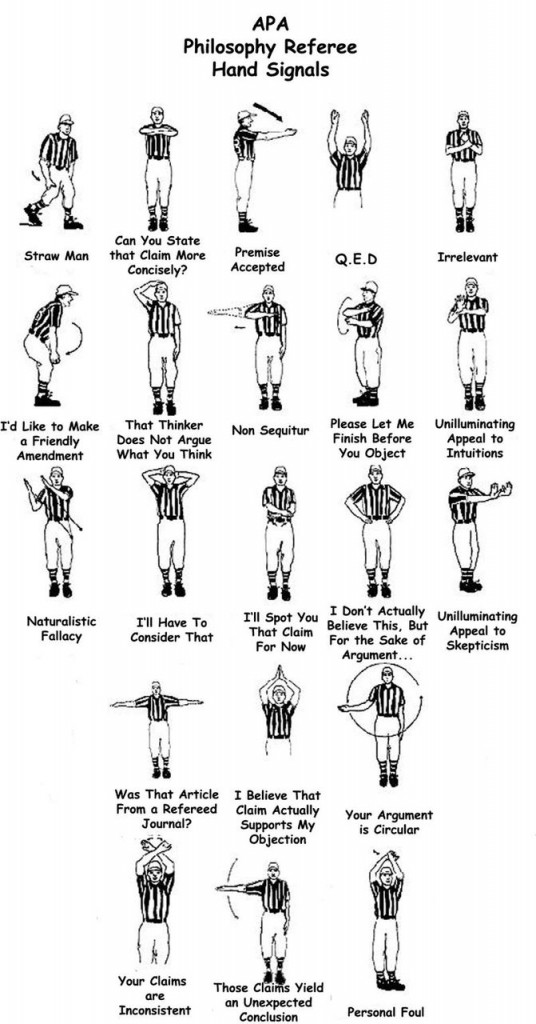
Philosophy Referee Hand Signals

by Dan Colman

philosophy ref signals

The next time you’re presiding over an intense philosophical debate, feel free to use these hand signals to referee things. Devised by philosophy prof Landon Schurtz, these hand signals were jokingly meant to be used at APA (American Philosophy Association) conferences. Personally, I think they would have made a great addition to the famous Monty Python soccer match where the Germans (Kant, Nietzsche & Marx) played the indomitable Ancient Greeks (Aristotle, Plato & Archimedes). Imagine Confucius, the referee, whirling his hand in a circle and penalizing Wittgenstein for making a circular argument. Priceless.

Related Content:

The Monty Python Philosophy Football Match: The Greeks v. the Germans

Monty Python Sings “The Philosopher’s Song,” Revealing the Drinking Habits of Great European Thinkers

The Modern-Day Philosophers Podcast: Where Comedians Like Carl Reiner & Artie Lange Discuss Schopenhauer & Maimonides

Download 100 Free Philosophy Courses and Start Living the Examined Life

Philosophy Referee Hand Signals is a post from: Open Culture. Follow us on Facebook, Twitter, and Google Plus, or get our Daily Email. And don't miss our big collections of Free Online Courses, Free Online Movies, Free eBooksFree Audio Books, Free Foreign Language Lessons, and MOOCs.

The post Philosophy Referee Hand Signals appeared first on Open Culture.

14 Aug 17:56

It's Probably Best to Avoid Antibacterial Soaps

by Julie Beck

Antimicrobial chemicals, intended to kill bacteria and other microorganisms, are commonly found in not just soaps, but all kinds of products—toothpaste, cosmetics, and plastics among them. There is evidence that the chemicals aren’t always effective, and may even be harmful, and their ubiquity means people are often continually exposed to them.

One such chemical, triclosan, has previously been found in many human bodily fluids. New research found traces of triclosan, triclocarban, and butyl paraben in the urine of pregnant women, and the cord blood of newborn infants. 

The research looked at the same population of 180 expectant mothers living in Brooklyn, New York, most of Puerto Rican descent. In a study published last week in Environmental Science and Technologyresearchers from Arizona State University and State University of New York’s Downstate School of Public Health found triclosan in 100 percent of the women’s urine samples, and triclocarban in 87 percent of the samples. Of the 33 cord blood samples they looked at, 46 percent contained triclosan and 23 percent contained triclocarban.

In another, still-unpublished study, the researchers found that all of the cord blood samples contained “at least one paraben,” according to Dr. Rolf Halden, director of ASU’s Center for Environmental Security. Halden authored the study along with Dr. Laura Geer of SUNY, Dr. Benny Pycke of ASU, and others.

Triclosan and triclocarban are endocrine disruptors, Halden explains. The risk there is that the chemicals can mimic thyroid hormones, potentially disrupting the metabolism and causing weight gain or weight loss. Previous research has also shown a connection between higher levels of triclosan in urine, and allergy diagnoses in children.

In the study looking at butyl paraben, the researchers found an association between higher exposure to the chemical, and a smaller head circumference and length of babies after they were born.

The thing about antibacterial soaps (containing triclosan and triclocarban), is that there’s no evidence they are any better at keeping people from getting sick than regular old soap, according to the Food and Drug Administration. In December of 2013, the FDA issued a proposed rule (for which public comment is now closed) that would require companies to show that their antimicrobial products are not only safe, but more effective than soap. If they can’t, they would have to remove the offending ingredients, or stop labeling the products “antibacterial.”

Butyl paraben is used as a preservative, so it’s found in a wider breadth of products, according to Halden. This isn’t entirely bad—it’s one of the chemicals that keeps things from growing in your tub of face lotion after you stick your grubby little fingers in it—but the question with any chemical is whether the benefits outweigh the risks. Antimicrobial chemicals, any potential risks to personal health aside, may also be contributing to the rise of drug-resistant bacteria.

“We are all guilty in that we buy antimicrobial products, knowingly or unknowingly,” Halden says. “We now know that both terrestrial and aquatic environments are highly contaminated. The chemicals are ubiquitous. Even if you don’t buy the products, you’ll be exposed in public places and in restaurants.”

These new studies have an admittedly small sample size, of women concentrated in one geographic area, so it’s impossible to extrapolate the results to everyone. But Halden says that he and his fellow researchers wanted to study newborns and pregnant mothers because babies’ immune systems are very sensitive to outside influences.

“People shouldn’t be too concerned,” he said, “but just exercise common sense. [Not using] antimicrobial liquid soaps, that’s the first important step, until we know more for sure, or until the regulatory agencies step in and do their work.”


08 Aug 01:59

Birthday Burger

by Dan Piepenbring

Happy birthday, Andy Warhol. Go on, have that Whopper! You’ve earned it. Ketchup? Sure! Ketchup! Have the whole bottle!

No, no, take your time. We’ve got all day.

This clip is from the Danish filmmaker Jørgen Leth’s 66 Scenes from America (1982). He said of the performance:

[Warhol] is told that he has to say his name and that he should do so when he has finished performing his action, but what happens is that the action takes a very long time to perform; it’s simply agonizing. I have to admit that I personally adore that, because it’s a pure homage to Warhol. It couldn’t be more Warholesque. That’s of course why he agreed to do it.

But we don’t know this. Maybe he was just hungry.

03 Aug 19:16

What’s That Type?

by Kaulie Lewis
01 Aug 01:56

Fair Play: The 2014 County Fair Season

by Linda @ KidFriendly DC

Flying high at last year's Montgomery County Fair

Flying high at last year’s Montgomery County Fair


There aren’t many events where you get farm animals, carnival rides and games, the junk food gamut, live entertainment, pony rides, piglet races, and wares for sale all in once place. But they do happen, and we’re about to get a glut of them. Yep, it’s County Fair time. And I highly recommend experiencing one while you can. Here’s the list of local fairs taking place, starting as soon as tomorrow.

Howard County Fair
What: The fair begins this weekend, and you have through next Saturday to enjoy rides, Shazam Magic Shows, musical entertainment in the evenings, pig races and pony rides, the Kids & Critters barn, and more. Most of the rides cost extra, and packages are available, so be sure to check out the website to see what’s available if you plan to go.
When: August 2-9, 8am – 11pm daily, though activity times vary, so be sure to check the schedule.
Where: 2210 Fairground Road, West Friendship, MD
How Much: Admission is $5/age 10 and up, $2/seniors, free for kids under 10. Rides and games are extra.

Arlington County Fair
What: We’ve been and have had a blast! It’s big enough for a fun-filled day, but not so huge that it’s overwhelming and you feel rushed get to everything. There are carnival rides for everyone from toddlers to adults, and the kids especially loved the pony rides and piglet races. You can also check out competitive exhibits, enjoy live entertainment, cheer on racing animals, view outdoor movies, and take the little ones to the Kids Court for moon bouncing, face painting, and more.
When: August 6-10, hours vary by day, so check the schedule for specifics.
Where: Thomas Jefferson Community Center, 3501 Second St., Arlington, VA. Get parking/shuttle information here.
How Much: Admission is free. Buy tickets to use for rides and other activities: $1/ticket, $20/24 tickets, $40/48 tickets.

Montgomery County Fair
What: This fair is a family fave. (You can get a glimpse of our experience there last year and read areview of it from a few years ago), so trust me when I say that there is so much to do, you have to see the schedule on the website for yourself to get the full scope. Highlights include plenty of 4-H exhibits and demos, including opportunities to pet some of the animals; animal races, pony rides, a KidZone with interactive games and activities, tons of carnival and kiddie rides, arts & crafts, and monster trucks and a demolition derby, and much more.
When: August 8-16, Times vary by day so check the schedule for specifics.
Where: 16 Chestnut Street, Gaithersburg, MD (Get directions)
How Much: Admission is $10, free for kids 11 and under. Tickets for rides cost extra. A one-day all-u-can-ride carnival wristband is available for $25.

Prince William County Fair
What: Virginia’s largest annual county fair will include 4-H exhibits, rides, contests (think pie eating and water balloon tossing), animal shows, craft demos, the Children’s Barn, Kid’s Zone, live performances, and more. Note that August 16 is Kid’s Friday when all admissions are $5. August 10 Veterans are admitted for free. Monday, August 11, admission is half price. On Tuesday, August 12, is $2 Tuesday. And Wednesday, August 13, is Ladies’ Night, free admission for women.
When: August 8-16, Hours vary by day, so check the daily schedule on their website (scroll down the page).
Where: Prince William County Fairgrounds. Get directions here.
How Much: Admission is $10/ages 14-59, $5/seniors and ages 5-13, free for ages 4 and under. Be sure to look for daily specials, too.

Prince George’s County Fair
What: A variety of entertainment and attractions for all ages — 4-H exhibits magic and dance shows, pig and duck races, a horse pull competition, a chain saw artist, a K-9 show, and much more.
When: September 4-7, hours vary by day.
Where: The Show Place Arena in Upper Marlboro. Get directions here.
How much: Admission is $6/ages 12 and up, $5/ages 6-11, free for ages 5 and under. Rides and games are extra.

Anne Arundel County Fair
What: Farm exhibitions, rides, lots of live entertainment, watermelon eating contests, and more.
When: September 10-14, check the website for hours.
Where: Anne Arundel County Fairgrounds in Crownsville, MD. Get directions.
How much: Admission is $6/ages 16 and up, $4/ages 8 – 15, free for ages 7 and under. Rides and games cost extra.

29 Jul 23:16

“Story with a Real Beast and a Little Blood”: on Rose McLarney’s Its Day Being Gone

by Nick Ripatrazone
cover

cover“A place belongs forever to whoever claims it hardest, remembers it most obsessively, wrenches it from itself, shapes it, renders it, loves it so radically that he remakes it in his own image.” Kentuckian Chris Offutt chose that line from Joan Didion’s The White Album as the epigraph for his memoir, No Heroes: A Memoir of Coming Home. Appalachian literature plays an elegaic refrain. It is a literature of dislocation and transition and survival. Ron Rash, echoing Offutt, reflects how everybody who lived on the two-mile dirt road that led to his grandmother’s farm was either family or friend. Now, “I probably know three families out of 60 or 70. And that place is gone. The accent’s gone. A lot of the culture is disappearing.”

Rash and Offutt hesitate to sentimentalize that passing world, but the pull is inescapable. As Rash says, “there’s something in us as human beings that–we know our lives are transitory, but we want something not to be transitory, something to endure, whether it’s a landscape or a place.” Rash’s poem “Preserves” is a concise dramatization of that process. After a funeral, the dead’s land and property are divided among kin, but the narrator has forgotten a springhouse. He opens the rotting door and he finds “woodslats bowed with berry and vegetable.” The double meaning of the poem’s title is less meant to be clever than funereal, as the family “heaped our paper plates and ate, one chair / closest to the stove unfilled.”

covercoverLater this year, Rash’s novel Serena gets the full Hollywood treatment. Jennifer Lawrence and Bradley Cooper will likely send more readers back to his work, including his newest release, Above the Waterfall. For many readers, the life and fiction of Breece D’J Pancake still haunts the discussion of Appalachian literature. Pancake killed himself in 1979 at 27-years-old, and his rough but lyric tales have made him a martyr. Jon Michaud’s recent retrospective at The New Yorker is a fitting tribute. He recommends Thomas E. Douglass’s biography, A Room Forever, and Samantha Hunt’s essay “The Secret Handshake,” which appeared in The Believer. I would add Marion Field’s touching “Complicated Manners” from the Oxford American. But start with the man’s fiction; my favorites are “The Way It Has To Be” and “Time and Again.”

covercoverIt would be foolish to deny Pancake’s literary influence on how we speak about literary Appalachia. The parallel nature of his passionate but short life, his brief output (he only published enough stories to fill one book), and the crafted compression of his tales make him almost too perfect of a symbol. During a review of Rusty Barnes’s story collection, Mostly Redneck, I positively compared Barnes to Pancake, noting that both writers used finely crafted settings to add gravity to the minutia of their characters’ lives. In an interview, Barnes pushed back against my comparison, citing a frustration with reviewers using Pancake as metonym for Appalachian literature. While that certainly wasn’t my intention, I welcome his excellent list of other noteworthy contemporaries from the region: Nikki Finney, Frank X. Walker, Lee Smith, Lisa Koger, Maurice Manning, Silas House, James Still, Crystal Wilkinson, Charles Dodd White, Gurney Norman, Denise Giardina, Mark Powell, Pinckney Benedict, and Chris Offutt. Readers should get Red Holler: Contemporary Appalachian Literature, edited by John Branscum and Wayne Thomas, or issues of Appalachian Heritage, Still, and Appalachian Journal to see the newest work coming from Appalachia. Countless others could be added to Barnes’s list, including Harry Humes, Jayne Anne Phillips, Tom Bailey, the late Irene McKinney, Ann Pancake, RT Smith, Fred Chappell, Joseph Bathanti, and Scott McClanahan, whose memoir, Crapalachia, is a self-admitted yarn. “God bless those who keep trying to make myths,” he writes.

coverOne of the finest mythmakers in contemporary Appalachian letters is Rose McLarney, a poet from western North Carolina. Although she now teaches in Oklahoma, while looking for her first teaching job back east, McLarney “was living without electricity, hiking 17 miles to use the phone or internet.” Her first book, The Always Broken Plates of Mountains, hits elegaic notes, as in poems like “Autumn Again,” where the sumac-stabbed hills create a beautiful color, but “this time of year, there is always / a wounded feeling.” Her first book was not provincial, but her newest release, Its Day Being Gone, widens her range.

The book begins with violence. In “Facing North,” the narrator needs to put down a sick goat. “Silent animals” on the farm watch in judgment. She is not without guilt, wondering if she “should have given her southerly pasture,” and then cleverly turning the hesitance on herself, thinking “I should have gone in another direction.” Her threnody might seem archaic. After all, “In this era, when there is no need / to farm, who is drawn to have livestock, / which die so much?” Yet again, the narrator has used “animals / as the figures for my sorrows.” But she is “still here. / I can’t stay away / from the hard images.”

Those hard images, like the tenuous truths of McClanahan’s memoir, are no less painful if they are myths. Later in the collection, McLarney writes “much of what you grew up with had already faded– / there was less paint than rust on the metal, and littler / hope.” This tension between past and present, reality and hope moves the book forward. In “Shadow Cat,” the narrator walks a dirt road, thinking how the “houses on bits of flat / kept their backs to the walls / of mountains, knowing / their place.” The natural world reigns, and is untouched until higher up the mountain, where a man pulling a bulldozer whispered a warning: “Careful out here alone. / Big cat will get you.” She’s been hearing such admonitions her entire life, although few people have actually seen such animals. She wonders if the warnings are a comfort, “keeping alive the belief / that what wildness abides / out there is the danger.”

Dangerous, but it is their wildness, and the narrator of “Watershed” defends the local, “murky” waterways. She is not interested in clear water “filtered by mosses and lichens.” She wants an “ancient, worn landscape,” where she can swim over sunken cars. A certain level of toughness is expected. Someone who enters her house must be “unafraid / of stumbling on sagging floors, into low doorframes, features / of old structures, the past, people I know.”

Great books can be local, but Its Day Being Gone gains another dimension through the inclusion of McLarney’s chapbook, Hone Creek, originally published in Mudlark. The poems in this sequence dramatize the upheaval of South American communities from hydroelectric damming. “Imminent Domain” introduces the section. Although McLarney does not identify herself as an activist–“as much as [my poems] say what is wrong, [they] end up admitting my complicity”–these poems are written with anger. Although some of these engineers “meant well,” “Power always is sent to serve regions other / than where it is made.”

The disparate regions are also connected by methods of storytelling. McLarney’s narrators often smirk, as good yarn spinners do. “Setting,” a story about a thief and his lover, is told “because I want your attention. For you to come for dinner again.” These “bellyful tales,” told “when no one is hungry,” are variations on a theme:

No, there’s nothing new in it. But it couldn’t be richer.
What would you rather have than a thing you know
spiced and simmered, spoken and seconded,

in another’s accent?

Its Day Being Gone is several books in one, and “Story with a Real Beast and a Little Blood in It” helps decode the synthesis. A bull breaks loose, and after the men, “butted and bruised / with rope-burned hands, give up,” the narrator makes a path of sweet feed that leads into a gated fence. But she pauses the poem to warn that we should “not look to make any allegories, / for any meaning beyond the marvel.” In Its Day Being Gone, McLarney has it both ways. Her stories are real, but they are symbols. Appalachia will remain, but it helps that the region has such skilled writers to document its truths and myths. McLarney’s poems contain enough eloquence to make a passing world permanent. Her work reminds us that when the bull ran, when the past began to fade, you “followed / on your knees down the mountain, noting / even in brambles, as you bled, the stars.”

29 Jul 13:35

We All Have a Friend Like Sarah, or at Least We Should

We All Have a Friend Like Sarah, or at Least We Should

Submitted by: (via The Sourpuss)

23 Jul 00:01

Aubrey Plaza Is Armed and Dangerous in the Teaser for Hal Hartley's 'Ned Rifle'

by Megh Wright
by Megh Wright

Back in March it was announced that Aubrey Plaza had signed on to star in Hal Hartley's new film Ned Rifle, and the first teaser trailer dropped today. The film also stars Liam Aiken, Parker Posey, James Urbaniak, and Thomas Jay Ryan and is set to premiere at the Toronto International Film Festival later this year.

0 Comments
22 Jul 01:45

'The Simpsons' Are Crossing Over with Basically Every Other Fox Cartoon This Season

by Megh Wright
by Megh Wright

the-simpsonsOver the course of last year, several big events slated for the 26th season of The Simpsons were revealed including a Futurama crossover episode, a Family Guy crossover episode, and the death of a character who has appeared on the show at least twice. At TCA over the weekend, a few more details were revealed about all three events, including that the Family Guy/Simpsons crossover episode — which will air as Family Guy's season premiere on September 28th — will also cross over into Bob's Burgers territory. From EW:

In addition to featuring Homer, his family, and various Springfield residents, Family Guy will include a cameo by Bob from Bob's Burgers, according to Family Guy executive producer Rich Appel. While the episode was written solely by the Family Guy team, the Simpsons producers and writers were invited to the table read of the script and offered a chance to give input. "We sent them the script, and I think between Jim [Brooks], Matt [Groening] and Al [Jean], they had one or two lines in the hourlong episode they asked to tweak," said Appel. "They gave us free rein."

Also airing on September 28th will be the season 26 premiere of The Simpsons called "Clown in the Dumps," which will feature the killing off of a character who longtime Simpsons showrunner Al Jean told EW last year would be someone who has appeared in at least two episodes and earned an Emmy for the role. (He also revealed over the weekend that the character might return in flashback or ghost form after dying.) On November 9th, The Simpsons will do yet another crossover episode with Futurama called "Simpsorama" featuring the voice talents of Billy West, John DiMaggio, Katey Sagal, Phil LaMarr, Lauren Tom, Maurice LaMarche, and Simpsons voice regular Tress MacNeille. According to EW, the episode follows Bender as he "travels back in time to kill Bart because Bart does something in the present that has terrible consequences for the future."

0 Comments
22 Jul 01:40

FX Passes on Charlie Kaufman's Comedy Pilot Starring Michael Cera and John Hawkes

by Megh Wright
Bgarland

Dammit! Will somebody please bring this to the viewing public?!?

by Megh Wright

img-charlie-kaufman_145436776316While FX revealed some good news today about Louie's future, along with that came some bad news for the fate of the Charlie Kaufman comedy pilot they ordered back in January. According to THR, How and Why – Kaufman's single-cam pilot and potential return to television that stars Michael Cera and John Hawkes and also had Catherine Keener and Sally Hawkins attached to appear — has been officially passed on by FX. Producers are now searching for a new outlet for the show; Netflix reportedly passed on it as well, but IFC is now being seen as its "potential home."

0 Comments
17 Jul 20:19

Fighting Loneliness With Cuddle Parties

by Jon Fortenbury
Bgarland

The only way a cuddle party could be more terrifying to me would be if the pillows were stuffed with spiders.

In a living room just outside of Dallas, Texas, about 20 of us crowded on couches, chairs, and blankets, and wore pajamas, sweatpants, and no shoes. The group was mostly middle-aged, a near-even split of men and women, and predominantly white. We listened to an hour-long lecture about the importance of asking for what you want, setting clear boundaries, and keeping your clothes on.

“Go around the room and say why you’re here,” said the facilitator, a woman with brown hair and penciled-in eyebrows who ran the event with two male assistants she referred to as “cuddle lifeguards.”

“I’m here because I’m a cuddle slut,” said the only 20-something girl in the room.

“I’m here to get out of my comfort zone,” said another woman.

But what came up most often was: “I’m at this cuddle party to connect.” That word connect was a buzzword throughout the evening, as people held each other, gave massages, nuzzled, spooned, puppy piled, and laughed over snacks. It was not a front for an orgy or a bunch of touchy-feely hippies preaching peace and love, but a group of individuals who craved the kind of non-sexual human connection that many people don’t get if they’re single.

When I told friends about this, the most common responses fell into two categories: pathetic and weird. They found it both sad and creepy that some people who attend cuddle parties do so to help alleviate loneliness. They saw it as a sort of emotional sleeping around. But in a country that seems to be becoming increasingly isolated, cuddling may be a healthy way to deal with the disconnection.

Cuddle parties, at least the official, documented ones, began in February 2004 in a tiny Manhattan apartment, facilitated by Marcia Baczynski and Reid Mihalko. From that came the birth of the official organization, Cuddle Party, which trains and supports cuddle party facilitators in 17 countries across the world. Cuddle parties vary in price (ours cost $10) and have 11 rules, ranging from keeping the space tidy to not saying “yes” to something if you're actually feeling “maybe.”

Cuddle parties attract singles and couples, and, on occasion, families (there was a 16-year-old girl with her parents at the cuddle party I attended). You're advised to bring snacks, pillows, and blankets, and aren't allowed to wear shorts, tank tops, or lingerie. If you become sexually aroused, you're advised not to act on it, since the purpose of a cuddle party, according to the website, is to "meet new people, to enjoy amazing conversations, to touch, to be touched, to have fun, to practice asking for what you want, to practice saying 'no' to what you don’t want—all in a setting structured to be a safe place for exploration and enjoyment. … You can even come to a Cuddle Party just to cuddle!"

Professional cuddlers, such as Ali C. in New York City and Samantha Hess in Portland, Oregon, popped up in the last few years and charge for one-on-one cuddle sessions in their homes or yours. They often charge between $60 and $80 an hour and require you to sign a waiver or policy form, which covers the rules on cuddling, confidentiality and more. You can book 30 minutes, an hour, or sometimes even an entire night.

Professionals typically don’t work with clients who merely like cuddling, but use it as a form of healing, or to help people who didn't receive that kind of nurturing as a kid. Hess sums up the benefits of seeing a professional cuddler quite well on her website. She wrote, "Touch has the power to comfort us when we are sad, heal us when we are sick, encourage us when we feel lost, and above all else, allow us to accept that we are not alone."

Cuddle parties and professional cuddlers seem to have come at a good time in America. The data suggests we feel lonelier than ever. According to a study published in June 2006 in American Sociological Review, a quarter of Americans in 2004 had no one to discuss important matters with. That’s more than double what that statistic was in 1985.

The numbers from that report were widely debated but more recent studies also show an increase in isolation. Pew Internet reported in November 2009 that Americans’ discussion networks have decreased by a third since 1985. Barna Group found that nearly twice as many Americans self-identified as lonely in 2013 (20 percent) as they did a decade prior (12 percent).

Loneliness appears to fluctuate with age. An October 2008 study published in Child and Adolescent Psychiatry and Mental Health found that 60.2 percent of college students experienced loneliness. A study published in AARP in September 2010 categorized 35 percent of adults aged 45 and older as lonely. Of those aged 45 to 49, 43 percent were lonely, and of people 70 and older, 25 percent were lonely.

Explaining this apparent increase in American loneliness is the topic of many debates. Some, like New York University professor Eric Klinenberg, refute the idea that America is lonelier, and others offer up explanations. Many, like author of Alone Together Sherry Turkle and Stephen Marche in his cover story for The Atlantic, blame the Internet and social media for our alienation. But despite older studies that found a link between Internet use and loneliness, like the famous 1998 study by Robert Kraut and colleagues published in American Psychologist, some recent studies have shown the opposite.

Pew published a report in June 2011 that showed Facebook users have more close relationships and social support than non-Facebook users. And a February 2013 study out of the University of Alabama at Birmingham showed that Internet use among older adults decreased loneliness and increased social contact. Many seem to use the Internet as a complement to offline life instead of as a replacement.

Perhaps we can’t blame just one thing for becoming disconnected. Dr. Jacqueline Olds, a psychiatrist in Massachusetts and author of The Lonely American: Drifting Apart in the Twenty-first Century, has a more comprehensive explanation.

“I think because we are such a productivity-oriented country and so much product now has to do with working at home on the Internet, there’s much less chance of seeing people on the street or making accidental contact in a way that used to happen,” said Olds, who also teaches at Harvard Medical School. “Being able to do everything from home—work, shop, watch movies, buy books—eventually can lead to too much isolation.”

Regardless of how we become lonely, it hurts our health. John Cacioppo and his colleagues at the University of Chicago presented in February their six-year study that tracked more than 2,000 people aged 50 and older. They found that those who were lonely had a 14 percent greater risk of premature death. That is twice the risk for early death that results from obesity. It’s not just the absence of someone to take care of you—in this study, isolation was linked with health problems such as elevated blood pressure, altered gene expression, and disrupted sleep.

Cuddling, on the other hand, has quite the opposite effect. Cuddling releases endorphins, dopamine, and oxytocin (“the cuddle hormone,” as some call it). All sorts of research have shown that cuddling, and oxytocin, can achieve incredible effects. It can bond mothers with their babies and make breastfeeding simpler; reduce stress and blood pressure; help enable sleep; improve communication among couples; increase happiness and well-being; increase trust and attachment; and much more. The release of oxytocin can have some negative effects, like increasing envy and gloating, but that won’t necessarily happen during cuddling.

Dr. Paul Zak, a scientist and economist who has done numerous experiments with oxytocin and author of the book The Moral Molecule, said that the amount of oxytocin you release depends on how attached you are to the person you’re cuddling with or touching.

“Based on my massage studies, a massage from a stranger increased oxytocin an average of 17 percent,” Zak said. “That's about the range for most oxytocin increases for all types of stranger interactions and likely applies to cuddling. Cuddling with a family member could increase oxytocin 50 to 100 percent. If you’re attracted to the stranger, though, an oxytocin increase of 100 percent or more would not be unlikely.”

Cuddling with a stranger or acquaintance, then, at a cuddle party or private session, may not be as beneficial as cuddling with a parent or significant other. But it releases oxytocin nonetheless and is an alternative for those embarrassed to admit to a loved one their need for cuddling, according to Olds. Sadly, that might be a lot of people.

“In our independent-minded culture, you’re not supposed to be needy or need cuddling,” Olds said.

The same can be said of admitting loneliness. Admitting the need to connect to people at the cuddle party may not have been easy for some. It doesn’t really fit in with the idea of American independence, as Olds noted. But time after time, as people explained why they were there, they brought up their desire to connect. I doubt anyone left that house feeling more disconnected than when they showed up. I know I didn’t.

Though I only cuddled with one girl during the evening—the short, skinny blonde perhaps closest to my age—I felt connected to this stranger like we’d already met. I instantly cared for her. As we spooned and discussed our life plans, the “cuddle slut” joined in. Then another person. And another. Pretty soon, half the party engaged in a group spoon—each person holding the person to their right.

One guy, a blonde massage therapist from Austin probably in his 30s, looked at me from a nearby chair and said, “I want to lay across all of you.” I laughed, assuming it was a joke, and then left to get some food. When I came back, he was lying on his back on top of several spooning cuddlers. The group laughed and smiled.

I thought, like many of my friends, that the cuddle party would be uncomfortable and weird. I always liked cuddling with past girlfriends, but wasn’t sure about cuddling with strangers. But I left that night feeling more appreciated, connected, and relaxed—and like I’d made my own small dent in American loneliness.


17 Jul 20:16

'Boondocks' Creator Aaron McGruder to Create New Pilot 'Hooligan Squad' for Adult Swim

by Bradford Evans
by Bradford Evans

aaron mcgruderAaron McGruder, creator of the comic strip-turned-Peabody Award-winning Adult Swim series The Boondocks, has signed a new first-look deal with Adult Swim to create and develop new shows for the cable network. His first project under the deal is a live-action adventure pilot he's writing called Hooligan Squad that is set in the future in Japanese-occupied San Francisco, following an American insurgency. McGruder has another live action Adult Swim show he created, Black Jesus, which is set to start airing this August. The Boondocks ended its four-season run on Adult Swim earlier this summer, with McGruder having left the show after its third season.

0 Comments
17 Jul 20:06

The Ramones, a New Punk Band, Play One of Their Very First Shows at CBGB (1974)

by Colin Marshall

“Ramones Reunion Nearly Complete,” announced The Onion just about ten years ago, after the death of the band’s guitarist Johnny Ramone. His bandmates Joey and Dee Dee Ramone had each taken their leave of this mortal coil a few years before, and now, with the passing of drummer Tommy Ramone, all the group’s original members have gone to that big CBGB in the sky. In the video above, you can see the Ramones playing at the small CBGB down here on Earth — way down here on Earth, given the setting of downtown Manhattan in 1974. That year alone, after the revelation they brought about after first taking the stage in their bangs, ripped jeans, and black leather jackets on August 16, they played the now-historic rock club no fewer than 74 times. Show length averaged about seventeen minutes, which means this video, at just seven minutes, includes quite a few songs. The setlist includes “Now I Wanna Sniff Some Glue,” “I Don’t Wanna Go Down to the Basement,” and “Judy Is a Punk.”

This performance happened on September 15, 1974, six months after their debut at Performance Studios in March of that year. They wouldn’t sign a recording contract until late the next year, but they would do it because the wife of Sire Records co-founder Seymour Stein saw them at CBGB. Though the Ramones always prided themselves on the rawness of their sound, this show catches them at a moment when, though they’d already armed themselves with looks and the attitude that made them instant icons, they still had to feel their way through exactly what this “punk rock” thing would turn into. You can see their music taking an even clearer, more distilled form in the 1977 CBGB set we featured last year. They may have lived fast, the Ramones, but they played even faster. Could they have done it without the borderline-unpunklike skill of their drummer?

Related Content:

The Ramones in Their Heyday, Filmed “Live at CBGB,” 1977

The Ramones Play a New Year’s Eve Concert in London, 1977

CBGB’s: The Roots of Punk Lets You Watch Vintage Footage from the Heyday of NYC’s Great Music Scene

Watch the Sex Pistols’ Very Last Concert (San Francisco, 1978)

Rare Live Footage Documents The Clash From Their Raw Debut to the Career-Defining London Calling

Colin Marshall hosts and produces Notebook on Cities and Culture and writes essays on cities, language, Asia, and men’s style. He’s at work on a book about Los Angeles, A Los Angeles Primer. Follow him on Twitter at @colinmarshall or on Facebook.

The Ramones, a New Punk Band, Play One of Their Very First Shows at CBGB (1974) is a post from: Open Culture. Follow us on Facebook, Twitter, and Google Plus, or get our Daily Email. And don't miss our big collections of Free Online Courses, Free Online Movies, Free eBooksFree Audio Books, Free Foreign Language Lessons, and MOOCs.

The post The Ramones, a New Punk Band, Play One of Their Very First Shows at CBGB (1974) appeared first on Open Culture.

17 Jul 20:00

Dorkfood DSV Temperature Controller for Sous Vide

by mark
Bgarland

Food nerds, heads up!

Works flawlessly, controlling temperature to one degree. Using it with my 25-year-old Proctor Slo-Cooker (Original cost $19). Best thing so far is 48-hour short ribs. Cooking them at 140 degrees for two whole days makes the best tasting beef dish I ever had. The meat is totally different texture than what a braise gives you and they still are pink on the inside.

It sure beats spending $400 for a sous vide water oven. I just set it up in the garage and let it go. I do use it with my vacuum food packer but you can use it with regular zip lock bags, (just remove the air using the archimedes principle).

-- Bruce Johnson

Dorkfood Sous-Vide Temperature Controller
$99

17 Jul 13:24

Watch the 72 Minute Trailer for the 720 Hour Film, Ambiancé, the Longest Movie in History

by Jonathan Crow

There’s an old truism in Hollywood that a movie shouldn’t last much longer than the endurance of the average audience member’s bladder. Most feature films run around an hour and a half to two hours, though summer blockbusters can last longer. Studios generally resist making long movies for the simple reason that they can’t pack as many screenings per day. While some art house auteurs have made movies that extend to bladder-busting lengths – Bela Tarr’s brilliant Satantango clocks in at seven and a half hours – the place to find truly long movies is in the art world.

Christian Marclay’s masterpiece The Clock is a 24-hour montage of watches, clocks and other timepieces from iconic movies synced to the actual time the film is running. Another incredibly long movie is the aptly named A Cure for Insomnia, which features artist Lee Groban reading a really long poem intercut with clips of porn and heavy metal music. That movie lasts over 3 days. And if you wanted to watch the entirety of Chinese artist Ai Weiwei’s movie Beijing 2003 – which documents every single street within Beijing’s inner ring – it would take you over a week.

But those films have nothing on Swedish artist and filmmaker Anders Weberg, who is making Ambiancé, which is, at 720 hours, the longest movie in the history of cinema. 720 hours. That’s 30 days. To put this into perspective, you can watch the entire special extended cut of the Lord of the Rings trilogy over 60 times in the time it takes for Ambiancé to unspool just once. The first trailer came out July 4th, and it clocks in at 72 minutes long, making it almost a feature unto itself. You can see it above. If this seems lengthy – most trailers are three or so minutes after all – note that Weberg promises that the next trailer will last seven hours and 20 minutes.

Weberg describes Ambiancé as a movie where space and time intertwine “into a surreal dream-like journey beyond places and [it] is an abstract nonlinear narrative summary of the artist’s time spent with the moving image. 
A sort of memoir movie.” As you can see above, the movie features densely layered images with a haunting, minimal score. Weberg plans to screen the entirety of the movie in 2020 on every continent simultaneously just once before destroying it. The trailer is only going to be available until July 20th, so watch it while you can.

Related Content:

The Clock, the 24-Hour Montage of Clips from Film & TV History, Introduced by Alain de Botton

Jonathan Crow is a Los Angeles-based writer and filmmaker whose work has appeared in Yahoo!, The Hollywood Reporter, and other publications. You can follow him at @jonccrow.

Watch the 72 Minute Trailer for the 720 Hour Film, Ambiancé, the Longest Movie in History is a post from: Open Culture. Follow us on Facebook, Twitter, and Google Plus, or get our Daily Email. And don't miss our big collections of Free Online Courses, Free Online Movies, Free eBooksFree Audio Books, Free Foreign Language Lessons, and MOOCs.

The post Watch the 72 Minute Trailer for the 720 Hour Film, Ambiancé, the Longest Movie in History appeared first on Open Culture.

16 Jul 01:26

Tour the World’s Street Art with Google Street Art

by Ayun Halliday
Bgarland

Dope.

By far the most enjoyable part of our recent family trip to London was the afternoon my young son and I spent in Shoreditch, groping our way to No Brow, a comics shop I had noticed on an early morning stroll with our hostess. Our route was evidence that I had forgotten the coordinates, the street name, the name of the shop… Eventually, I realized we were lost, and that is where the real fun began, as we retraced our steps using street art as bread crumbs.

Ah right, there’s  that rooftop mushroom installation!

And there’s that Stik figure

After a while, a FedEx man took pity on us, ruining our fun by steering us toward the proper address..

I’m not sure I could ever duplicate our trail, but I enjoy trying with Google Street Art. Armchair travelers can use it to project themselves to the heart of ephemeral, possibly illegal exhibitions all over the globe,.

Bogotá... Paris... New York’s legendary 5 Pointz, before the landlord clutched and whitewashed the entire thing in the dead of night. Each up close photo bears a highly informational caption, much more than you’d find in the street itself. Think of it as an after-the-fact digital museum. It’s appropriate, given the ephemeral nature of the work. An online presence is its best shot at preservation.

Those of us with something to contribute can add to the record with a user gallery or by tagging our photos with #StreetArtist.

Enter Google Street Art here.

Related Content:

Obey the Giant: Short Film Presents the True Story of Shepard Fairey’s First Act of Street Art

Banksy Creates a Tiny Replica of The Great Sphinx Of Giza In Queens

Big Bang Big Boom: Graffiti Stop-Motion Animation Creatively Depicts the Evolution of Life

Ayun Halliday is an author, homeschooler and the Chief Primatologist of The East Village Inky zine. Follow her @AyunHalliday

Tour the World’s Street Art with Google Street Art is a post from: Open Culture. Follow us on Facebook, Twitter, and Google Plus, or get our Daily Email. And don't miss our big collections of Free Online Courses, Free Online Movies, Free eBooksFree Audio Books, Free Foreign Language Lessons, and MOOCs.

The post Tour the World’s Street Art with Google Street Art appeared first on Open Culture.

16 Jul 00:53

A Positive Example of the Internet Comforting a Grieving Stranger

by Cari Romm
Bgarland

Breaks my heart, gives me hope.

Steffel07/Reddit

Yesterday a parent posted this photo (right) on Reddit with a request:

"My daughter recently passed away after a long battle in the children's hospital. Since she was in the hospital her whole life we never were able to get a photo without all her tubes. Can someone remove the tubes from this photo?"

The thread took off, and tons of people did:

Reddit/The Atlantic

Knowing how to respond to the grief of others is always difficult—especially when those others are strangers and especially when those strangers are grieving on the Internet, where people are only just beginning to figure out the digital protocol for loss.

“It’s not the nature of social media, generally, to react thoughtfully to things and think, ‘How can I really help?’” Gabrielle Birkner, a co-founder of the website Modern Loss, recently told The New York Times.

And indeed, social media-driven responses to death can range from uncomfortable—is hitting “Like” on a Facebook death announcement supportive or crassly insensitive?—to the downright cringe-worthy, like the Tumblr “Selfies at Funerals.”

But every so often, the world wide web offers up  to the bereaved some small piece of atonement for its missteps. For some, it comes in the form of permanence, as Elizabeth Stoker Brueing recently wrote for The Atlantic

"The internet lasts forever—which is usually a creepy warning, used to warn teenagers of oversharing on social media, but in this case, it facilitates mourning at its best... one can wake up at any time of the night and see the threads of online love and memory that accompany a modern death."

And for others, like this family, it comes in the form of something much more rare: crowdsourced comfort, delivered by total strangers from across a digital divide. 

Selfishly, it's comforting for the rest of us, too. The longer we exist on social media, the more loss we'll all eventually live out through our computer screens. Let's hope that this, rather than funeral selfies, becomes the future norm for public grief.


16 Jul 00:52

Power Tools

by Dan Piepenbring
Bgarland

I love these catalogs.

The wonders of industrial-supply catalogs.

Photo: Jjron, via Wikimedia Commons

When I was nine or ten, riding in the backseat of my mom’s car as we drove the gauntlet of strip malls, car dealerships, big-box stores, and fast-food franchises that constituted our suburb’s commercial district, I realized that all of the tall signs and buildings had been constructed and erected by actual people, different crews of people. I thought about all the Burger King and Mattress Discounters signs in the world, how each had been shipped from somewhere, delivered to someone, received, assembled, mounted, electrified. I attributed a lot of power and reach to corporations, especially those that advertised on TV, and to understand that they comprised real people was something of an epiphany—especially in suburbia, where corporate authority rests in the illusion that no human labor has gone into transforming and homogenizing the landscape. All the stores were just there. What else could there be?

That moment is part of what informs my fascination with the Grainger catalog, a massive, 4,322-plus page industrial-supply inventory with which I first became acquainted last year, when a friend gave it to me for my birthday. Released annually on February 1, it’s an omnibus of 590,000 products—power tools, fasteners, pneumatics, hydraulics, pumps, raw materials, janitorial necessities, HVAC and refrigeration components—a work of pure utility, designed, honed, and focus-grouped to provide ready access to its most arcane sections. I can’t get enough of it. For the uninitiated, it provides a glimpse at the invisible infrastructure girding the world of construction, maintenance, repair, and operations. Grainger’s aggressively salt-of-the-earth slogan is “For the Ones Who Get It Done,” and the joy of perusing its catalog is in seeing how very many things there are to get done, and how many ways we have of doing them.

And so I often reach for it in pursuit of a kind of materialist awe. It makes for a reading experience more engaging, imaginative, and informative than almost anything that passes as literature. I’ve put down novels to pick up the Grainger catalog, which holds court on my coffee table and which could, in a pinch, serve as a coffee table unto itself.

Grainger sells mail-room organizers, carpet deodorizers, hairnet dispensers, and gutter-deicing cables. They sell a three-stage, heavy-traffic floor-matting system designed to entrap heavy debris. They sell miniature high-precision stainless-steel ball bearings with extended inner rings. They sell 550-foot rolls of foam for protecting electronics and an oil-filtration system for high-viscosity fluids. Their catalog contains a proliferation of heavily modified nouns that denote things I never knew existed, or things I’d intuited to exist, but had never really considered.

Metalized polyester film tape.

GMP/GLP data output moisture analyzers.

Electrostatic dissipative (ESD) gloves.

Cup point alloy steel socket set screws.

grainger1

Catalog #405

In the specificity of its language, the catalog summons a rigorously taxonomic legion of hardware and stuff, the matter from which cities and roads are composed, the contrivances that keep machines running and power flowing and ventilators ventilating. It puts a real gleam on human ingenuity. We made these things. They’re everywhere. Spend enough time poring over the catalog and it begins to color your world; you’ll close it and walk to the refrigerator only to find yourself marveling at the hinges, screws, grilles, handles, nozzles, toggles, crisper drawers, and various constituents of the appliance instead of getting a beer. Who needs a beer? You could own a wide selection of pneumatic solenoid air valves.

Or push/pull paddle tubular locksets.

NIOSH-approved ISCBA industrial SCBAs.

Wall-switch occupancy sensors.

NSF-listed plate casters.

Then there are the item descriptions. If “For sale: baby shoes, never worn” counts as a story, then so, too, must “all-wood coffins store flat and assemble without tools. Can be stacked 3-high when assembled to maximize space in mass-casualty emergencies.” Or: “High-visibility warning whips alert other vehicles of your presence.” Or: “Stretch knit material covers head to protect from overspray.”

Arguably literature’s basic charge is to describe being in the world—the Grainger catalog reveals just how extensively our writers have failed to document the varieties of work happening now, and the hyper-precise terminology surrounding that work. Poetry and prose are some of the few venues for a culture to examine its language; in a sense, the bulk of our poetry and prose is marked by a paucity of information.

Granted, a novel full of phrases like “light- to medium-traffic dry-area antifatigue matting” wouldn’t make for a terribly lively read—if someone were to publish a hyperrealist story in which a plumber solves a complicated problem with a schedule-eighty polypropylene socket-fused fitting, I alone might find merit in it. But look at writers like Wallace, whose fascination with neologisms captures the sea change that technology has brought to bear on how we communicate; or Leyner, with his satirical slumgullion of pharmaceutical jargon and high-impact ad copy; or DeLillo, whose “Human Moments in World War III” declares, “The thing science does best is name the features of the world.” There’s room for potent work that wrestles with the flux and expansion of our syntax.

I want the Great American Static-Resistant Sorbent Novel.

Two-in-one squeegee pushbrooms.

Negative-rake carbine turning inserts.

Flange-mount disconnect enclosures.

* * *

door closers

A sample page from the latest Grainger catalog.

Grainger was founded in 1927 by William Wallace Grainger, a Chicago electrical engineer who sold hard-to-find motors out of the back of his station wagon. His first catalog was eight pages. He called it the MotorBook.

Deb Oler—vice president and general manager, Grainger Brand—was kind enough to indulge my obsession with the catalog, which she proclaimed “the largest printed book in the world.”

“We can’t actually make it any bigger,” Oler told me. “We spent a huge amount of time working with the people who make our paper to make it as thin as it can possibly be while still holding up for a really long period of time. We always think, What are things we can do to get more space? But we can’t bind any bigger than we bind now.”

Its distribution is two and a half million. Only two printers in the world have the technology to produce it. The ultra-lightweight paper—that’s the technical term—is so tissue thin that a Bible’s looks lavish in comparison, but preliminary evidence suggests the catalog is dense enough to stop a bullet. The entire project comes down to a “team of thirty, a very tenured group of people,” and of these, only eight are dedicated to copyediting—no mean feat, given that in my many hours with the catalog I’ve discovered only one typo.

Compiling a book of this size poses obvious editorial challenges. For one: What goes in, what stays out? Oler said, “We have hard hats that have every football team in America’s logo on them. Do we need to show all of those, or can we show a representative sample? Will people’s feelings be hurt because their team isn’t there?”

And what do you call things, how do you file them? Drinking fountains, for instance, which Grainger sells, are known in various parts of the nation as water fountains, bubblers, or coolers. There are trash cans and then there are waste receptacles and garbage bins. All of this occasions impassioned semantic debate. The deep, quasi-Teutonic satisfaction of the Grainger catalog is that everything, finally, has been named. Everything has been indexed and put where it belongs.

Diamond-knurled press inserts.

Self-sealing pan-head machine screws.

Octal-base specialty voltage relays.

“We spend time watching people use the catalog in native situations,” Oler said. “We time how long it takes to find things. We time what happens when we take things out or put new things in.”

There are those who would object to the waste of a printed volume like this. No matter how responsibly its paper is sourced—Oler made mention of the Forest Stewardship Council—it’s still a cumbersome, tree-hungry tome. But there are few books whose design and function make such a convincing argument for their existence in print. The Grainger catalog has colored indices at its center, where the book stays open and its pages can be flipped more easily with one hand. It has a durable spine and a series of black bands running down its edge to designate different sections.

“When the customer shows up, they have a problem,” Oler said. “Either something isn’t working or isn’t going to work.” The catalog is one of the few reference texts around whose print iteration is more efficient than its digital counterpart. You look in it to find things and you find them. It is, itself, a tool, designed to provide “the right amount of information to make a decision quickly.”

1935 mcmaster carr

The back of a 1935 McMaster-Carr catalog.

Of course, though it’s nearest to my heart, the Grainger catalog is not the only one of its kind. There’s also the McMaster-Carr, whose distinctive yellow cover and limited print runs make it especially coveted by industrial-supply fetishists: the backsides of early twentieth-century editions bore the label “An Industrial Encyclopedia.” There’s Fastenal, which calls its catalog “Big Blue,” and MSC Industrial Direct, which puts out “The Big Book”—names that suggest the engulfing totality of this enterprise. Above all, an industrial supplier strives to be comprehensive. What’s seductive about these catalogs is the promise of a certain exhaustive quality, a list so meticulous as to seem interminable. “Our customers have told us time and again,” Deb Oler said, “I want to be able to come to you for everything.”

Such as solar-powered automatic gable-mount attic ventilators.

Ultrasonic wall-thickness gages.

Expandable gravity skate-wheel conveyors.

“Our customers are the people that sit in the background of every business,” Oler told me. “You don’t think about your light bulbs until they’re off. You don’t care about the toilet or the sink until it doesn’t work. The people who are our customers … they’re MacGyvers. They see themselves as problem solvers, and they are. If you look at any building and the people who work in it, there are literally thousands of products that you would need to keep that building operating.”

Even so, their best-selling product, Oler said, is probably toilet paper.

13 Jul 11:31

We Tell Kids to ‘Go to Sleep!’ We Need to Teach Them Why.

by By ANNIE MURPHY PAUL
Sleep does so much more for our bodies than preventing us from being tired tomorrow, but most parents don't tell our children that. Educating kids about the importance of sleep leads them to sleep more.
10 Jul 12:27

Are kids today praise junkies, or is that just a myth?

by Carlin Flora
Bgarland

Interesting. I think I might have just praised Aoife for breathing...uh oh.

In praise of praise. Photo by Luca Zordan/Gallery Stock

When I took my son to visit my parents in South Carolina six months ago, my father yelled out ‘Good job!’ after I finished rinsing some dishes one night. It was a running joke at my expense – I had earlier exclaimed ‘Good job!’ when my son ate a handful of blueberries, and then again […]

The post Praise them! appeared first on Aeon Magazine.

06 Jul 01:06

The Best Popsicle Molds

by Andrew Kalinchuk
Bgarland

Making popsicles for Aoife is a lot of fun!

popsicle_molds

If you’re spending the weekend outdoors, enjoying a few homemade popsicles from the Zoku Round Slow Pop Molds is a pretty great way to stay cool. They’re a good size for adults and kids alike, don’t take up much space in your freezer, and work with most ingredients without risking breakage.

06 Jul 01:01

The Celebrity Encounters of Koko the Gorilla. For Her 43rd Birthday Today.

by Ayun Halliday
Bgarland

I miss Mr. Rogers.

Koko the Gorilla, who celebrates her 43rd birthday today, keeps pretty down-to-earth company for a celebrity. While others court the paparazzi with their public canoodling and high profile Twitter feuds, Koko’s most comfortable hanging with non-marquee-name kittens and pals Penny Patterson and Ron Cohn, the human doctors who’ve headed her caregiving team for the past 41 years.

Her privacy is closely guarded, but there have been a handful of times over the years when her name has been linked to other celebs…

Above, actor William Shatner recalls how, as a younger man, he called upon her in her quarters. He was nervous, approaching submissively, but determined not to retreat. “I love you, Koko,” he told her. “I love you.”

She responded by gripping a part of his anatomy that just happens to be one of the thousand or so words that comprise her American Sign Language vocabulary. One that takes two hands to sign…

Their time was fleeting, but as evidenced below, the connection was intense.

Comedian Robin Williams also claims to have shared “something extraordinary” with Koko. Their flirtation seems innocent enough, despite Williams’ NSFW description of their encounter, below. (He undercuts his credibility by referring to her as a “silverback”.)

leokoko1

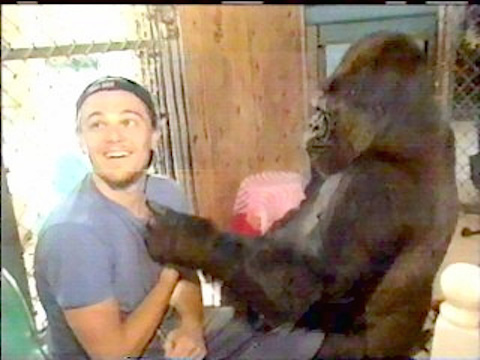
Leonardo DiCaprio is yet another famous admirer to be caught on camera with Koko. Is it any wonder that she embodies all of the qualities he claims to look for in a potential love interest: “humility, a sense of humor and not a lot of drama”? No word as to how the Titanic hunk measures up against the qualities Koko looks for in a mate, though footage of their one and only meeting has been known to get fans fantasizing in the comments section: I wish I was that gorilla ;) lol I looooooooooooooooove u Leo”

From the lady’s perspective, Koko’s sweetest celebrity encounter was almost certainly with her favorite, the late children’s television host, Fred Rogers. She removed his shoes and socks, he studied her lips, love was a primary topic and yet their time together does not invite prurient speculation. I can’t think of another human male as deserving of her affection.

Related Content:

Planet of the Apes: A Species Misunderstood

Ayun Halliday invites you to read her thoughts on another July 4 birthday on Rewire Me. Follow her @AyunHalliday

The Celebrity Encounters of Koko the Gorilla. For Her 43rd Birthday Today. is a post from: Open Culture. Follow us on Facebook, Twitter, and Google Plus, or get our Daily Email. And don't miss our big collections of Free Online Courses, Free Online Movies, Free eBooksFree Audio Books, Free Foreign Language Lessons, and MOOCs.

The post The Celebrity Encounters of Koko the Gorilla. For Her 43rd Birthday Today. appeared first on Open Culture.

27 Jun 08:20

Free Archive of Audio Interviews with Rock, Jazz & Folk Legends Now on iTunes

by Dan Colman

joe smith interviews

Back in 2012, we told you about how the Library of Congress launched the Joe Smith Collection, an audio archive featuring 200+ interviews with legendary music artists, all recorded during the 1980s by Joe Smith while researching and writing his book Off the Record. The audio collection, still available on the web, has now been brought to iTunesU. And the iTunes collection has a virtue that the web archive doesn’t — it lets you download instead of stream the audio files.

If you’re a music junkie, you won’t want to miss the longform interviews with legendary figures like Dave Brubeck, Lou Reed, Paul McCartney, Joan Baez, Herbie Hancock, David Bowie, George Harrison, Yoko Ono, James Brown, Bo Diddley, Jerry Garcia, Christine McVie, Mick Jagger, Linda Ronstadt and more. Each interview runs 30-60 good minutes. You can enter the archive here.

Related Content:

Library of Congress Releases Audio Archive of Interviews with Rock ‘n’ Roll Icons

Two Legends Together: A Young Bob Dylan Talks and Plays on The Studs Terkel Program, 1963

Watch John Lennon and Yoko Ono’s Two Appearances on The Dick Cavett Show in 1971 and 72

Free Archive of Audio Interviews with Rock, Jazz & Folk Legends Now on iTunes is a post from: Open Culture. Follow us on Facebook, Twitter, and Google Plus, or get our Daily Email. And don't miss our big collections of Free Online Courses, Free Online Movies, Free eBooksFree Audio Books, Free Foreign Language Lessons, and MOOCs.

The post Free Archive of Audio Interviews with Rock, Jazz & Folk Legends Now on iTunes appeared first on Open Culture.

25 Jun 00:33

Jorge Luis Borges: “Soccer is Popular Because Stupidity is Popular”

by Josh Jones

Jorge_Luis_Borges

I will admit it: I’m one of those oft-maligned non-sports people who becomes a football (okay, soccer) enthusiast every four years, seduced by the colorful pageantry, cosmopolitan air, nostalgia for a game I played as a kid, and an embarrassingly sentimental pride in my home country’s team. I don’t lose all my critical faculties, but I can’t help but love the World Cup even while recognizing the corruption, deepening poverty and exploitation, and host of other serious sociopolitical issues surrounding it. And as an American, it’s simply much easier to put some distance between the sport itself and the jingoistic bigotry and violence—“sentimental hooliganism,” to use Franklin Foer’s phrase—that very often attend the game in various parts of the world.

In Argentina, as in many soccer-mad countries with deep social divides, gang violence is a routine part of futbol, part of what Argentine writer Jorge Luis Borges termed a horrible “idea of supremacy.” Borges found it impossible to separate the fan culture from the game itself, once declaring, “soccer is popular because stupidity is popular.” As Shaj Mathew writes in The New Republic, the author associated the mass mania of soccer fandom with the mass fervor of fascism or dogmatic nationalism. “Nationalism,” he wrote, “only allows for affirmations, and every doctrine that discards doubt, negation, is a form of fanaticism and stupidity.” As Mathews points out, national soccer teams and stars do often become the tools of authoritarian regimes that “take advantage of the bond that fans share with their national teams to drum up popular support [….] This is what Borges feared—and resented—about the sport.”

There is certainly a sense in which Borges’ hatred of soccer is also indicative of his well-known cultural elitism (despite his romanticizing of lower-class gaucho life and the once-demimonde tango). Outside of the hugely expensive World Cup, the class dynamics of soccer fandom in most every country but the U.S. are fairly uncomplicated. New Republic editor Foer summed it up succinctly in How Soccer Explains the World: “In every other part of the world, soccer’s sociology varies little: it is the province of the working class.” (The inversion of this soccer class divide in the U.S., Foer writes, explains Americans’ disdain for the game in general and for elitist soccer dilettantes in particular, though those attitudes are rapidly changing). If Borges had been a North, rather than South, American, I imagine he would have had similar things to say about the NFL, NBA, NHL, or NASCAR.

Nonetheless, being Jorge Luis Borges, the writer did not simply lodge cranky complaints, however politically astute, about the game. He wrote a speculative story about it with his close friend and sometime writing partner Adolfo Bioy Casares. In “Esse Est Percipi” (“to be is to be perceived”), we learn that soccer has “ceased to be a sport and entered the realm of spectacle,” writes Mathews: “representation of sport has replaced actual sport.” The physical stadiums crumble, while the games are performed by “a single man in a booth or by actors in jerseys before the TV cameras.” An easily duped populace follows “nonexistent games on TV and the radio without questioning a thing.”

The story effectively illustrates Borges’ critique of soccer as an intrinsic part of a mass culture that, Mathews says, “leaves itself open to demagoguery and manipulation.” Borges’ own snobberies aside, his resolute suspicion of mass media spectacle and the coopting of popular culture by political forces seems to me still, as it was in his day, a healthy attitude. You can read the full story here, and an excellent critical essay on Borges’ political philosophy here.

via The New Republic

Related Content:

Borges: Profile of a Writer Presents the Life and Writings of Argentina’s Favorite Son, Jorge Luis Borges

Jorge Luis Borges’ 1967-8 Norton Lectures On Poetry (And Everything Else Literary)

Jorge Luis Borges’ Favorite Short Stories (Read 7 Free Online)

Josh Jones is a writer and musician based in Durham, NC. Follow him at @jdmagness

Jorge Luis Borges: “Soccer is Popular Because Stupidity is Popular” is a post from: Open Culture. Follow us on Facebook, Twitter, and Google Plus, or get our Daily Email. And don't miss our big collections of Free Online Courses, Free Online Movies, Free eBooksFree Audio Books, Free Foreign Language Lessons, and MOOCs.

The post Jorge Luis Borges: “Soccer is Popular Because Stupidity is Popular” appeared first on Open Culture.

10 Jun 18:56

Are halophytes the crop of the future?

by Mark Anderson
Bgarland

Fascinating!

Carpobrotus glaucescens, a halophyte. Photo courtesy Tony Rodd/Flickr

Ever since ancient times, the sowing of salt has been synonymous with severe and deadly retribution. The Roman general Scipio Africanus the Younger was said to have ended the Third Punic War in 146BC by razing Carthage, enslaving its population and spreading salt on its fields. In the biblical book of Judges (9:45), the brutal […]

The post Enter halophytes appeared first on Aeon Magazine.

06 Jun 23:44

Bella Bean Organics Online Farmers' Market

by rreed

If you crossed your local farmers’ market with Fresh Direct, Bella Bean Organics is what you’d get. Owned by North Carolina farmers Richard Holcomb and Jamie DeMent, Bella Bean delivers sustainable meat, dairy, and produce from more than 50 farms in North Carolina, South Carolina, Virginia, and Maryland, plus enough dry goods and pantry items to stock your entire larder, door-to-door. The virtual shelves are packed with everything from baby lettuces to Anson Mills Heirloom Popcorn to fresh-baked breads from Lionel Vatinet’s La Farm Bakery to top-shelf mixers such as Bittermilk and Jack Rudy Cocktail Co. Need shampoo? Soap? That’s available, too. And the selection is always expanding as new products become available, thanks to the duo’s extensive network of producers and growers (when they had trouble locating a sufficiently delicious, sufficiently regional source for vinegar, DeMent just kept asking around until she stumbled upon a couple of varieties from Virginia Vinegar Works).

“We love Southern food,” DeMent says. “We grow it. We cook it. We feed our friends and family the best the Southern table has to offer every day and can't imagine doing it any other way.” In addition to high-quality versions of grocery store staples, Bella Bean puts together recipe kits (to make dinner that much easier) and gift packages like this artisan charcuterie sampler that would be perfect for Father’s Day (hint, hint).

06 Jun 14:53

Silence, Please

by Kaulie Lewis

For everyone who believes that “being out and reading is better than staying home and planning to read,” The New Yorker‘s Andrea Denhoed may have found just the thing: silent reading parties.

03 Jun 01:17

tastefullyoffensive: Baby Godzilla [illuminescent] This is too...


tastefullyoffensive:

Baby Godzilla [illuminescent]

This is too cute not to reblog :)