Bgarland
Shared posts
Mary Beard has delved deep into the “logic" of misogyny. Both apparent chivalry and mere Twitter trolling have darker roots, she notes
Who Gets to Define Heritage Breed Chickens?
As consumer interest in heritage-breed meats grows, more companies are looking to get in on the market—especially when it comes to chicken.
In response, a group of farmers, business owners, and advocates are involved in a race to safeguard the term “heritage chicken,” to make sure it only applies to birds with a specific genetic profile that predates industrial animal agriculture.
Food and animal welfare advocacy group Farm Forward, for example, has been combing through hundreds of pages of U.S. Department of Agriculture (USDA) documents to determine how the agency is currently policing the term on food labels. It will also roll out an independent verification and “Certified Heritage Poultry” seal within the next few weeks in an attempt to address confusion in the marketplace.
The group and its allies say that protecting the true meaning of heritage chicken is essential to preventing the loopholes that have been created in relation to similar labels such as cage-free and grass-fed. The advocates point to a USDA petition already filed by one producer looking to define “heritage chicken”—which they deem to be incorrect—as evidence that the co-opting of the term has already begun.
Why does a term related to chicken genetics matter at all? At the root are two big ideas. First, that distinguishing heritage breeds from modern chickens will safeguard genetic diversity for the long-term stability of the food supply. Second, that many of the conversations around raising humane chicken production focus on giving the animals more space while ignoring the real cause of the animals’ suffering—the way they are bred to gain weight much faster than heritage breeds, causing multiple health issues.
“Good genetics are the most important factor in humane animal production,” says Patrick Martins, founder of leading seller Heritage Foods USA and another advocate for protecting the definition. “If the animal grows too fast, it suffers. Period.”
Why Heritage Matters
No matter who is talking about heritage chickens or turkeys, all roads lead back to Frank Reese, owner of Good Shepherd Poultry Ranch in Central Kansas.

Heritage hens foraging at Good Shepherd Poultry Ranch. (Photo courtesy of Heritage Foods USA)
Reese is a fourth-generation poultry farmer—and one of the farmers featured in the upcoming film, Eating Animals, based on the book by Jonathan Safran-Foer and narrated by Natalie Portman. He is an exhausted evangelist for chicken welfare and thinks a lot of well-meaning people—from conscious consumers to animal rights groups—are making the wrong arguments.
“People think chickens are growing fast because of antibiotics or growth hormones. They grow that fast because they’ve been genetically engineered through multiple genetically mutated lines,” he says. “If I brought those chickens to my farm, they’d still grow to that size in that amount of time, and the animal pays a tremendous price. Ninety percent of all suffering that industrial chickens and turkeys go through isn’t about how they’re raised, it’s their internal genetics.”
Hybrid poultry breeding started in the 1950s as a way to produce a lot of cheap chicken quickly. Today’s industrial chickens have been bred to have large breasts (for more meat) and put on weight at an incredible rate. Both make it difficult for them to move around (since their legs are too small to support their body size), breed on their own, and survive past a young age. They also get sick easily since their immune systems are underdeveloped.
In recent years, animal rights activists have directed consumer attention to the way chickens are raised. For laying hens raised for eggs, that has meant getting them out of crowded cages, and companies like McDonald’s have committed to selling only cage-free eggs. For broilers raised for meat, it’s meant discontinuing the use of routine antibiotics and in some cases switching to slightly slower-growing birds and giving them more outdoor space outside of cramped barns.
But Reese says that ignoring the birds’ DNA while changing the conditions they live in can even be crueler. “Now you want to put these obese animals on pasture … and the poor things can hardly walk,” he says.
Add that argument to the fact that most heritage breeds are becoming very rare.
“Conserving history is definitely a significant part of why we [campaign to preserve heritage breeds], but our mission is also about keeping genetic diversity in agriculture,” explains Livestock Conservancy communications manager Ryan Walker.
Just like crop biodiversity is seen as crucial to managing the challenges of producing produce and grains in an era of climate change, Walker adds that livestock biodiversity can also be seen as protection against natural disasters and disease outbreaks.
“We don’t know what agriculture is going to look like 100 years from now, and we may need the traits these breeds carry in order to meet challenges that arise in the future,” he says. For instance, some heritage breeds can survive outside for longer periods of time, can be resistant to disease and parasites, and have more intact mothering instincts.
For all these reasons, chef Antoine Westermann serves heritage chickens at his poultry-centric restaurant Le Coq Rico in New York City, but he also points to an additional benefit: they have incredible depth of flavor.
“[Heritage birds] have time to develop flavors that quick-growing birds don’t, and they actually reveal a terroir, like fine wine,” he says, noting that he’s become a sort of “poultry sommelier” over the years. “Beyond that, I believe that when an animal lives a good life, you can taste it.”
The Defining Controversy
More than 50 endangered heritage chicken breeds exist, and few farmers other than Reese are raising them commercially. In 2009, the Livestock Conservancy issued an official definition of heritage chicken specifically to draw attention to the endangered breeds and support long-term conservation.
It was supported by many in the industry, including Reese. According to the definition, a heritage chicken must meet four criteria. First, it must be on the American Poultry Association’s list of “Standard” breeds, which includes breeds recognized prior to 1952 with genetic lines that can be traced back generations.
It must also be produced through natural mating, be able to live a long, active life outside, and have a slow growth rate that means it reaches market weight in no fewer than 16 weeks. (Industrial chickens are reproduced via artificial insemination and typically reach market weight at about seven weeks.)
After USDA’s Food Safety and Inspection Service (FSIS) issued guidance on how they would evaluate animal-raising claims on labels, those in the industry were under the impression that the agency would use the Livestock Conservancy requirements to evaluate whether a company could use heritage chicken on its label. But they started to notice the claim on some chickens that they felt didn’t qualify.

Frank Reese’s heritage chickens at Good Shepherd Poultry. (Photo credit: Jim Turner)
The most prominent example was Joyce Farms, a small North Carolina company raising slow-growing chickens using humane, pasture-based practices, which it markets as heritage poultry. Its Poulet Rouge chickens meet France’s well-regarded Label Rouge standards for humane production. The farm is also certified “step 4” (out of 5) by the Global Animal Partnership’s Animal Welfare Rating Standards.
“By and large, I think what they’re doing is great,” says Andrew deCoriolis, Farm Forward’s director of strategic projects and engagement, of Joyce Farms’ work. “But it’s not heritage [because of the breed]. This is about the actual label claim and how the USDA is interpreting it.”
Last July, Joyce Farms stirred things up further by filing a petition with the USDA to add a heritage chicken classification rule—which would spell out when the term “heritage chicken” can be used on a label—where one currently does not exist. (Rulemaking is different from “guidance” in the complicated world of government agencies.)
The definition of heritage chicken they requested in the petition did not include some of the Livestock Conservancy’s requirements. Most notably, the proposed rule did not include that heritage chickens would have to be verified as APA Standard Breeds. This would potentially mean that any slower-growing chicken, regardless of its genetics, could qualify for the label. The petition also defines slow-growing as reaching market weight at 12 weeks, versus the Livestock Conservancy’s 16 weeks.
(In response to a request for comment on whether heritage should include a breed requirement, Joyce Farms emailed Civil Eats saying that they believe heritage chickens “should be slow-growing … suitable for outside (pastured) production, have a carcass appearance reflective of older breeds… be able to mate naturally, and generally have colored feathers.”)
No one disagrees with these broad requirements; it’s what’s not in the definition—the specific breed requirement—that’s causing the contention.
DeCoriolis is quick to point out the fight is not with Joyce, a small farm that shares a lot of the same values as it is with those on the opposite side of the issue. But he fears that if what Joyce proposed as a definition were approved, it would be much easier for large, industrial producers to take advantage of and bastardize the label.
That’s why his team is quickly moving the “Certified Heritage Poultry” program forward. Two producers will begin using it on eggs within the next few weeks, and others will follow soon after.
“In our minds, heritage breeds are the only breeds we think can truly be separated from the factory-farmed industry,” says DeCoriolis. “If we can’t protect these terms and help [Reese] and others differentiate what they do, they won’t be able to compete. Having a certification behind that effort, he adds, “will give us some legal protection to police the term.”
Farm Forward is also helping Reese establish the Good Shepherd Poultry Institute, where he plans to educate more producers on the importance of heritage breeds and how to raise them and invite groups like 4-H and college students to learn about the issue.
“My mission is not to shut down factory farms,” Reese says. “My mission has been to save these breeds from disappearing off the face of the earth.”
Top photo: Frank Reese’s heritage chickens at Good Shepherd Poultry. (Photo credit: Jim Turner)
This article has been updated to clarify which companies have made commitments to slower-growing laying hens and broiler chickens.
The post Who Gets to Define Heritage Breed Chickens? appeared first on Civil Eats.
For the Homeless, There’s More to Eating than Food
If you’ve ever lived on the street or in your car, or have suffered any other kind of itinerant existence, you will know there’s more to feeding yourself than not starving. There is, for instance, the question of whether the food you manage to scare up is fresh, clean, and, in some cases, sufficiently cooked to not infect you with any number of foodborne illnesses, from salmonella to hepatitis A. Then you have to worry about whether, even if the food is safe, your hands are not. Hand-washing has been found to reduce gastrointestinal illness by as much as 31 percent.
Complicating matters even more, you might have a diet-related illness: type 2 diabetes, heart disease, high blood pressure or the inability to digest certain foods. You might have lost many of your teeth—people who live on the street have scant access to dental care—which rules out that fresh, crunchy carrot. And you might have to limit your food choices to what’s on the shelves in a convenience store. When you’re carting everything you own with you everywhere you go, a trip inside a grocery store means finding a place to stash your gear and pray that no one swipes it.
Food safety, security, storage—these are the problems that necessarily influence the meal choices of people living without the other conveniences of shelter. “People who live without a place to cook or prepare their food, or a place to wash their hands, have considerations that are different than those for people who are housed,” says Jessica Bartholow, policy advocate with the Western Center on Law and Poverty. “Buying in bulk is not an option for them. Buying food that’s fresher and can spoil easily is not an option for them.”
Nor is spending a lot of time obsessing about bacteria. “At the top of people’s minds when they’re living homeless is not, ‘How do I keep my food safe?’ They’re thinking about how to prevent arrest.”
Seven years ago, in an effort to steer homeless people and their advocates toward better food choices, the Sacramento Hunger Coalition issued a nutrition education toolkit for people living without permanent shelter. “There was a wave of interest to make things more nutritious for people,” says Sabrina Hamm, who, as an Emerson National Hunger Fellow, wrote and compiled the toolkit. But she soon realized, as did others on the project, that the problem with itinerant people’s eating habits wasn’t a lack of nutrition education. It was a lack of access to healthy foods.
“I’ve been doing this work for 35 years, and I always get the same question,” says Bob Erlenbusch of the Sacramento Regional Coalition to End Homelessness. “Why, if people are food insecure, are they overweight?” The reason, he says, is that the cheapest and most filling foods pack in the maximum salt, sugar, and fat. “You might know what’s good for you. But when you go into 7-Eleven, what you can buy is a bag of potato chips and a coke.”
Erlenbusch and Bartholow are at the forefront of a movement to make healthy food accessible to homeless people. Most of their wins have involved expanding options for recipients of SNAP—the federal government’s Supplemental Nutrition Assistance Program, rebranded in California as CalFresh. Recipients have their benefits loaded onto an Electronic Benefits Card, which they can use to buy food at grocery stores. They can also, in some counties, use their cards at farmers’ markets.
But for someone without a permanent address, CalFresh can seem complicated. “SNAP doesn’t always fit into homeless people’s lives,” Bartholow says. California ranks 45th among states in SNAP participation, even though a quarter of the nation’s homeless live in California. “People don’t know about it,” Erlenbusch says. They might not even know that someone without a mailbox qualifies.
Worse, conservatives in Congress continue to wage war on SNAP. Since the passage of President Bill Clinton’s 1996 “welfare reform law,” able-bodied, unemployed adults without dependents get only three months of food assistance in any three-year period. Many states were allowed to suspend the time limit during the recession, but no longer. California’s waiver expires in September 2018. In the latest iteration of a farm bill proposed in the U.S. House of Representatives, SNAP benefits for unemployed adults without dependents would have covered only one month before work requirements kicked in. Erlenbusch called it “hideous,” adding that it would have increased “homelessness and food insecurity among millions of people.”
The bill fell 15 votes short when the House took it up on May 18, but only because some Republicans who defected to vote with Democrats wanted to tie it to a more punishing deal on immigration. “It’s not a fatal blow,” Rep. Mark Meadows (R-NC), head of the ultra-conservative Freedom Caucus, told reporters. “It’s just a reorganizing.”
Even with full CalFresh benefits, however, the unsheltered can find the program’s limitations stifling. Prepared hot meals might be the safest and most convenient option for people without kitchen access, for instance. But SNAP can’t be used for prepared hot meals. One exception is the U.S. Department of Agriculture’s Restaurant Meals Program, which allows CalFresh recipients who are homeless, elderly, or disabled to use their benefits at participating restaurants in certain counties. Disappointingly, only five states currently participate in the program, and in California, only nine counties have opted in. Assemblywoman Shirley Weber (D-San Diego) is currently carrying a bill that would extend the program to California State University students, even if they live in a county that hasn’t adopted the program.
The restaurant meals exemption is not without controversy. Marion Nestle, the renowned nutritionist and author, has been sharply critical of people using benefits in fast-food restaurants, musing that Yum! Brands in particular, which owns Taco Bell, KFC, and Pizza Hut, participates only to earn a cut of SNAP payouts, which were $68.1 billion in 2017. (Yum! Brands has “actively encouraged their franchised restaurants,” to sign up, Bartholow says.)
Nestle might be correct about Yum! Brands’ motives. But anti-hunger activists consider the moralizing akin to telling people that walking barefoot is better than wearing flimsy shoes. “If you’re hungry and living homeless, the worst outcome isn’t that you ate a hamburger today,” Bartholow says. “The worst outcome is that you went hungry.”
Restaurant eating also allows people to use a bathroom, wash their hands, and break bread in the presence of other people—an ever-more vital part of mealtime, now that authorities have criminalized encampments such as Orange County’s Santa Ana riverbed. “Food isn’t just about getting something in your body,” Bartholow says. “Food is also a way that, culturally, we come together.” Sometimes that matters almost as much as the food itself.
This article originally appeared on Capital & Main as part of their series on homelessness in California, and is reprinted with permission.
Photo credit: Ed Yourdon
The post For the Homeless, There’s More to Eating than Food appeared first on Civil Eats.
Download 50,000 Art Books & Catalogs from the Metropolitan Museum of Art’s Digital Collections

If you’ve lived in or visited New York City, you must know the laughable futility of trying to “do the Met” in a day, or even a weekend. Not only is the museum enormous, but its permanent collections demand to be studied in detail, an activity one cannot rush through with any satisfaction. If you’re headed there for a special exhibit, be especially disciplined—make a beeline and do not stop to linger over elaborate Edo-period samurai armor or austere Shaker-made furniture.
I thought I’d learned my lesson after many years of residence in the city. When I returned last summer for a visit, family in tow, I vowed to head straight for the Rei Kawakubo exhibit, listing all other priorities beneath it. More fool me.
Immediate overwhelm overtook as we entered, on a weekend, in a crush of tourist noise. After hours spent admiring sarcophagi, neoclassical paintings, etc., etc., we had to nix the exhibit and push our way into Central Park for fresh air and recuperative ice cream.
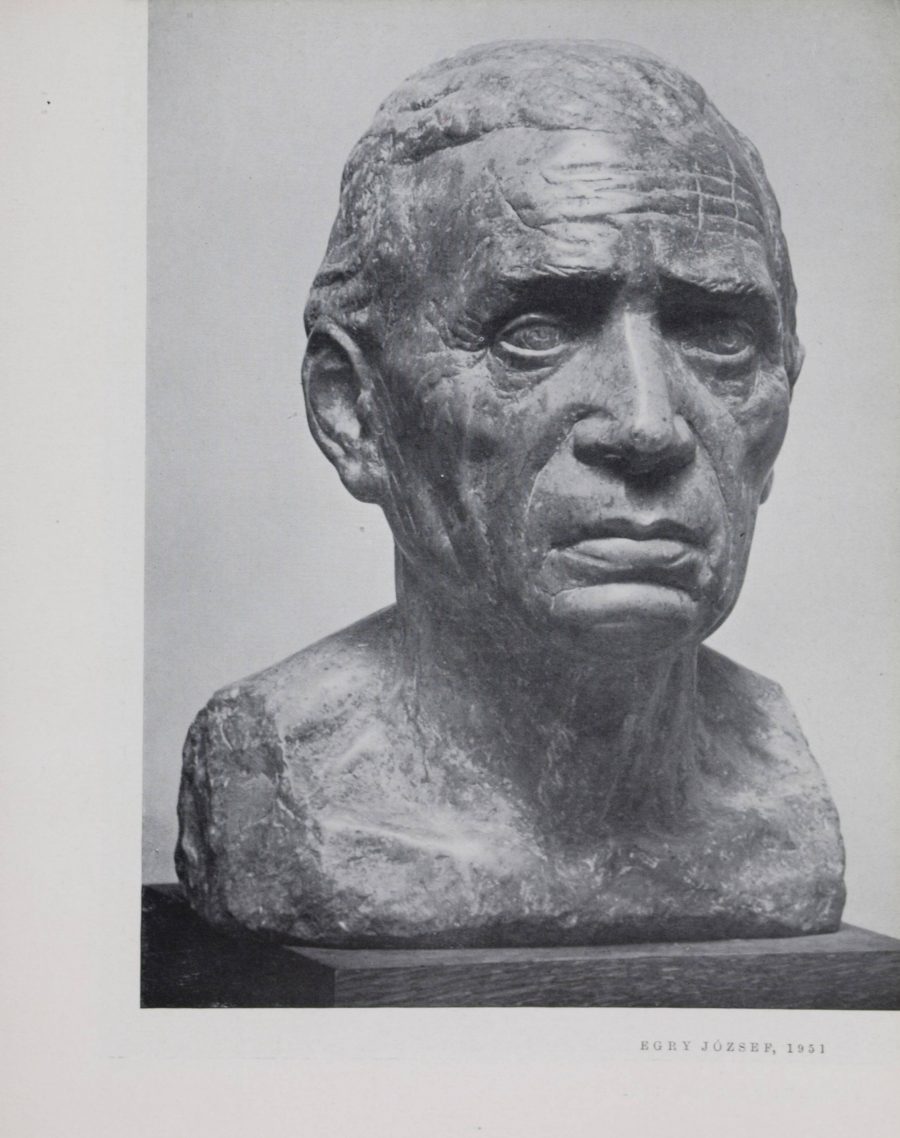
Does an exhibition checklist, with photographs and descriptions of every piece on display, make up for missing the Kawakubo in person? Not exactly, but at least I can linger over it, virtually, in solitude and at my leisure. If you value this experience, cannot make it to the Met, or want to see several hundred past exhibitions from the comfort of your home, you can do so easily thanks to the wealth of catalogs the Met has uploaded to its Digital Collections.
These catalogs document special exhibits not only at the New York landmark, but also at galleries around the world from the past 100 years or so. In a recent blog post, the Met points to one such scanned catalog—out of almost a hundred from the Hungarian Gallery Nemzeti Szalon—from a 1957 exhibition of sculptor Miklós Borsos. The text is in Hungarian, but the artwork (further up), in detailed black and white photographs, speaks a universal visual language.
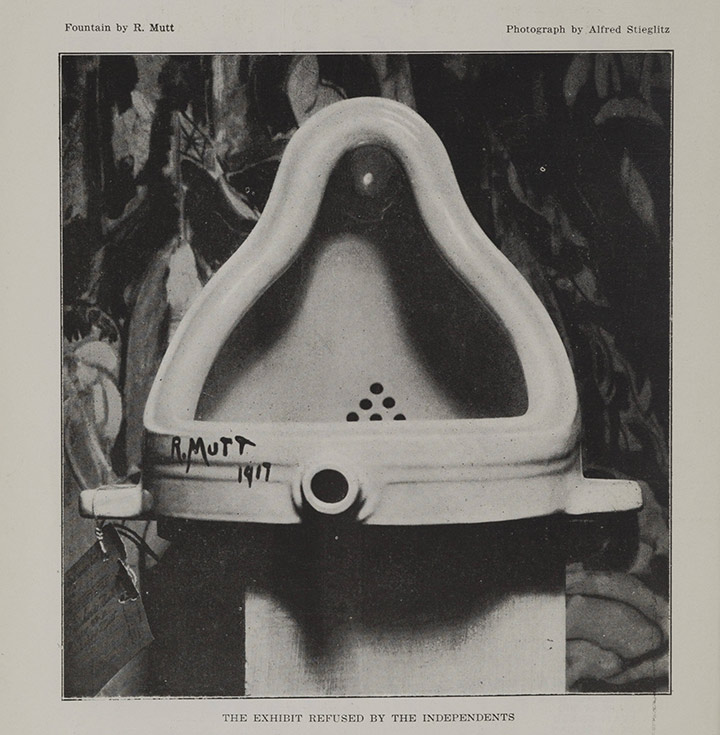
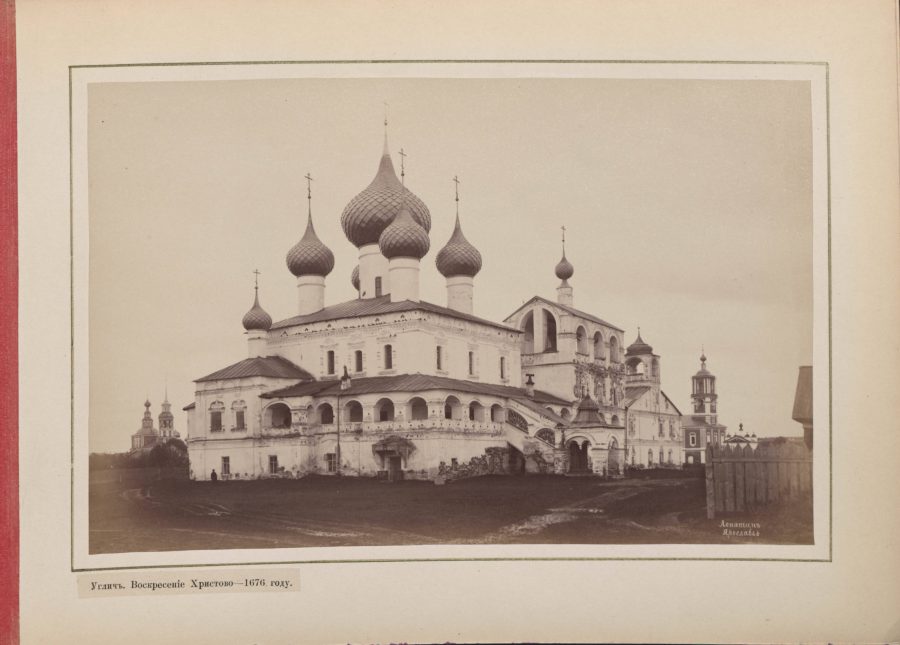
These catalogs join the thousands of books—50,000 titles in all—at the Met’s Digital Collections. There, you’ll find collections such as Rare Books Published in Imperial and Early Soviet Russia, with unusual treasures like the book Churches of Uglich, a survey of one Russian town’s churches, with photos, from the 1880s. “Interested in Dada?” asks the Met, and who isn’t? The museum has just added a 1917 issue of journal The Blind Man, edited by Marcel Duchamp and containing Alfred Stieglitz’s photograph of Duchamp’s found art prank Fountain.

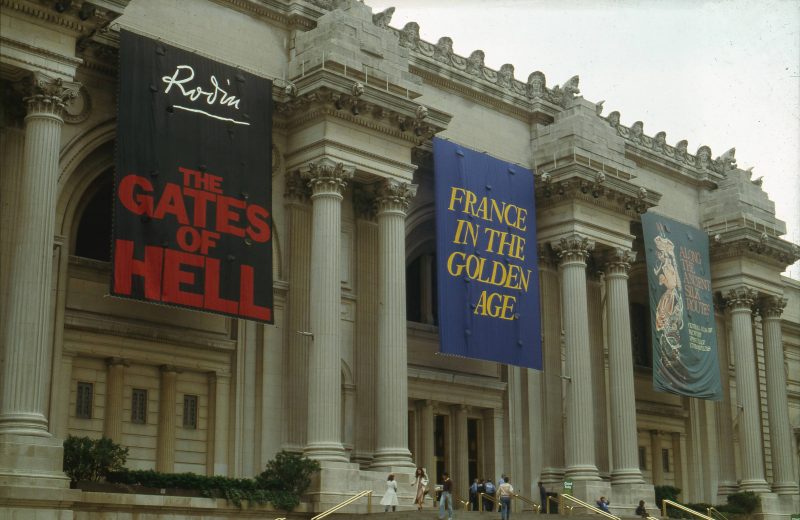
If fashion’s your thing, the museum has added thousands of Bergdorf Goodman sketches from 1929 to 1952 (see a particularly elegant example above from the 1930s). Maybe you’re into the history of the Met itself? If so, check out this massive collection of historical images of the museum, inside and out, dating from its inception in 1870 to the present. There’s even a selection of photos of its iconic special exhibition banners from 1970 through 2004 (like that below from 1982).
If you’re headed to the Met to see one of these special exhibits, take my advice and don’t get distracted once you’re inside. But if you want to access a range of the museum’s cultural treasures from afar, you can’t do any better than browsing its Digital Collections, where you’re also likely to get lost for hours, maybe days.
Related Content:
Download 200+ Free Modern Art Books from the Guggenheim Museum
2,000+ Architecture & Art Books You Can Read Free at the Internet Archive
Josh Jones is a writer and musician based in Durham, NC. Follow him at @jdmagness
Download 50,000 Art Books & Catalogs from the Metropolitan Museum of Art’s Digital Collections is a post from: Open Culture. Follow us on Facebook, Twitter, and Google Plus, or get our Daily Email. And don't miss our big collections of Free Online Courses, Free Online Movies, Free eBooks, Free Audio Books, Free Foreign Language Lessons, and MOOCs.
Rebecca Solnit: The Coup Has Already Happened

A lot of people are waiting for something dramatic to happen, some line to be crossed, an epic event like the firing of special counsel Robert Mueller III that will allow them to say that now we have had a coup and now we are ready to do something about it.
We already had the coup.
It happened on November 8, 2016, when an unqualified candidate won a minority victory in a corrupted election thanks in part to foreign intervention. Any time is the right time to pour into the streets and demand that it all grinds to a halt and the country change direction. The evidence that the candidate and his goons were aided by and enthusiastically collaborating with a foreign power was pretty clear before that election, and at this point, they are so entangled there isn’t really a reason to regard the born-again alt-right Republican Party and the Putin Regime as separate entities.
Take the recent revelations about the president’s personal errand boy, Michael Cohen. He ran a shell company from which money was used to pay Stormy Daniels to remain silent in what was quite likely an illegal campaign contribution. Money came in, along with major corporations, from a Russian oligarch close to Putin, Viktor Vekselberg, or rather from a corporation called Columbus Nova, run by a cousin of his apparently appointed to mask Vekselberg’s own role. The New Yorker reports, “It is a company technically owned by others but which looks after money owned and controlled in large part—if not entirely—by Vekselberg and his family.” Or as Frank Rich put it at New York Magazine, it’s “an example of collusion so flagrant that it made Trump and Rudy Giuliani suddenly go mute: a Putin crony’s cash turns out to be an essential component of the racketeering scheme used to silence Stormy Daniels and thus clear Trump’s path to the White House in the final stretch of the 2016 election.”
The Washington Post reports that Columbus Nova “is listed as the organization behind a string of websites targeted toward white nationalists and other members of the alt-right.” That is, this Russian oligarch’s company was illegally attempting to influence the election, and they were giving money to the bagboy of the election’s winner. Pro Publica reports that another personal lawyer of the president’s, Marc Kasowitz, also worked on behalf of Columbus Nova. There are a thousand other details like that of financial dealings—real estate sales, investments, odd transfers of wealth, social connections, meetings—that tie the Trump mob to the Russian mob—because most of the oligarchs are, in that autocratic regime, in one way or another mobsters, because Putin himself runs that vast country as though he was a mob boss intent on exerting control through fear, and profit through extortion.
The Trump family aspires to mafia status, a thuggocracy, but they are manipulable and bumbling where Putin and company are disciplined and Machiavellian. They hire fools and egomaniacs and compromised figures—Scaramucci, Giuliani, Bannon, Flynn, Nunberg, the wifebeating Rob Porter—and then fire them, with a soap opera’s worth of drama; the competent ones quit, as have many lawyers hired to help Trump navigate his scandals. The Trumps don’t hide things well or keep their mouths shut or manage the plunder they grab successfully, and they keep committing crimes in public. Remember when Trump revealed highly classified data to the Russian ambassador and foreign minister when they visited him in the Oval Office, not long after he fired FBI director James Comey (but before he admitted it was to obstruct Comey’s investigation of his ties to Russia?). There’s a picture of that visit in which the Russians are laughing at him and he looks befuddled. Remember when Donald Jr. met with the Russian agent in Trump Tower in June of 2016 to get purloined data on Clinton and tried to cover it up by saying it was about adoptions? Remember when the Trump team was forced out of the Panama hotel that Trump still profited from, and how his lawyers appealed directly to the president of Panama? How he profits from that business and others despite the emoluments clause of the Constitution? Or the various lawsuits for violating that clause, including one pending from the attorneys general of Maryland and the District of Columbia? Or the women suing Trump for defamation? Perhaps not, as so many scandals have piled up on those ones.
From the aforementioned slush fund we just learned about, Cohen made a second payoff to a woman who had sex with and was supposedly impregnated by another wealthy Republican, though there’s suspicion that the $1.6 million payment wasn’t really on behalf of Elliott Broidy, but of Trump himself. Shutting up women is a big part of what these people do, though maybe the existence of those affairs shuts Trump up too. Jonathan Chait writes of last week’s Cohen revelations: “For all the speculation about the existence of the pee tape, the latest revelations prove what is tantamount to the same thing. Russia could leverage the president and his fixer—who, recall, hand-delivered a pro-Russian ‘peace plan’ with Ukraine to Trump’s national-security adviser in January 2017—by threatening to expose secrets they were desperate to keep hidden. Whether those secrets were limited to legally questionable payments, or included knowledge of sexual affairs, is a question of degree but not of kind.”
It’s understandable if you find connecting the dots hard when there are so many dots they blur into a blob. So never mind the webs of connection; let’s talk about natural history. It is not actually true that frogs will remain in warming water until they boil to death, but there are some other natural-history metaphors that help us understand the administration, if not ourselves. I’m thinking of parasitic wasps, a large array of species whose lifecycle much resembles that of the aliens in the old Alien movie series. Some of them lay their eggs inside other animals, notably caterpillars, and the larvae devour the host from the inside.
Five days after the 2017 Trump inauguration, National Geographic reported on a newly discovered species: “Scientists have discovered a new parasitic wasp species with a life cycle so diabolical, they named it after Set, the Egyptian god of evil and chaos. Native to the southeastern United States, this species lays its egg inside the tiny, wooden chambers that another parasitic wasp species, the gall wasp (Bassettia pallida), carves out in sand live oak trees. Once the egg hatches, the crypt-keeper larva burrows into the other wasp and takes over its mind, forcing it to start tunneling through the tree’s bark to freedom—a feat the crypt-keeper struggles to perform on its own. Even more insidious, the larva then forces its victim to drill a hole too small for its own escape. Once the larger wasp is wedged in the opening it’s created, the crypt-keeper consumes its host from the inside out, finally erupting from B. pallida’s forehead out into the world.”
Right now, Devin Nunes is trying to drill a hole out of the Justice Department and push classified information through it, into the open. The Washington Post reported last week, “A subpoena that House Intelligence Committee Chairman Devin Nunes (R-Calif.) issued to the Justice Department last week made a broad request for all documents about an individual who people close to the matter say is a sensitive, longtime intelligence source for the CIA and FBI. The Justice Department has refused to provide the documents. Intelligence officials say the material could jeopardize the source.” There seems to be widespread expectation that Nunes is fully capable of setting someone up to be assassinated, since his clear agenda since Trump arrived has been to block, disrupt, discredit, or sabotage the investigation of ties between Russia and the president and his pack of thugs. It’s been more than a year since, in a midnight drama, Nunes rushed information to the White House that he got as a member of the House Intelligence Committee.
Sabotage of national institutions, laws, standards, and the greater good has been accepted as part of the new normal, which is staggeringly far from normal. An elected official is trying to prevent his country’s agencies and its citizens from finding out if and how the president and his goons are tangled up with a foreign regime and how that prevented us from having free and fair elections and may again. As fired FBI director Comey noted in his first briefing of the president, there is no concern with protecting the nation and its information systems. The president himself has done many extraordinary things to try to interfere with the investigation, and last year White House counsel Don McGahn reportedly only prevented him from firing Mueller by threatening to resign if he did.
The president himself has consistently revealed his lack of comprehension of the separation of the three branches of government, or his lack of enthusiasm for it, and has aspired to an authoritarianism like that of the dictatorial men he admires from the Philippines to Egypt to China. Earlier this month, Trump tweeted, “A Rigged System – They don’t want to turn over Documents to Congress. What are they afraid of? Why so much redacting? Why such unequal ‘justice?’ At some point I will have no choice but to use the powers granted to the Presidency and get involved!” He’s also gone after a free press. Another tweet this month: “91% of the Network News about me is negative (Fake). Why do we work so hard in working with the media when it is corrupt? Take away credentials?” It’s an argument that what he likes is real and what he doesn’t like is fake and that he should be able to control the media so that only the former is forthcoming. It’s an argument against facts and the people who document them and the right of the rest of us to see that documentation. Ultimately, it’s an argument against any reality he does not control, because he aspires to dictate reality itself, which is what autocrats do.
“Sabotage of national institutions, laws, standards, and the greater good has been accepted as part of the new normal, which is staggeringly far from normal.”Some of the press is already on board, of course, though we are at a point where we should probably stop calling propaganda outlets news sources. The rightwing Daily Caller, a widely read online publication co-founded by Fox’s Tucker Carlson, has cut out the middle men and the apologists and gone straight to Oleg Deripaska, aka Putin’s favorite oligarch, the one who kept Paul Manafort on a short leash, letting him publish an editorial headlined “The Ever-Changing ‘Russia Narrative’ Is False Public Manipulation.” Traditionally you don’t let the accused party dictate the narrative, especially when the accused is suspected of being part of a foreign conspiracy to subvert the government of the United States. But it’s is no more unusual than Fox’s and the National Enquirer’s deep allegiance to Trump over truth. For Fox that means constantly running disinformation or just avoiding major news that casts the president in a negative light (and for Fox’s Sean Hannity, that means, according to a stunning new piece in New York magazine, a bedtime call with the president every night—“Generally, the feeling is that Sean is the leader of the outside kitchen cabinet,” says one source in the piece, which also reminds us Fox is almost Trump’s sole source of news). For the Enquirer, it means catch-and-kill payoffs to women who might damage his reputation (a catch-and-kill is when you pay for exclusive rights to a story and then don’t publish it).
The Enquirer performed a catch-and-kill operation to silence former playmate Karen McDougal, who had a relationship with Trump around the same time Daniels had her lone sexual encounter with him.
There are so many threads in this tangle involving women and how to shut them up. Deripaska—whose money apparently went to Cohen’s slush fund—took Sergei Prikhodko, Russia’s deputy prime minister, on an August 2016 cruise on his yacht with a very young paid female companion on board who goes by the name Nastya Rybka. Rybka shared a video she recorded of the two of them discussing the US election and says she has 16 hours more of recordings containing valuable information for the Mueller investigation. The Putin regime found the video—and an opposition candidate’s interpretation of it—so significant that the government attempted to shut down YouTube in Russia. Rybka is currently imprisoned in Thailand on prostitution charges. The New York Times reports that earlier this year she said, “If America gives me protection, I will tell everything I know. I am afraid to go back to Russia. Some strange things can happen.” The US seems disinclined to take her or take a look at her evidence.
More recently the National Enquirer ran a hit piece on Michael Cohen, which makes it seem possible that Cohen is going to rat on Trump and the forces lined up with Trump are going to try to discredit him. CNN reports that it “could be a strong sign President Donald Trump is upset with his personal lawyer and turning against the man,” as though it’s normal for the president to use the tabloids to discredit longtime allies. Acts that would have been shocking if committed by previous administrations are overshadowed and crowded by equally transgressive acts that pile up into something that would like us to forget that this is not normal. Even when Trump is gone, the corruption of a significant percent of the American population, those with whom we don’t merely disagree on principles and goals, but on reality itself, will be a lingering problem. They are weaponized minds, and their hate, as hate always is, is easily directed. The Republican Party itself now stands for little other than its own grasp on power, and for the domination of this country’s white male Christian-identified minority over the majority of us.
This party over country loyalty manifests in many ways. Republican Senator John McCain has been concerned since before the election about Russian intervention, and recently revealed in his memoir what was pretty well known before: that he was given the Steele Dossier and passed it on to James Comey. He’s been an outspoken opponent of Trump on various issues (and is apparently not inviting Trump to his funeral, which may be quite soon). So Republicans are now lined up to spit on their former presidential candidate or even, prematurely, on his grave: one of Fox’s regulars, conspiracy theorist Lt. General Thomas McInerney, while defending CIA chief nominee Gina Haspel and the utility of torture generally, said that torture “worked on John. That’s why they call him ‘Songbird John.’” A right-winger on Twitter posted an image of a tombstone for McCain with “songbird” on it. Then White House aide Kelly Sadler dismissed McCain’s opposition to torture with “he’s dying anyway.” No one in the White House saw fit to apologize, though there was a meeting about leaks to the press about which five White House staffers leaked to the press.
The current situation of the United States is obscene, insane, and incredible. If someone had pitched it for a thriller novel or film a few years ago, they would’ve been laughed out of whatever office their proposal made it to because fiction ought to be plausible. It isn’t plausible that a solipsistic buffoon and his retinue of petty crooks made it to the White House, but they did and there they are, wreaking more havoc than anyone would have imagined possible, from environmental laws to Iran nuclear deals. It is not plausible that the party in control of the federal government is for the most part a kleptomaniac criminal syndicate.
It’s an incompetent criminal syndicate full of leaks and stumbles, easily played by the professionals across the sea. For example, Russian trolls used social media and a petition to try to prevent Trump from making Mitt Romney secretary of state. The allegations British spy Christopher Steele turned over included, as Jane Mayer put it in the New Yorker, this: “The Kremlin, through unspecified channels, had asked Trump to appoint someone who would be prepared to lift Ukraine-related sanctions, and who would coöperate on security issues of interest to Russia, such as the conflict in Syria. If what the source heard was true, then a foreign power was exercising pivotal influence over US foreign policy—and an incoming President.”
There are so many pieces to this picture, and so many of them point to Russia. The criminal Oliver North, the illegal arms dealer convicted of three felonies related to his cover-up of the Iran-Contra deal, is now the head of the NRA. Bloomberg News reported last month, “The NRA’s relationship with Alexander Torshin, a Russian politician and deputy governor of Russia’s central bank who has been linked both to Vladimir Putin and to Russian organized crime, is too troubling to ignore.” The organization seems to have received money from Russia, including this sanctioned oligarch, and it certainly gave a lot of money to Trump. There are weeks where every day a scandal erupts that would have been the defining crisis of previous administrations, and they pile on top of each other, obscuring the ones beneath. Amy Siskind, in her book The List, has tried to compile all the not-normal creeping-authoritarianism of the Trump era, but her project is itself almost too vast to comprehend.
In the case of the parasitic wasp species known as Glyptapanteles, the larvae eat through the caterpillar’s skin and build a cocoon. “At this point, something remarkable and slightly eerie happens, New Scientist explains. “The caterpillar, still alive, behaves as though controlled by the cocooned larvae.” The hijacked caterpillar serves its parasites, not itself, and it dies just as they emerge. Something is going to burst forth from the shell of what they once were. Or perhaps it has. Perhaps they’re it. Or perhaps you can picture the Russians inside the Trump team inside the Republican Party inside the American right wing as a set of Russian dolls. It’s certainly true that Russia’s waging a one-sided cyberwar against this country—through hacking of emails and election rolls, through professional trolls and online propaganda and surveillance. The response? The Trump Administration, according to Politico and other sources, is considering eliminating the administration’s top cybersecurity job.
The United States government has been a force for both good and evil, and in suggesting we defend its institutions I’m not defending all its players, actions, and history. I’m defending our ability to hold it accountable, because the current administration is endeavoring to make itself increasingly unaccountable to us and appears to be all too answerable to a hostile foreign regime. It’s not clear if Russia had any direct effect on, say, exiting the Iran nuclear pact, but Russia is a beneficiary (along with Saudi Arabia, another regime the Trump family is tangled up with). As former US ambassador to Russia Michael McFaul tweeted on May 10, “Days after Trump leaves Iran nuclear deal, oil prices are rising and ruble is strengthening.”
Over and over we’ve seen Trump contort his administration to serve Russia, whether he’s trying to hold back sanctions or to undermine the Paris climate treaty. The question isn’t whether we’re in a zombie horror movie starring an insane clown puppet with some very long and yankable strings, but what we’re going to do about it. Because what all those little pieces add up to, what the tangle sorts out as if you pay attention is: this is life after the coup.
After the coup, everything seems crazy, the news is overwhelming, and some try to cope by withdrawing or pretending that things are normal. Others are overwhelmed and distraught. I’m afflicted by a kind of hypervigilance of the news, a daily obsession to watch what’s going on that is partly a quest for sense in what seems so senseless. At least I’ve been able to find the patterns and understand who the key players are, but to see the logic behind the chaos brings you face to face with how deep the trouble is.
We still have an enormous capacity to resist the administration, not least by mass civil disobedience and other forms of noncooperation. Sweeping the November elections wouldn’t hurt either, if that results in candidates we hold accountable afterward. Or both. I don’t know if there’s a point at which it will be too late, though every week more regulations, administrators, and norms crash and burn—but we are long past the point at which it is too soon.
Yale’s Free Course on The Moral Foundations of Political Philosophy: Do Governments Deserve Our Allegiance, and When Should They Be Denied It?
"When do governments deserve our allegiance, and when should they be denied it?" It's a question that has perhaps crossed your mind lately. And it's precisely the question that's at the heart of The Moral Foundations of Political Philosophy, a free course taught by Yale political science professor Ian Shapiro.
In 25 lectures (all available above, on YouTube and iTunes), the course "starts with a survey of major political theories of the Enlightenment—Utilitarianism, Marxism, and the social contract tradition—through classical formulations, historical context, and contemporary debates relating to politics today. It then turns to the rejection of Enlightenment political thinking. Lastly, it deals with the nature of, and justifications for, democratic politics, and their relations to Enlightenment and Anti-Enlightenment political thinking."
You can find an archived web page that includes a syllabus for the course. Or you can now take the course as a full-blown MOOC. Below find the texts used in the course.
The Moral Foundations of Political Philosophy will be added to our list of Free Political Science Courses, a subset of our collection 1,300 Free Online Courses from Top Universities.
Texts:
Arendt, Hannah. Eichmann in Jerusalem. New York: Viking, 1963.
Bromwich, David. "Introduction" to On Empire, Liberty, and Reform: Speeches and Letters. New Haven: Yale University Press, 2000.
Burke, Edmund. Reflections on the Revolution in France. Oxford: Oxford University Press, 2009.
Hamilton, Alexander, John Jay, and James Madison. The Federalist Papers. Ed. Ian Shapiro. New Haven, CT: Yale University Press, 2009.
Locke, John. Two Treatises of Government and a Letter Concerning Human Understanding. Ed. Ian Shapiro. New Haven, CT: Yale University Press, 1988.
MacIntyre, Alasdair. After Virtue. Notre Dame, IN: University of Notre Dame Press, 2007.
Mill, John Stuart. On Liberty. Ed. David Bromwich and George Kateb. New Haven, CT: Yale University Press, 2003.
Nozick, Robert. Anarchy, State and Utopia. New York: Basic Books, 1974.
Rawls, John. A Theory of Justice. 2nd edition. Cambridge, MA: Harvard University Press, 1999.
Shapiro, Ian. Democratic Justice. New Haven, CT: Yale University Press, 1999.
Shapiro, Ian. Moral Foundations of Politics. New Haven, CT: Yale University Press, 2003.
Tucker, Robert C., ed. The Marx-Engels Reader. 2nd ed. New York: W.W. Norton, 1978.
Yale’s Free Course on <i>The Moral Foundations of Political Philosophy</i>: Do Governments Deserve Our Allegiance, and When Should They Be Denied It? is a post from: Open Culture. Follow us on Facebook, Twitter, and Google Plus, or get our Daily Email. And don't miss our big collections of Free Online Courses, Free Online Movies, Free eBooks, Free Audio Books, Free Foreign Language Lessons, and MOOCs.
If You’re Not Sure How a Male Author Would Describe You, Use Our Handy Chart
BgarlandSeems about right. Men, could we please try to get it together?
Don’t waste time trying to figure out how to write about your boobs—let this generator do it for you
The “describe yourself like a male author would” Twitter thread perfectly lampooned the worst habits of male novelists writing female characters. But it also required you to envision yourself as either a brainless sex object or a valueless nonentity, since those views of women are in fact the habits in question. Not everyone relished the idea of either writing salivating prose about their own hooters or acknowledging that their age, race, or size rendered them invisible.
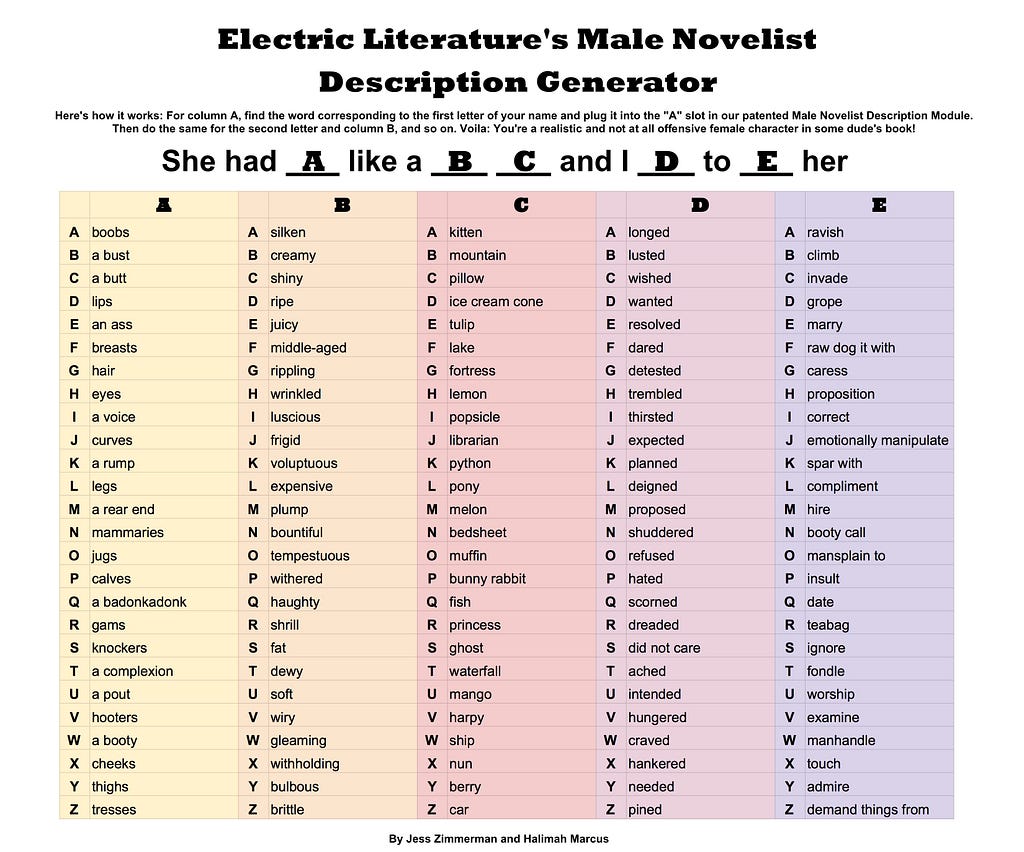
Enter: the Electric Literature automatic male novelist! Instead of objectifying yourself, let this chart objectify you based on the letters of your name. So for instance, if you’re Whitney Reynolds, originator of the Twitter challenge, you’d look up “w” in column A, “h” in column B, “i” in column C, and so forth, and then plug each word into the sentences below. Here’s your final result: “She had a booty like a wrinkled popsicle and I ached to booty call her.” Okay, there’s a little too much booty in that sentence, but since when is a little too much booty a bad thing?
If you run out of letters in your first name, move on to your last—Bo Derek would describe herself as “She had a bust like a tempestuous ice cream cone and I resolved to”… uh, this one gets a little rude, so we’ll just assume you get the idea. Literary greatness awaits!
Instagram Made Me A Better Writer


If You’re Not Sure How a Male Author Would Describe You, Use Our Handy Chart was originally published in Electric Literature on Medium, where people are continuing the conversation by highlighting and responding to this story.
What Are the Rules for Lending Your Books to Friends?
BgarlandBasically, if I love you, I lend you a book with the expectation of not getting it back. Everyone else can go to Amazon or their public library.
We asked librarians, since they’re the experts

I have a master’s degree in literature and I live in New York City, which means two things: I have a lot of books, and not a lot of anything else. So when people come over to my apartment and don’t want to talk to each other, they’re forced to marvel at my bookshelves, which are both my only art and my largest pieces of furniture.
After a couple of glasses of wine, I inevitably begin handing out my books like party favors. I always think I will get them back. But then I never get them back. And if I do, the pages are ripped, the cover clinging by one stitch, or there’s a hard, crusty peak of some unidentifiable food item (I hope) trapped on page 47.
I want to feel blithe about these borrowing faux pas. Books are just things, after all. But instead I start to sweat and fidget when someone walks into the room who has one of my books held hostage. And to come clean: I’ve also got some books that are not my own taking up loads of guilty space on the shelves. Should I flagellate myself for my oversights? Should I cut ties with friends who leave chocolate thumbprints on my dust jackets? What, in short, are the RULES here?
Should I cut ties with friends who leave chocolate thumbprints on my dust jackets? What, in short, are the RULES here?
I decided to reach out to some librarians, the experts on book borrowing, to find out what their personal policies are on sharing their own treasured property. In honor of National Library Week, here are the words of wisdom from six librarians on the do’s and don’ts of swapping books.
Do librarians lend from their personal collections?
“In general, I rarely lend my personal books out anymore, for a few reasons:
- I tend to forget who has what.
- I don’t give people deadlines, and the conversation is always the same (“Hey, did you read Stiff yet?” ‘No! It’s on my list!’), month after month. If I do give a deadline — usually a month or two — the borrower tends to give it back immediately and say ‘I can’t promise anything, so you keep it.’”
- People lose things.
That last one accounts for 97% of my book-stinginess now; the last few books I lent out did not return to me, and pleas to their borrowers were always met with a blank stare and a refrain of ‘Preeeeetty sure I gave that back to you.’ And I’m always torn about it, because there are books that I just NEED people to read, but I also don’t want to lose my entire library.”—Erica Smith, cataloger in Maryland
“I do love lending books! It is one of my favorite things. I love it. There are very few books I won’t lend out, and I tend to buy extras of my favorites when I see them at Goodwill or a used bookstore, specifically so that I always have them on hand to lend. My partner, who is an academic, finds my habit of lending books willy-nilly incredibly annoying, since it sometimes spills over into me enthusiastically lending hers as well. There is honestly almost no greater joy in my life than when somebody tells me that they loved a book I recommended, or that I lent or recommended the right book at the right time. I have no idea how many of my personal books have vanished from my lending habits, but it’s like a little hug (even right now thinking about it) to remember when various people came back to me to talk about a book I recommended them, especially if they loved it or if it opened a door for them.”—Claire Scott, children’s librarian in Seattle, Washington
There is honestly almost no greater joy in my life than when somebody tells me that they loved a book I recommended, or that I lent or recommended the right book at the right time.
“Since I became a librarian, most of my friends are now also librarians. As a result, I cannot even remember the last time I lent out a book of mine. If I want a book, I usually check it out from the library or get it through interlibrary loan. I rarely buy books anymore, and, as a result, few people ask me to borrow books from me.”—Brian Flota, humanities librarian at James Madison University
“I’ll lend anything out to anyone I like or trust to return it to me. I’ll also give away books on a store-to-own plan when I need space but am not ready to give something up. I guess I won’t lend something if I’m actively using it for my current project or if I BOTH don’t like the person and don’t trust them. Also if it’s really inconvenient.”—James Ascher, former Assistant Professor in U.C. Boulder Libraries, current doctoral student at University of Virginia
“Lending a book creates an obligation between friends and is fraught with potential arguments, from timing to condition of return. So much of my job is spent dealing with late and damaged books that I have no interest in making that a part of my off-the-clock life as well. That doesn’t mean that I don’t hand books to friends. I do. I just don’t expect to get them back.”—Tyler Wolfe, librarian from Baltimore County, Maryland
“My policy is fairly simple, in most cases — if I lend a book to you, I probably don’t expect to see it again. (There’s a very small group of people to whom I will lend books that I want back.) I don’t have a lot of regard for the book as physical object, and 90% of the books that I read get lent out, given away, donated, or returned to the library. I also live in an apartment in Brooklyn and don’t have the space for every book that passes through my life. I’d rather keep an extensive collection of books that I haven’t read yet and a small collection of books that I may want to revisit someday, and that takes up all the space I have. ‘Lending’ books out helps me keep my book situation under control.”—Jessica Harwick, YA librarian in Brooklyn, New York
My policy is fairly simple, in most cases — if I lend a book to you, I probably don’t expect to see it again.
Rules and regulations
“My own ‘rules’ about damage are similar to library rules: if you damage a book to the point where it’s no longer readable by another human being, you should replace it, if doing so isn’t a financial hardship. If you spill something on it, at least try to clean it off. And for Pete’s sake, come to me about it! If you damage my book, I’ll probably be annoyed, but I’ll get over it; I know you didn’t do it on purpose.” — Erica Smith
“If the book is special to me, I give them a very earnest speech about how special it is and why, and tell them that I definitely want it back eventually. I guess this implies that normally my joy in them reading the book is greater than my joy in getting it back? Whatever, it works out fine.” — Claire Scott
“As somebody who successfully completed a Ph.D. in English earlier in my life, many of my books are extensively marked up. Some of them even have taped spines. (I know, my library friends will shudder at the heresy of my actions.) As a result, if any of those books get lent out, I don’t really mind if more marginalia fills their pages. If the book is brand spanking new, I will ask for a little restraint from whomever I lend it out to so that it stays relatively pristine. If it is one of those old paperback editions of a classic printed on very acidic paper and the spine is starting to break, I will ask who I lend it out to to similarly be very careful about it. The due date seems pretty consistent: about four to six months if I really want it back. Most of my friends lead busy lives, especially those with children, and expecting it back within a public library’s due date policy just seems cruel.” — Brian Flota
Most of my friends lead busy lives, especially those with children, and expecting it back within a public library’s due date policy just seems cruel.
“If I think a book is too delicate for the person who wants to borrow it, I’ll probably show them how I’d handle it before they borrow it. If I don’t think that they’d be capable of not destroying the book — maybe they’re going on a sea voyage or live in a tent in the woods — then I’d have to like them enough to accept that I might never get the item back. Mostly, I want people who borrow my books to try to fix them if they break them — signs of readership are interesting to me.
I usually specify a vague timeframe for the book, but I’m grateful for distributed storage, so don’t force anyone to return something if I still know how to get in touch with them.
I write on the front free endpaper ‘James P. Ascher, his book, lent to BLAH BLAH April 2018’ to which I add ‘returned May 2018’ and might have a second, or third, lending there. I really only lend out books to people who would — at worst — forget to return them so writing on them is enough.”— James Ascher
“Even if I only have one copy, I’d usually rather give it away than loan it. There are so many books in the world and I’m confident that I’ll be able to get another copy when the urge to reread it strikes me. And if I never want to reread it, then what’s the use of having it on my shelf anyway? I know the books that I love, the books that I am most likely to recommend, so when I see a copy for a bargain price, at a used book store or a flea market or something, I’ll buy it. At any given time, I have 2–3 worn-out paperback copies of my favorite books on hand and ready to give away. A lot of this is a luxury, obviously. Thanks to my job, I’m surrounded by books and often can find them for cheap. I can afford to buy them and give them away. But even when I’m not comfortable giving a book away (I do have a few that hold particular sentimental or monetary value), I’d rather send someone to the library! Our whole business model is lending books at no cost.” — Tyler Wolfe
At any given time, I have 2–3 worn-out paperback copies of my favorite books on hand and ready to give away.
“Annotate away! Drink wine and be merry! Take it to the beach! Keep it until I forgot that I lent it to you! My only rule is don’t judge me for my own wine spills or annotations or sand/salt from the beach. If you can live with the evidence that I read and loved a book, I can live with yours.” — Jessica Harwick
On what being a librarian has taught them about the way people treat borrowed books
“Most library customers love books, respect books, and want other people to have access to books. Some, though, just don’t give a tinker’s damn. Here is a combination of pet peeves, nightmare stories, and my observation of/opinions on the way people treat borrowed books:
I’ve gotten books back with mold or — on three memorable occasions — live roaches in them. Or that are smeared with candy and Kool-Aid. Or that smell so strongly of gasoline that we can’t keep them in the building and have to exile them to the parking lot. Or that have clearly been kept in the wrong part of a diaper bag. Nonfiction books come with paragraphs highlighted and notes in the margins (in pen). Photography books have pictures cut out. History books are scrawled with racial slurs.
I’ve gotten books back with mold or — on three memorable occasions — live roaches in them. Or that are smeared with candy and Kool-Aid.
In my first year working in the Circulation department, a customer returned a huge pile of books and stood there waiting for me to check them in. I saw that their pages were all warped and the writing was smeared. I picked one up and immediately put it down again.
‘Sir,’ I said, ‘these are wet.’
‘They were like that when I checked them out,’ he responded.
A brief glance at my computer screen. ‘These were checked out three weeks ago.’
‘Yep,’ he said.
‘All of these books were wet — soaking wet — three weeks ago? All of them? From different sections of the library?’
‘Yep.’
By this point, a colleague had drifted over. ‘We have to charge you for these.’
The man smirked at me. ‘They were like that when I checked them out.’
I was a little desperate at this point. ‘But we wouldn’t have checked them out like this.’
The smirk became even more punchable. ‘You did. Someone did. Anyway, you can just dry them out and put them on the shelf again.’
I’ve had that exact conversation — about wet books, about defaced books, about books that have clearly been half-eaten by a dog — more times than I can count.” — Erica Smith
Librarians Are Secretly the Funnest People Alive
“Most of the patron book condition issues that I encounter are really more about access and circumstances, not willful damage. Often kids’ books will come back super beat up (especially books that have been hanging out in backpacks) but, you know, the kids are seven or ten, it’s amazing books come back at all. I mean, look at how many jackets end up in random corners of the playground after recess! A lot of book damage of adult books is things like damp or dirty pages, or cigarette odor — and those things are often due to the fact that lots of avid readers of print books are insecurely housed and it’s ridiculously hard to keep everything clean and dry and in perfect condition when you’re living out. Considering the sheer volume of library books read by my library patrons experiencing homelessness, it’s honestly incredible how little damage the books get under those circumstances and what good care patrons take of them. Cigarette smoke is a bummer, because there’s nothing you can do but discard that book… but again, nobody wants everything they own to smell like cigarette smoke. It’s not that common anymore, and mostly those books are coming back from folks who are homebound or isolated seniors in small living spaces.” — Claire Scott
“Most people treat books with care. But when you see so many books being checked out and returned, there are definitely some instances where something has gone horribly wrong. Water damage, dog and cat bites, pest bites, food stains, and incredibly destructive (and highly uninformative) marginalia are some of the worst things I’ve seen. But those instances are few and far between.” — Brian Flota
“People seem to have more respect for books that they borrow from people they know than they do for library books. Something about the communal experience of borrowing makes people feel as if they don’t have to be careful with the books. While I don’t care how long people keep my books, I am surprised at how long people will keep books without reading them. If I borrow a book from someone, I usually read it right away. If someone has gone to the trouble of recommending a book to me (or if I’ve sought it out), then I want to read it sooner rather than later.” — Jessica Harwick
People seem to have more respect for books that they borrow from people they know than they do for library books.
The Golden Rule
“Non-librarians are often more worried about a book’s condition than librarians are! We know that things get beat up and that there are plenty more out there.
Know your lender. Be just a smidge more careful than they are.
If you don’t want to read it, just say eh, I don’t think that sounds like what I want right now. We won’t mind! Don’t take the book and then let it gather dust and have the looming anxiety of not having read it build while your eager librarian friend checks in over and over to see what you thought! Because one day, years later, she’ll come to your house and find it hidden in your bookshelf and ask — with a tentative, heartbreaking hopefulness — if you’ve had a chance to try it yet. And you’ll have to mumble no, things got busy, but you’re going to read it soon. And her heart will sink and she’ll know that she did not, in fact, match the right reader with the right book at the right time, and worst of all, you didn’t tell her so she can’t make a better recommendation next time. Honesty is the backbone of every relationship, readers, including your relationship with your book-pushing friends.”— Claire Scott
What Are the Rules for Lending Your Books to Friends? was originally published in Electric Literature on Medium, where people are continuing the conversation by highlighting and responding to this story.
Black Farmers Reviving Their African Roots: ‘We Are Feeding Our Liberation’
One Saturday morning in November, Xavier Brown was working in the Dix Street community garden in northeast Washington, D.C. The garden is near the Clay Terrace public housing complex in the heart of the city’s Ward 7, home to about 70,000 people, 94 percent of whom are African American.
Brown worked alongside six formerly incarcerated men to build a compost bin big enough to generate 1,200 pounds of rich soil, or what they call “black gold,” out of neighborhood food scraps. The compost is an essential ingredient for growing crops in the 32 garden beds they also made from donated and recycled plywood.
Within a few hours, more bins were close to being finished, with dozens of feet of steel hardware cloth protecting the food scraps inside from rodents and other animals.
“It was not looking like this this morning,” Brown says in amazement.
Brown formed a partnership with Boe Luther and Wallace Kirby, two gardeners from Ward 7 who started Hustlaz 2 Harvesters to offer people released from incarceration ways out of poverty into urban agriculture careers and other social enterprises. Brown, a certified master composter for the city, helped Luther and Kirby transform an empty lot into the Dix Street community garden as part of an urban agricultural initiative called Soilful City.
Only 1 in 10 Americans eats the daily recommendation of fruits and vegetables, according to the Centers for Disease Control and Prevention, and people living in poverty have especially low rates of consumption of fresh produce. Access to healthy produce is difficult in low-income communities like Clay Terrace, because major chain supermarkets are reluctant to locate their stores there. Ward 7 has only one large grocery store, and that means the people who live there have a harder time obtaining more fruits and vegetables to help reduce cardiovascular risk.
Yet Brown, Luther, and Kirby believe the community can grow its way out of food scarcity through the Dix Street garden and similar projects. They say crops that were staples of their African ancestors’ diets hold an essential key to restoring the community’s health.
“It’s not just about vegetables—we’re building a new way to rebuild neighborhoods,” Brown says.
“Black people need to return to being growers, builders, and producers, so when we’re consuming, we’re also feeding one another, and we’re feeding our liberation,” he says.
For instance, to transform the food landscape in Washington, D.C., Brown, Kirby, and Luther helped a neighbor grow bodi, a long string bean indigenous to central Africa. The bean provides many nutrients that are routinely missing from most Americans’ diets, including fiber and vitamins. In D.C., it’s helping reconnect the local population to their cultural heritage.
At the same time, the work of planting and harvesting helps build an environment and community that can facilitate healing from the traumatic legacy of land-based oppression—from slavery to more modern practices of racist covenants and housing redlining—that Black people in the United States have endured.
“This is the generation that only sees [agricultural work] as a part of plantation slavery,” Kirby says. He says the neighborhood used to be filled with garden beds and chickens, because most of the families had come from the rural South and brought their way of life with them.
A lot of that rural character was then lost, especially after the 1968 riots that tore through the city after the assassination of Martin Luther King, Jr.
“After the riots, everyone wanted to disconnect with the Earth, with nature; they didn’t see the value,” he says. His eyes widen as he describes destroyed backyard gardens, Black businesses looted and burned. The community’s connection to land and its spirit of self-reliance broke.
Brown hopes to mend that rift by looking to African roots. He has adopted a practice called Afro-ecology, a theory and practice created by fellow urban farmer Blain Snipstal to describe how Black people in the U.S. can reconnect with their African or Afro-indigenous past through traditional planting and harvesting techniques.
“Afro-ecology is reorientation of our connection to the land, an organizing principle, and the way we express our culture while we grow food and grow healthy people,” Brown says.
Using food and farming to overcome the trauma resulting from a history of land oppression and racism is work Leah Penniman knows well. She is a farmer and food justice organizer in upstate New York at Soul Fire Farm, where hundreds of new Black, Latinx, Native American, and Asian growers come to participate in agricultural training workshops that focus on healing people as well as the land.
“We are in a moment where Black and Brown people are ready to reclaim our right to belong to the Earth and ready to reclaim our place and agency in the food system,” Penniman says.
Penniman sees delving deeply into the history of food injustice—effectively naming racism as the problem—as the first step in search of better solutions to structural realities of food injustice. At Soul Fire, Penniman discusses the hundreds of cases of Black farmers being cheated out of or driven off their land in 13 Southern and border states from the Civil War up to the 1960s.
The next steps involve learning the history of African agriculture and how it was transplanted to the Americas and became intertwined with the suffering and generational trauma of slavery. She wants to transform that pain into power, allowing Black farmers to take on the role of a griot, or a traditional African storyteller.
“We’ve replaced that story with a different story of ‘I’m harvesting a plant that’s sacred to my people and I’m harvesting a crop that will benefit my community in these particular ways,’” she says. “So, we are ‘deprogramming’ the victim mindset, the reactive mindset, and instead connecting with our ancestral way of being [on the land], which is a proactive mindset with agency and power.”

A large garden shed built using donated power tools and recycled plywood contains a food refrigerator and grilling area. Across the street from the community garden is the Clay Terrace public housing complex. (Photo by Kevon Paynter)
Similarly, Soilful City’s project connects recently released inmates and other community members of Clay Terrace to planting and harvesting methods rooted in the African diaspora, and their collective work authors a new story of self-determination and healthy food access for the neighborhood. At the same time, the farm is helping people develop work skills and producing needed revenue in the community, while also providing other urban agriculture businesses, like the legal marijuana industry, with composting and high-yield soil.
“I believe we can dominate the composting landscape in D.C. and have a model to take elsewhere,” Brown says.
If the rates of obesity, diabetes, and lower life expectancy in the neighborhood are reduced as a result, that will be just one more sign of the success the project is having in the community in repairing the broken relationship between the urban population and the land.
Another sign of hope is the vibrant red fish peppers growing in the garden beds, a crop originally from the Caribbean that nearly died out before it was salvaged by Horace Pippin, a painter who saved many rare seeds used by fellow Black gardeners in the 1940s.
By growing fish peppers, Brown says, he’s paying his respects to a fellow African American farmer.
Brown and Winford James, one of the men building the compost bin, started a micro-enterprise to bring a sweet and spicy hot sauce recipe they make from the fish pepper to market. Soilful City is changing communities, James says.
“Every farm I’ve ever been to has been with Xavier,” he says. “By helping them help the community, I’m also helping myself.”
This article, which was funded in part by a grant from the Surdna Foundation, originally appeared in Yes! Magazine’s Decolonize Issue, and is reprinted with permission.
Top photo: Xavier Brown, left, helps construct a wooden compost bin inside the Dix Street community garden in northeast Washington, D.C. (Photo by Kevon Paynter)
The post Black Farmers Reviving Their African Roots: ‘We Are Feeding Our Liberation’ appeared first on Civil Eats.
Are Washington, D.C. and the Bay Area superseding New York City?
In terms of influence, absolutely:
Traditionally, Americans have thought of New York City as the country’s cultural and intellectual center. That’s no longer the case. New York dominates in many areas, most of all the arts, but those are no longer the most influential or innovative parts of the American Zeitgeist.
Don’t be fooled by the fact that NYC feels higher status or is so diverse or has some of the coolest people. Right now it is not the place with the generative ideas — sorry!
Here is my bit on D.C.:
The D.C. area is the center of legalistic thinking, which is increasingly important with the growth of government and the regulatory state. Lawyers and policy-makers are our engineers for incentives, so to speak, even if they don’t always get it right. Their efforts are backed by an array of economic, legal, political, public opinion and bureaucratic expertise that is without parallel in history. If, for instance, you talk to the specialist at the Treasury Department on accelerated tax depreciation, that individual will be impressive, even though his or her final output may be filtered through some very unimpressive political constraints.
D.C. has also become an increasingly important media center, where so many rhetorical battles over the future of the country are started. President Donald Trump maximized his influence by moving to the nation’s capital, though augmented by Twitter, a San Francisco product.
I’m not saying you have to like this, in fact it may end in the overregulation of tech and the Bay Area — America’s other generative center — to the detriment of economic dynamism:
But the Bay Area and the D.C. area are built on such different principles, and they don’t understand each other very well. It’s more likely that we see a rude awakening, as the U.S. realizes its two most influential centers have been pulling the country in opposite directions.
Here is the rest of my Bloomberg column, recommended.
The post Are Washington, D.C. and the Bay Area superseding New York City? appeared first on Marginal REVOLUTION.
‘Describe Yourself Like a Male Author Would’ Is the Most Savage Twitter Thread in Ages
BgarlandThis was one of the best Twitter threads ever.
The challenge is a fierce indictment of what happens when you try to write a character you don’t respect or understand

O n an unnamed part of the internet, young adult author Gwen C. Katz found a delightfully deluded male author claiming that his facility with writing natural women characters constituted an unassailable rebuke to the idea that we need diverse authors to write diverse viewpoints. If a male author can write a woman this convincing, surely there’s no need for the #OwnVoices movement!
A male author is insisting that he is living proof that it's possible for a male author to write an authentic female protagonist. Here's a quote from his first page.
Some of his other perfect descriptions—which, remember, he himself was claiming were evidence of his skill—included “I could only imagine the thoughts that were running through his head. Naughty thoughts,” and “I could imagine what he saw in me. Pale skin, red lips like I had just devoured a cherry popsicle covered in gloss, two violet eyes like Elizabeth Taylor’s.” A cherry popsicle covered in gloss, y’all. Why would you even eat that? And TWO eyes, just to be clear.
The whole thread is worth a read, but it got even better once writer/podcaster/cat tweeter Whit Reynolds proposed a Twitter game: Describe yourself the way a male author would.
@kateleth new twitter challenge: describe yourself like a male author would
“I never expected it to blow up, it was a joke made to a friend while I was ripped on Franzia. But it clearly resonated!” Reynolds told Electric Literature. “The thing that stuck out to me most is how many women responded with something along the lines of, I’m old or fat or a woman of color, so I wouldn’t be described by a male author at all. I might as well be invisible.” Those responses, taken together with the women who waxed rhapsodic over their booby boob-shaped boobs, constitute a pretty damning indictment of the state of writing about women and people of color.
If you’re a male writer, this is actually good news! It means you have a chance to listen really carefully and do a lot better in creating your women characters. Consider, for instance, writing one who’s cutting as hell and 100% has your number.
Below are some of our favorite responses to Reynolds’ challenge—but it’s not too late to pour yourself some Franzia and jump in.
Her breasts entered the room before her far less interesting face, decidedly maternal hips and rounded thighs. He found her voice unpleasantly audible. As his gaze dropped from her mouth (still talking!) to her cleavage, he wondered why feminists were so angry all the time. https://t.co/YtsZENYsgS
She didn't exist because she's fat." https://t.co/xVxALYNBnD
she was not what you'd call beautiful: eyes a bit too big, mouth a bit too lush, just a few too many boobs. her hair was dark, because she was smart https://t.co/5o9NMcojEq
I had big honking teeters, just enormous bosoms, and I thought about them constantly as I walked down the street, using my legs (thick, with big shapely calves), but never not thinking about my enormo honkers, https://t.co/UaCQBchchL
As she moved her strong cocoa body gleamed as if calling to the country of Africa. Her chocolate waist moved like an alluring siren calling me to crash on the rocks of her brown buttocks. https://t.co/eY08cAprM1
As round as she was loud, she immediately filled the room. My first thought was that I didnt want to fuck her. My second thought was even more disturbing, she didnt seem to care. She contemplated the roundness of her own boobs and contributed something to the meeting.
She smiled, but I could see the sadness in her exotic almond-shaped eyes. Her scarf was made of light cotton, but the weight of oppression that came with it kept her head bowed in submission.
No male author has ever written an attractive fat woman in her twenties who loves life so I wouldn't even know where to start tbh. https://t.co/sCgNL6pCG1
10 Satirical Covers for the Terrible Books You Can’t Get Away From
She was forty but could have passed for a year younger with soft lipstick and some gentle mascara. Her dress clung to the curves of her bosom which was cupped by her bra that was under it, but over the breasts that were naked inside her clothes. She had a personality and eyes.
@whitneyarner @kateleth She stood in front of the mirror & ran her hands down her naked body. She could be beautiful. If only she was ten years younger, twenty pounds lighter, & had larger breasts. She sighed. She should have paid for a boob job instead of all that ice cream.
Ni hao!!" I yelled at the slight girl across the street; she whipped around, glaring at me with exotic almond eyes as I called to her in the unmistakable voice of her ancestors. https://t.co/8jVCl7mfon
@whitneyarner @kateleth She was a gigantic woman, bigger than any woman had a right to be. She laughed too loud and swayed her wide hips too much.
@PuccaNoodles I didn't write one because it'd probably just be about breasts and almond-shaped eyes, but I did draw it out
Teeth studded her eyelids, the twisted geometry of her limbs. If there were breasts, any vestige of femininity, he couldn't see them. Not under the slithering, static hiss of what he'd imagined was skin.. She gurgled. He'd remember the noise forever. https://t.co/xFFPmrXwfd
‘Describe Yourself Like a Male Author Would’ Is the Most Savage Twitter Thread in Ages was originally published in Electric Literature on Medium, where people are continuing the conversation by highlighting and responding to this story.
A Shazam for Nature: A New Free App Helps You Identify Plants, Animals & Other Denizens of the Natural World
BgarlandTotally dope.

Do you ever long for those not-so-long-ago days when you skipped through the world, breathless with the anticipation of catching Pokémon on your phone screen?
If so, you might enjoy bagging some of the Pokeverse’s real world counterparts using Seek, iNaturalist’s new photo-identification app. It does for the natural world what Shazam does for music.
Aim your phone’s camera at a nondescript leaf or the grasshopper-ish-looking creature who’s camped on your porch light. With a bit of luck, Seek will pull up the relevant Wikipedia entry to help the two of you get better acquainted.
Registered users can pin their finds to their personal collections, provided the app’s recognition technology produces a match.
(Several early adopters suggest it’s still a few houseplants shy of true functionality…)
Seek’s protective stance with regard to privacy settings is well suited to junior specimen collectors, as are the virtual badges with which it rewards energetic uploaders.

While it doesn’t hang onto user data, Seek is building a photo library, composed in part of user submissions.
(Your cat is ready for her close up, Mr. DeMille…)
(Ditto your Portobello Mushroom burger…)
Download Seek for free on iTunes or Google Play.
via Earther/My Modern Met
Related Content:
Two Million Wondrous Nature Illustrations Put Online by The Biodiversity Heritage Library
Ayun Halliday is an author, illustrator, theater maker and Chief Primatologist of the East Village Inky zine. Follow her @AyunHalliday.
A Shazam for Nature: A New Free App Helps You Identify Plants, Animals & Other Denizens of the Natural World is a post from: Open Culture. Follow us on Facebook, Twitter, and Google Plus, or get our Daily Email. And don't miss our big collections of Free Online Courses, Free Online Movies, Free eBooks, Free Audio Books, Free Foreign Language Lessons, and MOOCs.
Puerto Ricans and Ultrarich “Puertopians” Are Locked in a Pitched Struggle Over How to Remake the Island
BgarlandReally good read.
"an unruly hodgepodge of Ayn Randian wealth supremacy, philanthrocapitalist noblesse oblige, Burning Man pseudo-spirituality, and half-remembered scenes from watching “Avatar” while high."
Like everywhere else in Puerto Rico, the small mountain city of Adjuntas was plunged into total darkness by Hurricane Maria. When residents left their homes to take stock of the damage, they found themselves not only without power and water, but also totally cut off from the rest of the island. Every single road was blocked, either by mounds of mud washed down from the surrounding peaks, or by fallen trees and branches. Yet amid this devastation, there was one bright spot.
A Solar Oasis
Just off the main square, a large, pink colonial-style house had light shining through every window. It glowed like a beacon in the terrifying darkness.
The pink house was Casa Pueblo, a community and ecology center with deep roots in this part of the island. Twenty years ago, its founders, a family of scientists and engineers, installed solar panels on the center’s roof, a move that seemed rather hippy-dippy at the time. Somehow, those panels (upgraded over the years) managed to survive Maria’s hurricane-force winds and falling debris. Which meant that in a sea of post-storm darkness, Casa Pueblo had the only sustained power for miles around.
And like moths to a flame, people from all over the hills of Adjuntas made their way to the warm and welcoming light.
Already a community hub before the storm, the pink house rapidly transformed into a nerve center for self-organized relief efforts. It would be weeks before the Federal Emergency Management Agency or any other agency would arrive with significant aid, so people flocked to Casa Pueblo to collect food, water, tarps, and chainsaws — and draw on its priceless power supply to charge up their electronics. Most critically, Casa Pueblo became a kind of makeshift field hospital, its airy rooms crowded with elderly people who needed to plug in oxygen machines.

Casa Pueblo.
Photo: Facebook
Thanks also to those solar panels, Casa Pueblo’s radio station was able to continue broadcasting, making it the community’s sole source of information when downed power lines and cell towers had knocked out everything else. Twenty years after those panels were first installed, rooftop solar power didn’t look frivolous at all — in fact, it looked like the best hope for survival in a future sure to bring more Maria-sized weather shocks.
Visiting Casa Pueblo on a recent trip to the island was something of a vertiginous experience — a bit like stepping through a portal into another world, a parallel Puerto Rico where everything worked and the mood brimmed with optimism.
It was particularly jarring because I had spent much of the day on the heavily industrialized southern coast, talking with people suffering some of the cruellest impacts of Hurricane Maria. Not only had their low-lying neighborhoods been inundated, but they also feared the storm had stirred up toxic materials from nearby fossil fuel-burning power plants and agricultural testing sites they could not hope to assess. Compounding these risks — and despite living adjacent to two of the island’s largest electricity plants — many still were living in the dark.
The situation had felt unremittingly bleak, made worse by the stifling heat. But after driving up into the mountains and arriving at Casa Pueblo, the mood shifted instantly. Wide open doors welcomed us, as well as freshly brewed organic coffee from the center’s own community-managed plantation. Overhead, an air-clearing downpour drummed down on those precious solar panels.

Arturo Massol-Deyá.
Still: Cristian Carretero
Settling into a wooden rocking chair, Massol-Deyá said that Maria had changed his sense of what’s possible on the island. For years, he explained, he had pushed for the archipelago to get far more of its power from renewables. He had long warned of the risks associated with Puerto Rico’s overwhelming dependence on imported fossil fuels and centralized power generation: One big storm, he had cautioned, could knock out the whole grid — especially after decades of laying off skilled electrical workers and letting maintenance lapse.
Now everyone whose homes went dark understood those risks, just as the people in Adjuntas could all look to a brightly lit Casa Pueblo and immediately grasp the advantages of solar energy, produced right where it is consumed. As Massol-Deyá put it: “Our quality of life was good before, because we were running with solar power. And after the hurricane, our quality of life is good as well. … This was an energy oasis for the community.”

Truckers in Yabucoa, Puerto Rico, wait to fill gas and diesel trucks for transport to gas stations on the island on Sept. 27, 2017, one week after Hurricane Maria.
Photo: Hector Retamal/AFP/Getty Images
It’s hard to imagine an energy system more vulnerable to climate change-amplified shocks than Puerto Rico’s. The island gets an astonishing 98 percent of its electricity from fossil fuels. But since it has no domestic supply of oil, gas, or coal, all of these fuels are imported by ship. They are then transported to a handful of hulking power plants by truck and pipeline. Next, the electricity those plants generate is transmitted across huge distances through above-ground wires and an underwater cable that connects the island of Vieques to the main island. The whole behemoth is monstrously expensive, resulting in electricity prices that are nearly twice the U.S. average.
And just as environmentalists like Massol-Deyá had warned, Maria caused devastating ruptures within every tentacle of Puerto Rico’s energy system: The Port of San Juan, which receives so much of the imported fuel, was thrown into crisis, and some 10,000 shipping containers full of much-needed supplies piled up on the docks, waiting to be delivered. Many truck drivers couldn’t make it to the port, either because of obstructed roads, or because they were struggling to get their own families out of danger. With diesel in short supply across the island, some just couldn’t find the fuel to drive. The lines at gas stations stretched out by the mile. Half of the island’s stations were out of commission altogether. The mountain of supplies stuck at the port grew ever larger.
Meanwhile, the cable connecting Vieques was so damaged it has yet to be repaired six months later. And the power lines carrying electricity from the plants were down all over the archipelago. Literally nothing about the system worked.
This broad collapse, Massol-Deyá explained, was now helping him make the case for a sweeping and rapid shift to renewable energy. Because in a future that is sure to include more weather shocks, getting energy from sources that don’t require sprawling transportation networks is just common sense. And Puerto Rico, though poor in fossil fuels, is drenched in sun, lashed by wind, and surrounded by waves.

Solar panels near Salinas, Puerto Rico.
Still: Cristian Carretero
Renewable energy is by no means immune to storm damage. At some Puerto Rican wind farms, turbine blades snapped off in Maria’s high winds (seemingly because they were improperly positioned), just as some poorly secured solar panels took flight. This vulnerability is partly why Casa Pueblo and many others emphasize the micro-grid model for renewables. Rather than relying on a few huge solar and wind farms, with power then carried over long and vulnerable transmission lines, smaller, community-based systems would generate power where it is consumed. If the larger grid sustains damage, these communities can simply disconnect from it and keep drawing from their micro-grids.
This decentralized model doesn’t eliminate risk, but it would make the kind of total power outage that Puerto Ricans suffered for months — and which hundreds of thousands are suffering still — a thing of the past. Whoever’s solar panels survive the next storm would, like Casa Pueblo, be up and running the next day. And “solar panels are easy to replace,” Massol-Deyá pointed out — unlike power lines and pipelines.
In part to spread the gospel of renewables, in the weeks after the storm, Casa Pueblo handed out 14,000 solar lanterns — little square boxes that recharge when left outside during the day, providing a much-needed pool of light by night. More recently, the community center has managed to distribute a large shipment of full-sized solar-powered refrigerators, a game-changer for households in the interior that still don’t have power.
Several Puerto Ricans I spoke with casually referred to Maria as “our teacher.”
Casa Pueblo has also kicked off #50ConSol, a campaign calling for 50 percent of Puerto Rico’s power to come from the sun. They have been installing solar panels on dozens of homes and businesses in Adjuntas, including, most recently, a barbershop. “Now we have houses asking us for support,” Massol-Deyá said — a marked shift from those days not so long ago when Casa Pueblo’s solar panels looked like eco-luxury items. “We’re going to do whatever is at reach to change that landscape and to tell the people of Puerto Rico that a different future is possible.”
Several Puerto Ricans I spoke with casually referred to Maria as “our teacher.” Because amid the storm’s convulsions, people didn’t just discover what didn’t work (pretty much everything). They also learned very quickly about a few things that worked surprisingly well. Up in Adjuntas, it was solar power. Elsewhere, it was small organic farms that used traditional farming methods that were better able to stand up to the floods and wind. And in every case, deep community relationships, as well as strong ties to the Puerto Rican diaspora, successfully delivered lifesaving aid when the government failed and failed again.
Casa Pueblo was founded 38 years ago by Arturo’s father, Alexis Massol-González, who was awarded the prestigious Goldman Prize for environmental leadership in 2002. Massol-González shares his son’s belief that Maria has opened up a window of possibility, one that could yield a fundamental shift to a healthier and more democratic economy — not just for electricity, but also for food, water, and other necessities of life. “We are looking to transform the energy system. Our goal is to adopt a solar energy system and leave behind oil, natural gas, and carbon,” he said, “which are highly polluting.”
His message particularly resonates 45 miles to the southeast, in the coastal community of Jobos Bay, near Salinas. This is one of the areas coping with a slew of environmental toxins, much of it stemming from antiquated fossil fuel-burning power plants. As in Adjuntas, residents here have seized on the post-Maria electricity failures to advance solar power, through a project called Coquí Solar. Working with local academics, they have developed a plan that would not only produce enough energy to meet their needs, but would also keep the profits and jobs in the community as well. Nelson Santos Torres, one of Coquí Solar’s organizers, told me they are insisting on solar skills training “so that community youth can participate in the installation,” giving them a reason to stay on the island.

Mónica Flores.
Still: Cristian Carretero
When I visited the area, Mónica Flores, a graduate student in environmental sciences at the University of Puerto Rico who has been working with communities on renewable energy projects, told me that truly democratic resource management is the island’s best hope. People need to have a sense, she said, that “this is our energy. This is our water, and this is how we manage it because we believe in this process, and we respect our culture, our nature, everything that is supporting us.”
Six months into the rolling disaster set off by Maria, dozens of grassroots organizations are coming together to advance precisely this vision: a reimagined Puerto Rico run by its people in their interests. Like Casa Pueblo, in the myriad dysfunctions and injustices the storm so vividly exposed, they see an opportunity to tackle the root causes that turned a weather disaster into a human catastrophe. Among them: the island’s extreme dependence on imported fuel and food; the unpayable and possibly illegal debt that has been used to impose wave after wave of austerity that gravely weakened the island’s defenses; and the 130-year-old colonial relationship with a U.S. government that has always discounted the lives of Puerto Rico’s black and brown people.
If Maria is a teacher, the storm’s overarching lesson is that now is not the moment for reconstruction of what was, but rather for transformation into what could be.
If Maria is a teacher, this emerging movement argues, the storm’s overarching lesson is that now is not the moment for reconstruction of what was, but rather for transformation into what could be. “Everything we consume comes from abroad and our profits are exported,” said Massol-González, his hair now white after decades of struggle. It’s a system that leaves debt and austerity behind, both of which made Puerto Rico exponentially more vulnerable to Maria’s blows.
But, he said with a mischievous smile, “we look at crisis as an opportunity to change.”
Massol-González and his allies know well that they are not alone in seeing opportunity in the post-Maria moment. There is also another, very different version of how Puerto Rico should be radically remade after the storm, and it is being aggressively advanced by Gov. Ricardo Rosselló in meetings with bankers, real estate developers, cryptocurrency traders, and, of course, the Financial Oversight and Management Board, an unelected seven-member body that exerts ultimate control over Puerto Rico’s economy.
For this powerful group, the lesson that Maria carried was not about the perils of economic dependency or austerity in times of climate disruption. The real problem, they argue, was the public ownership of Puerto Rico’s infrastructure, which lacked the proper free-market incentives. Rather than transforming that infrastructure so that it truly serves the public interest, they argue for selling it off at fire-sale prices to private players.
This is just one part of a sweeping vision that sees Puerto Rico transforming itself into a “visitor economy,” one with a radically downsized state and many fewer Puerto Ricans living on the island. In their place would be tens of thousands of “high-net-worth individuals” from Europe, Asia, and the U.S. mainland, lured to permanently relocate by a cornucopia of tax breaks and the promise of living a five-star resort lifestyle inside fully privatized enclaves, year-round.
In a sense, both are utopian projects — the vision of Puerto Rico in which the wealth of the island is carefully and democratically managed by its people, and the libertarian project some are calling “Puertopia” that is being conjured up in the ballrooms of luxury hotels in San Juan and New York City. One dream is grounded in a desire for people to exercise collective sovereignty over their land, energy, food, and water; the other in a desire for a small elite to secede from the reach of government altogether, liberated to accumulate unlimited private profit.
As I traveled throughout Puerto Rico, from sustainable farms and schools in the central mountain region, to the former U.S. Navy base on Vieques, to a legendary mutual aid center on the east coast, to former sugar plantations-turned-solar farms in the south, I found these very different visions of the future sprinting to advance their respective projects before the window of opportunity opened up by the storm begins to close.
At the core of this battle is a very simple question: Who is Puerto Rico for? Is it for Puerto Ricans, or is it for outsiders? And after a collective trauma like Hurricane Maria, who has a right to decide?

Manuel Laboy Rivera, secretary of the Puerto Rico Department of Economic Development and Commerce.
Photo: Tony Zayas/GDA/AP
Invasion of the Puertopians
Earlier this month, in San Juan’s ornate Condado Vanderbilt Hotel, the dream of Puerto Rico as a for-profit utopia was on full display. From March 14 to 16, the hotel played host to Puerto Crypto, a three-day “immersive” pitch for blockchain and cryptocurrencies with a special focus on why Puerto Rico will “be the epicenter of this multitrillion-dollar market.”
Among the speakers was Yaron Brook, chair of the Ayn Rand Institute, who presented on “How Deregulation and Blockchain Can Make Puerto Rico the Hong Kong of the Caribbean.” Last year, Brook announced that he had personally relocated from California to Puerto Rico, where he claims he went from paying 55 percent of his income in taxes to less than 4 percent.
Elsewhere on the island, hundreds of thousands of Puerto Ricans were still living by flashlight, many were still dependent on FEMA for food aid, and the island’s main mental health hotline was still overwhelmed with callers. But inside the sold-out Vanderbilt conference, there was little space for that kind of downer news. Instead, the 800 attendees — fresh from a choice between “sunrise yoga and meditation” and “morning surf” — heard from top officials like Department of Economic Development and Commerce Secretary Manuel Laboy Rivera about all the things Puerto Rico is doing to turn itself into the ultimate playground for newly minted cryptocurrency millionaires and billionaires.
It’s a pitch the Puerto Rican government has been making to the private jet set for a few years now, though until recently it was geared mainly to the financial sector, Silicon Valley, and others capable of working wherever they can access data. The pitch goes like this: You don’t have to relinquish your U.S. citizenship or even technically leave the United States to escape its tax laws, regulations, or the cold Wall Street winters. You just have to move your company’s address to Puerto Rico and enjoy a stunningly low 4 percent corporate tax rate — a fraction of what corporations pay even after Donald Trump’s recent tax cut. Any dividends paid by a Puerto Rico-based company to Puerto Rican residents are also tax-free, thanks to a law passed in 2012 called Act 20.
Conference attendees also learned that if they move their own residency to Puerto Rico, they will not only be able to surf every single morning, but also win vast personal tax advantages. Thanks to a clause in the federal tax code, U.S. citizens who move to Puerto Rico can avoid paying federal income tax on any income earned in Puerto Rico. And thanks to another local law, Act 22, they can also cash in on a slew of tax breaks and total tax waivers that includes paying zero capital gains tax and zero tax on interest and dividends sourced to Puerto Rico. And much more — all part of a desperate bid to attract capital to an island that is functionally bankrupt.
To quote billionaire hedge fund magnate John Paulson, owner of the hotel in which Puerto Crypto took place, “You can essentially minimize your taxes in a way that you can’t do anywhere else in the world.” (Or, as the tax dodger’s website Premier Offshore put it: “All the other tax havens might as well just close down. … Puerto Rico just hit it out of the park … did the best set ever and dropped the mic.”)
The idea of turning an island that cannot keep the lights on for its own people into “the epicenter of this multitrillion-dollar market” rooted in the most wasteful possible use of energy is a bizarre one.
With just a 3 1/2-hour commute from New York City to San Juan (or less, depending on the private jet), all it takes to get in on this scheme is agreeing to spend 183 days of the year in Puerto Rico — in other words, winter. Puerto Rican residents, it’s worth noting, are not only excluded from these programs, but they also pay very high local taxes.
Manuel Laboy used the conference to announce the creation of a new advisory council to attract blockchain businesses to the island. And he extolled the lifestyle bonuses that awaited attendees if they followed the self-described “Puertopians” who have already taken the plunge. As Laboy told The Intercept, for the 500 to 1,000 high-net-worth individuals who relocated since the tax holidays were introduced five years ago — many of them opting for gated communities with their own private schools — it’s all about “living in a tropical island, with great people, with great weather, with great piña coladas.” And why not? “You’re gonna be, like, in this endless vacation in a tropical place, where you’re actually working. That combination, I think, is very powerful.”
The official slogan of this new Puerto Rico? “Paradise Performs.” To underscore the point, conference attendees were invited to a “Cryptocurrency Honey Party,” with pollen-themed drinks and snacks, and a chance to hang out with Ingrid Suarez, Miss Teen Panama 2013 and upcoming contestant on “Caribbean’s Next Top Model.”
Mining cryptocurrencies is one of the fastest growing sources of greenhouse gas emissions on the planet, with the industry’s energy consumption rising by the week. Bitcoin alone currently consumes roughly the same amount of energy per year as Israel, according to the Bitcoin Energy Consumption Index. The city of Plattsburgh, New York, recently adopted a temporary ban on cryptocurrency mining after local electricity rates suddenly soared. Many of the crypto companies currently relocating to Puerto Rico would presumably do their currency mining elsewhere. Still, the idea of turning an island that cannot keep the lights on for its own people into “the epicenter of this multitrillion-dollar market” rooted in the most wasteful possible use of energy is a bizarre one and is raising mounting concerns of “crypto-colonialism.”
In part to allay these fears, Puerto Crypto made a last-minute name change to the less imperial “Blockchain Unbound,” though it didn’t stick. Moreover, for some in the crypto crowd, the appeal of relocating to Puerto Rico goes well beyond Laboy’s version of paradise. Post-Maria, with land selling for even cheaper, public assets being auctioned at fire-sale prices, and billions in federal disaster funds flowing to contractors, some distinctly more grandiose dreams for the island have begun to surface. Now rather than simply shopping for mansions in resort communities, the Puertopians are looking to buy a piece of land large enough to start their very own city — complete with airport, yacht port, and passports, all run on virtual currencies.

Crypto-entrepreneur Brock Pierce at the Puerto Rico investment summit.
Photo: Photo: Juan Martinez/GDA/AP
Some call it “Sol,” others call it “Crypto Land,” and it even seems to have its own religion: an unruly hodgepodge of Ayn Randian wealth supremacy, philanthrocapitalist noblesse oblige, Burning Man pseudo-spirituality, and half-remembered scenes from watching “Avatar” while high. Brock Pierce, the child actor turned crypto-entrepreneur who serves as the movement’s de facto guru, is known for dropping New Age aphorisms like, “A billionaire is someone who has positively impacted the lives of a billion people.” Out on a real estate expedition scouting locations for Crypto Land, he reportedly crawled into the “bosom” of a Ceiba tree, a magnificent species sacred in many indigenous cultures, and “kissed an old man’s feet.”
But make no mistake — the true religion here is tax avoidance. As one young crypto-trader recently told his YouTube audience, before moving to Puerto Rico in time to make the tax-filing deadline, “I had to actually look it up on the map.” (He subsequently admitted to some “culture shock” upon learning that Puerto Ricans spoke Spanish, but instructed viewers thinking of following his lead to put a “Google translator app on your phone and you’re good to go.”)
The conviction that taxation is a form of theft is not a novel one among men who imagine themselves to be self-made. Still, there is something about rapidly becoming rich from money that you literally created — or “mined” — yourself that lends an especially large dose of self-righteousness to the decision to give nothing back. As Reeve Collins, a 42-year-old Puertopian, told the New York Times, “This is the first time in human history anyone other than kings or governments or gods can create their own money.” So who is the government to take any of it from them?
As a breed, the Puertopians, in their flip-flops and surfer shorts, are a sort of slacker cousin to the Seasteaders, a movement of wealthy libertarians who have been plotting for years to escape the government’s grip by starting their own city-states on artificial islands. Anybody who doesn’t like being taxed or regulated will simply be able to, as the Seasteading manifesto states, “vote with your boat.”
This exodus was first presented as a temporary emergency measure, but it has since become apparent that the depopulation is intended to be permanent.
For those harboring these Randian secessionist fantasies, Puerto Rico is a much lighter lift. When it comes to taxing and regulating the wealthy, its current government has surrendered with unmatched enthusiasm. And there’s no need to go to the trouble of building your own islands on elaborate floating platforms — as one Puerto Crypto session put it, Puerto Rico is poised to be transformed into a “crypto-island.”
Sure, unlike the empty city-states Seasteaders fantasize about, real-world Puerto Rico is densely habited with living, breathing Puerto Ricans. But FEMA and the governor’s office have been doing their best to take care of that too. Though there has been no reliable effort to track migration flows since Hurricane Maria, some 200,000 people have reportedly left the island, many of them with federal help.
This exodus was first presented as a temporary emergency measure, but it has since become apparent that the depopulation is intended to be permanent. The Puerto Rican governor’s office predicts that over the next five years, the island’s population will experience a “cumulative decline” of nearly 20 percent.
The Puertopians know all this has been hard on locals, but they insist that their presence will be a blessing for the devastated island. Brock Pierce argues (without offering any specifics), that crypto-money is going to help finance Puerto Rican reconstruction and entrepreneurship, including in local agriculture and energy. The enormous brain drain currently flowing out of Puerto Rico, he says, is now being offset with a “brain gain,” thanks to him and his tax-dodging friends. At a Puerto Rico investment conference, Pierce observed philosophically that “it’s in these moments where we experience our greatest loss that we have our biggest opportunity to sort of restart and upgrade.”
Gov. Rosselló himself seems to agree. In February, he told a business audience in New York that Maria had created a “blank canvas” on which investors could paint their very own dream world.

Wind damage on the east side of Vieques in the aftermath of Hurricane Maria.
Photo: Dennis M. Rivera Pichardo for the Washington Post/Getty Images
An Island Weary of Outside Experiments
The dream of the blank canvas, a safe place to test one’s boldest ideas, has a long and bitter history in Puerto Rico. Throughout its long colonial history, the archipelago has continuously served as a living laboratory for prototypes that would later be exported around the globe. There were the notorious experiments in population control that, by the mid-1960s, resulted in the coercive sterilization of more than one-third of Puerto Rican women. Many dangerous drugs have been tested in Puerto Rico over the years, including a high-risk version of the birth control pill containing a dosage of hormones four times greater than the version that ultimately entered the U.S. market.
Vieques — more than two-thirds of which used to be a U.S. Navy facility where Marines practiced ground warfare and completed their gun training — was a testing ground for everything from Agent Orange to depleted uranium to napalm. To this day, agribusiness giants like Monsanto and Syngenta use the southern coast of Puerto Rico as a sprawling testing ground for thousands of trials of genetically modified seeds, mostly corn and soy.
Many Puerto Rican economists also make a compelling case that the island invented the whole model of the special economic zone. In the ’50s and ’60s, well before the free-trade era swept the globe, U.S. manufacturers took advantage of Puerto Rico’s low-wage workforce and special tax exemptions to relocate light manufacturing to the island, effectively road testing the model of offshored labor and maquiladora-style factories while still technically staying within U.S. borders.
The list could go on and on. The appeal of Puerto Rico for these experiments was a combination of the geographical control offered by an island and straight-up racism. Juan E. Rosario, a longtime community organizer and environmentalist who told me that his own mother was a Thalidomide test subject, put it like this: “It’s an island, isolated, with a lot of nonvaluable people. Expendable people. For many years, we have been used as guinea pigs for U.S. experiments.”

Juan E. Rosario.
Still: Cristian Carretero
These experiments have left indelible scars on Puerto Rico’s land and people. They are visible in the shells of factories that were abandoned when U.S. manufacturers got access to even cheaper wages and laxer regulations in Mexico and then China after the North American Free Trade Agreement was signed and the World Trade Organization was created. The scars are etched too in the explosive materials, uncleared munitions, and diverse cocktail of military pollutants that will take decades to flush from Vieques’s ecosystem, as well as in the small island’s ongoing health crisis. And they are there in the swaths of land all over the archipelago that are so contaminated that the Environmental Protection Agency has classified 18 of them as Superfund sites, with all the local health impacts that shadow such toxicity.
The deepest scars may be even harder to see. Colonialism itself is a social experiment, a multilayered system of explicit and implicit controls designed to strip colonized peoples of their culture, confidence, and power. With tools ranging from the brute military and police aggression used to put down strikes and rebellions, to a law that once banned the Puerto Rican flag, to the dictates handed down today by the unelected fiscal control board, residents of these islands have been living under that web of controls for centuries.
On my first day on the island, at a meeting of trade union leaders at the University of Puerto Rico, Rosario spoke passionately about the psychological impact of this unending experiment. He said that at such a high-stakes moment — when so many outsiders are descending wielding their own plans and their own big dreams — “we need to know where are we heading. We need to know where is our ultimate goal. We need to know what paradise looks like.” And not the kind of paradise that “performs” for currency traders with a surfing hobby, but that actually works for the majority of Puerto Ricans.
“We are not supposed to be dreaming; we are not supposed to be thinking about even governing ourselves.”
The problem, he went on, is that “people in Puerto Rico are very fearful of thinking about the Big Thing. We are not supposed to be dreaming; we are not supposed to be thinking about even governing ourselves. We don’t have that tradition of looking at the big picture.” This, he said, is colonialism’s most bitter legacy.
The belittling message at the core of the colonial experiment has been reinforced in countless ways by the official responses (and nonresponses) to Hurricane Maria. Time after humiliating time, Puerto Ricans have been sent that familiar message about their relative worth and ultimate disposability. And nothing has done more to confirm this status than the fact that no level of government has seen fit to count the dead in any kind of credible way, as if lost Puerto Rican lives are of so little consequence that there is no need to document their mass extinguishment. As of this writing, the official count of how many people died as a result of Hurricane Maria remains at 64, though a thorough investigation by Puerto Rico’s Center for Investigative Journalism and the New York Times put the real number at well over 1,000. Puerto Rico’s governor has announced that an independent probe will re-examine the official numbers.
But there is a flipside to these painful revelations. Puerto Ricans now know, beyond any shadow of a doubt, that there is no government that has their interests at heart, not in the governor’s mansion, not on the unelected fiscal control board (which many Puerto Ricans welcomed at first, convinced it would root out corruption), and certainly not in Washington, where the current president’s idea of aid and comfort was to hurl paper towels into a crowd. That means that if there is to be a grand new experiment in Puerto Rico, one genuinely in the interest of its people, then Puerto Ricans themselves will have to be the ones to dream it up and fight for it — “from the bottom to the top,” as Casa Pueblo founder Alexis Massol-González told me.
He is convinced that his people are up to the task. And ironically, this is in part thanks to Maria. Precisely because the official response to the hurricane has been so lacking, Puerto Ricans on the island and in the diaspora have been forced to organize themselves on a stunning scale. Casa Pueblo is just one example among many. With next to no resources, communities have set up massive communal kitchens, raised large sums of money, coordinated and distributed supplies, cleared streets, and rebuilt schools. In some communities, they have even gotten the electricity reconnected with the help of retired electrical workers.
They shouldn’t have had to do all this. Puerto Ricans pay taxes — the IRS collects some $3.5 billion from the island annually — to help fund FEMA and the military, which are supposed to protect U.S. citizens during states of emergency. But one result of being forced to save themselves is that many communities have discovered a depth of strength and capacity they did not know they possessed.
Now this confidence is rapidly spilling over into the political arena and with it, an appetite among a growing number of Puerto Rican groups and individuals to do precisely what Juan E. Rosario said has been so difficult in the past: come up with their own big ideas, their own dreams of an island paradise that performs for them.

Students, community members, and farmers replant crops at the Segunda Unidad Botijas 1 farm school in Orocovis, Puerto Rico.
Photo: José D. Figueroa
“Welcome to Magic Land”
Those were the words that greeted me at a bustling public school and organic farm carved into the hillside in Puerto Rico’s spectacular central mountain region, a place known for its towering waterfalls, crystal natural pools, and electric green peaks.
After driving for an hour and a half through communities still badly battered by the hurricane, the scene did feel strangely enchanted. There were smiling children harvesting a crop of beans and wandering through stands of sunflowers. There were young men and women sawing lumber and busily erecting several new structures, stopping periodically to share ideas about how to get the farm working to maximum potential. And in a region where many are still relying on inadequate government food aid, there were older women preparing mountains of vegetables and fish for a sumptuous communal meal.
The mood was so upbeat and the efficiency so undeniable that I had a feeling similar to the one I had at Casa Pueblo — as if I had stepped through a portal to that parallel Puerto Rico, a place where both the ecological and economic lessons of Hurricane Maria were being powerfully heeded.

Dalma Cartagena, right, and Brítany Berríos Torres, left.
Still: Cristian Carretero
“We do agro-ecological farming,” Dalma Cartagena told me, pointing to the rows of spinach, kale, cilantro, and much more. “Kids from third grade to eighth grade do this work, this beautiful work.”
Cartagena — a trained agronomist with braided gray curls and a yogic smile — is most passionate about how farming has helped her students overcome the trauma of a storm that was so ferocious, it felt as if the natural world had turned against them. Running her fingers through a stand of medicinal flowers, she said, “After Maria, we encourage the students to touch the plants and let the plants touch them because that’s a way of healing the pain and anger.”
When students watch plants grow that they planted from seeds, it’s a reminder that despite all of the damage inflicted by the storm, “You are part of something that is always protecting you.” The apparent rupture between themselves and the land begins to heal.
Eighteen years ago, Cartagena took charge of this farm in the municipality of Orocovis as part of the Puerto Rico Education Department’s embattled “agriculture education program.” Connected by a short pathway to a large local middle school, Escuela Segunda Unidad Botijas I, students spend part of each day on the farm, listening to Cartagena explain everything from the nitrogen cycle to composting. Dressed in neat school uniforms complemented with mud-caked rubber boots, they also learn the practical skills of “agro-ecology,” a term referring to a combination of traditional farming methods that promotes resilience and protects biodiversity, a rejection of pesticides and other toxins, and a commitment to rebuilding social relationships between farmers and local communities.
Each grade tends to their own crops from seed to harvest. Some of what they grow is served in the school cafeteria, some is sold at market, and most goes home with the students.
Concentrating through heavy, black-framed glasses as she shelled a pile of beans, 13-year-old Brítany Berríos Torres explained, “My mom can make them, or she can give them to my grandmother so she can stop worrying about ‘What am I going to cook my daughters?’” With so much need on the island, doing this work, Torres said, “I feel as if we are throwing a rope to humanity.”
All of this makes this public school’s farm a relative anomaly in Puerto Rico. As a legacy of the slave plantation economy first established under Spanish rule, much of the island’s agriculture is industrial scale, with many crops grown for export or testing purposes. Roughly 85 percent of the food Puerto Ricans actually eat is imported.
With her unique school, which the government has tried to shut down several times, Cartagena is determined to prove that this dependency on outsiders is not only unnecessary, but a kind of folly. By using farming techniques and carefully preserved seed varieties adapted to the region, she is convinced that Puerto Ricans can feed themselves with healthy food grown in their own fertile soil — as long as there is sufficient land available for a new and existing generation of farmers with the knowledge to do the work.

A bare hillside in Jayuya, Puerto Rico, on Oct. 1, 2017, after Hurricane Maria destroyed coffee bean, papaya, and banana crops.
Photo: John Taggart/Bloomberg/Getty Images
This lesson of self-sufficiency took on very practical urgency after Hurricane Maria. Just as the upheaval revealed the perils of Puerto Rico’s import-addicted and highly centralized energy system, it also unmasked the extraordinary vulnerability of its food supply. All over the island, industrial-scale farms growing mono-crops of banana, plantains, papaya, coffee, and corn looked like they had been flattened with a scythe. According to Puerto Rico’s Department of Agriculture, more than 80 percent of the island’s crops were completely wiped out in the storm, a $2 billion blow to the economy.
“A lot of conventional farmers right now are starving, even though they have [an] amazing amount of land,” Katia Avilés, an environmental geographer and agro-ecological farming advocate, told me. “They didn’t have anything to harvest because they had followed the Department of Agriculture’s instructions” and literally bet the farm on a single, vulnerable cash crop.
Food imports, meanwhile, were in no better shape. The Port of San Juan was in chaos, with shipping containers filled with desperately needed food and fuel sitting unopened. For weeks, the shelves at many supermarkets were virtually empty. Remote areas like Orocovis fared the worst: stranded because of blocked roads and insufficient fuel, it took over a week or more for food aid to arrive. And when it came, it was often shockingly inadequate: military-style rations and FEMA’s now notorious boxes filled with Skittles, processed meats, and Cheez-It crackers.
On Cartagena’s small farm, however, there was nutritious food to share. The storm had knocked down the greenhouse and her outdoor classroom, and the wind had claimed the bananas. But many of the crops the students had planted were fine: the tomatillos, the root vegetables — pretty much everything that grows low to the earth or underneath it.
“We never closed the farm. We stayed here working,” Cartagena said, “cleaning up and doing the compost, the way we could.” Within days, students began crossing the mountains by foot to help out, carrying food home to their families. They planted flowers to try to lure back the bees.
There was other help too. On the day I visited, the land was crowded with about 30 farmers who had traveled from across the United States, Central America, Canada, and Puerto Rico to help Cartagena and her students rebuild and replant. The visitors were part of a wave of international “brigades” that had been going from farm to farm rebuilding chicken coops, greenhouses, and other outdoor structures, as well as replanting crops, an ambitious effort organized by Puerto Rico’s Organización Boricuá de Agricultura Ecológica, the U.S.-based Climate Justice Alliance, and the global network of peasants and small farmers, Via Campesina.

Jesús Vázquez.
Still: Eduardo Mariota
Jesús Vázquez, an environmental justice advocate, food sovereignty activist and local coordinator of the brigades, told me that Cartagena’s experience was not unique. In the days after Maria, farmers and community members helped one another across the island. And those rare estates that still used traditional methods— including planting a diversity of crops and using trees and grasses with long roots to prevent landslides and erosion — had some of the only fresh food on the island.
Yucca, taro, sweet potato, yam, and several other root vegetables are nutrient-rich staples of the Puerto Rican diet, and because they grow underground, where the high winds couldn’t touch them, most were almost entirely protected from storm damage. “Some farmers were harvesting food a day after the hurricane,” Vázquez recalled. Within a few weeks, they had hundreds of pounds of food to sell or distribute in their communities.
Avilés, Vázquez, and Cartagena all work with Organización Boricuá, a network of farmers who use these traditional Puerto Rican methods, passing them down through the generations, “campesino to campesino,” as Avilés put it. But after decades of U.S. government policy that equated campesino life with underdevelopment and set Puerto Rico up as a captive market for U.S. imports, all that remains, Avilés said, are “islands” of these agro-ecological farms scattered through the archipelago’s three inhabited islands.

Participants in an Organización Boricuá brigade rebuild a plant nursery at the Segunda Unidad Botijas 1 farm school in Orocovis, Puerto Rico.
Photo: Jesús Vázquez
For 28 years, Organización Boricuá has been connecting those farming islands to one another, advocating for their interests and publicly making the case that agro-ecology should form the basis for Puerto Rico’s food system, capable of providing “adequate, affordable, nutritious, and culturally appropriate food” for the entire population, Vázquez explained. The group has also been warning about the dangers of chokepoints in Puerto Rico’s highly centralized system, with almost all of its food imports shipping out of a single port in Jacksonville, Florida (which itself was slammed by Hurricane Irma last September), and roughly 90 percent of the food arriving at one entry point: the Port of San Juan. “We’ve always been saying within our movement that that’s a problem because of climate change,” Vázquez told me. After all, if something happens to the port, “then we’ll be doomed.”
Given the strength of the corporate agricultural lobbies they were up against, getting these kinds of messages through to the public has been an uphill battle. Their opponents painted them as backward relics, while imports and fast food were modernization incarnate. But Maria, which was powerful enough to rearrange local geology, has changed the political topography as well.
Overnight, everyone could see just how dangerous it was for this fertile island to have lost control over its agricultural system, along with so much else. “We didn’t have food, we didn’t have water, we didn’t have electricity, we didn’t have anything,” Avilés recalled. But in communities that still had local farms, people could also see that agro-ecology was not some quaint relic of the past, but a crucial tool for surviving a rocky future.
Now Organización Boricuá is joining with many others who have been constructing their own “islands” of self-sufficiency — not just farms, but also solar powered oases like Casa Pueblo, as well as mutual aid centers and groups of educators and economists with plans for how Puerto Ricans can confront international capital and remake their economy and public institutions. Together, this network of grassroots Puerto Rican movements is laying out a plan for a new Puerto Rico, one in which residents play a greater role in shaping their own destinies than they have at any time since the island was colonized by Spain in 1493. “It’s just one fight,” Katia Avilés said, “which is, how do we make sure that we have a just recovery and that for the future, we’re not going to fall as hard as we did this time?”
And there will be a next time. I spoke with Elizabeth Yeampierre, executive director of UPROSE, Brooklyn’s oldest Latino community-based organization, who was also in Puerto Rico as part of the climate justice brigades. She was preoccupied with the knowledge that hurricane season would begin again in just a few months. “It’s impossible to talk about what happened in Puerto Rico without talking about climate change,” which, by causing oceans to warm and sea levels to rise, is sure to bring more record-breaking storms. “It would be foolish for us to think that this is the last storm, that there aren’t going to be other recurring extreme weather events.”
She also said that Puerto Ricans — by drawing on long-protected indigenous knowledge about what seeds and tree species can survive extreme events, as well as the kind of energy and sturdy social structures that can withstand these shocks — are creating a model not just for the island, but for the world. A way to “start really thinking about how you prepare for the fact that climate change is here.”
But if Puerto Rico’s people’s movements are going to have a chance to provide this kind of global leadership, they will need to move fast. Because they aren’t the only ones with radical plans about how the island should transform after Maria.

Gov. Ricardo Rosselló Nevares, right, visits a school with U.S. Secretary of Education Betsy DeVos, left, and Puerto Rico Secretary of Education Julia Keleher, center, on Nov. 8, 2017.
Photo: Xavier Araujo/AP
Shock-After-Shock-After-Shock Doctrine
The day before I walked through that portal in Orocovis, Gov. Ricardo Rosselló delivered a televised address from behind his desk, flanked by the flags of the United States and Puerto Rico. “While overcoming adversity, we also find great opportunities to build a new Puerto Rico,” he announced. The first step was to be the immediate privatization of the Puerto Rico Electric Power Authority, known as PREPA, one of the largest public power providers in the United States and, despite its billions of dollars in debt, the one that brings in the most revenue.
“We will sell PREPA’s assets to the companies that will transform the power generation system into a modern, efficient, and less costly system for our people,” Rosselló said.
It turned out to be the first shot in a machine-gun loaded with such announcements. Two days later, the slick, TV-friendly young governor unveiled his long-awaited “fiscal plan,” which included closing more than 300 schools and shutting down more than two-thirds of the island government’s executive-branch entities, going from a total of 115 to just 35. As Kate Aronoff reported for The Intercept, this “amounts to a deconstruction of the island’s administrative state” (so it’s no surprise that Rosselló has many admirers in Trump’s Washington).
A week after that, the governor went on television again and unveiled a plan to crack open the education system to privately run charter schools and private school vouchers — moves Puerto Rico’s teachers and parents have successfully resisted several times before.
This is a phenomenon I have called the “shock doctrine,” and it is playing out in Puerto Rico in the most naked form seen since New Orleans’s public school system and much of its low-income housing were dismantled in the immediate aftermath of Hurricane Katrina, while the city was still largely empty of its residents. And Puerto Rico’s education secretary, the former management consultant Julia Keleher, makes no secret of where she is drawing inspiration from. One month after Maria, she tweeted that New Orleans should be a “point of reference,” and “we should not underestimate the damage or the opportunity to create new, better schools.”
Central to a shock doctrine strategy is speed — pushing a flurry of radical changes through so quickly it’s virtually impossible to keep up. So, for instance, while most of the meager media attention has focused on Rosselló’s privatization plans, an equally significant attack on regulations and independent oversight — laid out in his fiscal plan — has gone largely under the radar.
And the process is far from complete. There is a great deal of talk about more privatizations to come: highways, bridges, ports, ferries, water systems, national parks, and other conservation areas. Manuel Laboy, Puerto Rico’s secretary of economic development and commerce, told The Intercept that electricity is just the beginning. “We do expect that similar things will happen in other infrastructure sectors. It could be full privatization; it could be a true P3 [public-private partnerships] model.”
Despite the radical nature of these plans, the response from Puerto Rican society has been somewhat muted. No large-scale protests greeted the first wave of Rosselló’s rapid-fire announcements. No strikes in response to his plans to radically contract the state and roll back pensions. No uprisings against the Puertopians flooding into the island to build their libertarian dream state.
Yet Puerto Rico has a deep history of popular resistance and some very radical trade unions. So what is going on? The first thing to understand is that Puerto Ricans are not experiencing one extreme dose of the shock doctrine, but two or even three of them, all layered on top of one another — a new and terrifying hybridization of the strategy that makes it particularly challenging to resist.
Broke and desperate, the Puerto Rican government turned to borrowing.
Many Puerto Ricans told me that the latest chapter in this story really begins in 2006, when the tax breaks that had been used to attract U.S. manufacturers to the island were allowed to expire, prompting a devastating wave of capital flight (and demonstrating just how precarious it is to build a development policy based on tax giveaways). This was such a deep shock to the island’s economy that in May 2006, much of the government, including all the public schools, was temporarily shut down. That was the first punch. The second came when the global financial system melted down less than two years later, dramatically deepening a crisis already well underway.
Broke and desperate, the Puerto Rican government turned to borrowing, in part by using its special tax status to issue municipal bonds that were exempt from city, state, and federal taxes. It also purchased high-risk capital appreciation bonds, which will eventually rack up interest rates ranging from 785 to 1,000 percent. Thanks in large part to these kinds of predatory financial instruments, borrowed under conditions that many experts argue were illegal under the Puerto Rican Constitution, the island’s debt exploded. According to data compiled by lawyer Armando Pintado, debt-service payments, including interest and other profits paid to the banking industry, increased fivefold between 2001 and 2014, with a particularly marked spike in 2008. Yet another shock to the island’s economy.

A demonstrator wearing a “People’s National Strike” T-shirt gestures after police block a protest against then-Gov. Luis Fortuno near the hotel where Fortuno met with foreign investors in Fajardo, Puerto Rico, Oct. 22, 2009.
Photo: Andres Leighton/AP
And so, in an all-too-familiar story, an atmosphere of crisis was exploited to force severe austerity on a desperate people. In 2009, Puerto Rico’s governor passed a law declaring an economic “state of emergency” and used it to lay off more than 17,000 public sector workers and strip negotiated benefits and raises from many more — this at a time when unemployment was already 15 percent. As has been the case everywhere — these policies have been imposed in recent years from the U.K. to Greece — it didn’t bring the island back to growth and health. It pushed it deeper into joblessness, recession, and bankruptcy.
It was in this context that in 2016, Congress took the drastic measure of passing the PROMESA law that put Puerto Rico’s finances under the control of a newly created Financial Oversight and Management Board, a seven-person body appointed by the U.S. president, six of whom appear not to live on the island. The board, which is essentially charged with overseeing the liquidation of Puerto Rico’s assets to maximize debt repayments and approving all major economic decisions, is known in Puerto Rico as “La Junta.” For many, the name is a commentary on the fact that the board represents a kind of financial coup d’état: Puerto Ricans — unable to vote for president or Congress but forced to live under U.S. laws — already lacked basic democratic rights. By giving the fiscal board the power to reject decisions made by Puerto Rico’s elected territorial representatives, they were now losing the weak rights they had won, marking a return to unmasked colonial rule.
Unsurprisingly, the fiscal control board promptly placed Puerto Rico on an even more wrenching austerity diet. It demanded deep cuts to pensions and public services, including health care, as well as a laundry list of privatizations. The school system was particularly hard-hit in this period. Between 2010 and 2017, roughly 340 public schools were shut down; arts and physical education programs were virtually eliminated in many elementary schools; and the board announced plans to slash the University of Puerto Rico’s budget in half.

Yarimar Bonilla.
Still: Eduardo Mariota
Yarimar Bonilla, a Rutgers University associate professor who had been conducting a major research project on Puerto Rico’s debt crisis before Maria hit, told me there is no way to understand the post-Maria shock doctrine strategy without recognizing that Puerto Ricans “were already in a state of shock and severe economic policies were already being applied here. The government had already been whittled down and people’s expectations for the government had already been very much whittled down.” By early 2017, she pointed out, parts of San Juan looked very much like they had been hit by a hurricane — windows were broken, buildings were boarded up. But it wasn’t high winds that did it; it was debt and austerity.
Perhaps the most relevant part of this story, however, is that by 2017, Puerto Ricans were resisting this shock doctrine strategy with organization and militancy. There had been resistance at earlier stages, including a general strike in 2009. But in the months before Maria struck, Puerto Rico saw some of the strongest and most unified opposition in the island’s history.
A popular movement calling for an independent audit of the debt was quickly gaining ground, spurred by the conviction that if its causes were closely examined, as much as 60 percent of the more than $70 billion Puerto Rico supposedly owes would be found to have been accumulated in violation of the island’s constitution and is therefore illegal. And if a large part of the debt is illegal, not only would it need to be erased, the fiscal control board would need to be dismantled, and debt could no longer be used as a cudgel with which to impose austerity and further weaken democracy. According to Eva Prados, spokesperson for the Citizens Front for the Audit of the Debt, in the year before Hurricane Maria, 150,000 Puerto Ricans added their names to a call to audit the debt, and thousands participated in vigils calling for “light and truth.”

Protesters march against austerity measures in San Juan, Puerto Rico, on Aug. 30, 2017.
Photo: Ricardo Arduengo/AFP/Getty Images
And then there was the mounting revolt against austerity. Last spring, students at the University of Puerto Rico’s 11 campuses staged a historic strike that lasted more than two months, protesting plans to raise tuition while their school’s budget was being slashed, as well as the broader austerity agenda. A faculty group launched a major lawsuit against the fiscal control board alleging that the deep cuts to the university were an illegal attack on an essential service. Then, on May 1, 2017, many of Puerto Rico’s labor and social movements converged into one angry cry, when roughly 100,000 people took to the streets to demand an end to austerity and an audit of the debt — by some estimates, the second-largest protest in Puerto Rico’s history.
It was clear that this movement had authorities worried. After several banks were vandalized, the state launched an intense crackdown against the key organizations involved in the May 1 anti-austerity mobilization, threatening them with costly lawsuits and jailing several activists.
In this atmosphere of heated resistance, with many calling for Rosselló’s resignation, several of the more draconian plans seemed to stall. The cuts to the university were in question, as were some of the bigger-ticket privatizations. The secretary of education, meanwhile, had been forced to scale back the number of planned public school closures. Not every battle was won, but it was clear that there would be no all-out shock doctrine-style makeover of Puerto Rico without a fight.
Then came Maria, and all those same rejected policies came roaring back with Category 5 ferocity.

In the aftermath of Hurricane Maria, Ramon Torres stands in the wreckage of his sister-in-law’s home on Sept. 27, 2017, in Corozal, Puerto Rico.
Photo: Joe Raedle/Getty Images
Desperation, Distraction, Despair, and Disappearance
The jury is still out as to whether this latest attempt at the shock-after-shock doctrine approach will actually work. If it does, it will not be because Puerto Ricans suddenly overwhelmingly approve of these policies. It will be because the tremendous impact of the storm has disassembled life for millions of people, making the reconstitution of the pre-storm, anti-austerity coalition a herculean challenge.
It’s helpful to break the extreme state of shock that is being exploited into four categories: desperation, distraction, despair, and disappearance.
Desperation because the relief and reconstruction efforts have been so sluggish, so inept, and so apparently corrupt that they have understandably instilled a sense in many that nothing could be worse than the status quo. This is particularly true for electricity. Even among those that have had their power restored, many are experiencing regular blackouts. They are also hearing daily threats from their governor that the whole island could wind up back in the dark again at any point because PREPA is so broke that it can’t pay the bills; in some parts of the island, water is being rationed for similar reasons. It’s circumstances like these that make the prospect of privatization more palatable. With the status quo so untenable, anything at all can seem like an improvement.
Related to this is distraction: Daily life in Puerto Rico remains an immense struggle. There are repairs to be done to damaged homes, and byzantine, time-devouring bureaucracies to navigate to help pay for them. For those who still don’t have electricity or water, there are the interminable lineups required to receive aid. Many workplaces still remain closed, making paying the bills yet another huge logistical hurdle, if it’s possible at all. Add all this together and for many Puerto Ricans, the mechanics of survival can take up every waking hour — a state of distraction not very conducive to political engagement.
“There’s a real sorrow here in a place that used to be known for its joy.”
For many, the burdens of survival have been so onerous, and future prospects seemingly so bleak, that a deep despair has set in — indeed it is reaching epidemic proportions. Callers making credible threats to take their own lives overwhelmed the island’s 24-hour mental health hotline in the months after the hurricane. According to a government report, more than 3,000 people who called the line between November 2017 and January 2018 reported having already attempted suicide — a 246 percent increase over the previous year.
For Yarimar Bonilla, these figures represent not just the impacts of Maria, devastating as they have been, but rather the cumulative effects of many compounding blows. “Puerto Ricans had already undergone a huge amount of trauma due to the colonial relationship to the United States,” most recently during the debt crisis. Then came the storm, which literally ripped the lid off the agony that so many households had been quietly enduring. With cameras poking into homes that had their roofs torn apart, Puerto Ricans found themselves looking into one another’s lives, and they saw not just storm damage, but also punishing poverty, untreated illness, and social isolation. As Bonilla put it, “There’s a real sorrow here in a place that used to be known for its joy.”
Today, she says, there may not be rioting in the streets, but that should not be confused with consent. The apparent passivity is at least partly the result of so much pain being directed inward.
The same desperate circumstances have forced hundreds of thousands of Puerto Ricans to make the wrenching decision to simply disappear from the island. They vanish daily onto planes headed for Florida and New York and elsewhere in the mainland United States. Many of them have had the direct help of FEMA, which built what the agency called
an “air bridge,” airlifting people off the island and boarding others onto cruise ships. Once on the mainland, they were provided with funds to stay in hotels (supports set to expire on March 20).
Bonilla says this approach was a political choice — much as it was a choice to fly and bus the residents of New Orleans to distant states after Hurricane Katrina, often offering no way to return, a process that permanently changed the demographics of the city. “Instead of helping people here, providing shelters here, bringing more generator power to the places that need them, getting the electric system up and running, they’re encouraging people to leave instead.”
There are several reasons why evacuation may have been heavily favored by Washington and the governor’s office. The disappearance of so many people in such a short time, Bonilla explained, “operates as a political escape valve, so right now you don’t have people protesting in the streets because a lot of the people who are really desperate for medical care or who had real needs where they couldn’t live without electricity have just left.”
The exodus also conveniently helps create the “blank canvas” that the governor has bragged about to would-be investors. Elizabeth Yeampierre helped welcome and support many of her fellow Puerto Ricans when they arrived in the United States. But when I spoke with her on the island, she said that her “biggest fear” is that the evacuation will be a prelude to a massive land grab. “What they want is our land, and they just don’t want our people in it.”
Many Puerto Ricans I spoke with are similarly convinced that there is more than incompetence behind the various ways they are being pushed to the limits of endurance.

A Whitefish Energy worker in Manati, Puerto Rico, on Oct. 31, 2017.
Photo: Ricardo Arduengo/AFP/Getty Images
As has been extensively reported since the storm hit, the relief and reconstruction efforts have been a nonstop procession of almost impossibly disastrous decisions. A key contract to supply 30 million meals went to an Atlanta company with a record of failure and a staff of one (only 50,000 meals were delivered before the contract was canceled). Desperately needed relief supplies sat for weeks in storage, both in San Juan and Florida, where some became rat-infested. Materials key to rebuilding the electrical grid also sat in warehouses for unknown reasons. Whitefish Energy, a Montana-based firm with ties to Interior Secretary Ryan Zinke, had just two full-time staff when it landed a $300 million contract to help rebuild the electricity grid (the contract has since been canceled).
Then there were the common-sense measures that were simply ignored. As many pointed out, the Trump administration could have swiftly sent in the USNS Comfort, a massive floating hospital, to ease the strain on failing health care facilities. Instead, the ship was sent in late, sat nearly empty for weeks, and then was ordered withdrawn in November, with power still out on half of the island. Similarly, instead of relying on two-bit contractors like Whitefish, or notorious profiteers like Fluor, which has cashed in on disasters from post-invasion Iraq to post-Katrina New Orleans, PREPA could have requested that other state electrical utilities send workers to Puerto Rico and help with the rebuilding — its right as a member of the American Public Power Association. But it waited more than a month before putting in the request.
Each one of these decisions, even when they were ultimately reversed, set recovery efforts back further. Is this all a masterful conspiracy to make sure Puerto Ricans are too desperate, distracted, and despairing to resist Wall Street’s bitter economic medicine? I don’t believe it’s anything that coordinated. Much of this is simply what happens when you bleed the public sphere for decades, laying off competent workers and neglecting basic maintenance. Run-of-the-mill corruption and cronyism are no doubt at work as well.
But it’s also true that many governments have deployed a starve-then-sell strategy when it comes to public services: cut health care/transit/education to the bone until people are so disillusioned and desperate that they are willing to try anything, including selling off those services altogether. And if Rosselló and the Trump administration have seemed remarkably unconcerned about the nonstop relief and reconstruction screw-ups, the attitude may be at least partly informed by an understanding that the worse things get, the stronger the case for privatization becomes.
Mónica Flores, the University of Puerto Rico graduate student researching renewable energy, said the whole experience has been like watching a car wreck in slow motion. Like so many others, Flores said it felt impossible to take on these systemic issues when you have lost your home, when you are living out of your car, when you are going to friends’ houses to shower. “You’re trying not to fall apart … and people are immobilized because they’re scared, because they’re lost, because they’re just trying to survive.”
Many Puerto Ricans point out that the promises of lower prices and greater efficiency that would flow from privatizing basic services are contradicted by their own experiences. Private telephone companies have provided poor service in many parts of the archipelago, and a water and sewage system sale in the ’90s proved so economically and environmentally disastrous, it had to be reversed less than a decade later. Many fear this experience will be repeated — that if PREPA is privatized, the Puerto Rican government will lose an important source of revenue, while getting stiffed with the utility’s multibillion-dollar debt. They also fear that electricity rates will stay high, and that poor and remote regions where people are less able to pay could well lose access to the grid altogether.
Even so, the governor’s pitch has proved persuasive for some because privatization is not presented as one possible solution to a dire humanitarian crisis, but as the only one. As Casa Pueblo and Coquí Solar are attempting to show, this is far from the truth. There are other models — implemented successfully in countries like Denmark and Germany — that would greatly improve Puerto Rico’s broken and dirty state-run utility, while keeping power and wealth in the hands of Puerto Ricans. But advancing such democratic models requires the political participation of a population that has a lot of other things on its plate right now.
There is reason to hope, however, that a post-Maria shock-resistance may be starting to take root. Mercedes Martínez, the indomitable head of the Federation of Puerto Rican Teachers, has spent the months since the storm crisscrossing the island, warning parents and educators that the plan to radically downsize and privatize the school system relies upon their fatigue and trauma.

Mercedes Martínez.
Still: Cristian Carretero

Closed school in Humacao.
Still: Cristian Carretero
While visiting a still-closed school in Humacao, in the eastern region, she told a local teacher that the government “knows we’re made of flesh and bones — they know that human beings get worn out and discouraged.” But, she insisted, if people understand that it is a strategy, they can defeat it.
“Our job is to motivate people to know that it’s possible to resist things as long as we believe in ourselves.” This was more than a pep talk: In the few months after Maria, the secretary of education attempted to keep dozens of schools from reopening, claiming they were unsafe. The teachers feared it was a prelude to closing the schools for good.
Again and again, parents and teachers — who had, in many cases, repaired the buildings themselves — successfully fought to protect their local schools. “They occupied the schools, reopened them without permission; parents blocked the streets,” Martínez recalled. As a result, more than 25 schools were reopened that the government had tried to close for good after the storm.
That’s why Martínez is convinced that no matter what is written in the governor’s fiscal plan and no matter what privatization laws have been introduced, it is still possible for Puerto Ricans to successful resist the shock doctrine. Especially if the pre-storm coalitions rebuild and expand.
On March 19, teachers across Puerto Rico held a one-day walkout to protest the plans to shrink and privatize the island’s school system, the first major political demonstration since Maria. And talk of a full-blown strike is growing louder.
I asked Martínez if her members feared taking action that would disrupt the lives of families that have already been through so much. She was unequivocal. “Absolutely not. Our feeling is, how can the government add more pain to children’s lives by shutting down their schools, taking away their teachers, and setting up a privatized system that favors those who already have the most?”

Views of the Mariana neighborhood from a hilltop on Feb. 22, 2018.
Photo: Teresa Canino Rivera/AP
The Islands of Sovereignty Converge
On my last day in Puerto Rico, we climbed another mountain and stepped through yet another portal. I was traveling with Sofía Gallisá Muriente, a Puerto Rican artist I had first met in the Rockaways in the aftermath of Superstorm Sandy, where she had been part of the grassroots relief effort known as Occupy Sandy.
We’d been scaling treacherously narrow roads on the east coast of the island, taking various wrong turns because many signs were still down, looking for the community center in the village of Mariana. Finally, we asked a man on the side of the road for directions. “You mean the breadfruit festival? It’s right up there.”
We found ourselves in a clearing with hundreds of people from across the archipelago, gathered on folding chairs under a large, white tent. From up here, looking down the valley to the sea, we could see precisely where Maria first made landfall.
As the roadside confusion suggested, this was indeed the site of an annual festival that celebrates a large, starchy, and nutritious fruit, one that attracts hundreds of people for food and music to this village in the municipality of Humacao every year. But after the area was left without food aid for 10 days, only to get boxes filled with Skittles, the festival’s kitchen facilities were harnessed for a different use: Women who usually do the cooking for the festival came together, pooled whatever food they could find, and made hot, healthy meals for about 400 people a day. Day after day. Week after week. Month after month. They are doing it still.
Renamed the Proyecto de Apoyo Mutuo Mariana (the Mutual Aid Project of Mariana), the center has become a symbol of the miracles Puerto Ricans have been quietly pulling off while their governments fail them. In addition to the communal kitchen, which brought the neighborhood together around meals, the project started organizing brigades to go out and clear debris. Next, they set up programing for kids, since the schools were still closed.

Christine Nieves.
Still: Cristian Carretero
Christine Nieves, a dynamic thinker who left a post at Florida State University’s business school to move back to the island a year before the storm, is one of the forces behind this project. She and her partner, musician Luis Rodríguez Sánchez, used their contacts off-island to turn the community center into a functioning hub, with solar panels and backup batteries, a Wi-Fi network, water filters, and rainwater cisterns.
Since Mariana still doesn’t have power or water, the mutual aid center at the top of the mountain has become yet another energy oasis, the only place to plug in electronics and medical equipment. The next stage for the project, Nieves told me, is to extend solar power to other buildings in the community in a micro-grid.
The biggest challenge, she said, has been helping people to see that they don’t need to wait for others...
Toronto's best new bars 2018

Civic Tech: Hackers! To Your Stations!
BgarlandDope.
For those who care about data, the City’s new Open Data Master Plan is about to change everything.

One Saturday afternoon earlier this month, more than 100 people gathered at the Toronto Public Library for an annual gathering called CodeAcross, the city’s annual open data and civic tech event. This year, the theme was the Future of Work. One of the challenges centred on the City of Toronto’s freshly approved Open Data Master […]
The post Civic Tech: Hackers! To Your Stations! appeared first on Torontoist.
The Transcendent Humanity of the Worst Cruise I Have Ever Taken

I come from a family of sailors and I inherited the idea that travel by boat is the best kind of travel. We, the family history goes, are seagoing people. I enjoy an afternoon sail or row but until recently, I had not put my sealegs to the test. When I did, they failed.
My husband and I sat down to dinner in the dining room of a ferryboat at the start of a 36-hour voyage across the Black Sea from Odessa to Istanbul. Along with our mostly Ukrainian shipmates, we dined on meat and dark bread with butter and beer. Everyone aboard (aside from the stone-faced waitresses) was in good spirits. I had dreamed of this journey for a while having seen the ferry docked on the other side in Istanbul three years before. I was thrilled to make good on the promise I had made myself to return and cross this sea. My grandparents and great-grandparents would have been proud.
Not long after dinner, the wind picked up and the seas swelled. The ship rose and fell violently over the kind of waves I thought only existed in the wide-open ocean. We pitched. We rolled. We heaved. Within an hour, everyone—the broad-shouldered Ukrainian men in gold chains and tight jeans, the needle-thin women with bleached hair and black mini-dresses—began to vomit. People spewed in the bathrooms and they lost their cookies off the lee of the ship. Every person I saw had either just thrown up or was about to. The ship’s bow rose high and then dove. Waves crashed. We had 29 hours to go.
I am not a puker. I hadn’t thrown up since I was 18 and I was not going to let this break my record. I felt terrible, dizzy, upside-downed, but I resolved to keep the contents of my body on the inside. My husband is usually all for a good hurl, but when he went to the bathroom, what he found there was so wretched that he could not do it. We were united in our commitment. Miserable, but united. “We should have flown,” I said. “I can’t believe we chose to do this.” I cursed by relatives for filling me with sea lore. This wasn’t even the open ocean—just a puny little inland sea in what was probably perfectly regular weather. We curled up in our bunk bed and watched Lawrence of Arabia, the only movie we had on our tiny laptop. We dreamed of a calm, dry desert. We dreamed of drought.
The next afternoon, in a demonstration of will, I went to lunch. I clutched the railing so as not to be flung back downstairs, and climbed into the dining room where a few other delusional souls had gathered, attempting to butter bread. We did not look at one another for fear that one would fold and bring the others down. My water glass slid across the white-clothed table. Surely, if we had had Internet access, we would have discovered that we were caught in a terrible typhoon, yet the waitresses moved as if the earth had not given out under them. They were every bit as sullen and steady as ever. And what was that they were carrying out to us, the pale and wilting diners? In the hands of each waitress was a large silver tureen filled to the brim with soup. I re-tucked my napkin around my lap and, as if the waitress was an unfamiliar dog, I tried not to show fear as she approached. Soup splashed onto the floor. She then moved to hold the pot with one hand while she retrieved the ladle from her waistband. I imagined third-degree burns all over my body. The woman’s face did not reveal frustration or humor or any other human emotion as she sloshed the soup into my bowl. Not only was this soup, it was, of course, borscht. Essentially, this was a large pot of hot stain. We diners leaned inches above our bowls and felt victorious if even a tenth of the spoonful made it into our mouths. By the time we admitted defeat, the dining room was covered in red splashes and looked like the scene of a terrible crime.
On day three, my husband and I sat on deck trying spot Bulgaria in the distance. The Black Sea really was black. We hardly spoke—all concentration was on survival. Over the loudspeaker, an announcement, first in Ukrainian, then heavily accented English: Ladies and Gentlemans, thank you for your kind attentions. Please be advised that tonight there will be disco in the disco room. Time for dancing is at 10 o’clock. How absurd, we thought. Surely, they’ll have to cancel. Surely no one will show.
But at 10pm both ladies and gentlemans emerged from their bathroom stalls, brushed their teeth, put gel in their hair, and, wobbly legged, made their way to the top of the ship, the very rockiest place aboard, where Europop blasted from the speakers of a tiny, dark cubby of a room. I clung to the railing. The ship pitched and yawed. Strobe lights, which have always made me a little dizzy, had never seemed more cruel. Bartenders poured cheap vodka into plastic cups and people willingly took these and drank them. I was both horrified and deeply impressed.
Under huge swells and gale-force winds and loud pop music and cheap booze, that night felt like the last night on earth. The lights flashed and the floor moved under the green-faced people, and the green-faced people, they danced. They looked ridiculous, stumbling into one another. When one person would lose balance the whole group would fall over. But they didn’t care. They danced as if we had not been, every one of us, humbled and miserable, as if the sea were not trying to drown us all. They danced as if life was gorgeous and terrible and we could not afford to waste a moment of it.
In the morning we spotted land and the wind settled and the waves relented. All the hung-over and sea-battered passengers stood on deck wrapped in the scratchy wool blankets from our cabins as our ship entered the Bosporus, still as a pond, at dawn. I cannot overstate the gratitude I felt for flat water. We had traveled this way because we wanted to cover the miles between, because we wanted to earn our arrival. Istanbul appeared in the distance—stone-gray minarets and domes and a foggy pink sunrise, the last faint stars, the call-to-prayer drifting over the water. The air was cool and sweet. Heaven itself would have paled in comparison. I’ll give you this part, I said to my seagoing ancestors. All of the shipsore passengers clutched each other like castaways, sure that no one in the history of the world had ever seen a vision more perfect than this.
10 Books to Read by Living Women (Instead of These 10 by Dead Men)
Are you tired of the same old reading recommendations of books by Old White Men—so Old, in fact, that they’re Dead? I have an easy solution for you: read something else instead. I can even tell you what you should read instead—something that will scratch the very same itch but, importantly, be written by a woman, who is alive. Now, just to be clear, I’m not saying you should never read the below books by dead white men, or any books by dead white men, ever. Actually, almost all of the classics I’ve listed here are great. But for one thing, you’ve probably already read them. For another, their authors no longer have a shot at any royalties, being dead and all. Lastly, the books by living women I recommend instead are, if not necessarily better (though some are definitely better, if you can shake off your male glance), just as worthy of your time. So if this competition gets you down, I recommend you simply read both, and consider them a pairing, like very old wine and farm fresh cheese.

Instead of: A Portrait of the Artist as a Young Man, James Joyce
Read: A Girl is a Half-Formed Thing, Eimear McBride
Almost every reviewer who covered this novel has compared it to Joyce. Well, they have good reason. “When I began writing there was no real plan and nothing, I thought, that I urgently wished to say,” McBride wrote in The Guardian. “All I had was an idea about a girl walking down a London street over a single day and the feeling that Joyce’s observation—”One great part of every human existence is passed in a state which cannot be rendered sensible by the use of wideawake language, cutanddry grammar and goahead plot”—pointed somewhere interesting. So I wrote it on a scrap of paper, stuck it over my desk and began.” Joyce is referring to Finnegans Wake there, but as Annie Galvin pointed out in the LARB, McBride’s novel is closest to “A Portrait of the Artist as a Young Man, which similarly begins in babyhood and charts the maturation of a young mind as it strays from a stifling childhood home toward the more promising horizons of university and urban life.” Which doesn’t even get into the language—feverish, fragmented, flexible—and the style, an extravagant, difficult and ultimately compelling stream-of-consciousness. To this reader, A Girl is a Half-Formed Thing, though, is ultimately more enjoyable.
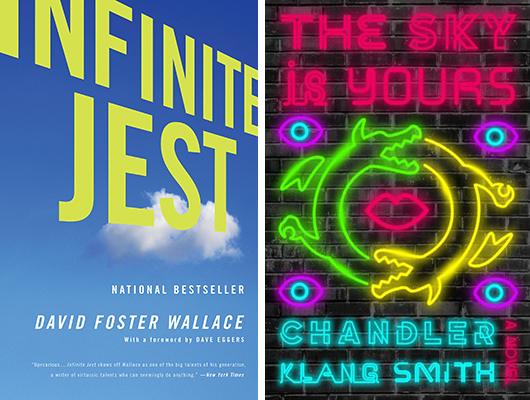
Instead of: Infinite Jest, David Foster Wallace
Read: The Sky is Yours, Chandler Klang Smith
Full disclosure: I read The Sky is Yours because of Leah Schnelbach’s review, which begins this way: “There have been a lot of books heralded as heirs to Infinite Jest, but I can happily say: this is it. I’ve found it.” Well, I thought, I like Infinite Jest and also I like dragons, so this should be a winner. It was. To be fair, it’s not really like David Foster Wallace’s behemoth. For one thing, Wallace was a lot of things, but he was very rarely silly. This book is sometimes silly. I kept putting it down, thinking that I wouldn’t pick it up again, because it was so ridiculous. And then I kept picking it up, and giggling to myself.
So: don’t read The Sky is Yours if you’re just looking for a book to be pretentious about. That said, I do ultimately agree with Schnelbach that this is a worthy heir to Infinite Jest. Both novels are fat, both are set in the future (though Smith’s future is further afield than Wallace’s), both take on our media consumption directly, both bristle with details and storylines. As Schnelbach points out, The Sky is Yours has is at least one allusion to Infinite Jest. But most importantly of all: as Wallace did in Infinite Jest, in The Sky is Yours Smith has invented the language she needs to tell her story. This is a book that invents itself.
Also, they both have three names.
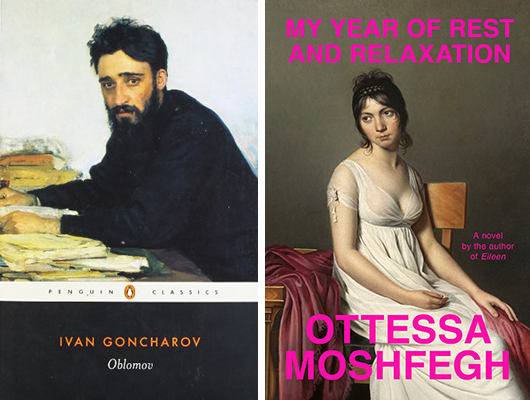
Instead of: Oblomov, Ivan Goncharov
Read: My Year of Rest and Relaxation, Ottessa Moshfegh
What would you get if you took Oblomov—that 19th-century icon of upper-middle-class sloth, indecisiveness, and superfluity, who doesn’t get out of bed for the first 150 pages of his eponymous novel—and transported him to early-2000s New York City? Maybe someone like the narrator of Moshfegh’s excellent forthcoming novel, an independently wealthy young woman who wants nothing more than to sleep all the time, and will use any cocktail of drugs necessary to get herself there. There are critiques of excess, class and society in both of these novels, but the main point of interest in each is the luxurious over-indulgence of the main character, a coziness that becomes a compulsion. Oblomov is a classic, but My Year of Rest and Relaxation is much more fun.
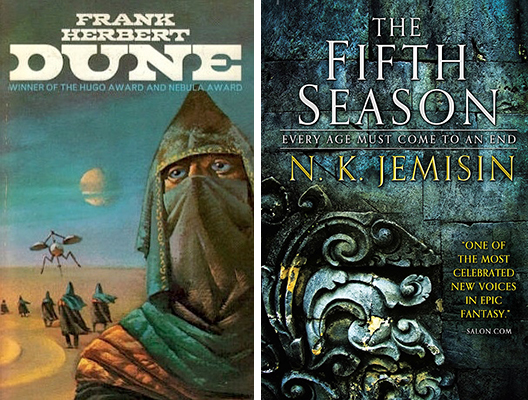
Instead of: Dune, Frank Herbert
Read: The Broken Earth Trilogy, N. K. Jemisin
To be fair, Jemisin’s Broken Earth Trilogy (The Fifth Season, The Obelisk Gate, The Stone Sky) doesn’t feel particularly similar to Frank Herbert’s Dune series while you’re reading it. But Dune was one of the first popular speculative novels to take ecology, climate change, and the earth’s systems as a subject—and Jemisin’s novels are among the most recent (and best) to do so. (Neither, in case you’re wondering, is at all didactic about it.) But on a more essential level than that, I’ll declare this: Dune was the fantasy novel everyone should have been reading 50 years ago, and The Fifth Season is the fantasy novel that everyone should be reading now.
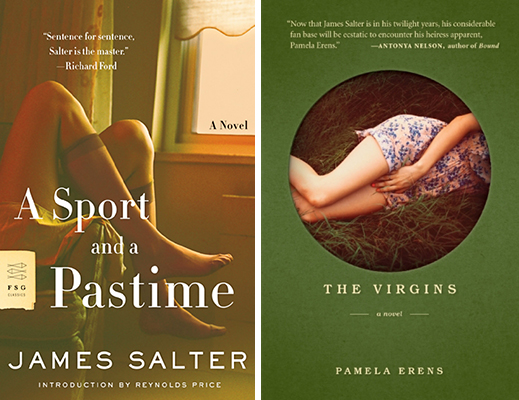
Instead of: A Sport and a Pastime, James Salter
Read: The Virgins, Pamela Erens
It’s not because both books are sexy (though both books are sexy). The formal conceit of Salter’s classic novel is that it is the story of an intense affair (in France, in the 60s) partially observed, but mostly imagined, by an obsessive third party. The Virgins is formatted in the same way, though Erens actually strikes closer to the heart by making all the players teenagers in high school—this being the time when it was usual (or more usual, at least) to obsess about one another’s bedroom activities. Erens herself has pointed to Salter as the inspiration for this narrative structure. In an interview with Tin House, she said:
I am an enormous Salter fan and I had read his story collections and his novels A Sport and a Pastime and Light Years. The Oates article reminded me of the setup of A Sport and a Pastime—a male narrator tells the story of a romance in which he doesn’t take part. That narrator describes encounters and events he couldn’t possibly have been a witness to. Suddenly I knew that was what I wanted to do with my own novel.
All I can say is: I knew it.
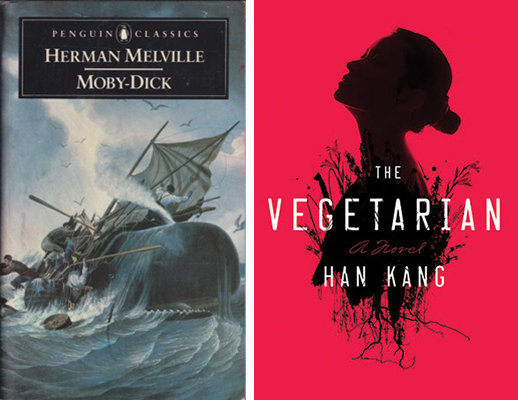
Instead of: Moby-Dick, Herman Melville
Read: The Vegetarian, Han Kang
Speaking of obsession: exchange an overlong and often-tedious novel where a man is obsessed with an elusive external white whale for a slim, electric one about a woman who is obsessed with an elusive internal “white whale.” Whereas the former leads to self-destruction, the latter leads to . . . well, self-destruction, but self-destruction that is also (for Yeong-hye at least) a triumphant seizing of agency.
Instead of: Winesburg, Ohio, Sherwood Anderson
Read: The Beggar Maid, Alice Munro
Winesburg, Ohio is the ur-novel-in-stories, set in a fictional small town (in Ohio, shocker), but The Beggar Maid is as good if not better: centering on the residents of another small town (this time in Ontario), in particular two women, Flo and Rose. (See also: Olive Kitteridge, by Elizabeth Strout, and pretty much everything else Munro has ever written).
Instead of: The Sound and the Fury, William Faulkner
Read: Sing, Unburied, Sing, Jesmyn Ward
“Our tragedy today is a general and universal physical fear so long sustained by now that we can even bear it,” Faulkner said in his Nobel Prize speech. “There are no longer problems of the spirit. There is only the question: When will I be blown up? Because of this, the young man or woman writing today has forgotten the problems of the human heart in conflict with itself which alone can make good writing because only that is worth writing about, worth the agony and the sweat. Like McBride with Joyce, Ward once printed out Faulkner’s speech and pinned excerpts above her writing desk. Now, with every book Ward writes, she solidifies her place as the contemporary bard of Mississippi, stepping into Faulkner’s admittedly large literary shoes. Her work is very different, but it is as much of the place as Faulkner’s, and is often told in multiple voices, suffuse with ghosts and songs and long family histories that hang around long after the family members themselves have gone to dust.
Instead of: Wittgenstein’s Mistress, David Markson
Read: Why Did I Ever, Mary Robison
Markson’s cerebral, fragmented text—ostensibly written by a woman who may or may not be the last human left on earth—is fantastic, and brilliant, and inventive in a way I wish I could find more often in novels. But so is Mary Robison’s Why Did I Ever, and it has the added benefit of being extremely funny. (See also: Dept. of Speculation, by Jenny Offill, and—though it’s a bit different—Jamie Quatro’s recent Fire Sermon, both of which are fragmented, incendiary, and truly wonderful.)
Instead of: The Catcher in the Rye, J. D. Salinger
Read: The Bluest Eye, Toni Morrison
As classic coming-of-age stories go, Morrison’s is simply better—and much more relevant to contemporary readers.
Can a troubled genre raise the bar for feminism?: Let’s Make a Bechdel Test for Crime Fiction

Many of us are familiar with Alison Bechdel’s test for feminism in film (and readily applicable to literature), also known as the Bechdel-Wallace Test. We also know how few classic works fulfill its simple criteria: two named female characters have a conversation about a topic other than a man. The test initially evolved as a running gag in Bechdel’s comic Dykes to Watch Out For, soon spreading across the internet and into my childhood home, wherein my family had endless arguments over whether the Bechdel Test could apply to history, in particular, military history and military fiction (my father’s area of expertise, and of zero interest to my sister). This recurring argument has led to additional arguments about how to apply the test to different genres, and a long-term discussion of how to measure feminism within a subject matter designed to explore the effects of toxic masculinity.
Stories set in primarily masculine worlds regularly fail the Bechdel Test, yet one can argue that any work of fiction wrestling with with the meaning of gendered behavior—rather than accepting and thus reinforcing standard gender norms—is inherently more valid than a story that shoe-horns in just enough female characters to check off some kind of nod-at-feminism box.
While genre fiction, especially detective fiction, has grown increasingly interested in portraying women’s stories, certain modern genres fulfill the test in rather specific ways, often bottlenecking their Bechdels into one or two discrete and relatively predictable conversations. My sister loves scifi so much partially because of the particular way space opera tends to pass the Bechdel Test (when it does at all)—two female battleship commanders have a discussion about strategy. The fantasy version usually unfolds when two women have a conversation about magic. (I’m fairly certain that this is the only context in which the Wheel of Time series gets a passing grade.) War stories usually only pass when two nurses have a conversation about supplies. The point here is that in genre fiction, there are certain types of conversations that happen over and over again; often they’re intrinsic to what brings the book into the genre in the first place, and so genre literature’s relationship with the Bechdel Test and whether a given book passes (or fails) tends to be be rather … specific.
There’s been a whole lot of hullabaloo on the internet since the announcement of a new prize for thrillers with no violence against women. For a thriller to be eligible for the Staunch Prize, “no woman [may be] beaten, stalked, sexually exploited, raped or murdered.” Given where I work (CrimeReads), my initial impulse upon seeing the prize announced was to take a coworker up on her suggestion and make a reading list of of thrillers eligible for the prize, and then realized I couldn’t think of a single one. Authors immediately objected to the prize as not acknowledging the realities of gendered violence. Sophie Hannah, in an op-ed for the Guardian, wrote that
“Brutality is not the same thing as writing about brutality. After suffering a trauma, some people find it consoling and empowering to read, or write, about fictional characters who have survived similar experiences. If we can’t stop human beings from viciously harming one another, we need to be able to write stories in which that harm is subjected to psychological and moral scrutiny, and punished.”
Hannah goes on to say that “The Staunch prize could instead have been created to honour the novel that most powerfully or sensitively tackles the problem of violence against women and girls.” The same could be said about true crime. True crime stories make sense of what could happen to us, what has happened to us, and what might keep something from happening to us in the future. Mixed with memoir, they are a rejection of women as targeted bodies, mingling body and mind, trauma and processing, harm and healing. There is a practical element to engaging with true crime stories while in a female body. It is a form of collective warning, information-sharing, and processing. Yet despite the enormous readership of crime fiction and true crime among women, most works in the genre are as unable to pass the Bechdel Test as they are ineligible for the Staunch Prize.
I don’t claim the right to come up with a test to redefine feminism in the genre—that’s the Bechdel wheelhouse, and who am I to compete with a term originating from comic book dialogue? I’m happy to riff on their innovations. Controversy over the Staunch Prize has reinvigorated what has sometimes been a rather circular conversation about gender, violence and representation, by starkly pointing out that women’s stories, in the context of crime fiction, are frequently narratives of male violence and its effects. Reframing the Bechdel Test for crime fiction is just another way of stepping out of a circular conversation, in search of new feminist possibility.
Here are a few suggestions for how we might create a Bechdel Test tailored to crime fiction’s very particular needs.
1. Communication Through Warning
In crime fiction, or at least, the sub-genres I love, two women rarely have a conversation at all—and when they do, it is almost always about a man (albeit a dangerous one). Therein lies the first possibility for setting the bar for feminism in crime fiction: two women warn each other of a dangerous man, or cooperate to cover up the death of a violent man. I know, there’s no part of the Bechdel Test that differentiates between a positive valuation of a man and a negative one, but in the mystery genre, information needs to be shared for characters to survive. When two women warn each other about a dangerous man, they are more likely to survive to talk about things other than men in the future—thus a warning about a man can be a necessary prerequisite to speaking about any other topics at all.
In the mystery genre, information needs to be shared for characters to survive. When two women warn each other about a dangerous man, they are more likely to survive to talk about things other than men in the future.
The most radical version of this idea could be “two women compare notes about a man they have both dated, realize the warning signs, become best friends, and never speak to that man again.” It’s amazing how many crime fiction characters are married to men they know nothing about, then seem shocked when they find out what’s in the cellar. With some thorough vetting of potential mates, through checking with exes, most domestic suspense plots would be derailed at the start. The Girl in the Train saves the comparing of notes till near the end, but still uses two women discussing a man as a prelude to those two women leading happy, independent lives, while the man ends up (spoiler alert) dead. And this is just the first on our list of the low-hanging conversational fruit of feminist crime fiction.
2. Communication Through Metadata
A second option for passing a crime fiction Bechdel Test involves a living female detective reading the data of a woman’s corpse and investigating the metadata of her interrupted life. A crime scene investigator will occasionally commune with the dead of her own gender, her dissection of another’s life a form of conversation. Tana French’s The Trespasser features such a conversation; a female detective, examining the body of a beautiful dead woman in an unadorned room, detects purpose in the woman’s choice of artifice while her colleagues see only a pretty corpse.
The ghosts of the past enhance the pursuits of the present. In Rachel Howzell Hall’s Land of Shadows, her detective Elouise “Lou” Norton finds closure through her pursuit of a murderer when she takes on the case of a young girl murdered at the same age as her sister. In Flynn Berry’s Edgar-Award-winning Under The Harrow, a woman takes great risks to protect a woman who reminds her of her sister. When a detective helps another woman merely because she reminds them of a different woman, that’s feminist community in action. The sisterly vengeance narrative is a particularly intriguing one when compared to its predominant masculine equivalent, which I will dub the “You killed my wife?” narrative in a shameless appropriation of Eddie Izzard’s “Dressed to Kill” routine. To unpack the statement from the pop culture references, the male revenge narrative tends to kill off a man’s wife or child, then sends him off immediately on a quest for vengeance, while the female revenge narrative takes time and plotting, and almost never sends a woman after a killer who got her man—instead she seeks vengeance for the suffering of a sister, friend, mentor or child
3. Communication through Swapping or Rejecting Identities
In stories that feature conversations between two women, names are often discarded. So here’s another rubric: two named women swap identities, or toss aside names in order to run. In Lisa Lutz’s The Passenger, two women switch documents to avoid their respective pursuers, and discuss enhancing their new alias through the name changes offered by marriage.
Another form of the same criterion: one woman pursues another woman for the purpose of utilizing or appropriating her identity. A gothic trope of women’s identities merging, competing, dominating, and replacing one another is currently making a resurgence in a series of frenemy mysteries, wherein one woman recruits another for a sinister purpose. Behind Her Eyes, by Sarah Pinborough, and The Perfect Stranger, by Megan Miranda, are two such tales to be released in the recent past, and given the high quality of both, are sure to be much imitated. So that brings us up to three.
4. Communication Between Evolving Identities Over Time
The women of crime fiction are often characters who’ve changed drastically over the course of their lives, sometimes to the point of making names meaningless, or so meaningful as to connote entirely different identities. A fourth take on a Bechdel Test for crime fiction might include conversations involving the same woman, over a period of time, in which she has multiple names and conflicting identities. Amy Gentry’s Good As Gone plays havoc with the nature of names and identities, as we follow a girl back in time through multiple names. Each is assigned to her by a dominant personality, and each represents a completely different approach to her porous yet evolving identity. Lori Rader-Day’s The Day I Died takes us into a woman’s life during a moment of crisis that forces her present self to confront the unfinished business of her past self.
***
Most of these proposals are tongue-in-cheek. When I first learned about the Bechdel Test, this simple proposition changed the way I thought about literature. Women in crime fiction—as characters, as authors, as symbols of the porous nature of female identity—changed the way I thought about the Bechdel Test. In the predominantly male world in which many female-driven crime stories are set, the Bechdel Test must be stretched and reconsidered in order to find a way to note “feminism” in detective fiction.
The Bechdel Test is not a scientific measurement of feminism in fiction. It sets an incredibly low bar with its criteria, and exists as a pointed statement about how most fictional works fail to meet even the lowest bar possible in measuring fictional feminism. Crime fiction, likewise, is in need of a new bar. It is also in need of a new context—one in which the realities of violence against women are acknowledged and engaged with critically.
At This Pop-Up Lunch Counter, Race Is Included in the Bill
“Give me 15 minutes and I’ll change your life.”
This was the caption on Tunde Wey’s Instagram post announcing a pop-up for the month of February in the Roux Carré outdoor food court in New Orleans.
The pop-up, which ends on March 4, is called Saartj, and on the surface it looks like any other shop in the food hall: the menu is Nigerian and the dishes vegetarian, an ode to the chef’s upbringing. The atmosphere is that of a quick-service lunch counter where guests grab lunch quickly and return to their office or find a spot in the food hall to sit and eat.
After the guests order from a menu that includes dishes like fermented cassava dumpling and fried plantains with palm oil-blanched peppers, the experience starts to differ from the other stalls in the food court. After they order, Wey tells each diner about the nation’s racial wealth gap, pointing to stark facts, such as higher education increases a Black family’s median income by $60,000, where as it increases a white family’s median income by $113,000.
“I start by asking them what they think the racial wealth gap is and then share stats about [how it manifests in] New Orleans and nationally,” he told Civil Eats.
At the end of his speech, Wey presents his guests with two options: White customers can either pay $12 for lunch or the suggested price of $30. Black customers are charged $12 and also given the option to collect the $18 paid by a white patron as a way to redistribute wealth.
“So, how much do you want to pay?” asked Wey.
The whole interaction takes only about 15 minutes. And Wey and his team run the pop-up—which continued Wey’s history of using food to explore issues of race, class, and justice—like a cross between a social practice art project and a social experiment, collecting data from diners while they waited for their food through a survey that asks questions such as, “have you ever inherited money or received gifts from family like a car, college tuition payments or other high value gifts?” If diners respond yes, they are asked how this has changed their lives.
A post shared by Tunde Wey (@from_lagos) on

Saartj is named after Saartjie Baartman, a Black South African woman who was lured to Europe by a doctor in the 1700s, and renamed Venus Hottentot. Wealthy Europeans could pay to have her come to their home where they could watch a “demonstration” or touch her body. When she died, her body was dissected and her brain, breasts, and butt put on display at a Paris museum until 1974. “Baartman’s story represents … the objectification and exploitation of Black, African, and female personhood,” Wey wrote on the website for the pop-up. “Our dinners are about confronting exploitative systems operating heartily, if sometimes covertly.”
Using the quick-serve model, Wey hoped to demonstrate that even an occasion as common and as seemingly simple as picking up lunch can be an opportunity to examine the role that these systems play in your everyday realities. And the event has brought a month’s worth of conversations with diners about the impact of race on wealth. Wey said he has seen “positive social pressure” perceived by white diners that makes them feel like they have to do something to “right” the wrong of the racial wealth gap.
“Most of the time we tend to identify the problem, assign an antagonist, and address the problem,” he told Civil Eats. The breakdown of diners was 46 percent Black and 45 percent white. Wey said 78 percent of the white guests who visited the pop-up chose to pay the higher amount. And that the fact that he, a Black man, did the asking, is part of the reason that that number is so high.
“Refusing to pay more comes off as anti-social and people don’t want to be judged for that,” Wey said. “People look on the other side of the till and see me standing there and they’re thinking that I’m judging them.” White guilt was definitely a factor. “If they couldn’t pay a higher amount, they gave a me a list of caveats why they couldn’t.”
A Long History of Racist Wealth Inequality
This is not the first time that Wey has used food and dining to address the significant gap between wealth held in white and Black communities nationwide. In 2016, Wey created a series called Blackness in America that explored the issue. Then, in 2017, he hosted 44: A Table for 44, a dinner series in Memphis that invited guests to have dinner together and hear readings about societal and structural racism and money.

Tunde Wey at the counter of Saartj. (Photo courtesy of Anjali Prasertong.)
“The idea was based on Jay Z’s ‘4:44’ album and the idea that capitalism and wealth can save Black folks,” Wey said. “’Financial freedom’s my only hope’.”
Now, Wey is continuing that conversation with a look at how some of that wealth may be redistributed.
“The current racial wealth gap is very much the result of decades of discriminatory public policy,” said Janelle Jones, economic analyst at the Economic Policy Institute. “Besides facing discrimination in employment and wage-setting, for generations even those African-American families that did manage to earn decent incomes were barred from accessing the most important financial market for typical families: the housing market.”
Even after the policies that made these practices possible were dismantled by the Fair Housing Act in 1968, Black families could still be discriminated against when purchasing a home or land, whether through overt segregation efforts like redlining or other less explicit but discriminatory practices.
“Even as much de jure discrimination in housing was dismantled by public policy, de facto segregation and the legacy of wealth non-accumulation kept the racial wealth gap from closing,” Jones explained. As a result, white families had a head start of several generations when it came to creating wealth that could be passed down to their children. The most recent data shows that the median white family has almost 10 times as much wealth as the median Black family ($171,000 compared to $17,409).
These disparities are not always easy to solve or address, but Wey says the pop-up prompted him to think critically about traditional ideas of charity.
What the Lunch Experiment Revealed
After offering his white diners the different price options, Wey said the question that most guests ask is, “Where does the additional money that I’m paying go?” That, he said, suggests a bigger problem with money and wealth.
“The act of finding a solution shouldn’t be charity-based or altruistic,” he said. But for white people to conflate giving with altruism, “is mistakenly making your wealth virtuous. The ownership of wealth has been contingent on taking from someone else, and money doesn’t distill virtue on you.” Wealth, he added, is merely a conduit for power, and when we think of it that way we’re able to see why redistribution is important. “You cannot transfer money without transferring the agency that comes with it,” he said.
Wey answers the “where is my money going” question by removing the agency from white people, a group that has historically had it. “I tried to just say the money is not need-based or merit-based, it’s neutral,” he said. “In fact the folks with the agency are the Black folks, because they get to take the money or not.”
There are definitely limitations to this experiment. After looking at the preliminary data collected from the survey, one of the most interesting results is that of 70 or so diners, 76 percent of the Black diners refused to take the $18 that they were offered. “Black people have even tried to pay the $30 and I’m like ‘No, it’s not for you,’” he said.
Through the pre-meal survey, he learned that the majority of his diners have incomes around $65,000, whereas the median household income in New Orleans is around $39,000. So Wey acknowledged that the results may have been different if the pop-up had attracted more of a diverse spread of incomes. “A lot of the Black folks said, ‘I don’t need that money, give it to someone else who needs it.’”

Tunde Wey in 2016. Photo credit: Molo Oyelola)
At Saartj, Wey seeks to educate people about the racial wealth gap in America and see how it made them react as they tried to confront a harsh reality. “We’re told that if you work hard you’ll become wealthy—and that’s not true,” he said. Black communities have historically been denied access to tools many white people use to build wealth, and Wey hopes that fact sticks with his diners long after they’ve finished their meal. “We want to provoke further thinking.”
One of the most interesting reactions he’s seen came from a white male diner, a “liberal fellow” as Wey called him, who objected to the entire experiment. “He paid the lower amount and his reason was ideological,” Wey explained. “He thought interpersonal interactions that discuss race and class actually distract from larger discussions and that the issue is best addressed by civic engagement and voting.”
Wey also remembers a pair of white women who visited the lunch counter. After giving his spiel, one of the women said that the experiment was “interesting” and asked follow-up questions, while the other was visibly uncomfortable.
“When we got their survey results, we found that the woman who seemed really uncomfortable was really flat in her responses and only paid the higher amount because her friend did.” For Wey, that’s the point of the experiment. “The value of this outweighs the discomfort.”
Top photo courtesy of Tunde Wey.
The post At This Pop-Up Lunch Counter, Race Is Included in the Bill appeared first on Civil Eats.
David Lynch Teaches Typing: A New Interactive Comedy Game

Typing programs demand some patience on the part of the student, and David Lynch Teaches Typing is no exception.
You’ve got 90 seconds to get acclimated to the cruddy floppy disc-era graphics and the cacophonous voice of your instructor, a dead ringer for FBI Deputy Director Gordon Cole, the hard-of-hearing character director David Lynch played on his seminal early 90s series, Twin Peaks.
Things perk up about a minute and a half in, when students are instructed to place their left ring fingers in an undulating bug to the left of their keyboards.
That second "in"? Not a typo (though you'll notice plenty of no doubt intentional boo-boos in the teacher's pre-programmed responses...)
The bug in question may well put you in mind of the mysterious baby in Lynch’s first feature length film, 1977’s Eraserhead.
On the other hand, it might not.
David Lynch Teaches Typing is actually a short interactive comedy game, and many of the millennial reviewers covering that beat have had to play catch-up in order to catch the many nods to the director’s work contained therein.
One of our favorites is the Apple-esque name of the program’s retro computer, and we'll wager that frequent Lynch collaborator, actor Kyle MacLachlan, would agree.
Another reference that has thus far eluded online gaming enthusiasts in their 20s is Mavis Beacon Teaches Typing. Take a peek below at what the virtual typing tutor’s graphics looked like around the time the original Twin Peaks aired to discover the creators of David Lynch Teaches Typing’s other inspiration.

David Lynch Teaches Typing is available for free download here. If you’re anxious that doing so might open you up to a technical bug of nightmarish proportions, stick with watching the play through at the top of the page.
Related Content:
The Big Lebowski Reimagined as a Classic 8-Bit Video Game
What Makes a David Lynch Film Lynchian: A Video Essay
Ayun Halliday is an author, illustrator, theater maker and Chief Primatologist of the East Village Inky zine. Join her March 20 in New York City for the second edition of Necromancers of the Public Domain, a low budget variety show born of a 1920 manual for Girl Scout Camp Directors. Follow her @AyunHalliday.
David Lynch Teaches Typing: A New Interactive Comedy Game is a post from: Open Culture. Follow us on Facebook, Twitter, and Google Plus, or get our Daily Email. And don't miss our big collections of Free Online Courses, Free Online Movies, Free eBooks, Free Audio Books, Free Foreign Language Lessons, and MOOCs.
Acquiring Books for the Greatest Libraries in the World

In 1685, years before his translation of The Thousand and One Nights would win him enduring fame, the French scholar Antoine Galland was living in Istanbul. Trained in Arabic, Persian, and Turkish, he was nearing the end of his nearly five-year mission in the city to collect books and ancient coins on behalf of the French crown; he also collected them for himself, and for the French ambassador, the Count of Guilleragues. In his role as interpreter and professional book buyer, as well as in his private capacity as a scholar, he had come to know the city’s book markets intimately. The number of works it was possible to find in the Ottoman capital delighted him: “The ease of buying [books] is greater than in any other place, as there is a considerable number of shops where they are sold and where every day new ones are brought to be sold to the highest bidder.”
Galland was no anomaly in his interest in Islamic books or in his deliberate and royally ordained quest to acquire them. Arabic, Persian, and Turkish manuscripts were collected across Europe in the 17th, and 18th centuries. In the 16th century, great libraries were founded all over Europe—the French Royal Library, initially located in Blois and Fontainebleau, and later in Paris; the Escorial, near Madrid; the Hapsburg Imperial Library, in Vienna; the Leiden University Library; the Bodleian, in Oxford—but it was in the 17th century that they gained Oriental collections. (The Vatican Library was founded in 1475, though the collection was begun earlier in the century.)
At this time, thousands of Arabic, Persian, and Turkish manuscripts were acquired for European collections, transforming them and making possible the in-depth study of Islamic literary and intellectual traditions. Oxford, Leiden, Paris, the Escorial, and Rome had the greatest Islamic manuscript collections in Europe, but they were far from the only ones. The Biblioteca Ambrosiana of Milan, founded in 1609, built an Arabic collection, and in Florence’s Palazzo Pitti, the grand dukes of Tuscany held an Oriental collection brought from Rome by Grand Duke Ferdinando de’ Medici. Moreover, many smaller libraries gathered Islamic manuscripts. In Paris alone, these included, besides the Royal Library, the library of the Sorbonne, the library of the Maurist (Benedictine) abbey of Saint Germain des Prés, and the library of the Jesuit school of Louis le Grand, as well as the private libraries of Cardinal Mazarin, the sometime finance minister Nicolas Fouquet, and the minister Jean Baptiste Colbert. All opened their doors to scholars.
Europeans in search of manuscripts were obsessed with great Islamic libraries: the collection of the sultan of Morocco, the library of the imperial seraglio in Istanbul, and the library of alAzhar mosque in Cairo. In the end, though, European collectors drew from other sources. When they could, they bought directly from monasteries and other such depositories, but marketplaces and their commercial booksellers proved to be their most valuable suppliers—once European envoys learned what books to seek and how to go about obtaining them.
*
Bookfinding missions were one part of travel in search of knowledge as theorized and practiced from the late Renaissance onward. Already in the 16th century, a series of treatises on the art of travel provided instructions to make such trips useful and educational. A subset of travelers set out in search of new knowledge to bring home, and, increasingly, these men broadened their horizons beyond Europe. For scholars, learning Arabic fluently was a primary motivation for visiting North Africa and the Levant. Others came to make astronomical observations. Antiquarian collectors began prowling the Eastern Mediterranean in the first half of the 15th century, beginning with the Italians Cristoforo Buondelmonti and Ciriaco of Ancona.
By the end of the 17th century, learned travel was increasingly systematic. Europeans wrote specialized guides for travelers interested in focusing on “literary” or antiquarian explorations or on the natural history or botany of an area. Learned travelers served as data collectors, gathering all manner of information on the lands they visited, including drawing maps and collecting botanical specimens, inscriptions, and even manuscripts. For example, Sir Thomas Roe, the English ambassador to the Ottoman Empire from 1621 to 1628, brought back 29 Greek manuscripts to Oxford. Scientific academies developed questionnaires to help collect, compare, and verify information gathered in countries in Europe and beyond, and they began to dispatch travelers to pursue their aims.
 The Hapsburg Imperial Library.
The geographic range of 17th-century collectors went beyond the Levant, moreover. Trade in the Indian Ocean and beyond yielded rich scholarly harvests. The Dutch presence in Southeast Asia led to the accumulation of books in Malay, Javanese, Malabar, and Formosan, some of which helped Dutch scholars reinterpret the Qur’an.
Over the course of the 1600s, book collecting became increasingly organized. In France under Louis XIV (r. 1643–1715), royal patronage of Oriental research was but one aspect of the cultural politics of the Sun King’s absolutist rule. Manuscript collecting abroad was transformed and greatly expanded during his reign under the management of Colbert (d. 1683) and, during the reign of Louis XV, of Jean Paul Bignon (d. 1743). These men acted as cultural entrepreneurs, supervising the acquisition and organization of large amounts of new information. Under Colbert, the Royal Library became a state research institute—something along the lines of Solomon’s House, the research institute for the arts and sciences featured in Francis Bacon’s posthumously published utopian narrative The New Atlantis (1626). Bacon’s belief that scientific inquiry needed to be supervised by a centrally organized administration was a position Colbert and Bignon shared.
In Istanbul, the buying of books by foreigners eventually got so out of hand that in 1715 or 1716 the grand vizir, Şehid Ali Pasha, himself a book collector, “enacted a law . . . banning the sale of books to foreigners.” This protectionist measure was designed to prevent the disappearance of valuable intellectual resources from the capital. Referring to secondhand booksellers, the grand vizir wrote: “Because of their crude greed, they send away countless valuable books to different places, perhaps even outside the Ottoman realm.”
Beyond Istanbul, Europeans collected manuscripts in many locations, including Cairo and Aleppo, where the English ran a factory of the Levant Company. Further afield, manuscripts were to be found in the Indian subcontinent, in Gujarati localities like Ahmedabad, as well as in southern India, where the French Jesuits had a mission, and on the Coromandel Coast.
In the 18th century, book buying continued, especially in the major collections of Catholic Paris and Rome. Under Louis XV, whose personal reign lasted from 1723 to 1774, the French royal collection expanded significantly, thanks in large part to these missions. In Rome, Pope Clement XI sent several expeditions to Egypt to collect Coptic and Syriac manuscripts, laying the foundation for modern Syriac studies.
 The Leiden University Library.
Even the famous exploratory mission to the Yemen, sponsored by the Danish crown in 1761–1767, was intended to be a book buying opportunity. Despite the death of all but one of the expedition members, as many as 119 Arabic manuscripts, acquired both in Istanbul and in Cairo, made it back to Copenhagen. The philologist in the group, Christian von Haven, who had received instructions about what he was to acquire, recorded the Arabic names of these books in a dedicated section of his diary, noting how much he had spent on buying each one. Literary and historical subjects predominated: of the 119, 26 were history books and 27 were poetry collections. There were 13 books of grammar and rhetoric, 12 anthologies, 2 books of literary history, and an abridged version of Kātib Çelebi’s great bibliography. The expedition also collected botanical samples, spices, and such rare substances as cinnabar and wormwood. In all of these respects, it pursued familiar objectives, if more systematically and on a grander scale.
In France, the Abbé Bignon proved no less talented than his predecessor, Colbert, in his judicious meddling with the research agendas of scholars. His nomination, in 1718, as royal librarian, inaugurated a new course for the French Royal Library. In 1724 he secured the perpetual right to house the library in the Hôtel de Nevers, a building on the rue de Richelieu much larger than the crowded rooms the library had until then occupied. He donated to the library his personal collection of Chinese, Indian, Tartar, and Islamic manuscripts, oversaw the creation of an inventory from 1719 to 1720, and arranged a book-buying mission to Istanbul. In addition, he mobilized the French East India Company to acquire printed books and manuscripts about the Far East and enjoined the Jesuits in Pondicherry, Canton, and Bengal to collect South Asian grammars and religious writings. His goal was to create the best library in Europe.
In Rome, as in Paris, an alliance of a sympathetic ruler with a capable librarian created a worldclass Oriental collection. Pope Clement XI (Albani) (d. 1721) transformed the manuscript holdings, and the library continued to grow under his successors until 1769. This pope is not usually remembered for his contributions to Oriental studies, yet under his papacy Oriental manuscript collections such as those of the Maronite scholar Abraham Ecchellensis and of the Italian traveler Pietro della Valle entered the Vatican Library.
In the long run, a great librarian was, perhaps, even more important than a committed patron. The librarian who can take much credit for the flourishing of the Oriental collection in Rome was the curator Giuseppe Simonio Assemani (1687–1768), a Maronite scholar and priest who began working at the Vatican Library in 1710. He first served Pope Clement XI as a traveling collector, visiting Egypt, Cyprus, and Syria between 1715 and 1717 and returning with several hundred Oriental codices, among which the Syriac ones were a particular prize. He then proceeded to study them, producing the impressive Bibliotheca Orientalis Clementino-Vaticana, whose four large folio volumes, which appeared between 1719 and 1730, were focused on the Syriac manuscripts in the library. (This publication, which presented to readers a huge number of texts for the first time, is considered the inception of Syriac studies in the modern West.)
But its author’s ambition was greater: he aimed to publish a critical bibliography of all of the literatures of the Near East, both Christian and Muslim, that were held in the Vatican Library, of which the Bibliotheca Orientalis was only the beginning. In 1739 Assemani was nominated first curator of the Vatican Library, an honor that had never before been bestowed on a Levantine scholar. Among his many projects, he aimed to complete a full, 20-volume catalog of all manuscripts in the Vatican Library, both Eastern and Western. Together with his nephew Stefano Evodio, he produced the volume on Hebrew and Samaritan books in 1756 and two volumes on Syriac books in 1758 and 1759. He was at work on the Arabic books when he died, in January 1768. A few months later, a fire burned all that had been printed of the Arabic catalog. Even so, by the time of his death Assemani had done more than anyone else to carry on the bibliographic legacy of Pope Clement XI, right through five successive papacies.
Through undertakings such as these, the “Oriental Libraries” of 17th- and 18th-century Europe came into being. What made its way to Europe depended both on what Islamic readers and copyists cultivated, and on what, from among that variety, Europeans decided to acquire. Thus, manuscripts obtained for European collections reflected the priorities of Islamic intellectual life and book culture in the 17th and 18th centuries. The latter, therefore, inevitably shaped what Europeans came to know.
*
Libraries are fragile entities. Collections must be amassed and then organized and safeguarded. A book unlisted in a catalog or placed on the wrong shelf is as good as lost. And above all, books need readers—an ambitious proposition in the case of ancient or foreign languages. It was not enough to bring Islamic manuscripts from faraway lands; their languages had to be cultivated. The creation of Oriental collections was, therefore, a necessary but not a sufficient step in the understanding of Islamic intellectual traditions. At the same time, it should not be understood simply as means to higher scholarly ends, but instead as a cultural phenomenon in its own right. Possessing foreign books seemed valuable even when there was no one on hand to study them. Patrons, collectors, and scholars believed in the ideal of the Oriental library, and they each contributed to its creation. Like all libraries, the Oriental library was an act of faith in the capabilities and interests of future readers.
__________________________________

From The Republic of Arabic Letters, by Alexander Bevilacqua, courtesy Harvard University Press.
Meanwhile, Over In Turkey . . .
BgarlandWTF is going on with these guys?
 Well isn’t this interesting? From Diplopundit last Friday comes a post with this title: Tillerson Meets Erdoğan in Ankara With Turkish Foreign Minister as Interpreter. The post is a series of tweets from all kinds of media folks, which include some of these gems:
Nicholas Wadhams of Bloomberg News:
Secretary of State Tillerson is currently meeting with Turkey’s President Recep Tayyip Erdogan. He is the lone US representative and Turkey’s foreign minister is translating.
Rajib Soylu, Washington correspondent for Daily Sabah:
This is the second Erdoğan – Tillerson meeting where all Turkish, American officials, and even the translators excluded.
Turkish FM functions as a translator.
Ihlan Tanir of Washington Hatti US:
Im trying to understand — I never expected Pres Erdogan and Sec Tillerson to have a press conference but they did not even read statements following 200 minutes of a meeting?
Let’s pause here for a moment to let that last one sink in.
It’s one thing if the Turkish Foreign Minister brings Erdogan over to Tillerson at a meet-and-greet and translates some friendly “let me show you pictures of my grandkids” chit-chat between the two. But that’s not what this was. This was a lengthy, official, and private meeting that lasted over three hours between some very high level folks at a time of rather significant tension between the two countries.
You don’t have meetings like this without your own translator. You just don’t. The typical process is that both sides have interpreters. Official A speaks, the interpreter for Official B tells Official B what was said, and the interpreter for Official A says some version of “Yes, that’s correct” to verify the interpretation. Then it all works in reverse when Official B replies. With difficult issues under discussion, the last thing either side wants is confusion about what each side is saying.
Excluding your own interpreter is so far outside of normal protocols it is unreal, and begs the ever-green question about most everything since 1/20/2017: idiot or crook?
As Diplopundit noted in his/her own tweet, someone else was missing from this meeting — an official note taker:
Saving money on translators*, too? And the foreign FM will just share his notes of the T-E discussion with the State Dept. Or EUR can use their Magic 8 ball.
It knows everything and always willing to share.
(* Diplopundit later corrected this to “interpreters”, as a slip of the fingers since “translators” are more precisely those who deal with written documents while “interpreters” handle verbal communications.)
“EUR” in that last tweet is the State Department’s Office of European Affairs, where long ago I was an intern. I can only imagine the reaction in Foggy Bottom was when word of Tillerson’s meeting with Erdogan reached them. It likely involved multiple variations on “He did WHAT?!?!?” with various . . . ahem . . . flavoring words for emphasis added. As former State Department spokesperson and retired Rear Admiral John Kirby told CNN:
“If the meeting is not conducted in English, it is foolhardy in the extreme not to have at his side a State Department translator, who can ensure that Mr. Tillerson’s points are delivered accurately and with the proper emphasis,” said former State Department spokesman and CNN diplomatic and military analyst John Kirby.
“That Mr. Tillerson eschewed this sort of support in what he knew would be a tense and critical meeting with President Erdogan smacks of either poor staff work or dangerous naïveté on his part,” Kirby added.
And that’s what Kirby said about this in public. I’ll leave it to your imagination what he and other current and former State and Defense Department folks said to each other about it in private. Hold onto this for a moment, because we’ll come back to it in a bit.
Eventually, Tillerson and his Turkish counterpart Mevlut Cavusoglu did in fact have a press availability, which the State Department has up on their website. In the statements issued by both, as well as their answers to questions from the reporters, they talked about all manner of increasingly tense topics, from the Kurds to what’s happening in Syria to the failed coup and the Turkish demands for Fethullah Gulen to be extradited back to Turkey, and more.
Two items stood out here. First, there’s this from Tillerson about midway through:
SECRETARY TILLERSON: Well, with respect to how we’re going forward – and that’s what all of the discussion here was about, recognizing where we find ourselves. And I think as the foreign minister indicated, we find ourselves at a bit of a crisis point in the relationship. And we could go back and revisit how we got here, but we don’t think that’s useful. We’ve decided and President Erdogan decided last night we needed to talk about how do we go forward. The relationship is too important, it’s too valuable to NATO and our NATO allies, it’s too valuable to the American people, it’s too valuable to the Turkish people for us to not do anything other than concentrate on how are we going forward.
And out of the meetings last night – and much of our staff was up through the night to memorialize how we’re going to go about this, and we’ll share a little bit of that in the joint statement. We’re going to reserve a lot of the details because there’s a lot of work yet to be done, and we – and our working teams need to be allowed to do that work in a very open, frank, honest way with one another so that we can chart the way forward together.
I’ll bet the staff was up through the night. If no staff were allowed in the three hour meeting, then the only one who can tell them what was said, what kind of emphasis it was given, what threats were made, what promises were made, and what kind of nuance there was to each of the exchanges was Tillerson. No offense to the Secretary, but that makes the work of the staff very very difficult. To begin with, they had to interview Tillerson just to get all the information about the meeting (and pray he didn’t leave anything out), before they could even think about “how we’re going forward.”
But the larger item that stood out to me came in the very last pair of question asked, reprinted in full below but with emphasis added:
QUESTION:[ed: to Tillerson] Did you warn Turkey that they could be subject to sanctions under CAATSA legislation if they go ahead with the purchase of the S-400 system? [ed: CAATSA is the Russian sanctions legislation that Congress passed but Trump refuses to implement with any teeth.]
And for you, Mr. Foreign Minister, would the threat of U.S. sanctions stop you from going ahead with the purchase of the S-400 system? And if you do buy the system, do you still want to remain in NATO if you’re obtaining the weapons from Russia?
SECRETARY TILLERSON: We did discuss the impact of the CAATSA law that was passed by the Congress last summer that deals with purchases of Russian military equipment. I discussed it last night with President Erdogan; we had further discussions this morning about it. And indeed, it’s in the first group of issues that the foreign minister is referring to. We need to put a group of experts together, and we’ll look at the circumstances around that, as we’ve done with governments all over the world, not just Turkey, because the intent of that legislation was not to harm our friends and allies. But it is directed at Russia for its interference in our elections. So we’ve been advising countries around the world as to what the impact on their relationship and purchases that they might be considering with Russia, and many have reconsidered those and have decided to not proceed with those discussions.
Every case is individual on its own. We want to consult with Turkey and at least ensure they understand what might be at risk in this particular transaction. We don’t have all the details yet, so I can’t give you any kind of a conclusion, but it’ll be given very careful scrutiny, obviously, and we’ll fully comply with the law. And we are – we are now implementing CAATSA and fully applying it around the world.
FOREIGN MINISTER CAVUSOGLU: Thank you very much. First and foremost, I need to underline that I am against the terminology that you use. You used the threat terminology. That is not a correct terminology to be used because it is true for all countries and states. We never use the language of threat and we deny if it is used against us, because this is not correct.
But as Rex has also indicated, this was not something that we talked just yesterday and today. When we met in Vancouver, we talked about this, and from time to time when we have phone conversations, we talk about such issues. This was again brought to the agenda in one of those talks. Of course, there is a law that was enacted by the United States Congress, and they explained this legislation to us. But on the other hand, this is our national security, and it’s important for our national security. I have emergency need of an air defense system. We want to purchase this from our allies, but this does not exist. So even when we are purchasing small-scale arms, the Congress or some other European parliaments, we have – we have and we had difficulty in purchasing these because of these excuses, and I have an emergency need. And the Russian Federation came up with attractive proposals for us. We also talked to other countries, not just with Russia, but we talked about this issue of emergency need with many countries and we had bilateral talks.
Also, in the mid-term, we talked about joint production and technology transfer. We focused on this because this is important for Turkey. And lastly, during the Paris visit of our president – with Eurosam – this is a French-Italian partnership – there was a pre-agreement signed, a memorandum of understanding signed with these groups. So we do not have any problems with our allies. Why should we not meet this requirement with NATO? But, of course, when it is not met within this platform, we need to look for alternative resources. Otherwise, some batteries – some Patriot were withdrawn from our frontier. Some European allies withdrew them. We have (inaudible) of the Italians and Patriots of Spain, and we do not have any other air defense. And we need to meet this requirement as soon as possible. And when we talked to Russia, this was actually an agreement that we reached before the legislation in Congress was enacted. And the remaining part was about the details of loans, et cetera.
Of course, we talked about all of these, and we will take into consideration this – within this working group the commission, but all of us need to understand each other and respect each other. Thank you very much.
In Cavusoglu’s answer, he is pushing back hard on attempts to isolate Turkey. He’s being polite about it, but the very public message is clear: “You know, the Russians seem very interested in making a deal with us, and if you persist in trying to pressure us and don’t back us with the Kurds and cause problems in Syria and don’t return that coup-instigating terrorist you are harboring, the Russians seem pretty clearly ready to help us out where you will not.”
Which makes Tillerson’s earlier comment above sound like he got that message loud and clear. To repeat: “The relationship is too important, it’s too valuable to NATO and our NATO allies, it’s too valuable to the American people, it’s too valuable to the Turkish people for us to not do anything other than concentrate on how are we going forward.”
But there were also some private messages being sent here, too.
Let’s go back to that no-staff-allowed element of the meeting once more. In general, it is in the interests of both parties to a conversation like that to have interpreters and notetakers present, so that in the public discussions that follow (like the one above), everyone agrees on the basic facts of what was said and you don’t getting into a “but you said . . .” and “no I didn’t” back-and-forth. For the meeting to exclude such staffers means that there is something else that overrides this interest.
In this case, the Turks had to have demanded that Tillerson not bring anyone with him to this meeting. There’s no way he would have told his staff “I got this – you take a break while I talk with Erdogan” on his own. The question is why, and all the possible answers I can come up after reading the Turkish Foreign Minister’s reply to that last question involve Vladimir Putin wanting Erdogan to pass on some kind of message to Trump — a message that he did not wish to be delivered within earshot of interpreters and notetakers.
It reminds me very much of that May 2017 Oval Office meeting that Trump had with Russian Foreign Minister Sergey Lavrov and outgoing Ambassador to the US Sergey Kislyak. That was the meeting where we later learned that Trump revealed Israeli intelligence to the Russians about their source inside ISIS and told them that he just fired “that nut job” James Comey which took the pressure off of him because of Russia.
Oh, and the US press were kept out of that meeting as well, with the only reports of it coming after the Russians told us about it. As Politico’s Susan Glasser noted about that Oval Office meeting, it came at the specific request of Putin:
The chummy White House visit—photos of the president yukking it up with Lavrov and Russian Ambassador to the United States Sergey Kislyak were released by the Russian Foreign Ministry since no U.S. press was allowed to cover the visit—had been one of Putin’s asks in his recent phone call with Trump, and indeed the White House acknowledged this to me later Wednesday. “He chose to receive him because Putin asked him to,” a White House spokesman said of Trump’s Lavrov meeting. “Putin did specifically ask on the call when they last talked.”
Kind of makes me wonder if the reason Tillerson left the interpreter back at the embassy is because Putin asked him to in a phone call last Monday. From CNN:
Washington (CNN) President Donald Trump spoke Monday with his Russian counterpart Vladimir Putin to express condolences for a weekend plane crash outside Moscow, according to a US official.
The phone call came amid ongoing Washington-Moscow tensions over policy in the Middle East and Russia’s attempts to meddling in US elections.
Russian news agencies reported the phone call also included discussion of the situation in Israel. . . .
Again we’re hearing about this via Russian news agencies? I’m sensing a pattern here . . .
What Did Mueller Achieve with the Internet Research Agency Indictment?
Back during Nunes Week, Trey Gowdy described the importance of Robert Mueller’s investigation by stating that we were only seeing half of what he was doing. The other half of his work, Gowdy said, was the counterintelligence side, the investigation into what Russia did to the US in 2016.
Friday, Rod Rosenstein rolled out the first glimpse of the other half of that investigation, an indictment of 13 Russians tied to the Internet Research Agency, the Russian troll factory. The indictment accuses IRA of 8 crimes: criminal conspiracy to defraud the United States, conspiracy to commit wire fraud and bank fraud, and five counts of aggravated identity theft.
In the wake of that indictment, the court unsealed a February 7 plea agreement with Californian Richard Pinedo, for identity theft (basically, selling bank account numbers; the information doesn’t identify the users who purchased the bank account numbers as IRA personnel who used them to set up “American” identities, but that is clearly what happened).
The 13 Russians charged in the IRA indictment — which include Yevgeniy Prigozhin, the close Putin associate who owns the company, those in charge of the operation (which was not limited to US targeting), down to a few of the analysts who did the troll work — will never be extradited to the US, though the most senior among them will surely be sanctioned. Nor will Putin in any way retaliate against them — they were doing work he approved of! Further, by criminalizing “information warfare” (as the Russians admitted they were engaged in, and as we do too, under the same name) we risk our own information warriors being indicted in other countries.
So what purpose did the indictment serve? Here are some thoughts:
Creating a paper trail
Rosenstein and Chris Wray have both said they believe investigators should speak through indictments and other official documents, not through Comeyesque press conferences. Here we have an indictment that serves as a record of what Mueller’s team has found.
We would probably have gotten it in any case, as Jeff Sessions’ DOJ has emphasized bringing more cybersecurity related indictments.
But that we did get it addresses one of the questions we’ve gotten about the Mueller investigation: whether we’ll get to read a report of what he has found.
To the extent that something is indictable, even if that indictment would name Russians or others located overseas, I guess we should expect more of the same.
Establishing bipartisan credibility for the larger investigation
The reason I keep pointing to Gowdy’s statements in support of the investigation in the last several weeks is because his actions seem to reflect one of the most partisan Republicans reacting soberly to an attack on the country, rather than just one party.
And while the details of the indictment — most notably that the trolls affirmatively supported Bernie Sanders as well as Trump — have resurfaced the old primary recriminations, for the most part, the indictment has provided a way for people from both parties to agree to the reality of the attack. Trump said Mueller did a good job with the indictment (admittedly, he may be currying favor). Trump’s National Security Advisor HR McMaster responded to the indictment by declaring the evidence that Russia interfered in the election “incontrovertible.” This indictment offers a way for even self-interested Republicans to start acknowledging the reality of what happened.
The indictment also gave Rod Rosenstein an opportunity to own this investigation with a press conference announcing it. None of the prosecutors tied to the case appeared (since I track these things, know that Jeannie Rhee, Rush Atkinson, and Ryan Dickey are on the docket), just Rosenstein. Hopefully, tying him to this non-offensive indictment will make it harder to fire Rosenstein, and thereby further protect Mueller.
Reiterating the crime of conspiracy to defraud the United States
The most interesting of the three crimes charged in the IRA indictment is the first, the conspiracy to defraud the United States. The indictment describes the conspiracy this way:
U.S. law bans foreign nationals from making certain expenditures or financial disbursements for the purpose of influencing federal elections. U.S. law also bars agents of any foreign entity from engaging in political activities within the United States without first registering with the Attorney General. And U.S. law requires certain foreign nationals seeking entry to the United States to obtain a visa by providing truthful and accurate information to the government.
Effectively, Mueller is saying that it’s not illegal, per se, to engage in political trolling (AKA information warfare), but it is if you don’t but are legally obliged to register before you do so. That’s an important distinction, because much of what these trolls did is accepted behavior in American politics — all sides did this in 2016, including people employed by campaigns and others expressing their own political opinions. Trolling (AKA information warfare) only becomes illegal when you don’t carry out the required transparency or reporting before you do so.
The charge of a conspiracy to defraud the United States has a very important parallel elsewhere in this investigation, in the first charge in the Paul Manafort and Rick Gates indictment. The indictment explains,
It is illegal to act as an agent of a foreign principal engaged in certain United States influence activities without registering the affiliation. Specifically, a person who engages in lobbying or public relations work in the United States (hereafter collectively referred to as lobbying) for a foreign principal such as the Government of Ukraine or the Party of Regions is required to provide a detailed written registration statement to the United States Department of Justice. The filing, made under oath, must disclose the name of the foreign principal, the financial payments to the lobbyist, and the measures undertaken for the foreign principal, among other information. A person required to make such a filing must further make in all lobbying material a “conspicuous statement” that the materials are distributed on behalf of the foreign principal, among other things. The filing thus permits public awareness and evaluation of the activities of a lobbyist who acts as an agent of a foreign power or foreign political party in the United States.
The Manafort indictment then argues that by hiding that the lobbying work they were doing was on behalf of Ukraine’s Party of Regions they, “knowingly and intentionally conspired to defraud the United States by impeding impairing, obstructing, and defeating the lawful governmental functions of a government agency, namely the Department of Justice and the Department of the Treasury.” I’ll have more to say about this parallel in coming days, but suffice it to say that Mueller is alleging that Manafort is the mirror image of the troll farm, engaging in politics while hiding on whose behalf he’s doing it (he was arguably doing the same in Ukraine). [Update: see this post for more on how this might work.]
In both cases, the indictments substantiate the conspiracy by naming a variety of crimes, like money laundering and identity theft.
I suspect we’ll be seeing more of this structure going forward (and suspect it’s something the numerous appellate specialists on Mueller’s team have been spending a lot of time thinking about).
Laying out how Americans might be involved with or without “colluding”
Much has been made of Rosenstein’s line, “There is no allegation in the indictment that any American was a knowing participant in the alleged unlawful activity.” I don’t read too much into that. Rather, I think Rosenstein included it because the indictment does explicitly and implicitly describe actions many Americans and possible Americans took that were part of this conspiracy. That includes:
Illegal compensated acvitities
- Richard Pinedo: Selling Russian trolls (and others) bank account numbers they can use to conduct identity fraud
- Unknown persons: Providing social security numbers and fake US drivers licenses of Americans
- Unknown persons: Selling stolen credit card information
Presumptively legal compensated activities
- Unknown Americans: Renting servers in the US to run VPNs to hide their foreign location
- Yahoo, Gmail, Paypal: Providing email and PayPal accounts the Russians used as the basis for social media accounts
- Twitter, Instagram, Facebook: Providing those social media accounts
- Twitter, Instagram, Facebook: Selling advertisements on social media
- Unknown Trump associates: Paying for IRA rally expenses
- Paid providers: Building a cage, acquiring a costume, and posing as Hillary in prison stunt at a FL event
- Unknown US person: Providing posters for a Support Hillary, Save American Muslims rally
- Unknown American: Holding a sign in front of the White House on May 29, 2016
Uncompensated activities
- Unknown Americans: Interacting with Aleksandra Krylova and Anna Bogacheva when they traveled to the US sometime between June 4 and June 26, 2014 to conduct reconnaissance and another co-conspirator that November
- Members of the media: Accepting tips and promoting IRA events
- A member of a real TX-based Tea Party organization: Advising the conspirators to focus on the purple states “like Colorado, Virginia & Florida”
- Unwitting members, volunteers, and supporters of the Trump Campaign involved in local community outreach, as well as grassroots groups that supported then-candidate Trump: Distributing IRA materials through existing channels of those groups
- Administrators of large social media groups focused on U.S. politics: Promoting IRA events
- Trump volunteer: Providing signs for the March for Trump event and otherwise recruiting for it
- A Florida-based political activist identified as the “Chair for the Trump Campaign” in a particular Florida county: Advising on more locations and logistics for the Florida Trump event
- Campaign Officials 1, 2, and 3: discussing the Florida events
Later the indictment describes a database of 100 real US persons whom the trolls treated as recruiting targets, complete with profiling.
On or about August 24, 2016, Defendants and their co-conspirators updated an internal ORGANIZATION list of over 100 real U.S. persons contacted through ORGANIZATION-controlled false U.S. persona accounts and tracked to monitor recruitment efforts and requests. The list included contact information for the U.S. persons, a summary of their political views, and activities they had been asked to perform by Defendants and their co-conspirators.
Here’s the important thing about all this. While Pinedo pled guilty and faces 12-18 months even with his cooperation agreement (and even there, while the information makes it clear he knew he was dealing with foreigners, his lawyer has made it clear he didn’t know who or what he was dealing with), there are only two other known illegal roles in this conspiracy, and there’s no reason those roles would have had to be carried out by Americans. Perhaps Mueller has others cooperating, perhaps those other criminals are unknown. But as for the rest, they are (as Rosenstein made clear) not guilty of any kind of conspiracy with Russia.
DOJ just rolled out an indictment in which probably 20 Americans can recognize themselves (many of whom were likely interviewed), about as many as all the Trump officials named in one or another plea agreement so far. Yet, as far as Mueller knows, none of these people did anything but conduct business or engage in sincerely held politics. They almost certainly had far less reason to be suspicious of the trolls they were being used by than Facebook and Twitter. Those actions have been tainted now through no fault of their own.
Which is something to remember: I’ve seen Hillary supporters, in the same breath, criticize Bernie or Jill Stein supporters because their preferred candidate was treated favorably by the trolls, yet in the same breath suggesting the black and Muslim activists targeted are innocent victims.
Obviously, Hillary and her supporters are victims. But everyone is, even the Trump volunteers. Because to the extent they had honestly held beliefs, the Russian operation tainted those beliefs, it diminished the weight of their honestly held beliefs. They were used by Russian trolls, most of them without the same profit motive that led Facebook and Twitter to allow themselves to be used. And we should remember that.
Hinting at what the US has
There are, however, a few tactical things this indictment does, starting with hinting at what other evidence the US has. This indictment was relatively easy, in that Adrian Chen (in a June 2015 article that still gets too little attention), Facebook and (to a lesser extent) other social media outlets, the Daily Beast, and SSCI generally have already laid out what IRA did. The indictment slaps some criminal charges on fraudulent behavior that enabled it, and without showing much about any additional evidence Mueller collected, you’ve got a showy indictment.
There are two hints, however, of the additional evidence used (which, given that the named conspirators will never face trial, will never need to be disclosed or explained). First, in a passage about how IRA started to cover their tracks after Mueller started focusing on this activity, there’s the reference to Irina Kaverzina.
On or about September 13, 2017, KAVERZINA wrote in an email to a family member: “We had a slight crisis here at work: the FBI busted our activity (not a joke). So, I got preoccupied with covering tracks together with the colleagues.”
Kaverzina was just a low-level troll and this may be nothing more than Section 702 collected email off GMail or Yahoo, or it may be a more formal intercept. But Mueller obtained communications from at least one of the indictees. Emails from more senior people, such as Prigozhin or his more senior managers (or the IT guys buying server space in the US) would be more interesting.
Plus, Mueller likely obtained cooperation from one IRA employee, the unnamed person who traveled to Atlanta in November 2014 for reconnaissance. Had that person not cooperated, he or she would have been named in the indictment.
Nevertheless establishing the political stakes
I said above that none of the hundred-plus Americans who were unknowingly used by trolls should be considered anything but victims. Their chosen political views, loathsome or not, have now been tainted, and not because of anything they’ve done except perhaps show too much trust or credulity.
But there are hints that Mueller is using this indictment to set up a more important point.
For example, the indictment (perhaps because of Mueller’s mandate) focuses on political activities supporting or opposing one or another 2016 candidate. Even where topics (immigration, Muslim religion, race) are not necessarily tied to the election, they’re presented here as such. Unless Facebook’s public reports are wrong, this is a very different emphasis than what Facebook has said the IRA focused on. Which is to say that Mueller’s team are focusing on a subset of the known IRA trolling, the subset that involves the 2016 contest between Trump and Hillary.
And there are several events, in particular, that may one day serve as details in a larger conspiracy. Most interesting, for the timing and location, are the twin anti-Hillary and pro-Trump events in NYC in June and July 2016.
In or around June and July 2016, Defendants and their co-conspirators used the Facebook group “Being Patriotic,” the Twitter account @March_for_Trump, and other ORGANIZATION accounts to organize two political rallies in New York. The first rally was called “March for Trump” and held on June 25, 2016. The second rally was called “Down with Hillary” and held on July 23, 2016.
a. In or around June through July 2016, Defendants and their co-conspirators purchased advertisements on Facebook to promote the “March for Trump” and “Down with Hillary” rallies.
b. Defendants and their co-conspirators used false U.S. personas to send individualized messages to real U.S. persons to request that they participate in and help organize the rally. To assist their efforts, Defendants and their co-conspirators, through false U.S. personas, offered money to certain U.S. persons to cover rally expenses.
c. On or about June 5, 2016, Defendants and their co-conspirators, while posing as a U.S. grassroots activist, used the account @March_for_Trump to contact a volunteer for the Trump Campaign in New York. The volunteer agreed to provide signs for the “March for Trump” rally.
[snip]
On or about July 23, 2016, Defendants and their co-conspirators used the email address of a false U.S. persona, joshmilton024@gmail.com, to send out press releases to over thirty media outlets promoting the “Down With Hillary” rally at Trump Tower in New York City.
The description of a IRA-organized event at Trump Tower the day after WikiLeaks dropped the DNC emails, in particular, suggests the possibility of a great deal of coordination, coordination with people in the US.
Similarly, the extended descriptions of events in Florida may also take on added relevance in the future, particularly coming as they did in tandem with Guccifer 2.0’s release of DCCC data targeting FL. (And this, in turn, should focus even more attention on the FL congressmen like Matt Gaetz and Ron DeSantis who’re leading the pushback on Mueller’s investigation.)
Using the term “co-conspirator” 119 times
Perhaps most interesting, given the tiny nods to what other intelligence Mueller might have, are the 119 uses of the word “co-conspirators.” Almost all of these uses seem to necessarily mean unnamed IRA employees working from the same St. Petersburg location described as trolling. Several times the co-conspirators are clearly described as located in Russia. So it may be that all references to co-conspirators here are just a way to refer to the 70 other people involved in this operation at IRA. But that’s not necessarily the case.
Other uses of “co-conspirator” involve wider knowledge, perhaps an outsider’s knowledge of a go-between role Prigozhin might have had.
But others are things that might have involved a stateside co-conspirator, such as the mention of co-conspirators helping to set up the May 29, 2016 Prigozhin birthday tribute in front of the White House, co-conspirators tracking US social media use, co-conspirators engaged in identity theft, co-conspirators promoting claims of voter fraud, co-conspirators destroying data. Several of those things (such as tracking US social media use or claiming Hillary was going to steal the election) are things we know Trump associates were also doing. Others might be facilitated by someone stateside. So those uses of the term could be people not employed by IRA.
Which is to say, this indictment might be (probably is) intended to address just the activities of those employed by IRA. But that’s not necessarily the case.
Update: added the public indictment part.
White as “right:” Why I don’t normalize Whiteness with my children
 by Sachi Feris
Around the corner from my apartment is a coffee shop with a poster-sized photograph of Marilyn Monroe. My two-year-old son and I have made many trips to this coffee shop and he always points out this image to me: a thin, blonde-haired, pale-skinned Marilyn Monroe. Already she is infiltrating my two-year-old’s brain as the standard to which all others are compared.
I always tell him: “This is a woman who is very famous—and a lot of people think she is very beautiful. But when I see this poster it makes me feel a little sad because I feel like the poster sends the message that you have to look like Marilyn Monroe to be beautiful. But, really, there are so many different ways you can look…and all of them are beautiful. You can have brown hair, or curly hair, or longer hair or shorter hair, you can have brown skin or pale skin, your body can be long and tall, or short and have curvy. I want you to know that everyone is beautiful in their own way.”
Impressed by my speech, my son agrees.
The other day I unintentionally took a photo of my kitchen counter. Later, when I saw the photo in my phone, it was, once again, a reminder of how Whiteness penetrates my children’s world, even in our kitchen. Two products (wet wipes and a cereal box) yielded three advertisements with images of Whiteness, silent reminders of what our world tells us is “normal,” “beautiful,” and “best.”
So when I read A year or so ago, my then, four-year-old daughter came across my childhood copy of the book  “I want to read it!” my daughter exclaimed when she spied this new book from a familiar series.
“That is a book I decided to hide because I really don’t like the message it sends…we can read it if you want to but if we read it, I’d like to also share with you the part I don’t like, OK?”
My daughter agreed.
The ending of “Mr. Messy” is the most disturbing part—Mr. Messy is forcibly “bathed” by Mr. Neat and Mr. Tidy who have deemed him too messy to live in his now clean house. Mr. Messy is sad during the entirety of the book…but after looking in the mirror at his now-clean self, the book ends with him laughing, and telling Mr. Neat and Mr. Tidy that he is going to have to change his name…“And then they all laughed together, and became the best of friends.”
“I don’t think he would have laughed,” I told my daughter. “I wouldn’t have laughed. It didn’t seem like Mr. Messy wanted these two White men to come to his house or clean his house, and definitely not force him to bathe. I can understand why it would be nice to have broken windows fixed so that the house doesn’t get cold in the winter but other than that, it is Mr. Messy’s house. It isn’t right that Mr. Neat and Mr. Tidy think they can decide how Mr. Messy should live…it is his house and he can keep it however he wants.”
 Through some conversation, my daughter agreed that she did not like the ending of the book and wrote a new ending of her own, which we pasted on the subsequent page and she illustrated:
“Mr. Messy decided he liked having his windows fixed so he wasn’t cold but everything else, he preferred the way it was before. So he went outside to play to get messy again, said good bye to the two (White) men, and let his grass grow long again.”
Whether with my two-year-old, my baby, or my now kindergartener, everyday life affords countless opportunities to dismantle “White” as “right.”
The alternative, for me, is that my White children don’t question Whiteness.
This alternative would mean that they, even as White children, grow up with a mainstream standard of beauty that does not reflect exactly how they look (even as White children!) and hence send a message that anyone who doesn’t fit this standard is “less than.”
This alternative would mean that they don’t question situations where they or other White people put their own norms of “normal” on non-White peoples’ lives.
This alternative would mean that they, as White adults, would not recognize their own obligation to stand up to racial injustice (and injustice of all kinds).
This alternative is not acceptable—so I find small moments in my everyday life to plant seeds for my children to become White adults who can stand up when Whiteness is portrayed as “normal.”
__
Sachi Feris is a blogger at Raising Race Conscious Children, an online a resource to support adults who are trying to talk about race with young children. Sachi also co-facilitates interactive workshops/webinars and workshops for schools and community organizations on how to talk about race with young children. Sachi currently teaches Spanish to Kindergarten and 1st grade at an independent school in Brooklyn. Sachi identifies as White and is a mother to her five-year-old daughter and to her two-year-old and eight-month-old sons.
Click here for more information on participating in Raising Race Conscious Children’s interactive workshop/webinar or in-person workshops.
The post White as “right:” Why I don’t normalize Whiteness with my children appeared first on Raising Race Conscious Children.
Nothing Happens in a Vacuum: Diplomatic Scuffles and Academic Speeches in Moscow
BgarlandWheels within wheels.
Also, advise against opening the link to the Russian governmental site.
In front of a brick building one pre-dawn summer morning, a security guard tackled a man as he walked toward the entrance after exiting a cab. The security guard slammed the man onto the building’s concrete steps, choking him as he restrained the man. The man managed to open the door and gain partial egress into the foyer without use of his hands while the guard continued to choke him.
The guard was Russian.
The man was an American.
The building was the U.S. Embassy in Moscow.
The two-man scuffle happened June 6, 2016, exactly one month before Trump campaign foreign policy adviser Carter Page would view the EUFA Portugal vs. Wales semi-final match at a Morgan Stanley-hosted event in Moscow.
On June 26, WaPo’s Josh Rogin wrote about increasing harassment of U.S diplomats across Europe by Russia. Episodes included breaking into diplomats’ homes and stalking diplomats’ children. Norm Eisen, U.S. ambassador the Czech Republic from 2011 to 2014, called this harassment “gray war.”
On June 29, Rogin wrote about the June 6 scuffle; the American was not identified by name or by employment. He may have been a diplomat or a spy under diplomatic cover; different sources gave different possible explanations.
But the guard who beat up the American was an FSB employee. The American’s shoulder was broken; the severity of his injuries required a flight out of Russia for urgent medical care.
On June 30, Foreign Ministry Spokesperson Maria Zakharova issued a statement* and claimed WaPo, the U.S. State Department and ‘special services’ had spread false information about the June 6 event. The FSB guard acted when the American didn’t show his ID; further, the “police officer on duty was attacked” and can be seen in surveillance video.
On July 7, Josh Rogin wrote that Congress had begun to investigate the June 6 event, concerned the FSB guard’s actions violated the Vienna Convention on diplomatic relations. The Obama administration had refused comment though State Department’s John Kirby said the Russian’s statements were “inaccurate” while administration officials quietly briefed members of Congress about the episode.
This same day Carter Page gave a speech at the New Economic School in Moscow, the day after he attended the EUFA semifinals viewing party, meeting Rosneft’s Directer of Investor Relations Andrey Baranov, Gazprom Investproekt’s CEO Oleg Nagovitsyn, Russia’s Deputy Prime Minister Arkady Dvorkovich, and members of the Duma. A video of Page’s speech is uploaded that day to YouTube by a think tank.
On July 8, RT (Russia Today) publishes on YouTube a tightly edited excerpt from a surveillance camera videotape which captured the June 6 scuffle. The FSB guard clearly had the upper hand from the moment he slammed the unnamed diplomat to the concrete.
This same day Carter Page would give a commencement speech at the New Economic School; it, too, is captured on video and uploaded to YouTube, though not until months later.
How odd that it took a little over a month for RT to acquire the video and upload it to their YouTube channel.
How odd that RT never asked Carter Page, a foreign policy adviser, what he might recommend to Trump to prevent future “gray war” events like the June 6 scuffle.
How odd that the “gray war” episodes which concerned Republican members of Congress so much are now inert about the sanctions they placed on Russia, with little concern for the effect on NATO.
“The problem is there have been no consequences for Russia,” said Rep. Mike Turner (R-Ohio), who serves as president of the NATO Parliamentary Assembly. “The administration continues to pursue a false narrative that Russia can be our partner. They clearly don’t want to be our partner, they’ve identified us as an adversary, and we need to prepare for that type of relationship.”
What changed since June 2016 besides the presidency?
* Open with caution; link is to a Russian government site.
The 25 Principles for Adult Behavior: John Perry Barlow (R.I.P.) Creates a List of Wise Rules to Live By
BgarlandJPB was a tireless self-promoter and a bit of an asshole in my experience, but he had a lot of good and interesting ideas.
Image by the European Graduate School, via Wikimedia Commons

The most successful outlaws live by a code, and in many ways John Perry Barlow, founder of the Electronic Freedom Foundation, Wyoming rancher, and erstwhile songwriter for the Grateful Dead—who died on Wednesday at the age of 70—was an archetypal American outlaw all of his life. He might have worn a white hat, so to speak, but he had no use for the government telling him what to do. And his charismatic defense of unfettered internet liberty inspired a new generation of hackers and activists, including a 12-year-old Aaron Swartz, who saw Barlow speak at his middle school and left the classroom changed.
Few people get to leave as lasting a legacy as Barlow, even had he not pioneered early cyberculture, penning the “Declaration of Independence of the Internet,” a techo-utopian document that continues to influence proponents of open access and free information. He introduced the Grateful Dead to Dr. Timothy Leary, under whose guidance Barlow began experimenting with LSD in college. His creative and personal relationship with the Dead’s Bob Weir stretches back to their high school days in Colorado, and he became an unofficial member of the band and its "junior lyricist," as he put it (after Robert Hunter).
“John had a way of taking life’s most difficult things and framing them as challenges, therefore adventures,” wrote Weir in a succinctly poignant Twitter eulogy for his friend. We might think of Barlow's code, which he laid out in a list he called the “25 Principles of Adult Behavior,” as a series of instructions for turning life’s difficulties into challenges, an adventurous reframing of what it means to grow up. For Barlow, that meant defying authority when it imposed arbitrary barriers and proprietary rules on the once-wild-open spaces of the internet.
But being a grown-up also meant accepting full responsibility for one’s behavior, life’s purpose, and the ethical treatment of oneself and others. See his list below, notable not so much for its originality but for its plainspoken reminder of the simple, shared wisdom that gets drowned in the assaultive noise of modern life. Such uncomplicated idealism was at the center of Perry’s life and work.
1. Be patient. No matter what.
2. Don’t badmouth: Assign responsibility, not blame. Say nothing of another you wouldn’t say to him.
3. Never assume the motives of others are, to them, less noble than yours are to you.
4. Expand your sense of the possible.
5. Don’t trouble yourself with matters you truly cannot change.
6. Expect no more of anyone than you can deliver yourself.
7. Tolerate ambiguity.
8. Laugh at yourself frequently.
9. Concern yourself with what is right rather than who is right.
10. Never forget that, no matter how certain, you might be wrong.
11. Give up blood sports.
12. Remember that your life belongs to others as well. Don’t risk it frivolously.
13. Never lie to anyone for any reason. (Lies of omission are sometimes exempt.)
14. Learn the needs of those around you and respect them.
15. Avoid the pursuit of happiness. Seek to define your mission and pursue that.
16. Reduce your use of the first personal pronoun.
17. Praise at least as often as you disparage.
18. Admit your errors freely and soon.
19. Become less suspicious of joy.
20. Understand humility.
21. Remember that love forgives everything.
22. Foster dignity.
23. Live memorably.
24. Love yourself.
25. Endure.
Barlow the “cowboy, poet, romantic, family man, philosopher, and ultimately, the bard of the digital revolution”—as Stephen Levy describes him at Wired—“became a great explainer” of the possibilities inherent in new media. He watched the internet become a far darker place than it had ever been in the 90s, a place where governments conduct cyberwars and impose censorship and barriers to access; where bad actors of all kinds manipulate, threaten, and intimidate.
But Barlow stood by his vision, of “a world that all may enter without privilege or prejudice accorded by race, economic power, military force, or station of birth… a world where anyone, anywhere may express his or her beliefs, no matter how singular, without fear of being coerced into silence or conformity.”
This may sound naïve, yet as Cindy Cohn writes in EFF’s obituary for its founder, Barlow “knew that new technology could create and empower evil as much as it could create and empower good. He made a conscious decision to move toward the latter.” His 25-point code urges us to do the same.
via Kottke/Hacker News
Related Content:
Alejandro Jodorowsky’s 82 Commandments For Living
Lou Reed and Laurie Anderson’s Three Rules for Living Well: A Short and Succinct Life Philosophy
The Hobo Ethical Code of 1889: 15 Rules for Living a Self-Reliant, Honest & Compassionate Life
Josh Jones is a writer and musician based in Durham, NC. Follow him at @jdmagness
The 25 Principles for Adult Behavior: John Perry Barlow (R.I.P.) Creates a List of Wise Rules to Live By is a post from: Open Culture. Follow us on Facebook, Twitter, and Google Plus, or get our Daily Email. And don't miss our big collections of Free Online Courses, Free Online Movies, Free eBooks, Free Audio Books, Free Foreign Language Lessons, and MOOCs.
Recently Released Mueller Emails Show How Conservative He Was, Not How Aggressive
CNN has a piece, based off widely released FOIA documents, claiming, “New documents show how Mueller quickly expanded investigation.”
Special counsel Robert Mueller asked a government agency last June to preserve documents relating to Donald Trump’s transition to the presidency, according to records obtained by CNN — an indication of how he expanded the investigation soon after his appointment.
The formal preservation request to the General Services Administration, the agency that supports presidential transitions, was sent on June 22, about a month after Mueller was named special counsel.
An email from March 2017 between the FBI and GSA — months before Mueller was appointed — suggests FBI investigators’ interests at that time were narrower. Then the FBI asked GSA to consult with lawmakers before disposing of other transition documents.
An email from March 2017 between the FBI and GSA — months before Mueller was appointed — suggests FBI investigators’ interests at that time were narrower. Then the FBI asked GSA to consult with lawmakers before disposing of other transition documents.
The more expansive request came when an agent in the FBI’s counterintelligence division emailed the deputy general counsel at GSA to preserve documents, electronics and communications from the Trump transition team, according to documents CNN obtained through a Freedom of Information Act request.
[snip]
The FBI request to the GSA appears to confirm a fear that the President’s friends warned him about last spring. They worried that a special counsel, which comes with broad authority to investigate any matters deemed relevant, could lead to an expansive investigation beyond what the FBI had in its initial inquiry.
In fact, the documents almost certainly show the opposite: that the FBI moved very conservatively as it investigated the Trump camp.
The release consists of two email chains. One, which starts on March 9, 2017, which asks GSA to preserve one person’s data. 
Given the length of the redaction, it appears likely this request pertains to George Papadopoulos, who was a transition team member and who had been interviewed for the second time on February 16. If that’s right, it means the FBI didn’t get a preservation order on Papadopoulos’ communications until eight months after they opened a full investigation tied, in significant part, to the Australian report he had been offered “dirt” in the form of Hillary emails almost a full year earlier. That’s just a preservation order! It means the FBI came back and obtained full legal process to obtain government communications in a predicated counterintelligence investigation.
Then there’s the second request, dated June 22, 2017, which CNN probably correctly ties to some shenanigans the transition team was engaging in. It shows a Supervisory Special Agent from the FBI sending a general official preservation letter to Lennard Loewentritt at GSA.
This request came a week after some shenanigans wherein the transition tried to assert ownership of public emails. Here’s how the transition described the events in a very self-serving complaint to Congress (a complaint they seem to have dropped).
After Inauguration Day on January 20, 2017, TFA wound down the bulk of its activities, vacated the premises provided by the GSA, and returned to the GSA the computer and telephone equipment that TFA had used during the transition period. Shortly thereafter, the GSA asked TFA for direction on the disposition of PTT data. TFA directed the GSA to handle PTT data in a manner consistent with the MOU and the reported disposition of data from President Obama’s presidential transition in 2008; computing devices were to be restored to original settings and reissued to federal personnel and, to the extent that PTT records were not required for the winding down of TFA’s affairs, the PTT email archives were no longer to be preserved.
Approximately two months later, TFA became aware of certain requests concerning PTT records. TFA promptly instructed the GSA, as the custodian of certain TFA records including PTT emails hosted on GSA servers, and others to preserve PTT records. Because of TFA’s prompt reaction, all PTT emails have been preserved.
In order to comply with congressional document production requests, TFA ordered from the GSA electronic copies of all PTT emails and other data. Career GSA staff initially expressed concern that providing copies of PTT emails to TFA might violate a document preservation request that the GSA had received from the Special Counsel’s Office. This issue was resolved decisively on June 15, 2017 after a series of emails and telephone calls between TFA’s legal counsel and Richard Beckler and Lenny Loewentritt, the newly appointed General Counsel for the GSA and the career Deputy General Counsel for the GSA, respectively. After discussion and consideration of the issue, Mr. Beckler acknowledged unequivocally to TFA’s legal counsel, in the presence of Mr. Loewentritt, that TFA owned and controlled the PTT emails and data pursuant to the Presidential Transition Act, and that the GSA had no right to access or control the records but was simply serving as TFA’s records custodian. Mr. Beckler assured legal counsel for TFA, again in the presence of Mr. Loewentritt, that any requests for the production of PTT records would therefore be routed to legal counsel for TFA. In the meantime, Mr. Beckler agreed to maintain all computer equipment in a secure, locked space within GSA facilities. There are multiple surviving witnesses to this conversation, including me. Additionally, we understand that the following day, June 16, 2017, Mr. Beckler personally informed the Special Counsel’s Office that PTT records are not owned or controlled by the GSA, and that the Special Counsel’s Office should communicate with TFA if it desired to obtain PTT records.
It is our understanding that Mr. Beckler was hospitalized and incapacitated in August 2017. Notwithstanding Mr. Beckler’s June 16, 2017 instruction to the Special Counsel’s Office concerning the ownership and control of PTT records, the Special Counsel’s Office, through the Federal Bureau of Investigation (“FBI”), sent to the GSA two requests for the production of PTT materials while Mr. Beckler was hospitalized and unable to supervise legal matters for the GSA. Specifically, on August 23, 2017, the FBI sent a letter (i.e., not a subpoena) to career GSA staff requesting copies of the emails, laptops, cell phones, and other materials associated with nine PTT members responsible for national security and policy matters. On August 30, 2017, the FBI sent a letter (again, not a subpoena) to career GSA staff requesting such materials for four additional senior PTT members. [my emphasis]
Here’s what Loewentritt, named in this email, told Buzzfeed really governed the Trump camp’s use of government resources.
Loewentritt said, “in using our devices,” transition team members were informed that materials “would not be held back in any law enforcement” actions.
Loewentritt read to BuzzFeed News a series of agreements that anyone had to agree to when using GSA materials during the transition, including that there could be monitoring and auditing of devices and that, “Therefore, no expectation of privacy can be assumed.”
Loewentritt told BuzzFeed News that the GSA initially “suggested a warrant or subpoena” for the materials, but that the Special Counsel’s Office determined the letter route was sufficient.
As to whether the Trump campaign should have been informed of the request, Loewentritt said, “That’s between the Special Counsel and the transition team.”
Which seems to suggest that after Mueller’s team learned that the transition was trying to get their own copy of the emails, they obtained a preservation request for everything a week later.
If these two interpretations are correct, then what we’re seeing is the exact opposite of what CNN claims. Rather than showing a fast expansion of the investigation, it instead shows a remarkable delay in investigating Papadopoulos, and then, as the investigation got started, after Trump people tried to intervene, Mueller’s team took the prudent step of issuing a preservation request (followed, months later, by a legal request for the content).
If the two suppositions here are correct, then there’s just one other thing that might change the analysis. Transition Counsel Kory Langhofer described the transition becoming “aware of certain requests concerning PTT records” two months after they preserved everything in January. Requests, plural.
One of those is surely the one we’re looking at, which I guess is Papadopoulos. The other, obvious one, would be Mike Flynn. But if there were more requests than that, then that would be news.
Update: There’s one more person who might obviously be included in a March request: Rick Gates.
What Was the First Book You Fell in Love With?
BgarlandFor me, it was Batman comic books. I asked my parents to buy them for me and taught myself to read with them.

We asked this year’s Center for Fiction First Novel Prize shortlisters about their earliest love affairs with reading. Meet them all at this year’s Center for Fiction Fete, December 4 at the Center for Fiction.

Bethany Ball, author of What to Do About the Solomons

The Wizard of Oz series, L. Frank Baum
Every Easter night, as far back as I could remember, I would watch The Wizard of Oz on an ancient black and white television at my grandparent’s house. Each spring break, my mom and I would visit her parents in Craggie Hope, Tennessee, where my mother had grown up. The Wizard of Oz, back then, was my favorite movie.
It was my father who gave me the first few Oz books. He’d been trying to get me to read the old books he loved so much as a child: Treasure Island, Swiss Family Robinson, Gulliver’s Travels, Mark Twain, and Ray Bradbury. But besides Tolkien, none of them interested me until he handed me The Wizard of Oz. Years later I realized it was the only book he gave me that had girls in it.
There were 14 Oz books in all. I loved Princess Ozma best. I loved Dorothy Gale too, but I could never really forgive her for wanting to go back to Kansas. I was a Midwestern girl myself and used to the tornado warnings that had us running for our basements. Tornados were frightening, but I figured if I ever got caught up in one and found myself in as fantastic a place as Oz, I would never come home. My aunts, upset we didn’t join them Easter Sunday at church on our yearly visit, would ask if I wanted to go to heaven. Well, don’t you? I’d nod my head, and squirm away shyly. But alone to my parents, and to my mother’s apparent delight, I would say,
When I die, I’m going to Oz.
Julie Lekstrom Himes, author of Mikhail and Margarita

A Wrinkle in Time, Madeleine L’Engle
My serious reading life began when I was seven and relegated to an antique rocking chair after school every day for 20 minutes of quiet reading. This required-reading stopped being torture on Day 2, as I got lost in the backwoods of Wisconsin with Laura Ingalls and her sister Mary. Torture then became our annual summer trip to the wilds of Northern Minnesota where the nearest library was 20 miles away and the only books to be purchased were Harlequin romances from the local Ben Franklin. My parents would complain of the piles of books that filled the foot wells of the car’s backseat in preparation for this trip. Somehow bike riding, swimming in the old mill pond, raising farm animals and driving a tractor were supposed to be sufficiently entertaining.
Madeleine L’Engle’s A Wrinkle in Time was one of my first literary loves, traveling with Meg Murry, little brother Charles Wallace, and the gangly but trusted Calvin O’Keefe as they followed Mrs. Whatsit through time and space, because you know, lamb, there is such a thing as a tesseract. “Go back to sleep,” says Meg on page 4 to the cat. “Just be glad you’re not a monster like me.” To my 12-year-old self, who like Meg had been befitted with braces and difficult hair and the inability to be cool or at least invisible, her words found me the way one finds a friend. Then, a heartbeat later, the realization—this was what I’d been reading for.
But chief among these was E. L. Konigsburg’s From the Mixed-up Files of Mrs. Basil E. Frankweiler, wherein the plucky but careful sixth grader, Claudia Kincaid, with her younger brother Jamie, run away from home to the New York Metropolitan Museum of Art. From the start, I had to admire Claudia—what a magnificent destination she’d chosen. In my own plotting of such a venture, I could devise of nothing better than to hide in one of the many daysailers tied along the small dock of the manmade lake in our town of Westlake, California. I imagined chilly nights lying in the hull of some boat, the sound of water lapping against the fiberglass, and I weighed the warmth of my own bed against the need to enforce some new sense of appreciation from my parents.
Claudia knew from the start that her adventure would be short, and her leave-taking a means to compel her own distracted parents not to take her for granted. Yet as we read, we sense that her need becomes something a bit different, something more adult-like. It isn’t really about gaining some sense of approval; rather a yearning to discover and understand the potential for her own relevance. This is where her desire transcends to all readers. I have pursued both science and creative writing, two seemingly disparate disciplines, yet they are not at all different. When Claudia discovers the secret to Angel, the statue which The Met has purchased from the reclusive Mrs. Basil E., we understand, as she does, that discovery is very much like creation. We are both making up and making sense of our world as we go. Even my own Margarita engaged in that same journey. Perhaps that’s how she found me—that’s why she invited me along. Perhaps that’s what we hope our characters—like best friends—will do.
Jaroslav Kalfar, author of Spaceman of Bohemia

The Fellowship of the Ring, J.R.R. Tolkien
There’s no getting around it—as a child, I was a thief. I began at the age of 11 by stealing prepackaged baguettes and candy bars from the market across the street from school. This way, I could avoid eating the often-gruesome meals at the school cafeteria (this was a Czech cafeteria, not an American one, and thus the American lunch choices of hot dogs, tacos, and sloppy Joe’s were denied to me in the interest of nutrition. My options were boiled carrots with beef, dill cream sauce, the stuff of nightmares) and look impressive to my friends at the same time.
But my thieving ways were interrupted when I was caught by security and chased out of the store. Around this time, a new bookstore opened in the same strip mall, right above the food market. Here my friends and I obtained our first Dungeon and Dragons manuals and here I continued my life of crime by stealing my very first novel. The Fellowship of the Ring by some person named Tolkien. It came highly recommended by an older friend, and I couldn’t resist the fresh white pages, their smell, the green cover decorated in golden Elvish letters. I took off my hoodie, slipped the book inside, and walked out.
I had loved books (from Robinson Crusoe to War with the Newts to everything by Verne—adventure was the keyword) and writing before I discovered Tolkien, but it was with The Fellowship that I discovered the real power a book can have over a person. I neglected my school duties, my friends, and my chores, I was annoyed at the concept of sleeping because I just wanted to get back to reading. Here was a beautiful world beyond my own where the ordinary and small could become heroes, where every minor action had a world-changing consequence. Not only was the story fascinating, gripping, and booming with imagination, the basic requirements most children have for their books. It seemed to have something to say about the world at large, my world, the life I would be living, and though I didn’t understand what that meant at the time, I was at the brink of discovery.
I came to the United States a few years later, rather abruptly, without any planning. I was lost, disconnected from the language and from the culture. In my one medium suitcase, I brought a single book. Its green cover decorated by golden Elvish letters. I read it through sleepless nights to distract myself from the constant sense of loneliness and loss of the old country. Characters in books often embark on unknown journeys. The unknown is their catalyst and their greatest obstacle and their biggest reward. When I picked up my first book in English at a high school library in Florida, I too was embracing the unknown. Reading The Fellowship in English was one of the most frustrating, discouraging things I have done, but I got through it. It helped to have my worn copy in Czech side by side, nearly memorized, so the words of the English version were still familiar even when they made no sense. It was no longer just a book—it was my partner in crime, my translator, my first ticket to the language in which I now read and write.
Not only is this the first book I truly loved, it is the one book I have loved unfailingly all my life. Books of such power deserve an entire library section of their own, so they can always be at the fingertips of children who might need them most.
Annabelle Kim, author of Tiger Pelt

Green Eggs and Ham, Dr. Seuss
“If Mommy puts a rock on your plate, you eat it!” my father used to bellow (unappetizingly) at dinner time. Having endured the Japanese occupation, having come of age during the Korean War, having witnessed the ravages of hunger, he was not about to allow a child of his to go malnourished. Not in America.
To this day, I shudder to recollect the hours hunkered miserably over our plates, laboriously putting away raw liver, served because some Korean lady told my parents it made children smart. Smart? Did somebody say smart? In no time, my sister and I were served a massive slab of quivering raw liver bleeding onto an oversized plate. We cut it into bite sized blood clots, placed the bits at the backs of our tongues and swallowed them whole with slugs of water. Refusing was not an option.
In our house, even innocuous hamburger stirred a disquiet in our little gullets. As soon as the patties had hit the frying pan, the dubious odor signaled that it would taste nothing like a farmed product. How could our freezer have filled to the brim overnight with burgers when we could scarcely afford a single package of beef? It had to be road kill. I just knew it. I could practically taste the asphalt.
If the problem was not about quality, then it was quantity. Even the most refined and processed child-friendly meal was bound to be cause for despair. For breakfast, the Kim offspring were forced to consume a tall glass of ice cold whole milk, a tall glass of ice cold orange juice, a grapefruit half, and a towering bowl of cereal so precariously heaped that one feared to insert a spoon lest a landslide occur, whereupon we sloshed heavily to the bus stop, the breakfast slurry rising up our pipes and threatening to overflow with every step. While we worked on stuffing our cereal chutes, my father compulsively re-organized the contents of the boxes, consolidating the multi-grain with the rice squares and the shredded wheat with the granola so you never knew what mixture would come out when he poured. The boxes had to be bulging; there could never be any partially empty boxes of cereal.
I loved Dr. Seuss’s Green Eggs and Ham because I admired and envied the unnamed fuzzy curmudgeon in the top hat who declares with unapologetic disdain, “I do not like green eggs and ham.” Pursued by pesky preachy Sam-I-am, a character I yearned to deliver a swift kick to the shin, the fuzzy curmudgeon abandons his armchair and stalks off in a huff. Sam-I-am pursues and cajoles the finicky eater. Fuzzy curmudgeon raises his fist, shouts, and runs far away from the unnatural food.
I had elaborate daydreams of defying my father and flying out the door, out into the street, over the hills, far away from the thrice-daily forced gorging. When I grew up, I was going to be just like this fuzzy curmudgeon. I was never going to eat anything but pizza and ice cream in perfect portions.
In my self-serving manner, I filtered out the parts of the book I did not like, namely the denouement, wherein Sam-I-am finally browbeats my hero into trying the green eggs and ham. Lo and behold, after one miraculous bite, the fuzzy curmudgeon transforms into a smiley health nut with a spring in his hairy step. He vows to eat the vile-looking meal here, there and everywhere, with a fox and a mouse for dinner companions. Such craven capitulation was not my idea of satisfaction.
The other day, I noticed that my triplet boys were swallowing their broccoli whole with swigs of apple juice. To my surprise, I heard a furious parent (me) bellow, “You have to chew the veggies or you don’t absorb the nutrients!” Sometimes you just cannot understand your father until you become him. And, yes, I confess. When I read Green Eggs and Ham to my children, I recapitulated the try-new-foods teaching moment ad nauseam until someone finally complained, “Mom, we get it!”
I do too. Don’t tell my kids, but I will always have a soft spot for that fuzzy curmudgeon.
Simeon Marsalis, author of As Lie Is to Grin

Animorphs: The Invasion, K.A. Applegate
The first book I ever fell in love with was Animorphs: The Invasion by K.A. Applegate. I didn’t know it at the time, but K.A. was two people, Katherine Applegate and her husband, Michael Grant. The tandem created 54 books from 1996 to 2001 (I was six when the first one came out). The series centered on a group of kids who were fighting a hostile alien takeover of the earth with their ability to morph into any animal they wanted and the help of their docile alien friend, Axe. I don’t remember the plot of that first book. The holographic cover felt far beyond our time. The holographic cover seemed to be a document from the future. Boys loved it, even with the clunky themes (children could only change into animals for two hours at a time). Many students made their parents buy the newest book in the series at the Daniel Webster Elementary School Book Fair.
After a year, the texts became less important than your possession of them, though I doubt my love for the book was ever pure. All of my friends had a copy. After some number in the series, I began to lie when people would ask if I had read the new Animorphs. The authors wrote more prodigiously than I could read. Then, Harry Potter and The Sorcerer’s Stone came out. We stopped buying Animorphs. Still, I remember lying on my childhood bed and learning about those evil Yeerks. Their bodies were shaped like slugs. They burrowed into the human brain and controlled their hosts. The only defense against their evil plans were the Andalites—that sacred race of alien centaurs with blue fur who communicated through telepathy—and the Animorphs. The cover of that first book has a young Caucasian boy transforming into a lizard. That book had a deep impact on my young psyche. Now that I think about it, I got a pet iguana in the late 90s. I don’t remember making that connection, but so many years have passed since then. He ran away.
Susan Rivers, author of The Second Mrs. Hockaday

The Adventures of Robin Hood, Howard Pyle
None of the books I read as a child have survived to the present day. Late in her life my dear mother developed dementia and became a hoarder; everything I once possessed in the house where I grew up was carted to a toxic-waste dump by the county hazmat crew. I suspect it would have been difficult to pick a favorite even if the books had survived: my sisters and I were voracious readers and were kept amply supplied by our Aunt Helene, a book editor at the San Francisco Chronicle. Every Christmas she shipped us—her poor relations—a box of reviewer’s copies of fiction and non-fiction titles, sometimes appropriate for children and sometimes less so. I recall a biography of mad King Ludwig II of Bavaria, a collection of Arthur Rackham’s illustrations of wood sprites, and a how-to guide for making macramé clothing, with which I entertained a mild obsession. (Is there anyone left who knows what “macramé” is?)
I don’t know if The Merry Adventures of Robin Hood was a gift from our aunt or if it had once been Daddy’s own, but I suspect the latter. That’s because we were not allowed to treat it with anything less than careful, clean-handed reverence. Our father was an artist: a creative misfit and traumatic brain injury survivor. All his life he maintained that his elder brother lured him on to the roof of Horace Mann Elementary School to fly a kite with the express intention of killing him, which was nearly the result. He treasured his Scribner’s edition with Howard Pyle’s intricate engravings; mostly what I remember from that book was the final illustration of a weakened Robin propped up on a pillow, drawing his bow in order to “shooteth his last shaft” through the open window. I pored over that picture, marveling at its tragic implications. That was my introduction to metaphor.
My father, while not comfortable in a traditional parenting role, nevertheless took pleasure in outfitting our childhoods with sublime props. He built a Sioux-style teepee large enough to accommodate us and our sleeping bags in the backyard on starlit nights, and during our Robin Hood period, crafted four beautiful bows and arrows by hand out of ash-wood, our names tooled on the grips. I would give anything to hold my bow in my hands today and “shooteth a shaft,” but the bows went to the dump along with the books, the teepee and the macramé vests.
The story of Robin’s merry band of men robbing the rich and giving to the poor is well-known, however, what I absorbed in powerfully affirming terms from this tale was not so much the noble aims of the band and its leader as much as their existence as outsiders, living in the woods far from the long arm of Nottingham’s authority and its conventions. This was a state I could relate to, as did my sisters, and we clung to Robin Hood’s alternate reality in order that, by identifying with outsiders, we felt less like outcasts. We were strange children, isolated by the circumstances of our parents’ complicated relationships with their own families, their bizarre ideologies, and their decision to settle on a former cattle ranch in a house my father designed, where coyotes howled outside our windows at night and rattlesnakes occasionally curled up beneath our baseboard heaters. And then, regrettably, I wore those macramé creations to school, along with the lederhosen I acquired during my Heidi craze. Even without the lederhosen, classmates who heard me speak aloud asked me “what country do you come from?” Not surprisingly, my best friend in high school was the librarian, a wild Alabamian who once put a loaded Colt revolver in my hands and taught me to shoot the shit out of a Jeffrey pine. In her own way, I believe, she was teaching me that being strange might one day prove to be my salvation.
Growing up as an outsider has its advantages. When my husband and I decided to move to North Carolina from San Francisco two decades ago, everyone we knew told us we were crazy. (Years before, some of the same people told us we were crazy to marry each other.) But if you are not bound by convention, you are more willing to take risks. My protagonist Placidia Hockaday is asked to explain why she married Major Hockaday after knowing him for only two days, taking on the care of his child and his farm while the Civil War raged, stepping blithely into the abyss of the unknown. She replies to her cousin: “life is all about the leaps.”
So it has been for me: an outsider still, but ready to leap, not knowing where I’ll land.
Kaitlin Solimine, author of Empire of Glass

Where the Sidewalk Ends, Shel Silverstein
For some unidentified reason, as a child I only read while sitting on my bedroom floor or cloistered in my crowded closet, a copy of Judy Bloom’s Are You There God, It’s Me, Margaret or Scott O’Dell’s Island of the Blue Dolphins held close. In my preteen years, female protagonists, like Anne in my beloved hardcover Anne of Green Gables series, drew me into a world that felt almost within my grip—a world beyond rural New Hampshire, of girls on the verge of womanhood, strong, adventurous, sharp-tongued girls.
And yet, as an adult, when I think of my childhood, I yearn to revisit one of my most treasured possessions—Shel Silverstein’s Where the Sidewalk Ends. I have abiding memories of my Godmother, Grace, a schoolteacher who reveled in the fanciful magic of Silverstein’s poetry, reading me the rhymes of “Sick:” “What’s that? What’s that you say? / You say today is… Saturday? / G’bye, I’m going out to play!” (And perhaps no coincidence of romantic fate my husband still recites this poem by heart.)
Revisiting Silverstein, I find a philosophical and political bent in his work and wonder if that may have been the reason he drew me in as a child eager to leave my bedroom, slowly becoming aware of the complications, the blurred lines of life outside the walls of my all-white, conservative-leaning New England town.
In “The Long-Haired Boy,” a boy with long hair is ridiculed until his hair turns into wings and he flies away, a town hero. [Message: difference can be a strength.]
In “No Difference,” the message is obvious: “Small as a peanut, / Big as a giant, / We’re all the same size/when we turn off the light.”
In “Forgotten Language,” an “I” bemoans a forgotten ability to speak the language of flowers, caterpillars, starlings—an ode to not only childhood presence but also lost connections to the natural world.
The spare, almost crude, black and white sketches call to me from the page, reminding us childhood can feel the loneliest place and yet also be full of possibility and wonder. Silverstein’s poetry, a beautiful departure from the drone of prose books, even plays with the space of the page itself, with writing as an act of material (and at times, futile!) art, as in “Lazy Jane,” where the words themselves fill a thirsty girl’s mouth, or in the text layered atop a giraffe’s neck: “Please do not make fun of me and please don’t laugh it isn’t easy to write a poem on the neck of a running giraffe.”
At its core, Silverstein’s poetry bursts with a simple question, the same one children regularly ask adults: “Why?” We join him on an adventure to that place where this question meets its conclusion, where the sidewalk ends, accepting his opening poem’s invitation–
If you are a dreamer, come in,
If you are a dreamer, a wisher, a liar,
A hope-er, a pray-er, a magic bean buyer…
If you’re a pretender, come sit by my fire
For we have some flax-golden tales to spin.
Come in!
Come in!
Isn’t this what all literature—and life—invites of us? The ability to dream of the impossible, to question what is, build a new scaffolding beyond the broken frames we’ve inherited (as in Silverstein’s “The Generals:” “Said General Clay to General Gore / Oh must we fight this silly war? / To kill and die is such a bore.”)
Now, as mother of an almost-two-year-old, I’m regularly deciding what books to read her, how I’ll shape her literary inheritance. One of our favorites is Animus by Seonna Hong, a moving picture book sharing the fancifulness, and blurred lines, of Silverstein’s poetic philosophies. Animus concludes with a telling, necessary lesson for children and adults alike, speaking to the power, and futility, of literature:
Knowledge is a sword,
but it’s also protection.
For what is important,
and this should be mentioned:
It’s not the sharp words,
the claws or the fangs,
It’s what we do to ourselves
that causes the angst.
There are few happy endings
all tied up in bows.
A full life is marked
by the highs and the lows.
And maybe it’s just about
finding our way
Through all of those wonderful
shades of gray.
In today’s complicated, not always “fair” world (fairness: a preoccupation of children and adults alike!), it is my hope literature provides children with narratives and language to navigate the power structures they inherit, perhaps providing hints as to how to create a more equitable, empathetic, responsible society. I’m grateful for authors like Silverstein and Hong who guide us there along the ragged paths, the sidewalks with, and without, ends.
Why We Need to Teach Kids Philosophy & Safeguard Society from Authoritarian Control

Several friends and relatives of mine teach philosophy, writing, and critical thinking to undergraduate college students. And many of those people have confessed their dismay in recent months. Threats and McCarthyite attacks on higher educators have increased (and in places like Turkey escalated to full-on war against academics). Many educators are also filled with doubt about the meaning of their profession. How can they stand in the pulpits of higher learning, many wonder, extolling the virtues of clear expression, logic, reason and evidence, ethics, etc., when the world outside the classroom seems to be telling their students none of these things matter?
But then there are some with a more optimistic bent, who see more reason than ever to extol said virtues, with even more rigor and urgency. Philosophy improves our mental and emotional lives in every possible situation. While millions of people in supposedly democratic countries have decided to put their trust in autocratic, authoritarian leaders, millions more have determined to resist the curtailing of civil liberties, democratic rights, and social progress. Educators see the tools of language and critical thinking as integral to those of political action and civil disobedience. And not only do college students need these tools, argue the executives of UK’s Philosophy Foundation, but children do as well, and for many of the same reasons.
Created in 2007 to conduct “philosophical enquiry in schools, communities, and workplaces,” the Foundation works with both children and adults. In the Aeon Magazine video above, COO and CEO Emma and Peter Worley explain the special appeal of philosophy for kids, making the case for teaching “thinking well” at a young age. Rather than lecturing on the history of ideas or presenting a thesis, their approach involves getting children “thinking about things together, working together collaboratively, coming up with counter-examples… really doing philosophy in the true sense.” Young students see problems for themselves and apply their own philosophical solutions, using the nascent reasoning faculties most of us can access as soon as we’ve reached school age.
The Foundation has shown that the teaching of philosophy to children “has an impact on affective skills and also on cognitive skills.” In other words, kids become more emotionally intelligent as they become better thinkers, developing what Socrates called “the silent dialogue” with themselves. These benefits are goods in their own right, argues Emma Worley, and as valuable as the arts in our lives. “We need philosophy because it’s a human thing to do,” she says, “to think, to reason, to reflect.” But there is a decided social utility as well. Philosophy can “safeguard against the ways in which education might sometimes be used to control people,” says Peter Worley: “If we have something like philosophy within the system, something that steps outside that system and asks questions about it, then we have something to protect us” against authoritarian means of thought and language control.
via Aeon
Related Content:
Free Online Philosophy Courses, a subset of our collection 1200 Free Online Courses from Top Universities
Noam Chomsky Defines What It Means to Be a Truly Educated Person
Why Socrates Hated Democracies: An Animated Case for Why Self-Government Requires Wisdom & Education
Henry Rollins Pitches Education as the Key to Restoring Democracy
Josh Jones is a writer and musician based in Durham, NC. Follow him at @jdmagness
Why We Need to Teach Kids Philosophy & Safeguard Society from Authoritarian Control is a post from: Open Culture. Follow us on Facebook, Twitter, and Google Plus, or get our Daily Email. And don't miss our big collections of Free Online Courses, Free Online Movies, Free eBooks, Free Audio Books, Free Foreign Language Lessons, and MOOCs.
Feminist cybersecurity 101
BgarlandIncreasingly important for the coming years, I expect.

The DIY Feminist Guide to Cybersecurity, available in Spanish and English, is designed to be a quickstart for "gendered, racialized, queerphobic, transphobic, ableist, and classist" threats to digital autonomy, created because "companies and developers frequently ignore or underestimate the digital threats to these spaces and their users."