Big Lots, the former trash palace that sold a bit of everything on its way to selling … patio furniture and nylon bedding? … is reportedly preparing to go out of business. A deal to sell itself to a private equity group didn't work out, and now the entire chain—900 stores—will be going into clearance mode. — Read the rest
Wannabe dictator Donald Trump further threatens democracy and the United States, once again promising to go after the free press if he becomes president next year. In fact, he suggests that NBC News, and MSNBC specifically, as well as all mainstream media, will be investigated and taken off the air waves. — Read the rest
I was always pretty lukewarm on DOOM when I was younger. I knew it was around and lots of my friends enjoyed it, but it never captured me. It was one of those games that was always producing sequels or spinoffs, and it was always in the background of my gaming awareness.
For whatever reason, I decided to give 2016’s DOOM a try and OH MY GOD IT WAS THE MOST METAL THING I’VE EVER PLAYED. I’m not big into first-person shooters but holy shit that game was satisfying. The opening lines just ignite something in me. I can’t explain it. So when DOOM Eternal was announced, I got super excited.
I just got around to finishing the campaign this week, so here are my spoiler-free thoughts on it:
The soundtrack is fucking amazing. It’s so goddamn metal. Hell yes.
I hate guns in real life, but in DOOM Eternal I love them. They’re outrageous, over-the-top, and everything I want from a sci-fi heavy metal arsenal. But even those take a back seat to the old-school joy of the Crucible.
I did not like the platforming parts of the levels at all. The less I say about them, the better.
I really enjoyed the expanded story, but I wish more of it was told in-game and not in multi-paragraph lore entries in the Pause screen. I wanted more of the story to play out before my eyes, not in the downtime between levels scrolling through Parts 1-8 of the History of Hell.
Glory Kills are so much better this time around. The Doomslayer is, as far as I’m concerned, the most terrifying Paladin ever created and his Glory Kills give wonderful new imagery to the classic Smite Evil ability of tabletop RPGs.
Whoever designed the Marauders is getting the bill for my new blood pressure medicine. Fuck those guys.
The final boss fight is the most fun I’ve had with a difficult boss fight. I lost a lot, but amazingly I was never frustrated. It was, for me, the perfect balance of insanity and thrills, with razor’s edge excitement and nail-biting tension. What a great boss fight.
No game is perfect, and parts of DOOM Eternal got under my skin, but overall I think it’s a great successor to 2016’s resurgent entry to the series. Give it a try, then RIP AND TEAR UNTIL IT IS DONE.
The United States has always been a diverse but segregated country. This has shaped American politics profoundly. Yet, throughout history, Americans have had to grapple with divergent views and opinions, political ideologies, and experiences in order to function as a country. Many of the institutions that underpin American democracy force people in the United States to encounter difference. This does not inherently produce tolerance or result in healthy resolution. Hell, the history of the United States is fraught with countless examples of people enslaving and oppressing other people on the basis of difference. This isn’t about our past; this is about our present. And today’s battles over laws and culture are nothing new.
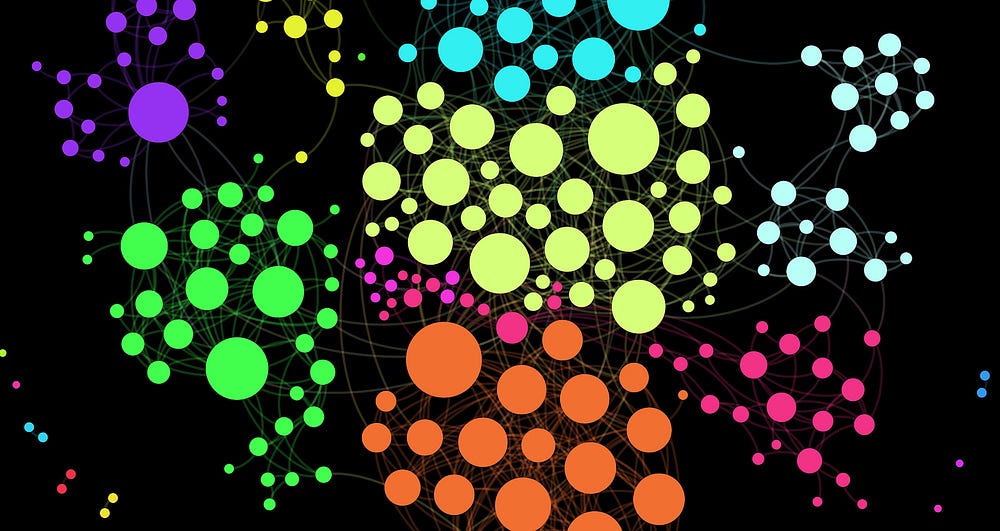
Ironically, in a world in which we have countless tools to connect, we are also watching fragmentation, polarization, and de-diversification happen en masse. The American public is self-segregating, and this is tearing at the social fabric of the country.
Many in the tech world imagined that the Internet would connect people in unprecedented ways, allow for divisions to be bridged and wounds to heal.It was the kumbaya dream. Today, those same dreamers find it quite unsettling to watch as the tools that were designed to bring people together are used by people to magnify divisions and undermine social solidarity. These tools were built in a bubble, and that bubble has burst.
Nowhere is this more acute than with Facebook. Naive as hell, Mark Zuckerberg dreamed he could build the tools that would connect people at unprecedented scale, both domestically and internationally. I actually feel bad for him as he clings to that hope while facing increasing attacks from people around the world about the role that Facebook is playing in magnifying social divisions. Although critics love to paint him as only motivated by money, he genuinely wants to make the world a better place and sees Facebook as a tool to connect people, not empower them to self-segregate.
The problem is not simply the “filter bubble,” Eli Pariser’s notion that personalization-driven algorithmic systems help silo people into segregated content streams. Facebook’s claim that content personalization plays a small role in shaping what people see compared to their own choices is accurate.And they have every right to be annoyed. I couldn’t imagine TimeWarner being blamed for who watches Duck Dynasty vs. Modern Family. And yet, what Facebook does do is mirror and magnify a trend that’s been unfolding in the United States for the last twenty years, a trend of self-segregation that is enabled by technology in all sorts of complicated ways.
The United States can only function as a healthy democracy if we find a healthy way to diversify our social connections, if we find a way to weave together a strong social fabric that bridges ties across difference.
Yet, we are moving in the opposite direction with serious consequences. To understand this, let’s talk about two contemporary trend lines and then think about the implications going forward.
Privatizing the Military
The voluntary US military is, in many ways, a social engineering project. The public understands the military as a service organization, dedicated to protecting the country’s interests. Yet, when recruits sign up, they are promised training and job opportunities. Individual motivations vary tremendously, but many are enticed by the opportunity to travel the world, participate in a cause with a purpose, and get the heck out of dodge. Everyone expects basic training to be physically hard, but few recognize that some of the most grueling aspects of signing up have to do with the diversification project that is central to the formation of the American military.
When a soldier is in combat, she must trust her fellow soldiers with her life. And she must be willing to do what it takes to protect the rest of her unit. In order to make that possible, the military must wage war on prejudice. This is not an easy task. Plenty of generals fought hard to fight racial desegregation and to limit the role of women in combat. Yet, the US military was desegregated in 1948, six years before Brown v. Board forced desegregation of schools. And the Supreme Court ruled that LGB individuals could openly serve in the military before they could legally marry.
Morale is often raised as the main reason that soldiers should not be forced to entrust their lives to people who are different than them. Yet, time and again, this justification collapses under broader interests to grow the military. As a result, commanders are forced to find ways to build up morale across difference, to actively and intentionally seek to break down barriers to teamwork, and to find a way to gel a group of people whose demographics, values, politics, and ideologies are as varied as the country’s.
In the process, they build one of the most crucial social infrastructures of the country. They build the diverse social fabric that underpins democracy.
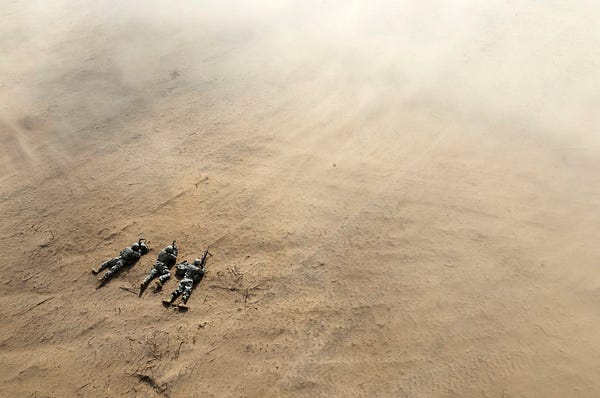
Tons of money was poured into defense after 9/11, but the number of people serving in the US military today is far lower than it was throughout the 1980s. Why? Starting in the 1990s and accelerating after 9/11, the US privatized huge chunks of the military. This means that private contractors and their employees play critical roles in everything from providing food services to equipment maintenance to military housing. The impact of this on the role of the military in society is significant. For example, this undermine recruits’ ability to get training to develop critical skills that will be essential for them in civilian life. Instead, while serving on active duty, they spend a much higher amount of time on the front lines and in high-risk battle, increasing the likelihood that they will be physically or psychologically harmed. The impact on skills development and job opportunities is tremendous, but so is the impact on the diversification of the social fabric.
Private vendors are not engaged in the same social engineering project as the military and, as a result, tend to hire and fire people based on their ability to work effectively as a team. Like many companies, they have little incentive to invest in helping diverse teams learn to work together as effectively as possible. Building diverse teams — especially ones in which members depend on each other for their survival — is extremely hard, time-consuming, and emotionally exhausting. As a result, private companies focus on “culture fit,” emphasize teams that get along, and look for people who already have the necessary skills, all of which helps reinforce existing segregation patterns.
The end result is that, in the last 20 years, we’ve watched one of our major structures for diversification collapse without anyone taking notice. And because of how it’s happened, it’s also connected to job opportunities and economic opportunity for many working- and middle-class individuals, seeding resentment and hatred.
A Self-Segregated College Life
If you ask a college admissions officer at an elite institution to describe how they build a class of incoming freshman, you will quickly realize that the American college system is a diversification project. Unlike colleges in most parts of the world, the vast majority of freshman at top tier universities in the United States live on campus with roommates who are assigned to them. Colleges approach housing assignments as an opportunity to pair diverse strangers with one another to build social ties. This makes sense given how many friendships emerge out of freshman dorms. By pairing middle class kids with students from wealthier families, elite institutions help diversify the elites of the future.
This diversification project produces a tremendous amount of conflict. Although plenty of people adore their college roommates and relish the opportunity to get to know people from different walks of life as part of their college experience, there is an amazing amount of angst about dorm assignments and the troubles that brew once folks try to live together in close quarters. At many universities, residential life is often in the business of student therapy as students complain about their roommates and dormmates. Yet, just like in the military, learning how to negotiate conflict and diversity in close quarters can be tremendously effective in sewing the social fabric.
In the springs of 2006, I was doing fieldwork with teenagers at a time when they had just received acceptances to college. I giggled at how many of them immediately wrote to the college in which they intended to enroll, begging for a campus email address so that they could join that school’s Facebook (before Facebook was broadly available). In the previous year, I had watched the previous class look up roommate assignments on MySpace so I was prepared for the fact that they’d use Facebook to do the same. What I wasn’t prepared for was how quickly they would all get on Facebook, map the incoming freshman class, and use this information to ask for a roommate switch. Before they even arrived on campus in August/September of 2006, they had self-segregated as much as possible.
A few years later, I watched another trend hit: cell phones. While these were touted as tools that allowed students to stay connected to parents (which prompted many faculty to complain about “helicopter parents” arriving on campus), they really ended up serving as a crutch to address homesickness, as incoming students focused on maintaining ties to high school friends rather than building new relationships.
Students go to elite universities to “get an education.” Few realize that the true quality product that elite colleges in the US have historically offered is social network diversification. Even when it comes to job acquisition, sociologists have long known that diverse social networks (“weak ties”) are what increase job prospects. By self-segregating on campus, students undermine their own potential while also helping fragment the diversity of the broader social fabric.
Diversity is Hard
Diversity is often touted as highly desirable. Indeed, in professional contexts, we know that more diverse teams often outperform homogeneous teams. Diversity also increases cognitive development, both intellectually and socially. And yet, actually encountering and working through diverse viewpoints, experiences, and perspectives is hard work. It’s uncomfortable. It’s emotionally exhausting. It can be downright frustrating.
Thus, given the opportunity, people typically revert to situations where they can be in homogeneous environments. They look for “safe spaces” and “culture fit.” And systems that are “personalized” are highly desirable. Most people aren’t looking to self-segregate, but they do it anyway. And, increasingly, the technologies and tools around us allow us to self-segregate with ease. Is your uncle annoying you with his political rants? Mute him. Tired of getting ads for irrelevant products? Reveal your preferences. Want your search engine to remember the things that matter to you? Let it capture data. Want to watch a TV show that appeals to your senses? Here are some recommendations.
Any company whose business model is based on advertising revenue and attention is incentivized to engage you by giving you what you want. And what you want in theory is different than what you want in practice.
Consider, for example, what Netflix encountered when it started its streaming offer. Users didn’t watch the movies that they had placed into their queue. Those movies were the movies they thought they wanted, movies that reflected their ideal self — 12 Years a Slave, for example. What they watched when they could stream whatever they were in the mood for at that moment was the equivalent of junk food — reruns of Friends, for example. (This completely undid Netflix’s recommendation infrastructure, which had been trained on people’s idealistic self-images.)
The divisions are not just happening through commercialism though. School choice has led people to self-segregate from childhood on up. The structures of American work life mean that fewer people work alongside others from different socioeconomic backgrounds. Our contemporary culture of retail and service labor means that there’s a huge cultural gap between workers and customers with little opportunity to truly get to know one another. Even many religious institutions are increasingly fragmented such that people have fewer interactions across diverse lines. (Just think about how there are now “family services” and “traditional services” which age-segregate.) In so many parts of public, civic, and professional life, we are self-segregating and the opportunities for doing so are increasing every day.
By and large, the American public wants to have strong connections across divisions. They see the value politically and socially. But they’re not going to work for it. And given the option, they’re going to renew their license remotely, try to get out of jury duty, and use available data to seek out housing and schools that are filled with people like them. This is the conundrum we now face.
Many pundits remarked that, during the 2016 election season, very few Americans were regularly exposed to people whose political ideology conflicted with their own. This is true. But it cannot be fixed by Facebook or news media. Exposing people to content that challenges their perspective doesn’t actually make them more empathetic to those values and perspectives. To the contrary, it polarizes them. What makes people willing to hear difference is knowing and trusting people whose worldview differs from their own. Exposure to content cannot make up for self-segregation.
If we want to develop a healthy democracy, we need a diverse and highly connected social fabric. This requires creating contexts in which the American public voluntarily struggles with the challenges of diversity to build bonds that will last a lifetime. We have been systematically undoing this, and the public has used new technological advances to make their lives easier by self-segregating. This has increased polarization, and we’re going to pay a heavy price for this going forward. Rather than focusing on what media enterprises can and should do, we need to focus instead on building new infrastructures for connection where people have a purpose for coming together across divisions. We need that social infrastructure just as much as we need bridges and roads.
danah boyd writes, "Yesterday, a group of us at Data & Society put out six essays on 'media, technology, politics.' Taken
together, these pieces address different facets of the current public
conversation surrounding propaganda, hate speech, and the US election.
Although we only allude to specifics, we have been witnessing
mis/disinformation campaigns for quite some time as different networks
seek to manipulate both old and new media, shape political discourse,
and undermine trust in institutions and information intermediaries. In
short, we are concerned about the rise of a new form of propaganda that
is networked, decentralized, and internet-savvy. We are also concerned
about the ongoing development of harassment techniques and gaslighting,
the vulnerability of old and new media to propagate fear and
disinformation, and the various ways in which well-intended
interventions get misappropriated. We believe that we're
watching a systematic attack on democracy, equality, and freedom. There
is no silver bullet to address the issues we're seeing. Instead,
a healthy response is going to require engagement by many different
constituencies. We see our role in this as to help inform and ground the
conversation. These essays are our first attempt to address the
interwoven issues we're seeing.
(more…)
The Duggar family has decided to defy God, who clearly believes that 19 children out of one clown car uterus is enough. So much for the "natural family."
[W]hen people aren’t being funded to create work by publishers or labels or whatever, then advertisers end up filling in that gap. Advertisers are happy to see the stuff they’ve branded out there for free, they don’t care about scarcity, they want any message they’re invested in to be shared and to be abundant and to be passed along. One thing that struck me about going to … tech conferences was all the enthusiasm for free culture, and remixing, and social media, but people’s greatest ambition was to be sponsored by Chipotle or something equivalent to that. It was this weird mix of collaborative, utopian claims and this total acquiescence to commercial imperatives. I think that overall, ultimately the impact of advertisers calling the shots is a more cloying, complacent culture.
Evegeny Morozov finds that one of the most important messages in Taylor’s book is that “web-enabled innovations like crowdfunding make for wonderful add-ons to, but very poor substitutes for, existing cultural institutions”:
[W]hat does it mean to democratize culture? To some, it means getting rid of gatekeepers such as the National Endowment for the Arts and replacing them with some kind of direct democracy, in which citizens can simply cast their votes for or against particular films or books. But this is definitely not how Taylor sees it. “Democratizing culture,” she writes, “means choosing, as a society, to invest in work that is not obviously popular or marketable or easy to understand. It means supporting diverse populations to devote themselves to critical, creative work and then elevating their efforts so they can compete on a platform that is anything but equal.”
But Tom Chivers argues that both Taylor and Morozov are a bit too black-and-white in their thinking:
Taylor’s book, it strikes me, is not so much directed against the internet – even though that is the “people’s platform” of her ironic title – but against the free-market purists who are in charge of so much of it. The cheerleaders she quotes regularly suggest that what the public is interested in is exactly the same as what is in the public interest: so long-lens shots of bathing celebrities, or lists of funny pictures of cats, are just as worthy as the best 14,000-word New Yorker investigative feature. The invisible hand of the free market will always create the best of all possible worlds, they say.
Yes, some of the best technical minds of our generation are being used to create ad software. But there are also plenty of people who want to use their engineering skills to fix the very social problems Taylor describes. How can we support this type of entrepreneur? After all, I can’t choose a more artist-friendly alternative to Spotify if it doesn’t exist.
I wish [Taylor] had devoted two or three chapters to such possible solutions rather than merely referenced them in her conclusion. The problems she explains in convincing detail are of the looming, complex variety that have vexed activists for generations. If the Internet really does pose new slants on these old problems, as she argues, it must also present new opportunities for remedying them.
At midnight last night, Twitter went dark in Turkey after the service was lambasted by Prime Minister Tayyip Erdogan. News of his massive corruption has been leaking out on social media, with damning audio clips and other evidence. Erdogan controls the old media – television and the print press – in Turkey, but has no way to stop the ten million Turkish Twitter users from sharing around the leaked material (which he maintains is fraudulent). So Erdogan said, “We Will eradicate Twitter.” Erdogan’s Justice and Development Party (AKP) is facing local municipal elections at the end of the month and it may be he hoped to close down conversations about the corruption issue in the run-up to them. If AKP does well in those elections, they will form a platform for his anticipated run for the presidency in five months.
If the audio clips are actually fraudulent, it should be possible for Erdogan to have forensics performed on them and to discredit them. In a democracy, you deal with allegations by debating them, not by trying to close down national discussions. Erdogan is demonstrating an increasingly troubling tendency toward dictatorial methods.
My colleague Tim Pool, broke the news from Istanbul. He tells me that “the reaction seems to be anger and confusion. I see a lot of people on facebook just asking ‘is twitter down for you?’” Erdogan called Twitter a “menace to society” when a popular uprising swept the country last year, and has made noise about curtailing social media use in Turkey ever since.
Prime minister Recep Tayyip Erdoğan huffed, ”We now have a court order. We’ll eradicate Twitter. I don’t care what the international community says. Everyone will witness the power of the Turkish Republic.” But the ban doesn’t doesn’t appear to have been that successful:
Not even a day after Prime Minister Recep Tayyip Erdogan said the social media service would be “eradicated” from the country, Turks were still actively tweeting by the millions through a variety of workarounds. A Turkish website, Zete.com, said 2.5 million tweets had been posted since the ban, reportedly setting traffic records in Turkey.
Yoree Koh and Danny Yadron detail another way people are circumventing the ban
Twitter has relationships with carriers in many countries, including four in Turkey, that have provided Twitter with short codes that allow users to send tweets. Users type in the code – either 2444 or 2555 in Turkey to signal the start of a tweet. The website then matches the sender’s phone number with their Twitter account. It makes for a handy back up plan when other methods may be compromised. Users receive all the texts sent by accounts they follow.
On Thursday, Twitter advised users in Turkey to text their tweets shortly after news stories of the shutdown surfaced. Twitter offered the same suggestion to users when the Venezuelan government restricted certain access to the service last month.
David Kenner notes that it’s not just the opposition that’s up in arms:
[T]he ban also appears to have exacerbated divisions within Erdogan’s party. President Abdullah Gul, who visited the headquarters of Twitter in 2012, said a ban on the site was “unacceptable” – and to add insult to injury, he made his comments via his Twitter account.
Gul isn’t alone. Melih Gokcek, the mayor of Ankara and another member of the ruling party, also continued to tweet. His first message after the ban was announced could’ve been interpreted as support or defiance – whatever he meant, it was retweeted thousands of times by Twitter users within Turkey:
Erdoğan, whose political instincts used to be top notch, appears to have badly miscalculated this time. The courts are denying that they issued any shutdown orders, other countries and NGOs are criticizing him left and right, and the economy has taken yet another dip in response to his latest move. Even if the local elections at the end of the month go the AKP’s way, Erdoğan’s own political viability has never been more in question. He may have some more tricks up his sleeve, but it is difficult to envision how Erdoğan ever recovers the colossal stature he had only a couple of short years ago.
Thanks to the rigorous use of backups, I’ve just noticed that it is the twentieth anniversary of my personal home page. In the spirit of commemoration, I’ve uploaded the original version (c. 1994). For reasons I don’t remember now, I named it “booger.html.” A screenshot:
I stumbled upon this file while looking through my backups for something else. I also found all kinds of other interesting stuff. For example, I found my personal list of “hotlinks” (as we called them then).
It’s very hard to reconstruct what the Web was like then. The Internet Archive had not begun operation yet. All of my old links to things are now dead, but it’s still interesting to try to remember how we were social with computers. Yes, there were “social media.” I’ll explain:
I found my PGP Public Key. (No idea where the private key is.) I made my PGP public key available so people could send me a PGP encrypted message at any time. However, in ten years no one ever sent me a PGP encrypted message. But I was ready. (Take that NSA.) As long as I could find my PGP private key and remember the password from ten years ago, that is.
My preferred search engine was Web Crawler.
Later in the year I was very excited about Hot Wired, the first commercial magazine on the Web (an online version of Wired Magazine). It had its own URL then, which still works: http://www.hotwired.com Everything was prefaced with “hot” back then. That is a hotlink to HotWired.
I spent a lot of time doing ytalkwith my friends. Screenshot (found on the Internet — not mine):
I exhorted people to look me up on whois and to “finger me.” I regularly updated my .plan and .project files, which were status updates. Yes, Mark Zuckerberg basically ripped off the finger protocol from 1971, then added a facility to help Harvard men look at Harvard women (the “Facebook”) and “poke” them. Great job. Here’s an example finger query (not mine, found on the Web):
A lot of being on the Web in 1994 seems to be about justbeing on the Web at all. For instance:
I used the HotDog Web Editor for my HTML. Apparently because the logo was so cool. (I don’t think I used it for my first Web page – booger.html though because the HTML is terrible.)
I appear to have been on an obsessive search for new “icons.” I bookmarked a bunch of icon sharing sites, all now defunct.
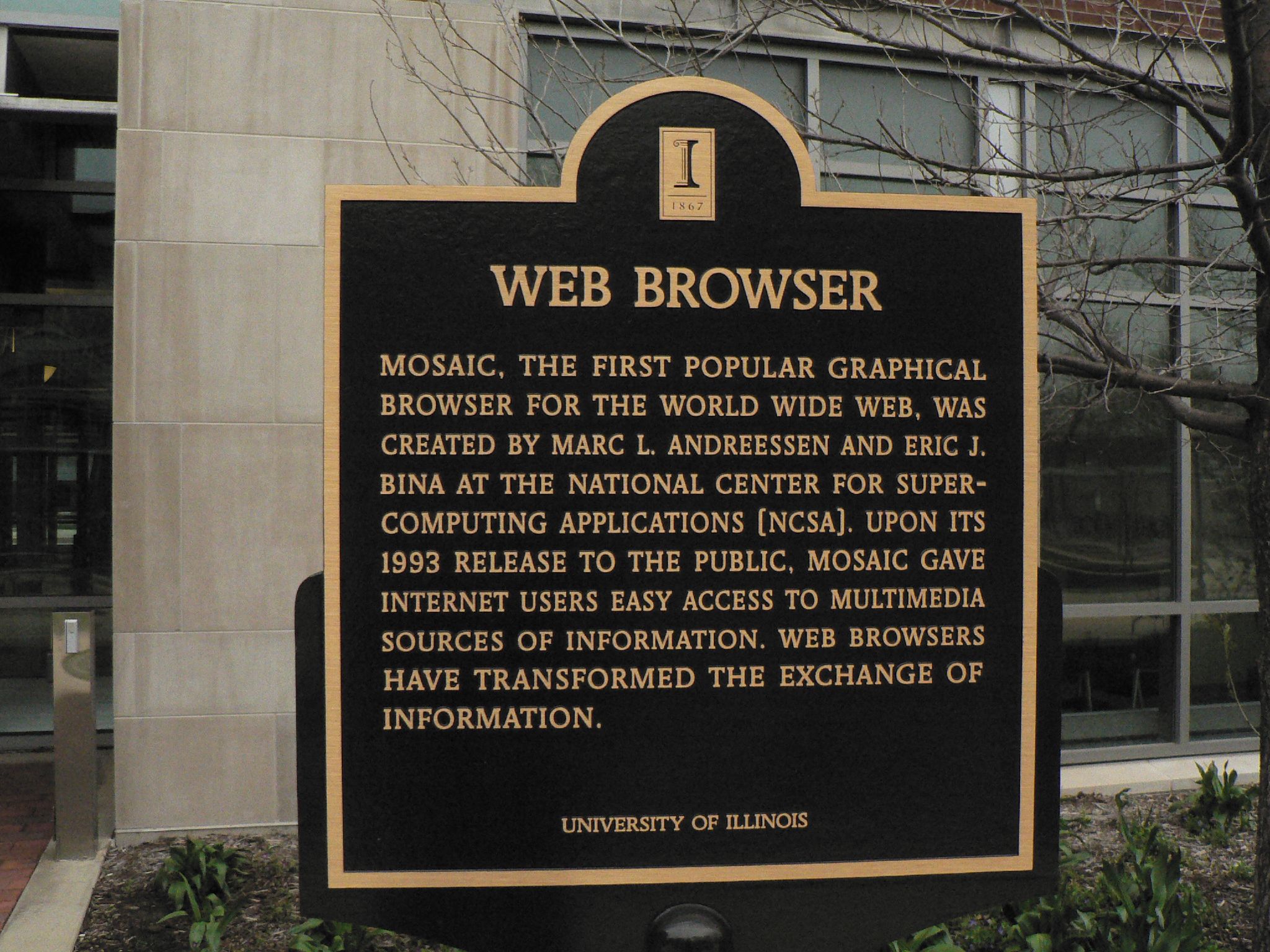
Does anyone else remember Carlos’s Forms Tutorial at NCSA? I spent a huge amount of time there and looking at the CGI documentation on a server named hoohoo (the link is a capture from 1996). I spent so much time on it that I memorized the URL, and we didn’t believe in short URLs then. UIUC loomed large in my imagination purely because of its Web stuff. Little did I know I would go on to work there and genuflect at the monument to the Web Browser every single day.
The ephemera above remind me that the Web was soexciting that a friend went to the DMV and got the California personalized license plate “IDOWWW“. I thought this might be the coolest thing anyone had ever done. In fact, I still think it is.
It’s hard to believe twenty years have passed since booger.html. I want to keep the nostalgia going. Does anyone else remember anything about social media in 1994?
Simon Owens offers a brief history of the supercut - that YouTube-ready montage of film clichés, tropes, or catchphrases:
While the supercut – a neologism coined by blogger Andy Baio–has proliferated with the creation of YouTube and its ease of use, the concept of stringing together brief clips to point out a common refrain stretches back decades. Jon Stewart almost single-handedly invented a new form of media criticism by collating the inane and vapid beltway doublespeak that plagues punditocracy. Tom McCormack, who wrote what is perhaps the definitive history of the supercut, traces the genre as far back as 1958 with Bruce Conner’s A Movie, “an early example of found-footage cinema” that “climaxes with interwoven footage of disasters: sinking ships, falling bridges, crashing cars, exploding blimps.”
Owens says it’s not just nostalgia that drives the art form:
For [supercutter Alex] Moschina, [what gives the genre so much emotional resonance is] the sense of recognition that’s triggered when the tropes and themes found through a television show’s arc or in dozens of unrelated movies are pieced together. It creates a kind of “A-ha!” moment when a Hollywood cliché that you perhaps never fully internalized is laid out for you. “It’s definitely something that everyone thinks about, whether they realize it or not,” he said. “They’ll be watching a movie and the main character will do something that makes you think, ‘Who does that in real life?’ Then you realize that if you noticed this weird cliché, other people probably noticed it as well, and so you have a built-in audience that will appreciate the hilarity of that situation.”
Jacob N. Shapiro, author of The Terrorist's Dilemma: Managing Violent Covert Organizations , sets out his thesis about the micromanagement style of terrorist leaders in a fascinating piece in Foreign Affairs. It comes down to this: people willing to join terrorist groups are, by definition, undisciplined, passionate, and unbalanced, so you have to watch them closely and coordinate their campaigns. From the IRA to al Qaeda, successful terrorist leaders end up keeping fine-grained records of who's getting paid, what they're planning, and how they're spending. This means that in many cases, the capture of terrorist leaders leads to the unraveling of their organizations, but the alternative is apparently even worse -- a chaotic series of overlapping, self-defeating attacks and out-of-control spending.
Recall that Moktar Belmoktar was hounded out of the Al-Qaeda in the Islamic Maghreb in part over his sloppy expense reporting, and that he went on to found the group that took more than 800 hostages in a gas plant in Algeria. This kind of budget-niggling is apparently common: Ayman al-Zawahiri, leader of al Qaeda since 2011, was reportedly furious that Yemeni affiliates had bought a new fax machine, because the old one worked just fine.
But the deeper part of the answer is that the managers of terrorist organizations face the same basic challenges as the managers of any large organization. What is true for Walmart is true for al Qaeda: Managers need to keep tabs on what their people are doing and devote resources to motivate their underlings to pursue the organization’s aims. In fact, terrorist managers face a much tougher challenge. Whereas most businesses have the blunt goal of maximizing profits, terrorists’ aims are more precisely calibrated: An attack that is too violent can be just as damaging to the cause as an attack that is not violent enough. Al Qaeda in Iraq learned this lesson in Anbar Province in 2006, when the local population turned against them, partly in response to the group’s violence against civilians who disagreed with it.
Terrorist leaders also face a stubborn human resources problem: Their talent pool is inherently unstable. Terrorists are obliged to seek out recruits who are predisposed to violence -- that is to say, young men with a chip on their shoulder. Unsurprisingly, these recruits are not usually disposed to following orders or recognizing authority figures. Terrorist managers can craft meticulous long-term strategies, but those are of little use if the people tasked with carrying them out want to make a name for themselves right now.
Terrorist managers are also obliged to place a premium on bureaucratic control, because they lack other channels to discipline the ranks. When Walmart managers want to deal with an unruly employee or a supplier who is defaulting on a contract, they can turn to formal legal procedures. Terrorists have no such option. David Ervine, a deceased Irish Unionist politician and onetime bomb maker for the Ulster Volunteer Force (UVF), neatly described this dilemma to me in 2006. “We had some very heinous and counterproductive activities being carried out that the leadership didn’t punish because they had to maintain the hearts and minds within the organization,” he said, referring to a period in the late 1980s when he and the other leaders had made a strategic calculation that the Unionist cause was best served by focusing on nonviolent political competition. In Ervine’s (admittedly self-interested) telling, the UVF’s senior leaders would have ceased violence much earlier than the eventual 1994 cease-fire, but they could not do so because the rank and file would have turned on them. For terrorist managers, the only way to combat those “counterproductive activities” is to keep a tight rein on the organization. Recruiting only the most zealous will not do the trick, because, as the alleged chief of the Palestinian group Black September wrote in his memoir, “diehard extremists are either imbeciles or traitors.”
It’s important to understand the particular nature of Russian homophobia if we ever hope to address it. In the U.S., much of our anti-gay politics emmanates from a politically influential religious class, and so it would be reasonable to assume that Russia’s anti-gay animosity springs from a similar source. And while the Russian Orthodox Church is virulently anti-gay, Masha Lippman says it would be a mistake to try to address Russian homophobia on religious grounds.
The country may appear to be fairly conservative, if one looks at its widespread homophobia or public condemnation of irreverence toward Russian Orthodox Church. Yet when it comes to other social habits, such as divorce, abortion, or birth rate, the picture is very different. Russia has one of the world’s highest rates of both divorce and abortion, and some of the most liberal laws on the latter. Russia’s birth rate is not dissimilar from that of secular cultures of western Europe. Premarital sex and single motherhood are fairly common; in one survey, a mere fourteen per cent of respondents said they believed a single parent can’t raise a child properly. And while a large majority of Russians identify themselves as Orthodox Christians, the proportion of those attending services or observing religious rituals in Russia is not dissimilar from many European countries.
A partial explanation of this discrepancy can be found in Soviet history. The early Soviet period involved a radical rejection of the ancien regime, a forced modernization by the Bolsheviks that included universal literacy and suffrage (along with the elimination of political choice, of course), as well as brutally imposed secularization, among other things. But the Soviet Union mostly missed the later, post-war stages of the Western social modernization, and especially the gay-rights movement. In the U.S.S.R., it was a crime to be a gay man. The atmosphere grew much freer for gays in the post-Communist period, yet gay rights have not become a nationwide issue until now, as the government has abruptly moved toward social conservatism.
This diary over at Daily Kos goes into it deeper, where Russian homophobia is seen in the context of Russian nationalism and distrust of foreigners. This is not the first time I’ve seen this; a number of Russians and citizens of former Soviet countries themselves have said this over the years:
In every way the homophobic tendency in contemporary Russia is riding the coattails of a decade’s worth of ethnic violence and xenophobia. Even the horrific videos of Russians torturing young people because of their perceived sexual identity are a recent addition to an already crowded field of anti-immigrant videos, in which Russian neo-Nazis beat up, and in some cases kill, people they suspect of being non-ethnic Russians. They share these videos on the internet for fun. (If you can bear it, this short documentary on anti-immigrant crime is as eye-opening as it is horrific.) On their own, these are the acts of fringe neo-Nazis like Maxim Martsinkevich (a major player in the torture video genre, who takes shirtless pictures and sexually violates LGBTs… read into that what you will.) Taken more broadly, once you throw in mass unemployment, frustration, and malaise, you start to see these hateful, exclusionary beliefs drift more and more into mainstream discourse.
Another important aspect of this is still-widespread nostalgia for the USSR - not the totalitarian policies per se, but the feeling that, for a couple of decades, Russia was an unchallenged world superpower, secure in its central place in international politics. Not for nothing did Putin call the collapse of the Soviet Union “the greatest geopolitical catastrophe of the century.” This is all of a part with Russia’s attempts to assert itself on the national stage – think oil pipelines, Syria, etc. – as a pathetic echo for the glory days of Soviet power. The gap between Russia’s (belief in its) former greatness and the inability to assert itself in the contemporary world has led to an ideological vacuum, conveniently filled with desperate nationalism.
Later, he adds:
No exaggeration here: there is a sadly widespread belief that the LGBT movement is a CIA-funded operation à la MKUltra. For a local example, check out the current wiki page on Patriarch Alexy II, cached here, and note the section on his opposition to homosexuality.
That’s been one of the challenges in dealing with anti-gay politics in Africa, the belief that LGBT rights and that gay people themselves are a product of foreign meddling. Those charges find fertile ground in Africa where European colonialism — and its import of sodomy laws — still casts a long shadow. That is why public threats of cutting foreign aide (as distinguished from private diplomatic engagement in which the same messages have been delivered) have sometimes been much more disruptive than helpful to LGBT advocates on the ground. The same potential effect could conceivable play out in Russia, where an attack on its laws, however repulsive and oppressive to human rights they may be, is seen as an attack on Russian sovereignty itself. This is where foreign protests can backfire.
That’s not to say that I’m against, for example, the Russian vodka boycott. I personally think it’s been a smashing success, although you won’t be able to measure it in economic terms. I don’t think you will see any impact on Russian vodka producers’ balance sheets, but you do see it in how people are suddenly talking about what’s happening in Russia, and their doing it on a daily basis. The so-called “anti-propaganda” law has been on the books since June, but it wasn’t until Dan Savage issued his call for a vodka boycott a month later that the media decided to take a look. And it has been a daily topic ever since.
Recognizing that this kind of pressure can exasperate Russian nationalism at the expense of LGBT people there doesn’t mean that we should suspend the boycott and call off all protests against Russia’s gross violations of human rights. I don’t see how we can cater to a culture’s xenophobic biases any more than than its homophobic ones. But I do think that there are some smart ways to go about it, and that we should consider following the lead of Russian LGBT activists who know their country and culture far better than we do. I think these examples are good ones to keep in mind:
In responding to the charge that queerness is a Western import, the St. Petersburg advocacy group Vykhod (“Coming Out”) put together an astute set of advertisements aimed at dismantling the rhetoric of Western cultural imperialism by showcasing various figures from Russian history. It’s hard to argue that homosexuality is a CIA plot when so many famous Russians, particularly in the reasonably relaxed culture of the early 20th century, left such a prominent legacy on their culture while living quasi-openly as gay, lesbian, and bisexual. (Transgender history is less prominent but no less there, especially during the early Soviet years and, surprisingly, the 1960s.) Tchaikovsky is of course the usual starting point, but actively open and out Russians included a diverse slate of artists, politicians, scientists… names like Georgy Chicherin, Marina Tsvetaeva, Sergei Diaghilev, Sophie Parnok… The list is very long, because turn-of-the-century Russia’s queer history is actually richer than anything contemporary in the West, where it was handled with much more euphemism. … For their troubles Vykhod was labeled a “foreign agent” and fined 500,000 rubles. So there’s that.
Quite a lot of Russian LGBTs have not kept silent, risking arrest and condemnation in order to make their existence known. One worth getting to know is the “404″ movement (like their FB page here), a Russian spin on the “It Gets Better” web presence. Celebrity culture, so vital in turning around attitudes in America, has been considerably more muted, but there are exceptions: e.g. actor Aleksei Panin came out as bisexual in an interview earlier this year in order to draw attention to the widespread cultural intolerance; socialite and media figureKsenia Sobchak has been very outspoken against the homophobic law; news anchor Anton Krasovsky came out on air and was immediately fired, etc. My first and most important piece of advice is this: get to know these people, share their stories, and don’t let them disappear into the memory hole.
Zan McQuade muses over the growing intimacy of the Internet:
Along with things that were already in the public domain, the television shows and baseball games that were broadcast to everyone, there are an increasing number of personal souvenirs of the past gradually appearing on the Internet. It’s these personal souvenirs that seem to most impressively contribute to our collective memory. Scanned brochures, ticket stubs, blurry photographs of family vacations. Somewhere on the Internet might even be a picture of someone else’s childhood, a trip to King’s Island perhaps, with me in the background. Detailed accounts in forums of events that few people might have experienced, but, once accessed, brings back a flood of new memories to be assembled and posted and disseminated. Like a postcard from the Lauderdale Biltmore, and a memory of a family vacation.
As more of these mementoes are brought forward and become publicly accessible, as we find better ways to tag and search, we are coming closer and closer to creating a massive online collective memory; a living, breathing, changing vision of the world from our perspective, to be shared and passed along and consumed and sighed over. Were you there? Did you see it when…? I was there!
The New York Times is accusing Geeks Out of blacklisting Orson Card Scott.
This isn’t about stopping the dissemination of antigay sentiments; it’s about isolating Mr. Card and shaming his business partners, thus cutting into their profits. If Mr. Card belongs in quarantine, who’s next? His views were fairly mainstream when the Sunstone article appeared and, unfortunately, are not unusual today.
Just 10 years ago, Justice Antonin Scalia wrote in his inflammatory Lawrence v. Texas dissent that Americans have every right to enforce “the moral opprobrium that has traditionally attached to homosexual conduct” in order to protect themselves “from a lifestyle that they believe to be immoral and destructive.”
On a practical level, the Geeks Out project seems misguided. These things have a way of backfiring, as when former Gov. Mike Huckabee of Arkansas promoted Chick-fil-A Appreciation Day to counter the Chick-fil-A boycott. Attending a goofy popcorn movie could become a way to express disapproval of gays and lesbians — hardly a happy ending.
There are many different forces pushing us toward a Big Brother dystopia.
There are those who profit off of selling surveillance equipment (obviously), there are various religious nutcases who insist that they have the perfect way of life for everybody else, there are politicians who try to prey votes off of fear. But one overlooked major player driving us towards a Big Brother society is the copyright industry.
The reason for the copyright industry to push for surveillance is simple: any digital communications channel can be used for private conversation, but it can also be used to share culture and knowledge that is under copyright monopoly. In order to tell which communications is which, you must sort all of it – and to do that, you must look at all of it.
In other words, if enforcing the copyright monopoly is your priority, you need to kill privacy, and specifically anonymity and secrecy of correspondence. This is exactly what the copyright industry has been doing quite consistently. I’m not going to let this stay at a philosophical level – instead, let’s see what tangible changes they pushed for hard in Sweden to enable persecution of people who share knowledge and culture outside of their monopolies. I’m going to focus on two changes.
In order to be able to sue single parents for their houses and life savings, they needed the ability to tie an IP address and a timestamp to a subscriber. In other words, they had to establish historic trackability of everybody’s actions online, and they needed direct access to that surveillance data. These two developments by themselves were unthinkable a decade ago, but it is the combination of them that mixes the real poison into society’s fabric.
If the copyright industry “only” received rights that went further than those of the Police in requesting IP logs from Internet Service Providers, the ISPs would have responded by refusing to keep any logs at all. If the ISPs were forced to keep logs by law, thus switching this kind of privacy intrusion from “absolutely forbidden” to “mandatory”, those logs would have been kept strictly for law enforcement. So it was the combination of the two – forcing ISPs to keep logs of everybody’s subscriber identity, and getting rights by law to access those logs – that was the key to suing the houses off single parents.
This was also exactly what they got in Sweden. Through an atrocious over-implementation of the EU IPRED directive, which was in itself shameless mail-order legislation from the record industry, the copyright industry got access to the subscriber logs. (It is notable that these rights to violate privacy are stronger than what the Police had.) You can even see this demand on a checklist of demands given to Sweden’s government from the International IP Association via the US Embassy. They also got their Data Retention Directive that specifically requires logging of subscriber identities online – Thomas Bodström, one of the architects behind the EU directive, was heavily in bed with the copyright industry.
There were many snags on the way to this point that were even more revealing. For example, it was proposed in Sweden that the records stored in accordance with the Data Retention Directive should be explicitly excepted from availability in accordance with IPRED. At that point, the copyright industry in Sweden went ballistic and threw tantrums all over the media. It left little to chance, or to the imagination, for that matter: it was obvious what they wanted. They wanted trackability of everybody online. And they got it, thanks to the clueless digital illiterates we have that call themselves politicians.
The copyright industry drives a Big Brother society in order to force everybody to care for their obsolete business. I certainly don’t, and I certainly won’t. I think the idea is repulsive. But at the end of the day, it’s not really the copyright industry who is at fault for making obscene demands. They’re just spectacularly failed entrepreneurs. The real blame here lies with the politicians who blindly accept the obscene demands.
With regards to the net and its liberties, today’s politicians keep behaving like drunken blindfolded elephants trumpeting about in a porcelain factory. It remains up to us to educate or replace them, and above all, making clear to them that these are their two options.
About The Author
Rick Falkvinge is a regular columnist on TorrentFreak, sharing his thoughts every other week. He is the founder of the Swedish and first Pirate Party, a whisky aficionado, and a low-altitude motorcycle pilot. His blog at falkvinge.net focuses on information policy.
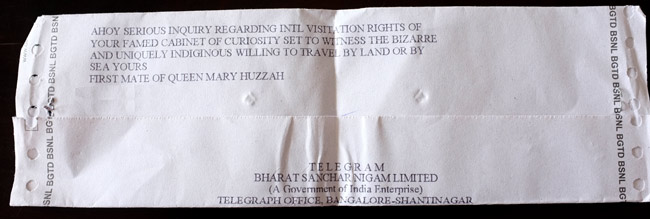
Andy Deemer discovered that India was about to decommission its telegram service on July 15, so he ran around Bangalore until he located the telegram office and sent one to a friend, just to document a procedure that is about to vanish forever:
He handed over an old slip of paper, wanted more details than should be necessary, copied everything into a massive bound ledger, spent ten minutes tallying up the bill, and charged only pennies for the experience. And that was it. I have no idea what happened next. Was there furious tapping of dots and dashes, or did he pop open Outlook 95 and send it via email? I don’t even know.
I guess the story isn’t exciting. Not one bit. But receiving the telegrams a week later?
Now that was grand.
The interesting thing is that the telegram system still sees a surprising amount of use; the Bangalore office alone handles 150 telegrams a day. However, that's down from a peak of 25,000-30,000 -- the decline started with the introduction of SMS.
The above screenshot from our unscientific poll shows that 12 percent of male respondents identify as bisexual while 26 percent of female respondents are bi. Of all the straight-identified respondents, 21 percent say they have had a pleasurable sexual experience with someone of the same gender. And 26 percent of respondents do not believe that bisexuality is a sexual identity of its own. Read all of the results here. Below are more stories and observations from bisexual men who bristled at the previous readers who doubted their existence:
When I was about 13 or 14, I realized I was attracted to men. I had many deep crushes on girls as children, and no real attraction to men until I hit puberty. I liked fantasizing about both, and I had two significant relationships in that period of bisexuality, one with a boy and another with a girl. They were both pretty good. Throughout this time, it was drilled into me by coming out stories and adults both gay and straight that bisexuality was a stopping point on the way to being gay. I still had crushes on girls, but my awkwardness and general unattractiveness mostly kept them from becoming relationships. I also had crushes on (mostly straight) boys.
At 16, as one of the few juniors at a debate camp full of seniors, there was a group of friends I really wanted to be part of – a clique led by a smart, good-looking girl with a gaggle of male followers. At first she thought I was hitting on her; that’s when I made my move and came out as gay. If I’m looking back and being totally honest, I think my shift from bisexual to gay at 16 was actually based on my attraction to a woman. This is a pattern that would hold for the next four years or so: I would develop close friendships with females I was actually attracted to while having sexual and romantic relationships exclusively with men. There was one exception: one of my female idols and I got so drunk and a hotel room that we attempted to have sex, but booze and marijuana and sexual confusion are not kind to the erection of any man.
At 20, I met the woman I would eventually marry. She is amazing, beautiful, smart, and we are infinitely compatible. During the early phase of our relationship, I spent a lot of time thinking about what it meant that I now had the most significant relationship of my life so far with a woman. Mostly it was just awkward. Coming out as gay to everyone you know was hard, and occasionally painful. Coming out to everyone you know again as bi just confuses them. I still am attracted to men, but I absolutely love my wife.
What I’ve concluded from all of this is that a lot of people’s confusion is based in two assumptions about bisexuality: for men it’s a phase before gay and for women it’s a phase before straight. I think this is often true, but man is it irritating to have all of those cases used against your identity.
Or as another reader puts it:
In most of these cases, a bisexual woman is perceived as a straight woman faking it to be edgy – a poser trying to attract men with a hot fantasy – and a bisexual man is perceived as a gay man in denial. In both these instances, society seems to be saying that if you’re going to deviate from the sexual norm, the only valid choice is the cock.
Another:
In my early teen years, I periodically developed powerful crushes on other boys in my classes. I’d worry that I was gay (I’m the son of a devoutly Catholic mother and was devout at that age as well), but then I’d think “but I also have a crush on all these girls.” In fact, I’d had crushes on girls from an early age. Since I’d never heard of bisexuality and figured a person was either one or the other, I figured “well, if I like girls, I must be straight, regardless of what I feel for these other boys.” Even then, when one of those boys dropped me in favor of “cooler” friends, I moped for a whole school year.
The lightning bolt didn’t really hit until a few months later when I was out hiking with my best friend and one of our old high-school buddies.
My friend had joined the rowing team at his college and had become extraordinarily fit in just a couple of months. We were hiking back to the car and my two friends challenged each other to a race. As they ran off, I caught myself admiring my friend’s ass. And not just in a “hey, he looks good” kind of way. The things I wanted to do with that ass would have shocked him. I was so surprised that I had to sit down. Soon after, I told my other best friend from high school (an ex-girlfriend) that “I think I might be bisexual.”
Her response? ”Duh.”
She told me that the way I’d been around certain men had aroused her suspicions years previously. She rattled off a list of names and at each one I felt a flutter. A litany of handsome, gorgeous, or just cute young men, any one of whom I’d have eagerly …
This was all about 25 years ago. In the intervening years, I’ve dated more women than men and I have no trouble admitting that I’m more often attracted to women. My taste in men frequently surprises me; I don’t have a single type; I’m not usually attracted to tremendously masculine men or to particularly effeminate men (for that matter, my taste in women is similarly androgynous). And in the last few years my social circumstances have moved me away from “traditional” gay culture. However, the two real passions I’ve had in my life were for a simply beautiful man and a gorgeous woman. And in neither case was it because I was “turned on by ‘dirty’”, as your reader put it. I was madly in love with both of them and was crushed when those relationships ended.
So, do we exist? Yes. Are there more of us than anyone else? Well, it’s true that we have that choice and in the prevailing social climate in this country, is it any surprise that most men who are occasionally attracted to other men chose to simply “be straight”? Some of us don’t, however, and telling us that we don’t exist is, honestly, deeply insulting.
Another:
I’m just catching up on this thread and feel the need to weigh in, particularly to your reader’s comment, “What I haven’t ever encountered was a guy claiming to be bi, but apparently exclusively interested in men.” I could be the guy your reader is looking for. I openly self-identify as a gay man primarily for the sake of simplicity, and I have only had long-term relationships with other men. My friends and family all know. However, I have had sex with women, I enjoy it, and I actively seek it out on occasion. I had several legitimate “crushes” on women in my high school/college days, though nothing became of them. My romantic interest in women largely ended when I started dating guys in college (I’m 28 now). At the same time, I don’t think many women would enter a relationship with a guy who was openly bisexual, for whatever reason – fear of being his showpiece to appear straight or to satisfy his parents, or she may find it unmasculine, etc.
Starting in college, however, I’ve had a string of female partner’s I’ve hooked up with regularly, as well as a few one-off hookups. I guess that makes me the reverse of the stereotypical bisexual guy, who will have relationships with a woman and only dabble in sex with other men.
As I said before, I quite openly self-identify as gay because it’s easy, and it’s mostly true – I am more inclined toward sex with men, and I think I’m probably more compatible with men for relationships. I could probably give up sex with women if I had to. However, if I’m with gay friends and the topic of sex with women arises, I don’t mind sharing my experience. The usual response is, “Wait, you’re bi?” as if a guy who can swing both ways is a mythical creature. I just reply, “Yeah, sort of.” Then come the follow-up questions, and all I can really say is that I occasionally like sex with women. Apparently bisexuality confuses people, and initially telling someone that I’m gay just allows me to skip having to explain myself.
Another:
I am the reader who posted that I “don’t believe” in bisexuals. Of course I posted that to be inflammatory (like almost everything else I do). However, the responses don’t take into consideration my experiences. I was married to a woman for over ten years and I have two children. I had an incredibly fulfilling sex life. I had been flipping back and forth between men and women my whole life and I’ve had four long-term relationships; two men and two women. I loved my wife more than words can express and I still do.
My point only was that over time EVERYONE will find that they are better off with one or the other, whether or not they are sexually attracted, emotionally attracted, etc. to varying degrees. Unfortunately for my wife and children I didn’t realize this until it was too late to avoid causing a great deal of pain. So yes, I don’t deny that some of your male readers might be capable of relationships with both genders and that they might be fulfilling in both directions but I truly believe that for each person there will be one that will make them whole in the way the other cannot. I don’t think many of your readers who responded to me have reached this point in their lives yet. I was almost 40 when I figured it out. I wish them luck. It’s not an easy road.
“(What I haven’t ever encountered was a guy claiming to be bi, but apparently exclusively interested in men.)” Actually, ”bi” was often shorthand for something else in the old “men seeking men” section of the Village Voice personals. Guys used “bi” and/or “masc” to differentiate from “fem” men (which had its own large following). “Bi” implied they pass for straight and/or were turned off by femininity in other men and themselves. It was a physical description that didn’t pertain to sexual practices because this personals section was exclusively about dude-on-dude action.
Personally, I liked the idea of dating bi men even if he really wasn’t, and I liked dating married men even if they were a little fem. They just had to be a bear.
Another has a long and dramatic story:
One of your readers in response to the original letter wrote that he has never met a bisexual man who only plays around with men. I am as close to that as I think anybody is going to find. Growing up, my animal attraction was definitely more directed at other males, but I developed deep crushes on girls and women as well. At 17, I had my first girlfriend and we were together until I was 21. Our sex life was satisfying (to me anyway, she had problems achieving orgasm from intercourse out of fear of pregnancy). However, I also had many male obsessions, any one of which I would have acted on if the situation arose – or more accurately, if the other guy had been extremely aggressive.
To that point, my only sexual encounter had been as a 16-year old at a choral convention of which my high school was one of only two invited. The rest of the groups were from colleges across the country. I relentlessly stared at this guy, not because I thought he was so attractive (there were others way more attractive) but because he was obviously gay. We eventually struck up a conversation and he asked me if I wanted to go to his room “to talk.” When there, he made a big move, which surprisingly, shocked me. But we messed around and then I went out to dinner and a show with my class, embarrassed and humiliated.
I continued dating women but developed a crush on a co-worker who prided himself on being the “first” for a lot of straight guys. I still identified as straight and aside from saying things like “I wouldn’t push Sting out of bed”, I never let on. We wound up in an extremely unhealthy relationship that lasted for two years on and off.
After it was over and I had recovered my sanity and self-esteem, I embarked on a period of dating women and sleeping around with men.
I told myself I was attracted to men but emotionally I was better off with a woman and I suspected I would never be happy with either completely. Surprisingly, I subsequently met a woman at the gym with whom I fell deeply in love. In two months we were married and in two years we had two children. I was 99% faithful as she seemed to help me put it all together. She was beautiful and wild and fun and raunchy and more importantly when I told her about my attraction to men and about my ex-boyfriend, her response was, “Cool!” Maybe twice in the first six years I had a little dalliance with a guy when she was out of town but it was nothing she probably wouldn’t have forgiven.
Seven years into my marriage, my wife was diagnosed as clinically depressed (she wasn’t, she was bipolar) and she was put on medication which made her worse and which also amplified the effects of alcohol (up to that point alcohol had no effect on her in any way, she could drink 20 shots and remain as sober as the moment she started) and she started to get drunk regularly. Our marriage started to fall apart and I started to sleep with men any chance I could get. The more unhappy we were, the gayer I became. We resembled a miserable married couple except for my secret. I still believed however, that emotionally I was meant for women and truthfully, I still loved my wife very much.
At eleven years of marriage, I met a man online and fell madly in love. Three weeks later I left my wife and he left his boyfriend of 14 years. A messy divorce followed. This man and I are still together 13 years later and we have been married for ten (in Ottawa in 2003). We regularly play outside the relationship together (although much less lately) and it’s always been with other men. We’ve joked about certain women we could have fun with (he has had his moments with women through the years), but it’s talk and nothing more. I’m very happy and I’m not tempted by women. However, I still do find certain women extremely sexually attractive and I would have no problem following through if the situation arose.
If I’m honest with myself I never really stopped being in love with my wife. I don’t have much to do with her anymore except when it comes to our beautiful children, but she really was and is someone very special to me. But for a number of reasons it wasn’t right.
I identified as bisexual for years after I left her but the truth is despite my obvious ability to have relationships and sex with men and women, I am gay. And while I’m sure you didn’t realize or expected this to go here, I really don’t believe there are bisexual men (as previously discussed, the fluidity of most women’s sexuality is way more complicated); men who can live life like a blank slate and where ever they wind up is fine with them. There is a correct choice for each person regardless of what titillates them or what they can do in the moment.
Your initial reader isn’t bisexual if his letter is honest. He’s a straight man who’s turned on by “dirty”. Despite 11 years of a mostly happy marriage in which my wife and I had a fulfilling sexual relationship until the day I left her, I could not completely be who I am with her. With my husband, I can. While many may disagree with me and that’s fine, I don’t find bisexuals threatening because I don’t believe in them. However, I’m as close to a bisexual man who only fools around with men as you are likely to find.
Another:
I feel vindicated by my earlier email to you by that fact that every letter you have posted is from a “bisexual” woman. You won’t find any truly bisexual men. Your initial reader is either titillated by the taboo of it all or he is a closeted gay man who is in denial. I know from personal experience, and so does every other gay man who finds women attractive in some way. It isn’t surprising to me that you appear to have very few men who would openly discuss their bisexuality.












![1916: 'PHYSICIST DAD' TURNS HIS ATTENTION TO GRAVITY, AND YOU WON'T BELIEVE WHAT HE FINDS. [PICS] [NSFW]](http://imgs.xkcd.com/comics/headlines.png "1916: 'PHYSICIST DAD' TURNS HIS ATTENTION TO GRAVITY, AND YOU WON'T BELIEVE WHAT HE FINDS. [PICS] [NSFW]")

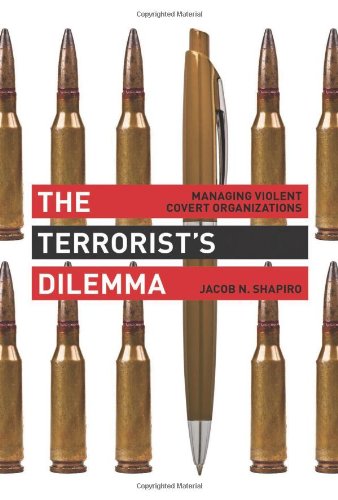 Jacob N. Shapiro, author of