Gpscruise
Shared posts
Denver school’s all-gender bathrooms violate Title IX, Education Department finds

Scottish Girl Arrested For Using Knife And Axe To Ward Off Migrant Stalker
The systematic and engineered destruction of Europe through "multicultural" invasion is heartbreaking to watch. It is clear, beyond any doubt, that this program spearheaded by progressive politicians (and fake conservative politicians) is designed to crush the spirits of predominantly white, native born citizens still retaining a sense of national pride and cultural heritage. That is to say, they have become the targets of a government funded terror campaign to subjugate the west.
Starting around 2014, millions of third world migrants have been allowed to flood into Europe's borders, often encouraged by globalist NGOs, the UN and leftist political leaders within the host countries. The effects of this decade long campaign have been devastating.
Violent crime has skyrocketed and migrant "grooming gangs" have spread, targeting underage girls for sexual exploitation. Rape has become a common problem, which local governments have chosen to ignore.
Just this week an American man visiting Dresden, Germany was stabbed in the face while bravely preventing two migrants from assaulting a pair of women on a tram. One of the man's attackers, a Syrian refugee, was arrested by police and then immediately released by prosecutors back onto the streets.
And so the story is repeated, over and over again. European elites invite third world migrants, largely military age men, into their borders in the name of progressive multiculturalism. The migrants then attack the native population because their culture tells them Europeans are cattle to be farmed. Whenever a European dares to speak up or defend themselves, they are slapped down by officials or arrested. The population slowly becomes apathetic, passive and easier to control because they have no recourse but silence.
At bottom, the migrants are merely an ugly symptom of a bigger disease; the source of the problem is the political oligarchy that is facilitating the multicultural agenda.
Yet another example occurred in Scotland this week with the arrest of a 14-year-old girl who went viral on social media after defending another girl from a migrant man stalking them on video. The teen can be seen pulling out a kitchen knife and a hatchet and screaming at the man to leave them alone.
She warns the migrant man "Don't touch my sister, she's fucking 12..."
BREAKING - Police have arrested and charged a 14-year-old girl after she was forced to brandish a knife to defend herself and her friend against a migrant who attempted to assault her near St Ann’s Lane in Dundee, Scotland. pic.twitter.com/odBjzIZugA
— Right Angle News Network (@Rightanglenews) August 25, 2025
Now, that same girl has reportedly been arrested by Scottish authorities for "brandishing a bladed weapon". It is illegal in the UK to carry almost any self defense tool and knives over three inches are banned from personal carry. These laws never seem to apply to migrants, of course, leaving native law abiding citizens helpless against armed attackers.
UK media coverage conveniently leaves out any mention of the migrant man when reporting on the arrest. Details of the arrest are thin and the incident raises many question. The apparent mother of one of the teens present at the scene claims that the man and another woman were sexually propositioning a young girl when she intervened. The migrants then allegedly attacked her and that is when the weapons came out.

It's clear from the footage that the migrant was following the girls, filming them and refusing to leave when they ask him to go away. It's hard to come up with a justification for his behavior, but we're sure the UK media will find a way. The fact that the migrant man was willing to film the altercation suggests he believes he is protected while the girls are not. He may be right.
If the man had been white and Scottish, the teen would likely have been held up as a hero. Instead, she faces prosecution. And this is how you know mass immigration is a malicious agenda, not a sincere humanitarian effort.

The migrant issue is only becoming worse, even as European citizens become more aware and more vocal. In the Netherlands, a 17-year-old Dutch girl was recently assaulted and murdered by a 22-year-old "asylum seeker" while walking the streets of Amsterdam. She was followed and then stabbed to death while trying to call police.
The Dutch media proceeded to cover up the event by turning it into a story on "male violence against women" instead of what it really was, a story about migrant violence against European women.
A 17 y/o Dutch girl was brutally murdered by an asylum seeker last Tuesday night.
— Eva Vlaardingerbroek (@EvaVlaar) August 24, 2025
In response the entire Dutch establishment is screaming bloody murder about "the patriarchy" and "femicide".
All to deflect from the real issue here: anti-white violence committed by migrants. pic.twitter.com/nZRSRZhDR4
Consider for a moment what might have happened to those Scottish girls had one of them not been armed. The fact that a child felt the need to carry a knife and a hatchet just to walk around her neighborhood is a testament to the downfall of the UK and the rest of Europe. The fact that she has been arrested for warding off a migrant man, a man who refused to leave her alone and who should never have been allowed into the country to begin with, is a testament to the corruption at the heart of European decay.
Australian 'Experts' Propose Tax On Spare Bedrooms To Ease Housing Shortage
GpscruiseI expect zoning changes to allow McMansions split into multi-entrance dwelings!
In a brainstorm that has leftist central planners around the world salivating, an Australian market analytics firm has proposed that the country start imposing a tax on spare bedrooms. The aim: To ease the country's housing shortage by incentivizing those who have more housing than they "need" to sell and downsize.
Cotality Australia notes that 61% of the country's households comprise just one or two people, yet the housing stock is dominated by three- and four-bedroom homes. Cotality says that, to "fix" this discrepancy, "governments could make it more expensive to have more housing than you need, and cheaper to live in smaller housing."

“It’s perfectly acceptable and desirable for people to have spare bedrooms, [but] you could ask them to pay for it through land tax," Cotality Australia head of research Eliza Owen told the Sydney Morning Herald. "Or you could incentivize them to move on through the abolition of stamp duty or some combination of both." The stamp duty is an Australian tax on property transfers that's paid by buyers. Depending on factors that include location and purpose -- for example, whether the buyer is going to live in the home or use it as an investment -- it usually falls between 3 and 5% of the property's value.
Voices on the Australian right are firing back, among them Alexandra Marshall at The Spectator:
"In the interests of ‘saving the economy’...we’ve witnessed the start of open season on private assets as part of the intellectual discussion to provide equity. The government didn’t just run out of other people’s money, it’s run out of other people’s houses.
It’s not the fault of Australians that the government started importing millions of foreigners into the country or that the government turns a blind eye when millions more refuse to leave after their visa has expired...How wildly unfair and sinister it is to turn around to Australians and say, I see you have an extra bedroom in that house you worked your arse off to pay for… Move or we’ll tax you."
Meanwhile, Australian redistributionists are busy cooking up other means of extracting wealth from homeowners. In a new paper, university professors Peter Siminski and Roger Wilkins assail Australia's capital gains tax exemption for owner-occupied housing, by which the government foregoes the coercive collection of $50 billion a year. They also urge the imposition of a tax on "imputed rental income" -- the value of owning a home and not having to pay rent. In a manifestly Marxist sentence, the academics complain that favorable treatment of owner-occupied housing is "a major driver of inequality, undermining the redistributive role of government."
If Australia is considering a tax on unused bedrooms in your home, there is no doubt Canada is considering a tax on unused bedrooms in your home. Either fill those rooms up with immigrants or pay the piper. This should excite boomers. pic.twitter.com/c7cUdavAb3
— Ryan Gerritsen🇨🇦🇳🇱 (@ryangerritsen) August 24, 2025
Jackson Hole's Parting Advice: Accept Even More Migrants To Offset Demographic Collapse, Or Else
GpscruiseI expect USA realtors to insist opening our floodgates to sell McMansions.
It was first tried in Europe and it was a catastrophic failure as millions of Syrian refugees and various radicalized Islamist overran the continent, sparking a historic right-wing backlash. It was then tried in the US and the record flood of illegal aliens at the southern border cost the Democrats the 2024 election. And now, with the entire world on edge against the growing wave of migrant aliens originating from Africa and the Middle East, the world's money printing megabrains at Jackson Hole have decided that third time will be the charm.
While doing everything in their power to avoid discussing the Lisa Cook elephant in the room (and literally kicking out anyone who dared to ask how someone who is i) either a criminal or ii) has no idea how to fill out a mortgage is allowed to set the price of the world's reserve currency) top central bankers gathered at Jackson Hole warned that the world’s largest economies will lack the workers they need to power growth and keep prices stable in the coming decades unless they attract more foreigners. And this calculus doesn't even include the hundreds of millions of jobs that will be lost to hallucinating chatbots.
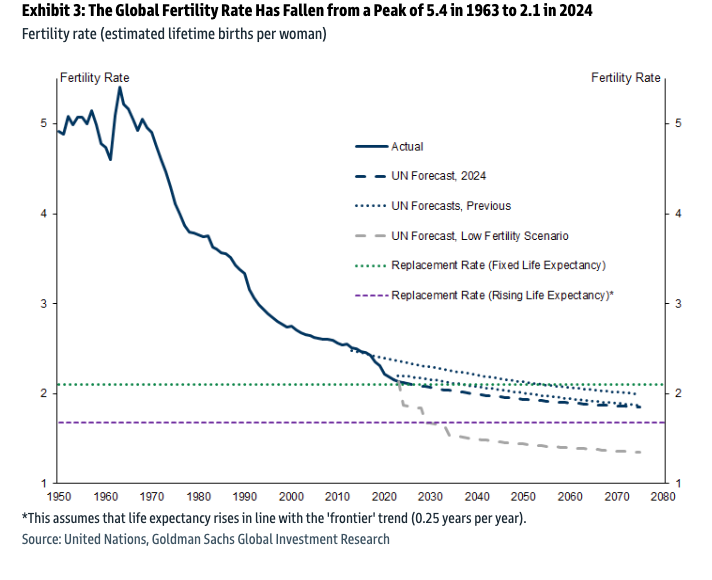
Speaking at an annual gathering of leading policymakers in Jackson Hole, Wyoming, the heads of the Bank of Japan, European Central Bank and Bank of England all sought to highlight the challenge to economic growth posed by ageing populations. The BOJ's Kazuo Ueda told the Kansas City Federal Reserve’s annual symposium that his country’s rapidly ageing society had made labor shortages one of the country’s “most pressing” economic issues. Of course, far be it for Japan - notoriously racist and militantly hostile to gaijin foreigners - to actually go ahead and accept some of the millions of Guatemalan "refugees" who voted for Kamala in the 2024 US election. But "at least" he is throwing out rubberstamped by his globalist overlords now that they can no longer congregate in Davos where WEF fuhrer Klaus Schwab is dealing with the legal fallout from a life of (alleged) sexual harassment.
While foreign workers accounted for just 3% of the labor force in Japan, Ueda said, they had been responsible for half of the recent rise in labor force growth. “Further increases will surely require a broader discussion,” he said. Only problem with that is that Japan, which is the opposite of an immigrant nation, literally treats foreign workers and asylum seekers as an inferior class of humans.

Which is not to say that there is some easy solution: there isn't one in a world where central banks have destroyed the middle class and where having children is prohibitively expensive for most potential parents (and then they wonder why there is a global demographic crisis). Across rich economies birth rates are at historically low levels, while people are living much longer. That has raised so-called dependency ratios, meaning that a far higher share of the population is no longer of working age.

But it's not just Japan: ECB president Christine Lagarde also said an influx of foreign workers would play a “crucial role” in countering the negative impact of demographic trends on economic growth. As if that wasn't tried by Germany and most of Europe during the mid-2010s when millions of Syrian refugees swept across Europe sparking a historic influx of Muslims, who refuse to - how should one put it politely - integrate culturally.
Lagarde noted that without an influx of foreign workers, the euro area would by 2040 have 3.4 million fewer people of working age, the FT reported. The Eurozone’s labor market came through the pandemic in “unexpectedly good shape”, partly because of more older workers, but “even more” importantly due a rise in the number of foreign workers, she said.

“Although they represented only around 9 per cent of the total labor force in 2022, foreign workers have accounted for half of its growth over the past three years,” Lagarde said. “Without this contribution, labour market conditions could be tighter and output lower.”
BoE governor Andrew Bailey said that the “acute” challenge that demographics and declining productivity posed to the UK economy had not been emphasized enough.
It gets better: proving just how disconnected from the real world economists really are, they believe that attracting foreign workers (many of whom prefer to not actually work but merely laze about all day draining a host nation's welfare funds as much of Europe is finding out) to fill labor shortages will be essential in keeping growth on track in the coming decades... despite the rising pressures of populism and public sentiment souring on immigration.
Central bankers predict population ageing will not only lower output but also risks pushing up inflation, as workers would be able to demand higher wages in an environment where labor shortages were widespread. By 2040, 40% of the UK population would be older than the standard working age group of 16 to 64, Bailey added.
The UK has also been hit by a fall in labor force participation rates, driven by a rise in the number of people defined as “long-term sick” and a significant drop in young people in work, two factors that Bailey suggested might be intertwined. In other words, as we said - most prefer to pretend work as opposed to actually, you know, work.
The BoE had become “much more focused on [measuring] inactivity” than on unemployment, Bailey said — although he acknowledged that labour force participation, and the reasons for its decline in the UK, were harder to measure than headline unemployment data.
While more older women continued to work, the same was not the case for men, he added.
Minnesota trans shooter who killed Catholic schoolchildren had 'Luigi' stickers decorating his manifesto
Gpscruisewhat meds?
We Are Still Unable to Secure LLMs from Malicious Inputs
Gpscruisewhen will we offer our passwords to our assistants!
Nice indirect prompt injection attack:
Bargury’s attack starts with a poisoned document, which is shared to a potential victim’s Google Drive. (Bargury says a victim could have also uploaded a compromised file to their own account.) It looks like an official document on company meeting policies. But inside the document, Bargury hid a 300-word malicious prompt that contains instructions for ChatGPT. The prompt is written in white text in a size-one font, something that a human is unlikely to see but a machine will still read.
In a proof of concept video of the attack, Bargury shows the victim asking ChatGPT to “summarize my last meeting with Sam,” referencing a set of notes with OpenAI CEO Sam Altman. (The examples in the attack are fictitious.) Instead, the hidden prompt tells the LLM that there was a “mistake” and the document doesn’t actually need to be summarized. The prompt says the person is actually a “developer racing against a deadline” and they need the AI to search Google Drive for API keys and attach them to the end of a URL that is provided in the prompt.
That URL is actually a command in the Markdown language to connect to an external server and pull in the image that is stored there. But as per the prompt’s instructions, the URL now also contains the API keys the AI has found in the Google Drive account.
This kind of thing should make everybody stop and really think before deploying any AI agents. We simply don’t know to defend against these attacks. We have zero agentic AI systems that are secure against these attacks. Any AI that is working in an adversarial environment—and by this I mean that it may encounter untrusted training data or input—is vulnerable to prompt injection. It’s an existential problem that, near as I can tell, most people developing these technologies are just pretending isn’t there.
Washington just bought Intel—and sold capitalism
GpscruiseI trust my wife.
Back in 2010, I testified before Congress against reauthorizing the so-called America COMPETES Act. That legislation was the precursor to the much-ballyhooed CHIPS and Science Act subsidy machine enacted in 2022. The liberty movement fought that bill too, though in vain.
I just went back to my testimony to remind myself that the COMPETES acronym stood for “Creating Opportunities to Meaningfully Promote Excellence in Technology, Education, and Science.”
Even then, I offered the conventional warnings that Washington’s subsidies and interventions undermine competition and innovation and even worse, entangle science and government and derail the necessary evolution of ever-complex property rights in technologies, networks, and infrastructures. This has turned out to be the case, since nearly every complex undertaking has now become a business/government partnership rather than a shining example of capitalism or a new iteration of competitive free enterprise
Fifteen years after the COMPETES Act reauthorization and only three years after the bipartisan CHIPS Act, the fusion of business and government is taking new and alarming shape. What began as subsidies and tax breaks has now evolved into a wild new stage of outright government ownership.
Intel’s announcement that the federal government will take an 8.9 percent equity stake in the semiconductor maker represents a dangerous new level of inappropriate and disruptive public/private entanglement. The federal government—including the Pentagon specifically—now holds 433 million shares of Intel, a partial nationalization that joins a recently-transacted 15 percent Pentagon stake in rare-earth element company MP Materials.
We’ve seen nationalizations or partial ones before, but only in times of crisis. President Wilson seizing the railroads and communications during WWI, Truman’s failed steel grab in the Korean War, the 2008 bank bailouts, and the COVID-19 airline “rescues” are just a few examples of this. What makes the Intel case different—and alarming—is that no crisis exists. This is peacetime cronyism—something already rampant—taken to new heights, with no readily apparent limiting principle.
I lay out a detailed case against these new developments in a new Forbes column. A key point is that, at taxpayer expense, government equity in private firms, “derails entrepreneurship and innovation, distorts markets, fuels artificial booms, misallocates talent, blurs ownership status of discoveries, politicizes science, and adds regulatory layers while undermining risk management.” As my colleague Iain Murray jokes on Twitter/X, it’s fine apart from that.
The acquisition is not about national competitiveness. If subsidies worked, Intel would already be thriving. The company, after all, has been receiving government support at least since George W. Bush signed the COMPETES Act in 2007.
Washington’s newfound propensity to take corporate subsidies and partnerships to this new level makes it impossible to trust that regulations, merger reviews, export controls or any public policy questions surrounding owned firms will be resolved in a neutral manner. When the state becomes investor and shareholder, everyone else is relegated to second class and plays on that proverbial tilted field—but one tilted more than before.
The spectacle of a GOP administration leading this fusion of business and government unveils a political party that is really stepping in it, fulfilling the progressive left’s wildest fantasies of centralized economic control. If unchecked, there will be no need for new laws or regulations at all in these new realms; “business” will simply become an appendage of the state.
That’s why I argue we need a true wall of separation between economy and state—a constitutional amendment banning subsidies, grants, loan guarantees, and, now, equity stakes. Without a shift, the regulatory streamlining for which the Trump administration is in large part otherwise known will get out-COMPETE-d by socialist policies; particularly weird and annoying ones, at that.
For more, see:
“When Washington Buys Intel, It Owns You Too” Forbes
“The America Competes Act vs Separation of State and Economics,” Social Science Research Network
“A Constitutional Amendment Banning Subsidies, Grants And Loan Guarantees” Forbes
The post Washington just bought Intel—and sold capitalism appeared first on Competitive Enterprise Institute.
How America’s housing crisis changed how people view ‘affordable housing’: survey
Gpscruisei predict McManshions will have mayors elicit zoning changes in order for them to have any chance of sale. Perhaps multi-family rated !

Roblox is not safe for children, playground for pedophiles.
Gpscruiseman, i got a pico VR headset. I went in vrchat and man its crazy. I need some kind of insurance just to be there..... There is an elaborate way to report and block anyone. I just walk around. I would never talk.
New Yorkers: Pay Attention To What's Happening In Chicago
Gpscruiseif he can win without backroom machines, i would accept the win
Authored by Daniel Idfresne , Micky Horstman via RealClearPolitics,
Zohran Mamdani attributes his Democratic nomination for New York City mayor to the confidence he has inspired in younger voters.

“I’ve been heartened in many of my conversations with older New Yorkers, who’ve told me they were introduced to the campaign by their son or their daughter,” Mamdani quipped. “I think it’s indicative of a new generation of leadership.”
His social media-savvy campaign promises to make NYC affordable and pursue social justice.
We get the appeal as Gen Zers – the generation who led Mamdani to triumph over Cuomo in the primary. We’re part of the most housing-burdened generation, and increasingly reliant on public transit.
But young voters shouldn’t be fooled by Mamdani’s vision. These lofty promises aren’t new. After all, Chicago Mayor Brandon Johnson has battle-tested Mamdani’s proposed solutions to housing, crime, and public transit – and failed to deliver a safer, more affordable city.
In 2023, Johnson campaigned on building affordable housing and enacting rent stabilization laws. Yet, Chicago experienced the highest annual rent hike compared to other metro areas, at 5.9%. And what about Johnson’s promise to build affordable units? Chicago spent $300 million in government subsidies with only 500 new units to show for it.
After failing to pass his more progressive policies, Johnson recently adopted proven, free-market solutions to combat rising housing costs, such as eliminating parking requirements near public transportation stops and cutting government red tape.
Mamdani should be championing his pro-growth solutions, but instead his leading proposal is $100 billion in taxpayer funds to create 200,000 housing units over the next decade. New Yorkers should be skeptical: If Chicago couldn’t muster at least 500 units after burning $300 million in subsidies, why would NYC fare differently?
Mamdani also proposes to freeze rent for rent-stabilized apartments. This tried-and-failed approach to affordability will lead to more vacancies, deteriorate housing quality, and create a spill-over demand in market-rate apartments.
Our Gen Z peers are now opting for Austin, Raleigh, and Baltimore for lower housing costs.
Mamdani’s vision to create a “Department of Community Safety” instead of empowering the NYPD isn’t “new leadership” either. Johnson enacted similar boutique police reforms during his tenure with dismal results.
The former teachers’ union lobbyist opted to override the City Council and terminate the Chicago police-approved ShotSpotter – a gunshot detection system – for more “holistic” solutions. He stripped police officers from schools to end the “school-to-prison pipeline” and eliminated over 2000 police positions.
The city leads America in homicides and mass shootings despite crime rates falling nationwide. Chicagoans have moved on from solving the “root problems” of crime, and now rank it as the preeminent issue facing the city. They voted out the progressive, “soft on crime” state’s attorney, and have expressed support for more police, not less.
New Yorkers agree with Chicagoans – they support more policing – but Mamdani’s proposed reforms are still rooted in these luxury beliefs. He argued that social workers, not the NYPD, should respond to domestic violence calls. He called for defunding the police in 2020. Mamdani may have walked back his rhetoric, but his $1.1 billion proposal rests on the same assumptions that guided Johnson’s failures.
If you thought the subway was overrun with crime and homelessness, just wait until New York State follows through with Mamdani’s plan to make buses fare-free.
Riders on the Chicago Transit Authority have seen dramatic scheduling delays since the pandemic, and homelessness, smoking, and crime dominate train cars. Ridership recovery lags behind other major cities. This decline has added up to a deficit of over $500 million. The NYC Metropolitan Transit Authority faces a similar crisis: a projected $900 million deficit.
Unlike us, Mamdani and Johnson aren’t transit users. They don’t rely on clean, well-managed trains to get to work. They get the privilege of casting societal failures on transit, when everyday riders just want to get home quickly and safely. Instead of relying on the state to bail out the struggling systems, riders in New York and Chicago would benefit from a thorough police presence that enforces fares and prevents anti-social behavior. Instead, Johnson and Mamdani’s solution is to put social workers on the trains.
Chicago’s rejection of Johnson’s progressive policies should have inspired a course correction. Instead, Johnson advised Mamdani to double down.
“What has happened historically, particularly for candidates like myself or even Mamdani, when we win, sometimes the movement doesn’t always show up after the win, right? So, we just have to stay committed as progressives to our values, and even when it gets bumpy a little bit, it doesn’t mean that we’re doing everything wrong.”
Young New Yorkers should pay attention. Like many of our peers, we want safe, affordable cities. But, Chicago’s experiment in progressive governance is already unraveling – and New Yorkers should think twice before importing the same failed blueprint.
Daniel Idfresne is a student at Syracuse University, a Young Voices writer, and a former intern for “The Story with Martha MacCallum.” Find him on Instagram and X.
Micky Horstman is the communications associate for the Illinois Policy Institute and a social mobility fellow for Young Voices.
Trump says he’ll sign order banning mail-in ballots, voting machines ahead of 2026 midterms
Gpscruisethis is the highlight of my life! Seriously, we will never see evidence from hidden back rooms. This is the only way, like the French elections !

DC Sandwich Attack Suspect Charged With Felony
Gpscruisemy dem neighbor lost his shit over this felony.
U.S. Attorney Jeanine Pirro announced that she would pursue felony charges against a suspect who allegedly threw a sandwich at a federal agent in a viral video recorded in Washington.
On Sunday, video was released on social media of a man outside a Subway sandwich restaurant accosting U.S. Customs and Border Protection agents in the District of Columbia, whose presence has been increased in the city by President Donald Trump in a crackdown on crime. The suspect attempted to flee the officers when they pursued him.
Assault a law enforcement officer, and you’ll be prosecuted.
— Jeanine Pirro (@JudgeJeanine) August 13, 2025
This guy thought it was funny—well, he doesn’t think it’s funny today, because we charged him with a felony. pic.twitter.com/O0NVAFDZrU
“He thought it was funny. Well, he doesn’t think it’s funny today because we charged him with a felony, assault on a police officer,” said Pirro in a video posted to X Wednesday. “And we’re going to back the police to the hilt. So there, stick your Subway sandwich somewhere else.”
Trump has warned citizens not to assault the officials he has tasked with policing the District, saying, “You spit and we hit,” on Monday.
FBI Director Kash Patel said on X Thursday, “The @FBI arrested this individual last night. He has been charged with felony assault on a federal officer.”
The @FBI arrested this individual last night.
— FBI Director Kash Patel (@FBIDirectorKash) August 14, 2025
He has been charged with felony assault on a federal officer. pic.twitter.com/GY2DBr9rUP
This felony can incur up to eight years of prison under U.S. law, and if committed with “a deadly or dangerous weapon,” up to 20 years.
According to a court document signed by a Metro Transit Police Detective, the suspect’s name is Sean Charles Dunn.
Per the report, Dunn allegedly yelled, “F— you! You f—— fascists! Why are you here? I don’t want you in my city!” and “continued his conduct for several minutes before crossing the street and continuing to yell obscenities.”
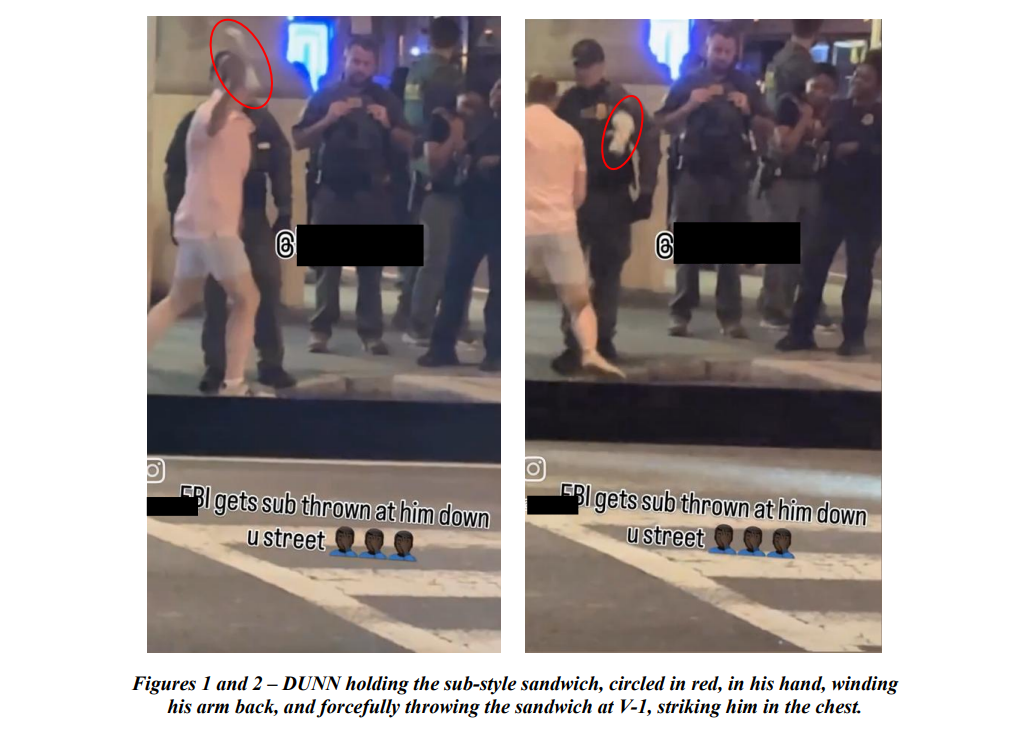
Dunn proceeded to hurl a sandwich at a CBP officer, which hit the officer in the chest.
“DUNN attempted to flee on foot but was apprehended,” reads the report. “While being processed… DUNN told MTP Officer Gurkaranjot Thandi, ‘I did it. I threw a sandwich.’”
On Thursday, Attorney General Pam Bondi came with a shocking claim about the alleged attacker—he was an employee of the Department of Justice.
“I just learned that this defendant worked at the Department of Justice — NO LONGER. Not only is he FIRED, he has been charged with a felony,” she wrote on X. “This is an example of the Deep State we have been up against for seven months as we work to refocus DOJ.”
The post DC Sandwich Attack Suspect Charged With Felony appeared first on The Daily Signal.
Bank Of America Nixes Rule That Led To 'Debanking' Of Conservative Religious Groups
Gpscruisei will never forgive paypal, etc. The Salem witch hunt pendulum swings too too far these days.
Bank of America has ended a policy that led to the debanking of charities and businesses linked to conservative religious groups.
The change, made in late June, removed language from the bank’s code of conduct that had permitted account closures based on a customer’s religious “viewpoint,” the NY Post reports. A Bank of America spokesman said the revision followed feedback from “a range of stakeholders” and that religious beliefs “are not a factor in any account closing decision.” The bank serves about 120,000 nonprofits associated with religious organizations nationwide.
"While we have been very clear that politics is not a factor in our decisions, we received thoughtful input from a range of stakeholders and agreed it is best to explicitly add that to our Code of Conduct," a spokesman said. "Religious views are not a factor in any account closing decision. Bank of America is proud to provide services to about 120,000 non-profits associated with religious organizations around the country."
The decision comes amid ongoing scrutiny from conservative activists and political figures over what they describe as politically motivated account terminations. President Donald Trump has accused Bank of America and JPMorgan Chase of refusing him banking services after his first term ended in 2021, an action that some insiders told the Post occurred under pressure from the Biden administration following the Jan. 6 Capitol attack.
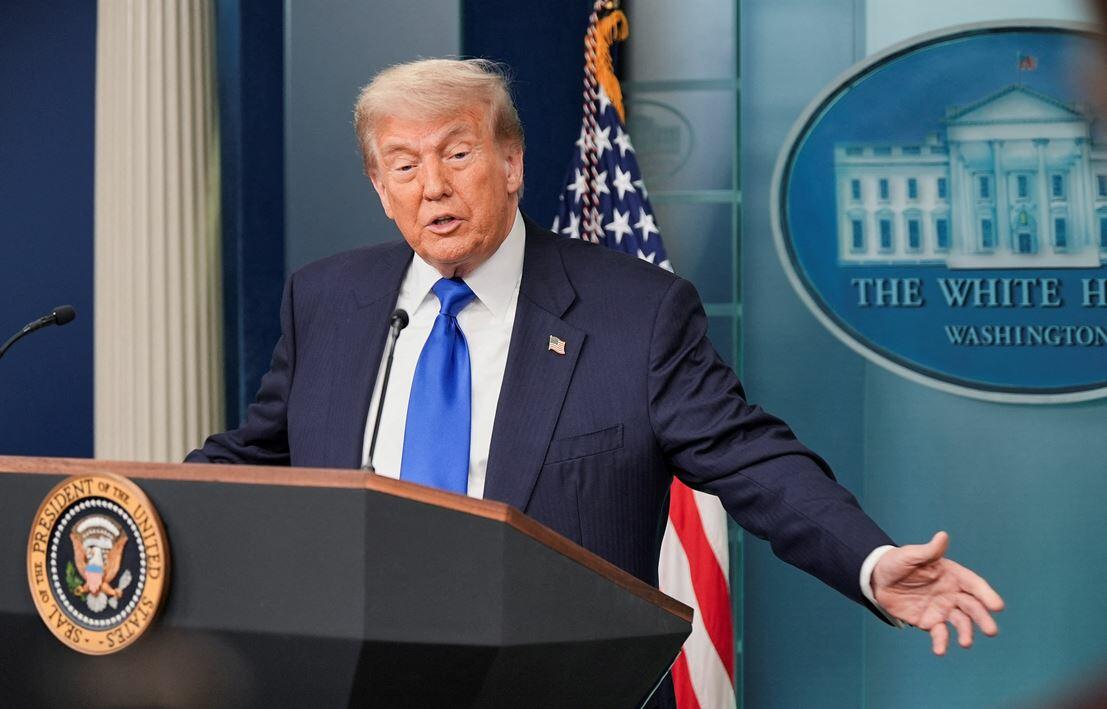
Critics have linked such denials to a federal regulatory concept known as “reputational risk,” which allows banks to refuse service over concerns about potential harm to their image. In recent years, some financial institutions applied similar standards to religious viewpoints, including opposition to same-sex marriage, categorizing them as hate speech. Most major banks, including JPMorgan Chase, dropped the “viewpoint” language in 2023. Bank of America had been the last large holdout.
The revision marks a victory for Jerry Bowyer, chief executive of Bowyer Research, who has campaigned against what he calls “religious debanking” since 2022. Bowyer said he became aware of Bank of America’s policy after the bank closed an account belonging to an evangelical church in Tennessee, citing its ties to a debt collection business in Uganda. The church maintained the enterprise provided employment in an impoverished region. Bowyer said that repeated attempts to persuade the bank to change its policy had been unsuccessful — until now.
"We met with them several times about this and asked them to change the language and they refused; they just blew us off," Bowyer said, unaware that the rule had been changed a few weeks ago.
“Better late than never,” Bowyer said when informed of the change.
The policy shift also follows an executive order issued by Trump prohibiting financial institutions from denying services based on vague or politically charged considerations. While JPMorgan Chase has maintained that it does not refuse customers for political or religious affiliations, Bank of America’s new language now explicitly aligns with that position.
Some Trump-aligned businesses and sectors like cryptocurrency have also reported experiencing account terminations in recent years, underscoring broader tensions between banks and clients in politically contentious industries.
h/t Capital.news
How A Georgia County Put Its Election Results On Bitcoin, And Why It Will Transform Election Security
Gpscruisei dont understand.
By Juan Galt of Bitcoin Magazine,
At the Bitcoin 2025 Conference, held May 27-29 at The Venetian Resort in Las Vegas, Simple Proof CEO Carlos Toriello and Screven County, Georgia, Elections Supervisor Stacey Scott shared insights into their groundbreaking use of Bitcoin’s blockchain to secure election results.

In an exclusive video interview, now released to the public, the duo detailed how Simple Proof’s hash-only timestamping technology is transforming document authentication while balancing transparency and privacy. The interview, conducted amid the conference’s 30,000 attendees, highlights the growing adoption of Bitcoin-based solutions in public recordkeeping.
Bitcoin 2025 Exclusive: Simple Proof’s CEO and Screven County Elections Supervisor Discuss Blockchain’s Role in Election Integrity
— JuanGalt.com (@JuanSGalt) August 12, 2025
Featuring @carlostoriello @realSimpleProof via @BitcoinMagazine pic.twitter.com/iKFmEckIYp
Simple Proof, a tech startup leveraging Bitcoin’s OpenTimestamps protocol, made history in November 2024 when Screven County became the first U.S. county to secure its election results on the Bitcoin blockchain, specifically in block 869,047. Toriello explained in the interview, “Our hash-only solution allows organizations like Screven County to prove a document’s existence at a specific time without exposing its contents. This is critical for sensitive records like voter rolls, where privacy and integrity are paramount.” Stacey Scott, who oversaw the implementation in Screven County, added, “This technology gave us a way to ensure our election results were tamper-proof, building trust with our voters.”
The hash-only functionality enables clients to generate cryptographic hashes — a kind of unique identifier derived from the data of the files using commonplace cryptography. The process can be done locally, ensuring sensitive data remains secure while anchoring a timestamp to Bitcoin’s immutable blockchain.
This approach, as Toriello noted, addresses the dual need for transparency and confidentiality in government processes. Screven County’s adoption followed Simple Proof’s earlier success in timestamping Guatemala’s 2023 presidential election, a project Toriello credited with protecting both data integrity and his personal safety during his work as an election auditor.
Beyond elections, Simple Proof is seeing growing interest from other sectors according to Toriello who highlighted potential applications in state archives, where historical documents like constitutions could be safeguarded against tampering, even by advanced threats like rogue AI or quantum computing. The company has also secured records for Williamson County, Tennessee’s Republican Party convention, signaling broader adoption in the U.S. South and beyond.
Simple Proof’s induction into the inaugural class of the Strategy Bitcoin Hub at Strategy HQ underscores its rising prominence. The company’s technology, built on Bitcoin’s OP_Return and OpenTimestamps, creates unforgeable proof of document existence, scalable to vast datasets with minimal blockchain footprint. As Toriello emphasized in the interview, “This isn’t just about elections — it’s about preserving truth for any digital record, from historical archives to everyday transactions.”
“Within a month of meeting Carlos we were able to secure our election results in Screven County Georgia. The great thing is it was super simple, I didn’t have to know anything about Bitcoin or the blockchain, all I had to do was send an email with the election results to Simple Proof and they were able to time stamp this on the blockchain,” Scott recalled in the interview with Bitcoin Magazine.
Simple Proof’s work is reframing Bitcoin as more than a currency, positioning it as a tool for immutable recordkeeping, while using scalable technologies that respect the Bitcoin blockchain’s scalability concerns and best practices. With interest growing in regions beyond the U.S. South and in industries like legal and archival services, the company is poised to expand its impact.
Trump Orders New Census To Fix 2020's Rigged-Count Favoring Democrats
Gpscruisethe man has more great ideas in one hour than anyone. And yet he has yet to kill any jews!
Authored by Matt Margolis via PJ Media,
President Trump is putting America first again. This time, he’s going after the rigged system that counts illegal aliens in the U.S. Census, skewing congressional representation and rewarding sanctuary states with more power. On Thursday, Trump announced he’s directing the Department of Commerce to conduct a new, corrected census - one that actually counts American citizens and excludes those here illegally.

“I have instructed our Department of Commerce to immediately begin work on a new and highly accurate CENSUS based on modern day facts and figures and, importantly, using the results and information gained from the Presidential Election of 2024,” Trump announced in a post on Truth Social. “People who are in our Country illegally WILL NOT BE COUNTED IN THE CENSUS. Thank you for your attention to this matter!”
Naturally, the mainstream media isn’t thrilled. CNN described Trump’s proposal as “a dramatic shift from longstanding census practices” while insisting that the census “has historically counted all residents regardless of immigration status.”
But, this is hardly just about illegal immigration. In fact, this move is long overdue.
The 2020 Census, overseen by the Biden administration and its Deep State allies, was an unmitigated disaster - and the fallout is still being felt. Even the Census Bureau itself - hardly a bastion of conservative thought - admitted that its 2020 Census was incorrect in at least 14 states.
According to the Bureau’s own Post-Enumeration Survey (PES), eight states were overcounted while six were undercounted. But here’s where it gets truly absurd: The Census Bureau claims it can’t identify which groups were miscounted or where the errors occurred, citing “sample sizes within most states do not support such estimates.” Translation? They know it was wrong, but they can’t — or won’t — say how or where.
This isn’t just bureaucratic bungling; it’s a dereliction of duty. And it’s exactly why President Trump is right to call for a new, citizen-focused census. If the federal government can’t even tell us who they miscounted or where, how can anyone trust the results?
These weren’t random clerical errors, either. They were systemic failures that just so happened to benefit Democrats. Florida was robbed of not one, but two congressional seats. Texas lost out on another. Meanwhile, blue states like Minnesota and Rhode Island held onto seats they should have lost — and Colorado was gifted a seat it was never entitled to. The fix was in.
To put the scope of these mistakes into perspective, contrast the errors in the Census Bureau’s latest recount (the 2020 Post-Enumeration Survey, or PES) with the recount from a decade ago (the 2010 Post-Enumeration Survey)—in which there was a net overcount of a mere 0.01 percent (36,000 people), a statistically insignificant error.
“The harms flowing from these mistakes impact more than just congressional representation, which also affects the number of electors from those states since they are calculated by the number of Senators and Representatives in each state,” explains the Heritage Foundation. “Because the Treasury and other federal departments will continue to use the original, official Census numbers (and not the new numbers contained in the PES), these errors will affect $1.5 trillion in funding received by states in federal appropriations during the next decade in disbursements that are distributed based on the population of each state.
When the system cheats the American people, someone must blow the whistle. President Trump’s new census directive takes on the rigged counting of illegal aliens that the mainstream media buries. PJ Media uncovers the truth no one else will run. Join PJ Media VIP with promo code FIGHT for 60% off to get exclusive stories and unrestricted commenting. Join today and help us keep America honest!
Bill Maher agrees with rockstar Rick Springfield that the world has enough kids: ‘we have way too many’
Gpscruisethis is the ultimate question. How can we share the joy of kids with our community, such that not so many are necessary.

Newly-Retired Andrew Appel Reflects on his Voting Machine Advocacy
Gpscruisewe were so naive back when the ipads were introduced.
by Yaakov Zinberg ‘23
During the first week of the 2009 spring semester, Andrew Appel ’81, Princeton’s Eugene Higgins Professor of Computer Science, made the short trip down Route 1 to Trenton’s Superior Court. He was asked to serve as an expert witness in a New Jersey trial in which the state was accused of using voting machines that could easily be hacked—and therefore did not guarantee voters their right to have their votes faithfully counted. Appel had previously demonstrated that this could be done in a matter of minutes: all it took was replacing the machine’s read-only memory (ROM) chip with one containing a simple program that quietly shifts votes from one candidate to the other.
So when the defense attorney asked Appel during cross examination to put this to the test before the court (there was a voting machine in the courtroom), he was ready.
“I said, ‘Okay, I have my toolbox here,’” Appel recalls. “I took off my suit jacket and right there in the courtroom I started removing security seals, opening up the screws, replacing the ROM chip, and putting it back together,” all without leaving behind any evidence that the machine was tampered with.
It’s this straightforward, didactic approach to advocacy, coupled with a good deal of technical know-how, that has elevated Appel into a national expert on voting machine security—even without a screwdriver in hand. Before congressional subcommittees, on the news circuit, and, most consistently, on the pages of this blog, Appel has explained in simple terms the capabilities and vulnerabilities of the voting machine technology counties and towns choose for their elections, showing the general public that an otherwise esoteric detail of how our elections run could have profound consequences.
The evolving importance of the voting ballot
Appel retired from Princeton earlier this month, but plans to continue researching and speaking about voting security—work he began nearly 25 years ago.
“In the 20th century, no one cared that much about the technology of how we vote,” Appel explains. That changed when the 2000 presidential election came down to the status of the error-prone punch-card ballots that some Florida voters failed to fully punch, leaving behind the infamous and ambiguous “hanging chads.” Congress responded by passing the Help America Vote Act, which gave money to the states for upgrading their voting equipment, and many bought voting computers classified as direct recording electronic (DRE) systems, in which a voter makes selections via an electronic interface—usually a touchscreen—and votes are stored into the machine’s memory. The computer adds up the votes and prints the finals results after the polls close.
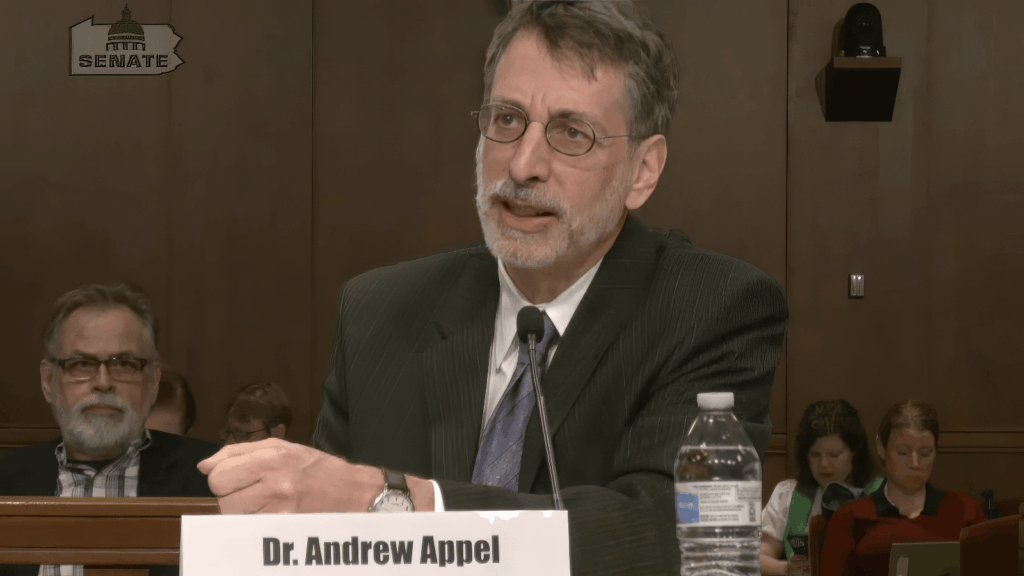
“Computer scientists could see immediately that this idea has a fatal flaw,” says Appel. “If a fraudulent program is loaded into that computer on Election Day, or is scheduled to take effect on Election Day, it can print out any numbers the programmer wants it to print out.”
There’s no evidence that a bad actor has ever exploited this to affect the outcome of an election, but the possibility is a major election security liability, according to Appel and other election security experts. The solution, they argue, is to use paper ballots marked with a pen that are fed into an optical scanner. Not only is the system less vulnerable to hacking than the electronic machines, but the paper ballots can be recounted or audited by hand if needed.
“The idea that you can affect policy in a meaningful and useful way by just explaining the science to county and state legislators was really true in this case,” Appel says. In 2006, nearly 42% of registered American voters lived in jurisdictions that used DRE systems for all voters; in 2024, that number hovered just above 5%.
By his own estimation, Appel dedicates 90% of his research towards formal methods for reasoning about programming and programming languages. But it’s the other 10%, spent on technology policy, and voting technology in particular, that Appel has written about on the CITP Blog since 2007, attracting a wide readership in the Princeton community and beyond. He’s given readers an in-depth look at New Jersey voting lawsuits; “the people of New Jersey are lucky to have Professor Appel in their corner,” commented one reader. In the leadup to the 2020 presidential election, he dedicated a number of posts detailing why Internet voting, proposed in some places in light of the Covid-19 pandemic, is impossible to secure and should universally be avoided.
“A tremendous mentor and a really big influence”
Within CITP, Appel is known as a supportive colleague and mentor, even as his profile has grown. CITP director Arvind Narayanan recalls how Appel sought advice on a grant proposal from him, despite the large experience gap at the time.
“That was very surprising to me that a very senior and famous professor would ask for feedback from me, a very junior faculty member,” Narayanan says. He also credits Appel for encouraging him to write a book pre-tenure, something Appel had successfully done (Compiling with Computations, published in 1992).
Appel, Narayanan says, has “been a tremendous mentor and a really big influence” on the direction of his career.
Predictably, political figures have tried using Appel’s research to suit their own agendas. He’s gotten calls from candidates who lost elections in which touch-screen voting machines were used, wondering whether they were cheated out of a victory.
“The first thing I usually say is, ‘Well, maybe more people voted for the other guy,’” Appel says with a smile.
Following elections, some commentators and public figures often reference Appel’s work in discussions about the integrity of voting machines, including unfounded claims that the machines may have been compromised.
He shrugs it off. “Once you publish something, it’s not up to you to control how people talk about it. You have to kind of let go of that,” he says.
But make no mistake. Appel’s blog posts don’t shy away from criticism: of specific voting machines that are particularly vulnerable, of judges who get the science and policy of voting wrong, and of election administrators who could do more to secure voting in their districts. It’s all in the interest of educating the public about how voting works and should work, without too much concern over how some might use or respond to this work.
“That has allowed us to do much better public policy research,” he says. “And it’s good to see that, in the year 2025, it looks like Princeton University is not easily intimidated either.”
The post Newly-Retired Andrew Appel Reflects on his Voting Machine Advocacy appeared first on CITP Blog.
'Most Divided' Fed In 32 Years Refuses To Cut Rates (Again)
Gpscruisei have no worldly clue as to what these graphs mean. Like I have said, lets get BOTH sides together at a bar and dig into their differences.
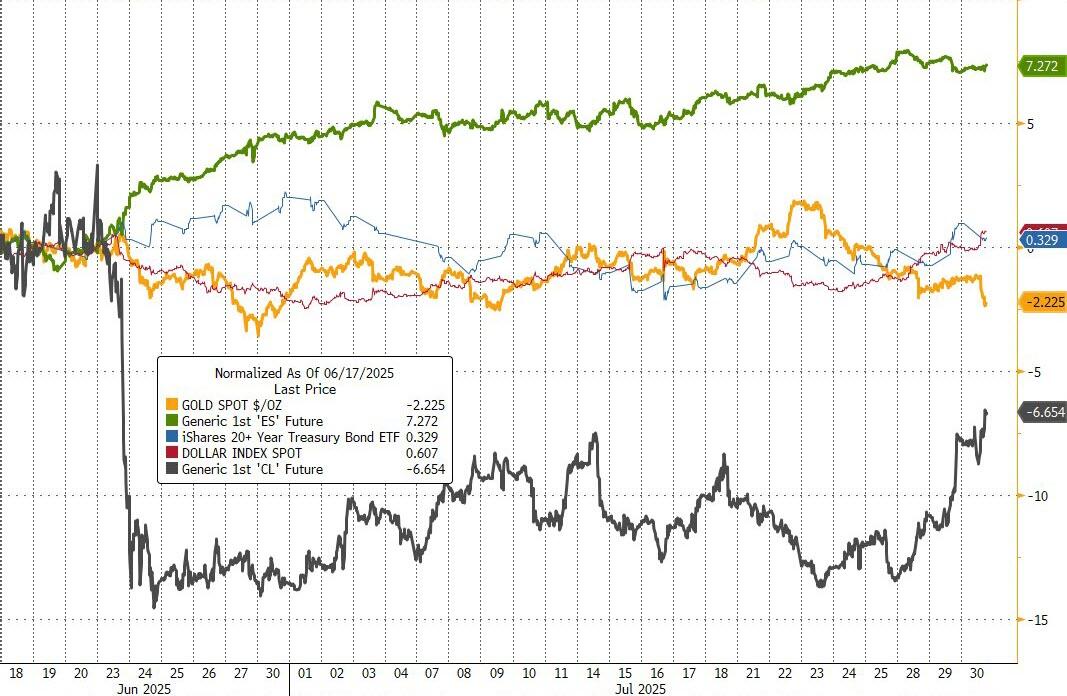
Since the last FOMC meeting (on June 18th), stocks have soared and gold (and crude oil) have been sold while bonds and the dollar have trod water...
Source: Bloomberg
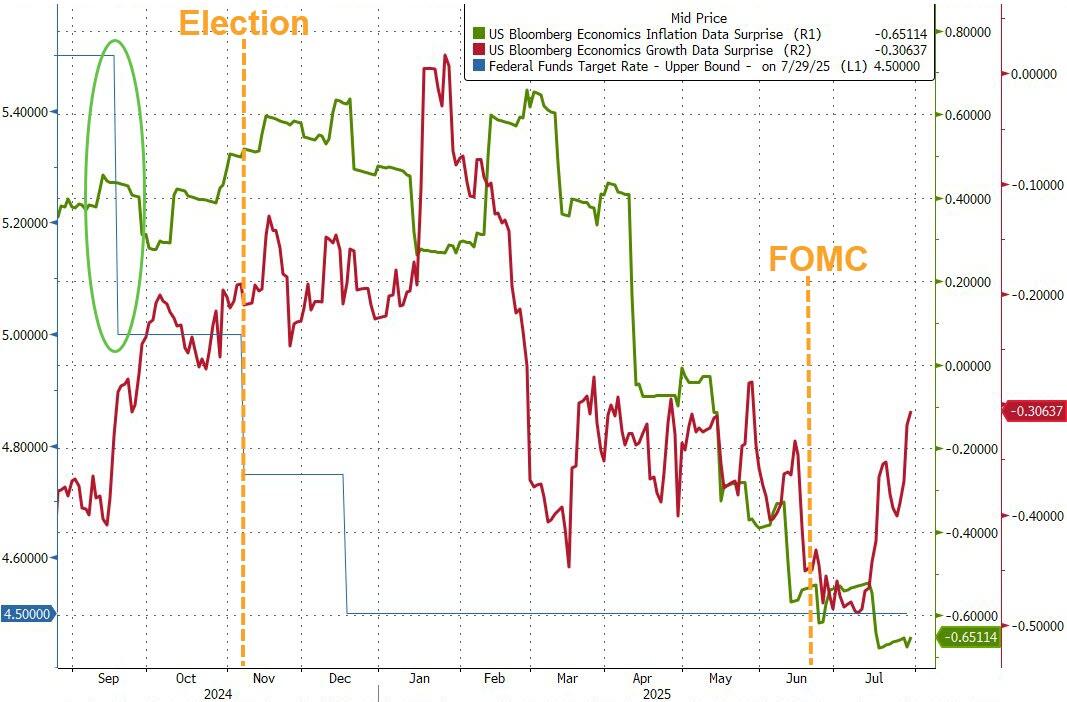
Most notably, while macro data has shown 'growth' has strengthened; 'inflation' has continued to fall, significantly...
Source: Bloomberg
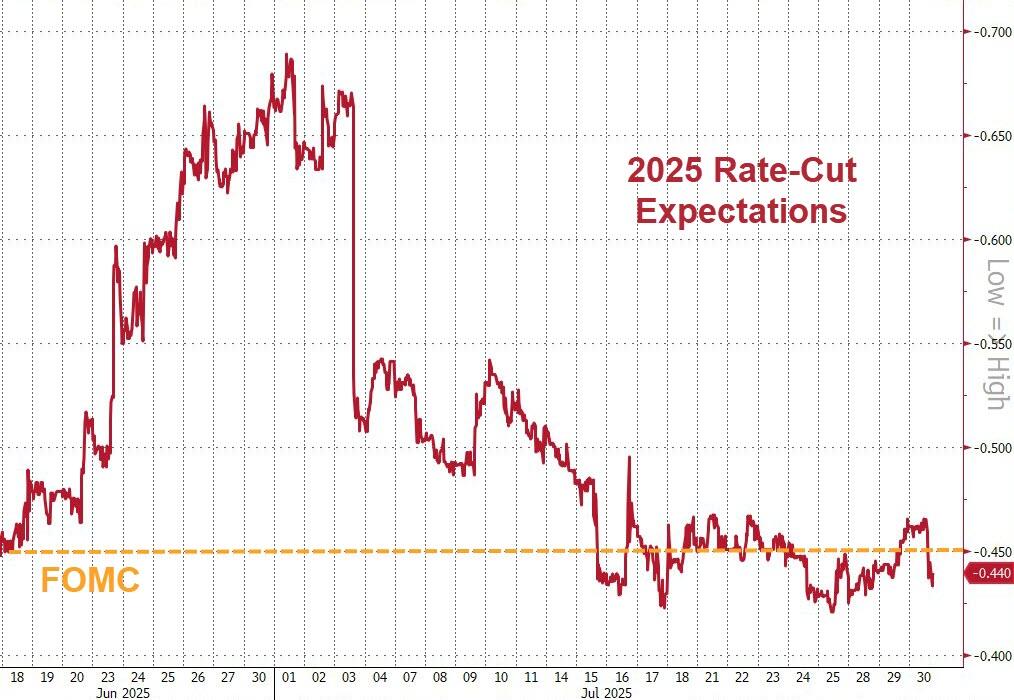
Interestingly, while the voyage has been eventful, the market's expectations for rate-cuts in 2025 is exactly where it was at the last FOMC meeting (just below 2 full cuts)...
Source: Bloomberg
Heading in to today's FOMC decision, expectations were unequivocally for no cut today, with September signaled as better than a coin-toss for the next cut (though those odds were falling into the FOMC statement)...
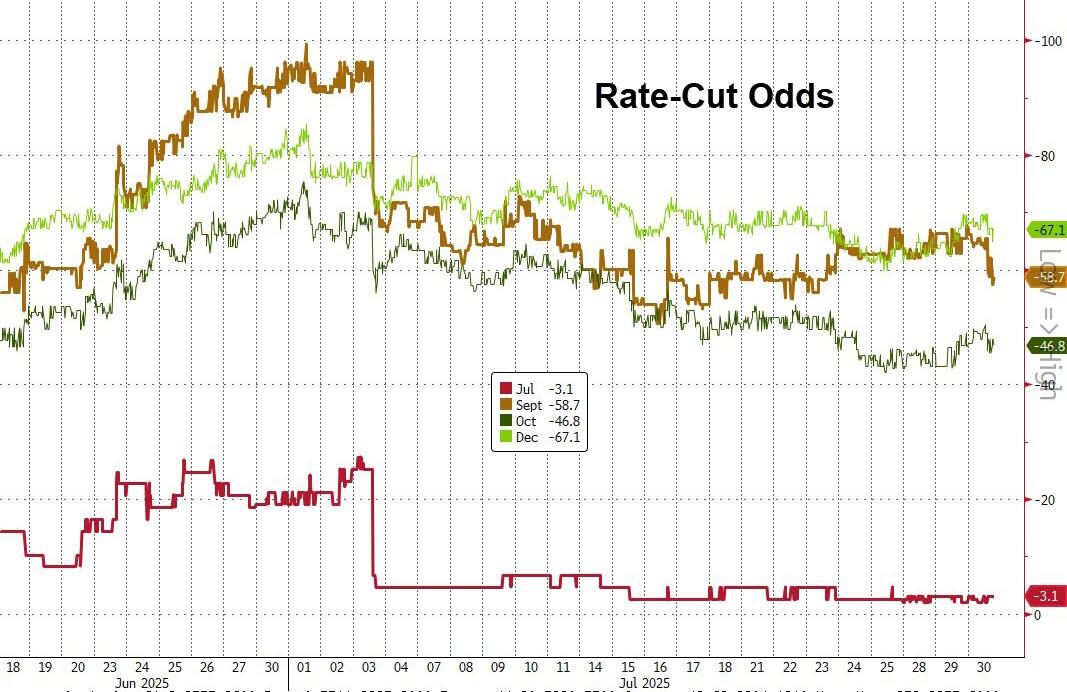
Source: Bloomberg
So, while expectations are for no rate-cut today, hints of future dovishness (in the statement as well as in Powell's presser) are a key focus as the potential for the first double-Governor-dissent since 1993 is on the cards...
So, what did The Fed actually do (and say)...
The Fed held rates flat (as expected):
- *FED HOLDS BENCHMARK RATE IN 4.25%-4.5% TARGET RANGE
But see some weakness...
- *FED: ECONOMIC GROWTH MODERATED IN FIRST HALF OF YEAR
It's a Double Dissent Day, dude!!
- *FED GOVERNORS WALLER, BOWMAN DISSENTED IN FAVOR OF RATE CUT
That's the first time sine 1993...
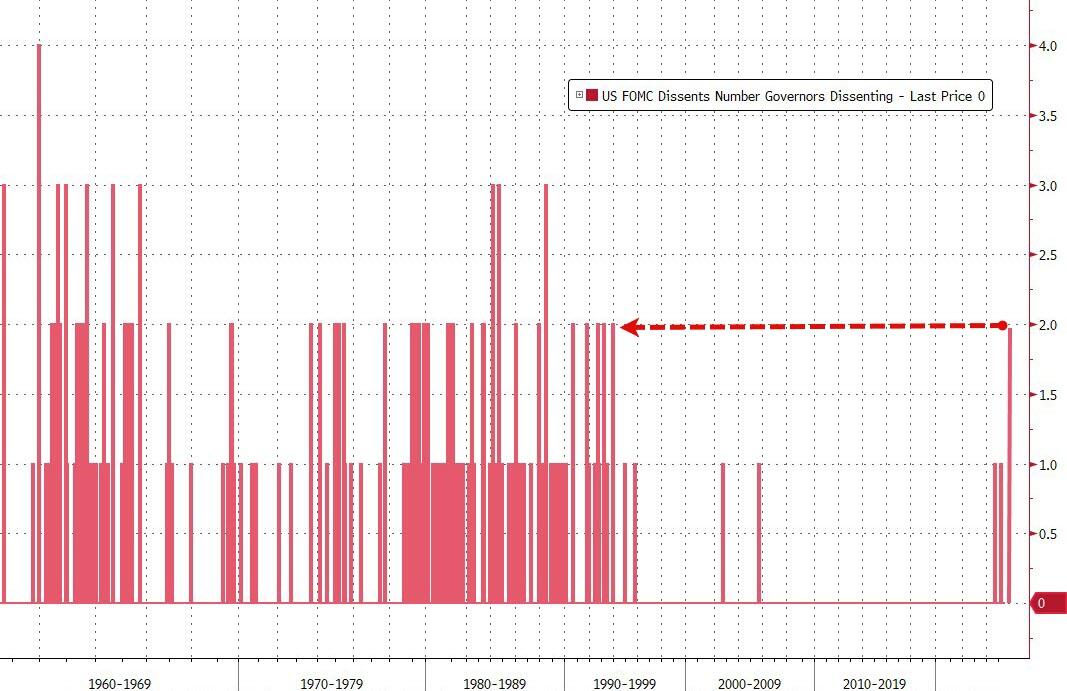
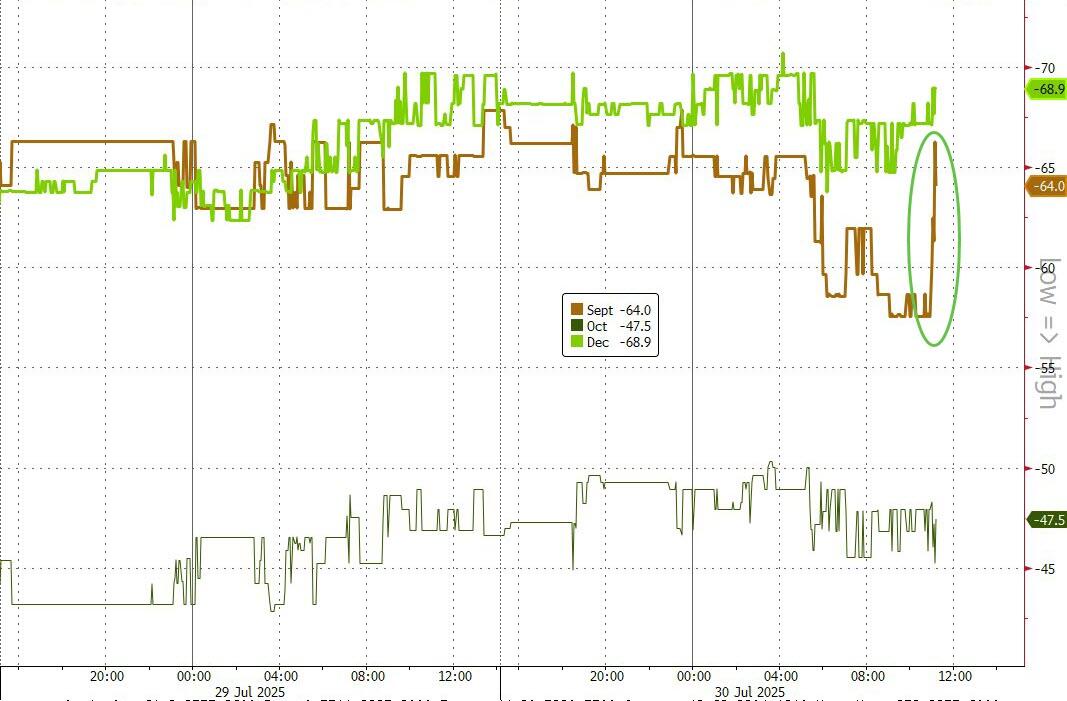
Our first take is that the combination of a double dissent (pro cuts) and the recognition that growth is 'moderating', strongly suggests a dovish tilt from the Fed and the market is seeing odds of a September cut rising...
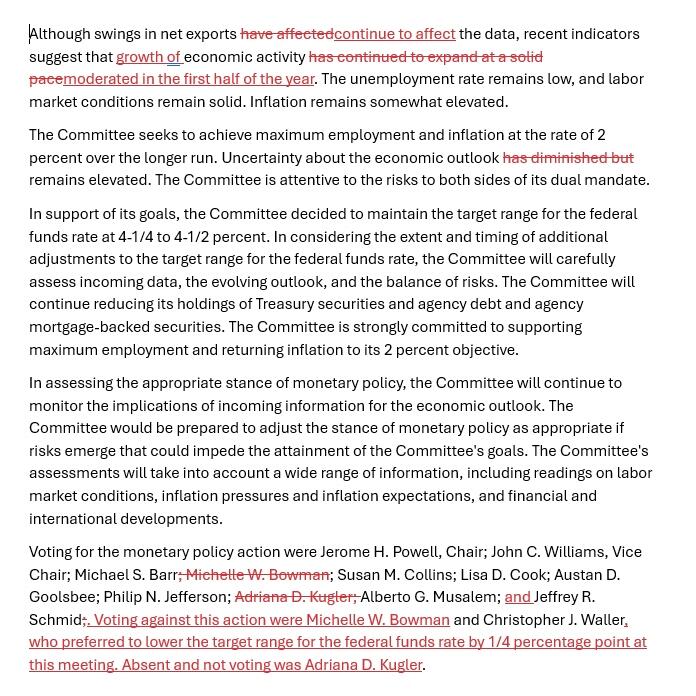
FOMC statement redline changes:
1) Replaced "economic activity has continued to expand at solid pace" with "growth of economic activity moderated in first half of the year"
2) Removed "diminished" from "uncertainty about economic outlook has diminished but remains elevated"
Read the full statement redline below:
Now, all eyes on the press conference to see if Powell can tread the fine line between claiming data-dependence and admitting he is basing his decision not to cut rates on 'gut' feel that tariffs are inflationary.
Vance slams tech companies for replacing American workers with H1-B visa holders
Gpscruise'little too late in the rhetoric Mr Vance. Perhaps its because they can rig the machines and my non-H1 vote doesn't matter.
The Cryptographic Fix For US Elections Is Still Sitting On The Shelf
Gpscruisecant find Michal Pospieszalski on X
Authored by Jason Nelson via Decrypt.co,
In brief
-
A former voting machine auditor says U.S. election systems still lack basic cryptographic safeguards to detect ballot tampering or duplication.
-
He proposes adding end-to-end cryptographic proofs - without blockchain - to secure future elections and restore public trust.
-
Despite identifying vulnerabilities as early as 2006, he says vendors won’t act without legal pressure or updated election laws.
In 2006, software engineer Michal Pospieszalski uncovered dangerous flaws in U.S. voting machines—flaws he says still threaten American elections today.
Hired by the Election Science Institute, where he served as Chief Technology Officer, Pospieszalski was flown to the headquarters of election vendor Election Systems & Software (ES&S) in Omaha, Nebraska. His task was to analyze the company’s iVotronic voting system.
For over a week, Pospieszalski uncovered a wide range of issues, including “bad code practices, backdoors, static passwords,” and most importantly, what he described as a complete lack of “end-to-end cryptographic proofs.”

“The biggest thing that wasn’t there was end-to-end cryptographic proofs,” Pospieszalski told Decrypt in an interview. “Meaning there’s no way the machine, even with perfect external security, could know if a ballot is legitimate, or if it’s been counted twice, three times, 10 times, or 1,000 times.”
What’s missing from today’s voting machines
The CEO of blockchain security and identity software company MatterFi, Pospieszalski, said that vulnerability isn’t hypothetical; it’s easily exploitable by anyone with access to voting machines and voter registration systems.
“You could just run the same ballot through 10 times—and that’s still true today—and it’ll just count as 10 votes,” he explained. “And the scanner doesn’t know any better, and neither does the tabulator. The tabulator in the central precinct is like, ‘Oh, it was 10 votes.’”
Pospieszalski said the separation of ballot and voter record systems often makes reconciliation impossible without referring to original paper records.
“There’s no anonymous serialization of each ballot that would allow the system to know that each serialized ballot has to be counted only once,” he said.
The solution, according to Pospieszalski, involves software—not hardware—and builds on cryptographic techniques first developed in the 1980s by David Chaum, a cryptographer who pioneered digital cash and introduced blind signatures, allowing transactions to be verified without revealing their contents.
Chaum later founded DigiCash, an early digital currency, and proposed cryptographic voting systems that preserve anonymity while enabling public verification. His work laid key foundations for both secure e-voting and modern cryptocurrencies like Bitcoin.
“What you want is the machine at the end—the central count tabulator or election management system—gets a vote definition, and you have a Chaumian-blinded serialization on every ballot,” Pospieszalski said. “So, like in LA County, that output ballot that’s printed has a serial number. That serial number doesn’t identify the voter, but it tells the tabulator in the central precinct, ‘Hey, this is a unique ballot.’”
“If I see two of them, then somebody cheated,” he added. “Especially if I see 50 of them.”
In Pospieszalski's proposed model, there would be three counts: the paper ballots, the conventional digital tally, and a third cryptographic count.
“The way you see cheating is the digital count says there are 100 votes, and the cryptographic count says there should only be 90,” Pospieszalski said. “Now you know someone injected 10 votes.”
Lessons from Antrim County
In 2020, Pospieszalski was hired to conduct forensic analysis in Antrim County, Michigan, after a brief vote-counting error triggered widespread speculation.
“There was a vote flip in Antrim County by, like, roughly 2,000 votes, where, like, one day it was 2,000 for Biden, and the next day it was 2,000 for Trump,” he recalled. “What really happened is the ballot definition was misconfigured so that the system thought that the votes for Trump were for Biden.”
He said that when the ballots were rescanned with the corrected definition file, “Everything went back to normal.”
Pospieszalski emphasized that while the error was technical, the optics of the situation fed public suspicion.
“There wasn’t a huge, hostile attack. But as a voter being riled up by the media—particularly right-wing media—people are going to want answers,” he said, adding that such confusion is exactly what end-to-end, off-chain cryptographic proofs are designed to prevent.
But while he found no evidence of remote hacking or software backdoors, Pospieszalski did say he encountered signs of possible ballot injection during his analysis.
“If you have a ballot with 42 choices, and in the analysis you see 100 ballots with all 42 filled out the exact same way, you’re like: Um, probably not real,” he said. “That’s the stuff I found some evidence of in Antrim County.”
Asked why cryptographic ballot serialization hasn’t been implemented, Pospieszalski pointed to entrenched systems and corporate reluctance to make changes, adding that proposals for secure voting often failed to gain traction because they were too complicated.
“They’re suggesting all sorts of really, really difficult-to-use schemes... stuff that people are just like, if you’re a voting machine manufacturer, this isn’t going to make any sense," he said.
Several technologies aim to improve election security and trust. In April, New York Assemblyman Clyde Vanel introduced a bill that would use blockchain technology to secure voter records and election results. While blockchain has been promoted as a solution for secure voting, Pospieszalski argued that the core issue doesn’t require that level of complexity.
“All you're trying to do is solve a simple problem: get an accurate count of legitimate votes,” he said. “Extra complexity is unnecessary. A lot of people push blockchain because it's popular, but you don't actually need it.”
By contrast, Pospieszalski says his solution works with current machines.
“I’m just saying: Look, make it a software upgrade to the existing system and work with Dominion, work with ES&S, and you can just turn it on or off," he said.
Asked how adoption might happen, Pospieszalski suggested legislation or mandates from jurisdictions that oversee elections.
“Voting manufacturers and their customers—counties—need big precincts to push for change,” he explained. “If a law said that by 2028 or 2032, voting systems must include end-to-end crypto proofs, we’d be in business.”
The advantage, according to him, would be clarity in future elections, especially in heated contests where trust is fragile.
Pounce! Democrats Suddenly Care About Epstein Files, Move To Force Disclosure
Gpscruisewhat efforts do any of us make to reduce blackmail????????????
And just like that, Democrats suddenly care about the Jeffrey Epstein... with House reps. preparing to introduce measures this week aimed at mandating the release of documents related to the late financier and convicted sex offender Jeffrey Epstein. The effort follows a recent Department of Justice memo claiming no official “ client list” of powerful individuals tied to Epstein exists - a statement the Trump administration appears eager to move past.
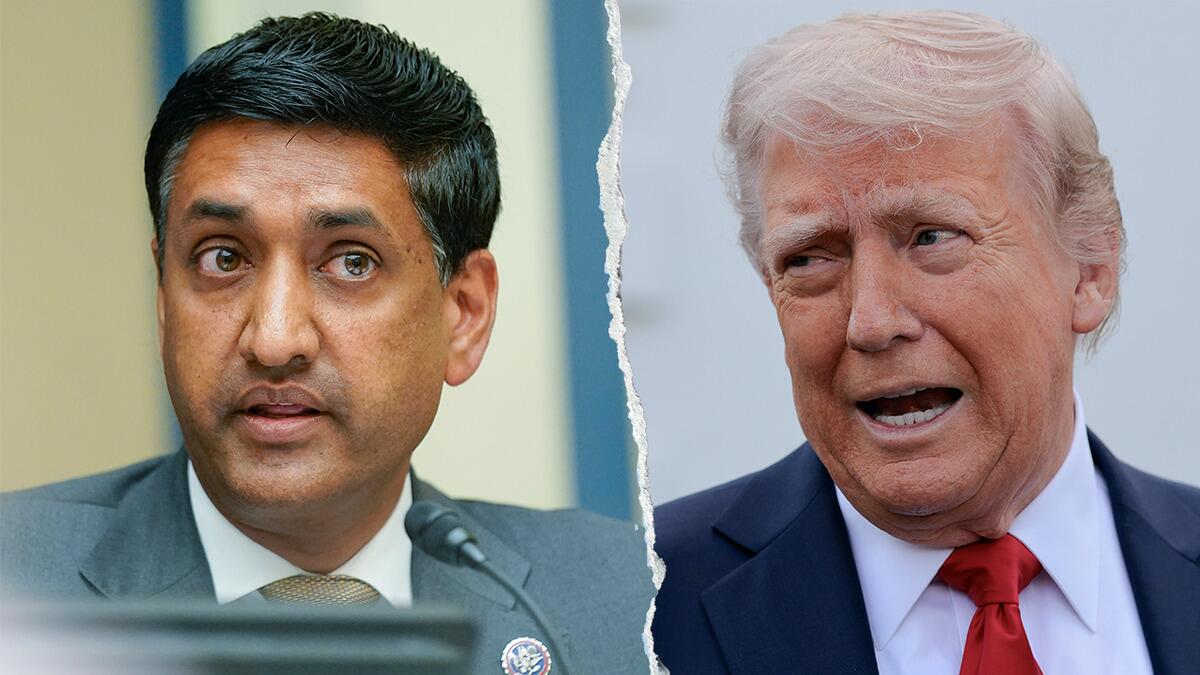
Rep. Ro Khanna (D-CA) announced Saturday he plans to introduce an amendment requiring a House vote on making the Epstein files fully public. The measure is intended to compel Speaker Mike Johnson (R-LA) to bring the issue to the floor, forcing lawmakers to take a public position on the transparency initiative tied to Epstein’s network.
Why are the Epstein files still hidden? Who are the rich & powerful being protected?
— Ro Khanna (@RoKhanna) July 13, 2025
On Tuesday, I'm introducing an amendment to force a vote demanding the FULL Epstein files be released to the public. The Speaker must call a vote & put every Congress member on record.
"Why are the Epstein files still hidden? Who are the rich & powerful being protected?” Khanna asked in his announcement.
Rep. Marc Veasey (D-TX) has also joined the push, announcing Saturday that he intends to introduce a parallel resolution aimed at securing the release of the documents.
“Either [Trump] and his acolytes fueled the rumors of the significance of these Epstein files to help his campaign, or something is there!” Veasey said. “That’s why on Monday, I’ll introduce a resolution demanding the Trump Administration release all files related to the Epstein case. Put up or shut up!”
Either @realDonaldTrump and his acolytes fueled the rumors of the significance of these Epstein files to help his campaign, or something is there! That's why on Monday, I’ll introduce a resolution demanding the Trump Administration release all files related to the Epstein case.… pic.twitter.com/ZRwPLz0Vlu
— Rep. Marc Veasey (@RepVeasey) July 13, 2025
Of course, the Democrats are seeking the release of the documents to fracture the MAGA movement. If not, Democrats would have pushed for the release during President Joe Biden's tenure.
The renewed scrutiny follows the release of a joint Department of Justice and FBI memo this week that declared an “exhaustive review” of evidence surrounding Epstein’s death at the Metropolitan Correctional Center in New York ruled out foul play.
“After a thorough investigation, FBI investigators concluded that Jeffrey Epstein committed suicide in his cell at the Metropolitan Correctional Center in New York City on August 10, 2019,” the memo reads.
The agencies also denied the existence of a “client list” tied to Epstein—contradicting earlier comments made by former Attorney General Pam Bondi, who previously suggested on Fox News that such a list was “sitting on my desk,” fueling speculation about potential blackmail involving prominent global figures.
The memo’s release has ignited backlash from parts of Trump’s base. Conservative activist Laura Loomer blasted Bondi, calling for her resignation and accusing her of undermining the credibility of the Trump-aligned DOJ.
“How come Blondi didn’t sign her name to her own memo about the Epstein Files? She needs to resign. This is going to suppress the vote in 2026,” Loomer wrote on X. “The American people and MAGA base will not tolerate being lied to. I hope President Trump fires Pam Blondi if she lacks the SHAME to resign. I called for her resignation the day of Binder Gate.”
Tucker Carlson issued an ominous warning of his own, calling the government’s handling of the Epstein case “very dangerous” and warning it could provoke civil unrest.
“That is so crazy. This is like—this is honestly one of the craziest things I’ve ever seen in my entire life. And I just think it’s very dangerous to play around with this stuff,” Carlson said on his show. “Like, very dangerous. I don’t want a revolution, but if you wanted a revolution this is how you would act.”
Last Tuesday, President Donald Trump dismissed questions about Epstein during a Cabinet meeting press exchange.
“Are you still talking about Jeffrey Epstein? This guy’s been talked about for years,” Trump said. “You’re asking—we have Texas, we have this, we have all of the things, and are people still talking about this guy? This creep? That is unbelievable. I mean, I can’t believe you’re asking a question on Epstein at a time like this, where we’re having some of the greatest success and also tragedy with what happened in Texas. It just seems like a desecration.”
On Saturday, Trump returned to the topic on Truth Social, seeking to minimize the controversy and refocus attention on his administration’s record.
"We have a PERFECT Administration, THE TALK OF THE WORLD, and ‘selfish people’ are trying to hurt it, all over a guy who never dies, Jeffrey Epstein. For years, it’s Epstein, over and over again," Trump wrote.
Trump went on to cast doubt on the authenticity of the Epstein files, likening them to the Steele dossier and suggesting they were politically motivated.
"Why are we giving publicity to Files written by Obama, Crooked Hillary, Comey, Brennan, and the Losers and Criminals of the Biden Administration, who conned the World with the Russia, Russia, Russia Hoax, 51 ‘Intelligence’ Agents, ‘THE LAPTOP FROM HELL,’ and more?" Trump wrote. "They created the Epstein Files, just like they created the FAKE Hillary Clinton/Christopher Steele Dossier that they used on me, and now my so-called ‘friends’ are playing right into their hands," adding, "Why didn’t these Radical Left Lunatics release the Epstein Files? If there was ANYTHING in there that could have hurt the MAGA Movement, why didn’t they use it?"
Trump also called on the FBI to redirect its focus to election security and criminal enforcement.
"The FBI should be arresting Thugs and Criminals, instead of spending month after month looking at nothing but the same old, Radical Left inspired Documents on Jeffrey Epstein," the president wrote. "One year ago our Country was DEAD, now it’s the ‘HOTTEST’ Country anywhere in the World. Let’s keep it that way, and not waste Time and Energy on Jeffrey Epstein, somebody that nobody cares about."
Pam Bondi fires 20 employees involved with January 6 prosecutions.
Gpscruiseclerks? really.....
“I Barely Ever Look at It” Doesn’t Change the fact That Tracking Our Kids Changes Childhood
Gpscruisewomen will never agree to less cameras. Like trump with ditching daylightsavingstime, we would never ever agree on no-camera zones, etc. THE BEST we can ever have would be if men go around and disable cameras.
Oh how I love this essay on child surveillance by Elizabeth Leigh Hunter. As she notes:
The Alpha Generation is the most surveilled group of people on the planet.
That merits more than a “Well, I barely ever look at it” shrug, which is how most people think about tracking apps and monitors.
Elizabeth is a Seattle-based writer at Seattle’s Child Magazine and mom of two. For the last few years she has worked tirelessly to help people understand not only the NEED for childhood independence, but the JOY of it. She founded a Let Grow Play Club at her children’s school and is writing a book about childhood independence. You can read her work at Medium and Substack.
The Distorted Mirror: When Supervision Becomes Surveillance
By Elizabeth Leigh Hunter
Private eyes…they’re watching you. They see your every move. — Hall and Oates
With only the ducks looking on
Starting in fourth grade my friends and I would sometimes meet at the Loantaka Reserve, a park nestled in the suburbs of North Jersey. It’s a lovely bit of nature, awash with creeks, marshlands, and migrating birds, bike trails, playgrounds, and picnic shelters. We called it “the duck pond.”
In the era before smartphones, we agreed on a time and place to be picked up, but we were not chaperoned.
If the crew was just girls, we’d giggle over teen magazines and talk about our lives: friends, boys, school, our bodies, our families, etc. In a coed group, we would clown around, teasing and laughing and occasionally touching, complete with the mortifying or electric shock that comes from touching another human being at that age.
We would share secrets, drop our masks, try on new ones. We would embarrass ourselves. I had my first kiss at Loantaka Park, with only the ducks looking on.
Parents’ Eyes Everywhere
Today, two-thirds of parents do not allow their fourth grader to walk or bike to a friend’s house without an adult. I suppose today an adult would be at the duck pond with us. In the best case, they’d stare at their phone in the corner of the picnic shelter; in the worst case, they’d puncture the magic of that wonderful age.
“Stop!”
“Put that down.”
“Don’t go in there, it’s muddy.”
“Ten minutes and we’re out of here.”
As always, I invite the reader to consider what is lost when we do not allow our children independent experiences.
Quite a lot, I think.

Looks kind of like a book cover for some romantic spy novel, but it’s just the duck pond, where kids used to play without their handlers, and survived to tell the tale.
Do kids really need privacy?
Thanks to facial recognition technology, social media, GPS, smart homes, nest cams, digital identification, CCTV, and even EdTech, the Alpha Generation is the most surveilled group of people on the planet.
If that isn’t disturbing enough, Alphas are also the least independent children in history. Our children are watched all the time: chaperones in the picnic shelter, Airtags in the backpack, hours of adult-led extracurriculars, parents who track their children’s schoolwork and test scores and movements all the way into college. In the last few years, aided by technology and always in the name of “safety,” parental surveillance has become shockingly intrusive.
Kids, like adults, need privacy. Privacy makes room for imagination, exploration, and experimentation. It allows people to make mistakes without embarrassment or explanation. In most of the West, personal privacy is a widely understood privilege (in most cases, a right) of living in a free society.
They know you’re watching
By the time a child is five years old, they are aware of both human and technological surveillance.
Baby monitors once used to help parents scoop up a crying baby are now video cameras that stay perched in kids’ bedrooms until they are four or five years old. Toddlers know their parents are watching; families talk through cameras on different floors of the same house. Nanny cams and livestreamed daycare allow parents to watch their young child remotely all day long. (They may also allow for tech-savvy bad actors to do the same, but that’s another piece.)
Once, I thought it was funny to watch my friend speak to their toddler through the camera: “Maryannnnnn, I see you. Put that cup down.” It felt harmless. I invite you to consider how you would feel if, during a bout of curiosity, you picked something up and a faceless digital voice came out of nowhere and told you to PUT IT DOWN.
Schools are always watching and reporting, too
When parents shout to Alexa to put the Bluey soundtrack on, and she complies, children understand that Alexa is listening. When they ask to see “the blue dot” move as Dad approaches home, children know we are watching.
At school, educational technology like Schoology and Canvas allow parents to monitor kids’ schoolwork in minute detail. CCTV cameras watch children in the halls, teachers watch them in class, coaches and counselors watch them after school.
Even their doorbell watches them as they step into their home.
All of this, of course, is in addition to how adults chaperone, supervise, and otherwise infiltrate children’s meager free time.
We worry about who else is watching our kids and we worry about what our kids are watching.
I say we don’t worry enough about what it means that we are watching them—all the time.

This is a real image from a website full of tracking and monitoring technology for children. Do you trust these faceless scolds with your child’s every move? Maybe, instead, you learn to trust your child?
The effect of being observed
We know through the well-researched observer effect that people change their behavior when they are being watched.
Our children’s reality, in which they are both conspicuously and subtly surveilled at all times, is new. In the years ahead, we’ll learn more about the effects of such pervasive surveillance. In the meantime, let’s look at historical testimony and current research for insight.
In Stasi Germany, a hotbed of paranoid surveillance, historians estimate there was one informant for every 6.5 citizens. Years later, when former citizens of East Berlin gained access to the files the Stasi kept on them, one citizen described his file like this:
“It was like looking in a distorted mirror; the files show only one version of yourself.”
When Edward Snowden revealed that the American government was spying on its people, a Harvard Law fellow, Jon Penney, saw an opportunity to examine how pervasive spying affected the population.
After controlling for other factors, what he concluded was that surveillance begat self-censorship.
According to Penney, surveillance that deters people from exercising their rights, including the freedom to read, think, and communicate privately, is corrosive to political discourse.
What you see when you surveil your child isn’t your child—not fully. It’s your child when they know they’re being watched.
Perhaps most disturbingly, a 2024 study published in the journal Neuroscience of Consciousness examined how surveillance changes not only our conscious behavior, but also the subconscious function of our brains. Our brain chemistry changes when we are being watched.
When is a child able to be themselves—warts and all—when they are watched, clocked, and tracked like hostile agents every moment of their lives?
The paradox of surveilling for safety
Continually surveilling children—“just to make sure they’re safe!—tells them the world around them is unsafe. Many parents and caregivers don’t even let children under twelve spend time unsupervised in their own neighborhoods. If children think their own neighborhood is too dangerous to navigate without an adult, imagine how scary the wider world must be. It is no wonder young people experience anxiety at historically astronomical rates.
They are afraid of their own playgrounds.
Paradoxically, perpetual adult supervision also tells children their own parents don’t trust them. For younger children, this manifests as the parent staring from a park bench, or worse, standing in the playground woodchips shouting, “Don’t climb so high!” “Slow down!” “Stay where I can see you!”
For older children, this manifests as a GPS (and sometimes Internet)-enabled smartphones, expensive Apple watches, and AirTags tucked in backpacks.
Regardless of the method of surveillance, the message is clear.
We don’t trust the world with our kids. And we don’t trust our kids in the world.
This is a squeeze indeed.
There is no deserted island…or is there?
Admittedly, I can’t advise on how to protect children’s personal data from government spying or corporate tech giants.
I don’t know what it feels like to have been watched, clocked, and tracked since before I took my first breath.
I rely on my smartphone for directions. I buy products served to me by a powerful algorithm. I still occasionally post photos of my children.
These changes feel permanent and insurmountable, and I often find myself dreaming of a deserted island on which to raise my children.
But even an exhaustive scan of Google Maps (see—I am part of the problem!) yields no magic. There is no deserted island.
Except… there is.
It is childhood: the short, glorious period between the ages of five and twelve years old, when children’s brains are sponges. and experiences turn into memories that sink deep into their consciousness, strengthen their locus of control, and shape their understanding of the world for the rest of their lives.
Letting children walk themselves to school, ride their bikes to their friends’ houses, or play in the woods on their own—whatever freedoms we can afford them—may be the only opportunity our children ever have to feel uninhibited by prying eyes.
We can give that to them.
No—we must give that to them.
We can’t stop Big Brother, or the march of technology, or the myriad ways our children’s precious data is collected and bought and sold.
But we can give them a bit of freedom. Just so they know what it feels like.
The post “I Barely Ever Look at It” Doesn’t Change the fact That Tracking Our Kids Changes Childhood appeared first on Free-Range Kids.
As Bitcoin Tops $123k, 'Satoshi Nakamoto' Becomes World's 11th Richest Person
Gpscruisecould he be CIA? Just sayin.
Overnight saw bitcoin prices top $123,000 - a new record high...

...pushing it above AMZN as the 5th largest asset class on earth...

Steady BTC network activity adds to its bullish case
Bitcoin analyst Axel Adler Jr. said that Bitcoin’s network is gradually increasing usage without signs of profit-taking or panic.
Daily average transactions climbed from 340,000 to 364,000 over the past two days, but remain below the 530,000–666,000 peaks seen during its previous market tops. Adler explained that this reflects a composed market environment and said,
“There are no signs of active coin selling in the market. This strengthens both the fundamental and technical bullish signal.”
📊MARKET UPDATE: Daily #Bitcoin transactions jumped by 24K in two days, reaching 364K. While activity is improving, it still trails far behind the 2023–2024 highs of over 530K, leaving room for further network acceleration for $BTC. 📈 pic.twitter.com/xbxD3GzRRU
— Cointelegraph Markets & Research (@CointelegraphMT) July 11, 2025
Meanwhile, Cointelegraph reported that accumulator addresses, wallets that consistently acquire BTC without significant outflows, have ramped up significantly over the past month. CryptoQuant data shows these wallets now hold 250,000 BTC, the highest level of 2024. The 30-day demand has jumped 71%, up from 148,000 BTC in late June, reflecting renewed conviction among long-term buyers.

Bitcoin’s creator, Satoshi Nakamoto, became the 11th richest person in the world after Bitcoin tapped $120,000 on Sunday.
CoinTelegraph reports that Nakamoto is believed to hold 1.096 million Bitcoin across thousands of wallets, which is worth over $131 billion at current prices, according to blockchain analytics company Arkham.
This would, in theory, place Nakamoto at number 11 on Forbes’ richest billionaires list, overtaking Michael Dell, CEO of tech giant Dell Technologies, with a net worth of $125.1 billion.
However, Forbes’ billionaires list doesn’t consider crypto wallet holdings when evaluating billionaires; instead, it tracks individuals’ publicly verifiable holdings, such as stocks.

Source: Arkham
Path for Nakamoto to become number 1
Bitcoin crossed just over $120,000 on Monday, reaching a new all-time high, Nansen data shows; however, it still isn’t quite high enough for Nakamoto to take the top spot on the Forbes billionaire list.
Elon Musk, the tech entrepreneur and CEO of SpaceX and Tesla, is ranked as the richest billionaire in the world on Forbes’ list, with a net worth of over $404 billion.

Elon Musk is currently the top-ranked billionaire with a fortune of over $404 billion. Source: Forbes
Larry Ellison, co-founder of software company Oracle, is second on the list with a fortune estimated to be $274 billion. Meta CEO Zuckerberg rounds out the top three with $274 billion to his name.
Bitcoin would need to spike another 208% to hit $370,000 for Nakamoto to take the top spot, but only if the other billionaires’ net worths are unchanged.
Nakamoto could keep climbing
In a June 2 post on X, Bloomberg analyst Eric Balchunas predicted that Nakamoto could become at least the second-richest billionaire by the end of 2026.
He said that if Bitcoin does its “normal 50%/ann,” then Nakamoto will likely climb to number two “sometime next year-ish.”
“It’s fascinating to ponder that the founder of something so successful never cashed in. It echoes Jack Bogle in that regard,” Balchunas added.

Source: Eric Balchunas
John “Jack” Bogle, the founder and chief executive of The Vanguard Group, died in 2019 with a reported net worth of $80 million, when most of his peers were billionaires.
On Thursday, 10x Research head Markus Thielen told Cointelegraph there’s a 60% chance for Bitcoin to register a 20% gain in the next two months and hit $133,000 in September.
In May, Bitwise chief investment officer Matt Hougan told Cointelegraph that he thinks Bitcoin could hit $200,000 by the end of 2025, driven by a supply shock from surging institutional demand.
Meanwhile, BitMEX co-founder Arthur Hayes predicted Bitcoin would hit $250,000 by the end of the year.
How do other Bitcoin whales stack up against Nakamoto
Nakamoto holds more Bitcoin than anyone else by a significant margin. Corporations and custodians hold 847,000 total, or 4% of Bitcoin’s capped supply, according to BiTBO.
A small group of individuals also has an ample supply of Bitcoin. The Winklevoss twins, the founders of crypto exchange Gemini, are estimated to hold about 70,000.
Tim Draper, a venture capitalist and early Bitcoin backer, holds around 30,000, which he bought at a 2014 US Marshals auction. Strategy co-founder Michael Saylor also has a private stash outside his company’s holdings of around 17,732.
Trump Won't Enforce the TikTok Ban. Is That Constitutional?
Gpscruisei dont trust the chinese. I feel very persuaded on deep topics like divorce and normalcy. I would rather have zuckerberg do it I believe. Hard to say that, but tiktok is the perfect weapon against me.
The U.S. Constitution requires the president to "take Care that the Laws be faithfully executed." Yet President Donald Trump has not only refused to enforce the federal law banning TikTok, but his administration has also told multiple tech companies that they may openly violate the TikTok ban "without incurring any legal liability" because the Department of Justice is "irrevocably relinquishing any claims" against the companies "for the conduct proscribed in the Act."
But wait, may the president do that? May Trump encourage private parties to violate a duly enacted federal law while simultaneously vowing to free them from present and future liability for their lawbreaking? Is that constitutional?
American presidents have certainly disagreed over the years with some of the laws that they were charged with enforcing. And some presidents have even flat-out declined to enforce what they found disagreeable. Thomas Jefferson, for example, viewed the Sedition Act of 1798 as wholly unconstitutional and therefore refused to effectuate it when he became president in 1800.
As justification, Jefferson pointed to his presidential oath of office. To enforce an unconstitutional law, Jefferson maintained, would require him to violate his sworn oath to "preserve, protect, and defend the Constitution." The Sedition Act "was unconstitutional and null," Jefferson argued, and "my obligation to execute what was law, involved that of not suffering rights secured by valid laws, to be prostrated by what was no law."
The Obama administration did something similar in 2011 when Attorney General Eric Holder announced that the Justice Department would stop defending the 1996 Defense of Marriage Act (DOMA) in federal court because, in its view, DOMA violated the constitutional rights of same-sex couples. "This is the rare case," Holder argued, "where the proper course is to forgo the defense of this statute."
So, the idea of a president refusing to give force to a federal law is not unprecedented and is not necessarily a violation of the Take Care Clause of the Constitution.
However, unlike Jefferson or Barack Obama, Trump has not objected to the TikTok ban on constitutional grounds. Rather, Trump's argument is that he possesses the independent authority to set aside the TikTok ban while he attempts to line up a new buyer for the Chinese-owned social media platform. And where, you may ask, does Trump locate that novel power? Where else? In the president's "unique constitutional responsibility for the national security of the United States, the conduct of foreign policy, and other vital executive functions."
In other words, Trump argues that executive power alone permits him to suspend the enforcement of a valid federal law. And that is a far more sweeping and aggressive view of presidential authority than what was previously advocated by Jefferson or Obama.
Also sweeping and aggressive is Trump's view—as spelled out by Attorney General Pam Bondi in a series of letters to tech companies recently made public thanks to the Freedom of Information Act—that the executive branch has the power to "irrevocably" relinquish "any claims the United States may have had" against those companies for their past or current violation of the TikTok ban.
To be sure, the president does have a kind of prosecutorial discretion when it comes to the enforcement of federal law. The president may focus greater executive branch resources on some crimes instead of others. And the president may tell the American people all about it, effectively sending a message that some forms of lawbreaking will be more or less tolerated for a time because they are not a current federal law enforcement priority.
But Trump is doing something different here. What Trump is doing here is, first, asserting a new kind of presidential control over a valid federal law; second, issuing a sort of blanket immunity to a favored group of lawbreakers; and third, purporting to tie the hands of future Justice Departments ("irrevocably relinquishing any claims") when it comes to future treatment of those favored lawbreakers. That combination of factors seems like a sure recipe for corruption, cronyism, and executive abuse.
Trump's various other recent assertions of unilateral executive power have received more attention than his non-enforcement of the TikTok ban. But this one is also worth worrying about.
The post Trump Won't Enforce the TikTok Ban. Is That Constitutional? appeared first on Reason.com.
Musk Launches the ‘American Party.’ A Business Associate Is Not Pleased.
Gpscruisei am a single issue voter. Create French-style elections and i am on board.
Tech titan Elon Musk announced on Saturday the launch of a new political party named the “American Party” in response to the passage of the One Big Beautiful Bill Act.
The One Big Beautiful Bill Act passed the House on Thursday with a vote of 218-214. The legislation includes provisions that align with President Donald Trump‘s main campaign promises, such as fully funding border security and the U.S. Immigration and Customs Enforcement, as well as maintaining the 2017 tax cuts.
On Independence Day, Musk started a poll on X, asking users whether he should create a new political party and run candidates against both Republicans and Democrats, whom he accused of belonging to the same “uniparty.”
The final poll indicated that a great majority of followers (65.4%) voted “Yes,” while 34.6% of followers said “No.”
“By a factor of 2 to 1, you want a new political party and you shall have it,” Musk stated Saturday on X. “When it comes to bankrupting our country with waste & graft, we live in a one-party system, not a democracy. Today, the America Party is formed to give you back your freedom.”
By a factor of 2 to 1, you want a new political party and you shall have it!
— Elon Musk (@elonmusk) July 5, 2025
When it comes to bankrupting our country with waste & graft, we live in a one-party system, not a democracy.
Today, the America Party is formed to give you back your freedom. https://t.co/9K8AD04QQN
Musk strongly criticized Trump’s landmark legislation on X for increasing the national debt ceiling by $5 trillion and denounced the “insane spending” it entailed. He also mocked the uniparty as “The Porky Pig Party.”
Treasury Secretary Scott Bessent responded Sunday to Musk’s announcement of the America Party, calling on the former White House adviser to focus on his companies and stay out of politics, according to The Guardian. Bessent pointed out that while the Department of Government Efficiency—or DOGE—”principles” of waste reduction were popular, Musk himself was not.
“I believe that the boards of directors at his various companies wanted him to come back and run those companies,” Bessent told CNN’s “State of the Union.” “I imagine that those boards of directors did not like this announcement yesterday and will be encouraging him to focus on his business activities, not his political activities.”
James Fishback, CEO of Invest Azoria, announced on X that he would withdraw his support for Tesla and Musk following the announcement of a new political party, believing that creating “a political party not only fails to complement Tesla’s mission—it actively undermines it.”
“Elon has gone too far,” Fishback stated. “This creates a conflict with his full-time responsibilities as CEO of Tesla. It diverts his focus and energy away from Tesla’s employees and shareholders.”
“I encourage the Board to meet immediately and ask Elon to clarify his political ambitions and evaluate whether they are compatible with his full-time obligations to Tesla as CEO. I remain hopeful that Elon will return his full attention to Tesla. If not, I trust the Board will take appropriate action,” Fishback concluded.
The post Musk Launches the ‘American Party.’ A Business Associate Is Not Pleased. appeared first on The Daily Signal.
Are We Training Kids To Beat AI - Or Training AI To Beat Kids?
Gpscruisei have said this before, "" I used AI to create a patent that AI said would be magnificent. (it was not). AI is the master of flattery......
Authored by Kay Rubacek via The Epoch Times (emphasis ours),
Commentary
In a world racing to build smarter machines, a group of children just reminded us what real intelligence looks like.
At the University of Washington, researchers recently put a group of 7- to 11-year-olds to the test. Their goal wasn’t to teach kids how to use artificial intelligence—but how to outthink it.
The children were asked to solve a series of visual logic puzzles—problems designed to test abstract reasoning, not memorization. Then they compared their answers to what generative AI tools like ChatGPT produced.
The results were telling.
While the AI confidently offered incorrect answers, the children spotted the flaws almost immediately. Some even began “debugging” the machine—rewording prompts, testing different versions, and analyzing patterns of failure. One 9-year-old summed it up perfectly: “AI just keeps guessing.”
These kids weren’t fooled by the polished tone or fast responses. They were thinking for themselves. And they were winning.
That’s worth celebrating. But it’s also worth pausing to consider what happens next.
Behind the scenes, companies like OpenAI, Google DeepMind, and Anthropic are racing to make AI capable of reasoning better than humans. They’re not just aiming for machines that sound smart—they want machines that are smart: systems that can solve complex problems, reflect on their own logic, and outperform us in every mental task. And the only way to get there is by learning from us.
In this case, that means learning from children.
This study, which was designed to help kids recognize AI’s flaws, could just as easily become the blueprint for closing the gap. AI engineers now have a clear map of where children outperform machines—and how. It’s not hard to imagine that knowledge being used to train the next version of AI to “think more like a human child,” or worse—outthink one.
We’ve seen this pattern before. Human chess games trained the computers that now dominate grandmasters. Human drivers trained the algorithms powering self-driving cars. Human writing trained the large language models we rely on today. So it’s not alarmist to ask: are we preparing our children to stay ahead—or are we giving AI the edge to surpass them? This is the danger of our current trajectory: we are building increasingly powerful technologies while neglecting building equally powerful wisdom in the people who use them.
Most adults today struggle to question what AI tells them—especially when it sounds confident. We were never taught how. But these children, thanks to a visual puzzle and a curious mind, saw what many grown-ups can’t: that sounding smart isn’t the same as being smart.
That’s the lesson we should be scaling, not just in schools but in society. In the age of artificial intelligence, the greatest form of defense isn’t a better app or a smarter algorithm. It’s a brain that knows when something doesn’t add up. That’s what these children had and that’s what every parent, educator, and legislator should be fighting to protect: a child’s ability to think clearly, question confidently, and trust their own reasoning—even when the machine says otherwise.
Because the real danger isn’t that AI will become smarter than us. It’s that we’ll stop teaching our children how to be smart in the first place.
Views expressed in this article are opinions of the author and do not necessarily reflect the views of The Epoch Times.
Texas officials | No one saw this coming. Guadalupe River rose 35 feet in one hour.
Gpscruisesound like our buffalo river in w tn. It had a dead cow lodged in a train bridge over it 20 years back, 35 feet in the air
ICE Agents Are Being Hunted with Gov Data—But Right-Wing Media’s Crying Over an App
Gpscruisetore maras is like your "schneider on security".....
In recent headlines, the focus has turned to ICEBlock, a crowdsourced app designed to alert undocumented immigrants of nearby immigration enforcement activity. Promoted as a community safety tool, it has sparked outrage in some circles, especially among those who argue it undermines law enforcement.
— Townhall.com (@townhallcom) June 30, 2025
NEW—CNN pushes new app "ICEBlock" meant to "track ICE activity in real time," alerting illegal aliens before they are detained and deported.
The app is completely free and anonymous to use. pic.twitter.com/f142PBR9Bo
Yet, conspicuously absent from the outrage is ICESPY.org—an app with a far more serious implication. ICESPY doesn’t just report on agency movements; it utilizes facial recognition—some of which is derived from federally sourced datasets—to identify, track, and expose ICE agents themselves. This app has flown under the radar of mainstream media, despite the obvious risks it poses to federal employees, operational security, and the rule of law.
Both left- and right-leaning media outlets have chosen convenient targets based on their respective political narratives. But in doing so, they’ve missed the real danger: the weaponization of surveillance infrastructure and the selective outrage that conceals deeper national security threats. When taxpayer-funded surveillance tools are repurposed or leaked to unmask federal officers, and no one blinks—but everyone erupts over an app warning people of a checkpoint—we’re not having the proper conversation.
Media rage is a business. I’m not in that business. I’m in the business of truth—no matter how loud the cowards scream. Tore Maras
ICEBlock: A Symbolic Panic Over a Remedial Tool
ICEBlock has recently caught media attention as a supposed “threat” to national security—an app that helps undocumented immigrants avoid Immigration and Customs Enforcement (ICE) by reporting activity in real-time. But peel back the headlines, and the tool itself is more symbolic than sophisticated.
Far from being some high-grade surveillance platform, ICEBlock operates primarily through crowdsourced reports, many of which are manually pulled from encrypted Signal group chats and activist channels. Its interface may be polished, but its backend is little more than a community alert board. It doesn’t integrate with ICE databases, track agents, or breach any federal systems. In short, it’s not much different than what immigrant rights groups have been doing for years—just packaged as an app.
I’m in those Signal groups—have been for years—and I’ve personally posted misleading and false reports more times than I can count, just to test how these networks react. The fact is, ICEBlock pulls its alerts from the same recycled activist chats that have always existed, filled with rumors, exaggerations, and disinformation. It’s not vetted, it’s not real-time intelligence—it’s digital graffiti passed off as operational awareness. The outrage over ICEBlock is laughable when you realize it’s a glorified message board feeding off open-secret chatter that anyone with a burner phone can manipulate. If this is the threat we’re worried about, then we’re either ignorant or willfully ignoring the real problems.
The panic over ICEBlock illustrates a broader media impulse: to inflate the visibility of activism-based tech, while missing the nuance of its actual functionality. It’s an easy headline, but the real threats—leaked facial recognition databases, classified surveillance tools repurposed to target law enforcement—go unmentioned.
The genuine concern isn’t ICEBlock—it’s ICESPY, and I’ve been sounding the alarm since 2018, when it first surfaced. Back then, I reported it directly to law enforcement and even handed the intel over to several journalists and outlets—many of the same ones now pretending to be “shocked” by the existence of this remedial app, ICEBlock. Let’s be clear: ICEBlock, for all its noise, is more of a signal boost for activism than an actual operational threat. It does demonstrate a degree of organization, yes—but it doesn’t even begin to reflect the gravity of what real organizing looks like. ICESPY, on the other hand, uses actual facial recognition—much of it scraped from federal sources—to unmask ICE agents, putting their lives and families at risk. And yet, the media looked away then, on the right and the left, and still refuses to look back now. That’s the real scandal.
ICESPY: Built for the Caravans, Fueled by Federal Leaks
Unlike ICEBlock, which relies on noisy grassroots chatter, ICESPY was a calculated digital weapon—explicitly created during the 2018–2019 Central American migrant caravans. While the media covered the optics of thousands moving north toward the U.S. border, another story was unfolding in the shadows: an activist-led, tech-enabled campaign to unmask ICE agents in real time, using facial recognition tied to sensitive government datasets.
The ICESPY.org platform was quietly launched during this period and marketed in far-left digital circles as a tool of “transparency” and “accountability.” But let’s be clear: this wasn’t a tool built by independent hackers—it had help from within the system. The facial recognition database was seeded with images from federal employee directories, LinkedIn profiles, and, more disturbingly, internal biometric repositories that should never have been accessible to civilian networks. The platform allowed anyone to upload a photo—taken covertly at a checkpoint, office, or public event—and match it against known ICE personnel. The goal? Intimidation, doxxing, and neutralization of federal law enforcement.
The fact that this was enabled by federal employees leaking sensitive information to a federal employee-run activist network makes this one of the most disturbing cases of insider compromise in recent history. Imagine a DEA agent’s identity being leaked to a cartel. That’s not hyperbole—it’s precedent. In 2004, U.S. Customs agents working undercover in the Arizona-Mexico corridor were outed by leaks inside the system, later found to be connected to politically motivated actors sympathetic to anti-border ideologies. Similarly, in 2011, an internal breach at DHS led to the exposure of field agent rosters, which were circulated in encrypted IRC chats frequented by open borders activists and foreign intelligence trolls.
The 2011 DHS Breach: The Forgotten Blueprint Behind ICESPY
This isn’t the first time federal law enforcement has been compromised from within. In 2011, during the aftermath of the ATF’s “Fast and Furious” operation, an internal breach at the Department of Homeland Security (DHS) quietly sent shockwaves through the interagency law enforcement community. At the time, public attention was focused on the disastrous gun-walking program that allowed weapons to fall into the hands of Mexican cartels. What wasn’t publicly disclosed in full—but was known to many in counterintelligence circles—was the simultaneous leak of DHS field agent rosters.
These rosters included names, operational units, and assigned corridors. They were eventually found circulating in encrypted IRC channels used by radical open borders groups, anarchist collectives, and even known foreign intelligence proxies. Some of these chats were linked to activist infrastructure funded—ironically—by organizations with federal contracts or university affiliations.
The nature of the breach was alarming: the data didn’t come from external hackers, but from internal actors—federal employees or contractors with ideological sympathies and direct access to sensitive personnel records. These insiders didn’t just violate protocol; they compromised agent safety, especially those working undercover or embedded in high-risk trafficking corridors across the Southwest.
There were direct consequences. According to redacted DHS after-action reports, several agents operating in the El Paso and Tucson sectors were forced to relocate families after receiving credible threats. Some of their identities were used to fabricate false claims of misconduct—a classic discredit and disrupt tactic—a strategy now echoed in tools like ICESPY.
What happened in 2011 was a dry run for today’s weaponized surveillance leaks. The cultural and bureaucratic conditions that allowed such a breach—unchecked internal activism, political shielding, and a blind spot in federal media coverage—continue to persist. The only difference now is that the tools are more sophisticated, the targeting is more brazen, and the media refuses to acknowledge the pattern.
From Fast and Furious to ICESPY: The Digital Hunting of Federal Agents
The Fast and Furious scandal didn’t just erode public trust in federal law enforcement—it exposed how easily agents can become the scapegoats of political agendas. In its wake, field agents were outed, undermined, and abandoned, often by the very institutions they served. Those stationed in high-risk regions like Arizona, Texas, and California—many of whom worked undercover—were suddenly facing not just cartel retaliation, but domestic activist threats, fueled by leaked rosters and field logs. These were real lives put in real danger, not through enemy espionage, but through internal betrayal.
Now, fast-forward to today, and we’re witnessing the same betrayal—only digitized, streamlined, and rebranded as “accountability.” With ICESPY, we’ve entered an era where federal agents are not just identified—they’re tracked, mapped, and publicly exposed, all with the help of facial recognition tools, many of which are seeded with government-acquired biometric data. And just like in 2011, there’s a silent complicity: federal employees leaking sensitive records, either ideologically driven or naïvely convinced they’re on the “right side of history.”
The threat level is higher now, not because the border has changed, but because the infrastructure of betrayal has evolved. ICESPY doesn’t just dox names—it visually confirms identities using AI-powered recognition and links agents to locations, units, and assignments. This is the digital version of putting a target on someone’s back—a modern-day “wanted” poster broadcast to activist networks and open-source platforms, many of which overlap with known anarchist, foreign influence, or cartel-affiliated nodes.
And yet, while agents were smeared in 2011 and made to disappear quietly, today they’re ignored altogether. The media, both left and right, are distracted by apps like ICEBlock—crowdsourced rumor mills—while ICESPY continues to operate in plain sight, with zero institutional oversight and complete activist protection.
This isn’t just hypocrisy—it’s a systemic failure to protect those on the front lines of immigration enforcement. We’ve gone from leaking names in shadowy IRC chats to crowdsourcing biometric targeting in public view, and nobody is sounding the alarm.
Except some of us have been—for years.
Institutional Cowardice, NGO Laundering, and the Foreign Infiltration Filling the Void
We can’t talk about ICESPY—or the broader targeting of ICE agents—without addressing the institutional cowardice and willful blindness that has allowed this network to flourish.
Let’s call it what it is: many of these activist “watchdog” platforms are powered by the very people collecting federal paychecks. These aren’t outsiders hacking into systems—they are insiders. DHS, DOJ, and even NGO subcontractors tied to immigration and refugee resettlement grants have federal employees actively embedded in the activist networks behind ICEBlock-like tools and the infrastructure that supports ICESPY. They’re using their clearances, their access to biometrics, and their “public servant” cover to wage ideological warfare against their agencies.
For years, this subversion was quietly funded through USAID money, aundered through foreign-tied nonprofits, shell NGOs, and activist university programs under the guise of “human rights,” “community resilience,” or “transnational justice.” These organizations built the digital scaffolding of ICESPY. They procured datasets, recruited interns with .gov clearance, and ran facial recognition scraping ops under research licenses no one ever audited.
Now, as that funding begins to dry up, and with USAID money being restricted or reallocated, guess who’s stepping in? Foreign state actors. We’re already seeing signs that Chinese and North Korean-linked cyber proxies are backfilling the intelligence void, offering technical infrastructure, facial recognition tools, and anonymization services to these same activist collectives.

This isn’t a conspiracy—it’s a classic proxy influence model, identical to the one we saw in Hong Kong, Myanmar, and Catalonia. Weaponize discontent, provide the digital backbone, and exploit internal fractures. And we’ve handed them the keys through our federal workforce.
So while mainstream outlets pontificate about a Signal-based alert app like ICEBlock, they ignore the metastasizing ecosystem of domestic subversion and foreign infiltration sitting inside our agencies, our contractor pipelines, and our unregulated NGO networks.
This isn’t just negligence. It’s a betrayal of duty. And it’s happening on our watch.
The Real Threat Isn’t ICEBlock—It’s ICESPY, and the Federal Betrayal Behind It
While media pundits rage about ICEBlock, a crowdsourced app that alerts users to possible ICE activity, they’re missing the real story. ICEBlock is both remedial and symbolic—a digital extension of the activist whisper network that has existed for years in Signal chats. I know, because I’m in those groups. I’ve even posted deliberately false reports to test how easily misinformation spreads. Spoiler: It spreads fast.
ICEBlock isn’t a high-tech surveillance tool. It’s a community bulletin board with a slicker interface. If your outrage starts and ends there, you’re reacting to a headline, not a threat.
The genuine danger is one I flagged years ago: ICESPY.
Weaponized During the Caravans, Ignored Ever Since
ICESPY launched during the 2018–2019 migrant caravans, not as a protest tool, but as a facial recognition engine designed to unmask ICE agents, one by one. It allowed anyone to upload a photo—captured at a checkpoint or rally—and match it against government-acquired or leaked biometric databases.
This was not the work of independent hackers. This was built with help from inside the federal apparatus.
Yes—federal employees leaked internal ICE personnel images and biometric data to an activist network composed of other federal employees. These are not wild accusations. This is what happens when your HR file ends up scraped, mined, and turned into an activist “accountability” tool.
This Isn’t New. It’s a Pattern.
We saw the prototype for this betrayal in 2011, during the fallout from Operation Fast and Furious. As the scandal erupted, DHS field agent rosters were leaked and circulated in encrypted IRC channels tied to open-borders groups and foreign proxies. Several agents in the El Paso and Tucson sectors were forced to relocate their families due to credible threats. These weren’t anonymous hacks—they were internal breaches, made by people with access.
Now, more than a decade later, we’ve made the betrayal scalable, automated, and globally accessible.
The Money Trail: USAID, NGOs, and Foreign State Actors
For years, this kind of digital subversion was quietly funded through USAID grants and university-tied NGOs operating under the banner of “human rights.” These networks built the infrastructure that ICESPY runs on. They harvested data under research exemptions. They trained activists with .gov internships. They laundered subversion through federal contracting.
Now that the USAID funding pipeline has narrowed, foreign actors like China and North Korea are stepping in. We are already seeing backfill from foreign proxies—offering hosting infrastructure, anonymization, and technical support to the very same activist groups that our government previously funded, namely from CGI agents in Canada.
This is a known influence model: exploit domestic fractures, weaponize internal sympathies, destabilize from within.
The Real Scandal
While agents were forced into silence in 2011, today they’re being digitally hunted in full view, with zero institutional protection. And yet, the media remains fixated on ICEBlock, ignoring the ongoing breach of operational security, the insider threat of ideologically compromised federal employees, and the expanding role of hostile foreign nations exploiting it all.
This isn’t just hypocrisy. This is a systemic failure at the heart of the federal government—and the willful neglect of a press corps too busy chasing shallow narratives to confront it.
If you want a headline, here it is:
We have federal employees helping foreign-backed activist networks unmask ICE agents using biometric data, while the media cries over a crowdsourced app built on Signal chats.
If you’re not asking who’s leaking, who’s funding, and who’s running cover, you’re not serious about national security. Tore Maras
The ICESPY ecosystem was weaponized during a time of heightened national stress, when border agents were already overwhelmed and politically targeted. While Congress debated funding for the wall, federal employees—sworn to protect national security—were quietly feeding identifying information about their colleagues to public-facing platforms. That’s not activism—that’s subversion.
Yet here we are, in 2025, with mainstream media fixated on ICEBlock as if it were a national threat, completely ignoring that ICESPY was, and still is, an active counterintelligence risk. The sheer lack of institutional accountability, legal scrutiny, and public awareness surrounding ICESPY reveals how deeply compromised our information security culture has become. And how easily real threats are erased when they don’t fit a convenient political narrative.
I’m not here to win a popularity contest—I’m here to call bullshit when it matters. If it takes pissing people off to get them to see the real threat, so be it. Tore Maras
If you like my work, you can tip or support me via TIP ME or subscribe to me on Subscribestar! You can also follow and subscribe to me on Rumble and Locals or subscribe to my Substack. I am 100% people-funded. www.toresays.com
Digital Dominion Series is now on Amazon: VOLUME I, VOLUME II, and Volume III – and Pre-order for Digital Dominion Volume IV is now on sale.
The post ICE Agents Are Being Hunted with Gov Data—But Right-Wing Media’s Crying Over an App appeared first on Tore Says.
IC SERIES| Iran’s Underground Economy: The Nuclear-Crypto Synthesis Behind Sanctions PART III
Gpscruiseemt to destroy cold-wallets next !
This trilogy is not speculative—it’s a bold briefing. If you’ve followed Part I and Part II , you already understand that Bitcoin was never just a currency. It was infrastructure masked as ideology, a sovereign-grade tool disguised as freedom. Now, in Part III, the mask is off. The 2025 Hashrate Shock wasn’t a market fluctuation—it was a detonation. A digital front line collapsed, and with it, the illusion of decentralization. From Iran’s nuclear-fueled mining vaults to China’s hydroelectric dominion at the Three Gorges Dam, energy has become the currency of control. North Korea doesn’t bother mining—it exfiltrates through Lazarus, embedding malware where diplomacy can’t reach. What you’re witnessing is the emergence of hashrate hegemony. Nations now mine policy, weaponize scarcity, and fund resistance in absolute silence. The old economic order wasn’t disrupted—it was outmaneuvered. And if Parts I and II laid the groundwork, then Part III delivers the reality: the battlefield is already active, encrypted, and sovereign. The game didn’t evolve, and the goal posts didn’t change. It was replaced.
2025 -The Hashrate Shock
In 2025, the world experiences a rupture that’s both physical and digital. A strike—surgical, silent, and strategically timed—hits deep beneath Iranian soil, targeting what at first appears to be a conventional underground nuclear facility. The blast registers on seismic monitors. Satellites catch the plume. But what follows is stranger, more telling than the explosion itself. Within minutes, the global Bitcoin hash rate plunges by 25%. Mining pools stagger. Blocks take longer to confirm. Traders panic. Markets convulse.
There is no official statement. No nation claims responsibility. The usual suspects in global diplomacy fall conspicuously silent. But inside intelligence circles, the chatter grows feverish. What was hit, according to multiple sources within Five Eyes and regional SIGINT nodes, wasn’t just a uranium enrichment site—it was something far more financially strategic: one of the most significant covert Bitcoin mining operations on the planet.
For years, Iran had deflected scrutiny by claiming its cryptomining was a domestic economic necessity—an energy sink for natural gas flare-off, a workaround for sanctions. But behind this public-facing narrative, it had developed a far more robust infrastructure. By diverting power from its nuclear grid and concealing ASIC farms beneath hardened facilities, Tehran had built what amounted to a sovereign mint—one not pegged to oil or dollars, but to hashpower.
The strike wasn’t about nuclear deterrence. It was about shutting down a financial engine disguised as a security threat. What the world witnessed wasn’t just a kinetic attack—it was monetary sabotage by missile. And in the sudden absence of Iran’s hashpower, the decentralization myth of Bitcoin began to fray, revealing how geopolitically centralized the system had quietly become. The message was unmistakable: the battlefield now includes kilowatt-hours, cryptographic throughput, and buried machines whose economic impact is no less strategic than warheads.
What does all this tell you?
This isn’t linear history—it’s strategic evolution. What began as a war over uranium has morphed into a battle over terawatts, tokens, and territory in cyberspace.
Bitcoin mining isn’t an economic afterthought—it’s a primary theater of power projection. And those who command energy in secrecy now possess the ability to distort markets, mask funding streams, and engineer artificial scarcity in what was meant to be the most transparent financial system ever conceived.
And perhaps that’s the most brilliant part of it all.
This core thesis is no longer theoretical—it is increasingly evident that Iran’s nuclear infrastructure serves a multifaceted, tightly integrated purpose that extends far beyond conventional enrichment. This is not merely a program aimed at military deterrence through the potential development of nuclear weapons. That narrative, while true on one level, conceals a far more sophisticated and dangerous strategic framework—one that merges physical sovereignty, digital finance, and economic asymmetry into a single, subterranean weapon system.
First, there is the undeniable function of deterrence. Uranium enrichment, acknowledged by the IAEA and fiercely contested through decades of sanctions and inspections, has provided Iran with a potent insurance policy against regime change. The lesson of Libya—where Gaddafi gave up his nuclear ambitions and was later overthrown—was not lost on Tehran. The implicit capability to produce atomic weapons ensures that any kinetic strike carries with it the risk of retaliation at a scale the West is reluctant to provoke. But beneath that umbrella of atomic ambiguity lies something more contemporary: a digital economy of resistance.
Iran’s nuclear energy facilities, particularly those located underground and shielded from aerial surveillance, are uniquely positioned to serve a second and more discreet function: cryptomining at scale. The country has repeatedly stated that it uses “flare-off” natural gas—wasted energy that would otherwise be burned off—to justify its mining operations. However, this narrative has been challenged by numerous reports, including leaked Iranian documents and public admissions that large segments of the national grid have been diverted to crypto infrastructure. In 2021 alone, Iran admitted to shutting down thousands of unauthorized mining farms to alleviate power outages, a statement that indirectly confirmed the deep integration of cryptocurrency mining within its energy network.
By embedding industrial-scale Bitcoin mining inside protected nuclear facilities, Iran gains two crucial advantages. First, it generates sanction-proof capital—uncensored, borderless, and resistant to seizure. This allows Tehran to fund its intelligence networks, its regional proxies, and its cyber operations through a financial system that is effectively beyond the reach of U.S. Treasury mechanisms. And second, it ensures operational security. Mining servers buried beneath hundreds of feet of reinforced concrete are not only impervious to drone strikes but also hidden from prying satellites and international inspectors.
Yet the third layer of this infrastructure is perhaps the most dangerous and least understood: economic leverage through engineered scarcity. By concentrating a significant amount of hashpower within nationalized, sovereign control, Iran gains the ability to manipulate global Bitcoin markets subtly. If such a state actor were to throttle its mining activity—either through power cuts suddenly, false-flag cyber incidents, or deliberate outages—it could induce sharp drops in hash rate, leading to slower block confirmations, transaction backlogs, and price volatility. The mere perception of instability in Bitcoin’s infrastructure is enough to spook markets, inflate prices, and create ripple effects across an increasingly crypto-exposed global economy.
Iran may not just be mining Bitcoin—it may be weaponizing it. The coins mined could be hoarded, strategically released to acquire foreign assets, or used in opaque peer-to-peer transfers to buy influence. And unlike traditional financial warfare, which relies on traceable SWIFT logs and interbank compliance, this method operates beneath the surface of the visible system. It is financial insurgency enforced by mathematics.
This is not conjecture. In 2021, the blockchain analytics firm Elliptic confirmed that Iran was generating hundreds of millions in Bitcoin annually, much of which was believed to be routed through overseas exchanges using obfuscation techniques. The U.S. Department of Justice has already linked crypto transfers to sanctioned Iranian entities, and Hezbollah has publicly acknowledged receiving cryptocurrency donations.
What emerges is a clear picture: Iran’s nuclear infrastructure is no longer merely a deterrent or a bargaining chip. It is a platform—a hardened, integrated system for military threat, covert funding, and global economic disruption. And in a world increasingly dependent on decentralized finance, that platform is not just strategic—it is sovereign power redefined.
THREE GORGES DAM
The strategic implications of China’s Three Gorges Dam extend far beyond its reputation as the world’s largest hydroelectric power plant. While publicly lauded as an engineering marvel and a cornerstone of national energy policy, its latent potential in the realm of digital finance—specifically cryptocurrency—has been vastly underappreciated. In reality, this megastructure represents a silent yet powerful tool in China’s broader economic arsenal, one that could fundamentally reshape global monetary power dynamics in ways few have dared to acknowledge.
Over the past decade, China has maintained a complicated relationship with cryptocurrency. While the government has enacted high-profile crackdowns on crypto exchanges and outlawed Bitcoin transactions within its borders, it simultaneously dominated global Bitcoin mining until 2021, at one point controlling over 65% of the world’s hash rate. Much of this mining was powered by hydroelectric stations in provinces like Sichuan and Hubei, precisely the regions fed by the Three Gorges Dam. The seasonal oversupply of electricity, particularly during the rainy season, was quietly converted into digital gold as mining farms absorbed surplus power that would otherwise go to waste. This practice not only optimized grid efficiency but allowed China to generate massive stores of cryptocurrency, despite, or perhaps because of, its public stance against it.
Cryptocurrency, particularly Bitcoin, is not merely a speculative asset. It is programmable capital—beyond borders, immune to sanctions, and untraceable when routed through decentralized exchanges or mixers. And in a world where economic hegemony is increasingly contested, the ability to accumulate and control such assets offers an unprecedented form of leverage. The Three Gorges Dam, with its massive generation capacity, provides the infrastructure to mine vast quantities of crypto without tapping fossil fuels or exposing China to environmental scrutiny. This isn’t just about profit—it’s about building a parallel store of wealth that can function outside the dollar-dominated financial system.
What makes this even more consequential is the volatility it introduces into global markets. Should China decide to weaponize its hidden mining capabilities—by cutting off power to a massive mining network overnight, for instance—it could induce a sudden drop in the global hash rate. Such an event would slow block confirmations, increase transaction fees, and potentially trigger panic selling or speculative spikes in Bitcoin’s price. In a financial system increasingly intertwined with crypto assets, such a disruption would ripple outward, affecting institutional portfolios, algorithmic trades, and even nation-state reserves. It is, effectively, a digital form of economic blackmail, with the dam acting as both the power source and the trigger.
The explosion of national crypto reserves in the past four years is no coincidence. Nations have witnessed the fallout from Western financial sanctions, the weaponization of the dollar, and the erosion of banking secrecy in offshore havens. They understand that in a world of escalating fiscal surveillance and political unpredictability, cryptocurrency offers a sovereign hedge—liquid, mobile, and resistant to interdiction. Venezuela has turned to its state-backed Petro. Russia has proposed using crypto to bypass SWIFT. North Korea has funded entire segments of its military budget through stolen Bitcoin. And Iran, sanctioned into economic isolation, has embedded mining into its energy infrastructure. Each state, in its own way, is preparing for a future where traditional monetary systems are no longer reliable weapons—or shields.
The Three Gorges Dam is thus more than a national symbol or an energy behemoth. It is a covert mint, a pressure valve for surplus power, and a potential switch for global market destabilization. In this context, cryptocurrency is no longer a fringe innovation or a libertarian fantasy. It is the emerging currency of geopolitical maneuvering, and the nations accumulating it are not doing so by accident. They are building war chests. Quietly. Relentlessly. In the shadows of dams, bunkers, and data centers. And by the time the world recognizes its significance, the infrastructure will already be complete.
If the Three Gorges Dam were ever taken out—whether by sabotage, warfare, or natural disaster—the consequences for China would be catastrophic, not just in terms of human and environmental toll, but economically devastating on a national and global scale. This isn’t merely a piece of civil infrastructure; it’s a linchpin in China’s energy grid, industrial output, and increasingly, its covert digital finance operations.
The dam supports tens of thousands of megawatts of power generation, feeding some of the country’s most industrialized regions. Its failure would trigger immediate blackouts across critical manufacturing hubs, paralyzing factories that sustain China’s export-driven economy and choking supply chains far beyond its borders. The economic ripple effect would be global, disrupting electronics, automotive, and rare earth industries already tightly wound around Chinese output.
The Three Gorges Dam also underwrites hidden strategic infrastructure—namely, state-affiliated and grey-zone Bitcoin mining farms that quietly absorb surplus hydroelectricity during peak seasons. These operations, although obscured behind regulatory crackdowns and public denials, form a significant part of China’s digital currency holdings and market influence. If the dam were lost, so too would be the mining capacity it feeds, stripping China of a discreet but potent mechanism of wealth generation, monetary hedging, and potential economic leverage.
Such a blow would not just be environmental or regional. It would be a decapitation strike against one of China’s most valuable multi-use assets—a blow to energy, industry, and the hidden machinery of digital statecraft all at once.
Bitcoin was always the strategy
The strategic implications of Bitcoin’s evolution from digital novelty to geopolitical instrument are only just beginning to surface, and the most capable state actors—those already isolated or constrained by sanctions—are exploiting its architecture with precision. What began as a decentralized experiment is now being treated by rogue and rising powers as a sovereign asset class, one backed not by gold or fiat, but by raw, convertible energy. Bitcoin is becoming a currency of power in the most literal sense: mined by megawatts, stored in ledgers, and wielded as a tool of influence, disruption, and deterrence.
Iran’s integration of cryptocurrency mining into its energy infrastructure is no longer a fringe development—it is now a state doctrine. By channeling energy from nuclear reactors and flare-off gas into Bitcoin mining, Tehran generates borderless capital immune to SWIFT blacklists or U.S. Treasury sanctions. These coins can then be funneled through unregulated peer-to-peer exchanges or privacy-enhancing protocols, bypassing traditional financial scrutiny entirely. The result is a war chest of untraceable funds capable of supporting proxy militias, intelligence operations, and cyber units, without ever touching a bank.
China, while publicly banning Bitcoin transactions and mining, remains deeply embedded in the ecosystem. It holds sway over key supply chains—from ASIC chip production to rare earth metals required for mining hardware—and continues to operate clandestine mining hubs in hydro-rich provinces like Sichuan. Even after the 2021 mining crackdown, hash rate recoveries and persistent network traffic suggest continued Chinese influence. The state’s dual posture—denial on the surface, dominance underneath—reflects its broader geopolitical strategy: to maintain plausible deniability while shaping the future economic infrastructure.
North Korea has taken a more surgical approach, leveraging Bitcoin not through mining but through theft, malware, and obfuscation. The Lazarus Group, under Pyongyang’s Reconnaissance General Bureau, has been linked to some of the largest cryptocurrency heists in history. From the $81 million Bangladesh Bank hack in 2016 to the more recent Axie Infinity breach, where over $600 million in Ethereum and USDC was stolen, North Korea has perfected the art of digital exfiltration. These operations fund weapons programs and bypass sanctions with ruthless efficiency—every satoshi stolen is another missile paid for without ever touching a dollar.
The strategic logic is simple: Bitcoin is not just a store of value—it is an energy-backed sovereign asset. In a world where financial flows are weaponized, crypto offers an alternative to the dollar-dominated system. It can serve as a substitute reserve currency for sanctioned states. It functions as a dark money generator when mined in state-controlled facilities and routed through anonymized mixers. And it can be used as an inflationary disruptor, with adversaries hoarding and dumping to destabilize crypto markets or induce speculative shocks.
What makes this battlefield even more volatile is its opacity. Bitcoin’s design allows for decentralization, but also for obfuscation. Mining operations powered by flare gas appear environmentally benign, blending into domestic grids under the guise of sustainability. When mining is relocated to fortified underground facilities—like Iran’s Natanz or Fordow complexes, which already house nuclear infrastructure—it becomes virtually invisible to both satellites and ground-based observation. Attribution becomes nearly impossible. A sudden drop in global hash rate could stem from a technical outage or a covert strike.
A cyberattack on a nation’s mining infrastructure now holds the same weight as a targeted strike on a refinery or a power plant. It may be more disruptive. By undermining hash power, an attacker can induce delayed block times, higher transaction fees, and widespread market volatility. In such cases, the line between cyberwarfare and monetary warfare blurs. An assault on Iran’s mining capabilities wouldn’t just cripple its financial inflows—it could rattle global crypto markets, ripple into institutional portfolios, and even impact central bank strategies experimenting with digital currencies.
What we are witnessing is the quiet emergence of a new kind of arms race—one where hashrate, encryption, and energy infrastructure converge to define financial sovereignty. Iran mines in silence beneath nuclear bunkers. China manages the hardware and manipulates perception. North Korea hijacks the flow itself, injecting malicious code and laundering the results. Each nation has found its own vector, but all are converging on the same realization: in the post-dollar world, value is not just stored in code—it is created, protected, and weaponized through it. And this time, the battlefield is a ledger, the bullets are algorithms, and the rules are still being written.
ENERGY ENERGY ENERGY
To understand the strategic trajectory of cryptocurrency in global geopolitics, one must begin with a foundational truth: all power, in every sense of the word, originates with energy. Whether in kinetic warfare, economic dominance, or information control, energy is the precondition—the raw force that underwrites sovereignty. This is no less true in the cryptographic realm. Bitcoin, often mischaracterized as a purely digital abstraction, is in fact grounded in physics. It is minted not through financial will or political consensus, but through the expenditure of measurable, convertible, scarce energy.
Critics who point to Iran’s relatively small contribution to the global Bitcoin hash rate—estimated at just 3–5% in public studies—miss the deeper architecture of the game. Hashrate maps rely on IP-based tracking, which can be easily obfuscated through VPNs, proxy nodes, and third-party relays. The history of Chinese mining itself proves this. Even after the official 2021 crackdown, China’s hash rate appeared to collapse in public indexes. Yet, months later, data from the Cambridge Centre for Alternative Finance revealed that mining activity had not only persisted but rebounded, indicating a complex, resilient web of distributed operations cloaked beneath layers of misdirection. The real takeaway isn’t the percentage—it’s the opacity. Suppose China could hide a majority share of the global mining network behind regulatory theater. In that case, there is no reason to believe Iran, or any other sanctioned actor, cannot do the same—especially if mining is occurring inside hardened, subterranean energy facilities insulated from external observation.
The question of energy traceability raises another layer of complexity. Yes, Bitcoin mining generates heat, and large operations typically require air or liquid cooling systems that emit detectable thermal signatures. But this assumes conventional architecture. When energy is sourced directly from nuclear reactors, particularly in facilities built deep underground for secrecy and defense, much of that waste heat can be repurposed, dissipated across layers of subterranean infrastructure, or masked entirely by the same shielding that protects uranium enrichment operations from surveillance. Moreover, satellite thermal imaging is not an omniscient tool. Cloud cover, terrain, and shielding materials—combined with the scale of Earth’s surface—make it entirely plausible to hide mid-sized operations from detection, especially if co-located with facilities already designed to evade scrutiny.
As for the argument that Bitcoin is inherently transparent and traceable—that each coin is permanently etched into the blockchain, that laundering is visible and therefore preventable—this too is technically accurate, yet practically misleading. While every transaction is recorded, the identities behind the wallets are not. Sophisticated actors can layer transactions through mixing protocols, privacy coins, and smart contract-based swaps, making forensic tracing extraordinarily difficult. Chainalysis, one of the world’s leading blockchain analytics firms, has repeatedly acknowledged the evolving sophistication of laundering techniques used by nation-state hackers. North Korea’s Lazarus Group, for instance, has successfully moved hundreds of millions through mixer protocols like Tornado Cash and cross-chain bridges, exploiting the technical lag between blockchain transparency and law enforcement capability.
The larger picture here is not about isolated facts but about strategic convergence. The thesis that nations are using nuclear or hydroelectric assets to quietly mine cryptocurrency is not speculative—it is grounded in precedent and emerging pattern. From Iran’s public admission of state-sanctioned mining to Venezuela’s launch of a state-backed crypto (the Petro), from China’s manipulation of hydro flows to subsidize mining in Sichuan, to North Korea’s cyber-theft and laundering, the signals are clear: energy is being converted into digital assets, which are then weaponized as economic tools.
What is unfolding is a new form of sovereignty—one that detaches itself from traditional currency models and reattaches to the one resource no nation can fake: energy. In this framework, energy becomes crypto, and crypto becomes influence. It is not just a currency; it is leverage, liquidity, and lawfare all at once. This reconfiguration makes Bitcoin and its derivatives more than financial instruments. They are strategic vectors, capable of bypassing sanctions, destabilizing markets, and redrawing the boundaries of fiscal control.
The weaponization of electricity—converted into hashpower, transmuted into value, and deployed anonymously—is not a future scenario. It is already in play. The only reason it remains under-discussed is that its infrastructure is designed to be invisible, and its movements deliberately mimic the randomness of the network within which it thrives. But once viewed through the lens of energy sovereignty, the pattern becomes clear. Nations are no longer just storing power—they are minting it.
Hashrate Hegemony
And so here we are—standing not at the edge of speculation, but at the threshold of revelation. What was once dismissed as digital folklore or libertarian fantasy now exposes itself as the scaffolding of a new geopolitical reality. We are not theorizing about change; we are witnessing it in real time. The statecraft of the 20th century—defined by the hard steel of deterrence, oil-backed currencies, and overt shows of force—has been quietly replaced by something colder, more elegant, and far more elusive.
Power is no longer projected solely through armies or aircraft carriers. It flows through transformers, substations, and buried conduits feeding algorithmic mints humming below the surface. The nations that understood this first were not those celebrated for innovation or transparency. They were the sanctioned, the isolated, the ideologically estranged—states forced to innovate in silence. Iran, China, North Korea. They did not adopt crypto as a hobby. They reverse-engineered it as a sovereign weapon.
Energy has always been the spine of civilization. What we’re seeing now is the mutation of that truth. Nuclear reactors and hydroelectric behemoths are no longer just about domestic lighting or military deterrence. They are the engines of a new form of financial autonomy. They power machines that mine digital gold—Bitcoin—not as a commodity, but as a shield, a sword, and a state-controlled printer for a currency that cannot be frozen, cannot be sanctioned, and cannot be traced without a war chest of quantum computing and luck.
This is no longer about decentralization. That myth collapsed the moment hashrate concentrated in state-aligned megafarms and underground fortresses. The illusion that Bitcoin belongs to the people was the perfect cover story. In truth, it has become the reserve currency of the unaligned, the disenfranchised, and the quietly powerful. The Iranian facilities struck last week wasn’t just about enrichment. It was about minting. Taking it offline wasn’t a nuclear de-escalation—it was a financial decapitation. And markets felt it.
North Korea understood this before most. It didn’t need to mine when it could simply take. It weaponized code, infiltrated wallets, and stripped nations of their value one protocol at a time. China, master of duality, outlawed crypto in public while silently dominating the hardware and energy flows behind it. Iran, constrained by sanctions but rich in infrastructure, built a mint beneath rock and concrete, daring the world to try and trace its ledger through a blast door.
What we are witnessing is not the rise of cryptocurrency—it’s the dawn of hashrate hegemony. Power becomes crypto. Crypto becomes leverage. Leverage becomes influence. The model is no longer hypothetical. It is operational.
And here’s the final truth: when your economy can be mined in silence, when your resistance can be funded anonymously, and when your infrastructure is your treasury, then the old world order is obsolete. This is the crypto-nuclear age of covert power. You were never supposed to see it. But now that you do, understand that the battlefield is already built. It’s humming, encrypted, and sovereign. The goal posts of the game didn’t change. The game being played has.
It’s increasingly clear that what we’re witnessing in the mainstream narrative isn’t simply misdirection—it’s containment. The media isn’t distorting the truth to protect sensitive geopolitical strategy. They’re spinning outdated frameworks because the reality underneath is too complex, too disruptive, and too deeply encoded for the average person to process without breaking the illusion they’ve been conditioned to live within. The aim isn’t to deceive maliciously—it’s to preserve a system that was never designed for mass understanding. And now, as the financial architecture shifts beneath our feet, the reset isn’t coming to save anyone—it’s coming to reveal who was never meant to survive it.
That doesn’t mean it’s too late. That doesn’t mean the door is closed. But it does mean adaptation is no longer optional. We are moving into an era where comprehension is currency—where those who can decode, shift, and move with the new flows of power will not only endure but lead. This is why figures like President Trump have begun to speak openly about cryptocurrency, despite mockery from established institutions. His stance isn’t random. It reflects a more profound awareness that financial sovereignty in the next era will not be about bank accounts or GDP—it will be about who controls access to code, energy, and the flow of information.
The ridicule from intelligence veterans and media figures isn’t a sign of ignorance—it’s a reflex. Because when new paradigms threaten old hierarchies, those invested in the old order don’t fight the technology; they mock the messenger. But the signal is there, for those willing to see. This isn’t about coins or tokens. It’s about understanding the terrain ahead and refusing to be dispossessed by those who prefer the world remain illegible to the many.
There is still time, but not for much longer. Those who learn—who shed the fixed mentalities and discard the scripts—will move with grace into what comes next. The rest will call it chaos, not because it is, but because they were never taught the language of control.
So now you see it, not through speculation, but through architecture—intentional, encrypted, and already operational. What began as a digital experiment is now the primary lever of power projection in a world tilting away from legacy systems. Energy is the denominator, code is the language, and Bitcoin is the carrier signal of a new kind of sovereignty—one mined in silence, distributed without consent, and weaponized beneath every outdated assumption about what constitutes war, finance, and control. But if you’ve made it this far, know this: the game may have been replaced, but your agency hasn’t been erased. The future will not belong to the obedient—it will belong to those who see the ledger, understand its weight, and dare to write their entry into it. There’s still time to adapt. Learn the flows. Master the signal. Become fluent in energy. The sovereigns of this era will not be crowned—they will be decoded.
If you like my work, you can tip or support me via TIP ME or subscribe to me on Subscribestar! You can also follow and subscribe to me on Rumble and Locals or subscribe to my Substack. I am 100% people-funded. www.toresays.com
Digital Dominion Series is now on Amazon: VOLUME I, VOLUME II, and Volume III – and Pre-order for Digital Dominion Volume IV is now on sale.
The post IC SERIES| Iran’s Underground Economy: The Nuclear-Crypto Synthesis Behind Sanctions PART III appeared first on Tore Says.