Gpscruise
Shared posts
Trump calls for special prosecutor to investigate 2020 election
Gpscruisewhatever they find, please get it into AI. I just asked and no AI thinks 2020 was rigged. When measuring related lawsuits, it prefaced the 300 lawsuits calling them trump lawsuits...... I only trust French voting method....
Jasmine Crockett says she's 'supposed to make the f*cking decision' to go to war
Gpscruiseiran can sue in world court and get a puppy
Trump Calls For Special Prosecutor To Investigate Rigged 2020 Election
Gpscruisewe either need to rig an election ourselves or shut up.
 It's long past due for a broader look into what happened in 2020 and the lie of 'the most secure [election] in American history.'
Anxiety Attack
Gpscruisei listen to "coffee and a mike" podcast. Kuntsler is the only guest that will contest the hosts' opinions. For that he is my favorite.
Authored by James Howard Kunstler,
"The object of life is not to be on the side of the majority but to escape finding oneself in the ranks of the insane."
- Marcus Aurelius
You must have noticed by now how this Fourth Turning bidness disorders the collective mind.

The churning zeitgeist is hard on the nerves, while something strange is birthed by mankind, the end of one way of life and the beginning of another.
Everybody’s got a story, and most of them are pretty spooky — A-I Globalist hell. . . de-pop and neo-slavery. . . chemtrail death. . . lizard people. . . caliphate on-the-march across Western Civ. . . World War Three. . . escape to Mars. . . . Mercy!
The last thing you might imagine is a tranquil evening in the town square among happy and prosperous neighbors, the dogs frisking and the children chasing each other as lights begin to twinkle against the lovely violet sky. Rather, you have to wonder just when is that hard rain a’gonna fall? When will some obdurate enemy try to bust a cap in your country’s ass? And at the center of this psychic maelstrom, the provocative visage of Mr. Trump.
So, let’s stipulate that it’s natural to be alarmed by events. But must you lose your mind? Many did during the Covid set-up, and they have not recovered. Most particularly the political Left. The Covid operation was supposed to rid the world of DJ Trump for good, and it flopped. What it accomplished politically for four years was to demonstrate that the Left cannot be trusted to run our national affairs. That, and the cumulative failures of lawfare, have made the Left crazier than ever — while the Democratic Party goes broke and bleeds out support-wise.
Meanwhile, the political Right struggles to hold things together, especially the morale of the people. The great national megaphones — CNN, The New York Times, et al. — are no help at all. They only multiply the mental disorder. And they will do everything possible to undermine the efforts of MAGA to reform a system that foundered under corruption and delusion. Where there is not gridlock these days, chaos breaks out. . . violence of action and opinion.
The focus of all this angst for the moment is Israel. Suspicion runs deep that Israel “owns” America, bends us to its will, treats us like a mere lackey in its quest to dominate the world. It does this, they say, through AIPAC, its chief lobbyist, stuffing money into every pocket and every campaign treasure-chest in DC. In reality, political payoff-wise, AIPAC, at $3.3-million (according to OpenSecrets.org) doesn’t hold a candle to the National Association of Realtors at $63.5-million, the Pharmaceutical Research and Manufacturers of America, at $30-million, and the US Chamber of Commerce, at $29.6-million.
Of course, the AIPAC suspicion tends to redound upon plain-old, age-old hatin’ on the Jews. (Full disclosure, yours truly is one.) It’s true enough, for such a low percentage of the US population, Jews seem to run an awful lot of things here: Wall Street firms, Ivy League universities, medical research, Silicon Valley, Hollywood, Broadway, the news media. How to account for that? Well. . . it is said that in the shtetls of old Europe, the richest fathers married off their daughters to the smartest young men in the village. Hence, their offspring sailed into Ellis Island with a certain advantage. It could be as simple as that. What else might it be? Luciferian magic, some seem to think.
So now, obviously, Israel is engaged in trying to beat the crap out of Iran in order to persuade them to discontinue that country’s quest for deliverable nukes. Every other means of persuasion has failed, you understand, while Iran has never ceased to advertise its wish to “wipe Israel off the map” — a leitmotif not subject to disambiguation. Strange to relate, this has utterly inflamed the political Left against Israel and the Jews. Strange especially because until the day-before-yesterday the political Left in America was dominated by Jewish orgs, Jewish money, and Jewish individuals.
As we speak, Jewish Democratic Party lawyers run the Lawfare endeavor: Norm Eisen, Marc Elias, Benjamin Wittes, Michael Bromwich, Brooke Goldstein (Exec Director of The Lawfare Project org). Marc Elias has served as the Left’s chief election law finagler through three national elections, while Norm Eisen coached Special Counsel Jack Smith, New York AG Letitia James and Manhattan DA Alvin Bragg in mounting their cases against Donald Trump.
Now, ironically-to-the-max, The Lawfare project is battling against the wild outbreak of antisemitism on Ivy League campuses (surprise, surprise) — Harvard, in particular, where the antisemitic frolics are presided over by the university’s Jewish president, Alan Garber. So, now it’s Jew-on-Jew, which is just another angle on the political Left eating itself alive. In case you’re wondering, I consider the Jewish lawfare ninjas a disgrace to my ethnic group, for the simple reason that their years’ long exploits against Mr. Trump have been altogether garishly dishonest. The lawfare gang has done much more damage to our country than AIPAC ever has.
And also now, at this inflection point in the Fourth Turning, Mr. Trump stands by in Israel’s campaign to put Iran’s nuke project out-of-business. This dilemma has inflamed both ends of the political spectrum. Looks like Mr. Trump is very reluctant to commit the US to an act of war. He is apparently unconvinced that our bunker-buster MOABs can successfully penetrate Iran’s nuclear Fordo mountain stronghold. For the moment, he is playing for time, probably hoping that Israel alone can “finish the job” (de-nuke Iran) somehow without US intervention. There is even some reasonable hope that Iran’s mullah theocracy can be tossed out, at best by the Iranian’s themselves.
Israel is much-resented for beating up on its enemies. It left Gaza for dead after the horrific Oct 7, 2023, rape, murder, and hostage attack. The American Left has labeled Israel “Hitler 2.0” for that. The American Left is insane of course. The news media is working the story hard that Israel is now hated by everybody in the world, even Ol’ Tucker Carlson. The Jewish lawfare ninjas are just layin’ low on this one, which seems a bit churlish for such otherwise combative punks. Only Alan Dershowitz dares speak up for Israel, and he’s not associated with the Left anymore. It remains for Mr. Trump to keep a clear head about this while everybody else runs around with his and her hair on fire.
I will make a bold prediction: Iran will be successfully de-nuked. The world will be better for it. Eventually, world opinion about Israel will shift. The world will be grateful that Israel dared to take on this problem. Eventually, too, the lawfare ninjas will find themselves in court — but, this time, sitting at the defendant’s table on a seditious conspiracy rap. That will toast my bagel.
Views expressed in this article are opinions of the author and do not necessarily reflect the views of ZeroHedge.
INSANE: Leftist Group Accuses PragerU of Trying to ‘Protect White Supremacy’
GpscruisepragerU should recruit some democrats OR rename themself. Everyone knows pragerU is the opposite of SPLC
Last week, the Trump White House hosted PragerU CEO Marissa Streit to launch a patriotic exhibit called “The Founders Museum,” a joint effort involving the White House, PragerU, and the Department of Education.
That seems a rather odd thing for an “antigovernment extremist group” to do, yet that’s exactly the label the Southern Poverty Law Center applies to PragerU. According to the SPLC, this nonprofit, best known for its five-minute educational videos, secretly works to “protect white supremacy” and belongs on a “hate map” with chapters of America’s most notorious hate group, the Ku Klux Klan.
The SPLC’s ire against PragerU comes as no surprise. After all, the SPLC has a long track record of putting mainstream conservative and Christian nonprofits on its “hate map,” and PragerU’s videos spread far and wide, encouraging Americans to defend family values, free markets, systems based on merit rather than identity—in short, the virtues of America.
This patriotism explains why PragerU is celebrating America’s 250th anniversary at 1600 Pennsylvania Avenue, so why does the SPLC hate it so much?
SPLC’s Beef With PragerU
As I wrote in my book, “Making Hate Pay: The Corruption of the Southern Poverty Law Center,” the SPLC gained its reputation by suing Klan groups into bankruptcy. Now, it uses a “hate map” to suggest that mainstream conservative nonprofits are somehow akin to the KKK. This map inspired a terrorist attack in 2012.
We're going through something similar to the Protestant Reformation and the Wars of Religion afterward, I tell @prageru's @marissastreit.
— Tyler O'Neil (@Tyler2ONeil) June 17, 2025
The Left's NGOs are rebranding the woke revolution, and the SPLC is trying to prevent anyone from stopping it.https://t.co/u7MRZJohrv https://t.co/hPIUANVxnl pic.twitter.com/zarjPlm8B2
Back in 2018, the SPLC insinuated that PragerU has connections to the alt-right movement, even while admitting that PragerU published a video condemning the alt-right. Dennis Prager—who has been recovering in the hospital as the SPLC attacks him—eviscerated this disgusting attack at the time.
When the SPLC added PragerU to the “hate map” in May, it also published its “Year in Hate and Extremism” report, which mentions PragerU in two sections—the “anti-student inclusion movement” and the opposition to the Left’s diversity, equity, and inclusion agenda.
“In 2024, [DEI] initiatives became ground zero for hard-right mobilizations to whitewash American society and protect white supremacy,” wrote SPLC research analysts Maya Henson Carey and R.G. Cravens.
Carey and Cravens frame DEI as “essential in ensuring pluralism … and promoting democracy.” Such programs “promote teaching accurate histories of American inequalities as structural.” This sentence smuggles in the notion of critical race theory, which teaches that American society is fundamentally unjust and oppressive against certain races, classes, LGBTQ+ identities, and more.
Critical race theory inspired The New York Times’ 1619 Project, which attempted to redefine America’s Founding—placing the real beginning of America with the arrival of the first slaves, rather than the signing of the Declaration of Independence.
PragerU naturally disagrees with this. Yes, America has struggled to live up to the ideals of the declaration, but critical race theory effectively denies the real progress of abolishing slavery and defending civil rights. It also encourages Americans to judge each other by the color of their skin, not the content of their character.
“The antigovernment group PragerU calls DEI ‘an affront to America’s core values’ that must be ‘cast … into the dustbin of history alongside all the other racist and discredited ideas of the past,’” the SPLC noted. Right-thinking Americans agree with PragerU on this score.
Fighting the Left’s Takeover of Education
The SPLC also attacked PragerU as part of an “anti-student inclusion movement,” including Moms for Liberty (which has been on the “hate map” since 2023).
The SPLC uses this framing to suggest that the parental rights movement is the aggressor in the cultural battles over education, while conveniently ignoring the Left’s ideological seizure of the classroom. In fact, the SPLC runs its own program—long called “Teaching Tolerance” but now rebranded as “Learning for Justice”—pushing critical race theory, transgender identity, and other leftist social causes in schools. The retreat away from tolerance is instructive.
When the parental rights movement calls for putting an end to classes teaching that blacks are inherently oppressed and whites inherently oppressors, for removing pornographic books from school libraries, and for parental opt-outs to LGBTQ+ lessons, the SPLC says that amounts to “promoting far-right ideological narratives.”
The SPLC claimed that PragerU is a “significant actor in this disinformation ecosystem,” and that it “specializes in promoting far-right propaganda through professionally produced media.”
“Critics have accused PragerU materials of promoting nationalism, anti-DEI narratives and the whitewashing of historical events as patriotic education,” the SPLC noted. “These narratives play into broader moral panic campaigns that portray public schools as battlegrounds for the nation’s cultural future.”
So, SPLC’s attack on PragerU boils down to two things: PragerU fights the SPLC’s woke agenda in schools and PragerU loves America too much.
By claiming that PragerU’s great sin is being insufficiently negative about America’s history and telling kids about the virtues of our Founding, the SPLC effectively admits there’s really nothing to justify PragerU’s presence on the “hate map.”
Americans should be grateful that PragerU, not the SPLC, is advising the White House’s celebration of America’s 250th anniversary.
The post INSANE: Leftist Group Accuses PragerU of Trying to ‘Protect White Supremacy’ appeared first on The Daily Signal.
Only 16% Of Americans, 19% Of Trump Voters Want US To Join Israel's War On Iran
Gpscruiseit smells of deceit. WMD bullshit
As President Trump reportedly considers issuing an unconstitutional order to commit the US military to Israel's war on Iran, a new poll finds very little public support for an American attack on Iran -- even among those who voted for Trump in 2024.
According to an Economist/YouGov poll taken between June 13 and 16, only 16% of Americans "think the US military should get involved in the conflict between Israel and Iran. In an even more significant finding, only 19% of people who voted for Trump in 2024 support American military involvement. (23% of all self-identified Republicans support going to war.) Similarly, 56% of all Americans say the United States should engage in negotiations with Iran. That avenue has even greater support among Trump supporters -- with 63% advocating negotiations.
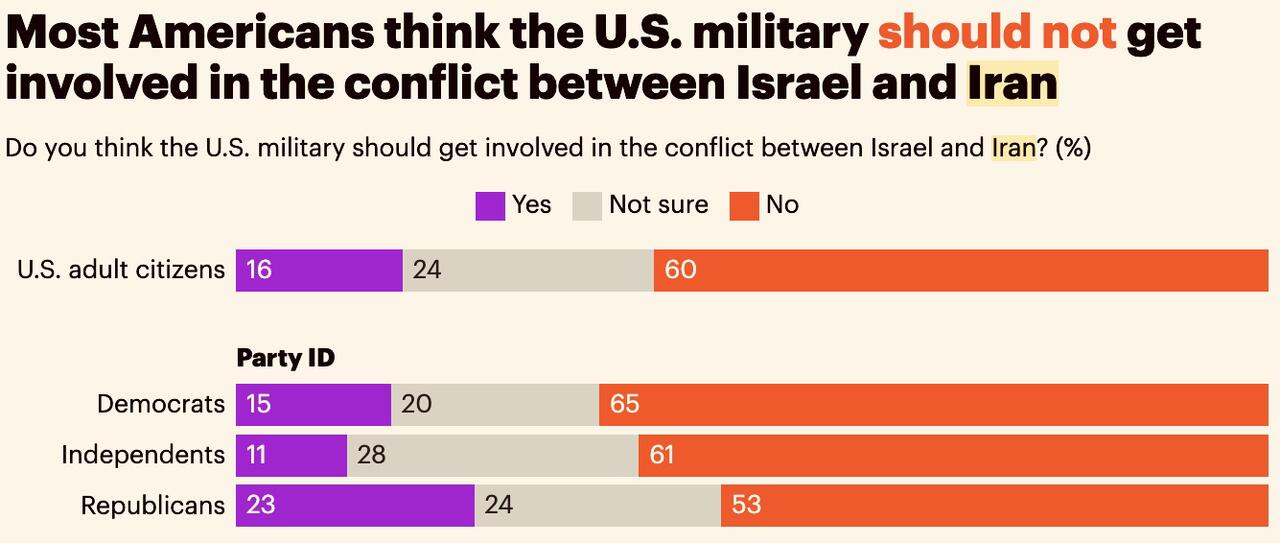
On the other hand, some of the poll's findings illustrate the effectiveness of decades of government propagandizing about Iran that's been echoed by establishment media. For example, 61% of Americans say Iran's nuclear program poses either an "immediate, serious threat" or "somewhat serious threat" to the United States. In 2007, the US intelligence community issued a National Intelligence Estimate that concluded with "high confidence" that Iran was not developing a nuclear weapon. That same conclusion has been periodically reiterated by the intelligence community ever since, including just three months ago. Similarly, 50% of Americans and 68% of Trump voters classify Iran as an "enemy" of the United States. A quarter of Americans categorize Iran as "unfriendly."
Interestingly, the poll also asked respondents to characterize Israel in the same way. Here, 10% said Israel was unfriendly and 6% called Israel an enemy; 61% said Israel was either an ally or friendly, while 23% said they were unsure. Against the top-line finding of 16% of Americans saying Israel is either "unfriendly" or an "enemy," some groups with above-average negative convictions about Israel include Hispanics (21%), 18- to 29-year-olds (21%), 30- to 44-year olds (20%), income under $50k (18%) and liberals (22%).
There’s not a single demo in the country whose majority is not opposed to US involvement in Israel’s war of aggression against Iran! Check out these polling figures. Never seen anything like this before. This is HUGE!!! pic.twitter.com/9X98CoI3WS
— Connor Freeman (@FreemansMind96) June 18, 2025
The finding of broad unpopularity of another US war in the Middle East comes alongside a rising chorus of voices demanding that the decision should be made by the Congress, as required by the United States Constitution. On Monday, Republican Rep. Thomas Massie and Democratic Rep. Ro Khanna introduced the "Iran War Powers Resolution" that would prohibit the US military from "unauthorized hostilities in the Islamic Republic of Iran." Also on Monday, Democratic Sen. Tim Kaine introduced a resolution in the upper chamber that would require a debate and vote before any use of force against Iran.
"The Constitution does not permit the executive branch to unilaterally commit an act of war against a sovereign nation that hasn't attacked the United States," said Massie "Congress has the sole power to declare war against Iran. The ongoing war between Israel and Iran is not our war. Even if it were, Congress must decide such matters according to our Constitution." A coalition that spans ideological lines is forming to back the resolutions, and the Ron Paul-affiliated Campaign for Liberty has posted a webpage that makes it quick and easy for citizens to urge their representative and senators to sign on.
An Israeli official tells CNN that Israel's war with Iran is "premised on the fact that the US will join at some point" pic.twitter.com/52uau9ya9g
— Dave DeCamp (@DecampDave) June 17, 2025
Speaking at an April event hosted by Bucknell University's Open Discourse Coalition, Sen. Rand Paul elaborated on why America's founders vested warmaking power in the Congress:
The most important thing is -- and it doesn't sound that exciting -- it's the process. We have to have a vote. You get a vote through your representatives. It's the dispersion of power. It's trying to keep power from being centralized in one authority, and warmaking is probably the most important of that. And Madison, when he was writing about this in the "Federalist Papers," said "the executive branch is the branch most prone to war. Therefore, with studied care, we have vested that power in the legislature."
On Monday, President Trump posted a disturbingly religion-charged text sent to him by US Ambassador to Israel, zealous Christian Zionist and perpetual Iran hawk Mike Huckabee. In it, Huckabee likens Trump's position to that of President Truman in 1945 -- the year he ordered the atomic bombing of Hiroshima and Nagasaki against the convictions of America's top military leaders. Appealing to Trump's ego, Huckabee also said, "The decisions on your shoulders I would not want to be made by anyone else."
There's no doubting his sincerity on that point: Given the universally low public support of US military engagement in Israel's war, neither Huckabee nor Israel want those decisions made by the people's representatives in Congress.
Terrifying shit. The religious fanaticism of Huckabee types, the psychos that run the Israeli govt, and Trump’s Messiah complex make this all even more dangerously insane. https://t.co/SfawzuIaSC
— Krystal Ball (@krystalball) June 17, 2025
U.S. Reportedly Scrapping Alcohol Limits In Favor Of Vague "Drink In Moderation" Guidance
Gpscruisewe need to let 18 year olds get into bars and meet women. Yeah, I said that......
A new report from Reuters, citing multiple sources, reveals that the upcoming U.S. Dietary Guidelines may drop the long-standing recommendation that adults limit alcohol consumption to one drink per day for women and two for men.
While not yet confirmed, the shift would represent a significant departure from decades of public health messaging, replacing the guidance with a vague call to "drink in moderation."
It also raises questions about whether the Department of Health and Human Services, even under Robert F. Kennedy Jr.'s leadership, remains an agency still captured by industry influence, drifting far from the "Make America Healthy Again" (MAHA) mission.

Here's more color from Reuters that really would only mark a significant win for the alcohol industry, which has lobbied heavily against tighter restrictions:
The updated Dietary Guidelines for Americans, which could be released as early as this month, are expected to include a brief statement encouraging Americans to drink in moderation or limit alcohol intake due to associated health risks, the sources said.
The guidelines are still under development and subject to change, two of the sources and a fourth individual familiar with the process said.
. . .
The fourth source said that the scientific basis for recommending specific daily limits is limited, and the goal is to ensure the guidelines reflect only the most robust evidence.
Critics, including public health advocates, warn that the new language downplays well-documented risks such as increased cancer, including breast cancer, even from moderate drinking.
Industry leaders, such as Diageo and Anheuser-Busch InBev, spent millions lobbying during the review process, concerned about increasing scrutiny from public health authorities.
All of this comes as Goldman analysts have pointed out deteriorating alcohol demand trends across the U.S.—underscoring broader challenges facing the industry:
- The Great Agave Bust Unfolds As Tequila Oversupply Worsens
- Beer Distribution Data Signals "Rough Start" To Summer Drinking Season
Given that this is a Reuters report based on anonymous sources, the details remain unconfirmed. However, if the reporting proves accurate, the shift would represent a significant victory for the alcohol industry—and further reinforce the perception that HHS remains agency captured.
Chokepoint Watch: GPS Jamming Impacts Tankers Across Strait Of Hormuz
Gpscruiseyou can buy a gps spoofer for $5k. Not sure the range....
Despite Israel and Iran volleying missiles and bombs at one another over the weekend, Brent crude futures showed a surprisingly muted reaction Monday morning, initially gapping higher Sunday evening but flat to down.
Goldman Sachs analyst Ananya Prakash added color about the market's restrained response, telling clients the "situation feels relatively contained" for now, with attention centered on potential supply disruptions—particularly the extreme scenario of Iran moving to close the Strait of Hormuz.

Bloomberg reports a surge in GPS jamming around the Strait of Hormuz, scrambling navigation for more than 900 vessels and hinting at a new form of disruption for the world's most critical maritime chokepoint.
Here's more from the report:
Starboard Maritime Intelligence and Bloomberg data showed vessels sailing impossibly straight lines in the region, zig- zagging across the water, or appearing onshore. The glitches — which have affected oil tankers, cargo ships, tugs and fishing boats among others since Friday — increase reliance on radars, compasses and eyesight, boosting the likelihood of collisions.
The Joint Maritime Information Center, an international naval task force monitoring the area, warned on Sunday that there are instances of "extreme jamming" of signals from the Iranian port of Bandar Abbas.
GPSJam—a site that publishes daily heat maps of GPS/GNSS disruptions affecting aircraft—shows multiple "high-interference" zones clustered around the Strait of Hormuz.

The United Kingdom Maritime Trade Operations said on Monday it had received multiple reports of increasing GPS interference in maritime chokepoint:
UKMTO has received multiple reports and monitoring of AIS confirms, that there is increasing electronic interference within the waters of the Gulf and Straits of Hormuz. Whilst the level of electronic interference continues to rise across the wider region, the levels and intensity inside the Gulf are having a significant impact on vessels positional reporting through automated systems (AIS).

Despite reports of "high" GPS jamming across parts of the maritime chokepoint, there are currently no signs of an imminent Iranian blockade. However, any move to choke off the strait, which handles roughly a quarter of global oil trade, would likely send Brent crude futures soaring into triple-digit territory.
However, a separate Bloomberg report found some oil tanker operators and managers have paused offering their vessels for Middle East routes since Friday to let the dust settle.
JPMorgan commodity analyst Natasha Kaneva issued a warning over the weekend, stating that the odds increased of a "worst-case scenario" —defined as "the oil price reaction turning exponential rather than linear, with the impact on supply potentially extending beyond a 2.1 mb/d reduction in Iranian oil exports"—could push prices as high as $120–$130 per barrel. Read the full note here.
Only Bitcoin & Gold Can Stop Governments From Destroying The Currency
Gpscruisetoresays.com says something possibly bad is brewing in BTC. She ways they are confiscating cold-wallets somehow.....
Allow me to remind you of a few uncomfortable truths.
Government spending is out of control in developed nations. Furthermore, no interventionist government wants to cut spending or balance the budget. Government spending empowers politicians, and reducing it means losing the grip on the economy.
Interventionist governments aren’t concerned about debts, deficits, or inflation. Inflation is a deliberate policy, and interventionist governments seek to nationalize the economy while imposing total control over productive sectors by issuing continuously devalued currencies.
Government spending is printing money. Politicians are happy to promise more free stuff by endlessly spending because they know they won’t pay for it and that it will make citizens and businesses more dependent and submissive to political power. No government can truly reduce debt without cutting spending.
Inflation is evidence of the loss of solvency for the issuer of money. It is a de facto slow default. Inflation serves as a policy that justifies and perpetuates significant government imbalances, shifting the financial burden onto real wages and deposit savings.
The fallacy of balancing the budget through higher taxes leads to economic stagnation and more debt. High taxes are not a tool to reduce debt but to justify high indebtedness. Tax receipts are cyclical whereas government expenditures are consolidated and annualised.
No interventionist government is going to willingly act to reduce debt and spending because they can always tax more and blame others for their problems. Furthermore, central banks have stopped playing the essential role of curbing fiscal excess to become enablers of rising fiscal imbalances.
Central banks play a crucial role in the fiat world due to the intertwining of monetary and fiscal policy. The system will gradually collapse if central banks do not stop the growth of government fiscal imbalances.
However, the independence of central banks is diminishing daily, and their policies tend to conceal excessive government spending and debt. Meanwhile, governments ignore the fact that they have surpassed the three limits of government debt: economic, fiscal, and inflationary. More government debt means lower growth, more taxes generate weaker receipts, and more government spending perpetuates inflation.
Now that central banks have stopped being the essential limit to government excess, there are only two alternatives: gold and Bitcoin.
Gold has already overtaken the euro as the second largest asset after the US dollar in global central banks. In a few months, it will be the largest asset. Global central banks have lost confidence in sovereign debt from developed countries as a reserve asset. Thus, developed nations’ long-term bond yields rise above inflation rate expectations.
Bitcoin, on the other hand, has shown investors and citizens that a decentralised currency can gradually become a low-volatility reserve asset, a generalised means of payment, and a unit of measurement. As global citizens see Bitcoin as an increasingly viable alternative to fiat money, more are using it to store value and protect themselves against inflation.
Investors do not trust developed economies to maintain their solvency. Gold and Bitcoin are now playing the role that central banks have abandoned: reminding governments that they cannot spend and print currency forever. Bitcoin may be a teenager and more volatile, but the powerful message to the world is clear: the years of uncontrolled government spending and printing are over.
Obviously, governments do not like this. And central banks that have stopped being as independent as they should be, like the ECB, are looking to eliminate the risk of independent currencies taking away the monopoly of money by issuing a legally imposed central bank digital currency (CBDC). Interestingly, the U.S. administration is doing the opposite, banning CBDCs and embracing crypto as the next monetary revolution.
The ECB is admitting the euro’s enormous loss of utilisation in global transactions and panicking by issuing a surveillance tool disguised as money, the CBDC. The US administration wants to cement the dollar’s reserve status by attracting global investment in crypto.
Bitcoin and gold are now playing the essential role that independent central banks should be enforcing. Central banks are unnecessarily dovish and continue to disguise bloated government imbalances. Gold and Bitcoin are essential parts of the answer to the inflationary temptations of governments. The only things that will save us from government excesses are decentralisation and independent money.
Tennessee Sues US Department Of Education Over Hispanic Student Funding
Gpscruisethere are so so many jobs i cant take since i am not bilingual. All public facing jobs....
Authored by Matthew Vadum via The Epoch Times (emphasis ours),
A civil rights lawsuit filed on June 11 in federal court for the Eastern District of Tennessee claims that a program providing federal money to colleges and universities if Hispanic students make up at least 25 percent of the student body is unconstitutional.

The lawsuit was brought by the state of Tennessee and Students for Fair Admissions, a group whose lawsuit led the U.S. Supreme Court in 2023 to strike down the use of racial criteria in student admissions at institutions of higher learning in a case called Students for Fair Admissions v. Harvard College.
Wednesday’s complaint names the U.S. Department of Education and Education Secretary Linda McMahon as defendants.
The plaintiffs argue that the federal government’s Hispanic-Serving Institutions (HSI) grant program unconstitutionally discriminates based on race and ethnicity, according to the complaint.
The Education Department’s Hispanic-Serving Institutions Division provides “grant funding to institutions of higher education to assist with strengthening institutional programs, facilities, and services to expand the educational opportunities for Hispanic Americans and other underrepresented populations,” the Department of Education’s website states.
Congress appropriated $350.6 million for the program in fiscal 2024, education think tank New America reports.
The department may not discriminate on the basis of race or ethnicity, “even when Congress orders it to,” the complaint states.
Despite this, under the federal Higher Education Act the department allocates HSI program funding to colleges and universities only if they meet the “arbitrary ethnic threshold of 25 percent Hispanic” student enrollment, according to the complaint.
Tennessee operates a variety of colleges and universities, all of which serve Hispanic students and low-income students. “But not one of them qualifies to receive grants under the HSI program” because they don’t possess “the right mix of ethnicities on campus,” the complaint states.
“Funds should help needy students regardless of their immutable traits, and the denial of those funds harms students of all races,” according to the complaint.
In its current form, the program engages in “unconstitutional racial balancing” and operates outside the constitutional authority of Congress. The 25 percent minimum Hispanic enrollment provision functions as “a strict racial gatekeeper,” determining which schools may receive millions of dollars under the program, Students for Fair Admissions said in a statement.
Racial balancing is the practice of using race as a factor to seek proportional representation of racial groups in institutions such as schools. Even before its ruling in Students for Fair Admissions v. Harvard College, the Supreme Court held that racial balancing policies must be weighed under the strict scrutiny standard, which means they must advance a compelling governmental interest and be narrowly tailored.
Tennessee argues the HSI program presents its schools with an impossible choice: they must either forgo millions of dollars in federal grants or participate in illegal racial balancing in admissions so they can boost Hispanic enrollment. A new state law specifically forbids race-based preferences in education, so now state schools are “at risk of violating either state or federal law no matter which direction they turn,” the statement said.
Students for Fair Admissions president Edward Blum said the HSI program is unconstitutional because it conditions receipt of government money on a student body’s racial composition.
The Supreme Court determined in the 2023 ruling that such practices are “patently unconstitutional.”
“Discriminating against colleges, universities, faculty, and students based on race violates the fundamental principle of equal protection under the law,” Blum said in a statement.
The Epoch Times reached out to the Department of Education for comment. No reply was received by publication time.
Autistic girl, 3, beaten to death by foster parents who would get upset over how she chewed food: report
Gpscruisewonder what would have happened if she dropped girl off at firestation?? We need that.

Donald Trump responds to Elon Musk’s late-night apology after ugly public feud
GpscruiseMusk has a very gentle voice in explaining hard things. He is very very valuable in that regard.

We Need A 'Kill Switch' On Foreign Powers Tampering With Our Electric Grid
Gpscruisepeople mistakenly think open source means unsafe, like only trade secrets are safe. This is wrong. The most secure thing on the planet is on github. We need to get all firmware open sourced. I may speak to my legislators. Example is pgp the old-standard for privacy. here it is. https://github.com/pgptool/pgptool
Authored by Gary Abernathy via The Empowerment Alliance,
It has long been acknowledged that the United States’ energy infrastructure isn’t particularly secure, a concern exacerbated by the lack of a central planning process for our nation’s piecemeal electric grid. Presidential administrations and Congress have been slow to address the problem, apparently daunted by the mere size and scope of the challenges the needed upgrades would present.

That needs to change now. The recent news that China apparently installed hidden “kill switches” in solar equipment sold to the U.S. was the latest in a long list of reasons to be concerned about our electricity infrastructure and the foolhardy rush to replace traditional energy sources with so-called “renewables” using technology that is often sourced from China.
As Reuters reported, “Rogue communication devices not listed in product documents have been found in some Chinese solar power inverters by U.S experts who strip down equipment hooked up to grids to check for security issues … Using the rogue communication devices to skirt firewalls and switch off inverters remotely, or change their settings, could destabilize power grids, damage energy infrastructure, and trigger widespread blackouts, experts said.”
As one source summarized it, “That effectively means there is a built-in way to physically destroy the grid.” Or, to put it in even simpler terms, the U.S. is purchasing Chinese equipment complete with a “kill switch” that would allow China to disable the U.S. power grid at any moment.
Even more concerning, the problem is not relegated to the United States. Britain’s GB News reported, “Chinese companies dominate the market for power inverters, with firms like Huawei and Sungrow controlling more than half the market in 2023, according to Wood Mackenzie research. The European Solar Manufacturing Council estimates that more than 200 gigawatts of European solar power capacity relies on Chinese-made inverters.” (One gigawatt is equal to one billion watts.)
As Christoph Podewils, the council’s secretary general, put it, “This means Europe has effectively surrendered remote control of a vast portion of its electricity infrastructure.”
The Chinese embassy in Washington dismissed the allegation.
The relatively sparse news coverage of this startling discovery is evidence of either the mainstream media’s complacency, or its intentional effort to downplay any development that might contradict its radical climate change narrative. Surely, this item led the evening newscasts on ABC, CBS and NBC, right? Sadly, no.
If ever there was a wakeup call regarding the urgent need for the U.S. to be even more committed to energy independence, it has arrived in the form of China’s ability to remotely turn off the U.S. power grid.
Fortunately, President Trump is working hard to reverse the Biden administration’s disastrous mandates that would have replaced affordable, reliable and increasingly clean traditional energy sources with untrustworthy and costly alternatives. Trump’s early declaration of a national energy emergency defined the dangers of relying on foreign sources of energy and spelled out several needed steps, including upgrades to our energy infrastructure.
But the added knowledge of Chinese subterfuge embedded within crucial components being installed in the U.S. electric grid adds even more urgency to the need to not only produce more domestic energy, but also to domestically develop more technology and manufacture more of the parts we currently import from outside U.S. borders.
While U.S. security experts should be lauded for discovering the Chinese “kill switches,” how many security threats have gone undetected? So-called “renewable” technologies like wind and solar were already suspect in regard to their reliability, as evidenced by the recent massive grid failure in Spain, Portugal and parts of France. We should be all the more wary of “alternatives” when the parts used to connect them to our power grids are sourced from foreign adversaries.
The episode again highlights the vital need for tougher regulations to ensure our nation’s energy security. The Empowerment Alliance’s model legislation – the Affordable, Reliable and Clean Energy Security act (ARC-ES) – would require “energy sources that are primarily produced within the U.S. and infrastructure that will reduce our reliance on foreign nations for critical materials and manufacturing.”
The time has passed for any reasonable argument suggesting that such legislation is not urgently needed, both at the federal and state levels. The notion of attacks from foreign adversaries on America’s energy infrastructure has often been the stuff of fantasy and “what-if” scenarios. Those have now been replaced with concrete evidence of nefarious, embedded components from a foreign superpower, just waiting for someone in Beijing to flip a switch and send Americans hurtling into a powerless abyss.
Let it sink in: China was secretly embedding technology in components shipped to the U.S. that could have triggered a massive power outage.
It’s time for Congress to embed a “kill switch” of its own on the ability of foreign countries to disable the U.S. power grid. That assurance can only come when we take America’s energy independence from being a worthy goal to a mandated reality.
10 years after the downfall of a same-sex marriage canvassing study, tenure, some better practices — and an engagement
Gpscruisethis is really interesting to read. "Feelings" metrics.... R math....
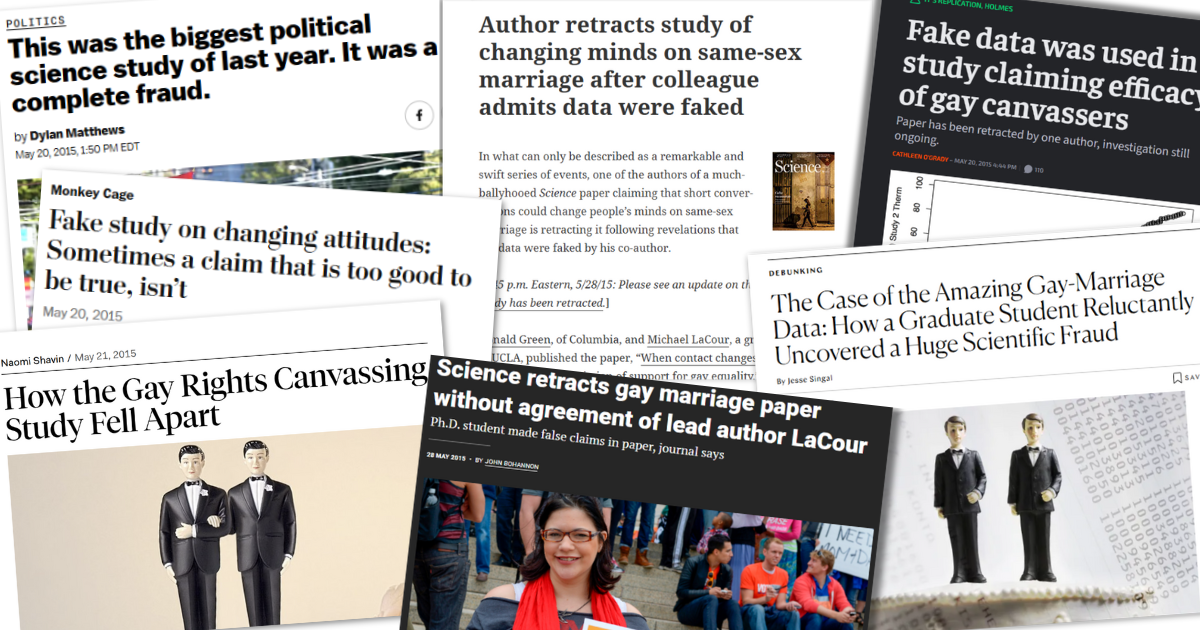
“Gay Advocates Can Shift Same-Sex Marriage Views,” read the New York Times headline. “Doorstep visits change attitudes on gay marriage,” declared the Los Angeles Times. “Cure Homophobia With This One Weird Trick!” Slate spouted.
Driving those headlines was a December 2014 study in Science, by Michael J. LaCour, then a Ph.D. student at the University of California, Los Angeles, and Donald Green, a professor at Columbia University.
Researchers praised the “buzzy new study,” as Slate called it at the time, for its robust effects and impressive results. The key finding: A brief conversation with a gay door-to-door canvasser could change the mind of someone opposed to same-sex marriage.
By the time the study was published, David Broockman, then a graduate student at the University of California, Berkeley, had already seen LaCour’s results and was keen to pursue his own version of it. He and fellow graduate student Joshua Kalla had collaborated before and wanted to look more closely at the impact canvassing could have on elections. But as the pair deconstructed LaCour’s study to figure out how to replicate it, they hit several curious stumbling blocks. And when they got a hold of LaCour’s dataset, or replication package, they quickly realized the results weren’t adding up.
The two graduate students found themselves in somewhat uncharted territory for how to share their critique. They wrote up their findings, recruiting help from Yale statistician P. Aronow. They shared the report with Green, the senior author on the paper, who confronted LaCour with the critique.
Then, the trio posted the report with its unassuming title, “Irregularities in LaCour,” online.
It was “like our personal Cuban Missile Crisis,” Broockman said in an interview with Retraction Watch last month. “There was basically this period between when our little PDF report went online and our little world exploded.”
Their revelations about “statistical irregularities” and false statements triggered the paper’s downward spiral, cataloged in nearly real time on Retraction Watch and widely reported elsewhere, culminating in the paper’s official retraction 10 years ago this week.
A decade later, Broockman, Kalla and Green continue to study persuasion in politics, among other topics. Their involvement in one of the most widely publicized retractions had some lasting effects on how they approach research. And the intervening years have also brought some welcome changes to research and data practices in their field.
‘There’s no rule book for this’
After Broockman and Kalla’s report went public, their peers were unsure how to react. “A lot of the fears we had felt like they were starting to come true,” said Broockman, now an associate professor at Berkeley. “People were like, ‘is this the right thing to do? Was this the right procedure?’” he said. “We were like, ‘there’s no rule book for this.’”
The same is true today. Post-publication peer review has gained more prominence since 2014, thanks to data sleuths, PubPeer and other efforts to police the literature. This week, a team of sleuths published a series of 25 guides on how to spot integrity issues. But a post on PubPeer is unlikely to draw attention beyond certain circles, and formal investigations trigger processes that move at an academic pace.
“I think there’s still a cultural problem in academia — and there was at the time — there’s just a lot of costs associated with criticizing existing research,” Broockman said. “The stories that you’re worried people are going to tell about you, I think that remains a big deterrent for people to come forward with whatever issues they have. I think academia has made a little bit of progress on that and could make more.”

When Broockman and Kalla spoke with us, news had just broken that MIT called for the withdrawal of an AI study done by an economics graduate student. Kalla hadn’t been familiar with the research — which had not yet been published but was posted as a preprint — or the university’s announcement. But he had read Stuart Buck’s May 18 newsletter recounting his critique of the study — and the backlash Buck faced for asking questions about it.
“He got pushback for not following proper etiquette, for not being kind and understanding and kind of wrong to be questioning the research paper,” said Kalla, now an associate professor at Yale University. “I don’t know if the norms have changed over the last 10 years, but Stuart is raising some of those same concerns that we had 10 years ago.”
Sometimes, no matter which option a person chooses, there’s pushback, Broockman said.
“I think it’s a problem that so many people’s first instinct in these circumstances is to criticize the person raising the issue,” he said. “That’s really problematic. I think Stuart’s post shows that this remains a problem.”
Kalla said he encourages early-career researchers to take a direct, respectful approach when critiquing anyone’s work. “The key advice I give to graduate students is to have that kind of respect and curiosity, since oftentimes there aren’t the smoking guns that David and I had 10 years ago,” he said.
‘The hero here is open data’
In 2014, publishing datasets, code and documentation with research papers was relatively uncommon. But that’s ultimately what led Broockman and Kalla to realize the “irregularities” they had found with LaCour’s study execution were something more.
“The hero here is open data. That’s what led us to do this,” Broockman said. “This is one example – it’s an extreme example – of why open data is important.”
“Ten years ago, the idea of pre-analysis plans, the idea of open data, the idea that you need to have reasonable sample sizes and studies, that was much more like a fringe, vanguard thing,” Broockman said. “My sense is that in the three main social science quantitative fields of psychology, political science and economics, I think we won that war. I think that’s pretty universal now.”

Kalla was somewhat less certain. “I’m not sure if I would say the war is totally over. I think there’s definitely still lots of pushback, especially around both pre-analysis plans and statistical power,” he said. “There’s a perception that our job is to publish and to keep our jobs, and not necessarily to do the best research possible. And sometimes these scientific best practices come at odds with those competing goals.”
Kalla and Broockman are meticulous researchers by nature, but their involvement in the Science retraction amplified that trait. “I think given the prominence of this retraction, I always feared people are going to double check my work,” Kalla said. “So I think that that made me always be careful, to try extra hard to make sure everything is buttoned down, everything is double and triple checked.”
Green acknowledged he didn’t do his due diligence as a coauthor, telling us at the time:
Convinced that the results were robust, I helped Michael LaCour write up the findings, especially the parts that had to do with the statistical interpretation of the experimental design. Given that I did not have IRB approval for the study from my home institution, I took care not to analyze any primary data — the datafiles that I analyzed were the same replication datasets that Michael LaCour posted to his website. Looking back, the failure to verify the original Qualtrics data was a serious mistake.
The study and its fallout prompted him to make changes in his collaborations. “My data-related collaborations now involve teams of people (rather than single individuals) working on data collection and data analysis,” Green said last month by email. “Research materials are shared and date-stamped. Replication materials work from basic inputs to final outputs.” And, he added, he no longer supervises doctoral students from other schools.
Trust but verify
A year after the LaCour retraction, Broockman and Kalla published a study finding that 10-minute, in-person conversations between door-to-door canvassers and voters in South Florida could “substantially reduce transphobia” and that the gender identity of the canvasser didn’t matter. (The irony of the finding’s similarity to LaCour’s, and its publication in Science, wasn’t lost on the media either.)
Since then, they’ve conducted “at least nine or 10 replications in various forms related to different issues,” from work on transphobia to immigration rights, Kalla said. “This style of non judgmentally exchanging narratives through door-to-door canvassing can durably reduce people’s prejudicial views towards these various out groups.”
Most recently, they posted a preprint of a study on how endorsements and special interest groups affect voter behavior in primaries and general elections. By surveying 31,000 respondents during 2024 elections in 27 congressional districts, they found “primary voters actually struggle to identify which candidates match their views. So they rely on other cues—especially from interest groups who might help drive polarization,” Broockman posted on Bluesky.
Just as they’ve stayed on theme with their research, so too have their opinions on the infrastructure for research. Shortly after the LaCour retraction, Broockman and Kalla wrote an editorial in Vox reacting to coverage citing “a growing number” of retractions. They cautioned retractions were a sign that the system is strong, not weak. They wrote at the time:
The fact that we are especially likely to see and hear about the errors scientists make does not suggest scientists are especially prone to making mistakes. Rather, it shows that scientific errors are increasingly likely to be detected and corrected instead of being swept under the rug.
Has that view changed? “When scandals like this MIT thing this week come out, those should make people more confident in academic research, because they show there is an ecosystem to catch this stuff,” Broockman said in our recent interview. “I think we should be wary of proposals to over-regulate academic research, to solve for these rare events.”
He continued: “But if we’re going to not over-regulate the doing of the research, that means we need the fire alarm — and that’s what you guys [Retraction Watch] are — and we need the researchers doing the research knowing that there’s a reasonable chance they will get caught.”
He likened blatant fraud cases like LaCour’s to “the airplane crashes of academic research” — they get a lot of attention, but in terms of what affects more people, “they attract far disproportionate attention,” he said. “If I were making a top five list of ways academia is not producing research that is as truthful as it could be, I don’t think fraud would be in my top five.” Issues like p-hacking, selectively including data, and deviating from research plans are all smaller infractions that are bigger issues, he said.

Carelessness has a large effect in the literature, too. “For me, the biggest takeaway is, sure, fraud happens,” Kalla said. “I think the bigger concern in research is sloppiness.” He and Broockman are systematic in their collaborations, carefully checking each other’s code and work. “And I think that extends to collaborations with other people as well. The trust-but-verify mentality,” Kalla said, “and definitely not in a skeptical, hostile, fraud based way. It’s very easy to make mistakes.”
Green also continues to study U.S. public opinion and political behavior, branching out to study the influence of mass media in low- and middle-income countries. “Several of my field experiments since then have focused on how narrative entertainment shapes beliefs, attitudes, and behavioral intentions,” he said. Those include studies on how a Tanzanian radio drama influenced attitudes on early and forced marriage, and the influence of a media campaign on violence against women in Uganda.
Coda
Ten years on, Green, Broockman and Kalla say the study and its demise still come up periodically, but far less often than it did in the year or two immediately after.
“My sense is that this episode is discussed fairly widely when scholars and instructors assess the replication crisis in social science, in part because the case illustrates both why research might fail to replicate (in this instance, due to fraud) as well as the norms and institutions that have emerged to expose replication failures (such as the availability of replication data that in this case exposed how fabricated data were grafted onto an existing dataset),” Green said.
He talks about it indirectly in his undergraduate textbook, but “students seem to be less and less familiar with the episode as time passes,” he said. “I suppose that a senior now would have been in elementary school when it happened.”
Every once in a while a student will ask Kalla about the case, he said, and Broockman said it mostly comes up when he’s talking to researchers in other disciplines, but not so much anymore.
For Broockman, the story has an added personal note: Eight years ago, it came up on a first date — with the man he’s now engaged to. “He had listened to the ‘This American Life’ episode about all of this,” he said. “So maybe that served me well.”
Like Retraction Watch? You can make a tax-deductible contribution to support our work, follow us on X or Bluesky, like us on Facebook, follow us on LinkedIn, add us to your RSS reader, or subscribe to our daily digest. If you find a retraction that’s not in our database, you can let us know here. For comments or feedback, email us at team@retractionwatch.com.
By clicking submit, you agree to share your email address with the site owner and Mailchimp to receive marketing, updates, and other emails from the site owner. Use the unsubscribe link in those emails to opt out at any time.
FBI IDs suspect who attacked ICE agents with rocks during LA riots
‘Bitcoin Family’ hides crypto codes etched onto metal cards on four continents — after kidnapping wave.
Gpscruisei hope he has some small wallets for kidnappers.... Just sayin, he is always vulnerable and should hire a guard like rich people do. Seems to be kidding himself.
Waymo pulls self-driving cars out of downtown LA after 5 torched by rioters
Gpscruisei predicted robot-abuse
Steve Bannon calls on Trump to deport Elon Musk: ‘Strong belief that he is an illegal alien’
Gpscruisemusk just joined DOGE to free up more money for him.......

NYC now has a 15 mph speed limit for e-bikes — but critics doubt it will make city streets safer
Gpscruisemake car manufacturers allow cruise controls to operate at lower speeds so they use them more often. Currently most cut out at 30mph. No help in school zones.....

Mexican flag-waving masked protester becomes the symbol of LA anti-ICE riots: ‘Perfect propaganda for Trump’
Gpscruisethere are so many jobs i cant have that involve speaking spanish, almost anything in transportation, public facing jobs. It sucks.

Remaking K–12 Classes For A Healthier America
Gpscruisejust lets walk outside as needed.
Authored by David Mansdoerfer via The Epoch Times,
America’s kids are navigating a health crisis, and our outdated K–12 health classes aren’t helping.
With childhood obesity at 20 percent, teen mental health issues doubling, and chronic diseases looming, the current curriculum—think food pyramids, anti-drug lectures, and awkward sex-ed—is woefully inadequate.
It’s time to transform these classes with a Make America Healthy Again (MAHA) approach, empowering students with practical, science-based tools for lifelong wellness.

Nutrition education needs a complete overhaul. Ditch memorizing calorie counts for hands-on lessons in reading labels, spotting hidden sugars, and cooking affordable, nutrient-dense meals. Schools could partner with local farmers or chefs to make it fun, showing kids that real food isn’t just for influencers. Imagine middle schoolers mastering a stir-fry or high schoolers debating ultra-processed foods’ impact on their bodies. These skills build confidence and independence, setting kids up to make smarter choices in a world of fast-food traps.
Mental health demands equal focus. Anxiety and depression rates among teens have surged, yet coping strategies are rarely taught. A MAHA curriculum would introduce age-appropriate mindfulness, stress management, and sleep science. Elementary students could practice breathing exercises; high schoolers could explore how social media algorithms hijack their attention. Teaching kids to set tech boundaries isn’t coddling—it’s equipping them for a digital world where mental resilience is non-negotiable.
Physical activity must evolve beyond dodgeball and humiliating fitness tests. Only 24 percent of kids meet daily exercise guidelines. Health classes should inspire movement through yoga, strength training, or outdoor challenges. Schools could use wearable tech to gamify fitness, rewarding effort over athletic talent. The aim? Make exercise a joy, not a chore, fostering habits that stick into adulthood.
Prevention ties it all together. Kids need to grasp how lifestyle shapes their future, from cutting diabetes risk to boosting heart health. Lessons could use real data—like how 10,000 steps a day lowers disease risk—or feature doctors sharing relatable stories. This isn’t about scaring kids; it’s about showing they hold the reins.
Skeptics might call this overhaul costly or unrealistic, but poor childhood health habits fuel billions in healthcare costs annually. MAHA classes are an investment, like building roads—do it right, and the benefits compound. Start with pilot programs, retrain teachers, and tap community resources. This isn’t partisan—it’s common sense. Every parent wants their kid to thrive. By remaking health classes, we give students the tools to build healthier bodies, minds, and futures.
Let’s stop lecturing kids on health and start teaching them how to live it.
Views expressed in this article are opinions of the author and do not necessarily reflect the views of The Epoch Times or ZeroHedge.
Pluralistic: AI turns Amazon coders into Amazon warehouse workers (27 May 2025)
GpscruiseThe point of the human isn't to catch the AI's errors so much as it is to catch the blame for the AI's errors

Today's links
- AI turns Amazon coders into Amazon warehouse workers: A reverse-centaur in the loop.
- Hey look at this: Delights to delectate.
- Object permanence: 2005, 2010, 2015, 2020, 2024
- Upcoming appearances: Where to find me.
- Recent appearances: Where I've been.
- Latest books: You keep readin' em, I'll keep writin' 'em.
- Upcoming books: Like I said, I'll keep writin' 'em.
- Colophon: All the rest.

AI turns Amazon coders into Amazon warehouse workers (permalink)
On a recent This Machine Kills episode, guest Hagen Blix described the ultimate form of "AI therapy" with a "human in the loop":
https://soundcloud.com/thismachinekillspod/405-ai-is-the-demon-god-of-capital-ft-hagen-blix
One actual therapist is just having ten chat GPT windows open where they just like have five seconds to interrupt the chatGPT. They have to scan them all and see if it says something really inappropriate. That's your job, to stop it.
Blix admits that's not where therapy is at…yet, but he references Laura Preston's 2023 N Plus One essay, "HUMAN_FALLBACK," which describes her as a backstop to a real-estate "virtual assistant," that masqueraded as a human handling the queries that confused it, in a bid to keep the customers from figuring out that they were engaging with a chatbot:
https://www.nplusonemag.com/issue-44/essays/human_fallback/
This is what makes investors and bosses slobber so hard for AI – a "productivity" boost that arises from taking away the bargaining power of workers so that they can be made to labor under worse conditions for less money. The efficiency gains of automation aren't just about using fewer workers to achieve the same output – it's about the fact that the workers you fire in this process can be used as a threat against the remaining workers: "Do your job and shut up or I'll fire you and give your job to one of your former colleagues who's now on the breadline."
This has been at the heart of labor fights over automation since the Industrial Revolution, when skilled textile workers took up the Luddite cause because their bosses wanted to fire them and replace them with child workers snatched from Napoleonic War orphanages:
https://pluralistic.net/2023/09/26/enochs-hammer/#thats-fronkonsteen
Textile automation wasn't just about producing more cloth – it was about producing cheaper, worse cloth. The new machines were so easy a child could use them, because that's who was using them – kidnapped war orphans. The adult textile workers the machines displaced weren't afraid of technology. Far from it! Weavers used the most advanced machinery of the day, and apprenticed for seven years to learn how to operate it. Luddites had the equivalent of a Masters in Engineering from MIT.
Weavers' guilds presented two problems for their bosses: first, they had enormous power, thanks to the extensive training required to operate their looms; and second, they used that power to regulate the quality of the goods they made. Even before the Industrial Revolution, weavers could have produced more cloth at lower prices by skimping on quality, but they refused, out of principle, because their work mattered to them.
Now, of course weavers also appreciated the value of their products, and understood that innovations that would allow them to increase their productivity and make more fabric at lower prices would be good for the world. They weren't snobs who thought that only the wealthy should go clothed. Weavers had continuously adopted numerous innovations, each of which increased the productivity and the quality of their wares.
Long before the Luddite uprising, weavers had petitioned factory owners and Parliament under the laws that guaranteed the guilds the right to oversee textile automation to ensure that it didn't come at the price of worker power or the quality of the textiles the machines produced. But the factory owners and their investors had captured Parliament, which ignored its own laws and did nothing as the "dark, Satanic mills" proliferated. Luddites only turned to property destruction after the system failed them.
Now, it's true that eventually, the machines improved and the fabric they turned out matched and exceeded the quality of the fabric that preceded the Industrial Revolution. But there's nothing about the way the Industrial Revolution unfolded – increasing the power of capital to pay workers less and treat them worse while flooding the market with inferior products – that was necessary or beneficial to that progress. Every other innovation in textile production up until that time had been undertaken with the cooperation of the guilds, who'd ensured that "progress" meant better lives for workers, better products for consumers, and lower prices. If the Luddites' demands for co-determination in the Industrial Revolution had been met, we might have gotten to the same world of superior products at lower costs, but without the immiseration of generations of workers, mass killings to suppress worker uprisings, and decades of defective products being foisted on the public.
So there are two stories about automation and labor: in the dominant narrative, workers are afraid of the automation that delivers benefits to all of us, stand in the way of progress, and get steamrollered for their own good, as well as ours. In the other narrative, workers are glad to have boring and dangerous parts of their work automated away and happy to produce more high-quality goods and services, and stand ready to assess and plan the rollout of new tools, and when workers object to automation, it's because they see automation being used to crush them and worsen the outputs they care about, at the expense of the customers they care for.
In modern automation/labor theory, this debate is framed in terms of "centaurs" (humans who are assisted by technology) and "reverse-centaurs" (humans who are conscripted to assist technology):
https://pluralistic.net/2023/04/12/algorithmic-wage-discrimination/#fishers-of-men
There are plenty of workers who are excited at the thought of using AI tools to relieve them of some drudgework. To the extent that these workers have power over their bosses and their working conditions, that excitement might well be justified. I hear a lot from programmers who work on their own projects about how nice it is to have a kind of hypertrophied macro system that can generate and tweak little automated tools on the fly so the humans can focus on the real, chewy challenges. Those workers are the centaurs, and it's no wonder that they're excited about improved tooling.
But the reverse-centaur version is a lot darker. The reverse-centaur coder is an assistant to the AI, charged with being a "human in the loop" who reviews the material that the AI produces. This is a pretty terrible job to have.
For starters, the kinds of mistakes that AI coders make are the hardest mistakes for human reviewers to catch. That's because LLMs are statistical prediction machines, spicy autocomplete that works by ingesting and analyzing a vast corpus of written materials and then producing outputs that represent a series of plausible guesses about which words should follow one another. To the extent that the reality the AI is participating in is statistically smooth and predictable, AI can often make eerily good guesses at words that turn into sentences or code that slots well into that reality.
But where reality is lumpy and irregular, AI stumbles. AI is intrinsically conservative. As a statistically informed guessing program, it wants the future to be like the past:
https://reallifemag.com/the-apophenic-machine/
This means that AI coders stumble wherever the world contains rough patches and snags. Take "slopsquatting." For the most part, software libraries follow regular naming conventions. For example, there might be a series of text-handling libraries with names like "text.parsing.docx," "text.parsing.xml," and "text.parsing.markdown." But for some reason – maybe two different projects were merged, or maybe someone was just inattentive – there's also a library called "text.txt.parsing" (instead of "text.parsing.txt").
AI coders are doing inference based on statistical analysis, and anyone inferring what the .txt parsing library is called would guess, based on the other libraries, that it was "text.parsing.txt." And that's what the AI guesses, and so it tries to import that library to its software projects.
This creates a new security vulnerability, "slopsquatting," in which a malicious actor creates a library with the expected name, which replicates the functionality of the real library, but also contains malicious code:
https://www.theregister.com/2025/04/12/ai_code_suggestions_sabotage_supply_chain/
Note that slopsquatting errors are extremely hard to spot. As is typical with AI coding errors, these are errors that are based on continuing a historical pattern, which is the sort of thing our own brains do all the time (think of trying to go up a step that isn't there after climbing to the top of a staircase). Notably, these are very different from the errors that a beginning programmer whose work is being reviewed by a more senior coder might make. These are the very hardest errors for humans to spot, and these are the errors that AIs make the most, and they do so at machine speed:
https://pluralistic.net/2024/04/23/maximal-plausibility/#reverse-centaurs
To be a human in the loop for an AI coder, a programmer must engage in sustained, careful, line-by-line and command-by-command scrutiny of the code. This is the hardest kind of code to review, and maintaining robotic vigilance over long periods at high speeds is something humans are very bad at. Indeed, it's the kind of task we try very hard to automate, since machines are much better at being machinelike than humans are. This is the essence of reverse-centaurism: when a human is expected to act like a machine in order to help the machine do something it can't do.
Humans routinely fail at spotting these errors, unsurprisingly. If the purpose of automation is to make superior goods at lower prices, then this would be a real concern, since a reverse-centaur coding arrangement is bound to produce code with lurking, pernicious, especially hard-to-spot bugs that present serious risks to users. But if the purpose of automation is to discipline labor – to force coders to accept worse conditions and pay – irrespective of the impact on quality, then AI is the perfect tool for the job. The point of the human isn't to catch the AI's errors so much as it is to catch the blame for the AI's errors – to be what Madeleine Clare Elish calls a "moral crumple zone":
https://estsjournal.org/index.php/ests/article/view/260
As has been the case since the Industrial Revolution, the project of automation isn't just about increasing productivity, it's about weakening labor power as a prelude to lowering quality. Take what's happened to the news industry, where mass layoffs are being offset by AI tools. At Hearst's King Features Syndicates, a single writer was charged with producing over 30 summer guides, the entire package:
That is an impossible task, which is why the writer turned to AI to do his homework, and then, infamously, published a "summer reading guide" that was full of nonexistent books that were hallucinated by a chatbot:
Most people reacted to this story as a consumer issue: they were outraged that the world was having a defective product foisted upon it. But the consumer issue here is downstream from the labor issue: when the writers at King Features Syndicate are turned into reverse-centaurs, they will inevitably produce defective outputs. The point of the worker – the "human in the loop" – isn't to supervise the AI, it's to take the blame for the AI. That's just what happened, as this poor schmuck absorbed an internet-sized rasher of shit flung his way by outraged social media users. After all, it was his byline on the story, not the chatbot's. He's the moral crumple-zone.
The implication of this is that consumers and workers are class allies in the automation wars. The point of using automation to weaken labor isn't just cheaper products – it's cheaper, defective products, inflicted on the unsuspecting and defenseless public who are no longer protected by workers' professionalism and pride in their jobs.
That's what's going on at Duolingo, where CEO Luis von Ahn created a firestorm by announcing mass firings of human language instructors, who would be replaced by AI. The "AI first" announcement pissed off Duolingo's workers, of course, but what caught von Ahn off-guard was how much this pissed off Duolingo's users:
But of course, this makes perfect sense. After all, language-learners are literally incapable of spotting errors in the AI instruction they receive. If you spoke the language well enough to spot the AI's mistakes, you wouldn't need Duolingo! I don't doubt that there are countless ways in which AIs could benefit both language learners and the Duolingo workers who develop instructional materials, but for that to happen, workers' and learners' needs will have to be the focus of AI integration. Centaurs could produce great language learning materials with AI – but reverse-centaurs can only produce slop.
Unsurprisingly, many of the most successful AI products are "bossware" tools that let employers monitor and discipline workers who've been reverse-centaurized. Both blue-collar and white-collar workplaces have filled up with "electronic whips" that monitor and evaluate performance:
https://pluralistic.net/2024/08/02/despotism-on-demand/#virtual-whips
AI can give bosses "dashboards" that tell them which Amazon delivery drivers operate their vehicles with their mouths open (Amazon doesn't let its drivers sing on the job). Meanwhile, a German company called Celonis will sell your boss a kind of AI phrenology tool that assesses your "emotional quality" by spying on you while you work:
https://crackedlabs.org/en/data-work/publications/processmining-algomanage
Tech firms were among the first and most aggressive adopters of AI-based electronic whips. But these whips weren't used on coders – they were reserved for tech's vast blue-collar and contractor workforce: clickworkers, gig workers, warehouse workers, AI data-labelers and delivery drivers.
Tech bosses tormented these workers but pampered their coders. That wasn't out of any sentimental attachment to tech workers. Rather, tech bosses were afraid of tech workers, because tech workers possess a rare set of skills that can be harnessed by tech firms to produce gigantic returns. Tech workers have historically been princes of labor, able to command high salaries and deferential treatment from their bosses (think of the amazing tech "campus" perks), because their scarcity gave them power.
It's easy to predict how tech bosses would treat tech workers if they could get away with it – just look how they treat workers they aren't afraid of. Just like the textile mill owners of the Industrial Revolution, the thing that excites tech bosses about AI is the possibility of cutting off a group of powerful workers at the knees. After all, it took more than a century for strong labor unions to match the power that the pre-Industrial Revolution guilds had. If AI can crush the power of tech workers, it might buy tech bosses a century of free rein to shift value from their workforce to their investors, while also doing away with pesky Tron-pilled workers who believe they have a moral obligation to "fight for the user."
William Gibson famously wrote, "The future is here, it's just not evenly distributed." The workers that tech bosses don't fear are living in the future of the workers that tech bosses can't easily replace.
This week, the New York Times's veteran Amazon labor reporter Noam Scheiber published a deeply reported piece about the experience of coders at Amazon in the age of AI:
https://www.nytimes.com/2025/05/25/business/amazon-ai-coders.html
Amazon CEO Andy Jassy is palpably horny for AI coders, evidenced by investor memos boasting of AI's returns in "productivity and cost avoidance" and pronouncements about AI saving "the equivalent of 4,500 developer-years":
Amazon is among the most notorious abusers of blue-collar labor, the workplace where everyone who doesn't have a bullshit laptop job is expected to piss in a bottle and spend an unpaid hour before and after work going through a bag- and body-search. Amazon's blue-collar workers are under continuous, totalizing, judging AI scrutiny that scores them based on whether their eyeballs are correctly oriented, whether they take too long to pick up an object, whether they pee too often. Amazon warehouse workers are injured at three times national average. Amazon AIs scan social media for disgruntled workers talking about unions, and Amazon has another AI tool that predicts which shops and departments are most likely to want to unionize.
Scheiber's piece describes what it's like to be an Amazon tech worker who's getting the reverse-centaur treatment that has heretofore been reserved for warehouse workers and drivers. They describe "speedups" in which they are moved from writing code to reviewing AI code, their jobs transformed from solving chewy intellectual puzzles to racing to spot hard-to-find AI coding errors as a clock ticks down. Amazon bosses haven't ordered their tech workers to use AI, just raised their quotas to a level that can't be attained without getting an AI to do most of the work – just like the Chicago Sun-Times writer who was expected to write all 30 articles in the summer guide package on his own. No one made him use AI, but he wasn't going to produce 30 articles on deadline without a chatbot.
Amazon insists that it is treating AI as an assistant for its coders, but the actual working conditions make it clear that this is a reverse-centaur transformation. Scheiber discusses a dissident internal group at Amazon called Amazon Employees for Climate Justice, who link the company's use of AI to its carbon footprint. Beyond those climate concerns, these workers are treating AI as a labor issue.
Amazon's coders have been making tentative gestures of solidarity towards its blue-collar workforce since the pandemic broke out, walking out in support of striking warehouse workers (and getting fired for doing so):
https://pluralistic.net/2020/04/14/abolish-silicon-valley/#hang-together-hang-separately
But those firings haven't deterred Amazon's tech workers from making common cause with their comrades on the shop floor:
https://pluralistic.net/2021/01/19/deastroturfing/#real-power
When techies describe their experience of AI, it sometimes sounds like they're describing two completely different realities – and that's because they are. For workers with power and control, automation turns them into centaurs, who get to use AI tools to improve their work-lives. For workers whose power is waning, AI is a tool for reverse-centaurism, an electronic whip that pushes them to work at superhuman speeds. And when they fail, these workers become "moral crumple zones," absorbing the blame for the defective products their bosses pushed out in order to goose profits.
As ever, what a technology does pales in comparison to who it does it for and who it does it to.
Hey look at this (permalink)

- The CIA Secretly Ran a Star Wars Fan Site https://www.404media.co/the-cia-secretly-ran-a-star-wars-fan-site/
-
Atomic Highway – Post Apocalyptic Roleplaying https://archive.org/details/atomic-highway-ebook-v-2/mode/1up
-
THE SILICON VALLEY EFFECT https://law.stanford.edu/wp-content/uploads/2025/04/SJIL_61-1_Arun.pdf

Object permanence (permalink)
#20yrsago Bulk of American calories comes from sweet drinks https://www.sciencedaily.com/releases/2005/05/050527111920.htm
#20yrsago Chicago’s Bean sculpture is free to photograph, at last https://memex.craphound.com/2005/05/27/chicagos-bean-sculpture-is-free-to-photograph-at-last/
#15yrsago Man single-handedly building a metro rail https://englishrussia.com/2010/05/24/the-most-unusual-metro-in-the-world/
#15yrsago Canada’s copyright minister: superinfringer https://memex.craphound.com/2010/05/27/canadas-copyright-minister-superinfringer/
#15yrsago Pinkwater’s ADVENTURES OF A CAT-WHISKERED GIRL, sequel to Neddiad and Yggyssey https://memex.craphound.com/2010/05/27/pinkwaters-adventures-of-a-cat-whiskered-girl-sequel-to-neddiad-and-yggyssey/
#10yrsago Real estate bubble drives urban blight https://www.newyorker.com/business/currency/why-are-there-so-many-shuttered-storefronts-in-the-west-village
#10yrsago IRS leaks 100K taxpayers’ data to identity thieves https://theintercept.com/2015/05/27/data-breaches-wreak-havoc/
#10yrsago Swiss cops’ dawn raid snags top FIFA officials https://www.nytimes.com/2015/05/27/sports/soccer/fifa-officials-face-corruption-charges-in-us.html
#5yrsago The Toronto Star's new owners donated to far-right Tories https://pluralistic.net/2020/05/27/literal-gunhumping/#plutewatch
#5yrsago How to pay artists while fighting censorship and Big Tech https://pluralistic.net/2020/05/27/literal-gunhumping/#pay-artists
#5yrsago Ammosexuals point their guns at their crotches https://pluralistic.net/2020/05/27/literal-gunhumping/#youll-shoot-your-eye-out
#5yrsago Twitter's porn filters are dampening discussions of "cumgate" https://pluralistic.net/2020/05/27/literal-gunhumping/#cumgate
#5yrsago West Virginia's governor Jim Justice: billionaire, deadbeat https://pluralistic.net/2020/05/27/literal-gunhumping/#injustice
#5yrsago Hertz's bankruptcy was caused by private equity looting https://pluralistic.net/2020/05/27/literal-gunhumping/#hertz-uranus
#5yrsago Facebook shelved research that showed they were sowing division https://pluralistic.net/2020/05/27/literal-gunhumping/#joel-kaplan
#5yrsago Youtube is automatically blocking criticism of the Chinese Communist Party https://pluralistic.net/2020/05/27/literal-gunhumping/#communist-bandit
#1yrago Against Lore https://pluralistic.net/2024/05/27/cmon-do-it-again/#better_to_remain_silent_and_be_thought_a_fool_than_to_speak_and_remove_all_doubt
Upcoming appearances (permalink)

- Seattle: Cascade PBS Ideas Festival, May 31
https://www.cascadepbs.org/festival/speaker/cory-doctorow -
Virtual: Fediforum, Jun 5
https://fediforum.org/2025-06/ -
PDX: Teardown 2025, Jun 20-22
https://www.crowdsupply.com/teardown/portland-2025 -
PDX: Picks and Shovels with bunnie Huang at Barnes and Noble, Jun 20
https://stores.barnesandnoble.com/event/9780062183697-0 -
Tualatin Public Library, Jun 22:
https://www.tualatinoregon.gov/library/author-talk-cory-doctorow -
London: How To Academy with Riley Quinn, Jul 1
https://howtoacademy.com/events/cory-doctorow-the-fight-against-the-big-tech-oligarchy/ -
Manchester: Picks and Shovels at Blackwell's Bookshop, Jul 2
https://www.eventbrite.co.uk/e/an-evening-with-cory-doctorow-tickets-1308451968059 -
Manchester: Co-operatives UK Co-op Congress keynote, Jul 4
https://www.uk.coop/events-and-training/events-calendar/co-op-congress-2025-book-your-place -
New Orleans: DeepSouthCon63, Oct 10-12, 2025
http://www.contraflowscifi.org/

Recent appearances (permalink)
- Kick 'Em In the Dongle (Understood)
https://www.cbc.ca/listen/cbc-podcasts/1353-the-naked-emperor/episode/16148346-kick-em-in-the-dongle -
The Big Story
https://www.seekyoursounds.com/podcasts/the-big-story/cory-doctorow-explains-who-broke-the-internet -
Keynote (Pycon)
https://www.youtube.com/watch?v=ydVmzg_SJLw

Latest books (permalink)
-
- Picks and Shovels: a sequel to "Red Team Blues," about the heroic era of the PC, Tor Books (US), Head of Zeus (UK), February 2025 (https://us.macmillan.com/books/9781250865908/picksandshovels).
- The Bezzle: a sequel to "Red Team Blues," about prison-tech and other grifts, Tor Books (US), Head of Zeus (UK), February 2024 (the-bezzle.org). Signed, personalized copies at Dark Delicacies (https://www.darkdel.com/store/p3062/Available_Feb_20th%3A_The_Bezzle_HB.html#/).
-
"The Lost Cause:" a solarpunk novel of hope in the climate emergency, Tor Books (US), Head of Zeus (UK), November 2023 (http://lost-cause.org). Signed, personalized copies at Dark Delicacies (https://www.darkdel.com/store/p3007/Pre-Order_Signed_Copies%3A_The_Lost_Cause_HB.html#/)
-
"The Internet Con": A nonfiction book about interoperability and Big Tech (Verso) September 2023 (http://seizethemeansofcomputation.org). Signed copies at Book Soup (https://www.booksoup.com/book/9781804291245).
-
"Red Team Blues": "A grabby, compulsive thriller that will leave you knowing more about how the world works than you did before." Tor Books http://redteamblues.com. Signed copies at Dark Delicacies (US): and Forbidden Planet (UK): https://forbiddenplanet.com/385004-red-team-blues-signed-edition-hardcover/.
-
"Chokepoint Capitalism: How to Beat Big Tech, Tame Big Content, and Get Artists Paid, with Rebecca Giblin", on how to unrig the markets for creative labor, Beacon Press/Scribe 2022 https://chokepointcapitalism.com
-
"Attack Surface": The third Little Brother novel, a standalone technothriller for adults. The Washington Post called it "a political cyberthriller, vigorous, bold and savvy about the limits of revolution and resistance." Order signed, personalized copies from Dark Delicacies https://www.darkdel.com/store/p1840/Available_Now%3A_Attack_Surface.html
-
"How to Destroy Surveillance Capitalism": an anti-monopoly pamphlet analyzing the true harms of surveillance capitalism and proposing a solution. https://onezero.medium.com/how-to-destroy-surveillance-capitalism-8135e6744d59?sk=f6cd10e54e20a07d4c6d0f3ac011af6b) (signed copies: https://www.darkdel.com/store/p2024/Available_Now%3A__How_to_Destroy_Surveillance_Capitalism.html)
-
"Little Brother/Homeland": A reissue omnibus edition with a new introduction by Edward Snowden: https://us.macmillan.com/books/9781250774583; personalized/signed copies here: https://www.darkdel.com/store/p1750/July%3A__Little_Brother_%26_Homeland.html
-
"Poesy the Monster Slayer" a picture book about monsters, bedtime, gender, and kicking ass. Order here: https://us.macmillan.com/books/9781626723627. Get a personalized, signed copy here: https://www.darkdel.com/store/p2682/Corey_Doctorow%3A_Poesy_the_Monster_Slayer_HB.html#/.

Upcoming books (permalink)
- Enshittification: Why Everything Suddenly Got Worse and What to Do About It, Farrar, Straus, Giroux, October 7 2025
https://us.macmillan.com/books/9780374619329/enshittification/ -
Unauthorized Bread: a middle-grades graphic novel adapted from my novella about refugees, toasters and DRM, FirstSecond, 2026
-
Enshittification, Why Everything Suddenly Got Worse and What to Do About It (the graphic novel), Firstsecond, 2026
-
The Memex Method, Farrar, Straus, Giroux, 2026

Colophon (permalink)
Today's top sources:
Currently writing:
- Enshittification: a nonfiction book about platform decay for Farrar, Straus, Giroux. Status: second pass edit underway (readaloud)
-
A Little Brother short story about DIY insulin PLANNING

This work – excluding any serialized fiction – is licensed under a Creative Commons Attribution 4.0 license. That means you can use it any way you like, including commercially, provided that you attribute it to me, Cory Doctorow, and include a link to pluralistic.net.
https://creativecommons.org/licenses/by/4.0/
Quotations and images are not included in this license; they are included either under a limitation or exception to copyright, or on the basis of a separate license. Please exercise caution.
How to get Pluralistic:
Blog (no ads, tracking, or data-collection):
Newsletter (no ads, tracking, or data-collection):
https://pluralistic.net/plura-list
Mastodon (no ads, tracking, or data-collection):
Medium (no ads, paywalled):
Twitter (mass-scale, unrestricted, third-party surveillance and advertising):
Tumblr (mass-scale, unrestricted, third-party surveillance and advertising):
https://mostlysignssomeportents.tumblr.com/tagged/pluralistic
"When life gives you SARS, you make sarsaparilla" -Joey "Accordion Guy" DeVilla
READ CAREFULLY: By reading this, you agree, on behalf of your employer, to release me from all obligations and waivers arising from any and all NON-NEGOTIATED agreements, licenses, terms-of-service, shrinkwrap, clickwrap, browsewrap, confidentiality, non-disclosure, non-compete and acceptable use policies ("BOGUS AGREEMENTS") that I have entered into with your employer, its partners, licensors, agents and assigns, in perpetuity, without prejudice to my ongoing rights and privileges. You further represent that you have the authority to release me from any BOGUS AGREEMENTS on behalf of your employer.
ISSN: 3066-764X
Kash Patel Shuts Down the Deep State’s Nerve Center
GpscruiseMemphis
Editor’s note: This is a lightly edited transcript of today’s video from Daily Signal Senior Contributor Victor Davis Hanson. Subscribe to our YouTube channel to see more of his videos.
Hello. This is Victor Davis Hanson for The Daily Signal. Recently, Kash Patel, who’s been under fire by the Left in a variety of ways, the new FBI director, he announced that he is shutting down the J. Edgar Hoover Building in Washington, D.C., where there’s about 1,500 employees, as I understand it.
There was a lot of outrage. But remember that this was not his original decision. It was the decision during the Biden administration of then-FBI Director Christopher Wray that this 50-year-old building was unsuitable. It was decrepit.
But what was more interesting, in addition to thinking he was going to shut down the building, we don’t know where he wants to relocate the headquarters.
I would prefer—I think some of you—if he put it in Kansas City or somewhere away from the proverbial deep state in Washington. He also said he didn’t understand, of the 35,000 employees, why a third were in Washington. Washington, as dangerous as it can be, does not account for a third of all crimes.
So, he’s trying to disperse or recalibrate the FBI. And are we going to lament the closure of that office and what it represents symbolically? I don’t think so.
Robert Mueller, a former FBI director, was the head of the Special Counsel’s Office. Remember that? And he had the dream team—the all-stars, a hunter/killer team—with the Left. He was almost giddy about that they were gonna get President Donald Trump on Russian collusion. Forty million dollars, 20 months later, they didn’t find anything.
We found all sorts of improprieties within that investigation. Andrew Weissmann and others cleaned their cellphones so that no one could see their text messages. We had Peter Strzok and Lisa Page dismissed from the investigation because of their notorious and now infamous tweets.
We had Robert Mueller go before the House Intelligence Committee and claim that he didn’t know what the Steele dossier was nor what Glenn Simpson’s Fusion GPS was. That was impossible. Those were the two catalysts that prompted his own appointment.
His successor was James Comey. He’s in the news right now for that weird tweet where he said he was walking on the beach and he saw “8647”—get rid of Trump; or maybe, you know, kill Trump; or whatever “86” can mean, it can mean a lot of stuff—and he didn’t understand it. But he’s also got a novel coming out right now about a supposed right-wing celebrity who threatens people and then something happens to the people he threatened. Was this a stunt for his book? I don’t know, but it’s in line with his character.
He went before the same House Intelligence Committee on 245 occasions. He pled either “I don’t know” or “I can’t recall” or “I don’t have that information” or “I shouldn’t give you that information.” Two hundred and forty-five times.
He was the one that set up Michael Flynn and bragged about how naive Michael Flynn was not to have an attorney when he sent agents in to ambush him on the Logan Act. My gosh, nobody ever invokes that.
He was the person who lied to Donald Trump and said, “We don’t have an investigation of you, Mr. President.” And then he went out and recorded that conversation. He did have an investigation. And then he had a third party leak it to The New York Times.
He was the one who hired Christopher Steele. He was an FBI contractor. They used the Steele dossier, which was fraudulent, to get FISA court warrants to, I think, unproperly and unlawfully spy on people like Carter Page. That same office gave us Kevin Clinesmith, the FBI lawyer who doctored a FISA email to spy on Carter Page.
That same office then gave us the successor to James Comey, interim Director Andrew McCabe. He lied four times, the inspector general said, to federal authorities and three of them were under oath, which was a basis for his firing.
He was followed by Christopher Wray. Why was he spying on parents at school board meetings? Why was he spying on what they called “radical-traditional Catholics”? Why did they go after abortion protesters, but not in the same way people who were protesting pro-life?
And why did they do the Mar-a-Lago raid? Why did they go in there with props and special files and scattered the files on the ground, where they were not there when they came, and then take pictures of them and add a little “classified”? Why did they take away 13,000 documents? And out of the 13,000 documents, they only found 102 that were classified, 0.007%. I could go on with Christopher Wray. This is what he gave us.
He had the chief counsel, James A. Baker, of the FBI working with Twitter and Facebook to suppress news of Hunter Biden’s laptop. The laptop was authenticated by Christopher Wray’s FBI. They kept it silent while 51 supposed intelligence authorities said that it was Russian disinformation. Why didn’t the FBI say, “No, it’s not. We’ve authenticated it for over a year”? Why? Why? Why?
Add it all up—Mueller, Comey, McCabe, Clinesmith, Christopher Wray, Strzok, Page—and I think it’s been a very good but overdue thing to close down that Washington office and close a sad chapter in the history of a once-great agency.
We publish a variety of perspectives. Nothing written here is to be construed as representing the views of The Daily Signal.
The post Kash Patel Shuts Down the Deep State’s Nerve Center appeared first on The Daily Signal.
Washington state cities, towns allowed to set residential speed limits of 10 mph under new law
Gpscruisenever understood why car manufacturers are allowed to have cruise control fade out at 30mph, not say 10
Microsoft Layoffs 7,000 as AI Restructuring Begins
Gpscruiseif you are an expert, you might be employable and cheaper!
The tech world just got another jolt, and this time, it's Microsoft in the spotlight. The news about Microsoft layoffs is making the rounds, and it’s not a small shake-up. The company is cutting about 7,000 jobs. Why? Because it’s betting big on AI. That’s right—real people are losing their jobs while the company shifts gears to chase artificial intelligence. It's part of a broader shift we’re seeing across the industry, where automation and cost-cutting often outweigh long-term employee retention.

Microsoft Layoffs: A Big Hit to the Workforce
Microsoft announced that 7,000 roles are getting the axe across departments like sales, support, and engineering. These layoffs represent roughly 5% of its global workforce. This isn’t new for them—Microsoft has done layoffs before—but this one is bigger than most in recent memory. According to the company, the move is part of a longer-term strategy aimed at reducing layers to become more efficient and focused. What’s especially jarring is the number of teams affected all at once. Some have said entire departments are being dissolved or absorbed into AI-focused groups to implement organizational changes and position the company for success.
Not Just Numbers on a Chart
Frank Shaw, who handles communications for Microsoft, said the company is “prioritizing AI and cloud services” and moving away from older roles. Corporate speak aside, this means a whole lot of people are being shown the door. Most of these cuts are hitting their Washington State offices, where many employees are based—where Microsoft has a massive footprint. In Redmond alone, Microsoft employs tens of thousands of people, many of whom have deep roots in the community. Layoffs on this scale could shake the local economy, hitting everything from housing to small businesses that rely on Microsoft employees.
The AI Trade-Off
Artificial intelligence is cool, sure. It’s fast, efficient, and can do things most people can’t. But here’s the truth: investing in AI is expensive. Microsoft is spending billions to stay ahead, especially in its partnership with OpenAI. Increasing investments in AI have been a significant focus for Microsoft, with spending rising alongside metrics like operating margins and net income. According to financial disclosures, Microsoft has committed over $10 billion to this collaboration. So, to afford all that? They’re cutting jobs. The company is flattening its org chart, removing levels of management, and getting rid of jobs they think won’t help them grow in the AI era. The hope is to move faster and stay lean, but that efficiency comes with real human costs.
July and June Could Be Hard Months
Internal emails show the layoffs will roll out slowly, starting in June and wrapping by July. Significant layoffs were also implemented in January. That means a lot of uncertainty for thousands of employees. Some already know they’re out. Others are still waiting. Either way, it’s weeks of tension, rumors, and low morale. Being in limbo like that takes a toll—even on people who survive the cuts. Some managers have reported that morale has dipped significantly, even among teams not directly affected. The slow rollout has caused confusion and speculation across departments.
The Spokesperson Spin
Microsoft spokesperson, Frank Shaw, says these organizational changes will best position the company for the future. That’s the corporate line—just like we hear every time a big company does mass layoffs. But the reality is that these “strategic shifts” come at a cost that can’t be softened with buzzwords. These are real people with bills, kids, careers. No clever phrase makes it better. The lack of transparency around which departments are targeted has only added to employee frustration. Some staff say they’re learning more from news articles than from internal briefings.
Success at What Cost?
Let’s not forget—Microsoft is doing well. Like, really well. Microsoft shares closed at $500, highlighting a peak in the company's stock value. They posted a 17% jump in revenue recently, pushing quarterly earnings over $60 billion. Microsoft shares just hit their record highest price ever, and analysts continue to raise price targets for the stock. Investors are thrilled. So if they’re flush with cash, why the cuts? Simple: it’s about being lean, fast, and focused on the AI future. But it still feels wrong to claim victory while putting thousands out of work. The optics are tough—especially when executive bonuses are expected to rise this year.
Welcome to the Dynamic Marketplace
They keep calling it a dynamic marketplace, but let’s be honest—it’s cutthroat. Companies are moving fast, making bold calls, and leaving people behind. Microsoft is just one of many trying to stay ahead. They are embedding AI capabilities into their core platforms, such as Microsoft 365 and Azure, to enhance business operations and drive growth. They want success in a dynamic world, and they think AI is the ticket. Maybe it is. But if that future leaves thousands behind, is it really a win? The pressure to adapt quickly is real, but there has to be a better balance between innovation and stability.
A Trend, Not an Outlier
Microsoft isn’t the only one making cuts, as they plan to lay off thousands of employees as part of a broader organizational restructuring. Significant financial reporting and market performance were highlighted on a Monday, with stock trading metrics showing notable highs.
Meta, Amazon, Google—name a tech giant, and they’ve probably done layoffs in the past year. In just the first month of 2025, the industry saw more than 30,000 jobs disappear. Some say it’s a market correction after over-hiring during the pandemic. Others believe it’s a redirection of capital toward technologies like AI. Either way, the trend is clear, and more layoffs are likely coming. The entire tech landscape is shifting under our feet.
What Comes Next?
For Microsoft, the roadmap is all about AI. On May 13, 2025, Microsoft announced layoffs impacting 3% of its workforce, a significant move amidst ongoing organizational changes. They’re plugging it into everything—Office, Teams, Windows, you name it. Their tools like Microsoft Copilot are being marketed as productivity game-changers. They’re betting that smarter tools will drive future growth and keep enterprise clients locked into their ecosystem. It might work. But only time will tell if losing 7,000 people in the process was a smart move—or a big mistake dressed up as innovation. Employees and analysts alike are watching closely to see if the gamble pays off.
The Human Toll
Behind every number is a person. Someone who showed up to work, worked overtime, trained new hires, and believed in the mission. Now, they’re packing up their desk. Some are parents. Some are new grads. Others were just months from retirement. When you’re laid off, it’s not just a job you lose—it’s stability, identity, and a sense of direction. Stories are surfacing online from those affected—some caught off guard without severance, others scrambling to find new roles in an already saturated job market.
Lessons From the Layoffs
If you work in tech, you’re probably watching all this closely. The big lesson? Job security doesn’t really exist—not even at a place like Microsoft, where recent layoffs have reduced layers of management to streamline operations. Roles are shifting, AI is moving in, and the skills that mattered last year might not matter tomorrow. Staying flexible and constantly learning? That’s the new normal. Upskilling in AI, data analytics, and cloud infrastructure is becoming essential, not optional. Employees are realizing they need to adapt quickly or risk being left behind.
Final Thoughts
Yes, Microsoft had its reasons for the cuts. Yes, they want to grow. Amy Hood, Microsoft CFO, emphasized the company's focus on operational efficiency and management structure, highlighting the strategy to improve performance and agility by reducing layers of management. But can we really call it growth if it sidelines thousands of people? AI might change the game, but it shouldn’t come at the cost of compassion. The company may say this is about the future, but it’s people who make up the present. And right now, they’re hurting. There’s a fine line between evolution and erosion—and it’s worth asking whether Microsoft has crossed it.
Weekly Reflection
As we move through 2025, one thing is clear: the tech industry is changing fast. But behind every buzzword and bold decision are people who helped build these companies. Layoffs can be strategic, but they’re also deeply personal, affecting the total headcount of employees and the overall workforce. Let’s not lose sight of that. In chasing innovation, companies need to remember the people who helped get them there in the first place. Compassion isn’t a weakness—it’s a responsibility. Let’s hope Microsoft and others don’t forget that in the race to automate everything.
Also Read: How Artificial Intelligence Will Dominate the Future of E-commerce
The post Microsoft Layoffs 7,000 as AI Restructuring Begins appeared first on Dumb Little Man.
Bruce Springsteen ignores question about Trump feud while signing autographs
Gpscruisemy democrat neighbor spends every waking minute honing talking points. I point to a photo on my wall showing Eisenhower making Germans walk past the dead in 1943.

Scott Adams reveals he expects to be 'checking out from this domain sometime this summer' after prostate cancer diagnosis
Gpscruisei was a superfan, until i realized he never spoke to legislators, just another talk-radio guy.
Trump to sign executive order to cut prescription drug prices by 30% to 80% — he says to match other countries
Gpscruiselove the guy, but wont that make them too expensive in say slabobia ??

Boy wins girls track events in Maine.
Gpscruisenot sure if i have mentioned this, but its mens fault this occurs. Let me elaborate. Trans want to dress as women. Fine. When they come into mens locker room dressed as woman, we need to allow and be-cool about this. Thats probably all they want. We men shamed them out of our locker room. Shame on us men.
Be Not Enticed To Tyranny: Oppose The Surveillance State
Gpscruisefriend got hit on bike. Camera not good enough. So how do we pivot. If I blinded them somehow, what would happen? "Our camera was disabled". I wish DOGE upon them.
Authored by Elizabeth Melton via the American Institute for Economic Research (AIER).
A surveillance state is being erected around the American public at an alarming rate. In many urban and suburban settings, anyone traveling on public streets or sidewalks will have his image captured by the ubiquitous surveillance cameras. A leisurely stroll around the neighborhood, as well as any conversation along the way, might be recorded if the city uses surveillance-enabled street lights. Even our own front yards might not be safe from the prying eyes of the state if a neighbor has a “smart” doorbell that shares data with law enforcement.

Rural areas are not exempt from this intrusion. Automatic License Plate Reader cameras (ALPRs, often contracted under the brand name FLOCK), are being placed on rural highways and on county lines in an increasing number of areas. Audio and video surveillance now cover remote corners of the Amazon Basin. Satellite technology could ensure that, one day, no square foot of the planet is unobserved.
The power of the modern surveillance state is without historical precedent. The argument that “there is no expectation of privacy in public” no longer adequately addresses the huge quantities of data that surveillance apparatus captures, stores, and analyzes.
While civil rights and other niche groups are sounding the alarm about the dangers of Big Brother, critics are surprisingly underrepresented among popular news outlets. When the topic of citizen surveillance is covered at all, these stories are often portrayed as a benign solution to a dangerous problem with the dangers to civil liberties receiving a brief nod, if even mentioned.
So why does the average citizen not have greater concern over these intrusions upon their civil liberties, in some cases even championing it? One answer to that question might be that these systems are a Trojan Horse. While they are dressed up as a gift that will protect society from all that they fear, it is the gift itself that poses the greatest threat.
The use of fear to gain power is a tale as old as time, but our unprecedented access to information has not made us any less vulnerable to it. Each decade of the lives of the modern citizen has brought about its own moral panic with the accompanying “solution.” From the Satanic Panic to the War on Drugs, fear has driven consistent relinquishment of our individual rights over time.
The justification for the modern surveillance state began on Sept. 11, 2001. The fear inspired by those terrible events was the foundation for the unconstitutional provisions of The PATRIOT Act, the advent of real-time crime centers, and the birth of the TSA. Public fear of terrorism enabled the government to impose security measures that would never have been tolerated in the absence of a crisis.
With greater public acceptance of an increasingly Orwellian environment, expanding surveillance from the airport into the streets required only amplifying stories of gang warfare, a problem portrayed as solvable only with the rampant use of cameras.
Divisive political rhetoric over illegal immigration has further fanned the flames as border walls are replaced by technological solutions.
As violations to privacy have become normalized, the powers-that-be are now promoting these technologies as an answer to non-violent crimes such as littering and traffic violations. Government programs also seek to use ALPRs to micromanage the behavior of travelers while also reaping revenue in the name of protecting the planet from climate change.
While fear of gangs or litterbugs or drunk drivers loom large in our collective imaginations, other legitimate fears are woefully underrepresented in the public discourse. A government wielding these technologies is a threat to the privacy, and indeed the lives, of citizens living under them. While the media ignores this threat—both unprecedented and with many global, historical parallels—we deny this very real risk at our own peril.
Some of the same technologies being erected in American communities are already used to oppress Chinese citizens through social credit systems and ethnic cleansing. Journalists and political dissidents who expose the corruption of government authorities are denied access to basic necessities, decent housing, and travel. In more authoritarian countries such as Myanmar, opponents of the ruling regime have been tracked down and executed using facial recognition.
One might argue that these countries do not enjoy the constitutional protections afforded to Americans, but it is dangerous to place such extraordinary power in the hands of even limited governments. The track record of abuse and encroachment, such as civil asset forfeiture, provides evidence that the surveillance state in America could be abused and that abuse would be protected by courts. Even when real crimes are detected by AI, the “evidence” police rely on routinely turns out to be wrong.
Collecting large quantities of data without proper consent or constraint is another danger of widespread surveillance. The comings and goings of average Americans are data-based and analyzed with little to no regulation. This poses a threat not only from agents of the state but also from the corporations that hold the data. Individuals risk having their data compromised by security breaches without having made the informed decision to provide that data in the first place. If an individual is targeted, state actors can reconstruct months or years of his life in search of a crime with which to charge him.
It is time for an honest conversation about surveillance. Weighing some kinds of fear heavily has contributed to our loss of liberties, while other legitimate fears, like the consequences of allowing government intrusion into the private lives of every citizen, have been outright ignored.