how much transfusion blood is needed should be the next trial.
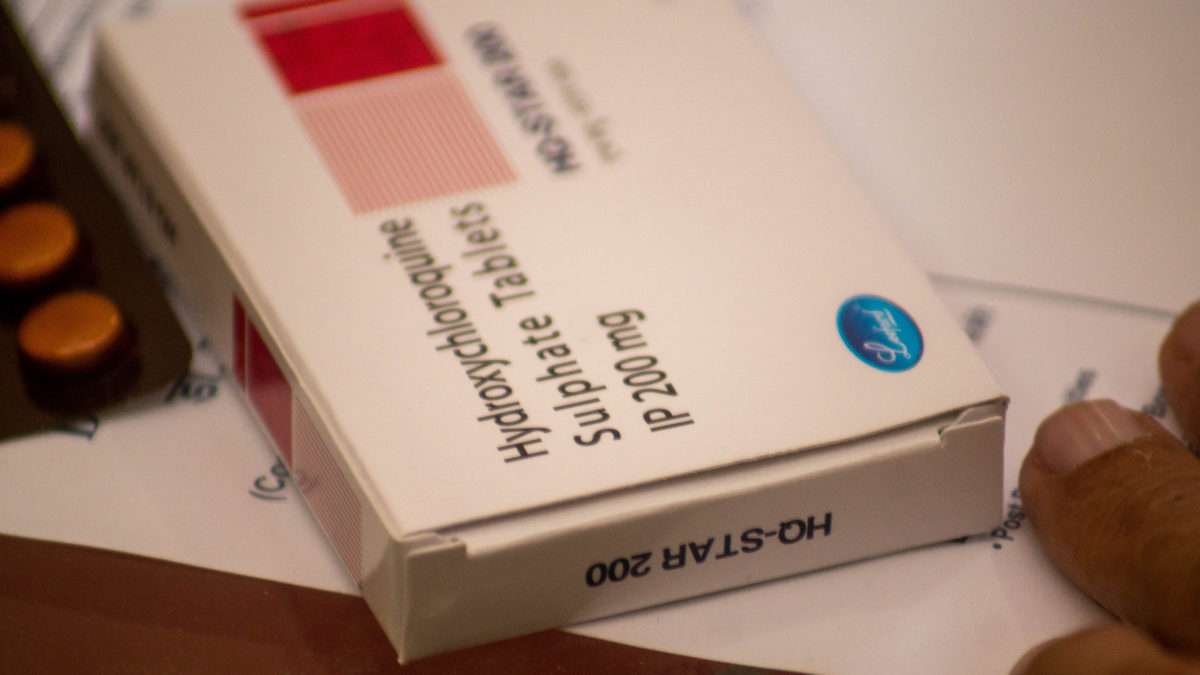
A just-reported Chinese study compares the clinical outcomes of COVID-19 patients treated with hydroxychloroquine with those of patients receiving standard of care. The results, alas, are disappointing.
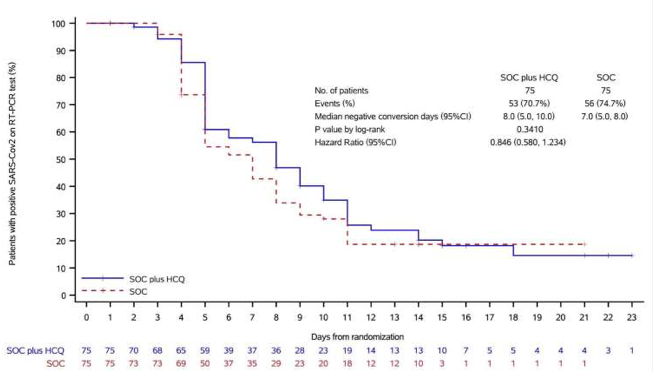
I summarized that study in my roundup yesterday of COVID-19 therapeutic research, pointing out that this randomized controlled trial of 150 patients "found no difference in the rate of viral load reduction or symptom alleviation between the group treated with hydroxychloroquine and the one that had not been." Now the University of Vermont pulmonologist Josh Farkas has published his own analysis of the results, delving more deeply into the data.
The patients in both arms of the study were well-matched demographically and clinically, Farkas notes. Most suffered relatively mild cases of the disease, and treatment was initiated fairly late—about 16 to 17 days after disease onset. Twenty-eight days into the trial, the researchers found essentially no difference between the two cohorts with respect to the percent of patients in which the virus was undetectable.
Farkas adds:
This endpoint most directly addresses the question: does hydroxychloroquine exert anti-viral activity in vivo? The answer seems to be: nope. Even if the drug were administered too late to affect the clinical course of the infection, if it exerted any anti-viral activity then we might expect to see that effect here. If anything, there might be a trend towards delayed viral clearance in patients treated with hydroxychloroquine.
The study also found that fever and respiratory symptoms did not abate any faster in patients who had been treated with hydroxychloroquine.
Farkas acknowledges the study's limits, including its small size and that the researchers were not blinded—that is, they knew which patients were being given the treatment. "Nonetheless," he says, "this study currently represents the highest available quality of evidence regarding hydroxychloroquine."
"For now, the best available evidence does not support the use of hydroxychloroquine in COVID-19," Farkas concludes. "It seems prudent to restrict the use of hydroxychloroquine to randomized controlled studies for the time being." He does acknowledge that future studies in which COVID-19 patients are treated earlier in the course of their infections may yet find that hydroxychloroquine offers some therapeutic benefits. Fingers crossed.
(Helmholtz-Zentrum Berlin für Materialien und Energie) A special branch in the famous NREL-chart for solar cell world records refers to a newly developed tandem solar cell by HZB teams. The world-record cell combines the semiconductors perovskite and CIGS to a monolithic 'two-terminal' tandem cell. Due to the thin-film technologies used, such tandem cells survive much longer in space and can even be produced on flexible films. The new tandem cell achieves a certified efficiency of 24.16 percent.
pregnant women were historically fired for getting pregnant. As a senior american, its a death sentence (literally) for me to be forced to return to my cubicle.
In the fight between the governors and President Trump over who has the authority to reopen America, the politicians have it wrong.
It's not the politicians who have the power to reopen America, or at least the parts that are now closed. It's individuals, families, businesses, and religious congregations.
The politicians can help by eventually lifting lockdown orders and school closures. That will make it easier for individuals, families, businesses, and religious congregations to resume more normal patterns of activity without the hassle of a legal challenge.
But when America reopens, it won't be the response to top-down orders from politicians. That's not how America works, not how the world works. If the president or governor says "open" and hospitals and funeral homes are clogged with Covid-19 critical cases and fatalities, plenty of people are going to remain in place based on the assessment that it's not worth risking death to comply with some politician's restart timeline. America is not a light switch or a sink faucet that can be turned on and off at will.
As Nate Silver, who has been an admirably level-headed guide to the pandemic throughout, put it, "people will vote with their feet."
What are the relevant motives?
Children want to see their parents. Parents want to see their children. Grandparents want to see their grandchildren. People who haven't yet started families want to go on in-person dates.
Business owners want to make money. They've invested labor, capital, and reputation in stores, restaurants, factories, and offices that are now empty or idle. The profit motive is a strong motive. The first restaurant or bar or theater or concert hall or museum to re-open, if it does so safely, will draw a crowd of paying customers.
The religious motive is also strong. The New Boston Post, in a memorable editorial, put it this way: "Christians need churches to tend to their souls….[C]hurch leaders need to begin the process of reopening their churches. By 'process' we mean series of steps that lead to churches eventually reopening their doors to anyone who wants to come….Each bishop or pastor or church council should come up with a plan today that sets forth a date certain when the church these people administer is going to open."
The editorial went on: "Church leaders should begin this process without any regard for the civil authorities. The civil authorities have their proper role, but it is limited. Our federal and state constitutions explicitly limit the role of government when it comes to religion. Can governors order churches to close? No."
Timothy P. Carney, writing in The Washington Examiner, makes a similar point: "Let the church close every other pew. Maybe allow only one family per pew. Pastors could bar socializing, hugging, and shaking hands and instruct every family or individual to stay at least 6 feet away from every other family or individual."
Carney writes, "A well-spaced mass, shul, or worship service in the church building could be far safer than it is currently to shop at Home Depot. Since we allow shopping at Home Depot, let's allow worshiping at church."
Against all these are the motives to stay alive and to avoid infecting others.
Who has the best information to weigh these risks, the costs and benefits of each trip out versus staying home? Not a governor or a president, but an individual. Different people may have different tolerances for risk. For some people that trip to a restaurant or a place of worship may be a risk worth taking. For others it is not. For sure, each individual decision can affect other people—one person who takes too much risk and gets sick means one fewer hospital slot available for someone else. But that is true in many areas of American life, and it hasn't until now caused the country or states to be locked down.
The best plan for reopening America is one that sticks to American values—one that emphasizes freedom, competition, choice, and diversity, not one-size-fits-all compulsion or command-and-control authoritarianism. It's a conception, outlined in the Declaration of Independence and the Constitution, in which government's role is protecting natural or God-given freedoms of individuals, families, businesses and religions, rather than turning them off or on a schedule, even in the service of public health.
Presumptive Democratic presidential nominee Joe Biden has remained largely outside the public view amidst the coronavirus pandemic, but the campaign has continued to eye potential candidates for the former vice president’s 2020 running mate.
While there is no evidence the campaign has made a final decision, the New York Post reports that Senator Amy Klobuchar (D-MN), who ran in the presidential primary as an outspoken Democratic moderate, has been emerging as a favorite among some campaign and party insiders.
According to the exclusive report, a Biden campaign insider recently told the news agency that Klobuchar “could be No. 1” on the former VP’s shortlist. Another party insider, a person who works in the Senate, told the news agency that Klobuchar was the stand-out candidate for the Democratic Congressional Campaign Committee.
The news agency reports that senior party insiders also believe that Klobuchar has the best shot at joining Biden’s 2020 presidential ticket. In descending order of likelihood, party insiders also told the Post that Governor Gretchen Whimter (D-MI), Senator Kamala Harris (D-CA), and Senator Tammy Duckworth (D-IL) also still have a shot at joining the ticket.
Since endorsing Biden last month, Klobuchar has drawn strong buzz as a potential running mate for the former vice president. As The Daily Wire previously reported, the Minnesota senator accidentally told a crowd of Biden supporters last month that she “couldn’t think of a better way to end my candidacy than to join the ticket.”
Although the crowd reportedly cheered after the statement, Klobuchar immediately clarified that she was joining the campaign, not the ticket itself. The remark drew the attention of NBC reporter Amanda Golden, who noted that the senator’s verbal slip-up seemed to be a “bit of a Freudian slip.”
Back at the February debate, Klobuchar was the only candidate to raise their hand after the moderator asked whether any of seven primary candidates would be concerned with a self-described democratic socialist at the top of the ticket in November.
During an interview with CBS News, Klobuchar criticized the other candidates for not speaking out against socialism, but also indicated that she has a friendly working relationship with Senator Bernie Sanders (I-VT).
“The question should be why didn’t everyone else raise their hand,” remarked Klobuchar, reports RealClearPolitics. “I am troubled by having a socialist lead our ticket.”
“I like Bernie, we are friends, he would tell you that as well. We have worked together on prescription drug prices and the like,” said Klobuchar. “But I think a candidate like me, who is able to actually bring in ideas and get them done, and as I’ve said so many times, people are tired of the extremes in our politics and the noise and the nonsense, that they have a home with me. That to me is the ticket of winning big.”
Sanders has since suspended his campaign, but has not explicitly endorsed Biden for president, reports Fox News. The Democratic Socialists of America has also refused to endorse the former vice president.
Footage filmed in Condell Park in western Sydney on Saturday afternoon showed the group of officers bundle one of the men to the ground as another warns a policeman to 'get your hands off me'.
bullshit. This never goes away. Intel Fellow, follow the money folks.
I stop the car when I see him walking slowly down the empty footpath outside our now shuttered building—I know he lives on campus and is far from home. I sent my students away more than a week ago; I think of them as diasporic now, not necessarily remote, but it is still a shock to see him. We talk about his studies, and his fiancée in San Francisco, and how strange this moment in which we find ourselves is—we are at the edges of what language can describe. After one last check-in and the promise to call me if I can help, he says in an awkward voice, “You know I will have to report this.”
The Australian National University (ANU), at which I work, is moving quickly in response to covid-19. Our classes have gone online, and we have sent our staff home; we are all navigating a new world of digital intermediation and distance. For the students who remain in the residence halls, locked in a country that has closed its borders and to which airlines no longer fly, it is an ever-changing situation. Keeping them safe is a big priority; there is social distancing, and increased cleaning and temporal staggering of access to services. There are rules and prescriptions and the looming reality of daily temperature checks. And apparently there is a contact log in which I will now feature, and which could be turned over to the local health services at a later point.
The rigorous use of contact tracing, across digital and physical realms, has been credited with helping limit the spread of covid-19 in a number of places, notably Singapore, Taiwan, and South Korea, as well as Kerala, India. As a methodology, it has a long history of use against diseases from SARS and AIDS to typhoid and the 1918-19 influenza pandemic. In its current instantiations—such as the mobile-phone app that South Koreans exposed to the virus must download so they can be monitored during self-quarantine—it has raised new concerns about surveillance and privacy, and about the trade-offs between health, community well-being, and individual rights. Even here at the ANU, we are trying to find a way to balance it all.
Perhaps we are negotiating new social contracts, with our neighbors, our communities, and our governments, that extend to the role technology plays in responding to a health crisis. And as we negotiate these new contracts, questions inevitably arise about our relationships to the data that exists about us, the sheer abundance of information that we generate, and how it could be used to help us or hurt us.
Imagine doing contact tracing on yourself. Do you know where you were yesterday, and with whom?
It is a lot to contemplate. Imagine doing contact tracing on yourself. Do you know where you were yesterday, and with whom? What you were doing? How about a week ago? Two weeks ago? How would you track back? Your calendar? Your in-box? Your credit card receipts or digital wallet? Facebook? Google Maps? Your mass transit card? Your shared services profiles? Your dating app? Your chat apps? Your smart watch? Your camera? Your phone? Would you rely on your memory or someone else’s? Your digital devices; your data; their data? Could you reconstruct it all?
And if you could, what would it mean and how could it be used, and by whom, for what, and for how long? How would it feel to know you were part of someone else’s reconstruction; that you were a trace in their days and weeks? Or to know that a passing moment was now captured, stabilized, stripped of its context, and used to tell a different kind of story—a story not about two people, but about two possible nodes in an epidemic?
And when you knew the arc of the last two weeks, and all its points of intersection and encounter, whom would you feel comfortable telling? Your kids? Your partner? Your parents? Your best friend? Your lover? Your service provider? Your employer? Your teacher? Your doctor? Your neighbors? Your community? Your government? How would you feel if you didn’t have a choice in the disclosure? What if you didn’t even know disclosure had happened?
As a little girl, I visited Port Arthur with my mother. It was a prison camp, built in Tasmania to house the most recalcitrant prisoners sent to Australia during its early colonial period. In 1853 a new prison was built there, modeled on the Eastern State Penitentiary in Philadelphia and strongly influenced by Jeremy Bentham’s ideas of the panopticon, a prison where every inmate can be watched at all times, but never see the watcher—a proto-version of mass surveillance. In Port Arthur, the guards could see each other, and watch the prisoners, through a small keyhole—colloquially known as a judas hole—in each cell door, placed so that no part of the cell was out of its sight. The prisoners could see no one. In the one hour a day they were released from their cells, they were masked and walked in silence in walled, open-air yards. The life of the prisoner was regimented, documented, and constrained; of course, they found ways to resist and subvert the process, but it was a stark existence. The relationships between power, surveillance, and discipline were clear to me even as a child.
Contact tracing has this kind of history too. It was used to identify Mary Mallon, an Irish immigrant cook, as an asymptomatic carrier of typhoid in 1900s New York City. She was repeatedly quarantined and demonized, and survives to this day in the phrase “Typhoid Mary.” It was deployed at scale during World War II to manage the spread of venereal disease by American soldiers in the United Kingdom—the overlays of nationalism, prurient interest in sex, and power dynamics in gender relationships are all highly visible. In the 1980s in Australia, it was used to identify at-risk communities at the start of the AIDs epidemic, and gay men bore the brunt of conservative politics, religious backlash, and stigma.
The question is, can we imagine contact tracing, and other forms of data revelation, that don’t feel like a judas hole?
Against this backdrop, we might need to reevaluate how we think about “contact” (which in the latter two examples meant sexual contact that society disapproved of) and “tracing” (associated with criminal investigations and punishment) and ask: can we strip them of their moral and punitive overlays? We have to break some of the social and cultural associations of the past to use these tactics most effectively in the future.
So I guess the question is, can we imagine contact tracing, and other forms of data revelation, that don’t feel like a judas hole?
Part of the answer lies in how we think about the basis of contact tracing—data, and its collection. Of course, there are already long-standing worries about the ways large corporations and governments use and control data. There will surely be questions: Who can use the data, or own it? Can data from sources that were originally supposed to stay separate, such as health services and the police, be combined? Will decisions about who gets access to your data be automated, or will humans review them? Will your diagnoses and antibody statuses be shared with other countries when you travel, or will you be tested at the border? Will at-risk people be targeted, and by whom? And let’s not forget that all of this is happening within larger systems and contexts.
Work is already under way in multiple countries on how to better regulate data collection, prevent algorithmic bias, and limit the use of mass surveillance (including facial recognition technology): it will clearly be relevant in answering such questions. So will the regulations and standards currently emerging—mostly from Europe—on privacy, the uses of personal data, and algorithmically enhanced decision-making. And it all needs to happen, as a friend of mine has taken to reminding me, at the speed of the virus—which is to say, very quickly indeed.
However, there is more to unpicking the potential panopticon than merely implementing technical and legal constraints on who controls your data. We might also need to think differently about why the data is being collected, and to what end.
Perhaps we can start by differentiating between three distinct purposes for contact tracing: one centered on public health, another on patients, and the last on citizens. All are necessary; all are different.
Public health is the most obvious focus. This is the sense in which countries like South Korea and Singapore have been doing contact tracing for the coronavirus, as well as the attendant medical interventions—notification, disclosure, registration, isolation, treatment. It is about helping make the best use of finite resources in the name of broader public health: here, contact tracing is how you might contain an outbreak before it gets too big.
The patient-centered purpose requires us to modify our notion of contact tracing to something that resembles a patient journey. Here the focus could be helping someone decide whether and how to seek care, and guiding health-care providers to the appropriate treatment. As one physician put it to me recently, it’s about helping patients “triage their worry”—work out when they should be concerned and, equally important, when they should not. Early examples are being trialed in Massachusetts and elsewhere.
A focus on citizens, however, is something quite different. Can we imagine community contact tracing? It could be a way of identifying hot spots without identifying individuals—a repository of anonymized traces and patterns, or decentralized, privacy-preserving proximity tracing. This data might help researchers or government agencies create community-level strategies—perhaps changing the layout of a park to reduce congestion, for instance. It might help us see our world a little differently and make different choices—a collective curve flattening. We could create open-source solutions or locally based tools.
The speed of the virus and the response it demands shouldn’t seduce us into thinking we need to build solutions that last forever.
In all three contexts, we need to considerably expand our understanding of the data, platforms, and devices that could be useful. Could mobile-phone data identify places that need help in achieving better social distancing? Could smart thermometers help identify potential hot spots? Is community-level data as useful as personal data for mapping an epidemic and the responses to it? We would also need to shift our sense-making around data: the issue we must grapple with isn’t just personal data anymore, or the ideas of privacy we have been contesting for years. It is also intimate and shared data, and data that implicates others. It might be about the patterns, not the individuals at all. How this data is stored and accessed, and by whom, will also vary depending on the tools available for accessing it. There will be many decisions—and, one hopes, many conversations.
The speed of the virus and the response it demands shouldn’t seduce us into thinking we need to build solutions that last forever. There’s a strong argument that much of what we build for this pandemic should have a sunset clause—in particular when it comes to the private, intimate, and community data we might collect. The decisions we make to opt in to data collection and analysis now might not resemble the decisions we would make at other times. Creating frameworks that allow a change in values and trade-off calculations feels important too.
There will be many answers and many solutions, and none will be easy. We will trial solutions here at the ANU, and I know others will do the same. We will need to work out technical arrangements, update regulations, and even modify some of our long-standing institutions and habits. And perhaps one day, not too long from now, we might be able to meet in public, in a large gathering, and share what we have learned, and what we still need to get right—for treating this pandemic, but also for building just, equitable, and fair societies with no judas holes in sight.
Genevieve Bell is director of the Autonomy, Agency, and Assurance Institute at the Australian National University and a senior fellow at Intel.
you will never, i repeat never track me. You have the right to stay home. All I need is a law saying I am >60, so I want a law forcing work from home at reduced pay options. Just like maternity issues. Thats all we need.
At some point covid-19 will be vanquished. By early April some 50 potential vaccines and nearly 100 potential treatment drugs were in development, according to the Milken Institute, and hundreds of clinical trials were already registered with the World Health Organization.
Even with all these efforts, a vaccine is expected to take at least 12 to 18 months to bring to market. A treatment may arrive sooner—one company, Regeneron, says it hopes to have an antibody drug in production by August—but making enough of it to help millions of people could take months more.
It could all be over more quickly if certain existing drugs, already known to be safe for other uses, prove effective in treating covid-19. Trials are now under way; we should know by the summer. On the flip side, it may be that only a vaccine delivers the knockout blow, and even then, we still don’t know how long one will stay effective as the virus mutates.
This is why everything feels unmoored and why everybody is stressed: because we can no longer predict what will be allowed and what will not a week, a month, or 12 months hence.
That means we have to prepare for a world in which there is no cure and no vaccine for a long time. There is a way to live in this world without staying permanently shut indoors. But it won’t be a return to normal; this will be, for Westerners at any rate, a new normal, with new rules of behavior and social organization, some of which will probably persist long after the crisis has ended.
In recent weeks a consensus has started to build among various groups of experts on what this new normal might look like. Some parts of the strategy will reflect the practices of contact tracing and disease monitoring adopted in the countries that have dealt best with the virus so far, such as South Korea and Singapore. Other parts are starting to emerge, such as regularly testing massive numbers of people and relaxing movement restrictions only on those who have recently tested negative or have already recovered from the virus— if indeed those people are immune, which is assumed but still not certain.
This will entail a considerable degree of surveillance and social control, though there are ways to make it less intrusive than it has been in some countries. It will also create or exacerbate divisions between haves and have-nots: those who have work that can be done from home and those who don’t; those who are allowed to move about freely and those who aren’t; and, especially in the US and other countries without universal health coverage, those who have medical care and those who lack it. (Though Americans can now get coronavirus tests for free by law, they may still wind up with hefty bills for related tests and treatment.)
This new social order will seem unthinkable to most people in so-called free countries. But any change can quickly become normal if people accept it. The real abnormality is how uncertain things are. The pandemic has undercut the predictability of normal life, the sheer number of things we always assume we will still be able to do tomorrow. That is why everything feels unmoored, why the economy is collapsing, why everybody is stressed: because we can no longer predict what will be allowed and what will not a week, a month, or three or six or 12 months hence.
Getting to normal, therefore, is not so much about getting back the old normality as it is about getting back the ability to know what is going to happen tomorrow. And it’s becoming increasingly clear what’s needed to achieve that kind of predictability. What we can’t predict, yet, is how long it will take political leaders to do what it takes to get there.
The background
First, let’s look at why simply waiting for a drug or vaccine isn’t a practical option.
One feature of the covid-19 pandemic is the speed with which the unthinkable has become the obvious. In mid-March, the British government was still advocating for letting most people go about more or less their normal daily business, while only the sick and the especially vulnerable isolated themselves. It changed tack rapidly after researchers at Imperial College London published a study showing the policy would lead to as many as 250,000 deaths in the UK.
That study made the case for what almost everyone now agrees is essential: imposing social distancing on as much of the population as possible. This is the only way to “flatten the curve,” or slow the spread of the virus enough to prevent hospitals from being overwhelmed, as they have been in Italy, Spain, and New York City. The goal is to keep the pandemic ticking along at a manageable level until either enough people have had covid-19 to create “herd immunity”—the point at which the virus is starting to run out of new people to infect—or there’s a vaccine or cure.
Waiting for herd immunity is not an idea most experts take seriously. But no matter what the final outcome, some degree of social distancing has to remain in place until we get there. A strict lockdown can slow new infections to a trickle, as it did in China’s Hubei province, but as soon as measures are relaxed, the infection rate starts to rise again.
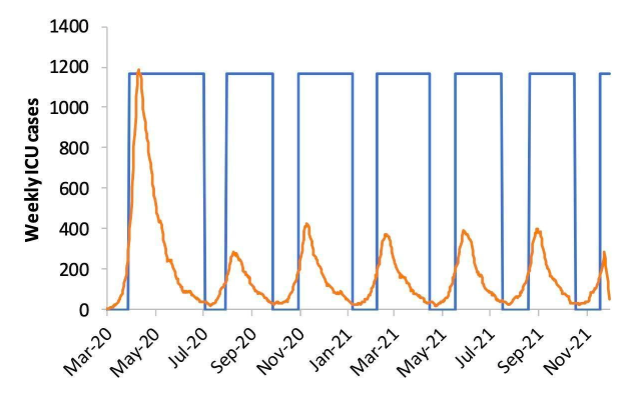
In their report on March 16, the researchers at Imperial College proposed a way of alternating between stricter and looser regimes: impose widespread social distancing measures every time admissions to intensive care units (ICUs) start to spike, and relax them each time admissions fall. Here’s how that looks in a graph.
The orange line is ICU admissions. Each time they rise above a threshold—say, 100 per week—the country would close all schools and most universities and adopt social distancing. When they drop below 50, those measures would be lifted, but people with symptoms or whose family members have symptoms would still be confined at home.
What counts as “social distancing”? The researchers define it as “All households reduce contact outside household, school, or workplace by 75%.” That doesn’t mean you should feel free to go out with your friends once a week instead of four times. It means if everyone does everything they can to minimize social contact, then on average, the number of contacts is expected to fall by 75%.
Under this model, the researchers concluded, both social distancing and school closures need to be in force some two-thirds of the time— roughly two months on and one month off—until a vaccine or cure is available. They noted that the results are “qualitatively similar for the US.”
The researchers also modeled various less stringent policies, but all of them came up short. What if you only isolate the sick and the elderly, and let other people move around freely? You’d still get a surge of critically ill people at least eight times bigger than the US or UK healthcare system can handle. What if you lock everybody down for just one extended period of five months or so? No good—as long as a single person is infected, the pandemic will ultimately break out all over again. Or what if you set a higher threshold for the number of ICU admissions that triggers tighter social distancing? It would first mean accepting that many more patients would die, but it also turns out that it makes little difference: even in the least restrictive of the Imperial College scenarios, we’re shut in more than half the time. That means the economic paralysis lasts until there’s a vaccine or cure.
The tools
Those scenarios, however, assumed that being shut in applies equally to everyone. But not everyone is equally at risk, or risky. The key to getting to normal will be to establish systems for discriminating—legally and fairly—between those who can be allowed to move around freely and those who must stay at home.
First, keep as many people as possible at home until the rate of infections is well under control. Meanwhile, massively ramp up testing capacity, so that once the country is ready to relax social distancing rules, anybody who asks for a test—and some who don’t—can take one and get the result within hours or, ideally, minutes. This has to include testing both for the virus, in order to detect people who are currently sick even if they don’t have symptoms, and for antibodies, in order to find people who have had the disease and are now immune.
People who test positive for antibodies might be granted “immunity passports,” or certificates to let them move freely; Germany and the UK have already said they plan to issue such documents. People who test negative for the virus would be allowed to move around too, but they would have to get retested regularly and agree to have their cell phone’s location tracked. This way they could be alerted if they come into contact with anyone who has been infected.
This new social order will seem unthinkable to most people in so-called free countries
This sounds Big Brotherish, and it can be: in Israel, such automated monitoring and contact tracing is being done by the domestic intelligence agency, using surveillance tools created for tracking terrorists. But there are less intrusive ways of doing it.
The Safra Center, for example, outlines various schemes for “peer-to-peer tracking,” in which an app on your phone swaps encrypted tokens via Bluetooth with any other phones that spend some minimum period of time nearby. If you test positive for the virus, you put that information into the app. Using the tokens your phone has collected in the past few days, it sends alerts to those people to self-isolate or go get tested. Your actual location doesn’t have to be tracked, only the anonymized identities of the people you’ve been near. Singapore uses a peer-to-peer tracking app called TraceTogether, which sends the infection alerts to the health ministry, but—in principle at least— such a system can be set up with no centralized record-keeping at all.
There also needs to be nationwide data-gathering and analysis to better understand how the virus is spreading and spot high-risk areas that might need more testing or medical resources, or another quarantine. This strategy has to include serological surveys—random testing for antibodies to find out how widely the virus has already spread. Some other ways to gauge its prevalence without spying on people directly might be to crowdsource the information using sites like covidnearyou.org, infer it from the volume of Google searches for covid-19 symptoms in different places, or even look for the virus in samples of sewage.
It’s also important to make sure people who have tested positive or been exposed are staying in quarantine. This, however, seems hard to do without more direct surveillance. Countries like Singapore and South Korea use various means, such as making people share their location via WhatsApp or download a specialized tracking app. Whether the US or European countries could impose (let alone enforce) that kind of control isn’t clear. Without it, we have to rely on people to be responsible citizens and self-isolate when necessary.
The point is, there are more and less creepy ways of doing all this, and the crisis could catalyze a broader conversation about how to use people’s data for the collective good while protecting the individual.
The hurdles
Regardless of the methods chosen, the goal is the same: after a couple of months of shutdown, to begin selectively easing restrictions on movement for people who can show they’re not a disease risk. With good enough testing capacity, data collection, contact tracing, enforcement of or adherence to quarantines, and coordination between the federal, state, and local governments, local outbreaks might be contained before they spread and force another national shutdown.
Gradually, more and more people would be able to return to some semblance of normality. It would still be a far cry from the packed bars and sports arenas of the past, but it would be a less unbearable way to wait for the discovery of a vaccine or cure. More important, the economy could start ticking back to life.
This depends on a lot of things going right, though. First, the initial shutdown probably needs to be harsher than it currently is in the US. At the time of writing some US states still had no stay-at-home orders, few cities were enforcing those orders, and there were no restrictions on travel between cities or states. In China, by contrast, cities in Hubei province spent some two months in strictly enforced lockdown, with public transport cut off and inter-city movement restricted.
Second, by some estimates, millions of virus tests a day, promptly performed, may be required to properly keep tabs on the pandemic in the US. By April 8 the country was testing around 150,000 people a day, and many results were taking more than a week to come back.
Third, testing for antibodies is still in its infancy, and most of the tests currently in development still return fairly high rates of both false positives and false negatives, according to the Johns Hopkins Center for Health Security. A plan to order millions of home test kits for the UK ran into trouble after experts found they might work as little as half the time.
Fourth, the US in particular has precious little coordinated national strategy. The chaotic management of the crisis by the Trump administration, the separation of powers between the federal government and the states, and the fragmented nature of privatized health care make it unclear how systems for automated contact tracing, quarantine enforcement, or immune certification will emerge.
That means a reopening of the US in June is optimistic, to say the least, and a reopening by April 30, as President Donald Trump was still hoping for in early April, is a fantasy. But Trump, along with his alter ego, Fox News, has gradually and reluctantly been moving toward a more realistic stance about the pandemic. By the end of March the White House had adopted projections of the death toll in line with those of many experts, even if those projections still assumed stricter social distancing measures than the federal government is currently calling for. As the pandemic spreads further into the country and starts to pummel the more Republican-leaning states, the president’s interests may start to align more closely with those of the country as a whole.
The outcome
This, then, is what passes for optimism in these grim times: the hope that while the days are still warm, and after tens if not hundreds of thousands of lives have been lost that could have been saved with quicker action, some of us will be able to start crawling out into the sunlight. We’ll emerge into a world in which people give each other wide berths and suspicious looks, where those public venues still in business allow only the thinnest crowds to congregate, and where a system of legal segregation determines who can enter them. Millions will still be out of work and struggling to get by, and people will watch nervously for signs of a new flare-up near them.
But as you contemplate that future, spare a thought for the billions of people in the world for whom even social distancing and basic hygiene are unaffordable luxuries, let alone testing, treatment, and technologically advanced governments. The pandemic will roar through the slums of the world’s poorest countries like fire through sawdust. In their considerably younger populations, it will probably be less deadly than in the rich world. But an unchecked pandemic there may also oblige other countries to keep their borders closed for longer to protect their own populations.
A miracle may still happen. Perhaps a readily available drug will work. Perhaps testing will show that the virus is far more widespread and less deadly than we thought. It’s worth hoping for these things, but we can’t bank on them. What we can expect is to have an increasingly clear picture, as the days go by, of how this will play out if we take the right steps.
That’s as normal as things are going to get for a while.
Amazon, the online superstore, has its hands full supplying goods to a quarantined nation while protecting employees from COVID-19.
The behemoth still appears to have found the time to yank a documentary title off its service.
“Hoaxed,” the 2019 film savaging the current state of journalism, is no longer available for rental or digital purchase at Amazon.com. The DVD of the film, featuring rabble-rousing journalist Mike Cernovich, appeared to remain in stock after he Tweeted the news about “Hoaxed” to his followers.
The “Hoaxed” DVD is no longer available now, either.
“Amazon told us that ‘Hoaxed’s’ removal was not a technical issue but that they don’t have to give us any more specific reasons as to why they banned it,” Cernovich said via email.
The film’s co-director, Jon du Toit, confirmed Amazon’s removal.
“They pulled it without giving our distributor, Random Media, any warning,” du Toit said, adding that he’d been told by some who previously bought a digital copy of the film that they can no longer access the documentary.
The film finds Cernovich smiting modern journalists for promoting liberal narratives, ignoring news that matters to many citizens, and giving little attention to the truth. Among the unconventional talking heads assembled for the film – Jordan Peterson, “Dilbert” creator Scott Adams, new media journalist Tim Pool, and InfoWars personality Alex Jones.
It’s possible Jones’ presence alone triggered Amazon’s decision. The conspiracy monger has been deplatformed by Twitter, YouTube, and Facebook. “Hoaxed” paints him in a mostly positive light.
Cernovich has said he’s counseled Jones to tone down his shtick, but he included him in the film because he’s been ahead of the curve on some issues, like Big Tech invading our privacy.
Think Facebook and Amazon’s Alexa device, for starters.
Jones currently appears in “After Truth: Disinformation and the Cost of Fake News,” but he’s framed as a villain, not a savvy pundit. The HBO documentary can currently be viewed via Amazon Prime’s HBO channel.
“Hoaxed” also shows Pool attempting to investigate Swedish police who allegedly avoid neighborhoods where violent Muslim immigrants flourish. Local police not so gently escort Pool from the area in question, and it’s all on video.
Cernovich’s team initially said it didn’t know what made Amazon memory hole their film. His website later posted a story saying the film’s critical coverage of Amazon’s $600 million CIA contract cost him a slot on the service.
Right-leaning artists often get their work booted from big tech platforms, though, often with little or no explanation.
YouTube routinely marks PragerU video lessons as “restricted,” which means they reach a significantly smaller audience. The clips aren’t profane or violent, and PragerU’s attorneys have unsuccessfully, to date, sued to reverse that policy.
Late last year, black libertarian film critic Jacob Smith got temporarily booted from Letterboxd.com, a site allowing members to post their reviews online. The site’s team said Smith had violated its community standards but couldn’t say in what way or how.
The site eventually restored four years’ worth of Smith’s reviews.
Conservative comedian Steve “Mudflap” McGrew spends much of his day in “Facebook jail,” and he often doesn’t know why. The platform says he’s run afoul of Facebook’s spamming features, but he claims he’s following the letter of the social media law.
“Hoaxed” is still available on other platforms, for now, including YouTube, Vimeo, and iTunes. The film shot to the number one spot on the latter’s documentary charts following Amazon’s banning.
Cernovich is right of center, but his film occasionally crosses the aisle to hammer home its points. It even features a member of the Black Lives Matter group. Plus, the film drew praise from at least one left-of-center viewer.
A self-described lifelong liberal cheered “Hoaxed” on Medium.com, including this prescient caveat.
“‘Hoaxed’ will go down as the most subversive documentary, perhaps film, of the current decade.”
Normal life will stay on hold until a virus vaccine becomes available in about 18 months, officials said last night (pictured, police car patrolling with a megaphone at Greenwich Park in London).
i dont see the incentive for me to announce this. My wife is terrified of being "the first case" in our area. That is her fear and she would hide hide hide this....
When it comes to predicting the spread of an infectious disease, it’s crucial to understand what Ryan Tibshirani, an associate professor at Carnegie Mellon University, calls the “the pyramid of severity.” The bottom of the pyramid is asymptomatic carriers (those who have the infection but feel fine); the next level is symptomatic carriers (those who are feeling ill); then come hospitalizations, critical hospitalizations, and finally deaths.
Every level of the pyramid has a clear relationship to the next: “For example, sadly, it’s pretty predictable how many people will die once you know how many people are under critical care,” says Tibshirani, who is part of CMU’s Delphi research group, one of the best flu-forecasting teams in the US. The goal, therefore, is to have a clear measure of the lower levels of the pyramid, as the foundation for forecasting the higher ones.
But in the US, building such a model is a Herculean task. A lack of testing makes it impossible to assess the number of asymptomatic carriers. The results also don’t accurately reflect how many symptomatic carriers there are. Different counties have different testing requirements—some choosing only to test patients who require hospitalization. Test results also often take upwards of a week to return.
The remaining option is to measure symptomatic carriers through a large-scale, self-reported survey. But such an initiative won’t work unless it covers a big enough cross section of the entire population. Now the Delphi group, which has been working with the Centers for Disease Control and Prevention to help it coordinate the national pandemic response, has turned to the largest platforms in the US: Facebook and Google.
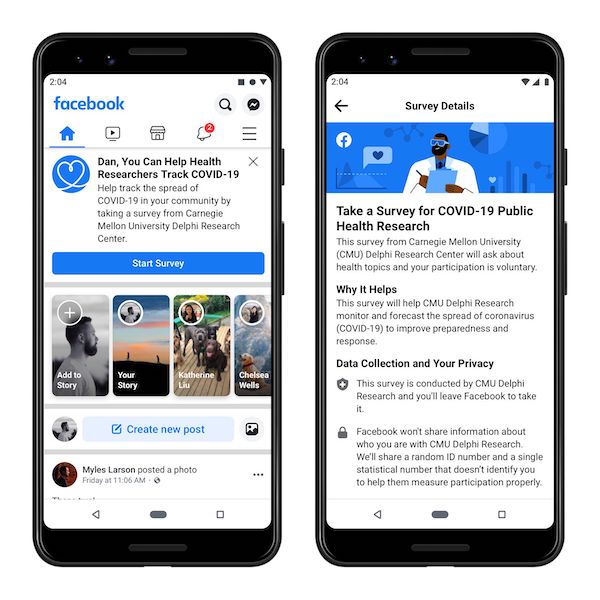
In a new partnership with Delphi, both tech giants have agreed to help gather data from those who voluntarily choose to report whether they’re experiencing covid-like symptoms. Facebook will target a fraction of their US users with a CMU-run survey, while Google has thus far been using its Opinion Rewards app, which lets users respond to questions for app store credit. The hope is this new information will allow the lab to produce county-by-county projections that will help policymakers allocate resources more effectively.
Neither company will ever actually see the survey results; they’re merely pointing users to the questions administered and processed by the lab. The lab will also never share any of the raw data back to either company. Still, the agreements represent a major deviation from typical data-sharing practices, which could raise privacy concerns. “If this wasn’t a pandemic, I don’t know that companies would want to take the risk of being associated with or asking directly for such a personal piece of information as health,” Tibshirani says.
Without such cooperation, the researchers would’ve been hard pressed to find the data anywhere else. Several other apps allow users to self-report symptoms, including a popular one in the UK known as the Covid Symptom Tracker that has been downloaded over 1.5 million times. But none of them offer the same systematic and expansive coverage as a Facebook or Google-administered survey, says Tibshirani. He hopes the project will collect millions of responses each week.
Tibshirani doesn’t know whether the collaborations with Facebook and Google will last once the pandemic is over. Without the urgency and pressure of the global crisis, he isn’t sure the platforms or their users will still be willing to give up such intimate health information. But he and the rest of the lab are grateful for what they are getting now. “I think that this has the potential for enormous impact,” he says.
we need govt approved bluetooth headsets with identical volumes...
This was supposed to be the moment for introverts—the disaster preppers of our new, covid-ravaged social lives. Those who cherished their time alone at home were already experts at voluntary self-isolation. Once, backing out of happy hour at a bar to read a book made you a bad friend. Now it’s patriotic.
In a TikTok from early March with 1.8 million views, an introvert watches the news, singing along with Phil Collins (“I’ve been waiting for this moment for all my life”) as the media tells him to stay home and avoid people. Introverts have published expert guides to staying at home and meditations on the joy of “flaking” on social plans. In the Atlantic, Andrew Ferguson wrote that covid isolation has “relieved considerable pressure on the introvert community,” the longtime “hopeful practitioners of antisocial distancing.”
But as people began to adjust to isolation, they started to find ways to bring their outside social lives into their homes. Living rooms that were once a sanctuary from people-filled offices, gyms, bars, and coffee shops became all those things at once. Calendars that had been cleared by social distancing suddenly refilled as friends, family, and acquaintances made plans to sip “quarantinis” at Zoom happy hours, hold Netflix viewing parties, or just catch up over Google hangouts.
People are coping with the coronavirus pandemic by upending their lives and attempting to virtually re-create what they lost. The new version, however, only vaguely resembles what we left behind. Everything is flattened and pressed to fit into the confines of chats and video-conference apps like Zoom, which was never designed to host our work and social lives all at once. The result, for introverts, extroverts, and everyone in between, is the bizarre feeling of being socially overwhelmed despite the fact that we’re staying as far away from each other as we can.
“I was into it at first—it was kind of fun,” says Tarek, a law student in New York. “It was nice knowing people were going through this together.”
But three long days of classes on Zoom, virtual extracurricular meetings, and nightly check-ins with friends and family left him drained. Soon, he stopped picking up when his friends rang. He just needed some time alone.
Turning down invitations to talk to people during a global pandemic can simultaneously be needed self-care and something that makes you feel like a bad friend. After all, how do you tell your group chat of college friends that you just need a night alone at home when you’re alone at home all the time?
“There’s no way you can pass that off as having other plans,” says Jaya Saxena, a staff writer at Eater, who is currently socially distancing with her spouse in her apartment in Queens, New York. “The only excuse is ‘I don’t want to,’ and no one wants to hear that right now.”
Extroverts and introverts are the subjects of many personality-driven online memes, like astrology signs or Hogwarts houses. It can give a bit of an exaggerated impression. The reality is that introverts don’t want to be alone all the time, and extroverts can appreciate moments of quiet. But the division exists as a way to describe how people gather their energy: introverts charge up by having quiet time to process, and extroverts do it by socializing.
Everybody is processing a lot of anxiety right now about the spread of coronavirus, says Pamela Rutledge, a social scientist and director of the Media Psychology Research Center. But their lives at home—and the ways they process that anxiety—are vastly different. For some, staying home means solitude and a lot of extra time. Others are trying to finish school, homeschool children, or work under difficult conditions. As one group looks for things to do, the other longs for a free moment to leave the home and hunt for toilet paper.
Introverts socially distancing with others might feel an additional layer of stress, even before the first virtual happy hour invitation, Rutledge notes. “Staying at home with others places a burden on introverts because they are not wired for full-time interaction,” she wrote in an email.
Saxena doesn’t think of herself as particularly introverted. She had a tendency to overschedule herself when there were open restaurants to go to after work. But after sitting down one day to schedule another Zoom happy hour, and seeing that she’d filled the next four nights of her calendar with virtual social gatherings, she realized she wasn’t really getting much out of video chats. She needed a break.
“I feel like an asshole for feeling this way. I love my friends. I like talking to them,” she says. And worse, she knows that these video hangouts have become a lifeline for others in a crisis: “It feels like every interaction is a matter of everyone’s mental health hinging on this thing. You don’t want to let anyone down.”
Everything feels like a meeting
Video chat has become the go-to substitute for many people’s discarded social lives, the place where they can see the most of the people they can no longer be with. Zoom, FaceTime, and Google Hangouts are easy to use. But they have a way of making everything feel like a meeting. At a happy hour of 10 people in a bar, you can settle into a side conversation, step away for fresh air, or listen to a conversation while nursing your drink.
Virtual happy hours eliminate that extra space, and do not “necessarily allow for time, reflection, and processing,” Jennifer Grygiel, an assistant professor of communications at Syracuse, told me in an email. “It doesn’t really allow for those pauses in conversation that you might experience on walks with friends.”
Stacy, who works for an ed-tech company near Albany, knows how that feels. She used to meet friends a few times a week to play Dungeons & Dragons. (Like Tarek, Stacy asked to be identified by her first name only.) Now, those physical games have moved online, through the same laptop camera that provides a portal to all her work meetings. The game is still fun, but it’s hard to relax. The video sessions have lag times; people speak over each other or not at all.
“We can’t necessarily read body language,” Stacy says. “So there’s people who will start to talk over each other, and then nobody talks. Just that tiny aspect of not being able to understand and watch other people’s body language, that minute lag.”
“We don’t have a ‘normal’ for Zoom when it’s used just as a conversation,” says Rutledge. “We have a ‘meetings’ mental model which suggests meetings are scheduled, they last for a while, and you look reasonable and have your camera on.”
Video chats, phone calls, and game nights won’t replace a hug or a shared meal. But there are, at least, ways to make the tools work a little better for those who feel drained.
Tarek learned that turning off the ability to view himself on camera during Zoom lectures helped him feel less as though every video chat was an interview. Rutledge suggests eliminating the video altogether: “In phone calls, you don’t feel any length constraints—it might be long or short—and you can walk around, do other stuff, and are not being observed,” she said. And set time limits, she says: “It’s okay to hang up.”
For others, structuring the calls might help. “People may try cooking while Zooming, or playing simple games, to allow for more natural pauses in chatter,” says Grygiel. “Folks may also consider going back to writing longer-form email to each other.”
But Grygiel cautioned against going back even further to letter writing: not everyone is privileged enough to stay at home all day and wonder how to best stay in touch with their friends online. As some manage Zoom social engagements and Instagram and sourdough starters, other people have to be out there delivering those letters.
The next "decision" will be limited in-store shopping and groups increased from 10 to 50.
anyone want to take my bet?
Dominic Raab took charge of Britain's battle against coronavirus on Tuesday as acting Prime Minister - but was warned just to 'hold on to the steering wheel'.
Any bets on when gathering of 10 is increased to 100?
U.S.—As of this weekend, based on recommendations from the Center for Disease Control and the World Health Organization, all civil libertiess have been declared nonessential. The Department of Homeland Security released a statement declaring that any human rights outlined in such documents as the Bill of Rights, the Constitution, or the Bible are nonessential and will, therefore, be disregarded amid the outbreak of COVID-19.
a six pack of beer is what we put out on christmas.
Joe Connolly from Bishop's Stortford, Hertfordshire came up with the idea to say thank you to refuse collectors who are continuing to provide a vital service despite the threat to their health.
Abott labs is a player in this. They are going to boycott cheap existing solutions. For petes sake, we must have cocktails for viruses and not expect designer drugs for everything...
More good news: Hospitalizations of patients drop 20 percent in Washington; Blood-plasma treatment looks promising; Americans eager to book cruises.
There is almost nothing more important to understand about people than intelligence. It can be measured more accurately than anything else in the social sciences. It differs tremendously and importantly between individuals. It is the single most important determinant of life success. It's very existence, however, remains subject to substantive debate, most of it highly politicized. Dr. Richard Haier has recently written a major book on the topic, The Neuroscience of Intelligence (http://amzn.to/2em55A9), summarized in the following manner: "This book introduces new and provocative neuroscience research that advances our understanding of intelligence and the brain. Compelling evidence shows that genetics plays a more important role than environment as intelligence develops from childhood, and that intelligence test scores correspond strongly to specific features of the brain assessed with neuroimaging. In understandable language, Richard J. Haier explains cutting-edge techniques based on genetics, DNA, and imaging of brain connectivity and function. He dispels common misconceptions, such as the belief that IQ tests are biased or meaningless, and debunks simple interventions alleged to increase intelligence. " We recently spent an hour and a half talking about such things. For more information about Dr. Haier, see: http://www.richardhaier.com/ 12 Rules for Life Tour: https://jordanbpeterson.com/events/ My new book: 12 Rules for Life: An Antidote to Chaos: jordanbpeterson.com/12-rules-for-life/ Audiobook now available for Maps of Meaning: The Architecture of Belief: jordanbpeterson.com/maps-of-meaning/ Dr Jordan B Peterson Website: jordanbpeterson.com/ Self Authoring Suite: selfauthoring.com/Understand Myself personality test: understandmyself.com/Podcast: jordanbpeterson.com/jordan-b-peterson-podcast/Reading List: jordanbpeterson.com/reading-list/great-books/Twitter: twitter.com/jordanbpetersonPatreon: www.patreon.com/jordanbpeterson
corvid will most certainly give the US their excuse to begin-the-recession.
Despite record unemployment claims exceeding 3 million in one week, President Donald Trump's administration is rapidly expanding H-1B, H-2A and H-2B foreign worker programs to take Americans' jobs and suppress wages.
...
Actor Tom Hanks and his actress wife Rita Wilson have returned to the United States after recovering from the China-originated novel coronavirus, or COVID-19.
“Tom Hanks and Rita Wilson are coming home,” a report from E! News said Friday. “A source close to Hanks and Wilson, who were both diagnosed with coronavirus two weeks ago, confirmed to E! News that they’ve returned to Los Angeles after recovering from the virus in Australia.”
A photographer captured a snapshot of the duo smiling in their car, apparently driving through Los Angeles, the outlet noted.
Hanks and Wilson were some of the first visible celebrities to test positive for the virus, giving COVID-19 a Hollywood face.
On March 11, Hanks shared a statement on social media announcing the positive tests and offering the public insight into their conditions.
“Hello folks,” the “Forest Gump” actor started the post. “Rita and I are down here in Australia. We felt a bit tired, like we had cold hands, and some body aches. Rita had some chills that came and went. Slight fevers too. To play things right, as is needed in the world right now, we were tests for the Coronavirus, and were found to be positive.”
“Well, now. What to do next?” he continued. “The Medical Officials have protocols that must be followed. We Hanks’ will be tested, observed, and isolated for as long as public health and safety requires. Not much more to it than a one-day-at-a-time approach, no?”
Keeping in-line with the parents’ transparency, even rapper son Chet Hanks offered an update on the famed actors.
“What’s up everyone?” the 29-year-old said. “Yeah, it’s true. My parents got coronavirus. Crazy. They’re both down in Australia right now because my dad was shooting a movie down there.”
“I just got off the phone with them. They both are fine,” Chet, shirtless, continued. “They’re not even that sick. They’re not worried about it.”
“They’re not trippin’, but they’re going through the necessary health precautions, obviously,” he said. “But I don’t think it’s anything to be too worried about.”
“I appreciated everyone’s concern and the well wishes, but I think it’s all gonna be alright,” the rapper closed. “But, I appreciate it. And, just, everybody stay safe out there. Much love.”
Since Hanks and Wilson’s announcement, other celebrities have come forward to share that they, too, have been infected by the virus, including British actor Idris Elba and former “Lost” star Daniel Dae Kim.
Kim is seemingly in recovery now, as well. The actor said in a video posted to social media last week that he credited his recovery to the “secret weapon” President Donald Trump-touted drug hydroxychloroquine.
“I need to say this in bold letters: Obviously, I am not a doctor, nor am I lawyer … So please don’t take my word as that of a medical professional,” emphasized Kim.
“That said, here is a treatment protocol I followed as prescribed by the amazing doctor,” he said. “It was what’s called a drug cocktail, which means it’s a combination of different drugs. It consisted of Tamiflu, which is an anti-viral, the antibiotic azithromycin, more commonly known as a ‘Zpack,’ a glycopyrrolate inhaler, that was used to ease breathing and the inflammation commonly associated with COVID.”
“And here’s what I consider to be the secret weapon: hydroxychloroquine,” Kim added. “This is a common anti-malarial drug that has been used with great success in Korea in their fight against the coronavirus. And yes, this is the drug that the president mentioned the other day.”
From Hong Kong, South China Morning Post CEO Gary Liu tracks China's response to the coronavirus pandemic -- from the initial outbreak in Wuhan to the shutdown of Hubei province and the containment measures taken across its major cities. Sharing insights into how the culture in places like Hong Kong and South Korea contributed to fast action against the virus, Liu identifies lessons people across the world can use to stop its spread. (This virtual conversation is part of the TED Connects series, hosted by head of TED Chris Anderson and current affairs curator Whitney Pennington Rodgers. Recorded March 25, 2020)
When a large asteroid hit the Earth 66 million years ago, it sent huge curtains of dust flying tens of kilometres up into the air that quickly covered the planet
Alan Dershowitz believes Jeffrey Epstein killed himself at Metropolitan Correctional Center in New York last Saturday because 'he didn't want to spend the rest of his life in prison'.
so you have fired me up. Kudos. So you published something correct, who cares. Until you load your gun in America, nothing changes.
On March 23, the City of Denver issued a “shelter in place” order designed to check the spread of COVID-19. The order prohibits travel and most business and recreational activities, subject to a long list of exceptions. It suffers from serious constitutional defects and should be challenged in court.
As a preliminary matter, I should say that, like many bureaucratic pronouncements, this decree seems to have been thrown together by people with inadequate understanding of the complexities of life and under political pressure.
For example, it defines as “essential activities,” and therefore exempts “Skilled trades such as electricians and plumbers.” The exemption appears under an “infrastructure” heading, but the wording suggests the trades are exempt without regard to the kinds of jobs the tradesmen are working on. So, is the skilled trade of a TV repairman included? What of a carpet layer? Is a trained legal secretary a member of a “skilled trade?” These questions illustrate some of the order’s drafting defects.
Some exemptions in the order are clearly political rather than heath related. One example is the flat exemption for the mass media (presumably so politicians stay on their good side). Another is for visits to liquor stores and marijuana shops that practice social distancing (presumably so politicians stay on the good side of people who like such substances). But if liquor stores and pot shops that practice social distancing are okay, then why can’t we go to cigar dens or museums or concert halls that do the same?
As a practical matter, the notion that a politician or bureaucrat can distinguish essential and non-essential trades is fanciful. The economy is highly interdependent. Essential personnel and activities rely on “non-essential” personnel and activities in ways few career government people can fathom.
Some parts of the order are simply incoherent. For example, it provides that “All individuals anywhere in the City and County of Denver . . . are ordered to stay at their place [sic – should be “places”] of residence.” Well, that makes sense if you are a Denver resident. But how can non-residents who happen to be “in . . Denver” be “ordered to stay at their place[s] of residence” if they have no residences in Denver?
Now, as to the constitutional issues. They come in two categories. The first involves the scope of the work and travel bans. The others are more specific.
To understand the “scope” issues, you need to know the following:
* The Supreme Court holds that the right to travel is a “fundamental” right—akin to freedom of speech or religion.
* The Supreme Court cases that rule on the subject involve the right of interstate travel. But local travel would seem to be even more important to most people in daily life than interstate travel and entitled to even more constitutional protection.
* For a government regulation such as Denver’s to substantially burden a fundamental right, the Court states that the government must prove the regulation is “narrowly tailored to advance a compelling governmental purpose.” In other words, the government must prove (1) the goal is very important (such as national defense) and (2) the method the government uses to advance that goal is closely targeted to it. You can’t use a shotgun to kill an ant.
* Thus, when government tries to impede the right to travel, the government carries the burden of proving that its goal is “compelling” and that it can’t achieve that goal by narrower means.
Now, let’s agree that fighting the Corona Virus is a “compelling governmental purpose.” Is the Denver order “narrowly tailored” (targeted) to accomplish that goal?
Not at all.
As a general matter, we really don’t have proof that stay-at-home orders are effective in controlling the virus. In theory they should be, because they presumably reduce social contact. But Italy has the longest experience with such orders, and according to the Italian Ministry of Health, the contagion rate in that country continues to soar. In addition, confining people to their homes carries some health risks of its own.
But assuming shelter-in-place orders do work, that doesn’t make the Denver order constitutional. It is too scatter-shot. It is under-inclusive in a few places and way over-inclusive in others.
For example, the part of the order limiting mass transportation makes perfect sense: In buses and trains people are often crowded. But why restrict travel by car, motorcycle, or scooter? Those are solo or small group activities. People don’t get infected across vehicle lines. By banning travel in private vehicles, the order is over-inclusive: It is too broad, not “narrowly tailored.”
The order has other elements of both over- and under-inclusiveness. It is under-inclusive in that some industries or trades enjoy wholesale exemptions (partly for political reasons?) while others—no matter how carefully conducted—do not. Thus, a reporter headed for a crowded news room is covered by the unconditional exemption for mass media. But a custodian is banned from cleaning up an office after business hours are over and Denver residents are prohibited from traveling even to remote, unpopulated areas.
Now let’s look at the other, specific constitutional problems:
Interstate travel: It is exceedingly doubtful that Denver may impose a ban on interstate travel for those passing through on journeys elsewhere. And millions of people do: Denver sits at the junction of I-25 and I-70. The order does have an exception for travel back to one’s home outside Denver. But it needs to contain an exception for anyone traveling through as well.
Interstate commerce. Denver’s order could be an unconstitutional restriction on interstate commerce. Although it exempts “Businesses providing mailing and shipping services, including post office boxes,” it is not clear what “shipping” means. Normal rules of legal interpretation suggest that “shipping” means services analogous to the postal service, such as UPS and FedEx. So is Denver presuming to ban other long-distance trucking through her boundaries? Good luck on that one!
First Amendment Religion Clauses. The order exempts “Faith-based establishments and houses of worship.” I’m personally sympathetic to that. But the Supreme Court has said the First Amendment bans discrimination in favor of religion as well as discrimination against religion. Why is a gathering for, say, Muslim worship protected while an assembly of a humanist group such as Ethical Culture is not?
It is a maxim of life that people tend to over-estimate the value of their own activities at the expense of those they don’t know or understand. Hence the saying, “If your only tool is a hammer then every problem looks like a nail.”
The “hammer” of government officials consists of law, regulations, and decrees—actually more of a sledgehammer. In this case, Denver has used that tool improperly: It has overreacted and has potentially violated the constitutional rights of city residents and of millions of others.
if you are studying IT, you are an idiot. Those are the new manufacturing jobs, GONE.
Those in Generation Z are the youngest alive, but their advanced wisdom is considered to be ahead of their years. Today, the average teenager and young adult is all business, putting the bulk of their focus on their future.
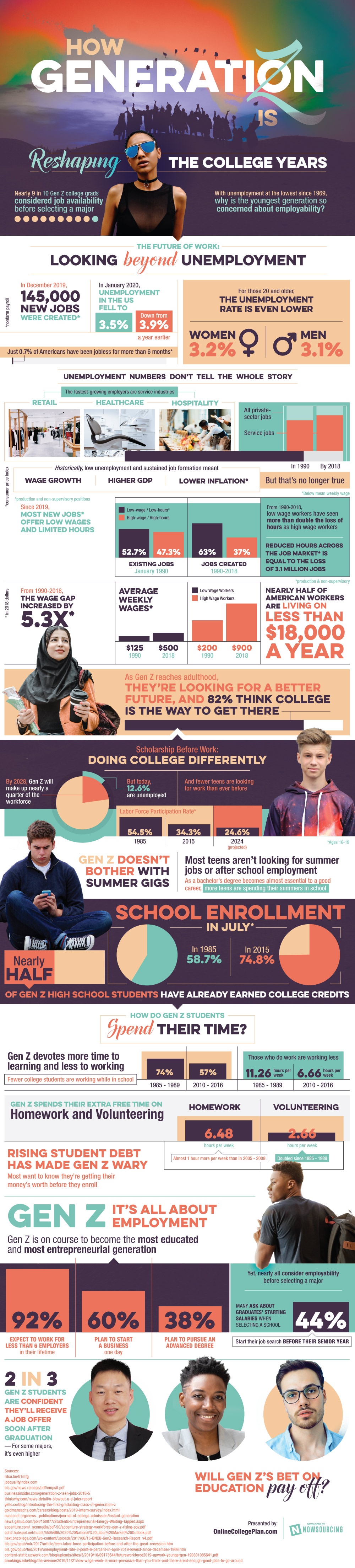
Gen Zers are privy to a high-level of socioeconomic consciousness, such as the fact that nearly half of the American workforce is living on less than an $18,000 annual income. As their generation approaches adulthood, they’re searching for a better future than the economical climate they’re observing — and 82% consider college the most realistic way to get there.
To do so, the Gen Z population is completely reshaping how we interact with higher education. At large, students are prioritizing scholarship before work, not even showing interest in summer gigs and after-school jobs. Even though 12.6% of their generation is unemployed, Gen Z will go on to make up nearly a quarter of the American workforce by just 2028. More importantly, this is their preference. But why?
Rising student debt has made Gen Z reluctant toward higher education. This isn’t to say our youngest generation isn’t attending college, because this isn’t the case. Instead, students are taking more strategic approaches in the ways they choose which college to attend and the financial packages they receive. Most just want the assurance they’ll get their money’s – and degree’s – worth before enrolling into a specific university.
This is why we’re seeing more K-12 students grow interest in their education. I bet you never thought you’d see a statistic telling you that students are obsessed with learning. Spending almost one hour more per week than within the years of 2005-2009, the average
Gen Z student spends 6.48 hours per week on homework. The number of students engaging in volunteer work has also grown. In fact, it has doubled since 1985-1989, as the average student dedicates 2.66 hours per week to volunteer work.
Furthermore, nearly half of Generation Z high school students have already earned transferable college credits. This is just another example of how today’s youngest generation is ahead of the game. To put it numerically, 74.8% of 2015’s high school students had earned college credit before completing their K-12 career. In 1985, this number was significantly less — only 58.7% of students achieved this. However, the availability for dual-credit courses was not at the level it is today.
Upon entering college, the generation’s ambition still seems to grow strong. Today, fewer college students than ever are working while in school. Why so? To Gen Zers, education trumps all. However, some do work — they’re just working less.
From 2010-2016, college students worked an average of 6.66 hours per week. During 1985-1989, this number was dramatically higher, and the average college student worked 11.26 hours per week. To put these numbers in another form, 57% of college students held a job from 2010-2016. In 1985-1989, 74% of college students held employment.
Now let’s relate this to national employment.
In December 2019, 145,000 new jobs were created in the U.S. The following month, unemployment fell to 3.5%, which was down from the 3.9% unemployment rate the following year. For those aged 20+, the unemployment rate is even lower. Women older than 20-years-old fall into an unemployment rate of 3.2%, men: 3.1%. Interestingly enough, only 0.7% of Americans have been without work for more than six months.
Still, unemployment numbers don’t describe the entire dynamic of America’s future job market that Gen Z is preparing themselves for. Nearly 9 in 10 of Gen Z college graduates took their desired field’s job availability into account before selecting a major. Today, the fastest-growing American employers are within the service industry, including: retail, healthcare, and hospitality.
However, it’s not even in the interest of most Gen Z students to enter the fields they’re cushioning themselves to fall back on. 92% of Gen Z students expect to work for less than six employers throughout their lifetime. In further ambition, 60% plan to start a business someday, and 38% plan to pursue an advanced degree.
For Gen Z, it’s all about employment. In fact, Gen Z is projected to become history’s most entrepreneurial and educated generation yet. Check out the infographic below for the complete analysis explaining how Gen Z is reshaping the college years.
Source: Online College Plan
send in the red cross. Natinoal Guard goes in, you no longer have my vote. This is bullshit
The disaster declaration will provide federal assistance for both emergency protective measures and crisis counseling in Washington, the White House said.
Tina Brown was never sexually harassed by Harvey Weinstein, however in 1998, she began a business partnership with Weinstein founding a new magazine following her success rebooting The New Yorker.
She describes the experience as a "colossal mistake" and Weinstein as a brutal bully who abused and humiliated his staff and left Brown shell-shocked. The venture was dropped, and Brown's regret is that she didn't pull the plug as soon as she learned what Weinstein was like behind closed doors.
Before you get into business with anyone, get to know who they are, advises Brown. Make phone calls to people who have worked with them in the past, and draw a line in the sand so you do not become roped into a bully's world.


 It all adds up to a huge amount of electricity consumption and carbon emitted, both embodied and operating.