during a virtual meeting today, i single handedly convinced my boss to let us work from home forever, and come in to work once in a while for perhaps staff meeting!
Dilbert readers - Please visit Dilbert.com to read this feature. Due to changes with our feeds, we are now making this RSS feed a link to Dilbert.com.
Matt Braynard, Executive Director of Look Ahead America, is being threatened and harassed by Dominion Voting Systems for being a vocal advocate for election integrity. Look Ahead America is a 501(c)(3) nonprofit dedicated to standing up for patriotic Americans and their right to a fair election. Along with fighting corporate censorship, the organization’s principal goal is to ensure voter integrity by investigating cases of illegal ballots and advocating for election reform to prevent them from being cast in the first place.
Dominion’s First Threatening Letter
Launching their attack on Braynard, Dominion’s counsel, Clare Locke, sent their initial threatening letter on Feb. 11. The letter’s first paragraph reads, “Our firm is defamation counsel to Dominion. With this letter, Dominion formally demands that you cease and desist promoting bogus claims about the election being stolen.”
According to Braynard, the letter’s first sentence, which he says is full of false and misleading claims about his work and him personally, is untrue. He is certain he has never stated that the 2020 election was stolen. Instead, he has been entirely consistent in stating the conclusion of his work, which is:
“Thenumber of illegal ballots surpasses the margin of victory in enough states such that the deserved winner of the presidential election is unknowable.”
Incorrect statements continue in the letter, according to Braynard, with the allegation that he has stated that Dominion is responsible for voter fraud irregularities. Braynard maintains that while others have made defamatory comments about Dominion, his work on election integrity has been explicitly focused on illegally cast ballots. Therefore he questioned the motive behind their baseless letter, which included no reference to his astonishing illegal ballot discoveries in the 2020 election. Braynard highlights one sentence that stuck out and to him, revealing the main objective of Dominion’s letter: “We demand you retract calls to boycott Dominion.” The letter continues, saying:
“Make no mistake, Dominion is determined to set the record straight and to defend its good name. We have already filed suits against Sidney Powell and Rudy Giuliani. More will follow. We are enclosing copy of Dominion’s complaints against Powell and Giuliani (and the voluminous exhibits supporting those complaints) so that there is absolutely no doubt in the future that you are fully aware of the facts and that you know your accusations about Dominion are false.”
The letter states Braynard “must preserve, without limitation, all communications” with:
Any member, volunteer, staff, or employee of the Trump campaign;
Sidney Powell, Rudy Giuliani, Jenna Ellis, L. Lin Wood, and each of their partners, associates, and paralegals;
Every individual who assisted you in drafting, or drafted for you, any and all affidavits or declarations you submitted in litigation related to Dominion or the November 2020 presidential election;
Every individual who assisted you in drafting, or drafted for you, any and all prepared remarks related to Dominion or alleged voting improprieties.
Every reporter, editor, blogger, host, or other members of the media with whom you communicated about Dominion or the November 2020 presidential election, regardless of whether they published any of your claims; and
Every individual who has compensated you or any related entity in any manner for making public statements about, submitting affidavits or declarations in litigation
Braynard is represented by attorney Harmeet Dhillon, who characterized Dominion’s claims in her email response to Clare Locke as frivolous, factually and legally baseless, and nothing more than “an attempt to harass and intimidate Mr. Braynard and chill his constitutionally protected free speech, dressed in the mock-serious garb of a legal demand letter purporting to assert valid legal claims where none exist. Mr. Braynard will not be intimidated by these thuggish tactics.”
Dhillon points out that Dominion’s letter “fails to even address, much less refute, Mr. Braynard’s findings.” Instead, by mentioning correspondence with Rudy Giuliani and Sidney Powell, it suggests that Mr. Braynard could be a potential witness in the lawsuits filed against them by Dominion and is nothing short of an attempt at witness intimidation, ultimately affecting the possible future testimony of her client.
Dominion’s Second Threatening Letter
Dominion’s most recent letter to Braynard, dated Feb. 26, again claims he made two false statements about the company, claiming it has “a monopoly on U.S. elections“ and that its equipment and software is “unavailable for examination by government officials.” In closing, the letter again asked Braynard to “retract his false claims” and renewed the request that he “retain all materials relevant to his claims about Dominion.”
In response to these claims, Dhillon specifically points out that Dominion meets at least two of the criteria for the definition of “monopoly,” adding:
“The Supreme Court of the United States has defined monopoly power as “the power to control prices or exclude competition.” Dominion arguably has such power, given the acknowledgment by Dominion companies on their website that their products are employed in nine of the top twenty counties in America and are used by 40% of U.S. voters.”
Figure 2b illustrates the number of voters each vendor reaches in absolute terms, 2017. Wharton Industry Report, The Business of Voting
In addressing Dominion’s claim that Braynard wrongly accused its software of being unavailable for examination by government officials, Dhillon corrects them to what Braynard actually said, which was that “Black box voting equipment runs on software and hardware that is a corporate secret and unavailable for examination by government officials and the public.” She explained in further detail:
“While Dominion may allow a certain federal government agency to audit or test its equipment and software in a limited fashion from time to time, it is still the case that the actual government parties that contract with Dominion are unable to “examine” the equipment and software in detail. Dominion’s software is known colloquially as “black box,” not open source, and thus as a practical matter, cannot be inspected or audited. This fact has been widely reported in the media—for example, one report on Dominion’s contract with Michigan provides that the Dominion required that the state “agree not to reverse engineer or otherwise attempt to derive the [Dominion] source code.” Georgia state senator Elena Parent also recently testified that state officials were not allowed to inspect Dominion’s source code.”
Black-Box Voting Equipment
Black-box voting equipment is in the systems Dominion sells for hundreds of millions of dollars to counties and states across the country. A key policy objective of Look Ahead America is to forbid the use of black-box voting equipment in future elections. Braynard explained further why Dominion is trying to silence him on this issue:
Black box voting equipment runs on proprietary software and hardware that is a corporate secret and unavailable for examination by the public and government officials. For this principled reason, and many others, Look Ahead America is leading the fight against its use in U.S. elections, and his mission has broad, bipartisan support and is backed by peer-reviewed science. And this is the real reason why Dominion is coming after me—because they’re worried about their bottom line and their monopoly on U.S. elections.
Concerns over voting irregularities in Dominion machines are a bipartisan issue. In a December 2019 letter to Dominion Voting Systems, Democratic Sens. Elizabeth Warren, Ron Wyden, Amy Klobuchar, and Congressman Mark Pocan warned about reports of machines “switching votes,” “undisclosed vulnerabilities,” and “improbable” results that “threaten the integrity of our elections.”
Braynard has pledged to continue to speak out against black box voting equipment and affirms that Look Ahead America will continue to lead the way in getting it banned in the United States. Braynard’s message to the rapidly growing tech firm is clear: “I am sorry, Dominion, but you picked the wrong fight with the wrong guy.”
Over four thousand people who responded to the latest unscientific poll at SharylAttkisson.com say they believe former President Donald Trump "actually won" or that President Biden "won due to fraud." Forty percent (40%) of those who answered our latest poll say that they believe Trump actually won. Another 52% say they think Biden won the […]
crock of shit. Only an overhaul will work. Ask any cyber analyst.
As much as the Marxists would like America to believe otherwise, the MAGA movement is alive and well, as evidenced by the enthusiastic patriots who converged in Orlando, Florida to attend the 2021 Conservative Political Action Conference (CPAC). Wendi Strauch Mahoney was part of the UncoverDC team in attendance, and she wrote a great review of the conference (see CPAC 2021: America Uncanceled). It’s a recommended read.
As he did last year, Donald Trump closed out the conference with what sounded like a campaign speech. Naturally, the crowd was tuned in to Trump’s message, but so were the folks at home – myself among them. After attending CPAC last year and experiencing the buzz of the crowd during Trump’s address, this year I joined 31 million other Americans and watched Trump speak from afar.
One topic that caught my attention during Trump’s speech was what needs to be done to restore election integrity in the United States. Yes, despite the false narrative regularly regurgitated by the Marxist-friendly media and their cohorts in Congress, evidence of ballot manipulation in the 2020 election is overwhelming. Just read General Michael Flynn’s recent UncoverDC article on Election Integrity. That piece links to a website called Defending the Republic, where you can find a compilation of sworn affidavits outlining the “irregularities” that occurred.
Read any one of those affidavits and you’ll instantly know that the narrative being shoved down America’s throat that “no evidence exists” is an outright lie.
However, having attended a meeting at Idaho’s statehouse on Jan. 2 of the Citizen’s Committee on Election Integrity, I was curious to hear what Trump had to say about the subject.
Trump pointed out the verifiable fact that some cities and states changed their election rules, “without the approval of their state legislatures, making it therefore, illegal.”
Trump was right when he said, “You have to go through the legislatures to get these approvals.” He was referring to Article I, Section 4 of the U.S. Constitution, which says, “The times, places and manner of holding elections for Senators and Representatives, shall be prescribed in each state by the legislature thereof;”
Trump’s action items for election integrity
Trump outlined several steps that should be taken to restore “honest, fair, and accurate” elections in America, the first being that election should be held on ONE day, “not 45 or 30.”
Trump also said, “[T]he only people that should be allowed to vote by mail are people that can be proven to either be very sick or out of the country, or military where they can’t [vote in person].” These constrictions are used by multiple states, because, as Trump pointed out, mail-in voting is often corrupt by not having a secure chain-of-custody.
Trump then underscored the need for voter ID, giving the example that Democrats attending their own national convention needed a government-issued ID to enter.
Following that, Trump said “We need universal signature matching.” This problem occurred in states like Nevada, where any scribble on the signature line was considered a valid match. Trump correctly pointed out that when a state doesn’t match signatures, signatures don’t mean a thing.
Trump also said, “There should be a 100% requirement to verify the citizenship of every person who votes,” and, “There must be chain-of-custody protections for every ballot.”
“You saw what happened in Detroit and Philadelphia and many other places … When you have more votes than you have people, that’s a problem.”
Another issue underscored by Trump is election laws being changed within a few days of the election. “It is undeniable that election rules were illegally changed at the last minute in almost every swing state – with the procedures re-written by local politicians — you’re not allowed to do that — and local judges.”
“Regardless of your political views,” Trump said, “this should concern you as a Constitutional matter.”
Recommendations from Idaho’s Citizen Committee on Election Integrity
As I mentioned, I paid particularly close attention to Trump’s list of action items, because on Jan. 2 of this year, a citizen’s committee met at the Idaho State Capitol to recommend minimum standards for fair and honest elections. I attended that meeting in person, and I may be a bit biased, but I think Idaho’s citizen committee offered additional excellent suggestions for ensuring election integrity (which were read into the Congressional Record). In fact, some of these ideas are flat out ingenious.
Know that I’ll be sending this list to Trump for his consideration, but feel free to beat me to it:
All voting processes, other than those needed to preserve the privacy of a citizen’s vote, must be open and available for direct observation, with no minimum distance requirements, and audit by agents of the candidates or parties.
All election materials must have a secure chain of custody at all times. Election officials must be accompanied by observers when accessing any election materials. Records of the chain of custody shall be complete and available for audit.
All votes, regardless of voting method, shall be held to equal standards.
Voters shall only be qualified electors that are able to verifiably provide their government issued photo identity before being issued a ballot. Voters who provide false information, including information of voter qualification, should face severe penalties.
As a condition of being issued a ballot, the voter’s identity and signature must be recorded in a permanent record (Poll Book).
Original Ballots must have a physical form that allows voting choices to be examined and properly interpreted by the naked eye.
Ballots must have features designed to prevent counterfeiting.
An auditable system for tracking the status of all ballots must be implemented and maintained in the State of origin. The total number of printed ballots must equal the sum of the number of cast ballots, spoiled ballots, and unvoted ballots.
Ballot tabulation must be conducted by two independent and unrelated systems. The difference in totals between the two systems must be less than one half the margin of victory or 0.1% of the vote total, whichever is less. Tabulating machines must only tabulate and not modify ballots in any way, or be connected to the internet.
Before the results of an election can be certified, the ballot counts must be reconciled with the voter records. The margin of uncertainty must be less than one half the margin of victory or 0.1% of the vote total, whichever is less.
Lists of qualified electors must be purged of unqualified persons 180 days before an election. Voter Rolls should be vetted and compared with available government records to identify duplicate or ineligible registrations.
Laws and regulations governing an election may not be changed for 180 days prior to that election.
All election records should be retained and preserved for not less than 22 months.
Voter identification for provisional ballots must be verified, with information provided by the voter, prior to that ballot being counted.
In my opinion, suggestions 7, 8 and 9 alone would severely curtail election fraud, but enacting all these suggestions would pretty much wipe it out altogether.
Rather than pursuing universal mail-in ballots (which practically guarantees fraud), every state in the Union should put in place this list offered by Idaho’s Citizen’s Committee for Election Integrity.
As Trump said at CPAC, we needfair, honest, and secure elections. Combine Trump’s recommendation with this list from Idaho’s citizen committee, and it can happen. And it shouldn’t matter which letter comes after our names. “Regardless of your political views,” Trump said, “this should concern you as a Constitutional matter.”
In a leaked video of a July 2020 internal weekly Q&A meeting, Facebook CEO Mark Zuckerberg made comments that squarely conflicted with policies in place on his platform when he expressed what seemed to be legitimate caution and concern over the Covid-19 vaccine. In the video, released by Project Veritas on Tuesday, Zuckerberg remarked, “We just don’t know the long-term effects of basically modifying people’s DNA and RNA to directly encode in a person’s DNA and RNA, basically the ability to produce those antibodies and whether that causes other mutations or other risks downstream.”
It is unclear if Zuckerberg’s concerns in July led him to ask Dr. Anthony Fauci about the potential effect of the mRNA vaccines during a public live stream Q&A on Nov. 30, 2020, entitled “LIVE: Zuckerberg and Fauci Discuss Covid Prevention During the Holidays.” In the interview, Zuckerberg asked Fauci about the coronavirus vaccines and their effects on DNA and RNA, saying, “just to clear up one point, my understanding is that these vaccines do not modify your DNA or RNA, so that’s just an important point to clarify, and if I am getting it wrong here, of course, correct me, but just to make that clear.”
Fauci grimaced and replied, saying, “No, first of all, DNA is inherent in your own nucleus cell. Sticking in anything foreign will ultimately get clear.” His somewhat vague answer seemed to satisfy Zuckerberg, who commented that he was “glad we could clear that up.”
The leaked video is compelling, especially since, in an official update in early February, Facebook announced that it would be increasing its censorship efforts to remove posts about Covid-19, Covid-19 vaccines, and vaccines in general determined to be false by the platform or its fact-checkers. The company added, “Today, following consultations with leading health organizations, including the World Health Organization (WHO), we are expanding the list of false claims we will remove to include additional debunked claims about the coronavirus and vaccines.” The social media giant went on to say that it has been removing false claims about Covid-19 vaccines since Dec. 2020 because they’ve been debunked by public health experts.
Facebook’s community standards declare the platform wants users to “discuss, debate and share their personal experiences, related to the COVID-19 pandemic.” However, as Project Veritas‘ James O’Keefe pointed out, it is impossible to discuss and debate something if you are unable to share your views, the facts, or discuss the CEO of Facebook’s own statements on his platform.
It’s an advisory board of all leftists and one libertarian.
And they can “overrule” Zuckerberg.
It’s the Facebook CEO’s way of banning almost ALL conservative content and not having to shoulder the blame.https://t.co/nVSeSlAIxL
Facebook’s Oversight Board states that “The board is not designed to be a simple extension of Facebook’s existing content review process. Rather, it will review a select number of highly emblematic cases and determine if decisions were made in accordance with Facebook’s stated values and policies.” According to an Op-Ed in the New York Times, the board “will focus on the most challenging content issues for Facebook, including in areas such as hate speech, harassment, and protecting people’s safety and privacy. It will make final and binding decisions on whether specific content should be allowed or removed from Facebook and Instagram.”
The board’s 19 members span the globe. At least two have direct ties to Democratic mega-donor and progressive leader George Soros. Nighat Dad of Pakistan serves on the Advisory Board for the Dangerous Speech Project, which receives funding from Soros’ Open Society Foundations and Maina Kiai of Kenya is the Director of Human Rights Watch Global Alliance and Partnerships which received $100 million from Open Society Foundations.
The content review (censorship) of information launched by social media platforms, including Facebook, is an ongoing issue. Fair, unbiased, and bipartisan “censorship” is vital to platforms that distribute information to the masses. As investigated and reported by UncoverDC Editor-in-Chief Tracy Beanz, a recent Time magazine article revealed that the 2020 election was intentionally, meticulously, and methodically “fortified” by a cabal of left-wing groups who devised a secret “shadow campaign” to manipulate the desired outcome at the polls, which became the reality of the presidential election. Social media monitoring and data collection were critical aspects of their strategy, reinforcing the cause for concern.
“What happened to free speech?” O’Keefe posed that question as he thanked the anonymous Facebook insider who continues to leak and transmit videotapes of executives at the giant platform to Project Veritas. He added, “It’s not that the insider is betraying Mark Zuckerberg, it’s that Mark Zuckerberg is betraying what FB ought to stand for.”
JUST IN – Bill Gates says "Trump should probably be allowed back on social media," in an interview with CNBC. pic.twitter.com/j1OGPyzjRq — Disclose.tv 🚨 (@disclosetv) February 18, 2021 Was it corrosive when Hillary and Democrats cried about the election being stolen by Russia in 2016?
Working at a nursing home can be stressful. You’re responsible not just for the well-being of elderly residents, but also for their safety and security — 24/7.
No matter how talented your workforce is, you still need technology to help. Here are four great ways to embrace technology and reinforce the safety and security of your nursing home.
Incorporate In-Room Patient Monitoring
Patients can’t realistically have around-the-clock staff assistance in their rooms, and so, it’s essential to have in-room monitoring to ensure resident safety and to alert staff of any important activities.
For instance, you can install motion sensors inside rooms to monitor the patient’s movement. Such devices could be triggered when residents need help getting out of bed, notifying staff members to assist them.
Leverage 24/7 Security Camera Surveillance
Cameras are vital not just to monitor resident activity and boost staff productivity, but for the overall security of your nursing home.
Apart from having 24/7 video surveillance in hallways and elevators, your nursing home should have video cameras for entrance/exits and parking lots, too. Cameras can help prevent theft in the facility and enhance security for residents, staff, and guests.
Furthermore, video surveillance helps ensure the quality assurance of your staff in administering medication and keeping track of other resources. In the event of theft, video footage can help settle liability and theft claims and reduce workers’ compensation.
Ensure Complete Perimeter Access Control
Video surveillance plays a vital role in perimeter security, but perimeter access control helps prevent trespassing and keeping patients from exiting the building without staff to escort them.
Rather than basic mechanical locks, your facility should have electronic access control with access cards for staff. The main entrance should be equipped with an intercom system to ensure anyone who enters the property has the authority to do so.
Access control is particularly critical for memory care units, as patients with dementia or Alzheimer’s may wander off to other parts of the building or even exit the building if it’s not properly secured.
Specialized access control for memory care units in your nursing home may include:
Credential technology for entry/exit, such as keypads with PIN codes for staff, so patients can only access certain parts of the building with accompanying staff.
Electronic bands worn by patients that interface with door-mounted readers. If a patient passes through a restricted door, the system sets off an alarm for your staff.
Limited entry/exit points (with a fire exit), to make it easy for your staff to track patient movement in the facility.
Don’t Forget Fire Safety
Fire safety is imperative for any property, but especially so for nursing homes where residents may have mobility problems and require more time to evacuate in case of emergencies.
Besides, sources of fire threats are just about everywhere in nursing homes, including combustible medical equipment like oxygen tanks, kitchen stoves, and other appliances.
So, there should be no compromises when it comes to having functional smoke detectors, carbon monoxide alarms, fire sprinklers, and fire extinguishers, together with unmistakable fire escape routes and plans.
Other Safety Questions to Ask
Apart from the four security measures outlined above, below are a few quick questions to consider when determining the security measures taken by your nursing home:
Is the property gated properly and well-lit?
Is there a place in each patient’s room where valuables can be secured?
Do you conduct background checks on new hires?
Do you have qualified security personnel?
Is the staff well-trained to tackle various security issues?
Closing Thoughts on Nursing Home Security Measures
Running a nursing home is arduous, to say the least. You want your residents to live comfortably and stress-free, instead of being concerned about their safety and security.
From in-room monitoring to video surveillance, and perimeter access control to fire safety — make sure to cover all of these points in your nursing home to make life easier for you and your residents.
Rush Limbaugh, the conservative media icon who for decades used his perch as the king of talk-radio to shape the politics of both the Republican Party and nation, died Wednesday after a battle with cancer. He was 70 years old.
Limbaugh announced in February 2020 that he had been diagnosed with advanced lung cancer. Limbaugh continued to host his show while undergoing treatment, and he told listeners that he remained hopeful he would defeat the disease.
A pioneer of AM talk-radio, Limbaugh for 32 years hosted “The Rush Limbaugh Show,” a nationally-syndicated program with millions of loyal listeners that transfigured him into a partisan force and polarizing figure in American politics. In many ways, his radio show was like the big bang of the conservative media universe. “TheRush Limbaugh Show” helped popularize the political talk-radio format and usher in a generation of conservative infotainment.
Using his sizable platform, Limbaugh advanced conservative ideas, though he often waded into conspiratorial waters and generated controversy for hateful commentary on gender and race. During the course of his career, Limbaugh started a number of fires with his commentary.
Accolades and well wishes came pouring in immediately:
Rush Limbaugh is a true patriot who was never afraid to speak truth to power and to fight for the freedoms we hold dear.
His impact on the conservative movement will never forgotten.
Rush Limbaugh was an American icon who brought conservatism into the mainstream—and our country is a better place because of his profound voice. He leaves behind an incredible legacy.
Huge loss for so many Rush Limbaugh has died after a battle with lung cancer. Icon, talk radio legend, Conservative political leader, Presidential Medal of Freedom winner. Prayers for his family pic.twitter.com/ezBJqHkWlh
The is the stupidest answer I have ever heard on China policy. This is something an undergrad freshman says in a poli sci class. https://t.co/BJ2v7l2Pbx
These are the same people crying that Trump hated Muslims.
Give me a break.
If Trump mouthed Chinese Communist Propaganda, they’d flip out.
But we live inside an inverted reality.
Here’s a sample from a BBC article that gives you some insight into the CCP atrocities carried out against the Uyghurs.
Tursunay Ziawudun spent nine months inside China’s vast and secretive system of internment camps in the Xinjiang region. According to independent estimates, more than a million men and women have been detained in the sprawling network of camps, which China says exist for the “re-education” of the Uighurs and other minorities.
Human rights groups say the Chinese government has gradually stripped away the religious and other freedoms of the Uighurs, culminating in an oppressive system of mass surveillance, detention, indoctrination, and even forced sterilisation.
The policy flows from China’s President, Xi Jinping, who visited Xinjiang in 2014 in the wake of a terror attack by Uighur separatists. Shortly after, according to documents leaked to the New York Times, he directed local officials to respond with “absolutely no mercy”. The US government said last month that China’s actions since amounted to a genocide. China says reports of mass detention and forced sterilisation are “lies and absurd allegations”.
First-hand accounts from inside the internment camps are rare, but several former detainees and a guard have told the BBC they experienced or saw evidence of an organised system of mass rape, sexual abuse and torture.
Tursunay Ziawudun, who fled Xinjiang after her release and is now in the US, said women were removed from the cells “every night” and raped by one or more masked Chinese men. She said she was tortured and later gang-raped on three occasions, each time by two or three men.
Ziawudun has spoken to the media before, but only from Kazakhstan, where she “lived in constant fear of being sent back to China”, she said. She said she believed that if she revealed the extent of the sexual abuse she had experienced and seen, and was returned to Xinjiang, she would be punished more harshly than before. And she was ashamed, she said.
It is impossible to verify Ziawudun’s account completely because of the severe restrictions China places on reporters in the country, but travel documents and immigration records she provided to the BBC corroborate the timeline of her story. Her descriptions of the camp in Xinyuan county – known in Uighur as Kunes county – match satellite imagery analysed by the BBC, and her descriptions of daily life inside the camp, as well as the nature and methods of the abuse, correspond with other accounts from former detainees.
Internal documents from the Kunes county justice system from 2017 and 2018, provided to the BBC by Adrian Zenz, a leading expert on China’s policies in Xinjiang, detail planning and spending for “transformation through education” of “key groups” – a common euphemism in China for the indoctrination of the Uighurs. In one Kunes document, the “education” process is described as “washing brains, cleansing hearts, strengthening righteousness and eliminating evil”.
The BBC also interviewed a Kazakh woman from Xinjiang who was detained for 18 months in the camp system, who said she was forced to strip Uighur women naked and handcuff them, before leaving them alone with Chinese men. Afterwards, she cleaned the rooms, she said.
“My job was to remove their clothes above the waist and handcuff them so they cannot move,” said Gulzira Auelkhan, crossing her wrists behind her head to demonstrate. “Then I would leave the women in the room and a man would enter – some Chinese man from outside or policeman. I sat silently next to the door, and when the man left the room I took the woman for a shower.”
The Chinese men “would pay money to have their pick of the prettiest young inmates”, she said.
Some former detainees of the camps have described being forced to assist guards or face punishment. Auelkhan said she was powerless to resist or intervene.
Asked if there was a system of organised rape, she said: “Yes, rape.”
“They forced me to go into that room,” she said. “They forced me to take off those women’s clothes and to restrain their hands and leave the room.”
Some of the women who were taken away from the cells at night were never returned, Ziawudun said. Those who were brought back were threatened against telling others in the cell what had happened to them.
“You can’t tell anyone what happened, you can only lie down quietly,” she said. “It is designed to destroy everyone’s spirit.”
Mr Zenz told the BBC that the testimony gathered for this story was “some of the most horrendous evidence I have seen since the atrocity began”.
“This confirms the very worst of what we have heard before,” he said. “It provides authoritative and detailed evidence of sexual abuse and torture at a level clearly greater than what we had assumed.”
The Uighurs are a mostly Muslim Turkic minority group that number about 11 million in Xinjiang in north-western China. The region borders Kazakhstan and is also home to ethnic Kazakhs. Ziawudun, who is 42, is Uighur. Her husband is a Kazakh.
The couple returned to Xinjiang in late 2016 after a five-year stay in Kazakhstan, and were interrogated on arrival and had their passports confiscated, Ziawudun said. A few months later, she was told by police to attend a meeting alongside other Uighurs and Kazakhs and the group was rounded up and detained.
Her first stint in detention was comparatively easy, she said, with decent food and access to her phone. After a month she developed stomach ulcers and was released. Her husband’s passport was returned and he went back to Kazakhstan to work, but authorities kept Ziawudun’s, trapping her in Xinjiang. Reports suggest China has purposefully kept behind and interned relatives to discourage those who leave from speaking out. On 9 March 2018, with her husband still in Kazakhstan, Ziawudun was instructed to report to a local police station, she said. She was told she needed “more education”.
According to her account, Ziawudun was transported back to the same facility as her previous detention, in Kunes county, but the site had been significantly developed, she said. Buses were lined up outside offloading new detainees “non-stop”.
The women had their jewellery confiscated. Ziawudun’s earrings were yanked out, she said, causing her ears to bleed, and she was herded into a room with a group of women. Among them was an elderly woman who Ziawudun would later befriend.
The camp guards pulled off the woman’s headscarf, Ziawudun said, and shouted at her for wearing a long dress – one of a list of religious expressions that became arrestable offences for Uighurs that year.
“They stripped everything off the elderly lady, leaving her with just her underwear. She was so embarrassed that she tried to cover herself with her arms,” Ziawudun said.
“I cried so much watching the way they treated her. Her tears fell like rain.”
The women were told to hand over their shoes and any clothes with elastic or buttons, Ziawudun said, then taken to cellblocks – “similar to a small Chinese neighbourhood where there are rows of buildings”.
Nothing much happened for the first month or two. They were forced to watch propaganda programmes in their cells and had their hair forcibly cut short.
Then police began interrogating Ziawudun about her absent husband, she said, knocking her on the floor when she resisted and kicking her in the abdomen.
“Police boots are very hard and heavy, so at first I thought he was beating me with something,” she said. “Then I realised that he was trampling on my belly. I almost passed out – I felt a hot flush go through me.”
A camp doctor told her she might have a blood clot. When her cellmates drew attention to the fact that she was bleeding, the guards “replied saying it is normal for women to bleed”, she said.
According to Ziawudun, each cell was home to 14 women, with bunk beds, bars on the windows, a basin and a hole-in-the-floor-style toilet. When she first saw women being taken out of the cell at night, she didn’t understand why, she said. She thought they were being moved elsewhere.
And these are the disgusting human rights abuses our Puppet in Chief defends.
Because they are “cultural norms.”
Joe Biden is a disgrace to the United States and the entire world.
He revealed his wickedness to the fullest extent tonight.
And the worst part is he’s too senile to even know it.
The HuffPost broke the story and released these details:
A bill introduced in the Tennessee General Assembly this week would allow a man who gets a woman pregnant to request an injunction barring her from having an abortion.
The legislation, SB0494 in the Senate and HB1079 in the House, would require a court hearing to be held within 14 days of a petition being filed by the individual seeking an injunction.
At the hearing, if the man can prove that he is the biological father and that there is a “reasonable probability” that the woman would obtain an abortion, the court shall issue an injunction prohibiting her from terminating the pregnancy. Proof of parenthood requires only that the petitioner acknowledges paternity. A DNA test is not required.
If the woman violates the injunction by obtaining an abortion, the court may hold her in civil or criminal contempt. There are no exceptions for rape or incest.
The legislation was sponsored by state Sen. Mark Pody (R) and state Rep. Jerry Sexton (R).
The measure would allow a man who gets a woman pregnant to request an injunction barring her from obtaining an abortion. https://t.co/meNHSAP3fl
Two Republican lawmakers in Tennessee proposed legislation this week that, if passed and if it survived court challenges, would allow fathers to file a petition to prevent women with whom they conceived a fetus from having an abortion.
The proposed law, SB0494 in the state Senate and HB1079 in the state House of Representatives, would let a man “petition a court with jurisdiction over domestic relations matters to request an injunction to prohibit a woman who is pregnant with the person’s unborn child from obtaining an abortion.”
The bill also would legalize the court to “issue the injunction” at a hearing where both parties are present, as long as the petitioner is the biological father of the child — although no DNA test is required — and “there is a reasonable probability that the respondent will seek an abortion prior to giving birth to the unborn child” and “the petitioner has executed a voluntary acknowledgement of paternity, pursuant to § 68-3-305(f) [the law regulating birth certificates], that is not subject to being rescinded,” the latter of which is only required if the parties are not married.
What do you think, should men get to veto an abortion?
Mastercard said on Wednesday that it is planning to support cryptocurrencies natively on its network. If this actually happens, it will be a big deal, helping to further legitimize virtual currencies and dramatically expand the market for their use.
However, Mastercard says that it's only going to support cryptocurrencies that meet a number of requirements—including stability, privacy, and compliance with money laundering laws. The problem is that few cryptocurrencies meet Mastercard's criteria. Indeed, it's not clear if any of them do.
It’s hard to be both decentralized and regulated
Bitcoin, the first cryptocurrency, was designed to disrupt the power of governments and conventional financial institutions. The bitcoin network has a decentralized architecture that puts it beyond the reach of any government. Without government backing, bitcoin's price is highly volatile. Users have no recourse against funds lost to hacking or fraud. The bitcoin network doesn't comply with anti-money laundering laws that conventional financial networks must follow—though some bitcoin intermediaries do.
Twitter permanently banned an account on Thursday belonging to Project Veritas, a conservative group founded by controversial activist James O’Keefe.
The decision followed what a Twitter spokesperson described to CNN Business as repeated violations of the platform’s policies prohibiting sharing — or threats of sharing — other people’s private information without consent.
Twitter declined to say what specific tweets may have triggered the enforcement action. But in a post on Project Veritas’s public Telegram channel Thursday afternoon, the group said the suspension occurred after it published a video in which Project Veritas accosted Facebook VP of Integrity at his home.
If that’s the standard at Twitter, then I’m really genuinely curious to see the repercussions of Jack banning CBS and the New York Times in the coming days…
they will pivot to a new scheme, perhaps two fake candidates, but they will know we are laser focused at the wrong item.
I say we succeed or force Twitter to reinstate everyone. We can do that will picket.
In my humble tale thus far, I sought to stick to what I saw, what I heard, and what I knew. In this final chapter I will cover what I think. That means I will be less rigorous and more given to speculation (which I openly concede here) than in previous chapters, as I skim across a number of subjects.
PRESIDENT* JOSEPH BIDEN
“You must never confuse faith that you will prevail in the end—which you can never afford to lose —with the disciplineto confront the most brutal facts of your current reality,whatever they might be.” ~ James Stockdale
Our Founding Fathers designed a Constitutional process for selecting our President. I recognize that the Constitutional process ran its course and selected Joe Biden as President. So Biden is President.
Federalist Paper 68 (Hamilton) argued that one thing our process had to recommend it was that it would filter out certain types of politicians and select for others (one wonders which describes Biden):
Talents for low intrigue, and the little arts of popularity, may alone suffice to elevate a man to the first honors in a single State; but it will require other talents, and a different kind of merit, to establish him in the esteem and confidence of the whole Union, or of so considerable a portion of it as would be necessary to make him a successful candidate for the distinguished office of President of the United States.
The drafters also anticipated state level corruption might disrupt a national election:
“It was also peculiarly desirable to afford as little opportunity as possible to tumult and disorder… But the precautions which have been so happily concerted in the system under consideration, promise an effectual security against this mischief. The choice of SEVERAL, to form an intermediate body of electors, will be much less apt to convulse the community with any extraordinary or violent movements, than the choice of ONE who was himself to be the final object of the public wishes. And as the electors, chosen in each State, are to assemble and vote in the State in which they are chosen, this detached and divided situation will expose them much less to heats and ferments, which might be communicated from them to the people, than if they were all to be convened at one time, in one place.”
By bifurcating the choice into (on the one hand) “an intermediate body of electors”, and (on the other hand) a Senate to examine and formally accept the votes of the Electoral College, another thing was accomplished. Elections may degenerate into debate about corruption, but at the end of the day, for an office such as President there needs to be a mechanism to guarantee that a selection is made. The system created by our Constitution, whereby electors are chosen and sent to an Electoral College to cast their votes, then at a later point the US Senate (by recognizing and counting electoral votes) accepts that decision, accomplishes that. No matter what goes on at the state level, no matter how corrupt the events, there is a US Senate to look at the facts and by accepting electoral votes, certify the decision. That bifurcation guarantees that disputes about election integrity cannot swamp the overriding constraint that by some date, a victor must be established. This Constitutional process decides the presidency. On January 6-7 that process ran its course, and selected Joe Biden. So Biden is our president.
Thomas Sowell has pointed out that the Right normally sees fairness as an attribute of processes, while the Left sees it as an attribute of outcomes. For example, imagine a fire department sets up a system for testing and ranking applicants, and the test measures physical and mental abilities related to the job duties, then spits out a ranking of candidates. In the eyes of someone who sees fairness as an attribute of process, if the testing made no reference to race and purely measured abilities related to the job duties, then whatever that ranking is, it is by definition fair. The process was fair so the outcome is fair. But in the eyes of the Left, if the outcome has too differential a mix of Whites and Blacks, it is unfair. That is why (says Sowell) the two sides argue and never get anywhere. They can argue about “fairnesss” until the cows come home, but underneath that one word they are arguing about two different things: one is talking about a process, one is talking about an outcome.
So we are experiencing a rare moment where Left and Right have switched sides philosophically. The Left is saying, “The process ran its course, Biden was selected in that Senate process, so he is now the legitimate President.” Others are saying, “Yes, but that outcome occurred only because of unprecedented election irregularities which created an enormous and complex election fraud, which survived because the shot-clock expired on January 6-7, leading to a perverse outcome that is unfair and does not reflect the will of the people.” Both are holding, in a sense, just the opposite view about fairness that they normally do.
If nothing else I seek to be intellectually consistent, and I think that justice and fairness are attributes of processes. The process mandated in the Constitution (Article II Section 1) ran its course, the Senate looked at the facts (as much as they wished to, anyway), they voted, and so the outcome they generated is the outcome. Thus, Biden is indeed President. End of story.
It would be tempting to use the Left’s own playbook against it by continuing to maintain, “Not my President!” (as the Left said for four years under Trump). By doing so one could force them to reveal their hypocrisy (as if further revelation were needed), watching them froth over a phrase they used for Trump’s entire presidency based on a theory of Russian collusion that Robert Mueller investigated and upon which he came up empty. However, I am nothing if not intellectually consistent, and as tempting as it would be to do that publicly for the next four years, it feels churlish. So with regret, I must acknowledge that while the Constitutionally-mandated process was corrupted from its inception by election fraud, the process ran its course, Joe Biden was the winner, and so he is, indeed, the President.
Having acknowledged that, I turn to the world of sports for semiotics. In 2007 Barry Bonds hit homerun 762, the final home-run of his professional career (surpassing Hank Aaron’s record of 755, which had stood since 1974). However, because for much of his professional career Bonds turned out to have been using performance-enhancing steroids (BALCO labs’ “the Clear”, so named because it was not detectable in urine samples until it was), Bonds’ achievement is noted with an asterisk (often printed in red: *).
In the National Baseball Hall of Fame (to which Bonds has still not been elected), Bonds’ record-breaking 756th homer is displayed with an asterisk:
Lance Armstrong won 6 Tour de France bicycle races. Yet it turned out that he did so with the assistance of performance enhancing drugs, so, as the New York Times wrote in 2012, his record will forever be marred: Armstrong, Best of His Time, Now With an Asterisk
I am going to adopt the same typographical convention for President* Biden. Referring to him as “President* Biden” accomplishes two things: it recognizes that he did, in fact, become President through the Constitutional process; it also recognizes that irregularities (such as have been described in this story) marred that achievement. So Biden is indeed President*, in the same way that Barry Bonds owns the home-run record with 762*, and Lance Armstrong won the Tour de France 6* times.
Q, “TRUST THE PLAN”, AND “THE STORM”
I hear from otherwise sane-sounding people, and read in social media, assertions that Trump is really still in charge, or the military is in charge, or that there is a plan, that this has all been a big 4-dimensional chess trap, and on March 4 Trump is going to reemerge as President, of the Republic not the Corporation (or some such)…. It is time someone tells all such folks: that is all delusional. Trust me, there is no such plan. Trump’s people in the Defense Department have all left. There is no network of secret agents ready to spring the trap and restore Donald Trump to the White House on March 4. It is delusional to think otherwise. The brutal fact of current reality is that (as a result of a process riddled with election fraud), we have a President* Biden. If enough of it could have been unwound by the middle of December, state legislators would have had something to think about in choosing their electors. But the genius of those who designed this scheme was that after the election, they simply had to rope-a-dope for 8 weeks, and the grinding of constitutional gears would do the rest of the work for them.
The Senate selected. Joe Biden became our President*. Yes, that really happened. Do not live in a delusion by believing some trap is going to spring, a storm is on its way, and so forth.
THE REPUBLICAN PARTY
As I indicated in “How DJT Lost the White House, Chapter 4: The Christmas Doldrums (December 23- noon January 6)”, the Republican Party is a disgrace. Through this process I saw enough of them that I came to understand who they are. Other than a small number of strong players, it is mostly socialites and dilettantes, fat-cats and grifters (e.g., raising $300 million to help expose election fraud, then provide no apparent help: someone should look into where that $300 million went).
I advise the Reader: Never give a dollar to the Republican Party again.
In these recent months I met two people for whom I can completely vouch. Two people of whom I can say, “These two people are fully and entirely about helping the USA, and are not in it one iota for themselves.” Those two people are Sidney Powell and Mike Flynn. They have started an excellent organization, Defending the Republic, and they mean business. Give them whatever donations you would otherwise send the Republican Party. They will be putting the money into two different endeavors: one is organized to fight election fraud, the other will be focused on finding the right candidates to back and fund. If you want a one-stop shop, the one place you can give money to help the pro-freedom side, forget about the Republican Party, and remember Sidney Powell and Mike Flynn, and DefendingtheRepublic.org.
AMERICA’S MAYORRUDY GIULIANI
I wish to repeat again that I have been a long-term admirer of Rudy Giuliani. I always thought he was a great American. But at age 76 he was not the right man to manage an complex litigation involving matters cyber, and certainly not while putting a lot of work into a daily podcast and other pastimes. I also believe he is driven by things like “jealousy over who gets airtime,” and not a guy used to working with or seeing females as equals.
In short, he’s Grandpa. I love Grandpa. But I don’t think the fate of the free world should hang on his shoulders. That was an unforced error on the part of President Trump. As much as I kick myself with should-haves and would-haves, at the end of the day I think that, given this one error, no victory was possible. Numerous people who worked with Rudy’s senior team independently came to wonder who among its top members were working for the opposition: that is how weak it seemed. There were fine people on Rudy’s team lower down, but it was so horrible at the top that one decision alone may have made victory impossible under any circumstances. And Rudy should have had better judgment than to take it on.
DONALD J. TRUMP
“The fox knows many things, but the hedgehog knows one big thing.”
– Isiah Berlin
The astute reader will notice my ambivalence regarding President Trump. I have included flattering details as well as unflattering ones. I did so because I really did not intend this to be a polemic. I felt I owed it to our country to relate precisely what happened in those fateful days. I have.
What else may I say about Donald Trump? From my hours with him I can tell you he is a smart man, smarter than I expected. He is more soft-spoken and gracious than I had anticipated as well. He is not the monster the Mainstream Media wishes you to believe.
I also think Trump has a taste for chaos (someone pointed this out to me as a trait of those who grew up around alcoholism). One of my mentors taught me that the first task in any leadership situation is to determine, “What’s the mission and who is in charge?” One needs clear chains of command to focus an organization. President Trump’s leadership style (which is to throw a problem against the wall and have a crowd swarm in to fix it) seems more appropriate to me to running a marketing company, than it is to someone running an operation with millions of employees.
Significantly, I think Donald Trump is a 74 year old fellow who has lost a number of friends over the years, and like all men in that position, he perhaps clings to his remaining ones too closely. I was floating around inside his operation from the wheels up, and I saw what I saw: Rudy was not capable of managing anything like the effort it would have taken to defeat The Deep Rig. Thinking otherwise was an absurdity. I am not even sure Rudy wanted to. Trump clung to Rudy from a place of loyalty, even after Rudy’s disastrous hair-dye-meltdown press conference, telling me twice he would not entertain a solution that did not have Rudy at the helm. Donald Trump paid for his loyalty.
Here is another thing to know about President Trump: I look over all the evidence, his refusal to take the 3-foot putt, and it occurs to me that at some level Trump may have wanted to leave. Maybe it was his age, maybe it was threats to his family, but it is entirely possible that by the time I met him in December he was looking forward to moving on and golfing (as he slyly hinted to me when we met). He is 74, a tad heavier than he should be, statistically probably has 5-10 years to live, and may well not really have wanted to spend most of them doing what he did the last four.
If that is indeed the case… more power to him. He did go to DC and, in one term, leave a mark deeper than most two term presidents. And he did that while having to fight the Esablishment for every inch.
If that is how he really felt, however, it would have been better for him to concede, and not to call millions of people to spend their savings to come defend him. I am not entirely certain he thinks in those terms, however.
I have indicated a lot of ambivalence about Donald Trump. But for the first time I have a clear understanding of the meaning of Donald J. Trump in our history. It is not about his mannerism, his hair, his speaking style, his management style…What Donald Trump did is he figured out one big thing:
The people of our country are suffering because elites sold them out. The people can look at what has happened over the last 30 – 40 years, and know they have been sold out. They correctly understand that when they look at Trump they are not looking at an “elite” but one who wants to stand up (however coarsely) against the elites on their behalf. That is his source of appeal, and that is what causes so many to look the other way on his personal foibles.
I agree with this worldview. I formed DeepCapture 13 years ago to document a war I would be waging against precisely the same observation. the USA has become an oligarchy, and the oligarchy has two wings: Wall Street and the Deep State. We are a republic grown corrupt, and the nation is not being run for the benefit of the people. Check. Trump’s movement is inspired by the same reaction to the world that inspired DeepCapture. Trump gets it. The problem is that Trump’s personal foibles leak into his management. Even his admirers within the administration told me that the chaos I was experiencing was par for the course for four years. Being President is not a branding exercise, and the management style one might take in approaching a branding firm is not right for running an administration. President Trump is intuitive, and does not do heavy homework (e.g. reading his full PDB). In this case, that resulted in him not understanding his full powers or the courses of action that were available to him.
He left the details to personnel, but his personnel choices were terrible.
Until he was elected President, Donald Trump had never spent one night in DC. Based on all that I observed, my guess is that the day Donald Trump fired Mike Flynn, his goose was cooked. For the next four years Trump got managed, he got handled, by the bureaucracy. It is indeed a wonder Trump got done what he did. But I am confident that had Mike Flynn been there history would have been completely different.
WHERE’S THE PROOF?
The same side maintaining there was no significant election fraud has since November 4 fought tooth-and-nail against allowing any real scrutiny of the systems to take place.
For example, in November, a Nevada court gave some cyber-ninjas of my acquaintance an order allowing an “audit” of election machines in that county. When they showed up to look at the machines, the audit was thwarted by election officials who said, “It does not say ‘digital audit’, it does not say ‘forensic audit’,” and on that basis gave minimal compliance. They revealed some certificates but gave no access to inspect the machines. Similarly, in Arizona, currently, the Maricopa Board of Elections is refusing to honor a subpoena from the State Senate. And so on across the country: despite the most suspect election in American history unfolding before our eyes, there has to this day been almost 0 actual inspection of the systems and ballots, and what inspection has occurred, has been exaggerated (e.g., Georgia). While these machines were sold to election boards as offering transparency, in practice there has been overwhelming digging-in-of-heels against transparency since the day after the election, and every scrap of information we have obtained was fought for inch by inch.
That is how they ran out the shot-clock on January 6.
By federal law, all the election materials used in the 2020 election must be preserved for 22 months. There are efforts to keep investigations running, court cases and Senate hearings and such. I believe that one breakthrough anywhere, will embolden State legislatures to get more aggressive on demanding their own local independent investigation. Still, the opposition has achieved its primary objective: it made it impossible to audit any of the materials meaningfully before the Senate made its decision on January 6-7. Now it continues the fight against transparency, knowing that revelations that would come from a full audit would shape Americans’ beliefs about the need to reform our election systems.
That’s odd, because one would think that if they actually believed their assertions of there being no fraud, they would welcome scrutiny to establish that election fraud had not dominated the election in key spots.
WHY DOES EVERYTHING SEEM SURREAL? THE WEAK HYPOTHESIS
You are living through a psyop (a psychological operation) being executed with military precision.
What scared both Flynn and me (and what drove us both forward whenever we asked each other, “What the hell are we doing here?”), was this possibility. It sounds far-fetched to most people, but we considered it an obvious possibility: what America has experienced for the last year has been a psyop, just like ones we have used to destabilize and impose regime change on other countries.
The stages of a regime-changing psyop (per what’s known as “the Bezmenov Model“) are:
Demoralization of the country;
Disorientation;
Crisis;
Normalization
It takes little imagination to fit to this paradigm the events of the last year:
Demoralization of the country – Covid-19;
Disorientation – Antifa & BLM;
Crisis–election counting stops in 6 cities in 6 swing states, then a surprise;
Normalization – the media gaslights anyone who sees anything odd here.
Regarding Step #1 (“Demoralization– Covid-19): how reasonable is it to suspect that Covid-19 may have been used in a plan to hijack the USA? I am not referring to the origins of Covid-19, or asserting that it was deliberately released as part of such a plan. But once in the open, does it seem like there were some who sought to take advantage of it? Might it be possible that some wanted the pandemic to be worse than it needed to be?
Let us look at some things that are now known to be true, but which caused mini-hysterics when they first arose in the public discourse a year ago.
Hydroxychloroquine
In 1983 a couple dozen other college students and I traveled to Asia to attend a semester in Beijing. We were all instructed to take Hydroxychloroquine prophylactically while there, increasing the dose at the onset of malarial symptoms. Hydroxychloroquine had been around for decades back then: I vaguely remember some statistic like, “Of people who take it daily for 10 years, 2% will develop heart arrhythmia.” But other than that warning, and one that slight dizziness might occur when one first took it, HCQ was described to us as being quite benign.
I stayed a year in China, then went and lived in the north of Thailand for five months. In dusty one-shop villages I would see on store shelves one bottle containing aspirin, one bottle containing hydroxychloroquine, both sold by the pill for 5 cents. When one had malarial symptoms, one bought a handful of hydroxychloroquine pills and treated oneself, just as if one had a tooth-ache one bought a handful of aspirin and treated oneself. Hydroxychloroquine was sold to kids with no more thought than one would give selling a few pills of aspirin to a 10 year old with a tooth-ache.
Thus when last Spring doctors started reporting favorable results with early treatment of Covid-19 using hydroxychloroquine, it was with some surprise that I saw the Mainstream Media go apoplectic about this suddenly-dangerous HCQ. Talking heads on Mainstream Media discussed whether or not in extremis they would take hydroxychloroquine, as though they were discussing taking a radical new form of chemotherapy in the event they had cancer. Governors got in on the act, creating special orders making it impossible for doctors to provide HCQ for off-label use to their Covid-19 patients (a rare moment that the government ruptured the doctor-patient privacy within such decisions are normally made).
It reached such a fervor that Jim Acosta (CNN) attacked the president for including in a White House gathering of Covid-19 survivors, some who had survived by way of HCQ, as though that put them beyond the pale.
Yet this benign and standard-issue drug went through the same process of demonization by the Mainstream Media as did HCQ. Eventually, in the face of enough data regarding its efficacy having reached the public, the NIH softened its stance against Ivermectin. The Association of American Physicians and Surgeons put out a statement welcoming that change:
“The Association of American Physicians and Surgeons [AAPS] notes that there are now 49 ivermectin studies summarized on c19study.com, 100 percent of which show favorable results” (from the report).
FromAustraliato South Africa, doctors reported rapid improvements in Covid-19 patients from this cheap and readily available drug.
Yet Ivermectin was another drug from which our betters protected us for months of this pandemic, rather than using these safe and dirt-cheap drugs to address early onset of symptoms (which would have done more to “flatten the curve” than all the press conferences we saw).
LOCKDOWNS
The Left has pushed for the most extreme lockdowns, while President Trump pushed for something more limited.
Sweden, operating from a perspective that was science-based (rather than “hysteria-based” or “politically-based”), instituted a more limited lockdown than anything contemplated in the USA. Their model was to quarantine the vulnerable yet have the rest of society continue with their lives with modest social distancing, thus pursuing herd immunity and the least disruption to the economy and civil liberties of the citizens. In other words, the Swedish approach was significantly more Trump than Trump (and the precise opposite of the lockdown-mad approach demanded by most of the rest of Europe and the Left in America).
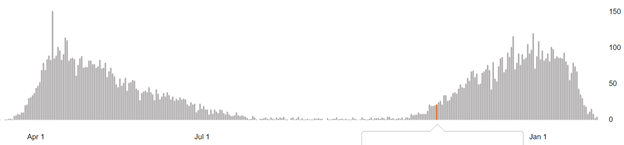
Sweden’s strategy turned out to be wisest. The second wave they experienced was not larger than the first, Sweden avoided turning into a police state, and now Covid-19 deaths have tapered to 0 (all data and graphs from World Health Organization website):
Covid-19 Deaths in Sweden
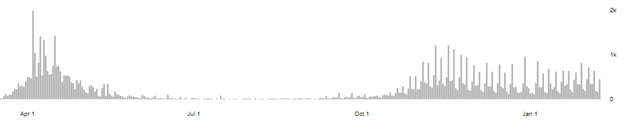
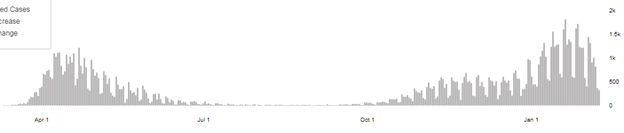
Meanwhile, most of Europe and the industrialized world is experiencing a second wave more intense than the first, and deaths have most certainly not tapered to 0. For example, here are Covid-19 deaths in lockdown-mad Germany, France, and the UK over the last year:
Covid-19 Deaths in Germany
Covid-19 Deaths in France:
Covid-19 Deaths in The United Kingdom
Please note the scale dissimilarities on the right: while Sweden has tapered to 0 deaths, Germany, France, and the UK are still experiencing daily deaths in the many hundreds and even over 1,000.
THE START OF THE COVID-19 PANDEMIC
The people who were maintaining positions thought whacky a year ago, have turned out to be right about other things besides Hydroxychloroquine and Ivermectin. For example, a year ago no “conspiracy thory” was more reviled than one that held this disease started in a government laboratory in Wuhan.
On February 2, 2021, PBS ran a 90 minute documentary (“China’s Covid Secrets”), maintaining that the Covid-19 pandemic began in a Chinese lab accident and the CCP engaged in a cover-up.
On Febuary 11, 2021, the Director-General of World Health organization did a U-turn on his previous dismissal of the possibility of Covid-19 originating in a Chinese lab, saying:
“Some questions have been raised as to whether some hypotheses have been discarded. I want to clarify that all hypotheses remain open and require further study.”
One year ago, nothing enraged the mass media more than people who espoused any form of this “conspiracy theory”. Now PBS and New York Magazine (both Establishment) are reporting it as true and WHO has retracted its previous assertion it was untrue.
Which raises a question: Why at the start of the Covid-19 pandemic was the Establishment so intent on suppressing possibilities such as HCQ, Ivermectin, and the possible origins of Covid in a Chines government lab? It sure seems they went to extraordinary lengths to denormalize these ideas (which have since proven true). Does that seem odd?
SUMMARY ON COVID-19
The discourse around this pandemic has been distorted by people seeking to weaponize it politically. As a result, the pandemic inflected more harm on the United States than it had to. The Swedish (science-based) approach would have left us far better off as a country, with less harm to our economy and our civil liberties, than the path we took. Coupled with the use of two cheap, safe drugs that have been in use for decades, this entire pandemic might have been snuffed out in its infancy.
Yet one group consistently fought any such measured discourse, insisting instead on a reaction marked by unscientific hysteria and, arguably, political calculation. As soon as Biden’s inauguration was confirmed, some proponents of lock-down switched to a less hysterical position essentially immediately. For example, among the most extreme lock-down proponents in the USA have been Chicago’s Mayor Lori Lightfoot, and New York City’s Mayor Bill De Blasio. In Chicago, Mayor Lightfoot recently decided that a much less stringent approach would be best: “Lightfoot Says Restaurants Should Reopen As Quickly As Possible “ (Patch, January 14, 2021). A similar pattern is unfolding in New York City.
If it is hard to imagine any politician being so cynical as to push for a lock-down that has destroyed millions of lives and tens of thousands of businesses (60% of which will not reopen), simply in order to achieve political advantage…. then you don’t understand the Goon-Left.
Above I asked regarding Covid-19:
“But once in the open, does it seem like there those who have sought to take advantage of it? Might it be possible that are those who wanted the pandemic to be worse than it needed to be?
We now return to the Bezmenov psyop I hypothesize may exist:
Demoralization of the country – Covid-19;
Disorientation – Antifa & BLM;
Crisis–election counting stops in 6 cities in 6 swing states, then a surprise;
Normalization – the media gaslighs anyone who sees anything odd here.
Regarding Step #2 (Disorientation – Antifa & BLM): One day this fall I was walking in front of the J. Edgar Hoover Building (FBI-HQ), when goons came roaring up on motorcycles and ATVs and took over the street, stopping traffic. They did wheelies and donuts for several minutes. Then they roared off. Again, this was on the street in front of putatively the premier law enforcement agency in the world. The guards at the FBI building stood and watched. I understood the message: “This is not the FBI you thought it was, this is not the USA you thought it was.” That, in fact, has been the subtext of the Big Broadcast since June, 2020.
Regarding Step #3 (“Crisis – election counting stops in 6 cities in 6 swing states, then a surprise”): I would call this election a crisis indeed, but I believe I have already covered this point thoroughly.
Regarding Step #4 (“Normalization – the media gaslights anyone who sees anything odd here”). In September, just four months ago, the possibility of a massive election fraud occurring in the USA was (as I demonstrated in the introduction) a proposition that enjoyed more support across the political spectrum than any other one could find. Now the possibility has become inexpressible, even unthinkable, as far as our Mainstream Media is concerned. Even Right-of-Center Newsmax recently saw a host walk off its show, rather than participate in a conversation where the possibility was discussed.
So why do things seem surreal? Perhaps because you are living through a psyop to take over our country, and reality as you know it is being engineered.
That’s the weak hypothesis.
WHY DOES EVERYTHING SEEM SURREAL? THE STRONG HYPOTHESIS
If the Weak Hypothesis is correct and we are living through a psyop, who is behind the psyop? Consider the possibility that China is behind the psyop.
I am not the proverbial Old China Hand, but decades ago I was once a Young China Hand. What follows is speculative but worth considering.
Since the Chinese publication in 1998 of: Unrestricted Warfare: Two Air Force Senior Colonels on Scenarios for War and the Operational Art in an Era of Globalization, by Qiao Liang (乔良) and Wang Xiangsui (王湘穗), it has been understood that hard-line elements within the Chinese National Security community have been envisioning and positioning themselves for war with the USA.
The “unrestricted” part of “unrestricted warfare” is the part that avoids direct military confrontation, and seeks instead to conquer through non-kinetic means.
In 2015, Michael Pillsbury, a lifelong China-dove (i.e., advocate of helping China modernize and prosper) wrote a book (The 100 Year Marathon) where he reversed course. He had been wrong all his professional life, he said, as he now understood that China had embarked on a 1949-2049 plan to turn the USA into a vassal state. In this book, he discussed a phrase circulating in Chinese national security literature: the “Assassin’s Mace” it planned for the USA. The reference, Pillsbury knew, was to an old Chinese story from the Warring States period, and refers to, in essence, a sucker-punch one-punch knockout.
Is what we are experiencing right now China’s “Assassin’s Mace”? Nothing would be more of an Assassin’s Mace than a scheme to take out the USA with a rigged election that could not be unscrambled through our court system by January 6, thus allowing the Constitutional forces to go to work and let turn to cement what had been presented as a fait accompli.
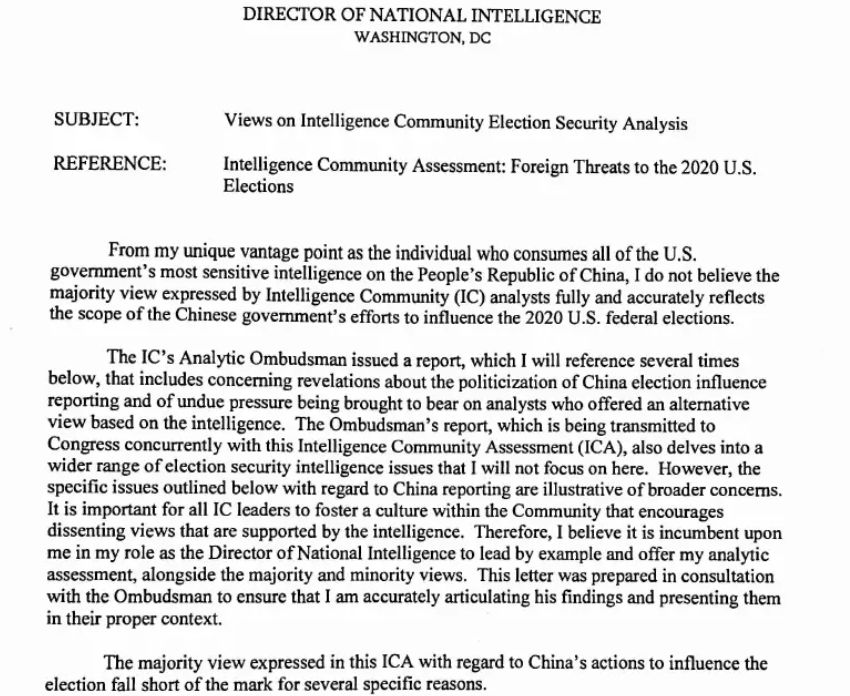
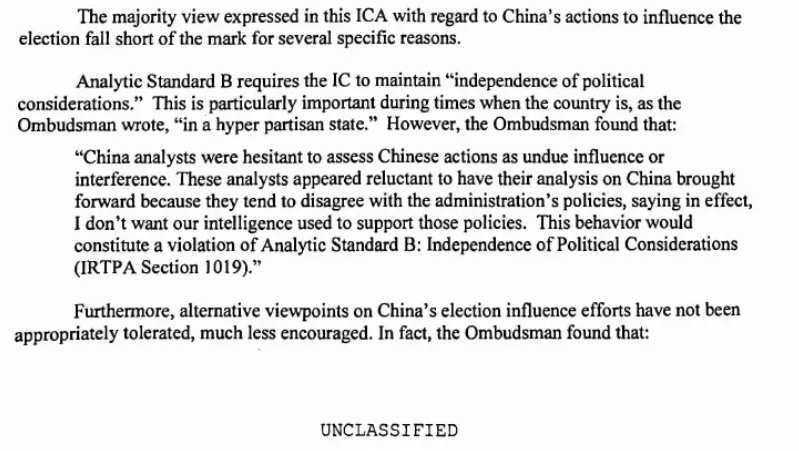
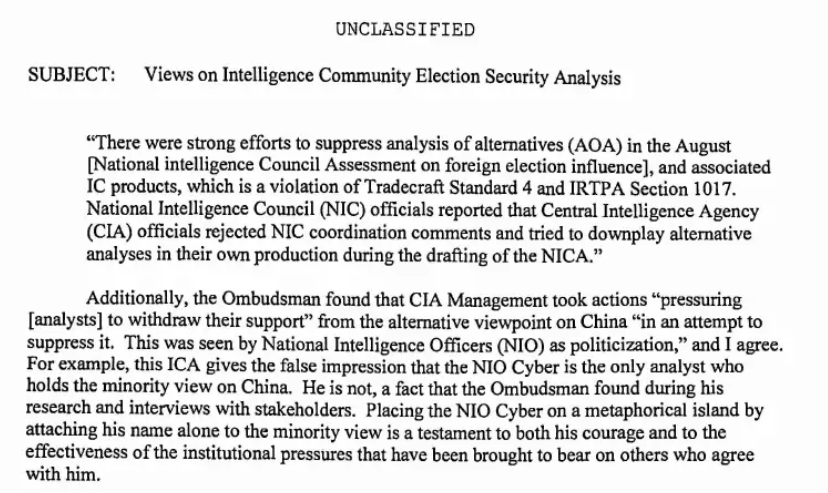
I am raising this not merely as a theoretical possibility. My colleagues and I discovered ample evidence of Chinese involvement in these election shenanigans. Go through the narrative that proceeds this, and note the mentions. Their money shows up in the firms supplying the election equipment in widest use; their IPs show up tickling our election equipment online; receipts from their print shops show up on stacks of ballots in our election operations… DNI Ratcliffe belatedly delivered on January 7 his opinion: he sees more of the intelligence than anyone in government, and his conclusion was that the Chinese had meddled in the election.
If the Strong Hypothesis is correct and this is all a Chinese psyop, there is one way you will be able to be able to tell. Authoritarian measures will be imposed on the US population (under the guise of stopping something vague like, “extremism”). President* Joe Biden will fill his administration with China-doves, and he will reverse an Executive Order of Trump’s to allow the Chinese to resume building components of our critical infrastructure (e.g., electrical infrastructure). Because of the political discourse being constrained by Big Tech and authoritarian measures, within 10 years there will be prison camps in America built next to hospitals for the purpose of organ-harvesting from dissidents. By that time, Xi Jinping will have a button on his desk: one day he will hit it, the US electrical grid will shut down, and over the course of one year 90% of Americans will die off and the USA will turn into a farm (for which China’s 1.6 billion people will be grateful).
Those will be your warning signs that the Strong Hypothesis was correct.
THE SUPREME COURT OF THE UNITED STATES
I will devote a full essay to this shortly, but I would be remiss if I did not remind citizens that we have a Supreme Court. The Supreme Court let us down once, in 1936-1937, when they succumbed to FDR’s threats to pack the Court. The result of their succumbing were allowing FDR’s propgrams to punch hole punched in the Constitution (e.g., Wickard v. Filburn), and through those holes the federal government grew to three times the size it should have been (and bankrupted the nation in the process).
The Supreme Court has their chance to make up for that one, by riding tall in the saddle, cleaning up this industrial election fraud and all future election fraud, and thus saving the republic.
They can do it on one principal: stopping voter suppression. Remember, every fake ballot that gets counted nullifies the vote of one actual voter, just as surely as a poll tax (or other forms of voter suppression) would. If the Supreme Court has courage, they will recognize that the moves Democrats made in 2020 to loosen everything that bringa integrity to an election, were part of what was, in essence, a massive voter suppression scheme (because industrial-sized election fraud creates massive voter suppression).
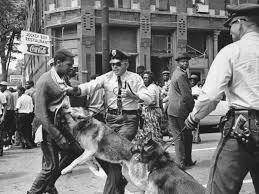
This is what voter suppression looked like in Birmingham, Alabama in 1963:
This is what it looks like now:
The signs are that in six key states there were collectively millions of acts of voter suppression in the 2020 election, by any of numerous methods.
Two generations ago we choose not to live in a world where this occurs:
But in the 2020 election it happened millions of times. Every illegitimate vote in the system is one act of voter suppression against some citizen somewhere who cast an opposing ballot. Thus, in the 2020 election, there were (effectively) several million of these (without the individuals whose votes were suppressed even knowing it):
I believe the US Supreme Court should, at earliest opportunity, save the republic by recognizing tht election fraud is mass voter suppression, and they should create the kind of blanket standards they imposed on states starting in the 1960’s. Standards such as: voter rolls must be kept clean; voters have to identify themselves; ballot-harvesting is an invitation to Goon-ism; reconsider using any electronic equipment (Dominion voting equipment is not used in Canada, though the firm is HQed in Toronto); and recognize (with almost all other countries) that mail-in voting is too given to fraud to be used in an election except as a special accommodation. Take the word of a bipartisan commision led by Jimmy Carter and James Baker:
‘Absentee ballots remain the largest source of potential voter fraud.” That quote isn’t from President Trump, who criticized mail-in voting this week after Wisconsin Democrats tried and failed to change an election at the last minute into an exclusively mail-in affair. It’s the conclusion of the bipartisan 2005 report of the Commission on Federal Election Reform, chaired by former President Jimmy Carter and former Secretary of State James Baker III.
The United States Supreme Court is faced with a novel situation. I believe I have presented enough evidence in this work to raise the possibility in the mind of any sane person, that a well-thought out and crisply executed organization hijacked our national election in 2020, by hijacking 6 key swing states, by hijacking the anchor city in each of those states, via election fraud that began with simultaneous and unprecedented shutting down of vote-counting, and continuing through countless forms that have been documented in videos and affidavits and with what forensics have been allowed.
That took a lot of chutzpah. And I think that if there were ever a time that the Supreme Court should act with chutpah, this would be it. All our other institutions have failed us, and this is as serious a moment as the 1960’s Civil Rights crisis, perhaps the Dred Scott decision (another one they flubbed, thus causing Civil War I). If they give a hall pass to the behavior and activities in Election 2020 that have already been extensively documented, it will bring about the end of the republic. Not just from the emboldened current administration, but from the acts of politicians brought to power by future Rigs, great and small, and how that defeats the very concept of consent of the governed that is central to our tradition.
The Supreme Court might show some chutzpah worthy of the moment, and solve this problem once and for all by recognizing that, thanks to the magic of modern election systems and methods and rules, we are back to is a world where this just happened to millions of people:
So it is not beyond the realm of possibility that the Supreme Court (which on Friday, February 19 will have a conference on Sydney’s Michigan case, a case which is chock-full of evidence), will do something as meaningful as they did in the 1960’s era, when voter suppression and other matters of egregious civil rights violation came before them.
WHAT SHOULD YOU DO? THREE SUGGESTIONS
We can pull this out if everyone will follow three pieces of advice.
The first rule in all situations (from Hitchhiker’s Guide to the Galaxy):
2. Remain non-violent. Is there anyone who does not see how much the events of January 6 hurt our cause? There was a huge number of Americans on the side of wanting to get to the bottom of election fraud, until the Capitol was stormed. It was a tremendous setback to our pro-freedom side. That may, in fact, be why it was engineered (and to some degree, it was engineered). At this point, the Goon’s in power want you to go violent, so as to justify them unleashing the FBI and CIA and DHS on you with a vengeance. Don’t do it. Remember the audience: middle America, who knows something goofy is going on, but will not side with the team that is bringing violence. so remain non-violent. It is better ethically, and it is better tactically.
To understand why it is better ethically, please see this post:
3. Focus your political attention, ire, and efforts on election integrity. No matter what else you want, you want this first and more.
A philosopher named John Rawls referred to “primary goods” as those goods you want no matter what else you want in life. When it comes to our political life, there is one good you must want beyond all others, and that is election integrity. No matter how strongly you feel about education policy, or abortion, or medical care, or gun rights, or or or… No matter what your interest in politics, you need to care about election integrity.
That means: get involved with your local elections board. Run for it if you can. Otherwise, volunteer to work in precincts. Do the 2 days of training. By November 2022 the pro-freedom among us (libertarians and republicans) have to be election mavens. We have to be working in the precincts and making sure the Rig cannot be repeated. You have 20 months to prepare: all your political ambition should be focused on this point. There is no point worry about any other political matter, without worrying about “election integrity” first and more.
2022 will be our last shot. If there is election integrity, I believe the Goons will lose the House and Senate in a landslide, because Americans see their true colors. On the other hand, if we do not restore election integrity by then, then next election will also be rigged, and we will have tipped our way into a fascist, authoritarian dystopian version of America, run by Goons.
And with the backing of China, the tech titans, and America’s Goon-Left, you can be confident that Government of the Goons, by the Goons, and for the Goons shall not perish from this Earth. So no matter what you care about in politics, for the next 20 months turn that care into intense focus on election operations in your county and state (swing states are especially important). These processes are open to the public: volunteer, get inside them, figure out what has to happen to make them run with integrity, and fight for that. That’s how we win.
THE FIRST AMENDMENT AND THE COMING(?) POLICE STATE
I know that some of the beliefs I have espoused here are not in synch with the times. Regarding my ability to publicly espouse and defend these beliefs, the First Amendment seems particularly on-point:
Congress shall make no law respecting an establishment of religion, or prohibiting the free exercise thereof; or abridging the freedom of speech, or of the press; or the right of the people peaceably to assemble, and to petition the Government for a redress of grievances.
If our new Congress passes any bill criminalizing people for challenging the integrity of the 2020 election, not only would it violate the First Amendment, but it would violate every principle on which this free country was founded and it would criminalize the conduct of every member of the “resist” movement and war that was waged on President Trump.
So I say to the United States Department of Justice: you are going to need a test case. Choose me. I say that not in a James Cagney “Come and get me, Coppers!” disrespectful kind of way. I mean it respectfully but sincerely. If our rulers wish to claim that in America, maintaining and expressing political beliefs such as mine ist jetzt völlig verboten, I’d really like to know. So I invite the DOJ to prosecute me for this four-part statement:
I acknowledge that Joe Biden proceeded successfully through the Article II Section 1 Constitutionally-mandated process that selects a president. He thus is, indeed, President. I also believe substantial irregularities affected the election process, and that those irregularities should be studied, discussed, and prosecuted in order to restore election integrity to our nation in time for the 2022 election. Because of these irregularities I refer to him as, “President* Biden”.
In addition, to the degree that Biden tries to loosen rules governing future elections, or changes immigration policy so as to dramatically shift voter composition in the USA, I will claim it confirms my Weak Hypothesis: industrial-level election fraud rigged the election for Biden, the Left knows it, and wanting the Rig to be locked in for future elections, they seek to change the rules and the electorate now.
In addition, behind some election irregularities I see the hand of China. Therefore, when President* Biden accommodates China through his appointments and Executive Orders, I take it as confirming my Strong Hypothesis: we are experiencing a Chinese psyop to take over the United States without firing a shot.
Lastly, I want those who join me in doubting election 2020 to work non-violently to pursue our investigations, promote our point of view, and get involved with local election activities across the country, with an eye to restoring election integrity in time for the elections of November, 2022. Every fake vote allowed into the system is an act of voter suppression against one legitimate vote from a citizen somewhere.
If it becomes illegal to espouse that worldview, I’ll be your huckleberry.
awesome. NYT said girl died, but it sure looks fake!
What happened on the afternoon of January 6 is the worst thing that could have happened for the Freedom Movement. Millions of people had descended on DC to rally in support of those standing up for the truth: our national election was rigged. However, in the course of their protest, Goons stormed the Capitol. One woman was shot unnecessarily by police, and one policeman died in a way that remains unclear: (“Media reports have been conflicting — unnamed law enforcement sources initially told outlets Sicknick was bludgeoned in the head by a fire extinguisher, while others speaking on condition of anonymity countered those claims, arguing there was no immediate evidence showing that Sicknick suffered any blunt force trauma”, “A month after Capitol riot, autopsy results pending in Officer Brian Sicknick death investigation“, Fox, February 8 2021). Mainstream Media has increased the body count by including, for example, two police officers who, days after the attack, putatively committed suicide.
The same Mainstream Media that (over the course of 2020) described as “mostly peaceful protests” the actions of Antifa and Black Lives Matter killing 33 police, injuring another 700 police, and burning thousands of businesses, has portrayed these events at the Capitol as the greatest tragedy to hit America since Pearl Harbor. It is nice to know there is some form of Goonism in politics still objectionable to the Mainstream Media. Myself, I eschew all political violence, not just ones convenient for me to denounce.
There are two ways to look at what happened on that fateful afternoon at the Capitol. I think they are both true, though which is more true is, at the moment, anyone’s guess.
The Party Line Explanation is this: splinter elements (200-400 people) of the millions of protesters decided to storm the Capitol. Given that this Party Line explanation has been repeated ad nauseum by a supine and obedient press, and is currently the object of an impeachment of a man who is no longer an officeholder (go figure), I will not spend time developing this interpretation. But I do not mean to discount it entirely, either.
The Alternative Explanation is more subtle, and runs along the lines of my story about Moldova explained in, “A Message to Militias Across America Regarding the Goon-Left and Agents Provocateurs (Not the Lingerie)”. This explanation holds that the events were engineered as part of a psyop to discredit those skeptical of the election result, and to justify a police-state-style crackdown by the Goon-Left on the rest of America.
What evidence is there to support this Alternative Explanation, that the ransacking of the Capitol was deliberately invited by those who would make hay from it politically? Let us review the evidence:
The Washington Post reported late Sunday night that the outgoing Capitol Police Chief, Steve Sund, believes his efforts to secure the premises were undermined by a lack of concern from House and Senate security officials who answer directly to Speaker Nancy Pelosi and Senate leader Mitch McConnell.
Then quoting from the WaPo:
Two days before Congress was set to formalize President-elect Joe Biden’s victory, Capitol Police Chief Steven Sund was growing increasingly worried about the size of the pro-Trump crowds expected to stream into Washington in protest.
To be on the safe side, Sund asked House and Senate security officials for permission to request that the D.C. National Guard be placed on standby in case he needed quick backup.
But, Sund said Sunday, they turned him down…
It was the first of six times Sund’s request for help was rejected or delayed, he said. Two days later on Wednesday afternoon, his forces already in the midst of crisis, Sund said he pleaded for help five more times as a scene far more dire than he had ever imagined unfolded on the historic Capitol grounds.
Besides the higher-ups preventing the police protecting the Capitol to increase their presence when asked, is there other evidence that suggests the occupation of the Capitol was to some degree invited?
In this clip (“Capitol Police Allow Protesters to Reach the Capitol”) police can, in fact, be seen inviting protesters past the barricades:
Then police stand aside and let the Capitol be assaulted (while patriotic bystanders ask them to stop it):
Here are patriots catching on to what is going on and trying to stop the Antifa/BLM agitators themselves:
Here one can clearly see someone inside the Capitol handing weapons to those outside the Capitol so they will be able to break their way in:
Then in this clip (“Capitol police open doors for the protestors. They stand aside and invite them inside”) police do… exactly what the title claims:
And this one (“Police open the doors of the capital and invite everyone in”):
“DC Capital Police Lets Protestors Enter and Storm US Capitol Building”:
Here is a policeman being “overwhelmed” with invaders. Does anything look staged about this?
And here is the famous Q Shaman with eight photojournalists. Anything here looked staged?
Here is an excellent “synch edit” showing a policeman taking careful aim and then shooting an unarmed (female) protester in the throat. She died.
If no video appears above, click here: https://www.youtube.com/watch?v=3Kn4JVIKB1Q
Interestingly, while the identity of the policeman who shot the unarmed female protester in the throat has been guarded by the media, there are unconfirmed reports that this is he:
If any rader has definitive information on that score, leave it in comments.
If one looks carefully in that crowd of protesters in the hallway when the female was shot, one spots this individual:
For further interest, I suggest watching this 21 minute mini-documentary:
So was the storming of the Capitol a disgrace? Yes. Was it also engineered and/or to some degree staged?
Put me down as, “Undecided”. lol
On the 7th of January, five minutes after the Senate had concluded its business and selected Joseph Biden to be President, DNI John Ratcliffe delivered his homework assignment (which had been due December 18). He opened it up with a rather dramatic and unequivocal statement: that the the IC community that he was then overseeing delivered a rport that inadequately reflected China’s role in the US election, and notes that an accompanying Ombudsman’s report highlights the worst sin of which intelligence analysts can be accused: politicizing the intelligence product. DNI Ratcliffe’s letter (which the MSM has flushed down the Orwellian Memory Hole) is so shocking I am going to quote the first 50% of it:
Ratcliffe claimed that he had not wanted to deliver the report any earlier because it would have “politicized” the Constitutional process of selecting the next president that was then occuring. He was another DC Republican concerned about “optics”. Call me “crazy”, but myself, I believe the correct analysis would have been, “I should deliver this report on time so that the Constitutionally-stipulated process for selecting the next President is fully informed, and if that includes that the election involved foreign interference, particularly from China, I have an obligation to make sure that is known to those involved in that process.”
Moving on….
Sidney had left before January 6, but after the events of January 6, Mike Flynn, the cyber-ninjas, dolphin-speakers, and I all prepared our goodbyes. We began drifting out of town to get on with our own lives. Yet on the evening of January 7 I got a phone call at 10:30 PM, telling me that Mayor Giuliani was requesting my presence at his hotel. The intermediary said, “We are just about ready to hang up our gloves on this, but we want to talk to you about your ideas.” I put my shoes on and walked over to Rudy’s hotel. When I got there, I found 8 people waiting in a suite. Rudy was there, along with the Commish, Mediocrity, a smart lawyer, and a handful of others. I sat down in front of Rudy and they repeated the request: they were ready to stop, but wanted to see if I had any ideas.
As I started to answer Rudy began checking his phones again, literally fumbling with two or three of them again, reading his texts, etc. For the first time I did what I should have done two months earlier: I simply stopped talking. He said, “No no, go ahead.” I stayed silent and just stared at him. He said, “I can’t turn these off, I might get a call from the President.”
“Then give them to” Mediocrity, I said, indicating the person to his left, and surprising myself at my rudeness. Then to Mediocrity: “Keep an eye on them and let Mayor Giuliani know if the President calls.”
Rudy put the phones down and slid them to Mediocrity. Just as I began again to speak, Mediocrity turned and began having a side conversation with someone in the next seat, and again I folded my hands, stared at Mediocrity, and kept my mouth shut. I had reached the point where I was preparing to say, “Who do you assholes think you are? You call me at 10:30 PM, tell me to come to your hotel to share my thoughts, then don’t even have the courtesy to pay attention?” But as I opened my mouth, Mediocrity cut off the side conversation and faced me quietly. Everyone else in the room went quiet as well, and looked at me.
In two months of dealing with that group, it was the first moment that they conducted themselves in a manner that normal business people (or even, “normal adults”) would conduct themselves. I realized that for the first time I had Rudy’s full attention, and not only that, I could see that it was the first time I had been with him when he was the Rudy Giuliani I remember from 30 years ago, prepared to take on the Mob, in command, focused. The silence stretched on as I thought, then said:
“These machines were sold to the public with a promise: as a fail-safe there would always be a paper ballots to use as a backup. If there was ever a time, now is the time. The FBI and CISA have both opined that our election came under foreign attack. We provided evidence of that as well. President Trump should find that there has been foreign interference, and on that basis send a federal force of US Marshalls, or National Guard, or DHS, or FBI, to examine paper ballots in the problematic six counties, and count them on livestream TV. If there are no gross irregularities, he should concede. But if he finds discrepancies of hundreds of thousands of ballots, as we think he may, he then has choices. He can recount the six states, or order the federal force to rerun the election in those 6 states. He might even be able to have it all done by January 20.”
There was silence. After a few seconds the Commish stirred to speak. I turned to face him as he slid his hand away from his mouth, and stroked his chin. He nodded slowly, and grunted, “Yeah. Makes sense.” Mediocrity lit up, and the new lawyer on the scene, on my left, spoke up and began exploring the advantages of it aloud. Rudy chimed in, and within minutes they had it all worked out: it was narrow so it was not too objectionable, it generated an answer, and depending upon the outcome, it gave a route to Trump. I stayed another 30 minutes as they bounced the idea around with a spark of excitement growing. Finally they said they would be working on details and maybe even calling the President, and I took that as my cue to leave. I said goodbye to them, and put my coat on.
As I turned to leave the Mayor came and shook my hand. Then he tapped my chest with his finger and said quietly, regretfully: “If only we had another month.”
Truly. I had watched two months slide by Mayor Giuliani and his team displaying no organization or progress. Watching them trying to get anything done was like watching half-a-dozen monkeys trying to fuck a football. But now I was hearing, “If only we had another month.” They could have had another decade and it would not have made a difference. They were the wrong people. Rudy, because he should likely no longer be handling complex litigation, he certainly should not be handling complex litigation regarding cyber, and because he’d rather spend his days doing podcasts. A former government employee who was so Mediocre we all came to suspect was sent as an agent of disruption, and others with their focus on a pot of cash that (at last report) was $300 million and growing.
I walked the snow-covered midnight streets of Washington DC back to my hotel, and finished packing for my departure.
The next day, the 8th, I checked out, experiencing yet again at the discontent I feel every time I have affairs that take me to DC. Discontent with people whose sense of accomplishment is so skewed (bureaucrats measure their output within the paradigm of thwarting other factions, not in anything that normal people would count as “accomplishment”), at the staggering cost to the country of DC, at the staggering wealth that has accumulated there (cf., “DC Suburbs Now Contain 7 Of America’s 10 Richest Counties,” Slate, September 2012). It has become Hunger Games without the archery. But there were people I had gotten to know over the previous several months, had grown to like and respect, and I had opportunity to visit with most of them individually and say goodbye.
I returned to my home in Utah by Saturday the 9th feeling under the weather, but intent on writing the story that you have been reading in these installments. By the next day I realized I had picked something up, and on the morning of Monday, January 11, I tested positive for Covid, as I had come to suspect. I took it easy for a few days with a fever of 101, still brushing it off, telling myself that, “On a Flu Scale of 1-10, this is a 2. They shut down the world for this?” I woke Thursday, January 14, feeling almost fine, with a temperature back under 100. I thought I was through it. But by afternoon I began feeling ill again, and within an hour my temperature was 105.4. I barely made it to a hospital, and when I did they put me on monoclonal antibodies due to risk factors too numerous and depressing to list. Dealing with that and the Covid Fog that followed cost me over a week.
Near the end of that, on January 20, on the day that Biden was sworn in as President, I got two phone calls from two different Trump White House staffers. They wanted to tell me a story before they left the White House for the last time. The stories they told me overlapped and matched in detail. I will relate it here.
On January 18, some loyal staffers had been visiting with Trump in his office for what was supposed to be a 10 minute goodbye. But the discussion had turned to the election, and before long Trump was rehashing the decisions he had made, wondering where he had made mistakes. The subject turned to Sidney, Mike, and me, and the plan we had brought the White House. Trump walked through it with these staffers for 20 minutes, I was told, before it clicked for him. “That’s it?” He asked angrily. “That’s all they wanted to do? Count paper ballots in six counties?” Trump excitedly explored the idea, saw how simple it would be, and even brought up the possibility that it might not be too late, with his last 48 hours in office, to cause it to happen. The meeting dragged on well over an hour, the two sources told me, and they left with Trump fired up about the idea, with instructions given to them that they should figure out that afternoon a way that it could be executed in the last two days he had as President. But an hour later their office got a phone call: the President had had further consultations with senior staff, had been dissuaded, and the younger staffers were instructed to drop the idea.
need 100% recycling initiative. There is a subaru car plant in Indiana doing that. People should too. Demand 1,2 plastic only... Demand Amazon take back anything they sell! (like in Germany)
As President Trump refused to concede, the response was not mass action but crickets. When media organizations called the race for Joe Biden on Nov. 7, jubilation broke out instead, as people thronged cities across the U.S. to celebrate the democratic process that resulted in Trump’s ouster.
A second odd thing happened amid Trump’s attempts to reverse the result: corporate America turned on him. Hundreds of major business leaders, many of whom had backed Trump’s candidacy and supported his policies, called on him to concede. To the President, something felt amiss. “It was all very, very strange,” Trump said on Dec. 2. “Within days after the election, we witnessed an orchestrated effort to anoint the winner, even while many key states were still being counted.”
In a way, Trump was right.
There was a conspiracy unfolding behind the scenes, one that both curtailed the protests and coordinated the resistance from CEOs. Both surprises were the result of an informal alliance between left-wing activists and business titans. The pact was formalized in a terse, little-noticed joint statement of the U.S. Chamber of Commerce and AFL-CIO published on Election Day. Both sides would come to see it as a sort of implicit bargain–inspired by the summer’s massive, sometimes destructive racial-justice protests–in which the forces of labor came together with the forces of capital to keep the peace and oppose Trump’s assault on democracy.
Time’s article is going to anger a lot of Trump voters, giving them plenty of evidence that the system was rigged against them — and possibly firing the opening salvo of the 2024 presidential campaign.
The grassroots effort underway to gather enough signed petitions to put a measure to recall Governor Gavin Newsom on the California state ballot is almost sure to succeed. With more than a month until the Mar. 17 deadline, the group needs 1.497 million signatures and currently has gathered over 1.4 million.
UncoverDC spoke with Randy Economy, Senior Advisor for the RecallGavin2020.com campaign. Economy, who is upbeat and full of energy, has advised more than 300 political campaigns, working with Democrats, Republicans, and Libertarians. He explained that the hands-on campaign is inspiring, and he is proud to be part of a mission that is making history in CA. According to Economy, the movement will succeed because all of Newsom’s failed policies are coming to light.
Already unhappy with Newsom’s failure to address the state’s homeless population and his support of sanctuary city policies and water rationing, when the coronavirus fear hit, Californians were expecting clear guidance from Newsom, who gave daily, sometimes hourly, press conferences that pre-empted every station in the state, telling residents to “stay home for a month and the virus will go away.” Now, almost a year later, the virus is still dictating daily life, and millions of jobs are gone.
On November 6, when California Gov. Gavin Newsom (D) sat down for a fancy dinner party at the tony Napa Valley restaurant The French Laundry, the state was in the midst of a COVID-19 surge. Newsom and other state officials were emphasizing the importance of following social distancing rules and wearing face masks in public places, as mandated by an order that the governor issued in June. Photo/KTTV
Economy explained that the hardest hit by Newsom and his failed policies are the small mom and pop business owners, like the little restaurant in East LA, South San Francisco, or Oakland, who have lost everything. Businesses and schools have been closed for almost a year. And now, with hospital mismanagement and a botched COVID-19 vaccine rollout, the movement has spread beyond conservatives and continues to gain momentum.
Under the state’s constitution, the people have the power to take the government into their own hands when needed, and that is what they are doing. Economy said there is not one specific reason for the need to recall Newsom. In fact, the “Reasons to Recall” section of the website lists over 60 reasons. Calling the campaign a “rags to riches” story that needs to be told, he said, “there is not one reason, there are dozens and dozens, and it is not political. CA is a ‘hot mess,’ and this is a real one-and-only kind of opportunity to hit the reset button and get this fixed. Not by political operatives or slick politicians, but by the volunteer groups on this campaign.”
Photo/LA Times
Fueled by regular Californians, the recall campaign is straightforward and fully transparent. Economy described it as “old school politics with no voting machines” to add any uncertainty. People go to the website, download the petition, print it out, sign it, get neighbors to sign too, and mail it back in. Fifty-eight different county registrars up and down the state serve as election officials. Every petition goes to a third-party vendor before being turned in to the registrars to ensure accuracy and validity. Economy said their current signature count is correct and noted that the CA Secretary of State’s website lists the count significantly lower, which isn’t surprising given that it is a government-run site.
When asked about Nathan Fletcher’s recent comments saying the Californian citizens leading the recall effort “are linked in association with neo-Nazi, with white supremacists, with right-wing militia groups,” Economy chuckled and said he must be “drinking his own bathwater.” He described Fletcher, who issued a resolution declaring racism as a public health crisis in San Diego, as out of touch with what is happening in the state.
As previously reported by UncoverDC, Newsom recently declared that restaurants in California were allowed to re-open. Many questioned whether the governor’s decision was an attempt to slow down the recall campaign. Economy believes that is the case, noting that Newsom advisors Jim DeBoo and Dee Dee Myers most likely told him to reverse course and make the decision. Myers and DeBoo joined Newsom’s team in December as he entered the second half of his term amid a brutal stretch of the pandemic and as he tried to overcome recent political stumbles.
Since 1911, there have been 55 attempts to recall a sitting California governor. This recall is the fifth in a series of six recall petitions filed against Newsom. If supporters turn in enough valid signatures to trigger a recall election, the additional procedural steps dictate that the election will occur within four to six months. With election fraud on the minds of many Americans across the country, it is inspiring that the people of California, amidst a “Gavin Newsom lockdown,” are taking matters into their own hands, going door to door, putting up tables, chairs, and pop-up tents, and exercising their constitutional right to assure their voices are heard.




 The board’s 19 members span the globe. At least two have direct ties to Democratic mega-donor and progressive leader George Soros. Nighat Dad of Pakistan serves on the Advisory Board for the Dangerous Speech Project, which receives funding from Soros’ Open Society Foundations and Maina Kiai of Kenya is the Director of Human Rights Watch Global Alliance and Partnerships which received $100 million from Open Society Foundations.



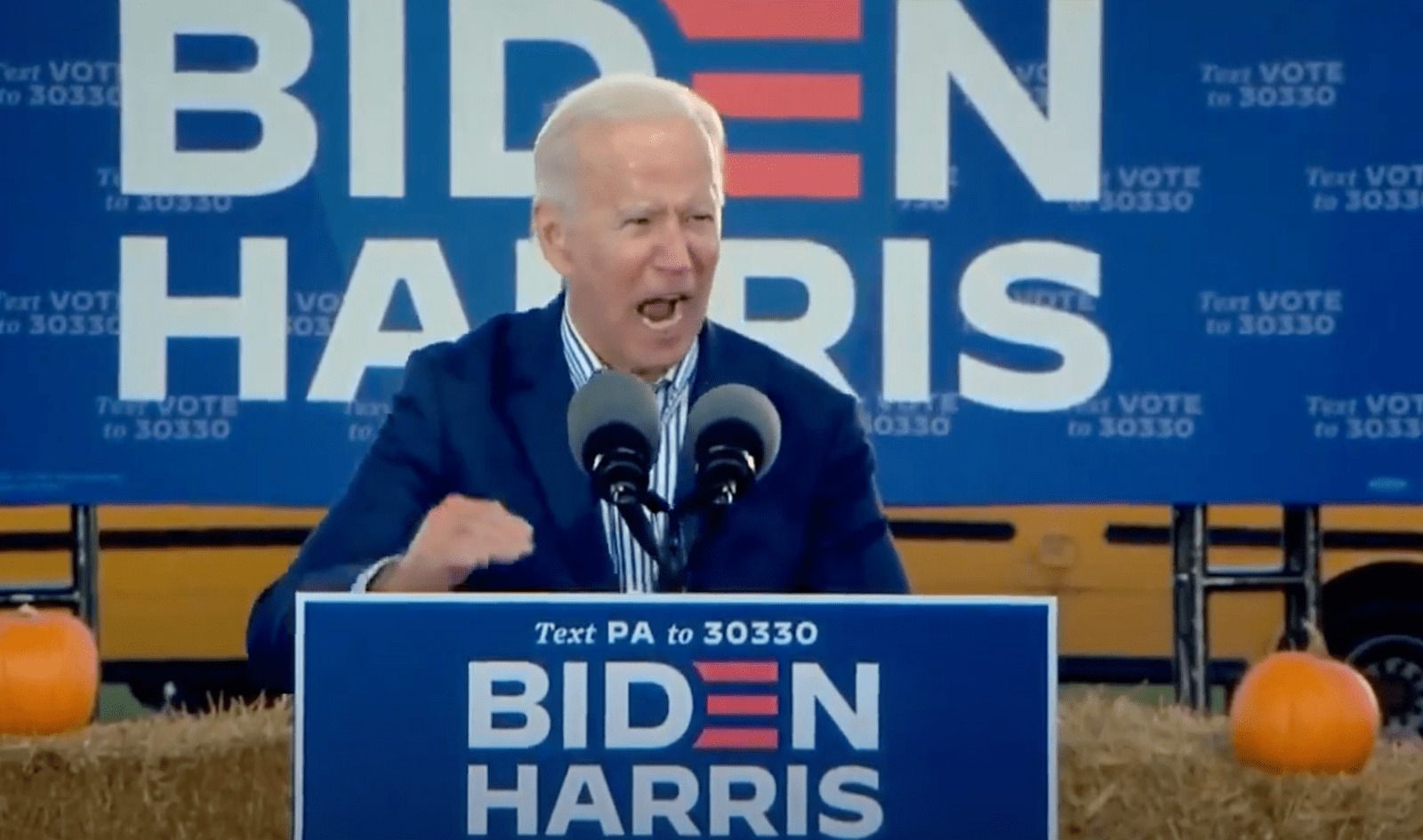

(@JackPosobiec) February 17, 2021