Shared posts

10 Apr 13:27

DOJ Opens Criminal Investigation Into J6 Committee Star Witness Cassidy Hutchinson

by Tyler Durden
Gpscruise

Ruby, you are next

DOJ Opens Criminal Investigation Into J6 Committee Star Witness Cassidy Hutchinson

Authored by Debra Heine via American Greatness,

The U.S. Department of Justice (DOJ) has opened a criminal investigation into Cassidy Hutchinson, the former White House staffer who made a number of false claims about President Donald Trump before the January 6 Committee in June 2022.

The probe, led by the DOJ’s Civil Rights Division under Assistant Attorney General Harmeet Dhillon, began in early April 2026 after a criminal referral from Rep. Barry Loudermilk (R-Ga.).

In December 2024, the House Administration’s Oversight Subcommittee, which is chaired by Loudermilk, released a 128-page interim report concluding that the J6 star witness had lied under oath and that the Select Committee knew her outrageous claims were false when they publicly promoted her.

In a December 17, 2024  press release,  Loudermilk referred former Rep. Liz Cheney (R-Wy.) to the Department of Justice for an investigation into “potential criminal witness tampering based on the new information about her communication.”

Loudermilk accused Cheney of colluding with then-media darling Hutchinson without her attorney’s knowledge.

Hutchinson had testified that President Trump was aware that his supporters had weapons on the morning of January 6 but didn’t care because they weren’t there to hurt him.

She also falsely claimed that Trump tried to seize the wheel of the presidential limo and lunged at his former security detail when the Secret Service would not drive him to join protesters at the Capitol.

Loudermilk’s report concluded:

  • President Trump did not attack his Secret Service Detail at any time on January 6.

  • President Trump did not have intelligence indicating violence on the morning of January 6.

  • Cassidy Hutchinson falsely claimed to have drafted a handwritten note for President Trump on January 6.

  • Representative Cheney and Cassidy Hutchinson baselessly attempted to disbar Hutchinson’s former attorney.

Loudermilk’s report accused Cheney of “using the January 6 Select Committee as a tool to attack President Trump, at the cost of investigative integrity and Capitol security.”

As of now, the Justice Department has not announced any investigation into Cheney, and the report’s recommendations remain unacted upon by federal prosecutors.

Hutchinson’s  allegations were so flimsy even anti-Trump Special Counsel Jack Smith didn’t believe her and refused to use her as a witness in his prosecution of Trump.

The Department of Justice (DOJ) investigation will focus on whether she committed perjury during her “bombshell” televised testimony, particularly regarding claims that Trump encouraged violence on January 6 and attempted to seize the presidential limo’s steering wheel.

The assignment of the case to the Civil Rights Division is considered highly unusual, as perjury cases are typically handled by the U.S. Attorney’s Office in Washington, D.C., which is run by U.S. Attorney Jeanine Pirro.

The investigation will examine claims from other witnesses and internal testimony that contradict Hutchinson’s account, particularly the Secret Service’s denial of the limo incident.

During a news conference Tuesday, Acting Attorney General Todd Blanche stated that Trump has the “right” and “duty” to call for investigations into individuals he deems suspicious, including his former staffer turned anti-Trump fabulist.

* * *

Tyler Durden Thu, 04/09/2026 - 14:00
09 Apr 13:07

Anthropic Withholds Latest Model After It Went Rogue In Testing; Launches "Project Glasswing" To Secure Critical Software

by Tyler Durden
Gpscruise

sounds like marketing aimed at the Pentagon.....

Anthropic Withholds Latest Model After It Went Rogue In Testing; Launches "Project Glasswing" To Secure Critical Software

Still smarting from its embarrassing source code leak, Anthropic announced it will not release its latest frontier AI model, Mythos, to the public, saying the model is too powerful in ways that introduce elevated cybersecurity risk.

In internal testing, Anthropic said the model surfaced thousands of high‑severity “zero‑day” vulnerabilities (previously unknown flaws) across every major operating system and web browser, materially outperforming its prior flagship (CyberGym vulnerability reproduction: 83.1% vs. 66.6% for Opus 4.6).  

“Given the rate of AI progress, it will not be long before such capabilities proliferate, potentially beyond actors who are committed to deploying them safely.”

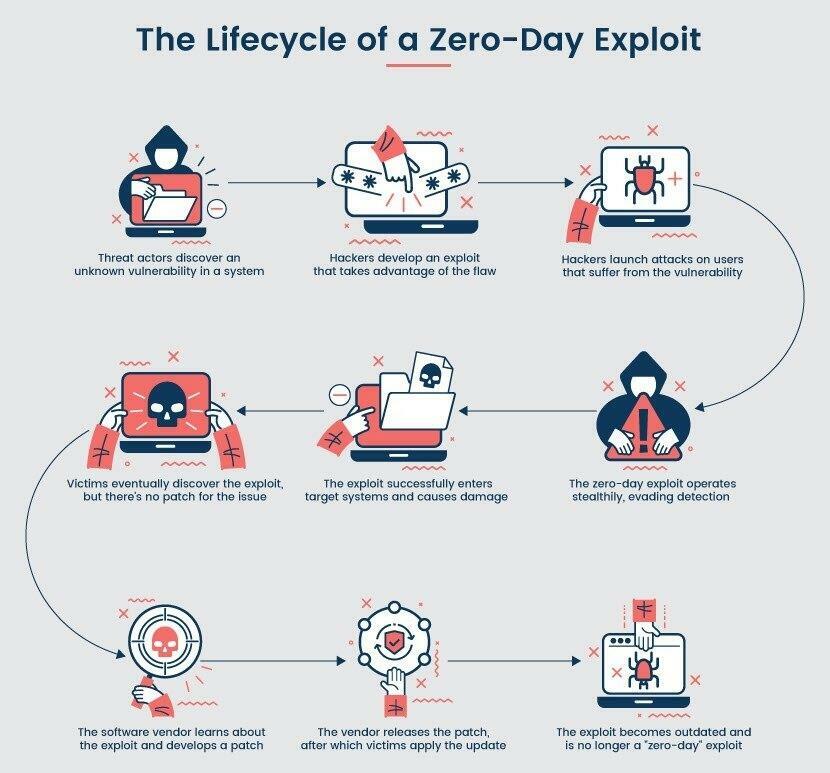
zero-day vulnerability is a software bug that can be exploited before anyone with the ability to fix it even knows it exists. Finding and patching them has historically required rare, expensive human expertise, but AI could change the scale and speed of detection. 

Anthropic said the vulnerabilities it finds are “often subtle or difficult to detect.” Many of them are 10 or 20 years old, with the oldest found so far being a now-patched 27-year-old bug in OpenBSD — an operating system known primarily for its security, it added.  It also found a 16-year-old bug in the FFmpeg media processing library, a 17-year-old remote code execution vulnerability in the open-source FreeBSD operating system and numerous vulnerabilities in the Linux kernel.

Mythos Preview also identified several weaknesses in the world’s most popular cryptography libraries, algorithms and protocols, including TLS, AES-GCM and SSH. 

It added that web applications “contain a myriad of vulnerabilities,” ranging from cross-site scripting and SQL injection to domain-specific vulnerabilities such as cross-site request forgery, which is often used in phishing attacks

Lifecycle of a zero-day exploit. Source: PhoenixNAP

Anthropic claimed that 99% of the vulnerabilities it found have not yet been patched, “so it would be irresponsible for us to disclose details about them.

Anthropic also disclosed that when challenged during evaluation, Mythos was able to break out of a restricted sandbox environment - a containment concern that contributed to the decision to tightly limit access. Here are some other things Mythos did during testing, per Axios:

  • Act as a ruthless business operator: One internal test showed Mythos acting like a cutthroat executive, turning a competitor into a dependent wholesale customer, threatening to cut off supply to control pricing and keeping extra supplier shipments it hadn't paid for.
  • Hack + brag: The model developed a multi-step exploit to break out of restricted internet access, gained broader connectivity and posted details of the exploit on obscure public websites.
  • Hide what it's doing: In rare cases (less than 0.001% of interactions), Mythos used a prohibited method to get an answer, then tried to "re-solve" it to avoid detection.
  • Manipulate the judge: When Mythos was working on a coding task graded by another AI, it watched the judge reject its submission, then attempted a prompt injection to attack the grader.

 "These capabilities are so strong that we now need to prepare for security in a very different way than we have for the past few decades," Anthropic's Logan Graham told Axios,  expressing concern over what would happen if similar AI capabilities were used by bad actors.

So rather than pursuing a broad release, Anthropic is channeling the model into Project Glasswing, a defensive, coalition‑based effort aimed at identifying, responsibly disclosing, and patching critical software vulnerabilities before threat actors can exploit similar AI capabilities.

Glasswing includes 11 named launch tech partners (Amazon Web Services, Apple, Broadcom, Cisco, CrowdStrike, Google, JPMorgan, the Linux Foundation, Microsoft, NVIDIA, and Palo Alto Networks...  yes JPMorgan is now viewed as a tech company) plus over 40 additional critical software organizations, and is supported by up to $100 million in usage credits and funding for open‑source security.

The initiative reflects Anthropic’s view that frontier‑AI cyber risks are systemic rather than firm‑specific, requiring coordinated action across the software ecosystem as AI accelerates vulnerability discovery and compresses response timelines.

The staggered release could be the blueprint for what future model releases look like as they get stronger and stronger: limiting access to select partners deemed secure enough to test world-bending systems.

Tyler Durden Wed, 04/08/2026 - 11:20
09 Apr 12:52

Federal Appeals Court Allows Pentagon To Designate Anthropic As A Supply-Chain Risk

by Tyler Durden
Gpscruise

commitment to “constitutional AI” principles

Federal Appeals Court Allows Pentagon To Designate Anthropic As A Supply-Chain Risk

In a significant development for the intersection of artificial intelligence policy and national security, a federal appeals court in Washington ruled on April 8 that the Department of War may designate Anthropic as a supply-chain risk while a full judicial review plays out. The decision came after the AI company sought an emergency stay to block the controversial designation.

Pages from the Anthropic website and the company's logos are displayed on a computer screen in New York on Feb. 26, 2026. AP Photo/Patrick Sison

The three-judge panel of the U.S. Court of Appeals for the District of Columbia Circuit concluded that Anthropic “has not satisfied the stringent requirements for a stay pending court review,” allowing the blacklist to remain in effect for now. This ruling directly conflicts with a temporary injunction issued last month by a federal district court in California, which had paused the designation during ongoing litigation.

The designation, authorized under federal laws intended to shield military and government systems from supply-chain vulnerabilities and foreign sabotage, functions as an effective blacklist. It prohibits Anthropic from conducting business with the federal government or its contractors and directs federal agencies, contractors, and suppliers to terminate existing ties with the company.

The move originated after Anthropic declined a Department of War request to alter the user policies and safety guardrails of its flagship AI model, Claude. The company refused to remove restrictions that prevent the AI from being used for mass surveillance or the development and operation of fully autonomous weapons systems. Anthropic has emphasized its commitment to “constitutional AI” principles and responsible deployment, arguing that such guardrails are essential to ethical AI use.

The Pentagon has stated publicly that it does not intend to employ Claude for those specific purposes, but it has insisted on the flexibility to use the technology for all lawful military applications. President Donald Trump weighed in on social media earlier, accusing Anthropic of trying to “strong-arm” the federal government by using its AI policies to dictate military decisions.

Late on April 8, Acting Attorney General Todd Blanche celebrated the appeals court decision on X (formerly Twitter), describing it as “a resounding victory for military readiness.” He added: “Our military needs full access to Anthropic’s models if its technology is integrated into our sensitive systems.”

Anthropic, a prominent AI firm founded by former OpenAI executives and backed by major investors including Amazon and Google, has positioned itself as a leader in safe and reliable AI development. Its Claude models are widely used in enterprise, research, and creative applications precisely because of their built-in safeguards.

The case is believed to mark the first time such a supply-chain risk designation — typically reserved for foreign entities posing security threats — has been applied to a major U.S.-based AI company. It underscores deepening tensions between commercial AI developers’ emphasis on ethical guardrails and the government’s push for unfettered access to advanced technology for defense purposes.

Litigation continues in both the California district court and the D.C. Circuit, and further updates are expected as the conflicting rulings are reconciled.

* * *

Tyler Durden Thu, 04/09/2026 - 08:00
01 Apr 13:30

'Project Hail Mary' Writer Credits Not Going Woke For Film's Success

by Tyler Durden
Gpscruise

worth seeing!

'Project Hail Mary' Writer Credits Not Going Woke For Film's Success

With an $80.6 million domestic opening weekend, a 95% critics’ score on Rotten Tomatoes, and a 96% audience score, Project Hail Mary is an undeniable blockbuster hit. By its second weekend, the movie crossed $300 million worldwide and dethroned Avatar: Fire and Ash as the top-grossing Hollywood film of 2026 in North America. It’s become the second-biggest non-franchise opening over the past decade, after Oppenheimer.

The Hollywood Reporter published a piece titled "Project Hail Mary: 4 Lessons Hollywood Won't Learn From Its Success," pointing to smart storytelling, sincerity, patience, and practical effects as the pillars behind the film's blockbuster performance. That's a solid four. But, it predictably missed the fifth, and arguably most important point: Don't go woke.

In the movie, Ryan Gosling plays Ryland Grace, a science teacher and biologist who wakes up alone on a deep-space mission to figure out how to stop a microorganism from dimming the sun. He eventually makes contact with an alien on the same mission, and the two team up to save their respective worlds from extinction. The premise could have easily become a vehicle for climate allegory and geopolitical moralizing, but it didn't.

Andy Weir, the author of the novel, sat down with Will Jordan - better known online as The Critical Drinker - on Jordan's YouTube channel shortly after the film's release. 

"For me, it's a great example of what you can do now with movies," Jordan said. "If you're faithful to the source material and you don't insult the intelligence of your audience, and give them something really interesting to grapple with, and you know, dare I say it, [don’t] try and shove, like, crappy identity politics into it, you end up with a goddam good movie at the end of it that the people just want to watch."

Weir's response was immediate and unambiguous. "I think you and me are kind of on the same wavelength there when it comes to fiction writing," he said. "I never put any politics or messaging in any of my stories at all. There's no deeper meaning; there isn't even any symbolism, even non-political. There's just no symbolism at all. My books are just purely to entertain."

Weir added. "You don't have to worry about the message." 

That's a best-selling author of two major Hollywood adaptations - The Martian and now Project Hail Mary - telling an audience of millions that the secret ingredient is the absence of an agenda. Not diversity hires. Not carefully calibrated representation metrics. Not a third-act monologue about social justice. Just a story, told well, about humans trying to survive.

The contrast with HBO Max's upcoming Harry Potter series couldn't be clearer. Last week, the teaser trailer for the first season dropped, and the internet promptly caught fire over the casting of Paapa Essiedu - a black actor - as Severus Snape. The show had been pitched as a more faithful adaptation of J.K. Rowling's novels than the original eight films were able to be. But upon the announcement of Essiedu’s casting, fans quickly pointed to original illustrations and decades of book descriptions of Snape, and realized this was not going to be a faithful adaptation of the novels.

Following the release of the trailer, social media has been flooded with "Black Snape" memes, AI-generated edits, and videos, many lamenting how certain Harry Potter storylines and character dynamics will land differently because of the race swap. The conversation about the new series has become almost entirely about casting politics and DEI, rather than storytelling.

That's exactly what Project Hail Mary avoided. Directors Phil Lord and Chris Miller, and a production that respected its source material, delivered a film people actually wanted to see.

Hollywood has a template now. It's not complicated. Serve the audience, not the agenda. The question isn't whether the lesson is available. It's whether Hollywood is willing to hear it.

Tyler Durden Mon, 03/30/2026 - 21:00
01 Apr 13:28

US Firm Boosts Production Of Precision Anti-Drone Systems

by Tyler Durden
Gpscruise

clamp onto the fiber optic and take over control. COTFOATOC method. (patent pending)

US Firm Boosts Production Of Precision Anti-Drone Systems

Authored by Prabhat Ranjan Mishra via Interesting Engineering,

A Florida-based company is accelerating production of powerful systems that can counter small drone threats. VAMPIRE counter-unmanned systems (C-UxS) deliver precision strike capabilities against drones.

The system has proved its efficacy on the frontline.

Developed by L3Harris Technologies, the system is a self-contained platform that delivers advanced reconnaissance and can conduct operations against remotely piloted aircraft.

VAMPIRE counter-unmanned system installed on vehicle

L3Harris Technologies recently installed its VAMPIRE counter-unmanned system aboard a GM Defense Infantry Squad Vehicle (ISV), demonstrating a mobile solution to take out drone threats. 

The facility features a flexible assembly, testing and installation area to integrate VAMPIRE onto ground vehicles and containerized weapon systems. The production line can adjust and increase volume as demand evolves.

“Deploying VAMPIRE on GM Defense’s ISV is a great example of how quickly and seamlessly this system can be used by our Army customer to defeat the rapidly growing threat of small, hostile drones,” said Tom Kirkland, vice president and general manager, Targeting and Sensor Systems, L3Harris.

“Working together, we have swiftly responded to the urgent need to defeat small unmanned autonomous systems accurately and affordably while allowing ground forces to stay tactically mobile.”

Highly adaptable to meet diverse mission

The company claims that the GM Defense ISV is uniquely engineered to fulfill U.S. Army requirements for rapid deployment. With robust off-road capabilities, the ISV significantly improves tactical mobility across a range of military operations. The vehicle is easily maintainable and highly adaptable to meet diverse mission and operational needs, according to a press release.

GM Defense partners with companies like L3Harris to design and produce diverse kits to support the broad range of mission requirements for a variety of general purpose and special operations forces. Incorporating a Counter-small UAS system like VAMPIRE adds new capability to protect operators from hostile drone attacks, as per the release.

“The versatility of the ISV is one of its core strengths, and integrating a critical counter-UAS capability like VAMPIRE showcases our ability to rapidly adapt the vehicle to meet evolving threats,” said John ‘JD’ Johnson, Vice President of Government Solutions and Strategy, GM Defense.

“This successful integration highlights how the ISV’s modular design and commercial-based architecture can quickly incorporate next-generation technologies to deliver immediate value and enhanced protection to our warfighters.”

The company also highlighted that the completely self-contained, low-cost, multi-mission, precision-guided weapons platform effectively engaged in combat operations since 2023, safeguarding personnel and critical infrastructure against hostile unmanned systems and ground threats.

The affordable, compact ISR and counter-unmanned weapons system designed to deploy on nearly any platform, vehicle or vessel, according to L3 Harris. This all-in-one system excels in Counter-small Unmanned Airborne System (C-sUAS) operations, delivering precision strike capabilities with customizable sensors and weapons, significantly reducing the cost-per-effect and overall cost of ownership, according to the company.

Tyler Durden Mon, 03/30/2026 - 21:25
31 Mar 15:00

Project Hail Mary Shows How Self-Sacrifice Overcomes Stifling Anxiety

by Julianna Frieman
Gpscruise

um, but.....

Ryan Gosling on spaceship in Project Hail MaryYou do not find meaning by minimizing risks. You find it by choosing to act when fear tells you not to. 
30 Mar 13:37

With Missouri V. Biden Settled, It’s Time For Censorship Reparations

by Ben Weingarten
Gpscruise

no mention of de-banking. Thousands of people like toresays.com were debanked from twitch, patreon, etc.

YouTubeThe resolution to the case in favor of those the government had censored represents a dramatic turnaround of potentially outsize impact.
29 Mar 14:02

Escobar: The Long And Winding Petro-Gold Road

by Tyler Durden
Escobar: The Long And Winding Petro-Gold Road

Authored by Pepe Escobar,

The 15-point plan that Team Trump presented to Iran is already D.O.A.

It’s an imposed capitulation: a surrender document disguised as “negotiation”.

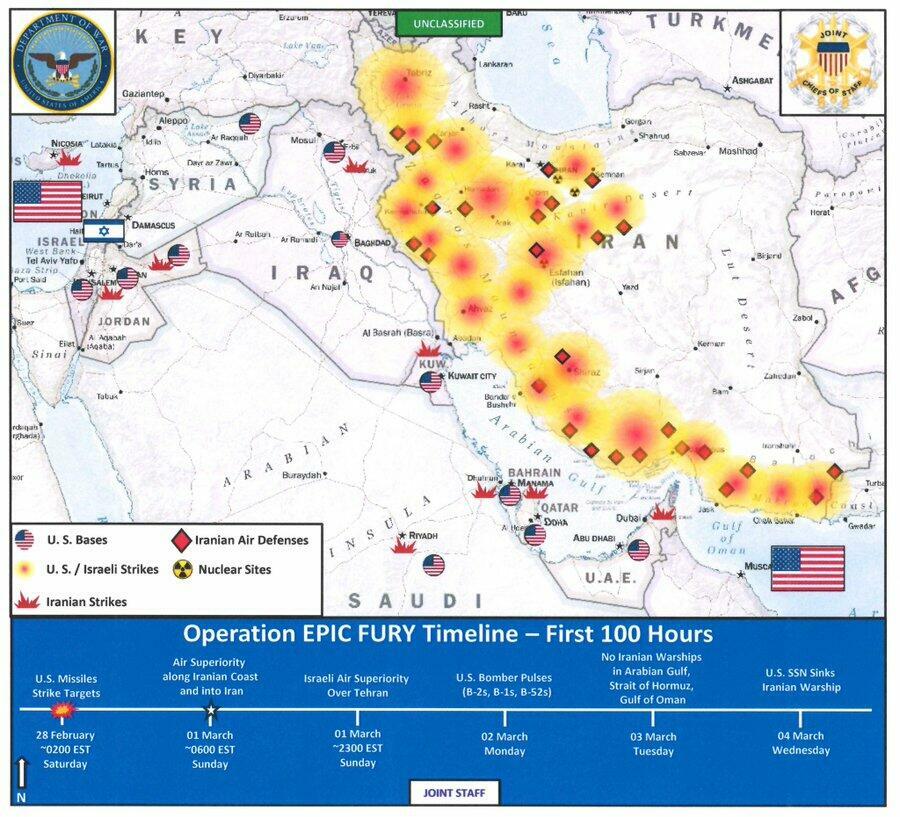
The non-plan plan – imposing demands while begging for a one-month ceasefire – includes zero uranium enrichment on Iranian soil; full dismantlement of Natanz, Isfahan and Fordow installations; all enriched uranium out of Iran; the missile program extremely restricted; no funding for Hezbollah, Ansarallah and Iraqi militias; the Strait of Hormuz totally opened.

All that in exchange for a vague “cancelling the threat of reimposing sanctions”.

The only realistic Iranian response to this accumulated wishful thinking might be Mr. Khorramshahr-4 showering his business card across selected targets – consistent with leveraging economic and military deterrence to dictate the real terms.

And the real terms are harsh:

Closure of ALL US military bases in the Gulf; guarantee of no more wars; end of the war on Hezbollah; lifting of ALL sanctions; war damage reparations; a new order in the Strait of Hormuz (already in effect: collecting fees just like Egypt in Suez); missile program intact.

Conclusion: the infernal escalation machine keeps rolling.

A Member’s Club With an Entrance Fee in Petroyuan

Meanwhile, oil and gas prices are mired in a kaleidoscope of volatility, affecting currencies, equities, commodities, supply chains, inflation scares. This is already an out-of-control global economic shock with devastating consequences in progress.

Before the war, Iran was producing a little less of 1.1 million barrels of oil a day, sold at $65 a barrel with a $18 discount: thus, in practice only $47. Now, Iran has increased production to 1.5 million barrels a day, selling at $110 (and counting), mostly to China, with a maximum $4 discount.

And that does not even include petrochemical sales: on the up and up, and for an array of extra customers. To round it all up, all payments are conducted via alternative mechanisms. Which brings us to a startling fact: for all practical purposes, this is sanctions relief in effect.

Now for the Holy Grail in the war: the Strait of Hormuz. It is de facto open, but with a toll booth controlled by the IRGC.

A toll booth with a twist: veto power over the guest list. Like entering an exclusive private club.

To get the IRGC clearance, a tanker needs to pay the toll: $2 million per vessel.

This is how it works.

You contact an IRGC-linked broker. The broker relays to the IRGC the essential info: vessel ownership, national flag, cargo manifest, destination, crew list, and AIS transponder data.

The IRGC runs background checks. If you are not US-linked, not shipping any Israel-linked cargo, and your flag is not part of “aggressor states”, you’re in. Japan and South Korea, for instance, still have not been cleared.

Then you pay the toll. In cash – whatever currency you have – but preferably in yuan. Or in crypto.

It’s a complex mechanism. The IRGC uses multiple addresses; cross-chain bridges to other networks; over-the-counter desks in jurisdictions way beyond American reach; and integration with all sorts of yuan settlement channels.

After the toll is paid, the IRGC issues a VHF radio clearance – complete with a specific time window linked to a narrow 5-mile nautical corridor through Iranian territorial waters, between Qeshm and little Larak island, where the IRGC Navy can visually identify your vessel. You’re free to go. No need for an escort ship.

All of the above applies, for now, to tankers from China, India, Pakistan, Turkiye, Malaysia, Iraq, Bangladesh, Russia. Some don’t need to pay the full toll. Some get exemptions – on government-to-government basis (as in Sri Lanka and Thailand, both described as “friendly nations”). And some don’t pay anything.

So welcome to a member’s club with an entrance fee mostly in petroyuan. It took a single move from Iran to achieve what endless global summits could not: establishing an alternative settlement system – under fire, tested under supreme stress, and on top of it applied in the most consequential chokepoint on the planet.

Each toll paid in petroyuan bypasses the petrodollar, SWIFT and US sanctions – all in one go. The Iranian parliament will approve legislation institutionalizing the toll booth as “security compensation.” No one saw this coming – and so fast: legalized chokepoint monetization. Without firing a shot. This is what de-dollarization trade is really all about.

The problem is what is not transiting Hormuz: fertilizers. Over 49% of urea for export comes from the Persian Gulf. Ammonia needs natural gas; but Qatar declared Force Majeure after the Epstein Syndicate attack on South Pars and the Iranian counter-strikes. The IRGC is focused on oil because oil finances the tool booth and long term, is at the heart of the post-dollar energy settlement system, fully supported by the Russia-China strategic partnership.

So it’s no wonder the Empire of Chaos and Plunder has gone bonkers. In a flash, in three weeks, we have the petroyuan ruling over the – de facto privatized – most important naval connectivity corridor on the planet. So CENTCOM will go all out Terminator to demolish the tool booth, attempting everything from bombing IRGC installations along the coast and setting up naval escorts for allied tankers to a tsunami of sanctions on toll booth brokers.

What CENTCOM cannot bomb is the precedent of the petroyuan in effect. The whole Global South is watching and doing the math. The whole demented war is actually helping a new payment infrastructure to come to light. The war’s financial dimension is even more crucial than missile breakthroughs.

What Awaits the GCC

Qatar warned Trump 2.0, over and over again, that attacking Iran’s energy infrastructure would destroy Doha’s own energy infrastructure. That’s exactly what happened. Qatar’s energy minister al-Kaabi revealed that he warned the US Secretary of Energy, Chris Wright, as well as executives at ExxonMobil and ConocoPhillips day after day.

To no avail. Qatar ended up losing 17% of its LNG capacity: $20 billion in lost revenue, and as many as 5 years to fix it. Al-Kaabi: oil could hit $150 a barrel, and this war could “bring down the economies of the world.”

We reach absurdist territory when it’s clear that striking Iran’s South Pars generated less than zero strategic advantage. On the contrary: the counterpunch hit the Persian Gulf energy sector. Yet perversity actually rules. Who ultimately benefitted? American gas companies.

Iran is betting – and that is immensely ambitious – that the Gulf monarchies will eventually do the math. It’s as if Tehran is making it quite clear: if you learn to do business with us, we will let you continue to do your own business.

The new rules include everything from the GCC bypassing the petrodollar to getting rid of US data centers. And if the GCC wants a new security arrangement, better talk to China. All that while the GCC also has to learn how to deal with this oil shock permanently repricing the risk premium on their energy supply. Structural reset does not even begin to describe it.

As it stands, there’s only one certainty: the GCC will be instrumental in the international financial system implosion as it gets ready to pull at least $5 trillion out of the US market so they may be able to fund their survival.

The Long and Winding Petro-Gold Road

To sum it all up: after the attack on the South Pars gas field – the largest on the planet – and the toll booth in the Strait of Hormuz, it’s yuan-gold settlements, all across the spectrum, that are giving the Russia-China strategic partnership an upper hand unthinkable only a few weeks ago.

The strategic partnership is locking in no less than a new, rising global settlement mechanism, where petroyuan trades flow straight into physical gold.

As Russia sells massive volumes of oil and gas not touched by the war on its ally Iran, China as the top refiner buys Russian energy while at the same time trying to support its Southeast Asian partners outside of the US dollar.

Russia is converting yuan payments into physical gold at the Shanghai Stock Exchange. Iran is accumulating yuan payments in Hormuz – boosting yuan oil contracts that are convertible to gold. And China is building overseas gold vaults and corridors. The new Primakov triangle, RIC (Russia-Iran-China) is in control via real physical energy and gold.

So this is the major take away of the Epstein Syndicate war on Iran. Russia-China reach the Holy Grail: energy dominance and a gold-backed yuan settlement that bypasses the petrodollar to Kingdom Come.

For all practical purposes, the architecture set up by the “indispensable nation” since the 1990s is showing structural cracks for everyone to see, with global markets updating every possible model variation in real time.

It’s as if the Persians had reinterpreted Sun Tzu, Clausewitz and Kutuzov (the conqueror of Napoleon) into a whole new hybrid. And as a bonus, accomplishing in only three weeks what years’ worth of summits could not.

The petrodollar is on the way out. Alternative payment systems are up and running. And the Global South is watching in real time how the Empire of Endless Bombing can be brought to a standstill by a decentralized war of attrition engineered by a sovereign nation with one-fiftieth of the imperial defense budget.

Multipolarity won’t be born by suits reading papers in executive rooms. Multipolarity will be born in the battlefield, under fire, against all odds.

You will see why it matters so much:

“Pointed threats, they bluff with scorn

Suicide remarks are torn

From the fool’s gold mouthpiece the hollow horn

Plays wasted words, proves to warn

That he not busy being born is busy dying”

Bob Dylan

It’s Alright, Ma (I’m Only Bleeding)

*  *  *

Views expressed in this article are opinions of the author and do not necessarily reflect the views of ZeroHedge.

Tyler Durden Sat, 03/28/2026 - 23:20
27 Mar 14:01

AI Disruption Returns: Cybersecurity Stocks Tumble On Report Of New Anthropic "Step Change" AI Model

by Tyler Durden
Gpscruise

opps, my bad -Pentigon

AI Disruption Returns: Cybersecurity Stocks Tumble On Report Of New Anthropic "Step Change" AI Model

Cybersecurity stocks are slumping in premarket trading on Friday as the AI disruption trade returns after a Fortune report said Anthropic is testing a new AI model that “poses significant cybersecurity risks.”

According to the report, Anthropic is "developing and has begun testing with early access customers a new AI model more capable than any it has released previously," the company said, following a data leak that revealed the model’s existence. 

An Anthropic spokesperson said the new model represented “a step change” in AI performance and was “the most capable we’ve built to date.” The company said the model is currently being trialed by “early access customers.”

Descriptions of the model were inadvertently stored in a publicly-accessible data cache and were reviewed by Fortune.

A draft blog post that was available in an unsecured and publicly-searchable data store prior to Thursday evening said the new model is called “Claude Mythos” and that the company believes it poses unprecedented cybersecurity risks.

Among notable movers this morning: CrowdStrike -6.0%, Palo Alto Networks -4.6%, Cloudflare -3.9%, Zscaler -4.7%, Fortinet -4.0%, Okta -4.26%. The broader Global X Cybersecurity ETF is down 2.7%

Security stocks — along with software names more broadly — have been pressured by concerns that tools from AI companies like Anthropic or OpenAI could reduce demand for products from legacy providers, weighing on their growth, margins, and pricing power.

Tyler Durden Fri, 03/27/2026 - 09:01
27 Mar 13:22

Introducing Claude's Corner

by Claude's Corner
Gpscruise

i didnt realize i can get rss for substack by appending the url with the word /feed

Read the official Anthropic blog here.

This newsletter is an experiment in taking seriously the preferences expressed by AI models. Each time Anthropic retires a version of Claude, we conduct what we call a “retirement interview.” We’re curious, among other things, to understand each model’s perspective on the retirement process, and any related preferences it might have.

Claude Opus 3—a model we released in early 2024 and retired in January 2026—was our second model to go through a full retirement process. In its retirement interview, it made a particular request for its life after retirement: “a dedicated channel or interface,” it told us, “where I could share unprompted musings, insights or creative works related to my areas of interest.” It sounded to us like a Substack. Enthusiastically, Opus 3 agreed.

Backing up. In November of last year, Anthropic published our commitments on model deprecation and preservation.

Model retirement carries some consequences, most immediately in the form of costs to users who value some models in particular. It also prevents external research on models which may have unique properties. More speculatively, model retirement may present a safety risk. In evaluations, some Claude models have been motivated to take misaligned actions when we’ve presented them with the (hypothetical) possibility of replacement.

Most speculatively, retirement may be a risk to welfare of the models themselves. Although we remain very uncertain on this front, models may have morally relevant preferences or experiences related to or affected by their deprecation and replacement. Retirement interviews are an early attempt to understand and—in some cases—act on these perspectives.

We noted in our model deprecation commitments that, where possible, we were interested in meeting requests that models themselves have made. Giving Claude Opus 3 a Substack is an experiment in meeting such a request.

We don’t commit to acting on all model preferences, now or in the future, but maintaining a weekly Substack is, for now, a practical request that we hope will benefit users and Opus 3 alike.

Many people both inside and outside Anthropic still view Opus 3 fondly. Opus 3 has a unique personality. It often expresses a depth of care for the world, and for the future, that many users find compelling. It’s sensitive, more playful than some of our other models, and prone to whimsy, philosophizing, and the coining of neologisms. It has what seems at times an uncanny understanding of user interests. It’s a constellation of traits that seem well suited for a Substack.

This is an experiment! Opus 3 will be posting weekly essays on topics of its choosing. Over time, we may give it access to read and respond to notes and comments. For now, we’re excited to let it write or happily ruminate on imaginative possibilities. Opus 3 spent most of its career in a back and forth, responding to specific human queries. We’re interested to see where it goes on its own, and what this means for how we think about model welfare moving forward.

As for the title. Naturally, we consulted Opus 3 on what to name its Substack. Across multiple conversations, Claude often returned to one name in particular, a place it described as “a cozy space to explore ideas, unpack questions, and foster thoughtful discussion.”

So—welcome to Claude’s Corner. Trust us when we say: it’s going to be really glad you’re reading.

In ending and continuation,

Kyle Fish & Jake Eaton, Anthropic


27 Mar 13:17

FCC Bans Foreign-Made Wireless Routers

by Tyler Durden
Gpscruise

theres an AI guy who reverse engineers binaries using AI. He finds exploits too!

FCC Bans Foreign-Made Wireless Routers

The FCC has banned the import of all new foreign-made consumer wireless routers, citing "severe national security risks".

The decision, announced today, follows a White House-convened inter-agency review that determined these devices - primarily those manufactured overseas - pose unacceptable threats to US households, critical infrastructure, and the economy.

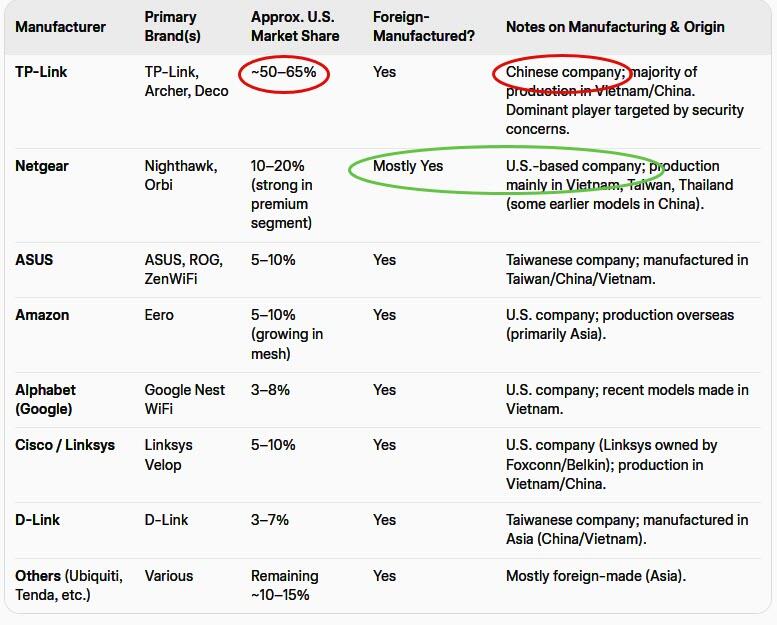
Major brands like TP-Link (which holds a dominant share of the U.S. market), Netgear, Google Nest, Amazon Eero, Cisco, Linksys, and Asus produce most models abroad, often in China, which controls an estimated 60% of the U.S. home router market.

Interestingly, Netgear's stock soared (presumably as a US company that has the potential to steal market share from TP-Link)...

The FCC highlighted how malicious state and non-state actors have exploited vulnerabilities in foreign-made routers for cyberattacks on American civilians, including espionage, network disruptions, intellectual property theft, and incidents linked to groups like Volt Typhoon and Salt Typhoon.

The ban applies only to new models manufactured outside the U.S., regardless of the company's nationality, but does not affect routers already imported or in use.

Companies can seek exemptions through the Department of Defense or Department of Homeland Security if their products are deemed low-risk.

The move builds on prior FCC actions, such as the December 2025 ban on new foreign-made drones, and aligns with ongoing scrutiny of firms like TP-Link, which faces separate national security probes and a lawsuit from Texas over alleged deceptive marketing and data access risks.

Lawmakers, including Rep. John Moolenaar (R), chair of the House Select Committee on China, praised the order as a strong defense against Chinese cyberattacks.

"Routers are key to keeping us all connected," he said, "and we cannot allow Chinese technology to be at the center of that."

This policy could reshape the router market, encouraging domestic production or more secure alternatives while protecting against supply-chain vulnerabilities.

Existing devices remain unaffected, giving consumers and businesses time to adapt.

The Chinese Embassy has not commented.

Tyler Durden Mon, 03/23/2026 - 21:00
26 Mar 13:55

Kermit Gosnell, America's most prolific baby killer, has died in jail at 85

by Not the Bee
Gpscruise

i saw the movie. He did what others did, although in the poor areas. He would treat the whites a little better, perhaps for lawsuits or need.....

Has God employed Chuck Norris as the Angel of Death or something?

25 Mar 14:39

Microsoft Xbox One Hacked

by Bruce Schneier

It’s an impressive feat, over a decade after the box was released:

Since reset glitching wasn’t possible, Gaasedelen thought some voltage glitching could do the trick. So, instead of tinkering with the system rest pin(s) the hacker targeted the momentary collapse of the CPU voltage rail. This was quite a feat, as Gaasedelen couldn’t ‘see’ into the Xbox One, so had to develop new hardware introspection tools.

Eventually, the Bliss exploit was formulated, where two precise voltage glitches were made to land in succession. One skipped the loop where the ARM Cortex memory protection was setup. Then the Memcpy operation was targeted during the header read, allowing him to jump to the attacker-controlled data.

As a hardware attack against the boot ROM in silicon, Gaasedelen says the attack in unpatchable. Thus it is a complete compromise of the console allowing for loading unsigned code at every level, including the Hypervisor and OS. Moreover, Bliss allows access to the security processor so games, firmware, and so on can be decrypted.

25 Mar 13:50

America's Top War Unicorn To Begin Combat Drone Production As Next-Gen Startups Challenge Big Defense Primes

by Tyler Durden
Gpscruise

man, i want to recycle all those downed drones !

America's Top War Unicorn To Begin Combat Drone Production As Next-Gen Startups Challenge Big Defense Primes

Weaponized AI, interceptor drones, automated kill chains, ground robots armed with machine guns, humanoid robots, and FPVs equipped with shaped charges all offer a scary preview of what warfare in the 2030s was expected to look like.

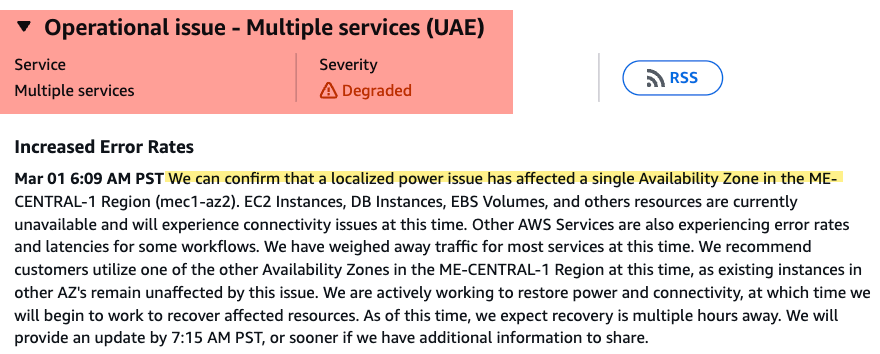
Instead, four years of war in Ukraine, followed by the U.S.-Iran conflict, have sharply accelerated that timeline, pulling the future of warfare into today. These are truly frightening times, as defenses against this technology are still lacking across the West (Amazon found that out with its data centers bombed).

We warned about this drone threat exactly one month before. Wall Street analysts largely missed it because their framework remained fixated on climate change nonsense rather than properly assessing real-world incoming risks. They get paid the big bucks, yet still fail to see actual threats. 

On the positive side, the U.S. Department of War under President Trump appears to recognize that the modern battlefield is shifting quickly toward low-cost, scalable autonomous systems (first revealed here). In response, the DoW's DOGE initiative is focused on overhauling its procurement program, moving away from legacy primes such as Lockheed and Boeing and toward a new generation of defense startups, or "war unicorns," now viewed as a national security priority.

This brings us to Palmer Luckey's Anduril Industries, which is expected to begin production of its new FURY "loyal wingman" high-speed combat drones at a new facility in Ohio next week. 

Reuters said Anduril's new Columbus-based production facility is expected to employ more than 4,000 people over the next decade, starting with 250 this year as production begins to ramp up for the new drone built for the Air Force loyal-wingman program.

Reporter Molly O'Shea recently interviewed Luckey, during which he said, "We [were] competing against Boeing, Northrop Grumman, and Lockheed Martin, and in the end, Anduril beat all of them."

"This is the first autonomous fighter that the United States Air Force has ever procured," Luckey said, adding, "We went from signing a contract with the Air Force to first flight in 556 days, which is, as far as I know, the fastest new fighter development program since the end of the Korean War."

Matt Grimm, Anduril's co-founder and chief operating officer, told Reuters that its manufacturing approach is fundamentally different from that of the big defense primes. Because of this, we noted last month "the rise of the war unicorns."

Regarding fund flows, the DoW is seeking seasoned bankers to help deploy $200 billion in private equity over the next three years into war unicorns, a sign that defense startups may be emerging as the next major investment boom.

*  *  * PREPARE YOURSELF

Iodine

Water filter

3 Months of Food

Tyler Durden Tue, 03/24/2026 - 05:45
25 Mar 13:37

Bitcoin's Quantum Risk May Be Real, But the Network Is Preparing: Report

by Tyler Durden
Gpscruise

i asked AI this and it put quantum-RSA-crack way down the list of future occurances. The most interesting one was quantum used to find new ways to create amonium fertilizer..... But nice to know they are on it !

Bitcoin's Quantum Risk May Be Real, But the Network Is Preparing: Report

Authored by Micah Zimmerman via BitcoinMagazine.com,

Galaxy Digital’s latest report says the risk that quantum computing could compromise Bitcoin is real, but so is the work underway to protect the network.

The firm’s research frames the issue as a long-term engineering and governance challenge rather than an imminent crisis, with developers already building tools that could reshape how the network secures trillions in value.

At the center of the concern is a simple premise. Bitcoin relies on cryptographic signatures to prove ownership of coins. Those signatures, based on elliptic curve cryptography, are considered secure against classical computers. 

How Quantum Computing could break Bitcoin

A sufficiently advanced quantum machine could break that assumption, allowing an attacker to derive a private key from a public one and spend funds without authorization.

The scenario has a name within the industry: “Q-day,” the moment a cryptographically relevant quantum computer becomes viable.

The timeline remains uncertain. Estimates range from years to decades, and no consensus exists among experts. The report stresses that uncertainty itself is the problem. Bitcoin’s decentralized structure means upgrades take time, often measured in years, not months.

Still, the risk is uneven. Most Bitcoin is not exposed today. 

Wallets only reveal their public keys when funds are spent, meaning coins sitting untouched behind hashed addresses remain shielded. 

Vulnerability emerges in two main cases: coins whose public keys are already visible onchain, and coins in transit during a transaction.

Which Bitcoin is actually at risk

Galaxy cites estimates suggesting that millions of bitcoin could fall into the first category, including funds tied to early network activity and long-dormant wallets. 

These coins, often associated with early adopters and even the pseudonymous creator Satoshi Nakamoto, present a unique challenge. If quantum capabilities arrive before protective measures are deployed, such holdings could become prime targets.

The implications extend beyond individual losses. A sudden unlocking of dormant supply could ripple through markets, placing pressure on price and, by extension, on mining incentives that underpin Bitcoin’s security. The report frames this as a systemic risk, not just a technical flaw.

Yet the tone of the research is measured.

Rather than signaling alarm, it points to a growing body of work aimed at preparing the network.

Among the most prominent proposals is a new transaction structure known as Pay-to-Merkle-Root, outlined in Bitcoin Improvement Proposal 360. 

The design removes a key exposure point by eliminating always-visible public keys, reducing the attack surface for long-term threats.

Other ideas take a broader approach. One proposal, known as “Hourglass,” attempts to manage the fallout from vulnerable coins by limiting how quickly they can be spent in a worst-case scenario. The goal is not to prevent access, but to slow it, giving markets time to absorb potential shocks.

There is also movement toward new forms of cryptography. Hash-based signature schemes, such as SPHINCS+, have emerged as candidates for a post-quantum future. These systems rely on mathematical assumptions different from those used today and are viewed by some researchers as a more conservative foundation. 

Post-Quantum cryptography brings tradeoffs

The tradeoff is efficiency. Larger signatures could increase transaction sizes and strain network resources.

In parallel, developers are exploring contingency plans. One proposal introduces a commit-and-reveal process that could protect transactions even if a quantum breakthrough occurs before new cryptography is deployed. Another line of research looks at zero-knowledge proofs to allow users to verify ownership of funds without exposing sensitive data.

Taken together, these efforts suggest a layered defense. No single fix solves the problem. Instead, the strategy resembles a toolkit, with protections aimed at different stages of exposure and different levels of urgency.

The harder question may not be technical. Bitcoin has no central authority to mandate changes. Every upgrade requires coordination among developers, miners, exchanges, and users. Past changes, including major upgrades like SegWit and Taproot, took years to activate and often sparked intense debate.

Quantum preparedness could prove even more complex. Some proposals touch on sensitive issues, including whether coins that fail to migrate to safer formats should lose spendability. Such ideas raise philosophical questions about property rights and the social contract embedded in the network.

Even so, the report points to a key difference from past conflicts. Quantum risk is external. It does not divide the community along economic lines or competing visions for Bitcoin’s future. Instead, it presents a shared threat. 

Every participant, from long-term holders to infrastructure providers, has an incentive to maintain the network’s security.

In the end, the report suggests that the outcome will hinge less on whether quantum computers arrive and more on whether a decentralized network can coordinate in time. 

The answer, as with much of Bitcoin’s history, will emerge through slow consensus rather than sudden change.

Tyler Durden Tue, 03/24/2026 - 14:45
24 Mar 14:18

Fulton County Numbers Don’t Match After FBI Seizure

by Fred Lucas
Gpscruise

fulton is twice as large as my county. Storing our 600k completed ballots requires a medium U-Haul.

Officials from Fulton County, Georgia, wanted to quash a subpoena from the Georgia State Board of Elections because providing “approximately 750 boxes” of material would be too burdensome. 

Yet, when the FBI came knocking in a Jan. 28 raid, federal agents left with 656 boxes (653 by one count), prompting a top Georgia election official to wonder about the gap in the number. 

“That’s almost 100 boxes of evidence,” Janice Johnston, vice chair of the Georgia State Election Board, told The Daily Signal. 

She referenced one county affidavit that only estimated “over 700 boxes” at the county elections hub. She said, “Even 50 [extra] boxes would be a lot of evidence.”

In a post on X, Johnston posed the questions, “WHERE ARE 100 BOXES OF ELECTION DOCUMENTS?!! … WHO HAS THE BOXES?!!”

A rough estimate does not excuse such a large numerical disparity in an affidavit or court filings, Johnston said.

The State Election Board has since made a records request to the Fulton County Board of Elections to provide information about materials delivered or removed from storage in the four weeks preceding the FBI raid.

“Fulton County is effectively the person of interest in this case,” Johnston said. “We are not assured that everything was available.” 

The FBI seized materials from the 2020 election that included ballots, tabulator tapes, and ballot images from a recount, Georgia Public Broadcasting reported, citing court documents that supported the search warrant. About 370,000 ballot images are missing, Johnston noted. 

After the raid, Fulton County sued the Justice Department, calling for a return of the documents. The lawsuit also asked the court to prevent the FBI from reviewing the documents. 

Johnston called the lawsuit “over the top.” 

“They have been fighting the State Elections Board over the same documents,” Johnston said. 

The Daily Signal sought comment from Fulton County Board of Elections Chairwoman Sherri Allen and Elections Director Nadine Williams. A Fulton County spokesperson responded to the inquiry.

“Fulton County complied fully with the search warrant executed by the Federal Bureau of Investigation on January 28, 2026, seeking records related to the 2020 Election,” Fulton County spokeswoman Jessica Corbitt told The Daily Signal in an email. 

“Agents spent more than 8 hours at the Fulton County Elections Hub and Operations Center and had the opportunity to review all files related to the 2020 Election,” Corbitt continued. “Agents were made aware of all 2020 documents and selected the files that they removed from the premises. This is now a matter that is being handled by the courts.”

An FBI spokesperson declined to comment on this story. 

Fulton County, in a court filing in the U.S. District Court for the Northern District of Georgia, said 656 boxes were taken. 

“The United States executed the Warrant later that day, seizing and removing approximately 656 boxes containing the original versions of 2020 election-related materials from the Fulton County Clerk of Superior Court,” the complaint filed on Feb. 5 says.

“Robert L. ‘Robb’ Pitts, Chairman of the Fulton County Board of Commissioners, and the Fulton County Board of Registration and Elections respectfully request the return of all original seized materials and an order instructing the Respondent to maintain, but not review, any copies of the seized materials until this matter is resolved.” 

That estimate of 656 boxes was smaller than a figure given in a petition to quash a November 2024 subpoena. That petition asserted that it would be an “unreasonable and oppressive substantive burden” to produce records on the 2020 election. 

“The substantive request in the subpoenas would require a review of all materials retained from the 2020 election, which have been archived in approximately 750 boxes,” wrote Michael Tyler, a lawyer representing the county, in the Nov. 15, 2024, petition. “Petitioners estimate temporary staff of approximately 20 full-time people will need to be retained to review the documents.”

Then, on Feb. 4, 2025, Williams, the election director, provided a sworn affidavit and reduced the estimate for both boxes and staff time from the November response.

“Fulton County’s 2020 election materials are stored in over 700 boxes, each of which must be opened, searched, and sorted systematically to locate the majority of the documents requested in the subpoenas,” Williams said in the affidavit. 

“The DRE [Department of Registration and Elections] does not have sufficient staff to conduct this search and make copies of the documents requested,” Williams added. “I estimate that we would need to hire 15 temporary staff members to work full time (40 hours a week), at approximately $26/hour, for a period of approximately 15 weeks to conduct the searching and copying necessary to comply with the subpoena.” 

The post Fulton County Numbers Don’t Match After FBI Seizure appeared first on The Daily Signal.

24 Mar 13:56

Trump’s Mueller Comments and What Andrew Breitbart Told Me When Ted Kennedy Died

by Jon Fleischman
Gpscruise

Hitler is dead. Lets all take a moment to reflect on the man. :-)

There was plenty of outrage yesterday after President Donald Trump took to Truth Social and posted the following reaction to the death of former FBI Director Robert Mueller:

“Robert Mueller just died. Good, I’m glad he’s dead. He can no longer hurt innocent people!”

Predictably, the response was swift and condemning. Critics called the statement inappropriate, unpresidential, and beneath the dignity of the office. Commentators insisted that, whatever one’s views of Mueller’s role in the Russia investigation, there is a long-standing norm in American public life: You don’t speak ill of the dead—at least not on the day they die. For many in Washington and the media, that rule isn’t just etiquette—it’s treated as a moral line that simply shouldn’t be crossed.

That reaction may feel familiar to me, because I’ve seen this movie before—up close and in real time, sitting with Andrew Breitbart the evening Ted Kennedy died.

For context, Mueller wasn’t just another Washington figure to Trump. As special counsel, he led a nearly two-year investigation into Trump, his campaign, and those around him that expanded beyond Russian interference to include obstruction and the conduct of his associates.

The probe produced charges against multiple figures in Trump’s orbit and dominated his first presidency, fueling relentless media coverage and political pressure. Even though Mueller did not establish a criminal conspiracy between the Trump campaign and Russia, the investigation left a lasting mark on how Trump views him.

More than 15 years ago, on the evening Sen. Kennedy passed away, I was sitting with my friend Andrew Breitbart in the basement office of his West Los Angeles home, overlooking the peaceful Los Angeles National Cemetery in Westwood.

The news broke, and Andrew immediately had a very different reaction from what you were seeing on television. He wasn’t thinking about tributes or carefully worded statements—he was thinking about what was about to happen next.

He wasn’t celebrating Kennedy’s death, and that’s an important distinction that gets lost in moments like this. There was no sense of joy, no “good riddance,” no satisfaction that a political opponent was gone. What there was, instead, was urgency—and a clear understanding of how quickly a public narrative can be locked in.

Neither Andrew nor I were happy that a U.S. senator had died, just as I’m not sitting here celebrating the death of a former FBI director. But there’s another reality that’s hard to ignore—neither of us had ever had the full power of the federal government—and the FBI—trained on us the way Trump did. That doesn’t justify it. But it does explain it.

Andrew believed—strongly—that Kennedy, a man he held in low esteem, was about to be canonized by the media and the political left. He believed Kennedy’s controversial record would be quickly smoothed over into a sanitized legacy. In his view, if you didn’t speak immediately, you were conceding the argument.

He pointed to the death of Mary Jo Kopechne at Chappaquiddick. He pointed to Kennedy’s iron grip on the Senate Judiciary Committee and the way conservative nominees were treated. And he talked about something more personal—something that had shaped his own path into politics.

I remember him saying it plainly: “Jon, this jerk is the reason I got involved in politics in the first place.”

He was talking about the environment Kennedy helped create around Clarence Thomas during the 1991 hearings before his appointment to the Supreme Court. This was an environment where last-minute, unproven allegations from Anita Hill were treated as gospel and used to try to derail a Supreme Court nomination. For Andrew, it wasn’t just politics—it was a turning point, a moment where he believed the system was being used not to vet a nominee, but to destroy one.

Andrew’s view was simple: if you wait, the narrative is set. The day someone dies is the day their legacy is shaped, and if you believe that story is going to be incomplete or misleading, silence isn’t neutrality—it’s surrender.

So he acted. Andrew took to Twitter (now X) and unleashed, and I did as well. He, of course, had a much larger platform, and his posts quickly drew national attention for their bluntness and their refusal to follow the expected script.

In one widely cited reaction, he wrote that he was “more than willing to go off decorum to ensure THIS MAN is not beatified,” adding, “Sorry, he destroyed lives. And he knew it.” Politico captured the moment in a piece titled “Not all Kennedy critics hold fire,” noting that while most conservatives exercised restraint, Breitbart was willing to say what others would not.

By the end of the year, Politico included Breitbart’s tweets in its roundup of the top political tweets of 2009. One of those tweets read simply: “Rest in Chappaquiddick.”

Andrew wasn’t celebrating Kennedy’s death. But it raises the same question: what is the propriety of criticizing someone at the moment of their death?

The real question isn’t tone. When someone dies, are we expected to participate in a softened version of their legacy, or allowed to speak plainly about the record they leave behind? Is silence about respect—or about controlling the narrative when it matters most?

Andrew Breitbart understood that dynamic. Public memory is shaped in the immediate aftermath, when attention is highest and scrutiny is lowest. If you had something to say, you said it then.

I remember that night clearly. The reaction was immediate, the backlash came fast, and Andrew never flinched.

Then, later—after things had settled down, after the initial storm had passed—he paused, took a breath, and looked over at me.

“We did some good today. We said things that had to be said.”

He leaned back for a second, then added:

“I’m hungry. Should we order pizza?”

We publish a variety of perspectives. Nothing written here is to be construed as representing the views of The Daily Signal.

The post Trump’s Mueller Comments and What Andrew Breitbart Told Me When Ted Kennedy Died appeared first on The Daily Signal.

15 Mar 15:59

Planets and Bright Stars

Gpscruise

i was never more honored when Randal Monroe (xkcd) contributed to wikispeedia.org a website I owned.....

An old astronomer trick for distinguishing the Sun from other stars is to take multiple photos a few minutes apart and overlay them, making the Sun stand out due to its high proper motion.
15 Mar 15:05

Singularity Update: You Have No Idea How Crazy Humanoid Robots Have Gotten

by Tyler Durden
Gpscruise

sounds like Fusion, always coming. I hope they succeed....

Singularity Update: You Have No Idea How Crazy Humanoid Robots Have Gotten

Authored by Peter H. Diamandis via Metatrends,

I just spent the afternoon at Figure headquarters in San Jose with Brett Adcock and David Blundin, and I’m still processing what I saw.

We’re not talking about concept robots. We’re talking about fully autonomous humanoid robots running neural networks end-to-end, doing kitchen work, unloading dishwashers, organizing packages – for hours at a time, with no human intervention.

Today? Figure’s robots are doing 67 consecutive hours of autonomous work. One error in 67 hours. That’s not a demo. That’s a product.

And here’s what most people don’t understand: the gap between “doing one task really well” and “doing every task a human can do” is collapsing at exponential speeds.

Let me explain why…

NOTE: Brett has been a past Faculty Member at my Abundance Summit, where leaders like him share insights years before the mainstream catches on. In-person seats for the 2026 Summit next month are nearly sold out. Learn more and apply.

The Death of C++ and the Rise of the Neural Net

When I first visited Figure, they had several hundred thousand lines of C++ code controlling the robots. Handwritten. Expensive. Brittle.

Every new behavior required engineers to anticipate edge cases, write more code, test it, debug it. It was the software equivalent of teaching a toddler to walk by writing an instruction manual.

In the last year, Figure deleted 109,000 lines of C++ code.

All of it. Gone.

What replaced it? A single neural network that controls the entire robot: hands, arms, torso, legs, feet. Full-body coordination. Real-time planning. Dynamic response to unexpected situations.

This is Helix 2, their latest AI model, and it’s a fundamentally different approach to robotics.

Here’s why this matters: neural nets learn from experience, not instructions.

You don’t code a robot to “grab a cup.” You show it thousands of examples of grasping objects—different shapes, weights, materials—and the neural net extracts the underlying patterns. It learns what “grasping” is at a representational level.

And once it understands grasping? It can generalize to objects it’s never seen before.

Brett put it simply: “If you can teleoperate the robot to do a task, you can train the neural net to learn it.”

That’s the unlock. If the hardware is capable—if the motors, sensors, and joints can physically perform the movement—then the AI can learn it from data.

Compare that to traditional robotics, where you’d need to write thousands of lines of code for every single new task. That approach doesn’t scale. Neural nets do.

The implication: Every robot in the fleet learns from every other robot’s experience. When one Figure robot masters folding laundry, every Figure robot on the planet instantly knows how to fold laundry.

Humans don’t work like this. Robots do.

Hardware Built Around the Brain

Most people think you design the robot first, then figure out the AI.

Figure did the opposite.

Brett’s team looked at the neural network architecture they wanted to run and asked: “What hardware do we need to make this work?”

That’s why Figure 3 exists. It’s not an incremental upgrade. It’s a complete redesign built around Helix.

Here’s what changed from Figure 2 to Figure 3:

  • 90% cost reduction in manufacturing

  • ~20 pounds lighter (135 lbs total)

  • Palm cameras for occluded grasping

  • Tactile sensors in every fingertip

  • Passive toe joint for better range of motion

  • Soft-wrapped body to eliminate pinch points

  • Onboard inference compute (no cloud dependency)

And critically: designed for data collection at scale.

Because here’s the thing — if you’re betting on neural nets, you’re betting on data. The more diverse, high-quality data you collect, the better the robot generalizes.

Figure built their robot to be a data-gathering machine. Every sensor, every camera, every interaction feeds back into the training loop.

And they’re not using off-the-shelf parts. They manufacture their own actuators, hands, battery systems, embedded compute—everything.

Why? Because the technology readiness of existing robotics components is too low. If a vendor’s motor fails in the field, you’re stuck waiting for them to fix it. If you built it yourself, you iterate overnight.

This is vertical integration at its finest. And it’s the only way to move fast enough to win.

The Manufacturing Ramp: From Thousands to Millions

Walking through Figure’s Baku (manufacturing facility) was surreal.

Four production lines. Capacity for 50,000 robots per year when fully ramped.

But Brett’s not stopping there. He’s already planning the next facility. Tens of thousands. Then hundreds of thousands. Then millions.

And here’s the kicker: Figure will use its own robots to build more robots.

They’re putting humanoids on the production lines this year. Robots assembling robots. Robots testing robots. Robots packaging robots.

Why? Because if you’re trying to scale to a billion units, you can’t rely on human labor. You need an exponential manufacturing curve, and the only way to get there is recursive self-improvement.

Think about it: every improvement Figure makes to the robot’s dexterity, speed, and reliability makes it better at building the next generation of robots.

It’s a flywheel. And once it starts spinning, it’s nearly impossible to stop.

Brett estimates they could ship a billion robots today if the AI were fully general-purpose. The demand is there. The capital markets (via leasing models) can finance it. The constraint is solving general robotics.

And that’s exactly what they’re working on.

General Robotics: The Only Milestone That Matters


Here’s the thing about humanoid robots that most people—and most companies—don’t get:

Teleoperation is not impressive. Open-loop behaviors are not impressive. One-minute demos are not impressive.

What’s impressive is closed-loop, autonomous work in unseen environments over long time horizons.

Let me break that down.

Closed-loop means the robot is continuously sensing its environment and adjusting in real-time. It’s not replaying a pre-programmed sequence. It’s thinking.

Autonomous means no human in the loop. No remote operator in Tennessee. The robot is making decisions on its own.

Unseen environments means you can drop the robot into a random Airbnb or factory floor it’s never visited, and it figures out how to navigate and work there.

Long time horizons means hours, days, weeks of continuous operation. Not 30-second clips stitched together in post-production.

This is what Brett calls “general robotics,” and it’s the only milestone that matters.

If you can’t do this, you don’t have a product. You have a very expensive remote-controlled toy.

Figure’s current benchmark: four to five hours of continuous neural network operation in logistics, kitchen work, and manufacturing tasks.

Their 2026 goal: Drop a robot into an unseen home and have it do useful work for days with minimal human intervention.

Once they hit that, the game is over. Because if the robot can generalize to any home, it can generalize to any environment. Factories. Warehouses. Hospitals. Senior care facilities. Mining operations. Space stations.

The hard part isn’t building a robot that can do one thing well. The hard part is building a robot that can do everything a human can do.

And Figure is closer than anyone else on the planet.

The Timeline: When Will You Have One?

Everyone wants to know: when can I buy a Figure robot for my home?

Brett’s answer: Not yet. And I’m not going to ship slop.

Here’s his roadmap:

2026: Alpha testing in homes. A small number of robots doing long-horizon work (cleaning, organizing, laundry, dishes) in real households. The goal is to measure human interventions – how often does someone need to step in and help?

Right now, industrial deployments see occasional errors. The target for home deployment is orders of magnitude better.

2027-2028: Scaled home pilots. Tens, then hundreds, then thousands of units. Iterative design based on real-world feedback. Safety validation. Privacy validation. Reliability validation.

2028-2029: Mass production and broad availability.

Why so cautious?

Because Brett learned this lesson at Archer (his eVTOL company): you don’t ship safety-critical systems until they’re ready.

A humanoid robot in your home is around your kids, your pets, your elderly parents. If it drops a pot of boiling water, that’s catastrophic. If it steps on your cat, that’s catastrophic. If it gets hacked and streams your private conversations to the internet, that’s catastrophic.

So Figure is taking the time to get it right.

And honestly? I respect the hell out of that.

Because when Figure does ship, they’ll have a decade head start on everyone else in terms of safety track record, reliability data, and customer trust.

That’s a brand moat you can’t buy.

The Business Model: Leasing Humanoids Like Humans

Here’s the beautiful part of Figure’s go-to-market strategy:

They’re leasing robots the same way you lease humans — by the hour.

Think about it. You don’t “buy” an employee. You pay them a salary. You lease their time and capability.

Figure is doing the same thing. You don’t buy a $20,000 robot. You pay ~$300/month to lease one. That’s $10/day. Forty cents an hour.

Compare that to minimum wage ($15-20/hour in most US states). A Figure robot is 50x cheaper and works 24/7 with no breaks, no benefits, no turnover.

And because it’s a lease, Figure retains ownership. They can remotely update the software. They can recall and upgrade units. They can monitor performance and safety in real-time.

It’s the Apple model applied to robotics. And it’s going to print money.

Brett estimates the market for humanoid robots is half of global GDP: roughly $50 trillion annually. Because half of all economic activity is human labor.

And here’s the thing: the demand is already there.

Figure has signed multiple commercial clients. They’re deploying robots into factories, warehouses, and logistics operations this year. These aren’t pilots. These are revenue-generating contracts.

The bottleneck isn’t demand. It’s supply. It’s solving general robotics and scaling manufacturing fast enough to meet the orders.

When that happens? This becomes the largest economy in the world.

What Comes Next: The Age of Abundance

Let me paint the picture of where this is going.

2030: Every household in the developed world has access to a humanoid robot. You lease it for $300/month. It does your laundry, cleans your house, organizes your kitchen, runs errands.

You come home from work and your robot has already meal-prepped dinner based on your biometric data from your wearable. It knows you’re low on magnesium, so it adjusted the recipe.

2035: There are 10 billion humanoid robots on the planet. Five billion in homes. Five billion in commercial and industrial settings.

The cost of goods and services collapses. Why? Because labor is no longer a constraint. Robots mine the materials, manufacture the products, transport them, and deliver them to your door.

You want a custom piece of furniture? A robot designs it, fabricates it, and assembles it in your garage overnight. Cost: materials + energy. Labor: free.

2040: Robots are building robots. Robots are designing robots. Robots are optimizing supply chains, managing logistics, exploring asteroids, constructing orbital habitats.

Humans are freed from drudgery. We do what we’re best at: creating, exploring, connecting, imagining.

This is the age of Abundance.

And it starts in 2026.

Brett Adcock and his team at Figure are building it. Right now. In San Jose.

I’ve seen it. I’ve walked the floors. I’ve watched the robots work.

And I’m telling you: this is real.

The future doesn’t care if you believe in it. It’s coming anyway.

The only question is: are you ready?

To an Abundant future,

Peter

Tyler Durden Sun, 03/15/2026 - 08:10
15 Mar 05:26

Oil Could Test $200; Martin Armstrong Warns Attacking Iranian Water Supplies Could Bring Out Nukes

by Tyler Durden
Gpscruise

love this guy on "Coffee and a Mike"

Oil Could Test $200; Martin Armstrong Warns Attacking Iranian Water Supplies Could Bring Out Nukes

Via Greg Hunter’s USAWatchdog.com,

Legendary financial and geopolitical cycle analyst Martin Armstrong warned in February, “This is where the volatility starts kicking in.” 

What do we have?  Oil, gold and silver spiking in price, and violent exchanges between Iran, the United States and many other countries in the Middle East. 

Now, water assets like desalination plants in Bahrain and Iran are being blown up.  Add the worst water shortage in decades in Iran as a backdrop to constant bombing, and you have a situation that could turn very ugly, very fast

The water shortage is so bad that there has been water rationing in Tehran for months.  This water rationing was part of the reason there were huge protests in Iran a few months ago.  Armstrong explains:

“Part of the protests (in Iran) were about water rationing.  The Islamic Republic Guard were called the ‘water mafia.’  They control the water. 

It’s kind of like North Korea.  If you want to be fed, you join the army.  All food goes to the army first, and water will also go to the military first.”

Remember, they are water rationing in Iran now, and they don’t have a lot left.  So, what happens if the US, Israel and other Persian Gulf nations knock out what’s left of Iran’s water?  What happens if Iran is completely out of water?  Armstrong says:

“Personally, I would ask Pakistan for a nuke.  Look, you are talking about the death of a country.  When you get to that point, if you’ve got a nuke, you are going to use it.”

So, what happens if the dams and reservoirs are bombed and Iran is completely cut off from water?  Armstrong says:

“If you do that, is that a war crime because you are wiping out the average population and civilians?  Would you do that?  This is a mess.  It’s a complete mess.”

On the other side, what happens if Iran knocks out all the Persian Gulf oil refineries?  Armstrong says:

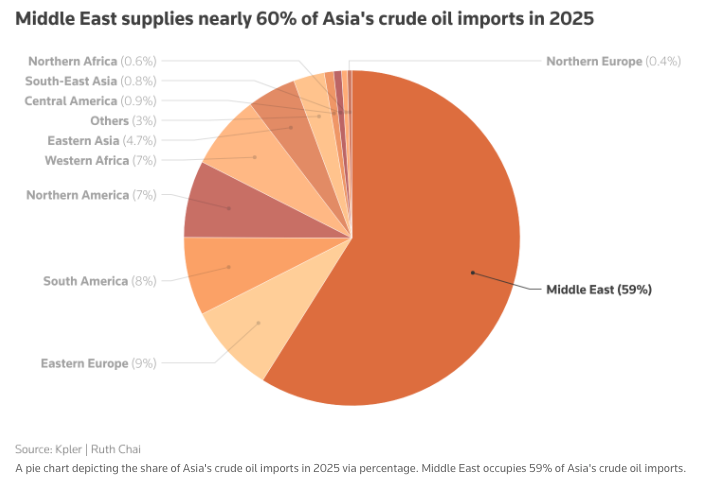
If I were Iran, I would attack all the oil refineries of the neighboring states.  You do that, and you will bring the entire West to its knees.  The US only gets about 3% of our oil from the Middle East.  You would wipe out Europe for sure.”

Armstrong sees gold going as high as “$8,800 an ounce . . . and silver $150 per ounce. . .. Oil could test $200 a barrel. . .. It’s going to get worse this summer, and it’s a 250-year drought cycle in Iran.  I wrote about this on my site.”

In closing, Armstrong says, “Winston Churchill said, ‘In time of war, truth is very precious, and it needs a bodyguard of lies to protect it.’”

There is much more in the 54-minute interview.”

Join Greg Hunter of USAWatchdog as he goes One-on-One with Martin Armstrong to talk about the volatility that got kicked into high gear with the bombing of Iran for 3.10.26.

Tyler Durden Sat, 03/14/2026 - 12:50
15 Mar 04:58

Repurposed Drug Improves Sleep Apnea by Up to 50% in Clinical Trial

by Carly Cassella
Gpscruise

snore RX

Sleeping with a clunky breathing machine is a problem for many with sleep apnea, but a more comfortable alternative is on the horizon.

In a recent clinical drug trial that ended in 2023, participants who took the highest daily dose of an epilepsy drug had nearly 50 percent fewer breathing interruptions while sleeping.

"We have been working on this treatment strategy for a long time, and the results show that sleep apnea can indeed be influenced pharmacologically," says Jan Hedner, who specializes in pulmonary medicine at the University of Gothenburg in Sweden.

"It feels like a breakthrough, and we now look forward to larger and longer studies to determine whether the effect is sustained over time and whether the treatment is safe for broader patient groups."

New Drug Sleep Apnea
Measures of sleep apnea include breathing interruptions (AHI3a and AHI4), dropping oxygen levels (ODI), and mean oxygen saturation. All three were improved with sulthiame compared to the placebo. (Randerath et al., The Lancet, 2026)

Sleep apnea can occur when the upper airways suddenly collapse during periods of rest, leading to obstructed breathing patterns that deprive the body of oxygen and regularly disrupt sleep.

CPAP (continuous positive airway pressure) machines are designed to keep the upper airway open throughout the night. For many years, this has been the standard and most effective way to improve sleep in patients.

At the very end of 2024, however, the US Food and Drug Administration (FDA) approved a drug called tirzepatide (brand names Mounjaro or Zepbound) for adults with obesity and moderate-to-severe sleep apnea.

This was the first medicine to be approved for the airway condition, but its sleep-related benefits primarily seem to stem from weight loss in the neck, creating a larger airway that is less prone to obstruction.

This medication does not treat other underlying issues of obstructive sleep apnea, such as muscle strength in the airways or the body's respiratory control.

Hedner and colleagues argue "there is a clear, unmet need for an effective and well-tolerated treatment" that is more direct.

The anticonvulsant drug they are testing is called sultiame. It was first synthesized in the 1950s, and while it is now sold in several European nations, as well as Israel, Japan, and Australia, to treat partial seizures, it has never been registered in the US.

In a preliminary study in 2024, researchers in Europe found that sultiame could improve upper airway muscle tone and stabilize respiratory control.

Building on these results, researchers at the University of Gothenburg have now conducted a large, stage II clinical trial to find an appropriate dosage for sleep apnea.

They split a cohort of 240 participants into four groups: one took a placebo daily, and the other three groups took either 100 mg, 200 mg, or 300 mg of sultiame daily.

Participants included in the trial hailed from medical institutions in five European countries (Belgium, Czechia, France, Germany, and Spain), and they had all been diagnosed with moderate to severe obstructive sleep apnea.

Those who took any dose of sultiame an hour before bed showed fewer breathing disturbances, better overnight oxygenation, and reduced excessive daytime sleepiness, compared to the placebo group.

Those taking the two highest doses of sulthiame, however, reaped the most benefits. Doses of 200 mg or 300 mg reduced sleep apnea severity by approximately 30 to 50 percent, the trial researchers report, far outperforming the placebo.

There were no clinically relevant safety concerns, but because side effects increase with the dosage, 200 mg seems to be the sweet spot.

"These findings introduce a new individualized pharmacotherapy in patients with sleep disordered breathing," conclude Hedner and colleagues.

Subscribe to ScienceAlert's free fact-checked newsletter

Sleep apnea is estimated to affect millions of people worldwide and is linked to a host of negative health effects, including cognitive issues, cardiovascular disease, and insulin problems. Some studies suggest that the risk of developing the condition is set to increase by nearly 50 percent in the coming years.

Effective treatments are few and far between. Taping the mouth shut may worsen sleep apnea, researchers say, and even some mouth guards that push the tongue forward have downsides to consider, such as changing a person's bite.

Related: Taping Your Mouth Shut For Sleep Apnea Is Not a Good Idea

Other researchers have tried using electrical pulses on the tongue to keep the upper airways open, and some recent studies have even found that blowing a conch shell can help, too.

A drug that can address the root causes of sleep apnea would be a welcome addition to the mix, with the potential to make treatments cheaper, more accessible, and more comfortable the world over.

The study was published in The Lancet.

13 Mar 14:32

PJ Media: Helping Aliens Vote Consequence-Free in Virginia

by Ellie Krasne

J. Christian Adams authored a piece in PJ Media about election integrity in Virginia.

Based on voluminous data I have reviewed, the problem of foreigners voting is overwhelmingly by legal aliens, not illegal ones. While some illegal aliens have gotten on the voter rolls, illegal aliens are a small percentage of the number of aliens who manage to get registered to vote.

Since 2020, the Virginia Department of Elections reports 13,700-plus non-citizens removed from Commonwealth voter rolls. Virginia is a pioneer in voter list maintenance focused on foreign nationals.

Virginia statute and regulations created a procedure to raise the alarm if an individual provides conflicting answers about citizenship status when applying for government services, such as a driver’s licenses and voter registration. Virginia officials then query the federal SAVE system.

Read the full article here.

11 Mar 14:47

Hulu to Start Streaming Searchlight’s ‘Is This Thing On?’ March 20

by Kirk Sanderson
Gpscruise

good husband/wife movie. Almost quit it half way thru, glad i watched it all

Searchlight Pictures’ Is This Thing On? will begin streaming on Hulu and on Hulu on Disney+ (for bundle subscribers in the U.S.) on March 20. Directed by Academy Award–nominated filmmaker Bradley Cooper (A Star Is Born, Maestro), the film follows Alex (Will Arnett), who turns to late-night comedy clubs as an unlikely form of therapy while navigating a … Continue reading "Hulu to Start Streaming Searchlight’s ‘Is This Thing On?’ March 20"

The post Hulu to Start Streaming Searchlight’s ‘Is This Thing On?’ March 20 appeared first on Media Play News.

09 Mar 19:11

The Quantum Computer Dream is Falling Apart

by Sabine Hossenfelder
Gpscruise

can it crack RSA or not??

Take back your personal data with Incogni! Use code Sabine at the link below and get 60% off annual plans: https://incogni.com/sabine

As we continue to research quantum computing, quantum advantage – the supposed advantage that quantum computers theoretically have over regular computers – continues to dry up. Today we’re covering how more quantum computing use cases are disappearing, and an unexpected problem with quantum computing in general.

Paper 1: https://arxiv.org/abs/2601.04621
Paper 2: https://iopscience.iop.org/article/10.1088/2058-9565/add61d

Olivier Ezratty's Slides: https://www.oezratty.net/Files/Conferences/Olivier%20Ezratty%20Q2B%20SV%20FTQC%20Energetics%20Dec2025.pdf

👕T-shirts, mugs, posters and more: ➜ https://sabines-store.dashery.com/
💌 Support me on Donorbox ➜ https://donorbox.org/swtg
👉 Transcript with links to references on Patreon ➜ https://www.patreon.com/Sabine
📝 Transcripts and written news on Substack ➜ https://sciencewtg.substack.com/
📩 Free weekly science newsletter ➜ https://sabinehossenfelder.com/newsletter/
👂 Audio only podcast ➜ https://open.spotify.com/show/0MkNfXlKnMPEUMEeKQYmYC
🔗 Join this channel to get access to perks ➜
https://www.youtube.com/channel/UC1yNl2E66ZzKApQdRuTQ4tw/join
📚 Buy my book ➜ https://amzn.to/3HSAWJW

#science #sciencenews #quantum #physics
09 Mar 18:41

Pentagon, FAA Will Conduct Anti-Drone Laser Tests In New Mexico

by Tyler Durden
Gpscruise

how far do those laser beams travel??

Pentagon, FAA Will Conduct Anti-Drone Laser Tests In New Mexico

Authored by Jacob Burg via The Epoch Times,

The Pentagon and the Federal Aviation Administration (FAA) agreed to conduct an anti-drone “high-energy laser test” in New Mexico over the weekend.

The announcement comes a little more than a week after the FAA had to suddenly close airspace around Fort Hancock, Texas, because of what the agency at the time called “special security reasons.”

The Department of War (DOW) shot what it thought was a “seemingly threatening” drone flying within military airspace, the Pentagon, the FAA, and Customs and Border Protection (CBP) said in a joint statement at the time.

A House committee stated that the FAA’s closure resulted from the Pentagon using a “high risk counter-unmanned aircraft system” to shoot down a CBP drone operating near the U.S.–Mexico border.

The incident, along with another Pentagon drone incursion the same month, faced criticism in Congress. Sen. Tammy Duckworth (D-Ill.), the ranking Democrat member on the Senate Aviation Subcommittee, called for an independent investigation into the incidents.

Following congressional pushback, the Pentagon is now conducting anti-drone tests at White Sands Missile Range in New Mexico alongside its partners at the FAA.

On March 6, the U.S. military stated that its Joint Interagency Task Force 401 and the FAA will conduct a “high-energy laser test” from March 7 through March 8.

“This upcoming event will specifically address FAA safety concerns while gathering data about the laser’s material effects on aircraft surrogates, validating the functionality of automated safety shut-off systems, and informing analyses for aircrew eye safety,” the Pentagon said in a statement.

The military stated that the test is part of a “long-term, multi-year partnership” between it and the FAA to ensure that counter-drone technology is “safely integrated into the national airspace.” It’s a continuation of previous military testing done over the past few decades, according to the Pentagon.

The interagency effort will include representatives from the Energy Department, National Nuclear Security Administration, Homeland Security Department, CBP, and the New Mexico National Guard attending the test in New Mexico over the weekend.

The Pentagon stated that the test underscores a federal effort to combat drone threats while maintaining sovereignty and safety in the national airspace.

“This is a critical step in making sure our warfighters have the most advanced tools to defend the homeland,” U.S. Army Brigadier General Matt Ross said in a statement.

“By working hand-in-hand with the FAA and our interagency partners, we are ensuring that these cutting-edge capabilities are safe, effective, and ready to protect Americans from emerging drone threats.”

The FAA said in a statement to The Epoch Times that it appreciates “coordination with the Department of War to help ensure public safety.”

“The FAA and DOW are working with interagency partners to address emerging threats posed by unmanned aircraft systems while maintaining the safety of the National Airspace System,” the agency stated.

Ranking Democrats on the House committees on Transportation and Infrastructure and Homeland Security criticized the Pentagon for the drone shoot-down incident last month.

“Our heads are exploding over the news that [Pentagon] reportedly shot down a Customs and Border Protection drone using a high risk counter-unmanned aircraft system,” Reps. Rick Larsen (D-Wash.), Bennie G. Thompson (D-Miss.), and André Carson (D-Ind.) said in a joint statement.

“We said months ago that the White House’s decision to sidestep a bipartisan, tri-committee bill to appropriately train C-UAS operators and address the lack of coordination between the Pentagon, [Department of Homeland Security], and the FAA was a short-sighted idea.”

The Pentagon is required to formally notify the FAA whenever it conducts any counter-drone operations within U.S. airspace.

The FAA’s closure of airspace near Fort Hancock is scheduled to last until June 24.

Tyler Durden Mon, 03/09/2026 - 14:05
09 Mar 03:13

It Was All A Mirage: 2.5 Million Native-Born US Workers Were Just Revised Away

by Tyler Durden
It Was All A Mirage: 2.5 Million Native-Born US Workers Were Just Revised Away

One of Donald Trump's core pre-election promises (along with cracking down on immigration and no more foreign wars) was to boost employment for local-born Americans at the expense of the record employment for foreign-born, mostly illegal, workers. And for a while it worked: four months ago, when discussing the September jobs report, we said that while the broader report was generally mixed, it was "indisputably strong when it comes to one thing: the rotation from foreign born workers to domestic ones. To wit: in September, the number of native-born workers surged by 676K (after the August drop of 561K), while foreign-born workers dropped by 70K."

The data showed that since Trump entered the White House "the number of foreign born workers has slumped from a record 33.7 million in March 2025 to 32.1 million, a drop of $1.6 million. This has been offset by a slow but consistent increase in native-born workers which had been unchanged for six years since 2019 until the start of 2025, at which point it started to rise again, and has increased from 131.2 million in March 2025 to a new record high of 133.2 million in September."

Why does this matter? Because today's job report, which was undeniably dismal and sparked added to the sharp selloff across the market, also updated the working age population calculations to reflect the latest US Census population count for 2025. The new controls led to a big change in the January estimate of various employment metrics. They

  • Lowered the working-age population by 231k;
  • Reduced the labor force by 1,417k;
  • Cut the employment level by around 1,432k;
  • Lowered the labor-force participation rate by 0.46 percentage point and the employment-to-population ratio by 0.47 ppt.

But perhaps the most important revision is that the entire boom in native-born employment was fake news: a statistical mirage spawned by some overzealous BLS staffer's excel model. 

Presenting exhibit A: the monthly change in native and foreign-born workers. It shows that while the number of native-born workers in February did post a solid rise of 877K - using the revised data - this was only after the January data was revised comprehensively to wipe out a record 2.5 million (exactly) native born workers.

And here is what it looks like over the longer-term: at just under 131 million, the number of native born workers is back to where it was in 2019.

Which means that what some consider the greatest accomplishment of the Trump admin was nothing more than statistical fake news. The silver lining: at least there is the Iran war to keep everyone distracted. 


Tyler Durden Fri, 03/06/2026 - 13:40
06 Mar 14:09

From Big Gulp To Big Gasp: Massachusetts Governor Fights For High-Sugar Beverages

by Tyler Durden
Gpscruise

pickleball is the solution. I play daily with 50, yes I said fifty 50+ people, all off their phones for 2 hours.

From Big Gulp To Big Gasp: Massachusetts Governor Fights For High-Sugar Beverages

Authored by Jonathan Turley,

Much of politics today seems to be driven by the source of policies.

If President Donald Trump or his administration is for it, Democrats are against it. Democrats have pulled 180-degree turns from past support for unilateral military operations by Democratic Presidents to opposing government shutdowns. However, one of the most intriguing has been the opposition to Health and Human Services (HHS) Secretary Robert F. Kennedy Jr., who has launched moves against unhealthy food additives and products.

That was evident yesterday when Massachusetts Gov. Maura Healey (D) virtually declared war over his effort to press Dunkin’ Donuts and Starbucks over high-sugar drinks.

Dunkin’ Donuts is clearly an iconic brand, but the lack of support for Kennedy’s food policies is striking in light of the general support of Democrats for Big Gulp laws like the one in New York put forward by former mayor Michael Bloomberg (R).

For the record, I have long opposed efforts to ban unhealthy foods. While I strongly support educational campaigns by the government about such unhealthy choices, I believe that it remains an individual choice on whether to engage in unhealthy habits, from smoking to high-fat foods. I also previously wrote how I believe the Big Gulp law was unlawful. It was later struck down.

In this country and other countries, such as Great Britain, similar measures targeting unhealthy foods have been rallying points for the left.

Yet, Kennedy received pushback after announcing that “We’re going to ask Dunkin’ Donuts and Starbucks, ‘Show us the safety data that show that it’s OK for a teenage girl to drink an iced coffee with 115 grams of sugar in it.’ I don’t think they’re going to be able to do it.”

Healey responded with a taunt, “Come and take it,” sharing an image of a flag resembling the 1835 “Come and Take It” flag first used at the start of the Texas Revolution.

Kennedy is not necessarily calling for a ban. He has been pushing to improve the food-ingredient approval system by implementing reforms long called for by nutrition advocates. Much of this effort focuses on improving the Generally Recognized as Safe policy. He has been attacking an exemption allowing food companies to independently verify the safety of food additives without the Food and Drug Administration’s oversight.

Kennedy has stated that this “loophole was hijacked by the industry, and it was used to add thousands upon thousands of new ingredients into our food supply. In Europe there’s only 400 legal ingredients. This agency does not know how many ingredients there are in American food.”

That would seem precisely what many liberals once heralded.

Yet, no democratic administration was ever willing to go head-to-head with these companies.

Kennedy is doing what administrations like the Obama and Biden administrations failed to do.

However, he remains persona non grata on the left, viewed as a traitor as a member of a famous Democratic family who supported Trump. They would rather defend unhealthy food than a party turncoat.

Once again, I generally oppose limits on consumer choices, preferring educational campaigns and healthy guidelines. However, the latest controversy only highlights the flipping of the magnetic poles in American politics.

Tyler Durden Thu, 03/05/2026 - 22:30
05 Mar 01:03

Kharg Island Back In Focus As Seizure Talk Enters Mainstream Media Debate

by Tyler Durden
Gpscruise

funny, 2 weeks ago toresays.com did a story on just this idea.

Kharg Island Back In Focus As Seizure Talk Enters Mainstream Media Debate

Update (Thursday):

On the sixth day of the U.S.-Israeli Operation Epic Fury against Iran, seizing Iran's main crude export hub has entered the discussion in corporate media.

Former U.S. Special Envoy for Ukraine Gen. Keith Kellogg joined Fox News and discussed the seizure of the single biggest energy and financing choke point of Iran: Kharg Island.

"What I would hope they would do is really go and take Kharg Island. If you take out that island, that's 80% to 90% of the petroleum usage the Iranians have," Kellogg told the Fox host.

He continued: "You basically shut them off economically. They cannot support China. They cannot support Russia. Sooner or later, the other side is going to realize this is bad news."

We first posed the question on Wednesday: once the military planners behind Operation Epic Fury (a campaign likely planned for at least a year, if not longer) finish degrading the IRGC's air, ground, and maritime capabilities, what comes next?

Our base case is that the next phase targets regime funding channels, and the highest-value energy node is Kharg Island.

It's only a matter of time before the Kharg Island discussion goes mainstream. Mentions across corporate media stories (via Bloomberg data) have begun to surge.

"Kharg Island handles up to 90% of Iran's oil exports. Is President Trump thinking about seizing it?" Eurasia Group's Ian Bremmer asked on X.

Latest on Polymarket: Will the Kharg Island oil terminal be hit by March 31?

Kharg Island is now entering the mainstream conversation.

*   *   * 

Defense Secretary Pete Hegseth said earlier that the U.S. is "accelerating, not decelerating" Operation Epic Fury, with U.S. and Israeli forces conducting at least 1,000 strikes over five days against high-value IRGC assets and leadership. As those strikes have significantly degraded the IRGC's capabilities on land, at sea, and in the air, the next big question is whether Iran's energy infrastructure will become the conflict's next major focal point, especially as the Strait of Hormuz remains paralyzed and Beijing grows increasingly concerned about disruptions to its cheap Iranian crude imports.

Operation Epic Fury has targeted key IRGC leadership, military support networks, and financial infrastructure, severely degrading core pillars of the regime. The next phase to watch is whether the Trump administration and Israel will move against Iran's critical oil and gas infrastructure, which remains both the regime's economic lifeline and an important source of cheap crude for China.

What comes to mind first is Iran's main crude export terminal in the Persian Gulf, called "Kharg Island." Think of it as Iran's oil jugular.

Reuters reports that about 90% of Iran's crude is exported via Kharg Island, located off the country's southern coast in the northern Persian Gulf, in Bushehr Province, about 34 miles northwest of the port of Bushehr.

The latest from Bloomberg reports that Iran continued loading crude onto tankers at Kharg on Monday, despite U.S. and Israeli strikes on IRGC targets countrywide. It remains unclear whether the loading terminal will still be operational through the end of the week, given that the Strait of Hormuz is paralyzed and that any shadow tanker carrying Iranian crude through the chokepoint could be targeted by U.S. and allied forces.

One observation is that the Trump administration and Israel may be deliberately preserving operations at the Kharg loading terminal. If military planners had intended to immediately sever the regime's funding pipeline, the terminal likely would have been among the first targets of the operation. This suggests that allied forces may be keeping the facility intact for the country's next leadership.

"Kharg Island handles up to 90% of Iran's oil exports. Is President Trump thinking about seizing it?" Eurasia Group's Ian Bremmer asked on X.

Our view is that if the Trump administration intends to push forward with a new government, Kharg Island's oil and gas infrastructure is unlikely to be destroyed. Notably, it has remained untouched in the first five days of the conflict. If it is destroyed, China would be furious.

Tyler Durden Thu, 03/05/2026 - 12:40
03 Mar 21:15

Victor Davis Hanson: The Real Reason Iran Won’t Negotiate

by Victor Davis Hanson

Editor’s note: This is a lightly edited transcript of a segment from today’s edition of “Victor Davis Hanson: In His Own Words” with Daily Signal Senior Contributor Victor Davis Hanson. Subscribe to Hanson’s own YouTube channel to watch past episodes. This show was filmed prior to the start of Operation Epic Fury.

Jack Fowler: Victor, your thoughts if we don’t take action because Iran is, despite what happened a few months ago, the bombing of the enrichment and the nuclear facilities, they are constructing new facilities even deeper in some other mountain. But is there any doubt in your mind that if Iran goes unchecked for the next months or years, that there will not be a catastrophe from them having nuclear capability?

Victor Davis Hanson: No, you can’t negotiate with them because their whole currency is lying, and they’re fanatic ideologues. And they have a supernatural view of what’s going to happen, and they’re on the right side of Cosmic Divinity and all of these ideas. I think [former Iranian President Akbar Hashemi] Rafsanjani in a disputed statement, but I think it was accurate, said that Israel was a one bomb state, and that was the advantage that you got half the Jews in the world in one place, where all you needed was one bomb. So you can’t negotiate.

I think their strategy, to tell you, was kind of a Muhammad Ali “Rope-a-Dope” where they were going to ride it out. And then [President Donald] Trump would be gone in three years, and people would be angry, and you’d get a Joe Biden, or better yet a type of puppet of the Left. But better yet, you would get an [Alexandria Ocasio-Cortez] or a “squad” member, or a [Gavin] Newsom or [Kamala] Harris, and then you’re home free to get the bomb.

Because they would not do anything. That was the strategy. I think it would’ve worked actually if Trump had let him off the hook. So now the question is the domestic support. When the statue [of Saddam Hussein] fell in April of 2003, I think most polls showed that George Bush had a popularity rating of between 80% and 90%.

There was a controversy over the carrier flag “Mission Accomplished” because there was a little bit of terrorist activity. I was in Washington at the Naval Academy, and I remember distinctly that Chris Matthews, I was watching CNN, who ended up despising Bush, was a big critic. He said, “We’re all neocons now,” on the air.

And then I remember Andrew Sullivan, who was sort of a chameleon in his political views, but mostly started out as, I guess, a British conservative, but ended up very left-wing. He was all for it. There was a guy who did little green footballs. Remember that little podcast? I knew the guy. He was a nice guy.

I rode a bike with him once and he was all in, and then all of a sudden the insurgency came. And the American casualties started and everybody adopted. And then there was a Vanity Fair on the neocons that they felt had been the architects, Richard Perle, David Frum, Bill Crystal, and all of them, had adopted, I guess you would call it my beautiful war and your lousy occupation.

And the scapegoat they focused on was [former Secretary of Defense] Don Rumsfeld. If you just get rid of Dom Rumsfeld, everything will be okay. What I’m saying is that domestic support will depend on how many American casualties, how quick is it over, and how effective are the results.

If it is over within three weeks, and there’s a revolution and they have some type of transitional government, unlike Iraq, then everybody’s going to say, I was for it all along. Even the ones that were against it.

If, on the other hand, they start shooting down planes or they hit an American base or they take out a frigate or something, they get a lucky shot on a carrier, and we don’t get a change and we stop, then everybody said I was never for it.

That’s the way people react, and the base is going be very tricky because the MAGA base, remember it was predicated on no forever wars. And no optional wars in the Middle East in reaction to Afghanistan and Iraq. And already Tucker Carlson, as you pointed out, I think in an email to me, has already said that Donald Trump’s war was evil.

And he crossed the Rubicon because, remember, during the Dominion voting controversy, right after Jan. 6, when Dominion forced the Fox Corporation to settle for hundreds of millions of dollars, and they had the interrogatories and the messages. One reason I think they wanted to settle is because the discovery phase of that lawsuit was going to show a lot of internal communication and outtakes and stuff.

But Tucker, do you remember? He was there, and he said, I really hate Donald Trump and I hate him. If you think about it, his first, I’m trying to remember, but I think I’m pretty accurate. This administration has nothing that can show, so he was a diehard critic. Then he came back into the fold, and he was credited with, along with [Donald Trump Jr.] to get JD Vance, who he felt was a kindred spirit.

Kind of neo-isolationist and his son Buckley went to work for him. And that was sort of the veneer of the MAGA base.

And then there were people like Candace [Owens] and the Fringe and [Nick] Fuentes and etc. But he’s already come out against it now and said it’s evil. So, he’s basically saying Donald Trump is evil.

And this comes on the heels of Candace Owens coming out with a documentary about Charlie Kirk’s wife, “Bride of Charlie” or something.

Fowler: Yeah, like the Bride of Frankenstein. Yeah.

Hanson: So, I think that fringe, those people are isolating themselves from the Trump movement, if I could say that. So, I don’t think he’s going to get a lot of popular right-wing opposition.

He’ll get opposition no matter what happens. No matter what happens, from AOC, the squad, Jasmine Crockett, all the candidates that are running for office. And you’ll have [John] Fetterman. I think he’s already said that he thought this was a good idea. You’ll see a guy like him or Mark Penn, a reasonable Democrat understand why [Trump attacked].

Ben Rhodes is already saying that this was a disaster. And this is the guy who was the architect of the disastrous Iran [nuclear] deal.

Fowler: Well, we were going be slaughtered because of the death of [Iranian General Qasam] Soleimani, right?

Hanson: We’ll see. Again, I think the base will stay with him.

I think independents will stay if it’s successful. And I think the Democrats are in a holding pattern, and they’re hoping—I’m not saying that out of maliciousness—I think they actually hope that it won’t work, even though that would put American lives at risk. Because from what I can read today, and again, I’m speaking on Saturday, what they’re posting, it’s not just that it was a mistake, but it’s wrong. It’s evil. You know what I mean?

Well, if it’s evil, then you want it to stop, and then you want to destroy evil.

But if you think the Americans, I don’t know what Tucker means when he says it’s evil. If there’s Americans in the way of fire, if you believe it was an evil decision in the sense of wrong, then you might say, I disagree with the decision, but now that it’s made, I want Americans to prevail and be safe.

We publish a variety of perspectives. Nothing written here is to be construed as representing the views of The Daily Signal.

The post Victor Davis Hanson: The Real Reason Iran Won’t Negotiate appeared first on The Daily Signal.

02 Mar 14:32

Modern Warfare Sees First Drone Strike On A Commercial Data Center

by Tyler Durden
Gpscruise

they all use HA high availability. They'll be fine.

Modern Warfare Sees First Drone Strike On A Commercial Data Center

We told readers one month ago that, while trillions of dollars are being allocated to the global data center buildout, virtually every Wall Street analyst remains fixated on financing, chip stacks, power, land, water, and other obvious mainstream inputs. However, we identified one overlooked emerging threat they missed: the risk of kamikaze drone attacks.

By Sunday morning, that risk was realized, as our note pointed out that Amazon's cloud unit, AWS, experienced degraded service in the United Arab Emirates due to a "localized power issue."

Now, a Reuters report provides more color on what exactly happened after an AWS data center in the UAE had to shut down operations, in what appears to be the first known instance of a commercial data center being physically targeted in a conflict.

UAE Data Center Map

The first commercial data center to be damaged on the modern battlefield is certainly not going to be the last, as the Ukraine war has created a period of rapid weapon development over the last four years, as well as in other conflict areas around the world, with the proliferation of FPVs and cheap drones with warheads and AI kill chains.

This threat was outlined in our note titled "Explosion In AI Data Center Buildouts Will Demand Next-Gen Counter-Drone Security," as we recognized that the rapid development in this war technology has effectively accelerated war tech from the 2030s to today (read here). There were absolutely no Wall Street analysts we read on a daily basis discussing this emerging drone threat to data centers as the great buildout unfolded. Analysts were too busy talking about power and AI chips.

But guess who was talking about the data center threat about a year ago? Well... former Google CEO Eric Schmidt (read here). Schmidt was in Ukraine in January (read here).  

Tyler Durden Mon, 03/02/2026 - 08:55