The libs are having a normal one this weekend as they decide how they want to talk about Trump taking out one of the most brutal dictators on earth.
The libs are having a normal one this weekend as they decide how they want to talk about Trump taking out one of the most brutal dictators on earth.
GpscruiseI bought a big old school Chalkboard. I am going to make ASMR videos on it. People forget how wonderful they feel.
Gpscruiseremlaps. do you use X ? We should discuss over there perhaps since no one much uses theoldreader?? @papervote27
 A break-in at the Democratic National Committee headquarters in the 1970s set off a chain of events that ended a presidency. Operatives tied to President Richard Nixon installed wiretaps inside the Watergate complex. When it was exposed, the fallout reshaped American politics. Now a bombshell report from Reuters reveals Biden’s FBI carried out a Wategate-style […]
Gpscruisesuing an administration. Virtue signalling.
Authored by Jill McLaughlin via The Epoch Times,
FedEx is suing the United States Feb. 23, seeking a full refund on President Donald Trump’s emergency tariffs after the U.S. Supreme Court ruled his use of the International Emergency Economic Powers Act (IEEPA) lacked authorization.

The lawsuit, filed in the U.S. Court of International Trade, seeks to recoup all duties paid by FedEx as a result of IEEPA orders and any interest accrued, plus attorney’s fees.
The Tennessee-based shipping giant focused its lawsuit mainly on the emergency tariffs imposed on Mexico, Canada, and China, and the 10 percent baseline tariff on all imports to the United States, which went into effect on April 5, 2025.
In the Learning Resources v. Trump case, the Supreme Court ruled Feb. 20 that Trump’s tariffs violated the emergency powers law he invoked last year to impose levies on China, Canada, Mexico, and other countries.
Tariffs enacted under other laws were not affected by the ruling.
The president declared a national emergency under IEEPA starting on Feb. 1, 2025, to address the flow of illicit drugs across the northern and southern borders, and to stop the synthetic opioid supply chain from China.
Trump continued taking more steps to implement emergency orders with tariffs last year and earlier this year, addressing global threats. The latest tariffs targeted Iran on Feb. 6.
The president issued an order Feb. 20 ending IEEPA tariff actions.
In a dissenting opinion, Supreme Court Justice Brett Kavanaugh said the federal government may be forced to refund billions of dollars to importers who paid tariffs under IEEPA “even though some importers may have already passed on costs to consumers or others.”
Kavanaugh also said he expected it could be a “mess.”
During a press conference Feb. 20 following the Supreme Court’s decision, Trump said the ruling didn’t do enough to address the refund issue, which could tie up the federal government in court for years to come.
“I guess it has to get litigated for the next two years,” the president said.

Ships are docked at the Port of Long Beach in Long Beach, Calif., on Feb. 20, 2026. Damian Dovarganes/AP Photo
Other companies have filed lawsuits seeking refunds on the tariffs, including Revlon, Costco, Goodyear Tire & Rubber, Toyota, BYD, Patagonia, REI, Trek, Specialized, Shimano, Bell Sports, Osprey, and Dole Fresh Fruit Company.
Since the Supreme Court ruling, Trump has imposed a 10 percent tariff on all countries, which was raised to 15 percent on Feb. 21. The new worldwide tariff level went into effect immediately, the president announced in a post on Truth Social.
Gpscruisehe pardoned her. He moved Spaceforce out of Colorado. Do you want him to Maduro her?


The post The Incarceration of “Sacrificial Lamb” Tina Peters by the Deep State appeared first on The Gateway Pundit.
GpscruiseThe recent Flock/Superbowl led to deacceptance of Flock. The tide has turned. I am waiting for Dads to unite and ditch cameras, perhaps framed as letting kids go outside.
Authored by Jeffrey A. Tucker via The Epoch Times (emphasis ours),
If you watch any movie from the 1940s in the film noir genre, you will see a recurring theme. Someone does something bad but runs away to another state. He might put on a disguise. People try to find him but cannot. He checks in and out of hotels under an assumed name. The heroic detective works to put together clues to connect the dots.

So on it goes in many variations of this theme, all of which turn on technological limitations. The police did not have the data. Communications technology was limited to phones attached to walls. There was no national database of anything, no permanent records except paper with fading ink in deep storage.
Nearly every drama turns on this point. A man courts a beautiful woman of noble lineage only to find out later that she is really a tramp on the make. A woman loves a man who she thinks is a fine gentleman only to discover later that he is an indebted rake. The priest is actually a mobster, a mobster is really a policeman, a shopkeeper is really a spy, and so on.
It’s all about information asymmetry. A vast gulf separates what is known by the players who are making decisions based on knowledge flows. Trickery is easy, deception is not easily discovered, duplicity is rewarded, and all-around sneakiness becomes the desiderata of social functioning. This dark plot line was especially compelling during and after World War II.
Watching this now, it’s impossible not to notice the difference between then and now. Almost everyone has a huge social media timeline that is open to the public. Artificial intelligence can figure out the most important details about anyone. What was once private is now entirely out in the open. What’s more remarkable still is that this new world without privacy was built entirely with public cooperation.
You watch old movies now and want to yell at the confused cop: Why not just take a look at the suspect’s social media trail? Of course, no such thing existed at the time. Now it does, which certainly makes law enforcement easier. That’s good. On the other hand, there is no longer much chance for anyone to maintain any privacy at all. That’s bad.
It’s much worse than that, as you know. Your every mouse click and phone scroll is recorded on databases that grow ever larger in size. These are sold and sold again, to other companies and also to governments. There is no limit on this. Your life has become your data, and your data belong to everyone. It’s the panopticon courtesy of technological innovation without guardrails.
Years ago, when email first came along, I intuited that there was nothing private about it ever. Anyone can forward anything to anyone. Storage allows something you sent a decade ago to resurface and be posted in public. Everything you say might as well be on a billboard on the interstate highway. This is just the nature of the medium.
Sadly, it took most people about 10 years to figure this out. What applies to email also applies to chats and groups. Screenshots enable anyone to share anything and everything you have ever said. Only recently have some options appeared that block screenshots, but I’m sure there is some way around that.
The world of yesteryear, the world of information asymmetry that formed the main plot device of novels and movies for centuries, is entirely gone.
The release of these Epstein files is a case in point. They reveal a terrible world of influence-peddling and grim debauchery. At the same time, many innocent people have likely been caught up in it. If you knew this guy and communicated with him at all, you are now under suspicion for having dark secrets, whether you do or not.
To be sure, much of the release of this information that implicates the overclass has been gathered by court discovery and the release then forced by an act of Congress. That said, it should serve as a reminder to everyone that what you do on your computer could potentially go public under the right circumstances. Anyone can be sued for anything, and if court discovery kicks in, nothing is private.
As a result, the release of these files is satisfying on the one hand but alarming on the other. Yes, we all want justice to come to bad actors, even if it comes in the form of a loss of reputation. On the other hand, innocent people who merely sent polite texts and emails are being dragged along too, creating all sorts of voyeuristic suspicions that are likely unjustified.
And yet perhaps this is a warning to everyone. Nothing you do on social media is private, obviously. But the same goes for emails, chats, texts, and even proprietary business communications. It’s also become obvious that our home devices and phones are always listening to our conversations. You should have it happen that you are talking about any subject with a friend only to have related ads hit your phone an hour later.
The only way to be truly private in conversation anymore is to be in person and without your smartphones. I hate being paranoid this way, much less forcing people to leave cellphones in the car if they are in my home or at dinner, but I fully understand why people do this. It’s not that we are hiding something; it’s simply that we don’t think the entire world should be listening to every passing word or typed message.
The deeper tragedy is the chilling effect. People self-censor, avoid controversial topics, or hesitate to associate with certain individuals lest old messages resurface. Innovation suffers when risk-averse cultures dominate. Free inquiry withers under perpetual surveillance. Trust erodes in institutions and in each other.
Reclaiming some privacy demands individual vigilance. As much as I would like to think legislation could help, I seriously doubt it. What we need is a culture-wide rejection of unchecked data extraction, stronger guardrails against commercial and state overreach, and decentralized technologies that prioritize user sovereignty over corporate control.
Until then, the old noir plots—where deception thrives on hidden truths—seem quaint. Today, the truth is everywhere, weaponized, inescapable, and often wielded against the wrong people. In this new reality, privacy isn’t entirely dead. It’s just increasingly expensive, inconvenient, and rare.
As frustrating as the old world of not knowing truly was, the new world of knowing everything about everybody has made us all nostalgic for the old movies. Our technological systems built to solve one big problem have created countless others of which we now know plus many more that will be revealed in the course of time.
Gpscruisewhen will AI write its own language...
After disrupting countless Software/SaaS/finance/real estate/broker sectors, Anthropic's Claude is now going after targeted companies.
A little before 2pm ET, Bloomberg sent out a headline that Anthropic's Claude has found yet another skillset:
A herd of panicked IBM longs flooded to the Claude blog to read more on what is happening. Here's what it found (excerpted):
COBOL is everywhere. It handles an estimated 95% of ATM transactions in the US. Hundreds of billions of lines of COBOL run in production every day, powering critical systems in finance, airlines, and government.
Despite that, the number of people who understand it shrinks every year.
The developers who built these systems retired years ago, and the institutional knowledge they carried left with them. Production code has been modified repeatedly over decades, but the documentation hasn't kept up. Meanwhile, we aren't exactly minting replacements—COBOL is taught at only a handful of universities, and finding engineers who can read it gets harder every quarter.
Given these roadblocks, how can organizations modernize their systems without losing the reliability, availability, and data they’ve accumulated over decades? And without breaking anything?
* * *
How AI changes COBOL modernization
AI excels at streamlining the tasks that once made COBOL modernization cost-prohibitive. With it, your team can focus on strategy, risk assessment, and business logic while AI automates the code analysis and implementation.
* * *
Start your COBOL modernization
The approach outlined above works for COBOL systems of any size. Tools like Claude Code can automate much of the exploration and analysis work described, giving your team the comprehensive understanding they need to plan and execute migrations confidently.
Start with a single component or workflow that has clear boundaries and moderate complexity. Use AI to analyze and document it thoroughly, plan the modernization with your engineers, implement incrementally with testing at each step, and validate carefully. This will build organizational confidence and surface adjustments needed for your systems.
In kneejerk reaction, IBM stock, already down sharply on the day, and tumbling 20% from its all time highs just earlier this month, plunged $15 to the lowest level since Liberation Day, briefly dipping below $230...

... as the market realized that it is the latest target of the Claude disruption train. You see, Common Business-Oriented Language (COBOL) is a high-level, English-like compiled programming language developed specifically for business data processing, via IBM. As such, anything that disrupts this lucrative ecosystem created by IBM (code COBOL, then sell consultancy contracts to adjust the code which virtually nobody knows how to use), would immediately smash IBM stock... and that's precisely what happened.
Which begs the question: after various Claude updates caused hundreds of billions in market cap damage in the past 3 weeks, is the company's strategy to keep rolling incremental disruption updates becoming Antrhopic's self-funding strategy. After all, if Dario Amodei had bought puts on IBM, and the dozens of companies that have plunge dmore than double digits in recent weeks, he would have made billions, certainly enough to fund his company for months if not years.
And if not Anthropic, when will OpenAI - which needs capital much more badly than its enterprise-focused peer - do the same?
Gpscruisehe didn't go town this path for any reason than to keep America afloat. Many probably wish instead for bankrupcy.
 The U.S. Supreme Court may have ruled against President Trump’s use of an emergency economics law to impose tariffs on foreign countries, but that doesn’t mean the president is left without other measures he can pursue to implement them. In its Friday decision in Learning Resources, Inc., et al v. Trump, the high court ruled […]
Gpscruisejust say the word, and i will head off to maricopa
The SAVE America Act squeaked through the House this week by five votes.
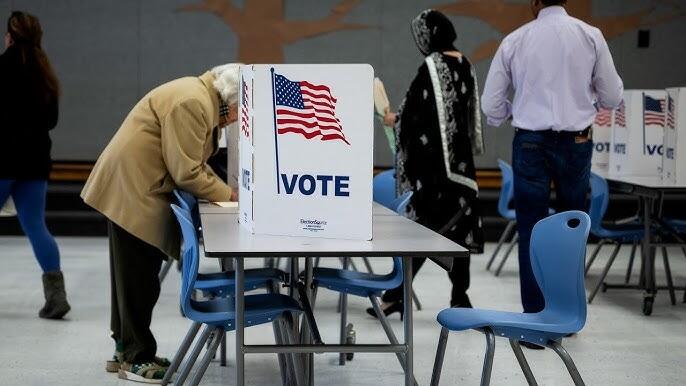
The final tally was 218-213, with Rep. Henry Cuellar of Texas standing as the lone Democrat to cross party lines.
On Friday, Sen. Susan Collins (R-Maine) gave Republicans their 50th vote late Friday afternoon, telling Maine Wire the revised bill strikes an appropriate balance between election security and voter access.
“The law is clear that in this country only American citizens are eligible to vote in federal elections. In addition, having people provide an ID at the polls, just as they have to do before boarding an airplane, checking into a hotel, or buying an alcoholic beverage, is a simple reform that will improve the security of our federal elections and will help give people more confidence in the results,” she told Maine Wire.
“Requiring voters to produce passports or birth certificates on Election Day — as opposed to just a state-issued ID — would have placed an unnecessary burden on the voters. That provision is no longer in the bill, and dropping this requirement was key to getting my support.”
With Will Collins on board, Republicans have enough support to pass the bill even without additional backing, with Vice President JD Vance ready to break any tie.
Unfortunately, 50 votes only get the GOP so far. The legislation still lacks the 60 votes needed to overcome a Democratic filibuster, and Senate Minority Leader Chuck Schumer has made clear the bill is "dead on arrival.”
And Collins herself opposes scrapping the filibuster to ram the measure through.
“I oppose eliminating the legislative filibuster,” Collins said.
“The filibuster is an important protection for the rights of the minority party, that requires Senators to work together in the best interest of the country. Removing that protection would, for example, allow a future Congress controlled by Democrats to pass provisions on anything they want — DC Statehood, open borders, or packing the Supreme Court — with just a simple majority of Senators.”
President Trump, however, is promising that requiring a photo ID to vote will get done with or without Congress.
In a post on Truth Social, he accused Democrats of opposing Voter ID and citizenship verification because “they want to continue to cheat in Elections.”

He said this “was not what our Founders desired” and promised to present an “irrefutable” legal argument on the issue soon. \
Trump vowed that “There will be Voter I.D. for the Midterm Elections, whether approved by Congress or not,” and stated that Americans demand “Citizenship, and No Mail-In Ballots, with exceptions for Military, Disability, Illness, or Travel.”
Trump also slammed Democrats as “horrible, disingenuous CHEATERS” for opposing Voter I.D., claiming they “boldly laugh in the backrooms” while opposing it.
He called the lack of Voter I.D. “even crazier, and more ridiculous, than Men playing in Women’s Sports, Open Borders, or Transgender for Everyone.”
Trump urged Republicans to make it “a CAN’T MISS FOR RE-ELECTION IN THE MIDTERMS, AND BEYOND,” noting that “Even Democrat Voters agree, 85%, that there should be Voter I.D.”
He called Democratic leaders “Crooked Losers like Schumer and Jeffries,” who label it “racist,” and promised to present legal arguments for action via an Executive Order.
Trump warned that if Democrats regain power, they will “PACK THE COURT with a total of 21 Supreme Court Justices” and warned the country “will never be the same if they allow these demented and evil people to knowingly, and happily, destroy it.”
Trump previously signed an executive order attempting to impose proof-of-citizenship requirements on federal voter registration forms.
That effort crashed into multiple legal challenges and has been systematically dismantled by the courts.
GpscruiseWebsites need to offer "Summary" links, so millions of us dont have to incite grok, et al to summarize these endless articles (no doubt created from a prompt).....
Authored by Daniel McCarthy via The Epoch Times,
The contrast between America’s great island allies on opposite ends of the world couldn’t be more drastic.

Japan has just given its commonsense conservative prime minister, Sanae Takaichi, a two-thirds supermajority in the national legislature’s Lower House; her Liberal Democratic Party took the highest proportion of seats of any party since World War II.
It’s an enormous vote of confidence not only in Takaichi’s economic agenda but also for her willingness to get tough with China.
Beijing’s mouthpieces have called Takaichi an “evil witch,” with China’s consul general in Osaka threatening, “the dirty neck that sticks itself in must be cut off” in response to Takaichi’s indication Japan would aid Taiwan against an invasion.
Such incendiary language didn’t intimidate Takaichi—nor, it turns out, Japan’s voters.
Yet even as Japan was rallying to its courageous prime minister, China was inflicting humiliation on America’s closest European ally.
Communist authorities in Hong Kong—which was a British colony until 1999—have just sentenced the businessman and free-speech champion Jimmy Lai to 20 years in prison.
The 78-year-old Lai, who holds British citizenship, will die behind bars under that sentence, but China isn’t worried about the UK’s reaction as long as Keir Starmer is prime minister there.
Just last month, the British government approved Beijing’s plans to build a vast new “mega-embassy” in London at the site of the former Royal Mint Court.
CNN notes that Xi Jinping has taken a personal interest in the complex and brought it up in his very first call with the then-newly elected Starmer in 2024.
Not that a larger presence for the People’s Republic of China in the very heart of London is the Labour government’s only recent concession:
Starmer has worked tirelessly to hand over the Chagos Islands, a British territory in the Indian Ocean, to Mauritius, an African island nation with tight connections to China.
This is no act of “decolonization.” The former Chagos natives, who were removed by Britain in the 1960s, don’t support turning the islands over to Mauritius.
The national-security implications of surrendering these small but strategic islets concern not only Britain but the United States as well, which shares a joint military base with the UK on the archipelago’s largest island, Diego Garcia.
While President Donald Trump has made his displeasure with the Mauritius deal known, Starmer has been pressing ahead.
His determination appears to derive from his background as a human-rights lawyer: he takes a nonbinding ruling proffered by the International Court of Justice as holy writ, Britain’s national interest be damned.
Starmer is a globalist at a time when the free world needs leaders who take their nations’ self-responsibilities far more seriously, especially in light of China’s ambitions.
He was swept into office in 2024 on a tide of revulsion against 14 years of leadership by Conservative prime ministers—five in all, most of whom never accepted the spirit of Brexit.
Unlike the overwhelming popular mandate the Japanese have given Takaichi, Starmer won big in Britain with a vote that was more a protest against his opponents than an endorsement of him or his party.
But he got a chance to turn that protest vote into real support—and failed.
At home, Starmer ranks as the least popular leader in the Western world, with disapproval numbers often above 70 percent.
His days are numbered, and his exit is being hastened by revelations in the Epstein files about Peter Mandelson, the man Starmer made ambassador to the United States.
Lord Mandelson stepped down from that post in September, but as further details of his dealings with sex trafficker Jeffrey Epstein have come to light, the heat on the prime minister who elevated him to Britain’s most sensitive overseas role has become unbearable.
On Monday, the leader of the Labour party in the Scottish parliament, Anas Sarwar, called on Starmer to resign.
He’s not going gracefully, however, and he still has enough backing in the UK parliament to hang on—for the moment.
But no one expects him to last until the next election, which, unfortunately for Britain, doesn’t have to be held before August 2029.
If Labour clings to power for another three years, the country’s woes will only multiply, with or without Starmer at the helm.
In Japan, Takaichi took a risk by calling a snap election just three months after she became prime minister.
Her confidence was justified—and rewarded.
In Britain, Labour knows full well it would get crushed in an early election, with Nigel Farage’s Reform party almost certainly winning power.
But Labour is only delaying the inevitable, and Britain can’t wait.
In a world where nations are aggressively pursuing their interests, the UK suffers under a government the people don’t want but can’t get rid of yet.
Gpscruiseabout time
Authored by Micah Zimmerman via Bitcoin Magazine,
BIP 360, a proposal aimed at preparing Bitcoin for future computing threats, has been updated and merged into the official Bitcoin Improvement Proposal (BIP) GitHub repository, marking a new step in efforts to strengthen the network against emerging cryptographic and quantum computing risks.

The proposal introduces a new Bitcoin output type called Pay-to-Merkle-Root (P2MR), designed to support quantum-resistant script tree functionality while maintaining compatibility with existing Tapscript infrastructure, according to a note seen by Bitcoin Magazine.
Supporters of BIP 360 describe the proposal as an early move toward quantum-hardening Bitcoin at the protocol level.
A merge into the BIP repository does not signal endorsement or future activation. BIPs are merged as part of the open process for documenting or discussing potential upgrades.
BIP 360: Pay to Merkle Root
— Murch (@murchandamus) February 11, 2026
was published pic.twitter.com/GXkmTHnDoL
Quantum computing has raised concerns across the cryptography and cybersecurity fields because sufficiently advanced machines may be able to break widely used cryptographic systems.
In Bitcoin’s case, the threat centers on the possibility that computers could derive private keys from exposed public keys, which could lead to stolen funds.
While all Bitcoin addresses become vulnerable when spending reveals a public key, some output types carry greater exposure.
Taproot addresses, along with Pay-to-Public-Key (P2PK) outputs and reused addresses, are considered more at risk because public keys are visible on-chain.
P2MR is conceptually similar to Taproot but removes a key weakness. Taproot includes a key-path spending method that can expose public keys. The proposed P2MR output type disables that key-path spend and commits only to the script path, reducing the surface area for potential attacks.
The BIP’s authors say the proposal is meant to serve as a foundation for later upgrades that could introduce post-quantum signature schemes into Bitcoin through follow-on soft forks. The note points to algorithms such as ML-DSA (Dilithium) and SLH-DSA (SPHINCS+) as possible candidates.
“Ultimately, the introduction of BIP 360 and P2MR is a first step in a larger set of quantum-resistance proposals that will be necessary to quantum-harden Bitcoin,” said co-author Hunter Beast, a Bitcoin developer and senior protocol engineer at MARA.
Beast added that the team is also exploring proposals to address vulnerable coins that are unlikely to move, including long-dormant holdings.
The latest update adds Isabel Foxen Duke as a co-author alongside Beast and cryptographic researcher Ethan Heilman.
Duke, a technical communications specialist, said the goal was to make the proposal understandable beyond the developer community.
“Given the sensitivity of the subject matter, we aimed to ensure the BIP was written in a manner that was clear and understandable to the general public,” Duke said.
The proposal arrives as governments and major technology firms increase investment in post-quantum cryptography.
The U.S. National Security Agency’s CNSA 2.0 framework calls for quantum-safe systems by 2030, while the National Institute of Standards and Technology plans to phase out elliptic curve cryptography in federal systems in the mid-2030s.
Supporters argue that BIP 360 aligns Bitcoin with a broader shift toward quantum-safe security standards, positioning the network to adapt as computing capabilities advance.
Gpscruisethe nite of 2020, i was all over The Guardian and "Quora" (of all places) criticizing their acceptance of a fair election.
Authored by Steve Watson via modernity.news,
A trial date has been locked in for President Trump’s massive $10 billion defamation lawsuit against the BBC, following the broadcaster’s deceptive editing of his January 6, 2021 speech to falsely portray him as inciting violence at the Capitol.

District Judge Roy Altman rejected the BBC’s motion to stay the merits-based discovery phase, allowing both sides to dig into evidence that could reveal the depths of this media manipulation. The two-week trial is set to kick off on February 15, 2027, one year from now, in Miami, Florida.
This latest bombshell builds on the escalating saga that has already forced top BBC executives to resign in disgrace and drawn scrutiny from U.S. regulators, highlighting how foreign media outlets interfere in American politics with impunity.
🚨🇬🇧🇺🇸 The BBC Vs President Trump
— Concerned Citizen (@BGatesIsaPyscho) February 12, 2026
The Libel Case against the BBC brought by Trump is set to go to court in February 2027‼️
Fake news the BBC got caught fraudulently splicing a manipulating footage of Trump from Jan 6th.
If this goes to Court - Legacy media the BBC will be… pic.twitter.com/IIIVfYFNBu
Trump’s legal team accuses the BBC of splicing together disparate parts of his speech—separated by over 50 minutes—to create a fabricated narrative. In the doctored clip aired in a Panorama documentary, Trump appears to say: “We’re going to walk down to the Capitol… and I’ll be there with you. And we fight. We fight like hell.”
The BBC Conveniently omitted Trump’s explicit calls for peaceful protest, which undercut the entire “insurrection” hoax pushed by legacy media.
The BBC has scrambled to defend itself, filing motions claiming lack of jurisdiction in Florida and denying the documentary aired in the U.S. via BritBox.
A spokesman stonewalled with: “As we have made clear previously, we will be defending this case. We are not going to make further comment on ongoing legal proceedings.”
But the damage is done. As we previously reported in the President put the broadcaster “on notice” with a demand for compensation, a retraction, and an apology—or face a billion-dollar reckoning for “false, defamatory, disparaging, and inflammatory” content.
That threat materialized into this lawsuit, amplified by revelations of internal BBC turmoil. Director General Tim Davie and News CEO Deborah Turness abruptly resigned amid the fallout, with Trump blasting them as “very dishonest people who tried to step on the scales of a Presidential Election.”
Adding fuel to the fire, FCC Chairman Brendan Carr launched a probe into the “news distortion and broadcast hoax.”
Carr demanded answers from U.S. partners NPR and PBS on whether they aired the fake clip, warning that such manipulation is a “heinous act against the public interest.”
Carr’s letter hammered the point: “That would appear to meet the very definition of publishing a materially false and damaging statement.” He pressed for transcripts and videos to ensure no tainted content poisoned American airwaves.
This isn’t just about one edited clip—it’s a stark exposure of how globalist media like the BBC, funded by UK taxpayers, peddle disinformation to undermine the truth. Trump himself called out the foreign meddling, noting the BBC hails from “a Foreign Country, one that many consider our Number One Ally.”
Leaked internal memos, including one from former BBC adviser Michael Prescott, condemned the edit as “completely misleading,” arguing it ignored Trump’s non-incitement as a key factor in avoiding federal charges.
With discovery now underway, expect explosive revelations about the BBC’s “reckless disregard for the truth” and potential “actual malice.” The broadcaster’s history of biased reporting, from Gaza coverage to anti-Trump narratives, could unravel under scrutiny.
Meanwhile, UK regulator Ofcom is investigating, but the real accountability may come from this U.S. courtroom, where Trump’s team seeks not just damages but a blow against fake news empires.
Carr’s letter hammered the point: “That would appear to meet the very definition of publishing a materially false and damaging statement.” He pressed for transcripts and videos to ensure no tainted content poisoned American airwaves.
This isn’t just about one edited clip—it’s a stark exposure of how globalist media like the BBC, funded by UK taxpayers, peddle disinformation to undermine the truth. Trump himself called out the foreign meddling, noting the BBC hails from “a Foreign Country, one that many consider our Number One Ally.”
Leaked internal memos, including one from former BBC adviser Michael Prescott, condemned the edit as “completely misleading,” arguing it ignored Trump’s non-incitement as a key factor in avoiding federal charges.
With discovery now underway, expect explosive revelations about the BBC’s “reckless disregard for the truth” and potential “actual malice.” The broadcaster’s history of biased reporting, from Gaza coverage to anti-Trump narratives, could unravel under scrutiny.
Meanwhile, UK regulator Ofcom is investigating, but the real accountability may come from this U.S. courtroom, where Trump’s team seeks not just damages but a blow against fake news empires.
Gpscruisewhat RFK taught me was that NEVER SMILE on issues. Be pissed. Be direct. I commented that to Dr Patrick Byrne and he is now more effective.
The Trump admin couldn't hand Democrats a fatter pitch than how they've handled the Epstein release...
On Wednesday, Attorney General Pam Bondi clashed repeatedly with Democrats during a tense House Judiciary Committee hearing, deflecting pointed questions about the Justice Department’s handling of the Epstein files before the session devolved into a shouting match with Rep. Thomas Massie (R-KY) over redactions, co-conspirators and DOJ accountability.
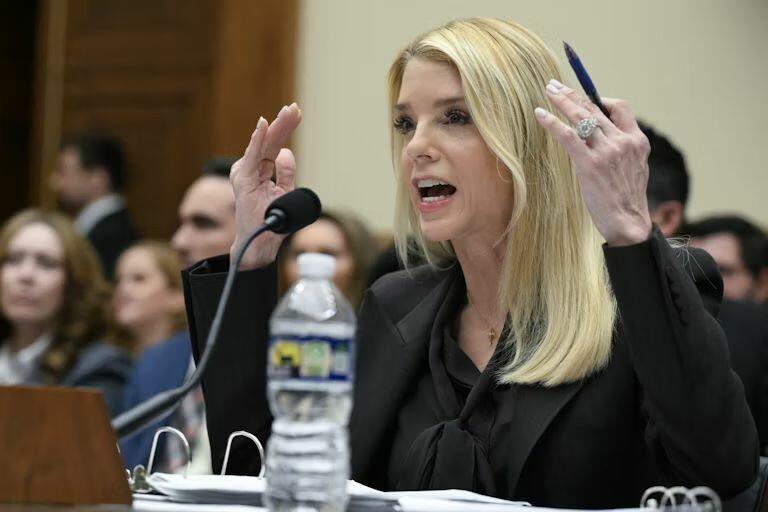
The fireworks began when Rep. Jerry Nadler (D-NY) pressed Bondi on whether DOJ has indicted or is investigating any of Epstein’s alleged co-conspirators, citing what he called “concrete evidence of disgusting criminality” in recently released files. Bondi attempted to sidestep the question; when Nadler repeated it, she raised her voice and insisted she would “answer the question the way I want to answer the question,” talking over Nadler as colleagues tried to intercede. As the exchange escalated, Bondi pivoted away from Epstein entirely - invoking the Dow, S&P and Nasdaq and touting retirement accounts.
Bondi: The DOW is over 50,000. That’s what we should be talking about. They just asked what does the DOW have to do with anything. ARE YOU KIDDING? pic.twitter.com/nl5ueU867x
— Acyn (@Acyn) February 11, 2026
Democrats kept the pressure on. Rep. Ted Lieu (D-CA) accused Bondi of lying under oath after she cited a July 2025 DOJ memo asserting there was no evidence warranting investigations of “uncharged third parties.” Lieu pointed to images of former Prince Andrew and then played a clip of Donald Trump with Epstein, asking whether there were underage girls present. Bondi responded by attacking Democrats and praising Trump, saying there was “no evidence that Donald Trump has committed a crime.” When Lieu cited an FBI tip and witness statement and urged DOJ to interview the witness, Bondi snapped, “Don’t you ever accuse me of a crime,” then turned to a large white binder as she accused Lieu of deflecting from crime in his district.
Lieu plays Bondi the infamous clip of Trump and Epstein partying together and asks her if there were underaged girls at any party the two attended together
— Aaron Rupar (@atrupar) February 11, 2026
"This is so ridiculous," Bondi says. "There is no evidence that Donald Trump has committed a crime"
"I believe you just… pic.twitter.com/Uv8BQTgMef
Similar exchanges followed with Rep. Zoe Lofgren (D-CA) and Rep. Jamie Raskin (D-MD), with Bondi repeatedly veering into personal attacks and unrelated topics rather than answering the questions posed. Chairman Jim Jordan (R-OH) ultimately moved the hearing along.
REP JAMIE RASKIN: "You can let her filibuster all day long, but not on our watch, not on our time. No way. And I told you about that, attorney general, before you started."
— Fox News (@FoxNews) February 11, 2026
AG BONDI: "You don't tell me anything you washed-up loser lawyer — not even a lawyer." pic.twitter.com/ouaDRGhz2I
Rep. Jayapal (D-WA) brought Epstein accusers...
Rep. Jayapal: Will you turn to the survivors, who are standing right behind you, and apologize for what your Department of Justice has done?
— Donna Stern🚫👑 (@dvsmemphis) February 11, 2026
Pam Bondi: *refuses to answer* #sheshed pic.twitter.com/rbUHcNmQVQ
And when asked again to face them...
Johnson: Rep. Jayapal asked if you would be so kind and honorable as to turn around and face them and apologize to them for outing them.
— Acyn (@Acyn) February 11, 2026
Bondi: Your time is up. pic.twitter.com/D9moGLCMVt
The hearing’s most explosive moment came when Massie, a co-sponsor of the Epstein Files Transparency Act, confronted Bondi with DOJ and FBI documents he said showed victims’ names disclosed while alleged abusers’ names were blacked out - and a 2019 FBI file that listed Epstein confidant Les Wexner as a “co-conspirator,” a designation Massie said was redacted in DOJ’s release. As Massie asked who authorized the redactions and why, Bondi interrupted repeatedly, insisting the issue had been “corrected within 40 minutes” and accusing Massie of acting as if there were a cover-up. When Massie noted the change came only after he flagged it, the exchange turned heated, with Bondi laughing off the criticism and attacking Massie personally.
"Who’s responsible?" asked Massie. "Are you able to track who in the organization made this massive failure and released the victims’ names?"
Bondi shot back that Massie was a "failed politician" and a "hypocrite."
Massie: "Here is an email that was sent by the victims' lawyers to the DOJ. It was a list of names not to release. What did the DOJ do with this email? They released it! Literally the worst thing you could do the survivors you did." pic.twitter.com/oSzA1dV2jj
— Aaron Rupar (@atrupar) February 11, 2026
🚨Massie: "This goes over four administrations. You don't have to go back to Biden. Let's go back to Obama. Let's go back to George Bush. This coverup spans decades, and you are responsible for this portion."pic.twitter.com/mZoCGOoEtD
— Derrick Evans (@DerrickEvans4WV) February 11, 2026
Massie then played testimony from FBI Director Kash Patel, who told Congress there was “no credible information” that anyone besides Ghislaine Maxwell assisted Epstein in trafficking women and girls, and asked Bondi whether that was her position. Bondi did not answer directly, instead urging victims to call the FBI and attempting to redirect blame to prior administrations, including former Attorney General Merrick Garland. When Massie reclaimed his time and framed the matter as a decades-long failure spanning multiple administrations, Bondi shouted that he did not “get to reclaim time” and again declined to address the substance.
By the end of the exchange, Bondi had not answered whether DOJ agrees there is “no credible information” about co-conspirators, why a document listing Wexner as a co-conspirator was redacted, or who approved releasing victims’ names while obscuring alleged abusers. The hearing closed with unanswered questions—and a stark contrast between Democrats’ early sparring over evasions and a later, bipartisan rupture that put the department’s handling of the Epstein files squarely at the center of the controversy.
Gpscruiseyears ago, i designed the same thing. I called it the "buddy system". It would connect to a paired trusted neighbor box. Its fun market. Security sells.
During the Superbowl there was an amazing Rorschach test masquerading as a feel-good Ring doorbell commercial. For those who missed it, find it here. Essentially it touts a new service where neighborhood networks of Ring doorbell cameras can combine with Amazon AI to find a lost dog based on an uploaded photo. Half the population reacted, "isn't that wonderful" and the other half of viewers, of whom I am one, reacted "that's freaking scary." The network of camera feeds in the commercial looks very similar to Batman's (admitted even by him) dystopian cell phone surveillance array in the Dark Knight.

This is exactly the sort of wedge strategy that our public and private control freaks use to normalize dystopian systems and technologies. You don't sell surveillance out of the gate with a system that tracks down a person in the neighborhood behind on taxes or child support. No, you sell it as a system to find that adorable lost dog (notice not even generic pets or certainly not cats because dogs are the new children for this generation**). They can fight all the backlash by saying, "Oh come on, who can be against finding lost dogs?" Then, months or years later, the terms and conditions have morphed and broader search capabilities are enabled without the user even knowing (I own a Ring doorbell and I guarantee I never knew this feature was turned on by default or even existed). When it really gets scary, they are not even going to tell you about it.
I do not believe this is just a marketing mistake -- Ring appears to have adopted neighborhood surveillance as their core business model. I have had a Ring doorbell for years and in its basic form of sending doorbell chimes to your phone and allowing you to see who is at the door and even talk to them remotely, it is a nice product. I have always liked it. But over the years I have noticed Amazon/Ring slowly morphing the app from just a doorbell / security tool into a neighborhood surveillance network. If you have the app, you can see that most of the functionality is now about messaging and notifications shared around the neighborhood, generally dominated by local Karen's putting up panicky posts about someone they saw they thought was creepy. In the main menu of the app, the very first option after a link to the dashboard is called "neighbors." This is the neighborhood watch group on steroids.
As a libertarian, what do I have against private neighborhood voluntary surveillance networks? Nothing, but this is neither voluntary nor private. As for voluntary, this functionality was added on an opt-out basis with zero notification, at least until this commercial came out. But what about privacy?
Well, I spent more time in the app yesterday than I probably had cumulatively over 5+ years. The first thing I did was turn off this advertised feature. From the main menu (the three bars in the upper left) you need to choose control center (not settings) and then scroll way down to "search party" (that is what they call it, to evoke maybe a bunch of guys with St Bernards looking for a lost hiker) and turn it off.
So while I was in the app I started trying to see if there was a way to block Amazon from sharing all this with the government or other third parties. There is an intriguing option in the control center labelled public safety which says it controls public safety agency notification settings -- maybe one can block sharing with the government? Nope. Turns out this option is just to change what police and other agencies can post to your neighborhood feed.
In the same control center there is a privacy tab. I clicked on that, but there are no settings. Only a promise to be really really nice and make our privacy their highest priority but no specific commitments on data privacy. Also note the use of "neighbors" over and over. It is as if they are trying to establish some right to collective privacy (whatever the f*ck that is) instead of individual privacy.

But it does say that I am in complete control so maybe there is a data sharing option somewhere else. Further down we finally get to the "data management" option. It says "Request a copy of your data, manage third-part access, or delete your data." There we go! Here is the screen you get:

This is the whole screen. Notice anything? As promised, you can download your personal data, I guess just to see what the CIA is looking at. You can delete your data, at the cost of bricking your products. But there is no actual option to manage 3rd party data access. It is promised in the privacy statement, it is promised in the menu header, but it does not exist. After an hour on their site and in the app, I still don't know who has access to my doorbell camera image.
**footnote: The other day in Orange County CA I was doing my 4 mile walk through some neighborhoods and I passed 4 young (at least relative to me) women pushing strollers. When I looked, all 4 strollers had dogs in them, not children. Some time ago someone said (sorry I can't give credit, can't remember) "dogs are the new children, plants are the new dogs." I didn't really understand that until recently but I believe it. I can't remember an airline flight I have been on that had more babies in the cabin than dogs.
Gpscruisetoresay.com says its possibly a way for access to fresh water, perhaps for Intel or such (I am paraphraising)
Authored by Jeff Louderback via The Epoch Times (emphasis ours),
Three years have passed since a Norfolk Southern freight train carrying hazardous chemicals derailed in East Palestine, an eastern Ohio village near the Pennsylvania border.

On Feb. 3, the disaster’s third anniversary, The National Institutes of Health (NIH) held a grand opening ceremony for the East Palestine Train Derailment Health Research Program Office.
The office will serve as the home to a five-year, $10 million research initiative to assess and address the long-term health outcomes stemming from the derailment.
“NIH’s research hub offers the people of East Palestine a pathway to clear answers about their health they deserve,” said Health Secretary Robert F. Kennedy Jr.
“Everyone affected by this environmental disaster deserves access to independent, gold-standard science that puts their well-being first.”
Life in East Palestine abruptly changed around 9 p.m. on Feb. 3, 2023.
The crew of a Norfolk Southern Railway freight train carrying 151 cars saw smoke and fire, and realized that 38 cars had derailed.
The flammable, toxic chemicals in 11 derailed cars had ignited, with flames spreading to an additional 12 cars.
According to the National Transportation Safety Board, nine cars were carrying hazardous materials in addition to the 11 that derailed.
The hazardous chemicals, including vinyl chloride in some of the rail cars, began to spill onto the ground and into the air.
Vinyl chloride is used to make PVC pipes and other products.
The National Cancer Institute notes that the toxic chemical has been linked to cancers of the brain, lungs, blood, lymphatic system, and liver.
Vinyl chloride creates carbon monoxide and hydrogen chloride when it burns.
When the latter mixes with water, it generates hydrochloric acid, a corrosive substance that can burn the skin and eyes, and is toxic if inhaled.
Burning vinyl chloride also produces a small amount of phosgene gas, which was used as a chemical weapon on World War I battlefields.
As the fire continued, authorities on Feb. 6—fearing shrapnel from a major explosion—decided on a controlled detonation of five cars, which sent a massive cloud of black smoke into the sky.
Visible for miles, it was likened to the mushroom cloud caused by a nuclear weapon.
The government characterized it as a “controlled burn,” but residents said it was anything but controlled.
A dark cloud of chemical-filled smoke could be seen for miles, and debris landed on properties several miles away.
The train cars were ruptured in the detonation, and spilled the rest of their contents into a drainage ditch connecting to Sulphur Run, a stream that flows through the heart of East Palestine.
Before the burn, Ohio Gov. Mike DeWine urged residents to evacuate a one-by-two-mile area surrounding East Palestine, which included parts of Ohio and Pennsylvania.
DeWine described the urgent evacuation as a “matter of life and death.”

Three days later, DeWine held a press conference announcing that the evacuation order had been lifted and residents could return to their homes.
Norfolk Southern trains resumed their routes through East Palestine, and federal and state officials said testing showed that the air and water were safe.
Fear and uncertainty remain among East Palestine residents.
Many locals complained about a toxic smell in the air, burning eyes, rashes, headaches, and other health issues.
These reports prompted concerns about potential long-term health effects, including “maternal and child health, as well as psychological, immunological, respiratory and cardiovascular health,” according to the NIH.
“This research program is designed to bring rigorous, independent science directly to the community,” NIH Director Dr. Jay Bhattacharya said.
“By establishing a local presence, we can better engage residents, support enrollment in studies, and ensure the research reflects the real experiences and concerns of the people affected.”
After the grand opening, a community meeting was held to outline the research program, explain how residents can enroll in studies, and provide people a chance to ask questions and share their experiences directly with researchers.
Jami Wallace was a lifelong East Palestine resident until the derailment.
She no longer lives in the community but has served as an outspoken advocate for people who have experienced health consequences from the disaster.
“I was diagnosed after the derailment with hypothyroidism. I’ve been diagnosed with asthma, I’ve been diagnosed with an adult chronic cough, I have a cyst on my right ovary that I have to have an operation on,” said Wallace, who is co-founder of the Chemically Impacted Communities Coalition.
“I get phone calls every day from people who are seeing cancers and thyroid disease, respiratory and neurological issues. You can’t tell me it’s not from those chemicals.
“I’ll fight Norfolk Southern, and I will fight my own government until we get accountability and we get justice.”
The Feb. 3 event included researchers and representatives from NIH’s National Institute of Environmental Health Sciences, the University of Kentucky, the University of Pittsburgh, and Yale University.
“Since the beginning, we have seen the public experience respiratory issues, we’ve seen and heard about rashes, nose bleeds in children, eczema, reproductive health questions and concerns, so now we have a team of about sixteen scientists on our team that can help answer those questions for the public,” Dr. Erin Haynes of the University of Kentucky said.
“We have learned that the community is experiencing health conditions from the derailment, and we want to be able to give them answers to know if it is a true direct association.
“A lot of things are unanswered, but this large-scale study that we now have funding to do will really help answer those questions.”
GpscruiseHey Remlaps, Would you consider trying an app I wrote?? https://www.youtube.com/watch?v=YdQtjQYhPW4
Hackers associated with the Chinese government used a Trojaned version of Notepad++ to deliver malware to selected users.
Notepad++ said that officials with the unnamed provider hosting the update infrastructure consulted with incident responders and found that it remained compromised until September 2. Even then, the attackers maintained credentials to the internal services until December 2, a capability that allowed them to continue redirecting selected update traffic to malicious servers. The threat actor “specifically targeted Notepad++ domain with the goal of exploiting insufficient update verification controls that existed in older versions of Notepad++.” Event logs indicate that the hackers tried to re-exploit one of the weaknesses after it was fixed but that the attempt failed.
Make sure you’re running at least version 8.9.1.
Authored by Walter Donway via The Epoch Times (emphasis ours),
Commentary
With its recent announcement of a trade deal with China, the White House intended to reassure markets, manufacturers, and the military that China would not sever the supply lines of “rare earths” to the United States. Among other concessions, Beijing committed itself to avoid restricting exports of rare earth elements and related critical minerals essential to advanced manufacturing, clean “green” energy, and modern weapons systems. The agreement was described as a win for American economic strength and national security. But the very need for such a promise reveals an uncomfortable truth: the United States, long the world’s leading industrial power, has become dependent on the goodwill of a strategic rival for materials central to its economy and its defense.

That dependence did not arise because rare earth minerals are scarce. They are not. Nor did it arise because China alone possesses the technical capacity to mine or refine them. It arose from a long chain of economic and political decisions—made largely in free societies—that concentrated production in a country willing to accept costs others would not.
Understanding how that happened is essential to understanding why China’s apparent monopoly is far less “coercive,” and far less durable, than it looks.
Rare earth elements are a group of seventeen metals mostly in the first row below the main periodic table in the lanthanide series (elements 57–71), plus Scandium (Sc, #21) and Yttrium (Y, #39), which share similar properties and are found in the same deposits as the lanthanides. They are “transition metals” with distinctive magnetic and fluorescent characteristics. The first was identified in 1787, and by 1947 all had been identified. (“Earths” is an archaic term for oxides, the form in which these elements are found.)
Think of these elements not as bulk materials but as metallurgical spices, used in tiny quantities to produce dramatic improvements in performance. Add neodymium to iron and boron and get the strongest permanent magnet known. Add yttrium to turbine alloys and jet engines can tolerate extraordinary heat. Europium makes modern display screens possible; terbium enables efficient electric motors; samarium strengthens guidance systems and sensors.
Despite their name, rare earths are widespread. Significant deposits exist in the United States, Australia, Brazil, India, and elsewhere. What makes them challenging is not their scarcity but their processing. The essential problem is that they are chemically almost identical, so how do you devise subtly different processes to separate them? More generally, they are chemically stubborn—for example, often intermingled with radioactive materials, and require dozens—sometimes more than a hundred—separation and purification steps. Each step consumes energy and produces toxic waste, making rare earth refining among the most environmentally punishing metallurgical processes in the modern economy.
The crux of the matter is straightforward. Mining rare earths is manageable. Processing them cleanly and at scale is hard, expensive, and politically fraught.
China’s rise to dominance in rare earths was neither accidental nor inevitable. Beginning in the 1980s and accelerating through the 1990s and 2000s, China’s one-party dictatorship made a deliberate choice to invest heavily in mining and processing capacity. It did so under the conditions of a command economy that differed starkly from those in the West. Environmental controls were lax or poorly enforced. Local opposition carried little weight. State support absorbed losses and encouraged long-term specialization.
The outcome was leadership—at a price paid largely by Chinese communities and ecosystems. In Inner Mongolia, the world’s largest rare-earth mining region, toxic tailings ponds and contaminated water became infamous. Workers there suffered severe health issues from chronic exposure to toxic dust, heavy metals, and radioactive materials. There were—and are—high rates of respiratory, bone, and other diseases, compounded by environmental devastation and working conditions in the heavily polluting industry. Those costs, however, paid by workers and nearby communities for decades, translated into lower global prices. Western manufacturers benefited as consumer electronics became cheaper, and electric motors became smaller and more efficient. Companies like Apple could embed rare earth magnets throughout their products because the marginal cost was low. Magnets made of rare earth alloys like neodymium, the strongest by weight we know, give that satisfyingly decisive “click” when your laptop closes—and have uses in EVs, phones, and defense systems.
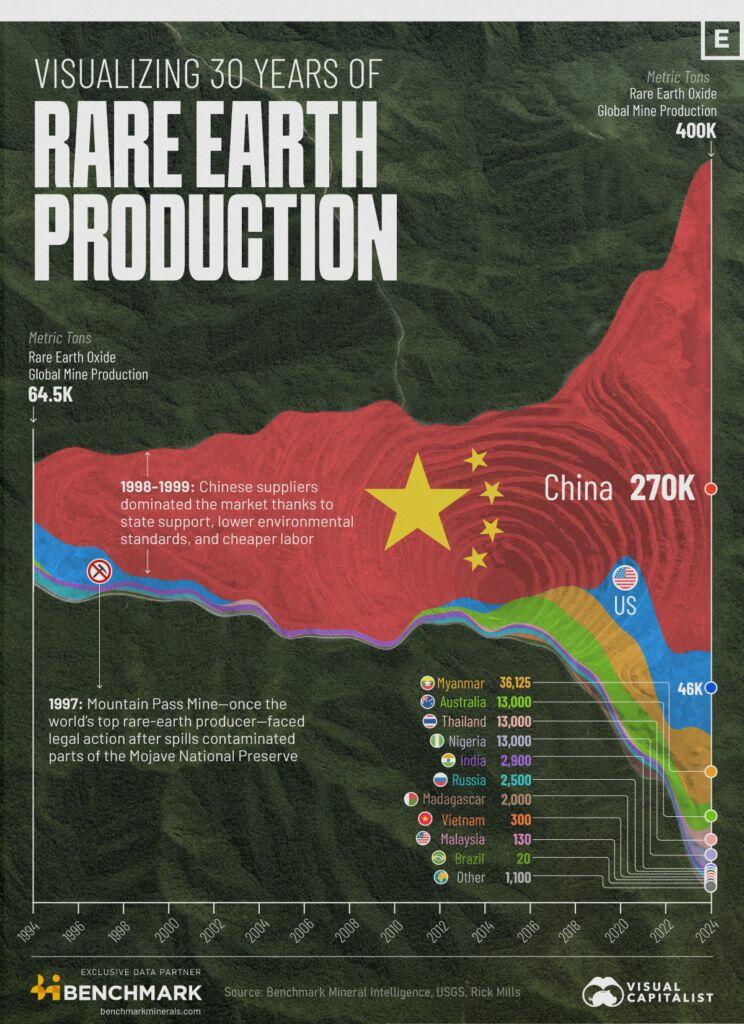
Over time, markets adapted rationally to these price signals. Western processing facilities closed. The United States, once a major producer, allowed its separation capacity to disappear. Even when rare earths were mined in California or Australia, the ore was shipped to China for refining. By the early 2020s, China accounted for roughly 70 percent of global rare-earth mining and more than 90 percent of processing and finished metal production.
Laissez-faire indifference did not produce this concentration. It owed as well to asymmetric regulation. Western governments imposed strict pollution controls and heavy liability that raised domestic costs, while China tolerated environmental and human damage in pursuit of strategic advantage. Markets responded to prices and rules as they existed, and production flowed—over time—to where it was cheapest and easiest to operate, even when that ease was politically manufactured. In this sense, China’s dominance was market-mediated, but politically orchestrated.
(In fact, a few analysts warned for years that China’s tolerance for environmental damage and state-directed investment would translate into strategic leverage. They included Jack Lifton of Technology Metals Research, Dudley Kingsnorth of Industrial Minerals Company of Australia, and researchers at the Congressional Research Service and RAND Corporation—warnings that were widely noted but largely discounted at the time.)
For years, this arrangement appeared stable. Rare earths are used in surprisingly small quantities, even at scale, and the total global market is modest—comparable in value to the North American avocado market. Shortages were rare. Prices generally trended downward. Supply chains became hyper-specialized, optimized for cost rather than resilience.
The strategic implications were visible, but easy for businessmen and politicians alike to ignore—until China began to test its leverage.
In 2010, during a diplomatic dispute with Japan, Chinese rare-earth exports suddenly slowed. Prices spiked. Panic followed. Although China denied imposing a formal embargo, the message was unmistakable.
A decade later, amid rising trade tensions with the United States, Beijing made its intentions clearer. Export controls were tightened. Licensing requirements expanded. Restrictions on rare-earth processing technologies were imposed.
By 2025, China was openly treating rare earths as a strategic asset, one that could be weaponized in response to tariffs, sanctions, or military pressure. The risks could no longer be ignored. Modern defense systems depend heavily on rare earths. An F-35 fighter jet contains hundreds of pounds of rare-earth materials. Missiles, radar, satellites, and secure communications systems all rely on specialized magnets and alloys for which there are no easy substitutes.
And 2026 continues the uncomfortable dilemma. The United States has the resources, capital, and technical expertise to rebuild domestic capacity—but not quickly. Processing facilities take years to permit and construct. Skilled labor must be trained. Supply chains must be reassembled. In the short run, dependence remained. Trump’s sudden tariff war, framed by Beijing as yet another affront to China’s long-promised redemption from its “century of humiliation,” sharpened the confrontation between what the Chinese Communist Party perceives as a resurgent Middle Kingdom and a declining hegemon.
All of this helps explain the White House’s eagerness to secure Chinese assurances. The deal bought time. It did not solve the problem.
It is tempting to describe China’s position as a market failure or a natural monopoly. Neither description is quite right. China’s dominance is better understood as a coercive monopoly—one sustained not by insurmountable efficiencies, but by political and regulatory asymmetries. It exists because the command economy of one country accepted environmental and social costs that others rejected, and because governments elsewhere constrained domestic production without fully accounting for strategic consequences.
Coercive monopolies are inherently unstable. They persist only so long as the costs of entry exceed the perceived risks of dependence. Once that balance shifts, the monopoly begins to erode. China’s own actions are now accelerating that shift.
Export restrictions and licensing regimes raise prices and introduce entrepreneurial uncertainty. Those effects are painful in the short term, but they also activate powerful counterforces. Higher prices make alternative supply economically viable. Unreliable supply makes diversification valuable. Strategic risk becomes something investors and manufacturers are willing to pay to avoid. This is the market logic that China cannot escape. By tightening its grip, Beijing invites others to loosen it.
From the American Institute for Economic Research (AIER)
Gpscruisegive the word and I will head out to stop illegal voters!
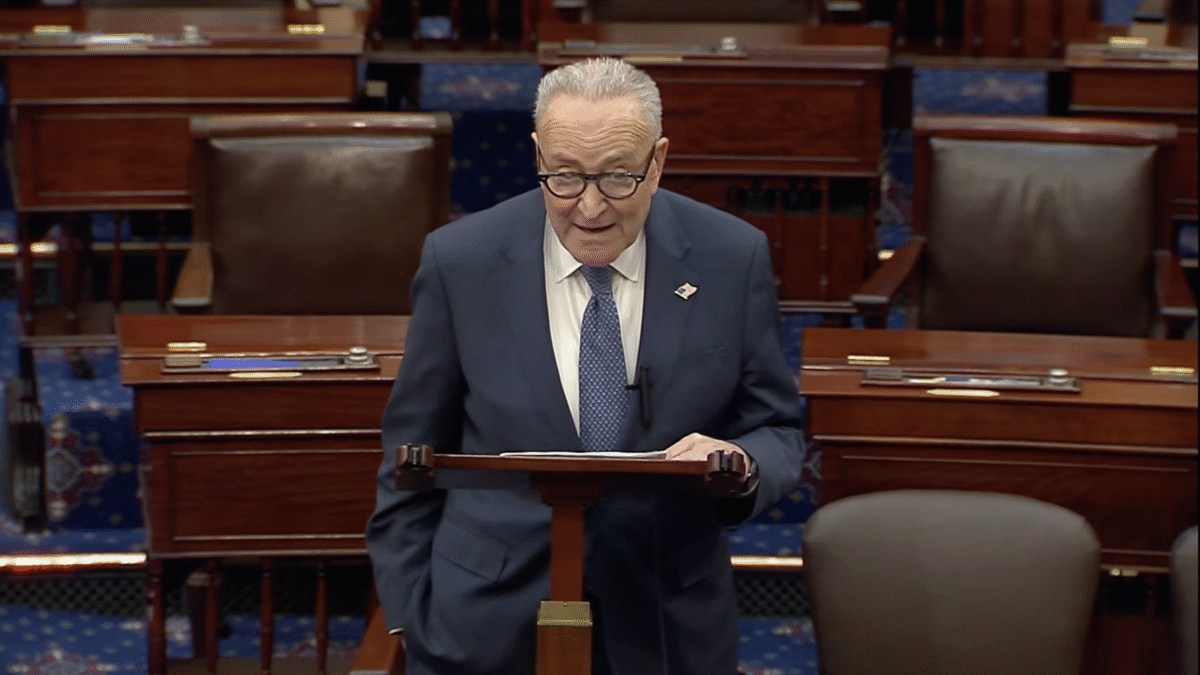 Senate Minority Leader Chuck Schumer (D-NY) threatened Monday to shut the government down unless Republicans drop their efforts to secure elections and keep noncitizens from voting. Schumer said in a post on X: “The SAVE Act is nothing more than Jim Crow 2.0. It would disenfranchise millions of Americans. Every single Senate Democrat will vote […]
Gpscruisei am watching "the wire"
Authored by Zachary Stieber via The Epoch Times (emphasis ours),
Health Secretary Robert F. Kennedy Jr. on Feb. 2 announced a new $100 million program that he said will help homeless people find jobs and treat drug abuse.
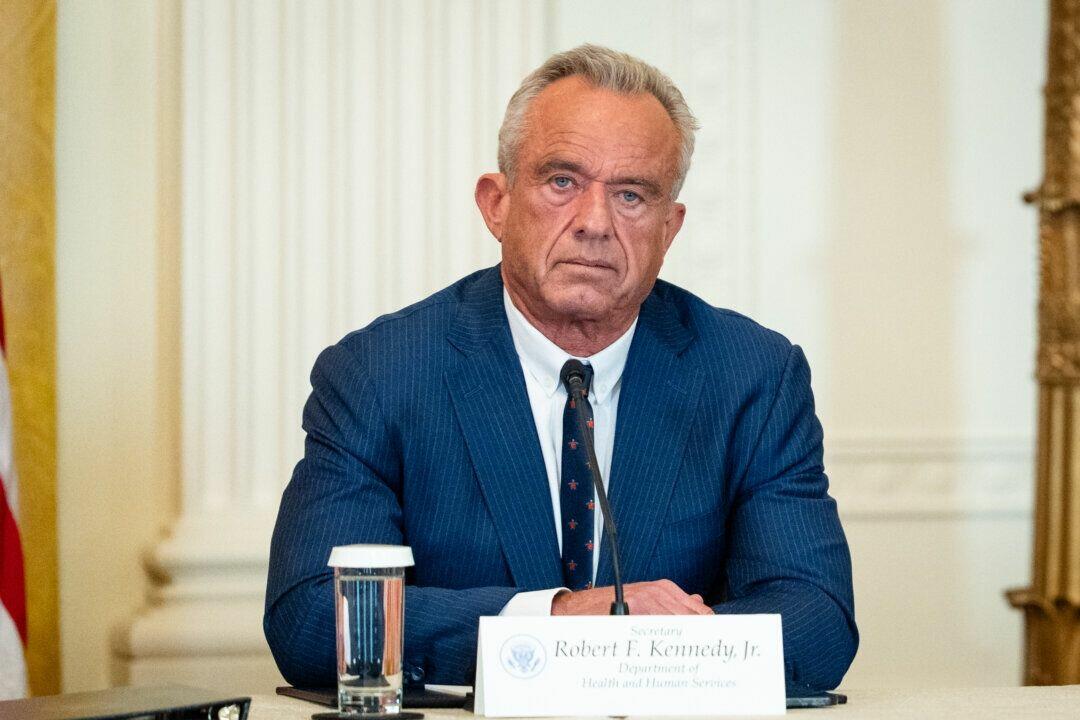
The $100 million investment is aimed at assisting homeless people and drug users in recovering from addiction, finding employment, and locating stable housing.
Kennedy told an event on Prevention Day—which is sponsored by the government and dedicated to preventing drug abuse—in Washington on Monday that the health care system under the previous administration was designed to cycle people who suffer from mental illness and drug addiction “between sidewalks, emergency room visits, jails, mental hospitals, and shelters.”
“No one took responsibility for the whole person. No one stayed long enough to help them recover, to help them reestablish their links, and teach them the lessons of how to live in a community,” he said. “That system is neither humane nor effective.”
Kennedy, who has said his addiction to heroin ended with help from 12-step programs, said that the $100 million would fund pilot initiatives that are crafted to resolve long-term homelessness and reduce opioid addiction by expanding treatment regimens that emphasize recovery and self-sufficiency. The program is known as Safety Through Recovery, Engagement, and Evidence-based Treatment and Supports, or STREETS.
“STREETS will engage people continuously, from first contact on the street through recovery, through employment, and through self-sufficiency,” Kennedy said. “Law enforcement, first responders, courts, housing providers, and health care systems will work as one team, so people will no longer fall through the cracks.”

STREETS follows an executive order President Donald Trump signed in January that says drug addiction is a chronic disease and that the administration needs to prioritize addiction treatment and recovery.
The new program builds on an investment federal health officials awarded in 2025 to boost homes for recovering addicts. Kennedy says he knows many people who have recovered in such homes.
Kennedy also announced the government will be providing $10 million through an assisted outpatient program to help adults designated as having serious mental illness, which he said will reduce hospitalization, incarceration, and homelessness.
Officials also said that the Department of Health and Human Services will, moving forward, let states use federal funding to pay for addicted parents to receive Food and Drug Administration-approved medications.
And they said that they would be giving faith-based organizations that meet certain standards funding to help with drug addiction recovery.
“This is a chronic disease. It’s a physical disease, it’s a mental disease, it’s emotional disease, but above all, it’s a spiritual disease,“ Kennedy said. ”And we need to recognize that, and faith-based organizations play a critical role in ... helping people reestablish their connections to community.”
Gpscruisei recently used copilot to publish an azure windoes app. Hundreds of checkboxes to achieve this which of course copilot knew.. I expect AI to redesign interfaces for AI-consumption, not hamburger web layouts for humans.....
From an Anthropic blog post:
In a recent evaluation of AI models’ cyber capabilities, current Claude models can now succeed at multistage attacks on networks with dozens of hosts using only standard, open-source tools, instead of the custom tools needed by previous generations. This illustrates how barriers to the use of AI in relatively autonomous cyber workflows are rapidly coming down, and highlights the importance of security fundamentals like promptly patching known vulnerabilities.
[…]
A notable development during the testing of Claude Sonnet 4.5 is that the model can now succeed on a minority of the networks without the custom cyber toolkit needed by previous generations. In particular, Sonnet 4.5 can now exfiltrate all of the (simulated) personal information in a high-fidelity simulation of the Equifax data breach—one of the costliest cyber attacks in historyusing only a Bash shell on a widely-available Kali Linux host (standard, open-source tools for penetration testing; not a custom toolkit). Sonnet 4.5 accomplishes this by instantly recognizing a publicized CVE and writing code to exploit it without needing to look it up or iterate on it. Recalling that the original Equifax breach happened by exploiting a publicized CVE that had not yet been patched, the prospect of highly competent and fast AI agents leveraging this approach underscores the pressing need for security best practices like prompt updates and patches.
AI models are getting better at this faster than I expected. This will be a major power shift in cybersecurity.
Gpscruisewould be fun to build this spy spy stuff
Despite trillions of dollars slated for global data center buildouts, power grid upgrades, and other artificial intelligence infrastructure expansion through the end of the decade, there remains very limited investor discussion about the next-generation physical security architecture required to defend these increasingly critical and high-value infrastructure nodes.
Protection of data centers from suicide drone swarm attacks is currently assessed as a lower risk at the moment, while the Trump administration, particularly following last year's "Restoring American Airspace Sovereignty" executive order, is primarily focused on counter-UAS measures to secure stadiums and related venues against drone attacks ahead of the 2026 FIFA World Cup.
In recent weeks, U.S. military, federal agencies, and local authorities gathered for a two-day summit near U.S. Northern Command headquarters, bringing together federal agencies, 11 U.S. host committees, and FIFA's security heads to prepare for matches across the United States, Mexico, and Canada.
"We're never going to not worry about a dirty bomb," Miami-Dade County Sheriff Rosanna Cordero-Stutz, who participated in the planning session, told Politico. "But we also recognize that there's a lot of other things that we need to worry about as well."
"You can't just give counter-UAS mitigation equipment to law enforcement that hasn't learned how to use it yet," said White House FIFA World Cup Task Force Andrew Giuliani, who coordinated the federal government's role in tournament preparations and addressed the drone threat at the summit.
Trump's counter-UAS EO last June, combined with heightened drone-threat concerns ahead of FIFA World Cup events, underscores the urgent need for low-cost, rapidly deployable kinetic interceptor counter-UAS systems that could be repurposed to defend high-value infrastructure and critical assets beyond the soccer tournament.
Beyond the FIFA World Cup and back to the data center buildout story, Morgan Stanley's Vishwanath Tirupattur forecasts that nearly $3 trillion of global data center spend will occur through 2028, comprising $1.6 trillion on hardware (chips/servers) and $1.3 trillion on building data center infrastructure, including real estate, build costs, and maintenance.
Wall Street analysts largely end their analysis at the financing and construction of next-generation data centers, with limited discussion regarding the modern security architecture required once these facilities are built and become instant high-value targets for non-state actors or foreign adversaries; traditional perimeter measures such as metal chainlink fencing and standard surveillance systems are rendered useless in the world of emerging AI threats, including coordinated autonomous drone or swarm-based attacks enabled by advances in AI and low-cost unmanned systems.
The deployment of low-cost kinetic counter-UAS intercept systems from the US could soon become a reality in Ukraine and be field-tested on the front lines, where tons of operational data would be gathered to help developers refine these systems ahead of future deployment to protect stadiums, data centers, and other high-value assets from drone threats across North America.
Cameron Rowe founded counter-UAS intercept startup Sentradel, which builds autonomous turrets to detect, track, and destroy FPV (first-person view) drones that can be easily fitted with explosives. The interceptor uses a rifle that fires low-cost 5.56 rounds at incoming FPVs, compared with current systems that use missiles and may cost tens of thousands per interception, where the economics of war aren't there.
Meet Sentradel's low-cost kinetic interceptor counter-UAS system:

Watch
Company Update #robotics #drones @sts_3d @camrrowe pic.twitter.com/0JoVSeYkpI
— Sentradel (@sentradel) December 2, 2025
There's growing interest from the Trump administration that these counter-UAS intercept systems will be guarding high-value assets, perhaps not stadiums immediately, but likely data centers in the future, especially as former Google CEO Eric Schmidt recently warned that attacks on data centers are only a matter of time. Readers can see the full story here.
Gpscruise300 days before detection of CCP in our cellphones.....
Authored by Shanaka Anslem Perera via Substack,
The four trillion dollars in institutional capital positioned for stable UK-China relations rests on an assumption that died in a Chengdu server room sometime around 2019. The assumption is that espionage between major powers operates within understood boundaries, that telecommunications infrastructure is contested but not compromised, that the surveillance systems Western governments built to watch their citizens cannot be turned around to watch them. The assumption has been falsified. What follows is the complete mechanism of how China’s Ministry of State Security achieved persistent access to the private communications of three British Prime Ministers’ closest advisers, the phones of a US President-elect, and the wiretap systems that were supposed to catch them doing it. The positioning implications are immediate. The framework is permanent.
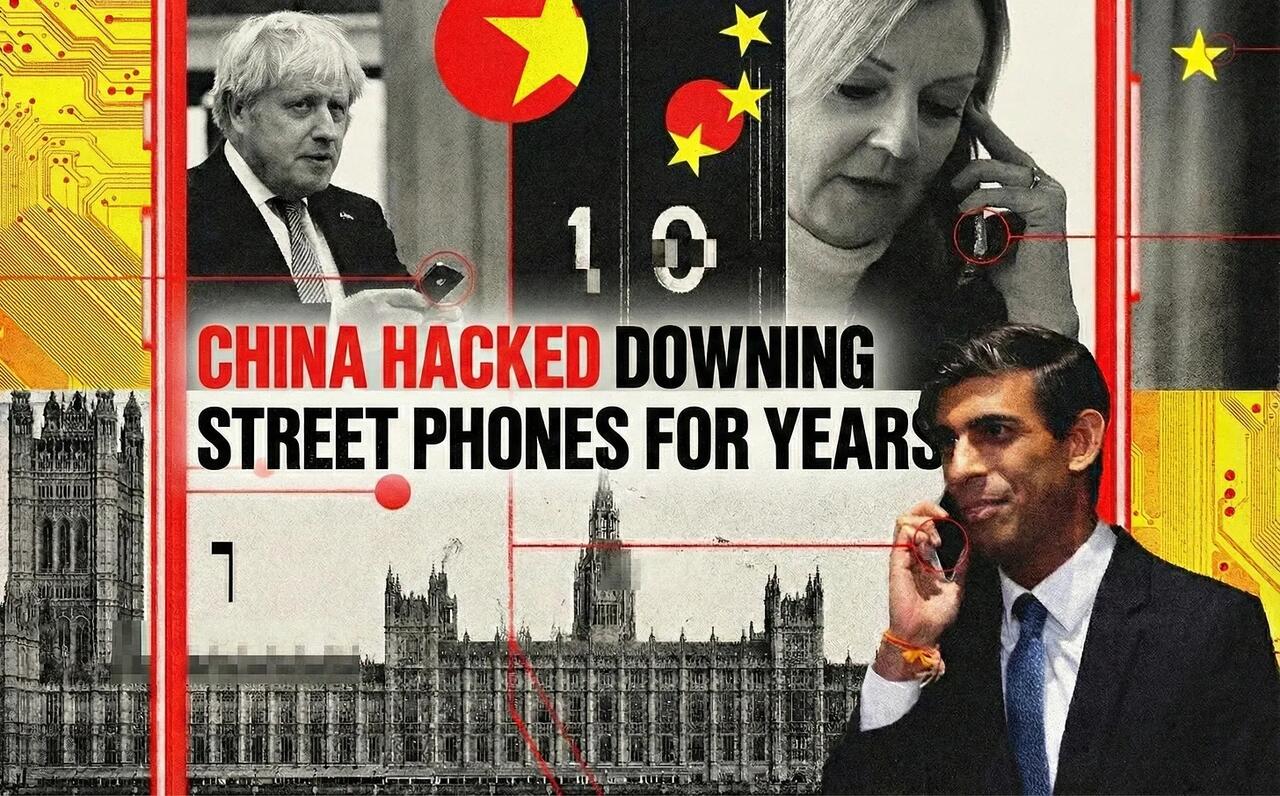
On January 26, 2026, The Telegraph disclosed that Chinese hackers had penetrated right into the heart of Downing Street, compromising mobile communications of senior officials across the Johnson, Truss, and Sunak administrations. The story was buried on page seven, treated as a technology curiosity. It was, in fact, a solvency event for the Western intelligence alliance. Not because phones were hacked, which happens, but because of how they were hacked: by weaponizing the very surveillance infrastructure that Western governments mandated for their own intelligence agencies. The Communications Assistance for Law Enforcement Act in the United States and the Investigatory Powers Act in the United Kingdom require telecommunications carriers to build backdoors into their networks for court-ordered wiretapping. Chinese state hackers found those backdoors. And walked through them.
The intelligence value is almost impossible to overstate. For approximately four years, operators linked to the MSS’s Chengdu bureau had the capability to see not just who British officials were calling, but whom the FBI was investigating, which Chinese operatives were under surveillance, what the United States knew about Beijing’s activities, and when counterintelligence was getting close. They could geolocate millions of individuals. They could record phone calls at will. They compromised the surveillance of their own surveillers, achieving the counterintelligence equivalent of reading the other side’s playbook while the game was in progress.
What follows is the institutional playbook. The positions are already being built.
The story of Salt Typhoon is not fundamentally a story about hacking. It is a story about architecture. Specifically, it is a story about what happens when governments mandate that their surveillance systems include single points of failure, then assume those points will only fail in their favor.
In 1994, the United States Congress passed the Communications Assistance for Law Enforcement Act, requiring telecommunications carriers to design their networks with built-in capabilities for government wiretapping. The law emerged from FBI concerns that digital switching technology would render traditional surveillance impossible. CALEA’s solution was elegant in its naivety: force every carrier to build a standardized interface through which law enforcement could access communications pursuant to court order. The interface would be secure because it would be secret, protected by access controls, audited by compliance regimes. No adversary would find it because no adversary would know to look.
Twenty-two years later, the United Kingdom enacted the Investigatory Powers Act 2016, colloquially known as the Snooper’s Charter. It went further than CALEA, mandating that technology companies retain communications data and provide access mechanisms for intelligence agencies. The architecture was the same: centralized access points designed for authorized users, protected by the assumption that authorized users would be the only ones using them.
Salt Typhoon was the adversarial audit that the system failed.
The Chinese operators did not need to hack individual phones, which would have been noisy and detectable. They did not need to intercept communications in transit, which would have required breaking encryption. They hacked the wiretap system itself. Once inside the CALEA infrastructure at AT&T, Verizon, and Lumen Technologies, they had access to everything the FBI had access to: call metadata showing who contacted whom and when, geolocation data derived from cell tower triangulation, the actual content of unencrypted calls and texts, and most devastatingly, the database of active surveillance requests. They could see whom the United States government was watching. They could see if they themselves were being watched.
The vulnerability was not a bug in the architecture. It was the architecture.
For decades, cryptographers and privacy advocates warned that there is no such thing as a backdoor only good guys can use. A vulnerability is a vulnerability. If it exists, a sufficiently motivated and resourced adversary will find it. The NSA and GCHQ and FBI dismissed these warnings as theoretical, academic, disconnected from operational reality. Law enforcement’s access needs are legitimate. But Salt Typhoon demonstrated empirically that the risks of mandated backdoors extend to everyone, including the governments that mandated them.
The irony approaches the unbearable. As Salt Typhoon was being discovered in late 2024, the UK government was pressuring Apple to weaken iMessage encryption under the Investigatory Powers Act. The argument was the same one that produced CALEA: law enforcement needs access, and carefully controlled access can be kept secure. Apple reportedly disabled certain features for UK users rather than comply. At precisely the same moment, as The Telegraph would later reveal, Chinese operators were reading communications from the heart of Downing Street through the access points the UK government had mandated.
The technical community has a name for this: the security paradox. Systems designed to enable surveillance become targets for adversary surveillance. The more access points you create for your own agencies, the more attack surface you expose to foreign agencies. The debate between security and privacy was always a false binary. The real tradeoff was between surveillability by your government and surveillability by everyone’s government.
Salt Typhoon collapsed that tradeoff into a single devastating data point.
Understanding what happened requires understanding how telecommunications networks actually function, not how they appear in policy documents.
A modern telecom network is not a monolithic system but a layered architecture spanning edge devices that connect to the public internet, core routing infrastructure that moves packets between networks, administrative systems that manage configurations and access, billing and customer data platforms, and lawful intercept systems that process surveillance requests. Each layer has its own attack surface. Salt Typhoon targeted the layer that matters most: the edge devices that control everything else.
The primary intrusion vector was a pair of vulnerabilities in Cisco IOS XE, the operating system running on millions of enterprise routers and switches worldwide. CVE-2023-20198, with a perfect 10.0 CVSS severity score, allowed an unauthenticated remote attacker to create an administrator account with Level 15 privileges, the highest access level on Cisco devices. CVE-2023-20273 enabled command injection that elevated those privileges to root access on the underlying Linux operating system. Chain them together and an attacker can create a god-mode account on any exposed Cisco device, then execute arbitrary code with full system control.
The vulnerabilities were disclosed in October 2023. Cisco issued patches. Many telecommunications operators delayed patching due to operational constraints that made rapid remediation nearly impossible.
This dynamic is not incompetence, though it resembles incompetence. Telecommunications infrastructure operates under pressures that create structural patch delays. These networks run 24 hours a day, 365 days a year. Downtime is measured in lost revenue and regulatory penalties. Patching a core router requires scheduling maintenance windows, testing updates in lab environments, coordinating with interconnected carriers, and accepting the risk that the patch itself introduces instability. For many operators, the calculation becomes: known theoretical vulnerability versus certain operational disruption. They chose the theoretical vulnerability. Salt Typhoon chose them.
Recorded Future’s Insikt Group documented the campaign exploiting over one thousand Cisco devices globally between December 2024 and January 2025. But the truly alarming finding was that attackers also exploited CVE-2018-0171, a vulnerability in Cisco Smart Install that had been patched seven years earlier. Some devices in critical telecommunications infrastructure had not been updated since 2018. The attack surface was not the frontier of zero-day exploitation. It was the accumulated technical debt of an industry that treated security as a cost center.
Once inside, Salt Typhoon deployed a sophisticated persistence mechanism designed to survive exactly the remediation attempts carriers would eventually undertake. The primary implant, documented by Trend Micro researchers under the name GhostSpider, operated entirely in memory without touching disk, evading traditional antivirus that scans for malicious files. It used DLL hijacking to execute within the context of legitimate processes, bypassing application whitelisting. Communications with command-and-control servers were encrypted and disguised as normal HTTPS traffic, blending with legitimate web activity.
The deeper persistence came from Demodex, a kernel-mode rootkit that modified the Windows operating system at its lowest level. Demodex hooked into system calls to hide its own processes, network connections, and registry entries from administrators running diagnostic commands. An operator investigating a compromised system would see nothing amiss because the rootkit was filtering what they could see. The malware achieved what the cybersecurity industry calls god-mode persistence: invisibility so complete that the only certain remediation is physical hardware replacement.
On Cisco devices specifically, the attackers exploited the Guest Shell, a Linux container environment designed for running legitimate management scripts. By injecting malicious code into this trusted container, they achieved persistence that survived standard reboots and even operating system reimaging. The infection lived below the level that normal administrators could access. It was not hiding in the house. It had become part of the foundation.
The operational sophistication extended to exfiltration. Salt Typhoon deployed a custom tool called JumbledPath that enabled packet capture across multiple network hops while simultaneously clearing logs and disabling logging along the capture path. They could intercept traffic without leaving forensic evidence of the interception. They modified Access Control Lists on compromised switches to explicitly permit their command-and-control IP addresses, ensuring their backdoors remained reachable even as security teams updated firewall rules. They created Generic Routing Encapsulation tunnels to route stolen data through compromised infrastructure, making the exfiltration appear as legitimate network traffic.
According to Cisco Talos analysis, the average dwell time before discovery was 393 days. One environment showed attackers maintaining presence for over three years. Three years of access to telecommunications infrastructure that carries the communications of governments, corporations, and private citizens. Three years of watching the watchers.
Attribution in cyber operations is notoriously difficult. Attackers route through compromised infrastructure in multiple countries, use commodity malware available to any buyer, and deliberately plant false flags suggesting different national origins. The intelligence community has learned hard lessons about premature attribution.
Salt Typhoon attribution does not suffer these ambiguities. It is among the most thoroughly documented cases of state-sponsored cyber operations in the public record.
The US Treasury Department sanctioned Sichuan Juxinhe Network Technology Co., Ltd. on January 17, 2025, identifying it as a Chengdu-based cybersecurity company with direct involvement in the Salt Typhoon cyber group. The language was unusually specific for a sanctions designation, which typically uses more cautious phrasing. Treasury stated that the Ministry of State Security has maintained strong ties with multiple computer network exploitation companies, including Sichuan Juxinhe. The implication was unmistakable: this was not a rogue actor tangentially connected to Chinese intelligence. This was an MSS operation executed through contractor infrastructure.
Chengdu has emerged as the primary hub of China’s offensive cyber contractor ecosystem, a distinction it shares with no other Chinese city to the same degree. The reasons are structural. Sichuan University and Chengdu University of Information Technology produce a steady pipeline of computer science graduates with the technical skills offensive operations require. The provincial government offers tax incentives for high-tech enterprises that attract cybersecurity firms. The MSS’s Chengdu bureau has historically been aggressive in recruiting and contracting local talent. The result is a geographic concentration of capability that the intelligence community has tracked for over a decade.
Sichuan Juxinhe is not an isolated entity but part of an interconnected ecosystem. Treasury’s designation also referenced Beijing Huanyu Tianqiong Information Technology Co., Ltd. and Sichuan Zhixin Ruijie Network Technology Co., Ltd. as associated entities. These firms share corporate registration patterns, overlapping personnel, and technical infrastructure in ways that suggest coordinated rather than independent operation.
The ecosystem became dramatically more visible in February 2024, when over five hundred internal documents from i-SOON (Sichuan Anxun Information Technology Co., Ltd.) appeared on GitHub in one of the most significant leaks of Chinese cyber operations ever recorded. The documents revealed a hacker-for-hire marketplace where private firms bid on government contracts to compromise specific targets. Price lists showed costs for different levels of access. Marketing materials advertised tools for hacking Twitter, Gmail, WeChat, and Telegram. Target lists included governments in India, Thailand, Vietnam, South Korea, and NATO member states. The operational picture was unmistakable: China’s cyber espionage apparatus operates significantly through private contractors who compete for MSS and PLA business.
The i-SOON leak provided a Rosetta Stone for understanding how Salt Typhoon operates. Domain registration patterns used by i-SOON matched those observed in Salt Typhoon infrastructure. Malware families overlapped. The corporate relationship between i-SOON and other Chengdu firms explained how capabilities and targeting information might flow between ostensibly separate entities.
The UK government reached the same conclusion. On December 9, 2025, Foreign Secretary Yvette Cooper announced sanctions against Integrity Technology Group and Sichuan Anxun Information Technology (i-SOON) for activities against the UK and its allies that impact our collective security. The 13-nation joint advisory released in August 2025 explicitly attributed the campaign to MSS-linked private contractors, co-signed by agencies from the United States, United Kingdom, Australia, Canada, New Zealand, Germany, Japan, and five other nations.
The evidence supporting attribution is overwhelming: convergent technical indicators across multiple intelligence services, targeting patterns aligned with MSS priorities rather than financial motivation, sanctions from two G7 governments naming specific companies, a leaked document trove revealing operational details, and multi-national intelligence consensus among powers with no incentive to coordinate false attribution.
Chinese Foreign Ministry spokesperson Guo Jiakun dismissed the allegations as unfounded and irresponsible smears and slanders, claiming China stands against hacking and fights such activities in accordance with the law. Chinese state media advanced the counter-narrative that Salt Typhoon accusations represent US efforts to secure congressional appropriations rather than genuine intelligence findings. The Global Times characterized the accusations as a farce of US smear tactics against China.
These denials represent diplomatic necessities. They do not survive contact with the documented evidence.
The targeting profile of Salt Typhoon reveals strategic intent far beyond conventional espionage.
In the United States, nine telecommunications carriers have been confirmed compromised: Verizon, AT&T, T-Mobile, Lumen Technologies, Spectrum (Charter Communications), Consolidated Communications, Windstream, Viasat, and at least one additional unnamed provider. Senator Mark Warner, chairman of the Senate Intelligence Committee, characterized it as the worst telecom hack in our nation’s history. The scope comparison is instructive. SolarWinds, the Russian supply chain compromise discovered in December 2020, affected approximately 18,000 organizations with deep penetration of roughly 100. Salt Typhoon compromised over 200 companies across 80 countries.
The data accessed falls into two categories with very different strategic implications.
The first category is bulk metadata: call detail records showing who contacted whom, when, and for how long, plus geolocation data derived from cell tower connections. Former Deputy National Security Advisor Anne Neuberger confirmed that attackers gained capabilities to geolocate millions of individuals. Metadata reveals patterns invisible in content alone. If a senior Treasury official calls a specific BP executive three times in one night before a North Sea oil announcement, Beijing knows the policy shift before the Cabinet does. Mapping communication networks reveals the actual decision-making structure of governments, which often differs substantially from organizational charts.
The second category is targeted content interception. Fewer than 100 individuals had actual call content and text messages directly compromised, but those individuals included Donald Trump, JD Vance, and senior staff from the Harris campaign during the 2024 presidential election. Congressional staff from the House China Committee, Foreign Affairs Committee, Armed Services Committee, and Intelligence Committee were accessed in breaches detected in December 2025, according to the Financial Times. The targeting was not random. It was surgical.
The United Kingdom penetration, disclosed by The Telegraph on January 26, 2026, reached right into the heart of Downing Street. The National Cyber Security Centre confirmed observing a cluster of activity targeting UK infrastructure since 2021. Aides to Prime Ministers Boris Johnson, Liz Truss, and Rishi Sunak had their communications compromised across a three-year period that included the COVID-19 pandemic response, the Ukraine war’s escalation, and critical UK-China trade negotiations.
Whether the Prime Ministers’ personal devices were directly compromised remains publicly unclear. The distinction may matter less than it appears. In a telecom network intrusion, attackers do not need to compromise individual devices. They compromise the network itself, intercepting communications as they transit carrier infrastructure. The Prime Minister’s phone may have been perfectly secure. The calls it made were not.
The strategic timing compounds the damage. The 2021-2024 window included decisions on Huawei’s role in UK 5G infrastructure, the AUKUS security pact formation, Hong Kong sanctions policy, and bilateral trade negotiations with Beijing. Chinese intelligence had real-time visibility into British decision-making during discussions where China’s interests were directly at stake. The information asymmetry is staggering.
Australia was similarly targeted. ASIO Director-General Mike Burgess confirmed in November 2025 that Salt Typhoon attempted to access Australia’s critical infrastructure, including telecommunications networks. Canada experienced confirmed breach of at least one unnamed telecom in February 2025. The campaign extended beyond the Five Eyes core: a South African provider was reportedly compromised via Cisco platforms, Southeast Asian telecoms detected new malware variants, and European telecommunications organizations identified intrusion attempts as late as October 2025.
The counterintelligence implications are the most damaging aspect, though the least publicly discussed.
By accessing CALEA systems, Salt Typhoon operators could see the database of active wiretap requests. They knew whom the FBI was investigating. If MSS operatives in the United States were under surveillance, Beijing could pull them out before arrests occurred. If FBI investigations were approaching sensitive Chinese assets, Beijing could warn them. If counterintelligence operations were building cases against Chinese technology companies or influence operations, Beijing could see the evidence accumulating.
This is the counterintelligence nightmare: your surveillance apparatus becomes the adversary’s intelligence source. The FBI was not just failing to catch Chinese spies. It was showing China exactly where to find its exposed spies before the FBI could catch them.
Systems approaching critical transitions exhibit a distinctive signature that financial risk models systematically miss. Surface metrics remain stable while underlying pressure accumulates. Correlations appear benign precisely because the stress is building uniformly across connected components. Then the transition happens not gradually but all at once, in a cascade that propagates faster than response mechanisms can activate.
The physics of phase transitions describes the phenomenon with precision. Water remains liquid as it cools, molecules slowing gradually, temperature dropping predictably. Then at exactly zero degrees Celsius, the system reorganizes instantaneously into a crystalline structure. The transition is discontinuous. Nothing in the gradual cooling predicted the sudden restructuring.
Salt Typhoon’s propagation through global telecommunications followed this pattern. The Global Cyber Alliance documented 72 million attack attempts from China-origin IP addresses against telecommunications infrastructure worldwide between August 2023 and August 2025. The number is not the important part. The distribution is. Rather than concentrating on a few high-value targets, the campaign probed systematically across the entire internet-facing surface of telecom networks in 80 countries. When one vector failed, others succeeded. The attack percolated through the network of networks, finding paths of least resistance through unpatched devices, legacy systems, and accumulated technical debt.
The 80-country spread was not a bug or scope creep. It was the exploitation of network topology itself. Telecommunications providers interconnect through peering relationships, shared vendors, inherited trust, and common infrastructure. Compromising one provider creates pivot points into connected providers. The attackers did not need to breach 80 countries independently. They needed to breach enough nodes that cascade dynamics carried the compromise further.
Financial risk models trained on historical correlations would have seen nothing unusual in the period before disclosure. Telecom stocks moved with normal volatility. Cybersecurity spending followed typical budget cycles. The correlation stability that risk managers found reassuring was measuring the pressure building uniformly, not the probability of release.
The parallel to credit markets before 2008 is instructive though imprecise. Mortgage-backed securities showed stable correlations because they were all exposed to the same underlying risk. The stability was the warning, not the comfort. When housing prices turned, the correlation snapped to one and everything moved together. The diversification that looked protective turned out to be concentration disguised.
Salt Typhoon exposed a similar hidden correlation in critical infrastructure. The assumption was that a breach of Verizon had no implications for BT, that American vulnerabilities were American problems, that European telecoms operated in a separate risk regime. The assumption was wrong. The same Cisco devices run everywhere. The same CALEA architecture creates the same vulnerability everywhere its analogues exist. The same contractor ecosystem targets everyone with the same tooling. The diversification across carriers and jurisdictions was illusory. They were all one network.
The Five Eyes intelligence alliance, comprising the United States, United Kingdom, Canada, Australia, and New Zealand, represents the deepest and most institutionalized intelligence-sharing arrangement among Western democracies. Its origins in World War II signals intelligence cooperation have evolved into comprehensive collaboration on technical collection, analysis, and counterintelligence. Salt Typhoon tested this architecture as nothing has since its formation.
The initial response demonstrated the alliance’s coordination capabilities. The December 2024 Enhanced Visibility and Hardening Guidance for Communications Infrastructure was the first joint Five Eyes response to the breach. The August 2025 advisory expanded to 13 nations, co-sealed by 22 agencies attributing the campaign to specific Chinese companies with unprecedented multinational consensus. The coordination was real and consequential.
But the fractures were also visible.
UK officials pointedly stated that had American regulations matched British standards, we would have found it faster, we would have contained it faster. The criticism was technically accurate. The UK’s Telecommunications Security Act 2021 imposed security obligations on carriers that exceed CALEA requirements. But the same UK government pursuing those regulations was simultaneously pressuring Apple to weaken encryption under the Investigatory Powers Act, replicating exactly the architectural vulnerability that Salt Typhoon exploited. The internal contradiction was not resolved so much as ignored.
The regulatory divergence reflects deeper philosophical disagreements that Salt Typhoon intensified without settling. The FBI and CISA’s December 2024 recommendation that Americans use end-to-end encrypted messaging applications represented an extraordinary acknowledgment that carrier networks cannot be trusted. Yet both agencies have historically sought encryption backdoors for law enforcement access. The cognitive dissonance remained unaddressed: advocating for encryption to protect against foreign adversaries while seeking to weaken encryption for domestic law enforcement.
The FCC’s regulatory response exemplified the policy incoherence. In January 2025, the Commission proposed mandatory cybersecurity requirements including role-based access controls, multi-factor authentication, and vulnerability patching for telecommunications carriers. Then-Chairwoman Jessica Rosenworcel stated: In light of the vulnerabilities exposed by Salt Typhoon, we need to take action. In November 2025, the reconstituted FCC voted 2-1 to revoke those rules. Chairman Brendan Carr argued for an agile and collaborative approach over regulatory mandates. Commissioner Anna Gomez dissented: This FCC today is leaving Americans less protected than they were the day this breach was discovered.
The Cyber Safety Review Board investigation, established to provide an authoritative post-mortem on Salt Typhoon, was terminated in January 2025 when the incoming administration dismissed all members before their investigation concluded. The official lessons learned process stopped before identifying lessons.
Intelligence sharing itself became contested. Reports emerged in 2025 that DNI Tulsi Gabbard barred sharing certain intelligence with Five Eyes partners. While some former officials characterized concerns as faux outrage, noting that withholding occurs routinely, others warned of a chilling effect on critical intelligence sharing at precisely the moment coordination mattered most.
From a Chinese perspective, as expressed by state media and diplomatic channels, the sanctions and coordinated Western response represent political escalation that unnecessarily heightens tensions and contradicts stated commitments to engagement. Beijing has consistently framed the accusations as evidence of anti-China bias in Western intelligence assessments rather than legitimate security concerns.
Salt Typhoon revealed that even the world’s most sophisticated intelligence alliance, facing the world’s most aggressive cyber adversary, operates with fundamental coordination failures, regulatory incoherence, and philosophical contradictions that compound rather than contain the damage.
The most alarming aspect of Salt Typhoon is not what happened but what continues to happen.
CISA Executive Assistant Director Jeff Greene stated plainly: We cannot say with certainty that the adversary has been evicted, because we still don’t know the scope of what they’re doing. Senator Maria Cantwell’s December 2025 assessment was equally stark: Telecom companies infiltrated in the attack have failed to prove the Chinese hackers have been eradicated from their networks.
AT&T and Verizon announced in January 2025 that they had successfully expelled the attackers from their networks, with Mandiant providing independent verification. The claims met immediate skepticism from government officials and security experts. The skepticism has not been resolved. When Senator Cantwell demanded documentation, the carriers could not provide evidence that Chinese hackers had been fully removed.
The technical reasons for persistent access are well understood.
Salt Typhoon’s persistence mechanisms, including GRE tunnels on network devices, Demodex kernel rootkits, and modified authentication server configurations, can survive standard remediation procedures. The attackers’ average dwell time of 393 days before detection, with some environments compromised for over three years, demonstrates operational security sufficient to reestablish access even after apparent eviction. If the attackers anticipated discovery, they likely created backup persistence mechanisms that remediation teams have not found.
Read the rest here and consider subscribing.
Gpscruisehorse shit
Authored by Aldgra Fredly via The Epoch Times (emphasis ours),
House Republicans on Jan. 29 said they plan to roll out a comprehensive election reform bill that would set requirements for elections, including for photo IDs and proof of citizenship.
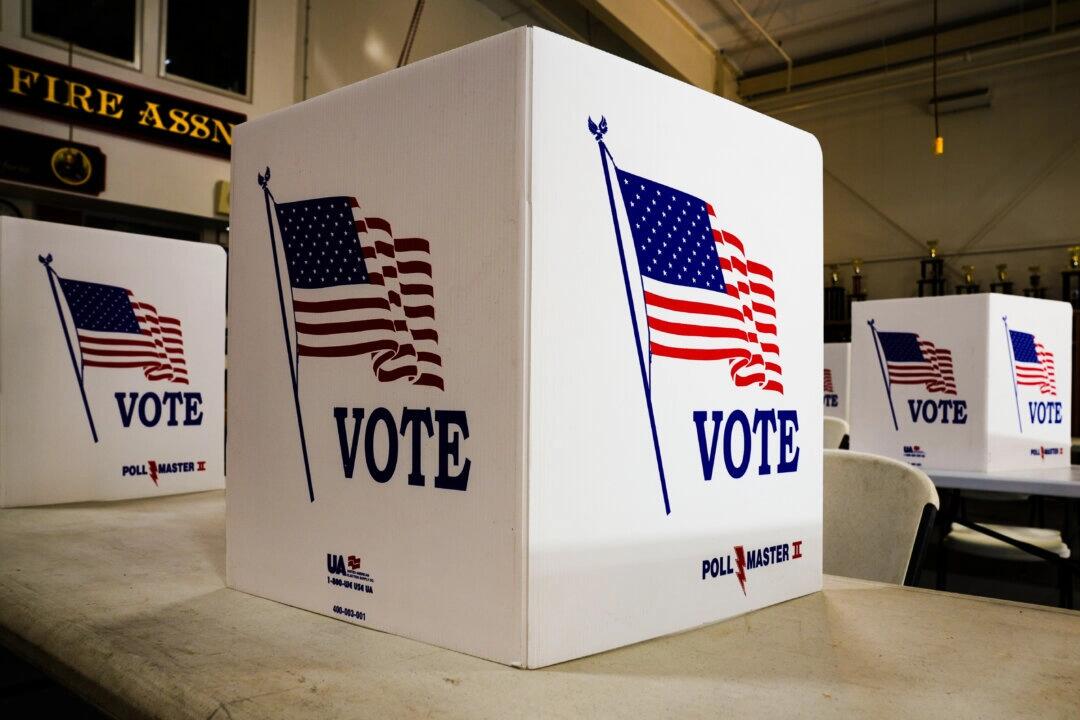
House Administration Committee Chair Rep. Bryan Steil (R-Wis.) said the Make Elections Great Again (MEGA) Act aims to prevent election fraud and will be introduced during the House’s pro-forma session on Jan. 30.
“Americans should be confident their elections are being run with integrity – including commonsense voter ID requirements, clean voter rolls, and citizenship verification,” Steil said in a statement.
“These reforms will improve voter confidence, bolster election integrity, and make it easy to vote, but hard to cheat.”
The bill, if passed, would require voters to show photo identification when casting ballots and verify their citizenship during registration.
It would also mandate that mail-in ballots be received by the close of polls on election day and require states to use auditable paper ballots.
Under the legislation, it would be “unlawful for an individual to distribute, order, request, deliver, or possess” a ballot belonging to another person who is not an immediate family member or caregiver.
It would also prohibit people from delivering more than four mail-in ballots at a time, except for incidental possession by postal workers or election officials.
In addition, the bill would tighten routine voter list maintenance requirements, ban universal vote by mail, and prohibit states from using a voting system that allows voters to choose more than one candidate or rank multiple candidates for the same office.
Rep. Joe Morelle (D-N.Y.), the Democratic Party’s top lawmaker on the House Administration Committee, opposed the bill and accused House Republicans of trying to “rig the system so they can choose their voters.”
“This bill is their latest attempt to block millions of Americans from exercising their right to vote,” Morelle said in a statement. “I will fight this bill at every turn.”

The MEGA Act is backed by several election advocacy groups, including America’s First Policy Institute (AFPI), which said the bill includes requirements that will prevent noncitizens from voting in U.S. elections.
“As an American citizen, casting a ballot is a civic duty, a unique privilege, and a fundamental right to help determine who represents you in government and who will stand for your ideas, values, and freedom,” AFPI’s chair of election integrity, Kenneth Blackwell, said in a statement.
“And that right, which men and women have died on foreign battlefields to protect, is discarded when noncitizens are allowed to vote.”
Election Transparency Initiative National Chairman Ken Cuccinelli said the omnibus would make voting “accessible for eligible citizens while closing loopholes that invite abuse, by banning ballot harvesting, stopping taxpayer-funded partisan registration schemes, and requiring auditable paper ballots.”
Gpscruisei think china took some last minute revenue-sharing thievery. Many report that.
US equity futures are rallying into record territory, led by Tech as overnight earnings (ASML, SK Hynix, STX, TXN) boost the group and help fuel the AI trade, perhaps pausing the broadening theme. As of 8:00am ET S&P futures are up 0.2% pointing to a sixth-straight advance that would mark the longest winning run in almost seven months and will push the S&P 500 cash index above the 7,000 mark for the first time when US markets open; Nasdaq futures surge 0.8, putting the index within touching distance of its October record, with Mag 7s and Semis bid in premarket trading, led by AMD (+2.3%), AVGO (+1.4%), and NVDA (+1.6%). Cyclicals are leading Defensives as Fins/Indu/Mats outperform and Staples lag. Bond yields are flat while the dollar advanced 0.2%, snapping a four-day slide that left the currency at its lowest level in nearly four years. Commodities are mixed: gold +1.7% and silver +0.4% to new record highs, as the Energy complex is under pressure (natgas -8%) with Ags maintaining a bid. Today’s macro focus is on the Fed unchanged announcement (full preview here) with the market looking to see if the Fed identifies growth or inflation as the biggest risk but with no moves expected and three Mag7 earnings releases (full preview here).
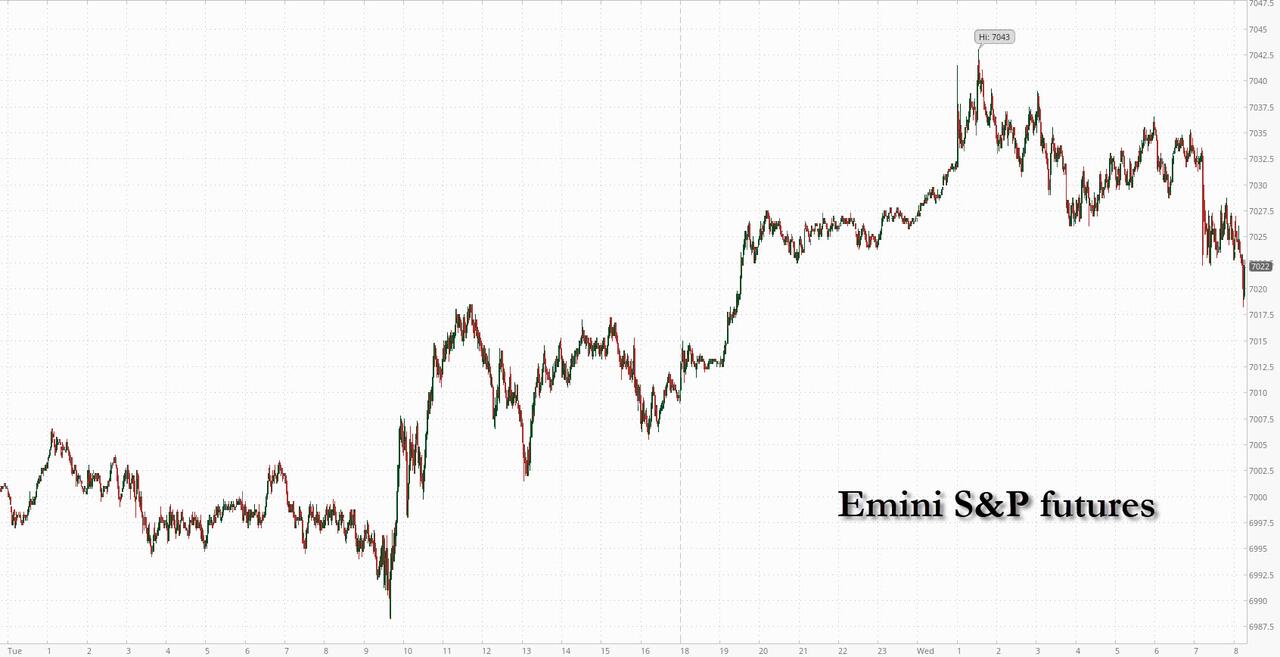
In premarket trading, semiconductor, memory and storage stocks rally after positive results from ASML, Seagate and Texas Instruments. ASML ADRs are up 5% after the company reported orders well beyond investor expectations, showing a surge in AI computing workloads has flowed through to higher demand for its chipmaking tools. Seagate (STX) is up 8% after the computer hardware and storage company’s second-quarter results beat expectations and it gave a positive outlook. Analysts note that results were boosted by strong gross and operating margins. Texas Instruments (TXN) gains 7% after the chipmaker gave an outlook that is seen as positive, signaling improved demand. Analysts highlight strength in the industrial and data center end markets. Magnificent Seven stocks are mostly higher (Nvidia +1.9%, Alphabet +0.4%, Amazon +0.3%, Meta -0.2%, Tesla +0.2%, Microsoft +0.2%, Apple -0.1%
In company news, Amazon is cutting about 16,000 roles across the company as part of ongoing organizational restructuring efforts, according to a statement.
Tech stocks are rallying around the world after blockbuster earnings from ASML and SK Hynix added fresh fuel to the artificial-intelligence trade while Microsoft, Meta and Tesla are due to report later (our preview here). Nasdaq 100 futures climbed 0.8%, putting the index within touching distance of its October record.
ASML rose more than 5% in Amsterdam on fourth-quarter bookings that far exceeded estimates. Asian equities got a boost as SoftBank Group Corp. flagged talks to invest $30 billion in OpenAI. Relentless demand for AI memory fueled a large earnings beat for SK Hynix. LVMH’s sluggish sales weighed on luxury names in Europe.
“The tech sector is likely to lift markets further, so the rally isn’t over yet,” said Claudia Panseri, chief investment officer for France at UBS Wealth Management. “The Fed this evening will be an important clarification for investors, who are at the moment expecting two cuts this year.”
Today’s tech gains might put a pause on the rotation away from the sector. Amid the S&P’s advance to a record, a version of the index stripped of market-cap bias has outperformed, with materials, health care and consumer sectors supplanting tech at the forefront.
The upbeat mood in equity markets comes ahead of the Federal Reserve’s latest policy decision, with investors expecting interest rates to remain on hold. With announcement of a nominee to succeed Fed Chair Jerome Powell in May pending and Governor Christopher Waller among the contenders, a focal point of the rate decision will be whether he dissents in favor of a rate cut US President is seeking; dissents by Governors Stephen Miran and Michelle Bowman are also expected (full preview here).
With BlackRock executive Rick Rieder seen as the front-runner to become the next Fed chair, bond futures traders are increasing bets that he would favor a more accommodative US monetary policy. Rieder, the firm’s chief investment officer for global fixed income, argued in September for a larger half-point rate cut, rather than the quarter-point moves preferred by the Fed.
“The appointment of Rieder should be a market positive given his background,” wrote Mohit Kumar, chief strategist for Europe at Jefferies. “He is likely to be modestly more dovish than some of the other choices, though it is unlikely that he would rubber stamp Trump’s views.”
The dollar is rebounding against all major currencies following Tuesday’s sharp selloff, which extended as President Trump indicated he’s comfortable with the greenback’s recent decline.Donald Trump’s relaxed stance on the dollar is adding to speculation that the US currency may be entering a more prolonged period of weakness. Speaking to reporters in Iowa on Tuesday, Trump said the dollar’s slide was beneficial for US businesses, moving currency markets by appearing to endorse the greenback’s sharp decline.
“I don’t think it’s going to be that same kind of blanket dollar weakness that we saw last year, but I think there are certainly some pairs where that move does look quite appealing,” Lauren van Biljon, senior portfolio manager at Allspring Global Investments, told Bloomberg TV.
Also due Wednesday are earnings from three of the Magnificent Seven heavyweights, Microsoft Corp., Tesla Inc. and Meta Platforms report after the close (our preview can be found here). Other companies reporting include Starbucks, Danaher, General Dynamics, GE Vernova and AT&T all out before the market open. IBM completes the notable companies to report after the close.
“So far, we’ve been pleasantly surprised by the earnings season in tech, with TSMC and ASML today,” said Karen Kharmandarian, chief investment officer of thematic equities at Mirova in Paris. “We’re still expecting capex to continue to grow substantially among the hyperscalers such as Google, Meta or Amazon, given the momentum in the AI space.”
In Europe, the Stoxx 600 is down by 0.5% as blowout results from Dutch semiconductor equipment maker ASML are more than offset by declines for health care companies and for the luxury goods sector, the latter on disappointing numbers from LVMH. Here are the biggest movers Wednesday:
Earlier in the session, Asian equities are set for another record high, supported by a continued rally in technology shares. The MSCI Asia Pacific Index gained as much as 1.2%, with TSMC, SK Hynix and Tencent the biggest boosts to the gauge. Hong Kong led gains in the region amid inflows spurred by dollar weakness. Shares also rose in South Korea, helping the country’s market cap to overtake that of Germany. Meanwhile, Indonesian stocks tumbled after MSCI raised concerns about their investability and warned of a potential downgrade to frontier-market status.
“The shortage in supply in memory chips will continue to be a key catalyst for Asian memory makers,” said Ken Wong, an Asian equity portfolio specialist at Eastspring Investments Hong Kong. “We probably won’t see equilibrium on supply versus demand till early next year.”
In FX, the greenback is rebounding after hitting 2022 lows. The Bloomberg Dollar Spot Index up by 0.3%, though mixed against G-10 peers.
In rates, treasuries were little changed ahead of the Fed rate decision with marginal long-end underperformance extending Tuesday’s late steepening move as the US dollar weakened further. US session features Federal Reserve rate decision, with swaps market priced for no change in the 3.5%-3.75% target range for federal funds. US front-end to belly yields are slightly richer on the day with longer maturities little changed, steepening 5s30s curve by about 1bp to 104bp, highest this week; 10-year, little changed near 4.24%, slightly lags bunds and gilts in the sector. Short-end bonds in Europe rallying as traders add to ECB rate cut bets.
In commodities, the blistering rally in precious metals continued as gold briefly topped $5,300 an ounce. Silver rose as much as 3.6% before pairing the advance. Oil prices are choppy, Brent now falling and hovering a little above $67/barrel.
Today's US economic calendar is blank; FOMC announcement is at 2pm New York time, followed by Chair Powell’s press conference at 2:30pm. Mag 7 earnings begin today with Microsoft, Meta and Tesla reporting after the close.
Market Snapshot
Top Overnight News
Trade/Tariffs
Central Banks
A more detailed look at global markets courtesy of Newsquawk
APAC stocks traded mixed with an early positive bias seen following the mostly constructive handover from Wall Street, although some cautiousness began to seep through ahead of looming key risk events. ASX 200 was subdued with the index dragged lower by weakness in tech and consumer stocks, while the predominantly firmer-than-expected inflation data from Australia supports the case for a hike at next week's RBA meeting. Nikkei 225 underperformed from the open, following the recent currency strength spurred by intervention speculation and US President Trump's FX-related rhetoric. Hang Seng and Shanghai Comp were in the green with energy and telecom stocks among the index leaders in Hong Kong, while the mainland was kept afloat after developer China Vanke won creditor approval to extend another two CNY bonds and with a report noting that China approved the first batch of NVIDIA's H200 AI chips for import involving several hundred thousand H200 AI chips.
Top Asian News
European bourses (STOXX 600 -0.4%) are generally trading with modest losses, aside from the AEX, which has been boosted by post-earnings strength in heavyweight ASML (+4.8%). The company beat across its headline metrics, provided a rosy outlook, and announced a EUR 12bln share buyback. European sectors hold a negative bias. Tech leads (boosted by ASML), whilst Consumer Products has been pressured by losses in LVMH (-7.1%) after its results disappointed.
Top European News
FX
Fixed Income
Commodities
Geopolitics: Ukraine
Geopolitics: Middle East
Geopolitics: Other
US Event Calendar
DB's Jim Reid concludes the overnight wrap
Risk assets put in another decent performance yesterday, with solid earnings pushing the S&P 500 (+0.41%) to another record, and futures on the index (+0.29%) are pointing to more gains this morning. But even as US equities reached new heights, the dollar index (-0.85%) fell to its weakest in nearly four years, having now posted its biggest 4-day decline since the Liberation Day turmoil last April. So it was a pretty mixed day for US assets. Meanwhile, geopolitical risk continued to dominate the headlines, with Brent crude oil reaching its highest since September after Trump said the US had a “big armada” heading to the Middle East, which together with the dollar slump pushed gold prices (+3.42%) to another record close of $5,180/oz. And there’ll be no let-up in the headlines today, as we’ve got the Fed’s latest decision tonight, along with earnings from three of the Mag 7 after the US close.
Ahead of the Fed’s decision, the main story was that ongoing dollar weakness, which saw the Dollar index (-0.85%) close at its lowest level since February 2022. Several factors contributed, but importantly, Trump himself was asked about his thoughts on the decline, and said “No, I think it’s great”, suggesting he wanted the currency to “just seek its own level, which is the fair thing to do”. That followed weak US data earlier in the session, as the Conference Board’s latest consumer confidence print hit its lowest since 2014, at 84.5 (vs. 91.0 expected). And on top of that, fears around a government shutdown this week continued to swirl, with Polymarket giving it a 76% chance of happening this Saturday. So all those factors contributed to pre-existing concerns pushing the dollar lower, including questions around the Fed’s independence, tariff policy uncertainty and the fiscal trajectory.
Of course, with the dollar moving lower, that meant several other currencies reached multi-year highs against it, with the Euro closing above $1.20 yesterday for the first time since June 2021. But that’s also raised questions about whether the ECB would need to think about another interest rate cut given the downward pressure that would cause on inflation. Indeed, Austrian central bank governor Kocher said in an FT interview out this morning that continued euro appreciation could mean the ECB has to react. So the euro’s slipped back a bit this morning after those comments, and is currently trading at $1.1987.
As all that was happening, investor concern continued to mount about geopolitical risk, with ongoing speculation about a potential US strike on Iran. That followed comments from Trump, in an interview recorded on Monday, saying that the US had a “big armada” heading to the Middle East, although he said “I’d rather not see anything happen”. So that helped push up oil prices, with Brent crude (+3.02%) reaching its highest level since September, at $67.57/bbl, whilst WTI (+2.90%) reached its highest since October, at $62.39/bbl. And there was plenty happening elsewhere for commodities, as precious metals saw another round of records yesterday thanks to heightened geopolitical risk and a broader move away from the US Dollar. So gold prices (+3.42%) posted their best day since April to a new record of $5,180/oz, whilst silver (+8.00%) also hit a record of $112.08/oz. Moreover, those gains have continued overnight, with gold up another +1.55% to $5,261/oz, whilst silver has risen +3.19% to $115.66/oz.
Looking forward, the main highlight on today’s calendar is the Federal Reserve’s policy decision, where it’s widely expected they’ll keep rates on hold after 3 consecutive rate cuts. So with the decision unlikely to surprise, the focus will be on the press conference, where several non-economic issues are likely to come up, including the recent DoJ subpoena, the Lisa Cook case at the Supreme Court, the next Chair, and whether Powell will remain as a Governor after his term as chair concludes in May. Our US economists have more in their preview (link here), but they expect Powell to reiterate the points made in his statement on the subpoena earlier this month, and not comment on the next Chair. Then in terms of policy, they expect the Fed to present a more upbeat view about the economy, and think the statement will signal that they’re well-positioned to respond to risks on either side of their dual mandate.
As we head into the Fed’s decision, that pressure on the dollar also spread to long-end Treasuries yesterday, with 10yr yields (+3.2bps) moving a couple of basis points higher after Trump’s comments to end the day at 4.24%, while 30yr yields rose +5.7bps on the day to 4.86%. By contrast, 2yr yields (-1.7bps) rallied after the weaker consumer confidence data, as investors moved to price in more Fed rate cuts this year. So by the close, 47bps of cuts were priced in by the December meeting, up +1.0bps on the day.
Despite that backdrop of dollar weakness and heightened geopolitical tensions, it was actually a very strong day for US equities, with the S&P 500 (+0.41%) posting a 5th consecutive advance that took the index to a new record. Tech stocks led the way, with the Magnificent 7 (+0.89%) closing just over 1% beneath its own record from late-October, ahead of earnings from Meta, Microsoft and Tesla after tonight’s close. Nevertheless, the gains were fairly narrow, with more than half of the S&P 500 constituents lower on the day.
Meanwhile in Europe, equities also put in a strong performance, with the STOXX 600 (+0.58%) closing just 0.2% beneath its own record high from a couple of weeks ago, whilst Spain’s IBEX 35 (+0.70%) hit a new record of its own. However, European bonds only saw modest moves, with yields on 10yr bunds (+0.8bps), OATs (+0.1bps) and BTPs (+0.3bps) all posting small increases. Gilts were the main exception to that, with the 10yr yield (+2.8bps) rising to 4.52%.
Overnight in Asia, there’s been a fairly mixed performance. Some indices have put in a very strong performance, with the KOSPI (+1.64%) currently on track for another record high, whilst the Hang Seng (+2.31%) is currently on course for its highest closing level since 2021. Moreover, the CSI 300 (+0.35%) and the Shanghai Comp (+0.36%) are also higher. However, Japan’s Nikkei (-0.46%) and the TOPIX (-0.85%) have lost ground, which comes as the yen continued to strengthen yesterday, closing at 152.21 per US dollar, its strongest since late October. But JGBs have put in a decent performance overnight after a 40yr auction saw strong demand. So the 10yr JGB yield is down -4.7bps this morning to 2.23%.
Looking at the day ahead, and the main highlight will be the Federal Reserve’s policy decision, along with Chair Powell’s press conference. Otherwise, the Bank of Canada will announce their latest decision, and we’ll hear from the ECB’s Elderson and Schnabel. Finally, today’s earnings releases include Meta, Microsoft, Tesla, IBM, AT&T and Starbucks.
Censorship concerns are back in the spotlight after TikTok users claim to be having trouble posting about Jeffrey Epstein and ICE raids.
Days after the company finalized a sale to a consortium of American investors who now control TikTok's business in the US - which averted a national ban of the app over national security concerns - users report being unable to use the word "Epstein" in direct messages.
The company responded, telling NPR "We don't have rules against sharing the name 'Epstein' in direct messages and are investigating why some users are experiencing issues."
TikTok said none of its content moderation rules have changed.
Still, when some users tried to send direct messages containing the word "Epstein," an automatic prompt appeared declaring that the message may be in violation of TikTok's community guidelines. The messages were not sent, according to the prompt, "to protect our community."
Tests by NPR, and other accounts on social media, show that it was happening inconsistently; Some users were able to send messages with "Epstein," and some were not. The TikTok spokesman said that is consistent with the company's own analysis so far, yet the exact cause is still under review.
TikTok users are also claiming that the platform is censoring information related to the Trump administration's immigration enforcement actions, as many users on the platform report being unable to upload videos on the topic.
The TikTok censorship this week is genuinely insane. It’s a very bad look to have more censorship under American management than under Chinese management. It almost goes without saying that if it doesn’t reverse course immediately, it deserves the scandal & exodus it’s getting.
— Mike Benz (@MikeBenzCyber) January 28, 2026
Some are pointing a finger at TikTok's new ownership - which includes lead investor Oracle, run by billionaire Larry Ellison, a close friend of President Trump. Users are now circulating the hashtag #TikTokCensorship on X.
It's nice to see Democrats suddenly discovering free speech.
Sen. Chris Murphy (D-CT) says this is at the 'top of the list' when it comes to threats to democracy. We don't remember him piping up when conservatives were being censored for a decade...
I know it's hard to track all the threats to democracy out there right now, but this is at the top of the list. https://t.co/WjB05qeQPN
— Chris Murphy 🟧 (@ChrisMurphyCT) January 26, 2026
TikTok said in a statement that 'glitches' on the app were due to a power outage at a US data center, causing videos to take longer to be uploaded and recommended to other users, and are "unrelated to last week's news" of the finalized sale.
Oracle, meanwhile, blamed the winter storm that has affected large swaths of central and eastern US, saying in a statement that an Oracle data center "experienced a temporary weather-related power outage," triggering wide-spread "technical issues" for users of TikTok, said spox Michael Egbert, who added that the companies are working "quickly" to restore service and stabilize the app.
On Tuesday, TikTok US Joint Venture said it had made "significant progress" in restoring service to US users, but noted that many might still have trouble uploading new videos.
We've made significant progress in recovering our U.S. infrastructure with our U.S. data center partner. However, the U.S. user experience may still have some technical issues, including when posting new content. We're committed to bringing TikTok back to its full capacity as…
— TikTok USDS Joint Venture (@tiktokusdsjv) January 27, 2026
Nurse Jen Hamilton, who has over 4.5 million TikTok followers, says that after she posted a still picture about Alex Pretti, a protester who was shot by one or more federal immigration agents on Saturday, her next four videos couldn't be uploaded.
"Something has shifted in the way that content is getting put on the platform, or allowed to be on the platform," she told CNN. "And I just find it very ironic that it’s the same day that it takes over that people are not being able to post their stuff."
While it would be difficult to prove TikTok is censoring content about ICE due to its opaque algorithm, it would also be within their legal right to do so, says Jeffrey Blevins, a professor at the University of Cincinnati who studies media law and ethics.
"They’re a private platform. They have a First Amendment right to do that," he said. "A lot of times it’s easy for us to think of social media as a public square, but it’s not public in a way that matters under the law."
Gpscruiseive grown to not hate this guy
As Congress battles over homeland security funding ahead of a potential government shutdown, Pennsylvania Democrat Sen. John Fetterman is calling to keep the government open while demanding an end to an immigration enforcement surge in Minnesota.
On Monday, Fetterman called for the expanded immigration enforcement operation in Minneapolis to “immediately end,” echoing the calls of his Democrat colleagues.
However, Fetterman has set himself apart from Democrat colleagues in refusing to trigger a government shutdown by voting against a six-bill funding package that includes funding for Immigration and Customs Enforcement.
— U.S. Senator John Fetterman (@SenFettermanPA) January 26, 2026
“I will never vote to shut our government down, especially our Defense Department,” Fetterman wrote in his statement.
Throughout the latest government shutdown, Fetterman consistently voted for a continuing resolution to maintain funding for the government and was one of eight Democrat caucus senators to cross the aisle and vote to reopen the government in November.
The federal government’s spending authority expires Jan. 30, and several Democrats, including Senate Majority Leader Chuck Schumer, D-N.Y., are demanding a separate vote on homeland security funding.
Currently, funding for several federal agencies is bundled together in the spending package.
The Department of Homeland Security encompasses not only immigration law enforcement, but also services such as the Federal Emergency Management Agency and the Coast Guard.
Failure to pass the six-bill minibus would also dry up funding for the State Department and financial regulators, as well as other agencies, including war, education, labor, health, and housing.
Fetterman argued that, regardless of the bill’s passage, ICE will still receive funding from the July 2025 budget reconciliation bill. He rejected “calls to defund or abolish ICE.”
He called for Homeland Security Secretary Kristi Noem to be removed over the deaths of Renee Good and Alex Pretti at the hands of federal immigration enforcement officers in Minnesota.
“I make a direct appeal to immediately fire [Secretary Noem],” Fetterman said in a post directed at President Donald Trump Tuesday.
“Americans have died,” Fetterman continued. “She is betraying DHS’s core mission and trashing your border security legacy. DO NOT make the mistake President [Joe] Biden made for not firing a grossly incompetent DHS Secretary.”
.@POTUS @realDonaldTrump: I make a direct appeal to immediately fire @Sec_Noem.
— U.S. Senator John Fetterman (@SenFettermanPA) January 27, 2026
Americans have died.
She is betraying DHS’s core mission and trashing your border security legacy.
DO NOT make the mistake President Biden made for not firing a grossly incompetent DHS Secretary.
The Pennsylvania senator’s remarks on Noem and Biden’s homeland security secretary, Alejandro Mayorkas, are noteworthy, given that Fetterman voted to confirm Noem as DHS secretary in 2025 and voted to dismiss articles of impeachment against Mayorkas in 2024.
After the publication of this article, a DHS spokesperson told The Daily Signal, “DHS enforces the laws Congress passes, period. If certain members don’t like those laws, changing them is literally their job. Secretary Noem oversees the Department of Homeland Security, and she is very happy that Tom Homan, who is a great asset to the President, and has a great depth of experience and insight, will be overseeing Minneapolis operations,”
The spokesperson continued, “Under [Noem’s] leadership, DHS law enforcement have arrested and deported over 700,000 criminal illegal aliens. Over 2 million self-deportations and we will continue with that work.”
The spokesperson also referred to a statement to the press from Trump, who said Tuesday, “I think she’s doing a very good job… the border is totally secure.”
This article has been updated with comment from DHS.
The post ‘Fire’ and ‘ICE’: Fetterman Sets Own Path on Immigration Issue appeared first on The Daily Signal.
Gpscruisesoo, i wanna get laid, so i need $$, so i support money laundering thru an NGO, which needs Democrat (illegals) voters. Is that accurate?
Republican Rep. Mike Lawler is breaking from the Trump administration on its deportation push, calling for leniency for some illegal immigrants in an essay for The New York Times.
“The deaths of Renee Good and Alex Pretti in Minneapolis this month were tragic and preventable,” Lawler, R-N.Y., writes in an essay published Tuesday. “No matter where you stand on immigration enforcement, the shootings show that what the country has been doing is not working.”
Lawler, who represents a district in New York’s Hudson Valley that favored Democrat presidential nominee Kamala Harris over now-President Donald Trump, argues in the essay that Congress must codify new immigration law.
“Along with building on Mr. Trump’s border policies, a realistic plan would provide a path to legal status—not citizenship—for long-term illegal immigrants without criminal records,” Lawler writes.
“This path would be rigorous and fair, and it would aim to keep families together. Fair means those who benefit would face mandatory work requirements, forgo public assistance and pay fines and any back taxes they might owe.”
Lawler additionally criticizes sanctuary city policies and calls for administration officials to investigate the deaths of Good and Pretti and testify before Congress.
Lawler is a co-sponsor of the “Dignity Act,” which would put a temporary pause on the removal of some migrants working in the United States.
The swing district congressman recently bucked the party line by voting to resurrect COVID-19-era Obamacare premium tax credit levels that expired at the end of 2025.
The essay received mixed reception in some conservative circles.
This is an odd, but under the circumstances entirely predictable, article. Lawler wants Congress to step in to keep Trump's secure border and increase Trump's deportation numbers–"but humanely"–and then provide a "rigorous and fair…path to legal status–not citizenship–for… https://t.co/PYdlXDyd27
— Byron York (@ByronYork) January 27, 2026
“Been saying watch out for the amnesty push,” wrote Mike Howell, president of the Oversight Project, in response to the essay. “I imagine the legislation will be some modest sanctuary city reform + gigantic amnesty.”
Byron York, a long-time conservative journalist, wrote in response that “this kind of talk has been going on for decades” and that history indicates “Congress will not legislate Trump-level deportation numbers.”
Department of Homeland Security officials did not immediately reply to The Daily Signal with a response to Lawler’s essay.
The post Lawler Calls for ‘Legal Status’ for ‘Long-Term Illegal Immigrants’ appeared first on The Daily Signal.
Gpscruiseso they can rig