Shared posts

09 Sep 16:12

5 Things Novelists Can Learn From Screenwriters

by Guest Column

David Magee didn’t learn to write his Academy Award–nominated screenplays Finding Neverland and Life of Pi in a classroom. He never cared much for screenwriting books or workshops, and what writing he did in his younger days—random scenes or script ideas he scribbled in personal journals—he hardly showed anyone. In fact, he didn’t learn to write from the movies at all. He learned by reading novels—and tearing them to pieces.

Originally an aspiring actor, Magee took a job reading audiobooks to make ends meet, a job that required him to first read the full novels, and then their “horrible” abridgements. Despite his shyness with his writing, he couldn’t help telling his producer what might have been the most important sentence of his career: “I could do better than this.”

—by Scott Atkinson

He was given a shot—and over the next five years he abridged more than 80 novels for audio.

“I really learned the craft of focusing the writing on the dialogue, what an actor could convey, turning back stage and set descriptions to the bare minimum so we could get on with the story. These are all things that are incredible training for someone who is looking to become a screenwriter.”

He found himself learning to be a screenwriter, yes, but more important, he found himself learning to become a storyteller. And it turns out there’s a lot the screenwriter who got his start reading stories—and stripping them to their essence—can give back to novelists.

1. Your novel is probably too long.

After first abridging books and later adapting them for screen, Magee has come to the conclusion that most books could be “wonderful” at three-quarters their published length.

“There are craftsman where every word on the page counts,” Magee admits. “But a lot of books that I read, I see these setting descriptions going on forever and not contributing to a greater understanding of the characters or the story.”

Magee learned to be “ruthless” with his own writing by first being a ruthless abridger. So if you’re having trouble killing your own darlings, you might do well to head to your local used bookstore and buy a thick, beat-up paperback. Then buy a red pen.

2. A story can be built in scenes.

Some novelists start on Page 1 and knock out a daily word count until they type “The End.” But if that doesn’t work for you, don’t worry. It doesn’t work for Magee, either. He never starts on Page 1 of a screenplay. He begins with the basic theme and overall journey—what screenwriters call the controlling idea—and lets it come together, scene by scene—and not necessarily in order.

He thinks: “What am I trying to write about? Am I trying to write about how lonely you can feel even among friends? Am I trying to write about the need to grow up, which was the theme of Finding Neverland? Am I trying to write about how stories help us get through life, which is Life of Pi? And then I try to organize my storytelling around the development of that theme or idea, finding ways to tie the main character and other characters to that idea.

“You have some ideas for scenes and you jot them down as quickly as possible, and start to imagine where they might fall into that. And then gradually you start piecing together a collage of those things either on cards or with colored pencils, in a notebook or on a piece of paper, and you start figuring out what happens when.”

3. Tension must drive every scene.

Once you’ve got your scenes, each one must count. If they don’t have tension and aren’t moving the story forward or revealing character, they have to go. Movie audiences know. So do fiction readers.

“In terms of keeping the story going, it’s a matter of never allowing the tension to completely go out of the scene,” Magee says. “A character wants something, and in the course of a sequence of scenes they try to get it. They either succeed or they fail but at the end of that, all is not resolved. Either they realize that was not what they ultimately needed, or it leads them to realize what they need next. They’re still in peril in some way.”

4. Plot and character are not enemies.

Some novelists shy away from—OK, despise—an emphasis on plot, focusing instead on character. For Magee, however, it’s not a matter of character vs. plot, but rather how character creates plot.

“Plot and character are two sides of the same coin. A character behaves the way they behave, and their behavior makes the plot. You learn about character through what they decide to do, and that creates the plot. So those two create the story. How do you do it? My analogy is always sleight of hand. A magician learns to focus an audience’s attention on what he wants them to enjoy and focus on, and he’s slipping in exposition underneath while they’re not looking. Look at the shiny coin over here, but pay no attention to what I’m doing over here. But what I’m doing down here is setting up what’s going to happen later.”

5. You must bring dialogue to life.

In a screenplay, it’s essential that dialogue ring true—and a novel should aspire to just as high a standard. While it’s common advice to read your dialogue aloud, Magee takes it to the next level—he performs it, and doesn’t care who’s watching.

“I had a neighbor who made fun of me for walking around the backyard, waving my arms around and talking to myself, working out a scene,” he says. “I do that all the time.

“Because of the tradition I came from, and reading books on tape, I consider novels—just as much as screenplays, and just as much as plays—part of an oral tradition. I know there are writers whose work only lives on the page, or who are doing things that are not meant to be read aloud. That’s not the kind of writing that interests me. To me a really good book is something that can be told around a fireside.”

***********************************************************************************************************************

MUST-HAVE SCRIPTWRITING RESOURCES


*********************************************************************************************************************************
Follow me on Twitter: @BrianKlems
Check out my humor book, Oh Boy, You’re Having a Girl.
Sign up for my free weekly eNewsletter: WD Newsletter

07 Sep 16:26

Curved Skyscraper Melts Cars, Starts Fires with Heat of Sun

by Urbanist
[ By WebUrbanist in Architecture & Cities & Urbanism. ]

reflected light london skyscraper

A nearly-complete London tower is being investigated thanks to reflected daylight that is dazzling (and sizzling) the neighborhood in extreme, surprising and undesirable ways. The structure is suspected as the source of myriad problems, from cooked car parts in adjacent vehicles (parked in its bright glare) to spontaneous fires in a nearby businesses (with carpets catching fire from the focused light).

reflective skyscraper daylight

On the vehicular front, per Mirror News in the UK (images via [Duncan]): warped side panels, melting mirror casings and a burning smell in some cars all point to the proverbial finger at glare caused by the uniquely-shaped, 37-story structure known as the Walkie Talkie building still under construction. While the matter is studied, usage of parking spots that fall under the building’s reflected spots of sunlight has been suspended.

reflective architecture under construction

Meanwhile, local businesses report peeling and puckered paint and other forms of heat damage to their exteriors and interiors, including a carpet that spontaneously ignited, presumably due to the light rays reflected from above and focused through the facade glass storefront.

reflective tower building

As a temporary measure, the building developers are apparently doling out cash for repairs and preventative measures to affected individuals and businesses until a lasting solution can be found.

reflecive building shape curved

This almost-finished work of urban architecture has a 300 million dollar price tags, yet it remains unclear how this fundamentally problematic design issues can be addressed now that the skin has been installed. Thankfully, the damage should be nearly done for this year. As the sun drops in the sky over the next few weeks of fall, the phenomena should disappear … at least until next summer, that is, but at least it buys the developers a bit more time.

Share on Facebook

[ By WebUrbanist in Architecture & Cities & Urbanism. ]

[ WebUrbanist | Archives | Galleries | Privacy | TOS ]


05 Sep 17:36

Live Between Buildings: Narrow Micro-Homes Fill City Gaps

by Urbanist
[ By WebUrbanist in Architecture & Houses & Residential. ]

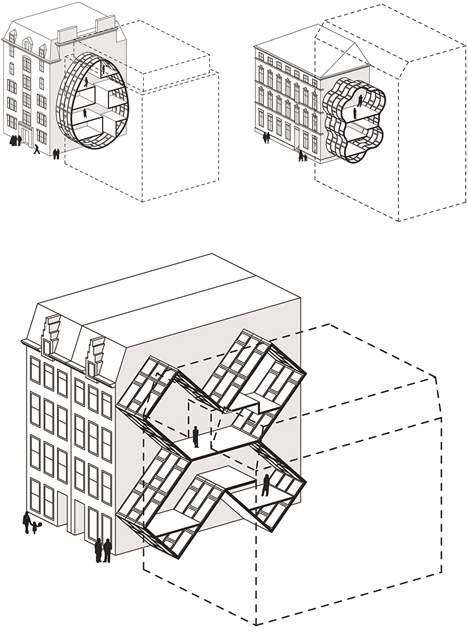
narrow home competition entry

Playful yet thought-provoking, this project asks: what do we do with small leftover spaces in cities … particularly in urban areas where even a few square feet of real estate can cost a fortune?

narrow house competition winners

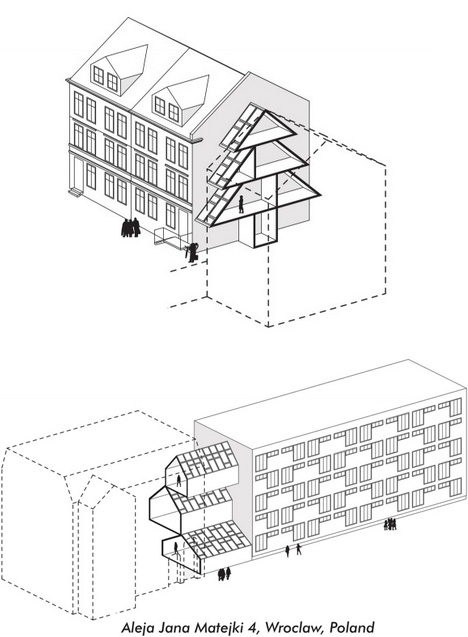
Live between Buildings by Ole Robin Storjohann and Mateusz Mastalski won first place in a Loft 2 competition held by FAKRO, which challenged contestants to rethink loft living and material efficiency without sacrificing light and space.

narrow interstitial house concept

Their various prototype proposals have nearly no ground footprint, being instead suspended in part or entirely between existing structures. In testing the idea, they took actual buildings and voids, abstracted and simplified their forms, all to show how such interventions would work in major cities from New York and London to Amsterdam and Tokyo.

narrow home architectural entries

A wide selection of shapes suggests many possibilities using modular pieces, including half-serious and semi-practical suggestions, such as egg and X shapes, as well as outright silly ones, like a Christmas-tree home or cloud-bubble house, more intended just to illustrate the potential flexibility.

narrow home case studies

Out of a variety of compelling entries, just why did this pair win the award? “The Jury appreciated the way the basic idea – creating small infill-dwellings in-between existing buildings – has been worked out in extended research, thus providing models for various housing types in different cities. The plan can be realized entirely out of roof windows (with some technical adjustments) and offers an innovative idea for using empty spaces in urban fabric. The possibility of shapes is endless. The project was very beautifully drawn and communicated on a single sheet, the section describing both the architectural idea and the exciting occupation of the proposed building.””

Share on Facebook

[ By WebUrbanist in Architecture & Houses & Residential. ]

[ WebUrbanist | Archives | Galleries | Privacy | TOS ]


03 Sep 16:24

Macro to Micro: Intricate Paper Cut Art Inspired by Nature

by Steph
[ By Steph in Art & Sculpture & Craft. ]

Rogan Paper Cut Art 1

What starts as a scientific study takes on a life of its own, guided only by the imagination of artist Rogan Brown as he transforms a sheet of paper into a masterful sculpture with thousands of tiny incisions. Rogan takes his inspiration from natural organic forms, mineral and vegetal, ranging from microscopic individual cells to large-scale geological formations.

Rogan Paper Cut Art 7

Each of these sculptures is incredibly time-consuming, with a single work sometimes taking more than five months to complete. Rogan starts with a pattern that catches his eye, carefully observing his chosen inspiration and creating ‘scientific’ preparatory drawings. But then, as he states, “everything has to be refracted through the prism of the imagination, estranged and in some way transformed.”

Rogan Paper Cut Art 3

Rogan Paper Cut Art 2

The artist sees the very long, arduous process of not only allowing his imagination to take over the work in a natural way but actually making those precision cuts in paper as an essential element of the work. “The finished artifact is really only the ghostly fossilized vestige of this slow, long process of realization.”

Rogan Paper Cut Art 4

Rogan Paper Cut Art 5

The complexity of Rogan’s work calls to mind the papercut art of Tomoko Shioyasu, whose own nature-inspired paper tapestries based on the structure of cells can measure as large as twelve feet high and eight feed wide.

Share on Facebook

[ By Steph in Art & Sculpture & Craft. ]

[ WebUrbanist | Archives | Galleries | Privacy | TOS ]


28 Aug 16:16

A unique solution to the 'Curse of the Indie Multiplayer Game'

by Staff

gun monkeys thumb.jpgIt's a common issue with multiplayer-only indie games -- reams of empty servers, and no-one to play against. Size Five Games' Dan Marshall has been having similar issues with his latest release Gun Monkeys, but today he launched a unique method for fixing the problem.

Whenever players find themselves sitting in an empty Gun Monkeys server for a few minutes, with no players online to fight against, the game will automatically generate a free Steam key for the player.

The idea is that the player can then give the key to another friend who is online, and quickly have someone to play against. Free keys are limited per player, meaning that you'll potentially receive multiple keys, but not unlimited numbers.

Marshall says that the method is "a unique solution to a frustrating situation."

[Mike Rose wrote this article originally for sister site Gamasutra]

27 Aug 16:36

How to Write a Novel Readers Won’t Put Down

by James Scott Bell
500x500_marchbellwriter_1

Take advantage of our Instructor of the Month deal and get all of James Scott Bell’s bestselling books on writing (and more) for one heavily discounted price. Order Now >>

A friend alerted me to an interesting “infographic” posted on Goodreads. The subject: Why readers abandon a book they’ve started. Among the reasons:

- Weak writing
- Ridiculous plot
- Unlikable main character

But the #1 reason by far was: Slow, boring.

Makes sense, doesn’t it? With all due respect to Somerset Maugham, I believe there is at least one “rule” for writing a novel, and that is Don’t bore the reader!

So if I may channel my favorite commercial character, The Most Interesting Man in the World:

Find out the things readers don’t like, then . . . don’t do those things.

I thank you.

Let’s have a look.

Weak Writing

This probably refers to pedestrian or vanilla-sounding prose. Unremarkable. Without what John D. MacDonald called “unobtrusive poetry.” You have to have a little style, or what agents and editors refer to as “voice.” I’ll have more to say about voice next week. But for now,  concentrate on reading outside your genre. Or read poetry, like Ray Bradbury counseled. Simply get good wordsmithing into your head. This will expand your style almost automatically.

Ridiculous Plot

Thriller writers are especially prone to this. I remember picking up a thriller that starts off with some soldiers breaking into a guy’s house. He’s startled! What’s going on? Jackboots! In my house! Why? Because, it turns out, the captain wants him for some sort of secret meeting. But I thought, why send a crack team of trained soldiers to bust into one man’s suburban home and scare the living daylights out of him? Especially when they know he’s no threat to anyone. No weapons. No reason to think he’d resist. And why wake up the entire neighborhood (a plot point conveniently ignored)? Why not simply have a couple of uniforms politely knock on the door and ask the guy to come with them? The only reason I could think of was that the author wanted to start off with a big, cinematic, heart-pounding opening. But the thrills made no sense. I put the book down.

Every plot needs to have some thread of plausibility. The more outrageous it is, the harder you have to work to justify it. So work.

Unlikable Main Character

The trick to writing about a character who is, by and large, unlikable (i.e., does things we generally don’t approve of) is to give the reader something to hang their hat on. Scarlett O’Hara, for example, has grit and determination. Give readers at least one reason to hope the character might be redeemed.

Slow, Boring

The biggie. There is way too much to talk about here. I’ve just concluded a 3-day intensive workshop that all based, like just about everything I do, on what I call Hitchcock’s Axiom. When asked what makes a compelling story he said that it is “life, with the dull parts taken out.”

If I was forced to put general principles in the form of a telegram, I’d probably say:

Create a compelling character and put him in a “death match” with an opponent (the death being physical, professional, or psychological) and only write scenes that in some way reflect or impact that battle.

The principle is simple and straightforward. Learning how to do it takes time, practice and study, which should never stop.

Learn More at the Writer’s Digest West Conference Sept. 27-29 in L.A.

James Scott Bell is the author of the #1 bestselling writing book, Plot & Structure, as well as an award-winning thriller writer. His Bootcamp “Writing a Novel They Can’t Put Down” will be held on Sept. 27 at the Writer’s Digest Conference in Los Angeles.
Register Now >>


*********************************************************************************************************************************
Follow me on Twitter: @BrianKlems
Check out my humor book, Oh Boy, You’re Having a Girl.
Sign up for my free weekly eNewsletter: WD Newsletter


26 Aug 18:07

Super-recogniser officers policing Europe’s biggest party

by vaughanbell

The Guardian are reporting that the London Metropolitan Police have deployed ‘super recogniser’ officers to Notting Hill Carnival to pick out known criminals from the crowd.

This is curious because this is a verified ability that has only recently been reported in the scientific literature.

It has been long known that some people have severe difficulties recognising faces – something called prosopagnosia and sometimes inaccurately labelled ‘face blindness’.

But more recently, it was discovered that a tiny minority of people are ‘super recognisers’ – with exceptional face recognition abilities – meaning they can pick out a previously identified face from huge numbers of possibilities.

A more recent fMRI study found that super recognisers tend to show a greater level of activity in the fusiform gyrus.

This area is heavily associated with face recognition, although debates are ongoing whether it is face-dedicated or just specialised for learned fine-grained visual recognition of various sorts.

It’s not clear how the Met Police identified their ‘super recogniser’ officers but it seems it might be an interesting exercise in screening for key neuropsychological characteristics and deploying those officers to the appropriate task.

Needless to say, picking out a few dodgy faces from a street party that welcomes a million people every year would be exactly this sort of job.

More details from the The Guardian report:

…17 specialist officers will be holed up in a central control room several miles away in Earls Court monitoring live footage in an attempt to identify known offenders.

Chief superintendent Mick Johnson from the Metropolitan police said it was the first time the “recognisers” – who have been selected for their ability to remember hundreds of offenders’ faces – have been used to monitor a live event.

“This type of proactive operation is the first one we have done in earnest in real time so we are going to be looking at it very closely to see how effective it is and what we get out of it,” he said.

The Met has 180 so-called super recognisers – most of whom came to the fore in the aftermath of the London riots when they managed to identify more than a quarter of the suspects who were caught on CCTV footage…

One of the super recognisers on duty will be Patrick O’Riordan, who says he has had an ability to pick people out in a crowd and recall faces since he joined the Met 11 years ago.

“It is with me all the time. Often when I am on a day off or out with my girlfriend I will see someone and know straight away who they are and where they fit in,” said 45-year-old. “It could be their eyes or the shape of their forehead or their gait, but something usually sticks with me. It something that started from day one as a police officer – really it is just something that I took too naturally.”

 
Link to Guardian article on super recogniser officers at the Carnival.
Link to summary of study that identified ‘super recognisers’.
pdf of full-text of the same paper.


23 Aug 16:52

A technoculture of psychosis

by vaughanbell

Aeon Magazine has an amazing article on the history of technology in paranoid delusions and how cultural developments are starting to mirror the accidental inventions of psychosis.

It’s by the fantastic Mike Jay, who wrote The Air Loom Gang, an essential book that looks at one of the most famous cases of ‘influencing machine’ psychosis.

In his article, Jay applies the same keen eye for history and culture and explores how the delusions of psychosis are carefully intertwined with culture.

Persecutory delusions, for example, can be found throughout history and across cultures; but within this category a desert nomad is more likely to believe that he is being buried alive in sand by a djinn, and an urban American that he has been implanted with a microchip and is being monitored by the CIA. ‘For an illness that is often characterised as a break with reality,’ they observe, ‘psychosis keeps remarkably up to date.’ Rather than being estranged from the culture around them, psychotic subjects can be seen as consumed by it: unable to establish the boundaries of the self, they are at the mercy of their often heightened sensitivity to social threats.

The article covers everything from Victorian delusions of electrical control, to the breakdown of novelist Evelyn Waugh, to the fiction of Philip K Dick.

It’s an excellent piece, and even those who have a special interest in the history of psychosis will find it full of fascinating gems.

By the way, it looks like Jay’s book The Air Loom Gang is about to be re-released in a newly updated version, under a new title The Influencing Machine.
 

Link to ‘The Reality Show’ in Aeon Magazine.


23 Aug 16:50

For Sony, when indies are happy, all devs are happy

by Staff

adamboyes thumb.jpgShort of actually timing it, it feels reasonable to say that half of Sony's Gamescom presentation focused on indie developers.

Whether it was videos with the likes of Derek Yu (Spelunky) and Mike Bithell (Thomas Was Alone) singing the praises of working on Sony's platforms, or the announcement of thechineseroom's new game, Everybody's Gone to the Rapture, indies were more prominent in Sony's press conference than they have ever been in any first-party showing to date.

One of the main people responsible for this at Sony is Adam Boyes, who heads up the company's publisher-developer relations teams. Sister site Gamasutra spoke to him at Gamescom in Cologne, Germany to find out more about Sony's strategy moving forward.

"It's a thing, it's an official thing," says Boyes of Sony's push to bring indie talent to its platforms. "Last night, I feel like we got to tell a little bit more of the developers' story."

If Steam exists, why go Sony?

Boyes understands that many of these games will be available elsewhere -- notably on PC, in many cases far earlier than on PS4 or Vita -- but that as a console platform holder, Sony can give them a lift.

"I've played all these games that have come out on Steam, on Steam. I've found out about them from friends." Sony has "the ability to elevate titles," says Boyes.

"The important thing is that we want to create a story around this," says Boyes, which offers "awareness and discoverability" for games that people would miss if they don't use Steam. Even if he may be fighting competitors for games -- he is well aware that Microsoft announced its ID@Xbox indie program this week. For his part, Boyes says that he wouldn't want to be starting his next-gen outreach now.

Strengthening Sony's Developer Relations

Boyes' main concern seems to be making sure Sony's program is strong, for developers of all sizes. Listening to indies, says Boyes, has made Sony more capable of addressing the needs of all developers. "What indies give me personally is an honest insight into their everyday plights," he says. "It helps us evolve our platform more quickly."

"I strongly feel like if we're catering to indies and making their lives better, everybody's life gets better."

Publishers were hesitant to give honest feedback about bureaucracy within Sony's publishing system, because they were entrenched in the Sony publishing machine.

Prior to Sony, Boyes was at Capcom. "I was on the other side when we had to go through these concept processes, and I remember getting these reports, and our team looking at me, going, 'What is this? We have to respond to these shenanigans?' And we'd need to figure out the most politically-correct way to respond to it."

Boyes killed that concept approval process earlier this year.

When he came on at Sony, Boyes "started talking to the stakeholders around the globe, going, 'Why do we do this? What is the benefit to developers?'" Changing process from within is easy, he says, when he makes this case: "Gamers benefit if it's easier to get content out there."

Becoming a service company

Major studios have a great deal of input into the decisions Sony is making, too -- the PS4 controller's suitability for shooters is also thanks to feedback from the likes of Infinity Ward and Bungie.

Boyes' team is working with these major studios to help ensure a smooth launch for their PlayStation 4 games. "We've been up to Seattle to meet with Bungie on a regular basis," he says. "We've been meeting with the Ubisoft Montreal team -- we've had a bunch of guys from Japan meeting with them... [on] everything, to help them through the process."

The company is also starting a series of roadshows "to roll out best practices" in front of developer partners, which helps "build a nice cadence to be able to help inform our partners."

"In general, in the past, we saw ourselves more of a platform," says Boyes. Sony made hardware, and developers made games on it. Now, things have changed: "We're transitioning to more of a service company."

Sony's aim with its revamped processes is "breaking down the walls, so the conversation between the gamers and the developers is as thin as possible, so they can have that direct conversation," says Boyes. "The goal is to have that really intimate relationship with gamer and developer. That's the master goal. We're just getting warmed up on the changes and improvements."

His goal with developers and publishers is to "treat them real," he says. "If you don't have that accountability with your partners, you can't be successful because it's going to get out. If people feel emotionally betrayed, then they are going to talk about it, and no NDA can prevent emotional betrayal."

Improving communication within Sony

Finally, Boyes is also is helping to streamline the communication channels within Sony so developers can be routed to the right person. For example, Worldwide Studios signs exclusive games, like Everybody's Gone to the Rapture, and it also runs the incubation program that gave rise to Thatgamecopany (Journey) and Giant Sparrow (The Unfinished Swan). But Boyes wants to make it easy for developers, who don't have a clear view into Sony's silos, to easily be guided to the right contacts to discuss their projects.

"We've been trying to streamline that communication line, so they understand who they're talking to." And there's another side to it, too: Sony is communicating with itself. "There's a lot more internal communication," says Boyes, and he and Scott Rohde, software product development head for Sony Worldwide Studios America, speak about games and developers frequently.

Boyes also brought 11 members of his team to Europe for Gamescom to meet with Sony Europe to share information on process improvements across regions, he told us.

The PlayStation 4 is scheduled for launch on November 15th for the U.S. and November 29th for Europe. Launch dates in other territories, such as Japan, have not yet been announced.

[Christian Nutt wrote this article for sister site Gamasutra]

23 Aug 16:46

Research the grandfather paradox without murdering your grandfather

by Esther Inglis-Arkell

Research the grandfather paradox without murdering your grandfather

The grandfather paradox is well-known and has a good dramatic hook, but it's a rather ineffective controlled experiment. The Polchinski Paradox gives us a time travel paradox based purely on laws of motion, without any of that tiresome free will. Plus, it involves billiards.

Read more...

23 Aug 16:43

These alien-looking ice sculptures formed all on their own

by Vincze Miklós

These alien-looking ice sculptures formed all on their own

They look like the work of a twisted science artist. Some maniac who spent hours dreaming up nightmare shapes made of ice. But no, these monstrous and lovely ice sculptures were formed by natural processes. Here are some of the most other-worldly ice formations on Earth.

Read more...

23 Aug 16:40

A Medieval poison ring used for political murders

by Rosella Lorenzi — Discovery News

A Medieval poison ring used for political murders

Bulgarian archaeologists have unearthed a medieval bronze ring that might have been used for political murders some 700 years ago.

Read more...

23 Aug 16:37

Astronomers Release Highest-Resolution Photos Ever Taken of Night Sky

by Robert T. Gonzalez

Astronomers Release Highest-Resolution Photos Ever Taken of Night Sky

Hold on to your butts, space junkies. After more than twenty years of development, an international team of astronomers has unveiled a new telescope optics system that produces higher resolution images of space than anything else on the planet. Or off the planet, for that matter – this thing records visible-light images with more than twice the sharpness of those captured by the Hubble Space Telescope.

Read more...

22 Aug 18:02

The deafening silence

by tomstafford

All silences are not equal, some seem quieter than others. Why? It’s all to do with the way our brains adapt to the world around us, as Tom Stafford explains

A “deafening silence” is a striking absence of noise, so profound that it seems to have its own quality. Objectively it is impossible for one silence to be any different from another. But the way we use the phrase hints at a psychological truth.

The secret to a deafening silence is the period of intense noise that comes immediately before it. When this ends, the lack of sound appears quieter than silence. This sensation, as your mind tries to figure out what your ears are reporting, is what leads us to call a silence deafening.

What is happening here is a result of a process called adaptation. It describes the moving baseline against which new stimuli are judged. The way the brain works is that any constant simulation is tuned out, allowing perception to focus on changes against this background, rather than absolute levels of stimulation. Turn your stereo up from four to five and it sounds louder, but as your memory of making the change rapidly fades, your mind adjusts and volume five becomes the new normal.

Adaptation doesn’t just happen for hearing. The brain networks that process all other forms of sensory information also pull the same trick. Why can’t you see the stars during the daytime? They are still there, right? You can’t see them because your visual system has adapted to the light levels from the sun, making the tiny variation in light that a star makes against the background of deep space invisible. Only after dark does your visual system adapt to a baseline at which the light difference created by a star is meaningful.

Just as adaption applies across different senses, so too does the after-effect, the phenomenon that follows it. Once the constant stimulation your brain has adapted to stops, there is a short period when new stimuli appear distorted in the opposite way from the stimulus you’ve just been experiencing. A favourite example is the waterfall illusion. If you stare at a waterfall (here’s one) for half a minute and then look away, stationary objects will appear to flow upwards. You can even pause a video and experience the illusion of the waterfall going into reverse.

It’s a phenomenon called the motion after effect. You can get them for colour perception or for just lightness-darkness (which is why you sometimes see dark spots after you’ve looked at the sun or a camera flash).

After-effects also apply to hearing, which explains why a truly deafening silence comes immediately after the brain has become adapted to a high baseline of noise. We perceive this lack of sound as quieter than other silences for the same reason that the waterfall appears to suck itself upwards.

So while it is true that all silences are physically the same, perhaps Spinal Tap lead guitarist Nigel Tufnel was onto something with his amplifier dials that go up to 11. When it comes to the way we perceive volume, it is sometimes possible to drop below zero.

This was my BBC Future from last weekend. The original is here.


16 Aug 17:41

Book of Cities: Rise & Fall of 10 Places Over 200 Years

by Urbanist
[ By WebUrbanist in Design & Graphics & Branding. ]

book of cities infographic

We take it for granted that London and New York will grace the pages of books, but would you be surprised to learn that Madrid and Cairo were once as commonly referenced, or that Mumbai and Beijing are now two of the most popular cities capturing global imaginations?

city popularity infographic

Edgard Barbosa created this infographic (above) and other associated graphics (below) to explore the ebb and flow of famous cities in works of fiction and non-fiction alike.

city data in books

From its creator: “Books of Cities measures the quantity of books, written in the English language, that refers to 10 major cities in the world between 1800 and 2000 … it gives an overall idea of the amount of literature produced in each era about the same city.”

book of cities poster

The graphic covers London, New York City, Rome, Paris, Chicago, Tokyo, Madrid, Beijing, Mumbai, and Cairo, and shows how some cities, like Mumbai and Beijing, have recently hit the scene in a major way. Others, meanwhile, like London and NYC, have consistently attracted attention for much of the last few hundred years.

Share on Facebook

[ By WebUrbanist in Design & Graphics & Branding. ]

[ WebUrbanist | Archives | Galleries | Privacy | TOS ]


10 Aug 17:27

Bone Flowers: Sculptures Made of Rodent Skeletons

by Steph
[ By Steph in Art & Sculpture & Craft. ]

Bone Flowers Skeleton Sculptures 1

A white sculpture of a dandelion becomes infinitely more interesting the closer you look, as you begin to pick out the tiniest of paws, vertebrae and tufts of fur. Petals are made up of rib cages, stems of spines. Skulls come together to form the base of the flower. Tokyo artist Hideki Tokushige produces these honebana, or bone flowers, in honor of the cycles of nature.

Bone Flowers Honebana

Bone Flowers Skeleton Sculptures 2

Bone Flowers Skeleton Sculptures 4

Tokushige procures (already-dead) carcasses of rodents and keeps them frozen so the flesh can be picked off the skeletons more easily without causing damage to the delicate bones.

Bone Flowers Skeleton Sculptures 5

Once he’s finished completing and photographing the sculptures, Tokushige disassembles them and buries the remains. Using these mice, which are kept in cages throughout their short lives and then frozen to feed to other animals in the least grisly way possible, reflects “a sense of our modern view of nature and life.”

Bone Flowers Skeleton Sculptures 6

Bone Flowers Skeleton Sculptures 7

“Some might think it weird,” says Tokushige of using bones. He states that proximity to bones was normal throughout much of human history, but we’re not as used to seeing them anymore. “Still, someday we all go back to bones and back to soil.” The artist crafts the bones into flowers as a means of paying respects to the dead, our cultural customs and the realities of the life cycle. Flowers are temporary, but bones can last millennia.

Share on Facebook

[ By Steph in Art & Sculpture & Craft. ]

[ WebUrbanist | Archives | Galleries | Privacy | TOS ]


09 Aug 16:28

Freeware Pick: Scary Gardener Tales 3D is a Halloween-flavored, old-school FPS treat

by Paul Hack

scarygardnr1.pngFound while browsing IndieDB, Scary Gardener Tales 3D is a tasty snack of a first-person shooter done in the style of Doom or Heretic--or perhaps it's more like Wolfenstein or Blake Stone, since it's a bit more quirky than it is grim. A developer with the unpronounceable moniker of ryctyngylyr made it using Pygame, which is technically impressive to me, and it's a solid FPS. Scary Gardener Tales is fun and even comforting, just like Halloween candy.

Someone--or something--has messed with your flower garden and you're not going to stand for it. You'll pursue this floral vendetta all the way to hell if you must, and as it turns out, you pretty much must. Cutely rendered, spooky enemies like skeletons and ghosts are your enemies. You're initially armed with a rake, which remains your back-up melee weapon, but you'll get to take out ghoulies with a variety of firearms as well.

In order to progress to new areas, you'll need to collect various keys to unlock color-coded, tombstone-shaped gates. Things get a little more genuinely creepy when you get to the carnival level. It's populated by Weeping Angel-esque shades that advance on you when your back is turned.

The audio effects are creative and fun, such as the xylophone sound made when you smash a skeleton. The music is both haunting and sweet. Scary Gardener Tales doesn't reinvent the FPS, but it's a bit of old-fashioned fun with a cool style all its own.

Versions of Scary Gardener Tales 3D are available for Windows and for Linux.

02 Aug 16:29

Browser Pick: You've never played a game of Chess quite like this RTS - CHESS (Beta)

by Paul Hack
Jdopplegaenger

I think I've seen this idea before, but never a computer implementation of it.

chess113.pngI like Chess, but it can be a really slow game. Players are susceptible to analysis paralysis, creating long wait times between moves. Sven Anders Robbestad solves that problem with his real-time strategy game CHESS (all caps to distinguish it from the boardgame, I suppose), which he made for the 7-day RTS / Mini Ludum Dare 44 competition.

The board is set up like a normal chess match, and all of the pieces' movement and capture rstrictions apply. As soon as the game starts, you can click any piece and move it to any legal location. A cooldown timer appears behind each piece that's been moved, counting down to when it can next be clicked. You can make moves as quickly as your mouse and the cooldown timers allow.

It doesn't take long for things to get pretty crazy, and you have to think ahead while reacting to an ever-changing board in order to beat your computer opponent. The cooldown periods are a brilliant element; they allow for strategic play and keep the game from devolving into a clickfest. The real-time nature of CHESS makes checks and checkmates obsolete, so you have to actually capture the king to win. Occasionally this can make the endgame a duel between lonely kings, but even these are fun and tactical.

You can play CHESS online in your browser. The current build is an open beta release, so the game's still undergoing some polish. In particular, the developer is working on improving the AI. Tweet the developer with any suggestions or bug reports at @svenardocom.

11 Jun 17:17

How Do You Find the Time to Write? 6 Tips For Moms (and Everyone Else, Too)

by Chuck Sambuchino

People ask me – you’ve got a child, a job, a commute, a house to run. How do you fit it all in? Well, to start with, all that stuff about scheduling my day, setting aside proper writing time, settling myself into a solid routine? Forget it.

That’s all shiny and fine if you’ve the time and the space. If you’ve got the job, and the family and the multipack of other fun responsibilities, you know it doesn’t work like that. However good your intentions, it’ll get messed up within three days of that nice chart thing that you’ve pinned to your fridge. That’s just how life works. So:

1. Master the art of snap-writing…


Guest column by Danie Ware, author of ECKO RISING (Titan),
a science fiction story. Danie is a publicist and event organiser
for cult entertainment retailer Forbidden Planet. She has been
immersed in the science-fiction and fantasy community for the
past decade. An early adopter of blogging, social media and a
familiar face at conventions, she appears on panels as an expert
on genre marketing and retailing. ECKO RISING is her first novel.
The novel is out in the U.S. in June 2013 (order it here), while
it is already out in the United Kingdom as of early 2013.
You’ll find Danie on twitter @danacea and at danieware.com.


1. Master the art of snap-writing.

Specifically – DON’T get into a routine. Don’t fall into a habit. Don’t fall victim to your own behaviour patterns – you can only write with a coffee, with a biscuit, at 4pm, at your desk, with your cat on your lap and your favourite music…

You’ve got twenty minutes. Half and hour between this job and that one. An hour on the train or at home in the quiet (if you’re lucky). It’s all time and it all matters. Use it.

(Advice on how to promote your book.)

2. Don’t get hung up on daily wordcount.

Sometimes, I’ve sat down to write my thousand words – and I’ve written a thousand words of filler, just to get the job done. Remember – it isn’t how many words you write, it’s how many words you keep. And, as Mark Charan Newton pointed out, it’s not a race – the numbers are there for your structure and discipline, no-one else’s.

Likewise, if you do get a full day to yourself to write (hallelujah!) use it. Don’t stop at the thousand or whatever it may be, keep going and gain yourself some ground.

3. Maintain your momentum.

If you stop for a couple of days, you lose your forward motion. In order to snap-write, you have to keep doing it. So, no matter how busy you are, do something every day, even if it’s only reading your current chapter.  Keep the conversations alive, keep the characters responsive. That way, when you do get that half an hour, you can make it count.

4. Always leave yourself an ‘in.’

This one’s stolen straight from Cory Doctorow’s article in Locus – don’t stop at a natural break. That way, when you sit down, you can pick up the thread immediately, because you know exactly where it was going. Simple genius.

5. Have faith in yourself – your confidence matters.

Gareth Powell wrote a fantastic piece on how much first drafts suck. You’re not writing to win the Clarke (well, not most of us anyway); you’re writing for you, writing what you know, and it’s what you do and love best. Have faith and move forwards. However you feel about editing as you go, you can be decisive and believe in what you’ve written. This is your passion and you have the right to do it in your voice.

(How to Create a Writer Blog.)

6. Get your backside off Twitter.

However useful it may be, Social Media the thief of time, big time. Research, pictures, publicity are all necessary – but they’re not writing. However you choose to discipline yourself – turn your server off, seal yourself in another room, promise yourself a cookie when your character makes that critical turning-point, it doesn’t matter. When you have that all-important slot, quit faffing and get on with it.

And that skirting board, there, yes that one, you really don’t need to dust it right now.

Okay. Stop reading this and go and write.


Join the Writer’s Digest VIP Program today!

You’ll get a subscription to the magazine, a
subscription to WritersMarket.com, discounts
on almost everything you buy, a download,
and much more great stuff.


Other writing/publishing articles & links for you:


Want to build your visibility and sell more books?
Create Your Writer Platform shows you how to
promote yourself and your books through social
media, public speaking, article writing, branding,
and more.
Order the book from WD at a discount.

18 May 17:23

Using Personal Disasters to Inform Your Writing

by Carolyn Kaufman, Psy.D.
Bad things–sometimes terrible things–happen to us all. While they’re happening, we’re focused on surviving them. But after we manage to do that, for better or worse, we've learned something new about the human condition. And if there’s one thing writers do well, it’s share how hard it is to be human. How to use your disaster to inform your writing.

read more

17 May 17:32

Revisiting Kepler’s Most Mind-Blowing Discoveries

by George Dvorsky

NASA’s Kepler space telescope is busted and it may never work normally again. But during its four years of exemplary service, the planet-hunting telescope provided astronomers with an unprecedented glimpse into the Milky Way. Here are the most incredible discoveries made by Kepler.

Top image: Ron Miller.

As we reported yesterday, controllers on the ground can no longer control Kepler’s orientation. Two of its four reaction wheels have broken down and it’s unlikely that it can be repaired. That said, the Kepler team hasn’t given up hope, saying there may be some ways to revive the telescope.

Regardless, the space telescope has done its bit for king-and-country, operating for six months longer than initially planned.

Over the course of its three-and-half-years, the $600 million Kepler mission helped astronomers identify 132 exoplanets, including another 2,700 candidates. But it’s also provided us with a clearer picture of the Milky Way — a galaxy that contains bizarre worlds, freaky solar systems, and an astounding number of potentially habitable planets.

Here’s a rundown of Kepler's most significant and jaw-dropping discoveries.

The First Confirmed Discovery of a Rocky Planet

In January 2011, astronomers discovered Kepler-10b — the most Earth-like planet known at the time. It marked the first time in history that a terrestrial planet was discovered outside of our own solar system. Kepler scientist Douglas Hudgins put it all into perspective:

The discovery of Kepler 10-b is a significant milestone in the search for planets similar to our own. Although this planet is not in the habitable zone, the exciting find showcases the kinds of discoveries made possible by the mission and the promise of many more to come.

The First Confirmed Discovery of a Potentially Habitable Planet

It’s one thing to find a rocky planet, but quite another to find one orbiting within its solar system’s habitable zone. Astronomers have now catalogued a handful of these potentially habitable exoplanets, but the first to ever be discovered was Kepler-22b. It has a radius 2.4 times that of our planet and it orbits about 15% closer to its star than Earth does to the Sun.

It’s also significantly cooler, dimmer, and smaller than ours. And while scientists have yet to determine K-22b's composition — be it rocky, gaseous or liquid — they estimate that surface temperatures on K-22b average a very Earth-like 72-degrees Fahrenheit.

Image: NASA/Ames/JPL.

Evidence that 17 Billion Earth-Sized Planets Exist in Our Galaxy

Back in January, Kepler data helped astronomers estimate the number of Earth-sized planets in the Milky Way. They surveyed about 2,400 candidate planets spotted by the Kepler satellite over the first 16 months of its operation. The data indicated that about 17 percent of stars have an Earth-sized planet in an orbit closer than Mercury — that's about one in every six star systems. Given that the Milky Way has about 100 billion stars, that adds up to the figure of 17 billion. If there are this many Earth-sized planets in Mercury-like orbits, it's probably safe to assume that there's a substantial number residing further out in the habitable areas.

Image via Harvard-Smithsonian Center for Astrophysics.

Evidence that 4.5 Billion Potentially Habitable Planets May Orbit Red Dwarfs in Our Galaxy

Red dwarfs comprise nearly 75% of all the stars in the Milky Way, yet they remain invisible to the naked eye.

Using data pulled from Kepler, astronomers now believe that as many as 6% of all red dwarfs host Earth-sized planets within their habitable zones — a calculation that brings the total number of red dwarf alien Earths across the galaxy to 4.5 billion.

Image: Artist's impression of a sunset from the super-Earth Gliese 667Cc courtesy ESO/L.Calçada. The large sun is the red dwarf, 667C.

The First Confirmed Discovery of a Tatooine-Like Planet

On September 15th, 2011, NASA discovered a "circumbinary planet," orbiting not one, but two stars — just like Tatooine.

Located 200 light years away, Kepler-16b is a binary star system that hosts a Saturn-like planet composed of both gas and rock. The larger of the two suns is roughly 69% the mass of our Sun, while the smaller, red star is closer to 20% of our Sun's mass. Kepler also discovered the first binary system with more than one planet. Others have since been discovered.

Image: NASA/JPL-Caltech.

The First Confirmed Discovery of a Planet with Four Suns

Kepler data was also made available to the general public. Back in October 2012, two amateur astronomers confirmed the existence of a Neptune-like planet with four suns, designating it the first quadruple star system ever discovered.

The planet, which is 5,000 light years away from Earth, closely orbits one pair of stars, which in turn forms a unit that revolves around a second pair at a distance of around 1,000 AU.

Image: Ron Miller.

The Discovery of a New Type of Super-Dense Planet

Several years ago, Kepler scientists discovered celestial bodies that appeared too heavy for their size.

The going theory is that they’re an entirely new class of planet — Neptune-like planets that were stripped of their outer gaseous layers after venturing too close to their sun. Once ice giants, these planets migrated inwards — as their orbits were affected by interactions with surrounding gas and dust — perhaps getting as close to their stars as Mercury is to ours.

Early last year, scientists also confirmed the discovery of a new class of exoplanet called a boiling waterworld.

Kepler has also found strange new solar systems that defy classification, like the one featuring a Neptune-like planet locked in a close orbit with a terrestrial planet.

Artistic impression of Kepler-36 by David Aguilar, Harvard-Smithsonian Center for Astrophysics.

The Discovery of a Planet Getting Ripped to Shreds by Its Sun

Kepler helped astronomers find a short-period super-Mercury planet that is in the final stage of its life.

The object has gotten so close to its parent star that it's only taking 15.7 hours to orbit around it, while it's surface temperature has risen to 3,600 degrees Fahrenheit. The result: a dramatic, comet-like tail that's bursting outward from the planet — and with it, much of the planet's surface.

Image via NASA/JPL-Caltech.

The Most Earth-Like Planets Ever Discovered

This past April, the Kepler mission discovered a trio of distant planets that look remarkably like our own.

Three Earth-sized worlds, dubbed Kepler-62f, Kepler-62e, and Kepler-69c, were discovered 1,200 and 2,700 light years from Earth — and they’re all situated in the so-called Goldilocks Zone of their parent stars, the "just-right" range at which liquid water, and life, can exist on a planet's surface.

The Development of a New Planet-Hunting Technique

Just announced this past week, data from Kepler helped astronomers find a hot Jupiter that’s 2,000 light-years away — and they did so using a new technique called BEER (relativistic BEaming, Ellipsoidal, and Reflection/emission modulations). The new planet-finding technique exploits an effect predicted by Einstein’s Special Theory of Relativity. Called beaming, it happens when a star’s brightness is increased as it moves towards the Earth, and dims as it moves away. It moves toward us because a planet is there to pull it (hence evidence of its presence). The brightening is caused by light particles, called photons, that are piling up in energy. This technique can now be used in conjunction with the wobble method and the transit method.

14 May 17:27

4 Truths That Will Revolutionize Your Revision Process

by Jessica Strawser

0613_wdPerhaps because I’m in the process of revising a novel manuscript myself, the advice in the May/June 2013 Writer’s Digest Guide to Pain-Free Revision really resonated with me as I pieced it all together behind the scenes. In fact, I’d go so far to say that some of the insights from the talented contributors we had the privilege of featuring in this issue have changed the way I think about revision.

Here are a few of my personal light-bulb moments from its pages:

1. The proof of your prose lies with the reader.

This tip comes from the incomparable novelist and writing instructor David Corbett. Because he’s, well, incomparable, I’ll quote directly from his thoughtful article here:

In Alphabet Juice, Roy Blount Jr.’s earthy, contrarian screed to the pleasures of language, he traces to Sir Arthur Quiller-Couch the now immortal edict of revision: Murder your darlings.

It’s interesting that this advice, so often attributed to one great writer or another—Twain, Faulkner, Hemingway, Orwell, Auden, even Samuel Johnson—was in fact penned by a relative obscurity who’d be lost to posterity were it not for that one fierce, scolding admonition.

And yet, as Blount points out, the phrase “Murder your darlings” is itself, well, a darling. There are many less flashy ways Quiller-Couch could have issued his diktat: “Eliminate all words or phrases, no matter how pleasing, that draw undue attention to themselves (or the writer) at the expense of the narrative flow.”

But who would remember that?

Writing is rewriting, another pithy bon mot (per Eudora Welty), and one that shies away from the homicidal imagery. After all, you’re not out to flog your manuscript—or yourself—into a state of self-abnegation. You’re hoping to create an impression in the reader’s mind, one that forms clearly and flows naturally. You’re hoping for immediate comprehension and yet also a force of impact, a depth of meaning, or an aptness of expression that causes what’s been read to linger. You’re hoping to make the reader happy.

Notice that each one of those goals involves someone else: the reader. One of my favorite aunts used to say: “You don’t know yourself by yourself.” The writer’s corollary to this might be: The proof of your prose lies with the reader, not the writer.

(Read Corbett’s full May/June 2013 Writer’s Digest article “Clearing Out the Clutter,” and I think you’ll agree that his thoughtful approach to such an evergreen topic is a breath of fresh air.)

2. Tinkering is not revising.

Read that again. This innocuous-sounding tidbit comes from freelance editor and novelist Tanya Egan Gibson, and I think it’s something we all need to be reminded of on a regular basis. I’ve found that often when I’m revising a piece—whether it’s a novel chapter or a magazine article—and just can’t seem to get it right, the key is to open up a blank document and re-vision it anew. At first, it might seem like more work to start fresh, so I think we all have a tendency to resist the need to do this—but I’ve found that when I stop tinkering with something that isn’t working and try another approach instead, it almost always leads to a speedier solution. (Gibson’s full May/June 2013 Writer’s Digest article “10 Things Your Freelance Editor Might Not Tell You—But Should” is filled with general wisdom that applies regardless of whether you’re working with an editor or critique partners, or revising on your own.)

3. Dialogue can almost always be more compressed, more driven by conflict, and more unique to the person speaking.

No roundup of revision tips would be complete without an appearance from revision guru James Scott Bell (author of writing pantry staple Revision & Self-Editing, recently revised and reissued from Writer’s Digest Books). Here’s a bit from his May/June 2013 Writer’s Digest article “The 5 Biggest Fiction Writing Mistakes + How to Fix Them” that I’ve applied successfully to my own work almost daily since first reading it:

Try this: Copy a lengthy dialogue exchange into a fresh document. Then cut and compress as much as you can. Compare it to the original. Nine times out of 10 you’ll prefer all or part of the new version.

Here’s an example from Bell:

“Mary, are you angry with me?” John asked.
“You’re damn straight I’m mad at you,” Mary said.
“But why? You’ve got absolutely no reason to be!”
“Oh but I do, I do. And you can see it in my face, can’t you?”

The alternative:

“You angry with me?” John asked.
“Damn straight,” Mary said.
“You got no reason to be!”
Mary felt her hands curling into fists.

Try it. It works.

4. The most successful writers “pressure test” their work (before submitting).

This one was written with freelance writers in mind, though the advice can certainly be adapted to any kind of writing you do. In my experience as a magazine editor, though, I can honestly say I wish every writer would take this suggestion from veteran freelancer Roger Morris to heart:

Aggressively challenge your work before presenting it your boss (the editor). Pressure testing isn’t perfect, but the more flaws you can eliminate before sending an article to your boss—the editor—the less likely you will get it back for revisions. And that makes for a more efficient, satisfying and profitable career in freelance writing. Here are 3 ways to do it:

• Keep asking yourself: What am I missing? Editors expect a story to be complete—that is, to not leave the readers with unanswered questions. If it’s not, expect a note about holes that need to be filled.

• Challenge your own points with this: So what? A lode of information is good, but being relevant is better. Constantly ask yourself the implications of details you present in an article—and then present those, too.

• Back it up. An article that presents a lot of good points but is not fleshed out with examples, statistics and quotes from experts to validate those points is asking to be rewritten. But it’s also true that an editor is more likely to overlook some flaws—or even be unaware of them—if you are constantly feeding her (and thus the ultimate reader) a heady diet of interesting information.

In his complete article “The Freelance Writer’s Guide to Avoiding Revisions & Rewrites,” Morris offers up 10 generous tips for pressure-testing your own work before you submit, and goes into helpful detail about each one. If you freelance, this article alone is worth the price of the issue, in my humble opinion.

5. Insert your best revision tip here.

What works well for you when it comes time to revise, and what approaches have you learned to avoid? What are your own favorite revision tips and strategies? Leave a comment below, and keep the discussion going!

Whether you’re revising a project now or will be in the near future (won’t we all?), I wholeheartedly endorse the full issue as a must-have reference. Find it on newsstands now, or order or download the May/June 2013 Writer’s Digest through the Writer’s Digest Shop right now.

Jessica Strawser
Editor, Writer’s Digest Magazine
Follow me on Twitter @jessicastrawser

Like what you read from WD online? Subscribe today, so you’ll never miss an issue in print! Or, have our specially formatted digital issues delivered directly to your inbox, or to your Amazon Kindle.

10 May 19:15

An Interactive Map of Racist, Homophobic and Ableist Tweets in America

by Robert T. Gonzalez
Jdopplegaenger

Somehow I'm not surprised most of it is concentrated on the east coast.

This is The Geography of Hate – a cartographical collection of every geotagged tweet in the continental U.S. between June 2012 and April 2013 in which the word "chink," "gook," "nigger," "wetback," "spic," "dyke" "fag," "homo," "queer" or "cripple" was used in an explicitly negative way.

Created by the datavisualization experts at Floating Sheep, the interactive map was made in response to criticism that a previous map – which plotted the distribution of racial epithets in the wake of Obama's re-election – had arrived at specious conclusions about the relative amount of racist content emanating from Mississippi and Alabama. Via Floating Sheep:

In order to address [one such criticism] , students at Humboldt State manually read and coded the sentiment of [hundreds of thousands of tweets containing homophobic, racist, or ableist slurs] to determine if the given word was used in a positive, negative or neutral manner. This allowed us to avoid using any algorithmic sentiment analysis or natural language processing, as many algorithms would have simply classified a tweet as ‘negative’ when the word was used in a neutral or positive way. For example the phrase ‘dyke’, while often negative when referring to an individual person, was also used in positive ways (e.g. “dykes on bikes #SFPride”). The students were able to discern which were negative, neutral, or positive. Only those tweets used in an explicitly negative way are included in the map... All together, the students determined over 150,000 geotagged tweets with a hateful slur to be negative.

The image up top is the map of all the homophobic tweets deemed hateful. Over at the interactive map, viewers can see similar maps for racist and ableist tweets, and even parse the data to examine the geographic distributions of individual words. The results were compelling. "Even when normalized," write the researchers, "many of the slurs included in our analysis display little meaningful spatial distribution":

For example, tweets referencing ‘nigger’ are not concentrated in any single place or region in the United States; instead, quite depressingly, there are a number of pockets of concentration that demonstrate heavy usage of the word. In addition to looking at the density of hateful words, we also examined how many unique users were tweeting these words. For example in the Quad Cities (East Iowa) 31 unique Twitter users tweeted the word “nigger” in a hateful way 41 times. There are two likely reasons for higher proportion of such slurs in rural areas: demographic differences and differing social practices with regard to the use of Twitter. We will be testing the clusters of hate speech against the demographic composition of an area in a later phase of this project.

For the full experience, check out The Geography of Hate interactive map. To read more about the research, visit Floating Sheep.

10 May 19:14

15 Things a Writer Should Never Do

by Zachary Petit

15Based on interviews with authors over the years, conferences, editing dozens of issues of Writer’s Digest, and my own occasional literary forays and flails, here are some points of consensus and observations: 15 of them, things anyone who lives by the pen (or seeks to) might consider. It is, like most things in the writing world, a list in progress—and if you’ve got your own Dos or Don’ts to add, I’d love to hear them in the Comments.

1. Don’t assume there is any single path or playbook writers need to follow. (Or, for that matter, a definitive superlative list of Dos and Don’ts …) Simply put: You have to do what works best for you. Listen to the voices in your head, and learn to train and trust them. More often than not, they’ll let you know if you’re on the right path. People often bemoan the surplus of contradictory advice in the writing world—but it’s there because there really is no yellow-brick road, and a diversity of perspectives allows you to cherry-pick what uniquely suits you and your abilities.

2. Don’t try to write like your idols. Be yourself. Yeah, it sounds a bit cheesy, but it’s true: The one thing you’ve got that no one else does is your own voice, your own style, your own approach. Use it. (If you try to pretend to write like anyone else, your readers will know.) Perhaps author Allegra Goodman said it best: “Know your literary tradition, savor it, steal from it, but when you sit down to write, forget about worshiping greatness and fetishizing masterpieces.”

3. Don’t get too swept up in debates about outlining/not outlining, whether or not you should write what you know, whether or not you should edit as you go along or at the end—again, just experiment and do what works best for you. The freedom that comes with embracing this approach is downright cathartic.

4. Don’t put all your eggs in one basket when it comes to pitching something—always be working on your next book or idea while you’re querying. Keeping your creative side in gear while focusing on the business of selling your work prevents bigger stalls in your writing life down the road.

5. Don’t be unnecessarily dishonest, rude, hostile—people in the publishing industry talk, and word spreads about who’s great to work with, and who’s not. Publishing is a big business, but it’s a pretty incestuous business. Keep those family reunions gossip free.

6. Don’t ever hate someone for the feedback they give you. No piece of writing is universally beloved. Nearly every beta reader, editor or agent will have a different opinion of your work, and there’s value in that. Accept what nuggets you believe are valid, recognize the recurring issues you might want/need to address, and toss the edits your gut tells to toss. (Unless the changes are mandatory for a deal—in which case you’ll need to do some deeper soul searching.) Be open to criticism—it will make you a better writer.

7. … But, don’t be susceptible to the barbs of online trolls—you know, those people who post sociopathic comments for the sake of posting sociopathic comments. That’s what trolls do: they troll (on Amazon, Goodreads, Twitter, etc.). It’s not personal. Which means the message at the core of their words means as little as the 0s and 1s used to code it. Ignore them heartily.

8. Don’t ever lower you guard when it comes to the basics: Good spelling, healthy mechanics, sound grammar. They are the foundations that keep our writing houses from imploding … and our queries from hitting the recycling bin before our stories can speak for themselves.

9. Don’t ever write something in an attempt to satisfy a market trend and make a quick buck. By the time such a book is ready to go, the trend will likely have passed. The astronomical amount of romantic teenage vampire novels in desk drawers is more than a nuisance—it’s a wildfire hazard. Write the story that gives you insomnia.

10. Don’t be spiteful about another writer’s success. Celebrate it. As author Amy Sue Nathan recalled when detailing her path to publication in the upcoming July/August 2013 issue of WD: “Writers I knew were landing book deals and experiencing other things I was working toward, so I made a decision to learn from them instead of begrudging them. I learned that another author’s success doesn’t infringe on mine.”

11. Don’t ever assume it’s easy. Writers with one book on shelves or one story in print often had to keep stacking up unpublished manuscripts until they could reach the publisher’s doorbell. (The exception being those lucky 19-year-old savants you sometimes hear about, or, say, Snooki. But, hey, success still isn’t guaranteed—after all, Snooki’s Gorilla Beach: A Novel has only sold 3,445 copies.) Success is one of those things that’s often damn near impossible to accurately predict unless you already have it in spades.

12. Don’t forget to get out once in a while. Writing is a reflection of real life. It’s all too easy to sit too long at that desk and forget to live it.

13. Don’t ever discount the sheer teaching power (and therapeutic goodness) of a great read. The makeshift MFA program of countless writers has been a well-stocked bookshelf.

14. Don’t be afraid to give up … on a particular piece. Sometimes, a story just doesn’t work, and you shouldn’t spend years languishing on something you just can’t fix. (After all, you can always come back to it later, right?)

15. But, don’t ever really give up. Writers write. It’s what we do. It’s what we have to do. Sure, we can all say over a half-empty bottle of wine that we’re going to throw the towel in this time, but let’s be honest: Very few of us ever do. And none of us are ever really all that surprised when we find ourselves back at our computers, tapping away, and waiting for that electric, amazing moment when the pebble of a story shakes loose and begins to skitter down that great hill …


Image By Marcus Quigmire [CC-BY-SA-2.0 (http://creativecommons.org/licenses/by-sa/2.0)], via Wikimedia Commons.

zp

Zachary Petit is the senior managing editor of Writer’s Digest magazine. He finally caved in and joined Twitter, and is now hopelessly distracted: @ZacharyPetit. 

For more, check out a copy of the latest issue of Writer’s Digest.


Need some help surviving and thriving in the writing life? Check out James Scott Bell’s The Art of War for Writers

Successfully starting and finishing a publishable novel can be like fighting a series of battles—against the page, against one’s own self-doubt, against rebellious characters, etc. Featuring timeless, innovative, and concise writing strategies and focused exercises, this book is the ultimate battle plan and more—it’s Sun Tzu’sThe Art of War for novelists.


09 May 18:10

5 Ways to Make Your Novel More Suspenseful

by Guest Column

A character who unknowingly carries a bomb around as if it were an ordinary package is bound to work up great suspense in the audience. —Alfred Hitchcock

Suspense happens when a scene becomes charged with anticipation. It’s the possibility of what might happen that keeps the reader on the edge of her chair.

Think of the classic suspense scene in the Alfred Hitchcock movie Suspicion. The Joan Fontaine character believes that her charming, wastrel husband, played by Cary Grant, is an embezzler and a murderer who is now out to poison her.

—by Hallie Ephron, author of Writing and Selling Your Mystery Novel

There’s a long shot as Grant mounts the stairs, and then the camera focuses on the nightly glass of milk he carries up to her. Everyone in the audience is wondering: Is it poisoned? To heighten the threat and foreboding, Hitchcock had a light bulb placed inside the glass to give it an eerie glow.

To create suspense, your job is to do the literary equivalent of what Hitchcock did by putting that light bulb in the milk: Build dramatic tension by making the ordinary seem menacing.

The writer’s tools for achieving this are sensory detail and the slowing down of time.

1. Turn up the Sensory Detail.

By focusing on the right sensory detail, you can heighten the sense of potential menace in everyday objects.

Take this example from my co-written novel, Amnesia. Peter Zak and Annie Squires approach a house where they suspect one of Peter’s patients is being held captive.

Tall bushes shrouded a shadowy front porch. Only a sliver of light between drawn drapes suggested anyone was home.

Someone had made an effort to dress up the house for Halloween. On the small lawn, dried cornstalks were teepeed around a lamppost. A pumpkin grinned from the top of a wheelchair ramp. Opposite the pumpkin was a little barrel of chrysanthemums. Beside the front door, barely visible in the shadow, a scarecrow dummy wearing a cowboy hat was slumped in a chair. I exhaled, realizing I’d been holding my breath.

Annie got out and eased the car door shut. I did the same.

We moved up the side of the house, crouching as we passed under the dark windows. I was conscious of every sound—my own breathing, traffic whooshing up and down the adjacent streets, the far-off pulsing wail of a siren. At every step, the sound of leaves crunching underfoot seemed thunderous.

Here the traditional trappings of a New England autumn, like a pumpkin and a scarecrow dummy, seem ordinary and ominous at the same time.

Now let’s take apart the pieces and look at what happens, alongside the sensory details that are used to create the suspense.

Scene synopsis:

  • Annie and Peter look at the house, get out of the car, and creep along the side of the house.


Sensory details:

  • Bushes shrouding the porch
  • Sliver of light between front curtains
  • Grinning pumpkin
  • Scarecrow dummy slumped in the shadows
  • Peter holding his breath
  • Peter hearing his own breathing, traffic whooshing, leaves crunching.

By making your character hyper-aware of sensations and sound, you ratchet up the dramatic tension. It all adds up to a feeling of impending danger, though it isn’t clear from what.

Suspense is sustained by the absence of anything terrible happening, and the continued focus on detail.

Remember: Your goal is to heighten anticipation.

2. Turn Down the Velocity.

Slowing down time increases suspense.

I deliberately drew out the moment Peter and Annie spend in the car looking at that house so it seemed longer than it would have if they were just arriving to deliver a package.

Here are some ways to slow things down:

Complex sentences: To create a feeling of apprehension about what might happen next, use longer, more complex sentences rather than rat-a-tat, subject-verb-object.

Internal dialogue: Let the reader hear your character’s thoughts.

Camera close-ups: You want the reader as close in as possible, experiencing the tension of your suspense sequence firsthand.

Quiet and darkness: Stillness and shadows suggest hidden menace.

3. Modulate Suspense.

Building suspense takes time. The reader will lose interest if all you do is pile on descriptive paragraph after descriptive paragraph, no matter how much menace there is in your descriptions. Break the tension by having something happen that advances the plot or provides a moment of comic relief.

There are many ways to insert a pause into suspense. The telephone rings. One of the characters cracks a joke (in real life, we all use humor to get through tense times).

Or, reveal something that seemed menacing to be ordinary: A scary shape turns out to be the shadow of a moonlit tree; a hand placed on your protagonist’s shoulder turns out to be his best buddy, come to help; boot heels stomping across a deserted parking lot turn out to belong to a man carrying a child on his shoulders.

For example, that excerpted scene from Amnesia continues for four pages as Peter and Annie circle to the back of the house and check out the yard.

They find a boat and a sodden hooded sweatshirt, both of which advance the plot. Then:

A nearby branch snapped and we both hunkered down beside the boat. In the darkness, all I could see were little white paws mincing toward me and the white tip of a tail held aloft.

The innocuous pussycat provides a momentary release, a false payoff. The reader thinks phew, and relaxes.

Use this technique of inserting a brief respite or comic relief into a suspenseful scene to give readers a break, then continue to ratchet up the suspense to keep them hooked.

4. Foreshadow rather than telegraph.

Creating a suspense sequence that ends harmlessly is a good way to foreshadow something more sinister that happens later in your novel. For example, in Chapter 3 your protagonist goes into a dark, dank basement and emerges, joking about things that go bump in the night. In Chapter 23, she goes down into that same basement, and this time she finds the villain waiting for her. Be careful you foreshadow and don’t telegraph-giving away too much too soon is guaranteed to ruin the suspense.

The line between foreshadowing and telegraphing is a subtle one. Let’s say your female sleuth meets a man who turns out to be a serial rapist/murderer who preys on young businesswomen he picks up at yuppie bars. What would be foreshadowing, and what would be telegraphing? Consider this list of possibilities. Where would you draw the line?

  1. The man is charming: His nails are manicured, and he smells of expensive aftershave. She finds herself feeling a bit uneasy around him, but she can’t put her finger on why.
  2. The man’s eyes linger on the woman’s chest when they’re introduced.
  3. When the man shakes her hand, he places his other hand on the small of her back.
  4. When she gets ready to leave, he offers to walk her to her car, saying there have been some muggings in the neighborhood.
  5. She finds his direct, penetrating blue eyes unnerving.
  6. She notices a scratch on his face; he notices her noticing, and says his cat scratched him.
  7. She’s repelled by the man. He reminds her of the college football player who tried to rape her years earlier.
  8. The man opens his briefcase; she notices a copy of Hustler magazine tucked inside.
  9. The man opens his briefcase; she notices that the briefcase contains a roll of duct tape and handcuffs.
  10. The man’s name is Vlad Raptor.

For me, the first six items are foreshadowing. The last four telegraph to the reader that this guy is, at the very least, a pretty dodgy character.

When you insert a hint of what’s to come, look at it critically and decide whether it’s something the reader will glide right by but remember later with an Aha! That’s foreshadowing. If instead the reader groans and guesses what’s coming, you’ve telegraphed.

Ultimately, the line between foreshadowing and telegraphing is in the eye of the beholder.

5. Always End With a Payoff.

You can have a suspense sequence early in your novel that ends with nothing more than a harmless tabby padding off into the night. But as you near one of your novel’s end-of-act climaxes, the suspense sequence should pay off.

The payoff can be an unsettling discovery of evidence of a crime—finding a dead body, bloodstained clothing, a weapons cache, or that the floor of a basement has been dug up. The discovery might reveal a character’s secret. Finding love letters or a personal diary might reveal a hidden relationship between two characters. Finding drug paraphernalia in a car might suggest that a suburban matron has a secret life.

Or the payoff can be a plot twist: The bad guy confesses; the sleuth gets attacked, or locked in a basement, or lost in a cave; or the police show up and arrest the sleuth.

Here’s how the suspense sequence from Amnesia pays off a few pages later, after Peter and Annie break into the garage alongside the house.

It’s pitch-black inside, and Annie turns on a penlight and shines it along the fender of a red Firebird:

“Do you see what I see?” she asked, indicating a dent and a streak of dark green paint.

I started to answer when Annie put her finger to her lips and doused the light.

The door to the house on the opposite side of the garage opened. I crouched. Footsteps were barely audible, rubber soles crossing the garage’s empty bay. As my eyes got accustomed to the dark, I began to make out a pale round shape, floating, suspended in the shadows at about head height.

There was a click and the room sprang to light. I blinked away the brightness. Angelo di Benedetti stood facing me.

“Well, if it isn’t the expert witness,” he said, sneering.

He wore a black turtleneck and baggy black pants, rolled at the ankle above combat boots. His handsome face was hard and a vein pulsed in his forehead. He had his hands in his pockets.

I wondered where Annie was, but I didn’t dare look at the spot where I knew she’d been not 10 seconds earlier. Another instinct told me not to move suddenly.

The payoff here is the appearance of the villain. But there’s a surprise, too—Annie disappears. Peter knows she can’t have gone far. So suspense continues as Peter confronts the villain, and all the while, Peter (and the reader) worry that Annie’s whereabouts will be discovered.

Want to improve your writing even more? Expand your writing knowledge with these great writing books:

************
Follow me on Twitter: @BrianKlems
Check out my book, Oh Boy, You’re Having a Girl.
Sign up for my free weekly eNewsletter: WD Newsletter

08 May 22:50

How to Create Tension Through Misdirection

by Guest Column
Jdopplegaenger

Pretty cool, but the example is pretty advanced. It took two readings to figure out how the second example increases tension.

A car engine breaks the stillness of the night … the smell of seaweed intrudes on an afternoon chess game … an unopened letter slips behind couch cushions.

These are what we might call “plot-hypers,” in that they add elements of uncertainty and tension. They create a rise of anxiety by injecting an unexplained event or circumstance. What makes plot-hypers especially helpful is the relative ease with which they can be used and the impact they can have on a story.

—by William Noble, excerpted from Elements of Fiction Writing: Conflict, Action & Suspense

Plot-hypers create uncertainty that might—but doesn’t have to—complicate things. They raise the tension level. What plot-hypers require is a sense of proportion that tries to keep the cat in the bag while opening the bag enough so the cat can breathe.

We speak of subtlety and misdirection because the story moves with veils and whisps and bare outlines, and there’s no attempt to ring a bell or blow a whistle so the reader’s attention can be lassoed like a runaway calf. What this type of writing requires is a careful assessment of how much or how little to offer the reader, keeping in mind that we don’t want to be unfair, and we don’t want to obfuscate beyond a reasonable point. It means that we must come up with at least one plot-hyper, and we must plant the key somewhere in the text.

Why do we use subtlety and misdirection in the first place? And do they really enhance the way we build action and suspense? The answers lie in the simple equation that becomes an element of the partnership we develop with our readers: The longer we keep our reader guessing, the more attention they will pay to what they are reading. And subtlety and misdirection are two of the most effective tools available to keep the reader guessing and reading. It’s as simple as that.

Take a look at this example:

The blackened mask had two slits for the eyes and a triangular hole where the nose would fit. Lips pierced by claw-like teeth were painted where the mouth would have been, and my mind screamed the question … would I be victim or victimizer this time?

And compare it to this one:

“I didn’t know you’d gone to acting school,” she said.

He laughed. “My father’s idea. I only lasted two months, and I was pretty bored.” He pushed himself from the chair. “What about that pizza?”

Assume that both of these selections come from a scene that deals with the same suspenseful topic—a sinister mask, and how it affects the person who is wearing it. The selections come from different directions, but both seek to develop suspense. In the first, there’s no attempt to hide the horrible implications; the mask is described, as are its possible effects. No subtlety here, no misdirection, only a straightforward depiction of a suspenseful event.

In the second selection, we have the subtlety, and we see it through the use of the plot-hyper. Note that the dialogue presents itself on two levels: as a simple conversation about attending acting school and as a clue to what this might mean later. It’s the second level that concerns us, and as both writers and readers, we should ask ourselves what the conversation actually implies.

The answer is: What can a person learn at acting school? Makeup techniques, characterization techniques. Two months of study would be enough to learn some of these techniques, and the results could have sinister consequences as the story moves along.

The plot-hyper is the character’s attendance at acting school, but note that’s all the information we’re given. The next line of dialogue changes the subject and the focus. An alert reader would catch the plot-hyper and might discern its relevance, even though its full impact won’t come until later in the story. But subtlety and misdirection make the plot-hyper work by:

  • Offering a thread of information
  • Forcing the reader to deduce the relevance
  • Not highlighting the information (making it seem a natural outgrowth of the conversation) but not burying it either—remember, no unreasonable obfuscation.

Suspense and action both can use subtlety and misdirection to give them depth and zip. Uncertainty is the lifeblood of suspense, and when we provide a bare clue about something sinister that’s already happened, is happening or will happen, we can’t help but heighten the uncertainty.

Want to learn more? Expand your writing knowledge with these great writing books:

************

Follow me on Twitter: @BrianKlems
Check out my book.
Sign up for my free weekly eNewsletter: WD Newsletter

07 May 00:31

DIY Space Exploration Takes Flight

by Sam Freeman
atsa700I visited the Citizen Astronaut and Space Hacker Workshop in Silicon Valley this weekend, hosted by Hacker Dojo, to see what’s new and exciting in DIY space stuff. This much is clear after just the first day: If you haven't explored it before, now is the time to start looking in to sending your experiments into the mesosphere (and beyond).

Read the full article on MAKE

22 Apr 22:44

Perfect Pitch: Impossibly Starry City Skies in Blackest Night

by Urbanist
[ By WebUrbanist in Art & Photography & Video. ]

pitch black skies

Massive power outages give us rare glimpses of darkened cities, but in normal conditions, there is simply no way to see the starry skies above the typical urban metropolis – but one photographer has found a way to simulate them.

pitch black starry skies

Thierry Cohen uses a multi-step process to create stunning visualizations (dubbed Darkened Cities) of would-be, could-be sights from New York to London, Shanghai to Sao Paulo … ones that the ordinary eye will rarely or never see naturally.

pitch dark night space

Cohen takes a series of shots of each of the cities themselves, and carefully removes illumination from the equation. Night sky photos from the same latitudes (adjusted for time and angle) are then layered into the background, creating a seamless illusion.

pitch photo edited cities

The results are at once mesmerizing, revealing the unseen potential for views of space right where we live, but also somewhat depressing – these are scenes that no one can actually ever see outside of deserts, at least unless disaster strikes.

Share on Facebook

[ By WebUrbanist in Art & Photography & Video. ]

[ WebUrbanist | Archives | Galleries | Privacy | TOS ]


27 Mar 17:23

Twin Tree-Covered Towers: The World’s First Vertical Forests

by Urbanist
[ By WebUrbanist in Architecture & Offices & Commercial. ]

vertical towers construction progress

Concept designs from far-fetched futurists have toyed with the idea for years, but one firm has finally made the vision a reality: towers extensively populated with intensive (meaning: large and heavy) plant life. In short: trees!

vertical forest sky trees

Situated in Milan, Italy, many skeptics were sure these two towers were just another pie-in-the-sky plan for an impossible building. After all, the load-bearing requirements alone for over 10,000 trees and 5,000 shrubs are extreme. Stefano Boeri Architetti (photos by Marco Garofalo) is showing them otherwise.

vertical green skyscraper lighting

The added weight is not wasted, nor ornamental – the vegetation layers will reduce the need for temperature regulation within the building. They will also filter the congested air of the city and serve to help reduce the temperature (always higher in urban areas).

vertical forest tree diagrams

vertical forest buildings

The pre-grown plant life was carefully selected for the structure based on the regional climate, light and wind exposure, and is even now being hoisted into final positions. When complete, this will be, on some metrics, quite literally the greenest pair of buildings in the world.

Share on Facebook

[ By WebUrbanist in Architecture & Offices & Commercial. ]

[ WebUrbanist | Archives | Galleries | Privacy | TOS ]


25 Mar 17:16

How to Organize Time for a Dramatic Story

by Guest Column

Every story, like every sequence of memorable events in life, has its own chronology; that is, significant happenings with a beginning, middle, and end. As we have said, they may not however be told in that order, which only makes matters more interesting. Embedded in the task of designing a plot sequence is the fundamental question—how will I handle time? Cinema has considerable temporal elasticity. The time element of a story can be greatly manipulated within the film’s actual duration. So where to begin?

***************************************************************************************************************************

Directing_smallThis excerpt on screenwriting is from Directing: Film Techniques and Aesthetics, 5th Ed. (Focal Press) by Proessor Emeritus Michael Rabiger & for the first time, co-author, Mick Hurbis Cherrier. The book has been heralded by USC Graduate Film Professor Jeremy Kagan and American Cinematographer advises “For those about to embark on their debut short or feature, ‘Directing’ offers a thorough manual that keeps one from having to learn everything the hard way.”

***************************************************************************************************************************

The first question when considering the issue of time is: How much time does this story cover? J.C. Chandor’s first feature film Margin Call (2011) follows the actions of an investment bank’s executives over a 24-hour period as they cope with a financial crisis that could ruin the company literally overnight. The Messenger (2009), by Oren Moverman, follows Sgt. Montgomery during the last three months of his deployment (the time he is assigned to casualty notification duty), and Tom Hooper’s The King’s Speech (2010) explores King George IV’s relationship with his speech therapist over a 14-year period. Istvan Szabo’s Sunshine (1999) follows the fate of a Hungarian family over three generations, from the end of the 19th century to the Hungarian revolution of 1956. All these films are roughly two hours long.

Whatever the time-span your story traverses, you must consider how to condense that expanse into your film’s actual running time: for a short you’ll have anywhere between three to 30 minutes; for a feature approximately 70–120 minutes. Given this imperative, you can see how almost all film stories must condense time by presenting only events crucial to the story, and how they must exclude whatever is extraneous or can be inferred by the audience.

WHERE TO BEGIN AND END

First ask yourself: Why am I starting this story here, at this moment rather than one hour, one day, or one week earlier or later? Where you begin should announce very clearly what this movie is about, as if you were making a contract with your audience.  For this reason, we always try to start as close to the true conflict as possible. The slice of history that screenwriter David Seidler presents in The King’s Speech begins with Bertie’s first ever radio address in 1925, a disaster revealing his calamitous verbal stammer to the world. The writer ignores everything in Bertie’s life leading up to this moment and instead plunges us directly into this central conflict. Bertie’s past (his backstory) emerges only when necessary and through occasional dialogue rather than whole scenes.

In The Messenger, Moverman does not start with Sgt. Will Montgomery in the Iraq war because the film is principally not about his war experiences but the trauma he carries well after combat. So the film starts when Montgomery is ordered to join the experienced Cpt. Stone as a two-man Casualty Notification team.

Once you’ve established where to begin, you need to understand very specifically where your film will end. Seidler ends after Bertie, now King George VI, successfully delivers the most important address of his life (1939). This resolves both his ability to control his stammer and his capacity as a Royal Monarch and leader. Beginning with a disastrous speech and ending with one that is historically important and emotionally moving not only traces a dramatically satisfying arc but also presents a lovely narrative symmetry. The Messenger ends when Sgt. Montgomery finds the strength to open up and tell Cpt. Stone, now his trusted friend, exactly what happened during the firefight where he earned his “hero” status. This scene unlocks and resolves the dramatic questions surrounding the mystery and cause of Sgt. Montgomery’s irregular behavior.

Between these poles, beginning and end, you must now carefully devise how to handle the organization through time of all the other events that make up the plot of your film.

OPTIONS FOR ORGANIZING TIME

Cinema is highly flexible when it comes to organizing the events of a story over time because films can easily move forward and backward in time, in large or small leaps. We can suspend, reverse, expand, or contract time. We can even repeat moments according to whatever works best for the story we’re telling. Here are a few organizing strategies, starting with the most strictly linear approaches and moving to more temporally free-flowing options.

Real Time

Real time, something seldom tackled by film, means that events unfold without breaks, lapses, or ellipses so that the complete story has the same duration as the film’s running time. Agnes Varda’s Cleo from 5 to 7 (1962) shows two uninterrupted hours in the life of a French singer, convinced she is dying of cancer, as she wanders the streets of Paris waiting for the results of a medical test. The drama of her situation justifies using real time, but usually it’s difficult for feature films to overcome the conspicuousness of this device. Short films however, especially the slice of life genre, can pull off real time very successfully. Rodrigo Garcia’s 2005 film Nine Lives presents nine portraits of women at particularly revealing moments in their lives. Each little portrait is a 10-minute, self-contained, real time short film.

Chronological Time

Far more common than real time are films that adhere to chronological time, where chronology means putting events in sequential order, from beginning to end. Chronological films can however be highly elliptical, meaning they elide (skip over) large chunks of time (hours, days, weeks, years) thus excluding whatever is inessential. The Messenger and The King’s Speech, both strictly linear films, never once present an event out of its chronological order. The first act of The King’s Speech, from Bertie’s Wembley speech to the moment he returns to Logue’s office after the haranguing from his father, covers a span of nine years (1925–1934) yet each represented event happens in chronological order.

Many essentially chronological films will insert a flashback here and there which disrupts the linear flow somewhat, but not significantly.

In Medias Res

In medias res, which translates as “into the middle,” is a common narrative time manipulation. The story begins at some crisis point deep into the story as a dramatic hook and then bounces back to the beginning. Once this flash forward opening is completed, these films usually follow a chronological progression leading back to that crisis point. In medias res plunges the audience into the heart of the conflict and privileges emotion and action over exposition. It also puts the audience ahead of the main character because they know what will befall the protagonist. This creates provocative dramatic questions such as, how the character got from here to there and additional dramatic tension as we watch the main character’s unknowing and inevitable march toward a previously revealed crisis.

Jon Favreau’s Iron Man (2008) starts with Tony Stark, in a tailored suit, riding in a Humvee in the middle of Afghanistan. The vehicle comes under intense fire that kills all the marines transporting him. As Tony tries to flee the kill-zone a missile detonates, seriously injuring him. When Tony regains consciousness he discovers that he has been taken captive by an Afghan terrorist group. This blistering opening leaves us wondering: What’s going on? Who is this guy? Then the plot backs up 36 hours and introduces us to Tony Stark and Stark Industries before chronologically making its way back to the firefight and beyond.

Sean Penn’s Into the Wild (2007) begins near the end of Christopher McCandless’s two-year journey to escape the corruption of modern civilization and find greater spiritual freedom. In the first 13 minutes of the film we see him arrive in the Alaskan wilderness, find the abandoned school bus which will become his shelter, and carve into a table his manifesto beginning the “climactic battle to kill the false being within … and victoriously conclude the spiritual revolution.” The plot then returns in time to McCandless’s university graduation two years earlier and traces his long journey from his family’s home, across the highways of America, and back to the Alaskan wilderness, where it then resumes the conclusion of McCandless’ personal revolution.

Frame Narrative

Frame narratives involve a framing device within which the film’s central story is told. This device most often uses a character from the central story recounting the events so that the central story (usually told chronologically) is an extended flashback. Eventually, the conclusion of the central story leads back to the framing story. Frame narratives have been used extensively through cinema’s history from Robert Wiene’s The Cabinet of Dr. Caligari (1920) to Danny Boyle and Loveleen Tandan’s Slumdog Millionaire (2008).

David Fincher’s The Social Network (written by Alan Sorkin, 2010) is a slightly more complex frame narrative that tells the story of Facebook’s creation through two separate flashbacks. These originate from two lawsuit depositions that occurred well after the success of the company.

The device of two frame narratives allows Fincher to tell the story in retrospect and from multiple points of view (Zuckerberg’s, Saverin’s, the Winklevosses and the official record). Most valuably, it also allows Fincher to bridge large gaps in the story and represent only events critical to his particular take on the Facebook story. This excludes events concerning computer code, network development, the process of incorporation, capital investment, or company valuation and instead concentrates on the development of Mark Zuckerberg’s personal relationships and inner motivations. This is precisely why the film begins with a scene between Mark and his girlfriend on their final, dreadful date. Because the opening scene zeroes in on Mark’s character, ambitions, vulnerabilities and his humiliation, this becomes a film not about a corporation, but about a brilliant young man with human needs and fallibility, and one who must prove his worth by building a personal empire.

Parallel Time

Parallel time, also called parallel storytelling, involves intercutting between multiple story lines of more or less equal dramatic weight in order to create narrative and thematic associations across time and terrain. The intercutting can create disruptions in linear time, but each individual storyline usually progresses chronologically.

This technique was influenced by the novels of Charles Dickens and first applied to the cinema by D.W. Griffith, who took the technique to the extreme in his sprawling epic Intolerance (1916). The film spans 2,500 years of human history and follows the struggle between love and intolerance in four separate stories from four different time periods: a contemporary story (1914) of a boy wrongly accused of a crime; events from the life of Jesus Christ; the massacre of the Huguenots by the Catholics in 16th-century France; and the fall of ancient Babylon around 540 bc. The cumulative thematic effect of the four juxtaposed narratives is to assert that human history has been shaped by the struggle of love to survive in the midst of persistent intolerance.

The same plot strategy can be seen in Paul Haggis’ Crash (2005) with its multiple storylines linked by the social tension surrounding issues of race and violence; and in Stephen Daldry’s The Hours (2002) which revolves around the lives of three women from different time periods (1941, 1951, 2001). Each must confront the specter of depression and suicide in their lives. Virginia Woolf’s 1925 novel Mrs. Dalloway serves as the central connection for the three main characters, one of which was Woolf herself.

Non-Chronological Narratives I: Subjective Time

Frequently a story’s chronology is rearranged to reflect a character’s subjective recall of events. This can take the form of multiple flashbacks intruding on the chronological narrative flow, each with a story line of its own. In Alain Resnais’ Hiroshima Mon Amour (1959), the Frenchwoman and her Japanese lover are consistently invaded by memories of their respective traumas—his, the dropping of the bomb on Hiroshima; hers, punishment for a love affair with a German soldier in occupied France. These memories inject anguish into their relationship so that Resnais seems to propose that extreme lives are propelled by extreme trauma. By juxtaposing the past and present, this plot design poses questions about the effect of repressed personal history on present behavior.

More recently, Michael Mills’ Beginners (2010) incorporates several layers of temporally fluid and interrelated flashbacks. In the present-day story, Oliver is trying to begin a romantic relationship with Anna, a French actress. The difficulty is that Oliver is grieving over the recent death of his father Hal and reeling from Hal’s revelation, toward the end of his life, that he is gay. As Oliver becomes more intimate with Anna he is inundated with memories of taking care of his father while Hal struggled with terminal cancer and exulted in his new life as an openly gay man. Oliver also reflects on his parents’ relationship when he was a boy, as more distant memories of himself and his mother surface. The close emotional proximity of Oliver’s past with the events of his present both encourage Oliver to fall in love and cast into doubt whether anyone can truly know another.

Non-Chronological Narratives II: Repeated Time

Occasionally, films will repeat events, usually to represent a new perspective or new context, or to extract a new meaning from some moment the audience assumed they understood. But few are the films that build an entire plot around event repetition. Harold Ramis’ very funny Groundhog Day (1993) features a man trapped in a time loop. A jaded TV weatherman is sent on assignment to cover the annual emergence of groundhog Punxsutawney Phil, but finds himself waking up on the same day over and over again. Each time he relives this day he learns a little more about himself until he finally he comes to understand what he’s doing wrong and can escape the time loop as a purged and happier man. This perhaps takes its inspiration from the Hindu belief that we are reincarnated into new bodies, from life to life, until we attain perfection.

The celebrated Run Lola Run (Tom Tykwer, 1998) repeats the same moment three times—the 20 minutes during which Lola races to save her boyfriend from gangsters who are intent on killing him. Each run traces the same journey but with very slight variations, revealing how tiny changes in a person’s timing and route can have enormous repercussions in the outcome of many people’s lives.

In the case of Akira Kurosawa’s classic Rashomon (1950) the events of a murder that occurred in a wooded grove are recounted at the trial four times (in flashback) by four witnesses: the bandit (the murder suspect), the murdered samurai (through a medium), the samurai’s wife, and the woodcutter. Each version favors the perspective of the witnesses who cast themselves as blameless victims. Interestingly, this film also uses a frame story because the events of the trial itself are being retold by a woodcutter and a priest to a commoner as they wait out a rainstorm at the ruined Rashomon gatehouse. In other words, we are shown flashbacks within flashbacks, a plot design which, given the vagaries of subjectivity and self-interest, calls into question the reliability and validity of anyone’s memory or testimony.

Non-Chronological Narratives III: Reverse Chronology

As its name implies, reverse chronology involves a plot line that orders events backwards in time. Jane Campion’s first full length film Two Friends (1986) is told entirely in reverse chronology and begins with two teenagers who appear to be estranged friends and vastly different from one another. Louise is a great student destined for a fine school while Kelly is trapped in an aimless life and into drugs. As the film traces their friendship in reverse order (over the previous year) we see them slowly converging and getting closer and we realize that only a few differences (small and large) pushed them onto radically different life paths. In Louise’s case, opportunities were given to her, but for Kelly they were stripped away. At the end of the film, we see their poignant beginning: two inseparable friends, very much alike, with the same energy, intelligence and potential for the future.

A few films have even attempted to mix chronological time and reverse chronology in different story lines. In Michel Gondry’s Eternal Sunshine of A Spotless Mind (2004) the reverse chronology of Joel Barish’s memories, as they are being erased, play against the chronological story of the Lacuna Corp. procedure itself. Another example is Christopher Nolan’s Memento (2001), which tells the story of a man suffering from short-term memory loss trying to piece his way backward to the moment of his wife’s murder. One element of the plot follows events chronologically (the black- and-white sequences) and another storyline plays out in reverse chronology (the color sequences). These two storylines, moving backward and forward, converge by the end of the film at a common point. Since the viewer enters moments and locations with no notion of what came before, or why they’re there, this strategy plunges the audience into the point of view of a protagonist suffering short-term memory loss.

************

For more on Brian, his blogs and his book, click here.

Follow on Twitter: @BrianKlems