Shared posts

14 Feb 20:56

A Week Without the Internet

by Chris Higgins
Michael Akerman

This is stupid. It's like taking a week off from using the products of industrialized farming, or a week off from electricity. You CAN, but it's hardly an addiction just because we rely on it.

Mother London enlisted five people for an experiment: they agreed to spend a week without using the Internet. That meant no smartphone, no Twitter, no Facebook, no blogging, no email. Most of the five actually have jobs that typically require them to be online, which makes quitting particularly challenging -- but not impossible, as long as it's just a week (and they appear to have proxies helping them get the net parts of their jobs done). The resulting 13-minute documentary is interesting because it's so relatable. I think most of us can identify these behaviors in ourselves, and one massive "oh crap" moment is when one person realizes she must use paper maps to navigate. That's so last century, and quite frankly, I'm 100% GPS-reliant.

Representative line: "The definition of addiction is trying to control your use, and not being able to." I can definitely relate to the twitchy desire to check my phone, refresh my browser, and so on. Have a look, but be aware that this is rated PG-13-ish (there're a few f-bombs and a glimpse of thumbnail-sized partial nudity visible at an art show):

NO INTERNET WEEK: FULL DOCUMENTARY from Mother on Vimeo.

So what do you think? Is it feasible to take a week off from the Internet every year?

On the other end of the voluntary/involuntary treatment spectrum, let's take a visit to China, where Internet addiction has been considered a medical disorder since 2008, and grim "Internet Addiction Treatment Centers" (read: creepy bootcamps) are used in an attempt to unhook the cord.

This look inside one camp is truly grim, and not just because of the conditions there -- it seems that some of these kids are not actually "addicted to the Internet" as much as they "have complicated relationships with their parents." While Internet abuse is considered a legitimate disorder in many places (including the U.S.), in China things are a bit more intense. Wow:

14 Feb 18:07

Work post. Not sure if a unicorn would wear a Threadless Bacon...


Work post. Not sure if a unicorn would wear a Threadless Bacon Sweatshirt, but I couldn’t resist wearing it for the photo shoot.

archiemcphee:

While a mask might help you feel like a unicorn, it takes Unicorn Hooves to actually become one! Especially good for hanging out with virginal maidens and wearing to psychiatric evaluations.

Buy them here!

05 Feb 17:07

The Evidence Piles Up: Antioxidant Supplements Are Bad For You

You may remember a study that suggested that antioxidant supplement actually negated the effects of exercise in muscle tissue. (The reactive oxygen species generated are apparently being used by the cells as a signaling mechanism, one that you don't necessarily want to turn off). That was followed by another paper that showed that cells that should be undergoing apoptosis (programmed cell death) could be kept alive by antioxidant treatment. Some might read that and not realize what a bad idea that is - having cells that ignore apoptosis signals is believed to be a common feature in carcinogenesis, and it's not something that you want to promote lightly.

Here are two recent publications that back up these conclusions. The BBC reports on this paper from the Journal of Physiology. It looks like a well-run trial demonstrating that antioxidant therapy (Vitamin C and Vitamin E) does indeed keep muscles from showing adaptation to endurance training. The vitamin-supplemented group reached the same performance levels as the placebo group over the 11-week program, but on a cellular level, they did not show the (beneficial) changes in mitochondria, etc. The authors conclude:

Consequently, vitamin C and E supplementation hampered cellular adaptions in the exercised muscles, and although this was not translated to the performance tests applied in this study, we advocate caution when considering antioxidant supplementation combined with endurance exercise.

Then there's this report in The Scientist, covering this paper in Science Translational Medicine. The title says it all: "Antioxidants Accelerate Lung Cancer Progression in Mice". In this case, it looks like reactive oxygen species should normally be activating p53, but taking antioxidants disrupts this signaling and allows early-stage tumor cells (before their p53 mutates) to grow much more quickly.

So in short, James Watson appears to be right when he says that reactive oxygen species are your friends. This is all rather frustrating when you consider the nonstop advertising for antioxidant supplements and foods, especially for any role in preventing cancer. It looks more and more as if high levels of extra antioxidants can actually give people cancer, or at the very least, help along any cancerous cells that might arise on their own. Evidence for this has been piling up for years now from multiple sources, but if you wander through a grocery or drug store, you'd never have the faintest idea that there could be anything wrong with scarfing up all the antioxidants you possibly can.

The supplement industry pounces on far less compelling data to sell its products. But here are clear indications that a large part of their business is actually harmful, and nothing is heard except the distant sound of crickets. Or maybe those are cash registers. Even the wildly credulous Dr. Oz reversed course and did a program last year on the possibility that antioxidant supplements might be doing more harm than good, although he still seems to be pitching "good" ones versus "bad". Every other pronouncement from that show is immediately bannered all over the health food aisles - what happened to this one?

This shouldn't be taken as a recommendation to go out of the way to avoid taking in antioxidants from food. But going out of your way to add lots of extra Vitamin C, Vitamin E, N-acetylcysteine, etc., to your diet? More and more, that really looks like a bad idea.

Update: from the comments, here's a look at human mortality data, strongly suggesting no benefit whatsoever from antioxidant supplementation (and quite possibly harm from beta-carotene, Vitamin A, and Vitamin E),

28 Jan 17:34

Chrome + LEGO: You can build whatever you like

by Emily Wood
Think back: you’ve just dumped a bin of LEGOR bricks onto the floor with a satisfying crash, and you have the whole day ahead of you to build whatever you want. There’s something pretty amazing about being able to piece together your ideas with just a collection of colorful bricks.

Well, we think the creative freedom of LEGO bricks shouldn’t be limited to plastic bins—which is the idea behind Build with Chrome, a collaboration between Chrome and the LEGO Group that brought these colorful bricks to the web using WebGL, a 3D graphics technology. It was originally built by a team in Australia as an experiment, and now we’re opening it up to everybody. So now you can publish your wacky creations to any plot of land in the world.

We’ve added a few new features to make it easier to build and explore this digital world of LEGO creations. To start, you can now sign in with a Google+ account to help find stuff that people in your circles have created. A new categorization system for completed Builds will help you sort and filter for specific types of structures.

To hone your engineering skills and prepare for the upcoming “THE LEGOR MOVIETM,” you can explore the Build Academy, a series of short tutorials and challenges featuring characters and structures from the film.

If it feels more natural to use your hands—rather than a mouse—you can build your creations using a touchscreen on your phone or tablet with Chrome for Android support for WebGL on devices with high-end graphics capabilities.

As big fans of LEGO, we’re excited to see what you come up with to fill this new world. Share your creations on Google+ and we’ll reshare the most inventive ones.

Posted by Adrian Soghoian, Product Marketing Manager and Beginning Builder
23 Jan 17:50

The Sumter County Does

by Greg Ross

sumter county does

In the early morning of Aug. 9, 1976, the bodies of a young man and woman were found on a secluded dirt road in Sumter County, S.C. Each had been shot in the throat, chest, and back. Both were white and in their mid-20s. They bore no identification, but there were signs that they were wealthy: He wore an expensive Bulova watch and had had specialized dental work, and she wore a jade ring.

“They were clean, neat,” remembered county coroner Verna Moore. “She was beautiful, real pretty girl. He was also.”

Police circulated composite drawings across the country and asked anyone with information to come forward. The case was publicized on numerous national news programs, and police consulted Interpol, immigration authorities, and U.S. Customs investigators. In 30 years, thousands of tips have been offered, but every lead has fallen through. No one has ever explained who the pair were, how they came there, who might have killed them, or why.

“I have not given up on this case,” Moore said in 2001. “The reason I am haunted is, I cannot understand how two young people disappeared from somewhere and that their parents would not be looking for them. … I can’t count the times when somebody hasn’t asked, ‘Have you ever found out who those children are?’”

20 Jan 15:51

Everything I’ve Always Wanted to Say about Fear, Worry, News, Perception, Psychology & Murder, Said by Vlogbrother

by lskenazy

Behold Hank Green (bro of John “The Fault In Our Stars” Green) summing up pretty much everything about why,  despite the fact we are surrounded by good news, it’s the rarest, worst news that we take to heart.

Kindly, ponder each point. Spread the message. Feel slight stabs of envy at how good this video is. But mostly gratitude that someone is saying this so perfectly:

17 Jan 01:22

Cops Investigate Mom After Busybody Reports, “Child Looks Cold”

by lskenazy
Michael Akerman

Barmiest!

Readers — This is an outlier of a case: A mom was walking with her baby on a promenade when someone saw them, judged the child under-dressed for the weather, and called the cops.

The cops came a-running and the mom (a nutritionist with two other kids) gave them no truck. Wisely, I’d say! (Maybe she reads this blog?) According to the Daily Mail (which I know is not the New York Times):

…After refusing to reveal who she was, Mrs Andrew, from Scarborough, was asked: ‘So you don’t want to co-operate?’ She said: ‘I told them that it was a mother’s right to play with her daughter and it wasn’t a co-operation thing.

‘I added that they’d be taking her to the social workers next if I gave them my details. I wasn’t doing anything wrong, so I walked off.’

A North Yorkshire Police spokesman said yesterday : ‘All reports concerning the safety of children are taken very seriously by North Yorkshire Police and must be properly checked out.’

But Stephen Hayes, an ex-policeman and writer, said the case typified what was wrong with modern policing.

‘This is by far the barmiest cold case I have ever come across,’ he added. ‘Do officers now need a thermometer to take children’s temperatures along with their truncheons? The mother is clearly not committing a crime by taking her child for a walk along the promenade.

Read more here. And shake your head, and then go about your day. And just don’t call the cops if a child is not in danger! – L.

Let's second guess all moms and the clothes they have their kids wear.

Let’s second guess all moms and the clothes they have their kids wear!

14 Jan 16:17

Piggyback

by Greg Ross

http://commons.wikimedia.org/wiki/File:Two_Avro_Ansons_(L9162_and_N4876)_%22piggyback%22_in_a_paddock_near_Brocklesby_2.jpg

On Sept. 29, 1940, two Avro Anson training aircraft took off from a Royal Australian Air Force base near Wagga Wagga for a cross-country exercise over New South Wales. They were making a banking turn over Brocklesby when pilot Leonard Fuller lost sight of Jack Hewson’s plane beneath him, and the two collided with a “grinding crunch of metal and tearing of fabric.”

To his horror, Fuller found that the planes were now locked together. His own engines had been knocked out by the collision, but Hewson’s were still functioning, and he could still manipulate his own ailerons and flaps, so he found he could control the lumbering pair as one aircraft.

After the crew of the lower plane had bailed out, along with his own navigator, Fuller flew an additional five miles and made an emergency landing in a paddock, where he slid 200 yards to a safe stop. “I did everything we’ve been told to do in a forced landing,” he told air accident inspector Arthur Murphy. “Land as close as possible to habitation or a farmhouse and, if possible, land into the wind. I did all that. There’s the farmhouse, and I did a couple of circuits and landed into the wind. She was pretty heavy on the controls, though.”

Fuller was credited with saving £40,000 worth of military hardware and preventing any damage or injury in Brocklesby, and his plane was even returned to service. He died four years later in a road accident.

13 Jan 17:52

Werewolves on Wheels


Werewolves on Wheels

08 Jan 18:16

Photos

I hate when people take photos of their meal instead of eating it, because there's nothing I love more than the sound of other people chewing.
07 Jan 15:22

Federal Grant Funding Miles of Bicycle Facilities In Downtown Raleigh

by Leo Suarez

Salisbury Street

Salisbury Street in the government district

As part of a federal grant, the City of Raleigh is receiving funds to apply marked bicycle facilities around the city. From the city’s website to the blog:

The City of Raleigh received a $1.1 million dollar grant from the federal Congestion Mitigation and Air Quality Improvement (CMAQ) program to construct at least 27 miles of marked, on-road bicycle facilities. A proposed list of twenty-two bicycle projects have been selected in order of adopted bicycle plan priority and previously adopted CIP projects. The design of these projects is currently underway and the lead consultant is Vanasse Hangen Brustlin, Inc. joined by Alta Planning + Greenways, Inc. and Kittelson & Associates, Inc.

*Bicycle Pavement Marking Design Project

We’ll have to wait for the designs to see what kind of “marked, on-road bicycle facilities” will be created but $1.1 million dollars spread across 27 miles doesn’t sound like much. I expect a mix of bike lanes and sharrows.

Here are the streets being looked at within downtown.

  • Wilmington Street from Saunders Street to Peace Street
  • Salisbury Street from Martin Luther King Jr. Boulevard to Lane Street
  • Martin Street from West Street to Tarboro Street
  • Hillsborough Street from Morgan Street to Salisbury Street
  • E. Cabarrus Street from Wilmington Street to Chavis Way
  • W. Cabarrus Street from Western Boulevard to Salisbury Street

See the link to the city’s website for more information.

Similar Posts:

20 Dec 14:13

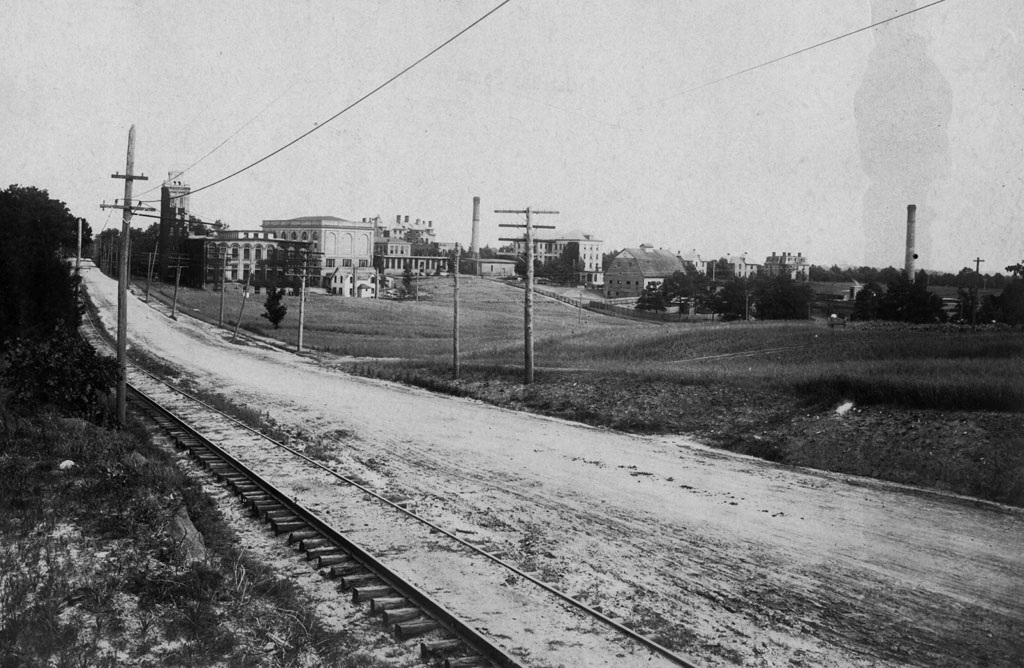
General View A&M College, Raleigh, N.C.

by Raleigh Boy

NC State campus_1918_web

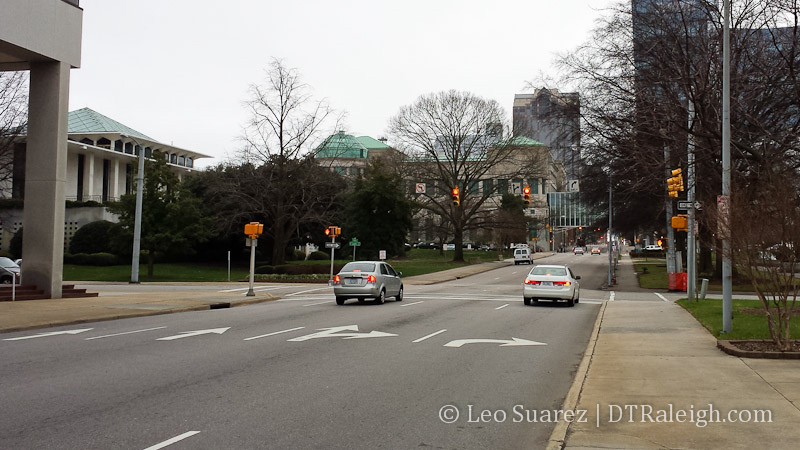
For Flashback Friday this week we take the trolley out Hillsboro St. to the campus of NC A&M (NC State University today). Although the buildings are still standing, the ’general view’ of 100 years ago depicted here is vastly different from what we would find today.

NC State campus_1918_back_web

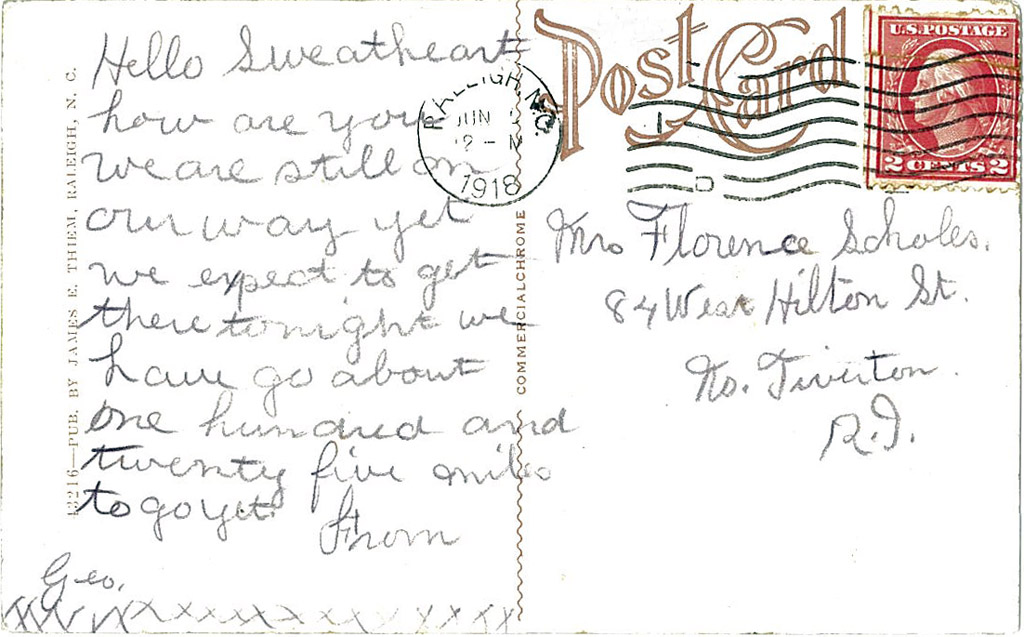
Hello Sweatheart [sic]
how are you / we are still on our way yet / we expect to get there tonight / we have [to] go about one hundred and twenty five miles to go yet
From
Geo
xxxxxxxxxxxxxxxxxxxx

I wonder if George’s “sweatheart” got a chuckle out of his misspelling of that tender term of endearment? The dated cancellation mark on this postcard — June 1918 — suggests that George was aboard a troop train bound for a military training camp during WWI.

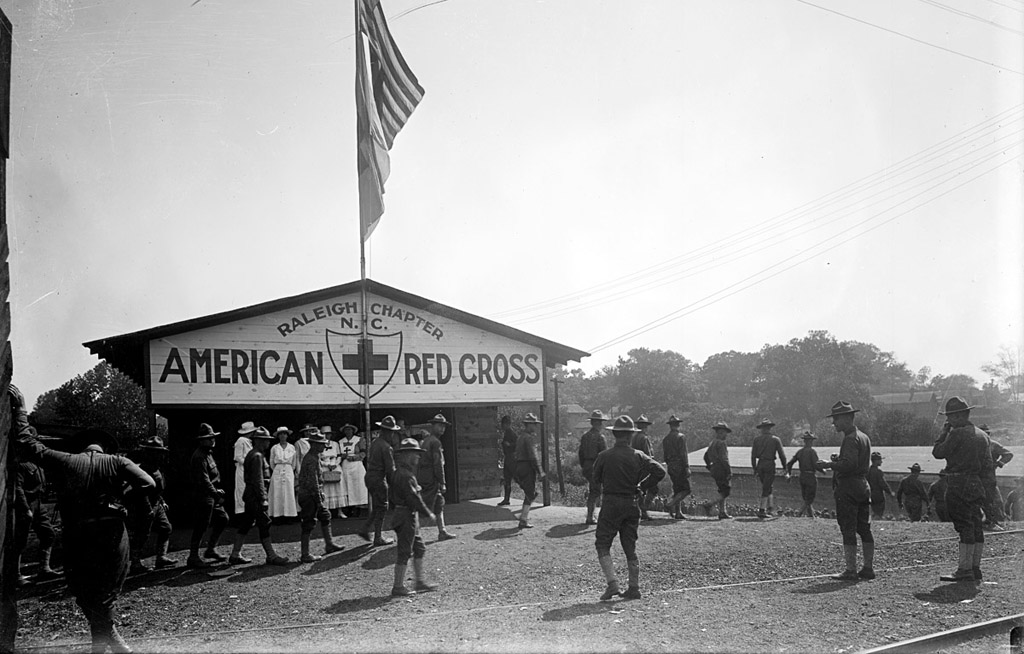
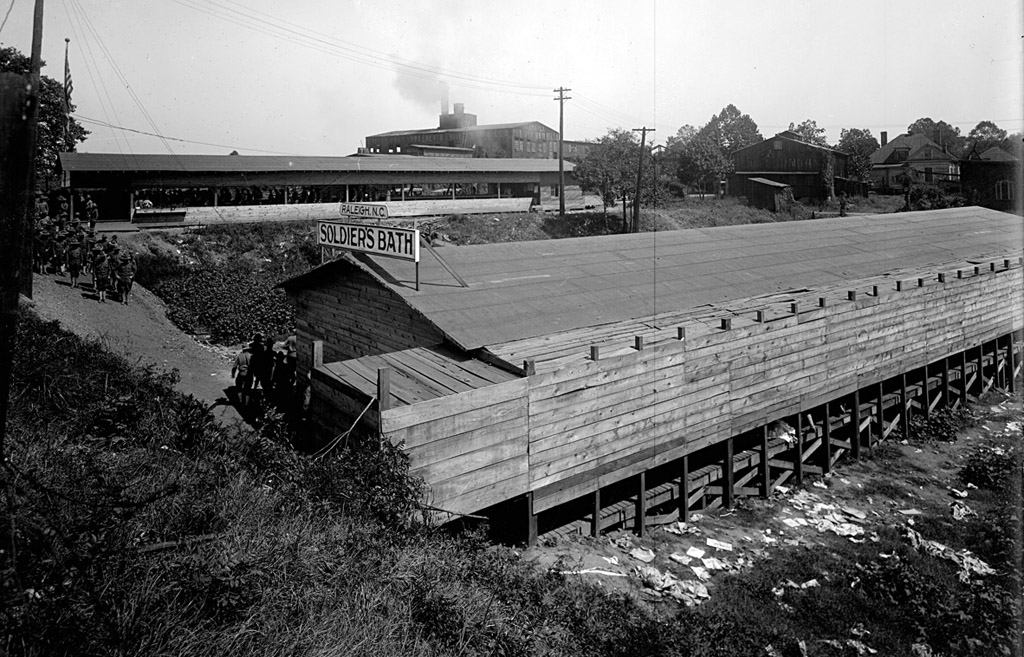
Raleigh was a stopover for the troop trains passing through town during the war. A canteen and bath house were operated by the Raleigh Chapter of the American Red Cross near the Seaboard rail yards just north of the city.

State Archives of North Carolina photo

State Archives of North Carolina photo

WWI soldiers were fed by Red Cross volunteers at the canteen, above, and were able to take welcomed showers at the adjacent bath house.

State Archives of North Carolina photo

State Archives of North Carolina photo

This week’s postcard shows a rather idealized view of Hillsboro St. of the 1910s. In fact, the image is so heavily retouched that the overhead power lines, streetcar tracks and much of the road itself have been airbrushed out of the picture! Below is a photo of the same view taken just a few years previously.

State Archives of North Carolina photo

State Archives of North Carolina photo


Our Flashback Friday postcard this week was published by the long-time Raleigh stationer and ‘office outfitter,’ James E. Thiem. It was printed by Commercialchrome of Cleveland.

Commercialchrome  1910-1920  Cleveland, OH

Printer of tinted halftone view-cards, most depicting scenes from the American Mid-West.


“Flashback Friday” is a weekly feature of Goodnight, Raleigh! in which we showcase vintage postcards depicting our historic capital city. We hope you enjoy this week end treat!


--- We are ad-free. Support this blog by buying City-Blox.
Follow us on Twitter and Facebook

20 Dec 14:09

True Stuff: The Internet According to 1995

by David Malki !

One of my recurring fascinations is reading pearl-clutching editorials over the menacing march of technological advance (such as the telephone, the printing press, or writing itself). So I loved this 1995 column from Newsweek by astronomer and Klein-bottler Clifford Stoll:

After two decades online, I’m perplexed. It’s not that I haven’t had a gas of a good time on the Internet. I’ve met great people and even caught a hacker or two. But today, I’m uneasy about this most trendy and oversold community. Visionaries see a future of telecommuting workers, interactive libraries and multimedia classrooms. They speak of electronic town meetings and virtual communities. Commerce and business will shift from offices and malls to networks and modems. And the freedom of digital networks will make government more democratic.

Baloney. Do our computer pundits lack all common sense? The truth in no online database will replace your daily newspaper, no CD-ROM can take the place of a competent teacher and no computer network will change the way government works…

“Why the Web won’t be Nirvana” — Newsweek, February 26, 1995

Stoll is the author of the 1995 book Silicon Snake Oil: Second Thoughts on the Information Highway, in which he was wrong about basically everything the Internet turned out to be. To his credit, he seems to have come around in the years that followed…And I wonder how many of those early curmudgeons eventually came around to the telephone, and how many of them railed against the infernal motor-car! to their dying day.

In a way, it seems Stoll’s pessimism wasn’t from a lack of understanding of the technology — he was an early adopter of Usenet and from what I can tell, was born on a BBS via 200 baud modem, or something.

It’s that he was too close — he only saw the structure as it was, and as he knew it; he couldn’t imagine what someone else, without that depth of understanding, could reimagine for it. (Or even if he could imagine great changes, didn’t think them possible, or likely to occur.)

But they did. It’s amazing what one can accomplish if one doesn’t know that what one is attempting is impossible.

20 Dec 14:07

funnypageszine: This comic was made for Cards Against...

17 Dec 18:08

Tit for Tat

by Greg Ross

On March 19, 1884, the French cargo ship Frigorifique was cruising through heavy fog in the Bay of Biscay when the British steamer Rumney loomed out of nowhere and struck it amidships. The French crew scrambled aboard the Rumney, and their own ship disappeared into the fog.

Some time later, while the injured Rumney was still lowering its boats, another ship hove out of the fog and struck it amidships. This proved to be the empty Frigorifique — her jammed rudder had led her in a great circle through the fog to return for a second collision.

Both ships sank this time, but the crews escaped safely in the Rumney‘s lifeboats.

05 Dec 16:19

Dolphin Rescues

by Greg Ross

In the summer of 1978, four men rowed a small boat into the deep water off Dassen Island, South Africa, to fish for barracuda. When mist overtook them, they weighed anchor and tried to return to shore, but visibility dropped so quickly that they were soon lost.

Mac Macgregor was in the bow, trying to peer through the mist, when he felt a bump on the right-hand side and discovered two dolphins there, repeatedly forcing the bow to the left, where two more dolphins were swimming.

“I realized that the dolphins’ odd behavior could be significant and shouted to Mr. [Kobus] Stander to steer to the left,” Macgregor said. “Mr. Stander pulled the tiller round wildly and we just managed to graze past the rocks.”

They continued some further distance through the mist, the dolphins continuing to force the prow to the left, and presently they just missed some further rocks — again on the right. “I was getting a strange feeling that we ought to leave our destiny to the dolphins,” Stander said, “since it was clear they had twice prevented us from running on to the rocks.”

The dolphins led the boat for half an hour until it entered calm water, then played around it briefly and disappeared. “When the mist cleared and the houses of Ysterfontein could be discerned, we were speechless,” Stander said. “We had intended going ashore at Dassen Island. We had never dreamed that the dolphins would guide us to Ysterfontein.”

In 1972, when her cabin cruiser sank in the Indian Ocean off Mozambique, a South African woman set out to swim the 25 miles to land. She was trailed by half a dozen sharks, attracted by a cut on her foot. But “as the sharks circled closer … two dolphins appeared at her side,” the New York Times reported. “The young woman, Yvonne Vladislavich, said that the dolphins guarded her against marauding sharks, escorted her as she swam and helped her stay afloat when her strength was failing.” They protected her until she was able to climb onto a buoy, from which she was later rescued.

(“Dolphins Rescue Fishermen,” South African Panorama, August 1978; “South African Reports a Rescue by Dolphins,” New York Times, Sept. 10, 1972.)

19 Nov 04:03

The Cloak & Blaster Pub It’s always so great to see...

by thedrunkenmooglestaffblog
Michael Akerman

Orlando!


The Cloak & Blaster Pub

It’s always so great to see another geeky bar open! The community and market for pubs like The Cloak & Blaster has grown so much over the past few years and always makes me feel fortunate to live in a time where places like this can exist. The Cloak & Blaster pub is a gaming pub for geeks in Orlando, Florida. As a meeting location for the geek community, the pub is a place for fellow nerds to hang out, play some D&D, watch some great shows, and of course drink. The establishment has already been funded and is set to open April of 2014! A Kickstarter campaign to furnish the bar is still going on and aims to get the bar custom gaming tables, the rights to show movies, build up the gaming library and more. Check out the video below and read some of the neat incentives they have for pledging.

Kickstarter Page

14 Nov 13:37

Government requests for user information double over three years

by Emily Wood
In a year in which government surveillance has dominated the headlines, today we’re updating our Transparency Report for the eighth time. Since we began sharing these figures with you in 2010, requests from governments for user information have increased by more than 100 percent. This comes as usage of our services continues to grow, but also as more governments have made requests than ever before. And these numbers only include the requests we’re allowed to publish.
Over the past three years, we’ve continued to add more details to the report, and we’re doing so again today. We’re including additional information about legal process for U.S. criminal requests: breaking out emergency disclosures, wiretap orders, pen register orders and other court orders.

We want to go even further. We believe it’s your right to know what kinds of requests and how many each government is making of us and other companies. However, the U.S. Department of Justice contends that U.S. law does not allow us to share information about some national security requests that we might receive. Specifically, the U.S. government argues that we cannot share information about the requests we receive (if any) under the Foreign Intelligence Surveillance Act. But you deserve to know.

Earlier this year, we brought a federal case to assert that we do indeed have the right to shine more light on the FISA process. In addition, we recently wrote a letter of support (PDF) for two pieces of legislation currently proposed in the U.S. Congress. And we’re asking governments around the world to uphold international legal agreements that respect the laws of different countries and guarantee standards for due process are met.

Our promise to you is to continue to make this report robust, to defend your information from overly broad government requests, and to push for greater transparency around the world.

Posted by Richard Salgado, Legal Director, Law Enforcement and Information Security
05 Nov 00:02

“To Celia”

by Greg Ross

Ping to me only with thine eyes,
And I will pong with mine;
We twain may win the Challenge cup,
If ping with pong combine:
The craze, that in my soul doth rise,
Is doubtless keen in thine;
I’ll take the rôle of pinger up,
If thou’lt be pongstress mine.

A Little Book of Ping-Pong Verse, 1902

31 Oct 15:08

Cat and Mouse

by Greg Ross
Michael Akerman

This seems like a tremendous waste of resources.

http://commons.wikimedia.org/wiki/File:Brown_rat_distribution.png

Rats have pretty well overrun the globe, but there’s one exception: Alberta, Canada, which has waged a successful war against the critters for 50 years. Owning rats is forbidden to Alberta residents; they can be kept only by zoos and research institutions. The province maintains a rat control zone 600 kilometers long along its eastern border, staffed by eight professionals, and any rats they find are poisoned, gassed, or shot.

“Alberta is the only province with rat-free status, and we take this very seriously,” Verlyn Olson, minister of agriculture and rural development, said in an August statement. “We have lived without the menace of rats since 1950, when our control program began.”

But it’s a constant battle. In 2003 pest specialist John B. Bourne told National Geographic that he worries the wily creatures will hitch a ride to the interior aboard a truck or train. “They are so adaptive, so intelligent, so successful and physically capable … that it would not surprise me if they show up in a place where you’d least expect a rat to show up. I have the greatest respect for this rodent’s resourcefulness, and [its] capabilities scare the hell out of me.”

30 Oct 23:57

This is an old drawing of an idea I used to noodle around with...


This is an old drawing of an idea I used to noodle around with about a kid who builds up a collection of enchanted quest items, it became part of the inspiration for the Adventure Time episode “Dungeon Train”.

I’m still really happy with this drawing! 

28 Oct 23:03

How Twin Peaks Made Modern Art of the Soap Opera

by the mag

Twin Peaks proved to fans, critics, and industry gatekeepers alike that television would no longer live in the shadow of film.

28 Oct 22:59

Retrieving the Space Shuttle's Solid Rocket Boosters

by Chris Higgins

After each Space Shuttle flight, NASA retrieved Solid Rocket Booster (SRB) segments from the ocean. During a Shuttle launch, the SRBs detached as the Shuttle rose, and they fell into the ocean, where teams in two massive ships (Liberty Star and Freedom Star) were waiting to locate and retrieve them so they could be reused. Here's video of NASA's SRB recovery teams picking up the segments after the STS-133 launch, the final mission of the Space Shuttle Discovery in February 2011.

Although I've always known the SRBs were reused, I never saw footage of the retrieval process. This is pretty much raw footage of the process (no narration), but if you're a space nerd, this is a must-see video. Part of the fun is seeing just how massive these things are; the other extra-fun bit is the time-lapse at the end, which helps to show how long the process takes.

If you want more of that, there's a 45-minute video of the STS-135 retrieval. It's slow, but shows even more of the process.

25 Oct 15:40

Benjaman Kyle

by Greg Ross

On Aug. 31, 2004, this man was discovered, naked and unconscious, behind a Burger King restaurant in Richmond Hill, Ga. When he regained consciousness in the local hospital, he was unable to remember who he was or how he’d came there.

That was nine years ago, and he still can’t remember. Benjaman Kyle — a name he adopted simply because it shares initials with Burger King — has been diagnosed with dissociative amnesia. He believes his birthday is Aug. 29, 1948, and he has some fragmentary memories of Denver and Indianapolis. But beyond that his life is largely a blank. He has been the subject of numerous newspaper stories and has appeared on national television, but no one has recognized him. He is the only American citizen whose whereabouts are known and yet is officially listed as missing.

The lack of a name or a Social Security number makes the search uniquely difficult. Benjaman has snapshots of memory: buying a grilled cheese sandwich at the Indiana state fair in the 1950s, and public debates over mass transit in Denver in the 1980s. But these lead nowhere. The Indiana Bureau of Motor Vehicles tried and failed to match his face with anyone in its records, and the FBI has been unable to match his DNA or fingerprints.

In 2010 he told told the Guardian that he often refrains from telling his story to new acquaintances because “you get two reactions. They want to tell you their theories or they think you’re mad. Neither is much fun for me.”

He acknowledges that many stories such as his turn out to be hoaxes. “It sounds crazy, I know that,” he says. “All I can say is I’m telling the truth.”

23 Oct 17:10

Nontransitive Dice

by Greg Ross

Label the faces of a fair set of dice with these numbers:

Die A: 3, 3, 3, 3, 3, 6
Die B: 2, 2, 2, 5, 5, 5
Die C: 1, 4, 4, 4, 4, 4

This gives them a curious property. In the long run Die A will tend to beat Die B, Die B will tend to beat Die C, and Die C will tend to beat Die A. The three dice form a ring in which each die beats its successor. No matter which die our opponent chooses, we can select another that is likely to beat it.

Business magnate Warren Buffet once challenged Bill Gates to such a game using four nontransitive dice. “Buffett suggested that each of them choose one of the dice, then discard the other two,” wrote Janet Lowe in her 1998 book Bill Gates Speaks. “They would bet on who would roll the highest number most often. Buffett offered to let Gates pick his die first. This suggestion instantly aroused Gates’s curiosity. He asked to examine the dice.”

“It wasn’t immediately evident that because of the clever selection of numbers for the dice, they were nontransitive,” Gates said. “Assuming the dice were rerolled, each of the four dice could be beaten by one of the others.” He invited Buffett to choose first.

23 Oct 11:14

Round and Round

by Greg Ross

Since demolishing 78 traffic signals and installing 80 roundabouts, the northern Indiana city of Carmel has reduced the number of accidents by 40 percent and the number of accidents with injuries by 78 percent.

“It’s nearly impossible to have a head-on or T-bone collision when using the roadways, and collisions that do happen tend to occur at much lower speeds,” noted Governing magazine. “Other benefits of roundabouts include reduced fuel consumption, due to a lack of idling, and a construction cost that is at least $150,000 less than installing traffic lights.”

“We have more than any other city in the U.S.,” says mayor James Brainard. “It’s a trend now in the United States. There are more and more roundabouts being built every day because of the expense saved and, more importantly, the safety.”

22 Oct 17:06

Green Peace

by Greg Ross

http://commons.wikimedia.org/wiki/File:CAB_1918_Carnegie_Andrew.jpg

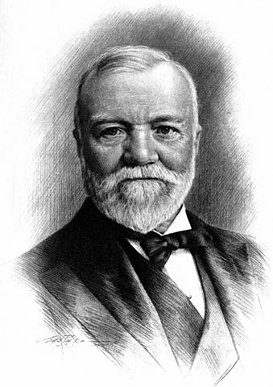
In December 1868, having just turned 33, Andrew Carnegie sat down in New York’s St. Nicholas Hotel and wrote a memo to himself. His net worth was $400,000, and with prudent management he could expect $50,000 in dividends each year for the rest of his life. “Beyond this never earn,” he resolved. “Make no effort to increase fortune, but spend the surplus each year for benevolent purposes. Cast aside business forever except for others.”

Man must have an idol — The amassing of wealth is one of the worst species of idolatry. No idol more debasing than the worship of money. Whatever I engage in I must push inordinately therefor should I be careful to choose that life which will be the most elevating in its character. To continue much longer overwhelmed by business cares and with most of my thoughts wholly upon the way to make more money in the shortest time, must degrade me beyond hope of permanent recovery.

He kept the memo for the rest of his life, and by the time of his death in 1919 he had given away $350,695,650, nearly $5 billion today, endowing universities, museums, libraries, and initiatives to support science, the arts, and world peace. “The man who dies rich, dies disgraced,” he wrote. “Money can only be the useful drudge of things immeasurably higher than itself. … Mine be it to have contributed to the enlightenment and the joys of the mind, to the things of the spirit, to all that tends to bring into the lives of the toilers of Pittsburgh sweetness and light. I hold this the noblest possible use of wealth.”

22 Oct 14:21

Prepositional identity

by Mark Liberman

From Tim Leonard:

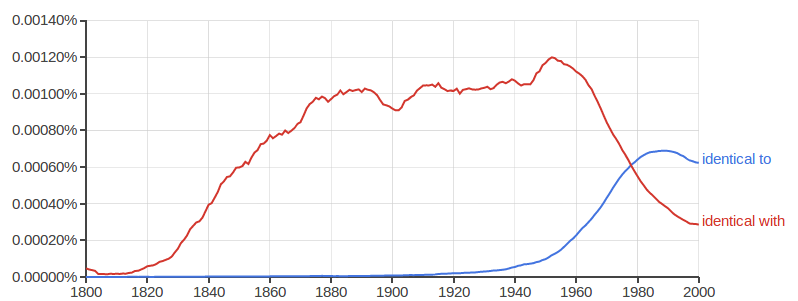
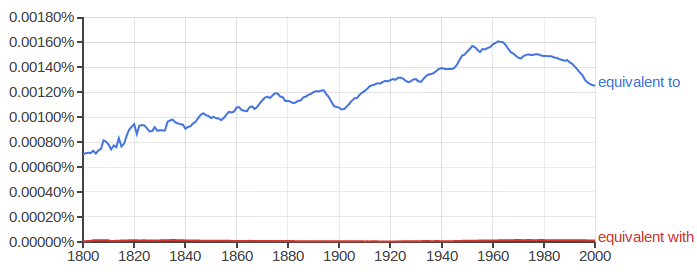
I read here that Arthur C. Clarke wrote in his diary, "… are virtually identical with us." I was surprised that he would use "identical with" rather than "identical to," since I find it ungrammatical. So I checked Google Ngram Viewer, and was delighted to discover that the preposition that goes with "identical" appears to be a previously fixed choice that's in the process of changing:


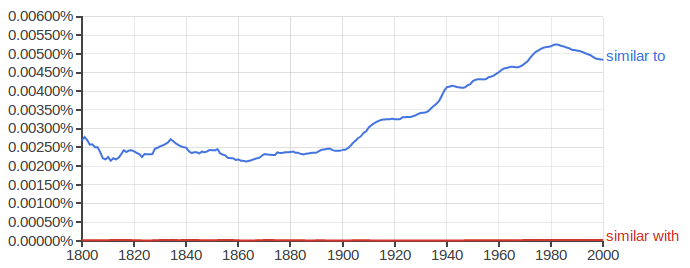
In contrast, similar has always selected for to:

And likewise equivalent:

As Geoff Pullum recent wrote ("At Cologne", 10/2/2013):

The problem is that each specific verb will have certain idiosyncratic demands regarding the particular prepositions it will accept as the head of its preposition-phrase complement. Arrive allows at or in (among others), but not (for example) to or into. And Welcome allows to, but not at or in.

You arrive at or in a place, not to a place, but you welcome someone to a place. That's just the way it is. Nobody promised you a rose garden: nobody guaranteed that languages would be easy or fair or logical or commonsensical. They are simply as they are. Deal with it.

And adjectives are no easier or fairer or more logical.

Also, the rules can change, sometimes quickly.


22 Oct 02:53

Linguistic change on a short time scale

by Mark Liberman

From Reuben Fischer-Baum, "Six Decades of the Most Popular Names for Girls, State-by-State", Jezebel 10/19/2013:


Someone should take a fuller slice of the historical data and calculate the latent regional affinities that this dataset implies. Or maybe someone has already done that?

17 Oct 15:36

Honorable Prisoners

by Greg Ross

After John II of France was captured by the English in 1356, he paid 1 million gold crowns for his ransom and promised to pay 2 million more. As a guarantee he offered his son Louis as a hostage. When word came that Louis had escaped, John voluntarily returned to captivity in England, citing reasons of “good faith and honor.” He died there in 1364.

In 1916, after two years in a German prisoner-of-war camp, British Army captain Robert Campbell received word that his mother was dying of cancer. He wrote to Kaiser Wilhelm II asking permission to visit her, and was given two weeks’ leave on condition that he return afterward. Campbell went to England, spent a week with his dying mother, then returned to confinement in Germany, where he remained until the war ended.

“Captain Campbell was an officer, and he made a promise on his honor to go back,” said historian Richard Van Emden, who uncovered the episode while researching his book Meeting the Enemy. “Had he not turned up there would not have been any retribution on any other prisoners. What I think is more amazing is that the British Army let him go back to Germany.”