Britain’s Beer Alliance sounds like my kind of superhero team, fighting the good fight against sobriety across the UK. At the mere whisper of “I’ll just have water, thanks,” our Alliance heroes don their goggles, suck in their guts, and stagger their way toward the cry for help.
You know that old canard about beer having more fat than a chocolate bar? Me neither. It never even crossed my mind to compare the two. But if you are promoting beer, surveying people about a series of attributes you want to promote is a great way to create myths you can debunk solely to promote those attributes.
Just saying straight out that beer has no fat is boring and obvious. Surveying people about which has more fat, beer or a chocolate bar, on the other hand, is bound to lead to some incorrect answers, which you can then turn into a shareable meme like this one:
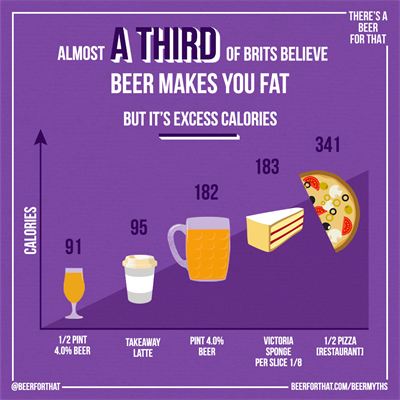
Or you can debunk a myth that isn’t really a myth, exactly, by pretending to misunderstand what people actually believe, which brings us to today’s bad chart:
Amazing, right? All this time, it wasn’t the beer but the calories in the beer that have led to weight gain? WHO KNEW? I’m starting my all-beer diet today!
Of course, beer doesn’t necessarily make a person fat. Depends on the person, how much they drink, their dietary and exercise habits, and so forth (not to mention how we define “fat”), which is why I say this isn’t exactly a myth, but I’m being generously pedantic. Any amount of beer is essentially excess calories in the sense that they are calories no one needs, so the belief that beer makes people fat is more of a statement about it being empty calories that will likely lead to weight gain if these calories are on top of the calories our bodies need, provided we don’t burn them off.
My favorite part of this chart, though, is the series of comparisons. They show that the calories in beer are not nearly as high as those in HALF A PIZZA. Not that I haven’t downed half a pizza in one sitting myself, but what do the calories in pizza have to do with beer? Why would anyone be choosing between the two? Plus, many people have more than one glass of beer when out drinking, but I’m guessing far fewer are going out to have a few halves of a pizza. Not to mention that unlike beer, pizza has at least some nutritional value.
On the other end of the scale, we have the tiniest half pint in the world relative to the size of the pint in the chart, and a meaningless y axis that the numbers don’t correspond to beyond being in increasing order. But I think we all know that this isn’t really intended to be a chart. It’s an advertisement thinly veiled as information. It’s a clever strategy in theory, although in practice, I’m not sure that insulting the intelligence of your audience is the best way to lure them in, although the elections in the US just might prove me wrong on that.
Which reminds me of an actually valid reason to get started on that all-beer diet . . .
This is where free speech as a principle starts conflicting with the reality of the human condition. He is allowed to ramble to strangers about hanging them upside down in the dark and cut them and burn them, but at some point someone ought to take them aside and get them some help, and maybe explain to them that that behavior is inappropriate and vile, and that they should stop doing it. And while it may be nice for him to get off on telling people about the graphic abuse and mutilation and murder stories playing out in his head, it’s distressing to others and raises legitimate concerns about whether he is a threat to their safety.
He was quite reasonably reported to the police. They “brushed it off”. His target reported him to Facebook. They informed her that it violated no “community standards” (what community is that? The community of psychopathic assholes?). And then, when she shared his nightmare stories with others, Facebook blocked her for a week.
I guess all I can do is use my power of free speech to spread the word that Matt Walters is a nasty piece of work. Oh, and that his brother Buddy Walters is a barely literate dumbass.
I remember when stuff like this was in cyberpunk fiction as fucking metaphor. That people actually now do this to one another is ... well I'm at a loss.
“When you work on the east side of our hospital, psychiatric patients are a dime a dozen,” he said.
But this patient is different. She’s put together. She’s lucid. She’s got an incision.
A group crowded around the computer to see her x-ray.
“Embedded in the right side of her flank is a small metallic object only a little bit larger than a grain of rice,” he said. “But it’s there. It’s unequivocally there. She has a tracker in her. And no one was speaking for like five seconds — and in a busy ER that’s saying something.”
It turns out this 20-something woman was being pimped out by her boyfriend, forced to sell herself for sex and hand him the money.
Yeah, some days, you start to see the virtues of extinction.
A huge experiment in player psychology occurred in October 2015 - but it went unnoticed in the games industry because it was the lottery conducting this experiment. The Multi State Lottery Association (MUSL) significantly lowered the odds of anyone winning the Powerball. With fewer winners, the jackpot grew and grew, and in the first week of January 2016 we saw what would turn out to be the biggest player numbers in Powerball history. Even though the odds of winning are worse, the appeal of the giant jackpot makes it so there's an exponential increase in the number of people who want to try their luck. We have to wonder, is there a point where the odds become so low it actually discourages players, or will the size of the reward become irresistible no matter how unlikely we know we are to win? Game designers expect players to be rational actors who will favor the most efficient route to success (power leveling, loot grinding, and son). But the lottery results suggest that may not always be the case. Many games, especially MMOs, could stand to experiment with incentive systems that incorporate more "Big Score" type events like the lottery and less "The Job" type grinding that we're used to.
I love the verticality to Sam Malmberg‘s slice of a cyberpunk cityscape. The builder mentions he was inspired by the architectural concept of a tripartite structure, which gives an appearance of vertically dividing lower, middle, and upper social and economic classes. A great concept for a cyberpunk scene, and rather well executed too!
There are several small details and scenes that bring this build to life, so be sure to check out the rest of the photos on Sam’s Flickr page.
As modern video games become more and more demanding in terms of hardware, no wonder getting the cutting edge component parts is a pressing problem. Recently, dueling LEGO builders produced a couple of brilliant microchips, and now it’s high time to get a proper motherboard for your high-end gaming station. Depending on your ambitions and budget, you can either go for the popular and reliable GIGABYTE G4M-XPZ by Tim Schwalfenberg…
…or opt for Jonas’ultimate ASUS P9X79-E WS, which can be upgraded with up to 64 GB of RAM.
That's a very confusing doll. It does look like a chibi version of a Pikachu, but there's a different Pokemon that already is a chibi-shaped version of a Pikachu called Pichu. But a Pichu has slightly different ears and a black collar which are absent here. Cute cockatiel though.
If one was ever to question their lifetime of unwavering devotion to New York City, February would the month to do it. It’s cold and has been for some time. It’s cold and will be for some time. And somewhere out in California, a “friend” — but really, are they if they torture you so? — is welcoming their first strawberries. You get strawberries in New York, too, but for about 5 minutes every June and they cost about as much per square foot as real estate in a neighborhood with multiple pour-over coffee outlets.
It is so easy to hang on to the negative things in life. I, just for a quick example, remember negative online comments much, much longer than positive ones. Logically, I know this is ridiculous. People who hate my stuff don’t matter, and people who like me and my art are really the ones that should care about. I tweeted something about this once, about how I wish I could remember the positive things more than the negative ones, and my friend Michael gave me some really great insight. It’s a survival instinct to watch out for the bad things more than the good ones. If you live in a forest with a scary bear and a bunch of delicious berries, you need to keep that scary bear on your mind all the time. You need to hide your food and yourself, you need to avoid the bear’s territory—and no matter how delicious those berries are, that bear is going to be bigger in your mind. This applies to internet comments, to drama, and to rejections of all kinds.
So what do we do with this, when we’re supposed to be all self-motivated and CREATIVE? How do we keep our energy up and ourselves happy? Well, I take negativity and I embrace it. If these negative thoughts, these scary bears, are the ones that are going to stick in my mind anyway, I might as well find the bears that help me. Here are some thoughts that keep me going.
I read this good essay from the American Humanists. I agree with it, but I have some problems with it. I can do that; I have one foot in the atheist camp, and the other in the humanist camp.
Atheism is what we don’t believe; humanism is what we do believe.
Humanists are cultural progressives. When you make decisions based on rationality and scientific research, with an added dose of empathy, the effective answers to the issues of our day are the progressive answers. Science-based sex education is proven to be more effective than abstinence-based sex education. A strong middle class is best for a stable, resilient economy. Health care for all extends quality of life and strengthens economies. The civil rights of all must be protected because the only justification for seeing women and racial minority groups as inferior comes from bronze-age holy books and other outdated ideas. People who support progressive ideals most often do so because they see positive results and understand cause and effect.
While atheists and humanists reject the existence of any gods for lack of evidence, atheism and humanism are not synonymous. Most atheists and humanists are good people, but atheism in and of itself is not supported by an ethical system to guide behavior. Not all those who don’t believe in a god have fully moved past societal prejudices and old programming—and not all have cultivated empathy in a way that engenders compassion for others and builds a sense of egalitarianism.
Here’s my problem: the characterization of atheists is false.
I say that even though a lot of atheists will eagerly agree with it. Atheism doesn’t have a moral code, they will say, it’s nothing but the absence of a supernatural moral authority. That’s what they tell themselves, anyway, but it’s all a lie — they’re humans, and they’re simply loaded with moral assumptions. You cannot get away from them. Atheists have a tendency to declare that logic and reason are their sole moral absolutes (which in itself is a kind of moral code), and then, in an unsurprising twist, explain that their particular beliefs, no matter what they are, are the product of their logic and reason, and are therefore good. The same circular logic we laugh at in biblical rationalizations is just fine when we do it.
So we get a kind of free-for-all. Atheist dudebros, for example, can claim that Libertarian selfishness is the only rational ethical stance, that science is the arbiter of all truth, and that because the social relationship of men and women is the product of evolution, it is optimized to support male dominance and female submission. They do have an ethical system to guide their behavior! It’s a thoroughly fucked-up system, but really, they’re not all sitting there in a moral void, objectively pure and unbiased. They’re actually operating under a whole set of premises, largely unexamined and often superficial, with a goodly dollop of motivated reasoning propping them up.
Science is true. How do we know? Science!
Humans are evolved. Therefore, everything about us has a purpose and provides a benefit. How do we know? Because we’re here!
Logic is the only right way to approach a problem, and the ideal human is objective, rational, and unemotional. How do we know? Well, there was this old Star Trek episode…
I like science, too, I know humans evolved, and I think logic is an excellent tool. It’s just that I also appreciate other ways of seeing the world (they’re inevitable, since we’re not robot clones), see evolution as a chaotic clusterfuck of chance with a ribbon of selection providing multiple ways forward, and also know that logic is a great tool for false rationalizations. Probably the most logical, successful, long-lived human institution on the planet is the Catholic church, and they are masters at using logic to back up odious, false, and harmful decisions.
So please, stop giving atheism the blank check they want, the claim of an absence of any kind of moral imperatives or any prior suppositions. It isn’t the case, it’s only that they want to pretend to have an absence of priors so they can assume the mantle of objective, bias-free decision making, which, by the assumptions they claim that they don’t have, makes their moral decisions superior.
It also drives me up a tree that whenever anyone proposes that atheists ought to recognize the consequences and obligations of their ideas, there will always be some pissy wanker who’ll tell them they should go join the humanists, because atheists don’t do that. Yeah, atheists do do that — it’s just that they prefer that their implicit biases be invisible. Humanists at least try to make the framework explicit.
People, not commercial organizations or chains of command, are what make great civilizations work.
There is a truth in there. Ultimately, it’s people who do the work. But institutions enable or disable their endeavor. Good schools, for instance, are essential to give people the tools to do great things; and the greatest people in the world can be trapped in futility by institutional poverty or racism.
That cartoon represents a very common atheist way of looking at things. We don’t need structure or ideals or even other people; we are all individuals! My greatness is mine and mine alone! And yet the people saying those things are often privileged, middle-class Americans who have benefited every day of their life from social structures that favor them and give them the ability to live up to their potential.
I am also an atheist, and I’ve had lifelong advantages because of where I come from and because of the support of social institutions. Tempting as it is to abandon the institution of atheism (and it is an institution, a movement, a framework for thinking) and just say everyone ought to be a humanist, I can’t. There’s more than one way to live a godless life, none of them involve becoming an unfeeling computer, and I refuse to allow atheists the pretext of lacking a moral code. I think we’re better served by making it explicit and open.
This is the Great Pyramid of King Khufu. Everybody knows the Great Pyramid of King Khufu, but you probably don’t know about the Shit Pyramids of his father, King Sneferu. This is a shame, because they are amazing.
When King Sneferu came to the throne of Egypt, the cool thing that all the pharaohs had was a Step Pyramid, like the original one built by King Djoser and designed by Imhotep (not the mummy). King Sneferu could easily have had one one because his predecessor King Huni had died before his could be finished. All Sneferu had to do was step in and put the last few blocks on.
But King Sneferu had a vision. He didn’t want any old Step Pyramid. He was going to build Egypt’s first smooth-sided pyramid, and make King Huni’s pyramid way taller in the bargain. It didn’t work. The core of Huni’s pyramid couldn’t handle the modifications and nowadays the Step Pyramid at Meidum looks like this:
It’s not on a hill - that’s the outer layers of the pyramid that have fallen down all around it. The name of the structure in Arabic is Heram el-Kaddaab, which means something like The Sort-Of Pyramid.
Anyway, King Sneferu was understandably disappointed and made his pyramid-builders start over from scratch at a different site. Apparently having learned nothing about the Big Fat Nowhere that hubristic pyramid ambition was going to get him, this pyramid was designed to be even taller and pointier than the last effort! Too tall and pointy, in fact - the bedrock proved to be less stable than he might have hoped, and by the time the pyramid was half-finished stuff was already moving and cracking inside of it. There are ceilings in this pyramid that are to this day partially held up by wooden beams.
The builders seem to have panicked and decided that the only way to finish the pyramid without another disaster was to make the top half lighter than the bottom half. They did this by changing the angle of the slope, ending up with a pyramid that looks like this:
Egyptologists call this one the Bent Pyramid for fairly obvious reasons. Uniquely among Egyptian Pyramids, it has most of its smooth outer blocks intact, rather than having them all stolen to build other stuff (most of medieval Cairo is built from the skin of the Giza pyramids). I’m guessing this is because nobody dared touch the thing for fear the whole structure would come down like a giant limestone game of Jenga.
I’m sure the pyramid-builders were very proud of this solution. Sneferu appears to have been less so. He had them move over about half a mile and start over. Again. Why only half a mile when he had them move 34 miles between the Sort-of Pyramid and the Bent Pyramid is a mystery. I think he wanted to keep them in sight of the Bent Pyramid so they could look at it and feel ashamed every once in a while.
And there they built Sneferu’s third pyramid, which is called the Red Pyramid. As pyramids go, it’s a very cautious one - it’s got the shallowest slope rise of any Egyptian pyramid, and while it’s the same height as the Bent Pyramid it spreads its weight over a much greater base area, making it far more stable. Sneferu seems to have been happy with this one, because he was buried in it. Either that, or after a forty-eight-year reign he just finally died and that was the pyramid they used because it was the nicest of the three.
These three pyramids together actually contain substantially more stone than the Great Pyramid of Sneferu’s son Khufu. By the time Sneferu died, his workforce had honed themselves into a lean, mean pyramid-building machine. They had already made every possible pyramid mistake. So when Khufu announced that he didn’t just want a great pyramid, but The Great Pyramid, these guys built him a pyramid so fucking great that we now think aliens must have done it.
The mastermind of LEGO models featuring motion, Jason Allemann has built a working orrery featuring the sun, earth and moon. Although other LEGO orreries exist, Jason’s model is the only one that is over 97% accurate compared to the actual rotation frequencies of these celestial bodies.
Check out the video to see the orrery in motion and learn about its intricate construction.
What would happen if one tried to funnel Niagara Falls through a straw?[1]This question was in reference to this Amazon review of gummy bears—but before you click, be warned that it describes the reviewer's gastrointestinal response to the candy in rather memorable detail.
—David Gwizdala
One would get in trouble with the International Niagara Committee, the International Niagara Board of Control, the International Joint Commission, the International Niagara Board Working Committee, and probably the Great Lakes–St. Lawrence River Adaptive Management Committee.[2]Which is, if I'm understanding these organizational charts right, itself a supergroup made up of three committees for individual bodies of water. Also, the Earth would be destroyed.
Well, that's not quite right. At the risk of stating the obvious, the real answer is, "Niagara Falls wouldn't fit through a straw."
There are limits to how fast you can push fluids through things. If you pump a fluid through a narrow opening, it speeds up. If the fluid is a gas,[3]Gasses are fluids. I know that's weird, but many things are weird. it becomes "choked" when the speed of the gas flowing through the opening reaches the speed of sound. At that point, the gas flowing through the hole can't move any faster—although you can still get more mass to flow through per second by increasing the pressure, which compresses the gas further.
For water, a different effect causes it to choke. When a fluid flows through an opening fast enough, the pressure within the fluid drops due to the Bernoulli principle. Water always "wants" to boil, but is held together by air pressure. Without enough pressure, bubbles of steam form in the water. This is called cavitation.
When the water is forced through an opening at high speed, cavitation bubbles cause it to become less dense overall. Increasing the pressure—to try to push the water through harder—only makes it boil faster. (See page 17 here for a description of this process.)[4]Valve designers try to avoid creating these steam bubbles, because after the bubbles form, they quickly collapse as the pressure rises back up past the valve, and the force from that collapse can gradually eat away at plumbing. This keeps the total amount of water making it through the opening from rising, even if the water-steam mix moves at a higher speed.
Another limit on the water flow rate comes from the speed of sound. You can't use pressure to accelerate water through an opening faster than the speed of sound (in water).[5]It's sort of like a traffic jam—forcing more cars into the back of a traffic jam won't make the ones in the front come out faster. The analogy between traffic jams and choked flows isn't perfect, but I still like it, because it's fun to imagine someone trying to solve traffic jams by using a bulldozer to push more cars into them. However, water very rarely reaches this point, because "the speed of sound in water" is very fast. If you try to make water—which is pretty heavy—go that fast, it tends to start ignoring the turns in your pipes.
So how fast does Niagara Falls need to go to fit through a straw, and is it faster than the speed of sound? This is easy to figure out; all we need to know is the flow rate over the falls and how much area it needs to fit through.
The flow rate over Niagara Falls is at least 100,000 cubic feet per second, which is actually mandated by law. The Niagara river supplies a total of about 292,000 cubic feet per second to the falls, but much of it is diverted into tunnels to generate electric power. However, since people get mad if you turn off the world's most famous waterfall, they're required to leave at least 100,000 of those cubic feet per second flowing over the falls for everyone to look at. (50,000 at night or during the off-season). Sometime in the next few years, the falls may be turned off for maintanence. And probably to see what cool stuff they can find.
(Important note: If you divert the water into a straw, you'll be in violation of the 1950 treaty establishing the "100,000 cubic feet per second" limit. This is monitored by the International Niagara Committee, which consists of one American and one Canadian.[6]Currently, they are Aaron Thompson of Environment Canada and Brigadier General Richard Kaiser of the US Army Corps of Engineers. I'm guessing their enforcement protocol is just some variation on "filing a report," but I like to imagine that they're empowered to physically return the stolen water to the falls by any means necessary. They'll probably be upset with you, as will the other boards I mentioned earlier, so proceed at your own risk.)
A typical straw is about 7mm in diameter. To find out how fast the water flows, we just divide the flow rate by that area. If the result is greater than the speed of sound, our flow will probably be choked, which will lead to problems.
Apparently, our water will be going one-quarter of the speed of light.
On the plus side, we don't need to worry about cavitation, since these water molecules would be going fast enough to cause all kinds of exciting nuclear reactions when they hit the walls of the straw. At those high energies, everything is a plasma anyway, so the concepts of boiling and cavitation don't even apply.
But it gets worse! The recoil from the relativistic water jet would be pretty strong. It wouldn't be enough to push the North American plate south, but it would be enough to destroy whatever device you were using to create the jet.
No machine could actually accelerate that much water to relativistic speeds. Particle accelerators can get things going that fast, but they're typically fed from a small bottle of gas. You can't just plug Niagara Falls into the accelerator input. Or, at least, if you did, the scientists would get awfully mad.
Which is for the best, since the power of the particle jet created by this scenario would be greater than the power of all the sunlight that falls on Earth. Your "waterfall" would have a power output equivalent to that of a small star, and its heat and light would quickly raise the temperature of the planet, boil away the oceans, and render the whole place uninhabitable.
And yet I bet someone would still try to go over it in a barrel.
These are Trdelníks. They are tubes of sweet bread cooked over fire with sugar and cinnamon on the outside. The picture shows what some trendy new places have done, which is turn them into cones and fill them with stuff (some have meat and cheese in them). Saw the non-ice-cream-cone version all over Prague at Christmas markets, and saw a store in the touristy section selling exactly what is in the picture.
Trdelník is a traditional Slovak cake and sweet pastry, originally coming from the Hungarian-speaking part of Transylvania, Romania. It is also known within the culinary heritages of other European countries like Hungary, the Czech Republic and Austria. It is made from rolled dough that is wrapped around a stick, then grilled and topped with sugar and walnut mix. Nowadays, trdelník is very popular among tourists as a sweet pastry in Slovakia and the Czech Republic.The name trdelník comes from trdlo, the wooden stake the cake is wrapped around for cooking which gives it its traditional hollow shape.
At the link are a list of similar products from other European countries, including Swedish spettekaka.
Last month Netflix announced that it would increase its efforts to block customers who circumvent geo-blockades.
As a result it has become harder to use VPN services and proxies to access Netflix content from other countries, something various movie studios have repeatedly called for.
With the application of commercial blacklist data, Netflix already blocks IP-addresses that are linked to such services, something which also affects well-intentioned customers who merely use a VPN to protect their privacy.
Instead of providing access to the latest video entertainment, Netflix then serves the following error message to these blocked users.
In recent weeks TorrentFreak has kept a close eye on the expanding blockade and its aftermath. We’ve learned that servers belonging to many popular commercial VPN services have been added to the blocklist, including ExpressVPN, Mullvad, Private Internet Access and StrongVPN.
While the blocks are being rolled out in phases, it’s already clear that some VPN users can’t access Netflix, even if the VPN server is located in the same country as they are. This means that Americans can no longer use a U.S. VPN server to protect their privacy.
Ironically, Netflix is even restricting access to its own original series, despite being the primary rightsholder.
This approach is meeting fierce resistance from many sides. To coordinate the protest Digital rights organization OpenMedia has started an OpenMedia petition urging Netflix to rethink its approach, which has already been signed by more than 33,000 people.
“Privacy is a huge priority for us as a digital rights organization, and that VPNs are probably the simplest, most user-friendly way for everyday Internet users to safeguard their online activities,” OpenMedia spokesperson David Christopher informs TorrentFreak.
“Given that a huge percentage of the population uses Netflix, if they were all forced to stop using VPNs, that would represent a major setback for privacy,” he adds.
OpenMedia itself has been affected by the new measures as well, as some of their staff members can no longer watch Netflix without having to turn off their VPN.
The group is concerned that Internet users are being forced to give up their privacy when they are not even trying to circumvent any geo-blockades. A better way would be to restrict content based on people’s credit card addresses, which doesn’t require any VPN blocking.
“We’re cooking up plans to take this message directly to Netflix and hope that if enough people speak up, Netflix will listen to their customers and find a better way,” Christopher says.
Meanwhile, the complaints keep pouring in on social media. There are even reports from users who are blocked without even using a VPN. In addition, several people claim to have ended their Netflix subscriptions due to the restrictive policies, and some hint at going back to their old pirate ways.
Despite the public outrage, Netflix said that it’s not worried about a subscriber exodus. “I don’t think we will see any impact,” CEO Reed Hastings said in a shareholders’ interview last month.
In the long-term the company hopes to make the entire geo-blocking discussion obsolete by offering movies and TV-shows worldwide. But given Hollywood’s reluctance to adapt, it may take a few years before this will be realized.
So a judge in Ontario has said “nuh-uh” to a deceased doctor’s plan, set forth in his will, to set up scholarships for straight, white, single students.
[Dr. Victor] Priebe’s will asked the trustee to set up bursaries for students planning studies in science …
It said one should be directed to “Caucasian (white), male, single, heterosexual students,” while the other should be reserved for a “hard-working, single Caucasian white girl who is not feminist or lesbian.” …
There were other odd stipulations, too, such as that the male bursary should not go to anyone who plays inter-collegiate sports, and that the recipient should ideally demonstrate “they are not afraid of hard manual work in their selection of summer employment.”
But the judge, a known woman by the name of Alissa Mitchell, says she can’t let something so blatantly discriminatory to stand.
Naturally, the good folks in the Men’s Rights subreddit are outraged by this assault on all that is good and decent.
“I am a white heterosexual single male, and I quite like myself that way,” a fellow calling himself CompayViejo declared, in a comment that got more than a dozen upvotes.
And I associate with other white heterosexual single males, and I generally think my friends are really a great bunch of people to be around. Does that make me racist and homophobic too?
Although we’d really have to read the guy’s entire will for an informed opinion, it’s just harrowing that nowadays, apparently you’re a racist homophobe just because you want to do something for a certain defined section of society after your death. …
Men, white heterosexual men, really have it quite bad these days in many Western “civilized” countries and are increasingly being marginalized. In a world like that, if you really think that scholarships for white heterosexual men are against the interest of the state, then that’s just pathetic.
A Texas law is going to allow students to open-carry guns into the classroom, so the University of Houston administration is doing the responsible thing, and informing instructors how to deal with armed students. Tell me if this sounds like good advice to you.
Be careful discussing sensitive topics
Drop certain topics from your curriculum
Not “go there” if you sense anger
Limit student access off hours
Good thing there are no sensitive topics in biology. No one gets upset about evolution, or reproductive biology, or biotechnology, or vaccines, or chemotherapy, or birth defects, or bioethics, or heritable traits, or…hey! If the administration ever tells me to drop controversial topics from my curriculum, I’ll be on easy street! I’ll just stroll in to every class, say “Let’s rap”, and we’ll just talk about non-stressful events on everyone’s minds, because all the subjects I teach have the potential to be controversial. This being Minnesota, we’ll just talk about the weather every day.
I feel for you people who teach political science, or sociology, or psychology, or any of those harder topics that everyone gets upset about. I’ve got it easy.
I think professors ought to consider some kind of class action lawsuit (with the reservation that I am not a lawyer). It sounds criminal to turn our profession into a dangerous occupation to the point where administrators advise us to not do our jobs.
The apocalypse is now. Civilization is gone. Chaos prevails… Sector AT.10 is the ultimate refuge for cut-throats, savages and punks. Only the most ruthless will survive…
Tim Schwalfenberg has masterfully crafted this dark scene depicting a fallen world often envisaged by pessimist spirits like myself. The choice of dull colors throughout the work helps a lot with the atmosphere. The recycled container, shabby ventilation system, disorganized structure and lying junk perfectly sums up a world without order. The hooded characters present an uncanny and unwelcoming ambiance. But don’t be intimidated! It’s just a perfect work of LEGO which we all should enjoy!








 Last month Netflix announced that it would increase its efforts to block customers who circumvent geo-blockades.