I dated a string of losers in New York in my 20s, and one thing they all had in common (besides unreliability and bad mattresses) was their assertion that I had the softest skin of any of the women they’d previously dicked over.
This was a trophy I held much more closely than I held any of those dudes, and the skin is a byproduct of my longest-running relationship to date: my love affair with The Body Shop’s Cocoa Butter Body Butter.
The Body Shop was it when I was 15; smelling like Satsuma was social currency. The Cocoa Butter Body Butter was one of the Body Shop’s first big sellers. The company has been making it since 1992, so I’ve been using it for 19 years. When I was 18, my best friend even went so far as to tell me this was my signature scent, something that seemed impossibly sophisticated, and impossibly far away.
It’s classic Body Shop, nothing refined: The top note could best be described as vanilla, and the base is something like Play-Doh. To me, it smells like humid afternoons, lush but slightly cloying, the heat just past the point where it should have broken.
I’m fairly lazy when it comes to beauty, but I apply my butter without fail after every shower. It is miraculous. I have dry skin, which this soothes, and it even makes the hair on my legs that I almost never bother to shave softer. I buy it in bulk whenever The Body Shop has sales (often), and the 200ml tubs last me about four months.
Amid rumors that the brand is discontinuing it, I’m deep in hoarding behavior and now have 12 tubs stockpiled under my bed. I’ve discarded basically everything that reminds me of the person I used to be — my belly-button piercing, my thirst for approval, those dudes — but those few post-shower seconds of sweetness remain the kindest thing I’ve ever done for myself.
It’s always tough to say goodbye to a restaurant that’s been around for a lifespan, but when the 80 year-old owner is ready to retire there’s usually not much choice — unless NFL star Marshawn “Beast Mode” Lynch happens to live nearby. That’s the case with Scend’s Restaurant and Bar, a soul food restaurant that’s operated at the Oakland-Emeryville border since 1967, which Lynch recently purchased in order to keep it open.
The purchase comes after 79-year-old owner Cassie Nickelson decided to retire from 50 years of serving soul food classics like red beans and rice, wings, fried catfish, oxtails, and macaroni and cheese. Lynch will take over the restaurant in August, with no plans to change the menu. “I’m comfortable with him and I like him,” Nickelson told KTVU. Apparently that stems from a long history in Oakland, when a nine-year-old Lynch bought french fries and hamburgers from Nickelson when she ran a catering business from her apartment.
It’s a happy ending for fans of the restaurant, who’ve been eating Nickelson’s food for decades, and for fans of Lynch, whose return to Oakland has been much celebrated. The running back, who was recently signed to the Raiders out of retirement, attended Oakland Technical High School and played for Cal; now that he’s back in his hometown, there’ve been multiple celebrations including a block party hosted by Lynch, and a group bike ride of almost 400 people in May.
Eater has reached out to Lynch for more information on what the takeover means for Scend’s. Stay tuned for more info.
The cast of Girls Trip are working the press circuit, since their movie is going to battle with Dunkirk this weekend. Jada Pinkett Smith was busy appearing on Watch What Happens Live last night, sipping a cocktail and fake asking, “A key party? What’s that?!”. On the West Coast, Jada’s co-star Tiffany Haddish took to Jimmy Kimmel Live to share how she got high and went on a Groupon date with America’s most famous certainly-not-swinging couple:
Tiffany went to dinner with Will Smith and Jada while they were filming the movie in New Orleans, and she told them she bought a Groupon for a swamp tour the next day. The Fresh Prince and Jada seemed to be up for some gator play and accepted her invitation. But Tiffany must have thought they were being polite. So the next day, Tiffany toked up RULL HARD before the tour, in hopes of seeing the alligators singing and raccoons waving while deep in the swamp (just like a Disney movie!). Only, Will and Jada really DID want to come on the tour. So Tiffany had to sober up as best she could and leave whatever Motel 6 the film company put her in, because she said she drove up in her $20/day rental car to the Louisiana palace (non-Scientology, of course) those two were staying in.
Back in the day, on Oprah’s last season of her talk show, she and Gayle went to Yosemite, and I remember Gayle talking about getting a sandwich from Panera, and Oprah was like, “What the fuck is that?”. Well, apparently the Mighty O and Jada both attend the Paris Hilton School of “I thought Wal-Mart is a place that sold walls” because Jada thought Groupon was a boat you could take a group on. Oh, girl. That didn’t help matters with calming Tiffany’s nerves, because she worried she was going to be the bitch that killed the Fresh Prince with $280 million in the backseat. To which Beyonce was heard cackling from her nearby coven before whispering, “$280 million? That’s all you got, peasant?”
Today we take a trip out of town, way up to Chelsea, where somebody files a report about, well, a grocery cart full of potatoes and raw chicken wings just sitting on 2nd Street near Broadway.
H/t AE Cuneo, who says she's not sure she wants to know the story behind this.
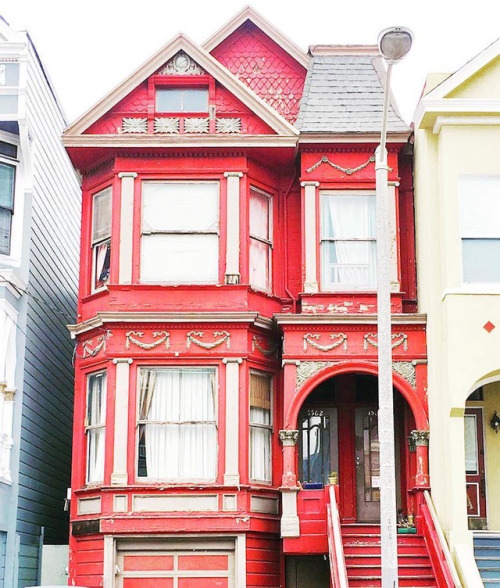
i mean clearly the price is insane but omg THIS HOUSE
Landmark home hopes for landmark deal
The spectacular red and black Roos House at 3500 Jackson, designed by Bernard Maybeck, architect of such San Francisco treasures as the Palace of Fine Arts, listed today asking a princely $16 million to match its dramatic Tudor style.
Realtor Nina Hatvany calls it a “stunning example of Maybeck’s architectural work,” singling out “the Great Room with 20-foot ceilings opening into a formal dining room” in particular.
Hatvany dubs the opulent listing a “once in a lifetime opportunity,” which, salesmanship aside, is almost certainly true.
Built in 1909 (although city records inaccurately date it to 1906) for clothing magnate Leon Roos, the 1992 book Bernard Maybeck: Visionary Architect lays out the power and the glory of the house’s lavish half-timbered design:
Panels of mauve plush edged with gold gimp harmonize with redwood walls. Redwood battens and moldings have Gothic profiles. Indirect lighting and diffused light from wall fixtures softly illuminate surfaces and details, while hanging chandeliers sparkle against the dark heights of the roof timbering.
[...] Wall coverings, light fixtures, and furniture - even the heraldic crest of the owner's initial ornamenting the entrance door - were fashioned from designs by Maybeck.
Since its construction, the property has undergone very few alterations, all of which were designed by the original architect, Bernard Maybeck.
Alterations occurred in 1913, when a balcony on the first story at the rear of the house was enclosed to become the sitting room off the living room alcove. A garage, constructed in 1916, was later demolished in 1982 and rebuilt in the same style and materials as the house.
A dressing room was added to the second floor in 1919. In 1926, the “Morning Room” was added onto the second story at the rear of the house. In 1926, the “Morning Room” was added onto the second story at the rear of the house.
The owner sold the rear garden plot (also designed by Maybeck) after the 1989 Loma Prieta earthquake to raise funds for repairing the rest of the house.
Owner and seller Dr. Jane Schaefer Roos married local lawyer and Leon Roos son Leslie Roos (who was actually named after his mother, Elizabeth Leslie Roos, for whom the elder Roos originally commissioned the house) back in 1962.
Unpredictable work schedules can make it impossible for retail and restaurant workers – especially working moms – to arrange child care and make ends meet, but that may be about to change for workers in Oregon.
Fair scheduling is one of the feminist and labor movement’s next big fights. If you’ve ever worked a retail job, you know that many employers saddle low-wage employees with unpredictable or on-call work schedules. Here’s how it works: employers can change retail workers’ hours based on predicted demand, with little notice, and often creating chaos in workers lives.
As Vox points out, the retail, healthcare, and restaurant workers most affected “tend to be young women of color who have children at home.” One in six Oregon workers reported having less than 24 hours notice before their shifts. If you have to come into work on late notice, that means scrambling to find childcare; if your shift is cancelled, that means fewer hours, less pay, and the risk you won’t be able to make ends meet that month.
And unfair scheduling can depress future earnings: if you have to work a wildly unpredictable schedule to hold down your job, you can’t reliably take a second job or go to school part-time: in fact, a University of Oregon survey found that many workers with low-wage jobs are forced to “give up furthering their education.”
Oregon’s on track to change that: their state legislature just became the first in the country to pass a Fair Work Week bill. The bill, which gathered bipartisan support, would require companies with more than 500 employees worldwide to give their workers work schedules with at least one week of notice starting next year, and two weeks’ by 2020.
The law would also protect workers from retaliation for simply asking for preferred shifts (shockingly, this kind of retaliation is A Real Thing) and establish that workers have a right to a 10-hour break between shifts (with the option to voluntarily agree to a shorter rest period for extra pay).
Oregon Governor Kate Brown (who, side note, is openly bi, a self-identified “radical feminist,” and so cool) is expected to sign the bill soon.
Oregon’s on track to be the first state to pass a Fair Work Week law, but they won’t be the last: According to Vox, Connecticut, California, North Carolina, and Massachusetts are all considering fair scheduling legislation. Cities are leading too: Seattle, New York, and San Francisco have passed Fair Scheduling legislation in recent years. New York and San Francisco even require employers who change workers’ schedules at the last minute to pay their employees.
Want to help? Contact your reps and say it’s time to support working families.
Joan Osborne (55)
Jaden Smith (19)
Sky Ferreira (25)
Sophia Bush (35)
Milo Ventimiglia (40)
Kathleen Robertson (44)
Beck (47)
Billy Crudup (49)
Michael Weatherly (49)
Rocky Carroll (54)
Andrew Fletcher of Depeche Mode (56)
Toby Keith (56)
Robert Knepper (58)
Kevin Bacon (59)
Monty Don (62)
Anjelica Huston (66)
Wolfgang Puck (68)
Raffi (69)
Jeffrey Tambor (73)
Janice Pennington (75)
Steve Lawrence (82)
Oops, she did it again: Somehow, Britney Spears has once again made us love her even more.
The pop star recently raised one million dollars through her "Piece of Me" show ticket sales to benefit the Nevada Childhood Cancer Foundation (NCCF). According to People, the NCCF is set to open its 16,000 square-foot Britney Spears Campus later this year, which will be used to host over 45 services for adults and children.
"There are many things I've done in my career that I am proud of, but none more than this," Spears said in a statement. "The fact that I was able to use my celebrity status to raise the money to build this incredible facility to help sick children and their families when they need it the most not only brings many tears to my eyes, but really brings tremendous meaning to this amazing journey that I have been on."
Spears has been performing at Planet Hollywood Resort & Casino in Las Vegas since 2013 and she announced in April that the final show of her residency will be on New Year's Eve of this year. During her four-year stay, the "Lucky" singer released an album, Glory, toured across Asia, and made a splash in Israel. Now, she's hoping to leave behind a different kind of legacy, one that's deeply personal to her.
"My aunt Sandra died of cancer, and I know the devastating effects that this terrible disease brings upon its victims and their loved ones, but when it happens to innocent young children, there's literally nothing I can think of worse than that" Spears said in a statement. "I'm just glad that I can help in some small way. I want to thank the NCCF for the amazing work they do on a daily basis, and I look forward to being there to officially open the Britney Spears Campus of the Nevada Childhood Cancer Foundation in the fall."
Claire Biddles: Bruno Mars is magical and perfect and earnest and corny and I will continue to theorise about how he would be the perfect celebrity boyfriend and keep you in silk sheets and lobster dinners and, apparently, Versace gowns to acquaintances while drunk as long as he keeps making pastiches of “I’ll Make Love To You” that are somehow the equals of “I’ll Make Love To You.” [10]
David Sheffieck: As if he’s decided to make every other current pastiche artist (but especially Pharrell) seem like they’re playing in the kiddie pool with their warmed-over rehashes of ’70s funk, Mars takes keytar and woodblock percussion and a showman’s ability to commit completely to the cheesiest of concepts, and turns out a masterpiece of a throwback that’s uniquely his. I remain unsure which is the peak Bruno Mars moment of the song, in part because the entire thing seems like peak Bruno Mars, but I think I’ve narrowed it down to two: the command “Dance!” prefacing a keytar solo, or the way he compliments the girl’s dress so passionately it seems like he almost regrets helping her take it off. [9]
Scott Mildenhall: Who knew Bruno Mars was such a fan of Johnny Hates Jazz? Well “Looking For Linda” is a banger after all, and it sounds even better after this invasively oleaginous pelisse procedural. He’s long traded in homage and pastiche, but this must be his first single that’s outright parody. [4]
Alex Clifton: If you want to do a sexy song, powerhouse vocals are not the way to go. Nor are superfluous lyrical details (“I unzip the back to watch it fall/While I kiss your neck and shoulders” — trust me, I didn’t want that much info, Bruno). Ditto extended synth solos that lead to an entirely unnecessary key change that doesn’t actually elevate the mood. Somewhere, Tommy Wiseau is upset he didn’t use this for the sex scenes in The Room. [2]
Eleanor Graham: Who exactly is this for? In case anyone was in any doubt, the kids do not want this at prom. The kids want the SZA album followed by “Mr Brightside” six times. Slow jams have to be justified by interesting production, which this doesn’t have. The key change is actually the sound of Bruno Mars’s MJ hubris reaching crisis point. *Frank Ocean voice* I’m not even into Versace. [2]
Maxwell Cavaseno: Bruno Mars doing an ’80s quiet storm jam in the style of “Between The Sheets”/”Curious”/Whatever WBLS is about to hit you with that makes your manager get real nostalgic during those opening shifts makes perfect sense. The only petulant complaint that ruins the illusion for me is the invocation of the Versace itself, a crass display of modernity in which Bruno implies glamour not sonically or lyrically, but with a bit of Brand Signifier. Normally Mars is allowed to channel his mimicry into a pastiche that sounds like so much but isn’t anything concrete. Here, he’s not only blatantly going for a certain style, he’s botching it in a way that’s seemingly minute but infinitely disruptive. [5]
Jonathan Bradley: Bruno Mars is an artist so invested in the artistry within pastiche he called an album Unorthodox Jukebox before another wag could stick a less kind version of the epithet to him. So I want very much to like his take on the ’90s slow jam, but it strikes its poses too precisely; Mars counts his steps so carefully it might as well be audible. The title image is marvellous, but to the detriment of the rest of the track. The-Dream, whose fingerprints are all over this — though the credits indicate he played no role — would tease out the tensions between passion and luxury consumption, making modern these old moves, but Mars is, for once, doing nothing more exciting than paying skillful tribute. [5]
Katherine St Asaph: Bruno Mars, as ever, is detail-oriented approaching fanaticism: Versace peaked in popularity — see: one of the few dresses with its own Wikipedia article — around the same time this music peaked in the pop mainstream. Bruno’s also really perverse: a synthesis of old-fashioned “Just the Way You Are” romanticism and old-school R&B pastiche should be an obvious hit, but in his devotion to period accuracy he does it via sex far more stylized and soft-focus than the current imagination (the joke in “That’s What I Like” is he’s the one who’d be lucky to find someone whose fantasies involve shrimp scampi and strawberry champagne), and slow jams associated these days with the dentist’s office. And he’s persuasive in this perversity — he convinces even David Guetta(!) to mostly leave the instrumental alone. Do any of these mean good? They at least mean different. [5]
Thomas Inskeep: Of course Babyface had a hand in Mars’s 24K Magic album: it’s the most joyously ’80s R&B flashback since, I dunno, maybe ever? What’s really surprising is that he didn’t have a hand in this song, which is the best 1989 Babyface ballad(ish) of the 2010s, expertly produced by Mars’s crew Shampoo Press & Curl and written by ’em too. This is a gorgeous track, as sweet as a song whose key line is “Let’s just kiss ’til we’re naked” can be. Bobby Brown wishes he’d had this on Bobby, trust. [8]
Alfred Soto: My respect for his mimicry is inversely proportional to my revulsion toward his influences. I suppose I should be grateful that “Versace on the Floor” segues from gross Styx mirror moves to French kissing with Gregory Abbott. [5]
Tim de Reuse: Breathtakingly uncanny; whizzes right past “sexy,” right past “sexy in a fun, silly way,” right past “good-spirited parody,” and right past “Tim & Eric-style hyper-exaggerated gross-out throwback” to confidently land in an antiseptic luxury slime netherworld full of soft light and awkward dissolve shots and the expression that Captain Kirk gets across his face when he thinks he’s saying something seductive. [1]
Stephen Eisermann: I’m still trying to understand everyone’s obsession with Bruno Mars, because he’s nothing more than a mediocre radio hit-maker to me. Bruno’s biggest weakness is his upper register, and his fascination with throwing out the tinniest of high notes is on full display in this track. What starts as an over-baked wooing attempt turns into a strainfest from the two-minute mark on and it doesn’t make for a pleasant listen. I challenge anyone to try and seduce their preferred lover by singing strained high notes. I promise you, it won’t work. [4]
Kendall and Kylie Jenner just released a collection of vintage music tees on their site. Each shirt, featuring iconic acts like Pink Floyd, Metallica, Led Zeppelin, the Doors, and Tupac, is one-of-a-kind and numbered. Each also features, for some baffling reason, the duo’s names, initials, or faces.
Because everyone who finally finds that perfect worn-in vintage T-shirt featuring their favorite band thinks “You know, there’s just one thing missing...”
A giant pink image of Kendall is splayed across a “Trust Nobody” T-shirt starring Tupac and Biggie Smalls. And while it’s doubtful the duo has ever listened to a Pink Floyd album, they’ve released a tee of the Division Bell album’s image with two giant Ks on it. It definitely needed that. Each one of these costs $125, by the way.
Doesn’t Metallica’s Kill ‘Em All album cover look so much better with a decal of an Instagram image of Kylie half-nakey?
The Kardashians/Jenners truly have no limits for vanity, even in the company of prodigies like Tupac Shakur.
“sorry we removed that little bin from the bathroom, it was ruining the vibe, you should use a mooncup anyway babe” pic.twitter.com/CM5ZHjYhZq — amelia horgan (@joan0fsnark) June 23, 2017
Writes an academic article that only cites male critics and theorists, but uses ‘she/her’ whenever talking about the imagined reader. pic.twitter.com/Eg66C2vCZw — charlotte (@splendababy_) June 24, 2017
Guests will be seeing double when they visit Brookfield Zoo’s Pinniped Point in a few weeks. Two California Sea Lion pups were recently born, and they are the first of this species born at the zoo in nearly 30 years.
The new pups are currently behind the scenes, bonding with their mothers, and learning how to swim, as well as being monitored by animal care staff. It is anticipated the pups will have access to their outdoor habitat in a few weeks.
The first pup, a female, was born on June 4 to seven-year-old Josephine. A week later, on June 11, Arie, who is estimated to be about nine-years-old, gave birth to a male.
Photo Credits: Brookfield Zoo/Chicago Zoological Society (CZS)
California Sea Lion pups are usually born in June and July and will weigh between 13 to 20 pounds. Pups do not swim for their first few weeks of life, but rather stay in tidal pools until they can go to sea with their mothers. They nurse for at least five months and sometimes for more than a year. In the wild, after giving birth, mother Sea Lions will leave their offspring for a short time while they forage at sea. As the pups grow stronger, the mothers leave them alone for longer periods. Mother Sea Lions recognize their pups through smell, sight, and vocalizations.
The new additions at Brookfield Zoo are very important to the genetic diversity of the accredited North American zoo population for the species because of the unique backgrounds of the two moms as well as of Tanner, the pups’ sire. All three adults were wild born and deemed non-releasable by the government for various reasons. All were taken in and given homes at three accredited facilities: Aquarium of Niagara, Brookfield Zoo, and Shedd Aquarium.
“We couldn’t be more thrilled with the birth of these two Sea Lion pups, which is a coordinated effort between us and our partner facilities,” said Rita Stacey, Curator of Marine Mammals for CZS.
Josephine was abandoned by her mom at the popular tourist attraction, Pier 39 in San Francisco, which is a highly unusual place for a California Sea Lion to give birth. As a newborn, Josephine was helpless and would have starved to death without human intervention. The Chicago Zoological Society (CZS) stepped forward and offered to give her a home at Brookfield Zoo, where she was hand-reared and has resided since 2010.
In 2009, at approximately one year of age, Arie was found stranded on a beach, where she was rescued and rehabilitated three times by a California stranding center before being deemed non-releasable and given a forever home at the Aquarium of Niagara in Niagara Falls, New York. She arrived at Brookfield Zoo in 2016, based on a recommendation from the Association of Zoos and Aquariums’ California Sea Lion Species Survival Plan (SSP). The program manages the breeding of Sea Lions in North American accredited zoos to maintain a healthy and self-sustaining population that is both genetically diverse and demographically stable. Jennifer McGee, Lead Animal Care Specialist for CZS, is the coordinator of this plan and also manages the studbook for the species. In these roles, she is responsible for documenting the pedigree and demographic history of each individual California Sea Lion at each institution and assists in making breeding recommendations.
Tanner, who is estimated to be 14 years old, arrived at Brookfield Zoo from Shedd Aquarium also based on a breeding recommendation. In 2012, Tanner received a second chance at life when Shedd Aquarium staff offered to provide him a new home after he was removed permanently from the wild by NOAA Fisheries for feeding on a federally protected endangered species of salmon in the Bonneville Dam area on the Columbia River. Government officials gave him the distinguishing and permanent ID on his back, “C011,” to be able to accurately identify him should he return to the dam to feed again on the endangered salmon. Despite several attempts to relocate him to another area, Tanner continued to return to the dam.
Although California Sea Lions (Zalophus californianus) are listed as “Least Concern” by the International Union for Conservation of Nature, the species still face challenges in their natural habitat along the west coast of North America from Vancouver Island in British Columbia, to the southern tip of Baja California in Mexico. These threats include entanglement in fishing gear, toxins they ingest from their prey, intentional dumping of toxic and hazardous waste, and changes in global atmosphere pressure that affects the availability of prey. Today, the 1972 Marine Mammal Protection Act protects all marine mammals, including California sea lions.
Those interested in helping care for the California Sea Lions at Brookfield Zoo can contribute to the Share the Care program. For $35, the recipient will receive the Basic Package, which includes a 5-inch x 7-inch color photograph and fact sheet about the species, a personalized adoption certificate, a Share the Care car decal, and an invitation to the annual Share the Care Evening. For further information, visit: www.CZS.org/SharetheCare .
Here, people experiencing homelessness, mental illness, and addiction find community
“My problem isn’t that I couldn’t pay my rent or I left my place. I didn’t have a place,” Mike Perry remembers of his life when he first got to Seattle in the late ‘80s. “Homelessness—at the time, I was fine with it, I didn’t care. But when I got into the point where I got into treatment two years ago, I cared. I didn’t want to be homeless anymore.”
Perry talked to us at Recovery Cafe, an unassuming, one-story brick building at the corner of Boren and Denny. The structure should stand out more than it does, sitting on its own traffic island and surrounded by taller buildings, but it seems to blend into the background.
Inside, a central kiosk houses an espresso station, or self-serve coffee and water. A small buffet provides some self-serve meals. It’s the tables around the “cafe” part that seem like the more key part of the programming though—some occupied by people playing games or talking, others by someone just having a rest. On colorful walls around the room, decorations spell words like “love” and “forgiveness.”
In the corner, some members work in a small computer lab. Sometimes the cafe hosts open mic nights.
It’s here that Perry found a community of people going through the same thing—not here, physically. Back when he first came to the cafe, it was at Second and Bell in Belltown, where they first opened in 2004. He came at first for AA meetings in 2006, but slowly got to know the community in the cafe.
This is what the cafe’s entire model is based on: community.
“We have people that have lost in such traumatic ways that without the support of community there’s no hope of rebuilding the life that they want to live,” founding director Killian Noe explained. “The reality is that’s true of every one of us when we’ve suffered trauma and we’ve lost life as we knew it. None of us can put that together by ourselves.”
“The difference is that a lot of our members don’t have others in the way of family or friendships, and so this becomes their family,” said Noe. “This becomes their home.”
The cafe, says Noe, provides a support system when that kind of support—the kind we get from our friends and our family—is hard to come by.
“The difference is that a lot of our members don’t have others in the way of family or friendships, and so this becomes their family,” said Noe. “This becomes their home.”
Their model is spreading. Through the Recovery Cafe Network, they’re supporting people in five cities at a time in starting their own cafes. So far, new cafes have sprouted up in Tacoma, Everett, Spokane, and San Jose.
Here’s how it works: When someone comes to the door, they can be a guest for the day, as long as they’re drug and alcohol free. Noe told us that one member, knowing he wasn’t sober, stayed far away from the door, telling them, “that space needs to stay sacred.”
“If it’s obvious that a person isn’t drug and alcohol free,” said Noe, “then we ask them to please, please, we really want you to come back, and in the meantime we have AA and AA meetings down the hall on our same property, but with a different entrance.”
After they’re a guest for a day, they’re invited to come back the next day.
“We are in second, third generation of membership,” said Ruby Takushi, an addition psychologist, Recovery Cafe co-founder, and current director of programs. “It’s people that know us that told someone else they know us that told someone else they know us.”
When someone becomes a member of the Recovery Cafe, they join a “recovery circle”—a small group of about six that meets to check in and provide support.
“These are people that have shared experience,” said Tukashi. “There’s an authenticity about that sharing that is really humbling.”
That sharing can just be talking about their day or their struggles—or it can mean sharing coping strategies, providing encouragement, or sharing tips for moving within a system that can be tough to navigate. A city survey earlier this year found that many people experiencing homelessness found the system challenging for a number of reasons, including long waiting lists, challenges, and inexperienced case management.
“Once people feel safe enough to share their struggle, there’s kindness and there’s generosity,” said Takushi. “Nobody wants other people to be struggling in the way that they are.”
“Once people feel safe enough to share their struggle, there’s kindness and there’s generosity,” said Takushi. “Nobody wants other people to be struggling in the way that they are.”
Perry said he found housing through other cafe members. “There’s always someone here to talk to that’s going through exactly what you’re going through or has been there,” he explained. “But you won’t know unless you speak up, and that’s why these circles… you can sit around with five or six, maybe seven of your own peers in a small setting and share what’s going on with you instead of talking to 50 people.”
The cafe doesn’t provide housing itself, and that’s by design. When Noe and Takushi were building the program, they found organizations that provide housing, although Noe clarifies, “Are there enough low-income housing units? No. Absolutely no.”
“What they did need, and this is what Ruby and I have become to understand at deeper and deeper levels, is a group that would hold people who are in that very fragile place when they first come in here, when they first come in here,” she continued.
“But I still come here when I can, and I just jump right in. Instead of picking up a beer I pick up a broom.”
While the circles are at the core of the cafe’s model, they also provide education through what they call the School of Recovery. Classes range from addiction recovery to creative writing to knitting, plus fitness classes, like the walking club. The yoga class has been especially popular—a few members have even gotten their certification, Tukashi tells us.
For Perry, though, it’s all about staying out of his head. “What the cafe has allowed me to do is come in here four days a week, eight or nine hours a day, and allow me to stay out of my head by staying busy,” he expla. “ I still come here when I can, and I just jump right in. Instead of picking up a beer I pick up a broom.”
When people “stabilize in their mental health, in their physical health, in their employment, in their relationships in all the things that make up a good life, the same thing everybody wants,” Noe explained, it helps people “stabilize in the housing when it becomes available to them. And I say when, because sometimes the wait is excruciatingly long.”
“Looking for housing takes time, getting housing takes time,” explained Perry. “It’s like a job. looking for a job. it’s job in itself. it’s the same thing with housing, it’s a job. the thing about it is you don’t have to do nothing alone… You have resources, and the resources are people.”
“Sometimes the wait [for housing] is excruciatingly long.”
“If you’re running around trying to do something on your own it’s probably not going to happen—speaking from experience, you’re going to give up, say eff this, I don’t need this,” he said.
Even once you’re in housing, said Takushi, it’s good to have that community to support the transition: “It’s not always ideal, it may be a different living situation that they’re not accustomed to or they might need different health supports that aren’t available.”
Noe gave one example: One woman was a regular at the cafe was hospitalized for mental health crises nine times in a year. After joining a recovery circle, she “began to stabilize”—and even after finding her apartment, others in her circle checked in on her to make sure she was handling everything okay.
“I was in recovery circle with her—they’re small groups where people are deeply-known and held,” remembered Noe. “When I was in group with her, whenever she would start hearing voices again, members of the group would [say], you’re doing too much, let’s take a step back.”
“If you’re running around trying to do something on your own it’s probably not going to happen—speaking from experience, you’re going to give up, say eff this, I don’t need this,” Perry said.
That woman, Noe said, worked with the cafe for nine years, and eventually graduated from college.
Perry went back to school himself recently. “I’m in the last phase of my CDL training, drive big rigs. Hopefully—no, I’m not going to say that. Next Wednesday I’m going to have my CDL,” he told us. “The beautiful part of this isn’t even that I’m getting to the end or that I’m getting CDL, it’s the journey. It’s that for once in my life, I didn’t quit… and now I’m about to see the fruits of my labor by not quitting, no matter how many times I failed.”
But it hasn’t always been easy—Perry’s no stranger to relapses. “Last time I left the cafe I was gone for two and a half years,” he said.
But eventually, he came back to his community at the cafe. “When I came back from that 2 and a half year relapse, when I came through those doors, they met me where I was. And by them doing that with love and support and patience, I was able to get enough confidence to go to school—not just pass, just going to school was big for me.”
“We might have all the same problems, you might get [help] before I get it, but we’re all going to keep supporting you,” said Perry. “And then once you get it, you can be that much more supportive to someone who’s trying to get where you are. This is the beauty of the cafe as I see it.”
The famed, polarizing Flintstone House in Hillsborough, located at 45 Berryessa Way, landed on the market in 2015 for a whopping $4.2 million. Since then, it saw several pricechops. And in May, it found a buyer. Today the final sale price was announced.
After asking $3.19 million, it closed for $2.8 million, according to Judy Meuschke of Alain Pinel Realtors.
Korie Edises, who bought the place in 1996 for $800,000 (the equivalent of $1.23 million today) ended up netting a hefty return. Now the big question remains—will the new owner keep the unique abode as-is?
Using innovative building materials, architect William Nicholson built the home in 1976. Its one-of-a-kind look—a series of rusty orange blobs relaxing in the hills over I-280 in Hillsborough—is an unofficial South Bay landmark.
Regarding the home’s special structure, Curbed SF noted in 2015, “The rounded forms are made by spraying a kind of concrete on metal frames molded over balloons.” Colloquially known as the Flintstone House, it's also referred to as the Barbapapa House “after the circular, shape-shifting creatures featured in a children's book from the 1970s.”
Fingers crossed that this beloved, cartoonish abode stays true to form.
Openhouse LGBT Senior Housing, Community, and Services celebrated the grand opening of an apartment complex billed as the country’s first housing geared toward the elderly LGBT community.
Mostly financed “with low income housing tax credits and with monies from the Mayor’s Office of Housing and Community Development,” according to a San Francisco Bay Timesarticle by Marcy Adelman, co-founder of Openhouse, the residential development will be a hub for LGBT seniors.
“In a city that is in some ways very youth-focused, it’s nice to have a home that’s specifically about seniors,” says Dr. Karyn Skultety, executive director of Openhouse. “That’s specifically about seniors who led a particular civil rights movement from this city, in this city, who can stay in this city.”
Once a college building called Richardson Hall, the Openhouse complex is now comprised primarily of one-bedroom units, ranging from $821 to $1,146. The new space also houses the Bob Ross LGBT Senior Center, the city’s first space dedicated to the needs of the LGBT elder community.
As for who gets to call the place home. Openhouse used a lottery system with a seven-day application window, open to citizens who are 55 years and older, whose income “does not exceed 50 perfect of Area Median Income (AMI).”
While the complex does not solely house LGBT seniors, seventy percent of the residents are LGBT seniors. Other units are reserved for people living with HIV or for residents at risk of homelessness.
There was also a higher preference placed on neighborhood location, according to Skultety, where 40 percent of the LGBT housing population must come from nearby neighborhoods.
“A lot of the work that we do is about bringing people together [and] what better way to be together than to live in an LGBT-welcoming environment where your support system becomes your neighbors and other people who live in the building,” says Skultety.
In August, Openhouse will break ground to add an additional 79 units and 7,000 square feet of program space.
Please, please, please let HGTV to do an episode of House Hunters in Concho, Arizona, because I really need to see a picky couple say, “Doesn’t have the granite counters or hardwood floors that I love, but I can see myself enjoying my morning coffee on this scratching post bench as my 200 cats slowly suffocate my body while begging for more food.” In Concho, AZ is a house that’s for sale for $240,000 and it’s covered from ceiling to floor with pussy, pussy, pussy and not the kind that Charlie Sheen’s house is covered with.
If you’re a people-hating cat hoarder who wants to be trapped in a Lisa Frank-like cat-themed acid trip and loves to wake up to the sour aroma of overused litter and pussy pee, get your ass to Concho. Your purradise has been found. Making the rounds today is a listing for a house that’s 2,500 square feet, has 2 bedrooms and 1 bath and sits on 20 acres in the middle of absolutely nowhere in Arizona. The good news about being in the sticks is that you don’t have to worry about annoying neighbors complaining about the screeches from your dozens of cats. You also don’t have to deal with them throwing you judgmental looks when they see you making a gorgeous front yard cat sculpture out of the slimy hairballs your pussies coughed up.
Here’s how a real estate agent used words to try to sell the almost unsellable:
Contemporary eccentric full log sided custom home on 20+/- acres for the cat fancier! If you love cats this is the home for you! If not bring your sandblaster! Custom build, hardwood kitchen cabinets (Oak, Lacewood, and Bocote) artistically accented with river rock. Cat walkways and in great room Medieval cat castle with different levels (stone). All interior doors custom built (wood). Must see to believe it does exist!!! Once in a lifetime find extremely fun home!
It’s like a house Taylor Swift would live in if she wasn’t a multi-millionaire celebrity. And this pussy palace is also perfect and move-in-ready for someone who really, really hates their dog.








/cdn.vox-cdn.com/uploads/chorus_asset/file/8848993/jack2.jpg)
/cdn.vox-cdn.com/uploads/chorus_asset/file/8848995/jack3.jpg)
/cdn.vox-cdn.com/uploads/chorus_asset/file/8848999/jack4.jpg)
/cdn.vox-cdn.com/uploads/chorus_asset/file/8849001/jack5.jpg)
/cdn.vox-cdn.com/uploads/chorus_asset/file/8849003/jack6.jpg)
/cdn.vox-cdn.com/uploads/chorus_asset/file/8849007/jack7.jpg)
/cdn.vox-cdn.com/uploads/chorus_asset/file/8849009/jack8.jpg)
/cdn.vox-cdn.com/uploads/chorus_asset/file/8849011/jack9.jpg)
/cdn.vox-cdn.com/uploads/chorus_asset/file/8849017/jack11.jpg)
/cdn.vox-cdn.com/uploads/chorus_asset/file/8849013/jack10.jpg)







/cdn.vox-cdn.com/uploads/chorus_asset/file/8767617/KK0118GA_KendallPortraitRap_Pink_Flat_Front.jpg)
/cdn.vox-cdn.com/uploads/chorus_asset/file/8767623/KK0120GB_KKMonogramRock2_Black_Flat_Front.jpg)
/cdn.vox-cdn.com/uploads/chorus_asset/file/8767629/KK0117GB_KylieInstagramRock_White_Flat_Front.jpg)

/cdn.vox-cdn.com/uploads/chorus_asset/file/8764271/CafePan5Small.jpg)
/cdn.vox-cdn.com/uploads/chorus_asset/file/8764319/Panorama_2000.jpg)




/cdn.vox-cdn.com/uploads/chorus_asset/file/4437537/ML81513899_1_1.0.jpg)
/cdn.vox-cdn.com/uploads/chorus_asset/file/4437547/ML81513899_5_1.0.jpg)
/cdn.vox-cdn.com/uploads/chorus_asset/file/7777899/ML81513899_2_1.0.jpg)
/cdn.vox-cdn.com/uploads/chorus_asset/file/4437541/ML81513899_3_1.0.jpg)
/cdn.vox-cdn.com/uploads/chorus_asset/file/7777785/flint4.jpg)
/cdn.vox-cdn.com/uploads/chorus_asset/file/7777791/flint6.jpg)
/cdn.vox-cdn.com/uploads/chorus_asset/file/7777797/flint9.jpg)
/cdn.vox-cdn.com/uploads/chorus_asset/file/7777795/flint8.jpg)


/cdn.vox-cdn.com/uploads/chorus_asset/file/8734125/14495301_10154603245379329_1551670822726460761_n.jpg) Photo via
Photo via