There is more here from Matt Yglesias.
What do you think you get if you add 1+2+3+4+5+... all the way on up to infinity? Probably a massively huge number, right? Nope. You get a small negative number:
This is, by a wide margin, the most noodle-bending counterintuitive thing I have ever seen. Mathematician Leonard Euler actually proved this result in 1735, but the result was only made rigorous later and now physicists have been seeing this result actually show up in nature. Amazing. (thx, chris)
Update: Of course (of course!) the actual truth seems more complicated, hinging on what "sum" means mathematically, etc. (via @cenedella)
Update: As usual, Phil Plait sorts things out on this complicated situation. (via @theory)
Tags: Leonard Euler mathematics videoFrom Bret Victor, a reading list of meaty material from the past year. His Reading Tip #1 in the sidebar is how I'd like my ideal self to read:
It's tempting to judge what you read:
I agree with these statements, and I disagree with those.
However, a great thinker who has spent decades on an unusual line of thought cannot induce their context into your head in a few pages. It's almost certainly the case that you don't fully understand their statements.
Instead, you can say:
I have now learned that there exists a worldview in which all of these statements are consistent.
And if it feels worthwhile, you can make a genuine effort to understand that entire worldview. You don't have to adopt it. Just make it available to yourself, so you can make connections to it when it's needed.
Fantastic tip.
Tags: Bret Victor listsFrom a presentation at SIGGRAPH Asia 2013, a demonstration of a program that learns how to walk by evolving the orientation of its muscles.
Love these kinds of things. I remember another video like this that went around a few months ago...but instead of bipeds, it was a a shambling collection of cubes that learned how to move around. Anyone have a link?
Update: Ah, here's that other video; I posted it back in April. (thx, @_DavidSmith)
Tags: video


Created in 2006 by multidisciplinary artist Kimsooja, To Breathe – A Mirror Woman was an elaborate installation at the Palacio de Cristal, Parque del Retiro, in Madrid. Originally built in the late 1880s to house a collection of flora and fauna from the Philippines, Kimsooja transformed the Palacio de Cristal into a multisensory sound and light experience. A special translucent diffraction film was used to cover the windows to create an array of naturally occurring rainbows which were in turn reflected by a mirrored surface that covered the entire floor. Additionally, an audio recording of the artist breathing was played throughout the space to further enhance the experience. The installation was on view through the end of the summer and you can read much more about it here.
Kimsooja most recently wrapped the Korean Pavilion with a similar film treatment at the 2013 Venice Art Biennale. (via My Amp Goes to 11)
Matt Zwolinski has an interesting article which attempts to answer the question "Why Did Hayek Support a Basic Income?". His answer is that Hayek did so because such a minimum endowment of economic means grants people the essential freedom to say "no"--thus making up for "real" freedom of contract. Matt stresses that Hayek was more concerned than most libertarians with the idea that "unbalanced" market relationships may also be a source of coercion.
I think Matt brings together a neat summary of some well-pondered arguments for a guaranteed minimum income. I would have thought, however, that the Hayekian arguments for a basic income were different.
I think that a Hayekian argument for the basic income is that it would minimize state interventions and, thus, discretionary powers on the part of lawmakers as opposed to contemporary welfare systems.
Hayek believed that there was a legitimate role for collective action against "the extremes of indigence or starvation". Certainly, as Matt remarked in a previous article that David Henderson sharply criticized here, "Hayek was not opposed to the welfare state as such (not even in the Road to Serfdom). At the very least, he regarded certain aspects of the welfare state as permissible options that states might pursue".
However, Hayek was also concerned "with the process by which an apparatus originally meant to relieve poverty is generally being turned into a tool of egalitarian redistribution. It is as a means of socializing income, of creating a sort of household state which allocates benefits in money or in kind to those who are thought to be most deserving, that the welfare state has for many become the substitute for old-fashioned socialism" . He saw clearly the limit of a welfare system that ended up in tinkering with economic life. For example, he maintained that "a compulsory scheme of so-called unemployment insurance will always be used to 'correct' the relative remunerations of different groups, to subsidize the unstable trades at the expense of the stable, and to support wage demands that are irreconcilable with a high level of employment" (The Constitution of Liberty).
Hayek feared that "bleeding heart" policies may endanger the market process. He thought the claims for redistribution were by and large built upon a misunderstanding of markets and a sense of nostalgia for societies based on face-to-face interactions, where (very limited) resources were orderly "distributed" rather than generated in the market process. He eloquently remarked that "those who attack great private wealth do not understand is that it is neither by physical effort nor by the mere act of saving and investing, but by directing resources to the most productive uses that wealth is chiefly created" (Law Legislation and Liberty II. The Mirage of Social Justice). In a market society, people get rewarded for their contributions in a restless process of learning, not because of their "just deserts".
The problem with social justice is thus that it embodies "a demand that the members of society should organize themselves in a manner which makes it possible to assign particular shares of the product of society to the different individuals or groups" (Law Legislation and Liberty II. The Mirage of Social Justice). This would imply a series of continuous interventions in the market process - and, ultimately, the demise of those general, uniformly applicable norms that make for the rule of law.
Thus, a basic minimum income is a smart solution to (a) keep our allegiance to the idea we shall accept some sort of poverty mitigation device but (b) refuse to accept the bureaucratization and the social and economic planning that inevitably comes with "organised benevolence", as Hayek repeatedly pointed out. By providing people with a basic income you do not play with prices (including the price of labour), and society spares herself the (self-interested) intermediation of a welfare apparatus. A basic income is less paternalistic, and may have seemed to Hayek a good way to avoid what happened in the years when he was writing, particularly in England: that is, increasing redistribution, nationalizations, and regulation of the economy going hand-in-hand.
Of course, the interesting question is: could this version of the idea of a basic income survive the test of the political process? And what about its unintended consequences? Hayek would have been fine with replacing the welfare state altogether with a basic income. In Europe at least, most advocates of the basic income are for adding it to the existing welfare provisions. If this happened, I suspect Hayek would not be very confortable in the position of the useful idiot (neither would Matt, for that matter).
Inspired by the escalating blade count of the razor industry, Nabisco has developed a new snack called the Quadriscuit.
"At the moment, this hyperwafer can only exist for six milliseconds in a precisely calibrated field of magnetic energy, positrons, roasted garlic, and beta particles," lab chief Dr. Paul Ellison told reporters at a press conference outside Nabisco's $200 million seven-whole-grain accelerator.
The last line of the piece made me LOL for real. (thx, meg)
Tags: food physics scienceПредставляем 15 самых обсуждаемых иллюзий года, доказывающих, как легко обмануть наши глаза.
Будьте осторожны! Некоторые иллюзии могут вызвать слезоточивость, головную боль и дезориентацию в пространстве.
Гипноз

Смотрите, не моргая, в середину изображения 20 секунд, а потом переведите взгляд на чье-нибудь лицо или просто стену.
Смотрите на крестик в центре

Периферическое зрение превращает красивые лица в монстров.
Черно-белое или цветное

Если пристально смотреть на точку в центре черно-белого изображения в течение 15 секунд, то картинка обретает краски.
Невозможный слон

Рисунок Роджера Шепарда.
Чёртово колесо

В какую сторону крутится колесо?
Дракон Гарднера
Или дракон Джери Андруса (по имени создателя) как его ни крути все время смотрит на наблюдателя.
Одинаковые или разные?

Как две сигареты могут быть одновременно разного и одинакового размера?
Стул-невидимка

Оптический эффект, создающий у зрителя ложное представление о месте нахождения сидения, обусловлен оригинальной конструкцией стула, придуманного французской студией Ibride.
Иллюзия цвета

Не отрываясь смотрите на крестик и вы увидите, как фиолетовые пятна станут зелеными. А потом вовсе пропадают.
Черно-белая иллюзия

Смотрите тридцать секунд на четыре точки в центре картинки, после чего переместите взгляд на потолок и поморгайте. Что вы увидели?
Четыре круга

Будьте осторожны! Эта оптическая иллюзия может вызвать головную боль продолжительностью до двух часов.
Пульсирующий постер

В какой точке картинки вы бы ни сфокусировали свой взгляд, картинка ни на секунду не перестает двигаться.
Клетки шахматной доски

Разного ли цвета клетки A и B шахматной доски? Иллюзия восприятия цвета, опубликованная профессором Массачусетского технологического института Эдвардом Эдельсоном (Edward H. Adelson) в 1995 году.

Бесконечный шоколад

Если разрезать плитку шоколада 5 на 5 и переставить все куски в показанном порядке, то, откуда не возьмись, появится лишний шоколадный кусочек?
Later in life, he disapproved of anyone who he thought had hastened the Soviet Union’s downfall, or who had been unable to control the political and economic turbulence that followed. In memoirs and interviews, he was harshly critical of Mikhail S. Gorbachev and Boris N. Yeltsin.
To the end he remained loyal to what he called Socialist ideals and the leaders who gave them shape, and seemed untroubled by the hardships endured by his family during the early years of Soviet rule. His family’s land and home had been seized during collectivization, and when he was a child the family was deported into the Siberian wilderness. His father died during their first Siberian winter, and one of his brothers labored for seven years as a prisoner digging the White Sea canal.
Still, General Kalashnikov spoke of his great respect for Lenin and Stalin alike. “I never knew him personally,” he said of Stalin, “and I regret this.”
There is more here. I think of him as one of the last tinkerer-inventors from the mechanical tradition, which stretched through the twentieth century but is becoming increasingly obsolete. Precisely because he was from this tradition, his famed rifle was relatively easy to fix, clean, and maintain, easy to equip with interchangeable spare parts, and thus it was easy to use for killing people in poorer countries with lower levels of the division of labor. There is a good Wikipedia page on the rifle here. He will go down in history as a good example of what was wrong with much of the twentieth century
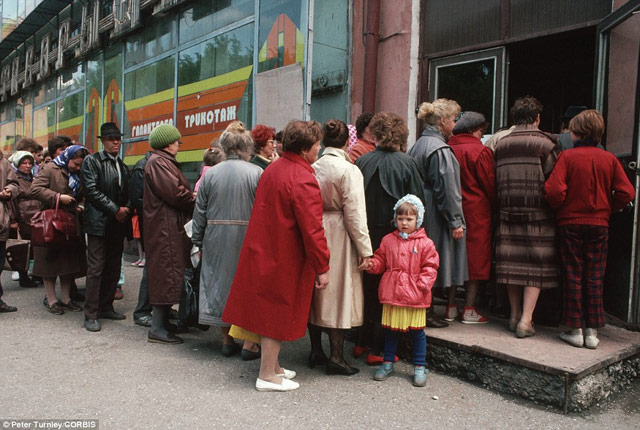
People waiting in line for food in the Soviet Union in the late 1980s:
The opening day line for the newest outpost of the Shake Shack in Moscow:

That's nothing, though, compared to the line to get into the first McDonald's in the Soviet Union, which opened in Moscow in 1990.
A year later in Moscow, an estimated 1.6 million people turned out to see Metallica in concert. Look at all those people:
Tags: communism food McDonald's Metallica Russia Shake Shack Soviet UnionI was somewhat surprised by these numbers:
Fifty-three percent of the uninsured disapprove of the law, the poll found, compared with 51 percent of those who have health coverage. A third of the uninsured say the law will help them personally, but about the same number think it will hurt them, with cost a leading concern.
I wonder if any of this poll was conducted in Spanish, and if not whether that would have changed the results. I found this interesting too:
Of the uninsured who said they were not likely to sign up by the deadline, fully half said it was because of the high cost. Twenty-nine percent said they planned to go without coverage because they object to the government’s requiring it, and 11 percent said they did not need health insurance.
And this:
Seventy-seven percent of the uninsured said they disapproved of the mandate, compared with 65 percent of those who already have health insurance.

Suppose the Grand Canyon were man-made. It could have been formed (though it wasn’t) by agricultural or industrial erosion; the results of poor farming methods can look very similar — artificial badlands — if on a smaller scale. Would this hideous scar on the fair face of the earth still be a national park? Would anyone visit it other than groups of awed schoolchildren studying Environmental Destruction, absorbing the dreadful lesson of what can happen to a desert raped by human exploiters? Strip mining can produce spectacular and dramatic landscapes. W.H. Auden loved the lead-mining landscapes of Cornwall above all others; the evocative and aromatic hillsides of the Mediterranean, with their olives, sages, thyme, and dwarf conifers, are a result of centuries of deforestation, goat herding, and the building of roads and cities.
– Frederick Turner, “Cultivating the American Garden: Toward a Secular View of Nature,” Harper’s, August 1985










Liu Bolin - The Invisible Artist’s newer (and some older) works. official gallery and from and from
Just wow.
Joswald1By reach, they mean able to contact quickly via telephone. I am in the hard to reach and happy about it category.
Notably, easy-to-reach women are happier than easy-to-reach men, but hard-to-reach men are happier than hard-to-reach women, and conclusions of a survey could reverse with more attempted calls.
That is Ori Heffetz and Matthew Rabin, in the new AER. An ungated version is here. Understandably, the authors are worried about potential subject selection biases in studies of self-reported happiness.
Icelandic police have shot dead a man who was firing a shotgun in his apartment in the early hours of Monday.
It is the first time someone has been killed in an armed police operation in Iceland, officials say.
There is more here.
Joswald1“There are four kinds of countries: developed countries, underdeveloped countries, Japan, and Argentina.” – Simon Kuznets
Here is a good point about Japan:
If there’s one asterisk to put after the shocking comparative figures, it’s that the debt-to-GDP ratios don’t take into account Japan’s huge asset holdings. At the end of March 2012, Japan’s central government had assets totaling some Y600 trillion, roughly half of its total liabilities projected for next March, separate MOF data show. And those assets include Y250 trillion in cash, securities and loans. Critics often say Japan’s fiscal health could quickly improve if the government sells some of those assets, a step the MOF is reluctant to take partly on worries that doing so could deprive lawmakers of incentives to improve government finances.
Here is my July NYT column on related matters.
I posted a video earlier today of a Super Cub airplane landing on the side of a mountain. Super Cubs are ideal for that undertaking because of their low stall speed and short take-off and landing distances. But I had no idea you could land and take off in one in the space of 20 feet.
Never seen a plane do that before...well aside from tiny model planes. What an incredible power-to-weight ratio that plane must have. You can seriously land these things anywhere, almost like a helicopter. Wanna go fly fishing? Just set it down on the banks of a stream:
Or on a gravel bar in a river:
These planes are referred to as STOL (short takeoff and landing) aircraft; here's some detail on how they work. (via @alper)
Tags: flying video