Shared posts

07 Jul 10:59

Frustration vs. Video Game Violence in Real-Life Aggression

by Jamie Madigan

Much to the annoyance of many gamers, whether video game violence causes real-world violence is a frequently studied topic in psychology. A definitive answer to this question, though, is still missing despite the fact that psychologists have been studying it for decades.

Or rather, there’s a lot of disagreement. Many politicians, researchers, and children advocacy groups point to lab studies, surveys, and meta analyses1 that show violent and aggressive behaviors follow exposure to violent games, and that their case is incontrovertible.2 Other researchers say that they can …controvert it. Is “controvert” a word? Let’s say “controvert” is a word. They do this by pointing to other studies and meta analyses that fail to show a link, as well as flaws in the theory and experimental designs of the opposing camp.3

I’ll get into the details of that debate another time, but the point is that the results of research on violence and aggression in games are mixed. There are several possible reasons why, but when I recently surveyed this literature it occurred to me that one may be that these studies have historically taken a very unsophisticated view of video games. Games differ widely in their design and so they surely differ widely in the ways that they interact with us and affect us psychologically. Some research, for example, shows that the context of the violence matters, and that shooting zombies while defending a teammate may affect our internal mental state differently than shooting the same zombies with the same weapons for no other reason than for sport.4
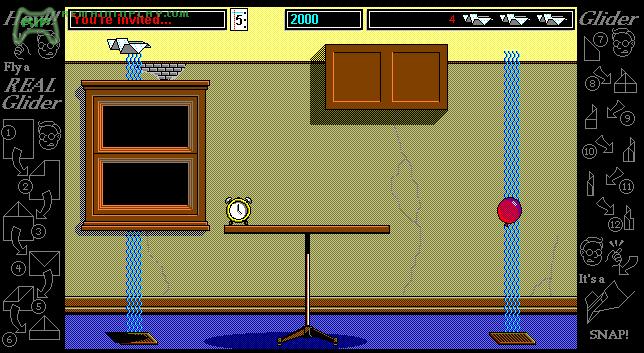
Glider Pro

Glider Pro is an example of a nonviolent game typically used in research.

But it might be even more fundamental than that. A 2004 study by several of the biggest supporters of the “video game violence leads to real-world violence” camp found the results they were looking for when they had some subjects play a nonviolent game and others play a violent one. The researchers found that those who played the violent game had more aggressive thoughts and moods than those who played the nonviolent one. But let’s take a closere look. In the nonviolent game, Glider Pro 4, players use just two keyboard keys to guide a paper airplane through a simple, two-dimensional environment. The violent game, Marathon 2, is a standard first-person shooter where players uses a mouse and 20 keys to navigate through a complex, three-dimensional environment.
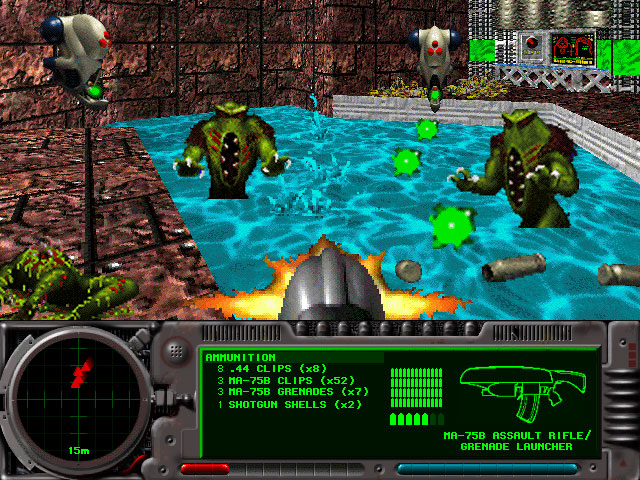
Marathon 2

Marathon 2 is typical of the violent games used in research.

There is a possible problem with this design. The researchers concluded that the violent nature of Marathon 2 was to blame for the increase in aggressive thoughts and mood, but it might have been that the complex nature of the controls were too much for new players to feel like they could do what they wanted in the game. This could then lead to frustration and a slightly hostile mood. In research parlance, this difference in the control complexity between the games is known as a “confound” because it offers an alternative explanation for the results.

This is exactly the thought that Andrew Przybylski (pronounced “Shuh-Bill-Skee”) and his colleagues (pronounced “colleagues”) had, and it lead them to an interesting study that was just published in the Journal of Personality and Social Psychology.5 In that study, they wondered how much frustration over one’s inability to master game controls contributed to aggression, as opposed to the violent content of a game.

Przybylski and his colleagues used self-determination theory as a guiding framework for their research. In short, this theory posits that people are motivated to play video games to the extent that they scratch three psychological itches: the need to feel competent at what you’re doing, the need to feel like you have meaningful choices when deciding how to do it, and the need to feel connected and related to others in the process. The researchers posited that when controls are difficult to master, it thwarts the need for competence. This leads to frustration. Frustration leads to anger. Anger leads to hate. Hate eventually leads to blowing up Alderaan just to show some uppity princess who’s boss.

To test this idea, Przybylski and his colleagues conducted a series of seven experiments, including a recreation of the Glider Pro 4 vs. Marathon 2 study described above. They also modified Half-Life 2 Deathmatch to create a nonviolent version where opponents were painlessly tagged and teleported to a penalty box instead of being blown to bloody bits. My favorites, though, were Studies 3 and 6, where they had subjects play the most nonviolent game imaginable, Tetris, but then screwed with them.

In Study 3, half the subjects played Tetris with normal, intuitive controls (see Figure 1) while half of them played with controls that were deliberately made to be counter intuitive and difficult to master right off the bat (see Figure 2). Just imagine trying to remember that the triangle button was for moving left, but that the left trigger was for moving right and the square button was for instantly dropping a block to the bottom of the screen –all under constant time pressure. In study 6, the researchers moved beyond thwarting competence just by making the controls tricky; they actually increased the difficulty of the game. Subjects once again played Tetris, but for some of them the researchers thwarted their sense of competence by modifying the game so as to analyze the situation at the bottom of the board then give them the absolute worst possible block. Need a long, skinny block to slide into a 1×4 gap and complete four rows at once? Screw you. Here’s a 2×2 block. Feeling aggressive now?
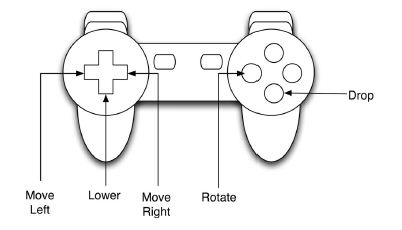
Figure 1

Figure 1, taken from Przybylski (2014)

All throughout the seven experiments, the researchers included measures of both control mastery, competence in general, and aggressive thoughts, emotions, and mental states. The short version of the results is that video games could make people feel aggressive and think violent thoughts simply by thwarting their sense of competence, either through difficult to master controls or general difficulty. This was true even in the absence of violent imagery.
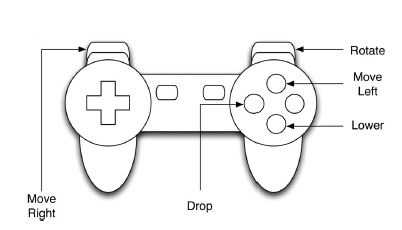
Figure 2

Figure 2, taken from Przybylski (2014)

This makes a lot of sense to me. Many of us have been in multiplayer matches where your team just plain sucks, and no matter what you do you can’t keep the opposition off the capture points or away from your flag. That undermining of your competence is frustrating and leads to rage quitting. So can difficult to use controls in any game. Just recently I was playing through the new Thief game and got frustrated with it when I couldn’t line Garrett up to jump up and grab a dangling rope so I could get him away from a patrolling guard. I actually pounded my desk in frustration after the third attempt because I felt that this should be SO SIMPLE yet I couldn’t do it.
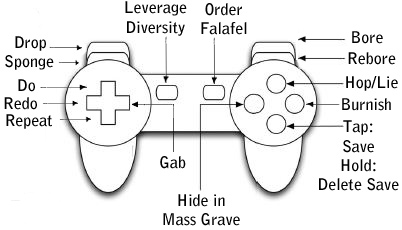
Figure 3

Figure 3, not actually taken from Przybylski (2014)

It’s worth noting that Przybylski et al.’s 2014 paper doesn’t address the question of whether or not violent games can make one violent, either in the short or long term. For example, it didn’t look at whether violent and nonviolent games with equal difficulty and frustration potential could affect children the same or differently. But that wasn’t necessarily the intent, Przybylski told me in an e-mail. The point was to show that games are complex, as are our interactions with them, and there are many theories about what makes for fun, frustrating, or enjoyable game beyond just how much red is on the screen. Alternative explanations for the effects of video game violence abound, and psychologists studying video games needs to better understand their nature and systems before designing research on them. This is why some of the best research on video games and psychology is starting to come out of people who grew up with the hobby and now getting established at universities and labs.

The violence in video games scene needs to move beyond simply “do they or don’t they” and look more carefully into what qualities of the game might or might not be more important for a variety of outcomes.

Follow me on Twitter, Facebook, or RSS.

05 Jul 12:24

Horsin’ Around…

by admin

26 Jun 19:16

A Wild Week

by admin

26 Jun 17:37

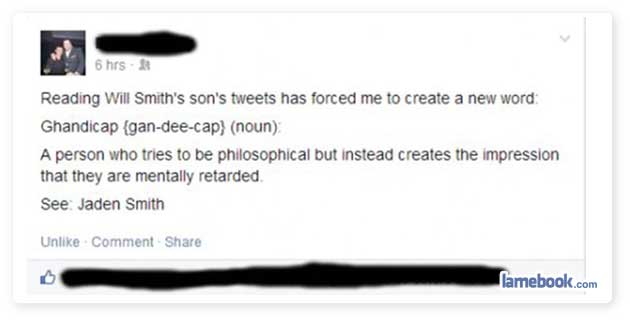
Ghandicap

by admin

24 Jun 20:45

Potassium Posse

by admin
Andrewerose

we missed an opportunity at carnival

12 Jun 03:03

NINTENDO: Yoshi's Woolly World confirmed for Wii U

Andrewerose

@lau - looks like a mario-esque platformer

Yoshi’s Woolly World is on the way to Wii U. The game promises a friendlier, more accessible experience than that offered by Mario’s platformers. Visually it draws on the theme of yarn...

MCV is the leading news site for the game industry. Check out our news, press releases and interviews.
11 Jun 16:09

King is trialling a new Candy Crush game

Andrewerose

@all you candy crush addicts

King has soft launched a new Candy Crush game entitled Candy Crush Soda Saga. This is not a sequel to Candy Crush but a sister title. At the moment it is being play-tested in Canada, Sweden, Spain...

MCV is the leading news site for the game industry. Check out our news, press releases and interviews.
11 Jun 11:47

Sought After Sentences

by admin

09 Jun 03:11

OH NO!

by admin

30 May 07:11

Mario dies in this surreal live-action Mercedes advert

by Dave Cook
Andrewerose

I like cartoon mario better

Mario Kart 8 is getting some free Mercedes DLC in Japan to tie in with the launch of the car manufacturer’s GLA model. The promotional has also received a weird advert that sees a live-action Mario die at the hands – well, feet – of a Goomba.

It follows my Mario Kart 8 Wii U review. The game’s out May 30 in the UK.

mario-kart-8-mercedes

The DLC is coming in the summer and there’s also word that a GLA tournament is coming in the Fall, although the specifics have yet to be confirmed.

Here’s the trailer:

In a statement to Joystiq, Nintendo said, “The announcement this time was made by Mercedes-Benz Japan regarding their collaboration in Japan with Nintendo Co. Limited.”

“As for the information relating to the distribution of the GLA kart for Mario Kart 8 outside Japan, we will be able to announce in the near future.”

So the DLC might come west later on. We’ll update you once we hear more, but for now, here’s some nightmare-fuel to play us out:

mario-mercedes-advert

mario-mercedes-advert_1

mario-mercedes-advert_2

mario-mercedes-advert_3

Christ.

27 May 16:32

Charging a Charger

by admin

13 May 15:08

TMI MIA

by admin

13 May 15:06

Morning News: May 9, 2014

by Eddy Elfenbein
Andrewerose

@lau - Sharing for the 3rd from bottom Kashi claim

12 May 15:35

Sooooo

by admin
Andrewerose

and the theme of the day for lamebook is...

05 May 11:05

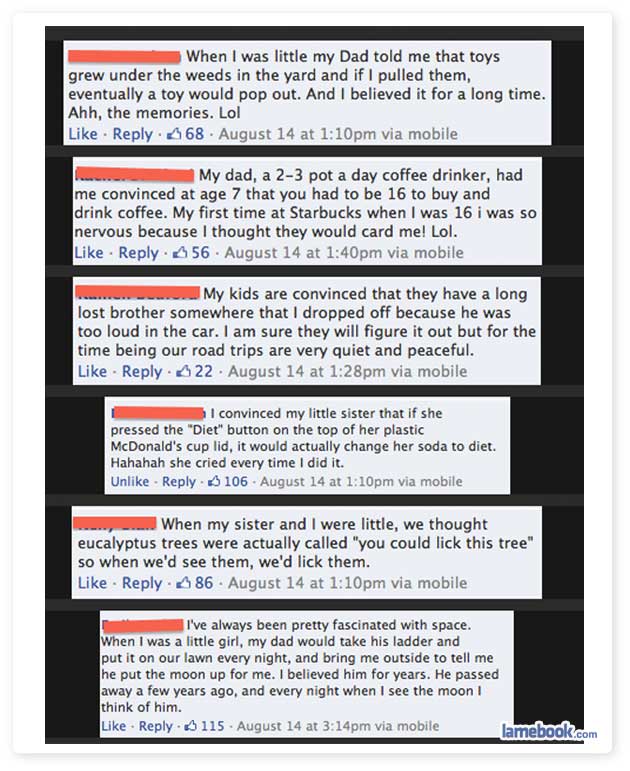
Lies we tell our kids…

by admin

25 Apr 02:54

Who ya gonna call???

by admin

18 Apr 13:43

Ron’s Face

by admin

18 Apr 05:05

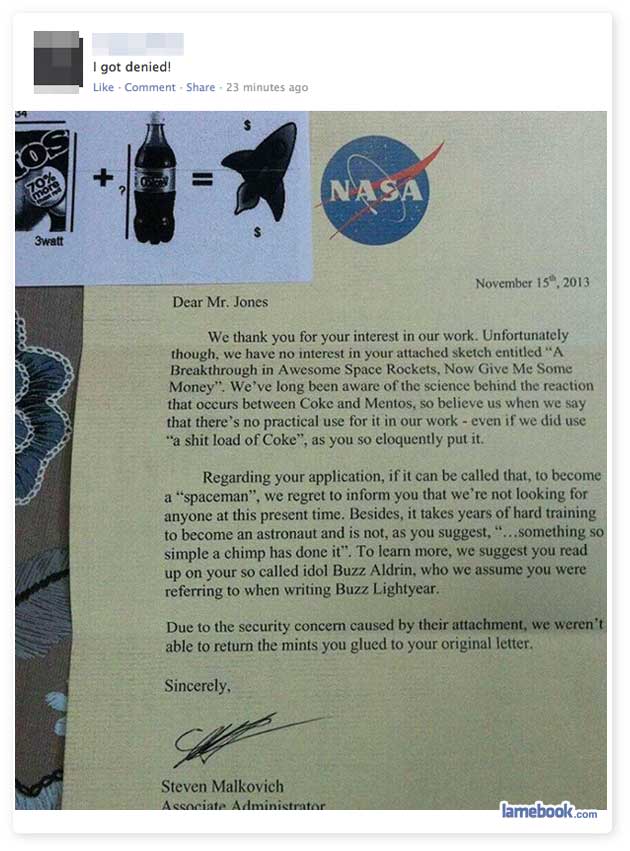
Denied!

by admin

04 Apr 11:22

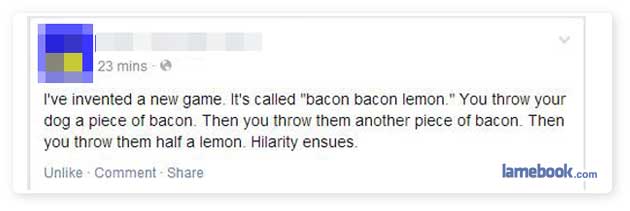
Bacon Bacon Lemon

by admin
Andrewerose

@Pretto's - now that Jersey has remained four legged it's time for fun!

26 Mar 12:59

Why I think King’s share price will fall by half

by Nicholas Lovell
Andrewerose

I just can't get on board with the King hasn't replicated Candy Crush. It has 2 other games in the top 10 grossing apps. That's replicating.

The valuation of King has me terrified.

If King tanks after its stock market debut this week (and I think it will), that will be bad news for the games industry for the next three years.

Zynga’s miserable performance is still fresh in people’s minds. Zynga convinced the market that its metrics-driven design process had eliminated the risky nature of the games industry. It had two proven “franchises” in the “Wars” games (although these had peaked) and the “-Ville” games and acquired a third (“With Friends”) through acquisition.

Yet all the metrics in the world couldn’t hide the fact that the titles were formulaic and derivative. Zynga has indeed brought metrics into the mainstream of the games industry, much to the good, but it has also demonstrated the limits of metrics. Metrics-led design can only seek out local maxima. It can make what already exists better. What it can’t do is take designers and players on new journeys, to new experiences that inspire their souls. Metrics-led design is good; creative-led, metrics-informed design is way better.

Which brings me back to King, which is expected to price an IPO this week with a valuation of $7.5 billion. My rough estimate is that King’s valuation should be is nearer to half that.

King’s success is predicated on one game, Candy Crush Saga, and one franchise, the “Saga” series, which it humorously calls its “first” franchise. Candy Crush Saga makes up 78% of gross bookings for the company. Three games – Candy Crush Saga, Pet Rescue Saga and Farm Heroes Saga – make up 95% of gross bookings. The company has also grown sharply. Revenues rose from $64 million in 2011 to $164 million to an astonishing $1.9 billion in 2013, mainly on the back of Candy Crush Saga.

What can grow ten fold in a year can fall ten fold in a year

image

I am in awe of what King has achieved in the past 11 years. Founded in 2003 as a skill gaming business, King has pivoted three times, first away from skill gaming, then from the browser to Facebook, then from Facebook to mobile. Any company that can achieve a successful pivot once deserves our respect. A business that can do it three times is impressive indeed.

It has also got lucky. Candy Crush Saga is a phenomenon up there with 50 Shades of Grey, Flappy Birds and Gangnam Style. A global phenomenon that captured the zeitgeist. Psy, the creator of Gangnam Style, was sanguine about his success. “It wasn’t me. It was the people. And what happens if they don’t do it again next time.” And they didn’t. Can you name Psy’s next YouTube hit after Gangnam Style? *

King’s valuation is predicated on the continued success both of Candy Crush Saga and of a successor to Candy Crush Saga. It’s $7.5 billion expected valuation is barely 10x the operating profit the company made in 2013. Which is a steal if you believe the 2013 operating profit is a good proxy for performance in the future.

Which I don’t.

What does King look like as a steady state company

I believe that King is a three product company that has a good track record of putting out high-quality casual games on multiple platforms. It has also struck oil once. I am nervous valuing it on the basis of striking gold again.

I have tried to “normalise” King’s business. Out of its $1.9 billion in 2013 revenues, Candy Crush Saga represented 78% or $1.47 billion. It makes 95% of gross bookings when added to Pet Rescue Saga and Farm Heroes Saga. Stripping Candy Crush Saga out suggests that Pet Rescue Saga and Farm Heroes Saga made $320 million in 2013, or $160 million each. So a steady-state King game, by my estimations, makes around $160 million a year.

There are some heroic assumptions in here. The 78% and 95% figures are based on gross bookings, and I am assuming they apply equally to revenue. I am treating Pet Rescue Saga and Farm Heroes Saga equally, even though Pet Rescue Saga has 15 million DAUs and Farm Heroes Saga has 8 million DAUs. I am crediting King with being able to create these franchises without the halo effect and cross promotional benefits of the Candy Crush leviathan. But bear with me.

So looking forward, let’s assume that King has three “steady state games” (CCS, PRS, FHS) and can produce another in 2014. That would suggest revenues of $640 million. (4 x steady state game revenues of $160 million). Strip out 30% platform holders fee leaves $450 million in net revenue (or gross profit depending on your definitions). Margins are likely to be under pressure, as King invests heavily both in new development but mostly in defending its position with marketing spend, so I estimate a 30% operating margin on the net revenue, leaving operating profit of $135 million.

Put that on a multiple of 15x and you get a valuation of just over $2 billion. Put it on a multiple of 20x and the valuation is $2.7 billion.

But what about Candy Crush?

Of course that valuation ignores Candy Crush. And you can’t ignore Candy Crush Saga, because without it King wouldn’t be floating. But how to value a one-off hit that King has not been able to replicate and that appears to have peaked? King’s Q4 2013 revenue numbers fell in the fourth quarter of 2013, the last quarter for which numbers are available, from $621 million to $602 million. Candy Crush Saga may have peaked in July, according to analyst Arvind Bhatai at Stern Agee.

But peaking doesn’t mean the same as “is over”. It’s a still a single game making around $1.5 billion a year. It has 93 million Daily Active Users (although King does count the same user playing on tablet, smartphone and Facebook as three Active Users). It is a profitable, declining business. If you knock off the platform fee of 30% and assume a 30% margin on net revenue, it is still making $315 million of profit a year.

So a declining business making $1.5 billion in revenue and $315 million in profit. Perhaps its worth 1x sales ($1.5 billion). Or 10x profits ($3.1 billion). Let’s split the difference and call it $2.3 billion. But we’ve already included $500 million of value for Candy Crush Saga in the steady state valuation above, so the Candy Crush Saga “premium” is $1.8 billion.

What about the next hit?

All of this is valuing King on its fundamentals. But what about the potential for it to make the next big hit?

At one level, what about it? That is not a game you should play in the stock market. That is for investors with high risk tolerance, probably in the public markets. But let’s be generous. Let’s assume that there is some valuation sizzle for the potential for King to knock another one of the park. I’ll add an extra $575 million for this, which is a quarter of the Candy Crush Saga valuation and implies a one in four chance of it happening. I think I’m being generous.

So what is the valuation

This process gives me three components to King’s valuation:

  • $2,000 million, the lower of the steady state valuations
  • $2,300 million, the Candy Crush Saga premium
  • $575 million, the sizzle factor in case King gets another blow out hit.

Combined, that is a valuation of $4,875 million.

I could be accused of making aggressive assumptions both for the bull case and the bear. I have assumed King maintains a 30% margin after the platform share, which is much lower than its current margin, which is enhanced by the success of Candy Crush and much higher than its historic margins – the company was loss making in 2011, for example. Marketing costs are going up as the market becomes more competitive. I have based my valuation on historic figures when any analyst worth his salt knows that it is only forecasts that matter. Arvind Bhatia estimates that King’s 2014 revenues will be $2.62 billion. I haven’t seen a detailed forecast, but if margins stay steady at 38% of gross revenue, that’s $1 billion in operating profit. On that basis, a $7.5 billion deal sounds cheap.

Which is the whole conundrum of King’s valuation. The company has struck oil. It is not pricing at the top end of the comparables on the basis of this dependence on a single title. It probably seems to executives and shareholders at the company as if this valuation is a steal.

I have enormous admiration for King. Its three pivots, its doggedness, its ability to not only bottle lightning but then to harness it to launch other titles have all been enormously impressive. To the risk takers and entrepreneurs who founded and invested in the business, it’s looking great. But to the investors in the public markets, the pension funds and life insurance companies and widows and orphans, their tolerance for risk is much lower.

So my conclusion is that King’s real valuation is below $5 billion, not over $7.5 billion. I expect that the banks will get the IPO away, because I have rarely seen an IPO get to this stage and not happen. But I expect the buyers to be the ill-informed and the followers, not the price setters. I expect the price to fall over the next four weeks. If it does, it won’t fall to my $5 billion. The market will get angry and fearful. The price will plummet.

I hope it doesn’t. I really do. Because of my respect for what King has achieved and because of my fear for what a second failed IPO would do to the market.

But it was I think will happen. Which makes me sad.


* It’s called Gentlemen.

The numbers in this piece are predominantly drawn from King’s registration statement .

07 Mar 20:33

Can’t Unsee

by admin

03 Mar 19:36

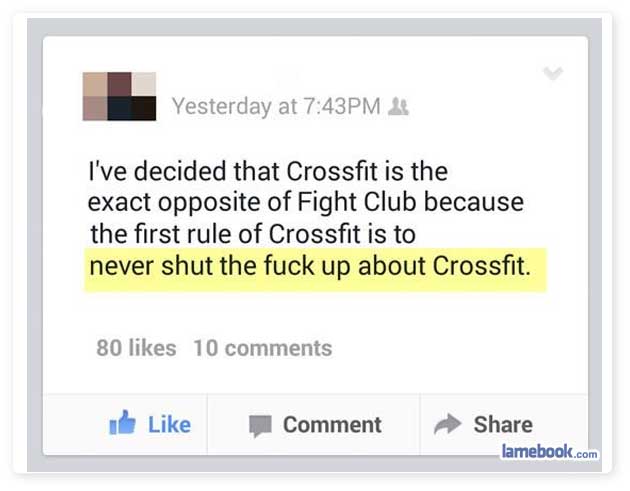
First Rule of Crossfit

by admin

21 Feb 19:15

Mario Kart ride-on coming to UK

Andrewerose

new trike?

Jakks Pacific has partnered with Nintendo to launch the first ever Nintendo licensed Mario Kart ride-on. Known as the Super Mario Kart Ride-On, the vehicle is the real life counterpart to Mario's...

MCV is the leading news site for the game industry. Check out our news, press releases and interviews.
20 Feb 12:21

Hero of an Idea

by admin
Andrewerose

@lau - missed opportunity

19 Feb 21:21

EXACTLY

by admin

14 Feb 03:01

Mario Kart 8 gets UK release date

The biggest game on the Wii U release calendar has a UK release date. The game will launch on May 30th, and will let players control Bowser's minions for the first time. Mario Kart 8 does not...

MCV is the leading news site for the game industry. Check out our news, press releases and interviews.
13 Feb 17:43

Friday Games

by ILuvNUFC
Andrewerose

sharing for the spot the skyline game. Thought i'd do better.

12 Feb 18:15

Mario Kart 8 heading to Wii U in May

Mario Kart 8 will arrive for Wii U this May, according to Nintendo. In a company briefing, Nintendo president Satoru Iwata stated that the next offering in the Mario Kart franchise will see release...

MCV is the leading news site for the game industry. Check out our news, press releases and interviews.
11 Feb 18:37

Me too…

by admin
Andrewerose

@lau - should we ever have a 2nd. Airwrecka Rose has a nice ring to it.

30 Jan 20:26

April Fools

by admin