In “Advanced Readings in D&D,” Tor.com writers Tim Callahan and Mordicai Knode take a look at Gary Gygax’s favorite authors and reread one per week, in an effort to explore the origins of Dungeons & Dragons and see which of these sometimes-famous, sometimes-obscure authors are worth rereading today. Sometimes the posts will be conversations, while other times they will be solo reflections, but one thing is guaranteed: Appendix N will be written about, along with dungeons, and maybe dragons, and probably wizards, and sometimes robots, and, if you’re up for it, even more.
Welcome to the tenth post in the series, featuring a look at The Carnelian Cube by the prose tag-team of L. Sprague de Camp and Fletcher Pratt.
[Read more]
Mordicai Knode: Here we go again. Neither of us was very keen on Lest Darkness Fall, and frankly, The Carnelian Cube is more of the same, even with the addition of a co-author. I mean, I haven’t finished the book yet, so there is a chance for the story to take a sudden right turn and surprise me, but I doubt it will happen. In fact, The Carnelian Cube might even be a worse offender; part of what made Lest Darkness Fall so frustrating was the inherent misogyny of the story, but there the sexism is largely related to the romantic subplots. Here, the romance is sort of the main frame of the story—or at least, it holds up each of the repeated vignettes—which makes the whole “women as explicit objects” stand out all the more.
See, I get it, L. Sprague de Camp. You’re a cynic. I’m just exhausted by all this cynical fiction; I yearn for the “gee whiz!” of some of the other pulps, I guess. See, in Lest Darkness Fall, the gimmick of the story was that the protagonist—a upper crust academic white dude—is thrust into the end of the Roman Empire. In Carnelian Cube, an upper class white academic is...also thrown into a fish out of water scenario. In this case, it is a series of worlds linked by his imaginings—a world where reason flourishes, or where individuality is the watchword of the civilization—each given a dystopian twist. I will say this: it makes the “modern day humans thrown suddenly into a fantasy world!” elevator pitch of the Dungeons & Dragons cartoon make a lot of sense. Then again, so does Three Hearts and Three Lions, which I preferred.
Tim Callahan: This book demoralizes me. I can confidently say that it’s the worst book out of the entirety of Appendix N, and I haven’t even read all the books yet. I’m sorry to say that nothing happens in the last half of the book to save it, but it does spiral downward into its own abyss of humorlessness, so you have that to look forward to. And here’s the thing: L. Sprague de Camp and Fletcher Pratt are trying ever so hard to make this book hilarious. You can see it in every scene. They must have seen this book as nonstop laughs, because it has all the hallmarks of a comedy, with its ridiculously exaggerated characters and its sitcom-like set-ups and the unrestrained use of dialect. I mean, what could be funnier than characters who talk like local dinner theater actors in an oh-so-clever performance of Colonel Sanders Presents the Best of Mark Twain as Recited by Guys Who Were Known as Third-Rate Jim Varney Impressionists?
Practically the whole book is like that.
If Lest Darkness Fall was a riff on A Connecticut Yankee in King Arthur’s Court, but with more pedantic history lessons thrown in—and it was—then The Carnelian Cube is de Camp and Pratt’s Adventures of Huckleberry Finn plus their nerd-snobbery brand of satire and minus any redeeming qualities whatsoever.
I can’t believe how much I despised this book. But I really did. After the first chapter, which is just your standard set-up of “hey, here’s this weird artifact” and “what a weird dream” it just keeps getting worse and worse until the whole thing escalates into what I can only imagine is the equivalent of the worst 1980s Rodney Dangerfield movies that don’t even show up on cable any more.
You know what The Carnelian Cube is? It’s a Grand Guignol of the unfunny.
MK: Wait, did I just read a serious and straight-faced piece of Anti-semitism in this book? I mean, I was already like—“oh look, the people who aren’t white in this book are a bunch of second-class citizens and buffoons, but at least all the white people are buffoons too”—but then there was a...screed about miscegenation? Out of the mouth of one of the supporting characters, at first, but then the...protagonist steps in to help him refine his ideas of how the Jews and race mixing were to blame for the Assyrians? I kept thinking that the main character would contradict him, or at least have an internal dialogue about it, but sheesh! Nothing doing. You know, for a book originally published in 1948, that is...just, wow. Wow in a bad way. Hashtag Shaking My Head.
The book is sort of like, “what if Mel Brooks wasn’t really funny, and also was a huge misogynist?” Actually, the women in the story really work in that analogy; Mel Brooks also as a little bit of a ribald sense of humor (“a little bit” may be an understatement) and so his movies hinge on sex quite often, as well as historical gender roles. Mel Brooks, however, lampoons that, while at the same time still having, you know, jokes about Vestal Virgins. L. Sprague de Camp and Fletcher Pratt on the other hand would take the same opportunity and use it as an excuse to demean women, maybe have their protagonist bully and coerce someone, and sort of grin rakishly like “ain’t I a stinker?”
Yeah, Carnelian Cube. You are. You stink.
TC: I don’t know how else to talk about this book except to not talk about it, so I’m going to head in this direction: why do you suppose this book ended up on Gygax’s Appendix N list?
Other than the cube itself, which acts as a kind of alternate-reality hopping TARDIS-sans-quality, there’s little in the way of sci-fi or fantasy trappings in this novel. Not in any recognizable way that could have influenced a role-playing game. It is like a series of terrible Mel Brooks scenes written by computer science nerd who had only read about Mel Brooks scenes and also hated almost everything and thought that southern accents were inherently hi-larious.
But the cube is just a storytelling conceit and it doesn’t have any special powers in the way that a D&D magic item might—it can’t really be used, but rather it just propels its subject from one alternate reality to another, yet more non-hilarious and likely-very-offensive, alternate reality.
Maybe that’s the thing. Maybe that’s Gary Gygax’s sweet spot. He did base an adventure on his heroes bumbling down through a portal into a warped version of Alice in Wonderland. That was what he liked to see: some physical humor and some viciousness and something that we wouldn’t likely recognize as comedy. But only in small doses. Most of his adventures weren’t really like that. Or maybe they were. The fact that he goes out of his way to name not just these two authors, but The Carnelian Cube specifically as recommended reading is one of the great mysteries of Appendix N.
MK: Well, personally I think it is a factor of a couple of things at work; some petty, some rather insightful, actually. Well, not in the text—as established, a pretty terrible book—but in what I imagine Gygax’s reading of the text to be. First, there is the eponymous cube, which is a pretty viable template for a D&D artifacts, or at least a big influence. A classic MacGuffin. Secondly, there is the issue of perverting wishes; you know that is some Gygaxian flavor right there. If you give your players a Ring of Wishes, you are obligated to try to misinterpret them...the same way that the carnelian cube’s created dream worlds are pessimistic inversion of the users original intentions.
The other is in terms of worldbuilding. I think that glomming on to a high concept idea like “a world where pitiless logic wins” or “a world of individualism taken to the extreme” and spilling it out for a few chapters is actually a solid Dungeon Mastering trick. I mean, look at Star Trek’s Vulcans; they are basically just elves with “logical” thrown on as a cultural gimmick, right? That sort of tactic is a good way to add colour to your newest fantasy metropolis, or tribe of non-humans, or alternate universe. It might be a “cheap trick,” being a little inorganic, but as someone who runs a game let me just say that sometimes, cheap tricks are the best.
Still, not a good enough reason to read this book, though.
TC: And, as someone else who regularly runs games, I’ll say that silly accents go right along with single-minded high-concept NPCs, and Carnelian Cube is nothing if not full of those things. And I’ll second all of your remarks. Especially the part about not reading this book. Or recommending it. Or ever mentioning it again.
Tim Callahan usually writes about comics and Mordicai Knode usually writes about games. They both play a lot of Dungeons & Dragons.
 Mouse Guard: The Black Axe by David Petersen.
 Imperial Histories II by AEG.
 The Watchers Out of Time by August Derleth.
 Lest Darkness Fall by L. Sprague de Camp.
 I’m on the record as saying “break your canon” is my favorite role-playing game ideology, right? I’ve said it about the World of Darkness and now I’m going to say it about Legend of the Five Rings. If you aren’t familiar, Legend of the Five Rings is a game setting that takes its inspiration from Eastern sources, rather than Western ones; most crucially, feudal Japanese samurai stories. The Empire of Rokugan, where the stories of “L5R” are set, is richly developed, through a variety of sources, from collectible card games to published books, and much of it is fan driven. Imperial Histories 2 is exactly the sort of book I am looking for when I say “break your canon.” They smash Legend of the Five Rings wide open, exposing the guts, the nuts and bolts, proposing campaign settings like Miyazaki-like fables to steampunk samurai tales all the way to samurais…in spaaaaaaace….
[Read more]
“Imperial Histories” sounds fairly bland, as a title, but the book is anything but. Rather than just a collection of timelines, Imperial Histories 2 presents a series of radical options for groups wanting to play Legend of the Five Rings on their own terms. The campaign settings it offer fall into two camps: Rokugan in different time periods, at crucial moments in history, and alternate Rokugan settings, where a change in the game’s foundations create an entirely different world for the players, with entirely different assumptions. Neither approach is better than the other; there are some historical periods that are so fantastic or distorted that they might as well be another universe, and there are some alternate histories that are so believable that they feel almost like a glimpse of things to come.
The sections that shake things up the least are some of the historical settings. In these campaigns, key periods in Rokugan’s history are laid bare, allowing the players to either play through the margins of great historical events, or to take the stories off their rails by breaking the chain of history and doing their own thing. The sections have special rules, where appropriate, for houses and schools that are extinct in later times or that haven’t made some key divergence that later histories cause. The bulks of them, however, are in fact historical records; not bland keynotes, but charged moments that lend themselves to player interventions—or, if the PCs can’t be there, to the development of the metaplot.

Some of the sample historical sections include the return of the Unicorn, where a clan of samurai called the Ki-Rin left Rokugan only to return 800 years later, strangers much changed. Negotiating their new ways, and their new role in the empire, along with rising military threats, presents a challenge to a range of characters, martial, supernatural or courtier. The Heresy of the Five Rings deals with a religious—and of course, also political—schism in Rokugan’s history, and I couldn’t help but read it and think “I know how to fix this.” A good sign for a story.
The Four Winds is about the struggles of an Emperor’s children, would be heirs, battling for the throne; a great chance to the PCs to choose sides. The Age of Exploration is an interesting proposition, as well; in a game where contact with outsiders—gaijin—typically brings with it the threat of taboo, a chance to see the world beyond the Great Clan’s borders is tantalizing. If you play in the time of the Shining Prince, you can bump into the NPCs that everything in Rokugan is named after; all of the big mythical founders of the families are present. “Let’s adventure with Gilgamesh and Hercules,” the L5R way. The Eight Century Crises is a setting similar to the “modern” Legend of the Five Rings, with an array of threats against the empire, but different threats.

The time of the Steel Chrysanthemum, on the other hand, isn’t your typical historical period. No, the Steel Chrysanthemum is the Emperor who is basically the Pol Pot of Rokugan’s history—the Hitler, the Stalin, the Dai Li, and Lake Laogai, the paranoid deranged lunatic with the power of an absolutely loyal genius general who holds the known world in the grip of terror. Negotiating that web of politics strikes me as…intense. In fact, the only other period of history that is quite as terrifying would be the Destroyer War, when the goddess Kali-Ma and her hordes of demons—and, well, robots?—brought the Empire to its knees and almost destroyed it, but for a last minute deal with the devil. Sort of the literal devil. The war was just shy of being apocalyptic; I wonder of the PCs can do better, or worse?
Meddling with any given timeline seems natural, so it makes sense to include “What If?” settings. What if the world had changed at the Second Day of Thunders; what if instead of heroes returning from the climactic battle with the dark lord, no one came home? What if Aragorn didn’t live through the end of Return of the King? What if the time of the Four Winds ended up with a weaker heir claiming the throne, letting the wolves circle close?

The three most interesting settings are, for me, “The Togashi Dynasty,” which posits an alternate Rokugan where instead of the kami of Hantei becoming the first emperor of Rokugan, the Dragon clan kami Togashi did. Instead of a world of strength and compassion, of honor and duty, Rokugan becomes an altogether more magical place, a world where the story of Spirited Away or Princess Mononoke would fit right in. “Iron Rokugan,” or “The Era of White Stag” is the real deal—I currently run a weird fantasy campaign heavily inspired by Legend of the Five Rings, and this is closest to it—being a setting in which your samurai get guns and trains. The Pan-Asian setting and the advent of the industrial revolution really remind me of The Legend of Korra. Heck, if you wanted to play a commoner game, you could actually put the “punk” into steampunk, for a change. Last, but certainly not least, “The Emerald Stars” is essentially science fiction Legend of the Five Rings. The themes haven’t changed, but the pieces on the board have. Clans are still feuding over territory, but now the disputes involve planets. Strange outsiders still lurk on the fringes of the map, but they are aliens rather than gaijin.
Break your canon. It is like a piñata. Or, well, suikawari. If you hit it hard enough, all kinds of goodies will come out.
Mordicai Knode is contractually obligated to be on Team Spider, which means he’ll have to pitch really hard to get to play the morally grey Spider Clan. You can find him on Twitter and Tumblr.
 In “Advanced Readings in D&D,” Tor.com writers Tim Callahan and Mordicai Knode take a look at Gary Gygax’s favorite authors and reread one per week, in an effort to explore the origins of Dungeons & Dragons and see which of these sometimes-famous, sometimes-obscure authors are worth rereading today. Sometimes the posts will be conversations, while other times they will be solo reflections, but one thing is guaranteed: Appendix N will be written about, along with dungeons, and maybe dragons, and probably wizards, and sometimes robots, and, if you’re up for it, even more.
Welcome to the ninth post in the series, featuring a look at Lest Darkness Fall by L. Sprague de Camp.
[Read more]
Mordicai Knode: Stirrups. I always said that if I was somehow suddenly time-displaced back to like, ancient Sumer that my invention would be stirrups. You could introduce them and seem “clever” rather than “a witch,” and it would ingratiate you with the military powers, which can’t hurt. That, and it would give your local power base a leg up on the competition. Lest Darkness Fall asks a similar question: what if you went back to the Roman Empire? Well, that is a pickle. I think my answer might be...curing scurvy? I know that sauerkraut doesn’t have a lot of Vitamin C but does have the most “shelf stable” supply, and it is enough to keep scurvy at bay, so pairing it with opportunistically eating citrus is a good regimen. That isn’t what our protagonist goes for, but man, it sure gets me thinking.
Tim Callahan: Lest Darkness Fall got me thinking too. It got me thinking about high school Latin class and Mark Twain’s A Connecticut Yankee in King Arthur’s Court and some stuff I probably should have remembered from Western Civ I but didn’t. I enjoyed the heck out of this book—a book in which a clever modern man jets back through time because of unexplained magical energies or something, and changes the course of human history mostly by being a better capitalist than anyone else in the Roman Empire—well, I enjoyed this book until I didn’t, I should say.
I grew tired of it about halfway through and expected it to add some sort of twist, but it just kept barreling down this relentless path showing the relatively plodding events that can lead to massive wars and political maneuverings and making the reader not at all care what happens next.
And what exactly does this book have to do with inspiring Dungeons & Dragons in any way? Is it the fact that sometimes the characters have swords?
MK: Well, old school Gygax-era Dungeons & Dragons had a lot of weird twists that would seem out of place or cliché in a more modern campaign. You know, the sort of “you wake up and all last session was a dream!” or “I just finished A Princess of Mars so a strange glowing portal materializes and sucks your characters into a red desert with two moons!” sort of thing. In particular, one of the original Greyhawk players, Don Kaye, loved Westerns, to the point that his character, Murlynd, was transported from Oerth to the Wild West, and came back in a Stetson with a pair of...um, strange magical wands that only had six charges until reloaded. The game Boot Hill sort of came out of those adventures, if I understand my chronology correctly.
Honestly, the thing that tired me out the most about this book was...well, the same problem I keep having with these pulps, which is the attitude towards women. I want to travel back through time to 1939 and take Mister de Camp aside and talk to him about it. His protagonist’s treatment of his housekeeper Julia in particular has me shaking my head; they have sex and then suddenly she’s dirty, soiled? And then he’s emotionally distant and manipulative towards her, and fires her? Yeah, man, if I knew Julia in the modern day I’d tell her to sue that guy for wrongful termination. It doesn’t help that the other two characters in the book are the femme fatale Mathaswentha and the virginal Dorothea. I’d give him credit for making Mathaswentha at least a three-dimensional femme fatale, but the resolution with Dorothea at the end left such a bitter taste in my mouth that they cancel out.
TC: Oh, I know what you mean. These relationships are cartoonish in the worst possible way—and they show a prudishness and a self-righteousness and a dismissive cruelty on the part of the narrator that can’t help but reflect back on the author:
“Dorothea was a nice girl, yes, pretty, and reasonably bright. But she was not extraordinary in these respects; there were plenty of others equally attractive. To be frank, Dorothea was a pretty average young woman. And being Italian, she’d probably be fat at thirty-five.”
And that’s the resolution of the relationship between the time-tossed “hero” Martin Padway and Dorothea?
If I had to pick an unbearably sexist pulp writer, I’d chose Robert E. Howard over L. Sprague de Camp every time, because at least Howard didn’t wag his finger at women, and he allowed some of them to be on the same stage as the men, even if they were always the target for leering. It’s not a pretty sight, either way.
I suppose we should note that Lest Darkness Fall sprang from a 1939 story that was expanded into a novel for release in 1941, and that L. Sprague de Camp was a military man and a researcher and a prolific writer and based on what little I know about him, he totally would have been the rules lawyer at the table if he played Dungeons & Dragons with you, and he would have been the one to spend twenty minutes explaining why an Owlbear could not, in fact, have been found on the edges of the swamp you might be exploring because it was contrary to their nesting impulses and hibernation cycle.
So, yes, while I liked the book in the beginning for its “let’s explore ancient Rome with a smarty pants guy as our lead,” I definitely grew tired of de Camp’s schoolmarm-ish lectures on culture, gender, the development of technology, and military formations in combat.
Did you end up liking anything about the book at all? Because I warn you, when we get to The Carnellian Cube, also by de Camp (with co-writer) Fletcher Pratt, you’re in for more of this kind of stuff, only with more linguistic hijinks which make the book read like the most tedious Mel Blanc off-Broadway one-man show.
MK: Oh, groan. I enjoyed reading this, sure: when de Camp is doing his whole “don’t worry, dear reader, if you were transported to Ye Olde Times you would totally be able to take it over!” it is a fun ride. He is a pretty huge Mary Sue, though, and when he starts getting preachy, he’s unbearable. I’m not surprised at what you say about his background; the details are the gems in this book, so de Camp as a big research nerd is easy to believe. I really like wonks like that, but if I want that itch scratched, I’d rather read a Neal Stephenson book. I just started to feel worn down by the relentless cultural imperialism. I guess I wouldn’t recommend Lest Darkness Fall to anyone, but I wasn’t miserable reading it. Which...wow, talk about damning with faint praise.
Tim Callahan usually writes about comics and Mordicai Knode usually writes about games. They both play a lot of Dungeons & Dragons.
MordicaiJCMcC.
Submitted by: Unknown

Stubby the Rocket has already written up a rundown of the important stuff that happened at SDCC this year, so I’m not going to rehash the cool announcements that were made. Instead I want to tell you about a thing I hoped to hear, but didn’t.
It’s quite possible that I may be alone in this wish, but the one thing I really had my fingers crossed for was the return of Rom, the greatest spaceknight of them all.
[Read more]
You might, at this point, have two questions on your lips: who is Rom and why should I care. I’M GLAD YOU ASKED.
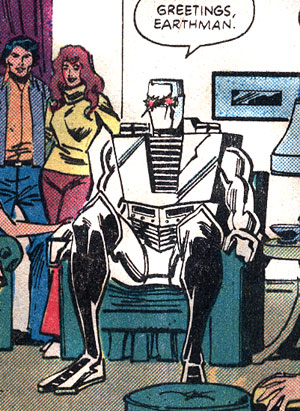
Rom, for the uninitiated, started out as a really awful toy in the 1970s. It looked like someone put frog legs on the chrome grille of a 1947 Chevy Fleetmaster, gave it a few weird accessories, an art deco espresso machine for a head, and called it day. Its eyes lit up, it made sounds, and it included a universal translator device that as a child I thought actually worked, although it’s worth mentioning that the only thing it could translate to was a cheap electronic beeping.
There were no enemies for Rom to fight, no allies for Rom to fight with, just: Rom. And Rom stunk.
Marvel Comics wound up with the license rights, and in 1979 began to produce an ongoing series based on the toy, which long outlived the miserable toy itself. The comic wasn’t set in a separate Rom-universe, like Marvel did with a lot of their licensed properties (e.g. G.I. Joe, or one of my other obscuro faves, The Starriors), but was actually as a part of regular Marvel continuity, which meant Rom would occasionally hang out with the Fantastic Four or the X-Men. You know, the way superheroes do.
The comics were written by Marvel’s resident 1970s genius weirdo Bill Mantlo, and if you’ve never read a Bill Mantlo book (Cloak & Dagger, Micronauts, Jack of Hearts, that comic where Iron Man fought Frankenstein), you are in for a treat my friend. And next summer, when you’re packed into a megaplex at midnight on July 31 to see the Guardians of the Galaxy movie and you think to yourself, “Oh weird, there’s a talking raccoon with a gun in this movie?”, remember that Bill Mantlo is the writer responsible for that raccoon.
In the comic, Rom was a space cyborg who sacrificed his humanity — or, er, his Galadorian-ity — to become the first and greatest of the Spaceknights, and protect everyone from his mortal enemy, the alien Dire Wraiths, whom Rom had kindasorta unleashed on the universe. Unlike most cyborgs where I guess they just put all your guts in a Hefty bag by the curb, Rom’s former parts are being kept in a jar somewhere, and once he succeeds in ridding the universe of the Dire Wraiths, he’ll reclaim the rest of his old body, fly back home, and make out with his old girlfriend again, big time.
He was selfless, heroic, and cool. Standard hero stuff.

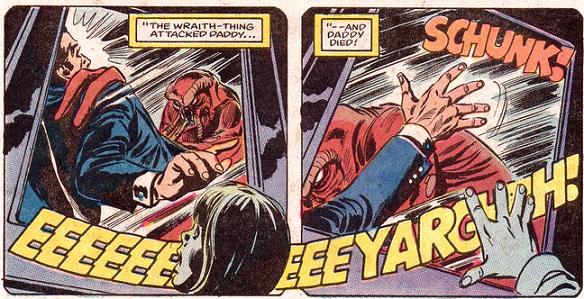
Now, two things. First is that the Dire Wraiths are TERRIFYING. Like, pee-your-pants scary. They are shape-shifting Cthulhu aliens with weird squid-drill tongues who will suck out your brain, turn you into a pile of goo, and just start living your life. But evilly.
The other thing is that Dire Wraiths are really good at staying hidden. Pretty much the only person who can reliably tell if someone is a Dire Wraith is Rom. And when he finds a Dire Wraith he blasts it into hot ashes with his Neutralizer ray. Job well done, Rom! It’s Miller Time.
Important: since virtually no one else can see the aliens’ true form once they’ve body-snatched you, no one ever knows what the hell Rom is doing. He might bash in the church doors on your wedding day and blast your fiancé to ashes, and while you’re changing your honeymoon-suite reservations to be under “Mr. and Mrs. Pile-of-Ashes”, he’d probably just be like, “Oh yeah, that dude was an evil alien doppelganger of your fiancé, trust me. Gotta go! ::drops microphone:: ROM OUT.”
There are so many comics in which Rom shows up and, apparently, to the casual observer, just starts straight-up murdering people right and left.

WHY, ROM, WHY.
Then people misunderstand his actions, treat him like a monster, attempt to intervene. Hijinks ensue.
So what happened? You might ask. If Rom is so cool, why isn’t he in comics any more?
Legal stuff, is the answer. Marvel doesn’t hold the license any more. But, what with the Guardians of the Galaxy getting made into a movie, I’d hoped against hope that there’d be news Rom would return. Last year Marvel published a tiny picture of Rom in the ads for their Age of Ultron storyline, and it did not escape my attention that the new Avengers movie would be called Avengers: Age of Ultron. The movie, however, will be an original story and not, confusingly, an adaptation of this very recent Marvel storyline that has the exact same name. Go figure.
So for now I’ll just cackle at jokes cracked at the expense of Rom’s legal limbo, add my “like” to the Bring Back Rom Facebook group, and cross my fingers that Guardians of the Galaxy is a hit and shows audiences just how rad Marvel’s space stories and characters are, and they’ll have no CHOICE but to bring Rom back.

Find him… before he finds you, Marvel Comics.
David Moran has nightmares about Dire Wraiths sometimes. Please Rom make it stop.

When Dungeons & Dragons co-creator Gary Gygax published his now-classic Advanced D&D Dungeon Master’s Guidein 1979, he highlighted “Inspirational and Educational Reading” in a section marked “Appendix N.” Featuring the authors that most inspired Gygax to create the world’s first tabletop role-playing game, Appendix N has remained a useful reading list for sci-fi and fantasy fans of all ages.
In Advanced Readings in D&D, Tor.com writers Tim Callahan and Mordicai Knode take a look at Gary Gygax’s favorite authors and reread one per week, in an effort to explore the origins of Dungeons & Dragons and see which of these sometimes-famous, sometimes-obscure authors are worth rereading today. Sometimes the posts will be conversations, while other times they will be solo reflections, but one thing is guaranteed: Appendix N will be written about, along with dungeons, and maybe dragons, and probably wizards, and sometimes robots, and, if you’re up for it, even more. Welcome to the seventh post in the series, featuring a look at the stories of August Derleth.
[Read more]
August Derleth is a controversial figure in “spooky nerd” circles. On one hand, people often think that he diluted the horror of Lovecraft’s stories and put Lovecraft’s name on things Derleth himself had actually written. But on the other hand, Call of Cthulhu is still filled with pages of weird stuff he invented. Some of the charges I think are deserved, some I think aren’t, and some of his achievements are often overlooked, or are just tarred with the same brush of distaste. How many people would have read Howard Phillip’s writings if not for Arkham House? Ultimately, Derleth’s legacy is editorial. He was the one who pounded the Mythos into a shared universe rather than just a series of Weird Tales. Say what you will about the man, but without him we probably wouldn’t be talking about “Lovecraftian” horrors in the first place. Then, well, there are issues that I think really are totally petty—like calling the Lovecraft-o-verse “The Cthulhu Mythos” instead of “Yog-Sothothery.”
That is really the best you can do, grumble about branding? I’ll tell you what; Cthulhu might not be at the center of Lovecraft’s universe in a cosmological sense—that’d be Azathoth, right?—but he sure looms large in the public eye. He’s the “charismatic megafauna” of Lovecraft’s writing; you could argue that he became the brand because of Derleth’s naming of the milieu which I’ll grant is a decent theory, but I think there is just something there. I think old squiddy is just the most recognizable face for the “brand,” so to speak. Heck, I sympathize with Derleth on that topic: even Tim and I are calling this reread Advanced Readings in Dungeons and Dragons rather than something with “Appendix N” in the name, because we wanted people to know what it was just from the title alone.
The real bone of contention here, and one that I do very much sympathize with, is that Derleth basically got the major themes and “moral” of Lovecraft all kinds of wrong. And there’s his “posthumous” collaboration in which he pulled a Christopher Tolkien and fleshed out Lovecraft’s notes, only with less faithfulness and verisimilitude than Tolkien. Most crucially, he introduced a Manichean cosmology—a battle of good and evil, which is utterly anathema to the powerful overriding subtext of Lovecraft’s writing—in which the universe is so strange as to be incomprehensible, so uncaring and amoral as to be monstrous. Throwing some Hermetic elementalism on top of Lovecraft’s alien god-things isn’t cricket, and creating a whole category of “Elder Gods” to oppose the inscrutable malevolence of the Old Ones just isn’t very...lovecraftian.
You know what it does sound like, though? Dungeons and Dragons. The Elder Gods and a primal war between good and evil (and/or law and chaos) is exactly what Gary Gygax and Dave Arneson gave us. I’ve always said—heck, I said it in my musings on D&D Next’s cosmology—that the demons and devils and evil gods were the coolest part of Dungeons and Dragons mythology. Bahamut is okay, Saint Cuthbert is alright, but really who can compare with Demogorgon, Lolth, Vecna, Tiamat and their ilk? Nobody, that is who, but you can see how the dualistic viewpoint of Derleth (along with Elric and Poul Anderson) influenced both the development of divine alignment in D&D, the Inner and Outer Planes, and more importantly, the pantheon construction of their fantasy worlds (along with liberal borrowing from real world mythology).
How is his writing? Fine. He writes...well, he writes Lovecraft fanfiction, basically. Aptly, but that is what it is—and I mean no disrespect to fanfiction authors or Mister Derleth. His Mythos stuff was just one facet of his writing; I thought about reading some of his historical fiction or detective genre stuff, but I didn’t think it was really in keeping with the spirit of the thing, guessing that Gygax was almost certainly referring to his horror writing. Derleth’s horror is a little overly enthusiastic with the peppering of “name brand” Mythos stuff; if there is a creepy library there is certainly going to be a Necronomicon and Unaussprechlichen Kulten, and if there is a cult they are probably going to talk about Cthulhu and the Deep Ones, if there is a place it’ll be anchored between the landmarks of Miskatonic University and Arkham. There will probably also be mention of “le Comte d’Erlette,” who is a Mythos figure that Lovecraft created as an homage to his buddy August.
Derleth has his own quirks, his own little signature ticks. He loves talking about architecture; “gambrel” is his favorite word. You know how we all affectionately joke about Lovecraft’s overuse of “eldritch” and other pieces of vocabulary that he kept in heavy rotation? Well, in that lizard man story, for instance, Derleth doesn’t even use the word “squamous” once, but in probably half of his stories he makes sure we know what kind of roof the house has. “The Survivor” was the first story of his I read and I immediately thought of two things: the Spider-Man villain The Lizard and...the half-baked idea I’ve had for an antagonist in my game based on The Lizard. Derleth’s story helped me come up with some new angles of approach, so right there, right off the bat, I’m already finding something. Oh, plus I really dug the story about the Yithian—I won’t tell you which one that is, no spoilers; I’ll let you figure it out yourself.
My thesis on Derleth is this: it is easy to dismiss him for failing to “get” the cosmological and existential horror of Lovecraft, but there are other themes in H.P. Lovecraft’s work that Derleth is really on point about. Haunted houses, for instance; Derleth totally gets that. Actually, that is what a lot of his stories center around, and they rank right up there with Lovecraft’s “The Rats in the Walls.” “The Peabody Heritage” is more Judeo-Christian than most, being a pretty classic “black mass” story about witches—if you are interested in the real roots of the fiction of the witches esbat, I highly recommend Carlo Ginzburg’s work, by the way—but it is right on the money. Derleth “gets” Lovecraft’s ideas of decaying upper class families, of inherited destiny, of “bad blood.” There is plenty to enjoy here...it just isn’t as “first tier” as Lovecraft. The reason we have that tier in the first place is in large part due to Derleth, however, and just think of how much thinner the Call of Cthulhu book would be without him.
Mordicai Knode has an idea of mashing up Vecna with a lizard-man, so thanks for helping him flesh it out, Auggie. Now help me find Tim, he’s lost in the labyrinth!
 Sorry, I might need to speak up; I’m not sure if you can understand me since the new volume of Mouse Guard melted my face off. Mouse Guard has been one of my favorite comics for a while now—ever since I read a Free Comic Book Day issue, I think—and the newest story arc, Mouse Guard: The Black Axe did not disappoint me for an instant.
If you aren’t familiar with Mouse Guard, the basic premise is thus: if there was an anthropomorphic mouse kingdom made up of separate quasi-Medieval mouse colonies,who would protect them? The Guard would, that’s who. Well, the guard and the legend—the myth of an immortal warrior, a champion bearing a brutal black axe from which he takes his name, crafted with all the rage and sorrow over the murders of his family that the master smith Farrer could forge into it. The Black Axe! The Black Axe is real, and this is his story. A story of Viking ferrets and Reaver fishers, of heirs and elders, of the death curses of crows and brutal psychological warfare with a fox in a thicket. It is utterly, wonderfully, incredibly awesome. It will make your fingers go \m/.
[Read more]
Have you read Watership Down? It was recommended to me by an unlikely source: a friend of mine, 6’8” and looking for all the world like Karl Marx. Well, that is now; I guess back in college he looked more like Morrissey. He ran a pretty brutal Dungeons and Dragons campaign, so when he insisted I read this book about bunny rabbits, I was skeptical. Just seemed out of place—until I read it. Watership Down is a book about heroism, science, exploration, oppression and diaspora—and it is completely hardcore.
The rabbits of Watership Down have a culture, complete with religion, but crucially, they are barely anthropomorphized. They can count: one, two, three, four, a thousand. They aren’t bipedal, they don’t have opposable thumbs or, well, hands at all. They live in holes in the ground: not a hobbit-hole, but a nasty, dirty, wet hole, filled with the ends of worms with nothing in it to sit down on. You know. Rabbits. Regular rabbits.

Mouse Guard isn’t like that, but I can’t help but see it as being part of the same lineage. The mice live in cities that would make even Bilbo, snug in Bag End, a little jealous. Which is to say, David Petersen’s art is just breathtakingly spectacular. The Black Axe gives us a peek at a variety of locations, from the nautical haven of Port Sumac to the mead hall of the ferret king Luthebon to the fog-haunted briars of a fox’s hunting grounds and to the stained glass lined sanctum sanctorum of the Matriarch of Lockhaven. The big set pieces are jaw-dropping but when you go to pick your mandible up off the floor, take a look at the little details, the background elements and the embellishments.
You’ve probably heard about WETA workshop’s ethos during the Lord of the Rings filming, how they’d add little details like runes or etchings onto their prop pieces, knowing full well that they probably wouldn’t show up on film and if they did, it would probably be too quick for your mind to register it. Well, your conscious mind; the idea being that such careful attention and craftsmanship would create a critical mass of verisimilitude. It worked there, and it works here. Don’t let me go on too long about the scenery, though, because as gorgeous and lush as it is, the characters are at the heart of these stories.

The frame sequence of The Black Axe involves the harsh spring season, where Petersen telling microstories—Guard Mice struggling against adversity, dealing with fierce badgers, tending bee hives, guarding caravans, that sort of thing—with such an economy of panels that Scott McCloud must weep from the beauty of it. Saxon and Kenzie—the fierce over-zealous mouse and the older, wiser mouse, sort of a Raphael and Splinter buddy cop duo—are among the Guard, but their apprentice, the former tenderfoot Lieam, is missing.
That frame story, however, surrounds a flashback that sits snug around the shoulders of Celanawe—pronounced Khel-en-awe, thank you very much—the mouse who will become the Black Axe. He is filled with doubts, filled with bravery; he struggles with questions and loss while always trying to do the honorable thing. Celanawe is not alone; with him comes Em, and with her all the secrets of the Black Axe—or some of the secrets, at least. Friends from earlier volumes of Mouse Guard appear here, as well, in their prime rather than their retirement; Conrad, the salty seadogmouse with his fishhook harpoon, most notably. I mentioned Petersen’s skill at communicating volumes in visual shorthand; each Guard mouse has a visual quirk, a distinctive fur color, a cloak and a signature weapon. A rapier mouse—Reepicheep!—a mace wielding mouse, and so on. Keeping track of the characters is no problem at all.
 The sweeping scope of the universe is what takes the cake, ultimately, at least for me; I’m a worldbuilder, by nature. Mouse Guard is not just a well-designed and well-realized world, it is one that makes different choices than the easy one. The best for-instance of what I mean would be the mice’s enemies in the great war: weasels. It would have been easy and expected to go with rats, but making their antagonists Mustelids? That is just genius. Their predatory nature, their sinuous bodies; Mouse Guard started off as a role-playing game, once upon a time, and the weasel family are the orcs and gnolls of the mouse world. In The Black Axe, they even get the treatment I want for orcs in fantasy gaming: they get dealt with as characters, as people. Oh, the fishers that chase Celenawe and Em are wholly terrifying, adorned in the dead flesh of their enemies, but they are contrasted with the ferrets, who are meat-eating and natural enemies of mice—well, natural predators, really—but have honor and hold to it, have feelings and loves and hates.

I mentioned this started as a game—there is Mouse Guard role-playing game now, as well, using a simplified version of Burning Wheel—and the use of mice instead of humans just alters and mutates your suspension of disbelief. Sure, maybe a brave warrior mouse requires more suspension of disbelief than a brave warrior human but once you buy in up-front, you get a lot of interesting stuff on the back-end. Take for instance, one of the pages towards the beginning; we see Guard mice battling a snapping turtle. Think of the scales involved, tiny mice, giant turtle—really terrifying. It is, for all intents and purposes, a dragon. Only, see, instead of your brain needing to grapple with “giant sentient flying magical reptile that breaths fire and loves gold” you get it all wrapped up in a real world package—a snapping turtle. Or an owl, or a snake or—well, you see what I mean. Potent stuff. It’ll melt your face right off.
Mordicai Knode made a Mouse Guard character; he was a former circus-mouse named Arkady, who wore a top hat and carried a whip. Tell him what your Mouse Guard character is or would be on Twitter or find him on Tumblr!
Mordicaifmf.

Houellebecq and his corgi Clément. No, you’re not dreaming.
Oh, Michel Houellebecq. First, he disappears from his own book tour for The Map and the Territory in the Netherlands, and no one can reach him and no one knows what is going on. Then he reappears, claiming that he’d just forgotten about it all and didn’t have phone or email access. And now, he’s starring in a movie about it, called “L’enlèvement de Michel Houellebecq” (“The Kidnapping of Michel Houellebecq”). The man’s daffy solipsism, in other words, knows no bounds.
The movie in question is being directed by Guillaume Nicloux, whose last movie was based on a Diderot novel about a nun, and it will address the events of that fatal week, during which, it sounds like, Houellebecq sat around his house in his socks eating morcilla and wondering why he felt like he had to be somewhere. Fans on social media, however, immediately assumed the worst, suggesting that he’d been captured by Al Qaeda, possibly for his comments about Islam—a rumor that was then picked up by news website Rue89.
As Sam Lipsyte has discovered, the truth about the Houellebecq is usually not that he’s been kidnapped or he’s holed up with hookers or he’s the one running the Zetas now. When Lipsyte tailed Houellebecq around California for the Believer in 2006, he got intrigued by the author’s interest in Scotch tape:
We pass an OfficeMax and I make a dumb joke about that being the biggest leather bar of all. Houellebecq’s eyes light up but not for any obviously pervy reason. No, like many writers, yours truly included, stationery has a nearly pornographic appeal, and besides, he appears to possess a Frenchman’s revulsion/attraction to big-box retail. We pull over and head into the store. He assures me he’s an “efficient consumer” and once inside he does seem to know exactly what he needs: erasers, folders and, most intriguingly, Scotch tape. It’s this final purchase and an earlier comment about how he planned to work in his room tomorrow that sets my mind racing. What’s the Scotch tape for? What’s he working on in his room? A collage? I’ve been on book tours before, and even bought stationery in foreign cities, but never Scotch tape. That must be the genius of Houellebecq.
Only to discover that Houellebecq was using the tape to fasten the loose caps on his pill bottles.
Since we don’t know anything about the plot of “L’enlèvement de Michel Houellebecq” so far, however, it seems fair to speculate wildly: maybe it’ll feature a fictional character named Houellebecq, played by Houellebecq, writing a novel about the kidnapping of a famous French writer by Al Qaeda? Which is then interrupted by an actual kidnapping? Maybe it’ll be a metaphorical kidnapping, in which a famous French writer goes to the Netherlands and is so entranced by late Rembrandt that he forgets to go to all his readings? Maybe it’ll be a modern-day re-working of “The Ransom of Red Chief” in which a French director making a movie about a French writer is so irritated by his subject that he abandons the movie midway through?
Recent comments by Nicloux, however, suggest that the movie will both hew closely to the truth, and that the truth is going to make us drop our Scotch tape in astonishment: an article by Angelique Chrisafis in the Guardian has him promising that the “truth goes well beyond fiction.”
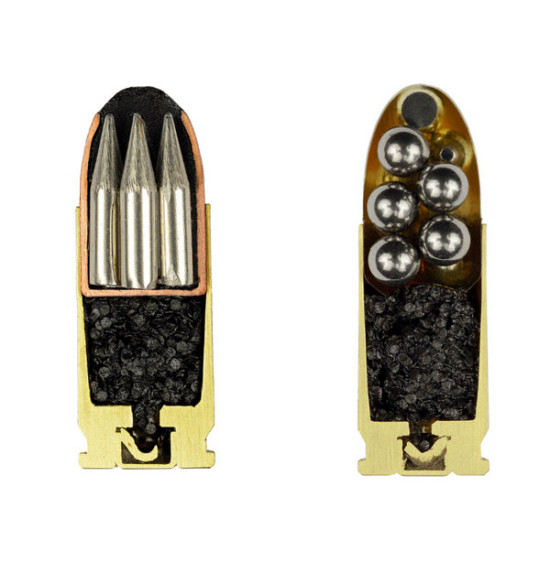
“This series of ammunition cross-sections was photographed inside a WWII bunker in Switzerland in October of 2012. The entire series consists of 900 specimen. I was originally intrigued by the ambiguous nature of the subject matter. The cross-sections reveal a hidden complexity and beauty of form, which stands in vast contrast to the destructive purpose of the object. It’s a representation of the evil and the beautiful, a reflection of the human condition.”
Sabine Pearlman is an Austrian photographer, she currently lives and works in Los Angeles.

 In “Advanced Readings in D&D,” Tor.com writers Tim Callahan and Mordicai Knode take a look at Gary Gygax’s favorite authors and reread one per week, in an effort to explore the origins of Dungeons & Dragons and see which of these sometimes-famous, sometimes-obscure authors are worth rereading today. Sometimes the posts will be conversations, while other times they will be solo reflections, but one thing is guaranteed: Appendix N will be written about, along with dungeons, and maybe dragons, and probably wizards, and sometimes robots, and, if you’re up for it, even more. Welcome to the sixth post in the series, featuring a look at Jack Vance’s collection of stories known as The Dying Earth.
[Read more]
Tim Callahan: All I knew about Jack Vance, before reading The Dying Earth, was that he’s the reason the “magic-user” in Dungeons and Dragons could only memorize a spell or two, and would forget them immediately after casting. Everyone in the tabletop gaming community talks about Vancian magic all the time—to have or not to have—but in reading this book I finally got to see why. These wizards (or magicians, or whatever they’re called) have some potent spells with fancy names like “the Excellent Prismatic Spray” and “Phandaal’s Mantle of Stealth” and they only get one shot to cast them before they have to dig back into their ancient tomes.
It is the “dying” Earth after all, so everything here has a tragic bent. Though, I must admit, I found the book—not really a novel, but a collection of stories with the same expansive setting—much more hopeful than I expected with the name that it has. The final story, in particular, “Guyal of Sfere,” is a confident burst of celebration from the author. A rousing conclusion to the cycle of stories.
Mordicai Knode: Also worth noting that everybody’s favorite evil wizard turned lich turned demigod turned major deity, Vecna, is named after a “Vance” anagram. & while we are pointing out bits and pieces—like the prismatic spray, which is such an amazing piece of writing, such a great turn of phrase, that it inspired a whole range of spells—I want to mention the ioun stones. In Dungeons & Dragons they are these little gemstones that float around your head—I always imagined the Bit from Tron—but in The Dying Earth story that inspired them, the IOUN stones are much more sinister and are gleaned from the center of a dwarf star that has been cut in half by the shrinking edges of the universe. Just let that sink in; that is really an incredible idea.
And those sorts of ideas are scattered all over the book, like some pirate with holes in his pocket idly scattered gold doubloons all over it. The whole “baroque civilization beyond civilization, at the end of all things” shtick really works for me. It has informed a lot of authors that I hold in the pinnacle of esteem—Gene Wolfe, I am talking about you—and more over directly influenced me & my roleplaying setting. I mean, it is hard not to read this and think “well, I’ll borrow that, thank you very much.”
TC: I certainly liked some of these stories more than others—and was disoriented at first because I didn’t realize they were distinct stories and thought I had missed some plot connections between the first few chapters until I figured out that this was actually a collection of short, self-contained pieces—but there’s no doubt that The Dying Earth is full of brilliant, inspirational, exciting ideas.
And Vance is just such a great writer, purely on the level of his prose, particularly compared to some of the other authors we’ve been digging into for this Gygaxian project. He’s a prose stylist, in control of his sentences and imagery, in the way that other “great” sci-fi/fantasy writers tend not to be. Sure, there are exceptions, but Vance is a big one. If The Dying Earth is an accurate representation of how he writes, I’m surprised he hasn’t been claimed by a larger segment of the literary establishment. He’s got the goods.
MK: Well I think that the exile of anything with a spaceship or a wizard into the genre ghetto is a bigger problem than Jack Vance, but you are right, he’s a prime example of someone who deserves much more critical attention. He’s got a poetry in his writing that is a sort of madness; it can consume entire passages, it can get out of hand, but it is also a bit of a brilliant glow in the dark gloom of the Overworld. In a lot of ways I think Jack Vance reminds of a very post-Lovecraft writer. He has the same sort of addiction to purple prose, but where H.P. Lovecraft can tend towards overuse of terminology and has a fondness for stacked archaic adjectives, Jack Vance can reign in his lyrical flourishes with a bit of the gonzo surrealism, and then dilute that with a dose of a scoundrel’s internal monologue.
Jack’s biggest contribution—beside the actual text of his writing—is the crystalization of a genre. I called him post-Lovecraft but really he’s more post-Clark Ashton Smith. He took that sort of high brow weird—the inheritors of Poe and Dunsany—and smashed it together with the pulp action of Edgar Rice Burroughs and H.G. Wells. Vance might not have created the Dying Earth notion, but he sure stitched it together & slapped a name on it.
TC: Let’s talk about some of the individual stories a bit. On the first read-through, I’d say my favorite were “Maziran the Magician,” “Guyal of Sfere,” and “T’Sias.” The latter two have the most interesting plot sequences and world exploration and the former is the most compressed and evocative.
You’re right about his ability to harness the poetry of his purple prose, and he does it well with “Maziran,” bombarding the readers with imaginative terminology that’s strange and wonderful and implies a vast reality, yet to be fully explained.
That’s one of the things I enjoyed about Vance—he doesn’t explain everything. You’ll get a sense of who the characters are and what they want, and the plot will make sense, but he’ll toss off these references to people and places and spells and customs without elaborating on them in any great detail. They are ultimately just flavor, but because he uses language so precisely, the references are packed with implicit meaning that you don’t need to fully understand to appreciate.
It’s kind of like, for me anyway, when I was a kid, and I’d read the AD&D Player’s Handbook or Dungeon Master’s Guide and just read through some of the spell names or magic item titles (without reading the descriptions below) and imagine what weird and wonderful things these powers and items could do.
Vance reminded me of that world of possibilities, almost on every page.
So much for talking about individual stories. Here I go digressing on his style again!
MK: That sort of background logic—you mention Vance not explaining everything—really adds a frenetic energy to a lot of his stories. It shows that things are moving, even when the action isn’t focused on them. Notably there are the deodands—what, mutants? Aliens? Cannibal wizards?—who he sketches into shape largely through their absence, through hearsay and rumor. But you wanted to talk about the stories, and I’m drifting off kilter, too! Actually, I know a way we can do both: let’s talk about the stories in chunks, separated by character.
I know Cugel the Clever is really the exemplar of Jack Vance’s Dying Earth stories, but I vastly prefer Rhialto the Marvellous. I know some people would find that to be heresy, but the trickster archetype can start to grate on my nerves after a bit...which is, I think, part of the point, and Vance is always careful to give a mix of comeuppance and victory at the end of his stories. That said, I think the college of wizards who gather together at the end of the 21st Aeon are charming as heck. Rhialto as the dandy, as a wizard with demigod-like power who spends his time picking up chicks? Cracks me up. I’d say the Rhialto collection is my favorite bit, followed by the scattered short stories, with Cugel’s stuff coming in last place.
TC: I haven’t yet read any of the Rhialto or Cugel stuff, just Vance’s first collection, and neither of those characters have shown up yet. But alt-comics superstar Ben Marra tells me that Cugel is probably his favorite character in any medium, and I should definitely continue on past this initial foray into Jack Vance read the books that feature that guy. You say Rhialto’s better though? Explain a bit more about that, because I probably won’t have time to read all the Vance books anytime soon, so why should I skip the two Cugel books and go right to the fourth book to get a dose of Rhialto?
MK: Rhialto is a pompous dandy...with the power of a planetcracking superbeing. He’s part of a coven of wizards who think he’s probably a slacker, but even if they are right it still makes him one of the most powerful beings of...well, post-history. The stories Vance tells about him are the ones where he really goes off the rails; in a lot of his stories there is a tinge of the vast supernatural, lurking in the margins, but in the Rhialto saga, they are the incredible intrusions of the epic scope. Riding around on spaceships eating magnificent feasts, slinging spells at aliens & getting wrapped up in the soap opera of other nigh omnipotent beings...I just think the tales them self are smashing. Psychadelia meets Joseph Campbell, at the edge of a decaying universe. Gorgeous stuff, but then, isn’t all of the Dying Earth?
TC: From what I’ve read, yes. But it looks like I haven’t even gotten to all the great stuff that comes in the later books. Unlike some of these Appendix N books, which I’m just checking off from a mental list and moving on, Vance’s work is definitely something I look forward to coming back to and reading a whole bunch more.
Tim Callahan usually writes about comics and Mordicai Knode usually writes about games. They both play a lot of Dungeons & Dragons.

This is no fantasy... no careless product of wild imagination. No, my good friends.
Scientists at the University of Southampton (together with the Eindhoven University of Technology) have developed a method of recording optical information in glass that allows for a massive amount of information to be stored, practically forever...by using lasers to record it in five dimensions.
How cool is science? So cool that we can only compare it to superhero comics, because that is the nearest analogue. The group supervisor summed it up with this: “It is thrilling to think that we have created the first document which will likely survive the human race.” It is thrilling!
They can be a great people, Kal-El, they wish to be...
 In “Advanced Readings in D&D,” Tor.com writers Tim Callahan and Mordicai Knode take a look at Gary Gygax’s favorite authors and reread one per week, in an effort to explore the origins of Dungeons & Dragons and see which of these sometimes-famous, sometimes-obscure authors are worth rereading today. Sometimes the posts will be conversations, while other times they will be solo reflections, but one thing is guaranteed: Appendix N will be written about, along with dungeons, and maybe dragons, and probably wizards, and sometimes robots, and, if you’re up for it, even more. Welcome to the fifth post in the series, featuring a look at the beginning of the John Carter series by Edgar Rice Burroughs.
[Read more.]
Tim Callahan: When we stared down the Edgar Rice Burroughs canon, we tossed around the idea that maybe we’d do a read of Pellucidar, to get into the Hollow Earth mythology, or maybe we’d do Carson of Venus to highlight one of his less-well-read series of books. Interestingly, neither of us ever threw Tarzan into the mix, and I suspect that’s because Tarzan is too much a part of the culture. Too well-trodden. Too likely not to surprise us. Though I understand that the later Tarzan books get pretty crazy. I don’t know, I haven’t read them, and I’ve only read comic book adaptations of the first book, so that probably tells you a lot about me, and not in a good way.
But we settled on A Princess of Mars, the first of the John Carter books, because it’s such a seminal work, and so hugely influential to the space opera genre and the swordfightin’ fantasy genre, and it was turned into a movie last year that was pretty disappointing in too many ways.
Not that we’re here to talk about the movie, but I’m sure it will come up, because it just did.
So A Princess of Mars, the classic novel? What do you think of it? What makes it worth reading? Is it worth reading?
Mordicai Knode: Well, I have to say; the first time I read A Princess of Mars I thought I was just sort of “paying my dues.” You know, going through the classics of the fantasy canon and giving them a shot. My expectations were pretty moderated; some classics really deserve their accolades, but I find a lot of them aren’t my cup of tea. These John Carter books...mwah! Magnifique! I really think they are the bee’s knees, and you know what else? I think a lot of modern criticism of the books—notably racial ones—are not just dead wrong, but that the Barsoom series is actually pretty great on the subject of race. Not perfect by any means, but especially given its position in history, I think the explicit moral of the story is a call for pluralism and tolerance.
I might be jumping the gun on that, so let me start with this. There are giant green aliens with four arms and tusks that lay eggs, are mildly telepathic, and have guns that shoot radium bullets which explode when light hits them. Come on, right there, that is enough of an elevator pitch to get me interested...and we’ve barely even scratched the surface. I haven’t even talked about John Carter’s suite of Superman powers or the anti-gravity properties of the Eight Ray, or the Oxygen Station that Total Recall borrowed as its MacGuffin, or the secret cults or weird critters of Mars. So...I guess what I’m saying is heck yes it is worth reading!
TC: I was astounded by the thrilling pace of the novel, and I love that the book begins with that Civil War-era framing sequence, so you really get the clash between the dusty archetypes of the old west and the operatic space adventures on Mars (ahem, Barsoom).
It’s also a book that manages to balance Burroughs obvious intelligence with the needs of the readership. The book isn’t quite the equivalent of a popcorn flick, even though its trappings may be outlandish and action-packed and visually extraordinary. Instead, it’s a smartly written planetary romance about a hero in an alien land.
Maybe that was the problem with the recent Disney movie version. Burroughs’ voice was missing, even if many of the plot elements were maintained. And without Burroughs’ voice—or with it, but only in a laborious cinematic framing sequence that didn’t have the charm of the novel—the spectacle remains, and we’ve seen plenty of spectacle in the years since this book was written.
A Princess of Mars came out in 1917! I can’t even imagine what it must have been like to read it back in those days.
MK: Seriously, reading this book when it came out must have turned your brain into a puddle that dribbled out your ears. No wait, better metaphor: it must have blown your mind so hard that your head popped off and became a Kaldane. Though you know, I liked the movie—I did find it to be a popcorn flick, but I thought it was a fun one. It isn’t going to enter my top ten or anything, but I was really confused by the drubbing it took, both at the box office and critically. I thought it was pretty, and I was entertained throughout, as was my wife, who doesn’t care about John Carter. I think the misstep was in smashing up the stories too much; adding the Therns was a nice touch, but adding a giant crawling mechanical city...well, that was where the plot convolutions starting impacting the suspension of disbelief.
The frame sequence! So...well, so weird. No, scratch that, Weird, capital W, as in the genre. So John Carter... So let me get this straight, John Carter...is immortal? They hint at it more than a few times, but what the heck is going on with John Carter? He’s an immortal warrior—it is his true warrior spirit that draws him to Mars, the planet named after the god of war—who keeps dying, and every time he dies he switches planets? From Earth to Mars, from Mars to Earth? That is...that is the sort of craziness inspired by genius; that is a Big Idea and the fact that it is just the framing device goes to show just how deeply and systemically weird the John Carter books are.
TC: Woah, that is weird. I’ve always appreciated the way the frame story provided a gritty, six-gun context for spacefaring swordsmanship, but I never spent much time thinking about the implications of his traveling soul and potential for immortality. Then again, I’ve never read any of the other books in the Barsoom series, so perhaps that stuff is emphasized more in later volumes.
Or maybe I’ve always just been distracted by the courtly heroics around Dejah Thoris and the fact that Tars Tarkas is just one of the coolest characters in the history of English-language literature. I mean, he doesn’t feature on that many pages, considering everything in the novel, but who’s better than Tars Tarkas? He’s like Han Solo and Conan all rolled up into one Martian package.
MK: I totally agree about Tars Tarkas...which I think brings us into a position to talk about race a little. First, a word on genderpolitik in here—no, it ain’t good. Dejah Thoris is pretty much a damsel and pretty high up on a pedestal. That said, there isn’t, you know, anything gross on display towards women here, just the kind of “fairer sex” tropes endemic to society at the time. I don’t want to condone that just because it isn’t blatantly offensive—the absence of real female characters with agency is a problem on its own—but, well, it isn’t offensive. Which, dealing with some of these pulps, counts for something when viewed in historical context, while at the same time failing in a larger framework. I don’t want to let it off the hook for that.
On the topic of race...well, I have read past the first book and besides the Green Martians—the aforementioned four armed giants—there are the Red Martians, who look like humans with red skin and are effectively immortal. The White Martians, Yellow Martians & Black Martians are all like the Red—that is, humanoid and long-lived. The first three books—the “John Carter trilogy” if you will—are about how John Carter unites all the races of Mars, becoming the eponymous Warlord of Mars. It is explicitly a message of how the different tribes of Mars have far more in common than dividing them, and how rejecting bad leadership, superstition, tribalism and old hatreds can result in a better, tolerant world.
I mean, that is right there in the text. That is actually the arc of the story; some White Martians are bad, some Green Martians are bad and so on, but some members of each Martian race good, also. I can understand people who see the Green Martians as a thinly veiled allegory for racial prejudice about Native Americans, and I don’t really disagree with John Carter as a manifestation of the Great White Hope—your Dances with Wolves or Avatar style white man who “saves” primitive people—but I think the fundamental message of the series undercuts that. At the end of the day, it reads like a screed of racial acceptance.
TC: But isn’t that racial acceptance only the result of the white savior? I’m only going by what you tell me here, because I’ve never read the later books, but I’m not sure you’ve convinced me that it’s all that different from Dances with Wolves, except...better.
And maybe this isn’t the place to get into it, but if we want to tie it back into Dungeons & Dragons, which is always in the background of our discussions, the racial politics of the Burroughs books aren’t all that different than what we see in early versions of the game, where there’s plenty of racial diversity (Dwarves, Elves, Hobbits...I mean Halflings) but the Humans (always portrayed as white people in the illustrations) are the only ones without class restrictions and level limits. The implicit message is that all races can and should work together, but Humans are the best! Those kind of racial restrictions were removed in later editions of D&D, but they seem not dissimilar from the kinds of stories we see in the Barsoom series. Or so you tell me.
MK: The elves and dwarves and what have you are white too in most of the classic—and non-Pathfinder modern—illustrations, too, for that matter, which I talked about in my Modest Proposal post. That said, I generally find that the mechanics of species in D&D are sort of self-selecting; humans are the norm in a campaign setting, but I haven’t found them to be the norm in actual adventuring parties, you know what I mean? Everybody grab-bags and monster mashes, playing anything from halflings to...well, my last 3.5 character was an astral deva. I think the problems with orcs and other monstrous humanoids—which I also talked about on Tor.com—are much more problematic, and mirror a lot of the concerns I have with the Tharks. That is what I mean when I acknowledge the Great White Hope problem of the books; totally real and I don’t want to ignore it, but it is in a context of a paean for racial harmony, which tempers it. Plus the books are—did I mention this already?—freaking awesome.
TC: I acknowledge the paean for racial harmony and I accept the awesome. Oh yes, I do.
Tim Callahan usually writes about comics and Mordicai Knode usually writes about games. They both play a lot of Dungeons & Dragons.
 In “Advanced Readings in D&D,” Tor.com writers Tim Callahan and Mordicai Knode take a look at Gary Gygax’s favorite authors and reread one per week, in an effort to explore the origins of Dungeons and Dragons and see which of these sometimes-famous, sometimes-obscure authors are worth rereading today. Sometimes the posts will be conversations, while other times they will be solo reflections, but one thing is guaranteed: Appendix N will be written about, along with dungeons, and maybe dragons, and probably wizards, and sometimes robots, and, if you’re up for it, even more. Welcome to the fourth post in the series, featuring a look at Fritz Leiber’s Fafhrd and Gray Mouser.
Guys, Fritz Leiber’s Fafhrd and Gray Mouser are basically the bee’s knees. In fact, I might go so far as to say they are the most Dungeons and Dragons of anything on the Appendix N list. Leiber obviously couldn’t have known that when he was writing the duo—at least not at first, starting them in 1939, but I guess perhaps he found out along the way, since he wrote them until 1988—but more interestingly, I don’t think Gary Gygax could have known, either. Now, obviously he knew that it influenced him in creating the game, but the thing about the Lankhmar stories is that they are actually how people play the game as well.
[Read more.]
You know, I saw a funny image recently that had a picture of Aragorn, Legolas, Gimli and the Rohirrim all posed like a bunch of cool looking tough guys, all epic in scope, with a caption of “How Most D&D Groups Begin” and then it cuts to an image below it labeled “How Most D&D Groups End” with a picture of the Monty Python crew in Holy Grail. Snerk. Still, I do find that most roleplaying groups have a strong element of black comedy running through them, along with a charming sort of nihilism. They aren’t all flowery speeches to elf queens; in fact, more often they are sarcastic quips to bartenders. Which, in a nutshell, is Fafhrd and Gray Mouser’s game.

Where to start on Fafhrd and Gray Mouser? Well, you might as well start at the beginning, with Swords and Deviltry, the first collection, since it has their meeting and each of their prologues. Let me illustrate it thus: Fafhrd straps fireworks to his skis at one point in order to rocket across a jump. That sort of insanity is just so…well, so Dungeons and Dragons; I don’t know how Leiber does it. I mean, I just had an AD&D campaign end when our bard, after crowdsurfing a horde of damned and demons, delivered the killing blow to Zuggtomoy with a roll of a natural 100 on a rod of wonder, which on the alternate table we were using was “death ray, no save.” It was epic, in the truest sense of the term, and was only possible thanks to the critical mass of multiple players, a convoluted prior history of adventuring, random number generators, and sheer dumb luck. That makes sense, but Leiber’s imagination is so fruitful that…well, it is like he has a chaos theory generator in his head. Billions of flapping butterflies.
Personally though, Swords Against Wizardry is my favorite omnibus, because it has the story “Stardock” in it, which is my favorite Fafhrd and Gray Mouser story by a mile (even if it doesn’t have Lankhmar in it). In short: the pair decide to climb the highest mountain in the world. You know; like if Everest came complete with the boilerplate fantasy hyperbole—like if Olympus Mons was on Earth. On a rumor, a riddle…because of course these two adventurers would undertake a task no one has ever accomplished because of a poem. With a snow leopard as a companion. Sounds like Mouser took a level in Ranger to me; it explains why he can dual-wield Scalpel and Cat’s Claw, too, for that matter.
Of course, just climbing an impossible mountain is almost too easy! So we get to have giant invisible flying manta rays trying to eat them, while invisible demigods riding on the giant invisible flying manta rays are trying to murder them. Well of course, you are saying, that is just obviously what happens when you try to climb past the rime and ice of a primordial peak. What else would you expect? Weird gnomes? We’ve got them too! Also, and perhaps most crucially, there are also invisible demigod ladies who’ve taken a fancy to our heroes.
We’ve talked about ladies and their representation in the pulps that influenced Dungeons and Dragons. They’ve ranged from the rotten to the pretty solid, but most fall into a big box labeled “problematic.” Leiber’s ladies (should that be Leiber’s Ladies, as a sort of fantasy Charlie’s Angels? I’d read it!) are generally on the positive end of the spectrum. They are defined by their roles as romantic foils, but they aren’t negative roles. They have agency, but typically in service to either narrative fiat or the agenda of the antagonists…and are almost always weird.
By way of example: here, the women in question are the invisible, nude godlings who live on the mountain. They “reveal” themselves to Gray Mouser and Fafhrd by covering themselves in paint or in lace. Pin up, sure, but not offensive. They aren’t even the weirdest ones; for a while Gray Mouser is involved with an albino were-rat, and Fafhrd dates a ghoul whose flesh and organs are transparent, leaving only her skeleton visible. Eventually the two settle down with two female counterparts, Cif and Afreyt, who are the best of Leiber’s women; as his Lankhmar stories evolved, so too did his characters.
I’d be remiss if I didn’t mention my personal favorite thing about the books: the wizards. Ningauble of the Seven Eyes and Sheelba of the Eyeless Face. Think of them as if Gandalf had a baby with Wilbur Whatley. You know, they sort of show up, meddle, display a casual alienation and inhuman form that makes you shudder at the indifference of the universe, make a few cheap jokes, and then exit from the story. Like if Guillermo del Toro got his art team together to brainstorm new faceless creatures for a Baba Yaga movie (I’d watch it!). Fafhrd and Gray Mouser, on the other hand, aren’t playing Call of Cthulhu. They’re playing Dungeons and Dragons, sword and sorcery style. SAN checks? No sweat. These are guys who clawed their way from first level to twentieth. They can handle some tentacles and a few eyes too many or two few. What’s the big deal?
Mordicai Knode is leaving diligent markings on the dungeon wall with chalk and a series of thieves’ cant markings so that the absent Tim Callahan can catch up with the rest of the party.

The movie version of World War Z is a pretty solid translation of the book World War Z. I’ve heard some people didn’t like it? Alex gave it a pretty big blah. Personally, though, I think it worked, because it focused on the spirit of the text, rather than the letter of it. It certainly worked for me as an audience member, and as a film, an adaptation, and a tweak on the nose of the genre. Part post-apocalypse, part plain old zombie flick, and part New Macho action-adventure—in which the sensitive family man retired UN investigator is the tough guy—I think a lot of the shade being thrown at it is undeserved and ultimately I think that the choices the movie made are absolutely in keeping with the themes of World War Z, the book. I’ll tell you why. Be warned that I’m going to talk fairly loosely about spoilers—not specific ones, but rather the big arcs and movements of the film.
[Read more.]
First and foremost, I think that telling an entirely original story for the film is a perfect direction to take things. World War Z, the book, is an oral history. A collection of shorter stories, told as anecdotes, that paint a broad canvas and allow the reader to piece together a big picture. Something like that is hard to translate to the screen—an ambitious director could have tried, especially if she or he could have made it a mini-series rather than a film—but I don’t have any problem with the decision to follow a single protagonist. For me, that is completely in keeping with the tone of the book. I didn’t see it as trying to be “this is the entirety of the book, translated to screen,” but rather vice versa: “what you see on the screen could be one of the stories in that book.”

The downside of this approach is that the movie never quite makes up its mind about Brad Pitt. He’s a cross between an Everyman and a hyper-competent disaster survival specialist, which is tricky to pull off. They aim for “just a regular guy with a unique set of skills,” but they ended up missing the mark a bit and hitting the trope of a featureless protagonist. Yes, he loves his family, and crying little kids is always a good kick in the ribs (just ask Children of Men, which used that trick to the point of abuse) but other than the fact that he retired to be with his family, we don’t know or discover much about him. Navidson, from House of Leaves, is a similar cipher, but that book plays on his obsession and family ties to tell a story about him. If you asked me to tell you anything about Gerry (Brad Pitt’s character) besides his job and his family, I’d come up blank.

The structure of the novel, however, definitely informs the movie version, and for the better. The family is not just trying to escape Philadelphia in the middle of a zombie outbreak; they hit a range of high points—apartment buildings, drug stores, military bases—before separating from Brad Pitt’s character. At that point, Pitt pinballs back and forth between locations; from an aircraft carrier to South Korea, to Israel, to Wales. Not quite the breadth of the books—which includes, you know, underwater as a major location—but it does show that the scope of the concern is global. Here is meets characters that widen the film’s appeal by providing new angles through which to view the story: the bald headed Segen helps dilute the overly macho cast by having a tough female character who brings a military viewpoint, and the cast of the WHO play a convincing spread of paranoia and bravery from the perspective of the medical establishment. Moreover, Brad Pitt’s character visits these places for intelligible reasons. In a world of Nolans and Shyamalans, it is a real relief to have a movie where people’s behavior isn’t utterly obfuscated and stretched thin to cover up plot holes.

You know from the start—just by the fact that the book you are reading is a history of the zombie war—that humanity wins. I quoted Marvel’s Ultimate Galactus a while back, but a different part of that story sticks out to me now, in this regard: after facing down a huge, extinction level event, Nick Fury says “the human race can kick the hell out of anything.” Which brings me to the crux of the matter, for me: the film version of World War Z had a happy ending. I’ve heard rumors that the original ending was as banal and grim as I’ve come to expect from these end of the world flicks; a paean to nihilism that shows just how “adult” it is by engaging in a juvenile display of feel-bad storytelling. Oh, you’ve commodified women’s sexuality, how bold! That is sarcasm, if you couldn’t tell over the sound of my eyes rolling all the way back in my head and rattling in my skull. Remember the mess that was 28 Days Later’s third act?
A happy ending is important to World War Z, because the book has a happy ending. Humans win; they win because humans are clever and zombies are stupid. They win because people get organized and communicate. They win, in essence, because humans are the best they can be. In a post-apocalyptic setting, it is easy to show humans acting at their worst. We see it in the film of World War Z during the looting and in the cold, hard decision made in evicting the protagonist’s family from the military ships when they lose contact. There the bad side makes its appearance, but here is where World War Z steps up its game: that isn’t the only side of humanity we see.

In both the book and the film, we see that there is plenty of room between relentlessly grimdark and innocent naivety. There is a vast middle ground where people can work together and use their brains to change the world. Between the ape and the angel, so to speak. We’ve heard the adage that there will only be peace on Earth when there are aliens for humans to join together and fight. Well, in World War Z those “aliens” are the dead, and while zombies sure take a bite out of the human species, the human species regains its footing. That is verisimilitude for you. Humans behaving…like humans. To me, that concept is central to the book, and I think the film captured it—which is far more important to me than hitting any particular plot point from the novel.
Mordicai Knode wants you to leave him behind if he gets bit. Don’t mercy kill him; he might get better or become a Zombie King, you don’t know. You can find him on Twitter and Tumblr.


Maybe my favorite clever bit in Marvel’s Ultimates universe comes from Warren Ellis. He has Reed Richards “solve” the Fermi paradox. You know, how the Drake equation, no matter how you slide the numbers, predicts oodles and zillions of aliens out there. So…why haven’t we heard from anybody? Ultimate Reed Richard comes up with the answer—Galactus! He eats planets! The real world, on the other hand, is much more entertaining; we don’t have a pat deus ex machina as our answer, nor a super-genius to figure it out for us, so we have to actually do science. In the July issue of Scientific American, Michael Lemonick looks at what we know about exoplanets, and how we figured out what we know so far, in the article “The Dawn of Distant Skies.” The article has been retitled “Astronomers Search for Signs of Life in the Skies of Distant Exoplanets” for the online edition.
[Read more.]
In 1996 Geoffrey Marcy said, after he and his partner found the second and third planets outside our own solar system, that “[p]lanets aren’t rare after all.” One of those vague little numbers in the Drake equation just got a little more solid, and to sort of everyone’s pleasant surprise, the answer to fp (stars with planets) is pretty big. Now, something like the Drake equation is a relatively simple model that largely exists for the sake of the conversation, not rigor, but the ease with which astronomers have been finding planets is heartening for those who think there might be someone—something—else out there. Even more uplifting, however, are the leaps and bounds scientists have made in the tools and methodology for recovering useful information from those exoplanets.
The techniques embraced by the recent crop of researchers focus on transits and eclipses; that is, if we can see the star, can we see when the planet orbiting the star is in front of it? Between us and the star? If we can find the minuscule dimming of the star while the exoplanet is in transit, astronomers can find out a bucketload of information. The amount it darkened lets you figure out a planet’s size, for one thing. You can deduce the mass of a planet from viewing the star’s Doppler shift—a small amount, but detectable—as it and the planet tug each other around their shared center of gravity. Boom, right there you’ve got size and mass and density. You can start making informed guesses from that, but when things really get tricky is when you start trying to figure out what is in the exoplanet’s atmosphere.

As the exoplanet passes in front of the face of the star, it shoots its light through the atmosphere, as you’d expect. Astronomers can use that light to do basic spectroscopy; every molecule has a different wavelength of light that it will absorb (sodium is, apparently, the easiest to spot) so you can deduce information that way. Moreover—as L. Drake Demming and David Charbonneau discovered simultaneously in one of those “how come so many interesting science theories are always discovered by two groups working independently?” moments—you can flip the process. Just as a planet is about to be eclipsed by its star, it shows part of its day side—and then it is swallowed up, blocked by the much more massive star. Comparing that (again, very tiny) spike in brightness with the now (slightly) dimmer star will get you a whole new set of calculations. At least, ever since the Spitzer Space Telescope went up.
So what kind of weird stuff have they found? How about hints that, sort of like Jupiter’s core in Arthur C. Clarke’s 2010, there are possible planets made of diamond? Insert YouTube clip of Good Will Hunting here: “how do you like those apples?” Nikku Madhusudhan’s work on the exoplanet WASP-12b suggests that it has an atmosphere with a ratio of 0.8 between carbon and oxygen. Now, WASP-12b is too big, but if the other planets condensed out of the same “soup” of elements, there would be other, smaller exoplanets made from the same stuff. A solid, Earth-sized planet could have entire continents made from diamond.

Or even better, a water world! GJ 1214b is 2.7 times the size of Earth and six times heavier, which is pretty close on a cosmic scale, and it isn’t even that far away, at 40 light years. The thing is, the density of the planet could come from an array of options. Maybe it is just a dense core with a huge puffy atmosphere. Maybe it is a sloshing bucket of water. If the latter, the obvious question is: could it support life? Jacob Bean at the University of Chicago is looking, but we don’t have answers. Yet. Which is the great thing about science. Brains are working on the problem, and new equipment is being made. In the next decade, new orbital and terrestrial telescopes will make this all easier, and ask new questions. Reed Richards might not be real, but that’s okay, we don’t need him.
Mordicai Knode thinks that when we find a habitable world in a binary star system that we need archeologist to dig back to “a long time ago…” to find fossil lightsabers. Oh wait, that would need to be in a far-away galaxy, too—never mind. You can follow him on Twitter and Tumblr.
 When Dungeons & Dragons co-creator Gary Gygax published his now-classic Advanced D&D Dungeon Master’s Guide in 1979, he highlighted “Inspirational and Educational Reading” in a section marked “Appendix N.” Featuring the authors that most inspired Gygax to create the world’s first tabletop role-playing game, Appendix N has remained a useful reading list for sci-fi and fantasy fans of all ages.
In Advanced Readings in D&D, Tor.com writers Tim Callahan and Mordicai Knode take a look at Gary Gygax’s favorite authors and reread one per week, in an effort to explore the origins of Dungeons & Dragons and see which of these sometimes-famous, sometimes-obscure authors are worth rereading today. Sometimes the posts will be conversations, while other times they will be solo reflections, but one thing is guaranteed: Appendix N will be written about, along with dungeons, and maybe dragons, and probably wizards, and sometimes robots, and, if you’re up for it, even more. Welcome to the second post in the series, featuring a look at Three Hearts and Three Lions by Poul Anderson.
To celebrate this awesome new series, Tor.com is giving away five gorgeous sets of D&D dice from Chessex. Check out the sweepstakes post for more information on how to enter!
[Read more.]
Mordicai Knode: I think this might be the “least most famous” of the books in Gygax’s Appendix N. That is, I think people know it, like they know Tolkien (the “most most famous”) and Moorcock, but I don’t think it actually gets the readership it deserves. That is a real shame, since Three Hearts and Three Lions really acts like a roadmap to a lot of the concepts that informed the early days of Dungeons & Dragons. The book’s claim to fame, at least in terms of inspiration, are the paladin class and the troll’s regeneration—you know that great moment where you expose a newbie to a troll for the first time and they don’t know to kill it with fire or acid and it just keeps healing no matter what you do? Yeah, there is a great scene with that happening to our protagonist—but it also has a shapeshifting proto-druid with an animal companion and a tangible battle between Law and Chaos. It really gets overlooked—even the vast breadth of Jo Walton’s Among Others doesn’t mention it, though her protagonist does read a lot of Poul Anderson—and I think it deserves a wider audience.
Tim Callahan: I had never even heard of this book before I ordered it for this Gygaxian reread project. I remember reading a couple of short Poul Anderson books back in my college days, but they were purely sci-fi and that’s about all I recall about them. Three Hearts and Three Lions was completely new to me when I first cracked it open a couple of weeks ago.
And yet... after the opening WWII sequence kicked the protagonist into a mythical fantasy world, it seemed completely familiar. The whole book not only informs D&D in terms of the paladin and troll, but the alignment system is part of the understructure of Anderson’s work here. It’s a bit of Moorcock-lite with the Order and Chaos stuff in Three Hearts, but it’s closer to what Gygax would do with Lawful and Chaotic than what Elric navigated in the Moorcockverse. It’s familiar in other ways too, drawing upon Mark Twain’s A Connecticut Yankee in King Arthur’s Court pretty heavily (and even making a direct reference to that classic novel), and pulling its hero from The Song of Roland. And if the three lead characters remind me of anything it’s the travelling companions in Spenser’s The Faerie Queene. The whole book is a tribute to other beloved fantasy tales.
Honestly, it looks like I didn’t enjoy it as much as you seem to. I liked playing the game of “oh, this part alludes to this other famous story,” but all the tributes and homages and allusions pulled me out of the actual narrative in almost every chapter. Three Hearts and Three Lions never really works as a story on its own. It’s a cut-and-paste job mostly, and Anderson doesn’t have a strong enough authorial voice in this book to give it any clear identity of its own.
It’s also weirdly cold and chaste. But maybe it just feels that way because we read this one right after that hot and sleazy Conan “Red Nails” story. Maybe I’m being too harsh on old Poul. Do you see what I’m saying about its faults, though?
MK: The problem with reading any classic story is that the tropes start becoming pillars of the more modern stories; I think some of what left you cold might be that the heavy recycling is sort of new & clever here, though in a current story it would be rather tired. It certainly isn’t the first to jumble everything together, but I think it is the first to jumble it all together with an engineer. That is, as I was reading it I felt like it was an arrow aimed at the heart of every doubting reader, a sort of tongue in cheek referendum on the suspension of disbelief. The magnesium knife that the faerie lord keeps in order to harm the others of his ilk who burn at the touch of daylight—burning magnesium releases UV radiation and that little touch could come out of any of the recent crop of Blade movies. He talks about lycanthropy using the language of Mendelian genetics and in my personal favorite the “curse” on a giant’s golden hoard is revealed to be radiation caused as a side effect of the creature’s transmutation to stone. The whole “bring a scientific explanation to the fantasy story” thing is rarely done with such elegance, if you ask me; normally I feel like it undermines the rules of the narrative, but here it is just sort of a running stitch reinforcing them.
Left cold, though? No way! The werewolf story, how great is that? I can’t get enough of that scene; it is maybe my favorite vignette in the novel. Followed shortly by the nixie, and here I think I have to half-way agree with you. The story is absolutely chaste, but I think that is really the point? It extols the virtue of courtly love & wistfully hearkens to a sort of old-fashioned—by which I mean, 1940s—idea of romance, while acknowledging the existence of sex and simultaneously condemning those ideas as silly. Sex is the primary tension between the characters! Holger wants Alianora, but thinks of her as being virginal—the unicorn doesn’t hurt that perspective—but Alianora clearly desires Holger. She’s sexually assertive & not slut-shamed, either; eventually the sexual tension is doomed by the romantic tension—they like each other, and since Holger doesn’t plan on staying in this fantasy world, they can’t be together without breaking both of their hearts. Meanwhile sexually available women—the elf Merivan, the nixie, and Morgan Le Fay, who is also a romantic rival to Alianora—dangle. I don’t know that there is a message... unless it is the dwarf’s befuddlement that Holger is making it too confusing by overthinking it!
TC: I can see how the courtly love stuff is part of that tradition, sure, and I really do think that it’s the juxtaposition with Robert E. Howard that makes it seem unusually chaste (I mean, most of these kinds of high-fantasy stories are almost unbearably innocent), but I didn’t feel any connection to the events of the story at all. The werewolf and nixie scenes lacked any kind of power for me. My favorite parts of the book, and the only parts that felt like they were truly alive—even in the fictional sense—were the moments when Holger was questioning what was real and what wasn’t. When he was trying to make sense of this world he found himself in. When he’s grappling with that, and then trying to figure out the subtleties of the shape-shifting female mind, and also play it cool around the mysterious Saracen, the protagonist is worthy of attention. Even the best fight scenes around those identity issues are more about Anderson playing around with fantasy tropes than moving the story forward in any meaningful way.
If we’re making the D&D connection, it’s like a beginning Dungeon Master’s approach to storytelling in this novel: a series of random encounters and an unimpressive mystery at the core. The big mystery? The reason Holger ends up pulled into this fantasy world? Oh, well, he’s actually a mythical hero named Holger and he has to defend this world from Chaos. Except, that’s the ending of the story, and he doesn’t so much as defend the world from Chaos in the rest of the book as he does wander around and stumble across stuff that Anderson wanted to write about (and add some goofy “hard science” explanations for, like radioactive gold can give you cancer).
Boy, I feel like I am tearing into Three Hearts and Three Lions, and I really didn’t hate it. But I certainly wouldn’t recommend it. It’s a curiosity at best.
I’m sure you’ll tell me how wrong I am about my criticisms, as you should, but I also have a topic to ponder that’s inspired by reading this novel: I wonder why the original D&D rules didn’t involve “regular” folks getting pulled into a fantasy world. Based on this novel and some of the others that inspired Gygax and friends, it would seem that the whole notion of a regular Earth man or woman finding themselves catapulted into a strange fantasy land would have been an obvious choice as part of the game, but it never was, not explicitly at least. Not until the 1980s D&D animated series. But I don’t think anyone played D&D with the cartoon as canon.
MK: You are right that the plot pulls him around, but again, I guess I just see that as a feature, not a flaw. I don’t disagree with a lot of what you are saying—it is more chaste and he is steamrolled by the greater plot—but I think those things serve the story. Right, Holger is Ogier the Dane and that is sort of just a bit of narrative railroading, but making it so lets you bookend the story with “generic epic saga”; you get that he’s some legendary hero, but whatever, this is about him as an engineer, this is about the series of weird stories that happen to him in the liminal space between being a hero of the past & a hero of the future. Here was where he got to be a person and straddle both worlds.
As to the pull from the real world to the fantasy—I’m not sure, actually, when that really became a “thing.” I know the early Gygaxian sessions often involved trips from the fantasy world to the real world—Dungeons & Dragons characters showing up in the western Boot Hill setting and coming back again, like Muryland—and I feel like the “play yourself!” campaign naturally occurs to everybody who plays the game at some point or other. “Hey, let’s stat ourselves up!” I don’t know about actual support for that in the game’s history, though; I suspect the witch-hunts based on wild conspiracy theories about Satanic cults and black magic put a stop to that, which is a shame; I’d sure like a crack at being myself in Middle World, or Middle-Earth or Oerth or whatever you call your fantastic setting of choice.
Tim Callahan usually writes about comics and Mordicai Knode usually writes about games. They both play a lot of Dungeons & Dragons.
MordicaiMaybe you don't care, maybe you do!


 fatbutts. Sunday, Sunday, Sunday! Jennifer & I met up with Matt, Kat, Jocelyn & Brian at the Seaport for drinks in a 250 year old bar where George Washington once got drunk. Then up to the Village, first for the Tony's-- did you see NPH's opening number?-- then for the real meat & drink of it. Watching Game of Thrones. None of our predictions were right-- no Purple Wedding, no Stoneheart-- but I liked what we got. It was all over the place in terms of tone, but I think it worked.
  When Dungeons & Dragons co-creator Gary Gygax published his now-classic Advanced D&D Dungeon Master’s Guide in 1979, he highlighted “Inspirational and Educational Reading” in a section marked “Appendix N.” Featuring the authors that most inspired Gygax to create the world’s first tabletop role-playing game, Appendix N has remained a useful reading list for sci-fi and fantasy fans of all ages.
In “Advanced Readings in D&D,” Tor.com writers Tim Callahan and Mordicai Knode take a look at Gygax’s favorite authors and reread one per week, in an effort to explore the origins of Dungeons & Dragons and see which of these sometimes-famous, sometimes-obscure authors are worth rereading today. Sometimes the posts will be conversations, while other times they will be solo reflections, but one thing is guaranteed: Appendix N will be written about, along with dungeons, and maybe dragons, and probably wizards, and sometimes robots, and, if you’re up for it, even more. Welcome to the first post in the series, featuring a look at a seminal story by Conan’s creator Robert E. Howard.
[Read more]
Tim Callahan: My Robert E. Howard history is incomplete, at best, but my understanding is that “Red Nails” is the last of the Howard Conan stories, correct? It’s certainly a good one—adjusting for the sexism and racism and xenophobia of the time—and it has plenty of quintessential Dungeons & Dragonsesque moments. It’s the perfect place to start this big Gygaxian reread project, don’t you think?
Mordicai Knode: Definitely. Conan is probably the place most non-gamer’s minds go when you say “Dungeons & Dragons,” after J. R. R. Tolkien, but the stories are also the ones most distorted by pop culture interpretations. I actually think there is probably a lot more complex stuff on race in these books than people give them credit for. Valeria is supposedly a deadly fighter, but I wonder if that will be more “tell” than “show”—you’re right to point out Howard’s track record in that regard.
TC: Before I pull out some of the absurdly sexist bits of narration, and then mock everything about it, let’s talk about some of the aspects that make this so D&Dish. Besides the general swordplay and combat, there’s also a flight through the wilderness, a hidden city, creepy catacombs, warring factions, ritual sacrifice, and foul sorcery. It’s got it all—in a package too small to even be called a “novella.”
“Red Nails” doesn’t just seem like an inspiration for the flavor of D&D, it seems like an inspiration for the very nature of the types of adventures most often undertaken in the game. I’d say the average campaign module or the average home-brew adventure is closer to the events detailed in “Red Nails” than the kind of fancy high-adventure epics of the Tolkien school.
MK: I mean, there is a giant mega-dungeon; it hardly gets more D&D than that. The two elements that really strike home here in terms of inspiration are the populated dungeons as its own character of rivalry and strife, and black magic. The city as one massive labyrinth is great, as is the characterization of its architecture & embellishment—gleaming corridors of jade set with luminescent jewels, friezes of Babylonianesque or Aztecish builders—but it is the logic of the city that shines brightest to me. “Why don’t the people leave?” There are dragons in the forest. “What do the people eat?” They have fruit that grows just off the air. “Where do all these monsters come from?” There are crypts of forgotten wizard-kings. There is a meaningful cohesion to the place; Howard manages to stitch dinosaurs, radioactive skulls, Hatfields and McCoys, and ageless princesses into something cogent.
TC: I don’t know if I’d say there’s logic behind all of that, but there sure is an internal consistency. Ultimately, the whole thing hinges on madness, though, and that’s what makes it scary and... kind of illogical in its extreme social pathologies. But it’s a Conan story, and so it should be more about weird characters and cool scenes than anything else, and “Red Nails” has plenty of those things. It layers the weirdness on thick, the deeper Conan and Valeria go into the dungeon—and into the conspiracies within the warring tribes.
I have a question for you, before we get into more specifics about the story and a vital D&D connection I want to bring up: How does the Conan presented in “Red Nails” compare to the Conan in other Howard stories? My understanding was that he was originally more of a roguish swashbuckler type of character, far from the dunderheaded barbarian we’ve seen in movie versions. Yet “Red Nails” presents him as kind of halfway between those states. He’s roguish, but also blunt and aggressive. Is that how he is in some of the other stories too? He’s a far cry in “Red Nails” from the way he seems in either the Milius film or the Roy Thomas comic books, and I’m just wondering who the “real” Conan is.
MK: Well therein lies the brilliance of Conan as a character: he isn’t static! There isn’t a “real” Conan, because the changes in Conan are built in the stories. They weren’t released chronologically, but when you look at them as a single corpus there is an arc. Howard said the Conan stories just came to him, as if he were a historian getting snippets of the life of the Hyborian Age. At the beginning of the second chapter of “Red Nails,” Conan offhandedly remarks about being a kozak, a pirate, the leader of a desert tribe... and he alludes to his future destiny as King of Aquilonia. He can be a brute or a brooder, a thief or a chieftain. He’s certainly smarter and more lithe than people tend to think of his pop culture portrayals, though.
I do want to talk about Valeria here, because she really is the crux of the story. Howard follows the trope of the “blonde, redhead & brunette” with Valeria, Red Sonja, and Bêlit (or Zenobia). Even if Sonja isn’t technically a Conan character; I’d say she’s been grandfathered in. Valeria is... what is the word people say when they realize something is sexist but they still like the source material if you can look beyond the sexism? Ah yes, problematic. It isn’t all bad! Valeria is a more than competent sword fighter who holds her own in all of the fights in the book, and she even saves Conan from falling to his death when they are fighting the “dragon.” And sure, she panics when the monster appears, but that is explicitly the theme of civilized versus savage, not genderpolitik. For all that, Howard peppers a liberal amount of “female malice” nonsense, and makes sure to stress that even though she’s tough, she’s still feminine. That macho posturing really undercuts the story, and Conan’s casual use of terms like “wench” and “hussie” is the character at his most unlikeable.
TC: That charged, pulpy sexuality is abundant in the story, for sure. “Red Nails” radiates heat, in a sleazy, almost overbearing way. It’s such an absurd counterpoint to the other end of the fantasy spectrum—anchored by the Lord of the Rings books—where everything is chaste and romanticized to death with a tweedy puritanical streak. This “Red Nails” stuff is raunchy by comparison. Even if we give a pass to the sexism of Conan’s language toward Valeria, and his lusty approach to every conversation with her in the first third of the story, how do you excuse the bondage scene later.
I mean... old school D&D was often accused of fostering some kind of shopping mall Satanism, but if any of those Bible-belt moms read the Robert E. Howard source material, I imagine they would have been burning books by the ton. Valeria’s held down on an altar, naked, near the end of the story. It’s pretty gratuitous, even if you give Howard the artistic leeway to exaggerate vulnerability for the sake of heightened conflict.
What do you think? Does the sexism and female victimization go so far that it ruins the story? It certainly super-charges it toward... something.
MK: I guess I’ll say it undermines the story. I mean, it is still a story where a dragon née dinosaur chases Conan and Valeria through a jungle, into an ancient arcology, where they deal with psychotic feuds, strange wizardry, an undying princess and one of my favorite action scenes in Conan—the creeping duel between Conan and the mad priest with a wand that shoots lightning bolts... but only if there is a direct line between him, his victim and something conductive. Howard certainly can write the heck out of a short story... but it is punctuated by these queasy bouts of misogyny. It takes me out of the story and makes me wistful for a story with an unambiguously fierce female hero. If Valeria was a match for Conan, rather than being tossed under the bus by Howard—was he afraid that a legitimate rival to Conan would be emasculating? How embarrassing!—this story would really be fantastic.
The pin-up nature of the character, heck, even the “erotic spanking” scene with the handmaiden, I could argue about that sort of thing, but what we’re given is just simply less than. The story still has plenty of great bits in it—as a series of vignettes it excels—but overall it doesn’t hang together, because the author tears down one of the main characters for no other reason than her gender. My verdict: it is totally worth reading but you have to keep your critical goggles on and that shouldn’t be too hard, because the treatment of women in the story is pretty baldly rubbish. What about you?
TC: Oh, I think it’s absolutely worth reading as an example of trashy sword and sorcery that’s never dull for a moment and acts like a sleazy D&D game highlight reel. It’s also notable that it’s one of the inspirations for Tom Moldvay’s 1982 module, “The Lost City,” which amped up the insanity of the warring factions, provided a multi-level dungeon, and then gave a map of an underground complex and asked Dungeon Masters to make up their own adventures in this Howardesque world. I bought that module when I was a kid, and adapted it into a 4th edition game for my own children a little while back, and they became the less-sleazy heroes of the underground world. Also, my daughter ended up being descended from the former kings and queens of the Lost City. Because you always need to make your daughter a secret princess when you play a D&D campaign, it turns out.
MK: It is hard to talk about Conan without mentioning the art accompanying it. Frazetta may rule the minds of all who read about the Cimmerian, but the edition I read had interior illustration by Gregory Manchess, who brought a great Aztec vibe to the story, though I was disappointed that the “dragon” he drew wasn’t in keeping with the “carnivorous stegosaurus” from the story. There is also, supposedly, a forthcoming cartoon adaptation of this story that I have high hopes for; keeping the good and winnowing the chaff—like making Valeria an unambiguously cool character—could pay off big time. I’m keeping my fingers crossed till then.
Tim Callahan usually writes about comics and Mordicai Knode usually writes about games. They both play a lot of Dungeons & Dragons.


Are Wil Wheaton, John Scalzi, Bobak Ferdowsi, and Jason Finn just “redshirts,” or do they have what it takes to conquer the sinking Forbidden Island on this episode of TableTop? Will this be another LOST island, a R’lyeh or a Lord of the Flies? Is Leslie Nielsen going to make a surprise appearance? Find out under the fold!
Mordicai Knode likes board games, haunted island, Twitter and Tumblr.

 ravenface penned play, Strange Tales of Preston Stagger. After a month of memorizing lines, the show goes up this week. It involves dueling warlocks, anthropomorphic pandas, crimefighting rabbits, & gratutious use of the word "pony." Personally, I've summed up my inspiration for the character as "Zatara '66," as I am trying to filter the campy Adam West Batman though the script. I am of course a nervous mess; I enjoy having done a play, but the actual doing of it, yikes. A sense of accomplishment, of some kind of artistic endeavour, that is all well & good. I stretch the proverbial muscles on all of my attributes, whether it is going to the gym for Strength, reading articles & books for my Intelligence or playing role-playing games & acting in plays for my Charisma. Also, I grew a beard for the role of Preston Stagger. Anyhow, if you'd like to come-- I'd encourage you to do so!-- the show is $15 with a two drink minimum. Starts at 7:00 & it is at Don't Tell Mama, the piano & cabaret bar at West 46th between 8th & 9th Avenue. If you reserve tickets in advance, it is actually only $10 (with a two drink minimum...the joke being "a one-act play with a two drink minimum!") so that might be a tactic worth pursuing? Here are the links for Thursday, Friday & Saturday.

Collage by Minna
I am probably one of four people my age who has never read any of the Harry Potter books or seen any of the movies,* but that seemed unimportant when I headed to Emma Watson’s apartment to interview her back in January. I’d just rewatched The Perks of Being a Wallflower and I’d been reading about some of her upcoming projects, so I had a squillion questions about the work she’s done since Potter ended and the work she’ll do in the future.
If you haven’t seen it already, Perks (based on the book by Stephen Chbosky, who also wrote and directed the film) is a flawless high school movie that will make you laugh and cry your eyes out in equal measure. Sofia Coppola’s The Bling Ring, which comes out June 14, is based on a group of real teenagers who robbed celebrities’ homes in 2008 and 2009. I saw a screening of it in April (after this interview, unfortunately), and as soon as it was over I just wanted to rewatch it for all of eternity. Like any Sofia Coppola fan, I was psyched that Emma would be her next ingénue, but this movie is not pretty or dreamy, it’s insane and funny and scary, and I couldn’t believe how hard I was laughing whenever Emma did something as small as stare at her phone. Watch the trailer—you will DIE at the end:
Emma also recently filmed a leading role in Darren Aronofsky’s biblical epic Noah, due out next year. It’s sure to be drastically different from anything we’ve seen her in, and I obviously can’t wait.
We sat at her kitchen table while she generously indulged my curiosity and Perks geekdom. Her cat slinked around the chairs, her roommate introduced herself and served some banana bread they’d baked together. It felt sort of like a gals’ lunch, or something that sounds less like a yogurt commercial. Emma showed me her journals and we all watched her favorite TED talk. Even though she’s been interviewed thousands of times over the 12 years since the first Harry Potter movie came out, nothing she said felt like a stock answer. Every word seemed carefully chosen, save for a few moments in which she let her thoughts carry her away, and then that was exciting in the way watching people think and seek and find is exciting. She also got almost as hyper as I did when we got to talking about Pretty Wild, and threw her head back in laughter when she admitted to getting through final exams with the help of The Carrie Diaries.
My dad came by after a couple hours and we started saying our goodbyes when I spotted her record player. The needle rested next to Joni Mitchell’s Blue, and I couldn’t help thinking about what a turning point that album signified in Joni’s career and life. Her first three records established her as a commercially successful and critically respected artist, then she decided to take a break from performing to travel and write these incredible songs where she just totally laid herself bare. Blue became a huge success. It’s widely regarded as her best album, and 42 years after its release it’s still gaining new fans, all of us attracted not just by Joni’s mindblowing talent but also by her honesty as she sings about her deepest secrets and desires.
Emma Watson seems to be writing her own Blue. She’s managed to protect her private life while using her work to reveal the kinds of vulnerabilities that feel the most private. It’s taken for granted that starting a career and becoming famous at a young age means sacrificing the space and peace necessary to learn about yourself or the rest of the world, but Emma has made time for both.
She also made time for me, and us, and this interview, and for that I thank her.
TAVI: I have watched Pretty Wild, the reality show about the real-life Bling Ring, so many times. I’m obsessed with Alexis Neiers, the girl you play in the movie. Have you heard from her about the film or anything?
EMMA WATSON: No, I haven’t. To be fair to Alexis, [my character] is like three steps removed from who she might be in real life. A lot of the material in the movie was based on an article which was based on a reality show, which we all know isn’t real life. I wasn’t trying to impersonate her—she just inspired the character. I watched Pretty Wild so many times to try and get her into my brain, though. It gave me anxiety. How do you watch it?
I think I have to pretend that it isn’t real. If you think about it too much it’s depressing. You have to shut your brain off and be like, “They’re not real people!”
But they are! Sofia filmed it in such a nonjudgmental way, though—she never tells the audience how they should feel about these characters, which I think might be quite unsettling for people who want to be told, “We should hate these people.” She made it so true to life, it almost feels like a documentary.
My final is tomorrow, so I’ve been living like a hermit. The only thing I have been watching—such a guilty pleasure, it’s the perfect study break ’cause you just don’t have to concentrate too hard—is The Carrie Diaries. Have you been watching it?
No!
[Laughs] So embarrassing to admit that! A 23-year-old that’s fully been watching The Carrie Diaries.
Not even.
Yep. No, it’s absolutely true. That’s been my study break.
What was it like working with Sofia Coppola?
It was a real dream of mine. I came to the part in a very roundabout way: I told my agent how much I loved Sofia’s work, and she’s like, “You should meet with her producer and [unofficial] casting director, Fred Roos,” and I did, and we got on really well, and that led to meeting Sofia, and she told me she was working on a project with young people in it. I read the script for The Bling Ring and I just got obsessed. For Sofia Coppola to be making a film which is a meditation on film and celebrity culture and what that all means, how it impacts society, and the psyches of young women in particular—I was just like, “OK, I have to be in your movie. I really, really, really want to be in your movie.” For my audition I went out and bought hoop earrings and this crazy hat like the one Alexis wears when she goes to see her lawyer, and I put on tons of bronzer and a fake tan—I just went full-out, and had the best time doing it. ’Cause it’s really the first time I’ve had to play someone who’s a real character, someone just so different from me.

Alexis Neiers at her lawyer’s office on Pretty Wild.
Sofia is incredibly smart, but she doesn’t try too hard. She’s very, very careful about the casting process, because when we get to the set she just wants to give everyone the space to do their own work. That attitude is so conducive to making a really interesting film, because she’s completely prepared to switch around the scene that we’re doing on a whim. She’ll be like, “You know what, guys? The light looks really beautiful in the room next door, so let’s just not do this scene today, we’ll do this [other] scene instead.” And everyone just moves next door. As an actress working with her, you have to be prepared for anything, because she likes capturing organic things, transcendent moments, changes in the wind and sun—which is awesome because you feel like you’re really part of creating something beautiful, but also very unnerving for me because I’m used to being inside a studio at Harry Potter and being incredibly controlled and sticking to a schedule. So it was fun—it felt very freeing.
I’ve read that the process of filming The Perks of Being a Wallflower was also quite different from the usual rigid studio schedule.
Yeah, we shot it in six weeks. I never worked such long hours or so hard in my life, but it was also obviously the most fun. We did a lot of night shoots, and [after shooting] you have so much adrenaline running through your system, it takes a few hours for you to wind down, even though it’s like four in the morning. So oftentimes we would sit in the parking lot and—it sounds so cheesy—just watch the sun come up. When you make a movie on location, where you have to go and live somewhere outside your comfort zone, you have to create your own family, and you get so much closer than when you’re making a movie somewhere where everyone can stay in their own homes. And you’re all trying to create something, and through that creative process you make this bond that you wouldn’t really have under any other circumstances.
I got to work with Logan [Lerman], who plays Charlie, again in the last movie I did, Noah. He plays my brother, and it was great because we already had that chemistry; we didn’t really have to push for it. It was intimidating stepping onto that set, because [the movie] is Russell Crowe and Darren Aronofsky and Jennifer Connelly, so to have Logan there was just immensely comforting.
My understanding is that you read the script for Perks and called your agent and said you wanted to do it, and you found out that it had been sitting on a shelf for a while because no one wanted to make it. Why did you think it was so important for this movie to exist in the world?
Well, I’d been reading scripts for two years before Perks came along, and nothing had really resonated with me in the same way. It was just on my brain, it was on my mind, I couldn’t stop thinking about it. It didn’t even occur to me that it wouldn’t be made, because Logan was already attached, and I’d met with Stephen [Chbosky] and it was like he’d been waiting 12 years, really, to make this film. Then I got a call saying that no one wanted to back it financially. So it took more than phone calls: I actually flew out to L.A. and met with all the different studio heads and basically pitched the movie, which was crazy—I’d never done anything like that before in my life. [The story] just really spoke to my teenage experience and my friends’ teenage experiences. I felt like I’d watched too much Gossip Girl and was just dying to see something that spoke to the kinds of issues that I’d encountered as a young woman. It felt unique, and like someone had really written it from the heart.
* I have nothing against HP, I just never got around to it! I didn’t expect it to be “my thing” when the first one came out (I was like seven) and then I was too intimidated to start because I was so behind. It’s on my reading/watching list, though, I swear.
 I was as surprised as anyone when Wizards of the Coast decided to release reprints of their old editions. It is a smart move, and one I’m glad to see them make, but personally the really interesting thing was the deluxe reprints of their Advanced Dungeons and Dragons First Edition books. Nice paper, thick covers, ribbon bookmarks, the works. I’ve heard people complain that the shading is too dark, but to me it looks crisp, and captures some of the fainter lines that might otherwise be overlooked. The fact that they donate a portion of the profits to the Gary Gygax Memorial Fund is more than icing on the cake; it is credit where credit is due (though it would be nice to have a Dave Arneson memorial, too; maybe if they reprint the non-advanced D&D?). I decided the best thing to do with these books is to look at them both in historical context…and in comparison to what follows. So I re-read them with a critical eye and was happy to find that they have a lot of great things to recommend them, and plenty of opportunities to talk about the evolution of game design.
[Read more]
I’m kind of amazed that my complaints about this Player’s Handbook are exactly the same as the complaints I’d make about almost any edition’s handbook...except, interestingly, 4e. Spells, for instance. Just from a pure layout perspective, a raw data point of view...spells take up half the dang book. Let’s literally count it out; 127 pages, 57 of them are spells. In 3.5e spells are 122 out of 317 pages, so we’re still in the same ballpark. The fact that a significant chunk of those spells don’t overlap—that is, they are priest or wizard exclusive—just exacerbates the problem. I like the Vancian magic system—in its place, I’m not saying it is the only system I like—but I’ve always found it wonky that so much of the book is given over to spellcasters, exclusively.
Personally, I’d advocate for one generic listI loathe class specific lists, like “paladin” or “bard” spells—but I would also like to see some way of making them relevant to other classes. Maybe through items? This, I think, is the train of logic that led to the paradigm of 4e, starting with the Tome of Battle: Book of Nine Swords. There should be fun toys for fighters and thieves, too! I don’t think 4e’s solution was the right one (personally), but I understand the impulse. The other option of making every weapon have its own power, or a list of “Maneuvers,” that are sort of martial spells, I get that too. I suppose this is where Feats came from, and let me tell you, I really like idea of Feats. I am sad they became “+2 to intimidate, +2 to saves versus petrification, if you have your back to a wall, if you are a grey elf fighter who specializes in spears.”
Which is one place where AD&D First Edition soars. It doesn’t over-specify, and it doesn’t over-restrict. Take wish for example. Third Edition has a laundry list of qualifications (duplicate an 8th level wizard spell, or a 6th level spell that isn’t a wizard spell, or a 7th level wizard spell from a prohibited school, or...) before finally putting at the end, as if in small print, that they could wish for whatever they want, and the DM could adjudicate it. It takes up about half the page. AD&D is about a paragraph; it gives examples, consequences and then invokes the Dungeon Master. This is a huge difference in tone; Third Edition is narrow, balanced and explicated; First Edition spells and powers may vary widely in usefulness and power, but they are broad in scope. That is the whole point of having a Dungeon Master, after all: you have an impartial referee! Use that.
 The Monster Manual of Advanced Dungeons and Dragons First Edition is a revelation. I like critter collections; I’ve talked before about Pathfinder’s Bestiaries, and why, but it boils down to the fact that...well, they’re cool! Even if you don’t play the game, you can still flip through it and think chimeras and hook horrors and mindflayers are awesome. Which follows through; even if you aren’t going to use any given monster, you can still find them interesting, and who knows, maybe flipping through you’ll find something that inspires you. I’ve built entire adventures, campaign tent poles, around a monster that tickled my fancy. I have one big pet peeve about monster stat blocks, though; I hate it when they are, essentially, a pile of hit points and a damage die. That...isn’t helpful to me. Boring. There are a few offenders here, but by and large I was very impressed with how closely the 1e Monster Manual adhered to my monster design philosophy: make every monster a mini-game.
When I read a creature entry, I scan down to the “special” section where unique powers and abilities are located. This book is ripe with them. Did you know about Demons’ Amulets and Devil’s Talismans? Just little story devices that allow you to use fiends as more than just “a thing to fight.” Heck, this book has rules for how to subdue a dragon, rather than slay it! Little ad hoc mechanical cul de sacs; they don’t need to be used for everything, in every situation, but they add options. If the adage “when all you have is a hammer, everything looks like a nail” hold true—which, in true D&D hack-n-slash fashion would be, kill everything and loot the corpses—it is nice to see entries saying “how about a screwdriver, how about a fork, how about a whistle?”
 I’ve rarely been impressed by a Dungeon Masters Guide. What is it, exactly? A collection of essays, of esoteric rules, random tables and then magic items? Just not my thing. In the First Edition DMG, I was happy to see it start off with a discussion of statistics! Not “Strength” or “Intelligence” but in the distribution curve of 3d6 compared to the flat randomness of a d20. Sadly, it was only a page, but more of this, please! Math matters to the game; it is hard to know how a given tweak will twist actual play, and a little guidance would be much appreciated, since this is the thing I imagine many people have the hardest time with. I can flip through the Monster Manual and decide “oh, an otyugh in the sewers, that would be a fun random urban encounter” so save the random table; what I need is someone who will explain the ramifications of a +2 to an attribute versus a +2 to hit versus a +2 to damage versus an upgrade from a d4 to a d6.
The rest of the Dungeon Masters Guide is as you’d expect: charts on how many rangers make up a band of rangers, or how fast a boat goes, or how hard types of stone are. Not organized as well as later editions; that is something where the game unequivocally improved. Really though, I imagine people use the DMG the same way I do; they flip to the back where the magic items are. Lo! Here they are, and just like with monsters and with spells, we’re in for a treat. In the search for efficiency and balance, later editions reduced magic items to...well, video game upgrades. Get equipped with...+3 flaming broadsword! Heck, later editions expect that you’ll have “appropriate” magic weapons and magic armor as you increase. That doesn’t sound magical at all. At least in Skyrim you get to make the stuff yourself! None of that here. Items are magical, not to mention frequently unsafe. Curses ahoy, Gygax you jerk!
The items, frankly, are neat as all get out. There is a good reason that all of the items here have been re-imagined in every subsequent edition—they are fantastic. Some of them are stupidly designed—really cloak of elvenkind, you need to differentiate between a 99% chance to hide in “outdoors, light growth” and a 95% chance in “outdoors, rocky terrain”?—but most of the items are gloriously, wondrously open-ended. As with spells, one of the reasons you have a Dungeon Master is so that he can reward Player ingenuity while at the same time reigning in abuses of mechanics. The section on artifacts is...a mixed bag. First off, the Hand of Vecna! We all agree that the Hand and Eye of Vecna are the best artifacts, right? At least, major artifacts; the best minor artifact is the sphere of annihilation. Okay, the Mighty Servent of Leuk-O is pretty great; who doesn’t like mecha? Like the apparatus of kwalish’s bigger sibling. While the backstories are wonderful, and I appreciate the impulse to leave artifacts open for DMs to tweak...a blank list of powers is just not helpful. Which is what you get, literal blank lines printed in the book. Come on, at least give a default suggestion!
Mordicai Knode was going to say he is Switzerland in the Edition Wars, but extending that metaphor leads to a Godwin in either direction, so never mind. You can find him on Tumblr and Twitter.