Shared posts
Advice for Millennials from Power Women


ZUGGTOMOY MUST DIE!

This is it. The final session of
 fordmadoxfraud's Stories of Our Youth Advanced Dungeons & Dragons game. The climax of The Temple of Elemental Evil. We've mastered the Elemental Nodes, & we are ready to put an end to a Demon Queen. Aeryn Prow, Alicia's human thief, has the Crown of Zuggtomoy, & is trying not to fall under its sway. Harlow, Ken's half-elf cleric/thief, has a belt of giant strength & a maul of the titans, powerful enough to destroy it. His colleague, Karai, skycornerless' elf fighter/cleric, has traveled from Kara-Tur to help us destroy the temple. Raz Jericho, Rasheem's human bard, has been touched by wild magic & sprouted dragon wings. Gilda, elf druid, has been tempted by Zuggtomoy's evil, & has taken the elements of air, water & fire inside of herself. Curulókë, my elf thief-archer, has rescued mushroom babies from slavery to evil, rescued jelly babies from slavery to evil, & stolen the divine portfolio of Queen of Fungi from Zuggtomoy for himself. We are a tough, buff crew. Everybody is around level ten & we are ready to do this.
Well, we are almost ready; getting Players to commit to a course of action can be like the proverbial herding of cats. I have two pre-game questions; can I use my skill at fletching to make a harpoon-like arrow out of the +1 dagger of poison that I have, & use the roc feathers I have as fletching? The answer is yes, & I fill the reservoir with the potent draught of paralysis poison I have been saving for a special occasion. Smoke if you got 'em, right? The other thing I do is head to Volgo, the King of the Earth Titans & ask him if he can use some kind of shape metal power to turn the sword Icefang, that I got from the treasure horde of the white dragon, into a recurve shortbow. He does so, but it is infused with wild magic! You remember Volgo; the Earth Node's gem was his heart, but we convinced him to let Curulókë cut it out & sew in a black dragon heart...which had been killed by Raz's rod of wonder. The resulting alchemy of the supernatural caused Volgo to sprout tentacles, & pipes from his chest crooning musically, & lets those around him levitate. The new bow casts dispel magic on its targets...but on the roll of a one, it polymorphs the user into a rabbit. Tempting, but far to risky; Harlowe breaks that curse & I dub it Icewing.
Then we have...arguments! Aeryn, who has a pet goristro demon named Warimere now, who follows her as the bearer of the Demon Queen's crown, wants to find the head of the cult of Iuz, Hedrak, to go free the white dragon. Um...what? We don't have time for that! Also muddying the water is Ziz'zerat, the drow that has been shadowing our party through the Temple. He's approached basically everyone except Curulókë-- which is probably wise-- & now he makes a move to swing Aeryn over to his side. Aeryn is probably planning a double-cross, but this is the drow-- this is the old school, AD&D drow!-- & they are probably planning triple-crosses, quadruple-crosses. As Curulókë is trying to explain-- "He worships treason. His god is literally treachery. He worships Treachery!"-- & things are messy until...out of nowhere Gilda throws a poison dagger at the drow, turns into a bear, & starts mauling the crap out of him! Aeryn uses her rod of passage to teleport Ziz'zerat...to Kara-Tur? See you later, spider-man!
Other things: Harlowe & Karai were gone last session, putting Vigda's body in the Ice Node, sealing it with a wall of ice, & leaving as the frost zombies gathered around it...in reverence? Doing a ritual to make her their ice zombie princess? Who can say. Gilda goes to Volgo & they bond over neither of them having a family, since the Earth Titans are extinct except him. He is a king with no kingdom. Curulókë doesn't care-- being a monarch is a strike against you!-- but Gilda does. They have some like, romantic talk, watch the sunset, that sort of thing, & she convinces him to come back with the party & confront Zuggtomoy with us. Aeryn also sends Warimere into the Fire Node, telling him to rule there in her name, taking the possibility of his betrayal off the menu. Curulókë told her he was willing to support her "experiment," to try to turn the demon "good," but Warimere just talks about eating souls & ravaging babies &...no. & so we begin our last bit of planned. We hide in the secret room we found, & rest a day. Heal everyone, cast some divinations, take a sabbath, & then we sleep another day, so we are all fresh. Good to go. Batteries full, spells memorized, clear eyes, full hearts. It has been tense, & we've labored under the psychological pressures of this place for who knows how long, but we're ready to bring it to an end. Mostly with shooting arrows into things' faces, for Curulókë's part.
We sneak into the Throne Room-- where Curulókë first carved his name in Zuggtomoy's throne, paving the way for his usurpation of Fungi-- & the Crone is there. Probably an aspect of Zuggtomoy, as we've been thinking. She'll probably turn into the giant monster thing, that is our thought. Gilda, with her elemental eyes, can see invisible, sees the creepy bearded Saint Cuthbert guy, hiding. I've been thinking he's an avatar of Saint Cuthbert, but then Harlowe shouts "it's a trap!" & we realize that-- like the fallen paladin Ser Joofer who we are trying to save, like the cannibal Ashram-- he's just defiling the holy order's symbols. I get that; I've been doing the same to Zuggtomoy's unholy symbols. He is the aspect of Iuz, the bridegroom of Zuggtomoy, we find out later. No time for that now; we assemble the crown & destroy it, before anyone can interfere. The Temple of Elemental Evil begins to crumble & the Crone shouts "NO!" before darting into a gate with the avatar of Iuz. & we follow. Into the Pit. The Abyss. A throne, surrounded by an infinite screaming horde of demons & the damned, writhing in a literal pit around the throne.

The Crone screams as horns...pierce her eyes from the inside out, as she begins to swell. Her hair falls out & the top of her head splits like rotting fruit, revealing savage jaws. Arms rip from her breast as she grows into a vast, humungous demon. Her divine aspects stripped by Curulókë & Gilda & the party's efforts, she is reduced to just her demonic form. Let's do this thing. The first thing that happens is...magic beans! Horrible, terrible magic beans. Gilda throws a handful of them into the pit, thinking they will grow into Purple Worms, like last time, & they...don't. Some sprout into shrieking fungi-- which the myconids dog whisper into silence-- & some sprout into trees with ruby fruits, but two...grow into ice storms. Curulókë makes both saves but that is still half is hit points, gone. Raz & Karai are both in single digits, & Harlowe & Aeryn take the frost pretty badly, as well. Curulókë's special roc-feather-&-magic-dagger-&-poison arrow...misses, & he spends the rest of his action...getting out of dodge, climbing onto a giant pillar...which, it turns out, is magical, & floats him all the way across the map! Out of the range of the unholy word & related spells thrown at the rest of the party. The myconids scamper away in the other direction.
The battle is pretty intense. Zuggtomoy is not at full strength; only one of the Seals was broken, so she is weak. That is a stroke of luck for us. She keeps vomiting up fungal monsters...& Curulókë keeps freeing them from her control, sending them away from her, to take refuge with the other mushroom babies & slime babies. Volgo uses his earth bending to make a bridge across the demons...& is power word: killed by Zuggtomoy, exploding into a shower of stone & dragon's blood, his music muted forever more. Those flecks of granite embed in Gilda's eye, as he gives her domain over the earth, completing her elemental eye collection. She's...pretty bummed. We all are. Curulókë is shooting arrows from hiding-- with his new magic bow, Icewing, & a x4 backstab multiplier he brings the pain. Aeryn, invisible, is too! She's backstabbing like crazy, so much so that the Iuz aspect uses limited wish to break her invisibility. Aeryn uses her rod of passage to try to make Zuggtomoy fall onto the Iuz avatar, but the demon queen just hovers, instead. Karai has summoned the lightning, & she throws bolt after crackling bolt into Zuggtomoy, the aspect of Iuz caught in the aftershocks. Harlowe tries to get clear of the party, of where Zuggtomoy is targeting, & jumps to the flying tower that the mushroom babies have commandeered. With his belt of giant strength it should be easy, as long as he doesn't roll a....twenty. Of course he does. He falls into the demons & they do enough damage to kill him. No! Or, no wait! Harlowe cast protection from evil on himself! They can't touch him! He still takes falling damage but is alive!
Really, though, this is the Saga of Raz Jericho. Hear his tale! Raz Jericho, who though there was a bridge of stone & though he had dragon wings, chose to crowd surf across the demons. Hear his bard's song, Back Sabbath's "Iron Man!" See...as the crowd turns on him, stomping him out, down to zero hit points. Witness! As Aeryn prow tosses him a mystery potion with a green cap! That we hope is a healing potion, though we found it on an assassin with red capped potions that we assumed were poison. Watch! As Raz drinks it...& the DM opens the Dungeon Master's Guide & we all groan, thinking it was poison, that his dying character drank poison. Hear! The roar of the crowd when it is revealed it is a potion of super-heroism, healing him & empowering him & making the demon audience go wild! Watch! Him fly into the sky, while the druid Gilda shapeshifts into a bat & lands on his shoulder. See! Him draw his rod of wonder & aim it at Zuggtomoy & roll...
A NATURAL 100. "DEATH RAY, NO SAVE."
Zuggtomoy is dead. The drow come in through the gate & acknowledge Gilda as the Queen of the Temple of Elemental Evil. There is temptation there, Gilda wants the demons to bow-- most do, except the ones that are throwing the sign of the horns at the most metal Raz-- & everyone else, which, no. Curulókë & the mushrooms & slimes don't do kneeling. Still, the drow do, & that is what matters. Instead, we leave through the gate & Gilda closes it behind us, trapping the drow. The Temple is crumbling, but as the master of it, Gilda stops it, the bricks paused in mid-air. We leave; some though the elevator-throne, but me & the new Toadstool Cabinet fly out on the magical tower, through the hole Volgo burrowed out. On the surface, the world is on fire-- Armageddon was midway through, but we've struck a wonderful blow against the end of the world, here-- but in the sky there seem to be giant flying islands, & enormous dolphins, & huge insects...Spelljammers! Even though Encre Panache died, I still feel like his backstory of wild magic & Spelljammer mattered to the campaign. One lands & a anthropomorphic hippo (a Giff!) in a very imperial officers uniform, swarming with medals, a pistol at his side gets out & says, "Aeryn Prow, your mother sent us...."

Fin.
Rise of the Planet of the Plankton

People tend to pay attention to big animals when they go to the zoo or museum. They go to see the gorillas, or the tigers, or the dinosaur bones. I get it; dinosaurs are awesome. The problem is that charismatic megafauna tell only a very narrow story about evolution and biology. Again, admittedly an awesome one—dinosaurs!—but there are plenty of other neat stories that smaller critters can tell. The lives of rodents, or the humble honey bee, of fungi who infect ants and drive them to literal lunacy. Focusing on all those oddball forms of life, big or small, can lead people to overlook the unsung heroes of the ecosystem. June’s Scientific American doesn’t fall into that trap, with its article on the “Tiny Plants That Once Ruled the Seas” being a bit of a love letter to...plankton. In particular, that the rise of modern sea life, in the wake of the Permian-Triassic Extinction Event, can be traced to phytoplankton, which literally fueled the bloom of diversity in the Mesozoic (that’s dinosaur times!) and Cenozoic (that’s now). In doing so, the authors Ronald Martin and Antoinetta Quigg also tie the rise of phytoplankton into the threat of climate change.
[Read more]
I don’t have to patronize the people reading this. It is easy to see how a flourishing food source would give rise to other forms of life. After all, that is the basis of the food chain, the food web, whatever you want to call it. Phytoplankton is eaten by...well, more tiny plankton, zooplankton, then zoom, on up the food chain. Not only does more food mean more life, but it means more interesting life; you can’t have your big critters with specialized biology without plenty of calories to go around. During the Paleozoic (the authors of the piece speculate that if you hopped in a time machine to the Paleozoic, you’d think you’d gone to another planet entirely, and in some ways you’d be right) green algal phytoplankton ruled the sea. This is the boring stuff; just dense and nutrient poor, keeping marine life locked into slower metabolic rates. It was the rise of red phytoplankton, rich delicious stuff, that let crazy predators evolve, up at the top of the “circle of life,” along with all kinds of other weird ocean life.

What caused the switch from green to red phytoplankton? Micronutrients. That is, well...fertilizer. Photosynthesis is mostly using the carbon from the atmosphere and the hydrogen and oxygen from water to build life, but just as animal life require vitamins, autotrophic life needs other things. In particular, green phytoplankton wants iron, zinc and copper, and thrive under lower oxygen levels, while higher oxygen levels help things like manganese, cadmium and cobalt dissolve in the oceans—the stuff that red phytoplankton crave. Macronutrients—even more highly in demand—like phosphorus also started pouring into the seas, as wetter weather patterns and plant roots broke up the soil and rotting leaf litter from flowering plants ran off into the sea, as did the rise of mountains as the continents clashed into Pangaea.

What does this all have to do with today and anthropogenic climate change? Well, for one thing, carbon emissions causes both global warming and the acidification of the oceans. In other words, the conditions of the sea are becoming much more like the Paleozoic, returning to the conditions where the less diverse green phytoplankton thrived, rather than the red. Coccolithophores, plankton with calcium carbonate exoskeletons, could soak up some of the carbon, and will in the deep sea, but the rapid rate of acidification will kill them off in the shallows, stopping that absorption cycle. Not only that, but Coccolithophores produce chemicals that seed cloud formation; as they die off, the global warming problem with increase even further, with less clouds to bounce sunlight off the atmosphere. And remember how nutrient run-off helped the switch to red plankton? Well, runoff from human causes—deforestation and agricultural fertilizers mixing into a heady cocktail—are causing a frenzy of excessive growth, choking out the usual lifecycle and resulting in stagnation and decay. The ones that do thrive, like dinoflagelletes, create toxic blooms, which can poison the feeding grounds of migratory birds and fish. When things start going wrong at the base of the food chain, everything above it is in jeopardy.
So that is the deal with plankton: they might not be the most interesting things—though up close they look like alien spaceships and there are bioluminescent plankton, so maybe it is interesting, if you pay attention—but it allows the more interesting forms of live to evolve and thrive. They are a keystone to both evolutionary history and the current marine ecosystem; they’ve demonstrated their importance throughout the history of life, and we ignore those lessons at our peril.
Mordicai Knode’s favorite word is “bioluminescence,” and wants everyone to know that the enzyme that catalyzes the reaction is called “luciferase.” You can follow him on Tumblr and Twitter.
Kotaku This Guy Has Been Using The Same Pokémon For Nearly A Decade | io9 The Central Problem With S
MordicaiTest.


Unexpected day: what are we gonna do about Google Reader death? Keep calm and carry on.
Hello everyone!
This morning I have mixed feelings: I am happy that we have the possibility to bring our beloved The Old Reader to a new level, and I am sad that Google Reader soon will be completely over. It was a large part of my daily internet life. We even started making The Old Reader because no one could stand my whining anymore.
News came unexpected (mind you, we are living in GMT, so it was literally the middle of the night), but we are doing out best. We tripled our user base (and still counting), and our servers are not amused so far. We will be deploying more capacity shortly, so things should get better by the end of the day. Please, be patient with us.
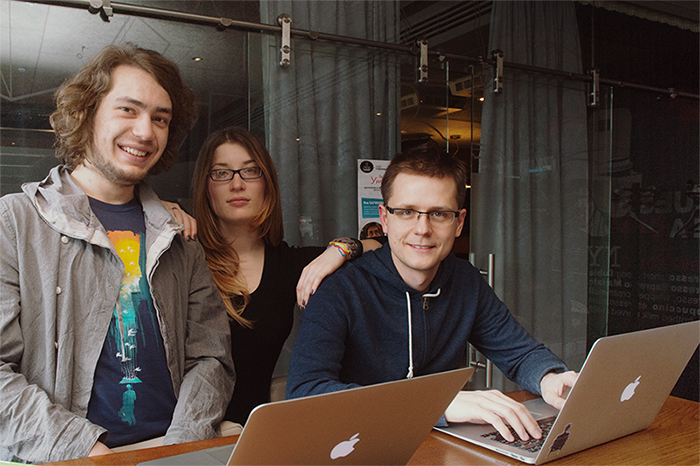 (The Old Reader’s team before March 13, photo by repor.to/shuvayev)
This is overwhelming. When we started this as something for us and our friends to use, we never expected so many of you to join us in our journey. Thank you very much for your kind words and support, we appreciate this.
Seeing Google Reader go, many of you are asking whether The Old Reader is going to stick around. Also, quite a lot of people would like to donate to keep our project running. We have been discussing this quite a lot recently, and we decided that paid accounts (the freemium model) are the way to go. We want to keep making a great product for our users, not cater it for advertisers’ needs.
We are going to be honest, we have not even started coding this yet. However, we would like to get this news out as soon as possible for everyone to know the way we will be going. Paid accounts will have some additional features, but the basic free accounts will still be 100% usable. We are not in this game to make money, but we want to give something special back to the people who are going to be supporting us.
We have our daily jobs, so we can’t promise that new features will be ready tomorrow or next week. We have no investors or fancy business plans, but we are open about everything we do, and we want to do it the right way.
We reworked the plans according to the news today. Creating an API for mobile clients is the number one priority in our roadmap. We would love to collaborate with any developers who were making Google Reader clients. Please, spread the word about this if you can.
For those of you who are posting feedback and creating new feature requests - please, double-check for existing items in Uservoice. We hate answering the same questions multiple times and removing duplicate requests.
Most asked questions are:
- “When will OPML import be working again?” As soon as we launch more capacity to handle this. Hopefully, later today.
- “Why are you asking for access to my Google contacts when I log in via Google account?” We don’t anymore.
- “When will you make an iOS app? How about Android?” We will start with API as soon as we can and see how it goes.
- “Why is there no way to login without Google or Facebook accounts?” We cover that one in our knowledge base, but we plan to implement own login code. The demand is high.
- “How do I rename a feed?”. Just browse the Tour page, please?
- “Shut up and take my money!”. Will work on that, stay tuned.
We have lots of things to do, and it will probably take us several days to reply to all emails and tickets. Also, Twitter keeps reminding us about daily tweet limits, so there might be delays as well.
Some other news: last week our developer (on the left) turned 21, and we have implemented PubSubHubbub support. Many of you asked us to make feed updates faster, and PubSubHubbub makes compatible feeds refresh almost instantly. Yay!
Thank you very much for your support. We will do our best during next three months to prepare for the day Google Reader will no longer be around.
The God-Machine Hints at the World of Darkness’ Future

Beneath the skin of the world you know, a terrible machine grinds and gnashes its gears. Its cogs range in size from the flap of a butterfly’s wings to the meteor that killed the dinosaurs. The God-Machine’s tools are timeclocks and angels, crushing banality and outrageous supernatural intervention; these contradictions are unified in the alien-clockwork of its inevitability. Azathoth is not a screaming, pulsating tumor of chaos at the center of reality; it is rust and cold and wire, soldered together. The factory assembly line for the banality of evil. Darkseid’s Anti-Life Equation, made from iron and clockwork and tesla coils. This is the premise behind The God-Machine Chronicle, the newest major World of Darkness offering (and its attendent short fiction anthology). Based on the piece of flavor text that began the core World of Darkness book, The God Machine Chronicle also introduces a number of major rules updates.
[Read more]
Didn’t I say before that the World of Darkness was at its best when it abandoned canon? Well, with the first round of offerings from their new print-on-demand distributor, Oynx Path, it seems like they agree. Glad tidings indeed! They’re creating a series of Chronicles; optional and modular offerings that are half-way between each point of a triangle: part adventure, part campaign setting and a part re-imagining. The lessons of Mirrors has been taken to heart, it seems, and the open-ended nature of the “new” World of Darkness is finally being taken advantage of on a large scale…frankly, I couldn’t be happier.
Let’s talk a little bit about the new rules. First off, Morality gets overhauled into Integrity, which is probably the most visible change. Personally, this is sort of how I’ve always used Humanity, rolling an “alignment” mechanic into a “sanity” mechanic. Conceptually, I’m fine with it but…really? Composure plus Resolve? Don’t we have enough core mechanics—notably, Willpower—that rely on those two attributes? I have to admit, it made me wistful for the days of Vampire: the Masquerade’s moral attributes, like Courage and Conscience. The new combat mechanics…well, they exist. I personally admired the extreme elegance of having weapons just straight add dice to the roll, cutting out a special “damage” mechanic, and I think tying Defense to Athletics sort of demands that players pay attention to it, over-weighting it, but neither of these are major concerns.
Complaints aside, a lot of the new mechanics in God-Machine resemble a lot of the house rules I’ve adopted in my campaign (which I run with the World of Darkness system), seeming to come from the same impulse and at a similar angle. I’ve long admired the way that Vice and Virtue reward players for making choices that are in-character for their PCs but are also obviously sub-optimal for “winning” the game. We’ve all had those moments, where you as the player can see a bad thing coming from a mile away, because you’ve familiar with the tropes of the genre, and the World of Darkness is good at rewarding you for falling for it despite any meta-game knowledge. Sure, pry the rubies out of the demonic idol, go right ahead!
Personally, however, I think the bean-counting gets a little too out of hand. I like the use of Conditions, which are essentially short-term and long-term Flaws, which impair you and reward you for applying their negative consequences in game, but I don’t like counting “Beats” to collect Experience points. In my game, I use the same mechanic to replenish Willpower—for non-rule based mishaps as well, like if a player decides on a colossal strike with their sword to arbitrarily have it wrench out of their hand, disarming them, I grant it too—instead of Experience points, just because I don’t want “grinding” for experience to be a thing, let alone a disruptive one. Besides that, I just generally would rather have people paying attention to the game, rather than their character sheet. I may play a little more fast and loose, but I still very much agree with the idea behind Conditions and Tilts.
One thing that makes God-Machine and the idea of a Chronicle book really appeal to me is just how modular it is! The core of the book is a serious of vignettes, of adventures, but they aren’t meant to be used linearly. Heck, they aren’t even your usual flow chart format; instead, The God-Machine Chronicle tries to give you the tools to make your own flowchart; it encourages you to use the prepared materials in any way you see fit; to tweak and discard, to cobble together and invert, if that is what you want. Just reading along I came up with the idea that The God-Machine’s true purpose—left purposefully undecided in the book—is to regulate the living from the dead…and now the underworld is full. “Operation: Bell Jar’s” creepy oil rig is a test site for the God-Machine’s experiments to integrate souls and machines, leading to “Ghost Machine’s” haunted electronics, “Missing Person” is an attempt to fix the same problem through dimensional abductions. When that fails, “Wake the Dead’s” magical realistic zombie story is inevitable as is the “Scarlet Plague,” as the God-Machine tries to force-quit the program with sterilization and extinction. There are plenty of other options—including a great time-travel campaign I whipped up that would make Steven Moffat weep, all about Dark Matter and the Big Crunch—and the moving pieces (and movable pieces) are so evocative it is hard not to dream one up just flipping through.
 The related collection of fiction is worth checking out as well; Mark L. S. Stone’s “Ouroboros” directly inspired a threat in the current campaign I run, and I think that is an achievement in itself. It also includes the aforementioned story that started it all, McFarland and Chillot’s “Voice of the Angel.” If you don’t own the World of Darkness core book, but have somehow read this far, that story alone is worth checking out the anthology for. A perfect piece of paranoid outsider art, it just oozes a disturbing verisimilitude. McFarland’s “Stories Uncle Don Told Me” and “Go Back” by Stew Wilson both also stand out for me as creepy and inspiring; The God-Machine Chronicle is really McFarland’s baby and you can tell it looms large in his head.
Mordicai Knode is a big Promethean fan—Frankenstein’s Monster and alchemy, what’s not to like?—so he’s very interested in the relationship of the Principal and the quashmallim to the God-Machine and it’s angels, so he wants to see more of Mary Dear and the third policeman. You can catch up with him on Twitter and Tumblr.
Plans unveiled for NYC’s Donnell Library
MordicaiIf Jennifer hadn't left the system, this would be her fiefdom.

Pretend you weren’t reading this article. Could you guess what this space is?
The New York Public Library officially unveiled the architectural plans today for the long-left-in-limbo Donnell Branch on 53rd Street. The good news is that it’s nice and airy-looking. The bad news? It’s 70,000 feet smaller than the original branch, probably won’t be open until late 2015, and, oh, wait, they forgot something… From the New York Times report on the plans:
In addition to traditional library elements — like some bookshelves and a children’s area — there will be public spaces, including sitting areas, a 141-seat auditorium and a technology hub.
“Some bookshelves”? “Some bookshelves?” You could be forgiven for thinking that we were no longer talking about a library branch, in a city where print materials still remain by far the majority in circulation numbers. And indeed, the view of the plans (the image above) from architect Enrique Norten and his firm TEN Arquitectos has a nice big wall over the whole area where the books appear to be—so, are there books behind there? Or just more stairs? Who knows? Not us.
Norten’s design adds yet another entrant to the “Big Stair” trend in urban design, as otherwise seen on the High Line and in the Prada store in Soho. (The Times calls them “bleachers.”) While, on the one hand, the Big Stair solves a couple of problems (seating that works for varying numbers of people and types of sitters, how to fit an auditorium in a small space) and recalls the famous steps of main branch on 42nd Street, they also take up a lot of space: space in which there are no books.

The whole design, in fact, represents the privileging of empty space over books. Its bare, mod-table-flecked expanses stretch away west, uninterrupted by anything more bibliographically intrusive than two sets of shelves on the front wall. It looks, indeed, suspiciously like the lobby of a high-end hotel chain, which is what the Donnell will still be part of, should the newest real estate deal for the space stay intact.
But the problem is not with empty space per se—there’s a lot of empty space in the Schwarzman Building—nor with Norten’s design—he seems to have been given what amounts to basically a slice of a building and has made an elegant multistoried gallery out of it. The problem is that there’s no evident effort here to balance the book-holding, book-delivery. and public-space functions of a library, which is exactly what the Schwarzman Building does very well.
This is a library design for people who read books on their phone, iPad, Kindle, or other e-reading device. As such, it’s a design only for the people who can afford those devices. In New York, that’s a lot of people: ebook circulation jumped 168 percent from 2011 to 2012. But that’s still not everyone, and it’s especially not the people who need the libraries most, the people who, as Anthony Marx, President of the Library, writes, made up part of the “nationwide surge in library usage” since the onset of the recession. These are, after all, the people who the public library systems were designed to serve in the first place. So it seems like a shame to get promises from the NYPL for another bookless glass box when what we actually need is a library.