fuck yeah Red Sonja

For years, the Tommy Wiseau film The Room has been celebrated as one of the worst films ever made, eliciting a devoted following of people who enjoy bad acting, worse writing, and inexplicable football-throwing. Nearly two years ago, Greg Sestero—the best friend turned wife-stealer in The Room—announced he was writing a book about his experience with the film, but it looks like it’s finally happening. Via the Instagram account of McNally’s Cristin Stickles comes the above image, and Sestero recently told the UK’s The Independent that it’s due out in October. It’s called The Disaster Artist, and it should be catnip for spoon-throwing Room devotees. Bonus: It was written with Tom Bissell, who covered The Room for Harper’s, and whose “Expensive Trips Nowhere” was adapted into the acclaimed film The Loneliest Planet.
Read moreAdd "CPAC vs. Islamophobes" to the growing list of internal conservative squabbles.
"What are they doing at CPAC? Essentially, they are enforcing the Shariah," said anti-Islam blogger Pamela Geller. "Under the Shariah, the blasphemy laws, you cannot say, you cannot offend, you cannot criticize and you cannot insult Islam. That is effectively what they’re doing, they are enforcing the Shariah."
Right Wing Watch reports that Geller was speaking on "The Janet Mefferd Show" about her recent snub from this year's Conservative Political Action Conference, at which she usually holds an unofficial panel. "This year I could not get an event, I was banned," she said, though also noted that in the past, "I wasn’t warmly welcomed because of the influence of what can only be described as Muslim Brotherhood facilitators or operatives like [ex-Bush staffer and Muslim] Suhail Khan and [anti-tax conservative ] Grover Norquist."

 |
 |


Read more of this story at Slashdot.


"H. Berthold first published Akzidenz-Grotesk in 1896. The design originates from the type used in Germany by job-setters and trade printers of earlier centuries. This early sans serif preceded the first weight of Helvetica by over 40 years. Throughout the years, H. Berthold has expanded this extremely popular and versatile family. AG Super, Extra, Super, Italic and Extra Bold was developed in 1968 by Günter Gerhard Lange and is an excellent choice for headlines requiring heavily-weighted strokes."

|
|
Russian Sledgesattn overbey
Over the past weekend, 60 artists and hackers gathered in Brooklyn for Art Hack Day, from which came God.js, a programming language that acts like scripture as users browse the web. Developed by Will Brand, Ramsey Nasser and Ivan Safrin, a user can enter in scripts, er, scriptures, that the program will obey. If a doctrine is violated too much, your higher power will scold you, resulting in a range of punishments including two dozen tabs full of animated GIF hellfire.
Hat tip goes to The Verge.
Submitted by: Unknown (via Github)
Share on Facebook
Franco Origlia/Getty Images
Pope Benedict XVI after his final general audience, St. Peter's Square, February 27, 2013
so my mums best friends husband went to school with David Tennant in Scotland and he told us that david would always say he “really really wants to be doctor who on television”
Excuse me while i die…


Silver Nemesis: I’m a good girl. I do what I’m told.


In an interview with Palm Beach Illustrated, actress Carrie Fisher said that she will be returning to Star Wars to reprise her role as Princess Leia for the new series of films.
Disney is going to continue the Star Wars saga, producing movies set to hit theaters starting in 2015. Can you confirm whether you’ll reprise the role of Princess Leia?
Yes.
What do you think Princess Leia is like today?
Elderly. She’s in an intergalactic old folks’ home [laughs].
I just think she would be just like she was before, only slower and less inclined to be up for the big battle.
And still wearing the bagel buns?
The bagel buns and the bikini, because probably she has sundowners syndrome. At sundown, she thinks that she’s 20-something. And she puts it on and gets institutionalized.
image by David Daring
via io9
Clever, but:
After all, other brands owned by Dove’s parent company, Unilever, don’t seem to be taking the real beauty message seriously — just look at Axe’s commercials.
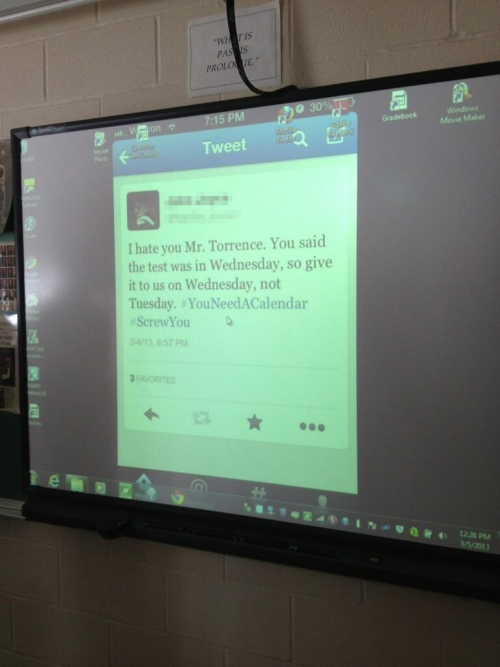
A student tweeted about a test, and the next day it was the teacher’s desktop background.

On top of a Zeppelin
Researchers at MIT plan to 3D print a 3m-high pavilion by imitating the way a silkworm builds its cocoon.
The Mediated Matter Group at MIT's Media Lab will use a robotic arm to print a structure using silk fibres bound together with a biodegradable glue. Unlike traditional 3D printing the CNSILK Pavilion will be “freeform” printed without the use of support material to hold it up during construction.
The research team, headed by architect and Mediated Matter Group founder Neri Oxman, attached tiny magnets to the heads of silkworms to discover how they “print” their pupal casings around themselves.
“We've managed to motion-track the movement as the silkworm is building its cocoon,” said Oxman. “We translated the data to a 3D printer that's connected to a robotic arm.”
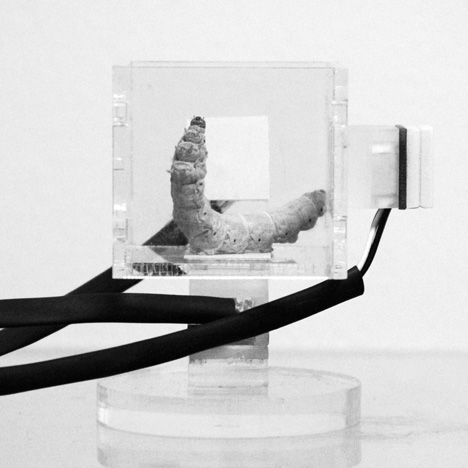
Above: Silkworm motion tracking; Bombyx mori silkworm spinning within a sensor rig. From the "Silk Pavilion" project by the Mediated Matter Group, MIT Media Lab. Image by the Mediated Matter Group, MIT Media Lab
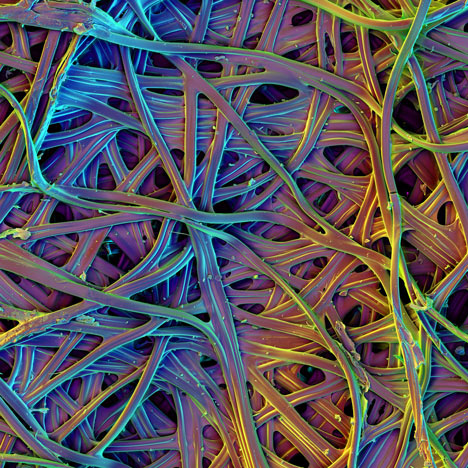
Top: colour scanning electron microscope image of the exterior surface of a silk moth cocoon. Image by Dr. James C. Weaver, Wyss Institute, Harvard University
The arm will deposit silk fibres as well as a gluey “matrix” using the same figure-of-eight motion a silk worm uses to build its casing. “Like the silkworm, you're using the robotic arm to move freely in space, printing or depositing the material,” said Oxman.
The pavilion is part of a research project to explore ways of overcoming the existing limitations of 3D printing and follows recent proposals for a house made of 3D printed concrete sections and a dwelling made of prefabricated plastic elements.
Today's printers are only able to produce homogeneous materials with the same properties throughout, whereas natural materials often exhibit varying properties, or "gradients". A silk worm, for example, is able to produce a cocoon with a tough exterior and soft interior by varying the density and pattern of the silk fibres it deposits.
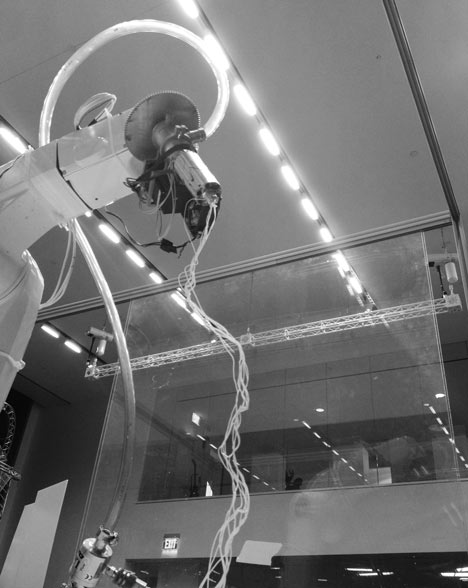
Above: custom multi-fiber extrusion head on KUKA robotic arm. From the "Silk Pavilion" project by the Mediated Matter Group, MIT Media Lab. Image by the Mediated Matter Group, MIT Media Lab
"What's so fascinating about the silk worm is that it creates the cocoon, which is this eggshell of fibrous geometry, out of one continuous kilometre of silk," Oxman said.
"It's moving its head and its body in an 8-figure in a way that allows for the distribution of the silk depending on the structural and environmental performance. For instance the inner layers of the cocoon are soft while the outer layers of the cocoon are stiff. The silk worm can vary its properties according to its function."
The CNSilk (Computer Numerically Controlled Silk Cocoon Construction) Pavilion will be built using a KUKA robotic arm at MIT’s MediaLab on 22 April and will measure 12 feet by 12 feet.
“We'll be able to show the robotic arm depositing the silk using its six axes to construct the pavilion,” said Oxman. “The robotic arm will have a deposition head for the matrix, the glue material. That will help stick the fibres together in the areas we need them.”
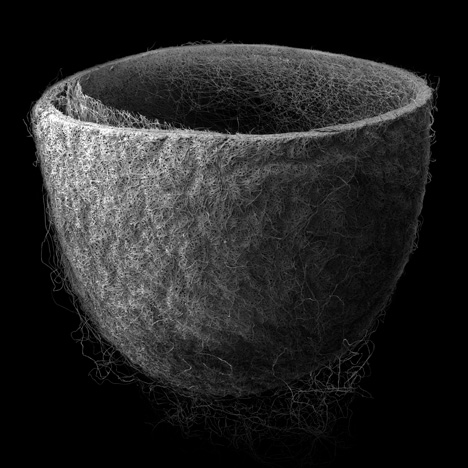
Above: Dissected silkworm cocoon. Image by Dr. James C. Weaver, Wyss Institute, Harvard University
The team are considering using a new material called shrilk as the gluey matrix. Developed at Harvard, shrilk is made of a mixture of discarded shrimp shells and proteins extracted from silk. Shrilk is similar to the hard, lightweight material found in insect’s shells.
Oxman believes that freeform printing using robot arms has more potential for architecture than existing 3D printing systems, which use gantries that can only move in three directions and which require complex support structures to be printed at the same time to prevent the building components collapsing under their own weight.
“Traditional 3D printing has a gantry-size that is limiting; it has three axes, which are limiting; it has support material, which is limiting,” explains Oxman. “Once we put it on a robotic arm, we free up these limitations. If we use a boom arm with a 20 metre reach, we can basically control not only the variation of properties but also how we choose to assemble the various parts together."
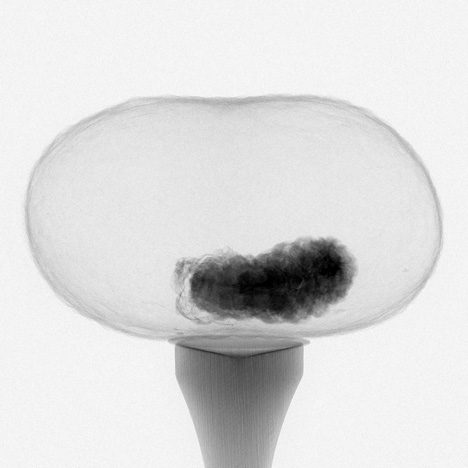
Above: X-ray photograph of a dried Bombyx mori pupa in a completed silk cocoon. From the "Silk Pavilion" project by the Mediated Matter Group, MIT Media Lab. Image by Dr. James C. Weaver, Wyss Institute, Harvard University
In future, buildings could be constructed by swarms of tiny robots, she said. “I would argue that 3D printing is a method of depositing material rather than a technology, and once you think about it in that way you release yourself and you don't just see it on a gantry. You can see it on a robotic arm, you can see it on a multi-agency system of lots of tiny robots that are printing together to print something bigger. Once you release the need to think of a 3D printing platform as gantry-related you can dream in lots of exciting new ways.”
However Oxman said that in the immediate future, 3D printing is more likely to be used for architectural components instead of complete buildings.
“We'll probably be seeing more and more structural printing for facades and for building components that are maybe not globally structural. Once we figure out the scale limitation, once we move from a small arm to a boom arm, then we'll actually be able to print a building. But probably in the next decade we'll only see building components, furniture and products. It will take quite a while until we're able to implement these technologies in the context of an entire building.”
The CNSilk Pavilion is being developed by Mediated Matter group at the MIT Media Lab in collaboration with James Weaver at the WYSS Institute and Professor Fiorenzo Omenetto at TUFTS University.
The post Robot silkworms to print architectural structure appeared first on Dezeen.
Poem written by an 11-year-old Afghan girl
This poem was recorded in a NYT magazine article about female underground poetry groups in Afghanistan. An amazing article about the ways in which women are using a traditional two line poetry form to express their resistance to male oppression, their feelings about love (considered blasphemous), and their doubts about religion.
One of the best articles I’ve read all year. Here’s the link
(via screwby)