Shared posts

10 Mar 21:55

Why Cable Has So Many TV Channels You Never Watch—Explained in 1 Lawsuit

by Derek Thompson
Russian Sledges

"I'd love to see the broadband internet access equivalent of the statement "When you get mad at cable companies, you are, somewhat literally, blaming the messenger"
Are cable companies subsidizing television access by overcharging/underinvesting in broadband?
If so... that's a huge-ass gaping hole for disruption from broadband providers who don't give a shit about television, which I imagine is why cable companies fight so hard against defining internet access as a public utility."--firehose

Have you ever fantasized about suing cable companies for over-charging you for hundreds, if not thousands, of channels that you don't watch? Then please direct your attention to a new lawsuit brought by Cablevision, a cable company, against Viacom, a media company that owns channels. 

Wait. A cable company is fighting on your behalf to shrink its channel offerings? We haven't gone through the looking glass. In fact, this is a crystal-clear lesson in who really wears the pants in the TV business.

When you get mad at cable companies, you are, somewhat literally, blaming the messenger. Cable companies are messengers. They build the infrastructure that transports channels to your television. To buy channels to carry, they make deals with media companies, like Time Warner and CBS. These companies own all the channels you want and all the channels you don't want. Viacom, for example, owns some networks I love (like Comedy Central) and some networks I've never seen (like Palladia, MTV Hits, and VH1 Classic ). When Cablevision signs on the dotted line, it has to carry all of them.

Cable companies can't shop the Viacom store like it's a Best Buy and pick whatever they want. The media companies tell the cable providers to buy and carry all of their channels or none of them. Is that fair, or unfair? I don't know. I just know that your cable menu is a thousand channels long, not because your cable company hates you, but because the companies who own the channels have incredible market power to force cable providers to buy everything they're selling.

Cablevision is claiming that Viacom "abused its market power" by forcing the cable company to buy and carry all of the channels, according to The Verge. Indeed, more than 90 percent of the shows Americans watch are owned by just seven media companies, like Time Warner, Disney, and Viacom. That sounds oligopolistic, but it will be up to a judge to determine whether it's really illegal.

Media companies like Viacom and Disney and Time Warner and CBS have pulled off an incredible trick. They've used their market power to force cable companies to carry all of their channels and avoided public criticism of bloated cable menus. Imagine if Coca Cola forced New York City bodegas to sell each Diet Coke shopper an additional Vitamin Water, Sprite, and Orange Fanta ... and New Yorkers responded by burning down the city's bodegas. That's what I mean by blaming the messenger.


10 Mar 20:28

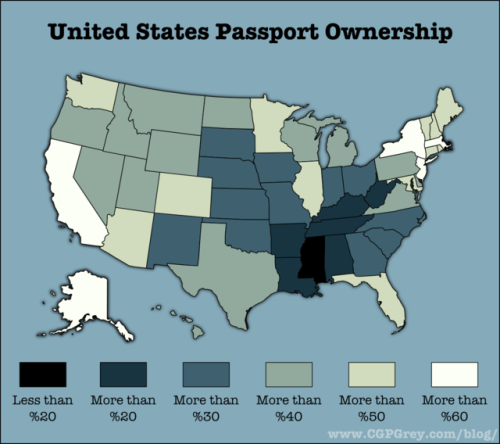
Red State

Russian Sledges

apparently I am from the passport-holding part of the country

data: http://www.cgpgrey.com/blog/how-many-americans-have-a-passport.html

10 Mar 20:01

Monstrous

by Josh Marshall

This is a kind of blood-curdling story I just learned about this afternoon. Zerlina Maxwell is an acquaintance who I've watched from a distance as she builds a media career as a progressive pundit and activist -- succeeding to an amazing degree while also getting a law degree. I met her for I think only the second time in person at my birthday party last weekend. I just found out that since an appearance on Hannity on Tuesday she's basically been under an escalating online assault filled with racist epithets and threats of rape all for stating what I think is a fairly straightforward opinion on the intersecting issues of guns and rape.

Here's a post Zerlina did at the feminist blog Feministing on this on Thursday while things were still heating up.

Now, I think we all realize that the Internet is not a representative medium and it tends to bring out the lowest common denominator types across the political and cultural spectra. But this strikes me as being in a more extreme category.

First, here's the segment in question.

The question at issue is whether women should carry or have the right to carry firearms to protect themselves against rape and sexual violence. The gist of Zerlina's argument was that it should be on men and the culture in general to make rape and sexual assault unacceptable rather than on women to arm themselves to not be raped. In other words, don't put it on her to carry a gun any more than you tell her to dress a particular way or anything else. The underlying point of debate was whether rape is just something like murder or robbery -- something that will always exist to some, hopefully limited, degree -- or something that is bound up in and encouraged or discouraged by our culture. In other words, whether men can be taught not to rape.

As you'll see if you watch it, Zerlina reveals in the segment that she is herself a rape survivor.

The pros and cons of the specific argument about guns speak for themselves and Zerlina makes it better than I can. What I'm interested in focusing on is the sort of digital lynch mob, seemingly churned up by a post on the segment at The Blaze and other sites, the segment generated.

Zerlina sent me a few examples of what she's been on the receiving end of ...

image content

image content

image content

I've been on the receiving end of really vicious online attacks before, most recently centered on this post. And it's difficult to describe -- even though it's just words -- what the experience is like. And I've never been on the receiving end of stuff like this. I don't really have more to add than my ability to shine a light on this.

[Ed.Note: I should note that in the argument he made in the segment above, Hannity was ... well, Hannity. But there was really nothing he did or said to encourage these kinds of attacks. And Zerlina tells me that off camera he was very compassionate and supportive of her decision to discuss her own rape as part of the segment in question.]


10 Mar 19:20

Who Will Be Pope?

by Josh Marshall
Russian Sledges

"the heavily Catholic Philippines, where past pontiffs had been welcomed by millions with rock-star intensity"

should be "where rock stars have been welcomed by millions with papal intensity"

With the conclave upon us, who will be the next pope? Check out our special cheat sheet of the top contenders with bios of each.


10 Mar 18:57

thefingerfuckingfemalefury: lysistratas: yes i am girl yes i play hoop with stick girl...

thefingerfuckingfemalefury:

lysistratas:

yes i am girl

yes i play hoop with stick

girl gamer

image

THAT STICK IS TOTALLY THE WRONG KIND OF STICK TO PLAY HOOP WITH STICK WITH

Clearly she is a fake girl gamer…

Just pretending to be into hoop with stick to try and seduce the few guys left who haven’t died of the plague…

10 Mar 18:56

Two Red Pandas Wrestle and Squeak

by Kimber Streams
10 Mar 18:07

More woo and anti-science rants at TEDx

by whyevolutionistrue

First we had Rupert “can-dogs-find-their-way-home” Sheldrake peddling woo and antiscience at TEDx Whitechapel, and now, at the very same venue, we see Graham Hancock decrying materialism and spouting woo and pseudoarchaeology. Here’s his 18-minute talk:

I actually agree with Hancock’s argument that we should be allowed to take whatever consciousness-altering drugs we want, but I totally reject as unsupported his arguments about our ancestors’ evolution being triggered by hallucinogenic substances and about ancient cave art clearly reflecting psychedelic trances. And I strongly decry his anti-science rant that begins at 9:50:

“That leads me to ask, ‘What is death?’ Our materialist science reduces everything to matter—materialist science in the West says that we are just meat: we’re just our bodies, so when the brain is dead, that’s the end of consciousness. There is no life after death; there is no soul—we just rot and are gone. But actually, many honest scientists should admit that consciousness is the greatest mystery of science, and we don’t know exactly how it works. The brain is involved in it in some way but we’re not sure how. Could be that the brain generates consciousness the way a generator makes electricity. If you hold to that paradigm then of course you can’t believe in life after death: when the generator is broken, consciousness is gone.

But it’s equally possible that the relationship—and nothing in neuroscience rules it out—is more like the relationship of the t.v. signal and the t.v. set. And in that case, when the t.v. set is broken, of course the t.v. signal continues. And this is the paradigm of all the spiritual traditions: that we are immortal souls, temporarily incarnated in these physical forms to learn and to grow and to develop. And really, if we want to know about this mystery, the last people we should ask are materialist, reductionist scientists. They have nothing to say on the matter at all! [Audience laughter.] Let’s go rather to the ancient Egyptians, who put their best minds to work for 3,000 years on the problem of death. . . “

Yep, consciousness is a mystery, but if anything will help us solve it, it will be reductionist science—certainly not woo or spirituality!

Hancock then argues that the best minds of the ancient Egyptians showed that our souls do live on after death and that we will be held accountable for our thoughts, actions, and deeds. (They divined this in part through “dream states” experienced from psychedelic plants.)  At the end, he argues that we may be denying ourselves the “next vital step” in our evolution—it’s not clear whether he means biological or cultural evolution—by refusing to sanction the use of psychedelic substances.

This, then, is Sheldrake-ian woo, and an unconscionable denigration of science in favor of  “insights” derived from ingesting drugs. It’s also the denigration of materialism: a criticism that, as the audience reaction shows, is favored by many.  Too many folks of a religious and spiritual bent resent the successes of science (as compared to faith) in understanding our cosmos, and often express this by hooting and jeering, as do Hancock and Sheldrake, at “scientific materialism.”  “There’s a lot more to the world!”, they cry.

That reminds me of a story that I may have told before.  When I was in college, a friend and I were—as was the custom in the Sixties—spending an evening under the influence of psychedelic substances. Suddenly I had a brilliant insight into the nature of the universe. Knowing I’d forget it, I wrote it down on a scrap of paper. After a while I went to bed, and when I awoke the next day I remembered the paper and reached eagerly into my pocket for it.  On it was scrawled my eternal truth, which turned out to be this:

“The walls are fucking BROWN.”

Many who grew up in the Sixties have a story like this.

I don’t deny that taking drugs can be a valuable way of expanding one’s consciousness. It was for me, for it reinforced my view that each of us is simply a small atom of animate matter in a very large universe, and helped me see the beauty around me that we often overlook. I think Sam Harris has made similar points. But taking drugs is not a substitute for science: it won’t help us understand whether we live on after death, or how consciousness arose, both physiologically and evolutionarily.

Here’s the TEDx blurb on Hancock:

Graham Hancock is the author of The Sign and the Seal, Fingerprints of the Gods, Keeper of Genesis, Heaven’s Mirror, Supernatural and other bestselling investigations of historical mysteries.

His books have been translated into twenty-seven languages and have sold over five million copies worldwide. His public lectures and broadcasts, including two major TV series, Quest for the Lost Civilisation, and Flooded Kingdoms of the Ice Age, have further established his reputation as an unconventional thinker who raises controversial questions about humanity’s past. Hancock’s first venture into fiction, Entangled, was published in 2010 and his second novel, War God, on the Spanish Conquest of Mexico, will be published on 30 May 2013. Hancock maintains an active Facebook presence: http://www.facebook.com/Author.Graham…. His website is: http://www.grahamhancock.com.

Hancock believes that the Ark of the Covenant was real, and his book The Sign and the Seal (a bestseller, of course), is about his search for that Ark.

Over this weekend I’ve pondered whether talks like Sheldrake’s and Hancock’s should be taken down: would that be “censorship”? And then Carl Zimmer called my attention to this stipulation from the TEDx “rules” page:

Speakers must tell a story or argue for an idea. They may not use the TED stage to sell products, promote themselves or businesses. Every talk’s content must be original and give credit where appropriate. Speakers cannot plagiarize or impersonate other persons, living or dead.

Speakers must be able to confirm the claims presented in every talk — TED and TEDx are exceptional stages for showcasing advances in science, and we can only stay that way if the claims presented in our talks can stand up to scrutiny from the scientific community. TED is also not the right platform for talks with an inflammatory political or religious agenda, nor polarizing “us vs them” language. If Talks fail to meet the standards above, TED reserves the right to insist on their removal.

Sheldrake was not only selling his book, but making false claims about science. Hancock does the same thing by insisting that ancient Egyptians tell us things about our consciousness that science hasn’t—and can’t. TEDx has the right to remove talks that abrogate these rules (what is Hancock’s anti-science rant but “us versus them” stuff?), and it should remove Hancock’s and Sheldrake’s videos.  If they don’t, it will simply confirm a growing view that TED and its subsidiaries are moving away from good science and heading toward Deepak and Oprah.

The motto of TEDx is “ideas worth spreading.”  Well, so is manure.

h/t: Carl Zimmer


10 Mar 18:04

hipsterlibertarian: Homeless mother who sent six-year-old son...

by experimentaltimeorder
Russian Sledges

this is very connecticut


hipsterlibertarian:

Homeless mother who sent six-year-old son to better school in the wrong town jailed for five years

A mother who pleaded guilty to fraudulently enrolling her six-year-old son in the wrong school district has been sentenced to five years in prison.

Tonya McDowell sent her son to an elementary school in Norwalk, Connecticut, instead of her home city of Bridgeport.

The 34-year-old, who was homeless when she was charged with felony larceny last year, said she wanted the best education possible for the boy.

Read more here.
There is something criminal going on here, but this woman isn’t the one guilty of it.
10 Mar 16:15

Bill Sees Role For Dental Practitioners In Mass.

by Bob Salsberg

BOSTON — Dental hygienists with advanced training could perform certain procedures now reserved for dentists, including routine fillings and tooth extractions, under a bill that supporters believe would improve access to oral health care for low-income Massachusetts residents and underprivileged children.

The legislation would create a new, mid-level position called advanced dental hygiene practitioner, similar to a nurse practitioner in a physician’s office and comparable to dental therapists that operate in more than 50 other countries. The proposal is being viewed with some alarm by dentists, who are worried about patient safety and adequacy of the training requirements contained in the bill.

“We love our dentists. They do a good job, but there are not enough of them,” said state Sen. Harriette Chandler, D-Worcester, who has sponsored the bill along with Rep. William “Smitty” Pignatelli, D-Lenox.

A dental practitioner would not supplant the traditional family dentist nor prompt any fundamental realignment of responsibilities in a typical dentist’s office, backers insist. In fact, the vast majority of people with dental insurance who see a dentist regularly for cleanings and other services would likely encounter no change in routine.

But for the poor, the uninsured and those who live in parts of the state where there are too few dentists, the advanced hygienist could provide access to preventative care that is otherwise not available.

“It is long overdue,” said Jacklyn Ventura, a dental hygienist who directs Mass Healthy Smiles, a private organization that offers screenings and other services, such as cleanings and fluoride, to children in community settings such as public schools and day care facilities.

“Dentistry is so expensive. When families have more than one child, it can put them back six months just to have regular visits,” Ventura said.

Supporters see the bill as a natural extension of a three-year-old Massachusetts law that allowed professionals like Ventura to provide typical dental hygiene services in public settings without direct supervision from dentists.

The legislation would take it a step further by allowing dental practitioners to perform non-surgical tasks, including the pulling teeth or filling small cavities – but only when such procedures do not require root canal, periodontal surgery or other more complex intervention.

“It would bridge that gap between what public health hygienists can do and what dentists can do,” said Katherine Pelullo, who chairs the Council on Regulations & Practice for the Massachusetts Dental Hygienists’ Association.

In more than half of the state’s 351 cities and towns, no dentists accept MassHealth, the state’s Medicaid program, and 53 percent of children in families eligible for MassHealth did not see a dentist in 2011, according to the association. Additionally, the group says, more than 600,000 residents live in areas of the state designated as having a shortage of dentists, and elderly in nursing homes often go without dental care.

The Division of Health Care Finance and Policy estimated that 31,000 hospital emergency room visits in 2011 resulted from preventable dental crises.

Supporters of the bill say they do not foresee a huge rush by current dental hygienists to become advanced practitioners. Achieving that designation would require an additional 12-18 months of study in a master’s level program, along with 500 hours of practice under the direct supervision of a dentist and other requirements.

Still, many dentists are wary.

“It clearly is a major change in the practice paradigm in oral health,” said Dr. Paula Friedman, president of the Massachusetts Dental Society and professor at Boston University’s Henry M. Goldman School of Dental Medicine.

“I have real concerns about safety of the public from someone who has only had 18 months of postsecondary education. The reality is that many people feel four years of dental school is not enough to teach people what they need to know,” Friedman said.

The dental society has yet to take a formal position on the legislation. Friedman says it needs more vetting. Chandler said lawmakers are prepared to address concerns about safety and training and fine-tune the bill if necessary.

“We have to guarantee the safety of our patients,” she said.

In 2009, Minnesota became the first U.S. state to license a similar category called dental therapists. In Alaska, dental therapists have provided care to native tribes for the past decade.

A number of states are weighing similar laws including New Hampshire, where a hearing was held this month on a bill allowing dental therapists.

The Massachusetts bill has been referred to the Legislature’s Committee on Public Health. No hearing date has been set.

10 Mar 16:07

Power Struggle on Reforming Vatican Bank

by By RACHEL DONADIO and ANDREW HIGGINS
The Vatican is under mounting pressure to clean up its bank — long the subject of dark intrigue — in a push by the European Union to apply common rules for the use of the euro.
10 Mar 15:47

fuzzycatbutt: seismogenic: Tattoo You This geologic cross...

by ushishir


fuzzycatbutt:

seismogenic:

Tattoo You

This geologic cross section tattoo is one of my favorite pages in Carl Zimmer’s Science Ink.

10 Mar 15:44

A malpresentation by BioDivLibrary on Flickr. The new book of...

by ushishir


A malpresentation by BioDivLibrary on Flickr.

The new book of the horse /.
London :Cassell and Co.,1911..
biodiversitylibrary.org/page/25431973

10 Mar 15:38

Into the Sheets

by Thomas Hawk

Thomas Hawk posted a photo:

Into the Sheets

10 Mar 15:37

Polycystins, figures of remarkable forms &c. in the Barbados...

by ushishir


Polycystins, figures of remarkable forms &c. in the Barbados chalk deposit (chiefly collected by Dr. Davy, and noticed in a lecture delivered to the Agricultural Society of Barbados, in July, 1846) by BioDivLibrary on Flickr.

London :W. Wheldon,[ca. 1869].
biodiversitylibrary.org/page/9995987

10 Mar 15:36

almondseed: De motu cordis / 1728 Illustrated by: Ricciolini,...

by ushishir


almondseed:

De motu cordis / 1728

Illustrated by: Ricciolini, Niccolo

Nerves of the thorax.

10 Mar 15:34

The Last of England (1988)

Russian Sledges

watched this a couple weeks ago when I was sick and delirious

10 Mar 15:33

The Dive

by nobody@flickr.com (Mr Macgoo)

Mr Macgoo has added a photo to the pool:

The Dive

While out with some friends checking on a tip of GG's moving through the area; we lucked out finding four of the owls. I've seen 5 species of owl in the last month and have to do a lot of downloading. Hope to have my blog updated soon.

10 Mar 15:22

Chinese character transcriptions for "nerd"

by Victor Mair
Russian Sledges

'nàdé 纳德 ("accept / admit / pay / offer virtue"), though this transcription is also used for "Nader", as in Ralph Nader (I've also had this transcription of "nerd" confirmed from other sources)'

Chinese speakers have phonetically transcribed the word "geek" as jíkè 极客, qíkè 奇客, etc., and these transcriptions are fairly widely used and recognized, even among Mandarin speakers (the initials would be velars in many non-Mandarin topolects, so they would sound more like "geek" than do the Mandarin pronunciations). So far, I don't know of any Chinese character transcription for "nerd", certainly none that is broadly circulating.


Although the English word "nerd" is widely known and used in China, it is puzzling that no character transcription has become popular for it, as have jíkè 极客 and qíkè 奇客 for "geek".  One of my hypotheses for the reluctance of Chinese speakers to attempt a transcription of "nerd" is that the final consonant cluster would be very difficult to render or approximate with characters.  But that could just be one of the reasons Chinese have not attempted to transcribe or tanscribe-translate "nerd".  It could also, or simply, be that Chinese have a harder time understanding the meaning of "nerd" than they do the meaning of "geek".

To force the issue, I asked about a dozen native speakers how they would transcribe "nerd" with Chinese characters.  Here are the results (thanks to Gianni Wan, Cheng Fangyi, and Cao Lin for help in assembling this information; note that I usually only give Modern Standard Mandarin [MSM] pronunciations; in most cases the characters are meant merely to transcribe the sounds of the English word, but sometimes they also secondarily convey a meaning that is more or less appropriate, so I also give literal translations of the individual characters):

From a Jin 晋 topolect speaker (age 30) who comes from Yulin, Shaanxi, but is living in Canton:  nè 讷 ("slow of speech; mumble; stammer") or nèdé 讷德 ("slow-of-speech virtue")

From a Hakka speaker (age 17) in Meizhou, Guangdong Province:  nède 讷的 ("one who is slow of speech")

A second reply from the same Hakka speaker:  nèdāi 讷呆 ("slow-of-speech dolt"), though he admits that the sound correspondence is not as good as his previous suggestion (I've also had this transcription confirmed from other sources)

From a Cantonese speaker (age 31) who comes from Liuzhou, Guangxi, but is living in Shenzhen:  nàdé 纳德 ("accept / admit / pay / offer virtue"), though this transcription is also used for "Nader", as in Ralph Nader (I've also had this transcription of "nerd" confirmed from other sources)

From a Mandarin-speaking graduate student (mid-20s) at Tsinghua University in Beijing who comes from Hunan:  nèdòu 讷豆 ("slow-of-speech bean")

From a speaker of Cantonese and Shanghainese, who comes from the north but is living in Shanghai:  nèdá 讷答 ("slow-of-speech answer")

From a speaker of Cantonese who comes from Xi'an, but is living in Shenzhen:  nède 讷的 ("one who is slow of speech")

And the last one, from a speaker of Shanghainese, who both comes from and is now living in Beijing:  nèdé 讷德 ("slow-of-speech virtue")

It is interesting that, in a separate note, this individual explicitly connects the nè 讷 ("slow of speech") of his ad hoc transcription nèdé 讷德 ("slow-of-speech virtue") with the bookish term mùnè 木讷 ("stiff; dull; sincere and honest but slow of speech").  I also find it fascinating that so many of my informants independently hit upon that rather odd character nè 讷 ("slow of speech; mumble; stammer") to render the "ne-" portion of "nerd".  In truth, however, there are very few characters in Mandarin that are pronounced "ne", though characters pronounced "na", of which there are many, could also have been used.  No matter what, it is serendipitously appropriate that nè 讷 ("slow of speech; mumble; stammer") conveys a meaning that Chinese speakers associate with "nerd".

In my original post on the subject of "nerd" in China, I noted with some puzzlement that èr 二 ("two") had been mentioned by several informants as recently being used in contexts that resemble those in which "nerd" appears in English.  In my latest round of inquiries, it was called to my attention that a fuller form of the expression is èrdāi 二呆 ("two / second dolt").  This still didn't make sense to me until I recalled that that the pronunciation of èr 二 ("two") in Japanese is "ni", and it also has an "n-" initial in older forms of Chinese.  In Cantonese èr 二 ("two") is ji6, so that wouldn't work, and in Taiwanese we have li7 / ji2, but in Shanghainese we have ni2, in Hakka we have [海陆丰腔] ngi6 [客语拼音字汇] ngi4 [沙头角腔] gni5 [陆丰腔] gni6 [梅县腔] ngi5 ng5 [台湾四县腔] ngi5 [客英字典] ngi5 [宝安腔] ngi5 [东莞腔] ngi5, and in Chaozhou (Chiuchow, Teochew) we have no6 (nõⁿ ) ri7 今又音ri6.  Consequently, in many Sinitic topolects, 二呆 ("two / second dolt") would sound something like "nidai", which is roughly within the ballpark for "nerd".

To return to the more direct character transcriptions of "nerd" that I discussed above, I think that the ones which incorporate 呆 are particularly clever, since that both sounds a bit like the final consonant of "nerd" and conveys the sense of "silly, daffy; dullard; dolt" — although that doesn't mean the same thing as "nerd", it is close to it in the eyes of many Chinese.  Meanwhile, again in the eyes of Chinese speakers, nè 讷 ("slow of speech; mumble; stammer") does fairly well for the "ne-" part of "nerd".  Consequently, I vote for nèdāi 讷呆 ("slow-of-speech dolt") as perhaps the best current Chinese transcription of "nerd", though, of course, it doesn't really sound a lot like "nerd", nor does it mean exactly what "nerd" does.  In the Chinese linguistic and social context, however, I suppose that something like nèdāi 讷呆 ("slow-of-speech dolt") will have to do, unless some daring folks simply want to adopt the word "nerd" itself and borrow it into their language.

As for the "r" sound of "nerd", it seems that it has been thrown to the winds.

—————–

Just after I finished the draft of this post, I received from one of our senior lecturers in Chinese some additional observations on the matter of "nerd" and "geek".  She suggested that "nerd" could be transcribed as nèdēer 讷嘚儿 and said that she had actually encountered this transcription online.  We've seen the nè 讷 ("slow of speech") character for the first syllable in many of the above listed transcriptions, but dē 嘚 offers a new twist.  On the one hand, because of the mouth radical, we may think of it as just a pure sound, but on the other hand it has a topolectal meaning which may have been subliminally present in the mind of the person who chose it, viz., "chatter" (the more usual meaning of "clatter of a horse's hooves" is irrelevant).  The er 儿 sound is also interesting, since — although it comes at the end — the person who selected it may have intended to represent the medial "r" of the English word.  But the final er 儿 also introduces an entirely new aspect to the conversation on "nerd", it conveys the sense of "young man; fellow; boy", thus raising the issue of gender, inasmuch as er 儿 tends strongly (while not exclusively) to refer to males.  In English, it seems to me that girls can definitely be nerds.  I'm certain that I've heard people talk about "nerdy girls".

Other renderings of "nerd" that our senior lecturer told me she had seen online are nèkè 讷客 ("slow-to-speak guest"), with the kè 客 ("guest") perhaps invoking something of the notion of xiákè 侠客 ("knight errant") (it clearly is not serving any transcriptional purpose here), and nèdēzú 讷嘚族 ("clan / tribe / family / race of nerds" [nèdēs, i.e., mumbling chatterers]).

The gendered conception of "geek" is clearly shown by our senior lecturer's coinage, jípǐnnán 极品男 ("top grade / quality / class / rank male"), which also shows that geeks to her are by no means situated on a low rung of the social scale.

Finally, our senior lecturer told me that her favorite proposal for "nerd" in Chinese is "BBT男", where "BBT" stands for "The Big Bang Theory", the title of a television series, and nán 男, of course, means "man; male; guy".  So "BBT男", i.e., "nerds" to our senior lecturer, are the kind of guys who elaborated the Big Bang Theory!

10 Mar 15:17

UK widow helps resurrect 'Mind the Gap' recording

by By Associated Press

LONDON — A widow's wish to hear her late husband's voice again has prompted London's subway system to restore a 40-year-old recording of the subway's famous "mind the gap" announcement.

The Underground, also known as the Tube, tracked down the voice recording by Oswald Lawrence after his widow, Margaret McCollum, approached its staff and told them what it meant to her.

10 Mar 13:24

Scientists Create Automated 'Time Machine' to Reconstruct Ancient Languages

Russian Sledges

attn overbey

please rewrite "youth without youth" as a movie about cyborgs or something

Scientists Create Automated 'Time Machine' to Reconstruct Ancient Languages:

transliterations:

First, a crash course in “proto-langauges”, also known as common ancestors, or parent languages, are grandmums and granddads of current, known languages, which are descended from them and have evolved from them. One proto-language can result in many languages that form a language family, depending on how promiscuous that proto-language was. (Sorry.) Latin is a proto-language, an exception in that it has been very well documented, unlike others.

The earliest known proto-languages include Proto-Indo-European, Proto-Afroasiatic and Proto-Austronesian, which resulted in modern-day languages in modern-day Southeast Asia, parts of continental Asia, Australasia, and the Pacific. Knowledge of proto-languages isn’t, generally, very detailed - these languages are old, and reconstructing them takes time, even for the best linguists. The good folk over at UC Berkeley have gone and done one better, by creating a time machine - or, if you prefer, a “computer program” - that can

reconstruct more than 600 Proto-Austronesian languages from an existing database of more than 140,000 words, replicating with 85 percent accuracy what linguists had done manually.
image

The model the researchers at UC Berkeley made use of the established theory in linguistics that the evolution of words follows along the branches of the family tree of that language. The method linguists use to find and research proto-languages is called the “comparative method”, which is exactly what it sounds like: finding links and connections between languages, between sounds and their evolution, and if they share similarities to one mother tongue.

“To understand how language changes — which sounds are more likely to change and what they will become — requires reconstructing and analyzing massive amounts of ancestral word forms, which is where automatic reconstructions play an important role.”

Which is where the awesome time machine comes in, I believe.

10 Mar 04:56

John Darnielle consoling a giant teddy bear.


John Darnielle consoling a giant teddy bear.

10 Mar 04:56

Calibrating a Digital Billboard via TwistedSifter by fungiside


Calibrating a Digital Billboard via TwistedSifter by fungiside

10 Mar 04:49

Chucks

10 Mar 04:49

Fire Damages Famed Restaurant Chez Panisse - Wall Street Journal


Wall Street Journal

Fire Damages Famed Restaurant Chez Panisse
Wall Street Journal
Berkeley, Calif.'s renowned Chez Panisse restaurant will likely be closed for weeks following a small fire that broke out early Friday, although its upstairs cafe may reopen as soon as next week, said founder Alice Waters. Enlarge Image. image. Close. image ...
The Porch Is Gone, the Memories RemainNew York Times (blog)
Photos: Fire at Chez Panisse damages front of restaurantSan Francisco Chronicle (blog)
Small fire damages Chez Panisse restaurant in BerkeleyLos Angeles Times
The Daily meal -KSWT-TV -East Bay Express (blog)
all 38 news articles »
10 Mar 04:47

Investigating leaks, Harvard secretly searched deans' email accounts

by Xeni Jardin
Russian Sledges

shiiiiiiiiit

The Boston Globe today broke the news that administrators at Harvard University secretly searched the e-mail accounts of 16 resident deans last fall, in an attempt to determine the source of "a leak to the media about the school’s sprawling cheating case." [The Boston Globe]
10 Mar 02:18

Quote For The Day

by Andrew Sullivan

“Again, while it is a great blessing that a man no longer has to be rich in order to enjoy the masterpieces of the past, for paperbacks, first-rate color reproductions, and stereo-phonograph records have made them available to all but the very poor, this ease of access, if misused — and we do misuse it — can become a curse. We are all of us tempted to read more books, look at more pictures, listen to more music than we can possibly absorb, and the result of such gluttony is not a cultured mind but a consuming one; what it reads, looks at, listens to is immediately forgotten, leaving no more traces behind than yesterday’s newspaper,” – W.H. Auden, Secondary Worlds (1967).


09 Mar 23:31

"Continuum was a pseudoscientific magazine published by an activist group of the same name who denied..."

“Continuum was a pseudoscientific magazine published by an activist group of the same name who denied the existence of HIV/AIDS. It addressed issues related to HIV/AIDS, AIDS denialism, alternative medicine, pseudoscience and themes of interest to the LGBT community. It ran from December 1992 until February 2001, ceasing publication because all the editors had died of AIDS defining clinical conditions.”

- Continuum (magazine) - Wikipedia, the free encyclopedia
09 Mar 19:48

PLOS ONE: Subjective Impressions Do Not Mirror Online Reading Effort: Concurrent EEG-Eyetracking Evidence from the Reading of Books and Digital Media

by overbey
You might not be the best judge of what medium is easiest to read on
09 Mar 19:46

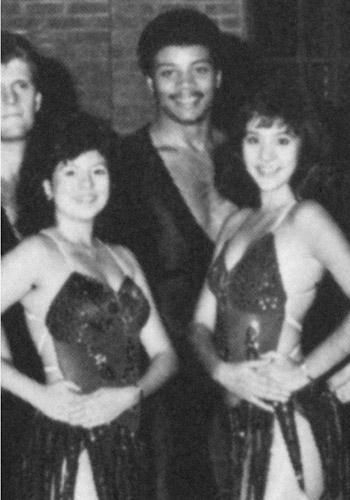
Identify This Young Dancer

by Miss Cellania

The guy, that is. Yes, this is astrophysicist Neil DeGrasse Tyson. He was on the dance team at the University of Texas at Austin as a graduate student, and they won a national championship in Latin Ballroom style in 1985. This photo is part of a list called 14 Things We Can All Appreciate About Neil Degrasse Tyson at Buzzfeed. Link

09 Mar 18:22

The Professor, the Bikini Model and the Suitcase Full of Trouble

by editors

A world-renowned physicist’s miscalculation.

Maxine Swann | New York Times Magazine | Mar 2013 [Full Story]