Russian Sledges
Shared posts
Any women,girls that come into Newton Center P.O. - m4w (Newton)
Russian Sledges"Well I work there and I'm always wondering if any of the women I think are cute/hot are thinking that about me."
More Than 78,000 People Have Applied to Die on Mars

Mars One, the Dutch company that is looking for a few individuals with the "right stuff" (the "right stuff" being wanting to leave Earth and never, ever return), reports that more than 78,000 people have applied to be chosen for a trip to the red planet.

    
|
rnackenziek: all-four-cheekbones: daftwithoneshoe: Shut up. I...
Russian Sledges"cat is looking for waffles"—firehose


Shut up. I needed a kitten stealing a pancake on my blog.
Honestly, if you don’t need a kitten stealing a pancake on your blog, it had better be because you already have a kitten stealing a pancake on your blog.
That’s not even a valid reason
Knowing what you want and going for it: about 80% of success in life, right there.
Sword Hilt: 1600 - 1625, England. “This basket-hilt of...

Sword Hilt: 1600 - 1625, England.
“This basket-hilt of blackened iron encrusted with silver is of a form known in the early 17th century as an ‘Irish’ hilt. At that period ‘Irish’ also meant the Highland Scots, who were celebrated for using a basket-hilted broadsword of similar type(…)”
CUCFA President Meister's Open Letter to Coursera Founder Daphne Koller
Small Space Swimming: Lap Pools
Russian Sledges#tinypoolbros


 We love a good lap pool. They take up a fraction of the space of a traditional pool, and their elongated shape is so elegant and modern. There's room to exercise, to splash around and have a drink on a hot day (because isn't that the whole reason to have a pool?), and you can still have a backyard. More
|
|
Cheerleaders win right to display Jesus banners at public school sporting events
Last October I reported that cheerleaders in Kountze, Texas, were displaying Christian banners, with slogans from the New Testament, at high-school football games. The Freedom from Religion Foundation (FFRF) brought suit against the school district, maintaining, correctly, that such displays violated the First Amendment, which prohibits government endorsement of religion. The case was then working its way through the courts after the displays were first rejected and then reinstated by a higher court.
ABC News reports this week that a state district court has ruled, however, that the banners are legal:
State District Judge Steven Thomas determined the Kountze High School cheerleaders’ banners are constitutionally permissible. In the ruling, Thomas determined that no law “prohibits cheerleaders from using religious-themed banners at school sporting events.”
The Kountze school district had initially said the banners could not be displayed after receiving a complaint about them in September from the Freedom From Religion Foundation. The foundation argued the banners violated the so-called First Amendment Establishment Clause that bars government — or publicly funded school districts in this case — from establishing or endorsing a religion.
Thomas ruled that the establishment clause does not prohibit the use of such religious-themed banners at school sporting events.
“This is a great victory for the cheerleaders and now they’re going to be able to have their banners,” said Hiram Sasser, a lead attorney for the Liberty Institute, a Plano, Texas-based nonprofit law firm that represented the cheerleaders.
. . . The cheerleaders in Kountze, located about 95 miles northeast of Houston, were supported by various state officials, including Gov. Rick Perry and Texas Attorney General Greg Abbott, who filed court papers seeking to intervene on their behalf. A Facebook group created after the ban, Support Kountze Kids Faith, has more than 45,000 members.
Abbott praised the court’s ruling on Wednesday, calling it a “victory for religious liberties.”
Perry in a statement said the cheerleaders “showed great resolve and maturity beyond their years in standing up for their beliefs and constitutional rights.”
Constitutional rights? What reading of the Constitution allows such rights?
It is, of course, settled law that schools cannot have official prayers broadcast before sporting events. The cheerleaders are representatives of the school, wearing school uniforms. I don’t get the difference.
The Freedom From Religion Foundation’s co-president, Annie Laurie Gaylor, was disappointed with the ruling, saying the banners “carry the appearance of school endorsement and favoritism, turning Christians into insiders and non-Christians and nonbelievers into outsiders.”
The Anti-Defamation League also criticized the ruling, calling it “misguided” and saying it “flies in the face of clear U.S. Supreme Court and other rulings.”
Curiously, attorneys for the school district advised the schools that these displays violated constitutional law:
Attorneys for the Kountze school district, in initially advising the superintendent to ban the religious statements on the cheerleaders’ banners, argued there have been several precedent-setting rulings by the Supreme Court.
In one of the more well-known cases, the court ruled in 2000 that a practice of allowing student-led prayer ahead of high school football games in Texas’ Santa Fe Independent School District violated the Constitution. In 1992, the Supreme Court made a similar ruling in a Rhode Island case that argued a rabbi’s prayer at a middle school graduation ceremony also violated the Constitution.
But public sentiment, combined with the pro-religion stance of state officials, was too strong. And the judge is wrong. Let’s hope that the FFRF appeals.
The forces of religion are ever busy feeding in America, and don’t care about the Constitution. What would happen if the cheerleaders displayed banners with verses from the Qur’an?
Really, who can argue that this is legal?:


The five myths about contemporary classical music | Music | The Guardian
Ghost town, under water for 25 years, surfaces (+video)
Russian Sledgesunderwater ruins autoshare
Ghost town under water: After 25 years under water, this Argentine town is now above the surface. Tourists flock to the ghost town, a bizarre, post-apocalyptic landscape that captures a traumatic moment in time.


"I am quite aware that I shall annoy some people by my insistence on correctness based on tradition..."
- Hardy Amies
Raw Silk Explained

It’s still a bit chilly in San Francisco, but in anticipation of summer, I went ahead and picked up a raw silk grenadine by Drake’s last week. Michael Hill and his design team seem to be getting more adventurous these days, but I still think they achieve great success. This new design, for example, has a bit more texture than their regular raw silks – adding the slubbiness of raw silk to the textured weave of grenadine. This makes it look something like a summer version of boucle, which I really like.
Alexander, that reader who kindly introduced me to the New York cloth merchant, explained to me last year that raw silk is simply silk that has not been chemically processed. You see, every silkworm extrudes two filaments when making its cocoon, and these fibers typically undergo a chemical processing to strip them of their bonding sericin. As a result of having their sericin left on, raw silk lacks the full luster and richness associated with the kinds of processed silk used for neckties. There also tends to be an unevenness in the yarns, as the two strands of filament are left bonded together, rather than being stripped and separated, which would yield an ultra-fine filament yarn that can be densely woven.
Note, this doesn’t mean that raw silk is necessarily organic, however, which is how it’s commonly advertised on some websites. Raw silk can still undergo several types of processing and finishing that are bad for the environment, and still be left “raw."


There’s a second type of material known as Tussah (seen above), which salespeople often mistakenly call raw silk. Tussah silk is cultivated by allowing silk worms to live on a wild diet rather than exclusively on mulberry leaves. It tends to have a slightly slubby quality similar to Dupioni, which is what leads it to being misidentified as raw silk. At Drake’s you can easily tell which is a Tussah silk tie by examining the weave - their Tussahs feel a bit delicate and are looser woven, whereas their raw silks are much denser.
Dupioni or duoppioni silk, on the other hand, is when two silk worms are left next to each other to create a strange double cocoon. Dupioni silk is almost always left raw in an effort to keep the multiple strands together and maintain their irregular yarn properties. I haven’t seen that many neckties made from Dupioni, but I’ve handled a couple vintage summer suits made from such material. They’re impossible to find nowadays new and off-the-rack, and are rarely available even through bespoke tailors, but A Suitable Wardrobe found a source for Dupioni through Jodek International (don’t expect prices to be cheap). You can see Dupioni’s qualities here, if you look very closely.


Anyway, that’s raw silk, in the best way it’s ever been explained to me. Drake’s new variety of raw silk grenadines at the moment can be found through Mr. Porter, Barney’s, and Drake’s website itself. They may or may not go on sale. I was afraid this one wouldn’t, which is why I bought early. Barney’s been having remarkably good sales at their Warehouse site, however, and things at the moment are discounted up to 75% off. That puts their remaining Drake’s ties at less than $50. The chances of a raw silk grenadine making it this far in a sale is slim, but that’s the game with discounts.
Special thanks to Alexander, as always, for taking the time to write to me.
(Pictured below: Drake’s raw silk grenadine up close, two photos of a striped raw silk tie by Drake’s, and an upcoming dotted raw silk grenadine by Panta)


Using Python to see how the Times writes about men and women
Russian Sledges"My quick interepretation: If your knowledge of men's and women's roles in society came just from reading last week's New York Times, you would think that men play sports and run the government. Women do feminine and domestic things. To be honest, I was a little shocked at how stereotypical the words used in the women subject sentences were."
Wary of Bitcoin? A guide to some other cryptocurrencies

It might have passed you by, but an essential part of the Internet's infrastructure took a heavy knock last week. The Silk Road—you know, the website where you can buy any drug imaginable—was subjected to a series of distributed denial of service (DDoS) attacks.
Calling the Silk Road "essential" might seem an exaggeration, but it isn't if you're one of its many regular users. The same goes if you're a regular user of Bitcoin—its journey to mainstream acceptance began with the Silk Road, as it's perfect for anonymous, untraceable transactions (as long as you're careful not to make your identity obvious, of course).
Right now, Bitcoin is undeniably a mainstream currency, even if it is not necessarily popular in the sense of being used by a significant proportion of society. But it is viewed as a legitimate method of payment, and a legitimate asset, by the people who matter in these issues—CNBC has it as a ticker on its website, for example, and there's a Bitcoin hedge fund in Malta.
Read 50 remaining paragraphs | Comments
Hitchcock’s Artillery
On the 55th anniversary of Vertigo, Tom McCormack recalls the novel equipment used to create the film’s title sequence, an “obsolete military computer called the M5 gun director” from WWII:
[Computer animation pioneer John Whitney] was hired to complete the seemingly impossible task of turning [Saul] Bass’s complicated designs for Vertigo into moving pictures. A mechanism was needed that could plot the shapes that Bass wanted, which were based on graphs of parametric equations by 19th mathematician Jules Lissajous; plotting them precisely, as opposed to drawing them freehand, required that the motion of a pendulum be linked to motion of an animation stand, but no animation stand at the time could modulate continuous motion without its interior wiring becoming tangled. …
The M5 was used during World War II to aim anti-aircraft cannons at moving targets.
It took five men to operate it on the battlefield, each inputting one variable, such as the altitude of the incoming plane, its velocity, etc. Whitney realized that the gun director could rotate endlessly, and in perfect synchronization with the swinging of a pendulum. He placed his animation cels on the platform that held the gun director, and above it suspended a pendulum from the ceiling which held a pen that was connected to a 24-foot high pressurized paint reservoir. The movement of the pendulum in relation to the rotation of the gun director generated the spiral drawings used in Vertigo’s opening sequence.
The M5 weighed 850 lbs and comprised 11,000 components, but its movement was dictated by the execution of mathematical equations; it was very much a computer Whitney’s work on the opening sequence for Vertigo could be considered an early example of computer graphics in film—and a clever détournement of military equipment.

The Story of Elizabeth Keckley, Former-Slave-Turned-Mrs. Lincoln’s Dressmaker
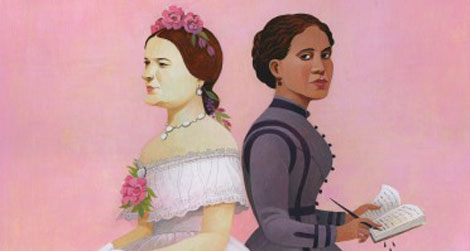
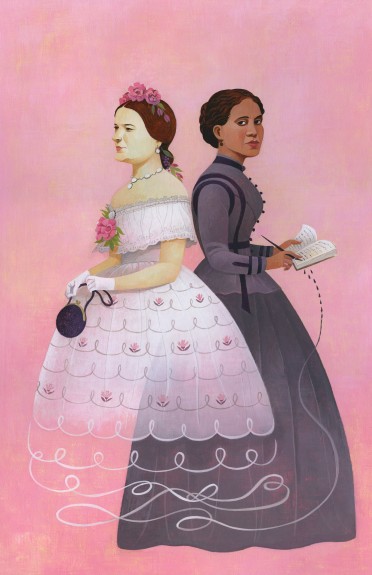
Mary T. & Lizzy K. runs through May 5, 2013, at Arena Stage at the Mead Center for American Theater. Illustration by Jody Hewgill.
Elizabeth Keckley was born into slavery in 1818 in Virginia. Although she encountered one hardship after another, with sheer determination, a network of supporters and valuable dressmaking skills, she eventually bought her freedom from her St. Louis owners for $1,200. She made her way to Washington, D.C. in 1860 to establish her own dressmaking business and met first lady Mary Todd Lincoln.
Just after Abraham Lincoln’s inauguration, in 1861, the FLOTUS hired Keckley (also spelled Keckly) as her personal modiste. Keckley took on the role of dressmaker, personal dresser and confidante, and the two women formed a special bond. Mary T. and Lizzy K., a new play written and directed by Tazewell Thompson, explores their relationship.
Much has been researched, written and analyzed about Keckley’s life as a result of the unusual friendship. In 1868, Keckley published a detailed account of her life in the autobiography Behind the Scenes: Or, Thirty Years a Slave and Four Years in the White House. A thorough study of her dressmaking legacy is still being uncovered, though, explained Elizabeth Way, a former Smithsonian researcher and New York University costume studies graduate student who worked for the Smithsonian last summer researching Keckley.
Prompted by Mary T. and Lizzy K., which runs through May 5, 2013, at the Mead Center for American Theater at Arena Stage in Washington, Threaded spoke with Way about Keckley’s dressmaking handiwork.
Are Elizabeth Keckley designs plentiful today?
Not that many still exist actually. And even with those pieces that do exist, there’s a question as to whether they can be attributed to Keckley. The Smithsonian’s National Museum of American History has a Mary Lincoln gown, a purple velvet dress with two bodices, that the first lady wore during the second presidential inauguration. There’s a buffalo plaid green and white day dress with a cape at the Chicago History Museum. At the Abraham Lincoln Presidential Library and Museum in Illinois, you’ll find a black silk dress with a strawberry motif that you’d wear to a strawberry party, which was a 19th-century Midwestern picnic tradition, but it’s disputed as to whether or not it’s a Keckley. Penn State has a quilt that Keckley made from dress fabrics, and other items are floating around in collections. For example, Howard University has a pincushion with her name on it.
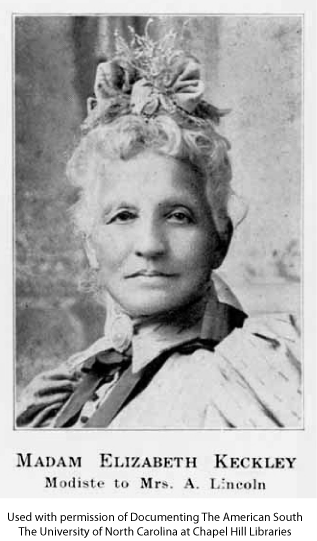
Elizabeth Keckley
You mentioned it’s difficult to attribute clothes to Keckley. Why is that?
At the time, no labels or tags were used. And because fabric was so expensive, dresses were often taken apart and reconstructed as a completely different dress using the same material. She made clothes for many official women in Washington, so one way to determine a Keckley dress is if any of those women kept a journal and noted that kind of detail within it.
I assume she followed fashion conventions of the mid- to late 19th century, but did she have a specific style?
Her style was very pared down and sophisticated, which a lot of people don’t imagine when they think of the Victorian era. Her designs tended to be very streamlined. Not a lot of lace or ribbon. A very clean design.
How did she build such a thriving business as an African-American woman in the mid-1800s?
She was very skilled at building a client network, which was very notable considering she was a black woman and previously enslaved. She consistently made friends with the right people and got them to help her, which was not only a testament to those people, but also to her. She had incredible business savvy.
Would she sew the entire dress?
When she started out, she would do the complete dress, sew it up, add the trim, everything. As she became more successful, she was able to hire seamstresses to do some of the sewing and she trained people to help with the construction. Generally, she would work on the fit of the dresses.
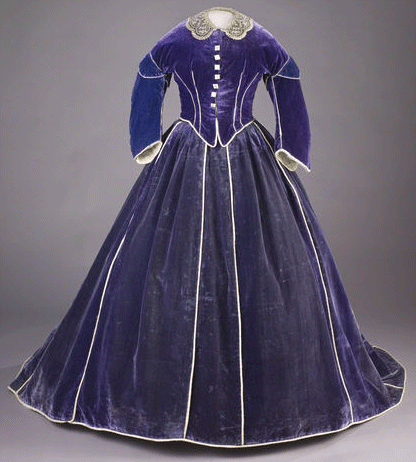
Mary Lincoln’s purple velvet skirt and daytime bodice are believed to have been made by African-American dressmaker Elizabeth Keckley. The first lady wore the gown during the Washington winter social season in 1861–62. National Museum of American History.
Was Mary Lincoln wearing only Keckley while she was the first lady?
Mary Lincoln liked to shop. She would go to New York to shop at the department stores, which were just emerging at that time. You could buy ribbon and trim and anything unfitted, like a cape. It was just the beginning of mass production. But any kind of dress had to be made by a dressmaker because the fit was so specific that it had to be customized. Mary Lincoln was said to order 15, 16 dresses each season, which took about three months to make.
While Mary Lincoln was known, and criticized, for an overly youthful style that embraced bright colors and floral patterns, the dresses made for her by Keckley that have survived are the opposite of that style—Keckley really designed with very clean lines.
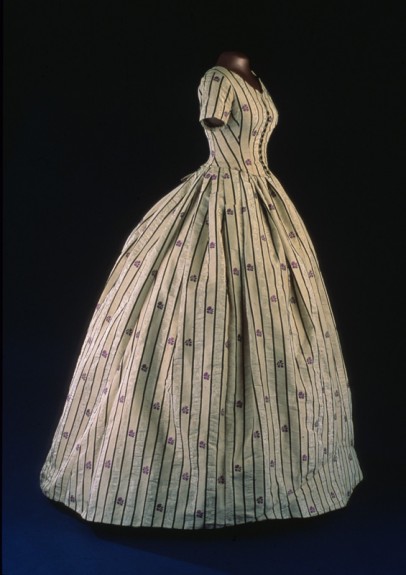
Striped and floral Mary Lincoln dress, attributed to Keckley, significantly altered from original design. Smithsonian National Museum of American History.
Where did Mary Lincoln, or other women for that matter, find out about fashion trends?
Fashion at this time copied France line for line. Whatever was happening at the French court was what women in D.C. wanted.
Elizabeth Keckley was an incredible businesswoman and was also known for her beauty.
In her memoir, she recalls that people thought she was beautiful. The Washington Bee, the African American newspaper, treated her like a black socialite within the African-American community. She dressed well—she was not gaudy or showy, but more pared down and refined. She was known for being elegant, upright and appropriate—the Victorian ideal.
How did that Victorian approach play into Keckley’s designs?
The Victorian ideals permeated all levels of American culture and determined what it meant to be an appropriate woman no matter who you were. There were so many social rules about what you had to wear in the daytime and nighttime, and Keckley’s garments all followed those rules, especially for Mary Lincoln, who was in the public eye so frequently.
How long would it take for Keckley to make one dress?
I’m not exactly sure. Maybe two, three weeks. To drape the fabric, cut the fabric, use a sewing machine on some parts and hand-stitch others. Also, remember—she was making multiple dresses at a time, and by the time she was a successful dressmaker in Washington, she also had seamstresses working with her.
What was Keckley most known for amongst women in Washington who wanted a dress from her?
Her fit and her adeptness when it came to draping fabric on the body. She was known to be the dressmaker in D.C. because her garments had extraordinary fit.
What were the dressmaking tools she would have been using at the time?
A rudimentary sewing machine, which is at the Chicago History Museum, pins, needles. She may have measured with inches but because that system was so new, she could have used another marking system for measurement. And she may have used a drafting system that came out in the 1820s for patternmaking.
How much was Keckley earning at the time when she was making dresses for Mary Lincoln?
When Keckley first moved to D.C. and worked as a seamstress for a dressmaker, she made $2.50 a day.
She recalls in her memoir that when she became a dressmaker, she made a dress for Anna Mason Lee who was attending a reception with the Prince of Wales in 1860, which was a very high society event in D.C. Captain Lee gave Keckley $100 to purchase lace and trim for his wife’s dress. So while that doesn’t quite speak to how much she was earning, it does put things in perspective and speak to the level of cost and the timeline of moving from a seamstress to a dressmaker. In fact, when she bought the trim from Harper Mitchell, the trim store, for Lee’s dress, the shop gave her a $25 commission for the purchase. That $25 was already ten times what she was making as a seamstress when she first came to Washington. Working as a dressmaker was the highest-paying opportunity women had during that time period, and Keckley’s dresses were known to be very expensive, the envy of women in Washington.
This interview has been edited and condensed.
Fight Club: Remembering Marla, the Dark Tourist
She arrives at the support group just as the hugging begins. “This is cancer, right?” she asks, her pallid skin and sunken eyes suggesting she could well be a sufferer. Except this is a support group for testicular cancer and Marla doesn’t have any balls, not the kind that can be removed by surgery anyway. Mischievous Marla Singer: black fur coat, sunglasses, squashed black hat and breathing through a cigarette. On the surface Marla looks like a femme fatale, though in truth she is not manipulative enough to fit the mould. In Tyler Durden’s words she is “rock bottom”. Once mislaid, now gone for good.
As an embodiment of affected audacity, Marla gives off the impression she could not give a damn. She walks in front of traffic, stands in front of traffic, takes a “cry for help thing” overdose of sleeping pills. Yet look at how she dresses; layered black thrift store cool and shades. If Marla really didn’t care less she would wear a tracksuit and flip-flops. Marla Singer (played by Helena Bonham Carter) is far and away the coolest character in Fight Club, cooler even than Tyler and what’s more she actually exists. Although to Fight Club’s costume designer Michael Kaplan, here reminiscing exclusively for Clothes on Film, Marla exists in her own bubble, “I do not believe Marla thinks she is cool (or uncool)” he points out. “I don’t think she’s that self aware. She is determined and in a strange way, a survivor.”


Nearly 14 years have passed since Fight Club (directed by David Fincher) was released. Michael Kaplan was justly rewarded with a Costume Designers Guild award for his work on the film. Two of his outfits worn by Brad Pitt and Edward Norton were recently on display at the V&A’s Hollywood Costume exhibition. We see the porno vest, red slacks and snaffle loafers and immediately think of Tyler. We see a black fur coat, flimsy dress, bird’s nest hair and omnipresent cigarette and think of Marla. She sits at the back of our mind like a filthy, sexually aggressive parasite. In this respect Marla is a femme fatale because she embodies the heterosexual male fantasy; she is a woman who has ‘let go’ of everything.
However Marla is not dangerous, certainly not to the Ikea and coffee house crowd she inhabited in 1999. Okay, she steals jeans from a laundrette and sells them to a vintage shop. Well from Marla’s point of view you shouldn’t leave your clothes unattended in the first place if you didn’t want some lowlife to steal them. Her own wardrobe consists of strappy dresses, geo-pattern shirts, skirts, high platform heels, the aforementioned fur jacket, a leather and suede reefer and a man’s tweed coat – something she probably just felt looked warm on a cold day. Hats too, hats give Marla what Madonna might describe as ‘good face’. “There is a scene at one of the 12 Step meetings where Marla is chain smoking” notes Kaplan. “I put her in a wide brimmed hat to trap all the smoke around her. It is beautifully shot. That really sticks in my mind.”


All costumes worn by Helena Bonham Carter were from a mix of sources. “Some made to order, some found in second hand and vintage stores and ‘reinvented’ and ‘distressed’. Nothing was new, with the exception of a jacket from my friend Rick Owens (American fashion designer), who, at the time was still living in Hollywood”. Marla did not necessarily exist this way on the page; in fact Bonham Carter had some difficulty locating her character at first. Kaplan continues, “Shortly after Helena was cast as Marla, She phoned me from London. ‘I’m gonna need your help – who the fuck is this Marla Singer? I haven’t a clue!’ Slightly surprised, having never met the Miss. Merchant-Ivory, I believe my response was ‘think Judy Garland, for the millennium’. Anyway, it kind of stuck – during the shoot, David Fincher was calling her Judy.”
This tiny charlatan rarely strays from her mournful signature look established at the support groups. Marla is the dark female tourist in a bright animal kingdom of men. “Close” Kaplan ponders. “I felt that Marla needed to be dark. I dressed Tyler brightly. I costumed both Tyler and Marla in contrast to Edward Norton’s character.” Taking her cue from the Judy Garland reference, Bonham Carter was completely receptive to Marla’s outlandish ensembles, “’Hel’ was open to my insight into her character. I find British actors are far more respectful of the role of costume designers than American actors.” Those statuesque shoes were a different matter, however. “Helena was a bit peeved at the extremely high platform shoes I expected her to wear – she kept ‘falling off’ them!” Ironic how well this works for Marla; she totters about in a haze for most of the film; barely awake or standing up most of the time.


Marla tries to be all doom and gloom, though really she is searching for an excuse to be happy. When she begins her (sexual) relationship with Tyler, soft shapes and soft colours creep into her rotation; she genuinely loves that $1 dollar bridesmaid’s dress, even if it does make look like a fluffy pink reanimated corpse. Marla likes to be pretty, it signals letting her guard down, which after being snubbed by Tyler/The Narrator she slams up again pronto. Michael Kaplan describes the thrift store bridesmaid’s dress as “pink chiffon and seed pearls…falling apart”, but something that Marla “recognises and rescues”.
Her only other notable use of colour comes before the bridesmaid’s costume, a blue sequin dress worn with matching eye shadow as she rolls around contemplating her “death rattle”. It seems like a purposeful choice, a highly unusual colour in the animal kingdom reflecting unique Marla. Although Kaplan considers focus lies more with the appliqué, “I just thought it was a beautiful colour with Helena’s pale Dresden skin and dark hair. The sequins were the thing; they were homage to Judy and her later stage performance costumes.” This dress foreshadows the chintzy, seemingly off-model bridesmaid’s gown. Deep down Marla is yearning to relive a past life.


For Marla, rescuing a pretty dress would be like fixing a bird with a broken wing. Marla’s innate sweetness comes from her confusion at life. She is quick to temper because she does not understand things; people, motivations, bitterness. The crop girdle briefly seen when yelling at Tyler down the telephone sums up her whole way of thinking. “I found the old girdle with hanging garters in a junk store” Kaplan recalls. “I thought, ‘if Marla came upon this, perhaps she’d think it was a tube top with straps’.” And that is Marla: if in doubt, try it anyway. She is free in a way that most of us will never be.
It is fun to contemplate what Marla would think of all the magazine spreads she occupied as inspiration for rebellious middle class bohemians (see also Gwyneth Paltrow as Margot Tenenbaum). She would probably be flattered. Like most people living on the fringes of society she aches for acceptance. Michael Kaplan created a character for Fight Club not a look-book, yet when someone like Marla, connects with an audience, especially a young audience, she transcends the screen and becomes something else. Modestly, Kaplan doubts her influence on the world of fashion, “I tried to dress Marla from the inside out; a dimensional character, not someone merely wearing cool or beautiful clothes. This is my job and what I always attempt to do. I don’t know about Marla being a fashion icon, although the character as well as the film has become quite iconic.” The Marla clone has never quite left us. Follow the plumes of smoke and you will find her. She may be cheap but she’s worth every penny.
With thanks to Michael Kaplan.
© 2013, Chris Laverty.
Star Trek Into Darkness: The Devil is in the Details
MAJOR SPOILERS THROUGHOUT
Minor, seemingly insignificant touches matter in the realm of sci-fi costume. They inspire curiosity, ignite recognition and establish a believable setting in which a story can unfold. Costume designer for Star Trek Into Darkness, Michael Kaplan, obviously grasps this concept. Returning as reboot costumer, he keeps things simple yet effective. A splash of colour here, a recognisable neckline there; again he manages to appease lifelong Star Trek fans without alienating newcomers.
Kaplan and director J.J. Abrams’ smartest move is to acknowledge but not overplay Star Trek heritage. Never be too self-referential, never try too hard not to be; it’s a balancing act. Uniforms worn by the crew of Starfleet have changed considerably since the original television series aired in 1966-69. Reflecting a swinging era, colours were bright and gaudy before evolving into moody and murky in 1990s and beyond. Kaplan took his cue for Star Trek (2009) from the first TV series, but now he moves on slightly. Into Darkness is not the nineties again, though in reflection of the film’s title and story progression, it is not a sixties cocktail party in space either.

Zachary Quinto as Commander Spock and Chris Pine as Captain Kirk. Costume designer Michael Kaplan continues the tricolour scheme established in the first season of Star Trek the TV series to distinguish branch aboard the Enterprise.
Little costume touches spark moments of “ah…” in the minds of fans while novices can get their feet wet learning Starfleet’s tricolour scheme. These colours – blue, red and yellow (or green-yellow) signify branches aboard the Starship Enterprise. Kirk (Chris Pine) wears yellow because as Captain he is in charge. Spock (Zachary Quinto) wears blue for Science, as does ‘Bones’ McCoy (Karl Urban) for Medical. Scotty (Simon Pegg), Sulu (John Cho) and Uhura (Zoe Saldana) wear red for Engineering, Command and Communications respectively. Star Trek has tinkered with this formula over the years but Kaplan now ingrains these colours – always overlaid on a pattern of Starfleet insignias – as standard. Early in the film the Starship Enterprise crew are dressed in skin tight grey mission suits, their branch indicated by narrow strips across the body. Colour is there, but if you miss it you don’t lose anything. Frankly these minor details matter precisely because you can ignore them.
With this in mind it is easy to overlook the delta print (Starfleet insignia) tunic worn by Admiral Marcus (Peter Weller) and his crew, Bones’ subtly light green surgical coat and the contemporary (or just plain flattering) darts on Starfleet’s dress uniforms. But to those with a passing knowledge of the Star Trek universe the neckline of John Harrison’s (Benedict Cumberbatch) black coat is surely a hat-tip by Michael Kaplan. Until Harrison’s true identity is revealed he keeps his neck covered with high upturned lapels or a scarf. However, look fast after Harrison is arrested and a wide ribbed shawl lapel is clearly visible on his coat. This is a nod to Ricardo Montalban’s pectorially revealing costume by Robert Fletcher in Star Trek: The Wrath of Khan (1982) where Montalban, of course, played Khan. Kaplan and Abrams were clearly not keen to linger on meta implications as from this point on Cumberbatch’s costume is a black crew neck jersey with Starfleet insignia then Deckard-like overcoat for the finale. Incidentally Kaplan was also co-costume designer of Blade Runner (1982).

Certainly in terms of silhouette, Benedict Cumberbatch as terrorist John Harrison bears a resemblance to Harrison Ford as Rick Deckard in Blade Runner. Both coats worn are variations on a contemporary trench.
‘Red shirts’ make more of an appearance during Into Darkness than 2009’s reboot. The informal rule from the TV series is that crew members wearing red jerseys were nameless expendables killed off every episode. This is not to imply that more people die throughout Into Darkness, more that the in-joke had already been covered for the first film so there was no need to repeat it. Instead we get a pointed and amusing exchange between Kirk and Navigator Chekov (Anton Yelchin). Kirk’s instruction to “put a red shirt on” so Chekov can take over as engineer is met with a terrified silence.
However, Kaplan is not afraid to go retro. Those mini-dresses on Dr. Carol Marcus (Alice Eve) and Uhura worn with calf length leather boots are freeze-frame sixties. The original show was influenced by contemporary trends as a means of connecting with its audience. Mini-dresses, mini-skirts and tight shirts were a commonplace sight. The closest Kaplan comes to contemporary for Into Darkness is a print t-shirt seen briefly on Uhura as she faces the Klingons. Uhura is supposed to be in disguise at this point; she certainly could have been plucked from the movie and dropped into our world without appearing out of place. This is precisely why most of Star Trek’s non-uniform costumes are just a detail or two away from our own. In other words they are not jarring.

Kaplan hints at the original Star Trek series with a 1960s style red dress and calf length boots worn by Uhura (Zoe Saldana).
Note the angular shoulder on the jacket of a worried father (Noel Clarke), Uhura’s patterned silk scarf, draped necklines on passers by in 23rd century London, a doctor’s medical coat with sleeves gathered toward the elbows – these are our clothes, just not as we know them. When Scotty is drinking in a bar his ensemble has a sixties flavour; the splayed collar on his floral shirt is rounded like a pyjama top. This is attire worn in the past, referenced in the future and then adapted to meet contemporary trends, which is something of a metaphor for the film itself.
That said, one item of clothing that has not changed much in the future is female underwear. When Dr. Carol strips to her essentials for the most gratuitously PG-sexual moment in recent cinema history, she is wearing a matching black set with plunge bra. Apparently support is one area of life that technology has failed to make any significant advancements in.
Star Trek Into Darkness is on general release now in UK and released in U.S. on 16th May.
© 2013, Chris Laverty.
barn owl
Karen Summers (kaz10) has added a photo to the pool:

When Three Really Is A Crowd
Gary Fairhead has added a photo to the pool:

Great Horned Owl mother feeds the smaller of two Owlets while its sibling regains its balance
Canon 7D and 500F4
Ottawa ON
Burrowing Owl With Owl Pellet
Michael Pancier Photography has added a photo to the pool:

Burrowing Owl, Athene cunicularia, Broward County, Florida
Big Jump / GH Owlet
Gary Fairhead has added a photo to the pool:

Young owlet is getting braver as it jumps from the cavity rim to a nearby branch. Canon 7D and 500F4
Ottawa ON

US to return dinosaurs to Mongolia
queensassyofthefatties: Lewis’s law is an observation she made...
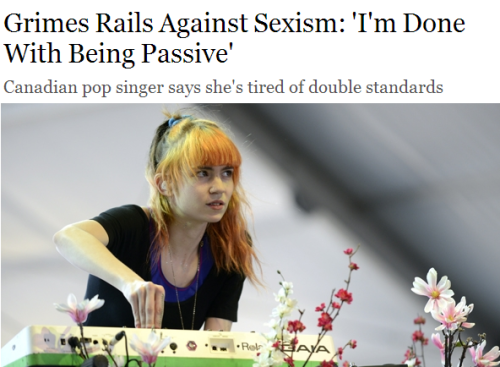
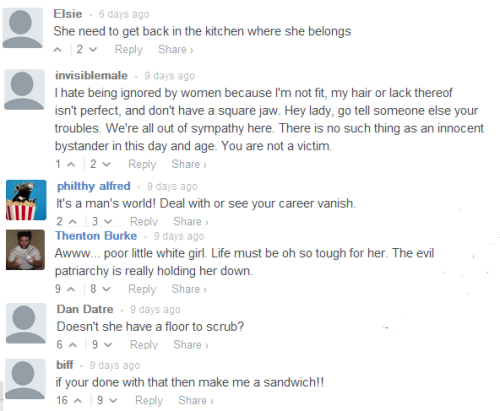
Can we just repeat that a few more times,
“The comments on any article about feminism justify feminism.”
“The comments on any article about feminism justify feminism.”
Me? I’m So Depressed
A research team led by Johannes Zimmermann suggests that people who often talk in terms of “I” and “me” tend to be more depressed:
Frequent use of first-person singular pronouns went hand in hand with higher depression scores and with interpersonal distress characterised by what the researchers called an “intrusive style”, including inappropriate self-disclosure, attention seeking, and an inability to spend time alone. “First-person singular pronoun use may be part of a … strategy that pulls for friendly-submissive attention from others,” the researchers said. A “tendency to seek attention from others rather than self-focused attention.”
In contrast, greater use of first-person plural pronouns was associated with lower depression scores and lower interpersonal distress. To the researchers’ surprise, this was characterised by a “cold” interpersonal style. However, they think this is a “functional” kind of coldness – the ability to help others with their needs while also remaining appropriately detached for self-protection.

That Bad?
TPM Reader JH says my idea of citizenship is archaic and may be in conflict with the modern principles of human rights ...
I write as a practicing academic sociologist, specializing in urban studies, globalization, urban planning and politics, and migration. I have been an avid, daily reader of TPM for years, but never before commented. Re: your post this morning about the NYC proposal to expand voting rights in local elections to non-citizens, I'd just like to make three quick points.
1. Many European cities have extended voting rights in local elections to non-citizens who meet a residency requirement (typically 5 years or 7 years). In some cases, this has been an accepted practice for more than two decades. One good place to learn more about this is Yasemin Soysal's book The Limits of Citizenship. It's not clear to me that this practice has had much of a negative effect on social solidarity in those places.2. New York's proposal is about what we might call *urban* citizenship, yet your post refers to citizenship at a national level: the problem of dual passport holders, with which country people's allegiances lie, the cultural-political-moral commitment to the American political community, etc. Rather than focusing on the split between people who might hold two separate national allegiances, it might be better to talk about the split that would occur in the citizenship rights held by New York residents versus those granted to people in Des Moines. In other words, the real story here might be the rise of differential citizenship rights accorded to people within the United States based on where they live.
3. You write of your belief in what you call "thick citizenship." But your preference for such a thick citizenship appears to conflict with core principles of human rights. A large part of what social scientists consider citizenship rights - for example, many of the things Americans consider "their" civil rights, or perhaps the right to an education - countries are duty- and treaty-bound to protect for all individuals in the national space, whether or not they are formal citizens. To the extent that one believes in the concept of human rights, most of what we have historically called citizenship rights should be afforded to people not on the basis of their membership in this or that national polity, but simply because they are human. What then happens to the political project of crafting a thick citizenship? Little is left for that citizenship to include other than the vote and the right to run for office. That, I suspect, is not really a thick citizenship at all.

|
|
How sequesterable are you?
Russian Sledgescosmo quiz
Leonard Jason, Madison Sunnquist, Suzanna So, and Sarah Callahan have created an infographic regarding the sequestration and its impacts.

You can also download a pdf of the infographic.
Leonard A. Jason, professor of clinical and community psychology at DePaul University and director of the Center for Community Research, is the author of Principles of Social Change published by Oxford University Press. Madison Sunnquist, Suzanna So, and Sarah Callahan are research assistants at the Center for Community Psychology at DePaul University.
Subscribe to the OUPblog via email or RSS.
Subscribe to only social sciences articles on the OUPblog via email or RSS.
Infographic courtesy of the author.
The post How sequesterable are you? appeared first on OUPblog.