
Russian Sledges
Shared posts
02 May 14:39
Collection Visualisation
by malbooth
This post is just a collection of examples that relate to the visualisation of collections. It saves me sending a number of tweets back to two colleagues in the US who started a conversation about this over the weekend: @sjwilder100 (from UNC Charlotte Library) & @lorcanD (from OCLC) Several researchers are doing some interesting work […]
15 Aug 22:07
Quakeress [back]
by Boston Public Library
Boston Public Library posted a photo:
![Quakeress [back]](http://farm4.staticflickr.com/3820/9445964906_bb71c51628_m.jpg)
File name: 10_03_002017b
Binder label: Tobacco / Cigarettes
Title: Quakeress [back]
Created/Published: N. Y. : Burrow-Giles Lith. Co.
Date issued: 1870 - 1900 (approximate)
Physical description: 1 print : chromolithograph ; 12 x 9 cm.
Genre: Advertising cards
Subject: Women; Cigars
Notes: Title from item.
Statement of responsibility: Reliance Cigar Factory
Collection: 19th Century American Trade Cards
Location: Boston Public Library, Print Department
Rights: No known restrictions.
firehose and -1 others like this
09 Aug 10:48


The Lincoln assassination conspirators, July 7, 1865
Russian Sledgesvia snorkmaiden
One of the hooded figures is Mary Surratt, the first woman executed by the US federal government. Her last words were, "Please don't let me fall."
09 Aug 10:37
The Birds: Tippi Hedren in the Green Suit
by Christopher Laverty
The green suit worn by Tippi Hedren as Melanie Daniels in The Birds (1963) has become increasingly symbolic in recent years as we delve ever deeper into the semiotics of film. In this case it is hardly surprising as Hedren only wears three costumes in total; the suit is so visible we cannot fail to draw meaning from its presence. But what was director Alfred Hitchcock trying to say with it, and more importantly, why?
If you visited the V&A’s Hollywood Costume exhibition (now closed in London but moved to Australia and the U.S.), seeing The Birds’ suit would likely have stuck in your mind. It was given prominent placing in room 2, an impressively constructed installation with video recollections from Hedren herself. Yet in real life the suit itself is very basic in style, darker and, dare we say, blander than in the movie. It craves context to bring it to life.

Tippi Hedren as scheming socialite Melanie Daniels. This first costume gives us fair warning of the darkness to come and the mysteriousness of her personality.

Melanie holding the caged lovebirds. This is the first time we see the green suit and apart from a briefly glimpsed nightdress, is Hedren’s only other costume in the film.
Hedren wears the green suit during The Birds’ second sequence, after Melanie’s initial encounter with Mitch (Rod Taylor), and having purchased two lovebirds for his younger sister Cathy (Veronica Cartwright). From this point on it is worn for the rest of movie, with a fox fur coat added and removed and one brief change into a matronly nightgown. Hitchcock apparently chose green because he felt it had a cool quality that set Melanie apart from the residents of Bodega Bay. While this is certainly true it also syncs Melanie with nature yet at the same time infusing her with a poisonous air. In his earlier film Vertigo (1958), Hitchcock used green lighting to imply the plot’s murky ambiguity. However when Judy Barton (Kim Novak) wears a green jersey dress it is actually to imply her down-to-earth quality, the very opposite of Melanie Daniels in The Birds. Like all colour interpretation, meaning is dependent on perspective.
Hitchcock’s very own Edna Mode, Edith Head, created the green suit. It’s based on her own design for Grace Kelly as Lisa Fremont in Rear Window (1954) – a celadon green I-line suit worn with white halterneck blouse. The Rear Window fabric is completely different, shantung silk instead of wool, and the ensemble is comprised of a two piece jacket and skirt instead of a dress and jacket. The similarities come from Head’s insistence on simplicity; like The Birds’ suit it ages so well because there is little to date it. Hedren’s suit is shorter and boxier than Kelly’s, superficially ‘Chanel like’, though in fact most resembles couturier Digby Morton’s early work (circa 1950s), except in a less luxuriant fabric:


Green sleeveless wool crepe sheath dress, knee-length, nipped in at the waist with high round neckline, small rear vent, matching big buckle belt and darted front – the dress fastens to the rear with zip and single button; matching hip-length edge-to-edge jacket with wide lapel collars, two patch pockets and three-quarter length raglan sleeves with turnback cuffs; knee-length mink fur coat, medium width collar; brown snakeskin frame handbag with gold clasp; gold beaded necklace; gold hook stud earrings; chunky gold ring; gold bracelet watch; dark grey pointed toe high heel leather shoes; grey suede gloves; ecru silk scarf.
Melanie’s fur coat finishes her outfit. Without it she still looks chic, but this is pure minimalist Head – terrified of her work becoming dated so keeps all lines as clean and functional as possible. The dress and jacket are moss-like on screen (Blu-ray transfer) but seeing them both at the V&A exhibition, despite the subdued lighting, the fabric is more asparagus green. In Head’s initial sketches the ensemble was light green and the dress a tubular skirt and separate top, leaning further toward her suit from Rear Window.

The violent conflict with the birds reflects the unspoken conflict between the three women: Melanie (Mitch’s new flame), Annie (Mitch’s old flame, pictured) and Lydia (Mitch’s mother).

Six separate copies of the green suit were made, most broken down for the final bird attack in the attic.
There is a straightforward yet valid parallel to draw from Melanie’s green suit and the caged lovebirds. She is first seen in this suit holding the birds, their colour, while not identical, is indicative enough to suggest a correlation. Melanie is simpatico with all birds; she is reckless and enjoys tricks. The birds are aligned with Melanie so this how they act during the entire film. It’s not a warning, it’s not judgement; it’s just that Melanie likes to play pranks and so do they. It’s a joke. The death and destruction the birds cause are simply consequences that Melanie will have to face. In the end the birds let Melanie leave because the joke is over. Wasn’t it funny? No, not really, but the birds enjoyed it. They don’t consider consequences of their actions any more than she does.
For her introduction in the story, Melanie is cool and smug in a charcoal grey wool blend (possibly mohair) suit with stand collar, a mysterious woman who enjoys attention. Because of this she is punished – in context and by Hitchcock himself – for daring to acknowledge her beauty. Later she is rendered chaste in a nightgown made for housewives and spinsters. The green suit is Melanie’s repressed sexuality, blossoming yet constricted like the caged lovebirds. This facade, as with the suit itself, is destroyed by the end of the film. Who knows what the future has in store for Melanie? Not a life with Mitch that’s for sure. The narrative conflict (thus interest), is between the three women: Melanie, Annie (Suzanne Pleshette) and Lydia (Jessica Tandy). The only thing we can safely say for certain is that Melanie will never, ever play another prank again.
© 2013, Christopher Laverty.
firehose and -1 others like this
09 Aug 10:34
Why ladies fancy a man with mustachios, 1707
by Emily Brand
Russian Sledgesattn multitask suicide
“If you find him with Mustachios, he’s certainly a Size above ordinary in his own Conceit; aye, and is fancied …
Rosalind, Tertiarymatt likes this
09 Aug 10:28
The Enduring Gullibility Of Chinese State Media
by ArtsJournal
Xinhua found the Andy Borowitz New Yorker column about Jeff Bezos having bought The Washington Post by mistake (he clicked the wrong button), translated it into Chinese and ran it as an actual news story. This was far from the first time Chinese state media believed what looked to Americans like obvious satire.
The Atlantic 08/08/13
firehose likes this
09 Aug 10:27


Man Changes Racist Restaurant Name, Loses Customers
by Arit John
Russian Sledges'And some patrons argue that, no, actually, the old name wasn't racist at all. The man who first opened the restaurant back in 1949 was Samuel "Chink" Sherman, and his friends came up with the nickname because his eyes were almond shaped.'
After 64 years, popular cheesesteak stop Chink's Steaks in Wissinoming, Philadelphia, was renamed Joe's Steaks + Soda Shop, for reasons that should be obvious to most people. Unfortunately, that subset doesn't include a large chunk of the restaurant's regulars — sales have not been good since the switch.
Over 10,000 people signing a petition to keep the offensive name, but owner Joe Groh still dropped the cheesesteak place's old title this April, and in the last couple of months he's seen a 10-15 percent dips in sales, reports Stu Bykofsky at the Philadelphia Daily News. Even the people who have hung around are mad with this display of political correctness. A quick look at Joe's Steaks social media and Yelp results show that most people either refer to the place as "Joe's (Formerly Chink's)," "Chink's (Now Joe's)" or:

And of the patrons who haven't abandoned the shop, there's still a lot of resentment. Groh occasionally finds the word Chink's painted on the walls and sidewalks of the building and, as Bykofsky notes:
Some want to have it both ways. A little old lady, maybe 75, comes in with her son and daughter. She says to Groh, "You make me sick," orders a cheesesteak, sits down, eats it, then walks out telling him, "You still make me sick."
There are a couple of reasons why the change, presumably the right thing to do, would receive this kind of backlash. It might just be a reflection of the shifting demographics in the area. Back in 1949, Wissinoming was predominantly a white, working class neighborhood. Now it's more diverse, and people aren't happy. In response to a tweet looking for recommendations of good cheesesteak places in Philadelphia, one person wrote:

Tradition also plays a part. This isn't the first Philly cheesesteak place to offend people, and Groh, who spent most of his life working The Restaurant Presently Known as Joe's, didn't really want to rename in the first place. "In all honesty, no," Groh told Bykofsky when asked. "[But] I am Joe. It's 2013. It was time to do it."
"Some longtime customers who hated the name-change [call] it a surrender to political-correctness," Bykofsky wrote. "They have a point." If Asian-American groups hadn't demanded that he change the name, you might still be able to get your greasy cheesesteaks with a side of old timey prejudice.
And some patrons argue that, no, actually, the old name wasn't racist at all. The man who first opened the restaurant back in 1949 was Samuel "Chink" Sherman, and his friends came up with the nickname because his eyes were almond shaped. And, as a black patron of the restaurant noted: If the shop had been named with a slur against blacks, "that would be offensive," he said. "But Chink was a nickname. It could have been a term of endearment."
Only one thing is clear, then: Philadelphians of all persuasions love cheesesteaks, even if they aren't very good for you.
    
|
09 Aug 10:21


How Roger Ebert Managed His Digital Afterlife
by Zach Schonfeld
On the Internet, nobody knows you're dead.
Your data and personal accounts and digital identity—content that is increasingly being referred to as your "digital estate"—remain in the cloud, of course. But what's to become of it all? Should your Facebook profile remain accessible, your Instagram archived? And who should have access?
As our lives and identities are increasingly managed online and channeled through social media, the notion of digital estate management has become less of a dystopian punchline and more a topic of genuine concern—but only five states have addressed the question, NPR's All Tech Considered blog notes today:
Only five states have enacted laws so far to address digital estate management, according to an article in the journal CommLaw Conspectus. There is no uniform federal law. Without it—and if you're in a state without clear-cut digital estate guidelines—the various service agreements of Internet companies govern what happens to our digital identities after death.
That can be problematic because of privacy concerns and the lack of uniformity in policies among Internet and social media companies.
Those five states include Oklahoma, Idaho, Rhode Island, Indiana, and Connecticut. Elsewhere, as NPR's Elise Hu chronicles, your online afterlife (or your loved one's) is at the behest of the service agreements of the tech companies in question, most of whom haven't really figured out a plan to address human mortality, either. Take, for example, the case of Anthony Cannata, who committed suicide in 2011:
The murky rules around digital asset management made the 20-year-old's suicide even more painful. Before taking his own life in 2011, Cannata uploaded a photo to his Facebook account that showed him holding a gun to his mouth. His family and friends petitioned Facebook to remove the photo or grant them access to his account to remove it after his death. But because they faced obstacles in getting access, the disturbing photo stayed online for more than a month, not removed by Facebook until Cannata's mother sent the company a newspaper article about the situation.
Absent any established legal policy, a handful of morbid-minded web entrepreneurs have launched services with names like Legacy Locker and DataInherit to help you secure your digital life. The New York Times Magazine profiled the curious business in early 2011, and it seems the whole thing made some readers queasy, one going so far as to call it "the latest cyberspace craze devoted to self-delusional egotism."
But two-and-a-half years later, we may be out of the wilderness: we've seen how digital estate management looks, roughly, in at least one high-profile case.
When beloved film critic Roger Ebert passed away in early April, he left behind some 800,000 Twitter followers, 100,000 Facebook fans, and one of the most well-respected film criticism websites and oeuvres in existence. Ebert's empire didn't fade to black when the critic died—his verified Twitter account continued tweeting (albeit a little more sporadically than before), and his website, RogerEbert.com, deferred to a new staff of writers and editors. Most of the time, Ebert's widow has introduced tweets with "CHAZ HERE" to minimize disorientation (which seems to come with the territory when one tweets from beyond the grave). But in one instance, she fired off a tweet that Roger apparently wrote before his passing:
Even when the theater has gone dark, the story is still alive in you.
— Roger Ebert (@ebertchicago) May 16, 2013
In a recent letter announcing a new Twitter account, @EbertVoices, Chaz claims that followers were able to tell the difference, and she explains how Roger gave her the keys to his digital identity in the final months of his life—and how she handled it after his death:
Starting in about March of this year he began to give me the secret code to his Twitter and Facebook accounts and he told me to make sure I kept his Twitter account up-to-date. I thought this was strange, but I didn't pay much attention to it. [...] So when he passed away and some suggested that we shut down his Twitter account, I remembered his admonishments against it. He knew that it could be disconcerting to some people to see his picture pop up if he was no longer here, so I changed the photo. At a lovely tribute to him in the south of France during the Cannes Film Festival, Julie Sisk at the American Pavilion got 250 people together on the beach and took a photo of them giving a "500 Thumbs Up Salute." That is the photo we switched to. (I have to admit that I still miss seeing the old photo of Roger.)
"Roger wanted us to use this account only for certain tweets," Chaz explained in a May 23 tweet from Roger's account. "He wanted us to have a Twitterchat, and we are working out the plans for it," she adds in her letter.
Widely recognized for his comfort with social media platforms during his lifetime (particularly after he lost the physical ability to speak), Ebert may well be a digital pioneer in death, too. That's not to say he used a service like Legacy Locker or hired a lawyer to manage his digital estate (if he did, Chaz isn't saying). But as death loomed closer, he became proactive about ensuring his accounts were in capable hands and his wishes understood. Sure, it can be creepy to see a dead person tweet from the digital beyond (just ask those following former New York City mayor Ed Koch at the time of his death), but give the man some credit for thinking ahead.
You may not have 800,000 Twitter followers and a world-famous film site. But chances are you have digital accounts of some personal value, and what will become of them if you die tomorrow?
|
|
09 Aug 10:21


Detroit's Emergency Manager Could Sell The City's Art Collection
by Abby Ohlheiser
Detroit Emergency Manager Kevyn Orr asked Christie's auction house to come in and appraise the city-owned collection at the Detroit Institute of Arts, Orr acknowledged on Monday. That appraisal made art news headlines for weeks after Detroit filed for bankruptcy, so the news today solves something of a mystery as to why the auction house came to the city in the first place. But its doubtful that very many people are heartened by it.
Orr will pay Christie's $200,000 to appraise the work at the behest of creditors, which may or may not result in a sale. The appraisal began in June and should be done by October. Detroit is currently $18 billion in debt, including to city pensioners. The world-class DIA art collection is estimated to be worth billions, as the Detroit Free Press explains:
Nearly 40 of the museum’s most important works carry an estimated value of $2.5 billion, according to experts consulted by the Free Press. Paintings by Van Gogh, Matisse, Bruegel and others carried individual estimates of $50 million to $100 million or more.
Orr defended the move by downplaying the significance of the DIA collection itself in his wider bankruptcy plans, adding that "There has never been, nor is there now, any plan to sell art. This valuation, as well as the valuation of other city assets, is an integral part of the restructuring process." But the Detroit News explains that the city's creditors have previously asked about the collection specifically after facing the prospect of getting 10 cents on the dollar back of what the city owes. So it might be hard to convince them to stay away from DIA. While the creditors themselves don't get to force the handover of city assets, the Free Press explains, the bankruptcy judge in the case can refuse to accept a deal if he thinks it's hiding some assets.
Detroit-area residents (presumably, not the creditors) are understandably unhappy:
Save #Detroit's art! RT Orr contracts Christie's to appraise DIA art @crainsdetroit http://t.co/I19xCqrDxq
— Kim D. Gladstone (@kdgladstone) August 5, 2013
The wolves are circling. Go and enjoy the DIA while we still have it! http://t.co/RuWozGYJSe
— Ed Foster (@Pootivic) July 19, 2013
Among art critics, the issue's been contentious, with most coming down on DIA's side — the museum hired their own bankruptcy lawyers and are putting together a case against the potential sale of the works. Modern Art Notes's Tyler Green:
Just a little reminder that @Christies apparently hates Detroit and seems to want the DIA to die. What an evil company.
— Tyler Green (@TylerGreenDC) July 24, 2013
and Hyperallergic's Hrag Vartanian:
@TwoCoats When someone takes over a city in an undemocratic way and then starts sizing up assets and which to sell, etc. that is looting.
— Hrag (@hragv) July 25, 2013
for example, came out strongly against Christie's involvement in the appraisal at the time. Meanwhile, the National Review's John Fund was for the sale, as was (originally) longtime New Yorker art critic Peter Schjeldahl. But Schjeldahl, after taking considerable flack from fellow critics, has since changed his mind. He wrote:
Finally, some acute attacks have shown me the indefensibility of my position. For example, from a blogger, would I “suggest that Greece sell the Parthenon to pay its crippling national debt”? The principle of cultural patrimony is indeed germane, and it should be sacred.
Christie's has taken some particularly harsh criticism for their presence at DIA, and the company finally released a statement on Monday acknowledging what's going on:
We confirm that Christie’s Appraisals Inc. was asked and has entered into an agreement to appraise a portion of the City owned collection at the Detroit Institute of Art. In addition we will also assist and advise on how to realize value for the City while leaving the art in the City’s ownership...At Christie's, we are passionate about art and understand the importance of the contribution that institutions such as the Detroit Institute of Arts offer to the community and the world at large. We are proud of our long history of support to museums, including the DIA. We want to continue to focus our efforts on being a positive force in both the interests of the City of Detroit and its arts community, including working with our fellow arts professionals at the DIA and with the City to find alternatives to selling that would still provide the City with needed revenue.
|
|
09 Aug 10:20
The Cult of Amazon
by editors
Russian Sledges'Classical music has reached the point where albums of Thomas Tallis songs now bear the label: “Features Spem in Alium, as mentioned in Fifty Shades of Grey.”'
firehose, Dan.swinhoe likes this
09 Aug 10:16

Olek Crochets an Entire Four-Car Locomotive in Lodz, Poland
by Christopher Jobson
Russian Sledges#trains?


Textile artist Olek has just completed work on what may be her largest piece ever, a four-car locomotive covered in crocheted technicolor camo in Lodz, Poland. The artist didn’t even stop to change out of a costume she wore at the Animal Ball in London before jumping on a plane to meet four assistants who began a four-day assault on the large train that was completed on July 19th. You may remember Olek’s work from just over a year ago here on Colossal when she crocheted an entire alligator-themed playground in São Paulo. The locomotive will be on view through August 19th, and you can see more over on Hi-Fructose.
rygzengrho, galaxy and 2 others like this
09 Aug 10:13

Edit wars
by R.L.W., G.D. and L.P.
The most controversial Wikipedia articles worldwide
WHEN disputes arise on Wikipedia, contributors are encouraged to go to a “talk page.” But often an “edit war” ensues: a change is repeatedly done by one person and undone by another—known as a “revert.” These reverts represent the most controversial articles. Taha Yasseri of the Oxford Internet Institute and colleagues looked at Wikipedia’s different language editions from their inception (January 2001 for English) to March 2010 and ranked the most contested articles, based on the number of reverts and the number of edits the contributors have made (dubbed their “maturity score”). The results in some ways confirm cultural stereotypes. Americans bicker over politics and professional wrestling; among the top French squabbles is Freud. When the Wikipedia community meets for Wikimania, an annual gathering held this year between August 7th and 11th in Hong Kong, they presumably will be nicer.
Tertiarymatt, Jdinoto likes this
09 Aug 10:11
Meet the woman who keeps Walter White (scientifically) honest
by Maggie Koerth-Baker
Russian Sledgesattn overbey
The blue meth made by Walter White is bluer than any meth that could actually exist in real life — and other interesting things that you learn while talking to Breaking Bad's scientific advisor, University of Oklahoma chemistry professor Donna Nelson. 


|
|
firehose likes this
09 Aug 10:09


Colorful underpass lights up in neon rainbow hues, makes your day at night
by Low Lai Chow

In downtown Birmingham, Alabama, an otherwise drab underpass at 18th street is equipped with thousands of LEDs that sees it light up like a rainbow every night. Artist Bill FitzGibbons is behind this fab work funded by the Community Foundation of Greater Birmingham’s Community Catalyst Fund in partnership with REV Birmingham.


The post Colorful underpass lights up in neon rainbow hues, makes your day at night appeared first on Lost At E Minor: For creative people.
Nilsemil, J.w.dillow likes this
09 Aug 10:08


How Upvote/Downvote Sites like Reddit Breed Irrational Herd Behavior
by Robert T. Gonzalez
Russian Sledges"Their observations, which are published in the latest issue of Science, demonstrate that, regardless of its quality, a comment's very first vote had a huge impact on individual rating behavior and gave rise to herding effects."

Are you a think-for-yourselfer? Do you weigh positive and negative Yelp reviews with a cold, dispassionate sagacity? Do you fancy yourself immune to the influence of others when you browse Reddit? That's cute. Newly published research says you're wrong.
|
|
firehose likes this
09 Aug 10:03


Nova Scotia's insane cyber bullying law
by Cory Doctorow
Jesse Brown writes, "Boing Boing readers may remember Rehteah Parsons, the Nova Scotia teen who, in news media shorthand, was driven to suicide last April by cyber bullies. The public's understandable shock and outrage over her death, and the lack of any charges being laid against her abusers* has resulted in Nova Scotia's Bill 61: the Cyber Safety Act. But pre-existing laws could have brought Rehteah justice while she was alive- they just weren't enforced. Rehteah may have been cyber bullied, but more descriptively, she was (allegedly) gang-raped while severely intoxicated and chronically harassed. But the RCMP closed her case without interviewing the four boys accused, despite the existence of photo evidence."
*The RCMP re-opened Rehteah's case under pressure from the Prime Minister. This morning, they finally laid charges against two individuals, assumedly not under Bill 61, which of course did not exist at the time of the incident.
The cops failed to take her rape seriously, as did her school. Her father reports that the mental health institute he sent her to had her strip-searched by male attendants, despite her history of sexual abuse. In her dad's words, "she didn't die of bullying, she died of disappointment". Yet in her memory comes Bill 61, a law that makes "cyber bullying" illegal, and defines it as anything you or your kids say online that could be expected to humiliate a person or harm their self-esteem or emotional well-being. This covers most journalism, I'd guess, as well as at least 60% of everything said on Twitter or Facebook.
If you're merely accused, a judge can issue a Protection Order against you before you have a chance to defend yourself. The cops can seize your computers, you can lose Internet access, you can be gagged from mentioning your accuser online or forbidden to use the Internet entirely. There's much more- the bill encourages parents and school administrators to spy on minors, and it gives police new powers to demand your data from your ISP.
I've written in more detail about the trouble with this abusive bill here.
Nova Scotia’s awful cyber abuse law makes bullies of us all 
|
|
09 Aug 10:02


Nathan Myhrvold-connected shell corporation forced to settle with victim
by Rob Beschizza
Patent troll Nathan Myhrvold's Intellectual Ventures-connected Lodsys, one the many faceless companies founded to obscure exactly who shakes down small businesses with vague patents that represent equally-vague post-Microsoft careers, was forced to settle with a victim this week—but not without exercising some grotesque conditions on it. Lodsys controls a patent on in-app purchase buttons, and it will have your money, should your app include a button of interest to it, on pain of lawsuits that are even more expensive to battle than the liver disease you'd end up with should you drink the way one imagines a wealthy patent troll might do at home, at night, in the clawing blender-decanted quiet, when the money just isn't enough anymore.
I was a little confused about why Lodsys wanted to make a donation to charity. I asked my lawyer if it was to make them appear more human. He said it is most likely because if we would have said no to this offer, the judge could have said we were not behaving reasonably. ...
The total costs to my company would have been $190,000. And that’s just for the initial response to this lawsuit. We hadn’t even gotten to court which would have increased that amount into millions. Remember that it only cost Lodsys about $450 to file the lawsuit. This is why small businesses will usually always settle. It’s just not worth it to fight. And even if you could win and get awarded your attorneys fees and costs, which are very rare, you probably won’t see a dime of that money.
Ladies and gentlemen, Nathan Myhrvold's Intellectual Ventures-connected Lodsys.
|
|
09 Aug 09:58


Cat-shaped kindergarten? Meow-velous!
by Low Lai Chow

In Karlsruhe, Germany, the kids who attend Kindergarten Wolfartsweier must contend with the serious business of walking straight into the mouth of a cat everyday. Artist Tomi Ungerer and architect d’Ayla-Suzan Yöndel are behind the brilliant kindergarten building design of a kitty in a sphinx-like pose.
It’s so cool, the cat’s tail at the back of the building forms a metal playground slide. We’re surprised this isn’t in Japan instead.


The post Cat-shaped kindergarten? Meow-velous! appeared first on Lost At E Minor: For creative people.
J.w.dillow, firehose and -1 others like this
09 Aug 09:57
The Declining Marginal Utility Of Bad Art
by ArtsJournal
Russian Sledges"Half the treatment group of undergraduate students were repeatedly exposed to the critically respected work of John Everett Millais over a seven week lecture course and half to Thomas Kinkade, who is a good deal less respected, although much more popular."
A longstanding belief within behavioral economics held that people will usually come to like lesser-known or mediocre works of art as well as they do canonical works simply through repeated exposure. Reassuringly, a new study finds that this is not true of bad art; the more subjects saw of it, the less they liked it. (And whose work was used as the bad art in the study?)
The Economist 08/07/13
Tertiarymatt, firehose likes this
09 Aug 09:55
Conductors Pierre Boulez And James Conlon Sidelined Due To Injury
by ArtsJournal
"With two more conductors sidelined, here and in Europe, just weeks after Andris Nelsons and Christoph Eschenbach bowed out of Tanglewood performances, the classical music world is compiling an injury list that rivals Major League Baseball."
The New York Times 08/08/13
firehose likes this
09 Aug 09:54
Marriage and Minorities - NYTimes.com
by russiansledges
One can’t bemoan the breakdown of the family — particularly the black family — without at least acknowledging the structural and systematic forces working against its cohesion.
09 Aug 09:54
'47 Percent Negro': Anti-Obama Protest Turns Racist In Phoenix | TPM LiveWire
by russiansledges
"Bye Bye Black Sheep," the protestors shouted at one point, a reference to the president's skin color, according to the Arizona Republic.
Another protestor carried a sign that said "Impeach the Half-White Muslim!"
“He’s 47 percent Negro,” one protestor shouted.
“We have gone back so many years,” Judy Burris told the Republic. “He’s divided all the races. I hate him for that.”
09 Aug 09:54
Aquinnah, Massachusetts - Wikipedia, the free encyclopedia
by russiansledges
First settled by English colonists in 1669, it was officially separated from Chilmark and incorporated in 1870 as Gay Head, Massachusetts. In 1997, by popular vote of 79 to 21, the town changed its name to Aquinnah, which is Wampanoag for "land under the hill."
firehose likes this
09 Aug 09:54
Gay Head Light - Wikipedia, the free encyclopedia
by russiansledges
Russian SledgestOR is back just in time for me to go away for an internetless weekend
Gay Head Light is an historic Martha's Vineyard lighthouse located on the island's westernmost point off of Lighthouse Road in Aquinnah, Massachusetts.
firehose likes this
06 Aug 22:46


The Depressing Stuff You'll Find Inside an Abandoned Inner City School
by Mark Byrnes
Russian Sledgesvia saucie
Today's postcard comes from Buffalo, where Aaron Borngraber's photos of an abandoned school offer a small window into the struggles of the city's public education system, and the neighborhoods that have declined with them.
Borngraber, an undergraduate in urban studies and planning at SUNY Albany, began this project by trying to shoot Buffalo's abandoned churches. After too many rejected requests for access, he decided to explore other kinds of abandoned properties as well, convincing the city to let him inside a former school on the city's east side last month.
P.S. 75 is one of 11 former public schools in Buffalo currently sitting vacant. The school closed in 1979, seeing limited stints as an AV center and storage facility afterward.
The former P.S. 75 and its surrounding neighborhood. View Larger Map
Just one mile away from a slowly improving downtown, the census tract where the former school sits in saw a 32 percent decline in population from 2000 to 2010, while City Hall attempts the impossible task of demolishing properties at pace with abandonment.
Borngraber, whose images recently made the rounds on Reddit, was in awe of what he found inside the school. "Nearly everywhere I went inside the building there was something from the past," says the photographer. "Writings on the chalk board, old signs and posters. I was in a time bubble."
Below, Borngraber's eerie trip back in time:


All images courtesy Aaron Borngraber
|
|
firehose likes this
06 Aug 19:57
Designer Proposes 100 Improvements to the New York City Subway
by EDW Lynch
Russian Sledgesvia rosalind

23. Designated Directions on Stairs
This spring designer Randy Gregory II embarked on a project to come up with 100 improvements to the New York City Subway in 100 days. His ideas include changes to signage, subway car design, station lightning, bathrooms, and more. Gregory completed the project as part of a masters program at the School of Visual Arts in New York City.

46. Bike Racks

38. Car density

4. Handicapped Areas
firehose likes this
06 Aug 16:26

Ecology a la Carte
by Nicola
Russian Sledgesvia saucie
Hot on the heels of my menu donation to the New York Public Library comes this intriguing news story about a team of ecologists using Hawaiian restaurant menus to reconstruct long-term changes in local marine populations. The menus provided the evidence needed to trace historical ecological shifts during “a critical 45-year gap” in the state’s early twentieth-century fishery records.
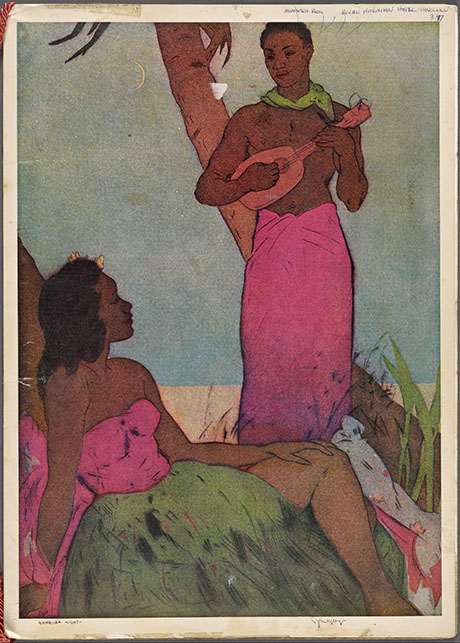
IMAGE: Menu cover, Monarch Room, Royal Hawaiian Hotel, March 25, 1977. NYPL Menu Collection.
Drawing on library and museum collections, but mostly on souvenirs saved by friends and colleagues, Kyle S. Van Houtan of Duke’s Nicholas School of the Environment, Loren McClenachan, assistant professor of environmental studies at Colby College, and Jack Kittinger of Stanford University’s Center for Ocean Solutions analysed 376 menus from 154 different restaurants in Hawaii, dated from 1928 to 1974.
The menus, Van Houtan et. al. explain in a peer-reviewed letter in the August 2013 issue of Frontiers in Ecology and the Environment, came from “a range of eateries from local businesses to larger restaurants serving tourists (we excluded 60 cruise-ship menus because their pantries were not locally sourced).”
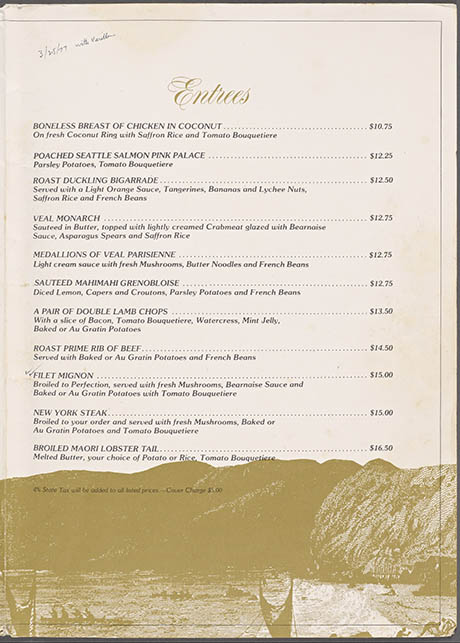
IMAGE: Entrees, Monarch Room, Royal Hawaiian Hotel, March 25, 1977. NYPL Menu Collection.
By counting the mentions of different species on the menus over time, the team were able to track a striking decline in Hawaii’s nearshore fishery stocks and an increasing reliance on larger, oceanic species. Reef fish, jacks, and bottomfish went from being extremely common before 1940 to appearing on less than 10 percent of menus by 1959, the year Hawaii became a state. Restaurants filled the gap by serving large pelagic fish, such as tuna and swordfish, which appeared on 95 percent of menus by 1970.
The scientists benchmarked their menu-derived data against early market surveys and later government fishery statistics from either side of the gap in the historical record, giving them confidence that their findings accurately reflected shifts in wild fish populations rather than just consumer preference or culinary trends.
Hawaii, the team admitted, was particularly well suited for their experiment in menu archaeology as historical ecology because “its remote location meant most locally consumed seafood was locally sourced.”
Nonetheless, the menu presence of some species didn’t accurately reflect changes in the marine environment: molluscs and shrimps were mostly imported from the mainland United States, frogs were sourced from local aquaculture operations, and the majority of the islands’ sea-turtle harvest was sold in fish markets rather than restaurants. “These latter instances,” Van Houtan noted, “may still present important information, such as the market forces supporting wildlife harvests.”

IMAGE: Menu occurrence of fishery items follows the rise and fall of local fisheries: wild-caught offshore fish species (top panel), imported and aquaculture species (middle panel), and wild-caught inshore species (bottom panel). Chart from Kyle S. Van Houtan, Loren McClenachan, and John N Kittinger, 2013, “Seafood menus reflect long-term ocean changes,” Frontiers in Ecology and the Environment 11: 289–290.
The team conclude their report by comparing restaurant menu analysis to the archaeological excavation of a midden in terms of its potential contribution to the historical environmental record — an unwitting testament to over-consumption, ecological pressures, and resource shifts. These menus “were often beautifully crafted, date-stamped, and cherished by their owners as art,” Van Houtan added, but “the point of our study is that they are also data.”
Johan Palme, Tertiarymatt and one other like this
06 Aug 13:09
Malcolm Tucker IS Dr Who! (by Pete Nottage)
Russian Sledgesinevitable; autoshare; via saucie
Cooper Griggs and -1 others like this
06 Aug 12:55





elizabethian-cows: cyberalpaca: It’s simple to be cool with...
Russian Sledgesvia snorkmaiden
It’s simple to be cool with other people.
This is an unexpectedly happy comic
firehose and -1 others like this
05 Aug 16:44
AHA Statement on Policies Regarding the Embargoing of Completed History PhD Dissertations
by russiansledges
The American Historical Association strongly encourages graduate programs and university libraries to adopt a policy that allows the embargoing of completed history PhD dissertations in digital form for as many as six years. Because many universities no longer keep hard copies of dissertations deposited in their libraries, more and more institutions are requiring that all successfully defended dissertations be posted online, so that they are free and accessible to anyone who wants to read them. At the same time, however, an increasing number of university presses are reluctant to offer a publishing contract to newly minted PhDs whose dissertations have been freely available via online sources.
firehose, Tertiarymatt likes this