
~Richard Nixon
 Russian artist Konstantin Altunin, who made international headlines this week after police seized his painting of Russian President Vladimir Putin and Prime Minister Dmitry Medvedev in women’s underwear, is seeking asylum in France.
The 45-year-old fled Russia on Tuesday night after police raided an art gallery in the northwestern city of Saint Petersburg and confiscated various works, including Altunin’s painting depicting Putin in a pink nightie and Medvedev in a bra and knickers.
Altunin fears he would be arrested if he returned to Russia.
"Yesterday I went to the prefecture in Paris ... and made this request (for asylum). I now need to go through the procedure and bring written confirmation of where I am staying," Altunin told the Agence France-Presse.
In a separate interview with Bloomberg, Altunin said: “I don’t want to return to Russia. I want to live and work in an atmosphere of freedom.”

    
|
Russian Sledgesthis is clearly a trick to get young people to join the masons
Russian Sledges#connecticut
Russian Sledgesvia firehose ("exceptionally well done and appropriately Moffat-epic grimdarked")
Can't wait to see Peter Capaldi take ownership of the TARDIS in 2014? 3-D artist NeonVisual (aka Xander David-Hugh) has you covered. He's created some brand new Capaldi opening credits that look neat enough to be the real thing.

|
|
Russian Sledgesvia firehose
the issue of mondo 2000 with jane siberry on the cover is probably buried in a box of comics in my parents' basement

R.U. Sirius was a founder of Mondo 2000, the definitive futurist magazine of the early 1990s. And now he's posted a ton of snippets from it over at Omni Reboot – including this amazing 1993 chart showing all the gadgets a cyberpunk needed. Like a portable computer and cellular phone!

|
|
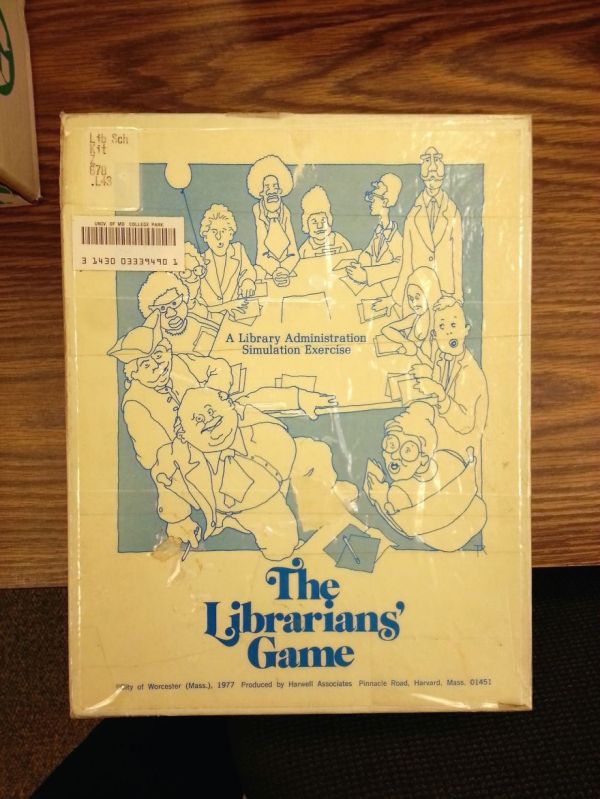

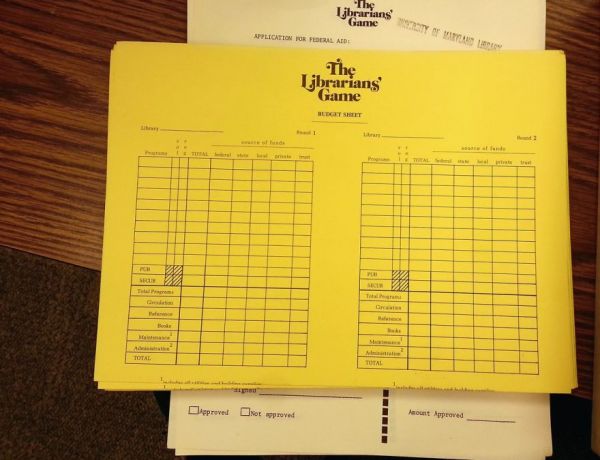
Tumblr user Yitzus came across this amazing find:
LOOK WHAT I FOUND! A TABLETOP LIBRARIAN GAME! WHO NEEDS DUNGEONS AND/OR DRAGONS WHEN YOU COULD BE FILLING OUT BUDGET SHEETS, DEALING WITH DRUNKEN PATRONS, AND FILING FOR GOVERNMENT AID!
What is this thing? Well, I logged into the library database WorldCat and did a search. This is a game published by the consulting firm Harwell Associates in 1977. It's designed to simulate the experience of a library director.
It's fun! I'm already a third-level cataloger/mage. The encumbrance rules are a pain, but we are talking about 70s-era data storage.
Link -via Breda Fallacy
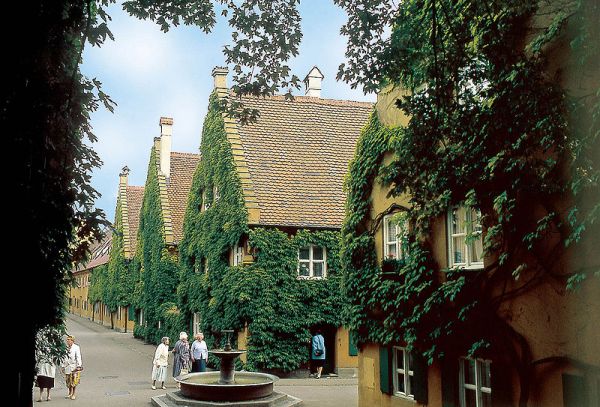
The world's oldest continuous "social settlement" is der Fuggerei in Augsburg, Germany. It was established 1521 by Jakob Fugger, a wealthy banker, merchant, and mining investor, to house the needy. The rent is the same as it was then, one Rhenish Guilder, which is less than one euro. Per year. The 67 houses of Fuggerei hold 140 apartments, with 150 residents. The neighborhood is a gated community, so to speak, with enclosed walls, its own church, and a museum. It is still supported by the Fugger Foundation, through returns on its investments over almost 500 years, supplemented by admission to the enclave and museum, which costs 4 euros. Link -Thanks, Bill Badrick!
(Image credit: context medien und verlag Augsburg)
Russian Sledgesvia firehose

A few days ago, after news of the sexual assault case in Mumbai broke out, someone on Twitter said something that got me thinking. A female resident of Mumbai, presumably, lashed out after seeing the umpteenth tweet asking women in Mumbai to “take care” and “be safe.”
Enough of this patronizing nonsense, she said. Instead of asking women to “take care” it was time that men actually did something to make the city safer for women.
In the days since that attack, such outbursts from men and women alike have become common. And they have been part of a much broader collection of discussion and debates about women’s safety. There are several concurrent threads to these debates: How can we teach our men to respect women better? Is violence against women an expression of social faults, if so which ones? How can these faults be alleviated? How does the portrayal of women, women’s issues and violence against women in mass media play a role in making things better or worse? Should minors involved in sex crimes be treated as adults? What can we do to make our neighborhoods safer? More recently there has been substantial debate on the trivializing of the idea of rape in the form of jokes and in other contexts not directly related to sex crimes.
Essentially, I suppose we are all trying to figure out how India can be made safer and more empathetic for all women. And these lines of questioning are legitimate. They might eventually help us make our cities, towns, and homes safer. But not immediately, not right now.
Right now, make no mistake about it, we need something that forms the foundation of a safe society: a functioning law-and-order system. No amount of soul searching, cultural self-flagellation, sex education, local activism, and behavioral conditioning will succeed unless our streets are well-policed and our courts function with speed and efficiency.
And this is exactly why I am afraid India will remain an unsafe country for women for the foreseeable future. Now I know this is not the message that many campaigners for women’s safety want to hear. Many of them are optimistic that some kind of governmental or non-governmental campaigning will make India safer. But as long these campaigns are divorced from a substantial overhaul of law and order mechanisms, they will not work.
Let us just take the case of of the city of Mumbai, arguably India’s most commercially important metropolis. Mumbai has a sanctioned police strength of approximately 45,000 officers. Around 3,000 of these posts are currently vacant. The effective number police on the streets are even lower. The New Indian Express recently said that Mumbai had a serving police force of 33,000 officers.
Earlier this month, in response to a Right To Information request, Mumbai police revealed that in the first two months of this year 27,740 police personnel had been deployed on VIP security duty, generally meaning they guard politicians. It is unclear if these deployments were short or long term. But there is no question that this substantially reduces the number of police officers the city actually needs on its streets.
An optimistic estimate suggests that, on an ongoing basis, Mumbai police has around 20,000 police taking care of its population of around 20 million residents. Therefore, Mumbai enjoys an effective police coverage of approximately 100 police officers per 100,000. (This number can vary somewhat depending on how you approximate police and population. But by my reckoning, it gets no better than around 165 per 100,000.) The United Nations recommends coverage where a population of 100,000 are served by 220 to 250 police officers.
What about courts? It is common knowledge that Indian courts have millions of cases pending at any given point in time. Yet another Right To Information request, filed by the same applicant in June, found 49,170 cases of crimes against women pending in courts across the state of Maharashtra (Mumbai is its capital). This number has increased by 40% between 2008 and 2012. Of the 14,414 rape cases tried in Maharashtra last year, 13,388 remain pending.
To be sure, better police and faster courts will not solve these problems alone, and columnist Praveen Swami explains this, but I can think of no conceivable solution that does not include better police and faster courts as key elements.
The need for immediate intervention is staring us in the face. So why don’t the people who run Mumbai, Maharashtra or India see this? What prevents them from overhauling the police force and legal system? Why does law minister after law minister lament about the masses of pending cases in Indian courts … and then actually do nothing radical about it?
This situation is doubly ludicrous when you consider that the government is also struggling to create sufficient jobs each year to occupy its exploding youth demographic. The nation is simultaneously drowning in both unemployed youth and undelivered public services.
Is it because these reforms are overly complex?
Cleaning up the courts is admittedly complex. But surely hiring a few thousand policemen can’t be as complex as rolling out multi-billion dollar job guarantees, food security or biometric identity schemes? Those are all initiatives the government has somehow managed to undertake.
Is it too expensive?
One estimate puts the annual budget of Mumbai’s police force at about 6 billion rupees (or $91 million). Almost all of this, around 85%, goes toward paying salaries. Can Mumbai, the beating heart of India’s economy afford to, say, double this? Given that the budget of the city of Mumbai is 280 billion rupees ($4 billion), and the city has a GDP which is at least 10 times as much, an escalation wouldn’t break the bank.
Then why not?
Your guess is as good as mine. But I think it is because overhauling Mumbai’s police or drawing up a radical plan to create new courts and hire new judges is exactly the kind of granular reform that, from a political perspective, Indian governments find difficult to execute. And unless these reforms deliver an immediate return (and one that can be politically leveraged), most stakeholders aren’t going to be interested in at all. In a given term in office there are only so many fights you can fight. So why pick the tough ones?
This is perhaps why the life cycles of legislation such as the Food Security Bill are relatively short, while those of a politically unsexy but economically important nature such as a new Companies Bill take decades.
There is a peculiar pattern that often pops up when “India’s problems” are discussed on social networks or in the comments section of news websites. Somehow while all of India’s problems are all universal—rapes happen in the US also, corruption happens in China also, malnutrition happens in Indonesia also—all the solutions to India’s problems become unique and complex. Police reform is complex, education is complex, food is complex, taxation is complex and on and on.
Not always. Some of India’s problem are simple things with simple solutions that unfortunately have no political capital.
I am afraid efficient courts and more and better police are among these problems. And I don’t think we should expect major reforms any time soon. Of course I hope I am proven completely wrong and Mumbai, and Delhi, and every other local administration immediately implements steps to improve law and order. Volunteer action, social awareness campaigns and neighborhood watch programs can all make marginal improvements. They will not, however, make up for a law and order system that works.
Until that happens—and I have no intention of being patronizing or sexist here—my fellow citizens will have to take care and be safe.
Follow Sidin on Twitter @sidin. We welcome your comments at ideas@qz.com.

Russian Sledgesvia firehose
Russian Sledgesvia firehose


Read more of this story at Slashdot.

Russian Sledgesvia firehose ("from IBM's Watson team, apparently")

Disconnected subway map? Sequential, linear relationships?
Possibly one of the worst uses of the “subway map” design metaphor I’ve ever seen. I can’t even bring myself to comment any further.
Russian Sledgeshwæt
Seamus Heaney, a Nobel laureate considered one of Ireland's greatest poets, died today. He refused to have his life defined by Ireland's decades of violence.
Russian Sledgesvia firehose
Read more of this story at Slashdot.

Russian Sledgesvia firehose ("a Kickstarter pitch voiced and edited by Werner Herzog")
Russian Sledgesvia firehose ("a reminder that North Korea is more bloody murder crazy than adorably crazy")
Telegraph.co.uk |
Keep up the pressure on Pyongyang over human rights Financial Times As the world contemplates intervening in Syria over alleged chemical weapons attacks on civilians, spare a thought for the long-abused civilians of North Korea. No one has gassed them, so far as we are aware. But practically every other known cruelty has ... North Korean dictator Kim Jong-un's former girlfriend shot by firing squad over ...NEWS.com.au all 241 news articles » |
Russian Sledges" The city’s famously liberal rent control and loitering policies have created, by accident, picture-perfect vignettes of these rapidly changing times. During my visit, I watched a homeless man help a twentysomething kid parallel-park a Tesla."
On the dysfunctional community colleges of San Francisco.
Russian Sledgesvia firehose
#nottheonion
#realmendonteatquiche
Russian Sledgesjust noticed that Cooking Issues is back
Russian Sledgesvia hosesnork

In 1967, Professor William Podlich (Arizona State University) took a sabbatical for two years to teach in the College of Teachers in Kabul as part of a collaboration with UNESCO. Besides his teaching activities, Podlich was a prolific photographer, and documented extensively everyday life. For the record, we are a decade before the Soviet invasion (1979).


Back to school for Afghan girls. They were also educated than boys. While in uniform, they were not allowed to wear the burqa to go to school.Text translated from the original French at Curiosités de Titam. Galleries of the original photos are at this link. Note the Paghman Gardens photo location looks a bit different today...

Russian Sledgesvia otters ("this just in from work")
LCCN Permalink provides persistent links to metadata records in LC Authorities. LCCN: sh96009275
LC control no.sh 96009275
Topical headingPeanut butter glasses
Browse this term in LC Authorities or the LC Online Catalog See alsoAdvertising drinking glasses
Browse this term in LC Authorities
Found inWork cat.: 96-35800: Mauzy, B.E. Peanut butter glasses, 1997.
LC database, Sept. 6, 1996 (peanut butter glasses)
Russian SledgesHFA autoshare
Swiss-born designer Le Corbusier was sitting in his Paris studio on April 7, 1960. In front of him was a sheet of onionskin paper a yard wide and long. In rapid strokes, using crayon for color, he sketched a tentative plan for what was to become the Carpenter Center for the Visual Arts at Harvard. The strikingly modernist structure, which turned 50 this year, was Le Corbusier’s only building in North America and was the last major project of his life.
He colored the intersecting ovals of the main structure in red, the sinuous center ramp in mauve, and the pathways of nearby Sever Quadrangle in yellow, a shade he always used to denote areas for “circulation.” The 1960 sketch, wrote one scholar, showed that “from the beginning Le Corbusier violently asserts the independence of his building from its grid of surrounding streets and architecture.” For instance, the Carpenter Center was set at an angle on Quincy Street, defiantly askance from its neighbors.
In the same sketch Le Corbusier also used color to editorialize, to set his building apart from what was around it. He blocked out the neo-Georgian Harvard buildings around the site, then shaded them in dark brown. Le Corbusier was a painter, and that brown was not part of his visual toolbox. He favored bright, arresting colors.
Once the Carpenter Center was under construction, Le Corbusier established strict color guidelines for interior finishes. The oak paneling was brown but had to be light and fine-grained. Anything painted was almost always green, yellow, red, black, or white. Colors had to be applied directly to the concrete, without gradations or toning. In the original basement auditorium space, which doubled as a studio, the right wall was red, and the zigzag left wall was white, blue, and green. The beams were white, the ductwork was green (one detractor called it a “shrill” green), and a portion of the rear ceiling was yellow. In all, these were typical Le Corbusier colors, wrote one scholar, “which one also might associate with new tractors and machinery.”
The designer, who was also an early urbanist, imagined a coming era in which machines would ease life and nature would weave organically through the built environment. As for colors, it may have helped that Le Corbusier — who began his mornings with gymnastics and painting — for a time drove to his Paris studio in a pistachio-green Simca Fiat convertible.
The Carpenter Center’s color scheme remains subtle, despite Le Corbusier’s modernist painterly touches. He wanted the smooth finish of the concrete to dominate the interior, with touches of color intended to draw the eye to form and light. It calls to mind the designer in his conservative dark suit and signature bow tie.
Le Corbusier’s building plans were sometimes touched by exuberant hues and always color-coded — yellow for walkways, blue for glass in shade, red and orange for glass touched by the sun. But in the end, he preferred form to color. When pictures of his buildings and his paintings were displayed side by side, in fact, Le Corbusier did not mind if they were reproduced in black and white.
Russian Sledgesso glad they dropped the papyrus logo

Designed by Might & Main.
Might & Main were asked to bring Duckfat's visual identity and print materials level with the finesse and forethought that goes into James-Beard-Award-winning chef Robert Evans's food. With carefully set typography, savory color palette, and pragmatic icons the menus and other brand expressions now create a visual allure consistent with the distinguished class of every other aspect of a Duckfat encounter.
Visit Duckfat.

For bigger menu images see this post at Art of the Menu


Russian Sledgesvia saucehose

Attention all map lovers: Stamen Design's new Mapstack service is hard to describe but worth delving into and playing around with. Is it an app? Not really; there's nothing to download. You just go to the website and jump right in. Is it a graphics program? Sort of; the controls work a bit like Photoshop, with sliders popping up in boxes when you want to edit a layer.
It's all there for free, accessible even from a tablet: worldwide map data with tons of graphic tools and the ability to link five layers. Concoct practically any kind of map you can imagine. Like it? Click on it to save it as an image. Click again to email it or Facebook it or load it onto your tumblr site. It's pretty cool.
According to the website, the service is "part of the CityTracking project, funded by the Knight Foundation, in which Stamen is building web services and open source tools to display public data in easy-to-understand, highly visual ways." According to users who have tried it, it's a ton of fun.
For more home and garden ideas and inspiration, sign up for our weekly At Home newsletter, subscribe to our RSS Feed, and visit our Home & Design page.
Russian Sledgesvia snorkhose/firemaiden

German non-profit group Definetz wants to make defibrillators readily available across its country so that any time someone has a heart attack, the life saving devices are within arms reach. And it's looking to drones to help it bring its vision to fruition. On Friday, the group announced the Defikopter, a concept device it designed with drone-maker Height Tech to fly defibrillators to emergency responders or the public by way of a GPS-enabled smartphone app.


