David Stromeyer Faceted Rock :: Mark Dorf Low Poly Rock
 In Noe Valley, where home prices are soaring, some merry pranksters are taking the term "Median Rent" literally with this cozy-looking statement that popped up in the middle of Dolores Street. [ more › ]
    
|
News: a redesigned accident and emergency department by London studio PearsonLloyd has been found to reduce aggression and violence by 50 percent.
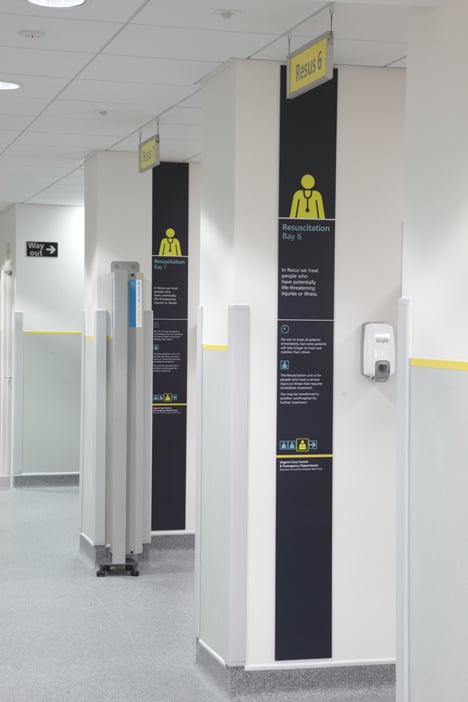
The design was trialled over the past year at a hospital in London and another in Southampton, and PearsonLloyd director Tom Lloyd told Dezeen the results have been overwhelmingly positive: "We were shocked by the fact that there was a 50 percent reduction in the aggressive incidents across the two hospitals after the implementation."
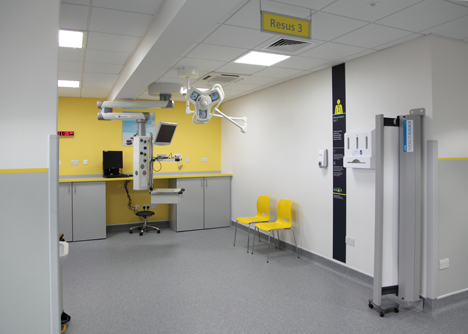
"For some reason A&E is a space where people feel like they have the right to get angry and start shouting," said Lloyd. "We thought that by trying to calm the space down and take that away there would be less likelihood of violent incidents."
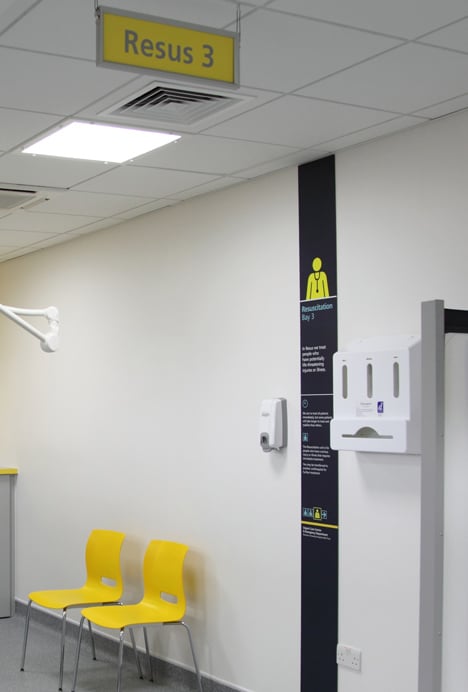
In response to a brief from the Design Council and the Department of Health, PearsonLloyd assembled a multidisciplinary team including psychoanalysts, service designers, A&E consultants and social scientists to identify the main reasons why patients become agitated enough to physically or verbally abuse hospital staff.
"A lot of the frustration that leads to anger is just a lack of knowledge and a lack of understanding about how things work," explained Lloyd. "It's caused by patients not understanding the clinical language or the process or why someone who arrives after them is seen before them."

The proposed solution focuses on placing key information in relevant locations within the waiting room and consultation areas so patients are constantly aware of where they are and how long each part of the process might take.
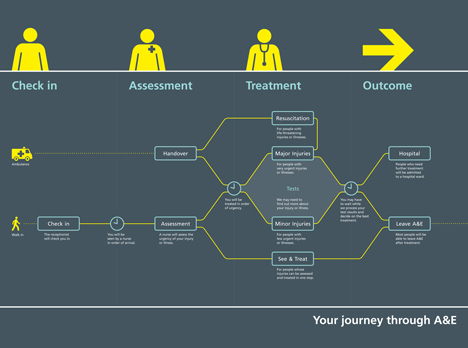
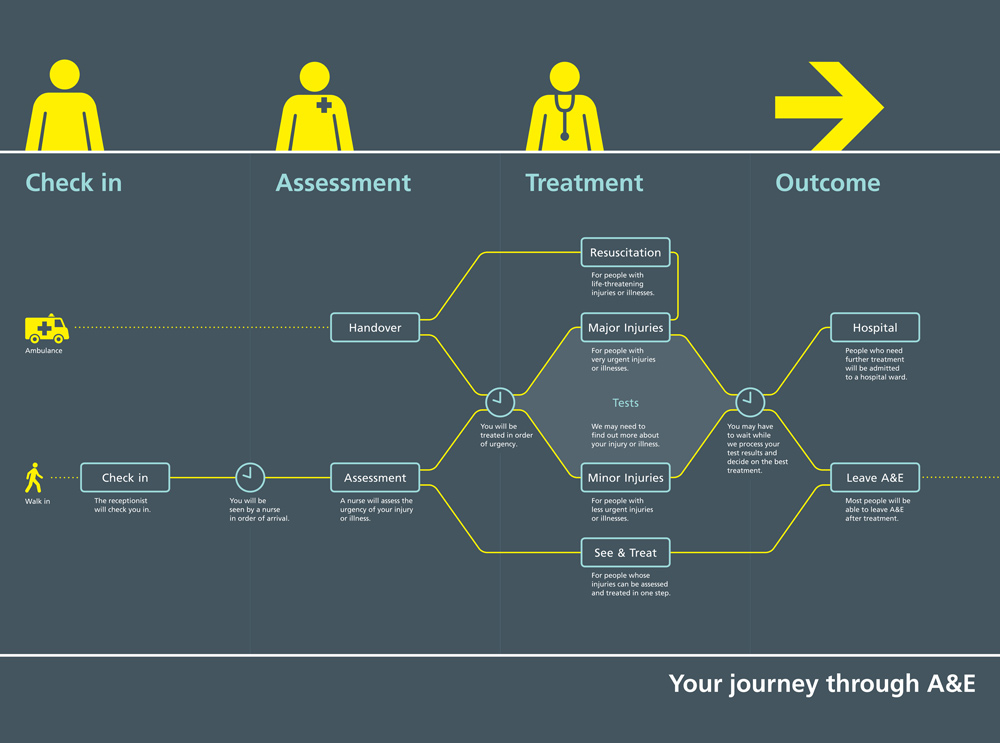
A process map in the waiting room guides patients arriving at A&E through the process, from check-in to assessment, treatment and next steps, and is supplemented by a leaflet with more details.
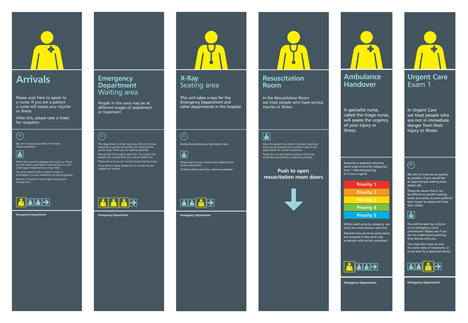
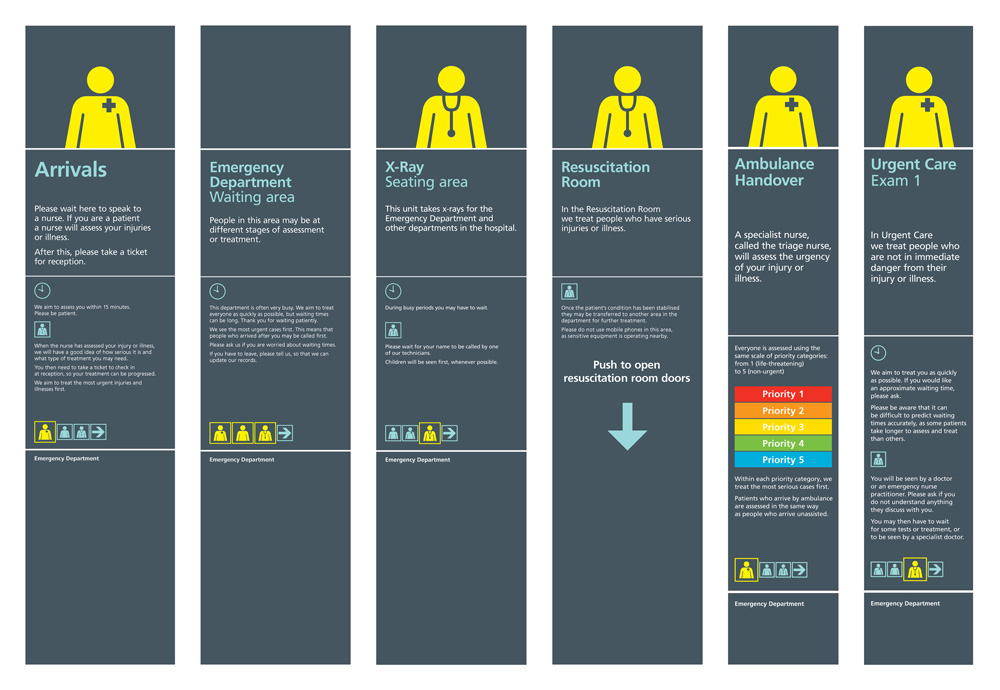
Vertical panels throughout the department explain the activities that take place in each space and their consistent appearance makes them easily identifiable.
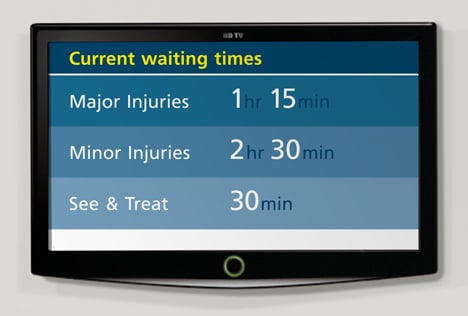
Live information about how busy the department is and predicted waiting times for different assessments are displayed on monitors and the designers have proposed a mobile app that could direct patients to the nearest A&E with the shortest waiting times.
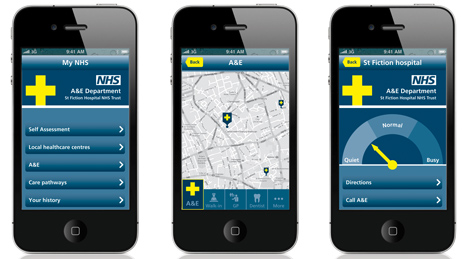
"It's about providing information and it sounds so simple but we wanted to create something that was cheap because if we'd designed the perfect waiting room, with great chairs and great lighting, then the chances of that being able to be rolled out in any hospital was next to zero," explained Lloyd.
"We wanted a system that could be retrofitted at very low cost and quite high speed in almost any department in the country."

The second part of the proposal is a programme that encourages staff to record instances of abuse on a purpose-designed chart so these can be communicated to management and trends identified that could facilitate procedural changes.
"For example, you imagine it's drunk men on a Friday night who cause most of the problems, whereas it might actually be other people for perfectly legitimate reasons being confused by the system," explained Lloyd.
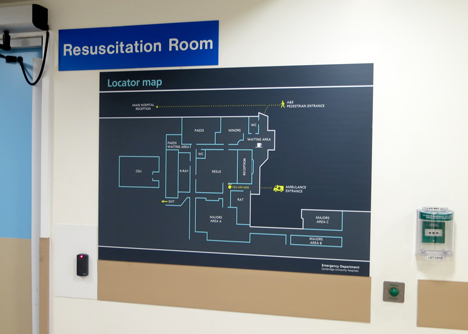
PearsonLloyd also developed a set of guidelines that enable the system to be implemented in any existing hospital and provide advice for architects and interior designers developing new healthcare facilities.
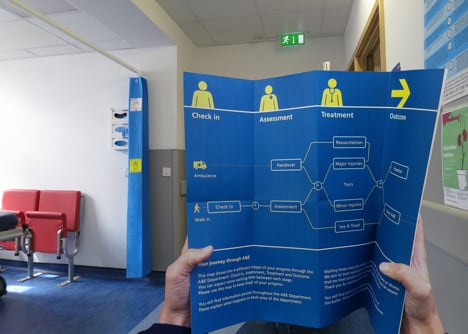
A website that acts as a resource for healthcare providers launched on Thursday and PearsonLloyd are now talking to several other trusts about implementing the system.

The post Signage system designed for hospitals
"reduces violence by 50 percent" appeared first on Dezeen.
Russian Sledgesstill afraid


|
|
Russian Sledgesto paraphrase joe laycock: we all become non-cyborgs

Neil Harbisson is the first person on the planet to have a passport photo that shows his cyborg nature — in his UK passport, he's wearing a head-mounted device called an eyeborg. The color-blind artist says the eyeborg allows him to see color, and he wants to help other cyborgs like himself gain more rights.

|
|
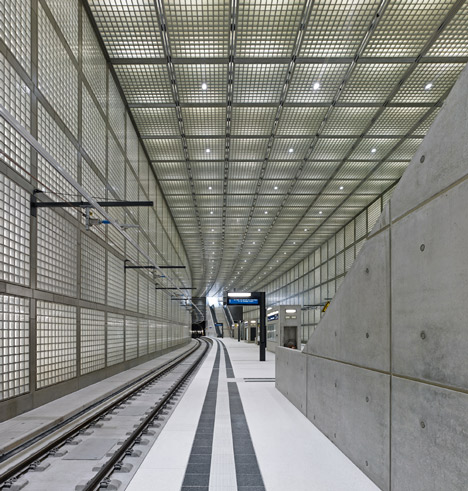
This new metro station in Leipzig, Germany, by Swiss architect Max Dudler comprises a 140 metre-long tunnel made up of illuminated glass blocks.
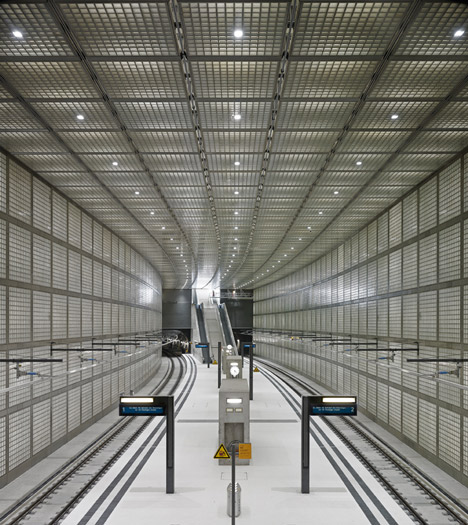
The Wilhelm-Leuschner-Platz S-Bahn station is one of four stops along the new Leipzig City Tunnel railway line that has been under construction for over ten years and is set to open next month, creating a new link between some of the city's major stations.
Swiss architect Max Dudler, whose previous projects include a glowing library and a castle visitor centre, won a competition to design the station in 1997 with his proposal for a glowing tunnel with a gently curved concourse and raw concrete details.
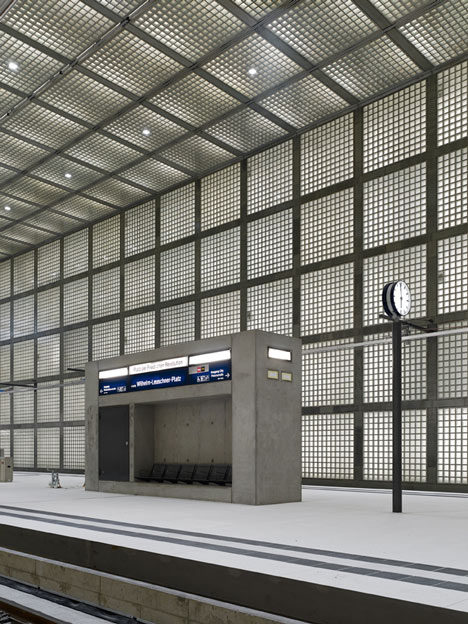
Back-lit glass blocks are arranged in groups within a concrete framework to create large glowing squares across the entire length of the walls and ceiling.
"The seemingly endless repetition of the same element in the course of the slightly curved, light-filled hall increases the sensation of the dimensions of this already large structure," said the studio.
The station platform is covered in pale terrazzo and interspersed with concrete volumes that form seating areas and signage boards.
"All station furnishings of the station are arranged as geometric concrete sculptures," added the studio.
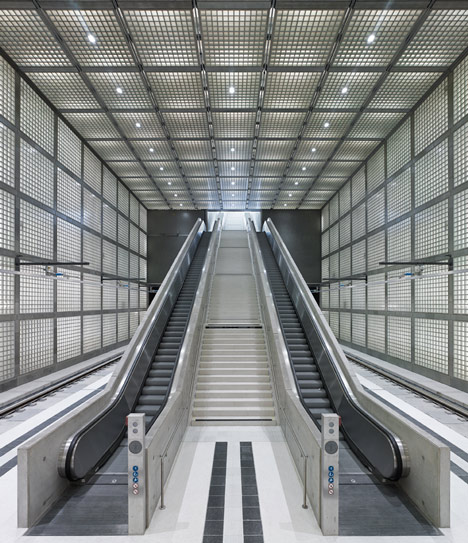
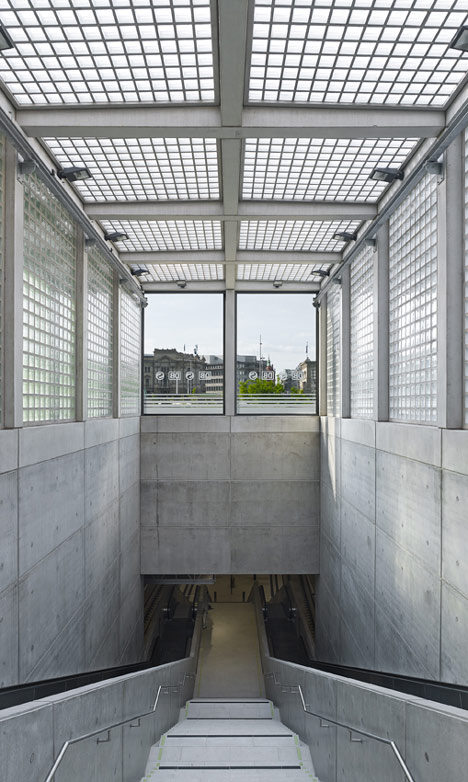
Entrances are positioned at the north and south ends of the platform, where solid concrete staircases are sandwiched between escalators. At street level, these entrances are contained within rectilinear structures that were also constructed using glass blocks.
Photography is by Stefan Müller.
Here's a project description from the design team:
Wilhelm-Leuschner-Platz Station
S-Bahn trains will cross beneath the centre of Leipzig from December 2013. This is when the 5.3 kilometre long city tunnel Leipzig, a joint development of Deutsche Bahn AG and the Free State of Saxony, will be completed. Wilhelm-Leuschner-Platz / Platz der Friedlichen revolution station on the southern end of the historic city centre is one of four stations of the major project that is currently one of the largest inner-city infrastructure projects in Europe.
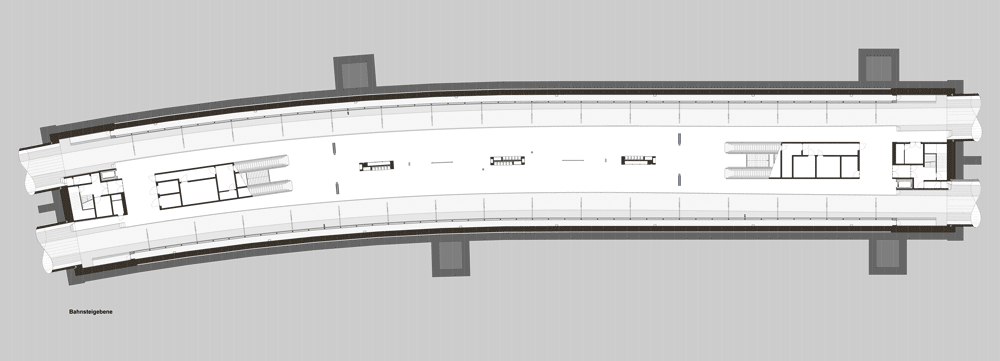
The design of the station is based on architect Max Dudler's successful competition entry from 1997. The Swiss architect's impressive 140 metre long and 20 metre wide station concourse has just recently been awarded the city of Leipzig's architecture award.
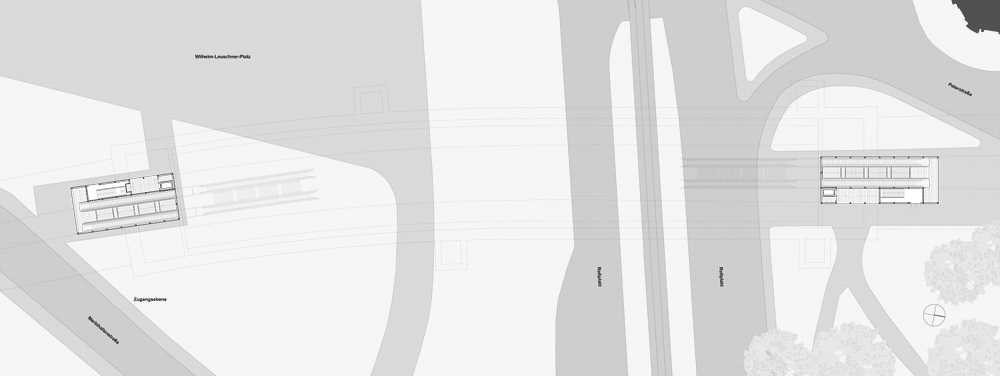
The station concourse, with a rectangular section and a slight longitudinal curve, is situated 20 metres below ground. Walls and ceilings of the elongated, column-free hall are clad with large, backlit prefabricated glass blocks set into a framework of fair-faced precast concrete. This gives the station concourse a bright and spacious feel. Extreme repetition of one and the same motif makes its actual dimensions almost intangible for passengers.
The light-coloured, jointless terrazzo flooring of the insular platform acts as a quiet counterpoint to the seemingly endless pattern of the walls. All necessary station furniture is arranged on the platform in the shape of geometrical concrete sculptures, all functions such as seating, timetables and ticket machines having in a sense been subtracted from or carved out of the concrete cubes.
The station concourse's supporting structure of precast reinforced concrete is not visible behind the glass block cladding. The wall elements of the glass block envelope are anchored to a steel substructure on the tunnel wall. The ceiling elements are suspended from the building shell.
Passengers access the station through the entrances on the north and south ends of the station that are fitted with solid staircases, escalators and elevators. The architectural design of the two entrances is in deliberate contrast to the filigree, seemingly transparent station concourse. As soon as they dip beneath the surface of the square, the staircases and their inner casings are made entirely of fair-faced concrete. The minimalist, almost coarse design conveys an impression of descending towards the interior of the earth, as if it was tunnelled directly into the rock.
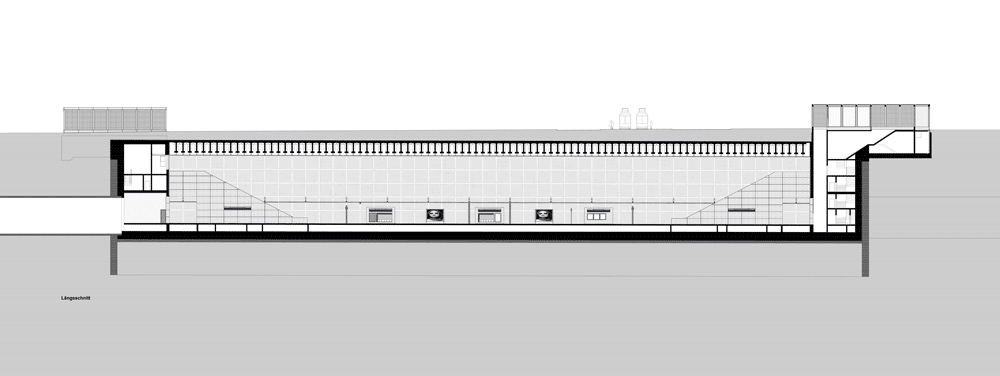
The stairs and the platform combine seamlessly into a monolithic ribbon. Similar to the station concourse, the aboveground entrance buildings have also been fitted with glass block components. They will help bring the square to life when illuminated at night.
Wilhelm Leuschner was a social democrat politician and part of the resistance against National Socialism. Formerly known as Königsplatz, this square in Leipzig was renamed Wilhelm-Leuschner-Platz in his honour in 1945. In 2013 it was finally renamed "Platz der Friedlichen Revolution" to honour the important role it played during German reunification.
The post Glowing glass blocks surround the Wilhelm-
Leuschner-Platz metro station by Max Dudler appeared first on Dezeen.

Two German students, in an effort to prove that the Great Pyramids are 15,000 years older than they really are, chipped off samples from the walls of an ancient burial chamber and brought them back home for analysis. Both Egyptian and German authorities are outraged.

|
|
Farewell, Comet ISON. After a weekend of hemming and hawing from experts, the sun-grazing ball of ice and dust has been declared officially dead. Again. Except this time, it's pretty much for sure. Bad Astronomer Phil Plait has the post-mortem. Astrophysicist Karl Battams even penned a eulogy.

|
|
Russian Sledgesvia saucie

Herbal oymels are sweet and sour blends of herbal infused vinegars, honey, and spices that can be enjoyed by the spoonful or used to make refreshing drinks. Violet oxymel is a delicious springtime treat that can be enjoyed through the summer as well!
Russian Sledgesvia firehose via GN

Korean artist Do Ho Suh has created a life-size fabric replica of a three-story American house, inside of which is a replica of a traditional Korean home, for his large scale installation “Home Within Home Within Home Within Home Within Home.” Each replica represents a home Suh has lived in—the 39-foot-tall American house was Suh’s first residence in the United States (in Providence, Rhode Island), and the smaller structure is his family’s house in Seoul. The installation is on display at the Seoul branch of the National Museum of Modern and Contemporary Art, Korea through May 11, 2014. For more of Suh’s work, see our previous posts.


photos via National Museum of Modern and Contemporary Art, Korea
Russian Sledgessanto domingo autoshare
This post is part of an ongoing series featuring items from the newly acquired Santo Domingo collection.
For the Scientific Treatment and Cure of the Alcohol, Morphine, Opium, Chloral, and Cocaine Habits!

Designed especially for the treatment of drug and alcohol abuse this pamphlet advertises the virtues of Dr. Rose’s Sanitarium. Located in bucolic Connecticut something that sets this institution apart is that it actually had a contract with a patient that guaranteed a cure. The pamphlet gives a general introduction to the location and amenities, including steam heat, gas lighting, a billiards room, and a gymnasium. The cost for morphine treatment- $25 a week with room and board extra. What if you are a lady patient? You will be guaranteed a lady attendant and the excellent care of a “beloved” doctor with an excellent track record of success. 
Still not a believer? There are a number of testimonials included to convince you. 
Dr. Rose’s Sanitarium, South Windham, Conn., for the scientific treatment and cure of the alcoholic, morphine, opium, chloral and cocaine habits. Utica, N.Y. : L.C. Childs & Son’s, Print., [1896?]. HV5281.W76 D7 can be found at the Countway Library at the Harvard Medical School in Longwood.
Thanks to Alison Harris, Santo Domingo Project Manager and Joan Thomas, Rare Book Cataloger at Countway for contributing this post.
Russian Sledgessanto domingo autoshare
This post is part of an ongoing series featuring items from the newly acquired Santo Domingo collection.

When I first looked at this cover I thought it was some sort of science-fiction title, but upon further inspection it is actually a guide on what to do in the event of an atomic emergency. The atomic age is often considered to be the period of history after the first atomic bomb was detonated and after the bombings of Japan during World War II. During this time the whole world was rushing to possess this new nuclear technology and it raised a lot of very real fears about what could happen and what the fallout would be. This French publication outlines what they believed to be appropriate actions, helpful tips, and detailed figures in the event of an atomic emergency during the 1950s.
For example Do. Not. Panic. Or as this caption states, there could be a stampede and subsequent trampling. 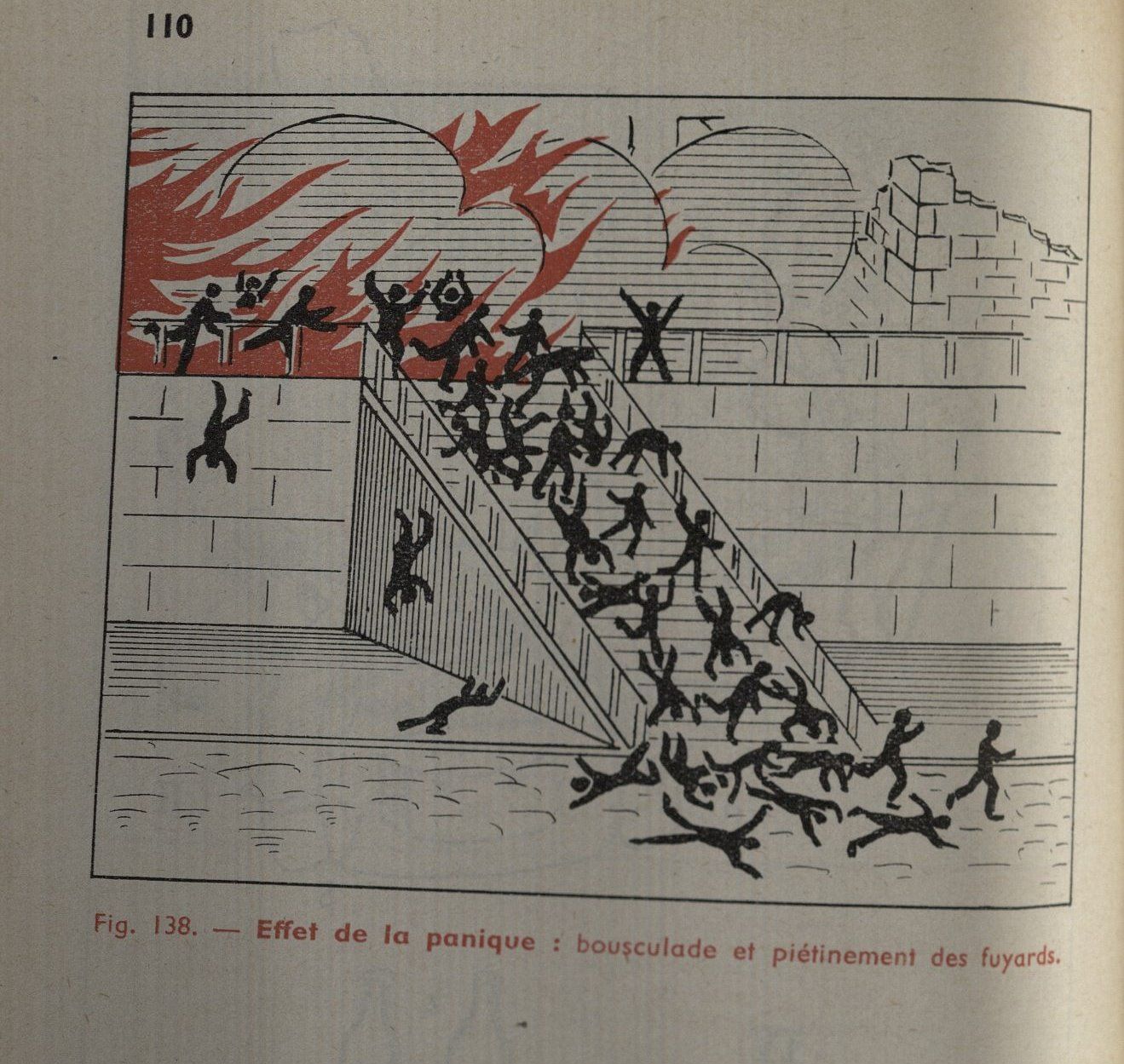 Other illustrations display the common equipment one might see during this type of emergency.
 Another figure outlines protective measures one should take if they are surprised by an explosion. They are counseled to jump behind a resistant wall while hiding their faces and hands to avoid burns. Or if possible crouch in a corner of the room to minimize any exposure from the blast.
 To learn more check out Atomique secours / Charles André Gibrin. Paris, Charles-Lavauzelle [1953] which can be found at the Widener Library.
Thanks to Alison Harris, Santo Domingo Project Manager for contributing this post
Russian Sledgesalso:
DEAR AMY: “Conflicted in the Heartland” disagreed with his wife’s political stance and felt pressured to “like” her posts on Facebook.
You said that “liking” a post on Facebook does not signify an endorsement of the post’s content. I disagree. I know that people use Facebook in unique ways, but for me “liking” does imply an endorsement. -- Facebook User
DEAR USER: Other readers agree with you. I use the thumbs up sign to let readers know I have read their post or comment, not that I necessarily agree with it.
Russian Sledgesthanks obama
Russian SledgesOld State House, in Boston; I've always wondered about this
Russian Sledgesvia otters ("hello my dapper ThOR ladies")
Daniel Friedman, 34, who owns Bindle and Keep in Brooklyn finds his niche in the fashion industry by giving female and transgender clients a masculine look, one that fits their bodies.
 Today* would have been the 90th birthday of the quintessential prima donna. The cher public are invited to comment, reminisce, and generally reflect on the artistry of this magnificent soprano.
* Yes, La Cieca realizes that the traditional date chez parterre for celebrating this birthday is December 3, but we’ll have another (perhaps) noteworthy anniversary to recall tomorrow.
Russian Sledgesvia snorkmaiden

"No! Absolutely not! Not a word of it is true! I did not have sex with her!"
1 & 2: Tablet, Yorghan Tepe, Stratum II.
Thus Kushshi-harbe, the mayor of Nuzi, vehemently denied the accusation of illicit sexual relations, one of the numerous allegations of corruption lodged against him by the citizens of Nuzi. Fourteen largely complete tablets, found in the palace at Location A on the site plan, record depositions against the mayor; other fragments have also been identified as belonging to the dossier. None, however, preserves the court’s verdict. In Tablets 1 and 2 Kushshi-harbe and his henchmen are charged, among other things, with making a door for his private house from wood belonging to the palace, looting a sealed house, numerous thefts and kidnapping. (Text: Semitic Museum).
This is one of my favorite artifacts from the museum, really just shows that even after these thousands of years, some things really do not change!
Courtesy & currently located at the Semitic Museum, Harvard University, Cambridge, MA.
Russian Sledgesevery time I see "wskeys" I read "whiskeys"
*******************************************************************************************************************************************************
I wanted to note that I’ve updated this post to correct/clarify two statements within this post.
OCLC has two wskey structures. For those developers that have been working with OCLC for a long time and have a wskey for their search services, OCLC can decommission your former key and create a new one that supports all functionality or they can give you a second key for the Metadata API. For new users, you simply need to request a key that includes specific functionality. In MarcEdit, I will continue to keep the key’s separate for configuration purposes, but this value can be the same.
Secondly – related to terms of use. I need to clarify – if you are developer and have been using the WorldCat Platform Services outside of the Search API, the terms to use this service as a developer are no different from the other licensing terms you or your institution may have agreed to. However, if you are a cataloger, the terms to retrieve/create a developer key are very likely different from the terms of service associated with your license related to the cataloging service. Users need to be aware of these differences because your organization may/will care.
*******************************************************************************************************************************************************
I’ve been starting to work on a couple of different write-ups around working with the OCLC Metadata API (http://oclc.org/developer/services/worldcat-metadata-api) – my general impressions and some specific improvements that really need to be in place to make this resource more usable. But I also have realized that I have neglected to give any kind of write-up about using the API within MarcEdit, save for an early YouTube video. So, I’m taking a little bit of time here to jot down some information related to how the API can be utilized within MarcEdit.
Background:
So a little bit of background. Over the past couple of years, I’ve been looking for opportunities to make use of the great work that OCLC Research does in exposing some interesting new data streams to the library community. When OCLC first released their classify service a number of years ago, I believe I was probably one of the first people to grab it and integrate it into a product that could be used within existing cataloging workflows. This year, I expanded the service to include integration with OCLC’s FAST headings service. While OCLC’s services do have some baggage attached (in terms of who is allowed to use them), the baggage is pretty small and they provide real value to the library community. Providing them through MarcEdit made a lot of sense.
The same can be true of OCLC’s new Metadata API. For a number of years, I’ve been having individuals in the user community looking for the ability to interact directly with WorldCat, specifically around the ability to set and delete holdings. The API provides this functionality, in addition to the ability to add and edit bibliographic records, as well as functionality around local data records. For the first round of integration, I’ve limited my work primarily to dealing with holdings and bibliographic data. I’ll be looking for people interested in the local data functionality and see how MarcEdit might be augmented to support that as well.
Early Use cases
Part of the reason I chose to work and support the specific API actions that I did was due to existing use cases. Processing around E-books and E-Resources have lead users within the MarcEdit community to make a couple common requests related to OCLC and WorldCat. Specifically, users are asking to:
The API provides the ability to address the first two questions, and I hope with time, OCLC will make some of their heading validation services available to support the 3rd request. But for now, MarcEdit’s development has really been focused around supporting these two specific use cases.
First Impressions
I’ll take some time to provide some additional feedback in a few days, but my first impressions were mixed. One the one hand, interacting with the service once I understood what the API expected in terms of requests and responses was pretty straightforward. On the other hand, very little documentation exists. Often times, I would initiate purposeful errors because simple things, like acceptable schemas, are left undocumented but are provided in an error message. Unfortunately, the missing documentation definitely complicates working with the service, as things related to validation, reasons for authentication errors, etc. simply are not documented and whose descriptions are fairly cryptic when reading as a response from the API.
However, I think anyone that does development probably is use to working with scarce documentation, and to OCLC’s credit, they have been very responsive in providing answers to the holes that currently exist in the documentation. From my perspective, the most concerning aspect of the API right now is the authentication. From a developer’s standpoint, the authentication process is easy enough. For the user however, the process for getting keys to utilize tools built upon the services is fairly problematic because the process assumes that users are developers and forces key requests and management through that portal. Likewise, these keys come with new terms of use outside of your traditional cataloging licensing and may (likely) will need to be vetted through an organizations legal council. Again, this is primarily a problem for non-developers – who have relationships with OCLC in ways outside of the WorldShare Platform Services…but these are primarily the users that this integration in MarcEdit targets (i.e., catalogers, not developers). This honestly is my biggest concern with the service right now (that and that keys are tied to individuals, not institutions) – bigger than issues related to documentation, validation, and the somewhat cryptic nature of the feedback received through the API.
Using the API in MarcEdit
So, to use the OCLC Metadata API in MarcEdit, there are a couple things that you need to do. First, you need to request your OCLC keys. MarcEdit’s integration requires users the appropriate Wskeys:
For long-term OCLC Platform Users (think Search API) – this means requesting two keys due to the fact that the previous key format isn’t compatible with their new authentication system. For new users, a single key should suffice. Regardless, a key that can support OCLC’s Search functionality is required to support MarcEdit’s ability to query the WorldCat database.
Likewise, MarcEdit needs a key that can utilize the Metadata API key. Again, for legacy API users, this will likely be a separate key – for new users – the search and metadata keys should be the same. This key has two parts – there is the Key and a Secret key. You need both to make requests. Likewise, there are 3 other values that users need to know to utilize the Metadata API services, and that is what is called a principalID a principalIDNS, a schema, a holdings symbol and a 4 character holdings code. All of these values need to be available in order to work with the various functions provided by the API.
Once you have these keys and supplemental information, you need to enter them into MarcEdit. Users will be able to see the menu entries for many of the OCLC functions, but until a user has entered their OCLC key data into the MarcEdit preferences and validated the data – these functions will remain disabled.
In the Preference’s area, there is a new tab that has been setup to store data related to OCLC’s Metadata services.
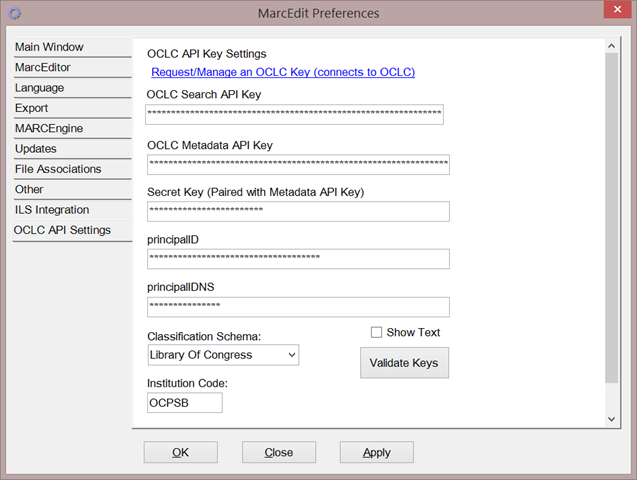
From this screen, users can enter all the information that they will need in order to utilize the various Metadata and Search API functions. MarcEdit will store this information in it’s configuration file, but does encrypt the data using a methodology that would make it impractical to reconstruct the key data.
After a user enters their data – the user should Click Apply, and then Validate. The Validate process is what enables the OCLC API integration functions. MarcEdit performs a couple API operations on an existing test record to determine if the information that user provided will support the required functionality. As MarcEdit validates a key, it will turn the textbox either green (for validated) or red (to indicate a problem).
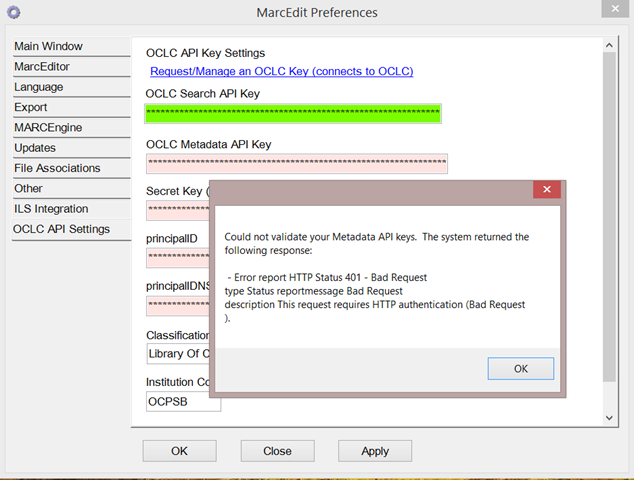
Example of a problem with a key
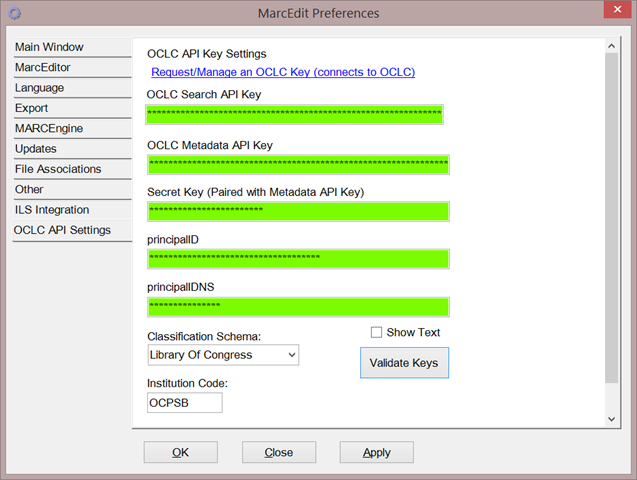
Example of all keys validated
Once the data has been validated – the OCLC Menu Items found in the Main Window and on the MarcEditor will be enabled.
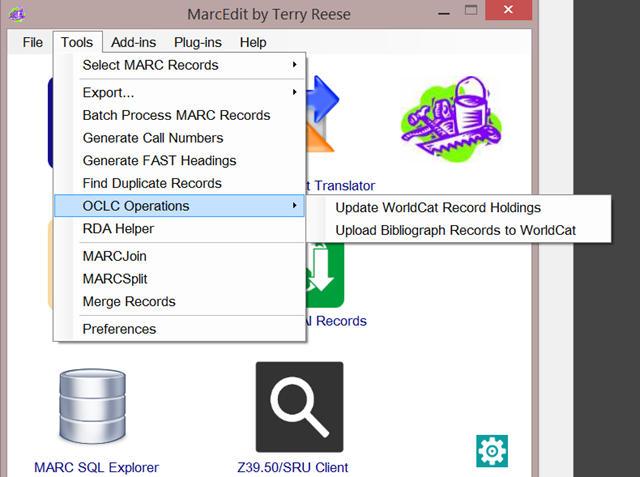
Main Window – OCLC Functions
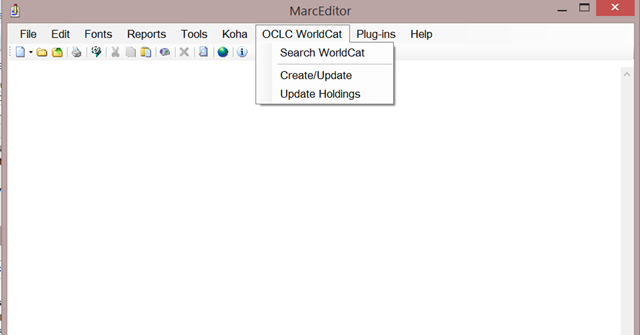
MarcEditor OCLC Functions
Using the OCLC API Functions
Hopefully, the functions are fairly straightforward to use and look identical regardless of where you interact with them within the application. At present, MarcEdit provides a function for setting holdings and working with bibliographic data.
Setting Holdings

MarcEdit’s Holdings Tool
MarcEdit provides a straightforward tool for updating a user’s holdings for a batch of records. MarcEdit’s holdings tool can process either MARC data, MarcEdit’s mnemonic data or a plain text file of OCLC numbers. The tool does exactly what it says. Using the information set in the Preferences, MarcEdit will pre-populate your Institution Code and Classification Schema. Users then need to select an action. MarcEdit’s batch tool can update or delete holdings, but will perform just one of those actions on all records within a designated file. That means, you cannot upload a file that contains records that need to have holdings added and deleted. The tool requires that these actions are isolated into discrete operations.
Update/Creating Bibliographic Data

MarcEdit’s Bibliographic Tool
When working with MarcEdit’s bibliographic updating/creation tool for WorldCat – this tool does allow users to work with files that contain records that are both new or updated. OCLC’s system and MarcEdit evaluates records within a file and based on the presence or absence of an OCLC number in a record will determine if a bibliographic record is to be created or updated. Of course, it’s not that simple – all bibliographic records passed through the API must be validated on the OCLC side, and at this point, that validation only occurs when the data is submitted for update or creation – a weakness that I hope at some point will be rectified since this causes a number of issues when working in a batch record environment.
Working within the MarcEditor
When working within the MarcEditor, the tools for working with Holdings and Bibliographic data are identical to outside. The main difference is that the data being acted upon is the data in the MarcEditor. This means that the MarcEditor needs to include one additional function, and that is the ability to retrieve data from WorldCat. MarcEdit has the ability to search and download a record set from WorldCat for editing.
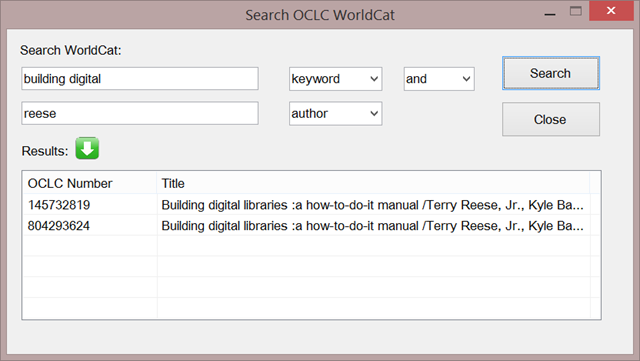
Searching WorldCat from Within the MarcEditor
The search tool provides a handy way for users to quickly retrieve data from WorldCat for edit. However, this too underlines one of the glaring issues with the API – especially around record editing. Traditionally, when catalogers work on a record, they can lock the record for editing. This prevents other users from changing the record while they are working on it, and protects the transaction information in the 005 which OCLC requires for updating purposes. When working with the API, there appears to be no way to lock a record. This means that records can be downloaded, edited and then on upload, be invalid due to someone else making an edit that updates the 005 information. And since OCLC doesn’t provide a method for validating information prior to upload, users won’t know that this problem has occurred until an upload is attempted. Again, in order to make the API functionally equivalent to OCLC’s other editing services, there needs to be a way for catalogers to lock records for editing.
Where we go from here
This is really hard to say. I believe that OCLC sees the release of the Metadata APIs as the first of a much larger portfolio of API services to provide programmatic support for their WorldShare endeavors. So, it will be interesting to see how these develop. At the same time, I’m really interested in seeing if the organization puts the type of resources behind the development of their API Services Portfolio to provide really meaningful services that librarians, developers, and 3-party library developers can work with, consume, or augment the wide range of data streams that they have available. On the one hand, I’m hopeful that the release of the Metadata API signals are wider commitment to providing transparent access to a wide variety of services. At the same time, the lack of development around the OCLC search API – which has seen only incremental changes since they were first released some 5 or so years ago – makes me wonder how much support within the larger organization exists around this type of work. So I guess that is a question that remains to be answered.
–TR
Russian Sledgessomebody just lent me a serger


Russian Sledgesvia multitask suicide ("never, ever, ever fucking go")

In the city of Miami Gardens, outside of Miami, FL, the police use aggressive campaigns of stop-and-frisk and absurd arrests to bolster their records, to the great detriment of the African-American majority who live there. For example, a young man named Earl Sampson has been stopped by Miami Gardens police 258 times; they've searched him more than 100 times; and they've arrested him for trespassing 56 times. He's never been convicted of anything apart from simple possession of small amounts of marijuana.
Sampson's trespassing arrests occurred at his place of work, a convenience store called the 207 Quickstop; Sampson was repeatedly arrested for trespassing there, over the loud objections of his employer, Alex Saleh, who owns the store, and who explained to police that Sampson was not trespassing in his store.
When Saleh gathered video evidence that showed the police had falsified their arrest reports and violated the rights of his customers, he was targeted for police harassment, including falsified vehicle stops and personal threats. Saleh is suing for federal civil rights violations, alleging that Miami Gardens police "routinely, under the direction of the city’s top leaders, directed its officers to conduct racial profiling, illegal stops and searches and other activities to cover up illegal misconduct."
Saleh, whose store is tucked between a public park and working-class neighborhoods, contends that Miami Gardens police officers have repeatedly used racial slurs to refer to his customers and treat most of them like they are hardened criminals.
“Police line them up and tell them to put their hands against the wall. I started asking myself ‘Is this normal?’ I just kept thinking police can’t do this,’’ Saleh said.
Last year, Saleh, armed with a cache of videos, filed an internal affairs complaint about the arrests at his store. From that point, he said, police officers became even more aggressive.
One evening, shortly after he had complained a second time, a squadron of six uniformed Miami Gardens police officers marched into the store, he says. They lined up, shoulder to shoulder, their arms crossed in front of them, blocking two grocery aisles.
“Can I help you?” Saleh recalls asking. It was an entire police detail, known as the department’s Rapid Action Deployment (RAD) squad, whom he had come to know from their frequent arrest sweeps. One went to use the restroom, and five of them stood silently for a full 10 minutes. Then they all marched out.
In Miami Gardens, store video catches cops in the act [Julie K. Brown/Miami Herald]
(via Sean Bonner) 
|
|
Russian Sledgesvia firehose


Just a reminder:the natural diet of these birds is BONES. Not just bone marrow; actual bone shards. They pick up huge freaking bones from carcasses and drop them onto rocks until they get spiky pieces and then they swallow them. Their stomach acid dissolves bone.
look me in the eye and tell me that’s not a fucking dragon
And they aren’t naturally red like that. That’s self-applied makeup. They find the reddest earth they can to work into their feathers as a status symbol.
And they don’t scavenge other parts of carcases, just the bones. 85-90% of their diet is exclusively bone. Hence why it’s only a myth that these birds would just pick up whole lambs and carry them off. It’s not true, but in German they’re still called Lämmergeier as a result.
So metal

New details are still leaking out about the diplomatic hoops diplomats were required to jump through in order to make the historic nuclear deal between the U.S. and Iran happen. In this chapter, all they had to do was return a stolen chalice.
According to this insane L.A. Times story, the U.S. was debating how best to acknowledge Hassan Rouhani's election as Iran's new president. The two countries were already knee-deep in secret, back-channel negotiations, but, on the surface, the relationship was cold as ever. One diplomat convinced the President's foreign policy team the best way to get in the country's good graces, is to return the 7th century, priceless Iranian chalice they've long wanted.
An art dealer illegally smuggled the chalice, looted from an Iranian cave, into the U.S. in 2003 to orchestrate a multi-million dollar sale. The State Department heard about his plan, confiscated the chalice, and it sat in a climate-controlled warehouse ever since. The diplomats knew Iran wanted it back.
Most importantly, retrieving the chalice earn Rouhani praise in Iran, endearing him to hardliners and building confidence among his people. So when both leaders were in New York for the U.N. General Assembly, the plan was set. Instructions were given to the diplomat who cares for the chalice explaining how to return it:
U.S. and Iranian diplomats can talk with one another on a short list of issues, such as helping the Iranians set up a bank account or get diplomatic license plates.
The U.S. diplomat called the Iranian contact for such matters and said he had something to deliver before Rouhani left. The Iranian agreed to meet.
Quickly, the diplomat took a photo of the griffin and printed a card explaining its history and why it was in U.S. hands. The Iranian contact might not recognize the object, he worried.
Thinking a cardboard box was no way to present a precious object, he bought a white gift bag at Hallmark, choosing that color so as not to imply it was a gift.
"Plain white gift bags are actually kind of hard to find," he said in a recent interview.
The Iranians love the gift, and accepted the gracious offer to build relations. Two days later, Rouhani and Obama were talking on the phone like it was no big deal, as if the two countries speak more often than once every three decades.

|
|
Russian SledgesI don't know

The Birds story finds inspiration in the iconic Hitchcock movie delivered to the pages of Elle Canada by talented photography duo Leda & St. Jacques. The photographers had help coming from fashion stylist Cloé Legault and art director Denis Desro. The gorgeous model is Pamelo from Mango Modeling Agency, while her hair styling and makeup are courtesy of Sabrina Rinaldi (Judy Inc/TRESemmé/ NARS).
To style the shoot Cloé Legault used pieces from fashion's greats such as Jil Sander, Prada, Gucci, Bottega Veneta, and Carven among other.
The Birds might be the work of digital technician Yanive Nizard.
(...)
Read the rest of The Birds by Leda & St. Jacques for Elle Canada
© admin for Design Scene - Fashion, Photography, Style & Design, 2013. |
Permalink |
Post tags:


The post The Birds by Leda & St. Jacques for Elle Canada appeared first on Design Scene - Fashion, Photography, Style & Design.
by Eyder Peralta
Paul Crouch, who along with his wife Jan, founded a TV network that went on to become the largest Christian television network in the world, died on Saturday, the network announced.
Trinity Broadcasting Network said it is believed that he died from on-going heart problems. He was 79.
If Crouch's name doesn't ring bell, his image surely will. You may have caught him hosting the two-hour variety show Praise the Lord, along with his wife, who is known for her big, pink hair and dramatic makeup.
Quoting a book chronicling the network, The Los Angeles Times reports that by the mid-1980s, TBN was "the country's most-watched religious network."
The Orange County Weekly paints a mixed picture of Crouch. In its obit, the weekly calls him both a "titan of American Christianity" and a man who spent the hard earned money of his working-class viewers with little regard.
Crouch also became a pioneer in what's called the "prosperity gospel," which essentially holds that God wants his followers to be rich.
During the past couple of years, Crouch's family has been haunted by sensational scandals about their wealth.
The New York Times ran a long piece about it in which they chronicle the couple's two sets of luxury homes, the secrecy surrounding the millions they received in donations (they received $93 million in 2010) and the family's struggle to keep control of the empire.
As part of the story, the Times interviewed Crouch's grandaughter, Brittany Koper, who was fired for allegedly stealing $1.3 million, but who also opened up about what she said were the company's financial improprieties. The Times reported:
"In two pending lawsuits and in her first public interview, Ms. Koper described company-paid luxuries that she said appeared to violate the Internal Revenue Service's ban on 'excess compensation' by nonprofit organizations as well as possibly state and federal laws on false bookkeeping and self-dealing.
"The lavish perquisites, corroborated by two other former TBN employees, include additional, often-vacant homes in Texas and on the former Conway Twitty estate in Tennessee, corporate jets valued at $8 million and $49 million each and thousand-dollar dinners with fine wines, paid with tax-exempt money.
"In the lawsuits and interviews, Ms. Koper, 26, also charges that TBN has spent millions of dollars in sweetheart deals with a commercial film company owned until recently by a son of the Crouches, Matthew, including poorly monitored investments made after he joined the TBN board in 2007.
"'My job as finance director was to find ways to label extravagant personal spending as ministry expenses,' Ms. Koper said. This is one way, she said, the company avoids probing questions from the I.R.S. She said that the absence of outsiders on TBN's governing board — currently consisting of Paul, Janice and Matthew Crouch — had led to a serious lack of accountability for spending."
On his website, Crouch is described as an "amazing servant of God."
His official biography says that, today, Crouch's network reaches every major continent and over 18,000 TV and cable affiliates around the world. The cable company even has a service in Spanish, Arabic and Farsi, as well as a cable channel in Asia, Europe and Russia.
His bio goes on:
"Dr. Crouch and TBN have been the recipients of numerous awards and citations of appreciation by both local and national leaders including the Golden Angel award from the Excellence in Media organization and the Parents Television Council Entertainment Seal of Approval, given to both the TBN and Smile of a Child networks for producing and promoting positive, pro-family programming. Dr. Crouch was also appointed by President Ronald Reagan to the Private Sector Initiative Project."
9())

A couple weeks ago, Pearl Jam brought out Carrie Brownstein and Annie Clark to cover Neil Young's "Rockin' in the Free World". As Stereogum reports, the band brought out Brownstein to cover the song once again last night, this time with some very special guests: the other two members of Sleater-Kinney.
UPDATE: Watch the performance below.
It's the first time all three members of the band have taken the stage together since 2006. There's photo evidence here. R.E.M.'s Peter Buck and Scott McCaughey were also there.
Video hasn't yet surfaced, but watch Sleater-Kinney and Pearl Jam do "Rockin' in the Free World" back in 2003:
Here's Carrie Brownstein telling a Sleater-Kinney story on Pitchfork.tv's "Frames":
Literally “mother-soul alone,” it means “a feeling of devastating loneliness–so lonely that it is as if your mother’s soul has left you.” Pronounced “mut-tare-zay-lin-uh-line” (the first syllable rhymes with “put”).

The U.S. Navy has offered to convert one of its ships into a floating chemical weapons disposal, according to the Organisation for the Prohibition of Chemical Weapons, the watchdog responsible for policing Syria's disposal progress.
The as-yet-unidentified ship offer ends a weeks-long, agonizing search for a place to dispose of the embattled country's 1,300 tons of chemical weapons. The BBC first reported the dismantling would be handled at sea, and said the MV Cape Ray, a U.S. Navy cargo ship, was the likely choice. Now they just have to find a Mediterranean port where the Cape Ray can park itself and perform the process, called hydrolysis, required to destroy the weapons.
Syria has, so far, cooperated fully with the international agreement to get rid of its chemical weapons supply, which gives the country until December 31 to complete the job. This week OPCW denied a request from Syria to convert some of its chemical weapons facilities for other functions.
The watchdog searched high and low for a country to volunteer their services to host the weapons once they're removed from Syria, and to handle their destruction. Even Albania said no thank you.

|
|
Russian Sledgescedar!
via overbey