Historical Diagram: Charing Cross/Embankment Tube Station Cutaway, 1914
Simply stunning cutaway cross-section of the London Tube station now known as Embankment in 1914. This drawing shows the station just after the opening of the new deep tube extension of the Charing Cross, Euston and Hampstead Railway (now part of the Northern Line) from their previous terminus to the north at Charing Cross station. The extension was a single line that headed south from Charing Cross, looped back around underneath the Thames and had a single platform heading northbound here at Embankment.
The diagram shows the C+E&H tube at the bottom right: it looks like a train has just left, heading back northwards to Charing Cross. To the left, the twin tubes of the Bakerloo line can be seen. Above, the shallow cut-and-cover tunnel of the District line runs at right angles to the deeper lines, built into the actual river embankment from which the station received its name. Above them all sits the grand old Charing Cross main line railway station, with The Strand just visible at its far end (a helpful caption, “This is The Strand”, points the way).
More than anything, it’s the detail of this cutaway that I like the most. Busy people enter and exit the station, read newspapers and ride the escalators between levels. A double-decker omnibus and Edwardian car can be seen chugging along the street, and trains belch steam in the station above. Advertisements adorn the walls, and the red carriages of the Tube fairly rattle along the tracks. An early version of the Underground roundel – a red circle with a blue bar across it – can be seen above the station’s building and on the District line platform.
If the naming of the station seems a little confusing, that’s because it was. In 1914, the District line platforms were named Charing Cross (for the main line station almost directly above), while the two separate deep tube lines were both called Embankment. The C+E&H station directly to the north, which was previously just Charing Cross, became Charing Cross (Strand). By 1915, everyone had had enough of this nonsense and all the platforms at this station took on the District line name of Charing Cross, while Charing Cross (Strand) became simply Strand. At the same time, the separate Strand station on the Piccadilly line was renamed as Aldywch to prevent even more confusion.
In June 1973, the newer Northern line Strand station was closed to allow construction of Jubilee line platforms. These platforms were constructed between the Bakerloo line and Northern line platforms together with the long-missing below-ground interchange between those two lines. In anticipation of the new interchange station, Charing Cross (this station) was renamed Charing Cross Embankment. The Jubilee line platforms and the refurbished Northern line platforms opened in May 1979, when the combined station (including Trafalgar Square on the Bakerloo line) was given its current name of Charing Cross; simultaneously, Charing Cross Embankment (this station) reverted to its original name – Embankment.
It’s easy, fast and fun to add female characters, in two simple steps. And I want to be clear I’m not talking about creating more movies with a female lead. If you do, God bless and thank you. Please consider me for that role.
Step 1: Go through the projects you’re already working on and change a bunch of the characters’ first names to women’s names. With one stroke you’ve created some colorful unstereotypical female characters that might turn out to be even more interesting now that they’ve had a gender switch. What if the plumber or pilot or construction foreman is a woman? What if the taxi driver or the scheming politician is a woman? What if both police officers that arrive on the scene are women — and it’s not a big deal?
Step 2: When describing a crowd scene, write in the script, “A crowd gathers, which is half female.” That may seem weird, but I promise you, somehow or other on the set that day the crowd will turn out to be 17 percent female otherwise. Maybe first ADs think women don’t gather, I don’t know.
And there you have it. You have just quickly and easily boosted the female presence in your project without changing a line of dialogue.
Yes, we can and will work to tell more women’s stories, listen to more women’s voices and write richer female characters and to fix the 5-to-1 ratio of men/women behind the camera. But consider this: In all of the sectors of society that still have a huge gender disparity, how long will it take to correct that? You can’t snap your fingers and suddenly half of Congress is women. But there’s one category where the under-representation of women can be fixed tomorrow: on screen. In the time it takes to make a movie or create a television show, we can change what the future looks like.
In what may be the single greatest Fox News clip ever recorded, Megyn Kelly hosts a frank discussion about race with a bunch of white people. This video is required viewing:
To recap, Jesus and Santa Claus are historical figures. And they were white. This actually contradicts the prevailing view that Jesus's precise ethnicity is unknown (though probably not "white") and Santa Claus is a mythical being representing an amalgamation of figures from folklore, as well as stories about a fourth-century bishop.
But according to Kelly, both are historic figures, both are white, and this is a "verifiable fact."
Break out the champagne, people, because this is the best news we could have hoped for. You see, there's only one way she could possibly be that certain about Jesus's skin color: time-travel must have been invented.
That's right. Time travel.
Because no self-respecting journalist - really, no human with even a shred of integrity - would ever say something like that unless they'd already gone back and checked. We can only assume Kelly's interview with Jesus in the Judaean Desert will air soon. I hope she asked some tough questions about the Psalms!
Of course, I'm even more excited by the news that Santa Claus is a verifiable historical figure. I'm not sure why she's so preoccupied with his race, through. I mean, the mere fact that he was a living, breathing elf makes his skin color kind of irrelevant.
“Just try to explain to anyone the art of fasting,” says the title character in Kafka’s short story “A Hunger Artist.” “Anyone who has no feeling for it cannot be made to understand it.” The emaciated circus freak is right: refusing food at the expense of bodily function is not an easy addiction to convey.
Ginia Bellafante put it well a few years ago, in a book review for the New York Times: “Anorexia is a disease of contradiction: it demands both discipline and indulgence . The anorexic disappears in order to be seen; she labors to self-improve as she self-annihilates.” Bellafante describes the condition as “an intellectualized hallucination.” That concise definition is better than any I’ve read, and it points to the conflicted way in which we talk about the disease: our intention is critical, but our language is celebratory.
In “How to Disappear Completely: On Modern Anorexia,” Kelsey Osgood parses these paradoxes by looking critically at the writings of and about anorexics. Her project is a contrarian one: to expose the hypocrisy of “treatment texts,” the pseudo-redemptive memoirs written in the past tense by those who see themselves as recovered. She believes that praise of such authors, who are often called rigorously honest and selflessly brave, is naïve, maybe even willfully so: in reality, their books do little more than teach readers to diet and think of anorexia as an aspirational illness. It’s a good point, and, coming from somebody who spent a decade in and out of hospitals and on the brink of death, one that should be taken seriously. Osgood “contracted” the disease as a teen-ager by copying the habits of anorexics, using books that purported to be recovery-oriented “didactically, as diet manuals.” She remembers thinking of anorexia not as an illness “but rather as the most logical progression of self-control.”
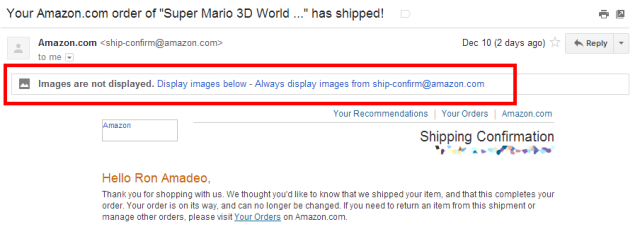
Ever wonder why most e-mail clients hide images by default? The reason for the "display images" button is because images in an e-mail must be loaded from a third-party server. For promotional e-mails and spam, usually this server is operated by the entity that sent the e-mail. So when you load these images, you aren't just receiving an image—you're also sending a ton of data about yourself to the e-mail marketer.
Loading images from these promotional e-mails reveals a lot about you. Marketers get a rough idea of your location via your IP address. They can see the HTTP referrer, meaning the URL of the page that requested the image. With the referral data, marketers can see not only what client you are using (desktop app, Web, mobile, etc.) but also what folder you were viewing the e-mail in. For instance, if you had a Gmail folder named "Ars Technica" and loaded e-mail images, the referral URL would be "https://mail.google.com/mail/u/0/#label/Ars+Technica"—the folder is right there in the URL. The same goes for the inbox, spam, and any other location. It's even possible to uniquely identify each e-mail, so marketers can tell which e-mail address requested the images—they know that you've read the e-mail. And if it was spam, this will often earn you more spam since the spammers can tell you've read their last e-mail.
But Google has just announced a move that will shut most of these tactics down: it will cache all images for Gmail users. Embedded images will now be saved by Google, and the e-mail content will be modified to display those images from Google's cache, instead of from a third-party server. E-mail marketers will no longer be able to get any information from images—they will see a single request from Google, which will then be used to send the image out to all Gmail users. Unless you click on a link, marketers will have no idea the e-mail has been seen. While this means improved privacy from e-mail marketers, Google will now be digging deeper than ever into your e-mails and literally modifying the contents. If you were worried about e-mail scanning, this may take things a step further. However, if you don't like the idea of cached images, you can turn it off in the settings.
OK, so this isn't the first in-browser emulator we've seen, but we thought you might get a kick out of it anyway. Using Chrome's Portable Native Client (PNaCl), Google developer Christian Stefansen has the Universal Amiga Emulator (UAE) running within the browser.
Introduced in 2009, Google's Native Client (NaCl) started out as a way of running native x86 code in a safe, sandboxed environment. It uses specially compiled programs, combined with the x86 processor's built-in memory segmentation capabilities, to offer something like 95 percent of the performance of unsandboxed programs. An ARM version made its debut in 2010.
NaCl gets its performance—and the "native" part of its name—by using processor-specific code. x86, x64, and ARM are all currently supported, but programs must be compiled separately for each: ARM processors obviously cannot run x86 code, nor vice versa.
The Federal Communications Commission (FCC) voted today to consider a rule change that would allow cellular phone calls during airplane flights. But the possibility of allowing in-flight phone service might be ruled out even before the FCC can take final action.
US Department of Transportation Secretary Anthony Foxx said his department will consider banning in-flight calls.
"Over the past few weeks, we have heard of concerns raised by airlines, travelers, flight attendants, members of Congress, and others who are all troubled over the idea of passengers talking on cellphones in flight—and I am concerned about this possibility as well," Foxx said, according to Reuters. "As the FCC has said before, their sole role on this issue is to examine the technical feasibility of the use of mobile devices in flight… DOT will now begin a process that will look at the possibility of banning these in-flight calls."
As thousands of Rohingya flee Myanmar to escape religious persecution, a Reuters investigation in three countries has uncovered a clandestine policy to remove Rohingya refugees from Thailand's immigration detention centers and deliver them to human traffickers waiting at sea.
A September report from the Library of Congress's National Film Preservation Board called The Survival of American Silent Feature Films: 1912–1929 [PDF] paints a dismal picture of the archival record of silent movies. In all, "14% of the 10,919 silent films released by major studios exist in their original 35mm or other format," although some of the missing items are extant in lesser transfers and foreign editions. But in all, "we have lost 75% of the creative record from the era that brought American movies to the pinnacle of world cinematic achievement in the 20th century."
It's a sobering reminder of the fragility of even relatively recent media, and the need for preservation. An appreciable slice of the missing archival materials are still in copyright, with attending difficulties in clearing them for the purpose of striking and circulating new prints. As we close in on 2018, the date at which materials from 1928 onward will begin entering the public domain again, this is an important reminder of what can happen if we let the profitability of a tiny slice of commercially viable ancient materials trump the preservation of the vast bulk of cultural materials.
Billington says the report finally confirms the anecdotal information about lost pics that has long been available, especially about films made by the most celebrated U.S. filmmakers. It enables the Library to authoritatively report that “we have lost 75% of the creative record from the era that brought American movies to the pinnacle of world cinematic achievement in the 20th century.”
The repatriation proposal is one of six recommendations offered in the study. It also suggests that studios and rights holders collaborate to acquire archival master film elements of unique titles. For example, many of the films preserved by MGM in the 1960s are not yet held by any American archive, it notes.
It also encourages the coordination among U.S. archives and collectors to identify silent films surviving only in small-gauge formats (particularly 28mm, 16mm and 9.5mm). It claims that the largest cache of unexplored surviving titles is the 432 U.S. silent feature films that survive only in 16mm.
Given what’s gone on this week, it’s appropriate that I announce this.
There’s a very interesting one-day conference taking place at this very moment in Halifax, Nova Scotia. The topic is “Hype in Science” (real and LOLzy subtitle: “How can respectable journals publish such c**p?”); the program is here; and it’s sponsored by “Situating Science” a program funded by the Canadian government to promote “communication and collaboration among humanists and social scientists that are engaged in the study of science and technology.”
This is the program, prefaced with the blurb on its site:
Just recently, a special issue of the premier journal Science focused on “pressure and predators” in the communication of scientific results. A similar exposé appeared in The Economist. The peer review system, which is supposed to make science uniquely trustworthy, is collapsing under it own weight. Rogue journals and dubious scientific conferences blur the boundaries between respectable and sensational. The reluctance of researchers to submit – and of journals to publish – negative results or serious disciplinary critiques fosters a falsely progressive view in many disciplines. Papers presented as “breakthroughs” in areas deemed to be of “wide general interest” get top priority, are picked up by the popular press and find popular acceptance or notoriety in so far as they complement or conflict with the agendas of special interests. It is good that science engages the public, but some of the most publicity-attracting breakthroughs reported in the last few years by top journals such as Science, Nature or the Proceedings of the National Academy have turned out to over-hyped, misrepresented or false. No institution or publication seems to be immune.
Well, that’s a bit exaggerated—I wouldn’t call the peer-review system “collapsing” quite yet—but it’s time that we addressed this problem of hype, hype in both the scientific literature and popular science writing. (The latter is a bigger problem for journalists than for scientists who write popular stuff, for we scientists are trained to avoid overhyping stuff—not that all of us succeed!)
Three of the talks are of special interest to Professor Ceiling Cat:
8:35am: “The “Arseniclife” Debacle.”
Rosie Redfield, Zoology, UBC.
Almost everyone got very excited when Science published NASA-supported research claiming that some bacteria can build their DNA with arsenic instead of phosphorus. But, in rapid ‘post-publication peer review’ on blogs and Twitter, chemists pointed out that such arsenic bonds were very unstable, and microbiologists decried the contaminated reagents and shoddy methodology. Redfield led the initial critique and refuted the conclusions in a series of experiments that she posted on her open-research blog and published in a follow-up Science article. Redfield has long been one of her own field’s most thoughtful critics; her own research addresses the contentious question of whether bacteria have sex.
I met Rosie in Canada at the Evolution meetings two years ago, and she was a firecracker! She told me the whole story of the arsenic “debacle,” not pulling any punches, and it was both fascinating and horrifying. It was her blogging that largely debunked the “arsenic life” story—a story that hasn’t yet, as far as I know, been retracted by Science nor disowned by its main author, Felisa Wolfe-Simon.
1:15 pm: “Epigenetics and the New Lysenkoism.”
Florian Maderspacher, Elsevier, Senior Editor, Current Biology
Much is at stake in the current excitement over epigenetics as the means by which nature might trump nurture. Politically, the left roots for the latter and the right for the former. This divide and the need for news media to frame scientific results in larger contexts make it very hard to get a balanced picture of the importance and meaning of epigenetic mechanisms.
I know Florian, and he seems as dubious about the New Epigenetics Revolution as I am. As you know from my many posts on this issue, while I think epigenetics is an exciting field, and has been important in evolution, what has not been important (at least according to the evidence) is the genetic assimilation of purely environmental modifications of DNA, like methylation, in the evolution of adaptive traits. I’ll be curious to find out what Florian says.
Finally, I’d like to hear the following talk just because it sounds unbearably postmodern (I’ve bolded all the postmodern buzzwords and phrases):
3:25 pm: “Race and IQ in the Postgenomic Age.”
Sarah Richardson, History of Science and of Studies of Women, Gender, and Sexuality, Harvard.
Claims about recent positive selection in brain- and behavior-related traits unique to different racial and ethnic groups are proliferating. Current structures in postgenomic bioscientific research are roadblocks to transformative scientific conversations about community standards for evolutionary cognitive genetics and its overlapping fields. Displacing the traditional notion of scientific communities as static, bounded and autonomous, the postgenomic biosciences are defined by their speed, transdisciplinarity and commercial context. We must ask: What is “the research community”? Who is an “expert”? And, how is the labor of substantive conceptual and methodological debate rewarded? Beginning with Bruce Lahn’s 2005 Science paper on microcephaly gene variants and racial differences in IQ, Richardson looks at the limitations of scientific peer review to handle the difficult methodological issues alongside the potentially explosive ethical and political dimensions of evolutionary genomic research.
Florian is the Senior Reviews Editor of Current Biology, and I hope he’ll do a writeup of this conference.
The conference will end with a roundtable on “What more can we do?”. That’s a good question, for journals and popular venues just adore hyped-up findings like Arsenic World, The Epigenetics Revolution, and Ding-Dong: the Selfish Gene is Dead. I see no solution to the hype problem save an army of science-minded people calling out the hype on social media. If enough of us do it, the journals and popular venues will eventually take notice, as will the authors of hype-y articles.
I have not actually read this, but, I would like to point out that nobody who likes this film has ever entertained the notion of shame
Among its many virtues, Love Actually tells us that octopuses truly do belong in Christmas nativity plays. (Studio Canal)
A decade after its release, Love Actually is under attack. The Atlantic’s Christopher Orr posted a lengthy takedown of the movie last Friday, eliciting glee from the film’s many haters and only sheepish defiance its fans. His criticisms: the movie focuses too much on physical attraction; it portrays relationships as grand gestures and crushes, rather than timeworn care and hard work; it suggests love can’t overcome obstacles. Basically, Orr says, the movie offers a lusty, shallow, wimpy version of love.
I disagree, and I’ve been plotting my response to Orr’s post for a while. At approximately 4:33 p.m. a Wednesday afternoon before Thanksgiving, virtually all work at our D.C. office ground to a halt when staffers circled around me and Orr, Fight Club style, as we loudly debated the movie’s merits. And since The Atlantic is “of no party or clique,” there’s room for more than one Love Actually opinion on this website.
I admire the bravery that’s needed to declare oneself the enemy of Christmas, Colin Firth, and crushes nurtured by 11-year-old kids, and it would be cowardly to hide behind the movie’s cute-factor in mounting my defense. There’s a real argument to be made on the film’s behalf: Love Actually shows awkward, charming, complicated entanglements that can be very instructive in thinking about love.
To help explain why, I hereby declare my second in this duel: C.S. Lewis. Although a mid-century Christian apologist might seem like an bizarre choice for back-up in a battle about a romantic comedy, his book The Four Loves provides a helpful framework for examining the big question Love Actually asks: What is love, actually?
Well, for starters, it’s a lot more than romance. Some of the movie’s most “aww!”-inducing moments do involve big, dramatic declarations of the heart (more on that later), but the most interesting of the movie’s nine or 10 subplots are those that don’t quite fit the expected rom-com mold. That’s because they’re not romantic at all: They’re versions of the first two kinds of love Lewis writes about, affection and friendship.
Take, for example, the lovely Laura Linney, who plays a graphic designer who can’t consummate her crush on her co-worker, Carl, because she feels obligated to spend her emotional energy caring for her mentally ill brother. Orr doesn’t buy it, writing, “It’s not as though she’s caring for her disabled brother full-time: He’s in a state facility! But by the molehills-to-mountains calculus of Love Actually, Linney appears doomed to an early spinsterhood.”
That misses the point of this subplot: Sometimes, non-romantic relationships are more important than romantic ones, even if that fact can be frustrating and heartbreaking. Linney may be scared and shy and slightly awkward, which are all understandable, true-to-life explanations for why she’s not getting any with Carl, but she’s also emotionally preoccupied. For Linney, her affection for her brother has displaced the role of eros, or romantic, sexual love, in her life.
“Affection … is the humblest love,” Lewis writes. “People can be proud of being ‘in love,’ or of friendship. Affection is modest—even furtive and shame-faced.” Linney captures this perfectly: She’s embarrassed and sad about getting in her own way with Carl, indulging a quick cubicle cry when Carl wishes her only a brief good night at work after their failed post-Christmas-party hook-up.
But her relationship with her brother is also one of great need. Since their parents have passed away, she feels he must be her emotional priority, and in some ways, she uses him to hide her own feelings of shyness and dissatisfaction with her love life. Lewis writes that this is an important component of affection: “It is a need-love, but what it needs is to give. It is a gift-love, but it needs to be needed.”
Need is also an important part of the relationship between Liam Neeson and Thomas Brodie-Sangster, who play a recent widower and stepson dealing with loss. Neeson is unsure of how to be a father to Brodie-Sangster after the death of the child’s mother. “The problem is, it was his mom who always used to talk to him,” Neeson says. “This whole stepfather thing seems suddenly to somehow matter in a way that it never did before.” When Brodie-Sangster confesses that he’s despairing about a crush on Joanna, “the coolest girl in school,” the two find something to work on together, a temporary distraction from grief. “Her name’s Joanna?” Neeson asks. “Yeah, I know, same as mom,” Brodie-Sangster answers.
The movie’s most heartbreaking plotline shows how affection can become the substance of marriage over time—and how, sometimes, that’s not enough. Alan Rickman and Emma Thompson play a husband and wife with a friendly, banter-filled domestic routine: raising kids, shopping for presents, crafting ridiculous papier-mâché lobster costumes for their daughter’s Christmas nativity play (“There was more than one lobster present at the birth of Jesus?” Thompson asks. “Duh,” her daughter replies). Thompson clearly feels that she has become less sexy as she has aged: At one point, she remarks that her skirt size makes her look like Pavarotti, and her husband fails to take the compliment cue when he replies, “Pavorotti dresses very well.”
Meanwhile, at work, Rickman’s sexually aggressive secretary is pursuing him, and he gives in a little, buying her an expensive gold necklace (while his wife gets only a Joni Mitchell CD). Thompson finds out and confronts him in a devastating scene. “What would you do if you were in my position?” she asks. “Would you stay, knowing life would always be a little bit worse? …You’ve made a fool out of me. You’ve made the life I lead foolish, too.”
Orr praises this scene but condemns the movie for failing to supply an adequate resolution to their story. But again, this criticism is besides the point: Although this incident might not be fully realized infidelity, it represents the unhappiness hiding beneath a friendship-style marriage. We can’t be sure what to make of Rickman and Thompson’s final conversation at the end of the movie, when she greets him coldly at the airport after he returns from a trip, but that uncertainty seems just as plausible as a scene where we find out that Thompson has made a definitive choice would have been. “Nearly all the characteristics of this love are ambivalent,” Lewis writes. Especially in the context of marriage, the idea of definitively “overcoming an obstacle” seems much less authentic than “just trying to figure it out,” muddling through the infinite composite of good moments and bad moments of a life lived together. Ambivalence is appropriate: Thompson can love her husband and feel hurt by him at the same time.
Then there’s the complication of Lewis’s second kind of love: friendship. Although we don’t know much about the longtime friendship between two thirtysomethings played by Chiwetel Ejiofor and Andrew Lincoln, we do know that Lincoln’s character has long been in love with Ejiofor’s new wife, played by Keira Knightley.
In most romantic comedies, there would be no space for a plot line sympathetic to a guy who wants to get it with his best friend’s brand-new wife, but that’s why this story is so charming—and challenging. Love does not always or even usually happen in convenient or symmetrical ways, and that’s painful: We see Lincoln’s character literally spin in circles outside of his apartment, trying to decide what to do after Knightley finds out how he feels about her. Ultimately, he decides to be honest, but in a non-predatory way: He confesses that he cares about her but asks for nothing in return. For some, this may seem morally messy, made even worse when Knightley runs after him to give him a kiss. But “not all kisses between lovers are lovers’ kisses,” Lewis writes. With that kiss, Knightley recognizes how human it is to love someone but not be loved back in the same way, but both she and Lincoln seem to understand that having feelings for someone doesn’t make it right to break up a marriage or destroy a friendship.
We see another friendship between Bill Nighy and Gregor Fisher, a washed-up rockstar and his manager who are trying to stage Nighy’s return to fame by promoting a genuinely terrible Christmas remix of one of his old hits. Orr dismisses this relationship as “pretty clearly tacked on at the end to make that story fit the film’s larger framework,” but I disagree. As Lewis writes, friendship “withdraws men from collective ‘togetherness’ as surely as solitude itself could do.” That’s a lot like how Nighy describes his feelings for Fisher at the end of the movie when he leaves a decadent Christmas party to come to Fisher’s apartment and drink beer instead: Being at a glamorous bash full of people who only like you superficially and temporarily is infinitely lamer than hanging out on the couch with the friend who’s been with you for the most significant moments of your life. This, coincidentally, is the guiding principle of my couch-intensive social life. But unlike me, Nighy is a celebrity with roomfuls of admirers, which is why his late-in-the-movie realization is believable. Throughout, Fisher is always with him, always willing to be the butt of his jokes—it just takes a while for Nighy to realize that this is more substantive than the “collective togetherness” of fame.
Despite the striking elements of these plotlines, I would be lying if I pretended I don’t swoon a little at the movie’s examples of eros, or romantic and sensual love. Lewis’s description of eros is important for debunking the claim that the movie focuses too much on physical attraction, because it’s not quite right to say that the characters are just full of raw sexual urges. “Sexuality may operate without eros or as part of eros,” Lewis writes. “Lovers, unless their love is very short-lived, again and again feel an element not only of comedy, not only of play, but even buffoonery, in the body’s expression of eros.” It’s telling that there’s very little sex in the movie; lust plays a very minor role (with the possible exception of Kris Marshall’s clearly-intended-to-be-comical character, Colin Frissell, an awkward Brit who travels to Wisconsin with the explicit goal of getting girls and promptly finds himself a trio of women to take him home. My brother, who’s living as an ex-pat in China, says this is the only believable part of the movie—figures).
Orr is right that we don’t see many long, relationship-building conversations, but that doesn’t mean the characters aren’t in love. In fact, it seems true to life that crushes should happen in irrational, unpredictable ways. It’s also possible that “similar likes and dislikes, overlapping senses of humor, shared values,” and other elements of romance cited by Orr factor into the characters’ feelings, but it’s valid for the movie to focus on showing a different aspect of love: the mysterious, sometimes inexplicable experience of falling for someone.
This brings me to the most important point in defense of the movie: the greatness of grand gestures.
One of the movie’s “disturbing lessons about love,” Orr writes, is that “the principal barrier to consummating a relationship is mustering the nerve to say, ‘I love you’—preferably with some grand gesture—and that once you manage that, you’re basically on the fast track to nuptial bliss.”
He’s right that relationships don’t become permanent and perfect just because someone says “I love you.” But the movie recognizes this—take Lincoln’s confession of love to Knightley, for example. More importantly, it recognizes the hand-wringing nervousness that comes from confessing care, and from having an all-consuming crush on another person, as a real and authentic part of romantic love.
Lewis agrees. “The event of falling in love is of such a nature that we are right to reject as intolerable the idea that it should be transitory,” he writes. Becoming fascinated with someone else is so exciting, so nerve-racking—it’s “the total agony of being in love,” observes Brodie-Sangster, quite a wise 11-year-old.
On the most basic level, this is why I love Love Actually and, I think, it's part of why people are drawn to romantic movies in the first place: the excitement and power of demonstrations of love. None of the movie’s characters manages to pull off a Hollywood-perfect version of this. Hugh Grant, who plays Britain’s prime minister, gets caught kissing one of his staffers, played by Natalie McCutcheon, on stage at her nephew’s Christmas play. Colin Firth proposes to his former house cleaner, Lúcia Moniz, in grammatically sketchy Portuguese. Martin Freeman’s character meets Joanna Page’s character while they’re working as body doubles on the set of a soft-core porn movie, yet he fumbles their first kiss after he finally asks her out on a date. These scenarios are messy, awkward, and often hilarious, but they are also winning, because they make the universe seem ever-so-slightly more wondrous.
If the real world is not like this, then perhaps it’s the real world that needs to change—we’d be better off if there were more grand gestures. These are moments that remind of how special life really is: The gesturer gets the thrill of delighting someone they care about; the recipient feels as though they are uniquely worth of someone’s affections; and bystanders believe that, one day, they too might find the high heights of enthusiastic, whirlwind love. Especially at Christmas time, when new snow and Mariah Carey and the smell of pine make the world seem magical even for Jews like me, big expressions of feeling should be applauded, not condemned—and perhaps that’s why Love Actually has been declared a “‘classic’ holiday film.”
For those keeping score on the C.S. Lewis front, you’ll notice I’ve only mentioned three loves, not four. That’s because charity, the fourth love, is where the “Christian apologist” part of Lewis’s work becomes unavoidable: The three “natural loves” of affection, friendship, and eros cannot equal or replace the loving relationship we experience with God, he says. Any argument I could make for applying this concept to Love Actually would be total bullshit, so for now, let’s stick with three.
But I think three loves do the trick. Love Actually is not solely romantic, but it’s also not un-romantic. Although it may have flaws, these imperfections probably make it more romantic, because they make it more true to the complicated nature of love in real life. I refuse to be shamed into taking my Netflix and bowl of Honey Bunches of Oats and retreating into my bedroom to watch the movie in secret. C.S. and I will enjoy our annual viewing with pride.
WikiGIFs collects every animated GIF on Wikipedia. Every time you press the space bar, a new one is pulled from the ether. As you might imagine, it is very difficult to stop once you’ve started exploring.
David Gerard writes "Elsevier, in final desperation mode, is going after authors sharing their own papers online. Academia.edu has told several researchers that Elsevier 'is currently upping the ante in its opposition to academics sharing their own papers online.' This is the sounds of a boycott biting."
“If my books appear oversimplified, then you shouldn’t read them.” Malcolm Gladwell’s invitation to avoid reading his books, made recently in an interview in The Guardian, has a c
shared for mental image of steven pinker gnawing on a kindle
Over at The New Republic, Isaac Chotiner reports (surprisingly neutrally) on an interview between unlikely twins, the unctuous Malcom Gladwell and the odious Glenn Beck, who met on Beck’s show for a conversation. As Chotiner reports, Gladwell is flogging his new book, David and Goliath: Underdogs, Misfits, and the Art of Battling Giants (see the Guardian review here). I haven’t yet read the book, but it’s apparently how the supposedly “weak” can overturn the “strong” by concentrating on their weak points. In other words, a morality tale for Generation Y.
As the reader who sent me the NR link noted, “Please watch this video and try not to gag.” I was successful in watching it, not so successful in inhibiting the gag reflex. Listen, then, to Beck and Gladwell’s bro-fest about the wonderfulness of faith. As Gladwell notes, he was brought up in a strong tradition of faith, had drifted away, and, with this book, is returning to it.
When you watch the video, count the number of errors, lies, and misrepresentations—largely on the part of Beck. But the constant extolling of “faith” (i.e., belief without evidence) by both men is nauseating.
Of Gladwell’s books, I’ve read only The Tipping Point, but he’s been widely criticized for using anecdotes, as he did in that book, to make general points. Readers love stories more than they love scientific analysis. In a 2009 review of Gladwell’s book What the Dog Saw, Steve Pinker, who combines anecdote and science in the right way (viz., The Better Angels of Our Nature), judges him like this:
In the spirit of Gladwell, who likes to give portentous names to his aperçus, I will call this the Igon Value Problem: when a writer’s education on a topic consists in interviewing an expert, he is apt to offer generalizations that are banal, obtuse or flat wrong.
The banalities come from a gimmick that can be called the Straw We. First Gladwell disarmingly includes himself and the reader in a dubious consensus — for example, that “we” believe that jailing an executive will end corporate malfeasance, or that geniuses are invariably self-made prodigies or that eliminating a risk can make a system 100 percent safe. He then knocks it down with an ambiguous observation, such as that “risks are not easily manageable, accidents are not easily preventable.” As a generic statement, this is true but trite: of course many things can go wrong in a complex system, and of course people sometimes trade off safety for cost and convenience (we don’t drive to work wearing crash helmets in Mack trucks at 10 miles per hour). But as a more substantive claim that accident investigations are meaningless “rituals of reassurance” with no effect on safety, or that people have a “fundamental tendency to compensate for lower risks in one area by taking greater risks in another,” it is demonstrably false.
The problem with Gladwell’s generalizations about prediction is that he never zeroes in on the essence of a statistical problem and instead overinterprets some of its trappings.
. . .The common thread in Gladwell’s writing is a kind of populism, which seeks to undermine the ideals of talent, intelligence and analytical prowess in favor of luck, opportunity, experience and intuition. For an apolitical writer like Gladwell, this has the advantage of appealing both to the Horatio Alger right and to the egalitarian left. Unfortunately he wildly overstates his empirical case. It is simply not true that a quarterback’s rank in the draft is uncorrelated with his success in the pros, that cognitive skills don’t predict a teacher’s effectiveness, that intelligence scores are poorly related to job performance or (the major claim in “Outliers”) that above a minimum I.Q. of 120, higher intelligence does not bring greater intellectual achievements.
The reasoning in “Outliers,” which consists of cherry-picked anecdotes, post-hoc sophistry and false dichotomies, had me gnawing on my Kindle.
The emphasis on anecdote (and self-help anecdote at that) over more rigorous—ergo more boring—science seems to be a theme at the New Yorker, which until recently also harbored the now-disgraced Jonah Lehrer, who used the same technique. I miss the old New Yorker multipart articles that really bored in on the science. But that kind of boring must have been boring. What’s true is that Gladwell and Lehrer sell—Gladwell got at least a million-dollar advance for his book.