Ben Forman, an employee at the Harvard Book Store on Massachusetts Avenue, said the atmosphere around Harvard’s campus was not too panicked this morning as police swept through the yard.
“It looks pretty relaxed out there actually,” he said. “There is a gate closed into the yard, but its not panicked.”
Forman said police had not contacted the bookstore with news of further evacuations along Massachusetts Avenue.
Bomb squad officers from the State, Cambridge, Harvard University, Boston and Transit Police departments are on campus this morning, searching buildings for signs of explosives, officials said. Cambridge firefighters are also on the scene.
According to MBTA spokeswoman Kelly Smith, Red Line service is not being disrupted, but bus routes 1, 68 and 69 are being diverted.
“The Harvard [Square] T station is just being swept by Transit Police, but it is not being closed or evacuated,” said Smith. “Service is not being held.”
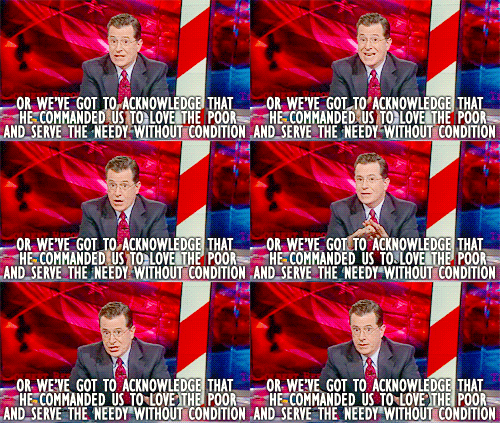
Best thing about Colbert is that when he nails it, he nails it.
I feel like Colbert is one of the best examples of religious you can ever get. He’s Catholic. He’s one of 11 kids. He teaches SUNDAY SCHOOL. And it never comes off like he’s judging you because you don’t follow his exact path.
I’m an atheist, and I feel like Colbert gets me in a lot of ways. It means a lot.
'As he himself said, he had long been “happy to grasp the hand of misfortune, dissipation, riotous living and violence,” counting Burton, Richard Harris, Robert Shaw, Francis Bacon, Trevor Howard, Laurence Harvey and Peter Finch among his drinking companions. He lost much of his “Lawrence” earnings in two nights with Omar Sharif at casinos in Beirut and Casablanca.'
Mr. O’Toole’s performance in the epic 1962 film earned him overnight fame and established him as one of his generation’s most charismatic actors.
Does the world need 3,000 more words about Love Actually? Obviously not. Does it need 3,000 more words about anything? And yet, there’s the Internet, just sitting there, waiting to be filled. So with full awareness that I am becoming a living embodiment of this classic cartoon, I plunge once more (and, yes, rest assured, just once more) unto the breach …
When I argued last week that Love Actually was not merely unromantic, but actively anti-romantic, my editors assured me the piece would hit a vein, and it has. But I assumed that responses to it would run somewhere on the order of 10-1, or perhaps 100-1, against my thesis. To my surprise, it turns out there are a great many non-admirers of the film out there, perhaps even an until-now silent majority. Which is tremendously gratifying. I’m fine with the piece being hated by lovers of Love Actually—it’s natural!—but it’s nicer still to see it loved by haters of Love Actually.
That said, on to some critiques of the article, which have for the most part been generous, thoughtful, and even wise. These accomplishments are all the more impressive given that the critiques in question are, inevitably, wrong.
(If it’s not already evident, this is probably not a piece you want to read unless you have a general familiarity with Love Actually and have read some combination of my original piece and the responses to it by Emma Green, Alyssa Rosenberg, and Ben Dreyfuss. Also, be forewarned that this may take a while.)
I think there are two flaws common to many of the defenses of Love Actually I’ve seen in comments, on Twitter, and elsewhere on the web. The first is attempting to defend each subplot on an individual basis. I agree that (with one notable exception) any given storyline is perfectly defensible on its own merits. The problem, rather, is the patterns that emerge when you consider the film as a whole. One subplot about an older man wooing a much-younger subordinate? Fine. But three? And on it goes: not one, but two gags (three, if you count the Colin subplot) about how the only possible way a man could overcome heartbreak is with the assistance of one or more supermodels; two storylines in which women (never men) see their romantic lives shattered by obstacles that ought to be surmountable; and, most important, upwards of half a dozen subplots in which characters go directly from initial physical infatuation to (presumed) happily-ever-afters, without remotely bothering to get to know one another in between. These repeated themes are not coincidental.
The second mistake is trying to defend the Keira Knightley storyline, which is flat-out indefensible. Cut it loose, Love Actually fans! It’s an anchor that can only bring you down with it. (More on this later.)
As for particular responses to the piece, let’s begin where the whole affair originated, in a dispute with my colleague Emma Green. The title of her excellent reply is “I Will Not Be Ashamed of Loving Love Actually.” Nor should she be! Who among us has not at one time or another fallen for the wrong person (or movie)? The heart wants what it wants…
Green cunningly enlists C.S. Lewis to her cause (quite literally over his dead body), using his book The Four Loves to make the case that Love Actually is not merely a film about romance, but about the varied forms of love: eros, yes, but affection and friendship as well. (She rightly notes that the fourth love, charity, really doesn’t enter into it at all.)
This is, of course, very much the way the film pitches itself. “Love is everywhere,” explains Hugh Grant’s opening voiceover. “Fathers and sons, mothers and daughters, husbands and wives, boyfriends, girlfriends, old friends.” Whether or not you find this monologue as painful as I do (I can’t even bring myself to quote the line from which the movie’s title is pilfered), it’s a wildly inaccurate advertisement for the film that follows. Just look at the scoreboard. Fathers and sons: one subplot. Mothers and daughters: a tiny fraction of a subplot (first lobster!). Husbands and wives: one subplot. Old friends: one subplot. Boyfriends/girlfriends (or would-be boyfriends/girlfriends): depending on your count, anywhere from four to eight subplots, constituting a substantial majority of the movie’s running time. It’s true that if you check out deleted scenes from the film, you’ll find that some other non-romantic bits were left on the cutting room floor. But you go to war with the movie you have, not the movie Hugh Grant pretends you have. (The movie’s tagline—“The Ultimate Romantic Comedy”—is more honest.)
Likewise, I can’t help but think Green is straining a bit when she squeezes the movie’s storylines into her own Lewis-inspired categories of affection, friendship, and eros. I’ll happily grant that the Neeson/Brodie-Sangster relationship falls under the rubric of “affection,” and that placing the Rickman/Thompson marriage in there as well (to its detriment) is a clever and entirely reasonable choice.
Putting Linney’s subplot in the category, however, is a rather trickier proposition. I’ve seen a number of folks argue that her storyline is not really about her tragic inability to have a relationship with the co-worker she adores, but rather about her love for her institutionalized brother. And obviously it is to some degree about both. But again, if you look at what writer/director Richard Curtis bothered to put on screen, it’s a whole lot of romantic frustration and less than five minutes of Linney interacting with her brother in any way, phone calls included. Yes, for Linney affection has “displaced” eros. But the movie’s overwhelming emphasis is on the latter, not the former.
On to “friendship,” where Green places the Nighy/Fisher storyline (correctly) and the Knightley/Lincoln storyline (insanely). Let’s be clear: Curtis’s film has no interest whatsoever in the friendship between Lincoln and Ejiofor except insofar as it precludes any romantic opportunity the former might otherwise have with Knightley. And if being madly, intolerably in love with someone you know you can never have—as Lincoln is with Knightley—doesn’t qualify as “eros,” then I’m not sure what could.
So rather than three “affection” subplots and two “friendship” ones, I think we’re looking at something closer to two and one, respectively, stacked up against six “eros” subplots. And that’s without counting eros-related sub-subplots such as Brodie-Sangster’s infatuation and Rickman’s indiscretion, which are just as important for foils/motivations as the bit about Linney’s love for her brother.
I half-agree with many of Green’s other observations (yes, “muddling through” marital problems seems a more plausible model than “overcoming an obstacle”—so show us the muddling!), and I fully agree with others, including the importance of grand gestures. I’ll have more to say about that, too, but in the interest of completing this response before it hits its December 25 expiration date, let me press on.
Within hours of the Love Actually piece going up, my friend Alyssa Rosenberg offered a sharp and decidedly idiosyncratic take on the film, which she enjoys neither as a holiday movie nor as a romantic comedy, but rather as a tragedy. Given this disposition, she unsurprisingly focuses on the Thompson and Linney characters and the degree to which they are the authors, or at least coauthors, of their own unhappy fates.
I found Rosenberg particularly compelling on the subject of Thompson, and nowhere more than in her reading of the elusive final scene between Thompson and Rickman at the airport:
But that isn’t all we really see in that exchange. We actually get Karen in the kind of splashy earrings she wore to the Christmas party, with sharper styling to her hair and brighter color in her clothing. She’s experimenting with her identity. And Harry’s tentative precisely because, after half-listening to his wife, he’s realized that as Karen tries to figure out who she is and what she likes, there may not be a place for him.
I’m not sure this is the only plausible reading of the scene, but it is a thoughtful and observant one. (I confess that I had not noticed Thompson’s styling changes.) The only place I genuinely disagree with Rosenberg is when it comes to her take on—of course—the Knightley subplot, which I again promise to get to shortly.
The final piece to which I want to reply is by Ben Dreyfuss of Mother Jones. His rebuttal is witty, lengthy, and laden with GIFs—which are, I hope we can all agree, the last refuge of a scoundrel. Dreyfuss makes several points that merit response before we even get to the core of his argument.
First, he suggests that the characters in Love Actually don’t fall in love out of physical attraction, but rather for a host of crazy, madcap reasons. He suggests, for instance, that Brodie-Sangster falls for his crush at school due to the “spooky” coincidence of her having the same name as his dead mother. I suppose that’s possible, but I think a more plausible explanation is the one offered by Brodie-Sangster that Dreyfuss himself cites two sentences earlier: “She's the coolest girl in school and everyone worships her because she's heaven.”
Similarly, although he acknowledges that Grant had an immediate attraction to McCutcheon, Dreyfuss suggests that the real reason he falls for her is that “David [i.e., Grant] stands up for Great Britain in front of all the world and is met with adoring press from his constituents. This is a political triumph that will largely define his career and he will always associate it with Natalie.” I think it’s pretty self-evident that the causality is backwards here: Grant doesn’t fall for McCutcheon because he’s stood up to America; he stands up to America because he’s fallen for McCutcheon. (Whatever one’s thoughts on romance, this is clearly no way to conduct foreign policy.)
Dreyfuss also quibbles with my suggestion that the film suggests the principal hurdle to romance is mustering the nerve to say “I love you.” No one, he notes, actually utters those words in the film apart from Firth, who says them to the girlfriend who’s cheating on him at the opening of the film. The good gestures of affection in the film, he argues, come closer to “I have romantic feelings for you” than to “I love you.” Really? Sprinting through Heathrow security post-9/11 is only a gesture of moderate romantic interest? A marriage proposal doesn’t say “I love you”? Standing on a doorstep with cue cards that read “My wasted heart will love you” doesn’t say, you know, what it says?
Finally, Dreyfuss argues that characters do indeed overcome obstacles in order to be together: Firth learns Portuguese, Moniz learns English, etc. I would add, in a related vein, that Brodie-Sangster learns to play the drums. But that’s not what I meant when I argued that the film never shows any of its (many) romantic protagonists overcoming obstacles to their affection. My point, rather, was that despite its extensive running time, the film never shows its lovers working through any issue of contention between them. Firth learns Portuguese alone, ditto Moniz, ditto Brodie-Sangster. These, too, are grand gestures of love—I love you so much I learned a foreign language!—but they are not examples of two people negotiating their way through a relationship.
Dreyfuss recognizes this, I think, which brings us to the nub of his argument. He writes:
Orr goes on to point out that, as opposed to every romantic comedy ever, Love Actually dedicates no real time to showing the couples getting to know each other. This is undeniably true—and it is an asset!... Love Actually is about, largely, the period before people get to know each other.
We agree! The problem is that two paragraphs later, he forgets that we agree:
So, you meet someone and feel something instantly and then you imagine a thousand conversations in your mind and you become enamored with a fantasy and you know it's a fantasy but as you get to know the person really every new thing you learn seems to reaffirm the fantasy… [bold mine]
That sounds like a good movie. Just not, as Dreyfuss himself noted, like Love Actually.
In any case, after a lively and heartfelt disquisition on the value (and, for most folks, difficulty) of making grand romantic gestures—again, I completely agree!—Dreyfuss, too, steps into the mud puddle that is the Keira Knightley storyline. Yes, it’s finally time to go there.
Of the subplot, Drefuss writes, “It may be romantic and evil, but it’s still romantic!” I’ve been puzzling over this statement, and I’m still not convinced that I can envision any scenario that I would consider to be both romantic and evil. Which is, I think the core of the problem with the subplot: It’s trying to be two things that are fundamentally incompatible.
Once Knightley becomes aware of Lincoln’s infatuation, Lincoln has a few options. He could a) do nothing and just wait for it all to blow over; b) try to defuse the situation by saying, in effect, “don’t worry about this, I’ll be fine”; or c) declare his love with at least some hope of reciprocation, and without caring what terrible repercussions might befall his relationship with his best friend or said best friend’s marriage.
Obviously, he doesn’t choose option a). But does he choose b) or does he choose c)? The answer, I think, is both—and thus neither.
If Lincoln genuinely wanted to defuse the situation, here are some of the things he could have written on his cue cards: “I’m really sorry to have put you in such an awkward position”; “I would never do anything to hurt my friendship or your marriage”; “I’ll eventually get over this and move on”; “I look forward to the day when we’re best chums and can look back on this and laugh.”
He does not, of course, write anything remotely like this on his cue cards.
Instead, after enlisting Knightley to deceive her husband about his presence(!), he writes, “To me you are perfect, and my wasted heart will love you until you look like [a desiccated mummy].”
Yes, he throws in a caveat about making this declaration “without hope or agenda,” but that’s lawyer-speak at its lowest. Lincoln is not an imbecile: He knows perfectly well that anyone without hope or agenda would convey something along the lines I suggested above. Instead, he lobs a toxic grenade of “don’t tell your husband (my theoretical best friend), but I will love you desperately in a not-remotely-platonic way for the rest of your life.”
And, yes, at the end of the sequence, Lincoln does mutter to himself, “Enough, enough now,” as defenders of the scene (and the character) are quick to point out. But the idea that his spontaneous comment to himself—which comes in the afterglow of a miraculously implausible kiss from Knightley—somehow carries not merely as much but more weight than the premeditated announcement of eternal love that he shared with Knightley is absurd. Anyone who loves so rashly, and with so little concern for the wellbeing of others, isn’t just going to shrug and get over it.
What could make this worse? I’m so glad you asked. The movie makes exquisitely clear that Lincoln is captivated by Knightley’s beauty (the wedding video) and that the two have barely ever spoken. His love is not that of a college pal who only just realized that his longtime confidante may in fact have been his soul mate. He is, essentially, a stalker, except that he’s well groomed and not lurking in the shrubbery.
No normal, halfway decent person would behave as Lincoln does, and no normal, halfway decent person would receive such a gesture with giggles and then reward the gesturer with a kiss—even a chaste one—while her new husband waited upstairs, oblivious. Indeed, it’s interesting to contrast this subplot (wife lies to husband, kisses his explicitly amorous best friend), which the film presents as completely adorable, with the Rickman-Thompson one (man lies to wife, buys necklace for his explicitly amorous assistant), which the film presents as a life-altering and possibly unforgivable betrayal.
This is where defenders of the film will again say, “see, Love Actually presents a nuanced exploration of love in all its messy complications.” Bollocks. What’s happening in this scene is instead a textbook case of audience manipulation: how a creepy and appalling scene can be presented as “romantic” when accompanied by the proper soundtrack and sheepish grins all around—especially if one is Keira Knightley’s. Let’s hope that Richard Curtis never starts making political ads.
But let me clarify that while I find Lincoln’s “grand gesture” abominable, I am by no stretch opposed to grand gestures in general, as some respondents seem to believe. I am myself a hopeless romantic, and often prone to grand gestures—or attempted grand gestures—as my wife would readily attest, possibly with some eye-rolling involved. My complaint with Love Actually is that it’s nothing but grand gestures, deracinated from any meaningful emotional context.
I was discussing this characteristic with my colleague Spencer Kornhaber, when he offered up what I consider a spot-on metaphor. Back in April, in a speech on the state of cinema at the San Francisco International Film Festival, Steven Soderbergh described looking over the shoulder of a fellow passenger on his plane to see what he was watching on his handheld:
And I begin to realize what he’s done is he’s loaded in half a dozen action sort of extravaganzas and he’s watching each of the action sequences – he’s skipping over all the dialogue and the narrative. This guy’s flight is going to be five and a half hours of just mayhem porn.
That captures pretty well why I so dislike Love Actually: Set aside the Linney and Rickman-Thompson storylines (which I find problematic in other ways), and it’s almost two hours of rom-com porn, of grand gestures with little buildup and no follow through, of money shots. And I can’t help but wonder whether this is not, in part, why the movie seems to be more popular than ever.
Last week, North Korea announced the trial and execution of Kim Jong Un's "traitorous" uncle Jang Sung Thaek—by way of a startling press release, filled with bizarre insults and florid descriptions of Jang's misdeeds.
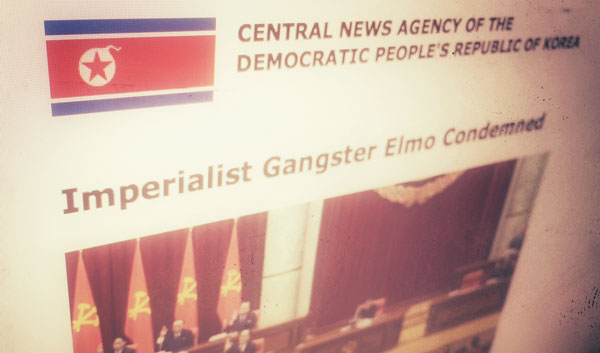
But did you know that on the same day, the People's Republic also condemned Elmo to death?
Just kidding, kids! Welcome to the North Korea Press Release Generator, which produces random denunciations based entirely upon last week's official announcement and various other statements put out over the years by the DPRK's official journalistic organs. You can even denounce your friends, and share news of their imminent execution on Twitter and Facebook! Refresh the page for a fresh official condemnation.
via overbey ("I will always remember his role in 2008’s scintillating _Thomas Kinkade’s Christmas Cottage_. _Lawrence of Arabia_ was pretty good too.")
Acclaimed actor Peter O'Toole, who starred in the classic film Lawrence of Arabia, dies aged 81.
The question is being raised once again in recent issues of Nature, the British science journal. It was proposed in one letter to the journal that perhaps the wine the Greeks drank was indeed blue.
Robert H. Wright and Robert E. D. Cattley, of Vancouver, British Columbia, noted in their letter that the ancient Greeks seldom took their wine neat. They often diluted it with as much as six or eight parts of water. Since the geology of the Peloponnesus, the site of some of the action in the epics, includes large formations of marble and limestone, the authors said, the ground water must have been alkaline, perhaps sufficiently so ''to change the color of the wine from red to blue.''
Dr. Wright is a research chemist. Dr. Cattley is a retired classics professor from the University of New Brunswick.
Other attempts to explain Homer's wine- dark sea have included such ''solutions'' as the absence of a word for ''blue'' in the ancient Greek language, congenital color- blindness in the particular Greeks of the Homeric tales and an outbreak of red-colored marine algae.
For his recent solo show earlier this year at Pippy Houldsworth, Japanese artist Yuken Teruya (previously) transformed the waste products of consumerism—luxury gift bags—into cut paper trees that rise like fragile silhouettes from inside each bag. Via Pippy Houldsworth:
Discussing how Teruya’s bags are made, Megan Ratner explains that he ‘begins with photographs of trees, which he transfers to his computer, superimposing this image on the logo-ed side of a shopping bag. Using the original shape as a guide, he deftly cuts a two-part silhouette – lower branches/trunk and leafy top – folding and twisting the two halves into the interior of the bag, rooting the trunk with a single drop of glue.’
The works are part of Teruya’s ongoing Notice – Forest series and seems like almost a miracle that each piece comes together as it does, somewhat similar to the cut paper works by Peter Callesen. You can see much more over on Pippy Houldsworth. (via My Amp Goes to 11)
Local Accession Number: 06_11_004629 Title: Woman with revealing neckline Genre: Stereographs; Photomechanical prints Date issued: 1850-1920 (approximate) Physical description: 1 photomechanical print on stereo card : halftone, color ; 9 x 18 cm. General notes: Title supplied by cataloger. Date notes: Date supplied by cataloger. Subjects: Glamour photographs; Clothing & dress Collection: Harper Stereograph Collection Location: Boston Public Library, Print Department Shelf locator: Two women set - 21 cards Rights: Rights status not evaluated
Kim Kyong-hui was named on a leadership list in North Korea’s state-run media, signaling she may have avoided the fate of her husband, who was executed last week.
The Minnesota Orchestral Association gives a dumbfounding report of its financial situation. This increasingly Borgesian entity managed to spend $13 million in its performance-free year, including $885,000 on "negotiations and negotations related" — one assumes that this sum went to the firm of Felhaber, Larson, Fenlon and Vogt, experts in union lockouts — and $616,000 on "advertising and promotion." Jon Campbell, the board chair, reaches a brain-teasing conclusion: "The fact that the organization’s deficit is substantially smaller in a year without any performances indicates the degree to which this business model is out of alignment." Meanwhile, ten state legislators have called for the resignations of Campbell, his fellow board member Richard Davis, and Michael Henson, the CEO. Save Our Symphony's report on the orchestra's collapse reaches this ironclad conclusion: "MOA leadership has no remaining credibility." The Minnesota Orchestra Musicians, running on a budget comparable to the MOA's "advertising and promotion" expenditures, present their next concert on Saturday. Their spring season will include appearances by Osmo Vänskä, Joshua Bell, Itzhak Perlman, and Hugh Wolff — a lineup that suggests the isolation of the MOA from the remainder of the musical world.
More: Robert Levine is also amazed at some of the figures and statements in the MOA's report. He writes: "The story of how the board of the Minnesota Orchestral Association allowed three men to drive one of the great American orchestral institutions into a deep, deep ditch will be studied—with fascination and horror—for as long as there is an American nonprofit sector."
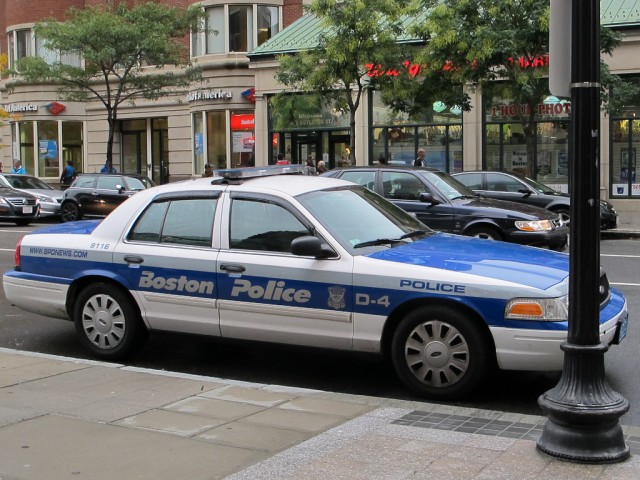
The Boston Police Department (BPD) has indefinitely halted its use of license plate readers (LPR) following an investigation into their use published on Saturday by the investigative journalism organization MuckRock and the Boston Globe.
David Estrada, a BPD spokesperson, confirmed to Ars that the department had stopped using its LPRs for now and asked that further questions be submitted in writing, which Ars has done.
This suspension likely makes Boston one of the largest cities in America to stop using this sort of technology, which for years has been in wide use by thousands of law enforcement agencies nationwide. At present, BPD uses 14 individual LPRs, which enables them to scan “as many as 4 million vehicles a year,” the Globe noted.
In her photo series simply titled, “Mum“, award-winning photographer Nancy Newberry has captured the revered Texas tradition of “Homecoming Mums”, the decoration of silk chrysanthemum flowers with ribbons, trinkets and charms to create heavily decorated corsages for high school homecoming activities.
Artificial, shiny and virtually unknown outside of Texas, the Homecoming Mum is an elaborate corsage exchanged between friends and lovers. They are ritually worn and subsequently immortalized, tacked to bedroom walls as trophies. At a time when many American high schoolers seem purposefully disengaged from the world around them, the Mum constitutes both a unique act of cultural immersion and a specific brand of folk art.
Everybody in college hates papers. Students hate writing them so much that they buy, borrow, or steal them instead. Plagiarism is now so commonplace that if we flunked every kid who did it, we’d have a worse attrition rate than a MOOC. And on those rare occasions undergrads do deign to compose their own essays, said exegetic masterpieces usually take them all of half an hour at 4 a.m. to write, and consist accordingly of “arguments” that are at best tangentially related to the coursework, font-manipulated to meet the minimum required page-count. Oh, “attitudes about cultures have changed over time”? I’m so glad you let me know.
This morning, TIME announced that this year's Prom Queen Of News is none other than Pope Francis. The pontiff is the perfect choice for 2013's Person of the Year — he changed the Church from a mouthpiece for intolerance into one of love and acceptance. Except not really for women. He's still pretty meh about women. But you can't win 'em all, right?
The Hall of Famer is continuing his exploits in the Democratic People's Republic of Korea.
Dennis Rodman will be traveling to North Korea next week to train the North Korean basketball team, along with a group of Americans, according to the Associated Press.
Rodman has previously visited North Korea and met Kim Jong-Un, the country's leader, in a high-profile trip captured in a documentary on HBO. According to the AP, "Rodman considers Kim a close friend," and has planned the trip for a long time, and it won't be canceled despite Kim's executing his uncle, Jang Song Thaek. Jang, according to the AP, was the No. 2 ranking person in the government.
Rodman said he's bringing former pro basketball players on the trip, but declined to say whom. From the AP report:
"Yes, I'm going to North Korea to train the basketball team," he told The Associated Press by phone. "I'm going to bring American players over there. Yes I am. I'm going to be the most famous person in the world when you see American people holding hands and hoping the doors can be opened. If they can. If they can. If they can. I'm going. I'm going back for his birthday. Special."
Kim's birthday is in January, and he's hoping to organize an exhibition match.